


Abstract
Deep space missions face challenges in guidance, navigation, and control due to subtle non-gravitational forces, such as the Pioneer Anomaly—an unexplained acceleration toward the Sun observed in Pioneer 10 and 11. The most plausible cause is thermal recoil from anisotropic infrared emission by onboard systems, RTGs, and radiators. This study models thermal acceleration based on spacecraft geometry and heat-source placement, analyzing two spacecraft configurations for outer solar system missions. By parametric analysis, we assess the influence of geometric, thermo-optical properties, and emitted power, and we propose design recommendations—symmetrical layouts, optimized materials, and heat management—to mitigate or exploit thermal forces for improved navigation passive control.
1. Introduction
Deep space exploration has revealed unexpected challenges in the guidance, navigation and control of interplanetary probes and beyond. One of the most intriguing phenomena observed in this context is the so-called Pioneer Anomaly, detected in both the trajectories of Pioneer 10 and 11, which experienced an unmodeled acceleration directed towards the Sun [1]. Among the various hypotheses proposed to explain this behavior, the most plausible candidate is a thermal recoil force caused by anisotropic emission of thermal radiation from the spacecraft [2,3].
The anisotropic emission of infrared radiation—from electronic systems, radioisotope thermoelectric generators (RTGs), radiators, and other subsystems—can induce small, continuous forces that, over long mission durations, lead to measurable deviations in trajectory [4]. Though subtle, this acceleration becomes appreciable in missions to the outer solar system or even in far future interstellar trajectories, where small navigation errors lead to large deviations in the spacecraft’s position [5].
In this study, we analyze this thermal acceleration effect by focusing on the spacecraft’s geometric configuration and the relative placement of heat-dissipating components. Consequently, various spacecraft designed or proposed for missions to the outer solar system and beyond the heliopause are selected and conceptually modeled under the mission scenarios of interest [4]. Moreover, to reproduce the physical causes adequately, we recover their thermal behavior. Based on these preliminary results, we provide a set of recommendations aimed at minimizing or controlling this effect. These include symmetry in the placement of heat sources, strategic positioning of heat-dissipating subsystems, or the use of materials with appropriate radiative properties depending on location [6]. Such measures can not only mitigate unwanted accelerations but also potentially harness thermal recoil as a means of passive attitude control or auxiliary propulsion for deep space missions [6]. This work contributes to a more accurate understanding of non-gravitational forces acting on spacecraft and supports improved navigation and planning for future outer solar system and interstellar missions.
This paper is organized as follows: Section 1 introduces the motivation and background of the study, highlighting the relevance of thermal recoil forces in deep space missions. Section 2 presents the numerical modeling approach, including the radiative and thermal models used to estimate the anisotropic emission effects. Section 3 summarizes preliminary results, highlighting the influence of spacecraft geometry and thermal properties on recoil forces. Finally, Section 4 presents the main conclusions and design recommendations to mitigate or exploit these effects in deep space missions.
2. Numerical Modeling
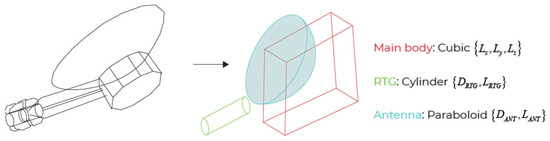
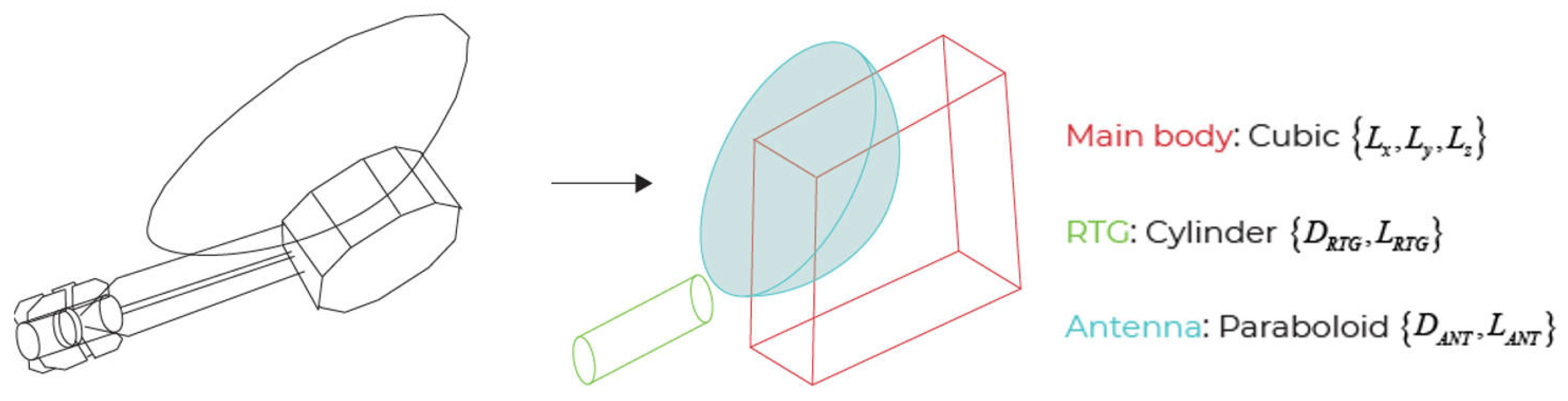
The objective of this work is to estimate the order of magnitude of the thermal acceleration affecting deep space-like probes; therefore, detailed geometrical modeling and power dissipation accurate characteristics are beyond the scope of this study. A simplified geometric configuration was adopted (see Figure 1), consisting of the main body, the RTG, and the antenna (HGA). With this geometry, a numerical model was developed to simulate the coupled radiative and thermal behavior of the system.
Figure 1.
Geometrical simplification of a common configuration of deep space-like probes.
2.1. Radiative Model
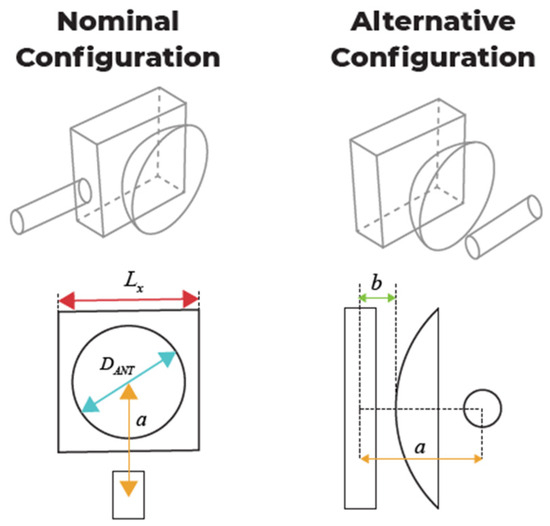
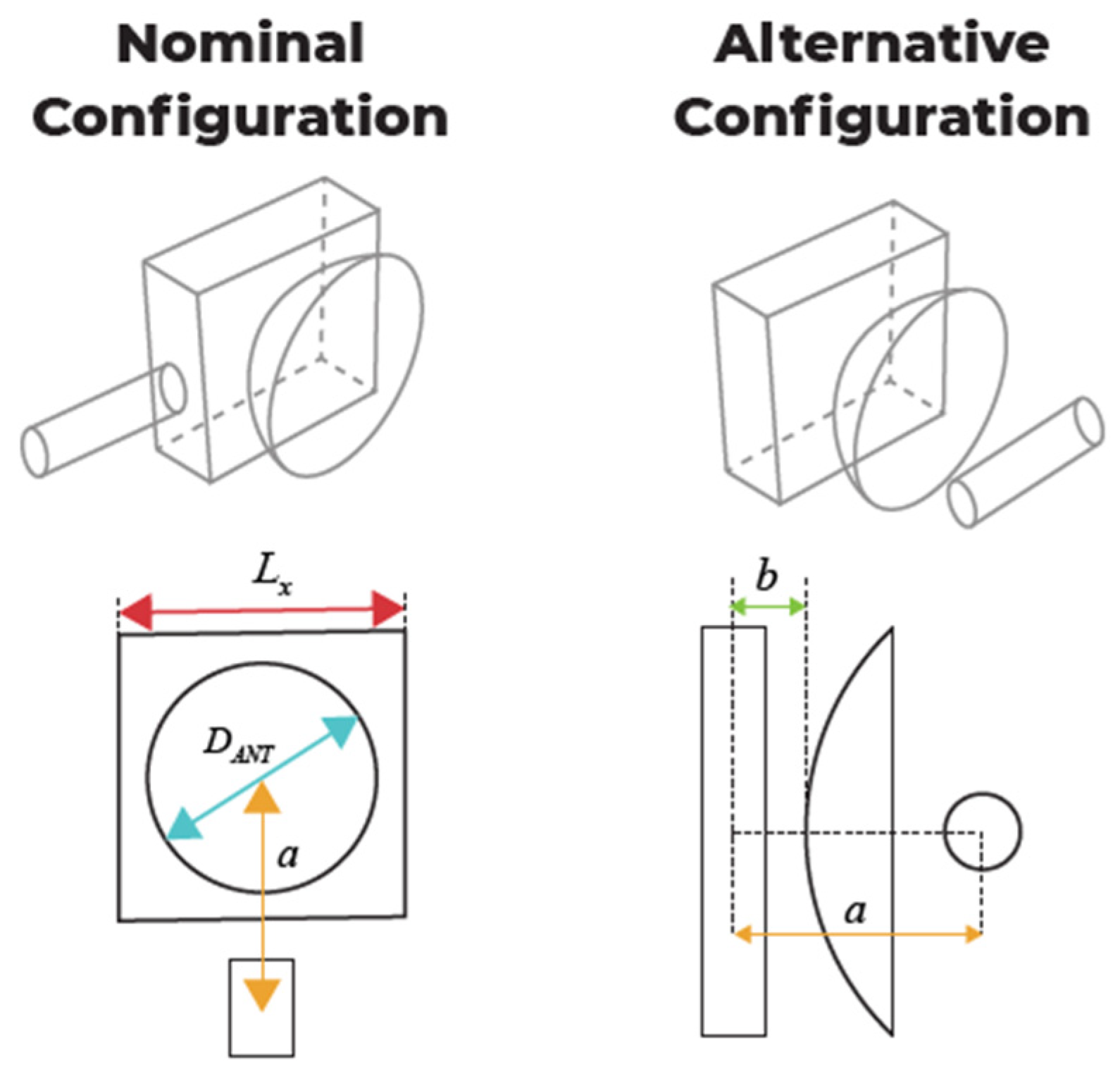
The radiative problem considers Lambertian sources emitting omnidirectionally from both the RTG and the main body, with surface nodes accounting for absorption (abs), diffusive reflection (rd), and specular reflection (rs). Two simplified spacecraft configurations were developed to assess the effects of thermal radiation on spacecraft dynamics, as shown in Figure 2. As mentioned above, the first configuration (nominal) represents a typical deep-space vehicle layout, featuring a Radioisotope Thermoelectric Generator mounted laterally with respect to the main body and the high-gain antenna. The second configuration (alternative), by contrast, places the RTG in a frontal position, mounted between HGA and the Sun. These two geometrical arrangements allow for the evaluation of the influence of the RTG placement on the resulting thermal recoil acceleration and the overall spacecraft thermal balance.
Figure 2.
Scheme of nominal and alternative configurations.
To study the dependence of the spacecraft geometrical dimensions, a set of characteristic parameters has been defined. The main body is modeled as a parallelepiped with dimensions (Lx, Ly, Lz). The RTG is represented as a cylindrical element characterized by its diameter DRTG and length LRTG. Finally, the high-gain antenna is modeled as a paraboloidal surface with a diameter DANT and depth LANT. The distance between the center of the main body and the RTG center of mass is the parameter “a” in both configurations. These parameters are systematically varied to analyze their respective contributions to the resulting thermal radiation forces and the induced spacecraft acceleration.
Two code blocks have been developed: (1) in Python 3.12 for calculating the forces and the spacecraft acceleration due to thermal radiation, and (2) in Matlab R2025a for calculating the temperatures of external surfaces and inner nodes, intended to distribute the inner heat power dissipation. The total force is breakdown as follows: for absorbed radiation, and for diffusive and specular reflective radiation. These forces originated from Lambertian sources, which create the radiation field . Once the sources’ radiation reaches reflective surfaces, the subsequent radiation field after reflection is for diffusive and for specular radiation. The radiative interaction between the different spacecraft surfaces is modeled by considering the fundamental balance between absorptivity, specular reflectivity, and diffuse reflectivity, which satisfy the following conservation relation:
where denotes the absorptivity, the specular reflectivity, and the diffuse reflectivity of the surface.
The radiation pressure exerted by an incident flux is expressed as the ratio between the radiation intensity and the speed of light :
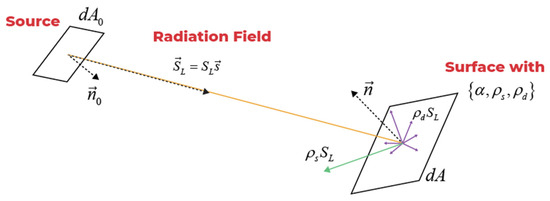
Therefore, we mathematically model the propagation path of the radiation from its sources (see Figure 3). The incident Lambertian radiation field emitted by a surface element located at and impinging on an observation point is modeled as follows:
where is the total emitted power, and is the surface normal at the emitting point.
Figure 3.
Scheme of radiation flux interaction between a source and a reflecting surface.
The radiation reflected by a surface of normal at position contributes to the total flux through both diffuse and specular components. The diffuse reflection field at is expressed as
and the specular reflection field at is given by
where controls the sharpness of the specular reflection lobe and represents the direction of the reflected ray.
The total force acting on a given surface element due to thermal radiation is obtained as the sum of the absorbed, diffusely reflected, and specularly reflected contributions:
According to [6], each term can be expressed as follows for each surface element:
These expressions provide the local radiation pressure forces acting on each illuminated surface, which can then be integrated over the entire spacecraft geometry to obtain the net thermal recoil force and corresponding acceleration.
2.2. Thermal Model
Once the radiative problem is solved, in obtaining the corresponding optical balances and View Factors for each surface involved, the thermal problem can be closed for each of the studied configurations.
We model the heat exchange between all the described bodies in Figure 2, in both configurations by means of a Lumped Parameter Method. In this sense, all the volumes are concentrated into an iso-thermal node, whose equation balances the heat fluxes, reaching and leaving them.
For the studied test case, we only define two thermal mechanisms, defined by their conductances: the conduction between connected bodies and the radiation fluxes, obtained as described in the previous section. Hence, we model Antenna, RTG and Spacecraft (S/C) by their bulk properties and their surfaces, exchanging temperature following the computed View Factors between each other and towards a space node at 3.15 K. The thermo-optical and thermo-physical properties of each of the bodies and surfaces are obtained from the literature [1,2] as well as the power being dissipated at the RTG and the inner side of the S/C.
Therefore, the iso-thermal nodes are defined by means of their bulk and surface properties and each of the heat fluxes that connect them together (and with the space node). This produces the usual non-linear matrix equation for the temperature of each of the nodes: a linear component for the conduction exchange and the non-linear term (in power to the fourth) for the radiation exchange. This non-linear equation is solved by means of the Levenberg–Marquardt algorithm implemented in the fsolve function in Matlab [7], using as an initial guess the temperatures reported in [1,2]. A tolerance of 10−6 is set for the iteration step, obtaining a relative, mean squared error on the iterations of 10−10 relative to the initial guess temperature of the S/C’s main body (200 K).
Finally, these temperatures are fed back to the radiation problem in an iterative process that aims for convergence in the obtained forces. For the two configurations modeled, this overall thermal–radiative convergence is achieved on the forces after less than 10 iterations. We obtain a relative error in the computed force up to 10−6 (with respect to the initially computed force) after five iterations in the Nominal Configuration and after seven in the Alternative Configuration.
3. Results
The results presented in this paper correspond to a set of preliminary analyses aimed at characterizing the thermal acceleration effects induced in deep space probes. These effects, primarily driven by anisotropic thermal radiation emitted by the spacecraft and its subsystems, can introduce small but measurable perturbations in the spacecraft’s trajectory. Understanding their magnitude and dependence on the probe’s geometry is essential for improving orbit determination accuracy and refining dynamical models used in deep space navigation.
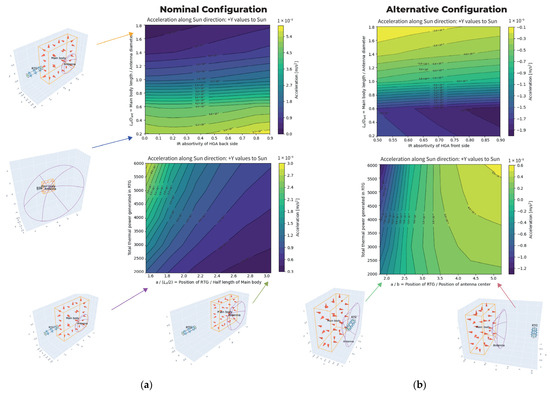
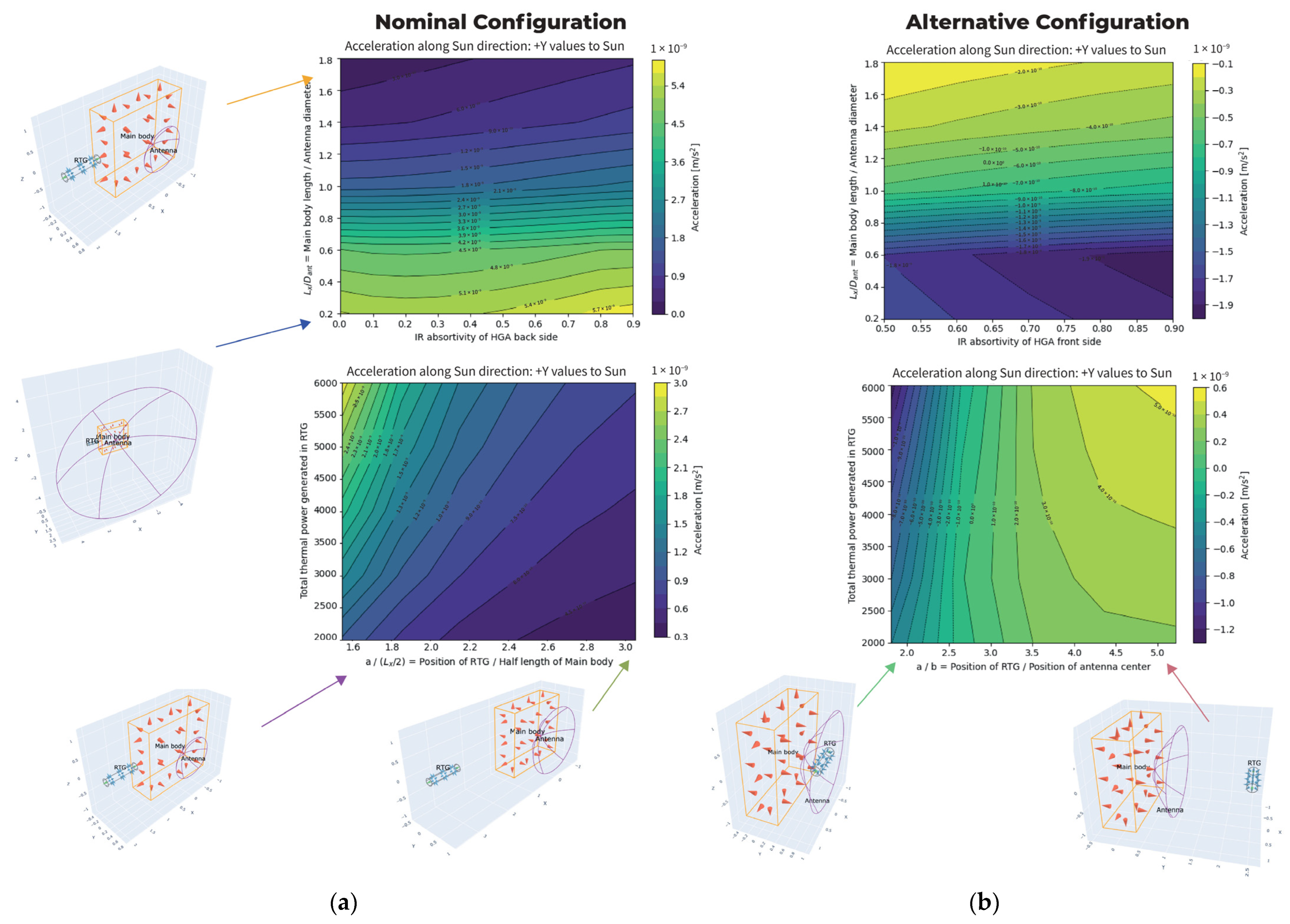
Figure 4 summarizes the main geometrical and thermo-optical parameters considered in this study. Specifically, we examine the following:
Figure 4.
Maps of thermal acceleration in case of the following: (a) nominal configuration with the influence of the ratio main body length and antenna diameter vs. IR absortivity of HGA back side (top), and the influence of RTG thermal power vs. the ratio of RTG’s position and half-length of main body (bottom); (b) alternative configuration with the influence of the ratio main body length and antenna diameter vs. IR absortivity of HGA front side (top), and the influence of RTG thermal power vs. the ratio of RTG’s position and HGA center’s position (bottom). Arrows indicate the correspondence of the periferic draws of geometric configurations with the extreme values of variables within horizontal and vertical axes.
- Nominal geometrical configuration, based on the layouts adopted for missions such as Pioneer and New Horizons, which are used as reference cases for comparison.
- Alternative configuration, in which the Radioisotope Thermoelectric Generator is positioned directly in front of the High-Gain Antenna, allowing us to assess the sensitivity of thermal forces to a major structural rearrangement that is expected to redirect the anisotropic thermal radiation in such a way that it pushes the spacecraft forward rather than producing a decelerating effect.
- Aspect ratio between the spacecraft main body length and the antenna diameter for both configurations, a key parameter that influences the fields of view between the three spacecraft’s elements.
- Total thermal power generated by the RTG in each configuration, which sets the scale of the resulting anisotropic momentum flux.
- Infrared absorptivity of the back side of the HGA in the nominal configuration, crucial for estimating the fraction of RTG-emitted heat intercepted and re-emitted by the antenna.
- Normalized RTG position relative to half of the spacecraft body length in the nominal configuration, used to quantify its contribution to asymmetric radiation patterns.
- Infrared absorptivity of the front side of the HGA in the alternative configuration, enabling comparison with the nominal case and evaluation of sense differences along the Sun’s direction.
- Normalized RTG position with respect to the HGA center in the alternative configuration, introduced to capture changes in thermal force when the RTG is relocated.
These parameters collectively define the thermal environment and radiation geometry of the probe. Their variation forms the basis for the subsequent computation of thermal recoil forces and the resulting accelerations. The outcomes of this preliminary assessment provide a foundation for more detailed modeling.
4. Conclusions
The analysis confirms that asymmetric thermal radiation from spacecraft surfaces produces a net force on the center of mass, becoming a dominant source of non-gravitational acceleration at large heliocentric distances. This thermal force, consistent with the acceleration toward the Sun observed in Pioneer 10 and 11, depends strongly on spacecraft geometry and surface properties. Controlling the position and orientation of the main radiative sources can thus be an effective strategy to mitigate or even exploit this perturbation. The parametric study highlights two key factors: (1) the relative size of the spacecraft body and antenna, where smaller antennas reduce recoil in the nominal configuration, while larger ones may enhance acceleration outward from the Sun in the alternative configuration; and (2) the thermo-optical characteristics of the antenna, whose emissivity distribution can slightly modify the magnitude and direction of the recoil, particularly for low body-to-antenna dimensional ratios.
Additionally, lateral accelerations induced by RTG emissions, which are of the same order of magnitude than along-Sun acceleration for nominal cases, can produce significant long-term trajectory deviations. At Kuiper Belt distances, these perturbations may reach 0.017 AU after 80 years—comparable to the separation between typical Kuiper Belt objects—underscoring the importance of accurately modeling thermal forces in mission design. Overall, these results emphasize the need for thermal symmetric designs and strategic heat management to enhance the precision, stability, and predictability of deep space navigation.
Author Contributions
Conceptualization, methodology, software, F.N.-M. and P.S.-L.; validation, all authors; writing—original draft preparation, F.N.-M. and P.S.-L.; writing—review and editing, E.V.-N. and M.M.C.; project administration, F.N.-M. All authors have read and agreed to the published version of the manuscript.
Funding
This research received no external funding.
Data Availability Statement
The data presented in this study are available in the article. Further inquiries can be directed to the corresponding author.
Conflicts of Interest
The authors declare no conflicts of interest.
Abbreviations
The following abbreviations are used in this manuscript:
| AU | Astronomical Units |
| HGA | High Gain Antenna |
| IR | Infrared |
| RTG | Radioisotope Thermo-electric Generator |
References
- Modenini, D.; Tortora, P. Pioneer 10 and 11 orbit determination analysis shows no discrepancy with Newton–Einstein laws of gravity. Phys. Rev. D 2014, 90, 022004. [Google Scholar] [CrossRef] [Scilit]
- Bertolami, O.; Francisco, F.; Páramos, J.; Gil, P.J.S. The Contribution of Thermal Effects to the Acceleration of the Deep-Space Pioneer Spacecraft. In Proceedings of the 1st IAA Conference on Dynamics and Control of Space Systems, Porto, Portugal, 19–21 March 2012. [Google Scholar] [CrossRef] [Scilit]
- Rievers, B.; Lämmerzahl, C.; List, M.; Bremer, S.; Dittus, H. New powerful thermal modelling for high-precision gravity missions with application to Pioneer 10/11. New J. Phys. 2009, 11, 113032. [Google Scholar] [CrossRef] [Scilit]
- Guerra, A.G.C.; Francisco, F.; Gil, P.J.S.; Bertolami, O. Estimating the thermally induced acceleration of the New Horizons spacecraft. Phys. Rev. D 2017, 95, 124027. [Google Scholar] [CrossRef] [Scilit]
- Nyambuya, G.G. Apsidal precession of the outer solar planetary orbits due to the Pioneer anomaly. New Astron. 2017, 57, 22–29. [Google Scholar] [CrossRef] [Scilit]
- Wie, B. Space Vehicle Dynamics and Control, 2nd ed.; AIAA: Reston, VA, USA, 2008; 966p. [Google Scholar]
- The MathWorks Inc. Optimization Toolbox (R2024b); The MathWorks Inc.: Natick, MA, USA, 2025; Available online: https://www.mathworks.com (accessed on 31 March 2025).
Disclaimer/Publisher’s Note: The statements, opinions and data contained in all publications are solely those of the individual author(s) and contributor(s) and not of MDPI and/or the editor(s). MDPI and/or the editor(s) disclaim responsibility for any injury to people or property resulting from any ideas, methods, instructions or products referred to in the content. |
© 2026 by the authors. Licensee MDPI, Basel, Switzerland. This article is an open access article distributed under the terms and conditions of the Creative Commons Attribution (CC BY) license.