1. Introduction
In Europe, most of the passengers traveling by train use only a small part of the railway network. The rest of the network, which is only used by a very small proportion of customers, is called capillary lines. Although these lines are vital for urban development, conventional rail is not economically viable for such low passenger volumes. Consequently, approximately 2300 km of these lines have been decommissioned in France alone [
1]. While rolling stock is not excessively expensive, maintenance and construction of infrastructure account for the largest portion of the budget of a rail solution. In order to offer a sustainable transportation solution for small towns, a lighter rail infrastructure solution then is needed. This vision lies at the core of a new era in railway solutions, known as light-train systems.
One of the promising ways to lighten the railway infrastructure is to replace the current Train Detection Devices (TDD) and sensors on track, called balises, with GNSS [
2]. These existing sensors are indeed very effective and robust, but need to be installed all along the tracks and thus are very expensive. Hence, the appeal of having only a GNSS receiver onboard instead of many sensors on the railroad. However, this transition is not straightforward since TDDs ensure passenger safety and therefore must comply with strict railway standards. Indeed, safe positioning is part of a function that must reach a Safety Integrity Level (SIL) that only allows for
critical error per hour [
3].
Even if some signaling systems, such as some American Positive Train Control (PTC), already use GNSS for safe positioning [
4], most of these applications are meant for freight applications and are not yet suitable for passenger applications. One of the major issues for their introduction into safety applications is the need to demonstrate the safety of the three GNSS segments (ground, space, and user) for single-point positioning (SPP) using railway norms [
4]. In fact, rail and aerospace communities have independently developed their own certification methods. When GNSS systems are using an “accuracy, availability, continuity, integrity” based certification, train systems are using “Reliability, Availability, Maintainability and Safety” (RAMS) [
3]. Furthermore, ground transportation systems operate in environments that differ significantly from those in aeronautics, with obstructions such as buildings, trees, and other obstacles, and therefore have distinct operational requirements. Using aeronautic safe GNSS positioning engineering for rail is then not that straightforward.
Pseudorange differencing is a relative positioning method that is commonly used as part of precise positioning systems such as Real-Time Kinematic (RTK) because of its ability to cancel out common errors (i.e., errors deriving from space or control segments). Since errors from both the ground and space segments are canceled out, this method allows the user to operate independently of the corrections provided in the navigation data. The ground and space segments no longer need to be certified for railway applications; only the user segment requires certification, thereby reducing the overall certification complexity for rail systems. Furthermore, relative positioning is better suited than absolute positioning for collision avoidance systems. Relative positioning using GNSS can also be employed in modern and more efficient signaling systems, such as virtual coupling [
5]. In virtual coupling, the aim is to leverage relative positioning and relative speed measurements to operate multiple units as if they were a single, physically coupled train, thereby increasing rail efficiency. Pseudorange differencing is particularly well suited for light-train systems operating on capillary single-track lines, where track discrimination is unnecessary due to the absence of parallel tracks, eliminating the need for high-precision absolute positioning.
Performance assessment of pseudorange differencing has been conducted in previous studies in [
6,
7,
8] for completely different applications. However, these studies lack a railway-scale evaluation and do not assess the impact of individual error factors. A simulated performance assessment in a railway-scaled environment has already been carried out in [
9]. The aim of this paper is to evaluate the performance of several pseudorange differencing algorithms on a capillary line using an experimental light-train and real GNSS data.
The paper is structured as follows:
Section 2 describes the various investigated ranging approaches, including ordinary and horizontal pseudorange differencing, as well as a relative speed estimation method. After outlining the experimental setup, experimental results are presented in
Section 3.1. Finally, a conclusion is provided in
Section 4.
2. Problem Formulation
In a previous study [
9], we investigated the potential of pseudorange differencing as a function of baseline length, speed, and multipath using simulations. The results demonstrate that baseline length had a negligible influence on performance outcomes, with the predominant impact of speed being attributable to substantial accelerations. Multipath effects were evident, yet remained constrained when employing the horizontal method outlined in this section.
The objective of this paper is to compare the simulated behavior with real-world experimental results. To better understand the origins of the observed errors, this section presents the mathematical formulation of the algorithms and the corrections applied in the experiment, along with models of the expected sources of error.
2.1. Measurements
According to Kaplan et al. in [
10], the effective accuracy of the pseudorange value, termed the user-equivalent range error (UERE), is influenced by the following factors:
Satellite errors are composed of satellite clock, orbital and relativistic effect errors.
Atmospheric errors are caused by ionospheric and tropospheric effects.
Local effects
such as multipath and shadowing are particularly critical for safe train positioning applications. Their impact on positioning concerns unavailability, but also inaccuracy, which also makes it difficult to guarantee position integrity. In addition, the requirements are defined without operational phases, as in aeronautical requirements, and are therefore to be achieved everywhere and at all times [
11].
Receivers errors are composed of receiver noise (including thermal noise, tracking errors, receiver clock instability, etc.) and resolution.
Finally, represents the non-modeled errors.
Thus, the pseudorange
, measured at a given epoch, is composed of the true range
R and the sum of the UERE
:
The pseudorange rate
can be obtained as a function of the signal wavelength
, the measured Doppler shift
D and the sum of the measurement error rate
:
2.2. Ranging Algorithms
To compare the ranging performance of single and double pseudorange differencing and a more conventional method, the mathematical formulation of pseudorange differencing is presented alongside that of Absolute Position Differencing (APD).
2.2.1. Absolute Position Differencing (APD)
In this study, APD serves as a benchmark against which pseudorange differencing is compared. With APD, each receiver independently computes a single-point positioning (SPP) solution. The relative distance between the two receivers can then be estimated using their absolute position estimates, as given by the following equation [
8]:
With and the position vectors of each receiver and the estimated baseline vector.
Common error cancelation is not straightforward when using APD. A comparative error analysis of APD and pseudorange differencing was presented in [
12].
2.2.2. Single Difference
Ranging can be performed using a single difference. The single difference
between receivers
A et
B is the difference between ranges
and
received by both receivers from a common satellite:
With single differences, only uncorrelated errors (i.e., local
, receiver
and non-modeled
) remains:
Similarly, relative speed can be obtained using single differences between pseudorange rates
:
Finally, pseudoranges
can be expressed as a function of the geometry matrix
G (see [
13] for details) and the baseline estimate
, composed of the three geometrical components of the baseline and the relative clock bias:
The same equation can be used to compute relative speed instead of baseline by replacing the pseudoranges with pseudorange rates.
In railway environments, the upward component can be considered negligible due to the minimal vertical gradients of rail tracks. As a result, when working in an East-North-Up (ENU) reference frame, horizontal pseudorange differencing can be performed using a reduced ENU geometry matrix that omits the upward component.
When using Ordinary Least Squares (OLS) to compute the baseline estimates, the covariance
matrix can be derived based on the standard deviation of the single difference measurements
, as [
13]:
2.2.3. Double Difference
The double difference
between receivers
A et
B is the difference between single differences
and
received by both receivers from satellites
i and
j:
As with single differences, the only remaining errors
are the uncorrelated errors, i.e., the local
and non-modeled
errors:
Similarly, relative speed can be obtained using double differences between pseudorange rates
:
With double differencing, correlated errors, including the relative clock bias, are eliminated. As a result, the following relation holds between the double-differenced measurements
, the differenced geometry matrix
(composed of the differenced steering vectors [
13]), and the baseline estimate
:
The same equation can be used to compute relative speed instead of baseline by replacing the pseudoranges with pseudorange rates.
As with single differencing, relative velocity can be computed in the ENU reference frame using a differenced geometry matrix that omits the upward component.
When using Ordinary Least Squares (OLS) to compute the baseline estimates, the covariance
matrix can be derived based on the standard deviation of the double difference measurements
, as [
13]:
2.3. Corrections
Additional corrections must be applied to both the baseline estimate and the pseudorange rate measurements: to compensate for the receiver movement and mitigate satellite relative velocity decorrelation. Without these corrections, a bias proportional to the relative velocity and the baseline length will be introduced.
2.3.1. Receiver Movement Compensation for Asynchronous Measurements
When ranging two receivers with a measurement offset , the final solution is not the actual range but the range between the first receiver A at the first epoch and the second receiver B at the second epoch plus the measurement offset. If at least one of the receivers is moving, its movement during the measurement offset will not be taken into account in the final range estimate.
Thus, we propose a correction that applies at the mean epoch
:
At this mean epoch, the baseline
B between receivers
A and
B can be expressed as:
With and , the absolute positions of receivers A and B at the mean epoch.
By considering constant speed, the following equations holds:
Finally, the correction to be applied to the baseline estimate
between the position of receiver
A at
and
B at
can be computed using the measurement offset and the relative speed estimate using the following relation:
To estimate the error associated with this correction, the standard deviation of the baseline change rate,
, can be computed using the method described in the previous sections. The standard deviation and bias of the measurement offset,
, can be estimated by multiplying the offset estimates by the Allan deviation and accuracy, respectively, of a quartz clock drift [
14].
Needless to say, the best way to reduce the effect of asynchronous measurements is to synchronize the receivers. Asynchronous measurements induce other biases that are negligible in our use case, such as satellite displacement between differenced pseudorange measurements.
2.3.2. Satellite Speed Decorrelation
For short baselines, the satellite radial velocities are highly correlated between the two receivers and, therefore, cancel out when applying pseudorange rate differencing. However, as the baseline length increases, this correlation diminishes. As a result, the relative speed estimates derived from pseudorange rate differencing no longer accurately represent the true relative velocity between the receivers.
The satellite-velocity-free pseudorange rate
is a function of the steering vector
h and the absolute velocity of the receiver
:
This corrected pseudorange rate can be computed using the measured pseudorange rate
and the absolute speed of the satellite vehicle
as:
3. Real-World Experiment
3.1. Experimental Setup
The experimental setup follows a rover-base configuration, consisting of a stationary and a mobile GNSS receiver. The base receiver was mounted on top of a stationary train coach, approximately 3 m above ground level, in an environment with open-sky visibility. The rover receiver was installed on the CH-01, an experimental train developed at the engineering school ESTACA. Both receivers are U-Blox F9P GNSS units, configured to record raw GPS L1 data.
Ground truth positioning was estimated using RTK corrections delivered via the TERIA network over the internet. However, due to the remote location of the test railway, intermittent internet connectivity led to periods of RTK correction loss. Data collected during these outages were excluded from the analysis.
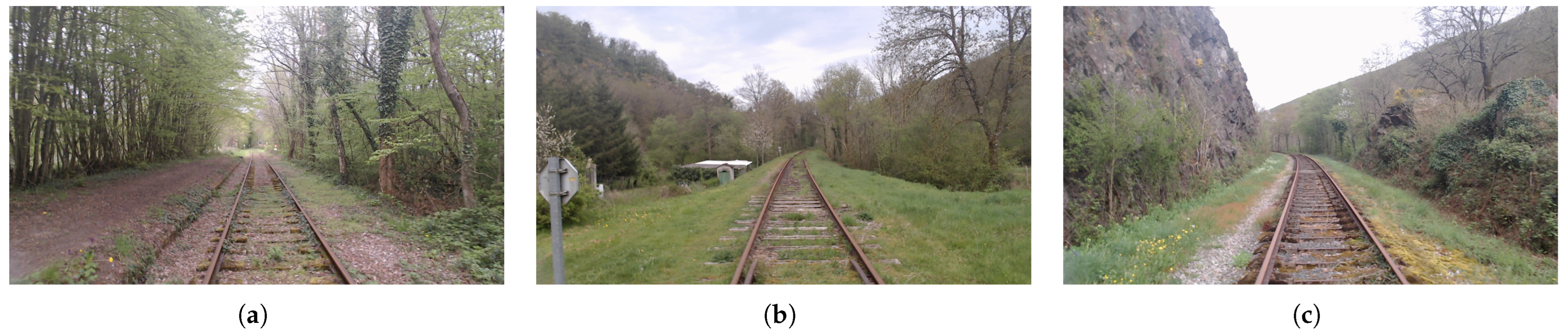
The test campaign was conducted on a 13 km long railway segment between Pont-Erambourg and the Tunnel des Gouttes in Normandy, France. This single-track line is highly representative of typical capillary railway lines. Furthermore, this test track includes several different environments as depicted in
Figure 1.
The test campaign was conducted over a period of three days. During this time, the experimental light-train covered the full 13 km of track at a low speed, not exceeding 10 km/h. The complete dataset will be made available on the upcoming FerroNext sharing platform by Ferrocampus.
3.2. Metrics
To statistically characterize the error in baseline and relative speed measurements, the mean value and the standard deviation of the error are used as comparison metrics.
The error
is defined as the difference between the horizontal ground truth
X and estimated value
:
The error is computed using horizontal ground truth and estimated value. Bias and standard deviation are computed over 20 bins that cover the entire range of relative speed or baseline ground truth values.
The mean
and the standard deviation
are defined over a bin containing
N values as:
3.3. Results
This section presents an analysis of 10,092 raw measurements, recorded at 1 Hz over more than an hour and a half, collected across three days and four runs. The analysis focuses on the horizontal mean error and standard deviation discussed in the previous section. Outliers have been removed from the dataset. The number of measurements varies along the length of the line due to ground truth outages.
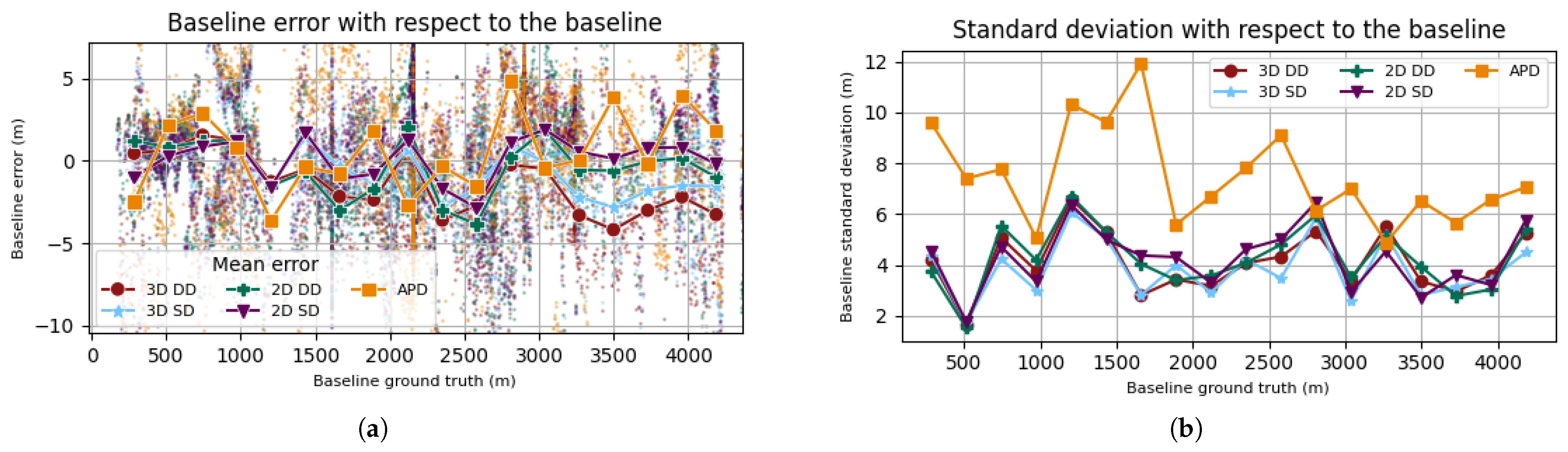
Figure 2 shows the baseline estimate error and standard deviation relative to the baseline ground truth. It is known that the accuracy of pseudorange differencing baseline estimates tends to degrade as the baseline length increases. However, as shown in
Figure 2a, no significant performance loss is observed over the 4 km baseline. Overall, pseudorange differencing algorithms demonstrate better standard deviation performance than APD, as illustrated in
Figure 2b.
Notably, the standard deviation peaks around 1200 m, 2700 m, and 4100 m. These peaks correspond to sections with harsh GNSS environments. In such challenging conditions, the baseline error in
Figure 2a remains significantly more constrained for the four pseudorange differencing algorithms compared with APD. As expected, pseudorange differencing performs better than APD under harsh conditions.
Initially, the baseline errors are similar across all pseudorange differencing methods. However, beyond 3 km, the horizontal method outperforms the ordinary one, despite the presence of a vertical gradient exceeding 15 m near the end of the line.
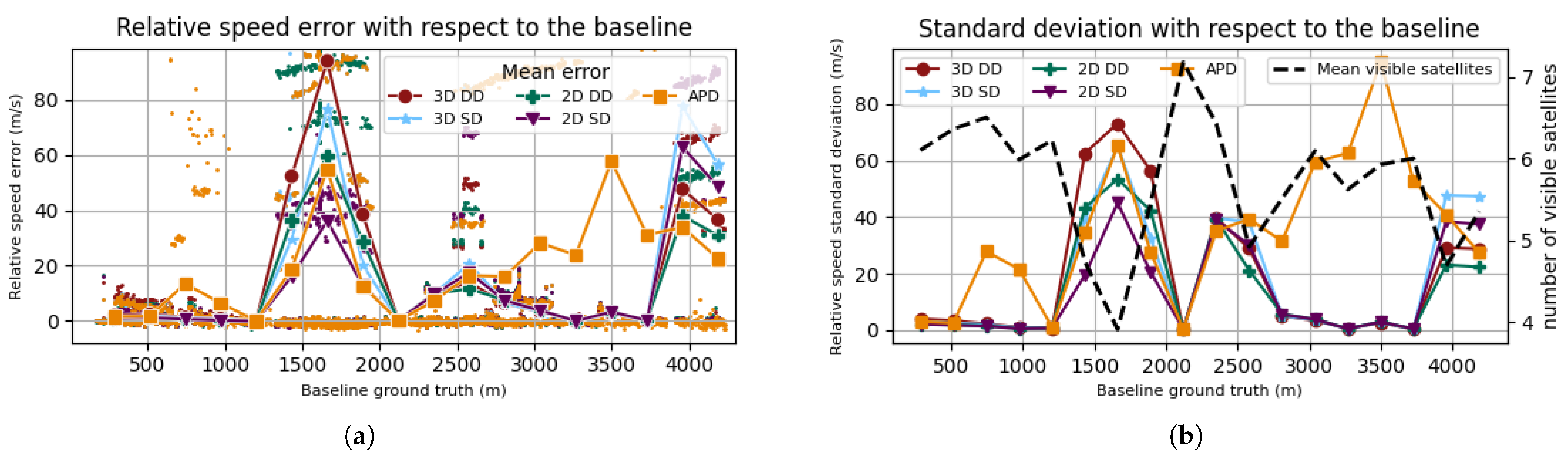
Figure 3 illustrates the relative speed estimation error and its standard deviation with respect to the baseline ground truth. Several large and unacceptable error peaks are observed in both the mean error and the standard deviation. As shown in
Figure 3b, these peaks correlate with a reduction in the number of visible satellites, likely caused by dense forest environments. Since the dataset includes only GPS signals, the accuracy of relative speed estimation could potentially be enhanced by incorporating multiple GNSS constellations.
Importantly, baseline length does not appear to induce performance degradation. As expected, the APD method exhibits significantly poorer performance compared with pseudorange differencing, particularly in the baseline length range of 2700 to 3700 m. Finally, the horizontal-only approach demonstrates slightly better performance than the conventional 3D method.
4. Conclusions
In this paper, we analyzed the use of GNSS pseudorange differencing for train relative positioning and relative speed estimation. We proposed a mathematical model for pseudorange differencing, including baseline and baseline rate estimation, using both ordinary and horizontal single and double differences, along with their respective corrections. Four different methods—horizontal and ordinary single and double differencing—were evaluated and compared against APD in a real-world experiment.
The experimental results show that pseudorange differencing consistently achieves better standard deviation performance than APD, with horizontal pseudorange differencing demonstrating superior accuracy. Further work is required on relative speed estimation using multiple constellations to assess its viability for railway applications.
In our previous work [
9], we used simulations to evaluate the expected performance of pseudorange differencing as a function of baseline length, speed, and multipath conditions. Then a bias in relative speed was observed but has been corrected in this paper using the methods described in
Section 4. We concluded that pseudorange differencing—especially the horizontal variant—is well suited for train relative positioning and speed estimation. The experimental results presented in this paper confirm those findings: although performance is slightly degraded compared with simulations, horizontal pseudorange differencing remains the most accurate method for both relative positioning and speed. Nevertheless, further research is needed to evaluate performance at higher speeds and over longer baselines and with multiple constellations.