Proceeding Paper

Comparative Analysis of CNG and Hydrogen Effects on Exhaust Emissions in Dual-Fuel Single Cylinder Diesel Engines †
1
Department of Combustion Engines, Automobile Engineering and Transport Faculty of Transport, Technical University of Sofia, 8 Kliment Ohridski Blvd., 1000 Sofia, Bulgaria
2
Department of Transport and Aircraft Equipment and Technologies, Technical University of Sofia, Plovdiv Branch, 25 Tsanko Dyustabanov Street, 4000 Plovdiv, Bulgaria
3
Center of Competence “Smart Mechatronic, Eco- and Energy-Saving Systems and Technologies”, 4000 Plovdiv, Bulgaria
*
Author to whom correspondence should be addressed.
Presented at the 17th International Scientific Conference on Aerospace, Automotive, and Railway Engineering (BulTrans-2025), Sozopol, Bulgaria, 10–13 September 2025.
Eng. Proc. 2026, 121(1), 15; https://doi.org/10.3390/engproc2025121015
Published: 14 January 2026

Abstract

This study provides a comparison between the impact of two gas fuels, compressed natural gas (CNG) and hydrogen (H2), on the exhaust emissions of a single-cylinder diesel engine operating in dual-fuel mode. The analysis is conducted with a constant and maximum achieved gas-to-total-fuel ratio (K = 20% and K = max) under varying load conditions, specifically at an engine speed of 2000 min−1 and brake mean effective pressures ranging from 0.2 to 0.43 MPa. The results reveal that H2 significantly improves the engine’s emissions profile compared to CNG. When H2 is used as the secondary fuel, reductions in soot, carbon monoxide (CO), carbon dioxide (CO2), and unburned hydrocarbons (CHs) are more pronounced. However, under certain load conditions, nitrogen oxide (NOx) emissions are higher with H2 than with CNG and can even surpass those observed during diesel-only operation. These findings suggest that while H2 demonstrates superior overall emissions performance, its impact on NOx emissions under specific conditions requires further optimization to maximize environmental benefits.

1. Introduction

In recent years, stringent environmental regulations and heightened public awareness about air quality have driven significant changes in the automotive and power generation industries. The growing demand for improved environmental performance in modern engines serves as a crucial prerequisite for adopting alternative fuels or additives to conventional ones, aimed at reducing harmful emissions generated during the engine’s operating cycle [1,2]. Diesel engines, recognized for their efficiency and robustness, remain pivotal in many sectors. However, their associated emissions have prompted extensive research into cleaner and more sustainable alternatives. One promising avenue is the dual-fuel approach, which involves supplementing traditional diesel with an alternative gaseous fuel.
Compressed natural gas is one of the most common and readily available alternative gaseous fuels [3]. Its primary source is natural gas fields, where methane is the dominant component. According to various scientific studies, the use of CNG as a secondary fuel in a dual-fuel engine cycle leads to an increase in CO and CH emissions [4,5,6,7,8], while soot and CO2 emissions are reduced [6,8,9,10].
The CO increase is due to an increase of the induction period causing the combustion process to shift along the expansion line, while the combustion temperature is not high enough to oxidize the entire amount of fuel [11,12]. Additionally, the gaseous fuel supplied through the intake manifold reduces the amount of air, and consequently oxygen, entering the cylinder, leading to a decrease in the air–fuel ratio and, accordingly, an increase in CO emissions [11].
One of reasons of CH increase in dual-fuel mode is the inability the layer of gaseous fuel located near the walls of the combustion chamber to be oxidized, as the temperature of the air–fuel mixture in this zone is too low [4,10]. According to another theory, part of the air–fuel mixture enters the space between the piston and the cylinder during compression, where it cannot oxidize and exits the cylinder during the exhaust stroke [4]. Additionally, a portion of the air–fuel mixture leaves the engine cylinder during the overlap of the valve timing phases.
Some studies [6,7,9,13] report a reduction in NOx emissions when CNG is used in a gas–diesel cycle. The reasons for this are the lower oxygen content in the cylinder (due to the replacement of part of the air entering the engine with gaseous fuel) and the lower intensity of the combustion process during the rapid combustion phase, which leads to a lower temperature of the working medium [9,14].
However, other studies [5,10] suggest that NOx emissions decrease only under low and medium loads, whereas at high loads, NOx emissions increase when operating in the CNG–diesel dual-fuel mode. Probable reasons for the reduction in NOx emissions include the lower peak temperature (due to the increased induction period and the shift of the combustion process along the expansion line) and the reduced amount of oxygen entering the engine [5,10]. Since the engine used for the comparative bench tests described in [5] is turbocharged, the air mass entering the cylinder increases with the load, which also improves the mixing of the gaseous fuel with air. Achieving a homogeneous air–fuel mixture creates conditions for an increase in the maximum combustion temperature, which, combined with the presence of sufficient oxygen, leads to a rise in NOx concentrations in the exhaust gases of the engine [5]. The higher heat release rate observed in [10] during the rapid combustion phase (and the corresponding increase in combustion temperature) when the engine operates on a gas–diesel cycle and at above-average loads explains the increase in nitrogen oxides in the exhaust gases.
Hydrogen (H2) is a non-carbonaceous, non-toxic gaseous fuel that has garnered significant interest due to its vast potential as a clean energy source. It is one of many alternative fuels that can be produced from a variety of natural resources. Commercially, H2 can be generated through the electrolysis of water and coal gasification. Additionally, advanced methods such as thermochemical water splitting and solar photo-electrolysis are being explored, although these technologies remain in the developmental stage [15]. The energy required to ignite H2 is very low, making it unsuitable for conventional spark-ignition engines due to the risk of pre-ignition and knock. In compression-ignition engines, H2 does not auto-ignite because of its high auto-ignition temperature (858 K). As a result, the dual-fuel mode emerges as the most viable approach to effectively utilize H2 in internal combustion engines [15].
Studies [16,17,18,19,20,21,22] demonstrate that supplementing diesel fuel with hydrogen can significantly reduce CO emissions across a wide range of fuel blends and engine load conditions. This reduction is primarily attributed to enhanced air–fuel mixing and improved charge homogeneity, which together suppress CO formation during combustion. Moreover, hydrogen’s low ignition energy and high diffusivity enhance combustion stability, particularly at low engine loads, where CO emissions are typically higher.
Apart from CO emission a decrease in CO2 emissions is also observed in [23,24,25,26,27]. This is caused by the lower percentage of carbon in the total amount of fuel, as well as to the higher flame speed of H2 compared to that of diesel fuel.
Experimental results [16,17,18,19,20,21,22,28] show that HC emissions decrease regardless of the fuel blend or engine load when a compression ignition engine operates in dual-fuel mode with a hydrogen additive. Hydrogen’s wide flammability range enables leaner combustion, which results in fewer unburned hydrocarbons and more complete fuel oxidation. Enhanced air–fuel mixing and improved charge homogeneity further promote consistent combustion, thereby reducing HC levels.
Some research [23,25,27,29] on dual-fuel engine operation with H2 have found that, at loads below 50%, the gas–diesel working cycle lowers the combustion chamber temperature, thereby reducing NOx concentrations in the exhaust. However, when the engine load goes above mid-levels the NOx emissions increase because hydrogen use under these conditions raises the combustion temperature. In contrast, other researchers [16,19,22,24,28,30,31] have reported an increase of NOx emissions across all load conditions with hydrogen addition, attributing this to the higher temperatures reached during the oxidation of hydrogen.
Several studies [20,26,32,33] report reductions in NOx emissions at both low and high loads when compression ignition engines operate in dual-fuel mode with hydrogen. This behavior is primarily attributed to a shorter combustion duration—which limits the time available for NOx formation—and an increased production of H2O molecules during hydrogen oxidation (compared to diesel-only combustion), which helps lower the combustion chamber temperature.
Since both gaseous fuels—compressed natural gas and hydrogen—demonstrate varying degrees of improvement and degradation in exhaust gas emissions, it is advantageous to directly compare their effects under identical engine and load conditions. These fuels exhibit distinct combustion characteristics, for instance, CNG offers a relatively higher energy density and a well-defined combustion process, whereas hydrogen is known for its wide flammability limits and rapid burn rates. These inherent differences can lead to significant variations in the formation of emissions such as NOx, CO, CO2, CH and soot. Considering these factors, the primary objective of this study is to conduct a comprehensive comparative analysis of CNG and hydrogen as secondary fuels in a single-cylinder diesel engine operating in dual-fuel mode. The investigation is designed to evaluate the quantitative changes in exhaust emissions at identical engine settings and load conditions.

2. Materials and Methods

For the purpose of the study a single cylinder diesel engine DV550 is used. The engine key parameters are as follows: cylinder bore D = 91.5 mm; piston stroke S = 85 mm; compression ration ε = 17.5; direct injection; brake power Ne = 8 kW at engine speed n = 3000 min−1. The engine is connected to direct current electric dynamometer SAK 28, allowing measuring of brake power up to Ne = 28 kW at engine speed of n = 6000 min−1.
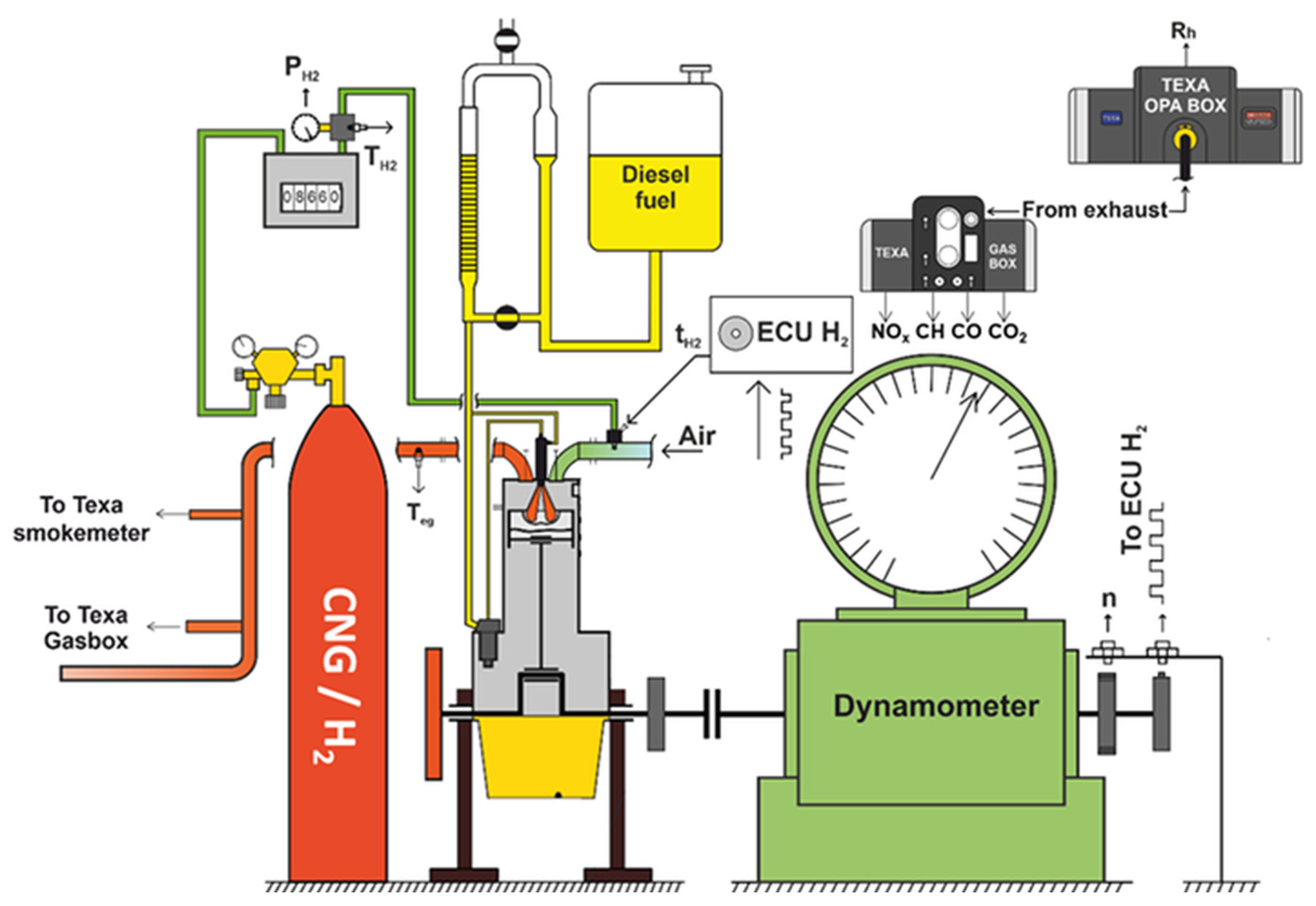
The gas fuel (CNG or H2) is supplied to the engine’s intake manifold in pulses. The quantity of gas fuel is controlled by an electronic control unit (ECU), which adjusts the opening duration of the solenoid gas valves. The ECU was developed by the Department of Combustion Engines, Automobile Engineering, and Transport at the Technical University of Sofia. Gas fuel consumption is measured using data obtained from a diaphragm flow meter (type G4), a manometer, and a type K thermocouple. The maximum relative error in determining the hourly gaseous fuel consumption is 8.2%.
Diesel fuel consumption is measured using a volumetric flow meter developed by Technical University of Sofia. It operates based on the principle of measuring the time needed for a specific volume of diesel fuel to be consumed by the engine. The maximum relative error in determining the hourly diesel fuel consumption is 6.9%.
Emissions of toxic components in engine exhaust gases are measured by using a Texa Gasbox 2 gas analyzer, made in Italy sourced from GarAgent, Sofia, Bulgaria funded by the Bulgarian National Science Fund-BNSF of the Ministry of Education and Science of Bulgaria [project number No.KP-06-H77/11 of 14.12.2023 “Modeling and development of a complex system for environmental and energy efficiency of urban transport”]. The analyzer determines the concentrations of the following components in the exhaust gases: carbon monoxide (CO) with an accuracy of 0.01%, hydrocarbons (HCs) with an accuracy of 1 ppm, nitrogen oxides (NOx) with an accuracy of 5 ppm and carbon dioxide (CO2) with an accuracy of 0.1%. Soot emissions are assessed using a Texa Opabox smoke meter, which provides measurements with an accuracy of 0.1%.
Schematic of the test bench is shown in Figure 1.
The amount of gas fuel injected into the engine is defined by the coefficient K. This coefficient represents the mass fraction of gas fuel consumption relative to the total fuel consumption based on the following equations:
K = (Bgas/Bh) × 100, %
where Bgas is the hourly gas fuel consumption, kg/h; Bh—total (combined) hourly fuel consumption, kg/h.
The combined hourly fuel consumption Bh is calculated based on the following:
Bh = Bgas + BD
where BD is the hourly diesel fuel consumption, kg/h.
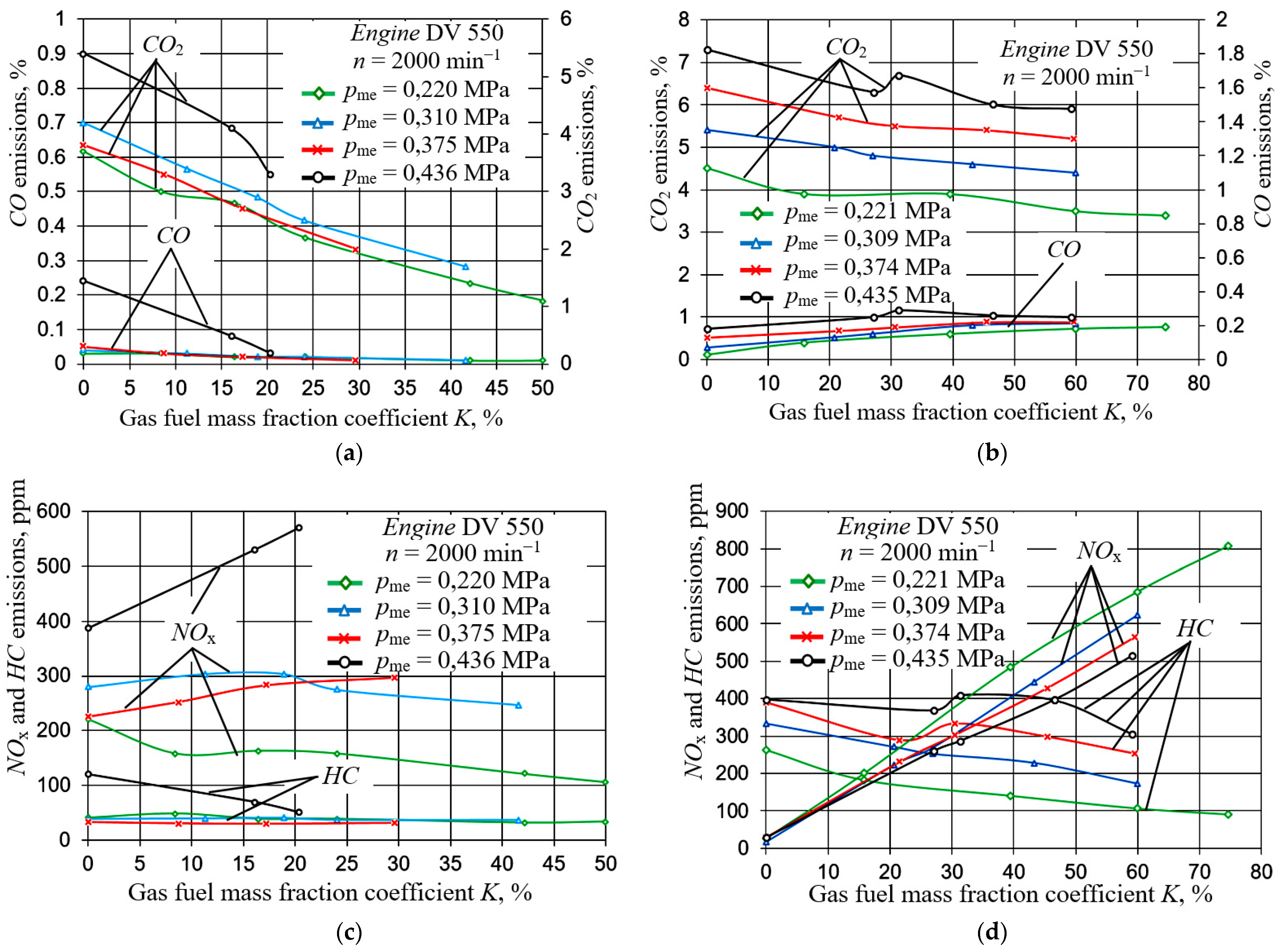
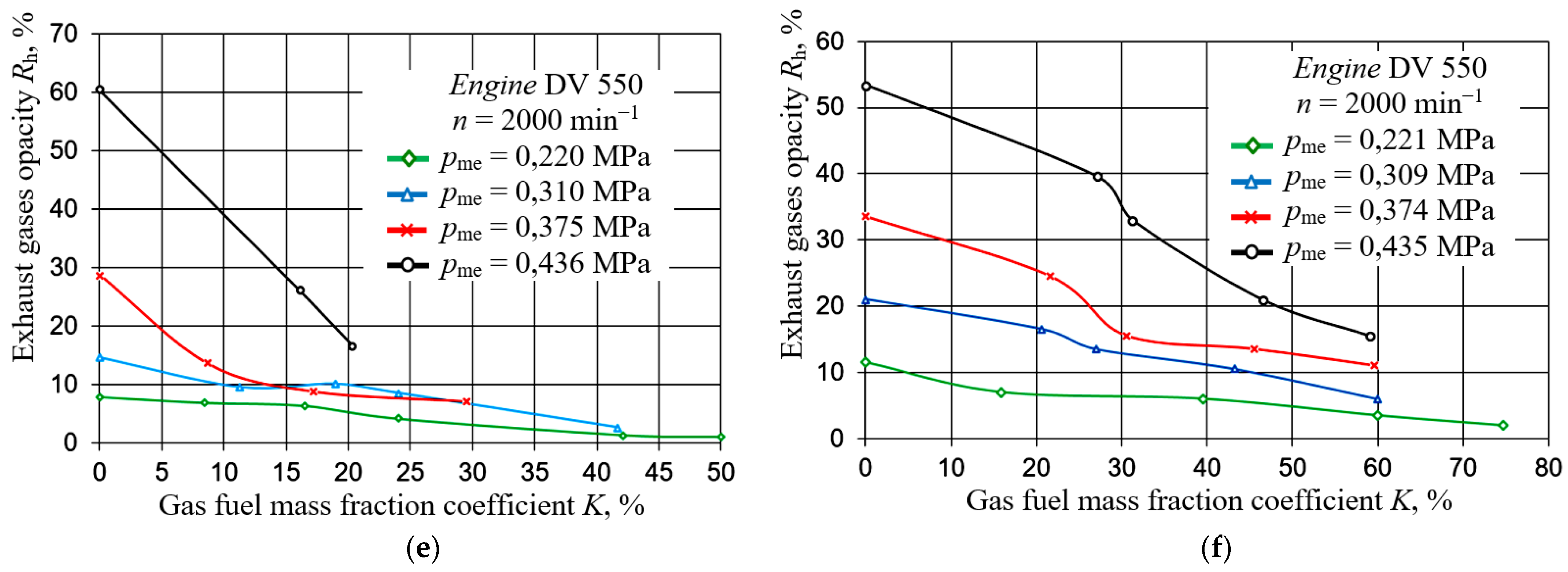
The test results used to compare the effects of CNG and H2 on exhaust emissions are obtained at a constant coefficients K (K = 20% and K = max) and variable loads (load engine characteristic) at constant engine speed—n = 2000 min1, based on the obtained regulating characteristics shown in Figure 2. The regulating characteristic are defined at a constant engine load (constant brake mean effective pressure—pme) and variable values of the coefficient K (pme = const, K = var). Further details on the methodology and the process for obtaining these characteristics are provided in [34]. The criterion used to determine the maximum amount of gas fuel supplied to the engine (K = max) is the occurrence of either critical rate of in-cylinder pressure rise or misfire, caused by an excessively weak pilot diesel portion whose combustion energy is insufficient to initiate oxidation of the gas–air mixture.

3. Results and Discussion

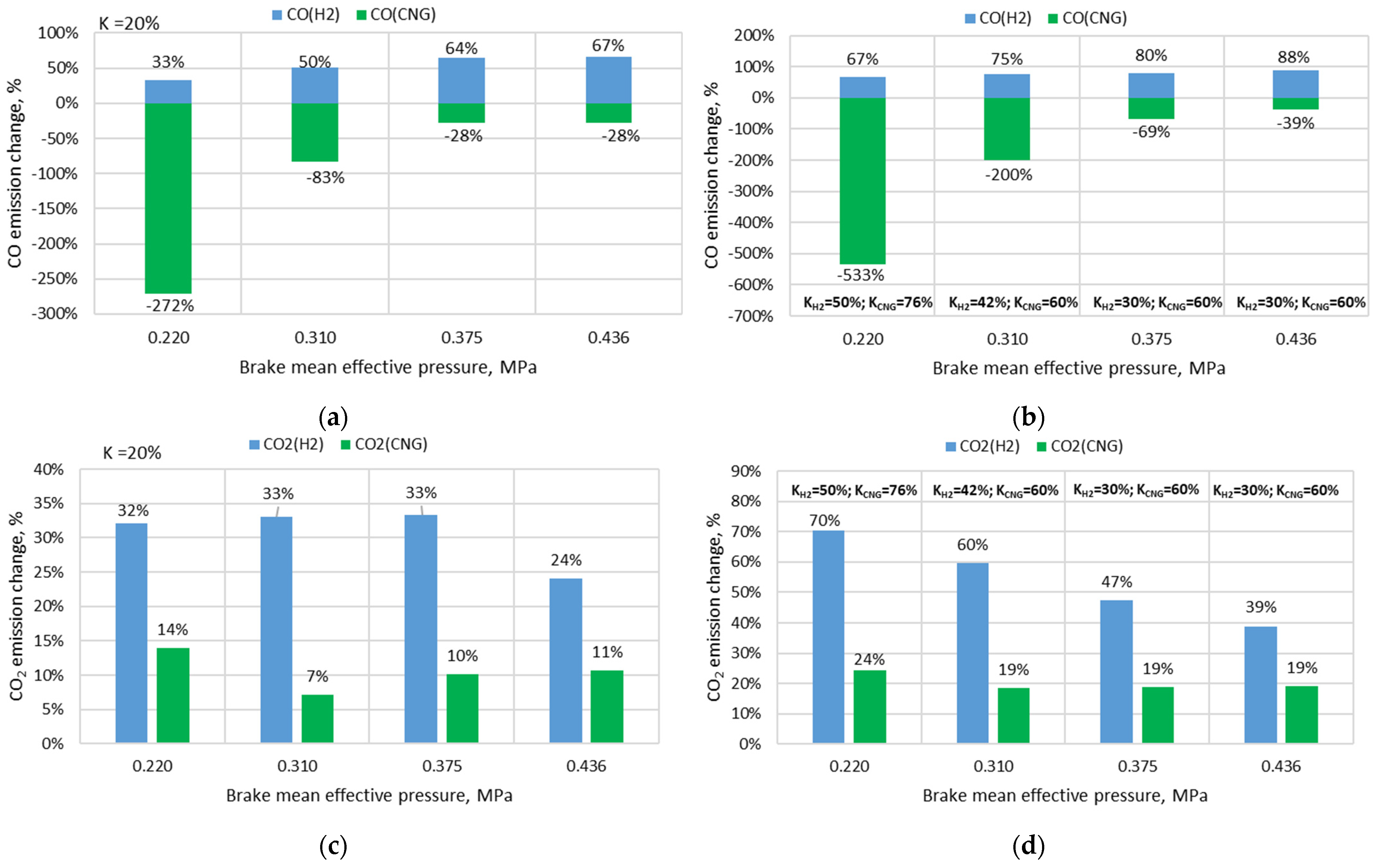
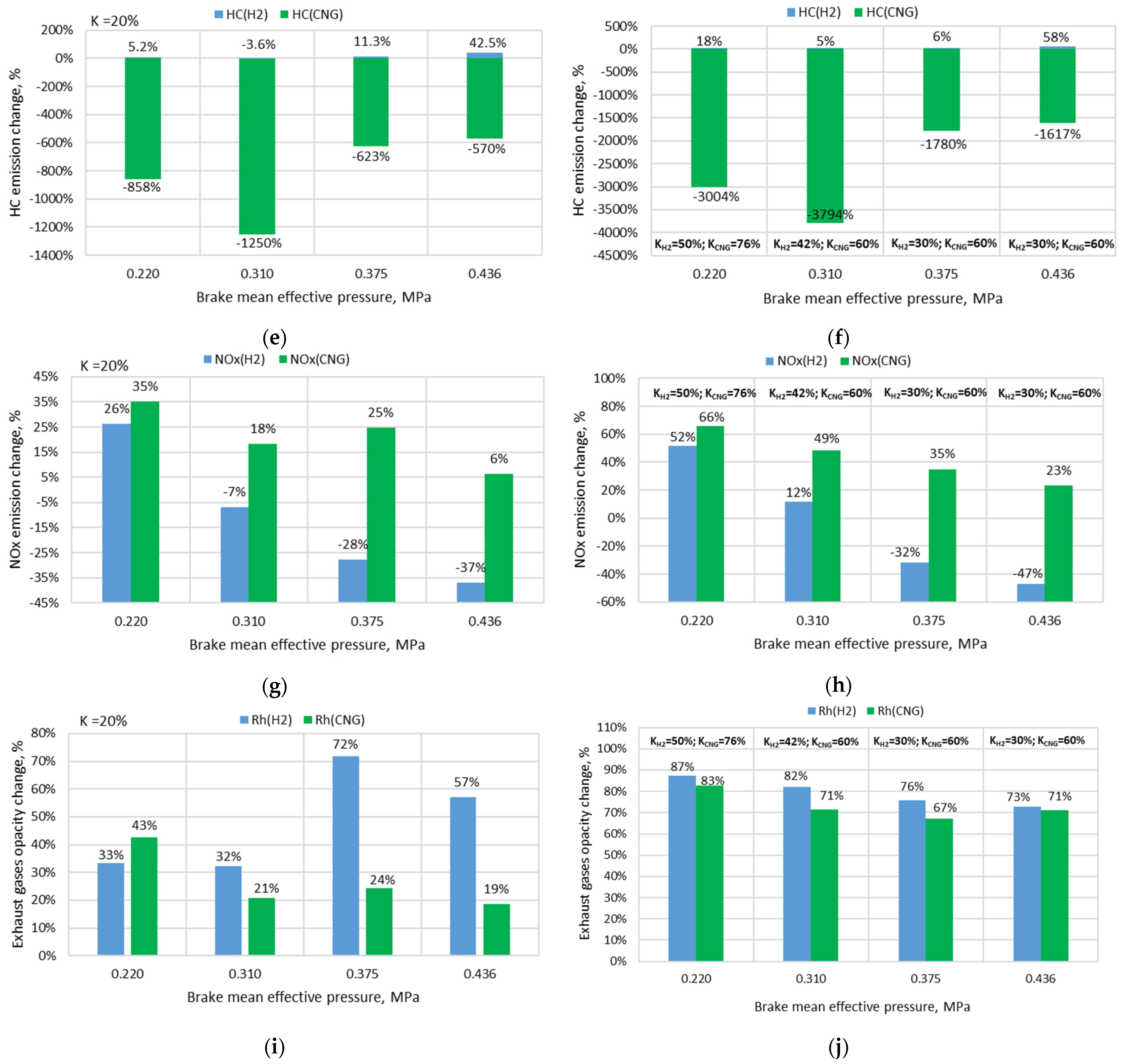
The results of the comparison at constant coefficient K and maximum achieved rate of gas fuel provided to the engine (K = max) are presented in Figure 3. The comparison is expressed as the percentage change in the specific parameters. A negative percentage indicates a deterioration of the parameter under dual-fuel operation, whereas a positive percentage signifies an improvement.
The variation in CO emissions when the engine operates with CNG and H2 in the gas–diesel cycle (Figure 3) shows that H2 significantly reduces CO emissions, whereas CNG has a negative impact on this parameter, which becomes more pronounced with an increase in the amount of gas fuel supplied to the engine. The reduction in CO emissions with H2 is attributed to improved air–fuel mixing and charge homogeneity, which minimize CO formation during combustion. Additionally, hydrogen’s low ignition energy and high diffusivity enhance combustion stability, particularly at low engine loads where CO emissions are typically higher. The absence of carbon molecules in H2 fuel further explains this observed effect. Conversely, the increase in CO emissions with CNG is due to the prolonged ignition delay period (more pronounced at low and medium loads), which shifts the combustion process along the expansion line. This results in a combustion temperature that is insufficiently high to oxidize the entire amount of fuel.
The measurement results presented in Figure 3 indicate that both gaseous fuels, CNG and H2, effectively reduce CO2 emissions across the analyzed load range. However, the reduction achieved with H2 is notably more significant due to its more complete combustion and the absence of carbon molecules in the fuel.
The analysis shows a significant increase in CH emissions when CNG is used in dual-fuel mode, proportional to the amount injected. In contrast, hydrogen fuel does not cause notable changes in this parameter—except at high engine loads, where a reduction in CH emissions is observed. Increasing the amount of H2 supplied to the engine does not significantly impact CH emissions. Hydrogen’s wide flammability range promotes leaner combustion, resulting in fewer unburned hydrocarbons and enhanced fuel oxidation. Moreover, the use of H2 improves air–fuel mixing and charge homogeneity, leading to more consistent combustion and lower HC levels. The absence of carbon molecules in hydrogen further contributes to this effect. In contrast, the higher CH emissions observed when the engine operates in a gas–diesel cycle with CNG are attributed to the passage of a portion of the gas–air mixture from the cylinder into the exhaust system due to valves overlap and the lower flame propagation speed of the CNG compared to the H2.
The results presented in Figure 3 show an improvement in NOx emissions for both gas fuels (CNG and H2) when the engine operates in dual-fuel mode at low loads, even at the maximum value of coefficient K. However, as the load increases, using H2 as the gas fuel leads to an increase in NOx emissions, which becomes slightly more pronounced at the maximum amount of H2 supplied to the engine. In contrast, CNG continues to show improvement, albeit with a decreasing rate of NOx reduction. This effect is more pronounced at the maximum value of coefficient K. The reduction in NOx emissions during CNG–diesel operation is primarily due to the fact that the CNG–air mixture is very lean and exhibits a low flame velocity, which prevents an increase in the maximum cylinder temperature. In the case of hydrogen, the improvement in NOx emissions at low engine loads can be attributed to a shorter rapid combustion period. Conversely, at medium and high engine loads in hydrogen–diesel operation, the increase in combustion chamber temperature leads to higher NOx emissions.
Both gas fuels (CNG and H2) demonstrate a reduction in engine soot emissions especially at maximum amount of gas fuel (K = max)—Figure 3. This improvement is attributed to their lower carbon-to-hydrogen ratio compared to diesel fuel, and to the fact that, after the self-ignition of the pilot diesel portion, the flame propagates through a relatively homogeneous gas–air mixture. Hydrogen shows a greater reduction in soot emissions due to the absence of carbon molecules.

4. Conclusions

This study reveals that hydrogen (H2) offers a more favorable emissions profile compared to CNG in a gas–diesel cycle. H2 significantly reduces CO, CO2, and soot emissions—attributable to enhanced air–fuel mixing, complete combustion, and its carbon-free nature—while maintaining stable hydrocarbon levels. In contrast, CNG tends to increase CO and CH emissions due to a prolonged ignition delay and gas–air mixture dynamics. Although both fuels improve NOx emissions at low loads, H2 leads to higher NOx at mid and high loads because of increased combustion temperatures. Overall, H2 emerges as a promising alternative for dual-fuel applications, with careful optimization required to manage NOx emissions at higher loads.

Author Contributions

Conceptualization, A.T. and E.D.; methodology, A.T. and E.D.; software, M.P.; validation, A.T., E.D. and M.P.; formal analysis, A.T.; investigation, E.D. and M.P.; resources, A.T. and E.D.; data curation, A.T., E.D. and M.P.; writing—original draft preparation, A.T.; writing—review and editing, A.T. and E.D.; visualization, A.T. and M.P.; supervision, E.D.; project administration, E.D.; funding acquisition, A.T. All authors have read and agreed to the published version of the manuscript.

Funding

This research was funded by the European Regional Development Fund within the OP “Research, Innovation and Digitalization Programme for Intelligent Transformation 2021–2027”, Project No. BG16RFPR002-1.014-0005 Center of competence “Smart Mechatronics, Eco- and Energy Saving Systems and Technologies”.

Institutional Review Board Statement

Not applicable.

Informed Consent Statement

Not applicable.

Data Availability Statement

The research data will be provided upon request via e-mail.

Conflicts of Interest

The authors declare no conflicts of interest.

Abbreviations

The following abbreviations are used in this manuscript:
CNGCompressed natural gas
H2Hydrogen
COCarbon monoxide
CO2Carbon dioxide
HCHydrocarbons
NOxNitrogen Oxides
pmeBrake mean effective pressure

References

  1. Ambarev, K.; Nikolov, V.; Ivanov, A. System of Experimental Study of Diesel Engine at Work with Brownian Gas. Mech. Mach. 2016, 115, 20–23. [Google Scholar]
  2. Mladenov, G.; Damyanov, I.; Saliev, D.; Iontchev, E. Design of Measurement System for Vehicle Emissions in Real Road Conditions. In Proceedings of the 30th National Conference with International Participation “Telecom 2022”, Sofia, Bulgaria, 27–28 October 2022; pp. 1–4. [Google Scholar] [CrossRef]
  3. Dimitrov, A. Alternative fuels in ICE—Solutions and problems (in Bulgarian). Mach. Technol. Mater. 2007, I-2007, 54–64. [Google Scholar]
  4. Nwafor, O. Effect of advanced injection timing on the performance of natural gas in diesel engine. Sadhana 2000, 25, 11–20. [Google Scholar] [CrossRef]
  5. Egusquiza, J.C.; Braga, S.L.; Braga, S. Performance and gaseous emissions characteristics of a natural gas/diesel dual fuel turbocharged and aftercooled engine. J. Braz. Soc. Mech. Sci. Eng. 2009, 31, 142–150. [Google Scholar] [CrossRef]
  6. Jensen, S. Converting Diesel Engines to Dual Fuel the Pros and Cons of Common Gas Engine Types; Energy Conversions Inc.: Fife, WA, USA, 2006. [Google Scholar]
  7. Liu, J.; Yang, F.; Wang, H.; Ouyang, M.; Hao, S. Effects of pilot fuel quantity on the emissions characteristics of a CNG/diesel dual fuel engine with optimized pilot injection timing. Appl. Energy 2013, 110, 201–206. [Google Scholar] [CrossRef]
  8. Kumar, N.; Arora, B.; Maji, S. Experimental Evaluation of CNG Substitution Ratio on Exhaust Gas Emissions of Diesel/CNG Dual Fuel Combustion. Mechanika 2023, 29, 432–437. [Google Scholar] [CrossRef]
  9. Wong, W.L. Compressed Natural Gas as an Alternative Fuel in Diesel Engines; Courses ENG 4111 and ENG 4112 Research Project Towards the Degree of Bachelor of Engineering (Mechanical); University of Southern Queensland: Toowoomba, Australia, 2005. [Google Scholar]
  10. Lounici, M.S.; Loubar, K.; Tarabet, L.; Bilistrou, M.; Niculescu, D.C.; Tazerout, M. Towards improvement of natural gas-diesel dual fuel mode: An experimental investigation on performance and exhaust emissions. Energy 2014, 64, 200–211. [Google Scholar] [CrossRef]
  11. Attia, M.; Adbel-Rehim, A. An experimental investigation on performance and emissions of a single cylinder dual fuel Diesel-CNG engine combined with EGR. Int. J. Automot. Eng. Technol. 2014, 3, 91–102. [Google Scholar] [CrossRef]
  12. Ehsan, M.; Bhuiyan, S. Dual fuel performance of a small diesel engine for applications with less frequent load variation. Int. J. Mech. Mechatron. 2009, 9, 30–39. [Google Scholar]
  13. Belgiorno, G.; Di Blasio, G.; Beatrice, C. Parametric study and optimization of the main engine calibration parameters and compression ratio of a methane-diesel dual fuel engine. Fuel 2018, 222, 821–840. [Google Scholar] [CrossRef]
  14. Papagiannakis, R.; Hountalas, T. Combustion and exhaust emission characteristics of a dual fuel compression ignition engine operated with pilot diesel fuel and natural gas. Energy Convers. Manag. 2004, 45, 2971–2987. [Google Scholar] [CrossRef]
  15. Debnath, K.; Saha, K.; Sahoo, N. Effect of hydrogen-diesel quantity variation on brake thermal efficiency of a dual fuelled diesel engine. J. Power Technol. 2012, 92, 55–67. [Google Scholar]
  16. Leo, G.; Jayabal, R.; Kathapillai, A.; Sekar, S. Performance and emissions optimization of a dual-fuel diesel engine powered by cashew nut shell oil biodiesel/hydrogen gas using response surface methodology. Fuel 2025, 384, 133960. [Google Scholar] [CrossRef]
  17. Reddy, K.; Rao, G.; Reddy, R.; Agbulut, U. Artificial intelligence-based forecasting of dual-fuel mode CI engine behaviors powered with the hydrogen-diesel blends. Int. J. Hydrogen Energy 2024, 87, 1074–1086. [Google Scholar] [CrossRef]
  18. Zhou, W.; Wang, H.; Gao, J.; Zhou, S. Effects of using argon, hydrogen and syngas on performance and emissions of a heavy-duty natural gas/diesel RCCI engine at low load. Int. J. Hydrogen Energy 2024, 77, 958–974. [Google Scholar] [CrossRef]
  19. Rajak, U.; Apparao, K.; Verma, T.; Agbulut, U. Enhancing performance, and combustion efficiency, and reducing tailpipe emissions of an engine fueled with hydrogen-enriched diesel and ethanol blends at varying CRs using RSM. Int. J. Hydrogen Energy 2024, 92, 1236–1247. [Google Scholar] [CrossRef]
  20. Pachiannan, T.; Zhong, W.; Balasubramanian, D.; Alshehri, M.; Pugazhendhi, A.; He, Z. Enhancing engine performance, combustion, and emission characteristics through hydrogen enrichment in n-pentanol/diesel blends: A study on advanced combustion strategies for reduced emissions. Int. J. Hydrogen Energy 2025, 98, 741–750. [Google Scholar] [CrossRef]
  21. Manickam, S.; Kasinathan, S.; Gurusamy, M.; Al-Ansari, M.; Subramanian, B. Effect of hydrogen and diethyl ether addition on 5E attributes of compression ignition engine using papaya seed oil-diesel blend. Int. J. Hydrogen Energy 2024, 143, 366–388. [Google Scholar] [CrossRef]
  22. Aravind, S.; Barik, D.; Praveenkumar, S.; Tudu, K.; Dara, R. Influence of compression ratio variations on hydrogen combustion dynamics in a tri-fuel agricultural diesel engine operating with diesel, algae spirogyra methyl ester, and di-tert-butyl peroxide. Int. J. Hydrogen Energy 2025, 143, 429–440. [Google Scholar] [CrossRef]
  23. Dimitrov, E.; Gigov, B.; Pantchev, S.; Michaylov, P.; Peychev, M. A study of hydrogen fuel impact on compression ignition engine performance. MATEC Web Conf. 2018, 234, 03001. [Google Scholar] [CrossRef]
  24. SinghYadav, V.; Soni, S.; Sharma, D. Performance and emission studies of direct injection C.I. engine in duel fuel mode (hydrogen-diesel) with EGR. Int. J. Hydrogen Energy 2012, 37, 3807–3817. [Google Scholar] [CrossRef]
  25. Bose, P.; Maji, D. An experimental investigation on engine performance and emissions of a single cylinder diesel engine using hydrogen as inducted fuel and diesel as injected fuel with exhaust gas recirculation. Int. J. Hydrogen Energy 2009, 34, 4847–4854. [Google Scholar] [CrossRef]
  26. Tsujimura, T.; Suzuki, Y. The utilization of hydrogen in hydrogen/diesel dual fuel engine. Int. J. Hydrogen Energy 2017, 43, 14019–14029. [Google Scholar] [CrossRef]
  27. Mirica, I.; Pana, C.; Negurescu, N.; Cernat, A.; Nutu, C. Experimental investigations of the hydrogen addition effects on diesel engine performance. IOP Conf. Ser. Mater. Sci. Eng. 2016, 147, 012121. [Google Scholar] [CrossRef]
  28. Vargün, M.; Yapmaz, A.; Kalender, V.; Yılmaz, I. Investigation of the effects of using hydrogen enriched fuel blends in a diesel engine on engine performance, combustion and exhaust emissions. Int. J. Hydrogen Energy 2025, 97, 1399–1410. [Google Scholar] [CrossRef]
  29. Shaikh, A.; Tarafdar, A.; Majumder, P.; Bera, U. Synergistic enhancement of performance and emission profiles in a single cylinder CI-engine: A fuzzy-tuned multi-objective whale optimization algorithm for diesel-hydrogen dual fuel augmentation. Energy Convers. Manag. 2024, 317, 118865. [Google Scholar] [CrossRef]
  30. Nguyen, V.; Nayak, S.; Le, H.; Kowalski, J.; Deepanraj, B.; Duong, X.; Truong, T.; Tran, V.; Cao, D.; Nguyen, P. Performance and emission characteristics of diesel engines running on gaseous fuels in dual-fuel mode. Int. J. Hydrogen Energy 2024, 49, 868–909. [Google Scholar] [CrossRef]
  31. Chaichan, M.; Al-Zubaidi, D. A practical study of using hydrogen in dual-fuel compression ignition engine. Int. J. Mech. Eng. 2014, 2, 1–10. [Google Scholar]
  32. Talibi, M.; Hellier, P.; Balachandran, R.; Ladommatos, N. Effect of hydrogen-diesel fuel co-combustion on exhaust emissions with verification using an inecylinder gas sampling technique. Int. J. Hydrogen Energy 2014, 39, 15088–15102. [Google Scholar] [CrossRef]
  33. Arpa, O.; Akbalık, Z. Enhancing diesel engine efficiency and emission control: A study on hydrogen and water vapor injection. Int. J. Hydrogen Energy 2024, 143, 1053–1067. [Google Scholar] [CrossRef]
  34. Dimitrov, E.; Tashev, A.; Pantchev, S. Methodology for experimental investigation of the influence of gaseous fuels on the performance of the diesel engine operating on gas-diesel cycle. In Proceedings of the BulTrans-2015 Proceedings, Sozopol, Bulgaria, 16–18 September 2015; pp. 103–107. [Google Scholar]
Figure 1. Principle view of the test bench.
Engproc 121 00015 g001
Figure 2. Regulating characteristics of the DV550 engine operating in dual-fuel mode with hydrogen (left column: panels (a,c,e)) and compressed natural gas (right column: panels (b,d,f)) as gas fuels. Emission trends are shown for: (a,b) CO and CO2; (c,d) NOx and HC; and (e,f) exhaust gas opacity.
Engproc 121 00015 g002aEngproc 121 00015 g002b
Figure 3. Effect of gas fuel substitution ratio: K = 20% (left column: panels (a,c,e,g,i)) and K = max (right column: panels (b,d,f,h,j)) on emission characteristics change of the DV550 engine operating in dual-fuel mode: (a,b) CO emissions; (c,d) CO2 emissions; (e,f) HC emissions; (g,h) NOx emissions; (i,j) exhaust gas opacity.
Engproc 121 00015 g003aEngproc 121 00015 g003b
Disclaimer/Publisher’s Note: The statements, opinions and data contained in all publications are solely those of the individual author(s) and contributor(s) and not of MDPI and/or the editor(s). MDPI and/or the editor(s) disclaim responsibility for any injury to people or property resulting from any ideas, methods, instructions or products referred to in the content.