

You are currently viewing a new version of our website. To view the old version click .

Livers, Volume 4, Issue 1

March 2024 - 11 articles

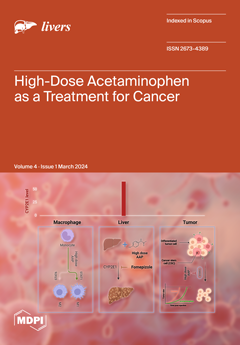
Cover Story: High-dose acetaminophen (AAP) has demonstrated promising anti-cancer activity in early-stage clinical trials. Our reverse translational studies have demonstrated that high-dose AAP has anti-cancer activity via modulation of JAK-STAT signaling in a free radical independent fashion, suggesting that AAP can be administered concurrently with rescue cocktails to prevent liver toxicity. High-dose AAP inhibits STAT3 within the tumor, a key transcription factor regulating cancer stem cell proliferation and function. AAP inhibits STAT6-mediated M2 polarization of tumor-associated macrophages in the tumor immune microenvironment, leading to enhanced anti-tumor immunity. Fomepizole-based rescue strategies offer optimal liver protection from AAP toxicity in pre-clinical mouse models, allowing dose escalation to 100-fold higher than standard AAP dosing without hepatotoxicity. View this paper
  • Issues are regarded as officially published after their release is announced to the table of contents alert mailing list .
  • You may sign up for email alerts to receive table of contents of newly released issues.
  • PDF is the official format for papers published in both, html and pdf forms. To view the papers in pdf format, click on the "PDF Full-text" link, and use the free Adobe Reader to open them.

Articles (11)

  • Review
  • Open Access
6 Citations
4,219 Views
22 Pages

Functions and Therapeutic Use of Heat Shock Proteins in Hepatocellular Carcinoma

  • Ramakrushna Paul,
  • Smriti Shreya,
  • Shweta Pandey,
  • Srishti Shriya,
  • Aya Abou Hammoud,
  • Christophe F. Grosset and
  • Buddhi Prakash Jain

4 March 2024

Heat shock proteins are intracellular proteins expressed in prokaryotes and eukaryotes that help protect the cell from stress. They play an important role in regulating cell cycle and cell death, work as molecular chaperons during the folding of newl...

  • Review
  • Open Access
1 Citations
3,272 Views
19 Pages

Minimally Invasive Surgery in Liver Transplantation: From Living Liver Donation to Graft Implantation

  • Eleni Avramidou,
  • Konstantinos Terlemes,
  • Afroditi Lymperopoulou,
  • Georgios Katsanos,
  • Nikolaos Antoniadis,
  • Athanasios Kofinas,
  • Stella Vasileiadou,
  • Konstantina-Eleni Karakasi and
  • Georgios Tsoulfas

17 February 2024

Since the end of the 20th century and the establishment of minimally invasive techniques, they have become the preferred operative method by many surgeons. These techniques were applied to liver surgery for the first time in 1991, while as far as tra...

  • Review
  • Open Access
7 Citations
34,321 Views
25 Pages

Herbal- and Dietary-Supplement-Induced Liver Injury: A Review of the Recent Literature

  • Palak A. Patel-Rodrigues,
  • Lindsey Cundra,
  • Dalal Alhaqqan,
  • Daniel T. Gildea,
  • Stephanie M. Woo and
  • James H. Lewis

13 February 2024

Herbal-induced liver injury (HILI) continues to increase in prevalence each year due to the ongoing popularity of herbal supplements and complementary and alternative medicines. A detailed literature review of case reports and clinical studies publis...

  • Review
  • Open Access
3 Citations
6,601 Views
10 Pages

High-Dose Acetaminophen as a Treatment for Cancer

  • Jeffrey Wu,
  • Bradley Maller,
  • Rujul Kaul,
  • Andrea Galabow,
  • Allyn Bryan and
  • Alexander Neuwelt

31 January 2024

The use of high-dose acetaminophen (AAP) with n-acetylcysteine (NAC) rescue was studied as an anti-cancer treatment in phase I trials with promising signals of anti-tumor efficacy. Correlative analysis suggested that AAP has a free-radical-independen...

  • Article
  • Open Access
3 Citations
2,759 Views
21 Pages

Glycyrrhizinic Acid and Phosphatidylcholine Combination as a Preventive Therapy for Experimental Murine Non-Alcoholic Steatohepatitis

  • Veronika A. Prikhodko,
  • Tatyana M. Matuzok,
  • Vadim E. Karev,
  • Anna V. Karavaeva,
  • Olga M. Spasenkova,
  • Nadezhda V. Kirillova,
  • Dmitry Yu. Ivkin and
  • Sergey V. Okovityi

29 January 2024

Non-alcoholic metabolic-associated steatohepatitis (MASH) is a condition characterized by increasingly high prevalence and incidence, and also represents an important unmet medical need when it comes to effective pharmacotherapy. In this work, we aim...

  • Article
  • Open Access
2,361 Views
12 Pages

The Hepatokine Leukocyte Cell-Derived Chemotaxin-2 Is Elevated in People with Impaired Glycaemic Regulation and Augmented by Acute Exercise

  • Buket Engin,
  • Scott A. Willis,
  • Sundus Malaikah,
  • Jack A. Sargeant,
  • David J. Stensel,
  • Charlotte Jelleyman,
  • Gaël Ennequin,
  • Guruprasad P. Aithal,
  • Thomas Yates and
  • James A. King

17 January 2024

The hepatokine leukocyte cell-derived chemotaxin-2 (LECT2) promotes insulin resistance and hepatic fibrogenesis. In rodents, acute exercise suppresses circulating LECT2; however, human data are lacking. This study compared circulating LECT2 across po...

  • Review
  • Open Access
4 Citations
8,231 Views
15 Pages

9 January 2024

Artificial Intelligence (AI) can be a useful tool in the management of disease processes such as hepatocellular carcinoma (HCC) as treatment decisions are often complex and multifaceted. AI applications in medicine are expanding with the ongoing adva...

  • Communication
  • Open Access
1,816 Views
5 Pages

Chronic Hepatitis B: A Summarized Anecdote of Complexities in Natural History, Treatment, and Complications

  • Nicholas Noverati,
  • Jay W. Jun,
  • Vivian Yan,
  • Dina Halegoua-DeMarzio and
  • Hie-Won Hann

29 December 2023

Chronic hepatitis B is still a disease process that affects millions around the world. Serologies used to diagnose and follow the progression (or resolution) of the disease can be confusing for clinicians. Further, throughout years of treatment, ther...

  • Article
  • Open Access
1 Citations
2,642 Views
16 Pages

Translocation of Adenosine A2B Receptor to Mitochondria Influences Cytochrome P450 2E1 Activity after Acetaminophen Overdose

  • Giselle Sanchez-Guerrero,
  • David S. Umbaugh,
  • Abhay A. Ramachandran,
  • Antonio Artigues,
  • Hartmut Jaeschke and
  • Anup Ramachandran

26 December 2023

The adenosine A2B receptor (A2BAR) is a member of a family of G-protein coupled receptors (GPCRs), which has a low affinity for adenosine and is now implicated in several pathophysiological conditions. We have demonstrated the beneficial effects of A...

of 2

Get Alerted

Add your email address to receive forthcoming issues of this journal.

XFacebookLinkedIn
Livers - ISSN 2673-4389