Article

Chitosan/Cellulose Functional Composite Hydrogel as Adsorbent for the Removal of Cu(II) from Aqueous Solutions in Dynamic Adsorption System


by
Katarina Stanković
1,
Igor Telečki
1,
Danijela Smiljanić
1,*,
Danica Bajuk-Bogdanović
2,
Jelena Potočnik
1,
Ljiljana Veselinović
3 and
Ksenija Kumrić
1,*
1
“Vinča” Institute of Nuclear Sciences—National Institute of the Republic of Serbia, University of Belgrade, P.O. Box 522, 11001 Belgrade, Serbia
2
Faculty of Physical Chemistry, University of Belgrade, Studentski trg 12-16, 11158 Belgrade, Serbia
3
Institute of Technical Sciences of the Serbian Academy of Sciences and Arts, Knez Mihailova 35, 11000 Belgrade, Serbia
*
Authors to whom correspondence should be addressed.
Polysaccharides 2026, 7(1), 30; https://doi.org/10.3390/polysaccharides7010030
Submission received: 3 January 2026 / Revised: 16 January 2026 / Accepted: 6 March 2026 / Published: 9 March 2026

Abstract

Water contamination by heavy metals remains a major global challenge, requiring efficient, sustainable, and low-cost remediation materials. Chitosan and cellulose are recognized as effective biosorbents due to their high affinity toward metal ions, biodegradability, and availability. However, their individual limitations motivate the design of composite with enhanced properties. In this study, chitosan/cellulose composite hydrogel beads crosslinked with glutaraldehyde (CHB-CF-GLA) were synthesized and evaluated for Cu(II) removal under batch and dynamic conditions. The composite was characterized by FESEM-EDS, ATR-FTIR, XRD, swelling analysis, and determination of pHpzc to elucidate its structural and physicochemical features. Batch experiments optimized pH, initial Cu(II) concentration, and adsorption capacity, while non-linear kinetic and isotherm models described the adsorption mechanism. The adsorbent exhibited good stability and reusability over multiple cycles. Fixed-bed column studies demonstrated that increasing bed height prolonged breakthrough and exhaustion times, while higher influent concentrations and flow rates led to earlier column saturation. The experimental breakthrough curves were well described by the Thomas and Yoon–Nelson models, whereas the Adams–Bohart model showed limited applicability. COMSOL Multiphysics 3.5 simulations validated the experimental data and predicted column performance. Overall, CHB-CF-GLA is an efficient and functional adsorbent with strong potential for continuous Cu(II) removal in water treatment applications.

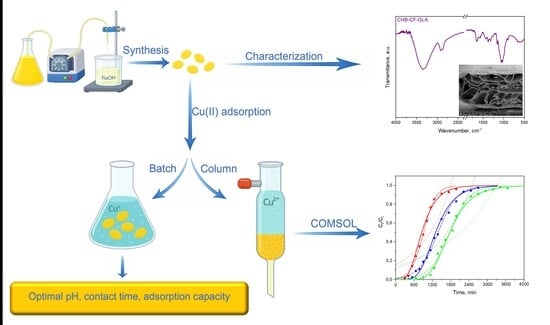
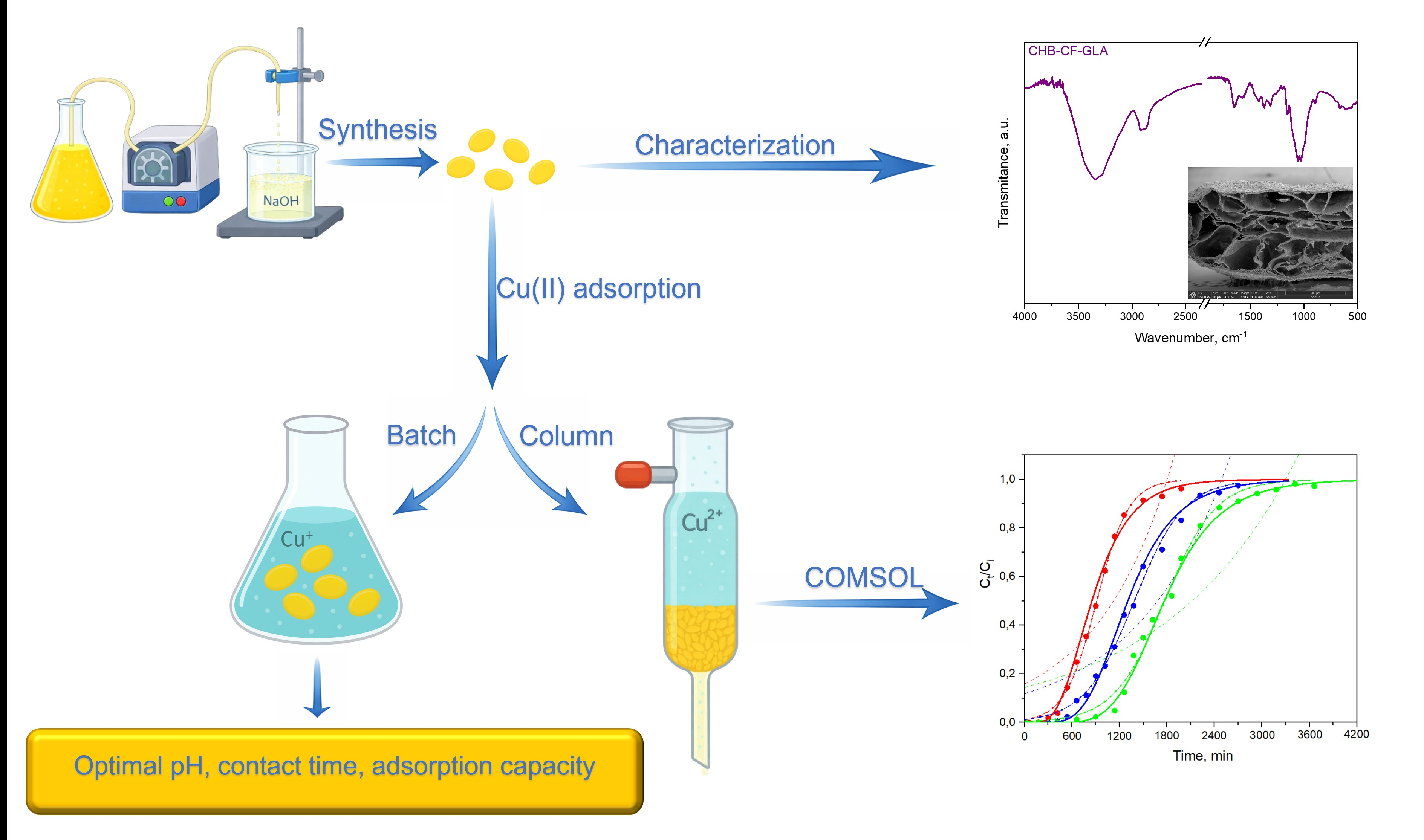
Graphical Abstract

1. Introduction

Water pollution resulting from diverse industrial activities has become a global environmental concern, posing a serious threat to both ecosystems and human health. Among the most prevalent contaminants in wastewater are heavy metals, which are non-biodegradable and, when present above permissible limits, can cause severe adverse effects on human health and the environment [1]. Copper (II) ions are undoubtedly one of the most important metals in human body, playing essential roles in numerous physiological processes. Excess of Cu(II) ions, however, cause a number of neurological conditions, including Wilson’s disease, Parkinson’s disease, and Alzheimer’s disease. The World Health Organization (WHO) recommends a maximum permitted amount of Cu(II) ions in drinking water of 2.0 mg dm−3 [2]. Therefore, the removal of Cu(II) ions from wastewater is one of the most important environmental problems.
Various methods, such as ion exchange, coagulation, precipitation, electrochemical processes, adsorption, and extraction, have been developed for the removal of heavy metal ions from wastewater. Among these, adsorption is particularly noteworthy due to its high efficiency, fast operation, reversibility, ease of implementation, and cost-effectiveness [3]. Although, activated carbon is the most widely used commercial adsorbent in wastewater treatment, it is limited by its high cost and energy demands. As a result, recent research has focused on developing more economical and efficient alternatives, including zeolites, chitin, chitosan, agricultural wastes, and other natural adsorbents [4]. Among these, chitosan and cellulose stand out as highly effective biosorbents due to their selectivity, strong affinity for heavy metal ions, and low cost [5,6,7,8,9].
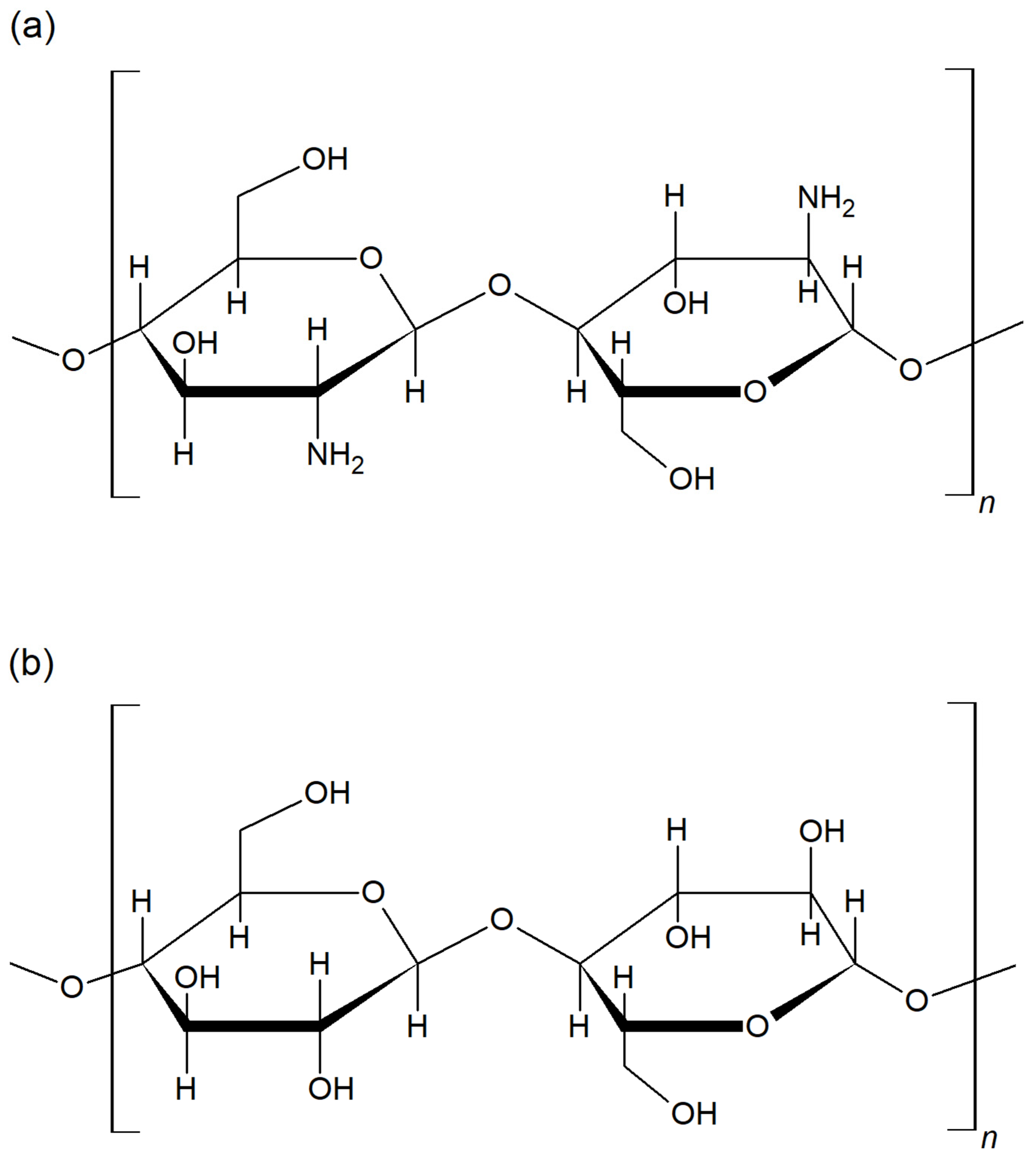
Chitosan is a natural amino polysaccharide obtained by the deacetylation of chitin. Due to the presence of reactive amino (–NH2) and hydroxyl (–OH) groups (Figure 1a), chitosan has a high binding capacity for heavy metal ions. Similarly, cellulose, a homopolysaccharide, contains two types of hydroxyl groups: primary (–CH2OH) and secondary (–OH) (Figure 1b). Both types of hydroxyl groups are hydrophilic, which results in strong hydrogen bonding between cellulose chains and the insolubility of cellulose in water and most common solvents [10,11]. Other characteristics of chitosan and cellulose, such as nontoxicity, biodegradability, renewability, efficiency, and low cost, make these biopolymers among the most widely used adsorbents for the removal of heavy metal ions from aqueous solutions [10,11]. However, chitosan use also has some limitations, such as low chemical stability and poor mechanical properties. To overcome these drawbacks, chitosan is often combined with materials such as cellulose, clays, zeolites, and synthetic polymers, resulting in composite structures with improved properties [12].
Polymer hydrogels have emerged as promising materials for pollutant removal due to their high adsorption efficiency and capacity. Numerous studies have reported the widespread application of hydrogels as effective adsorbents in water treatment processes [14,15,16,17]. Among these, composite hydrogels based on chitosan and cellulose have attracted significant attention for their potential in removing heavy metals from aqueous solutions, especially in batch systems [18,19,20,21,22]. However, relatively few studies have investigated the performance of chitosan/cellulose composite hydrogels in dynamic systems.
The goal of our research is to develop a functional adsorbent based on a chitosan/cellulose composite hydrogel and to test its potential for Cu(II) removal from aqueous solutions through adsorption in dynamic systems. The structural and morphological characteristics of the obtained adsorbent will also be presented, along with an evaluation of its regeneration potential and reusability. In accordance with our previous research, which demonstrated excellent agreement between experimental and modeled results [23], the experimental data of continuous adsorption of Cu(II) ions will be modeled using the COMSOL Multiphysics 3.5 software package.

2. Materials and Methods

2.1. Chemicals

Chitosan powder purchased from Acros Organics (Geel, Belgium), with a medium molecular weight of 100,000–300,000 Da (Daltons) and a deacetylation level of more than 90% [23] was used as the first component in the synthesis of composite. Cellulose fibers, obtained from Sigma-Aldrich (St. Louis, MI, USA), were used as the second component. Glutaraldehyde, citric acid, and copper(II) nitrate hemi(pentahydrate) [Cu(NO3)2·2.5H2O] were purchased from Sigma-Aldrich (St. Louis, MI, USA). Citric acid was used for the preparation of the chitosan solution, glutaraldehyde served as a crosslinking agent, and Cu(NO3)2·2.5H2O as the source of Cu(II) ions. The stock standard solution of Cu(II) (1000 mg dm−3) was made by dissolving an appropriate amount of Cu(NO3)2 2.5H2O in deionized water, while the 0.1 mol dm−3 HNO3 or 0.1 mol dm−3 NaOH were used for adjustment of pH values of the working solutions. Deionized water used in the experiments was obtained using a Milli-Q Water Purification System (Simplicity® Water Purification System, Millipore Corporation, Burlington, MA, USA).

2.2. Preparation of Chitosan/Cellulose Composite Hydrogel Beads

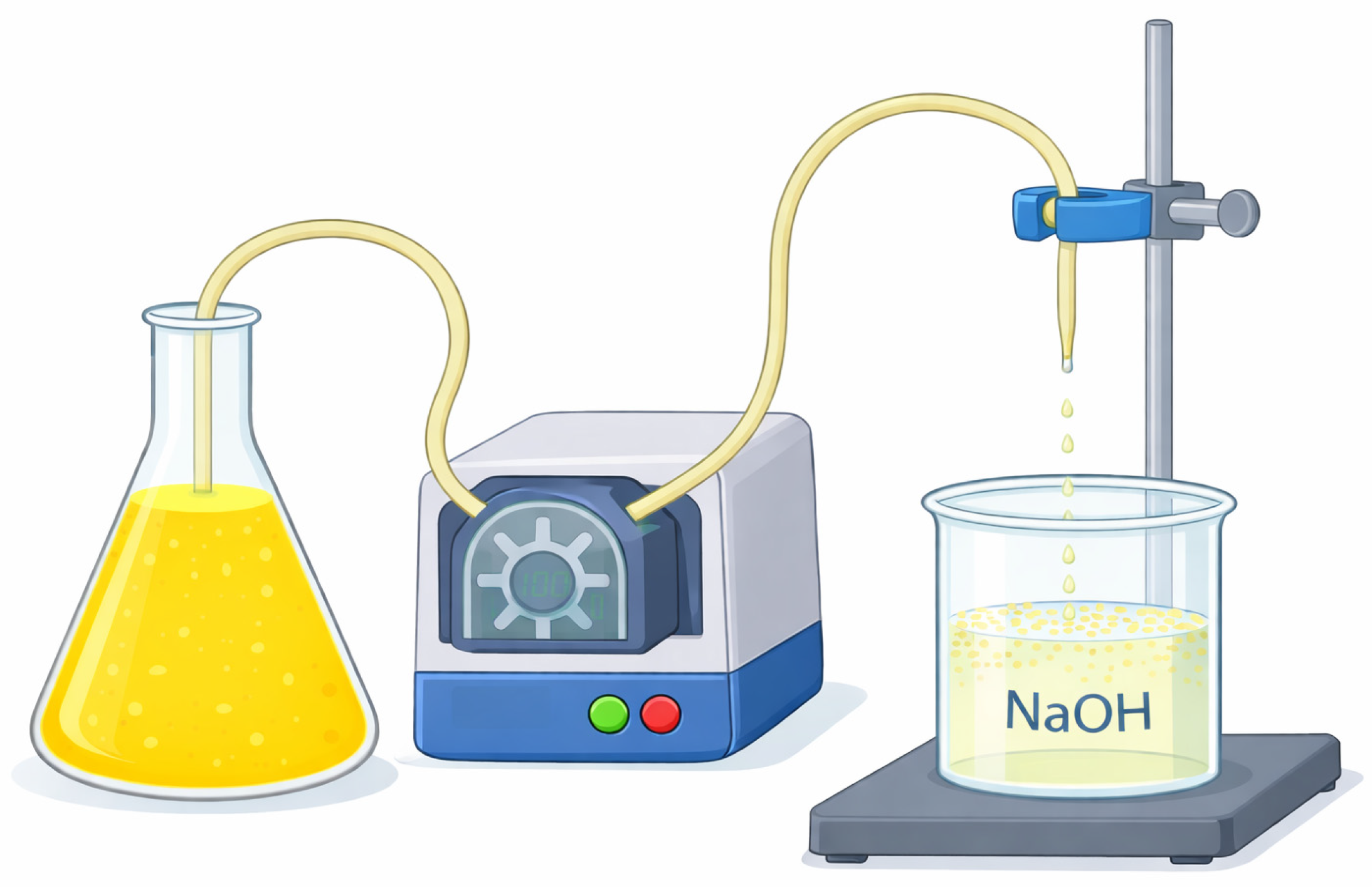
A 1 g amount of chitosan powder was added into 40 cm3 of 2% (w/w) citric acid in a beaker and mixed over 24 h at room temperature. Subsequently, 1 g amount of milled cellulose fibers (CF) was added to the chitosan solution and stirred for additional 24 h under the same conditions. Chitosan/cellulose composite hydrogel beads (CHB-CF) were formed by pipetting composite solution into a stirred 1 mol dm−3 NaOH solution with a Masterflex peristaltic pump (Cole-Parmer Instrument Co., Vernon Hills, IL, USA) (Figure 2). The formed spherical CHB-CF were continuously stirred in the same NaOH solution for 4 h to prevent aggregation, and then left overnight for hardening (Figure S1).
Crosslinking of the chitosan/cellulose composite hydrogel beads was performed using glutaraldehyde (CHB-CF-GLA). The hardened CHB-CF was added to 0.025% (v/v) glutaraldehyde solution and shaken for 24 h at room temperature. Following that, excess glutaraldehyde was eliminated by repeatedly rinsing the produced beads with deionized water (Figure S2). The resulting CHB-CF-GLA beads were lyophilized at 223 K and 1 mbar (Figure S3), and the dried material was used in all further experiments.

2.3. Characterization of CHB-CF-GLA

The morphology and elemental composition of CHB-CF-GLA were investigated using field emission scanning electron microscope, combined with energy dispersive X-ray spectroscopy (FESEM-EDS, FEI Scios 2 Dual beam system, Hillsboro, OR, USA). Each sample was attached to the holder with double-sided carbon adhesive. Prior to imaging, a thin layer of gold was sputter-coated onto the samples to ensure electrical conductivity. The micrographs and EDS spectra were acquired at an accelerating voltage of 15 kV with a magnification of 150x. The functional groups were analyzed using a Thermo Scientific Nicolet iS20 FTIR spectrometer (Thermo Fisher Scientific, Waltham, MA, USA) equipped with an attenuated total reflection (ATR) module (single-bounce diamond crystal). The ATR-FTIR spectra were collected in the wavenumber range of 4000–500 cm−1 with a resolution of 4 cm−1 and 16 scans. Advanced ATR Correction was applied using OMNIC software (sample refractive index = 1.50). The point of zero charge (pHpzc) of the CHB-CF-GLA was determined by the method used in our previous research [23]. XRD analysis was performed on Philips PW 1050 diffractometer (Philips, Amsterdam, The Netherlands) with Cu Kα1,2 (λ = 1.54178Å) radiation. The patterns were collected over a 2θ range of 10 to 40°, using a step size of 0.05° and scanning time of 3 s per step. The degree of swelling (DS) was determined by weighing 0.01 g of the sample and immersing it in 25 cm3 of deionized water. The suspension was shaken at 150 rpm for 24 h. Afterward, the mass of the swollen (wet) sample was measured and used to calculate the DS value (Equation (S1)).

2.4. Cu(II) Batch Adsorption/Desorption Experiments

In order to obtain optimized conditions for experiments with a fixed bed column, batch adsorption experiments were performed. The batch adsorption experiments involved obtaining the adsorption capacity of the CHB-CF-GLA material towards Cu(II) ions at different initial Cu(II) concentrations (10–300 mg dm−3) and initial pH values (3.5–6.5) of the solution. The adsorbent dosage used in the experiments (2 g dm−3), stirring speed (150 rpm) and contact time (24 or 4 h) were taken from our previous studies [23]. The initial and residual concentrations of Cu(II) ions were determined with a polarography system 797 VA Computrace analyser (Metrohm, Herisau, Switzerland) by using the Metrohm’s procedure for the voltametric determination of copper in water samples No. 231/2 e. All adsorption experiments were carried out in duplicate with relative deviation less than 5%. Efficiency of the adsorption process, E (%), and adsorption capacity of the applied adsorbent, qe (mg g−1), were calculated by Equations (1) and (2):
E = 100 C i C e C i
q e = C i C e m V
where Ci and Ce are the initial and equilibrium Cu(II) concentrations (mg dm−3), V (dm3) is the solution volume, and m (g) is the weight of the adsorbent.
The kinetics of Cu(II) adsorption onto CHB-CF-GLA was analyzed using the pseudo-first order (Equation (3)) and pseudo-second order (Equation (4)) non-linear kinetic models:
q t = q e ( 1 e k 1 t )
q t = q e   k 2   t 2 1 + q e   k 2   t
where qe (mg g−1) is the amount of Cu(II) adsorbed at equilibrium, and qt (mg g−1) is the amount of Cu(II) absorbed at the adsorption time t. The quantities k1 (min−1) and k2 (g mg−1 min−1) are the kinetic constants of the pseudo-first and pseudo-second order models.
Experimental data from the batch study, obtained to describe the adsorption of Cu(II) ions on CHB-CF-GLA at different initial concentrations of metal ions, were analyzed using two non-linear isotherm models, Langmuir (Equation (5)) and Freundlich (Equation (6)):
q e = q m K L C e 1 + K L C e
q e = K F C e 1 / n
where qm (mg g−1) is the maximum adsorption capacity; KL (dm3 mg−1) is Langmuir constant; KF ((mg g−1) (dm3 mg−1)1/n) is Freundlich constant related to adsorption capacity, and n (dimensionless) is Freundlich constant. The non-linear forms of isotherms were used to estimate the model parameters.
Adsorption/desorption experiments were conducted to evaluate the stability of the CHB-CF-GLA adsorbent over four consecutive cycles. EDTA solution is widely reported as an effective desorption agent for metal ions [24,25,26]. Thus, 0.01 mol dm−3 EDTA solution was used as the desorption agent between cycles. The adsorption/desorption experiments were performed under the same operating conditions as in the previous batch adsorption experiments.

2.5. Fixed-Bed Column Adsorption Studies

Continuous fixed-bed adsorption experiments were carried out to investigate the removal of Cu(II) at room temperature and pH 5.5, under different operating conditions (adsorbent bed height, feed flow rate, and initial Cu(II) concentration). Experiments were performed in custom-made glass column (height 15 cm, internal diameter 1.96 cm) containing sintered frit and glass beads to ensure uniform flow rate. The glass column was then filled with a CHB-CF-GLA adsorbent.
Known amounts of adsorbent (0.5, 0.75, and 1 g) were added in a glass column, corresponding to column bed heights of 2.0, 3.0, and 4.0 cm, respectively. Feed solution (initial Cu(II) concentration, 25, 50, and 75 mg dm−3) was introduced at desired flow rates (1.1, 2.1, and 3.1 cm3 min−1) via a peristaltic pump. Effluent samples were collected at specified time intervals to measure the Cu(II) concentration. The Cu(II) concentration was determined by polarography system according to standard procedure (No. 231/2 e). In this study, the breakthrough curve was used to monitor column performance, and the maximum adsorption capacity was considered to be reached when the outlet-to-inlet Cu(II) concentration ratio ( C t / C i ) exceeded 0.96. The adsorption characteristics in a fixed-bed column, such as total mass of adsorbed Cu(II)—mad (mg), maximum adsorption capacity of the column—qmax (mg g−1), total amount of Cu(II) entering the column—mtot (g), and removal efficiency—RE (%), can be calculated based on column operating parameters (Z (cm)—adsorbent bed height, Q (cm3 min−1)—feed flow rate, and Ci (mg dm−3)—initial Cu(II) concentration) and following Equations (7)–(10):
m a d = Q 1000 0 t t o t C i C t d t
q m a x = m a d m
m t o t = C i Q t t o t 1000
R E = m a d m t o t × 100
In the fixed-bed column adsorption studies, the experimental data were fitted using three mathematical models: Yoon–Nelson (Y-N), Adams–Bohart (A-B), and Thomas (Th) (Equations (11), (12) and (13), respectively). The non-linear equations of the aforementioned models were used to determine the corresponding parameters for each breakthrough curve.
C t C i = e x p k Y N t k Y N τ 1 + e x p k Y N t k Y N τ
C t C i = e x p k A B C i t k A B N 0 Z u
C t C i = 1 1 + e x p k T h q 0 m Q k T h C i t
where kYN (min−1) is Yoon–Nelson rate constant; τ (min) is time required for 50% adsorbate breakthrough; kAB (dm3 min−1 mg−1) is Adams–Bohart rate constant; N0 (mg dm−3) is maximum adsorption capacity; Z (cm) is bed height; u (cm min−1) is average velocity of solution; kTh (cm3 min−1 mg−1) is Thomas rate constant, and q0 (mg g−1) is predicted adsorption capacity.
Following the application of mathematical models to the fixed-bed column data, COMSOL Multiphysics 3.5 (Burlington, MA 01803, USA) was used to predict breakthrough curves based on system operating conditions and the physical characteristics of the column, adsorbent, and adsorbate. An axially dispersed plug flow model, described by the Advection Dispersion Reaction (ADR) equation (Equation (14)), was implemented, while the axial dispersion coefficient (Dz) was calculated using the Chung-Wen equation (Equation (15)):
C t + ρ p ( 1 ε b ) ε b q t = v z C z + D z 2 C z 2 ,
1 P e = ε b 0.2 + 0.11 R e 0.48
where C (mol dm−3) is the Cu(II) concentration in the liquid phase, ρ p (kg m−3) is the particle density, q (mol kg−1) is the amount of Cu(II) adsorbed in time t (min), ε b is the bed porosity, Pe is Peclet number (Pe = dpνz/Dz; dp(m)—the mean particle diameter, νz (m s−1)—the interstitial velocity of the liquid phase in the bed, and Dz (m2 s−1)—the axial dispersion coefficient), and R e is the Reynolds number (Re = dpνz/ν, ν—kinematic viscosity of water, 1.0034 × 10⁻⁶ m2/s at 20 °C).

3. Results and Discussion

3.1. Composite Characterization

3.1.1. ATR-FTIR

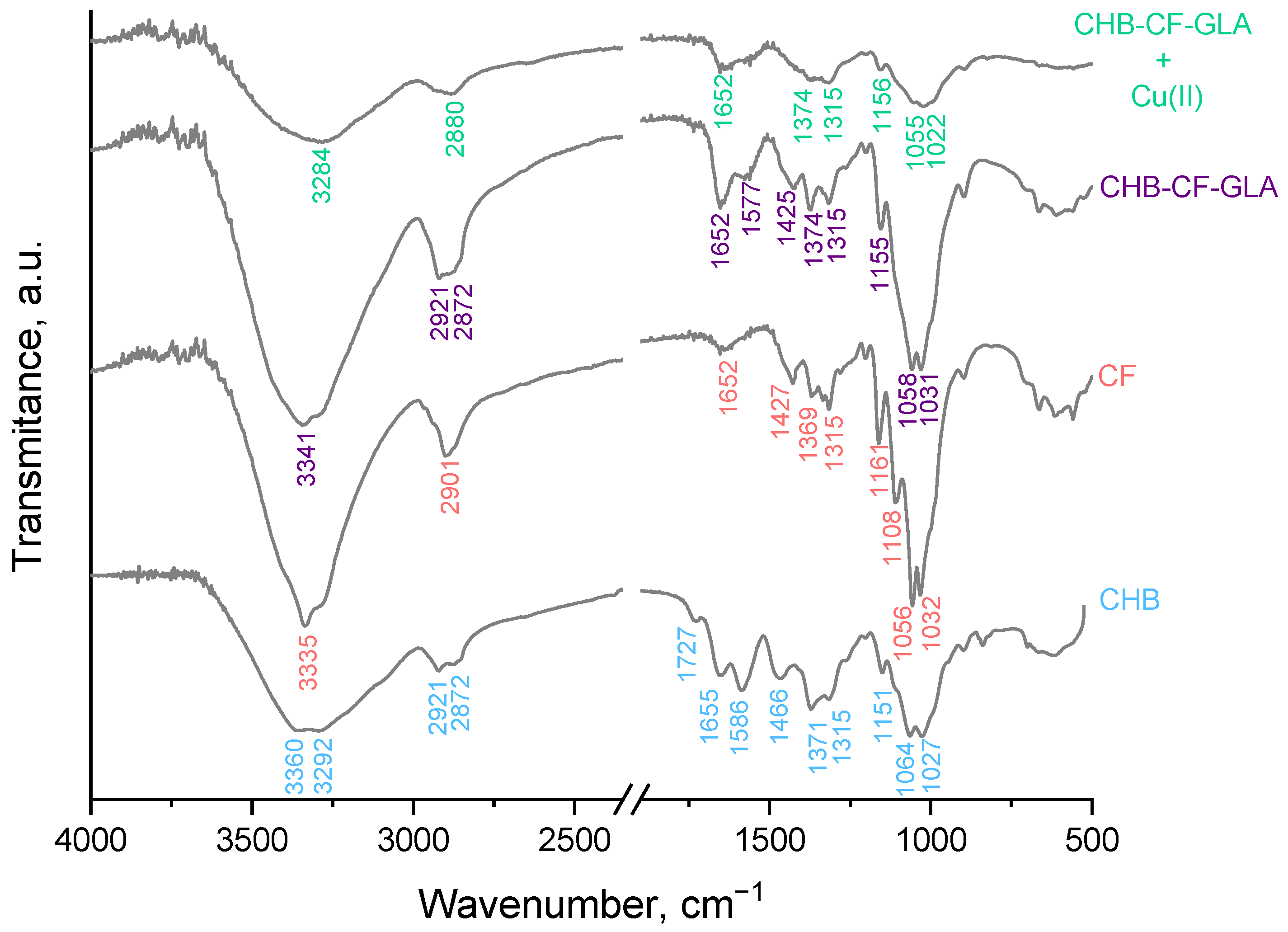
To better understand the structural features of the prepared materials and the functional groups involved in metal ion binding, ATR–FTIR analysis was performed for chitosan hydrogel beads (CHB), cellulose (CF), and the CHB–CF–GLA composite before and after Cu(II) adsorption (Figure 3).
The spectrum of CHB exhibits several characteristic absorption bands confirming the presence of functional groups typical of chitosan. The broad band between 3600 and 3100 cm−1 corresponds to the stretching vibrations of O–H and N–H groups involved in hydrogen bonding. The bands at 2921 and 2872 cm−1 are attributed to C–H asymmetric and symmetric stretching vibrations [23,27,28]. The band at 1727 cm−1 is likely associated with the C=O stretching vibration of carboxylic groups originating from citric acid used during hydrogel bead preparation [29]. The absorption at 1655 cm−1 corresponds to amide I (C=O stretching), while the band at 1586 cm−1 arises from amide II (N–H bending) vibrations. The peaks at 1466 and 1371 cm−1 are assigned to C–H deformation vibrations, whereas the band at 1315 cm−1 is attributed to the amide III (C–N stretching and N–H bending) vibration. The absorption at 1151 cm−1 corresponds to the asymmetric C–O–C stretching of the glycosidic linkage, while the strong bands observed at 1064 and 1027 cm−1 are due to C–O and C–O–C stretching vibrations within the polysaccharide backbone [23,27,30,31].
Similarly, the FTIR spectrum of cellulose fibers (CF) also displays characteristic absorption bands of polysaccharide structures. The broad band at 3335 cm−1 corresponds to O–H stretching vibrations from intra- and intermolecular hydrogen bonds, while the peak at 2901 cm−1 arises from C–H stretching in the glucopyranose ring [32,33,34,35]. The band at 1652 cm−1 is attributed to the O–H bending vibration, whereas absorptions at 1427, 1369, and 1315 cm−1 correspond to C–H deformation vibrations. The intense peaks at 1161, 1108, 1056, and 1032 cm−1 are characteristic of the carbohydrate fingerprint region, originating from C–O–C and C–O stretching vibrations of the pyranose ring and glycosidic linkages [32,33,34,35].
As expected, the spectrum of the CHB–CF–GLA composite exhibits most of the characteristic absorption bands of both CF and CHB, confirming the coexistence of cellulose and chitosan structural features. However, noticeable shifts in band positions and variations in intensity are evident, reflecting intermolecular interactions between the two polysaccharides and the crosslinking effect of glutaraldehyde. In particular, the broad O–H/N–H stretching band shifts from 3360 cm−1 (CHB) to approximately 3341 cm−1, indicating altered hydrogen bonding environments. The amide I and II bands near 1655 and 1586 cm−1 shift slightly to 1652 and 1577 cm−1, respectively, consistent with the formation of C=N linkages between chitosan amino groups and glutaraldehyde [23,36]. Minor shifts observed in the C–O–C and C–O stretching region (1200–1000 cm−1) further support structural reorganization.
After Cu(II) adsorption, additional spectral changes are observed, including a further shift in the O–H/N–H stretching band to 3284 cm−1 and intensity reductions in the amide and C–O regions. These modifications indicate the interaction of Cu(II) ions with amino and hydroxyl groups of the biopolymer matrix, suggesting the involvement of these active sites in metal ion binding [37,38]. Deeper insight into the interactions between Cu(II) ions and the functional groups of the CHB-CF-GLA adsorbent via X-ray photoelectron spectroscopy (XPS) or theoretical calculations is a subject for future studies [39].

3.1.2. FESEM Analysis

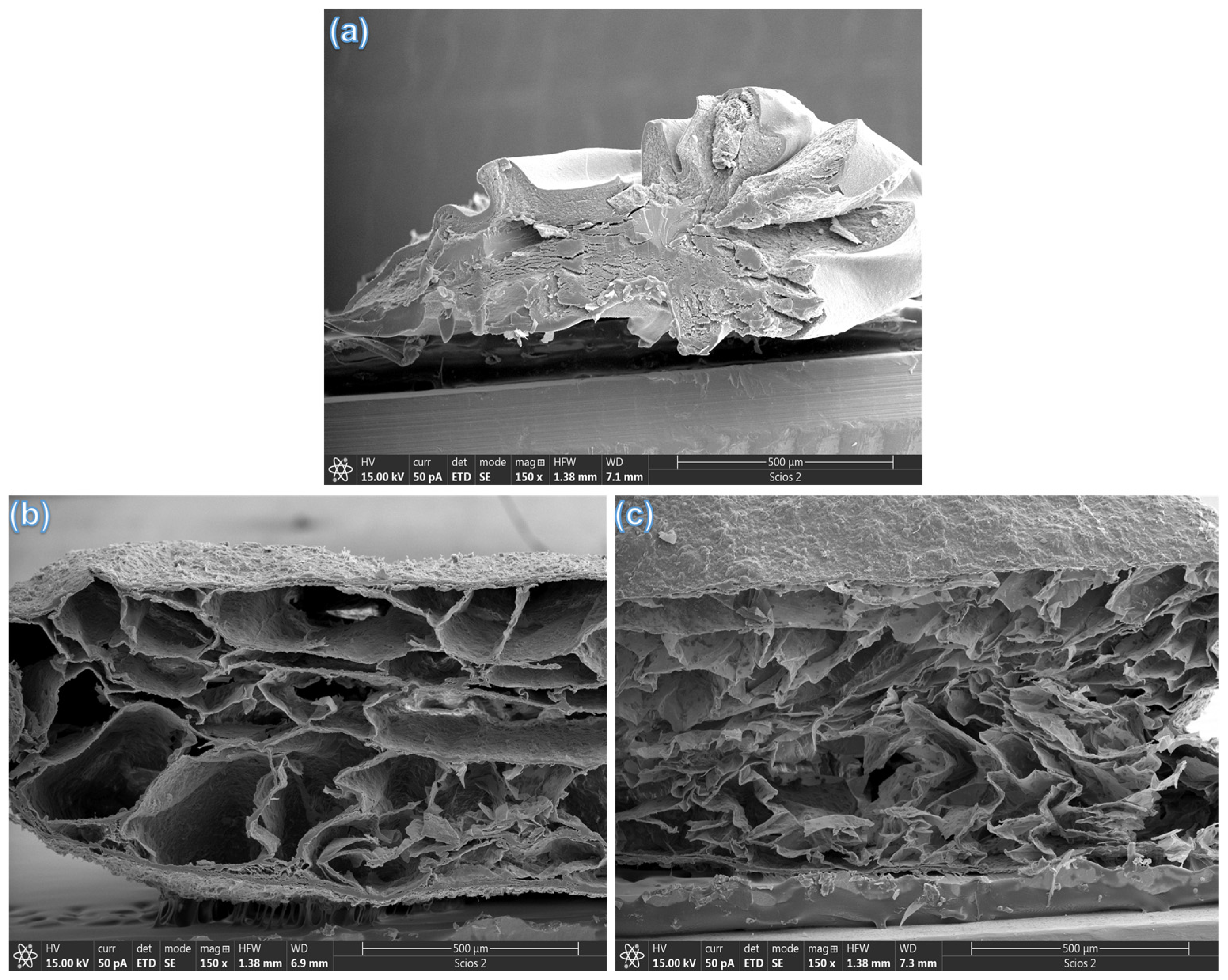
The cross-sectional morphology of the dried samples was examined by FESEM, and representative micrographs of the beads are shown in Figure 4.
In our previous work, a composite of chitosan hydrogel beads crosslinked with glutaraldehyde and modified with citric acid (CA–GLA–CHB) was prepared and characterized by FESEM; however, only the surface of the bead was examined [23]. In this study, cross-sectional micrographs of this sample were recorded (Figure 4a) in order to compare how addition of CF in the composite influenced bead’s structure.
Examination of the cross-sections revealed noticeable differences between the samples. While the composite without CF formed more compact structure with irregularly folded surfaces, the CHB–CF–GLA composite (Figure 4b) displayed an open, layered morphology, typical of cellulose-based materials [40,41]. A well-defined, interconnected fibrous cellulose network was evident throughout the structure, providing reinforcement and contributing to the improved mechanical stability of the composite. These morphological observations are consistent with the swelling behavior of the materials. The two composites showed substantial differences in their degree of swelling: CA–GLA–CHB reached 327.4%, while CHB–CF–GLA swelled to 200.9%. The reduced swelling of the cellulose-containing composite reflects lower water uptake, which, according to the literature, is associated with enhanced mechanical properties. Furthermore, cellulose incorporation has also been reported to improve the chemical stability of similar composites in both acidic and alkaline environments [42].
FESEM analysis was also performed after Cu(II) adsorption (Figure 4c), revealing pronounced structural changes in the hydrogel following interaction with Cu(II) ions. In contrast to the highly porous morphology of the CHB-CF-GLA sample prior to adsorption, the post-adsorption material exhibited noticeably reduced pore size and a more compact appearance. This behavior is consistent with reports in the literature on hydrogels used for heavy-metal adsorption and supports the conclusion that Cu(II) ions were effectively retained within the hydrogel structure [43,44]. To further support these observations, EDS spectra of CHB–CF–GLA before and after Cu(II) adsorption (Figure S4) were recorded. In the spectra of CHB–CF–GLA only carbon, oxygen and nitrogen peaks were present at 0.28 keV, 0.52 keV and 0.39 keV, respectively, which is consistent with polysaccharide composition. In contrast, the CHB–CF–GLA + Cu(II) spectrum, additionally to C, O and N, displays distinct copper peaks (around 0.9 keV, 8.0 keV and 8.9 keV), confirming successful adsorption of Cu(II) ions onto the composite.

3.1.3. XRD Analysis

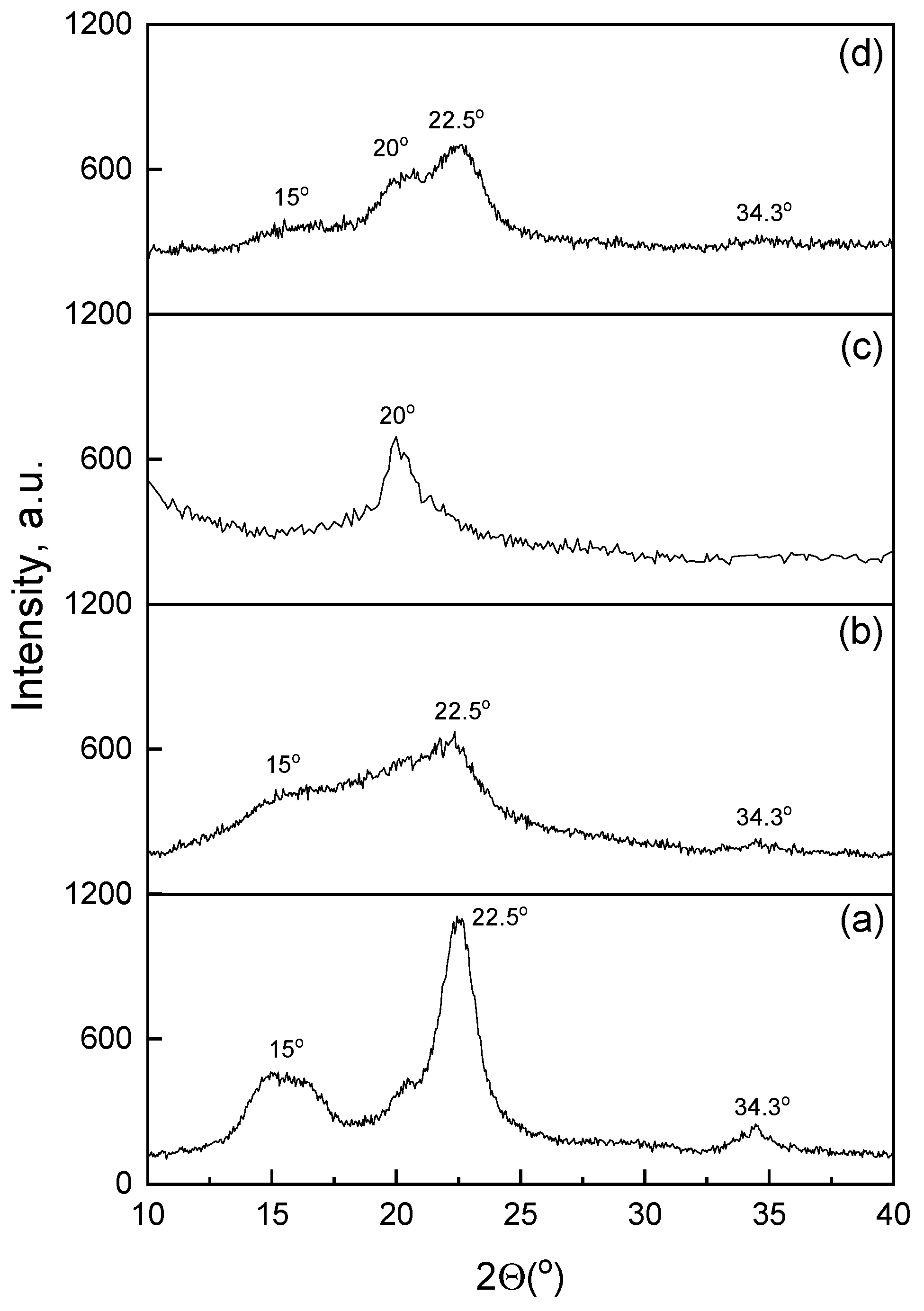
The XRD patterns of powdered chitosan, non-milled cellulose fibers, mechanically treated (milled) cellulose fibers (CF), and the final CHB-CF-GLA composite (Figure 5) reveal distinct structural changes induced by fiber processing and composite formation.
Powdered chitosan shows a broad, low-intensity diffraction peak at ~20° 2θ, characteristic of its semicrystalline structure [45]. In contrast, untreated cellulose fibers exhibit pronounced peaks at ~15°, ~22.5°, and ~34.3° 2θ, which are typical for the cellulose I crystalline structure [45,46,47]. Mechanical milling leads to a substantial decrease in the intensity of these reflections, indicating a reduction in crystallite size and partial disruption of the ordered cellulose domains [48,49,50]. Structural changes in cellulose after milling were additionally confirmed by field emission scanning electron microscopy (Figure S5). Because milled cellulose was used for preparation of the CHB-CF-GLA composite, its reduced crystallinity is directly reflected in the structure of the final material. Accordingly, the XRD pattern of CHB-CF-GLA displays the cellulose peaks together with an additional chitosan-related peak at ~20° 2θ. As reported in the literature [47], such composites typically show diffraction contributions from both polysaccharide components, with the relative peak intensities being proportional to their respective contents in the material.

3.2. Batch Adsorption/Desorption Study

3.2.1. Effect of Initial pH

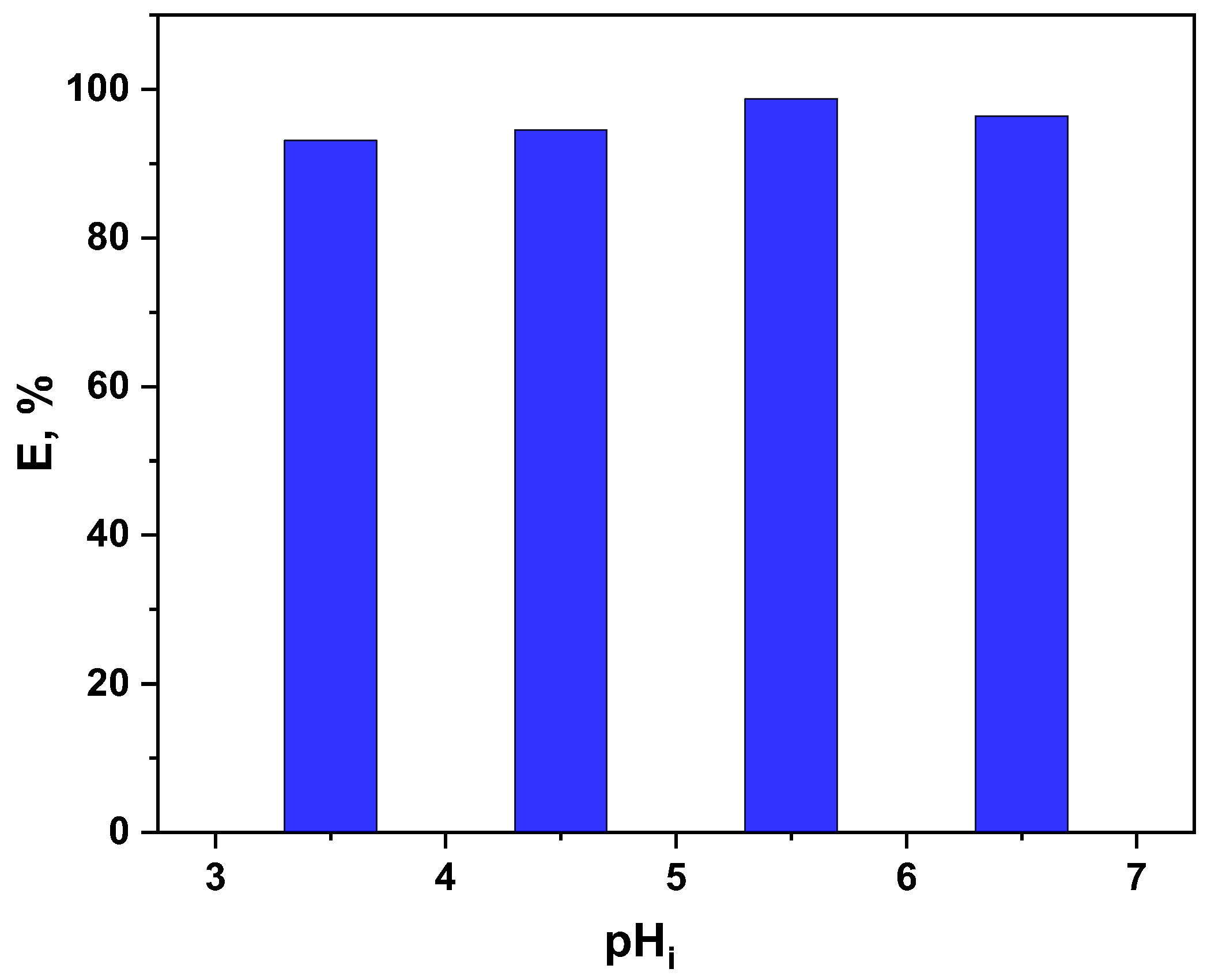
To achieve the highest efficiency in Cu(II) ion removal, it is essential to determine the optimal pH of the solution. For this purpose, the effect of the initial pH, ranging from 3.5 to 6.5, on adsorption was investigated. Higher pH values were not considered because Cu(II) ions tend to precipitate as hydroxides under alkaline conditions [18]. The experiments were performed at room temperature, with an initial Cu(II) concentration of 25 mg dm−3, a contact time of 24 h, a stirring speed of 150 rpm, and an adsorbent dosage of 2 g dm−3. As shown in Figure 6, the CHB-CF-GLA composite achieved maximum Cu(II) removal at pH 5.5 (98.7%), while maintaining high uptake across the entire investigated pH range.
The pHpzc of the composite was determined to be 6.8 (Figure S6), indicating that the material is expected to carry a net positive surface charge at all investigated pH values (pH < pHpzc) and therefore exhibit limited affinity toward cationic species. However, the composite still demonstrated high Cu(II) uptake (>90%) across the entire tested pH range. This behavior is consistent with reports on chitosan-based composites, where Cu(II) adsorption is governed predominantly by thermodynamically favored complexation with amino and hydroxyl groups rather than by electrostatic attraction. The formation of Cu-N and Cu-O coordination bonds is associated with a negative Gibbs free energy change (ΔG < 0), allowing adsorption to proceed despite electrostatic repulsion [51,52,53]. At pH 5.5, a sufficient fraction of unprotonated amino groups (–NH2) remains available to coordinate Cu(II), with additional contribution from hydroxyl groups (–OH), which together result in enhanced metal binding. Therefore, this pH was selected as optimal for the initial Cu(II) solution in subsequent experiments [54,55].

3.2.2. Effect of Contact Time and Kinetic Models

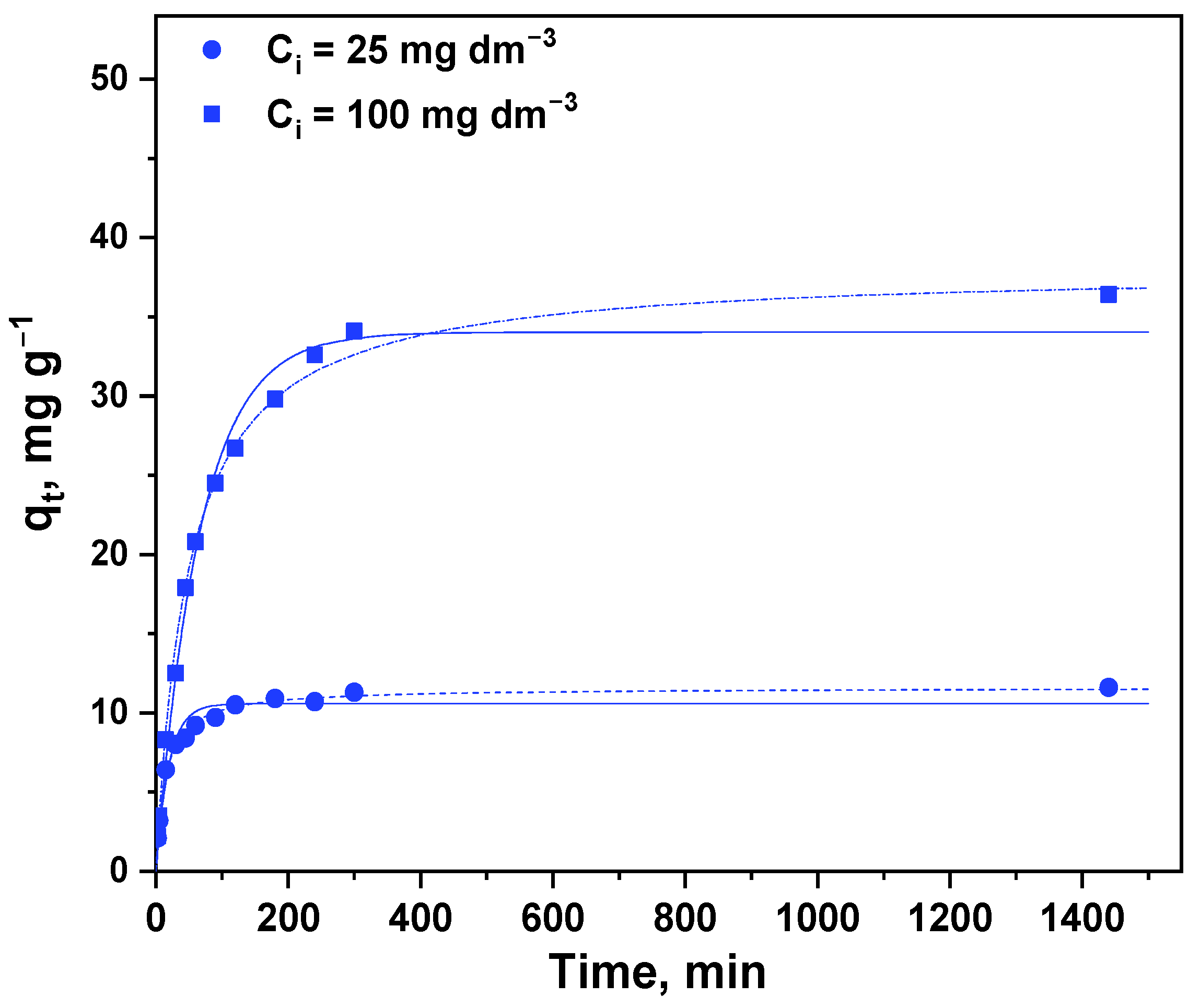
The effect of contact time on Cu(II) adsorption was examined over a time range of 3–1440 min (Figure 7). During these experiments, contact time was the only variable, while all other operating parameters were kept constant: room temperature, solution pH of 5.5, stirring speed of 150 rpm, and an adsorbent dosage of 2 g dm−3. Additionally, two concentrations of Cu(II) (25 and 100 mg dm−3) were used in order to evaluate whether the adsorption kinetics depend on the initial Cu(II) concentration.
For both concentrations, Cu(II) adsorption exhibited a rapid uptake during the first 90 min, followed by a slower progression toward equilibrium, which was reached within 180–240 min, after which no further significant increase in adsorption was observed. At the higher Cu(II) concentration, the initial uptake was slightly slower, likely due to a greater number of ions competing for available active sites, delaying the approach to equilibrium [56]. As expected, the lower Cu(II) concentration resulted in a lower equilibrium adsorption capacity, whereas an increase in concentration led to higher adsorption capacities. Since the upcoming isotherm experiments cover a broad concentration range (10–300 mg dm−3), a 240 min (4 h) was selected as the optimal contact time.
The experimental data were fitted using pseudo-first-order and pseudo-second-order non-linear kinetic models, with the corresponding kinetic parameters shown in Table S1. The adsorption of Cu(II) ions onto CHB-CF-GLA followed the pseudo-second-order kinetic model for both initial concentrations (25 and 100 mg dm−3), as evidenced by determination coefficients (R2 = 0.996 and 0.998, respectively). This model also showed excellent agreement between calculated (qe,cal) and experimental (qe,exp) adsorption capacities (Table S1). Specifically, for an initial Cu(II) concentration of 25 mg dm−3, qe,exp and qe,cal were 11.5 and 11.6 mg g−1, respectively. At the higher initial concentration, the corresponding values increased to 36.4 and 38.0 mg g−1, confirming the good predictive performance of the model.

3.2.3. Effect of Initial Cu(II) Concentration and Adsorption Isotherms

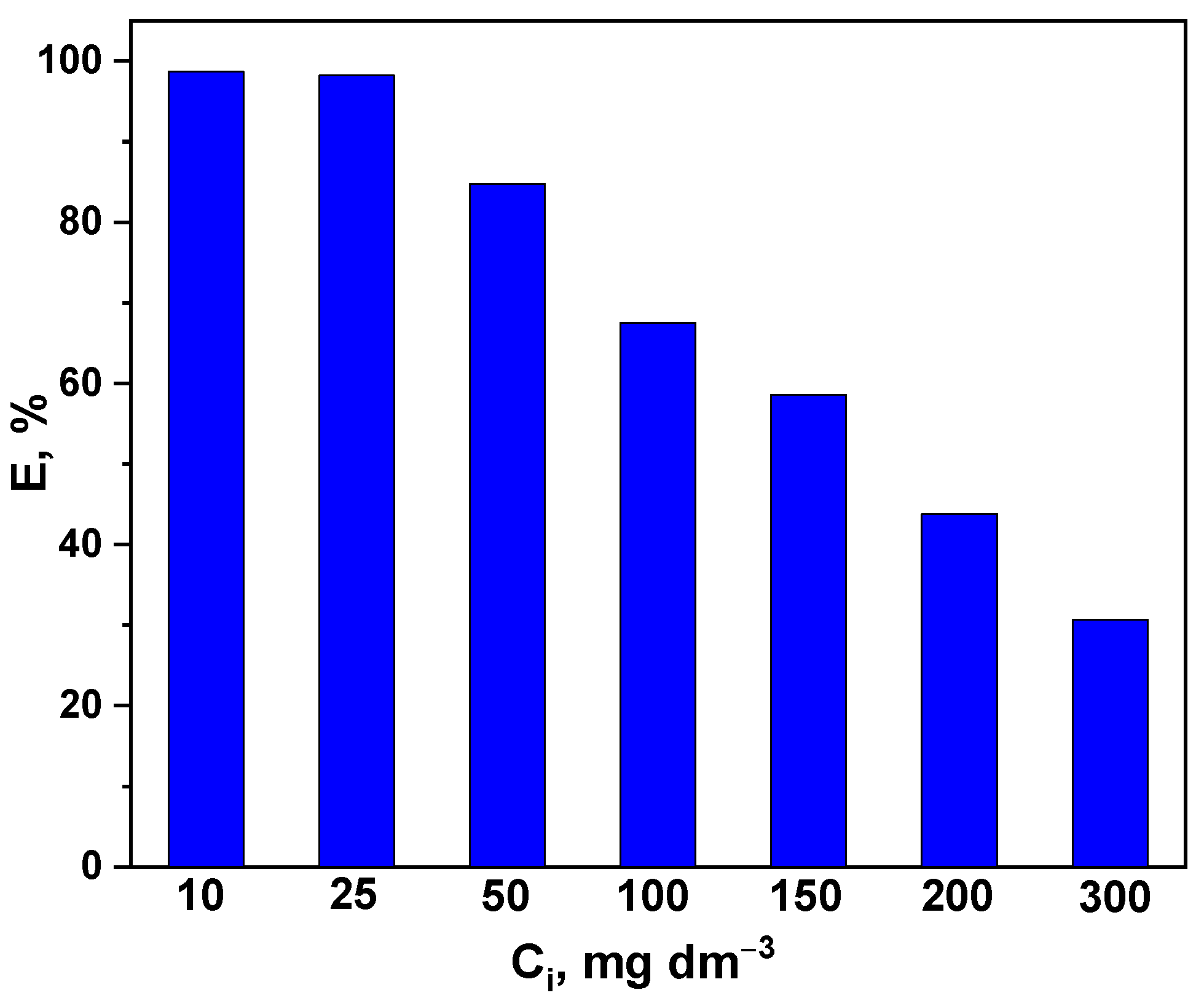
The effect of the initial Cu(II) concentration, Ci, on the adsorption performance of CHB-CF-GLA was evaluated by varying Ci from 10 to 300 mg dm−3, while keeping all other experimental parameters constant (solution pH 5.5, contact time 4 h, stirring speed 150 rpm, and adsorbent dosage 2 g dm−3). As shown in Figure 8, the Cu(II) removal efficiency decreased from 98% to 30% with increasing initial concentration. This trend can be attributed to the fact that, at higher Cu(II) concentrations, the available binding sites on the surface of the adsorbent become progressively saturated. Once these active sites are fully occupied, no further adsorption can occur, resulting in a reduction in the overall removal efficiency.
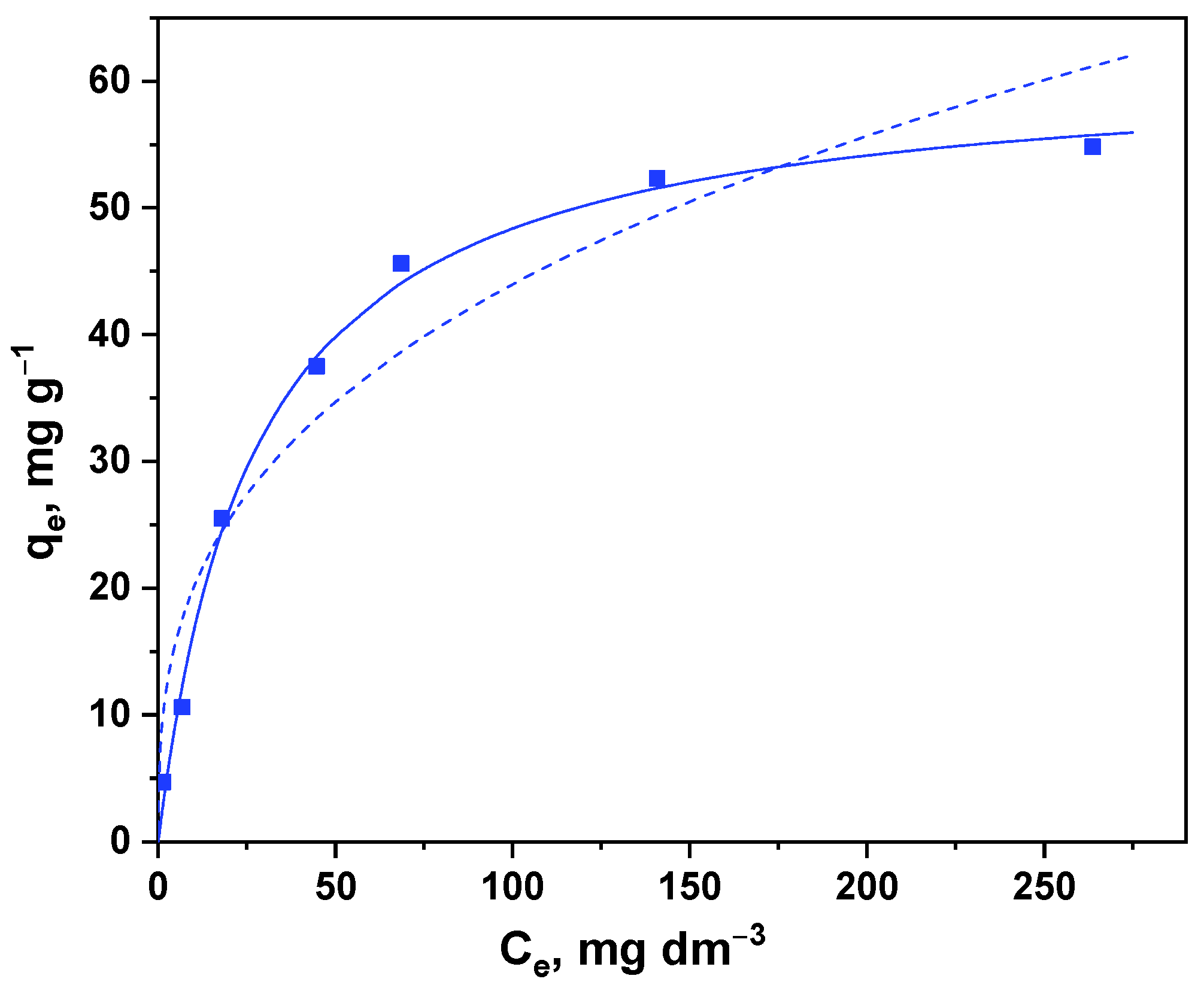
The equilibrium adsorption data for Cu(II) on CHB-CF-GLA, obtained at different initial concentrations, were analyzed using two non-linear isotherm models: Langmuir and Freundlich (Figure 9). Model performance was evaluated using the coefficient of determination (R2, Table 1). The Langmuir model provided a better fit to the experimental data (R2 = 0.995) compared with the Freundlich model (R2 = 0.918), indicating a more accurate description of the adsorption process. Additionally, Langmuir model predicted maximum adsorption capacity of 61.4 mg g−1, which is in good agreement with the experimental value (54.8 mg g−1).

3.2.4. Desorption Study of CHB-CF-GLA Adsorbent

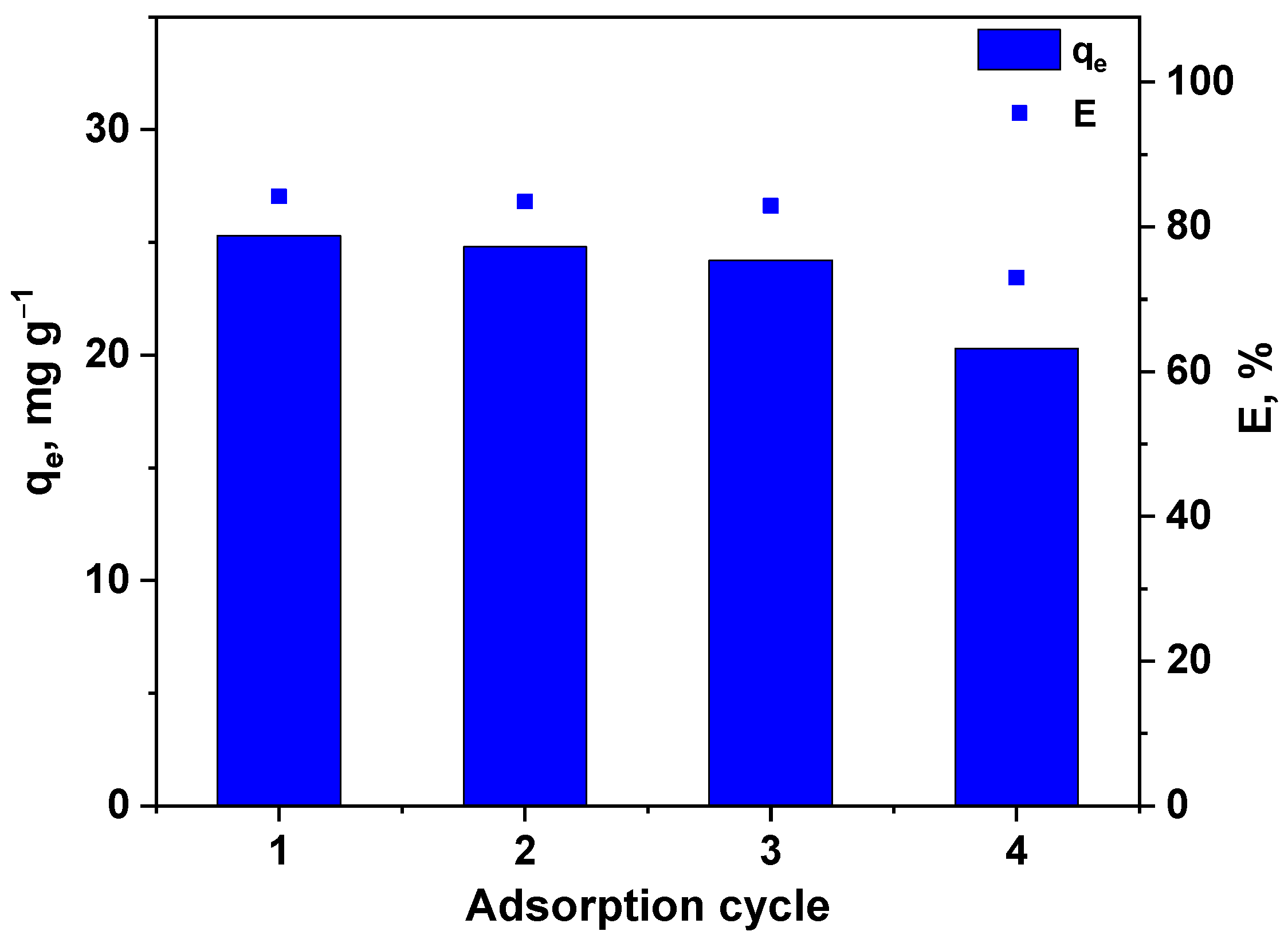
To assess the reusability of CHB-CF-GLA, a series of adsorption–desorption cycles were performed. The spent adsorbent was regenerated over four consecutive cycles using a 0.01 mol dm−3 EDTA solution, as the desorption eluent. All experiments were conducted at room temperature with an initial Cu(II) concentration of 50 mg dm−3, a solution pH of 5.5, a stirring speed of 150 rpm, a contact time of 4 h, and an adsorbent dosage of 2 g dm−3. As shown in Figure 10, Cu(II) removal efficiency gradually decreased during the first three cycles, from 84.2% to 82.9%, followed by a more pronounced decline after the fourth cycle. The relatively small loss of efficiency over the first three cycles suggests that the hydrogel structure remains largely stable, while the sharper decline after the fourth cycle, accompanied by a decrease in solution pH to 3.25, indicates a possible acid-induced weakening of the glutaraldehyde crosslinked network. This suggests that repeated exposure to the EDTA desorption solution may cause weakening of the CHB-CF-GLA hydrogel network, resulting in reduced Cu(II) removal efficiency. The obtained results indicate that CHB-CF-GLA can be effectively regenerated, highlighting its potential as an economically viable adsorbent for practical wastewater treatment applications.

3.3. Dynamic Study

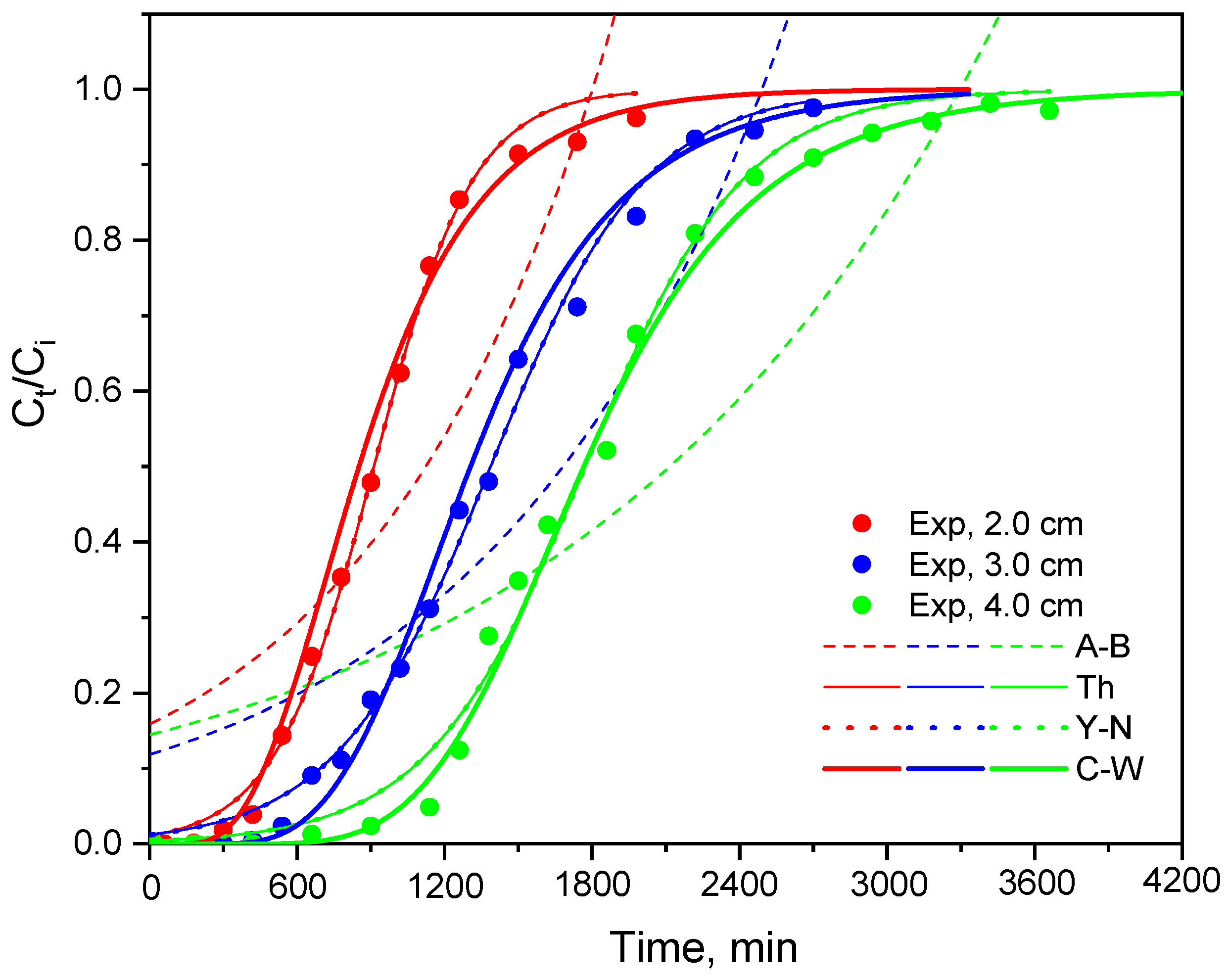
A dynamic adsorption study was performed using a fixed-bed column packed with CHB-CF-GLA adsorbent to evaluate its performance in the removal of Cu(II) ions from aqueous solutions. The influence of operating parameters, including adsorbent bed height (Z), influent flow rate (Q), and initial Cu(II) concentration (Ci), on the breakthrough behavior was systematically investigated at room temperature. Based on the obtained breakthrough curves, key column performance parameters such as breakthrough time (tb) and exhaustion time (te), were determined and together with parameters calculated based on Equations (7)–(10) (mad, mtot, RE, qmax) are presented in Table 2. In addition, COMSOL Multiphysics was used to predict the breakthrough curves for Cu(II) adsorption in a fixed-bed column packed with CHB-CF-GLA adsorbent by applying Equations (14) and (15).

3.3.1. Effect of Adsorbent Bed Height

To investigate the effect of bed height on the breakthrough behavior of Cu(II) adsorption onto CHB-CF-GLA, different bed heights of 2.0, 3.0, and 4.0 cm were employed at an initial Cu(II) concentration of 25 mg dm−3, a solution pH of 5.5, and an influent flow rate of 1.1 cm3 min−1, at room temperature. As shown in Figure 11, an increase in bed height led to a pronounced prolongation of both breakthrough and exhaustion times. Specifically, increasing the bed height from 2.0 to 4.0 cm resulted in an increase in the breakthrough time from 420 to 1040 min, while the exhaustion time increased from 1730 to 2970 min. This trend can be attributed to the higher availability of functional adsorption sites for Cu(II) ions at greater bed heights of adsorbent [57]. Consequently, a bed height of 4.0 cm was selected for subsequent dynamic experiments.
The experimental breakthrough data at different bed heights were successfully fitted using the Adams–Bohart (A-B), Thomas (Th), and Yoon–Nelson (Y-N) models. The model parameters were estimated by non-linear regression (shown in Table S2), and the results indicated that the Thomas and Yoon–Nelson models provided a better fit than the Adams–Bohart model. These results are in agreement with the literature, where the poorer fit of A-B model was explained by the fact that this model describes only the initial part of the breakthrough curve while other models are used for the whole curve [57,58,59,60]. The Thomas model parameters indicated a decrease in the rate constant and an increase in the predicted adsorption capacity with increasing bed height, with calculated capacities closely matching the experimentally determined dynamic adsorption capacities (Table S2). Furthermore, a good agreement was obtained between the experimentally determined time at Ct/Ci = 0.5 and the corresponding breakthrough time (τ) estimated using the Yoon–Nelson model.

3.3.2. Effect of Feed Flow Rate

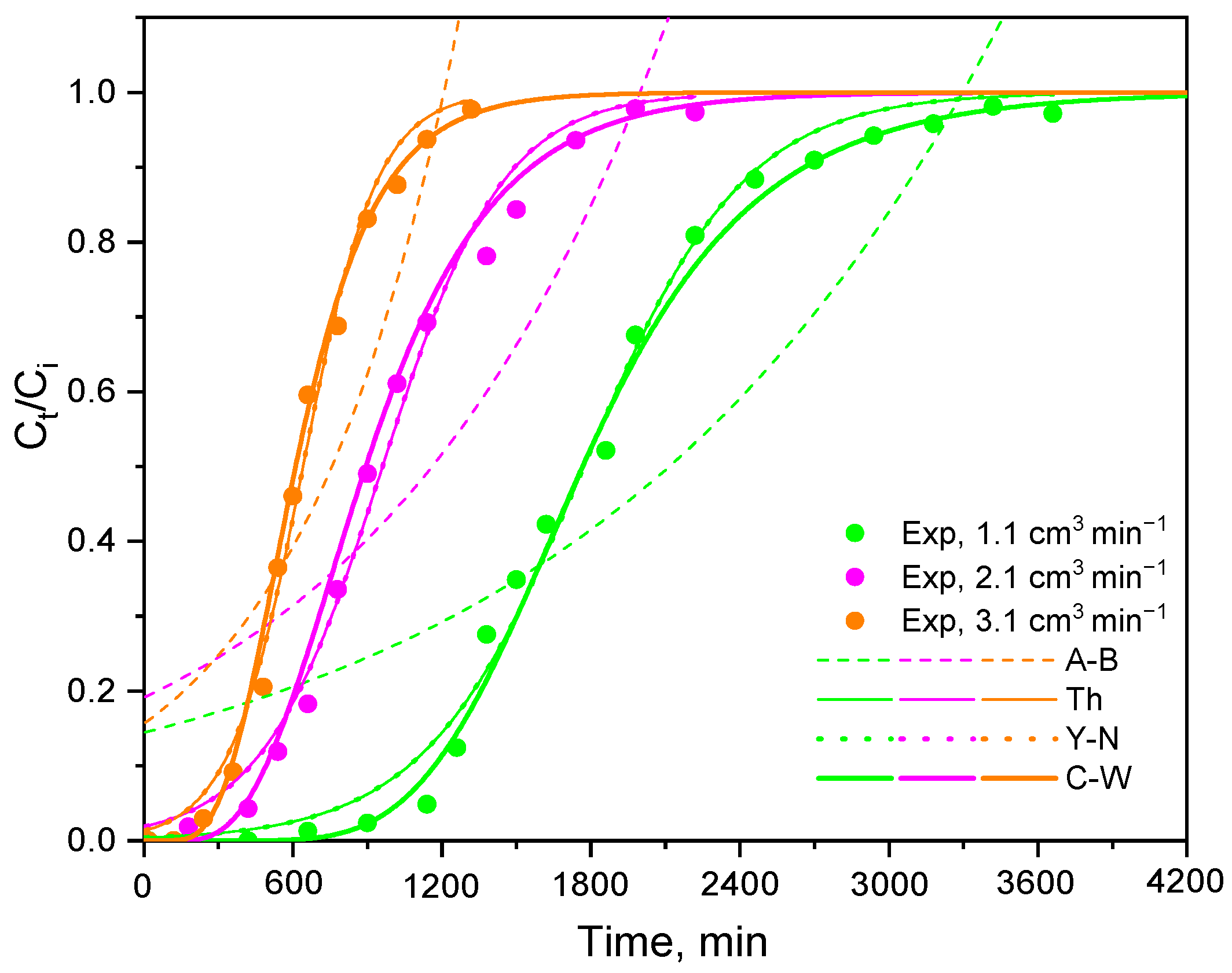
The effect of feed flow rate on the Cu(II) breakthrough curves was evaluated at flow rates of 1.1, 2.1, and 3.1 cm3 min−1, while all other operating parameters were kept constant (initial Cu(II) concentration of 25 mg dm−3, solution pH 5.5, and a bed heights of 4.0 cm). As shown in Figure 12, increasing the flow rate resulted in breakthrough curves with a higher slope, accompanied by shorter breakthrough and exhaustion times. The shortest breakthrough and exhaustion times (290 and 1180 min, respectively) were observed at the highest flow rate of 3.1 cm3 min−1, whereas the longest times (1040 and 2970 min, respectively) were obtained at 1.1 cm3 min−1. The observed reduction in breakthrough and exhaustion times at higher flow rates can be attributed to the decreased residence time of the Cu(II) solution within the column, which limits mass transfer and reduces the interaction between Cu(II) ions and the available adsorption sites on the CHB-CF-GLA adsorbent. Conversely, lower flow rates provide extended contact time, facilitating intraparticle diffusion and improving adsorption efficiency [57]. Therefore, a flow rate of 1.1 cm3 min−1 was identified as the most favorable operating condition for achieving efficient Cu(II) removal in the fixed-bed column system.
A comparison between the experimental and model-predicted breakthrough curves is presented in Figure 12. Again, the Adams–Bohart model had lower determination coefficients compared to Thomas and Yoon–Nelson models. (Table S2). With increasing feed flow rate, the Thomas rate constant increased while the predicted adsorption capacity decreased, with calculated capacities closely matching the experimental values. In addition, the breakthrough times predicted by the Yoon–Nelson model (τ) were in good agreement with the experimental times determined at Ct/Ci = 0.5 (1760, 890, and 620 min for increasing flow rates), further confirming the suitability of the Thomas and Yoon–Nelson models for predicting Cu(II) adsorption in a fixed-bed column packed with CHB-CF-GLA adsorbent.

3.3.3. Effect of Initial Cu(II) Concentration

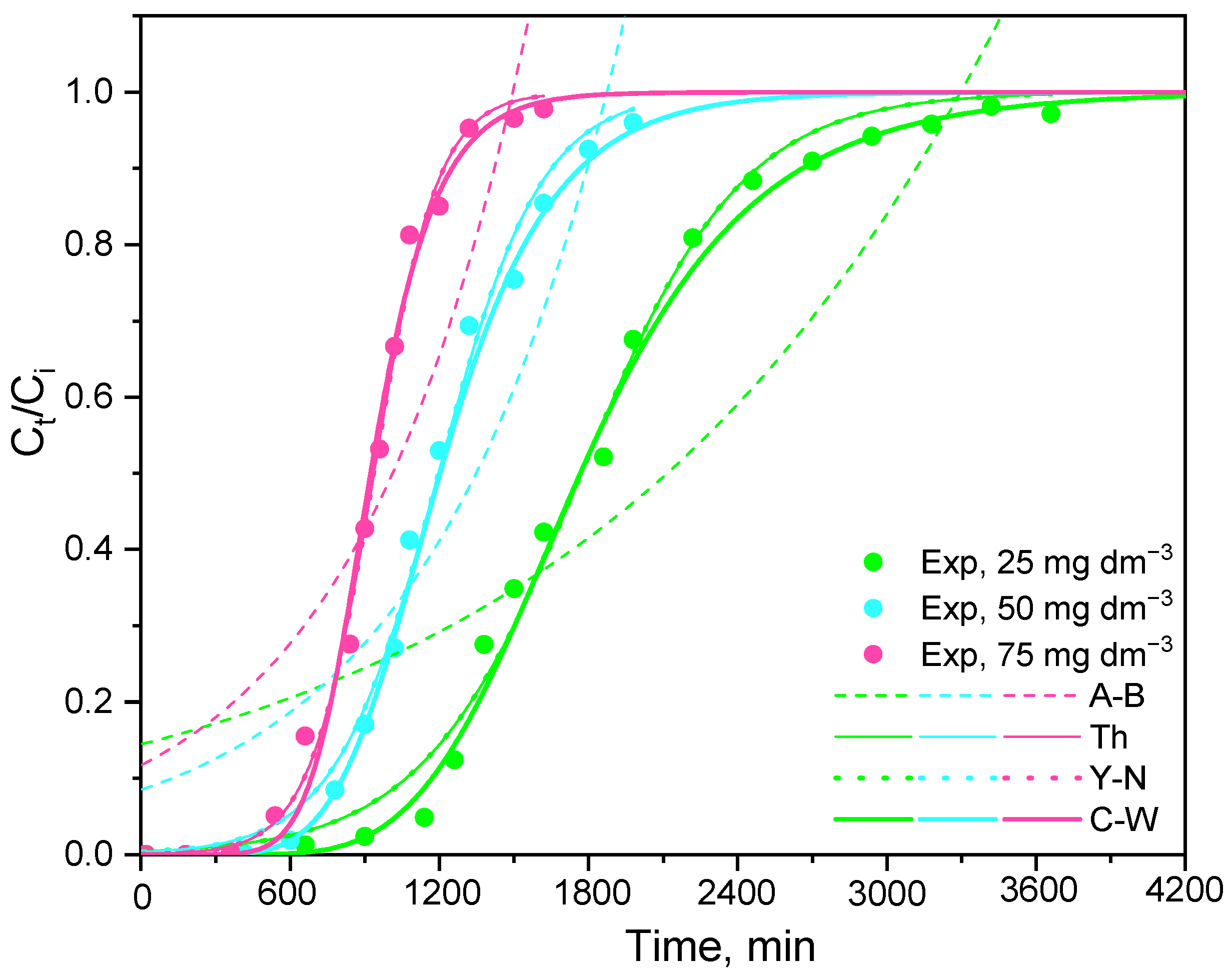
Fixed-bed column experiments using CHB-CF-GLA adsorbent were conducted by varying the initial Cu(II) concentration between 25, 50, and 75 mg dm−3, while maintaining constant operating conditions (solution pH of 5.5, an influent flow rate of 1.1 cm3 min−1, and a bed height of 4.0 cm). The results, presented in Figure 13, indicate that increasing the initial Cu(II) concentration caused a pronounced leftward shift in the breakthrough curves, accompanied by a decrease in both breakthrough and exhaustion times (from 1040 to 570 min and from 2970 to 1320 min, respectively). This behavior can be attributed to the higher mass of Cu(II) ions introduced into the column per unit time at elevated influent concentrations, which accelerates the saturation of available adsorption sites [57]. In contrast, at lower Cu(II) concentrations, broader and more dispersed breakthrough curves were observed due to reduced mass transfer rates and slower diffusion, resulting in prolonged breakthrough times.
As in the previous cases, the Thomas and Yoon–Nelson models fitted the experimental breakthrough data significantly better than the Adams–Bohart model (Figure 13 and Table S2). The good agreement between predicted and experimental breakthrough curves, as well as adsorption capacities and breakthrough times, confirms the suitability and reliability of the Thomas and Yoon–Nelson models for describing and evaluating the dynamic performance of the fixed-bed column under different influent concentrations.

3.3.4. COMSOL Modeling

Breakthrough curves for Cu(II) adsorption in a fixed-bed column packed with CHB-CF-GLA adsorbent were predicted using an axially dispersed plug-flow model governed by the ADR equation (Equation (14)), which was solved numerically in COMSOL Multiphysics. Since the adsorption of Cu(II) onto CHB-CF-GLA was described by the Langmuir isotherm; accordingly, the second term on the left in the ADR equation was represented by the non-linear Langmuir formulation. The Langmuir parameters were determined from batch adsorption experiments. The axial dispersion coefficient (Dz) was evaluated using the Chung–Wen empirical correlation based on the Peclet number (Equation (15)). The simulations incorporated the system operating conditions as well as the physical characteristics of the column, adsorbent, and adsorbate. All input data used in the simulations are summarized in Table S3.
The reliability of the model was assessed by comparing the simulated breakthrough profiles with the experimental data obtained under different operating conditions. As shown in Figure 11, Figure 12 and Figure 13, curves obtained in COMSOL, calculated using the Chung–Wen correlation (thicker solid lines) had shown an excellent agreement with experimental breakthrough curves. This strong consistency indicates that the model accurately captures the system behavior across the studied conditions. Furthermore, the high coefficients of determination (R2), summarized in Table S4, confirm the reliability and predictive capability of the proposed model. Although the simulated breakthrough curves matched well with the experimental data under the investigated operating conditions, the model is based on a simplified form of ADR equation that does not take into account mass transfer resistance (external film and intraparticle diffusion) during adsorption. However, the influence of mass transfer resistance cannot be completely neglected and may become significant under different operating conditions, such as higher flow rates, increased bed heights or different particle sizes. Therefore, further studies are needed to validate the proposed model and assess its robustness for the fixed-bed columns packed with the CHB-CF-GLA adsorbent.

3.3.5. Comparison of CHB-CF-GLA with Other Adsorbents

To evaluate the potential applicability of the investigated biopolymer-based adsorbent for wastewater treatment, the Cu(II) adsorption capacity of CHB-CF-GLA was compared with those of other chitosan-based adsorbents reported in the literature under comparable experimental conditions. The maximum Cu(II) adsorption capacities obtained from batch and fixed-bed column studies are summarized in Table 3.
As shown in Table 3, the adsorption capacity of CHB-CF-GLA (61.4 mg g−1 in batch mode and 74.2 mg g−1 in fixed-bed column experiments) is comparable to, and in several cases higher than, many previously reported chitosan-based composites. While some materials exhibit higher maximum capacities, they often involve more complex synthesis routes, additional functionalization steps, or magnetic components, which may increase production cost. In contrast, the CHB-CF-GLA hydrogel beads combine a relatively high Cu(II) adsorption capacity with a simple preparation method, mechanical stability, and effective performance under continuous-flow conditions. These features highlight the suitability of glutaraldehyde-crosslinked chitosan/cellulose hydrogel beads as an efficient and practical bioadsorbent for Cu(II) removal from aqueous solutions, with promising potential for the treatment of Cu(II)-contaminated wastewater.

4. Conclusions

In this study, a chitosan/cellulose composite hydrogel adsorbent (CHB-CF-GLA) was successfully synthesized for the removal of Cu(II) from aqueous solutions and comprehensively characterized by FESEM-EDS, ATR-FTIR, XRD, swelling analysis, and pHpzc determination. Batch experiments demonstrated that the optimal pH for adsorption is 5.5, with Cu(II) adsorption following the pseudo-second-order kinetic model, while the Langmuir isotherm provided the best fit, predicting a maximum adsorption capacity of 61.4 mg g−1. The adsorbent exhibited good stability and reusability over multiple adsorption–desorption cycles. Dynamic fixed-bed column studies showed that increasing bed height prolonged breakthrough and exhaustion times, whereas higher influent concentrations and flow rates led to faster column saturation. Experimental breakthrough curves were well described by the Thomas and Yoon–Nelson models, while the Adams–Bohart model had lower correlation coefficients. COMSOL simulations validated the experimental data and allowed accurate prediction of column performance. Overall, CHB-CF-GLA represents an efficient, sustainable, and promising adsorbent for continuous Cu(II) removal in water treatment applications. Future studies will focus on testing the performance of CHB-CF-GLA in synthetic multicomponent systems and real wastewaters to further support its application in practical water treatment processes.

Supplementary Materials

The following supporting information can be downloaded at: https://www.mdpi.com/article/10.3390/polysaccharides7010030/s1, Figure S1: Chitosan/cellulose composite hydrogel beads (CHB-CF); Figure S2: Chitosan/cellulose composite hydrogel beads crosslinked with glutaraldehyde (CHB-CF-GLA); Figure S3: Lyophilized chitosan/cellulose composite hydrogel beads crosslinked with glutaraldehyde (CHB-CF-GLA); Figure S4: EDS spectra of (a) the chitosan/cellulose composite hydrogel crosslinked with glutaraldehyde (CHB–CF–GLA) and (b) the chitosan/cellulose composite hydrogel crosslinked with glutaraldehyde after copper(II) adsorption (CHB–CF–GLA + Cu(II)); Figure S5: FESEM micrographs of a) cellulose fibers and b) cellulose fibers after milling. The scale bar is 50 µm; Figure S6: pHpzc of chitosan/cellulose composite hydrogel beads crosslinked with glutaraldehyde (CHB-CF-GLA); Figure S7: Comparison of experimental and COMSOL simulated breakthrough curves of Cu(II) adsorption onto CHB-CF-GLA at different bed heights; Figure S8: Comparison of experimental and COMSOL simulated breakthrough curves of Cu(II) adsorption onto CHB-CF-GLA at different feed flow rates; Figure S9: Comparison of experimental and COMSOL simulated breakthrough curves of Cu(II) adsorption onto CHB-CF-GLA at initial Cu(II) concentrations in the feed solution; Equation (S1): The degree of swelling (DS); Table S1: Kinetic parameters for Cu(II) ion adsorption on chitosan/cellulose composite hydrogel beads crosslinked with glutaraldehyde (CHB-CF-GLA); Table S2: Parameters of non-linear Adams–Bohart, Thomas, and Yoon–Nelson models under different operating conditions of the dynamic adsorption process. Table S3: Parameters used for COMSOL simulation of Cu(II) breakthrough curves. Table S4: Fundamental characteristics of Cu(II) breakthrough curves simulated using COMSOL under various operating conditions of the dynamic adsorption process. Reference [67] is cited in the Supplementary Materials.

Author Contributions

Conceptualization, K.S., D.S. and K.K.; methodology, K.S. and K.K.; software, I.T.; validation, K.S., D.S. and K.K.; formal analysis, I.T.; investigation, K.S., D.B.-B., J.P. and L.V.; resources, I.T.; data curation, K.S. and D.S.; writing—original draft preparation, K.S.; writing—review and editing, D.S., D.B.-B., J.P., L.V. and K.K.; visualization, K.S. and D.S.; supervision, K.K.; funding acquisition, K.K. All authors have read and agreed to the published version of the manuscript.

Funding

This research was funded by the Ministry of Science, Technological Development, and Innovation of the Republic of Serbia, grant numbers 451-03-136/2025-03/200017, 451-03-136/2025-03/200146, and 451-03-66/2024-03/ 200175. The part of the research was conducted using the instrumentation provided by the ASPIRE project, granted by the Science Fund of the Republic of Serbia (grant No. 6706).

Institutional Review Board Statement

Not applicable.

Data Availability Statement

The data presented in this study are available upon request from the corresponding authors.

Conflicts of Interest

The authors declare no conflicts of interest.

References

  1. Zhang, L.; Zeng, Y.; Cheng, Z. Removal of Heavy Metal Ions Using Chitosan and Modified Chitosan: A Review. J. Mol. Liq. 2016, 214, 175–191. [Google Scholar] [CrossRef]
  2. Awual, M.R. New Type Mesoporous Conjugate Material for Selective Optical Copper(II) Ions Monitoring & Removal from Polluted Waters. Chem. Eng. J. 2017, 307, 85–94. [Google Scholar] [CrossRef]
  3. AL-Othman, Z.A.; Ali, R.; Naushad, M. Hexavalent Chromium Removal from Aqueous Medium by Activated Carbon Prepared from Peanut Shell: Adsorption Kinetics, Equilibrium and Thermodynamic Studies. Chem. Eng. J. 2012, 184, 238–247. [Google Scholar] [CrossRef]
  4. Abshirini, Y.; Foroutan, R.; Esmaeili, H. Cr(VI) Removal from Aqueous Solution Using Activated Carbon Prepared from Ziziphus Spina-Christi Leaf. Mater. Res. Express 2019, 6, 045607. [Google Scholar] [CrossRef]
  5. Aljohani, M.S.; Alnoman, R.B.; Alharbi, H.Y.; Al-Anazia, M.; Monier, M. Designing of a Cellulose-Based Ion-Imprinted Biosorbent for Selective Removal of Lead (II) from Aqueous Solutions. Int. J. Biol. Macromol. 2024, 259, 129145. [Google Scholar] [CrossRef]
  6. Karimi, F.; Ayati, A.; Tanhaei, B.; Sanati, A.L.; Afshar, S.; Kardan, A.; Dabirifar, Z.; Karaman, C. Removal of Metal Ions Using a New Magnetic Chitosan Nano-Bio-Adsorbent; A Powerful Approach in Water Treatment. Environ. Res. 2022, 203, 111753. [Google Scholar] [CrossRef]
  7. Kaur, R.; Kaur, A.; Umar, A.; Anderson, W.A.; Kansal, S.K. Metal Organic Framework (MOF) Porous Octahedral Nanocrystals of Cu-BTC: Synthesis, Properties and Enhanced Absorption Properties. Mater. Res. Bull. 2019, 109, 124–133. [Google Scholar] [CrossRef]
  8. Khalid, A.M.; Hossain, M.S.; Khalil, N.A.; Zulkifli, M.; Arafath, M.A.; Shaharun, M.S.; Ayub, R.; Ahmad Yahaya, A.N.; Ismail, N. Adsorptive Elimination of Heavy Metals from Aqueous Solution Using Magnetic Chitosan/Cellulose-Fe(III) Composite as a Bio-Sorbent. Nanomaterials 2023, 13, 1595. [Google Scholar] [CrossRef]
  9. Saberi-Zare, M.; Bodaghifard, M.A. A Schiff Base-Functionalized Chitosan Magnetic Bio-Nanocomposite for Efficient Removal of Pb (II) and Cd (II) Ions from Aqueous Solutions. Int. J. Biol. Macromol. 2025, 296, 139794. [Google Scholar] [CrossRef] [PubMed]
  10. Chiappisi, L.; Gradzielski, M. Co-Assembly in Chitosan-Surfactant Mixtures: Thermodynamics, Structures, Interfacial Properties and Applications. Adv. Colloid Interface Sci. 2015, 220, 92–107. [Google Scholar] [CrossRef]
  11. Hokkanen, S.; Bhatnagar, A.; Sillanpää, M. A Review on Modification Methods to Cellulose-Based Adsorbents to Improve Adsorption Capacity. Water Res. 2016, 91, 156–173. [Google Scholar] [CrossRef]
  12. Lone, S.; Yoon, D.H.; Lee, H.; Cheong, I.W. Gelatin-Chitosan Hydrogel Particles for Efficient Removal of Hg(Ii) from Wastewater. Environ. Sci. Water Res. Technol. 2019, 5, 83–90. [Google Scholar] [CrossRef]
  13. Ahmed, M.A.; Mohamed, A.A. The Use of Chitosan-Based Composites for Environmental Remediation: A Review. Int. J. Biol. Macromol. 2023, 242, 124787. [Google Scholar] [CrossRef] [PubMed]
  14. Seida, Y.; Tokuyama, H. Hydrogel Adsorbents for the Removal of Hazardous Pollutants—Requirements and Available Functions as Adsorbent. Gels 2022, 8, 220. [Google Scholar] [CrossRef]
  15. Darban, Z.; Shahabuddin, S.; Gaur, R.; Ahmad, I.; Sridewi, N. Hydrogel-Based Adsorbent Material for the Effective Removal of Heavy Metals from Wastewater: A Comprehensive Review. Gels 2022, 8, 263. [Google Scholar] [CrossRef] [PubMed]
  16. Zhou, G.; Luo, J.; Liu, C.; Chu, L.; Ma, J.; Tang, Y.; Zeng, Z.; Luo, S. A Highly Efficient Polyampholyte Hydrogel Sorbent Based Fixed-Bed Process for Heavy Metal Removal in Actual Industrial Effluent. Water Res. 2016, 89, 151–160. [Google Scholar] [CrossRef]
  17. Dong, C.; Lu, J.; Qiu, B.; Shen, B.; Xing, M.; Zhang, J. Developing Stretchable and Graphene-Oxide-Based Hydrogel for the Removal of Organic Pollutants and Metal Ions. Appl. Catal. B Environ. 2018, 222, 146–156. [Google Scholar] [CrossRef]
  18. Yang, S.C.; Liao, Y.; Karthikeyan, K.G.; Pan, X.J. Mesoporous Cellulose-Chitosan Composite Hydrogel Fabricated via the Co-Dissolution-Regeneration Process as Biosorbent of Heavy Metals. Environ. Pollut. 2021, 286, 117324. [Google Scholar] [CrossRef]
  19. Zeng, H.; Hu, Z.; Peng, C.; Deng, L.; Liu, S. Effective Adsorption and Sensitive Detection of Cr(Vi) by Chitosan/Cellulose Nanocrystals Grafted with Carbon Dots Composite Hydrogel. Polymers 2021, 13, 3788. [Google Scholar] [CrossRef]
  20. Aljar, M.A.A.; Rashdan, S.; Almutawah, A.; El-Fattah, A.A. Synthesis and Characterization of Biodegradable Poly(Vinyl Alcohol)-Chitosan/Cellulose Hydrogel Beads for Efficient Removal of Pb(II), Cd(II), Zn(II), and Co(II) from Water. Gels 2023, 9, 328. [Google Scholar] [CrossRef]
  21. Sun, J.; Hu, R.; Zhao, X.; Liu, T.; Bai, Z. A Novel Chitosan/Cellulose Phosphonate Composite Hydrogel for Ultrafast and Efficient Removal of Pb(II) and Cu(II) from Wastewater. Carbohydr. Polym. 2024, 336, 122104. [Google Scholar] [CrossRef]
  22. Abdul Rahman, A.S.; Fizal, A.N.S.; Khalil, N.A.; Ahmad Yahaya, A.N.; Hossain, M.S.; Zulkifli, M. Fabrication and Characterization of Magnetic Cellulose–Chitosan–Alginate Composite Hydrogel Bead Bio-Sorbent. Polymers 2023, 15, 2494. [Google Scholar] [CrossRef] [PubMed]
  23. Stanković, K.; Telečki, I.; Bajuk-Bogdanović, D.; Petrović, Đ.; Potočnik, J.; Vladisavljević, G.T.; Kumrić, K.R. Citric Acid Functionalized Chitosan Hydrogel Beads for Enhanced Cr(VI) Removal: Experimental Assessment and COMSOL Modelling of Adsorption in a Fixed-Bed System. J. Ind. Eng. Chem. 2025, 144, 512–525. [Google Scholar] [CrossRef]
  24. Liu, C.; Bai, R. Adsorptive Removal of Copper Ions with Highly Porous Chitosan/Cellulose Acetate Blend Hollow Fiber Membranes. J. Membr. Sci. 2006, 284, 313–322. [Google Scholar] [CrossRef]
  25. Hasan, S.; Ghosh, T.K.; Viswanath, D.S.; Boddu, V.M. Dispersion of Chitosan on Perlite for Enhancement of Copper(II) Adsorption Capacity. J. Hazard. Mater. 2008, 152, 826–837. [Google Scholar] [CrossRef] [PubMed]
  26. Mallik, A.K.; Kabir, S.F.; Bin Abdur Rahman, F.; Sakib, M.N.; Efty, S.S.; Rahman, M.M. Cu(II) Removal from Wastewater Using Chitosan-Based Adsorbents: A Review. J. Environ. Chem. Eng. 2022, 10, 108048. [Google Scholar] [CrossRef]
  27. Zhang, D.; Wang, L.; Zeng, H.; Yan, P.; Nie, J.; Sharma, V.K.; Wang, C. A Three-Dimensional Macroporous Network Structured Chitosan/Cellulose Biocomposite Sponge for Rapid and Selective Removal of Mercury(II) Ions from Aqueous Solution. Chem. Eng. J. 2019, 363, 192–202. [Google Scholar] [CrossRef]
  28. Smiljanić, D.; Daković, A.; Obradović, M.; Ožegović, M.; Marković, M.; Rottinghaus, G.E.; De Gennaro, B. Influence of the Type and the Amount of Surfactant in Phillipsite on Adsorption of Diclofenac Sodium. Catalysts 2022, 13, 71. [Google Scholar] [CrossRef]
  29. Altun, T.; Ecevit, H.; Çiftçi, B. Production of Chitosan Coated, Citric Acid Modified Almond, and Hazelnut Shell Adsorbents for Cr(VI) Removal and Investigation of Equilibrium, Kinetics, and Thermodynamics of Adsorption. Arab. J. Geosci. 2021, 14, 439. [Google Scholar] [CrossRef]
  30. Sun, X.; Peng, B.; Ji, Y.; Chen, J.; Li, D. Chitosan(Chitin)/Cellulose Composite Biosorbents Prepared Using Ionic Liquid for Heavy Metal Ions Adsorption. AIChE J. 2009, 55, 2062–2069. [Google Scholar] [CrossRef]
  31. Silva, D.S.; Delezuk, J.A.M.; La Porta, F.A.; Longo, E.; Campana-Filho, S.P. Comparison of Experimental and Theoretical Data on the Structural and Electronic Characterization of Chitin and Chitosan. Curr. Phys. Chem. 2016, 5, 206–213. [Google Scholar] [CrossRef]
  32. Abidi, N.; Cabrales, L.; Haigler, C.H. Changes in the Cell Wall and Cellulose Content of Developing Cotton Fibers Investigated by FTIR Spectroscopy. Carbohydr. Polym. 2014, 100, 9–16. [Google Scholar] [CrossRef] [PubMed]
  33. Carrillo, F.; Colom, X.; Suñol, J.J.; Saurina, J. Structural FTIR Analysis and Thermal Characterisation of Lyocell and Viscose-Type Fibres. Eur. Polym. J. 2004, 40, 2229–2234. [Google Scholar] [CrossRef]
  34. Hinterstoisser, B.; Åkerholm, M.; Salmén, L. Effect of Fiber Orientation in Dynamic FTIR Study on Native Cellulose. Carbohydr. Res. 2001, 334, 27–37. [Google Scholar] [CrossRef]
  35. Schwanninger, M.; Rodrigues, J.C.; Pereira, H.; Hinterstoisser, B. Effects of Short-Time Vibratory Ball Milling on the Shape of FT-IR Spectra of Wood and Cellulose. Vib. Spectrosc. 2004, 36, 23–40. [Google Scholar] [CrossRef]
  36. Agarwal, M.; Agarwal, M.K.; Shrivastav, N.; Pandey, S.; Das, R.; Gaur, P. Preparation of Chitosan Nanoparticles and Their In-Vitro Characterization. Int. J. Life Sci. Sci. Res. 2018, 4, 1713–1720. [Google Scholar] [CrossRef]
  37. Gritsch, L.; Lovell, C.; Goldmann, W.H.; Boccaccini, A.R. Fabrication and Characterization of Copper(II)-Chitosan Complexes as Antibiotic-Free Antibacterial Biomaterial. Carbohydr. Polym. 2018, 179, 370–378. [Google Scholar] [CrossRef] [PubMed]
  38. Gamboa-Solana, C.D.C.; Chuc-Gamboa, M.G.; Aguilar-Pérez, F.J.; Cauich-Rodríguez, J.V.; Vargas-Coronado, R.F.; Aguilar-Pérez, D.A.; Herrera-Atoche, J.R.; Pacheco, N. Zinc Oxide and Copper Chitosan Composite Films with Antimicrobial Activity. Polymers 2021, 13, 3861. [Google Scholar] [CrossRef]
  39. Nie, J.; Feng, D.; Shang, J.; Nasen, B.; Jiang, T.; Liu, Y.; Hou, S. Green Composite Aerogel Based on Citrus Peel/Chitosan/Bentonite for Sustainable Removal Cu(II) from Water Matrices. Sci. Rep. 2023, 13, 15443. [Google Scholar] [CrossRef]
  40. Liao, Q.; Su, X.; Zhu, W.; Hua, W.; Qian, Z.; Liu, L.; Yao, J. Flexible and Durable Cellulose Aerogels for Highly Effective Oil/Water Separation. RSC Adv. 2016, 6, 63773–63781. [Google Scholar] [CrossRef]
  41. Petrauskaite, O.; Juodzbalys, G.; Viskelis, P.; Liesiene, J. Control of the porous structure of cellulose-based tissue engineering scaffolds by means of lyophilization. Cellul. Chem. Technol. 2016, 50, 23–30. [Google Scholar]
  42. Li, N.; Bai, R. Copper Adsorption on Chitosan–Cellulose Hydrogel Beads: Behaviors and Mechanisms. Sep. Purif. Technol. 2005, 42, 237–247. [Google Scholar] [CrossRef]
  43. Halah, A.E.; López-Carrasquero, F.; Contreras, J. Applications of Hydrogels in the Adsorption of Metallic Ions. Cienc. Ing. 2018, 39, 57–69. [Google Scholar]
  44. Milosavljević, N.B.; Ristić, M.Đ.; Perić-Grujić, A.A.; Filipović, J.M.; Štrbac, S.B.; Rakočević, Z.L.; Kalagasidis Krušić, M.T. Hydrogel Based on Chitosan, Itaconic Acid and Methacrylic Acid as Adsorbent of Cd2+ Ions from Aqueous Solution. Chem. Eng. J. 2010, 165, 554–562. [Google Scholar] [CrossRef]
  45. Celebi, H.; Kurt, A. Effects of Processing on the Properties of Chitosan/Cellulose Nanocrystal Films. Carbohydr. Polym. 2015, 133, 284–293. [Google Scholar] [CrossRef]
  46. Tran, C.D.; Duri, S.; Delneri, A.; Franko, M. Chitosan-Cellulose Composite Materials: Preparation, Characterization and Application for Removal of Microcystin. J. Hazard. Mater. 2013, 252, 355–366. [Google Scholar] [CrossRef] [PubMed]
  47. Fernandes, S.C.M.; Freire, C.S.R.; Silvestre, A.J.D.; Pascoal Neto, C.; Gandini, A.; Berglund, L.A.; Salmén, L. Transparent Chitosan Films Reinforced with a High Content of Nanofibrillated Cellulose. Carbohydr. Polym. 2010, 81, 394–401. [Google Scholar] [CrossRef]
  48. Borsoi, C.; Ornaghi, H.L.; Scienza, L.C.; Zattera, A.J.; Ferreira, C.A. Isolation and Characterisation of Cellulose Nanowhiskers from Microcrystalline Cellulose Using Mechanical Processing. Polym. Polym. Compos. 2017, 25, 563–570. [Google Scholar] [CrossRef]
  49. Zhao, H.; Kwak, J.H.; Wang, Y.; Franz, J.A.; White, J.M.; Holladay, J.E. Effects of Crystallinity on Dilute Acid Hydrolysis of Cellulose by Cellulose Ball-Milling Study. Energy Fuels 2006, 20, 807–811. [Google Scholar] [CrossRef]
  50. Zhang, W.; Liang, M.; Lu, C. Morphological and Structural Development of Hardwood Cellulose during Mechanochemical Pretreatment in Solid State through Pan-Milling. Cellulose 2007, 14, 447–456. [Google Scholar] [CrossRef]
  51. Rinaudo, M. Chitin and Chitosan: Properties and Applications. Prog. Polym. Sci. 2006, 31, 603–632. [Google Scholar] [CrossRef]
  52. Flores-Alamo, N.; Gómez-Espinosa, R.M.; Solache-Ríos, M.; García-Rivas, J.L.; Zavala-Arce, R.E.; García-Gaitán, B. Adsorption Behaviour of Copper onto a Novel Modified Chitosan Material: Thermodynamic Study. Desalination Water Treat. 2016, 57, 25080–25088. [Google Scholar] [CrossRef]
  53. Monteiro, O.A.C.; Airoldi, C. Some Studies of Crosslinking Chitosan–Glutaraldehyde Interaction in a Homogeneous System. Int. J. Biol. Macromol. 1999, 26, 119–128. [Google Scholar] [CrossRef]
  54. Hu, C.; Zheng, Z.; Huang, M.; Yang, F.; Wu, X.; Zhang, A. Adsorption Characterization of Cu(II) and Cd(II) by a Magnetite–Chitosan Composite: Kinetic, Thermodynamic and Equilibrium Studies. Polymers 2023, 15, 2710. [Google Scholar] [CrossRef]
  55. Bąk, J.; Thomas, P.; Kołodyńska, D. Chitosan-Modified Biochars to Advance Research on Heavy Metal Ion Removal: Roles, Mechanism and Perspectives. Materials 2022, 15, 6108. [Google Scholar] [CrossRef] [PubMed]
  56. Demirbas, E.; Dizge, N.; Sulak, M.T.; Kobya, M. Adsorption Kinetics and Equilibrium of Copper from Aqueous Solutions Using Hazelnut Shell Activated Carbon. Chem. Eng. J. 2009, 148, 480–487. [Google Scholar] [CrossRef]
  57. Claude, B.J.; Onyango, M.S. Continuous Fixed-bed Column Adsorption of Nickel (II) Using Recyclable Three-dimensional Cellulose Nanocrystals-hydrogel: Bed Depth Service Time, Thomas, Adams–Bohart, and Yoon–Nelson Modelling. Can. J. Chem. Eng. 2024, 102, 2160–2171. [Google Scholar] [CrossRef]
  58. Aksu, Z.; Gönen, F. Biosorption of Phenol by Immobilized Activated Sludge in a Continuous Packed Bed: Prediction of Breakthrough Curves. Process Biochem. 2004, 39, 599–613. [Google Scholar] [CrossRef]
  59. Calero, M.; Hernáinz, F.; Blázquez, G.; Tenorio, G.; Martín-Lara, M.A. Study of Cr (III) Biosorption in a Fixed-Bed Column. J. Hazard. Mater. 2009, 171, 886–893. [Google Scholar] [CrossRef]
  60. Han, R.; Wang, Y.; Zhao, X.; Wang, Y.; Xie, F.; Cheng, J.; Tang, M. Adsorption of Methylene Blue by Phoenix Tree Leaf Powder in a Fixed-Bed Column: Experiments and Prediction of Breakthrough Curves. Desalination 2009, 245, 284–297. [Google Scholar] [CrossRef]
  61. Xiao, M.; Hu, J. Cellulose/Chitosan Composites Prepared in Ethylene Diamine/Potassium Thiocyanate for Adsorption of Heavy Metal Ions. Cellulose 2017, 24, 2545–2557. [Google Scholar] [CrossRef]
  62. Luo, X.; Zeng, J.; Liu, S.; Zhang, L. An Effective and Recyclable Adsorbent for the Removal of Heavy Metal Ions from Aqueous System: Magnetic Chitosan/Cellulose Microspheres. Bioresour. Technol. 2015, 194, 403–406. [Google Scholar] [CrossRef]
  63. Kavianinia, I.; Plieger, P.G.; Kandile, N.G.; Harding, D.R.K. Fixed-Bed Column Studies on a Modified Chitosan Hydrogel for Detoxification of Aqueous Solutions from Copper (II). Carbohydr. Polym. 2012, 90, 875–886. [Google Scholar] [CrossRef]
  64. Futalan, C.M.; Yang, J.-H.; Phatai, P.; Chen, I.-P.; Wan, M.-W. Fixed-Bed Adsorption of Copper from Aqueous Media Using Chitosan-Coated Bentonite, Chitosan-Coated Sand, and Chitosan-Coated Kaolinite. Environ. Sci. Pollut. Res. 2020, 27, 24659–24670. [Google Scholar] [CrossRef] [PubMed]
  65. Mahmudur Rahman, M.; Sarmina Yeasmin, M.; Jasim Uddin, M.; Hasan, M.; Aftab Ali Shaikh, M.; Safiur Rahman, M.; Maniruzzaman, M. Simultaneous Abatement of Ni2+ and Cu2+ Effectually from Industrial Wastewater by a Low Cost Natural Clay-Chitosan Nanocomposite Filter: Synthesis, Characterization and Fixed Bed Column Adsorption Study. Environ. Nanotechnol. Monit. Manag. 2023, 20, 100797. [Google Scholar] [CrossRef]
  66. Wan Ngah, W.S.; Teong, L.C.; Toh, R.H.; Hanafiah, M.A.K.M. Utilization of Chitosan–Zeolite Composite in the Removal of Cu(II) from Aqueous Solution: Adsorption, Desorption and Fixed Bed Column Studies. Chem. Eng. J. 2012, 209, 46–53. [Google Scholar] [CrossRef]
  67. Sahebjamee, N.; Soltanieh, M.; Mousavi, S.M.; Heydarinasab, A. Preparation and Characterization of Porous Chitosan–Based Membrane with Enhanced Copper Ion Adsorption Performance. React. Funct. Polym. 2020, 154, 104681. [Google Scholar] [CrossRef]
Figure 1. Chemical structures of: (a) chitosan and (b) cellulose. The structures were drawn using the free software ChemSketch based on [13].
Polysaccharides 07 00030 g001
Figure 2. Experimental setup for the formation of chitosan/cellulose composite hydrogel beads (CHB-CF).
Polysaccharides 07 00030 g002
Figure 3. ATR–FTIR spectra of pristine chitosan hydrogel beads (CHB), cellulose fibers (CF), composite chitosan/cellulose crosslinked with glutaraldehyde (CHB–CF–GLA), and composite after adsorption of copper(II) ions (CHB–CF–GLA + Cu(II)).
Polysaccharides 07 00030 g003
Figure 4. Cross-sectional FESEM micrographs of: (a) chitosan hydrogel bead’s crosslinked with glutaraldehyde and modified with citric acid (CA–GLA–CHB); (b) chitosan/cellulose composite hydrogel crosslinked with glutaraldehyde (CHB–CF–GLA); (c) chitosan/cellulose composite hydrogel crosslinked with glutaraldehyde after adsorption of copper(II) ions (CHB–CF–GLA + Cu(II)).
Polysaccharides 07 00030 g004
Figure 5. XRD diffractogram of: (a) non-milled cellulose fibers; (b) milled cellulose fibers (CF); (c) chitosan; (d) chitosan/cellulose composite hydrogel crosslinked with glutaraldehyde (CHB–CF–GLA).
Polysaccharides 07 00030 g005
Figure 6. Effect of initial solution pH values on Cu(II) removal efficiency on the CHB-CF-GLA (initial Cu(II) concentration in the solution: 25 mg dm−3).
Polysaccharides 07 00030 g006
Figure 7. Effect of contact time on the adsorption of Cu(II) by CHB-CF-GLA at two initial Cu(II) concentrations, with the pseudo-first-order model represented by solid lines and the pseudo-second-order model by dashed lines.
Polysaccharides 07 00030 g007
Figure 8. Effect of the initial Cu(II) concentration on its removal efficiency by CHB-CF-GLA.
Polysaccharides 07 00030 g008
Figure 9. Experimental data and theoretical non-linear isotherm plots: Langmuir isotherm is represented by solid lines and Freundlich isotherm by dashed lines.
Polysaccharides 07 00030 g009
Figure 10. Adsorption–desorption of Cu(II) ions onto regenerated CHB-CF-GLA adsorbent.
Polysaccharides 07 00030 g010
Figure 11. Breakthrough curves for Cu(II) adsorption onto CHB-CF-GLA at different bed heights. Symbols represent experimental data, while lines correspond to curves obtained by fitting with the Adams–Bohart (A-B), Thomas (Th), and Yoon–Nelson (Y-N) models, as well as a COMSOL-based simulation using the Chung–Wen (C-W) correlation.
Polysaccharides 07 00030 g011
Figure 12. Breakthrough curves for Cu(II) adsorption onto CHB-CF-GLA at different feed flow rates. Symbols represent experimental data, while lines correspond to curves obtained by fitting with the Adams–Bohart (A–B), Thomas (Th), and Yoon–Nelson (Y–N) models, as well as a COMSOL-based simulation using the Chung–Wen (C–W) correlation.
Polysaccharides 07 00030 g012
Figure 13. Breakthrough curves for Cu(II) adsorption onto CHB-CF-GLA at different initial Cu(II) concentrations in the feed solution. Symbols represent experimental data, while lines correspond to curves obtained by fitting with the Adams–Bohart (A–B), Thomas (Th), and Yoon–Nelson (Y–N) models, as well as a COMSOL-based simulation using the Chung–Wen (C–W) correlation.
Polysaccharides 07 00030 g013
Table 1. Langmuir and Freundlich parameters for the adsorption of Cu(II) ions onto CHB-CF-GLA adsorbents.
Isotherm ModelParameterValue
Langmuirqm (mg g−1)61.4
KL (dm3 mg−1)0.037
R20.995
FreundlichN2.935
KF (mg g−1) (dm3 mg−1)(1/n)9.155
R20.918
Table 2. Characteristics of the breakthrough behavior for Cu(II) adsorption onto CHB-CF-GLA at an initial pH of 5.5, under different operating conditions.
Operating ParametersColumn Adsorption Characteristics
Ci,
mg dm−3
Q,
cm3 min−1
Z,
cm
tb, *
min
te, **
min
mad, mgmtot,
mg
RE,
%
qmax,
mg g−1
251.12.0420173026.0754.4547.952.09
3.0690242042.4174.2557.156.63
4.01040297058.2594.0561.958.23
251.14.01040297058.2594.0561.958.23
2.1420178052.61103.9550.652.59
3.1290118051.62102.3050.551.60
251.14.01040297058.2594.0561.958.23
50710195066.99108.9061.566.97
75570132074.25123.7560.074.23
* tb was determined as the time when Ct reached 5% of Ci. ** te was determined as the time when Ct reached 95% of Ci.
Table 3. Comparison of Cu(II) adsorption capacity of CHB-CF-GLA with other adsorbents.
Adsorbentqm,
mg g−1
Batch/Fixed-Bed
Column Experiments
Reference
Chitosan/cellulose hydrogel beads crosslinked with ethylene glycol diglycidyl ether (EGDE)37.0Batch[42]
Cellulose/chitosan composites47.0Batch[61]
Magnetic chitosan/cellulose microspheres88.2Batch[62]
Pyromellitic dianhydride crosslinked chitosan39.0Fixed-bed column[63]
Ethylenediaminetetraacetic acid (EDTA) functionalized magnetic chitosan composite36.0Batch[6]
Mesoporous cellulose/chitosan composite hydrogel94.3Batch[18]
Highly porous chitosan/cellulose acetate blend hollow fiber membranes48.2Batch[24]
Chitosan(chitin)/cellulose composite26.5Batch[30]
Chitosan-coated bentonite/chitosan-coated sand/chitosan-coated kaolinite18.8/3.1/7.7Fixed-bed column[64]
Low-cost natural chitosan/clay nanocomposite94.1Fixed-bed column[65]
Chitosan/zeolite composite41.4Fixed-bed column[66]
Chitosan/cellulose composite hydrogel beads crosslinked with glutaraldehyde (CHB-CF-GLA)61.4/74.2Batch/Fixed-bed columnThis study
Disclaimer/Publisher’s Note: The statements, opinions and data contained in all publications are solely those of the individual author(s) and contributor(s) and not of MDPI and/or the editor(s). MDPI and/or the editor(s) disclaim responsibility for any injury to people or property resulting from any ideas, methods, instructions or products referred to in the content.