Article

Identification of Radiolytic and Hydrolytic Degradation Products from Cellulosic Materials in Radioactive Waste Disposal Environments

1
SCK CEN, Institute Sustainable Waste & Decommissioning, Boeretang 190, 2400 Mol, Belgium
2
Helmholtz-Zentrum Dresden—Rossendorf, Institute of Resource Ecology, Bautzner Landstr. 400, 01328 Dresden, Germany
3
SCK CEN, Institute Nuclear Medical Applications, Boeretang 190, 2400 Mol, Belgium
4
SCK CEN, Institute Nuclear Energy Technology, Boeretang 190, 2400 Mol, Belgium
*
Author to whom correspondence should be addressed.
Current address: Autorité de Sûreté Nucléaire et de Radioprotection (ASNR), PSN-RES, SEREX, Laboratoire Expérimentation Environnement et Chimie (L2EC), 13115 St Paul Lez Durance, France.
Current address: Institut des Sciences Moléculaires, Université de Bordeaux, UMR CNRS 5255, 33405 Talence Cedex, France.
Polysaccharides 2026, 7(1), 31; https://doi.org/10.3390/polysaccharides7010031
Submission received: 8 December 2025 / Revised: 12 January 2026 / Accepted: 26 February 2026 / Published: 10 March 2026

Abstract

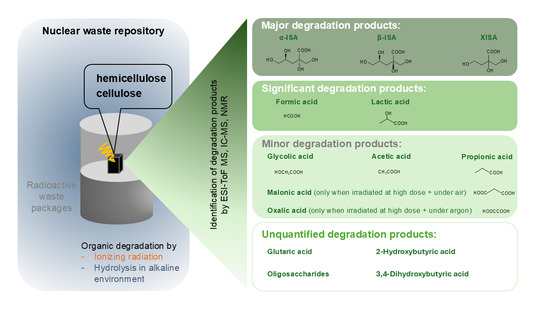
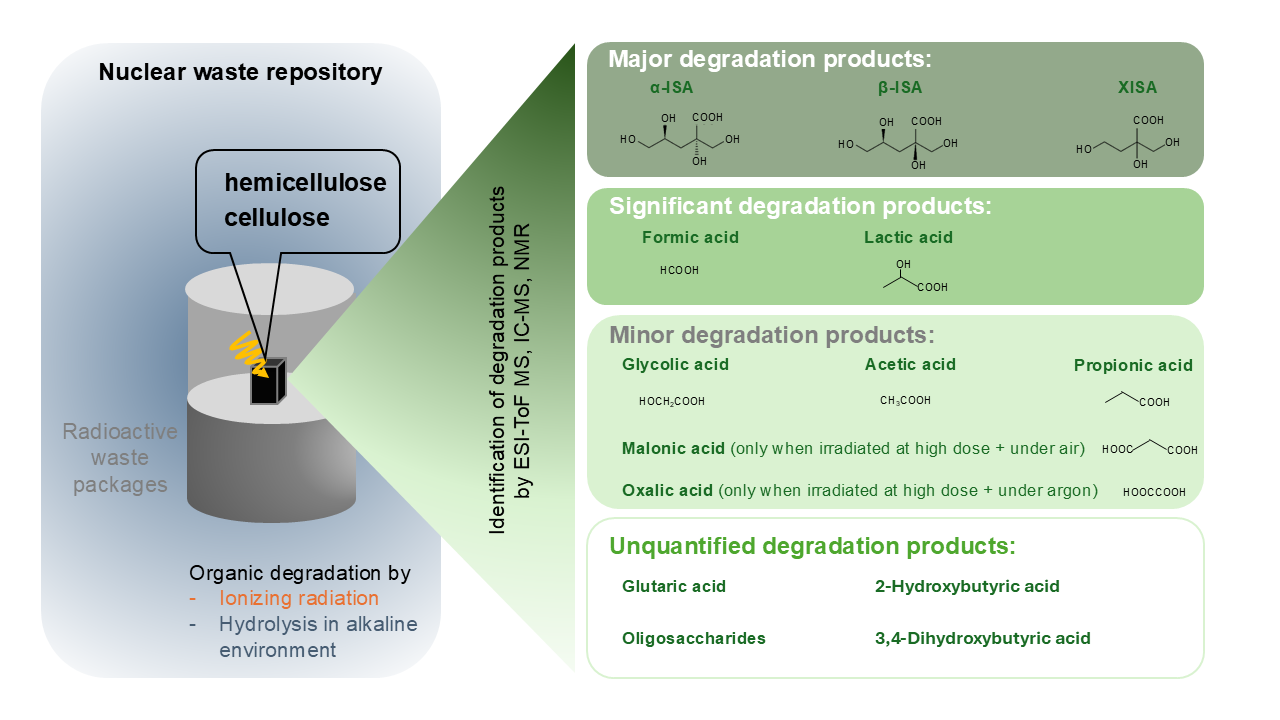
Cellulose and hemicellulose, both widely present in radioactive waste, undergo combined radiolytic and hydrolytic degradation during disposal under the highly alkaline conditions imposed by the cementitious waste matrices and engineered barriers. This combined process generates water-soluble organic compounds that can complex with radionuclides, thereby potentially enhancing their migration from the waste to the biosphere. Identification of these degradation products formed by cellulosic materials is essential for assessing their complexation potential and predicting their impact on radionuclide mobility. In this work, degradation products resulting from sequential radiolytic and alkaline degradation of cellulosic tissues, realistically present in radioactive waste, were identified using multiple advanced techniques, i.e., Electrospray Ionization Time-of-Flight Mass Spectrometry, Ion Chromatography Mass Spectrometry, and Nuclear Magnetic Resonance spectroscopy. Our results confirm that isosaccharinic acid (α-ISA and β-ISA) is the major end product from cellulose degradation, while xylo-isosaccharinic acid (XISA) indicates hemicellulose degradation. Furthermore, significant concentrations of formic and lactic acid were detected, alongside minor products including glycolic, acetic, propionic, malonic, and oxalic acids, with malonic and oxalic acids appearing only after irradiation at high irradiation doses and under air (malonic) or argon (oxalic). Additional unquantified compounds, such as glutaric acid, 2-hydroxybutyric acid, and oligosaccharides, were observed as well. These findings advance our insight into the degradation of end products of cellulosic materials in radioactive waste and establish a foundation for future research on their complexation potential and impact on radionuclide mobility, especially for compounds where data are lacking.

Graphical Abstract

1. Introduction

Certain types of radioactive waste contain cellulosic materials derived from routine operations and decommissioning activities, such as paper and tissue wipes, cotton items (e.g., protective clothing), cellulose-containing filters, and contaminated packaging materials (cardboard or wood). These materials constitute a significant fraction of certain (mostly cemented) waste packages. For instance, it is estimated that thousands of 400 L conditioned low- and intermediate-level short-lived radioactive waste drums in Belgium each contain several kilograms of cellulosic materials per drum [1].
Cellulose is an organic compound with the chemical formula (C6H10O5)n, where n represents the number of β-D-anhydroglucose units in the pyranose form, which can reach up to 10,000. These units are connected by 1,4-glycosidic bonds to form a long, unbranched polymer, with non-reducing end groups on one side and reducing end groups on the other [1,2]. Cellulose chains assemble into nano- and subsequently microfibrils via strong intra- and intermolecular hydrogen bonds, as well as van der Waals forces. These microfibrils are heterogeneous, with alternating crystalline (highly ordered and tightly packed) and amorphous (less ordered and more accessible) regions [1,3].
In plant-derived materials, cellulose microfibrils are embedded in a hemicellulose matrix primarily composed of pentose sugars, such as xylose, with branched side sugar chains, and are further reinforced by lignin, a crosslinked phenol-based polymer. During industrial processing of cellulosic materials, lignin is often removed almost entirely, whereas hemicellulose is only partially removed [4].
The long-term management solution for radioactive waste is its disposal in a repository specifically designed to impede radionuclide transport from the waste to the biosphere. In Belgium, low- or intermediate-level short-lived radioactive waste containing cellulosic materials are envisaged for disposal in a near-surface disposal facility, while deep geological disposal is proposed for intermediate-level long-lived waste. Both repository designs contain multiple engineered barriers and include large quantities of cementitious materials [1].
During the storage of radioactive waste, radiolysis is considered to be the dominant degradation process due to the presence of radionuclides. In contrast, in a disposal environment, cellulosic materials are susceptible to radiolytic, hydrolytic, and alkaline degradation (when in contact with cement pore water with a high alkalinity (>pH 13).
Radiolysis causes chain scission of polysaccharides such as cellulose, leading to the formation of in situ reducing (end) groups, gas production, and a loss of crystallinity and chain length [2,5,6]. Furthermore, ionizing radiation increases the production yield of sugar monomers and oligosaccharides, aldehydes, and carboxylic acids [7,8]. In an oxygen-rich atmosphere, a more severe radiolytic degradation occurs, resulting in more chain scissions, but also in the oxidation of the monomers in the polysaccharide backbones. The latter leads to an increase in the number of carbonyl and carboxyl functional groups per polymer chain, but also to a higher production yield of small organic molecules such as malonaldehyde, formic acid, and other carboxyl acids [5,6,7,8].
Under alkaline conditions, the cellulose chains’ reducing end groups undergo stepwise peeling by β-elimination of anhydroglucose units, forming isosaccharinic acids (ISA). Two diastereomers, 2-C-(hydroxymethyl)-3-deoxy-D-erythro- and -threo-pentonic acids, also referred to as α- and β-D-isosaccharinic acid, respectively, are produced in approximately equal amounts by the alkaline degradation of cellulose along with other minor degradation products [6,9,10,11,12,13,14]. The stepwise peeling process is counteracted by two stopping processes. On the one hand, a chemical stopping reaction can take place where the reducing end group is transformed into a stable metasaccharinic acid (MSA) end group. On the other hand, the physical stopping process is the result of end groups being inaccessible to alkaline degradation within the crystalline regions [6,9,10,11].
Although peeling and chemical stopping reactions occur relatively rapidly in the amorphous regions of cellulose, a slower amorphization of the outer surfaces of the crystalline regions has been proposed to occur as a secondary process [6]. This would ultimately result in the liberation of new reducing end groups, which then become also available for peeling. After degradation of the outer layers, the underlying layers would become exposed and could similarly dissolve and amorphize, followed by hydrolytic degradation. This slow secondary process only seems to become important when the easily accessible reducing end groups become depleted [6]. The above-mentioned processes result in a stepwise hydrolytic degradation of cellulose, i.e., a first rapid degradation at the easily accessible end groups and a second slower phase during which the degradation reactions are limited by the slower liberation of new reducing end groups. Alkaline degradation of hemicellulose is presumed to occur in a similar manner, though considering its amorphous nature, this process occurs more rapidly [15].
As mentioned earlier, under disposal conditions, a combination of both radiolysis and hydrolysis of cellulose and hemicellulose is expected. However, only a few studies have examined this coupled degradation process, and data on the resulting degradation products remain limited [15,16,17,18]. Both the dose-dependent production of dissolved organics—ISA in particular—during alkaline degradation of irradiated cellulosic materials, and the radiolytically induced physicochemical changes, suggest that irradiation of (hemi)cellulose under anoxic conditions primarily accelerates subsequent alkaline degradation. Degradation products similar to those obtained after alkaline degradation of non-irradiated cellulosic materials are expected, i.e., mainly saccharinic acids. However, while alkaline degradation of hemicellulose such as xylan leads to the generation of xylo-isosaccharinic acid (XISA) [1,19,20,21], there is limited information on how irradiation (under oxic or anoxic conditions) influences the XISA yields compared to ISA. In addition, based on the observed radio-oxidation of the (hemi)cellulose backbone, irradiation in air may lead to the formation of additional (oxidized) end products [15,22].
Given the potential for these degradation products to influence radionuclide migration behavior, their identification and quantification are important. ISA, particularly the α-diastereomer, is well known for its strong complexing ability, which could enhance radionuclide mobility in disposal systems [23,24,25,26]. Other degradation products may, however, exhibit similar effects. Earlier work on the combination of size fractionation of cellulose leachates with Pu solubility measurements showed that while ISA strongly affects Pu solubility, other unidentified species in the leachate likely contribute to the overall effect on Pu solubility [27]. Moreover, several non-ISA products expected in cellulose degradation products mixtures have shown metal binding capacity, for example, XISA complexation with Ni(II) (though with a significantly lower stability constant compared to ISA) [28], and lactate complex formation with trivalent actinides/lanthanides [29]. A recent study of Durce et al. (2025) [30] showed that the impact of a mixture of degradation products from irradiated paper tissues on the sorption of 63Ni on cement is indeed stronger than that of α-ISA alone. Based on ISA and dissolved organic matter (DOC) concentrations measured in these mixtures, ISA accounted for only about half of the total DOC, suggesting that other organics in the mixture may also contribute significantly [22,30]. This underscores the importance of comprehensive characterization of these products to improve predictions of radionuclide transport under disposal conditions. Identification of cellulose degradation products would enable more refined radionuclide transport modeling by accounting for radionuclide complexation with the identified species using thermodynamic databases. It would also help to identify gaps in existing thermodynamic data and guide efforts to acquire missing parameters for the relevant degradation products.
The primary objective of this study is therefore to identify the range of degradation products, other than ISA, generated by Bleyen et al. [15] during alkaline degradation of irradiated cellulosic tissues, which were used in the above-mentioned sorption experiments conducted by Durce et al. [30]. The formation of these degradation products is examined in relation to two key factors: the effects of alkaline cement water (hydrolysis) and the influence of irradiation (radiolysis) prior to hydrolysis. Degradation products were identified using multiple techniques, i.e., Electrospray Ionization Time-of-Flight Mass Spectrometry (ESI-ToF MS), Ion Chromatography Mass Spectrometry (IC-MS), and Nuclear Magnetic Resonance (NMR) spectroscopy.

2. Materials and Methods

2.1. Cellulosic Materials

Two types of cellulosic materials were used to produce the degradation products under highly alkaline conditions. Pure powder cellulose Avicel (Merck Life Science, Hoeilaart, Belgium) and cellulosic tissues (Extra Soft Tork Facial Tissues; Tork, Machelen, Belgium), an overview of their composition is given by Bleyen et al. (2023) [6]. Briefly, these tissues consist predominantly of α-cellulose (88.1 wt%) and hemicellulose (11.4 wt%) [6]. This type of tissue has been commonly used in nuclear facilities to wipe surfaces, check for and remove radioactive contaminations, and is therefore realistically present in radioactive waste.

2.2. Artificial Cement Water

The artificial cement water (ACW) used in the degradation tests was a solution of NaOH (0.014 M) and KOH (0.18 M) oversaturated with Ca(OH)2 with pH > 13.33, to represent fresh cement water according to Van Loon and Glaus, (1998) [31]. These conditions are representative of those of the early stage of cement degradation.

2.3. Degradation Study

For this study, cellulosic tissues were irradiated with gamma irradiation (γ-irradiation) and then degraded in ACW. Details on the γ-irradiation and alkaline degradation study are described by Bleyen et al. (2023, 2025) [6,15]. Briefly, γ-irradiation occurred at absorbed doses up to 1.4 MGy, under either anoxic (argon) or oxic (air) conditions, at the Geuse II facility at SCK CEN. These irradiation conditions simulate storage and disposal conditions for low- and intermediate-level radioactive waste.
Subsequently, non-irradiated and irradiated tissues were degraded for up to 2.5 years in ACW and under anoxic conditions, to simulate alkaline degradation during disposal of radioactive waste in a cementitious environment. For this, the tissues were submerged in ACW at a tissue-to-liquid ratio of 10 wt%. Samples were taken regularly and were filtered using a pre-washed PTFE membrane filter with a pore size of 0.45 µm (Merck Life Science, Hoeilaart, Belgium). As discussed in detail by Bleyen et al. (2025) [15], the concentrations of ISA (both isomers) and DOC were measured for all samples, according to the methodology described in Section 2.4.2. The results for the samples considered relevant for the current study are summarized in Table 1.
Samples subjected to various test conditions, including different atmospheres during irradiation and different degradation times, were selected for further analysis by Electropray Ionization Time-of-Flight Mass Spectrometry (ESI-ToF MS; Section 2.4.1), by Ion Chromatography coupled to Mass Spectrometry (IC-MS; Section 2.4.2) and/or NMR (Nuclear Magnetic Resonance; Section 2.4.3). A description of the samples is included in Table 1.
In order to compare the degradation products originating from irradiation with those formed during long-term hydrolysis, an irradiated sample of Tork Facial paper tissues (absorbed dose 1.4 MGy; dose rate ~ 0.6 kGy h−1; under Ar atmosphere) was immersed for two hours in demineralized water. The same sample was also immersed for two hours in the ACW solution. The solution was filtered afterwards using a pre-washed Acrodisc syringe filter with a PTFE membrane and a pore size of 0.45 µm. The solution was analyzed by ESI-ToF MS using the same methodology (described in Section 2.4.1) applied to the other samples. The same steps were performed for non-irradiated tissues to compare degradation products originating from irradiated and non-irradiated tissues.

2.4. Analytical Techniques

2.4.1. ESI-ToF MS

For each sample, a series of 10-fold dilutions in MS-grade solvent A (0.1% formic acid) was prepared. Mass spectrometry (MS) analysis was performed at SCK CEN (Institute Nuclear Medical Applications, Mol, Belgium) using an Ultra-High Resolution Quadrupole Time-of-Flight (UHR Q-ToF) MS instrument (Impact II, Bruker Daltonics, Bremen, Germany) equipped with an Apollo II electrospray ionization (ESI) source (Bruker Daltonics, Bremen, Germany). For sample infusion, a Model NE-300 microfluidic syringe pump (New Era Pump Systems, Farmingdale, New York, USA) was used. Compass otofControl version 4.1 and Data Analysis version 4.4 software (Bruker Daltonics, Germany) were used for data acquisition and data processing, respectively. The solutions were introduced into the mass spectrometer via direct infusion through the ESI source without chromatographic separation at a flow rate of 180 µL h−1. Samples ran for 2 min using the following acquisition parameters (direct injection method): 3400 V capillary voltage; set end plate offset at −500 V; 2000 V charging voltage; 0.8 bar nebulizer pressure; dry temperature 190 °C; dry gas flow of 5.0 L min−1. Full mass spectra were acquired in negative ion mode over an m/z (mass-to-charge ratio) range of 50–1300. Prior to each analysis, the instrument was calibrated using a sodium formate solution suitable for LC-MS analysis (Fisher Scientific, Illkirch, France).
For each of the expected ions (i.e., deprotonated and ion adducts formed), theoretical m/z values were derived based on the monoisotopic masses and the charge of the ion. These theoretical m/z values are used as important information for the identification of compounds within the ESI-ToF MS spectra, i.e., they were used to compare with the obtained m/z values from the MS spectra.
The methodology for interpretation of the full MS spectra was optimized by Nushi et al. (2023, pp. 13–14) [32]. Based on the ESI-ToF MS analyses performed on multiple dilutions of the reference compounds (see below) and degradation solutions of pure cellulose and irradiated tissues, the following points were deduced for the interpretation of the spectra:
  • The spectra selected (from other spectra performed in multiple dilutions) for the peak interpretation are those for which the base peak (i.e., peak with the highest intensity) was attributed to the deprotonated molecule and the signal intensity was in the order of 105 or 106 counts per second. The ratio among the intensity of the main peaks was maintained in other dilutions as well, as long as the compound was not too diluted.
  • For some compounds, the highest intensity peak corresponded to an adduct ion. It is important to keep in mind that, in the negative ionization mode, the presence of adduct ions can either accompany or replace the base peak in ESI-ToF MS spectra.
  • To facilitate the interpretation of the spectra, especially in the case of degraded solutions, a manual background subtraction (solvent and ACW solution) was performed. After performing this step, the spectra were re-plotted in Python (Python Software Foundation, version 3.9.13).
A selection of reference compounds was analyzed following this methodology, to be able to compare their MS peaks with those obtained in the MS spectra of the samples with degradation products, herein and after referred to as real samples. The selection of these compounds was based on a literature review and includes known cellulose and hemicellulose degradation compounds formed through radiolysis and hydrolysis [14,19,33,34]. While additional degradation compounds have been reported in the literature, the list shown in Table S1 in the Supplementary Materials primarily focuses on the major and significant compounds. All compounds were used without further purification. Stock solutions of each reference compound were prepared in ultra-pure HPLC-grade water and stored in the dark. All samples from the degradation study were diluted in 0.1% formic acid for ESI-ToF MS. The tested dilutions were 1:10,000, 1:1000, and 1:100.
Due to compositional differences between the real samples and the available reference compounds, particularly in terms of ion content and the complexity of the solution, adduct formation and peak intensities may vary. These differences are especially evident in low intensity peaks, but usually the [M – H] peak is not affected. The interpretation of the spectra is then based on theoretical m/z values, which can be linked to a known molecular formula containing C, H, and O, and the known presence of cations in solution. Where possible, identifications were further supported by comparison with spectra from reference compounds. For the interpretation of the peaks for which no verification with reference compounds could be made, we suggested a match based on the m/z calculations.
The most significant peaks (relative intensity > 5%) were compared to those of reference compounds, with some identifiable peaks below 5% intensity also being interpretable. This cutoff was applied to exclude very low intensity peaks that could be related to the noise of the instrument. The absolute intensity is used for comparison purposes. We are aware of the variabilities in absolute intensities occurring between measurements and after each calibration. For this reason, comparison between samples is therefore only done for measurements performed on the same day. Analyzing the same sample on two different days did not indicate significant differences in relative intensities.

2.4.2. Ion Chromatography and DOC Analysis

The low molecular weight organic acids (LMWOAs) formed during the anoxic and alkaline degradation of cellulosic tissues were identified and quantified by high-performance ion exchange chromatography coupled with mass spectrometry at PSI (Villigen, Switzerland). This analysis could not be performed on highly alkaline solutions. Therefore, the solution samples were neutralized prior to analysis using H-cartridges (DionexTM OnGuard cartridge, Thermo Fisher Scientific, Sunnyvale, CA, USA), allowing treatment of up to 12 mL of ACW with a pH of 13.3 in one run. A measurement procedure was put in place to enable optimal identification and quantification of a series of LMWOAs, including formic acid, acetic acid, glycolic acid, propionic acid, lactic acid, valeric acid, malonic acid, oxalic acid, and butyric acid. For this purpose, an ICS-5000 ion chromatography system (DionexTM ICS-5000; Thermo Fisher Scientific, Sunnyvale, CA, USA) coupled to an MSQ™ Plus mass spectrometer (Thermo Fisher Scientific, Sunnyvale, CA, USA), operating in the negative electrospray ionization mode, was used and is later on referred to as IC-MS. Optimal cone voltage for scanning the organic acids was found to be in the range between 30 and 50 V. For more details, the reader is referred to Tits et al. (2021) [35].
Dissolved organic carbon (DOC) was determined by Bleyen et al. (2025) [15] with a TOC/TIC analyzer using the high-temperature combustion technique (Formacs HT-I, Skalar Analytical, Breda, the Netherlands). Concentrations of α- and β-ISA were measured by ion chromatography equipped with a CarboPac PA1 anion-exchange column (DionexTM, Thermo Fisher Scientific, Merelbeke, Belgium) and a pulsed amperometric detector (ED v2, DionexTM, Thermo Fisher Scientific, Merelebeke, Belgium), as described by Bleyen et al. (2025) [15].

2.4.3. NMR Spectroscopy

Solutions with test code 1600_0.8_Ar_3m_R3 and 1600_0.8_Ar_1y_R3 (cf. Table 1) were unsealed in a glovebox with N2 atmosphere, and 700 µL of each was transferred into a 5 mm screw-cap NMR tube, respectively.
NMR spectra were obtained on an Agilent DD2-600 NMR system (Agilent Technologies, Waldbronn, Germany), operating at 14.1 T with corresponding 1H and 13C resonance frequencies of 599.8 and 150.8 MHz, respectively, using a 5 mm oneNMR probe (Agilent Technologies, Waldbronn, Germany), at (25 ± 0.2) °C.
1H NMR spectra were recorded using solvent signal suppression by pre-saturation for 2 s on the water resonance, followed by full spectral excitation applying a 2.9 µs (π/6) pulse, an acquisition time of 3 s, accumulating at least 16 scans using a 3 s relaxation delay. For quantification purposes, spectra were recorded without water signal suppression and with an increased relaxation delay of 60 s, allowing for complete relaxation. 1H broadband-decoupled 13C NMR spectra were acquired, accumulating 1024 scans using a 2.7 µs (π/6) pulse, an acquisition time of 1 s, and a relaxation delay of 5 s. 1H–13C heteronuclear single-quantum coherence (HSQC) and 1H–13C heteronuclear multiple-bond correlation (HMBC) sequences applied gradient-selection and adiabatic pulses, acquiring 2048 × 1024 complex points in F2 and F1, 48 transitions per F1 increment, with a relaxation delay of 1 s, respectively. For polarization transfer, (2 × J)−1 delays of 3.45 and 100 ms were opted, corresponding to 145 Hz 1J in HSQC and 5 Hz nJ in HMBC, respectively. For 1H–1H homonuclear (total) correlation spectroscopies, the gradient-selected COSY (correlation spectroscopy) as well as the zero-quantum-filtered TOCSY (total correlation spectroscopy; mixing time 80 ms) were acquired using 2048 × 512 complex points in F2 and F1, eight transitions per F1 increment, and a relaxation delay of 1 s. Two-dimensional NMR experiments applied 1 s pre-saturation selective pulse on the water resonance for solvent suppression.
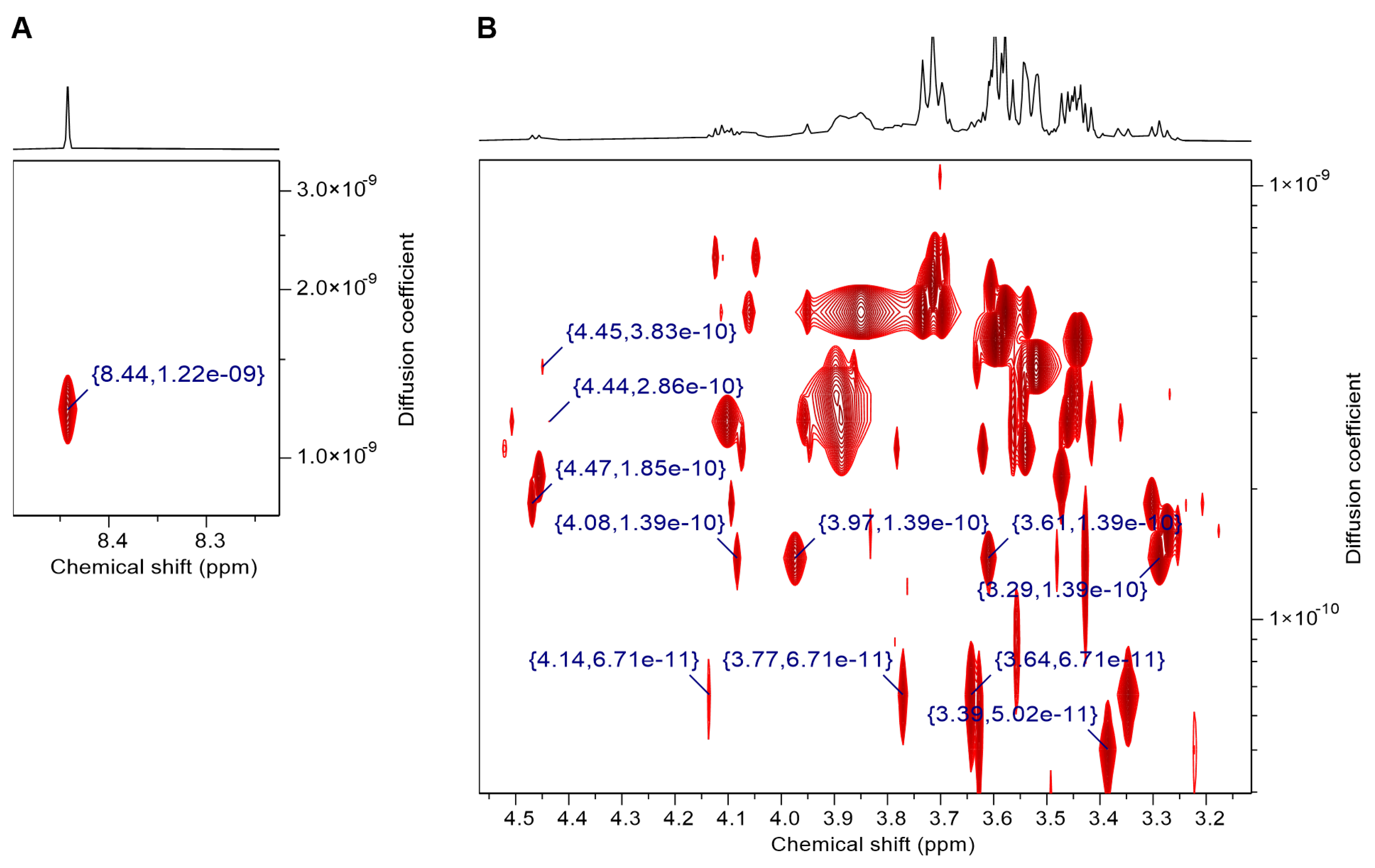
Diffusion-ordered spectroscopy (1H DOSY) applied a gradient-compensated stimulated echo sequence, opting for diffusion delays of 50, 100, and 200 ms, respectively, varying the diffusion gradient strength over 15 steps up to its maximum. Because of the water signal suppression sequence used, distortions and truncations of the resulting signal render water unsuitable for internal diffusion coefficient calibration and viscosity estimation. The signal due to formate was used as internal calibration for the diffusion coefficient. Molecular weights were estimated using the online version of the DOSY Molecular Weight Calculator [36].

3. Results

3.1. Release of DOC and ISA from (Irradiated) Tissues During Alkaline Degradation

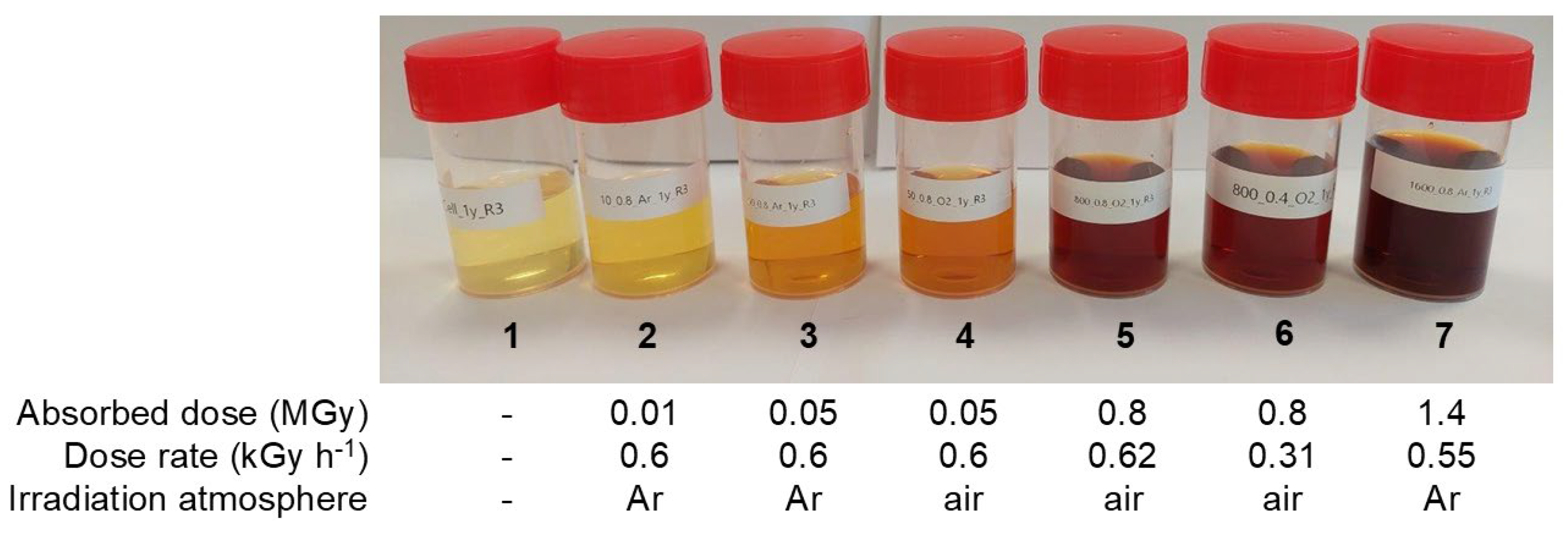
Figure 1 shows the filtered solutions containing degradation products obtained from (irradiated) Tork Facial cellulose tissues in ACW. It can be observed that the intensity of the color becomes more pronounced with an increase in the absorbed dose during pre-irradiation, which is in line with the dose-dependency of the DOC concentration as discussed by Bleyen et al. (2025) [15].
The evolution of the α- and β-ISA and DOC concentrations in the different suspensions was discussed previously by Bleyen et al. (2025) [15]. Briefly, a significant increase in ISA and DOC concentrations was observed over time in all test suspensions. The rates at which DOC and ISA are released from the tissues increase significantly with an increasing absorbed dose. Furthermore, tissues irradiated under air also produce higher amounts of DOC and ISA, though also cause a significant decrease in the pH when the pre-irradiation dose is high, which counteracts the higher alkaline degradation rates. The measured ISA (total and α- and β-ISA) and DOC concentrations for the solutions tested in this work are shown in Table 2.

3.2. Identification of Degradation Products by ESI-ToF MS

3.2.1. Proof of Principle with Reference Compounds

The interpretation of ESI-ToF MS spectra of the reference compounds or suspected cellulose degradation products, sugars, and oligosaccharides is summarized in Table 3.
Note that for the 1:10,000 dilution, background peaks from the solvent and ACW complicated the interpretation as the intensities of the sample’s peaks were in the same order of magnitude as the intensities of the background peaks. However, the spectra from the 1:1000 and 1:100 dilutions were nearly identical, with consistent peak ratios. In the 1:100 dilution, the main peak intensity ranged from 105 to 106 counts per second, while background peaks were up to 104 counts per second. Therefore, the 1:100 dilution was used for data interpretation. For further details, the reader is referred to the Supplementary Materials (Figure S1 and subsequent interpretation). These results demonstrate that the applied methodology is suitable for the detection of ISA, sugars, oligosaccharides, and other organic acids that could be formed during the degradation of cellulosic materials.

3.2.2. Alkaline Degradation Products from Tissues Irradiated Under Argon

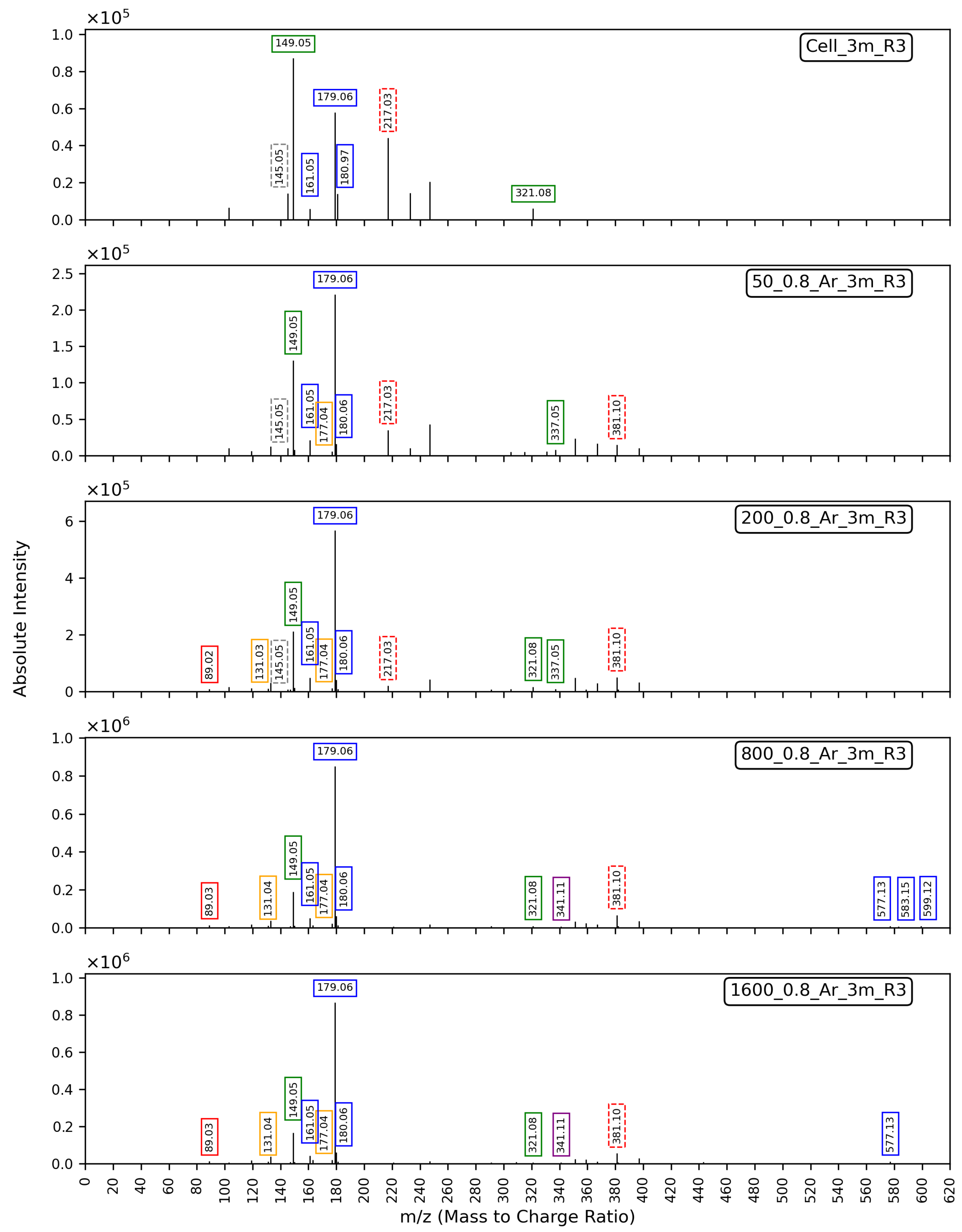
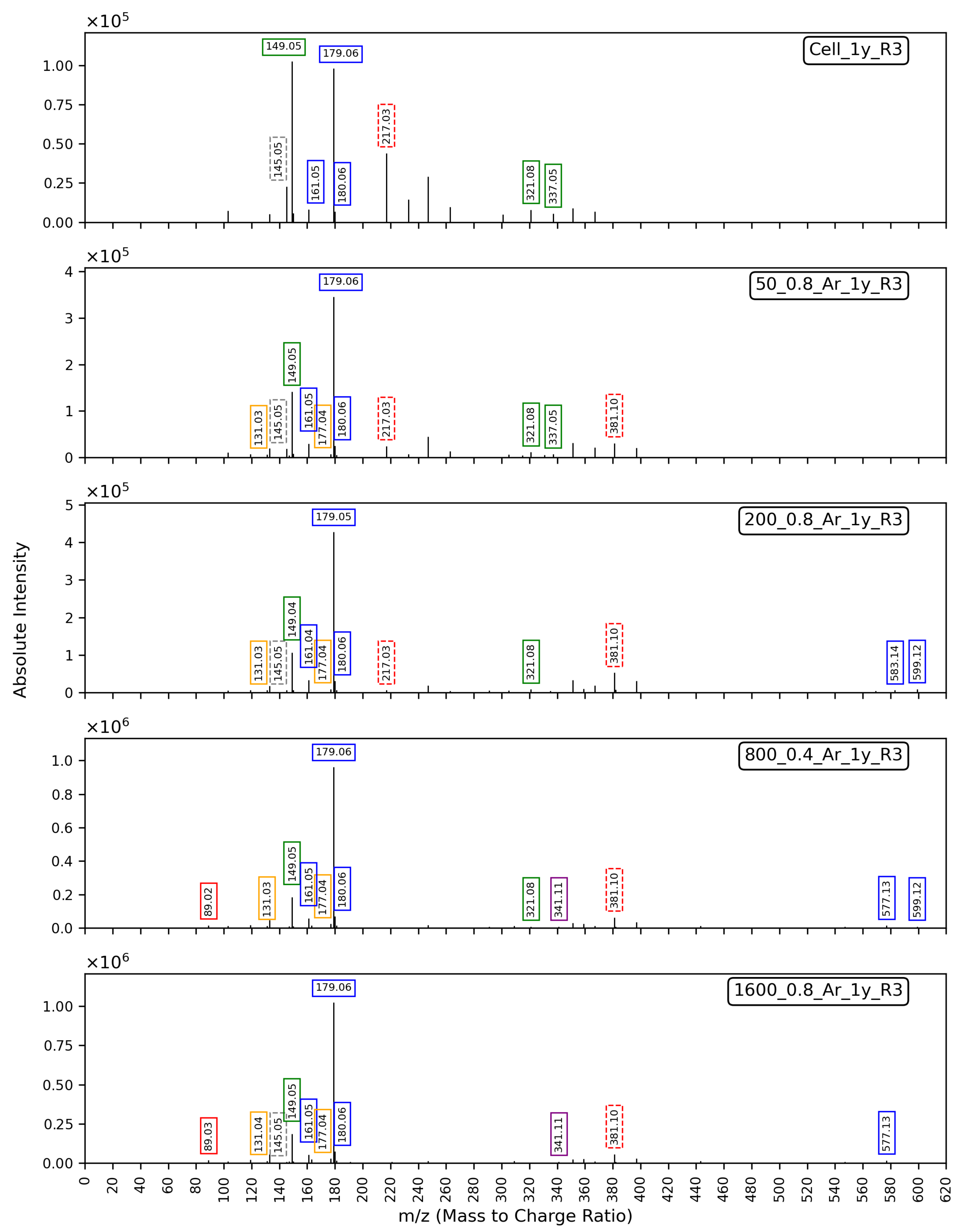
To investigate the impact of pre-irradiation under an anoxic atmosphere on the produced degradation products, solutions with non-irradiated tissues and tissues pre-irradiated at an absorbed dose varying between 0.05 and 1.4 MGy, were tested with ESI-ToF MS. The reader is referred to Figure 2 and Figure 3 to follow the interpretation. For clarity, simplified versions of these spectra are available in the Supplementary Materials (Figures S3 and S4).
In all spectra, the peak at m/z 179 is (one of) the predominant peaks. This peak is assigned to the deprotonated molecule of ISA, which is known to be the major degradation product of cellulose [33]. Note, however, that no distinction can be made between both ISA isomers, as well as with MSA, whose production is presumed to occur alongside ISA during alkaline degradation of radiolytically produced glucose [15]. An increase in the intensity of this peak with the absorbed dose was observed. However, for tissues irradiated at high absorbed doses such as 0.8 and 1.4 MGy, the difference in intensity becomes small, which is in line with the measured ISA concentrations in the solutions (Table 2), suggesting that this technique can be used for semi-quantitative purposes, at least in similar background solutions. This relationship between ESI-ToF MS signal intensity and analyte concentration has been demonstrated in various studies [46,47,48]. The peak at m/z 179 is accompanied by another peak with an intensity of about 7% of that of the deprotonated ISA peak. This additional peak at m/z 180 represents the deprotonated form of ISA with one 13C atom instead of 12C. Another peak observed at m/z 161 suggests the presence of isosaccharino-1,4-lactone form. However, it is important to note that this peak likely arose due to the acidification of the sample during pretreatment, as ISA-lactone is only formed at lower pH [49]. We therefore assign this peak also to the presence of ISA (see the Supplementary Materials for more details).
Other peaks are assigned to trimer adducts of ISA, i.e., at m/z 577, 583, and 599, corresponding to the following ions of ISA: [3M + Ca – 3H], [3M + 2Na – 3H] and [3M + Na + K – 3H], respectively. These peaks were low in intensity and only detected for tissues pre-irradiated at high absorbed doses, i.e., solutions with high ISA concentrations, and their intensity increased with increasing concentration of ISA in solution (measured by IC). Furthermore, the ion with a Ca cation was only found in solutions with high Ca concentrations [15]. In solutions with a lower Ca concentration, the trimers were not found or were found with only the Na or K cation. Furthermore, it is worth noting that these ions were not detected in the spectra of the reference α-ISA. This can be attributed to (1) the lack of cations in the solution of the reference compound and (2) the high ISA concentrations in the solutions obtained after alkaline degradation of irradiated tissues.
Another peak appears at m/z 149 (highlighted with a green box in Figure 2 and Figure 3) along with the deprotonated form of ISA in all spectra, though most dominant in the spectra of the non-irradiated tissues. This peak tends to increase in absolute intensity with an increase in the absorbed dose. However, its relative intensity decreases with the increase in the intensity of the deprotonated ISA peak, i.e., the higher the peak at m/z 179, the lower the relative intensity of the peak at m/z 149. This peak is assigned to the deprotonated molecule of XISA, a saccharinic acid formed during alkaline hydrolysis of xylan, in a similar manner as ISA [50]. The alkaline degradation of the hemicellulose, present in paper tissues, therefore, explains the presence of this peak. Also, the peak at m/z 150 is assigned to XISA; in this case, the ion contains one 13C atom, similar to what was found for ISA. Furthermore, peaks for the dimer adducts with either Na or K ([2M + Na – 2H] and [2M + K – 2H]) were found as well, at m/z 321 and 337.
Another identified peak is observed at m/z 89 (highlighted with a red box in Figure 2 and Figure 3), although its intensity is very low (below 5%). This peak is assigned to the deprotonated molecule of lactic acid, which is also supported by the ion chromatography data (Section 3.3). Two relatively high intensity peaks at m/z 217 and 381 are observed as well (highlighted with a red dashed box). The intensity of the latter peak is low but tends to increase slightly with the absorbed dose in the pre-irradiation phase, and appears in all irradiated samples. Given the m/z value, the suggested matches for this peak are ISA [2M + Na − 2H] or lactic acid [4M + Na − 2H].
Only one low-intensity peak can be assigned to the presence of oligosaccharides, i.e., the peak at m/z 341, which corresponds to the [M – H] peak of cellobiose. This peak is only detected in solutions with tissues irradiated at high doses (≥0.8 MGy), which is in agreement with the findings of Bleyen et al. (2025) [15]. Indeed, radiolytic degradation at these high doses resulted in short-chain cellulose in these tissues. Alkaline degradation occurred very rapidly due to the high amount of reducing end groups. Given the short chains of cellulose present at the start, it is logical to assume that hydrolysis would lead to soluble oligosaccharides such as cellobiose at least intermediately. The low intensity of this peak, however, may be attributed to the fact that these oligosaccharides are degraded further to ISA and other molecules, i.e., their concentration is not expected to accumulate in the solution.
Furthermore, based on the similarities between experimentally derived and theoretical m/z values, a suggested match for the peaks at m/z 131 and 177 may be the generic molecule C5H8O4 or glutaric acid (m/z 131 corresponds to the deprotonated form of C5H8O4, and m/z 177 corresponds to the adduct formation with formate ions). This molecule has been found previously in alkaline degradation experiments of cellulose by Pavasars (1999) [20]. In the latter study, this compound was found in trace amounts. Also in the present study, its peaks are only detected at low intensities. The peaks are not found for non-irradiated tissues or tissues irradiated at low doses, and increase in intensity with increasing pre-irradiation doses, which again suggests that the concentration of glutaric acid in the solution is dose-dependent, similar to other identified compounds.
Overall, similar peaks are observed after 3 and 12 months, although the differences in both absolute and relative intensities are small but notable. For example, in the case of the XISA signal, the relative intensity of its [M − H] peak decreases over time, most likely corresponding to the faster degradation of hemicellulose compared to cellulose [15]. Due to this difference in degradation rates, XISA thus becomes gradually less abundant in comparison to the degradation products from cellulose. This dose dependency of the cellulose degradation rate shown by Bleyen et al. [15] also explains the decreasing relative intensity of the m/z 147 peak with increasing absorbed dose.
The remaining low-intensity peaks detectable but not identified for all samples may be related to other low molecular mass compounds formed during (hemi)cellulose degradation, though they cannot be identified using the current ESI-ToF MS technique.

3.2.3. Alkaline Degradation Products from Tissues Irradiated in Oxic Conditions

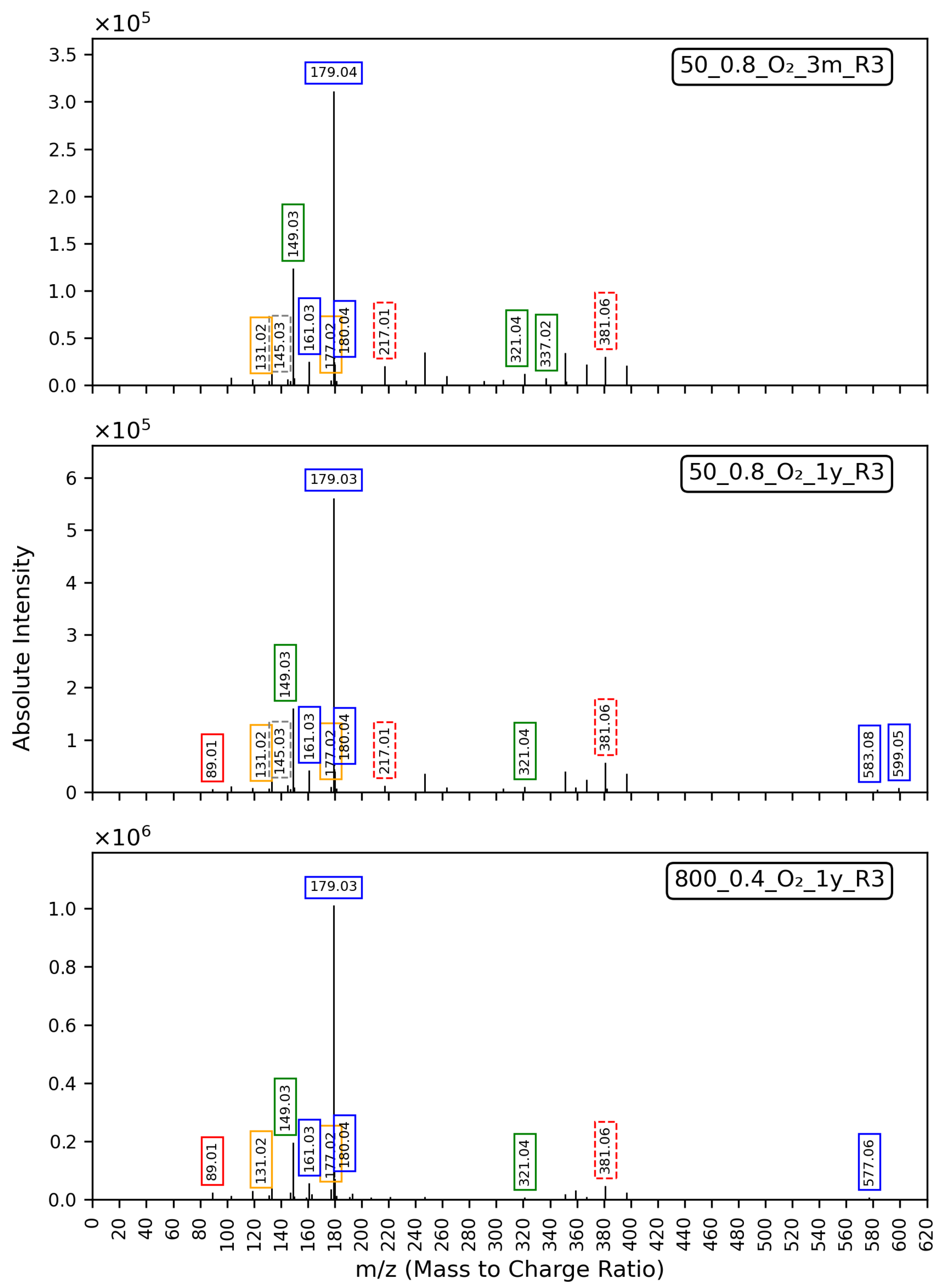
To investigate the impact of pre-irradiation under air on the production of degradation products, solutions with tissues pre-irradiated under oxic and anoxic atmospheres were tested with ESI-ToF MS (Figure 4 and Figure S5 in Supplementary Materials). A comparison of spectra for degradation products from tissues irradiated at the same dose but under different atmospheres is shown in Figures S2 and S6 in the Supplementary Materials.
For suspensions with tissues irradiated at the same low absorbed dose (0.05 MGy), the intensity of all peaks that were assigned to ISA in the previous section is higher when the pre-irradiation atmosphere was oxic, and this for both reaction times (3 months and 1 year). This aligns with our previous findings: higher concentrations of ISA were found in solutions with radio-oxidized tissues [15]. On the other hand, for tissues irradiated at a high absorbed dose (0.8 MGy) and hydrolyzed for 1 year, the intensity of the ISA peaks is only slightly higher for tissues irradiated under oxic conditions or even similar for both pre-irradiation atmospheres. Also, this is in line with the measured ISA concentrations, as the effect of oxygen on the ISA production is less evident when tissues are irradiated at high absorbed doses, due to the counteracting pH decrease and Ca release observed in the solutions with tissues pre-irradiated under oxygen and at a high absorbed dose [15].
Other peaks present in the spectra of samples with tissues irradiated in the presence of oxygen were previously associated with the presence of lactic acid (m/z 89 and possibly 381), XISA (m/z 149, 150, 321, and 337), and C5H8O4 (m/z 131, 177) and were discussed in Section 3.2.2. Finally, other low-intensity peaks are only present in the samples with tissues pre-irradiated under an argon atmosphere and not under air (m/z 159, 191, 193, 207, 262, and 352). However, based on ESI-ToF MS results alone, the corresponding compounds could not be identified.

3.3. Identification of Low-Molecular-Weight Organic Acids

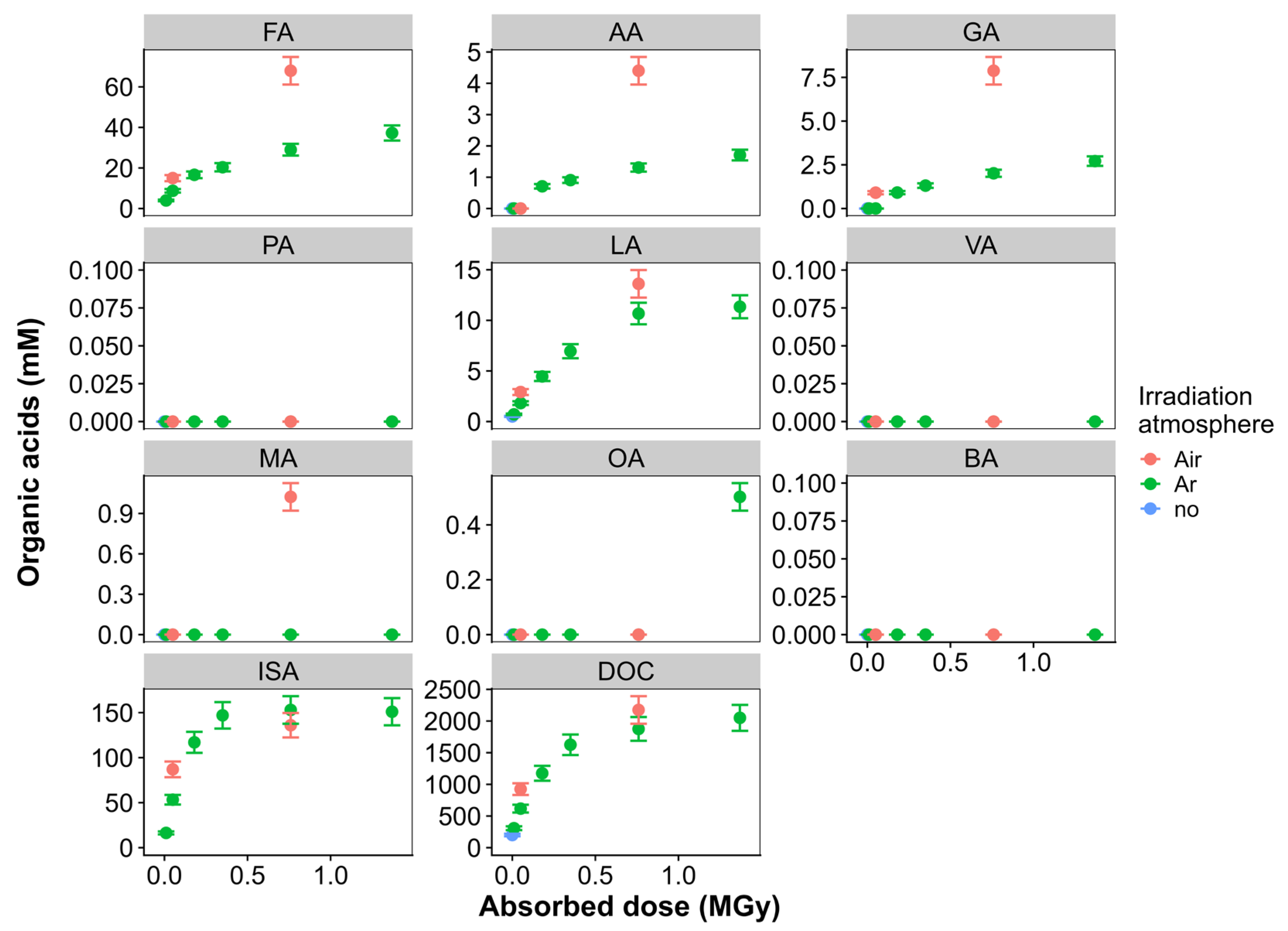
IC-MS was performed to assess the concentrations of LMWOAs in the alkaline degradation solutions sampled after 1 year and after 2.5 years (data in Table 2 and Table S2, Supplementary Materials) (Figure 5). These results indicate that predominantly ISA, formate, and lactate are formed, though acetate and glycolate are produced as well during alkaline degradation of non-irradiated and irradiated tissues. Propionate was detected in solutions with strongly irradiated tissues, though only in much lower concentrations (~0.2–0.3 mM) in the samples taken after 1 year, while its concentration remained low after 2.5 years (<0.5 mM). Valerate and butyrate were not detected in any solution (<detection limit of 0.5 mM).
We notice a clear dose-dependency, i.e., a higher production of LMWOAs is observed with increasing absorbed dose during pre-irradiation (Figure 5). Over time, the concentration of formate increases (Table S2, Supplementary Materials), while the lactate concentration increases only in the solutions with the irradiated tissues. The acetate concentrations decrease in time, indicating further degradation of this species. The glycolate concentrations remain generally stable over the 2.5 years of the experiment. No dependency on the dose rate is observed (Table S2, Supplementary Materials), in line with the ISA and DOC concentrations released from tissues irradiated at 0.3 and 0.6 kGy h−1 described in [15].
In most cases, tissues that were irradiated under oxic conditions produce higher concentrations of LMWOAs, i.e., this is the case for formate, lactate, acetate, and glycolate. Malonate was only produced in tissues irradiated at a high absorbed dose and in air, while oxalate was only found in the solution with tissues irradiated at a high absorbed dose and under argon. Note that the latter concentration was very close to the detection limit (0.5 mg L−1), and slightly lower concentrations in the other solutions may therefore have been missed.
A comparison of the LMWOAs concentrations with the total DOC concentration in the test solutions sampled after 2.5 years (Figure 5), shows that ISA is the dominant organic acid formed in all solutions, i.e., 30–60% of DOC is made up by ISA (Table S2, Supplementary Materials), which is in line with previous results from Glaus and Van Loon (2004) [13]. Although lactate and formate are produced in significant concentrations, they only make up 1 to 3% of the DOC. Glycolate and acetate contribute to less than 1% of the DOC concentration. These results indicate that 37–66% of the DOC cannot be identified by IC and probably consists of organic compounds other than the tested LMWOAs. According to the ESI-ToF MS (Section 3.2) results, XISA and glutaric acids are formed as well, but the concentrations of these compounds were not measured by IC due to a lack of calibration standards. Given the intensity of the peaks detected by ESI-ToF MS, especially XISA, might make up a significant part of the missing DOC. Nevertheless, other organics may have been produced as well, which were not detected by either IC-MS or ESI-ToF MS, e.g., oligosaccharides as detected by NMR (Section 3.4).

3.4. Identification by NMR

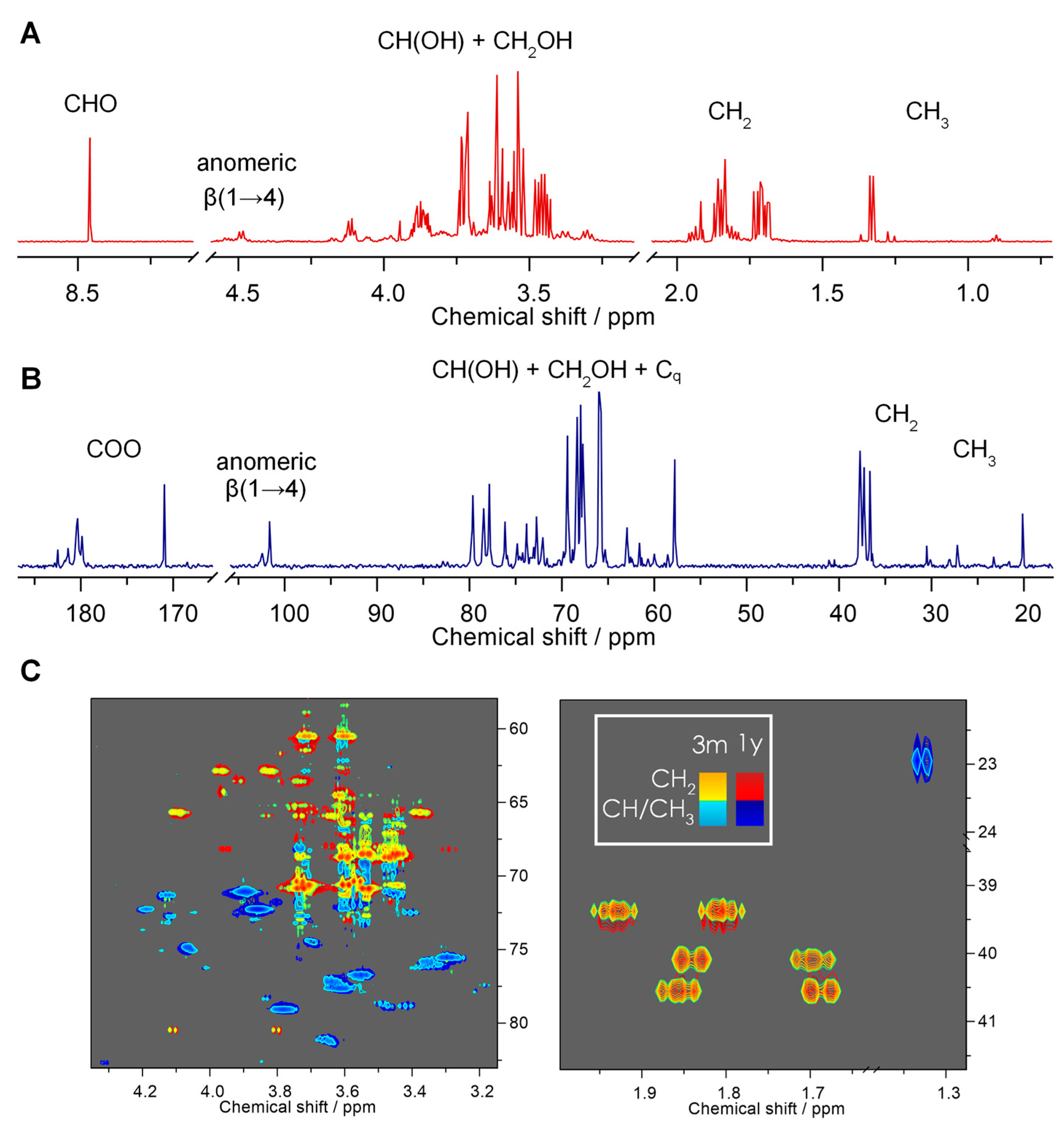
NMR spectroscopy was employed as a complementary method to independently analyze the obtained cellulose degradation products. Two solutions were investigated by one- and two-dimensional NMR experiments, and spectra were examined thoroughly. Evaluation of the spectra is not straightforward owing to the complexity of the sample composition and, consequently, the resulting multitude of very similar and strongly overlapping signals (Figure 6A,B). Corresponding spectra of the two solutions of cellulosic tissues irradiated under an anoxic atmosphere and hydrolyzed for three months and one year reveal that the qualitative sample composition is similar in both samples (Figure 6C), which is in line with the ESI-ToF MS spectra.
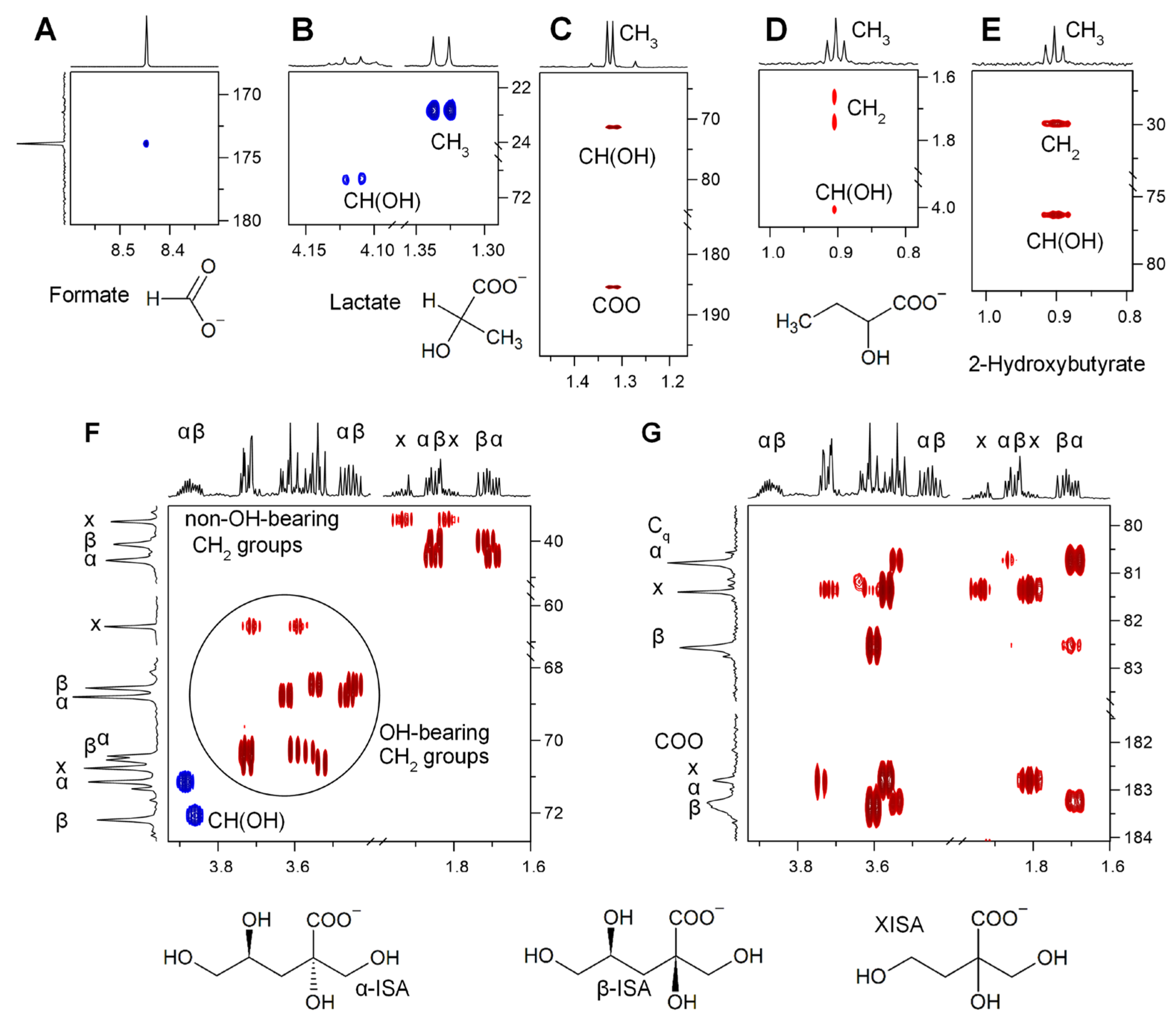
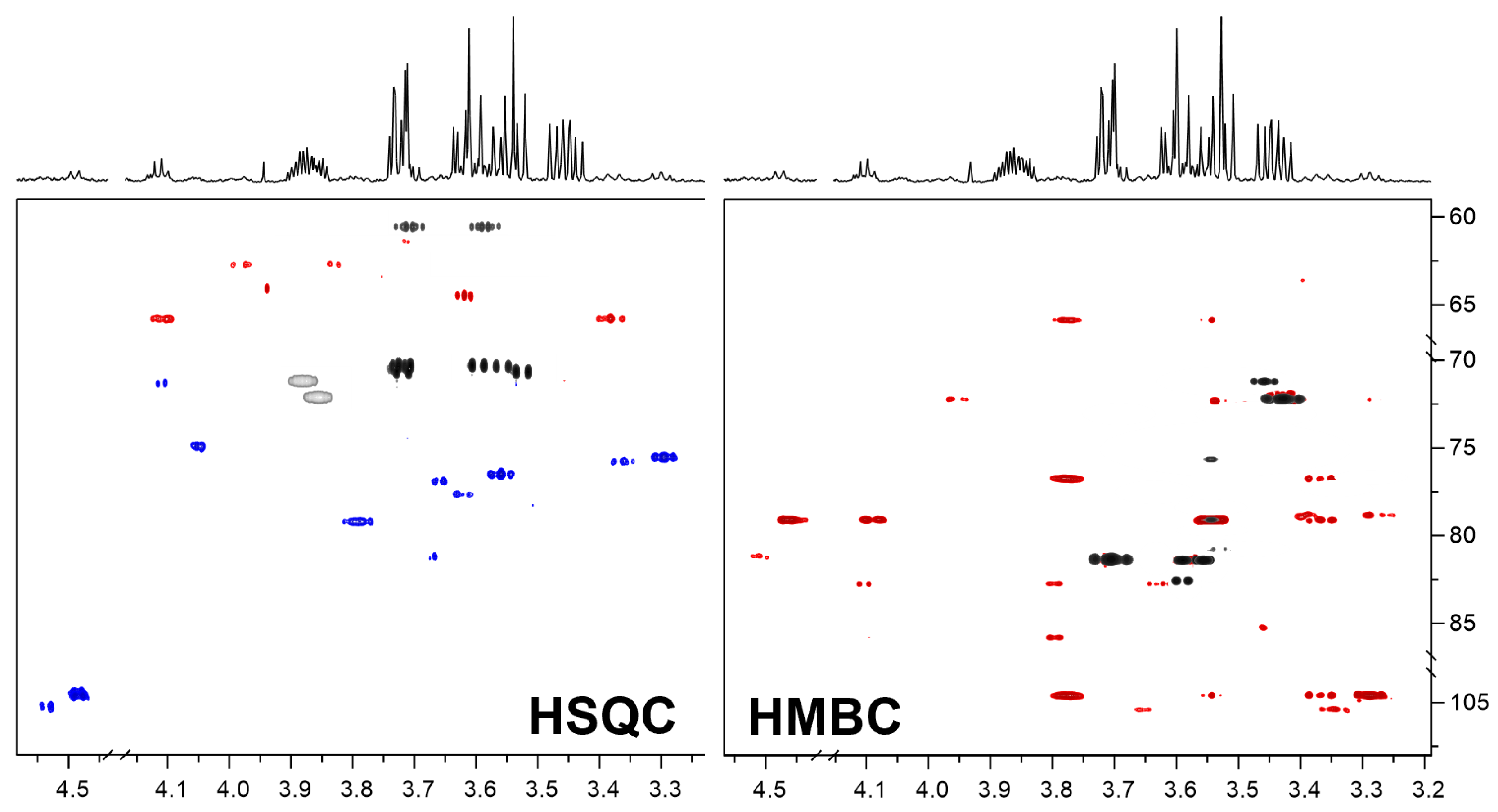
1H–13C correlation spectra have proven valuable by dint of signal separation into two dimensions, thereby simultaneously providing information on hydrogen and carbon connectivity. The HSQC spectrum is phase-sensitive, featuring correlations between carbons and directly attached hydrogen, with signals of CH and CH3 groups (blue, negative) in opposite phase as the CH2 groups (red, positive), helping to identify structural characteristics critical for substance discrimination. Carbons with no directly attached hydrogen, such as carboxyl (COO) or other quaternary carbons (Cq), can be correlated to hydrogen separated by several bonds by means of the HMBC analysis.
Formate is easily recognized by its unique 1H and 13C signals, the former being just a singlet revealing a notably large chemical shift (δ), and the latter featuring the only carboxyl carbon with a directly attached hydrogen (Figure 7A). Scalar spin coupling between distinct 1H nuclei (except OH), such as geminal (2J) and vicinal coupling (3J) via two or three bonds, respectively, results in characteristic signal splitting. The 1H signal of lactate’s CH3 group gives rise to a doublet owing to the one 1H of the adjacent CH group, and, correspondingly, the latter features a quartet because of the 3J to the three 1H nuclei in the methyl group (Figure 7B). 3J between the methyl 1H and a 13C resonating in the spectral region indicative of carbonyl carbons (160–200 ppm) reveals lactate’s carboxyl carbon around 185 ppm (Figure 7C).
Spin coupling among all 1H spins within a unique spin system is detected by means of a TOCSY experiment, as exemplarily shown in Figure 7D for 2-hydroxybutyrates’ CH3 correlation to both CH and CH2, the latter of which reveals two distinct resonances (δH ~ 1.66 and 1.75 ppm). Owing to the chiral center at the CH(OH) carbon, the hydrogens of the adjacent methylene group become diastereotopic, thus giving rise to individual signals. This is also a recurring and prominent feature of the signals associated with α-, β-, and xylo-isosaccharinic acids (Figure 7F,G) as these chiral compounds each possess several methylene groups. These saccharinic acids share three particular structural elements that allow identification as closely related derivatives: (i) a Cq—bearing a carboxyl and a hydroxyl group along with methylene groups—resonating at δC around 80 ppm (Figure 7G); (ii) two (diastereotopic) hydroxymethylene groups giving rise to signals in the characteristic 1H and 13C chemical shift ranges of 3.4–3.8 ppm and 60–71 ppm, respectively (encircled signals in Figure 7F); and (iii) a non-hydroxylated methylene group at δH and δC around 1.8 ppm and 40 ppm, respectively. The latter signals pose a good starting point for 1H–13C correlations to adjacent carbons and hydrogens, enabling to ascertain the molecular scaffold, revealing that only two compounds possess a CH(OH) residue as inferred from the negative (blue) HSQC signal along with corresponding δH above 3.8 ppm, establishing these two as α-ISA and β-ISA, while XISA refers to the other set of signals. The similarity in α- and β-ISA structures is also mirrored by the very close carboxyl carbon resonances (Figure 7G).
An estimation of the LMWOAs molar ratio was obtained from integrals of unambiguously identified, well-separated signals by means of spectral deconvolution upon least-squares optimization considering chemical shift, line width, and line shape, and applying Lorentzian/Gaussian line fitting functions. Accordingly, the five components of highest concentration in the degradation solution 1600_0.8_Ar_1y_R3 are: α-ISA, β-ISA, XISA, formate, and lactate with corresponding molar ratios of 5.4: 4.7: 2.0: 2.0: 1.0. These estimates are quite similar to what is obtained by IC(-MS) for the same sample, providing molar ratios of 6.3: 6.2: 3.2: 1.0 for α-ISA, β-ISA, formate, and lactate. It is also worth noting that the ratio of the absolute intensities of the main ISA and XISA peaks obtained by ESI-ToF MS is also in agreement with the molar ratio of ISA to XISA provided by NMR, i.e., the m/z 147 peak attributed to XISA ([M − H] peak) is 18% of the m/z 179 peak ([M − H] peak of ISA). Based on the molar ratio obtained by NMR and the ISA concentration measured in the solution, we can estimate the XISA concentration in the solution, i.e., 26 mM. Additional LMWOAs identified qualitatively by NMR are 2-hydroxybutyrate, 3,4-dihydroxybutyrate, as well as acetate and glycolate. However, their relative concentrations could not be determined with sufficient certainty.
Furthermore, some of the signals that are not assigned to LMWOAs are mainly associated with short-chained cellulose. Especially the 1H and 13C signals at ~4.5 and 105 ppm, respectively, refer to the anomeric CH β(1 → 4) glycosidic bond in cellulose. Additionally, further CH(OH) (C2–C5) and CH2OH (C6) (blue and red correlation signals, respectively, in the HSQC shown in Figure 8) in the characteristic 1H (3.3–4.1 ppm) and 13C (60–80 ppm) chemical shift ranges evidence features of remaining carbohydrates. Based on this assignment, diffusion coefficients determined from DOSY NMR reveal cellobiose units in oligomers of variable length, remaining from incomplete cellulose degradation. Estimated molecular weights, ranging between 0.3 and 9.7 kDa, correspond to cellobiose itself (see Table S3, Supplementary Materials) as well as oligomers containing up to ~30 cellobiose units. Further details are stated in Figure 9 and Table S3, Supplementary Materials. It is worth noting that these oligosaccharides may have contributed substantially to the measured DOC in the solution.

4. Discussion

The degradation of cellulose under alkaline conditions, such as those anticipated in radioactive waste repositories, is known to result in the formation of a variety of LMWOAs. The dominant degradation pathway is the stepwise peeling reaction, which takes place from the reducing ends of cellulose chains. This includes β-alkoxycarbonyl elimination followed by a calcium-catalyzed benzilic acid rearrangement, leading to the production of ISA as the major product [15]. In addition to ISA, competing reactions such as β-hydroxycarbonyl elimination, retro-aldol fragmentation, and oxidative cleavage give rise to a variety of other organic acids, including lactic, formic, glycolic, and numerous deoxy and hydroxy acids with carbon chains ranging from C2 to C6. These products result from intermediate sugar rearrangements, enediol formation, and subsequent cleavage pathways [19,33].
In radioactive waste, however, not only alkaline degradation can occur, but radiolysis is expected as well. The latter can even occur during storage and dry disposal, i.e., before alkaline degradation takes place. As discussed previously by Bleyen et al. (2025) [15], radiolytic degradation of cellulosic tissues prior to alkaline degradation results in a significant acceleration of ISA and DOC production, with the release rate of these degradation compounds increasing with absorbed dose. Tissues irradiated under air exhibited higher DOC and ISA release rates than under anoxic environments [15].
All analytical techniques applied in this study demonstrated that similar alkaline degradation products were formed by tissues irradiated at varying doses and under anoxic conditions, though at different concentrations. This supports the hypothesis that was previously made by Bleyen et al. (2025) [22], i.e., γ-irradiation under anoxic conditions predominantly accelerates the alkaline degradation processes, rather than inducing other degradation pathways. In contrast, when irradiation occurs under oxic conditions, the ESI-ToF MS spectra exhibit several additional low-intensity peaks, indicating the formation of additional degradation products, although the majority of the spectrum is still quite similar to that of tissues irradiated under anoxic conditions. IC-MS results show similar LMWOAs for both types of irradiated tissues, though for tissues irradiated at high absorbed doses, malonate was found only when pre-irradiation occurred under air. Furthermore, higher concentrations of LMWOAs were generally detected when the tissues were irradiated under air, in line with the previous observations for DOC and ISA [15].
Table 4 provides an overview of all degradation products found in this study. As expected, ISA is the major LMWOAs produced during alkaline degradation of (irradiated) cellulosic tissues, with both isomers formed in equimolar concentrations. Importantly, XISA was found as well, confirmed independently by ESI-ToF MS and NMR. This shows that hemicellulose degradation contributed significantly to the organic mixture as well and therefore should not be ignored. Based on the relative intensities of the MS peaks and the evolution of the ISA concentrations in solution, XISA is more dominantly present in degradation phases when hemicellulose degradation is favored, while cellulose degradation (and thus production of ISA) is still limited (e.g., after 1 year of hydrolysis of non-irradiated tissues or tissues irradiated at low absorbed doses). Nevertheless, even for tissues irradiated at 1.4 MGy, in suspension in ACW for 1 year, XISA is detected by NMR in quite significant concentrations (~20 mol% compared to the total ISA concentration or 6% of the total DOC). Thus, although ISA dominates the mixture, XISA still represents a significant fraction.
Apart from ISA and XISA, several other LMWOAs were detected by IC-MS: formate, lactate, glycolate, acetate, propionate, oxalate, and malonate. The latter two were only observed after hydrolysis of tissues irradiated at high doses in either argon or air, respectively.
For tissues irradiated under anoxic conditions, the detected concentrations of LMWOAs increased with absorbed dose and degradation time, i.e., similar to DOC, ISA, and XISA. Only acetate did not show the same time dependency—its concentration decreased over time, suggesting some degradation of this compound in the test solution. Both formic and lactic acid were detected in all solutions, and both constitute 1–2% of the total DOC after 2.5 years of degradation. These LMWOAs were also identified as alkaline degradation products of non-irradiated pure cellulose by Van Loon and Glaus (1998) [31], again indicating the similarities in the nature of the degradation products between non-irradiated and irradiated cellulose. Note that formic acid was not detected by ESI-ToF MS due to its presence in the solvent. The low intensity of the lactic acid peaks in the ESI-ToF MS spectra may be attributed to the low concentration of lactic acid in the solutions, at least compared to the main degradation products ISA and XISA. Note that the ESI-ToF MS peaks for ISA, XISA, and lactate increase in absolute intensity with absorbed dose during pre-irradiation and with the duration of the alkaline degradation. This correlation between concentration (as measured by NMR or IC-MS) and absolute MS intensities implies that the ESI-ToF MS methodology may be applied for semi-quantitative purposes.
All other LMWOAs detected in the alkaline degradation solutions of tissues irradiated under anoxic conditions were present at lower concentrations, only attributing to less than 1% of the total DOC. Oxalate was only detectable in solutions with tissues irradiated at the highest absorbed dose. However, since the measured concentration was very low and close to the detection limit, the presence of trace amounts of oxalate in the other solutions cannot be excluded, especially given the dose-dependency of the other LMWOAs concentrations.
For tissues irradiated in air, higher concentrations of LMWOAs were noted in comparison to the tissues irradiated at the same absorbed dose but in Ar. Similar correlations could be made between the concentrations and the absolute intensities of the corresponding peaks in the ESI-ToF MS spectra, again indicating the possibility of applying the ESI-ToF MS method in a semi-quantitative manner. In addition, low concentrations of malonate were produced in tissues irradiated at high doses in air.
The higher concentrations of ISA and other LMWOAs present in solutions with oxically irradiated tissues are in line with the previously made observations [15,22], i.e., radiolysis of cellulosic materials under air results in additional chain scissions and thus reducing end groups along which peeling can occur. This explains the similarity in end products for non-irradiated, anoxically, and oxically irradiated tissues, though the higher concentration of reducing end groups in the latter further accelerates the alkaline degradation. In addition to this, radio-oxidation results in the incorporation of additional carbonyl and carboxyl groups along the (hemi)cellulose backbone [15,22], which would explain the presence of more oxidized degradation products such as malonate in solutions with oxically irradiated tissues.
The NMR analysis supports the findings of ESI-ToF MS and IC-MS, i.e., the presence of α-ISA, β-ISA, XISA, formate, lactate, acetate, and glycolate. Some additional compounds were also detected, such as 2-hydroxybutyrate and 3,4-dihydroxybutyrate, though they could not be quantified with high certainty. Note that the latter compounds were not unambiguously detected by ESI-ToF MS, but some of the minor peaks may be attributed to their presence (e.g., m/z 119 for 3,4-dihydroxybutyrate ([M − H] peak) and m/z 103 for 2-hydroxybutyrate ([M − H] peak). Finally, NMR detected the presence of oligomers in the solutions, originating from incomplete cellulose degradation. This fraction may have contributed significantly to the DOC in the test solutions. Future work using size fractionation followed by DOC measurements and other analytical techniques may provide additional insights into the high molecular weight fraction.
Despite the valuable information obtained from the combined results of different techniques used to characterize cellulose degradation products, some uncertainties remain. Several compounds were detected only qualitatively, and part of the ESI-ToF MS mass spectra could not be fully interpreted. Therefore, we suggest that optimizing the ESI-ToF MS analysis using another solvent (e.g., methanol [51]) and application of techniques such as size exclusion chromatography coupled to IC-MS or ESI-ToF MS can improve both characterization and quantification. Furthermore, we acknowledge that some of the degradation products may not be detectable or identifiable by the applied and suggested methodology, and other techniques may be required to explore this further.
In summary, our results indicate that tissues irradiated under anoxic conditions mainly accelerate the alkaline degradation processes without changing the main end products, whereas irradiation under oxic conditions leads to an additional (minor) fraction of oxidized degradation products. In addition, hemicellulose degradation contributes significantly to the overall degradation mixture by the production of XISA. Moreover, cellulose oligomers also make up part of the leachate. These findings advance our insights into the degradation end products of cellulosic materials in radioactive waste and establish a foundation for future research on their complexation potential and impact on radionuclide mobility, especially for compounds where data are lacking.

5. Conclusions

This study provides a comprehensive understanding of the impact of γ-irradiation on the alkaline degradation of cellulosic materials, with particular emphasis on the end products. The results confirm that irradiation accelerates the alkaline degradation and thus the release of degradation products such as ISA, and various LMWOAs, with the extent of this release being strongly influenced by the absorbed dose and—to a lesser extent—the irradiation atmosphere. Although oxic irradiation conditions promote additional radio-oxidation in the polysaccharides’ backbone, which leads to the minor formation of more oxidized organic species, the major products remain consistent with those observed for anoxically irradiated tissues. The strong similarity in the final degradation products suggests that the fundamental degradation mechanisms are largely unaffected by the applied irradiation conditions. The contribution of different analytical techniques used in this study increases confidence in identifying the main degradation products.
Importantly, the dose-dependent trends in both concentration and MS signal intensity suggest that ESI-ToF MS may serve as a semi-quantitative tool for monitoring the degradation products, at least for the major compounds. It would be worthwhile to investigate this potential in more detail in future research.
Across all analytical techniques, ISA, XISA, lactic acid, and other minor LMWOAs were consistently detected, further supporting the robustness of the identifications. The results confirm that ISA remains the primary degradation product, especially in the long term, when cellulose degradation becomes the dominant degradation process. The presence of XISA, which acts as a marker of hemicellulose degradation, indicates that hemicellulose degradation also contributes to the mixture of degradation products, particularly in the early stages of degradation, when the hemicellulose degradation rate exceeds that of cellulose. Moreover, even over the long term, XISA concentration in the leachate solution remains significant. However, while its influence is expected to be limited, the role of XISA in radionuclide transport remains largely unknown, and further studies are needed to investigate its complexation with safety-relevant radionuclides. In addition to ISA, XISA, and LMWOAs, other end products such as glutaric acid, hydroxybutyric acids, and oligosaccharides were identified as well, though could not be quantified (or estimated).
Our findings offer valuable insights into the behavior of cellulosic materials and the nature of their degradation products in waste disposal environments. As a previous study [30] showed that a complex mixture of degradation products from irradiated paper tissues reduces the sorption of 63Ni on cement more strongly than α-ISA alone, the present study provides essential knowledge for interpreting this observation. The broader suite of identified products, including XISA, other LMWOAs, and oligosaccharides, offers plausible candidates for the non-ISA fraction that may modulate radionuclide sorption on cement. However, the detection of unidentified compounds and unquantified oligomers highlights the limitations of the current analytical techniques and the need for complementary methods to fully unravel the complexity of alkaline degradation of (irradiated) cellulosic tissues. Future work could therefore focus on: (i) developing quantitative analytical methods for XISA and other identified degradation products (ii) incorporating complementary techniques, such as SEC coupled with IC-MS or ESI-ToF MS, to improve both characterization of unidentified compounds and quantification (iii) combining experimental data with molecular simulations to have an understanding of the complexation mechanism between radionuclides and other compounds in the mixture (iv) conduct experiments with realistic waste simulants to validate laboratory studies under conditions more representative of cement-based disposal environments.


Supplementary Materials

The following supporting information can be downloaded at: https://www.mdpi.com/article/10.3390/polysaccharides7010031/s1. Table S1: List of reference compounds analyzed with ESI-ToF MS. Figure S1: ESI-ToF MS spectra of the reference compounds according to Table S1 after background subtraction. Figure S2: ESI-ToF MS spectra of solutions sampled from ACW in which pre-irradiated Tork Facial paper tissues were submerged and hydrolyzed for 3 months or 1 year. Figure S3: Presentation of the spectra shown in Figure 3 in the main document without color marking. Figure S4: Presentation of the spectra shown in Figure 4 in the main document without color marking. Figure S5: Presentation of the spectra shown in Figure 5 in the main document without color marking. Figure S6: Presentation of the spectra shown in Figure S2 without color marking. Table S2: Concentrations (in mM) of LMWOA as determined by IC-MS, of ISA (by IC with pulsed amperometric detector) and of DOC. Table S3: Diffusion coefficients (D, determined from DOSY NMR depicted in Figure 9 of the paper) used to estimate the molecular weight (M) and the corresponding length of cellobiose units (N).

Author Contributions

Conceptualization: N.B.; Methodology: E.N., J.K., F.M. and G.V.; Validation: J.K., F.M., K.S. and N.B.; Formal analysis: E.N., J.K. and G.V.; Investigation: E.N., J.K., G.V. and N.B.; Resources: K.S. and N.B.; Data curation: E.N., J.K. and N.B.; Writing—original draft preparation: E.N., J.K. and N.B.; Writing—review and editing: all authors; Visualization: E.N., J.K. and N.B.; Supervision: D.D., F.M., K.S. and N.B.; Project administration: D.D., K.S. and N.B.; Funding acquisition: D.D., K.S. and N.B. All authors have read and agreed to the published version of the manuscript.

Funding

This research has received funding from the European Union’s Horizon 2020 research and innovation program under grant agreement no. 847593 (EURAD Work Package CORI). Furthermore, this work was undertaken in close co-operation with, and with the financial support of ONDRAF/NIRAS, the Belgian Agency for the Management of Radioactive Waste and Enriched Fissile Materials, as part of the public-public partnership between SCK CEN and ONDRAF/NIRAS. The optimization of the ESI-ToF MS methodology was part of the thesis of E. N. and was additionally financially supported by the ENEN2plus Mobility Grant awarded under the framework of the European Union’s Horizon 2020 research and innovation program under grant agreement no. 101061677. J. K. and K. S. acknowledge funding from the German Federal Ministry for the Environment, Nature Conservation, Nuclear Safety and Consumer Protection (BMUV) within the GRaZ II project, no. 02E11860B.

Institutional Review Board Statement

Not applicable.

Data Availability Statement

The original contributions presented in this study are included in the article/Supplementary Material. Further inquiries can be directed to the corresponding author.

Acknowledgments

The authors would like to thank the team of the RCA unit at SCK CEN and Jan Tits and Dominik Kunz from PSI for performing the DOC and IC or HPIEC-MS analyses. Furthermore, the help of Katrien Hendrix (SCK CEN) as a mentor of E.N. during her internship and of Veerle Van Gompel (SCK CEN) for technical support is greatly appreciated. Finally, we thank all colleagues within the EURAD project WP CORI and at ONDRAF/NIRAS for their constructive comments and suggestions on this study.

Conflicts of Interest

The authors declare no conflicts of interest.

Abbreviations

The following abbreviations are used in this manuscript:
γ-irradiationGamma irradiation
AAAcetic acid
ACWArtificial cement water
BAButyric acid
COSYCorrelation spectroscopy
DDiffusion coefficient
DLDetection limit
DOCDissolved organic matter
DOSYDiffusion-ordered spectroscopy
ESIElectrospray ionization
ESI-ToF MSElectropray ionization time-of-flight mass spectrometry
FAFormic acid
GAGlycolic acid
HMBC1H–13C heteronuclear multiple-bond correlation
HPIEC-MSHigh-performance ion exchange chromatography coupled with mass spectrometry
HSQC1H–13C heteronuclear single-quantum coherence
ICIon chromatography
IC-MSHigh-performance ion exchange chromatography coupled with mass spectrometry
ISAIsosaccharinic acid
LALactic acid
LMWOAsLow molecular weight organic acids
MUncharged molecule (of the analyte)
MAMalonic acid
MaMajor
MiMinor
MSMass spectrometry
MSAMetasaccharinic acid
m/zMass-to-charge ratio
NMRNuclear magnetic resonance
OAOxalic acid
PAPropionic acid
SSignificant
TOCSY Total correlation spectroscopy
UUnquantified
UHR Q-ToFUltra-high resolution quadrupole time-of-flight
VAValeric acid
XISAxylo-isosaccharinic acid

References

  1. Bleyen, N. Degradation of Cellulose under Disposal Conditions; State-of-the-Art Report; External Report SCK CEN-ER-0791; SCK CEN: Mol, Belgium, 2020. [Google Scholar]
  2. Ershov, B.G. Radiation-chemical degradation of cellulose and other polysaccharides. Russ. Chem. Rev. 1998, 67, 315–334. [Google Scholar] [CrossRef]
  3. Martínez-Sanz, M.; Pettolino, F.; Flanagan, B.; Gidley, M.J.; Gilbert, E.P. Structure of cellulose microfibrils in mature cotton fibres. Carbohydr. Polym. 2017, 175, 450–463. [Google Scholar] [CrossRef]
  4. Jung, S.-J.; Kim, S.-H.; Chung, I.-M. Comparison of lignin, cellulose, and hemicellulose contents for biofuels utilization among 4 types of lignocellulosic crops. Biomass Bioenergy 2015, 83, 322–327. [Google Scholar] [CrossRef]
  5. Arthur, J. Reactions induced by high-energy radiation. In Cellulose and Cellulose Derivatives, Part V; Wiley Interscience: New York, NY, USA, 1971; p. 946. [Google Scholar]
  6. Bleyen, N.; Van Gompel, V.; Smets, S.; Eyley, S.; Verwimp, W.; Thielemans, W.; Valcke, E. Radiolytic degradation of cellulosic materials in nuclear waste: Effect of oxygen and absorbed dose. Radiat. Phys. Chem. 2023, 212, 111177. [Google Scholar] [CrossRef]
  7. Ershov, B.; Samuilova, S.; Petropavlovskii, G.; Vasil’eva, G. Radiation-thermal destruction of cellulose. Dokl. Phys. Chem. (Engl. Transl.) 1984, 274, 11–14. [Google Scholar]
  8. Tissot, C.; Grdanovska, S.; Barkatt, A.; Silverman, J.; Al-Sheikhly, M. On the mechanisms of the radiation-induced degradation of cellulosic substances. Radiat. Phys. Chem. 2013, 84, 185–190. [Google Scholar] [CrossRef]
  9. Blears, M.; Machell, G.; Richards, G. Alkaline degradation of 4-0-substituted glucose derivatives. Chem. Ind. 1957, 24, 1150–1151. [Google Scholar]
  10. Lai, Y.Z. Chapter 10: Chemical Degradation. In Wood and Cellulosic Chemistry, 2nd ed.; Hon, D.N.S., Shiraishi, N., Eds.; CRC Press: London, UK, 2000; pp. 443–512. [Google Scholar]
  11. Machell, G.; Richards, G. 384. Mechanism of saccharinic acid formation. Part I. Competing reactions in the alkaline degradation of 4-O-methyl-D-glucose, maltose, amylose, and cellulose. J. Chem. Soc. (Resumed) 1960, 1924–1931. [Google Scholar] [CrossRef]
  12. Van Loon, L.R.; Glaus, M.A.; Stallone, S.; Laube, A. Sorption of isosaccharinic acid, a cellulose degradation product, on cement. Environ. Sci. Technol. 1997, 31, 1243–1245. [Google Scholar] [CrossRef]
  13. Glaus, M.A.; Van Loon, L.R. Cellulose Degradation at Alkaline Conditions: Long-Term Experiments at Elevated Temperatures; PSI report No. 04-01; Paul Scherrer Institute (PSI): Villigen, Switzerland, 2004. [Google Scholar]
  14. Van Loon, L.R.; Glaus, M.A. Review of the kinetics of alkaline degradation of cellulose in view of its relevance for safety assessment of radioactive waste repositories. J. Environ. Polym. Degrad. 1997, 5, 97–109. [Google Scholar] [CrossRef]
  15. Bleyen, N.; Durce, D.; Nushi, E.; Valcke, E. Gamma irradiation accelerates alkaline degradation of cellulosic materials in radioactive waste. Radiat. Phys. Chem. 2025, 229, 112464. [Google Scholar] [CrossRef]
  16. Bassil, N.M.; Small, J.S.; Lloyd, J.R. Enhanced microbial degradation of irradiated cellulose under hyperalkaline conditions. FEMS Microbiol. Ecol. 2020, 96, fiaa102. [Google Scholar] [CrossRef] [PubMed]
  17. Blouin, F.A.; Arthur, J.C., Jr. The effects of gamma radiation on cotton: Part I: Some of the properties of purified cotton irradiated in oxygen and nitrogen atmospheres. Text. Res. J. 1958, 28, 198–204. [Google Scholar] [CrossRef]
  18. David, C.; Van den Bergh, M. Utilization of waste cellulose. II. Gamma irradiation and alkaline hydrolysis. Cellul. Chem. Technol. 1982, 16, 153–158. [Google Scholar]
  19. Knill, C.J.; Kennedy, J.F. Degradation of cellulose under alkaline conditions. Carbohydr. Polym. 2003, 51, 281–300. [Google Scholar] [CrossRef]
  20. Pavasars, I. Characterisation of Organic Substances in Waste Materials Under Alkaline Conditions. Ph.D. Thesis, Linköping University, Linköping, Sweden, 1999. [Google Scholar]
  21. Sjostrom, E. The behavior of wood polysaccharides during alkaline pulping processes. Tappi 1977, 60, 151–154. [Google Scholar]
  22. Bleyen, N.; Van Gompel, V.; Eyley, S.; Durce, D.; Verpoucke, G.; Thielemans, W.; Valcke, E. New insights in long-term alkaline degradation mechanism of cellulosic materials in radioactive waste. Cellulose 2025, 32, 4363–4385. [Google Scholar] [CrossRef]
  23. Allard, S.; Ekberg, C. Complexing properties of α-isosaccharinate: Stability constants, enthalpies and entropies of Th-complexation with uncertainty analysis. J. Solut. Chem. 2006, 35, 1173–1186. [Google Scholar] [CrossRef]
  24. Felipe-Sotelo, M.; Hinchliff, J.; Field, L.; Milodowski, A.; Holt, J.; Taylor, S.; Read, D. The solubility of nickel and its migration through the cementitious backfill of a geological disposal facility for nuclear waste. J. Hazard. Mater. 2016, 314, 211–219. [Google Scholar] [CrossRef]
  25. Brinkmann, H.; Patzschke, M.; Kaden, P.; Raiwa, M.; Rossberg, A.; Kloditz, R.; Heim, K.; Moll, H.; Stumpf, T. Complex formation between UO22+ and α-isosaccharinic acid: Insights on a molecular level. Dalton Trans. 2019, 48, 13440–13457. [Google Scholar] [CrossRef]
  26. Gaona, X.; Montoya, V.; Colàs, E.; Grivé, M.; Duro, L. Review of the complexation of tetravalent actinides by ISA and gluconate under alkaline to hyperalkaline conditions. J. Contam. Hydrol. 2008, 102, 217–227. [Google Scholar] [CrossRef] [PubMed]
  27. Greenfield, B.; Holtom, G.; Hurdus, M.; O’Kelly, N.; Pilkington, N.; Rosevear, A.; Spindler, M.; Williams, S. The identification and degradation of isosaccharinic acid, a cellulose degradation product. MRS Online Proc. Libr. (OPL) 1994, 353, 1151. [Google Scholar] [CrossRef]
  28. Almond, M.; Belton, D.; Humphreys, P.N.; Laws, A.P. A study of the metal binding capacity of saccharinic acids formed during the alkali catalysed decomposition of cellulosic materials: Nickel complexation by glucoisosaccharinic acids and xyloisosaccharinic acids. Carbohydr. Res. 2016, 427, 48–54. [Google Scholar] [CrossRef] [PubMed]
  29. Barkleit, A.; Kretzschmar, J.; Tsushima, S.; Acker, M. Americium (III) and europium (III) complex formation with lactate at elevated temperatures studied by spectroscopy and quantum chemical calculations. Dalton Trans. 2014, 43, 11221–11232. [Google Scholar] [CrossRef]
  30. Durce, D.; Wang, L.; Bleyen, N.; Van Gompel, M. Effect of cellulose degradation products on 63Ni sorption on Portland cement. Appl. Geochem. 2025, 178, 106237. [Google Scholar] [CrossRef]
  31. Van Loon, L.R.; Glaus, M.A. Experimental and Theoretical Studies on Alkaline Degradation of Cellulose and Its Impact on the Sorption of Radionuclides; PSI-Bericht 98-07; Paul Scherrer Institut: Villigen, Switzerland, 1998. [Google Scholar]
  32. Nushi, E.; Bleyen, N.; Hendrix, K.; Mastroleo, F. Cellulose Degradation and Nuclear Waste Management: Characterization of Cellulose Degradation Products by ESI-ToF MS. Master’s Thesis, IMT Atlantique—Campus de Nantes & Universidad Politécnica de Madrid, Nantes, France, 2023. [Google Scholar]
  33. Glaus, M.A.; Van Loon, L.R.; Achatz, S.; Chodura, A.; Fischer, K. Degradation of cellulosic materials under the alkaline conditions of a cementitious repository for low and intermediate level radioactive waste: Part I: Identification of degradation products. Anal. Chim. Acta 1999, 398, 111–122. [Google Scholar] [CrossRef]
  34. Bourbon, X.; Toulhoat, P. Influence of organic degradation products on the solubilisation of radionuclides in intermediate and low level radioactive wastes. Radiochim. Acta 1996, 74, 315–320. [Google Scholar] [CrossRef]
  35. Tits, J.; Kunz, D.; Guillemot, T.; Wieland, E. The stability of α-isosaccharinate under highly alkaline, reducing conditions. In Proceedings of the CORI 3rd Annual Work Package Meeting, Online, 25–29 November 2021; pp. R1–R12. [Google Scholar] [CrossRef]
  36. Tooley, O.; Pointer, W.; Radmall, R.; Hall, M.; Beyer, V.; Stakem, K.; Swift, T.; Town, J.; Junkers, T.; Wilson, P. MaDDOSY (Mass Determination Diffusion Ordered Spectroscopy) using an 80 MHz bench top NMR for the rapid determination of polymer and macromolecular molecular weight. Macromol. Rapid Commun. 2024, 45, 2300692. [Google Scholar] [CrossRef]
  37. Wan, D.; Yang, H.; Yan, C.; Song, F.; Liu, Z.; Liu, S. Differentiation of glucose-containing disaccharides isomers by fragmentation of the deprotonated non-covalent dimers using negative electrospray ionization tandem mass spectrometry. Talanta 2013, 115, 870–875. [Google Scholar] [CrossRef]
  38. Schneckenburger, T.; Riefstahl, J.; Fischer, K. Adsorption of aliphatic polyhydroxy carboxylic acids on gibbsite: pH dependency and importance of adsorbate structure. Environ. Sci. Eur. 2018, 30, 1. [Google Scholar] [CrossRef]
  39. CPC Scientific. ESI-MS Peptide Interpretation Guide. Available online: https://cpcscientific.com/esi-ms-peptide-interpretation-guide (accessed on 4 April 2023).
  40. Hill, L.M. Interpretation of Isotope Peaks in Small Molecule LC MS. Available online: https://www.chromatographyonline.com/view/interpretation-isotope-peaks-small-molecule-lcms (accessed on 26 June 2023).
  41. Frattari, S.; Gironi, F.; Sabia, R.; Villani, C. Equilibrium condition and stabilization kinetics of lactic acid oligomers in aqueous solutions. Can. J. Chem. Eng. 2017, 95, 863–870. [Google Scholar] [CrossRef]
  42. Golon, A.; Kuhnert, N. Characterisation of “caramel-type” thermal decomposition products of selected monosaccharides including fructose, mannose, galactose, arabinose and ribose by advanced electrospray ionization mass spectrometry methods. Food Funct. 2013, 4, 1040–1050. [Google Scholar] [CrossRef] [PubMed]
  43. Kappes, K.J.; Deal, A.M.; Jespersen, M.F.; Blair, S.L.; Doussin, J.-F.; Cazaunau, M.; Pangui, E.; Hopper, B.N.; Johnson, M.S.; Vaida, V. Chemistry and photochemistry of pyruvic acid at the air–water interface. J. Phys. Chem. A 2021, 125, 1036–1049. [Google Scholar] [CrossRef] [PubMed]
  44. Gamoh, K.; Saitoh, H.; Wada, H. Improved liquid chromatography/mass spectrometric analysis of low molecular weight carboxylic acids by ion exclusion separation with electrospray ionization. Rapid Commun. Mass Spectrom. 2003, 17, 685–689. [Google Scholar] [CrossRef]
  45. Sandín-España, P.; Mateo-Miranda, M.; López-Goti, C.; De Cal, A.; Alonso-Prados, J.L. Development of a rapid and direct method for the determination of organic acids in peach fruit using LC–ESI-MS. Food Chem. 2016, 192, 268–273. [Google Scholar] [CrossRef]
  46. Gale, P.; Duncan, M.W.; Yergey, A.L. Quantifying small molecules by mass spectrometry. LCGC N. Am. 2015, 33, 34–41. [Google Scholar]
  47. Kebarle, P.; Tang, L. From ions in solution to ions in the gas phase-the mechanism of electrospray mass spectrometry. Anal. Chem. 1993, 65, 972A–986A. [Google Scholar] [CrossRef]
  48. Wilm, M. Principles of electrospray ionization. Mol. Cell. Proteom. 2011, 10, M111.009407. [Google Scholar] [CrossRef]
  49. Ekberg, S.; Ekberg, C.; Albinsson, Y. Characterization of α-isosaccharinic acid: Lactone and carboxylic conformations. J. Solut. Chem. 2004, 33, 465–477. [Google Scholar] [CrossRef]
  50. Whistler, R.L.; Corbett, W. Behavior of Xylan in Alkaline Solution: The Isolation of a New C5 Saccharinic Acid1, 2. J. Am. Chem. Soc. 1956, 78, 1003–1005. [Google Scholar] [CrossRef]
  51. HITACHI Analysis of Organic Acids by MS Detector (AS/MSD-008). Available online: http://www.hitachi-hitec-science.com/ (accessed on 26 June 2023).
Figure 1. Filtered solutions obtained after 1 year of alkaline degradation of (irradiated) cellulosic tissues. The codes on the samples are in accordance with Table 1.
Polysaccharides 07 00031 g001
Figure 2. ESI-ToF MS spectra of solutions sampled from ACW in which pre-irradiated Tork Facial paper tissues were submerged and hydrolyzed for three months. Pre-irradiation occurred under anoxic conditions. Further details on the irradiation conditions and on the sample codes are provided in Table 1. The m/z data are labeled as follows: m/z within blue boxes correspond to the presence of ISA, m/z within green boxes indicate the presence of XISA, m/z within orange boxes correspond to the presence of glutaric acid, m/z within purple boxes correspond to the presence of cellobiose, and m/z within red boxes represent the presence of lactic acid. For m/z within dashed boxes (gray and red), a match is suggested. See Figure S3 at Supplementary Materials for a version of the spectra without color markings.
Polysaccharides 07 00031 g002
Figure 3. ESI-ToF MS spectra of solutions sampled from ACW in which pre-irradiated Tork Facial paper tissues were submerged and hydrolyzed for one year. Pre-irradiation occurred under anoxic conditions. Further details on the irradiation conditions and on the sample codes are provided in Table 1. The m/z data are labeled as follows: m/z within blue boxes correspond to the presence of ISA, m/z within green boxes indicate the presence of XISA, m/z within orange boxes correspond to the presence of glutaric acid, m/z within purple boxes correspond to the presence of cellobiose, and m/z within red boxes represent the presence of lactic acid. For m/z within dashed boxes (gray and red), a match is suggested. See Figure S4 at Supplementary Materials for a version of the spectra without color markings.
Polysaccharides 07 00031 g003
Figure 4. ESI-ToF MS spectra of solutions sampled from ACW in which pre-irradiated Tork Facial paper tissues were submerged and hydrolyzed for 3 months and 1 year. Pre-irradiation occurred under oxic conditions. Further details on the irradiation conditions and on the sample codes are provided in Table 1. The m/z data are labeled as follows: m/z within blue boxes correspond to the presence of ISA, m/z within green boxes indicate the presence of XISA, m/z within orange boxes correspond to the presence of glutaric acid, and m/z within red boxes represent the presence of lactic acid. For m/z within dashed boxes (gray and red), a match is suggested. See Figure S5 at Supplementary Materials for a version of the spectra without color markings.
Polysaccharides 07 00031 g004
Figure 5. Concentration of low molecular weight organic acids (LMWOAs) in the solutions with (irradiated) tissues as a function of absorbed dose (X-axis), irradiation atmosphere (color legend), and dose rate (shape legend). The error bars indicate the measurement uncertainty (with 95% confidence). Values can be found in Table S2 of the Supplementary Materials. FA: formic acid; AA: acetic acid; GA: glycolic acid; PA: propionic acid; LA: lactic acid; VA: valeric acid; MA: malonic acid; OA: oxalic acid; BA: butyric acid; ISA: isosaccharinic acid; DOC: dissolved organic carbon. Only data for solutions irradiated at a dose rate of ~0.6 kGy h−1 are shown, as the dose rate did not affect the concentrations (see Table S2, Supplementary Materials, and Bleyen et al. [15] for quantitative data).
Polysaccharides 07 00031 g005
Figure 6. 1H (A) and 13C NMR (B) spectra corresponding to the solution obtained from tissues irradiated under an anoxic atmosphere and hydrolyzed for one year (sample 1600_0.8_Ar_1y_R3), along with a general assignment of spectral regions to corresponding structural features. Superposition of selected regions from the H,C-HSQC spectra (C) obtained from solutions of tissues irradiated under an anoxic atmosphere and hydrolyzed for three months (3m, bright colors, sample 1600_0.8_Ar_3m_R3) and for one year (1y, dark colors, sample 1600_0.8_Ar_1y_R3), demonstrating the qualitative sample composition to be similar in both samples. Signals associated with CH2 groups are given in warm colors, while signals due to CH and CH3 groups are given in cold colors, respectively.
Polysaccharides 07 00031 g006
Figure 7. Magnifications of the H,C-HSQC spectrum (A,B,F), of the H,C-HMBC spectrum (C,E,G), as well as of the H,H-TOCSY spectrum (D) exemplarily depict correlation signals proving the presence of formate (A), lactate (B,C), 2-hydroxybutyrate (D,E), as well as α-, β-, and xylo-isosaccharinates (F,G). Axes represent chemical shift values in ppm. Note the phase-sensitivity in the HSQC spectra (CH/CH3 groups in blue, CH2 groups in red (sample 1600_0.8_Ar_1y_R3—Table 1).
Polysaccharides 07 00031 g007
Figure 8. Selected regions from the H,C-HSQC (left) and H,C-HMBC spectra (right) of the solution obtained from tissues irradiated under an Ar atmosphere and hydrolyzed for three months (sample 1600_0.8_Ar_3m_R3—Table 1). Signals depicted in shades of gray refer to signals already assigned to LMWOAs, while colored signals are associated with cellulose oligomers remaining from incomplete degradation. Note the same 1H and 13C chemical shift ranges in both spectra, and the phase-sensitivity in the HSQC spectrum (CH/CH3 groups in blue, CH2 groups in red). Axes represent chemical shift values in ppm.
Polysaccharides 07 00031 g008
Figure 9. Diffusion-ordered spectroscopy (1H DOSY, T = 25 °C) of the solution obtained from tissues irradiated under an Ar atmosphere and hydrolyzed for three months (1600_0.8_Ar_3m_R3—Table 1). The signal due to formate (A) was used as internal calibration for the diffusion coefficient (D in m2/s) to estimate the molecular weight (degree of oligomerization) of cellobiose units (B) remaining from incomplete cellulose degradation, using the online version of the DOSY Molecular Weight Calculator [36]. Owing to quite high sample concentration, the increased bulk viscosity is estimated from the diffusion coefficient of the small molecule formate (molecular weight 46 g/mol, D = 1.22 × 10⁻⁹ m2/s), yielding 1.5 mPa s. Correspondingly, DOSY signals with 1H NMR chemical shifts associated with cellobiose (cf. also Figure 8) with different D values referring to oligomers of varying molecular weight, i.e., cellobiose units, assuming that these constitute the primary source of macromolecules. Because of the water signal suppression sequence used, distortions and truncations of the resulting signal render water unsuitable for internal diffusion coefficient calibration and viscosity estimation.
Polysaccharides 07 00031 g009
Table 1. Samples used for the identification of degradation products, obtained after (radiolytic and) alkaline degradation of cellulosic tissues, as discussed in Bleyen et al. [15]. ISA and DOC concentrations were determined for all samples. Detection of low molecular weight organic acids (LMWOAs) was done by ion chromatography or high-performance ion exchange chromatography coupled with mass spectrometry.
Test Code *Absorbed Dose (MGy)Mean Dose Rate (kGy h−1)Irradiation
Atmosphere
Degradation Time in ACWAnalyses
Cell_3m_R3///3 monthsESI-ToF MS
Cell_1y_R3///1 yearESI-ToF MS, LMWOAs
Cell_R1///2.5 yearsLMWOAs
10_0.8_Ar_3y_R30.010.6 ± 0.1Ar2.5 yearsLMWOAs
50_0.8_Ar_3m_R30.050.6 ± 0.1Ar3 monthsESI-ToF MS
50_0.8_Ar_1y_R30.050.6 ± 0.1Ar1 yearESI-ToF MS
50_0.8_Ar_3y_R30.050.6 ± 0.1Ar2.5 yearsLMWOAs
50_0.8_O2_3m_R30.050.6 ± 0.1Air3 monthsESI-ToF MS
50_0.8_O2_1y_R30.050.6 ± 0.1Air1 yearESI-ToF MS
50_0.8_O2_R10.050.6 ± 0.1Air2.5 yearsLMWOAs
50_0.4_O2_R10.050.34 ± 0.05Air2.5 yearsLMWOAs
200_0.8_Ar_3m_R30.20.7 ± 0.2Ar3 monthsESI-ToF MS
200_0.8_Ar_1y_R30.20.7 ± 0.2Ar1 yearESI-ToF MS
200_0.8_Ar_3y_R30.20.7 ± 0.2Ar2.5 yearsLMWOAs
400_0.8_Ar_R10.40.7 ± 0.1Ar2.5 yearsLMWOAs
800_0.8_Ar_3m_R30.80.62 ± 0.08Ar3 monthsESI-ToF MS
800_0.8_Ar_1y_R30.80.62 ± 0.08Ar1 yearLMWOAs
800_0.8_Ar_3y_R30.80.62 ± 0.08Ar2.5 yearsLMWOAs
800_0.8_O2_1y_R30.80.62 ± 0.08Air1 yearLMWOAs
800_0.8_O2_3y_R30.80.62 ± 0.08Air2.5 yearsLMWOAs
800_0.4_Ar_1y_R30.80.62 ± 0.08Ar1 yearESI-ToF MS
800_0.4_O2_1y_R30.80.31 ± 0.04Air1 yearESI-ToF MS
1600_0.8_Ar_3m_R31.40.55 ± 0.06Ar3 monthsESI-ToF MS, NMR
1600_0.8_Ar_1y_R31.40.55 ± 0.06Ar1 yearESI-ToF MS, NMR, LMWOAs
1600_0.8_Ar_R11.40.55 ± 0.06Ar2.5 yearsLMWOAs
* For non-irradiated tissues, test codes follow the format Cell_a_Rb, with ‘a’ being the target duration of alkaline degradation and ‘b’ the duplicate test series. Note that ‘a’ is only provided for duplicate test series that were sacrificed during sampling (R3). For irradiated tissues, test codes follow the format x_y_z_a_Rb, with ‘x’ being the target absorbed dose (kGy), ‘y’ the target dose rate (kGy h−1), and ‘z’ the irradiation atmosphere (Ar: argon and O2: air).
Table 2. DOC and ISA concentrations measured by Bleyen et al. (2025) [15] in solutions used for the identification of degradation products (cf. Table 1).
Test CodeDegradation Time in ACWDOC (mM)ISA (mM)α-ISA (mM)β-ISA (mM)
Cell_3m_R33 months122 ± 184.0 ± 0.21.8 ± 0.12.2 ± 0.1
Cell_1y_R31 year167 ± 334.4 ± 0.42.2 ± 0.32.2 ± 0.3
Cell_R12.5 years200 ± 1911.7 ± 0.95.8 ± 0.65.9 ± 0.7
10_0.8_Ar_3y_R32.5 years308 ± 2716 ± 18.3 ± 0.98 ± 1
50_0.8_Ar_3m_R33 months185 ± 568.8 ± 0.34.2 ± 0.14.7 ± 0.3
50_0.8_Ar_1y_R31 year442 ± 58n.a. * (27 ± 2)n.a. (13 ± 2)n.a. (15 ± 2)
50_0.8_Ar_3y_R32.5 years617 ± 5053 ± 527 ± 326 ± 3
50_0.8_O2_3m_R33 monthsn.a. (401 ± 120)n.a.n.a.n.a.
50_0.8_O2_1y_R31 year750 ± 10855 ± 425 ± 230 ± 3
50_0.8_O2_R12.5 years925 ± 12591 ± 944 ± 647 ± 7
50_0.4_O2_R12.5 years858 ± 8395 ± 948 ± 647 ± 7
200_0.8_Ar_3m_R33 months683 ± 8348 ± 524 ± 324 ± 3
200_0.8_Ar_1y_R31 year958 ± 12567 ± 936 ± 631 ± 6
200_0.8_Ar_3y_R32.5 years1175 ± 108117 ± 960 ± 657 ± 7
400_0.8_Ar_R12.5 years1625 ± 142147 ± 1076 ± 771 ± 7
800_0.8_Ar_3m_R33 months1608 ± 167109 ± 559 ± 450 ± 4
800_0.8_Ar_1y_R31 year1717 ± 192124 ± 863 ± 461 ± 7
800_0.8_Ar_3y_R32.5 years1875 ± 183153 ± 1482 ± 971 ± 10
800_0.8_O2_1y_R31 year2075 ± 217114 ± 957 ± 657 ± 7
800_0.8_O2_3y_R32.5 years2175 ± 200136 ± 1068 ± 768 ± 7
800_0.4_Ar_1y_R31 year1767 ± 200131 ± 963 ± 668 ± 7
800_0.4_O2_1y_R31 year2050 ± 217145 ± 1069 ± 1576 ± 7
1600_0.8_Ar_3m_R33 months1775 ± 192130 ± 667 ± 463 ± 5
1600_0.8_Ar_1y_R31 year2125 ± 233130 ± 866 ± 464 ± 7
1600_0.8_Ar_R12.5 years2050 ± 192151 ± 1478 ± 973 ± 10
* n.a.: not analyzed. For samples without a measured concentration, the concentration of the duplicate solution is given in parentheses when available.
Table 3. Ion type identified from the ESI-ToF MS of reference compounds. Theoretical m/z is given for the identified ions. The experimentally measured m/z values align with the theoretical values, accounting for a consistent bias observed also for the background peaks. M refers to the uncharged molecule of the corresponding compound (analyte). Details on the ion assignment are provided in the Supplementary Material, following established approaches reported in the literature [37,38,39,40,41,42,43,44,45].
Reference Compound
(Spectra Reference)
m/zSuggested Ion Type
Cellobiose
(Figure S1, 1)
161.04
179.06
341.11
387.11
683.22
729.23
M Glucose H H 2 O
M Glucose H
M Cellobiose   H
M Cellobiose + HCOO
2 M Cellobiose   H
2 M Cellobiose + HCOO
α-ISA
(Figure S1, 2)
161.04
179.06
180.06
M I S A H H 2 O
M I S A H
M I S A H with   1  13C isotope
Glucose
(Figure S1, 3)
161.04
179.06
180.06
225.06
359.12
M Glucose H H 2 O
M Glucose H
M Glucose H   with   1  13C isotope
M Glucose   +   HCOO
2 M Glucose H
Sodium lactate
(Figure S1, 4)
89.02
201.04
M Lactic   acid H
2 M Lactic   acid + Na   2 H
Succinic acid
disodium salt
(Figure S1, 5)
117.02
257.03
M Succinic   acid H
2 M Succinic   acid + Na   2 H
Arabinose
(Figure S1, 6)
131.03
149.04
150.04
195.05
299.09
M Arabinose H H 2 O
M Arabinose H
M Arabinose H   with   1  13C isotope
M Arabinose   +   HCOO
2 M Arabinose H
Sodium pyruvate
(Figure S1, 7)
87.01
105.02
197.00
M Pyruvic   acid H
M Pyruvic   acid H + H 2 O
2 M Pyruvic + Na   2 H
Glycolic acid
(Figure S1, 8)
75.01 M Glycolic   acid H
Deoxy galactose
(Figure S1, 9)
163.06
119.07
145.05
209.07
M Deoxy   g alactose H
M Deoxy   galactose H CO 2
M Deoxy   galactose H H 2 O
M Deoxy   galactose + HCOO
Isobutyric acid
(Figure S1, 10)
87.05
133.05
M Isobutyric   acid H
M Isobutyric   acid + HCOO
Butyric acid
(Figure S1, 11)
87.05 M Butyric   acid H
Malic acid
(Figure S1, 12)
133.01
115.00
M Malic   acid H
M Malic   acid H H 2 O
Xylose
(Figure S1, 13)
149.04
150.04
195.05
M Xylose H
M Xylose H with   1  13C isotope
M Xylose   +   HCOO
Table 4. Overview of degradation products detected in this study, including an indication of their concentration when present (Conc.) and which technique was applied to detect specific species. Concentration: Ma = major (> 10% of total DOC); S = significant (1–10% of total DOC); Mi = minor (<1% of total DOC); U = unquantified. DL: Detection limit of the applied technique.
Degradation ProductConc.Applied Techniques
Non-Irradiated TissuesIrradiated Tissues
Dose ≤ 0.05 MGyDose ≥ 0.8 MGy
AnoxicOxic AnoxicOxic
ISAMESI-ToF MS; ICESI-ToF MS; ICESI-ToF MS; ICESI-ToF MS; IC; NMRESI-ToF MS; IC
 α-ISAMICICICIC - NMRIC
 β-ISAMICICICIC - NMRIC
XISAM-S 1ESI-ToF MSESI-ToF-MSESI-ToF MSESI-ToF-MS; NMRESI-ToF MS
Formic acidSIC-MSIC-MSIC-MSIC-MS; NMRIC-MS
Lactic acidSIC-MSIC-MSESI-ToF MS; IC-MSESI-ToF MS; IC-MS; NMRESI-ToF MS; IC-MS
Glycolic acidMi<DL of IC-MS<DL of IC-MSIC-MSIC-MS; NMRIC-MS
Acetic acidMi<DL of IC-MS<DL of IC-MS<DL of IC-MSIC-MS; NMRIC-MS
Glutaric acidUESI-ToF MSESI-ToF MSESI-ToF MSESI-ToF MSESI-ToF MS
Malonic acidT<DL of IC-MS<DL of IC-MS<DL of IC-MS<DL of IC-MSIC-MS 1
Oxalic acidT<DL of IC-MS<DL of IC-MS<DL of IC-MSIC-MS 2<DL of IC-MS
Propionic acidT<DL of IC-MS<DL of IC-MS<DL of IC-MSIC-MS 2IC-MS
2-hydroxybutyric acidUn.a. 3n.a.n.a.NMRn.a.
3,4-dihydroxybutyric acidUn.a.n.a.n.a.NMRn.a.
Cellulose oligomersU<DL of ESI-ToF MS<DL of ESI-ToF MS<DL of ESI-ToF MSESI-ToF MS; NMR<DL of ESI-ToF MS
1 depending on the hydrolysis time and cellulose degradation rate. 2 close to the detection limit and not detected in all samples. 3 n.a.: not analyzed.
Disclaimer/Publisher’s Note: The statements, opinions and data contained in all publications are solely those of the individual author(s) and contributor(s) and not of MDPI and/or the editor(s). MDPI and/or the editor(s) disclaim responsibility for any injury to people or property resulting from any ideas, methods, instructions or products referred to in the content.