
Article

Alginate–Chitosan Nanoparticles Improve the Stability and Biocompatibility of Olive Leaf Polyphenols

1
Department of Nutrition and Food Technology, The University of Jordan, Amman 11942, Jordan
2
Department of Basic Medical Sciences, Medical School, National and Kapodistrian University of Athens, 11527 Athens, Greece
3
Department of Chemistry, The University of Jordan, Amman 11942, Jordan
*
Authors to whom correspondence should be addressed.
Polysaccharides 2026, 7(1), 29; https://doi.org/10.3390/polysaccharides7010029
Submission received: 1 January 2026 / Revised: 10 February 2026 / Accepted: 4 March 2026 / Published: 6 March 2026

Abstract

Polysaccharide-based nanocarriers offer a novel delivery system for improving the stability, controlled release, and biological functionality of plant-derived bioactive materials. Olive leaf extract (OLE), rich in polyphenolic compounds with antioxidant and other bioactive properties, is limited by low stability and bioavailability. In this study, OLE-loaded alginate–chitosan nanoparticles were prepared using ionotropic gelation–polyelectrolyte complexation (IG-PEC) method, and their physicochemical properties, cytotoxic behavior, and potential prebiotic effects were evaluated. The resulting nanoparticles (232–237 nm) exhibited uniform spherical morphology, negative zeta potentials, and improved colloidal stability. Free OLE demonstrated concentration-dependent and selective cytotoxicity toward A549 and MCF-7 cancer cells, while exhibiting lower toxicity toward normal fibroblasts. In contrast, unloaded and OLE-loaded nanoparticles (1X, 2X) showed low cytotoxicity, suggesting superior biocompatibility of the polysaccharide nanocarrier. Notably, cultures supplemented with OLE-loaded nanoparticles showed a trend toward higher probiotic growth compared to free OLE, indicating a potential prebiotic effect and improved microbial tolerance to polyphenols during extended exposure. These findings highlight the advantages of polysaccharide-based nanoencapsulation for both stabilizing bioactive materials and supporting favorable microbial responses. The developed OLE nanocarriers may serve as a promising platform for nutraceutical, biomedical, and functional food applications.

1. Introduction

The Olea europaea L., commonly known as the olive tree, is among the earliest cultivated plants and is widely recognized for its health benefits [1]. Olive leaves are particularly valued for their rich polyphenol content [2], which includes secoiridoids, flavonoids, hydroxycinnamic acids, triterpenes, lignans, hydroxybezoic acids and phenylethanoids, among others [3,4]. These polyphenols are recognized for their antioxidant, anti-inflammatory and antimicrobial activities and are frequently incorporated into dietary supplements [5]. However, their stability can be affected by pH, temperature, light, oxidation, and interaction with other food components during food processing [6,7]. Moreover, only a small proportion of dietary polyphenols are effectively absorbed in the small intestine because of their complex chemical modifications, such as glycosylation and polymerization, which reduce their bioavailability [8]. Enhancing the bioavailability of olive leaf polyphenols can increase their concentration in the bloodstream and potentially improve their efficacy in minimizing the likelihood of chronic diseases, such as cardiovascular issues, cancers, and neurodegenerative disorders [9,10].
Various approaches have been used to enhance the availability of polyphenols, including microencapsulation, emulsions, and chemical complexation. More recently, growing interest has focused on nanoencapsulation as an advanced strategy to improve the stability, absorption, and functional properties of dietary polyphenols [7,11,12]. Encapsulation within nanoparticles (NPs) has been shown to protect these compounds from environmental stressors, enhance their stability, and enable controlled release. This approach has led to improved performance in applications such as cosmetic formulations [13]. Moreover, the small size and vast surface area of NPs improves their bioavailability in the body. For example, the incorporation of olive leaf polyphenols into polymeric micelles has been shown to enhance their solubility and intestinal absorption, as reflected by increased permeability in both artificial membrane and cellular models [14].
Meanwhile, due to their limited absorption in the small intestine, significant portions of dietary polyphenols reach the colon where they encounter gut microbiota. These polyphenols are metabolized by the gut microbiota into bioactive compounds, including phenolic acids and other lower molecular weight polyphenols, which can exert antioxidant and anti-inflammatory effects, as evidenced by modulation of oxidative stress markers and suppression of pro-inflammatory mediators in vitro and in vivo [15,16,17,18]. This highlights the importance of developing delivery systems that can both protect polyphenols during digestion and enhance the activity of beneficial gut microbes.
In this context, polysaccharide-based nanocarriers emerge as a promising option. Chitosan, a cationic polysaccharide, has been utilized to formulate olive leaf extract (OLE) nanoparticles and shown enhanced antifungal activity, improved gastroprotective properties, and selective cytotoxicity against cancer cells [19,20]. Alginate is an anionic polysaccharide; when combined with chitosan, they form a highly stable nanocarrier system that has been used for the controlled release of drugs, enhancing bioavailability and reducing dosing frequency [21]. While chitosan–alginate systems have been used to encapsulate various plant extracts [22,23], OLE has not previously been prepared at the nanoscale using this biopolymer combination.
Although chitosan–alginate NPs have been reported to exhibit antimicrobial activity against certain microbial species [24], their potential prebiotic effects remain largely unexplored. Given the ability of chitosan–alginate NPs to protect polyphenols during digestion and modulate their release in the colon, the aim of this study was to prepare and characterize OLE-loaded alginate–chitosan NPs and to evaluate their physicochemical properties, cytotoxic behavior, and potential prebiotic effects.

2. Materials and Methods

2.1. Preparation of OLE

OLE was prepared with slight modifications to existing procedures [25]. Olive leaves of the Nabali Muhasan variety were collected from the Botanical Garden at the University of Jordan (GPS: 32°3′36″ N, 35°55′29″ E), Amman, Jordan, and shadow-dried to prevent compound degradation. The dried leaves were milled and sieved for uniformity, then stored at −18 °C to preserve bioactive compounds. A water–methanol (30:70) solvent was prepared, and the olive leaf powder was mixed with it in a 1:4 (w:v) ratio. Extraction of the mixture was carried out at ambient temperature for 24 h. After extraction, the mixture was filtered using Whatman No. 1 paper to obtain a clear liquid extract. Solvent evaporation was performed at 35 °C using a rotary evaporator (Laborota 4000, Heidolph, Schwabach, Germany) and freeze-dryer (FDB-5502, Operon, Gimpo, Republic of Korea) to concentrate the phenolic compounds. The final extract (0.2 g/1 g of dry leaves) was refrigerated at 4 °C until further analysis.

2.2. Total Phenolic Content

The total phenolic content of the OLEs was determined using the Folin–Ciocalteu colorimetric method [26]. A 100 µL aliquot of the sample extract was combined with 1 mL of distilled water and 250 µL of Folin–Ciocalteu reagent. After 6 min of incubation, 2.5 mL of 7% sodium carbonate solution and 2 mL of distilled water were added. The mixture was thoroughly mixed and left to develop color for 90 min, after which absorbance was measured at 650 nm. A standard calibration curve was constructed using gallic acid (20–100 µg/mL in 70% (v/v) aqueous ethanol). Total polyphenol content was expressed as milligrams of gallic acid equivalents (mg GAE) per gram of extract.

2.3. Preparation of NPs

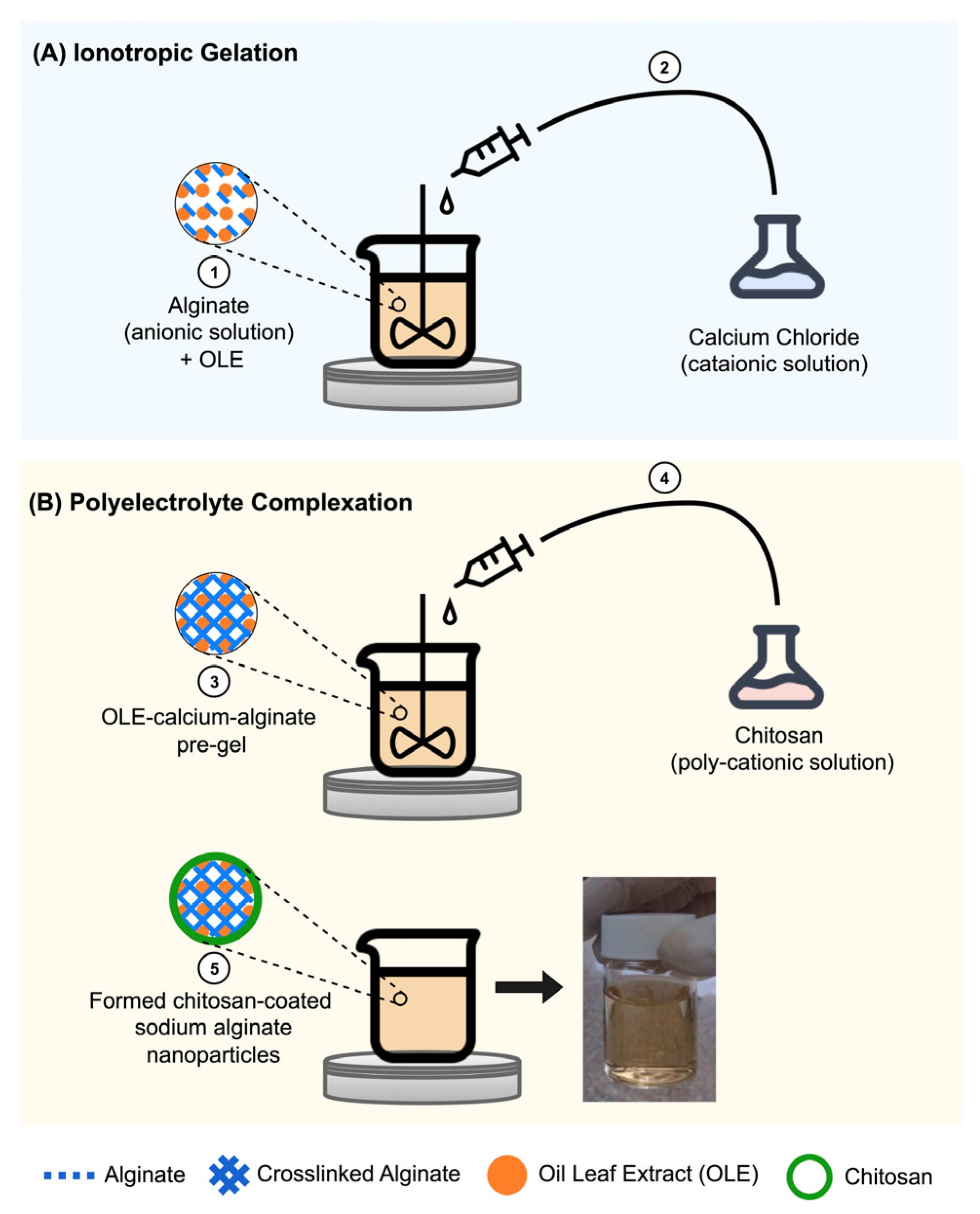
Chitosan-coated sodium–alginate NPs were synthesized using ionic gelation–polyelectrolyte complexation (IG-PEC) [27]. Briefly, a 20 mL alginate (0.6 mg/mL, pH 5) solution was subjected to ionotropic gelation through the addition of 2 mL of calcium chloride (0.4 mg/mL) dropwise with mixing using an Ultra-Turrax T25 device (IKA Werke, Staufen im Breisgau, Germany) for 30 s. The resulting calcium–alginate pre-gel was stirred for 30 min, after which 2 mL of polycationic chitosan solution (0.3 mg/mL, pH 5.4) was added, followed by continued stirring. The suspension was equilibrated overnight to form uniform NPs (Figure 1). For loaded NPs, OLE was mixed with alginate before adding calcium chloride. Two concentrations were prepared: 1X containing 30 mg (1.25 mg/mL) of OLE, and 2X concentrations. These concentrations were selected to represent standard and elevated OLE loadings, enabling assessment of their effects on nanoparticle stability and biological activity.

2.4. Dynamic Light Scattering (DLS) Measurements

The average particle size, poly dispersity index (PDI) and zeta potential were measured using a DLS system (Zetasizer Nano, Malvern Instruments Ltd., Malvern, UK). The samples were diluted accordingly using distilled water and analyzed in triplicate.

2.5. Morphological Characteristics

Nanoparticle morphology was visualized using electron microscopy (Versa 3D, FEI, Eindhoven, The Netherlands). Samples were lyophilized (Lyovapor-L200, Buchi, Flawil, Switzerland), gold-coated with a sputter and carbon thread coater (Leica, Vienna, Austria), and scanned for morphological structures.
Transmission electron microscopy analysis was carried out utilizing the negative staining method at 30 kV with electron microscopy (Morgagni, FEI, Eindhoven, The Netherlands). Samples were prepared on formvar-coated 100-mesh copper grids (SPI supplies, West Chester, PA, USA), air-dried for 15 min, and stained with 3% (v/v) aqueous uranyl acetate solution for 20 min at ambient temperature.

2.6. Cell Cultures

The human dermal fibroblast cell line (HDF, ATCC number: PCS-201-012) was sustained in Dulbecco’s Modified Eagle’s Medium (Euroclone, Milan, Italy). The MCF-7 cell line, representative of breast cancer (ATCC number: HTB-22), and the A549 cell line, associated with lung cancer (ATCC number: CCL-185), were cultured in RPMI-1640 growth medium (Euroclone, Milan, Italy). Both medium types were enriched with 10% (v/v) heat-inactivated fetal bovine serum, 1% penicillin–streptomycin, and 2 mM L-glutamine. The cultures were held at a temperature of 37 °C within a 5% CO2 tissue culture incubator (INB200, Memmert, Schwabach, Germany).

2.7. Cell Viability Assay (MTT)

For the determination of the half-maximal inhibitory concentration (IC50) of OLE-loaded NPs, a micro-culture tetrazoliumn (MTT) assay was performed. Cells were seeded at a density of 6.5 × 10³ for A549 cells, 9 × 10³ cells for MCF7, and 15 × 103 cells for HDF per well in a microtiter 96-well plate (Corning Costar, Acton, MA, USA) in 100 mL complete culture medium. Cells were exposed to 12 varying concentrations of both free OLE and OLE-loaded NPs (0.0025–0.75 mg/mL). The cells were incubated at 37 °C in a 5% CO2 incubator for 72 h. Following incubation, the old media was discarded, and 100 μL of MTT assay solution (Bioworld, Minneapolis, MN, USA) in fresh media was added to each well. The plates were then incubated at 37 °C for an additional 3 h. After incubation, the MTT-containing media was discarded, and 50 μL of solubilization solution (DMSO) was added to each well to assess cell viability. Absorbance was measured at 560 nm using a microplate reader (GloMax, Promega, Madison, WI, USA); then, IC50 values were calculated by nonlinear regression analyses described by Lafi et al. [28].

2.8. Assessment of Prebiotic Potential of NPs

A probiotic mixture used in this study was prepared from dehydrated bacterial cultures of Lactobacillus acidophilus, Lactobacillus delbrueckii subspecies bulgaricus, Bifidobacterium lactis, and Streptococcus salivarius subspecies thermophilus (2 × 10² colony-forming units per gram of dehydrated cultures per each species, Lactobifidus® (BioenergyTech, Amman, Jordan). To prepare the starter culture, dehydrated bacteria were reconstituted in sterile lactose broth (Oxoid, Basingstoke, UK) and cultured at 37 °C for 24 h. To create non-aerobic conditions, culture tubes were entirely filled with culture medium and tightly sealed to minimize oxygen exposure. Separate tubes were prepared and inoculated for each time point and experimental condition. Each tube was only opened at its designated time for analysis. The experimental design included three groups: a control culture without supplementation, a culture with the addition of free OLE, and a culture supplemented with an equivalent quantity of OLE-loaded NPs. All treatments were performed in parallel, and the experiment was replicated twice. Probiotic growth was monitored by regularly measuring the optical density at 600 nm.

2.9. Statistical Analysis

Data were presented as means ± standard deviation. The experimental data were analyzed using one-way ANOVA followed by Tukey’s test for multiple comparisons, with a significance level set at 5%. Statistical analyses were performed using GraphPad Prism version 10.3.

3. Results

3.1. OLE Preparation and Characterization

OLE was extracted from the Nabali Muhasan variety of olive leaves and characterized to determine their total phenolic content. The total phenolic content of OLE was calculated to be 62 ± 0.049 (mean ± SD) mg GAE/g of dry olive leaves. In addition, a preliminary HPLC analysis was performed, which enabled the detection of polyphenolic compounds corresponding to tyrosol and oleuropein derivatives, as shown in Figure S1 in the Supplementary Materials.

3.2. Physicochemical Properties of Prepared Nanoparticles

OLE-loaded chitosan–alginate nanoparticles were successfully synthesized using the IG-PEC method. Dynamic light scattering analysis revealed notable differences in the physicochemical properties of unloaded and OLE-loaded NPs (Table 1). The particle size of the unloaded NPs averaged 157.2 nm, while encapsulation with 1X and 2X concentrations of OLE significantly increased the particle size to 237.1 nm and 232.4 nm, respectively. This increase suggests successful loading of OLE into the NPs. Zeta potential values for all formulations were negative, indicating colloidal stability, with unloaded NPs having the highest magnitude at −33.05 mV. The PDI, a measure of particle size distribution, also improved upon OLE loading, decreasing from 0.607 in unloaded NPs to 0.476 and 0.451 in the 1X and 2X OLE-loaded NPs, respectively, indicating enhanced homogeneity.

3.3. Scanning and Transmission Electron Microscopy (SEM/TEM)

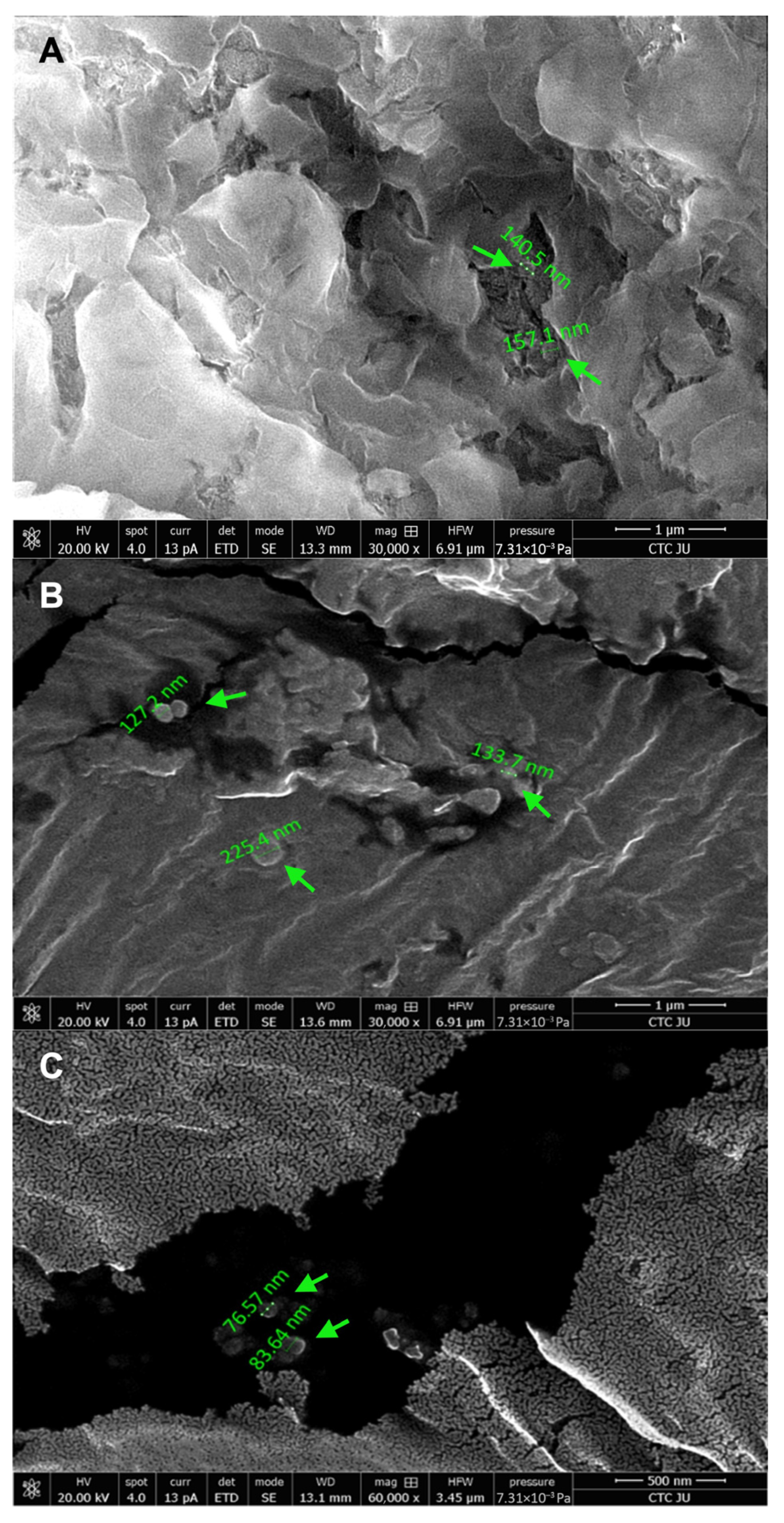
To further investigate the structural characteristics of the formulated NPs, SEM was employed, and the resulting micrographs are presented in Figure 2. The SEM image of unloaded alginate–chitosan nanocapsules (Figure 2A) reveals well-defined, discrete particles with smooth surfaces and predominantly spherical morphology. Similarly, Figure 2B,C display the SEM images of OLE-loaded NPs (at 1X and 2X concentrations, respectively), which also exhibited spherical shapes and smooth surface features. Notably, no aggregation or fusion was observed in any of the samples, indicating good structural integrity and dispersion. The apparent particle sizes observed across all formulations ranged from 76.56 to 225.4 nm, aligning well with the size measurements obtained through DLS.
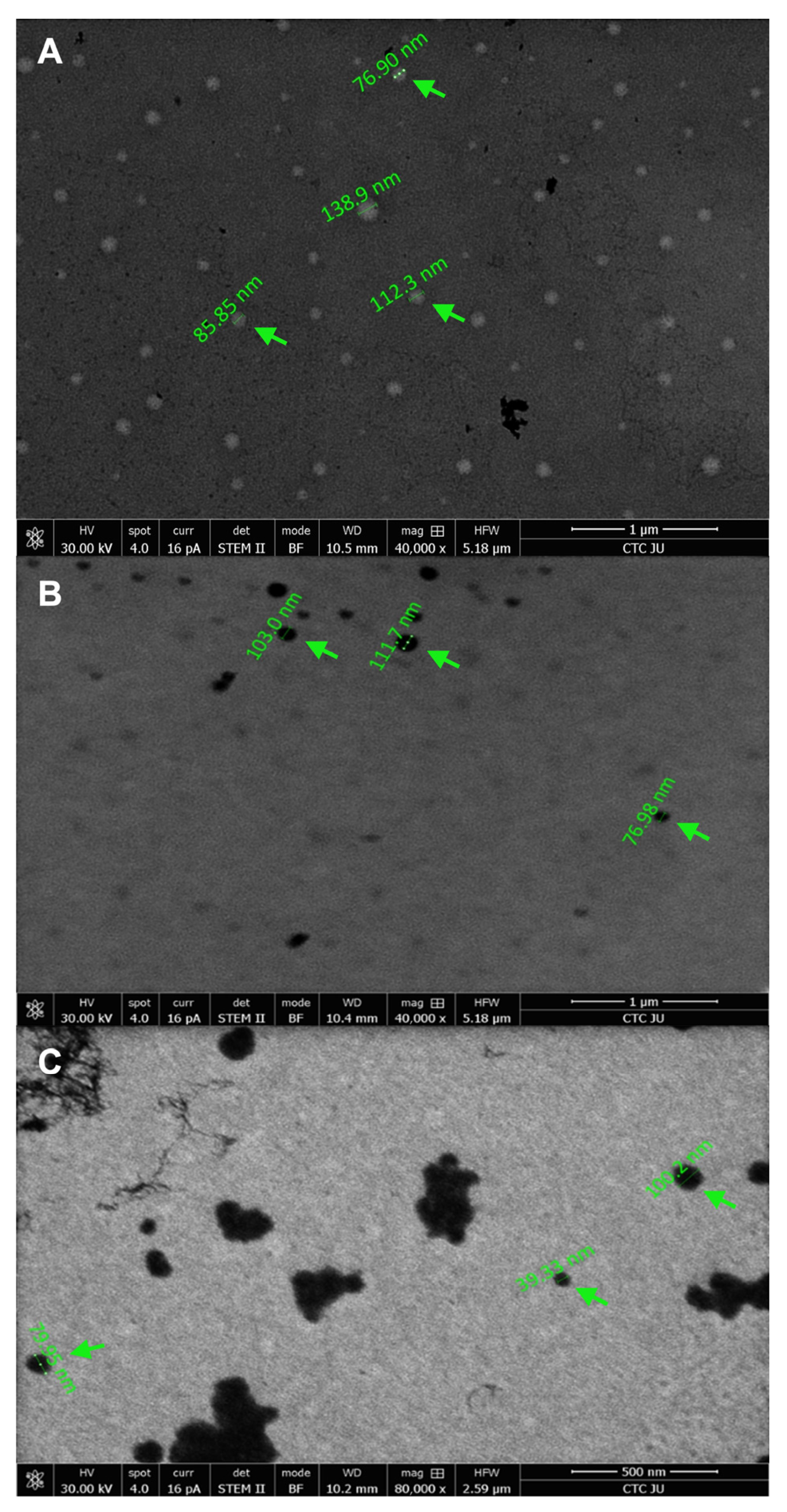
TEM further validated the successful formation of NPs with controlled morphology and narrow size distributions. As shown in Figure 3A, the unloaded NPs appeared as well-defined spherical structures with diameters below 138.9 nm, supporting the efficiency of the ionotropic pre-gelation method employed in their synthesis. Figure 3B and 3C depict the TEM images of OLE-loaded NPs prepared at 1X and 2X concentrations, respectively. Both formulations displayed uniformly distributed, well-separated spherical particles with size ranges between 39.33 and 111.7 nm. The consistent morphology across samples suggest that the optimized preparation parameters effectively supported the formation of stable NPs.

3.4. In Vitro Antiproliferative Effect

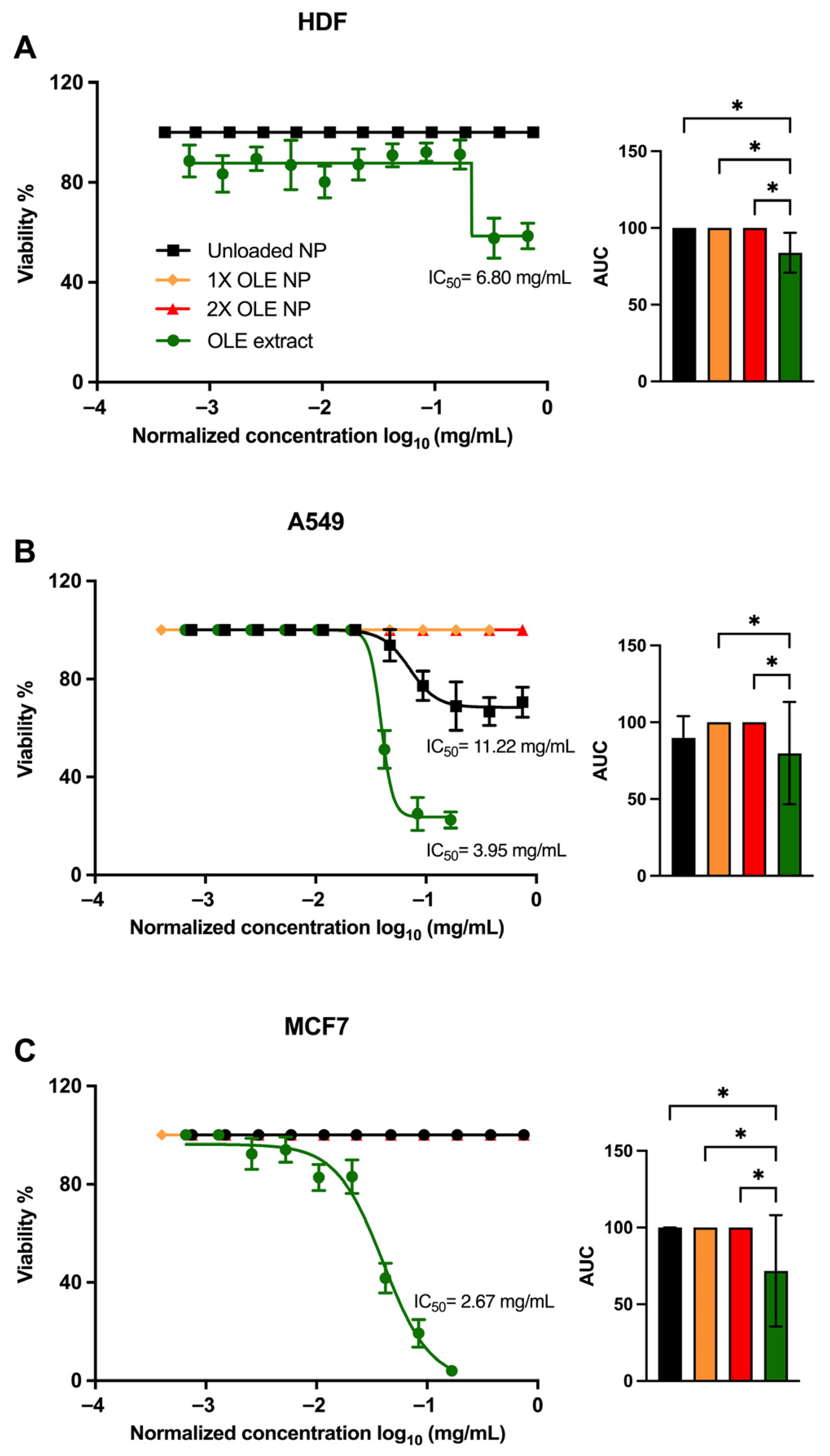
OLE is rich in polyphenols, including oleuropein and hydroxytyrosol, and demonstrated antiproliferative and pro-apoptotic effects in various cancer cell lines [29,30]. However, poor solubility, stability, and bioavailability often limit its therapeutic application. This experiment evaluated the effects of free OLE and OLE-loaded NPs on cell viability in normal human dermal fibroblasts, HDF, lung cancer cells, A549, and breast cancer cells, MCF-7, using the MTT assay. As shown in Figure 4A, free OLE caused only a modest decrease in HDF cell viability (IC50 = 6.80), indicating low toxicity toward normal cells. Moreover, free OLE exhibited a stronger, concentration-dependent reduction in viability (IC50 = 3.95 and 2.674, respectively) and greater sensitivity in cancer cells (Figure 4B,C), demonstrating selective cytotoxic effects against A549 and MCF-7 cells compared to HDF cells. These results indicate the selective cytotoxic activity of free OLE toward cancer cells. In contrast, unloaded NPs and OLE-loaded NPs (1X and 2X) did not show significant cytotoxic effects within the tested concentration range, as IC50 values were not reached (Figure 4A–C). AUC analysis further confirmed the significantly lower cytotoxic impact of both unloaded and OLE-loaded NPs compared with free OLE (p < 0.05), indicating that nanoencapsulation attenuates acute cytotoxicity within the tested dose range.

3.5. Prebiotic Properties

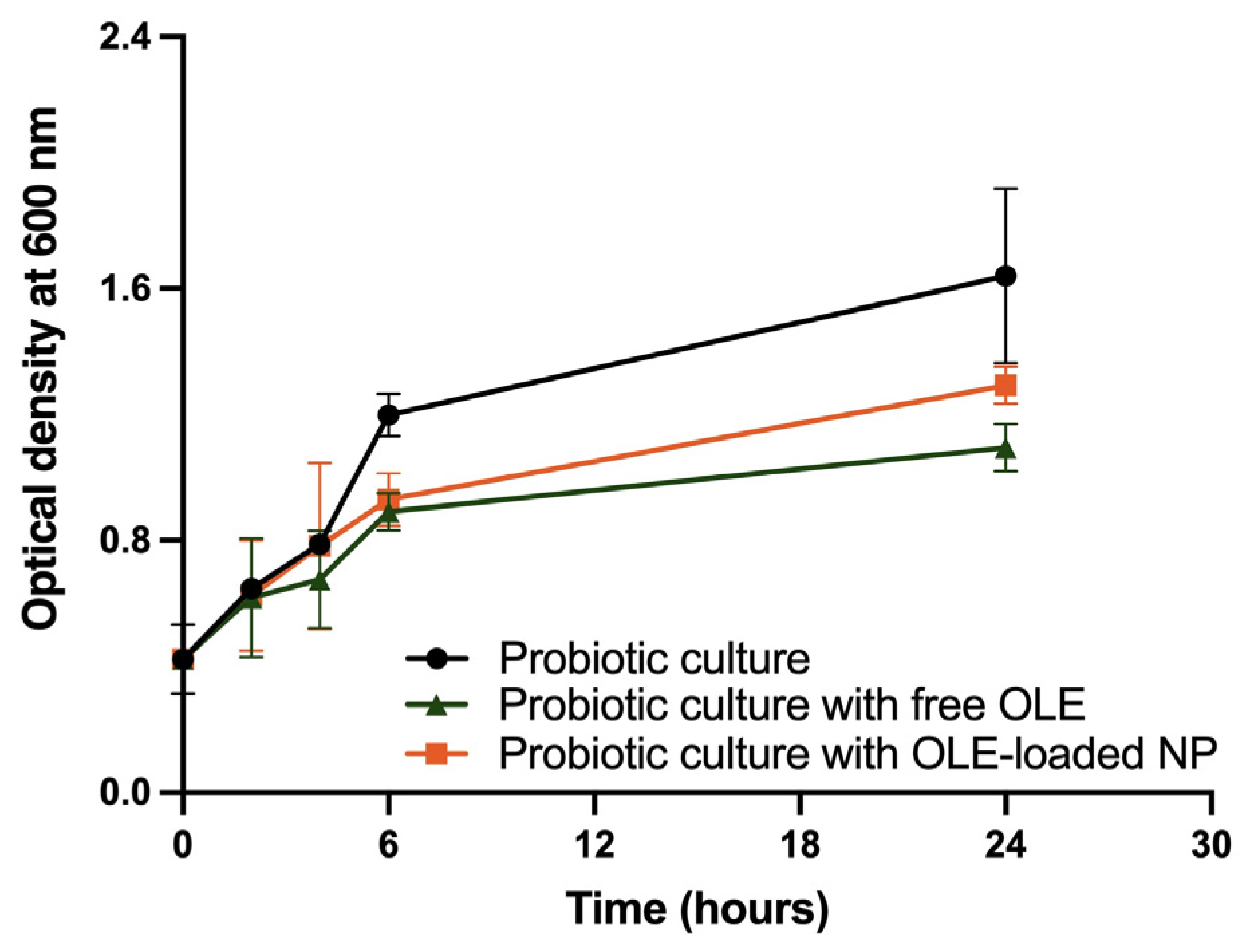
Considering that the health benefits of polyphenols rely heavily on their interaction with gut microbes [31,32], we assessed the effect of OLE nanoencapsulation on probiotic growth by measuring optical density in control and both free OLE and OLE-loaded NP-supplemented cultures. As shown in Figure 5, all cultures exhibited an initial increase in optical density (OD600) during the first four hours of incubation, indicative of active bacterial proliferation. At this early stage, both OLE-supplemented groups showed similar or slightly lower microbial growth compared to the control, indicating an initial adaptation phase. By 24 h, cultures treated with free OLE tended to show lower OD600 values, suggesting a potential growth-inhibitory effect of free OLE. In contrast, cultures supplemented with OLE-loaded nanoparticles showed relatively higher OD600 values than those supplemented with free OLE, although this difference did not reach statistical significance (p = 0.17). These trends indicate that alginate–chitosan nanoencapsulation might help enhance microbial tolerance to OLE and support improved probiotic growth during extended exposure.

4. Discussion

This study investigated the development and characterization of alginate–chitosan nanoparticles as a delivery system for olive leaf extract (OLE) and evaluated their effects on physicochemical stability, cytotoxic activity, and probiotic growth. The total phenolic content obtained for OLE in this study falls within the wide range previously reported for different olive varieties. Earlier studies documented values as high as 260 mg GAE/g in Turkish cultivars [19] and as low as 20 mg GAE/g in major Greek varieties [33]. The total phenolic content observed in this study falls within this reported range and supports the known antioxidant richness of olive leaf extract. However, these findings also highlight the significant variability in phenolic content among different olive varieties, suggesting that geographical, genetic, and methodological factors may play a crucial role in determining the antioxidant potential of olive leaves.
Incorporation of OLE into the alginate–chitosan nanocarrier system resulted in an increase in particle size after loading. Similar trends have been observed in previous studies investigating the incorporation of plant extracts into nanoparticle formulations. For instance, studies by Salvia-Trujillo et al. [34] demonstrated that the inclusion of polyphenol-rich extracts into polymeric nanocarriers often leads to increased particle sizes and slightly reduced zeta potentials, attributed to surface adsorption and encapsulation of bioactive molecules. Dos Santos Alves et al. [35] reported that phenolic compounds stabilized NPs by increasing surface charge and hydrophobicity but did not affect size distributions. The moderately negative zeta potentials across all formulations support the colloidal stability of the system, which is crucial for potential biomedical or nutraceutical applications.
SEM and TEM imaging confirmed the successful formation of uniform alginate–chitosan nanoparticles and provided visual evidence supporting the DLS data. Particle sizes revealed by SEM and TEM micrographs were consistent, or slightly smaller, compared with those obtained by DLS, which might be due to sample preparation before imaging. TEM micrographs revealed discrete, spherical particles with smooth surfaces and no observable aggregation across unloaded and OLE-loaded formulations of 1X concentration. This morphology is characteristic of polysaccharide-based nanoparticles produced by ionotropic gelation and has been reported in a similar system used to encapsulate rutin within an alginate–chitosan complex [36]. The absence of particle fusion or surface irregularities in our samples further suggests strong electrostatic interactions between alginate and chitosan, which arise from ionic complexation between the negatively charged carboxyl groups of alginate and the protonated amino groups of chitosan under acidic conditions [37]. These interactions promote the formation of a stable polyelectrolyte network, enhancing mechanical stability and preventing collapse during drying. Together, SEM and TEM results validate the robustness of the IG-PEC method and confirm that OLE incorporation did not disrupt nanoparticle morphology.
The cytotoxicity results demonstrate that free OLE retained selective antiproliferative activity against MCF-7 and A549 cancer cell lines while exhibiting substantially lower toxicity toward healthy fibroblasts. These findings align with extensive evidence supporting the anticancer properties of olive-derived polyphenols, including oleuropein and hydroxytyrosol [29,30]. The higher tolerance of HDF cells toward OLE may reflect their more robust antioxidant defenses, which can mitigate polyphenol-induced oxidative stress [38,39]. Interestingly, both unloaded and OLE-loaded NPs displayed minimal cytotoxicity within the tested concentration range. This may indicate either incomplete release of active compounds during the incubation period or the intrinsic biocompatibility of the alginate–chitosan system. Comparable observations were made by Huguet-Casquero et al. [40], who reported high cell viability following exposure to OLE-loaded lipid nanocarriers, suggesting that encapsulation can buffer the immediate cytotoxic impact of phenolic compounds. Together, these findings strengthen the potential of OLE as a natural anticancer agent and suggest that while nanoencapsulation offers promise for improved delivery and stability, further optimization of formulation and dosing strategies is required to achieve comparable cytotoxic efficacy.
The reduced cytotoxicity of OLE-loaded nanoparticles also raises important considerations regarding release kinetics. Previous work has shown that encapsulated phenolics may exert delayed biological effects due to slower diffusion from the nanoparticle matrix. The dense polyelectrolyte network formed via ionic crosslinking can limit rapid diffusion of encapsulated polyphenols, resulting in slower release kinetics and reduced acute exposure compared to free OLE. For example, chitosan and sodium alginate-coated liposome formulations demonstrated higher stability and a slower release rate of apple peel polyphenols compared to free extracts [41]. Our findings likely reflect a similar phenomenon, emphasizing the need for extended exposure or particular release profiles to better evaluate the therapeutic potential of OLE-loaded NPs.
Evaluation of the prebiotic effects revealed that nanoencapsulation improved the microbial tolerance to OLE. The improved probiotic growth with OLE-loaded nanoparticles, despite reduced cytotoxicity in cancer cells, can be attributed to moderated compound exposure. Free polyphenols can exert rapid antimicrobial and cytotoxic effects at higher concentrations [42], whereas nanoencapsulation moderates this exposure by reducing immediate bioavailability. This controlled release may alleviate stress on probiotic bacteria while still allowing for gradual metabolic utilization of phenolic compounds, whereas cancer cells require higher intracellular concentrations to elicit antiproliferative effects. Supporting this, previous work has shown that nanoencapsulation of polyphenol-rich prebiotics from pomegranate peel extract enhanced probiotic viability under stress conditions compared to free formulations by modulating the release and reactivity of bioactive compounds [43].
In contrast to systems designed to enhance antimicrobial potency, such as PLGA-based phenolic nanocarriers that intensify microbial inhibition [44], the alginate–chitosan platform used here appears more suitable for applications requiring biocompatibility and controlled exposure, including symbiotic formulations and functional foods targeting gut health. Previous olive leaf extract delivery systems have focused on improving antioxidant stability and anticancer efficacy, as evidenced by studies showing enhanced radical scavenging and sustained release in lipid nanocarriers and prolonged polyphenol diffusion in liposomal systems [40,45]. Compared with earlier formulations, the present system emphasizes moderated polyphenol release and microbial tolerance rather than immediate bioactivity, which represents a distinct functional design strategy. Nevertheless, this approach may limit short-term cytotoxic efficacy, highlighting a balance between biological potency and compatibility that must be considered in future optimization.
While this study highlights the potential of alginate–chitosan nanoparticles as stable and biocompatible carriers for olive leaf polyphenols, several important aspects remain to be addressed. Notably, the current work emphasizes physicochemical characterization and biological compatibility but does not explore release kinetics, the effects of the carrier materials alone, quantitative profiling of individual polyphenolic constituents, or comprehensive assessment of bioactivity. Future research should aim to provide a deeper understanding of the release behavior, long-term stability, and independent effects of the carrier system, as well as to evaluate the functional efficacy and safety of the nanoencapsulated polyphenols in vivo. Addressing these limitations will provide a more comprehensive understanding of how polysaccharide-based nanoencapsulation can be optimized for nutraceutical and functional food applications.

5. Conclusions

This study demonstrated that polysaccharide-based alginate–chitosan nanoencapsulation provides a multifunctional delivery system for stabilizing OLE while improving its biocompatibility and tolerance during prolonged biological exposure. The developed nanoparticles exhibited favorable physicochemical properties, minimal cytotoxicity compared to free OLE, and improved compatibility with probiotic cultures, indicating that nanoencapsulation can mitigate the immediate biological stress associated with polyphenols while enabling controlled release. The main contribution of this work is the demonstration that alginate–chitosan nanocarriers can balance bioactivity with microbial compatibility, distinguishing this system from previous OLE-based formulations primarily designed to enhance antioxidant or anticancer potency. These findings support the potential application of OLE-loaded polysaccharide nanoparticles in nutraceutical, biomedical, and functional food formulations targeting gut microbial health.

Supplementary Materials

The following supporting information can be downloaded at: https://www.mdpi.com/article/10.3390/polysaccharides7010029/s1, Figure S1: HPLC analysis of OLE. (A) Chromatogram of the internal standards used. (B) Chromatogram of OLE sample. Arrows indicate the identified polyphenols and correspond to dialdehydic form decarboxymethyl oleuropein aglycon (DDOA), tyrosyl acetate and aldehydic form oleuropein aglycon (AOA) as described in the reference [46].

Author Contributions

Conceptualization, S.M.H., M.G. and I.H.; formal analysis, R.A. and H.A.-S.; writing—original draft preparation, R.A.; writing—review and editing, S.J. and S.M.H.; visualization, S.M.H.; supervision, M.G.; project administration, I.H.; funding acquisition, S.M.H. All authors have read and agreed to the published version of the manuscript.

Funding

This work was supported by an internal grant (2704) awarded to SMH from the Deanship of Academic Research, The University of Jordan.

Institutional Review Board Statement

Not applicable.

Data Availability Statement

The original contributions presented in this study are included in the article. Further inquiries can be directed to the corresponding authors.

Acknowledgments

The authors would like to thank Dana Al Qudah and Walhan Alshaer from the Cell Therapy Center, The University of Jordan, for their assistance with nanoparticle characterization during this study.

Conflicts of Interest

The authors declare no conflicts of interest.

Abbreviations

OLE: olive leaf extract; NPs: nanoparticles; IG-PEC: ionotropic gelation–polyelectrolyte complexation; DLS: dynamic light scattering; SEM: scanning electron microscopy; TEM: transmission electron microscopy; TPC: total phenolic content; GAE: gallic acid equivalents; MCF-7: Human breast adenocarcinoma cell line; A549: human lung carcinoma cell line; HDF: human dermal fibroblast; OD: optical density.

References

  1. Ghanbari, R.; Anwar, F.; Alkharfy, K.M.; Gilani, A.H.; Saari, N. Valuable nutrients and functional bioactives in different parts of olive (Olea europaea L.)—A review. Int. J. Mol. Sci. 2012, 13, 3291–3340. [Google Scholar] [CrossRef]
  2. Filardo, S.; Roberto, M.; Di Risola, D.; Mosca, L.; Di Pietro, M.; Sessa, R. Olea europaea L-derived secoiridoids: Beneficial health effects and potential therapeutic approaches. Pharmacol. Ther. 2024, 254, 108595. [Google Scholar] [CrossRef]
  3. Clodoveo, M.L.; Crupi, P.; Annunziato, A.; Corbo, F. Innovative Extraction Technologies for Development of Functional Ingredients Based on Polyphenols from Olive Leaves. Foods 2021, 11, 103. [Google Scholar] [CrossRef] [PubMed]
  4. Nicoli, F.; Negro, C.; Vergine, M.; Aprile, A.; Nutricati, E.; Sabella, E.; Miceli, A.; Luvisi, A.; De Bellis, L. Evaluation of Phytochemical and Antioxidant Properties of 15 Italian Olea europaea L. Cultivar Leaves. Molecules 2019, 24, 1998. [Google Scholar] [CrossRef] [PubMed]
  5. Borjan, D.; Leitgeb, M.; Knez, Z.; Hrncic, M.K. Microbiological and Antioxidant Activity of Phenolic Compounds in Olive Leaf Extract. Molecules 2020, 25, 5946. [Google Scholar] [CrossRef]
  6. Zhang, H.; Wang, M.; Xiao, J. Stability of polyphenols in food processing. Adv. Food Nutr. Res. 2022, 102, 1–45. [Google Scholar] [CrossRef]
  7. Cao, H.; Saroglu, O.; Karadag, A.; Diaconeasa, Z.; Zoccatelli, G.; Conte-Junior, C.A.; Gonzalez-Aguilar, G.A.; Ou, J.; Bai, W.; Zamarioli, C.M.; et al. Available technologies on improving the stability of polyphenols in food processing. Food Front. 2021, 2, 109–139. [Google Scholar] [CrossRef]
  8. Mahdi, L.; Graziani, A.; Baffy, G.; Mitten, E.K.; Portincasa, P.; Khalil, M. Unlocking Polyphenol Efficacy: The Role of Gut Microbiota in Modulating Bioavailability and Health Effects. Nutrients 2025, 17, 2793. [Google Scholar] [CrossRef] [PubMed]
  9. Albogami, S.; Hassan, A.M. Assessment of the Efficacy of Olive Leaf (Olea europaea L.) Extracts in the Treatment of Colorectal Cancer and Prostate Cancer Using In Vitro Cell Models. Molecules 2021, 26, 4069. [Google Scholar] [CrossRef]
  10. Ismail, M.A.; Norhayati, M.N.; Mohamad, N. Olive leaf extract effect on cardiometabolic profile among adults with prehypertension and hypertension: A systematic review and meta-analysis. PeerJ 2021, 9, e11173. [Google Scholar] [CrossRef]
  11. Habib, S.M.; Amr, A.S.; Hamadneh, I.M. Nanoencapsulation of Alpha-linolenic Acid with Modified Emulsion Diffusion Method. J. Am. Oil Chem. Soc. 2011, 89, 695–703. [Google Scholar] [CrossRef]
  12. Rudrapal, M.; Mishra, A.K.; Rani, L.; Sarwa, K.K.; Zothantluanga, J.H.; Khan, J.; Kamal, M.; Palai, S.; Bendale, A.R.; Talele, S.G.; et al. Nanodelivery of Dietary Polyphenols for Therapeutic Applications. Molecules 2022, 27, 8706. [Google Scholar] [CrossRef] [PubMed]
  13. Kesente, M.; Kavetsou, E.; Roussaki, M.; Blidi, S.; Loupassaki, S.; Chanioti, S.; Siamandoura, P.; Stamatogianni, C.; Philippou, E.; Papaspyrides, C.; et al. Encapsulation of Olive Leaves Extracts in Biodegradable PLA Nanoparticles for Use in Cosmetic Formulation. Bioengineering 2017, 4, 75. [Google Scholar] [CrossRef]
  14. Bergonzi, M.C.; De Stefani, C.; Vasarri, M.; Ivanova Stojcheva, E.; Ramos-Pineda, A.M.; Baldi, F.; Bilia, A.R.; Degl’Innocenti, D. Encapsulation of Olive Leaf Polyphenol-Rich Extract in Polymeric Micelles to Improve Its Intestinal Permeability. Nanomaterials 2023, 13, 3147. [Google Scholar] [CrossRef]
  15. Pasinetti, G.M.; Singh, R.; Westfall, S.; Herman, F.; Faith, J.; Ho, L. The Role of the Gut Microbiota in the Metabolism of Polyphenols as Characterized by Gnotobiotic Mice. J. Alzheimers Dis. 2018, 63, 409–421. [Google Scholar] [CrossRef]
  16. Hu, J.; Mesnage, R.; Tuohy, K.; Heiss, C.; Rodriguez-Mateos, A. (Poly)phenol-related gut metabotypes and human health: An update. Food Funct. 2024, 15, 2814–2835. [Google Scholar] [CrossRef]
  17. Kiokias, S.; Oreopoulou, V. A Review of the Health Protective Effects of Phenolic Acids against a Range of Severe Pathologic Conditions (Including Coronavirus-Based Infections). Molecules 2021, 26, 5405. [Google Scholar] [CrossRef]
  18. Han, D.; Wu, Y.; Lu, D.; Pang, J.; Hu, J.; Zhang, X.; Wang, Z.; Zhang, G.; Wang, J. Polyphenol-rich diet mediates interplay between macrophage-neutrophil and gut microbiota to alleviate intestinal inflammation. Cell Death Dis. 2023, 14, 656. [Google Scholar] [CrossRef]
  19. Özdamar, B.; Sürmeli, Y.; Şanlı-Mohamed, G. Immobilization of Olive Leaf Extract with Chitosan Nanoparticles as an Adjunct to Enhance Cytotoxicity. ACS Omega 2023, 8, 28994–29002. [Google Scholar] [CrossRef]
  20. Muzzalupo, I.; Badolati, G.; Chiappetta, A.; Picci, N.; Muzzalupo, R. In vitro Antifungal Activity of Olive (Olea europaea) Leaf Extracts Loaded in Chitosan Nanoparticles. Front. Bioeng. Biotechnol. 2020, 8, 151. [Google Scholar] [CrossRef] [PubMed]
  21. Niculescu, A.G.; Grumezescu, A.M. Applications of Chitosan-Alginate-Based Nanoparticles-An Up-to-Date Review. Nanomaterials 2022, 12, 186. [Google Scholar] [CrossRef]
  22. Fabrikov, D.; Varga, A.T.; Garcia, M.C.V.; Belteky, P.; Kozma, G.; Konya, Z.; Lopez Martinez, J.L.; Barroso, F.; Sanchez-Muros, M.J. Antimicrobial and antioxidant activity of encapsulated tea polyphenols in chitosan/alginate-coated zein nanoparticles: A possible supplement against fish pathogens in aquaculture. Environ. Sci. Pollut. Res. Int. 2024, 31, 13673–13687. [Google Scholar] [CrossRef]
  23. Belscak-Cvitanovic, A.; Stojanovic, R.; Manojlovic, V.; Komes, D.; Cindric, I.J.; Nedovic, V.; Bugarski, B. Encapsulation of polyphenolic antioxidants from medicinal plant extracts in alginate-chitosan system enhanced with ascorbic acid by electrostatic extrusion. Food Res. Int. 2011, 44, 1094–1101. [Google Scholar] [CrossRef]
  24. Wathoni, N.; Herdiana, Y.; Suhandi, C.; Mohammed, A.F.A.; El-Rayyes, A.; Narsa, A.C. Chitosan/Alginate-Based Nanoparticles for Antibacterial Agents Delivery. Int. J. Nanomed. 2024, 19, 5021–5044. [Google Scholar] [CrossRef]
  25. Ghomari, O.; Sounni, F.; Massaoudi, Y.; Ghanam, J.; Drissi Kaitouni, L.B.; Merzouki, M.; Benlemlih, M. Phenolic profile (HPLC-UV) of olive leaves according to extraction procedure and assessment of antibacterial activity. Biotechnol. Rep. 2019, 23, e00347. [Google Scholar] [CrossRef]
  26. Singleton, V.L.; Orthofer, R.; Lamuela-Raventós, R.M. Analysis of total phenols and other oxidation substrates and antioxidants by means of folin-ciocalteu reagent. In Methods in Enzymology; Academic Press: Cambridge, MA, USA, 1999; Volume 299, pp. 152–178. [Google Scholar]
  27. Loquercio, A.; Castell-Perez, E.; Gomes, C.; Moreira, R.G. Preparation of Chitosan-Alginate Nanoparticles for Trans-cinnamaldehyde Entrapment. J. Food Sci. 2015, 80, N2305–N2315. [Google Scholar] [CrossRef]
  28. Lafi, Z.; Alshaer, W.; Hatmal, M.M.; Zihlif, M.; Alqudah, D.A.; Nsairat, H.; Azzam, H.; Aburjai, T.; Bustanji, Y.; Awidi, A. Aptamer-functionalized pH-sensitive liposomes for a selective delivery of echinomycin into cancer cells. RSC Adv. 2021, 11, 29164–29177. [Google Scholar] [CrossRef]
  29. Boss, A.; Bishop, K.S.; Marlow, G.; Barnett, M.P.; Ferguson, L.R. Evidence to Support the Anti-Cancer Effect of Olive Leaf Extract and Future Directions. Nutrients 2016, 8, 513. [Google Scholar] [CrossRef] [PubMed]
  30. Rishmawi, S.; Haddad, F.; Dokmak, G.; Karaman, R. A Comprehensive Review on the Anti-Cancer Effects of Oleuropein. Life 2022, 12, 1140. [Google Scholar] [CrossRef]
  31. Alves-Santos, A.M.; Sugizaki, C.S.A.; Lima, G.C.; Naves, M.M.V. Prebiotic effect of dietary polyphenols: A systematic review. J. Funct. Foods 2020, 74, 104169. [Google Scholar] [CrossRef]
  32. Chai, S.C.; Davis, K.; Zhang, Z.; Zha, L.; Kirschner, K.F. Effects of Tart Cherry Juice on Biomarkers of Inflammation and Oxidative Stress in Older Adults. Nutrients 2019, 11, 228. [Google Scholar] [CrossRef]
  33. Mitsopoulos, G.; Papageorgiou, V.; Komaitis, M.; Hagidimitriou, M. Total Phenolic Content and Antioxidant Activity in Leaves and Drupes of Ten Olive Varieties. Not. Bot. Horti Agrobot. Cluj-Napoca 2016, 44, 155–161. [Google Scholar] [CrossRef]
  34. Salvia-Trujillo, L.; Rojas-Graü, A.; Soliva-Fortuny, R.; Martín-Belloso, O. Physicochemical characterization and antimicrobial activity of food-grade emulsions and nanoemulsions incorporating essential oils. Food Hydrocoll. 2015, 43, 547–556. [Google Scholar] [CrossRef]
  35. Dos Santos Alves, M.J.; de Sousa, M.H.O.; de Moura, N.F.; Cesca, K.; Verruck, S.; Monteiro, A.R.; Valencia, G.A. Starch nanoparticles containing phenolic compounds from green propolis: Characterization and evaluation of antioxidant, antimicrobial and digestibility properties. Int. J. Biol. Macromol. 2024, 255, 128079. [Google Scholar] [CrossRef]
  36. Mujtaba, A.; Hassan, K.; Ansari, M.; Mujtaba, M. Chitosan-Alginate Nanoparticles as a Novel Drug Delivery System for Rutin. Int. J. Adv. Biotechnol. Res. 2018, 9, 1895–1903. [Google Scholar]
  37. Wang, N.; Tian, J.; Wang, L.; Wen, C.; Song, S. Polyelectrolyte complex formation of alginate and chito oligosaccharide is influenced by their proportion and alginate molecular weight. Int. J. Biol. Macromol. 2024, 273, 133173. [Google Scholar] [CrossRef]
  38. Golalipour, A.; Mohammadi, A.; Hosseinzadeh, S.; Soltani, A.; Erfani-Moghadam, V. Synergistic cytotoxicity of olive leaf extract-loaded lipid nanocarriers combined with Newcastle disease virus against cervical cancer cells. PLoS ONE 2024, 19, e0308599. [Google Scholar] [CrossRef]
  39. Mileo, A.M.; Miccadei, S. Polyphenols as Modulator of Oxidative Stress in Cancer Disease: New Therapeutic Strategies. Oxid. Med. Cell Longev. 2016, 2016, 6475624. [Google Scholar] [CrossRef] [PubMed]
  40. Huguet-Casquero, A.; Moreno-Sastre, M.; Lopez-Mendez, T.B.; Gainza, E.; Pedraz, J.L. Encapsulation of Oleuropein in Nanostructured Lipid Carriers: Biocompatibility and Antioxidant Efficacy in Lung Epithelial Cells. Pharmaceutics 2020, 12, 429. [Google Scholar] [CrossRef]
  41. Hu, H.; Cai, P.; Liu, Y.; Li, Y.; Zhong, J.; Kong, F. Chitosan and sodium alginate-coated liposomes as a novel delivery system for apple peel polyphenols: Preparation, characterization, stability, bioactivity, and in vitro digestion. Innov. Food Sci. Emerg. Technol. 2025, 104, 104153. [Google Scholar] [CrossRef]
  42. Othman, L.; Sleiman, A.; Abdel-Massih, R.M. Antimicrobial Activity of Polyphenols and Alkaloids in Middle Eastern Plants. Front. Microbiol. 2019, 10, 911. [Google Scholar] [CrossRef] [PubMed]
  43. Hashem, N.M.; Hosny, N.S.; El-Desoky, N.; Soltan, Y.A.; Elolimy, A.A.; Sallam, S.M.A.; Abu-Tor, E.M. Alginate Nanoencapsulated Synbiotic Composite of Pomegranate Peel Phytogenics and Multi-Probiotic Species as a Potential Feed Additive: Physicochemical, Antioxidant, and Antimicrobial Activities. Animals 2023, 13, 2432. [Google Scholar] [CrossRef] [PubMed]
  44. Pereira, M.C.; Oliveira, D.A.; Hill, L.E.; Zambiazi, R.C.; Borges, C.D.; Vizzotto, M.; Mertens-Talcott, S.; Talcott, S.; Gomes, C.L. Effect of nanoencapsulation using PLGA on antioxidant and antimicrobial activities of guabiroba fruit phenolic extract. Food Chem. 2018, 240, 396–404. [Google Scholar] [CrossRef] [PubMed]
  45. Baljak, J.; Dekanski, D.; Pirković, A.; Mitić, N.; Rašković, A.; Kladar, N.; Jovanović, A.A. Valorization of Olive Leaf Extract via Tailored Liposomal Carriers: Comparative Analysis of Physicochemical Features, Antioxidant Capacity, and Stability. Pharmaceuticals 2025, 18, 1639. [Google Scholar] [CrossRef]
  46. Alsafadi, D.; Alhesan, J.A.; Mansour, A. Extraction and Quantification of Bioactive Phenolic Compounds in Olive Oil by Acid Hydrolysis Method. Food Anal. Methods 2023, 16, 581–595. [Google Scholar] [CrossRef]
Figure 1. Schematic representation of ionic gelation and polyelectrolyte complexation (IG-PEC) method. (A) Ionotropic gelation, and (B) polyelectrolyte complexation.
Polysaccharides 07 00029 g001
Figure 2. Scanning electron microscopy micrographs of OLE-loaded NPs. (A) Unloaded NPs, (B) 1X OLE-loaded NPs, and (C) 2X OLE-loaded NPs. All images were captured under an accelerating voltage of 20.00 kV and a beam current of 13 pA, with magnifications of 30,000× for (A,B), and 60,000× for (C).
Polysaccharides 07 00029 g002
Figure 3. Transmission electron microscopy analysis of OLE-loaded NPs. (A) Unloaded NPs, (B) 1X OLE-loaded NPs, and (C) 2X OLE-loaded NPs. All images were captured under an accelerating voltage of 30.00 kV and a beam current of 16 pA, with magnifications of 40,000× for (A,B), and 80,000× for (C).
Polysaccharides 07 00029 g003
Figure 4. Selective cytotoxicity of free and OLE-loaded NPs on cancer and normal cell lines. Cytotoxic effects of unloaded nanoparticles (NP), free olive leaf extract (OLE), and OLE-loaded NPs (1X and 2X concentrations) on (A) human dermal fibroblasts (HDFs), (B) lung cancer cells (A549), and (C) breast cancer cells (MCF-7) after 24 h of treatment, assessed using MTT assay. Points represent log10-transformed concentrations ± SD. Bar charts display area under curve (AUC) analysis for each treatment ± standard error, with * p < 0.05.
Polysaccharides 07 00029 g004
Figure 5. Effect of olive leaf extract and its nanoscale formulation on probiotic culture growth. Data presented as mean ± SEM. OLE: olive leaf extract. NP: nanoparticle.
Polysaccharides 07 00029 g005
Table 1. Particle size, zeta potential, and polydispersity index values of NPs.
Particle Size (nm)Zeta Potential (mV)Polydispersity Index
Unloaded NPs157.2 ± 13.61−33.05 ± 6.220.607 ± 0.064
1X OLE-loaded NPs237.1 ± 7.99 *−32.67 ± 6.140.476 ± 0.044 *
2X OLE-loaded NPs232.4 ± 32.4 *−28.18 ± 5.300.451 ± 0.054 *
* p < 0.005; data shown represent mean ± standard deviation.
Disclaimer/Publisher’s Note: The statements, opinions and data contained in all publications are solely those of the individual author(s) and contributor(s) and not of MDPI and/or the editor(s). MDPI and/or the editor(s) disclaim responsibility for any injury to people or property resulting from any ideas, methods, instructions or products referred to in the content.