


Abstract
This study developed multifunctional chitosan–hydroxyapatite (CH–HAp) scaffolds incorporating cobalt ferrite (CoFe2O4, CFO) nanoparticles and carvacrol to combine bone regeneration potential with magnetic responsiveness and antimicrobial activity. Scaffolds containing 5 wt% CFO and 10–30 wt% carvacrol (free or Tween 80-emulsified) were fabricated via freeze-drying. The inclusion of CFO provided ferrimagnetic behavior, while carvacrol reduced chitosan crystallinity and increased scaffold porosity. Formulations with 30 wt% carvacrol demonstrated the strongest antimicrobial effect, showing inhibition halos against Staphylococcus aureus, Escherichia coli, Candida albicans, and Candida glabrata. The scaffold combining emulsified carvacrol and CFO exhibited a highly porous (≈90%) structure, preserved magnetic response, and mild cytotoxicity toward L929 fibroblasts, indicating cytocompatibility. The synergistic integration of CFO and carvacrol in a CH–HAp matrix yielded a multifunctional platform that simultaneously provides structural support, magnetic responsiveness, and antimicrobial performance, showing great promise for advanced bone tissue engineering applications.
1. Introduction
Bone Tissue Engineering (BTE) aims to develop biomaterial systems capable of supporting efficient bone regeneration while ensuring structural stability, biocompatibility, and infection prevention, which are among the main factors associated with implant failure [1,2]. Three-dimensional scaffolds combining CH and Hap have been widely explored due to their bioactivity, osteoconductivity, and chemical similarity to the natural bone matrix [3,4,5]. Recent studies have shown that CH–HAp hybrid scaffolds can be functionalized with a variety of bioactive agents, enhancing their regenerative and antimicrobial potential [6,7,8,9,10]. Despite these advances, important challenges remain, particularly those related to microbial contamination and the need for combined therapeutic strategies within BTE.
Carvacrol, a phenolic monoterpene found in essential oils, exhibits strong antimicrobial, antifungal, and anti-inflammatory activities [11,12]. However, its high hydrophobicity and volatility hinder its stable incorporation into hydrophilic polymer matrices. For this reason, emulsifiers such as Tween 80 (T80) are often required to improve their dispersion and retention in polymeric systems [13,14]. In parallel, CFO have attracted significant interest in the biomedical field due to their high coercivity, chemical stability, and efficient response to external magnetic fields [15,16,17,18]. While both components are well-studied individually, their synergistic integration into CH–HAp scaffolds has not been systematically explored.
Here, we develop and characterize multifunctional CH–HAp scaffolds functionalized with CFO and carvacrol, the latter incorporated in both free and emulsified forms. We evaluate the effects of these components on the physicochemical, magnetic, structural, and biological properties of the scaffolds, focusing on their antimicrobial efficacy, cytocompatibility, and potential as a magnetically responsive platform for bone tissue engineering.
2. Experimental Section
2.1. Materials
Carvacrol (purity ≥ 98%), chitosan (75–85% deacetylation, 50–150 kDa), hydroxyapatite (purity ≥ 97%, particle size < 200 nm), Tween 80 (≥58% oleic acid content), glacial acetic acid (purity ≥ 99.8%), and phosphate-buffered saline (PBS, pH 7.4) were obtained from Sigma-Aldrich® (Merck Group, Darmstadt, Germany). Ammonium hydroxide (28–30%) was sourced from Neon® (Suzano, SP, Brazil). Cobalt ferrite (CoFe2O4, CFO) nanoparticles were synthesized via combustion reaction at the Laboratory for the Synthesis of Ceramic Materials (LabSMaC, Campina Grande, Brazil). All materials were used as received.
2.2. Preparation of CH–HAp/CFO/Carvacrol Scaffolds
Scaffolds were prepared using a polymer–ceramic matrix composed of CH (1.5% w/v in 1% acetic acid) and HAp (30% w/w relative to the mass of chitosan), following an adapted methodology from previous studies [19]. The CH–HAp base dispersion (total batch volume: 100 mL) was homogenized by mechanical stirring at 350 ± 10 rpm for 1 h at room temperature (25 ± 2 °C).
The experimental design (Table 1) included three independent factors:
- (i)
- CFO presence (0 or 5 wt% relative to CH)
- (ii)
- Carvacrol concentration (10, 20, or 30 wt% relative to CH)
- (iii)
- Carvacrol incorporation method (free or emulsified with T80 at 1:1 w/w ratio)
The proportions of CFO constituting the scaffolds were determined according to the method by Farzaneh et al. [20], and the HAp composition followed the procedure described by Ponciano et al. [21].
Table 1.
Composition of scaffolds according to the presence of CFO, carvacrol concentration, and carvacrol incorporation form (free or emulsified).
Each formulation was prepared individually, with reagents weighed separately to ensure reproducibility and uniformity within each experimental group.
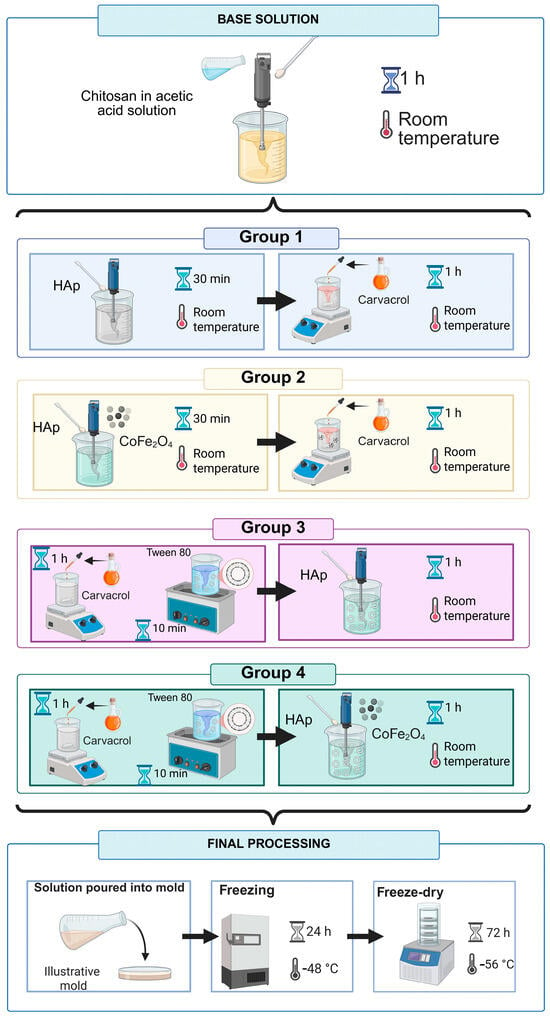
Group 1—CH–HAp containing free carvacrol: Free carvacrol (10–30 wt%) was added dropwise to CH–HAp dispersion with continuous stirring (1 h).
Group 2—CH–HAp + CFO + free carvacrol: CFO (5 wt%) was first dispersed in CH–HAp (30 min stirring), followed by free carvacrol addition (10–30 wt%) and further mixing (1 h).
Group 3—CH–HAp + emulsified carvacrol (without CFO): An aqueous surfactant phase was first prepared by dispersing T80 in deionized water under magnetic stirring for 30 min. Carvacrol was then added dropwise to this aqueous T80 solution (1:1 w/w carvacrol:T80), followed by 30 min of stirring and 10 min of ultrasonication, forming a stable oil-in-water nanoemulsion. This preformed nanoemulsion was then incorporated into the CH–HAp dispersion under continuous mixing.
Group 4—CH–HAp + CFO + emulsified carvacrol: CFO (5 wt%) was first dispersed in the CH–HAp matrix (30 min stirring). The preformed nanoemulsion (T80 dispersed in water + carvacrol incorporated afterward) was then added dropwise to the CH–HAp–CFO dispersion, followed by 1 h of homogenization.
All formulations underwent identical post-processing: freezing at −48 °C (24 h), freeze-drying at −56 °C (72 h), neutralization in ammonium hydroxide vapor (24 h), and secondary freeze-drying.
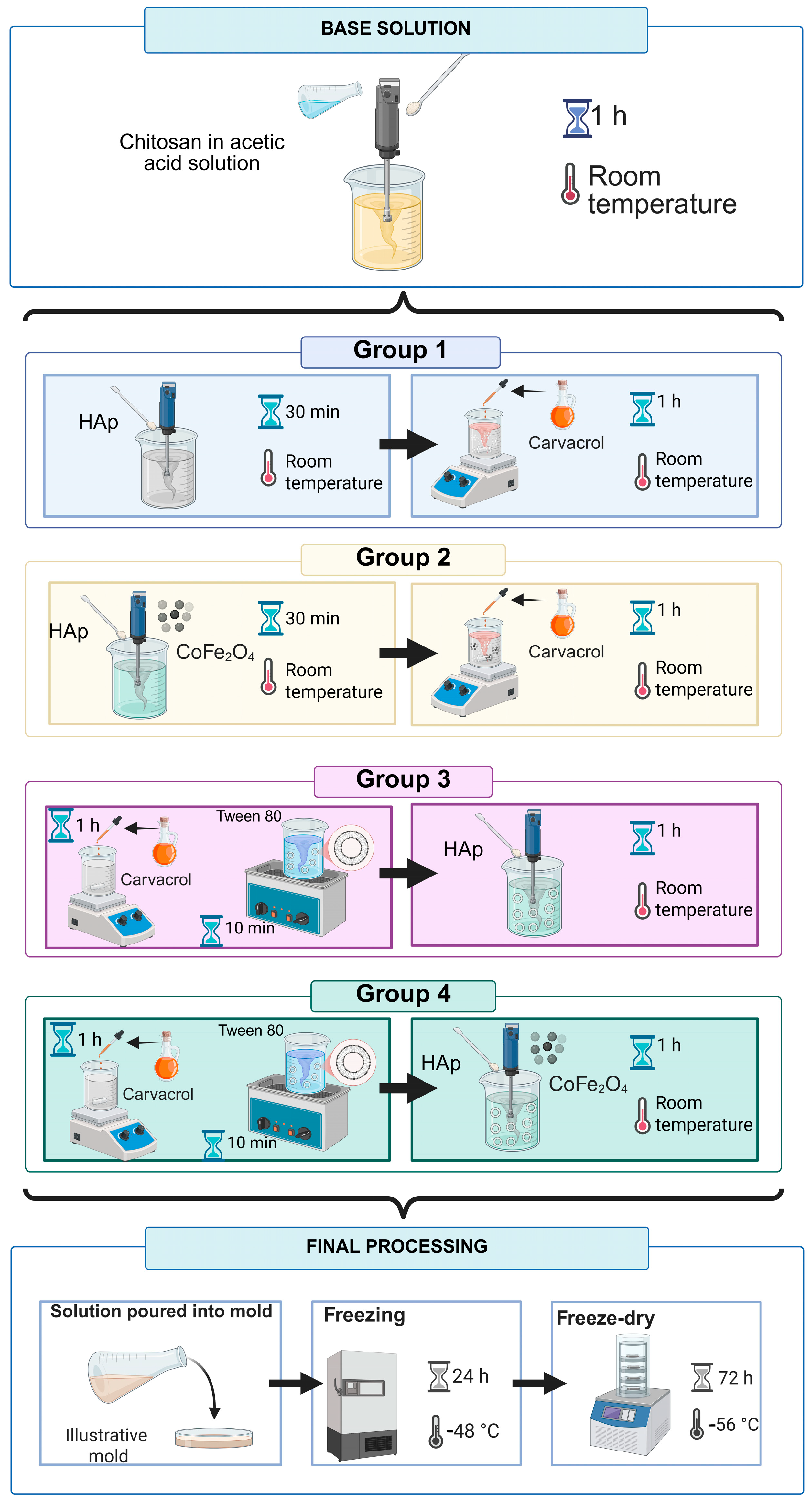
Figure 1 presents a schematic illustration of the scaffold preparation process.
Figure 1.
Scaffold fabrication process.
2.3. Physicochemical and Biological Characterization
All scaffold formulations (S1–S12) and precursor materials were characterized using the following techniques. Based on preliminary antimicrobial screening, scaffolds S3, S6, S9, and S12 were selected for detailed morphological, porosity, and cytotoxicity analysis.
FT-IR analysis: Spectra were acquired using a Bruker Vertex 70 spectrometer (Bruker Optics, Ettlingen, Germany) with ATR accessory. Measurements were taken in the 4000–400 cm−1 range (4 cm−1 resolution, 64 scans).
XRD analysis: Patterns were obtained using a Bruker D2 PHASER diffractometer (Bruker AXS, Karlsruhe, Germany) with Cu Kα radiation (λ = 1.5406 Å, 30 kV, 10 mA) over 2θ = 10–60° (0.02° step size, 2° min−1 scan rate). Crystallite sizes were estimated using the Scherrer equation [21].
Magnetic measurements: Hysteresis loops were measured at room temperature using a vibrating sample magnetometer (MicroSense EZ9, MicroSense LLC, Lowell, MA, USA) with maximum applied field of 13,700 G. Magnetization values were normalized to the total mass of each scaffold (0.0063–0.0245 g).
Minimum inhibitory concentrations (MIC) and minimum bactericidal concentration (MBC) determination: Antimicrobial evaluation included two complementary assays: broth microdilution and agar diffusion. Different microbial panels were used depending on the assay. The MIC and MBC values were determined exclusively for standard strains from the American Type Culture Collection (ATCC) Staphylococcus aureus MRSA (ATCC 43300) and Escherichia coli (ATCC 25922), following the protocol by Ellof et al. [22] and the Clinical and Laboratory Standards Institute M07 and M27 protocols (CLSI M07/M27) [23]. Sterile 96-well plates received 190 μL of tryptic soy broth (TSB), CFO powder at 10% (w/v), and carvacrol at 100 µg·mL−1. Serial dilutions of CFO were performed to achieve final concentrations ranging from 100 × 103 μg·mL−1 to 390.62 μg·mL−1. A bacterial suspension standardized to 1.5 × 10⁸ CFU mL−1 was added (10 μL per well), followed by incubation at 35 ± 2 °C for 24 h. After incubation, 20 μL of TTC (2%) was added for viability detection. MBC values were determined by transferring samples from inhibited wells to Mueller–Hinton agar and incubating at 37 ± 1 °C for 24 h. The MBC corresponded to the lowest concentration producing no visible growth [24].
Antimicrobial assays: Agar diffusion assays were performed for all scaffold formulations (S1–S12) using a broader microbial panel, including: Staphylococcus aureus (ATCC:77193), methicillin-resistant Staphylococcus aureus (MRSA, ATCC:43300), Escherichia coli (ATCC:25922), Pseudomonas aeruginosa (ATCC:27853), Candida albicans (ATCC:14053), and Candida glabrata (ATCC:90030). The inoculum was prepared in TSB and incubated for 24 h at 35 °C. The resulting bacterial suspensions were standardized via spectrophotometry at 580 nm (25% transmittance), achieving a final concentration of 1 × 10⁸ CFU·mL−1. For each strain, 50 µL of inoculum was mixed with 4.95 mL of molten Mueller–Hinton agar (double-layer technique). Scaffold discs (8 mm) and positive controls (cefazolin for Gram-positive and gentamicin for Gram-negative bacteria) were placed on the agar surface and incubated at 35 °C for 24 h. For fungal assays, inocula were prepared in Sabouraud dextrose broth, incubated for 48 h at 25 °C, standardized, and tested using the same double-layer method. Plates were incubated at 25 °C for 48 h. Inhibition zones were measured in triplicate. Based on preliminary screening, samples S2, S3, S6, S9, and S12 displayed measurable antimicrobial activity and were selected for extended characterization.
SEM analysis: Surface morphology was examined using a VEGA3 TESCAN microscope at 20 kV accelerating voltage under high vacuum (<10−4 Torr). Images were captured at 100× and 2000× magnification using a secondary electron detector.
Apparent porosity (AP): Porosity was determined by ethanol displacement method using Equation (1):
where , , and represent the ethanol volume before immersion, after immersion, and after scaffold removal, respectively. Measurements were performed in triplicate.
Cytotoxic activity: Cytotoxicity according to ISO 10993-5:2009 [25] using the agar diffusion method and L929 mouse fibroblasts (ATCC NCTC clone 929, Cell Bank of Rio de Janeiro, Rio de Janeiro, Brazil). Cells were cultured in RPMI 1640 medium (Gibco-Invitrogen Corporation, Grand Island, NE, USA) at 37 °C with 5% CO2 until reaching 80% confluence. Trypsinization was performed with 0.25% trypsin (Gibco®, Life Technologies, Grand Island, NY, USA), and cell density was quantified using an automated cell counter (Interwoven-Thermo Fisher, Waltham, MA, USA). Suspensions of 1.0 × 10⁵ cells·mL−1 were distributed into 6-well plates (4 mL per well) and incubated under the same conditions for 24 h. After cell adhesion, 2× concentrated MEM medium (Gibco®-Invitrogen Corporation, Grand Island, NE, USA) and agar solution with neutral red (Sigma-Aldrich, St. Louis, MO, USA) were added. Scaffolds, as well as the latex and filter paper, were sectioned into 1 cm2 pieces and inserted into the wells, with a positive control (toxic latex sheet) and a negative control (quantitative filter paper with a pore size of 0.45 µm, obtained from Química Moderna, Barueri, SP, Brazil). The plates were incubated for 24 h, and the clear zones were quantified (ISO 10993-5). Cell lysis was evaluated using a NIKON ECLIPSE TS100 inverted digital microscope (Minato, Tokyo, Japan).
3. Results and Discussion
3.1. Chemical Interactions and Structural Properties (FT-IR/XRD)
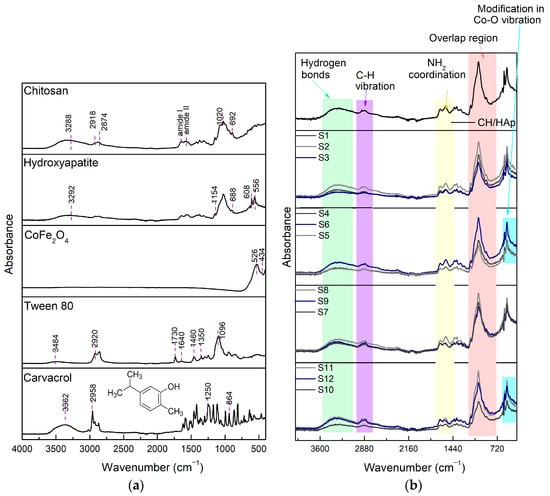
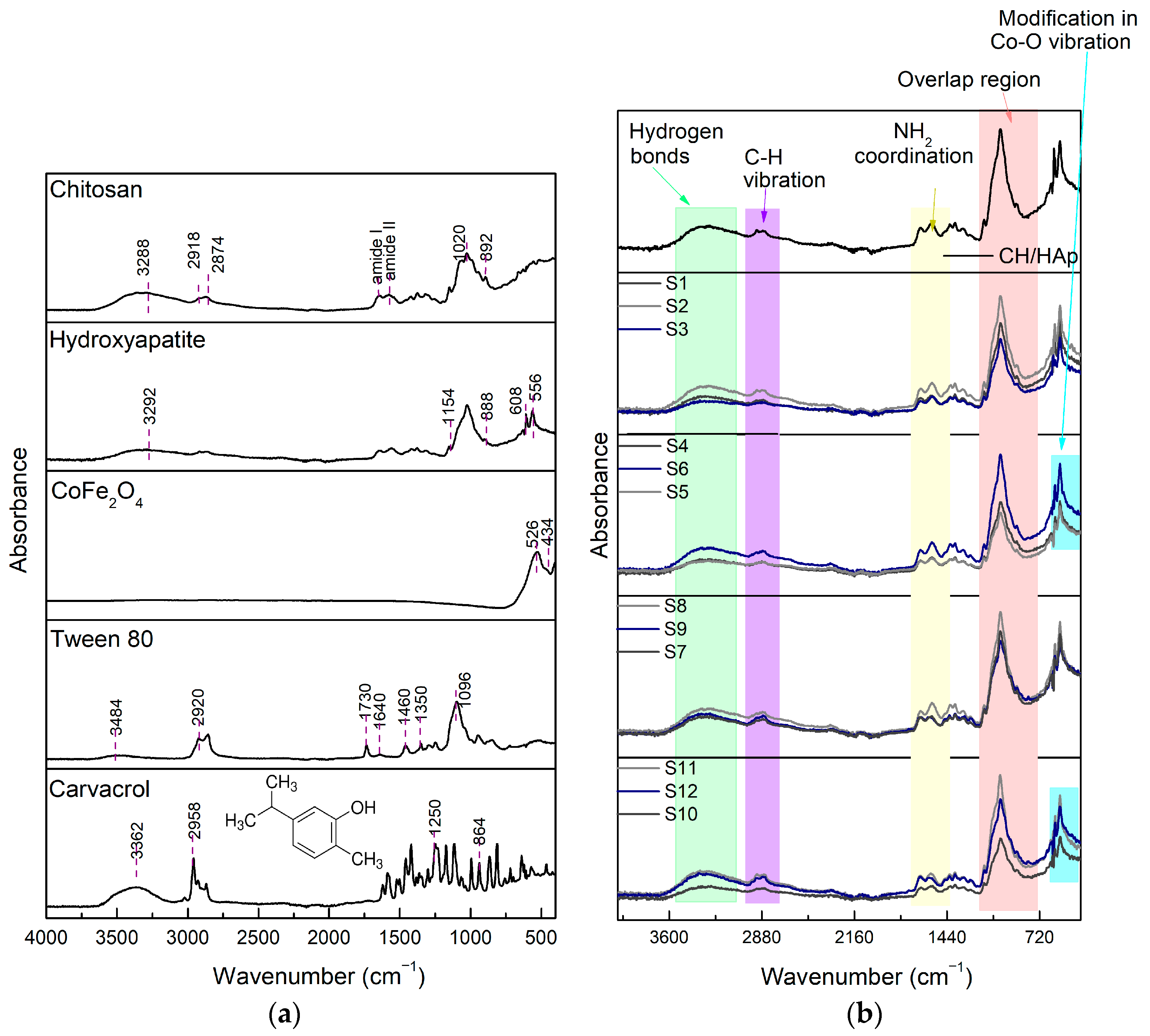
FT-IR analysis confirmed the presence of characteristic functional groups from all components in the composite scaffolds. Figure 2a shows the reference spectra of precursor materials, with leading absorption bands summarized in Table 2.
Figure 2.
FT-IR spectra of (a) precursor materials and (b) composite scaffolds (S1–S12) and CH-HAp control.
Table 2.
Main FT-IR absorption bands and their assignments for precursor materials, compared with literature data.
Spectral regions including the broad O-H/N-H stretching (~3300 cm−1) and C-H stretching (2960–2870 cm−1) showed overlapping contributions from CH, carvacrol, and T80 components. Variations in relative intensity were observed in the amide I region (~1650 cm−1) among different formulations.
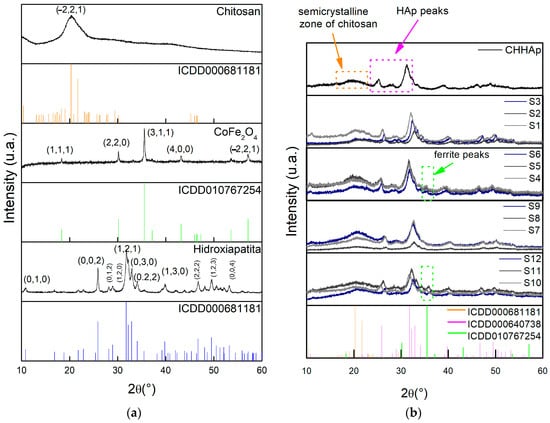
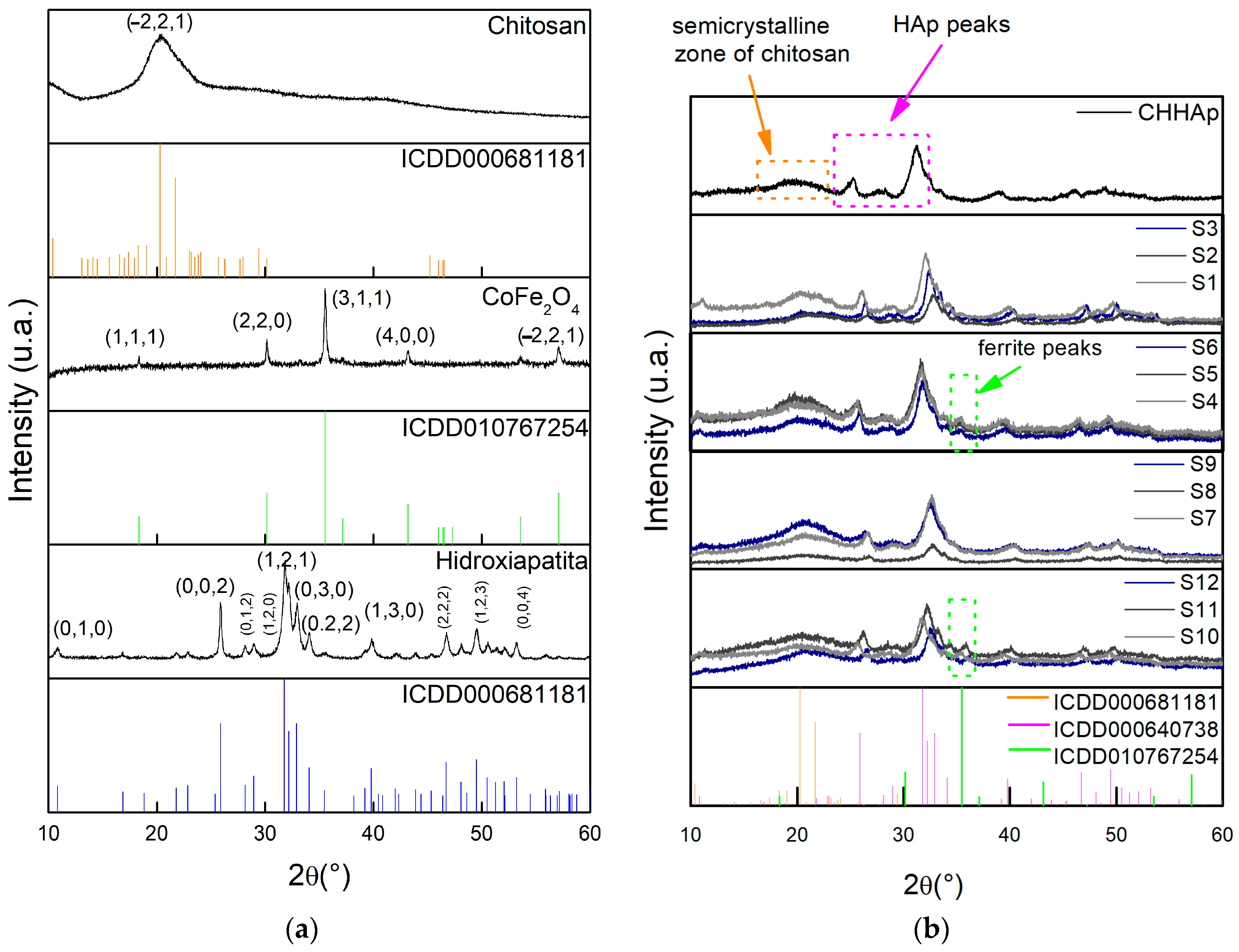
To further evaluate structural preservation and phase composition, XRD analysis was performed. Figure 3 shows the diffractograms of the precursor materials (CH, HAp, CFO) and the scaffolds (S1–S12), compared with the CH-HAp control.
Figure 3.
X-ray diffractograms of (a) precursors and (b) scaffolds S1–S12 and CH-HAp.
The XRD pattern of CH revealed two characteristic crystalline regions at 2θ ≈ 9.8° and 20.1°, consistent with the known organization of ordered domains formed through intra and interchain packing of the semicrystalline polysaccharide [35]. The CFO pattern exhibited a single-phase inverse spinel structure, with diffraction peaks at approximately 2θ = 18.4°, 30.2°, 35.6°, 43.24°, and 57°, corresponding to the (111), (220), (311), (400), and (511) planes of the cubic spinel phase (space group Fd-3m, No. 227). These reflections are consistent with the reference pattern from the JCPDS 01-076-7254 database, indicating 66% crystallinity and an average crystallite size of 31 nm. The HAp exhibited the characteristic reflections of the hexagonal phase (ICDD 00-064-0738), including peaks at 2θ ≈ 25.9°, 28.9°, 31.86°, 32.1°, and 32.9°, corresponding to the (002), (102), (210), (211), and (112) planes.
The CH-HAp control scaffold displayed the expected combination of CH’s semicrystalline region (around 20°) and HAp reflections (25–35°), indicating that scaffold processing did not induce detectable phase changes. Across the composite scaffolds (S1–S12), the XRD patterns consistently showed the characteristic reflections of HAp and, when applicable, CFO, indicating that both phases were preserved after incorporation into the polymeric matrix.
Scaffolds containing carvacrol (Groups 1 and 3) displayed a reduction in the intensity of CH characteristic reflections and a broadening of the diffuse halo in the 20–35° region. This effect, which increased with higher carvacrol content, reflects a decrease in the ordering of semicrystalline domains. Additionally, scaffolds incorporating CFO (Groups 2 and 4) retained the magnetic phase structure without alteration. The overlapping contributions of CH, HAp, and CFO reflect the hybrid nature of the composite and the coexistence of multiple crystalline and amorphous domains.
Altogether, the XRD results indicate the preservation of the crystalline phases of HAp and CFO, expected modifications in the semicrystalline organization of CH due to carvacrol, and the absence of new crystalline phases after scaffold processing.
3.2. Magnetic Properties
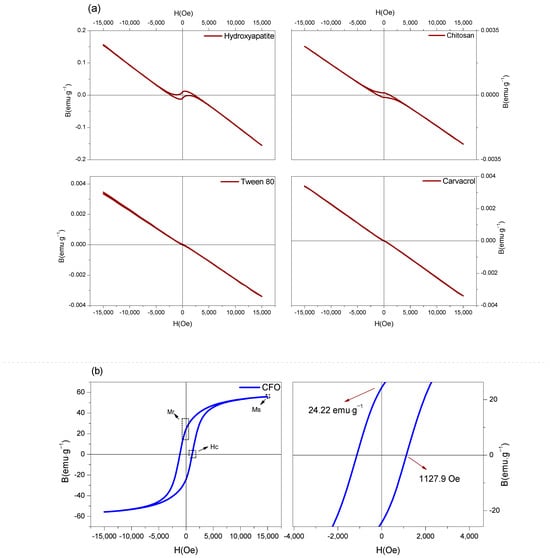
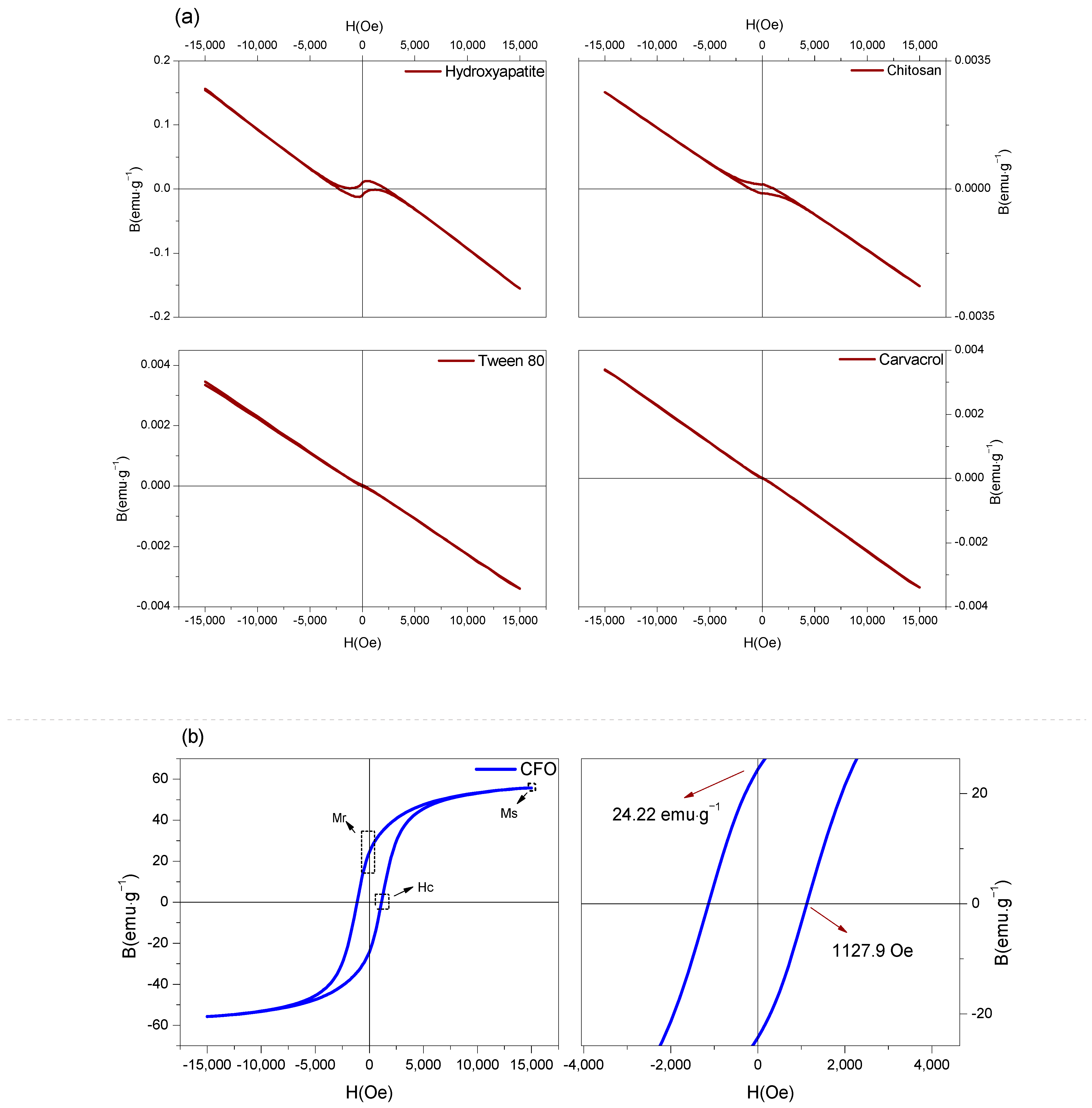
Figure 4 illustrates the magnetization curves of the precursors.
Figure 4.
(a) Magnetization and diamagnetization curves of precursor materials. (b) Magnetic hysteresis loop of cobalt ferrite nanoparticles.
Based on the magnetization curves illustrated in Figure 4a,b, CH, HAp, carvacrol, and T80 exhibited diamagnetic behavior, evidenced by their negative magnetic susceptibility and the absence of a magnetic hysteresis loop [36]. In contrast, CFO nanoparticles displayed typical ferrimagnetic behavior, with a well-defined magnetic hysteresis loop (Figure 4b). The CFO particles exhibited saturation magnetization (Ms) of 55.9 emu·g−1, remanence (Mr) of 24.22 emu·g−1, and coercivity (Hc) of 1127.9 Oe, values consistent with cobalt ferrite nanoparticles synthesized via combustion reactions reported by Santos et al. [37] and E. Leal et al. [38]. These findings align with previously reported magnetic properties for ferrimagnetic materials, particularly CFO [39].
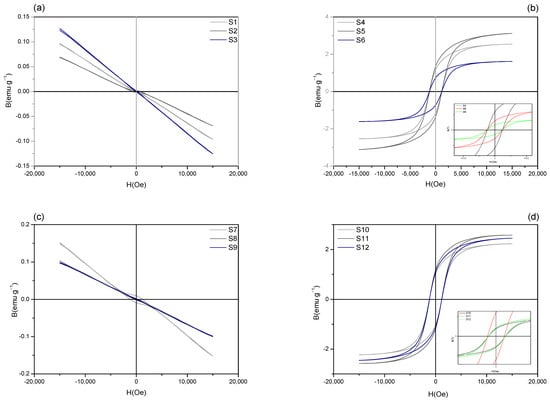
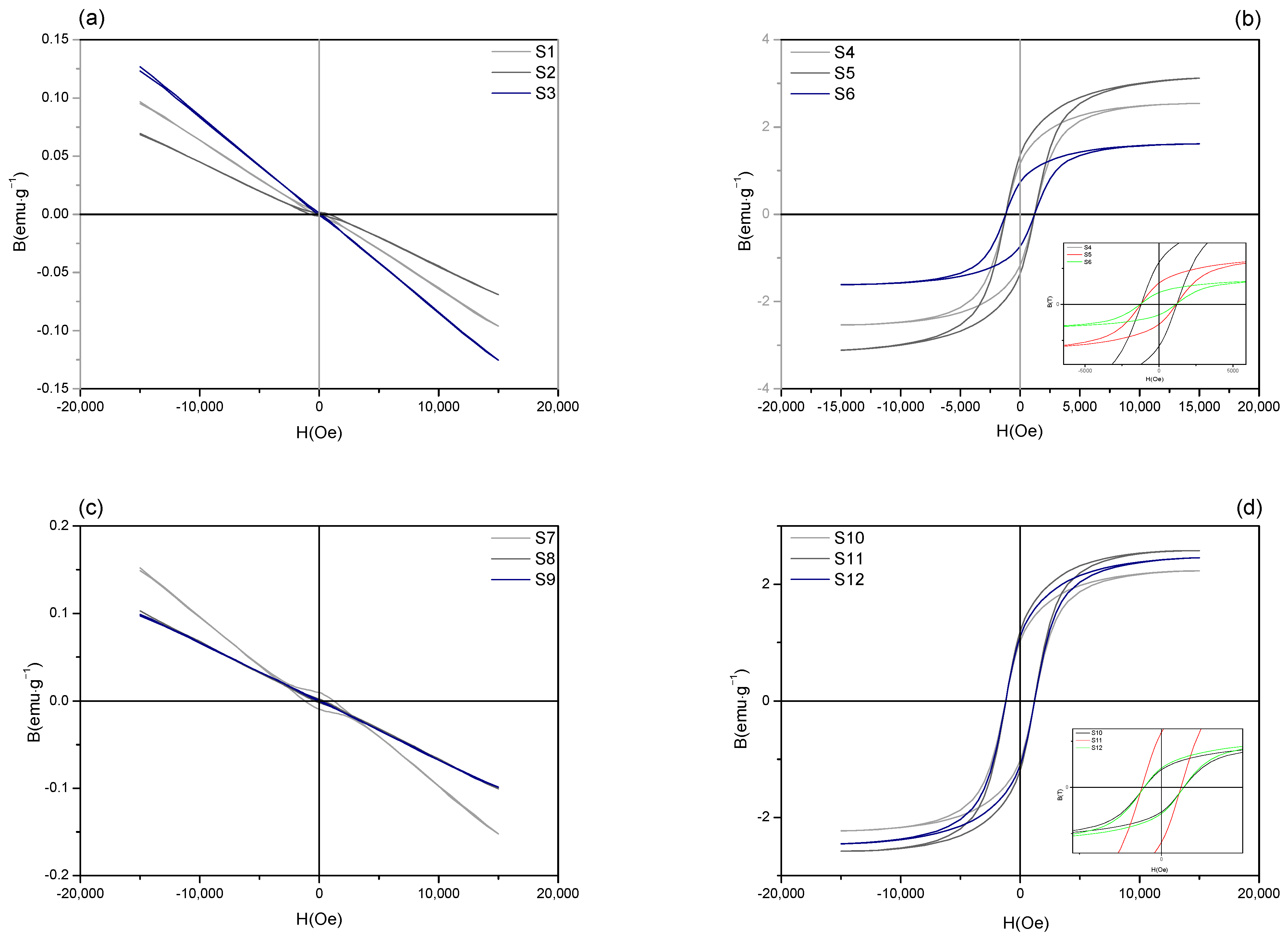
Figure 5 shows the magnetization curves for the scaffolds (S1–S12). Scaffolds without CFO (S1–S3 and S7–S9) maintained the intrinsic diamagnetism of the polymeric matrix (Figure 5a,c). Conversely, incorporated with 5 wt% CFO (S4–S6 and S10–S12) exhibited clear ferrimagnetic signatures, characteristic of the magnetic nanoparticles incorporated in the formulations (Figure 5b,d). The persistence of ferrimagnetism contrasts with findings by Cevallos et al. [40], who observed suppression of ferrimagnetic behavior in polyvinylpyrrolidone (PVP) fibers containing CFO. In the present work, the CH–HAp matrix successfully supported the retention of CFO’s magnetic properties.
Figure 5.
Magnetization curves of the scaffolds: (a) S1–S3, (b) S4–S6, (c) S7–S9, and (d) S10–S12.
Table 3 summarizes the magnetic parameters of the magnetic scaffolds. Although all formulations contained identical CFO loading (5 wt%), the magnetic response varied significantly, reflecting differences in nanoparticle distribution and agglomeration within the matrix [41].
Table 3.
Magnetic parameters of scaffolds S4, S5, S6, S10, S11, and S12.
The highest Ms value was observed for scaffold S5 (3.11 emu·g−1), formulated with 20% free carvacrol. In contrast, scaffold S6, containing 30% free carvacrol, showed the lowest Ms (1.60 emu·g−1), representing a reduction of approximately 50%. This decrease suggests that higher free-carvacrol content may reduce the homogeneous dispersion of CFO particles, promoting agglomeration and decreasing the net magnetic response.
In contrast, scaffolds containing emulsified carvacrol (Group 4, S10–S12) displayed more uniform Ms values (2.23–2.56 emu·g−1). This uniformity is likely attributable to T80, which acts as a surfactant to enhance nanoparticle dispersion. The literature suggests that magnetic nanoparticles in T80 solutions can form stabilized core–shell structures, reducing agglomeration [42]. Roacho-Péres et al. also showed that T80 coatings decrease the aggregate size of magnetite nanoparticles [43].
Coercivity values also varied widely, ranging from 715 Oe (S12) to 1722 Oe (S6). The high Hc in S6 indicates stronger magnetic-domain coupling, likely associated with greater nanoparticle clustering. Conversely, the lower Hc values in S11 and S12 reflect more efficient CFO dispersion facilitated by T80, which minimizes interparticle interactions [44].
3.3. Antimicrobial Evaluation
Table 4 summarizes the MIC and MBC values obtained for CFO nanoparticles and for carvacrol against S. aureus MRSA and E. coli. Values represent the mean of three independent experiments (n = 3).
Table 4.
MIC and MBC values for CFO nanoparticles and carvacrol against S. aureus MRSA and E. coli bacteria.
Both carvacrol and CFO exhibited measurable antimicrobial activity. CFO displayed a potent antibacterial effect, with MIC values of 6.25 µg·mL−1 (S. aureus MRSA) and 12.5 µg·mL−1 (E. coli). The high sensitivity of MRSA ATCC 43300 to CFO is significant, given MRSA strains, suggesting that combustion-synthesized CFO holds potential as an alternative antimicrobial agent [15,45].
Carvacrol also showed bactericidal activity, with MIC and MBC values of 48.8 µg·mL−1 for both organisms. These results indicate greater potency against MRSA ATCC 43300 compared to findings by Bakhtiari et al. [46], who reported significantly higher MIC (250 µg·mL−1) and MBC (500 µg·mL−1) values for carvacrol against MRSA ATCC 33592. Such variations are likely due to differences among strains and assay conditions.
In addition to the MIC/MBC values obtained in this study, carvacrol is widely recognized as a broad-spectrum antimicrobial agent. Previous reports demonstrate its effectiveness against a wide range of clinically relevant microorganisms, including Gram-positive bacteria (Staphylococcus aureus ATCC 25923, ATCC 6538P, ATCC 29213, ATCC BAA-1707, ATCC 43300; S. epidermidis ATCC 12228; Micrococcus luteus ATCC 10240; Bacillus subtilis ATCC 6633; B. cereus ATCC 10876; Enterococcus faecalis ATCC 29212), Gram-negative bacteria (Escherichia coli ATCC 25922; Salmonella typhimurium ATCC 14028; Bordetella bronchiseptica ATCC 4617; Proteus mirabilis ATCC 12453; Pseudomonas aeruginosa ATCC 27852; Klebsiella pneumoniae), and several fungal species (Candida albicans ATCC 10231, ATCC 2091; C. auris CDC B11903; C. glabrata ATCC 90030; C. krusei ATCC 14243; C. parapsilosis ATCC 22019; C. lusitaniae ATCC 34449; C. tropicalis ATCC 1369) [47,48].
Table 5 describe the antimicrobial activity of scaffolds S1–S12 evaluated by the agar diffusion method.
Table 5.
Antimicrobial activity of scaffolds S1–S12 evaluated by the agar diffusion assay.
The antimicrobial behavior of the scaffolds reflected their composition, carvacrol loading, incorporation method, and the intrinsic antimicrobial potency of the isolated active agents.
Scaffolds containing 10% carvacrol, whether in free form (S1, S4) or nanoemulsified with T80 (S7, S10), did not produce inhibition halos against any of the tested microorganisms. This absence of activity indicates that a 10% loading was insufficient to release carvacrol at concentrations that reach the MIC (48.8 µg·mL−1) within the agar medium, a limitation often observed in controlled-release matrices where drug loading is below the threshold for effective diffusion [49,50].
In contrast, scaffolds formulated with 20% and 30% free carvacrol (S2, S3, S5, S6) exhibited marked antibacterial activity. The inhibition zones for the 30% formulations were larger, suggesting that higher loading enabled release concentrations that approached the MBC, resulting in a pronounced bactericidal effect.
Distinct behavior was observed in formulations containing nanoemulsified carvacrol. Scaffolds with 10% and 20% nanoemulsified carvacrol (S7, S8) produced no detectable antimicrobial activity, whereas those containing 30% (S9, S12) demonstrated apparent antibacterial and antifungal effects. This delayed onset is characteristic of nanoemulsion-loaded systems; T80 encapsulates carvacrol within its hydrophobic core, thereby restricting rapid release. Only at higher loadings does sufficient carvacrol overcome this barrier to diffuse at effective concentrations [51,52].
Among all formulations, scaffolds S6 and S12 displayed the most significant antimicrobial activity (both containing 30% carvacrol and 5 wt% CFO). The literature suggests that ferrimagnetic nanoparticles can enhance antimicrobial performance through mechanisms such as ROS generation [53] or local microdisturbances that increase membrane permeability [54,55]. Although no external magnetic field was applied, these intrinsic effects may contribute to the enhanced performance of the magnetic scaffolds.
Regarding antifungal activity, only scaffolds containing 30% nanoemulsified carvacrol (S9 and S12) exhibited inhibitory effects against C. albicans and C. glabrata. This aligns with reports that nanoemulsions improve antifungal efficacy by enhancing solubility and facilitating membrane fusion and intracellular release [12,56,57,58]. The superior performance of the nanoemulsified system is likely attributed to two factors: the higher concentration of carvacrol (30%) required to overcome the intrinsic resistance of yeast cells, and the high specific surface area and mobility of the nanodroplets, which facilitate mass transfer and fusion with the fungal membrane [59,60]. Peculiarly, the absence of inhibition zones in scaffolds containing 30% free carvacrol underscores the critical role of the nanoemulsion system. While free carvacrol failed to permeate the complex fungal structure efficiently, the T80-stabilized nanocarriers successfully enhanced bioavailability and localized action, thereby inhibiting fungal growth.
3.4. Morphology and Porosoty
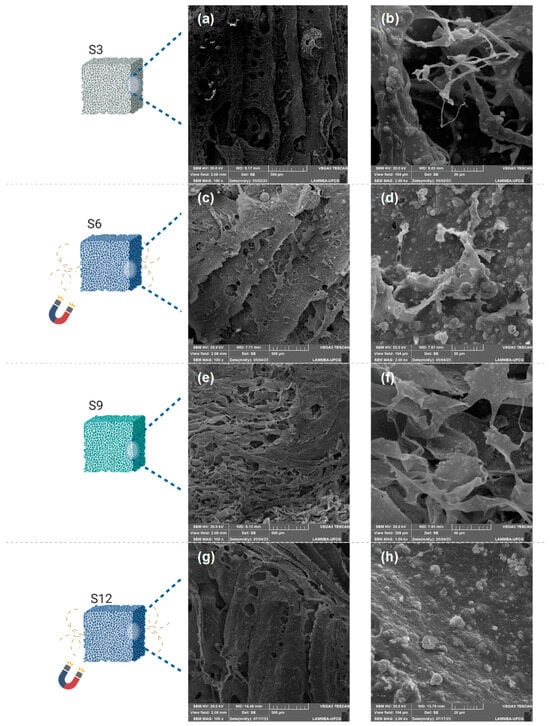
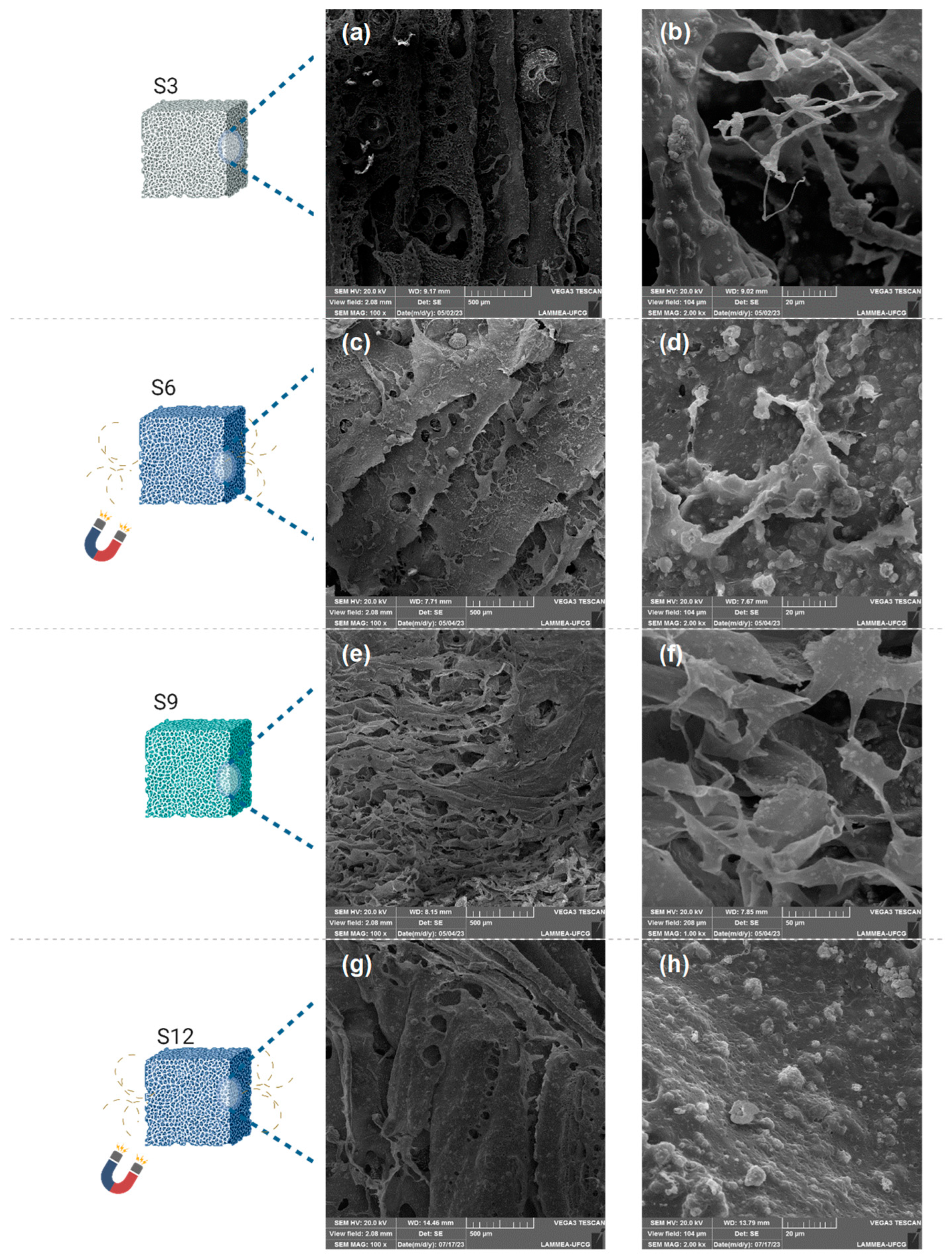
To correlate microstructural features with antimicrobial performance, selective screening was performed. Scaffolds exhibiting the highest activity at maximum carvacrol concentration (S3, S6, S9, and S12) were selected for detailed characterization. Figure 6 presents the surface morphology of the selected scaffolds.
Figure 6.
SEM micrographs of selected scaffolds at 100× and 2000× magnification: (a) S3 at 100×; (b) S3 at 2000×; (c) S6 at 100×; (d) S6 at 2000×; (e) S9 at 100×; (f) S9 at 2000×; (g) S12 at 100×; (h) S12 at 2000×, showing differences in pore size, wall morphology, and CFO distribution.
The microstructure of scaffold S3 (30% free carvacrol) (Figure 6a,b) revealed a heterogeneous matrix and irregular pore distribution. The polymeric walls exhibited local collapse and discontinuities. At higher magnification, disorganized fibrous structures and granular domains were observed adhering to pore walls. These features likely correspond to phase-separated carvacrol regions formed during solvent removal, suggesting that direct incorporation leads to an uncontrolled distribution within the CH-HAp matrix.
In contrast, scaffold S6 (CFO + 30% free carvacrol, Figure 6c,d) presented a markedly more organized architecture. The incorporation of the CFO contributed to matrix reinforcement, resulting in thicker, continuous polymeric walls. Well-defined spherical agglomerates, consistent with CFO nanoparticles, were observed embedded within the matrix. These particles appeared well-distributed, conferring structural stability and mitigating pore collapse. The coexistence of lamellar structures and globular domains indicates partial incorporation of carvacrol within the CFO-reinforced matrix.
The morphology of S9 (30% emulsified carvacrol; Figure 6e,f) showed a highly porous, less-dense matrix with thin, interconnected walls. The use of T80 promoted finer dispersion of carvacrol droplets, yielding a more homogeneous pore distribution compared to free-carvacrol formulations. High-magnification images reveal globular vesicular domains partially integrated into the polymer network. The smoother topography indicates improved interfacial compatibility between the polymeric and oily phases.
Finally, scaffold S12 (CFO + 30% emulsified carvacrol, Figure 6g,h) exhibited the most compact and structurally organized morphology among the evaluated formulations. The combination of emulsification and magnetic nanoparticles resulted in a scaffold with minimal phase separation and enhanced structural stability. This densification effect aligns with findings by Heidari et al., who observed that the incorporation of iron oxide nanoparticles into chitosan/hydroxyapatite scaffolds qualitatively reduced matrix porosity, promoting a denser, more mechanically robust structure [61].
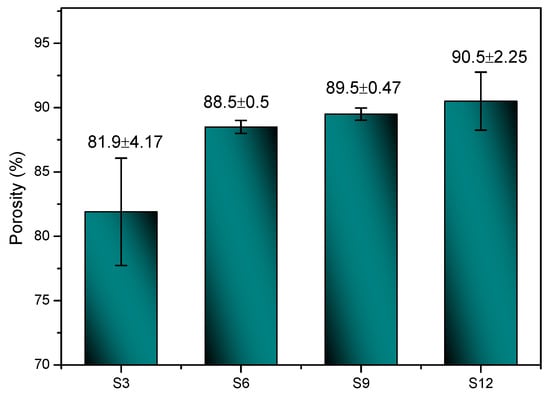
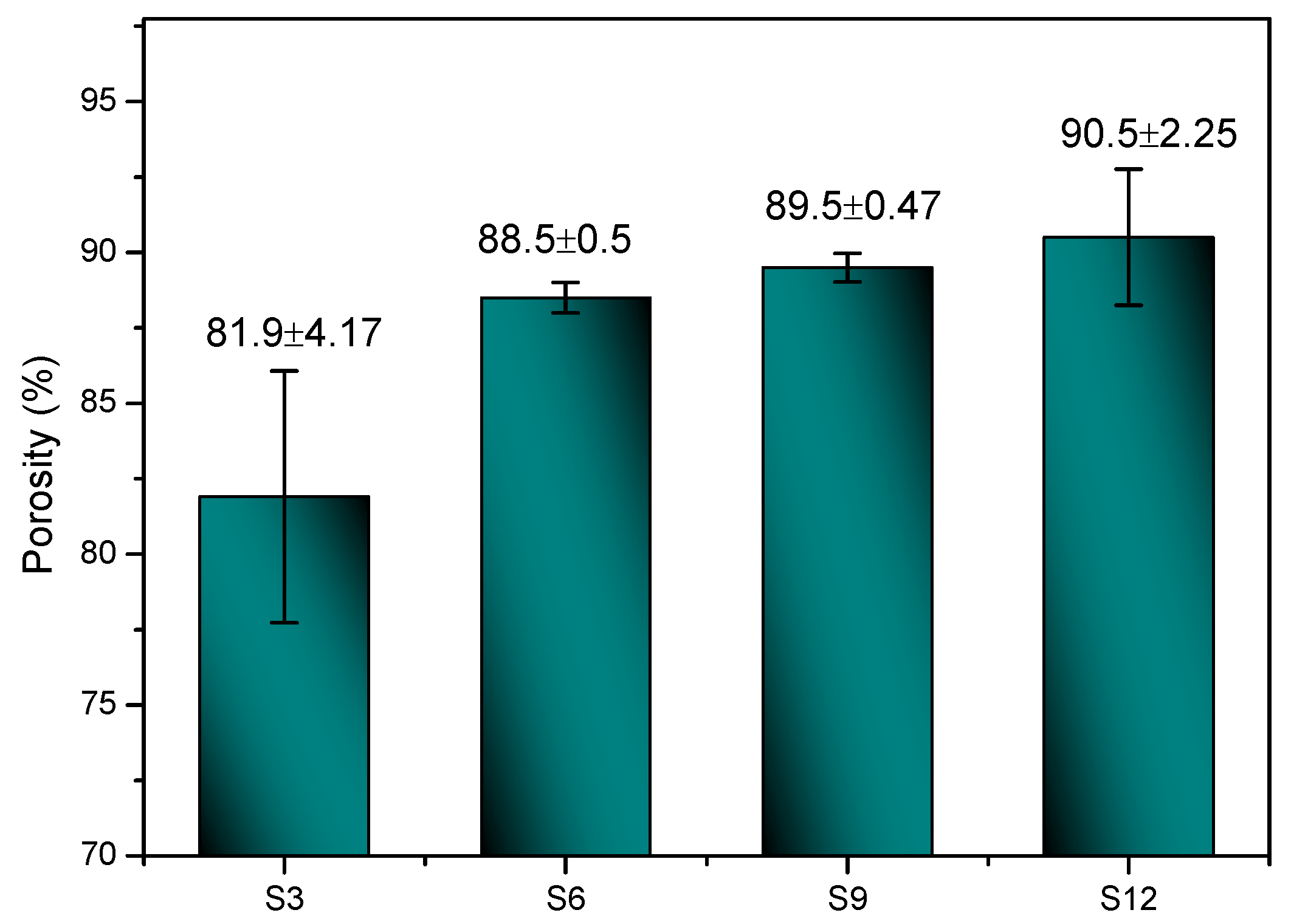
Figure 7 presents the apparent porosity of scaffolds S3, S6, S9, and S12. The results reveal distinct trends associated with the method of carvacrol incorporation and the presence of cobalt ferrite.
Figure 7.
Apparent porosity values of scaffolds S3, S6, S9, and S12.
Scaffold S3 (30% free carvacrol) exhibited the lowest porosity (81.9 ± 4.17%) and the highest variability among samples. This behavior is consistent with the heterogeneous microstructure observed in SEM analysis, where the direct incorporation of carvacrol without emulsifying agents promoted the formation of irregular hydrophobic domains and local wall collapse during drying. These structural defects likely obstructed the pore network, reducing the total void volume.
In contrast, for scaffold S6 (CFO + 30% free carvacrol), porosity increased markedly to 88.5 ± 0.50%, accompanied by a decrease in variability. The presence of CFO appeared to contribute to greater matrix stability; the rigid nanoparticles likely reinforced the polymer walls, preventing shrinkage during lyophilization. This reinforcement is reflected in the SEM images, which show a cohesive structure with fewer collapsed regions and a uniform distribution of interconnected pores.
Scaffold S9 (30% emulsified carvacrol) showed even higher porosity 89.5 ± 0.47%). The emulsification process enabled a homogeneous distribution of carvacrol throughout the polymeric matrix, reducing phase separation. As evidenced by SEM, this resulted in thin, continuous pore walls and a smoother topography. The high porosity indicates that the nanoemulsion effectively mitigated the morphological disruptions commonly observed in scaffolds containing free hydrophobic agents.
The highest porosity value was observed for scaffold S12 (90.5 ± 2.25%), which combined emulsified carvacrol and CFO. SEM analysis revealed an organized architecture with uniform pores, well-distributed CFO particles, and minimal surface collapse. This result suggests a synergistic effect: T80 promotes the efficient dispersion of carvacrol, while CFO reinforces the polymeric network. Consequently, this combination yielded a highly porous and interconnected structure, as recently highlighted by Apăvăloaiei et al. [62]. Their study emphasizes that interconnected pores are essential to stimulate osteoblast adhesion, nutrient flow, and vascularization. Furthermore, they note that pore sizes in the 50–150 µm range are particularly effective for fibrovascular growth and cell migration, features consistent with the optimized morphology observed in this work.
3.5. Biocompatibility and Trade-Offs
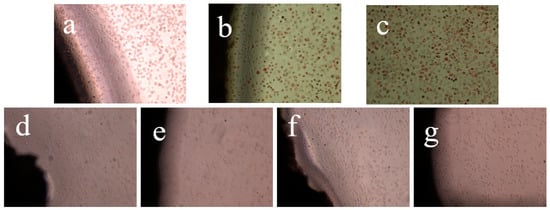
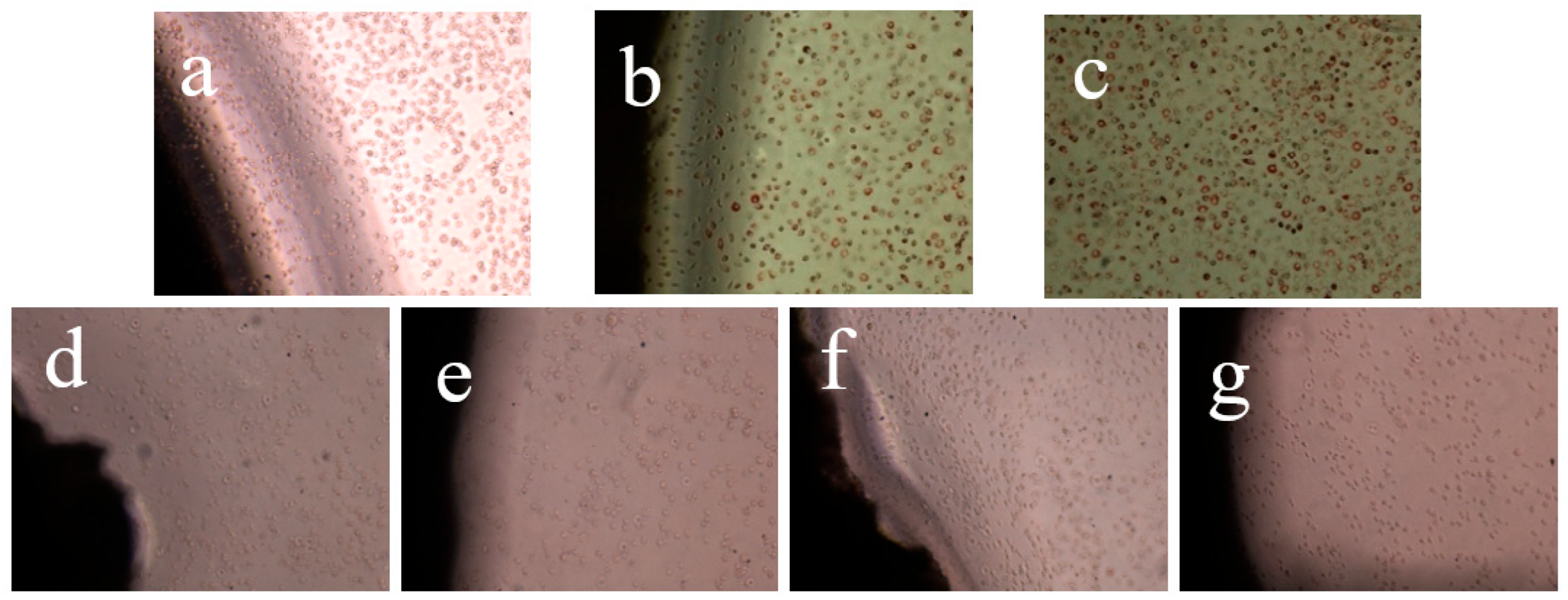
Figure 8 illustrates the cytotoxic behavior of the scaffolds against L929 fibroblasts evaluated via the agar diffusion method.
Figure 8.
Optical microscopy images (100×) of L929 fibroblasts in the agar diffusion cytotoxicity assay: (a) positive control, (b) negative control, (c) blank, (d) S3, (e) S6, (f) S9, (g) S12. All scaffolds exhibited only mild cytotoxicity (grade 2), with decolorization halos smaller than 0.45 cm (Table 5), and were therefore classified as non-cytotoxic to slightly cytotoxic according to ISO 10993-5:2009.
The results, summarized in Table 6, indicate that all scaffolds exhibited only mild cytotoxicity (Grade 2), characterized by decolorization zones smaller than 0.45 cm. According to ISO 10993-5:2009 standards, materials falling within this range are interpreted as having “mild” reactivity, bordering the limit of biological acceptance for implantable devices but considered distinct from “moderate” or “severe” toxicity.
Table 6.
Results of the agar diffusion cytotoxicity test according to ISO 10993-5:2009.
This outcome is significant considering the high concentration of carvacrol incorporated into the matrices. Carvacrol is a phenolic compound with known intrinsic cytotoxicity; Ranjitkar et al. reported that concentrations above 100 µg·mL−1 reduced the viability of both tumor and non-tumor cell lines by more than 50%, demonstrating limited selectivity [63].
In contrast, the present results show that, when incorporated into CH-HAp scaffolds, carvacrol’s cytotoxic effects are markedly attenuated. This mitigation is likely related to the polymeric matrix acting as a barrier, reducing the burst release and controlling cellular exposure to the bioactive agent. This “protective” effect aligns with findings by Akhlaq et al., who demonstrated that nanostructuring carvacrol into chitosan-based particles reduced toxicity towards non-tumoral cells, achieving selectivity indices greater than 2 [64].
Complementarily, Farto-Vaamonde et al. observed that PLA scaffolds loaded with carvacrol maintained tissue viability even during the initial release phase, suggesting that the scaffold architecture modulates the interaction between the drug and the surrounding tissue [65]. Therefore, the magnetic scaffolds developed in this work demonstrate a favorable balance: they effectively inhibit resistant bacteria and fungi while maintaining mild cytotoxicity. This suggests that the controlled incorporation of bioactive compounds can ensure antimicrobial efficacy without compromising biomedical safety.
4. Conclusions
In this study, multicomponent magnetic and antimicrobial scaffolds were successfully developed by integrating CFO nanoparticles and carvacrol into a CH–HAp matrix. Both components were effectively incorporated and directly influenced the structural, magnetic, and biological properties of the scaffolds. Carvacrol, especially at 30 wt%, acted as a plasticizer, reducing CH crystallinity and promoting a more amorphous structure, whereas 5 wt% CFO imparted ferrimagnetic behavior and enabled measurable magnetization. T80 improved carvacrol stabilization and dispersion, enhancing the homogeneity of the polymeric network and facilitating a more uniform distribution of CFO. Among all formulations, those with higher carvacrol content and the combination of emulsified carvacrol with CFO demonstrated the most promising multifunctional performance. These scaffolds exhibited broad-spectrum antimicrobial activity against S. aureus, E. coli, C. albicans, and C. glabrata, while maintaining only mild cytotoxicity (discoloration halos < 0.45 cm), in accordance with ISO 10993-5 standards. Of particular significance, the scaffold containing emulsified carvacrol and CFO achieved the best balance of porosity (≈90%), surface organization, magnetic response, and biological safety. Future studies should focus on in vivo evaluation, drug-release kinetics, mechanical characterization, and intermediate carvacrol concentrations to optimize the balance between antimicrobial activity and cytocompatibility.
Author Contributions
Conceptualization, D.G.G., H.V.P., A.C.F.d.M.C. and M.J.C.d.S.; methodology, D.G.G., H.V.P. and J.d.O.d.S.; investigation, G.G.G., A.J.A.d.F.P. and C.B.B.L.; data curation, D.G.G. and A.L.S.; writing—original draft preparation, D.G.G. and H.V.P.; writing—review and editing, R.M.R.W., A.C.F.d.M.C. and M.J.C.d.S.; supervision, A.C.F.d.M.C.; project administration, A.C.F.d.M.C. and M.J.C.d.S.; funding acquisition, A.C.F.d.M.C. All authors have read and agreed to the published version of the manuscript.
Funding
This research received no external funding.
Data Availability Statement
The original contributions presented in this study are included in the article. Further inquiries can be directed to the corresponding author.
Acknowledgments
We would also like to thank the Northeast Biomaterials Evaluation and Development Laboratory (CERTBIO-UFCG), the Drug Development and Testing Laboratory (LABDEM-UEPB), the Pharmaceutical Product Development and Characterization Laboratory (LDCPF-UEPB) and the Mechanical Engineering Laboratory (LEM-UFCG) for their technical support and infrastructure. We thank CNPq—National Council for Scientific and Technological Development; CAPES—Coordination for the Improvement of Higher Education Personnel; and FAPESQ-PB—Research Foundation of the State of Paraíba for institutional support. The researcher Carlos Bruno Barreto Luna acknowledges the National Council for Scientific and Technological Development (CNPq) for the award of a Junior Postdoctoral Fellowship (PDJ) under CNPq Call No. 49/2024, related to process No. 152382/2025-9. During the preparation of this work, the authors used Grammarly (web-based version) to assist with Portuguese-to-English translation and for English language grammar and spelling checks. After using this tool, the authors reviewed and edited the content as needed and take full responsibility for the content of the published article.
Conflicts of Interest
The authors declare no conflicts of interest.
References
- Akobundu, U.U.; Ifijen, I.H.; Duru, P.; Igboanugo, J.C.; Ekanem, I.; Fagbolade, M.; Ajayi, A.S.; George, M.; Atoe, B.; Matthews, J.T. Exploring the role of strontium-based nanoparticles in modulating bone regeneration and antimicrobial resistance: A public health perspective. RSC Adv. 2025, 15, 10902–10957. [Google Scholar] [CrossRef] [Scilit]
- Hoveidaei, A.H.; Sadat-Shojai, M.; Nabavizadeh, S.S.; Niakan, R.; Shirinezhad, A.; MosalamiAghili, S.; Tabaie, S. Clinical challenges in bone tissue engineering—A narrative review. Bone 2025, 192, 117363. [Google Scholar] [CrossRef] [Scilit]
- Khodaverdi, K.; Naghib, S.M.; Mozafari, M.R.; Rahmanian, M. Chitosan/hydroxyapatite hydrogels for localized drug delivery and tissue engineering: A review. Carbohydr. Polym. Technol. Appl. 2025, 9, 100640. [Google Scholar] [CrossRef] [Scilit]
- Suresh, N.; Shanmugavadivu, A.; Selvamurugan, N. Chitosan–exosome synergy: Advanced cell-free scaffold approaches for bone tissue engineering. Int. J. Biol. Macromol. 2025, 304, 140753. [Google Scholar] [CrossRef] [Scilit]
- Waidi, Y.O. Strategies for fabricating multi-material bone tissue constructs. Bioprinting 2025, 48, e00405. [Google Scholar] [CrossRef] [Scilit]
- Abdian, N.; Soltani Zangbar, H.; Etminanfar, M.; Hamishehkar, H. 3D chitosan/hydroxyapatite scaffolds containing mesoporous SiO2-HA particles: A new step to healing bone defects. Int. J. Biol. Macromol. 2024, 278, 135014. [Google Scholar] [CrossRef] [Scilit] [PubMed]
- Ameri, B.; Taheri-Behrooz, F. Novel mixed mode I/II fracture load prediction of chitosan polymer-infiltrated hydroxyapatite ceramic scaffolds using ICIM/GMTS theory in bone scaffold additive manufacturing. Mater. Des. 2025, 253, 113931. [Google Scholar] [CrossRef] [Scilit]
- Chen, J.; Qiao, L.; Zhao, S.; Dai, L.; Guo, J.; Fu, Q.; Liu, J.; Yang, M.; Li, S.; Zhang, X.; et al. Multifunctional chitosan-hydroxyapatite-polyphenol nanoparticles from 3D printed bone scaffolds: Controlled release and therapeutic properties. Eur. Polym. J. 2025, 226, 113738. [Google Scholar] [CrossRef] [Scilit]
- Habiburrohman, M.R.; Jamilludin, M.A.; Cahyati, N.; Herdianto, N.; Yusuf, Y. Fabrication and in vitro cytocompatibility evaluation of porous bone scaffold based on cuttlefish bone-derived nano-carbonated hydroxyapatite reinforced with polyethylene oxide/chitosan fibrous structure. RSC Adv. 2025, 15, 5135–5150. [Google Scholar] [CrossRef] [Scilit]
- Yilmaz, P.; Demirhan, E.; Ozbek, B. Eco-friendly fabrication of bioactive chitosan-hydroxyapatite sponge-like scaffolds functionalized with Ficus carica Linn leaf extract for enhanced antioxidant and antimicrobial properties. Food Biosci. 2025, 69, 106901. [Google Scholar] [CrossRef] [Scilit]
- Fan, Y.; Chen, Y.; Yang, H.; Chen, N.; Gu, X.; Feng, X.; Fang, C.; Yin, Y.; Deng, H.; Dai, L. Carvacrol attenuates mucosal barrier impairment and tumorigenesis by regulating gut microbiome. Transl. Oncol. 2025, 58, 102431. [Google Scholar] [CrossRef] [Scilit]
- Nehme, R.; Abdennebi-Najar, L.; Rault, L.; Maillard, M.-B.; Even, S.; Andrés, S.; Hamon, P.; Pereira, D.M.; Ceciliani, F.; Falleh, H.; et al. Antibacterial effect of free, nanoemulsified and protein-complexed carvacrol. Food Chem. Adv. 2025, 6, 100881. [Google Scholar] [CrossRef] [Scilit]
- Azizi-Lalabadi, M.; Rahimzadeh-Sani, Z.; Feng, J.; Hosseini, H.; Jafari, S.M. The impact of essential oils on the qualitative properties, release profile, and stimuli-responsiveness of active food packaging nanocomposites. Crit. Rev. Food Sci. Nutr. 2023, 63, 1822–1845. [Google Scholar] [CrossRef] [Scilit]
- Mauriello, E.; Ferrari, G.; Donsì, F. Effect of formulation on properties, stability, carvacrol release and antimicrobial activity of carvacrol emulsions. Colloids Surf. B Biointerfaces 2021, 197, 111424. [Google Scholar] [CrossRef] [Scilit]
- Guedes, D.G.; Guedes, G.G.; Silva, J.D.; Silva, A.L.; Luna, C.B.; Damasceno, B.P.; Costa, A.C. Development of Scaffolds with Chitosan Magnetically Activated with Cobalt Nanoferrite: A Study on Physical-Chemical, Mechanical, Cytotoxic and Antimicrobial Behavior. Pharmaceuticals 2024, 17, 1332. [Google Scholar] [CrossRef] [Scilit]
- Noruzi, E.B.; Shaabani, B.; Eivazzadeh-Keihan, R.; Aliabadi, H.A.M. Fabrication and investigation of a pentamerous composite based on calix[4]arene functionalized graphene oxide grafted with silk fibroin, cobalt ferrite, and alginate. Int. J. Biol. Macromol. 2024, 259, 129385. [Google Scholar] [CrossRef] [Scilit] [PubMed]
- Senthil, V.P.; Gajendiran, J.; Raj, S.G.; Shanmugavel, T.; Ramesh Kumar, G.; Parthasaradhi Reddy, C. Study of structural and magnetic properties of cobalt ferrite (CoFe2O4) nanostructures. Chem. Phys. Lett. 2018, 695, 19–23. [Google Scholar] [CrossRef] [Scilit]
- Shuai, C.; Lin, C.; Gao, X.; Tan, W.; Bai, X.; Yang, W. Bifunctional cobalt ferrite/reduced graphene oxide heterojunction enhances the antibacterial and osteogenic activities of scaffold. Appl. Surf. Sci. 2025, 695, 162942. [Google Scholar] [CrossRef] [Scilit]
- Klug, H.P.; Alexander, L.E. X-Ray Diffraction Procedures: For Polycrystalline and Amorphous Materials, 2nd ed.; Wiley-Interscience: New York, NY, USA, 1974; ISBN 978-0-0471-49369-3. [Google Scholar]
- Farzaneh, S.; Hosseinzadeh, S.; Samanipour, R.; Hatamie, S.; Ranjbari, J.; Khojasteh, A. Fabrication and characterization of cobalt ferrite magnetic hydrogel combined with static magnetic field as a potential bio-composite for bone tissue engineering. J. Drug Deliv. Sci. Technol. 2021, 64, 102525. [Google Scholar] [CrossRef] [Scilit]
- Ponciano, R.C.d.O.; Costa, A.C.F.d.M.; Barbosa, R.C.; Fook, M.V.L.; Ponciano, J.J. Chitosan and hydroxyapatite scaffolds with amoxicillin for bone repair. Res. Soc. Dev. 2021, 10, e13410514790. [Google Scholar] [CrossRef] [Scilit]
- Pauw, E.; Eloff, J.N. Which tree orders in southern Africa have the highest antimicrobial activity and selectivity against bacterial and fungal pathogens of animals? BMC Complement. Altern. Med. 2014, 14, 317. [Google Scholar] [CrossRef] [Scilit]
- CLSI. Methods for Dilution Antimicrobial Susceptibiçity Tests for Bacteria that Grow Aerobically. 2018. Available online: https://clsi.org/shop/standards/m07/ (accessed on 15 November 2025).
- Obiang, C.S.; Misso, R.L.N.M.; Atome, G.R.N.; Obame, R.B.M.; Ondo, J.P.; Engonga, L.C.O.; Emvo, E.N. Antimicrobial, antioxidant, anti-inflammatory and cytotoxic study of extracts of Guibourtia tessmanii (harms) J. Léonard from Gabon. Clin. Phytosci. 2021, 7, 45. [Google Scholar] [CrossRef] [Scilit]
- ISO:10993-5; Biological Evaluation of Medical Devices Part 5: Tests for In Vitro Cytotoxicity. International Organization for Standardization: Geneva, Switzerland, 2009.
- Azeez, S.; Anusha, N.; Sathiyaseelan, A.; Nagarajan, S. Chitosan: A multifaceted biomaterial—Exploring physicochemical insights and diverse drug delivery applications. J. Drug Deliv. Sci. Technol. 2025, 111, 107140. [Google Scholar] [CrossRef] [Scilit]
- Liu, F.; Liu, Y.; Guo, Y.; Liu, J.; Dong, J.; Wang, T.; Hao, D.; Zhang, Y. FTIR determination of the degree of molar substitution for hydroxypropyl chitosan. Carbohydr. Polym. 2024, 339, 122229. [Google Scholar] [CrossRef] [Scilit]
- Nordin, N.; Zaini Ambia, N.F.A.; Majid, S.R.; Abu Bakar, N. Efficient encapsulation of a model drug in chitosan cathodic electrodeposition: Preliminary analysis using FTIR, UV–vis, and NMR spectroscopy. Carbohydr. Polym. 2025, 348, 122830. [Google Scholar] [CrossRef] [Scilit]
- Fitriyana, D.F.; Muhammadin, R.C.; Pusparizkita, Y.M.; Ismail, R.; Jamari, J.; Bayuseno, A.P. Microwave-assisted synthesis of nanocrystalline hydroxyapatite using calcium supplies from green mussel shells with synthesis time optimization. Nano-Struct. Nano-Objects 2025, 42, 101484. [Google Scholar] [CrossRef] [Scilit]
- Islam, M.A.; Hossain, N.; Hossain, S.; Khan, F.; Hossain, S.; Arup, M.M.R.; Chowdhury, M.A.; Rahman, M.M. Advances of Hydroxyapatite Nanoparticles in Dental Implant Applications. Int. Dent. J. 2025, 75, 2272–2313. [Google Scholar] [CrossRef] [Scilit]
- Anila, I.; Lahiri, B.B.; John, S.P.; Jacob Mathew, M.; Philip, J. Preparation, physicochemical characterization, and AC induction heating properties of colloidal aggregates of ferrimagnetic cobalt ferrite nanoparticles coated with a bio-compatible polymer. Ceram. Int. 2023, 49, 15183–15199. [Google Scholar] [CrossRef] [Scilit]
- Li, Z.; Fu, J. Formation of naturally-occurring gold nanoparticles by photosensitive surfactant Tween 80/85 under light irradiation: A new origin in aquatic environment. J. Mol. Liq. 2024, 401, 124683. [Google Scholar] [CrossRef] [Scilit]
- Sivasankar, K.; Pathak, A.; Jain, K. Effect of Tween 80 and Pluronic 127 on the stabilization of zein nanocarriers for the delivery of piperine. Food Res. Int. 2024, 197, 115202. [Google Scholar] [CrossRef] [Scilit] [PubMed]
- Gandova, V.; Lazarov, A.; Fidan, H.; Dimov, M.; Stankov, S.; Denev, P.; Ercisli, S.; Stoyanova, A.; Gulen, H.; Assouguem, A.; et al. Physicochemical and biological properties of carvacrol. Open Chem. 2023, 21, 20220319. [Google Scholar] [CrossRef] [Scilit]
- Elmehbad, N.Y.; Mohamed, N.A.; Abd El-Ghany, N.A.; Abdel-Aziz, M.M. Evaluation of the in vitro anti-inflammatory and anti-Helicobacter pylori activities of chitosan-based biomaterials modified with copper oxide nanoparticles. Int. J. Biol. Macromol. 2023, 253, 127277. [Google Scholar] [CrossRef] [Scilit]
- Singh, D.; Vora, T.; Ganesan, S.; Bhardwaj, C.K.; Ray, S.; Singh, U.; Al-Hasnaawei, S.; Kaur, I.; Sharma, G.C.; Devi, A. Cobalt Nanoferrites and Their Composites: Advanced Materials for Water Purification. J. Mol. Struct. 2025, 1348, 143395. [Google Scholar] [CrossRef] [Scilit]
- Santos, P.T.A.; Araújo, P.M.A.G.; Leal, E.; de Albuquerque, I.L.T.; Conrado, L.S.; Costa, A.C.F.d.M. Immobilized Enzyme Gox with Ferrite CoFe2O4 and Hybrid CoFe2O4/APTS. Mater. Sci. Forum 2015, 820, 161–166. [Google Scholar] [CrossRef] [Scilit]
- Leal, E.; Dantas, J.; Santos, P.T.A.d.; Bicalho, S.M.d.C.M.; Kiminami, R.H.G.A.; da Silva, M.R.; Costa, A.C.F.d.M. Effect of the surface treatment on the structural, morphological, magnetic and biological properties of MFe2O4 iron spinels (M = Cu, Ni, Co, Mn and Fe). Appl. Surf. Sci. 2018, 455, 635–645. [Google Scholar] [CrossRef] [Scilit]
- Jasrotia, R.; Prakash, J.; Saddeek, Y.B.; Alluhayb, A.H.; Younis, A.M.; Lakshmaiya, N.; Prakash, C.; Aly, K.A.; Sillanpää, M.; Ismail, Y.A.M.; et al. Cobalt ferrites: Structural insights with potential applications in magnetics, dielectrics, and Catalysis. Coord. Chem. Rev. 2025, 522, 216198. [Google Scholar] [CrossRef] [Scilit]
- Cevallos, V.J.; Briceño, S.; Solorzano, G.; Gardener, J.; Debut, A.; Dávalos, R.; Bramer-Escamilla, W.; González, G. Electrospun polyvinylpyrrolidone fibers with cobalt ferrite nanoparticles. Carbon Trends 2025, 19, 100478. [Google Scholar] [CrossRef] [Scilit]
- Blachowicz, T.; Grzybowski, J.; Ehrmann, A. Influence of agglomerations on magnetic properties of polymer matrices filled with magnetic nanoparticles. Mater. Today Proc. 2022, 67, 792–796. [Google Scholar] [CrossRef] [Scilit]
- Nagornyi, A.V.; Avdeev, M.V.; Ivankov, O.I.; Shlapa, Y.Y.; Solopan, S.O.; Nagorna, T.V.; Shulenina, A.V.; Zabulonov, Y.L.; Belous, A.G.; Bulavin, L.A. Structural Stability of Dispersions of Magnetic Nanoparticles in Aqueous Solutions of Polysorbate-80. J. Surf. Investig. X-Ray Synchrotron Neutron Tech. 2021, 15, 781–786. [Google Scholar] [CrossRef] [Scilit]
- Roacho-Pérez, J.A.; Rodríguez-Aguillón, K.O.; Gallardo-Blanco, H.L.; Velazco-Campos, M.R.; Sosa-Cruz, K.V.; García-Casillas, P.E.; Rojas-Patlán, L.; Sánchez-Domínguez, M.; Rivas-Estilla, A.M.; Gómez-Flores, V.; et al. A Full Set of In Vitro Assays in Chitosan/Tween 80 Microspheres Loaded with Magnetite Nanoparticles. Polymers 2021, 13, 400. [Google Scholar] [CrossRef] [Scilit]
- Liu, X.; Lu, Y. Tailoring Emulsion Polymerization for High-Yield Synthesis of Tween 80 Stabilized Magnetic Cross-Linked Polystyrene Nanocomposite Particles. Ind. Eng. Chem. Res. 2019, 58, 8140–8147. [Google Scholar] [CrossRef] [Scilit]
- Gole, D.; Kapatkar, S.; Mathad, S.; Chavan, R. In vitro antimicrobial activity of cobalt ferrite nanoparticles synthesized by Co-precipitation method. ACTA Chem. IASI 2020, 28, 225–236. [Google Scholar] [CrossRef] [Scilit]
- Bakhtiari, R.; Shiri, M.; Reza Mohammadi, M.; Reza Pourmand, M.; Mirzaie, A.; Taghiabadi, Z. Enhanced antimicrobial effects of carvacrol against methicillin-resistant Staphylococcus aureus strains using niosome formulations. Rev. Argent. De Microbiol. 2025, 57, 39–48. [Google Scholar] [CrossRef] [Scilit]
- Chroho, M.; Rouphael, Y.; Petropoulos, S.A.; Bouissane, L. Carvacrol and Thymol Content Affects the Antioxidant and Antibacterial Activity of Origanum compactum and Thymus zygis Essential Oils. Antibiotics 2024, 13, 139. [Google Scholar] [CrossRef] [Scilit] [PubMed]
- Walasek-Janusz, M.; Grzegorczyk, A.; Malm, A.; Nurzyńska-Wierdak, R.; Zalewski, D. Chemical Composition, and Antioxidant and Antimicrobial Activity of Oregano Essential Oil. Molecules 2024, 29, 435. [Google Scholar] [CrossRef] [Scilit]
- Lee, P.I. Kinetics of drug release from hydrogel matrices. J. Control. Release 1985, 2, 277–288. [Google Scholar] [CrossRef] [Scilit]
- Varma, M.V.S.; Kaushal, A.M.; Garg, A.; Garg, S. Factors affecting mechanism and kinetics of drug release from matrix-based oral controlled drug delivery systems. Am. J. Drug Deliv. 2004, 2, 43–57. [Google Scholar] [CrossRef] [Scilit]
- Abbot, V.; Paliwal, D.; Sharma, A.; Sharma, P. A review on the physicochemical and biological applications of biosurfactants in biotechnology and pharmaceuticals. Heliyon 2022, 8, e10149. [Google Scholar] [CrossRef] [Scilit]
- Donsì, F.; Ferrari, G. Essential oil nanoemulsions as antimicrobial agents in food. J. Biotechnol. 2016, 233, 106–120. [Google Scholar] [CrossRef] [Scilit]
- Ezealigo, U.S.; Ezealigo, B.N.; Aisida, S.O.; Ezema, F.I. Iron oxide nanoparticles in biological systems: Antibacterial and toxicology perspective. JCIS Open 2021, 4, 100027. [Google Scholar] [CrossRef] [Scilit]
- de Toledo, L.d.A.S.; Rosseto, H.C.; Bruschi, M.L. Iron oxide magnetic nanoparticles as antimicrobials for therapeutics. Pharm. Dev. Technol. 2018, 23, 316–323. [Google Scholar] [CrossRef] [Scilit]
- El-Khawaga, A.M.; Orlandini, M.; Raucci, L.; Elmaghraby, K. Magnetic nanoparticles as a promising antimicrobial agent for combating multidrug resistant bacteria: A review. Discov. Appl. Sci. 2025, 7, 652. [Google Scholar] [CrossRef] [Scilit]
- Brahmi, M.; Moumnassi, S.; Ji, J.; Dumas, E.; Asehraou, A.; Tahani, A.; Gharsallaoui, A. Insight into the formation of layer-by-layer emulsions stabilized by sodium caseinate and montmorillonite studied with ITC for carvacrol retention and spray drying efficiency. Food Chem. 2025, 487, 144697. [Google Scholar] [CrossRef] [Scilit]
- Brahmi, M.; Moumnassi, S.; Essifi, K.; Dumas, E.; Asehraou, A.; Tahani, A.; Gharsallaoui, A. Synergistic stabilization of carvacrol emulsions using alginate, caseinate, and montmorillonite: Enhancing encapsulation efficiency and controlled release. Int. J. Biol. Macromol. 2025, 309, 142957. [Google Scholar] [CrossRef] [Scilit]
- Kim, Y.J.; Kim, B.-G.; Chun, Y.-G.; Kim, H.R.; Woo, S.-H.; Choi, Y.-S.; Kim, B.-K. Effect of astaxanthin and carvacrol co-encapsulated emulsion and chitosan on the physicochemical, rheological, and antimicrobial properties in nitrite-free meat spread. Food Chem. 2025, 469, 142605. [Google Scholar] [CrossRef] [Scilit]
- Zan, M.A.H.C.M.; Suhaili, Z.; Elsayed, T.M.A. Carvacrol-Loaded Nanoemulgel for Improved Antifungal Effect. Asian J. Med. Biomed. 2025, 9, 37–47. [Google Scholar] [CrossRef] [Scilit]
- Vitali, A.; Stringaro, A.; Colone, M.; Muntiu, A.; Angiolella, L. Antifungal Carvacrol Loaded Chitosan Nanoparticles. Antibiotics 2022, 11, 11. [Google Scholar] [CrossRef] [Scilit]
- Heidari, F.; Bahrololoom, M.E.; Vashaee, D.; Tayebi, L. In situ preparation of iron oxide nanoparticles in natural hydroxyapatite/chitosan matrix for bone tissue engineering application. Ceram. Int. 2015, 41, 3094–3100. [Google Scholar] [CrossRef] [Scilit]
- Apăvăloaiei, I.; Nacu, I.; Cojocaru, F.-D.; Balan, V.; Bercea, M.; Niță, L.E.; Vereștiuc, L. Effect of chitosan on 3D printed scaffolds with gelatin–hyaluronic acid, hydroxyapatite and magnetic nanoparticles for bone tissues defects repair. React. Funct. Polym. 2025, 216, 106422. [Google Scholar] [CrossRef] [Scilit]
- Ranjitkar, S.; Zhang, D.; Sun, F.; Salman, S.; He, W.; Venkitanarayanan, K.; Tulman, E.R.; Tian, X. Cytotoxic effects on cancerous and non-cancerous cells of trans-cinnamaldehyde, carvacrol, and eugenol. Sci. Rep. 2021, 11, 16281. [Google Scholar] [CrossRef] [Scilit]
- Akhlaq, A.; Ashraf, M.; Omer, M.O.; Altaf, I. Carvacrol-Fabricated Chitosan Nanoparticle Synergistic Potential with Topoisomerase Inhibitors on Breast and Cervical Cancer Cells. ACS Omega 2023, 8, 31826–31838. [Google Scholar] [CrossRef] [Scilit]
- Farto-Vaamonde, X.; Diaz-Gomez, L.; Parga, A.; Otero, A.; Concheiro, A.; Alvarez-Lorenzo, C. Perimeter and carvacrol-loading regulate angiogenesis and biofilm growth in 3D printed PLA scaffolds. J. Control. Release 2022, 352, 776–792. [Google Scholar] [CrossRef] [Scilit] [PubMed]

Disclaimer/Publisher’s Note: The statements, opinions and data contained in all publications are solely those of the individual author(s) and contributor(s) and not of MDPI and/or the editor(s). MDPI and/or the editor(s) disclaim responsibility for any injury to people or property resulting from any ideas, methods, instructions or products referred to in the content. |
© 2026 by the authors. Licensee MDPI, Basel, Switzerland. This article is an open access article distributed under the terms and conditions of the Creative Commons Attribution (CC BY) license.