Article

Functional Properties and Rheological Performance of Cassava (Manihot esculenta) Hydrocolloids: Influence of Extraction pH on Technological Characteristics

by
Valentina Osorio-Comendador
,
Luis A. García-Zapateiro
and
Somaris E. Quintana
*
Research Group on Complex Fluid Engineering and Food Rheology, Universidad de Cartagena, Cartagena 130015, Colombia
*
Author to whom correspondence should be addressed.
Polysaccharides 2026, 7(1), 21; https://doi.org/10.3390/polysaccharides7010021
Submission received: 13 November 2025 / Revised: 18 December 2025 / Accepted: 3 February 2026 / Published: 7 February 2026

Abstract

This research focused on the systematic engineering of processing parameters to obtain novel hydrocolloids from cassava (Manihot esculenta), specifically investigating how extraction pH controls their functional and physicochemical properties. Hydrocolloids were obtained across a range of pH conditions, followed by rigorous analysis of their chemical composition, flow behavior, viscoelasticity, and technological capacity, including water and oil holding capacity (WHC and OHC). The study established that hydrocolloids yield can be decoupled from extreme pH constraints, as high yields were successfully attained in both acidic and alkaline environments, thereby identifying a critical and flexible processing window for scalable production. Compositionally, the extracts confirmed their potential as functional additives due to a high carbohydrate content and minimal fat. Crucially, the extracted hydrocolloids exhibited strong structural performance, displaying high water and oil retention capacity—metrics essential for emulsion stability and shelf life—while consistently confirming desirable shear-thinning behavior across all effective extraction conditions. In conclusion, these results demonstrate that hydrocolloids derived from cassava are versatile stabilizers whose robust structural performance is maintained across varying processing pH levels, positioning them as promising, cost-effective alternatives for developing resilient, stable food matrices.

1. Introduction

The contemporary food industry is undergoing a critical shift, focusing intensely on sustainability, the replacement of synthetic ingredients, and the development of high-performing functional foods. Central to this evolving landscape is the critical role of hydrocolloids: complex, high-molecular-weight polysaccharides that are defined by their ability to dissolve or disperse in water to impart thickening, gelling, or viscosity-forming effects [1]. As non-digestible, hydrophilic compounds, they are indispensable functional ingredients used in food production to meticulously control rheology, enhance gelling capacity, and regulate the final microstructure, flavor, and shelf life of formulations [2].
As consumer demand increasingly rejects chemical additives in favor of natural, safer, and higher-quality alternatives, the research and development of novel natural hydrocolloids have gained unprecedented urgency. Their primary utility lies in their ability to bind water and modify the rheological and, consequently, sensory properties of food, acting as essential thickeners, stabilizers, emulsifiers, and gelling agents [3]. Furthermore, their capacity for water retention and network formation makes them suitable for advanced applications, such as edible coatings that can offer benefits like reduced oil absorption or the inhibition of harmful Maillard reaction products [4]. However, many existing commercial hydrocolloids, such as guar and xanthan gum, often exhibit functional shortcomings under extreme processing conditions, including sensitivity to high temperature, low pH, or high salt concentrations, limiting their use in complex matrices. Moreover, relying on a small pool of sources creates supply chain volatility. Consequently, a systematic characterization of the structure-activity relationships and mechanisms of action of novel hydrocolloids—especially those derived from sustainable, non-conventional sources—is still needed to diversify the market and facilitate the targeted development of ingredients with superior or specialized functional performance [5,6,7].
To address the growing industrial demand for novel natural hydrocolloids, it is crucial to explore underutilized agricultural resources and embrace circular economic principles. Cassava (Manihot esculenta), a tuber native to the American tropics, is a globally important, highly resilient crop and the fourth most vital source of dietary energy [8]. Despite its versatility and importance, its utilization in the industrial sector presents a significant problem: processing targets starch extraction from the root, resulting in the widespread discarding or limited use of other valuable components. Different authors have employed cassava to obtain new ingredients. For example, Del Rosario-Arellano et al. [9] obtained starch from cassava clones; Weligama Thuooahige et al. [10] obtained starch from cassava peel and bagasse; and Setyaningsih et al. [11] obtained starch using ultrasound-assisted extraction. These often-wasted streams, such as peel and post-extraction bagasse, are rich in non-starch polysaccharides (fiber), protein, and various bioactive compounds. This represents a profound resource inefficiency and a significant missed opportunity for economic development in cassava-dependent economies.
Considering this gap in resource valorization, the extraction and characterization of hydrocolloids from these currently unexploited cassava components offer a sustainable, high-value solution that transforms agricultural waste into a functional food ingredient, simultaneously increasing the crop’s profitability and reducing environmental impact. Therefore, the objective of this work is to obtain and comprehensively characterize natural hydrocolloids derived from cassava (Manihot esculenta) waste streams and analyze their rheological, technological, and bromatological properties.

2. Materials and Methods

2.1. Materials

Xanthan gum and citric acid were procured from Tecnas SA (Medellin, Colombia). Ethanol (99.5% analytical grade), hexane, and glacial acetic acid (99.5%) were sourced from Panreac (Barcelona, Spain). Lecithin was obtained from Tessin (Medellín, Colombia). Sodium hydroxide (NaOH, EMSURE®, Merck Millipore, Darmstadt, Germany), acetic acid, Tween 80, phenolphthalein, sodium hydrogen carbonate (99.5%), gallic acid (>98%), Folin–Ciocalteu reagent, and 2,2′-azino-bis (3-ethylbenzothiazoline-6-sulfonic acid) diammonium salt (ABTS, ≥95%) were purchased from Sigma–Aldrich (St. Louis, MO, USA). All other chemical reagents utilized were of analytical grade. The sweet cassava roots were collected in Magangué (9°14′31.3″ N, 74°45′16.8″ W), Bolívar, Colombia, between September and December of 2023. The region features a warm tropical climate with an average annual temperature ranging from 27 to 29 °C and relative humidity between 75% and 85%. These conditions provide an optimal environment for cassava cultivation.

2.2. Sample Preparation

Fresh, high-quality cassava roots (Manihot esculenta) were selected, ensuring they were free of physical damage, disease, or contaminants. The roots were thoroughly washed with tap water to remove all soil and external impurities. The outer layer (peel) was manually removed. The peeled cassava was then sliced into uniform chips (approximately 5 mm in thickness). These chips were dried in a forced-air oven at 60 °C until a constant weight was achieved (moisture content below 10%). The dried chips were subsequently ground using a high-speed mill and sieved through a ≤40 mesh screen to obtain a fine powder. This cassava flour was vacuum-packed in sealed containers and stored at 4 °C prior to hydrocolloids extraction.

2.3. Methods

2.3.1. Obtention of Cassava Hydrocolloids

The obtention and purification of the hydrocolloids were performed following the procedures described by López-Barraza et al. [12] with modifications to evaluate the effect of pH on the final hydrocolloids yield. The process was carried out using a range of solubilization pH values (3, 4, 5, 6, 7, 8, 9, and 10). Initially, a solubilization process was conducted in an aqueous medium using a 1:10 ratio of cassava flour to distilled water (w/v). This step aims to maximize the extraction of total soluble components, including polysaccharides. The pH of the mixture was precisely adjusted using glacial acetic acid (99.5%) or 1 M sodium hydroxide (NaOH). The mixture was then subjected to continuous magnetic stirring for 4 h at 80 °C to facilitate the release and solubilization of the polysaccharides. The resulting crude extract was centrifuged at 5000× g for 20 min. The supernatant, containing the dissolved soluble components, was separated, and absolute ethanol (96%) was added at a 1:1 ratio (v/v). This step selectively precipitates the high molecular weight polysaccharides (hydrocolloids). The mixture was subjected to constant stirring for 2 h at 4 °C. The precipitated hydrocolloids were recovered by a second centrifugation step at 3000× g for 15 min. The obtained crude hydrocolloids were washed twice with 70% ethanol and once with acetone before being dried in an oven at 35 °C to remove the water content. The final dried product was ground, stored in a desiccator, and labeled as Cassava Hydrocolloids (CHs).

2.3.2. Physicochemical and Bromatological Analysis

The physicochemical and proximate composition of the samples was determined using standard official methods. The pH was measured potentiometrically using a pH meter (HI 221, Hanna Instruments, Woonsocket, RI, USA), and the titratable acidity was determined by direct titration with a 0.1 N NaOH solution and expressed as a percentage of lactic acid. The proximate composition included the determination of ether extract (crude fat) content via the Soxhlet method (AOAC 972.28); protein, by the Kjeldahl method (AOAC 926.123); moisture, by dehydration in a drying oven at 105 °C for 4 h (AOAC 926.08); and ash content, by incineration in a muffle furnace at 550 °C (AOAC 935.42). All analyses adhered to the methods described by the AOAC [13]. Total carbohydrates were determined using the phenol-sulfuric acid method according to Dubois et al. [14].

2.3.3. Fourier-Transform Infrared Spectroscopy (FT-IR)

The Fourier-transform infrared (FT-IR) spectra of the cassava hydrocolloids were recorded using a Nicolet Summit X spectrophotometer (Thermo Scientific, Waltham, MA, USA) equipped with a universal attenuated total reflectance (ATR) attachment. The analysis was performed within a scanning range of 400–4000 cm−1 at a resolution of 4 cm−1. Subsequently, the obtained spectra were processed for deconvolution and peak delineation, and automatic baseline correction was applied using OMNIC Paradigm 2.8 software.

2.3.4. Determination of Technological Properties

The Water Holding Capacity (WHC) and Oil Holding Capacity (OHC) of the hydrocolloids were determined via centrifugation assays.
The Water Holding Capacity (WHC) was determined using a centrifugal method and calculated employing Equation (1). Approximately 0.5 g of the hydrocolloids (weighed accurately) and 3.0 mL of deionized water were added to a tared centrifuge tube. The mixture was manually shaken for 1 min to ensure proper dispersion and then centrifuged at 3200 rpm for 30 min. Following centrifugation, the supernatant was carefully decanted, and the mass of the water-retaining pellet was measured. The volume of water retained was then calculated based on the initial mass of the hydrocolloids and the final mass of the pellet (assuming the density of water is 1 g/mL). The WHC was calculated using the following equation:
WHC = mL of water holding g of hydrocolloids × 100
The Oil Holding Capacity (OHC) was determined using the same centrifugal methodology and calculated employing Equation (2), substituting deionized water with a specific oil (e.g., refined corn oil). Approximately 0.5 g of the hydrocolloids (weighed accurately) was mixed with 3.0 mL of oil, shaken manually for 1 min, and centrifuged at 3200 rpm for 30 min. The supernatant was carefully decanted, and the mass of the oil-retaining pellet was measured. The volume of oil retained was then calculated, and the OHC was expressed as:
OHC = mL of oil holding g of hydrocolloids × 100

2.3.5. Rheological Analysis

Rheological properties were investigated using both stationary and dynamic oscillation assays, following the methodology described by Mieles-Gómez et al. [15]. All measurements were conducted on 20% w/w hydrocolloids dispersions prepared in water using a Modular Advanced Rheometer System (Haake Mars 60, Thermo Scientific, Karlsruhe, Germany), operating in controlled stress mode. A rough plate geometry (35 mm diameter) with a 1 mm gap was employed to effectively mitigate wall slip effects. Prior to all testing, each sample was thermally and mechanically equilibrated for 600 s to ensure a consistent history. The viscous flow test was specifically conducted at a constant temperature of 25 °C, applying a shear rate ranging from 0.001 to 1000 s−1. The resulting experimental data from this stationary assay were subsequently fitted to the Ostwald de Waele (Power Law) model (Equation (3)) to characterize the non-Newtonian flow behavior.
σ = k γ · n
where k is the consistency index (Pa sn) and n is the flow behavior index (dimensionless).
Power-law fluids can be subdivided into three different types of fluids based on the value of their flow behavior index: n < 1 pseudoplastic fluid or shear-thinning fluids, n = 1 Newtonian fluid (where apparent viscosity is constant regardless of imposed stress) and n > 1 dilatant or shear thickening fluids.
Stress sweeps were performed at a frequency of 1 Hz, applying an ascending series of stress values from 0.001 to 1000 Pa at 25 °C, to determine the linear viscoelasticity range. Then, frequency sweeps were performed to obtain the mechanical spectrum by applying stress value within the linear viscoelastic range, in a frequency range between 10−2 and 102 rad/s at 25 °C.
The thermo-viscoelastic properties were investigated on a temperature ramp from 30 to 90 °C, under constant frequency in the LVR, and at a heating rate of 5 °C/min.

2.3.6. Statistical Analysis

All experiments were performed in triplicate, and results are expressed as the mean ± standard deviation (SD). The data were statistically analyzed using a one-way Analysis of Variance (ANOVA) to determine significant differences between samples. Statistical calculations were performed using Statgraphics Centurion version 16.1 software, and a significance level of p < 0.05 was adopted.

3. Results and Discussion

3.1. Physicochemical and Bromatological Properties

Hydrocolloids were extracted from cassava by evaluating solubilization across a pH range of 3 to 10. This process yielded eight distinct samples (coded Hd_Cas_pH3 to Hd_Cas_pH10), as detailed in Table 1.
The extraction yield varied significantly (p < 0.05) based on the solubilization pH, with values ranging from 16.25% to 29.50% (Table 1). The highest extraction efficiency was achieved at pH 9 (Hd_Cas_pH9), yielding 29.50%, followed by the acidic extraction at pH 3 (Hd_Cas_pH3) with 28.25%. Conversely, yields decreased significantly in near-neutral conditions, with the lowest yield recorded at pH 6 (16.25%).
This “U-shaped” trend, with higher efficiencies at acidic and alkaline extremes and a minimum near neutrality, is consistent with literature findings [16]. This behavior is likely due to the pKa of carboxylic acid (COOH) groups within the polymer structure; at pH values far from neutral, these groups become more ionized and soluble, enhancing the extraction efficiency [17,18]. The proximal composition (moisture, ash, fat, protein, and carbohydrates) for all eight hydrocolloid samples is summarized in Table 1.
Moisture content is a critical factor defining the physicochemical stability and functional characteristics of hydrocolloids in various applications [19]. The moisture values across all extracted hydrocolloids ranged narrowly from 12.19% to 13.39%. Crucially, the statistical analysis demonstrated that the extraction pH did not have a significant effect on the final moisture content, as there was no clear tendency (increase or decrease) observed between acidic, neutral, and alkaline conditions. This consistent behavior is supported by literature, aligning with the moisture contents reported for hydrocolloids derived from tamarillo puree (10.65%) and Pereskia bleo leaves (13.68%) [12,20].
Ash content, which reflects the presence of physiological minerals (such as sodium, potassium, iron, calcium, or magnesium inherent to cassava), ranged from 0.08% to 0.96%. While numerical fluctuations were observed, with the highest values in samples extracted at pH 4 (0.88%) and pH 6 (0.96%) and the lowest at pH 3 (0.08%), no statistically significant differences (p > 0.05) were determined across the samples. This indicates that the extraction pH did not exert a sufficiently strong or consistent effect to significantly modify the final mineral load. Fluctuations are likely attributable to other factors, such as the natural variability of the raw material or minor variations in processing. These mineral levels are generally consistent with those found in similar studies [21]. Furthermore, the values are comparable to those reported for native and modified cassava starches, where the addition of gums has been shown to influence mineral retention [19]. The percentage of fat in hydrocolloids is typically negligible, which establishes their utility as fat substitutes in food products [22]. In this study, no fat was detected in any of the extracted hydrocolloids (Fat < 0.05%). This aligns with the understanding that native sources like tubers and leaves contain minimal fat [23]. While some studies report negligible but detectable fat content (e.g., 0.1% to 0.9% [24] the absence of fat in the cassava extracts reinforces their viability as a valuable option for simulating the physical properties of fat in low-fat food applications.
The proteins present in hydrocolloids are crucial for their functional properties, influencing structure formation and matrix stabilization. The protein content varied significantly (p < 0.05) depending on the extraction pH. A relatively high protein content was observed, with the maximum value recorded at pH 10 (Hd_Cas_pH10) at 9.02%. This finding is comparable to other reported hydrocolloids extracts [25]. The protein content exhibited a pattern of defined peaks at pH 5 (Hd_Cas_pH5, 8.37%) and pH 10, directly relating to protein solubility. Proteins tend to be less soluble near their isoelectric point and exhibit maximum solubility under highly acidic or highly alkaline conditions, promoting co-extraction with the polysaccharides [26].
Carbohydrate content showed a significant variation based on the extraction pH, ranging from 76.71% to 84.76% [27]. The highest carbohydrate content (84.76%) was observed in the Hd_Cas_pH3 sample, indicating that the acidic medium favors efficient polysaccharide extraction, potentially due to enhanced solubilization and bond rupture within the plant matrix [28]. Conversely, the carbohydrate content decreased significantly as the pH approached neutral conditions (e.g., Hd_Cas_pH5 and Hd_Cas_pH6). Notably, sample Hd_Cas_pH10 showed the lowest carbohydrate value (76.71%), suggesting that while extremely alkaline conditions enhance overall extraction yield (as seen previously), they may limit the polysaccharide purity, possibly due to degradation or high co-extraction of protein (as shown by the maximum protein at pH 10). These values are similar to those reported for Detarium microcarpum and Irvingia gabonensis hydrocolloids (84.50%) [29], but higher than those obtained from pumpkin seeds (sim 52.68%) [21], highlighting the role of raw material and extraction parameters.

3.2. Fourier-Transform Infrared Spectroscopy (FT-IR) Analysis

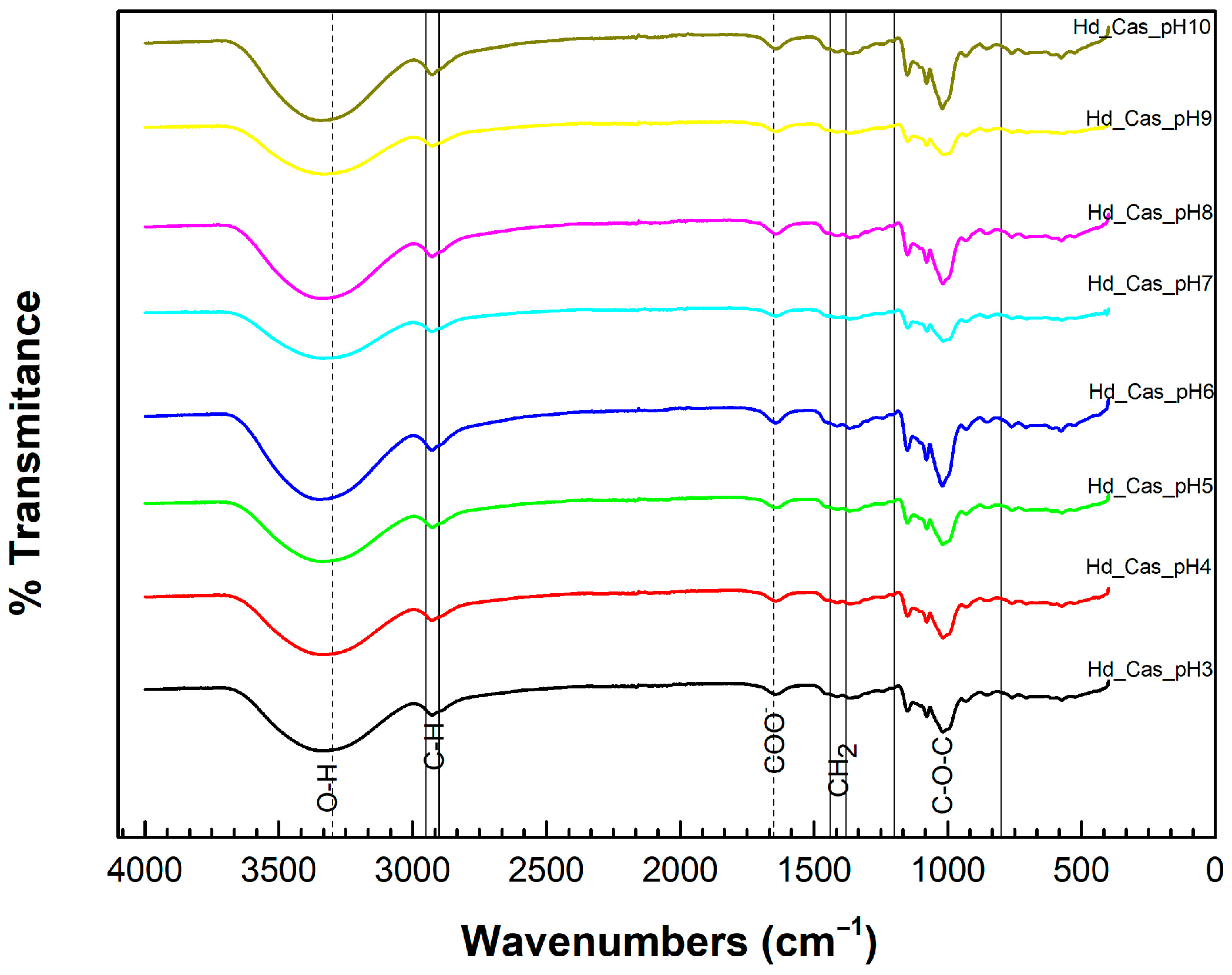
The FT-IR spectra of cassava hydrocolloids obtained at different extraction pH levels are presented in Figure 1. The spectral profiles exhibited a characteristic pattern typical of polysaccharide structures, confirming the identity of the extracted material. The broad, intense absorption peak observed near 3300 cm−1 is attributed to the stretching vibrations of hydroxyl (O-H) groups [30]. The magnitude and broadening of this band are indicative of extensive intra- and intermolecular hydrogen bonding between the polymer chains, which plays a crucial role in the water-holding capacity of the hydrocolloids [30]. The absorption band in the 2950–2900 cm−1 region corresponds to C-H stretching vibrations [31], specifically related to the methyl and methylene groups within the carbohydrate ring of the polysaccharide backbone [32]. A prominent peak near 1640 cm−1 was observed in all samples; this is primarily associated with the bending vibrations of tightly absorbed water (O-H bending) or the asymmetric stretching of carboxylate groups (COO). This feature is strongly correlated with the hydrophilic nature of the hydrocolloids and the presence of bound water within the matrix [33]. In the lower frequency region, the peak between 1440 and 1380 cm−1 is assigned to CH2 symmetric bending vibrations [34]. The “fingerprint” region (1200–800 cm−1) provided further structural confirmation. The peak at 1157 cm−1 corresponds to C-O-C asymmetric stretching associated with C-O and C-C bending modes [35]. Furthermore, the distinctive absorption bands in the 1100–800 cm−1 range—specifically the peaks near 1020 cm−1—are characteristic of the C-O-C ring vibrations of carbohydrates and the stretching of glycosidic linkages (α-1,4 or α-1,6) that hold the glucose units together [34].
Crucially, as shown in Figure 1, the spectral patterns remained highly consistent across all extraction conditions (pH 3 to pH 10). No disappearance of functional groups or emergence of new degradation peaks was observed. This structural stability suggests that the modification of extraction pH does not chemically alter the primary polysaccharide backbone, validating the robustness of the extraction method for obtaining chemically stable hydrocolloids regardless of the acidity or alkalinity of the medium.

3.3. Technological Properties

The WHC is the ability of the material to hold water against gravity [36]. It is a functional property fundamentally dependent on the hydrophilic composition and network expansion of the cassava hydrocolloids [37]. The presence of available hydrophilic groups favors the interaction with water molecules through hydrogen bonding. As shown in Table 2, the Water Holding Capacity (WHC) varied considerably depending on the extraction pH. The maximum WHC was observed for Hd_Cas_pH6 (611.86 ± 11.17%), indicating a processing point where the polymeric structure retains high flexibility and an open network capable of entrapping large amounts of water. Conversely, the lowest WHC was observed for Hd_Cas_pH9 (359.05 ± 2.64%). This significant reduction is associated with the destabilization of the hydrocolloid structure under strongly alkaline conditions. This behavior may be attributed to partial depolymerization, a decrease in swelling capacity, or a conformational change that results in the greater exposure of hydrophobic (water-repelling) groups and a loss of structural order. This behavior reflects the influence of pH on the molecular conformation of the polymer chains. At extreme pH values, the ionization of functional groups generates electrostatic repulsion between polymer chains, favoring the expansion of the network and thus increasing water retention. However, the notable decrease in WHC at pH 9 suggests that strong inter-molecular associations, such as hydrogen bonds or specific alkaline-induced aggregation, may be strengthened at this point, leading to a more compact, less expansive structure that restricts water binding [38]. Notably, the observation of increasing values for Hd_Cas_pH4 and Hd_Cas_pH7 suggests a mechanism of enhanced hydration and conformational opening of the polysaccharide structure. This behavior is likely attributed to conditions where the carboxyl and/or hydroxyl groups become partially ionized, creating electrostatic repulsion that expands the polymeric network. Consequently, while lower values were noted under strictly near-neutral conditions, the overall WHC trend indicates that the optimal structural configuration for water retention occurs within the slightly acidic to neutral range. In this range, the hydrocolloid develops a maximal affinity for water, balancing structural integrity with swelling capacity. Furthermore, it is important to note that temperature also influences these interactions; increasing thermal energy weakens the inter-molecular hydrogen bonds between starch molecules, allowing water molecules to have a greater opportunity to form new bonds with the exposed hydroxyl groups, thereby increasing the overall WHC [39].
The OHC is essential for assessing functionality, as it quantifies the material’s ability to retain nonpolar substances, which is influenced by chemical composition, molecular structure, and porosity [40]. The OHC results show a significant increase (p < 0.05).
The Oil Holding Capacity (OHC) exhibited a marked increase as the extraction medium became more alkaline, reaching its peak values for Hd_Cas_pH9 and Hd_Cas_pH10. This enhancement is likely attributed to the exposure of buried hydrophobic groups within the hydrocolloid structure, induced by alkaline destabilization. The resulting increase in structural flexibility and disorder facilitates the physical entrapment and interaction of oil between the polymeric chains. Conversely, at acidic pH levels (Hd_Cas_pH3 and Hd_Cas_pH4), OHC values were significantly lower. This reduction is linked to a more compact and rigid molecular network caused by the protonation of functional groups, which limits the availability of hydrophobic sites and restricts oil absorption. The overall trend suggests that alkalinization significantly enhances the hydrocolloid’s affinity for oily phases, primarily through the unfolding of less polar structural segments.
In summary, the functional behavior can be categorized into three distinct zones: (i) the acidic region (Hd_Cas_pH3 and Hd_Cas_pH4), characterized by moderate WHC and low OHC due to a compact, protonated structure; (ii) the slightly acidic-to-neutral region (Hd_Cas_pH5, Hd_Cas_pH6, and Hd_Cas_pH7), where maximum WHC occurs due to greater ionization and subsequent swelling; and (iii) the alkaline region (Hd_Cas_pH9 and Hd_Cas_pH10), where maximum OHC is achieved via structural unfolding and the exposure of hydrophobic moieties.

3.4. Rheological Properties

The rheological properties of cassava hydrocolloids explain how the material flows and deforms when subjected to applied forces. They also establish a quality control method for product development and processing calculations [39]. These properties are essential for understanding their functionality in various systems. These characteristics depend on variables such as hydrocolloids concentration, temperature, and pH levels.
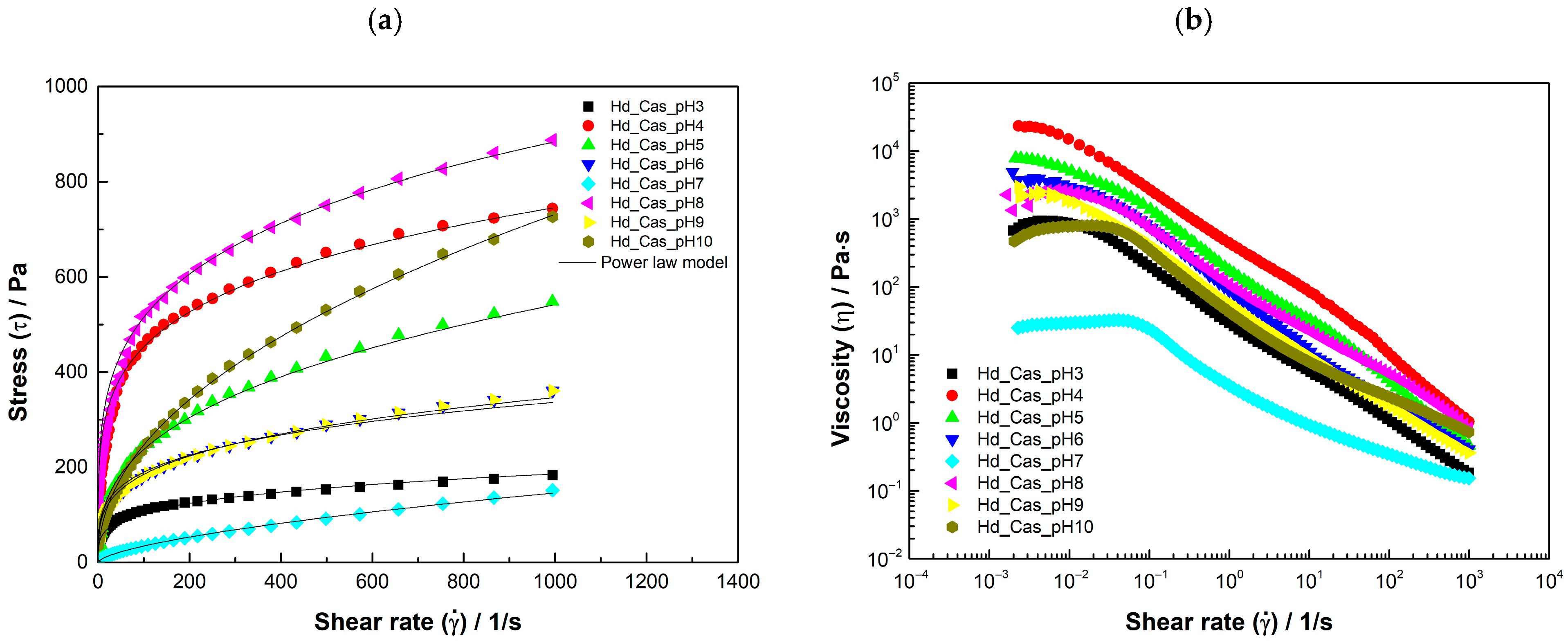
Figure 2 shows the flow behavior of hydrocolloids from cassava. The samples showed shear-thinning behavior and could be well described by the Power Law (Ostwald-de Waele) model (Equation (3)).
The Power Law model parameters are presented in Table 3. The high coefficients of determination (R2 > 0.90) indicate an excellent fit of the experimental data to the model. In all samples, the flow behavior index, n, was below 1, denoting a pseudoplastic non-Newtonian (shear-thinning) behavior, characterized by a decrease in apparent viscosity with increasing shear rates (Figure 2b). The observation means that at low shear rates, higher shear stress is required to maintain the fluid flow (i.e., high viscosity); however, at elevated shear rates the viscosity is decreased exponentially, attributed to the presence of high molecular weight materials [41,42].
The strongest pseudoplastic behavior was observed for Hd_Cas_pH4 (n = 0.21), followed by Hd_Cas_pH8, Hd_Cas_pH6, Hd_Cas_pH3, and Hd_Cas_pH9 (n values between 0.24 and 0.27). Significantly higher n values were observed for Hd_Cas_pH5 and Hd_Cas_pH10, while the weakest pseudoplastic behavior was observed for Hd_Cas_pH7, which displayed the highest flow behavior index (n = 0.62). A lower flow behavior index (n) signifies a greater deviation from Newtonian flow; therefore, these results suggest that samples extracted at pH 4 and pH 8 exhibit the highest sensitivity to shear rate, corresponding to a more rapid structural breakdown compared to the pH 7 sample. The higher pseudoplasticity implies that shear rate effectively favors molecular disentanglement, leading to uncross-linked molecules that offer less resistance to flow than entangled superstructures [16,39]. This behavior is often attributed to the influence of hydrogen bonding within the aqueous medium acting as a plasticizer, which enhances molecular mobility and reduces torsional constraints [43]. The consistency index (K), which reflects the apparent viscosity at a shear rate of 1 s−1, varied significantly with solubilization pH. The highest values were recorded for Hd_Cas_pH8 (175.30 ± 0.10 Pa sn) and Hd_Cas_pH4 (167.34 ± 1.10 Pa sn) while the lowest was found for Hd_Cas_pH7 (1.91 ± 0.06 Pa sn). Higher K values generally indicate increased viscosity and greater resistance to flow, attributable to enhanced intermolecular interactions.
This is the result of an orientation effect. As shear rate increases, the long chain of polymer molecules and randomly positioned chains become increasingly aligned in the direction of flow resulting in less interaction between adjacent polymer chains. Similar results have been obtained for flaxseed gum [44] pectin, gums, cellulose and carrageenan [41,45,46,47].
Dynamic analysis is crucial for determining the viscoelasticity and structural behavior of the hydrocolloids under alternating stress, essential for quality control and predicting material behavior under processing conditions [16,39].
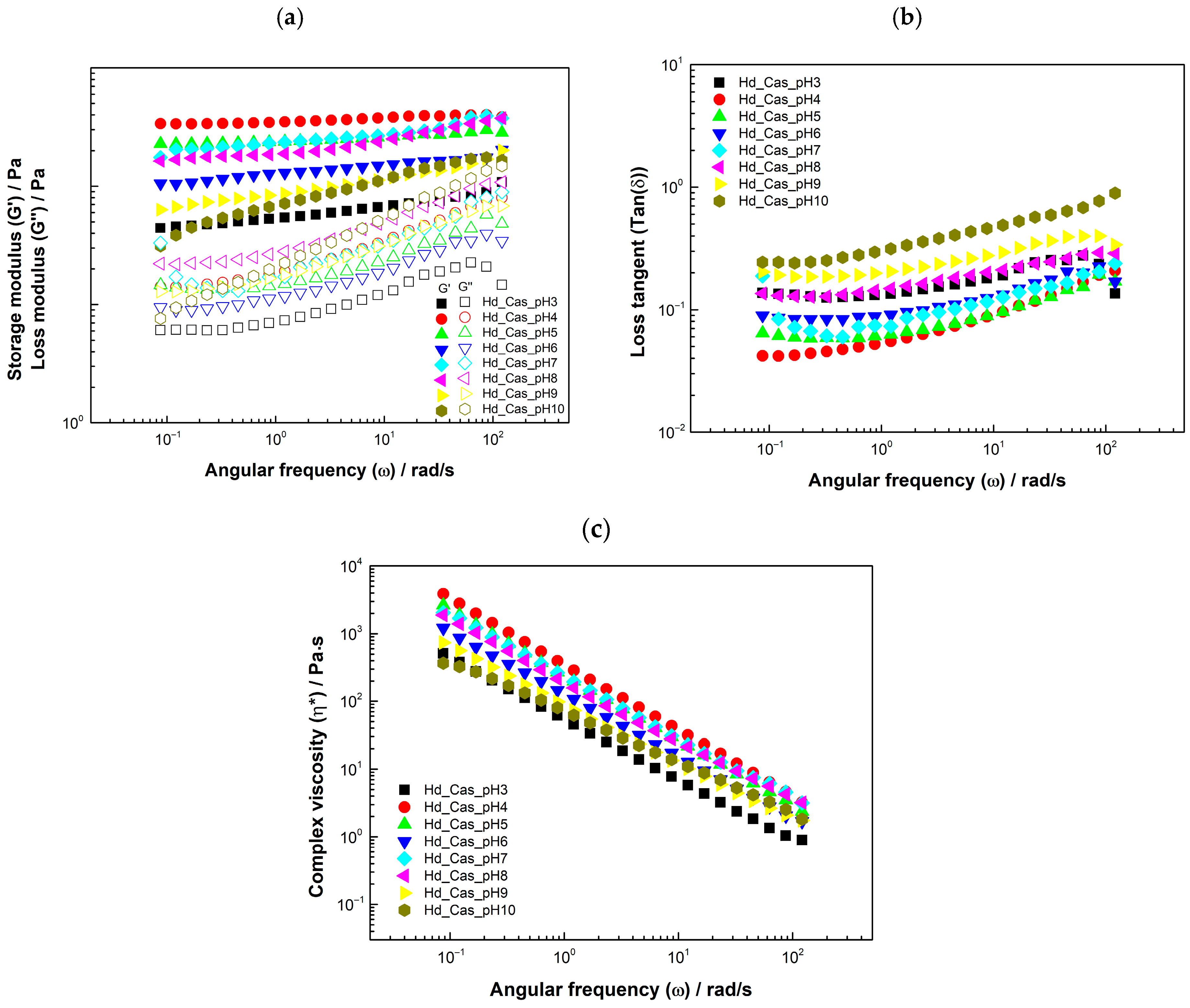
The viscoelastic behavior of the cassava hydrocolloids is illustrated in Figure 3. Specifically, Figure 3a displays the frequency dependence of the elastic response (storage modulus, G′) and the viscous response (loss modulus, G″). To quantitatively evaluate the influence of extraction pH, the viscoelastic parameters at an angular frequency of 6.28 rad/s are summarized in Table 4. In all investigated cases, G′ consistently exceeded G″ across the analyzed frequency range, indicating a predominant solid-like or gel-like structural behavior. Regarding elasticity, Hd_Cas_pH4 exhibited the highest storage modulus, followed by Hd_Cas_pH7, Hd_Cas_pH5, and Hd_Cas_pH8; notably, Hd_Cas_pH3 displayed the lowest elastic properties. In terms of the viscous component, Hd_Cas_pH10 presented the highest loss modulus, followed by Hd_Cas_pH8. Significant differences were observed for Hd_Cas_pH4, Hd_Cas_pH7, and Hd_Cas_pH6, while the lowest viscous response was again observed for Hd_Cas_pH3.
The loss tangent (Tan δ = G″/G′) presented in Figure 3b provides a quantitative measure of this viscoelasticity. In all cases, Tan δ was less than 1, indicating a predominantly elastic (solid-like) behavior [39]. The Tan δ values corroborate that Hd_Cas_pH4 exhibits the strongest elastic properties (lowest Tan δ), whereas Hd_Cas_pH10 shows the weakest elastic dominance (highest Tan δ). This pronounced solid-like state at low pH is generally attributed to the formation of more rigid and elastic structures [37]. Conversely, the higher Tan δ observed for Hd_Cas_pH10 suggests a weaker structural network. Furthermore, at neutral pH (pH 7), Tan δ values remain distinctive and below 1, confirming the sensitivity of the viscoelastic network to the surrounding medium and indicating that, despite the specific extraction conditions, the elastic character prevails. Although all hydrocolloid extracts displayed solid-like behavior (Tan δ < 1) across the frequency range, a clear distinction was observed based on extraction pH. The specific emphasis on samples extracted under acidic conditions (pH 3, 4, and 5) arises from their significantly lower Tan δ values compared to the neutral and alkaline extracts. A lower Tan δ indicates a larger separation between the elastic (G′) and viscous (G″) moduli, reflecting a more rigid and structured elastic network with higher energy storage capability. In contrast, extracts obtained near neutral pH exhibited Tan δ values closer to 1, suggesting a softer, more relaxed gel structure. Therefore, while all samples form gels, the acidic extraction environment promotes stronger intermolecular associations, resulting in superior elastic dominance.
Complex viscosity (η*) allows for the characterization of viscoelastic behavior under dynamic conditions. As shown in Figure 3c, η* exhibited a linear decrease in all samples as a function of angular frequency. This marked tendency towards pseudoplastic behavior confirms the findings from the stationary assay. The sample Hd_Cas_pH4 presents the highest viscous while Hd_Cas_pH3 was the least viscous under dynamic conditions. This shear-thinning is likely due to the shear-induced alignment of particles present in the samples, a behavior observed in other complex hydrocolloids like xanthan gum [48,49].
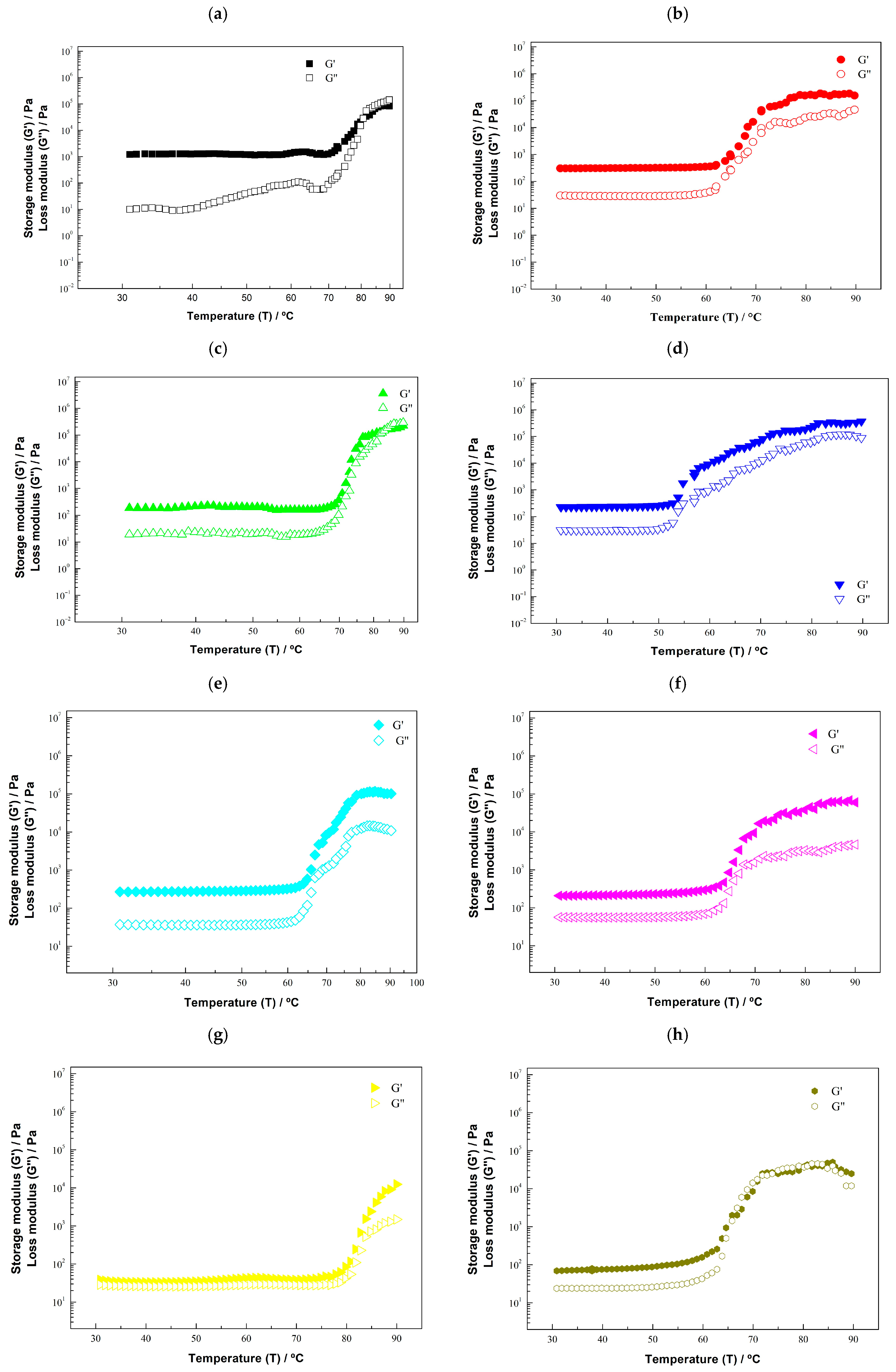
The analysis of the temperature sweep (Figure 4) is paramount for determining the thermal stability of the polymer network and predicting hydrocolloid behavior during processing. The effect of temperature on the variation in G′ and G″ of hydrocolloids expose the phase transitions and elasticity and allows the selection of appropriate temperature ranges for the formulation and their application into food products.
For all samples, the storage modulus (G′) remained higher than the loss modulus (G″) throughout the entire temperature range, denoting consistent solid-like behavior. The moduli generally remained stable from 30 °C up to approximately 65 °C, signifying excellent thermal stability in typical processing conditions. Above 65–70 °C, the samples exhibited a thermorheological transition characterized by an increase in G′, suggesting a heat-induced structural reorganization of the polymer chains. While the final elastic moduli for all samples converged within the same order of magnitude (approximately 105 Pa), the nature of this transition was pH dependent. The neutral-to-alkaline extracts (Hd_Cas_pH7 to Hd_Cas_pH10) showed the most robust transitions with a steady structural reinforcement. Conversely, acidic extracts (e.g., Hd_Cas_pH4 and Hd_Cas_pH6) displayed a less pronounced transition. This suggests that the lower molecular weight polymers resulting from acid hydrolysis are less efficient at forming stable, thermally induced networks compared to the intact chains in alkaline extracts [50]. The increase in viscoelasticity at high temperatures is likely driven by the exposure of hydrophobic groups and increased molecular entanglement, which compensates for the weakening of hydrogen bonds. In conclusion, while all hydrocolloids exhibit thermal tolerance, the optimal heat-induced gelation potential is achieved in the neutral-to-alkaline extraction range.

4. Conclusions

Hydrocolloids were successfully extracted from cassava (Manihot esculenta), with extraction yields maximized at the pH extremes, confirming that polymer solubility is favored far from neutral conditions. Proximal analysis indicated that the extract obtained at pH 10 contained the highest co-extracted protein content, while fat content remained negligible (<0.05%) across all samples, consistent with a typical high-purity polysaccharide profile. Also, the variations in extraction pH do not induce chemical modifications in the main polysaccharide backbone.
Extracts obtained at slightly acidic to neutral pH (pH 5–7) displayed maximum WHC, while alkaline extraction (pH 9–10) favored OHC. All samples exhibited desirable pseudoplastic (shear-thinning) flow, characteristic of effective thickeners. Notably, Hd_Cas_pH4 demonstrated the strongest pseudoplastic behavior (n = 0.21) and the highest elastic modulus (G′), indicating superior structural rigidity and thickening efficiency. Based on the convergence of high yield, strong viscoelastic properties, and distinct functional capabilities, emerging as the most promising candidate for industrial applications requiring structural reinforcement.
Overall, these findings position cassava hydrocolloids as a viable, natural alternative for the food industry, offering versatile functional characteristics for emulsion stabilization, gel formation, and texture improvement.

Author Contributions

Conceptualization, V.O.-C., S.E.Q. and L.A.G.-Z.; methodology, V.O.-C., S.E.Q. and L.A.G.-Z.; software, V.O.-C. and S.E.Q.; validation, V.O.-C., S.E.Q. and L.A.G.-Z.; formal analysis, V.O.-C. and S.E.Q.; investigation, V.O.-C.; resources, V.O.-C., S.E.Q. and L.A.G.-Z.; data curation, V.O.-C. and S.E.Q.; writing—original draft preparation, V.O.-C. and S.E.Q.; writing—review and editing, V.O.-C., S.E.Q. and L.A.G.-Z.; visualization, V.O.-C., S.E.Q. and L.A.G.-Z.; supervision, V.O.-C., S.E.Q. and L.A.G.-Z.; project administration, V.O.-C., S.E.Q. and L.A.G.-Z.; funding acquisition, V.O.-C., S.E.Q. and L.A.G.-Z. All authors have read and agreed to the published version of the manuscript.

Funding

This research was provided by the Universidad de Cartagena through the Strengthening Plan for Research Groups (Resolution 044-2021) and Project Code No. 065-2022.

Institutional Review Board Statement

Not applicable.

Informed Consent Statement

Not applicable.

Data Availability Statement

The data presented in this study are available within the article.

Acknowledgments

This research was provided by the Universidad de Cartagena through the Strengthening Plan for Research Groups (Resolution 044-2021) and Project Code No. 065-2022.

Conflicts of Interest

The authors declare no conflicts of interest.

References

  1. Gawai, K.M.; Mudgal, S.P.; Prajapati, J.B. Stabilizers, Colorants, and Exopolysaccharides in Yogurt; Academic Press: London, UK, 2017. [Google Scholar]
  2. O’Sullivan, J.J.; O’Mahony, J.A. Food Ingredients. In Reference Module in Food Science; Elsevier: Amsterdam, The Netherlands, 2016. [Google Scholar] [CrossRef]
  3. Vera, N.; Laguna, L.; Zura, L.; Puente, L.; Muñoz , L. Evaluation of the physical changes of different soluble fibres produced during an in vitro digestion. J. Funct. Foods 2019, 62, 103518. [Google Scholar] [CrossRef]
  4. Zhang, N.; Zhou, Q.; Fan, D.; Xiao, J.; Zhao, Y.; Cheng, K.-W.; Wang, M. Novel Roles of Hydrocolloids in Foods: Inhibition of Toxic Maillard Reaction Products Formation and Attenuation of Their Harmful Effects. Trends Food Sci. Technol. 2021, 111, 706–715. [Google Scholar] [CrossRef]
  5. Saha, D.; Bhattacharya, S. Hydrocolloids as Thickening and Gelling Agents in Food: A Critical Review. J. Food Sci. Technol. 2010, 47, 587–597. [Google Scholar] [CrossRef] [PubMed]
  6. Yemenicioğlu, A.; Farris, S.; Turkyilmaz, M.; Gulec, S. A Review of Current and Future Food Applications of Natural Hydrocolloids. Int. J. Food Sci. Technol. 2020, 55, 1389–1406. [Google Scholar] [CrossRef]
  7. Gao, Y.; Liu, R.; Liang, H. Food Hydrocolloids: Structure, Properties, and Applications. Foods 2024, 13, 1077. [Google Scholar] [CrossRef] [PubMed]
  8. Fuentes Cárdenas, C.E. El Cultivo de la Yuca (Manihot esculenta Crantz) en Santander; Instituto Colombiano Agropecuario “ICA”, Regional siete: Cúcuta, Colombia, 1977; 29p.
  9. Del Rosario-Arellano, J.L.; Meneses-Márquez, I.; Leyva-Ovalle, O.R.; Aguilar-Rivera, N.; Bolio-López, G.I.; Andrés-Meza, P. Morphoagronomic and Industrial Performance of Cassava (Manihot esculenta Crantz) Germplasm for the Production of Starch and Solid Byproducts. AIMS Agric. Food 2020, 5, 617–634. [Google Scholar] [CrossRef]
  10. Weligama Thuppahige, V.T.; Moghaddam, L.; Welsh, Z.G.; Wang, T.; Xiao, H.W.; Karim, A. Extraction and Characterisation of Starch from Cassava (Manihot esculenta) Agro-Industrial Wastes. LWT 2023, 182, 114787. [Google Scholar] [CrossRef]
  11. Setyaningsih, W.; Karmila; Fathimah, R.N.; Cahyanto, M.N. Process Optimization for Ultrasound-Assisted Starch Production from Cassava (Manihot esculenta Crantz) Using Response Surface Methodology. Agronomy 2021, 11, 117. [Google Scholar] [CrossRef]
  12. López-Barraza, D.; Ortega-Ramos, A.; Torregroza-Fuentes, E.; Quintana, S.E.; García-Zapateiro, L.A. Rheological and Functional Properties of Hydrocolloids from Pereskia bleo Leaves. Fluids 2021, 6, 349. [Google Scholar] [CrossRef]
  13. AOAC. Association of Official Analytical Chemist. In Official Methods of Analysis, 17th ed.; AOAC: Gaithersburg, MD, USA, 2000. [Google Scholar]
  14. Dubois, M.; Gilles, J.K.; Hamilton, J.K.; Rebers, P.A.; SMith, F. Colorimetric Method for Determination of Sugars and Related Substances|Analytical Chemistry. Anal. Chem. 1956, 28, 350–356. [Google Scholar] [CrossRef]
  15. Mieles-Gómez, L.; Lastra-Ripoll, S.E.; Torregroza-Fuentes, E.; Quintana, S.E.; García-Zapateiro, L.A. Rheological and Microstructural Properties of Oil-in-Water Emulsion Gels Containing Natural Plant Extracts Stabilized with Carboxymethyl Cellulose/Mango (Mangiferaindica) Starch. Fluids 2021, 6, 312. [Google Scholar] [CrossRef]
  16. Quintana-Martínez, S.E.; Torregroza-Fuentes, E.E.; García-Zapateiro, L.A. Food Hydrocolloids from Butternut Squash (Cucurbita moschata) Peel: Rheological Properties and Their Use in Carica papaya Jam. ACS Omega 2021, 6, 12114–12123. [Google Scholar] [CrossRef] [PubMed]
  17. Souza Rocha, M.; Célio Souza Rocha, L.; Barreto da Silva Feijó, M.; Luiza Limongi dos Santos Marotta, P.; Cardozo Mourão, S. Effect of PH on the Flaxseed (Linum usitatissimum L. Seed) Mucilage Extraction Process. Acta Sci. Technol. 2021, 43, e50457. [Google Scholar] [CrossRef]
  18. Ahmad Lodhi, B.; Ajaz Hussain, M.; Sher, M.; Tahir Haseeb, M.; Umer Ashraf, M.; Zajif Hussain, S.; Hussain, I.; Nasir Abbas Bukhari, S. Polysaccharide-Based Superporous, Superabsorbent, and Stimuli Responsive Hydrogel from Sweet Basil: A Novel Material for Sustained Drug Release. Adv. Polym. Technol. 2019, 2019, 9583516. [Google Scholar] [CrossRef]
  19. Chandanasree, D.; Gul, K.; Riar, C.S. Effect of Hydrocolloids and Dry Heat Modification on Physicochemical, Thermal, Pasting and Morphological Characteristics of Cassava (Manihot esculenta) Starch. Food Hydrocoll. 2016, 52, 175–182. [Google Scholar] [CrossRef]
  20. Mu, X.; Shi, W.; Sun, L.; Li, H.; Jiang, Z.; Zhang, L. Functional and Preliminary Characterisation of Hydrocolloid from Tamarillo (Solanum betaceum Cav.) Puree. Molecules 2012, 17, 6869–6885. [Google Scholar] [CrossRef]
  21. Quintana, S.E.; Torregroza-Fuentes, E.; García Zapateiro, L.A. Development of Dressing-Type Emulsion with Hydrocolloids from Butternut Squash Seed: Effect of Additives on Emulsion Stability. Gels 2022, 8, 209. [Google Scholar] [CrossRef]
  22. Zhao, Y.; Khalesi, H.; He, J.; Fang, Y. Application of Different Hydrocolloids as Fat Replacer in Low-Fat Dairy Products: Ice Cream, Yogurt and Cheese. Food Hydrocoll. 2023, 138, 108493. [Google Scholar] [CrossRef]
  23. Medina-López, S.V.; Zuluaga-Domínguez, C.M.; Fernández-Trujillo, J.P.; Hernández-Gómez, M.S. Nonconventional Hydrocolloids’ Technological and Functional Potential for Food Applications. Foods 2022, 11, 401. [Google Scholar] [CrossRef]
  24. Otálora, M.C.; Wilches-Torres, A.; Gómez Castaño, J.A. Mucilage from Yellow Pitahaya (Selenicereus megalanthus) Fruit Peel: Extraction, Proximal Analysis, and Molecular Characterization. Molecules 2023, 28, 786. [Google Scholar] [CrossRef]
  25. Keshani-Dokht, S.; Emam-Djomeh, Z.; Yarmand, M.S.; Fathi, M. Extraction, Chemical Composition, Rheological Behavior, Antioxidant Activity and Functional Properties of Cordia Myxa Mucilage. Int. J. Biol. Macromol. 2018, 118, 485–493. [Google Scholar] [CrossRef] [PubMed]
  26. Guldiken, B.; Saffon, M.; Nickerson, M.T.; Ghosh, S. Improving Physical Stability of Pea Protein-Based Emulsions near the Isoelectric Point via Polysaccharide Complexation. Food Hydrocoll. 2023, 145, 109029. [Google Scholar] [CrossRef]
  27. Alba, K.; Laws, A.P.; Kontogiorgos, V. Isolation and Characterization of Acetylated LM-Pectins Extracted from Okra Pods. Food Hydrocoll. 2015, 43, 726–735. [Google Scholar] [CrossRef]
  28. Amiri, S.; Nabizadeh, F.; Rezazad Bari, L. A Novel Source of Food Hydrocolloids from Trigonella Elliptica Seeds: Extraction of Mucilage and Comprehensive Characterization. J. Sci. Food Agric. 2022, 102, 7144–7154. [Google Scholar] [CrossRef]
  29. Uhumwangho, M.U.; Louis Ileje, I. Preliminary Evaluation of the Suspending Properties of Brachystegia Eurycoma Gum on Metronidazole Suspension. Int. Curr. Pharm. J. 2014, 3, 328–330. [Google Scholar] [CrossRef]
  30. Agorku, E.S.; Kangmennaa, A.; Danu, B.Y.; Ampong, F.K.; Voegborlo, R.B. Core-Shell V2O5Gum Ghatti Grafted Poly (Acrylamide-Co-Methacrylic Acid) Adsorbent for the Removal of Methylene Blue Dye in Water: Kinetic, Equilibrium and Thermodynamic Studies. Next Sustain. 2025, 5, 100069. [Google Scholar] [CrossRef]
  31. Dave, P.N.; Chopda, L.V.; Kamaliya, B.P. Adsorption of Metformin Hydrochloride and Sodium Diclofenac over Gum Ghatti-g-Poly(NIPAM-co-AA)/-o-MWCNT. Next Mater. 2024, 4, 100190. [Google Scholar] [CrossRef]
  32. Maity, J.; Ray, S.K. Synthesis, Characterization and Column Adsorption Properties of Gum Ghatti and Water Hyacianth Derived Cellulose Grafted Poly(Vinyl Sulfonic Acid-co-Acrylamide) Composites. Int. J. Biol. Macromol. 2024, 268, 131652. [Google Scholar] [CrossRef]
  33. Jan, R.; Saxena, D.C.; Singh, S. Pasting, Thermal, Morphological, Rheological and Structural Characteristics of Chenopodium (Chenopodium album) Starch. LWT-Food Sci. Technol. 2016, 66, 267–274. [Google Scholar] [CrossRef]
  34. Lu, W.C.; Chan, Y.J.; Li, Z.E.; Li, P.H. Influence of Different Hydrocolloids on the Pasting, Rheological, and Morphological Characteristics of Heat Gelatinized Cassava Starch. Food Chem. 2025, 463, 140933. [Google Scholar] [CrossRef]
  35. Lastra-Ripoll, S.E.; Quintana, S.E.; García-Zapateiro, L.A. Chemical, Technological, and Rheological Properties of Hydrocolloids from Sesame (Sesamum indicum) with Potential Food Applications. Arab. J. Chem. 2022, 15, 104146. [Google Scholar] [CrossRef]
  36. Mariod, A.A. Functional Properties of Gum Arabic. In Gum Arabic: Structure, Properties, Application and Economics; Elsevier: Amsterdam, The Netherlands, 2018; pp. 283–295. [Google Scholar] [CrossRef]
  37. Ospina, K. Estudio de la Interacción de Hidrocoloides Empleados en Alimentos y su Efecto en las Propiedades Reológicas y de Textura Sensorial e Instrumental. Master’s Thesis, Universidad Nacional de Colombia, Bogotá, Colombia, 2016. [Google Scholar]
  38. Kovačević, J.; Wurm, F.; Pham, T.; Bechtold, T. Influence of Chickpea Protein on the PH and Temperature Dependent Viscosity of Carboxymethylated Starch. Int. J. Biol. Macromol. 2024, 280, 136170. [Google Scholar] [CrossRef] [PubMed]
  39. Han, X.; Liang, Q.; Rashid, A.; Qayum, A.; Rehman, A.; Zhong, M.; Sun, Y.; Liu, Y.; Ma, H.; Miao, S.; et al. The Effects of Different Hydrocolloids on Lotus Root Starch Gelatinization and Gels Properties. Int. J. Biol. Macromol. 2024, 257, 128562. [Google Scholar] [CrossRef] [PubMed]
  40. Ribeiro, S.; Almeida, R.; Batista, L.; Lima, J.; Sarinho, A.; Nascimento, A.; Lisboa, H. Investigation of Guar Gum and Xanthan Gum Influence on Essential Thyme Oil Emulsion Properties and Encapsulation Release Using Modeling Tools. Foods 2024, 13, 816. [Google Scholar] [CrossRef]
  41. Barnes, H. A Handbook of Elementary Rheology; University of Wales, Institute of Non-Newtonian Fluid Mechanics: Swansea, UK, 2000. [Google Scholar]
  42. Morris, E.R.; Cutler, A.N.; Ross-Murphy, S.B.; Rees, D.A.; Price, J. Concentration and Shear Rate Dependence of Viscosity in Random Coil Polysaccharide Solutions. Carbohydr. Polym. 1981, 1, 5–21. [Google Scholar] [CrossRef]
  43. Alpizar-Reyes, E.; Román-Guerrero, A.; Gallardo-Rivera, R.; Varela-Guerrero, V.; Cruz-Olivares, J.; Pérez-Alonso, C. Rheological Properties of Tamarind (Tamarindus indica L.) Seed Mucilage Obtained by Spray-Drying as a Novel Source of Hydrocolloid. Int. J. Biol. Macromol. 2018, 107, 817–824. [Google Scholar] [CrossRef]
  44. Wang, Y.; Wang, L.J.; Li, D.; Xue, J.; Mao, Z.H. Effects of Drying Methods on Rheological Properties of Flaxseed Gum. Carbohydr. Polym. 2009, 78, 213–219. [Google Scholar] [CrossRef]
  45. Wang, Y.; Li, D.; Wang, L.J.; Li, S.J.; Adhikari, B. Effects of Drying Methods on the Functional Properties of Flaxseed Gum Powders. Carbohydr. Polym. 2010, 81, 128–133. [Google Scholar] [CrossRef]
  46. Wang, Y.; Wang, L.J.; Li, D.; Özkan, N.; Chen, X.D.; Mao, Z.H. Effect of Flaxseed Gum Addition on Rheological Properties of Native Maize Starch. J. Food Eng. 2008, 89, 87–92. [Google Scholar] [CrossRef]
  47. Koocheki, A.; Mortazavi, S.A.; Shahidi, F.; Razavi, S.M.A.; Taherian, A.R. Rheological Properties of Mucilage Extracted from Alyssum homolocarpum Seed as a New Source of Thickening Agent. J. Food Eng. 2009, 91, 490–496. [Google Scholar] [CrossRef]
  48. Razavi, S.M.A.; Alghooneh, A. Understanding the physics of hydrocolloids interaction using rheological, thermodynamic and functional properties: A case study on xanthan gum-cress seed gum blend. Int. J. Biol. Mol. 2020, 151, 1139–1153. [Google Scholar] [CrossRef]
  49. Taki, A.; John, B.; Arakawa, S.; Okamoto, M. Structure and Rheology of Nanocomposite Hydrogels Composed of DNA and Clay. Eur. Polym. J. 2013, 49, 923–931. [Google Scholar] [CrossRef]
  50. Salcedo, J. Comportamiento Viscoelástico de Masas Para Pastas Suplementadas Con Hidrocoloides y Fibra Efecto de La Goma Xantana En El Comportamiento Reológico de Cremas Instantáneas de Harina de Pescado. Agron. Colomb. 2016, 1, S442–S445. [Google Scholar]
Figure 1. FTIR spectrum of hydrocolloids from cassava.
Polysaccharides 07 00021 g001
Figure 2. Flow curve of hydrocolloids from cassava. (a) flow curve and (b) viscous flow curve.
Polysaccharides 07 00021 g002
Figure 3. (a) Storage and Loss modulus, (b) Loss tangent and (c) Complex viscosity of hydrocolloids from cassava.
Polysaccharides 07 00021 g003
Figure 4. Temperature sweep of cassava hydrocolloids. (a) Hd_Cas_pH3, (b) Hd_ Cas_pH4, (c) Hd_ Cas_pH5, (d) Hd_ Cas_pH6, (e) Hd_ Cas_pH7, (f) Hd_ Cas_pH8, (g) Hd_ Cas_pH9 y (h) Hd_ Cas_pH10.
Polysaccharides 07 00021 g004
Table 1. Yield and proximal composition of hydrocolloids from cassava.
No.Sample CodeYield
%
Moisture
%
Protein
%
Ash
%
Carbohydrates
%
1.Hd_Cas_pH328.25 ± 1.77 ab13.04 ± 0.40 a2.34 ± 0.18 c0.08 ± 0.12 a84.76 ± 1.07 b
2.Hd_Cas_pH421.75 ± 1.06 cd13.20 ± 0.48 a5.54 ± 0.23 b0.88 ± 0.20 a80.28 ± 0.45 ab
3.Hd_Cas_pH517.80 ± 1.13 de12.94 ± 0.68 a8.37 ± 0.26 c0.56 ± 0.16 a78.03 ± 1.05 a
4.Hd_Cas_pH616.25 ± 1.77 e13.23 ± 0.91 a8.00 ± 0.28 b0.96 ± 0.08 a77.68 ± 1.03 a
5.Hd_Cas_pH727.50 ± 0.71 ab12.81 ± 1.58 a5.90 ± 0.27 ab0.60 ± 0.20 a80.56 ± 1.98 ab
6.Hd_Cas_pH824.00 ± 1.41 bc12.19 ± 1.32 a6.64 ± 0.29 ab0.37 ± 0.12 a80.67 ± 1.65 ab
7.Hd_Cas_pH929.50 ± 1.41 a13.39 ± 0.21 a4.60 ± 0.19 b0.73 ± 0.12 a81.19 ± 0.23 ab
8.Hd_Cas_pH1024.50 ± 0.71 abc13.34 ± 0.21 a9.02 ± 0.31 a0.78 ± 0.04 a76.71 ± 0.40 a
Fat < 0.05% Data are presented as mean ± standard deviation. Different letters in the same column indicate a statistically significant difference (p < 0.05).
Table 2. Water holding capacity (WHC) and oil holding capacity (OHC) of hydrocolloids from cassava.
No.Sample CodeWHCOHC
1.Hd_Cas_pH3461.68 ± 15.42 b104.63 ± 6.34 a
2.Hd_Cas_pH4586.36 ± 53.29 d182.43 ± 15.57 d
3.Hd_Cas_pH5575.47 ± 28.47 d143.61 ± 0.02 c
4.Hd_Cas_pH6611.86 ± 11.17 e164.90 ± 7.61 c
5.Hd_Cas_pH7585.72 ± 30.35 d136.84 ± 5.43 b
6.Hd_Cas_pH8537.33 ± 51.21 c158.09 ± 9.26 c
7.Hd_Cas_pH9359.05 ± 2.64 a193.44 ± 7.18 d
8.Hd_Cas_pH10531.48 ± 4.98 c227.39 ± 3.41 e
Data are presented as mean ± standard deviation. Different letters in the same column indicate a statistically significant difference (p < 0.05).
Table 3. Parameters value of hydrocolloids from cassava.
No.Sample CodeKnR2
1.Hd_Cas_pH332.92 ± 0.49 b0.25 ± 0.00 a0.99
2.Hd_Cas_pH4167.34 ± 1.10 d0.21 ± 0.01 a0.91
3.Hd_Cas_pH545.67 ± 4.21 c0.35 ± 0.01 b0.95
4.Hd_Cas_pH660.01 ± 3.35 c0.24 ± 0.01 a0.90
5.Hd_Cas_pH71.91 ± 0.06 a0.62 ± 0.00 c0.99
6.Hd_Cas_pH8175.30 ± 0.10 d0.23 ± 0.00 a0.95
7.Hd_Cas_pH953.80 ± 0.91 c0.27 ± 0.00 a0.99
8.Hd_Cas_pH1028.08 ± 0.95 b0.47 ± 0.00 b0.99
Data are presented as mean ± standard deviation. Different letters in the same column indicate a statistically significant difference (p < 0.05).
Table 4. Viscoelastic parameters of hydrocolloids from cassava (Manihot esculenta).
No.Sample Code G ω = 6.28   rad/s G ω = 6.28   rad/s Tan δ ω = 6.28   rad/s η * ω = 6.28   rad/s
1.Hd_Cas_pH364.15 d10.91 a0.17 b10.36 a
2.Hd_Cas_pH4370.40 a29.55 d0.07 a59.14 f
3.Hd_Cas_pH5254.21 a20.86 c0.08 a40.59 e
4.Hd_Cas_pH6145.03 b16.88 b0.11 a23.23 c
5.Hd_Cas_pH7262.20 a28.58 d0.10 a41.98 e
6.Hd_Cas_pH8226.32 a43.20 e0.19 b36.67 d
7.Hd_Cas_pH9107.44 c28.12 d0.26 c17.67 b
8.Hd_Cas_pH10101.72 c44.04 e0.43 d17.64 b
Data are presented as mean ± standard deviation. Different letters in the same column indicate a statistically significant difference (p < 0.05).
Disclaimer/Publisher’s Note: The statements, opinions and data contained in all publications are solely those of the individual author(s) and contributor(s) and not of MDPI and/or the editor(s). MDPI and/or the editor(s) disclaim responsibility for any injury to people or property resulting from any ideas, methods, instructions or products referred to in the content.