1. Introduction
Soft growing robots, often referred to as vine robots, are a class of soft continuum robots that locomote by tip extension rather than by translating their entire body through the environment [
1,
2]. Their motion is enabled by pressure-driven eversion, in which a thin-walled flexible membrane is turned inside out and continuously deployed from the base toward the tip. As pressurized air drives the membrane material forward, the robot elongates through growth while the previously everted body remains largely stationary with respect to the environment [
1,
2]. This tip-growing mechanism provides important advantages over conventional mobile or continuum robots [
3,
4,
5], including reduced friction along the body, lower inertial loading, and improved ability to navigate confined spaces and cluttered environments [
6,
7].
Soft robots have become increasingly important in the medical field because their compliant bodies can conform to human anatomy, distribute contact pressure over larger areas, and reduce the risk of injury during close physical interaction [
8,
9]. Recent studies have demonstrated their potential in rehabilitation and assistive care, including wearable upper-limb devices, soft elbow rehabilitation muscles, and soft ankle-assist or ankle-rehabilitation systems, where compliance and adaptability are essential for safe and comfortable patient interaction [
10,
11,
12]. In the broader medical domain, soft robotic technologies are also being explored for wearable, implantable, diagnostic, therapeutic, and nursing-assistance applications [
8,
9,
13]. A wide range of soft actuation methods has been investigated for these systems, including pneumatic/fluidic actuation, cable-driven mechanisms, shape-memory alloys, electroactive polymers, and hydraulic strategies, each with different trade-offs in force output, response speed, portability, wearability, and system complexity [
9,
14]. In this work, pneumatic actuation was selected because it is particularly well suited to bedside patient repositioning: it provides intrinsic compliance and backdrivability, can generate distributed lifting forces over a large contact area, and enables bulky rigid components such as compressors or regulators to be located away from the patient [
15,
16,
17]. In addition, compared with thermally driven or high-voltage actuation strategies, pneumatic systems are especially attractive for human-centered assistive tasks because they combine mechanical softness with relatively simple and safe force generation [
9,
15]. These features make soft pneumatic robots a strong candidate for rehabilitation, assisted nursing, and other medical applications in which safety, comfort, and adaptability are critical [
8,
13].
One promising but largely unexplored application of soft growing robots is assisted patient turning and repositioning. In hospitals, nursing homes, and long-term care settings, repositioning immobile or weak patients is a routine and clinically important task for preventing pressure injuries and other complications associated with prolonged immobility [
18,
19]. Current pressure-injury-prevention guidance recommends regular repositioning and favors the use of approximately 30° lateral side-lying positioning over steeper side-lying postures for at-risk individuals [
20,
21]. In practice, however, repositioning is still frequently performed manually by caregivers using bed sheets, pillows, or other support aids, typically to move the patient from a supine posture to a side-lying posture. Such manual patient handling tasks are physically demanding and are a major source of musculoskeletal loading and injury among nurses and other direct-care workers [
22,
23,
24,
25]. The problem becomes even more challenging when caring for overweight or obese patients, for whom repositioning often requires greater exertion, additional caregiver assistance, and increased use of handling aids [
25,
26].
Several assistive technologies, including air-assisted lateral transfer devices, friction-reducing aids, lift systems, and positioning supports, have been introduced to reduce caregiver workload and improve patient safety [
20,
27]. In addition, support pillows and related positioning aids can be used to maintain lateral tilt and improve comfort during repositioning [
20]. Nevertheless, many existing solutions still depend on substantial caregiver effort, require external lifting or manual placement beneath the patient, or are difficult to deploy in the narrow clearance available between the patient and the bed surface. As a result, repeated repositioning several times per day remains labor-intensive, especially for high-dependency or obese patients [
22,
28]. These limitations motivate the development of a robotic mechanism that can deploy underneath the patient with minimal sliding resistance.
A soft pneumatic manipulator capable of sliding beneath the human body with minimal friction was proposed in [
29]. The device consists of two pneumatic chambers with distinct functions. The inner chamber is pressurized to generate a slip-in motion, allowing the manipulator to be inserted between the bed surface and the patient’s body, while the outer chamber is subsequently pressurized to produce bending and assist the patient in rolling over in bed. However, the reported setup relied on two separate manipulators positioned manually by the caregiver, typically at the shoulder and buttock regions, in order to generate the rolling motion.
In [
30], a pneumatically driven growing sling was proposed to assist with safe and comfortable patient transfer. The device was designed to exploit the growth mechanism of soft everting structures so that the sling could be inserted automatically and smoothly between the patient and the bed, thereby reducing the need for manual placement. To improve comfort and load support during lifting, the authors constrained the radial expansion of the inflatable beam by integrating rigid shafts into the membrane, which produced a flatter cross-sectional profile beneath the patient. This flattened geometry was better suited for supporting the body during transfer while maintaining the deployability of the sling. However, the system was primarily developed for patient transfer rather than controlled in-bed rolling or repositioning, and its operation still depends on a dedicated lifting configuration after insertion.
Recently, a soft growing robotic sling was developed in [
31] to enable safe harnessing and transfer of the full body weight of a human using a single caregiver. The proposed device employs a sheet-shaped everting sling that can automatically extend beneath the patient and retract after use, thereby reducing the need for manual placement. To obtain a geometry better suited for supporting the body, the radial expansion of the inflated cross-section was constrained using flexible strips attached along the outer membrane. This design produced a flatter and wider inflated profile while preserving the compliance of the soft structure. In addition, tubular loop fabrics were integrated into the sling so that the system could be connected to a Hoyer lift through external cables during patient lifting and transfer. Although this design significantly improves automatic placement and full-body support, it was primarily developed for harnessing and transfer rather than controlled in-bed rolling and repositioning.
In this paper, we propose a two-stage soft growing robot for safe and assisted patient repositioning. The proposed mechanism is designed to roll a patient from the supine posture toward a side-lying position through two sequential stages. It comprises two soft pneumatic chambers with distinct but complementary functions. The first chamber is used to achieve pressure-driven eversion, enabling the robot to slip smoothly beneath the patient with minimal friction. The second chamber is then pressurized to generate the lifting and rolling motion required for patient repositioning. Compared with existing hospital repositioning solutions, such as friction-reducing aids, air-assisted transfer systems, lift-based devices, and previously reported soft patient-handling systems, the proposed mechanism integrates low-friction insertion and active rolling assistance within a single platform, thereby avoiding the need for multiple separately positioned devices or a dedicated external hoist [
29,
30,
32,
33]. This integrated design is expected to reduce caregiver workload by decreasing the amount of manual pushing, pulling, and lifting required during repositioning, which is particularly important because manual patient handling is a major source of musculoskeletal loading in healthcare workers [
22,
33]. To describe the behavior of the proposed mechanism, a unified dynamic modeling and control framework is developed. The framework captures the deployment dynamics of the soft growing robot together with the pneumatic actuation effects governing its motion. Based on this model, a robust multi-stage nonlinear model predictive control (NMPC) strategy is formulated to regulate deployment beneath the patient in the presence of parameter uncertainties. In addition, the rolling dynamics of the second stage are analyzed to determine how patient weight and roll angle affect the minimum pressure required for assisted repositioning.
The remainder of the paper is organized as follows.
Section 2 introduces the design concept of the proposed two-stage soft growing robot.
Section 3 presents the dynamic model of the eversion-based soft growing robot, including the pneumatic supply system, internal pressure dynamics, and tip extension behavior. The rolling dynamics of the proposed mechanism are then described in
Section 4. In
Section 5, a robust multi-stage nonlinear model predictive control (NMPC) scheme is developed to control the deployment of the robot beneath the patient.
Section 6 presents and discusses the simulation results. Finally, concluding remarks and directions for future work are provided in
Section 7.
2. Two-Stage Soft Growing Mechanism for Assisted Patient Rolling
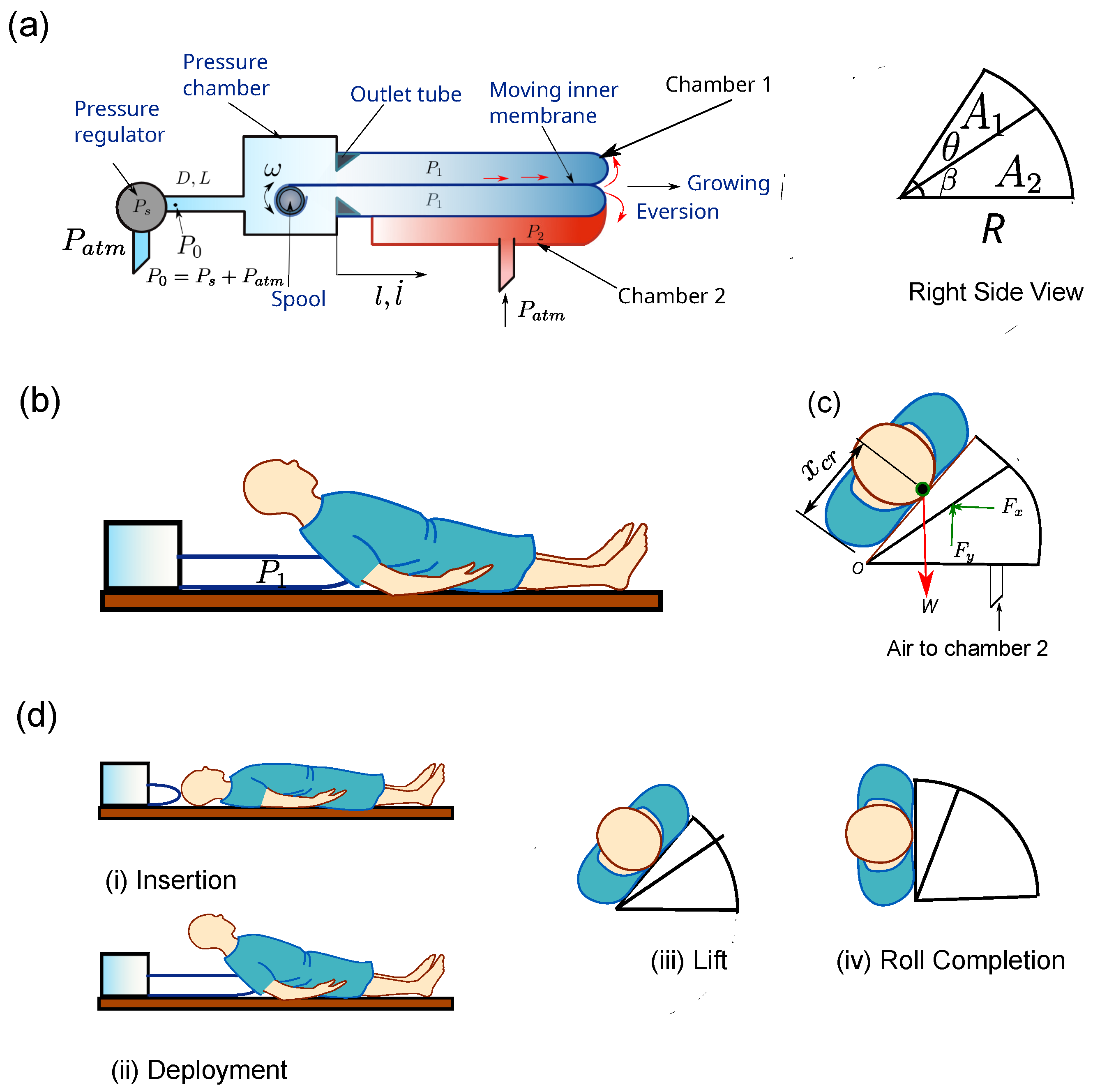
The proposed two-stage soft growing robot for safe and assisted patient repositioning is illustrated in
Figure 1. The mechanism is designed to roll a patient from a supine posture toward a side-lying position through two sequential stages: deployment by eversion and lifting by pressurization.
The vine-robot-assisted rolling mechanism consists of two pneumatic chambers. The first chamber, denoted by
, is the eversion chamber and is defined by the cross-sectional area of a circular sector subtending a constant angle
. The second chamber, denoted by
, is the lifting chamber and is defined by the remaining sector area, associated with the variable angle
. The overall cross-section of the robot is modeled as a quarter circle of radius
R, as shown in
Figure 1a. This partitioned geometry enables the robot to separate the functions of insertion and patient lifting.
The two chambers are realized as an integrated soft structure formed from a common membrane body with an internal sealed partition. In the practical implementation, Chamber
and Chamber
are mechanically continuous parts of the same robot body, but they are pneumatically isolated and supplied through separate air inlets. Chamber
is connected to the eversion pathway and is responsible for tip growth beneath the patient, whereas Chamber
is positioned adjacent to it and acts as the lifting chamber during the rolling stage. This arrangement enables the robot to combine low-friction deployment and distributed lifting within a single compact structure, similar in spirit to previously reported soft everting manipulators and growing sling systems for patient handling [
29,
30,
31].
In the first stage, the thin membrane forming the robot body is initially inverted inside the base section
. When chamber
is pressurized, the internal pressure drives the membrane to evert at the tip, causing the robot to elongate from its core. As a result, the robot grows forward underneath the patient from behind the neck and upper shoulder region, with minimal sliding interaction or friction and without requiring external lifting, as shown in
Figure 1b. This self-deploying eversion process is particularly advantageous in caregiving scenarios, where the clearance between the patient and the bed is limited and friction makes insertion of conventional devices difficult.
After sufficient insertion has been achieved, the second stage is activated by pressurizing chamber
. Unlike
, whose primary role is longitudinal growth, chamber
is responsible for generating the lifting action required for rolling. Inflation of
produces a distributed upward force over the projected contact region beneath the patient. This force generates a net moment about the contact edge or pivot point
O, as illustrated in
Figure 1c, thereby rotating the patient toward the desired side-lying configuration.
The complete operation of the mechanism is summarized in
Figure 1d. First, the robot is positioned adjacent to the patient. Next, chamber
is pressurized to deploy the robot beneath the body by eversion. Once the desired insertion length is reached, chamber
is pressurized to lift and roll the patient. Through this two-stage actuation principle, the proposed mechanism combines the advantages of soft deployability, reduced insertion friction, and distributed lifting, making it a promising solution for safe and low-effort patient repositioning.
3. Modeling Vine Robot Dynamics
In this section, we present a dynamic model of the vine robot that integrates the pressure and flow dynamics, air consumption, and tip extension while being computationally efficient for real-time control. The model explicitly captures the coupled pneumatic-mechanical behavior of the system, which is essential for both open-loop analysis and closed-loop controller design. The dynamics of the vine robot are governed by several interacting factors: the internal chamber pressure that drives eversion, the external force applied through a tendon attached to the sealed distal tip, and the flow characteristics of the pneumatic supply system. In turn, the internal pressure and the total air consumption depend not only on the properties of the pneumatic source but also on the instantaneous state of the robot, such as its current length and geometric configuration. By incorporating these elements into a unified framework, the proposed model enables accurate open-loop simulations, offering insights into the system’s behavior and the interdependent factors influencing its growth and motion. Furthermore, this model serves as a foundation for synthesizing and evaluating feedback controllers to achieve robust closed-loop performance.
3.1. Modeling Tip Extension
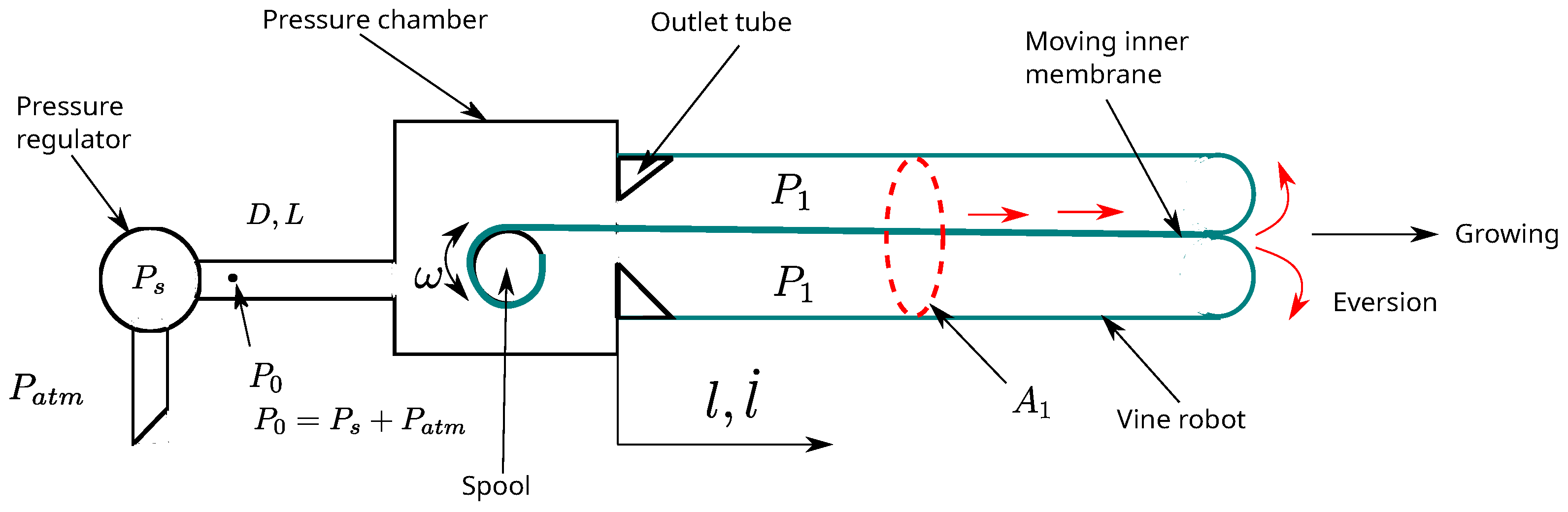
The vine robot, also referred to as a soft growing robot, is constructed from a thin-walled inflatable membrane of low-density polyethylene (LDPE) formed into a long cylindrical tube. One end of the membrane is sealed, inverted through the tube, and wrapped onto a spool, while the other end is clamped to the outlet of a pressurized chamber. Upon pressurization, the internal air pressure drives the membrane to evert from the tip, causing the body to extend forward. A tendon attached to the sealed distal end enables the application of external forces at the tip, such as pulling or steering. A schematic of the setup is shown in
Figure 2. Let
ℓ denote the everted length of the robot, measured along its central axis from the chamber outlet. Actuation results from the absolute internal pressure
acting over the uniform cross-sectional area
at the eversion front. This axial force causes continuous material eversion at the tip, enabling growth. The kinetic energy of the moving portion of the robot is expressed as
, where the effective moving mass varies with length according to
. Here,
is the lumped mass of tip-mounted components,
is the linear mass density of the membrane, and
is the density of the pressurized gas, given by
, with
denoting the gas constant and
T the absolute temperature. Applying Lagrange’s equation of motion yields the tip dynamics:
where
,
,
b is the linear viscous damping coefficient,
is the ambient pressure, and
is the yield pressure required to initiate eversion. The disturbance term
represents external forces acting at the tip due to environmental interaction.
It should be emphasized that the dynamic model in (
1) does not explicitly account for the tensile force generated by the tendon. In this study, we assume that the spool continuously releases the inverted membrane at a rate equal to or slightly greater than the tip extension rate, thereby preventing the buildup of tension in the body wall during growth. To enforce this condition, the spool’s angular velocity is defined as
where
is the angular velocity of the spool,
is the spool radius, and
is the tip velocity. The parameter
is a small dimensionless offset factor that ensures the spool rotates marginally faster than the nominal rate required for material release. In practice,
guarantees that the supply of inverted membrane always outpaces the tip extension, thereby eliminating slack-induced tension in the tail and ensuring smooth eversion.
It is equally important to monitor the amount of membrane material deployed by the spool during operation, since this determines the effective body length of the vine robot and ensures consistency between commanded growth and actual extension. The cumulative length of material released from the spool in discrete time is expressed as
where
is the angular velocity of the spool at time step
k and
T is the sampling time.
Accurate tracking of is essential for synchronizing spool feed with tip extension ℓ. Any mismatch between these two quantities may result in membrane tension buildup (if the spool feeds too slowly) or slack accumulation (if it feeds too quickly), both of which can degrade the robot’s performance and reliability.
The derivation of Equation (
1) is based on several simplifying assumptions. First, the internal pressure
is assumed to be uniformly distributed along the entire length of the vine robot, which is reasonable given the low flow resistance of the inflated body relative to the supply pressure. However, pressure non-uniformity may become more significant during fast transients or at larger deployed lengths, and incorporating distributed pressure dynamics would be an important extension for future work. The cross-sectional shape at the eversion front is considered perfectly circular, reflecting the natural symmetry of the membrane under uniform pressurization. The yield pressure
is treated as a constant threshold value, consistent with experimental observations showing that the minimum eversion pressure varies little once inflation begins. Finally, path-dependent losses associated with the transport of material through the body are neglected, as these effects are comparatively small during smooth, continuous growth.
It should also be emphasized that the proposed model is valid only during unconstrained growth, where the membrane material is deployed freely without generating internal tension. Consequently, phenomena such as steering, retraction, or interaction with external obstacles fall outside the scope of this formulation and are not captured in the present analysis.
To extend the one-dimensional formulation in (
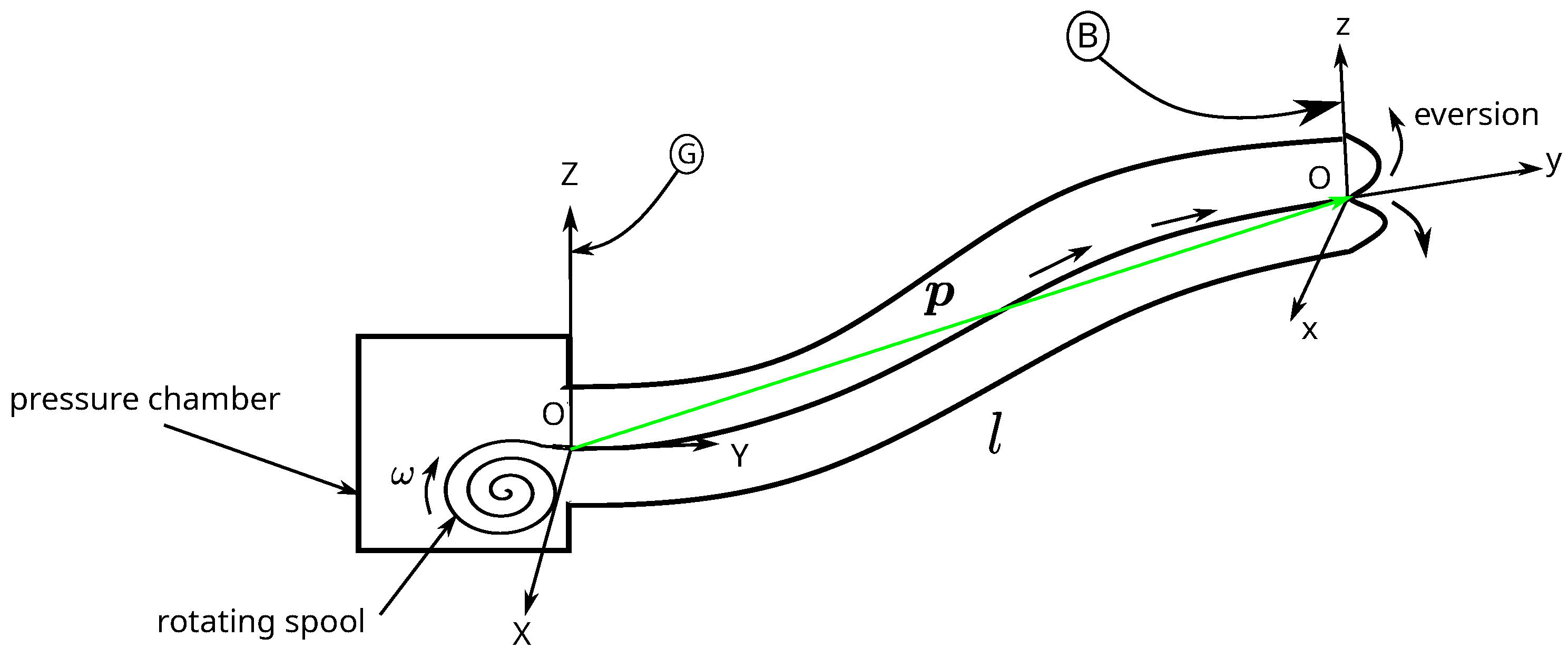
1) to free-space motion, the soft eversion-based growing robot is modeled within a three-dimensional kinematic framework, as illustrated in
Figure 3.
A global inertial frame is attached to the center of the robot’s base, with the Y-axis aligned tangentially to the backbone at the base in order to provide a fixed spatial reference. A body-fixed frame is attached to the robot’s tip, where the y-axis remains tangent to the backbone at the distal end throughout motion. This definition ensures that the body frame always aligns with the instantaneous growth direction.
The position of the tip relative to the global frame is described by the vector
The orientation of the body frame
with respect to the global frame
is parameterized using Euler angles
. These correspond to a sequence of rotations about the global
Z-axis, followed by rotations about the intermediate local
x- and
z-axes, respectively. The resulting rotation matrix from
B to
G is given by
where
and
denote cosine and sine functions, respectively.
Under unconstrained free-space growth, the everted length
ℓ directly corresponds to the arc-length displacement of the tip. Consequently, the axial growth rate equals the magnitude of the tip velocity:
The actuation force generated by internal pressure acts along the
y-axis of the body frame and is expressed as
where
Transforming this force into the global frame yields
External interaction forces, such as contact with the environment, are represented in the global frame by .
The resulting three-dimensional dynamic model of the soft eversion-based growing robot is therefore expressed as
where
denotes the diagonal matrix formed from the components of
.
3.2. Vine Robot Pressure Dynamics
The pressure dynamics of the vine robot are modeled by treating the system as a variable-volume pneumatic chamber, where the internal volume increases as the robot everts. At the initial state, when the internal pressure equals the ambient pressure
, the volume is
. As growth proceeds, the volume expands according to
, where
is the cross-sectional area and
ℓ is the everted length of the robot. Assuming ideal gas behavior, isothermal conditions, and initially negligible leakage, the system can be represented by a pneumatic capacitor model [
34,
35]. The volumetric inflow
Q (m
3/s) is then expressed as
where
denotes the effective stiffness of the body, capturing the elastic response of the membrane, and
is the maximum deployable length of the robot.
In the first regime (), the robot is actively growing, and inflow contributes to both pressure increase and eversion of new material at the tip. In the second regime (), geometric growth ceases, and any additional pressure leads only to stretching of the membrane. The term refers exclusively to the initial pneumatic chamber volume, excluding structural components such as the spool and tubing. This framework provides a basis for predicting internal pressure evolution across different operational phases of the robot.
In practice, however, leakage effects cannot be ignored. Micro-defects in the membrane, such as imperfect seals from heat welding, allow air to escape and result in exponential pressure decay. This behavior is well captured by the following model:
where
is the internal pressure at time
t,
is the pressure at valve closure (
),
is the asymptotic pressure (typically atmospheric), and
k is the leakage decay constant. To account for leakage, the rate at which the internal pressure
P changes is given by:
This extended formulation captures both the normal pressure–volume dynamics of growth and the leakage–induced decay, thereby providing a more realistic description of the vine robot’s pneumatic behavior under experimental conditions.
3.3. Fluid Flow Dynamics
The pneumatic supply system of the vine robot consists of a pressure regulator that modulates the compressor output, together with the connecting tubing and fittings that deliver air to the pressure chamber. As described in Equation (
11), the pressure dynamics inside the robot are directly influenced by the airflow through this supply pathway.
For compressible flow through sharp-edged orifices with effective conductance
C, the volumetric flow rate
Q is governed by the ratio between the downstream absolute pressure
and the upstream absolute pressure
, where
is the regulator setpoint pressure. According to the ISO 6358 standard [
36], the mass flow characteristics can be expressed in terms of equivalent volumetric flow rate as
where
and
denote the upstream and downstream absolute pressures, respectively, and
is the critical pressure ratio for isentropic flow of air. This ratio corresponds to the onset of sonic (choked) flow conditions at the orifice, when the Mach number reaches unity [
37,
38].
In the experimental setup illustrated in
Figure 2, the regulator output pressure
serves as the effective control input, while the internal pressure
inside the vine robot evolves as a state variable influenced by both pneumatic inflow and the robot’s extension. From Equation (
12), it is clear that the flow rate
Q can be positive (inflow) or negative (outflow). However, under the operating conditions considered here, the vine robot only experiences positive inflow, with
maintained above the critical pressure ratio. By rearranging Equation (
12), the upstream pressure
can be expressed explicitly as a function of
and
Q:
Finally, the flow conductance
C of the pneumatic path, which is dominated by the supply tubing, can be approximated using an empirical relationship based on the tube’s internal diameter
D and length
L:
3.4. Model Description
An accurate dynamic model is essential for the implementation of model-based control. In this study, the vine robot is described by a set of continuous nonlinear differential equations, represented in state-space form. Defining the state vector as
and the control input as
, the system dynamics can be expressed compactly as
where
denotes the nonlinear state-transition function derived from the coupled mechanical and pneumatic dynamics. The explicit form of the equations is given by
The regulated upstream pressure
is subsequently obtained from Equation (
13), thereby linking the pneumatic supply dynamics to the internal states of the robot.
In the subsequent sections, the vine robot model is formulated in a general discrete-time nonlinear state-space representation of the form
where
denotes the state vector,
is the control inputs,
represents the uncertain parameters, and
represents the measurement outputs at a discrete time step
k. The states are related to the continuous-time dynamics through
, with
T being the sampling time.
4. Rolling Dynamics of Vine Robot
After the vine robot has been deployed beneath the patient by the eversion chamber, rolling is initiated by pressurizing the lifting chamber with pressure . The rolling action is produced by the distributed air pressure acting on the projected surfaces of the lifting chamber. Let R denote the radius of the chamber cross section, the rolling angle of the chamber with respect to the horizontal plane, and the effective length of lifting chamber along the patient-contact region.
The pressure in the lifting chamber generates two resultant force components due to the projected areas of the chamber. First, the vertical projected area of the second chamber is
and hence the corresponding vertical force is
Similarly, the projected area of the lifting chamber on the horizontal plane is
which gives the horizontal force component
The two force components act through their respective centroids. Therefore, the moment arm associated with the vertical force
is
while that associated with the horizontal force
is
Taking moments about the rolling pivot point
O, the pressure-induced rolling moment becomes
Substituting (
19) and (
21) yields
Using the identity
, (
25) simplifies to
The resisting moment is caused by the patient weight
W, acting at a distance
from the pivot. If
denotes the wedge angle of the first chamber, then the gravitational restoring moment is expressed as
Hence, the net rolling moment about point
O is
For rolling to occur, the net moment must be nonnegative, that is,
Therefore, the minimum pressure required in lifting chamber to initiate rolling is obtained from (
28) as
Equation (
30) shows that the minimum rolling pressure increases with the patient load
W and the effective lever arm
, while it decreases with increasing chamber geometry
. This implies that a larger chamber radius and longer contact length can reduce the pressure required to achieve rolling.
Safety Considerations for Human–Robot Interaction During Rolling
Because the proposed robot is intended for direct physical interaction with a patient, safety is a primary design consideration. One advantage of the present approach is that the mechanism is based on a soft pneumatic structure, whose intrinsic compliance helps distribute contact loads over a larger area and reduces the likelihood of harmful concentrated forces during insertion and rolling. This property is particularly important in patient-assistive applications, where excessive localized loading on soft tissue must be avoided. However, compliance alone is not sufficient to guarantee safety, and recent studies on rehabilitation and assistive robots emphasize the need for explicit safety assessment, monitoring of excessive tissue loading, and dedicated fail-safe mechanisms in systems involving close physical human–robot interaction [
39,
40].
In the context of the present rolling mechanism, safety can be enforced through both model-based constraints and hardware-level fail-safe strategies. From a control perspective, the rolling motion should be limited by upper bounds on the lifting-chamber pressure
, the pneumatic flow rate, the rolling angle
, and the angular velocity of the maneuver, so that the generated moment remains sufficient for repositioning without inducing abrupt or excessive body motion. In addition, the contact force and interface pressure between the robot and the patient should remain below clinically acceptable limits, which motivates the future integration of force or pressure sensing into the lifting chamber. At the hardware level, an emergency-stop mechanism can be implemented by immediately venting the pneumatic chambers and closing the supply line, allowing the robot to rapidly depressurize and stop the maneuver. Additional fail-safe measures include pressure-relief valves, redundant pressure sensing, and supervisory logic that terminates actuation if abnormal pressure growth, excessive rolling angle, or unexpected patient motion is detected. Such strategies are consistent with current safety recommendations for medical and rehabilitation robots, which stress essential performance, risk control, and the prevention of excessive biomechanical loading during patient interaction [
39,
41].
The present study focuses on dynamic modeling, rolling mechanics, and robust deployment control, and therefore, these safety mechanisms are not yet experimentally implemented in the current simulation results. Nevertheless, they form an essential part of the intended next-stage prototype development. In future work, the proposed framework will be extended to include explicit safety constraints in the control law, including bounds on interface pressure, contact force, rolling speed, and allowable angular displacement, together with emergency-stop and fail-safe depressurization mechanisms for safe human-subject operation.
5. Robust Multi-Stage Nonlinear Model Predictive Control (NMPC)
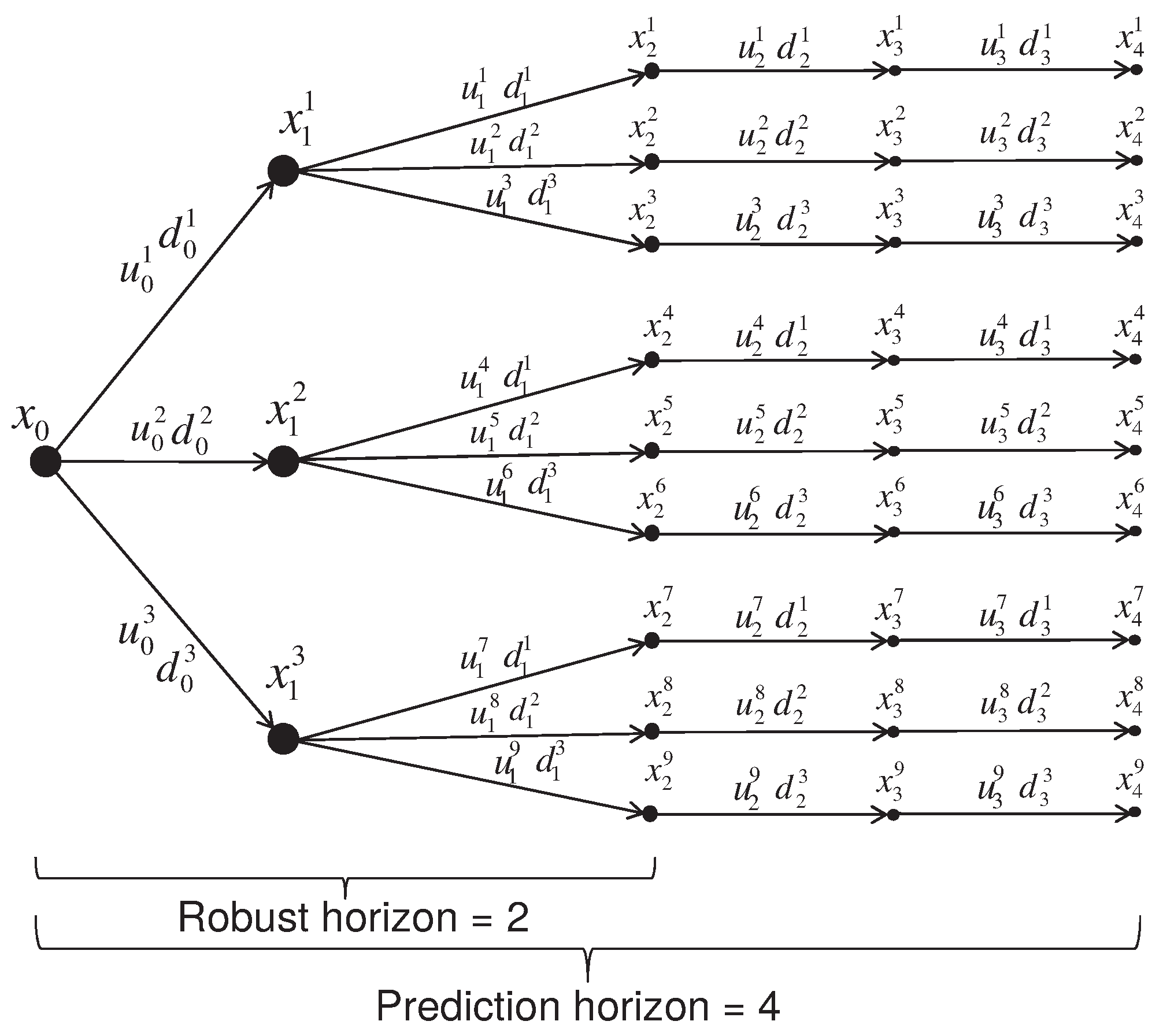
In this section, we introduce the robust multi-stage nonlinear model predictive control (NMPC) framework. Unlike standard NMPC, which assumes perfect knowledge of system parameters, the multi-stage formulation explicitly accounts for parameter uncertainty while ensuring that control actions remain feasible under all possible realizations. The uncertainty is represented as a
scenario tree, where each branch corresponds to one possible realization of the uncertain parameters at each step of the prediction horizon [
42], as illustrated in
Figure 4.
By constructing a family of discrete scenarios, the predictive control policy adapts dynamically whenever the system parameters deviate from their nominal values as new measurements become available. This leads to improved robustness against parameter uncertainty compared to nominal NMPC, which can become overly optimistic.
A major challenge in multi-stage NMPC, however, is the rapid growth in computational complexity: the number of scenarios increases exponentially with both the number of uncertain parameters and the number of possible realizations for each parameter. The total number of scenarios is given by
where
is the number of uncertain parameters,
is the number of discrete realizations considered for parameter
i,
is the robust horizon, and
is the total number of scenarios.
To reduce computational burden, the robust horizon
is introduced as a tuning parameter. In practice, the scenario tree is branched only for the first
steps, while for the remaining
steps of the prediction horizon, the parameter realizations are assumed constant. This strategy balances robustness with tractability, as shown in
Figure 4.
The robust multi-stage NMPC optimization problem to be solved at each time step can be formulated as
where,
represents the state trajectory over the prediction horizon
N. The weighting factor
assigns relative importance to each scenario in the objective function. The cost associated with each scenario
j is given by
where
is the stage cost, typically penalizing deviations from desired states and excessive control effort. State and input trajectories are constrained by upper and lower bounds, denoted by
and
, respectively. Additional system and safety constraints are encoded in
, while
enforces terminal feasibility conditions at the end of the horizon.
6. Results and Discussion
To evaluate the performance of the proposed framework, simulations were conducted under two different scenarios: closed-loop control of vine-robot deployment and analysis of the rolling pressure requirements.
In the first scenario, a closed-loop simulation based on multi-stage nonlinear model predictive control (NMPC) was performed to control the deployment of the vine robot beneath the patient. This simulation framework was used to assess the ability of the proposed controller to achieve reliable real-time deployment in the presence of parameter uncertainties.
In the second scenario, the minimum rolling pressure required to reposition the patient was evaluated for different patient weights and rolling angles. This analysis was carried out to quantify how the pressure demand varies with patient loading conditions and vine-robot geometry.
Table 1 summarizes the main simulation parameters adopted in this study. These parameters were selected based on values reported in the existing literature [
43] and those used in the development of the proposed model.
6.1. Robust Closed-Loop Deployment Control Under Parametric Uncertainty
This subsection evaluates the closed-loop performance of the proposed multi-stage nonlinear model predictive controller (NMPC) for regulating the deployment of the soft growing robot beneath the patient in the presence of parametric uncertainty. The main objective is to examine the ability of the controller to drive the robot to the desired deployment length while preserving constraint satisfaction and robustness against variations in model parameters.
The multi-stage NMPC was implemented with a prediction horizon of , a robust horizon of , and a sampling period of s. The initial state was chosen as = [0, 0, 102,103]T, and the desired deployment length was set to m. Parametric uncertainty was introduced in the chamber cross-sectional area and the leakage decay constant k, both varied within of their nominal values. In addition, the controller was required to satisfy the imposed state and input constraints throughout the maneuver. Specifically, the chamber pressure was constrained to remain between 102,103 Pa and 105,000 Pa, while the admissible flow rate was limited to m3/s.
The implementation is carried out using the
do-mpc framework [
44], which leverages CasADi [
45] for symbolic differentiation and IPOPT [
46] as the underlying nonlinear solver, supported by the MA27 linear solver. The dynamic model is integrated using the IDAS solver from the SUNDIALS toolbox [
47], ensuring high numerical accuracy. Discretization of the continuous-time dynamics is achieved through an orthogonal collocation on finite elements scheme [
48], which is integrated in
do-mpc.
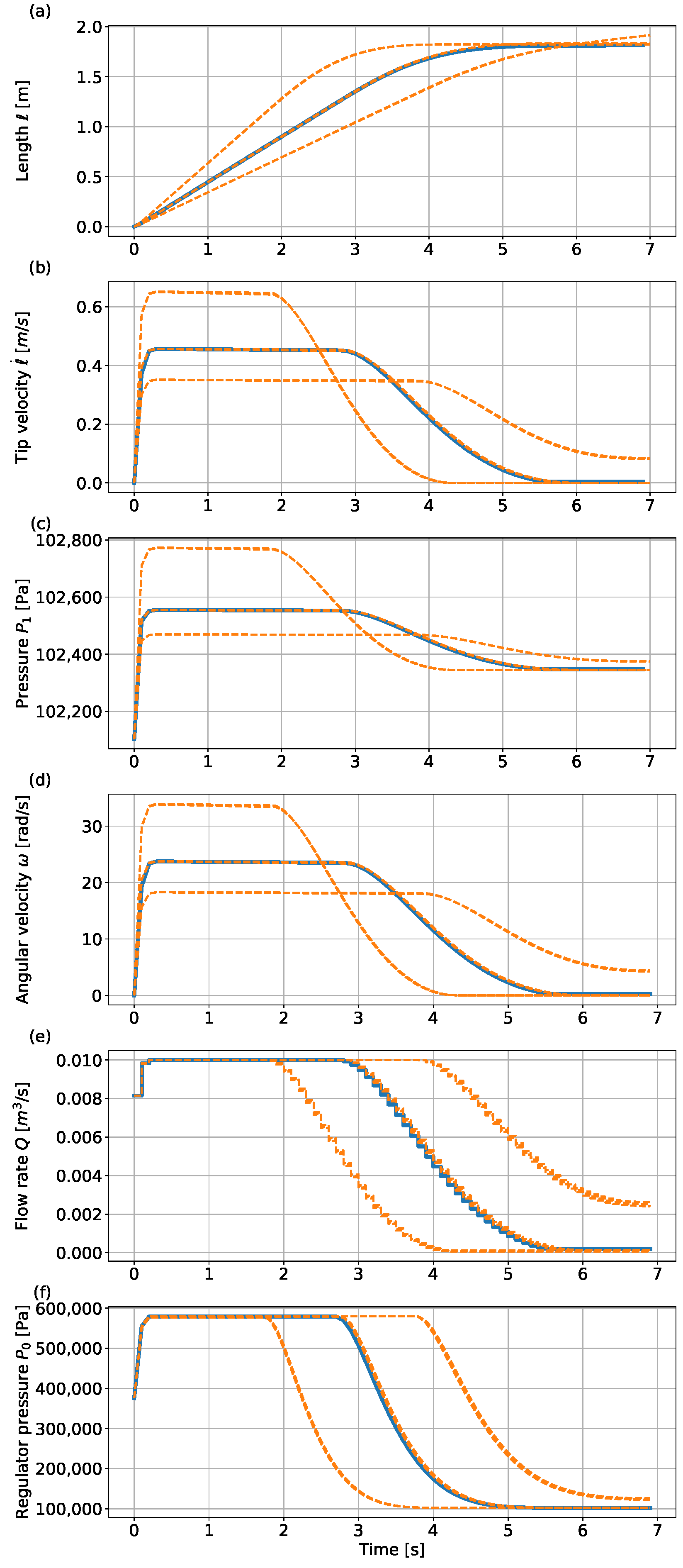
The closed-loop responses of the proposed multi-stage NMPC are shown in
Figure 5. As illustrated in
Figure 5a, the robot length increases smoothly from the initial state and converges to the desired deployment length of
m with negligible overshoot and no visible oscillation. The corresponding tip velocity in
Figure 5b rises rapidly to an approximately constant value during the main deployment phase and then gradually decreases to zero as the robot approaches the target length. A similar trend is observed for the spool angular velocity in
Figure 5d, which closely follows the deployment dynamics and smoothly decays to zero near the steady state. These responses indicate that the controller achieves a well-regulated insertion maneuver with stable transient behavior.
The pressure and input trajectories further confirm that the controller respects the imposed constraints while maintaining smooth control action. As shown in
Figure 5c, the chamber pressure
quickly rises from the atmospheric level to the operating range required for deployment and then gradually decreases as the system approaches the target length. The flow-rate profile in
Figure 5e shows that the controller initially drives the input to its upper bound, which is expected during the rapid-growth phase, and subsequently reduces it in a controlled manner to zero as the robot reaches the reference. Likewise, the regulator pressure
in
Figure 5g increases sharply at the beginning of the maneuver and then decreases smoothly as less actuation effort is needed near the terminal condition. This behavior demonstrates that the NMPC effectively exploits the available actuation range while preserving smooth and constraint-satisfying closed-loop performance.
The dashed trajectories in
Figure 5a–f represent the scenario predictions generated by the multi-stage NMPC under different realizations of the uncertain parameters. These predicted trajectories illustrate the range of possible system responses caused by variations in
and
k. Although the uncertainty produces noticeable dispersion during the transient phase, the closed-loop performance is satisfactory and converges reliably to the desired target. Overall, the results confirm that the proposed control framework provides robust deployment performance under substantial parametric uncertainty.
Overall, the results confirm that the proposed multi-stage NMPC provides accurate and stable deployment control of the vine robot under parametric uncertainty. The controller ensures smooth state evolution, respects the imposed pressure and flow constraints, and successfully compensates for uncertainty in key model parameters, thereby making it suitable for reliable real-time deployment in patient-assistive applications.
6.2. Effect of Patient Weight and Roll Angle on the Required Rolling Pressure
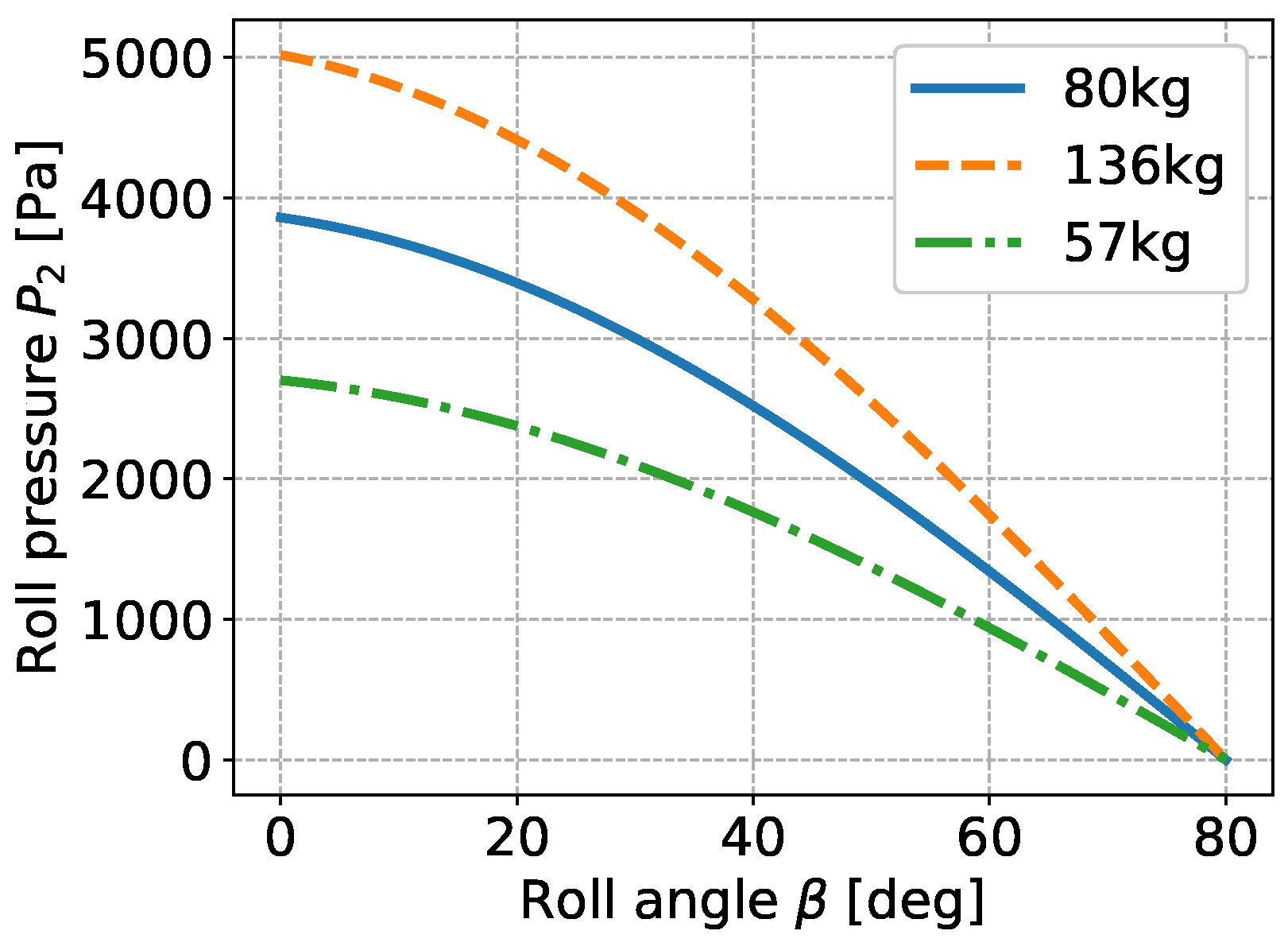
In this section, the minimum pressure required in chamber 2 to initiate and sustain patient rolling is evaluated for different patient weights as a function of the roll angle
. The results are presented in
Figure 6, which shows the variation in the required chamber pressure
for representative patient masses of 57 kg, 80 kg, and 136 kg.
As shown in
Figure 6, the required rolling pressure decreases monotonically as the roll angle increases for all considered patient weights. This trend is consistent with the rolling model, in which the minimum pressure is proportional to the gravitational restoring moment. At smaller roll angles, the resisting moment due to the patient weight is larger, and therefore, a higher chamber pressure is needed to generate sufficient rolling torque. As the roll angle increases, the gravitational restoring moment reduces, leading to a progressive decrease in the required pressure.
The influence of patient weight is also clearly observed. Heavier patients consistently require higher chamber pressure over the entire range of roll angles because the resisting moment increases with body weight. For example, the 136 kg case exhibits the highest pressure demand, followed by the 80 kg and 57 kg cases. This confirms that patient weight is a dominant factor in determining the actuation requirement of the lifting chamber.
Another important observation is that the pressure demand approaches zero as the roll angle nears 80°. At this configuration, the gravitational resistance to rolling becomes very small, and only a negligible additional pressure is required to maintain the motion. This indicates that the most demanding phase of the maneuver occurs at the early stage of rolling, where the system must overcome the largest restoring moment.
Overall, these results demonstrate that the required rolling pressure is strongly dependent on both the patient weight and the roll angle. In practical terms, this implies that the design of the lifting chamber and its pressure supply system should primarily account for the worst-case operating condition, which occurs for heavier patients and at small roll angles.
7. Conclusions
This paper presented a dynamic modeling and control framework for a two-stage soft growing robot intended for safe and assisted patient repositioning. The proposed approach enables the patient to be rolled from the supine posture toward a side-lying position through two sequential stages: deployment of the robot beneath the patient, followed by pressure-driven lifting and rolling. This mechanism is designed to reduce the physical effort required from caregivers during patient handling and repositioning. A physics-based model of the soft growing robot was developed to capture the coupled growth dynamics, internal chamber pressure evolution, and pneumatic supply effects. Based on this model, a robust multi-stage nonlinear model predictive control (NMPC) scheme was formulated to regulate the deployment of the robot beneath the patient in the presence of parameter uncertainty. The simulation results demonstrated that the proposed controller achieves smooth and reliable setpoint tracking, maintains constraint satisfaction, and remains robust against significant variations in key model parameters. In particular, the controller provided stable closed-loop deployment without overshoot while respecting the imposed pressure and flow constraints. In addition, the rolling dynamics of the second stage were analyzed to quantify the pressure required for patient repositioning. The results showed that the minimum rolling pressure depends strongly on both patient weight and roll angle. Heavier patients require higher chamber pressure throughout the maneuver, whereas the required pressure decreases as the roll angle increases, indicating that the initial phase of rolling is the most demanding in terms of actuation. Overall, the results confirm the feasibility of combining physics-based modeling with robust predictive control for the deployment and assisted rolling of a patient using a soft growing robot. The proposed framework provides a useful foundation for the future development of patient-assistive soft robotic systems that are safer, less labor-intensive, and more adaptable to human-centered care environments. Future work will focus on reducing the computational complexity of the proposed framework through neural-network-based approximations of the NMPC law. Additional research will include experimental validation of the two-stage rolling mechanism on a physical prototype, integration of state-estimation methods such as moving horizon estimation, incorporation of contact-force sensing for closed-loop patient interaction, and inclusion of the human in the control loop to enforce safety, interface pressure, and comfort constraints during repositioning.




 ,
,