Article

Experimental Comparison of Model-Based and Model-Free Trajectory Tracking Control on a Mobile Robot

by
Sebastian Vega
1,
Mateo Vasquez-Guevara
2,
Pablo Proaño
3,
Gabriela Andaluz
3,
Paulo Leica
3 and
Oscar Camacho
2,*
1
Engineering Department, Harper Adams University, Edgmond, Newport TF10 8NB, UK
2
Colegio de Ciencias e Ingenierias, Universidad San Francisco de Quito, Diego de Robles y Av. Pampite, Quito 170901, Ecuador
3
Departamento de Automatización y Control Industrial, Escuela Politécnica Nacional, Quito 170143, Ecuador
*
Author to whom correspondence should be addressed.
Eng 2026, 7(6), 281; https://doi.org/10.3390/eng7060281
Submission received: 18 March 2026 / Revised: 18 May 2026 / Accepted: 27 May 2026 / Published: 4 June 2026
(This article belongs to the Special Issue Interdisciplinary Insights in Engineering Research 2026)

Abstract

This paper presents an experimental comparison between model-based and model-free trajectory-tracking control strategies applied to an omnidirectional mobile robot platform. Classical model-based controllers, including Proportional-Integral-Derivative (PID), Generic Model Control (GMC), and Sliding Mode Control (SMC), are evaluated against a Model-Free Control (MFC) strategy based on an intelligent Proportional–Integral–Derivative (iPID) regulator. An empirical integrator-with-delay model is identified from experimental data and used to design model-based controllers. All strategies were implemented on the Festo Robotino platform under comparable operating conditions and evaluated using circular, lemniscate, and square trajectories. Controller performance is assessed using the Integral of Squared Error (ISE), the settling time ( T s ), and the control effort quantified by the Integral of Squared Control Output (ISCO). Experimental results show that the model-free controller provides the best overall tracking performance, achieving tracking error reductions of approximately 25 % to 90 % compared with the evaluated model-based controllers, while maintaining a competitive control effort. The study provides a unified experimental benchmark comparing model-based and model-free control paradigms on the Robotino platform, highlighting the practical advantages of model-free control for robotic systems affected by uncertainties and nonlinearities.

1. Introduction

A mobile robot is a dynamic system equipped with locomotion mechanisms that enable it to interact with its environment through controlled motion. Depending on their design and intended application, mobile robots may locomote by walking, jumping, swimming, flying, or rolling. Among these configurations, wheeled mobile robots have gained particular relevance in recent years as essential components of modern automation systems, with applications ranging from industrial logistics and autonomous transportation to agricultural operations, military reconnaissance, and space exploration [1,2].
Despite their increasing deployment, one of the most persistent challenges in robotics remains the trajectory tracking problem (TTP), which requires the robot’s position and orientation to accurately follow time-varying reference trajectories while ensuring stability and smooth motion [3,4,5]. This problem becomes especially demanding in nonholonomic mobile robots, where non-integrable kinematic constraints restrict lateral motion and introduce strong coupling between translational and rotational dynamics. As a result, nonlinear behavior, sensitivity to disturbances, and performance degradation due to modeling inaccuracies become significant obstacles. Achieving precise and robust trajectory tracking, therefore, requires control strategies capable of compensating for uncertainties, handling nonlinear dynamics, and respecting physical and actuator constraints.
In realistic operating conditions, mobile robots typically function in partially structured environments, where parameter variations, unmodeled dynamics, sensor noise, and external disturbances—such as uneven terrain or unexpected obstacles—further complicate trajectory tracking [6]. These challenges have motivated the development of numerous control strategies for Nonholonomic Mobile Robots (NMRs), including Linear Quadratic Regulators (LQR) [7,8,9], nonlinear and adaptive control techniques [10,11,12], Model Predictive Control (MPC) [1,13,14], fuzzy logic approaches [15], and Sliding Mode Control (SMC) [3,16]. Although these model-based approaches often provide strong theoretical guarantees, their practical effectiveness depends heavily on the availability of accurate system models and reliable parameter identification, which remain challenging for robotic platforms exhibiting nonlinear and time-varying dynamics [17].
To mitigate modeling difficulties, empirical reduced-order models, such as First-Order Plus Dead Time (FOPDT) representations, have been widely adopted in control engineering [18,19,20]. These models capture dominant system dynamics while preserving simplicity and computational efficiency, making them attractive for real-time embedded robotic implementations. Within this modeling philosophy, Generic Model Control (GMC) emerges as a flexible and physically motivated methodology originally developed for chemical process control [21,22,23]. Introduced by Lee and Sullivan in 1988 [21], GMC integrates the process model directly into the control law, eliminating the need for linearization and enabling reference-driven controller synthesis. Its ability to encompass classical strategies such as PI, IMC, and DMC within a unified framework, together with its robustness to modeling uncertainties, suggests strong potential for robotic applications characterized by nonlinearities and coupling effects. Nevertheless, its experimental implementation for trajectory tracking in mobile robotics remains scarcely explored.
In contrast to model-based methodologies, Model-Free Control (MFC) has gained significant attention due to its capability to regulate nonlinear systems without requiring explicit mathematical models [24,25]. Based on the concept of an ultra-local model, MFC aggregates unknown dynamics and disturbances into a single term that is estimated online, allowing the use of intelligent PID controllers (iP, iPI, iPID) to achieve adaptive regulation with minimal modeling effort. Because this term is continuously updated during operation, MFC provides robustness against time-varying uncertainties and environmental perturbations [26,27]. This reduced dependence on detailed modeling makes MFC particularly attractive for robotic systems operating under uncertain and dynamic conditions.
Another prominent robust methodology is Sliding Mode Control (SMC), introduced by Utkin [28]. SMC achieves robustness by forcing system trajectories to converge to a predefined sliding surface, rendering the closed-loop dynamics insensitive to matched uncertainties. Despite its strong robustness properties, the discontinuous switching term may generate chattering, potentially exciting unmodeled dynamics and increasing actuator wear. To address this limitation, several enhanced variants—including Dual Sliding Mode Control (DSMC) [29], Dynamic Sliding Mode Control (D-SMC) [30,31,32], and higher-order or super-twisting algorithms [33,34]—have been proposed. SMC has demonstrated remarkable performance across robotics, electromechanical systems, and process control applications [35,36].
Although significant advances have been made in both model-based and model-free control methodologies, existing studies often focus on the development or validation of individual control strategies. In many cases, evaluations are performed in simulation environments or focus on specific controller architectures, which makes it difficult to draw practical conclusions regarding their relative performance under comparable experimental conditions.
Furthermore, while empirical modeling approaches and data-driven control techniques have independently demonstrated promising results, their combined assessment within a unified experimental framework remains relatively limited, particularly for omnidirectional mobile robotic platforms operating under real-world constraints. A systematic experimental analysis comparing classical, robust, and model-free control philosophies may, therefore, contribute to a clearer understanding of the practical trade-offs among tracking accuracy, robustness, and implementation complexity.
Motivated by these considerations, this work presents an experimental comparative study of trajectory tracking control strategies implemented on the Festo Robotino mobile robot. An empirically derived integrating-type reduced-order model is obtained from experimental step-response data and used to design three model-based controllers: Proportional–Integral (PI), Generic Model Control (GMC), and Sliding Mode Control (SMC). These approaches are evaluated alongside a model-free intelligent PI controller operating without an explicit plant model. The comparison is conducted using multiple trajectory patterns under real operating conditions to analyze performance, robustness, and practical implementation aspects. This work provides one of the first experimental comparisons between model-based and model-free control strategies implemented on an omnidirectional Robotino platform under identical operating conditions.
The main contributions of this research are summarized as follows:
  • A unified experimental benchmark comparing model-based (PI, GMC, SMC) and model-free (iPI) control strategies under identical conditions on an omnidirectional Robotino platform.
  • An empirical integrator-with-delay model that enables the design of both classical and robust controllers within a common framework.
  • A quantitative experimental evaluation based on normalized ISE indices and trajectory tracking tests across multiple motion profiles.
  • An experimental assessment of control effort, highlighting the practical advantages of model-free control in uncertain robotic systems.
Although the control strategies considered in this work (PI, GMC, SMC, and iPI) have been previously reported in the literature, the novelty of this study lies in the systematic experimental comparison performed under a unified framework. In contrast to previous studies, all controllers are implemented on the same platform, subjected to identical trajectories, and evaluated using consistent normalized performance metrics. This approach enables a fair and comprehensive assessment of the trade-offs between model-based and model-free control strategies in terms of tracking accuracy and control effort.
The remainder of this paper is organized as follows. Section 2 describes the Festo Robotino platform and presents the empirical modeling procedure. Section 3 introduces the theoretical formulation of the control strategies. Section 4 presents the experimental results and comparative performance analysis. Finally, Section 5 summarizes the main conclusions and outlines future research directions.

2. The Festo Robotino Mobile Robotics Platform

This section briefly presents the Festo Robotino mobile robotics platform [37], which is used in this study and serves as a test environment for evaluating the controllers’ performance across different trajectory-tracking scenarios. The Robotino system is characterized by nonlinear dynamics, actuator limitations, and external disturbances, making it an appropriate platform for evaluating control strategies.

2.1. Fundamentals

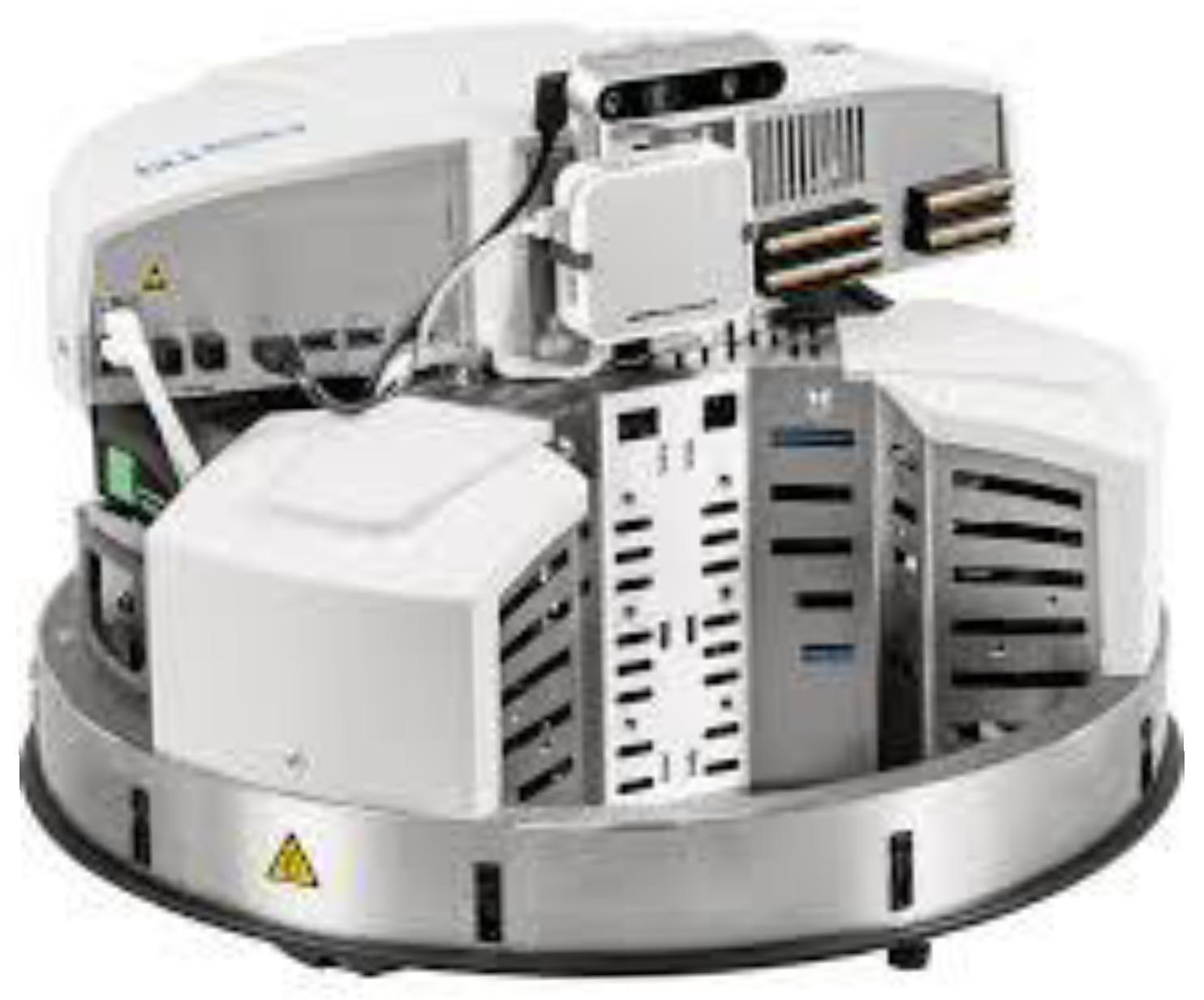
The experiments in this study were conducted using the Festo Robotino, a widely adopted three-wheel omnidirectional mobile robot (OMR) platform designed for research and education [38,39]. The Robotino, illustrated in Figure 1, features three independently driven omnidirectional wheels that provide three degrees of freedom, allowing translational and rotational movements in any direction regardless of its initial orientation. The platform consists of a laser-welded stainless steel frame, surrounded by a rubber protection strip equipped with collision-prevention sensors. It can carry payloads of up to 30 kg and measures approximately 450 mm in height. The robot features a webcam, nine infrared distance sensors, an inductive sensor, and two optical sensors, all designed for line-following applications. Its embedded PC controller is available in two configurations: an Intel i5 (2.4 GHz, dual-core, 8 GB RAM, 64 GB SSD) or an Intel Atom (1.8 GHz, dual-core, 4 GB RAM, 32 GB SSD). For input and output operations, the Robotino provides multiple interfaces, including USB, Ethernet, eight digital inputs, eight analog inputs, and eight digital outputs [37]. In addition, it includes an extra motor output for driving high loads and an additional encoder input. Moreover, the system supports custom application programming across various environments, including industrial logistics, warehouse automation, indoor navigation, and educational applications, enabling users to integrate advanced control algorithms while leveraging its modular architecture and omnidirectional capabilities.

Kinematics of Omnidirectional Wheels

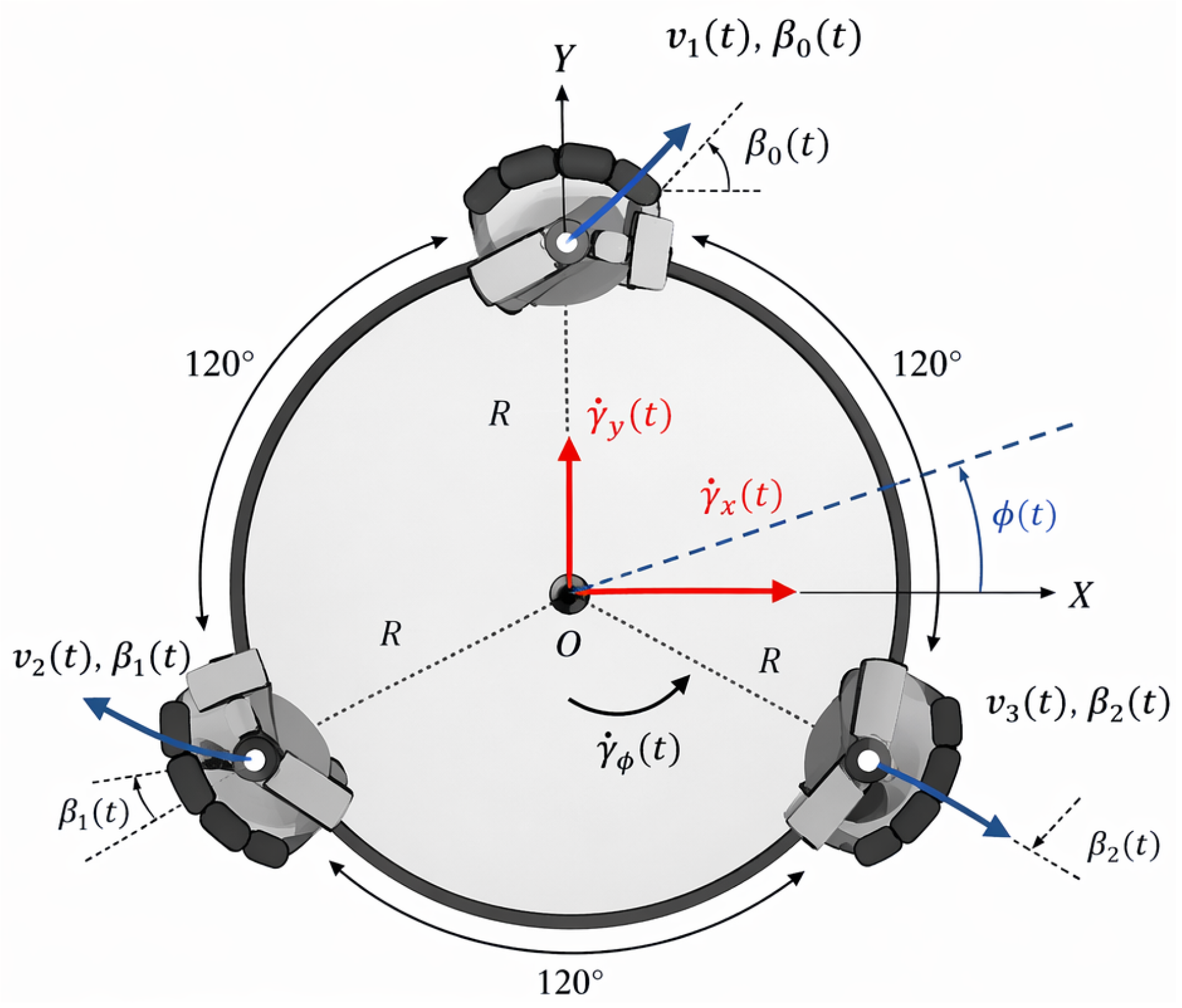
Festo’s Robotino employs three omnidirectional wheels (omni wheels), whose drive axles are arranged at 120° to each other. This geometric configuration, together with the wheels’ capacity to generate lateral motion via passive rollers on their periphery, enables the robot to move in any direction and even rotate about its own axis without changing its orientation. The kinematics of omnidirectional wheels enable simultaneous motion in multiple directions, offering significant advantages in maneuverability and precision for robotics and mobile platforms. Understanding the kinematics of these wheels is crucial for designing systems that can exploit their full range of motion in various applications, including automated vehicles, robotic arms, and other systems requiring high maneuverability in confined spaces [40].
To determine the robot’s position relative to the setpoint, one must calculate the direct kinematics, as shown in Equation (1). The kinematic model presented captures the relationship between the three individual wheel speeds and the resulting velocity of the Robotino in the global reference frame.
γ ˙ x ( t ) γ ˙ y ( t ) γ ˙ ϕ ( t ) = c o s ( θ ( t ) ) s i n ( θ ( t ) ) 0 s i n ( θ ( t ) ) c o s ( θ ( t ) ) 0 0 0 1 1 r s i n ( β 0 ( t ) ) c o s ( β 0 ( t ) ) R s i n ( β 1 ( t ) ) c o s ( β 1 ( t ) ) R s i n ( β 2 ( t ) ) c o s ( β 2 ( t ) ) R v 1 ( t ) v 2 ( t ) v 3 ( t )
where θ ( t ) is the Robotino’s rotation angle [40]. Let r be the radius of each wheel. β 0 ( t ) , β 1 ( t ) , and β 2 ( t ) are the angles of each wheel relative to a reference axis, respectively (usually in the forward direction). The quantities γ ˙ x ( t ) , γ ˙ y ( t ) , and γ ˙ ϕ ( t ) denote the velocities of the robot with respect to x, y, and ϕ , respectively. R is the radius from the center of the robot’s chassis to the center of each wheel. v 1 ( t ) , v 2 ( t ) , and v 3 ( t ) are the wheel velocities. Figure 2 shows the kinematic variables of the robot.

2.2. Empirical Modeling

In this section, empirical models are derived from the step responses of the robot’s position along the x and y axes and its angular orientation, θ ( t ) . The empirical modeling approach relies on the direct interpretation of experimental input–output data obtained under controlled operating conditions, thereby capturing the dominant dynamic behavior of each motion channel without requiring a detailed first-principles derivation [41].
This approach is particularly suitable for robotic platforms exhibiting nonlinearities, parameter variations, actuator limitations, and unmodeled internal dynamics, where the development of a complete analytical model may be unnecessarily complex or impractical for controller synthesis. The identification procedure consists of exciting the system around a selected operating point using step input signals of moderate amplitude—large enough to generate measurable output variations, yet sufficiently small to maintain the system within its linear operating region [41].
By analyzing the transient response to these step inputs, essential dynamic characteristics such as steady-state gain, effective time delay, and dominant dynamic order can be extracted. These parameters are subsequently used to construct low-order transfer function approximations that preserve the principal motion dynamics while maintaining computational simplicity. The models were obtained using MATLAB’s System Identification Toolbox 2025a, based on experimental input–output datasets and adopting an output-error structure with delay estimation.
Unlike conventional First-Order Plus Dead Time (FOPDT) representations, which assume asymptotic first-order behavior, analysis of the experimental step-response data obtained in this study indicates that the position variables exhibit an integrating-type dynamic behavior [41]. This behavior is physically consistent with the kinematics of mobile robots, where position results from the time integration of velocity, and the internal motor velocity loops operate at a faster timescale. Consequently, the dominant observable dynamics in the position channels can be accurately represented by an integrator combined with a transport delay.
The resulting empirical model for each motion channel is expressed as
G ( s ) = K s e t 0 s ,
where K denotes the effective static gain relating input voltage to velocity-induced position change, and t 0 represents the equivalent transport delay accounting for sensing, computation, and actuation latencies.
The integrator-with-delay structure captures the cumulative nature of position dynamics while incorporating the experimentally observed reaction delay. Although such representations are less frequently reported in the mobile robotics literature than FOPDT or higher-order models, they provide a compact yet physically meaningful approximation that facilitates controller design, analytical development, and robustness analysis without introducing unnecessary parametric complexity.
It is important to note that the identified model represents the dominant motion dynamics within the operating conditions considered in this study. The model was obtained from experimental data collected around a nominal operating region and therefore provides a local approximation of the robot dynamics. As a consequence, the model does not explicitly account for velocity sign changes, zero-velocity transitions, or hybrid dynamics associated with motion reversals. In addition, model identification and validation were performed using data collected under the same operating conditions, and cross-validation using different trajectories or excitation amplitudes was not conducted. Therefore, the model is intended to support controller design and comparative evaluation within the explored operating regime, rather than to provide a globally valid representation of the system dynamics.

3. Fundamentals of the Control Strategies

This section describes four control strategies implemented for trajectory tracking in the considered system. Three of them are model-based approaches: the Proportional–Integral–Derivative (PID) controller, the Generic Model Control (GMC), and the Sliding Mode Control (SMC). These approaches rely on empirical or reduced-order models to represent the process dynamics and guide controller design. In contrast, the Model-Free Control (MFC) strategy operates without an explicit process model, using real-time input–output data to estimate the system behavior and determine the control action. The comparison among these approaches provides a consistent framework to evaluate the advantages and limitations of model-based and data-driven control techniques in robotic applications.

3.1. Model-Based Approaches

Three model-based controllers (MBCs) are proposed in this study, each designed using an empirical mathematical model that captures the dynamic behavior of the robotic system under consideration. These models provide a simplified yet representative description of the system’s input–output relationships, enabling the controllers to effectively regulate the process response and compensate for external disturbances [20].

3.1.1. Proportional–Integral–Derivative Control Fundamentals

Proportional–Integral–Derivative (PID) control remains one of the most widely used feedback control strategies in industrial practice due to its simplicity, robustness, and ease of implementation [42,43,44]. Despite the availability of advanced control techniques, PID controllers continue to serve as a benchmark for performance comparison in both industrial and laboratory settings.
The PID controller generates the control action through proportional, integral, and derivative components, all computed as functions of the tracking error. Its transfer function is expressed as:
P I D ( s ) = K p 1 + 1 τ i s + τ d s
The tracking error is defined as ξ ( t ) = R ( t ) y ( t ) , where R ( t ) denotes the reference signal (setpoint) and y ( t ) the measured process output. In Equation (3), K p is the proportional gain, τ i is the integral time constant, and τ d is the derivative time constant. Alternatively, the controller may be expressed in its parallel form using the integral and derivative gains K i and K d , defined as K i = K p / τ i and K d = K p τ d , respectively.
In the present work, although the complete PID structure is presented for completeness, only the proportional–integral (PI) configuration is employed. The derivative action was omitted because the Robotino platform exhibits relatively smooth low-frequency dynamics, while the measured signals are affected by sensor noise and quantization, making the PI configuration more robust and suitable for practical implementation.

3.1.2. Generic Model Control-GMC

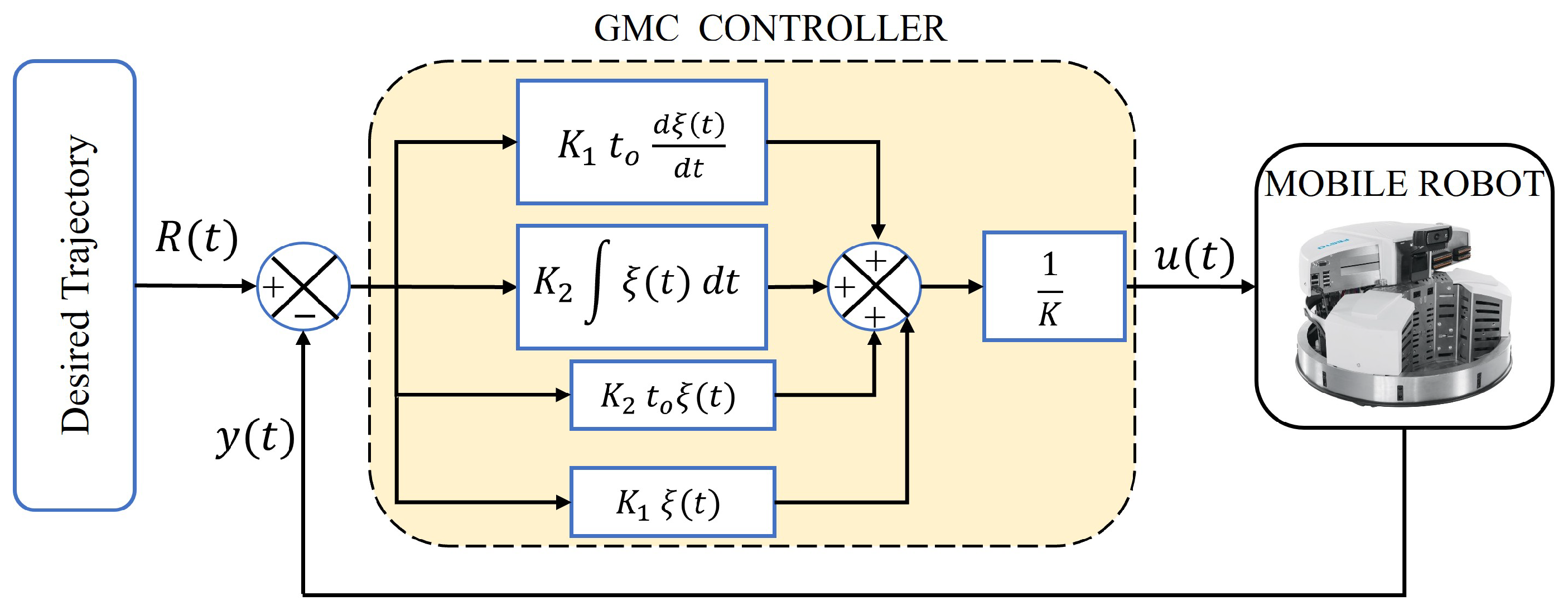
The schematic representation of Generic Model Control (GMC) is shown in Figure 3. GMC is a model-based control strategy that explicitly incorporates a process model into the control law. In its original formulation, the model is typically derived from nonlinear mass and energy balances. However, in practical applications, simplified dynamic representations are often adopted while preserving the dominant process behavior [20,21].
The dynamic behavior of a general process can be described by
d y d t = f ( y , u , d )
where y is the process output, u is the control input, and d represents disturbances. The function f ( · ) may describe either linear or nonlinear dynamics.
A central feature of GMC is the definition of a desired output trajectory y r ( t ) that smoothly drives the process output toward the setpoint R ( t ) . This reference trajectory is defined as
d y r d t = K 1 ( R ( t ) y ( t ) ) + K 2 ( R ( t ) y ( t ) ) d t
where ξ ( t ) is the tracking error defined above. Thus, (5) can be rewritten as
d y r d t = K 1 ξ ( t ) + K 2 ξ ( t ) d t
Differentiating (6) with respect to time gives
d 2 y r d t 2 = K 1 d ξ ( t ) d t + K 2 ξ ( t )
The identified empirical model of each channel is given by
G ( s ) = K s e t 0 s
which represents an integrator with dead time. To avoid the right-half-plane zero introduced by Padé approximation, a first-order Taylor expansion of the delay term is adopted following [45], yielding
Y ( s ) U ( s ) = K s ( t 0 s + 1 )
Rearranging (9) gives
s ( t 0 s + 1 ) Y ( s ) = K U ( s )
or equivalently,
( t 0 s 2 + s ) Y ( s ) = K U ( s )
Transforming this expression into the time domain yields
t 0 y ¨ ( t ) + y ˙ ( t ) = K u ( t )
and therefore
u ( t ) = 1 K t 0 y ¨ ( t ) + y ˙ ( t )
According to the GMC formulation, the process output is forced to follow the desired trajectory. Under this assumption, the process derivatives are replaced by the desired trajectory derivatives, i.e., y ˙ ( t ) = y ˙ r ( t ) and y ¨ ( t ) = y ¨ r ( t ) . Thus, (13) becomes
u ( t ) = 1 K t 0 y ¨ r ( t ) + y ˙ r ( t )
Note: y ( t ) R 3 represents the system variables x, y, and ϕ , while u ( t ) R 3 denotes the input velocities v 1 ( t ) , v 2 ( t ) , and v 3 ( t ) .
Substituting (6) and (7) into (14) yields
u ( t ) = 1 K t 0 K 1 d ξ ( t ) d t + K 2 ξ ( t ) + K 1 ξ ( t ) + K 2 ξ ( t ) d t
Finally, expanding (15) leads to the GMC control law
u ( t ) = 1 K K 1 t 0 d ξ ( t ) d t + K 1 ξ ( t ) + K 2 t 0 ξ ( t ) + K 2 ξ ( t ) d t
Therefore, the resulting GMC structure behaves as a proportional–integral-derivative (PID) controller whose gains are directly related to the process gain K, the time delay t 0 , and the trajectory-shaping parameters K 1 and K 2 .

3.1.3. Sliding Mode Control (SMC)

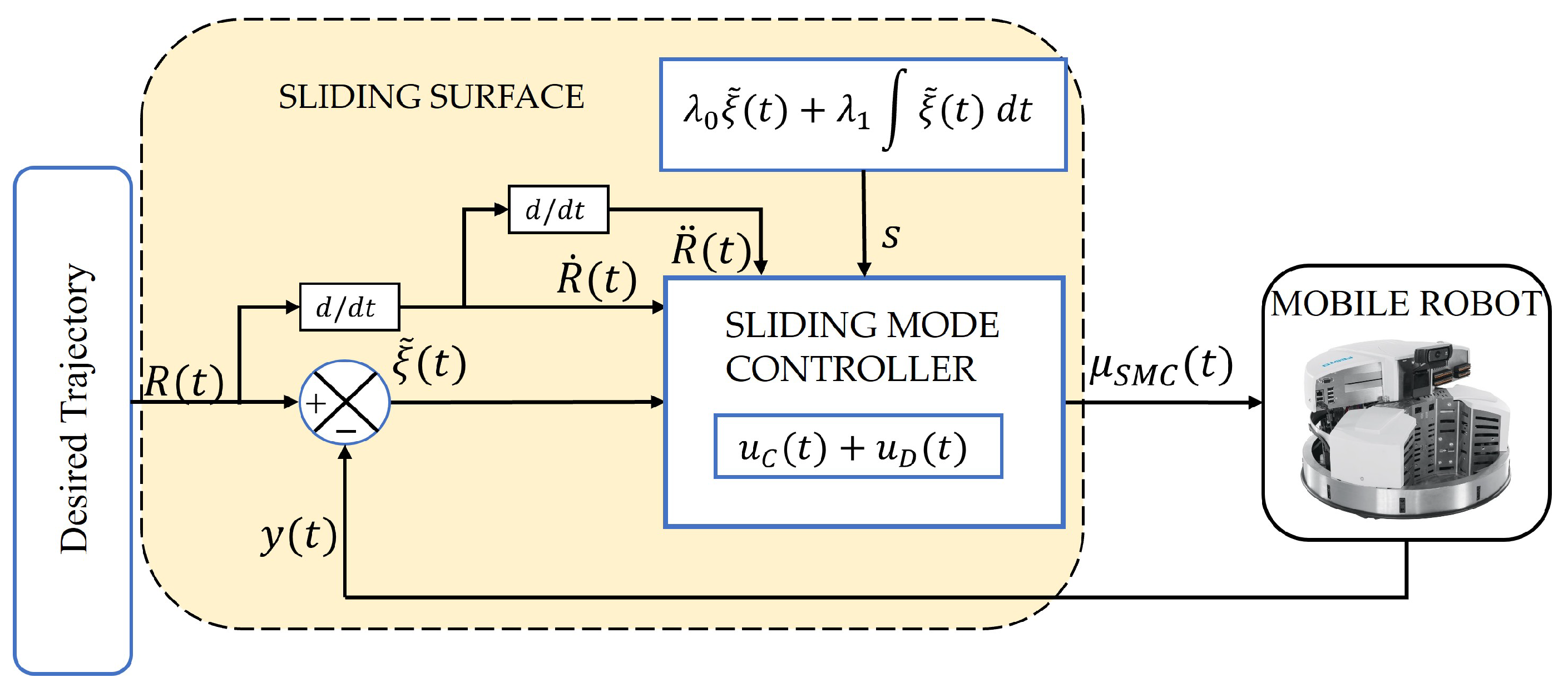
The schematic of Sliding Mode Control (SMC) is presented in Figure 4. SMC is a robust, model-based strategy that originated from Variable Structure Control (VSC), where the system is driven toward a predefined sliding surface and its dynamics subsequently evolve along the desired trajectory [33,46]. Due to its robustness against model uncertainties and external disturbances, SMC has been extensively applied in robotic systems, including recent trajectory tracking implementations for mobile robots operating under slip and uncertainty conditions [47].
The synthesis of an SMC involves three stages: modeling the robot, defining the sliding surface, and designing a control law that ensures convergence to the surface under Lyapunov stability conditions [48].
For controller synthesis, empirical models are adopted due to their simplicity and suitability for practical robotic applications [45]. In this work, an integrator with time delay is employed instead of conventional FOPDT approximations, as described in Equation (2). The delay term is approximated using a first-order Taylor expansion, leading to the representation
Y ( s ) U ( s ) = K s ( t 0 s + 1 ) ,
where K denotes the identified system gain, which determines the slope of the output response to a unit-step input, and t 0 represents the reaction delay of the robot.
Transforming Equation (17) into the time domain yields
t 0 y ¨ ( t ) + y ˙ ( t ) = K u ( t ) ,
where u ( t ) is the system input and y ( t ) the output variable.
The design of a suitable sliding surface is a critical aspect of the controller, as it defines the system dynamics during the sliding mode and ensures stability [33]. Its formulation must account for both the robot’s characteristics and the control objectives, while the highest derivative order in the model determines the number of terms required for a well-posed control law. In this work, the surface is defined as
σ ( t ) = ξ ˙ ( t ) + λ 0 ξ ( t ) + λ 1 ξ ( t ) d t ,
where ξ ( t ) denotes the tracking error defined above, with R ( t ) representing the reference signal and y ( t ) the system output, while λ 0 , λ 1 are tuning parameters shaping the closed-loop response.
Sliding mode control consists of two components: a continuous term u C ( t ) , obtained through the equivalent control method to ensure the system remains on the sliding surface, and a discontinuous term u D ( t ) , designed to drive the states toward the surface and guarantee finite-time convergence. The overall control action is expressed as
u S M C ( t ) = u C ( t ) + u D ( t ) .
To satisfy the sliding condition, the time derivative of Equation (19) is set to zero, yielding
σ ˙ ( t ) = ξ ¨ ( t ) + λ 0 ξ ˙ ( t ) + λ 1 ξ ( t ) = 0 .
From this relation, the highest-order derivative of the output is obtained as
y ¨ ( t ) = R ¨ ( t ) + λ 0 ξ ˙ ( t ) + λ 1 ξ ( t ) .
The continuous component of the control law follows by substituting Equation (22) into Equation (18) and solving for u ( t ) . Setting λ 0 = 1 / t 0 simplifies the resulting expression, leading to
u C ( t ) = t 0 K λ 1 ξ ( t ) + t 0 K R ¨ ( t ) + 1 K R ˙ ( t ) .
Hence, the control law can be expressed as
u S M C ( t ) = t 0 K λ 1 ξ ( t ) + t 0 K R ¨ ( t ) + 1 K R ˙ ( t ) + u D ( t ) .
The discontinuous component is designed to satisfy the Lyapunov stability condition. Considering the candidate function
V ( t ) = 1 2 σ 2 ( t ) , V ( t ) > 0 ,
its time derivative is given by
V ˙ ( t ) = σ ( t ) σ ˙ ( t ) .
Differentiating Equation (19) and substituting ξ ¨ ( t ) = R ¨ ( t ) y ¨ ( t ) , together with the process model (18), yields
t 0 y ¨ ( t ) + y ˙ ( t ) = K u ( t ) y ¨ ( t ) = K t 0 u ( t ) 1 t 0 y ˙ ( t ) .
Replacing this expression in the derivative of the sliding surface gives
σ ˙ ( t ) = R ¨ ( t ) + 1 t 0 y ˙ ( t ) K t 0 u ( t ) + λ 0 ξ ˙ ( t ) + λ 1 ξ ( t ) .
Substituting y ˙ ( t ) = R ˙ ( t ) ξ ˙ ( t ) and setting λ 0 = 1 / t 0 simplifies Equation (28) to
σ ˙ ( t ) = R ¨ ( t ) + R ˙ ( t ) t 0 1 t 0 ξ ˙ ( t ) + λ 1 ξ ( t ) K t 0 u ( t ) .
Substituting the complete control law u ( t ) = u C ( t ) + u D ( t ) , where u C ( t ) is defined in Equation (23), the derivative of the Lyapunov function becomes
V ˙ ( t ) = K t 0 σ ( t ) u D ( t ) .
To ensure V ˙ ( t ) < 0 for all t, the discontinuous term must satisfy the reachability condition σ ( t ) σ ˙ ( t ) < 0 . The classical definition
u D ( t ) = K D sign ( σ ( t ) )
guarantees convergence but may cause high-frequency oscillations known as chattering, which excite unmodeled robot dynamics and lead to actuator stress. To mitigate this phenomenon, a smooth approximation is adopted:
u D ( t ) = K D σ ( t ) | σ ( t ) | + δ ,
where K D denotes the switching gain and δ > 0 is a smoothing parameter introduced to attenuate chattering while preserving convergence toward the sliding surface [49]. For | σ | δ , the switching function behaves similarly to sign ( σ ) , thereby preserving the reaching condition of the sliding mode. Within a small neighborhood of σ = 0 , the smooth approximation mitigates high-frequency switching while still ensuring convergence of the sliding variable.
Substituting Equation (32) into Equation (30) yields
V ˙ ( t ) = K t 0 σ ( t ) K D σ ( t ) | σ ( t ) | + δ = K K D t 0 σ 2 ( t ) | σ ( t ) | + δ .
Since K > 0 , K D > 0 , and | σ ( t ) | + δ > 0 for all t, it follows that
V ˙ ( t ) 0 ,
with equality only when σ ( t ) = 0 . Therefore, the closed-loop system is stable in the Lyapunov sense, and the sliding variable converges asymptotically to zero, ensuring that the sliding surface is reached and maintained.
Finally, the complete control law for the SMC can be expressed as
u S M C ( t ) = t 0 K λ 1 ξ ( t ) + t 0 K R ¨ ( t ) + 1 K R ˙ ( t ) + K D σ ( t ) | σ ( t ) | + δ .

3.2. Model-Free Control

Model-free controllers, often referred to as data-driven controllers [25,50], operate without a predefined mathematical model of the process to be controlled. Essentially, these controllers tune their parameters with limited or no prior knowledge of the process by experimenting with the actual system they seek to control. Rather than relying on detailed process information, a generalized model is used [24], and its unknown parameters are continuously estimated using real-time input–output data from the dynamic system.

Intelligent PID Controller Fundamentals

Control algorithms tuned using the Model-Free Control (MFC) approach are commonly referred to as intelligent controllers in the literature [24]. These controllers are typically implemented using proportional (P), proportional–integral (PI), or proportional–integral–derivative (PID) structures, leading to the so-called intelligent P, PI, and PID controllers, denoted as iP, iPI, and iPID, respectively. The MFC framework enables controller tuning without requiring an explicit mathematical model of the process. Instead, it relies on nonparametric representations obtained directly from real-time input–output data.
The MFC algorithm employs an ultralocal model to replace the unknown mathematical description of the process. For a single-input single-output system, the ultralocal model is defined as [24]
y ˙ ( t ) = F ( t ) + α u ( t ) ,
where u ( t ) denotes the control input, y ( t ) is the system output, and α is a design parameter selected such that α u ( t ) has the same order of magnitude as y ˙ ( t ) . According to [24], α is not intended to represent a physical property of the process and therefore does not require precise identification. The term F ( t ) represents the aggregated unknown system dynamics, including nonlinearities, parametric uncertainties, and external disturbances. Since F ( t ) is not directly available, it must be estimated online from the measured input and output signals, as described later in this section.
Although the intelligent PID formulation is presented for completeness, this work specifically employs the intelligent PI (iPI) configuration, defined as
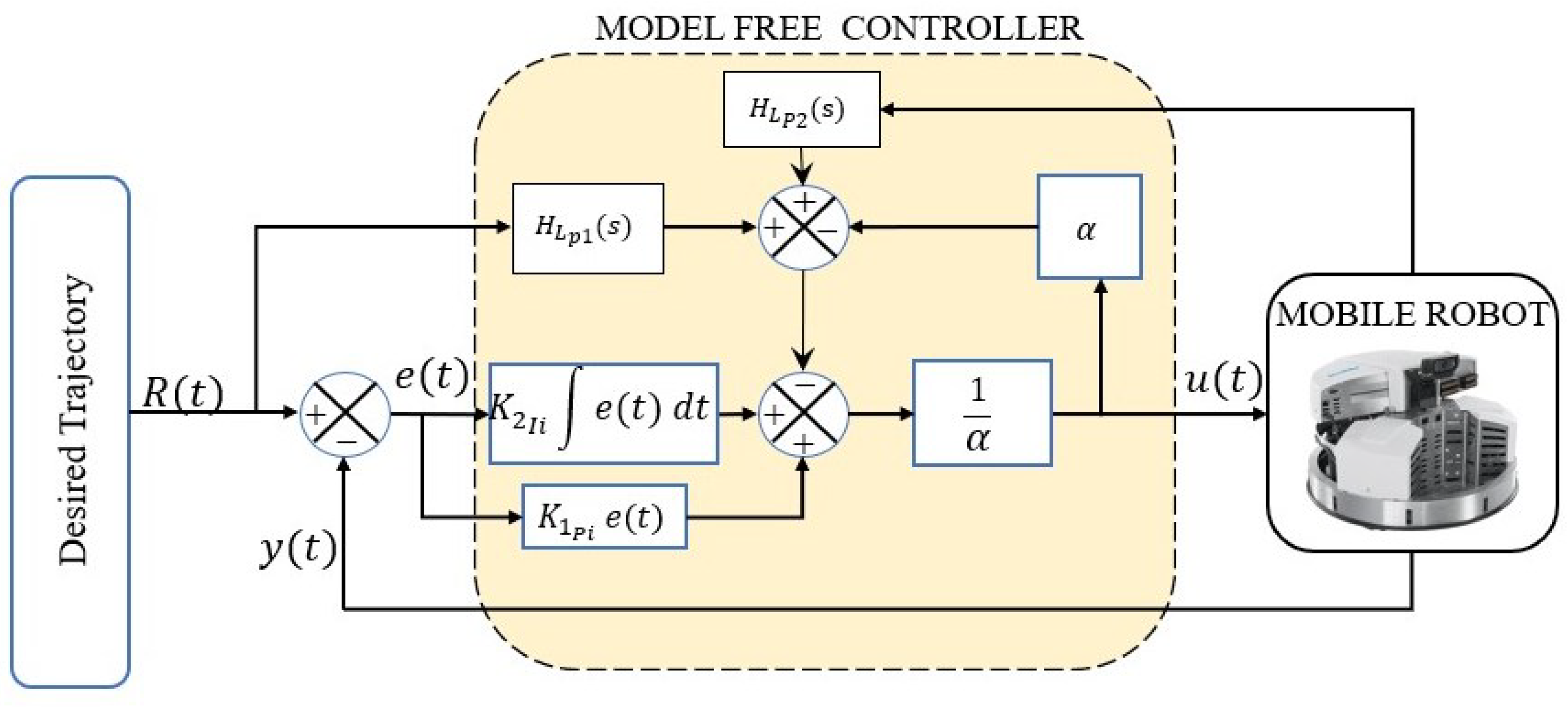
u ( t ) = 1 α F ^ ( t ) + R ˙ ( t ) + K 1 P i ξ ( t ) + K 2 I i ξ ( t ) d t ,
where F ^ ( t ) is the real-time estimate of F ( t ) , R ( t ) is the reference signal, and ξ ( t ) = R ( t ) y ( t ) denotes the tracking error.
Substituting (37) into the ultralocal model (36) yields
y ˙ ( t ) = F ( t ) F ^ ( t ) + R ˙ ( t ) + K 1 P i ξ ( t ) + K 2 I i ξ ( t ) d t .
Using the relation ξ ˙ ( t ) = R ˙ ( t ) y ˙ ( t ) , the closed-loop error dynamics become
ξ ˙ ( t ) = F ( t ) F ^ ( t ) K 1 P i ξ ( t ) K 2 I i ξ ( t ) d t .
Defining the estimation error as
F ˜ ( t ) = F ( t ) F ^ ( t ) .
the closed-loop error dynamics can be expressed as
ξ ˙ ( t ) + K 1 P i ξ ( t ) + K 2 I i ξ ( t ) d t = F ˜ ( t ) .
Equation (41) shows that the closed-loop behavior depends on the quality of the estimate F ^ ( t ) . In the ideal case, when the estimation is sufficiently accurate so that F ^ ( t ) F ( t ) , the estimation error becomes negligible ( F ˜ ( t ) 0 ) , and the closed-loop dynamics reduce to
ξ ˙ ( t ) + K 1 P i ξ ( t ) + K 2 I i ξ ( t ) d t = 0 ,
which corresponds to the nominal closed-loop error dynamics imposed by the controller.
The parameters K 1 P i and K 2 I i are tuned to ensure adequate tracking performance and fast convergence.
A schematic of the model-free iPI structure is shown in Figure 5, where the estimate F ^ ( t ) is computed following the approach proposed in [25].
The proposed structure preserves the simplicity of conventional PI control while providing real-time compensation for unknown system dynamics through the online estimation of F ( t ) . The derivatives required to estimate both the reference signal and F ^ ( t ) are obtained using low-pass filtered differentiators:
H L p 1 ( s ) = K L p 1 s T L p 1 s + 1 ,
H L p 2 ( s ) = K L p 2 s T L p 2 s + 1 .
Unlike the model-based controllers considered in this work, the iPI strategy does not rely on an explicit parametric model of the process. Instead, it estimates the aggregated system dynamics in real time using filtered input–output signals. The derivative filters employed in this approach provide the numerical estimates required for control computation, rather than constituting an explicit dynamic model of the system.
In the following section, the comparison is intentionally limited to a selected set of well-established controllers (PI, GMC, SMC, and iPI) to provide a consistent experimental benchmark under identical conditions. More advanced strategies, such as adaptive MPC or learning-based approaches, are beyond the scope of this study.

4. Results and Discussion

This section presents the experimental results obtained using the Festo Robotino mobile robotic platform. The system dynamics were characterized through empirical modeling, with transfer functions and parameter identification derived from experimental data. The trajectory tracking performance of different control strategies, including PI, GMC, SMC, and a model-free approach, is analyzed and compared, providing insights into the effectiveness of each controller in achieving accurate trajectory tracking.
The experiments were conducted under standard indoor laboratory conditions on a flat and rigid floor surface, ensuring consistent contact conditions for the mobile robot. Lighting conditions remained stable, and no significant external disturbances were introduced during testing. All experiments were performed as single-run evaluations under these consistent operating conditions; therefore, statistical repeatability analysis was not considered in this study. Accordingly, the robustness assessment presented in this work refers to the ability of the controllers to maintain performance under practical operating conditions, rather than under systematically varied environmental uncertainties.

4.1. Empirical Modeling of the Robotino Platform

In this subsection, the empirical modeling procedure for the Robotino platform is presented. System identification was carried out using MATLAB’s System Identification Toolbox (Ident), based on experimental data obtained for the variables x, y, and ϕ . The objective was to derive transfer functions that accurately capture the system dynamics.
An integrator-type model structure was selected because the experimental responses exhibited ramp-like behavior under step inputs, indicating dominant integral dynamics. Model parameters were optimized to minimize the mean squared error between measured data and model responses. The identification configuration employed a sampling period of 0.1 s , an output-error model structure, and transport-delay compensation.
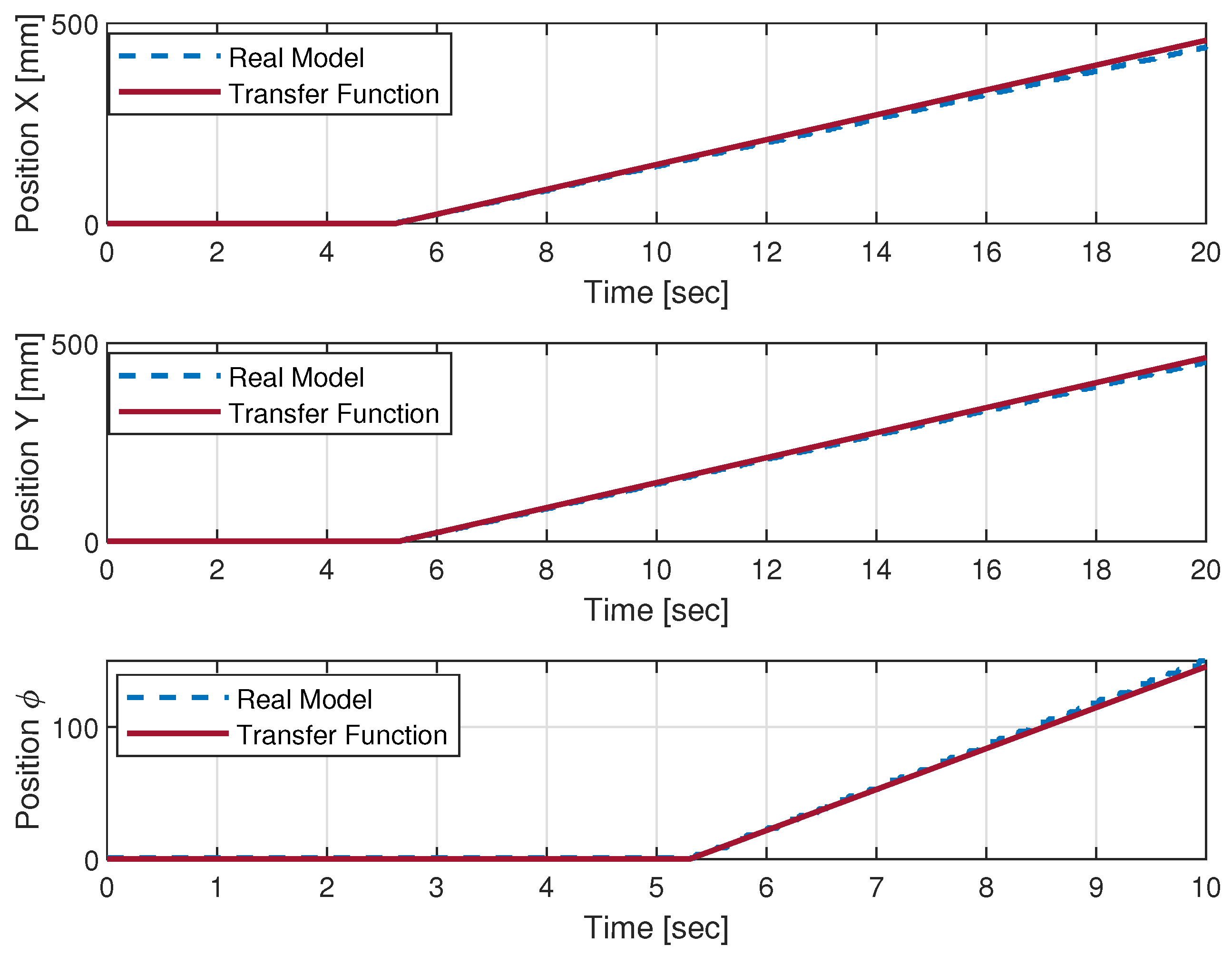
The resulting transfer functions, summarized in Table 1, provide an accurate representation of the system dynamics around the operating point, as validated through experimental comparison. The identified models are valid within the considered operating region and assume small deviations around nominal motion conditions.
Figure 6 compares the real system response with the obtained approximation, showing close alignment around the operating point.
The identified models are valid around the operating region used during experiments and are not intended to represent aggressive maneuvering conditions.
The Robotino platform operates under physical constraints imposed by the wheel actuators, motor dynamics, and onboard safety mechanisms. During experimental validation, the commanded velocities were bounded to ensure safe operation and to prevent actuator saturation. The linear velocity was limited to v max = 0.6 m/s and the angular velocity to ω max = 2.0 rad/s, well within the manufacturer’s specified limits [37].
All reference trajectories were generated within admissible operating limits, ensuring comparable operating conditions for all controllers and avoiding excessive control effort or loss of wheel traction. Since the control input signals were not recorded during the experiments, actuator saturation effects are not explicitly analyzed in this study.

4.2. Performance Indicators

The performance of the evaluated controllers was assessed using quantitative time-domain metrics that enable objective comparison under identical experimental conditions. Among the available performance criteria, the Integral of Squared Error (ISE) is adopted as the primary evaluation index because it penalizes large tracking deviations and accounts for accumulated error over the entire trajectory.
The ISE is defined as
I S E = 0 T ξ 2 ( t ) d t ,
where ξ ( t ) = r ( t ) y ( t ) was previously defined and T denotes the evaluation horizon. Lower ISE values indicate improved tracking accuracy and better transient and steady-state performance.
All ISE values were computed using position errors expressed in millimeters and evaluated over identical time horizons to ensure a fair comparison among controllers.
Because absolute ISE magnitudes depend on trajectory geometry and signal amplitude, a normalized performance index was additionally employed to allow direct comparison across controllers and trajectories. The normalized ISE is defined as
I S E norm = I S E i I S E P I ,
where I S E i corresponds to the evaluated controller and I S E P I denotes the ISE obtained using the PI controller, selected as the baseline reference. This normalization removes scaling effects associated with trajectory size and measurement units, providing a dimensionless metric that highlights the relative performance improvements achieved by each control strategy.
In addition to tracking accuracy, the transient response of the system is evaluated through the settling time T s , which represents the time required for the tracking error to remain within a specified tolerance band around the reference trajectory. The settling time is defined as
T s = min t : | ξ ( t ) | ϵ , t T s ,
where ϵ denotes the tolerance band used to determine convergence. In this work, the tolerance band was set to 2 % of the steady-state reference value, following standard practice in control systems for evaluating settling time. Lower values of T s indicate faster stabilization and improved transient performance of the controller.
Finally, the control effort required by each controller is evaluated using the Integral of Squared Control Output (ISCO), which quantifies the energy of the control input applied during the experiment. Since the control signal is a three-dimensional vector u ( t ) R 3 , the ISCO index is defined as
I S C O = 0 T u ( t ) u ( t ) d t = 0 T u ( t ) 2 d t ,
where T is the duration of the experiment. Lower ISCO values indicate smoother control actions and reduced actuator effort, whereas higher values correspond to more aggressive control activity.
While tracking performance is evaluated individually for each state variable (x, y, and ϕ ), the control effort is reported using a global indicator I S C O a v g . This choice reflects that the control signals act simultaneously on the robot actuators, and therefore, the control energy is naturally interpreted as a combined measure rather than as axis-specific quantities.
In the following sections, the comparative analysis focuses exclusively on experimental results obtained under identical operating conditions.

4.3. Controller Tuning

Table 2, Table 3, Table 4 and Table 5 present the tuning parameters obtained for each implemented control strategy. The tuning process aimed to reduce the settling time while maintaining acceptable performance indices.
The controller parameters were tuned empirically through experimental testing. A formal optimization-based tuning procedure or sensitivity analysis was not performed in this study.

4.4. Comparative Analysis of Trajectory Tracking

This section analyzes the experimental trajectory-tracking performance of the evaluated controllers. The discussion focuses on the tracking accuracy, transient behavior, and qualitative control response observed when following three representative trajectories: circular, lemniscate, and square.
To ensure a consistent evaluation framework, the trajectories were generated using the following parameters:
  • Circular trajectory with radius 1 m completed in 126 s .
  • Lemniscate trajectory with radius 1 m completed in 126 s .
  • Square trajectory with side length 0.5 m completed in 126 s .

4.4.1. Circular Trajectory

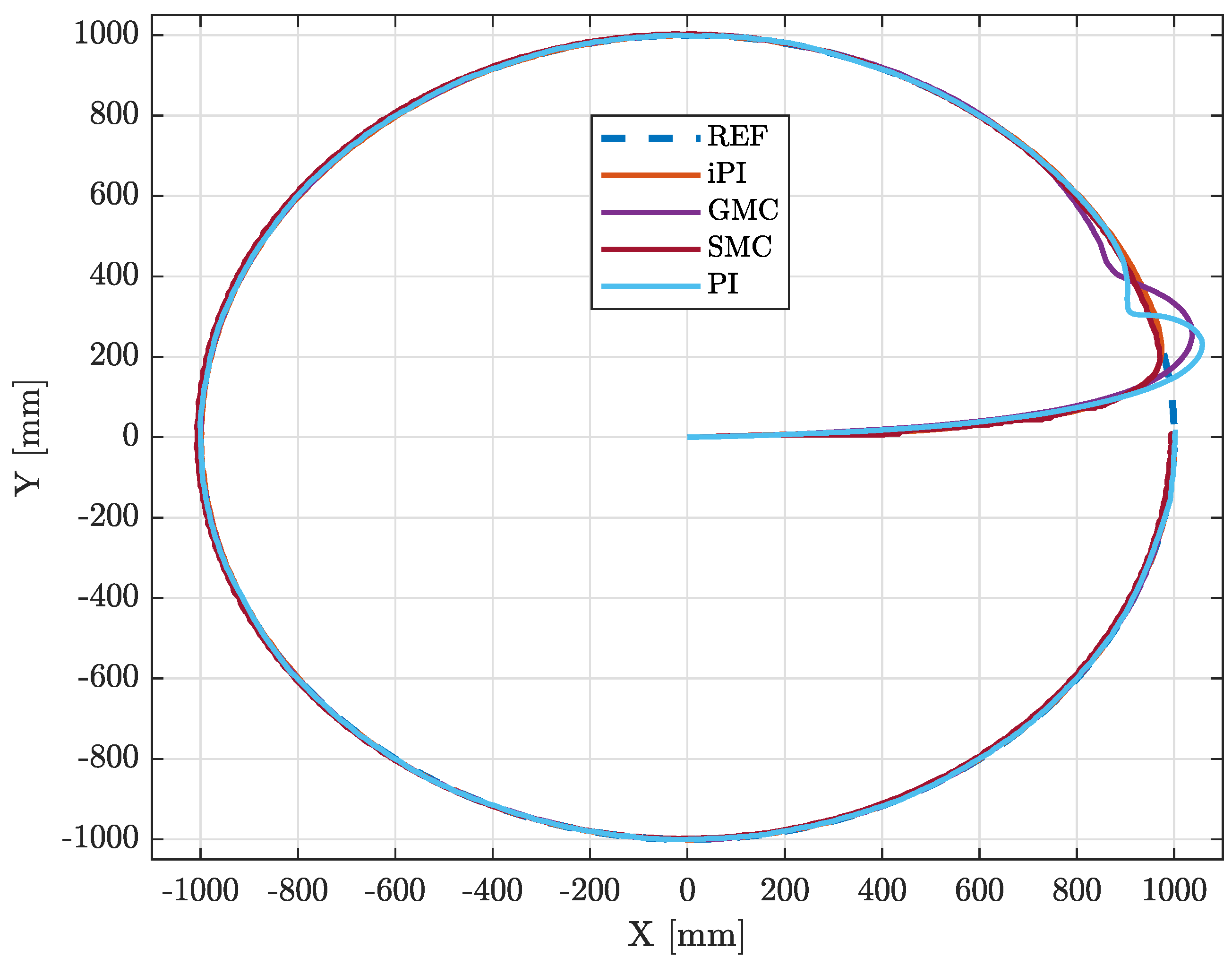
Figure 7 shows the experimental circular trajectories obtained with the four control strategies. All controllers successfully follow the reference path; however, clear differences in tracking precision and transient response can be observed.
The PI and GMC controllers exhibit similar behavior, presenting moderate overshoot and small deviations along the circular path. The SMC controller provides improved stability and faster convergence, although slight oscillatory behavior can be observed near the steady-state region due to the switching nature of the control law. In contrast, the iPI controller achieves the most accurate trajectory reproduction, characterized by smoother transients and faster stabilization.
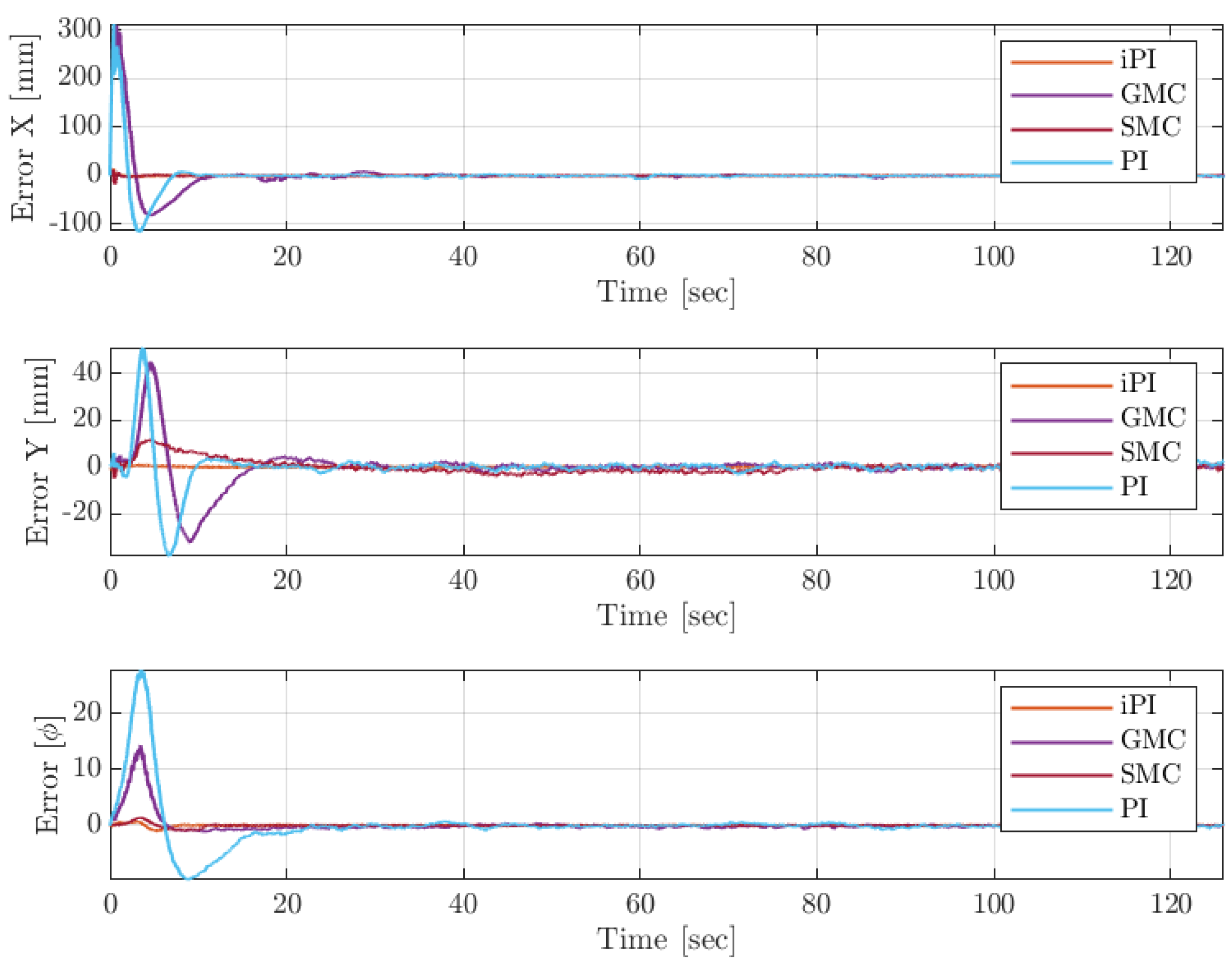
The tracking errors shown in Figure 8 further highlight these differences. The iPI controller converges within approximately 3 s while maintaining peak errors below 80 mm in all variables. The SMC controller stabilizes in about 5– 6 s , whereas PI and GMC exhibit slower responses with settling times between 8 and 10 s .
These observations are quantitatively confirmed in Table 6. The iPI controller not only achieved the lowest tracking error but also required the smallest control effort, with I S C O avg = 0.391 . The SMC controller follows with I S C O avg = 0.544 , while GMC and PI exhibit larger actuator activity. Therefore, for the circular trajectory, the iPI controller provides the most favorable compromise between tracking precision, transient response, and control effort.

4.4.2. Lemniscate Trajectory

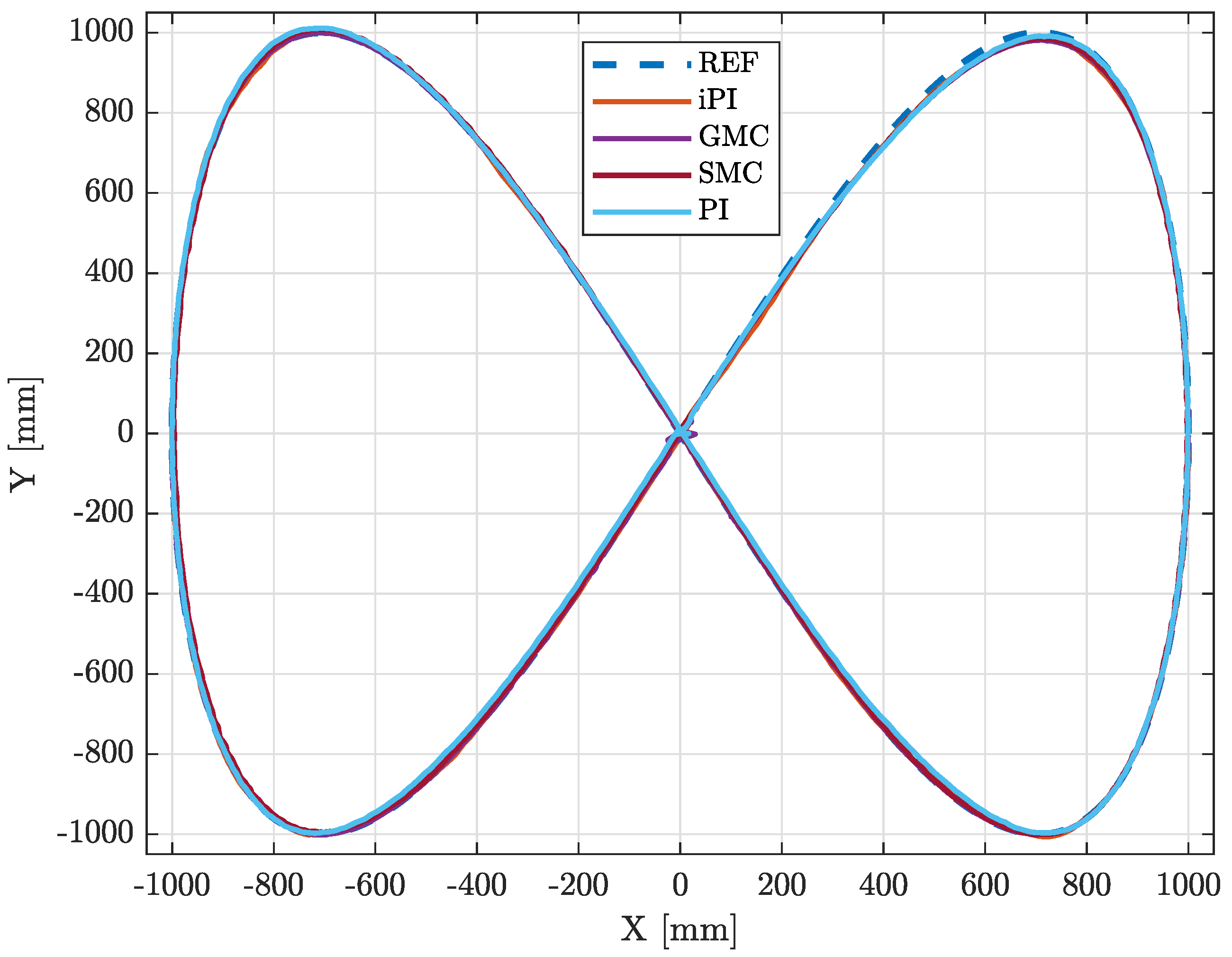
The lemniscate trajectory introduces continuous curvature variations and an intersection point, which makes the tracking problem more demanding.
Figure 9 shows that all controllers are able to follow the reference trajectory, although with different levels of accuracy. The PI and GMC controllers present moderate overshoot and small oscillations near the trajectory crossover. The SMC controller achieves faster convergence but still exhibits minor oscillations around the inflection regions. The iPI controller again delivers the best tracking behavior, minimizing overshoot and ensuring the fastest stabilization.
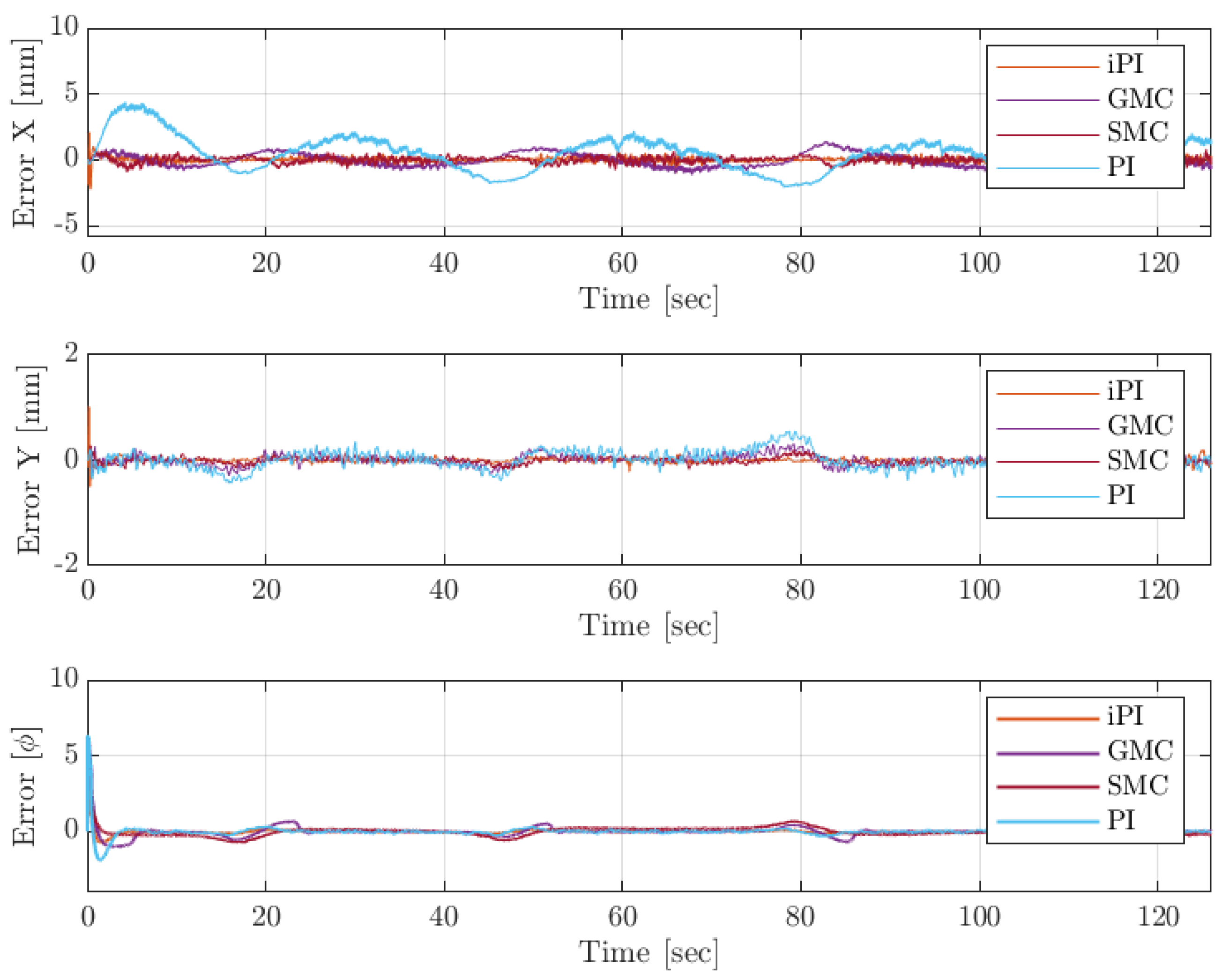
The corresponding tracking errors in Figure 10 confirm these observations. The iPI controller maintains steady-state deviations below ± 2 mm in x and y, and less than 1 ° in ϕ . The SMC and GMC controllers achieve slightly larger errors, while PI exhibits the largest fluctuations.
However, the quantitative results in Table 7 reveal an important difference regarding control effort. While iPI provides the best tracking accuracy, it also requires the highest control activity with I S C O avg = 1.000 . In contrast, GMC exhibits the lowest actuator effort ( I S C O avg = 0.148 ), followed by PI and SMC. This behavior indicates that the improved tracking precision achieved by the model-free strategy in the lemniscate case is accompanied by a more energetic control action, likely due to the continuous curvature changes of the path.

4.4.3. Square Trajectory

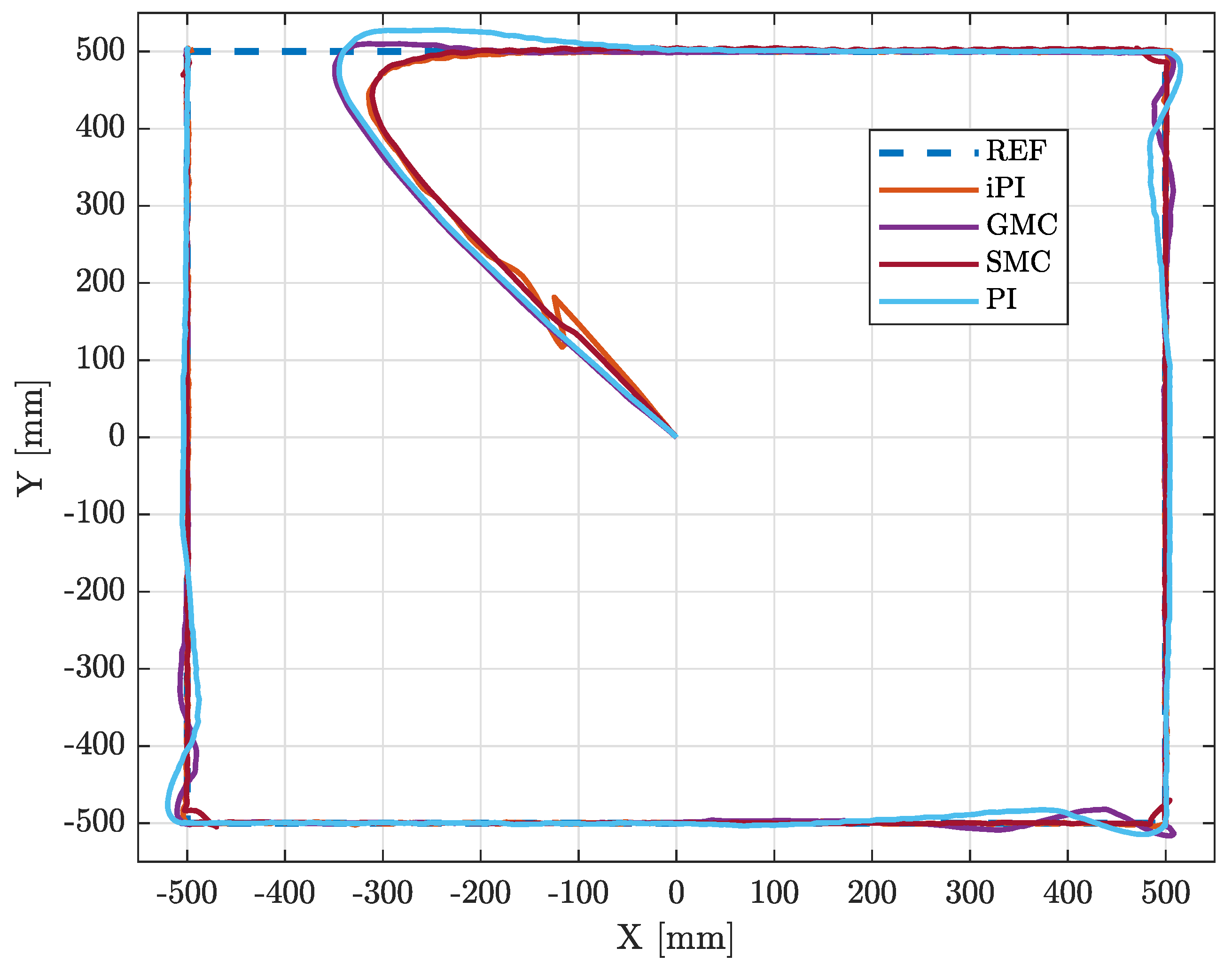
The square trajectory represents the most demanding scenario because of its abrupt directional changes.
As illustrated in Figure 11, the PI and GMC controllers exhibit overshoot near the corners and noticeable deviations during direction transitions. The SMC controller improves stability and reduces these deviations, although the switching nature of the control action produces sharper control variations. The iPI controller provides the closest match to the reference path, minimizing overshoot and achieving rapid recovery at each corner.
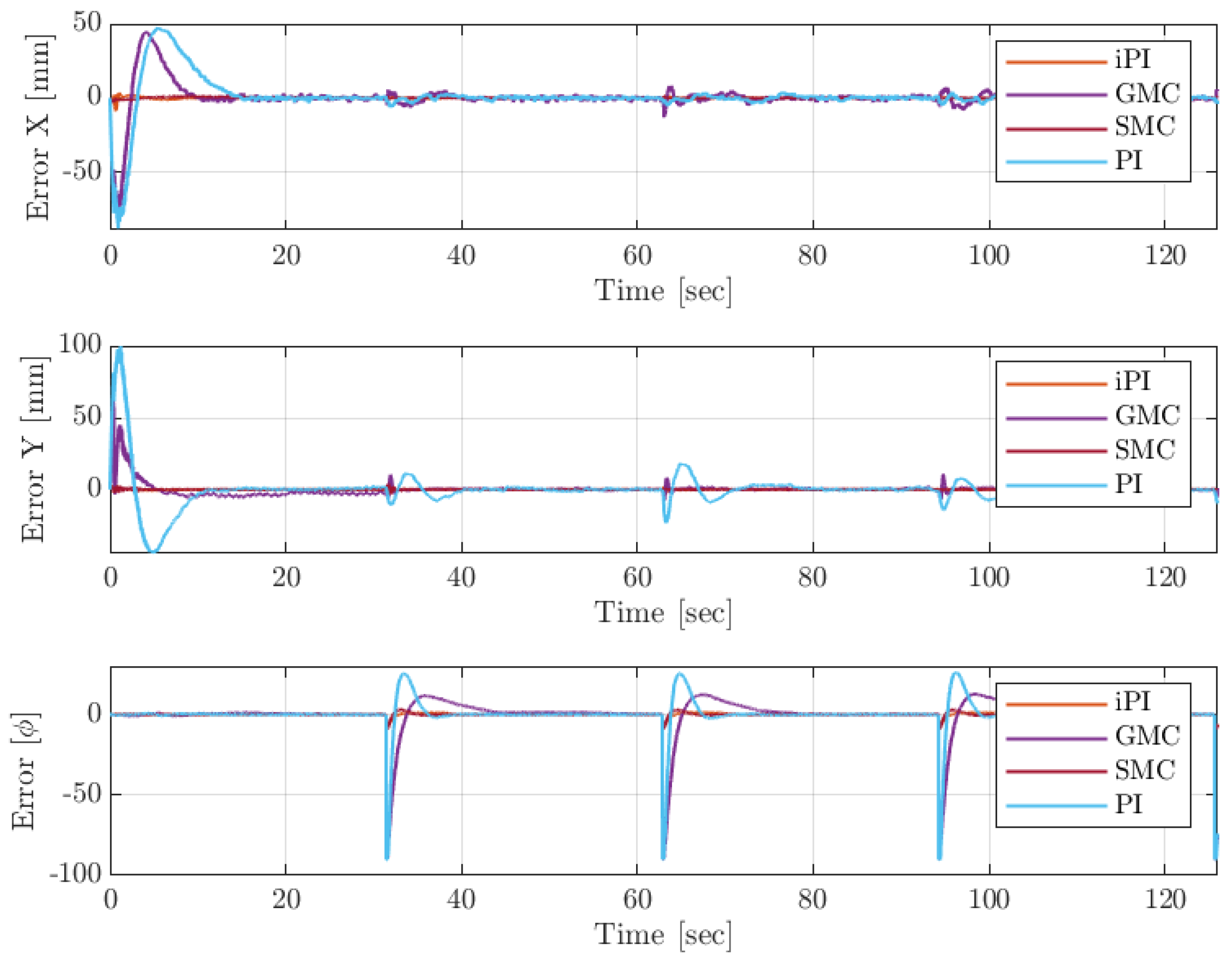
The error signals in Figure 12 confirm that iPI achieves the fastest stabilization, with settling times around 3 s and peak deviations below 20 mm . The SMC controller follows with moderate errors around 40 mm , while PI and GMC exhibit larger deviations.
The quantitative comparison in Table 8 shows that GMC achieves the lowest control effort ( I S C O avg = 0.258 ), followed by PI and iPI, whereas SMC requires the largest actuator activity. Therefore, although iPI provides the most accurate tracking performance. For this trajectory, GMC exhibits the lowest ISCO value, indicating the lowest control effort among the evaluated controllers.

4.5. Performance Evaluation

To complement the qualitative observations, a quantitative performance evaluation was conducted using three metrics: the normalized Integral Squared Error (ISEavg), the settling time Ts, and the average normalized Integral Square Control Output (ISCOavg). The definitions of these performance metrics were introduced in Section 4.2 and are used here to provide a quantitative comparison among the evaluated control strategies.
A global tracking index was computed as
I S E avg = I S E x , norm + I S E y , norm + I S E ϕ , norm 3 ,
It is important to note that the quantities involved in this average are normalized performance indices and therefore dimensionless. Consequently, this formulation does not combine physical quantities expressed in different units (e.g., millimeters and radians), but rather provides a unified measure of relative tracking performance.
Where I S E x , norm , I S E y , norm , and I S E ϕ , norm are dimensionless normalized indices. Therefore, their arithmetic mean provides a global indicator of relative tracking performance across translational and rotational states without directly combining heterogeneous physical units.
Similarly, the global control effort is represented by
I S C O avg = I S C O x , norm + I S C O y , norm + I S C O ϕ , norm 3 ,
which provides a dimensionless average measure of the relative actuator activity associated with the evaluated control strategies.
Since the control inputs simultaneously affect the robot motion in all state variables, the control effort is evaluated using a global index I S C O avg , which represents the overall actuator activity required to achieve the reported tracking performance.
Table 6 summarizes the normalized performance metrics for the circular trajectory. As expected, the PI controller acts as the baseline reference and therefore presents unitary normalized ISE values. The GMC controller improves tracking accuracy, reducing the global error to I S E avg = 0.593 , whereas the SMC controller further enhances performance, reaching I S E avg = 0.045 .
The iPI controller achieves the best overall tracking performance, with I S E avg = 6.2 × 10 4 and the shortest settling time ( T s = 3 s), confirming its superior transient behavior. In addition, the ISCO analysis reveals that iPI also produces the lowest control effort ( I S C O avg = 0.391 ), followed by SMC (0.544), GMC (0.637), and PI (0.749). Therefore, for the circular trajectory, the model-free strategy simultaneously minimizes tracking error and control effort.
Table 7 presents the performance comparison for the lemniscate trajectory. The GMC controller reduces the global tracking error to I S E avg = 0.418 , while the SMC controller further improves the response with I S E avg = 0.274 .
The iPI controller again provides the lowest tracking error, reaching I S E avg = 0.101 and achieving the shortest settling time ( T s = 3 s). However, the ISCO analysis reveals a different trend in terms of control effort. In this case, GMC produces the lowest actuator activity ( I S C O avg = 0.148 ), followed by PI (0.263) and SMC (0.342), while iPI exhibits the highest control effort (1.000). Thus, for the lemniscate trajectory, the improved tracking precision obtained with iPI is achieved at the cost of increased actuator activity.
Table 8 summarizes the results for the square trajectory, which introduces abrupt direction changes. The GMC controller reduces the global error to I S E avg = 0.522 , while the SMC controller significantly improves performance, reaching I S E avg = 2.99 × 10 3 .
The iPI controller once again provides the lowest global error, I S E avg = 2.65 × 10 3 , together with the fastest settling time ( T s = 3 s). Nevertheless, the ISCO results indicate that GMC achieves the smallest control effort ( I S C O avg = 0.258 ), followed by PI (0.380), iPI (0.447), and SMC (0.733). Therefore, although iPI achieves the most accurate trajectory tracking, GMC requires less actuator activity during the abrupt corner transitions.
The normalization process removes scaling effects associated with trajectory amplitude and measurement units, enabling a fair comparison of controller performance. While I S E avg quantifies the global tracking accuracy, I S C O avg provides complementary information about the control energy required to achieve the reported behavior, thereby revealing the trade-off between precision and actuator effort.

4.6. Cross-Trajectory Performance Discussion

Across all evaluated trajectories, a consistent performance trend emerges. Classical PI control exhibits the largest tracking errors and slowest convergence, particularly for trajectories involving strong nonlinearities or abrupt directional changes, such as the lemniscate and square paths. The GMC controller improves performance through model-based compensation, but remains sensitive to dynamic variations.
Both SMC and iPI controllers significantly enhance tracking accuracy and robustness. SMC provides strong disturbance rejection and stable behavior, while the iPI controller consistently achieves the lowest tracking error and fastest transient response.
The ISCO analysis indicates that improved tracking performance does not necessarily correspond to reduced control effort. However, it is important to note that the controllers were tuned independently and employ different gain values, which influences the resulting control effort. For the circular trajectory, the iPI controller achieves both low tracking error and low control effort. In contrast, for the lemniscate and square trajectories, the GMC controller exhibits lower ISCO values, whereas the iPI controller maintains superior tracking precision.
This variation in control effort across trajectories may be associated with the increased complexity of the motion, particularly in trajectories involving stronger curvature variations or abrupt directional changes. However, this interpretation is based on the observed experimental results and was not systematically validated through additional tests under varying trajectory speeds or operating conditions. Therefore, a more comprehensive analysis would be required to establish a direct relationship between trajectory characteristics and control effort.
These results highlight a trade-off between tracking accuracy and control effort, especially in trajectories with complex geometric and dynamic characteristics.

4.7. Computational Complexity Considerations

In addition to tracking accuracy and control effort, the practical implementation of the evaluated controllers also depends on their computational requirements. From this perspective, the classical PI controller represents the simplest strategy, since its implementation only involves the evaluation of proportional and integral actions based on the tracking error. Consequently, it exhibits very low computational complexity and is well suited for real-time embedded applications.
The iPI controller maintains a similarly low computational burden, as it relies on the online estimation of the lumped dynamics term F ( t ) through simple algebraic filtering and arithmetic operations. This estimation allows the controller to compensate for uncertainties and disturbances without requiring an explicit process model.
In contrast, Sliding Mode Control (SMC) requires the continuous evaluation of the sliding surface and the associated switching law, which introduces additional computational operations compared with PI-based approaches.
Finally, the Generic Model Control (GMC) strategy incorporates model-based compensation terms derived from the process dynamics to ensure accurate tracking of a predefined reference trajectory. This requires the evaluation of the process model within the control law, leading to a slightly higher computational complexity than the PI and iPI controllers. Nevertheless, all evaluated strategies remain computationally feasible for real-time implementation on the Robotino platform.

4.8. Practical Control Implications

From a practical standpoint, the results demonstrate that nonlinear control strategies such as Sliding Mode Control (SMC) and model-free approaches can significantly improve trajectory tracking performance without requiring highly accurate process models.
Among the evaluated approaches, the iPI controller consistently provides superior tracking accuracy and fast transient response across all trajectories while maintaining a reasonable control effort. This behavior can be attributed to its ability to compensate aggregated system uncertainties through the real-time estimation of the ultra-local model term F ( t ) . As a result, the controller can adapt to variations in robot dynamics and external disturbances without relying on an explicit plant model.
The Sliding Mode Control (SMC) strategy achieved satisfactory trajectory tracking performance in the experiments. In the literature, SMC is well known for its robustness against model uncertainties and disturbances due to the invariance properties of the sliding motion. In this work, a smoothed version of the switching law was implemented to mitigate the chattering phenomenon typically associated with discontinuous control actions. This smoothing introduces a boundary layer around the sliding surface, which reduces chattering but may increase the variation of the control signal while maintaining stable trajectory tracking.
Model-based approaches such as Generic Model Control (GMC) can provide smooth control actions and may reduce control effort in certain scenarios. Nevertheless, their performance remains dependent on the accuracy of the process model used for controller design.
Overall, the experimental results confirm that model-free control, particularly the iPI strategy, constitutes a promising alternative for mobile robotic applications requiring robust trajectory tracking under practical operating conditions.

5. Conclusions

This study presented a comprehensive experimental comparison under real-time operation of four control strategies—PI, GMC, SMC, and iPI—for trajectory tracking on the Festo Robotino platform using circular, lemniscate, and square reference trajectories. Performance was evaluated through transient response analysis and the Integral Squared Error (ISE) metric.
The experimental results consistently demonstrate the superior tracking accuracy of the model-free iPI controller. Across all trajectories, iPI achieved global error reductions ranging from approximately 25% to 90% relative to the other controllers. It provided faster convergence, lower steady-state error, and improved adaptability to abrupt directional changes, particularly during the square trajectory. A slight initial deviation in the y-axis was observed during this maneuver; however, the transient effect was rapidly compensated once the ultra-local estimation stabilized and did not affect steady-state precision.
The SMC controller also achieved robust tracking performance, reducing the tracking error by approximately 60–75% compared with the classical PI controller, although the presence of residual chattering slightly affected control smoothness. The GMC strategy improved performance relative to PI while providing a structured model-based design framework, at the expense of increased tuning effort and computational complexity. As expected, the conventional PI controller exhibited the largest tracking errors, highlighting its limitations in nonlinear and dynamically varying robotic systems.
From an engineering perspective, controller selection should balance tracking accuracy, robustness, computational complexity, and modeling requirements. The results highlight the practical advantages of model-free intelligent control for robotic systems affected by uncertainties and nonlinear dynamics.
Future work will explore hybrid control architectures that combine the adaptability of model-free control with the robustness of sliding mode strategies and the structural benefits of model-based approaches, aiming to further improve trajectory tracking performance in nonlinear mobile robotic platforms.


Author Contributions

Conceptualization, P.L., O.C. and P.P.; methodology, P.P., G.A. and P.L.; software, S.V. and M.V.-G.; validation, S.V., M.V.-G., P.P., G.A. and P.L.; formal analysis, P.P., G.A. and P.L.; investigation, S.V. and M.V.-G.; resources, O.C.; data curation, S.V. and M.V.-G.; writing—original draft preparation, S.V. and M.V.-G.; writing—review and editing, P.P., G.A., P.L. and O.C.; visualization, S.V. and M.V.-G.; supervision, O.C.; project administration, O.C. All authors have read and agreed to the published version of the manuscript.

Funding

Universidad San Francisco de Quito supported this work through the Poli-Grants Program under Grant 41983.

Institutional Review Board Statement

Not applicable.

Informed Consent Statement

Not applicable.

Data Availability Statement

The original contributions presented in this study are included in the article. Further inquiries can be directed to the corresponding author.

Conflicts of Interest

The authors declare no conflicts of interest.

References

  1. Nascimento, T.P.; Dórea, C.E.; Gonçalves, L.M.G. Nonholonomic mobile robots’ trajectory tracking model predictive control: A survey. Robotica 2018, 36, 676–696. [Google Scholar] [CrossRef]
  2. Tang, M.; Zhang, Y.; Yu, S.; Li, J.; Tang, K. Trajectory tracking model predictive control for mobile robot based on deep Koopman operator modeling. Robot. Auton. Syst. 2025, 194, 105152. [Google Scholar] [CrossRef]
  3. Medina, L.; Guerra, G.; Herrera, M.; Guevara, L.; Camacho, O. Trajectory tracking for non-holonomic mobile robots: A comparison of sliding mode control approaches. Results Eng. 2024, 22, 102105. [Google Scholar] [CrossRef]
  4. Morales, L.; Herrera, M.; Camacho, O.; Leica, P.; Aguilar, J. LAMDA control approaches applied to trajectory tracking for mobile robots. IEEE Access 2021, 9, 37179–37195. [Google Scholar] [CrossRef]
  5. El-Sayyah, M.; Saad, M.R.; Saad, M. Enhanced mpc for omnidirectional robot motion tracking using laguerre functions and non-iterative linearization. IEEE Access 2022, 10, 118290–118301. [Google Scholar] [CrossRef]
  6. Wang, D.-S.; Yu, H.-F. Path planning of mobile robot in dynamic environments. In Proceedings of the 2011 2nd International Conference on Intelligent Control and Information Processing; IEEE: Piscataway, NJ, USA, 2011; pp. 691–696. [Google Scholar]
  7. Morales, S.; Magallanes, J.; Delgado, C.; Canahuire, R. LQR trajectory tracking control of an omnidirectional wheeled mobile robot. In Proceedings of the 2018 IEEE 2nd Colombian Conference on Robotics and Automation (CCRA); IEEE: Piscataway, NJ, USA, 2018; pp. 1–5. [Google Scholar]
  8. Rigatos, G. A nonlinear optimal control approach for tracked mobile robots. J. Syst. Sci. Complex. 2021, 34, 1279–1300. [Google Scholar] [CrossRef]
  9. Hassan, N.; Saleem, A. Analysis of trajectory tracking control algorithms for wheeled mobile robots. In Proceedings of the 2021 IEEE Industrial Electronics and Applications Conference (IEACon); IEEE: Piscataway, NJ, USA, 2021; pp. 236–241. [Google Scholar]
  10. Yang, H.; Fan, X.; Shi, P.; Hua, C. Nonlinear control for tracking and obstacle avoidance of a wheeled mobile robot with nonholonomic constraint. IEEE Trans. Control Syst. Technol. 2015, 24, 741–746. [Google Scholar] [CrossRef]
  11. Kubo, R.; Fujii, Y.; Nakamura, H. Control Lyapunov function design for trajectory tracking problems of wheeled mobile robot. IFAC-PapersOnLine 2020, 53, 6177–6182. [Google Scholar] [CrossRef]
  12. Zheng, Y.; Zheng, J.; Shao, K.; Zhao, H.; Xie, H.; Wang, H. Adaptive trajectory tracking control for nonholonomic wheeled mobile robots: A barrier function sliding mode approach. IEEE/CAA J. Autom. Sin. 2024, 11, 1007–1021. [Google Scholar] [CrossRef]
  13. Kühne, F.; Gomes, J.; Fetter, W. Mobile robot trajectory tracking using model predictive control. In Proceedings of the II IEEE Latin-American Robotics Symposium (LARS), São Luís, Brazil; IEEE: Piscataway, NJ, USA, 2005; Volume 51, pp. 1–5. [Google Scholar]
  14. Wang, Z.; Gao, F.; Zhao, Y.; Yin, Y.; Wang, L. Improved A* algorithm and model predictive control-based path planning and tracking framework for hexapod robots. Ind. Robot. Int. J. Robot. Res. Appl. 2023, 50, 135–144. [Google Scholar] [CrossRef]
  15. Campos, J.; Jaramillo, S.; Morales, L.; Camacho, O.; Chávez, D.; Pozo, D. PSO tuning for fuzzy PD+ I controller applied to a mobile robot trajectory control. In Proceedings of the 2018 International Conference on Information Systems and Computer Science (INCISCOS); IEEE: Piscataway, NJ, USA, 2018; pp. 62–68. [Google Scholar]
  16. Salinas, L.R.; Santiago, D.; Slawiñski, E.; Mut, V.A.; Chavez, D.; Leica, P.; Camacho, O. P+ d plus sliding mode control for bilateral teleoperation of a mobile robot. Int. J. Control. Autom. Syst. 2018, 16, 1927–1937. [Google Scholar] [CrossRef]
  17. Gude, J.J.; Bringas, P.G.; Herrera, M.; Rincón, L.; Di Teodoro, A.; Camacho, O. Fractional-order model identification based on the process reaction curve: A unified framework for chemical processes. Results Eng. 2024, 21, 101757. [Google Scholar] [CrossRef]
  18. Capito, L.; Proaño, P.; Camacho, O.; Rosales, A.; Scaglia, G. Experimental comparison of control strategies for trajectory tracking for mobile robots. Int. J. Autom. Control 2016, 10, 308–327. [Google Scholar] [CrossRef]
  19. Guevara, L.; Camacho, O.; Rosales, A.; Guevara, J.; Scaglia, G. A linear algebra controller based on reduced order models applied to trajectory tracking for mobile robots: An experimental validation. Int. J. Autom. Control 2019, 13, 176–196. [Google Scholar] [CrossRef]
  20. Ogunnaike, B.A.; Ray, W.H. Process Dynamics, Modeling, and Control; Oxford University Press: New York, NY, USA, 1994. [Google Scholar]
  21. Lee, P.; Sullivan, G. Generic model control (GMC). Comput. Chem. Eng. 1988, 12, 573–580. [Google Scholar] [CrossRef]
  22. Lee, P.L. Nonlinear Process Control: Applications of Generic Model Control; Springer: New York, MY, USA, 2012. [Google Scholar]
  23. Jenzsch, M.; Simutis, R.; Luebbert, A. Generic model control of the specific growth rate in recombinant Escherichia coli cultivations. J. Biotechnol. 2006, 122, 483–493. [Google Scholar] [CrossRef]
  24. Fliess, M.; Join, C. Model-free control. Int. J. Control 2013, 86, 2228–2252. [Google Scholar] [CrossRef]
  25. Precup, R.E.; Radac, M.B.; Roman, R.C.; Petriu, E.M. Model-free sliding mode control of nonlinear systems: Algorithms and experiments. Inf. Sci. 2017, 381, 176–192. [Google Scholar] [CrossRef]
  26. Li, W.; Yuan, H.; Li, S.; Zhu, J. A revisit to model-free control. IEEE Trans. Power Electron. 2022, 37, 14408–14421. [Google Scholar] [CrossRef]
  27. Lafont, F.; Balmat, J.F.; Pessel, N.; Fliess, M. A model-free control strategy for an experimental greenhouse with an application to fault accommodation. Comput. Electron. Agric. 2015, 110, 139–149. [Google Scholar] [CrossRef]
  28. Utkin, V.I. Variable structure systems with sliding modes. IEEE Trans. Autom. Control 1977, 22, 212–222. [Google Scholar] [CrossRef]
  29. Obando, C.; Rojas, R.; Ulloa, F.; Camacho, O. Dual-mode based sliding mode control approach for nonlinear chemical processes. ACS Omega 2023, 8, 9511–9525. [Google Scholar] [CrossRef]
  30. Sira-Ramirez, H. On the dynamical sliding mode control of nonlinear systems. Int. J. Control 1993, 57, 1039–1061. [Google Scholar] [CrossRef]
  31. Koshkouei, A.J.; Burnham, K.J.; Zinober, A.S. Dynamic sliding mode control design. IEE Proc.-Control Theory Appl. 2005, 152, 392–396. [Google Scholar] [CrossRef]
  32. Herrera, M.; Camacho, O.; Leiva, H.; Smith, C. An approach of dynamic sliding mode control for chemical processes. J. Process Control 2020, 85, 112–120. [Google Scholar] [CrossRef]
  33. Utkin, V.; Poznyak, A.; Orlov, Y.V.; Polyakov, A. Road Map for Sliding Mode Control Design; Springer: Cham, Switzerland, 2020. [Google Scholar]
  34. Gambhire, S.; Kishore, D.R.; Londhe, P.; Pawar, S. Review of sliding mode based control techniques for control system applications. Int. J. Dyn. Control 2021, 9, 363–378. [Google Scholar] [CrossRef]
  35. Vaidyanathan, S.; Lien, C.H. Applications of Sliding Mode Control in Science and Engineering; Springer: New York, NY, USA, 2017; Volume 709. [Google Scholar]
  36. Das, M.S.; Gogoi, U.R.; Mandal, S. Hybrid Adaptive Sliding Mode Controller for Path Tracking of Wheeled Mobile Robot in Uncertainty. Ain Shams Eng. J. 2025, 16, 103640. [Google Scholar] [CrossRef]
  37. Bliesener, M.; Weber, C.; Kling, K.; Karras, U.; Zitzmann, D. Festo Robotino Manual; Festo Didactic GmbH & Co. KG: Denkendorf, Germany, 2007. [Google Scholar]
  38. Weinert, H.; Pensky, D. Mobile robotics in education and student engineering competitions. In Proceedings of the IEEE Africon’11; IEEE: Piscataway, NJ, USA, 2011; pp. 1–5. [Google Scholar]
  39. Fuentes, M.; Castillo, O.; Cortés-Antonio, P. Review of fuzzy control for path tracking in the Robotino system. In Recent Advances of Hybrid Intelligent Systems Based on Soft Computing; Springer: New York, NY, USA, 2021; pp. 205–215. [Google Scholar]
  40. Gutiérrez Ramón, X. Trajectory Control Design of a Mobile Robot with Computer Vision. Bachelor’s Thesis, Universitat Politècnica de Catalunya, Barcelona, Spain, 2016. [Google Scholar]
  41. Seborg, D.E.; Edgar, T.F.; Mellichamp, D.A.; Doyle, F.J. Process Dynamics and Control, 3rd ed.; Wiley: Hoboken, NJ, USA, 2011. [Google Scholar]
  42. Knospe, C. PID control. IEEE Control Syst. Mag. 2006, 26, 30–31. [Google Scholar] [CrossRef]
  43. Samad, T.; Bauer, M.; Bortoff, S.; Di Cairano, S.; Fagiano, L.; Odgaard, P.F.; Rhinehart, R.R.; Sánchez-Peña, R.; Serbezov, A.; Ankersen, F.; et al. Industry engagement with control research: Perspective and messages. Annu. Rev. Control 2020, 49, 1–14. [Google Scholar] [CrossRef]
  44. Liptak, B.G.; Piovoso, M.J.; Shinskey, F.G.; Eren, H. Instrument Engineers’ Handbook, Volume Two: Process Control and Optimization; CRC Press: Boca Raton, FL, USA, 2018. [Google Scholar]
  45. Camacho, O.; Smith, C.A. Sliding mode control: An approach to regulate nonlinear chemical processes. ISA Trans. 2000, 39, 205–218. [Google Scholar] [CrossRef]
  46. Perruquetti, W.; Barbot, J.P. Sliding Mode Control in Engineering; Marcel Dekker: New York, NY, USA, 2002. [Google Scholar]
  47. Li, Z.; Guo, J.; Wang, T.; Xiong, X.; Feng, Y.; Li, X. Trajectory Tracking Control for Wheeled Mobile Robots with Unknown Slip Rates Based on Improved Rapid Variable Exponential Reaching Law and Sliding Mode Observer. Machines 2025, 13, 765. [Google Scholar] [CrossRef]
  48. Castellanos-Cárdenas, D.; Posada, N.L.; Orozco-Duque, A.; Sepúlveda-Cano, L.M.; Castrillón, F.; Camacho, O.E.; Vásquez, R.E. A Review on Data-Driven Model-Free Sliding Mode Control. Algorithms 2024, 17, 543. [Google Scholar] [CrossRef]
  49. Camacho, O.E.; Smith, C.; Chacón, E. Toward an implementation of sliding mode control to chemical processes. In Proceedings of the ISIE’97 Proceeding of the IEEE International Symposium on Industrial Electronics; IEEE: Piscataway, NJ, USA, 1997; pp. 1101–1105. [Google Scholar]
  50. Zhai, Z.M.; Moradi, M.; Kong, L.W.; Glaz, B.; Haile, M.; Lai, Y.C. Model-free tracking control of complex dynamical trajectories with machine learning. Nat. Commun. 2023, 14, 5698. [Google Scholar] [CrossRef] [PubMed]
Figure 1. Robotino-Festo.
Eng 07 00281 g001
Figure 2. Kinematic variables of the robot.
Eng 07 00281 g002
Figure 3. GMC Control schematic.
Eng 07 00281 g003
Figure 4. Sliding Mode Control schematic.
Eng 07 00281 g004
Figure 5. iPI Model-Free control structure [25].
Eng 07 00281 g005
Figure 6. Empirical model of the Robotino platform based on experimental data of X, Y, and ϕ .
Eng 07 00281 g006
Figure 7. Comparison of experimental responses for the circular trajectory.
Eng 07 00281 g007
Figure 8. Tracking errors for the circular trajectory.
Eng 07 00281 g008
Figure 9. Comparison of experimental responses for the lemniscate trajectory.
Eng 07 00281 g009
Figure 10. Tracking errors for the lemniscate trajectory.
Eng 07 00281 g010
Figure 11. Comparison of experimental responses for the square trajectory.
Eng 07 00281 g011
Figure 12. Tracking errors for the square trajectory.
Eng 07 00281 g012
Table 1. Integrator-type transfer function approximations based on experimental data.
VariableExperimental Model
x  0.31 s e 0.25 s  
y  0.32 s e 0.3 s  
ϕ   0.31 s e 0.3 s  
Table 2. PI controller tuning parameters.
Variable K p K i
x1.00.6
y1.21.0
ϕ 2.50.6
Table 3. GMC controller tuning parameters.
Variable K 1 K 2
x3.02.0
y3.04.0
ϕ 1.01.5
Table 4. SMC controller tuning parameters.
Variable λ 1 λ 0 K D δ
x2.41.75.01.13
y3.52.54.75.8
ϕ 2.632.05.81.2
Note: The parameters K and t 0 were obtained from the experimental values reported in Table 1.
Table 5. iPI controller tuning parameters.
Variable α K 1 Pi K 2 Ii K L P 1 K L P 2 T L P 1 T L P 2
x30.01.00.6 1.0 × 10 5 1.01.01.0
y30.01.21.0 1.0 × 10 5 1.01.01.0
ϕ 30.02.50.6 1.0 × 10 4 1.01.01.0
Table 6. Normalized performance metrics for the circular trajectory. The table reports the normalized Integral Square Error (ISE) for each state variable (x, y, and ϕ ), together with the global performance index I S E avg . The settling time T s and the average normalized Integral Square Control Output I S C O avg are also included to characterize transient response and control effort.
Controller ISE x ISE y ISE ϕ ISE avg T s [s] ISCO avg
PI1.0001.0001.0001.000100.749
GMC0.7140.8970.1670.59390.637
SMC7.5 × 10 4 0.1332.6 × 10 3 0.0455.50.544
iPI4.1 × 10 4 3.5 × 10 4 1.1 × 10 3 6.2 × 10 4 30.391
Table 7. Normalized performance metrics for the lemniscate trajectory. The table reports the normalized Integral Square Error (ISE) for each state variable (x, y, and ϕ ), together with the global performance index I S E avg . The settling time T s and the average normalized Integral Square Control Output I S C O avg are included to evaluate transient response characteristics and control effort.
Controller ISE x ISE y ISE ϕ ISE avg T s [s] ISCO avg
PI1.0001.0001.0001.00070.263
GMC0.1310.3240.7980.41860.148
SMC0.0260.1350.6610.2744.50.342
iPI0.0190.0810.2020.10131.000
Table 8. Normalized performance metrics for the square trajectory. The table reports the normalized Integral Square Error (ISE) for each state variable (x, y, and ϕ ), together with the global performance index I S E avg . The settling time T s and the average normalized Integral Square Control Output I S C O avg are included to evaluate transient performance and cornering response under discontinuous trajectory conditions.
Controller ISE x ISE y ISE ϕ ISE avg T s [s] ISCO avg
PI1.0001.0001.0001.00090.380
GMC0.5790.1450.8420.52280.258
SMC1.47 × 10 3 5.05 × 10 4 7.0 × 10 3 2.99 × 10 3 50.733
iPI8.8 × 10 4 3.6 × 10 4 6.7 × 10 3 2.65 × 10 3 30.447
Disclaimer/Publisher’s Note: The statements, opinions and data contained in all publications are solely those of the individual author(s) and contributor(s) and not of MDPI and/or the editor(s). MDPI and/or the editor(s) disclaim responsibility for any injury to people or property resulting from any ideas, methods, instructions or products referred to in the content.