
Thermal Behavior of Dental Composites During Photopolymerization: Effect of Material Type, Increment Thickness, and Light Intensity


 ,
,  ,
,  ,
,
Abstract
1. Introduction
2. Materials and Methods
2.1. Study Design
2.2. Statistical Analysis
3. Results
4. Discussion
5. Conclusions
Author Contributions
Funding
Institutional Review Board Statement
Informed Consent Statement
Data Availability Statement
Conflicts of Interest
References
- Ribeiro, M.T.; Price, R.B.; Michaud, P.L.; Soares, C.J. Physicomechanical properties of resin-based composites photo-polymerized using laser, polywave and quadwave curing lights. Dent. Mater. 2025, 41, 699–707. [Google Scholar] [CrossRef] [Scilit] [PubMed]
- Alsenan, J.; Al-Ghamdi, S.; Al-Senan, D. Photoinitiator Systems in Dental Resin-Based Composites: Mechanisms, Performance, and Clinical Implications. F1000Research 2026, 15, 201. [Google Scholar] [CrossRef] [Scilit]
- Cunha, L.G.; Alonso, R.C.; Pfeifer, C.S.; Correr-Sobrinho, L.; Ferracane, J.L.; Sinhoreti, M.A. Contraction stress and physical properties development of a resin-based composite irradiated using modulated curing methods at two C-factor levels. Dent. Mater. 2008, 24, 392–398. [Google Scholar] [CrossRef] [Scilit]
- Czasch, P.; Ilie, N. In vitro comparison of mechanical properties and degree of cure of bulk-fill composites. Clin. Oral Investig. 2013, 17, 227–235. [Google Scholar] [CrossRef] [Scilit]
- Feng, L.; Suh, B.I. Exposure reciprocity law in photopolymerization of multi-functional acrylates and methacrylates. Macromol. Chem. Phys. 2006, 207, 295–302. [Google Scholar] [CrossRef] [Scilit]
- Ferracane, J.L. Resin composite—State of the art. Dent. Mater. 2011, 27, 29–38. [Google Scholar] [CrossRef] [Scilit]
- Hatner, H.A.; Keigo, R.N.; Caneschi, C.S.; Aquino, J.R.; Albuquerque, R.C.; Morgan, L.F.; Moreira, A.N. Evaluation of pulp chamber temperature during cementation with the preheated composite resin technique. J. Prosth. Dent. 2025, 133, 202-e1. [Google Scholar] [CrossRef] [Scilit]
- Ahmed, D.; Al-Ani, A.; Yousif, E. Dental Polymeric Composites: A Narrative Review of Properties and Clinical Performance. J. Indones. Dent. Associat. 2025, 8, 61–65. [Google Scholar] [CrossRef] [Scilit]
- Phan, A.C.; Tang, M.L.; Nguyen, J.F.; Ruse, N.D.; Sadoun, M. High-temperature high-pressure polymerized urethane dimethacrylate—Mechanical properties and monomer release. Dent. Mater. 2014, 30, 350–356. [Google Scholar] [CrossRef] [Scilit]
- Michaud, P.L.; Price, R.B.; Labrie, D.; Rueggeberg, F.A.; Sullivan, B. Localised irradiance distribution found in dental light curing units. J. Dent. 2014, 42, 129–139. [Google Scholar] [CrossRef] [Scilit] [PubMed]
- Par, M.; Spanovic, N.; Bjelovucic, R.; Skenderovic, H.; Gamulin, O. Temperature rise in pulp chamber during light-curing of resin-based composites: A systematic review and meta-analysis. Clin. Oral Investig. 2019, 23, 1803–1818. [Google Scholar]
- Price, R.B.; Ferracane, J.L.; Shortall, A.C. Light-curing units: A review of what we need to know. J. Dent. Res. 2015, 94, 1179–1186. [Google Scholar] [CrossRef] [Scilit]
- Maucoski, C.; Guarneri, J.A.; Farrar, P.; Price, R.B. Influence of temperature and primer application on setting time and degree of conversion of a dual-cure self-adhesive cement. J. Dent. 2025, 160, 105859. [Google Scholar]
- Schneider, L.F.; Cavalcante, L.M.; Silikas, N. Shrinkage stresses generated during resin-composite applications: A review. J. Dent. Biomech. 2010, 2010, 131630. [Google Scholar] [CrossRef] [Scilit]
- Al-Qudah, A.A.; Mitchell, C.A.; Biagioni, P.A.; Hussey, D.L. Effect of composite shade, increment thickness and curing light on temperature rise during photocuring. J. Dent. 2007, 35, 238–245. [Google Scholar] [CrossRef] [Scilit] [PubMed]
- Shortall, A.C.; Palin, W.M.; Burtscher, P. Refractive index mismatch and monomer reactivity influence composite curing depth. J. Dent. Res. 2008, 87, 84–88. [Google Scholar] [CrossRef] [Scilit]
- Ferracane, J.L. Hygroscopic and hydrolytic effects in dental polymer networks. Dent. Mater. 2006, 22, 211–222. [Google Scholar] [CrossRef] [Scilit]
- Nangia, D.; Duggal, I.; Logani, A.; Sharma, S.; Duggal, R. Reliability of electric pulp test and thermal pulp test for assessing pulpal response in patients undergoing orthodontic treatment—A systematic review. Int. Orthod. 2025, 23, 100952. [Google Scholar] [CrossRef] [Scilit] [PubMed]
- Hussein, H.A.; Saeed, H.M. Effect of shade and light-curing intensity on bulk-fill composite: Heat generation and chemo-mechanical properties (in vitro study). J. Compos. Sci. 2024, 8, 237. [Google Scholar] [CrossRef] [Scilit]
- Guiraldo, R.D.; Consani, S.; De Souza, A.S.; Consani, R.L.; Sinhoreti, M.A.; Correr-Sobrinho, L. Influence of light energy density on heat generation during photoactivation of dental composites with different dentin and composite thickness. J. Appl. Oral Sci. 2009, 17, 289–293. [Google Scholar] [CrossRef] [Scilit]
- Algamaiah, H.; Kwon, T.Y.; Kim, K.H. Temperature rise during light-curing of resin composites in dentin cavities. Dent. Mater. 2024, 40, e45–e53. [Google Scholar]
- Szalewski, L.; Szymańska, J.; Zaborowski, P. Temperature rise during polymerization of resin composites: An in vitro study. Appl. Sci. 2021, 11, 474. [Google Scholar] [CrossRef] [Scilit]
- Ilie, N.; Stark, K. Effect of different curing protocols on the mechanical properties of low-viscosity bulk-fill composites. Clin. Oral Investig. 2015, 19, 271–279. [Google Scholar] [CrossRef] [Scilit]
- Leprince, J.G.; Palin, W.M.; Hadis, M.A.; Devaux, J.; Leloup, G. Progress in dimethacrylate-based dental composite technology and curing efficiency. Dent. Mater. 2013, 29, 139–156. [Google Scholar] [CrossRef] [Scilit] [PubMed]
- Al-Ahdal, K.; Ilie, N.; Silikas, N.; Watts, D.C. Polymerization kinetics and impact of post-polymerization on the degree of conversion of bulk-fill resin composite at clinically relevant depth. Dent. Mater. 2015, 31, 1207–1213. [Google Scholar] [PubMed]
- Mousavinasab, S.M.; Taromi, Z.; Zajkani, E. Thermal rise during photopolymerization and degree of conversion of bulk-fill and conventional resin composites. Dent. Res. J. 2020, 17, 293–300. [Google Scholar]
- McCabe, J.F.; Wilson, H.J. The use of differential scanning calorimetry for the evaluation of dental materials: I. Cements, cavity lining materials and anterior restorative materials. J. Oral Rehabil. 1980, 7, 103–110. [Google Scholar] [CrossRef] [Scilit]
- Lloyd, C.H. A differential thermal analysis for the heats of reaction and temperature rises produced during the setting of tooth-coloured restorative materials. J. Oral Rehabil. 1984, 11, 111–121. [Google Scholar]
- McCabe, J.F. Cure performance of light-activated composites by differential thermal analysis. Dent. Mater. 1985, 1, 231–234. [Google Scholar] [CrossRef] [Scilit]
- Lloyd, C.H.; Joshi, A.; McGlynn, E. Temperature rises produced by light sources and composites during curing. Dent. Mater. 1986, 2, 170–174. [Google Scholar] [CrossRef] [Scilit]
- Watts, D.C.; McAndrew, R.; Lloyd, C.H. Thermal diffusivity of composite restorative materials. J. Dent. Res. 1987, 66, 1576–1578. [Google Scholar] [CrossRef] [Scilit]
- Rueggeberg, F.A.; Giannini, M.; Arrais, C.A.G.; Price, R.B.T. Light curing in dentistry and clinical implications: A literature review. Braz. Oral Res. 2017, 31, e61. [Google Scholar] [CrossRef] [Scilit] [PubMed]
- Hasanain, F.A.; Nassar, H.M. Utilizing light cure units: A concise narrative review. Polymers 2021, 13, 1596. [Google Scholar] [CrossRef] [Scilit]
- Guiraldo, R.D.; Consani, S.; Consani, R.L.; Berger, S.B.; Mendes, W.B.; Sinhoreti, M.A. Light energy transmission through composite influenced by material shades. Bull. Tokyo Dent. Coll. 2009, 50, 183–190. [Google Scholar] [CrossRef] [Scilit]
- Harlow, J.E.; Sullivan, B.; Shortall, A.C.; Labrie, D.; Price, R.B. Characterizing the output settings of dental curing lights. J. Dent. 2016, 44, 20–26. [Google Scholar] [CrossRef] [Scilit]
- Karabay, F.; Tuncer, S.; Berkman, M.; Demirci, M.; Tekçe, N. Resin composite microhardness ratio: Effect of light curing modes. Int. Dent. J. 2024, 74, S305–S306. [Google Scholar] [CrossRef] [Scilit]
- Rueggeberg, F.A. State-of-the-art: Dental photocuring—A review. Dent. Mater. 2011, 27, 39–52. [Google Scholar] [CrossRef] [Scilit] [PubMed]
- Dos Santos, P.G.; Travassos, R.M.; Freitas, W.J.; Xavier, V.F.; Ribeiro, A.C.; Alves, J.; Menezes, M.R.; Rodrigues, V.M.S.; Prosini, P.; Chaves, A.T.; et al. The “best curing light” versus the “best resin”: What is most important in restorative dentistry? Rev. DCS 2025, 22, e101. [Google Scholar] [CrossRef] [Scilit]
- Keon-Hee, L.E.; In-Bog, L.E. Effect of light transmittance and thermal diffusivity on the temperature changes of layered restorative materials during photopolymerization. Korean J. Dent. Mater. 2025, 52, 247–260. [Google Scholar] [CrossRef] [Scilit]
- Dorterler, O.C.; Yilmaz, F.; Tokul Olmez, O. Color-Dependent Polymerization: The Impact of Curing Time on the Conversion Degree and Microhardness of Colored Compomers. Polymers 2025, 17, 2155. [Google Scholar] [CrossRef] [Scilit]
- Calheiros, F.C.; Daronch, M.; Rueggeberg, F.A.; Braga, R.R. Influence of irradiant energy on degree of conversion, polymerization rate and shrinkage stress in an experimental resin composite system. Dent. Mater. 2008, 24, 1164–1168. [Google Scholar] [CrossRef] [Scilit]
- Javed, F.; Tewari, R.K.; Alam, S.; Husain, S.; Hasan, F. Effect of different light-curing modes and curing times on degree of conversion and microhardness of three different bulk-fill composites: An in vitro study. Clin. Oral Investig. 2025, 29, 437. [Google Scholar] [CrossRef] [Scilit]
- Uhl, A.; Völpel, A.; Sigusch, B.W. Influence of heat from light curing units and dental composite polymerization on cells in vitro. J. Dent. 2006, 34, 298–306. [Google Scholar] [CrossRef] [Scilit] [PubMed]
- Lovell, L.G.; Newman, S.M.; Bowman, C.N. Effects of light intensity, temperature, and comonomer composition on the polymerization behavior of dimethacrylate dental resins. J. Dent. Res. 1999, 78, 1469–1476. [Google Scholar] [CrossRef] [Scilit]
- Stewardson, D.A.; Shortall, A.C.; Harrington, E.; Lumley, P.J. Thermal changes and cure depths associated with a high-intensity light activation unit. J. Dent. 2004, 32, 643–651. [Google Scholar] [CrossRef] [Scilit]
- Kleverlaan, C.J.; De Gee, A.J. Curing efficiency and heat generation of various resin composites cured with high-intensity halogen lights. Eur. J. Oral Sci. 2004, 112, 84–88. [Google Scholar] [CrossRef] [Scilit] [PubMed]
- Vaidyanathan, J.; Vaidyanathan, T.K. Computer-controlled differential scanning calorimetry of dental composites. IEEE Trans. Biomed. Eng. 1991, 38, 319–325. [Google Scholar] [CrossRef] [Scilit] [PubMed]
- Vaidyanathan, J.; Vaidyanathan, T.K.; Wang, Y.; Viswanadhan, T. Thermoanalytical characterization of visible light cured composites. J. Oral Rehabil. 1992, 19, 49–64. [Google Scholar] [CrossRef] [Scilit]
- Elkholany, N.R.; Abdallah, A.M. Impact of abrasive and erosive challenges on surface roughness and microhardness of resin composites with different filler loading. Egypt. Dent. J. 2026, 72, 1041–1052. [Google Scholar] [CrossRef] [Scilit]



| Material | Manufacturer | Type | Resin Matrix Composition | Filler Composition | Filler Load |
|---|---|---|---|---|---|
| Filtek Z350 XT | 3M ESPE, St. Paul, MN, USA | Nanohybrid composite | Bisphenol A-glycidyl methacrylate (Bis-GMA), urethane dimethacrylate (UDMA), triethylene glycol dimethacrylate (TEGDMA), ethoxylated bisphenol A dimethacrylate (Bis-EMA) | Non-agglomerated silica (20 nm), zirconia (4–11 nm), aggregated zirconia/silica clusters | ~78.5 wt% (~63.3 vol%) |
| Filtek Bulk Fill Posterior | 3M ESPE, St. Paul, MN, USA | Bulk-fill composite | Aromatic urethane dimethacrylate (AUDMA), urethane dimethacrylate (UDMA), addition–fragmentation monomer (AFM), 1,12-dodecane dimethacrylate (DDDMA) | Silica, zirconia, ytterbium trifluoride | ~76.5 wt% (~58.4 vol%) |
| Filtek Flow | 3M ESPE, St. Paul, MN, USA | Flowable composite | Bisphenol A-glycidyl methacrylate (Bis-GMA), urethane dimethacrylate (UDMA), triethylene glycol dimethacrylate (TEGDMA) | Silica, zirconia nanofillers | ~65 wt% (~46 vol%) |
| Group | Composite | Shade | Thickness (mm) | Output | Initial Temp T0 (°C) | Final Temp Tf (°C) | ΔT (°C) |
|---|---|---|---|---|---|---|---|
| 1 | Conventional | BW | 2.0 | 100% | 23.94 | 28.76 | 4.82 |
| 2 | Conventional | BW | 2.0 | 50% | 22.83 | 26.97 | 4.14 |
| 3 | Conventional | BW | 4.0 | 100% | 23.81 | 32.94 | 9.13 |
| 4 | Conventional | BW | 4.0 | 50% | 23.70 | 28.43 | 4.73 |
| 5 | Conventional | A4 | 2.0 | 100% | 23.77 | 30.52 | 6.75 |
| 6 | Conventional | A4 | 2.0 | 50% | 22.65 | 27.63 | 4.98 |
| 7 | Conventional | A4 | 4.0 | 100% | 23.54 | 31.22 | 7.68 |
| 8 | Conventional | A4 | 4.0 | 50% | 23.41 | 26.65 | 3.24 |
| 9 | Bulk-fill | A1 | 2.0 | 100% | 23.60 | 29.84 | 6.24 |
| 10 | Bulk-fill | A1 | 2.0 | 50% | 22.91 | 27.56 | 4.65 |
| 11 | Bulk-fill | A1 | 4.0 | 100% | 23.73 | 31.88 | 8.15 |
| 12 | Bulk-fill | A1 | 4.0 | 50% | 23.48 | 27.92 | 4.44 |
| 13 | Bulk-fill | A3 | 2.0 | 100% | 23.68 | 30.94 | 7.26 |
| 14 | Bulk-fill | A3 | 2.0 | 50% | 22.74 | 27.96 | 5.22 |
| 15 | Bulk-fill | A3 | 4.0 | 100% | 23.52 | 32.67 | 9.15 |
| 16 | Bulk-fill | A3 | 4.0 | 50% | 23.33 | 28.41 | 5.08 |
| 17 | Flowable | XB | 2.0 | 100% | 22.88 | 33.61 | 10.73 |
| 18 | Flowable | XB | 2.0 | 50% | 21.95 | 29.02 | 7.07 |
| 19 | Flowable | XB | 4.0 | 100% | 22.71 | 36.48 | 13.77 |
| 20 | Flowable | XB | 4.0 | 50% | 22.10 | 31.35 | 9.25 |
| 21 | Flowable | A3 | 2.0 | 100% | 22.64 | 35.12 | 12.48 |
| 22 | Flowable | A3 | 2.0 | 50% | 21.83 | 30.94 | 9.11 |
| 23 | Flowable | A3 | 4.0 | 100% | 22.53 | 40.71 | 18.18 |
| 24 | Flowable | A3 | 4.0 | 50% | 21.69 | 30.86 | 9.1 |
| Variable | Category | ΔT (°C, Mean ± SD) | p-Value |
|---|---|---|---|
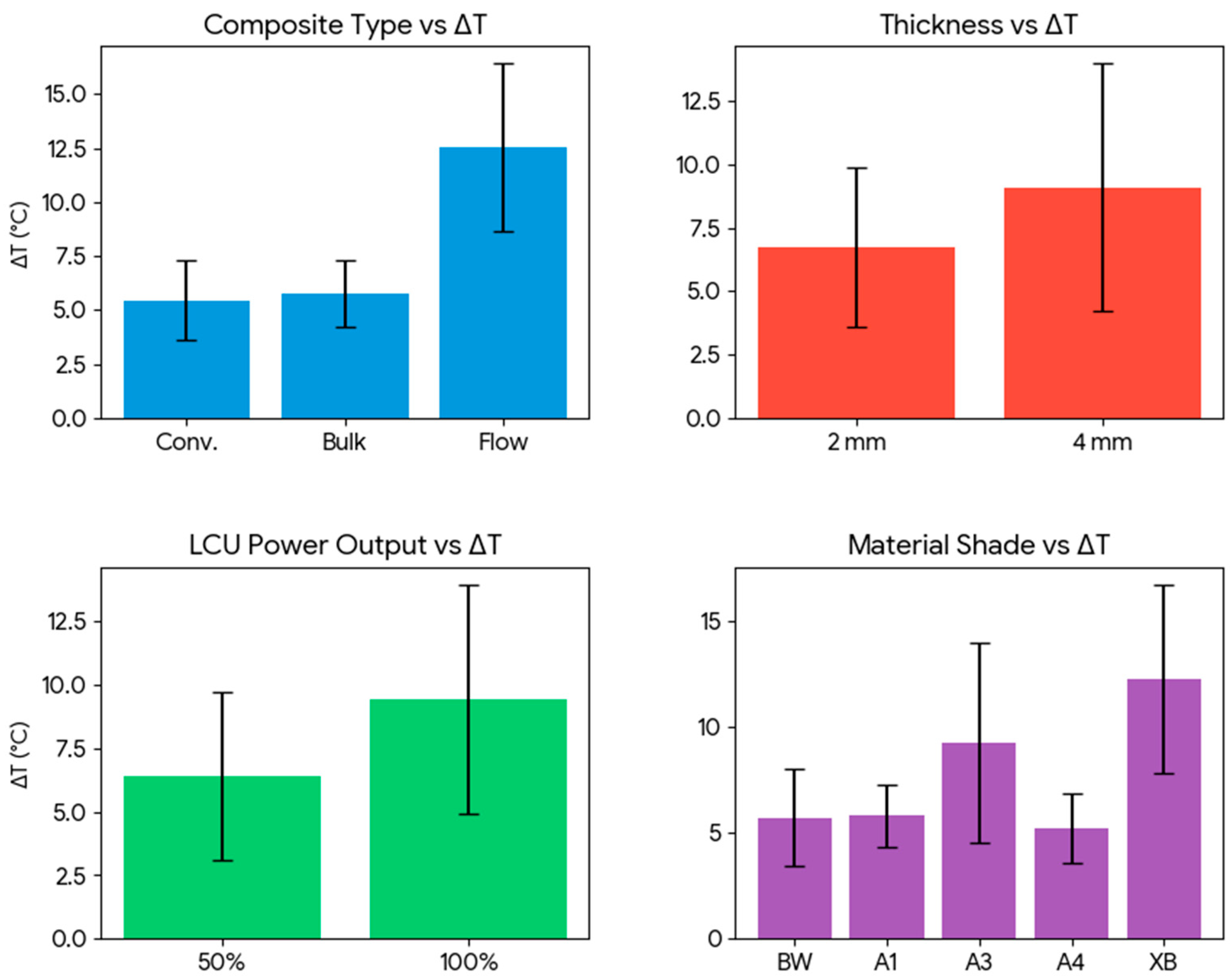
| Composite type | Conventional | 5.46 ± 1.86 | <0.001 |
| Bulk-fill | 5.76 ± 1.54 | ||
| Flowable | 12.52 ± 3.88 | ||
| Thickness | 2.0 mm | 6.74 ± 3.13 | 0.008 |
| 4.0 mm | 9.09 ± 4.86 | ||
| Output | 50% | 6.39 ± 3.31 | <0.001 |
| 100% | 9.44 ± 4.51 | ||
| Shade | BW | 5.71 ± 2.30 | <0.001 |
| A1 | 5.82 ± 1.48 | ||
| A3 | 9.23 ± 4.71 | ||
| A4 | 5.22 ± 1.61 | ||
| XB | 12.28 ± 4.44 |
| Factor | Description of Influence on Temperature Rise |
|---|---|
| Composite resin type (conventional, bulk-fill, flowable) | Flowable composites generate higher temperature due to lower filler content, higher resin matrix proportion, and greater exothermic polymerization. Bulk-fill materials show intermediate behavior due to modified chemistry. |
| Filler content and filler type | Higher filler loading increases thermal conductivity and reduces temperature rise by dissipating heat more efficiently. Low filler content increases heat accumulation. |
| Monomer composition (e.g., bisphenol A glycidyl methacrylate, urethane dimethacrylate, triethylene glycol dimethacrylate) | High-reactivity monomers and high resin content increase polymerization rate and exothermic heat release. |
| Photoinitiator system (e.g., camphorquinone, alternative initiators) | More efficient or higher concentration photoinitiators increase radical formation, accelerating polymerization and heat generation. |
| Light-curing unit irradiance (light intensity) | Higher irradiance increases energy input, accelerating polymerization kinetics and raising both exothermic and direct thermal contributions. |
| Exposure time | Longer curing increases total energy delivered, leading to higher cumulative temperature rise. |
| Light-curing mode (continuous, soft-start, pulse) | Continuous high-intensity modes produce higher peak temperature; ramped or pulsed modes reduce thermal spikes by moderating polymerization rate. |
| Emission spectrum (wavelength compatibility) | Better match with photoinitiator absorption increases efficiency of polymerization and associated heat generation. |
| Composite shade (lightness/chroma) | Darker shades absorb more light energy, converting more radiation into heat and increasing temperature rise. |
| Increment thickness | Thicker increments increase total exothermic reaction due to greater material volume, but may reduce surface heat due to light attenuation. |
| Distance between light tip and material surface | Increased distance reduces irradiance reaching the material, decreasing polymerization efficiency and temperature rise at the interface. |
| Cavity configuration and remaining dentin thickness | Thinner dentin increases heat transmission to pulp, reducing thermal insulation and increasing intrapulpal temperature rise. |
| Thermal properties of surrounding tissues/materials | Dentin and surrounding structures act as thermal barriers; reduced thickness leads to increased heat transfer to pulp. |
Disclaimer/Publisher’s Note: The statements, opinions and data contained in all publications are solely those of the individual author(s) and contributor(s) and not of MDPI and/or the editor(s). MDPI and/or the editor(s) disclaim responsibility for any injury to people or property resulting from any ideas, methods, instructions or products referred to in the content. |
© 2026 by the authors. Licensee MDPI, Basel, Switzerland. This article is an open access article distributed under the terms and conditions of the Creative Commons Attribution (CC BY) license.
Share and Cite
Fontoura, L.; Bourgi, R.; Suárez, C.E.C.; Kharouf, N.; Hasani, M.A.; Hess, M.J.; Rosales, A.B.; Klein Junior, C.A. Thermal Behavior of Dental Composites During Photopolymerization: Effect of Material Type, Increment Thickness, and Light Intensity. Eng 2026, 7, 241. https://doi.org/10.3390/eng7050241
Fontoura L, Bourgi R, Suárez CEC, Kharouf N, Hasani MA, Hess MJ, Rosales AB, Klein Junior CA. Thermal Behavior of Dental Composites During Photopolymerization: Effect of Material Type, Increment Thickness, and Light Intensity. Eng. 2026; 7(5):241. https://doi.org/10.3390/eng7050241
Chicago/Turabian StyleFontoura, Laura, Rim Bourgi, Carlos Enrique Cuevas Suárez, Naji Kharouf, Mohammed Al Hasani, Matías Junge Hess, Abelardo Baez Rosales, and Celso Afonso Klein Junior. 2026. "Thermal Behavior of Dental Composites During Photopolymerization: Effect of Material Type, Increment Thickness, and Light Intensity" Eng 7, no. 5: 241. https://doi.org/10.3390/eng7050241
APA StyleFontoura, L., Bourgi, R., Suárez, C. E. C., Kharouf, N., Hasani, M. A., Hess, M. J., Rosales, A. B., & Klein Junior, C. A. (2026). Thermal Behavior of Dental Composites During Photopolymerization: Effect of Material Type, Increment Thickness, and Light Intensity. Eng, 7(5), 241. https://doi.org/10.3390/eng7050241