Article

Rational Design of MXene-Based Electrodes for High-Performance Supercapacitors

1
Department of Advanced Materials Science and Engineering, Gyeongkuk National University, Andong 36729, Republic of Korea
2
Graduate School of Energy Science and Technology, Chungnam National University, Daejeon 34134, Republic of Korea
*
Author to whom correspondence should be addressed.
Eng 2026, 7(5), 240; https://doi.org/10.3390/eng7050240
Submission received: 30 March 2026 / Revised: 4 May 2026 / Accepted: 12 May 2026 / Published: 15 May 2026
(This article belongs to the Special Issue Advanced Materials for Next-Generation Electrochemical Energy Storage)

Abstract

Supercapacitors offer high power density; however, improving their energy density requires enlarging the active surface area and optimizing ion transport pathways. In this study, a Ti3C2Tx MXene@ZnO composite electrode was fabricated to suppress the restacking of MXene layers and enhance the specific surface area. Ti3C2Tx MXene was synthesized, followed by ZnO incorporation using a simple precipitation process. The introduction of ZnO effectively stabilized the layered MXene structure and promoted pore formation. BET analysis revealed that the composite synthesized for 2 h exhibited the largest specific surface area of 43.639 m2 g−1, indicating the most effective pore structure development. Electrochemical evaluation as a supercapacitor electrode demonstrated that the 2 h composite achieved the highest specific capacitance of 139.0 F g−1 and the longest discharge time of 172.6 s. These improvements are attributed to the expanded pore structure and increased electrochemically active surface area induced by ZnO incorporation. Overall, the Ti3C2Tx MXene@ZnO composite exhibits enhanced structural stability and ion transport properties, demonstrating its strong potential and stable electrode material for advanced energy storage applications.

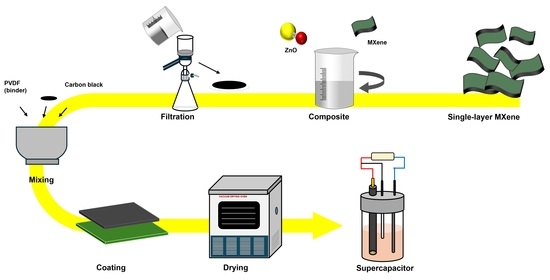
Graphical Abstract

1. Introduction

Rechargeable batteries with high energy capacity based on electrochemical reactions and supercapacitors (SCs) with high power performance and long cycle life have been extensively studied [1]. Supercapacitors are high-performance energy storage devices used in low-power electronic devices and high-power military applications [2]. Due to their compact size, light weight, and flexibility, supercapacitors can be applied as energy storage systems for portable electronic devices such as mobile phones, laptop computers, and digital cameras [3]. Generally, supercapacitors are classified into electric double-layer capacitors (EDLCs) and pseudocapacitors according to the charge storage mechanism of the electrode materials, and both mechanisms can operate simultaneously depending on the properties of the electrodes [4,5]. In EDLCs, energy is stored through electrostatic interactions at the electrode–electrolyte interface, and the capacitance strongly depends on the surface area of the electrode material that is in contact with electrolyte ions [6]. Pseudocapacitors stored charge through Faradaic processes involving fast ion insertion or surface redox reactions occur near the electrode surface [7]. Due to these rapid surface redox reactions, pseudocapacitors can store a larger amount of charge and therefore generally exhibit higher specific capacitance than EDLCs [8,9]. Carbon nanomaterials such as activated carbon, carbon nanotubes, graphene, and MXene possess structures that are suitable for EDLCs due to their high specific surface area, excellent mechanical and chemical stability, and high electrical conductivity [10]. The layered structure of Ti3C2Tx MXene enhances electrolyte ion transport and enables transition metal-based redox reactions on its surface [11]. Owing to these properties, MXene is well suited for use as an electrode material for supercapacitors [12]. MXene has a general chemical formula of Mn+1XnTx and belongs to a family of two-dimensional transition metal carbides and nitrides. Here, M represents an early transition metal, X denotes carbon or nitrogen, and Tx refers to surface functional groups [13]. MXene is generally synthesized by selectively etching the A element from MAX precursors using hydrofluoric acid, during which the A atoms are replaced by fluorine (–F), oxygen (–O), and hydroxyl (–OH) functional groups [14]. Zinc oxide (ZnO) is considered a suitable material for supercapacitor applications due to its good electrochemical activity, low raw material cost, and environmentally friendly characteristics among various metal oxide materials [15]. Nevertheless, ZnO suffers from slow Faradaic redox kinetics and high electrical resistance, which limit its electron transport properties, cycling stability, and achievable power density [16]. Recent studies have highlighted that controlling ion transport and interfacial behavior plays a crucial role in enhancing electrochemical performance. Therefore, designing composite structures that can regulate ion transport is an effective strategy to overcome these limitations [17]. However, these limitations can be overcome by using composites composed of carbon materials and metal oxides as electrode materials for electrochemical capacitors [18]. By combining carbon materials with metal oxides, the electric double-layer capacitance of high-surface-area carbon materials and the Faradaic capacitance of metal oxides can be utilized simultaneously, leading to enhanced capacitance and improved energy output performance [16,19]. Unlike previous studies that primarily focus on enhancing capacitance through simple composite formation, this work systematically investigates reaction-time-dependent ZnO growth and its impact on structural evolution, pore characteristics, and electrochemical behavior. Therefore, Ti3C2Tx MXene@ZnO composites were synthesized with controlled ZnO growth time to examine the effects of reaction time on the structural characteristics, specific surface area, and electrochemical performance. This approach enables the identification of an optimized composite structure that balances surface area enhancement, ion transport, and structural stability, providing insight into the structure–performance relationship of MXene/metal oxide hybrid systems.

2. Materials and Methods

2.1. Materials

Zinc nitrate hexahydrate (Zn(NO3)2∙6H2O, 98%) was purchased from Sigma-Aldrich. Hexamethylenetetramine (C6H12N4, 99.0%, HMT) was purchased from Kanto Chemical Co., Inc. (Tokyo, Japan). Ti3AlC2 (MAX) powder was purchased from Carbon Ukraine (Kyiv, Ukraine). Potassium hydroxide (KOH), and N-methyl-2-pyrrolidinone (NMP) were purchased from SAMCHUN Chemicals Co., Ltd., Seoul, Republic of Korea. The poly (vinylidene fluoride), carbon black and activated carbon were purchased from Sigma Aldrich (St. Louis, MO, USA).

2.2. Synthesis of Ti3C2Tx MXene@ZnO

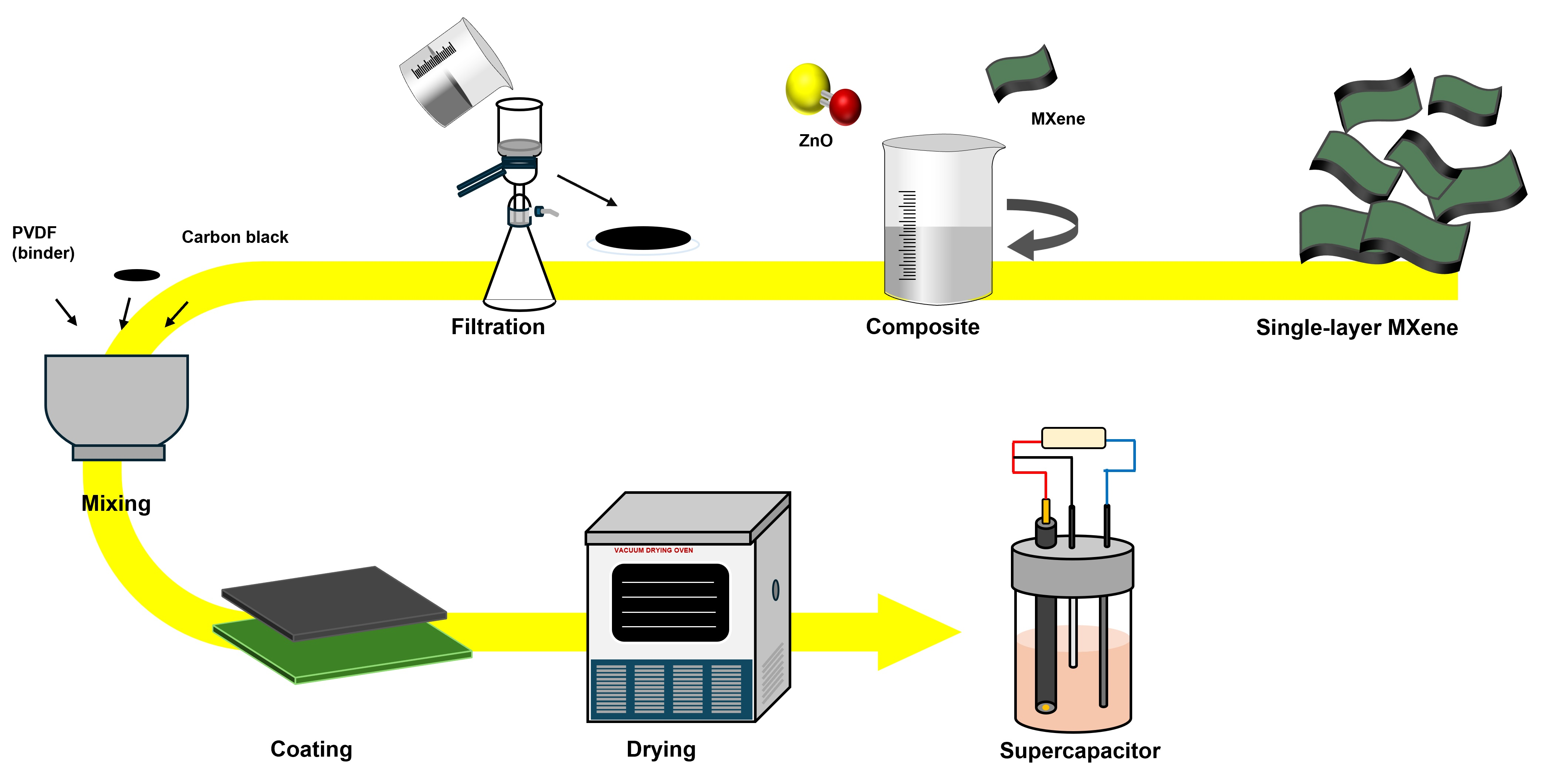
Zinc nitrate hexahydrate (Zn(NO3)2∙6H2O) and HMT were used as the zinc precursor and precipitating agent, respectively. MXene (0.001 g), Zn(NO3)2∙6H2O (0.02894 g), and HMT (0.01402 g) were used for the synthesis. Zn(NO3)2∙6H2O and MXene were dispersed in 100 mL of deionized (DI) water under stirring, while HMT was separately dissolved in 100 mL of DI water at the same concentration. The HMT solution was then slowly added dropwise to the MXene/Zn(NO3)2∙6H2O dispersion under continuous stirring, followed by reaction for 1, 2, or 3 h. After the reaction, the products were collected by vacuum filtration using a polyvinylidene fluoride (PVDF) membrane, washed twice with DI water to remove residual impurities, and dried at 40 °C for 24 h to obtain the final powders. The obtained product masses were 0.2543 g, 0.1460 g, and 0.0295 g for the 1 h, 2 h, and 3 h samples, respectively. All samples were prepared under identical experimental conditions to ensure reproducibility.

2.3. Characterization

The surface chemical states and elemental bonding characteristics of the synthesized MXene@ZnO composites were analyzed using X-ray photoelectron spectroscopy (XPS, NEXSA G2, Thermo Fisher Scientific, Waltham, MA, USA). The crystal structure was examined by X-ray diffraction (XRD) (Rigaku Corporation, Tokyo, Japan) in the 2θ range of 5–70°. The specific surface area was determined by Brunauer–Emmett–Teller (BET) analysis using N2 adsorption. The morphology and microstructure were observed by field-emission scanning electron microscopy (FE-SEM).

2.4. Electrochemical Studies

The electrochemical performance of the MXene@ZnO-based electrodes was systematically evaluated using cyclic voltammetry (CV), galvanostatic charge–discharge (GCD), and electrochemical impedance spectroscopy (EIS). All electrochemical measurements were carried out using a Biologic VMP3 electrochemical workstation with 1 M KOH aqueous solution as the electrolyte. The electrochemical tests were primarily conducted in a three-electrode configuration. The prepared MXene-based electrode was used as the working electrode, a Hg/HgO electrode served as the reference electrode, and a platinum (Pt) wire was employed as the counter electrode. In addition, electrochemical performance was also evaluated using a two-electrode configuration. In this system, the prepared MXene-based electrode was used as the working electrode, while an activated carbon-based electrode was employed as the counter electrode. All measurements were performed at an ambient temperature to ensure the reliability and reproducibility of the electrochemical data. The electrode fabrication process was carried out as follows. MXene@ZnO was used as the active material, while PVDF and carbon black were used as the binder and conductive additive, respectively. The components were mixed at a weight ratio of 80:10:10 to form a composite slurry. The mixture was dispersed in NMP and thoroughly mixed using a mortar and pestle to obtain a homogeneous slurry. The prepared slurry was uniformly coated onto a pretreated graphite sheet using a slurry-coating method, followed by drying at 60 °C for 12 h to completely remove the solvent. The mass loading of the active material was approximately 1.5 mg cm−2 per electrode. All MXene@ZnO samples synthesized at reaction times of 1 h, 2 h, and 3 h were fabricated using the same procedure.

3. Results

Ti3C2Tx MXene Characterization Results

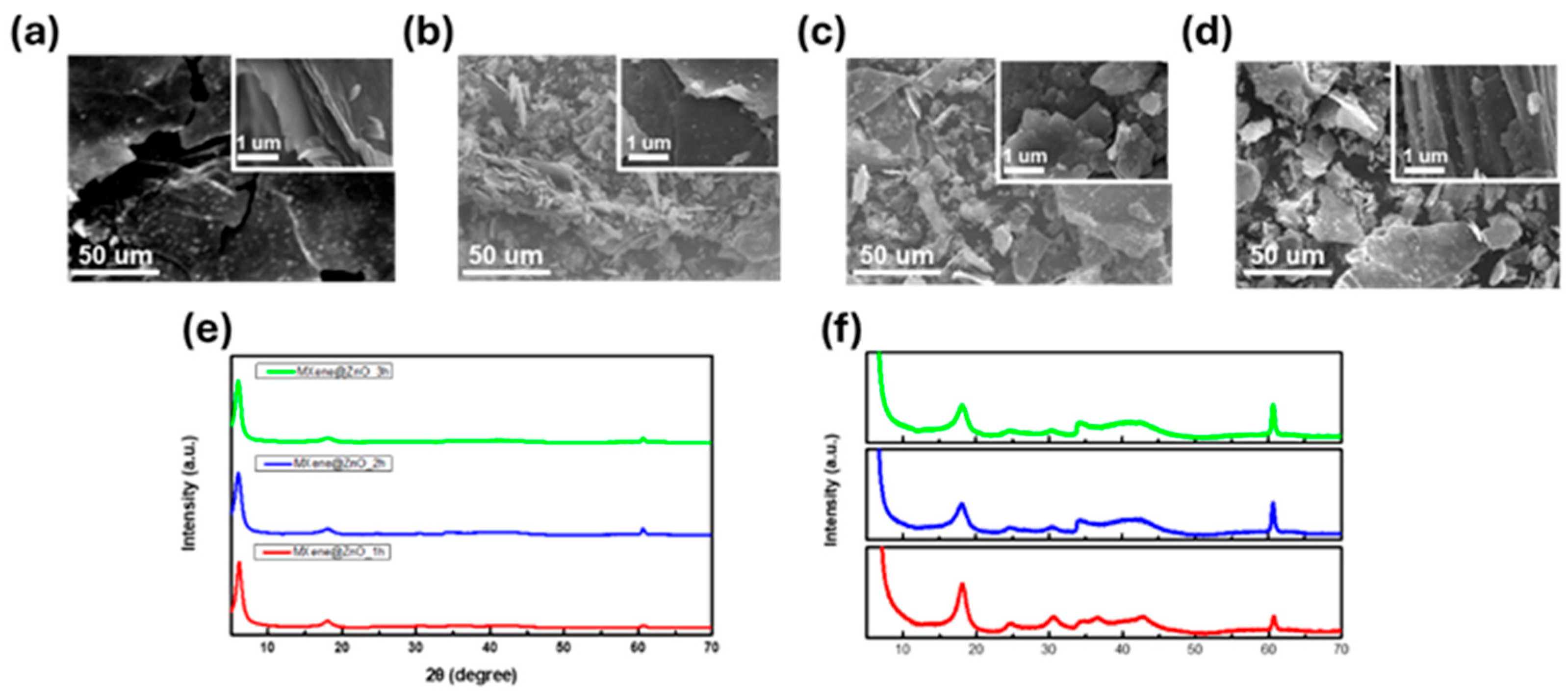
Figure 1a–d shows the SEM images of pristine Ti3C2Tx MXene and MXene@ZnO composites. The pristine MXene exhibits a smooth layered structure with relatively uniform exfoliated sheets (Figure 1a). For the MXene@ZnO composites, clear structural changes are observed with the increasing reaction time. In the 1 h composite (Figure 1b), ZnO nanoparticles are partially formed on the MXene surface, indicating an initial nucleation stage. The 2 h composite (Figure 1c) shows a more uniform and dense distribution of ZnO particles, forming a stable composite structure over the MXene surface. In the 3 h composite (Figure 1d), ZnO particles are also evenly distributed on the MXene sheets, with a larger amount of ZnO compared to the 1 h and 2 h composites. Figure 1e,f presents the XRD patterns of the MXene@ZnO composites. For all samples, the characteristic (002) peak of Ti3C2Tx MXene is observed at a low angle of approximately 9.5°, confirming that the layered structure is preserved. In the composite samples, distinct diffraction peaks corresponding to the wurtzite ZnO structure, including the (100), (002), and (103) planes, are clearly observed (Table 1). The 1 h composite shows relatively weak ZnO peaks, indicating an early growth stage. In contrast, the 2 h composite exhibits increased ZnO peak intensity, suggesting improved crystallinity. The ZnO peaks of the 3 h composite is further intensified, indicating continued ZnO growth and successful composite formation with MXene.
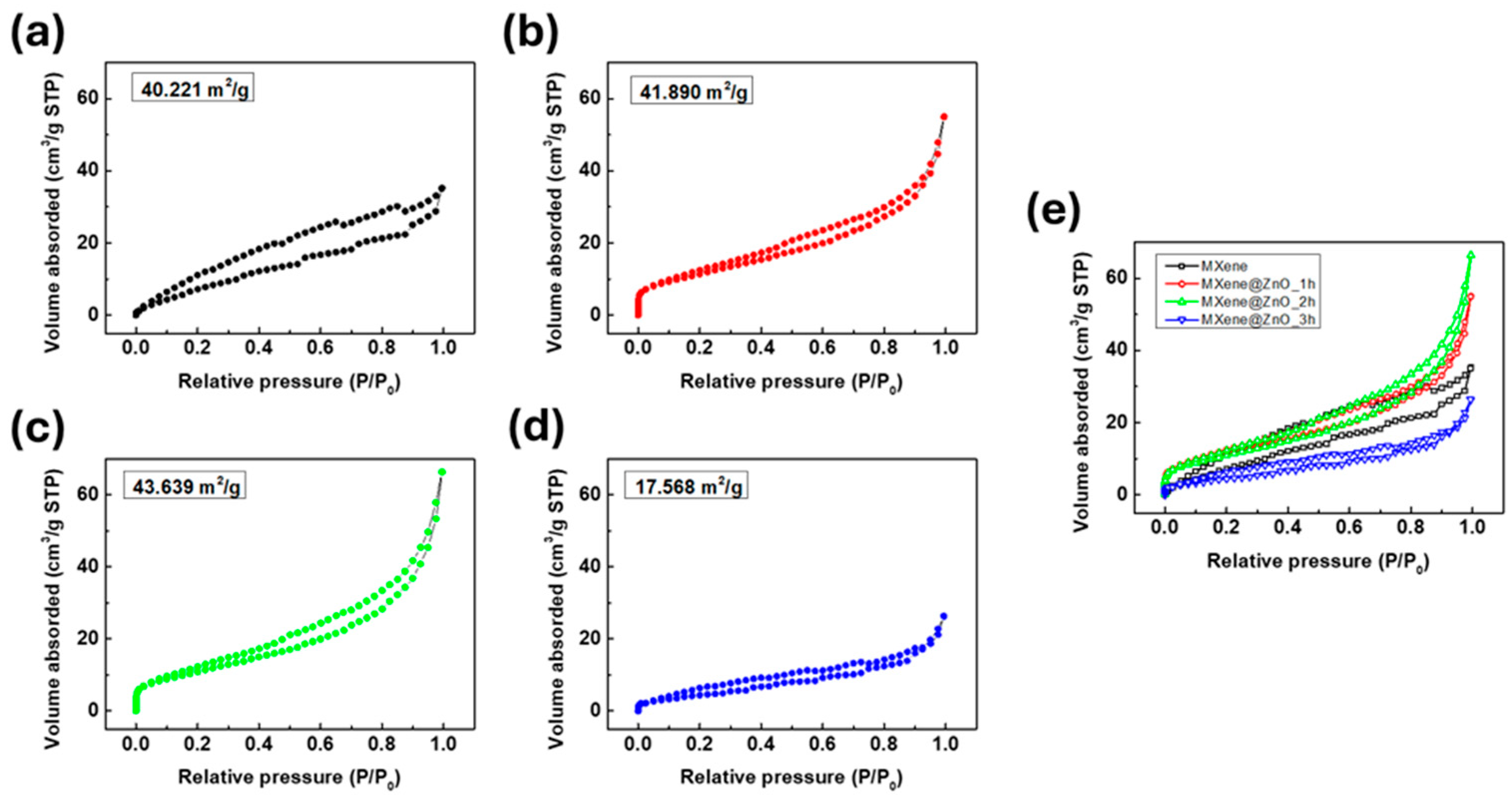
Figure 2 shows the nitrogen adsorption–desorption isotherms of pristine Ti3C2Tx MXene and MXene@ZnO composites prepared with different reaction times. All samples exhibit clear hysteresis loops, indicating the presence of a mesoporous structure. This result confirms that the porous structure of MXene is maintained after ZnO incorporation. The BET-specific surface area of pristine MXene is 40.221 m2 g−1. After ZnO incorporation, the specific surface area increases to 41.890 m2 g−1 for the 1 h composite and further increases to 43.639 m2 g−1 for the 2 h composite. Among all samples, the 2 h composite shows the highest specific surface area, suggesting the most effective pore structure formation and optimal ZnO growth on the MXene surface. This increase in surface area is attributed to the suppression of MXene restacking and the formation of additional active surfaces by ZnO nanoparticles. In contrast, the specific surface area of the 3 h composite decreases significantly to 17.568 m2 g−1. This reduction is mainly attributed to excessive ZnO growth, which leads to pore blocking and particle aggregation, thereby limiting the accessible surface area. Overall, the BET results indicate that the 2 h MXene@ZnO composite exhibits the most optimized pore structure and surface area, which is favorable for electrochemical energy storage applications. These results suggest that controlled ZnO growth plays a critical role in tailoring the pore structure and surface accessibility, which are expected to directly influence electrochemical performance.
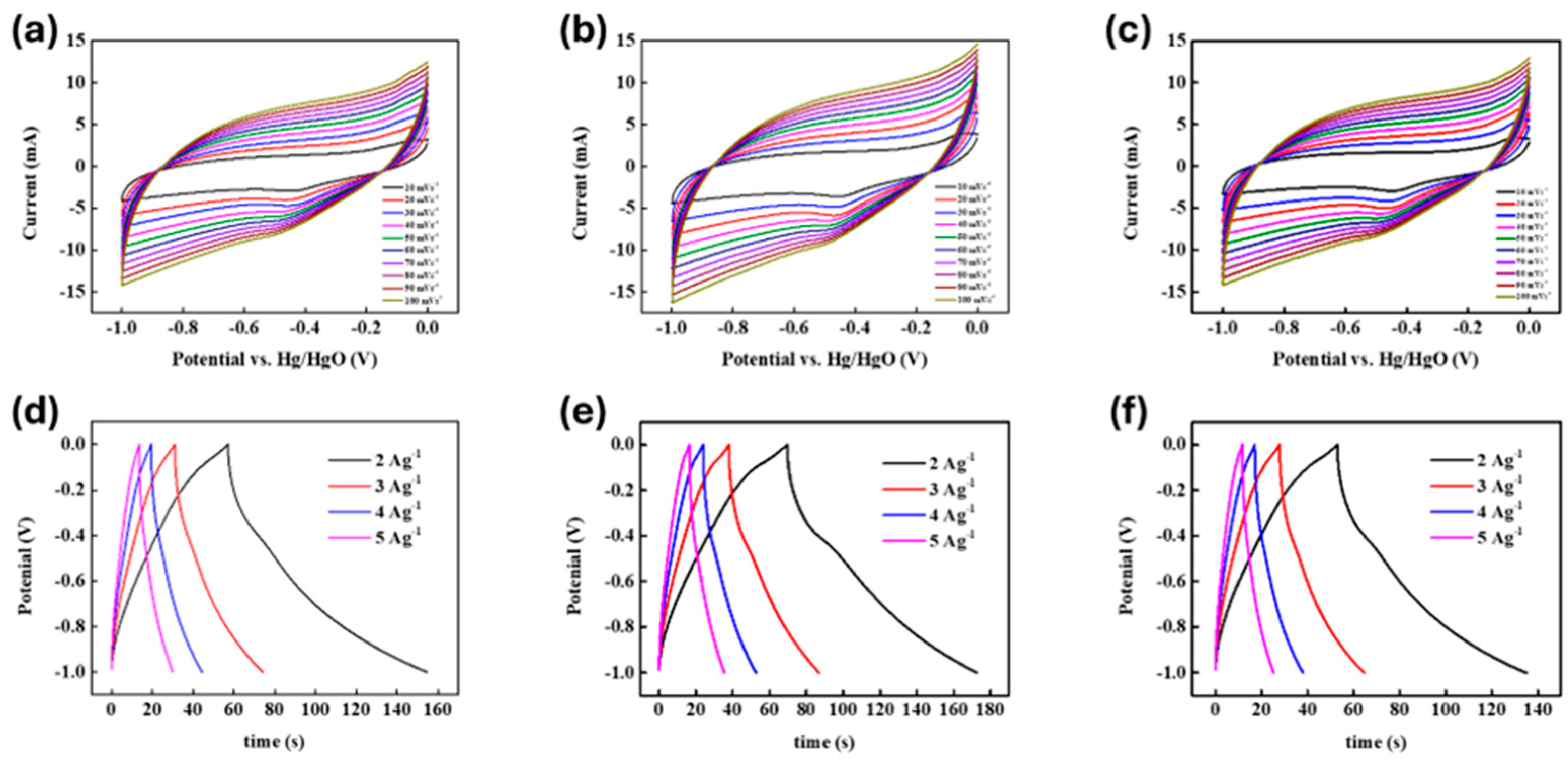
Based on the structural and surface area analysis, the electrochemical behavior of the composites is expected to be strongly governed by the balance between ZnO-induced surface area enhancement and the preservation of ion-accessible pathways. Figure 3 compares the electrochemical performance of Ti3C2Tx MXene@ZnO composites prepared at different reaction times. As shown in Figure 3a–c, all samples display typical EDLC-type CV curves with increasing current response at higher scan rates, indicating fast ion transport. The CV curves retain a similar shape even at higher scan rates, suggesting good rate-dependent electrochemical behavior. The specific capacitance values were calculated from the CV curves using Equation (1). Although the CV shapes are similar, significant differences in capacitance are observed. Pristine Ti3C2Tx MXene and the 1 h composite exhibit comparable values of 115.5 and 114.3 F g−1, respectively, suggesting limited improvement at the early stage of ZnO growth. The 2 h composite delivers the highest capacitance of 139.0 F g−1, attributed to optimized ZnO growth and increased electrochemically active surface area. In contrast, the capacitance of the 3 h sample decreases to 113.1 F g−1, likely due to excessive ZnO growth that restricts ion accessibility and charge transport.
C = 1 / m V v I V d V
The GCD curves in Figure 3d–f further confirm these results, with the 2 h composite exhibiting the longest discharge time at the same current density. As shown in Table 2, the 2 h composite exhibits capacitance values that are comparable to or higher than previously reported MXene-based composites, supporting the effectiveness of controlled ZnO growth in optimizing electrochemical performance. Overall, the electrochemical performance follows the order MXene@ZnO (2 h), pristine MXene, MXene@ZnO (1 h), MXene@ZnO (3 h), indicating that 2 h provides the optimal growth condition. The charge-storage behavior is therefore interpreted as a hybrid mechanism, in which EDLC-type behavior originates from ion adsorption on the MXene surface, while additional electrochemical activity is attributed to the incorporation of ZnO. This interpretation is supported by the combined electrochemical and structural trends, including the preservation of EDLC-type CV profiles, reaction-time-dependent capacitance variation, and the correlation between surface area and electrochemical performance. The enhanced performance is not only attributed to the increased surface area but also to the multifunctional role of ZnO. ZnO can contribute additional pseudocapacitance and suppress MXene restacking, thereby improving ion transport kinetics [24,25]. In addition, possible Zn–O–Ti interfacial interactions may facilitate charge transfer across the heterointerface [26]. These combined effects highlight that ZnO does not simply act as a passive surface modifier, but plays an active role in regulating the interfacial structure and charge-storage behavior. The increased ZnO peak intensity with reaction time reflects crystallinity evolution, while the superior capacitance and lower resistance of the 2 h sample suggest that optimized ZnO coverage maximizes interfacial coupling without hindering ion-accessible pathways.
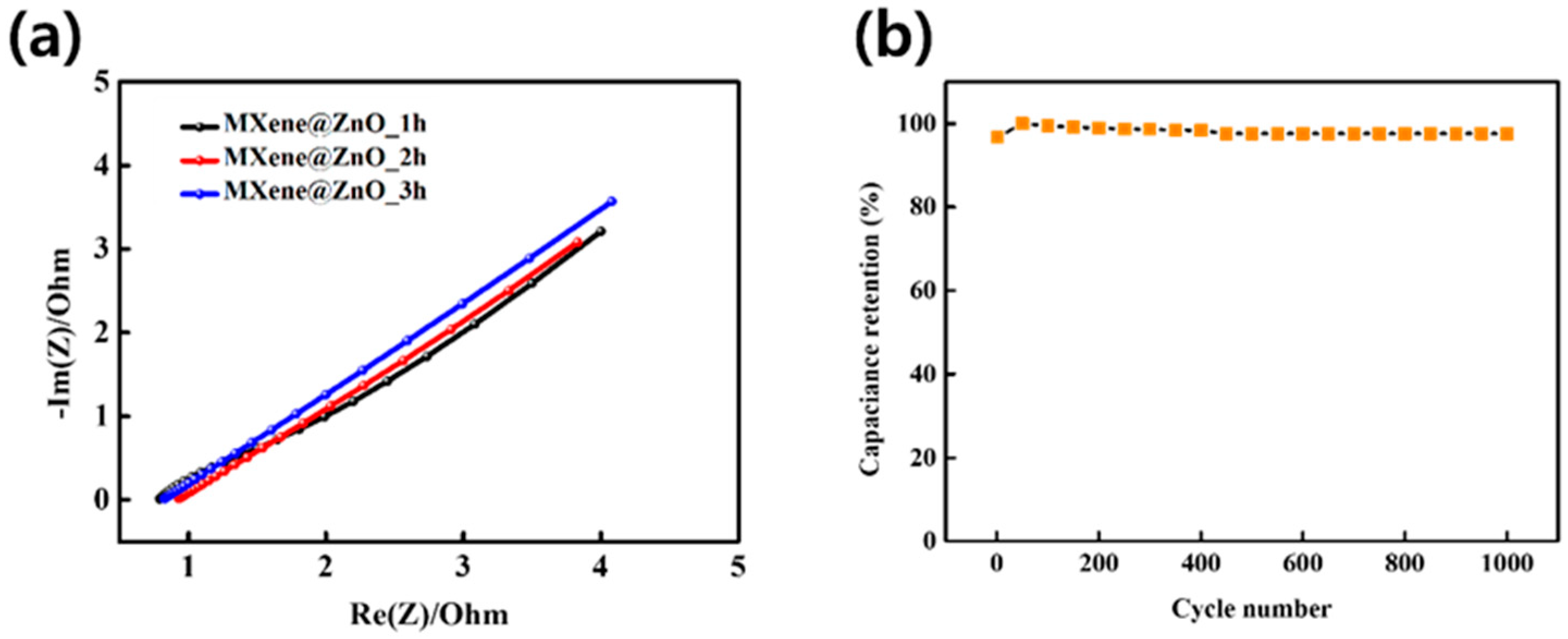
The EIS responses in Figure 4a evolve systematically with the reaction time. The 2 h sample exhibits a lower overall impedance and a steeper slope in the low-frequency region compared to the other samples, indicating improved ion diffusion behavior and reduced resistance to ion transport. In contrast, the 1 h sample shows relatively higher impedance, suggesting insufficient ZnO coverage, while the 3 h sample exhibits increased impedance due to excessive ZnO growth, which may hinder ion transport pathways. The tail-dominated Nyquist feature indicates that the impedance response is mainly governed by ion transport within the porous network coupled with capacitive charge storage. These trends are consistent with the electrochemical results, confirming that the 2 h condition provides the most favorable balance between ion transport and capacitive behavior. Accordingly, the cycling stability of the optimized MXene@ZnO (2 h) electrode is presented in Figure 4b, showing stable capacitance retention over repeated charge–discharge cycles under the applied testing conditions. Accordingly, the cycling stability of the optimized MXene@ZnO (2 h) electrode is presented in Figure 4b, showing stable capacitance retention over repeated charge–discharge cycles under the applied testing conditions. The electrode was cycled for 1000 cycles at a current density of 2 A g−1, retaining approximately 97.6% of its initial capacitance. The nearly overlapping charge–discharge profiles indicate good electrochemical reversibility and stable cycling behavior.

4. Discussion

The electrochemical performance of MXene-based electrodes is strongly influenced by their surface structure, porosity, and ion transport pathways, as widely reported in previous studies on MXene [30]. In particular, restacking of MXene layers has been recognized as a major limitation, as it reduces the accessible surface area and hinders electrolyte ion diffusion [31]. In this context, the incorporation of metal oxide nanoparticles has been proposed as an effective strategy to suppress restacking while introducing additional Faradaic active interfaces. Previous studies have shown that pristine ZnO exhibits relatively low electrochemical performance, with limited capacitance depending on its morphology, indicating restricted charge-storage capability [32]. Therefore, ZnO has been widely incorporated into composite structures with conductive matrices to enhance electrochemical performance. For example, hierarchical ZnO/graphene oxide composites delivered improved capacitance and cycling stability [33], while ZnO/graphene nanosheet composites were reported to facilitate charge and ion transport when used as binder-free supercapacitor electrodes [34]. These results support the use of conductive ZnO-based composite structures to overcome the intrinsic limitations of ZnO. The charge storage behavior is therefore interpreted as a hybrid mechanism. Ti3C2Tx MXene mainly contributes to EDLC-type charge storage through reversible ion adsorption/desorption on its conductive layered surface [35]. In contrast, ZnO-based materials have been reported to provide a pseudocapacitive contribution through Faradaic surface reactions [36]. Previous studies have also shown that ZnO nanostructures incorporated into conductive layered matrices can effectively suppress sheet restacking and improve ion and electron transport pathways by forming interlayer-supported structures [37]. Therefore, the improved performance of the MXene@ZnO composite can be reasonably attributed to the combined contributions of EDLC-type charge storage from MXene and additional pseudocapacitive contribution from ZnO, rather than to a single charge storage mechanism. In the present study, ZnO nanoparticles were uniformly grown on Ti3C2Tx MXene sheets, and the reaction time was systematically varied to investigate their effect on the structural and electrochemical properties. XRD and SEM results confirmed that the layered structure of MXene was preserved after ZnO incorporation, while ZnO nanoparticles were successfully formed on the MXene surface. This structural integrity is essential for maintaining fast electron transport, which is a key advantage of MXene-based electrodes. BET analysis revealed a clear correlation between the reaction time, surface area, and electrochemical performance. The 2 h MXene@ZnO composite exhibited the largest specific surface area, indicating that ZnO growth at this stage effectively prevented MXene restacking while generating additional accessible pores. It has been reported that structural modification can significantly improve ion transport pathways and charge-storage behavior, leading to enhanced electrochemical performance [38]. Electrochemical measurements further supported this interpretation. The superior specific capacitance and extended discharge time observed for the 2 h composite can be attributed to the increased electrochemically active surface area and improved ion diffusion pathways. In contrast, the 1 h composite showed limited performance enhancement, suggesting that insufficient ZnO coverage at the early growth stage was not enough to significantly modify the MXene surface. Meanwhile, the reduced performance of the 3 h composite is likely due to excessive ZnO growth, which led to particle aggregation and partial blockage of pores, thereby restricting the ion accessibility and charge transport. Overall, these results support the interpretation that controlled ZnO growth on MXene sheets can effectively balance surface area enhancement and structural stability. The findings highlight the importance of optimizing synthesis conditions to achieve synergistic effects between MXene and metal oxides. From a broader perspective, the Ti3C2Tx MXene@ZnO composite system demonstrates a promising design strategy for advanced supercapacitor electrodes.

5. Conclusions

In this study, Ti3C2Tx MXene was modified and MXene@ZnO composites were fabricated with different reaction times (1, 2, and 3 h) to evaluate their performance as energy storage devices. Structural characterization confirmed the successful formation of the MXene@ZnO composite structure. XRD analysis revealed the coexistence of the characteristic (002), (004) peak of Ti3C2Tx MXene and the ZnO diffraction peak corresponding to the (002) plane, indicating the preservation of the MXene structure and the successful synthesis of ZnO. SEM observations further confirmed that ZnO nanoparticles were uniformly grown on the MXene surface. BET analysis revealed that the 2 h MXene@ZnO composite exhibited the highest specific surface area of 43.639 m2 g−1, confirming that surface area is a key factor that is directly related to electrode performance. In electrochemical evaluations, the MXene@ZnO composite prepared for 2 h showed the best supercapacitor performance, delivering the longest discharge time of 172.6 s and the highest specific capacitance of 139.0 F g−1. The charge storage mechanism is governed by a hybrid EDLC and pseudocapacitive behavior. Overall, this study demonstrates that the uniform growth of ZnO nanoparticles on the Ti3C2Tx MXene surface effectively increases the specific surface area, leading to simultaneous enhancement of the electrochemically active area and ion transport properties. This improved performance is associated with a hybrid charge-storage mechanism combining EDLC and pseudocapacitive contributions. Among the investigated synthesis conditions, the 2 h MXene@ZnO composite exhibited the most optimized structure, with the largest surface area and superior electrochemical performance. Therefore, a Ti3C2Tx MXene@ZnO composite synthesized for 2 h shows strong potential as an electrode material for next generation energy storage devices, particularly supercapacitors. Further optimization of the pore structure and interfacial design is expected to achieve even higher electrode performance in future studies.

Author Contributions

Conceptualization, C.M.H. and K.S.L.; methodology, C.M.H.; validation, C.M.H. and K.S.L.; formal analysis, C.M.H.; investigation, C.M.H.; resources, S.M.; data curation, C.M.H.; writing—original draft preparation, C.M.H.; writing—review and editing, C.M.H. and K.S.L.; visualization, C.M.H.; supervision, K.S.L. All authors have read and agreed to the published version of the manuscript.

Funding

This research was supported by the Gyeongsangbuk-do Glocal University Promotion Team [2025-0275-01 unit].

Institutional Review Board Statement

Not applicable.

Informed Consent Statement

Not applicable.

Data Availability Statement

The data presented in this study are available upon request from the corresponding author. The data are not publicly available due to institutional policy and ongoing related research.

Conflicts of Interest

The authors declare no conflicts of interest.

Abbreviations

The following abbreviations are used in this manuscript:
SCsSupercapacitors
EDLCsElectric double-layer capacitors
ZnOZinc oxide
HMTHexamethylenetetramine
NMPN-methyl-2-pyrrolidinone
PVDFPolyvinylidene fluoride
XPSX-ray photoelectron spectroscopy
XRDX-ray diffraction
BETBrunauer–Emmett–Teller
FE-SEMField-emission scanning electron microscopy
CVCyclic voltammetry
GCDGalvanostatic charge–discharge
EISElectrochemical impedance spectroscopy

References

  1. Chen, G.Z. Supercapacitor and supercapattery as emerging electrochemical energy stores. Int. Mater. Rev. 2017, 62, 173–202. [Google Scholar] [CrossRef]
  2. Patel, A.; Patel, S.K.; Singh, R.S.; Patel, R.P. Review on recent advancements in the role of electrolytes and electrode materials on supercapacitor performances. Discov. Nano 2024, 19, 188. [Google Scholar] [CrossRef] [PubMed]
  3. Yaseen, M.; Khattak, M.A.K.; Humayun, M.; Usman, M.; Shah, S.S.; Bibi, S.; Hasnain, B.S.U.; Ahmad, S.M.; Khan, A.; Shah, N.; et al. A Review of Supercapacitors: Materials Design, Modification, and Applications. Energies 2021, 14, 7779. [Google Scholar] [CrossRef]
  4. Czagany, M.; Hompoth, S.; Keshri, A.K.; Pandit, N.; Galambos, Z.; Baumli, P. Supercapacitors: An Efficient Way for Energy Storage Application. Materials 2024, 17, 702. [Google Scholar] [CrossRef] [PubMed]
  5. Simon, P.; Gogotsi. Materials for electrochemical capacitors. Nat. Mater. 2008, 7, 845–854. [Google Scholar] [CrossRef]
  6. Vol’fkovich, Y.M. Electric Double Layer Capacitors: A Review. Russ. J. Electrochem. 2024, 60, 761–794. [Google Scholar] [CrossRef]
  7. Schoetz, T.; Gordon, L.W.; Ivanov, S.; Bund, A.; Mandler, D.; Messinger, R.J. Disentangling faradaic, pseudocapacitive, and capacitive charge storage: A tutorial for the characterization of batteries, supercapacitors, and hybrid systems. Electrochim. Acta 2022, 412, 140072. [Google Scholar] [CrossRef]
  8. Zhang, L.L.; Zhao, X.S. Carbon-based materials as supercapacitor electrodes. Chem. Soc. Rev. 2009, 38, 2520–2531. [Google Scholar] [CrossRef]
  9. Otgonbayar, Z.; Yang, S.; Kim, L.J.; Oh, W.C. Recent Advances in Two-Dimensional MXene for Supercapacitor Applications: Progress, Challenges, and Perspectives. Nanomaterials 2023, 13, 919. [Google Scholar] [CrossRef]
  10. Poonam; Sharma, K.; Arora, A.; Tripathi, S.K. Review of supercapacitors: Materials and devices. J. Energy Storage 2019, 21, 801–825. [Google Scholar] [CrossRef]
  11. Li, X.; Huang, Z.; Shuck, C.E.; Liang, G.; Gogotsi, Y.; Zhi, C. MXene chemistry, electrochemistry and energy storage applications. Nat. Rev. Chem. 2022, 6, 389–404. [Google Scholar] [CrossRef]
  12. Chen, Y.; Yang, H.; Bo, Z.; Yan, J.; Cen, K.; Ostrikov, K.K. MXene-Based Electrodes for Supercapacitor Energy Storage. Energy Fuels 2022, 36, 2390−2406. [Google Scholar] [CrossRef]
  13. Baig, M.M.; Gul, I.H.; Baig, S.M.; Shahzad, F. 2D MXenes: Synthesis, properties, and electrochemical energy storage for su-percapacitors—A review. J. Electroanal. Chem. 2022, 904, 115920. [Google Scholar] [CrossRef]
  14. Fan, Z.; Wang, Y.; Xie, Z.; Wang, D.; Yuan, Y.; Kang, H.; Su, B.; Cheng, Z.; Liu, Y. Modified MXene/Holey Graphene Films for Advanced Supercapacitor Electrodes with Superior Energy Storage. Adv. Sci. 2018, 5, 1800750. [Google Scholar] [CrossRef]
  15. Mari, G.M.D.; Mineo, G.; Franzo, G.; Mirabella, S.; Bruno, E.; Strano, V. Low-Cost, High-Yield ZnO Nanostars Synthesis for Pseudocapacitor Applications. Nanomaterials 2022, 12, 2588. [Google Scholar] [CrossRef]
  16. Kim, C.H.; Kim, B.H. Zinc oxide/activated carbon nanofiber composites for high-performance supercapacitor electrodes. J. Power Sources 2015, 274, 512–520. [Google Scholar] [CrossRef]
  17. Mohamed, M.M.; Hussain, A.; Hardianto, Y.P.; Shaikh, M.N.; Aziz, M.A. Decorative separator with spongy morphology polyaniline enables dendrite free zinc ion hybrid supercapacitor. Electrochim. Acta 2025, 513, 145545. [Google Scholar] [CrossRef]
  18. Reenu; Sonia; Phor, L.; Kumar, A.; Chahal, S. Electrode materials for supercapacitors: A comprehensive review of advancements and performance. J. Energy Storage 2024, 84, 110698. [Google Scholar] [CrossRef]
  19. Tundwal, A.; Kumar, H.; Binoj, B.J.; Sharma, R.; Kumar, G.; Kumari, R.; Dhayal, A.; Yadav, A.; Singh, D.; Kumar, P. Developments in conducting polymer-, metal oxide-, and carbon nanotube-based composite electrode materials for supercapacitors: A review. RSC Adv. 2024, 14, 9406–9439. [Google Scholar] [CrossRef]
  20. Iqbal, M.A.; Tariq, A.; Zaheer, A.; Gul, S.; Ali, S.I.; Iqbal, M.Z.; Akinwande, D.; Rizwan. Ti3C2-MXene/Bismuth Ferrite Nanohybrids for Efficient Degradation of Organic Dyes and Colorless Pollutants. S. ACS Omega 2019, 4, 20530–20539. [Google Scholar] [CrossRef]
  21. Gouthamsri, S.; Rao, K.J.; Charan, P.H.K.; Basavaiah, K.; Ramanaiah, M. Highly efficient visible-light photocatalysis by Fe-substituted ZnO nanoparticles: Dual action on methylene blue degradation and microbial elimination. Next Mater. 2026, 10, 101405. [Google Scholar] [CrossRef]
  22. Samavati, Z.; Samavati, A.; Ismail, A.F.; Yahya, N.; Othman, M.H.D.; Rahman, M.A.; Bakar, M.A.A.; Amiri, I.S. The impact of ZnO configuration as an external layer on the sensitivity of a bi-layer coated polymer optical fiber probe. RSC Adv. 2020, 10, 12864. [Google Scholar] [CrossRef] [PubMed]
  23. Hossain, R.; Apblett, A. Cr3+-Doped Anatase-Phase TiO2 Nanocrystals with (101) and (004) Dominant Facets: Synthesis and Characterization. Catalysts 2025, 15, 33. [Google Scholar] [CrossRef]
  24. Mari, G.M.D.; Yao, C.; Lan, T.; Liu, S.; Mineo, G.; Strano, V.; Bruno, E.; Kim, J.S.; Mirabella, S.; Torrisi, F. Advanced Pseudocapacitive Performances of a Ti3C2Tx–ZnOHF/ZnO Nanocomposite for Energy Storage Applications. Chem. Sus. Chem. 2025, 18, e202500024. [Google Scholar] [CrossRef] [PubMed]
  25. Jangra, S.; Sengupta, S.; Raza, A.; Lone, A.R.; Kumar, B.; Kundu, M.; Hussain, I.; Pandey, K.; Das, S.; Goyat, M.S. 3D ZnO hexagonal prism-decorated 2D MXene-based high-performance flexible symmetric supercapacitor. J. Energy Storage 2025, 120, 116366. [Google Scholar] [CrossRef]
  26. Hou, C.; Yu, H. ZnO/Ti3C2Tx monolayer electron transport layers with enhanced conductivity for highly efficient inverted polymer solar cells. Chem. Eng. J. 2021, 407, 127192. [Google Scholar] [CrossRef]
  27. Murugesan, R.A.; Raja, K.C.N. Capacitance performance of Ti3C2Tx MXene nanosheets on alkaline and neutral electrolytes. Mater. Res. Bull. 2023, 163, 112217. [Google Scholar] [CrossRef]
  28. Zhang, Y.; Tang, C.; Lu, S.; Zeng, Y.; Hua, Q.; Zhang, Y. MnO2 Nanoflower Intercalation on Ti3C2Tx MXene with Expanded Interlayer Spacing for Flexible Asymmetric Supercapacitors. Carbon Neutralization 2025, 4, e70006. [Google Scholar] [CrossRef]
  29. Shavita; Thaku, K.K.; Sharma, A.L.; Singh, S. Exploring MXene-MOF composite for supercapacitor application. Mater. Chem. Phys. 2024, 322, 129463. [Google Scholar] [CrossRef]
  30. Akhter, R.; Maktedar, S.S. MXenes: A comprehensive review of synthesis, properties, and progress in supercapacitor appli-cations. J. Mater. 2023, 9, 1196–1241. [Google Scholar] [CrossRef]
  31. Bandpey, M.; Barz, D.P.J. Effects of interlayer space engineering and surface modification on the charge storage mechanisms of MXene nanomaterials: A review on recent developments. Nanoscale 2024, 16, 15078–15093. [Google Scholar] [CrossRef]
  32. Lee, K.S.; Park, C.W.; Kim, J.D. Electrochemical properties and characterization of various ZnO structures using a precipitation method. Colloids Surf. A Physicochem. Eng. Asp. 2017, 512, 87–92. [Google Scholar] [CrossRef]
  33. Lee, K.S.; Park, C.W.; Lee, S.J.; Kim, J.D. Hierarchical zinc oxide/graphene oxide composites for energy storage devices. J. Alloys Compd. 2018, 739, 522–528. [Google Scholar] [CrossRef]
  34. Zhang, Z.; Ren, L.; Han, W.; Meng, L.; Wei, X.; Qi, X.; Zhong, J. One-pot electrodeposition synthesis of ZnO/graphene composite and its use as binder-free electrode for supercapacitor. Ceram. Int. 2015, 41, 4374–4380. [Google Scholar] [CrossRef]
  35. Azadmanjiri, J.; Děkanovský, L.; Wei, S.; Li, M.; Sofer, Z. Covalent alteration of Ti3C2Tx MXene layers by selenium decoration for enhanced electrochemical capacitance. J. Energy Storage 2022, 56, 105918. [Google Scholar] [CrossRef]
  36. Rattanaveeranon, S.; Jiamwattanapong, K.; Suntako, R. Performance enhancement of supercapacitors using zinc oxide/reduced graphene oxide nanocomposites and Nafion-117 based hybrid electrolytes. J. Mater. Sci. 2025, 20, 134. [Google Scholar] [CrossRef]
  37. Li, Z.; Zhou, Z.; Yun, G.; Shi, K.; Lv, X.; Yang, B. High-performance solid-state supercapacitors based on graphene-ZnO hybrid nanocomposites. Discov. Nano 2013, 8, 473. [Google Scholar] [CrossRef] [PubMed]
  38. Mohamed, M.M.; Shah, S.S.; Hardianto, Y.P.; Hussain, A.; Gondal, M.A.; Aziz, M.A. Pulsed laser-modified zinc anode with improved dendrite and corrosion resistance for sustainable high performance zinc ion hybrid supercapacitors. Mater. Chem. Phys. 2024, 326, 129809. [Google Scholar] [CrossRef]
Figure 1. SEM images of (a) pristine Ti3C2Tx MXene, (b) Ti3C2Tx MXene@ZnO composite prepared for 1 h, (c) 2 h composite, and (d) 3 h composite. Insets show higher-magnification images. (e) XRD patterns of Ti3C2Tx MXene@ZnO composites prepared at different reaction times and (f) enlarged XRD patterns highlighting the characteristic diffraction peaks of MXene and ZnO.
Eng 07 00240 g001
Figure 2. Nitrogen adsorption–desorption isotherms of (a) pristine MXene and Ti3C2Tx MXene@ZnO composites synthesized for (b) 1 h, (c) 2 h, and (d) 3 h, with (e) comparison of all samples. BET-specific surface areas are indicated in each panel.
Eng 07 00240 g002
Figure 3. Electrochemical performance of Ti3C2Tx MXene@ZnO composites synthesized at different reaction times. (ac) CV curves of the 1 h, 2 h, and 3 h composites at various scan rates, and (df) corresponding GCD curves measured at different current densities.
Eng 07 00240 g003
Figure 4. EIS and cycling stability of Ti3C2Tx MXene@ZnO electrodes synthesized at different reaction times: (a) Nyquist plots and (b) capacitance retention versus cycle number.
Eng 07 00240 g004
Table 1. Summary of the characteristic diffraction peaks of the Ti3C2Tx MXene@ZnO composites, indicating the corresponding 2θ positions and associated crystal planes for Ti3C2Tx, ZnO, and TiO2 phases.
CompositesPlanesRef.
Ti3C2Tx9.5°(002)[20]
19.1°(004)
ZnO31.7°(100)[21,22]
34.4°(002)
62.85°(103)
TiO225.39°(101)[23]
Table 2. The comparison of specific capacitance of previously reported Ti3C2Tx MXene-based composites and this work.
MaterialElectrolyteConditionCapacitanceRef.
Ti3C2Tx MXene nanosheet3 M KOH−0.7 V92 F g−1[27]
δ-MnO2@MXene1 M NaSO40.6 V108 F g−1[28]
Ti3C2Tx/Ni-MOF1 M H2SO42 V139.4 F g−1[29]
Ti3C2Tx MXene@ZnO1 M KOH1 V139.0 F g−1This work
Disclaimer/Publisher’s Note: The statements, opinions and data contained in all publications are solely those of the individual author(s) and contributor(s) and not of MDPI and/or the editor(s). MDPI and/or the editor(s) disclaim responsibility for any injury to people or property resulting from any ideas, methods, instructions or products referred to in the content.