1. Introduction
Linear assets, such as road networks, pipelines, railways, power transmission lines, and conveyor belt systems, are rarely renewed as complete entities. In engineering practice, they are usually maintained through localized interventions applied to selected sections or components, because degradation is spatially heterogeneous and technical condition evolves unevenly along the asset length. As a result, maintenance decisions are typically taken at the segment level rather than for the system as a whole [
1,
2,
3,
4].
This operational reality has led to the widespread use of segment-based maintenance supported by inspection systems, diagnostic methods, and condition indicators. More broadly, maintenance practice has evolved from time-based scheduling toward condition-based and predictive strategies, in which decisions are increasingly linked to monitored condition, deterioration behaviour, and intervention logic rather than to elapsed age alone [
5,
6,
7]. In many infrastructure domains, local condition scores, health indices, or risk measures are assigned to individual sections and used to prioritize interventions [
1,
2]. Similar developments can be observed in conveyor belt systems, where modern non-destructive diagnostic methods enable direct measurement of internal core damage, splice condition, defect density, and defect area density along the entire belt loop [
8,
9,
10,
11,
12]. Such advances have significantly improved the technical basis for local maintenance decision-making, especially in systems where direct damage measurement is possible [
13,
14].
However, an important engineering problem remains insufficiently formalized. Local interventions that improve the condition of a selected segment may simultaneously worsen the structural properties of the asset considered as a system. In other words, a decision that is beneficial from the perspective of the repaired section may generate adverse consequences at the level of the whole structure.
This effect is particularly transparent in conveyor belt loops, which provide an analytically useful reference case for studying the relationship between local renewal and global system performance. In these systems, damaged belt sections are often shortened, replaced, or supplemented with inserted segments [
15,
16,
17,
18]. Although such actions improve the material condition of the repaired region, they also increase the number of splices. Since splices are generally regarded as less durable and more failure-sensitive than the belt body, each additional insertion may create a new weak point in the loop [
11,
18,
19]. Consequently, the asset may improve locally while deteriorating structurally.
This distinction has direct engineering significance. A conveyor belt loop, and many other linear assets, can often be approximated as a series-like system in which total reliability depends not only on the condition of the main segments, but also on the number and quality of the interfaces between them. Under such conditions, repeated local interventions may lead to progressive fragmentation, shorter average segment length, higher interface density, and greater structural heterogeneity [
17,
18]. These effects are well recognized in practice, but they are rarely represented explicitly in maintenance models.
The problem is not limited to conveyor belts. Analogous phenomena occur in other classes of linear assets. In road infrastructure, repeated patching and resurfacing improve local pavement condition but create an increasingly heterogeneous patchwork of repaired zones and transitions between sections of different age and structure [
20,
21,
22,
23]. In pipeline systems, repeated repairs, sleeves, welds, and reinforced sections may reduce local risk while increasing mechanical discontinuity and inspection complexity [
24,
25,
26]. In power transmission assets, localized replacement and upgrading of selected elements may produce growing non-uniformity of component condition, age, and type across the system [
27,
28,
29]. In all such cases, the cumulative structural consequences of repeated local maintenance may become important even when each individual intervention is technically justified [
1,
2].
At the same time, the growing availability of high-resolution diagnostic data is shifting maintenance practice from time-based scheduling toward condition-based and predictive strategies. In conveyor belt systems, direct measurement of internal defects, splice geometry, and damage distributions makes it possible to define quantitative condition indices for both segments and interfaces [
8,
10,
11,
12]. Similar trends are visible in other infrastructure domains, where digital inspection systems, deterioration models, and asset-health indicators increasingly support maintenance planning [
1,
4,
7,
24]. This evolution creates favourable conditions for more advanced decision models, but it also exposes the limitations of approaches that consider only local degradation while ignoring structural side effects.
An additional layer of complexity arises in systems where removed segments may still retain technical or economic value. In conveyor belt practice, sections dismantled within an appropriate condition window may remain suitable for refurbishment and reuse [
13,
14]. The timing of removal therefore affects not only safety and continuity of operation, but also regeneration potential, resource efficiency, and lifecycle cost. This naturally leads to maintenance strategies based on more than one threshold: one threshold may indicate the need to plan intervention, another may define the upper limit for economically justified refurbishment, while a further threshold marks the onset of critical condition [
6,
13,
14]. Such a decision structure is more informative than a single end-of-life criterion, because it reflects the fact that intervention timing changes future options.
Although the literature addresses several of these issues separately, there is still no unified engineering framework that combines the following elements within one consistent decision structure: segment-level condition assessment, explicit distinction between segments and interfaces, multi-threshold intervention logic, regeneration potential of removed elements, and the structural consequences of repeated local renewal. In particular, the divergence between local material improvement and global structural deterioration remains underrepresented in current maintenance models [
1,
5,
6,
7].
To address this gap, this paper proposes a unified engineering framework for the structure-aware renewal of linear assets, using the conveyor belt loop as a reference case. The framework distinguishes between material state and structural state, and consequently between material aging and structural aging. Material aging refers to the deterioration of the technical condition of individual segments or interfaces, whereas structural aging is understood as degradation of system-level properties caused by increasing segmentation, increasing interface density, and growing structural heterogeneity. This distinction makes it possible to express explicitly a trade-off that is often visible in engineering practice but rarely formalized: a maintenance action may improve local condition while simultaneously worsening the structure of the asset as a system.
A central concept introduced in the paper is the fragmentation penalty, understood as the adverse system-level effect associated with increasing segmentation and interface density. The purpose of this construct is to translate a widely recognized engineering intuition into a formal quantity that can be incorporated into maintenance reasoning and, ultimately, into optimization models. The fragmentation penalty is not limited to conveyor systems; rather, it is intended as a transferable concept for other linear assets in which repeated local interventions progressively reshape system configuration [
1,
2].
The framework also adopts a multi-threshold decision logic, replacing the traditional single failure threshold with a set of decision windows linked to different technical and economic actions [
6,
13,
14]. In addition, maintenance actions are interpreted not simply as restoration steps, but as state–structure transformations that affect both the local condition of the renewed element and the structural configuration of the asset. This provides a more realistic basis for analysing the long-term consequences of local interventions.
The contribution of this paper is threefold. First, it introduces a structure-aware interpretation of segment-based renewal by distinguishing explicitly between material state and structural state. Second, it formalizes the notion of structural aging through the concept of fragmentation penalty, which captures the system-level consequences of repeated local interventions. Third, it develops a mathematical representation of the asset as a dynamically evolving system of segments and interfaces, enabling maintenance actions to be analysed as coupled state–structure transformations under multi-threshold decision logic.
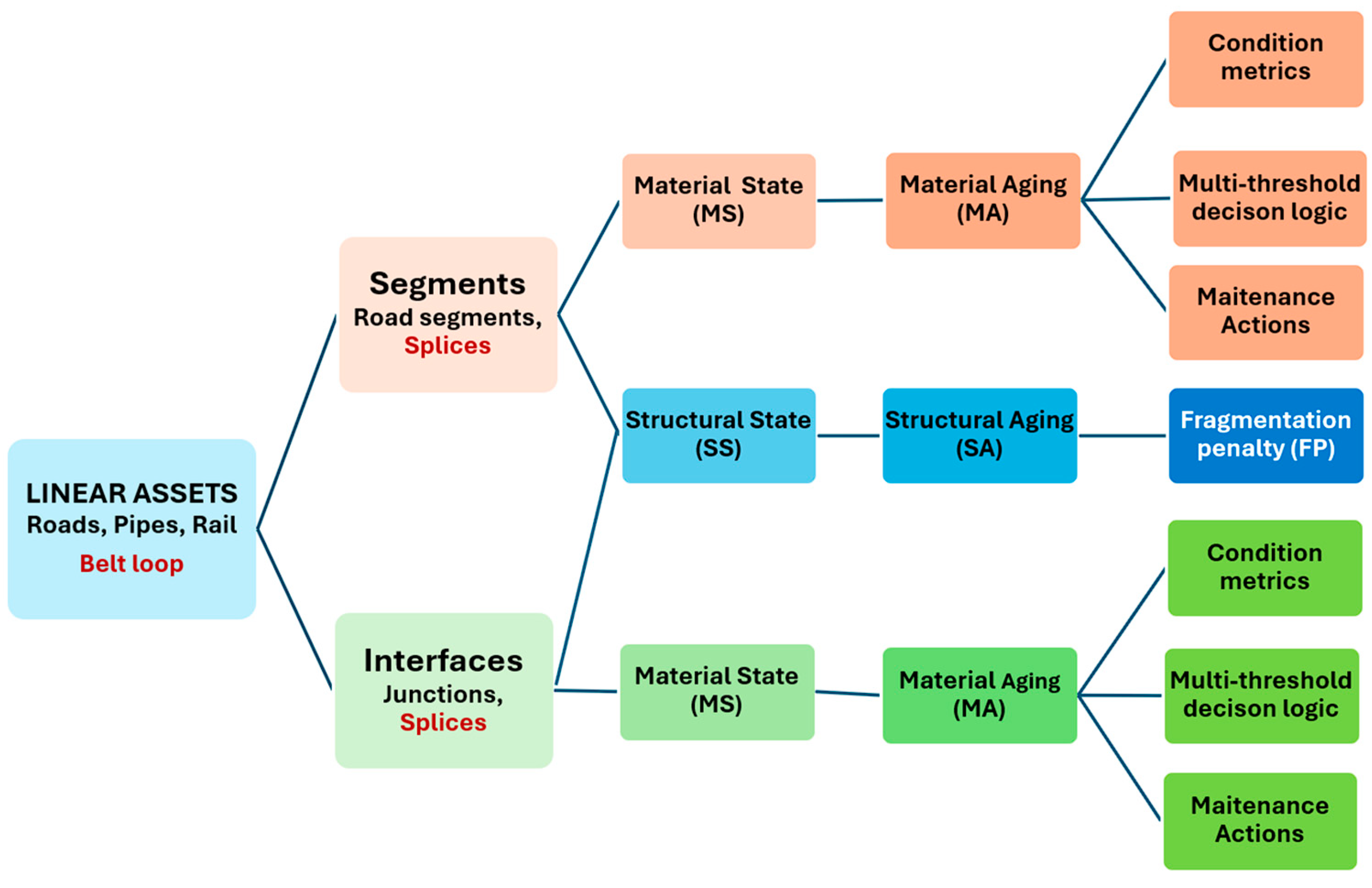
Figure 1 summarizes the conceptual architecture of the proposed framework and the relationships between material state, structural state, decision thresholds, maintenance actions, and fragmentation penalty.
Conveyor belt loops are used as a reference case because they make the interaction between local renewal and global structural effects particularly explicit [
11,
17,
18]. In such systems, the distinction between segments and interfaces is physically clear, the number of splices is directly observable, and the structural consequences of local replacement can often be interpreted without ambiguity. For this reason, the conveyor belt loop serves not merely as an application example, but as a transparent benchmark for a broader class of segmented engineering systems.
The remainder of the paper is organized as follows.
Section 2 reviews the literature on renewal processes, condition-based diagnostics, refurbishment strategies, and segment-based maintenance in other classes of linear assets.
Section 3 introduces the conceptual basis of the proposed engineering framework.
Section 4 develops the formal model of segment-based renewal, including state variables, degradation dynamics, threshold-based decision logic, and fragmentation penalty.
Section 5 discusses the transferability of the framework across asset classes and outlines its broader engineering implications.
Section 6 concludes the paper and identifies directions for future research.
2. Literature Background
2.1. Renewal Processes and Segment-Based Maintenance
Segment replacement and local renewal have long been recognized as natural maintenance strategies in linear systems exposed to spatially heterogeneous degradation. More generally, the maintenance literature has evolved from age-based replacement logic toward approaches that increasingly account for observable condition, deterioration trajectories, and decision timing [
5,
6]. Within such a perspective, renewal is not interpreted simply as full restoration of an entire asset, but more often as selective intervention applied to locally degraded sections whose technical state or risk level differs from the remainder of the system.
In conveyor belt systems, early work already approached segment replacement within the broader logic of renewal processes. A particularly important early contribution is the paper by Jurdziak [
15], which anticipated the renewal-oriented interpretation of belt-section management well before such topics became common in the more recent literature. Later studies also considered the useful life of conveyor belt sections in relation to operational exposure and repeated circulation rather than purely chronological age, showing that the renewal perspective is especially relevant where localized damage accumulates unevenly along the loop [
16].
A key assumption of classical belt-maintenance thinking was that the number of splices should be minimized and that long belt sections are generally preferable to heavily segmented loops. This assumption was rooted in engineering practice, where splices are usually perceived as weaker and more failure-sensitive than the belt body itself. In effect, belt sections located between existing splices were often treated as the natural units of replacement, while insertions were viewed more cautiously because they introduced additional interfaces into the system [
15,
16].
However, subsequent field observations and reliability-oriented analyses showed that real conveyor belt loops frequently evolve in a different way under long-term operation. Instead of remaining composed of a few long sections, they tend to become progressively subdivided through repeated local repairs, insertions, and partial replacements. This process leads to an increase in splice count and a reduction in average segment length, even when each individual intervention is locally justified [
17,
18]. In engineering terms, this can be interpreted as progressive structural fragmentation caused by maintenance history.
This point is important because classical renewal-based interpretations focus primarily on the life cycle of an individual segment, whereas long-term operation creates an additional layer of system evolution at the level of overall structure. In other words, segment renewal changes not only the condition of the replaced element, but potentially also the organization of the system in which that element operates. This distinction becomes especially relevant in assets that can be approximated as series-like structures, where a growing number of interfaces may alter reliability even if the average condition of material segments improves [
17,
18,
19].
The broader maintenance literature supports this interpretation indirectly. Reviews of condition-based maintenance policies and optimization models show that maintenance timing, intervention selection, and observable degradation are now treated as central decision variables, especially in systems with stochastic deterioration and heterogeneous condition states [
5,
6,
7]. Yet even in this broader literature, the structural consequences of repeated local renewal are much less explicitly represented than the condition of the repaired component itself.
Thus, in the conveyor belt context, the literature already contains two important ingredients: first, a renewal-oriented understanding of local section replacement, and second, an empirical recognition that repeated local interventions increase segmentation and splice density. What remains insufficiently formalized is the interaction between these two levels, namely the fact that repeated local renewal may gradually transform the technical structure of the loop itself.
2.2. Condition-Based Diagnostics and Refurbishment Strategies
The development of condition-based maintenance has changed the way deterioration is interpreted in engineering systems. Instead of relying primarily on chronological age or fixed service intervals, modern maintenance strategies increasingly use monitored condition, degradation indicators, and predictive logic to support intervention decisions [
5,
6,
7]. This shift is particularly important in systems where degradation is spatially heterogeneous and where local damage cannot be inferred reliably from time of service alone.
Conveyor belt systems fit this description well. Belt damage is highly non-uniform, depends on operating conditions, transported material, loading geometry, and local history, and may accumulate in a manner that is not well described by age alone. External literature on conveyor belt failure and damage classification confirms the diversity of belt deterioration mechanisms and the importance of targeted diagnostic interpretation. Failure-analysis studies on steel cord conveyor belts and reviews of belt-damage types show that belt condition should be understood as a combination of different interacting damage modes rather than as a single uniform wear process [
30,
31].
This general observation is strongly supported by recent progress in belt diagnostics. In steel cord belts, magnetic methods and related non-destructive techniques make it possible to identify internal damage, broken cords, splice defects, and other core-related anomalies directly. The DiagBelt+ system and related developments provide a particularly important example of this transition from indirect assessment to direct measurement-based condition evaluation [
8]. More recent work has extended this diagnostic perspective to splice geometry and splice condition assessment, which is especially relevant because splices often constitute the most structurally sensitive elements of the loop [
10,
11].
A further important development is the emergence of review and monitoring studies that treat conveyor belt diagnostics not as isolated technical tests but as part of broader condition-based maintenance logic. Recent review work shows that belt monitoring increasingly combines internal defect detection, external condition assessment, and maintenance-oriented interpretation of measured data [
9,
12]. Such an approach is fully aligned with the wider condition-based maintenance literature, which emphasizes that sensing and monitoring become operationally meaningful only when they are linked to maintenance decisions, intervention thresholds, and future state estimation [
7].
This is also the context in which predictive maintenance becomes relevant. Liu et al. [
13] proposed an integrated decision-making framework for predictive maintenance of belt conveyor systems, demonstrating that condition data and decision logic can be connected more directly than in traditional time-based replacement models. Their work is particularly important in the present context because it provides an external, non-local reference confirming that belt-maintenance decisions should be linked to degradation trajectories and future decision consequences rather than to simple replacement-by-age logic.
Another important dimension of the problem concerns refurbishment and reuse. In conveyor belt practice, removal from service does not necessarily mean end of technical value. A section dismantled at the appropriate moment may still retain sufficient structural integrity to be refurbished and returned to operation. This makes intervention timing economically and operationally more complex than in systems governed only by a single failure limit. The refurbishment literature shows that profitable regeneration depends strongly on the condition at removal and that diagnostics can significantly improve refurbishment decision quality [
14].
This immediately leads to the concept of decision windows rather than a single threshold. If a segment is removed too late, it may lose refurbishment potential; if it is removed too early, useful life is sacrificed unnecessarily. In that sense, maintenance decisions should distinguish at least between continued operation, planned removal with refurbishment potential, replacement without refurbishment, and critical withdrawal. Such logic is consistent with broader CBM optimization literature, in which intervention timing changes not only the risk of failure but also the future action set available to decision-makers [
6,
7].
Taken together, the literature on diagnostics, predictive maintenance, and refurbishment suggests that conveyor belts should be treated as measured, state-dependent, and decision-sensitive systems rather than as assets governed only by age or average service life. What remains less developed, however, is the explicit integration of these condition-driven decisions with the structural consequences of repeated localized renewal. In other words, the literature increasingly supports better local maintenance decisions, but it does not yet adequately formalize how a sequence of such decisions reshapes the loop as a segmented technical structure.
2.3. Analogous Approaches in Other Linear Assets
The engineering logic described above is not unique to conveyor belts. Similar maintenance principles can be observed in other classes of linear assets, including roads, railways, pipelines, and power transmission systems. In each of these domains, degradation is spatially distributed rather than uniform, interventions are often applied to selected sections, and maintenance decisions are increasingly based on measured condition or risk indicators rather than on age alone [
1,
2].
Road infrastructure provides one of the clearest analogues. Pavement management is inherently section-based, and maintenance decisions are typically supported by condition data related to distress, rutting, cracking, and serviceability. Studies on pavement deterioration explicitly account for heterogeneity among sections and show that local deterioration patterns affect both forecasting and intervention policy [
20,
21]. FHWA and related practice-oriented documents further show that maintenance and rehabilitation strategies are increasingly linked to condition assessment and expected treatment effectiveness rather than to purely fixed schedules [
21,
22,
23].
The analogy with conveyor belts is particularly instructive because both systems consist of load-bearing structures protected by outer layers that degrade in different ways. In roads, the pavement surface can be renewed while the underlying structural layers may remain in service or require deeper intervention depending on their condition. In conveyor belts, cover wear and surface damage may be addressed while the internal core remains structurally usable or, conversely, may reveal more fundamental structural limitations. In both cases, condition assessment of the visible or outer layer alone is insufficient if the deeper structural state remains unknown.
Pipeline systems provide another strong parallel, especially in the context of integrity management. Pipeline maintenance decisions increasingly rely on inspection data, defect characterization, growth prediction, and risk-based action logic rather than on simple time-to-replacement assumptions [
24]. Standards and methodologies such as ASME B31.8S and AMPP ECDA further formalize the link between inspection, integrity assessment, and intervention planning [
25,
26]. This is conceptually very close to the logic proposed in the present paper, where local degradation indicators and future decisions are linked within one structure.
Power transmission infrastructure offers a related but somewhat broader example. In this domain, asset condition is often represented through health indices, tower-specific indicators, or risk-based maintenance frameworks rather than through direct replacement-by-age rules. Studies and technical guidance show that maintenance, refurbishment, and replacement planning increasingly depend on the condition of locally differentiated components and their role within the wider system [
27,
28,
29]. This makes power assets a useful example of how local condition assessment and system-level maintenance planning can coexist, even if the physical form of interfaces differs from that of segmented belt loops.
Railway infrastructure also reflects this logic. Railway tracks deteriorate unevenly, maintenance is section-based, and deterioration models are increasingly used to support intervention planning. Reviews of railway track deterioration confirm the importance of representing maintenance decisions in relation to measured or inferred section-level deterioration processes rather than to uniform aging assumptions [
3,
4].
Across all these domains, a common engineering pattern emerges. The asset is managed through local condition assessment and selective intervention, but repeated local maintenance also creates or preserves structural non-uniformity, transition zones, heterogeneity of service history, and differences in component age or configuration. In roads, this appears as patchwork pavement structures. In pipelines, it appears through repairs, sleeves, and reinforced sections. In transmission systems, it appears through uneven modernization and heterogeneous health distributions. In conveyor belts, it appears most transparently through growing splice density and progressive loop fragmentation.
Yet the literature rarely treats these structural side effects as a formal maintenance variable in their own right. Most current approaches remain focused on local deterioration, local risk, or local condition, even when they are embedded in broader asset-management systems. The question of how repeated local interventions gradually transform the asset as a segmented technical structure remains much less explicitly represented.
2.4. Research Gap
The literature reviewed above shows substantial progress in several overlapping directions. First, maintenance research has moved decisively toward condition-based, predictive, and optimization-oriented strategies that link observable deterioration to intervention timing and policy choice [
5,
6,
7]. Second, conveyor belt systems have benefited from significant advances in diagnostic methods that enable direct measurement of internal damage, splice condition, and localized deterioration patterns [
8,
10,
11,
12]. Third, refurbishment and reuse have introduced an economic and circular perspective into belt maintenance, making the timing of removal a strategic issue rather than a purely reactive one [
13,
14]. Fourth, analogous section-based maintenance logic is well established across roads, pipelines, railways, and power transmission systems [
1,
4,
24,
29].
Despite this progress, an important gap remains. Current approaches generally optimize or justify interventions at the level of the local element, segment, or section being repaired, replaced, or monitored. Much less attention is given to the fact that repeated local interventions may progressively alter the structure of the system itself. In particular, the literature does not adequately formalize the divergence between local material improvement and global structural deterioration.
This gap is especially visible in conveyor belt loops. Here, local renewal may improve the condition of the repaired segment while simultaneously increasing splice density and reducing average section length. In other words, the system may become structurally more fragmented even as its locally renewed parts become technically better. Previous belt studies clearly indicate both the practical importance of splice-sensitive structures and the empirical tendency of loops to become more segmented over time [
17,
18,
19]. However, these observations have not yet been integrated with the broader logic of condition-based maintenance, threshold-based decision-making, and cross-asset infrastructure thinking within one coherent framework.
The missing concept is therefore not simply another condition index or another maintenance rule. What is missing is a framework that explicitly distinguishes between material state and structural state, interprets maintenance actions as changes affecting both, and represents the system-level cost of increasing segmentation in a formal way. This is the problem addressed in the present paper.
3. Proposed Engineering Framework
3.1. Problem Statement: Local Interventions vs. System-Level Effects
Maintenance of linear assets is inherently segment-oriented because degradation processes are spatially heterogeneous and interventions are applied locally. In roads, railways, pipelines, and belt conveyors alike, the practical unit of decision is usually a section, span, segment, or component rather than the entire system [
1,
2]. This is also consistent with the logic of condition-based maintenance, where interventions are triggered by the observed or estimated state of a particular part of the system rather than by the age of the system as a whole [
5,
6,
7].
From the perspective of local engineering action, such interventions are beneficial by design. Replacing, repairing, or reinforcing a degraded section improves the condition of the affected region and may reduce the immediate risk associated with that local defect. In conveyor belt systems, this logic is particularly clear when a locally damaged zone is removed or replaced based on direct diagnostic evidence of internal damage, splice deterioration, or defect accumulation [
8,
11,
12].
However, this local logic conceals a deeper system-level problem. A maintenance action may improve the material condition of the repaired part while simultaneously altering the structure of the system in a less favourable direction. In segmented technical assets, local intervention is not always structurally neutral. It may increase the number of segments, increase interface density, reduce average segment length, and create new transition zones between elements of different age, condition, or technical history.
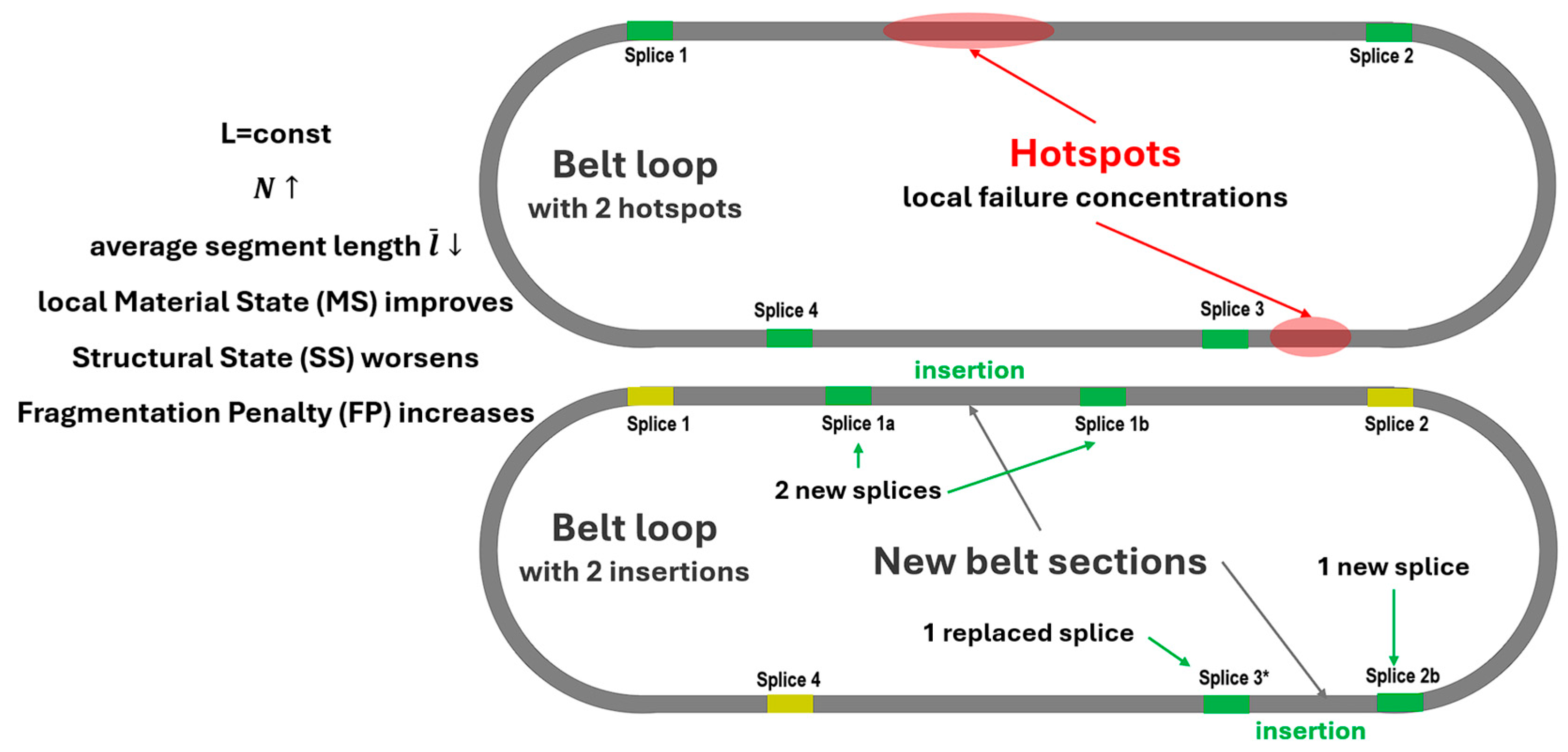
This effect is especially transparent in conveyor belt loops. When a damaged section is replaced by an inserted segment, the local defect may be removed, but the operation also introduces additional splices. Since splices are structurally more sensitive than the belt body and often constitute the dominant weak points of the loop, the intervention may improve the local material state while worsening the structural configuration of the system [
11,
17,
18].
Thus, the central engineering contradiction addressed in this paper can be stated as follows: local renewal may improve the condition of the repaired zone while degrading the system through progressive fragmentation. Existing maintenance models rarely represent this trade-off explicitly. Instead, they often assume that a sequence of locally justified interventions necessarily improves the system as a whole. In segmented linear assets, this assumption is not generally valid.
Figure 2 illustrates the central engineering contradiction addressed in this paper: local renewal improves the material condition of the repaired zone while simultaneously increasing structural fragmentation through additional splices.
3.2. Conceptual Separation: Material State vs. Structural State
To formalize the contradiction identified above, it is necessary to distinguish between two different dimensions of asset condition.
The first dimension is the material state of the asset. This refers to the technical condition of individual segments or interfaces and includes such phenomena as wear, fatigue, defect accumulation, thickness loss, corrosion, local damage, or any other measurable deterioration process. Material state answers the question: how degraded is the element itself?
The second dimension is the structural state of the asset. This refers to the configuration of the system as an organized whole. It includes the number of segments, the number and density of interfaces, the distribution of section lengths, and the overall level of structural heterogeneity induced by maintenance history. Structural state answers the question: how is the system organized?
This distinction leads directly to two different but interacting forms of aging. Material aging refers to the progressive deterioration of the elements themselves. Structural aging refers to the deterioration of system-level properties caused by increasing segmentation, increasing interface density, and growing structural heterogeneity.
These two forms of aging do not necessarily move in the same direction. A local intervention may reduce material aging in the renewed section while increasing structural aging at the level of the system. This divergence is the conceptual foundation of the framework proposed in the present paper.
The importance of such a distinction is not limited to conveyor belts. Similar situations can be recognized in roads with patchwork resurfacing histories, in pipelines with repeated repairs and sleeves, and in transmission systems with heterogeneous modernization patterns. What makes conveyor belt loops especially useful as a benchmark is that the distinction between material sections and structural interfaces is unusually explicit and technically observable.
3.3. Segment-Based Representation of Linear Assets
The proposed framework represents a linear asset as a system composed of two classes of elements: segments and interfaces. Segments are the material portions of the asset that carry load, resist deterioration, and accumulate local damage over time. Interfaces are the structural connections or transition zones between segments. In conveyor belt loops, these correspond naturally to belt sections and splices.
This representation departs from homogeneous or averaged descriptions of the asset. Instead of treating the system as a continuous object characterized only by global properties, the framework interprets it as a dynamically evolving arrangement of discrete elements whose condition and configuration change over time.
Such a representation is strongly supported by engineering practice. In many infrastructure domains, inspection and maintenance are already performed section by section. The proposed model generalizes this intuition by making the distinction between segments and interfaces explicit and by treating both as relevant components of the maintenance problem.
This is particularly important in conveyor systems. A splice is not just another piece of belt. It differs in geometry, local strength, defect evolution, and failure sensitivity. For this reason, it should not be merged conceptually with the surrounding belt body. The same general idea applies in other domains, where joints, repaired boundaries, reinforced sections, or transition zones may behave differently from the primary material segments.
The segment-based representation also provides a natural foundation for maintenance decision-making. Local condition can be assigned to individual segments and interfaces, while system-level descriptors can be assigned to the overall structural arrangement. This dual representation makes it possible to connect local condition assessment with global maintenance consequences.
3.4. Condition Metrics and State Variables
For the proposed framework to be operational, both segments and interfaces must be associated with state variables that represent their technical condition. These state variables may be derived directly from measurement, estimated from models, or inferred from inspection and diagnostic systems.
For material segments, condition variables may describe defect density, defect area density, thickness loss, corrosion depth, crack intensity, wear level, or other forms of measurable deterioration. In conveyor belt systems, magnetic diagnostics and related monitoring methods make it possible to identify and quantify internal damage directly, which makes segment-level state assignment particularly natural [
8,
9,
12].
For interfaces, separate state variables are needed because their degradation mechanisms and engineering significance differ from those of segments. In conveyor belt loops, splices exhibit specific geometrical, structural, and defect-related behaviour and therefore require separate representation [
10,
11,
19].
A key practical requirement is that such state variables should be measurable or at least estimable, comparable across elements, and suitable for use in maintenance decision logic. This is the point at which descriptive condition assessment becomes decision-oriented modeling.
The same logic can be generalized to other linear assets. In roads, the segment state may represent local pavement deterioration, while the interface state may correspond to the condition of transitions between treated and untreated zones. In pipelines, the segment state may represent wall condition or corrosion severity, while the interface state may correspond to repaired or welded zones. In all such cases, the framework requires that both classes of elements be treated explicitly.
3.5. Multi-Threshold Decision Logic
Classical maintenance models often rely on a single end-of-life or failure threshold. In the context of segmented assets and condition-sensitive intervention timing, such an approach is too restrictive.
The proposed framework therefore adopts a multi-threshold decision logic. Instead of asking only when the element reaches an unacceptable condition, it distinguishes between several decision regions corresponding to different engineering actions. For segments, these may include continued operation, planned intervention, removal while refurbishment remains feasible, replacement without refurbishment, and critical withdrawal. For interfaces, the logic may be simpler but still requires more than a binary acceptable/unacceptable classification.
This approach is consistent with the broader maintenance literature, which emphasizes that the timing of intervention affects not only failure risk but also future options, costs, and technical feasibility [
6,
7]. In conveyor belt systems, it is especially relevant because a segment removed too late may lose refurbishment potential, while a segment removed too early may waste residual useful life [
13,
14].
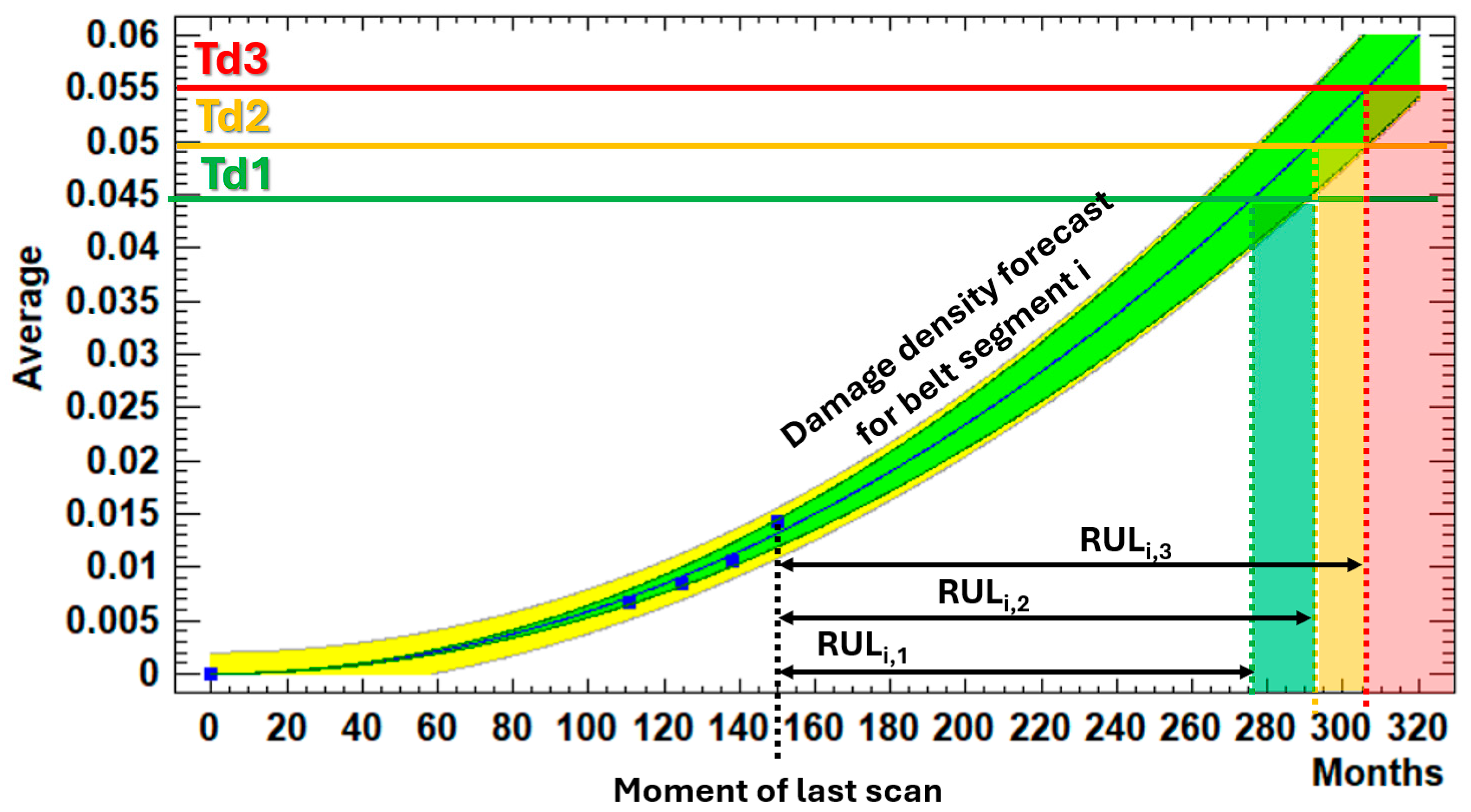
The result is a set of decision windows rather than a single terminal threshold. This interpretation also changes the meaning of remaining useful life. Instead of treating RUL as a single time-to-failure value, the framework interprets it as a structured horizon containing multiple relevant intervention boundaries (
Figure 3).
3.6. Fragmentation as a System-Level Effect
Repeated local interventions tend to increase the number of segments and interfaces. In the proposed framework, this process is referred to as fragmentation. Fragmentation is not treated merely as a geometric descriptor, but as a system-level property with technical consequences.
It may be characterized by the number of segments, interface density, average segment length, or the distribution of segment sizes. In a conveyor belt loop, fragmentation is visible directly through the growth of splice count and the progressive subdivision of the loop into shorter sections [
17,
18].
The engineering importance of fragmentation lies in the fact that it affects more than geometry. A more fragmented system may exhibit lower reliability, higher inspection burden, greater maintenance complexity, and reduced long-term robustness. For this reason, the framework introduces the concept of a fragmentation penalty, understood as the adverse system-level effect associated with increasing structural complexity.
This concept is one of the main original elements of the framework. It translates an engineering intuition that is widely recognized in practice into a quantity that can later be incorporated into formal models and optimization procedures.
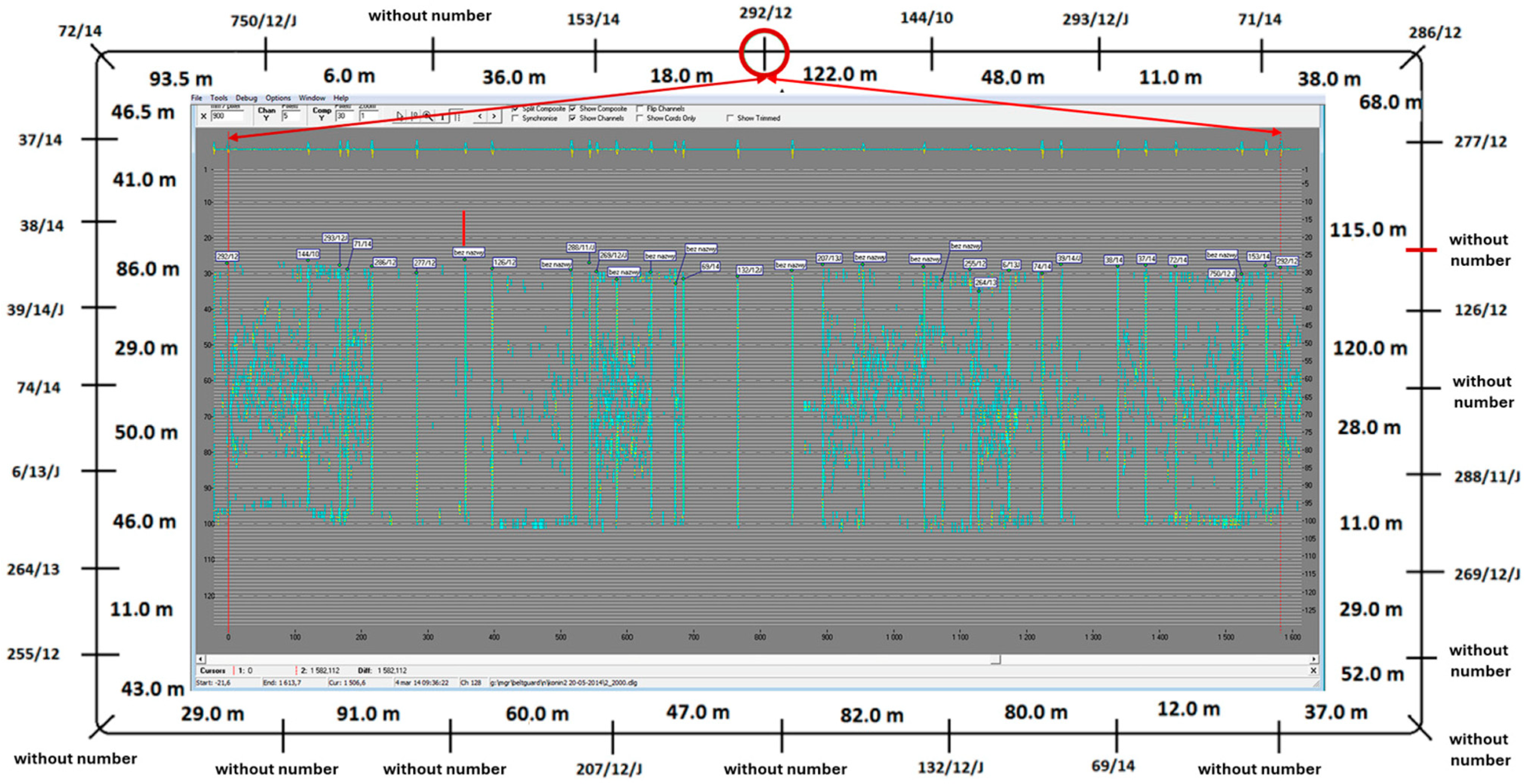
The conveyor belt loop provides particularly clear empirical support for this idea, because local repairs and insertions visibly create splice-dense and structurally aged loops whose configuration differs fundamentally from that of a loop composed of a small number of long sections.
Figure 4 shows a real example of belt-loop fragmentation caused by repeated short-section replacements.
3.7. Maintenance Actions as State–Structure Transformations
A further conceptual shift proposed in this paper concerns the interpretation of maintenance itself. Maintenance is not treated merely as restoration of local condition. Instead, it is interpreted as a state–structure transformation.
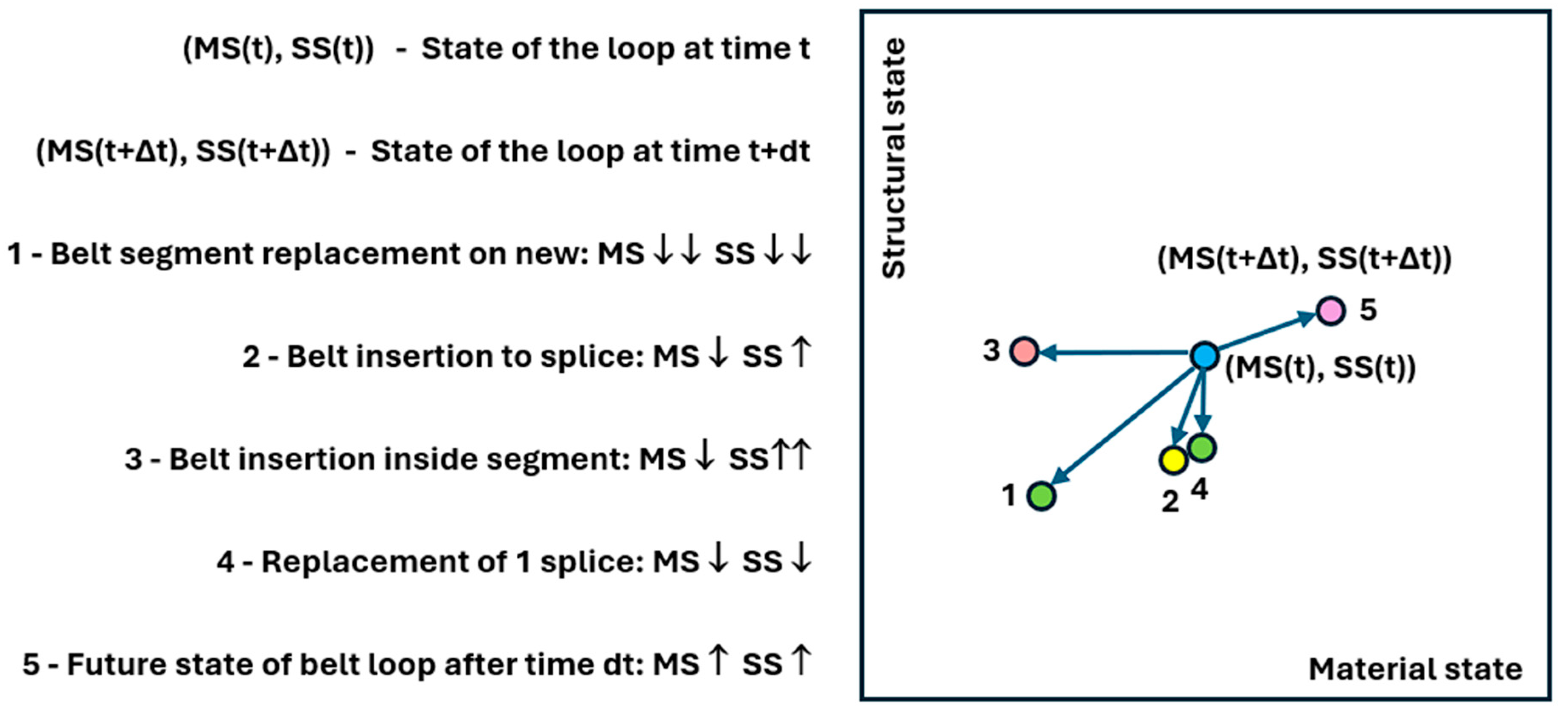
This means that a maintenance action affects at least two dimensions at once. First, it changes the condition state of one or more elements. Second, it may alter the structural configuration of the system by changing the number, arrangement, and length distribution of segments and interfaces.
For example, replacing an entire belt section may improve local material state without increasing fragmentation. By contrast, inserting a short new section into an existing loop may remove a local defect while also increasing splice count and therefore worsening structural state. Similarly, replacing a splice restores the condition of an interface while leaving the segmentation pattern unchanged.
This dual interpretation is essential because it makes explicit what is usually hidden in conventional maintenance logic: two actions that are locally equivalent in terms of defect removal may be structurally very different in terms of long-term system consequences.
The same principle can be recognized in other linear assets. In roads, localized patching and section replacement do not affect the network identically. In pipelines, clamp-type or sleeve-based repairs do not leave the structure unchanged in the same way as replacement of a longer section. In all such cases, maintenance changes both the condition of the treated zone and the technical configuration of the asset.
Figure 5 summarizes this dual-state interpretation of maintenance effects.
3.8. Framework Overview
The proposed engineering framework integrates the elements introduced above into one consistent structure. It combines:
- (1)
A segment-based representation of the asset;
- (2)
A distinction between material state and structural state;
- (3)
Measurable or estimable state variables for segments and interfaces;
- (4)
Multi-threshold decision logic;
- (5)
Explicit treatment of fragmentation as a system-level consequence of repeated local intervention;
- (6)
An interpretation of maintenance actions as state–structure transformations.
Taken together, these components provide a bridge between local diagnostics and system-level maintenance reasoning. They make it possible to move beyond the implicit assumption that a locally justified intervention must automatically improve the asset as a whole. Instead, the framework treats local condition improvement and global structural consequence as two interdependent dimensions of the same engineering problem.
This conceptual structure forms the basis for the formal model developed in the following section.
4. Formal Model of Segment-Based Renewal
4.1. System Representation
In the proposed framework, a linear asset is represented as a finite ordered system composed of two classes of elements: material segments and structural interfaces. In the reference case of a conveyor belt loop, these correspond naturally to belt sections and splices. At time
, the system may be expressed as
where
denotes the
-th segment,
denotes the interface associated with the segment sequence, and
is the current number of segments. In a closed-loop representation, the number of segments is equal to the number of interfaces.
The total asset length is assumed constant at the system level:
where
is the length of segment
. This formulation is important because it allows maintenance to be interpreted not only as a change in condition, but also as a transformation of system structure through changes in the number, arrangement, and size distribution of segments and interfaces.
This representation reflects the engineering logic developed in
Section 3. The asset is not treated as a homogeneous continuous object described only through global averages, but as a dynamically evolving arrangement of elements whose local condition and mutual configuration jointly affect performance.
4.2. Structural State Variables
The structural state of the asset is described through aggregated descriptors that quantify its degree of segmentation. The most natural variables are:
and the interface density
These variables characterize the configuration of the system independently of the local condition of individual elements. An increase in or , or a decrease in , represents increasing structural subdivision and therefore structural aging.
The key point is that these descriptors do not measure material damage directly. Instead, they quantify how strongly the asset has become partitioned into shorter sections and more numerous interfaces as a result of maintenance history. This is fully consistent with the interpretation introduced earlier: repeated local intervention may improve material condition while worsening system structure.
Additional structural descriptors may also be included if needed, for example, the variance of segment lengths, the density of very short sections, or the number of interfaces per critical subsystem. However, , , and are sufficient as first-order structural indicators for the present framework.
4.3. Material State Variables
Each segment and each interface is associated with a variable describing its technical state. For the
-th segment, let
denote the material degradation state, and for the
-th interface let
denote the interface degradation state. Higher values correspond to more advanced deterioration.
For segments, the state variable should be linked to measurable condition indicators. In the conveyor belt reference case, a natural choice is to define segment state as a function of defect density and defect area density derived from diagnostic measurements:
where
is defect density and
is defect area density for segment
. In a simple linear form, this may be written as
where
and
are weighting coefficients reflecting the relative importance of count-based and area-based degradation descriptors.
This choice is justified in systems where local degradation can be measured directly rather than inferred only from age. In conveyor belts, this condition is increasingly satisfied through magnetic diagnostics, splice imaging, and related condition-monitoring methods [
8,
10,
11,
12]. The same general logic also applies to other asset classes, where local condition may be represented through wall loss, crack intensity, rutting, or health-index values.
Interfaces require separate state variables because their geometry, degradation modes, and structural role differ from those of segments. In conveyor belt loops, splice condition cannot be merged with belt-body condition without losing important information about local reliability sensitivity [
11,
19].
4.4. Degradation Dynamics
The degradation state of both segments and interfaces evolves under the influence of operational exposure and environmental conditions. In the most general form, this may be written as
where
and
denote vectors of conditions affecting degradation, such as load, transported material, operating speed, geometry, environment, and maintenance history.
For analytical tractability, a simplified linear approximation may be adopted in the first version of the model:
where
and
are effective degradation rates for the segment and the interface, respectively.
This approximation is not intended to claim that deterioration is intrinsically linear. Its purpose is to provide a first formal layer that enables threshold analysis, decision-interval calculation, and optimization. More advanced stochastic, nonlinear, or load-dependent models can later be introduced without changing the conceptual structure of the framework.
Although a linear degradation law is adopted here in the simplest analytical version of the model, the framework itself is not restricted to linear deterioration. In conveyor belt diagnostics, nonlinear damage evolution has also been observed in repeated scan data. In particular, rolling linear prediction of damage-growth measures between successive scans may still produce nonlinear long-term trends if the fitted coefficients evolve over time. In a recent study of steel cord belt-core damage growth, the coefficients
of local linear prediction were found to depend linearly on time, which led to quadratic changes in damage-density measures over longer operating periods [
20]. This supports the interpretation that the present linear formulation should be treated as a first-order analytical simplification rather than as a constitutive claim about real deterioration kinetics.
This is especially important because measured deterioration in conveyor systems is often nonlinear in practice and strongly affected by operating conditions, damage history, and local loading variability [
13,
14]. The present section therefore establishes the architecture of the model rather than its final empirical calibration.
4.5. Multi-Threshold Decision Model
The decision structure is based on threshold regions rather than on a single failure limit. For each segment, three thresholds are introduced:
where
marks the upper bound of normal operation;
marks the upper bound of the refurbishment-eligible region;
marks the critical limit beyond which continued operation is unacceptable.
This creates four segment-state regions:
normal operation;
planned intervention;
mandatory replacement with limited refurbishment potential,
critical condition.
For interfaces, a simpler two-threshold logic is often sufficient:
with the regions:
acceptable condition;
planned replacement;
critical condition.
This structure is consistent with the wider condition-based maintenance literature, in which intervention timing affects not only failure probability but also the set of available future actions [
6,
7]. It is also directly aligned with predictive and refurbishment-oriented decision logic in belt conveyor systems, where removal timing influences both safety and reuse potential [
13,
14].
4.6. Remaining Useful Life as Decision Intervals
Within the present framework, remaining useful life is not treated as a single scalar time to failure. Instead, it is represented as a sequence of times to relevant decision thresholds.
For segment , define:
: time to the planning threshold;
: time to the refurbishment boundary;
: time to the critical limit.
Under the linear degradation approximation,
provided that
.
This gives rise to two engineering decision intervals of particular relevance:
The refurbishment window, between and ;
The mandatory replacement window, between and .
This interpretation is also consistent with repeated diagnostic observations in conveyor belts, where damage-density growth may follow nonlinear trajectories even if local prediction between consecutive scans is formulated in linear incremental form. If the underlying growth coefficients evolve over time, the resulting threshold-crossing times may shorten progressively, which means that delaying intervention may reduce planning flexibility faster than a linear model would suggest [
20]. This further justifies the decision-window interpretation of remaining useful life (
Figure 3).
4.7. Fragmentation Penalty
The structural consequences of repeated local interventions are captured through a fragmentation penalty. In the simplest form, this penalty may depend directly on the number of segments or on interface density:
where λ > 0 is a calibration parameter expressing the cost of additional structural complexity.
A more general form may be written as
where l(t) is the vector of segment lengths and Φ(·) may incorporate nonlinearity, threshold effects, or penalties for high dispersion in segment size.
This term is one of the main original constructs of the model. It converts an engineering intuition widely recognized in practice into a formal quantity that can be included explicitly in maintenance optimization.
4.8. System Reliability Approximation
For a series-like system, total reliability may be approximated as the product of the reliabilities of its segments and interfaces:
In this representation, an increase in the number of interfaces generally tends to reduce structural simplicity and may reduce total system reliability, especially in splice-sensitive systems, even if some individual elements improve in condition. This is precisely the mechanism that motivates the distinction between material and structural aging. In conveyor belt loops, where splices are commonly treated as more sensitive than the belt body itself, this approximation is meaningful as a first-order engineering representation.
The present formulation is deliberately simplified. It does not yet include statistical dependence, load redistribution, common-cause failures, interaction between adjacent elements, or maintenance-induced correlation. However, it is sufficient to formalize the central point of the paper: the addition of interfaces is not structurally neutral.
It should be emphasized that an increase in the number of interfaces does not necessarily imply an immediate reduction in the reliability of the locally renewed part of the system after every intervention. In the conveyor belt context, a local insert may simultaneously remove a high-risk hotspot, introduce a new defect-free belt segment, and reduce the damage concentration in the adjacent retained fragments. As a result, the local material reliability may improve even though the number of interfaces becomes larger. For this reason, the structural effect of added interfaces should be interpreted primarily as an increase in long-term structural complexity and future vulnerability, rather than as an automatic instantaneous reliability loss in every case. The series-like formulation used here is therefore a first-order engineering approximation for splice-sensitive segmented systems, not a universal law for all local maintenance actions.
4.9. Maintenance Operator
A maintenance action is represented as an operator acting simultaneously on system structure and on condition states:
where
C(
t) denotes the structural configuration,
x(
t) is the vector of segment states, and
y(
t) is the vector of interface states.
This notation emphasizes that maintenance is not merely a reset of degradation. It is a transformation of the coupled state–structure system.
For example, a local insertion may improve the state of a damaged region, increase the number of interfaces, change the segment-length distribution, and therefore alter both material and structural state. This dual effect is the formal core of the proposed framework and distinguishes it from classical condition-reset models.
4.10. Objective Function
The maintenance problem may then be written as an optimization problem:
with
or, in weighted form,
where
CM is the maintenance cost,
CR is the expected failure-risk cost,
FP is the fragmentation penalty, and
w1,
w2, and
w3 are weighting coefficients reflecting decision priorities.
The objective function formalizes the central engineering claim of the paper: an intervention cannot be judged solely by its local restorative effect. An action that is cheap and locally effective may still be suboptimal if it induces excessive fragmentation and long-term reliability loss. In that sense, the optimization problem does not simply minimize deterioration; it balances condition improvement, risk control, and structural preservation.
4.11. Interpretation
The formal model shows that maintenance decisions in segmented linear assets must balance at least three competing effects:
Reduction in local degradation;
Avoidance of failure and risk escalation;
Limitation of structural fragmentation.
This balance directly formalizes the trade-off introduced conceptually in
Section 3. The mathematical layer therefore does more than restate the engineering intuition. It converts the local-versus-system conflict into a structure that can be analyzed, calibrated, and eventually optimized.
In that sense, the formal model is the point at which the paper moves from conceptual framework to operational decision architecture. The equations are intentionally simple in their present form, but they are sufficient to demonstrate the main contribution of the study: maintenance in segmented linear assets should be treated as a coupled condition–structure problem, not merely as a sequence of local repairs.
4.12. Illustrative Maintenance-Planning Example with Realistic Cost Assumptions
To clarify the operational meaning of the proposed framework, this subsection presents a simple maintenance-planning example using engineering cost assumptions representative of conveyor belt practice. The purpose of the example is not to provide a fully calibrated industrial optimization model, but to show how a fragmentation-aware decision framework may lead to a different maintenance preference than purely local-condition-based reasoning.
Consider a locally degraded hotspot of 20 m detected within a 100 m parent belt section bounded by two terminal splices. Assume that the defect may be addressed by one of three alternative strategies: Option A, short local insertion; Option B, full-section replacement; and Option C, deferred intervention until emergency failure.
For the illustrative comparison, let the following assumptions be adopted: belt replacement cost equal to 1000 PLN/m, splice cost equal to 15,000 PLN per splice, preventive replacement performed during a planned stoppage without additional production loss, and emergency replacement requiring one full 8 h shift. For the downtime calculation, let the conveyor throughput be and the unit production-loss cost be .
In Option A, a 20 m damaged fragment is removed from within the parent section and replaced by a short inserted belt section. This operation requires two additional internal splices, so the total number of interfaces in the loop increases by two. The direct maintenance cost is
Thus, Option A has the lowest direct preventive cost, but it increases segmentation and therefore contributes to structural aging.
In Option B, the entire 100 m parent section between its terminal splices is replaced. The direct maintenance cost is
Although two splice operations are also required in this case, these new splices replace the old terminal splices of the removed section. Therefore, the total number of interfaces in the loop does not increase, the number of segments does not increase, and no additional structural aging is introduced. At the same time, both the full section and its two terminal splices are renewed, so the material state of the section and the local interface state are substantially improved.
In Option C, intervention is deferred until the defect develops into an emergency event. Emergency replacement then typically also requires replacement of the full parent section and execution of two terminal splices, so the technical repair cost is again
However, unlike preventive replacement, emergency intervention is additionally burdened by downtime cost. If the failure causes one full 8 h stoppage, the downtime cost may be written as
Thus, the total emergency cost becomes
The comparison also clarifies that splice execution as a technological necessity should not be confused with splice growth as a structural consequence. Option A adds two new internal splices and therefore increases fragmentation. By contrast, Option B also requires two splice operations, but these only replace the old terminal splices of the removed section and do not increase the number of interfaces in the loop. Structural aging should therefore be linked to the net increase in structural complexity, not to splice work itself.
To include this structural effect, let the total objective of action
be written as
where
is direct maintenance cost,
is expected risk-related cost, and
is the fragmentation penalty. In the simplest form,
where
is the net increase in the number of interfaces caused by the action. Accordingly,
for Option A, whereas
for Options B and C. In this simplified example, the fragmentation penalty is linked to interface growth, but more generally it should be understood as a structural term reflecting maintenance-induced complexity rather than as a direct surrogate for immediate post-intervention reliability loss.
Importantly, the insertion option does not necessarily reduce the immediate reliability of the renewed part of the loop. By removing a high-risk hotspot, introducing a new defect-free belt segment, and reducing the damage concentration in the adjacent retained fragments, the intervention may improve the local material reliability even though it increases the number of interfaces. In this sense, the fragmentation penalty should not be interpreted as an automatic short-term reliability decrement, but rather as a structural penalty associated with increasing segmentation, interface density, and future maintenance burden. This is one of the main reasons why the proposed framework separates material state from structural state.
A comparison of the three strategies is summarized in
Table 1. The example shows that the locally cheapest intervention is not necessarily the most favorable one at the system level. Option A has the lowest direct preventive cost, but increases fragmentation. Option B is more expensive, but renews both the section and its terminal splices without increasing the number of interfaces. Option C also does not increase fragmentation, but becomes economically highly unfavorable because of the asymmetry between preventive and emergency intervention. Thus, maintenance planning in segmented linear assets should account not only for local repair cost, but also for structural side effects and downtime risk.
The local reliability of the analysed belt section containing a hotspot may be expressed before and after insertion of a new belt segment with two splices as follows:
If the hotspot reliability is sufficiently low, the post-insertion local reliability may exceed the pre-insertion value despite the addition of two new splices.
Table 1 summarizes the three alternative maintenance strategies together with their cost, reliability, and structural implication.
Table 1 provides an illustrative comparison of three maintenance strategies for a locally degraded hotspot in a conveyor belt loop. Option A has the lowest direct preventive cost but increases fragmentation by introducing two additional internal splices. Option B is more expensive but renews the full parent section and its terminal splices without increasing the number of interfaces in the loop. Option C avoids immediate intervention but becomes economically highly unfavorable once emergency replacement and downtime are included.
From the reliability perspective, the comparison is not trivial. Option A may improve the immediate local reliability of the renewed zone because the hotspot is removed, a new defect-free segment is inserted, and the adjacent retained fragments become less damage-concentrated. However, this improvement is accompanied by structural aging due to the addition of two new interfaces. Option B improves reliability more comprehensively, because it renews the full parent section and its terminal splices without increasing the number of interfaces. Option C is the least favorable from an operational perspective, because reliability continues to degrade until failure and the eventual intervention is burdened by severe downtime cost.
Thus, the reliability effect of Option A is potentially positive in the short term at the material level, but negative in the long term at the structural level.
The example therefore shows that local material improvement and structural aging do not necessarily move in the same direction, which is precisely why both dimensions must be represented explicitly in maintenance reasoning.
5. Cross-Asset Discussion
5.1. Generalization to Linear Assets
The framework developed in the preceding sections is not limited to conveyor belt loops, but applies more broadly to linear assets whose degradation is spatially heterogeneous, whose maintenance is performed locally, and whose technical performance depends not only on the condition of material sections but also on the configuration of the system as a whole. This broader interpretation is consistent with the evolution of infrastructure asset management toward data-informed, optimization-supported, and condition-driven decision frameworks [
1,
2]. It is also compatible with the wider condition-based maintenance literature, which increasingly links monitoring, deterioration assessment, and intervention planning rather than treating them as isolated activities [
5,
6,
7].
Across roads, railways, pipelines, utility networks, and industrial conveying systems, deterioration rarely develops uniformly over the full asset length. Instead, different sections experience different loading histories, environmental exposure, local damage mechanisms, and maintenance histories. As a result, inspection and intervention are naturally organized at the segment or section level. In this sense, segment-based representation is not a special feature of conveyor belts, but a general characteristic of linear infrastructure management.
To make the proposed concept of structural state more operational outside the conveyor belt context,
Table 2 summarizes examples of measurable or estimable descriptors that may represent maintenance-induced structural complexity in different classes of linear assets. The table is not intended as a complete taxonomy, but as a practical guide showing that the structural dimension of the framework can be quantified in different domain-specific ways.
Table 2 also clarifies an important distinction. In conveyor belts, pavements, pipelines, and rail tracks, structural state is often linked to explicit physical segmentation and repair boundaries. In power transmission systems, by contrast, the relevant issue is usually broader maintenance-induced structural heterogeneity rather than literal fragmentation in the same geometric sense. For this reason, transferability of the framework is strongest in asset classes with physically meaningful interfaces and repeated local structural discontinuities, whereas in transmission systems the framework should be interpreted in a broader and more abstract form.
What the proposed framework adds is the explicit distinction between material state and structural state. This distinction makes it possible to formalize a phenomenon that is often recognized in engineering practice but only rarely expressed in analytical form: repeated local interventions may improve the technical condition of selected sections while simultaneously increasing structural heterogeneity, interface density, and system complexity. Conveyor belt loops are particularly useful as a reference case because this contradiction is unusually visible through splice proliferation and loop fragmentation, but the underlying logic is transferable to many other segmented assets.
5.2. Road Infrastructure
Road infrastructure provides one of the clearest analogues to the proposed framework because pavement management is inherently section-based. Pavement condition is assessed locally through cracking, rutting, roughness, and related distress indicators, while maintenance and rehabilitation are planned for selected sections rather than entire networks at once [
21,
22,
23]. Deterioration models also explicitly recognize that road sections do not behave uniformly and that heterogeneity materially affects both forecasting and policy optimization [
24,
25].
Within the language of the present framework, the material state of a road section corresponds to the structural and surface condition of the pavement layers in that section. The structural state, however, is reflected in the spatial pattern of patching, resurfacing boundaries, repaired zones, and transitions between sections with different service histories. In this sense, repeated local maintenance may improve the serviceability of specific locations while producing an increasingly heterogeneous patchwork structure at the level of the road corridor.
The analogy becomes even stronger when the layered nature of both systems is considered. In roads, the asphalt surface can be renewed while the deeper structural layers remain in service, provided they still retain sufficient integrity. If the underlying structure is also compromised, the intervention becomes more extensive and costly. A similar distinction exists in conveyor belts: local surface damage or cover wear may be separable from the condition of the internal core, but once core integrity is compromised, the repair logic changes substantially. Thus, both roads and belts require maintenance strategies that distinguish between visible deterioration and deeper structural condition.
The difference, of course, is that roads are stationary assets degraded by traffic passing over them, whereas conveyor belts are moving assets whose degraded sections can be removed and processed externally. Nevertheless, from the perspective of section-based maintenance and evolving structural heterogeneity, the analogy remains strong.
5.3. Pipeline Systems
Pipeline systems provide another highly relevant comparison, especially because integrity management in pipelines already combines inspection, defect characterization, deterioration prediction, and decision support. Reviews of pipeline integrity management based on inspection data show that maintenance decisions are increasingly tied to defect identification, growth prediction, and risk-based intervention logic rather than to fixed replacement schedules [
26]. Standards such as ASME B31.8S and methodologies such as AMPP ECDA further formalize this link between inspection, integrity assessment, and system-level maintenance planning [
27,
28].
In the terms of the proposed framework, the material state of a pipeline segment may correspond to corrosion loss, cracking, wall thinning, or other forms of local deterioration. The structural state may then be associated with the distribution of repairs, sleeves, welds, reinforced zones, or transitions between original and repaired sections. Repeated local repairs reduce immediate local risk but may also create a more heterogeneous technical structure, which in turn affects inspection burden, uncertainty, and long-term management complexity.
This comparison is particularly valuable because pipeline engineering is already a mature integrity-management domain. It therefore provides independent support for the view that local condition assessment should be embedded within a broader system-oriented framework [
29]. What remains less explicit is the formal treatment of increasing structural heterogeneity itself as a maintenance-relevant variable. In that sense, the proposed fragmentation-aware perspective extends rather than contradicts the logic of pipeline integrity management.
5.4. Power Transmission Lines
Power transmission infrastructure provides a useful, although more indirect, cross-domain comparison. In this domain, maintenance and refurbishment are increasingly supported by health indices, risk indicators, and component-specific prioritization logic rather than by age alone [
30,
31,
32]. The material state may therefore be interpreted through the condition of conductors, towers, insulators, fittings, and associated components.
However, the analogy with conveyor belt fragmentation must be treated carefully. In transmission systems, local interventions do not usually create explicit physical interfaces in the same direct sense as splice insertion in a belt loop, pavement patch boundaries, or pipeline sleeves and repaired sections. The more relevant issue is broader maintenance-induced structural heterogeneity: coexistence of older and newer components, uneven modernization history, and non-uniform distribution of condition and technical standards within the same functional line or subsystem.
For this reason, power transmission assets should not be interpreted as a direct physical analogue of conveyor belt fragmentation. Rather, they represent a broader case in which repeated local interventions gradually increase structural non-uniformity and management complexity. In this domain, the concept corresponding to fragmentation penalty is better understood as a heterogeneity-related system penalty than as a literal penalty for explicit segmentation.
This distinction is important because it defines the limits of transferability of the proposed framework. The framework is strongest and most directly applicable in asset classes where repeated local intervention produces physically meaningful interfaces or boundaries. In transmission systems, its application is more interpretive and should be treated as an extension of the state–structure concept rather than as a one-to-one physical correspondence.
5.5. Conveyor Belt Systems as a Reference Case
Although the framework is intended to be transferable, conveyor belt loops remain a particularly useful reference case because they make the interaction between local renewal and structural consequence unusually explicit. The distinction between segments and interfaces is physically clear, splices are directly observable, and the effects of local replacement or insertion can often be interpreted without ambiguity. In addition, modern diagnostics provide unusually rich local state information for both belt sections and splices [
8,
10,
11,
12,
33].
This makes conveyor belts analytically valuable in a way that goes beyond simple application convenience. In many other asset classes, the structural side effects of local maintenance exist but are more weakly observable or more difficult to quantify directly. In conveyor belts, by contrast, splice growth, shortening of average segment length, and real loop fragmentation can be documented relatively clearly [
17,
18,
34]. For that reason, the belt loop functions not merely as an industrial case study, but as a transparent benchmark for the formulation of a more general structure-aware maintenance model.
The belt context also adds an important practical dimension through refurbishment. In contrast to many linear assets, removed belt sections may retain value for regeneration and reuse, provided that intervention timing is appropriate [
14]. This strengthens the need for multi-threshold decision logic and reinforces the idea that maintenance is not only about avoiding failure, but also about preserving future options through timely refurbishment and reuse [
14]. In this broader context, conveyor belt maintenance increasingly relies on structured decision support for service delivery [
35], advanced monitoring systems integrating machine vision and sensor data [
36], and more reliable traceability of damage-related information [
37]. These developments are fully consistent with the present framework, which links local condition assessment with longer-term structural and decision consequences.
5.6. Implications for Maintenance Strategy
Taken together, the cross-asset comparisons suggest that many current maintenance approaches remain biased toward local optimization. This is understandable because interventions are executed locally and condition data are often collected at the segment or component level. However, the broader maintenance and infrastructure literature increasingly shows that effective maintenance should integrate sensing, deterioration assessment, forecasting, and intervention planning within one decision framework [
1,
5,
6,
7].
The step that is still frequently missing is the explicit representation of structural side effects generated by repeated local actions. The proposed framework therefore suggests several strategic implications.
First, maintenance decisions should integrate both material and structural criteria. It is not sufficient to know whether the treated section becomes technically better; it is also necessary to assess what the intervention does to the structure of the asset as a system.
Second, excessive fragmentation or over-segmentation should be treated as a long-term engineering concern rather than as a neutral by-product of maintenance history. This applies most directly to conveyor belts, but analogous concerns arise whenever repeated local maintenance creates a denser pattern of interfaces, repairs, or non-uniform sections.
Third, the fragmentation penalty should be included explicitly in decision models wherever repeated local intervention alters the effective structure of the asset. Even if its numerical form differs across domains, the general idea of penalizing structural over-complexity remains useful.
Fourth, multi-threshold logic should replace purely single-failure decision rules wherever intervention timing affects refurbishment feasibility, risk level, or future action flexibility.
Fifth, the technical or economic value of removed elements should be incorporated whenever regeneration or reuse is possible, because this changes the optimal timing and meaning of maintenance action.
These implications do not overturn current condition-based maintenance logic. Rather, they extend it by adding a structural dimension that is currently often treated only informally.
5.7. Model Interpretation Across Domains
One of the strengths of the formal model proposed in
Section 4 is that its mathematical structure is generic even though the physical interpretation of variables changes across domains.
In roads, segment condition may be defined through pavement distress or serviceability indicators, while interface condition may reflect the quality of repaired boundaries or transitions between treated and untreated sections.
In pipelines, segment condition may represent wall loss or crack severity, while interface condition may correspond to repaired, clamped, or welded zones.
In transmission systems, segment condition may be interpreted through health indices or component-level deterioration measures, while structural state may reflect the heterogeneity of modernization and component populations across the line.
In conveyor belts, segment condition may be defined through defect density, defect area density, or related diagnostics, while interface condition corresponds naturally to splice condition.
Thus, what differs between asset classes is not the existence of the local-versus-structural trade-off, but the form in which it appears. Roads express it through patching density and rehabilitation boundaries. Pipelines express it through welds, sleeves, and reinforced segments. Transmission systems express it through heterogeneous technical populations. Conveyor belts express it most directly through splice proliferation and loop fragmentation. This is precisely why the framework can travel across domains without becoming merely metaphorical.
5.8. Limitations and Research Directions
Despite its generality, the framework still has limitations.
First, the fragmentation penalty is introduced here as a formal engineering construct intended to represent the system-level consequences of repeated local intervention. In the present study, however, it is not yet calibrated using a dedicated empirical dataset. Its quantitative form should therefore be understood as illustrative and domain-dependent rather than universal. The main contribution of the paper is to make this structural effect explicit within maintenance reasoning, not to claim that a single calibrated penalty law is already available for all asset classes.
Second, the reliability representation adopted in the formal model is intentionally simplified. The series-like approximation is used as a first-order representation for systems in which interfaces are generally more failure-sensitive than the parent segments, as is often assumed in splice-sensitive conveyor belt loops. The model does not yet include statistical dependence, interaction between neighboring elements, common-cause failures, load redistribution, interface-quality variability, or empirical calibration against failure-event datasets.
Third, the degradation dynamics are represented in simplified linear form for analytical transparency. This approximation was adopted to expose the decision structure of the framework and to keep the illustrative planning example interpretable. In real engineering systems, deterioration is often nonlinear, state-dependent, load-dependent, and stochastic. The framework itself is compatible with such richer deterioration laws, but these extensions were outside the scope of the present paper.
Fourth, the worked example added in this study is intended as an operational illustration rather than as full validation of the framework. Its role is to demonstrate how a fragmentation-aware objective may alter maintenance preference relative to purely local-condition-based reasoning. Broader validation would require real inspection histories, intervention records, and failure data.
Fifth, transferability across asset classes is not uniform. The framework is most directly applicable in systems with physically explicit interfaces and repeated local structural discontinuities, such as conveyor belts, pavements, pipelines, and, to some extent, rail infrastructure. In other assets, such as power transmission systems, the relevant structural effect is often broader maintenance-induced heterogeneity rather than literal fragmentation. For this reason, cross-domain application should remain sensitive to the physical meaning of interfaces and structural complexity in each domain.
Accordingly, future research should focus on five directions:
Empirical calibration of fragmentation-related structural penalties for specific asset classes and operating conditions;
Validation of the framework using real inspection, maintenance, and failure datasets;
Integration with nonlinear, stochastic, and load-dependent deterioration models;
Development of optimization procedures for maintenance planning under coupled condition–structure evolution;
Comparative studies assessing whether fragmentation-aware strategies improve long-term performance relative to purely local-condition-based maintenance logic.
At the same time, empirical belt-diagnostic studies suggest that deterioration may evolve nonlinearly over time. In particular, repeated scan analyses have shown that rolling linear prediction between consecutive observations may lead to quadratic long-term growth of damage-density measures when the fitted coefficients change systematically over time [
20]. This further supports the need to extend the framework toward nonlinear and data-calibrated deterioration laws in future work.
5.9. Summary of Contributions
The cross-asset discussion confirms that the proposed framework is not simply a conveyor-specific abstraction. It captures a broader phenomenon observed across segmented linear assets: repeated local interventions may improve the condition of repaired elements while gradually increasing the structural complexity of the system as a whole.
By distinguishing between material state and structural state, and by introducing the fragmentation penalty as a formal representation of structural side effects, the framework provides a common analytical language for comparing roads, pipelines, transmission systems, railways, and conveyor belt loops.
In this sense, the contribution of the paper is twofold. First, it offers a more precise interpretation of segment-based maintenance in linear infrastructure and industrial systems. Second, it provides a basis for decision models in which local condition improvement and system-level structural deterioration are evaluated together rather than separately. This is the point at which the conveyor belt loop becomes more than an example and begins to function as a reference model for structure-aware maintenance of segmented linear assets.
6. Conclusions
This paper addresses a fundamental limitation of existing maintenance approaches for segmented linear assets, namely the insufficient integration of local condition improvement with system-level structural consequences. While many current maintenance models support section-based intervention, condition monitoring, and predictive decision-making, they usually evaluate actions primarily from the perspective of the repaired element itself. Much less attention is given to the fact that repeated local interventions may progressively alter the technical structure of the asset as a whole.
To address this issue, the paper proposed a unified engineering framework based on the explicit distinction between material state and structural state. This dual representation makes it possible to distinguish between two different but interacting processes: material aging, associated with the degradation of segments and interfaces, and structural aging, associated with increasing segmentation, increasing interface density, and growing structural heterogeneity.
A key contribution of the study is the introduction of the fragmentation penalty, which formalizes the adverse system-level effect of increasing structural complexity. In engineering terms, this concept captures the fact that additional segments, interfaces, and transition zones are not neutral by-products of maintenance history. They may influence reliability, inspection burden, maintenance complexity, and long-term operational robustness.
The framework also extends conventional maintenance logic in three important ways. First, it represents the asset explicitly as a coupled system of segments and interfaces rather than as a homogeneous continuous object. Second, it replaces the single end-of-life criterion with a multi-threshold decision structure, in which intervention timing is linked to planning windows, refurbishment feasibility, and critical withdrawal. Third, it interprets maintenance actions as state–structure transformations, meaning that an intervention changes not only local condition but also the structural configuration of the asset.
From a formal viewpoint, the model developed in this paper shows that maintenance decisions in segmented linear assets should balance at least three competing objectives: reduction in local degradation, limitation of failure risk, and control of long-term structural fragmentation. This is the main point at which the study moves beyond descriptive analogy and offers an engineering decision architecture.
Although the framework was developed using conveyor belt loops as a reference case, its logic is transferable to other classes of linear assets. Roads, pipelines, railways, and power transmission systems all exhibit spatially heterogeneous degradation, section-based intervention logic, and increasing structural complexity under repeated local renewal. What differs between these domains is not the existence of the local-versus-structural trade-off, but the physical form in which it appears.
The main practical implication of the study is that maintenance strategies for linear assets should integrate both local condition indicators and descriptors of evolving asset structure. In particular, excessive fragmentation should be treated not merely as an operational consequence of past repairs, but as a relevant engineering variable that may influence reliability, lifecycle cost, and future intervention flexibility.
The present study also has clear limitations. The fragmentation penalty is introduced here as a formal and transferable concept, but its quantitative calibration still requires domain-specific operational data. In addition, the reliability representation adopted in the formal model is intentionally simplified and does not yet include dependence between elements, common-cause failures, load redistribution, or more advanced stochastic interactions.
Future research should therefore focus on four main directions: empirical calibration of the fragmentation penalty for specific asset classes and operating conditions; integration of the framework with stochastic deterioration and reliability models; development of optimization procedures for maintenance planning in systems where intervention progressively modifies asset structure; and validation using real inspection, maintenance, and diagnostic datasets from conveyor systems and, where possible, from other classes of linear assets.
At the same time, the present study should be interpreted within its intended scope. The paper develops and clarifies a structure-aware engineering framework and supports it with an illustrative quantitative comparison, but it does not yet provide full empirical calibration of the fragmentation penalty or cross-domain statistical validation of the reliability formulation. These aspects remain necessary steps before the framework can be treated as a fully validated predictive maintenance tool. The present contribution is therefore best understood as a formal and operational bridge between local condition-based maintenance and system-level structural reasoning.
In summary, the paper proposes a structure-aware interpretation of segment-based renewal in which local condition improvement and system-level structural deterioration are evaluated jointly rather than separately. By combining dual-state representation, multi-threshold decision logic, explicit treatment of interfaces, and the fragmentation penalty within one formal structure, the study provides a more consistent basis for engineering maintenance of segmented linear assets.