1. Introduction
In the automotive domain, vehicle stability and passenger comfort are among the most important concerns and have motivated a worldwide effort to achieve certain standards. Research on vehicle suspensions has been motivated by the purpose of achieving a balance between comfort and stability. This objective can be reached through the so-called intelligent suspensions that have been applied for decades. During this time, alternative designs have been tested, with different actuators, sensors, and modeling and control strategies, and very recently, artificial intelligence techniques have been explored to continue improving stability and comfort indices.
To achieve performance objectives, the suspension must allow for some real-time flexibility, and in this regard, there are three types of suspension system. The passive approach is the standard type commonly found in commercial vehicles. Its parameters for absorbing impacts from potholes or bumps are preset and remain unchanged, ensuring consistent passenger comfort and road holding. However, it does not adapt in real time to specific driving conditions. The other two types of suspension systems are the active and semi-active ones. The main differences between them are the amount of energy they require and the operating condition of the suspension system when the control signal is null. Despite these differences, both are considered intelligent strategies because they allow actions to be implemented when operating conditions change in real time [
1].
For an intelligent suspension to become a commercial solution, years of research are required. The process usually begins with the design of a suspension for a corner (one-quarter) of the vehicle (QoV) limited to the vertical dynamics of its masses. Subsequently, the study is extended to half a vehicle (HoV), where lateral and longitudinal dynamics could be included, until reaching a complete vehicle. Each approach has its specific conditions, relevance, and contributions to solve particular problems [
2].
Several rule-based if–else control strategies have been applied to intelligent suspensions to improve passenger comfort and vehicle stability. skyhook [
3], groundhook, hybrid [
4,
5,
6], and fuzzy controllers [
7,
8] are control approaches that have been implemented for these objectives. Of all the control strategies applied, one that has yielded very good results without a complex structure in terms of computational effort is hybrid control [
9].
The hybrid controller combines the approaches of the skyhook and groundhook controllers to achieve a balance in performance indices. It includes a weighting factor (
) that indicates how much the control signal will take from the skyhook approach or from the groundhook part; thus, it increases or decreases the impact of each control approach. It is important to remember that the skyhook control seeks to improve passenger comfort, whereas the groundhook strategy is oriented toward vehicle stability [
10]. Examples of reported contributions with hybrid controllers for QoV suspensions are available in [
11,
12,
13].
A recent variant of hybrid control is the Generalized Skyhook–Groundhook Hybrid approach. Its baseline is hybrid control and considers acceleration using an inertial structure (inerter) to compensate for the effect of phase deviations that arise between the ideal control laws and the actual system response. Furthermore, it allows one to understand how phase deviations affect the overall suspension performance in terms of chassis acceleration (ride comfort), suspension deflection, and dynamic tire load. In addition, analysis is performed from a complex mechanical impedance perspective, and structural compensation is proposed using an inertial element in the suspension to realign the phase between the control signal and the dynamics of the system [
14]. This generalized approach combines skyhook and groundhook in a better way, producing improved comfort and stability results simultaneously. Recently, this approach has been used to design and evaluate impedance-based control in vehicle suspensions, with the contribution of optimizing and generalizing skyhook and groundhook structures from the perspective of mechanical impedance in the complex domain [
15]. For this research, the scope is limited to the traditional hybrid strategy and not to the more cutting-edge generalized approach.
Another method of finding an adequate balance between comfort and vehicle stability for suspensions is the application of optimal control theory. This strategy consists in taking the suspension control question as a problem of optimization, where a cost function represents the trade-off between some defined performance criteria and maximizing or minimizing them. With this scheme, controllers can be adapted in real time and could be applied in a hybrid control law [
16,
17,
18,
19].
Robust solutions have also been reported when the focus is on the implementation of the intelligent suspension system. One possible scenario is when the shock absorber fails and, for this, ref. [
20] proposes the application of a fault-tolerant, event-triggered H
∞ dynamic output feedback controller. The other part of the implementation is to measure the variables of interest, such as speed or acceleration. The sensing process can trigger delays in the control loop. To overcome this drawback, ref. [
21] proposes a real-time solution that applies Linear Parameter-Varying (LPV) modeling and reduces computational effort to have a more efficient handling of variations in sensor data. Furthermore, another solution has been sensing suspension deflection and suspension rate to feed a robust controller that could meet performance indices when the QoV is affected by a sinusoidal and stochastic
[
22].
In recent years, the integration of artificial intelligence (AI) into control systems has represented a transformative approach for improving traditional control strategies. Using machine learning algorithms, neural networks, or data-driven techniques, AI enables controllers to adapt to complex, dynamic, or nonlinear systems in real time. AI-based systems can learn from historical and real-time data to optimize performance, predict disturbances, and adjust control actions dynamically. This capability is particularly beneficial in suspension systems, where road conditions, vehicle speed, and mass vary continuously. Furthermore, artificial intelligence tools for learning and adaptation provide capabilities that traditional vehicle suspension systems do not offer. Machine Learning algorithms have been applied to model complex system behaviors and predict optimal control requirements. However, integrating AI into real-time control systems demands advanced computational resources. This condition includes training datasets and the processing power necessary to handle the required operations effectively.
From the set of AI-mechanisms for learning and adaptation, AI-powered reinforcement learning can refine control strategies by learning optimal damping forces and spring rates. For example, AI algorithms have been implemented to simulate vehicle suspension using ADAMS/Car software [
16], while other examples include the Neural Ring Probabilistic Logic Network (RPLNN) architecture [
17] and Neuro-Fuzzy Logic Controllers [
18]. Some other instances include deep learning and other AI techniques for designing active suspensions in autonomous vehicles or for fault diagnosis [
23,
24,
25]. In this context, AI is a promising approach to be applied to optimal control in vehicle suspensions to achieve an adequate trade-off between comfort and stability. Despite this potential, a hybrid controller in its basic form is unable to detect, in real time, changes in the model’s masses and adjust the control signal to avoid a detriment in its performance. With this opportunity area, AI-powered controllers (skyhook, groundhook, or hybrid) could provide adaptability to real-time variations that could negatively affect suspension performance.
Artificial intelligence techniques could be employed to design hybrid controllers. Although research in this field is limited, a notable study by Ahmadi et al. [
26] propose an AI-based hybrid control strategy for a semi-active suspension system equipped with magnetorheological (MR) dampers. In that work, fuzzy logic is used to determine the force required to be applied to the body of the vehicle, and a recurrent neural network is developed to predict the required damper’s input voltage to generate the control signal. The simulation results demonstrate that the AI-based hybrid strategy improves ride comfort by reducing the vertical acceleration experienced by the passenger. This approach suggests that the integration of AI techniques into hybrid controllers can offer important improvements in the performance of intelligent suspensions. To the best of the authors’ knowledge, there are very few reported works that use artificial intelligence techniques to update one or more parameters of a hybrid controller towards improving passenger comfort and vehicle stability.
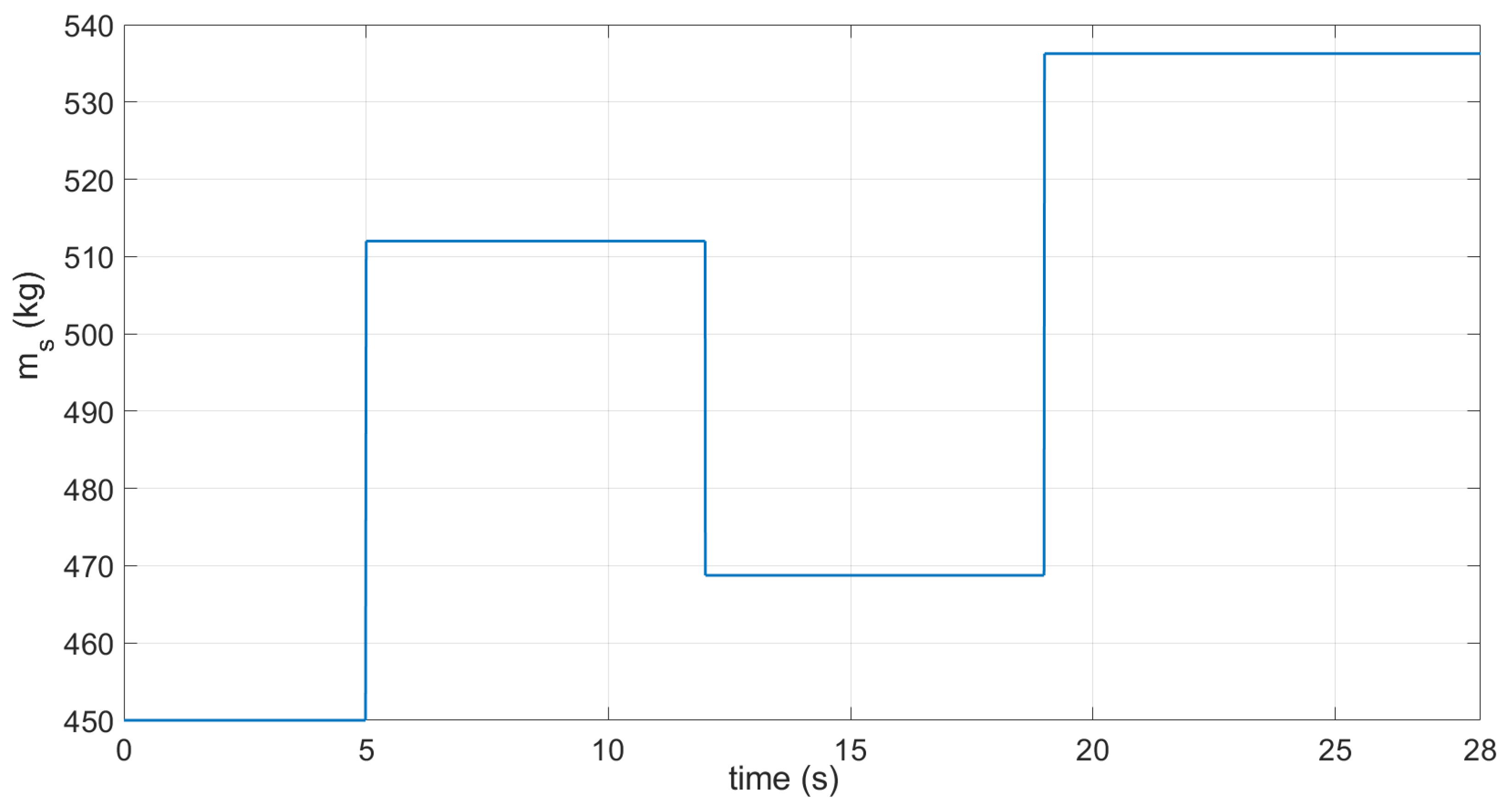
The contribution of this research is the proposal of a novel hybrid controller reinforced with AI. The introduced AI-powered approach is capable of adapting the controller’s gain in real time when the road profile and sprung mass vary as might occur under certain conditions in the real world. AI is applied through RL, where an agent interacts with a changing environment and makes decisions to modify a weighting factor (), and from these choices, it receives rewards or penalties towards the optimization of a parameter. In addition, the proposed approach focuses on an optimization model based on the equations that govern the QoV suspension system. Moreover, the developed solution is validated through time domain tests in MATLAB-Simulink for a QoV active suspension in different scenarios where the sprung mass and road profile vary in real time. Furthermore, the AI-powered controller is coded in MATLAB and optimizes the parameter within predefined boundaries in the hybrid controller. This research work tests the proposed control approach in everyday situations where the road profile is not even, and people enter or exit a vehicle. This condition changes the relationship between sprung and unsprung masses, thus negatively affecting the suspension performance. The proposed AI reinforcement detects, in real time, changes in model mass and adjusts the control action to maintain suspension performance.
The following sections of this manuscript detail the methodology and results of the performed research.
Section 2 presents the modeling of the QoV suspension and the development of the hybrid control strategy.
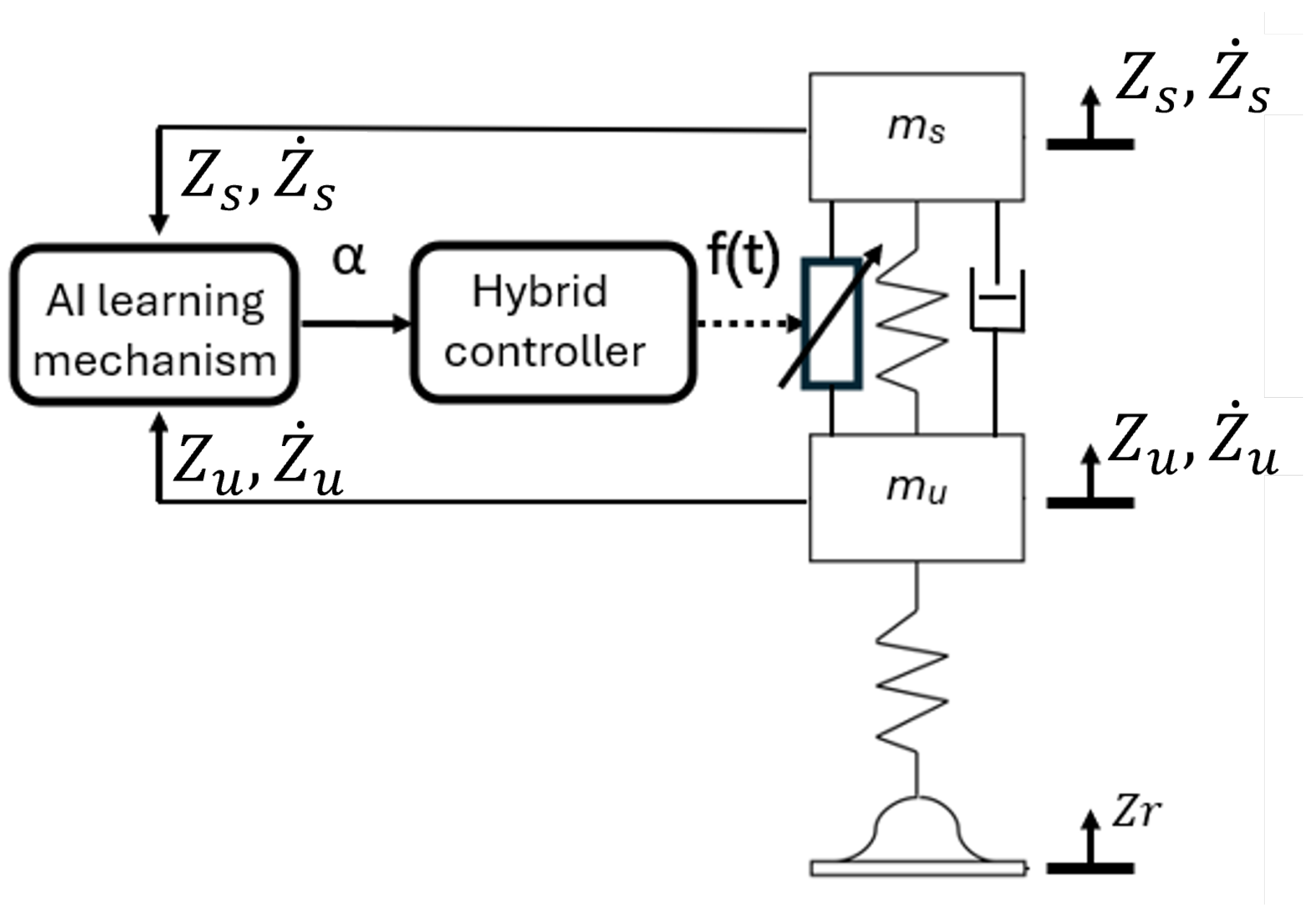
Section 3 describes the proposed approach to add the AI mechanism to strengthen the hybrid controller. In
Section 4, the simulation results are shown.
Section 5 formulates a comprehensive discussion of the outcomes. Finally,
Section 6 concludes the manuscript and suggests paths for future research.
2. Modeling and Hybrid Control
This section focuses on establishing the base elements that are necessary to understand the suspension system and implement the proposed control strategy. The study employs the two-degree-of-freedom (2-DOF) QoV suspension, a very well-known representation to investigate the vertical dynamics of the sprung and unsprung masses in a QoV vehicle suspension towards understanding passenger comfort and vehicle stability. In this way, the well-known hybrid controller, which combines the advantages of both the skyhook and groundhook control methods, is used as the development framework for applying AI. This hybrid approach uses an factor to balance the contributions of each part with the aim of achieving ride comfort and vehicle stability.
2.1. QoV Suspension System
In this subsection, a mathematical model of an active QoV suspension is developed, which is a fundamental representation to analyze vehicle suspension dynamics. This representation captures the essential vertical dynamics between the sprung mass (the vehicle body) and the unsprung mass (the wheel and axle), connected through the suspension’s spring and damper elements. The sprung mass represents one-quarter of the chassis, including one seat and one person as well, and its dynamic is related to passenger comfort. In addition, describes the unsprung mass, which mainly includes a wheel and its tire, and whose dynamics are associated with the stability of the vehicle.
The following definitions are needed to understand the 2-DOF QoV suspension:
Suspension spring stiffness ;
Suspension damping coefficient ;
Tire stiffness ;
Sprung mass ;
Unsprung mass ;
Vertical displacement of the sprung mass ;
Vertical displacement of the unsprung mass ;
Vertical displacement of the road surface ;
Force provided by a controllable actuator located between and .
These definitions are included in the equations of the vertical dynamics of the QoV, as shown below:
Equations (
1) and (
2) can also be represented in matrix form by defining the following matrices:
Taking into account Equations (
1) and (
2), as well as matrices in Equation (
3), the state-space representation of the system is generated as follows:
In Equation (
4), note that the QoV has two inputs. The ground profile
directly affects the dynamics of the unsprung mass. Furthermore, the force
, generated by the suspension, is defined in Equations (
1) and (
2), and is represented as
in the state-space model of Equation (
4).
2.2. Hybrid Control Strategy
The hybrid control Strategy combines the advantages of the skyhook control and groundhook control systems to achieve a balance between ride comfort and stability performance. Skyhook control focuses on reducing the relative motion of the sprung mass to improve ride comfort by simulating a damper connected to a fixed inertial frame (“sky”). On the other hand, groundhook control minimizes the relative motion of the unsprung mass, improving road contact and stability. The skyhook and groundhook control laws are described in Equation (
5) and Equation (
6), respectively.
In Equations (
5) and (
6),
is the relative velocity of the sprung mass
compared to the unsprung mass
. This variable is calculated as stated in Equation (
7).
In applications with real vehicles or instrumented test benches, accelerometers are placed directly on the parts of interest to measure accelerations of both masses. From these vertical measurements, velocities are obtained by numerical integration. This approach has been applied in automotive dynamics using Inertial Mass Units (IMUs) containing Micro-Electro-Mechanical Systems (MEMS). These measurements can be complemented with suspension deflection sensors, such as Linear Variable Differential Transformers (LVDTs), to measure small displacements accurately. Both approaches were used in the experiments described in [
20,
21].
The other parameters in Equations (
5) and (
6) are the constants
(skyhook control law) and
(groundhook control law). Each of these constants could be defined empirically or through some calculations regarding the relationship between masses and stiffness constants. If the approach is empirical, reference values are available according to the type of mass–spring system that is being analyzed. However, to find the more appropriate values for a specific case study, the following equations must be considered:
In Equations (
8) and (
9),
and
are critical values related to transmissibility for the sprung and unsprung masses, respectively. They are the base values for the skyhook and groundhook constants. Furthermore,
and
are multiplied by some tuning factors
and
as in Equations (
10) and (
11)
In Equations (
10) and (
11),
and
are the constants applied in Equations (
5) and (
6), respectively. Moreover, by combining the skyhook and groundhook approaches to obtain the hybrid control law, the following equation is obtained to calculate the total force delivered to the suspension system by a hybrid control strategy:
As shown in Equation (
12), in its formulation, the hybrid control strategy includes an
factor to dynamically adjust between these two strategies and prioritize one or another specific strategy, skyhook or groundhook [
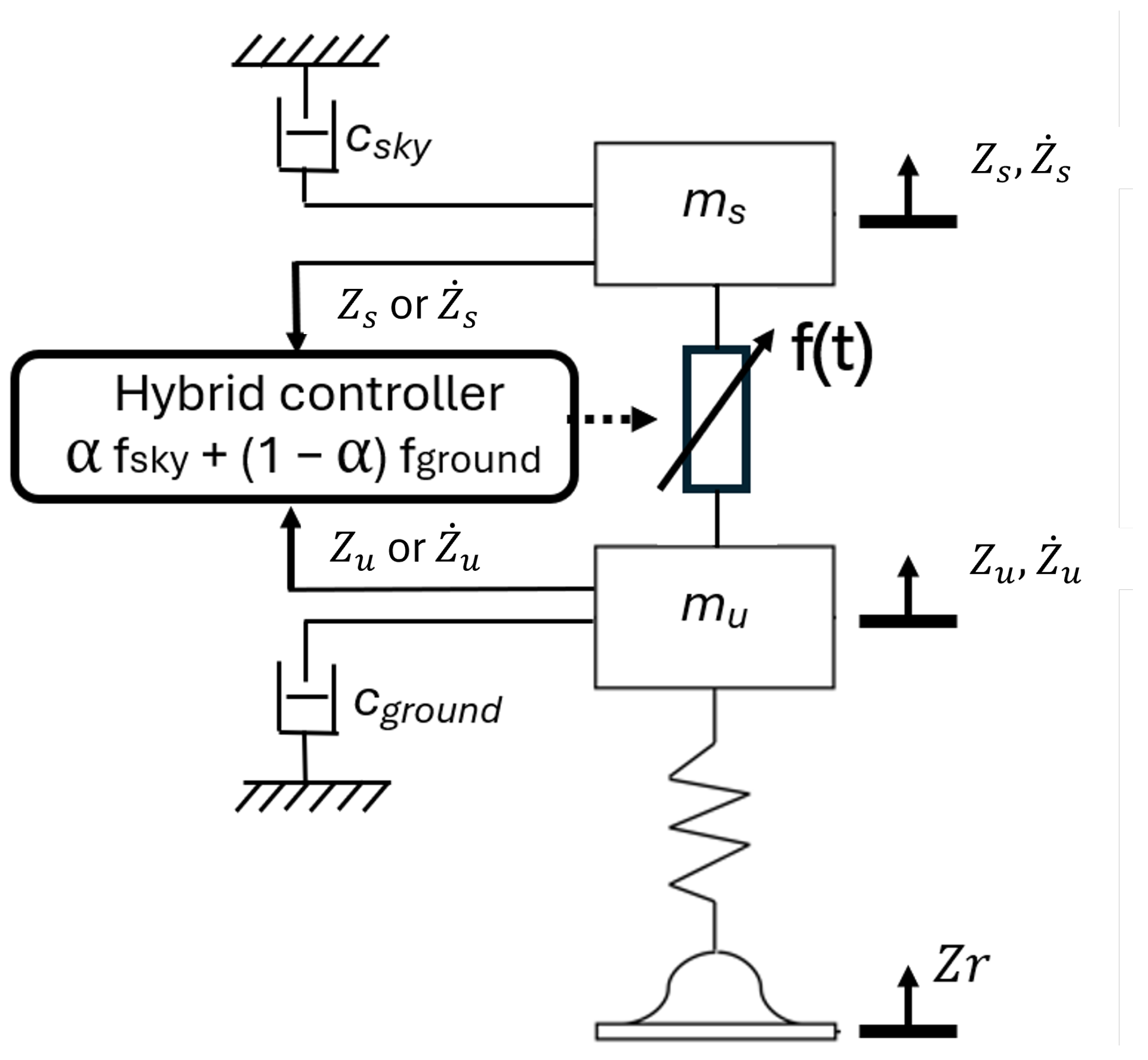
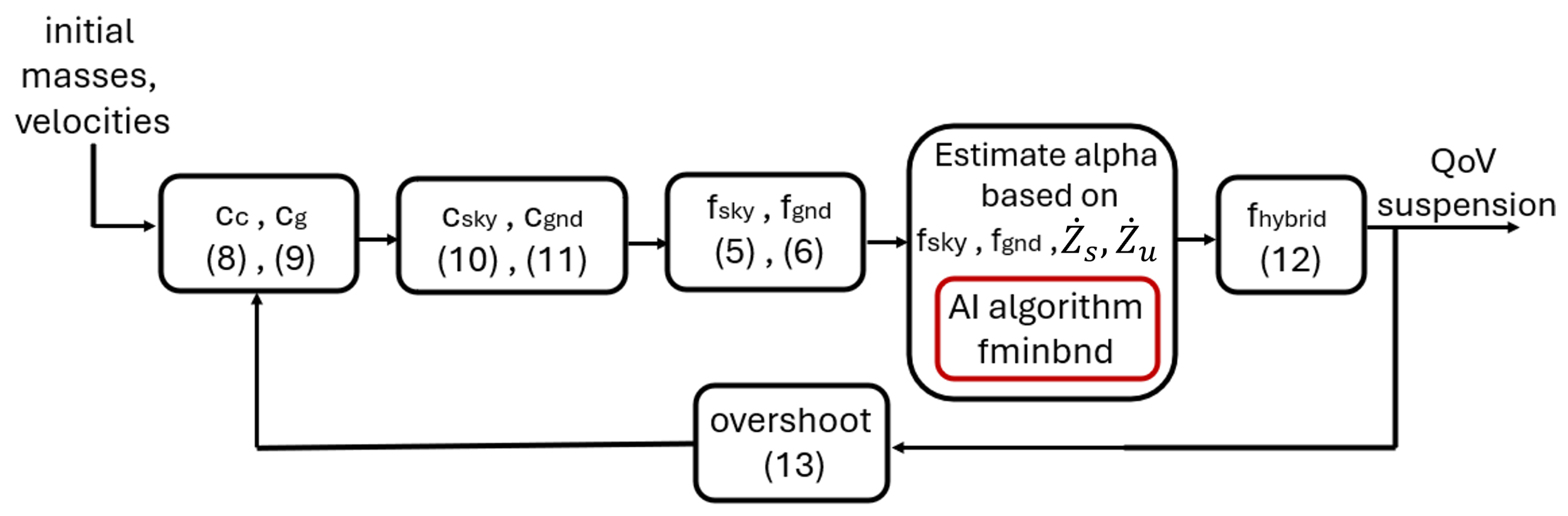
9]. This action is done with a control rule depending on one or more performance criteria pertinent to the time domain or frequency domain. A generic representation of a hybrid controller applied to a QoV is illustrated in
Figure 1.
It is important to note that the tuning parameters
and
were obtained starting from the critical damping values defined in Equations (
8) and (
9). These parameters were then refined through simulation-based tuning, following a trial-and-error approach, to achieve an acceptable trade-off between passenger comfort (
displacement and
acceleration) and vehicle stability (
displacement and suspension deflection). This procedure is consistent with methodologies reported in previous studies on hybrid suspension controllers [
1,
9,
10].
In Equation (
12),
, so that the resulting control action is more beneficial to passenger comfort or vehicle stability. That is, by combining both methods, the hybrid strategy could provide an optimal trade-off between the isolation of the cabin from vibrations and ensure the adhesion of the tire to the road, leading to improved overall suspension system performance. Furthermore, it is clear that the total force
delivered to the suspension is limited by the capabilities of the actuator and the suspension system.
There are variations in the control laws presented in Equations (
5), (
6), and (
12). These approaches that could be extracted from
Figure 1 are available in [
19,
27]. Our inquiry is based on the aforementioned equations and, although it is relevant to explore variations of these control laws, they were not considered to limit the scope of this investigation.
2.3. Performance Criteria
Although there are no specific time-domain indices for suspension performance in a QoV, the goal is to minimize all displacements and the acceleration of the sprung mass as much as possible. The objective is to reduce the amplitudes of the oscillations and the settling time for chassis displacement , tire displacement , chassis acceleration , and suspension deflection as much as possible with respect to a passive suspension. Thus, when a vehicle hits a pothole, a speed bump, or generally travels on very uneven pavement, it is undesirable for passengers to experience large vertical displacements or prolonged oscillations that would be detrimental to comfort.
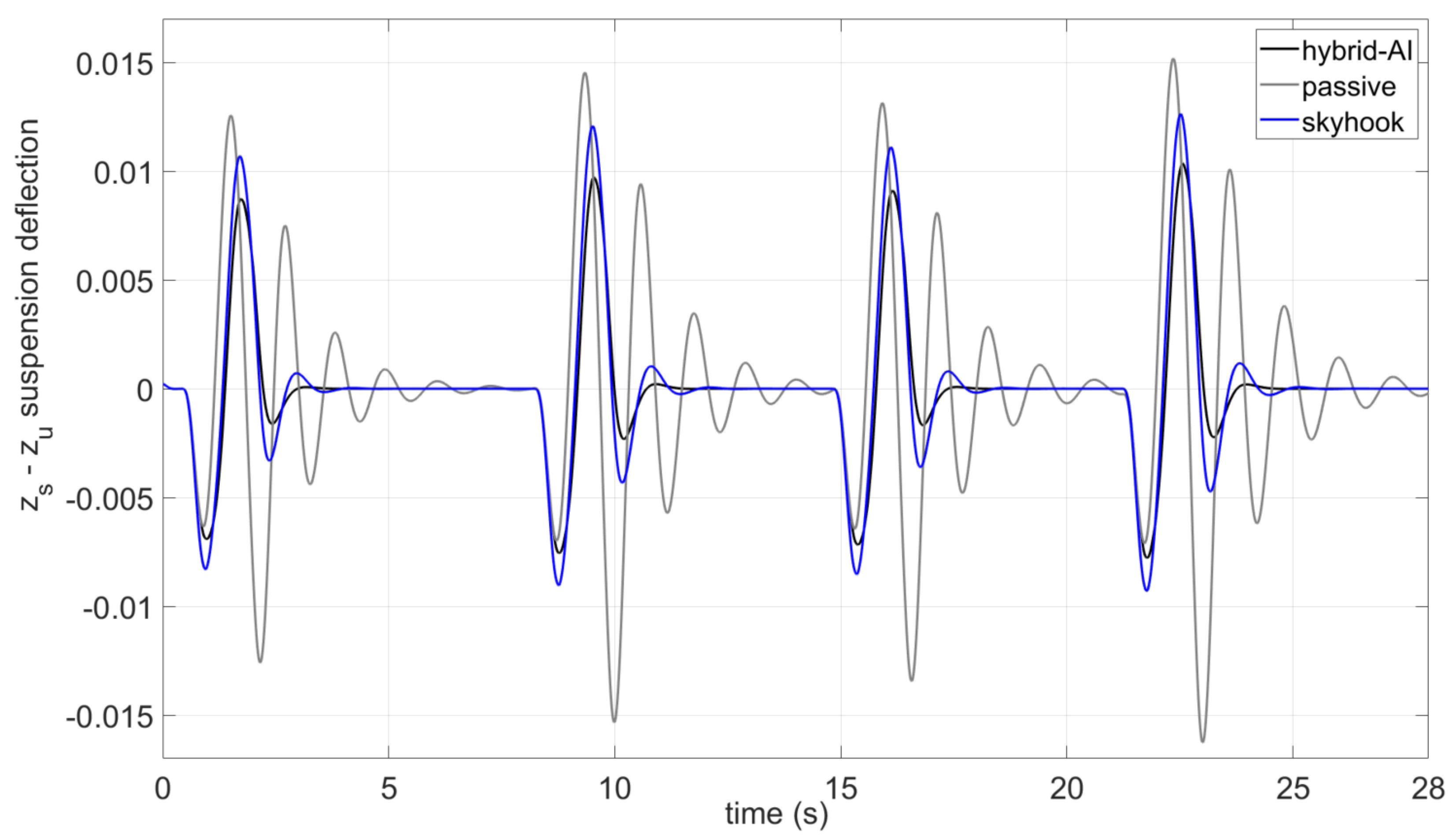
Two specific criteria for which numerical limits could be used are suspension deflection (
) and vertical acceleration of the sprung mass (
). Suspension deflection must be within physical limits to avoid premature deterioration of the mechanical elements and discomfort for passengers because the impact of the mechanical stop generates an unpleasant sensation for the vehicle’s occupants. For a compact city vehicle, if (
) is within ±
, it is considered that no physical limit is reached [
28]. In addition, a performance criterion can be established for the acceleration experienced by passengers. Ref. [
29] performed an analysis of passenger comfort that included acceleration. They used a QoV testing platform with several participants; one at a time, different road profile signals were applied to the QoV and instantaneous accelerations were measured. The results showed that the values
m/s
2 were perceived as “good” by the participants. Accelerations
m/s
2 were considered “tolerable/moderate” sensations, whereas values
m/s
2 were perceived as “bad” [
29]. Therefore,
m/s
2 could be considered a fair upper limit to maintain a feeling of comfort for passengers.
A very commonly applied road disturbance
in the time domain is a road-bump-like signal. In our case,
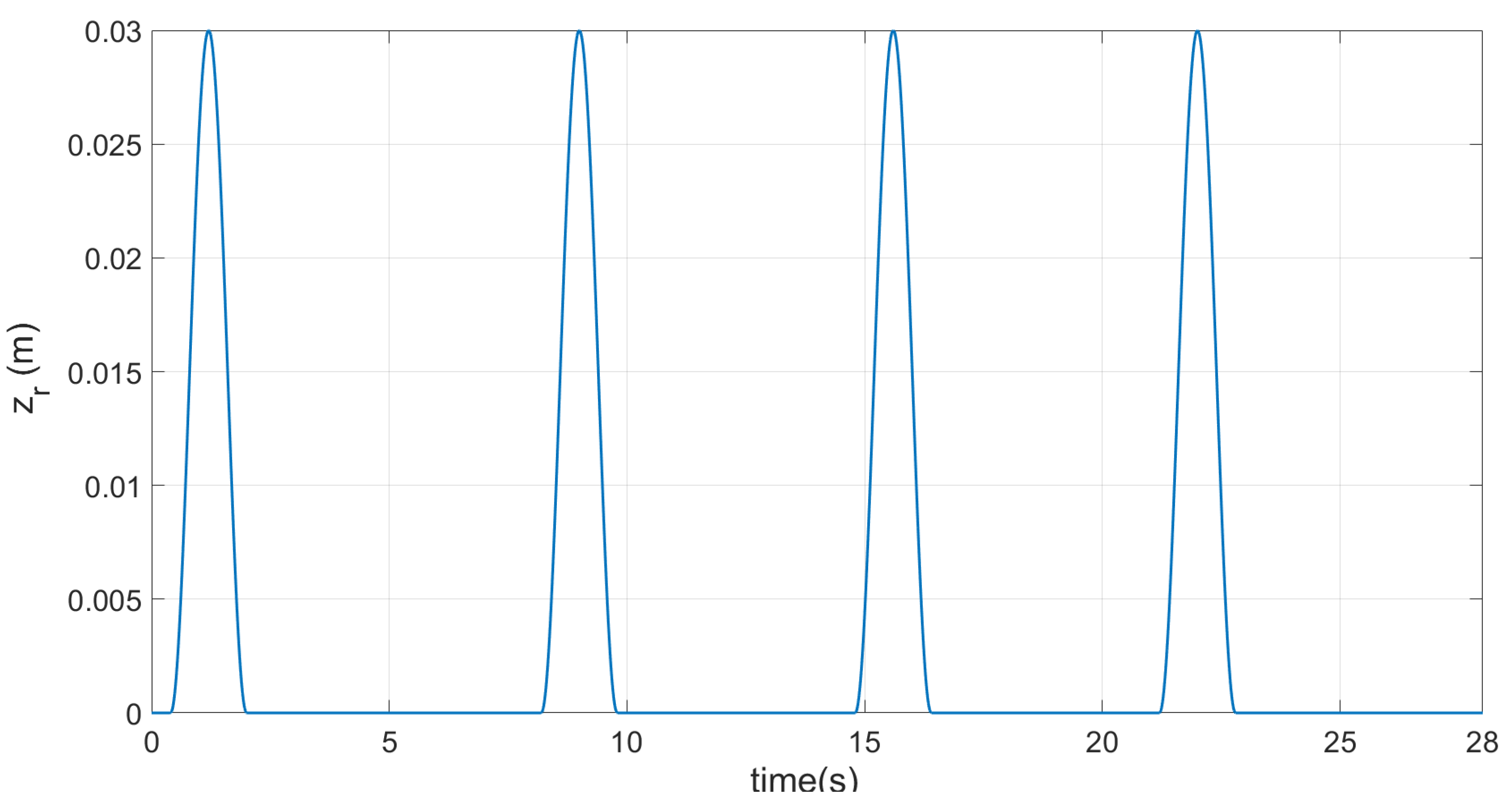
represented a displacement of 3 cm height, following a road-bump-like signal that enters the QoV system, from the bottom part, at a slow longitudinal speed, as would occur in a real case where a car goes over a speed bump [
28]. Within the time-domain analysis, this work focused on reducing the maximum overshoot and undershoot and settling time of
,
, and
to improve passenger comfort with respect to a passive suspension and an active one (skyhook controller). In addition, stability was studied through road holding, seeking the smallest possible vertical displacement of the unsprung mass
, assuming that it remains in contact with
(represented by a road bump profile) [
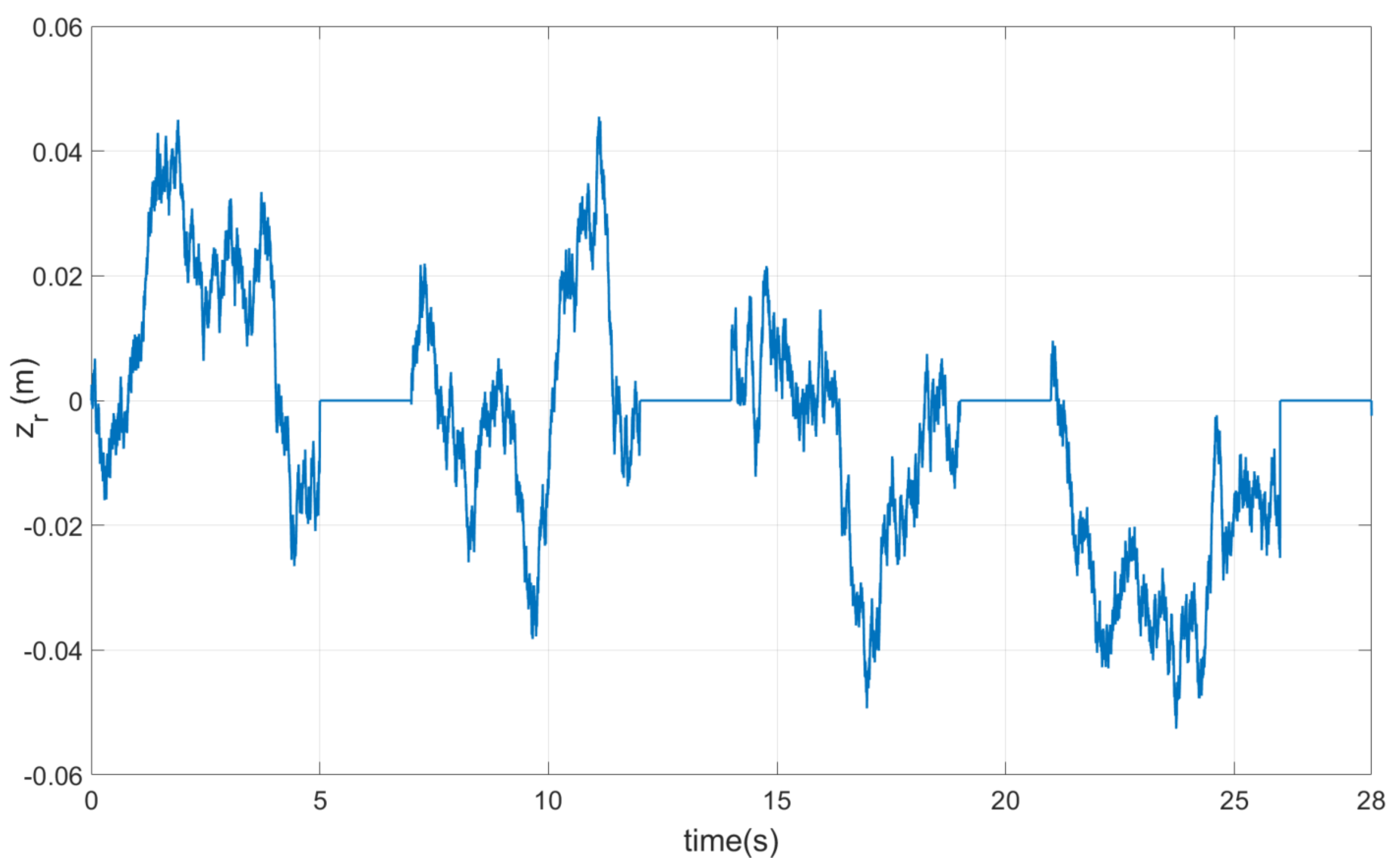
30]. To extend the validity of the study, tests were also performed with an ISO 8608 C-type profile signal, which represents a paved road with medium to high roughness and still in acceptable condition, like many suburban and secondary roads [
31]. More information on this type of
is included in
Section 4.1.2.
After understanding the vertical dynamics of a QoV, its inputs and outputs of interest, and the hybrid control scheme, the next step was to develop the AI-enhanced hybrid control proposal to improve performance criteria in the time domain.
5. Discussions
The first point to discuss is the response to road bump profile.
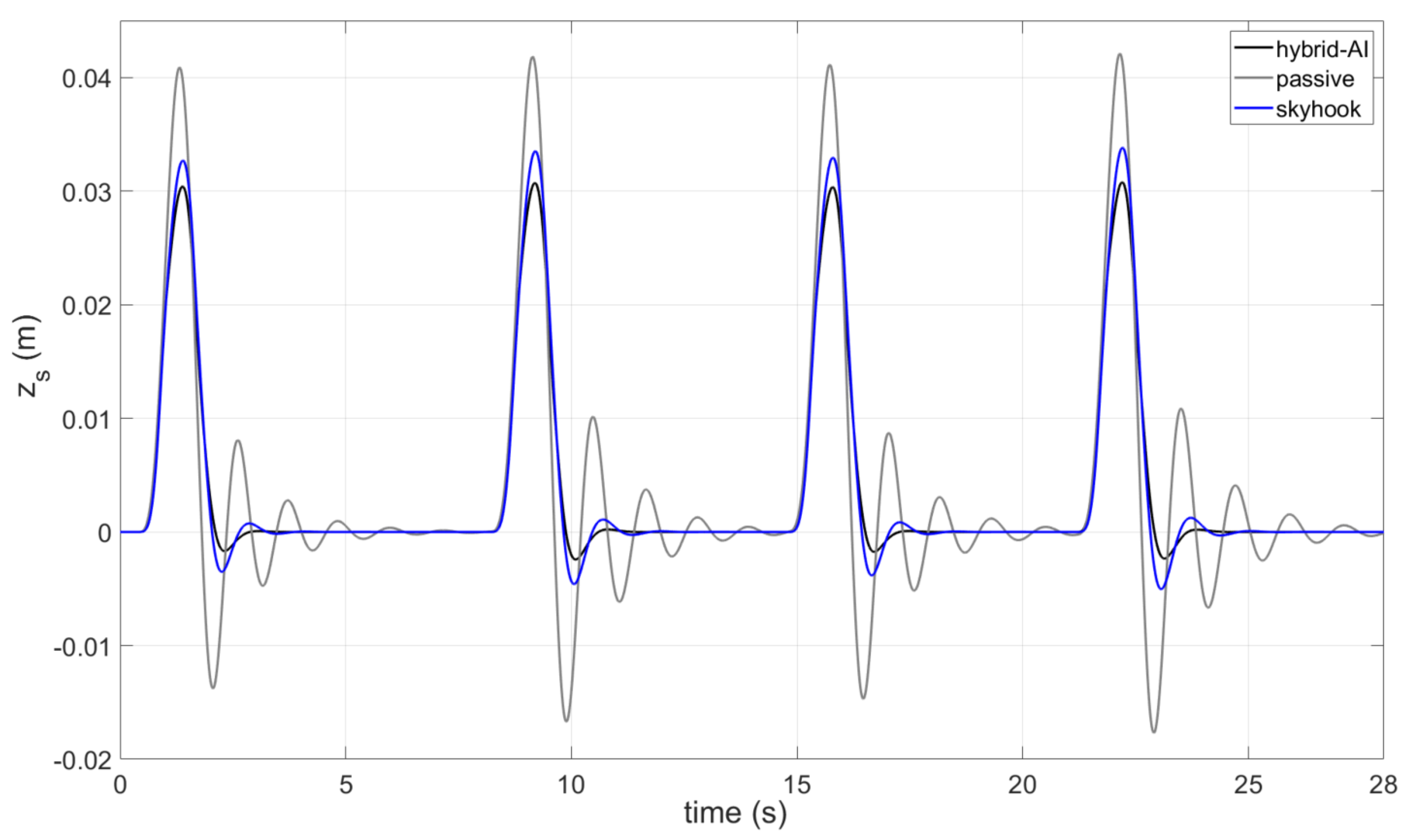
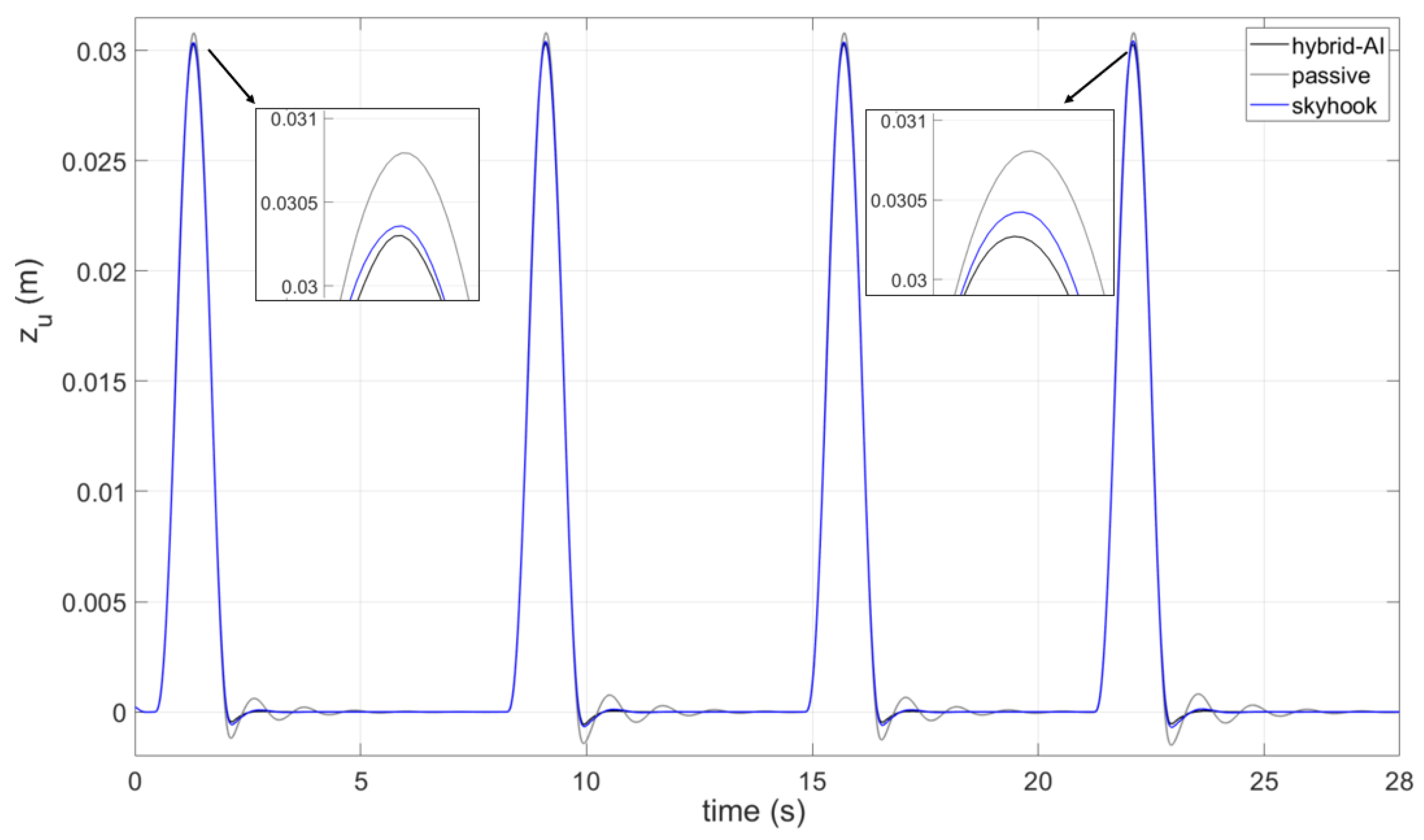
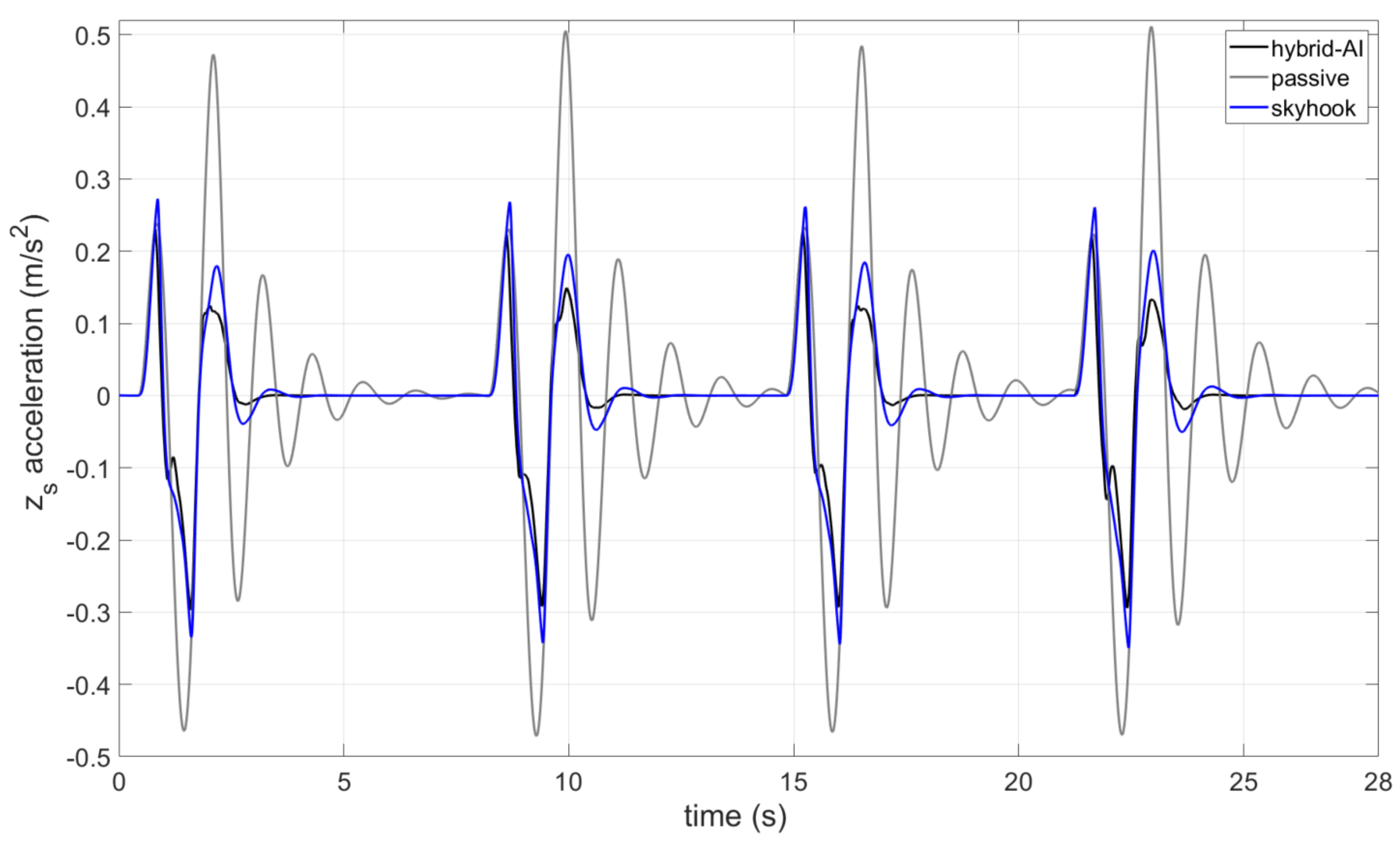
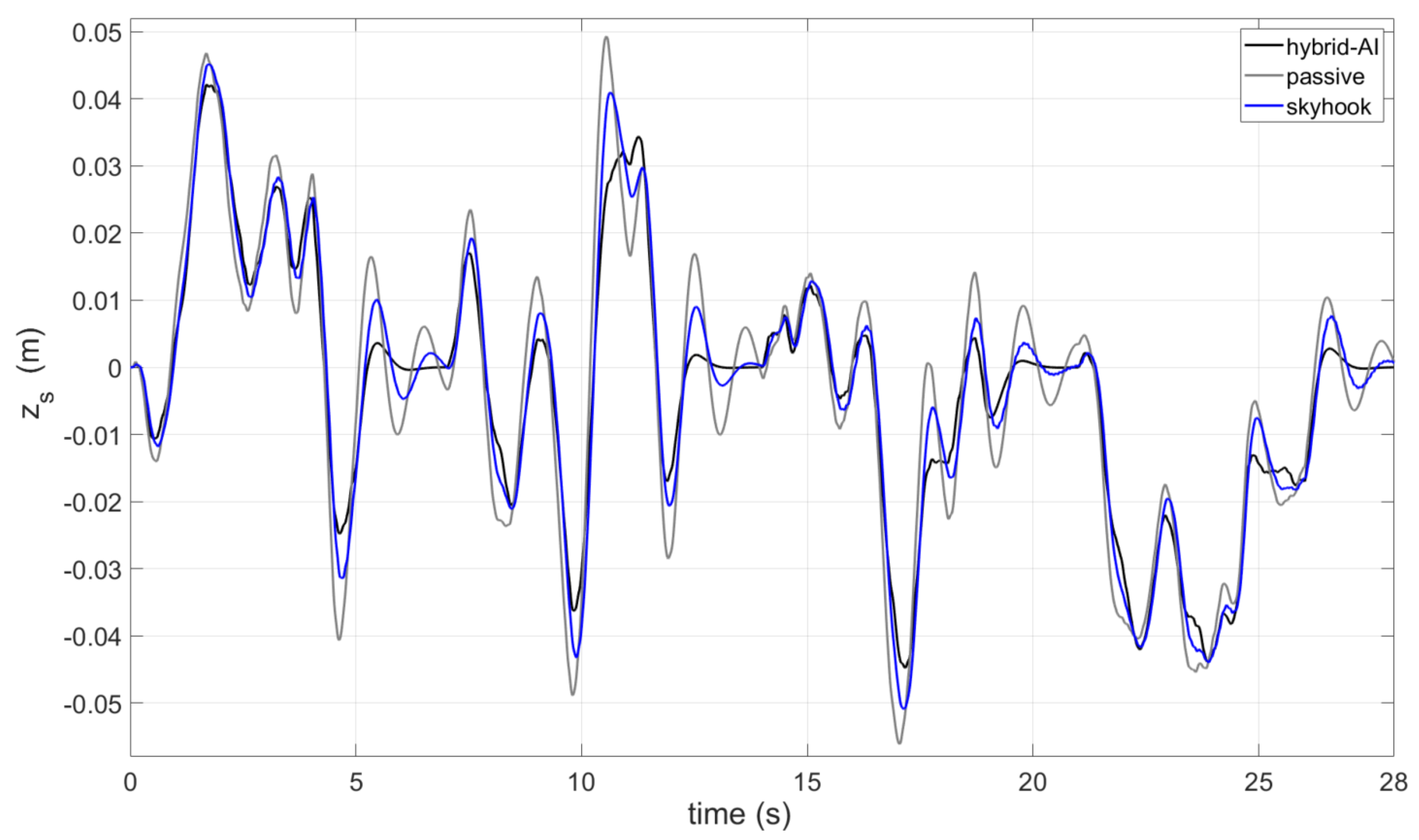
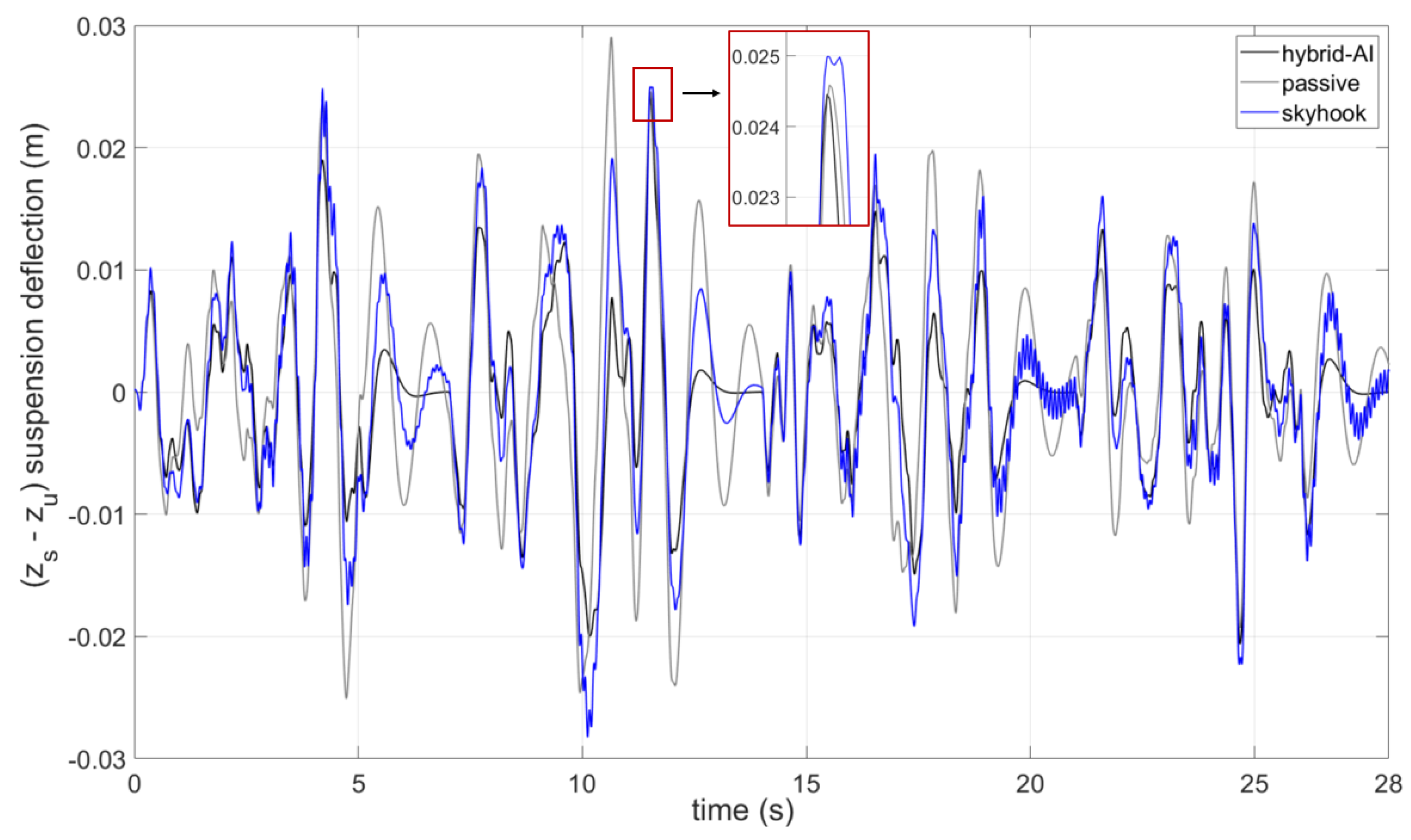
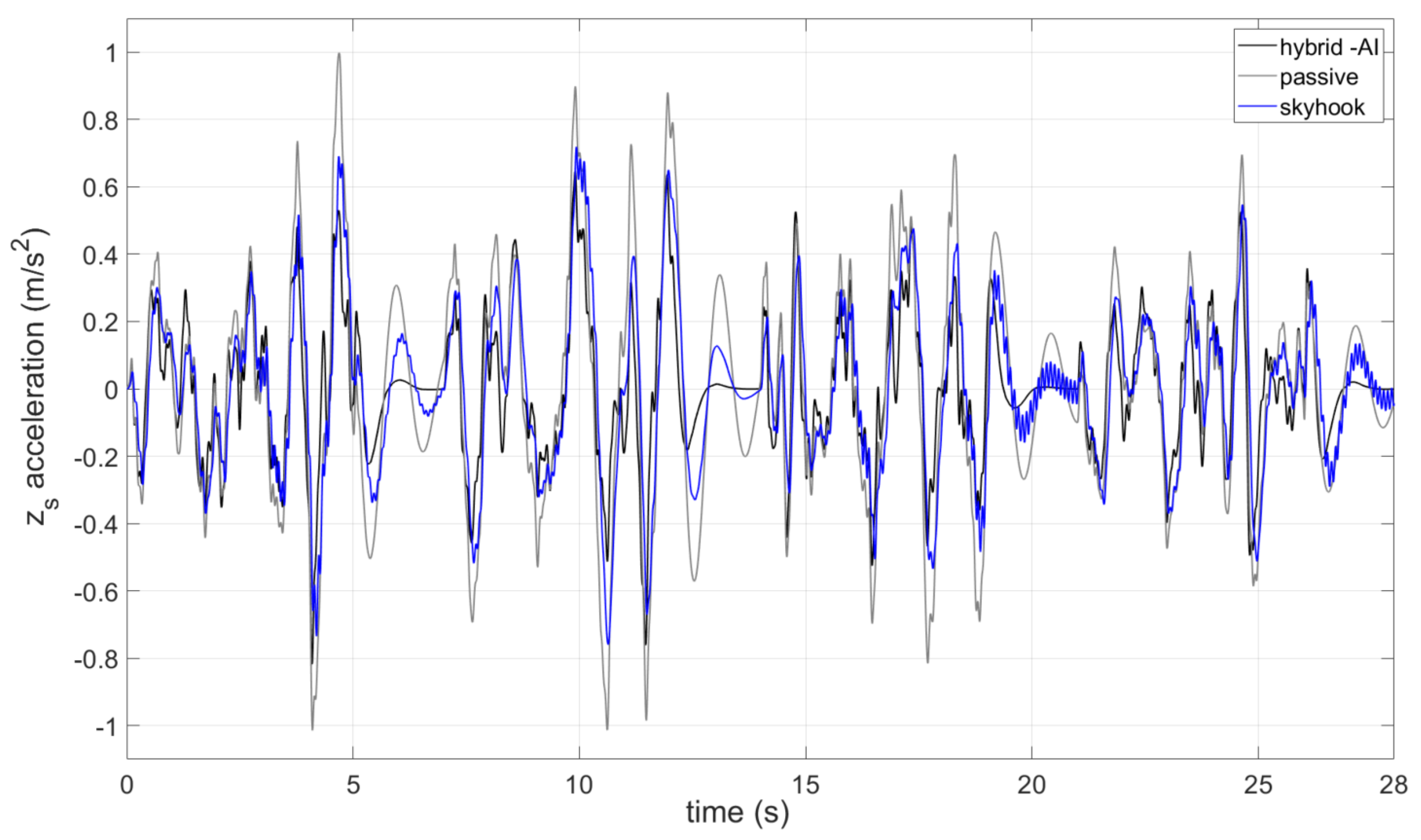
Figure 8,
Figure 10 and
Figure 11 show that the overshoot, undershoot, and settling time of passive suspension are significantly reduced by active suspensions when measuring
,
, and
. For the same parameters, the AI-based hybrid system slightly improves the performance of the skyhook suspension. It should be noted that in all three cases,
never exceeds the physical limits of ±2.5 cm, which corresponds to the mechanical stop of the suspension. Furthermore, although
is considerably larger in the passive case, it remains below the threshold of 0.89 m/s
2 to maintain passenger comfort. Regarding
, sprung mass (
) follows the road profile, and the only easily noticeable improvement is the reduction in oscillations following the overshoot, as shown in
Figure 9. The passive suspension has a longer settling time than its active counterparts, as also shown in
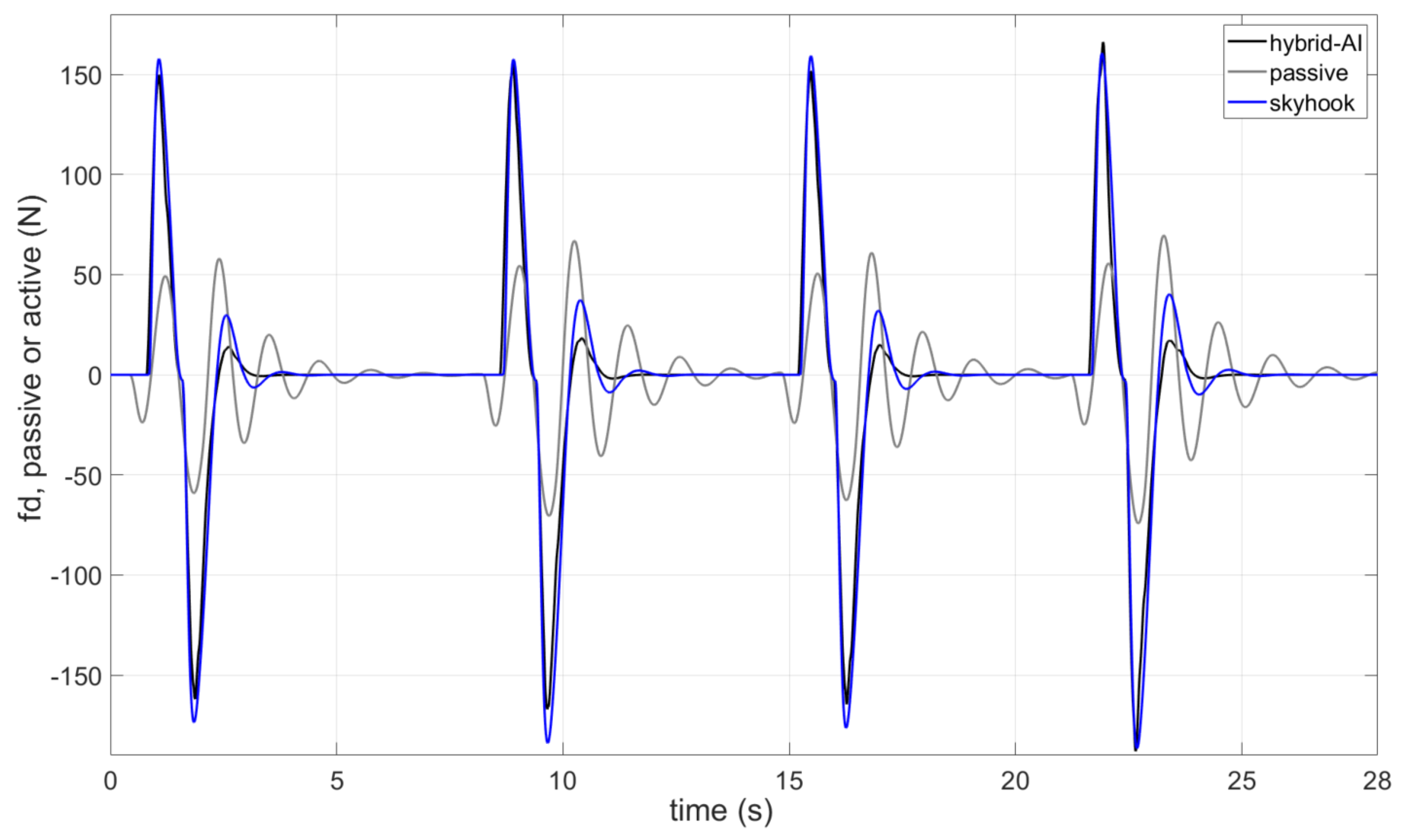
Figure 9. In the same figure, the two boxes highlight the maximum displacements for the three suspension systems. Upon zooming in, a slight reduction in overshoot is observed for both active suspensions compared to the passive one. By including the force graph in
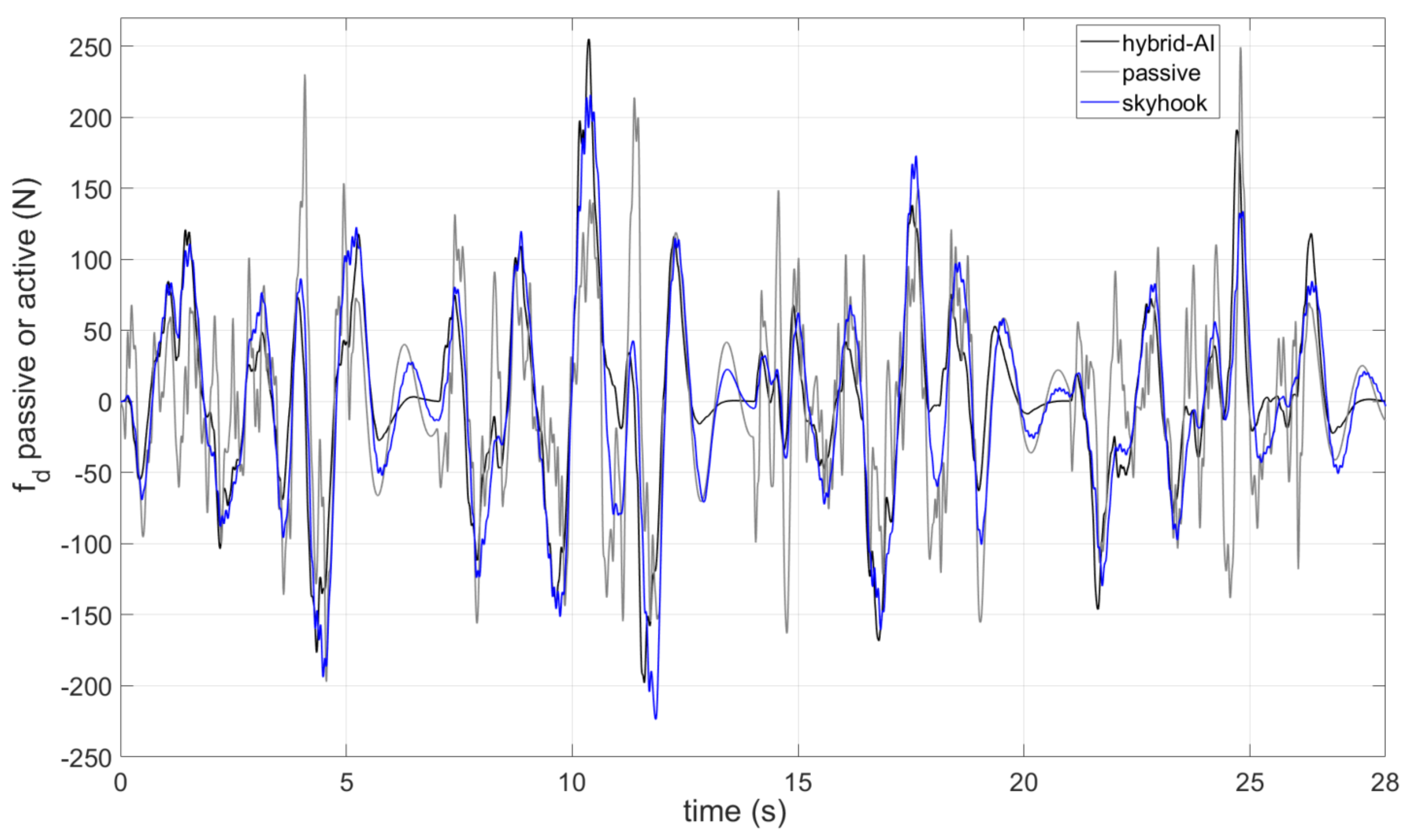
Figure 16, when the road bump
enters the system, the active suspensions exert more force than the passive suspension, helping to reduce
,
, and
.
The other scenario corresponds to the variables of interest when
is an ISO C-type road profile. In
Figure 12 and
Figure 15, for
and
, it can be observed that the passive suspension exhibits the largest oscillation amplitudes and settling time throughout the entire simulation. For
, in
Figure 14, during most oscillations, the passive suspension shows the highest overshoots. Furthermore, in at least one case, around 11 s, the suspension deflection in the passive system exceeds the physical limit of ±2.5 cm, reaching the mechanical stop, which causes passenger discomfort and premature wear to the suspension components. Similarly, at approximately 10 s, the skyhook suspension also exceeds that limit in the downward direction, while the AI-based hybrid suspension always remains below the physical limits, as shown in
Figure 14. In
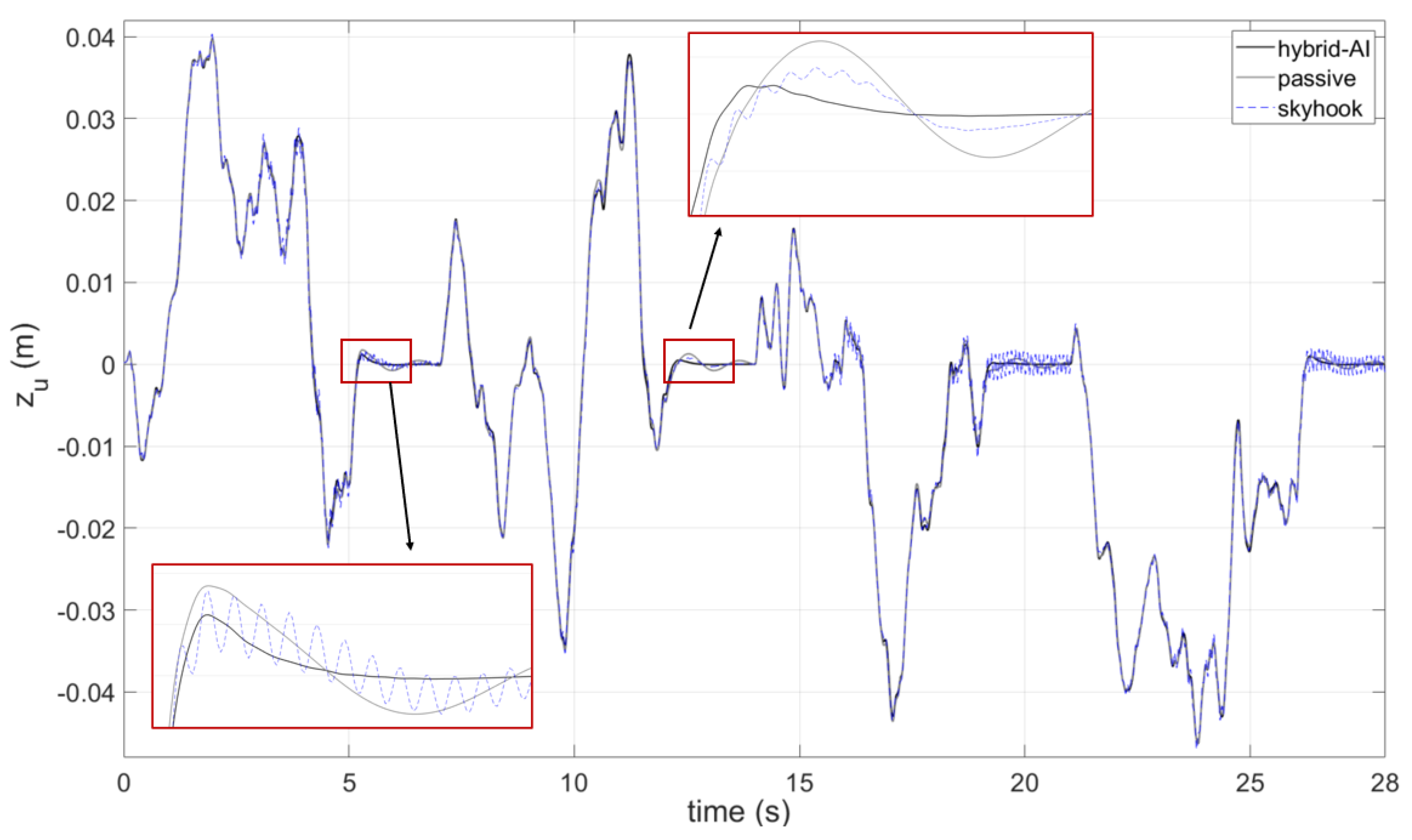
Figure 13, the unsprung mass
follows the road profile in all three cases. However, focusing on the red rectangles, it can be observed that the AI-based hybrid system performs slightly better than the other two suspensions. It could be considered that all three systems have almost the same performance for
; therefore, they all maintain tire contact with the road surface to maintain traction and braking performance. Another case where active suspensions outperform the passive one is in
. In
Figure 15, at four points in the simulation, the passive suspension exhibits instantaneous accelerations that exceed the threshold of ±0.89 m/s
2, causing discomfort for passengers. For the rest of the simulation, the AI-based hybrid suspension has the lowest acceleration of the three approaches. To conclude this comparison section, the force graph in
Figure 15 shows the relationship between when and how much force is applied and the performance of each suspension system.
Considering all figures, the AI-controlled system displays the best adaptability to non-nominal conditions, such as unexpected disturbances or parameter shifts. The skyhook model, while effective in maintaining performance, is less capable of dynamically recalibrating to unanticipated changes. The AI algorithm, in contrast, leverages its learning mechanisms to anticipate and counteract disruptions effectively, ensuring a better performance.
5.1. The Key Parameter in the AI-Powered Hybrid Controller
As shown in Equation (
12), the
factor calculated in the AI-based hybrid controller determines whether the control action is more oriented towards a skyhook or a groundhook behavior. For example, in
Figure 12, where
is an ISO C-type road profile, a mass change occurs in 5 s. Iteratively, the AI-based hybrid controller modifies
, and in less than half a second, it gives more weight to skyhook behavior to decrease overshoot. As a result, the oscillation amplitude is less than that of its passive and pure skyhook counterparts. Visualizing how
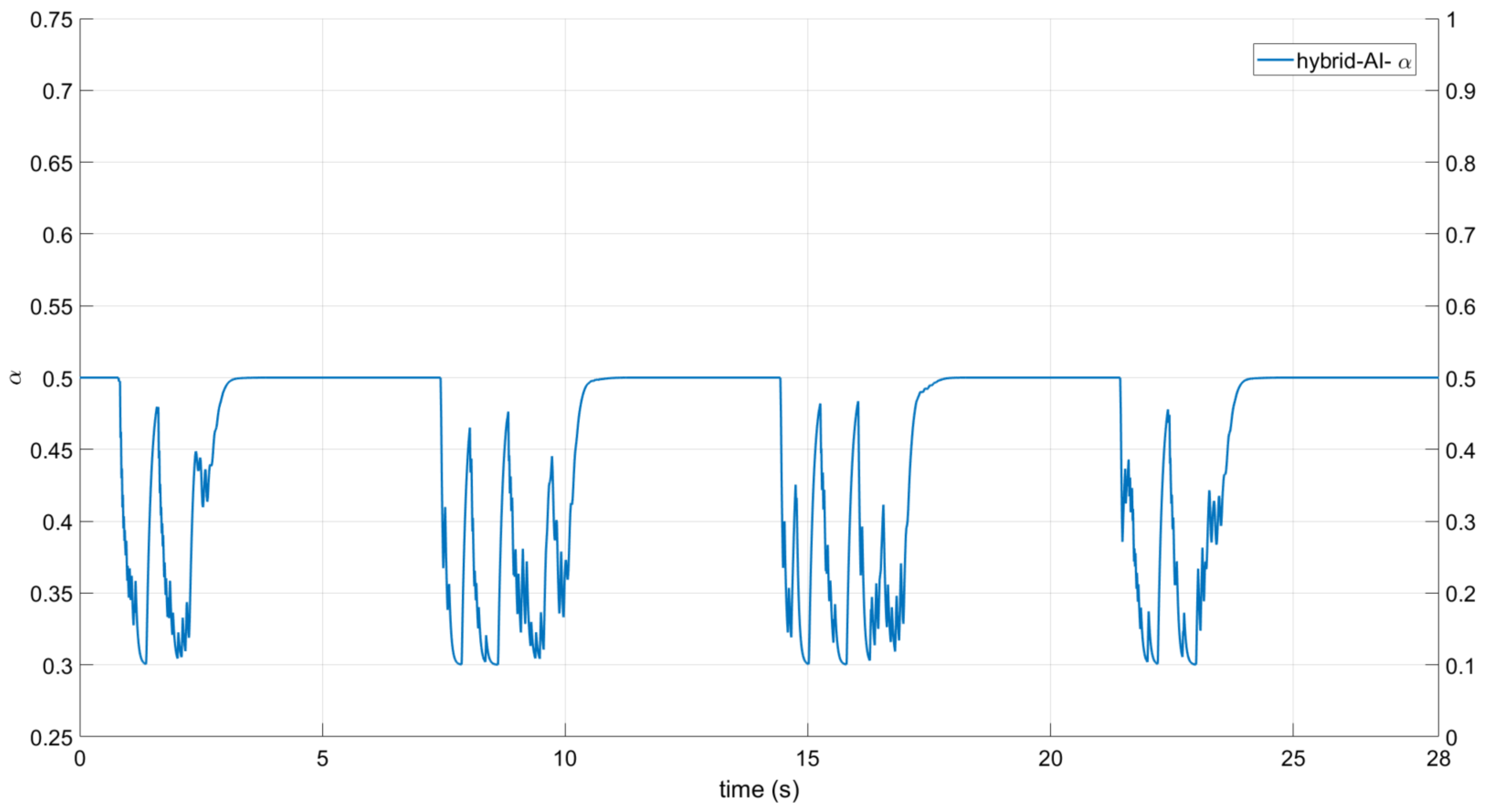
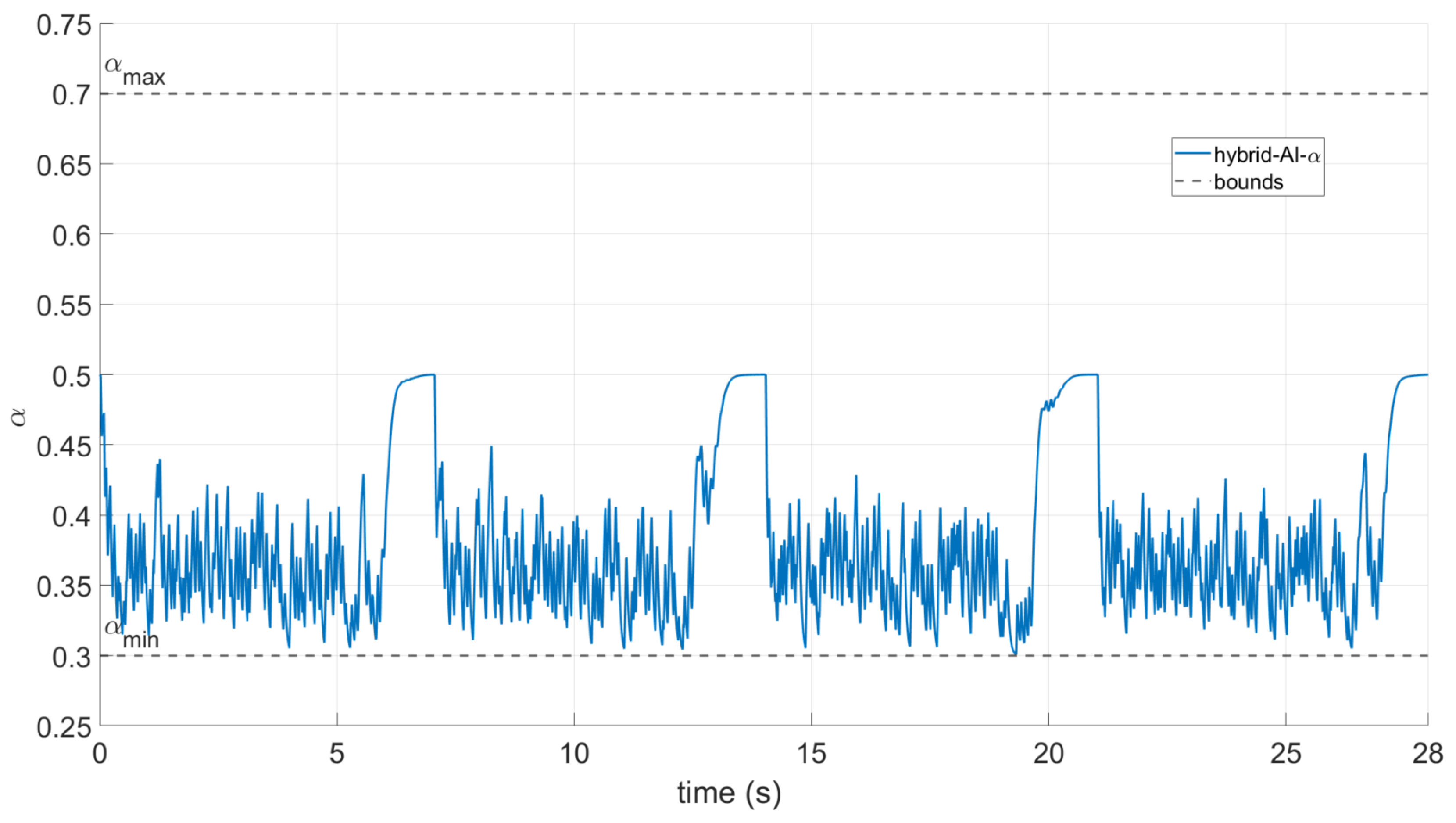
changes during simulation time helps to better understand the operation of the AI-based algorithm. For both test scenarios, the road bump and the ISO C-type profile, plots of
versus time were generated, as shown in
Figure 18 and
Figure 19.
In the case of road bumps, the evolution of the weighting factor
shows a more dynamic behavior compared to the ISO profile. The controller starts around 0.5 for the same reason (this midpoint initialization avoids bias between skyhook and groundhook at the beginning of the simulation) but as soon as the system detects large transient disturbances from bumps,
is driven closer to its lower bound (0.3). This reflects the algorithm’s decision to prioritize stability (groundhook contribution) over comfort during severe road excitations, as minimizing overshoot requires stronger tire–road contact. As shown in
Figure 18, once the transient effect of each bump dissipates,
returns to a steady value around 0.5, highlighting that the AI mechanism adapts by shifting toward stability during impacts and then re-balancing toward comfort during smoother intervals. The absence of values above 0.5 indicates that, under bump disturbances, the compromise found by the algorithm never demands a higher skyhook dominance.
The evolution of the weighting factor
under ISO road excitation starts around 0.5 because the reinforcement learning algorithm initializes
near the midpoint of the admissible range
to avoid biasing the controller towards skyhook or groundhook at the beginning of the simulation. Although the theoretical limits allow
to vary up to 0.7, the optimization process continuously minimizes the overshoot cost function and, in this case, finds that values close to 0.5 provide the best trade-off between comfort and stability, as shown in
Figure 19. As a result,
oscillates within the defined boundaries but never exceeds 0.5, reflecting that the AI mechanism settles around a stable equilibrium solution rather than exploiting the full parameter’s span. This behavior indicates that the AI controller prioritizes robustness and consistency over aggressive variation, especially under random ISO-type disturbances.
5.2. Broader Implications
The observed performance of the hybrid AI highlights the limitations of traditional passive systems and the pure skyhook approach when considering dynamic environments and modifications in , as in real scenarios. Although the passive approach is simple and cost-effective, and the skyhook model introduces a significant performance boost with its advanced control strategy, neither option matches the adaptability and performance of the AI-based hybrid suspension system. However, the skyhook model remains acceptable in scenarios where implementing AI may be impractical due to cost or complexity considerations.
It is important to extend the comparison between the proposed AI-powered hybrid and skyhook controllers. Considering only the control laws, the skyhook controller requires calculating a relative velocity (Equation (
7)) and processing a decision structure with two statements to calculate the force to be applied to the suspension by the controlled actuator (Equation (
5)). On the other hand, a hybrid controller requires one to compute the skyhook output and the groundhook contribution (Equation (
6)). In addition, it calculates the hybrid force as shown in Equation (
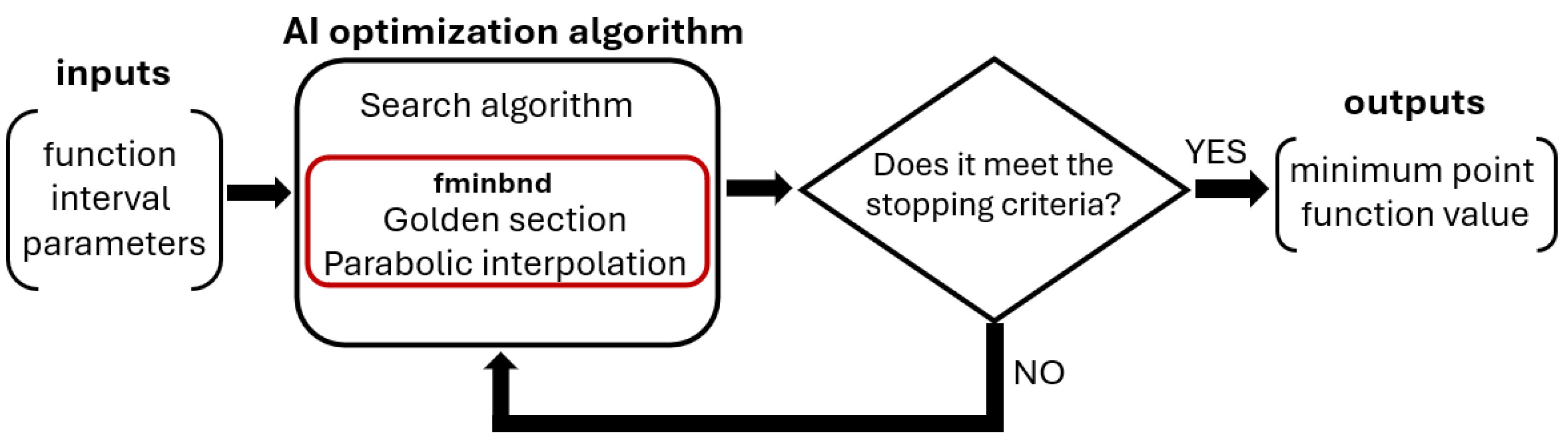
12). Furthermore, the AI-enhanced controller must perform the iterative process shown in
Figure 3. As a result, the complexity and resource requirements of the AI-based controller are significantly higher than those of the skyhook controller. Even if only the high-level programming language for implementing control algorithms is considered, RAM requirements are much greater in the AI-powered one, and simulation takes more time for similar hardware capabilities. As a result, qualitatively, the AI-based controller consumes more energy than its skyhook counterpart.
The results demonstrate that the artificial intelligence (AI)-controlled system achieves significant overall improvements over passive output. Additionally, compared to the pure skyhook model, the AI-controlled system further underscores its ability to adapt and optimize under diverse operating conditions. This condition leads to better results even over the well-established performance of the skyhook controller in critical metrics. These findings underscore the transformative potential of AI in dynamic systems, where adaptability and optimization are paramount. Furthermore, the proposed AI-driven methodology not only optimizes system performance but also establishes a framework for continuous learning and improvement. By analyzing real-time data, artificial intelligence identifies patterns and trends that enable precise adjustments in operations, quickly adapting to changes in the environment. Moreover, its ability to integrate multiple sources of information facilitates more informed decision-making, reduces errors, and enhances long-term efficiency. These features position artificial intelligence as a key tool for transforming dynamic processes into more resilient and adaptive systems [
37].
For an automatic suspension control system to be viable, constant monitoring of vehicle masses is required. To the best of our knowledge, commercial vehicles typically lack sensors that continuously measure sprung and unsprung masses, unlike laboratory-instrumented QoV systems. However, practical approaches exist for estimating axle loads and weights. These sensors measure the load applied to the vehicle axle and transmit this information to a vehicle system [
38]. Other sensors measure body position or height (sometimes using air spring pressure/height) in a system designed to control body leveling and maintain the correct ride height based on load or speed. This method allows one to infer a relative change in total load and estimating the sprung mass [
39]. In addition, the use case assumed that the unsprung mass was constant. Furthermore, toward the potential implementation of the AI-powered hybrid controller in commercial solutions, the key point is that the control algorithm has a fixed hybrid control law, a pragmatic approach that produces a quick decision. The controller relies on AI to calculate the dynamic weighting factor
. The AI algorithm adjusts
by estimating the suspended mass or perhaps the roughness level of the road, but it is not the control law; this reduces computational time.
6. Conclusions and Future Work
This research provided promising results and a comprehensive evaluation of the integration of artificial intelligence (AI) into hybrid vehicle suspension control systems. Using the dynamic adaptability of AI, the proposed AI-powered hybrid controller achieved notable improvements over traditional passive suspensions and even some active suspension systems. Specifically, the AI-controlled system exhibited better performance in most simulation scenarios. In these cases, reductions in peak amplitudes and settling time contributed to improving passenger comfort while maintaining road holding.
The study validated the practical implementation of AI in real-time control applications through simulation work. The use of reinforcement learning and optimization algorithms, such as the fminbnd function, to fine-tune parameters such as , demonstrated the system’s ability to adapt to varying operating conditions without manual intervention. This adaptability ensured that the suspension’s performance was maintained even when the suspended mass changed, as might happen when passengers enter or exit the vehicle.
The AI-enhanced suspension system may contribute to improved energy efficiency. By optimizing the suspension response to minimize unnecessary motion and energy dissipation, the system can reduce the overall energy consumption of the vehicle. This is particularly advantageous for electric and hybrid vehicles, where energy management is critical to extend autonomy and improve efficiency.
The positive demonstration of AI in suspension control also opens avenues for integrating predictive maintenance and diagnostics. Continuous monitoring and learning of AI capabilities could help in early detection of component wear or failure, enhance vehicle safety, and reduce maintenance costs. There are challenges to be achieved in real-time optimization and robustness against several scenarios that can be found. The inclusion of AI is possible and could be an improvement for the suspension control system in terms of passenger control and vehicle stability.
Real-time implementation remains a critical area of focus, where the practical application of the optimal AI-reinforced hybrid controller must address computational constraints. Ensuring efficient operation with limited processing power in on-board vehicle systems is essential to translate these findings into real-world applications. In addition, hardware-in-the-loop tests would help validate this control proposal and compare its performance against approaches such as LQR, MPC, and SMC, among others. A test bench could be used to test road profiles, as well as actuator saturation conditions, sensor noise, and uncertainty in the system modeling.
Another important avenue involves testing the system under a broader range of conditions to evaluate its robustness and adaptability. Conducting experiments on varied road profiles, vehicle speeds, and mass distributions will provide a more comprehensive understanding of the capabilities and limitations of the suspension system. Additionally, integrating advanced AI algorithms, such as deep reinforcement learning or neuro-fuzzy systems, could significantly enhance the controller’s ability to navigate complex, nonlinear dynamics, pushing the boundaries of performance. Furthermore, a sensitivity analysis to study parameter uncertainties would bring the study even closer to real-world situations by assessing robustness due to parameter variations. Moreover, considering the dynamics of the controllable actuator makes the research work better represent the physical phenomenon studied, and this is another element to consider in the coming phases of this research.
Another next step in this investigation would be an analysis in the frequency domain. The frequency response results could expand the understanding of the suspension system and improve the control system’s performance for comfort and stability. This effort would require considering more performance indices, coding the algorithms for frequency response diagrams, and significantly expanding the analysis of results.
Expanding the scope of the AI-based hybrid controller to half-of-vehicle and full-vehicle models will enable holistic assessments of its impact in real-world driving scenarios. From an AI perspective, extending the research to half-of-vehicle and full-vehicle studies and implementing more comprehensive AI or deep learning algorithms will require more advanced reinforcement learning techniques that consider dynamic policy learning under uncertainties. Furthermore, to achieve better results, it will be important to consider using a wider variety of response metrics in different time and frequency domains, such as RMS acceleration, suspension deflection, and tire deflection, among others. Furthermore, the exploration of hardware solutions, such as edge computing devices, will play a crucial role in addressing the computational demands of sophisticated AI algorithms, paving the way for seamless implementation in modern vehicles.




 ,
,