1. Introduction and Literature Review
Smart textiles, also known as electronic textiles, e-textiles or intelligent textiles, are changing people’s traditional impression of textiles. Smart textiles can respond to environmental changes, monitor human biosignals, and perform human–machine interaction [
1]. Conductive textile structures are generally considered to be the most fundamental part of smart textiles. In contrast to traditional electronic components, conductive textiles are required to maintain their electrical properties while maintaining comfort, flexibility, and resistance to deformation [
2,
3,
4]. An ideal way to construct a conductive textile structure is by using machine sewing. Machine sewing is compatible with both textile fabrics and electronic components. At the same time, machine sewing provides great space and freedom for circuit design [
5].
Sewability is a critical performance metric that encapsulates the complex, aggregate properties of a yarn [
3]. A thread with good sewability is characterized by rigorous longitudinal uniformity in diameter and a high-quality surface finish [
6]. This dimensional consistency is essential for maintaining uniform tensile strength and minimizing kinetic friction as the thread navigates the high-speed stitch forming mechanisms. Consequently, superior thread quality significantly mitigates the risk of breakage, thereby reducing the operational costs and inefficiencies associated with machine re-threading, stitch repair, and the production of sub-standard goods [
7].
Typical sewing problems found in the literature [
8,
9,
10] using traditional sewing threads could be summarized for yarn-related issues as follows: (1) bird-nesting, (2) skipped stitch, (3) stitch breakage, (4) loose threads, (5) seam pucker, and (6) uneven stitches. Bird-nesting takes place when the needle thread is not fully pulled up after forming a loop around the bobbin. It leaves excessive needle thread appearing unnecessarily on the bobbin-side stitches forming a nest or knots. Bird-nesting seems to be the most frequent issue found with conductive threads [
11,
12]. Loose threads are different from bird-nesting in that loose thread loops are created on the surface, needle threads are created on needle-side stitches, and bobbin threads are created on bobbin-side stitches. Loose threads and seam puckering might be introduced mainly by improper thread tension maintenance, while other factors could be involved as well. Irregular yarn properties could trigger stitch breakage and uneven stitch problems.
Traditional yarns have been used in sewing machines for centuries. However, the assessment of the sewability of existing conductive yarns is still lacking. As opposed to traditional sewing yarns, whose structure and materials are relatively simple, the materials, structures, and preparation methods of conductive yarns are more complex and unprecedented. Conductive materials can be metals, conductive polymers, graphene, etc., in diverse forms, such as surface plating or fine wire. Processing methods are also varied accordingly. Thus, it is necessary to evaluate the sewability of commercial conductive yarns on conventional sewing machines.
There are several papers in the literature that discuss advancements in smart textiles through the design of woven metamaterials for high-pass filtering [
13], the implementation of ultrasonic plastic welding for stable interconnections in wearable sensors [
14], and the application of artificial intelligence to optimize yarn quality and production parameters [
15]. This paper contributes to this body of literature in smart textiles by exploring the sewability of conductive yarn.
2. Research Method
2.1. Yarns Selected
Commercially available conductive yarns are predominantly categorized into three distinct structural types. The first consists of fine metal filaments that are twisted together to ensure cohesion. The second type utilizes traditional non-conductive textile fibers or filaments, such as nylon and polyester, which act as a substrate for conductive coatings applied via sputtering, plating, or dip coating with metals like silver, gold, or tin. The third type employs composite architecture, featuring a metallic core wrapped in traditional textiles fibers. These hybrid yarns often incorporate specialized surface treatments to enhance durability and reduce the coefficient of friction.
In this project, the following three conductive yarn types were selected for testing: silver-plated yarns, copper core yarns, and stainless-steel yarns. In the first round of testing, different yarn samples were chosen from these three types of yarn, and a total of 15 yarns were tested. Basic mechanical properties, such as linear density, strength, strain, tenacity etc., were measured and analyzed. The electrical performance was also evaluated in terms of resistance and resistivity. In addition to the first-round test, a second-round test was conducted. In total, there were 23 conductive yarns chosen (yarn 15 bonded and unbonded were both selected), as well as 3 conventional sewing yarns.
In first-round test, the plated/coated yarns, provided by Shieldex by Statex (Bremen, Germany), were spun nylon filaments with a silver plating. The metal filaments yarns were made of stainless-steel filaments and were produced by Bekaert (Zwevegem, Belgium). The metal core yarns used in these tests were provided by Supreme Corporation (Hickory, NC, USA) and utilize a core of 4–8 copper filaments surrounded by two layers of twisted nylon filaments with a polyurethane coating. In the second-round test, the silver-plated polyester yarns were provided by Swicofil (Emmenbruecke, Switzerland). There was one silver plated nylon from Syscom Advanced Materials, Inc. (Columbus, OH, USA) and a core yarn comprised of 4 copper filaments without polyurethane coating from Supreme Corporation.
While silver-plated, copper-core, and stainless-steel yarns represent the most commercially prevalent high-conductivity yarns, this study does not include conductive polymers, graphene, or carbon-based yarns. Consequently, the findings may specifically reflect the behavior of metallic yarns rather than the entire spectrum of conductive yarns.
2.2. Yarn Properties
The specifications of each yarn are summarized in
Table 1. Based on their fabrication technologies, the yarns are classified as either metal-based conductive yarns (from Bekaert and Supreme Corporation) or metal-coated yarns (from Shieldex, Swicofil, and Syscom). From a structural perspective, the yarns are further categorized into twisted yarns, characterized by a defined twist factor, and core-sheath yarns, which do not exhibit a twist factor. The mechanical properties of all yarns are also presented in
Table 1.
Among the conductive yarns, twisted stainless-steel yarns exhibit exceptionally high linear density and breaking strength. Both the linear density and diameter increase with the addition of plied stainless-steel filaments. For example, the 6-ply stainless-steel yarn reaches a linear density as high as 13,500 denier and a diameter of 0.496 mm. However, the tenacity shows an opposite trend, with the 6-ply yarn exhibiting the lowest value. This behavior is attributed to the introduction of a plied structure, which induces a bias angle between the filaments and the yarn axis. As a result, the filaments are not loaded strictly along the yarn axis, leading to reduced yarn tenacity and modulus.
Furthermore, the plied (twisted) structure provides additional space for filament mobility, resulting in a modest increase in elongation from 1.23% to 2.41%. Stainless-steel filaments offer excellent electrical conductivity, with the 6-ply stainless-steel yarn exhibiting a resistance as low as 6.04 Ω·m−1. The increased number of conductive filaments effectively reduces the overall electrical resistance. Despite the reduced tenacity, the stainless-steel yarns maintain a very high modulus.
For the Ag-plated nylon yarns, Yarns 08, 10, and 11 incorporate a nitrile rubber coating in addition to the silver plating. With the exception of Yarn 11, which has a 4-ply structure, all plated yarns exhibit a 2-ply configuration. Owing to the use of ultra-fine nylon filaments, these yarns achieve very small diameters and low linear densities, ranging from 0.055 to 0.400 mm and from 48.6 to 1098 denier, respectively. These yarns demonstrate high flexibility and stretchability, with elongation at break reaching up to 43.81% and bending length reduced to as low as 37 mm. Because nylon serves as the base material and electrical conductivity is introduced via surface coating rather than through bulk metallic filaments, the tenacity of the Ag-plated nylon yarns is comparable to that of conventional nylon yarns. However, their electrical resistance is substantially higher than that of metallic silver, exceeding 60 Ω·m−1.
Among the core-sheath yarns, three specifications were produced with different numbers of internal copper wires (4, 6, and 8). To prevent the breakage of the copper core during processing, stainless-steel reinforcement wires were incorporated into Yarns 16 and 17. Increasing the number of copper wires results in a higher linear density and modulus. The polyester sheath provides moderate stretchability, with an elongation at break of approximately 15%. However, the additional polyurethane (PU) coating leads to a relatively stiff structure, reflected by a high bending length of approximately 140 mm. Owing to the metallic copper core, the electrical resistance of these yarns remains low, at less than 4 Ω·m−1.
Ag-plated polyester yarns (Yarns 19 to 24) have similar mechanical properties compared to Ag-plated nylon yarns (Yarns 8 to 14). Ag-plated polyester yarns may have lower strength compared to Ag-plated nylon yarns. Yarns with a core-sheath structure show higher tenacity but low strain compared to twisted yarn. Yarn 18 shows the highest strain.
A comparison among the three types of conductive yarns reveals distinct differences in their structural, mechanical, and electrical characteristics. Metal-filament yarns exhibit the highest linear density and diameter, resulting in the greatest breaking strength among all yarn types. However, their stretchability and deformability are limited, with an elongation at break below 2.5%. The primary advantages of these yarns are their high mechanical strength and excellent electrical conductivity. Metal-plated nylon yarns represent a widely used class of commercial conductive yarns. These yarns are characterized by their ability to largely retain the mechanical properties of the base polymer, enabling direct integration into conventional textile products. By selecting different base materials, their mechanical properties can be engineered across a broad range. The combination of low bending length and high elongation indicates superior flexibility and deformability, making these yarns highly versatile for textile manufacturing processes such as weaving, knitting, sewing, and embroidery. Metal core-sheath yarns employ multilayered wrapping and coating structures that provide excellent structural stability and minimize untwisting during end-product fabrication. However, this robust construction inevitably introduces increased stiffness, as reflected by their high bending length. The electrical conductivity of the copper core is well preserved, resulting in the lowest electrical resistance among the three conductive yarn types.
2.3. Sewability Experiments
Sewing experiments were carried out on an industrial sewing machine, Juki DDL 8700-7 (Juki Corporation, Tokyo, Japan). There were two fabrics in which the yarn was sewn. Initially, the fabric used was a twill with a unit mass of 203.52 g/m2 and a thickness of 0.398 mm. After the twill fabric ran out, a lightweight Ripstop Cordura® fabric (Kennesaw, GA, USA), with a unit mass of 195.38 g/m2 and a thickness of 0.410 mm, was used. As the two substrates were found in a similar range in terms of their weight and thickness, the impact of substrates is considered minimal.
In the experiments, sewing conditions were administered by varying thread tension, sewing speed, and stitch length. Needle thread tension was assessed on the sewing machine between a take-up lever and a needle eye by a real-time digital tension meter (Checkline, Lynbrook, NY, USA), while bobbin thread tension was controlled by a digital tension gauge (Towa Industrial Co., Ltd., Niigata, Japan) when the thread was loaded to a bobbin. The sewing conditions were varied as follows:
Needle Pre-tension: Three varying levels depending on the yarn (ranged in 30–380 cN).
Bobbin Pre-tension: Three varying levels depending on the yarn (ranged in 2–130 cN).
Speed: Three levels (~200, ~1200, ~2000 rpm).
Stitch Length: Two levels (510, 210 spm).
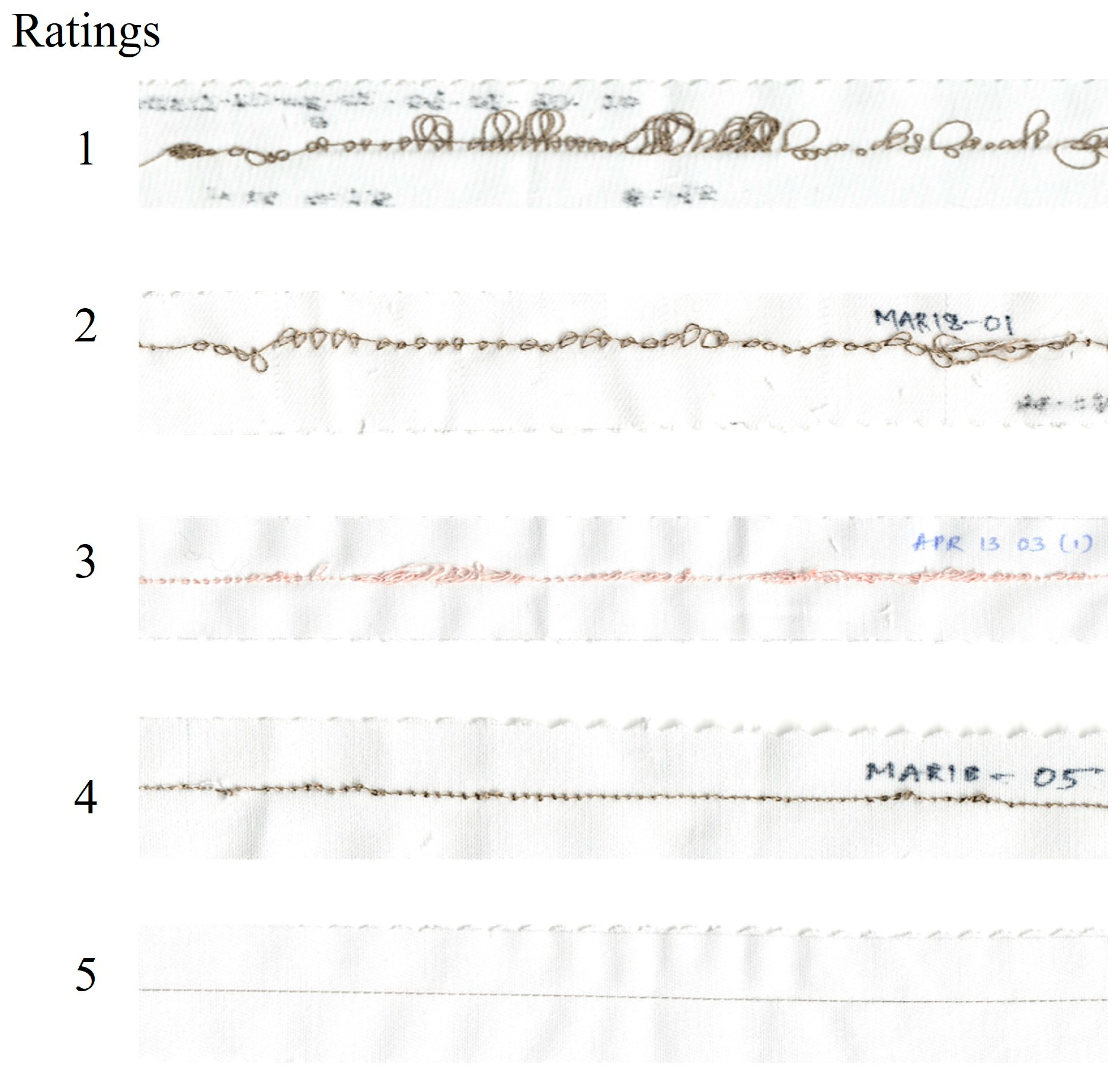
In total, there were roughly 3 × 3 × 3 × 2 = 54 sewing trials per yarn. However, some of the initial yarns were tested 3 times for each combination of sewing factors to gauge the consistency of the process. A visual rating scale from 1 to 5 was developed for bird-nesting problems, with 1 defined as the problem being severe and frequent and 5 meaning that the problem is not present. Yarns 01, 03, 04, 05, 06, 07, 11, and 17 were not ever-sewable.
2.4. Sewability Scale
Sewability scales from 1 to 5 were evaluated for each sewn specimen following the proposed experimental design.
Figure 1 presents examples of each scale.
2.5. Data Analysis
The data was analyzed via explanatory data analysis to try to determine the factors that drive sewability. Then, predictive analysis was undertaken using machine learning methods. The independent variables used in this analysis included the four sewing conditions, and the following seven yarn properties: linear density, yarn diameter, breaking strength, elongation, tenacity, bending length, and friction coefficient. The dependent variables were the ratings for a specific problem type converted to a binary score, where 1 represented sewable and 0 represented not sewable. In all cases, except when otherwise indicated, ratings of 5 were converted to sewable (1), while ratings below 5 were converted to not sewable (0). This analysis took place on all conductive yarns that were ever-sewable (for at least for some combinations of sewing conditions), unless otherwise noted. There was a total of 1485 of these data points. The focus was on bird-nesting, since this was a problem that occurred for all yarn types. All analysis was performed in JMP Pro 16, and JSL code was written to automate the predictive analysis.
3. Results
Section 3.1 presents the results of the exploratory data analysis using binary logistic regression to model whether a yarn is sewable with respect to bird-nesting under specific sewing conditions. In
Section 3.2, different machine learning models were tested to predict if a yarn is sewable under specific sewing conditions. First, models were investigated to predict sewability with respect to bird-nesting for all yarns. Then plated, core, and filament yarns were modeled separately. Next, machine learning models were tested to predict sewability under specific sewing conditions with respect to skipped stitches, stitch breakage, loose threads, seam puckering, and uneven stitches.
Section 3.3 focuses on predicting if a yarn is ever-sewable under any sewing conditions, for both all yarn and only conductive yarn.
3.1. Exploratory Data Analysis to Determine if a Yarn Is Sewable Under Specific Sewing Conditions
Binary logistic regression (BLR) was the first explanatory data analysis method that was employed. BLR differs from multiple linear regression in that it develops a best-fitting equation that estimates in which of two categories the response falls (sewable or not sewable) rather than estimating the numerical value of the response. Through analyzing the variance inflation factors (VIFs) of preliminary binary logistic regression models, it was quickly determined that there was a relatively high correlation between many of the yarn properties. The multicollinearity for Yarns 08–10 and 12–16 is shown in
Table 2. Multicollinearity makes it challenging for many types of regression models, including BLR, to estimate the link between each independent variable and the dependent variable separately. This creates a situation in which the
p-values might not correctly indicate which variables are statistically significant. Starting with all of the yarn properties in the model, one yarn property was successively eliminated at a time until all of the variance inflation factors (VIFs) were less than 10 (the highest recommended value). The process was repeated several times, eliminating the yarn properties in different orders. However, a maximum VIF of 10 could not be achieved for any model that contained more than one yarn property.
Therefore, the initial analysis focused on problems where the dependent variables consisted of all sewing variables and only one yarn variable. Several different models were investigated for each yarn property, starting with models that had no more than two-way interactions and second-order polynomial (quadratic) terms, since higher-order interactions and terms are very difficult to understand. For each model, the factors with
p-values greater than 0.05 were eliminated one at a time, starting with the one with the greatest
p-value. This process was repeated until all of the remaining variables in a model had
p-values less than 0.05. The models were compared, and the one with the best R-squared(U)—McFadden’s pseudo R-squared—was selected. The results of the best models are shown in
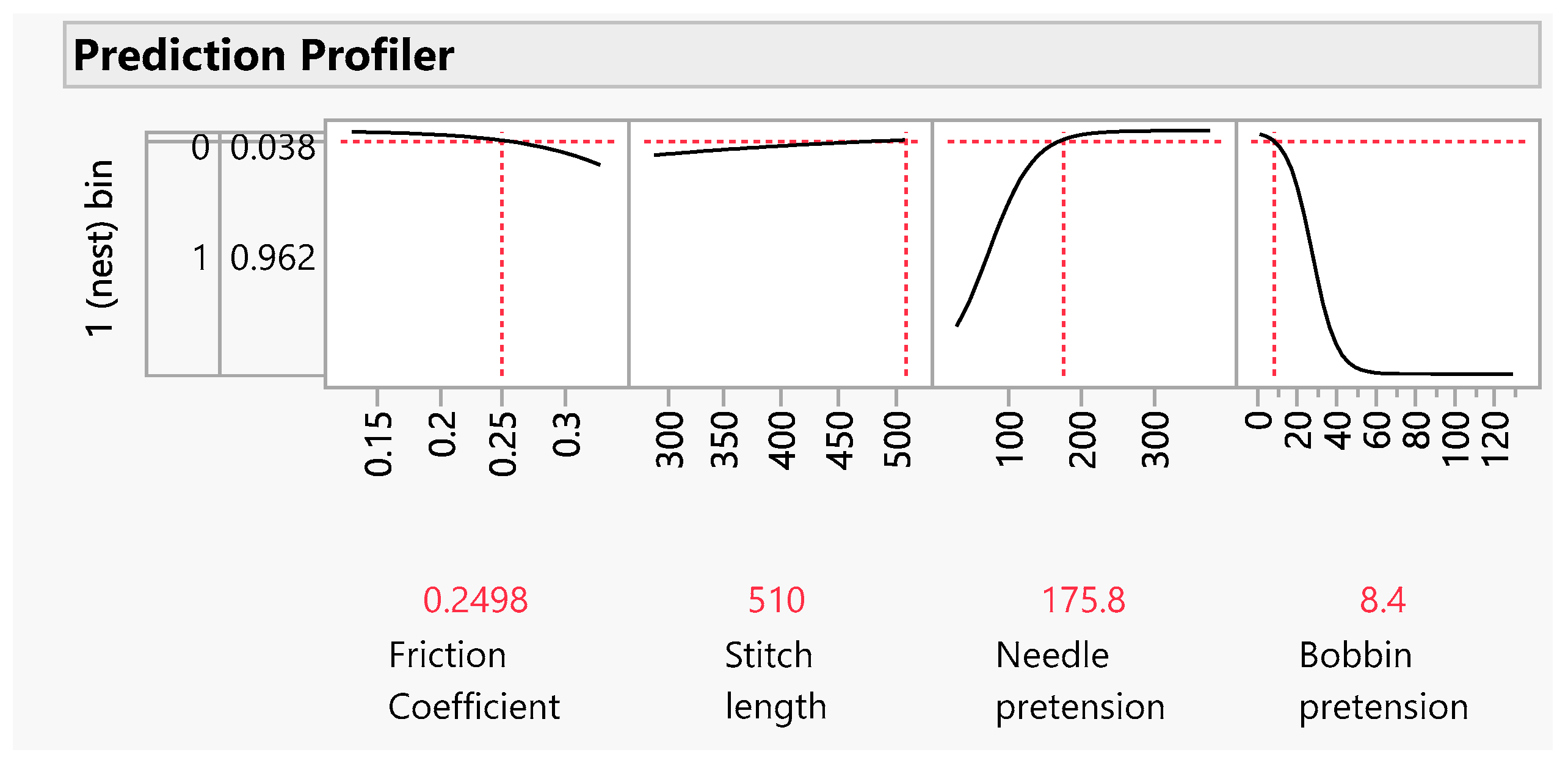
Table 3. Unlike in multiple linear regression, there is no consensus on the best R-squared calculation to use. For comparison purposes, the generalized R-squared is also listed. The best solution with one yarn variable had an R-squared(U) = 0.4220 and the friction coefficient as its one yarn variable. The prediction profiler for the model is shown in
Figure 2. If the friction coefficient or the bobbin pre-tension is increased and the other three independent variables remain at the same values, the model predicts that the sewability with respect to bird-nesting will decrease. In contrast, if needle pretension is increased and the other three independent variables remain at the same values, the model’s prediction of sewability with respect to bird-nesting will initially increase slightly and then plateau at very high sewability.
Near the end of the project, it was discovered that the correlation between some yarn properties was substantially less when computed for all the yarns that were ever-sewable (08–10, 12–16, 18–24, 15U). The multicollinearity is shown in
Table 4. One example of a substantial change in correlation is the decrease from 0.9158 to 0.3007 between linear density and yarn diameter. This indicates that more than one yarn property might have been able to be included in the analysis of all yarns that were ever-sewable.
Since the best R-squared(U) is relatively low, another method was tested to try to find a better model. Principal component analysis (PCA) was undertaken before performing logistic regression. PCA linearly transforms data into components that are orthogonal to each other, and therefore, it eliminates the problem of multicollinearity. Interpreting models with principal components (PCs) is more difficult with this approach, but all of the yarn variables have the potential to be used in the logistic regression. PCA was performed on all of the sewing variables together with all of the yarn variables. Then, BLRs were performed using different numbers of PCs as the independent variables. Models were initially created that had no more than two-way interactions and second-order polynomial (quadratic) terms, and non-significant terms were removed one by one, as in the initial analysis using one yarn property at a time. The whole process was repeated, performing PCA on just the yarn variables (within the data table of sewing experiment results), and BLRs were run on both the sewing variables, along with different numbers of PCs. The best result for performing PCA on all of the yarn and sewing properties had an R-squared(U) = 0.6595, and this was found when using nine PCs. The best result for performing PCA on just all of the yarn properties had an R-squared(U) = 0.6628, and this was found when using 5 PCs. These results can be seen in
Table 3.
From the overall explanatory analysis, the friction coefficient seemed to have a large impact on sewability, and sewing speed seemed to rarely have any impact (rarely statically significant). Although the results obtained with using principal components were better than those without principal components, understanding the drivers of sewability was not greatly improved. Overall, the BLR results might be improved by incorporating higher order interactions and higher order polynomial terms, but this would also be unlikely to improve understanding of the drivers of sewability. Therefore, the emphasis of the analysis was transitioned from attempting to explain the drivers of sewability to being able to predict whether a yarn is sewable or not under specific sewing conditions.
3.2. Predictive Analysis to Determine if a Yarn Is Sewable Under Specific Sewing Conditions
Predictive modeling experiments using machine learning were performed. The following machine learning techniques were used: Decision Tree, Bootstrap Forest, Boosted Tree, K Nearest Neighbors, Neural Network, Support Vector Machines, Discriminant Analysis, Stepwise Logistic Regression, Nominal Logistic Regression, and Lasso Regression.
F1 scores were used to evaluate the strength of machine learning models, and accuracy was also reported. Accuracy is the proportion of total predictions that are correct. However, accuracy can be misleading in cases where the problem is not balanced. In terms of sewability, unbalanced means that the number of experiments rated as sewable is not approximately equal to the number of experiments rated as not sewable. So, to overcome problems with unbalanced data, F1 scores are usually used. An F1 score attempts to balance the proportion of cases predicted as sewable that are actually sewable (precision), with the proportion of cases that are actually sewable that are predicted as sewable (recall).
A total of 33 different combinations of independent variables for each of the 10 machine learning algorithms previously mentioned was run on all of the 1485 data points to get each of the best results (excepted when looking at groups of yarn). The different combinations of independent variables included whether or not the independent variables were standardized and whether or not PCA was used. If PCA was used, it was performed in the following different ways: on the yarn data within the yarn data table, on the yarn data within the sewing experiment results data table, and on the yarn and sewing data together within the sewing experiment results data table. Regardless of how the PCA was performed, different numbers of PCs were used in different experiments.
Table 5 shows the machine learning experimental design.
While initially models were tested with a training-test split, all the experiments were repeated with k-fold cross-validation with k = 10. The disadvantage of the training-test split that was used previously is that each model was only tested on one test set, and thus performance could be influenced by a test set that is particularly favorable or particularly unfavorable to the model. By using k-fold cross-validation with k = 10, the model was tested on 10 different test sets, and the results are reported in terms of statistics based on all of these 10 test sets. This is accomplished by dividing the 1485 data points into 10 sets, with roughly 10% of the data in each. Each set serves as one of the test sets, and the data is trained on the 90% of the data not in the current test set.
First, models were run to predict bird-nesting. As seen in
Table 6, the F1 score of the best models on all yarn was 0.9438, and the accuracy was 0.9791. The best model was created using a boosted tree algorithm, where the independent variables consisted of performing PC on the yarn and sewing variables together (either in their original or standardized form) and using the first 10 PCs in the model. Then, experimentation was performed on groups of yarn. Results for plated yarn and core yarn can also be found in
Table 6. The results for the plated yarn have a somewhat lower F1 score (0.9391) and accuracy (0.9650) than when all of the yarn is taken together. However, the results for the core yarn are higher than when all of the yarn is modeled together, with both an F1 score and accuracy of 1.0000. For core yarns, the analysis was performed by converting both ratings of 4.5 and 5 to sewable, since there were only seven ratings of 5 for bird-nesting on all core yarns. In addition, due to the low number of core yarns, only two PCs resulted from each method of performing PCA on the yarn only, and only six PCs resulted from performing PCA on the yarn and sewing variables together. Therefore, core yarns were run only with independent variable experiments 1–6, 26, and 27. Filament conductive yarns were never sewable. Hence, prediction modeling was not performed on their sewing problem scores.
Finally, experimentation was performed on each of the other five sewing problems. This can be seen in
Table 7. The mean accuracy for each problem was above 0.97 in all cases. It should be noted that for skipped stitches, the accuracy of the boosted tree algorithm for independent variable experiments 30 and 31 was identical to the best solutions, and the F1 score was just slightly lower. For all types of sewing problems, using PCA on the yarn and sewing variables together and then using nine (30 and 31) or ten (32 and 33) PCs in a boosted tree algorithm yielded the best, or close to the best, F1 score.
3.3. Predictive Analysis to Determine in a Yarn Is Ever-Sewable
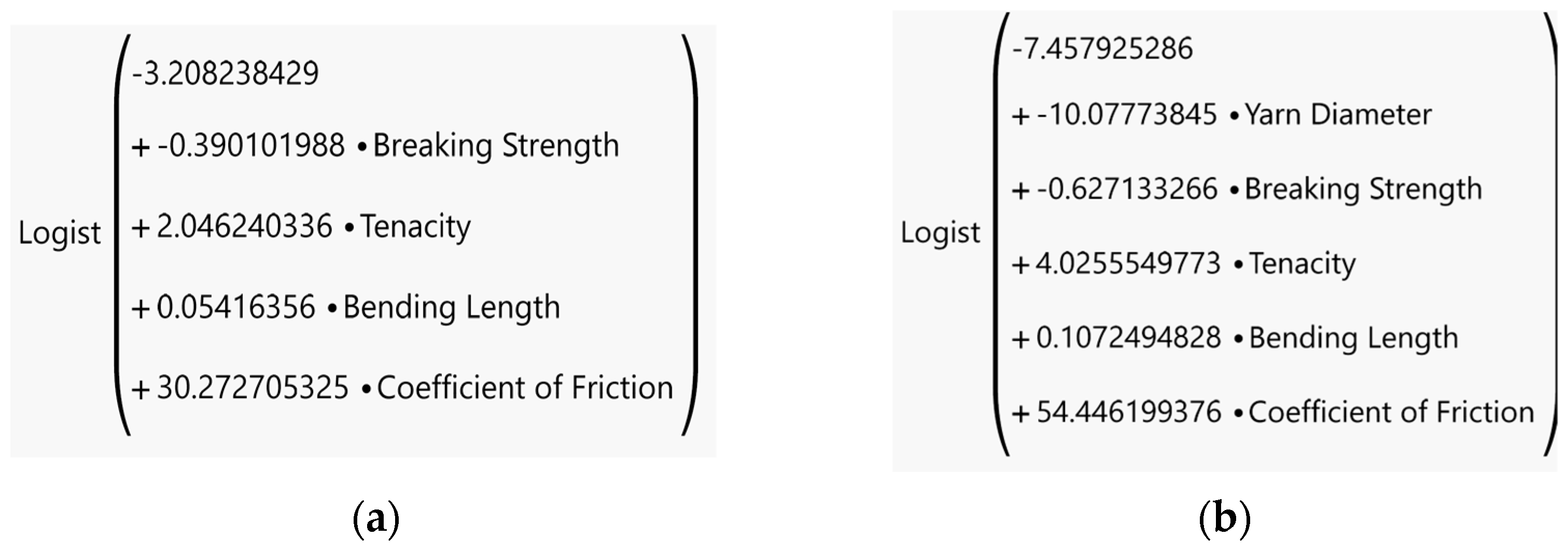
Additional analysis was performed in JMP Pro 16 to determine whether it was possible to reliably predict if a yarn was ever-sewable, based on the seven yarn properties (used in the previous analysis). Even though Lasso regression did not perform particularly well in predicting whether a yarn was sewable under specific sewing conditions, Lasso regression was tested to see if this technique would perform well in this instance. Lasso regression produces models that are generally more intuitive than “black box” models like those resulting from neural-network, boosted-tree, and random-forest algorithms. Only main effects were input into the model (no interaction or polynomial terms). Leave-one-out validation was used, instead of k-fold cross-validation, because the datasets were small. First, Lasso regression was performed on the 23 conductive yarns. The best model found is shown in
Figure 3a. It had both an F1 score and accuracy of 1.0000 (100%), indicating that this is an excellent predictive model. Note that “Logist” refers to the sigmoid function, S(x) = 1/(1 + e
(−x)). If the prediction expression is greater than or equal to 0.5, then the yarn is sewable. Otherwise, it is not ever-sewable. Then, the process was repeated with both the 23 conductive yarns and 3 non-conductive yarns together (26 total). For this model, the F1 score and accuracy were again both 1.0000. The best model that includes all of the conductive and non-conductive yarns is shown in
Figure 3b. (Note that due to the nature of Lasso regression and that these models were built for prediction, it is difficult to accurately infer much about the individual variables and their coefficients in the models).
Although the results of the predictive analysis are very strong overall, additional analysis should be undertaken to further test the best models. There is some “data leakage” in the problems where the best models both used PCs and were tested via k-fold cross-validation. This is a result of only running PCA for the whole dataset, rather than running PCA for each of the 10 training sets. Thus, the training process has some incorporation of the test-set data because the PCA included the test-set data. Consequently, this could make the results appear better than they actually are. The PCA was performed this way since JMP makes it very difficult to recompute the PCs for each fold in k-fold cross-validation. Further analysis should be performed to validate the models on an independent test set.
4. Conclusions and Future Research
Through exploratory data analysis using binary logistic regression, this study found that a yarn’s friction coefficient has a substantial impact on its sewability. Predictive analysis revealed that machine learning models with high F1 scores and high accuracy could be developed for determining the sewability of a yarn under specific sewing conditions. Good models were found for sewability with respect to bird-nesting for all yarn, plated yarn, and core yarn. In addition, good models were also found for predicting the sewability with regards to skipped stitches, stitch breakage, loose threads, and seam puckering. Excellent Lasso regression models were found to determine whether a yarn is ever-sewable. These models revealed that the breaking strength, tenacity, bending length, and friction coefficient have a notable impact on predicting whether the yarn is ever-sewable.
In the future, additional work should be undertaken to validate the best machine learning models on an independent test set. Models should be developed to predict sewability over all of the different sewing problems. This could be achieved by combining the best individual sewing problem models or creating a model that predicts overall sewability. Future work could also include focusing on the best predictive models (like boosted trees) and tuning their hyperparameters. Due to having unbalanced data for many sewing problems, performing oversampling or undersampling may also increase the F1 scores and accuracy of some of the predictive models.




 ,
,