Article

A GWO-Based Optimization for mmWave Integrated Sensing and Communications in IoT Systems

Department of Electrical Engineering, French South African Institute of Technology (FSATI), Tshwane University of Technology, Pretoria 0001, South Africa
*
Author to whom correspondence should be addressed.
Telecom 2026, 7(2), 44; https://doi.org/10.3390/telecom7020044
Submission received: 28 February 2026 / Revised: 9 April 2026 / Accepted: 10 April 2026 / Published: 14 April 2026

Abstract

The next generations of wireless networks will use more intensively shared spectrum and hardware resources. This leads to huge demand for integrated sensing and communication (ISAC) technology. Additionally, the integration of millimeter-wave (mmWave) spectrum can improve the sensing capabilities and communication rates of ISAC systems. This development is of great significance to the internet of things (IoT), as it is essential for intelligent operations and decision-making to have accurate surround sensing and device communication. This study presents a novel methodology for beamforming design in mmWave ISAC base stations within IoT systems, utilizing a grey wolf optimizer (GWO) to optimize the total communication rate and effective sensing power. Also, this work is mostly focused on simulation and heuristic optimization methods. The analyses conducted indicate that the suggested GWO-based optimization achieves a sum rate of up to 22.7 bit / s / Hz and a sensing power of 65.8 dBm when the base station (BS) is equipped with 8 antennas, in comparison to the results from the particle swarm optimization (PSO)-based and genetic algorithm (GA)-based schemes.

1. Introduction

An Internet of Things (IoT) system is important for applications including smart cities, autonomous vehicles, and telemedecine [1,2,3]. These applications require extremely efficient, low-latency, and robust wireless communication, which may lead to spectrum congestion and throughput limitation. To tackle these issues, as the sixth-generation (6G) network develops, millimeter-wave (mmWave) technology plays a key role by offering higher communication rates and better sensing for IoT systems [4]. Furthermore, integrated sensing and communication (ISAC), an economical signal processing and hardware technology, signifies a promising approach to facilitate high-quality communication while ensuring accurate target detection [5,6]. The integration of mmWave and ISAC technologies not only provides IoT with essential connectivity at high rates but also enables environmental sensing and object detecting capabilities. This technology is essential for IoT applications, including smart homes, intelligent transportation, and remote healthcare.
Specifically, ISAC is another technical breakthrough that tries to integrate two discrete functions, namely, communication and sensing, into a unified system and perform them jointly and concurrently [7]. By using shared hardware resources and employing signals for both communication and sensing functions, it boosts spectral and energy efficiency while cutting costs [5,8]. Inspired by these considerations, this paper examines mmWave ISAC in IoT systems.
The authors of [2] proposed a dual-functional radar-communication (DFRC) system design that functions within the mmWave range. Nonetheless, the implementation of IoT within the mmWave DFRC system was not addressed. The authors of [8] presented a meta-learning approach utilizing the gradient descent technique, aimed at minimizing the transmit power at the transmitter in IRS-assisted ISAC systems. The authors of [9] explored an intelligent reflecting surface (IRS)-assisted ISAC system operating in the millimeter-wave band. They proposed an alternative method for jointly designing the radar signal covariance (RSC) matrix, communication beamforming, and IRS phase shifts. This approach aims to enhance the communication subsystem’s rate and improve the radar beampattern. In [10], the authors investigated multi-target ISAC in massive multiple-input, multiple-output (MIMO) systems and proposed various precoding methods to design the sum of Cramer Rao’s lower bound (CRLB) for the system. To optimize the weighted sum of effective sensing power and the communication rate in a non-orthogonal multiple access (NOMA) ISAC system, the authors of [11] proposed a double-layer penalty-based method. Ref. [12] explored a full-duplex NOMA system that integrates sensing and communication. The full-duplex base station is capable of serving downlink and uplink communication IoT devices and detecting targets. However, this investigation exclusively evaluates the ISAC full-duplex NOMA system. Nevertheless, the system’s effective sensing ability was not taken into account. The outage probability of rate splitting multiple access (RSMA)-based ISAC frameworks within IoT networks was delineated in [13]. A fair ISAC approach for multi-UAV-enabled IoT is examined in [14] to optimize the minimum rate for each IoT node. Moreover, in [15], beamforming approaches were introduced for a combined MIMO radar communication system, utilizing manifold algorithms under two distinct antenna configuration possibilities. Ref. [16] proposed a thorough examination of the background, spectrum of key applications, and state-of-the-art schemes of ISAC. However, the potential integration of ISAC with IoT systems was not considered. The authors of [17] offer an in-depth summary of the latest advancements in joint communication and radar sensing (JCR) systems, focusing on the signal processing aspect. A technique based on semidefinite relaxation (SDR) was proposed by the authors of [18] to enhance the efficacy of MIMO radar transmit beamforming in dual-function radar-communications systems. Nevertheless, the major emphasis of this study is on radar-communications systems that serve dual functions. In addition, in reference [19], the authors utilized an SDR method to optimize the beamforming design of an ISAC system. The authors of [20] suggest that the weighted sum rate of a MIMO cell that interferes with a broadcast channel can be optimized by using a linear method for transceiver configuration based on iterative minimization of weighted mean-square error (MSE). However, this study did not account for MIMO in conjunction with the ISAC scheme. In [21], the authors examined the challenges and solutions associated with mmWave unmanned aerial vehicle (UAV) cellular networks. Furthermore, the research conducted in [22] evaluated the efficacy of particle swarm optimization (PSO) and grey wolf optimizer (GWO) methods in comparisons to the extant methods in the literature. The exploration of mmWave ISAC for IoT systems is essential. Previous works, as referenced in [13,15], have only examined the application of the ISAC approach within IoT systems while neglecting mmWave technology. Specifically, further research is necessary to investigate the application of a heuristic-based optimization for beamforming designs in mmWave ISAC schemes for IoT systems. The iterative optimization methods outlined in [11] achieve significant communication rates and sensing power performance; however, the complexity associated with these methods poses challenges for their practical hardware implementation. Additionally, it is challenging to resolve non-convex optimization problems with highly interconnected non-convex constraints using conventional optimization methods, such as convex optimization. Therefore, we proposed a GWO-based beamforming optimization method that demonstrates reduced complexity compared to the alternating optimization (AO) method while also achieving a considerably greater performance improvement over both GA-based and PSO-based schemes.
In this study, we present mmWave technology with an ISAC scheme for IoT systems. The purpose is to achieve high-quality communication and precise target identification for the communication channel and sensory detection of IoT systems, respectively, by developing the transmit beamforming at the base station (BS). The transmit beamforming is optimized using a customized GWO-based scheme. We emphasize formulating a beamforming design problem aimed at optimizing the sum rate for users and sensing power received at the BS, all while adhering to total power constraints. Based on this principle, we present a new GWO-based method that outperforms the PSO-based and genetic algorithm (GA)-based schemes with respect to convergence rate and effectiveness.
The key findings of the paper are as follows:
  • We developed a novel method for enhancing the sum of effective sensing power and communication rate in a mmWave ISAC scheme for IoT systems.
  • We presented an innovative method for the design of the mmWave ISAC BS transmit beamforming that is based on the grey wolf optimizer concept.
  • Finally, the suggested methodology is evaluated through various simulated computations, and the results indicate that it is more effective than the particle swarm optimization method with respect to effective sensing power and sum rate.
The remaining parts of the paper have the following layout: The framework model and defining a problem are describe in Section 2. The design optimization strategy is presented in Section 3. The numerical results are presented in Section 4. The paper concludes with a summary.

2. System Model and Formulation of the Problem

2.1. The Model of the Framework

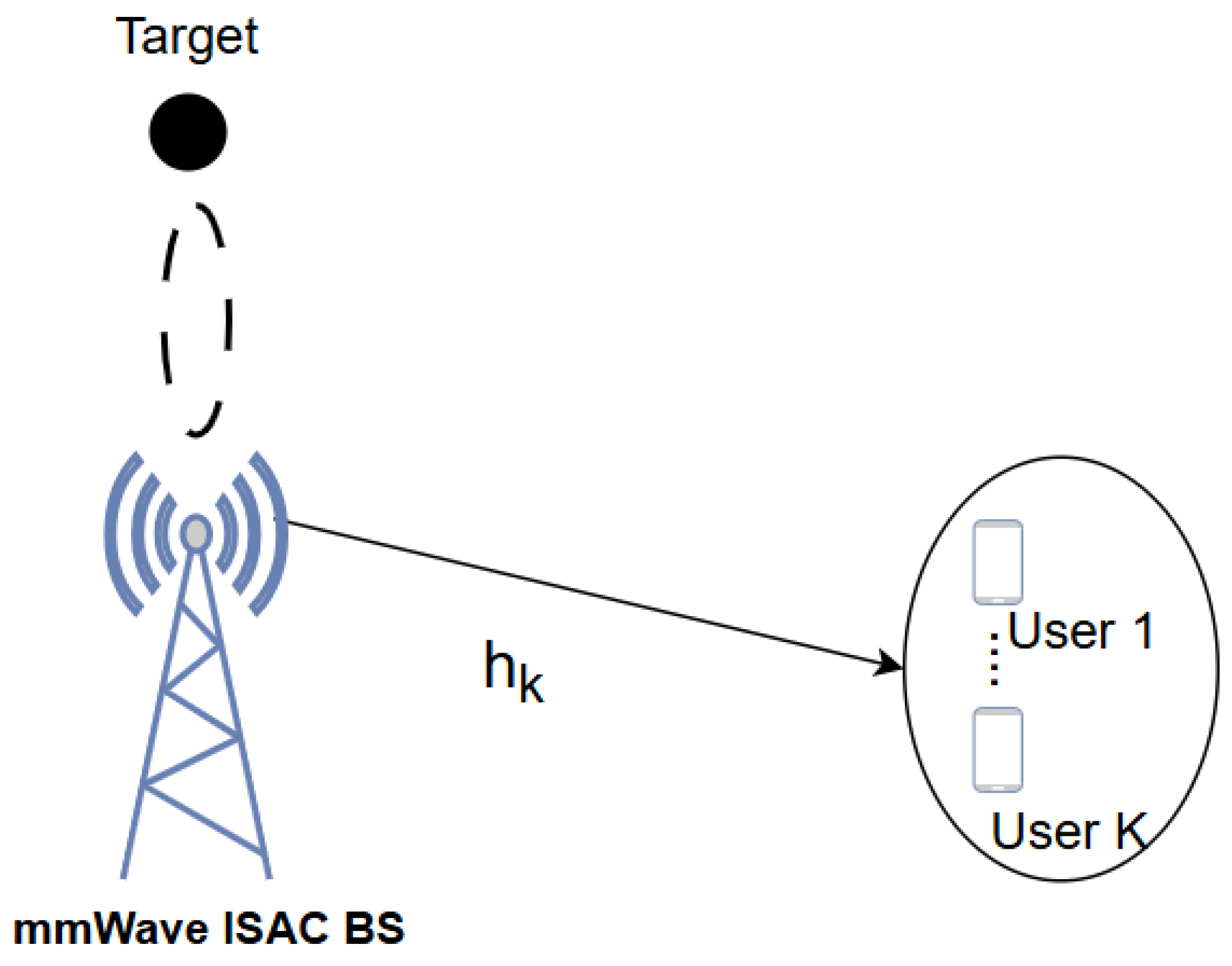
Figure 1 shows our suggested mmWave ISAC scheme for IoT systems. This scheme comprises a double-function mmWave ISAC BS and a singular antenna user, which represent the transmitting and receiving nodes in IoT contexts, respectively. The BS is equipped with N antennas and serves K single-antenna users, in addition to a radar target. The system employs a uniform linear array (ULA) in mmWave ISAC BS to enable the concurrent transmission of communication and radar signals, hence facilitating target detection while enabling communication with K users. In this context, the received signal for the k-th user is expressed as follows
y k = h k H i = 1 K w i P i d i + n k
where w i C N × 1 represents the beamforming vector, while P i denotes the power corresponding to the i-th user with i = 1 K P i P c , where P c represents the overall power used for transmission at the mmWave ISAC base station. h k C N × 1 denote the channel vectors from communication antennas to the k-th user. d i and n k C N ( 0 , σ 2 ) represent the information symbol, and the receiver noise, respectively.
The aim of sensing system is to optimize the effective sensing power. The radar’s effective sensing capability is determined by the waveform covariance matrix, described as follows:
R = i = 1 K w i w i H ,
The effective sensing power at the BS is defined as follows
P θ = a H θ R a θ ,
where
a θ = 1 , e j 2 π λ d sin ( θ ) , . . , e j 2 π λ d ( N 1 ) sin ( θ ) T C N × 1
is the steering vector, where θ 90 ° , 90 ° denotes the target direction, λ and d denote the carrier wavelength and antenna spacing, respectively. Next, the signal-to-interference-plus-noise (SINR) for the k-th user is expressed as
SINR k = h k H w k 2 i k K h k H w i 2 + σ 2 ,
Therefore, the sum rate of the mmWave ISAC scheme for IoT system communication users can be described as follows
SE = k = 1 K log 2 1 + SINR k .

2.2. Formulation of the Problem

Our mmWave ISAC framework for IoT systems aims to optimize both the effective sensing power received at the BS and the sum communication rate of users, subject to the total power constraint ( P c ) and the sensing-specific requirements for the mmWave ISAC BS beamforming design. In particular, the optimization problem is expressed as
max w k β C SE + β S P θ
s . t . k = 1 K | | w k | | 2 P c ,
R = i = 1 K w i w i H ,
P θ = a H θ R a θ .
where β C and β S are normalization variables. It is important to note that by modifying these variables, we can reach a balance between communication and sensing performance [5]. The non-convex characteristics of optimization (7a) and its dependence on interconnected non-convex constraints (7b–d) present a challenge in identifying a solution. In the subsequent section, we optimize w k utilizing a GWO-based scheme.

3. GWO-Based Optimization for ISAC in IoT Frameworks

This section offers an effective strategy to optimize the mmWave ISAC BS beamforming. The grey wolf optimizer approach [23] was established based on the collective behavior and group foraging strategies of the grey wolves, wherein a designated number of wolves in a pack navigate multi-dimensional search space in pursuit of prey. Inspired by this core concept, we enhance the mmWave ISAC transmit beamforming in our optimization problem through the application of the GWO technique. The next subsection explains the methods used to recognize, surround, and attack prey inside the GWO framework. It then goes on to explain the GWO’s basic structure. Thereafter, we provide a full explanation of the specific optimization strategy.

3.1. Utilize GWO in ISAC

Inspired by how grey wolves hunt in groups, the GWO method has three types of wolves: gamma ( γ ) , lambda ( λ ) , and omega ( ω ) . Each type represents a different way to get the best results [24]. The best answer is the gamma ( γ ) wolf, then the lambda ( λ ) , and finally the omega ( ω ) . Within the GWO approach to addressing (7a), these essential elements are used.
  • Recognizing the three foremost beamformings: From the initial reference, we must ascertain the three principal beamformings w k , referred to as gamma, lambda, and omega. The beamforming is developed by identifying the perfect locations using the grey wolf hunting technique. The initial ranking of the grey wolf is dictated by the location of the prey relative to the grey wolf pack. The coordinates of a grey wolf denote its present location. These locations are utilized to calculate the problem’s objective function value, and in our framework, they represent the mmWave ISAC BS beamforming w k .
  • Phases for surrounding the prey: The surrounding behavior of the grey wolf is characterized as [23,24]
    w ~ g t + 1 = w ~ p t A ~ D ~ .
    The symbol w ~ p represents the prey position and channel state information (CSI) in this framework study. The mmWave ISAC BS beamforming w k values are denoted by w ~ g , while coefficient vector A ~ and D ~ are defined as [23,25]
    D ~ = C ~ w ~ p t w ~ g t ,
    A ~ = 2 d ~ r ~ 1 .
    In the aforementioned equation, C ~ = 2 r ~ is a coefficient vector, where r ~ is a randomly selected vector ranging from 0 to 1, and a regulating coefficient d ~ that diminishes linearly from 2 to 0 throughout iterations, as defined
    d ~ = 2 1 z Z .
    Z indicates the total count of iterations, whereas z is the present iterations count.
  • Phases for predatory attack: Due to the challenges in computationally simulating the prey’s position, it is presumed that the initial three wolves can accurately locate their prey at this stage. The three most appropriate beamformings are chosen, and the perfect solution, which is denoted as gamma, lambda, and omega wolf positions, is determined by the following parameters [23]
    w ~ 1 = w ~ γ A ~ 1 D ~ γ ,
    w ~ 2 = w ~ λ A ~ 2 D ~ λ ,
    w ~ 3 = w ~ ω A ~ 3 D ~ ω ,
    where w ~ γ , w ~ λ , and  w ~ ω refer to the positions of the top three beamformings, and D ~ γ , D ~ λ , and  D ~ ω are represented by [24]
    D ~ γ = | C ~ 1 w ~ γ w ~ g | ,
    D ~ λ = | C ~ 2 w ~ λ w ~ g | ,
    D ~ ω = | C ~ 3 w ~ ω w ~ g | .
    To update the optimal beamforming w k , the average values of the three most suitable positions are combined as follows:
    w ~ g ( i + 1 ) = w ~ 1 + w ~ 2 + w ~ 3 3 .
The optimization approach based on GWO presented in Algorithm 1 can be characterized as follows: At the outset, we established b ~ , A ~ , and  C ~ to generate G grey wolf search agents positioned randomly, represented as w ~ 1 ( 0 ) , w ~ 2 ( 0 ) , . . , w ~ G ( 0 ) . In our model, these search agents are identified as mmWave ISAC BS beamforming. Next, we compute the value of the objective function utilizing Equation (7a) for every search agent. We define w ~ γ ( 0 ) , w ~ λ ( 0 ) and w ~ ω ( 0 ) to denote the positions of the gamma, lambda, and omega wolves, respectively. As  w ~ γ , w ~ λ and w ~ ω attain new positions for each search agent during an iteration, we proceed to update the beamforming values until convergence is achieved, subsequently identifying the optimal wolf position, w ~ γ . The output beamforming is expressed as w k = w ~ γ .
To satisfy the problem constraints in (7a), the following steps are performed: Constraint (7b) is ensured by setting w k = P c w k . Next, upon determining w k , it is substituted into (7c,d), respectively, so that constraints (7c,d) are satisfied during iteration.
Algorithm 1 Proposed GWO-based Optimization
  1:
Initialize randomly the grey wolf population G as w ~ 1 ( 0 ) ,   w ~ 2 ( 0 ) ,   . . ,   w ~ G ( 0 ) .
 2:
Initialize b ~ ,   A ~ , and C ~ .
 3:
Compute the objective function value (7a) of each search agent.
 4:
Initialize w ~ γ ,   w ~ λ and w ~ ω to zeros.
 5:
while  z < Z  do
 6:
       for  g = 1 : G  do
 7:
              Update the position of the current grey wolf position by (18).
 8:
       end for
 9:
       Update b ~ ,   A ~ , and C ~ .
10:
      Refine objective function value on this new position (7a).
11:
      Update w ~ γ ,   w ~ λ and w ~ ω .
12:
       z = z + 1 .
13:
end while
14:
Find :   w ~ γ
15:
Output  w k

3.2. Complexity Analysis

In this subsection, we examine the computational complexity of the proposed GWO-based optimization and juxtapose it with the AO scheme [11], the PSO-based scheme [26], and the GA-based scheme [27]. The complexities of the PSO, the GA, and the alternating optimization schemes are represented as O Z P S O G P S O K log N + N K , O n P n G K log N + N K , and O I o I i K 6.5 N 6.5 log 1 e , respectively. Z P S O and G P S O indicates the number of iterations and particle size for the PSO scheme, and n P and n G indicate the population size and number of generations for the GA scheme, while I o and I i are the number of iterations of the outer and inner layers, and e is the solution accuracy for the AO scheme. In contrast, the computational complexity of the GWO-based optimization is denoted as O Z G K log N + N K . The complexity of the PSO and GA scheme is comparable to this value, which is substantially lower than that of the AO scheme. The GWO-based method achieves superior objective performance compared to the PSO and GA schemes. Therefore, applying GWO-based optimization to configure mmWave ISAC BS transmit beamforming in future IoT systems offers an impressive benefit.

4. Numerical Results

This section contains numerical results that describe the effectiveness of the suggested mmWave ISAC for IoT systems. We evaluated the proposed GWO-based optimization method by contrasting its efficacy with that of the PSO-based and GA-based schemes.

4.1. Simulation Setups

In the mmWave ISAC scheme for IoT systems illustrated in Figure 1, we set G = 30 , N = 8 , T = 100 , σ 2 = 104 dBm, β C = 10 , and β S = 1 [11]. The network functions at a frequency of 30 GHz [4]. Furthermore, the system assumes the presence of a single target positioned at an angle of 40 ° relative to the mmWave ISAC BS. Rician fading is assumed to occur in the path separating the mmWave ISAC BS and users, as modeled by the following
H ¯ = H D Ω 1 + Ω + H R 1 1 + Ω
where H D is the deterministic component, H R is the Rayleigh fading components, and Ω the Rician factor. The path loss factor that changes with the distance is modeled as
L k = C 0 d k D 0 n ¯
where d k represents the propagation path among the k-th UE and the mmWave ISAC BS. The coordinates of the users are 10 k , 10 , 10 k , k = 1 , 2 , 3 , 4 . n ¯ = 3.5 is the path loss exponent, and we set Ω = 4 . C 0 is the path loss at the reference distance D 0 = 1 m. The statistical reliability and randomness of the results are mitigated by averaging them over 400 independent Monte Carlo simulations.

4.2. Assessment of Suggested Method’s Effectiveness

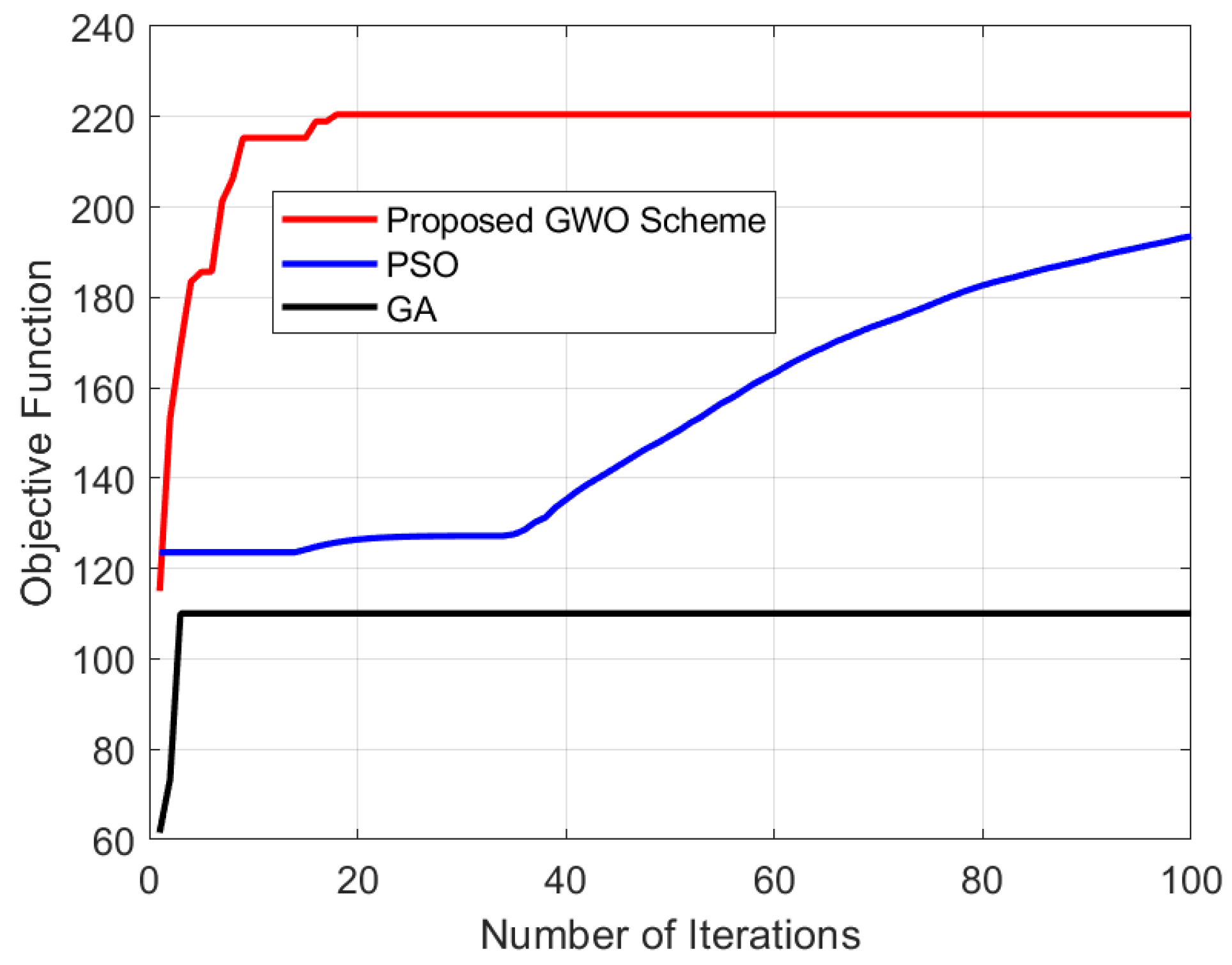
In Figure 2, the convergence performance of the suggested GWO-based optimization technique is demonstrated with parameters K = 2 , and P c = 35 dBm. The GWO-based optimization rises to the maximum objective value very quickly compared to the PSO-based scheme and the GA-based scheme, respectively, as it is evident. This advantage is attributed to the GWO’s effective balance between achieving a higher final objective function value and demonstrating a rapid convergence. Due to its high exploratory behavior, GWO is better equipped to circumvent local optima during optimization. Additionally, its robust exploitative behavior enables rapid convergence closer to the global optimum. Compared to GA-based and PSO-based schemes, GWO’s superior performance is influenced by these characteristics. GWO’s effectiveness is related to its collective hunting behavior technique, which improves the solution (mmWave ISAC BS beamforming) by combining three existing solutions. Therefore, we can conclude that our proposed scheme effectively maximizes both the sensing power and the sum communication rate of the system.
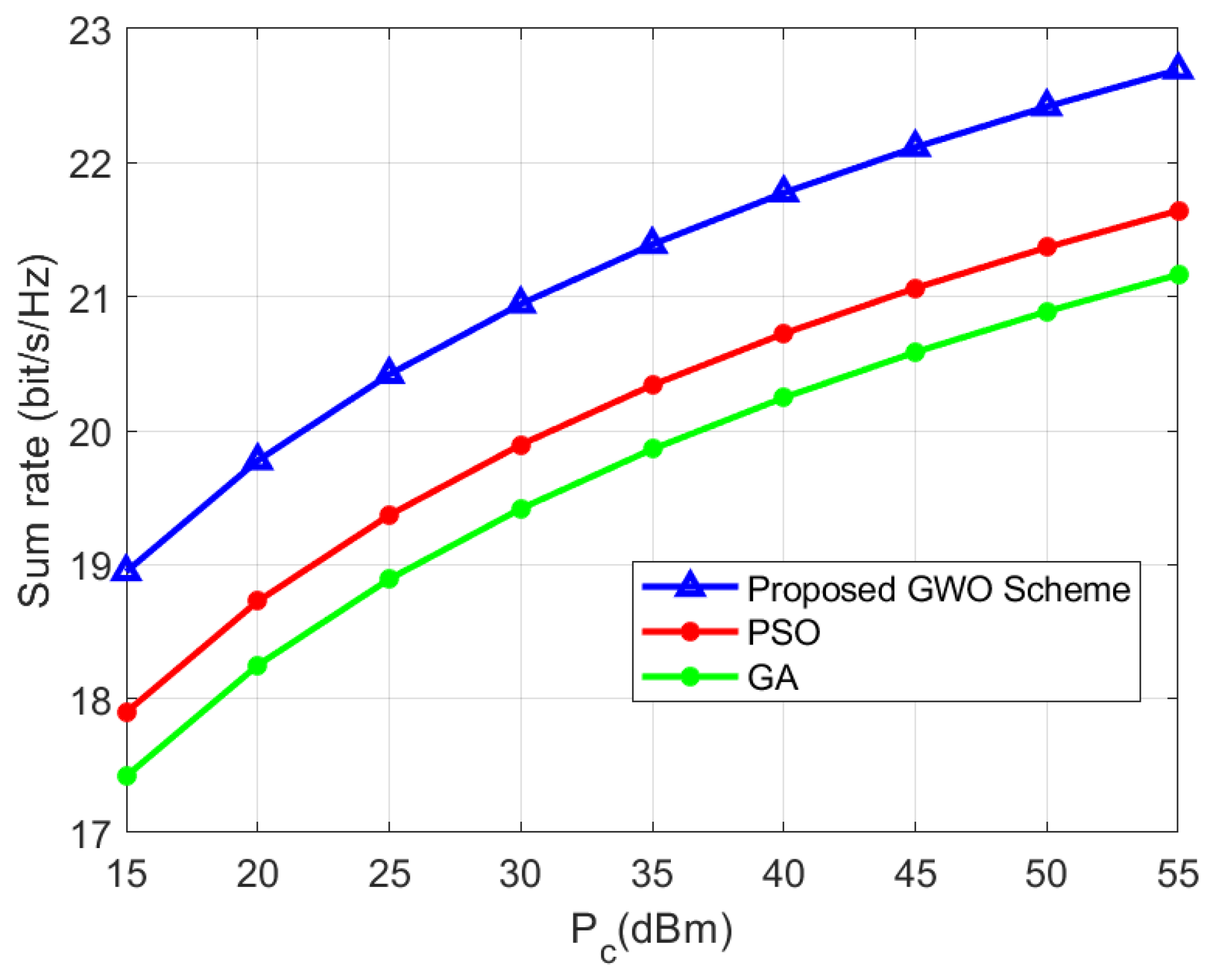
The sum rate is depicted in Figure 3 as a function of the power range at the mmWave ISAC BS. Across all schemes, the total rate increases as P c increases. The graph illustrates that the proposed method obtains a sum rate that is significantly higher than that of the PSO-based and GA-based methods for all power levels. This emphasizes the rapid convergence of our proposed method in optimizing the performance of the objective function of the mmWave ISAC scheme for IoT systems. Moreover, the result highlights the efficacy of integrating mmWave with ISAC to improve communication capabilities of IoT systems.
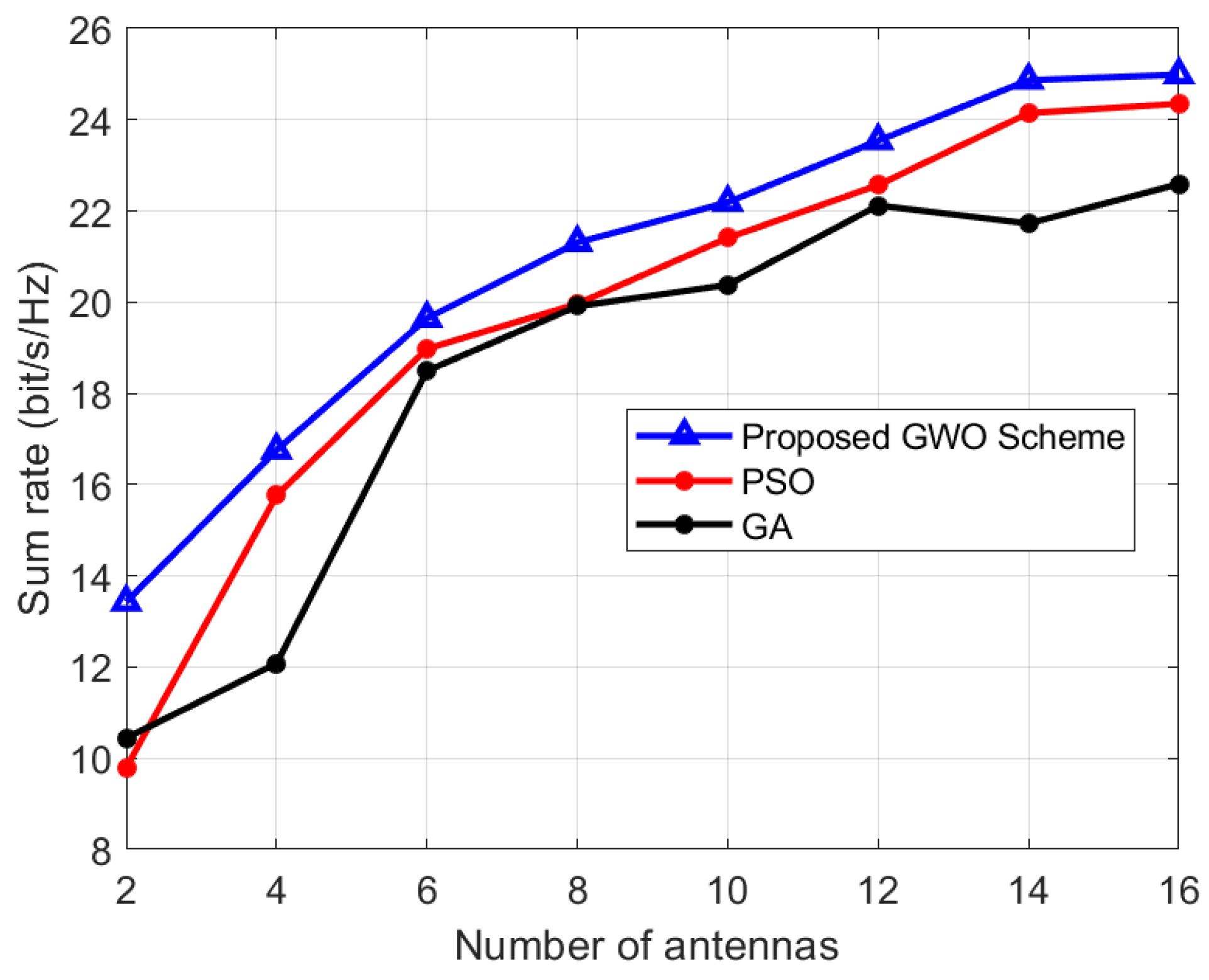
Figure 4 illustrates the sum rate performance across all schemes, varying the number of antennas at the mmWave ISAC BS with P c = 35 dBm. The data clearly indicates that the sum rate rises across all schemes with an increase in the number of antennas. The proposed optimization scheme based on GWO consistently delivers a notably superior sum rate compared to the schemes based on PSO and GA as the number of antennas rises from 2 to 16. This indicates that the application of the proposed GWO-based optimization scheme for optimizing mmWave ISAC BS beamforming can significantly improve the system’s sum rate. This analysis provides insight that by augmenting the number of antennas in mmWave ISAC BS, we can further maximize the sum rate of the mmWave ISAC framework for IoT systems.
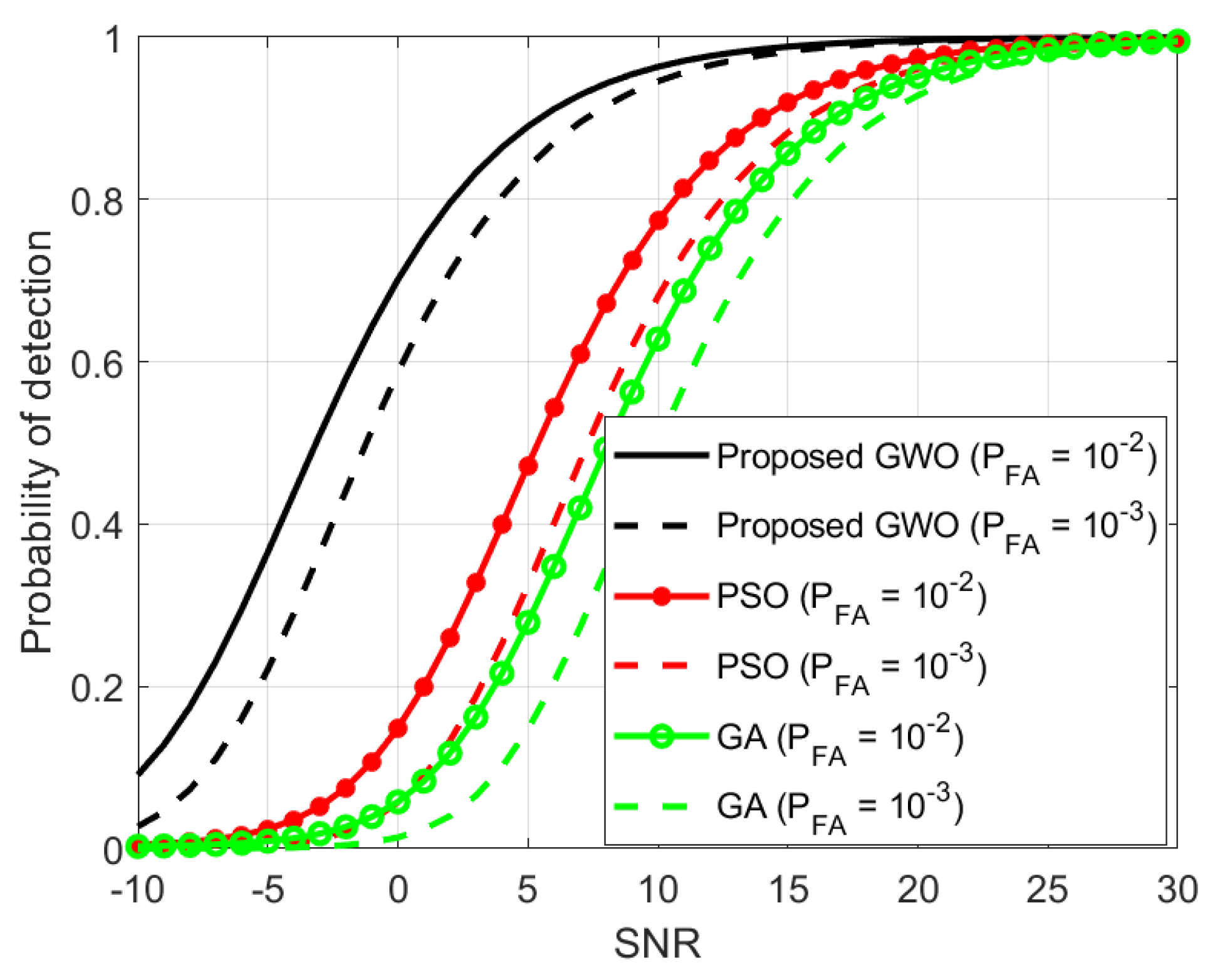
The sensing performance of the radar system was assessed using the probability of detection in this paper, where P FA represents the false alarm probability. This pertains to the probability that the system will detect the presence of a target in the event that only noise is present. In Figure 5, the overall probability of detection increases as the radar signal-to-noise ratio (SNR) increases, with K = 4 , N = 8 , and P c = 35 dBm. Additionally, the probability of detection decreases as the P FA decreases for all considered schemes. The PSO-based and GA-based methods are consistently outperformed by the proposed scheme across all SNR ranges as well as when P FA decreases. The reason for this result is that an elevated P FA indicates a higher error tolerance of the system, which in turn increases the probability of detection. Hence, optimizing both the sum rate and sensing power will enhance the probability of detection for the mmWave ISAC scheme in IoT systems.
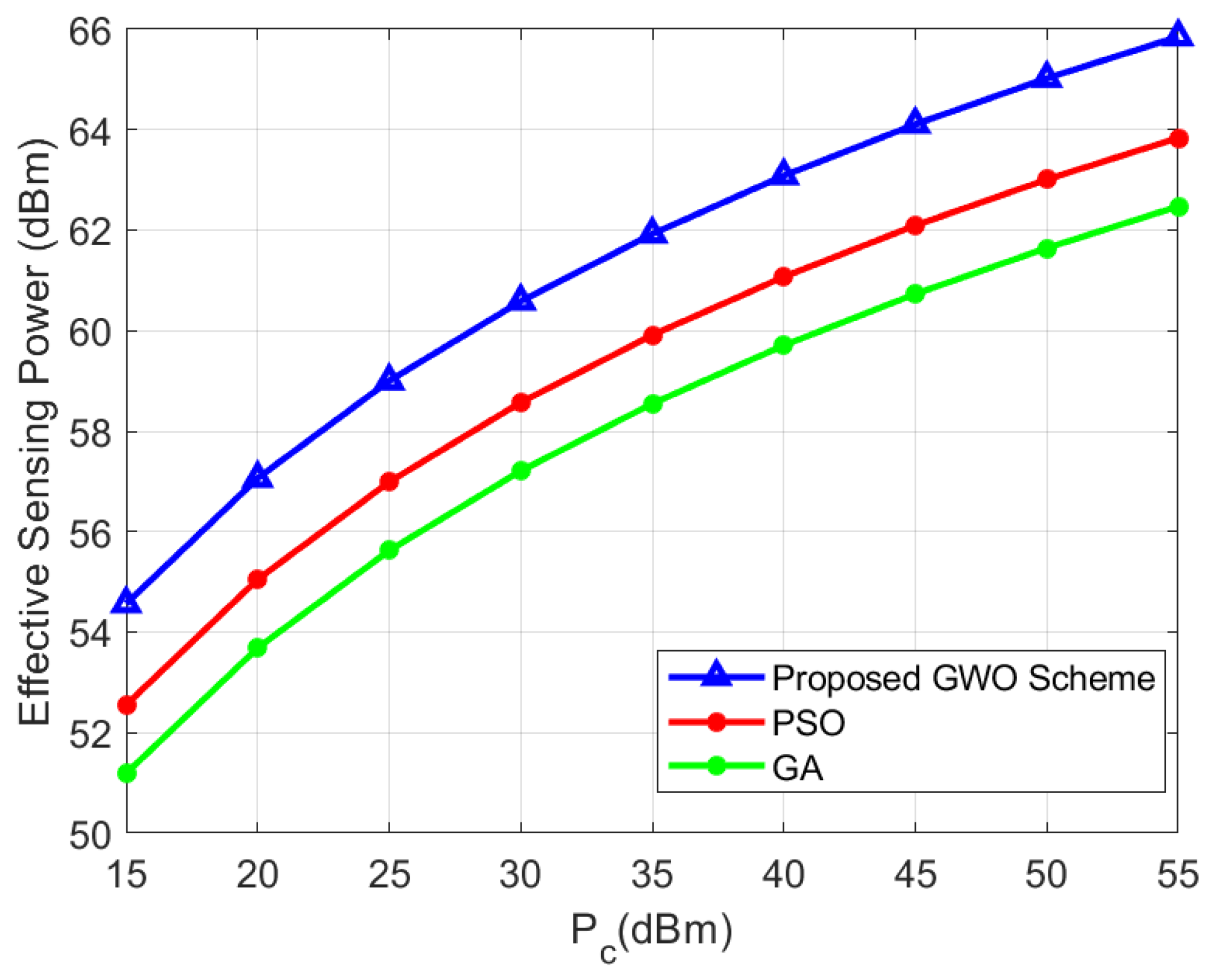
Figure 6 shows the system’s effective sensing power performance across several power ranges at the mmWave ISAC BS. As the power range increases, so does the effective sensing power for each scheme, as illustrated in the figures for N = 8 and K = 4 . It can be seen that, as compared to the PSO-based and GA-based schemes, the suggested GWO-based optimization produces considerably higher effective sensing power for a given increase in total power. The results presented in Figure 6 validate the effectiveness of GWO-based optimization in enhancing the system’s effective sensing power performance. This optimization not only optimizes the sensing power but also optimizes the sum rate of the entire system as a result of a spectral-efficient mmWave ISAC scheme. This demonstrates the benefits of incorporating mmWave and ISAC in IoT systems.
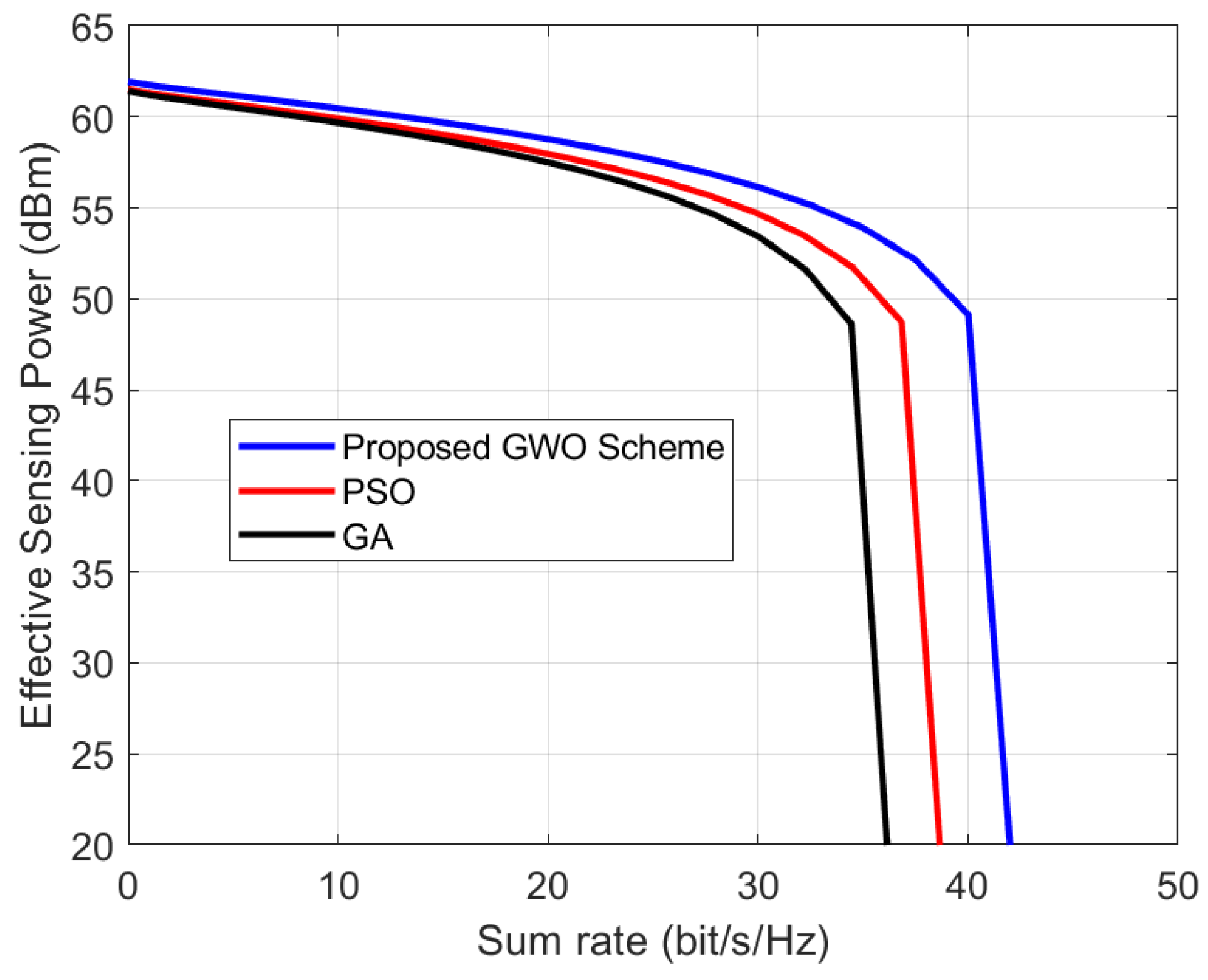
Figure 7 examines the performance tradeoff by altering the communication sum rate ( N = 8 , K = 4 , P c = 35 dBm). With an increase in the communication sum rate, there is a corresponding decrease in the effective sensing power of the ISAC schemes, attributed to the constraints of quality of service. The proposed optimization scheme constantly surpasses the GA-based and PSO-based schemes, showcasing a beneficial balance between effective sensing power and communication sum rate in optimizing the optimization objective (7a).
The suggested GWO-based optimization method is presented in Table 1, which also demonstrates the efficacy of the PSO-based scheme. The efficiency of the method is assessed by comparing the maximum sum rates that are achieved. The other parameters remain unaltered, as illustrated in Figure 3. The optimization technique based on PSO requires marginally less time than the GWO-based and the GA-based methods. The GWO-based optimization outperforms the PSO-based and GA-based schemes, respectively, resulting in a maximal communication sum rate of the system of approximately 22.7 bit / s / Hz . Furthermore, the proposed optimization based on GWO can achieve the highest efficiency while simultaneously reducing complexity.
Table 2 shows the effective sensing power performance of both the PSO-based scheme and the proposed approach. The effective sensing power performance is evaluated by comparing the maximum effective sensing power achieved by each scheme. Table 2 demonstrates that GWO-based and PSO-based methods necessitate a considerably smaller time over the GA-based scheme, and all other variables and parameters are the same as those depicted in Figure 6. Moreover, the suggested GWO-based optimization provides nearly 65.8 dBm of effective sensing power and surpasses the PSO-based and GA-based schemes, respectively. As a result, with a minimum expense of time and rapid convergence, the proposed GWO-based optimization algorithm can achieve optimal effective sensing power.

5. Conclusions

This study investigated the mmWave ISAC framework for IoT systems. We addressed the proposed optimization problem concerning the summation of communication rate and effective sensing power by employing the GWO-based optimization method to enhance the beamforming of the mmWave ISAC base station. Experimental results demonstrated that the suggested scheme surpassed the PSO-based and GA-based methods, respectively, for system sensing power and sum rate maximization. A sum rate and sensing power gain of approximately 22.7 bit / s / Hz and 65.8 dBm, respectively, are achieved by the suggested scheme when N = 8 . The results indicate that the incorporation of mmWave with the ISAC framework can enhance the efficacy and dependability of IoT systems.

Limitation and Future Work

In this study, we have implemented a GWO-based optimization approach to investigate the mmWave ISAC BS beamforming design in single radar target systems. In the future, we will implement a deep reinforcement learning-based approach to enhance the scalability of beamforming in multiple target systems for large systems. Moreover, we will implement a hybrid metaheuristic-reinforcement learning-based method to optimize the mmWave ISAC BS beamforming. This will allow evaluating the systems under varying weighting coefficients, different target angles, and diverse user scenarios.

Author Contributions

Conceptualization, S.D., A.S.H. and T.O.O.; methodology, A.S.H., S.D. and T.O.O.; software, A.S.H., S.D. and T.O.O.; validation, A.S.H., S.D., T.O.O. and B.J.V.W.; formal analysis, A.S.H., S.D. and T.O.O.; writing—original draft preparation, A.S.H.; writing—review and editing, A.S.H., S.D., T.O.O. and B.J.V.W.; visualization, A.S.H., S.D. and T.O.O.; supervision, S.D., T.O.O. and B.J.V.W. All authors have read and agreed to the published version of the manuscript.

Funding

The National Research Foundation of South Africa partially supported the research that is the basis of this work (Refs numbers SRUG2203291049, EQP240515218724, and RCHDI241029277625).

Data Availability Statement

The article contains the original contributions that were detailed in the study. The corresponding author can be contacted for additional information.

Conflicts of Interest

The authors declare no conflicts of interest.

References

  1. Liu, M.; Yang, M.; Wei, F.; Li, H.; Zhang, Z.; Nallanathan, A.; Hanzo, L. A Nonorthogonal Uplink/Downlink IoT Solution for Next-Generation ISAC Systems. IEEE Internet Things J. 2024, 11, 8224–8239. [Google Scholar] [CrossRef]
  2. Liu, F.; Masouros, C.; Petropulu, A.P.; Griffiths, H.; Hanzo, L. Joint Radar and Communication Design: Applications, State-of-the-Art, and the Road Ahead. IEEE Trans. Commun. 2020, 68, 3834–3862. [Google Scholar] [CrossRef]
  3. Soumana Hamadou, A.N.; Du, S.; Olwal, T.O.; Wyk, B.J.V. Digital Twin and Integrated Sensing and Communication Applications in Internet of Things: Enabling Communication Technologies, Taxonomy, Implications, and Open Issues. Appl. Sci. 2026, 16, 73. [Google Scholar] [CrossRef]
  4. Liu, X.; Zhao, Y.; Wang, X.; Wang, B.; Cheng, K. Intelligent Convergence: Advancing 6G mmWave Networks with RIS-Enhanced ISAC for IoT Applications. In Proceedings of the 27th International Conference on Computer Supported Cooperative Work in Design (CSCWD), Tianjin, China, 8–10 May 2024; IEEE: New York, NY, USA, 2024; pp. 2668–2673. [Google Scholar] [CrossRef]
  5. Nassar, F.; Singh, K.; Prakriya, S.; Singh, S.K.; Li, C.-P.; Ding, Z. Backscatter-Enabled RIS-Assisted NOMA ISAC. In Proceedings of the 2024 IEEE International Conference on Communications Workshops (ICC Workshops); IEEE: New York, NY, USA, 2024; pp. 117–122. [Google Scholar] [CrossRef]
  6. Lu, S.; Liu, F.; Li, Y.; Zhang, K.; Huang, H.; Zou, J.; Li, X.; Dong, Y.; Dong, F.; Zhu, J.; et al. Integrated Sensing and Communications: Recent Advances and Ten Open Challenges. IEEE Internet Things J. 2024, 11, 19094–19120. [Google Scholar] [CrossRef]
  7. Niu, Y.; Wei, Z.; Wang, L.; Wu, H.; Feng, Z. Interference Management for Integrated Sensing and Communication Systems: A Survey. IEEE Internet Things J. 2025, 12, 8110–8134. [Google Scholar] [CrossRef]
  8. He, X.; Ye, Y.; Xu, H.; Liu, W.; Zhou, A. Beamforming optimization of meta-learning algorithm based on gradient descent in RIS-assisted ISAC system. Phys. Commun. 2024, 66, 102429. [Google Scholar] [CrossRef]
  9. Zhu, Z.; Li, Z.; Chu, Z.; Guan, Y.; Wu, Q.; Xiao, P.; Renzo, M.D.; Lee, I. Intelligent Reflecting Surface Assisted mmWave Integrated Sensing and Communication Systems. IEEE Internet Things J. 2024, 11, 29427–29437. [Google Scholar] [CrossRef]
  10. Topal, O.A.; Demir, O.T.; Bjornson, E.; Cavdar, C. Multi-Target Integrated Sensing and Communications in Massive MIMO Systems. IEEE Wirel. Commun. Lett. 2025, 14, 345–349. [Google Scholar] [CrossRef]
  11. Wang, Z.; Liu, Y.; Mu, X.; Ding, Z.; Dobre, O.A. NOMA Empowered Integrated Sensing and Communication. IEEE Commun. Lett. 2022, 26, 677–681. [Google Scholar] [CrossRef]
  12. Liu, M.; Yang, M.; Nallanathan, A. On the Performance of Uplink and Downlink Integrated Sensing and Communication Systems. In Proceedings of the 2022 IEEE Globecom Workshops; IEEE: New York, NY, USA, 2022; pp. 1236–1241. [Google Scholar] [CrossRef]
  13. Ghosh, S.; Singh, K.; Jung, H.; Li, C.P.; Duong, T.Q. On the Performance of Rate Splitting Multiple Access for ISAC in Device-to-Multi-Device IoT Communications. IEEE Trans. Cogn. Commun. Netw. 2025, 11, 333–348. [Google Scholar] [CrossRef]
  14. Liu, X.; Liu, Y.; Liu, Z.; Durrani, T.S. Fair Integrated Sensing and Communication for Multi-UAV-Enabled Internet of Things: Joint 3-D Trajectory and Resource Optimization. IEEE Internet Things J. 2024, 11, 29546–29556. [Google Scholar] [CrossRef]
  15. Liu, F.; Masouros, C.; Li, A.; Sun, H.; Hanzo, L. MU-MIMO Communications with MIMO Radar: From Co-Existence to Joint Transmission. IEEE Trans. Wirel. Commun. 2018, 2755–2770. [Google Scholar] [CrossRef]
  16. Liu, F.; Cui, Y.; Masouros, C.; Xu, J.; Han, T.X.; Eldar, Y.C.; Buzzi, S. Integrated Sensing and Communications: Toward Dual-Functional Wireless Networks for 6G and Beyond. IEEE J. Sel. Areas Commun. 2022, 40, 1728–1767. [Google Scholar] [CrossRef]
  17. Zhang, J.A.; Liu, F.; Masouros, C.; Heath, R.W.; Feng, Z.; Zheng, L.; Petropulu, A. An Overview of Signal Processing Techniques for Joint Communication and Radar Sensing. IEEE J. Sel. Top. Signal Process. 2021, 15, 1295–1315. [Google Scholar] [CrossRef]
  18. Liu, X.; Huang, T.; Shlezinger, N.; Liu, Y.; Zhou, J.; Eldar, Y.C. Joint Transmit Beamforming for Multiuser MIMO Communications and MIMO Radar. IEEE Trans. Signal Process. 2020, 68, 3929–3944. [Google Scholar] [CrossRef]
  19. Cong, D.; Guo, S.; Zhang, H.; Ye, J.; Alouini, M.S. Beamforming Design for Integrated Sensing and Communication Systems with Finite Alphabet Input. IEEE Wirel. Commun. Lett. 2022, 11, 2190–2194. [Google Scholar] [CrossRef]
  20. Shi, Q.; Razaviyayn, M.; Luo, Z.Q.; He, C. An Iteratively Weighted MMSE Approach to Distributed Sum-Utility Maximization for a MIMO Interfering Broadcast Channel. IEEE Trans. Signal Process. 2011, 59, 4331–4340. [Google Scholar] [CrossRef]
  21. Xiao, Z.; Xia, P.; Xia, X.G. Enabling UAV cellular with millimeter-wave communication: Potentials and approaches. IEEE Commun. Mag. 2016, 54, 66–73. [Google Scholar] [CrossRef]
  22. Korouzhdeh, T.; Eskandari-Naddaf, H.; Shadnia, R.; Zhang, L. A comparative study between Gray Wolf and particle swarm algorithms use for optimization of cost in composite beam. Soft Comput. 2024, 28, 6571–6593. [Google Scholar] [CrossRef]
  23. Mirjalili, S.; Mirjalili, S.M.; Lewis, A. Grey wolf optimizer. Adv. Eng. Softw. 2014, 69, 46–61. [Google Scholar] [CrossRef]
  24. Hamadou, A.N.S.; Maina, C.W.; Soidridine, M.M. A grey wolf optimiser (GWO)-based RIS phase shift design for a RIS-assisted multi-antenna system. IEEE Commun. Lett. 2024, 28, 2171–2175. [Google Scholar] [CrossRef]
  25. Hamadou, A.N.S.; wa Maina, C.; Lang’at, K.; Soidridine, M.M. GWO-based SIM configuration for implementing multiuser beamforming in the wave domain. Phys. Commun. 2025, 70, 102648. [Google Scholar] [CrossRef]
  26. Kennedy, J.; Eberhart, R. Particle Swarm Optimization. In Proceedings of IEEE International Conference on Neural Networks; IEEE: New York, NY, USA, 1995. [Google Scholar]
  27. Mirjalili, S. How effective is the Grey Wolf optimizer in training multi-layer perceptrons. Appl. Intell. 2015, 43, 150–161. [Google Scholar] [CrossRef]
Figure 1. Model of the mmWave ISAC scheme for IoT systems.
Telecom 07 00044 g001
Figure 2. Number of iterations versus objective function.
Telecom 07 00044 g002
Figure 3. Sum rate versus P c .
Telecom 07 00044 g003
Figure 4. Sum rate with respect to N.
Telecom 07 00044 g004
Figure 5. Radar probability of detection with respect to the radar SNR.
Telecom 07 00044 g005
Figure 6. Effective sensing power as a function of P c .
Telecom 07 00044 g006
Figure 7. Tradeoff between sum rate and effective sensing power.
Telecom 07 00044 g007
Table 1. Comparison of efficiency.
SchemesTime (s)Efficiency ( bit / s / Hz )
GWO-based optimization0.0822.7
PSO-based scheme0.0221.6
GA-based scheme121.1
Table 2. Comparison of effective sensing power performance.
SchemesTime (s)Effective Sensing Power (dBm)
GWO-based optimization0.0565.8
PSO-based scheme0.0363.8
GA-based scheme1.0362.4
Disclaimer/Publisher’s Note: The statements, opinions and data contained in all publications are solely those of the individual author(s) and contributor(s) and not of MDPI and/or the editor(s). MDPI and/or the editor(s) disclaim responsibility for any injury to people or property resulting from any ideas, methods, instructions or products referred to in the content.