1. Introduction
In wireless communication systems, high-precision signal synchronization and channel estimation are fundamental to ensuring reliable and efficient data transmission. This is particularly critical under harsh channel conditions such as multipath fading and carrier frequency offset (CFO), which can induce timing misalignment, inter-carrier interference (ICI), and waveform distortion, thereby severely degrading system performance [
1]. Conventional approaches typically adopt a stage-wise processing architecture in which timing synchronization, CFO compensation, and channel estimation are implemented as separate modules. However, in complex multipath environments, this decoupled paradigm is prone to error propagation, reduced link reliability, and inefficient resource utilization [
2]. With the evolution toward 6G networks, the demand for low-latency and ultra-reliable communications is becoming increasingly stringent, and synchronization and estimation under adverse channels have emerged as one of the key bottlenecks hindering further technological advances [
3].
OFDM mitigates inter-symbol interference (ISI) by enabling parallel transmission over multiple subcarriers and employing a cyclic prefix (CP), thereby offering strong resilience to frequency-selective fading and serving as a mainstream transmission technique for multipath environments [
4,
5]. However, OFDM is highly sensitive to symbol timing offset (STO) and CFO; residual synchronization errors can significantly aggravate ICI and, in turn, impair the accuracy of channel estimation.
Although substantial efforts have been devoted to synchronization and channel estimation (CE) in OFDM systems, most existing studies remain largely confined to conventional approaches that treat CE and synchronization as separate processing stages. STO and CFO directly distort the received signal, degrading CE accuracy. Conversely, inaccurate channel estimates impair synchronization decisions. This mutual dependence necessitates a strongly coupled joint estimation approach. Consequently, a joint design that integrates timing synchronization, frequency synchronization, and channel estimation is expected to mitigate error propagation inherent in stage-wise processing and reduce the overall overhead without sacrificing estimation accuracy.
In recent years, research on the coupling between OFDM synchronization and CE has mainly progressed along three directions: joint processing, time-varying channel tracking, and low-overhead frame design. Building on these advances, this work further exploits the intrinsic coupling between synchronization parameters and channel parameters, and investigates a low-overhead joint estimation approach for STO, CFO, and CE. For underwater acoustic communications, Wang [
6] presented a pilot-aided joint estimation scheme that effectively addresses Doppler scaling and residual CFO; however, it relies on a specific pilot-structure design. For high-mobility scenarios, Zhang [
7] developed a multi-module time–frequency synchronization algorithm that reduces sensitivity to timing errors via differential operations and achieves favorable performance over multipath Doppler channels, at the cost of relatively high computational complexity. By incorporating deep learning, Li [
8] extended the CFO estimation range to ±7 kHz and significantly improved the mean-square-error (MSE) performance at low SNR, yet the model requires large-scale training data and its real-time deployment still needs further optimization. For non-contiguous OFDM (NC-OFDM), Li [
9] achieved narrowband-interference-resilient timing synchronization through mean removal of the autocorrelation signal, but did not specifically optimize frequency-offset estimation.
Regarding comparisons with conventional methods, prior work has analyzed the performance differences between training-sequence correlation-based approaches and cyclic-prefix-based estimation methods in multipath environments [
10]. In addition, Yuan [
11] investigated the impact of CFO on OFDM systems from both theoretical and simulation perspectives and provided corresponding synchronization and compensation strategies, but lacked systematic validation under complex scenarios. Moreover, Boiko [
12] optimized the error vector magnitude (EVM) of 5G downlink transmissions using a QPSK-based architecture, albeit at the expense of increased transmit power.
In [
13,
14], deep-learning-based OFDM channel estimation methods were proposed. Specifically, Hasini [
13] achieves performance comparable to the minimum mean-square error (MMSE) estimator by recovering implicit channel state information (CSI), while Jameel [
14] leverages a frequency-recursive model (SisRafNet) to improve the signal-to-noise ratio (SNR) performance under 3GPP channel models. In [
15,
16], targeting massive MIMO-OFDM doubly selective channels and time–frequency-varying channels, respectively, semi-blind compressed sensing (SB-BOMP) and a super-resolution network were adopted to enhance estimation accuracy. Meanwhile, Singh [
17] provides a systematic survey of blind CFO estimation techniques for multicarrier systems (OFDM and MIMO-OFDM), comparing the applicability of statistical methods and deep-learning-based approaches.
With respect to improvements of conventional methods, Badi [
18] integrates a deep neural network (DNN) with spatial modulation to reduce pilot overhead and enhance detection generalization, whereas Chen [
19] explores the performance–complexity trade-off of the EM-VAMP algorithm in underwater acoustic communications. However, many existing studies assume perfect channel estimation [
13,
14,
15,
16], and the limited preamble length can exacerbate ISI/ICI. Although the E-TRFI-IP scheme proposed in [
20] exploits inactive subcarriers to improve performance, it incurs a relatively high training overhead. In addition, as pointed out in [
17], blind estimation methods eliminate the need for reference signals but typically suffer from a limited estimation range; likewise, the algorithm in [
19], while suitable for underwater acoustic scenarios, imposes relatively stringent requirements on hardware computational capability.
In summary, although coordinated synchronization and estimation strategies have been widely studied, there remains a need for a low-overhead realization tailored to conventional CP-OFDM systems under the standard frame structure. The contribution of this work is not to claim a generic new joint-estimation paradigm, but to develop an implementation-oriented joint STO/CFO/CE method in which the channel vector is analytically eliminated, the online search dimension is reduced, and recurring common computations are reused to achieve a better trade-off between performance and complexity.
Specifically, the proposed method formulates the joint estimation problem in a least-squares framework, converts the original three-dimensional search into a two-dimensional search over timing and CFO, and enables offline precomputation of the pseudoinverse-related operator for efficient online evaluation under the conventional CP-OFDM frame setting.
3. Joint Synchronization and Channel Estimation
A joint timing synchronization, frequency synchronization, and channel estimation method is proposed. Let denote the true STO, let denote a candidate timing index in the search process, and let denote the resulting timing estimate. For CP-aligned timing evaluation, the reference timing instant is defined as , and its estimate is given by . In addition, let denote the true normalized CFO, let denote the candidate CFO variable used in the search, and let denote the final CFO estimate. Therefore, the objective of the proposed method is to estimate the timing parameter, the CFO, and the channel gain vector from the received samples and the known pilot symbols. The observation window length is chosen such that the received observation window fully covers the possible timing uncertainty region and contains the entire pilot block used for joint synchronization and channel estimation. Based on the received signal model, this task is formulated as a least-squares problem, where the objective function measures the residual error between the received samples and the reconstructed signal under a candidate parameter set.
Note that the true normalized CFO
is assumed to lie in the range
[
21]. For numerical optimization,
is introduced as the candidate CFO variable over this interval, and the final CFO estimate obtained from the search is denoted by
. Accordingly, the joint optimization problem is formulated as
Here,
i denotes the candidate timing index,
denotes the candidate normalized CFO used in the search, and
denotes the channel gain vector. The corresponding estimates are denoted by
,
, and
, respectively.
The objective function represents the squared difference between the received symbols and the corresponding estimated symbols. In Equation (
9), the summation is taken over
.
It represents the convolution between the channel coefficients and the pilot symbols. Here, denotes the N-periodic extension of the sequence ,, for , and . In addition, .
Since the feasible sets of
and
are both continuous, a direct exhaustive search is impractical. Moreover, when
i and
are fixed, the channel vector enters the model linearly. Therefore, the joint optimization can be rewritten in a nested form, in which the channel vector is first estimated conditionally for each candidate pair
. Hence, Equation (
8) can be rewritten as
In this way, the innermost problem becomes a standard least-squares problem with a closed-form solution, and the original joint optimization is reduced to a two-dimensional search over i and .
When
i and
are fixed, the solution to the innermost problem, the estimate of the channel gain vector, can be expressed as [
22]
The channel gain vector can be expressed as
where
is of size
with the matrix
of size
,
is a
vector of received symbols, the
diagonal matrix
accounts for the CFO variable
and satisfies
and
is an
matrix of marker symbols. By substituting Equation (
13) into the innermost optimization, the optimization problem in Equation (
11) can be expressed as
By eliminating the channel coefficients as an optimization variable in closed form, and by combining the pseudoinverse property of the matrix with the CFO compensation matrix , the original three-dimensional joint optimization over is reduced to a two-dimensional search over only. The matrix can be computed offline in advance, and since is diagonal, the phase compensation can be implemented via element-wise complex multiplication. In this way, a closed-form estimate of is obtained and the objective function can be rewritten in terms of the residual between the received signal segment and the reconstructed signal, thereby avoiding costly iterative solving.
In terms of computational complexity, let the STO candidate set be
, and thus the number of STO candidates is
. The normalized CFO is searched over the interval
with a uniform grid step size
, and the number of CFO candidate points is
. In the simulations,
, as listed in
Table 1. For each candidate pair
, the main computations consist of several matrix–vector multiplications and residual evaluation, with a per-point cost of
. Therefore, the overall complexity is
. When
, the above expression can be simplified to
; if further
, it becomes
. In addition, computing the pseudoinverse matrix
V is a one-time cost, approximately
, and is independent of the number of candidate points.
It should be noted that a smaller leads to a finer CFO search grid and is generally beneficial to CFO estimation accuracy, but it also increases the number of candidate points and thus the overall computational cost. Since the proposed method eliminates the channel vector analytically rather than treating it as a search variable, the search dimension is reduced from three to two, thereby significantly reducing the overall computational load and improving real-time capability. It should be noted that a smaller leads to a finer CFO search grid and is generally beneficial to CFO estimation accuracy, but it also increases the number of candidate points and thus the overall computational cost. In this work, the CFO search step size is set to , which provides a favorable trade-off between estimation accuracy and computational complexity within the normalized CFO range .
In Algorithm 1, the pilot-based matrix
S and its corresponding linear operator
V are first constructed. Then, the CFO search is confined to the range
, and the timing-offset search is limited within the maximum window length
, so as to reduce computational redundancy. For each candidate CFO
,a diagonal phase-compensation matrix
is constructed, and the operator
is computed to facilitate channel estimation. For each candidate timing offset
i, the corresponding received segment
is extracted, and the cost function is evaluated as the squared norm of the residual between the received segment and the compensated signal. The optimal estimates are updated by minimizing this cost function, where the reference timing index is aligned with the cyclic prefix to ensure synchronization accuracy.
| Algorithm 1 Joint Synchronization and Channel Estimation |
Require: Received sequence ; CFO search interval ; grid step ; CP length .
Ensure: Timing estimate ; CFO estimate ; channel estimate .
Initialize . Construct the circulant matrix according to Equation ( 18); compute . Set and . for each do Construct and compute . for each do Extract . Compute . Compute . if then Update , , , . end if end for end for Return , , .
|
4. Performance Analysis
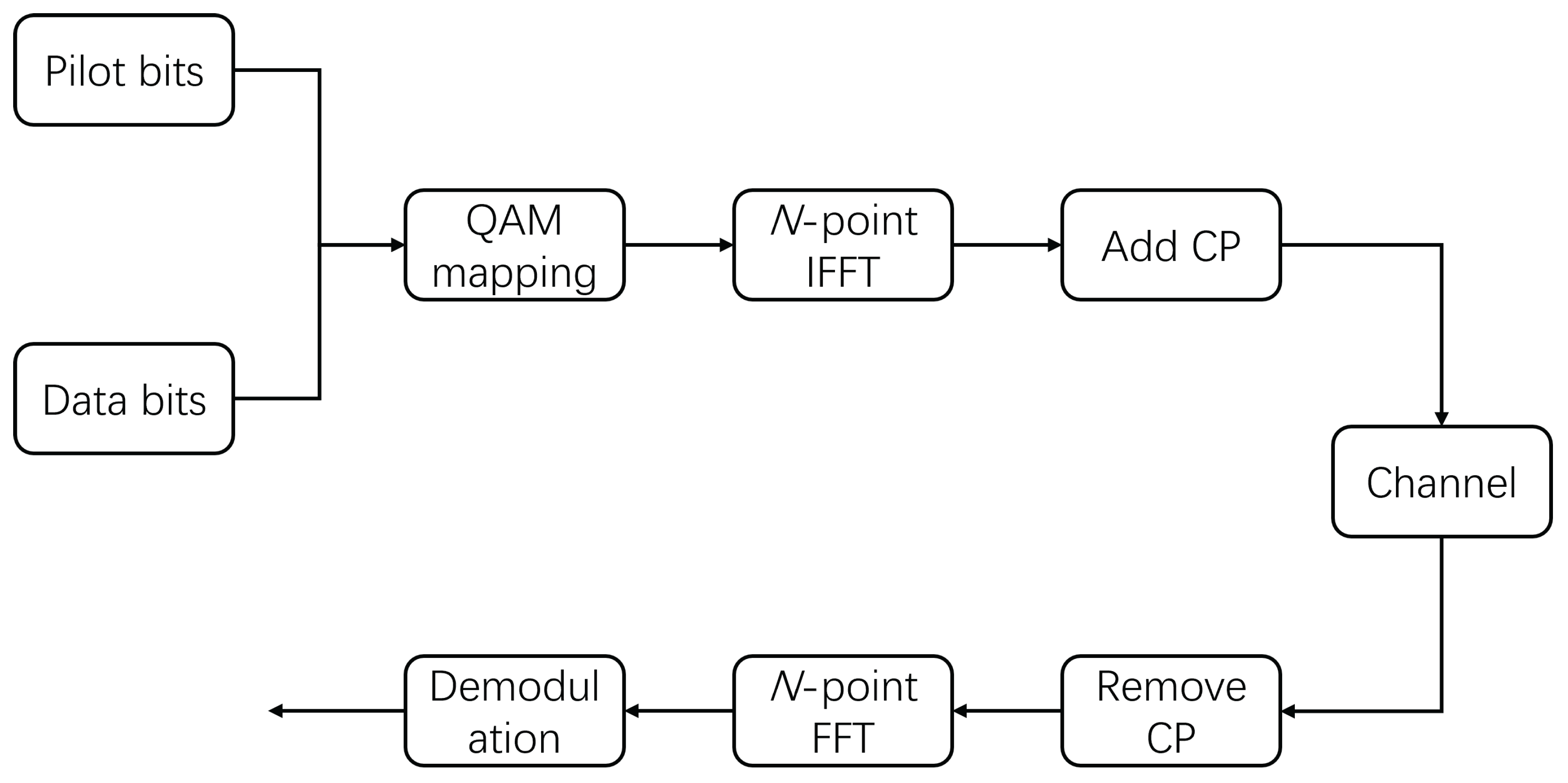
In this section, we evaluate the performance of the proposed joint synchronization and channel estimation algorithm and compare it with several representative baseline methods. Since the proposed method is developed for the conventional CP-OFDM frame structure without introducing additional dedicated training preambles, three representative CP-redundancy-based synchronization schemes, namely the cyclic-prefix correlation method (CP-Corr) [
23], the cyclic-prefix differential method (CP-Diff) [
24], and the Van de Beek method (Van) [
25], are first considered for comparison under the same frame structure. In addition, the maximum-likelihood-based method (ML) [
21] and the expectation–maximization-based method (EM) [
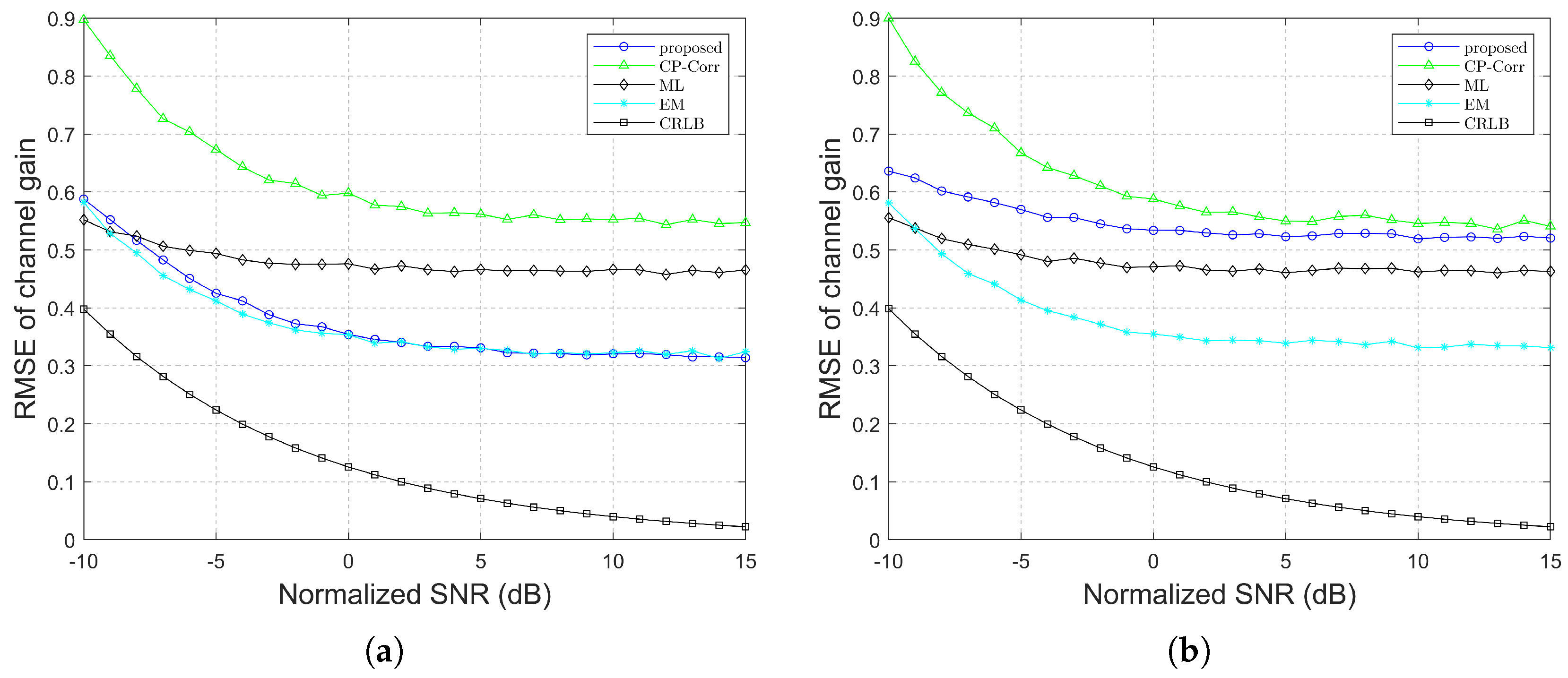
26] are included as iterative joint-estimation baselines. For the CE performance comparison, the proposed method is further compared with the separate processing scheme that applies least-squares (LS) channel estimation after synchronization.
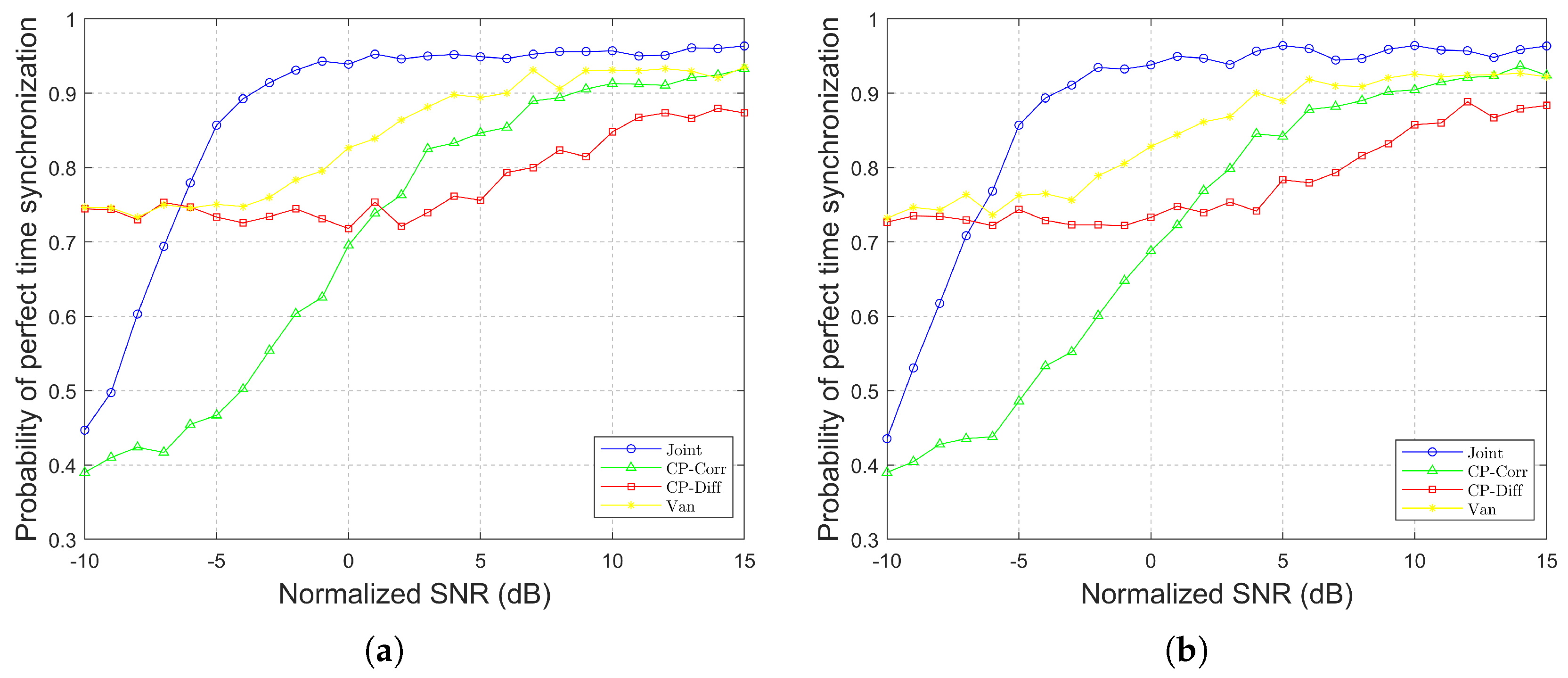
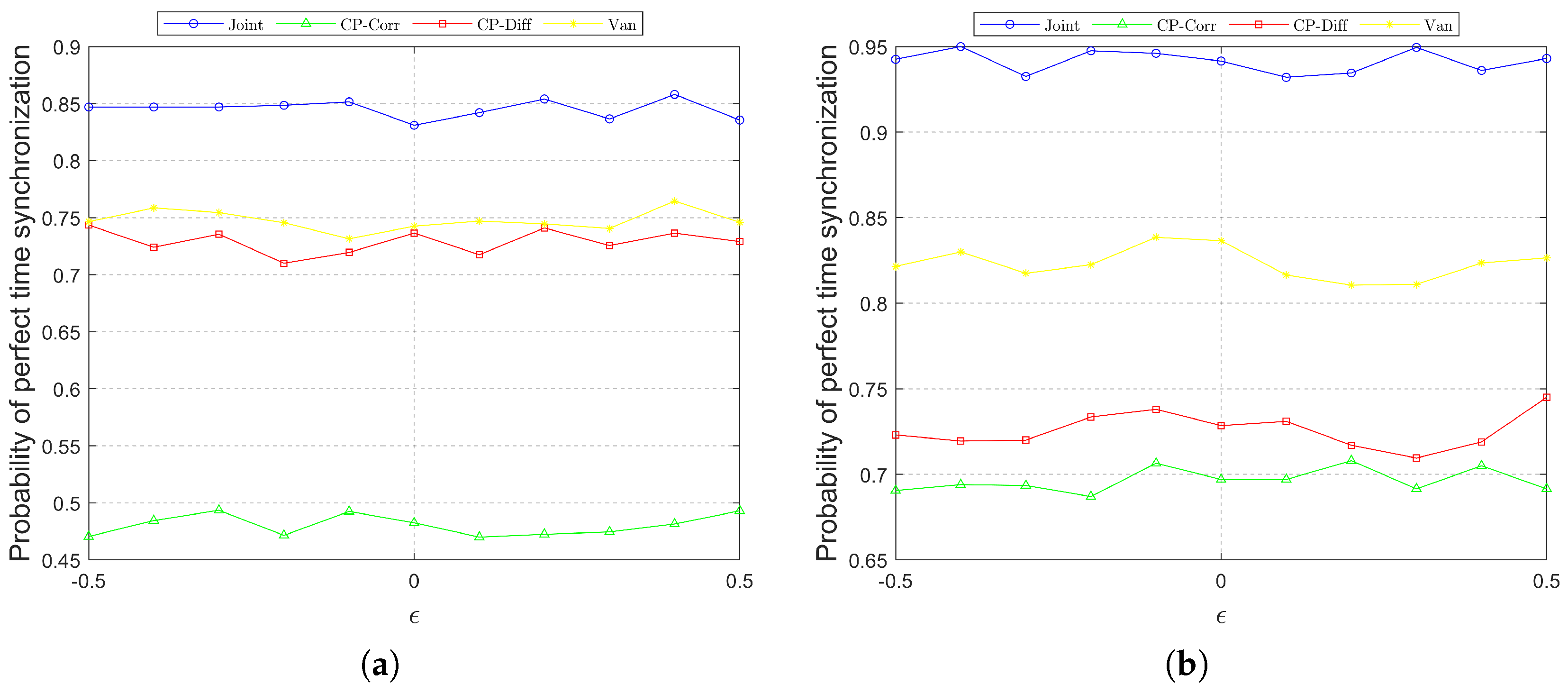
The performance metrics include the probability of perfect timing synchronization and the root-mean-square error (RMSE) for STO estimation, as well as the RMSE for CFO estimation and CE. The probability of perfect timing synchronization
is defined as the probability that the estimated reference index equals the true reference index. This probability is numerically approximated by
, where
denotes the total number of Monte Carlo trials,
denotes the estimated reference timing instant in the n-th trial, and
is the indicator function. In this part, the normalized SNR is used, defined as
assuming the signal power of each component is 1. The parameter values used in the simulations are listed in
Table 1. Each point in the figures presented in this section is obtained from 2000 Monte Carlo experiments, except that the CRLB is obtained by numerical methods.
4.5. Robustness to Error in Number of Paths
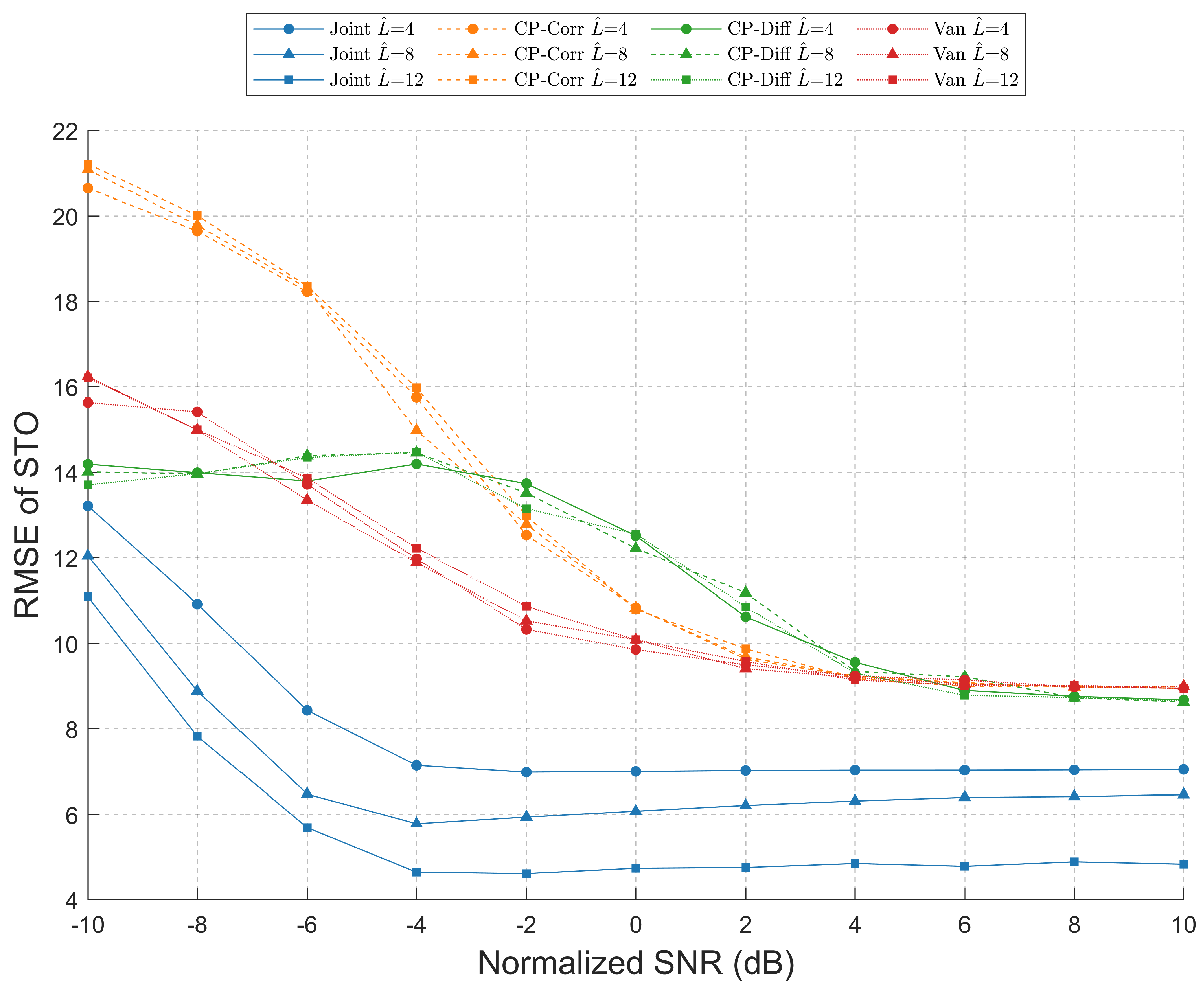
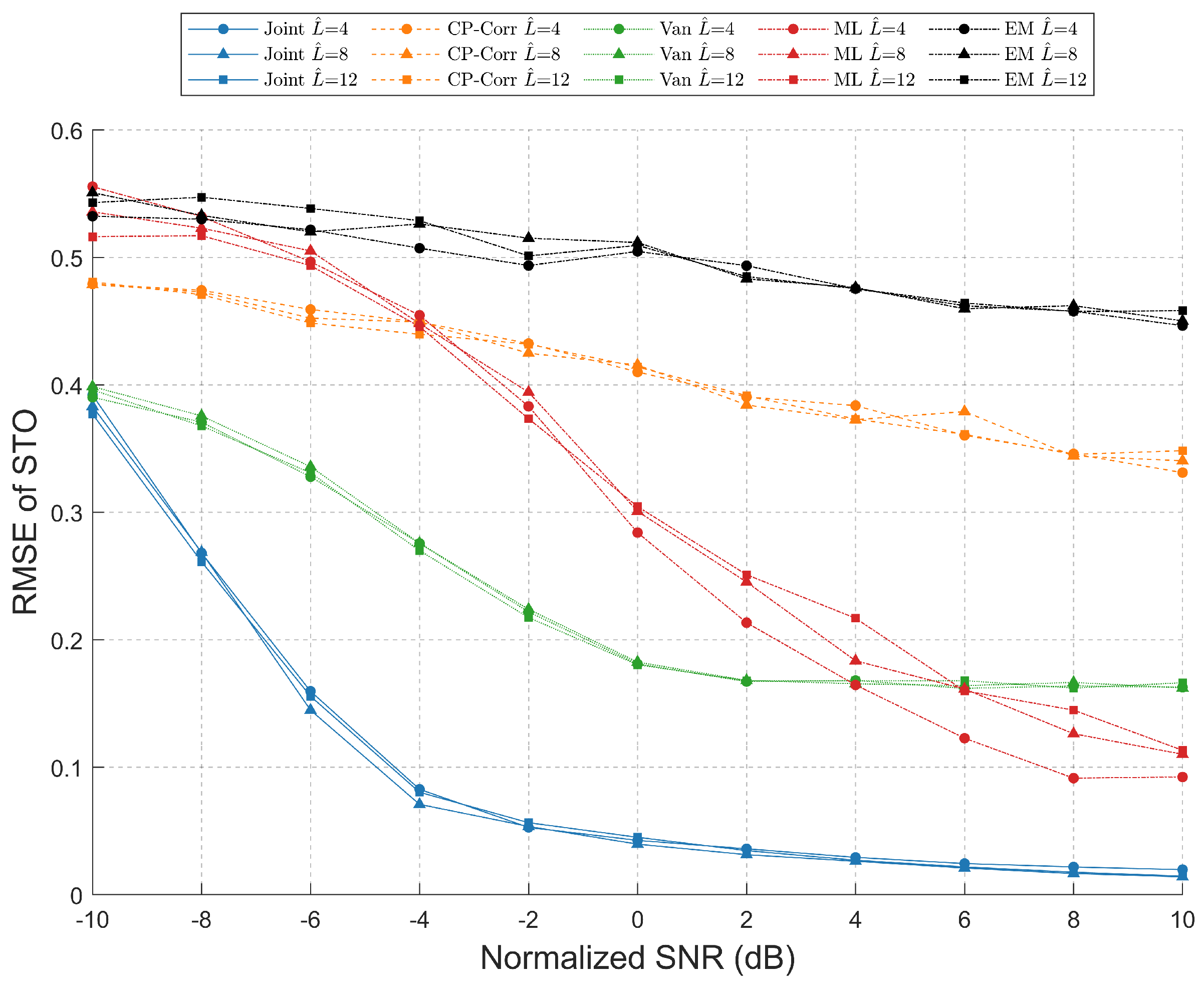
This part evaluates the impact of incorrect knowledge of the number of propagation paths L on the performance of the proposed method as well as the CP-Corr, CP-Diff, and Van methods. In this section, the CFO is fixed at a moderate value of = 0.4. Let denote the number of propagation paths assumed at the receiver when performing synchronization and CE, which is not necessarily equal to the true number of paths L. We consider the simulation scenarios (L, ) = (8, 4), (8, 8), and (8, 12). These scenarios cover the cases where the number of paths used at the receiver is smaller than, equal to, or larger than the actual number of paths.
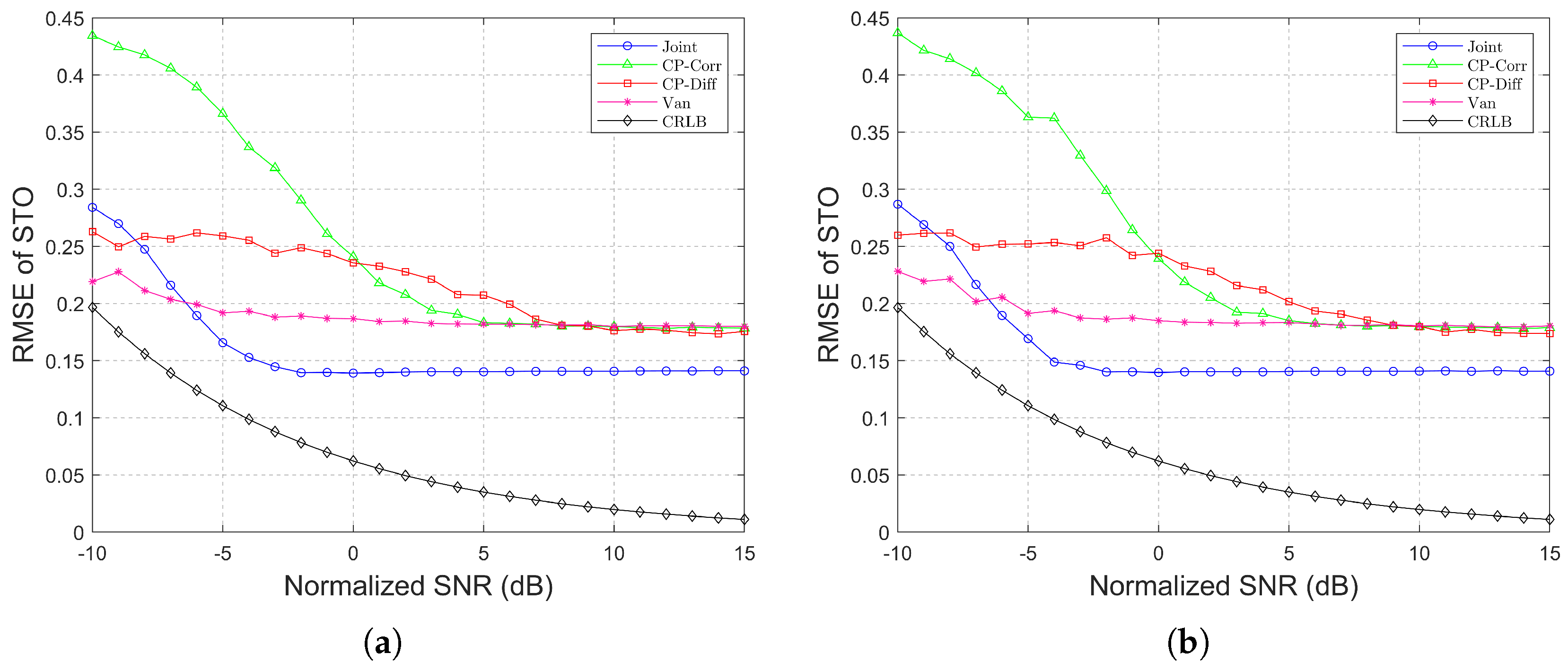
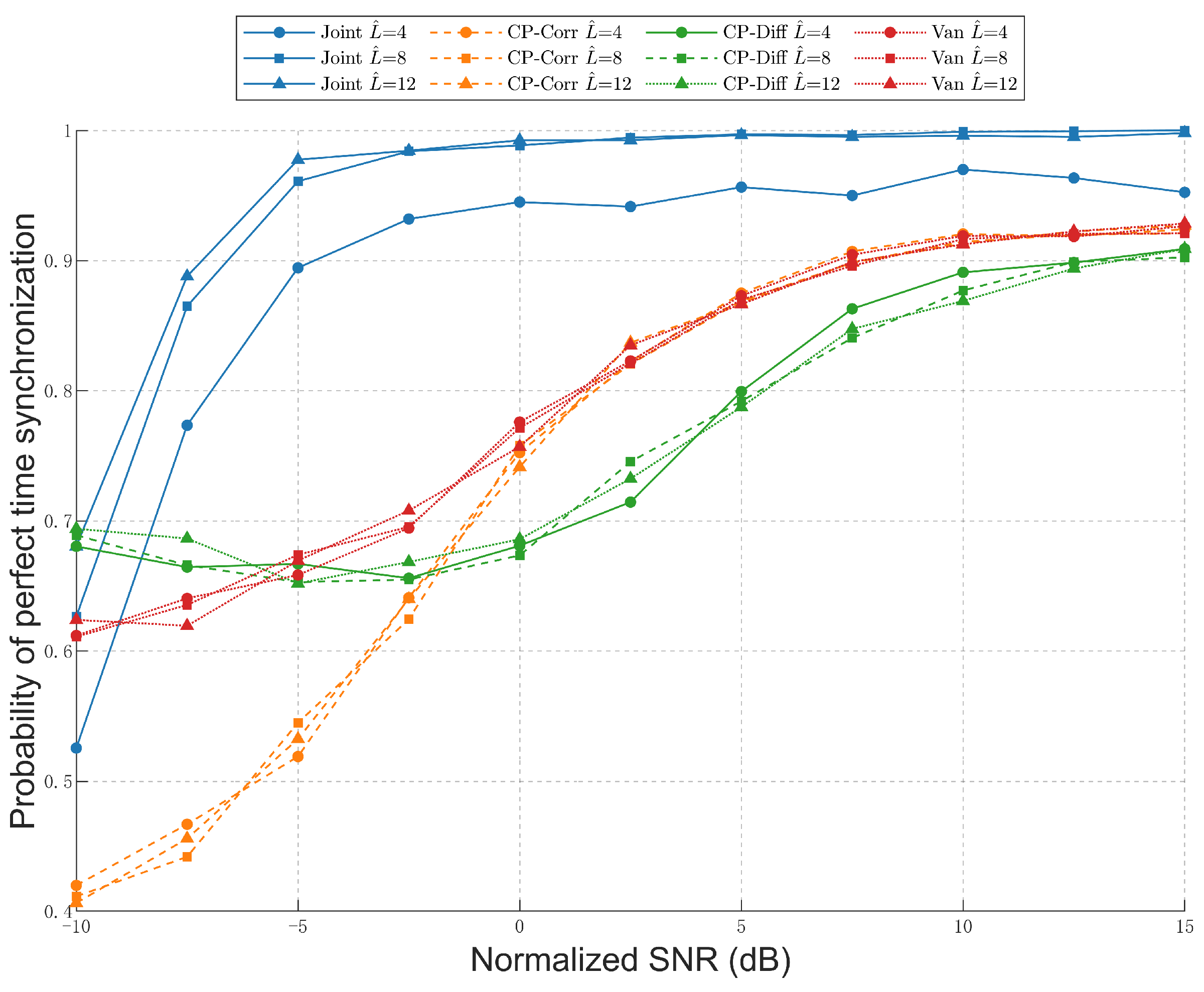
Figure 8 and
Figure 9 illustrate the performance of the proposed method under path-number mismatch, where the true number of channel taps is
and the assumed value is
. As shown in
Figure 8, the proposed method consistently achieves a higher probability of perfect timing synchronization than CP-Corr, CP-Diff, and Van for all tested
values. Among the three settings,
provides the highest synchronization probability over most of the low-to-moderate SNR region, while
becomes slightly better at high SNR. By contrast,
yields the lowest synchronization probability, indicating that underestimating the channel length is more detrimental than moderate overestimation. In comparison, the three conventional methods are only weakly affected by
, since they do not explicitly rely on the channel order in the synchronization process.
A similar trend can be observed in
Figure 9. The proposed joint estimation method still outperforms the conventional methods over the entire SNR range under all tested
values. Moreover, among the three candidate values,
achieves the lowest RMSE, followed by
, whereas
gives the largest RMSE. These results show that the proposed method is robust to moderate path-number mismatch. Therefore, when the true path number is unavailable, adopting a slightly conservative
or selecting
from a small candidate set according to the residual cost is a practical strategy.
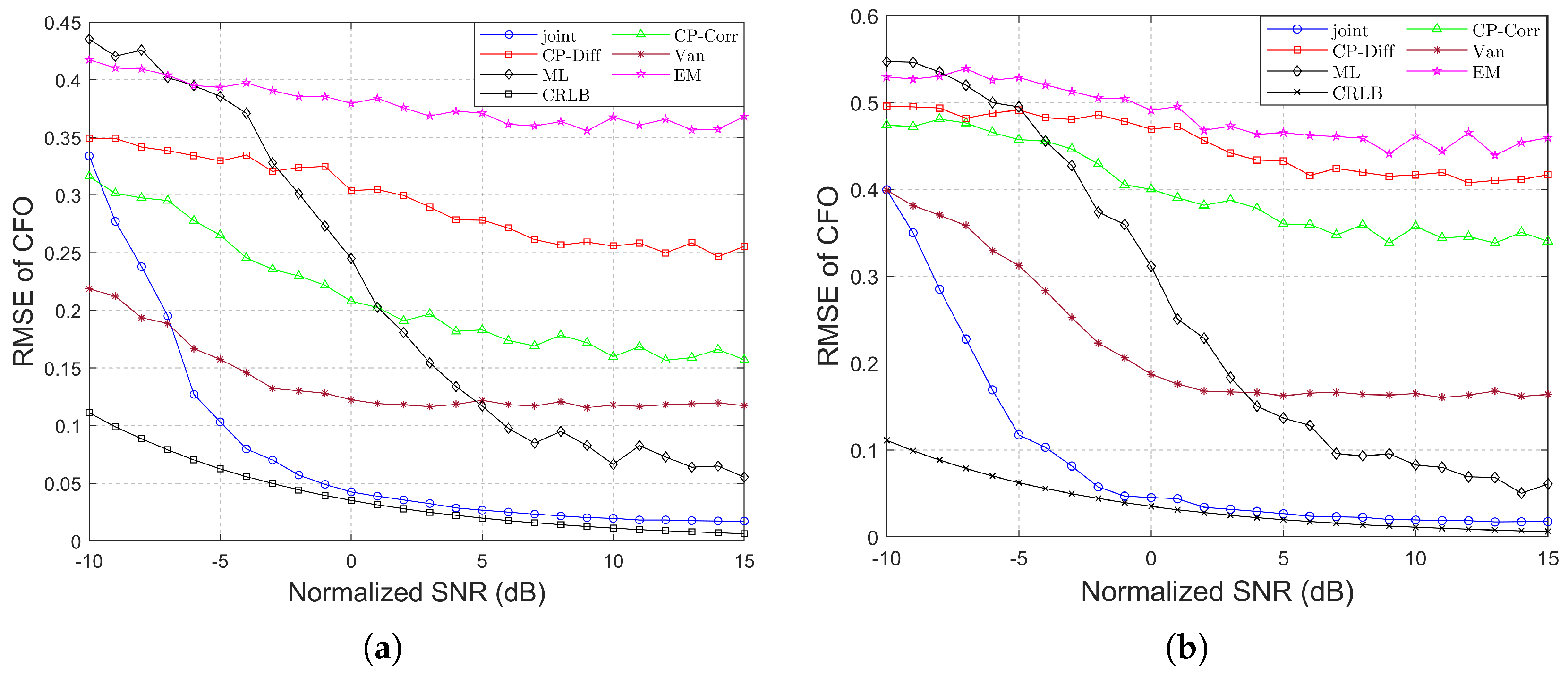
Figure 10 presents the RMSE of CFO estimation under path-number mismatch for the cases
,
, and
. It can be observed that the RMSE of all methods decreases as the SNR increases. For nearly all SNR values, the proposed method achieves the lowest CFO-estimation RMSE among the compared methods under all three assumed path numbers, demonstrating strong robustness to path-number mismatch. These results indicate that the proposed method remains effective for CFO estimation even when the assumed number of propagation paths does not exactly match the true channel order.
The path-mismatch experiment in this subsection is intended to provide a controlled analysis of receiver-side model-order mismatch by isolating the effect of an incorrectly assumed channel length. In practical implementations, synchronization and channel estimation are typically carried out with respect to an effective channel length or significant-path number, rather than the exact physical number of propagation paths. Such an effective model order may be determined by a preliminary selection procedure based on, for example, the delay-domain energy distribution, a thresholding rule for dominant paths, or residual-cost evaluation over a small candidate set. Under this interpretation, the results in
Figure 8,
Figure 9 and
Figure 10 suggest that the proposed method remains applicable when combined with a front-end model-order selection stage.