Article

Evaluating Techno-Economic Feasibility of Green Hydrogen Production Integrated with a Wave Energy Converter Device

by
Sagar Kansara
1,
Kourosh Rezanejad
2,3,*,
Mohammad Jahanbakht
3,4 and
Diogo M. F. Santos
5,*
1
MEGE Program, Mechanical Engineering Department, Instituto Superior Técnico, Universidade de Lisboa, 1049-001 Lisbon, Portugal
2
Centre for Marine Technology and Engineering (CENTEC), Instituto Superior Técnico, Universidade de Lisboa, 1049-001 Lisbon, Portugal
3
Frenesim Das Ondas, LDA (Wave To Energy™), 2650-463 Amadora, Portugal
4
Department of Industrial, Manufacturing, and Systems Engineering, University of Texas at Arlington, Arlington, TX 76019, USA
5
Centre of Physics and Engineering of Advanced Materials (CeFEMA), Laboratory of Physics for Materials and Emerging Technologies (LaPMET), Chemical Engineering Department, Instituto Superior Técnico, Universidade de Lisboa, 1049-001 Lisbon, Portugal
*
Authors to whom correspondence should be addressed.
Fuels 2025, 6(4), 92; https://doi.org/10.3390/fuels6040092 (registering DOI)
Submission received: 14 September 2025 / Revised: 14 October 2025 / Accepted: 1 December 2025 / Published: 4 December 2025
(This article belongs to the Topic Hydrogen Energy Technologies, 3rd Edition)

Abstract

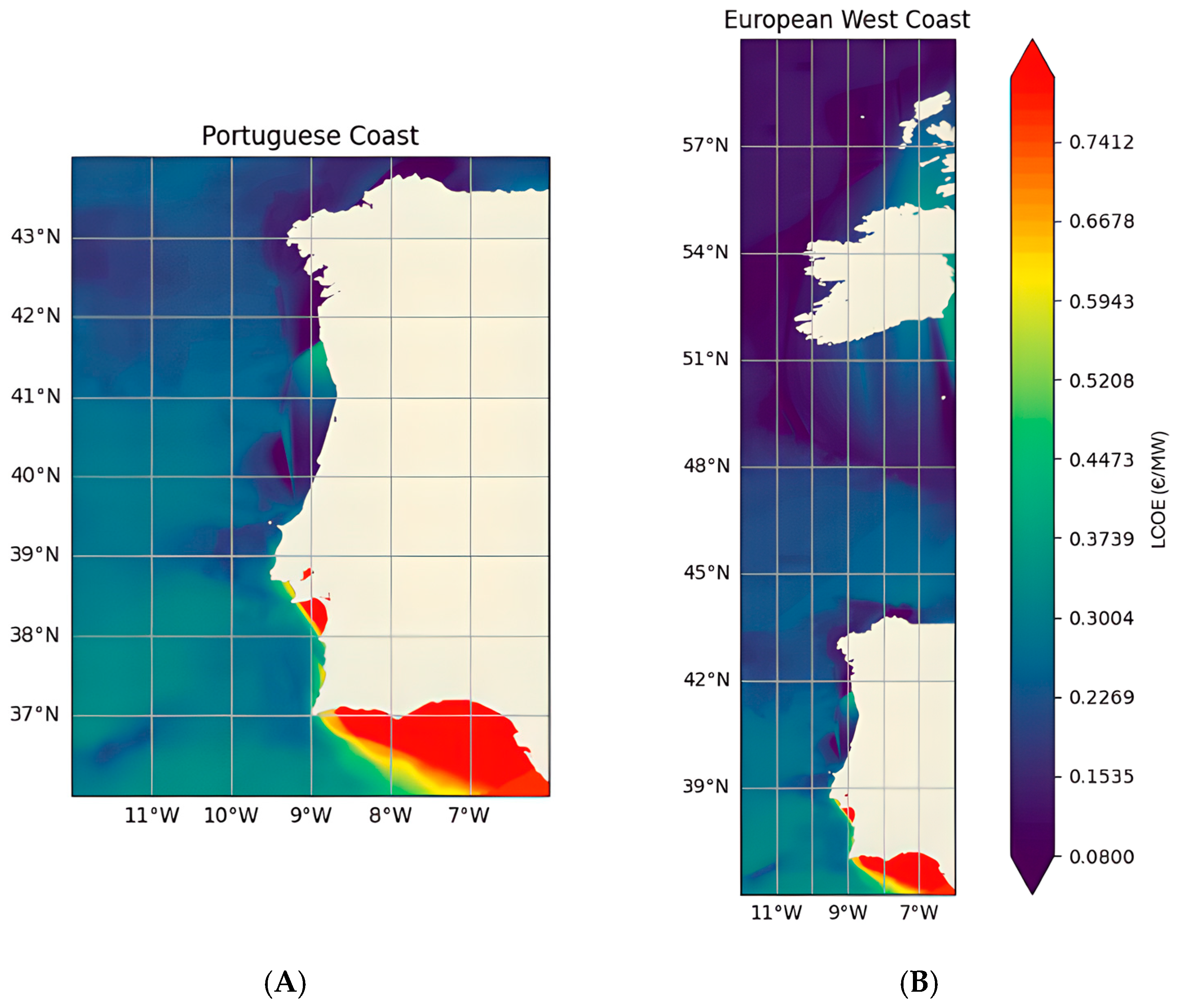
The urgent need to address climate change has driven the exploration of sustainable energy solutions, with wave energy and green hydrogen emerging as prominent alternatives to traditional fossil fuels. This study examines the potential synergy between wave energy and hydrogen production, with a focus on the economic viability of integrating these technologies. Through a detailed analysis of the levelised cost of electricity (LCOE) and the levelised cost of hydrogen (LCOH), this paper examines how coastal regions in Portugal and across Western Europe can harness wave energy to produce green hydrogen, a crucial component in the global energy transition. The techno-economic assessment accounts for capital and operational costs, energy efficiency, and lifetime performance to determine how design and location affect economic feasibility. Preliminary analysis indicates that regions with significant wave power potential present opportunities for competitive LCOE values, with some coastal areas achieving LCOE figures as low as 0.10 €/kWh. Additionally, the LCOH analysis reveals that among various storage methods, compressed gas hydrogen at 350 bar stands out as the most cost-effective option. This research highlights the transformative potential of wave energy-driven hydrogen production as a crucial solution for decarbonising the maritime sector. Future technological advancements and cost efficiencies are poised to overcome current economic barriers and accelerate the transition to a sustainable, low-carbon energy landscape.

1. Introduction

Maritime transport accounts for nearly 3% of global carbon dioxide (CO2) emissions, underscoring the urgency of decarbonising this sector [1]. As maritime transportation is essential for global trade, it has become a critical area of focus in discussions on reducing carbon emissions. The essential sector’s reliance on heavy fuel oils underscores the urgency of transitioning to renewable energy sources. Wave energy and green hydrogen (H2), in particular, show strong potential for decarbonising marine transport due to their compatibility and scalability. Estimates suggest wave energy could generate up to 29,500 TWh per year globally, nearly double the world’s current electricity consumption of around 23,000 TWh [2]. Recent global techno-economic assessments suggest that wave energy, although currently expensive, could become highly cost-competitive by 2050 in regions with strong wave climates. For example, projections indicate that levelised cost of electricity (LCOE) values will drop below 0.05 €/kWh in areas such as the northern British Isles, South Africa, and Portugal due to reduced capital expenditure (CAPEX) and technological maturity [3]. As of 2023, the wave energy market is valued at ca. 850 million euros and is projected to experience significant growth by 2030, driven by rising investments in renewable energy technology and increasing global energy demand [4].
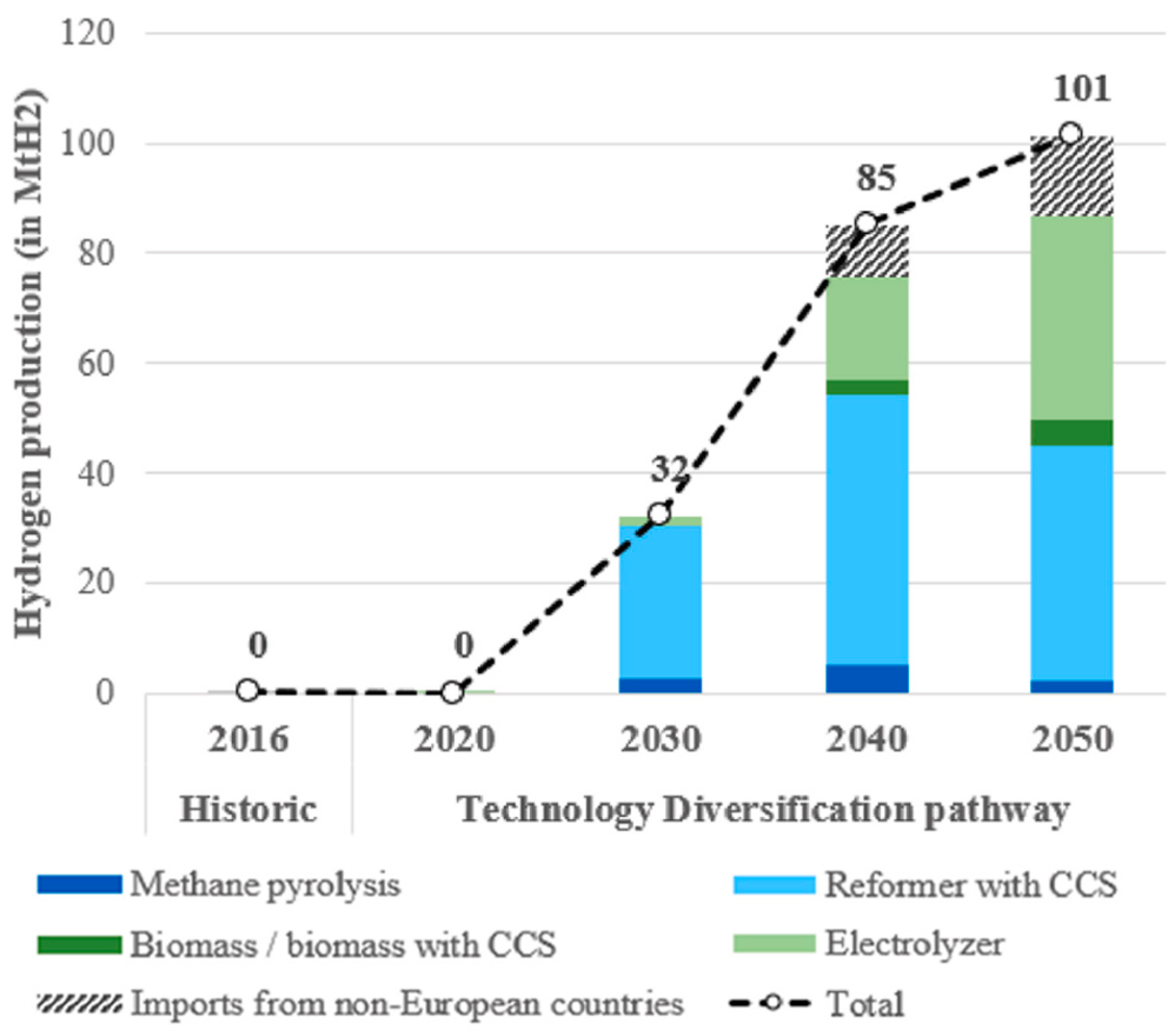
Green H2 produced using renewable energy is increasingly recognised as a viable decarbonisation pathway for transport and industry. This momentum is reinforced by large-scale policy commitments and international projects aimed at integrating H2 into energy systems, with countries like Germany and Japan allocating billions toward H2 infrastructure and production incentives [5]. Studies analysing market trends in renewable energy technologies, along with the current state of green H2 [6], demonstrate an exponential increase in H2 production. Thus, electrolysis technology is poised to become a key player by 2050, as shown in Figure 1.
This method is expected to drive significant growth in H2 availability as countries focus on reducing reliance on fossil fuels. The integration with renewable energy sources further decreases carbon intensity, making it a promising option for achieving low-carbon H2 production. Projections indicate rapid adoption and expanding use of green H2 across sectors, positioning it as a key player in the transition towards sustainable energy solutions. By examining factors such as production costs, operation expenses, and lifecycle analyses, these studies offer valuable insights into the economic viability and long-term sustainability of green H2 production methods [7,8]. However, despite increasing attention, several research bottlenecks remain. Most studies on H2 production from marine renewables focus on offshore wind integration [9], while wave-driven systems are less explored due to the complexity of wave profiles and limited full-scale demonstrations. Consequently, the feasibility of coupling wave energy with H2 production remains under-investigated, particularly along the western European coastline, where previous work has mainly examined nearshore single-chamber oscillating water column (OWC) systems. The present study extends this research by evaluating a dual-chamber OWC configuration that demonstrates higher overall conversion efficiency and improved techno-economic feasibility under comparable regional conditions.
Thus, green H2 remains the most environmentally sustainable form of H2, although it faces higher production costs and efficiency losses compared to blue or grey H2, especially due to the intermittency of renewable energy inputs [10]. H2 demand is expected to reach 75 MT by 2030 to achieve the emission-free energy system targets, with an estimated 660 MT by 2050 [11]. The European Commission has spearheaded a comprehensive H2 strategy, outlining ambitious objectives, including installing at least 40 GW of electrolyser capacity by 2030 to produce 10 MT of H2 from renewable energy sources [12]. According to the IEA’s Global Hydrogen Review, the production of low-emission H2 by 2030 will exceed 20 Mt, assuming all the announced projects in electrolysis and fossil fuels with CCUS are realised. Approximately 50% of the H2 produced from these projects will emerge from feasibility studies, and about 45% will come from projects still in the early stages of development [11].
Integrating H2 production with wave energy combines the benefits of two sustainable technologies, offering a pathway to produce H2 with minimal environmental impacts. By harnessing wave energy to power electrolysers, coastal regions can generate green H2 locally, reducing fossil fuel dependency and lowering carbon emissions. This study presents a comprehensive techno-economic feasibility assessment that extends beyond conventional LCOE and levelised cost of hydrogen (LCOH) calculations by incorporating three key dimensions. To address the research gaps, this study adopts a multidimensional approach that integrates spatial, techno-economic, and design-based evaluations. The framework combines (i) spatial mapping of wave resources across Western Europe, (ii) expert-validated technology cost and performance analysis, and (iii) evaluation of a dual-chamber OWC wave energy converter (WEC) concept to determine LCOE and LCOH.
Secondly, instead of adopting a conventional approach that focuses on a single region or a predetermined country, such as limiting the analysis to Portugal, this study undertakes a much broader spatial assessment, encompassing the entire western European coastline. Furthermore, wave resource availability along the western European coast has been widely characterised as both consistent and high intensity. Lavidas and Venugopal explored the nearshore wave power potential across the Atlantic-facing regions of Scotland and Portugal, identifying long-period swell waves as a dominant contributor to energy availability during winter months [13]. This characteristic enhances the predictability and regularity of energy production, especially when paired with robust seasonal analysis. Importantly, these areas are influenced by westerly wind regimes, which support wave growth and sustain high energy fluxes over extended periods. Long-term datasets, such as those from Reguero [14], have further demonstrated that interannual and decadal variability in wave power is more pronounced in the Northern Hemisphere, yet within acceptable ranges for stable infrastructure investment. These insights underscore the resilience of wave energy projects in Western Europe, despite the region’s inherent climate fluctuations. This regional-scale evaluation considers variations in wave power potential, infrastructure accessibility, and maritime activity, enabling a more nuanced understanding of the geographical feasibility of integrating wave energy with green H2 production. By evaluating multiple locations rather than a single case study, the findings of this research are more widely applicable and adaptable to different regulatory, economic, and environmental contexts.
Thirdly, this study introduces a novel Wave-To-Energy WEC design featuring a dual-chamber OWC, which improves primary energy conversion efficiency. Unlike conventional OWCs, the dual-chamber configuration provides additional space to house the H2 systems, enhancing wave energy capture and leading to greater energy extraction before conversion losses occur in the pneumatic chamber. This increased efficiency is critical for H2 production, as it ensures more energy is available for electrolysis, reducing overall LCOH. By integrating this advanced WEC technology, the study demonstrates a significant improvement in the feasibility of offshore H2 production compared to traditional single-chamber OWCs.
Finally, the study integrates these insights into a detailed LCOE and LCOH analysis, systematically linking spatial, technical, and economic parameters. This holistic approach ensures that the cost assessments reflect not only the direct capital and operational expenditures but also the broader site-specific factors that influence the economic viability of green H2 production from wave energy. By combining technical feasibility with economic considerations and geographic evaluation, this research provides a well-rounded perspective that can inform future policy, investment decisions, and the strategic deployment of offshore H2 production facilities.
The present work is structured as follows: Section 2 addresses the main application of this solution; Section 3 presents the methodology used to develop the framework of the techno-economic model; Section 4 analyses the techno-economic model, breaking down the factors that affect the LCOE and LCOH; Section 5 presents the model’s results, highlighting the main outcomes of the optimised simulations; and finally, Section 6 draws the main conclusions of the study.
By aligning H2 production with key maritime pathways, this study connects wave energy resource assessments with the practical requirements of green fuel deployment. It thereby strengthens the link between coastal renewable resources and decarbonisation pathways for the shipping sector, contributing to the broader transition towards sustainable, low-carbon energy solutions.

2. Hydrogen Application in Decarbonising Maritime Transport

Building upon this context, maritime shipping remains one of the most challenging sectors to decarbonise, primarily due to its reliance on heavy fuel oil (HFO). This carbon-intensive fuel also contributes to other forms of environmental pollution, such as sulphur oxides and particulate matter. Shipping traffic contributes between 0.2% to 14% for PM2.5 (particulate matter with a diameter of less than 2.5 micrometres) in Europe and between 3% and 9% in North America [15]. The exponential growth in trade and transportation has further increased pressure on the maritime industry to transition to cleaner energy sources. Recent studies have emphasised the integration of clean fuels, such as H2 and ammonia, into maritime supply chains as part of the response to increasingly stringent International Maritime Organisation environmental regulations [16]. Green H2 is emerging as a key alternative fuel in marine transportation, an area with significant untapped potential for decarbonisation. According to the IEA, the use of H2 fuel in transport increased by 45% in 2022 compared to 2021. By the end of 2022, there were 58,000 fuel cell electric vehicles (FCEVs) globally, with the majority in South Korea, the United States, and China. Additionally, the demand for H2-powered buses and trucks is growing, alongside other advanced green H2 solutions [17].
Green H2 is emerging as a significant alternative fuel in transportation, particularly in the marine industry, and is becoming one of the largest untapped markets for decarbonisation. The global sustainable marine fuels market, which includes green H2, was valued at 7.50 billion euros in 2023 and is projected to reach ca. 440 billion euros by 2033 [18]. One study has demonstrated the feasibility of integrating wave energy with water electrolysis and has been proposed to ensure continuous renewable energy availability [19]. Green H2 offers an alternative to the typically used marine heavy fuel oils (HFO). According to a techno-economic optimisation study, H2 presents a promising alternative to heavy fuel oil due to its lower lifecycle GHG emissions, especially when produced through renewable pathways. However, transport-related challenges, such as boil-off gas and cost, remain key constraints [16]. It boasts a higher energy density than HFO, enhancing efficiency and range while reducing the carbon footprint [20]. In high-energy wave zones in the coastal regions of Europe, hybrid systems coupling Wave Dragon WECs with onshore electrolysis have demonstrated LCOH values as low as 3.6 €/kg under optimised conditions [21].
Green H2 for maritime travel is already being utilised in various projects worldwide. Alternative fuels, such as green H2 and ammonia, offer varying pathways to decarbonise the maritime sector, although each presents trade-offs in terms of infrastructure readiness, energy density, and emissions potential [22]. In-depth comparative assessments have demonstrated that green H2 and ammonia offer substantial reductions in GHG emissions compared to LNG and conventional marine diesel, with well-to-propeller emissions being 30–60% lower, depending on the production method and onboard systems [23]. According to the IEA, the European Union adopted a new regulation, FuelEU Maritime, in July 2023 to increase the use of low-carbon fuels in shipping, offering incentives for those making the switch. Norway introduced the world’s first liquid H2 ferry, the MF Hydra, in 2023, with plans for two more vessels by 2024 [24,25]. The United States launched the first commercial H2-powered maritime vessel, the Sea Change, and a H2-powered barge was launched in the Netherlands. The global momentum to replace traditional HFO with H2 is gaining traction, paving the way for a cleaner future.
Wave-powered H2 production could serve as an integrated solution for remote coastal and island locations. Such decentralised H2 production models could reduce dependence on long-distance fuel supply chains, supporting resilience and energy autonomy in coastal regions. However, system-wide integration would require advances in H2 storage and distribution, including liquid H2 and ammonia-based carriers, which are being actively investigated in current international projects [5].
Green H2 has the potential to drastically reduce the carbon footprint of maritime shipping. However, while its renewability is well-documented, its practical application requires careful economic assessment. Studies, such as those by Huertas-Fernandez et al., have demonstrated that H2 production from wave energy can be viable when integrated with financial models to evaluate its long-term feasibility [18]. A comparative life cycle assessment (LCA) of H2, ammonia, and LNG marine fuels reveals that green H2 achieves the greatest reduction in well-to-wake CO2-equivalent emissions, provided the electricity used is entirely generated from renewable sources [23]. The results from their study suggest that site-specific considerations, including wave energy availability and infrastructure costs, are critical in ensuring economic success. Huertas-Fernández et al. highlighted that prior research on H2 production from wave energy in port areas demonstrates its feasibility in practical applications [19]. From a policy standpoint, alongside the technical aspects, the adoption of H2 as a maritime fuel is advancing through emerging fuel standards and port initiatives. The International Maritime Organisation (IMO) is developing greenhouse gas intensity regulations for marine fuels, expected to take effect by 2028, which will promote low-carbon alternatives such as H2 [26]. However, infrastructure readiness remains limited: only a small number of ports, including Rotterdam, Valencia, and Trondheim, have initiated H2 bunkering or refuelling projects, while most global ports still lack the necessary storage and handling capabilities [27]. Coordinated regulatory frameworks and targeted port-side investments will be critical to enable large-scale deployment.
To effectively address the challenge of decarbonising the maritime shipping industry, it is essential to develop a comprehensive and well-structured methodology, followed by a detailed techno-economic analysis. The following methodology will guide the exploration of the technical aspects necessary to successfully integrate green H2 with wave energy.

3. Methodology

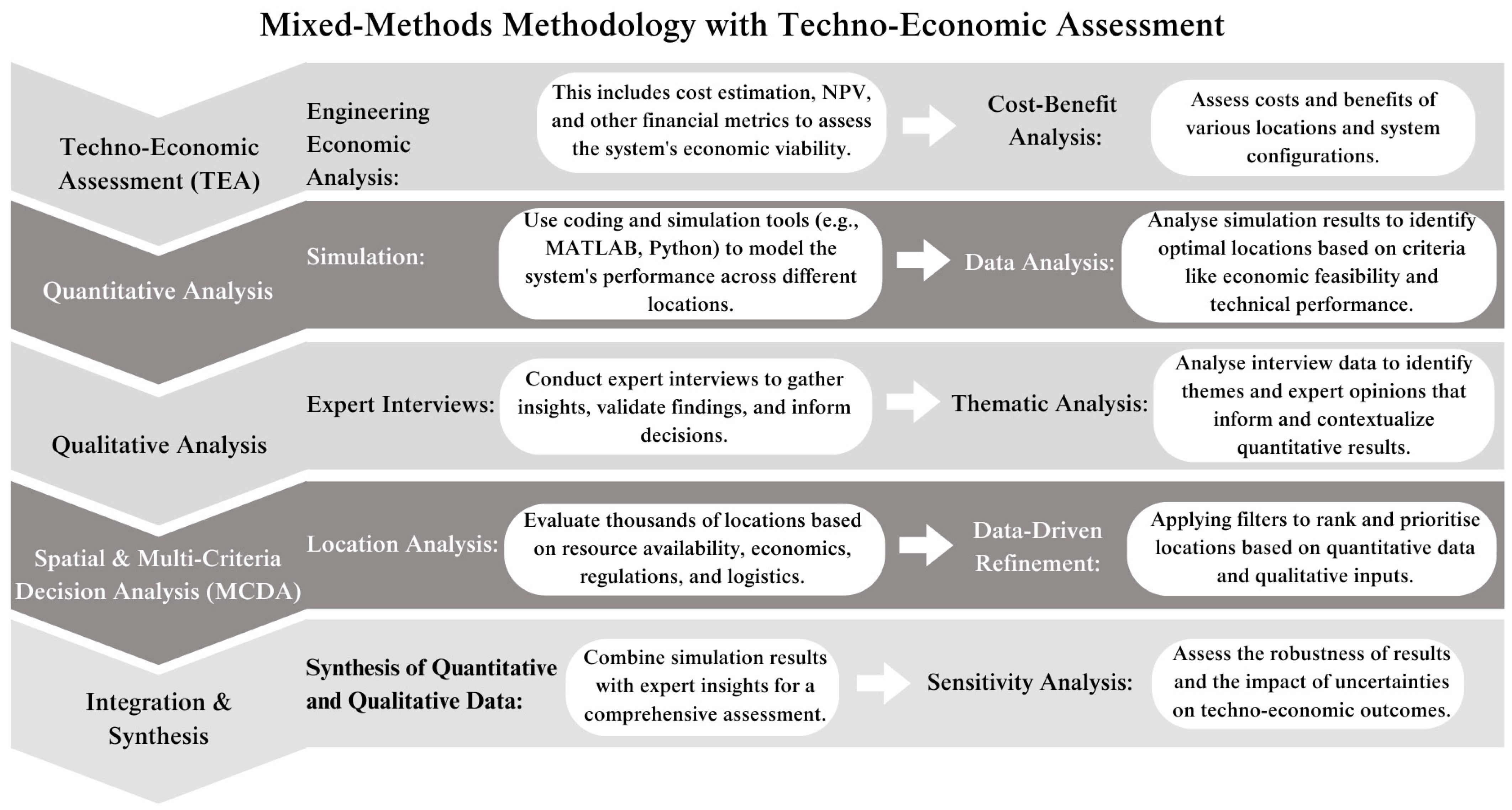
This section presents the entire research process, covering the data collection, system configuration, performance simulation, and cost modelling required to assess the feasibility of wave energy-to-hydrogen systems. The study employs a mixed-methods approach to analyse the integration of wave energy with H2 production and storage. This study integrates techno-economic, spatial, quantitative, and qualitative analyses to assess feasibility, as shown in Figure 2.
The techno-economic assessment framework was adopted to evaluate both the technical performance and cost-effectiveness of the proposed wave-to-hydrogen system. The approach integrates technical modelling with cost indicators through the LCOE and LCOH, capturing the full conversion chain from wave energy to H2 storage. LCOE reflects the discounted cost of electricity generation over a 30-year lifetime, while LCOH translates this into the equivalent cost of H2, including electrolysis, compression, and storage. The techno-economic assessment follows established IEA, IRENA, and DOE guidelines, providing a structured and comparable basis for assessing renewable H2 pathways. The quantitative analysis utilises simulation tools, such as Python 3.10, to evaluate the system’s performance across geographically diverse locations. The qualitative analysis involves interviews with industry experts to gain insights into the feasibility, challenges, and opportunities associated with the system. The spatial analysis involved evaluating thousands of locations based on criteria such as resource availability, economic factors, and logistical considerations. These locations were ranked and prioritised using both quantitative and qualitative data inputs. Finally, the quantitative simulation results and qualitative insights from the experts were integrated to provide a comprehensive assessment along with a sensitivity analysis to evaluate the robustness of the results under varying assumptions.

Data Collection

In addition to conducting a comprehensive literature review on wave energy and H2 production, an extensive data collection process was undertaken by directly engaging with relevant industry companies. To respect confidentiality agreements, the names of these companies and employees have been kept anonymous, as some of the information provided was sensitive and not intended for public disclosure. Table 1 provides an insight into the different companies and their respective area of expertise.
Company A provided the schematics for the WEC that will be used in this research. The WEC they supplied is a sophisticated floating double-chamber oscillating water column system designed to optimise wave energy capture and conversion. The detailed design and functionality of this WEC will be thoroughly discussed in the following section of the study, as it forms the core technology around which the analysis is built.
Company B offered a comprehensive analysis of WECs. Their report delves deeply into the various types of WECs, providing a robust evaluation of the economic factors to consider when developing a wave energy farm. The report has been instrumental in informing the cost estimation for this study’s LCOE analysis. Many financial assumptions and values used in the LCOE calculations were derived from the detailed data and insights presented in this document [16].
Together, the contributions from these two companies have been crucial in shaping the technical and economic framework of this research. Company A’s advanced WEC design, combined with the in-depth economic analysis from Company B, has provided a solid foundation for exploring the viability and potential of wave energy as a sustainable power source.
Company C specialises in H2 production through advanced electrolyser technologies and plays a pivotal role in guiding the selection process for the most suitable electrolyser technology for integration with the WEC. Their expertise provided valuable insights into the advantages and limitations of different electrolyser types, particularly in the context of variable power inputs characteristic of wave energy systems.
Alkaline electrolysers, while well-established, are less suited to handle the fluctuations in current density that occur with wave energy. These systems require a more gradual ramp-up and ramp-down process, meaning they cannot quickly adjust from 0 to 100% power. Instead, they must increase in stages, such as from 0–15% over 15 min, then from 15–30% over the next 15 min, and so on. This stepwise approach limits their efficiency in environments where power input can change rapidly.
On the other hand, proton-exchange membrane (PEM) electrolysers offer better ramping capabilities, allowing for quicker adjustments to changing power levels. However, according to Company C, solid oxide electrolysis cells (SOEC) represent the most promising technology for use with WECs. SOECs are particularly well-suited to handle rapid fluctuations in power, efficiently managing the quick ramp-up and ramp-down scenarios common in wave energy applications. Despite this, SOEC technology is still in the developmental stage and has not yet been fully commercialised, presenting a challenge for immediate large-scale deployment.
Company C’s expertise extends from the transformer rectifier to the compressor, covering everything in between, but it does not encompass H2 storage solutions. They focus on the production and initial compression stages, ensuring that the H2 generated is ready for subsequent storage or transportation by other systems.
Company D also specialises in water electrolysis, although they are more reserved about sharing detailed information. However, they did mention that several relevant projects are being developed by other companies, such as the CrossWinds Prototype, a 1 MW offshore H2 production platform that could provide valuable insights and potential benchmarks for similar endeavours. This reference to CrossWinds suggests there are emerging efforts in the industry to explore offshore H2 production, which could offer lessons or synergies for the current project.
Beyond this, most of the technical details provided by Company D were consistent with the information already confirmed by Company C, particularly regarding the strengths and limitations of various electrolysis technologies. While Company D’s reluctance to fully disclose details limited the depth of its contribution, their mention of ongoing projects, such as CrossWinds, underscores the growing interest and activity in offshore H2 production, indicating a broader industry trend towards exploring and validating these technologies in real-world settings.
Company E specialises in offshore H2 production, primarily through the use of floating wind turbines. One innovative technology that stood out was their method of reusing waste heat from water electrolysis and liquid organic hydrogen carriers (LOHC) systems for storing H2. This approach demonstrates significant potential, particularly in the company’s broader mission to decarbonise industries such as steel and glass, where LOHC is used as an efficient H2 storage method.
However, despite its promise, LOHC technology is unsuitable for maritime fuel applications in this project. The primary reasons are its current technological immaturity and the challenges associated with integrating it seamlessly into existing shipping infrastructure. Unless shipping vessels are specifically designed or retrofitted to accommodate LOHC storage, adopting this technology would likely face significant hurdles.
While the concept of utilising waste heat for desalination is relevant and could theoretically be applied, the energy required for the desalination process within this project’s scope is relatively low. As a result, the potential benefits of implementing a waste heat recovery system do not justify the additional complexity and costs. Consequently, although the technology is innovative and has clear applications in other contexts, it was not pursued further for this particular maritime-focused project.
The insights and documentation provided by these companies were invaluable, significantly influencing the strategic decisions made throughout the project. Each company offered unique perspectives and technical expertise that helped refine the understanding of the available technologies and their applications within the context of wave energy and H2 production. Their contributions were relevant and critical in guiding the selection of the most suitable technology solutions. Following the data acquisition phase, the methodology moved on to the practical design and implementation of the system model. This phase included evaluating device-level configurations, selecting suitable electrolysers, and integrating this information into a working system architecture.
The implementation stage of the methodology involved translating the qualitative and technical inputs into a structured model. Specific technology types were selected based on expert input and feasibility alignment. The study then advanced into detailed techno-economic modelling using standardised equations for LCOE and LCOH. These computations account for system lifetime, CAPEX, operational expenditure (OPEX), efficiency ratios, and localised energy inputs. This combined approach enabled the construction of a realistic, spatially informed techno-economic model, aligning system architecture with location-specific wave resources and real-world deployment constraints.

4. Framework

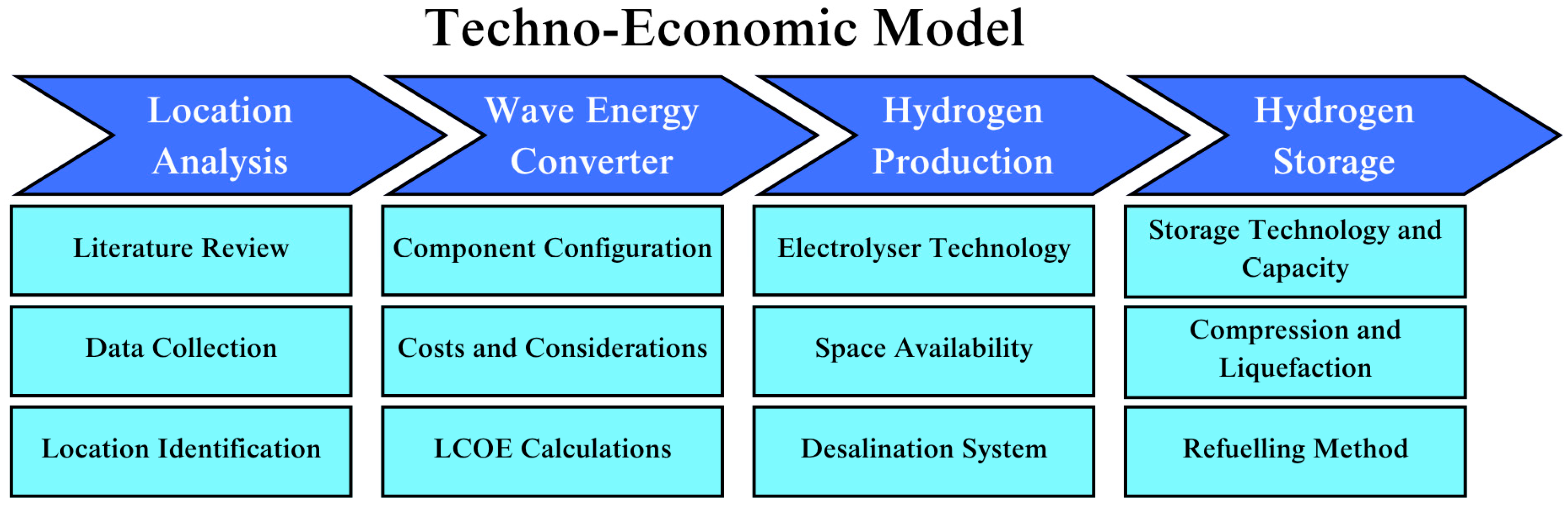
This section aims to provide a model of the project, reviewing the various components that need to be addressed and the sub-factors of each that require further examination. Figure 3 illustrates a breakdown of the project’s components, along with the factors that need to be considered for each major component. The analysis begins with a location assessment, identifying optimal sites for wave energy conversion based on factors such as wave power density and accessibility. A detailed examination of wave energy technology is then conducted, focusing on the operational efficiency and key components of WECs.
The study explores the process of H2 production, emphasising the integration of electrolysis systems powered by wave energy. The methodologies for H2 storage are reviewed, considering various technologies that efficiently manage the produced H2 and provide the best fuel source for shipping vessels. Finally, the methodology includes the calculation of the LCOE and LCOH, providing a comprehensive economic analysis. These calculations are crucial for determining the overall cost-effectiveness and scalability of producing H2. By systematically addressing each of these areas, the methodology aims to provide a robust framework for assessing the potential of wave energy as a sustainable and economically viable source for H2 production.

4.1. Location Analysis

An in-depth analysis of the project’s location was first conducted. This involved a thorough literature review, scanning for high wave power density locations worldwide, while also considering storm conditions and other challenges that could adversely affect the WEC. The optimal placement of WECs is largely determined by dynamic tidal currents and the energy density of coastal regions. Coastal nations, particularly those nearer to the poles, can harness wave energy’s high density and inexhaustible nature to meet their energy needs. Regions such as the west coast of Europe, the western coast of the United States, New Zealand, and Japan are notable for their concentration of wave energy projects. Portugal stands out in Europe due to its significant wave energy potential, which has attracted commercial ventures.
When selecting a site for the project, it is crucial to consider the frequency and intensity of storms and natural events. Ideal locations should have high energy density and fewer occurrences of severe weather to minimise the risk of infrastructure damage and ensure consistent operational efficiency. While higher wave power densities can contribute to increased energy production, they do not always guarantee better energy conversion efficiency. Extreme sea states may lead to frequent shutdowns due to safety concerns, reducing the WEC’s effective operational capacity over its lifetime [28,29]. Additionally, higher wave conditions can result in excessive air pressure fluctuations within the device’s air chambers, decreasing turbine efficiency and, consequently, the overall energy conversion rate. For this reason, locations were selected not solely based on wave power density but also on their ability to provide stable and reliable energy output over time. The coast of Portugal was initially chosen as a prime location for this project due to its consistently high wave power densities and established reputation in wave energy, exemplified by projects such as the commercial CorPower C4 farm. Portugal’s advantageous position along the Atlantic Ocean, coupled with relatively few severe storms compared to other coastal regions, makes it a prime candidate for wave energy and H2 production projects.
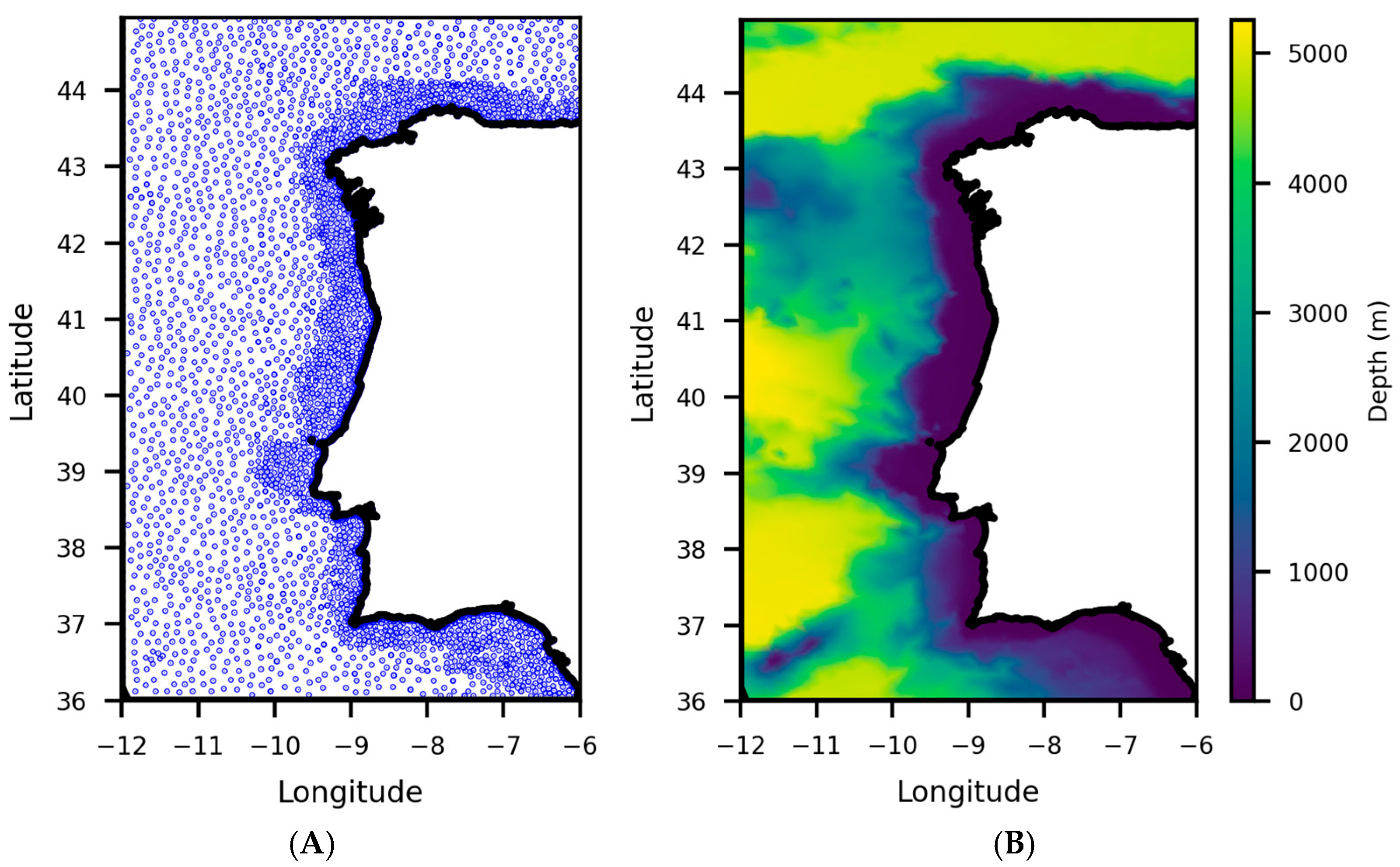
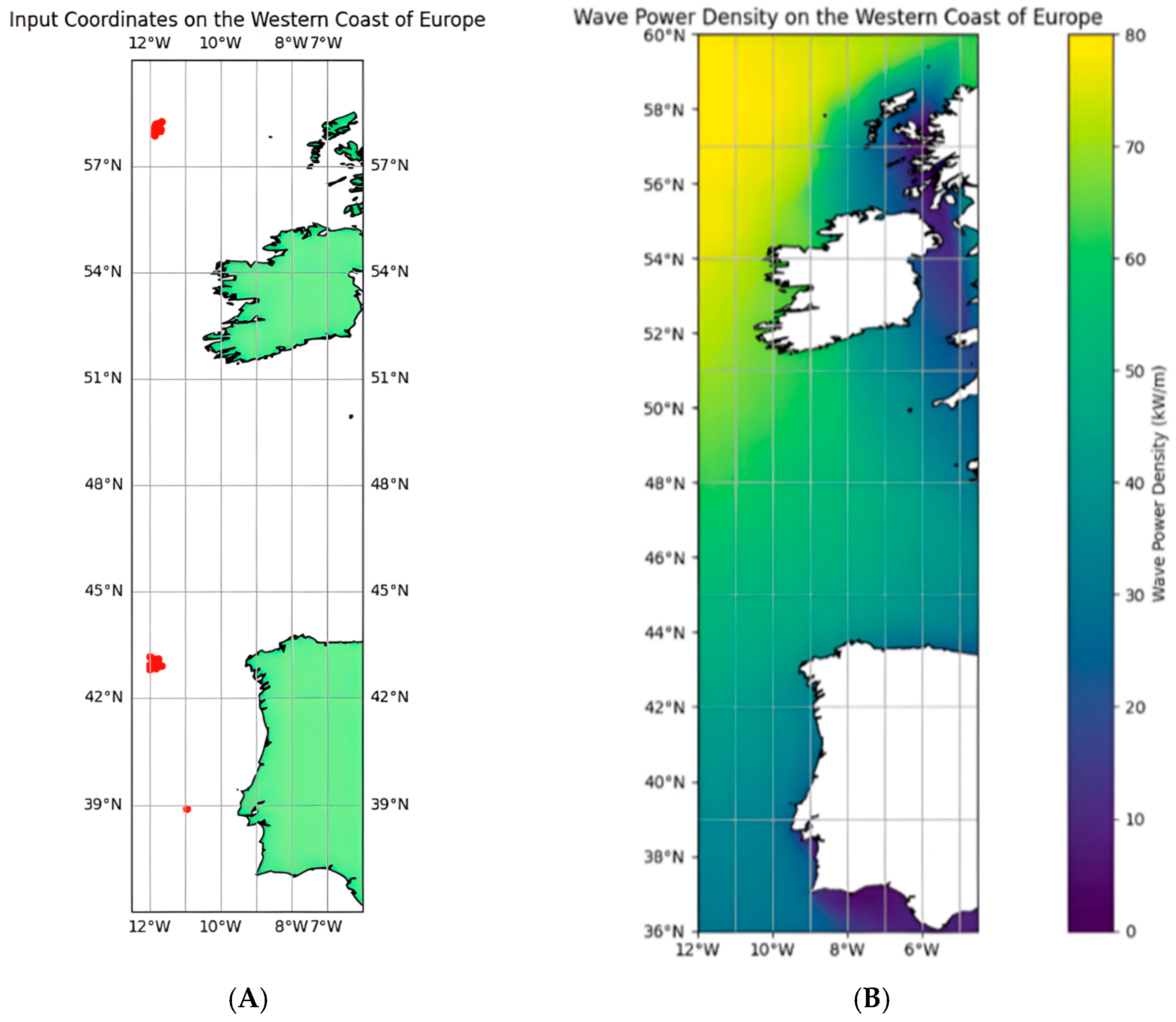
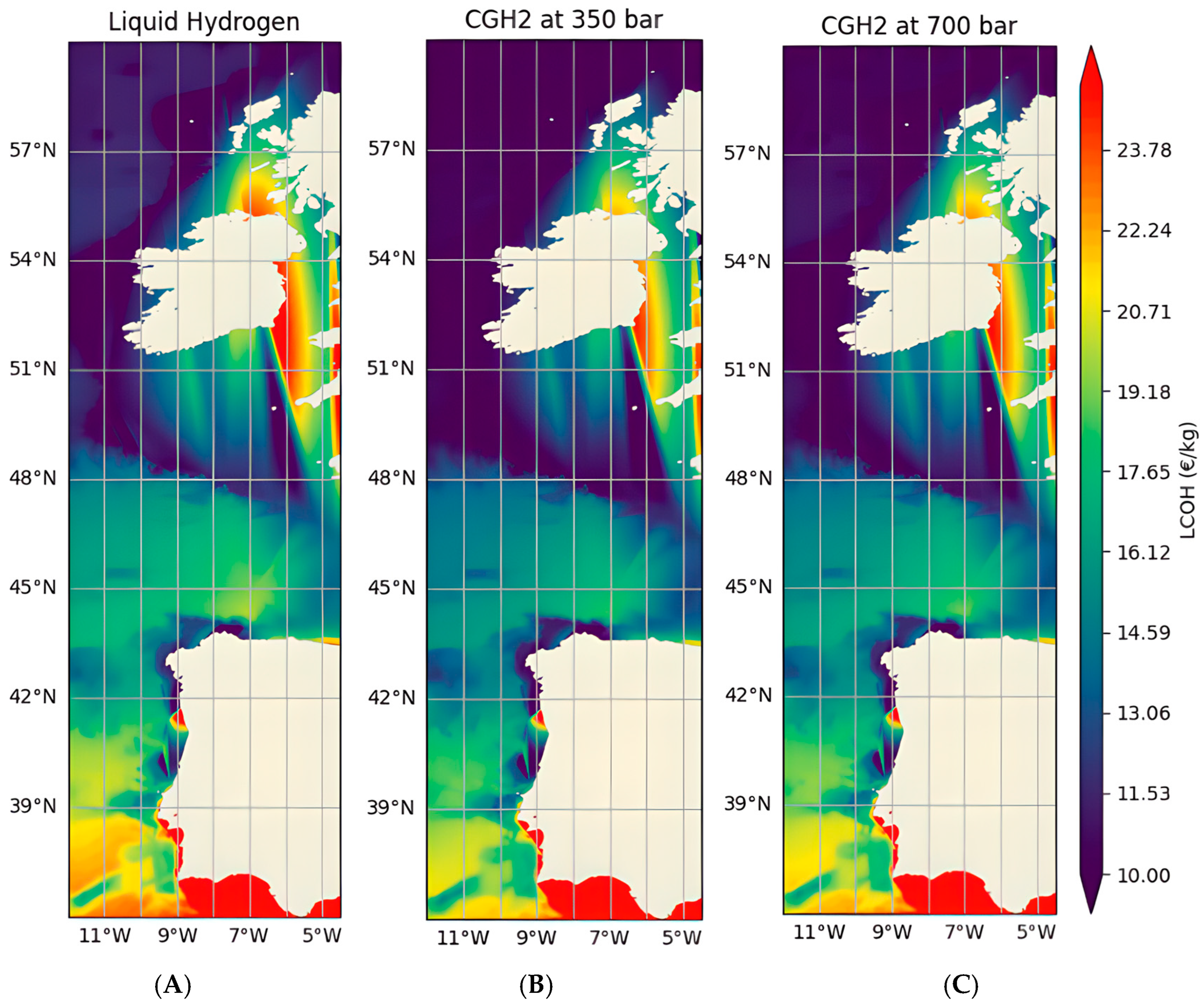
Leveraging data from ResourceCode, two distinct algorithms were also developed to assess potential sites along the Portuguese coast and the broader western European coast [30]. These codes incorporated water depth data and wave power density from the past 10 years to identify optimal locations. The analysis identified 18 sites with the criteria of high wave power density and relatively shallow water depths, which are crucial factors in minimising the cost of mooring lines for the WEC. However, in addition to these considerations, milder but stable wave climates were also taken into account. Deploying the device in extreme conditions could lead to higher maintenance costs, increased downtime, and accelerated structural wear, ultimately affecting the overall economic viability. Therefore, a balance was sought between energy availability and operational feasibility to ensure that the chosen locations would support long-term H2 production at a competitive cost [31]. To further refine the site selection, these points were overlaid with shipping route maps, allowing for the identification of locations that offer both high energy potential and strategic advantages for mid-ocean refuelling. Figure 4 illustrates the approximately 1500 nodes analysed within the Portuguese region, along with their corresponding depths.
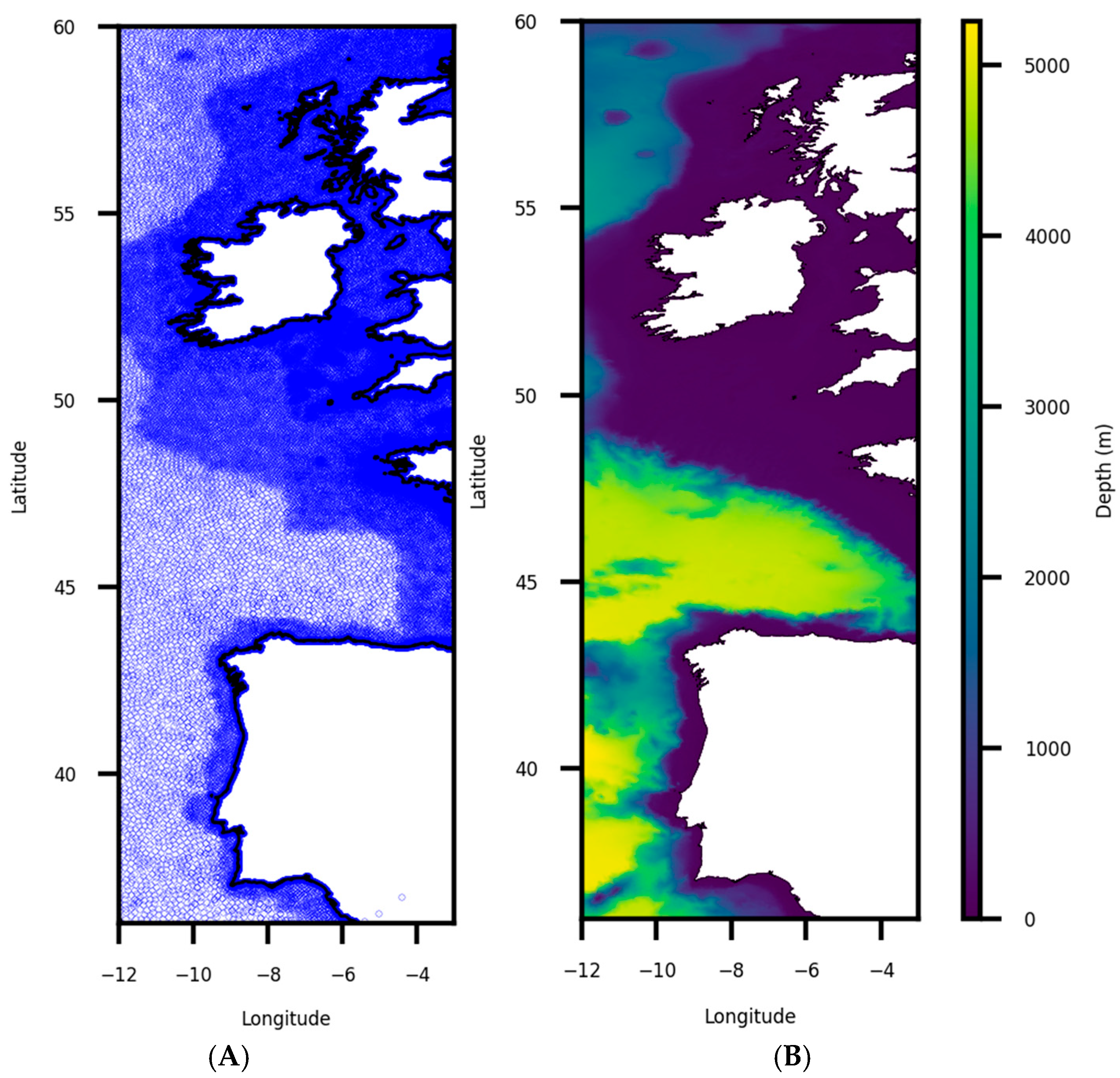
While the Portuguese coast was selected as the reference site due to its favourable wave resource profile, maritime infrastructure, and ongoing wave energy development, the methodology is designed to be transferable. The techno-economic assessment framework can be applied to other coastal regions by substituting local wave, depth, and cost data. Economic outcomes, such as LCOE and LCOH, will naturally vary with geographic and climatic conditions, since factors like storm frequency, installation depth, and accessibility influence capital and operational costs. Therefore, although Portugal offers an ideal case study due to its balance between high resource potential and moderate sea states, the approach remains universally applicable to coastal areas with similar characteristics. Similarly, Figure 5 presents the same parameters for the western coast of Europe. These depth maps are crucial for cost calculations, as depth significantly influences the expenses related to mooring lines and anchor cables.

4.2. Wave Energy Converter (WEC)

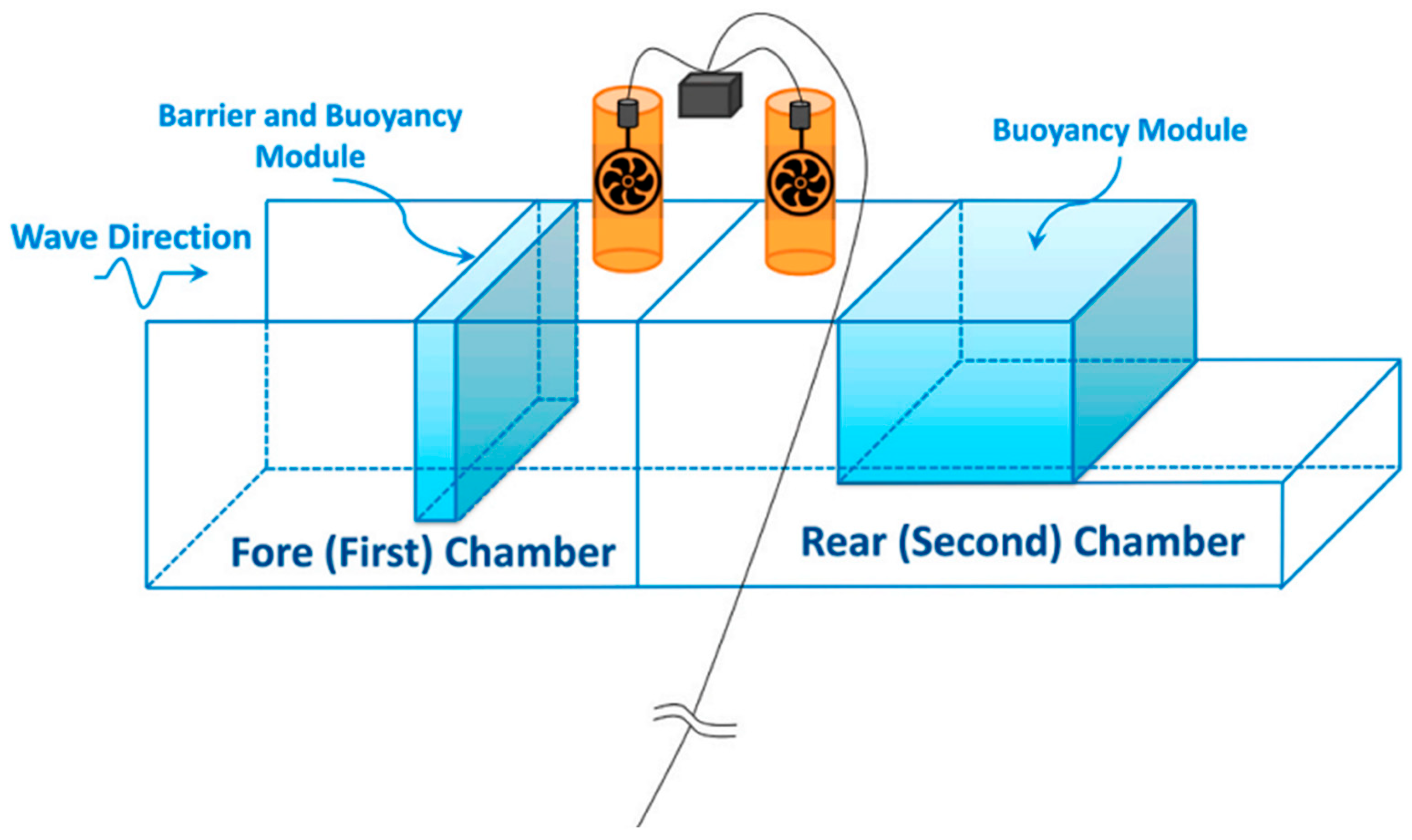
This study adopts a dual-chamber OWC system, equipped with two turbines and two generators, optimised to harness wave energy more efficiently. Figure 6 illustrates this configuration.
The double-chamber OWC device captures wave energy using two specialised chambers, each designed to maximise energy absorption in different ways. The device features both fore and rear chambers, which are integral to the WEC. The fore chamber faces the incoming waves directly and operates similarly to a conventional OWC system [32]. As waves enter this chamber, they cause the water inside to move up and down, compressing and decompressing the air above the water surface. This fluctuation in air pressure drives a turbine, which converts the energy into mechanical power, and then into electrical power via a generator.
The rear chamber, positioned behind the fore chamber, interacts with the wave energy that passes through the front chamber. This chamber is designed with a configuration akin to a Backward Bent Duct Buoy (BBDB), allowing it to effectively capture the remaining energy from the waves that have already interacted with the fore chamber. The rear chamber also converts this energy into pneumatic power, which is used to operate a second turbine.
Unlike traditional WEC designs, which primarily focus on electricity generation, this system leverages its additional internal space to directly integrate electrolysis and H2 storage processes within the device. To the authors’ knowledge, no other WEC currently features this capability, making it a unique advancement in offshore H2 production. This feature not only enables decentralised H2 generation but also supports strategic applications, such as refuelling next-generation ships, unmanned underwater vehicles, long-endurance drones, and ocean observation systems.
At this stage of research, the focus remains on evaluating the feasibility of a single-device configuration. However, future deployments could explore WEC arrays, where H2 production and storage could be centralised on selected units, reducing infrastructure costs while optimising energy conversion efficiency. By integrating both power generation and H2 production within the same system, this approach offers a scalable and efficient pathway for offshore green H2 supply.
The study also considers the mooring lines that secure the WEC to its location, the control systems, and the steel housing. The mooring lines must be designed to withstand harsh marine conditions and ensure the stability of the WEC, while the control systems are crucial in maintaining optimal energy conversion efficiency by adapting to varying wave conditions. Additionally, the steel housing must be robust enough to protect against corrosion and mechanical wear, thereby ensuring the device’s longevity and safety.
Alongside the primary components that contribute to the CAPEX of the WEC, the balance of plant costs is also accounted for. Within the context of this project, the BoP encompasses a wide array of elements required to support the WEC’s operation, such as the cost of project development, monitoring systems, electrical infrastructure installation, installation labour, anchor systems and marine transportation.
Marine transportation is a substantial cost calculated based on detailed assumptions about the time and resources required to transport components from the shore to the deployment site, as well as the time needed for installation activities. An Anchor Handling Tug Supply (AHTS) vessel, commonly used in the offshore oil and gas industry, is employed for the mooring installation and transportation of large components [33]. These vessels are equipped to handle the demanding task of positioning and securing the moorings, which are vital for the stability of the WECs.
Routine dry docking and maintenance planning are incorporated into the OPEX model to preserve structural integrity. Dry docking involves removing vessels from the water and placing them in a specialised dry dock facility, where the water is drained to expose the entire hull of the vessel. This process is essential for conducting maintenance, repairs, inspections, and cleaning tasks that cannot be performed while the vessel is afloat.
While the WEC is designed to operate efficiently under a range of sea conditions, extreme wave environments can pose operational challenges. High-energy sea states may result in more frequent shutdowns due to safety considerations, ultimately reducing energy production over the device’s service life. Additionally, turbulent wave conditions can cause excessive air pressure fluctuations within the air chambers, decreasing turbine efficiency and reducing the overall energy conversion performance. As a result, while the WEC can withstand harsh conditions, deploying it in excessively energetic sea states may not always yield the best economic or operational outcomes. Instead, balancing wave energy availability with operational stability is key to optimising overall efficiency and minimising lifetime costs.
The project was evaluated over a 30-year lifetime, with a discount rate of 5% applied to account for the time value of money. Decommissioning costs were identified as a significant component of the OPEX for the wave energy system integrated with H2 production. These costs, which include the removal of equipment, restoration of the site, and safe disposal of materials, have a considerable impact on the overall financial viability of the project, emphasising the need for careful planning and budgeting throughout the system’s lifecycle. This thorough examination of the wave energy system and its associated components highlights the intricate balance required between technological design, operational efficiency, and cost management. By examining these elements in detail, the review aims to provide a comprehensive understanding of how each component contributes to the LCOE, a critical metric in evaluating the economic viability of renewable energy projects.

4.3. Hydrogen Production

Several H2 production technologies were reviewed, and when considering integrating these technologies onboard a WEC, several critical factors must be addressed to ensure the system’s efficiency and viability. The primary challenge lies in selecting technology that can endure the relentless motion of the waves while efficiently utilising the limited space available within the WEC structure.
Three primary water electrolysis technologies are commonly employed for H2 production: proton exchange membrane (PEM) water electrolysis, alkaline water electrolysis (AWE), and solid oxide electrolysis cells (SOEC). Each technology is distinguished by its operational temperature range, significantly impacting its energy efficiency and power consumption. A summary of their operational ranges and energy efficiencies is provided in Table 2. Although SOEC can be more energy-efficient per kilogram of H2 produced, its overall energy consumption is heavily influenced by the need to maintain higher operating temperatures. This energy demand for SOEC is often offset by utilising waste heat from nearby factories and industrial processes, a strategy not feasible in this project, given its offshore location in the middle of the ocean. Table 2 highlights the differences between the three main types of electrolysers used today, including the energy consumption by each system [34].
PEM electrolysis is particularly advantageous in offshore environments due to its rapid response time and high efficiency under fluctuating power inputs. Its compact design and ability to operate at higher pressures without needing an external compressor make it a more practical solution for integration with a wave energy system. However, PEM electrolysers require expensive materials, such as platinum group metals (PGMs), which increase the capital cost. In contrast, AWE, one of the oldest and most commercially established H2 production technologies, benefits from lower material costs and long operational lifetimes. Despite these advantages, AWE systems are less suited for offshore applications due to their slower response time to dynamic power inputs and lower efficiency at partial loads [36].
Recent advancements have been made in the realm of SOEC technology, particularly by Doosan, which has developed an innovative solid oxide fuel cell (SOFC) stack capable of operating at lower temperatures with higher efficiency [37]. This technology has demonstrated considerable promise, particularly in marine environments, where it has passed rigorous environmental tests, proving its durability and performance even under harsh conditions. Traditionally, SOECs are coupled with SOFCs to create a complete energy storage and conversion solution within a single unit. While recent advancements in SOFC technology, particularly in microstructural optimisation and low-temperature operation, have shown promise in improving efficiency and durability, these developments remain primarily relevant for stationary energy storage and conversion applications. Notably, recent studies have explored the optimisation of electrode porosity, pore size, and grain structure to mitigate degradation and enhance performance at lower operating temperatures (600–650 °C). However, despite these improvements, SOFCs still require stable high-temperature conditions and remain impractical for dynamic offshore and marine H2 applications [38].
Despite these advancements, SOEC technology remains an emerging solution and is not yet as commercially mature as PEM and alkaline electrolysers, both of which are more widely deployed for H2 production. Although SOEC’s higher operating temperatures are being gradually reduced with new material designs, they still pose challenges related to material degradation and system longevity. As a result, its large-scale adoption is contingent on further improvements in durability and cost-effectiveness. Furthermore, SOEC technology is highly reliant on industrial waste heat recovery, an unfeasible approach in this project’s context.
Given these constraints, PEM technology emerges as the most efficient and practical choice for offshore applications. Its viability is further demonstrated by its adoption in concurrent offshore energy projects, such as Energy Observer’s Odyssey, which also utilises PEM electrolysis. PEM electrolysers operate efficiently under dynamic load conditions, making them well-suited for integration with wave energy systems where power availability fluctuates. It is important to consider the recent upward trend in electrolyser costs. Although many studies and research papers suggest that the cost should decrease as the technology matures and its utilisation increases globally, recent reports indicate a price rise [39]. This cost trend emphasises the importance of ongoing research and development to achieve cost-effective solutions for green H2 production.
Space availability is another critical consideration, especially in the confined environment of a WEC. In this context, Bosch’s compact PEM electrolysis stack provides a robust solution, measuring a volume of 85 cm × 100 cm × 153 cm, and is capable of producing 23 kg H2/h [40]. This stack comprises numerous finely tuned cells that deliver 1.25 MW of power while operating at pressures exceeding 30 bar. This eliminates the need for costly auxiliary units in various applications. The stack demonstrates impressive efficiency, with a beginning-of-life (BOL) efficiency of 65.3% and a peak efficiency of 76.3%, displaying its prowess in energy conversion.
Another important process involved in the production of H2 via seawater electrolysis is desalination. As the electrolysers are made of precious materials such as PGMs (platinum group metals), the water must be pure and desalinated before it can be converted into H2. Impurities commonly found in untreated water can severely damage these components, decreasing efficiency and increasing operation costs.
Reverse osmosis is the most used method for desalinating seawater. The process involves forcing water through a semipermeable membrane, which filters out salt and other impurities, producing pure water suitable for electrolysis and leaving behind a concentrated solution. Reverse osmosis typically operates at high pressures of up to 80 bar. The lifespan of reverse osmosis membranes typically ranges from three to five years, necessitating periodic replacements, which add to the maintenance costs [41]. Furthermore, operational costs are increased by the need for chemicals such as antiscalants, biocides, pH-adjusting chemicals, and disinfectants to maintain the membrane and ensure the purity of produced water.
The location of the WEC module can significantly influence the rate at which the desalination system degrades, as different oceanic regions contain varying concentrations of sediments and salts. These geographical differences in water quality must be carefully considered when designing and deploying reverse osmosis systems to optimise their efficiency and longevity. This could be further studied for the specific region of the Western Coast of Europe, as it has not been done so here.
Direct seawater electrolysis has been considered a potential alternative to reduce energy consumption in the desalination step. However, this method introduces additional complications due to the degradation of the PGM materials in the electrolyser and the production of unwanted byproducts. Seawater contains a complex mix of ion species, sediments, microorganisms, and salts such as magnesium and calcium, which can accelerate wear and tear on the electrolyser’s components and affect the purity of the H2 produced.
For this project, reverse osmosis remains the chosen method for desalination. This decision is based on the current technological readiness and the need to ensure the longevity and efficiency of the H2 production system. While direct seawater electrolysis offers a promising avenue for reducing energy use, technological and material challenges currently limit its practical application. Further research and development could potentially make this method more viable in the future, thus reducing the energy overhead associated with H2 production from WECs.
Integrating H2 production technology onboard a WEC presents unique challenges and opportunities. By carefully selecting the appropriate electrolysis technology and considering factors such as space availability, cost trends, and operational efficiency, it is possible to develop a robust and efficient system that harnesses the power of the ocean to produce green H2, contributing to a sustainable energy future.

4.4. Hydrogen Storage

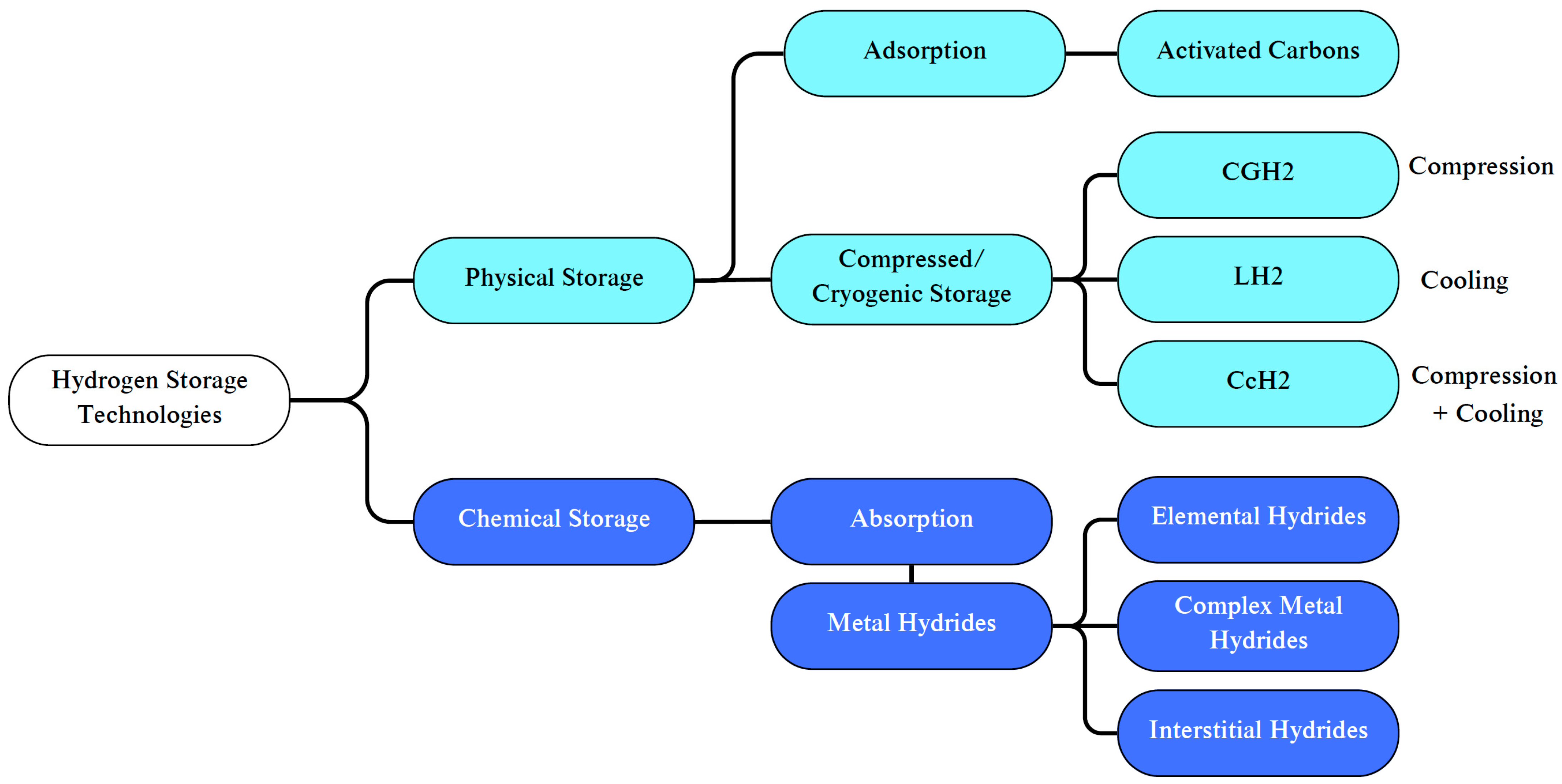
Various H2 storage technologies were reviewed based on their suitability for offshore integration with WEC systems. Figure 7 illustrates the main categories of H2 storage types available, along with their corresponding technologies [21]. Storage systems were evaluated for their resilience to marine motion and the space constraints inherent to offshore deployment. Additionally, during peak wave conditions, when the WEC operates at maximum capacity, H2 production may be suspended, similar to the measures taken by energy production components during storms.
H2 storage falls into two main classes: physical storage and chemical storage. Physical storage involves compressing the H2 gas into compressed gaseous H2 (CGH2), cooling the gas into liquid H2 (LH2), or a combination of both, known as cryo-compressed H2 (CcH2). Physical storage often poses spatial challenges in compact marine settings. An alternative approach is to utilise highly porous materials, such as activated carbon or metal-organic frameworks, to physically adsorb H2 gas at cryogenic temperatures (60–77 K).
Regarding chemical storage, H2 can be chemically absorbed into metal hydride materials, a particularly compelling option due to its space efficiency and compatibility with the dynamic operational conditions of a WEC. By leveraging metal hydride storage, the H2 storage system can be designed to optimise space utilisation while maintaining operational robustness in the face of wave-induced motions. Metal hydrides provide compact and vibration-resistant alternatives to traditional physical storage methods.
While specific metal hydrides have shown considerable promise for H2 storage, it is important to acknowledge that no material currently meets all the targets set by the United States Department of Energy for onboard vehicular applications or at a relatively high technology readiness level. Ongoing research and development efforts are focused on synthesising metal hydrides with favourable thermodynamics, fast reaction kinetics, and high gravimetric H2 storage capacities to meet the stringent requirements for H2 storage in intense motion structures and vehicular applications. Despite these advances, no ideal metal hydride solution for these specific applications, including intense motion structures like WECs, has been identified. Continued development is required before marine deployment is feasible. Table 3 provides a brief overview of these technologies and their respective gravimetric and volumetric capacities, offering insight into the decision-making process for selecting the storage type [42]. Gravimetric capacity refers to the mass fraction of H2 that can be stored relative to the total system mass, indicating how much H2 a storage medium can hold per unit weight. Higher gravimetric capacity values are desirable, as they enable lighter storage systems and improve energy density by weight. Volumetric capacity represents the amount of H2 stored per unit volume, reflecting how compact the storage system is. Higher volumetric capacity values are also favourable, since they allow more H2 to be stored in a smaller space, which is critical for maritime and large-scale storage applications.
Furthermore, the practical application of metal hydrides for H2 storage involves complex conversion methods. Upon heating, the stored hydrogen within the crystal lattice structure is released in a gaseous state. This requires subsequent compression to achieve liquefaction, a process that demands significant energy input. As a result, the efficiency and economic viability of the solution are compromised.
Given these challenges, physical H2 storage is the optimal storage medium for the refuelling station onboard the WEC. It facilitates seamless transfer to passing ships and compatibility with existing fuelling protocols. Liquid H2 is a more energy-dense fuel source than compressed gas H2; however, it is important to acknowledge the logistical challenges associated with LH2 storage. Liquid H2 is considered an option due to its use on some current H2-powered ships. H2’s extremely low boiling point of −252.87 °C necessitates maintaining cryogenic conditions, which requires substantial energy input to sustain over time. Due to the offshore location of the WEC, where ambient temperatures are lower, the energy required to maintain H2 in its liquid state could be reduced, warranting further investigation [43].
Liquid H2 also has a wider flammable limit range, a lower boiling temperature, and a lower flash temperature, leading to higher risks of fire and explosion. Therefore, it is imperative to consider these characteristics when determining the fuel source for ships [44]. In theory, LH2 can address longer-range limitations; however, currently, its production capacity is low, and there is a lack of fuel infrastructure [45]. Boil-off losses from cryogenic storage require mitigation strategies. In that case, some gaseous H2 may need to be vented to prevent pressure buildup, a process known as boil-off. However, various systems are used to minimise this H2 loss.
In another scenario, the use of compressed H2 is also considered. This analysis aims to examine the advantages and drawbacks of each method, primarily because the majority of the transport industry using H2, including cars and trucks, utilises compressed H2. The comparison is crucial because the technology readiness level for liquid H2 storage remains relatively low, while compressed H2 technology has been well-established and mature for many years. Storage tanks in vehicles must withstand high pressures and be able to store H2 without leakage; typically, FCEVs store H2 at either 350 or 700 bar.
Similar to the liquefaction process used to achieve LH2, H2 must undergo compression to achieve a higher pressure, which is then used as fuel for FCEVs. Again, this process takes energy, although not on the same scale as liquefaction. H2 produced from a PEM electrolyser is typically at low pressure, between 1–30 bar, and must be significantly compressed to reach 350 bar or 700 bar, the pressures used for CGH2. This compression begins with multi-stage compressors, such as reciprocating or diaphragm compressors, which gradually increase the H2 pressures in stages. In the first stage, H2 is typically compressed to a pressure of around 100–150 bar. Since compressing H2 generates heat, the gas is cooled between each stage using intercoolers to improve efficiency and prevent overheating. The H2 then undergoes further compression stages, with each stage incrementally increasing the pressure. For 350 bar, H2 typically passes through 3 to 5 stages, while reaching 700 bar may require up to 7 stages. Compressing to 700 bar is more energy-intensive and requires more sophisticated equipment that can withstand the stresses of high-pressure H2. After compression, the H2 is stored in high-pressure tanks made of advanced materials, such as carbon fibre composites, designed to safely contain the high-pressure gas. CGH2 is highly flammable and requires stringent safety measures for handling and storage, similar to LH2; however, the technology already has safety standards in place to mitigate these risks.
Although this study qualitatively discusses H2 storage safety, boil-off losses, and compression energy requirements, a quantitative risk analysis was not performed. Such an assessment would require probabilistic modelling of leak events, ignition scenarios, and lifecycle safety costs, which falls beyond the present techno-economic scope. Future work could incorporate these aspects to estimate risk-adjusted costs or safety indices for different storage methods.
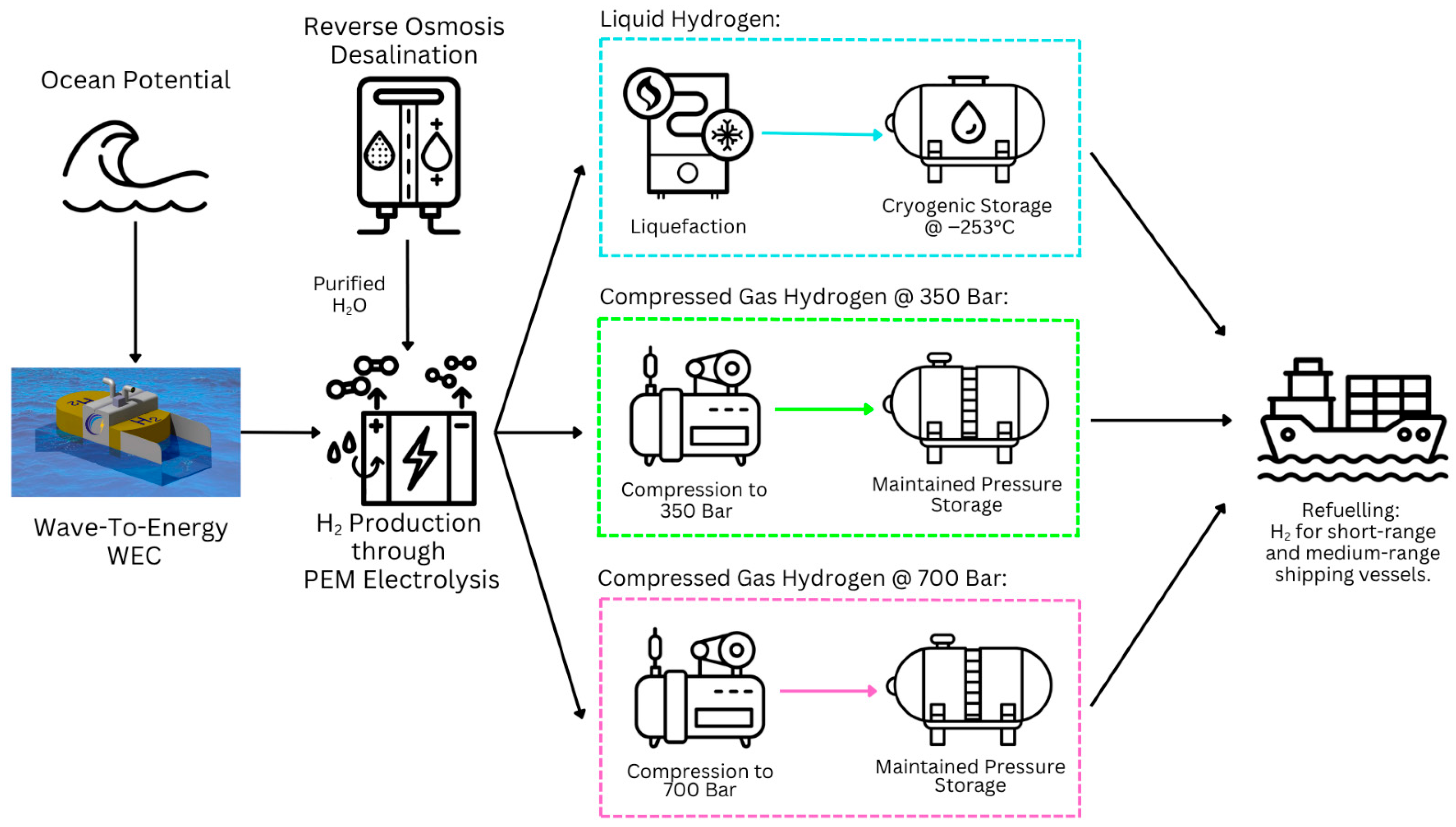
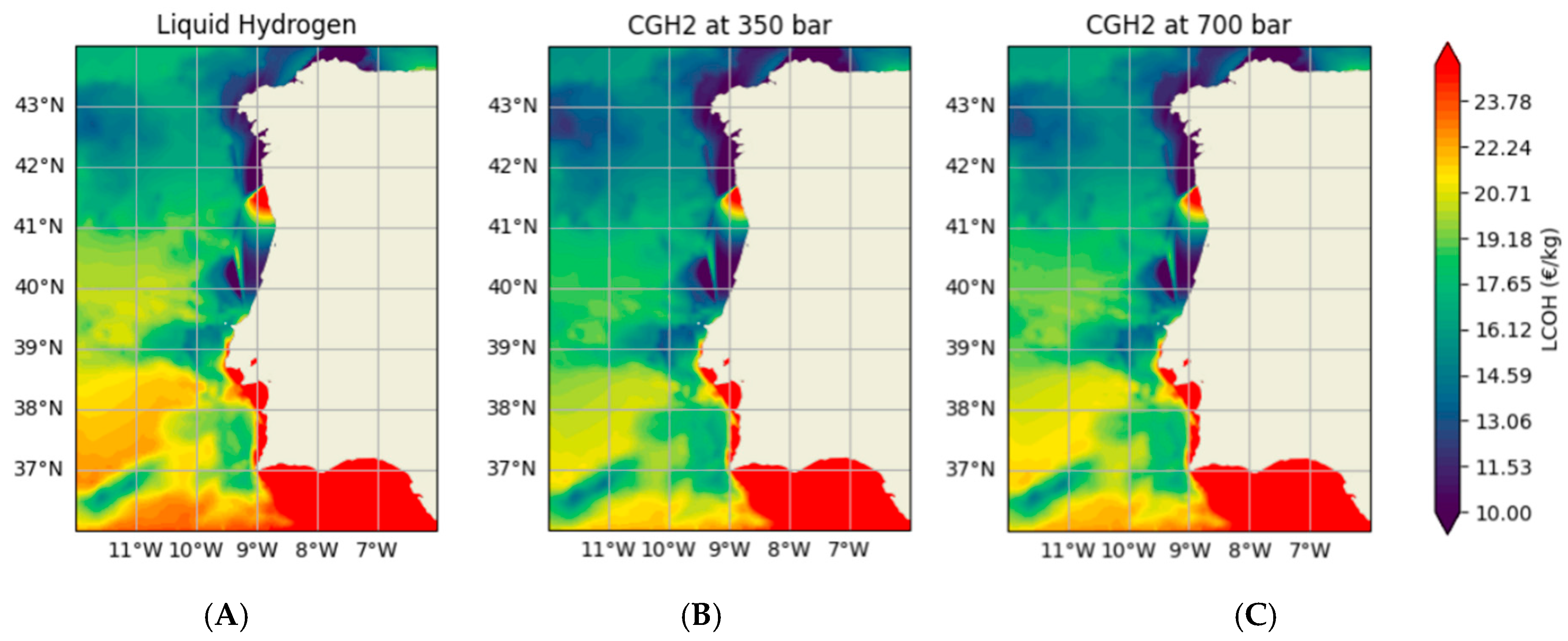
This project selected three H2 storage technologies for further exploration: liquid H2, compressed gas H2 at 350 bar, and compressed gas H2 at 700 bar. These options were chosen based on their technical maturity and compatibility with maritime applications. Metal hydrides, while considered a promising technology for H2 storage, have been excluded from this analysis due to current limitations for maritime use. By focusing on LH2, CGH2 at 350 bar, and CGH2 at 700 bar, this project aims to evaluate the most viable options for decarbonising maritime transportation.

4.5. Proposed System, Levelised Cost of Electricity (LCOE), and Levelised Cost of Hydrogen (LCOH)

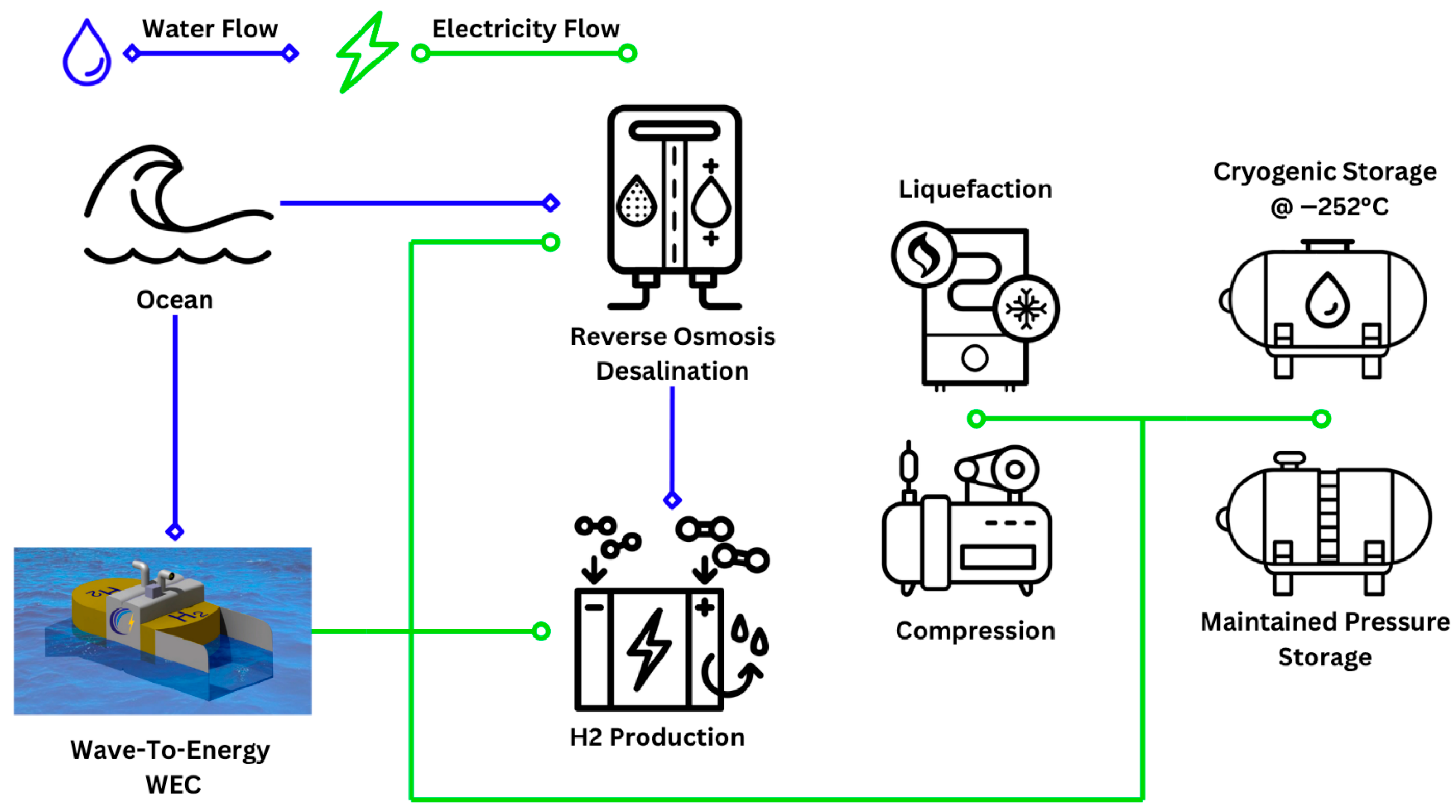
LCOE and LCOH are calculated separately. The need for a clear, step-by-step evaluation of each system component drove the decision to separate the calculation of the LCOE and the LCOH. By first calculating the LCOE independently, the cost factors associated solely with wave energy conversion could be isolated, providing a detailed understanding of the energy production’s economic dynamics. This separation ensures that the energy input cost is accurately reflected when determining the LCOH, allowing for a more precise analysis of the H2 production process. Additionally, this approach provides a better focus on the specific costs, efficiencies, and technological factors unique to each stage of the system, ultimately enhancing the clarity and accuracy of the overall economic assessment.
Figure 8 provides a comprehensive overview of the various scenarios meticulously considered within the analysis. It presents the detailed flow of the process from wave energy captured to H2 production, storage, and final distribution. The three storage options cater to different operational needs, with the final output designed to refuel shipping vessels, thus enabling cleaner maritime transport.
The evaluation of the LCOE and the LCOH was a comprehensive process that involved detailed data collection and analysis. This assessment included gathering information on CAPEX related to the WEC components, water electrolyser, storage tanks, desalination system, and either the liquefaction or compression systems. OPEX and energy output data were also meticulously compiled to assist in these calculations.
The approach involved separating the system’s energy conversion to first calculate the LCOE for the wave energy conversion process, which was then used as an input for calculating the LCOH. This method allows focusing on the energy cost as a distinct aspect of the system before incorporating it into the total H2 production cost, ensuring clarity in assessing each component’s contribution. While alternative approaches exist, such as calculating the LCOH for the entire system at once, separating the energy production and H2 production processes allows the cost factors to be specific to each stage.
The annual energy production was estimated using key parameters obtained from the location analysis, such as wave power density and water depth at each proposed site. This figure was crucial in calculating the LCOE, which is derived by summing the CAPEX and OPEX and then dividing these by the annual energy output. This resulting LCOE value was subsequently used as a crucial input in the LCOH calculations. For the LCOH, the combined CAPEX, OPEX, and LCOE totals were calculated specifically for the H2 production process.
Several critical factors influence the LCOH, including the type of storage technology employed, the pressure levels managed by the electrolyser system, and the duration of H2 storage. Each factor has significant implications for the electrolyser’s power class and the required sizes of the storage tanks.
An additional critical aspect of this analysis was the breakdown of energy requirements. To effectively allocate power for H2 production and determine the optimal size for the electrolyser, a detailed analysis of energy demands for each component of the H2 process was conducted. This analysis considered the energy needed for initial H2 production, daily storage, the liquefaction or compression processes, and the desalination system, which varied significantly based on the chosen storage type. The distribution of energy dedicated to H2 production varied across different storage solutions. Liquid H2 systems typically left the least amount of energy available for production, while CGH2 at 350 bar provided the most.
By integrating these detailed financial and technical evaluations, the study provides a nuanced understanding of the economic and operational dynamics associated with integrating H2 production into wave energy systems. This comprehensive approach ensures that all relevant costs and energy factors are considered, paving the way for informed decision-making regarding the deployment of these technologies.

5. Techno-Economic Assessment

This section provides a comprehensive economic assessment of the system, evaluating both capital and operational expenditures to determine the cost-effectiveness of integrating wave energy with H2 production. The analysis considers key financial metrics, including the annual energy production of the WEC system, the OPEX required for maintenance and system operation, and the energy consumption necessary for H2 production. By systematically assessing these factors, the study determines the LCOE as a foundation for understanding the financial feasibility of wave-to-hydrogen conversion. The insights gained from this analysis are then extended to the calculation of the LCOH, ensuring that both the economic and technical aspects of the system are holistically evaluated.

5.1. LCOE Assessment

The CAPEX for the WEC are predominantly driven by the costs of its components. Detailed in Table 4, the breakdown of these costs reveals significant investments, particularly due to the design choice of a dual-chamber oscillating water column. This design incorporates two turbines and two generators, thereby inherently increasing the overall financial outlay.
The turbines employed in this project are impulse turbines. However, accurately estimating the cost of these turbines is challenging due to the proprietary nature of the technology, which many manufacturers prefer to keep confidential. For this analysis, the turbine cost estimation was derived from a similar project involving an offshore wind farm, as documented by Hill et al. [9]. Their research suggested that a turbine costs approximately 1400 €/kW, meaning the 1 MW WEC in this project would cost 1.4 M€. This analysis considered a 1 MW WEC instead of a larger farm to focus on understanding the H2 production potential at the individual unit level. This approach enables a detailed assessment of the H2 generation potential using the proposed WEC system, providing a foundational understanding of its economic and operational viability before scaling up to larger arrays or farms. As this is a double-chamber oscillating WEC, the double-impulse turbines are included in the projected cost. Another way to estimate the cost of the turbines is to use hydropower turbines. According to a study conducted by Paish, the expenses for small hydro projects tend to range from 2500 to 3000 €/kW [46]. Although this scenario presents a higher cost, it provides a conservative estimate for financial planning. However, since this range is considerably higher and may seem excessively costly for impulse turbines, the lower value from the offshore wind farm analogy was ultimately used for more pragmatic calculations.
Furthermore, the costs associated with the generators and control systems were estimated using data from the 2022 Renewable Energy Power Generation Costs report by IRENA [47]. According to this report, a medium-range generator would cost approximately 600 €/kW, totalling 600,000 € for the necessary generator capacity. Additionally, the costs for mooring lines and steel housing were calculated based on information provided in a report by Wave Energy Scotland, which outlines the expenditures for large-scale WECs.
Table 4. Capital expenditures (CAPEX) regarding the dual-chamber wave energy converter (WEC).
Component Costs Unit Source
Impulse Turbine 1,400,000 €/turbine [9]
Generator (600 €/kW) 600,000 €/generator [47]
Mooring cost per metre 200 €/m [33]
Control System 400,000 [47]
Steel Cost per Tonne 3000 €/tonne [33]
Total Steel Housing 900,000 authors’ estimation
The financial analysis of the BoP components for the WEC is crucial in understanding the total capital requirements for deploying a 1 MW capacity WEC. This analysis methodically breaks down the costs associated with project development, monitoring systems, installation labour, and turbine installation, all calculated on a cost-per-kilowatt basis to provide a standardised approach to financial planning and budgeting. These calculations are based on the same study by Hill et al., which estimates the costs for wind turbine installation, as shown in Table 5 [9].
Following the core component costs were the expenditures related to the anchoring system, comprising the anchor itself and the anchor cable. The cost of the anchor was estimated based on an assumption of its weight at 6 tonnes, priced at 2.5 €/kg. This assumption was based on standard industry practice for similar marine installations, where a 6-tonne anchor is considered sufficient to ensure stability under the expected environmental loads, such as currents and wave forces. For the anchor cable, calculations were premised on a diameter of 0.1 m. Using the density of steel and the specific water depth, a formula was applied to determine the additional cable length required beyond the direct distance. This extra length serves as a safety measure, allowing for some slack to accommodate movement and prevent the anchoring system from snapping under tension, thereby ensuring its integrity and durability. The calculated cost for the steel cable considered these factors to arrive at a total projected expense.
Marine transport expenses were derived from models and data provided by Wave Energy Scotland. For operational planning, the speed of the AHTS vessel, which is 5 knots, ca. 10 km/h, was considered. The total travel time to the installation site was estimated by dividing the journey’s distance by the vessel’s daily travel capacity, resulting in an estimated number of days required for transit. To this figure, two days were added as a buffer to account for potential delays during the installation period. The total number of days calculated for the round trip was then multiplied by the daily operational cost of the AHTS. Additionally, an extra 10% was factored into the overall costs as a weather contingency to accommodate potential delays or operational adjustments due to adverse marine conditions. This approach yielded a comprehensive estimate of the total cost for marine transportation, encompassing both the logistical and financial planning required to ensure the timely and efficient delivery and installation of the WEC components at the site.
In addition to the initial setup and operational components, the CAPEX for the WEC also encompass transportation and decommissioning costs. According to research conducted by Guo et al., these costs are quantified in €/kW [48]. Specifically, the decommissioning costs are estimated at € 420/kW, accounting for approximately 10% of the total CAPEX. It is important to note that these costs vary based on the project’s location, as different environments and logistical challenges can significantly influence overall expenditure.
Regarding OPEX, insights from a report by Michael O’Connor highlight that wave energy projects typically incur an OPEX of 24 €/kW per year [49]. Applying this standard rate to the specific WEC project results in an estimated operational cost of € 720,000 over the project’s expected lifetime (Table 6). This estimation provides a baseline for budgeting the regular costs associated with operating the WEC, including maintenance, management, and routine repairs, which are essential for ensuring the installation’s longevity and efficiency.
Alongside other expenses, the costs associated with dry docking are a significant consideration. Based on a study by Agamemnon et al., the cost of a dry-docking operation in 2007 was approximately 370,000 €, which, adjusted for inflation, amounts to about 700,000 € today [50]. However, it is important to note that this figure pertains to much larger shipping vessels than those involved in this project. Agamemnon et al. primarily focused on container ships with capacities of 1000 TEU, each TEU being a standard unit with internal dimensions of 20 feet long, 8 feet wide, and 8 feet tall [44]. Given the smaller scale of this project, a tailored estimation is required for dry docking costs. Therefore, the cost was adjusted downward to more accurately reflect this vessel’s size and scope, estimating the dry-docking cost for a small vessel in this project to be approximately 200,000 € per operation. Over the project’s lifetime, this equates to a total of around 1 M€. Although this may still represent an overestimate, it provides a conservative figure that ensures financial prudence and buffers against unforeseen expenses, offering a safer approximation for financial planning and budgetary allocations.
Calculating the annual energy production (Equation (1)) is a pivotal element in determining the LCOE for the WEC. A thorough understanding of the wave power density at the specific deployment location is crucial to this calculation. Cabo da Roca in Portugal was initially identified as a potential site due to its favourable marine conditions. According to an extensive literature review, the wave power density in this region is estimated to be approximately 35–40 kW/m. This metric reflects the power available per metre of wavefront and is vital for assessing the WEC’s total annual energy output.
E = P o u t p u t × W i d t h × E f f i c i e n c y × Hours Year
Within Equation (1), Poutput is the wave power density (45 kW/m). The width of the WEC is based on the dimensions provided by Company A, which is 25 m [51]. The primary efficiency of the WEC is 70%, reflecting the efficiency of wave energy capture and conversion to pneumatic power (compressed air energy confined within the chambers of the OWC device) by the system before any power conditioning or electrical conversion processes occur. The Power Take-Off (PTO) efficiency, which refers to the combined efficiency of the turbine and electric generator, is 55% in this study. This PTO efficiency encapsulates the turbine’s capability to convert the pneumatic power of the air trapped inside the chambers into rotational energy, and the generator’s ability to convert this rotational energy into electrical energy. Additionally, the exploitation factor, which represents the operational availability and reliability of the WEC, accounting for downtime due to maintenance, suboptimal sea conditions or other natural phenomena, is 95%. Consequently, the total overall efficiency of the WEC system, which combines these factors, is calculated to be 36.6%. Capacity factor, another critical performance metric, further contextualises these efficiencies within the operational environment of the WEC. It is defined as the ratio of the actual energy produced over a period to the energy that would have been produced at continuous full power operation during the same period. As highlighted in studies such as those conducted on the Mutriku wave farm, the capacity factor significantly influences the overall energy output and economic viability of wave energy systems, underscoring its importance in assessing WEC performance alongside other efficiency metrics [52].
It is also worth mentioning that, in addition to factors such as the need for maintenance operations, sub-optimal or survival conditions that cause energy production interruptions and affect the capacity factor of WECs, specific concerns exist for OWCs, including the effects of air humidity, which can further reduce system performance and suppress annual energy production. According to Medina-Lopez [52], air humidity can significantly impact energy output under certain conditions. This effect has not been explicitly accounted for in the estimated annual energy production of the FOWC device in this study, as it requires a dedicated investigation to accurately assess its impact. However, general considerations of factors such as maintenance operations and the effects of air humidity on energy production have been incorporated through an assumed capacity factor of 0.95. In this context, future studies may possibly be conducted to refine this estimation, ensuring a more precise capacity factor and a more accurate assessment of annual energy production.
There are 8760 h in a year. This calculation yields an annual energy production of 3604 MWh/year (44 × 25 × 0.70 × 0.55 × 0.95 × 8760). To determine the average hourly energy output, this value is divided by the total number of hours in a year (365 days × 24 h = 8760 h), resulting in an average energy production of 411 kWh per hour. This final value accounts for all efficiency adjustments, including the capacity factor, conversion losses, and downtime considerations.
To calculate the total energy produced by the WEC over its 30-year project lifetime, the annual energy output (in kWh) was first estimated based on the WEC’s operational parameters. This annual energy was then multiplied by 1000 to convert into watt-hours, ensuring unit consistency. To account for the time value of energy production over the project’s lifespan, a discount rate of 5% was applied. The total lifetime energy is then calculated using Equation (2) [53].
T o t a l   E n e r g y   O v e r   L i f e t i m e = A n n u a l   E n e r g y × 1 1 + r n r
Finally, the LCOE for the project was calculated to provide a comprehensive financial assessment of the WEC’s viability. The LCOE is then calculated using Equation (3),
L C O E = T o t a l   C A P E X + A d j u s t e d   A n n u a l   O P E X T o t a l   E n e r g y   O v e r   L i f e t i m e
where r is the discount rate (i.e., 5%) and n is the project lifetime (30 years) [9]. This formula effectively discounts future energy outputs to their present value, similar to how financial costs are adjusted in economic evaluations. Using this method, the total energy output over the project’s lifetime is accurately represented, taking into account the diminishing value of future energy production due to the 5% discount rate.
To calculate the LCOE, the model incorporates both the CAPEX and the OPEX over the project’s lifecycle, typically set at 30 years. To accurately sum these costs, the time value of money is accounted for using a discount rate, ensuring that future costs are represented in present-value terms. The total OPEX is spread across the 30-year project lifespan. To achieve this, the annual OPEX is adjusted using Equation (4), which considers the discount rate.
A d j u s t e d   A n n u a l   O P E X = A n n u a l   O P E X × 1 1 + r n r
This approach ensures that OPEX costs are represented as a present value sum, adjusted for the effects of time and the discount rate. The adjusted OPEX is then added to the CAPEX to compute the total cost over the project’s life. This sum is then divided by the total energy output over 30 years to derive the LCOE. By using this method, both CAPEX and OPEX are appropriately accounted for over the project’s lifespan, allowing for a more accurate representation of the levelised cost, which reflects the influence of time, OPEX, and the discount rate on the overall economic analysis. In the case of Cabo da Roca, the total CAPEX was calculated to be 6,980,332 €.
The LCOE encapsulates the average cost per unit of electricity generated, factoring in all costs associated with the project from inception through decommissioning, divided by the total energy output. This metric is crucial for evaluating the economic viability of the wave energy project in comparison to alternative energy sources and for making informed decisions about investment and development in renewable energy technologies. The result of this calculation will inform future strategies regarding project scaling, potential return on investment, and competitive pricing in the energy market.

5.2. LCOH Assessment

Following the computation of the LCOE, the LCOH was calculated. Several foundational assumptions were required, including the project’s projected lifetime and the applicable discount rate. While the project’s lifetime is expected to span 30 years, that does not necessarily apply to the electrolyser system, which necessitates its own specific lifetime assessment.
Full load hours refer to the time an electrolyser operates at its maximum rated capacity over a specific period, in this case, a year. According to Agora, the electrolysers for green H2 production should operate at about 3000–4000 h per year, as they rely on electricity from inexpensive renewable energy [54]. For the calculations of this project, 4000 h are taken as the full load hours.
The stack lifetime of PEM electrolysers typically ranges from 60,000 to 80,000 h [55]. This range is supported by industry reports, such as the IEA Global Hydrogen Review (2023), which indicates that modern PEM electrolysers, particularly when operated under optimised conditions and with proper maintenance, can achieve lifetimes of up to 80,000 h [11]. The cost of replacements is 35–45% of the total system capital costs (referring only to the H2 production in the water electrolyser and not the whole WEC module). This estimate aligns with industry and academic studies, which indicate that stack replacement costs typically constitute 30–40% of electrolyser CAPEX, depending on technology type and degradation rates. Reports support these cost assumptions, reinforcing the significance of stack replacement expenditures in long-term H2 production economics [11]. Assuming a stack lifetime of 80,000 h, the stack would need to be replaced every 15 years with a full load of 4000 h, meaning it would be replaced once during the 30-year project lifetime. Table 7 provides the initial parameters used in the analysis, including the discount rate, project lifetime, stack lifetime, energy consumption and stack replacement costs as a percentage of the electrolyser system’s CAPEX.
Furthermore, the specific energy consumption of the electrolyser is significantly influenced by its operational pressure. It is crucial to specify the system pressure, as operating conditions below 30 bar can introduce inefficiencies, including higher overpotentials, increased bubble resistance, and suboptimal membrane conditions, all of which increase energy consumption. Conversely, operating the PEM electrolyser above 30 bar can mitigate these issues, enhancing the system’s overall efficiency and reducing the specific energy consumption to an assumed optimal value of 55 kWh/kgH2. Equation (5) depicts the energy consumption when the inlet pressure is below 30 [38].
E n e r g y   C o n s u m e d = c × T a m b T o t a l   E f f i c i e n c y × P i n l e t P o u t l e t 1 H C R H C R 1 × 0.000278
The parameters used to calculate energy consumption for pressures below 30 bar are as follows: the outlet pressure is 30 bar, the heat capacity ratio (HCR) is 1, and the system’s total efficiency is 80%. The ambient temperature (Tamb) is 298 K, and the heat capacity (c) of H2 is 14 kJ/kgH2. With an inlet pressure of 1 bar, the energy demand increases by 2.4 kWh/kgH2, resulting in a total of 57.434 kWh/kgH2.
The assumed system efficiency of 80% corresponds to the nominal performance of a PEM electrolyser operating under stable conditions. In practice, however, the efficiency of electrolytic H2 production varies with the intermittency of renewable power and tends to decline gradually due to membrane and catalyst degradation. Studies indicate that long-term degradation can reduce efficiency by approximately 0.5–1% per year, while variable loading from fluctuating wave energy can lower the lifetime-averaged efficiency to around 73–76% [56]. A constant efficiency was therefore adopted here to maintain consistency across scenarios and isolate the effects of wave resource variability on cost. Nevertheless, incorporating a lifetime-averaged efficiency would likely increase the overall LCOH by 4–7%, a refinement recommended for future dynamic modelling efforts.
The H2 system’s CAPEX was then procured by adding different components, including EPC costs, compressor costs, storage costs, reverse osmosis system costs, and electrolyser costs. According to Hill et al., a PEM electrolyser costs ca. 2000 €/kW [9]. All these costs are detailed in Table 8. The resulting CAPEX was dependent on the storage type and the system’s pressure, all of which were taken into account by the model itself.
The cost of desalination is based on a small-scale system. According to data from EST Water Products, a compact reverse osmosis system capable of processing approximately 5000 gallons (or 18,927 L) per day measures 30 in × 38 in × 47 in (76.2 cm × 96.52 cm × 119.38 cm) and has a maximum price of about 6900 € [54]. Although the maintenance and chemical cleaning requirements of reverse osmosis systems can represent a notable share of OPEX in large desalination plants, their contribution here is minimal due to the small feed-water demand. The maximum freshwater requirement for H2 production is about 3 m3/day, corresponding to a maintenance and chemical cost of only 0.05–0.15 € m−3 [59,60]. This equates to roughly 50–100 €/yr, or less than 0.01% of the total annual operating costs, confirming that desalination maintenance has a negligible influence on overall techno-economic results.
While this system is designed to produce a volume of water that exceeds the needs of a 1 MW PEM electrolyser, it provides a useful benchmark for setting a maximum price threshold in the LCOE analysis. It is important to note that the capacity required for this project’s electrolyser will likely be less than 500 kW. This consideration enables the appropriate scaling of the desalination system, ensuring that investment in capacity aligns with operational requirements.
This strategic sizing not only helps optimise the investment in infrastructure but also aligns the operational output with the project’s energy production capacities. Budget management can be effectively controlled by using the cost of a relatively larger system as a price cap, potentially driving down the CAPEX if a smaller, less expensive desalination system that meets the project’s needs can be identified. Such financial prudence is essential to maintaining the project’s overall economic viability, ensuring that the desalination process contributes positively to the sustainability and efficiency of the H2 production operation.
Following the CAPEX calculations, the OPEX had to be calculated. This encompasses several critical components, each contributing to the overall cost structure of the H2 production process. The general OPEX for the H2 production system is estimated at 51 €/kW per year [9]. This cost covers the routine operation and maintenance of the H2 production equipment, including the electrolyser and associated systems. It reflects the ongoing expenses required to keep the H2 production process running efficiently over the project’s lifespan. This figure is crucial for calculating the overall LCOH and ensuring that the project remains economically feasible.
Beyond the base OPEX, specific costs are associated with the liquefaction and compression of H2, depending on the chosen storage method. The liquefaction process, which converts gaseous H2 into its liquid form to increase storage density, incurs a cost of 3 €/kgH2 [11]. Additionally, the storage cost for maintaining H2 in its liquid state over a year is 0.364 €/kgH2. While not as impactful on OPEX, it must still be included in the overall financial calculations to ensure a comprehensive cost assessment.
Compression costs also vary depending on the required storage pressure. The cost of H2 compressed to 350 bar is 1.5 €/kgH2, while the compression to 700 bar, which requires more sophisticated equipment and a higher energy input, is 2 €/kgH2 [57]. Furthermore, each compression level incurs its respective annual storage costs, 0.004 €/kgH2 for 350 bar and 0.013 €/kgH2 for 700 bar [61]. Again, although these additional storage costs are relatively small, they are important to include in the overall OPEX to provide an accurate and complete financial picture of the H2 production system.
Finally, the LCOH is calculated, integrating the CAPEX, OPEX, and electricity costs, all expressed in €/kgH2. Equation (6) displays the total OPEX calculation specifically tailored to the chosen storage technology and system pressure [53]. It is essential to note that while the LCOH is determined per kilogram of H2, the total H2 demand and, consequently, the required storage volume will be assessed later to ensure they fit within the available space of the WEC. This spatial consideration is not factored into the current LCOH calculation.
T o t a l   O P E X   =   G e n . O P E X   ×   S E C + S t o r a g e   C o s t s F u l l   L o a d   H o u r s × C l i q / c o m p
The general OPEX is multiplied by the SEC (specific energy consumed) and added to the storage costs, which are then divided by the full load hours to distribute the annual storage costs over the total amount of H2 produced during those operational hours, ensuring that the cost per unit of H2 accurately reflects the operational capacity of the system. The liquefaction and compression costs (Cliq/comp) are not divided by the full load hours because these costs are typically variable and directly proportional to the amount of H2 produced, rather than fixed annual costs like storage infrastructure expenses. This distinction enables an accurate breakdown of costs based on their nature (fixed vs. variable) and their impact on H2 production economics.
The electricity costs are derived by multiplying the LCOE by the specific energy consumption associated with the system’s operating pressure. This figure is then combined with the CAPEX and OPEX to arrive at the final LCOH for the given location, as shown in Equation (7) [53]. Electricity costs constitute the largest portion of the total cost of H2 production, underscoring the critical role of energy efficiency in the project’s overall economic feasibility. In the case of Cabo da Roca, the OPEX costs amount to 2.23 €/kgH2, the CAPEX sums to 0.46 €/kgH2, and the electricity costs are 8.70 €/kgH2, resulting in a total LCOH for Cabo da Roca of 11.39 €/kgH2.
L C O H = T o t a l   O P E X + T o t a l   C A P E X + T o t a l   E l e c t r i c i t y   C o s t s
An essential aspect of this analysis is determining the H2 demand to assess how much H2 can be stored within the WEC. This step is crucial for understanding the storage capacity requirements and ensuring that the system design can accommodate the necessary volume of H2. However, it is important to note that this storage capacity evaluation does not directly impact the LCOH. The LCOH is calculated per kilogram, providing a holistic view of the cost of H2 production regardless of the total volume stored. This approach allows for a clear understanding of the economic viability of H2 production, independent of the specific storage capacity constraints of the WEC.
Another complexity of integrating the H2 production system with the WEC is the effective distribution of the energy produced by the WEC across the H2 subsystems. This distribution is influenced by the type of H2 storage used and the duration for which the H2 is stored. For instance, in the case of liquid H2, a significant portion of energy must be allocated not just for liquefaction but also for maintaining the H2 in its liquid state. Figure 9 illustrates the energy and water flow across the WEC and H2 systems, with power being distributed to the desalination system, electrolyser system, storage, and either compression or liquefaction.
A baseline energy allocation has been set for the control, emergency, and communication systems, which are critical for the safe and efficient operation of the WEC. These allocations are fixed at 5% and 1% of the total energy output, respectively, leaving 94% for the remaining subsystems.
The energy requirements for each storage system have been calculated based on data extracted from an extensive literature review. The energy calculation is particularly detailed for desalination, essential for ensuring the purity of water used in H2 production. It is based on the assumption that desalination consumes approximately 3.5 kWh for every cubic metre of water processed. Considering that one cubic metre equals 1000 L and that only 9 L of water are required to produce one kilogram of H2, the energy expenditure for desalination translates to a mere 0.0315 kWh/kgH2. Table 9 presents the breakdown of each component of the H2 system and its corresponding energy requirements per kilogram of H2.
Table 10 below provides a detailed breakdown of the energy allocation for each H2 storage type, along with its respective components. 94% of the energy produced, excluding that allocated to control and emergency systems, is further divided according to the specific energy requirements for each storage type, as outlined in the previous table. This distribution strategy ensures that each component of the H2 production process receives an adequate amount of energy to function efficiently while also accounting for the varying demands of different storage types. Notably, LH2 storage systems allocate the least amount of energy for production due to the high energy demands of liquefaction and maintaining H2 in a liquid state. In contrast, CGH2 systems have the most energy available for production, reflecting their lower energy requirements for compression and storage. This tailored approach to energy allocation is designed to optimise the overall efficiency of the H2 production system and maximise the output from the energy harvested by the WEC.
Finally, after determining the amount of energy allocated to H2 production, the next step is calculating the appropriate power class for the electrolyser and the maximum H2 output in kilograms. This calculation is based on the capacities of current PEM electrolysers, specifically referencing data from the Handtmann 1 MW electrolyser datasheet [66]. The daily H2 production can be accurately estimated using a straightforward proportional relationship between the energy input and the electrolyser’s capacity.
Once the daily H2 production rate is established, the next consideration is the storage requirement, which varies depending on how long H2 needs to be stored. Three storage scenarios are considered: 2 weeks, 1 month, and 2 months. The size of the H2 storage tanks will be directly influenced by these periods. The longer the storage duration, the larger the tank capacity needed to accommodate the cumulative H2 production over that period. This approach ensures that the system is designed with flexibility in mind, allowing for the storage of adequate H2 volumes based on specific operational needs and periods, while also optimising the efficiency and cost-effectiveness of the overall H2 production and storage system.
The H2 demand is calculated using the following parameters: 311.3 kWh of energy is dedicated to H2 production, assuming the storage technology is LH2, and the energy produced from Cabo da Roca is 411.5 kWh. The power class of the electrolyser is 400 kWh, determined by rounding the energy dedicated to H2 to the nearest 100. A 1 MW PEM electrolyser can produce 528 kg of H2 per day, based on Handtmann, and it is proportional to the lower power classes of electrolysers, so for this specific configuration, 211.2 kg of H2 per day will be produced [66].
Given that the WEC allocates a 10 m × 10 m × 5 m space (500 m3) for H2 production systems, it is essential to calculate the remaining space available for H2 storage after accounting for the required equipment. This includes the dimensions of the electrolyser, desalination system, compression system, and liquefaction system. Conversion values were used to determine the volume of H2, based on the storage technology, with the compressed gas calculated using the ideal gas law.
The calculations for determining space availability for the storage of CGH2 and LH2 are based on the following parameters: the electrolyser (1 MW) occupies 1.16 m3 [40], while desalination requires 0.88 m3 [58], and compression takes up 0.48 m3 [67]. The liquefaction system dimensions were not specified but were assumed to be 1.5 m × 1.5 m × 1.5 m for safety calculations.
After allocating space for the necessary systems, the remaining volume available for H2 storage is 497.48 m3 for compressed H2 and 494.58 m3 for liquid H2. Converting these volumes into the equivalent kilograms of H2 can give a clearer understanding of the storage capacity for each technology at each location. This calculation is crucial for determining how much H2 can be stored within the WEC, ensuring that the design accommodates the necessary storage requirements while optimising the overall efficiency and functionality of the H2 production system.
Evaluating the techno-economic feasibility of integrating wave energy and H2 production requires a structured approach that accounts for multiple interdependent parameters. Instead of utilising a fully automated computational optimisation algorithm, this study employs a systematic manual evaluation model to iteratively assess LCOE, LCOH, and system design feasibility. Given the complex interdependencies between site selection, infrastructure costs, electrolyser operating conditions, and H2 storage methods, a purely algorithmic optimisation would struggle to capture the full scope of design trade-offs effectively.
Following the calculation and organisation of LCOE and LCOH values in an Excel-based model, a structured, systematic evaluation was applied to further refine the analysis. This model incorporated multiple data points, each representing a different location with specific water depth and wave power density, as identified in the location analysis. The primary objective of this process was to identify the most advantageous sites for wave energy conversion, balancing the cost of electricity and H2 production against local environmental conditions. Decision variables, such as location selection, water depth, and wave power density, were systematically assessed. Constraints were applied to exclude sites exceeding 2000 m in depth, where mooring and installation costs would become prohibitively expensive.
By integrating numerical filtering techniques with a stepwise feasibility assessment, the model ensured that site selection was guided by technical requirements, cost considerations, and energy efficiency metrics. This iterative feasibility approach allowed for a comprehensive comparison of LCOE and LCOH values across multiple locations, providing a structured framework for identifying the most cost-effective and energy-efficient deployment options. The process ensured that selected sites met the technical requirements for WEC deployment while maximising the project’s economic viability and operational efficiency.


6. Results and Discussion

This section presents and discusses the results for the selected location, including the LCOE and LCOH for each site. From over 4500 points analysed, only 16 were suitable for the imposed restrictions. As mentioned, eight points were selected within the Portuguese coast, and eight were selected within the European Western Coastal region. Two additional points were considered, just off the coast of Cabo da Roca and the Azores Islands in the Portuguese territory. The Azores were chosen for their strategic positioning within the Atlantic Ocean for shipping routes; however, the main challenge is that there is no recorded data for that specific region. As of now, it is considered within the LCOE and LCOH analysis with an estimated depth of 300 m. Again, the remaining points were selected based on their depth below 2000 m and high wave power density. As a result, many of the points fall within the same areas. Figure 10 shows the points selected within the European Coastal region, excluding the Azores islands.
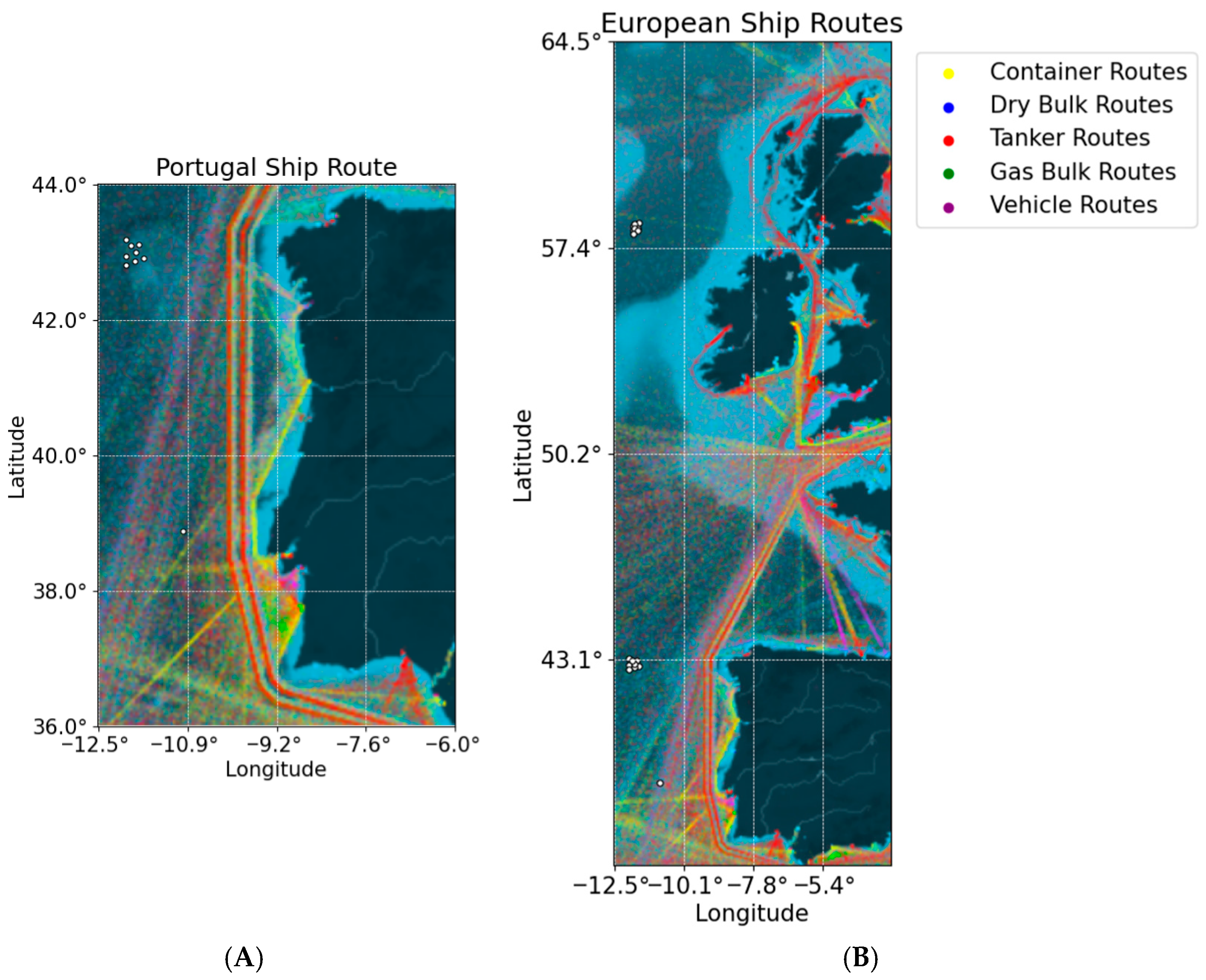
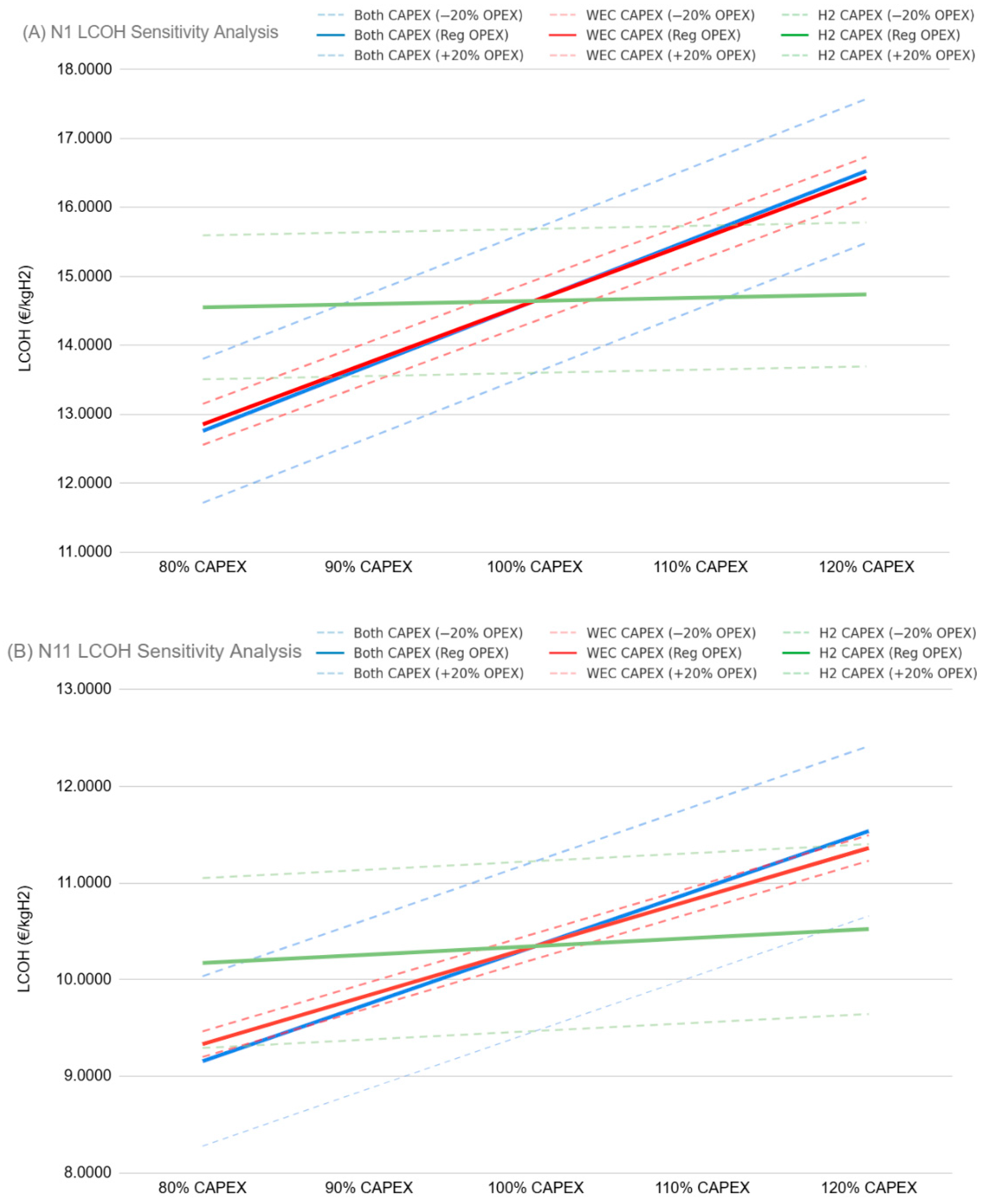
Using the data sourced from ResourceCode, the wave power density across the whole western coast of Europe is presented in Figure 11. This visualisation provides an initial indication of how the LCOE and, consequently, the LCOH might be distributed across the region. The areas with higher wave power density are expected to result in a lower LCOE, as more energy can be harnessed per unit of wavefront. However, it is essential to consider that higher wave power density may potentially lead to increased maintenance requirements for the WEC and H2 systems due to the greater mechanical stresses involved.
Thus, Figure 11 presents a detailed analysis of LCOE along the Portuguese coast and the European Coast. The results indicate consistent values across the region, with most locations offering competitive LCOE figures. In this study, LCOE values exceeding 0.8 €/kW were disregarded from consideration due to their limited feasibility, as the most cost-effective renewable energy projects typically achieve LCOE values below 0.2 €/kW. Similarly, for the European coast, the analysis revealed that the region northwest of the Scottish coast offers the lowest LCOE values, making it an ideal candidate for wave energy and H2 production.
The corresponding LCOE values, along with their respective wave power densities and water depths, are detailed in Table 11, highlighting the region’s strong potential for cost-effective energy generation. The table uses colour coding to distinguish between the different regions analysed: the red entries represent data points from the Portuguese coast, while the green entries correspond to locations in the northwest of Scotland.
The final analysis of the LCOH was conducted across two distinct regions, beginning with the Portuguese region. Figure 12 provides a visual representation of the LCOH for each H2 storage technology under consideration, assuming that the electrolyser system operates at a baseline pressure of 30 bar. Among the three technologies analysed (LH2, CGH2 at 350 bar, and CGH2 at 700 bar), it is evident that CGH2 at 350 bar emerges as the most economically viable option.
In addition to its economic advantages, CGH2 at 350 bar aligns well with existing and emerging maritime infrastructure. This pressure level is already used in several pilot projects for port-side H2 refuelling and storage, such as those in Rotterdam, Trondheim, and Valencia [26,27]. It is compatible with standard composite cylinder technologies and modular container systems that can be transported by truck or barge without specialised cryogenic equipment, thereby reducing logistical complexity. Shipboard storage at 350 bar has also been demonstrated in smaller H2-powered vessels and service crafts, providing a proven pathway for near-term deployment. However, large-scale bunkering and integration into conventional port supply chains still require harmonisation of refuelling standards and safety protocols under IMO and ISO frameworks, which are under active development.
Conversely, LH2 proves to be the least cost-effective, while CGH2 at 700 bar, although less expensive than LH2, still presents high costs. A closer examination of the LH2 map reveals that the costs are higher across most of the region, particularly in the southern parts of Portugal. This pattern suggests that the energy-intensive processes required for liquefaction and cryogenic storage render LH2 a less favourable option in these areas. However, the northwest region shows slightly lower LCOH values, although still higher than those of other technologies, reinforcing the conclusion that liquid H2 storage may not be the most cost-effective solution.
The map illustrating CGH2 storage at 700 bar presents a cost scenario comparable to or slightly lower than the LH2 map. Despite this, the costs associated with 700 bar compression remain high, primarily due to the increased energy required for compressing H2 to such high pressures.
Finally, the middle map, which shows CGH2 storage at 350 bar, highlights this technology as the most economically feasible. The costs are noticeably lower across the region, making 350 bar compression a more attractive option for H2 storage in Portugal. This analysis highlights the relationship between LCOE and LCOH, where lower energy costs directly translate into more favourable H2 production costs, supporting the viability of CGH2 at 350 bar as the preferred storage method in the region.
Similarly, the LCOH analysis was conducted along the Western Coast of Europe, as shown in Figure 13, and the results closely mirror those found in the Portuguese region. Once again, the storage technology for LH2 emerges as the most expensive option, while CGH2 at 350 bar proves to be the most cost-effective solution.
As observed with the Portuguese coast, the areas in the northwest of the region exhibit the lowest LCOH values. This outcome is primarily due to the high wave power density in these locations, which contributes to a significantly lower LCOE. Since LCOE is a key determinant in the overall LCOH, regions with higher wave energy potential benefit from reduced H2 production costs.
The consistency of these findings across both regions reinforces the conclusion that CGH2 at 350 bar is the most economically viable option for H2 storage in areas with high wave power density. It also highlights the critical role that renewable energy sources, such as wave power, play in reducing the costs of sustainable H2 production. This analysis underscores the importance of strategically selecting locations with favourable energy dynamics to maximise the cost-effectiveness of green H2 as a maritime fuel.
The scalability of the proposed dual-chamber WEC design remains uncertain in the absence of pilot or large-scale validation. While our modelling indicates strong potential, real deployment must demonstrate long-term durability, control optimisation, and integration with H2 infrastructure. Moreover, alternative fuel pathways (e.g., wind-assisted ships, biofuels, ammonia carriers) further complicate long-term demand for this particular scaling route.
The environmental benefit of adopting a wave-to-hydrogen system can be evaluated through the avoided CO2 emissions relative to marine diesel generation. Using a specific fuel consumption of 169.4 g/kWh for marine diesel oil [68] and a combustion emission factor of 3.206 kg CO2/kg fuel [69], conventional diesel generation emits approximately 0.54 kg CO2/kWh of energy produced. Replacing this with H2 generated from renewable electricity, which has near-zero operational emissions, results in significant reductions in emissions. For instance, a 1 MW WEC operating 4000 h per year would generate 4000 MWh/yr, avoiding roughly 2170 tonnes CO2/yr compared with diesel use. Even when life cycle impacts such as equipment manufacture and electrolysis losses are considered, the net reduction remains above 85–90% relative to fossil-based systems. These results demonstrate the strong decarbonisation potential of integrating wave energy into maritime H2 production.
Table 12 presents the detailed figures from the LCOH analysis for each storage type. These distinctions highlight the geographical variations in LCOH, clearly comparing the cost implications for each H2 storage technology across the different regions. Again, the red entries represent data points on the Portuguese coast, and the green entries correspond to locations in northwest Scotland.
One key reason the Portuguese coastal points remain under consideration is their strategic proximity to major shipping routes. Figure 14 illustrates this by overlaying the identified points with shipping routes sourced from shipmap.org [70]. The figure clearly shows the dense network of shipping routes along the western coast of Europe, and the locations highlighted in white on the left side of the map.
The eight locations identified along the Portuguese coast stand out as particularly advantageous due to their proximity to these critical maritime pathways. This proximity is not just a geographical convenience; it is a crucial factor in the context of this project, which focuses on decarbonising the shipping industry. By utilising H2 production and storage facilities near these well-travelled routes, the project can more effectively supply green H2 to vessels, facilitating the transition to cleaner fuel alternatives and maximising the impact on reducing carbon emissions in maritime transport.
This alignment between strategic location and shipping activity underscores the importance of considering both energy production costs and logistical efficiency in planning and implementing sustainable maritime fuel solutions.
Although this study focuses on Western Europe, the techno-economic framework is inherently transferable to other coastal regions worldwide. The model’s structure relies on fundamental physical and economic parameters, such as wave power density, bathymetry, distance to shore, infrastructure accessibility, and local cost factors, that can be replaced with region-specific datasets. Consequently, the methodology can be adapted to locations with different wave climates, such as the Pacific coasts of Chile or Australia, by updating the input resource and cost data. However, resulting LCOE and LCOH values will vary according to local conditions, including resource intermittency, installation depth, and supply-chain maturity. This flexibility demonstrates the global applicability of the framework while acknowledging the regional dependence of economic performance.

7. Sensitivity Analysis

A sensitivity analysis was conducted to evaluate the impact of variations in CAPEX and OPEX on the system’s LCOH. The study was performed for two specific locations: Cabo da Roca (N1) and N11, which were selected due to their low LCOE among the sites considered. The objective was to understand how cost changes associated with different project components could influence the overall economic feasibility. The analysis considered various scenarios in which the CAPEX for both wave energy conversion and H2 production systems was adjusted independently and simultaneously within a range of ±20%. Additionally, changes in OPEX were included to account for fluctuations in ongoing operational costs. By systematically altering these cost parameters, the sensitivity analysis aimed to identify key cost drivers for the LCOH and determine the system’s most economically resilient configuration (Figure 15).
Figure 15A illustrates the sensitivity analysis for Cabo da Roca (N1). The red line shows the impact of varying the WEC CAPEX from 80% to 120%, revealing a noticeable linear increase in LCOH as the WEC costs rise. The green line represents the effect of changing only the H2 production CAPEX over the same range. Interestingly, this line remains relatively flat, indicating that the LCOH at N1 is less sensitive to fluctuations in H2 production CAPEX compared to the WEC CAPEX.
The blue line depicts the scenario where both WEC and H2 production CAPEX are adjusted simultaneously. As expected, this line demonstrates the steepest incline, reflecting the cumulative impact of changes in both cost components on the LCOH.
The dashed and faded lines surrounding each of the main lines illustrate the ±20% variation in OPEX. For each scenario (WEC CAPEX, H2 CAPEX, and combined), the upward and downward shifts caused by changes in OPEX suggest that operational costs play a significant role in the overall LCOH. Notably, the baseline LCOH values for N1 range from approximately 13.0 to 17.5 €/kg H2, indicating a relatively high sensitivity to CAPEX changes, especially in the WEC component.
Figure 15B presents the sensitivity analysis for N11, the location with the lowest LCOE. Similar to N1, the red line indicates how the LCOH changes with variations in the WEC CAPEX, displaying a linear increase. The green line illustrates the changes in LCOH when only the H2 production CAPEX is adjusted. As observed with N1, the H2 CAPEX has a smaller impact on the LCOH, exhibiting a relatively flat slope, which indicates reduced sensitivity.
The blue line shows the effect of varying both WEC and H2 production CAPEX simultaneously. This line’s incline suggests a more pronounced impact on the LCOH compared to adjusting each CAPEX individually. However, the overall range of LCOH values in this figure (approximately 9.0 to 13.0 €/kg H2) is lower than that of N1, highlighting the economic advantages of the N11 location.
Again, the dashed and faded lines represent the ±20% OPEX variations for each scenario. These shifts demonstrate that while OPEX changes affect the LCOH, the location’s overall lower cost base makes it less sensitive to operational cost fluctuations compared to N1.
In addition to the CAPEX and OPEX variations already analysed, other assumptions, such as liquefaction system size and desalination costs, were also examined qualitatively. Liquefaction contributes a modest share of total costs, so even moderate variations in its parameters would change the final LCOH by only a few percent. Additionally, desalination has an almost negligible influence because the water demand for H2 production is low compared to typical desalination plant capacities. Consequently, uncertainties in these auxiliary components are unlikely to alter the overall economic conclusions, which remain primarily driven by electricity price, wave energy availability, and electrolyser performance.

8. Conclusions

This study provides a techno-economic assessment of offshore H2 production using wave energy, evaluating LCOE and LCOH across multiple locations along the Portuguese coast and the broader western European coastline. Site selection was based on water depth and wave power density, both of which significantly impact economic feasibility. Results showed that northern Portuguese sites offered the lowest LCOE values (ca. 0.10–0.11 €/kWh), while southern and central offshore locations presented higher costs due to reduced wave power availability. Similarly, LCOH values were lowest for northern Iberian nodes with strong wave resources, highlighting the role of geography in optimising production.
Among the three storage technologies analysed (liquid H2 (LH2), compressed gas H2 (CGH2) at 350 bar, and CGH2 at 700 bar), CGH2 at 350 bar emerged as the most cost-effective option, whereas LH2 proved to be the least viable due to its high liquefaction and storage costs.
While wave energy-powered H2 production is not yet the most cost-competitive solution for large-scale decarbonisation, it represents a promising step towards integrating renewables into the maritime sector. Technological improvements are anticipated through advances in dual-chamber OWC design, turbine efficiency, and control algorithms, which together could reduce conversion losses by 10–15% and lower structural costs as deployment scales. Most commercial WEC concepts are currently at a technology readiness level of 6–7, with pilot arrays expected within the next 5–10 years, suggesting that near-term progress could substantially enhance economic feasibility.

Author Contributions

Conceptualisation, K.R. and M.J.; methodology, K.R.; validation, K.R., M.J., and D.M.F.S.; formal analysis, S.K.; investigation, S.K.; resources, K.R. and M.J.; data curation, K.R.; writing—original draft preparation, S.K. and K.R.; writing—review and editing, M.J. and D.M.F.S.; visualisation, S.K.; supervision, K.R., M.J. and D.M.F.S.; project administration, K.R. and M.J. All authors have read and agreed to the published version of the manuscript.

Funding

Financial support was provided by Fundação para a Ciência e a Tecnologia (FCT, Portugal) for funding a Principal Researcher contract (2023.09426.CEECIND, https://doi.org/10.54499/2023.09426.CEECIND/CP2830/CT0021) in the scope of the Individual Call to Scientific Employment Stimulus—6th Edition (D.M.F. Santos).

Data Availability Statement

The original contributions presented in the study are included in the article, further inquiries can be directed to the corresponding author.

Conflicts of Interest

The authors declare no conflicts of interest.

Abbreviations

The following abbreviations are used in this manuscript:
AHTSAnchor Handling Tug Supply
AWEAlkaline Water Electrolysis
BBDBBackward Bent Duct Buoy
BOLBeginning of Life
BoPBalance of Plant
cHeat Capacity
CAPEXCapital Expenditure
CGH2Compressed Gas Hydrogen
EPCEngineering, Procurement, Construction Costs
FCEVFuel Cell Electric Vehicle
H2Hydrogen
HCRHeat Capacity Ratio
HFOHeavy Fuel Oil
IEAInternational Energy Agency
LCOELevelised Cost of Electricity
LCOHLevelised Cost of Hydrogen
LH2Liquid Hydrogen
OPEXOperational Expenditure
OWCOscillating Water Column
PEMProton-Exchange Membrane
PGMPlatinum Group Metals
SOECSolid Oxide Electrolysis Cells
SOFCSolid Oxide Fuel Cells
TambAmbient Temperature
TEUTwenty-Foot Equivalent Unit
WECWave Energy Converter

References

  1. Reducing Emissions from the Shipping Sector. European Commission. Available online: https://climate.ec.europa.eu/eu-action/transport/reducing-emissions-shipping-sector_en (accessed on 14 October 2025).
  2. Mørk, G.; Barstow, S.; Kabuth, A.; Pontes, M.T. Assessing the Global Wave Energy Potential. In Proceedings of the 29th International Conference on Ocean, Offshore and Arctic Engineering, Shanghai, China, 6–11 June 2010; ASMEDC: Singapore, 2010; Volume 3, pp. 447–454. [Google Scholar] [CrossRef]
  3. Satymov, R.; Bogdanov, D.; Dadashi, M.; Lavidas, G.; Breyer, C. Techno-economic assessment of global and regional wave energy resource potentials and profiles in hourly resolution. Appl. Energy 2024, 364, 123119. [Google Scholar] [CrossRef]
  4. Wave and Tidal Energy Market Size, Share & Industry Analysis, by Technology. Fortune Business Insights, Market Analysis FBI100584. 2023. Available online: https://www.fortunebusinessinsights.com/industry-reports/wave-and-tidal-energy-market-100584 (accessed on 14 October 2025).
  5. Rasheed, T.; Shafi, S.; Anwar, M.T.; Khurshid, H.; Naveed, A.; Alshoaibi, A.; Alnaim, N.; Liu, Y.; Sherazi, T.A. Greener hydrogen production and storage revolution towards a low-carbon future: An overview of current scenarios and future prospects. Fuel 2026, 405, 136519. [Google Scholar] [CrossRef]
  6. Seck, G.S.; Hache, E.; Sabathier, J.; Guedes, F.; Reigstad, G.A.; Straus, J.; Wolfgang, O.; Ouassou, J.A.; Askeland, M.; Hjorth, I.; et al. Hydrogen and the decarbonization of the energy system in europe in 2050: A detailed model-based analysis. Renew. Sustain. Energy Rev. 2022, 167, 112779. [Google Scholar] [CrossRef]
  7. Razmi, A.R.; Hanifi, A.R.; Shahbakhti, M. Techno-economic analysis of a novel concept for the combination of methane pyrolysis in molten salt with heliostat solar field. Energy 2024, 301, 131644. [Google Scholar] [CrossRef]
  8. Razmi, A.R.; Hanifi, A.R.; Shahbakhti, M. A comparative techno-economic assessment between solar-based hydrogen production by methane pyrolysis and water electrolysis methods. Renew. Energy 2025, 242, 122504. [Google Scholar] [CrossRef]
  9. Hill, S.J.P.; Bamisile, O.; Hatton, L.; Staffell, I.; Jansen, M. The cost of clean hydrogen from offshore wind and electrolysis. J. Clean. Prod. 2024, 445, 141162. [Google Scholar] [CrossRef]
  10. Younas, M.; Shafique, S.; Hafeez, A.; Javed, F.; Rehman, F. An Overview of Hydrogen Production: Current Status, Potential, and Challenges. Fuel 2022, 316, 123317. [Google Scholar] [CrossRef]
  11. Bains, P.; Bennett, S.; Collina, L.; Connelly, E.; Delmastro, C.; Evangelopoulou, S.; Fajardy, M.; Gouy, A.; Kotani, M.; Marois, J.-B.L.; et al. Global Hydrogen Review 2023; IEA: Paris, France, 2023. [Google Scholar]
  12. Tatarewicz, I.; Skwierz, S.; Lewarski, M.; Jeszke, R.; Pyrka, M.; Sekuła, M. Mapping the Future of Green Hydrogen: Integrated Analysis of Poland and the EU’s Development Pathways to 2050. Energies 2023, 16, 6261. [Google Scholar] [CrossRef]
  13. Lavidas, G. Energy and socio-economic benefits from the development of wave energy in Greece. Renew. Energy 2019, 132, 1290–1300. [Google Scholar] [CrossRef]
  14. Reguero, B.G.; Losada, I.J.; Méndez, F.J. A global wave power resource and its seasonal, interannual and long-term variability. Appl. Energy 2015, 148, 366–380. [Google Scholar] [CrossRef]
  15. Contini, D.; Merico, E. Recent Advances in Studying Air Quality and Health Effects of Shipping Emissions. Atmosphere 2021, 12, 92. [Google Scholar] [CrossRef]
  16. Al-Enazi, A.; Bicer, Y.; Okonkwo, E.C.; Al-Ansari, T. Evaluating the utilisation of clean fuels in maritime applications: A techno-economic supply chain optimization. Fuel 2022, 322, 124195. [Google Scholar] [CrossRef]
  17. Diaz, L.B.; Boillot, L. Historical Analysis of Clean Hydrogen JU Fuel Cell Electric Vehicles, Buses and Refuelling Infrastructure Projects; Online; European Commission: Brussels, Belgium, 2024. Available online: https://www.clean-hydrogen.europa.eu/document/download/a86f6124-fcb3-48ea-8276-3b10a44cd7f2_en?filename=Historical_FCEVandFCEB_public_0.pdf (accessed on 14 October 2025).
  18. Sustainable Marine Fuels Market Size and Growth 2025 to 2034. Precedence Research, 4487. June 2024. Available online: https://www.precedenceresearch.com/sustainable-marine-fuels-market (accessed on 14 October 2025).
  19. Huertas-Fernández, F.; Clavero, M.; Reyes-Merlo, M.Á.; Moñino, A. Combined Oscillating Water Column & hydrogen electrolysis for wave energy extraction and management. A case study: The Port of Motril (Spain). J. Clean. Prod. 2021, 324, 129143. [Google Scholar] [CrossRef]
  20. Jameel, A.G.A.; Alkhateeb, A.; Telalović, S.; Elbaz, A.M.; Roberts, W.L.; Sarathy, S.M. Environmental Challenges and Opportunities in Marine Engine Heavy Fuel Oil Combustion. In Proceedings of the Fourth International Conference in Ocean Engineering (ICOE2018), Chennai, India, 18–21 February 2018; Murali, K., Sriram, V., Samad, A., Saha, N., Eds.; Lecture Notes in Civil Engineering. Springer: Singapore, 2019; Volume 22, pp. 1047–1055. [Google Scholar] [CrossRef]
  21. Pompodakis, E.E.; Orfanoudakis, G.I.; Katsigiannis, Y.A.; Karapidakis, E.S. Hydrogen Production from Wave Power Farms to Refuel Hydrogen-Powered Ships in the Mediterranean Sea. Hydrogen 2024, 5, 494–518. [Google Scholar] [CrossRef]
  22. Rony, Z.I.; Mofijur, M.; Hasan, M.; Rasul, M.; Jahirul, M.; Ahmed, S.F.; Kalam, M.; Badruddin, I.A.; Khan, T.Y.; Show, P.-L. Alternative fuels to reduce greenhouse gas emissions from marine transport and promote UN sustainable development goals. Fuel 2023, 338, 127220. [Google Scholar] [CrossRef]
  23. Zincir, B.A.; Arslanoglu, Y. Comparative Life Cycle Assessment of Alternative Marine Fuels. Fuel 2024, 358, 129995. [Google Scholar] [CrossRef]
  24. Holtze, B. World’s First Liquid-Powered Hydrogen Ship, MF Hydra, Is Powered by Ballard’s Fuel Cells. Ballard. Available online: https://blog.ballard.com/marine/worlds-first-liquid-powered-hydrogen-ship-mf-hydra-is-powered-by-ballards-fuel-cells (accessed on 14 October 2025).
  25. Fan, H.; Abdussamie, N.; Chen, P.S.-L.; Harris, A.; Gray, E.M.; Arzaghi, E.; Bhaskar, P.; Mehr, J.A.; Penesis, I. Two decades of hydrogen-powered ships (2000–2024): Evolution, challenges, and future perspectives. Renew. Sustain. Energy Rev. 2025, 219, 115878. [Google Scholar] [CrossRef]
  26. IMO CCC 11: Interim Guidelines for Hydrogen as Fuel Completed. Available online: https://www.dnv.com/news/2025/imo-ccc-11-interim-guidelines-for-hydrogen-as-fuel-completed/?utm_source=chatgpt.com (accessed on 14 October 2025).
  27. Chen, P.S.-L.; Fan, H.; Enshaei, H.; Zhang, W.; Shi, W.; Abdussamie, N.; Miwa, T.; Qu, Z.; Yang, Z. A review on ports’ readiness to facilitate international hydrogen trade. Int. J. Hydrogen Energy 2023, 48, 17351–17369. [Google Scholar] [CrossRef]
  28. Jalón, M.L.; Baquerizo, A.; Losada, M.A. Optimization at different time scales for the design and management of an oscillating water column system. Energy 2016, 95, 110–123. [Google Scholar] [CrossRef]
  29. Molina-Salas, A.; Quirós, C.; Gigant, P.; Huertas-Fernández, F.; Clavero, M.; Moñino, A. Exergy assessment and sustainability of a simple off-shore oscillating water column device. Energy 2023, 264, 126142. [Google Scholar] [CrossRef]
  30. Raillard, N.; Chabot, S.; Maisondieu, C.; Darbynian, D.; Payne, G.; Papillon, L. Resourcecode. 2022. Python. Available online: https://resourcecode.ifremer.fr/ (accessed on 14 October 2025).
  31. De Andres, A.; Medina-Lopez, E.; Crooks, D.; Roberts, O.; Jeffrey, H. On the reversed LCOE calculation: Design constraints for wave energy commercialization. Int. J. Mar. Energy 2017, 18, 88–108. [Google Scholar] [CrossRef]
  32. Rezanejad, K.; Gadelho, J.F.M.; Xu, S.; Soares, C.G. Experimental investigation on the hydrodynamic performance of a new type floating Oscillating Water Column device with dual-chambers. Ocean Eng. 2021, 234, 109307. [Google Scholar] [CrossRef]
  33. Wave Energy Scotland. Very large scale wave energy converters. In Analysis of the Innovation Landscape; 260796–00; Wave Energy Scotland: Inverness, UK, 2018. [Google Scholar]
  34. Sebbahi, S.; Nabil, N.; Alaoui-Belghiti, A.; Laasri, S.; Rachidi, S.; Hajjaji, A. Assessment of the three most developed water electrolysis technologies: Alkaline Water Electrolysis, Proton Exchange Membrane and Solid-Oxide Electrolysis. Mater. Today Proc. 2022, 66, 140–145. [Google Scholar] [CrossRef]
  35. El-Shafie, M. Hydrogen production by water electrolysis technologies: A review. Results Eng. 2023, 20, 101426. [Google Scholar] [CrossRef]
  36. Razmi, A.R.; Sharifi, S.; Gholamian, E.; Arabkoohsar, A.; Shahbakhti, M. Green hydrogen. In Future Grid-Scale Energy Storage Solutions; Elsevier: Amsterdam, The Netherlands, 2023; pp. 573–619. [Google Scholar] [CrossRef]
  37. Hydrogen World Expo. The Doosan SOFC Stack Has Successfully Passed the Marine Environmental Test; Online; Hydrogen World Expo: Hamburg, Germany, 2024; Available online: https://www.hydrogen-worldexpo.com/industry-news/doosan-sofc-stack-successfully-passed-marine-environmental-test (accessed on 14 October 2025).
  38. Razmi, A.R.; Sharifi, S.; Vafaeenezhad, S.; Hanifi, A.R.; Shahbakhti, M. Modeling and microstructural study of anode-supported solid oxide fuel cells: Experimental and thermodynamic analyses. Int. J. Hydrogen Energy 2024, 54, 613–634. [Google Scholar] [CrossRef]
  39. Parkes, R. Cost of electrolysers for green hydrogen production is rising instead of falling: BNEF. Hydrogen Insight, March 2024. Available online: https://www.hydrogeninsight.com/electrolysers/cost-of-electrolysers-for-green-hydrogen-production-is-rising-instead-of-falling-bnef/2-1-1607220?zephr_sso_ott=dXFOvl (accessed on 14 October 2025).
  40. Electrolysis Technology & Services by Bosch: Accelerating Green Hydrogen Production. Bosch, 2024. Available online: https://www.bosch-hydrogen-energy.com/electrolysis/ (accessed on 14 October 2025).
  41. Akgul, D.; Çakmakcı, M.; Kayaalp, N.; Koyuncu, I. Cost analysis of seawater desalination with reverse osmosis in Turkey. Desalination 2008, 220, 123–131. [Google Scholar] [CrossRef]
  42. AlZohbi, G.; Almoaikel, A.; AlShuhail, L. An overview on the technologies used to store hydrogen. Energy Rep. 2023, 9, 28–34. [Google Scholar] [CrossRef]
  43. Zohuri, B. Cryogenics and Liquid Hydrogen Storage. In Hydrogen Energy; Springer International Publishing: Cham, Switzerland, 2019; pp. 121–139. [Google Scholar] [CrossRef]
  44. Atilhan, S.; Park, S.; El-Halwagi, M.M.; Atilhan, M.; Moore, M.; Nielsen, R.B. Green hydrogen as an alternative fuel for the shipping industry. Curr. Opin. Chem. Eng. 2021, 31, 100668. [Google Scholar] [CrossRef]
  45. Fure, H. Sustainable Shipping: Exploring the Feasibility of Investments in Hydrogen-Powered Vessels for the Short-Sea Sector; Online; Norwegian School of Economics: Bergen, Norway, 2020. [Google Scholar]
  46. Paish, O. Small hydro power: Technology and current status. Renew. Sustain. Energy Rev. 2002, 6, 537–556. [Google Scholar] [CrossRef]
  47. Taylor, M.; Al-Zoghoul, S.; Ralon, P. Renewable Power Generation Costs in 2022; Online; IRENA: Masdar City, United Arab Emirates, 2023; Available online: https://www.irena.org/-/media/Files/IRENA/Agency/Publication/2023/Aug/IRENA_Renewable_power_generation_costs_in_2022.pdf (accessed on 14 October 2025).
  48. Guo, C.; Sheng, W.; De Silva, D.G.; Aggidis, G. A Review of the Levelized Cost of Wave Energy Based on a Techno-Economic Model. Energies 2023, 16, 2144. [Google Scholar] [CrossRef]
  49. O’Connor, M.; Lewis, T.; Dalton, G. Operational expenditure costs for wave energy projects and impacts on financial returns. Renew. Energy 2013, 50, 1119–1131. [Google Scholar] [CrossRef]
  50. Agamemnon, A.; Andreas, M.; Anna, M. The modelling of maintenance cost: The case of container-ships in dry-dock. J. Comput. Optim. Econ. Financ. 2013, 5, 27. [Google Scholar]
  51. Rezanejad, K.; Anastas, G.; Hashemzadeh, M.; Gadelho, J.; López, I.; Carballo, R.; Soares, C.G. Experimental study on the hydrodynamic performance of an innovative floating dual-chamber oscillating water column. Ocean Eng. 2025, 323, 120549. [Google Scholar] [CrossRef]
  52. Medina-Lopez, E.; Borthwick, A.G.L.; Moñino, A. Analytical and numerical simulations of an oscillating water column with humidity in the air chamber. J. Clean. Prod. 2019, 238, 117898. [Google Scholar] [CrossRef]
  53. Ohlig, K.; Decker, L. The latest developments and outlook for hydrogen liquefaction technology. In Proceedings of the ADVANCES IN CRYOGENIC ENGINEERING: Transactions of the Cryogenic Engineering Conference—CEC, Anchorage, AK, USA, 17–21 June 2013; pp. 1311–1317. [Google Scholar] [CrossRef]
  54. Nigbur, F.; Roninius, M.; Wienert, P.; Deutsch, M. Levelised Cost of Hydrogen. In Making the Application of the LCOH Concept More Consistent and More Useful; Online; Agora Energiewende: Berlin, Germany; Umlaut: Plano, TX, USA, 2023; Available online: https://www.agora-energiewende.org/fileadmin/Projekte/2022/2022-12-10_Trans4Real/A-EW_301_LCOH_WEB.pdf (accessed on 14 October 2025).
  55. Kim, M.; Lee, D.; Qi, M.; Kim, J. Techno-economic analysis of anion exchange membrane electrolysis process for green hydrogen production under uncertainty. Energy Convers. Manag. 2024, 302, 118134. [Google Scholar] [CrossRef]
  56. Carmo, M.; Fritz, D.L.; Mergel, J.; Stolten, D. A comprehensive review on PEM water electrolysis. Int. J. Hydrogen Energy 2013, 38, 4901–4934. [Google Scholar] [CrossRef]
  57. Hydrogen Council; McKinsey & Company. Hydrogen Insights 2023; Online; Hydrogen Council: Brussels, Belgium; McKinsey & Company: New York City, NY, USA, 2023; Available online: https://hydrogencouncil.com/wp-content/uploads/2023/12/Hydrogen-Insights-Dec-2023-Update.pdf (accessed on 14 October 2025).
  58. AXEON CT—Series Spec Sheet. 2017. Available online: https://espwaterproducts.com/cdn/shop/files/Axeon_CT_Series_Spec_Sheet-12-20.pdf?v=17452564721900108340 (accessed on 14 October 2025).
  59. Khawaji, A.D.; Kutubkhanah, I.K.; Wie, J.-M. Advances in seawater desalination technologies. Desalination 2008, 221, 47–69. [Google Scholar] [CrossRef]
  60. Mezher, T.; Fath, H.; Abbas, Z.; Khaled, A. Techno-economic assessment and environmental impacts of desalination technologies. Desalination 2011, 266, 263–273. [Google Scholar] [CrossRef]
  61. Burke, A.; Ogden, J.; Fulton, L. Hydrogen Storage and Transport: Technologies and Costs; UC Davis, Institute of Transportation Studies: Yolo County, CA, USA, 2024. [Google Scholar]
  62. Bora, D.K. Green Hydrogen Production with 25 kW Alkaline Electrolyzer Pilot Plant Shows Hydrogen Flow Rate Exponential Asymptotic Behavior with the Stack Current. Hydrogen 2025, 6, 75. [Google Scholar] [CrossRef]
  63. Decker, L.; Elliot, A.; Stolzenburg, K.; Berstad, D.; Haberstroh, C.; Hatto, C.; Klaus, M.; Mortimer, N.D.; Mubbala, R.; Mwabonje, O.; et al. Efficient Liquefaction of Hydrogen: Results of the IDEALHY Project. In Proceedings of the XXth Energie—Symposium, Stralsund, Germany, 7–9 November 2013. [Google Scholar]
  64. Gardiner, M. Energy Requirements for Hydrogen Gas Compression and Liquefaction as Related to Vehicle Storage Needs; Online; Department of Energy, United States: Washington, DC, USA, 2009. Available online: https://www.hydrogen.energy.gov/docs/hydrogenprogramlibraries/pdfs/9013_energy_requirements_for_hydrogen_gas_compression.pdf?Status=Master (accessed on 14 October 2025).
  65. American Membrane Technology Association. Membrane Desalination Power Usage Put in Perspective; American Membrane Technology Association: Stuart, FL, USA, 2016. [Google Scholar]
  66. Handtmann Data Sheet PEM Electrolyser. Available online: https://www.handtmann.de/fileadmin/user_upload/Geschaeftsbereiche/e-solutions/Kernmaerkte/Wasserelektrolyse/data_sheet_handtmann_electrolyser_en.pdf (accessed on 14 October 2025).
  67. H2Planet Hy-COMP XT Automated Hydrogen Compression System. 2023. Available online: https://www.h2planet.eu/grk_files//landing-pages/presentazioni/Brochure_Hy-COMP_XT_ENG.pdf (accessed on 14 October 2025).
  68. Wärtsilä Generating Sets—Tailored to Optimize Performance. 2025. Available online: https://www.wartsila.com/marine/products/engines-and-generating-sets/generating-sets/wartsila-gensets (accessed on 14 October 2025).
  69. Comer, B.; Osipova, L. Accounting for Well-to-Wake Carbon Dioxide Equivalent Emissions in Maritime Transportation Climate Policies; Online; The International Council on Clean Transportation: Washington, DC, USA, 2021; Available online: https://theicct.org/wp-content/uploads/2021/06/Well-to-wake-co2-mar2021-2.pdf (accessed on 14 October 2025).
  70. Clark, D.; Houston, R.; Schaumeier, J.; Smith, T. Ship Map. Available online: https://www.shipmap.org (accessed on 14 October 2025).
Figure 1. Global hydrogen (H2) production projections (all technologies), highlighting the rapid growth of electrolyser-based (green) H2 [6].
Fuels 06 00092 g001
Figure 2. A process combining quantitative analysis, expert interviews, and spatial decision analysis to assess system viability across locations, culminating in an integrated evaluation with sensitivity and uncertainty analysis.
Fuels 06 00092 g002
Figure 3. A breakdown of the sequence followed in the present study, along with the different factors assessed for each phase.
Fuels 06 00092 g003
Figure 4. (A) Analysis of water depth and wave power density at various nodes along the Portuguese coast and (B) selected points from the analysis over a depth map of the coast.
Fuels 06 00092 g004
Figure 5. (A) The nodes along the Western Coast of Europe analysed in the code, and (B) the selected points against a depth map of the region.
Fuels 06 00092 g005
Figure 6. Schematic of the double-chamber oscillating water column device featuring a fore and rear chamber [32].
Fuels 06 00092 g006
Figure 7. Categorised hydrogen (H2) storage technologies into physical storage (CGH2, LH2, CcH2) and chemical storage (absorption with various metal hydrides).
Fuels 06 00092 g007
Figure 8. The proposed system with the different storage technologies considered.
Fuels 06 00092 g008
Figure 9. Flow diagram of a WEC system powering desalination and H2 production, with subsequent H2 systems, with green representing energy flow and blue representing water flow through the system. Depending on the type of H2 storage, energy can be directed to either liquefaction and cryogenic storage or compression and maintained pressure storage.
Fuels 06 00092 g009
Figure 10. (A) Locations selected in red dots for the WEC with the lowest LCOE and LCOH within the two regions. (B) Wave power density is mapped across the whole region.
Fuels 06 00092 g010
Figure 11. (A) Colour map of LCOE along the Portuguese coast and the Western Coast of Europe with the Floating Dual Chamber Oscillating Water Column Device. (B) LCOE calculations for each selected point, along with their respective annual energy production based on wave power density and water depth.
Fuels 06 00092 g011
Figure 12. LCOH for (A) liquid H2, (B) compressed gas H2 at 350 bar, and (C) compressed gas H2 at 700 bar for the Portuguese Coast.
Fuels 06 00092 g012
Figure 13. LCOH for (A) liquid H2, (B) compressed gas H2 at 350 bar, and (C) 700 bar along the Western Coast of Europe.
Fuels 06 00092 g013
Figure 14. Shipping routes, categorised by ship type, overlapped onto the (A) Portuguese Coast and (B) the Western Coast of Europe, with the selected points presenting the lowest LCOE and LCOH in white.
Fuels 06 00092 g014
Figure 15. (A) Sensitivity analysis on N1 with changes in the WEC CAPEX, H2 CAPEX, and both simultaneously, along with OPEX change in dashed, and (B) sensitivity analysis on N11 with the same format. Dashed lines represent ±20% variations. The upper dashed line corresponds to +20% and the lower dashed line to −20%.
Fuels 06 00092 g015
Table 1. Companies considered, along with their respective locations and specifications.
CompanyLocationArea of Expertise
APortugalWave Energy Converters
BScotlandWave Energy
CNorwayOnshore H2 Production
DFranceOnshore H2 Production/Storage
EGermanyOffshore H2 Production/Storage
Table 2. Water electrolysis technology comparison [34,35].
Characteristic Alkaline Water Electrolysis Proton Exchange Membrane Electrolysis Solid Oxide Electrolysis Cell
Efficiency (%) 60–80 80 >90
Operating Temperature (°C) 60–90 50–90 700–1000
Energy Consumption (kWh/kgH2)50–7550–8340
Lifetime (h)40,000–60,00060,000–90,00020,000–40,000
Technology MaturityCommercially MatureCommercially MatureEmerging
Table 3. Comparison of typical H2 storage technologies [42].
Technology Metal Hydrides LH2 CGH2@350 Bar CGH2@700 Bar
Operating temperatureVariable on type−253 °CAmbientAmbient
Gravimetric capacity (wt.%) 1–28–10 4–6 5–7
Volumetric capacity (kg/m3) 100–15070–100 24–40 28–45
Maturity level Less developed Mature and used in specific applications Mature and commercially used Mature and commercially used
Table 5. Balance of plant cost estimates for the WEC [9].
Factor Cost (€/kW)
Project Development 252
Monitoring System 63.2
Installation Labour 772
Anchor (€/unit) 15,000
Table 6. OPEX breakdown of the WEC.
Parameter Cost (€) Source
Dry Docking 1,000,000 [50]
WEC OPEX 720,000 [49]
Decommissioning Costs 420,000 [48]
Table 7. Key assumptions for the hydrogen (H2) system.
Parameter Value
Discount Rate (%) 5.00
Project Lifetime (years) 30
Lifetime Stack (hours) 80,000
Specific Energy Consumption (kWh/kgH2) 55
Full Load Hours (hours) 4000
System Pressure (bar) 1 to 30
Compressor Efficiency (%) 80
Stack Replacement Costs (% of CAPEX) 35
Table 8. CAPEX costs of H2 systems.
Component Value Source
Engineering, Procurement, Construction Costs (% of CAPEX) 30 [54]
Compressor Costs (€/kW) 1000 [54]
LH2 Storage (€/kgH2) 1500 [11]
CGH2 350 bar Storage (€/kgH2) 300 [57]
CGH2 700 bar Storage (€/kgH2) 600 [57]
Reverse Osmosis System (€) 8000 [58]
Electrolyser System (€/kW) 2000 [9]
Table 9. Required energy (in kWh/kgH2) for each component of the H2 system.
Component of H2 SystemEnergy Consumed (kWh/kgH2) Source
Production 55.0 [62]
LH2 Storage per Day 0.0119 [61]
Liquefaction 13.3[63]
Compression 350 bar 2.23[61]
350 bar Storage Per Day 0.460 [61]
Compression 700 bar 4.00 [64]
700 bar Storage Per Day 1.38[61]
Desalination 0.0315 [65]
Table 10. Energy distribution between the three storage types (LH2, CGH2 at 350 bar, and CGH2 at 700 bar).
Liquid H2CGH2 at 350 BarCGH2 at 700 Bar
H2 Production 75.65%90.29%87.58%
CGH2 Storage -0.0007%0.0021%
Compression -3.66%6.37%
LH2 Storage 0.02%--
Liquefaction 18.29%--
Desalination System 0.04%0.05%0.05%
Control System 5.00%5.00%5.00%
Emergency & Communication System 1.00%1.00%1.00%
Table 11. LCOE calculations for each selected point, along with their respective annual energy production based on wave power density and water depth.
Location Name (Node Point) Latitude LongitudeDistance to Nearest Port (km) Water Depth (m) Wave Power Density (kW/m) Annual Energy Production (kWh) LCOE
(€c/kWh)
N1: Cabo da Roca 38.884408 −10.953589157.88 200 35.55 325.05 18.83
N2: Azores 37.004186 −22.20096 317.88 300 45.00 411.47 15.33
N3 42.936459 −11.998958279.95 1642 47.32 432.70 16.79
N4 43.186459 −11.998958288.35 1999 48.08 439.64 17.11
N5 43.118237 −11.760653267.54 1908 47.93 438.25 17.01
N6 42.911205 −11.664474252.89 1701 47.19 431.52 16.94
N7 42.867661 −11.828926264.59 1069 47.25 432.05 15.87
N8 42.998676 −11.818981267.76 1401 47.59 435.17 16.30
N9 43.096104 −11.900826277.46 1777 48.00 438.94 16.77
N10 42.811459 −11.998929276.70 1836 46.99 429.62 17.23
N11 58.248558 −11.673246538.70 1736 79.86 730.22 10.28
N12 58.056549 −11.701195524.61 1886 79.87 730.33 10.42
N13 58.111565 −11.864402535.78 1863 79.94 730.93 10.39
N14 58.208336 −11.82726 541.80 1767 79.87 730.31 10.31
N15 57.985085 −11.847041525.31 1863 80.02 731.66 10.38
N16 58.046482 −11.82128 528.91 1863 79.93 730.85 10.39
N17 57.987732 −11.713585519.79 1915 79.90 730.56 10.45
N18 57.860298 −11.849504516.01 1836 79.85 730.17 10.38
Table 12. LCOH Calculations for each location, comparing the liquid H2, compressed gas H2 at 350 bar and compressed gas H2 at 700 bar.
Location Name Latitude Longitude LCOH for LH2
(€/kgH2)
LCOH for CGH2 350 Bar (€/kgH2) LCOH for CGH2 at 700 Bar (€/kgH2)
N1: Cabo da Roca 38.884408 −10.95358914.4912.9813.48
N2: Azores 37.004186 −22.20096 12.6811.1911.75
N3 42.936459 −11.99895813.4912.0512.49
N4 43.186459 −11.99895813.7312.1612.67
N5 43.118237 −11.76065313.6112.1212.61
N6 42.911205 −11.66447413.5712.0712.57
N7 42.867661 −11.82892612.9811.4811.98
N8 42.998676 −11.81898113.2211.7212.22
N9 43.096104 −11.90082613.4811.9812.48
N10 42.811459 −11.99892913.7312.2312.73
N11 58.248558 −11.67324610.178.819.31
N12 58.056549 −11.70119510.258.899.39
N13 58.111565 −11.86440210.238.879.37
N14 58.208336 −11.82726 10.198.829.32
N15 57.985085 −11.84704110.238.879.37
N16 58.046482 −11.82128 10.238.879.37
N17 57.987732 −11.71358510.268.909.40
N18 57.860298 −11.84950410.238.869.36
Disclaimer/Publisher’s Note: The statements, opinions and data contained in all publications are solely those of the individual author(s) and contributor(s) and not of MDPI and/or the editor(s). MDPI and/or the editor(s) disclaim responsibility for any injury to people or property resulting from any ideas, methods, instructions or products referred to in the content.