Article

Wind-Resistant Adaptive Robust Control of Vector–Rotor Unmanned Aerial Vehicles for Omnidirectional Orchard Crop Inspection


1
Smart Transportation Engineering Research Center, School of Information and Electrical Engineering, Hangzhou City University, Hangzhou 310015, China
2
Hangzhou Zhiyuan Research Institute Co., Ltd., Hangzhou 310012, China
3
College of Mechanical and Vehicle Engineering, Hunan University, Changsha 410082, China
*
Author to whom correspondence should be addressed.
Appl. Mech. 2026, 7(2), 46; https://doi.org/10.3390/applmech7020046
Submission received: 12 April 2026 / Revised: 20 May 2026 / Accepted: 29 May 2026 / Published: 30 May 2026

Abstract

This paper investigates the flight-control problem of a vector–rotor UAV (VR-UAV) for orchard crop-inspection tasks, where wind acts as the dominant external disturbance source. In such tasks, the UAV is required to maintain position while adjusting its attitude for flexible sensor pointing. For a conventional quadrotor UAV (QUAV), however, position and attitude are strongly coupled because the thrust directions are fixed relative to the fuselage, which limits its ability to perform stable hovering and directional sensing simultaneously. Although gimbal-based solutions can provide sensing-direction adjustment, they may become less suitable for wind-affected low-altitude inspection tasks involving large, elongated, or multi-sensor payloads, due to the added mass, inertia, structural compliance, and vibration sensitivity introduced by the additional mechanism. To address these limitations, this paper proposes a compact VR-UAV platform together with an adaptive robust constraint-following control (ARCFC) method. By incorporating tilting motors for thrust-vector adjustment, the proposed VR-UAV enables decoupled regulation of position and attitude, thereby improving fixed-point hovering capability and flexible sensor pointing. From the control perspective, the thrust-vectoring mechanism introduces strongly nonlinear coupled dynamics, while wind-induced disturbances and modeling uncertainties further complicate the control problem. To address these challenges, a constraint-following control framework is developed to handle the nonlinear dynamics, and an adaptive robust compensation mechanism is introduced to estimate the uncertainty bound online and compensate for unknown but bounded disturbances. The closed-loop stability and robustness of the proposed method are rigorously established by theoretical analysis. Comparative simulation results demonstrate that, relative to a conventional QUAV, the proposed VR-UAV with ARCFC achieves superior flight stability, stronger wind-disturbance rejection, and better trajectory-tracking performance in wind-affected orchard inspection scenarios.

1. Introduction

In orchard crop-inspection tasks, a UAV is often required to hover at a prescribed position while adjusting its observation direction to inspect targets hidden by dense foliage, branches, and surrounding obstacles. In this paper, the detector is assumed to be rigidly mounted on the UAV body without an independent gimbal mechanism. Under this setting, the observation direction is directly determined by the vehicle’s attitude. Therefore, effective inspection requires the UAV to regulate position and attitude in a coordinated yet sufficiently decoupled manner. Such perception-intensive agricultural operations have been widely discussed in recent studies on agricultural robots and UAV-based crop inspection [1,2]. However, for a conventional quadrotor UAV (QUAV), the rotor thrust directions are fixed relative to the fuselage, and horizontal motion is achieved primarily through body tilting. As a result, position and attitude are strongly coupled, making it difficult for the vehicle to maintain fixed-point hovering while simultaneously adjusting its attitude for flexible sensor pointing. This limitation becomes more severe in low-altitude orchard environments, where wind acts as the dominant external disturbance source and can significantly degrade hovering stability and observation accuracy [3,4].
To overcome this limitation, existing studies can be broadly classified into two technical routes. One route augments conventional multirotor platforms with additional sensing-orientation mechanisms, such as gimbals. For example, Liang et al. [5] developed an aerial pipeline-inspection UAV equipped with a gimbal structure, which enables stable monitoring through gimbal-angle adjustment. However, in the wind-affected orchard inspection scenario considered in this paper, the sensing payload is not treated as a small independent camera module, but as a rigidly mounted inspection device that may be large, elongated, or composed of multiple sensors. Although gimbal-based solutions are common, for such payloads, an additional gimbal mechanism introduces an extra mechanical structure between the UAV body and the sensing payload, thereby increasing the overall mass, rotational inertia, structural complexity, structural compliance, and vibration sensitivity. These factors may reduce flight endurance, maneuverability, hovering robustness, and sensing stability. The other route modifies the propulsion layout itself through tilting mechanisms or thrust-vectoring structures, so that observation-direction adjustment can be realized at the vehicle level. Zeng et al. [6] introduced a fully actuated tilt-rotor quadrotor platform in which each rotor orientation is independently controlled by a dual-axis tilting mechanism, thereby achieving full six-degree-of-freedom (6-DoF) control. The Korea Advanced Institute of Science and Technology [7] proposed an X-type wall-climbing quadrotor with biaxial tilting mechanisms for vertical-surface inspection, while Hao et al. [8] presented a tilting quadrotor carrying a thickness-measurement sensor for metal-structure inspection. In a related direction, Skygauge Robotics developed a thrust-vectoring UAV capable of maintaining stable contact with vertical or inclined surfaces. These studies show that thrust-vectoring platforms can provide the structural basis for decoupled regulation of position and attitude. However, many existing designs still suffer from high structural complexity, increased cost, and reduced mechanical compactness and their suitability for wind-affected orchard inspection tasks remains insufficiently addressed. More broadly, system-level parametric studies have also shown that UAV performance is highly sensitive to configuration and control-related design choices across different flight conditions [9].
Motivated by the above considerations, this paper proposes a vector–rotor UAV (VR-UAV) for orchard crop-inspection tasks. The proposed platform realizes thrust-vector adjustment through tilting motors mounted beneath the rotors, allowing the vehicle to regulate position and attitude in a decoupled manner while maintaining a compact mechanical architecture [10]. Compared with a conventional QUAV equipped with an additional gimbal chain, the proposed VR-UAV shifts the directional-adjustment function to the vehicle level, which is more suitable for tasks requiring stable hovering, flexible sensor pointing, and improved robustness under wind disturbances. However, the introduction of thrust-vector adjustment also leads to stronger nonlinearity and more complicated coupled dynamics, making controller design significantly more challenging [11,12,13].
Various response-tracking methodologies have also been compared for aerospace dynamic systems [14]. For nonlinear UAV control, linearization-based methods have been widely studied [15,16]. Although such methods can simplify controller design, they generally provide only local approximations around selected operating points and may become inadequate when strong coupling, parameter variations, and external disturbances are present. For disturbance rejection in UAV systems, robust control and model predictive control (MPC) have also attracted considerable attention. Bianchi et al. [17] proposed a robust UAV control strategy with disturbance and uncertainty estimation, showing the importance of explicitly considering external disturbances and uncertain dynamics in UAV flight control. Mendez et al. [18] developed a wind-preview-based MPC method for multi-rotor UAVs using LiDAR information, demonstrating that wind-aware predictive control can improve trajectory tracking under wind disturbances. These studies provide important insights into UAV control under uncertain and wind-affected conditions. However, for the VR-UAV considered in this paper, thrust-vector adjustment introduces stronger nonlinear coupling between translational and rotational dynamics, and the desired crop-inspection task requires simultaneous position holding and attitude adjustment. Therefore, a control framework that can directly incorporate nonlinear dynamics and handle unknown-but-bounded uncertainties is required. In contrast, the constraint-following control (CFC) methodology proposed by Chen et al. [19] directly incorporates nonlinear system constraints into control design without requiring model linearization [20]. Within this framework, control objectives are formulated as servo constraints, and the control input is derived according to the Lagrangian form of Gauss’s principle of least constraint together with D’Alembert’s principle. As a result, the generated control force is naturally consistent with the nonlinear dynamics of the system. Related recent studies have further demonstrated the effectiveness of constraint-based planning and adaptive robust control in nonlinear mechanical systems [21,22,23,24]. This property makes CFC particularly suitable for the VR-UAV studied here, whose core task is to achieve stable position holding and attitude adjustment under a nonlinear thrust-vectoring mechanism.
In practical orchard inspection scenarios, wind is the dominant source of external disturbance, while modeling errors and parameter variations are also unavoidable. Rather than relying on an explicit wind model, this paper treats wind-induced effects together with modeling uncertainties as unknown-but-bounded disturbances to be compensated online. Existing robust control methods often assume known and constant uncertainty bounds [25,26,27,28]. However, such assumptions may be overly restrictive for low-altitude outdoor flight, where wind-induced disturbances vary with time and are difficult to characterize accurately. To overcome this limitation, the adaptive robust constraint-following control (ARCFC) framework proposed by Chen provides a promising solution for nonlinear systems with uncertainties. Related studies have demonstrated its effectiveness in uncertain autonomous systems and articulated mechanical systems [21,29]. Motivated by these observations, this paper develops an ARCFC strategy for the proposed VR-UAV so that wind-induced disturbances and modeling uncertainties can be handled in a unified adaptive robust framework, thereby improving flight stability, disturbance-rejection capability, and trajectory-tracking performance in wind-affected orchard crop-inspection tasks.
Based on the above discussion, this paper develops a VR-UAV platform and an ARCFC strategy for wind-affected orchard crop-inspection tasks. The main contributions of this work are summarized as follows.
  • A compact VR-UAV configuration is proposed for orchard inspection tasks. By introducing tilting motors for thrust-vector adjustment, the proposed platform enables decoupled regulation of position and attitude, thereby improving fixed-point hovering capability and flexible sensor pointing under wind-affected conditions.
  • A complete dynamic model of the VR-UAV is established, which captures the system dynamics and provides a theoretical basis for the subsequent controller design.
  • An ARCFC strategy is developed for the VR-UAV to address both nonlinear dynamics and unknown-but-bounded disturbances. Within this framework, wind-induced disturbances and modeling uncertainties are compensated online through adaptive robust control, thereby improving flight stability, disturbance-rejection capability, and trajectory-tracking performance.

2. Position–Attitude Requirement and Structural Limitation of QUAVs

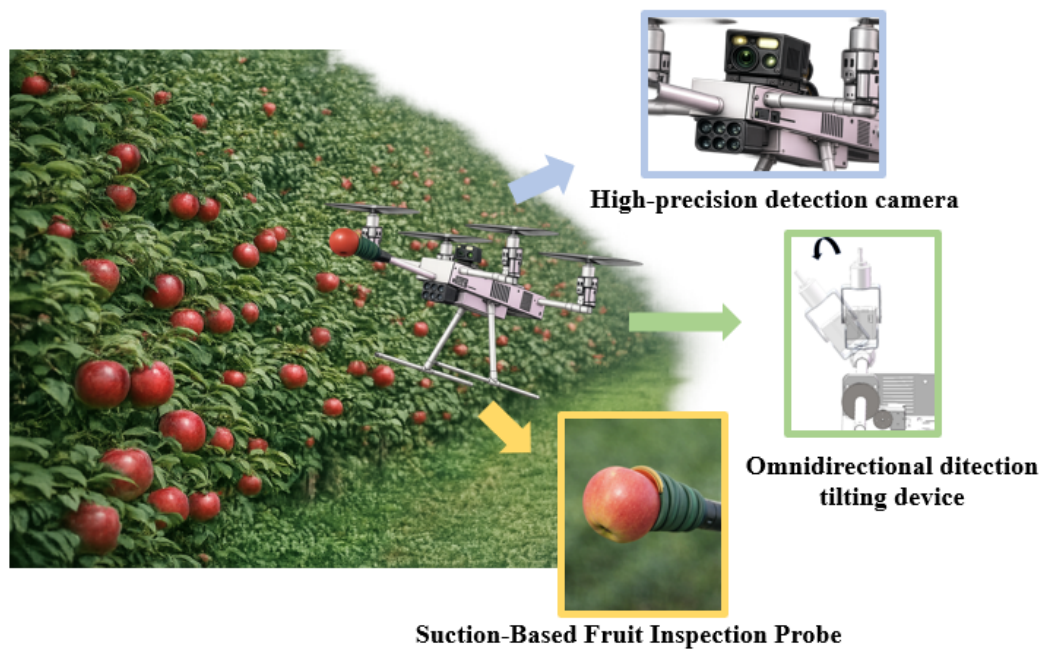
In orchard crop-inspection tasks, the target to be observed is often partially occluded by dense foliage and surrounding branches, while neighboring trees and environmental obstacles further restrict the available observation space, as illustrated in Figure 1. In this paper, the detector is assumed to be rigidly mounted on the UAV body without an additional gimbal mechanism. Under this setting, the observation direction is directly determined by the body attitude of the UAV. Therefore, the inspection task requires the UAV to maintain a prescribed position while adjusting its attitude so that the detector can cover the desired field of view.
Accordingly, the inspection requirement can be expressed as
p = p d , w = w d ,
where p d = [ x d , y d , z d ] T denotes the desired position and w d = [ φ d , θ d , ψ d ] T denotes the desired attitude.
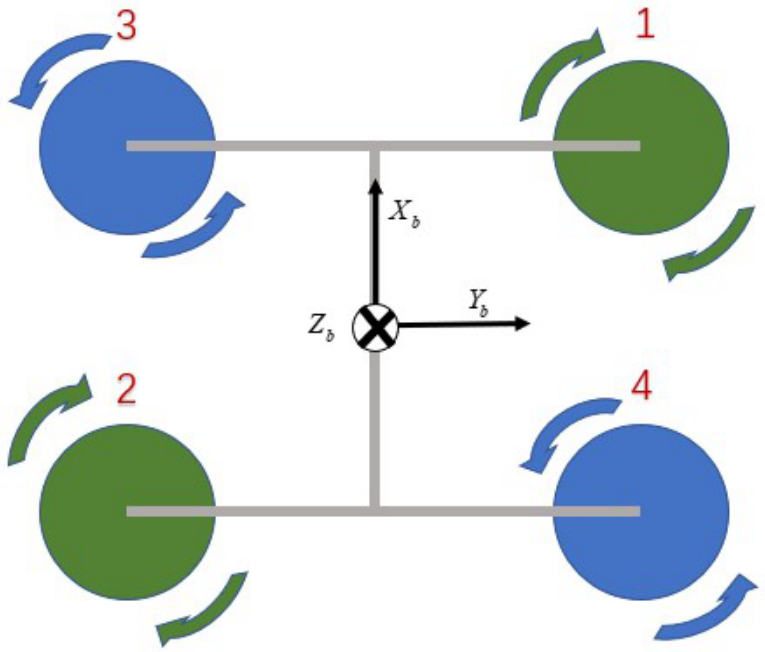
A conventional quadrotor UAV (QUAV) generates motion through four fixed rotors, as illustrated in Figure 2. When the detector is rigidly mounted on the fuselage, the observation direction is directly determined by the vehicle attitude. However, because the rotor thrust directions are fixed relative to the body frame, horizontal translation of a QUAV is mainly achieved through body tilting. Consequently, position regulation and sensor pointing are intrinsically coupled, which limits the ability of the vehicle to maintain fixed-point hovering while simultaneously adjusting its attitude.
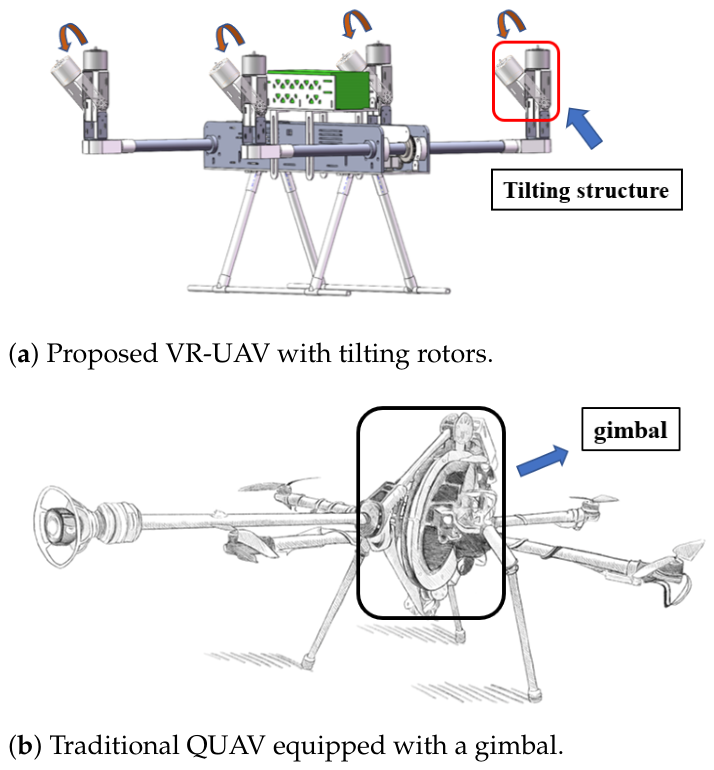
A straightforward way to improve directional sensing is to equip the QUAV with an additional gimbal. This solution can provide sensor-orientation adjustment without directly changing the vehicle attitude. However, the added mechanism increases structural complexity, payload mass, and inertia, which may reduce endurance, maneuverability, and robustness in wind-affected low-altitude inspection tasks. Therefore, for the task considered in this paper, vehicle-level attitude adjustment while maintaining position is more desirable than relying on an additional gimbal mechanism.

3. VR-UAV Design and Control-Oriented Modeling

To satisfy the inspection requirement in Equation (1), this paper proposes a vector–rotor UAV (VR-UAV), as shown in Figure 3a. The proposed platform realizes thrust-vector adjustment through tilting motors mounted beneath the rotors, rather than by using a large external gimbal for sensor orientation. As shown in Figure 3b, a gimbal-equipped QUAV relies on an additional payload-level orientation mechanism, which may become bulky and mechanically complex in narrow orchard spaces. In contrast, the proposed VR-UAV integrates the directional-adjustment function into the rotor-level tilting structure, thereby preserving vehicle compactness. By reorienting the thrust vectors, the platform can generate horizontal control force without relying solely on body tilting, allowing the UAV to maintain its position while adjusting its attitude toward the detected target. As a result, position and attitude can be regulated in a substantially decoupled manner, enabling fixed-point hovering with flexible sensor pointing.

Control-Oriented Dynamic Model

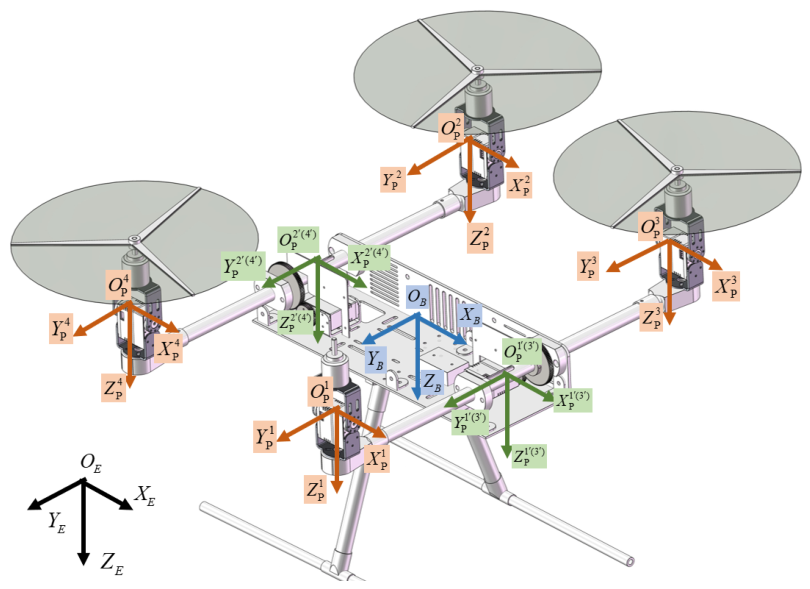
To derive a control-oriented model, the Earth-fixed inertial frame is denoted by E ( o E , x E , y E , z E ) , the body-fixed frame of the VR-UAV by B ( O B , X B , Y B , Z B ) , and the rotor frame of the ith rotor by P i ( O P i , X P i , Y P i , Z P i ) , as shown in Figure 4. Let the position vector and Euler-angle vector of the UAV be
p = [ x , y , z ] T , w = [ φ , θ , ψ ] T .
The body angular velocity expressed in B is denoted by
ω B = [ ω x , ω y , ω z ] T .
Following the XYZ Euler-angle convention, the rotation matrix from B to E is
R B E = cos θ cos ψ cos ψ sin φ sin θ cos φ sin ψ cos φ cos ψ sin θ + sin φ sin ψ cos θ sin ψ cos φ cos ψ + sin φ sin θ sin ψ cos ψ sin φ + cos φ sin θ sin ψ sin θ cos θ sin φ cos θ cos φ ,
and the kinematic relationship between ω B and w ˙ is
ω B = T ( w ) w ˙ = 1 0 sin θ 0 cos φ sin φ cos θ 0 sin φ cos φ cos θ φ ˙ θ ˙ ψ ˙ .
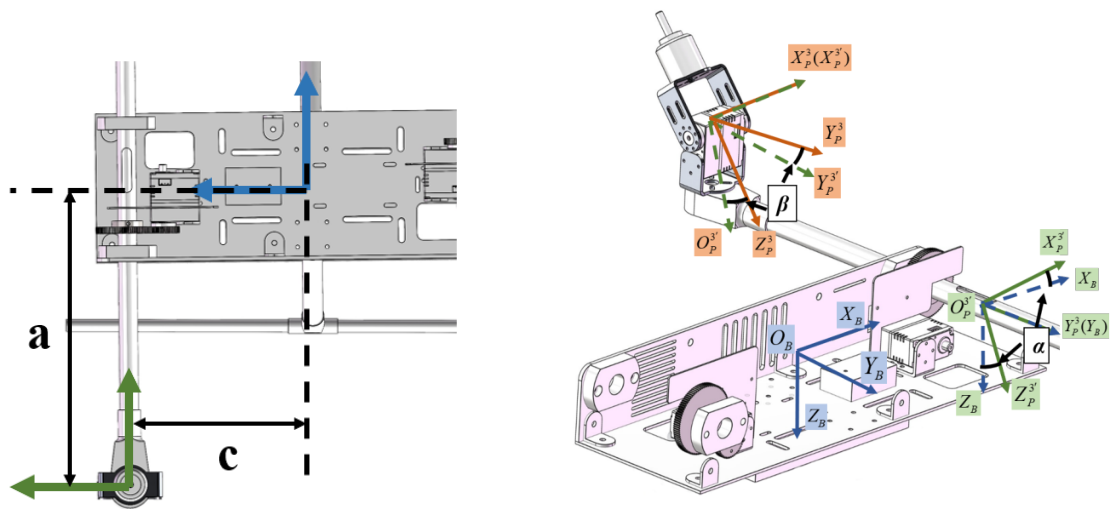
The rotor-frame origins are located at fixed positions in the body-fixed frame. Their geometric arrangement and the rotor-to-body transformation are illustrated in Figure 5. The position vectors of the rotor-frame origins are defined as
r P 1 = c a h , r P 2 = c a h , r P 3 = c a h , r P 4 = c a h ,
where a and c denote the distances from the rotor axis to the Y B O B Z B and X B O B Z B planes, respectively, and h denotes the height difference between the rotor-frame origin and the body-frame origin.
For the ith rotor, let α i and β i denote the two tilting angles. Starting from B , a rotation by α i about the Y B axis yields an intermediate frame P i , and a subsequent rotation by β i about the X P i axis yields the rotor frame P i . The corresponding transformation is
R B P i = R X P i ( β i ) R Y B ( α i ) = cos α i 0 sin α i sin α i sin β i cos β i cos α i sin β i cos β i sin α i sin β i cos α i cos β i ,
with inverse
R P i B = ( R B P i ) 1 .
Let the lift produced by the ith rotor be denoted by F i with F i 0 . Then the thrust vector and reaction torque vector expressed in P i are
Γ P i = 0 0 s f F i , τ P i = 0 0 s m F i , i = 1 , 2 , 0 0 s m F i , i = 3 , 4 ,
where s f and s m denote the thrust coefficient and the aerodynamic reaction-torque coefficient, respectively.
The total translational dynamics of the VR-UAV are given by
M P p ¨ = R B E i = 1 4 R P i B Γ P i g P ,
where
M P = diag ( m , m , m ) , g P = [ 0 , 0 , m g ] T .
Define the resultant force input as
F = F x F y F z = R B E i = 1 4 R P i B Γ P i .
Then Equation (8) can be rewritten as
M P p ¨ + g P = F .
Similarly, the rotational dynamics in the body-fixed frame are
J ω ˙ B = i = 1 4 R P i B τ P i + i = 1 4 r P i × R P i B Γ P i ω B × ( J ω B ) ,
where
J = diag ( J x x , J y y , J z z ) .
Define the resultant torque input as
τ r = τ x τ y τ z = i = 1 4 R P i B τ P i + i = 1 4 r P i × R P i B Γ P i .
Then Equation (11) becomes
J ω ˙ B + ω B × ( J ω B ) = τ r .
For controller design, define the generalized coordinate
q = [ p T , w T ] T ,
and the generalized input
H ( t ) = F T τ r T T .
Then the translational and rotational dynamics can be collected into the following compact control-oriented form:
M ( q , ϱ , t ) q ¨ + C ( q , q ˙ , ϱ , t ) q ˙ + G ( q , ϱ , t ) + W ( ϱ , t ) = H ( t ) ,
where t R denotes time, ϱ Σ R 6 × 1 denotes the uncertain parameter vector, and W ( ϱ , t ) denotes the lumped disturbance/uncertainty term. The control objective is to design H ( t ) such that, under parameter uncertainties and external wind disturbances, the VR-UAV satisfies the position–attitude requirement in Equation (1).
In implementation, the generalized input
H ( t ) = F T τ r T T
is realized through the actuator-level variables { F i , α i , β i } i = 1 4 . Specifically, the commanded resultant force F and torque τ r are mapped to the rotor thrusts and tilting angles according to the force/torque relationships in Equations (9) and (12), together with the geometric transformations in Equations (5)–(7). In the simulations, this control-allocation step is carried out at each sampling instant to convert the generalized command into physically admissible actuator inputs.
Remark 1.
In the control-oriented model, the actuator-level allocation from the generalized input H ( t ) to the rotor thrusts and tilting angles is modeled as an ideal mapping. This modeling choice is used to focus on the vehicle-level dynamics and the resultant force–torque generation of the proposed VR-UAV.

4. Design of the Control Method

Based on the control-oriented dynamic model in Equation (14), this section develops an adaptive robust constraint-following control strategy for the VR-UAV. The objective is to design the control input H ( t ) such that the VR-UAV satisfies the position–attitude requirement in Equation (1) despite nonlinear coupling, parameter uncertainties, and external wind disturbances. To this end, the desired tracking objective is first formulated as a servo constraint, and then an adaptive robust compensation term is introduced to handle unknown-but-bounded disturbances online.

4.1. Servo Constraint

To simplify the notation, the functional arguments of variables are omitted in the following analysis unless they appear for the first time or may cause ambiguity. Consider the following first-order servo constraint imposed on the general mechanical system:
A q ˙ = b ,
where A = A l i 6 × 6 , b = b 1 b 2 b 6 T , and both A l i ( · ) and b ( · ) are C 1 functions of q and t. In general, the constraint is non-integrable. Differentiating Equation (15) with respect to time yields
A q ¨ = c ,
where c = b ˙ A ˙ q ˙ .
Under a suitable control input H ( t ) , the controlled system is expected to approximately satisfy the servo-constraint equation in Equation (16). This process is referred to as constraint-following control. To facilitate the subsequent analysis, the constraint-following error is defined based on Equation (15) as
λ = A q ˙ b ,
where λ = λ 1 λ 2 λ 6 T . If the control input H ( t ) ensures that the constraint-following error in Equation (17) is uniformly bounded and uniformly ultimately bounded, then the controlled system satisfies the imposed constraint in the sense of bounded tracking.

4.2. Adaptive Robust Control Design

First, the terms M ( · ) , C ( · ) , G ( · ) , and W ( · ) in Equation (14) are decomposed into nominal parts and uncertain parts:
M ( q , ϱ , t ) = M ¯ ( q , t ) + Δ M ( q , ϱ , t ) , C ( q , q ˙ , ϱ , t ) = C ¯ ( q , q ˙ , t ) + Δ C ( q , q ˙ , ϱ , t ) , G ( q , ϱ , t ) = G ¯ ( q , t ) + Δ G ( q , ϱ , t ) , W ( ϱ , t ) = W ¯ ( t ) + Δ W ( q , ϱ , t ) .
Here, M ¯ ( · ) , C ¯ ( · ) , G ¯ ( · ) , and W ¯ ( · ) denote the nominal parts, with M ¯ > 0 , whereas Δ M ( · ) , Δ C ( · ) , Δ G ( · ) , and Δ W ( · ) denote the uncertain parts. Define
D ( q , t ) : = M ¯ 1 ( q , t ) , Δ D ( q , ϱ , t ) : = M 1 ( q , ϱ , t ) M ¯ 1 ( q , t ) ,
and
E ( q , ϱ , t ) : = I + M ¯ ( q , t ) M 1 ( q , ϱ , t ) .
Then,
Δ D ( q , ϱ , t ) = D ( q , t ) E ( q , ϱ , t ) .
Based on the above decomposition, the nominal VR-UAV system is written as
M ¯ ( q , t ) q ¨ ( t ) + C ¯ ( q , q ˙ , t ) q ˙ ( t ) + G ¯ ( q , t ) + W ¯ ( t ) = H ( t ) .
According to the nominal system in Equation (19) and the servo-constraint equation in Equation (16), the nominal constraint force is constructed as
P 1 ( q , q ˙ , t ) : = M ¯ 1 2 ( q , t ) [ A ( q , t ) M ¯ 1 2 ( q , t ) ] + c ( q , q ˙ , t ) + A ( q , t ) M ¯ 1 ( q , t ) C ¯ ( q , q ˙ , t ) q ˙ + G ¯ ( q , t ) + W ¯ ( t ) ,
which is consistent with the Lagrangian form of D’Alembert’s principle and ensures that the nominal system satisfies the imposed constraint. The term P 1 is derived from the nominal system model and corresponds to the ideal case in which the servo constraint is exactly satisfied.
When the model is exactly known, the system can satisfy Equation (16) through appropriate control design based on Equation (20). However, in the presence of uncertainties, additional correction and compensation terms are required. Therefore, for the uncertain VR-UAV system in Equation (14), the following adaptive robust design is developed.
For a given matrix P R 6 × 6 with P > 0 , define
U ( q , ϱ , t ) : = P A ( q , t ) D ( q , t ) E ( q , ϱ , t ) M ¯ ( q , t ) A T ( q , t ) A ( q , t ) A T ( q , t ) 1 P 1 .
There exists a constant ρ > 1 (which may be unknown) such that, for any ( q , t ) R 6 × R ,
1 2 min ϱ Σ λ m U ( q , ϱ , t ) + U T ( q , ϱ , t ) ρ ,
where λ m denotes the minimum eigenvalue of U ( q , ϱ , t ) + U T ( q , ϱ , t ) . Because the uncertainty set Σ is unknown, the constant ρ is usually also unknown. This assumption restricts the deviation between M and M ¯ to a prescribed range.
Define the stabilizing term
P 2 ( q , q ˙ , t ) : = ν M ¯ ( q , t ) A T ( q , t ) A ( q , t ) A T ( q , t ) 1 P 1 [ A ( q , t ) q ˙ b ( q , t ) ] ,
where ν > 0 .
We now introduce the following assumptions.
Assumption 1.
Assume that there exists an unknown constant vector  η ( 0 , ) k , together with a known function
Π ( · ) : ( 0 , ) k × R 6 × R 6 × R R + ,
such that for all  ( q , q ˙ , t ) R 6 × R 6 × R  and  ϱ Σ ,
( 1 + ρ ) 1 max ϱ Σ P A ( q , t ) Δ D ( q , ϱ , t ) [ C ( q , q ˙ , ϱ , t ) q ˙ G ( q , ϱ , t ) W ( ϱ , t ) + P 1 ( q , q ˙ , t ) + P 2 ( q , q ˙ , t ) ] P A ( q , t ) D ( q , t ) [ Δ C ( q , q ˙ , ϱ , t ) q ˙ + Δ G ( q , ϱ , t ) + Δ W ( q , ϱ , t ) ] Π ( η , q , q ˙ , t ) .
Assumption 2.
For all  ( q , q ˙ , t ) R 6 × R 6 × R , the function  Π ( η , q , q ˙ , t ) : ( 0 , ) k R +  satisfies the following properties:
(i) 
it is C 1 ;
(ii) 
it is concave, and for any η 1 , η 2 ( 0 , ) k ,
Π η 1 , q , q ˙ , t Π η 2 , q , q ˙ , t Π η η 2 , q , q ˙ , t η 1 η 2 ;
(iii) 
it is nondecreasing with respect to each component of η.
Since ρ > 1 , it follows that 1 + ρ > 0 . The function Π ( · ) is related to the uncertainty bound, while the constant vector η is associated with the uncertainty set Σ, which may be unknown.
A particular case of Assumption 2 is that Π ( η , q , q ˙ , t ) is linearly parameterized with respect to η , that is, there exists a function
Π ^ ( · ) : R 6 × R 6 × R R + k
such that
Π ( η , q , q ˙ , t ) = η T Π ^ ( q , q ˙ , t ) .
In this paper, the following adaptive law is proposed:
η ^ ˙ = σ 1 Π T η ( η ^ , q , q ˙ , t ) λ ( q , q ˙ , t ) σ 2 η ^ ,
where σ 1 > 0 and σ 2 > 0 .
We now propose the following adaptive robust control law:
H ( t ) = P 1 ( q , q ˙ , t ) + P 2 ( q , q ˙ , t ) + P 3 ( η ^ , q , q ˙ , t ) ,
where
P 3 ( η ^ , q , q ˙ , t ) = M ¯ ( q , t ) A T ( q , t ) A ( q , t ) A T ( q , t ) 1 P 1 γ ( η ^ , q , q ˙ , t ) μ ( η ^ , q , q ˙ , t ) Π ( η ^ , q , q ˙ , t ) ,
with
μ ( η ^ , q , q ˙ , t ) = [ A ( q , t ) q ˙ b ( q , t ) ] Π ( η ^ , q , q ˙ , t ) ,
and
γ ( η ^ , q , q ˙ , t ) = 1 μ ( η ^ , q , q ˙ , t ) , μ ( η ^ , q , q ˙ , t ) > ξ , 1 ξ , μ ( η ^ , q , q ˙ , t ) ξ ,
where ξ > 0 is a constant.
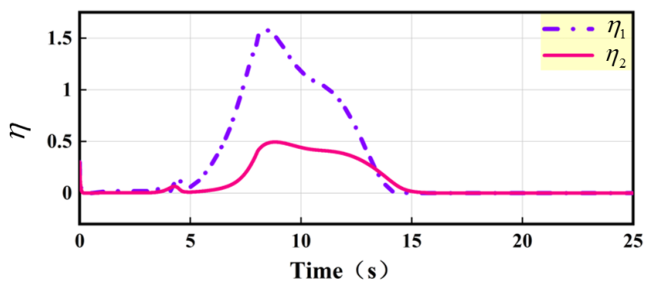
The term P 3 acts as the adaptive robust compensation force based on the adaptive parameter η ^ . Since the true uncertainty-bound parameter vector η is unknown, the controller uses its online estimate η ^ instead of requiring a pre-specified disturbance upper bound. According to the adaptive law in Equation (27), η ^ increases when the constraint-following error becomes large due to time-varying wind disturbances or model uncertainties, thereby strengthening P 3 . Meanwhile, the leakage term prevents excessive parameter growth when the tracking error decreases. Therefore, the proposed ARCFC can compensate for unknown and time-varying disturbances without requiring the exact disturbance bound in advance.
Remark 2.
In practical implementation, the lumped uncertainty considered in the proposed ARCFC may include not only wind-induced aerodynamic disturbances, modeling errors, and parameter variations, but also actuator-related and hardware-related effects, such as servo bandwidth, response delay of the tilting angles α i and β i , angular-rate limits, rotor thrust dynamics, sensor noise, communication delay, and controller-induced latency. These effects may cause deviations between the ideal control command and the actual system response. Within the proposed ARCFC framework, such deviations can be incorporated into the unknown-but-bounded uncertainty term and compensated by the adaptive robust term P 3 , without requiring each practical effect to be explicitly modeled.
Theorem 1.
Let
ϖ : = λ η ^ η R m + k .
For the uncertain VR-UAV system in Equation (14), if Assumptions 1 and 2 hold, then the proposed controller in Equation (28) renders ϖ uniformly bounded and uniformly ultimately bounded.
1. 
Uniform boundedness: For any r > 0 , there exists a positive constant d ( r ) < such that, for all t t 0 ,
ϖ ( t 0 ) r ϖ ( t ) d ( r ) .
2. 
Uniform ultimate boundedness: For any positive constant r, if ϖ ( t 0 ) r , then for all t t 0 + L ( d ¯ , r ) ,
ϖ ( t ) d ¯ , d ¯ > d ,
where L ( d ¯ , r ) < .
Proof. 
Consider the Lyapunov candidate
V ( λ , η ^ η ) = λ T P λ + σ 1 1 ( 1 + ρ ) ( η ^ η ) T ( η ^ η ) ,
which is positive definite and suitable for stability analysis. For given uncertainties ϱ ( · ) and the corresponding trajectories q ( · ) , q ˙ ( · ) , and η ^ ( · ) of the controlled system, the derivative of V is
V ˙ ( λ , η ^ η ) = 2 λ T P λ ˙ + 2 σ 1 1 ( 1 + ρ ) ( η ^ η ) T η ^ ˙ .
We analyze each term separately. First,
2 λ T P λ ˙ = 2 λ T P A M 1 ( C q ˙ G W ) + M 1 ( P 1 + P 2 + P 3 ) c ,
and define
A M 1 ( C q ˙ G W ) + M 1 ( P 1 + P 2 + P 3 ) c = : V 1 .
Since λ ˙ = A q ¨ c , it follows that
V 1 = A [ ( D + Δ D ) ( C ¯ q ˙ G ¯ W ¯ Δ C q ˙ Δ G Δ W ) + ( D + Δ D ) ( P 1 + P 2 + P 3 ) ] c = A [ Δ D ( C q ˙ G W + P 1 + P 2 ) + D ( Δ C q ˙ Δ G Δ W ) + D ( C ¯ q ˙ G ¯ W ¯ ) + D P 1 + D P 2 + ( D + Δ D ) P 3 ] c ,
where
V 2 : = Δ D ( C q ˙ G W + P 1 + P 2 ) + D ( Δ C q ˙ Δ G Δ W ) ,
V 3 : = D ( C ¯ q ˙ G ¯ W ¯ ) + D P 1 ,
V 4 : = D P 2 ,
V 5 : = ( D + Δ D ) P 3 .
In the ideal case, there is no uncertainty in the controlled system, that is, ϱ 0 and hence Δ M = Δ C = Δ G = Δ W = 0 . In this case,
V 3 = 0 .
According to Equation (24),
2 λ T P A V 2 2 λ P A V 2 2 ( 1 + ρ ) λ Π ( η , q , q ˙ , t ) .
By Equation (23), we have
2 λ T P A V 4 = 2 λ T P A D ν M ¯ A T ( A A T ) 1 P 1 ( A q ˙ b ) = 2 ν λ T ( A q ˙ b ) = 2 ν λ 2 .
Because Δ D = D E , according to Equation (29),
2 λ T P A V 5 = 2 λ T P A D P 3 + 2 λ T P A D E P 3 .
Since
P 3 = M ¯ A T ( A A T ) 1 P 1 γ μ Π ( η ^ , q , q ˙ , t ) ,
and
μ = λ Π ( η ^ , q , q ˙ , t ) ,
we obtain
2 λ T P A D P 3 = 2 λ Π ( η ^ , q , q ˙ , t ) T γ μ = 2 γ μ 2 .
According to Equations (21) and (22), together with the Rayleigh principle, we have
2 λ T P A D E P 3 = 2 μ T P A D E P 3 2 γ μ T · 1 2 λ m ( U + U T ) μ 2 γ ρ μ 2 .
Combining Equations (45) and (46) gives
2 λ T P A V 5 2 γ ( 1 + ρ ) μ 2 .
According to Equation (31), if μ > ξ ,
2 γ ( 1 + ρ ) μ 2 = 2 ( 1 + ρ ) μ .
If μ ξ ,
2 γ ( 1 + ρ ) μ 2 = 2 ( 1 + ρ ) μ 2 ξ .
Based on Equations (42)–(49), it can be concluded that if μ > ξ ,
2 λ T P λ ˙ 2 ν λ 2 + 2 ( 1 + ρ ) λ Π ( η ^ , q , q ˙ , t ) + λ Π ( η , q , q ˙ , t ) ,
and if μ ξ ,
2 λ T P λ ˙ 2 ν λ 2 + 2 ( 1 + ρ ) λ Π ( η , q , q ˙ , t ) 2 ( 1 + ρ ) μ 2 ξ 2 ν λ 2 + ( 1 + ρ ) ξ 2 + 2 ( 1 + ρ ) λ Π ( η ^ , q , q ˙ , t ) + λ Π ( η , q , q ˙ , t ) .
Next, by Assumption 2,
λ Π ( η ^ , q , q ˙ , t ) + λ Π ( η , q , q ˙ , t ) λ · Π ( η ^ , q , q ˙ , t ) η ( η η ^ ) .
Substituting the second term on the right-hand side of Equation (33) into the adaptive law in Equation (27) yields
2 σ 1 1 ( 1 + ρ ) ( η ^ η ) T η ^ ˙ = 2 σ 1 1 ( 1 + ρ ) ( η ^ η ) T · σ 1 Π T η ( η ^ , q , q ˙ , t ) λ σ 2 η ^ 2 ( 1 + ρ ) ( η ^ η ) T Π T η ( η ^ , q , q ˙ , t ) λ 2 σ 1 1 σ 2 ( 1 + ρ ) η ^ η 2 + 2 σ 1 1 σ 2 ( 1 + ρ ) η ^ η η .
Using Equations (52) and (53) in Equation (33), and noting that
ϖ 2 = λ 2 + η ^ η 2 , η ^ η ϖ ,
we obtain
V ˙ 2 ν λ 2 2 σ 1 1 σ 2 ( 1 + ρ ) η ^ η 2 + 2 σ 1 1 σ 2 ( 1 + ρ ) η ^ η η + ( 1 + ρ ) ξ 2 σ ̲ 1 ϖ 2 + σ ̲ 2 ϖ + σ ̲ 3 ,
where
σ ̲ 1 = min 2 ν , 2 σ 1 1 σ 2 ( 1 + ρ ) , σ ̲ 2 = 2 σ 1 1 σ 2 ( 1 + ρ ) η , σ ̲ 3 = ( 1 + ρ ) ξ / 2 .
By standard Lyapunov arguments, it follows that the solution of the controlled mechanical system is uniformly bounded.
(a) 
Uniform boundedness:
d ( r ) = χ 2 χ 1 R , r R , χ 2 χ 1 r , r > R ,
where
R = 1 2 σ ̲ 1 σ ̲ 2 + σ ̲ 2 2 4 σ ̲ 1 σ ̲ 3 ,
and
χ 1 = min χ min ( P ) , σ 1 1 ( 1 + ρ ) , χ 2 = max χ max ( P ) , σ 1 1 ( 1 + ρ ) .
(b) 
Uniform ultimate boundedness:
d ¯ > d ̲ = χ 2 χ 1 R ,
and
L ( d ¯ , r ) = 0 , r d ¯ χ 1 χ 2 , χ 2 r 2 χ 1 2 χ 2 d ¯ 2 σ ̲ 1 d ¯ 2 χ 1 χ 2 σ ̲ 2 d ¯ χ 1 χ 2 1 / 2 σ ̲ 3 , r > d ¯ χ 1 χ 2 .
Note that the ultimate bound can be reduced by appropriately tuning the design parameters ν , σ 1 , σ 2 , ξ , and related design constants. □

5. Design Procedure

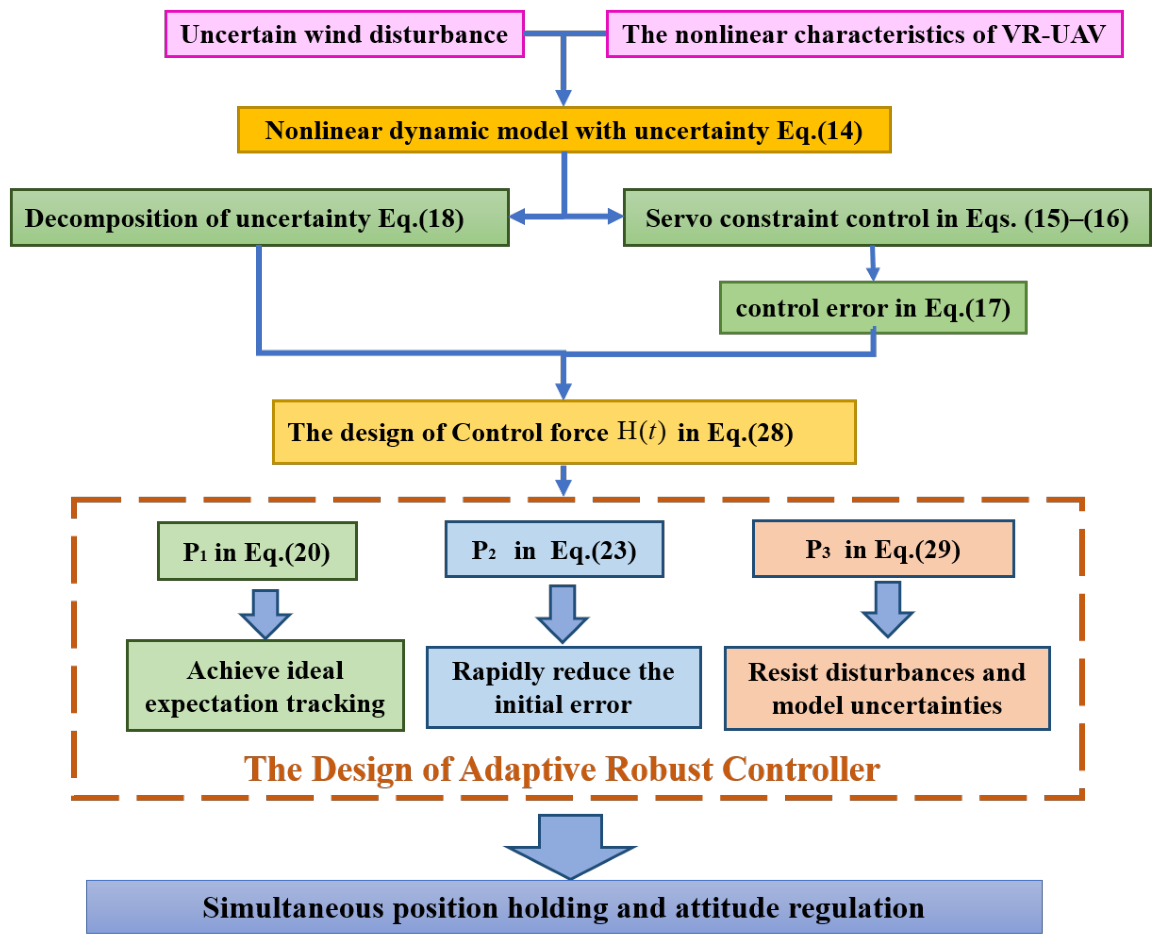
The proposed control design procedure for the VR-UAV is summarized in Figure 6. The nominal term P 1 is designed based on the servo constraint to achieve the desired tracking performance for the ideal system. The additional terms P 2 and P 3 are introduced to accelerate the convergence of the initial tracking error and to compensate for disturbances and modeling uncertainties, respectively. In this way, the control problem is converted into the design of a control input H ( t ) such that the VR-UAV can maintain the desired attitude while hovering at the desired position.

6. Simulation

This section validates the proposed method in two aspects: (i) the structural advantage of the VR-UAV in realizing position–attitude decoupling, and (ii) the control performance of ARCFC under parameter uncertainties and wind disturbances.

6.1. Simulation Settings

Unless otherwise specified, the simulation parameters are listed in Table 1. The VR-UAV starts from p 0 = ( 0 , 0 , 0 ) and w 0 = ( 0 , 0 , 0 ) .

6.2. Structural Validation Under Nominal Conditions

To highlight the structural difference between the VR-UAV and the conventional QUAV, this subsection considers nominal conditions only. Specifically, the uncertainty terms and external disturbances are set to zero, and the proposed controller reduces to the nominal CFC part of the proposed controller, with the adaptive robust compensation term removed.
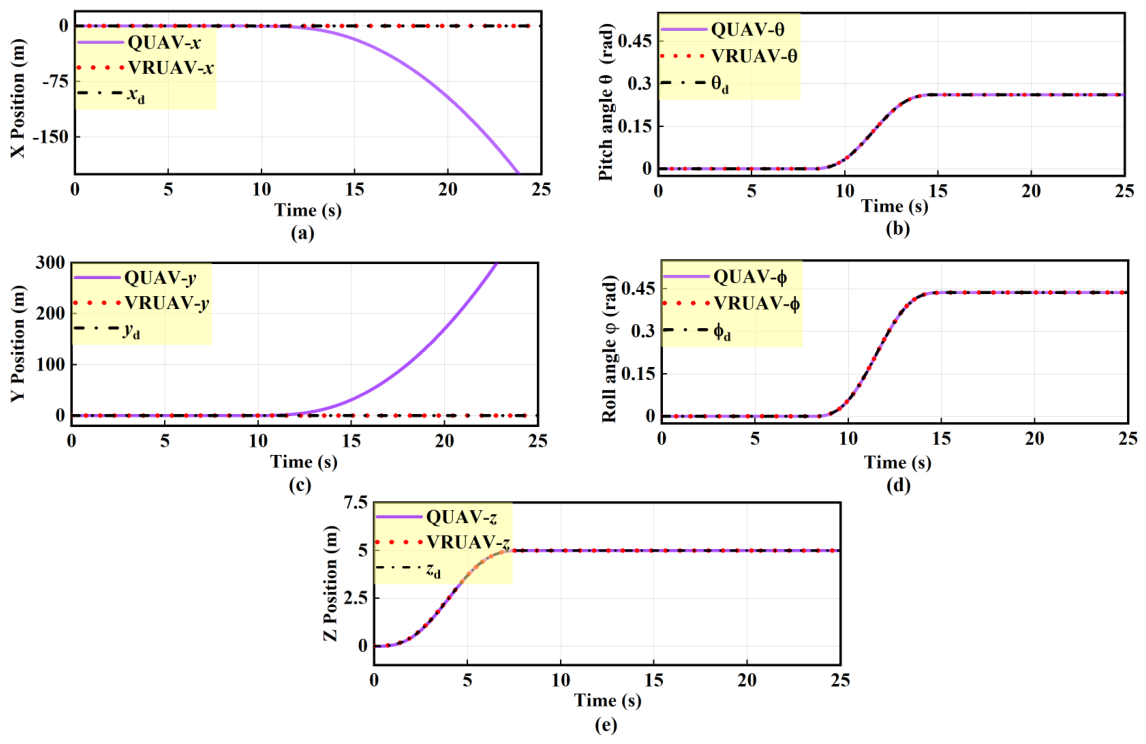
For comparison, the conventional QUAV model in [30] is used as the baseline platform. The task is defined as follows: the UAV first moves from p 0 = ( 0 , 0 , 0 ) to p d = ( 0 , 0 , 5 ) during 0–8 s, and then its attitude is changed from w 0 = ( 0 , 0 , 0 ) to w d = ( 15 , 25 , 0 ) .
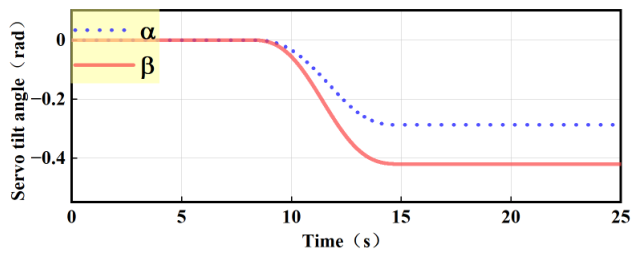
As shown in Figure 7, after altitude tracking is completed, the traditional QUAV exhibits obvious horizontal position drift when executing the ϕ - and θ -angle commands. This is caused by the inherent coupling between thrust direction and vehicle attitude. By contrast, the VR-UAV maintains the desired horizontal position throughout the attitude-regulation phase. As shown in Figure 8, the tilting angles vary accordingly to compensate for the horizontal force components induced by attitude changes. These results demonstrate that the proposed thrust-vectoring structure provides the mechanical basis for decoupled position–attitude regulation.

6.3. Control Performance Under Uncertainties and Wind Disturbances

This subsection compares the proposed ARCFC with CFC and sliding mode control (SMC). For fairness, all controllers are tested on the same VR-UAV model and task. The tracking task is defined by
p d = ( 10 , 10 , 5 ) , w d = ( 15 , 25 , 0 ) ,
where the position transition is completed during 0–8 s and is followed by attitude regulation.
For the SMC baseline [31], the sliding surface and reaching law are selected as
S = Γ E + E ˙ , S ˙ = Ξ sign ( S ) Φ S ,
where E = q q d , and
Γ = diag ( [ 1 , 1 , 1 , 1 , 1 , 1 ] ) , Ξ = diag ( [ 1 , 1 , 1 , 1 , 1 , 1 ] ) , Φ = diag ( [ 0.1 , 0.1 , 0.1 , 0.1 , 0.1 , 0.1 ] ) .
The uncertain parameters are chosen as
m u = 6.73 + 0.2 sin ( 2 t ) ,
J x x , u = 0.153 + 0.003 sin ( 3 t + 20 ) , J y y , u = 0.17 + 0.003 sin ( 2 t + 30 ) ,
J z z , u = 0.32 + 0.003 sin ( t + 45 ) ,
s m , u = 3.447 × 10 6 + 3.447 × 10 6 sin ( t ) ,
s f , u = 3.447 × 10 5 + 3.447 × 10 7 sin ( t + 45 ) .
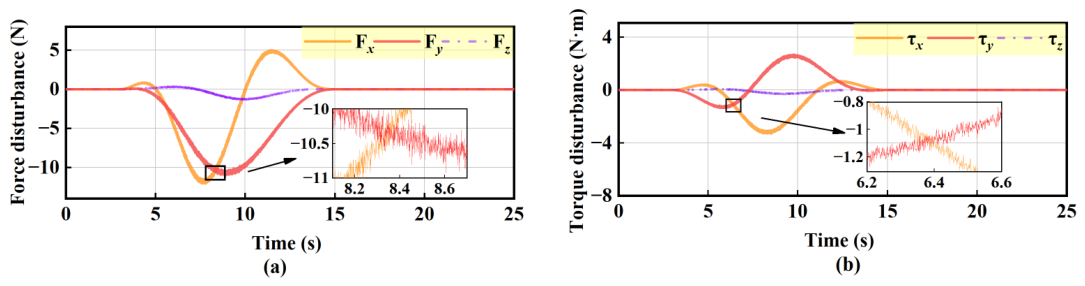
The wind disturbance is modeled as time-varying forces and torques acting on the VR-UAV, as shown in Figure 9. In the simulation, both horizontal and vertical wind-disturbance components are considered. The horizontal components are used to represent the dominant lateral wind effects that directly influence position holding and attitude regulation in low-altitude orchard inspection. A relatively small vertical component is also introduced to represent local turbulent airflow, canopy-induced upwash/downwash, and minor unmodeled aerodynamic effects. The disturbance magnitude increases smoothly in the initial stage, remains active during the main stage, and then gradually decays, while small random oscillations are superimposed on the disturbance profiles to represent local turbulence and unmodeled aerodynamic fluctuations.
For simulation implementation, the uncertainty bound is selected as
Π ( η , q , q ˙ , t ) = η A ( q , t ) , η > 0 ,
and the adaptive law is chosen as
η ^ ˙ = σ 1 A ( q , t ) λ ( q , q ˙ , t ) σ 2 η ^ .
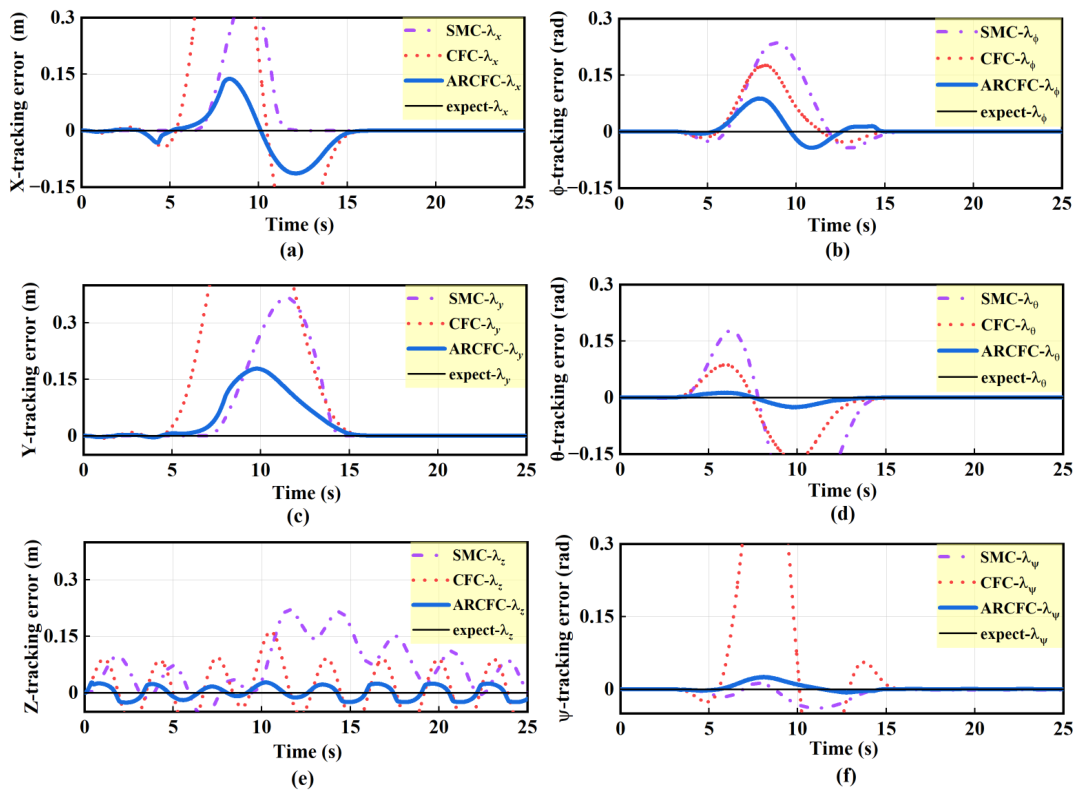
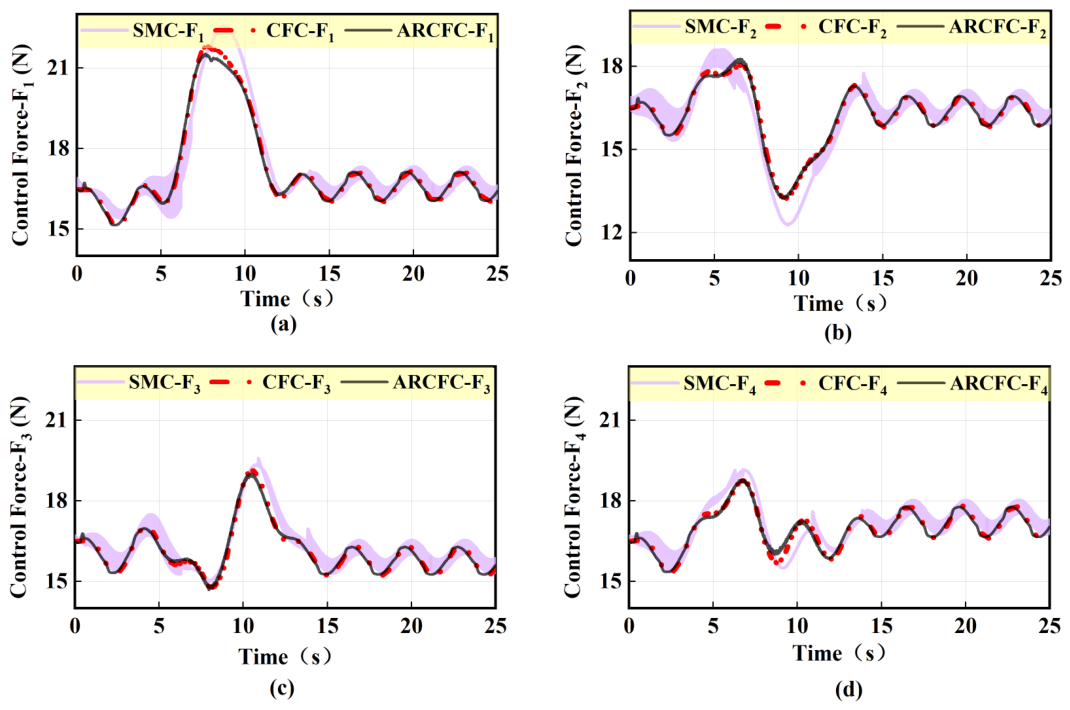
Figure 10 shows that ARCFC achieves the smallest position and attitude tracking errors among the three controllers. In contrast, both CFC and SMC exhibit noticeably larger deviations under uncertainties and wind disturbances. Figure 11 further shows the actuator-level thrust commands after control allocation. The ARCFC input remains smooth while preserving strong tracking capability, whereas the SMC input exhibits evident chattering. Therefore, the proposed adaptive robust term improves disturbance rejection without sacrificing input smoothness.
Figure 12 shows the evolution of the adaptive parameter η ^ . It increases rapidly when the tracking error becomes large, thereby strengthening compensation against uncertainties and disturbances, and then gradually settles as the tracking error decreases. This behavior is consistent with the adaptive mechanism in Equation (61) and supports the improved robustness of ARCFC.

7. Conclusions

This paper investigated the flight-control problem of VR-UAVs for wind-affected orchard crop-inspection tasks. A VR-UAV configuration and an ARCFC strategy were developed to address the requirement of maintaining position while adjusting attitude for flexible sensor pointing. Compared with a conventional QUAV, the proposed VR-UAV enables decoupled regulation of position and attitude, thereby allowing fixed-point hovering with the desired attitude. From the control perspective, the nonlinear dynamics introduced by thrust-vector adjustment are handled within the constraint-following control framework, while wind-induced disturbances and modeling uncertainties are compensated online through adaptive robust control. The simulation results demonstrated that, in the presence of external disturbances and model uncertainties, the proposed ARCFC method outperforms conventional CFC and SMC in terms of trajectory-tracking accuracy, control smoothness, and robustness.
Future work will develop a physical VR-UAV platform and conduct orchard flight experiments. Manufacturing cost, mechanical robustness, servo delay, and IMU errors will be further considered through hardware-in-the-loop tests and outdoor experiments to verify the practical performance of the thrust-vectoring structure and ARCFC strategy.

Author Contributions

Conceptualization, Z.Z. (Ziheng Zhou) and Z.Z. (Zheshuo Zhang); methodology, Z.Z. (Zheshuo Zhang); software, Z.Z. (Ziheng Zhou); validation, Z.Z. (Ziheng Zhou), J.D., and B.Z.; formal analysis, Z.Z. (Ziheng Zhou) and Z.Z. (Zheshuo Zhang); investigation, Z.Z. (Ziheng Zhou) and Z.Z. (Zheshuo Zhang); resources, Z.Z. (Zheshuo Zhang); data curation, Z.Z. (Ziheng Zhou) and J.D.; writing—original draft preparation, Z.Z. (Ziheng Zhou) and J.D.; writing—review and editing, Z.Z. (Zheshuo Zhang), J.D., and B.Z.; visualization, Z.Z. (Ziheng Zhou); supervision, L.L., Z.Z. (Zheshuo Zhang), X.Z., J.B., B.R., and B.Z.; project administration, L.L., X.Z., J.B., B.R., and Z.Z. (Zheshuo Zhang); funding acquisition, Z.Z. (Zheshuo Zhang). All authors have read and agreed to the published version of the manuscript.

Funding

This work was supported by the Key Research and Development Program in High-Tech Fields of Jiangxi Province under the project “Efficient Vector-Rotor UAV”, and the Hangzhou Innovation and Entrepreneurship Program for High-Level Overseas Returnees under the project “Strong-Wind-Resistant Omnidirectional Inspection Vector-Rotor UAV”.

Institutional Review Board Statement

Not applicable.

Informed Consent Statement

Not applicable.

Data Availability Statement

The data are contained within the article.

Conflicts of Interest

L.L. was employed by Hangzhou Zhiyuan Research Institute Co., Ltd. The remaining authors declare no conflict of interest. Hangzhou Zhiyuan Research Institute Co., Ltd. was not involved in the design of the study; in the collection, analysis, or interpretation of data; in the writing of the manuscript; or in the decision to publish the results.

Abbreviations

The following abbreviations are used in this manuscript:
VR-UAVsvector–rotor unmanned aerial vehicles
QUAVsQuadrotor unmanned aerial vehicles
ARCFCAdaptive robust constraint-following control
CFCConstraint-following control
SMCSliding mode control

Notation

The main symbols used throughout this paper are summarized as follows.
E ( o E , x E , y E , z E ) Earth-fixed inertial frame of the UAV.
B ( O B , X B , Y B , Z B ) body-fixed frame of the VR-UAV.
P i ( O P i , X P i , Y P i , Z P i ) rotor frame of the ith rotor.
P i intermediate frame generated by rotation about the Y B axis.
p = [ x , y , z ] T position vector of the UAV in frame E .
w = [ φ , θ , ψ ] T Euler-angle vector of the UAV.
w ˙ = [ φ ˙ , θ ˙ , ψ ˙ ] T Euler-angle rate vector.
ω B = [ ω x , ω y , ω z ] T angular velocity vector in the body-fixed frame.
q = [ p T , w T ] T generalized coordinate vector.
q ˙ , q ¨ generalized velocity and acceleration vectors.
p d , w d desired position and desired attitude.
R B E rotation matrix from frame B to frame E .
T ( w ) kinematic transformation matrix relating w ˙ and ω B .
R B P i , R P i B rotation matrices between the body-fixed frame and the ith rotor frame.
r P i position vector of the ith rotor-frame origin in the body-fixed frame.
α i , β i tilting angles of the ith rotor.
F i lift generated by the ith rotor.
Γ P i thrust vector of the ith rotor in frame P i .
τ P i reaction torque vector of the ith rotor in frame P i .
F = [ F x , F y , F z ] T resultant force input.
τ r = [ τ x , τ y , τ z ] T resultant torque input.
H ( t ) R 6 × 1 generalized control input.
M P = diag ( m , m , m ) translational inertia matrix.
g P = [ 0 , 0 , m g ] T gravitational vector in the translational subsystem.
J = diag ( J x x , J y y , J z z ) inertia matrix in the body-fixed frame.
M ( q , ϱ , t ) generalized inertia matrix.
C ( q , q ˙ , ϱ , t ) generalized Coriolis/centrifugal matrix.
G ( q , ϱ , t ) generalized gravitational vector.
W ( ϱ , t ) lumped uncertainty/disturbance term.
ϱ Σ uncertain parameter vector and its admissible set.
A ( q , t ) q ˙ = b ( q , t ) first-order servo constraint.
c ( q , q ˙ , t ) second-order servo-constraint term satisfying A q ¨ = c .
λ = A q ˙ b constraint-following error.
M ¯ , C ¯ , G ¯ , W ¯ nominal parts of the dynamic model.
Δ M , Δ C , Δ G , Δ W uncertain parts of the dynamic model.
D = M ¯ 1 ( q , t ) inverse of the nominal inertia matrix.
Δ D = M 1 ( q , ϱ , t ) M ¯ 1 ( q , t ) uncertainty-induced inverse-inertia variation.
E ( q , ϱ , t ) : = I + M ¯ ( q , t ) M 1 ( q , ϱ , t ) auxiliary matrix used in controller design.
P 1 nominal constraint force.
P 2 stabilizing correction term.
P 3 adaptive robust compensation term.
Ppositive-definite design matrix used in Lyapunov analysis.
ρ unknown constant satisfying the matrix inequality condition in Assumption 1.
η unknown constant vector associated with the uncertainty bound.
η ^ adaptive estimate of η .
Π ( η , q , q ˙ , t ) uncertainty-bound function.
Π ^ ( q , q ˙ , t ) basis function in the linear parameterization of Π .
μ auxiliary variable used in the adaptive robust term.
γ ( · ) scaling function used in the adaptive robust controller.
ν stabilizing gain in P 2 .
σ 1 , σ 2 adaptive-law gains.
ξ threshold constant in the definition of γ ( · ) .

References

  1. Botta, A.; Cavallone, P.; Baglieri, L.; Colucci, G.; Tagliavini, L.; Quaglia, G. A review of robots, perception, and tasks in precision agriculture. Appl. Mech. 2022, 3, 830–854. [Google Scholar] [CrossRef]
  2. Su, J.; Zhu, X.; Li, S.; Chen, W.-H. AI Meets UAVs: A Survey on AI-Empowered UAV Perception Systems for Precision Agriculture. Neurocomputing 2023, 518, 242–270. [Google Scholar] [CrossRef]
  3. Maddikunta, P.K.R.; Hakak, S.; Alazab, M.; Bhattacharya, S.; Gadekallu, T.R.; Khan, W.Z.; Pham, Q.V. Unmanned Aerial Vehicles in Smart Agriculture: Applications, Requirements, and Challenges. IEEE Sens. J. 2021, 21, 17608–17619. [Google Scholar] [CrossRef]
  4. Holman, R.A.; Brodie, K.L.; Spore, N.J. Surf Zone Characterization Using a Small Quadcopter: Technical Issues and Procedures. IEEE Trans. Geosci. Remote Sens. 2017, 55, 1900–1913. [Google Scholar] [CrossRef]
  5. Liang, J.; Zhong, H.; Wang, Y.; Chen, Y.; Mao, J.; Wang, W.; Zhang, H. Reference Optimization-Based Compliant Control for Aerial Pipeline Inspection Using a Hexacopter with a Robotic Contact Device. IEEE/ASME Trans. Mechatron. 2024, 29, 2488–2499. [Google Scholar] [CrossRef]
  6. Zheng, P.; Tan, X.; Kocer, B.B.; Yang, E.; Kovac, M. Tilt Drone: A Fully-Actuated Tilting Quadrotor Platform. IEEE Robot. Autom. Lett. 2020, 5, 6845–6852. [Google Scholar] [CrossRef]
  7. Myeong, W.; Myung, H. Development of a Wall-Climbing Drone Capable of Vertical Soft Landing Using a Tilt-Rotor Mechanism. IEEE Access 2019, 7, 4868–4879. [Google Scholar] [CrossRef]
  8. Hao, S.; Mao, J.; Zhang, J.; Zhao, X.; Song, G.; Song, A.; Liu, P.X. Design and Control of a Fully Actuated Aerial Manipulator System for Measuring the Thickness of Metal Facilities. IEEE Trans. Instrum. Meas. 2025, 74, 3512410. [Google Scholar] [CrossRef]
  9. Benmoussa, A.; Gamboa, P.V. Effect of Control Parameters on Hybrid Electric Propulsion UAV Performance for Various Flight Conditions: Parametric Study. Appl. Mech. 2023, 4, 493–513. [Google Scholar] [CrossRef]
  10. Kotarski, D.; Piljek, P.; Kasać, J.; Majetić, D. Performance Analysis of Fully Actuated Multirotor Unmanned Aerial Vehicle Configurations with Passively Tilted Rotors. Appl. Sci. 2021, 11, 8786. [Google Scholar] [CrossRef]
  11. Guan, Y.-L.; Xu, W.; Zhang, M.-Y. Nonlinear Modeling of Composite Wing with Application to UAV Flight Dynamic Analysis. Mech. Syst. Signal Process. 2020, 138, 106542. [Google Scholar] [CrossRef]
  12. Ding, C.; Lu, L. A Tilting-Rotor Unmanned Aerial Vehicle for Enhanced Aerial Locomotion and Manipulation Capabilities: Design, Control, and Applications. IEEE/ASME Trans. Mechatron. 2021, 26, 2237–2248. [Google Scholar] [CrossRef]
  13. Liu, H.; Wang, N.; Zhang, Z.; Yin, H. Agile and Precise Attitude Control of Tiltrotor Aircraft in Transition Flight. IEEE Trans. Intell. Veh. 2024, 9, 787–798. [Google Scholar] [CrossRef]
  14. Nieto, M.G.; Babu, S.S.; ElSayed, M.S.A.; Mourad, A.-H.I. A Comparative Analysis of the Response-Tracking Techniques in Aerospace Dynamic Systems Using Modal Participation Factors. Appl. Mech. 2023, 4, 1038–1065. [Google Scholar] [CrossRef]
  15. Salazar, E.; Lozano, R.; Salazar, S. Nonlinear Feedback Linearization Control and Region of Attraction Analysis for a Fixed-Wing UAV. Drones 2025, 9, 606. [Google Scholar] [CrossRef]
  16. Zhou, W.; Li, B.; Sun, J.; Wen, C.Y.; Chen, C.K. Position Control of a Tail-Sitter UAV Using Successive Linearization Based Model Predictive Control. Control Eng. Pract. 2019, 91, 104125. [Google Scholar] [CrossRef]
  17. Bianchi, D.; Di Gennaro, S.; Di Ferdinando, M.; Acosta Lua, C. Robust Control of UAV with Disturbances and Uncertainty Estimation. Machines 2023, 11, 352. [Google Scholar] [CrossRef]
  18. Mendez, A.P.; Whidborne, J.F.; Chen, L. Wind Preview-Based Model Predictive Control of Multi-Rotor UAVs Using LiDAR. Sensors 2023, 23, 3711. [Google Scholar] [CrossRef]
  19. Chen, Y.H. Constraint-Following Servo Control Design for Mechanical Systems. J. Vib. Control 2009, 15, 369–389. [Google Scholar] [CrossRef]
  20. Yin, H.; Huang, J.; Chen, Y.H. Possibility-Based Robust Control for Fuzzy Mechanical Systems. IEEE Trans. Fuzzy Syst. 2021, 29, 3859–3872. [Google Scholar] [CrossRef]
  21. Zhang, Z.; Zhang, B.; Yin, H. Constraint-Based Adaptive Robust Tracking Control of Uncertain Articulating Crane Guaranteeing Desired Dynamic Control Performance. Nonlinear Dyn. 2023, 111, 11261–11274. [Google Scholar] [CrossRef]
  22. Zhang, Z.; Zhang, B.; Hu, W.; Zhou, R.; Cao, D.; Yin, H. Dynamic Three-Dimensional Lift Planning for Intelligent Boom Cranes. IEEE/ASME Trans. Mechatron. 2023, 28, 2885–2896. [Google Scholar] [CrossRef]
  23. Zhang, Z.; Zhang, B.; Cao, D.; Yin, H. Precise Tracking Control for Articulating Crane: Prescribed Performance, Adaptation, and Fuzzy Optimality by Nash Game. IEEE Trans. Cybern. 2024, 54, 387–400. [Google Scholar] [CrossRef] [PubMed]
  24. Zhang, Z.; Zhang, J.; Yin, H.; Zhang, B.; Jing, X. Bio-Inspired Structure Reference Model Oriented Robust Full Vehicle Active Suspension System Control via Constraint-Following. Mech. Syst. Signal Process. 2022, 179, 109368. [Google Scholar] [CrossRef]
  25. Guo, K.; Wang, N.; Liu, D.; Peng, X. Uncertainty-Aware LSTM Based Dynamic Flight Fault Detection for UAV Actuator. IEEE Trans. Instrum. Meas. 2023, 72, 3502113. [Google Scholar] [CrossRef]
  26. Zong, Q.; Wang, F.; Tian, B.; Su, R. Robust Adaptive Dynamic Surface Control Design for a Flexible Air-Breathing Hypersonic Vehicle with Input Constraints and Uncertainty. Nonlinear Dyn. 2014, 78, 289–315. [Google Scholar] [CrossRef]
  27. Cao, X.; Li, K.; Li, Y. Robust Adaptive Formation Control for Nonlinear Multi-Agent Systems with Range Constraints. Nonlinear Dyn. 2024, 112, 1917–1929. [Google Scholar] [CrossRef]
  28. Wei, C.; Wu, X.; Xiao, B.; Wu, J.; Zhang, C. Adaptive Leader-Following Performance Guaranteed Formation Control for Multiple Spacecraft with Collision Avoidance and Connectivity Assurance. Aerosp. Sci. Technol. 2022, 120, 107266. [Google Scholar] [CrossRef]
  29. Wang, X.; Wang, Y.; Sun, Q.; Chen, Y.; Al-Zahran, A. Adaptive Robust Control of Unmanned Tracked Vehicles for Trajectory Tracking Based on Constraint Modeling and Analysis. Nonlinear Dyn. 2024, 112, 9117–9135. [Google Scholar] [CrossRef]
  30. Yang, W.; Cui, G.; Ma, Q.; Ma, J.; Guo, S. Finite-Time Adaptive Optimal Tracking Control for a QUAV. Nonlinear Dyn. 2023, 111, 10063–10076. [Google Scholar] [CrossRef]
  31. Naser, H.N.; Hashim, H.A.; Ahmadi, M. Aerial Assistive Payload Transportation Using Quadrotor UAVs with Nonsingular Fast Terminal SMC for Human Physical Interaction. Results Eng. 2025, 25, 103701. [Google Scholar] [CrossRef]
Figure 1. Typical crop-inspection scenario in orchard environments.
Applmech 07 00046 g001
Figure 2. Schematic diagram of a conventional QUAV. The red numbers indicate rotor indices, the green and blue disks denote two counter-rotating rotor pairs, and the curved arrows indicate the rotor rotation directions. The body-fixed axes are labeled as X b , Y b , and Z b .
Applmech 07 00046 g002
Figure 3. Comparison between the proposed VR-UAV and a gimbal-equipped QUAV. The four curved arrows above the rotors in panel (a) indicate the allowable tilting directions of the tilting rotors, while the straight arrows and boxes highlight the tilting structure and the gimbal, respectively.
Applmech 07 00046 g003
Figure 4. Coordinate frames of the VR-UAV. The black, blue, orange, and green coordinate axes denote the Earth-fixed inertial frame, body-fixed frame, rotor frames, and intermediate frames, respectively.
Applmech 07 00046 g004
Figure 5. Control-oriented geometric description of the VR-UAV: rotor-frame origins and rotor-to-body transformation. Different colors are used to distinguish the inertial frame, body-fixed frame, rotor frames, and intermediate frames. The parameters a and c denote the distances from the rotor axis to the Y B O B Z B and X B O B Z B planes, respectively.
Applmech 07 00046 g005
Figure 6. Control design flowchart. The arrows indicate the information flow among the wind-disturbance input, nonlinear dynamic model, uncertainty decomposition, servo-constraint formulation, control-error definition, and control-input design. Different colors are used to distinguish the disturbance input, model-related modules, constraint-related modules, and the three controller components P 1 , P 2 , and P 3 .
Applmech 07 00046 g006
Figure 7. Comparison of the performance of the VR-UAV and QUAV under CFC. (a) X-position response; (b) pitch-angle response; (c) Y-position response; (d) roll-angle response; (e) Z-position response.
Applmech 07 00046 g007
Figure 8. Tilting-angle variations of the VR-UAV actuators.
Applmech 07 00046 g008
Figure 9. Force and torque profiles caused by wind disturbances. (a) Time-varying force disturbance acting on the VR-UAV; (b) time-varying torque disturbance acting on the VR-UAV.
Applmech 07 00046 g009
Figure 10. Comparison of control errors under different control methods. (a) X-position tracking error; (b) roll-angle tracking error; (c) Y-position tracking error; (d) pitch-angle tracking error; (e) Z-position tracking error; (f) yaw-angle tracking error.
Applmech 07 00046 g010
Figure 11. Comparison of control inputs under different control methods. (a) Control input F 1 ; (b) Control input F 2 ; (c) Control input F 3 ; (d) Control input F 4 .
Applmech 07 00046 g011
Figure 12. Adaptive parameter evolution under ARCFC.
Applmech 07 00046 g012
Table 1. Simulation parameters.
SymbolDescriptionValue
m 1 Mass of the QUAV6.73 kg
m 2 Mass of the VR-UAV6.73 kg
J x x Moment of inertia about the x-axis0.1534
J y y Moment of inertia about the y-axis0.1694
J z z Moment of inertia about the z-axis0.3209
dArm length0.2 m
gGravitational acceleration9.8 m/s2
s m Reaction-torque coefficient 3.447 × 10 6
s f Thrust coefficient 3.447 × 10 5
Disclaimer/Publisher’s Note: The statements, opinions and data contained in all publications are solely those of the individual author(s) and contributor(s) and not of MDPI and/or the editor(s). MDPI and/or the editor(s) disclaim responsibility for any injury to people or property resulting from any ideas, methods, instructions or products referred to in the content.