1. Introduction: The Problem of Internal Time
1.1. The Foundational Tension
Canonical quantum cosmology places the problem of time in its sharpest form. In the Wheeler–DeWitt formulation, the universal state is annihilated by the Hamiltonian constraint,
so the universal wavefunction contains no external time parameter [
1,
2,
3,
4]. Yet physical observers experience ordered histories, thermodynamic arrows, causal succession, and cosmological evolution. The usual temptation is to ask how time emerges from the outside. The present framework starts from the opposite premise: if the universal state is genuinely atemporal, there is no external temporal standpoint from which a physical history can be selected, ordered, or conditioned.
The central move is therefore an internal-access move. Observers are not external to the universal state; they are embedded in an accessible partition. The relevant object for internal physics is not the total pure state by itself, but the reduced state available to observers inside the partition. This suggests a simple but powerful separation: the entropy of the total state, the entropy of the observable partition, and the local thermodynamic entropy of embedded subsystems are not the same quantity and do not play the same physical role.
1.2. Main Contribution
The paper makes one foundational proposal and one minimal cosmological bridge. The foundational proposal is that internal ordering is represented by an algebraic readout-depth parameter lambda associated with a tower of admissible factor-like subalgebras, while the reduced von Neumann entropy of the observable partition,
is the bipartite entropy profile evaluated along that ordering. This is not ordinary local thermodynamic entropy, and it is not itself the definition of lambda. It is the entanglement entropy between the observable partition S and its complement E, here called the Cloud. It measures how autonomous and relationally separated the partition is from the inaccessible total state at a given readout depth.
The cosmological bridge is deliberately minimal. Rather than directly postulating the sign of the dark-energy equation of state, the revised formulation assumes only that, in a semiclassical FLRW projection of a mature partition, the effective Hubble rate is a monotonic functional of the partition entropy, H_eff = h(S_S), with h′ > 0, and that the algebraic readout depth is monotonically oriented with the emergent observer time in the relevant regime. The sign relation between entropy change and w_eff then follows from the standard FLRW identity for w_eff. This reduces the speculative content of the original sign postulate while preserving its falsifiable consequence.
1.3. Scope and Status of the Result
The manuscript separates a compact core result from downstream technical development. The core result is the internal-access architecture, S(rho_U), rho_S, lambda, S(rho_S), S(rho_local), t_obs, F[rho_S], and the algebraic admissibility of the S/E split play different conceptual roles and should not be conflated. The paper also gives a sign-level FLRW projection showing how a monotonic bridge H_eff = h(S_S) entails the qualitative relation between entropy change and w_eff once the readout depth is oriented with observer time. The DESI discussion is used only as an observational falsification channel, not as confirmation. Quantitative reconstruction of the full metric map, the crossing redshift, the amplitude of w(z), perturbations, and local causal structure is reserved for the open mathematical program summarized in
Section 7. The unifying claim is correspondingly modest but central: several apparent puzzles usually discussed separately—the problem of time, the low-entropy beginning of the observable branch, the compatibility of a local thermodynamic arrow with a global partition lifecycle, and the qualitative dark-energy sign relation—are treated as distinct projections of the same internal-access architecture rather than as independent mechanisms.
1.4. Logical Status of the Claims
Definitions: the total state rho_U, the reduced state rho_S, the algebraic readout-depth parameter lambda, the partition entropy S(rho_S), local coarse-grained entropy S(rho_local), observer time t_obs, and the metric map F[rho_S] are assigned distinct roles. Hypotheses: the admissible S/E split is treated as internally accessible and factor-like; lambda is modeled as readout depth in a tower of admissible subalgebras; the partition entropy evaluated along that depth is assumed to follow a Page-like non-selected lifecycle; and the semiclassical bridge H_eff = h(S_S) is assumed monotonic. Sign-level consequence: under these hypotheses, standard FLRW kinematics imply the qualitative relation between the sign of dS_S/dt_obs and the sign of w_eff + 1. Open problems: the construction of the physical tower, the full construction of F[rho_S], the amplitude and redshift dependence of w(z), perturbations, local causal structure, and the emergence of the Lorentzian metric remain to be derived.
2. Strict Atemporality and the Internal-Access Principle
2.1. Universal Purity and Reduced Accessibility
Let the universal state be a pure vector |Ψ_U⟩ in an abstract Hilbert space H_U. The associated density operator is
and its von Neumann entropy is
The statement S(ρ_U) = 0 does not mean that every internally accessible subsystem has zero entropy. For a bipartition
the state accessible to observers confined to S is
and generally S(ρ_S) > 0. In a pure bipartite state, S(ρ_S) = S(ρ_E); the entropy is relational, not a fundamental entropy of the total state [
5,
6,
7,
8].
2.2. No External Temporal Selection
A strict reading of H|Ψ_U⟩ = 0 removes not only an external clock but also an external temporal stage on which special histories can be selected. A non-generic entropy history for an observable universe may be introduced by additional boundary conditions, selection rules, or model-dependent constraints; such strategies are legitimate in other approaches. The present framework adopts a different principle: no external temporal selection rule is added beyond the atemporal universal state and the existence of an internally accessible partition.
This matters because the question “why this branch rather than another?” cannot be answered by invoking a prior selecting process without reintroducing an ordering external to the timeless state. The framework therefore treats the physical history of a universe not as an externally selected trajectory of the universal state, but as an internally ordered readout of an admissible partition. The ordering is supplied by algebraic readout depth, while S(rho_S) supplies the Page-like scalar profile exposed by that depth.
2.3. Quantum-Informational Quantities
The framework is organized around seven quantities (
Table 1). Their separation is the main conceptual result of the manuscript.
2.4. Algebraic Admissibility of the Observable Partition
The admissibility of an observable partition is not meant as a post-selection of states after the fact. It is an algebraic accessibility criterion. In the present framework, a sector S becomes a physically meaningful candidate partition when its observable algebra A_S is internally closed and behaves as a factor, with trivial center, so that no further classical superselection label is available from within the sector. The complement E is then defined relationally as the inaccessible remainder of the total atemporal state relative to that internally closed algebra.
This criterion is not yet a full derivation of the physical measure over admissible partitions. It specifies the structural condition under which a reduced state ρ_S = Tr_E(|Ψ_U⟩⟨Ψ_U|) can be treated as an internally accessible branch rather than as an arbitrary subsystem chosen from outside. In this sense, the admissibility criterion is also the criterion that induces the S/E factorization used throughout the framework.
The connection with Type II1 observer algebras in de Sitter space is therefore not used as a proof of the present construction, but as evidence that factor-like observer-accessible algebras are technically natural in quantum-gravitational settings. A complete theory must still derive which internally closed factors are dynamically stable, finite-resolution distinguishable, and capable of supporting an effective semiclassical geometry.
The admissibility criterion has a deeper operational meaning that connects the algebraic language of this section to the informational tradition in quantum foundations. A sector qualifies as an internally closed factor not merely because it satisfies a formal algebraic condition, but because it can discriminate its own internal alternatives without any classical superselection reference to its complement. This autonomous distinguishability—the capacity to separate alternatives purely from within, without inheriting labels from outside—is the physical content captured by the factor-like condition with trivial center. In this sense, the admissibility criterion identifies the kind of object that can function as an elementary unit of internal access: not an arbitrary mathematical subsystem chosen from outside, but a subsystem constituted by self-contained distinguishability, in the spirit of operational and informational reconstructions of quantum theory [
9,
10].
2.5. Algebraic Readout Depth and Towers of Admissible Subalgebras
Once admissible units of autonomous distinguishability are available, internal ordering can be represented schematically by a nested tower of subalgebras:
where each inclusion adds one admissible unit to the accessible sector. The corresponding parameter lambda is the normalized depth of this readout, for example, lambda = k/n in a finite tower. This parameter is not an external time coordinate, not a Page–Wootters clock added to the system, and not the entropy itself. It is the depth at which the fixed atemporal state is restricted to an internally accessible algebraic readout.
This formulation also clarifies why the Page-like profile is not a freely drawn curve. For a typical pure state evaluated along such a tower, the entropy of the accessible algebra is controlled by the smaller of the accessible and inaccessible capacities. In finite-dimensional language, if the total effective dimension is D and the accessible dimension at depth k is d_k, then the typical entropy is governed by log min(d_k, D/d_k). For equal elementary units this reduces to a profile proportional to min(k, n-k). The order in which equivalent units are added is therefore not fundamental to the leading Page-like profile; the physically important structure is the existence of admissible units and a tower of access. The construction of the actual tower in quantum cosmology—for example through Dirac observables, subfactor structure, or Type-II observer algebras—remains an open problem [
11,
12,
13,
14].
3. Page-like Entanglement as the Minimal Non-Selected Lifecycle
3.1. Why the Page-like Profile Is Not an Arbitrary Add-On
For generic bipartite pure systems, the average subsystem entropy follows Page-like behavior: as the accessible sector grows relative to its complement, its entanglement entropy rises toward near-maximal values; when the effective autonomous partition exhausts or dissolves into its complement, the reduced entropy returns to zero [
7,
8]. The cosmological use of this structure is a hypothesis, but it is not a freely chosen curve inserted by hand. In the present formulation, the profile is read along algebraic depth in a tower of admissible subalgebras, not along an externally supplied time coordinate.
A special entropy history different from a Page-like lifecycle would require additional information: a boundary condition, a selection functional, a preferred branch rule, or a non-generic constraint on the partition. Such additional structure may be appropriate in other quantum-cosmology programs, but the present framework deliberately asks what follows before adding such a selector. In that sense, the Page-like profile is not an extra condition imposed on the Cloud; it is the generic bipartite entropy profile exposed by internal readout depth when no external temporal selection rule is admitted.
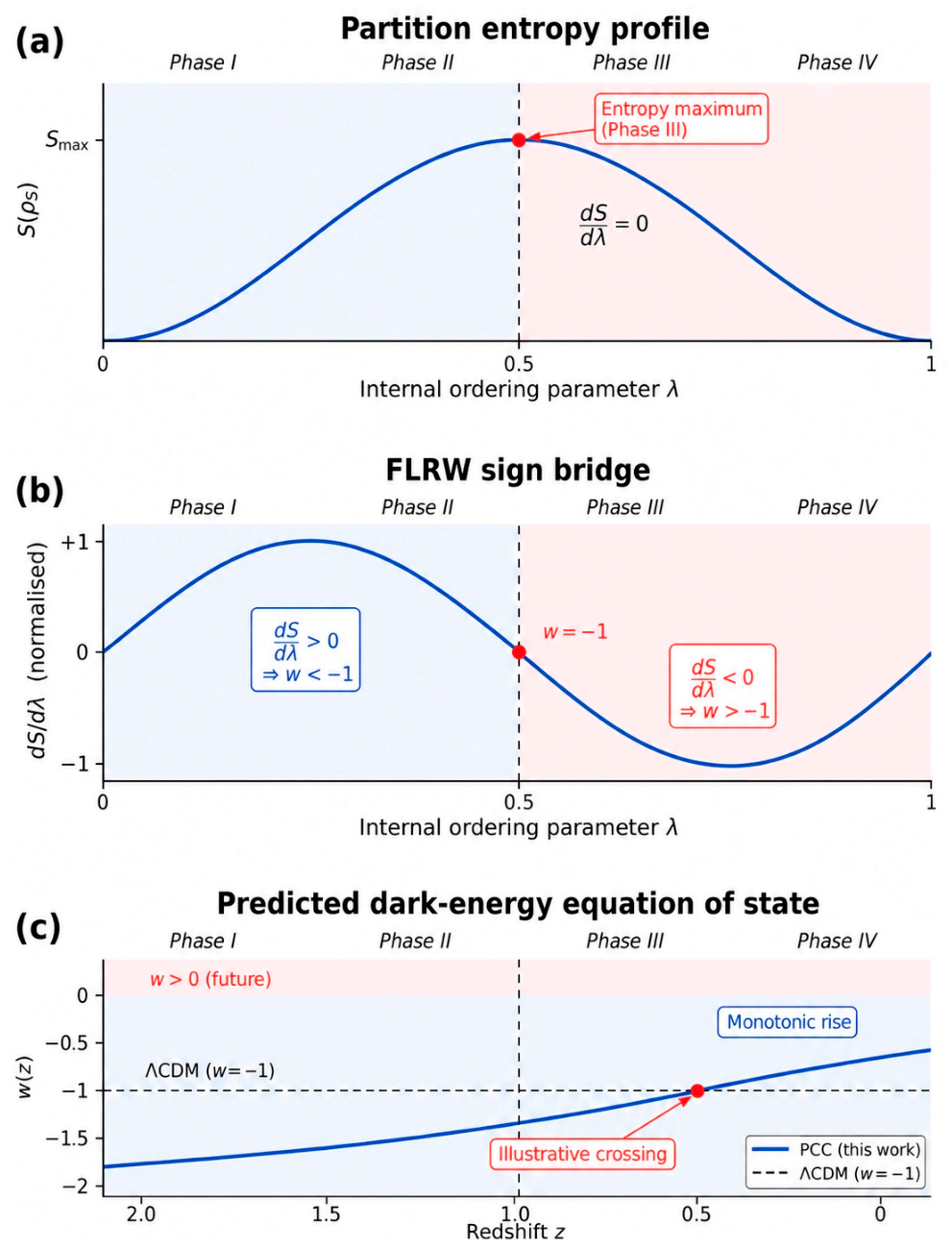
Here and in
Figure 1, lambda denotes a dimensionless algebraic readout-depth label for admissible reduced readouts of the partition. It is not an external time coordinate and does not parametrize evolution of the universal Wheeler–DeWitt state. It is also not defined by the value of S(rho_S). Rather, S(rho_S(lambda)) is the entropy profile evaluated along lambda.
The operational construction of the physical tower is not derived in this manuscript and belongs to the open mathematical program. The structural point is narrower: if internally admissible units of autonomous distinguishability form a tower of access, then the Page-like profile follows from the complementarity of accessible and inaccessible capacities.
In schematic finite-dimensional form, the entropy along the tower obeys the Page-type capacity bound S(rho_S(k)) ≤ log min(d_k, D/d_k), where d_k is the effective accessible dimension at depth k and D is the total effective dimension. For typical states in the relevant admissible subspace, the average entropy lies close to this bound except for the usual Page corrections. Thus the turning point occurs near the depth where accessible and inaccessible capacities are comparable.
3.2. Formation, Maturity, and Dissolution of the Partition
The profile is interpreted as the lifecycle of the observable partition:
Phase I: rapid separation. The partition forms and its reduced entropy grows rapidly. The partition becomes increasingly autonomous from the Cloud.
Phase II: moderating growth. Entropy continues to grow but at a decreasing rate as the partition approaches maximal separation.
Phase III: entropy maximum. The rate of change in S(ρ_S) vanishes. This is the unique turning point in the minimal unimodal case.
Phase IV: global recoherence/dissolution. S(ρ_S) decreases as the partition loses global autonomy. Local observers need not experience time reversal, because their local thermodynamic entropy remains a distinct coarse-grained quantity.
3.3. Local Arrow Versus Global Partition Entropy
A frequent source of confusion is the apparent tension between a decreasing global partition entropy in Phase IV and the experienced thermodynamic arrow of local observers. There is no contradiction because four objects do different work [
15,
16]. Lambda denotes algebraic readout depth; S_S = S(rho_S(lambda)) is the global entropy profile measured along that depth; S(rho_local) defines the ordinary local thermodynamic arrow; and t_obs denotes the emergent semiclassical clock/cosmic-time parameter available only inside a mature effective spacetime. Local entropy can increase macroscopically even while the global entanglement autonomy of the partition decreases. The framework therefore does not identify an observer’s clock time with S_S itself; it treats S_S as a Page-like scalar profile whose relation to t_obs must be supplied by the effective metric map.
3.4. Level Separation and the Low-Entropy Beginning
The same distinction also gives the framework an Occam-like unifying role. The proposal does not introduce one independent mechanism for temporal ordering, another for the low-entropy beginning, another for the local thermodynamic arrow, and another for the dark-energy sign relation. It asks whether these difficulties arise, at least in part, from conflating different levels of description: the pure atemporal total state, the reduced observable partition, the local thermodynamic subsystems inside that partition, and the semiclassical clock time available only after an effective spacetime has emerged.
In the standard formulation, the early universe appears to require an exceptionally special low-entropy condition [
17]. In the present framework, the corresponding branch-level statement is partly reformulated. The total state is not assigned a low thermodynamic entropy; it remains pure and atemporal, with S(ρ_U) = 0. The entropy that begins small is instead S(ρ_S), the bipartite entropy of the observable partition. Its small value at the formation edge of the lifecycle expresses the fact that the partition has not yet developed maximal entanglement autonomy with respect to its complement. In this limited sense, the low-entropy beginning of the observable branch is not an externally imposed preparation of the total state, but the boundary condition associated with partition formation.
This does not solve the full Penrose-type problem of gravitational entropy, nor does it derive why this particular partition corresponds to our observable universe. Those questions require the future construction of a measure over physically admissible internally closed partitions and the full map F[ρ_S]. The present point is narrower: once S(ρ_U), S(ρ_S), S(ρ_local), and t_obs are not identified, the apparent conflicts among timelessness, branch formation, local irreversibility, and late-time cosmological behavior are reformulated as level-specific questions rather than as separate paradoxes requiring unrelated explanations.
The resulting structure is therefore unifying but conditional. The problem of time becomes the problem of internal readout depth within an admissible partition; the low-entropy beginning becomes the formation edge of that partition entropy profile; the local arrow remains governed by S(rho_local); and the dark-energy sign relation becomes a possible semiclassical projection of the same partition lifecycle through the minimal FLRW bridge. The value of the framework is precisely that these links are generated by one internal-access separation rather than by multiple unrelated postulates.
4. Minimal Mathematical Bridge to the Dark-Energy Sign Relation
4.1. From a Direct Sign Postulate to a Monotonic Bridge
The original formulation directly postulated a correspondence between the sign of dS(rho_S)/dλ and the effective equation of state w(z). The revised formulation weakens this assumption. It does not assume the sign relation directly. Instead, it assumes only a monotonic bridge between partition entropy and the effective Hubble expansion rate in the semiclassical FLRW regime, together with a monotonic orientation between algebraic readout depth and the observer time used in that regime:
dλ/dt_obs > 0 (within the mature FLRW projection).
This is not the full map F[ρ_S], but a sign-level projection of it. It states that greater partition separation/entanglement corresponds, in the effective FLRW description, to a greater Hubble expansion rate. The bridge is intentionally minimal: it fixes only a qualitative sign relation and leaves quantitative reconstruction to the full metric map.
4.2. Sign Derivation in FLRW Kinematics
For a spatially flat effective FLRW description in which the relevant late-time dynamics are represented by an effective equation-of-state parameter, the Friedmann equations give
or equivalently
where the dot denotes differentiation with respect to t_obs, the emergent semiclassical cosmic time used by embedded observers inside the mature partition.
Because lambda is the algebraic readout-depth parameter, the sign-level bridge also assumes that, in the mature FLRW regime under consideration, lambda is monotonically oriented with the emergent observer time t_obs. In the semiclassical limit relevant for this bridge, the discrete readout depth is treated as an effectively continuous parameter; this monotonic orientation is therefore a hypothesis of the mature FLRW projection, not a property derived from the algebraic architecture alone. Equivalently, dλ/dt_obs has a fixed positive orientation, so dS_S/dt_obs = (dS_S/dλ)(dλ/dt_obs), and the sign of dot S_S tracks the sign of dS_S/dλ under this orientation.
Since S_S is evaluated along algebraic readout depth, S_S = S_S(lambda(t_obs)),
Since h′(S_S) > 0, H_eff
2 > 0, and dλ/dt_obs > 0 in the mature FLRW projection,
Therefore, the qualitative correspondence follows algebraically:
Thus the phantom crossing at w = −1 is not independently inserted once the monotonic bridge is assumed. It occurs at the entropy turning point of the partition. The bridge remains conditional, but the sign relation itself is a concrete consequence of FLRW kinematics plus monotonicity.
4.3. Scope of the Sign Bridge
The bridge establishes a sign-level result: if the effective Hubble rate is monotonic in S_S, and if algebraic readout depth is monotonically oriented with t_obs in the mature FLRW regime, then the sign of dS_S/dt_obs determines whether the effective cosmology lies below, at, or above w = −1. It does not determine the value of z at which the crossing occurs, the magnitude of w + 1, the late-time asymptote, or the full function H(z); these are precisely the quantities assigned to the full map F[rho_S] in
Section 7.
The purpose of the bridge is to isolate the weakest cosmological assumption needed to make the foundational proposal empirically vulnerable. A future stable LambdaCDM-like w = −1, a permanent phantom phase, or a reversal away from the predicted post-crossing rise would falsify the present formulation at the sign level, even before the amplitude is derived.
5. Observational Context and Falsifiability
5.1. DESI as Context, Not Confirmation
Recent DESI analyses using BAO in combination with CMB and supernova data have motivated renewed interest in dynamical dark energy and possible evolution of w(z) [
18,
19,
20,
21,
22,
23,
24,
25,
26]. Some combined fits are qualitatively compatible with a past phantom regime and a present value above −1. In this manuscript, this is used only as observational context. The framework does not claim that current DESI data confirm Page-Curve Cosmology, and it does not fit DESI data.
The role of DESI, Euclid, Vera Rubin Observatory, and the Nancy Grace Roman Space Telescope is instead falsificatory. Conditional on the Page-like lifecycle and the monotonic FLRW bridge, the framework implies a single qualitative direction: after the entropy turning point, the effective w(z) should continue to rise away from −1 rather than stabilizing at −1, remaining permanently below −1, or oscillating without a single Page-like lifecycle structure.
5.2. Primary Falsification Conditions
The present formulation fails if future data robustly establish any of the following:
- -
w(z) is consistent with exactly −1 at all relevant late times within improved uncertainties.
- -
w(z) remains permanently below −1 without a transition to w > −1.
- -
w(z) crosses repeatedly in a way incompatible with a single entropy maximum.
- -
w(z) reverses after the inferred post-crossing phase rather than continuing the qualitative rise implied by the sign bridge.
This is why the observational component is retained. It is not a claim of present confirmation. It is the channel through which the foundational hypothesis becomes scientifically vulnerable.
6. Relation to Existing Frameworks
6.1. Page–Wootters, Thermal Time, and Relational Time
The Page–Wootters mechanism shows how temporal evolution may be described internally through correlations in a globally stationary quantum state [
27]. The thermal time hypothesis similarly relates temporal flow to state-algebra structure [
28]. The present framework is aligned with these relational insights but shifts the emphasis to cosmology: the relevant ordering is not a local clock subsystem alone, and not the entropy value by itself, but the algebraic depth of internal access through which a partition entropy profile is exposed.
6.2. Decoherent Histories and Relational Quantum Mechanics
Decoherent histories provide a framework for assigning probabilities to consistent coarse-grained histories without invoking a single external classical trajectory [
29]. Relational quantum mechanics treats physical properties as relational rather than absolute [
30]. The present construction shares this internal perspective but introduces a specific cosmological organization: algebraic readout depth supplies the internal ordering label, while S(rho_S(lambda)) supplies the Page-like scalar profile of an accessible partition.
6.3. Relation to Established Quantum Cosmology
The framework is not a variant of loop quantum cosmology, Hartle–Hawking no-boundary cosmology, Vilenkin tunneling cosmology, or semiclassical WKB time [
31,
32,
33]. Those approaches introduce their own boundary conditions, dynamical structures, or semiclassical approximation schemes. The present manuscript asks a narrower foundational question: if one refuses an external temporal selection rule and treats the universal Wheeler–DeWitt state as atemporal, what internal structure can order the observable partition? The answer proposed here is algebraic readout depth, with S(rho_S(lambda)) as the corresponding Page-like entropy profile.
This difference should not be read as a rejection of established programs. It is a change of question. Established quantum-cosmology programs often ask how to obtain a semiclassical spacetime from a constrained quantum state. Page-Curve Cosmology asks what internal ordering remains available to observers when the total state itself has no external time and no externally selected history, and whether that ordering can be represented by a tower of admissible observer-accessible subalgebras.
6.4. Entanglement, Geometry, and Observer Algebras
The proposal is also motivated by the broader line of work in which geometry and gravitational dynamics are constrained by entanglement. Jacobson derived Einstein equations as an equation of state from entropy-area relations [
34,
35,
36], holographic work relates entanglement entropy to geometry [
37,
38,
39,
40], causal-set approaches provide an alternative discreteness-based route to spacetime structure [
41], while space-from-Hilbert-space approaches reconstruct geometry from entanglement patterns [
42,
43]. Observer-dependent algebras in de Sitter space have also been shown to acquire Type II_1 factor structure in the presence of gravitational corrections [
11,
12,
13]. Subfactor theory and the Jones index provide a natural language for nested inclusions of factors [
14]. These results do not prove the admissibility or readout-depth construction, but they make its language technically natural: observer-accessible physics is algebraic, entropic, and relational.
7. Limitations and Open Mathematical Problems
7.1. The Full Map F[ρ_S]
The main open problem is the construction of the full map:
The minimal bridge H_eff = h(S_S), h′ > 0 is only a sign-level projection of this map. A complete theory must derive the physical tower of admissible readout units, the relation between readout depth lambda and t_obs, the Lorentzian metric, local causal structure, effective clocks, H(z), perturbations, and the numerical behavior of w(z) from the reduced-state structure. These items define the next mathematical stage of the program;
Appendix A and
Appendix B provide only minimal sign-structure and interpretive support, not a full metric derivation.
7.2. Typicality and Measure
The Page-like profile is treated as the generic non-selected lifecycle of a bipartite partition evaluated along algebraic readout depth, but a rigorous measure over physically admissible cosmological partitions and access towers is not yet constructed. The framework therefore distinguishes between the definition of S(rho_S(lambda)), which is exact once a partition and readout depth are given, and the genericity claim that this profile is Page-like, which requires a future measure theory over internally closed, factor-like admissible partitions. This limitation also applies to the low-entropy reinterpretation: the framework reframes the small initial S(rho_S) as a partition-boundary feature, but it does not yet derive a measure selecting this partition or a full gravitational-entropy account. The relevant typicality is not Haar-typicality over the unrestricted Hilbert space H_U, which would conflict with the non-trivial Wheeler–DeWitt constraint satisfied by the physical state. It is, rather, typicality conditional on Wheeler–DeWitt admissibility and the factor-like accessibility criterion: a statement that generic members of H_phys that also support an admissible access tower produce a Page-like reduced entropy profile along that tower. This conditional genericity is structurally analogous to canonical typicality in statistical mechanics [
44,
45], which establishes that generic states on a microcanonical energy shell produce thermal reduced states without requiring that the global state be typical over the unrestricted Hilbert space. The construction of the relevant measure over H_phys remains an open problem, but the scope of the genericity claim is bounded in this more precise way.
7.3. Why This Partition?
The framework does not yet explain why this specific partition, or its associated tower of admissible readout units, corresponds to our observable universe.
Section 2.4 supplies a preliminary admissibility criterion for what can count as an internally accessible unit: the relevant observable algebra must be internally closed and factor-like, rather than an arbitrary externally chosen subsystem. This is a necessary structural condition, not a complete selection principle. The present formulation reduces the problem from choosing an arbitrary entropy curve to constructing the admissible units and inclusions that generate readout depth. A future theory of F[rho_S(lambda)] may sharpen this into a full selection criterion based on internal closure, factor stability, finite-resolution distinguishability, subfactor structure, and the capacity to support an effective semiclassical geometry.
7.4. Relation to Ongoing Technical Development
A later technical program must build the finite-resolution readout machinery needed to make F[rho_S(lambda)] explicit. That work should be separate from the present manuscript. The present paper establishes only the conceptual and sign-level constraints that such a technical construction must satisfy: algebraic admissibility, autonomous distinguishability, readout-depth ordering, Page-like non-selected entropy profile, local thermodynamic compatibility, and the FLRW sign bridge.
8. Conclusions
Page-Curve Cosmology proposes that the problem of time should be reframed as an internal-access problem. If the universal state is genuinely atemporal, physical time is not added to the total state. It appears as ordering inside an accessible reduced partition. In the refined formulation, the ordering parameter is algebraic readout depth, represented schematically by a tower of admissible factor-like subalgebras. The bipartite entropy S(rho_S(lambda)) is not the entropy of the total state and not local thermodynamic entropy; it is the scalar Page-like profile measured along that internal depth. The same level separation also clarifies why a low S(rho_S) at the beginning of the branch, an increasing local thermodynamic arrow, and a possible late-time sign change in w_eff need not be treated as unrelated problems.
The revised mathematical contribution is modest but concrete. The Page-like profile is interpreted as the generic non-selected entropy profile of a bipartite partition read through a tower of admissible internal access under strict atemporality. The dark-energy sign correspondence is no longer introduced as an isolated sign postulate; it follows from the minimal bridge H_eff = h(S_S), h′ > 0, together with the standard FLRW identity w_eff = −1 − (2/3)(Hdot_eff/H_eff2), once readout depth is monotonically oriented with the observer time of the mature FLRW projection. This establishes a conditional but explicit sign-level link between partition entropy dynamics and the phantom divide.
The remaining work is technical rather than cosmetic: the physical tower of admissible readout units, the full map F[rho_S(lambda)], the amplitude of w(z), the crossing redshift, local causal structure, and the emergence of Lorentzian spacetime must be derived rather than assumed. Nevertheless, the framework is falsifiable at the sign level: if future observations do not show the qualitative post-crossing rise required by the Page-like entropy lifecycle, the present formulation fails. The value of the proposal is therefore not that it is already a completed cosmological model, but that it provides a minimal internal-access architecture for deriving one.
Funding
This research received no external funding.
Data Availability Statement
No new data were generated or analyzed in this study. Observational references are used only as public context.
Acknowledgments
The author acknowledges the use of AI-assisted tools as supportive aids for Spanish-to-English translation, language editing, and terminology consistency checking during manuscript preparation. The author reviewed and edited the output and takes full responsibility for all conceptual contributions, theoretical choices, equations, references, interpretations, and final content.
Conflicts of Interest
The author declares no conflicts of interest.
Appendix A. Minimal Algebraic Entropy Profile and Turning Point
This appendix provides a minimal mathematical realization of the sign structure using algebraic readout depth. It does not derive the full map F[rho_S(lambda)] and does not fit observational data.
Appendix A.1. Inclusion-Depth Entropy Profile
Let N_0 ⊂ N_1 ⊂ ⋯ ⊂ N_n be a finite tower of admissible factor-like subalgebras, and let lambda = k/n denote normalized readout depth. If d_k is the effective accessible dimension at depth k and D is the total effective dimension of the relevant physical sector, then for a typical pure state the reduced entropy is controlled by the smaller of the accessible and inaccessible capacities:
up to the usual Page corrections. For equal elementary units of dimension q, d_k = q
k and D = q
n, giving
This profile rises for k < n/2, reaches its maximum near k = n/2, and decreases for k > n/2. The turning point is therefore a consequence of the complementarity between accessible and inaccessible capacities, not of defining lambda by the entropy value.
Appendix A.2. Smooth Representative
A smooth continuum representative of the same sign structure may be used when a differentiable FLRW bridge is required:
This representative is not the fundamental origin of the profile; it is a smooth approximation to the inclusion-depth Page profile. Any smooth unimodal Page-like lifecycle gives the same sign structure.
Appendix A.3. Relation to the FLRW Bridge
Using H_eff = h(S), h′ > 0 and S = S(lambda(t_obs)), the FLRW identity gives
In the same effective continuum limit, if dλ/dt_obs > 0 in the mature FLRW projection, the entropy turning point is also the w = −1 crossing in the sign-level bridge. This establishes only the local sign structure, not the quantitative expansion history.
Appendix B. Non-Core Interpretive Extensions
The following extensions are not part of the core argument and should be read only as possible directions for future development. If local horizons correspond to regions where local partition autonomy saturates, then black holes may provide a local analog of the same entropic ordering logic. The Bekenstein–Hawking area law and holographic entropy relations make such analogies plausible, but no local black-hole model is derived here [
38,
46,
47].
Similarly, large-scale recoherence in Phase IV would not imply local time reversal. It would correspond, if physically realized, to a weakening of global partition correlations while local thermodynamic observers continue to experience ordinary forward entropy growth. Observable consequences of such a phase remain speculative and require a full F[ρ_S] construction.
References
- DeWitt, B.S. Quantum theory of gravity. I. The canonical theory. Phys. Rev. 1967, 160, 1113–1148. [Google Scholar] [CrossRef]
- Smolin, L. Time Reborn; Houghton Mifflin Harcourt: Boston, MA, USA, 2013. [Google Scholar]
- Isham, C.J. Canonical quantum gravity and the problem of time. In Integrable Systems, Quantum Groups, and Quantum Field Theories; Kluwer: Dordrecht, Germany, 1993. [Google Scholar]
- Kuchar, K.V. Time and interpretations of quantum gravity. In Proceedings of the 4th Canadian Conference on General Relativity and Relativistic Astrophysics; World Scientific: Singapore, 1992. [Google Scholar]
- von Neumann, J. Mathematische Grundlagen der Quantenmechanik; Springer: Berlin, Germany, 1932. [Google Scholar]
- Bengtsson, I.; Zyczkowski, K. Geometry of Quantum States; Cambridge University Press: Cambridge, UK, 2006. [Google Scholar]
- Page, D.N. Average entropy of a subsystem. Phys. Rev. Lett. 1993, 71, 1291–1294. [Google Scholar] [CrossRef] [PubMed]
- Page, D.N. Information in black hole radiation. Phys. Rev. Lett. 1993, 71, 3743–3746. [Google Scholar] [CrossRef] [PubMed]
- Hardy, L. Quantum theory from five reasonable axioms. arXiv 2001, arXiv:quant-ph/0101012. [Google Scholar]
- Chiribella, G.; D’Ariano, G.M.; Perinotti, P. Informational derivation of quantum theory. Phys. Rev. A 2011, 84, 012311. [Google Scholar] [CrossRef]
- Chandrasekaran, V.; Penington, G.; Witten, E. Large N algebras and generalized entropy. J. High Energy Phys. 2023, 4, 9. [Google Scholar]
- Witten, E. Gravity and the crossed product. J. High Energy Phys. 2022, 10, 8. [Google Scholar]
- Chandrasekaran, V.; Longo, R.; Penington, G.; Witten, E. An algebra of observables for de Sitter space. J. High Energy Phys. 2023, 2, 82. [Google Scholar]
- Jones, V.F.R. Index for subfactors. Invent. Math. 1983, 72, 1–25. [Google Scholar] [CrossRef]
- Zurek, W.H. Decoherence, einselection, and the quantum origins of the classical. Rev. Mod. Phys. 2003, 75, 715–775. [Google Scholar] [CrossRef]
- Zeh, H.D. Remarks on the compatibility of opposite arrows of time. Entropy 2005, 7, 199–207. [Google Scholar] [CrossRef]
- Penrose, R. The Road to Reality; Jonathan Cape: London, UK, 2004. [Google Scholar]
- DESI Collaboration. DESI DR2 Results II: Measurements of baryon acoustic oscillations and cosmological constraints. arXiv 2025, arXiv:2503.14738. [Google Scholar]
- DESI Collaboration. Extended dark energy analysis using DESI DR2 BAO measurements. Phys. Rev. D 2025, 112, 083511. [Google Scholar] [CrossRef]
- Perlmutter, S.; Aldering, G.; Goldhaber, G.; Knop, R.A.; Nugent, P.; Castro, P.G.; Deustua, S.; Fabbro, S.; Goobar, A.; Groom, D.E.; et al. Measurements of Omega and Lambda from 42 high-redshift supernovae. Astrophys. J. 1999, 517, 565–586. [Google Scholar] [CrossRef]
- Riess, A.G.; Filippenko, A.V.; Challis, P.; Clocchiatti, A.; Diercks, A.; Garnavich, P.M.; Gilliland, R.L.; Hogan, C.J.; Jha, S.; Kirshner, R.P.; et al. Observational evidence from supernovae for an accelerating universe. Astron. J. 1998, 116, 1009–1038. [Google Scholar] [CrossRef]
- Chevallier, M.; Polarski, D. Accelerating universes with scaling dark matter. Int. J. Mod. Phys. D 2001, 10, 213–224. [Google Scholar] [CrossRef]
- Linder, E.V. Exploring the expansion history of the universe. Phys. Rev. Lett. 2003, 90, 091301. [Google Scholar] [CrossRef] [PubMed]
- Caldwell, R.R. A phantom menace? Cosmological consequences of a dark energy component with super-negative equation of state. Phys. Lett. B 2002, 545, 23–29. [Google Scholar] [CrossRef]
- Caldwell, R.R.; Kamionkowski, M.; Weinberg, N.N. Phantom energy: Dark energy with w < −1 causes a cosmic doomsday. Phys. Rev. Lett. 2003, 91, 071301. [Google Scholar] [CrossRef] [PubMed]
- Copeland, E.J.; Sami, M.; Tsujikawa, S. Dynamics of dark energy. Int. J. Mod. Phys. D 2006, 15, 1753–1936. [Google Scholar] [CrossRef]
- Page, D.N.; Wootters, W.K. Evolution without evolution. Phys. Rev. D 1983, 27, 2885. [Google Scholar] [CrossRef]
- Connes, A.; Rovelli, C. Von Neumann algebra automorphisms and time-thermodynamics relation in generally covariant quantum theories. Class. Quantum Grav. 1994, 11, 2899–2918. [Google Scholar] [CrossRef]
- Gell-Mann, M.; Hartle, J.B. Quantum mechanics in the light of quantum cosmology. In Complexity, Entropy and the Physics of Information; Addison-Wesley: Redwood City, CA, USA, 1990. [Google Scholar]
- Rovelli, C. Relational quantum mechanics. Int. J. Theor. Phys. 1996, 35, 1637–1678. [Google Scholar] [CrossRef]
- Hartle, J.B.; Hawking, S.W. Wave function of the universe. Phys. Rev. D 1983, 28, 2960–2975. [Google Scholar] [CrossRef]
- Vilenkin, A. Creation of universes from nothing. Phys. Lett. B 1982, 117, 25–28. [Google Scholar] [CrossRef]
- Ashtekar, A.; Singh, P. Loop quantum cosmology: A status report. Class. Quantum Grav. 2011, 28, 213001. [Google Scholar] [CrossRef]
- Jacobson, T. Thermodynamics of spacetime: The Einstein equation of state. Phys. Rev. Lett. 1995, 75, 1260–1263. [Google Scholar] [CrossRef]
- Jacobson, T. Entanglement equilibrium and the Einstein equation. Phys. Rev. Lett. 2016, 116, 201101. [Google Scholar] [CrossRef] [PubMed]
- Padmanabhan, T. Distribution function of the atoms of spacetime and the nature of gravity. Entropy 2015, 17, 7420–7452. [Google Scholar] [CrossRef]
- Maldacena, J.; Susskind, L. Cool horizons for entangled black holes. Fortschr. Phys. 2013, 61, 781–811. [Google Scholar] [CrossRef]
- Ryu, S.; Takayanagi, T. Holographic derivation of entanglement entropy from the AdS/CFT correspondence. Phys. Rev. Lett. 2006, 96, 181602. [Google Scholar] [CrossRef] [PubMed]
- Faulkner, T.; Guica, M.; Hartman, T.; Myers, R.C.; Van Raamsdonk, M. Gravitation from entanglement in holographic CFTs. J. High Energy Phys. 2014, 3, 51. [Google Scholar]
- Bousso, R. The holographic principle. Rev. Mod. Phys. 2002, 74, 825–874. [Google Scholar] [CrossRef]
- Bombelli, L.; Lee, J.; Meyer, D.; Sorkin, R. Space-time as a causal set. Phys. Rev. Lett. 1987, 59, 521–524. [Google Scholar] [CrossRef] [PubMed]
- Cao, C.; Carroll, S.M.; Michalakis, S. Space from Hilbert space: Recovering geometry from bulk entanglement. Phys. Rev. D 2017, 95, 024031. [Google Scholar] [CrossRef]
- Van Raamsdonk, M. Building up spacetime with quantum entanglement. Gen. Relativ. Gravit. 2010, 42, 2323–2329. [Google Scholar] [CrossRef]
- Goldstein, S.; Lebowitz, J.L.; Tumulka, R.; Zanghi, N. Canonical typicality. Phys. Rev. Lett. 2006, 96, 050403. [Google Scholar] [CrossRef] [PubMed]
- Popescu, S.; Short, A.J.; Winter, A. Entanglement and the foundations of statistical mechanics. Nat. Phys. 2006, 2, 754–758. [Google Scholar] [CrossRef]
- Bekenstein, J.D. Black holes and entropy. Phys. Rev. D 1973, 7, 2333–2346. [Google Scholar] [CrossRef]
- Hawking, S.W. Particle creation by black holes. Commun. Math. Phys. 1975, 43, 199–220. [Google Scholar] [CrossRef]
| Disclaimer/Publisher’s Note: The statements, opinions and data contained in all publications are solely those of the individual author(s) and contributor(s) and not of MDPI and/or the editor(s). MDPI and/or the editor(s) disclaim responsibility for any injury to people or property resulting from any ideas, methods, instructions or products referred to in the content. |