

Experimental Manipulation of Psychological Control Scenarios: Implications for Exercise and Memory Research


Abstract
1. Introduction
2. Methods
Study Design and Participants
3. Measures
4. Statistical Analysis
5. Results
6. Discussion
Author Contributions
Funding
Conflicts of Interest
References
- Roig, M.; Nordbrandt, S.; Geertsen, S.S.; Nielsen, J.B. The effects of cardiovascular exercise on human memory: A review with meta-analysis. Neurosci. Biobehav. Rev. 2013, 37, 1645–1666. [Google Scholar] [CrossRef]
- Loprinzi, P.D.; Frith, E.; Edwards, M.K.; Sng, E.; Ashpole, N. The effects of exercise on memory function among young to middle-aged adults: Systematic review and recommendations for future research. Am. J. Health Promot. 2018, 32, 691–704. [Google Scholar] [CrossRef] [PubMed]
- Pontifex, M.B.; McGowan, A.L.; Chandler, M.C.; Gwizdala, K.L.; Parks, A.C.; Fenn, K.; Kamijo, K. A primer on investigating the after effects of acute bouts of physical activity on cognition. Psychol. Sport Exerc. 2018, 40, 1–22. [Google Scholar] [CrossRef]
- Boot, W.R.; Simons, D.J.; Stothart, C.; Stutts, C. The pervasive problem with placebos in psychology: Why active control groups are not sufficient to rule out placebo effects. Perspect. Psychol. Sci. 2013, 8, 445–454. [Google Scholar] [CrossRef] [PubMed]
- Kremer, E.F. The truly random control procedure: Conditioning to the static cues. J. Comp. Physiol. Psychol. 1974, 86, 700. [Google Scholar] [CrossRef] [PubMed]
- Kremer, E.F. Truly random and traditional control procedures in CER conditioning in the rat. J. Comp. Physiol. Psychol. 1971, 76, 441. [Google Scholar] [CrossRef]
- Dudai, Y. Memory from A to Z: Keywords, Concepts, and Beyond; Oxford University Press: New York, NY, USA, 2004. [Google Scholar]
- Loprinzi, P.D.; Blough, J.; Crawford, L.; Ryu, S.; Zou, L.; Li, H. The temporal effects of acute exercise on episodic memory function: Systematic review with meta-analysis. Brain Sci. 2019, 9, 87. [Google Scholar] [CrossRef] [PubMed]
- Crush, E.A.; Loprinzi, P.D. Dose-response effects of exercise duration and recovery on cognitive functioning. Percept. Mot. Ski. 2017, 124, 1164–1193. [Google Scholar] [CrossRef]
- Siddiqui, A.; Loprinzi, P. Experimental Investigation of the Time Course Effects of Acute Exercise on False Episodic Memory. J. Clin. Med. 2018, 7, 157. [Google Scholar] [CrossRef] [PubMed]
- Sng, E.; Frith, E.; Loprinzi, P.D. Temporal effects of acute walking exercise on learning and memory function. Am. J. Health Promot. 2018, 32, 1518–1525. [Google Scholar] [CrossRef] [PubMed]
- McNerney, M.W.; Radvansky, G.A. Mind racing: The influence of exercise on long-term memory consolidation. Memory 2015, 23, 1140–1151. [Google Scholar] [CrossRef] [PubMed]
- Labban, J.D.; Etnier, J.L. The Effect of Acute Exercise on Encoding and Consolidation of Long-Term Memory. J. Sport Exerc. Psychol. 2018, 40, 336–342. [Google Scholar] [CrossRef] [PubMed]
- Liu, D.L.J.; Graham, S.; Zorawski, M. Enhanced selective memory consolidation following post-learning pleasant and aversive arousal. Neurobiol. Learn. Mem. 2008, 89, 36–46. [Google Scholar] [CrossRef]
- Wingate, S.; Crawford, L.; Frith, E.; Loprinzi, P.D. Experimental investigation of the effects of acute exercise on memory interference. Health Promot. Perspect. 2018, 8, 208. [Google Scholar] [CrossRef] [PubMed]
- Bergmann, H.C.; Rijpkema, M.; Fernandez, G.; Kessels, R.P. The effects of valence and arousal on associative working memory and long-term memory. PLoS ONE 2012, 7, e52616. [Google Scholar] [CrossRef]
- Jubelt, L.E.; Barr, R.S.; Goff, D.C.; Logvinenko, T.; Weiss, A.P.; Evins, A.E. Effects of transdermal nicotine on episodic memory in non-smokers with and without schizophrenia. Psychopharmacology 2008, 199, 89–98. [Google Scholar] [CrossRef]
- Klaming, R.; Annese, J.; Veltman, D.J.; Comijs, H.C. Episodic memory function is affected by lifestyle factors: A 14-year follow-up study in an elderly population. Aging Neuropsychol. Cognit. 2017, 24, 528–542. [Google Scholar] [CrossRef]
- Henry, J.D.; Rendell, P.G. A review of the impact of pregnancy on memory function. J. Clin. Exp. Neuropsychol. 2007, 29, 793–803. [Google Scholar] [CrossRef] [PubMed]
- Wammes, J.D.; Good, T.J.; Fernandes, M.A. Autobiographical and episodic memory deficits in mild traumatic brain injury. Brain Cognit. 2017, 111, 112–126. [Google Scholar] [CrossRef] [PubMed]
- Hindocha, C.; Freeman, T.; Xia, J.; Shaban, N.; Curran, H. Acute memory and psychotomimetic effects of cannabis and tobacco both ‘joint’ and individually: A placebo-controlled trial. Psychol. Med. 2017, 47, 2708–2719. [Google Scholar] [CrossRef] [PubMed]
- Le Berre, A.P.; Fama, R.; Sullivan, E.V. Executive functions, memory, and social cognitive deficits and recovery in chronic alcoholism: A critical review to inform future research. Alcohol. Clin. Exp. Res. 2017, 41, 1432–1443. [Google Scholar] [CrossRef] [PubMed]
- Sherman, S.M.; Buckley, T.P.; Baena, E.; Ryan, L. Caffeine enhances memory performance in young adults during their non-optimal time of day. Front. Psychol. 2016, 7, 1764. [Google Scholar] [CrossRef] [PubMed]
- Labban, J.D.; Etnier, J.L. Effects of acute exercise on long-term memory. Res. Q. Exerc. Sport 2011, 82, 712–721. [Google Scholar] [CrossRef]
- Singer, J.A.; Salovey, P. Mood and memory: Evaluating the network theory of affect. Clin. Psychol. Rev. 1988, 8, 211–251. [Google Scholar] [CrossRef]
- Watson, D.; Clark, L.A.; Tellegen, A. Development and validation of brief measures of positive and negative affect: The PANAS scales. J. Personal. Soc. Psychol. 1988, 54, 1063. [Google Scholar] [CrossRef]
- Ball, T.J.; Joy, E.A.; Gren, L.H.; Cunningham, R.; Shaw, J.M. Predictive validity of an adult physical activity “Vital Sign” recorded in electronic health records. J. Phys. Act. Health 2016, 13, 403–408. [Google Scholar] [CrossRef] [PubMed]
- Ball, T.J.; Joy, E.A.; Gren, L.H.; Shaw, J.M. Peer Reviewed: Concurrent Validity of a Self-Reported Physical Activity “Vital Sign” Questionnaire With Adult Primary Care Patients. Prev. Chronic Dis. 2016, 13, E16. [Google Scholar] [CrossRef] [PubMed]
- Ball, T.J.; Joy, E.A.; Goh, T.L.; Hannon, J.C.; Gren, L.H.; Shaw, J.M. Validity of two brief primary care physical activity questionnaires with accelerometry in clinic staff. Prim. Health Care Res. Dev. 2015, 16, 100–108. [Google Scholar] [CrossRef]
- Garber, C.E.; Blissmer, B.; Deschenes, M.R.; Franklin, B.A.; Lamonte, M.J.; Lee, I.M.; Nieman, D.C.; Swain, D.P. Quantity and quality of exercise for developing and maintaining cardiorespiratory, musculoskeletal, and neuromotor fitness in apparently healthy adults: Guidance for prescribing exercise. Med. Sci. Sports Exerc. 2011, 43, 1334–1359. [Google Scholar] [CrossRef]
- Wilson, M. MRC psycholinguistic database: Machine-usable dictionary, version 2.00. Behav. Res. Methods Instrum. Comput. 1988, 20, 6–10. [Google Scholar] [CrossRef]
- Geffen, G.M.; Butterworth, P.; Geffen, L.B. Test-retest reliability of a new form of the auditory verbal learning test (AVLT). Arch. Clin. Neuropsychol. 1994, 9, 303–316. [Google Scholar] [CrossRef] [PubMed]
- Cheke, L.G. What–where–when memory and encoding strategies in healthy aging. Learn. Mem. 2016, 23, 121–126. [Google Scholar] [CrossRef] [PubMed]
- Cheke, L.G.; Simons, J.S.; Clayton, N.S. Higher body mass index is associated with episodic memory deficits in young adults. Q. J. Exp. Psychol. 2016, 69, 2305–2316. [Google Scholar] [CrossRef] [PubMed]
- Krikorian, R.; Bartok, J.; Gay, N. Tower of London procedure: A standard method and developmental data. J. Clin. Exp. Neuropsychol. 1994, 16, 840–850. [Google Scholar] [CrossRef]
- Schnirman, G.M.; Welsh, M.C.; Retzlaff, P.D. Development of the Tower of London-revised. Assessment 1998, 5, 355–360. [Google Scholar] [CrossRef] [PubMed]
- Shallice, T. Specific impairments of planning. Philos. Trans. R. Soc. Lond. Ser. B Biol. Sci. 1982, 298, 199–209. [Google Scholar] [CrossRef]
- Bull, R.; Espy, K.A.; Senn, T.E. A comparison of performance on the Towers of London and Hanoi in young children. J. Child Psychol. Psychiatry 2004, 45, 743–754. [Google Scholar] [CrossRef]
- Köstering, L.; Schmidt, C.S.; Egger, K.; Amtage, F.; Peter, J.; Klöppel, S.; Beume, L.A.; Hoeren, M.; Weiller, C.; Kaller, C.P. Assessment of planning performance in clinical samples: Reliability and validity of the Tower of London task (TOL-F). Neuropsychologia 2015, 75, 646–655. [Google Scholar] [CrossRef]
- Köstering, L.; Nitschke, K.; Schumacher, F.K.; Weiller, C.; Kaller, C.P. Test–retest reliability of the Tower of London Planning Task (TOL-F). Psychol. Assess. 2015, 27, 925. [Google Scholar] [CrossRef]
- Lee, S.-Y.; Song, X.-Y. Evaluation of the Bayesian and maximum likelihood approaches in analyzing structural equation models with small sample sizes. Multivar. Behav. Res. 2004, 39, 653–686. [Google Scholar] [CrossRef]
- Hox, J.J.; van de Schoot, R.; Matthijsse, S. How few countries will do? Comparative survey analysis from a Bayesian perspective. Surv. Res. Methods 2012, 6, 87–93. [Google Scholar]
- Jarosz, A.F.; Wiley, J. What are the odds? A practical guide to computing and reporting Bayes factors. J. Probl. Solving 2014, 7, 2. [Google Scholar] [CrossRef]
- Loprinzi, P.D. Intensity-specific effects of acute exercise on human memory function: Considerations for the timing of exercise and the type of memory. Health Promot. Perspect. 2018, 8, 255. [Google Scholar] [CrossRef]
- Jaffery, A.; Edwards, M.K.; Loprinzi, P.D. The effects of acute exercise on cognitive function: Solomon experimental design. J. Prim. Prev. 2018, 39, 37–46. [Google Scholar] [CrossRef] [PubMed]
- Loprinzi, P.; Ponce, P.; Frith, E. Hypothesized mechanisms through which acute exercise influences episodic memory. Physiol. Int. 2018, 105, 285–297. [Google Scholar] [CrossRef]
- Loprinzi, P.D.; Edwards, M.K.; Frith, E. Potential avenues for exercise to activate episodic memory-related pathways: A narrative review. Eur. J. Neurosci. 2017, 46, 2067–2077. [Google Scholar] [CrossRef]
- Haynes, J.T., IV; Frith, E.; Sng, E.; Loprinzi, P.D. Experimental effects of acute exercise on episodic memory function: Considerations for the timing of exercise. Psychol. Rep. 2018, 0033294118786688. [Google Scholar]
- Frith, E.; Sng, E.; Loprinzi, P.D. Randomized controlled trial evaluating the temporal effects of high-intensity exercise on learning, short-term and long-term memory, and prospective memory. Eur. J. Neurosci. 2017, 46, 2557–2564. [Google Scholar] [CrossRef] [PubMed]
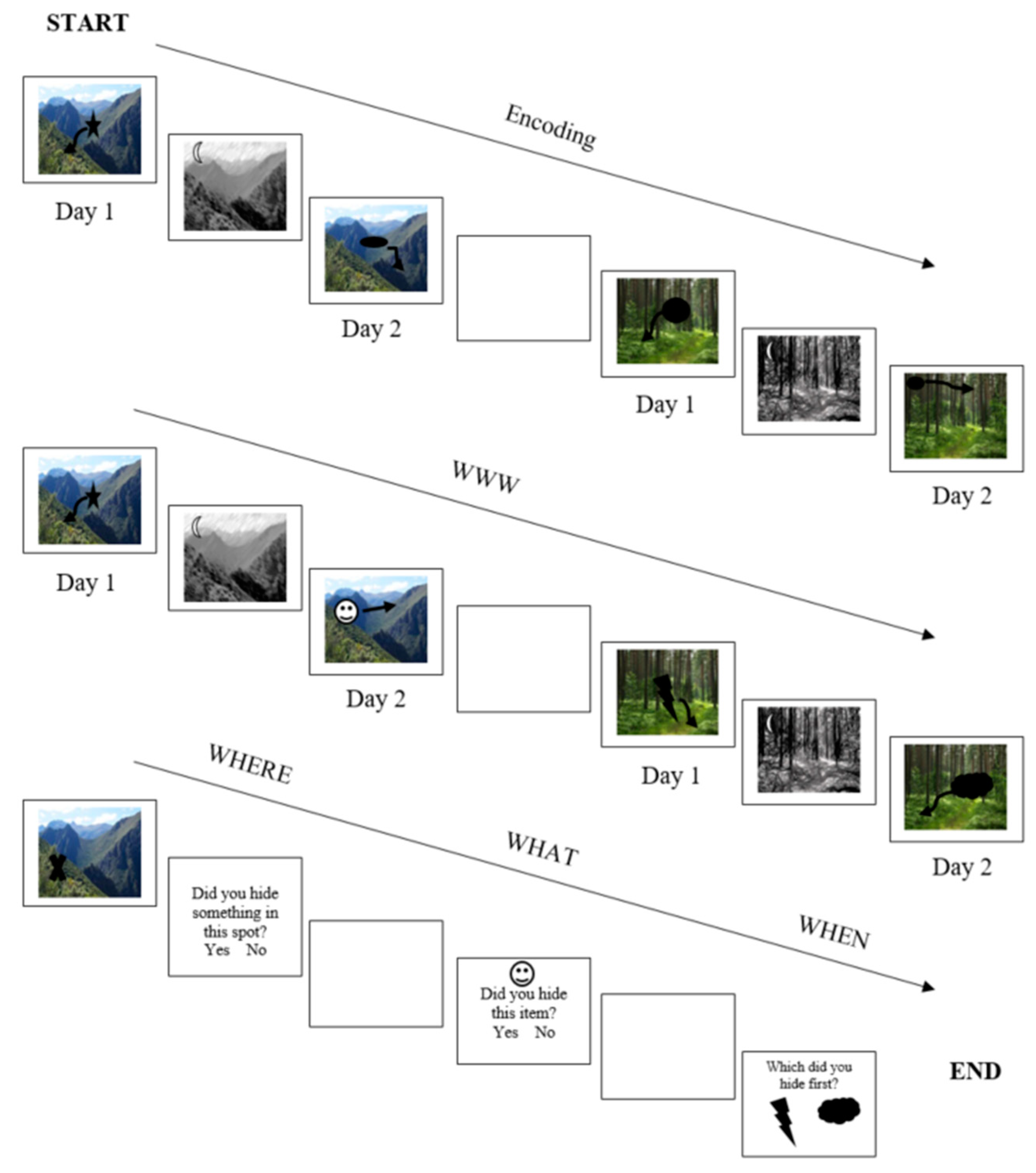
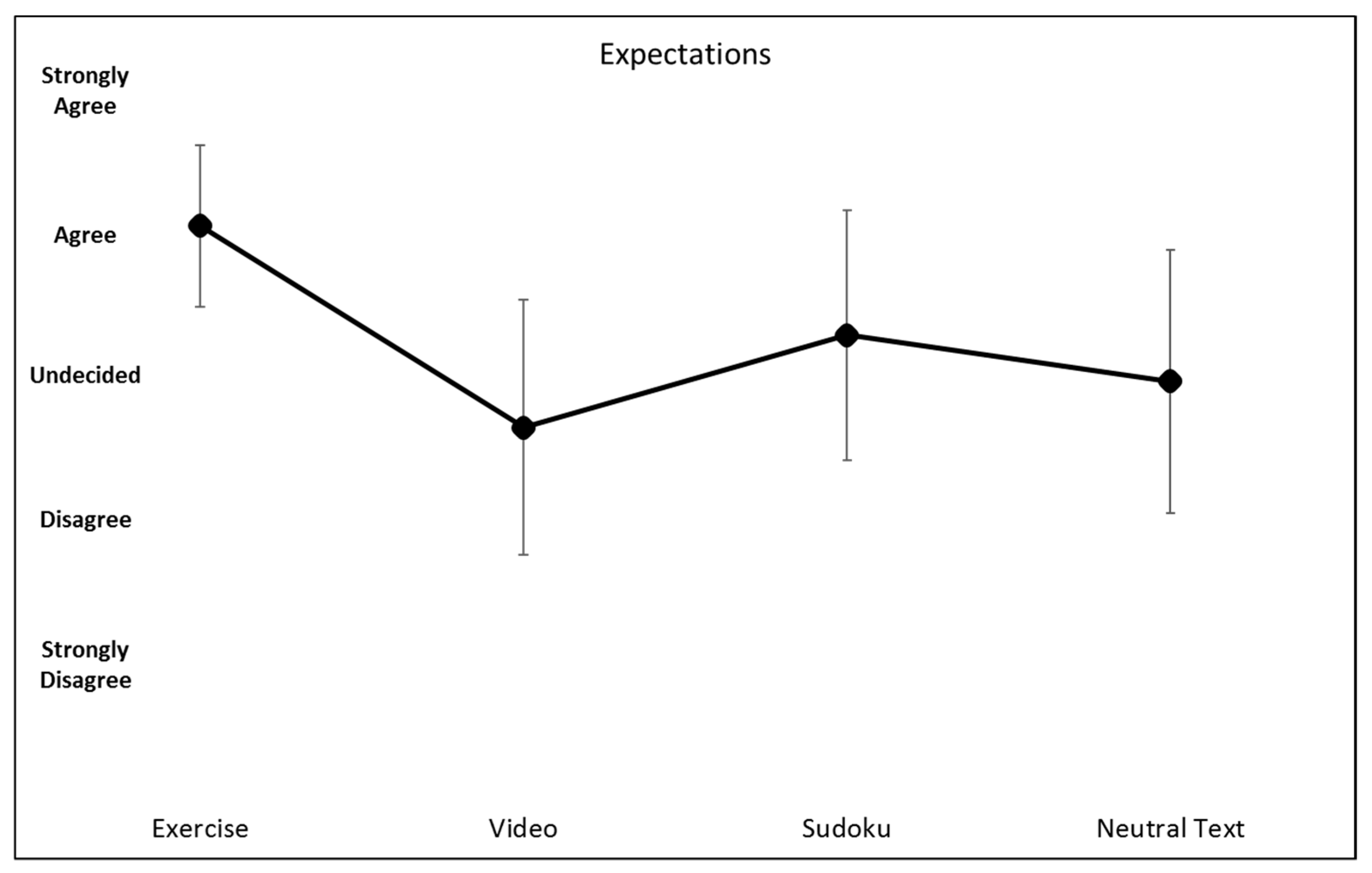

| Variable | Point Estimate |
|---|---|
| Age (mean years [sd]) | 21.04 (1.12) |
| Sex (% female) | 66.7 |
| Race-Ethnicity, % | |
| Non-Hispanic White (n = 19) | 79.2 |
| Other/Multi-race (n = 3) | 12.5 |
| Non-Hispanic Black (n = 2) | 8.3 |
| Taking Medication to Regulate Mood/Emotion (% Yes) | 4.2 |
| Currently diagnosed with ADD/ADHD (% Yes) | 4.2 |
| BMI (mean [sd]) | 26.58 (6.28) |
| MVPA (mean min per week [sd]) | 175.4 (116.8) |
| Variable | Exercise Visit | Video Visit | Sudoku Visit | Neutral Text Visit | Test Statistic |
|---|---|---|---|---|---|
| What-Where-When (WWW) (mean % [sd]) | 63.28 (21.6) | 69.53 (21.91) | 65.63 (23.89) | 61.2 (22.04) | F3,23 = 0.989, P = 0.403, η2p = 0.041, BF10 = 0.167 |
| What Loop (mean % [sd]) | 99.48 (1.77) | 99.22 (2.8) | 99.22 (2.11) | 99.48 (1.77) | F3,23 = 0.113, P = 0.952, η2p = 0.005, BF10 = 0.065 |
| Where Loop (mean % [sd]) | 87.03 (10.25) | 87.24 (15.03) | 90.89 (9.03) | 87.24 (13.6) | F3,23 = 0.571, P = 0.636, η2p = 0.024, BF10 = 0.113 |
| When Loop (mean % [sd]) | 84.38 (15.09) | 91.19 (7.87) | 90.16 (11.49) | 93.49 (7.01) | F3,23 = 4.455, P = 0.006, η2p = 0.162, BF10 = 7.596 |
| Tower of London (mean score [sd]) | 33.25 (2.72) | 33.58 (2.640 | 33.42 (2.28) | 33.83 (2.3) | F3,23 = 0.277, P = 0.842, η2p = 0.012, BF10 = 0.079 |
| Immediate Recall (mean score [sd]) | 7.54 (2.34) | 8.49 (2.4) | 7.67 (2.18) | 7.58 (2.28) | F(Visit) = 1.289, P = 0.285, η2p = 0.053, F(Time) = 125.995, P < 0.001, η2p = 0.846, F(Interaction) = 1.635, P = 0.189, η2p = 0.066 |
| Delayed Recall (mean score [sd]) | 4.67 (1.93) | 5.29 (2.9) | 4.42 (2.83 | 5.29 (2.65) |
© 2019 by the authors. Licensee MDPI, Basel, Switzerland. This article is an open access article distributed under the terms and conditions of the Creative Commons Attribution (CC BY) license (http://creativecommons.org/licenses/by/4.0/).
Share and Cite
Blough, J.; Loprinzi, P.D. Experimental Manipulation of Psychological Control Scenarios: Implications for Exercise and Memory Research. Psych 2019, 1, 279-289. https://doi.org/10.3390/psych1010019
Blough J, Loprinzi PD. Experimental Manipulation of Psychological Control Scenarios: Implications for Exercise and Memory Research. Psych. 2019; 1(1):279-289. https://doi.org/10.3390/psych1010019
Chicago/Turabian StyleBlough, Jeremiah, and Paul D. Loprinzi. 2019. "Experimental Manipulation of Psychological Control Scenarios: Implications for Exercise and Memory Research" Psych 1, no. 1: 279-289. https://doi.org/10.3390/psych1010019
APA StyleBlough, J., & Loprinzi, P. D. (2019). Experimental Manipulation of Psychological Control Scenarios: Implications for Exercise and Memory Research. Psych, 1(1), 279-289. https://doi.org/10.3390/psych1010019


