Article

Electronically Excited States of Closed-Shell, Cyano-Functionalized Polycyclic Aromatic Hydrocarbon Anions


by
Taylor J. Santaloci
and
Ryan C. Fortenberry
*
Department of Chemistry & Biochemistry, University of Mississippi, University, MS 38677-1848, USA
*
Author to whom correspondence should be addressed.
Chemistry 2021, 3(1), 296-313; https://doi.org/10.3390/chemistry3010022

Submission received: 1 January 2021 / Revised: 8 February 2021 / Accepted: 10 February 2021 / Published: 23 February 2021
(This article belongs to the Special Issue 2020 Profile Papers by Chemistry' Editorial Board Members)

Abstract

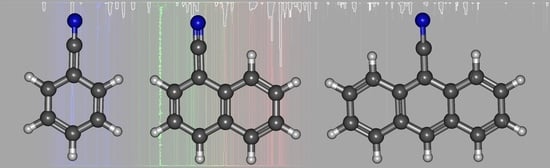
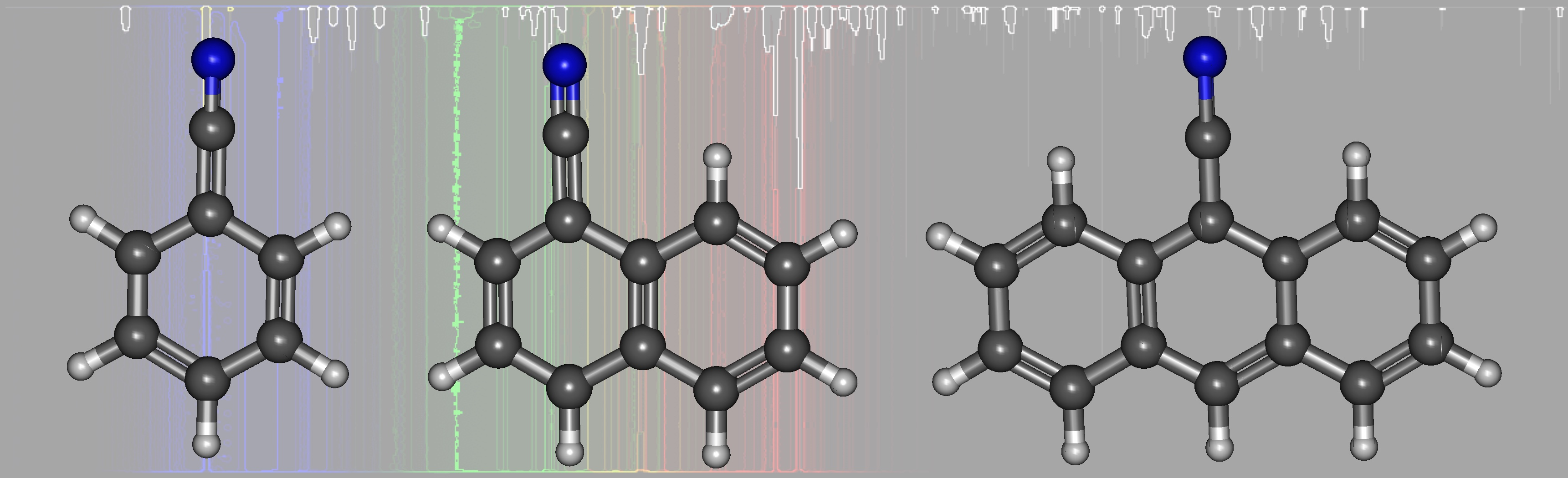
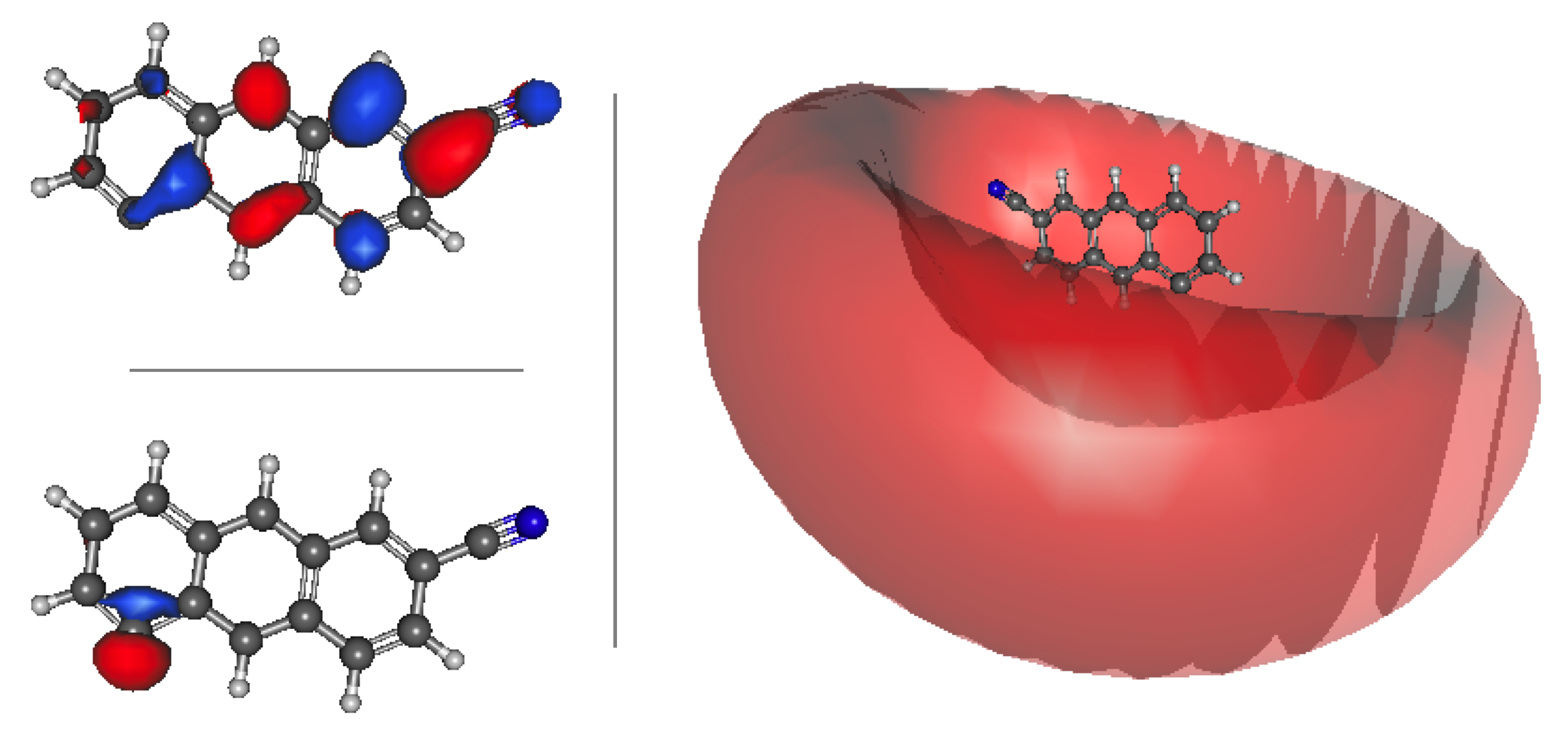
Few anions exhibit electronically excited states, and, if they do, the one or two possible excitations typically transpire beyond the visible spectrum into the near-infrared. These few, red-shifted electronic absorption features make anions tantalizing candidates as carriers of the diffuse interstellar bands (DIBs), a series of mostly unknown, astronomically ubiquitous absorption features documented for over a century. The recent interstellar detection of benzonitrile implies that cyano-functionalized polycyclic aromatic hydrocarbon (PAH) anions may be present in space. The presently reported quantum chemical work explores the electronic properties of deprotonated benzene, naphthalene, and anthracene anions functionalized with a single cyano group. Both the absorption and emission properties of the electronically excited states are explored. The findings show that the larger anions absorption and emission energies possess both valence and dipole bound excitations in the 450–900 nm range with oscillator strengths for both types of >1×10⁴. The valence and dipole bound excited state transitions will produce slightly altered substructure from one another making them appear to originate with different molecules. The known interstellar presence of related molecules, the two differing natures of the excited states for each, and the wavelength range of peaks for these cyano-functionalized PAH anions are coincident with DIB properties. Finally, the methods utilized appear to be able to predict the presence of dipole-bound excited states to within a 1.0 meV window relative to the electron binding energy.
Keywords: dipole bound states; astrochemistry; anions; polycylic aromatic hydrocarbons; electronically excited states; diffuse interstellar bands dipole bound states; astrochemistry; anions; polycylic aromatic hydrocarbons; electronically excited states; diffuse interstellar bands
Graphical Abstract