1. Introduction
Bianisotropy is a property of a metamaterial where electric and magnetic responses are coupled, meaning that an applied electric field induces both electric and magnetic polarization, and conversely, a magnetic field induces both magnetic and electric polarization. Quantum bianisotropy should be based on quantum magnetoelectric (ME) meta-atoms to provide local ME coupling in a subwavelength domain, which is necessary for defining a quantum ME energy and exploring asymmetric momentum transfer from vacuum fluctuations (Feigel effect [
1,
2]). Recent research discusses the relationship between ME energy, bianisotropy, and ME meta-atoms, suggesting that a small ferrite resonator can serve as a model for a building block of a metamaterial structure with such properties. The ME response in a ferrite disk model is characterized by the violation of parity (
P) and time-reversal (
T) symmetry, key aspects related to quantum bianisotropy. The properties of quantum meta-atoms are intrinsically linked to the localized near fields they can produce and interact with. Characterizing these evanescent field couplings is vital for understanding how a lattice of meta-atoms behaves collectively.
Electromagnetic (EM) wave propagation is the process of coupling between polar (for instance, electric
E-field) and axial (for instance, magnetic
H-field) vectors in a region of
the size of a wavelength. In the dynamical regime of ME materials and ME samples, coupling between polar and axial vectors occurs in the
subwavelength region of EM radiation. Structural elements in chiral and bianisotropic metamaterials are assumed to behave like meta-atoms with strong electric and magnetic responses. These LC (inductor–capasitor) subwavelength resonators are currently considered as classical scatterers with ME point-dipole interactions [
3,
4,
5]. However, the main point is that there are
no near-field solutions of Maxwell’s equations with two sources, electric and magnetic currents, which are supposedly linked by electromagnetic forces in a subwavelength (
quasistatic) region. The realization of
local coupling between electric and magnetic dipoles must be associated with the violation of both spatial and temporal inversion symmetries. The “first-principle”, “microscopic-scale” ME effect of a structure composed of “glued” pairs of electric and magnetic dipoles raises questions on the methods of
local probing the dynamic ME parameters. The model of bianisotropic metamaterials (materials composed of bianisotropic particles) typically accounts for the ME response as a
far-field characteristic resulting from the geometry and arrangement of the constituent subwavelength elements, as opposed to the local, intrinsic ME energy of interaction between separate, point-like electric and magnetic dipoles in the near-field region. In contrast, materials with
intrinsic magnetoelectricity possess a
local ME energy density due to specific microscopic or mesoscopic physical mechanisms, often comprising a violation of both spatial and time-reversal symmetries [
6,
7,
8]. This involves the actual energy of interaction between electric and magnetic subsystems within the ME meta-atom [
9,
10,
11,
12], which can be
observed in the near-field.
Chiral particles are considered a class of bianisotropic particles characterized by a particular symmetry (space symmetry breaking) in their ME coupling. Within the framework of the dipole approximation, a chiral particle is represented as a pair of coupled electric and magnetic dipoles. Chiral objects can only be distinguished through interaction with other objects that have a different 3D (three-dimensional) arrangement (opposite enantiomers). The difference also becomes apparent when they interact with such a chiral environment as circularly polarized light (CPL). The CPL technique is effectively used to distinguish enantiomers by considering the chiral response as a far-field characteristic. Chirality, like bianisotropy, is a form of nonlocal property. Non-local materials exhibit a response that depends on the field distribution over a spatial extent [
13].
The utilization of plasmonic materials that could control local chiral light–matter interactions successfully facilitated chiral sensing into ultrasensitive detection. To enhance the subtle differences between enantiomers’ interactions with light, various types of engineered chiral fields, called
superchiral fields, have been proposed. These fields, being generated by plasmonic structures, are crucial for advanced sensing [
14,
15,
16]. The superchiral fields described by the parameter of chirality
C are referred to as inherently 3D near fields [
17,
18]. It is stated that the superchiral fields are
near fields because they create intense,
non-propagating electromagnetic fields right at the surface, with spatial variations much smaller than a wavelength. However, the use of such artificially created chiral fields—superchiral fields—in an analysis of plasmonic structures reveals an obvious paradox. In Ref. [
17], the “near fields” are created based on two
counterpropagating circularly polarized waves with slightly different intensities. Interference of these propagating plane waves, giving enhanced chiral asymmetry on a 2D region, is not actually a 3D near-field structure. The case with plasmonic chiral meta-atoms is quite different from Tang–Cohen’s model. Light coupled to electron oscillations on a metal surface, used in nanophotonics, are
slow EM waves. The confinement (“trapping”) occurs due to evanescent fields decaying perpendicular to the metal surface. The total distance
along the boundary of a 2D-shape plasmonic sample is about a wavelength of the free-space EM wave. Therefore, there is
EM surface-wave resonance along the perimeter. These are not the superchiral Tang–Cohen fields, and certainly, it is not a 3D confinement effect of chirality in a subwavelength region. Surely, in an analysis of plasmonic chiral meta-atoms, Tang–Cohen’s
C parameter is used quite formally. The generation of “superchiral” nodes observed in experiments [
14,
15,
16] can be explained in terms of signal amplification arising from the known effect of surface plasmon amplification in systems fabricated with a metal substrate.
The Tang–Cohen’s
C parameter (optical chirality) [
17], used to describe the interaction of light with chiral molecules, is proportional to the
imaginary part of the product of the electric and magnetic fields. This time-even pseudoscalar measures the degree of chiral asymmetry in an electromagnetic field and is related to the spin angular momentum of light. On the other hand, the so-called parameter of magnetoelectricity [
19] is proportional to the
real part of the product of the electric and magnetic fields. This quantity is claimed to be a time-odd pseudoscalar and describes the effects related to the breaking of both parity and time-reversal symmetries. Similarly to the chiral fields in Ref. [
17], the “magnetoelectric” fields in Ref. [
19] are considered specific fields created by two counterpropagating polarized waves with slightly different intensities. The effect should be observed due to the interference of these propagating plane waves on a 2D region. In Ref. [
20], the point of obtaining the subwavelength structure with vacuum fields with the real product of the electric and magnetic fields was realized based on a special plasmonic-vortex structure. However,
PT properties of the fields in this structure are related to the parameter obtained in the plane wave propagation regime [
19]. This cannot be considered a local 3D-confined effect.
From Maxwell’s electrodynamics, it is impossible to observe magnetoelectrically coupled electric and magnetic evanescent fields in the 3D vacuum space. Meta-atoms described in Ref. [
17] can be referred to as
chiral meta-atoms, while meta-atoms described in Ref. [
19] can be referred to as the Tellegen meta-atoms. Chiral/Tellegen meta-atoms are not subwavelength 3D open resonators. Both types of these meta-atoms are classical systems whose properties are due to their specially created structures with EM responses and are not quantum emitters like semiconductor quantum dots (QDs). In semiconductor QDs, the electron
effective mass is generally different from the bulk material value and is a function of the dot’s size, shape, and material composition. Electron energy levels are discrete and determined by quantum confinement, often modeled as a “particle-in-a-box” or harmonic oscillator potential. Fundamental differences between the near fields of classical chiral/Tellegen meta-atoms and quantum emitters arise from the inherent properties of their excited states and the nature of their light–matter interaction. The near fields of chiral/Tellegen meta-atoms are Maxwellian electromagnetic fields. Their interaction with incident light is described by constitutive relations, which, actually, are non-local bianisotropic constitutive relations [
13]. The near fields of semiconductor QDs originate from the
quantized energy transitions. It is intrinsically linked to the quantum mechanical wavefunctions.
In this paper, it is shownthat the ME near field, interpreted as a structure combining the effect of bianisotropy/chirality with a quantum atmosphere, is a non-Maxwellian field with space–time symmetry breaking. Quantum ME fields arise from the dynamic modulation and topological coupling of magnetization and electric polarization within ME meta-atoms—specific subwavelength structural elements with magnetic and dielectric subsystems in magnetic insulators. These quantum properties of ME meta-atoms include quantized energy states, quantum vacuum effects, and the ability to extract linear or angular momentum from quantum vacuum fluctuations.
2. Propagation of Electromagnetic Waves in Bianisotropic Media
The study of the quantum properties of EM wave propagation in bianisotropic media involves applying principles of canonical quantization to these complex materials. A bianisotropic medium is modeled by introducing two independent sets of three-dimensional harmonic oscillators to represent the material’s electric and magnetic polarization fields, which are then coupled to the quantized EM field [
21,
22]. In the study of quantum properties of EM wave propagation in standard bianisotropic media, ME energy is typically not included. These materials, modeled in the far-field limit, are generally considered to be time-even effects related only to the violation of spatial inversion symmetry. This means that in this analysis, the ME effect is considered as the effect of nonlocality arising from the geometry of subwavelength structures, rather than an intrinsic, local ME coupling.
Being not electromagnetic in nature, ME energy density plays a crucial role in forming a topological structure of the fields. This can be well understood from classical analysis of EM wave propagation in bianisotropic media. By considering Poynting’s theorem for a homogeneous material with electric, magnetic and ME characteristics, some significan fundamental aspects of the relationship between electromagnetism and bianisotropy become clear.
Based on the initial assumption that in the dipole approximation, a bianisotropic EM material is a composition of coupled electric and magnetic dipoles, the constitutive relations are described by four tensors:
with
ω the EM wave frequency, and
ε(
ω),
ξ(
ω),
μ(
ω) and
ζ(
ω) the tensor functions.
To derive the energy balance equation in temporary dispersive dielectric and magnetic media, one must use the regime of propagation of
quasi-monochromatic EM waves [
6]. For a ME medium, such quasi-monochromatic behavior was considered in Ref. [
9]. The fields are expressed as
and
, where complex amplitudes
and
are time and space smooth-fluctuation functions, with
k denoting the wavenumber,
t the time and
r the position. It should be assumed [
6,
9] that in the frequency regions of the transparency of the EM-wave propagation, the concepts of internal-energy densities in alternative fields are introduced in the same sense as they are used in the electrostatic, magnetostatic and magnetoelectrostatic structures [
23]. For the time-averaged stored energy, one has
The superscripts “h” and “ah” in Equation (2) denote, respectively, the Hermitian and anti-Hermitian parts of tensors of the second rank, the asterisk denotes the complex conjugate. For a lossless medium, tensors and are Hermitian and , . In a quasistatic limit, when the wavelength , the parts of average stored energy in Equation (2) correspond to potential energies in a magnetoelectrostatic structure. These are the electric-field energy density and the magnetic-field energy density expressed by the first two terms on the right-hand side of Equation (2). The ME energy density is expressed by the last two terms on the right-hand side of Equation (2).
It is crucial that the continuity equation for energy (Poynting’s theorem) for ME medium is valid only when definite constraints are imposed on quite slowly time-varying amplitudes of the field components [
9]:
The physical meaning of these constraints is that subwavelength fluctuations in the intensity of EM excitation in the ME medium occur
only at
certain ratios of the complex amplitudes of the electric and magnetic fields. Let us rewrite Equation (3) to
where
and
are differentials of the corresponding fields. Equation (4) implies that there exists a linear time-relation coupling between complex amplitudes of the fields. In a general form, one can write [
10]
where the matrix
is a field-polarization matrix which is an invariant when defined for a specific type of ME medium. Components of matrix
are complex quantities. To find the parameters of the polarization matrix
, one needs to solve an electromagnetic boundary problem with the known constitutive parameters of the electric and magnetic subsystems of the medium. When the parameters of matrix
are found, an average energy density in a bianisotropic medium can be determined. In general, this represents an integro-differential problem.
The derivation of the continuity equation for energy from symmetry principles is related to Noether’s theorem. By virtue of Noether’s theorem, the invariance of the action under translation in time, translation in space, and rotation implies the existence of the conservation of energy, linear momentum, and angular momentum, respectively. Noether’s theorem is used to investigate symmetries and related conserved quantities in Maxwell’s equations [
24]. Using Noether’s theorem, electric–magnetic symmetry can be demonstrated in ME electromagnetism. The constraints (3)–(5) are considered as certain symmetry conditions for the field structure. It is straightforward to show that without these constraints, it is impossible to use the concept of ME energy [
9].
It is known that for any EM process in a lossless non-ME medium,
. For a propagating monochromatic plane wave, the electric energy density and magnetic energy density are equal to each other at every instant of time. In the case of an EM resonator (such as, for example, a closed metal-wall cavity or a dielectric resonator), one has a quasistatic process when electrical energy is converted into magnetic energy and vice versa over a time period of the EM radiation. “Mediators” of these transformations are electric conduction currents and/or electric currents of polarization (displacement currents). Now, in electrodynamical ME effects, there are the three parts of the average stored energy:
,
and
. In this case, one has to assume that there is also a specific “mediator” associated with the ME effect, which mutually converts the electric and magnetic energies. In a subwavelength region where both the electric and magnetic fields exist, energy conversion between average stored energies
,
and
can occur through a certain
circular process of energy exchange. This implies the presence of a
local power-flow circulation, which can be carried out with
synchronous rotation in time of both complex-amplitude vectors
and
[
9,
10]. So, the process is accompanied by power-flow
vortices in subwavelength domains of EM radiation. The power flows of the circulating adiabatic processes of the energy interchange are not exclusively the EM power flows. In structures with temporal inversion symmetry broken, the right- and left-hand vortices can be observed.
The analysis of the energy balance in bianisotropic metamaterials presented leads us to essential conclusions. First, it should be noted that in these metamaterials, the material and field structures are integrally
linked and
cannot be considered separately. In this medium-field system, the intrinsic dynamics of the ME meta-atom determine the symmetry properties of the field (such a field is called the ME field here). The ME field, in turn, determines the
intrinsic dynamics of the ME meta-atom. The energy balance equation for EM waves propagating in the ME medium, showing the unique effect of power-flow circulations in local regions, reveals the feature that such a subwavelength circulation quantum process of energy should also occur in comparably small ME resonators—ME meta-atoms. In such meta-atom, there is an ME “trion”—a localized (subwavelength) resonant excitation with energies of three subsystems (electric, magnetic, and magnetoelectric). The energy states of ME “trions” can be split in a bias magnetic field. For two opposite directions of a normal bias field, there are two types of ME “trions” with different chirality. Since the temporal inversion symmetry is broken, the right- and left-hand power-flow vortices can be observed [
11]. Circulating energy contributes to the field’s angular momentum. The combination of circulating energy (contributing to angular momentum) and the transfer of energy (propagation along an axis) results in a helical power flow. That is, due to the ME energy density, one has
twisted wave propagation of EM radiation in bianisotropic media.
The concept of ME quantum vacuum involves the study of vacuum states of quantized ME fields arising from the oscillation spectra of ME resonators. Fundamental studies of the interaction of a resonant point ME scatterer with EM radiation constitute a field of research called ME quantum electrodynamics. The main aspects of the physics of ME meta-atoms has to be related to magnetism, relativity theory, and topology. In near-field analysis, the role of ME energy is of exceptional importance. The ME near fields represent non-Maxwellian fields with space–time symmetry breaking. In the dynamic regime, the observation of ME characteristics in vacuum EM fluctuations is the subject of much discussion. Quantum fluctuations near the ME material with violation of the
PT discrete symmetries will produce a sort of
PT-violating atmosphere [
25]. It is argued that this atmosphere induces new kinds of “Casimir” forces on bodies near the material. There are claims that the vacuum can impart momentum asymmetrically on ME structures. Asymmetric momentum transfer arises from the ME structure since it breaks the temporal and spatial symmetries of electromagnetic modes. The possibility of extracting linear momentum from a vacuum was discussed by Alexander Feigel who argued that the momentum of vacuum zero fluctuations can occur only in a structure with
PT-symmetry breakings [
1]. The main point is to suggest a novel quantum mechanical effect, namely the extraction of momentum from the electromagnetic vacuum oscillations. In the proposed effect, linear momentum is extracted from a vacuum field. This is different from the case of the Casimir effect, in which energy is extracted from a vacuum field [
26]. It was argued that rotating ME particles can generate changes in momentum of zero-point fluctuations, which result in the “self-propulsion” in quantum vacuum. The “self-propulsion” in quantum vacuum requires mechanical back-action from ME particle. To provide this, the ME particle should be a propeller-like device [
2]. Thus, the fundamental question of extracting angular momentum from the vacuum arises.
Finally, it is worth noting that while in “real” atoms the electric and magnetic energies (fields) are profoundly coupled due to relativistic effects, most noticeably manifested in the spin–orbit interaction, in ME meta-atoms the coupling of electric and magnetic energies (fields) occurs differently, but also due to relativistic effects and spin–orbit interaction [
12].
3. Bianisotropic Structures Based on Magnon–Plasmon Meta-Atoms
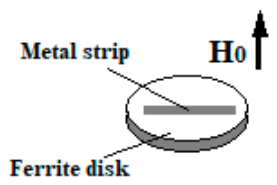
In a quasi-2D ferrite disk particle with a surface metal strip, electrical and magnetic properties are intrinsically cross-coupled. Such a magnon–plasmon meta-atom is shown in
Figure 1. For EM radiation, this ME meta-atom is viewed as a subwavelength scatterer with a multiresonant ME response spectrum [
27,
28,
29,
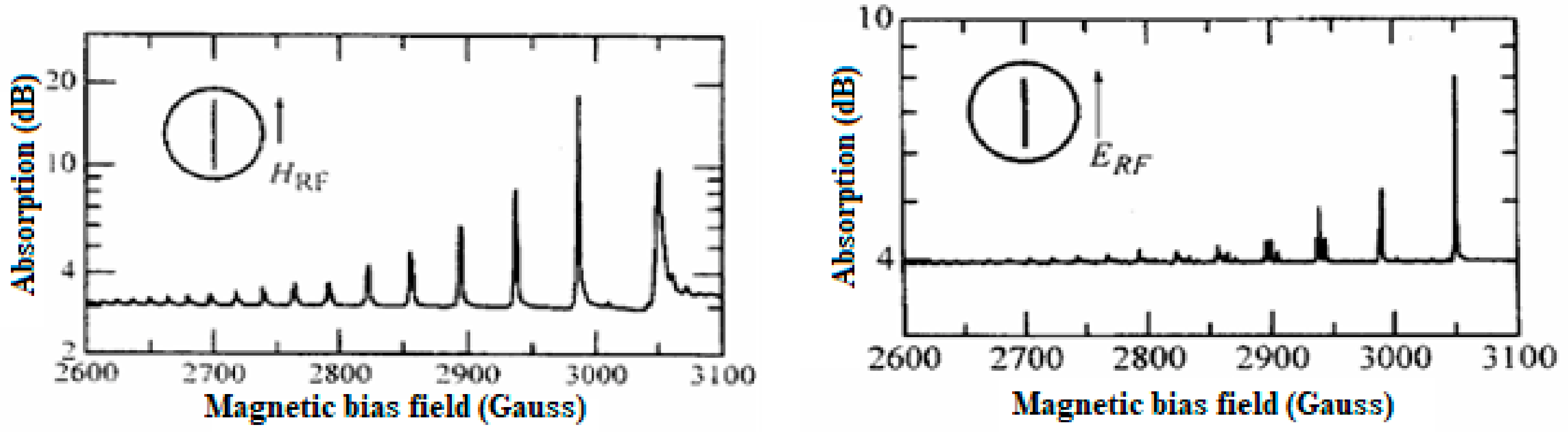
30]. The experimental results with the ferrite-based ME meta-atom, presented in
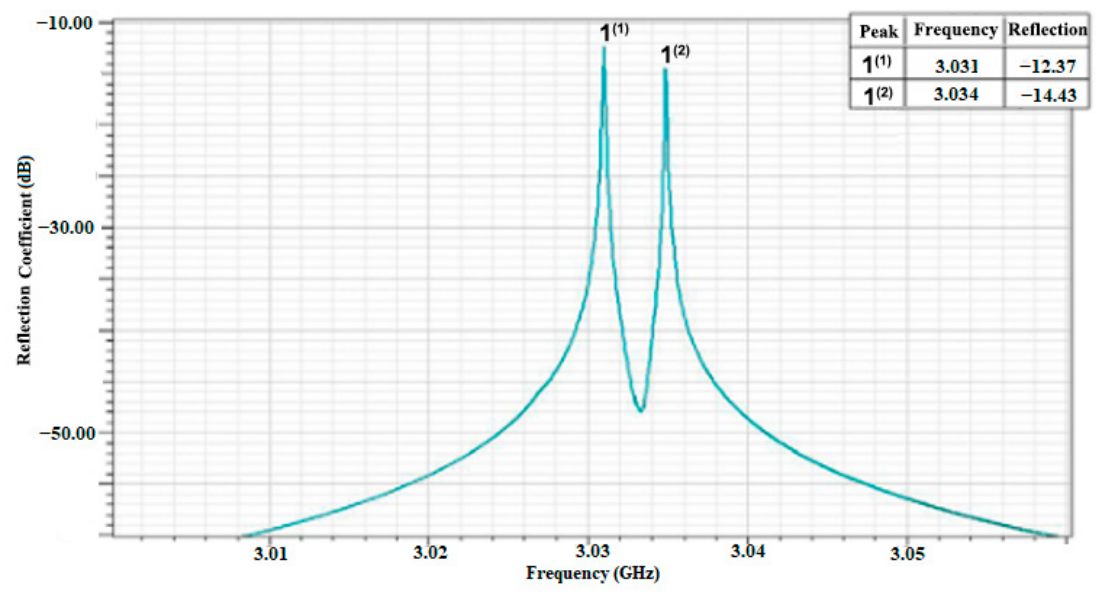
Figure 2, indicate the existence of quantized ME energy—the energy of interaction between quasistatic oscillations of the electric and magnetic subsystems [
29]. The magnon–plasmon magnetoelectricity refers to a specialized phenomenon where magnetic excitations (magnons) and charge oscillations (plasmons) couple to create unique ME properties in a subwavelength region of EM radiation. The ME interaction is mediated by magnetic-dipolar-mode (MDM) oscillations and topology effects, which exhibit broken symmetries that allow for the co-existence of electric and magnetic moments. The physics of this macroscopic quantum effect of an energy conversion between the average stored magnetic, electric, and ME energies differs from the microscopic effect of magnon–plasmon hybridization, where the electric field associated with plasmon oscillations creates a nonequilibrium spin density that couples to magnons by an exchange interaction [
31].
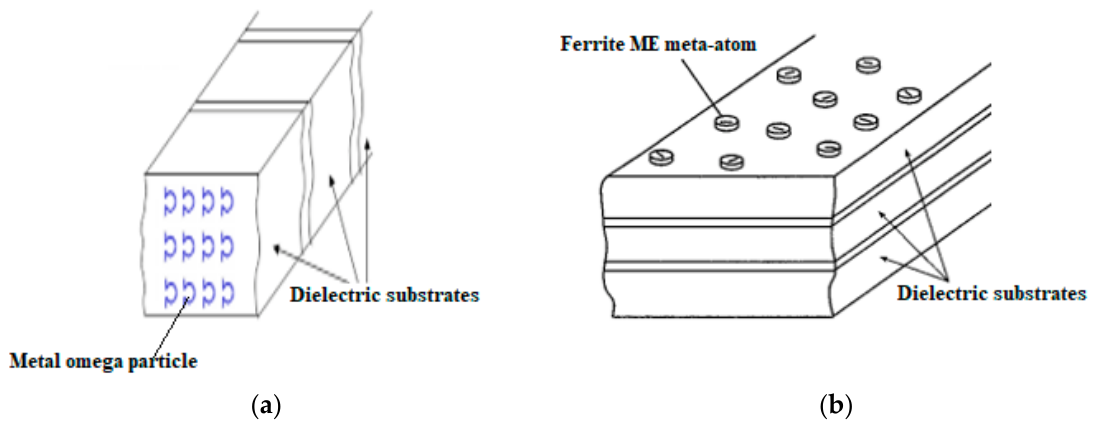
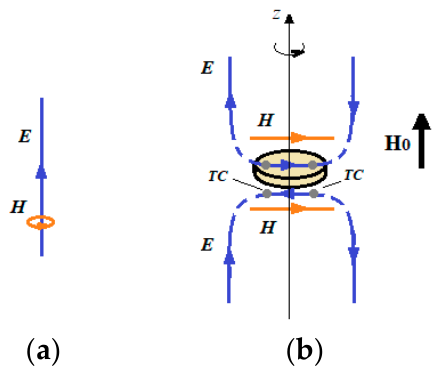
Figure 3 illustrates fundamentally different concepts of two types of bianisotropic metamaterials. In a bianisotropic metamaterial composed of LC-circuit elements [
32], there are ME responses due to far-field EM radiation. In metamaterials composed of magnon–plasmon meta-atoms,
local ME responses are observed caused by internal (not only electromagnetic) dynamic processes.
In a bianisotropic structure based on magnon–plasmon meta-atoms, each subwavelength particle may be considered as a glued pair of two magnetic and electric dipoles: the magnetic dipole is due to the ferrite body, and the electric dipole is due to the metallization region. When such a particle is described quasistatically and is considered as a Dirac
-functional dipolar scatterer, one can use the integral-form constitutive relations (ICR) for a bianisotropic material:
The integral operators on the right-hand side of the Expressions (6)–(7) have a form similar to the integral operator
The kernels of the operators in the above ICRs are responses of a medium to the Dirac
-function of electric and magnetic fields. Convergence of integrals in the ICRs can be proven if one shows a physical mechanism of influence of short-time and short-space
quasistatic interactions on the medium polarization properties.
In an assumption that ME material strictures based on ferrite magnon–plasmon meta-atom can be realized, the theory of bianisotropic crystal lattices has been proposed [
33]. To use macroscopic Maxwell’s equations for the material continuum, the maximum scale of material nonhomogeneity must be much less than distances of macroscopic field variations. For electromagnetic waves, these distances correspond to the wavelength. Because of the limiting cutoff wave numbers, all variables in macroscopic electrodynamics are finite-spectrum functions [
34]. Two ways can be used to describe the electromagnetic field-condensed media interaction. While one way is to get over the discrete structure of a medium by the averaging procedure, another way can be conceived as follows: to
discretize fields based on the discrete structure of a medium. When initial restrictions to the wave number spectrum take place, one can use the sampling theorem for a medium modeled as a triple infinite periodic array of identical
-functional scattering elements. Taking into account the Lorenz–Lorentz model one can develop a dynamical theory which considers strong field fluctuations in crystal lattices [
35]. The method used in Ref. [
35] also becomes of importance for the dynamical model of bianisotropic crystal lattices when every bianisotropic particle is a
-functional dipolar scatterer of coupled electric and magnetic dipoles [
33].
However, by using the results of the sampling theorem for a crystal lattice composed of
-functional scattering ME elements, the conclusion made in
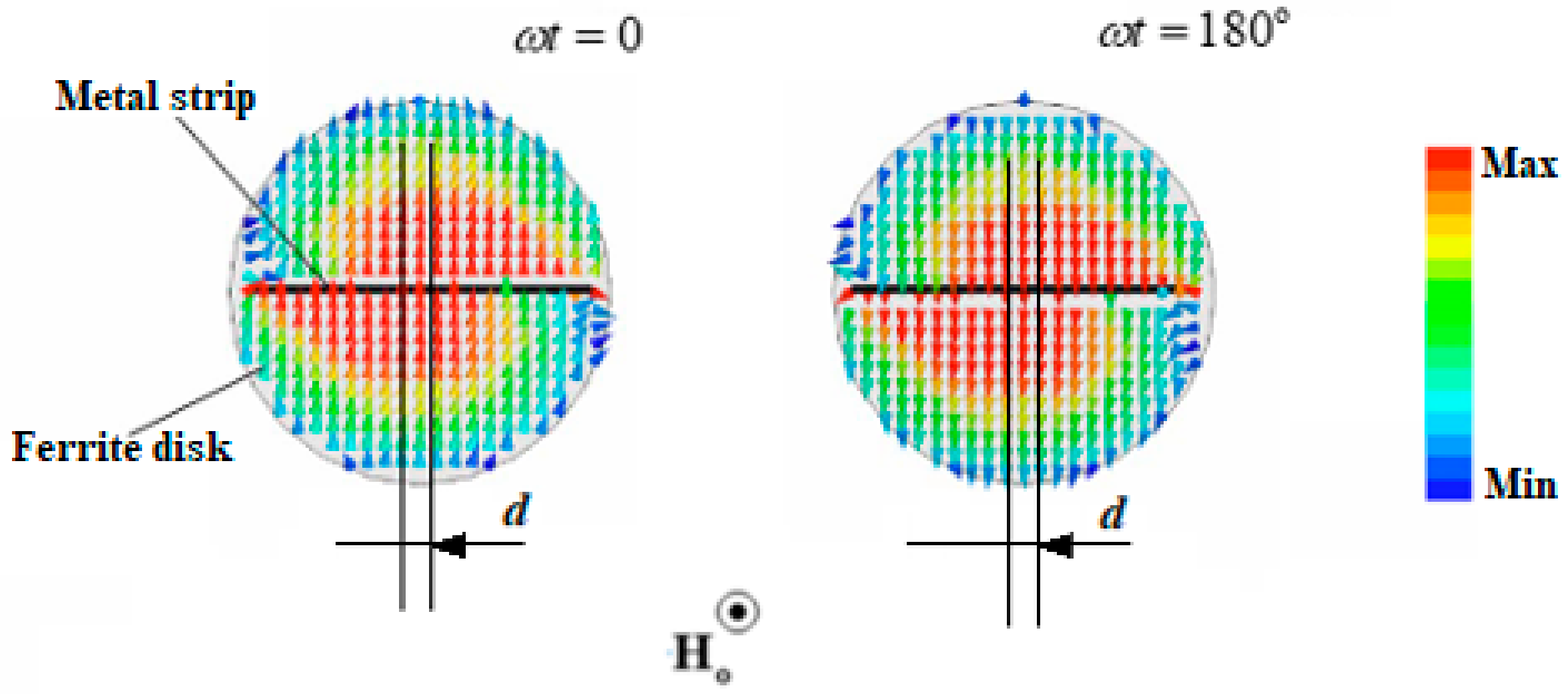
Section 2 that electromagnetic radiation propagates in the form of twisted waves in bianisotropic media is effectively ignored. To clarify this, let us consider the near-field structure of our magnon–plasmonic meta-atoms.
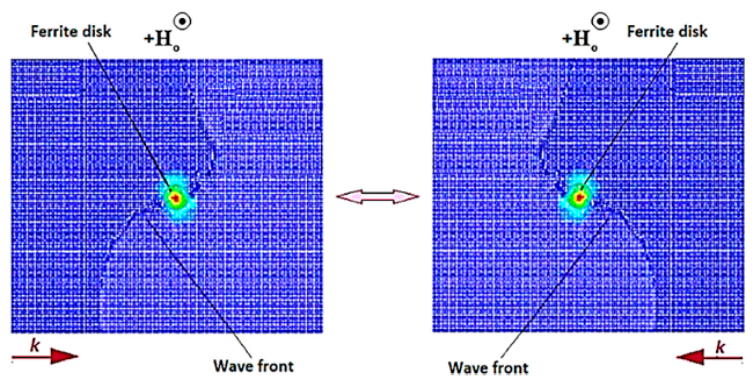
Figure 4 shows the electric field distribution on the surface of a metal strip for different time phases at a given direction of the bias magnetic field. A distinct asymmetry shift is observed in this distribution of a field. With the bias magnetic field in the opposite direction, the direction of the asymmetry shift reverses.
The asymmetry of the presented distribution is due to the orbital rotation of the near-field structure.
In a magnetized ferrite disk, the electromagnetic Goos–Hänchen shift is closely linked to the generation of orbital angular momentum and chiral states due to the breaking of time-reversal symmetry. When an EM wave interacts with a magnetized ferrite, the non-reciprocity induced by the external magnetic field causes a lateral Goos–Hänchen shift. In such small resonant structures like a disk, this lateral displacement—combined with the internal reflections—manifests itself as a rotational motion of the energy flow. This symmetry breaking results in the formation of EM vortices. Depending on the direction of magnetization, these resonances exhibit opposite vortex rotations (different chirality).
The above aspects indicate that a subwavelength ferrite disk by itself—without a metal strip on its surface—can behave as an ME particle with quantized orbital angular momentum. The study presented suggests the existence of such ME resonances [
36]. These resonances involve coupled states of magnetostatic (MS) and electrostatic (ES) functions within the subwavelength domain. The ME resonances are intrinsically linked to ME energy. The concept of “quantum resonances” relates to the quantization of internal magnetic energy or magnetization states within the confined ferrite structure. The sharp—“atomic-like”—spectra observed in microwave experiments with ferrite disks are schematic representations of these discrete states.
4. ME Quantum Resonances in a Subwavelength Ferrite Disk
While the understanding of magnetism (and ultimately electromagnetism) arose from electricity, the understanding of magnetoelectricity arose from magnetism. Violation of the invariances under time inversion
T and space reflection parity
P in the magnetic structure are necessary conditions for the emergence of the ME effect. In the expression for free energy, the energy term describing the ME coupling has the form:
where
is a ME tensor [
6]. For linear ME effect, both
T and
P should be broken, but the product
PT is conserved. The magnitude of the magnetoelectric coefficient in a medium is ultimately restricted by the speed of light in that medium.
Dynamic magnetoelectricity in an ME meta-atom is due to the generation of electrical polarization by means of magnetization changing in space and time. These are dynamic properties of resonantly oscillating magnetizations and magnetically induced electric polarizations. A suitable geometric shape for a 3D confined subwavelength ferrite sample is a quasi-2D disk, where electric polarization is induced by a topological effect associated with chiral magnetic currents at the sample boundary. If the current loop is located on the lateral surface of such a disk, a non-standard connected region with topologically protective edge currents is obtained.
In a sample made of a magnetic insulator, an interaction between the ferromagnetic order subsystem and the electric polarization subsystem may occur. Similarly to type II multiferroics, the intrinsic ME coupling in the ferrite disk is due to the electric polarization caused by spatially and temporally modulated spin structures, but the physical mechanism is completely different. In ME meta-atoms, the mesoscopic effect of dynamic magnetoelectricity arises from the topologically coupled MS and ES resonances. Both MS and ES oscillations are observed with quantum confinement effects for scalar wave functions and in a small enough sample localized in the subwavelength region of EM radiation. These wave functions are introduced as quasistatic solutions of the magnetic and electric fields: and . The term “ME coupled” implies that the MS and ES states are not isolated but rather interact with each other due to topologically induced edge currents. In general, this interaction is expressed by terms in the Hamiltonian that relate to the ME states: . The ME coupled states can be represented using a tensor product of the individual, MS and ES, state spaces. In the ME resonance states, a violation of both spatial and temporal inversion symmetry occurs. ME duality involves a symmetry relationship between time-varying electric and magnetic fields that is distinct from EM fields. Any EM retardation effects are disregarded.
Due to circulation of a chiral magnetic current on a lateral surface of a ferrite disk, electric charges appear on the top and bottom planes of the ferrite disk. This induces a normal electric-field gradient. As a result, there is the
electric-quadrupole precession caused by the magnetization dynamics. The magnetic-dipole and electric-quadrupole resonances are well known in nuclear physics [
37]. The electric field gradient arises from the inhomogeneous distribution of charges. Electric quadrupole precession, in the context of nuclear magnetic resonance (NMR), refers to the precession of a nucleus’s quadrupole moment in an electric field gradient. This precession is distinct from regular Larmor precession, which is caused by a magnetic field. In the case under study, there is a unique effect of coupling these resonances. Then, the magnetic-field flux caused by topologically protective electric edge currents is observed. These are electric chiral currents at the lateral boundary of the disk sample. Similarly to the spectral analysis for the MS scalar wave functions
ψ, a spectral analysis for the ES scalar wave functions
ϕ has been performed. Orbital magnetization creates a topological contribution to the electric polarization, and orbital electric polarization creates a topological contribution to the magnetization. This topological effect leads to magnetoelectricity. Topological currents provide us with the possibility to get chiral rotational symmetry by the turn over a regular-coordinate angle
at the
-shift in a dynamic phase of the external EM field. The frequency of orbital rotation must be twice the EM wave frequency
. In the coordinate frame of orbitally driven field patterns, the lines of the electric field
as well as the lines of the polarization
are “frozen” in the lines of magnetization
. It signifies that there are no time variations in vectors
and
with respect to vector
.
The physics of quantum ME resonances in a subwavelength ferrite particle is based on an understanding of the key aspects of the theory of spectral properties of MDMs in a ferrite disk resonator, published in Refs. [
30,
38,
39,
40,
41,
42,
43,
44]. Here, brief excerpts from this theory are performed.
When analyzing MDM oscillations in a ferrite disk, two types of solutions for scalar wave function
are considered. There are the spectral solutions of the energy eigenstates, conventionally called the
G-mode solutions, and the spectral solutions of the power-flow-confinement states, conventionally called the
L-mode solutions [
30,
38,
39,
40,
41,
42,
43,
44]. For the
G-modes, the energy eigenstates of MS oscillations are defined based on the Schrödinger-like equation for scalar wave function
with use of the Neumann–Dirichlet (ND) boundary conditions. In case of
L modes, normalization to the power-flow density
is considered by using the EM boundary conditions. Certainly, when characterizing the MDM oscillations, the resonant states of the
G and
L modes should be considered together.
Analyzing the
G-mode solutions in a cylindrical coordinate system
, let us determine the membrane function
by the Bessel-function order and the number of zeros of the Bessel function corresponding to the radial variations. Membrane functions
is a single-valued function. On a lateral surface of a ferrite disk, the ND boundary conditions for mode
n are written as
and
where
is a disk radius. For
G modes, the spectral problem gives the energy orthogonality relation:
. The quantity
is considered as density of accumulated magnetic energy of mode
n. This is the average (on the radiofrequency (RF) period) energy accumulated in a flat ferrite-disk region of in-plane cross-section and unit length along
z axis. Since the space of square integrable functions is a Hilbert space with a well-defined scalar product, we can introduce a basis set. The mode amplitude can be interpreted as the probability of finding a system in a certain state
n. Using the principle of wave-particle duality, one can describe this oscillating system as a collective motion of quasiparticles. There are “flat-mode” quasiparticles with a reflexively translational motion behavior between the lower and upper planes of a quasi-2D disk. Such quasiparticles are called “light” magnons. In the study performed here, “light” magnons in ferromagnet are considered as quanta of collective MS spin waves that involves the precession of many spins on the long-range dipole–dipole interactions. It is different from the short-range magnons for exchange-interaction spin waves with a quadratic character of dispersion. The meaning of the term “light”, used for the condensed MDM magnons, arises from the feature that effective masses of these quasiparticles are much less than effective masses of “real” magnons—the quasiparticles describing small-scale exchange-interaction effects in magnetic structures. The effective mass of the “light” magnon for a monochromatic MDM is defined as [
40]
where
is the propagation constant of mode
n along the disk axis
z.
In the
L-mode solutions, the membrane function
is defined in the same way as done for the membrane function
for
G-mode solutions. The continuity of
on a lateral surface of a ferrite disk is characterized by the equation like Equation (11). However, for the derivatives on a lateral surface, nonhomogeneous boundary conditions read
what represents the EM boundary condition of continuity of the magnetic flux density on a lateral surface of a ferrite disk. In Equations (12) and (14),
and
are diagonal components and off-diagonal components of the permeability tensor
[
45]. When using the EM boundary conditions, it becomes understandable that the membrane function
must not only be continuous and differentiable with respect to a normal to the lateral surface of the disk, but, thanks to the presence of a gyrotropy term, be also differentiable with respect to a tangent to this surface.
From Equation (14), it follows that for a given direction of a bias magnetic field (which defines a sign of
), one finds both the clockwise (CW) and counterclockwise (CCW) azimuthally propagating modes. In this case, it can be assumed that the strength of the scattering of light for the clockwise to the CCW propagation direction is different. For homogeneous ND boundary condition, one has Hermitian Hamiltonian resulting in real energy eigenstates. However, since the sample considered represents an open system, the coupling to the environment expressed by the EM boundary conditions leads to non-Hermitian Hamiltonian with complex wave functions. Membrane functions
are not single-valued functions. It can be represented as a two-component spinor [
44]
Circulation of gradient
along contour
is not equal to zero. On a lateral border of a ferrite disk (
), we express function
as
where
is a double-valued edge wave function on contour
[
38,
41].
On the lateral surface of a quasi-2D ferrite disk, one can distinguish two different functions , which are the counterclockwise and clockwise rotating-wave edge functions with respect to a membrane function . The spin-half wave-function changes its sign when the regular-coordinate angle is rotated by . As a result, one has the eigenstate spectrum of MDM oscillations with topological phases accumulated by the edge wave function . A circulation of the gradient along contour gives a non-zero quantity when an azimuth number is . A line integral around a singular contour : is an observable quantity. It follows from the feature that, because of such a quantity, one can restore single-valuedness (and, therefore, hermicity) of the spectral problem. This observable quantity can be represented as a linear integral of a certain vector potential. Because of the existing the geometrical phase factor on a lateral boundary of a ferrite disk, MDM oscillations are characterized by a pseudo-electric field (the gauge field). The pseudo-electric field can be found as , where a vector function can be considered as the Berry connection. The gauge-invariant field is the Berry curvature. The corresponding flux of the field through a circle of radius is obtained as: , where are quantized fluxes of pseudo-electric fields and K is the normalization coefficient. The physical meaning of coefficient K concerns the property of a flux of a pseudo-electric field. There are the positive and negative eigenfluxes. In the MDM spectral problem, it is impossible to satisfy the EM boundary conditions without a flux . Each MDM is characterized by energy eigenstate and is quantized to a quantum of an emergent electric flux.
In the system under study, there should be a certain internal mechanism that creates a nonzero vector potential
. This internal mechanism becomes apparent when comparing the ND boundary condition (12) (providing single-valuedness) and the EM boundary condition (14) (which does not provide single-valuedness). The difference arises from the term in the right-hand side of Equation (14), which contains the gyrotropy parameter, the off-diagonal component of the permeability tensor
, and the annular magnetic field
. Just due to this term a nonzero vector potential appears. The annular magnetic field
is a singular field existing only in an infinitesimally narrow cylindrical layer abutting from a ferrite side to the border of a ferrite disk. There are noany special conditions connecting radial and azimuth components of magnetic fields on other inner or outer circular contours, except contour
. Because of such an annular magnetic field, the notion of an effective circular magnetic current can be considered. The Berry mechanism provides a basis for the surface magnetic current at the interface between gyrotropic and nongyrotropic media. Following the spectrum analysis of MDMs in a quasi-2D ferrite disk, one obtains edge chiral magnetic currents. This results in the appearance of an anapole moment. For mode
n, the anapole moment is calculated as [
38,
41]
where
is the edge persistent magnetic current. At a large enough distance from the disk, localized distribution of an edge magnetic current is viewed as an electric field
. The electric moment
is considered as the density of the electric flux
.
Based on Equation (10) for the power-flow density, in Ref. [
41], it was shown that the orthogonality conditions for the
L-mode spectral solutions take place when
where
is the surface power-flow density on contour
. It is evident, however, that the power-flow-confinement states can be realized when a softer boundary condition on contour
is used:
This implies the presence of the edge persistent power-flow circulation.
Due to the surface power flow density, the membrane eigenfunction
of the MDM rotates around the disk axis. As soon as for every MDM the notion of an effective mass
is introduced, expressed by Equation (13), it can be assumed that for every MDM there exists also an effective moment of inertia
. With this assumption, an orbital angular momentum mode is expressed as
. Supposing, as the first approximation, that the membrane eigenfunction
is viewed as an infinitely thin homogenous disk of radius
(in other words, assuming that for every MDM, the radial and azimuth variations in the MS-potential function are averaged), the effective moment of inertia, reads
The orbital angular momentum of a mode is expressed as
With the use of the EM boundary conditions, the spectral solutions for the MS wave functions
is considered here as generating functions for determining the fields. For any mode
n, magnetization field is found as
[
45]. Knowing
and
, one obtains the electric and magnetic fields outside a ferrite disk [
38]:
and
where
V and
S are a volume and a surface of a ferrite sample, respectively. Vector
is outwardly directed normal to surface
S.
In the vacuum near-field region adjacent to the MDM ferrite disk, there exist power-flow vortices, defined by the cross product
. Alongside, there is another quadratic-form parameter determined by a
scalar product between the electric and magnetic field components [
38,
44]:
The presence of this parameter, called the parameter of helicity, in the vacuum region is a fundamental effect in our analysis. In Refs. [
46,
47], it was argued that a linear structure of the EM radiation fields in vacuum can be observed only when
. At this condition, the electromagnetic helicity is defined as a difference between the numbers of right- and left-handed photons. On the other hand, when
, quantum electrodynamics predicts that the vacuum behaves like a material medium. In this case, the linear Maxwell theory receives nonlinear corrections. One can observe such a ME birefringence of the quantum vacuum when static magnetic and electric fields are applied [
48,
49,
50]. In the case considered, the nonlinearity in the vacuum near-field region adjacent to the MDM ferrite disk arises due to magnon-magnon dipole interaction effects. The dominant magnonic response is observed, even at room temperature. Realtively large binding energy and quite small size of an MDM particle enable considerably strong light–matter coupling to cavity photons and magnons, leading to emergent magnon-polaritons.
The helicity parameter in Equation (24) actually represents the ME energy density. In Ref. [
42], it has been qualitatively explained how the multiresonance states in a microwave resonator, experimentally observed in Refs. [
36,
51,
52], are associated with a quantized change in the energy of a ferrite disk, which arises due to an external source—a bias magnetic field
—at a constant frequency of the microwave signal. It was stated [
42] that there is a quantum effect of electromagnetically generated demagnetization of a sample:
The energy
is the microwave energy extracted from the magnetic energy of a ferrite disk at the
nth MDM resonance. It was supposed that the demagnetizing magnetic field is reduced due to effective magnetic charges on ferrite-disk planes. For the reduced DC magnetization of a ferrite disk, the frequency
, that is less than such a frequency
in an unbounded magnetically saturated ferrite [
45]. The quantized magnetic charges on the ferrite-disk planes are caused by the induced electric gyrotropy and orbitally driven electric polarization inside a ferrite. This is due to EDM oscillations in the electric subsystem.
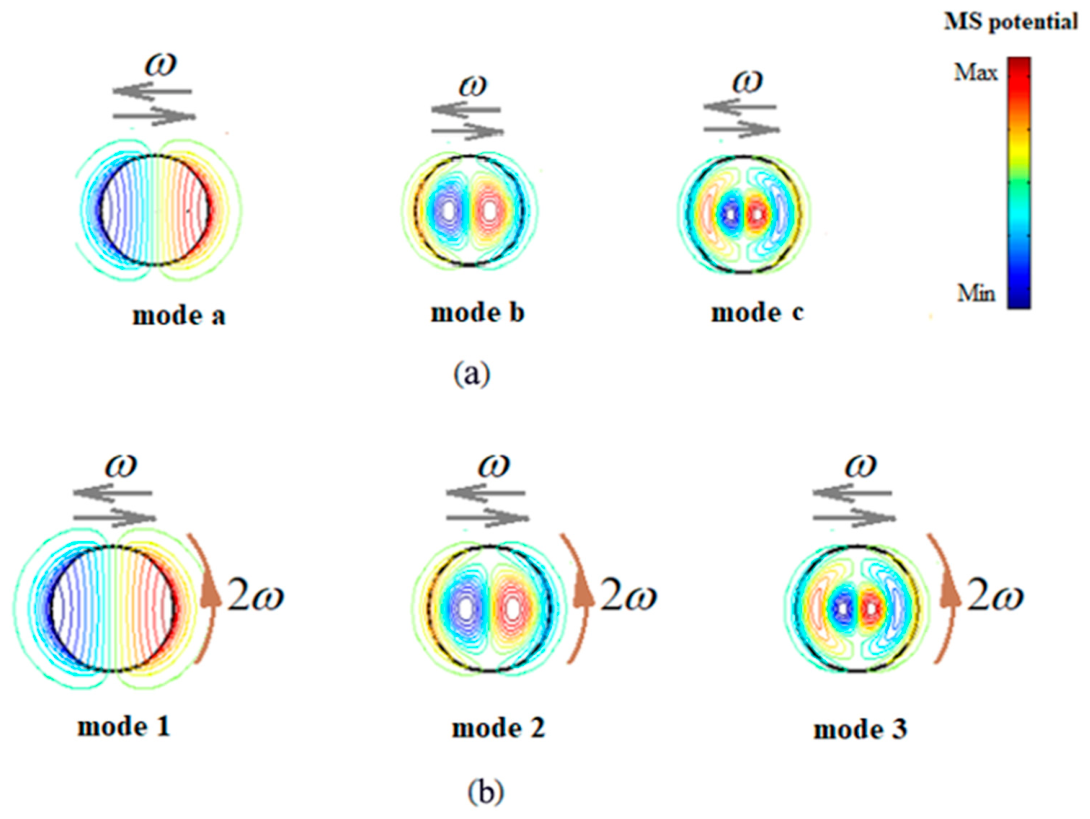
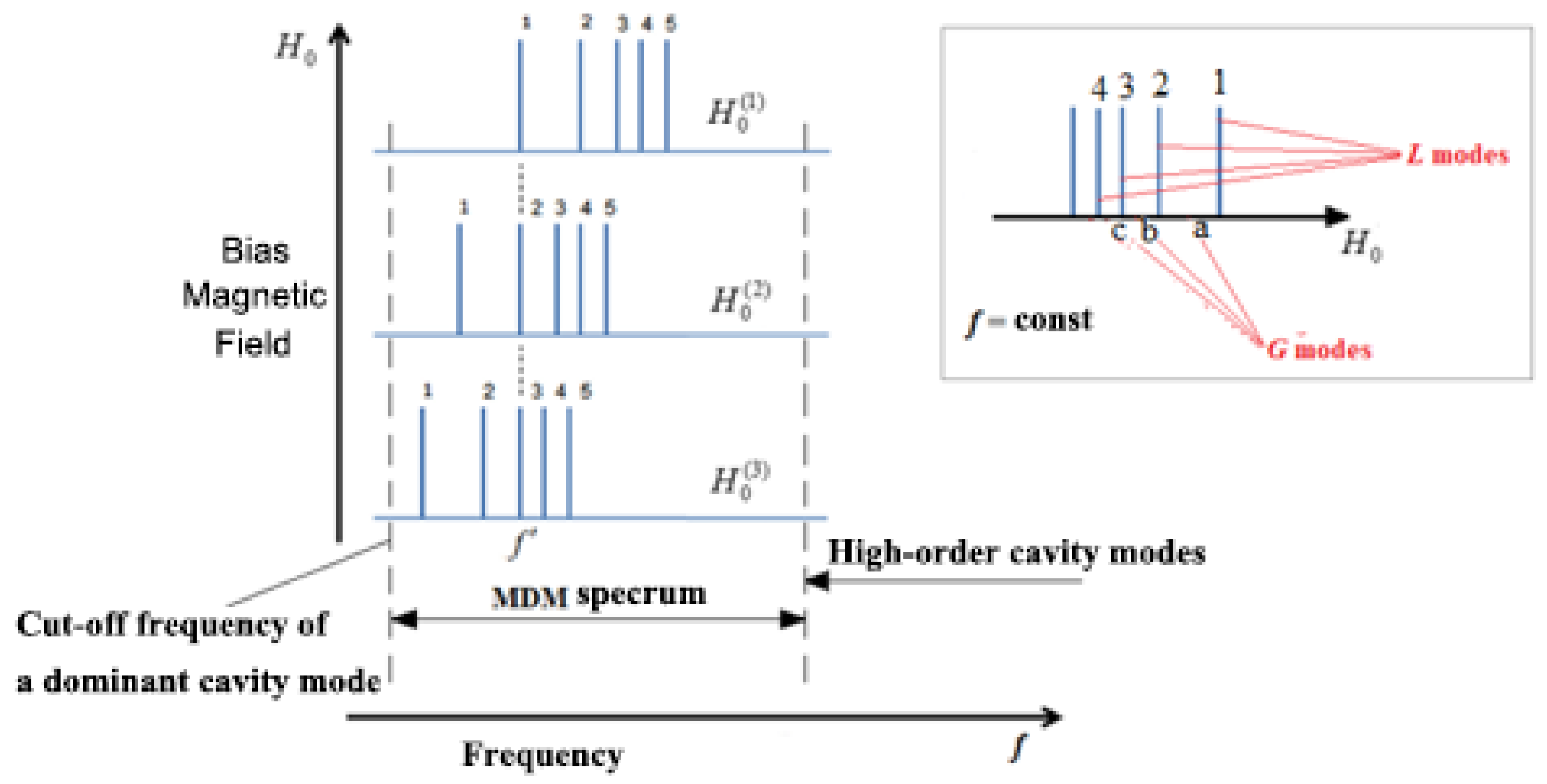
The spectral characteristics of the
G and
L modes, illustrated by the distribution of MS potentials, are shown in
Figure 5. For
G modes, there is a collinear magnetic system, where spins align in parallel or antiparallel configurations. For
L modes, non-collinear arrangements exhibit spatially varying spin orientations that give rise to topologically non-trivial spin textures due to chiral rotation in systems lacking inversion symmetry. Lacking inversion symmetry is due to the involvement of the electric-dipole-polarization subsystem. Modes a, b, and c shown in
Figure 5 are ground states. These are quasi-rest-frame structures. The “quasi-rest frame structures” refers to analyzing a system or object as if it were at rest, even though it might be in motion or undergoing acceleration, from the perspective of a non-inertial or accelerating frame of reference. This approach allows for simplification of complex dynamic problems by considering fictitious forces that arise due to the acceleration of the reference frame. Modes 1, 2, and 3 in
Figure 5 are
metastable states.
G modes are MDMs. There is no ME coupling for
G modes, but
L modes are ME modes.
In the laboratory coordinate system for the
L mode inside the ferrite disk, one sees magnetic-dipole and electric-quadrupole structures rotating at a frequency twice the frequence of the microwave signal. In a rotating coordinate system, the lines of polarization
are “frozen” in the lines of magnetization
. The inversion symmetry is broken due to the electric-quadrupole structure. In magnetic resonance, the rotating frame simplifies the description of spin dynamics by effectively “freezing out” the time evolution of the spins due to the applied radiofrequency field [
53]. It was shown [
53] that the direction of the electric and magnetic fluxes of a ferrite disk at the
L-mode resonances depends on the direction of a bias magnetic field. The electric flux is due to the edge magnetic current, and the magnetic flux is due to the edge electric current.
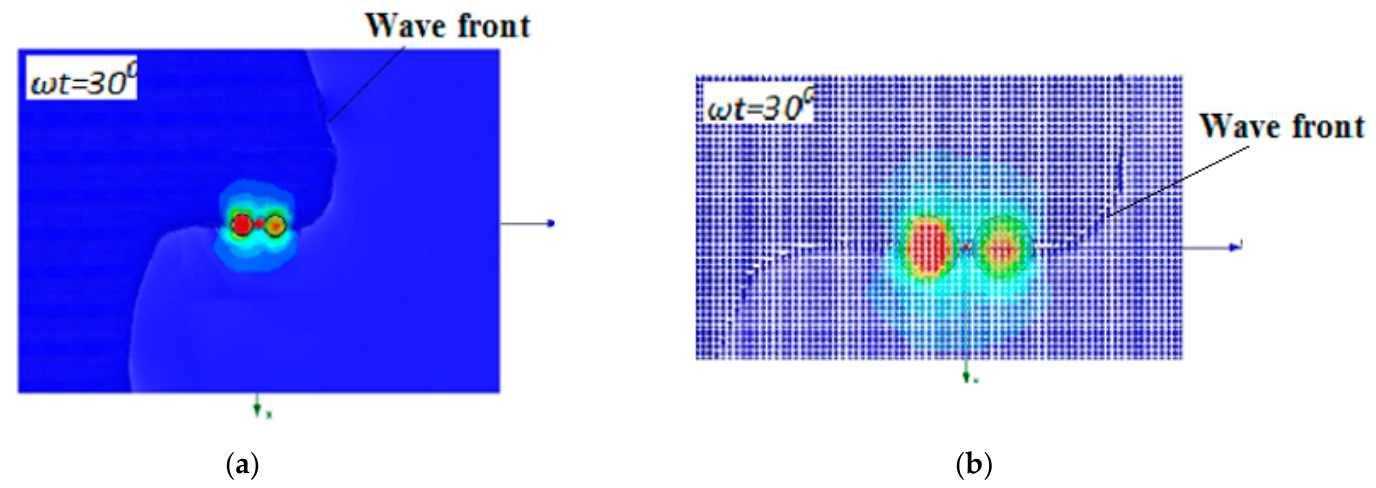
Due to specific properties of MS-wave oscillations, one can observer nontrivial topology of the fields in vacuum near-field region. The power-flow rotation and the ME energy in a vacuum near-field region for the first
L mode are shown in
Figure 6.
The main role of coupling of ME and ES resonance belongs to magnon spin–orbit interaction in a quasi-2D disk of magnetic insulators. In this case, one has a quasi-rotating ME system: A system that exhibits rotational characteristics (being analyzed within a rotating reference frame) but it’s not a real rotation. In such a meta-atom, the effect of ME coupling vanishes in a rotating reference frame. The term “quasi-rotating” in this context refers to how the ME properties over time demonstrate a periodic pattern of changes.