1. Introduction
At present, there are two different theories of wave turbulence that use the concept of phase-space representation. They can be called the kinetic theory of solitons and the kinetic theory of quasi-particles. These theories have their own weaknesses and advantages and cannot be easily compared. The questions that we consider answering in this paper are as follows. First, what can each of the theories learn from the other one? Second, can the soliton kinetics be seen as a particular case of a more complete quasi-particle kinetics?
The kinetic theory of solitons is the oldest and, simultaneously, the theory with the more recent development. It started in 1971 [
1], when the concept of Korteweg–De Vries (KdV) soliton phase-space was explored. In more recent approaches [
2,
3,
4], solitons of different types, namely KdV and nonlinear Schorödinnger (NLS) solitons, are discussed. The concept has been applied to a variety of problems, from fluid turbulence [
5] and Bose–Einstein condensates [
6,
7] to drift-wave turbulence in plasmas [
8]. In parallel, a variational approach to problems of the kinetic theory of solitons was also developed. This allowed the reduction of the partial differential equation (PDE) problem at hand to a dynamical system of coupled ordinary differential equations (ODEs). The variational approach has been helpful in modelling complex physical systems with spatio-temporal pattern formation, such as nonlinear transmission lines, liquid crystals, etc. [
9,
10]. In general, these theories are only valid in one dimension, sometimes in quasi-two dimensions, and imply the existence of integrable nonlinear wave equations.
The kinetic theory of quasi-particles was mainly developed in plasma physics, where it was described in quite general conditions, not necessarily involving integrability [
11,
12]. It was also applied to a variety of cases, where coupling with large-scale perturbations was included [
13], and extended to Earth atmospheric turbulence [
14]. Its greatest success was probably related to the explanation of the transition from a low- to high-confinement regime in tokamak devices [
15]. This kinetic model can be used in three-dimensional problems, but it generally excludes direct interaction between quasi-particles, in contrast with the soliton theory, where soliton collisions are a necessary ingredient.
The present study is not a typical research paper but can be seen as a programmatic paper, pointing to possible new areas of research. Our discussion is based on a simple physical model, corresponding to intense laser–plasma interaction, from which we derive both soliton and quasi-particle models. The one-dimensional soliton problem is discussed in
Section 2, while the three-dimensional quasi-particle problem is considered in
Section 3. A possible extension of these two models to a more general formulation of the wave-kinetic theory, where the soliton gas can be seen as a particular case of a quasi-particle gas, is discussed in
Section 4. Finally, in
Section 5, we state some conclusions.
2. Soliton Gas
We start with the wave equation in a cold non-magnetized (thus, isotropic) plasma, which can be used as a starting point to describe both the solitons and the quasi-particles. The neutralizing ions are considered completely immobile. Assuming that the wave is described by a normalized (to
, with
e the elementary charge,
c the speed of light and
being the electron rest mass) vector potential
(with spatial position
r and time
t) for transverse electromagnetic waves in the medium, this equation takes the form [
16]
where
(with
) is the relativistic factor associated with the electrons in the wave field. This is a known equation in plasma electrodynamics [
16,
17]. One can generally assume that
where the plasma frequency
represents the uniform background,
is a scale factor, and
describes a perturbation of the medium, which can be a plasma non-uniformity or a large-scale electron plasma wave. To simplify the problem, we assume a nonlinear planar wave front (the
plane) propagating along the
z-axis (transverse to the plane). Because of the weak non-uniformity (
2) one may use the following approximation:
where
is a scale factor,
is induced by the perturbation of the medium, the amplitude
is slowly varying in time, and ‘c.c.’ stands for complex conjugate. We can restrict our discussion to the weakly relativistic case and assume circular polarization such that
Neglecting perturbations (
) and performing a simple renormalization, we can reduce Equation (
1) to a NLS equation of the form
where
(
: the unit vector along
) is the renormalized wave amplitude. It is known that Equation (
5) has a soliton solution of the form
where the parameter
A determines the soliton amplitude, as well as its width, the phase
is given by
and
v is the velocity:
. It is also useful to consider the Fourier transformation of this solution,
, as defined by the integral
such that
with the new phase
It is known that two-soliton collisions are elastic processes and that the solitons emerge after interaction with the same initial amplitudes,
, with
. However, the solitons suffer a space shift
in the direction of propagation, as well as a phase shift
[
18]. In contrast, collisions of two quasi-particles (see
Section 3) can lead to amplitude and shape variations but do not suffer space shifts. This qualitative difference will have to be explained and incorporated in a more general approach to turbulence.
Because of this elastic scattering property, we can define a gas of solitons as an ensemble of solutions
, with
, similar to Equation (
8), such that at a given time
t they have central positions
and move with velocity
. This allows us to represent the dynamical state of this “rough” planar front (because of
in Equation (
3)) in a reduced phase space
, where a system of
N solitons with identical amplitudes
evolves in time and is described by a microscopic distribution function
defined as
where
is the Dirac delta function. Under certain conditions, the evolution of this distribution can be described by a Klimontovich-type equation, from which statistical averages can be made and the basic oscillation modes of the propagating front can eventually be derived [
6,
7].
The Klimontovich equation takes the traditional form
where the potential
is determined by
and the Hamiltonian
H can be obtained from the NLS Equation (
5) as
This can be transformed into a smooth kinetic equation by performing an ensemble average such that
, where the angular brackets
denote ensemble averaging. For a diluted gas, this then leads to a Vlasov equation for the distribution function
of the form
Oscillations in the soliton gas can then be studied using a perturbative analysis such that
, where
is the equilibrium distribution and
is perturbation. This then leads to a dispersion relation of the form
where
is the Fourier transform of the mean field force
F defined above. For an adequate choice of the equilibrium distribution
, this can be shown to describe a wave of the soliton gas. When the medium is assumed static, this is a kind of sound wave, already discussed in [
7]. When the density of the medium also oscillates, we need to include another equation describing the density oscillations, which has been used for quasi-particles (see the next section) but has never been explored for solitons. This could be an electron plasma wave.
However, in any case, what is more significant in the present context is the singularity at , appearing in the denominator of the above integral. This leads to the occurrence of Landau damping, (with ℑ denoting the imaginary part), due to the resonant interaction of a soliton moving with velocity v in a wave with phase velocity . To our knowledge, this soliton Landau damping has not yet been discussed in the literature and will be explored in a future publication.
3. Quasi-Particle Gas
In contrast with the soliton approach, we consider now the wave-kinetic theory that describes a quasi-particle gas. This theory is based on the concept of the scalar Wigner function,
W, which describes the field autocorrelations. We start with the weakly relativistic version of Equation (
1), which can be written as
introduce the field autocorrelation function
and define the Wigner function as its double Fourier transformation
It is known [
19] that, under quite general conditions, one can derive from the wave Equation (
17) an evolution equation for
W, sometimes called the Wigner–Moyal equation, which takes the form
where
k is the wavevector and the integrand is defined as
and
. Given the similarity of this equation to the kinetic equations that describe particle distributions, it is sometimes called the wave-kinetic equation. Similarly, the Wigner functions are called the quasi-particle distribution functions because they give a kinetic description of the wave spectrum.
Furthermore, the quantity
, which is the double Fourier transform of
appearing in Equation (
17), describes the spectrum of large-scale density perturbations such that typically
. Its evolution can be determined by an independent equation, which can be derived from the electron fluid equations and is discussed below in this Section. In some cases, this spectrum reduces to a single-mode component of the form
where
and
denote the perturbed and equilibrium electron densities, respectively.
In Equations (
20) and (
21), the frequency
and the wavevector
are independent. Traditionally, the wave-kinetic theory is based on the assumption that they are related by the linear dispersion relation such that
. In that case, one can use a reduced Wigner function of the form
, which simplifies the above equations. The temporal evolution of the turbulent spectrum can then be represented in a 6-dimensional phase space
. This is different from the phase space used above to represent the soliton gas.
In the present formulation, given the relativistic correction, the nonlinear dispersion implicitly depends on the Wigner function, the role of which signifies the departure from the linear dispersion relation. That is,
, as determined by
This means that
where
refers to the linear dispersion. We can now integrate Equation (
20) over the frequency spectrum
and take this nonlinear dispersion relation into account. One can then obtain an equation for the reduced Wigner function
, which now only depends on the wavevectors
and takes the form
Here, we have used the quantities
Equation (
25) introduces a new term in the usual wave-kinetic description, which is due to the nonlinear character of the wave dispersion. This new term may solve two problems: First, the possible existence of soliton solutions as particular cases of a quasi-particle spectrum. Second, the nonlinear collision of different quasi-particle components of the wave spectrum due to the relativistic correction. These two problems are discussed in
Section 4.
Another aspect associated with the nonlinear correction is the shift in the Landau resonance of the quasi-particle spectrum. To understand this property, we assume a simple large-scale spectrum, as given in Equation (
22). For simplicity, we drop the subscript in
. Assuming that the quasi-particle distribution is given by
, where
is the unperturbed value, one can reduce Equation (
21) to
To the lowest order with respect to the perturbations, this leads to
In previous models of quasi-particle turbulence [
11,
13], the turbulent response to a large-scale perturbation leads to the occurrence of a Landau resonance, given by
. This corresponds to quasi-particles moving with group velocity
that is equal to the phase velocity of the large-scale mode,
, and is formally identical to the original model of resonant electrons moving in the field of an electron plasma wave. Here, however, this unperturbed resonance condition is shifted due to the influence of the turbulent field
.
To complete our present analysis, let us assume that the density perturbations
are determined by a wave equation, where the ponderomotive force due to the turbulence field (short-wavelength electromagnetic waves) is included. It takes the form
where we have used the electron thermal velocity
, with
the electron temperature, and the total electromagnetic spectrum is given by
. Relativistic corrections have been ignored, for simplicity, but can easily be added. For perturbations evolving as
as above, this then leads to
by factoring out
from both sides. Using Equation (
28), we can eliminate
and obtain a nonlinear dispersion relation of the form
where
is the intensity-dependent group velocity. Following the standard procedure, we can assume that
, where the real part is dominant,
. The imaginary part is then given by the contribution of the pole and leads to
where the bracket is calculated at resonance, corresponding to the singularity
. This difference can be transformed into a derivative in the geometric optics approximation, when the condition
justifies the development
In that case, the imaginary part of the frequency leads to the classical Landau damping, where
, valid for quasi-particles.
Similar dispersion relations have been derived before (see, for instance, the papers [
13,
14]), using the wave-kinetic approach. The novelty here is the presence of the nonlinear group velocity. For that reason, the quasi-particle Landau resonance is shifted. We are then led to the conclusion that, when the propagation of large-scale perturbations is described by a wave equation that contains a correction due to the presence of the
W distribution (the ponderomotive force), this then leads to a displacement and eventual broadening of the Landau resonance. This is qualitatively similar to the concept of turbulence broadening introduced by Thomas Dupree [
20], but referring now to quasi-particles and not to particles.
The above discussion suggests that, in principle, the quasi-particle approach to turbulence is more general and powerful than the soliton approach of
Section 2. But, as already noted, the interaction of a soliton gas with long-wavelength perturbations can be considered. It could eventually lead to soliton Landau damping, as briefly discussed in
Section 2. This problem is considered for our future work.
4. Soliton–Quasi-Particle Connections
Here, we discuss some of the properties of the improved version of the wave-kinetic theory described above. This could lead to an upgrade of the existing theoretical approaches to turbulence. Let us first focus on possible soliton solutions and consider the one-dimensional problem in the unperturbed medium,
. We also assume the equivalence of
k and
, which is equivalent to ignoring the distinction between large-scale and short-scale lengths. In this case, Equation (
25) is reduced to
with
Noting that
one can see that, after renormalization of the space variable, it is possible to write Equation (
35) in the form
We can therefore reduce the wave-kinetic equation to the NLS equation in the standard form (
5). A soliton kind of quasi-particle solution is then clearly valid for Equation (
35) such that
with
where, in accordance with the solution (
6), we have
and the phase
is given by
Comparing this result with the one obtained in the
Section 2, Equation (
10), it becomes evident that, in the context of the quasi-particle description, Equation (
35) would be able to establish a connection between solitons and quasi-particles.
Let us now turn to the case of quasi-particle collisions. This is another qualitative difference between solitons and quasi-particles. In contrast with solitons, which are known to interact (although keeping their identity), quasi-particles are usually assumed to be non-interacting objects. This changes in the present version of the wave-kinetic theory because the nonlinear term in Equation (
25) implies the existence of quasi-particle collisions. Ignoring coupling with the background, and assuming that
, we can split Equation (
25) into a system of two coupled equations of the form
where we have used
The coupled Equations (
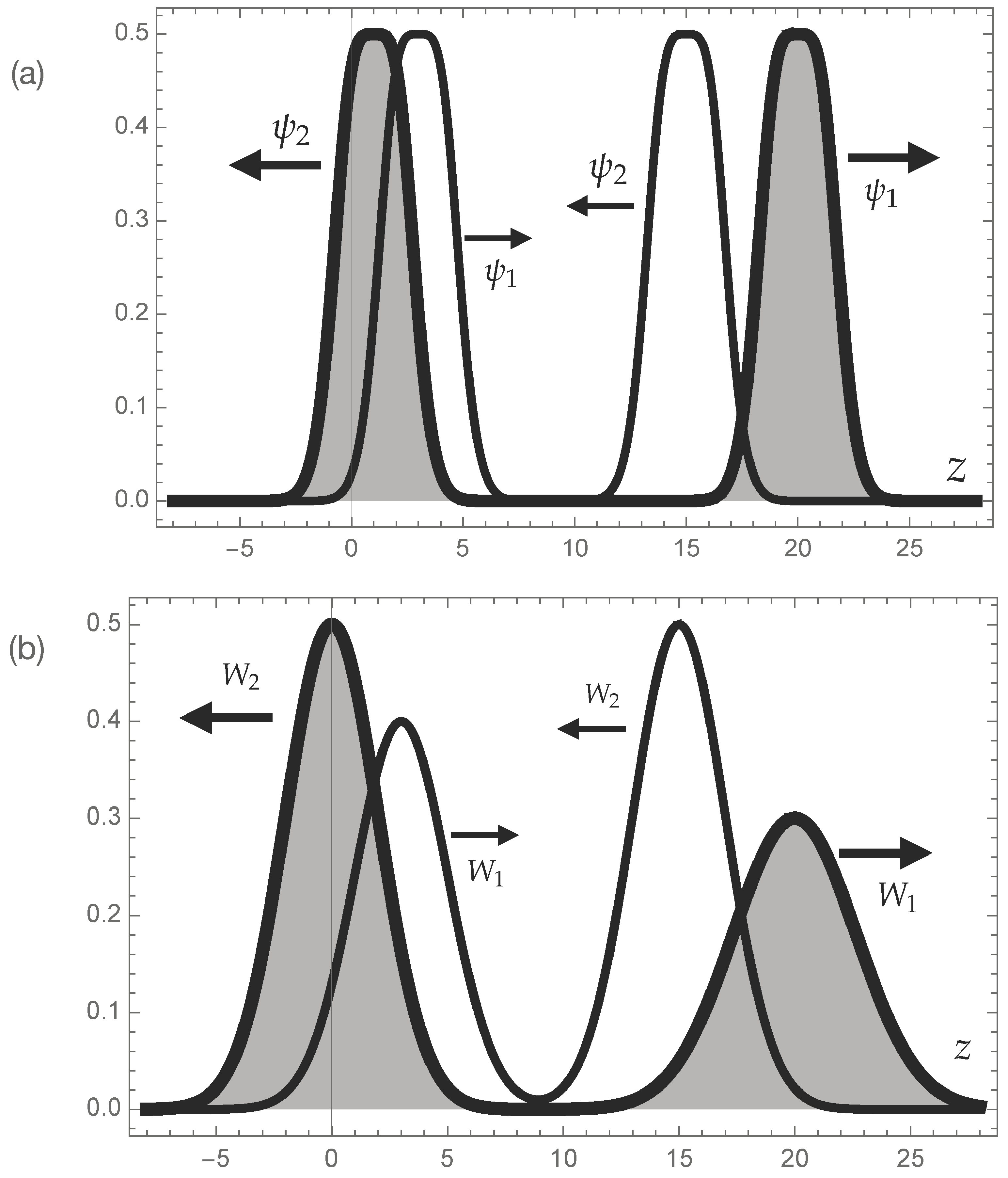
43) would reveal nonlinear interactions between the two different parts of the quasi-particle spectrum that are similar (at least in the one-dimensional limit), if not identical, to collisions between solitons. Furthermore, such collisions could take place in three dimensions. In
Figure 1, two soliton collisions are shown (
Figure 1a), as compared with Gaussian quasi-particle collisions (
Figure 1b). In the first case, the solitons emerge after collision with the same amplitudes but suffer a space shift in the direction of propagation. However, in case of
Figure 1b, the two quasi-particles emerge with a different amplitude and shape but do not suffer space shifts. This is a topic that deserves further consideration. In the case of one dimension, we should also mention possible Landau damping of electron plasma waves by a soliton spectrum, in the same way as it occurs for quasi-particles. This would be related to the term on the right-hand side of Equation (
25).
5. Conclusions
In conclusion, we have discussed two different theoretical models of wave turbulence, the soliton model and the quasi-particle model, and compared their main properties. This includes dimensionality, soliton collisions, and interaction with large-scale perturbations. Our discussion leads to the formulation of an improved model of quasi-particle turbulence, which not only retains quasi-particle collisions but also includes the soliton gas as a special case of quasi-particle turbulence.
The present comparison between soliton and quasi-particle turbulence opens up new questions relevant to these two approaches. One is related to the possible observation of Landau damping of large-scale waves by a gas of solitons. The other is related to the inclusion of quasi-particle collisions in the wave-kinetic description.
Notice that our description of a soliton gas is only valid for a dilute gas and for solitons with the same amplitude. A more complete description of soliton kinetics, valid for a dense soliton gas, would have to include solitons with different amplitudes and their effective velocity [
4]. This would imply a much deeper analysis. Other possible extensions of the present paper include breathers and rogue waves (see, for instance, [
21,
22]). This means that our present approach opens an avenue of research on a variety of topics in the large area of wave turbulence. In that respect, we should be able to establish bridges with the relevant work on optical turbulence theory, developed by Ariel Gordon and Baruch Fischer [
23], Antonio Picozzi [
24,
25], and others.
Finally, this concept of improved quasi-particle turbulence may be applied to specific cases of a soliton gas, including the dissipative solitons of Nino Pereira and Lennart Stenflo [
26,
27,
28] (recent papers on dissipative solitons in Refs. [
29,
30] should also be mentioned). Some of these topics will be examined in a forthcoming publication.