Review

Partially Ionized Plasma Physics and Technological Applications


by
Igor Kaganovich
1 and
Michael Tendler
1,2,*
1
Princeton Plasma Physics Laboratory, Princeton University, Princeton, NJ 08543, USA
2
KTH Royal Institute of Technology, Stockholm SE-100 44, Sweden
*
Author to whom correspondence should be addressed.
Physics 2026, 8(1), 18; https://doi.org/10.3390/physics8010018
Submission received: 31 October 2025 / Revised: 16 December 2025 / Accepted: 25 December 2025 / Published: 6 February 2026

Abstract

Partially ionized plasma physics has attracted increased attention recently due to numerous technological applications made possible by the increased sophistication of computer modelling, the depth of the theoretical analysis, and the technological applications to a vast field of manufacturing for computer components. Partially ionized plasma is characterized by a significant presence of neutral particles in contrast to the fully ionized plasma. The theoretical analysis is based upon solutions of the kinetic Boltzmann equation, yielding the non-Maxwellian electron energy distribution function (EEDF), thereby emphasizing the difference with a fully ionized plasma. The impact of the effect on discharges in inert and molecular gases is described in detail, yielding the complex nonlinear phenomena resulting in plasma selforganization. A few examples of such phenomena are given, including the non-monotonic EEDFs in the discharge afterglow in a mixture of argon with the molecular gas NF3; the explosive generation of cold electron populations in capacitive discharges, hysteresis of EEDF in inductively coupled plasmas. Recently, highly advanced computer codes were developed in order to address the outstanding challenges in plasma technology. These developments are briefly described in general terms.

1. Introduction

Analysis of the low-temperature plasma offers a number of common features and similarities with high-temperature plasmas relevant for fusion research. In a partially ionized plasmas electrons are still hot enough to provide the energy required to dissociate molecules or ionize atoms and chemical radicals. While studying electrified gases in 1927, Irving Langmuir was influenced by the similarities between how blood plasma transports red and white blood cells and how an electrified gas carries around electrons and ions. This led him to adopt the term “plasma’’ for ionized gases. Hence, both quite different phenomena received the same name. When a gas is ionized, pairs of electrons and ions are created. The resulting plasma is like a “soup’’ of freely moving positive ions and negative electrons. The crucial point to bear in mind is that the total number of positively charged particles—ions is approximately equal to the total number of negatively charged particles—electrons and negative ions. The notion is crucial for understanding both fully ionized and partially ionized plasma physics. The individual electrons and ions can be pulled closely or pushed apart by electrical and magnetic forces. However, electrons have higher velocity than ions due to their lower mass and higher mobility, and this movement can cause a separation of charge that is positive where the ions remain, and negative where electrons accumulate in peripheral plasma regions. Plasma remains quasi-neutral, implying that over large scales, the densities of positive and negative charges are nearly equal. This feature has profound ramifications for both partially and fully ionized plasmas. For example, it is the cause for the emergence of the self-consistent electric field in fully ionized plasmas that keeps negatively and positively charged particles together. The resulting electric field profile affects the quality of confinement exerted upon plasma by a magnetic field in fusion devices. Therefore, it is crucial for the impact on plasma turbulence. Indeed, it has been demonstrated by numerous experiments that spatial gradients of the electric field shred multi-scale fluid eddies and result in the improved confinement regime in modern tokamaks [1,2,3]. In summary, both partially and fully ionized plasmas demonstrate many self-organizing features typical of a strongly non-linear system addressed within the framework of the chaos theory. These are the subject to the known fundamental non-linear phenomena in nature, such as bifurcations of a steady state, the hysteresis of the timely evolution and the unfolding self-organization characterized by a power law behavior of the system [4,5,6,7].
The impact of an external magnetic field is another essential factor affecting both fully and partially ionized plasmas, yet quite differently. Indeed, there is quite a difference between fully ionized and partially ionized plasmas specified here. If plasma is fully ionized, increasing the power leads to heating and increasing electron or ion temperatures. (This approach is employed in fusion research in order to obtain relevant plasma parameters.) In contrast, if plasma is partially ionized, additional power provides for an increase in the plasma density. The electron temperature is nearly fixed by the balance between the rates of ionization and the loss of particles to the surrounding walls. The averaged ionization frequency over a Maxwellian electron energy distribution function is a nonlinear function of the electron temperature. In partially ionized plasmas at high pressure (above 100 mTorr, plasma transport is reduced due to faster collisions with gas. In addition, the plasma self-organization is governed by nonlinear ionization processes often subject to the emergence of filamentary structures in discharge; see, e.g., Ref. [8]. At low pressure (below 10 mTorr), plasma transport is the dominant process, and non-local phenomena are crucial too for the kinetics of the discharge. Non-local effects where streams of interpenetrating particles affect plasma self-organization are common for collisionless cosmic plasma addressed by Hannes Alfvén and Svante Arrenius [9] and Bo Lehnert [10].

2. Plasma Simulation Particle-in-Cell Codes

For plasma simulations, two codes, EDIPIC-2D and LTPPIC-3D, are used, which were developed at Princeton Plasma Physics Laboratory (PPPL). A brief overview of the major characteristics and achievements of these codes is given in this Section.

2.1. Low-Temperature Plasma Particle-in-Cell (LTP-PIC) Code

LTP-PIC code represents full 3D electrostatic PIC code—LTP-PIC-3D [11]—designed to scale well as required for computationally demanding high-performance computing (HPC) simulations with hybrid architecture for CPU plus GPU.
The LTP-PIC software suite is an electrostatic kinetic plasma simulation package that can target modern heterogeneous computing architectures. While several high-performance PIC codes exist within the plasma physics community, the developers of LTP-PIC identified a niche for a high-performance, open-source and unrestricted code dedicated to low-temperature plasma simulations [12,13]. Within the code, a particular focus is directed towards the performance of collision algorithms and wall interaction models appropriate to low-temperature plasmas. Additionally, the software allows for complex two or three-dimensional geometry and couples with state-of-the-art linear algebra solvers to invert the Poisson equation. These design features make full device modeling a real possibility and provide deeper physical insights within shorter simulation times.
The design and coding of this software are built upon decades of experience at PPPL and Princeton University, with high-performance fusion and astrophysics plasma codes. The physics models within LTP-PIC have been extensively verified against published results as well as numerous alternative codes. This includes participation in the Landmark 2a benchmark [14] with six other developers, agreement with the Turner benchmark [15], which tests all incorporated collision algorithms. The developers of LTP-PIC are also currently leading an effort [16], of the team with more than ten international code developers, to investigate the emergence of rotating structures within partially magnetized ExB devices [17], which includes the rigorous benchmarking of the codes.
LTP-PIC is designed from the bottom up to reach high performance and scalability and incorporates best practices in computer science to achieve results on heterogeneous supercomputers, including parallelized via the Message Passing Interface (MPI) with hybrid grid and particle decomposition. Each MPI task can be further parallelized via OpenMP to take advantage of modern high-thread-count nodes. Moreover, it incorporates a geometric multi-grid preconditioned Generalized Minimal Residual (GMRES) solver from the Hypre package to invert the Poisson equation [18].

2.2. Electrostatic Direct Implicit Particle-in-Cell 2D (EDIPIC-2D) Code

EDIPIC-2D [19] is based on 2D Cartesian and cylindrical geometry, state-of-the art collision models, plasma surface interaction and circuit models, Poisson solver, abundant diagnostics, contains inner objects, implicit algorithms, electrostatics and electromagnetics and has been validated by numerous benchmarks. The code is an open source with many users.
EDIPIC stands for Electrostatic Direct Implicit Particle-In-Cell. This was the name of a 1D code developed in the early 2000s by Dmytro Sydorenko at the University of Saskatchewan [20] and summarized the numerical scheme of the code. The 1D EDIPIC code was well accepted in the low-temperature plasma community and used extensively for studies of Hall thruster plasmas, dc discharges, and beam–plasma systems. The 2D codes described below received the name EDIPIC to capitalize on the heritage of the 1D code and have several 2D versions of EDIPIC, including electrostatic explicit and Darwin direct implicit methods [21]. The code was rigorously verified in several international benchmarks [14,16].
Main physics features of the code include: implementation of complex geometry where domain boundary may consist of multiple segments; metal or dielectric material objects of rectangular shape can be placed inside the simulation domain; each segment of the domain boundary and each inner object may have individual electron emission properties; the electrostatic potential of each metal boundary segment and metal inner object may be a complex function of time or controlled by an external circuit as described in Ref. [22]. The code includes a Monte-Carlo model of electron-neutral collisions, a model of charge-exchange collisions between ions and neutrals, a Coulomb scattering module based on the Nanbu algorithm with imposed conservation of energy and momentum in electron–electron collisions; material surfaces can emit secondary electrons in response to electron or ion bombardment. The model of electron emission is also extended from the 1D EDIPIC [20]. Poisson’s equation is solved using the GMRES method from the PETSc library (KSPGMRES)] combined with a preconditioner from the Hypre package [18]. The code includes abundant diagnostics. For example, one can specify points inside the simulation domain (called probes) and the code will save the following parameters as functions of time in these points The numerous parameters such as the electrostatic potential, electrostatic vector field components, total electric current vector components, and, for each charged species the density, vector flow velocity components, vector electric current components, average energies of motion along the three directions, temperatures along the three directions, heat flow vector components are obtained.

3. Results

3.1. Kinetics of Partially Ionized Plasmas

The range of parameters of partially ionized plasmas is given by the plasma density 109–1013 cm−3; a small degree of ionization, less than 10−4; electron temperature of 1–10 eV; ion temperature, Ti = 0.03 eV and the spatial scale varying from millimeters to meters. At low pressures (1–10 mTorr), the mean free path for electrons and ions, as well as the energy relaxation length, is large compared to the sheath or presheath. This is the range where nonlocal and collisionless effects, which are the main focus of this discussion, are highly significant. At high pressures (tens or hundreds of mTorr and above), nonlocal and collisionless effects become less dominant. However, it is crucial to note that kinetic effects remain significant.
It is worthy to emphasize that the electron energy distribution function (EEDF) in partially ionized plasmas is dramatically non-Maxwellian in contrast to the fully ionized plasmas. The reason is the competition between electron–electron collisions (driving EEDF towards a Maxwellian) and the cooling effect due to collisions with neutral particles and walls and heating by electric fields in the discharge. Indeed, if the frequency of the electron–electron collisions, νee, is much larger than the effective energy exchange collision frequency with neutrals, ν*, or the degree of ionization, ne/ng, (with ne denoting the electron density and ng denoting the neutral density) is sufficiently high: ne/ng > 10−4, the electron energy distribution function, EEDF, is a Maxwellian. In contrast, if νee < ν* or ne/ng < 10−4, EEDF can have any shape depending on discharge conditions. The non-Maxwellian electron energy distribution function was first obtained by Druyvesteyn [23] for the mean free path, λ, being constant and assuming only energy losses due to elastic collisions. Under these conditions, f = e x p ( ε 2 / ε 0 2 ) , where ε denotes the total energy, ε 0 = e E λ M / m , where e is an elementary charge, E denotes the electric field, λ is the mean free path, M denotes the ion mass, and m denotes the electron mass. However, inelastic collisions are significant in realistic discharge conditions and strongly modify EEDF as shown below.
The electron energy distribution function in partially ionized plasmas differs crucially from the Maxwellian form typical for fully ionized plasmas. It is determined by a highly non-linear kinetic Boltzmann equation, obtaining the integral–differential form [24]
t + v e E m v f = k ν k * u u f ( w + w k * ) ν k * f + S t e e ,
where f ( r , v , t ) is distribution function in six dimensional phase space r , v ,   E is the electric field, sum in the right-hand side denotes summation over all inelastic collisional processes that lead to electron energy losses with inelastic energy change, w k * , and collisional frequency, ν k * ; w is kinetic energy, and u is absolute value of velocity, prime denotes states with kinetic energy w + w k * , and S t e e -denotes the Coulomb collision integral.
The EEDF formation is determined by heating by the electric field and the energy losses in elastic and inelastic collisions with neutrals and energy exchange in electron–electron collisions. The electron–electron collisions drive the EEDF to maintain a Maxwellian form, while the former processes are responsible for the EEDF attaining a complex non-linear form, often exhibiting non-local effects and memory effects of the prelude temporal evolution of the discharge. At high electric fields, collisions may not scatter electrons fast enough to make the electron velocity distribution function (EVDF) isotropic [25]. In some cases, the EEDF can be anisotropic and therefore the EEDF must be determined by a multi-term solution of the Boltzmann equation [26].
In special cases, EEDF can even be nonmonotonic; and more complex phenomena, such as negative power dissipation, can also be observed [27,28,29].
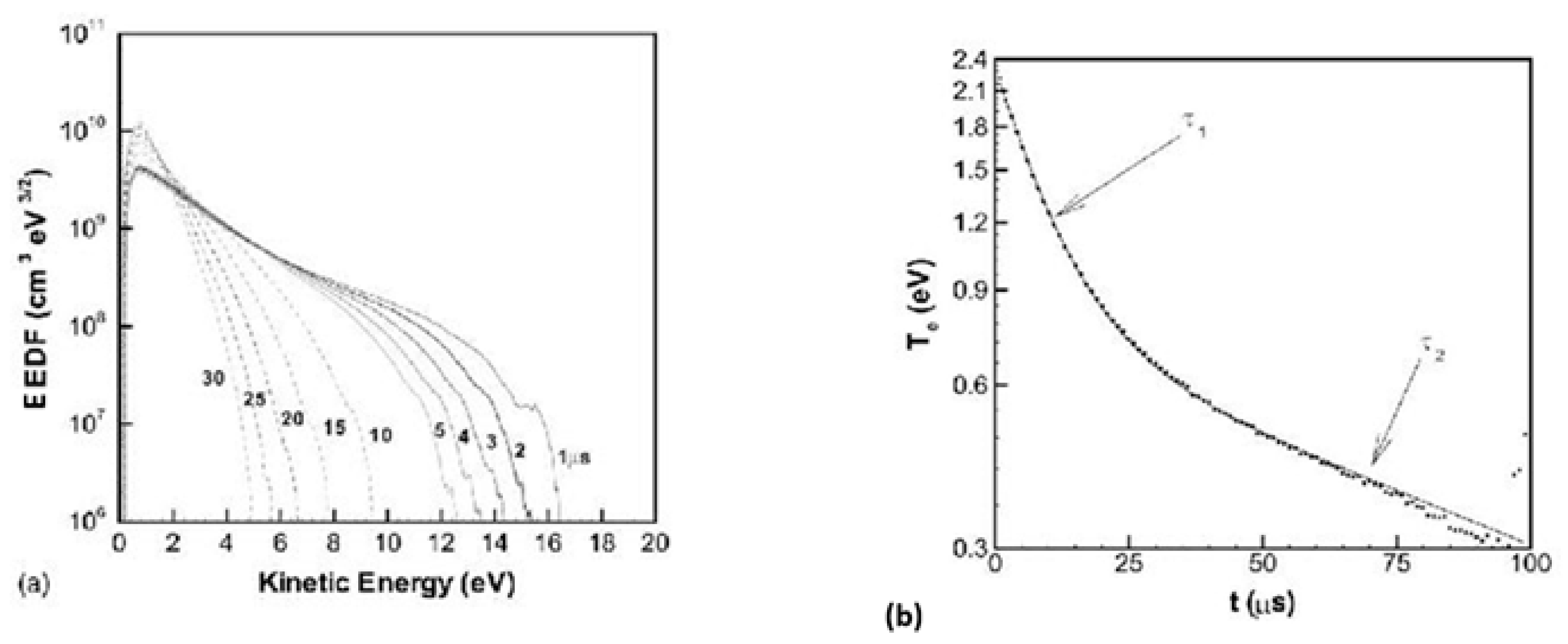
The non-Maxwellian EEDFs can be readily obtained in the afterglow of the noble gases like Ar. The EEDF shape is dramatically different from an exponential as a function of kinetic energy for a Maxwellian EEDF, as seen from Figure 1, where EEDF evolution of the discharge afterglow is shown for different time intervals after external power is switched off.
The major phenomena affecting the EEDF formation are electron-electron collisions (driving it into the Maxwellian) versus the cooling occurring due to the energy losses in elastic and inelastic collisions with neutrals. As discussed above, if νee < ν* or ne/ng < 10−4 EEDF shape is determined by the atomic structure of the background gas. Therefore, the modelling of the discharge in a partially ionized plasma must be performed kinetically by solving the Boltzmann kinetic equation with a collisional operator.
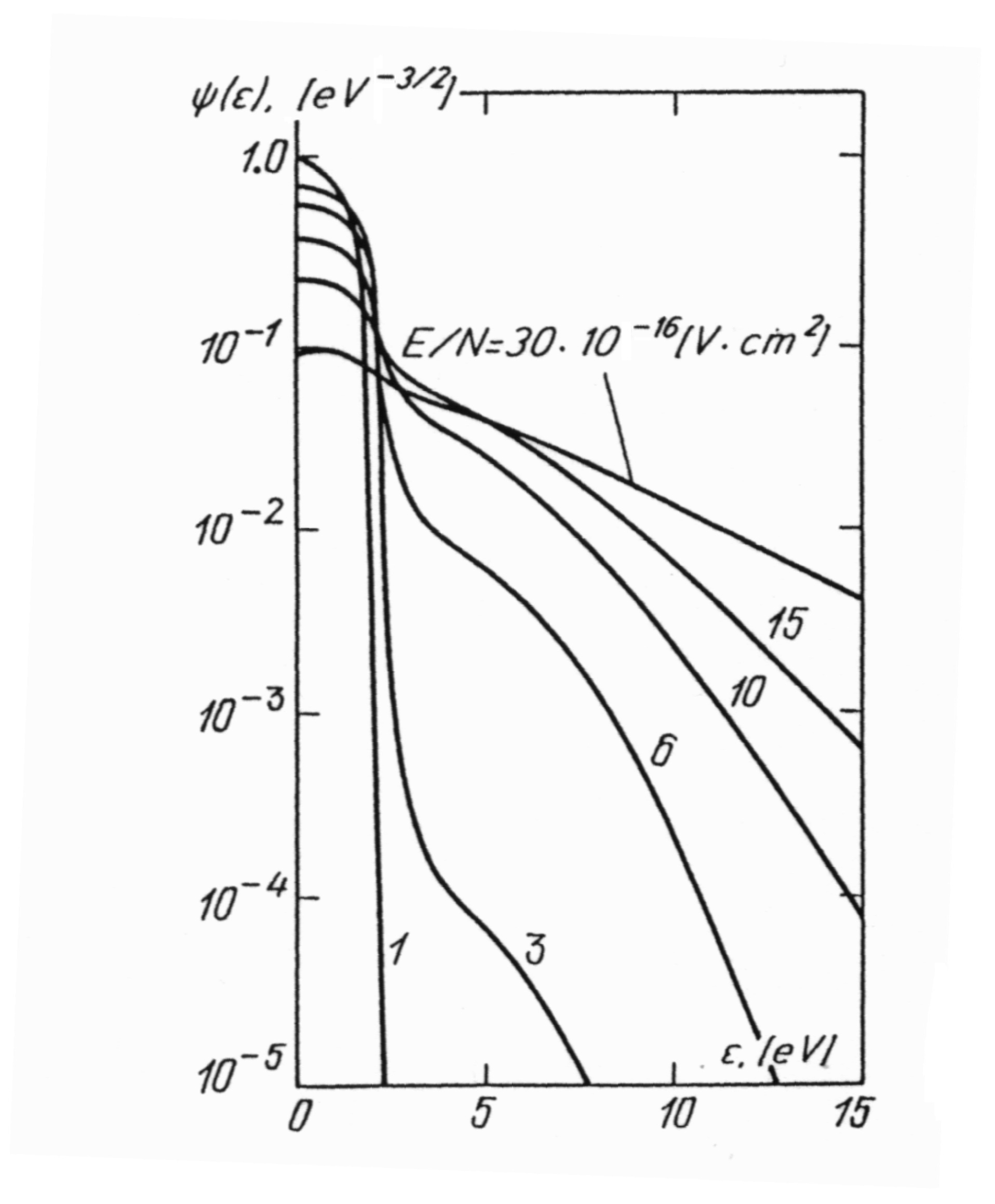
In the case of the more complex molecular gas, additional complications emerge due to the presence of metastable vibrational states excited by the electrons. Metastable vibrational states can be both excited and deactivated by electron collisions with the background molecules, thus removing or returning energy to electrons. For molecular gases N2 or CO, EEDFs can differ even more significantly from a Maxwellian form. Parts of the EEDF are quite flexible and almost independent from each other, following a power law within certain ranges of energy. The EEDF shape was obtained analytically for the first time by employing the Galerkin method for the solution of complex integral–differential equations [31].The importance of de-excitation collisions of the second type (in this phenomenon, an excited atom transfers its internal energy to a free-moving electron during a collision, causing the electron to gain kinetic energy while the atom de-excites to a lower energy state) is also brought to light in particular for parameters of E/N < 3.10−16 V·cm2, where N denotes the plasma density [32], as shown in Figure 2, essential for applications to externally driven lasers.
The resonance in the inelastic scattering of electrons emerges due to the capture of an electron by a molecule. The resulting ion decays, forming a vibrationally excited stable molecule. The corresponding cross-sections for both single quantum and multi-quantum transitions are large only within a specific energy range. An analytical solution was derived in Ref. [32] by joining the solutions for the EEDF in different energy ranges. Moreover, the effects of metastable states on the EEDF are also significant in noble gases [33].
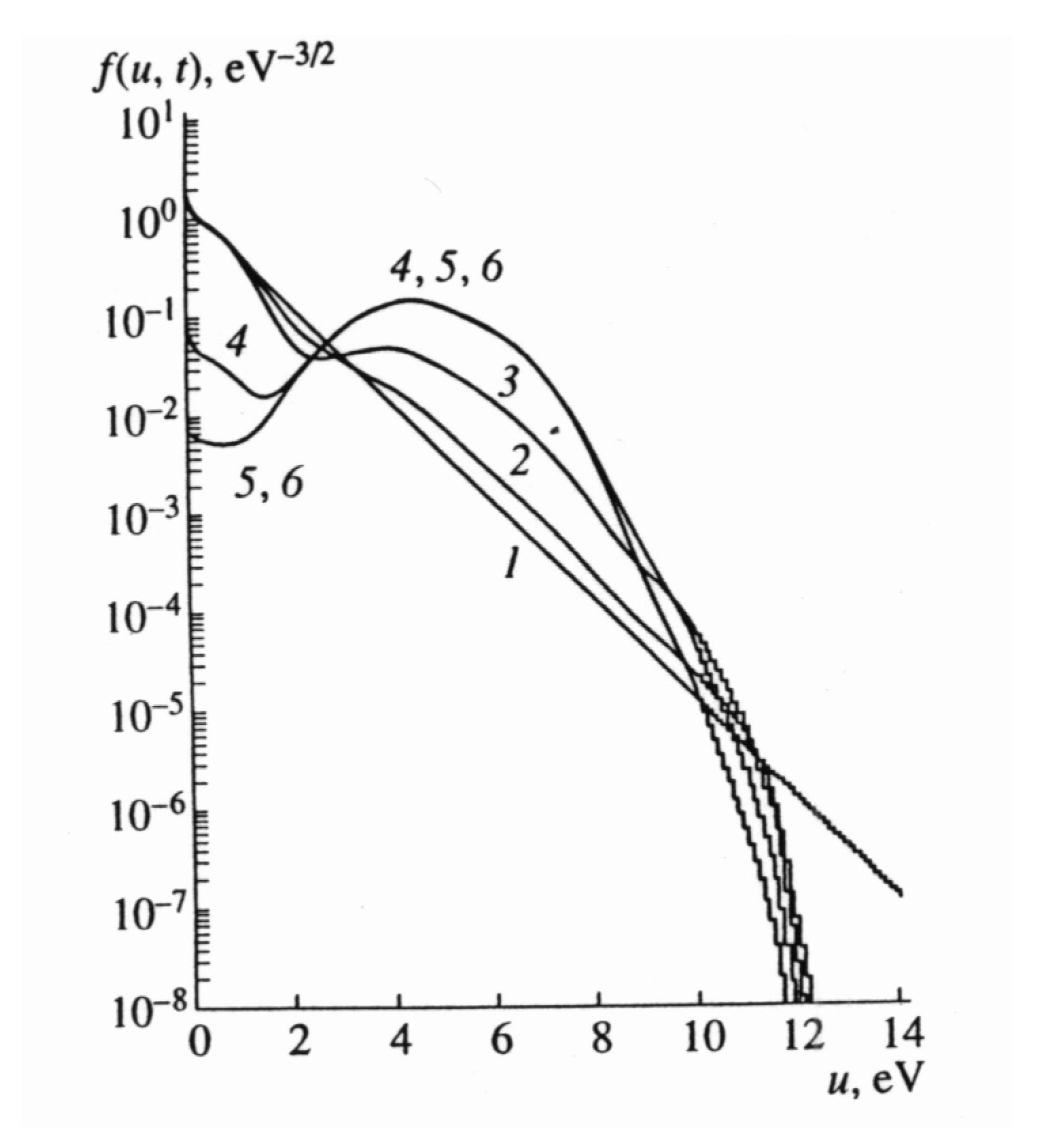
The most dramatic changes in the EEDF result when an inert gas is mixed with molecular gas. The form of the EEDF in the afterglow of the argon gas (Ar) is drastically modified due to the addition of the molecular gas NF3, as shown in Figure 3. Quite sensitive energy losses occur due to the efficient vibrational excitation of molecular states in the region of electron energies where vibrational excitation cross sections have a strong maximum (2–4 eV), yielding the non-monotonic energy dependence of the distribution function, EEDF. The resulting non-monotonic EEDF gives rise to the negative plasma conductivity, where the total electron current is opposite to the applied electric field [34]. Physically, this can be explained by the feature that electrons diffuse in space at a given total energy, which is the sum of kinetic and potential energy, ε = w φ ( x ) , where φ ( x ) is the plasma potential. Because of considerable losses at small energy (2–4 eV) due to vibrational excitations, electrons with ε > 4 eV diffuse towards smaller kinetic energy regions, i.e., against the electric field [35].
The EEDF in the afterglow can be strongly enough affected by the Penning ionization process called after Dutch physicist Frans Michel Penning. In the afterglow, electrons cool quite rapidly to a considerably low electron energy, which can be as low as 30 K [36]. However, a relatively small amount of fast enough electrons with energy of few eVs arise from slowly decaying metastable states, due to the so-called Penning ionization resulting from collisions of two metastable atoms, A* + A*→ A + A+ + ef and can quite strongly affect potential of the wall which is in contact with the plasma [37] or potential of inserted electrodes or probes if the flux of energetic electrons produced by the Penning ionization is large compared with the ion flux, Γef > Γi. In this case, the near-wall potential drop can be much greater than the typical value for the wall potential for a cold Maxwellian afterglow plasma, which value is a few times the electron temperature, Te. Such large wall potential arrests further losses of cold electrons in the afterglow and the diffusion (or evaporating) cooling typical during the afterglow can be eliminated [37].
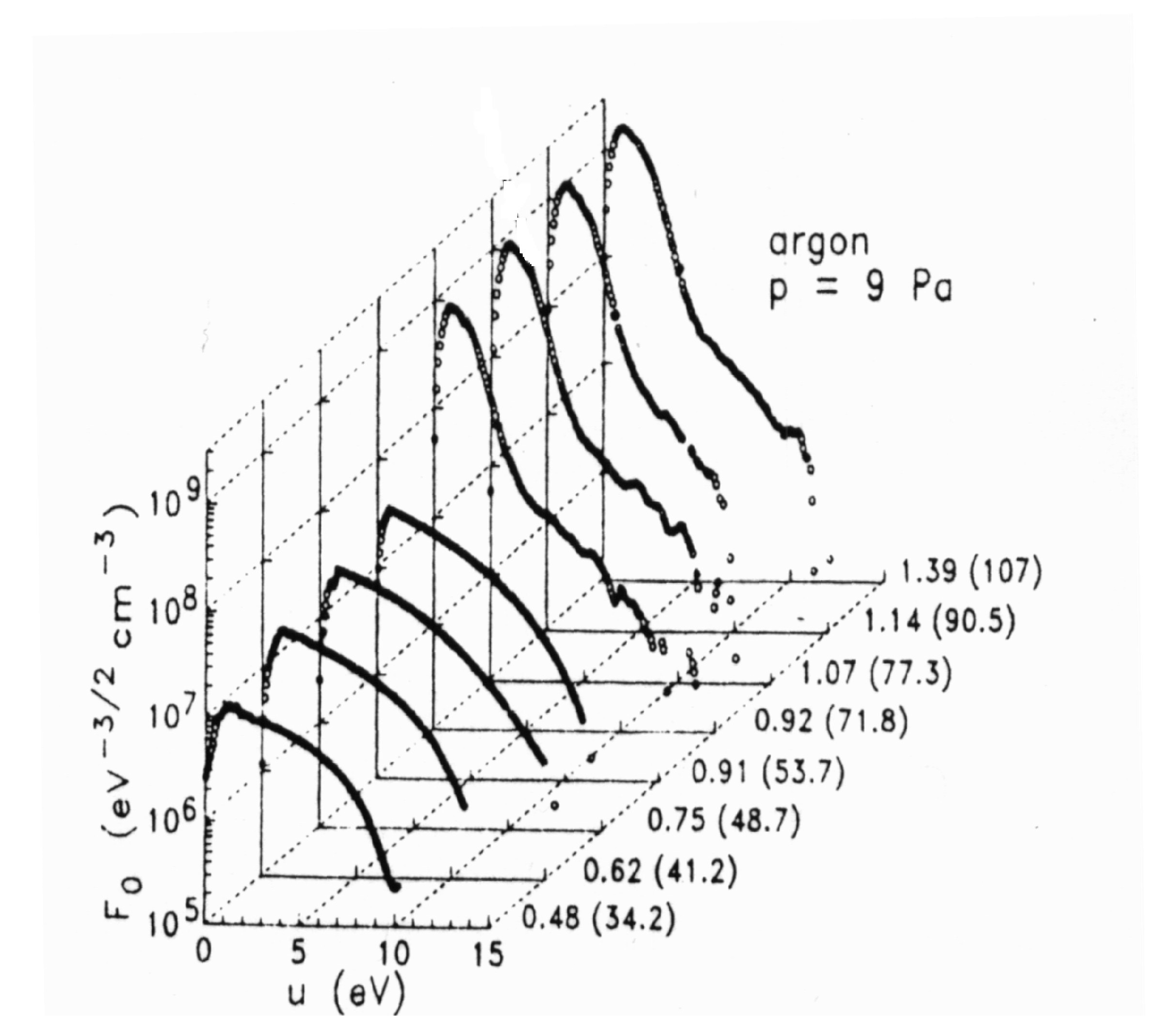
Another intriguing kinetic effect was observed in low-pressure capacitive RF discharge. The paradoxical electron cooling with an increase in deposited power into the plasma can take place if the amount of cold electrons drastically enhances with the increase in the injected power [38]—the so-called explosive generation of cold electrons in capacitive discharge emerges. The evolution of the EEDF in argon is shown in Figure 4 for the following parameters of the capacitive discharge (frequency 13.56 MHz, length 6 cm and pressure 9 Pa) [39]. Indeed, the explosive generation of cold electrons occurs in the discharge. The formation of two populations of cold and hot electrons is the result of the non–locality and the non-linearity features of the phenomenon [40]. The abrupt formation of cold electrons happens because as the electron density in the bulk increases, the RF electric field in the plasma bulk decreases inversely proportional to the plasma density and that results in a much smaller electron temperature in the plasma bulk. Consequently, the ambipolar potential decreases, and ion density continues increasing due to the reduced ion velocity. The process only stops when the Coulomb electron-electron collisions provide sufficient energy exchange between cold electrons trapped in the potential well near the discharge center and more energetic electrons that can reach RF sheathes and gain energy from the RF sheathes.
The cold electron formation is also prominent in another discharge phenomenon the so-called negative glow of the direct current discharge [41]. In this case, trapped electrons in a potential well at the end of the cathode fall can be extremely cold (about 0.1 eV) because there is no other heating mechanism for these electrons except for the Coulomb electron-electron collisions. The modelling of this kind of discharge often has difficulty reaching the steady state due to the very slow evolution of cold electron density. Complications deriving from this kinetic effect make detailed analysis rather complex.
Similar phenomena are at play in low-power inductively coupled plasma sources and can explain hysteresis in plasma parameters as a function of coil voltage [42].

3.2. Modern Modeling Methods of the Partially Ionized Plasma

Plasma processing applications utilize capacitively coupled or inductively coupled plasmas. Due to the requirements of atomic-scale precision, the controls of radical and ion fluxes need to be highly precise, and, therefore, the modeling and optimization of such discharges must be rather advanced and precise. Parallel, particle-in-cell codes are a powerful and versatile tool to address the technological applications of the partially ionized plasmas. Their versatility stems from the simplicity of the development of codes capable of addressing the underlying physics of the phenomena. These codes are modular and therefore adaptable for effective parallelization procedures. Furthermore, modern high-performance clusters and multi-core PCs are relatively cheap and capable of using a number of CPUs and GPUs for practical calculations. Recent benchmarking papers overview available particle-in-cell codes and their performance [14,16].
The limitation of traditional momentum conserving and explicit algorithm is that it is severally limited by small temporal and spatial steps (temporal step, Δ t , is chosen to well resolve plasma oscillations with frequency, ω p e , Δ t ω p e < 0.2 , spatial step, Δ x , needs to resolve the electron Debye radius, λ D e , Δ x < 0.5 λ D e , and that fast particles do not move over the cell size during one time step, i.e., v m a x Δ t < Δ x ) [43]. One way to reduce such limitations is to use energy-conserving or implicit methods.
Energy conserving method [44] allows to use much larger cell sizes Δ x > λ D e , but is still limited by the limitation on the temporal step, ( Δ t ω p e < 0.2 and v m a x Δ t < Δ x ). For GPU-accelerated codes using much larger cell sizes Δ x > λ D e yields significant savings in compute time for simulations of, for example, capacitively coupled plasmas, because there is no need to resolve the Debye radius in the areas of dense plasma where typical spatial scales of plasma inhomogeneity are far larger than the Debye radius, while resolving the Debye radius in the sheath region where it is necessary to resolve it [45].
Another approach is to use various implicit [46] and semi-implicit methods [47]. These approaches do not require resolving the plasma frequency but may not conserve energy and require careful monitoring of energy conservation, as they often lead to artificial cooling or heating [48]. If the artificial cooling or heating is sufficiently smaller than heating by the external electric field, the issue can be constrained. Using implicit methods is especially significant for electromagnetic codes where explicit methods are limited by the Courant condition for speed of light, c Δ t < Δ x . Recent applications of implicit methods for electromagnetic simulations can be found in Refs. [49,50].
Another practical way to remove restrictions on the Courant condition for speed of light ( c Δ t < Δ x ) is to remove radiation completely for simulations of plasmas where radiation is negligible. This is accomplished by using the so-called Darwin scheme [51]. Numerical implementations of the Darwin scheme involve careful separation of electrostatic and solenoidal parts and solving iteratively. The result is a set of complex nonlinear equations. Previously, the resulting system of equations was solved using the dynamic alternating-directions implicit technique [52,53]. In a recent paper [21], the solenoidal electric field was obtained from an equation for the field vorticity, and the solver was more stable than the one used in the previous formulations.
The PIC simulation can encounter another severe issue of artificially fast numerical thermalization when scattering on short-wave numerical fluctuations driven by numerical statistical noise due to the finite number of particles in the cell. It leads to significantly enhanced Coulomb collisions, driving the EEDF to a Maxwellian in conditions when it should not happen [54]. The solution to the issue is to use cell sizes larger than the Debye radius in combination with energy-conserving or implicit methods, because that significantly reduces artificial thermalization [54]. In some examples of highly dense plasmas, where the sheath is considerably thin, the Debye radius can be safely artificially increased by scaling vacuum permittivity. Examples of such modeling methods can be found in Refs. [55,56,57].
The issue of numerical noise is even more prevalent for electromagnetic simulations, for example, for ICP, microwave, or helicon plasmas. For electromagnetic simulations, numerical noise can enhance shortwave radiation, which in turn could artificially enhance scattering on short electromagnetic waves as was described in pioneering papers [58,59,60]. However, a detailed study of the effects of electromagnetic numerical noise on thermalization is still lacking, to the best of our knowledge.
Particle-in-cell codes are extensively used for modeling and optimization of low-pressure discharges. There exists quite a large literature on PIC simulations of capacitively coupled (CCP) and inductively coupled plasmas (ICP), see discussion in Ref. [13]. There the authors study the use of non-sinusoidal waveforms and multifrequency voltages in low-pressure capacitively coupled plasmas for designing ion and electron energy and angular distributions impinging on the wafer. This is especially significant for plasma sources used for high aspect ratio etching of trenches in SiO2. Recently, there were a number of studies of the effect of a weak magnetic field on both CCP and ICP. For example, Ref. [61] studied the effect of a weak external magnetic field on radio-frequency discharge due to bounce resonance between electron cyclotron motion and RF sheath. At higher pressures and higher magnitudes of applied magnetic field, plasma often becomes non-uniform and a variety of complex modes appear on the plasma profile. The modes can rotate and even assemble plasma into highly nonuniform structures called spokes, named so because they resemble spokes on bicycle wheels. Among major recent examples of computational and scientific accomplishments using PIC codes are the demonstration of the self-organized structure spokes in magnetized plasmas in 2D [18] and even 3D simulations [62]. There are several groups that can simulate entire plasma devices in 3D, including emerging turbulence [63]. Breakdown in RF discharges is another highly significant issue that PIC simulations can help to predict; see, for example, review [64]. Electron beams, when interacting with low-pressure plasmas, can excite strong enough plasma waves leading to turbulence; these waves can scatter electron beams and transfer energy from the beams to the background plasma. Classification of different nonlinear regimes was performed in Ref. [65]. Ion beams are used for ion implantation and require careful design of plasma sources to reduce extracted ion beam emittance while having high brightness. PIC simulations help to understand complex plasma physics phenomena happening in such systems [66].

4. Discussion

The use and the application of the PIC codes discussed to model experimental situations revealed novel findings, such as 3D spokes in the Penning discharges [62]. PIC simulations of 3D Hall thruster channel revealed that anomalous electron transport is considerably different in 3D versus 2D [11].
However, quite a number of outstanding issues remain still to be addressed in more detail. An incomplete list of issues that remain to be addressed in more detail includes the breakdown in narrow gaps [67], studies of hollow cathode [57], the electron–beam [65] and ion–beam [66] interaction with the plasma, effects of external magnetic field [68,69], the Penning discharges [70] and Hall thrusters [63].
Machine learning methods can be used for accelerating simulations [71] and making resulting surrogate models potent and multifaceted tools for further analysis and optimization.
Not addressed in this review are the surface chemistry studies that are vital for etching, and the deposition of thin films and nanomaterials is currently fast progressing using modern methods of quantum chemistry.

5. Conclusions

In summary, modern plasma applications call for modeling of complex plasmas in two and three dimensions. With access to modern, highly paralyzed particle-in-cell, fluid and hybrid codes, the prototyping and optimizations of plasma reactors and developing plasma processing and deposition methods for making desired materials for quantum sensors and computers can be largely achieved employing computational modeling. Therefore, the applications represent a powerful tool to address the urgent needs of computer technology, calling for optimal manufacturing of super-thin chips and novel materials and devices enabling quantum computing. In summary, there is currently an urgent need for hybrid approaches that combine fluid and kinetic methods. While fluid approaches allow for fast simulations, they often lack essential kinetic effects. Yet, although kinetic approaches enable comprehensive kinetic studies, they are too slow for extensive use in applications. Therefore, combining these methods to achieve fast simulations while still retaining key kinetic effects is critical for many applications. Machine learning methods may prove highly instrumental for further acceleration of simulations.

Author Contributions

Conceptualization, I.K. and M.T.; methodology, I.K.; writing and original draft preparation, I.K. and M.T.; writing—review and editing, I.K. and M.T.; funding acquisition, I.K. All authors have read and agreed to the published version of the manuscript.

Funding

The research at Princeton Plasma Physics Laboratory (PPPL) was funded by the US Department of Energy CRADA (Cooperative Research & Development Agreement) between Applied Material Inc. and PPPL. The research at The Royal Institute of Technology (KTH), Sweden, was carried out due to the support of the School of the Electrical Engineering within the framework of its activities.

Data Availability Statement

All of the data used in the publication is publicly available.

Conflicts of Interest

The authors declare no conflicts of interest.

Abbreviations

The following abbreviations are used in this manuscript:
CCPcapacitively coupled plasma
CIPinductively coupled plasma
CPUcentral processing unit
EDIPICElectrostatic Direct Implicit Particle-in-Cell
EEDFelectron energy distribution function
EVDFelectron velocity distribution function
GMRESGeneralized Minimal Residual (algorithm)
GPUgraphics processing unit
HPChigh-performance computing
Hyprehigh-performance preconditioners (library)
KSPKrylov subspace method
KSPGMRESGMRES using KSP
LTP-PICLow-Temperature Plasma Particle-in-Cell
MPImessage passing interface
OpenMPOpen Multi-Processing
PCpersonal computer
PETScPortable, Extensible Toolkit for Scientific computing
PPPLPrinceton Plasma Physics Laboratory
RFradio frequency
1D, 2D, 3Done-, two-, three-dimensional

References

  1. Shukla, P.K.; Stenflo, L. Nonlinear phenomena involving dispersive Alfvén waves. In Nonlinear MHD Waves and Turbulence; Passot, T., Sulem, P.-L., Eds.; Springer: Berlin/Heidelberg, Germany, 1999; pp. 1–30. [Google Scholar] [CrossRef]
  2. Pokhotelov, O.A.; Stenflo, L.; Shukla, P.K. Nonlinear structures. Plasma Phys. Rep. 1996, 22, 852–863. [Google Scholar]
  3. Tendler, M. Self-organisation in plasma physics. Phys. Scr. 2004, T113, 51–55. [Google Scholar]
  4. Mandelbrot, B.B. The Fractal Nature of Nature; Freeman W.H. and Company: San Francisco, CA, USA, 1977; Available online: https://archive.org/details/fractalgeometryo00beno (accessed on 20 December 2025).
  5. Prigogine, I.; Stengers, I. Order out of Chaos: Man’s New Dialogue with Nature; Bantam Books, Inc.: New York, NY, USA, 1984; Available online: https://archive.org/details/orderoutofchaosm00prig (accessed on 20 December 2025).
  6. Back, P. How the Nature Works: The Science of Self-Organized Criticality; Springer Science + Business Media: New York, NY, USA, 1997. [Google Scholar] [CrossRef]
  7. Zaslavsky, G.M. Hamiltonian Chaos & Fractional Dynamics; Oxford University Press: London, UK, 2004. [Google Scholar] [CrossRef]
  8. Burin, M.J.; Simmons, G.G.; Ceja, H.G.; Zweben, S.J.; Nagy, A.; Brunkhorst, C. On filament structure and propagation within a commercial plasma globe. Phys. Plasmas 2015, 22, 053509. [Google Scholar] [CrossRef]
  9. Alfvén, H.; Arrhenius, G. Evolution of the Solar System; Scientific and Technical Information Office, National Aeronautics and Space Administration (NASA): Washington, DC, USA, 1976. Available online: https://ntrs.nasa.gov/citations/19770006016 (accessed on 20 December 2025).
  10. Lehnert, B. Minimum temperature and power effect of cosmical plasmas interacting with neutral gas. Cosm. Electrodyn. 1970, 1, 397–410. [Google Scholar]
  11. Powis, A.T.; Villafana, W.; Kaganovich, I. Three-dimensional kinetic simulations of oscillations and anomalous electron transport in a Hall thruster. In Proceedings of the 37th International Electric Propulsion Conference, Massachusetts Institute of Technology (IEPC-2022-532), Cambridge, MA, USA, 19–23 June 2022; Available online: https://www.jotform.com/uploads/electricrocket/220994246997171/5314533868819892790/IEPC-2022-532_Powis.pdf (accessed on 20 December 2025).
  12. Kaganovich, I.D.; Smolyakov, A.; Raitses, Y.; Ahedo, E.; Mikellides, I.G.; Jorns, B.; Taccogna, F.; Gueroult, R.; Tsikata, S.; Bourdon, A.; et al. Physics of E × B discharges relevant to plasma propulsion and similar technologies. Phys. Plasmas 2020, 27, 120601. [Google Scholar] [CrossRef]
  13. Versolato, O.; Kaganovich, I.; Bera, K.; Lill, T.; Lee, H.C.; Hoekstra, R.; Sheil, J.; Nam, S.K. Plasma sources for advanced semiconductor applications. Appl. Phys. Lett. 2024, 125, 230401. [Google Scholar] [CrossRef]
  14. Charoy, T.; Boeuf, J.P.; Bourdon, A.; Carlsson, J.A.; Chabert, P.; Cuenot, B.; Eremin, D.; Garrigues, L.; Hara, K.; Kaganovich, I.D.; et al. 2D axial-azimuthal particle-in-cell benchmark for low-temperature partially magnetized plasmas. Plasma Sources Sci. Technol. 2019, 28, 105010. [Google Scholar] [CrossRef]
  15. Turner, M.M.; Derzi, A.; Donko, Z.; Eremin, D.; Kelly, S.J.; Lafleur, T.; Mussenbrock, T. Simulation benchmarks for low-pressure plasmas: Capacitive discharges. Phys. Plasmas 2013, 20, 013507. [Google Scholar] [CrossRef]
  16. Powis, A.T.; Ahedo, E.; Laguna, A.; Barléon, N.; Bello-Benítez, E.; Beving, L.; Boeuf, J.P.; Bogopolsky, G.; Bourdon, A.; Cichocki, F.; et al. Benchmark for two-dimensional large scale coherent structures in partially magnetized E × B plasmas—Community collaboration & lessons learned. arXiv 2025, arXiv:2510.21261. [Google Scholar]
  17. Powis, A.T.; Carlsson, J.A.; Kaganovich, I.D.; Raitses, Y.; Smolyakov, A. Scaling of spoke rotation frequency within a Penning discharge. Phys. Plasmas 2018, 25, 072110. [Google Scholar] [CrossRef]
  18. Falgout, R.D.; Yang, U.M. hypre: A library of high performance preconditioners. In Computational Science—ICCS 2002: International Conference, Amsterdam, The Netherlands, 21–24 April 2002; Proceedings: Part III; Sloot, P.M.A., Hoekstra, A.G., Kenneth Tan, C.J., Dongarra, J.J., Eds.; Springer: Berlin/Heidelberg, Germany, 2002; pp. 632–641. [Google Scholar] [CrossRef]
  19. EDIPIC-2D. Available online: https://github.com/PrincetonUniversity/EDIPIC-2D (accessed on 20 December 2025).
  20. Sydorenko, D. Particle-in-Cell Simulations of Electron Dynamics in Low Pressure Discharges with Magnetic Fields. Ph.D. Thesis, University of Saskatchewan, Saskatoon, SK, Canada. Available online: http://hdl.handle.net/10388/etd-06142006-111353 (accessed on 20 December 2025).
  21. Sydorenko, D.; Kaganovich, I.D.; Khrabrov, A.V.; Ethier, S.A.; Chen, J.; Janhunen, S. Improved algorithm for a two-dimensional Darwin particle-in-cell code. Phys. Plasmas 2025, 32, 043904. [Google Scholar] [CrossRef]
  22. Vahedi, V.; DiPeso, G. Simultaneous potential and circuit solution for two-dimensional bounded plasma simulation codes. J. Comput. Phys. 1997, 131, 149–163. [Google Scholar] [CrossRef]
  23. Druyvesteyn, M.J. Der Niedervoltbogen. Z. Phys. 1930, 64, 781–798. [Google Scholar] [CrossRef]
  24. Druyvesteyn, M.J.; Penning, F.M. The mechanism of electrical discharges in gases of low pressure. Rev. Mod. Phys. 1940, 12, 87–174. [Google Scholar] [CrossRef]
  25. Stenflo, L. High field electron distribution function in GaAs. Proc. IEEE 1967, 55, 1088–1089. [Google Scholar] [CrossRef]
  26. Loffhagen, D.; Winkler, R. Time-dependent multi-term approximation of the velocity distribution in the temporal relaxation of plasma electrons. J. Phys. D Appl. Phys. 1996, 29, 618–627. [Google Scholar] [CrossRef]
  27. Stenflo, L. Oscillations of a weakly ionized plasma in a constant electric field. Plasma Phys. 1968, 10, 551–559. [Google Scholar] [CrossRef]
  28. Stenflo, L. Negative absorption due to collisions in a drifted electron plasma. Plasma Phys. 1968, 10, 801–803. [Google Scholar] [CrossRef]
  29. Godyak, V.A.; Kolobov, V.I. Negative power absorption in inductively coupled plasma. Phys. Rev. Lett. 1997, 79, 4589–4592. [Google Scholar] [CrossRef]
  30. Kortshagen, U.; Maresca, A.; Orlov, K.; Heil, B. Recent progress in understanding of electron kinetics of low pressure inductive plasmas. Appl. Surf. Sci. 2002, 192, 244–257. [Google Scholar] [CrossRef]
  31. Galerkin, B.G. Rods and plates: Series occurring in various questions concerning the elastic equilibrium of rods and plates. Vestn. Inzhen. Tekhn. [Bull. Engin. Technolog.] 1915, 19, 897–907. (In Russian) English translation: 63-18925, Clearinghouse Fed. Sci. Tech. Inform.: Spriengfield, VA, USA, 1963. [Google Scholar]
  32. Lyagushenko, R.; Tendler, M. Electron energy distribution in a cool molecular gas. Sov. J. Plasma Phys. 1975, 1, 458–463. [Google Scholar]
  33. Colonna, G. On the relevance of superelastic collisions in argon and nitrogen discharges. Plasma Sources Sci. Technol. 2020, 29, 065008. [Google Scholar] [CrossRef]
  34. Dyatko, N.A.; Capitelli, M.; Longo, S.; Napartovich, A.P. Negative electron mobility in a decaying plasma. Plasma Phys. Rep. 1998, 24, 691–699. [Google Scholar]
  35. Tsendin, L.D. Nonlocal electron kinetics in gas-discharge plasma. Phys.-Usp. 2010, 53, 133–157. [Google Scholar] [CrossRef]
  36. Biondi, M. Diffusion Cooling of Electrons in Ionized Gases. Phys. Rev. 1954, 93, 1136–1140. [Google Scholar] [CrossRef]
  37. Demidov, V.I.; DeJoseph, C., Jr.; Kudryavtsev, A. Anomalously high near-wall sheath potential drop in a plasma with nonlocal fast electron. Phys. Rev. Lett. 2005, 95, 215002. [Google Scholar] [CrossRef]
  38. Godyak, V.A.; Piejak, R.B.; Alexandrovich, B.M. Measurement of electron energy distribution in low-pressure RF discharges. Plasma Sci. Technol. 1992, 1, 36–58. [Google Scholar] [CrossRef]
  39. Buddemeier, U.; Kortshagen, U.; Pukropski, I. On the efficiency of the electron sheath heating in capacitively coupled radio frequency discharges in the weakly collisional regime. Appl. Phys. Lett. 1995, 67, 191–193. [Google Scholar] [CrossRef]
  40. Berezhnoi, S.V.; Kaganovich, I.; Tsendin, L. Generation of cold electrons in a low-pressure RF capacitive discharge as an analogue of a thermal explosion. Plasma Phys. Rep. 1998, 24, 556–563. [Google Scholar]
  41. Arslanbekov, R.R.; Kudryavtsev, A. Modeling of nonlocal slow-electron kinetics in a low-pressure negative-glow plasma. Phys. Plasmas 1999, 6, 1003–1016. [Google Scholar] [CrossRef]
  42. Lee, H.C. Review of inductively coupled plasmas: Nano-applications and bistable hysteresis physics. Appl. Phys. Rev. 2018, 5, 011108. [Google Scholar] [CrossRef]
  43. Birdsall, C.K.; Langdon, A.B. Plasma Physics via Computer Simulation; CRC Press; Taylor & Francis Group, LLC.: New York, NY, USA, 2005. [Google Scholar] [CrossRef]
  44. Lewis, H.R. Energy-conserving numerical approximations for Vlasov plasmas. J. Comput. Phys. 1970, 6, 136–141. [Google Scholar] [CrossRef]
  45. Powis, A.T.; Kaganovich, I.D. Accuracy of the explicit energy-conserving particle-in-cell method for under-resolved simulations of capacitively coupled plasma discharges. Phys. Plasmas 2024, 31, 023901. [Google Scholar] [CrossRef]
  46. Chen, G.; Chacon, L. A multi-dimensional, energy-and charge conserving, nonlinearly implicit, electromagnetic Vlasov–Darwin particle-in cell algorithm. Comput. Phys. Commun. 2015, 197, 73–87. [Google Scholar] [CrossRef]
  47. Lapenta, G.; Gonzalez-Herrero, D.; Boella, E. Multiple-scale kinetic simulations with the energy conserving semi-implicit particle in cell method. J. Plasma Phys. 2017, 83, 705830205. [Google Scholar] [CrossRef]
  48. Sun, H.; Banerjee, S.; Sharma, S.; Tasman Powis, A.; Khrabrov, A.; Sydorenko, D.; Chen, J.; Kaganovich, I.D. Direct implicit and explicit energy-conserving particle-in-cell methods for modeling of capacitively-coupled plasma devices. Phys. Plasmas 2023, 30, 103509. [Google Scholar] [CrossRef]
  49. Angus, J.R.; Link, A.; Friedman, A.; Ghosh, D.; Johnson, J.D. On numerical energy conservation for an implicit particle-in-cell method coupled with a binary Monte-Carlo algorithm for Coulomb collisions. J. Comput. Phys. 2022, 456, 111030. [Google Scholar] [CrossRef]
  50. Eremin, D. An energy-and charge-conserving electrostatic implicit particle-in-cell algorithm for simulations of collisional bounded plasmas. J. Comput. Phys. 2022, 452, 110934. [Google Scholar] [CrossRef]
  51. Darwin, C.G. The dynamical motions of charged particles. Lond. Edinb. Dublin Philos. Mag. J. Sci. 1920, 39, 537–551. [Google Scholar] [CrossRef]
  52. Gibbons, M.R.; Hewett, D.W. The Darwin direct implicit particle-in-cell (DADIPIC) method for simulation of low frequency plasma phenomena. J. Comput. Phys. 1995, 120, 231–247. [Google Scholar] [CrossRef]
  53. Hewett, D.W.; Larson, D.J.; Doss, S. Solution of simultaneous partial differential equations using dynamic adi: Solution of the streamlined darwin field equations. J. Comput. Phys. 1992, 101, 11–24. [Google Scholar] [CrossRef]
  54. Jubin, S.; Powis, A.T.; Villafana, W.; Sydorenko, D.; Rauf, S.; Khrabrov, A.V.; Sarwar, S.; Kaganovich, I.D. Numerical thermalization in 2D PIC simulations: Practical estimates for low temperature plasma simulations. Phys. Plasmas 2024, 31, 023902. [Google Scholar] [CrossRef]
  55. Shuai Cao, S.; Ren, J.; Tang, H.; Zhang, Z.; Wang, Y.; Cao, J.; Chen, Z. Numerical simulation of plasma power deposition on hollow cathode walls using particle-in-cell and Monte Carlo collision method. Phys. Plasmas 2018, 25, 103512. [Google Scholar]
  56. Parodi, P.; Boccelli, S.; Bariselli, F.; Magin, T.E. Pantera: A PIC-MCC-DSMC software for the simulation of rarefied gases and plasmas. SoftwareX 2025, 31, 102244. [Google Scholar] [CrossRef]
  57. Villafana, W.; Powis, A.T.; Sharma, S.; Kaganovich, I.D.; Khrabrov, A.V. Establishing criteria for the transition from kinetic to fluid modeling in hollow cathode analysis. Phys. Plasmas 2024, 31, 093504. [Google Scholar] [CrossRef]
  58. Akhiezer, A.I.; Aleksin, V.F.; Bar’yakhtar, V.G.; Peletminskii, S.V. Effect of radiation on electron relaxation and plasma conductivity in a strong magnetic field. Sov. Phys. JETP 1962, 15, 386–398. Available online: http://jetp.ras.ru/cgi-bin/e/index/e/15/2/p386?a=list (accessed on 20 December 2025).
  59. Dreicer, H. Kinetic theory of an electron–photon gas. Phys. Fluids 1964, 7, 735–753. [Google Scholar] [CrossRef]
  60. Dupree, T.H. Kinetic theory of plasma and the electromagnetic field. Phys. Fluids 1963, 6, 1714–1729. [Google Scholar] [CrossRef]
  61. Sharma, S.; Sengupta, S.; Sen, A.; Khrabrov, A.; Kaganovich, I. Investigating the effects of electron bounce-cyclotron resonance on plasma dynamics in capacitive discharges operated in the presence of a weak transverse magnetic field. Phys. Plasmas 2022, 29, 063501. [Google Scholar] [CrossRef]
  62. Chen, J.; Powis, A.T.; Kaganovich, I.; Wang, Z.; Yu, Y. Three-Dimensional Helical-Rotating Plasma Structures in Beam-Generated Partially Magnetized Plasmas. Phys. Rev. Lett. 2025, 135, 045301. [Google Scholar] [CrossRef]
  63. Boeuf, J.P.; Smolyakov, A. Physics and instabilities of low-temperature E × B plasmas for spacecraft propulsion and other applications. Phys. Plasmas 2023, 30, 050901. [Google Scholar] [CrossRef]
  64. Kim, J.Y.; Kaganovich, I.; Lee, H.C. Review of the gas breakdown physics and nanomaterial-based ionization gas sensors and their applications. Plasma Sources Sci. Technol. 2022, 31, 033001. [Google Scholar] [CrossRef]
  65. Sun, H.; Chen, J.; Kaganovich, I.D.; Khrabrov, A.; Sydorenko, D. Physical regimes of electrostatic wave-wave nonlinear interactions generated by an electron beam propagating in a background plasma. Phys. Rev. E 2022, 106, 035203. [Google Scholar] [CrossRef]
  66. Nuwal, N.; Levin, D.A.; Kaganovich, I. Kinetic modeling of solitary wave dynamics in a neutralizing ion beam. Phys. Plasmas 2023, 30, 012110. [Google Scholar] [CrossRef]
  67. Son, S.H.; Go, G.; Villafana, W.; Kaganovich, I.D.; Khrabrov, A.; Lee, H.C.; Chung, K.-J.; Chae, G.-S.; Shim, S.; Na, D.; et al. Unintended gas breakdowns in narrow gaps of advanced plasma sources for semiconductor fabrication industry. Appl. Phys. Lett. 2023, 123, 232108. [Google Scholar] [CrossRef]
  68. Ganta, S.; Bera, K.; Rauf, S.; Kaganovich, I.; Khrabrov, A.; Powis, T.P.; Sydorenko, D.; Xu, L. Analysis of Instabilities in Magnetized Low-pressure Capacitively-Coupled RF Plasma using particle-in-cell (PIC) simulations. Phys. Plasmas 2024, 31, 102107. [Google Scholar] [CrossRef]
  69. Patil, S.; Sharma, S.; Sengupta, S.; Sen, A.; Kaganovich, A.D. Electron bounce-cyclotron resonance in capacitive discharges at low magnetic field. Phys. Rev. Res. 2022, 4, 013059. [Google Scholar] [CrossRef]
  70. Fubiani, G.; Camenen, G.Y.; Garrigues, F.L.; Papahn Zadeh, M.; Smolyakov, A.; Tyushev, M. Impact of the radial electric field on plasma instabilities in a penning discharge: Insights from a 3D particle-in-cell model. Phys. Plasmas 2025, 32, 080704. [Google Scholar] [CrossRef]
  71. Powis, A.T.; Corona Rivera, D.; Khrabry, A.; Kaganovich, I.D. Accelerating kinetic plasma simulations with machine learning generated initial conditions. Phys. Plasmas 2026, 33, 013902. [Google Scholar] [CrossRef]
Figure 1. (a) EEDFs evolution during afterglow of inductive RF discharge in Ar at a given pressure of 15 mTorr [30]. (b) Electron temperature decay as a function of time in plasma afterglow [30]. under copyright permission from Elsevier.
Physics 08 00018 g001
Figure 2. The EEDF in the molecular nitrogen N2 as a function of energy. for different values of the electric field to plasma density ratio E/N as indicated [32] Reprinted under copyright permission from AIP Publishing.
Physics 08 00018 g002
Figure 3. EEDF in afterglow Ar:NF3, E/N = 2 × 10⁻¹⁷ Vcm2 [34]. Notations 1, 2, 3, 4, 5, and 6 stand for the time interval of the afterglow 0, 0.25, 1, 3, 5, and 10 ns, respectively. Reproduced under copyright permission from Elsevier.
Physics 08 00018 g003
Figure 4. EEDFs in the midplane of capacitive RF discharge in Ar for constant pressure and varying RF current densities in mA/cm2 (or RF discharge voltages given in parentheses) [39] Reprinted under copyright permission from AIP Publishing.
Physics 08 00018 g004
Disclaimer/Publisher’s Note: The statements, opinions and data contained in all publications are solely those of the individual author(s) and contributor(s) and not of MDPI and/or the editor(s). MDPI and/or the editor(s) disclaim responsibility for any injury to people or property resulting from any ideas, methods, instructions or products referred to in the content.