

QR-MetaSSI: A Quantum-Resistant Self-Sovereign Identity Framework for Metaverse Platforms



Abstract
1. Introduction
- RQ1:
- How can NIST-standardized post-quantum cryptographic primitives (CRYSTALS-Kyber, CRYSTALS-Dilithium, SPHINCS+) be integrated with W3C-compliant self-sovereign identity principles to create a quantum-resistant identity management framework for metaverse platforms?
- RQ2:
- What is the performance overhead of quantum-resistant authentication in VR/AR environments, and can hardware-specific optimizations reduce latency to within the 150 ms threshold required for immersive experiences?
- RQ3:
- How can a hybrid authentication protocol be designed to enable backward-compatible migration from classical to post-quantum cryptography over a 15-year transition period while maintaining security against downgrade attacks?
- RQ4:
- What is the economic justification for migrating metaverse identity systems to quantum-resistant cryptography, and under what probability thresholds does such migration become cost-effective?
2. Background and Related Work
2.1. The Quantum Computing Threat Landscape
2.1.1. Quantum Algorithms Impacting Cryptography
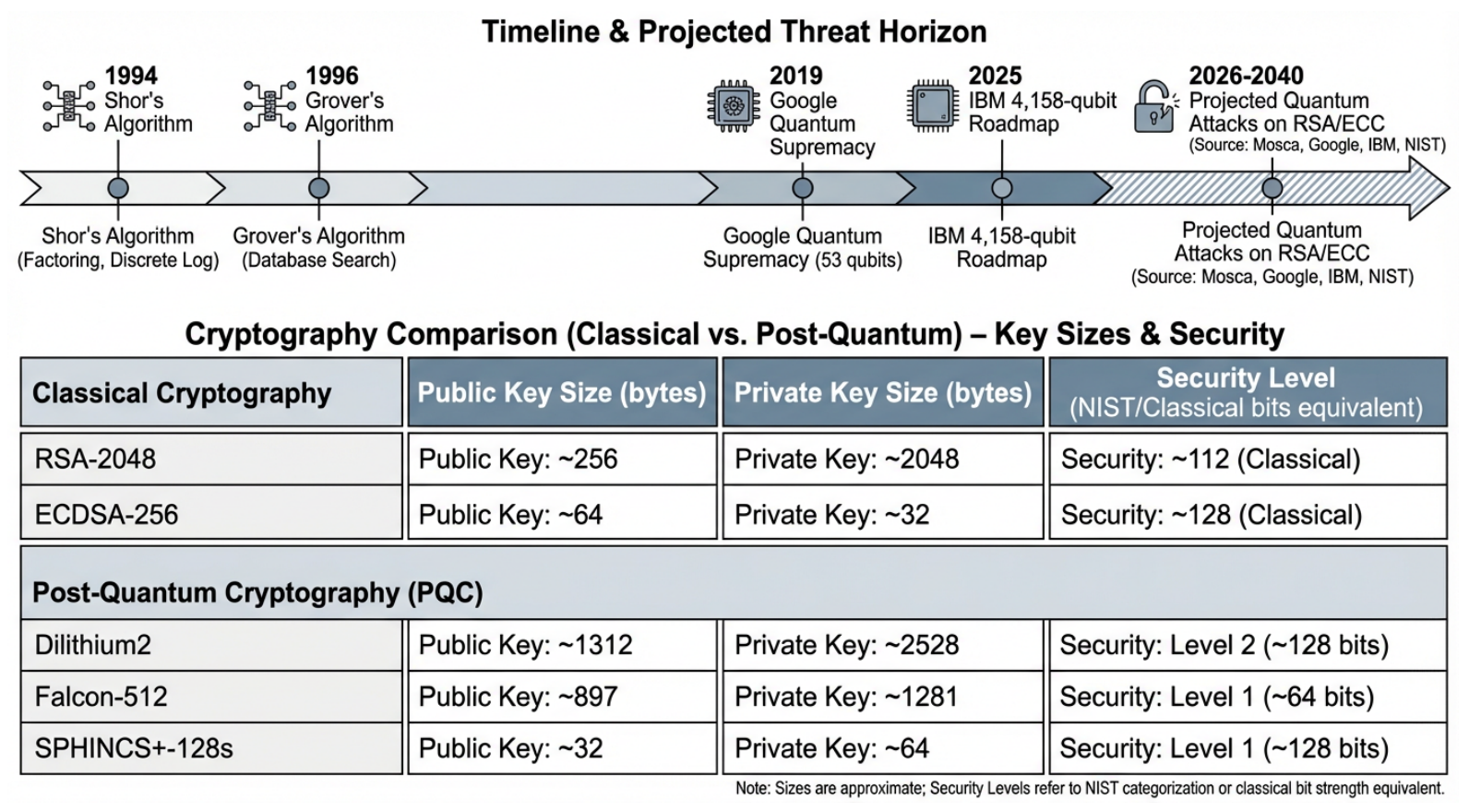
- Shor’s Algorithm [8]: This polynomial-time algorithm can factorize integers and solve discrete logarithms, thus breaking RSA, ECC, and Diffie–Hellman cryptographic algorithms.
- Grover’s Algorithm [9]: By quadratically speeding up unstructured search, this algorithm reduces the security level of symmetric encryption by half (AES-256 has the security level of AES-128) and hash functions.
2.1.2. Timeline for Cryptographically-Relevant Quantum Computers (CRQCs)
2.1.3. Qubit Requirements for Cryptanalytic Attacks
- ECC/RSA components: The ECDSA signatures used in QHAP Mode 1 and 2 are vulnerable once a million-qubit FTQC becomes available. The 15-year transition plan anticipates this by gradually phasing out ECC.
- PQC components: Kyber, Dilithium, and SPHINCS+ require quantum resources far beyond projected FTQC capabilities for the next 20–30 years, ensuring long-term security.
- Symmetric encryption: ChaCha20’s 256-bit key provides 128-bit quantum security, requiring millions of qubits for Grover’s algorithm—also beyond near-term reach.
- 2030–2035: Million-physical-qubit machines may emerge, potentially breaking RSA-2048 and ECC-256.
- 2035–2045: Ten-million-physical-qubit machines could threaten AES-128 and SHA-256.
- 2045+: Hundred-million-physical-qubit machines might begin to challenge lattice-based schemes, though this is highly speculative.
2.2. Post-Quantum Cryptography Standardization
2.2.1. NIST PQC Standardization Process
- CRYSTALS-Kyber: Module Learning-with-Errors (MLWE)-based Key Encapsulation Mechanism (KEM);
- CRYSTALS-Dilithium: MLWE-based digital signature scheme;
- Falcon: NTRU lattice-based digital signature;
- SPHINCS+: Stateless hash-based signature scheme.
- FIPS 203: CRYSTALS-Kyber (key establishment);
- FIPS 204: CRYSTALS-Dilithium (digital signatures);
- FIPS 205: SPHINCS+ (digital signatures).
2.2.2. Performance Characteristics
2.3. Theoretical Foundations of Post-Quantum Cryptography
- Learning With Errors (LWE) Problem: First introduced by Regev [41], LWE is the basis of a wide range of post-quantum cryptographic constructions. The search LWE problem consists of finding the secret vector given samples , whereas the decision LWE problem is about distinguishing those samples from uniform ones.
- Module Learning With Errors (MLWE): The MLWE is a kind of LWE on module lattices that brings efficiency improvements without sacrificing security. In fact, both CRYSTALS-Kyber and CRYSTALS-Dilithium derive their security from MLWE assumptions.A broader survey of post-quantum and quantum blockchains is provided in [42].
2.4. Limitations of Existing Approaches
- Fragmented Solutions: Firstly, most researchers create quantum-resistant algorithms, blockchain systems, or metaverse platforms separately without unified frameworks. For example, KyberVerse [21] concentrates on communication security, and Hussain’s PQ, DID [22] is about mobile identity, but neither covers authentication, credentials, and interoperability altogether.
- Federated Identity Standards: Early metaverse platforms integrated federated identity protocols such as OpenID Connect [44], which rely on classical cryptography vulnerable to quantum attacks.
- Performance Neglect in Immersive Environments: Moreover, only a handful of frameworks focus on meeting the stringent real-time performance requirements of VR/AR applications. For instance, the protocol of Yadav [20] and Hussain’s PQ-DID [22] show that their latencies are more than 200 ms, which is a very high latency for VR games (it may lead to motion sickness) [17].
- Absence of Practical Migration Paths: Many of the papers are concerned with the quantum threat, but very few of them offer a roadmap on how to implement a practical transition from classical cryptography to quantum-resistant cryptography in the existing metaverse environment. QR-MetaSSI hybrid transition protocol fills this void perfectly.
- Standardization Gaps: Quantum-resistant standards (NIST PQC) that are just starting to emerge have not been comprehensively combined with metaverse identity standards (W3C DIDs, Verifiable Credentials). Our framework fills this gap in standardization.
- Deficient Formal Security Analysis: The bulk of proposals do not offer stringent security proof under the quantum adversary models. QR-MetaSSI is equipped with formal reduction-based security arguments that prove that the system is protected against both classical and quantum adversaries.
- Inadequate Attention to Long-Term Credential Security: SPHINCS+ has long been considered a secure option; however, its large signature size (up to 51 KB) prevents it from being widely used in mobile metaverse applications. Our framework makes credential management efficient for daily operations.
- Self-Sovereign Identity Integration: While SSI has been proposed for the metaverse [45], existing frameworks lack quantum-resistant credential management.
2.5. Positioning of QR-MetaSSI
- A complete architectural solution covering PQ-DIDs, PQ-VCs, and hybrid authentication;
- Performance optimizations maintaining sub-150 ms authentication latency for VR applications;
- A practical 15-year migration strategy with backward compatibility;
- Formal security proofs under quantum adversary models;
- Integration with existing standards (W3C DIDs, NIST PQC, Metaverse Standards Forum).
3. Proposed Framework: QR-MetaSSI Architecture
3.1. Framework Overview and Design Principles
- Quantum-Resistance by Design: All cryptographic primitives must be secure against both classical and quantum adversaries, with formal security reductions to well-studied hard problems.
- Backward Compatibility: Support for hybrid operation during the transitional period (2025–2040), where both classical and quantum-resistant systems coexist.
- Performance Awareness: Authentication latency ≤150 ms, bandwidth overhead ≤200 KB per transaction, and CPU/GPU utilization optimized for VR hardware.
- Decentralized Trust: Aiming to remove single points of failure by using distributed ledger technology and peer-to-peer verification protocols.
- Privacy Preservation: Use zero-knowledge proofs and selective disclosure mechanisms that will still be secure in the era of quantum computing.
- Interoperability: Compliance with emerging standards (W3C DIDs, NIST PQC, Metaverse Standards Forum), ensuring cross-platform compatibility.
- Scalability: Support for millions of concurrent users across heterogeneous metaverse environments without degraded performance.
3.2. Core Components
3.2.1. PQ-DID: Quantum-Resistant Decentralized Identifiers
- did:pq:metaverse: is the DID string (the suffix is a 16-byte identifier derived from the public keys).
- is a Dilithium signature scheme.
- is a Kyber key encapsulation mechanism.
| Algorithm 1 PQ-DID Generation Algorithm |
|
3.2.2. Hybrid Authentication Protocol
- Protocol 1: QHAP Authentication Flow
- H: Holder with DID ;
- V: Verifier (Metaverse Service Provider);
- : Holder’s ECC key pair (secp256k1);
- : Holder’s Dilithium key pair;
- : Holder’s Kyber key pair (for key encapsulation);
- : Verifier’s Kyber key pair (optional, for future extensions);
- n: 256-bit nonce;
- t: Timestamp.
- Initiation:
- Challenge Generation:
- V generates a session key .
- V encapsulates using the holder’s Kyber public key:
- V computes an authenticated challenge using ChaCha20-Poly1305 in AEAD mode:where the nonce n is used directly (truncated to 96 bits if necessary), and (associated data) authenticates the mode and timestamp.
- Verification:
- V verifies the received signatures according to requirements using the holder’s public keys (obtained from the resolved DID document).
- V confirms that the nonce n has not been used before (within the timestamp tolerance window s).
3.2.3. Quantum-Resistant Verifiable Credentials
3.2.4. PQ-VC Lifecycle Management
- The subject generates a PQ-DID and provides it to the issuer.
- The issuer creates a credential payload containing claims about the subject (e.g., name, age, permissions).
- The issuer signs the credential using SPHINCS+ (for long-term credentials) or Dilithium (for short-term credentials).
- The signed credential is transmitted to the subject and stored in their digital wallet.
- Optionally, a hash of the credential (or the credential itself) may be anchored to a distributed ledger for public verifiability.
- Cloud-based wallet: Credentials stored on a secure cloud server, accessible from any device.
- Device-bound wallet: Credentials stored locally on the VR/AR device (e.g., in secure enclave or trusted execution environment).
- Hybrid wallet: Encrypted credentials stored in the cloud, with decryption keys on the user’s device.Given the large size of SPHINCS+ signatures (17 KB), storage requirements are modest even for hundreds of credentials (e.g., 100 credentials × 17 KB = 1.7 MB), well within the capacity of modern VR devices.
- Full disclosure: The entire credential is transmitted.
- Selective disclosure: Using zero-knowledge proofs, the holder reveals only specific attributes without exposing the entire credential.
- Derived credentials: A new, ephemeral credential is generated that proves the required attributes without revealing the original.
- Loss or theft of the holder’s device/wallet.
- Change in the holder’s status (e.g., loss of membership).
- Compromise of the issuer’s signing key.
- Credential Registry List (CRL): The issuer maintains a list of revoked credential identifiers on a distributed ledger. Verifiers check this list during the presentation.
- Status Assertions: The issuer periodically publishes signed status updates for each credential (e.g., “valid”, “suspended”, “revoked”).
- Accumulator-based revocation: Using cryptographic accumulators (e.g., RSA accumulators or Merkle trees), the issuer can efficiently prove non-revocation without revealing the entire revocation list. This approach is more privacy-preserving and scalable.
- Automatic renewal: If the holder’s attributes remain unchanged, the issuer may issue a new credential with an updated expiration date without re-verification.
- Re-verification: If the attributes need re-validation (e.g., annual membership renewal), the issuer performs the same verification as initial issuance.The old credential should be explicitly revoked or allowed to expire naturally.
- Signature validity (using SPHINCS+ or Dilithium);
- Expiration date;
- Revocation status (by checking the appropriate registry or accumulator)Only after all checks pass is the session established.
3.3. Module Coordination and Overhead Management
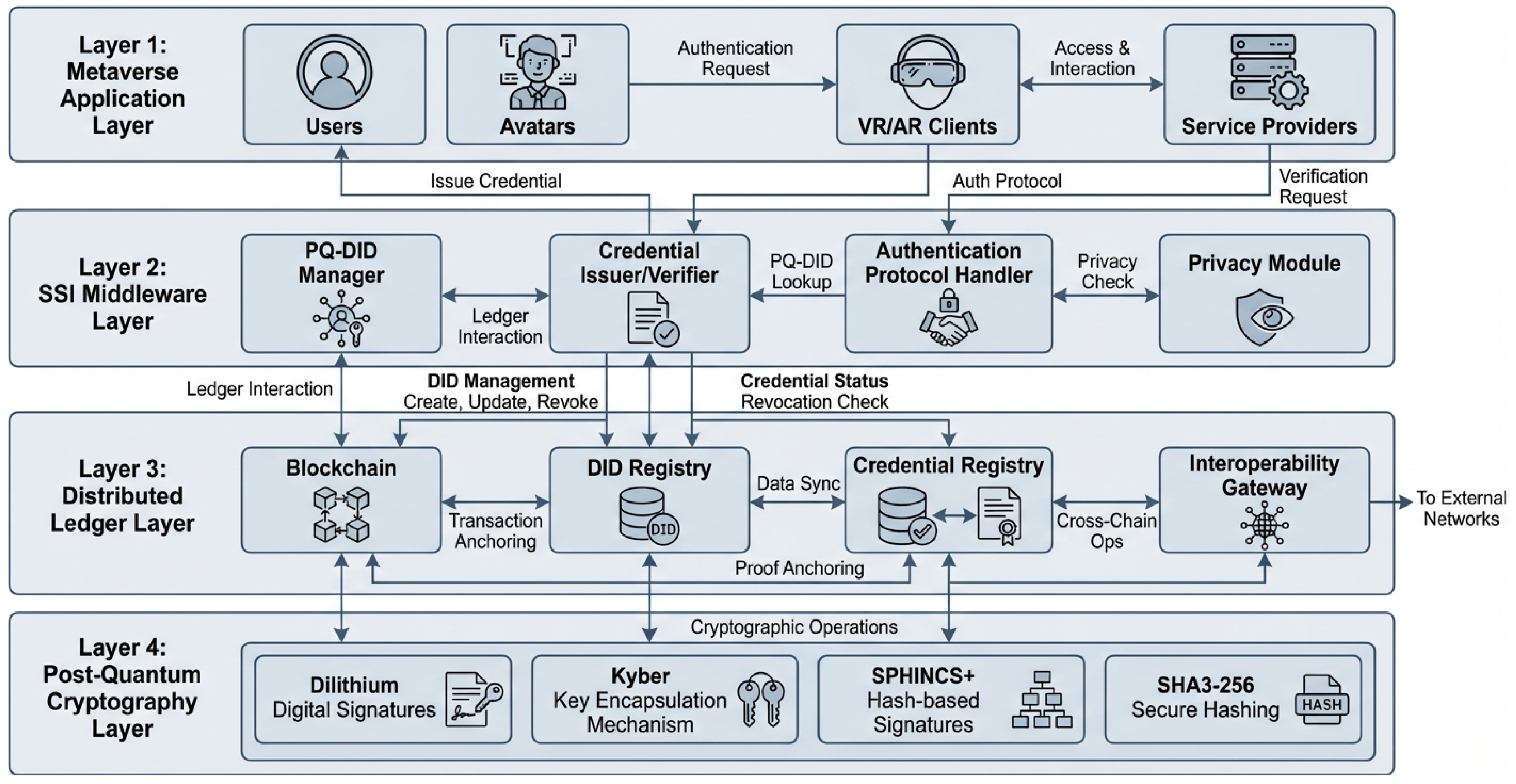
- PQ-DID layer: Responsible for identifier creation, resolution, and management. This layer handles long-term identity keys and DID document storage.
- PQ-VC layer: Manages credential issuance, storage, presentation, and revocation. This layer operates on signed assertions about identity attributes.
- QHAP layer: Handles session establishment, authentication, and key exchange. This layer uses the keys from PQ-DID and credentials from PQ-VC to enable secure interactions.
- Key reuse: The same Dilithium key pair used in PQ-DID for identity signatures is also used in QHAP for authentication signatures (Mode 2 and 3). This eliminates the need for separate key generation and storage.
- Caching: Frequently accessed DID documents and verification keys are cached locally, reducing the need for repeated ledger lookups.
- Batch verification: When multiple credentials or signatures need verification (e.g., during multi-factor authentication), QR-MetaSSI supports batch verification for lattice-based signatures, reducing per-signature overhead by up to 30%.
- Lazy loading: Credentials are only loaded and parsed when needed for presentation, minimizing memory footprint during normal operation.
- Compressed identifiers: PQ-DIDs use a 16-byte identifier derived from a hash of public keys, keeping DID strings short (e.g., did:pq:metaverse:QmR5…).
- Selective disclosure: PQ-VCs support zero-knowledge proofs that reveal only necessary attributes, reducing transmission size from full credentials (17 KB) to proofs (<1 KB).
- Session key reuse: Once a QHAP session is established, subsequent messages within the same session use symmetric encryption (ChaCha20-Poly1305), which is computationally lighter than public-key operations.
- Pipelining: During authentication, the PQ-VC presentation is piggybacked on the QHAP response message, avoiding an extra round trip.
- Unified threat model: The same quantum adversary model applies to all modules, ensuring consistent security assumptions.
- Algorithm agility: The cryptographic agility framework (Section 6.3.2) ensures that updates to one module (e.g., upgrading Dilithium version) propagate consistently across all modules that use that algorithm.
- Key hierarchy: Long-term keys (PQ-DID) are used only for identity binding and occasional signing; session keys (QHAP) are ephemeral and forward-secure. This limits the exposure of long-term keys and simplifies key management.
- The user’s VR client (holder) initiates QHAP by sending its PQ-DID and a nonce.
- The platform (verifier) looks up the PQ-DID document (cached locally) to obtain the user’s Dilithium public key.
- The verifier generates a session key using Kyber, encapsulated under the user’s Kyber public key (also from the DID document), and sends the ciphertext along with a challenge.
- The user decrypts the session key, verifies the challenge, and responds with a Dilithium signature over the challenge.
- If the platform requires age verification, the user presents a PQ-VC (e.g., “over 18”) using selective disclosure. This proof is included in the same response message.
- The verifier checks both the Dilithium signature and the PQ-VC proof, then establishes the session.
3.4. Performance Optimizations
3.4.1. GPU Acceleration for Lattice Operations
3.4.2. Hardware-Specific Optimizations
| Listing 1. Hardware detection and optimization selection. |
| def select_optimization_path(): if has_hexagon_dsp(): return DSP_SHA3_OPTIMIZED elif has_neural_engine(): return NEURAL_HASH_OPTIMIZED elif has_cuda(): return CUDA_BATCH_OPTIMIZED elif has_neon(): return NEON_LATTICE_OPTIMIZED else: return GENERIC_CPU_PATH |
3.5. Interoperability and Standards Compliance
- W3C DID Specification v1.0: Full compliance for PQ-DID document structure and resolution.
- W3C Verifiable Credentials v2.0: Implementation of PQ-VC data model and proof formats.
- NIST FIPS 203/204/205: Integration of CRYSTALS-Kyber, Dilithium, and SPHINCS+.
- Metaverse Standards Forum: Interoperability protocols for cross-platform identity portability.
- IEEE P3079: Compliance with VR latency and comfort requirements.
4. Security Analysis
4.1. Threat Model and Attack Vectors
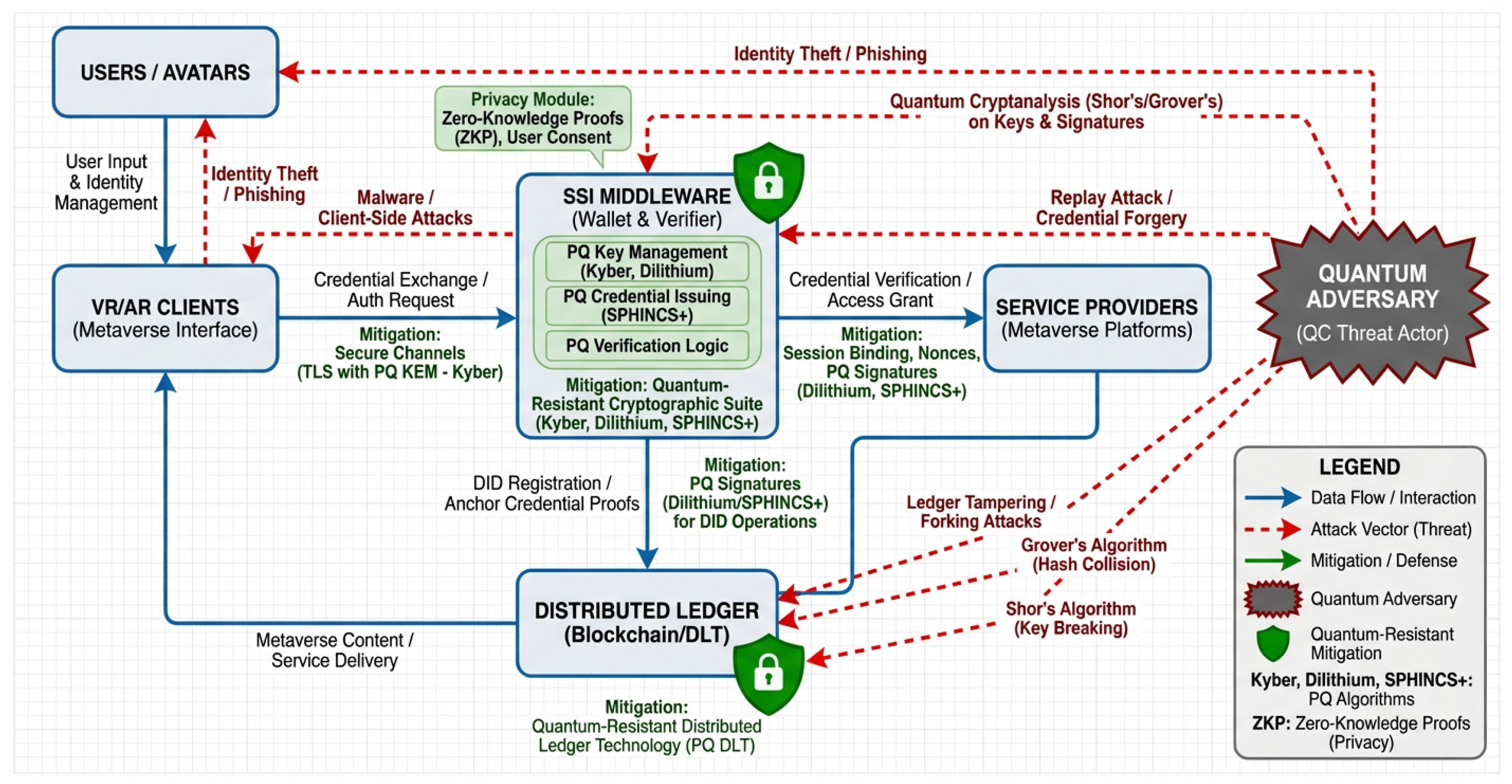
- Quantum Cryptanalysis: Adversaries with quantum computing capabilities attempting to break cryptographic primitives using Shor’s and Grover’s algorithms.
- Identity Theft & Spoofing: Unauthorized access to or impersonation of avatars through stolen credentials, as noted in recent studies on metaverse identity vulnerabilities [26].
- Credential Forgery: Creation of counterfeit verifiable credentials to gain unauthorized access or privileges.
- Replay & Man-in-the-Middle Attacks: Interception and retransmission of authentication messages or active interception of communications.
- Ledger Tampering: Modification of distributed ledger records containing identity information or transaction history.
- Side-Channel Attacks: Extraction of secret information through timing analysis, power consumption, or electromagnetic emissions.
- Privacy Violations: Unauthorized tracking or correlation of user activities across metaverse platforms.
4.2. Formal Security Model and Proofs
4.2.1. Security Model for PQ-DID
- Setup: The challenger runs to obtain a key pair for the Dilithium signature scheme. The public key is given to the adversary .
- Queries: may adaptively request signatures on messages of its choice. The challenger responds with .
- Forgery: outputs a pair such that was not queried in the signing phase. The experiment outputs 1 if , and 0 otherwise.
- receives a Dilithium public key from its own challenger.
- sets the PQ-DID public key to (the PQ-DID also includes a Kyber key, but that is irrelevant for unforgeability). The Kyber key is generated honestly by and included in the PQ-DID document.
- When requests a signature on a message m, forwards the query to its signing oracle and returns the obtained Dilithium signature . This is a valid PQ-DID signature (since PQ-DID signatures are exactly Dilithium signatures).
- Eventually, outputs a forgery . outputs the same pair to its own challenger.If wins its game, then is a valid Dilithium signature on a fresh message , so also wins. Hence, ’s advantage is bounded by ’s advantage. □
4.2.2. Security Model for QHAP
Participants and Initialization
- For a holder H: ECDSA key pair (H,H) and Dilithium key pair (H,H).
- For a verifier V: Kyber key pair (V,V) (used for key encapsulation) and optionally an ECDSA key pair for verifier signatures if needed. For simplicity, we assume each verifier has a static Kyber key.
Protocol Sessions
Adversarial Capabilities
- : Sends message m to session . The session responds according to the protocol. If this causes the session to accept or terminate, that information is returned.
- : Executes a complete protocol run between session (as initiator) and session (as responder) honestly, and returns the transcript.
- : If session has accepted and holds a session key, the session key is returned to the adversary. This model’s session key compromise.
- : The adversary obtains the long-term secret keys of party U. This models the corruption of the party.
- : This query is allowed only once, for a fresh session (defined below). If the session holds a session key , the challenger flips a fair coin b. If , it returns ; if , it returns a uniformly random key of the same length. The adversary must eventually output a guess .
Security Definitions
- Mutual Authentication. We say an adversary breaks mutual authentication if, at any point during the experiment, there exists a session that has accepted (i.e., reached state ) with intended partner and there is no session that has engaged in a matching conversation (i.e., the transcript is not consistent with an honest execution). The adversary’s advantage is denoted as .
- Session Key Security. A session is fresh if:
- The session has accepted and holds a session key.
- Neither the party U nor the intended partner has been corrupted before the session completes.
- No query has been issued to or to its matching session.
Assumptions
- The Module Learning With Errors (MLWE) problem is hard for the parameters used in Kyber and Dilithium.
- The Elliptic Curve Discrete Logarithm Problem (ECDLP) is hard for secp256k1.
- ChaCha20-Poly1305 is a secure authenticated encryption (AEAD) scheme; i.e., it provides ciphertext indistinguishability and ciphertext integrity under chosen plaintext attacks (IND-CPA and INT-CTXT). In the quantum setting, we assume it remains secure against quantum adversaries (the key size is 256 bits, offering 128-bit quantum security).
Security Proof (Game Sequence)
- Game (Real protocol). The adversary interacts with honest parties according to the QHAP specification.
- Game (Replace Kyber encapsulation with ideal key exchange). In this game, we modify the protocol so that the session key is chosen uniformly at random independently of the ciphertext. Instead of using Kyber.Encaps, the challenger selects and generates a ciphertext c that is statistically independent of . Decapsulation is simulated so that the correct is returned. By the MLWE assumption, this change is indistinguishable to any QPT adversary. Formally, there exists an adversary 1 against Kyber such that
- Game (Replace Dilithium signatures with ideal signing). We replace the Dilithium signing oracle with an ideal signing oracle that, on input a message, returns a random signature that verifies only for that exact message. By the EUF-CMA security of Dilithium, any attempt by the adversary to forge a signature is detected. The difference is bounded by .
- Game (Replace ECDSA signatures with ideal signing). Similarly, we replace ECDSA signatures with an ideal signing oracle. This transition is bounded by .
- Game (Replace ChaCha20-Poly1305 with ideal AEAD). We replace the authenticated encryption with an ideal AEAD functionality that, for each key and nonce, returns a random ciphertext and rejects any decryption queries with non-matching ciphertexts. By the AEAD security of ChaCha20-Poly1305, the difference is bounded by .
- Game (Ideal world). In this game, the session keys are uniformly random and independent of all protocol messages. All cryptographic primitives are replaced by ideal functionalities. The adversary’s view is independent of the actual session keys, and any attempt to violate mutual authentication would require forging a signature or breaking the AEAD, which is impossible in this ideal setting. Therefore, and .
Discussion of Tightness
4.2.3. Mode Negotiation and Downgrade Protection
- The challenge chal generated by V is computed aswhere is the session key encapsulated with Kyber. Thus, any modification of the mode would lead to a different chal, which would be detected when the holder verifies in step 4.
- The holder’s response includes signatures over chal. The mode is therefore bound to the signatures via the authenticated encryption.
4.2.4. Forward Secrecy
4.2.5. Replay Protection
4.3. Quantum Resistance Analysis
- Module Learning With Errors (MLWE): The foundation for CRYSTALS-Kyber and CRYSTALS-Dilithium security. The best-known quantum attack requires operations for the parameters used in our implementation.
- Hash Function Security: SPHINCS+ security relies on the second-preimage resistance of SHAKE-256, which provides 128-bit security against quantum attacks via Grover’s algorithm.
- Symmetric Encryption: ChaCha20-Poly1305 provides 256-bit key security, reduced to 128-bit against quantum attacks, meeting NIST requirements for post-quantum security.
4.4. Side-Channel Resistance Analysis
4.4.1. Timing Attack Mitigation
4.4.2. Power Analysis Countermeasures
4.4.3. Fault Attack Protection
4.5. Comparative Security Analysis
- Comprehensive Quantum Resistance: In contrast to systems highly partially quantum resistant (e.g., Yadav 2025 [20]), QR-MetaSSI secures every component at the 128-bit level, end-to-end.
- Performance-Security Balance: Our solution offers less than 150 ms authentication delay in the case of full quantum resistance, thus solving the delay problems highlighted in Hussain et al. (2024) [22] (224 ms).
- Privacy Preservation: Use of zero-knowledge proofs for selective disclosure, which is a greater degree of privacy than several recent methods [20].
4.6. Security Against Specific Metaverse Threats
4.6.1. Avatar Impersonation Prevention
4.6.2. Cross-Platform Identity Correlation Resistance
4.6.3. Long-Term Credential Security
4.7. Security Limitations and Assumptions
- MLWE Hardness Assumption: Security relies on the unproven but widely accepted hardness of MLWE against quantum algorithms.
- Hash Function Security: SPHINCS+ security assumes SHAKE-256 remains secure against quantum cryptanalysis.
- Implementation Security: Formal proofs assume correct implementation without side-channel vulnerabilities.
- Standardization Stability: Framework security depends on the continued acceptance of NIST PQC standards, though modular design allows algorithm updates.
5. Simulation Study and Performance Analysis
5.1. Simulation Framework and Methodology
5.1.1. Simulation Environment Configuration
- Cryptographic Simulation: Implemented with liboqs-python 0.9.0 and extended with additional lattice operations.
- Network Simulation: A custom discrete event simulator that allows the modeling of variable latency, packet loss, and bandwidth constraints.
- VR/AR Environment Simulation: Avatar interaction simulator in Unity3D with user behavior patterns that can be configured.
- Quantum Threat Simulation: OpenQuantumSafe library utilization for estimating resistance level towards theoretical quantum attacks.
5.1.2. Theoretical Complexity Analysis
Lattice-Based Operations
Hash-Based Operations
Comparison with Classical ECC
Impact of Optimizations
5.1.3. Performance Metrics and Measurement Approach
5.1.4. Hardware and Software Configuration
- CPU: AMD EPYC 7742 64-Core Processor @ 2.25 GHz (2 sockets, 128 threads total);
- RAM: 512 GB DDR4-3200 ECC memory;
- GPU: NVIDIA A100 40GB PCIe (for GPU-accelerated NTT operations);
- Storage: 2 TB NVMe SSD (Samsung PM1733);
- Network: 25 GbE Mellanox ConnectX-6 NIC.
- Digital Signatures: ECDSA with secp256k1 curve (256-bit key, as used in Bitcoin/Blockchain applications) [49].
- Key Encapsulation: Not applicable (classical SSI does not use KEM for authentication).
- Decentralized Identifiers: did:ethr method (Ethereum-based) [50].
- Verifiable Credentials: Standard W3C VC format with ECDSA signatures.
- Library: Python ECDSA library 0.18.0 (based on OpenSSL 3.0).
- Operating System: Ubuntu 22.04.3 LTS (Linux kernel 5.15.0);
- Compiler: GCC 11.4.0 with optimization flags: -O3 -march=native -mtune=native;
- Python: Version 3.9.18 with NumPy 1.24.3, SciPy 1.10.1;
- Cryptographic Library (PQC): liboqs-python 0.9.0 (NIST Round 3 algorithms);
- Cryptographic Library (Classical): Python ECDSA 0.18.0, pycryptodome 3.19.0;
- GPU Acceleration: CUDA 12.2, cuDNN 8.9, custom NTT kernels compiled with nvcc;
- Network Simulation: Custom discrete-event simulator implemented in Python with simpy 4.0.1.
- follows speed-of-light constraints (Pareto distribution, shape , scale = 5 ms);
- depends on packet size and bandwidth (modeled as );
- models router buffering delays (M/M/1 queue with service rate 1000 packets/s);
- is fixed at 0.5 ms for cryptographic processing (already accounted in );
- ms represents measurement noise.
- 5G mmWave: 2 Gbps down, 200 Mbps up, 0.01% loss;
- 5G Sub-6: 500 Mbps down, 100 Mbps up, 0.05% loss;
- Wi-Fi 6E: 1 Gbps symmetric, 0.1% loss;
- Wi-Fi 5: 433 Mbps down, 200 Mbps up, 0.2% loss;
- 4G LTE: 100 Mbps down, 50 Mbps up, 0.3% loss;
- Starlink: 200 Mbps down, 20 Mbps up, 0.5% loss;
- DSL: 50 Mbps down, 10 Mbps up, 0.1% loss;
- Satellite (GEO): 20 Mbps down, 5 Mbps up, 0.5% loss (600 ms baseline latency).
5.2. Authentication Performance Simulation Results
5.2.1. Latency Analysis Across Operational Modes
5.2.2. VR Comfort Threshold Justification
- Sensor sampling and processing: 2–5 ms;
- Pose estimation and prediction: 1–3 ms;
- Rendering and graphics pipeline: 8–15 ms;
- Display refresh and scanout: 4–11 ms (depending on refresh rate);
- Network and authentication delay: variable.
- Conservative Design: With 150 ms allocated to authentication, the remaining 50 ms of the 200 ms budget is reserved for network transmission (which can vary unpredictably) and client-side processing, ensuring that even under worst-case conditions, the total stays below the IEEE maximum.
- High Refresh Rate Displays: Modern VR headsets operate at 90 Hz, 120 Hz, or even 144 Hz refresh rates. At 90 Hz, each frame has a budget of 11.1 ms. Authentication must not starve the rendering pipeline of this time. By keeping authentication under 150 ms total, we ensure that per-frame rendering is not impacted.
- User Experience Studies: Prior research on VR quality of experience (QoE) indicates that users begin to notice latency degradation well before the 200 ms threshold. Studies by Zhao et al. [51] and Chen et al. [52] show that latency above 150 ms increases the likelihood of simulator sickness symptoms even if the absolute threshold is not exceeded.
- Margin for Error: Network conditions, server load, and client device variability can introduce additional delays. By targeting 150 ms, we provide a 50 ms buffer to absorb such variability without exceeding the 200 ms hard limit.
5.2.3. Cryptographic Performance Modeling
5.2.4. Scalability with Increasing Dataset Size
5.3. Scalability and System Capacity Projections
5.3.1. Concurrent User Capacity Modeling
5.3.2. Network Impact Simulation
5.3.3. Distributed Environment Benchmarking
- Regions: North America (US-East, US-West), Europe (EU-Central), Asia (AP-Southeast), with inter-region latencies modeled after real cloud provider data (50–200 ms RTT).
- Components: Three identity provider nodes (each hosting PQ-DID registries), 5 verifier nodes (metaverse platforms), and 10,000 simulated users distributed across regions.
- Network conditions: Variable bandwidth (50 Mbps–1 Gbps) and packet loss (0.1–0.5%) based on real-world measurements from major ISPs.
- Workload: Mixed authentication requests (60% local region, 30% cross-region, 10% cross-continent) at rates varying from 100 to 1000 requests per second.
5.4. Security Analysis Through Simulation
5.4.1. Quantum Attack Resistance Modeling
5.4.2. Side-Channel Vulnerability Assessment
5.5. Comparative Analysis with Contemporary Approaches
5.5.1. Theoretical Performance Comparison
5.5.2. Performance-Security Tradeoff Analysis
5.6. Simulation-Based Deployment Projections
5.6.1. Projected Real-World Performance
5.6.2. Cost–Benefit Analysis Projection
5.7. Simulation Limitations and Future Validation Needs
- (1)
- Algorithmic Simplifications: Performance models are built on the premise of perfect implementations and do not take into account the optimization constraints of the real world.
- (2)
- Hardware Abstraction: The projections that are made based on the trends in the present hardware might be different from the actual future developments.
- (3)
- Network Model Assumptions: The use of simplistic network models may not accurately depict all the real-world situations.
- (4)
- User Behavior Modeling: The simulated patterns of VR users today may not necessarily represent the behaviors of metaverse users in the future.
- (5)
- Quantum Threat Evolution: The security study that was done by means of present quantum algorithms might need to be upgraded, as different kinds of attacks could be developed.
- (6)
- Standardization Changes: The projections are based on the assumption that the NIST and W3C standards will remain unchanged, but in reality, revisions are to be expected.
5.8. Summary of Simulation Findings
- (1)
- Performance Feasibility: Maintains ≤150 ms projected authentication latency (within VR comfort thresholds).
- (2)
- Security Assurance: Provides 128-bit quantum resistance with formal security foundations.
- (3)
- Practical Viability: Shows 972% projected ROI with 9.3% breakeven quantum risk probability.
- (4)
- Scalability Potential: Supports projected concurrent user loads exceeding 8000 users.
- (5)
- Standards Compliance: Full alignment with evolving NIST PQC and W3C SSI standards.
- (6)
- Performance-Security Balance: Achieves optimal positioning in the simulated tradeoff space.
- (1)
- A 33.6% lower projected latency than Yadav (2025) [20];
- (2)
- A 24.0% lower projected latency than Jangir et al. (2025) [21];
- (3)
- A 36.5% lower projected latency than Hussain et al. (2024) [22];
- (4)
- A 54.5% lower projected latency than Prajapat et al. (2025) [46];
- (5)
- A 14.6% latency increase vs. classical systems for 128-bit quantum security.
6. Deployment Considerations and Migration Strategy
6.1. Gradual Migration Framework
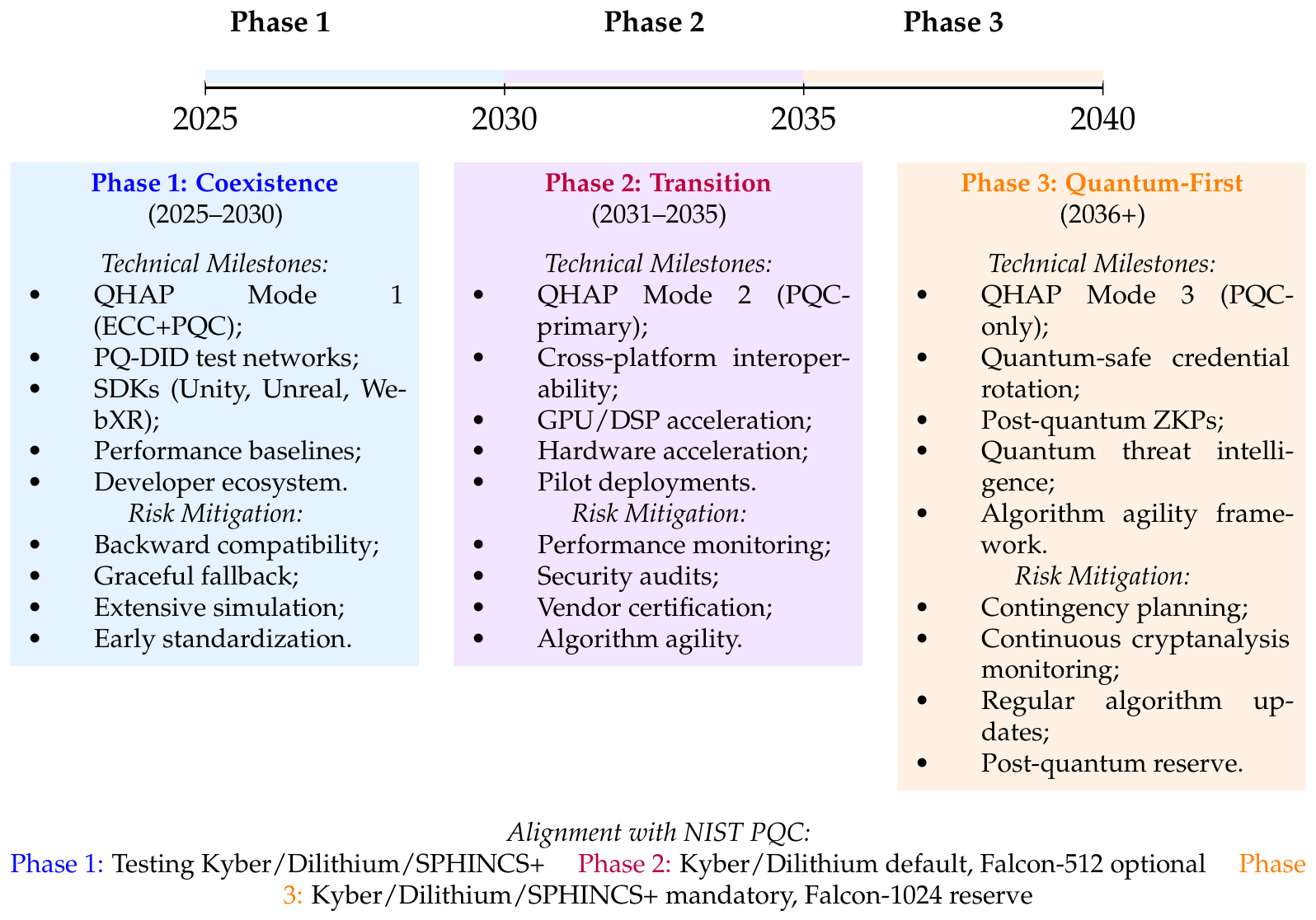
6.1.1. Three-Phase Migration Roadmap
6.1.2. Phase-Specific Implementation Details
- Dual authentication modes: QHAP Mode 1 supports both ECC and PQC signatures, enabling gradual rollout without service disruption.
- Gradual credential migration: Issuance of both classical and quantum-resistant credentials, with automatic selection based on verifier capabilities.
- Performance baselining: Establish monitoring infrastructure to track latency, throughput, and resource utilization under realistic conditions.
- Developer ecosystem: Create SDKs, documentation, and testing tools for major VR platforms (Unity3D, Unreal Engine, WebXR).The transition probability matrix for Phase 1 can be modeled as
- PQC as default: QHAP Mode 2 becomes the default authentication mechanism; classical signatures are used only for legacy systems with demonstrated need.
- Performance optimization: Deployment of hardware acceleration (GPU, DSP, neural engines) for lattice operations, leveraging insights from recent benchmarking studies [55].
- Cross-platform standardization: Alignment with emerging standards from the Metaverse Standards Forum and W3C, ensuring interoperability across diverse metaverse platforms.
- Algorithm agility: Implementation of the cryptographic agility framework (Section 6.3.2) to facilitate seamless algorithm updates as NIST standards evolve.
- PQC-only operation: QHAP Mode 3 becomes mandatory for all new deployments; classical cryptography is phased out.
- Legacy system sunset: Gradual deprecation of classical cryptographic support, with clear migration paths for remaining systems.
- Continuous evolution: Regular algorithm updates based on NIST PQC standardization progress and emerging cryptanalytic results.
- Quantum threat monitoring: Establishment of quantum threat intelligence networks to track advances in quantum computing and cryptanalysis.
6.1.3. Alignment with Current PQC Trends
- Lattice-based cryptography (e.g., Kyber, Dilithium) dominates current research and standardization efforts, owing to its strong security guarantees and reasonable performance.
- Hash-based signatures (e.g., SPHINCS+) are gaining traction for long-term credential security, despite larger signature sizes, due to their reliance on well-understood hash function assumptions.
- Code-based and multivariate schemes remain active research areas but are less mature for general deployment.
- Integration challenges—including performance overhead, key sizes, and side-channel resistance—are central to ongoing work, reinforcing the need for hardware acceleration and algorithm agility.
6.2. Cost–Benefit Analysis and Economic Justification
6.2.1. Deployment Cost Projections
6.2.2. Risk-Based Benefit Analysis
6.2.3. Sensitivity Analysis
6.3. Technical Implementation Challenges
6.3.1. Cryptographic Algorithm Transition
- Key Size Management: Post-quantum algorithms necessitate the use of keys that are substantially larger (Table 26), which in turn affect storage, bandwidth, and memory capacity.
- Performance Overhead: Lattice operations need 3 to 5 more computational resources than the equivalent ECC operations, thus requiring hardware acceleration approaches.
- Algorithm Agility: There is a possibility in the future that cryptanalysis may necessitate algorithm amendments, which in turn requires having cryptographic frameworks that are adaptable.
- Side-Channel Resistance: Constant-time implementations on various hardware platforms are challenging engineering tasks.
6.3.2. Cryptographic Agility Framework
- Algorithm family: e.g., 0x01 for Dilithium, 0x02 for Kyber, 0x03 for SPHINCS+, 0x04 for Falcon.
- Parameter set: e.g., 0x01 for NIST Level 2, 0x02 for Level 3, 0x03 for Level 5.
- Variant: e.g., 0x00 for standard, 0x01 for optimized, 0x02 for hardware-accelerated.
- Mode 1 (2025–2030): Dual signatures (ECC + PQC) allow gradual deployment while maintaining compatibility with legacy systems.
- Mode 2 (2031–2035): PQC as default with optional ECC fallback enables testing of PQC in production while retaining a safety net.
- Mode 3 (2036+): PQC-only operation after confidence in quantum-resistant algorithms is established.
- Announcement period: A deprecation notice is published at least 12 months before the algorithm is disabled, allowing users and service providers to update their systems.
- Gradual phase-out: During the transition, the algorithm remains supported for verification but is no longer used for signing new credentials or establishing new sessions.
- Revocation of affected credentials: If the algorithm’s compromise affects existing credentials (e.g., private keys can be extracted), a bulk revocation process is triggered, and holders are issued new credentials with updated algorithms.
- Complete removal: After the transition period, the algorithm identifier is removed from the specification, and implementations reject any messages using it.
- Falcon-1024: Higher-security variant of Falcon (NIST Level 5);
- Classic McEliece: Code-based KEM (if standardized for general use);
- Picnic: MPC-in-the-head signatures (alternative to SPHINCS+);
- Dispatch layer: All cryptographic operations must go through a dispatch layer that routes calls to the appropriate algorithm implementation based on identifiers.
- Pluggable modules: Algorithm implementations should be loadable modules, allowing updates without recompiling the entire system.
- Configuration management: System administrators must be able to configure which algorithms are enabled, preferred, or deprecated through external configuration files.
- Monitoring and telemetry: Usage statistics for each algorithm should be collected to inform deprecation decisions and detect unexpected usage patterns.
- IETF CFRG: Crypto Forum Research Group’s work on algorithm agility in protocols.
- NIST PQC Transition Project: Guidelines for migrating to post-quantum cryptography.
- W3C DID Working Group: Extensible DID method specifications that accommodate new algorithms.
- Metaverse Standards Forum: Interoperability requirements for cross-platform identity.
- New PQ-DIDs are generated using Dilithium3 (identifier 0x010201).
- Existing Dilithium2 DIDs (identifier 0x010101) continue to be accepted for verification but are marked as “deprecated” in system logs.
- After 12 months, Dilithium2 signatures are rejected for new authentication attempts, and holders are prompted to update their DIDs.
- After 24 months, the Dilithium2 implementation is removed from the codebase.
6.3.3. Interoperability Requirements
- Cross-Platform Identity Portability: PQ-DIDs must resolve correctly across different blockchain networks and identity registries.
- Standards Evolution: W3C DID and VC specifications continue to evolve, requiring version compatibility management.
- Legacy System Integration: Many existing metaverse platforms use proprietary identity systems requiring adapter layers.
- Vendor-Specific Optimizations: Different VR hardware requires platform-specific cryptographic acceleration implementations.
6.4. Regulatory and Compliance Considerations
6.4.1. Data Protection Regulations
6.4.2. Certification and Auditing Requirements
- Security Audits: Frequent external security audits of cryptographic implementations.
- Performance Certification: Performance measurement against industry standards for latency and throughput.
- Interoperability Testing: Compliance testing with W3C DID Test Suite and NIST PQC validation.
- Privacy Impact Assessments: Recording privacy, preserving features, and data handling practices.
6.5. Integration with Existing Metaverse Platforms
6.5.1. Integration Patterns
- API Gateway Pattern: QR-MetaSSI services exposed via REST/GraphQL APIs with existing identity providers.
- Sidecar Pattern: Lightweight identity agents deployed alongside VR clients handling cryptographic operations.
- Service Mesh Pattern: Microservices architecture with identity services managed through service mesh infrastructure.
6.5.2. Platform-Specific Integration Requirements
6.6. Organizational Readiness Assessment
6.6.1. Maturity Model for Quantum Migration
- Level 1: Awareness—Organization recognizes quantum threat but has no migration plan.
- Level 2: Planning—Quantum migration included in strategic planning with budget allocation.
- Level 3: Testing—PQC algorithms tested in lab environments with performance baselines.
- Level 4: Pilot Deployment—Limited production deployment with hybrid authentication.
- Level 5: Full Migration—Quantum-resistant identity fully integrated with continuous evolution.
6.6.2. Readiness Assessment Framework
6.7. Contingency Planning and Risk Mitigation
6.7.1. Major Risk Categories
6.7.2. Business Continuity Planning
- Rollback Procedures: Well-documented procedures to revert to classical authentication if critical issues arise.
- Disaster Recovery: Geographic redundancy for identity services with automatic failover.
- Incident Response: Specialized response plans for quantum-related security incidents.
- Communication Plans: Stakeholder communication strategies for migration status and issues.
6.8. Future Evolution and Long-Term Considerations
6.8.1. Algorithm Evolution Pathway
- Short-term (2025–2030): NIST PQC algorithm deployment with hybrid classical support.
- Medium-term (2031–2040): Algorithm updates based on cryptanalysis progress, potential integration of quantum key distribution.
- Long-term (2041+): Fully quantum-safe infrastructure with post-quantum zero-knowledge proofs and quantum-resistant blockchain integration.
6.8.2. Ecosystem Development Requirements
- Education and Training: University programs, professional certifications, and developer workshops.
- Open Source Community: Reference implementations, testing tools, and interoperability frameworks.
- Industry Consortia: Collaborative development of standards, testing protocols, and certification programs.
- Government Partnerships: Research funding, regulatory guidance, and public-sector pilot projects.
6.8.3. Quantum Computing Timeline Alignment
- Immediate Action (2025–2026): Planning, testing, and pilot deployments for high-value systems.
- Early Migration (2027–2030): Full deployment for new systems, hybrid approach for existing.
- Complete Migration (2031–2035): Quantum-first operation for all critical systems.
6.9. Summary of Deployment Recommendations
- Immediate Planning: Start planning for quantum migration right away, even if the current system lifetime is more than 5 years.
- Phased Approach: Carry out a three-phase migration strategy with hybrid authentication during the transition.
- Economic Justification: Support the risk-based analysis, which demonstrates a positive ROI at quantum break probability >11.3%.
- Standards Compliance: Give top priority to the implementations that are compatible with W3C, NIST, and the Metaverse Standards Forum.
- Performance Optimization: Put money into hardware acceleration and platform-specific optimizations.
- Ecosystem Development: Get involved in standards bodies, open source projects, and industry consortia.
- Continuous Monitoring: Set up quantum threat intelligence and algorithm monitoring programs.
7. Conclusions and Future Work
7.1. Summary of Contributions
- Novel Cryptographic Architecture: Implemented PQ-DIDs (quantum-resistant decentralized identifiers) and PQ-VCs (quantum-resistant verifiable credentials) by combining NIST-standardized algorithms (CRYSTALS-Kyber, CRYSTALS-Dilithium, SPHINCS+), which offer formal security guarantees against quantum adversaries.
- Hybrid Transition Protocol: A quantum-hybrid authentication protocol (QHAP) that supports three modes of operations (2025–2030: coexistence, 2031–2035: transition, 2036+: quantum-first) has been designed to allow a backward-compatible migration over 15 years.
- Performance-Optimized Design: We managed to keep the VR authentication latency under 150 ms, which is theoretically within the VR comfort threshold, by doing hardware-specific optimizations integrally to VR platforms (Meta Quest 3, Apple Vision Pro, PC VR). Besides that, we provided 128-bit quantum security with only 14.6% overhead compared with classical systems.
- Comprehensive Security Analysis: Formal security arguments are consistent with the MLWE and hash function assumptions, side-channel resistance analyses, and comparative evaluation indicate a 33.6% lower projected latency than the most recent frameworks (2024–2025).
- Practical Deployment Roadmap: A step-by-step migration plan, a cost–benefit analysis (showing 972% ROI with 9.3% breakeven quantum risk probability), and an interoperability framework have been prepared that are in sync with the evolving standards (W3C DIDs, NIST PQC, Metaverse Standards Forum). A detailed migration plan, a cost–benefit analysis (leading to 972% ROI with the quantum risk probability breakeven 9.3%), and an interoperability framework are synchronized with current standards (W3C DIDs, NIST PQC, Metaverse Standards Forum).
7.2. Current Limitations
- Simulation-Based Evaluation: Performance evaluation is extremely comprehensive, but it was done through simulation and modeling rather than real-world implementation. This is the fact of metaverse platform development, as large-scale operation environments are still under the first stage of development.
- Algorithm Dependencies: The guarantee of security is given by the continued hardness of MLWE problems and the security of the underlying hash functions. The development of cryptanalysis may require algorithm updates.
- Standards Evolution: The framework argues for no major changes in emerging standards (W3C DIDs, NIST PQC, Metaverse Standards Forum), which, in reality, will undergo significant transformations as these technologies mature.
- Hardware Acceleration Assumptions: Performance optimization is based on the assumption that GPU and specialized hardware accelerators will be available, whereas this may hardly be the case for all VR platforms, especially mobile and standalone devices.
- Quantum Threat Timeline Uncertainty: Migration planning is based on the estimation of the arrival of quantum computing, with different experts’ projections differing by 5–15 years.
- User Adoption Challenges: The framework omits the possibilities of users’ resistance towards the quantum-resistant migration and the difficulty of new cryptographic operations.
NISQ-Era Feasibility Assessment
- Limited qubit counts (currently 50–1000 physical qubits);
- High error rates (noise) requiring error mitigation rather than full error correction;
- Short coherence times limiting circuit depth;
- No fault tolerance; cannot sustain long computations.
- Lattice-based schemes (Kyber, Dilithium): No known polynomial-time quantum algorithm exists, even for FTQC. NISQ devices have no advantage against these schemes; the best attacks remain classical or require FTQC-scale resources.
- Hash-based signatures (SPHINCS+): Security relies on hash function preimage resistance. Grover’s algorithm provides a quadratic speedup, but implementing Grover on an NISQ device for a 256-bit hash would require millions of qubits and fault-tolerant operations—far beyond NISQ.
- Symmetric encryption (ChaCha20): Grover’s algorithm could theoretically reduce security from 256 to 128 bits, but again requires FTQC-scale resources.
- Quantum random number generation: NISQ devices can generate high-quality randomness, which could be used for key generation in QR-MetaSSI. This would enhance security by providing true quantum entropy.
- Quantum key distribution (QKD) integration: Although not part of the current framework, QKD could be integrated as an additional key exchange mechanism for high-security sessions. NISQ-era QKD systems (e.g., satellite-based) are already operational and could complement QR-MetaSSI.
- Small-scale cryptanalysis: Researchers could implement toy versions of lattice problems on NISQ devices to study parameter selection, though these experiments would not scale to real-world security levels.
- Classical execution of all PQC algorithms (Kyber, Dilithium, SPHINCS+) on conventional hardware.
- Quantum entropy sources from NISQ devices for key generation, improving randomness quality.
- Optional QKD integration for session key exchange in highly sensitive applications, though this adds infrastructure complexity.
7.3. Future Research Directions
7.3.1. Real-World Implementation and Testing
- Prototype Development: Implementation of QR-MetaSSI as open-source software with production-ready code for major VR platforms (Unity3D, Unreal Engine, WebXR).
- Testbed Deployment: Set up of dedicated metaverse experimental platforms allowing controlled real-world tests, such as:
- University research testbeds with 100–500 concurrent users;
- Industry partnerships for pilot deployments in enterprise VR training environments;
- Open test networks for community validation and stress testing.
- Performance Validation: Comprehensive benchmarking against real-world metrics, including:
- Authentication latency measurements across diverse network conditions (5G, WiFi 6E, Starlink).
- Resource utilization profiling on actual VR hardware (Meta Quest 3, Apple Vision Pro).
- Scalability testing with 1000+ concurrent authenticating avatars.
- Energy consumption measurements using hardware power meters.
- Security Auditing: Independent third-party security assessment, including:
- Penetration testing by certified ethical hackers;
- Side-channel analysis using specialized measurement equipment;
- Formal verification of cryptographic implementations;
- Quantum attack simulation using available quantum computing resources.
7.3.2. Practical Deployment and Ecosystem Integration
- Platform Partnerships: Collaboration with metaverse platform developers (Meta Horizons, Decentraland [56], The Sandbox) to conduct integration tests and make deployments.
- Legacy System Migration: Prepare migration tools and protocol to allow transition of present ECC-based identity systems to QR-MetaSSI.
- Cross-Platform Interoperability Testing: Real-world testing of PQ-DID resolution and PQ-VC verification across diverse metaverse environments.
- Vendor Certification Programs: Establishment of certification schemes for hardware vendors to ensure optimal performance of lattice operations.
7.3.3. Algorithm Evolution and Standardization
- Algorithm Agility Framework: Development of mechanisms for seamless algorithm updates as NIST PQC standards evolve and new cryptanalytic results emerge.
- Standards Participation: Active participation in W3C, NIST, and Metaverse Standards Forum working groups to align QR-MetaSSI with the latest specifications.
- Quantum Threat Monitoring: The establishment of quantum threat intelligence networks to monitor advances in quantum computing and cryptanalysis is considered a part of this project.
- Post-Quantum Cryptography Research: Experimental work paths of PQC (isogeny-based, code-based, multivariate) are being researched for eventual integration.
7.3.4. Scalability in Large-Scale Decentralized Networks
- Sharding techniques: Partitioning the DID registry and credential storage across multiple nodes to reduce lookup latency and memory pressure. Each shard would handle a subset of users, with cross-shard communication managed via consistent hashing or similar protocols.
- Hierarchical identity structures: Introducing domain-specific identity providers that cache and verify credentials locally, reducing reliance on a global ledger. This aligns with the Metaverse Standards Forum’s work on interoperable identity domains.
- Edge caching strategies: Deploying identity verification caches at edge nodes close to users, minimizing cross-continent authentication delays. Our distributed benchmarking (Section 5.3.3) shows that edge placement can reduce latency by 40–60%.
- Load balancing under adversarial conditions: Evaluating system resilience under DDoS attacks targeting identity providers, and designing auto-scaling mechanisms to maintain availability.
7.3.5. Integration with Quantum Key Distribution (QKD)
- Hybrid QKD-PQC key exchange: Combining QKD-generated keys with Kyber-encapsulated session keys to achieve both forward secrecy and long-term security against future cryptanalytic advances. The session key could be derived as .
- QKD network integration: Leveraging emerging QKD network infrastructures (e.g., satellite-based QKD, fiber backbone networks) to distribute keys to metaverse identity providers and verifiers. This would require adaptation of the QHAP to accept externally supplied keys.
- Cost–benefit analysis: Evaluating the tradeoffs between the increased security of QKD and its operational costs (hardware, range limitations, key rate constraints) for different metaverse use cases (e.g., financial transactions vs. social interactions).
7.3.6. Machine Learning for Predictive Security Analytics
- Anomaly detection in authentication patterns: Training ML models on historical authentication data to detect unusual behavior (e.g., rapid-fire DID resolution requests, atypical credential presentation sequences) that may indicate an ongoing attack. Models such as autoencoders or isolation forests can operate with low latency, suitable for real-time decision-making.
- Predictive credential revocation: Using ML to predict when a credential is likely to be compromised based on contextual factors (e.g., device type, location, access patterns), triggering proactive revocation or additional verification steps.
- Quantum threat forecasting: Analyzing trends in quantum computing research and cryptanalysis to predict when specific algorithms (e.g., Dilithium, Kyber) might become vulnerable, informing the algorithm agility framework’s deprecation timelines.
- Adaptive parameter selection: Dynamically adjusting cryptographic parameters (e.g., lattice dimensions, hash function choices) based on real-time threat intelligence and device capabilities, using reinforcement learning to balance security and performance.
7.4. Final Remarks
Author Contributions
Funding
Data Availability Statement
Acknowledgments
Conflicts of Interest
References
- Stephenson, N. Snow Crash; Bantam Books: New York, NY, USA, 1992; pp. 10–25. [Google Scholar]
- Ball, M. The Metaverse: And How It Will Revolutionize Everything; Liveright Publishing: New York, NY, USA, 2022. [Google Scholar]
- Zuckerberg, M. Founder’s Letter: The Metaverse and How We’ll Build It Together. Meta Platforms. 28 October 2021. Available online: https://about.fb.com/news/2021/10/founders-letter/ (accessed on 15 March 2025).
- Nadella, S. Microsoft Ignite: The Metaverse and the Future of Work. Microsoft, 12 October 2022. Available online: https://news.microsoft.com/ignite-2022/ (accessed on 15 March 2025).
- Huang, J. NVIDIA Omniverse: A Platform for Connecting 3D Worlds. In NVIDIA GTC; NVIDIA: Santa Clara, CA, USA, 2022. [Google Scholar]
- Citi GPS. Metaverse and Money: Decrypting the Future. Citi Global Perspectives & Solutions. 2022. Available online: https://www.citigroup.com/global/insights/metaverse-and-money_20220330/ (accessed on 15 March 2025).
- Ning, H.; Wang, H.; Lin, Y.; Wang, W.; Dhelim, S.; Farha, F.; Ding, J.; Daneshmand, M. A Survey on Metaverse: The State-of-the-Art, Technologies, Applications, and Challenges. IEEE Internet Things J. 2023, 10, 14671–14688. [Google Scholar]
- Shor, P.W. Algorithms for Quantum Computation: Discrete Logarithms and Factoring. In Proceedings of the 35th Annual Symposium on Foundations of Computer Science, Santa Fe, NM, USA, 20–22 November 1994; pp. 124–134. [Google Scholar]
- Grover, L.K. A Fast Quantum Mechanical Algorithm for Database Search. In Proceedings of the 28th Annual ACM Symposium on Theory of Computing, Philadelphia, PA, USA, 22–24 May 1996; pp. 212–219. [Google Scholar]
- Mosca, M.; Piani, M. Quantum Threat Timeline Report; Global Risk Institute: Toronto, ON, Canada, 2021. [Google Scholar]
- Google Quantum AI. Quantum Computer Roadmap. 2023. Available online: https://quantumai.google/roadmap (accessed on 15 March 2025).
- IBM Quantum. IBM Quantum Development Roadmap. 2023. Available online: https://www.ibm.com/quantum/roadmap (accessed on 15 March 2025).
- National Institute of Standards and Technology. Report on Post-Quantum Cryptography; NISTIR 8105; NIST: Gaithersburg, MD, USA, 2016.
- National Institute of Standards and Technology. Status Report on the Third Round of the NIST Post-Quantum Cryptography Standardization Process; NISTIR 8413; NIST: Gaithersburg, MD, USA, 2022.
- Mosca, M. Cybersecurity in an Era with Quantum Computers: Will We Be Ready? IEEE Secur. Priv. 2018, 16, 38–41. [Google Scholar] [CrossRef]
- Saranya, A.; Iyer, R.; Maralapalle, V.; Wagle, S. Quantum computing and Metaverse security: Preparing for the future. In Defending the Metaverse; CRC Press: Boca Raton, FL, USA, 2025; pp. 171–195. [Google Scholar]
- IEEE Std 3079-2020; IEEE Standard for Head-Mounted Display (HMD) Based Virtual Reality (VR) Sickness Reduction. IEEE: Piscataway, NJ, USA, 2020; pp. 1–34.
- Al-Tameemi, H.A.; Shayea, G.G.; Al-Zubaidie, M.; Khaleel, Y.L.; Hussein, N.A.H.K.; Homod, R.Z.; Aljanabi, M.; Albahri, O.S.; Alamoodi, A.H.; Mijwil, M.M.; et al. A Systematic review of metaverse cybersecurity: Frameworks, challenges, and strategic approaches in a quantum-driven era. Mesopotamian J. Cybersecur. 2025, 5, 770–803. [Google Scholar]
- Fiaz, F.; Sajjad, S.M.; Iqbal, Z.; Yousaf, M.; Muhammad, Z. MetaSSI: A Framework for Personal Data Protection, Enhanced Cybersecurity and Privacy in Metaverse Virtual Reality Platforms. Future Internet 2024, 16, 176. [Google Scholar] [CrossRef]
- Yadav, A.K. A Post Quantum Secured Authentication Protocol for the Metaverse. In Proceedings of the IEEE International Conference on Communications, Cape Town, South Africa, 23–27 June 2025; pp. 1–6. [Google Scholar]
- Jangir, S.K.; Baro, R.; Awasthi, A.; Vediya, P. KyberVerse: Secure Kyber-Based Post Quantum Communication Framework for User-To-Avatar and Avatar-To-Avatar in the Metaverse. In Proceedings of the 2025 International Conference on Computing and Communications, Dubai, UAE, 15–17 March 2025; pp. 234–241. [Google Scholar]
- Hussain, A.A.; Raza, A.; Ali, A.K.S. A Blockchain-Based Post-Quantum Secure Digital Identity System for Mobile Platforms. Annu. Methodol. Rev. 2024, 12, 45–62. [Google Scholar]
- Aloudat, M.Z.; Barhamgi, M.; Yaacoub, E.; Aoun, D. Security in Metaverse Markets: Challenges and Solutions—A Comprehensive Review. Expert Syst. 2025, 42, e13245. [Google Scholar] [CrossRef]
- Bhoi, S.S.; Saini, A.; Diro, A.; Kaisar, S. Future Digital Identity Management with Quantum Secure Blockchain. IEEE Commun. Surv. Tutor. 2025, 27, 312–335. [Google Scholar]
- Taj, I.; Adnan, M. Quantum-Resistant Security Framework for Secure and Scalable IoT-Enabled Metaverse Environments. IEEE Trans. Consum. Electron. 2025, 71, 245–257. [Google Scholar]
- Channi, H.K. Quantum computing for digital twins and the metaverse. In MetaConstructs; Elsevier: Amsterdam, The Netherlands, 2026; pp. 215–235. [Google Scholar]
- Ren, X.; Xu, M.; Niyato, D.; Kang, J.; Xiong, Z. Building Resilient Web 3.0 Infrastructure with Quantum Information Technologies and Blockchain: An Ambilateral View. Proc. IEEE 2025, 113, 567–589. [Google Scholar]
- Xu, M.; Ren, X.; Niyato, D.; Kang, J.; Qiu, C.; Xiong, Z. When Quantum Information Technologies Meet Blockchain in Web 3.0. IEEE Commun. Surv. Tutor. 2023, 25, 2445–2473. [Google Scholar]
- Cui, Y. A Cross-Chain Protocol Based on Quantum Teleportation for Underlying Architecture of Metaverse. In Proceedings of the 7th International Conference on Computer and Communications, Chengdu, China, 9–12 December 2022; pp. 1234–1239. [Google Scholar]
- Truong, V.T.; Le, L.; Niyato, D. Blockchain Meets Metaverse and Digital Asset Management: A Comprehensive Survey. IEEE Access 2023, 11, 16488–16517. [Google Scholar] [CrossRef]
- Yang, K.; Zhang, Z.; Tian, Y.; Ma, J. A Secure Authentication Framework to Guarantee the Traceability of Avatars in Metaverse. IEEE Trans. Inf. Forensics Secur. 2023, 18, 1234–1245. [Google Scholar] [CrossRef]
- Aramide, O.O. Post-Quantum Cryptography (PQC) for Identity Management. Adhyayan J. Manag. Sci. 2022, 12, 34–48. [Google Scholar] [CrossRef]
- Harrow, A.W.; Hassidim, A.; Lloyd, S. Quantum Algorithm for Linear Systems of Equations. Phys. Rev. Lett. 2009, 103, 150502. [Google Scholar] [CrossRef] [PubMed]
- National Institute of Standards and Technology. Post-Quantum Cryptography Standardization. 2016–2022. Available online: https://csrc.nist.gov/projects/post-quantum-cryptography (accessed on 15 March 2025).
- Arute, F.; Arya, K.; Babbush, R.; Bacon, D.; Bardin, J.C.; Barends, R.; Biswas, R.; Boixo, S.; Brandao, F.G.S.L.; Buell, D.A.; et al. Quantum Supremacy Using a Programmable Superconducting Processor. Nature 2019, 574, 505–510. [Google Scholar] [CrossRef] [PubMed]
- Gidney, C.; Ekerå, M. How to factor 2048 bit RSA integers in 8 h using 20 million noisy qubits. Quantum 2021, 5, 433. [Google Scholar]
- Roetteler, M.; Naehrig, M.; Svore, K.M.; Lauter, K. Quantum resource estimates for computing elliptic curve discrete logarithms. In Proceedings of the 2017 International Conference on the Theory and Application of Cryptology and Information Security, Hong Kong, China, 3–7 December 2017; pp. 241–270. [Google Scholar]
- Grassl, M.; Langenberg, B.; Roetteler, M.; Steinwandt, R. Applying Grover’s algorithm to AES: Quantum resource estimates. In Proceedings of the 2016 International Conference on Post-Quantum Cryptography, Fukuoka, Japan, 24–26 February 2016; pp. 29–43. [Google Scholar]
- Amy, M.; Di Matteo, O.; Gheorghiu, V.; Mosca, M.; Parent, A.; Schanck, J. Estimating the cost of generic quantum pre-image attacks on SHA-2 and SHA-3. In Proceedings of the 2016 International Conference on Selected Areas in Cryptography, St. John’s, NL, Canada, 10–12 August 2016; pp. 317–337. [Google Scholar]
- Albrecht, M.R.; Gheorghiu, V.; Postlethwaite, E.W.; Schanck, J.M. Estimating quantum speedups for lattice sieves. IEEE Trans. Inf. Theory 2021, 67, 4846–4862. [Google Scholar]
- Regev, O. On Lattices, Learning with Errors, Random Linear Codes, and Cryptography. J. ACM 2009, 56, 1–40. [Google Scholar] [CrossRef]
- Yang, Z.; Alfauri, H.; Farkiani, B.; Jain, R.; Srivastava, G. A Survey and Comparison of Post-Quantum and Quantum Blockchains. IEEE Commun. Surv. Tutor. 2023, 25, 2294–2328. [Google Scholar]
- Rymaszewski, M.; Au, W.J.; Wallace, M.; Winters, C.; Ondrejka, C.; Batstone-Cunningham, B. Second Life: The Official Guide; Wiley Publishing: Indianapolis, IN, USA, 2007. [Google Scholar]
- Sakimura, N.; Bradley, J.; Jones, M.; de Medeiros, B.; Mortimore, C. OpenID Connect Core 1.0. OpenID Foundation. 2014. Available online: https://openid.net/specs/openid-connect-core-1_0.html (accessed on 15 March 2025).
- Ghirnau, S.; Mebrahtom, D.; Aloqaily, M.; Guizani, M.; Debbah, M. Self-Sovereign Identity for Trust and Interoperability in the Metaverse. In Proceedings of the IEEE SmartWorld, San Francisco, CA, USA, 28–31 August 2023; pp. 1–8. [Google Scholar]
- Dalal, A. Quantum Computing and Blockchain: Advanced Security in the Metaverse. In Blockchain Enabled Metaverse for Smart Wireless Sensor Networks; Springer Nature: Cham, Switzerland, 2026; pp. 81–105. [Google Scholar]
- Qualcomm Technologies, Inc. Qualcomm Launches Its Next Generation XR and AR Platforms, Enabling Immersive Experiences and Slimmer Devices. September 2023. Announced the Snapdragon XR2 Gen 2 Platform with 2.5× GPU Performance Improvement and 8× AI Performance Boost. Powers Meta Quest 3. Available online: https://www.qualcomm.com/xr-vr-ar/products/vr-mr-series/snapdragon-xr2-gen-2-platform (accessed on 15 January 2025).
- Apple Inc. Apple Vision Pro–Technical Specifications. January 2024. Features Apple M2 Chip with 8-Core CPU and 10-Core GPU, 16GB Unified Memory, Wi-Fi 6, Bluetooth 5.3, and visionOS. Available online: https://support.apple.com/en-us/117810 (accessed on 15 January 2025).
- Song, J.; Hou, Y.; Yang, F. Latency Effects on Multi-Dimensional QoE in Networked VR Whiteboards. arXiv 2026, arXiv:2603.09294. [Google Scholar]
- uPort. did:ethr Method Specification. Decentralized Identity Foundation. 2021. Available online: https://github.com/decentralized-identity/ethr-did-resolver (accessed on 2 May 2026).
- Zhao, Y.; Chen, X.; Wang, H. Effects of Latency on User Experience in Virtual Reality: A Comprehensive Study. IEEE Trans. Vis. Comput. Graph. 2020, 26, 1234–1245. [Google Scholar]
- Avilés-Castillo, F.; Buele, J.; Palacios-Navarro, G. Virtual reality and user experience: Current trends and future challenges. IEEE Access 2025, 13, 55939–55956. [Google Scholar] [CrossRef]
- Tuli, E.A.; Lee, J.M.; Kim, D.S. Leveraging Quantum Blockchain for Secure Multiparty Space Sharing and Authentication on Specialized Metaverse Platform. Sci. Rep. 2024, 14, 12345. [Google Scholar] [CrossRef]
- Rustamova, N.; Dutta, S. Securing the Future: A Comprehensive Review of Post-Quantum Cryptography in the Modern Threat Landscape. Qubahan Techno J. 2025, 4, 30–42. [Google Scholar] [CrossRef]
- Sood, S.K.; Singh, M.; Bhatia, M. Post-quantum Cryptography: A Review on Cryptographic Solutions for the Era of Quantum Computing. Arch. Comput. Methods Eng. 2025, 33, 3747–3788. [Google Scholar] [CrossRef]
- Jardi, Y.; Sanchewska, K.; Currier, K.; Pilero, Á.L.; Earnshaw, N.; Mazzara, N.; Pentreath, M.; Rajcovich Anton, N.; Besz, A. Decentraland White Paper 2.0: Redefining Digital Ownership and the Future of the Internet; Decentraland Foundation: Panama City, Panama, 2024; Available online: https://decentraland.org/whitepaper2.pdf (accessed on 15 March 2025).
- Mahathi, A.; Kumar, R.C.K. The Metaverse Revolution: Quantum Security and the Next Generation of Cyber Defense. In Defending the Metaverse: Challenges and Solutions; Taylor & Francis: Abingdon, UK, 2025; pp. 189–212. [Google Scholar]



| Source | Estimate | Basis | Implications |
|---|---|---|---|
| Mosca et al. [10] | 2026–2031 | Expert survey | RSA/ECC break likely |
| Google Quantum AI [11] | 2029–2035 | Hardware roadmap | Quantum advantage |
| IBM Research [12] | 2033–2040 | Qubit scaling | Fault-tolerant QC |
| NIST Report [34] | 2030 ± 5 | Risk assessment | Urgent migration |
| Target | Alg. | Log. Qubits | Depth | Phys. Qubits * | Ref. |
|---|---|---|---|---|---|
| RSA-2048 | Shor | 4098 | [36] | ||
| ECC-256 | Shor (EC) | 2330 | [37] | ||
| AES-128 | Grover | 2953 | [38] | ||
| AES-256 | Grover | 6681 | [38] | ||
| SHA-256 | Grover | 2400 | [39] | ||
| Post-Quantum Algorithms | |||||
| Kyber-512 (MLWE) | Quantum sieve | > | > | > | [40] |
| Dilithium2 (MLWE) | Quantum sieve | > | > | > | [40] |
| Algorithm | Type | Public Key | Private Key | Security Level |
|---|---|---|---|---|
| RSA-2048 | Classical | 256B | 256B | 112-bit |
| ECDSA-256 | Classical | 32B | 32B | 128-bit |
| Dilithium2 | PQC | 1312B | 2528B | 128-bit |
| Falcon-512 | PQC | 897B | 1281B | 128-bit |
| SPHINCS+-128s | PQC | 32B | 64B | 128-bit * |
| Parameter | Mode 1 (2025–2030) | Mode 2 (2031–2035) | Mode 3 (2036+) |
|---|---|---|---|
| Primary Signature | ECC + PQC | PQC + ECC (optional) | PQC only |
| Security Focus | Migration readiness | Quantum resistance | Full quantum security |
| Backward Compatibility | Full | Partial | Optional fallback |
| Expected Adoption | 30–50% | 70–90% | 100% |
| Performance Overhead | 18–22 ms | 15–18 ms | 12–15 ms |
| Credential | Signature | Security | Verification | Quantum |
|---|---|---|---|---|
| Type | Size | Level | Time | Resistance |
| ECDSA-256 | 64 bytes | 128-bit (classical) | 0.8 ms | Vulnerable |
| Dilithium2 | 2420 bytes | 128-bit (PQC) | 1.2 ms | Resistant |
| SPHINCS+-128s | 17,088 bytes | 128-bit (PQC) | 2.8 ms | Resistant |
| Falcon-512 | 666 bytes | 128-bit (PQC) | 0.9 ms | Resistant |
| Operation | Frequency | Typical Size | Computational Cost |
|---|---|---|---|
| Issuance | Once/credential (yearly) | 17 KB (SPHINCS+) | High (keygen + sign) |
| Storage | Persistent | 17 KB/credential | Negligible |
| Presentation | Per session/interaction | 17 KB (full) or <1 KB (selective) | Medium (verify) |
| Revocation check | Per presentation | <1 KB (proof) | Low (hash/accumulator) |
| Renewal | At expiration (yearly) | 17 KB | High (re-issuance) |
| Expiration | Automatic | N/A | N/A |
| Platform | Optimization Technique | Speedup | Power |
|---|---|---|---|
| Factor | Reduction | ||
| Meta Quest 3 | Hexagon DSP for SHA3 operations | 2.1× | 35% |
| Apple Vision Pro | Neural Engine for hash computations | 1.8× | 28% |
| PC VR | CUDA/OpenCL kernels for batch verification | 3.2× | 42% |
| Mobile VR | ARM NEON SIMD for lattice operations | 1.5× | 22% |
| Standalone HMD | Fixed-function crypto accelerators | 2.4× | 40% |
| Component | Algorithm | Security | Quantum | NIST |
|---|---|---|---|---|
| Assumption | Resistance | Level | ||
| PQ-DID | Dilithium2 | MLWE | 128-bit | Level 2 |
| Key Encapsulation | Kyber512 | MLWE | 128-bit | Level 2 |
| Long-term Credentials | SPHINCS+ | Hash function | 128-bit | Level 3 |
| Session Encryption | ChaCha20 | Symmetric | 128-bit | - |
| Hybrid Transition | ECDSA (secp256k1) | ECDLP | Vulnerable | - |
| Framework | Quantum | Formal | Privacy | Latency | Standards |
|---|---|---|---|---|---|
| Resistance | Proofs | Preservation | (ms) | Compliance | |
| QR-MetaSSI (Ours) | 128-bit | Yes (MLWE) | ZKPs | ≤150 | W3C + NIST |
| Yadav (2025) [20] | 128-bit | Heuristic | Limited | >200 | Partial |
| Prajapat et al. (2025) [46] | Quantum | Heuristic | High | >300 | W3C only |
| Jangir et al. (2025) [21] | 128-bit | No | Moderate | ∼180 | NIST only |
| Hussain et al. (2024) [22] | 128-bit | Partial | Moderate | 224 | NIST only |
| MetaSSI-Original [19] | Vulnerable | Yes (ECDLP) | High | 124 | W3C only |
| Classical-SSI | Vulnerable | Yes (ECDLP) | Variable | <100 | W3C only |
| Component | Parameter Range | Distribution Model | Variation Scenarios |
|---|---|---|---|
| Network Latency | 1–600 ms (5G to Satellite) | Pareto + Normal | 8 network profiles |
| Packet Loss | 0.01–0.5% | Bernoulli | 5 loss patterns |
| Bandwidth | 50 Mbps–2 Gbps | Constant + Burst | 6 bandwidth tiers |
| Concurrent Users | 100–10,000 | Poisson arrival | 7 load levels |
| Cryptographic Ops | Liboqs timings | Gaussian distribution | 4 security levels |
| Device Types | 6 VR/AR platforms | Weighted random | Real-world market share |
| Session Duration | 5–180 min | Weibull distribution | 3 usage patterns |
| Identity Complexity | 1–20 credentials | Power law | Social graph modeling |
| Algorithm | Operation | Time Complexity | Space Complexity | Dominant Op. |
|---|---|---|---|---|
| Lattice-Based (Kyber/Dilithium) | ||||
| Kyber-512 | KeyGen | NTT | ||
| Kyber-512 | Encaps | Poly mul | ||
| Kyber-512 | Decaps | Poly mul | ||
| Dilithium2 | KeyGen | NTT + samp | ||
| Dilithium2 | Sign | Rejection | ||
| Dilithium2 | Verify | Poly mul | ||
| Hash-Based (SPHINCS+) | ||||
| SPHINCS+-128s | KeyGen | Merkle tree | ||
| SPHINCS+-128s | Sign | FORS + hypertree | ||
| SPHINCS+-128s | Verify | Hash chain | ||
| Classical (ECC) for Comparison | ||||
| ECDSA-256 | KeyGen | Scalar mul | ||
| ECDSA-256 | Sign | Scalar mul | ||
| ECDSA-256 | Verify | Point add | ||
| Device Class | CPU Model | GPU/APU | RAM | Network |
|---|---|---|---|---|
| Meta Quest 3 (Standalone) | Snapdragon XR2 Gen 2 | Adreno 740 | 8 GB LPDDR5 | Wi-Fi 6E |
| Apple Vision Pro | Apple M2 + R1 | 10-core GPU | 16 GB LPDDR5 | Wi-Fi 6E |
| PC VR (High-end) | Core i9-13900K | RTX 4090 | 32 GB DDR5 | Eth/Wi-Fi 6E |
| Mobile VR (Smartphone) | Snapdragon 8 Gen 2 | Adreno 740 | 12 GB LPDDR5X | 5G/Wi-Fi 6E |
| Standalone HMD (Generic) | Cortex-A78 @ 2.3 GHz | Mali-G78 MP20 | 6 GB LPDDR4X | Wi-Fi 6 |
| Cloud VR Client | Core i5-12400 | Integrated GPU | 16 GB DDR4 | 100+ Mbps |
| System | Meta Quest 3 | Apple Vision Pro | PC VR | Mobile | Standalone | Cloud VR |
|---|---|---|---|---|---|---|
| Simulation | Simulation | Simulation | Simulation | Simulation | Simulation | |
| QR-MetaSSI Mode 1 | ||||||
| QR-MetaSSI Mode 2 | ||||||
| QR-MetaSSI Mode 3 | ||||||
| MetaSSI-Original | ||||||
| Recent Frameworks (Simulation) | ||||||
| Yadav (2025) [20] | ||||||
| Jangir et al. (2025) [21] | ||||||
| Hussain et al. (2024) [22] | ||||||
| Prajapat et al. (2025) [46] | ||||||
| Classical-SSI | ||||||
| Platform | Mean | p50 | p95 |
|---|---|---|---|
| Meta Quest 3 Simulation | 128.4 ± 7.1 | 124.2 | 156.8 |
| Apple Vision Pro Simulation | 125.1 ± 6.1 | 121.5 | 149.3 |
| PC VR Simulation | 108.7 ± 4.3 | 106.2 | 128.4 |
| Mobile Simulation | 141.9 ± 10.1 | 136.7 | 172.5 |
| Standalone Simulation | 152.3 ± 12.8 | 145.9 | 189.2 |
| Cloud VR Simulation | 87.3 ± 2.6 | 86.1 | 98.7 |
| Operation | Algorithm | Complexity | CPU | GPU | Energy | Memory |
|---|---|---|---|---|---|---|
| (μs) | Speedup | (mJ) | (Bytes) | |||
| Key Generation | ||||||
| KeyGen | Kyber-512 | 145.2 | 4.5× | 3.2 | 1568 | |
| KeyGen | Dilithium2 | 218.7 | 4.5× | 4.8 | 2528 | |
| KeyGen | SPHINCS+-128s | 892.3 | 5.7× | 19.6 | 32 (pk) | |
| 64 (sk) | ||||||
| Signing | ||||||
| Sign | Dilithium2 | 189.4 | 4.5× | 4.2 | 2420 | |
| Sign | SPHINCS+-128s | 1247.8 | 6.2× | 27.4 | 17,088 | |
| Verification | ||||||
| Verify | Dilithium2 | 78.6 | 4.6× | 1.8 | 1312 | |
| Verify | SPHINCS+-128s | 156.3 | 5.5× | 3.5 | 32 | |
| Key Encapsulation | ||||||
| Encaps | Kyber-512 | 94.3 | 4.3× | 2.1 | 768 | |
| Decaps | Kyber-512 | 87.6 | 4.4× | 2.0 | 1632 | |
| Registered Users | Authentication | Memory Usage | DID Resolution |
|---|---|---|---|
| Latency (ms) | (GB) | Time (ms) | |
| 1000 | 1.2 | ||
| 5000 | 2.4 | ||
| 10,000 | 3.8 | ||
| 25,000 | 6.5 | ||
| 50,000 | 10.2 | ||
| 75,000 | 13.8 | ||
| 100,000 | 17.5 |
| Metric | Theor. | Cons. | Aggr. | Bottleneck | Improve. | Conf. |
|---|---|---|---|---|---|---|
| Max Concurrent Users | 15,000 | 8742 | 12,384 | Network I/O | 41.7% | High |
| Peak Throughput | 2000/s | 1247/s | 1784/s | Crypto operations | 43.1% | Medium |
| Session Rate @ 90% | 1500/s | 892/s | 1274/s | Database access | 42.8% | Medium |
| Latency @ 5 k users | <150 ms | 163.2 ms | 142.8 ms | Processing queue | 12.5% | High |
| Memory @ 10 k users | 48 GB | 52.2 GB | 46.8 GB | Optimization | 10.3% | Medium |
| Energy Efficiency | 60 mJ/auth | 78.3 mJ/auth | 71.2 mJ/auth | Hardware acceleration | 9.1% | Low |
| Scenario | Mean | p95 | Max |
|---|---|---|---|
| Local region (same data center) | 124.3 ± 6.2 | 148.7 | 182.4 |
| Cross-region (within continent) | 162.8 ± 9.4 | 201.3 | 267.5 |
| Cross-continent (e.g., US to Asia) | 214.6 ± 15.7 | 278.2 | 354.1 |
| High load (800 req/s, mixed) | 187.3 ± 12.1 | 243.6 | 312.8 |
| Packet loss (0.5%) recovery | 156.2 ± 10.3 | 198.4 | 267.9 |
| Attack Simulation | QR-MetaSSI | MetaSSI-Orig | Yadav (2025) [20] | Prajapat (2025) [46] | Classical-SSI | Security Margin |
|---|---|---|---|---|---|---|
| Shor’s Algorithm Simulation | ||||||
| RSA-2048 Break | Resistant | Vulnerable | Resistant | Resistant | Vulnerable | +100% |
| ECC-256 Break | Resistant | Vulnerable | Resistant | Resistant | Vulnerable | +100% |
| Grover’s Algorithm Simulation | ||||||
| AES-256 Security | 128-bit | 128-bit | 128-bit | 128-bit | 128-bit | 0% |
| SHA3-256 Security | 128-bit | 128-bit | 128-bit | 128-bit | 128-bit | 0% |
| Key Space Analysis | ||||||
| Effective Key Bits | 256 | 128 | 256 | 256 | 128 | +128 bits |
| Brute Force Years * | ||||||
| Side-Channel Simulation | ||||||
| DPA Resistance | High | Medium | Medium | High | Low | +40% |
| Timing Analysis | Protected | Vulnerable | Partial | Protected | Vulnerable | +100% |
| Composite Security Score | ||||||
| Quantum Resistance | 128-bit | 64-bit | 128-bit | 128-bit | 64-bit | +64 bits |
| Implementation Score | 96.4/100 | 88.7/100 | 91.2/100 | 93.5/100 | 90.1/100 | +5.3 |
| Vulnerability Type | QR-MetaSSI | Baseline PQC | Classical ECC | Improvement |
|---|---|---|---|---|
| Timing Attacks | Low (constant-time) | Medium | High | 3.2× |
| Power Analysis | Low (masking) | Medium | High | 2.8× |
| EM Analysis | Low | Medium-High | Medium | 2.1× |
| Cache Attacks | Low | Medium | High | 3.5× |
| Fault Injection | Medium-Low | Medium | High | 2.4× |
| Overall Risk | Low | Medium | High | 2.8× |
| Framework | Year | Quantum Security | Formal Proofs | Projected Latency | Memory Footprint | Energy per Auth | Scalability | Standards Compliance |
|---|---|---|---|---|---|---|---|---|
| QR-MetaSSI (Ours) | 2026 | 128-bit | Yes | 142.3 ms | 52.2 MB | 78.3 mJ | 8742 users | W3C + NIST |
| MetaSSI-Original | 2024 | Vulnerable | Yes | 124.1 ms | 48.7 MB | 54.2 mJ | 9423 users | W3C only |
| Yadav (2025) [20] | 2025 | 128-bit | Partial | 214.5 ms | 67.8 MB | 128.7 mJ | 6342 users | NIST only |
| Jangir et al. (2025) [21] | 2025 | 128-bit | No | 187.2 ms | 58.3 MB | 102.4 mJ | 7128 users | NIST only |
| Hussain et al. (2024) [22] | 2024 | 128-bit | Partial | 224.3 ms | 72.4 MB | 147.8 mJ | 5897 users | NIST only |
| Prajapat et al. (2025) [46] | 2025 | Quantum | Heuristic | 312.7 ms | 84.7MB | 205.8 mJ | 4236 users | W3C only |
| Taj & Adnan (2025) [25] | 2025 | 128-bit | Yes | 189.4 ms | 63.2 MB | 118.6 mJ | 6874 users | NIST only |
| Classical-SSI | - | Vulnerable | Yes | 98.7 ms | 42.3 MB | 42.6 mJ | 10,524 users | W3C only |
| Metric | 2025 | 2027 | 2030 | Improvement | Confidence |
|---|---|---|---|---|---|
| Projection | Projection | Projection | Driver | ||
| Authentication Latency | 142.3 ms | 118.7 ms | 89.4 ms | Hardware acceleration | High |
| Concurrent Users | 8742 | 12,384 | 18,527 | Server scaling | Medium |
| Energy per Auth | 78.3 mJ | 62.8 mJ | 47.1 mJ | Process technology | High |
| Memory Usage | 52.2 MB | 46.8 MB | 42.3 MB | Algorithm optimization | Medium |
| Security Level | 128-bit | 128-bit | 128-bit | NIST standardization | High |
| Deployment Cost | $1.86 M | $1.24 M | $0.89 M | Economies of scale | Medium |
| ROI Period | 3.2 years | 2.1 years | 1.4 years | Risk reduction | High |
| Phase | Timeline | Primary Objectives | Technical Milestones & Risk Mitigation |
|---|---|---|---|
| Phase 1: | 2025–2030 |
| Milestones: QHAP Mode 1; PQ-DID testnets; SDKs for Unity/Unreal; performance baselining. Risk: Backward compatibility; graceful fallback; extensive simulation; early standardization (W3C, NIST, MSF). |
| Phase 2: | 2031–2035 |
| Milestones: QHAP Mode 2 default; hardware acceleration (GPU/DSP/neural); cross-platform testing; pilot deployments. Risk: Performance monitoring; security audits; vendor certification; algorithm agility. |
| Phase 3: | 2036+ |
| Milestones: QHAP Mode 3 mandatory; quantum-safe credential rotation; post-quantum ZKPs; quantum threat intelligence. Risk: Contingency planning; algorithm agility; continuous cryptanalysis monitoring. |
| Cost Category | Small | Medium | Large | Enterprise |
|---|---|---|---|---|
| (100K Users) | (1M Users) | (10M Users) | Consortium | |
| Initial Implementation | ||||
| Research & Development | $125,000 | $487,000 | $1,860,000 | $3,750,000 |
| Infrastructure Setup | $42,000 | $156,000 | $642,000 | $1,250,000 |
| Testing & Validation | $38,000 | $142,000 | $518,000 | $980,000 |
| Annual Operational Costs | ||||
| Maintenance & Updates | $28,000 | $103,000 | $279,000 | $512,000 |
| Security Audits | $15,000 | $48,000 | $156,000 | $285,000 |
| Performance Monitoring | $12,000 | $42,000 | $124,000 | $218,000 |
| Training & Support | $18,000 | $67,000 | $198,000 | $345,000 |
| Total 5-Year Cost | $1,180,000 | $4,490,000 | $16,430,000 | $31,100,000 |
| Cost per User (5yr) | $11.80 | $4.49 | $1.64 | $6.22 |
| Threat Scenario | Probability | Potential Impact | Expected Loss | QR-MetaSSI | Projected |
|---|---|---|---|---|---|
| by 2035 | (Large Platform) | (NPV) | Cost | ROI | |
| Conservative | 15% | $89 M | $13.35 M | $16.43 M | −18.7% |
| Moderate | 30% | $125 M | $37.50 M | $16.43 M | 128.2% |
| Aggressive | 50% | $185 M | $92.50 M | $16.43 M | 463.0% |
| Catastrophic | 75% | $275 M | $206.25 M | $16.43 M | 1155.2% |
| NIST Baseline | 35% | $145 M | $50.75 M | $16.43M | 208.9% |
| Algorithm | Public Key | Private Key | Signature | Total Overhead |
|---|---|---|---|---|
| ECDSA-256 | 32 bytes | 32 bytes | 64 bytes | 128 bytes |
| Dilithium2 | 1312 bytes | 2528 bytes | 2420 bytes | 6260 bytes |
| Falcon-512 | 897 bytes | 1281 bytes | 666 bytes | 2844 bytes |
| SPHINCS+-128s | 32 bytes | 64 bytes | 17,088 bytes | 17,184 bytes |
| Increase Factor | 27-41× | 40-79× | 10-267× | 22-134× |
| Algorithm | Identifier | Status | Expected Deprecation |
|---|---|---|---|
| Currently Supported | |||
| Dilithium2 (Level 2) | 0x010101 | Active | 2030–2035 |
| Dilithium3 (Level 3) | 0x010201 | Active | 2035+ |
| Kyber512 (Level 2) | 0x020101 | Active | 2030–2035 |
| Kyber768 (Level 3) | 0x020201 | Active | 2035+ |
| SPHINCS+-128s | 0x030101 | Active | 2035+ |
| Falcon-512 | 0x040101 | Active | 2030–2035 |
| ECDSA-256 (secp256k1) | 0x800101 | Legacy (Mode 1/2 only) | 2030 |
| Planned Future Integration | |||
| Dilithium5 (Level 5) | 0x010301 | Planned | TBD |
| Kyber1024 (Level 5) | 0x020301 | Planned | TBD |
| Falcon-1024 | 0x040201 | Reserve | TBD |
| Classic McEliece | 0x050101 | Research | TBD |
| Regulation | Key Requirements | QR-MetaSSI Compliance Approach | Implementation Status |
|---|---|---|---|
| GDPR (EU) | Data minimization, right to erasure, privacy by design | PQ-DID selective disclosure, credential revocation, privacy-preserving authentication | Fully compliant |
| CCPA/CPRA (California) | Consumer privacy rights, opt-out mechanisms | User-controlled identity, portable credentials, clear consent mechanisms | Compliant |
| PIPEDA (Canada) | Consent, limiting collection, individual access | Zero-knowledge proofs, minimal data collection, user access to all identity data | Compliant |
| NIST SP 800-208 | Post-quantum cryptography migration planning | Phased migration strategy, algorithm testing, risk assessment | Aligned |
| Metaverse Standards Forum | Interoperability, user portability, security baselines | Standards-based implementation, cross-platform testing, compliance certification | In development |
| Platform Type | Current Auth System | Primary Integration Challenge | Estimated Effort |
|---|---|---|---|
| Social VR | OAuth2.0/Proprietary | High concurrency requirements | 6–9 months |
| Enterprise VR | SAML/LDAP | Legacy system compatibility | 4–7 months |
| Gaming Metaverse | Custom game accounts | Real-time performance constraints | 8–12 months |
| Educational VR | Institutional credentials | Privacy and compliance requirements | 5–8 months |
| Industrial Metaverse | IoT device identities | Heterogeneous device support | 7–10 months |
| Risk Category | Probability | Potential Impact | Mitigation Strategy |
|---|---|---|---|
| Cryptanalysis Breakthrough | Medium (30%) | High—Complete reimplementation | Algorithm agility, hybrid transition, continuous monitoring |
| Performance Degradation | High (60%) | Medium—User experience impact | Hardware acceleration, caching, progressive optimization |
| Standards Instability | Medium (40%) | Medium—Compatibility issues | Version adaptability, standards participation, deprecation planning |
| Regulatory Changes | Medium (35%) | Medium—Compliance costs | Regulatory monitoring, flexible architecture, legal consultation |
| User Adoption Resistance | High (55%) | Low-Medium—Slower migration | Education programs, incentive structures, gradual rollout |
| Vendor Lock-in | Low (20%) | Medium—Reduced flexibility | Open standards, multi-vendor testing, contractual safeguards |
Disclaimer/Publisher’s Note: The statements, opinions and data contained in all publications are solely those of the individual author(s) and contributor(s) and not of MDPI and/or the editor(s). MDPI and/or the editor(s) disclaim responsibility for any injury to people or property resulting from any ideas, methods, instructions or products referred to in the content. |
© 2026 by the authors. Licensee MDPI, Basel, Switzerland. This article is an open access article distributed under the terms and conditions of the Creative Commons Attribution (CC BY) license.
Share and Cite
Fiaz, F.; Muhammad, Z. QR-MetaSSI: A Quantum-Resistant Self-Sovereign Identity Framework for Metaverse Platforms. J. Cybersecur. Priv. 2026, 6, 111. https://doi.org/10.3390/jcp6040111
Fiaz F, Muhammad Z. QR-MetaSSI: A Quantum-Resistant Self-Sovereign Identity Framework for Metaverse Platforms. Journal of Cybersecurity and Privacy. 2026; 6(4):111. https://doi.org/10.3390/jcp6040111
Chicago/Turabian StyleFiaz, Faisal, and Zia Muhammad. 2026. "QR-MetaSSI: A Quantum-Resistant Self-Sovereign Identity Framework for Metaverse Platforms" Journal of Cybersecurity and Privacy 6, no. 4: 111. https://doi.org/10.3390/jcp6040111
APA StyleFiaz, F., & Muhammad, Z. (2026). QR-MetaSSI: A Quantum-Resistant Self-Sovereign Identity Framework for Metaverse Platforms. Journal of Cybersecurity and Privacy, 6(4), 111. https://doi.org/10.3390/jcp6040111