
Evaluating the Impact of Elevated Temperatures on Engineering Properties of Sedimentary Rocks: Insights and Current Trends



Abstract
1. Introduction
- What are the current methods/approaches and testing procedures used to investigate the behaviour of heated rocks, and what are their advantages and limitations?
- How can elevated temperatures affect the engineering properties of rocks?
- What is the mechanism of changes in the properties of heated rocks?
2. Materials and Methods
2.1. Overview of SQL Procedure
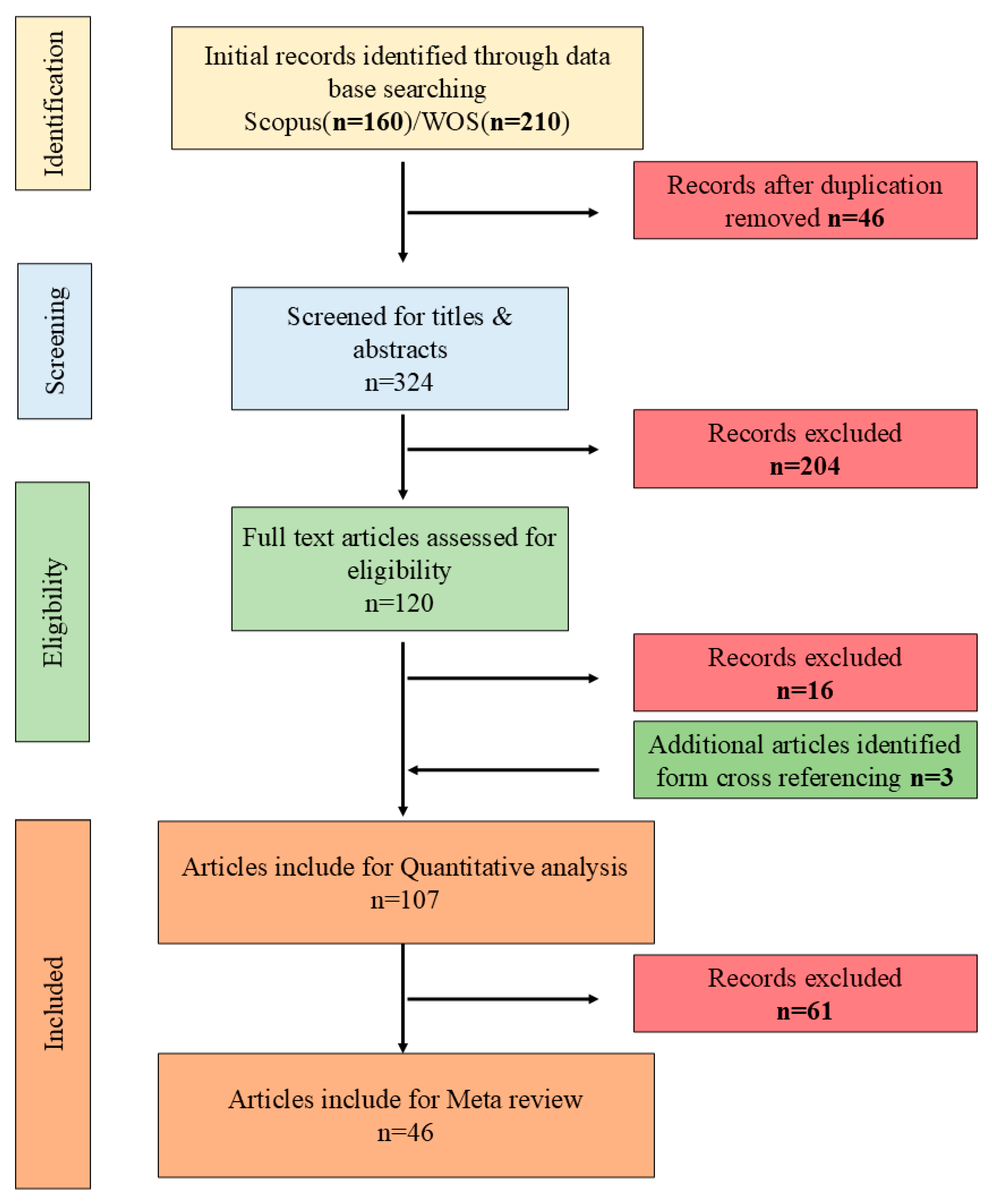
2.2. Article Record Identification
2.3. Screening, Eligibility, Extraction, and Inclusion
3. Results
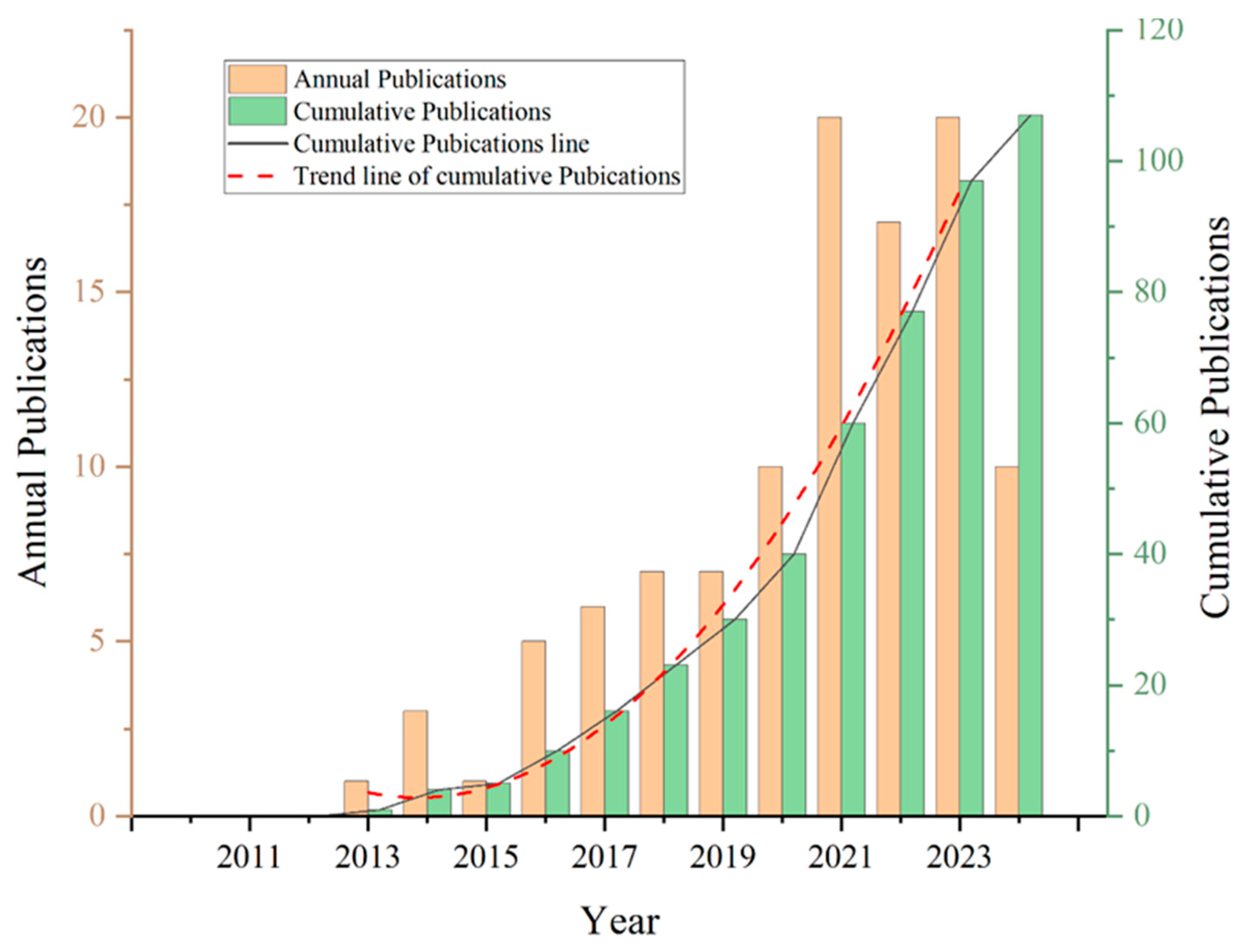
3.1. Meta-Analysis Results
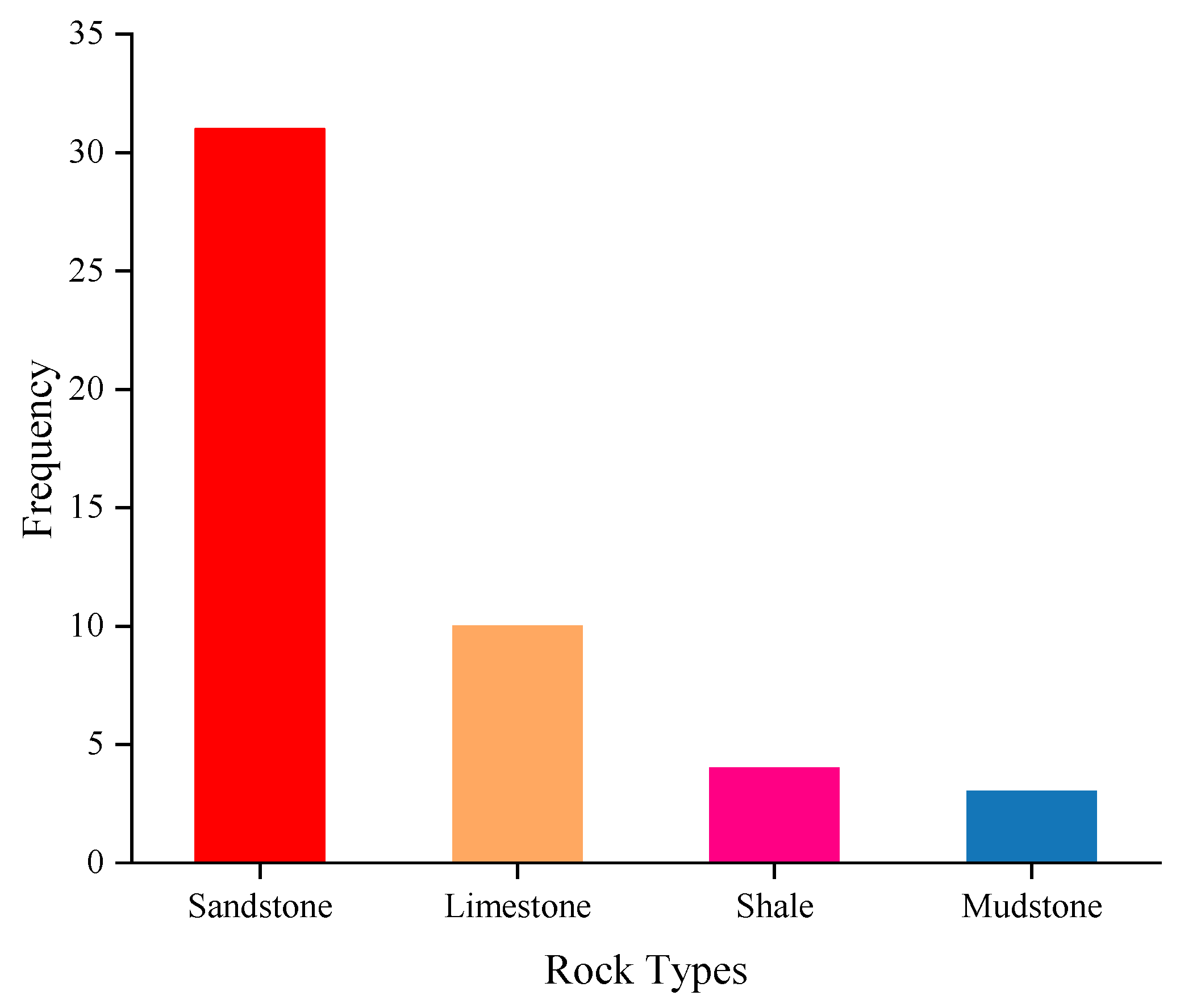
3.2. Rock Types
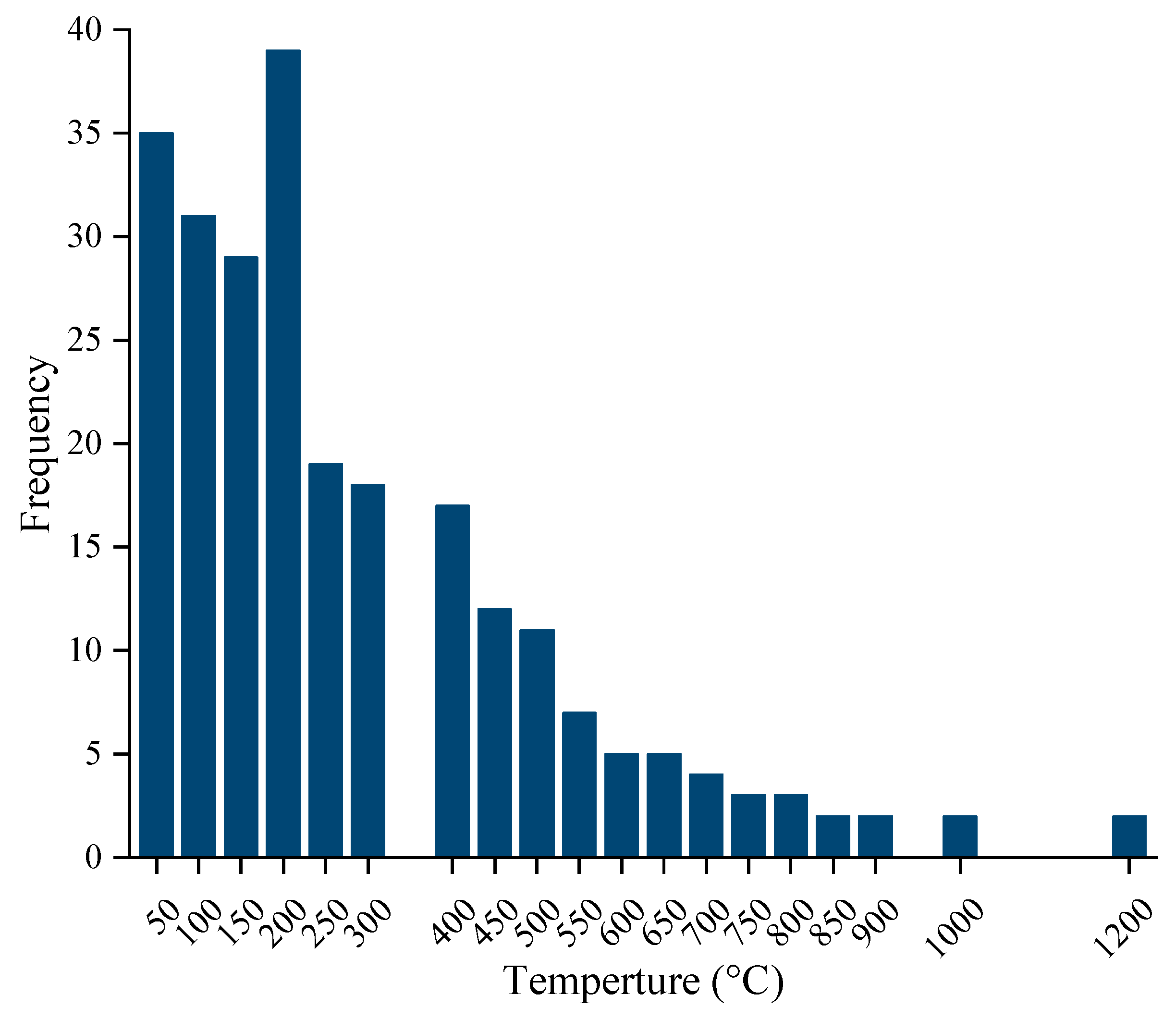
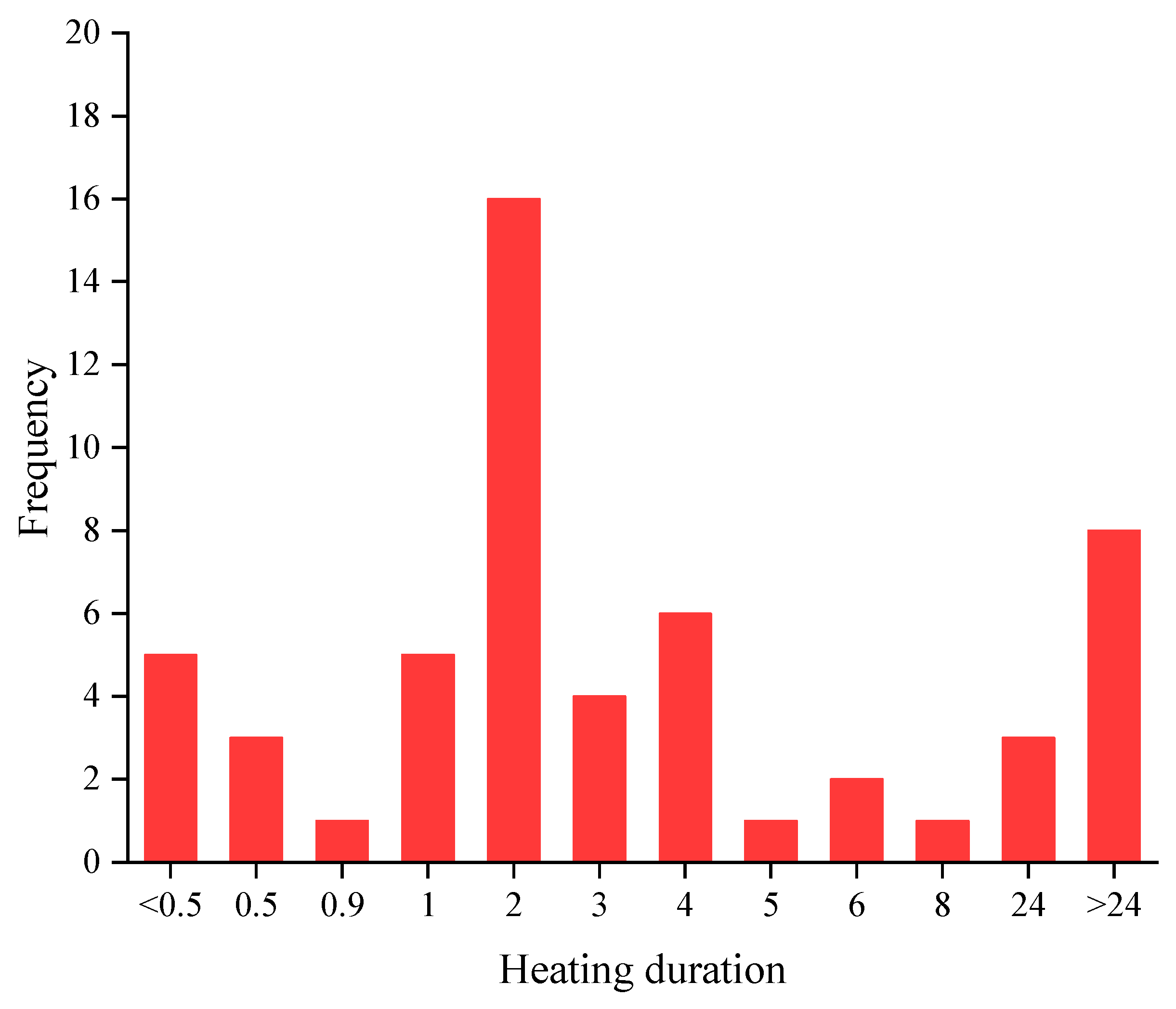
3.3. Temperature Range and Heating Duration
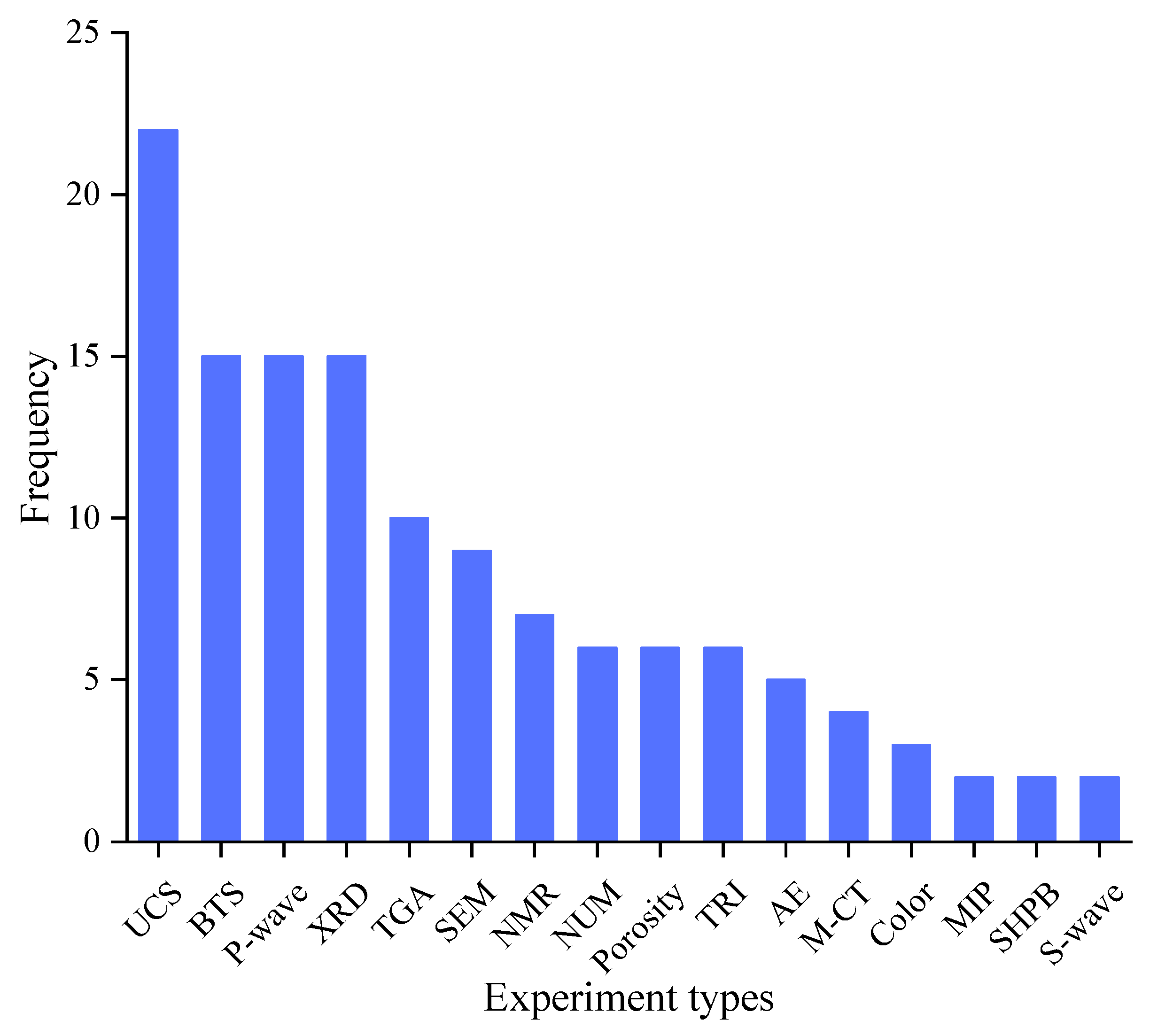
3.4. Experimental Methods for Studied Rocks’ Properties
3.5. Effect of Temperature on Rock Mineral Properties
3.6. Effect of Temperature on Engineering Properties of Rock
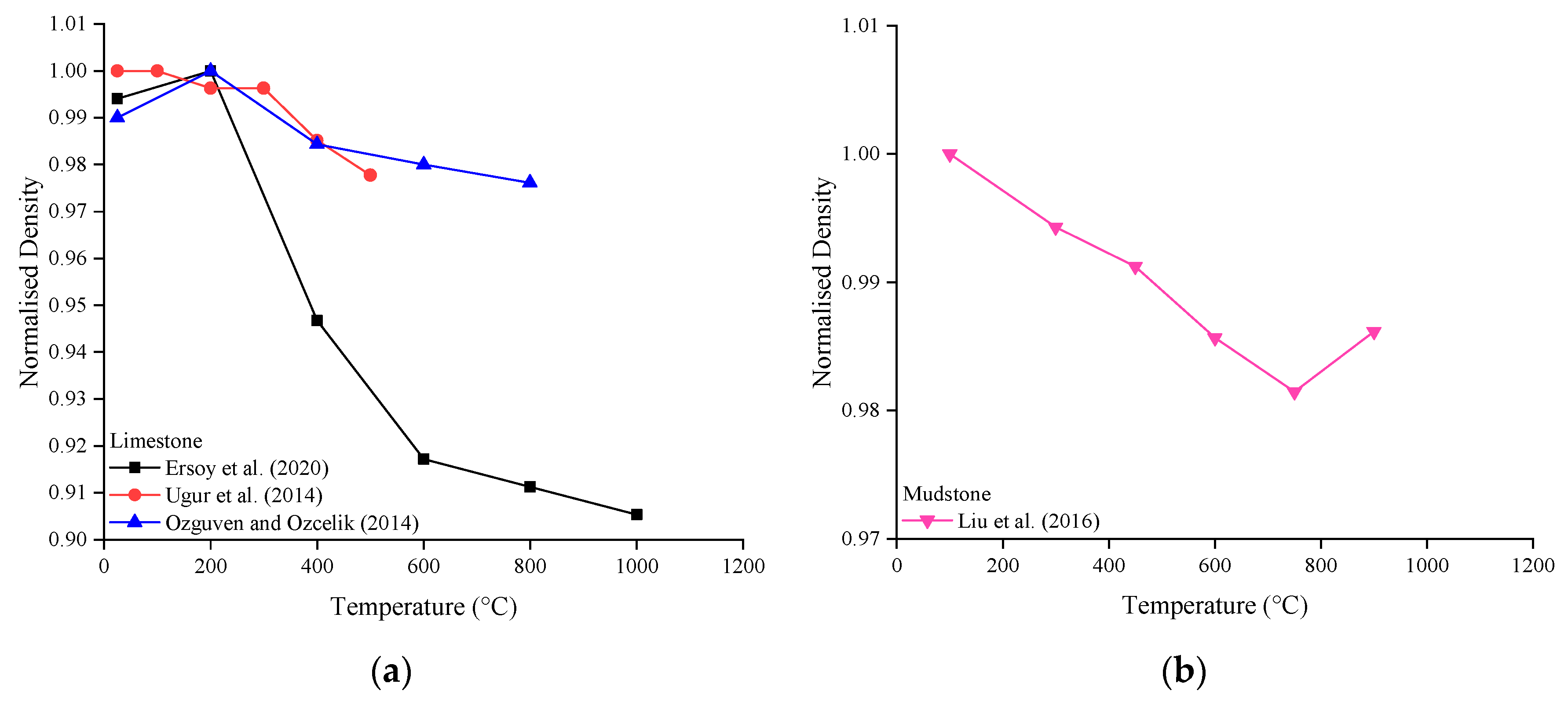
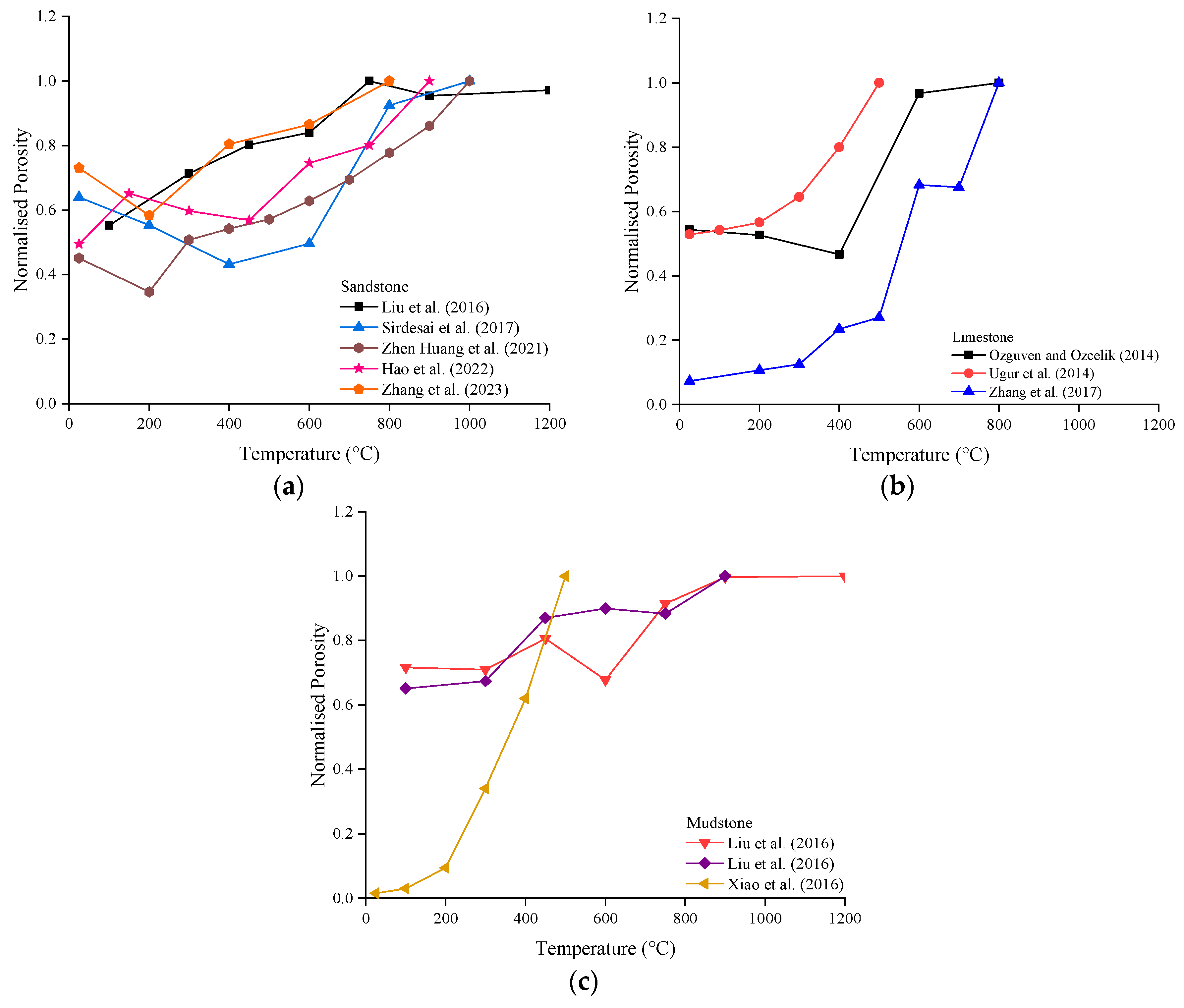
3.6.1. Density and Porosity

3.6.2. Permeability
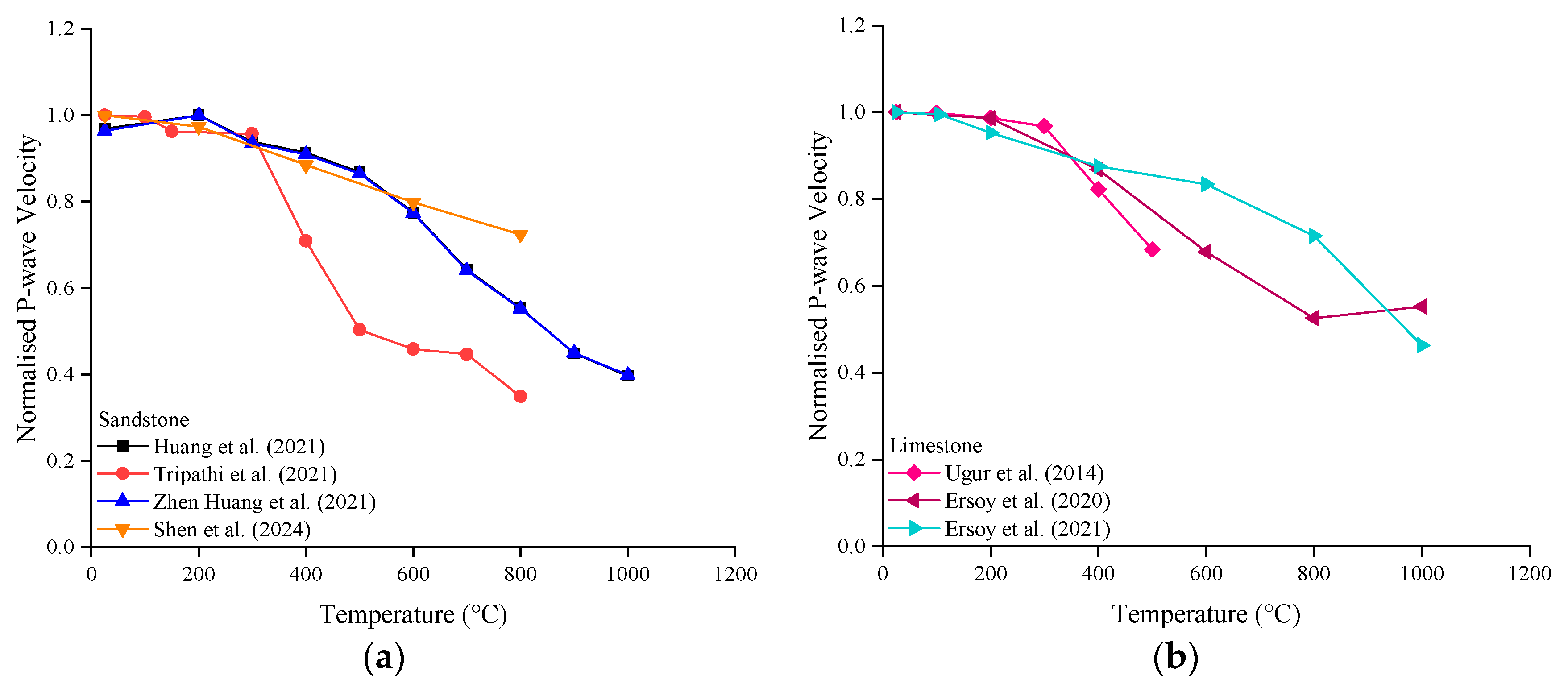
3.6.3. P-Wave Velocity
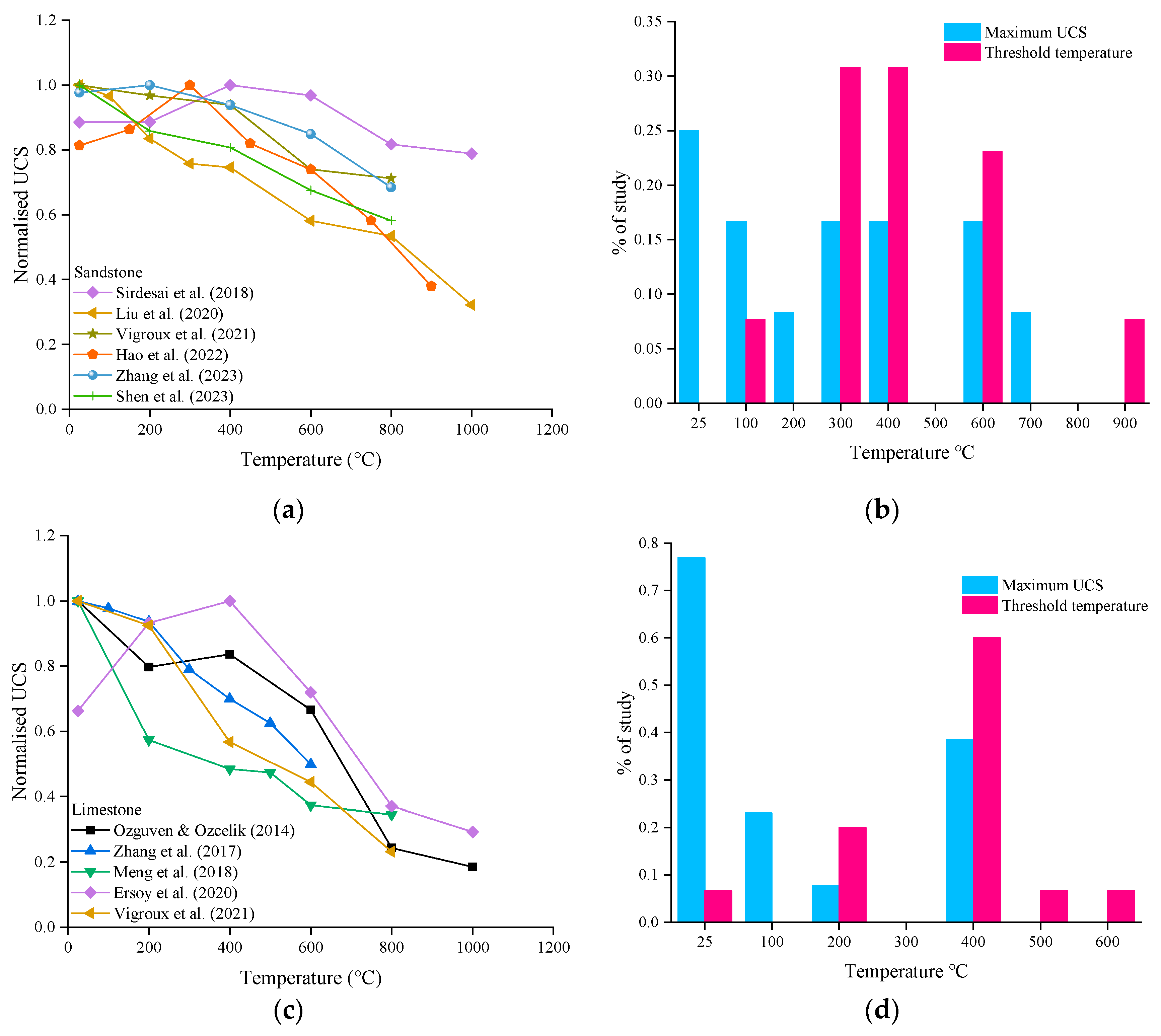
3.6.4. Unconfined Compressive Strength (UCS)
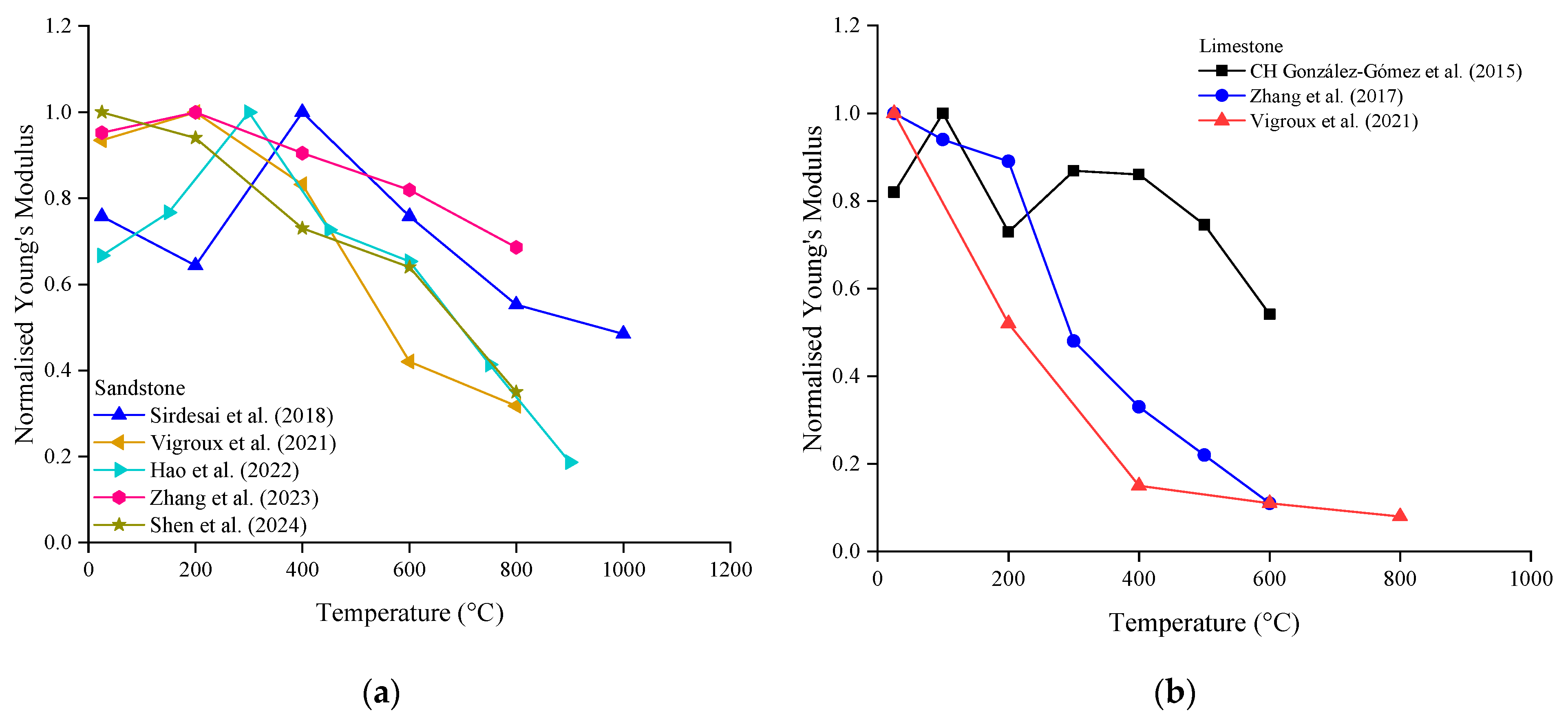
3.6.5. Elastic Modulus (E)
3.6.6. Poisson’s Ratio
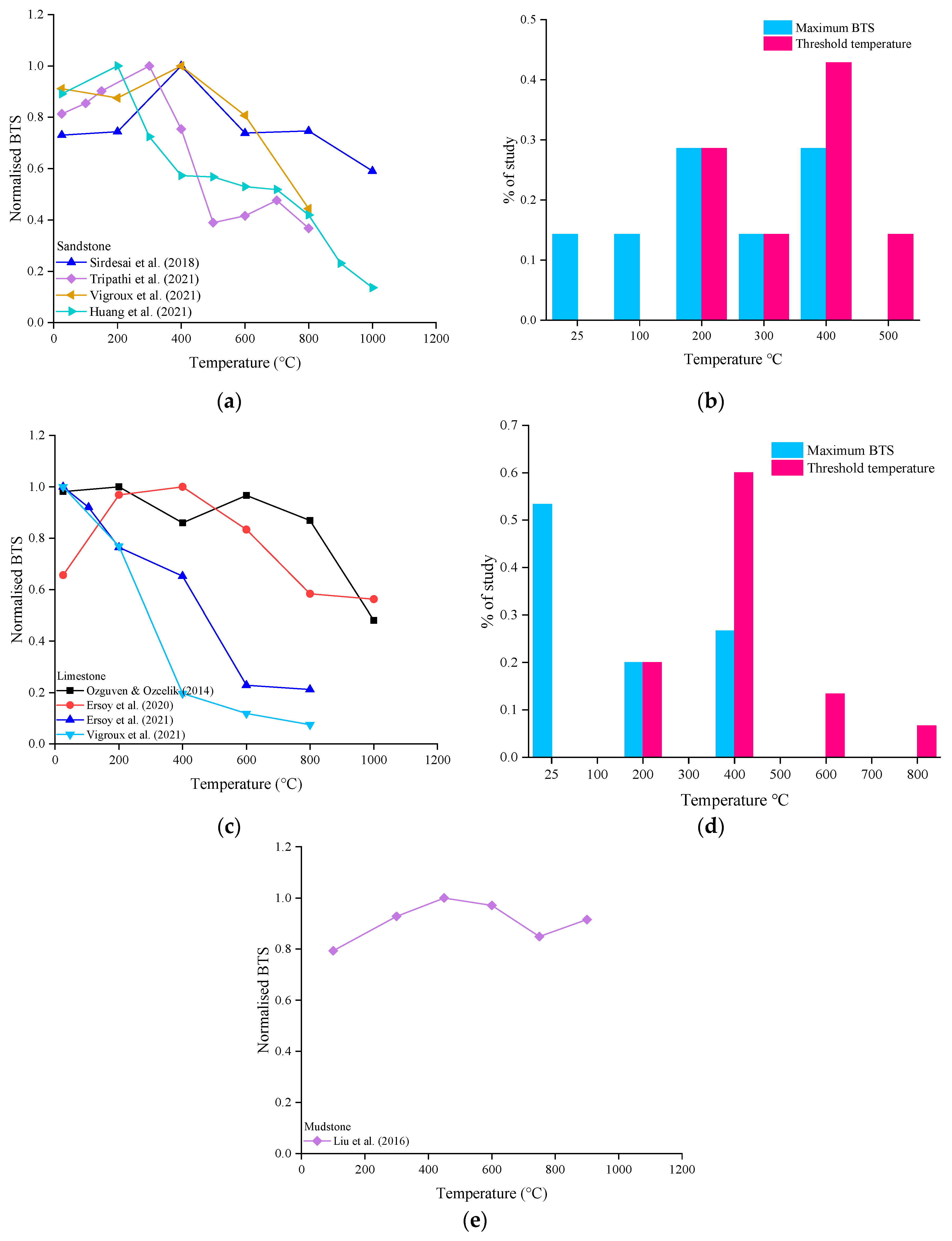
3.6.7. Brazilian Tensile Strength (BTS)
3.6.8. Point Load Index (PLI) and Other Tests
4. Discussion on Rock Behaviour at Different Temperatures
- (1)
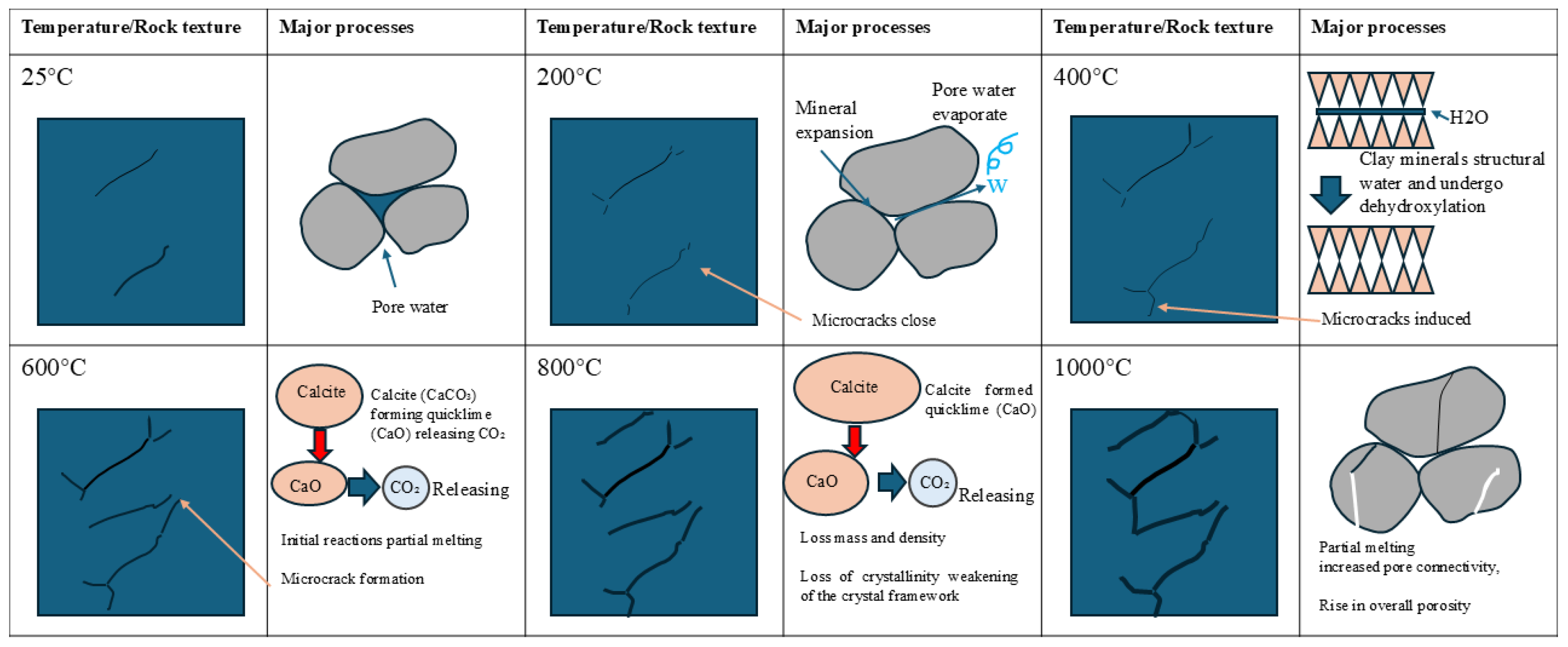
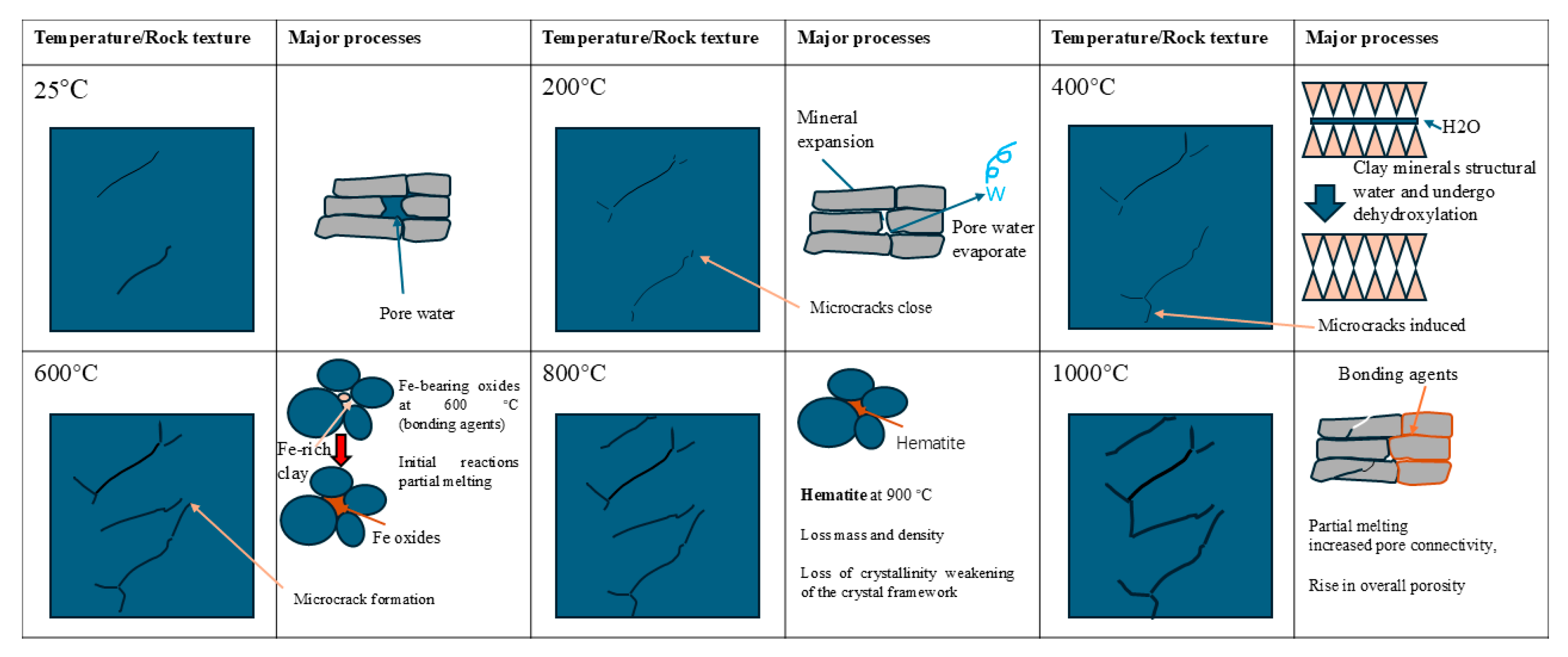
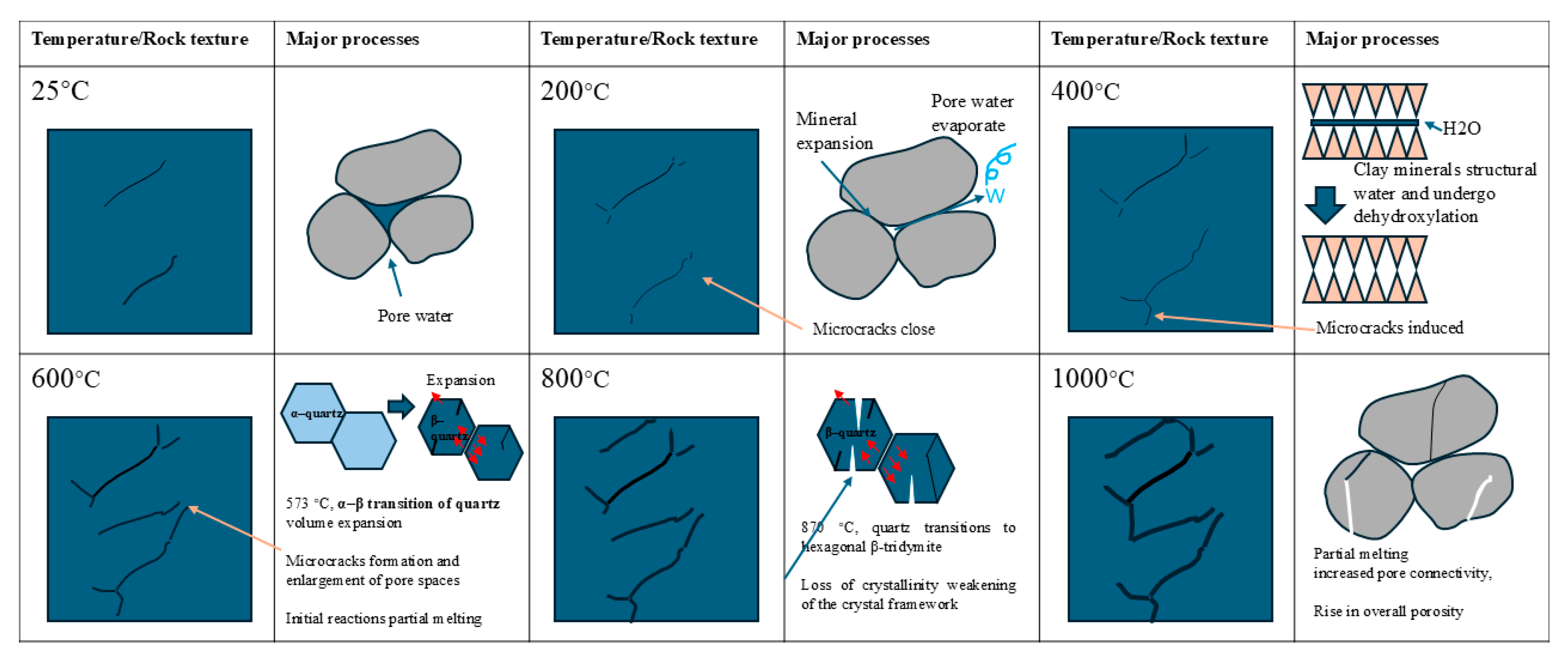
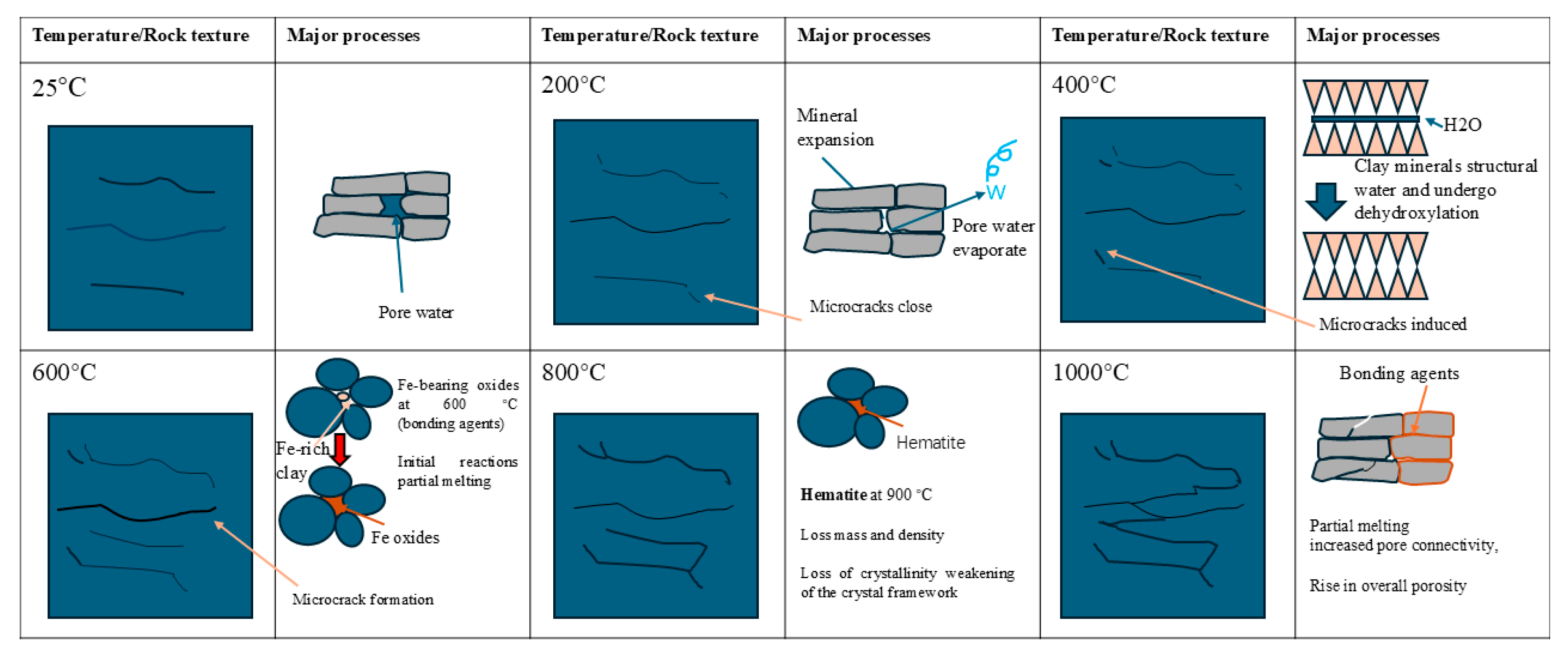
- Room temperature up to 400 °C: mineral structures remain largely stable during this stage. Free water and some bound water within the rock begin to vaporize. Between 100 °C and 200 °C, the thermal expansion of mineral grains may close pre-existing microcracks but can also introduce new ones. Due to differences in thermal expansion coefficients among minerals, stress mismatches at grain boundaries promote the propagation of initial defects.
- (2)
- Temperatures of 400 °C to 600 °C: quartz undergoes an α–β phase transition, causing significant expansion and the formation of cracks within grains and the surrounding matrix. Kaolinite loses structural water, reducing lattice stability and making this a critical stage for strength degradation. Other minerals, such as siderite, muscovite, and illite, also exhibit notable thermal reactions or transformations during this phase.
- (3)
- Temperature above 600 °C: this stage is characterized by pronounced thermal damage. The continued expansion of mineral particles induces numerous new fractures and voids. Minerals such as calcite and feldspar undergo significant thermal decomposition or phase changes, leading to disintegration and separation from adjacent grains, thereby further accelerating crack development and connectivity.
4.1. Sandstone
4.2. Limestone
4.3. Mudstone
4.4. Shale
4.5. Limitations
- The basic discontinuous, inhomogeneous, anisotropic, and non-elastic (DIANE) nature of rocks [88] results in inconsistent elevated temperature responses, even within the same rock type. This intrinsic variability arising from fracture, coupled with the normalization issue noted in Section 3.5, is a key source of conflicting findings for threshold temperatures and property correlations.
- The research is heavily skewed towards sandstone, with limited attention paid to limestone, mudstone, and shale. This bias neglects sedimentary rocks such as conglomerates and siltstones, whose behaviour at elevated temperatures may differ significantly, thereby limiting the generalizability of the current research and models.
- Most studies rely on laboratory experiments, particularly unconfined tests to evaluate elevated-temperature effects, often neglecting the role of confining pressure and the pore fluid present in deep geological settings—a critical parameter influencing rock strength. This shows a significant gap between laboratory experimental data and field conditions, particularly for geothermal and nuclear disposal projects. Triaxial testing may provide a more realistic simulation of the high confining pressures and stress conditions encountered in situ.
- The existing literature primarily examines controlled-temperature exposure rather than real-fire scenarios involving open flames, rapid heating and cooling, and oxidative atmospheres. The combined effects of temperature and flame impingement remain poorly understood. Therefore, investigations into the combined effects of elevated temperatures and open flames on rock engineering properties are significant.
- The variations in heating rates, cooling conditions, sample sizes, and testing procedures introduce substantial scatter and hinder the development of robust predictive models.
5. Future Research Recommendations
- -
- Correlation Between Engineering Properties and Temperature: future investigations should aim to establish robust correlations between engineering properties and thermal exposure. Developing predictive models and correlation formulas will enhance understanding of how temperature variations influence rock behaviour under thermal stress.
- -
- Mechanistic Formulation of Thermal Damage: research should focus on elucidating the mechanisms underlying thermal damage in rocks and on developing predictive formulas. Such formulations will be instrumental in assessing failure processes at elevated temperatures and informing engineering design.
- -
- Future research could explore the role of AI and machine learning in modelling rock behaviour at elevated temperatures. Future studies should aim to develop advanced testing methods and damage models, while also validating their safety and applicability in real-world engineering scenarios.
6. Conclusions
- The review reveals that previous studies focus on sandstone, with limestone and shale receiving less research attention. Experimentally, UCS and BTS tests are the most prevalent. This research bias may limit the applicability of the existing models to a wide range of sedimentary rocks, such as siltstones and conglomerates encountered in real projects. In addition, the widespread use of unconfined compressive tests may fail to replicate in situ stress conditions, potentially overestimating rock strength in deep geological settings, including nuclear waste reservoirs and geothermal energy systems. It is suggested that engineers apply experimentally derived strength parameters with correction factors for confining pressure, especially in underground-related projects.
- A consistent and critical transition zone between 400 °C and 600 °C governs significant strength loss. In quartz-rich sandstone and clay-rich mudstone, this is triggered by α-β quartz transitions and clay dehydroxylation, resulting in a precipitous decrease in strength and stiffness, whereas limestone exhibits progressive deterioration initiated at 600 °C due to calcite calcination. This threshold is important for risk assessment and design in high-temperature environments. For projects in sandstone-dominated terrains, designs should account for potential strength loss within a 400–600 °C range. For projects involving limestone, designs should account for progressive, long-term strength decrease under sustained temperature stress.
- The sedimentary rocks, shale, and other laminated rocks exhibit fabric-controlled temperature damage, in which degradation propagates along weak bedding planes rather than within the rocks. Simultaneously, the correlation between P-wave decrement has been established. The stability of laminated rocks under high-temperature stress depends more on bedding-plane strength than on rock compressive strength. This necessitates tailored testing protocols for projects such as shale gas extraction and nuclear waste disposal in shale formations. Additionally, P-wave velocity measurements in structures and rocks enable rapid mapping of heat-affected areas and the estimation of residual strength.
- The review consolidates normalized data trends for key properties such as BTS, UCS, porosity, and elastic modulus across different temperatures, providing a valuable dataset. However, significant research gaps remain, particularly regarding the effects of confining pressure, real-fire scenarios, and standardized testing protocols. The compiled normalized data and identified threshold temperatures serve as important references for calibrating the thermomechanical constitutive models used in numerical simulations, thereby enhancing the predictive accuracy of rock behaviour under temperature-stress conditions. To bridge the gap between experimental and field conditions, future studies and practice should prioritize triaxial compression testing under confining pressures and develop sedimentary rock models that account for the anisotropic and discontinuous nature of these rocks.
Author Contributions
Funding
Data Availability Statement
Acknowledgments
Conflicts of Interest
References
- Murrell, S. A criterion for brittle fracture of rocks and concrete under triaxial stress and the effect of pore pressure on the criterion. In Proceedings of the Fifth Symposum on Rock Mechanics; Pergamon Press: Oxford, UK, 1963; pp. 563–577. [Google Scholar]
- Reichmuth, D.R. Point load testing of brittle materials to determine tensile strength and relative brittleness. In Proceedings of the ARMA US Rock Mechanics/Geomechanics Symposium, Golden, CO, USA, 17–19 April 1967. Paper Number ARMA-67-0134. [Google Scholar]
- Hassanzadegan, A.; Blöcher, G.; Milsch, H.; Urpi, L.; Zimmermann, G. The Effects of Temperature and Pressure on the Porosity Evolution of Flechtinger Sandstone. Rock Mech. Rock Eng. 2014, 47, 421–434. [Google Scholar] [CrossRef]
- Kumari, W.G.P.; Ranjith, P.G.; Perera, M.S.A.; Li, X.; Li, L.H.; Chen, B.K.; Isaka, B.L.A.; De Silva, V.R.S. Hydraulic fracturing under high temperature and pressure conditions with micro CT applications: Geothermal energy from hot dry rocks. Fuel 2018, 230, 138–154. [Google Scholar] [CrossRef]
- Chen, Q.; Chen, Y.; Xiao, P.; Du, X.; Pan, Y.; Azzam, R. Mechanical properties and damage constitutive model of sandstone after acid corrosion and high temperature treatments. Int. J. Min. Sci. Technol. 2023, 33, 747–760. [Google Scholar] [CrossRef]
- Lu, Y.; Shi, S.; Wang, H.; Tian, Z.; Ye, Q.; Niu, H. Thermal characteristics of cement microparticle-stabilized aqueous foam for sealing high-temperature mining fractures. Int. J. Heat Mass Trans. 2019, 131, 594–603. [Google Scholar] [CrossRef]
- Xu, X.L.; Karakus, M. A coupled thermo-mechanical damage model for granite. Int. J. Rock Mech. Min. 2018, 103, 195–204. [Google Scholar] [CrossRef]
- Chang, K.W.; LaForce, T. Coupled hydro-thermal flow and radionuclide transport driven by spatial variation of heat-generating radioactive wastes in shale formations. Tunn. Undergr. Sp. Technol. 2024, 146, 105676. [Google Scholar] [CrossRef]
- Liu, J.F.; Chen, L.; Wang, C.P.; Man, K.; Wang, L.; Wang, J.; Su, R. Characterizing the mechanical tensile behavior of Beishan granite with different experimental methods. Int. J. Rock Mech. Min. 2014, 69, 50–58. [Google Scholar] [CrossRef]
- Dou, L.; Shu, G.; Gao, H.; Bao, J.; Wang, R.; Madonia, P. Study on the Effect of High-Temperature Heat Treatment on the Microscopic Pore Structure and Mechanical Properties of Tight Sandstone. Geofluids 2021, 2021, 8886186. [Google Scholar] [CrossRef]
- Wu, X.; Huang, Z.; Li, R.; Zhang, S.; Wen, H.; Huang, P.; Dai, X.; Zhang, C. Investigation on the damage of high-temperature shale subjected to liquid nitrogen cooling. J. Nat. Gas Sci. Eng. 2018, 57, 284–294. [Google Scholar] [CrossRef]
- Orlander, T.; Andreassen, K.A.; Fabricius, I.L. Effect of Temperature on Stiffness of Sandstones from the Deep North Sea Basin. Rock Mech. Rock Eng. 2020, 54, 255–288. [Google Scholar] [CrossRef]
- Liu, J.; Xu, H.; Li, J.; Tang, W.; Liu, W.; Hu, Q.; Heng, S. Thermal Effect on the Compaction Behavior of Tight Shale by Uniaxial Strain Test. J. Eng. Mech. 2023, 149, 04023039. [Google Scholar] [CrossRef]
- Zhou, Z.; Zhang, F.; Fu, H.; Xiu, N.; Guan, B.; Cai, B. A thermal–mechanical coupled DEM model for deep shale reservoir: The effects of temperature and anisotropy. Rock Mech. Rock Eng. 2024, 57, 3707–3726. [Google Scholar] [CrossRef]
- Zhu, J.; Yang, Z.; Li, X.; Qi, S.; Fang, Q.; Ding, Y. The experimental study of microwave heating on the microstructure of oil shale samples. Energy Sci. Eng. 2019, 7, 809–820. [Google Scholar] [CrossRef]
- Chen, Q.; Yang, W.; Lu, H. Assessment of Mechanical Properties for High-Temperature Sandstone in Coal Fire Area Based on Different Cooling Methods. KSCE J. Civ. Eng. 2022, 26, 5187–5198. [Google Scholar] [CrossRef]
- Kumari, W.G.P.; Ranjith, P.G.; Perera, M.S.A.; Chen, B.K.; Abdulagatov, I.M. Temperature-dependent mechanical behaviour of Australian Strathbogie granite with different cooling treatments. Eng. Geol. 2017, 229, 31–44. [Google Scholar] [CrossRef]
- Li, J.; Fu, P.; Zhu, Q.; Mao, Y.; Yang, C. A lab-scale experiment on low-temperature coal oxidation in context of underground coal fires. Appl. Therm. Eng. 2018, 141, 333–338. [Google Scholar] [CrossRef]
- Tripathi, A.; Gupta, N.; Singh, A.K.; Mohanty, S.P.; Rai, N.; Pain, A. Effects of Elevated Temperatures on the Microstructural, Physico-Mechanical and Elastic Properties of Barakar Sandstone: A Study from One of the World’s Largest Underground Coalmine Fire Region, Jharia, India. Rock Mech. Rock Eng. 2021, 54, 1293–1314. [Google Scholar] [CrossRef]
- Becattini, V.; Motmans, T.; Zappone, A.; Madonna, C.; Haselbacher, A.; Steinfeld, A. Experimental investigation of the thermal and mechanical stability of rocks for high-temperature thermal-energy storage. Appl. Energy 2017, 203, 373–389. [Google Scholar] [CrossRef]
- Qiao, M.; Jing, Z.; Feng, C.; Li, M.; Chen, C.; Zou, X.; Zhou, Y. Review on heat extraction systems of hot dry rock: Classifications, benefits, limitations, research status and future prospects. Renew. Sustain. Energy Rev. 2024, 196, 114364. [Google Scholar] [CrossRef]
- Daoudi, A.; Eslami, J.; Beaucour, A.-L.; Vigroux, M.; Noumowé, A. High-temperature behaviour of various limestones at the block scale. Constr. Build. Mater. 2024, 416, 135109. [Google Scholar] [CrossRef]
- Ge, S.; Wu, C.; He, C.; Wang, Y.; Chen, D.; Shi, B. Thermal damage of high-temperature sandstone subjected to cooling shock and its effect on capturing acoustic emission signals during fracture. Eng. Fail. Anal. 2023, 145, 107003. [Google Scholar] [CrossRef]
- Lü, C.; Sun, Q.; Zhang, W.; Geng, J.; Qi, Y.; Lu, L. The effect of high temperature on tensile strength of sandstone. Appl. Therm. Eng. 2017, 111, 573–579. [Google Scholar] [CrossRef]
- Yang, R.; Fang, S.; Li, W.; Wei, G.; Li, Q.; Liang, S. Temperature effects on dynamic compressive behavior of siliceous sandstone. Arab. J. Geosci. 2020, 13, 382. [Google Scholar] [CrossRef]
- Sirdesai, N.N.; Singh, T.N.; Ranjith, P.G.; Singh, R. Effect of Varied Durations of Thermal Treatment on the Tensile Strength of Red Sandstone. Rock Mech. Rock Eng. 2016, 50, 205–213. [Google Scholar] [CrossRef]
- Lu, H.; Chen, Q.; Ma, X. Investigation into Dynamic Behaviors of High-Temperature Sandstone under Cyclic Impact Loading Using DIC Technology. Appl. Sci. 2022, 12, 9247. [Google Scholar] [CrossRef]
- Meng, Q.-B.; Liu, J.-F.; Pu, H.; Yu, L.-Y.; Wu, J.-Y.; Wang, C.-K. Mechanical Properties of Limestone After High-Temperature Treatment Under Triaxial Cyclic Loading and Unloading Conditions. Rock Mech. Rock Eng. 2021, 54, 6413–6437. [Google Scholar] [CrossRef]
- Wang, S.; Wang, L.; Ren, B.; Ding, K.; Jiang, C.; Guo, J. Mechanical behavior and fracture characteristics of high-temperature sandstone under true triaxial loading conditions. J. Mater. Res. Technol. 2024, 28, 569–581. [Google Scholar] [CrossRef]
- Zheng, F.; Jiang, A.; Jiang, T.; Jiang, H.; Guo, X. Study on mechanical characteristics and damage model of layered sandstone after high temperature action. Case Stud. Constr. Mater. 2023, 19, e02601. [Google Scholar] [CrossRef]
- Ge, S.; Shi, B.; Zhang, S.; Zhai, X.; Wu, C. Thermal damage and mechanical properties of high temperature sandstone with cyclic heating–cooling treatment. Bull. Eng. Geol. Environ. 2022, 81, 284. [Google Scholar] [CrossRef]
- Liu, P.; Liu, X.; Tian, G.; Gan, F.; Bi, J. Effect of thermal cycling and hydro-thermal cycling on physical and mechanical properties of sandstone. Energy Sci. Eng. 2019, 8, 718–730. [Google Scholar] [CrossRef]
- Liu, Q.; Qian, Z.; Wu, Z. Micro/macro physical and mechanical variation of red sandstone subjected to cyclic heating and cooling: An experimental study. Bull. Eng. Geol. Environ. 2017, 78, 1485–1499. [Google Scholar] [CrossRef]
- Ersoy, H.; Atalar, C.; Sünnetci, M.O.; Kolaylı, H.; Karahan, M.; Fırat Ersoy, A. Assessment of damage on geo-mechanical and micro-structural properties of weak calcareous rocks exposed to fires using thermal treatment coefficient. Eng. Geol. 2021, 284, 106046. [Google Scholar] [CrossRef]
- Ersoy, H.; Karahan, M.; Kolaylı, H.; Sünnetci, M.O. Influence of Mineralogical and Micro-Structural Changes on the Physical and Strength Properties of Post-thermal-Treatment Clayey Rocks. Rock Mech. Rock Eng. 2020, 54, 679–694. [Google Scholar] [CrossRef]
- Hajpál, M.; Török, A. Mineralogical and colour changes of quartz sandstones by heat. Environ. Geol. 2004, 46, 311–322. [Google Scholar] [CrossRef]
- Huang, Z.; Zeng, W.; Gu, Q.; Wu, Y.; Zhong, W.; Zhao, K. Investigations of variations in physical and mechanical properties of granite, sandstone, and marble after temperature and acid solution treatments. Constr. Build. Mater. 2021, 307, 124943. [Google Scholar] [CrossRef]
- Jiang, H.; Jiang, A.; Zhang, F. Comparative experimental study on the physical and mechanical properties of quartz sandstone after water-cooling and natural-cooling under high temperature. Q. J. Eng. Geol. Hydrogeol. 2021, 55, qjegh2020-181. [Google Scholar] [CrossRef]
- Liu, D.; Chen, H.; Su, R.K.L. Effects of heat-treatment on physical and mechanical properties of limestone. Constr. Build. Mater. 2024, 411, 134183. [Google Scholar] [CrossRef]
- Liu, X.; Yuan, S.; Sieffert, Y.; Fityus, S.; Buzzi, O. Changes in Mineralogy, Microstructure, Compressive Strength and Intrinsic Permeability of Two Sedimentary Rocks Subjected to High-Temperature Heating. Rock Mech. Rock Eng. 2016, 49, 2985–2998. [Google Scholar] [CrossRef]
- Liu, X.; Zhang, C.; Yuan, S.; Fityus, S.; Sloan, S.W.; Buzzi, O. Effect of High Temperature on Mineralogy, Microstructure, Shear Stiffness and Tensile Strength of Two Australian Mudstones. Rock Mech. Rock Eng. 2016, 49, 3513–3524. [Google Scholar] [CrossRef]
- Ozguven, A.; Ozcelik, Y. Investigation of some property changes of natural building stones exposed to fire and high heat. Constr. Build. Mater. 2013, 38, 813–821. [Google Scholar] [CrossRef]
- Vasanelli, E.; Quarta, G.; Masieri, M.; Calia, A. High temperature effects on the properties of a high porosity calcareous stone building material. Eur. J. Environ. Civ. Eng. 2021, 26, 6733–6745. [Google Scholar] [CrossRef]
- Akosah, S.; Gratchev, I. A review of the engineering properties of heated rocks in Australia. Aust. Geomech. J. 2025, 60, 143–159. [Google Scholar] [CrossRef]
- Tang, Q.; Gratchev, I.; Akosah, S.; Ding, Z. Investigating Thermal Damage of Sandstone. In Proceedings of the Rocscience International Conference 2025 (RIC 2025), Sydney, Australia, 6–8 April 2025; pp. 131–140. [Google Scholar]
- Garrido, M.E.; Petnga, F.B.; Martínez-Ibáñez, V.; Serón, J.B.; Hidalgo-Signes, C.; Tomás, R. Predicting the Uniaxial Compressive Strength of a Limestone Exposed to High Temperatures by Point Load and Leeb Rebound Hardness Testing. Rock Mech. Rock Eng. 2021, 55, 1–17. [Google Scholar] [CrossRef]
- Sirdesai, N.N.; Singh, A.; Sharma, L.K.; Singh, R.; Singh, T.N. Development of novel methods to predict the strength properties of thermally treated sandstone using statistical and soft-computing approach. Neural Comput. Appl. 2017, 31, 2841–2867. [Google Scholar] [CrossRef]
- Wang, P.; Yin, T.; Li, X.; Konietzky, H. Quasi-Static and Dynamic Tensile Behavior of Water-Bearing Sandstone Subjected to Microwave Irradiation. Mathematics 2022, 11, 203. [Google Scholar] [CrossRef]
- Zhang, J.; Shen, Y.; Yang, G.; Zhang, H.; Wang, Y.; Hou, X.; Sun, Q.; Li, G. Inconsistency of changes in uniaxial compressive strength and P-wave velocity of sandstone after temperature treatments. J. Rock Mech. Geotech. Eng. 2021, 13, 143–153. [Google Scholar] [CrossRef]
- Zhao, Y.; Du, C.; Bi, J.; Li, J.; Wang, C. Influence of multiple porous structure evolution on physical–mechanical properties and damage mechanism of sandstone heated continuously/periodically with the identical heating time. Bull. Eng. Geol. Environ. 2022, 81, 507. [Google Scholar] [CrossRef]
- Vidana Pathiranagei, S.; Gratchev, I. Engineering properties of sandstone heated to a range of high temperatures. Bull. Eng. Geol. Environ. 2021, 80, 2415–2432. [Google Scholar] [CrossRef]
- Page, M.J.; McKenzie, J.E.; Bossuyt, P.M.; Boutron, I.; Hoffmann, T.C.; Mulrow, C.D.; Shamseer, L.; Tetzlaff, J.M.; Moher, D. Updating guidance for reporting systematic reviews: Development of the PRISMA 2020 statement. J. Clin. Epidemiol. 2021, 134, 103–112. [Google Scholar] [CrossRef] [PubMed]
- Pickering, C.; Byrne, J. The benefits of publishing systematic quantitative literature reviews for PhD candidates and other early-career researchers. High. Edu. Res. Dev. 2014, 33, 534–548. [Google Scholar] [CrossRef]
- Ugur, I.; Sengun, N.; Demirdag, S.; Altindag, R. Analysis of the alterations in porosity features of some natural stones due to thermal effect. Ultrasonics 2014, 54, 1332–1336. [Google Scholar] [CrossRef] [PubMed]
- Ozguven, A.; Ozcelik, Y. Effects of high temperature on physico-mechanical properties of Turkish natural building stones. Eng. Geol. 2014, 183, 127–136. [Google Scholar] [CrossRef]
- González-Gómez, W.S.; Quintana, P.; May-Pat, A.; Avilés, F.; May-Crespo, J.; Alvarado-Gil, J.J. Thermal effects on the physical properties of limestones from the Yucatan Peninsula. Int. J. Rock Mech. Min. 2015, 75, 182–189. [Google Scholar] [CrossRef]
- Xiao, Y.; Lu, J.-H.; Wang, C.-P.; Deng, J. Experimental Study of High-Temperature Fracture Propagation in Anthracite and Destruction of Mudstone from Coalfield Using High-Resolution Microfocus X-ray Computed Tomography. Rock Mech. Rock Eng. 2016, 49, 3723–3734. [Google Scholar] [CrossRef]
- Gautam, P.K.; Verma, A.K.; Maheshwar, S.; Singh, T.N. Thermomechanical Analysis of Different Types of Sandstone at Elevated Temperature. Rock Mech. Rock Eng. 2016, 49, 1985–1993. [Google Scholar] [CrossRef]
- Zhang, W.Q.; Sun, Q.; Hao, S.Q.; Geng, J.S.; Lv, C. Experimental study on the variation of physical and mechanical properties of rock after high temperature treatment. Appl. Therm. Eng. 2016, 98, 1297–1304. [Google Scholar] [CrossRef]
- Sirdesai, N.N.; Mahanta, B.; Ranjith, P.G.; Singh, T.N. Effects of thermal treatment on physico-morphological properties of Indian fine-grained sandstone. Bull. Eng. Geol. Environ. 2017, 78, 883–897. [Google Scholar] [CrossRef]
- Shen, Y.-J.; Zhang, Y.-L.; Gao, F.; Yang, G.-S.; Lai, X.-P. Influence of Temperature on the Microstructure Deterioration of Sandstone. Energies 2018, 11, 1753. [Google Scholar] [CrossRef]
- Sirdesai, N.N.; Gupta, T.; Singh, T.N.; Ranjith, P.G. Studying the acoustic emission response of an Indian monumental sandstone under varying temperatures and strains. Constr. Build. Mater. 2018, 168, 346–361. [Google Scholar] [CrossRef]
- Meng, Q.; Zhang, M.; Han, L.; Pu, H.; Chen, Y. Experimental research on the influence of loading rate on the mechanical properties of limestone in a high-temperature state. Bull. Eng. Geol. Environ. 2018, 78, 3479–3492. [Google Scholar] [CrossRef]
- Liu, Z.; Yao, Q.; Kong, B.; Yin, J. Macro-micro mechanical properties of building sandstone under different thermal damage conditions and thermal stability evaluation using acoustic emission technology. Constr. Build. Mater. 2020, 246, 118485. [Google Scholar] [CrossRef]
- Vidana Pathiranagei, S.; Gratchev, I.; Kong, R. Engineering properties of four different rocks after heat treatment. Geomech. Geophys. Geo-Energy Geo-Resour. 2021, 7, 16. [Google Scholar] [CrossRef]
- Chen, Y.; Yin, T.; Li, X.; Li, Q.; Yang, Z.; Li, M.; Wu, Y. Experimental investigation on dynamic mechanical behavior and fracture evolution of fissure-filled red sandstone after thermal treatment. Eng. Geol. 2021, 295, 106433. [Google Scholar] [CrossRef]
- Vigroux, M.; Eslami, J.; Beaucour, A.-L.; Bourgès, A.; Noumowé, A. High temperature behaviour of various natural building stones. Constr. Build. Mater. 2021, 272, 121629. [Google Scholar] [CrossRef]
- Wang, F.; Konietzky, H.; Herbst, M.; Kutz, M.; Frühwirt, T.; Freudenberg, N.; Siedel, H. Numerical Simulation of Damage Behaviour of Building Sandstone Exposed to Fire. Rock Mech. Rock Eng. 2021, 54, 3149–3164. [Google Scholar] [CrossRef]
- Xiao, W.; Yu, G.; Li, H.; Zhang, D.; Li, S.; Yu, B.; Li, D. Thermal cracking characteristics and mechanism of sandstone after high-temperature treatment. Fatigue Fract. Eng. Mater. Struct. 2021, 44, 3169–3185. [Google Scholar] [CrossRef]
- Shtober-Zisu, N.; Wittenberg, L. Wildfires as a Weathering Agent of Carbonate Rocks. Minerals 2021, 11, 1091. [Google Scholar] [CrossRef]
- Vidana Pathiranagei, S.; Gratchev, I. Coupled thermo-mechanical constitutive damage model for sandstone. J. Rock Mech. Geotech. Eng. 2022, 14, 1710–1721. [Google Scholar] [CrossRef]
- Wang, F.; Konietzky, H.; Herbst, M. Damage of irregular-shaped sandstone balusters under real fire loading. J. Build. Eng. 2022, 45, 103492. [Google Scholar] [CrossRef]
- Hao, J.; Qiao, L.; Liu, Z.; Li, Q. Effect of thermal treatment on physical and mechanical properties of sandstone for thermal energy storage: A comprehensive experimental study. Acta Geotech. 2022, 17, 3887–3908. [Google Scholar] [CrossRef]
- El Jazouli, B.; Tsangouri, E. Fire-exposed stones in constructions: Residual strength, performance loss and damage mode shift due to mineralogical transformation and micro-cracking. Eng. Geol. 2022, 302, 106638. [Google Scholar] [CrossRef]
- Vidana Pathiranagei, S.; Gratchev, I.; Sokolowski, K.A. Investigation of the microstructural characteristics of heated sandstone by micro-computed tomography technique. Environ. Earth Sci. 2022, 81, 401. [Google Scholar] [CrossRef]
- Meng, F.; Li, Y.; Zhai, Y.; Li, Y.; Zhao, R.; Zhang, Y. Study on the Effect of Sandstone Microscopic Damage and Dynamic Compressive Properties After Heat Treatment. Rock Mech. Rock Eng. 2022, 55, 1271–1283. [Google Scholar] [CrossRef]
- Kang, Z.; Jiang, X.; Wang, L.; Yang, D.; Ma, Y.; Zhao, Y. Comparative investigation of in situ hydraulic fracturing and high-temperature steam fracturing tests for meter-scale oil shale. Energy 2023, 281, 128343. [Google Scholar] [CrossRef]
- Zhang, P.; Tian, S.; Ren, S.; Wu, F.; Chen, J.; Ma, L. Effects of high temperature and acidic solutions on the pore characteristics and mechanical properties of sandstone. Environ. Sci. Pollut. Res. Int. 2023, 30, 21888–21899. [Google Scholar] [CrossRef] [PubMed]
- Wang, P.; Yin, T.; Li, X.; Konietzky, H. Evolution of micro-damage and degradation of macro-mechanical properties of sandstone due to thermal effects. Bull. Eng. Geol. Environ. 2023, 82, 83. [Google Scholar] [CrossRef]
- Guo, P.; Zhang, P.; Bu, M.; Xing, H.; He, M. Impact of cooling rate on mechanical properties and failure mechanism of sandstone under thermal–mechanical coupling effect. Int. J. Coal Sci. Technol. 2023, 10, 26. [Google Scholar] [CrossRef]
- Shen, M.; Zhao, Y.; Bi, J.; Wang, C.; Ning, L.; Deng, X.; Zhang, K.; Du, B. Micro-damage evolution and macro-mechanical property of preloaded sandstone subjected to high-temperature treatment based on NMR technique. Constr. Build. Mater. 2023, 369, 130638. [Google Scholar] [CrossRef]
- Zhao, Q.; Zheng, Y.; Li, J.; Che, P.; Zhao, X. Heating and Water Transport Behavior of Sandstones Under Microwave Irradiation. Rock Mech. Rock Eng. 2024, 57, 4755–4770. [Google Scholar] [CrossRef]
- Guo, Y.; Dyskin, A.; Pasternak, E. Thermal spallation of dry rocks induced by flame parallel or normal to layering: Effect of anisotropy. Energy 2024, 288, 129697. [Google Scholar] [CrossRef]
- Bi, J.; Zheng, K.; Zhao, Y.; Wang, C. Permeability Evolution of Coal Seam Roof Sandstone Under Thermal Treatment. Rock Mech. Rock Eng. 2023, 57, 1137–1151. [Google Scholar] [CrossRef]
- Shen, M.; Zhao, Y.; Bi, J.; Wang, C.; Liu, T.; Du, B. Softening properties and damage evolution of the preloaded building sandstone after exposure to high-temperature. Constr. Build. Mater. 2024, 414, 134970. [Google Scholar] [CrossRef]
- Kompaníková, Z.; Gomez-Heras, M.; Michňová, J.; Durmeková, T.; Vlčko, J. Sandstone alterations triggered by fire-related temperatures. Environ. Earth Sci. 2014, 72, 2569–2581. [Google Scholar] [CrossRef]
- Yao, H.; Yao, J. Strength Degradation and Fracture Mechanism of Sandstone Under Microwave Irradiation. Geotech. Geol. Eng. 2023, 41, 2201–2209. [Google Scholar] [CrossRef]
- Noorian Bidgoli, M.; Jing, L. Anisotropy of strength and deformability of fractured rocks. J. Rock Mech. Geotech. Eng. 2014, 6, 156–164. [Google Scholar] [CrossRef]
- Zhu, J.; Yang, Z.; Li, X.; Wang, N.; Jia, M. Evaluation of different microwave heating parameters on the pore structure of oil shale samples. Energy Sci. Eng. 2018, 6, 797–809. [Google Scholar] [CrossRef]
- Brotóns, V.; Tomás, R.; Ivorra, S.; Alarcón, J.C. Temperature influence on the physical and mechanical properties of a porous rock: San Julian’s calcarenite. Eng. Geol. 2013, 167, 117–127. [Google Scholar] [CrossRef]
- Yavuz, H.; Demirdag, S.; Caran, S. Thermal effect on the physical properties of carbonate rocks. Int. J. Rock Mech. Min. 2010, 47, 94–103. [Google Scholar] [CrossRef]
- Ding, Q.-L.; Ju, F.; Song, S.-B.; Yu, B.-Y.; Ma, D. An experimental study of fractured sandstone permeability after high-temperature treatment under different confining pressures. J. Nat. Gas Sci. Eng. 2016, 34, 55–63. [Google Scholar] [CrossRef]
- Li, Y.; Jia, D.; Rui, Z.; Peng, J.; Fu, C.; Zhang, J. Evaluation method of rock brittleness based on statistical constitutive relations for rock damage. J. Petrol. Sci. Eng. 2017, 153, 123–132. [Google Scholar] [CrossRef]
- Rossi, E.; Kant, M.A.; Madonna, C.; Saar, M.O.; Rudolf von Rohr, P. The Effects of High Heating Rate and High Temperature on the Rock Strength: Feasibility Study of a Thermally Assisted Drilling Method. Rock Mech. Rock Eng. 2018, 51, 2957–2964. [Google Scholar] [CrossRef]
- Yang, J.; Fu, L.Y.; Zhang, W.Q.; Wang, Z.W. Mechanical property and thermal damage factor of limestone at high temperature. Int. J. Rock Mech. Min. 2019, 117, 11–19. [Google Scholar] [CrossRef]
- Zhang, Y.; Sun, Q.; Geng, J. Microstructural characterization of limestone exposed to heat with XRD, SEM and TG-DSC. Mater. Charact. 2017, 134, 285–295. [Google Scholar] [CrossRef]
- Sirdesai, N.N.; Singh, T.N.; Pathegama Gamage, R. Thermal alterations in the poro-mechanical characteristic of an Indian sandstone—A comparative study. Eng. Geol. 2017, 226, 208–220. [Google Scholar] [CrossRef]
- Zhao, Y.; Sun, Q.; Zhao, F.; Cai, Y. Pore characteristics and permeability changes of high-temperature sandstone after rapid dry ice cooling. Bull. Eng. Geol. Environ. 2023, 82, 280. [Google Scholar] [CrossRef]
- Huang, Z.; Zeng, W.; Wu, Y.; Li, S.; Gu, Q.; Zhao, K. Effects of temperature and acid solution on the physical and tensile mechanical properties of red sandstones. Environ. Sci. Pollut. Res. Int. 2021, 28, 20608–20623. [Google Scholar] [CrossRef]
- Rathnaweera, T.; Ranjith, P.; Gu, X.; Perera, M.; Kumari, W.; Wanniarachchi, W.; Haque, A.; Li, J. Experimental investigation of thermomechanical behaviour of clay-rich sandstone at extreme temperatures followed by cooling treatments. Int. J. Rock Mech. Min. 2018, 107, 208–223. [Google Scholar] [CrossRef]
- Dwivedi, R.; Goel, R.; Prasad, V.; Sinha, A. Thermo-mechanical properties of Indian and other granites. Int. J. Rock Mech. Min. 2008, 45, 303–315. [Google Scholar] [CrossRef]
- Ahmed, M.F.; Waqas, U.; Arshad, M.; Rogers, J.D. Effect of heat treatment on dynamic properties of selected rock types taken from the Salt Range in Pakistan. Arab. J. Geosci. 2018, 11, 728. [Google Scholar] [CrossRef]
- Biró, A.; Hlavička, V.; Lublóy, É. Effect of fire-related temperatures on natural stones. Constr. Build. Mater. 2019, 212, 92–101. [Google Scholar] [CrossRef]
- Bisai, R.; Palaniappan, S.K.; Pal, S.K. Effects of high-temperature heating and cryogenic quenching on the physico-mechanical properties of limestone. SN Appl. Sci. 2020, 2, 158. [Google Scholar] [CrossRef]
- Ding, R.; Sun, Q.; Jia, H.; Tang, L.; Li, D. Experimental Study on the Compressive Strength and AE Characteristics of High-Temperature–Treated and LN2-Cooled Sandstone. Int. J. Geomech. 2024, 24, 04024040. [Google Scholar] [CrossRef]
- Dong, S.; Zhang, W.; Chang, Z.; Wang, Z.; Shi, Z.; Qiao, W. Influence Mechanism of Temperature Paths on Hardness of Sandstone. Nat. Resour. Res. 2023, 32, 2927–2944. [Google Scholar] [CrossRef]
- Dong, Y.; Xi, B.; He, S.; Chen, L. Experimental Study on the Effect of Thermal Shock on Physical and Mechanical Properties of Limestone. Appl. Sci. 2023, 13, 3649. [Google Scholar] [CrossRef]
- Dong, Z.; Sun, Q.; Ranjith, P.G. Surface properties of grayish-yellow sandstone after thermal shock. Environ. Earth Sci. 2019, 78, 420. [Google Scholar] [CrossRef]
- Gao, F.; Shao, Y.; Zhou, K. Analysis of Microwave Thermal Stress Fracture Characteristics and Size Effect of Sandstone under Microwave Heating. Energies 2020, 13, 3614. [Google Scholar] [CrossRef]
- Gu, B.; Wan, Z.; Zhang, Y.; Ma, Y.; Xu, X.B. Influence of Real-Time Heating on Mechanical Behaviours of Rocks. Adv. Civ. Eng. 2020, 2020, 8879922. [Google Scholar] [CrossRef]
- Guo, Y.; Dyskin, A.; Pasternak, E.; Li, X.; Huang, L. Mechanics of thermal spallation and fracturing of dry rocks produced by surface heating. Acta Geotech. 2024, 19, 5517–5543. [Google Scholar] [CrossRef]
- Hartlieb, P.; Kuchar, F.; Moser, P.; Kargl, H.; Restner, U. Reaction of different rock types to low-power (3.2 kW) microwave irradiation in a multimode cavity. Miner. Eng. 2018, 118, 37–51. [Google Scholar] [CrossRef]
- Heidari, M.; Torabi-Kaveh, M.; Mohseni, H. Artificial weathering assessment of Persepolis stone due to heating to elucidate the effects of the burning of Persepolis. Bull. Eng. Geol. Environ. 2016, 75, 979–992. [Google Scholar] [CrossRef]
- Jiang, H.; Jiang, A.; Li, G. Cut-Through Fractured Seepage Properties and Numerical Simulation of Sandstone after Different Temperature Treatments. Geofluids 2021, 2021, 5534121. [Google Scholar] [CrossRef]
- Jiang, H.; Jiang, A.; Zhang, F. Cooling Methods under High-Temperature Effects on Creep Properties and Nonlinear Creep Damage Model of Quartz Sandstone. Int. J. Geomech. 2023, 23, 04023152. [Google Scholar] [CrossRef]
- Jodry, C.; Heap, M.J.; Bayramov, K.; Alizada, G.; Rustamova, S.; Nabiyeva, S. Influence of High Temperature on the Physical and Mechanical Properties of Porous Limestone from Baku (Azerbaijan). Fire 2023, 6, 263. [Google Scholar] [CrossRef]
- Kareem Alzo’ubi, A.; Alneasan, M.; Ibrahim, F.; Okasha, N.M.; Mirrashid, M. Thermal treatment effects on rock fracture behaviour under three loading modes: A comparative analysis of granite and mudstone. Eng. Fail. Anal. 2024, 159, 108092. [Google Scholar] [CrossRef]
- Keppert, M.; Fořt, J.; Trník, A.; Koňáková, D.; Vejmelková, E.; Pokorný, J.; Svora, P.; Pavlík, Z.; Černý, R. Behavior of Sandstones Under Heat Treatment. Int. J. Thermophys. 2017, 38, 60. [Google Scholar] [CrossRef]
- Li, X.; Huang, S.; Yin, T.; Li, X.; Peng, K.; Fan, X.; Dang, W.; Huang, L. Dynamic Properties of Thermal Shock Treated Sandstone Subjected to Coupled Dynamic and Static Loads. Minerals 2021, 11, 889. [Google Scholar] [CrossRef]
- Liu, S.; Wang, D.; Yin, G.; Li, M.; Li, X. Experimental Study on the Microstructure Evolution Laws in Coal Seam Affected by Temperature Impact. Rock Mech. Rock Eng. 2019, 53, 1359–1374. [Google Scholar] [CrossRef]
- Martínez-Ibáñez, V.; Garrido, M.E.; Hidalgo Signes, C.; Tomás, R. Micro and macro-structural effects of high temperatures in Prada limestone: Key factors for future fire-intervention protocols in Tres Ponts Tunnel (Spain). Constr. Build. Mater. 2021, 286, 122960. [Google Scholar] [CrossRef]
- Qin, Y.; Xu, N.; Chen, W.; Wu, L. Experimental Study on the Effect of High Temperature on the Physical and Mechanical Properties of Sandstone with Different Bedding Angles. Appl. Sci. 2023, 13, 13199. [Google Scholar] [CrossRef]
- Rongrong, Z.; Qinyong, M.; Qi, P.; Dongdong, M. Effect of hydrothermal coupling on energy evolution, damage, and microscopic characteristics of sandstone. High Temp. Mater. Process. 2020, 39, 377–389. [Google Scholar] [CrossRef]
- Shen, Y.; Yang, Y.; Yang, G.; Hou, X.; Ye, W.; You, Z.; Xi, J. Damage characteristics and thermo-physical properties changes of limestone and sandstone during thermal treatment from −30 °C to 1000 °C. Heat Mass Transf. 2018, 54, 3389–3407. [Google Scholar] [CrossRef]
- Sun, Q.; Geng, J.; Zhao, F. Experiment study of physical and mechanical properties of sandstone after variable thermal cycles. Bull. Eng. Geol. Environ. 2020, 79, 3771–3784. [Google Scholar] [CrossRef]
- Trzeciak, M.; Sone, H.; Voegeli, S.; Bate, C.E.; Wang, H. Laboratory Evaluation of the Thermal Breakout Method for Maximum Horizontal Stress Measurement. Rock Mech. Rock Eng. 2021, 55, 51–69. [Google Scholar] [CrossRef]
- Vigroux, M.; Sciarretta, F.; Eslami, J.; Beaucour, A.-L.; Bourgès, A.; Noumowé, A. High temperature effects on the properties of limestones: Post-fire diagnostics and material’s durability. Mater. Struct. 2022, 55, 253. [Google Scholar] [CrossRef]
- Wang, W.; Zhao, P.; Liao, Y.; Zhang, Y.; Peng, J.; Xian, H.; Liu, J. Investigating fracture initiation and propagation in deep buried shale due to thermal shock: A numerical approach. Front. Energy Res. 2023, 11, 1231958. [Google Scholar] [CrossRef]
- Wu, M.; Li, H.; Wang, L.; Yang, X.; Dai, C.; Yang, N.; Li, J.; Wang, Y.; Yu, M. μCT quantitative assessment of the pore–fracture structures and permeability behaviors of long-flame coal treated by infrared rapid heating. Energy 2023, 274, 127308. [Google Scholar] [CrossRef]
- Wu, Y.; Deng, L.-C.; Huang, Z.; Yang, L.-N. Experimental investigation of temperature effects on the physical and mechanical properties of red sandstone. Q. J. Eng. Geol. Hydrogeol. 2023, 56, qjegh2021-086. [Google Scholar] [CrossRef]
- Xiao, W.; Zhang, D.; Li, S.; Lu, J.; Li, Y. Fracture evolution and nonlinear characterization of thermally damaged sandstone under uniaxial compression based on acoustic emission parameters. Bull. Eng. Geol. Environ. 2023, 82, 312. [Google Scholar] [CrossRef]
- Zhang, H.; Guo, W. Acoustic Emission Waveform Characteristics of Red Sandstone Failure under Uniaxial Compression after Thermal Damage. Sustainability 2022, 14, 13285. [Google Scholar] [CrossRef]
- Zhang, Y.; Sun, Q.; He, H.; Cao, L.; Zhang, W.; Wang, B. Pore characteristics and mechanical properties of sandstone under the influence of temperature. Appl. Therm. Eng. 2017, 113, 537–543. [Google Scholar] [CrossRef]
- Zhao, F.; Sun, Q. Combined effects of cooling rate and salt on physical properties of yellow sandstone collected from Eastern China. Arab. J. Geosci. 2020, 13, 525. [Google Scholar] [CrossRef]
- Zhao, Y.; Sun, Q.; Wang, S.; Zhang, L.; Jiang, Z. Pore characteristics and permeability changes of high-temperature limestone after rapid cooling by dry ice. Heat Mass Transf. 2022, 58, 1339–1352. [Google Scholar] [CrossRef]
- Zhu, J.; Yi, L.; Yang, Z.; Duan, M. Three-dimensional numerical simulation on the thermal response of oil shale subjected to microwave heating. Chem. Eng. J. 2021, 407, 127197. [Google Scholar] [CrossRef]





| Database | Search Terms | Number of Search Results |
|---|---|---|
| Scopus | TITLE-ABS-KEY ((“Sedimentary rock” OR sandstone OR siltstone OR mudstone OR limestone OR “Coal deposit *” OR “Carbonate rock” OR shale OR conglomerate OR arenite OR breccia) AND (“thermal behaviour” OR “thermal behaviour” OR “thermal Stress” OR fire OR “Elevated temperature environment”) AND (mechanical OR structural OR porosity OR “Engineering Property” OR characteristics OR “Mineral composition” OR behavioural OR behaviour OR strength OR ucs OR uct OR “Brazilian tensile strength” OR bts OR “Shear Strength” OR “Tensile Strength” OR “Point load Index” OR pli)) | 210 |
| WoS | TS = ((“Sedimentary rock” OR sandstone OR siltstone OR mudstone OR limestone OR “Coal deposit *” OR “Carbonate rock” OR shale OR conglomerate OR arenite OR breccia) AND (“thermal behaviour” OR “thermal behaviour” OR “thermal Stress” OR fire OR “Elevated temperature environment”) AND (mechanical OR structural OR porosity OR “Engineering Property” OR characteristics OR “Mineral composition” OR behavioural OR behaviours OR strength OR ucs OR uct OR “Brazilian tensile strength” OR bts OR “Shear Strength” OR “Tensile Strength” OR “Point load Index” OR pli)) | 160 |
| Reference | Rock Type | Temperature (°C) | Heat Duration (h) | Experiments Conducted |
|---|---|---|---|---|
| Ozguven and Ozcelik [42] | Limestone | Rm, 200, 400, 600, 800, 1000 | 1 | Colour analysis |
| Ugur et al. [54] | Limestone | Rm, 100, 200, 300, 400, 500 | 3 | P-wave, porosity |
| Ozguven and Ozcelik [55] | Limestone | 22, 200, 400, 600, 800, 1000 | 1 | UCS, BTS, abrasion resistance, Mohs hardness, porosity, density |
| González-Gómez et al. [56] | Limestone | 25, 100, 200, 300, 400, 500, 600 | 1 | UCS, TGA, reflectance spectra, colour analysis |
| Liu et al. [40] | Sandstone, mudstone | 100, 300, 450, 600, 750, 900, 1200 | 24 | TGA, XRD, UCS, MIP, TRI |
| Liu et al. [41] | Mudstone | 100, 300, 450, 600, 750, 900 | 24 | BTS, S-wave, XRD, MIP |
| Xiao et al. [57] | Coal, mudstone | 25, 100, 200, 300, 400, 500 | 0.083 | Micro-CT |
| Gautam et al. [58] | Sandstone | 25, 100, 250, 450, 550, 650, 800, 850, 950 | 8 | UCS |
| Sirdesai et al. [26] | Sandstone | Rm, 50, 100, 150, 200, 250, 300, 350, 400, 450, 500 | 120, 240, 360, 480, 600, 700 | BTS, porosity |
| Zhang et al. [59] | Limestone | 25, 100, 200, 300, 500, 600, 700, 800 | 2 | XRD, TGA |
| Sirdesai et al. [60] | Sandstone | 25, 100, 200, 300, 400, 500, 600, 700, 800, 900, 1000 | 120 | UCS, BTS, FDXM, XRD |
| Shen et al. [61] | Sandstone | 25, 100, 200, 300, 400, 500, 600, 700, 800, 900 | 0.5 | XRD, SEM, TGA |
| Sirdesai et al. [62] | Sandstone | 25, 200, 400, 600, 800, 1000 | 120 | XRD, UCS, BTS, AE, Micro-CT |
| Meng et al. [63] | Limestone | 20, 200, 400, 600, 800 | 4 | UCS |
| Zhu et al. [15] | Shale | 550, 650, 750 | 0.5, 0.33, 0.17, 0.9 | SEM, Micro-CT |
| Liu et al. [64] | Sandstone | Rm, 200, 400, 600, 800, 1000 | None | UCS, P-wave, AE, XRD |
| Ersoy et al. [34] | Calcarenites, chalks | 25, 105, 200, 400, 600, 800, 1000 | 0.16, 0.33, 0.5, 1, 2, 3 | P-wave, BTS, SEM |
| Orlander et al. [12] | Sandstone | 50, 100, 150, 170 | None | TRI, P-wave, S-wave |
| Tripathi et al. [19] | Sandstone | 25, 100, 150, 300, 400, 500, 600, 700, 800 | 24 | P-wave, BTS, UCS, SEM, TGA, porosity |
| Huang et al. [37] | Sandstone | 25, 200, 300, 400, 500, 600, 700, 800, 900, 1000 | 4 | XRD, P-wave, BTS, thermal conductivity, porosity, SEM |
| Vidana Pathiranagei et al. [65] | Sandstone, argillite | 25, 100, 200, 300, 400, 500, 600, 700, 800 | 2 | XRD, TGA |
| Chen et al. [66] | Sandstone | 25, 200, 400, 600, 800 | 2 | SHPB, SEM, XRD |
| Vigroux et al. [67] | Limestone, sandstone | Rm, 200, 400, 600, 800 | 1 | TGA, UCS, BTS, P-wave |
| Ersoy et al. [35] | Clayey rock | Rm, 200, 400, 600, 800, 1000 | 2 | XRD, TGA, BTS, UCS, P-wave |
| Meng et al. [28] | Limestone | 20, 200, 400, 600, 800 | 4 | TRI |
| Wang et al. [68] | Sandstone | Rm, 400, 500, 600, 700, 800, 1000 | 6 | UCS, NUM |
| Xiao et al. [69] | Sandstone | 25, 200, 400, 600, 800, 1000 | 4 | NMR, SEM |
| Shtober-Zisu and Wittenberg [70] | Carbonate rock | 880 | None | Field test |
| Vidana Pathiranagei and Gratchev [71] | Sandstone | 25, 400, 600, 800 | 2 | TRI |
| Wang et al. [72] | Sandstone | 25, 400, 500, 600, 700, 1000 | 6 | BTS, UCS, NUM |
| Hao et al. [73] | Sandstone | 25, 150, 300, 450, 600, 750, 900 | 2 | NMR, XRD, P-wave, UCS, AE |
| El Jazouli and Tsangouri [74] | Limestone, sandstone, quartzite, ferrous quartzite, Silestone | 1100 | 2 | Three-point bending, P-wave, UCS, AE |
| Vidana Pathiranagei et al. [75] | Sandstone | 25, 400, 600, 800 | 2 | Micro-CT, XRD, SEM, PLI, TGA |
| Meng et al. [76] | Sandstone | 20, 200, 400, 600, 800, 1000 | 2 | SHPB, P-wave, NMR |
| Ge et al. [31] | Sandstone | 25, 100, 200, 300, 400, 500, 600, 700, 800 | 2 | UCS, P-wave |
| Kang et al. [77] | Shale | 25, 200, 300, 400, 500, 600 | 2 | BTS, in situ hydraulic fracturing, and elevated temperature steam fracturing of metre-scale oil shale |
| Zhang et al. [78] | Sandstone | 25, 200, 400, 600, 800 | 3 | UCS, NMR |
| Wang et al. [79] | Sandstone | 25, 100, 200, 400, 600, 800, 1000, 1200 | 2 | TGA, NMR, P-wave, UCS, BTS |
| Guo et al. [80] | Sandstone | −30, 150 | 2 | TRI, NUM, AE |
| Shen et al. [81] | Sandstone | 25, 200, 400, 600, 800 | 4 | NMR, XRD, UCS |
| Zhou et al. [14] | Shale | 25, 50, 100, 200, 300, 400 | None | UCS, BTS, TRI, NUM |
| Zhao et al. [82] | Sandstone | 500 | None | NMR |
| Daoudi et al. [22] | Limestone | Rm, 650, 850 | 2 | Modify test |
| Guo et al. [83] | Shale | 899, 1243, 1599 | None | NUM |
| Bi et al. [84] | Sandstone | Rm, 100, 200, 300, 400, 500, 600, 700 | 3 | Permeability, NUM |
| Shen et al. [85] | Sandstone | 25, 200, 400, 600, 800 | 4 | UCS, P-wave |
| Mineral | Temperature (°C) | Type of Change | Description of Change |
|---|---|---|---|
| Quartz | ~573 | α–β transition | Crystal structure transformation accompanied by volume expansion, leading to microcrack initiation and the enlargement of pore spaces. |
| ~870 | Transition to hexagonal β-tridymite | Loss of crystallinity and weakening of the crystal framework. | |
| Clay minerals | 100–200 | Dehydration | Removal of pore water, resulting in a slight loosening of the microstructure. |
| 400–600 | Dehydroxylation | Breakdown of hydroxyl bonds and formation/propagation of microcracks. | |
| Calcite (CaCO3) data | ~620 | Onset of calcination | Beginning of decomposition into quicklime (CaO) with the release of CO2. |
| ~820 | Peak of calcination | Major conversion of calcite into quicklime; significant reduction in mass and density. | |
| Other minerals | ~650 | Initial mineral reactions and melting | The formation of microcracks accompanies early synthesis reactions and the onset of partial melting. |
| ~1000 | Crack penetration through crystals | Cracks propagate through grains, reducing crystal integrity and grain bonding strength. | |
| ~1200 | Partial melting | Local melting occurs, increasing pore connectivity and overall porosity. |
Disclaimer/Publisher’s Note: The statements, opinions and data contained in all publications are solely those of the individual author(s) and contributor(s) and not of MDPI and/or the editor(s). MDPI and/or the editor(s) disclaim responsibility for any injury to people or property resulting from any ideas, methods, instructions or products referred to in the content. |
© 2026 by the authors. Licensee MDPI, Basel, Switzerland. This article is an open access article distributed under the terms and conditions of the Creative Commons Attribution (CC BY) license.
Share and Cite
Tang, Q.; Akosah, S.; Gratchev, I.; Doh, J.-H. Evaluating the Impact of Elevated Temperatures on Engineering Properties of Sedimentary Rocks: Insights and Current Trends. GeoHazards 2026, 7, 19. https://doi.org/10.3390/geohazards7010019
Tang Q, Akosah S, Gratchev I, Doh J-H. Evaluating the Impact of Elevated Temperatures on Engineering Properties of Sedimentary Rocks: Insights and Current Trends. GeoHazards. 2026; 7(1):19. https://doi.org/10.3390/geohazards7010019
Chicago/Turabian StyleTang, Qianhao, Stephen Akosah, Ivan Gratchev, and Jeung-Hwan Doh. 2026. "Evaluating the Impact of Elevated Temperatures on Engineering Properties of Sedimentary Rocks: Insights and Current Trends" GeoHazards 7, no. 1: 19. https://doi.org/10.3390/geohazards7010019
APA StyleTang, Q., Akosah, S., Gratchev, I., & Doh, J.-H. (2026). Evaluating the Impact of Elevated Temperatures on Engineering Properties of Sedimentary Rocks: Insights and Current Trends. GeoHazards, 7(1), 19. https://doi.org/10.3390/geohazards7010019