
Review

Feeder-Aware Coordination of Buildings, EVs, and DERs in Smart Cities: A Systematic Review of AI-, Digital-Twin-, and Interoperability-Enabled Approaches


by
Manuel Dario Jaramillo
*,
Diego Carrión
and
Alexander Aguila Téllez
Grid Research Group—GIREI (Spanish Acronym), Electrical Engineering Department, Salesian Polytechnic University, Quito EC170702, Ecuador
*
Author to whom correspondence should be addressed.
Smart Cities 2026, 9(5), 87; https://doi.org/10.3390/smartcities9050087
Submission received: 23 April 2026 / Revised: 6 May 2026 / Accepted: 12 May 2026 / Published: 20 May 2026
(This article belongs to the Special Issue Energy Strategies of Smart Cities, 2nd Edition)

Highlights

What are the main findings?
  • Explicit feeder modeling is concentrated in grid and EV studies, whereas AI/digitaltwin and interoperability studies are less often validated against urban distribution constraints.
  • Economic and flexibility indicators dominate the reported evidence base, while interoperability, cybersecurity, and validation-maturity metrics remain comparatively scarce.
What are the implications of the main findings?
  • Urban flexibility studies gain more deployment value when buildings, EVs, DERs, and storage are coordinated with explicit feeder, standards, and governance assumptions.
  • The taxonomy, validation ladder, and benchmarking framework supportmore comparable smart-city pilots, digital-twin studies, and distribution-level flexibility assessments.

Abstract

Urban flexibility research is expanding across buildings, electric vehicles (EVs), distributed energy resources (DERs), storage, positive energy districts (PEDs), digital twins, and interoperability platforms. These strands are often reviewed separately, although urban distribution operators must manage their combined impacts on the same feeders. This paper presents a PRISMA 2020-aligned systematic review with evidence mapping and narrative synthesis of feeder-aware coordination in smart-city electricity systems. Searches of Scopus, Web of Science, IEEE Xplore, ScienceDirect, and citation chasing identified 312 records; 127 studies were included after screening and eligibility assessment, 101 entered the quantitative mapping sample, and 31 formed the deep-synthesis anchor core. Sparse contingency tables were analyzed with Monte-Carlo permutation chi-square tests and bootstrap confidence intervals for Cramér’s V, while ordinal variables were summarized with medians and interquartile ranges. Explicit feeder grounding was concentrated in grid-oriented and EV-oriented studies, whereas many AI/digital-twin and interoperability studies were less often validated against distribution-network operation. Economic and peak-flexibility indicators were reported far more often than interoperability, cybersecurity, or validation-maturity indicators in the anchor core. The synthesis also showed that deployment-oriented work depends on clearer treatment of standards, co-simulation workflows, regulatory instruments, and stakeholder roles. The evidence base is heterogeneous, English-only, and single-coded, so the quantitative results are descriptive rather than population-level. The review contributes a transparent three-layer corpus design (127 included/101 mapped/31 anchor), a domain-specific specialization of SGAM/IEEE 2030 for urban feeder orchestration, an operational digital-twin definition and validation ladder, a retrofittable benchmarking framework, and a practical roadmap for DSOs, municipalities, aggregators, EV operators, building managers, and ICT providers.

1. Introduction

Cities are becoming electrically denser, operationally more dynamic, and digitally more observable. Buildings, EVs, rooftop photovoltaics, stationary storage, district energy communities, and smart charging infrastructure increasingly interact on the same urban distribution feeders. This means that the smart city is not only a planning concept; it is also a grid-edge operating environment where physical constraints, digital control layers, user behavior, and institutional rules interact in real time [1,2,3,4,5,6,7].
The relevant review literature is broad but segmented. Urban-energy and smart-grid reviews provide strategic framing [1,2,3]. Building-demand-flexibility reviews discuss comfort, automation, demand response, and building-to-grid interaction [8,9,10,11,12,13]. EV and V2G reviews explain ancillary services, fast charging, and charging impacts on distribution networks [4,14,15,16,17,18,19,20,21,22]. Digital-twin and AI reviews emphasize architecture, analytics, and cyber-physical visibility [23,24,25,26]. PED and energy-community reviews foreground governance, local value creation, and district implementation [5,6,7,27,28,29,30,31,32]. These pieces of literature are individually useful, but system operators do not manage them individually. They manage their combined effects on voltage, transformer loading, congestion, protection, interoperability, and resilience.
This motivates the central concept used in this review. Grid-edge flexibility refers here to controllable variation in demand, storage, or distributed generation at the building, EV, district, or community edge of the grid. Feeder-aware orchestration refers to coordinating several such resources while explicitly representing feeder-level constraints, communication assumptions, and institutional roles. A paper is coded as having higher network awareness when it models or reports voltage, thermal, congestion, hosting-capacity, protection, reliability, or resilience effects at the distribution level. A paper has a direct digital-twin relationship when a digital twin is central to the analytical object rather than merely adjacent to it. Validation maturity denotes the highest rung reached on the ladder from concept-only framing to replicated district or city evidence.
The review addresses this integration problem through a PRISMA 2020-aligned systematic review with evidence mapping and narrative synthesis [33]. It asks five questions: which assets and urban electricity contexts dominate the literature; how explicitly feeder constraints are represented; which digital, interoperability, and governance layers are integrated; which KPI families and validation stages are reported and what combinations of themes define the most important next steps for urban electricity research. The aim is not to suggest that earlier reviews ignored distribution constraints entirely. Rather, it is to consolidate dispersed evidence and show where cross-asset coordination, validation maturity, and deployment-oriented reporting remain limited.

2. Materials and Methods

2.1. Review Design and PRISMA Compliance

This study is designed as a systematic review with evidence mapping and narrative synthesis. The systematic element comes from explicit information sources, search strings, eligibility criteria, screening steps, and PRISMA 2020 reporting. The evidence-mapping element comes from coded corpus analysis and descriptive association measures. The narrative-synthesis element comes from comparative interpretation across assets, digital layers, standards, governance instruments, and validation stages. This mixed design was selected because the included evidence spans reviews, conceptual papers, and implementation-oriented studies with heterogeneous methods. The review is reported in alignment with PRISMA 2020 [33]; the checklist, search log, flow counts, and supplementary tables are provided in the Supplementary Materials. The protocol was not prospectively registered.

2.2. Information Sources, Search Strategy, and Eligibility Criteria

Searches were formalized across Scopus, Web of Science Core Collection, IEEE Xplore, ScienceDirect, and backward/forward citation chasing. Primary database searches were executed on 3–4 May 2026; citation-chasing verification and search-log harmonization were completed on 5 May 2026. Six concept families structured the search: (i) smart cities and urban energy systems, (ii) smart grids and urban distribution networks, (iii) building-to-grid and demand response, (iv) EV charging and V2G, (v) digital twins, AI, and interoperability, and (vi) PEDs, energy communities, and resilience. Full database-specific search strings are reported in Supplementary Table S1 and in the Supplementary Workbook. The initial yield of 312 records is moderate for a six-concept-family review because the Boolean strategy prioritized review-level literature and explicit urban/distribution-network coupling rather than broad generic smart-city or optimization records. A sensitivity check that relaxed the urban/feeder coupling terms in Scopus and Web of Science increased mainly generic ICT and non-urban energy hits and did not change the final included set after screening; the sensitivity procedure and result are reported in Supplementary Table S5.
Records were eligible when they were English-language journal articles, reviews, or high-value city/district implementation papers with DOI-verifiable bibliographic metadata and clear relevance to urban electricity coordination. Records were excluded when they dealt with generic smart-city ICT, healthcare IoT, manufacturing, subsea, or software-interface topics without an urban-electricity or grid-edge-flexibility link; when they lacked stable bibliographic traceability; or when they were conference abstracts or editorials only. Standards, regulatory documents, and simulation-tool references were retained as narrative framework sources outside the coded corpus; they inform the architecture, validation, and governance discussion but were not entered into the 127-study mapping statistics. The same eligibility rules were applied irrespective of authorship. One background paper in the broader corpus shares authorship with members of the current manuscript team [34]; it was retained only for contextual comparison and did not determine the anchor-core statistics or the central claim of this review.

2.3. Deduplication, Screening, and Analytical Layers

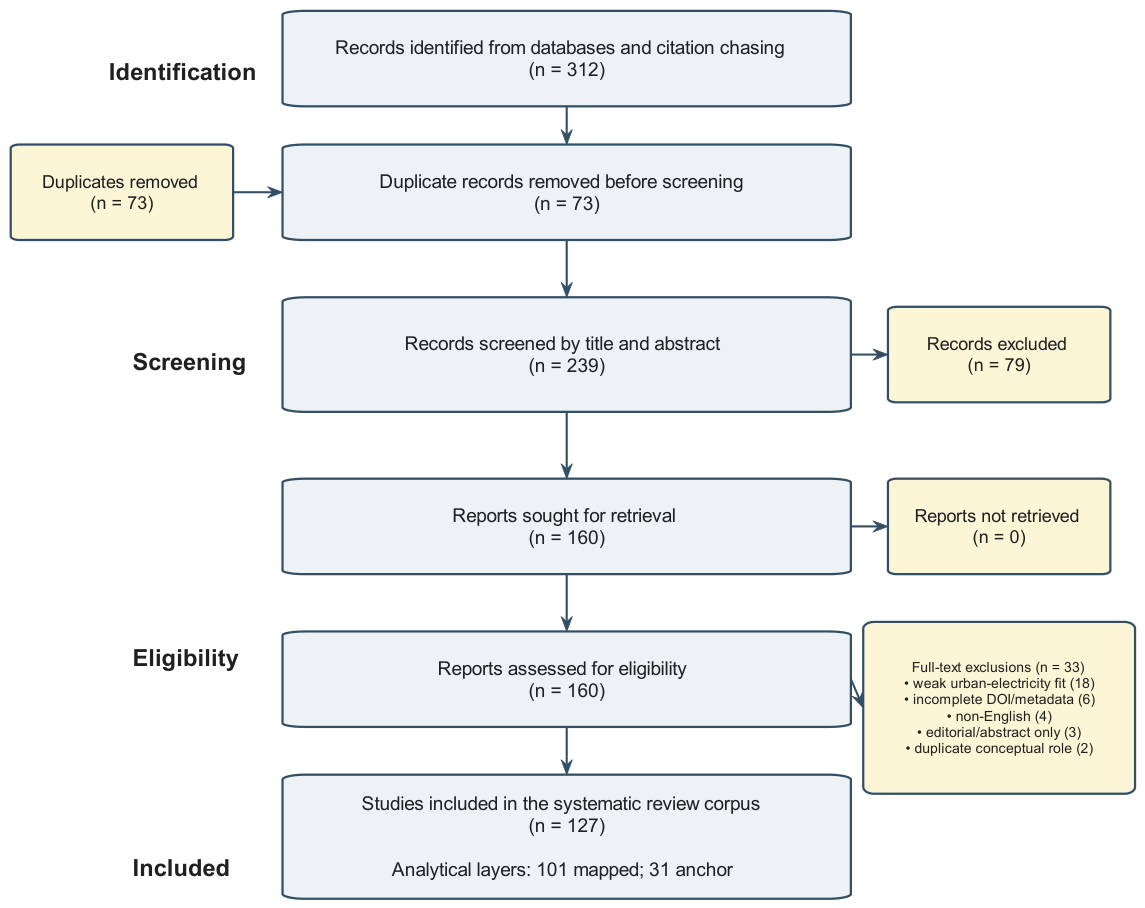
Deduplication used exact DOI matching first, followed by normalized-title inspection for near-duplicates. Screening was conducted in two stages: title/abstract screening followed by full-text eligibility assessment. Figure 1 summarizes the resulting PRISMA flow. The systematic review corpus contains 127 included studies.
The review used three nested analytical layers. The included corpus ( n = 127 ) is the auditable evidence base retained in the Supplementary Workbook. The main quantitative mapping sample ( n = 101 ) excludes 26 contextual-only methods/background records that were useful for framing but too generic to support direct quantitative claims about urban electricity orchestration. Those 26 contextual-only records are listed in Supplementary Table S6 and are flagged in the workbook through the InMainQuantSample field. Operational rules for movement between the included corpus, the mapping sample, and the anchor core are summarized in Supplementary Table S4 and in the workbook columns InMainQuantSample, CorePriority, and ReviewDepth. The deep-synthesis anchor core ( n = 31 ) was selected purposively for close reading when studies offered direct smart-city or district relevance, nontrivial orchestration content, sufficient detail for KPI or validation coding, and a non-duplicative narrative role. Thus, the 127 included studies establish scope, the 101 mapped studies support descriptive comparisons, and the 31 anchor papers carry the deepest interpretive burden.

2.4. Data Charting, Codebook, and Subjectivity Control

Each included paper was charted using a structured codebook covering year, broad theme, primary cluster, asset focus, system level, network awareness, digital-twin relationship, smart-city relevance, niche fit, review depth, and KPI-family coverage. To reduce subjectivity, the codebook defines explicit decision rules for the most interpretive variables and distinguishes direct digital-twin use from indirect cyber-physical or virtual-model relationships. KPI families were coded only when a paper reported at least one operationalized, simulated, estimated, or tabulated measure in that family; narrative mention alone was not counted. This distinction is important for cybersecurity and interoperability: a paper that notes cyber risk is not equivalent to a paper that reports a cyber or protocol-performance metric.
Coding was performed by D.C. using the written codebook and an auditable worksheet. No formal co-author audit or second-coder procedure was undertaken, so no inter-rater statistic is reported. Subjectivity is, therefore, managed through explicit operational rules, transparent data files, and a conservative interpretation of the coded variables.

2.5. Statistical Treatment

The quantitative layer is explicitly descriptive. The included corpus is not a random sample from a defined population of all publications; it is a curated evidence base assembled through systematic searching and purposive analytical layering. Sparse cells were common in the contingency tables, especially for the broad theme × network awareness and publication period × broad theme. Therefore, the analysis uses Monte-Carlo permutation chi-square tests (20,000 permutations) as the primary significance diagnostic and bootstrap 95% confidence intervals for Cramér’s V (5000 resamples). All permutation tests used random seed 20260505 and preserved the observed table margins under the null. Bootstrap intervals for Cramér’s V were computed with the percentile method. The contingency analyses were generated from the coded workbook in Python 3.13 using pandas, NumPy, and SciPy; the raw contingency tables behind Table 2 are provided in Supplementary Tables S7–S10 and in the accompanying CSV files. Ordinal variables such as smart-city relevance and niche fit are summarized by medians and interquartile ranges rather than arithmetic means. The descriptive intent is emphasized throughout: the statistics identify systematic patterns inside the assembled corpus, not universal laws of the field.

3. Results

3.1. PRISMA Flow and Corpus Composition

Figure 1 shows the search and selection process. Searches and citation chasing identified 312 records. After duplicate removal, 239 records were screened by title and abstract. A total of 160 reports were assessed at full text, of which 33 were excluded, mainly because they were insufficiently grounded in urban electricity coordination or lacked complete DOI-traceable bibliographic information. This yielded 127 included studies. Database-specific identification counts and detailed PRISMA flow/exclusion counts are reported in Supplementary Tables S2 and S3, respectively.
The included corpus spans 2009–2026. The broader 127-record library is retained in the Supplementary Workbook as an auditable evidence map. The 101-paper mapping sample supports the descriptive quantitative summaries, while the 31-paper anchor core supports close narrative synthesis and KPI coding.

3.2. Theme Profile and Temporal Evolution

The 101-paper mapping sample was grouped into six broad themes. Table 1 reports paper counts, recent-share counts, high-network-awareness counts, direct digital-twin counts, and medians for the two ordinal scores. The table operationalizes three terms that were previously underdefined. Recent share is the proportion of papers published in 2024–2026; high network awareness is the proportion coded High on the explicit feeder-constraint rule and direct digital-twin share counts only records coded Yes rather than Indirect.
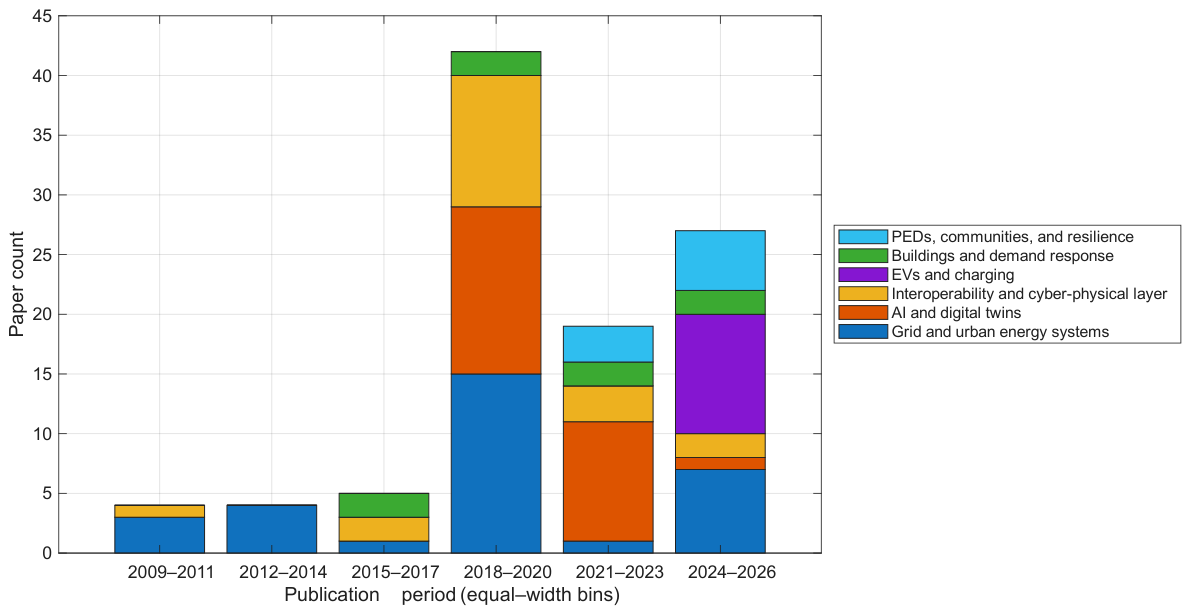
Three descriptive observations follow immediately. Grid-oriented urban-energy studies remain the largest and most explicitly feeder-aware theme. EV and charging studies are the most recent theme, with all ten mapped papers published in 2024–2026. By contrast, AI/digital-twin and interoperability papers are abundant but seldom operationalize feeder constraints directly. Figure 2 shows the same pattern using equal-width three-year bins for direct period comparability.

3.3. Association Results with Sparse-Cell-Robust Statistics

Table 2 reports the descriptive association analysis. Monte-Carlo permutation p-values, bootstrap confidence intervals for Cramér’s V, and counts of expected cells below 5 are reported so that the sparse-cell structure of the data remains explicit.
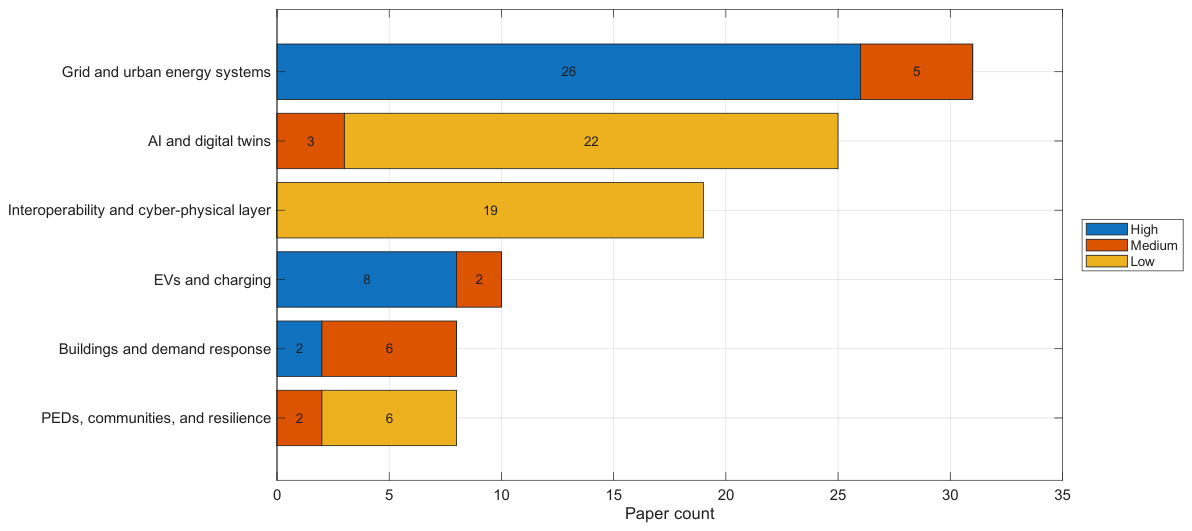
The largest effect is broad theme versus network awareness. Within this systematically assembled mapping sample, explicit network awareness is much more common in grid- and EV-oriented studies than in AI/digital-twin or interoperability studies. Figure 3 visualizes this result using the High → Medium → Low ordering.
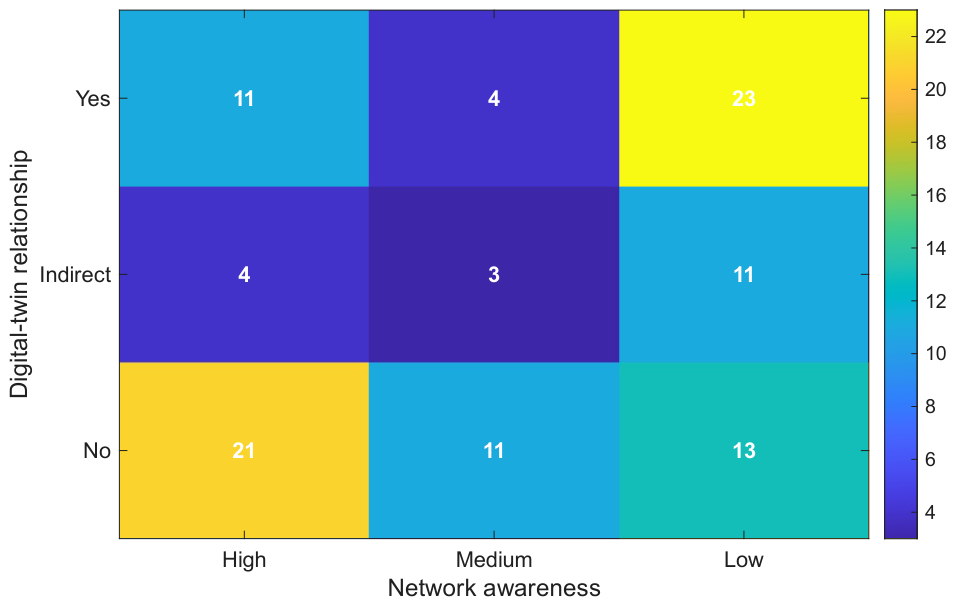
Figure 4 shows that a direct digital-twin relationship is not synonymous with feeder-aware modeling. The relationship exists, but it is weak-to-moderate rather than decisive.

3.4. KPI Coverage, Validation Maturity, and Representative-Study Synthesis

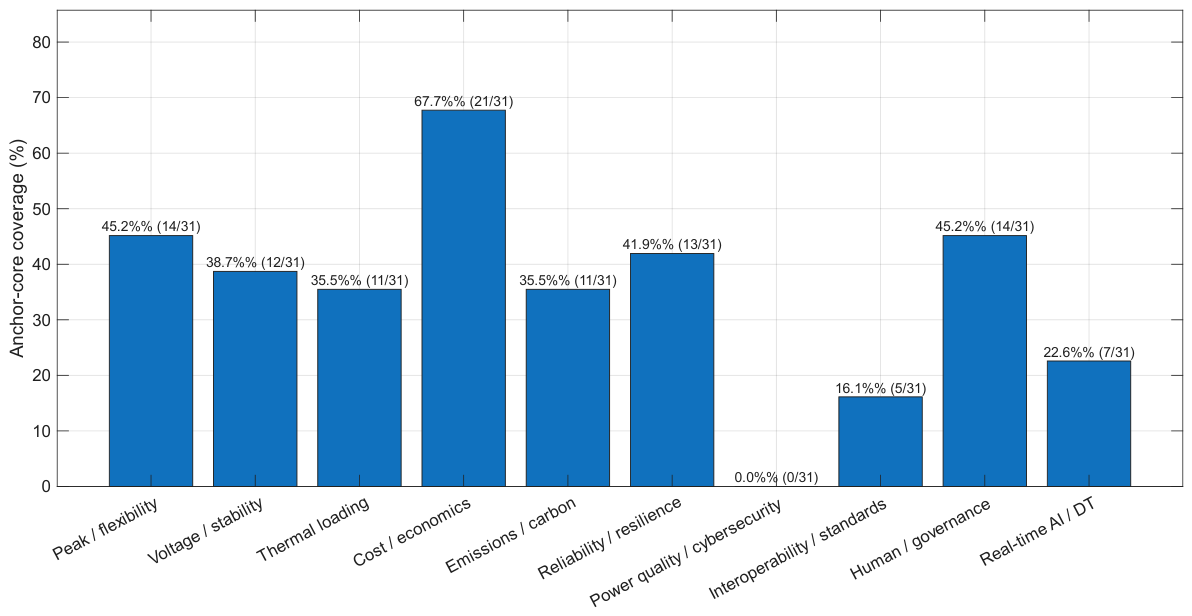
Figure 5 counts only metric-level operationalization, not mention-level discussion. Cost/economic outcomes are the most frequently operationalized KPI family, whereas interoperability/standards and operational digital-twin metrics remain scarce. Within the 31 anchor papers, no study operationalized cybersecurity or power quality metrics as a dedicated reported KPI family.
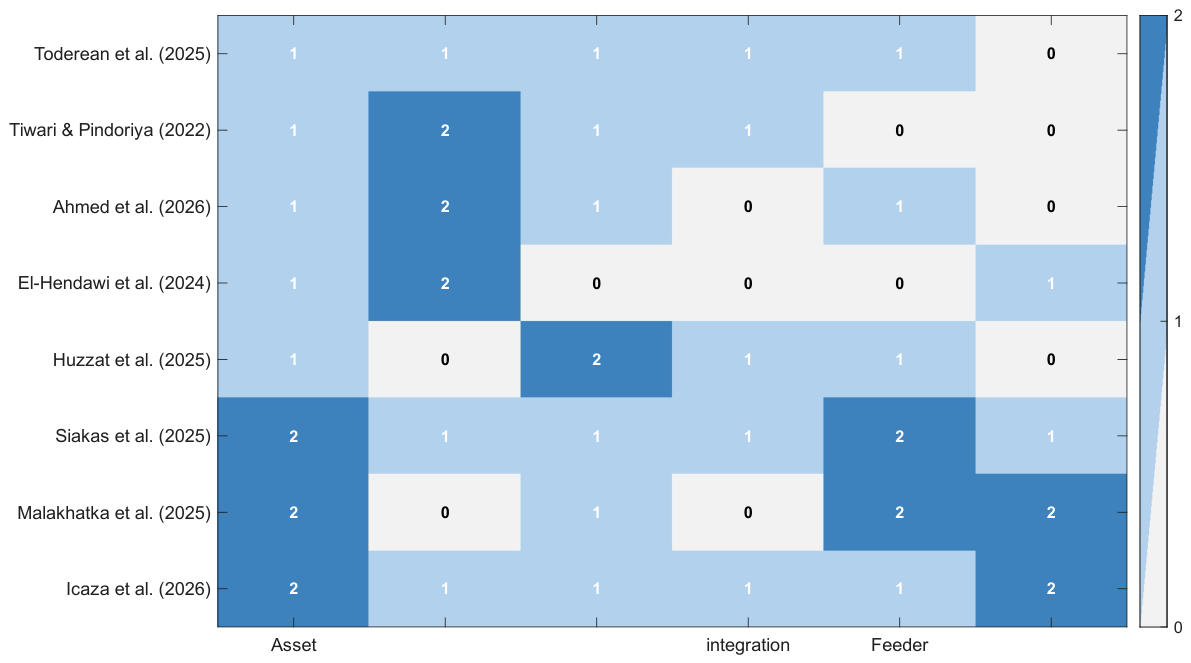
Figure 6 complements the quantitative summary by comparing eight representative papers across asset integration, feeder constraints, digital layer, interoperability/standards, governance/market content, and validation maturity. The eight studies were selected purposively to span the main applied strands of the review: two building-side exemplars, two EV/distribution-impact studies, one digital-twin synthesis paper, and three district/city implementation cases. The matrix is not a population estimate; it is a transparent comparative device for the narrative synthesis.

3.5. Positioning Relative to Recent Overlapping Reviews

Table 3 positions the present study relative to recent overlapping reviews. Its distinctive contribution is not simply broader scope; it is the explicit coupling of feeder constraints, interoperability/cybersecurity, and validation maturity within one urban electricity frame.

4. Narrative Synthesis and Framework Development

4.1. What the Literature Already Does Well

The literature already provides several strong building blocks. The field does not lack progress; it lacks enough integrated evidence across layers. Grid and EV studies already do several things well. Distribution-impact reviews on EV charging and fast charging explicitly quantify voltage deviation, transformer stress, congestion, and mitigation strategies [4,18,19,20,21,22]. Building-side flexibility reviews are also technically mature in their own domain, especially on thermal inertia, comfort-aware control, and automated demand response [8,9,10,11,12,13]. PED and community reviews, meanwhile, are much stronger than feeder-focused studies on governance, local value creation, participation, and district implementation [5,6,7,27,28,29,30,31,32].
Digital-twin and AI reviews also contribute something real: architecture, data fusion, forecasting, optimization, state visibility, and cyber-physical integration [23,24,25,26]. The problem is, therefore, not that one theme is valuable and the others are not. The problem is that the most operationally important themes are distributed across literature that seldom evaluates the same system boundary.

4.2. Where the Orchestration Gap Remains

The central synthesis claim of this review is not that the field lacks components; it is that the field still lacks enough integrated evidence about how components should be orchestrated together. Buildings are often evaluated without EV interaction. EV studies are often richer on feeder constraints than on cross-vendor interoperability. Digital-twin papers are often richer on architecture than on measurable feeder improvement. PED studies are often richer on governance and annual district balance than on hourly feeder effects. This is why feeder-aware orchestration remains the unresolved middle layer.
The building literature illustrates this point well. Recent studies of residential air-conditioning flexibility and heat-pump water-heater control show that controllable building-side demand can be quantified in more operationally nuanced ways than simple peak-shaving metrics alone [12,13]. These two primary studies were included as building-side exemplars because they quantify flexible thermal loads with operational detail that review articles rarely report, thereby illustrating what feeder-relevant end-use evidence can add to broader building-to-grid syntheses. However, these studies become materially more relevant to smart-city electricity systems when they are linked to feeder state, tariff design, and simultaneous EV or DER interaction. The same logic applies to EV studies: EVs are now one of the strongest feeder-aware pieces of literature, but a pure EV review would underplay the building, district, and governance layers that urban operators must coordinate.

4.3. Standards, Architectures, Co-Simulation Tools, and Regulatory Instruments

A central implication of this review is that standards, interoperability frameworks, validation tools, and regulatory instruments cannot remain peripheral. Table 4 frames the proposed taxonomy as a domain-specific specialization of SGAM and IEEE 2030 rather than an attempt to replace them [35,36]. It also lists the protocol and interoperability families most relevant to urban flexibility orchestration, including IEC 61850 and DER profiles [37,38], CIM-based IEC 61968/61970 practices [39,40], IEEE 2030.5 [41], OpenADR, OCPP, OPC UA, MQTT, SunSpec-style device semantics, and IEEE 1547/1547.1 assumptions at the DER interface [42,43]. The point is not to claim that all included papers must use every interface; rather, feeder orchestration is not convincingly deployable unless such interfaces are made visible.
Validation tooling also deserves explicit treatment. HELICS, Mosaik, OpenDSS, and GridLAB-D are not peripheral details; they are part of the methodological bridge from conceptual orchestration to deployable urban controls [44,45,46,47]. In the governance layer, FERC Order 2222 is a useful U.S. reference because it operationalizes DER aggregation rules in wholesale markets [48]. In Europe, the Clean Energy for All Europeans package and the demand-response-code process around ACER and the EU system operators are directly relevant because they frame how storage, distributed generation, and demand response can provide services under common rules [49,50]. These instruments do not settle the urban orchestration problem, but they shape what counts as a realistic deployment path.

4.4. Adjacent Literature Outside the Anchor Core

The zero cybersecurity/power quality bar in Figure 5 is intentionally scoped. Within the 31 anchor papers, no study operationalized cybersecurity or power quality as a dedicated KPI family. That is methodologically defensible because the anchor core prioritizes integrative urban-orchestration papers. It is not evidence that the wider literature lacks cybersecurity or power quality work. Adjacent literature exists on EV-induced harmonic and power quality effects, on cyber attacks such as false-data injection, and on operational security frameworks for DER communication ecosystems. Official reference points include the IEC 62351 security family and NIST SP 1800-32 for securing DER-related IIoT ecosystems [51,52]. This review, therefore, treats cybersecurity and power quality as adjacent but under-integrated literature, not as absent topics.

4.5. A Domain-Specific Taxonomy for Feeder-Aware Urban Orchestration

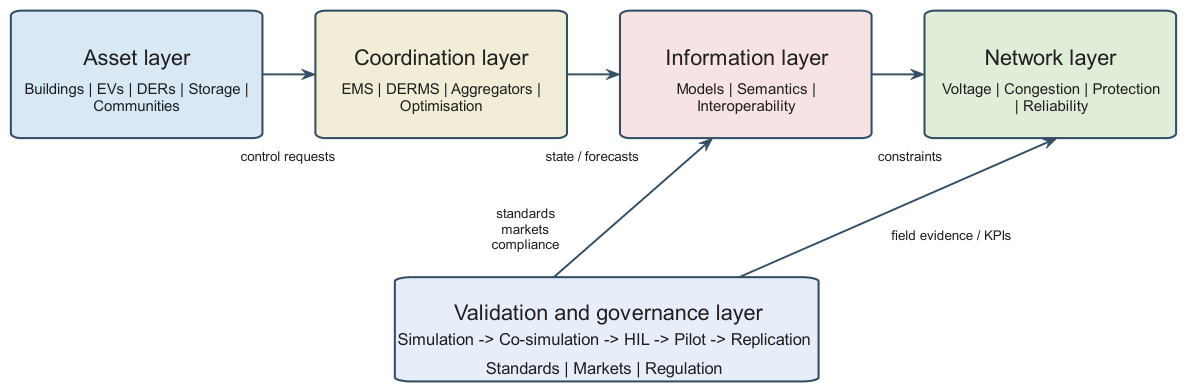
Figure 7 presents the taxonomy used in this review. It adds directionality, signal types, and an explicit validation/governance layer. The figure does not claim to supersede SGAM or IEEE 2030. Instead, it specializes those broader frameworks for the narrower problem of urban feeder orchestration.

4.6. Operational Digital Twins and the Validation Ladder

In this review, an “operational digital twin” is defined as a cyber-physical representation of an asset, feeder, or district that is updated with live or periodically synchronized data and is used not only for visualization, but for state estimation, prediction, supervision, or closed-loop control. Under this definition, many smart-city digital-twin papers remain at the architecture or planning level. That is not a criticism of their value; it is a classification of their current maturity.
Table 5 and Figure 8 introduce the validation ladder used in this review. The ladder separates literature concept, offline simulation, co-simulation, controller-in-the-loop, hardware-in-the-loop, closed-loop synchronization, pilot/living-lab deployment, and replicated district/city evidence. Its purpose is twofold: to define what “operational digital twin” means in this paper, and to make validation maturity visible as a reporting dimension rather than an implicit impression.

5. Benchmarking Framework and Stakeholder Roadmap

Table 6 applies the reporting framework retroactively to representative studies and indicates the minimum reporting expectation each would need for stronger cross-paper comparability. The table is intended as a retrofittable reporting instrument rather than a generic checklist.
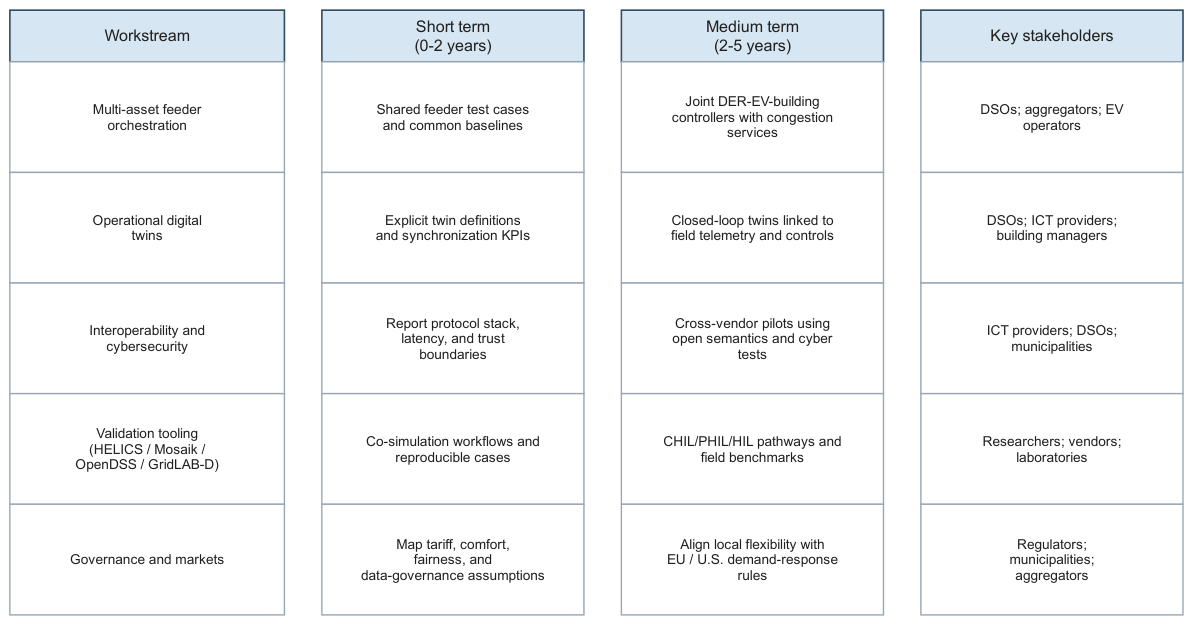
Figure 9 translates the synthesis into a stakeholder-aware roadmap with short-/medium-term horizons and named actor groups.
A final methodological implication follows from the roadmap. Privacy-preserving and distributed learning approaches, including federated or edge-learning strategies, are promising precisely because urban flexibility data are fragmented across buildings, EV operators, DSOs, and municipalities. However, the reviewed corpus rarely treats these approaches as part of a full feeder-aware orchestration stack. They, therefore, appear here as an important forward-looking research avenue rather than as a mature current subfield.

6. Discussion

The review supports three main conclusions. First, the existing literature already contains strong single-theme progress: feeder-aware EV studies, technically mature building-flexibility studies, governance-rich PED studies, and architecture-rich digital-twin studies. Second, the central integration gap lies in the combination of these strengths, not in the absence of any one of them. Third, the most useful next-step studies are those that couple multi-asset flexibility, feeder constraints, interoperability, validation maturity, and governance under one urban distribution-system frame.
At the same time, the review also clarifies what the evidence does not support. It does not support population-level statistical generalization beyond the assembled corpus. It does not support the claim that cybersecurity or power quality are absent from the broader literature. It does not support equating any digital-twin label with operational maturity. And it does not support treating every smart-city energy paper as equally relevant to feeder-aware orchestration.

Limitations

Several limitations should be considered. First, the review includes only English-language records and omits grey literature and standards documents from the coded corpus, even though several standards and regulatory instruments are discussed narratively. Second, the corpus, while systematically assembled, is still shaped by database coverage and the choice of search terms. Third, the coded corpus mixes reviews, conceptual papers, and implementation-oriented studies, so no formal risk-of-bias instrument was applied across all evidence types. Fourth, the coding was performed by a single reviewer; although the codebook and workbook are transparent, no inter-rater statistic is available. Fifth, the 31-paper anchor core is a purposeful deep-synthesis layer rather than an exhaustive close reading of all 127 included records. These considerations are precisely why the statistical claims in this paper are descriptive and scoped.

7. Conclusions

This systematic review examined what the current smart-city electricity literature can support about feeder-aware coordination of buildings, EVs, DERs, storage, digital twins, and interoperability layers. The evidence shows that the field has mature component literature, but fewer studies that integrate these components under feeder constraints, validation ladders, standards, and governance assumptions.
The main quantitative pattern is that feeder grounding is concentrated in grid and EV studies, whereas AI/digital-twin and interoperability studies are less often validated against distribution-network operation. The main narrative pattern is that building and district/community studies contribute essential service, governance, and participation perspectives, but often without enough operational normalization at the feeder level. Taken together, the results support a research agenda centered on multi-asset urban flexibility orchestration with explicit network, interoperability, and governance evidence.
For smart-city researchers, the implication is that urban intelligence becomes electrically meaningful only when the feeder is treated as an operational boundary. For power-systems researchers, urban flexibility becomes more deployable when community governance, building services, and interoperable digital control are treated as system variables rather than externalities. In practical terms, DSOs, municipalities, and aggregators benefit most from studies that report feeder metrics, interoperability assumptions, and governance conditions together rather than as separate layers. That combined perspective is where the evidence base remains thinnest and where future review and primary research can add the most value.

Supplementary Materials

The following supporting information can be downloaded at: https://www.mdpi.com/article/10.3390/smartcities9050087/s1. The supplementary package uses filenames that match the Supplementary Table labels and the supporting file roles. It includes: (i) Supplementary_File_S1_PRISMA_2020_checklist_and_abstract_checklist.pdf, which contains the PRISMA 2020 main checklist and abstract checklist; (ii) Supplementary_File_S2_detailed_search_log_sensitivity_note _and_PRISMA_flow_counts.pdf, which contains Supplementary Table S1 (database search strings), Supplementary Table S2 (database-specific identification counts), Supplementary Table S3 (PRISMA flow and exclusion counts), and Supplementary Table S5 (sensitivity note); (iii) Supplementary_Table_S4_operational_rule_codebook_table.pdf, which contains Supplementary Table S4 (operational rule/codebook table documenting movement between the included corpus, mapping sample, and anchor core); (iv) Supplementary_Tables _S1–S5 and Tables S11–S15_coded_review_workbook.xlsx, which contains the full 127-record evidence map, the 101-paper mapping sample, the 31-paper anchor core, the codebook, and the workbook versions of Supplementary Tables S1–S5 and S11–S15; (v) Supplementary CSV exports Tables S6–S10, which contains CSV exports for Supplementary Table S6 (contextual-only records), Supplementary Table S7 (broad theme versus network awareness), Supplementary Table S8 (broad theme versus digital-twin relationship), Supplementary Table S9 (digital-twin relationship versus network awareness), Supplementary Table S10 (publication period versus broad theme), and the data behind Figure 6 and Table 6; and (vi) Supplementary_File_S3_MATLAB_R2024b_figure_ regeneration.m, which provides MATLAB R2024b code for regenerating the manuscript figures from the workbook. All references cited in the supplementary files have been included in the main reference list and are cited where relevant in the manuscript and supplementary materials.

Author Contributions

Conceptualization, methodology, and writing—review and editing: M.D.J., D.C. and A.A.T.; investigation, data curation, formal analysis, visualization, and writing—original draft preparation: M.D.J.; supervision and project administration: M.D.J. All authors have read and agreed to the published version of the manuscript.

Funding

This work was supported by Universidad Politécnica Salesiana and GIREI—Smart Grid Research Group.

Institutional Review Board Statement

Not applicable.

Informed Consent Statement

Not applicable.

Data Availability Statement

The original contributions presented in this study are included in the article and Supplementary Materials. Further inquiries can be directed to the corresponding author.

Acknowledgments

The authors acknowledge institutional support from Universidad Politécnica Salesiana and the GIREI research group.

Conflicts of Interest

The authors declare no conflicts of interest.

Abbreviations

AIArtificial Intelligence
CHILController-Hardware-in-the-Loop
DERDistributed Energy Resource
DSODistribution System Operator
DTDigital Twin
EMSEnergy Management System
EVElectric Vehicle
EVSEElectric Vehicle Supply Equipment
HILHardware-in-the-Loop
KPIKey Performance Indicator
OCPPOpen Charge Point Protocol
OPC UAOpen Platform Communications Unified Architecture
PEDPositive Energy District
PHILPower-Hardware-in-the-Loop
PRISMAPreferred Reporting Items for Systematic Reviews and Meta-Analyses
RECRenewable Energy Community
SCADASupervisory Control and Data Acquisition
SGAMSmart Grid Architecture Model
V2GVehicle-to-Grid

References

  1. Esfandi, S.; Tayebi, S.; Byrne, J.; Taminiau, J.; Giyahchi, G.; Alavi, S.A. Smart Cities and Urban Energy Planning: An Advanced Review of Promises and Challenges. Smart Cities 2024, 7, 414–444. [Google Scholar] [CrossRef]
  2. Silva, N.S.E.; Castro, R.; Ferrao, P. Smart Grids in the Context of Smart Cities: A Literature Review and Gap Analysis. Energies 2025, 18, 1186. [Google Scholar] [CrossRef]
  3. Alhasnawi, B.N.; Hashim, H.K.; Zanker, M.; Bures, V. The rising, applications, challenges, and future prospects of energy in smart grids and smart cities systems. Energy Convers. Manag. X 2025, 27, 101162. [Google Scholar] [CrossRef]
  4. El-Hendawi, M.; Wang, Z.; Paranjape, R.; Fick, J.; Pederson, S.; Kozoriz, D. Impact of Electric Vehicles Charging on Urban Residential Power Distribution Networks. Energies 2024, 17, 5905. [Google Scholar] [CrossRef]
  5. Siakas, D.; Rahanu, H.; Georgiadou, E.; Siakas, K.; Lampropoulos, G. Positive Energy Districts Enabling Smart Energy Communities. Energies 2025, 18, 3131. [Google Scholar] [CrossRef]
  6. Trevisan, R.; Ghiani, E.; Pilo, F. Renewable Energy Communities in Positive Energy Districts: A Governance and Realisation Framework in Compliance with the Italian Regulation. Smart Cities 2023, 6, 563–585. [Google Scholar] [CrossRef]
  7. Krangsås, S.G.; Steemers, K.; Konstantinou, T.; Soutullo, S.; Liu, M.; Giancola, E.; Prebreza, B.; Ashrafian, T.; Murauskaitė, L.; Maas, N. Positive Energy Districts: Identifying Challenges and Interdependencies. Sustainability 2021, 13, 10551. [Google Scholar] [CrossRef]
  8. Xiang, Y.; Chen, L.; Wuyun, Q.; Yu, S.; Geng, Y.; Tang, H.; Wang, Z.; Tang, R.; Hui, H.; Zhao, Y.; et al. A Comprehensive Review of Building-to-Grid Interaction. Energy Use 2026, 2, 100043. [Google Scholar] [CrossRef]
  9. Toderean, L.; Cioara, T.; Anghel, I.; Sarmas, E.; Michalakopoulos, V.; Marinakis, V. Demand response optimization for smart grid integrated buildings: Review of technology enablers landscape and innovation challenges. Energy Build. 2025, 326, 115067. [Google Scholar] [CrossRef]
  10. Tiwari, A.; Pindoriya, N.M. Automated Demand Response in Smart Distribution Grid: A Review on Metering Infrastructure, Communication Technology and Optimization Models. Electr. Power Syst. Res. 2022, 206, 107835. [Google Scholar] [CrossRef]
  11. Samad, T.; Koch, E.; Stluka, P. Automated Demand Response for Smart Buildings and Microgrids: The State of the Practice and Research Challenges. Proc. IEEE 2016, 104, 726–744. [Google Scholar] [CrossRef]
  12. Li, W.; Sui, W.; Cheng, L.; Ji, Y.; Guo, Y.; Zhu, J. Quantifying seasonal demand-side flexibility in residential air conditioning under diverse control strategies. Energy Build. 2026, 352, 116764. [Google Scholar] [CrossRef]
  13. Jing, Q.; Guo, Y.; Liu, Y.; Wang, Y.; Du, C.; Liu, X. Optimization study of energy saving control strategy of carbon dioxide heat pump water heater system under the perspective of energy storage. Appl. Therm. Eng. 2026, 283, 129030. [Google Scholar] [CrossRef]
  14. Kumar, P.; Channi, H.K.; Kumar, R.; Rajiv, A.; Kumari, B.; Singh, G.; Singh, S.; Dyab, I.F.; Lozanovic, J. A comprehensive review of vehicle-to-grid integration in electric vehicles: Powering the future. Energy Convers. Manag. X 2025, 25, 100864. [Google Scholar] [CrossRef]
  15. Eltohamy, M.S.; Tawfiq, M.H.; Ahmed, M.M.R.; Alaas, Z.; Mohammed, B.; Ahmed, I.; Youssef, H.; Raouf, A. A comprehensive review of Vehicle-to-Grid V2G technology: Technical, economic, regulatory, and social perspectives. Energy Convers. Manag. X 2025, 27, 101138. [Google Scholar] [CrossRef]
  16. Alamgir, S.; Hassan, S.J.U.; Mehdi, A.; Abdelmaksoud, A.; Haider, Z.; Shin, G.S.; Kim, C.H. A comprehensive review of vehicle-to-grid (V2G) technology as an ancillary services provider. Results Eng. 2025, 27, 106813. [Google Scholar] [CrossRef]
  17. Stogl, O.; Miltner, M.; Zanocco, C.; Traverso, M.; Stary, O. Electric vehicles as facilitators of grid stability and flexibility: A multidisciplinary overview. WIREs Energy Environ. 2024, 13, e536. [Google Scholar] [CrossRef]
  18. Babar, R.; Muhammad, A.; Khan, R.S.; Khan, W.; Aziz, A.; Yousaf, M.Z.; Bajaj, M.; Zaitsev, I. Operational strategies for EV fast-charging and their impact on power grid and renewable integration. Energy Explor. Exploit. 2025, 01445987251352551. [Google Scholar] [CrossRef]
  19. Ahmed, F.; Ahmad, S.; Rahman, M.T.; Hazari, M.R.; Faiz, R.; Ahmed, T.; Karimi, M. A holistic review of electric vehicle charging impacts on power distribution networks: Technical challenges, smart mitigation strategies and future directions. Appl. Energy 2026, 402, 126961. [Google Scholar] [CrossRef]
  20. Tayri, A.; Ma, X. Grid Impacts of Electric Vehicle Charging: A Review of Challenges and Mitigation Strategies. Energies 2025, 18, 3807. [Google Scholar] [CrossRef]
  21. Nutkani, I.; Toole, H.; Fernando, N.; Andrew, L.P.C. Impact of EV charging on electrical distribution network and management strategies. IET Smart Grid 2024, 7, 485–502. [Google Scholar] [CrossRef]
  22. Li, J.; Chew, A.; Wang, H. Investigating state-of-the-art planning strategies for electric vehicle charging infrastructures in coupled transport and power networks: A comprehensive review. Prog. Energy 2024, 6, 042004. [Google Scholar] [CrossRef]
  23. Huzzat, A.; Anpalagan, A.; Khwaja, A.S.; Woungang, I.; Alnoman, A.A.; Pillai, A.S. A comprehensive review of Digital Twin technologies in smart cities. Digit. Eng. 2025, 4, 100040. [Google Scholar] [CrossRef]
  24. Judge, M.A.; Franzitta, V.; Curto, D.; Guercio, A.; Cirrincione, G.; Khattak, H.A. A comprehensive review of artificial intelligence approaches for smart grid integration and optimization. Energy Convers. Manag. X 2024, 24, 100724. [Google Scholar] [CrossRef]
  25. Ahmadi, M.; Aly, H.; Gu, J. A comprehensive review of AI-driven approaches for smart grid stability and reliability. Renew. Sustain. Energy Rev. 2026, 226, 116424. [Google Scholar] [CrossRef]
  26. Lytras, M.D.; Chui, K.T. The Recent Development of Artificial Intelligence for Smart and Sustainable Energy Systems and Applications. Energies 2019, 12, 3108. [Google Scholar] [CrossRef]
  27. Casamassima, L.; Bottecchia, L.; Bruck, A.; Kranzl, L.; Haas, R. Economic, social, and environmental aspects of Positive Energy Districts—A review. WIREs Energy Environ. 2022, 11, e452. [Google Scholar] [CrossRef]
  28. Sassenou, L.N.; Olivieri, L.; Olivieri, F. Challenges for positive energy districts deployment: A systematic review. Renew. Sustain. Energy Rev. 2024, 191, 114152. [Google Scholar] [CrossRef]
  29. Sassenou, L.N.; Olivieri, F.; Civiero, P.; Olivieri, L. Methodologies for the design of positive energy districts: A scoping literature review and a proposal for a new approach (PlanPED). Build. Environ. 2024, 260, 111667. [Google Scholar] [CrossRef]
  30. Malakhatka, E.; Shafqat, O.; Sandoff, A.; Thuvander, L. Positive energy districts and energy communities: How living labs create value. Build. Cities 2025, 6, 783–799. [Google Scholar] [CrossRef]
  31. de Bruyn, C.; Ben Said, F.; Venter, M.; Castanho, R.A. Are smart technologies enough to build climate-resilient cities? A bibliometric assessment of global trends and research gaps. City Environ. Interact. 2026, 29, 100306. [Google Scholar] [CrossRef]
  32. Icaza, D.; Borge-Diez, D.; Pulla Galindo, S.; Siguencia, M. Novel smart grids applications for energy management and traceability in heritage cities: Case study for city of Cuenca, Ecuador. Sustain. Futur. 2026, 11, 101596. [Google Scholar] [CrossRef]
  33. Page, M.J.; McKenzie, J.E.; Bossuyt, P.M.; Boutron, I.; Hoffmann, T.C.; Mulrow, C.D.; Shamseer, L.; Tetzlaff, J.M.; Akl, E.A.; Brennan, S.E.; et al. The PRISMA 2020 statement: An updated guideline for reporting systematic reviews. BMJ 2021, 372, n71. [Google Scholar] [CrossRef]
  34. Jaramillo, M.; Carrion, D.; Munoz, J.; Tipan, L. A Bibliometric Assessment of AI, IoT, Blockchain, and Big Data in Renewable Energy-Oriented Power Systems. Energies 2025, 18, 3067. [Google Scholar] [CrossRef]
  35. CEN-CENELEC-ETSI Smart Grid Coordination Group. Smart Grid Reference Architecture; SG-CG/M490/C; Version 3.0; Technical Report; CEN-CENELEC-ETSI: Brussels, Belgium, 2012; Available online: https://www.cencenelec.eu/media/CEN-CENELEC/AreasOfWork/CEN-CENELEC_Topics/Smart%20Grids%20and%20Meters/Smart%20Grids/reference_architecture_smartgrids.pdf (accessed on 10 May 2026).
  36. IEEE Std. 2030-2011; Guide for Smart Grid Interoperability of Energy Technology and Information Technology Operation with the Electric Power System, and End-Use Applications and Loads. IEEE Standards Association: Piscataway, NJ, USA, 2011.
  37. IEC 61850-7-420:2021; Communication Networks and Systems for Power Utility Automation—Part 7-420: Basic Communication Structure—Distributed Energy Resources and Distribution Automation Logical Nodes. International Electrotechnical Commission: Geneva, Switzerland, 2021.
  38. IEC TR 61850-90-7:2023; Communication Networks and Systems for Power Utility Automation—Part 90-7: Object Models for Power Converters in Distributed Energy Resources (DER) Systems. International Electrotechnical Commission: Geneva, Switzerland, 2023.
  39. IEC 61968-11:2013; Application Integration at Electric Utilities—System Interfaces for Distribution Management—Part 11: Common Information Model (CIM) Extensions for Distribution. International Electrotechnical Commission: Geneva, Switzerland, 2013.
  40. IEC 61970-301:2020+AMD1:2022 CSV; Energy Management System Application Program Interface (EMS-API)—Part 301: Common Information Model (CIM) Base. International Electrotechnical Commission: Geneva, Switzerland, 2022.
  41. IEEE Std 2030.5-2023; IEEE Standard for Smart Energy Profile Application Protocol. IEEE Standards Association: Piscataway, NJ, USA, 2024. Available online: https://standards.ieee.org/ieee/2030.5/11216/ (accessed on 10 May 2026).
  42. IEEE Std 1547-2018; IEEE Standard for Interconnection and Interoperability of Distributed Energy Resources with Associated Electric Power Systems Interfaces. IEEE Standards Association: Piscataway, NJ, USA, 2018. Available online: https://standards.ieee.org/standard/1547-2018.html (accessed on 10 May 2026).
  43. IEEE Std 1547.1-2020; IEEE Standard Conformance Test Procedures for Equipment Interconnecting Distributed Energy Resources with Electric Power Systems and Associated Interfaces. IEEE Standards Association: Piscataway, NJ, USA, 2020. Available online: https://standards.ieee.org/ieee/1547.1/6039/ (accessed on 10 May 2026).
  44. Hardy, T.; Palmintier, B.; Top, P.; Krishnamurthy, D.; Fuller, J. HELICS: A Co-Simulation Framework for Scalable Multi-Domain Modeling and Analysis. IEEE Access 2024, 12, 29404–29432. [Google Scholar] [CrossRef]
  45. Schütte, S.; Scherfke, S.; Troschel, M. Mosaik: A Framework for Modular Simulation of Active Components in Smart Grids. In 2011 IEEE First International Workshop on Smart Grid Modeling and Simulation (SGMS); IEEE: Piscataway, NJ, USA, 2011; pp. 55–60. [Google Scholar] [CrossRef]
  46. Electric Power Research Institute. OpenDSS Documentation, 2026. Available online: https://opendss.epri.com/ (accessed on 10 May 2026).
  47. GridLAB-D Project. GridLAB-D Distribution System Simulation Platform, 2026. Available online: https://www.gridlabd.org/ (accessed on 10 May 2026).
  48. Federal Energy Regulatory Commission. Order No. 2222: Opening Wholesale Markets to Distributed Energy Resource Aggregations, 2020. Available online: https://www.ferc.gov/sites/default/files/2020-09/e-1_0.pdf (accessed on 10 May 2026).
  49. European Commission; Directorate-General for Energy. Clean Energy for All Europeans; Publications Office of the European Union: Luxembourg, 2019; Available online: https://op.europa.eu/en/publication-detail/-/publication/b4e46873-7528-11e9-9f05-01aa75ed71a1 (accessed on 10 May 2026).
  50. European Union Agency for the Cooperation of Energy Regulators (ACER). Recommendation No. 01/2025 on Reasoned Proposal for the Establishment of the Network Code on Demand Response. 7 March 2025. Available online: https://www.acer.europa.eu/sites/default/files/documents/Recommendations/ACER_Recommendation_01-2025_Demand_Response_Network_Code.pdf (accessed on 10 May 2026).
  51. IEC 62351:2026 SER; Power Systems Management and Associated Information Exchange—Data and Communications Security—All Parts. IEC. Geneva, Switzerland, 2026. Available online: https://webstore.iec.ch/en/publication/6912 (accessed on 10 May 2026).
  52. NIST SP 1800-32; Securing Distributed Energy Resources: An Example of Industrial Internet of Things Cybersecurity. NIST: Gaithersburg, MD, USA, 2022. [CrossRef]
Figure 1. PRISMA 2020 flow diagram for the systematic review. The main-text figure reports inclusion into the systematic review corpus ( n = 127 ); the analytical subdivision into the 101-paper mapping sample and the 31-paper anchor core is shown in the final inclusion box and detailed in the Methods and Supplementary Workbook. Database-specific identification counts and detailed PRISMA flow/exclusion counts are reported in Supplementary Tables S2 and S3, respectively.
Smartcities 09 00087 g001
Figure 2. Temporal evolution of the 101–paper mapping sample using equal-width three-year bins. The post-2024 surge is concentrated in EV/charging and PED/community studies, while AI/digital-twin work is earlier and more architecture-oriented.
Smartcities 09 00087 g002
Figure 3. Within-theme distribution of network-awareness levels. Counts are shown inside the bars. Grid and EV studies are more explicitly feeder-aware than AI/digital-twin and interoperability studies.
Smartcities 09 00087 g003
Figure 4. Digital-twin relationship versus network awareness in the mapping sample. The heatmap indicates that direct digital-twin usage and explicit feeder grounding overlap only partially.
Smartcities 09 00087 g004
Figure 5. Metric-level operationalization in the 31-paper anchor core. A family is counted only when at least one measurable indicator is reported. The zero bar for power quality/cybersecurity applies to the anchor core and should not be interpreted as the absence of adjacent literature in the wider field.
Smartcities 09 00087 g005
Figure 6. Representative-study synthesis matrix used in the narrative comparison. The selected studies were chosen to span the main applied strands of the review rather than to estimate prevalence. Scores indicate absent (0), partial (1), or strong (2) treatment of each dimension [4,5,9,10,19,23,30,32].
Smartcities 09 00087 g006
Figure 7. Domain-specific taxonomy for feeder-aware urban flexibility orchestration. The figure is a specialization of broader smart-grid architecture frameworks: it preserves the asset, coordination, information, and network logic while adding an explicit validation/governance layer for deployment-oriented smart-city electricity studies.
Smartcities 09 00087 g007
Figure 8. Validation ladder for operational digital twins and feeder-aware flexibility studies. The ladder is intended as both a classification aid for future reviews and a reporting guide for primary studies.
Smartcities 09 00087 g008
Figure 9. Stakeholder-aware roadmap derived from the synthesis. The roadmap is organized by workstream, horizon, and stakeholder.
Smartcities 09 00087 g009
Table 1. Profile of the six broad themes in the 101-paper mapping sample. Ordinal variables are reported as medians [IQR].
Broad ThemePapersRecent ShareHigh Network AwarenessDirect Digital-Twin ShareSmart-City RelevanceNiche Fit
Grid and urban energy systems317/31 (22.6%)26/31 (83.9%)11/31 (35.5%)3 [3–4]3 [3–5]
AI and digital twins251/25 (4.0%)0/25 (0.0%)20/25 (80.0%)2 [2–2]3 [3–3]
Interoperability and cyber-physical layer192/19 (10.5%)0/19 (0.0%)6/19 (31.6%)2 [1.5–2]3 [2.5–3]
EVs and charging1010/10 (100.0%)8/10 (80.0%)0/10 (0.0%)3 [3–3]3 [3–3]
Buildings and demand response82/8 (25.0%)2/8 (25.0%)1/8 (12.5%)4 [3.75–4]3 [3–3.25]
PEDs, communities, and resilience85/8 (62.5%)0/8 (0.0%)0/8 (0.0%)3 [3–3]2 [2–2]
Table 2. Descriptive association analysis for the mapping sample. Monte-Carlo permutation p-values are primary because several tables contain sparse expected counts. Raw contingency tables are provided in Supplementary Tables S7–S10.
Association χ 2 DoFMC pCramér’s V95% CICells < 5
Broad theme vs. network awareness108.48610<0.00010.733[0.678, 0.831]11/18
Broad theme vs. digital-twin relationship60.56010<0.00010.548[0.456, 0.676]11/18
Digital-twin relationship vs. network awareness10.60940.03060.229[0.142, 0.372]1/9
Publication period vs. broad theme67.20415<0.00010.471[0.430, 0.581]17/24
Table 3. Positioning of this review relative to recent overlapping reviews. NR = not reported in the reviewed article.
ReviewPrimary ScopeCorpus SizeFeeder ConstraintsInteroperability/
Cyber
Validation TreatmentDistinctive Strength or Gap
Esfandi et al. (2024) [1]Urban energy planningNRIndirectNo dedicated treatmentNo explicit ladderStrong city-scale framing, but limited feeder-operational depth
Silva et al. (2025) [2]Smart grids in smart-city contextNRPartialLimitedMostly conceptualClosest predecessor, but weaker on multi-asset orchestration and KPI balance
Xiang et al. (2026) [8]Building-to-grid interactionNRPartial/
building-centric
PartialBuilding/system studiesDeep building coverage, but not cross-asset urban orchestration
Kumar et al. (2025) [14]V2G integrationNRModerateLimitedMostly simulation/service framingStrong EV-service framing, but narrow asset scope
Huzzat et al. (2025) [23]Digital twins in smart citiesNRWeakPartialArchitecture-heavyStrong digital framing, but weak feeder grounding
Siakas et al. (2025) [5]PEDs and smart energy communitiesNRPartialLimitedDistrict/community framingStrong governance and district layer, but limited feeder-level orchestration
This reviewBuildings, EVs, DERs, storage, AI, DT, interoperability, governance127 included/
101 mapped/
31 anchor
Explicit comparative focusDedicated standards and cyber discussionExplicit validation ladderIntegrates feeder constraints, standards, governance, and validation in one frame
Table 4. How the taxonomy used in this review relates to SGAM/IEEE 2030 and to deployment-relevant standards. The alignment is conceptual and refers to the SGAM component/function/information/communication/business structure and to the power, communications, and information perspectives of IEEE 2030.
Layer in This ReviewNearest SGAM/IEEE 2030 CorrespondenceExamples of Relevant Standards/ToolsReason for Explicit Inclusion in This Review
Asset layerSGAM component/domain perspectives; IEEE 2030 power-system perspectiveDER devices; EVSE; building EMS; storage controllersMakes physical flexibility resources explicit rather than hiding them inside abstract architectures
Coordination layerSGAM function layer; IEEE 2030 interoperability functionsAggregators; DERMS; schedulers; forecasting and optimization enginesCaptures the control logic that turns asset flexibility into system services
Information/
interoperability layer
SGAM information and communication layers; IEEE 2030 communications and information perspectivesIEC 61850 family; CIM-related practices; IEEE 2030.5; OpenADR; OCPP; OPC UA; MQTTMakes protocol choice, semantics, latency, and cross-vendor communication visible
Network layerSGAM power-system domain perspectiveIEEE 1547 assumptions; feeder models; protection studies; power-quality envelopesPrevents “smart-city” claims from bypassing voltage, thermal, congestion, and reliability realities
Validation and governance layerBusiness/implementation overlays absent from many purely technical taxonomiesHELICS; Mosaik; OpenDSS; GridLAB-D; CHIL/PHIL/HIL; FERC 2222; EU Clean Energy Package; ACER demand-response codeMakes deployment maturity, regulation, and market/governance conditions part of the architecture instead of an afterthought
Table 5. Validation ladder for operational digital twins and feeder-aware flexibility studies.
Validation StageMinimum EvidenceRepresentative KPI Expectations
Literature conceptArchitecture or conceptual logic onlyNone beyond conceptual argument; deployment-level claims should be avoided
Offline simulationStand-alone feeder, building, or district modelTechnical-network KPIs and scenario assumptions
Co-simulationCoupled power/communication/control simulationTechnical-network KPIs plus timing, synchronization, or data-exchange assumptions
Controller-in-the-loopControl algorithm linked to real controller logicTechnical-network KPIs plus controller response and interface documentation
CHIL/PHIL/HILHardware or power-hardware interactionTechnical-network KPIs plus hardware boundary and latency documentation
Closed-loop synchronizationDigital twin synchronized with field or quasi-field data streamsSynchronization cadence, state-estimation quality, control objective, and fault handling
Pilot/living labField deployment in one site or districtTechnical-network, service, governance, and interoperability KPIs
Replicated district/cityRepeated deployment across more than one district or caseCross-site comparability, replication conditions, and governance transferability
Table 6. Retroactive application of the reporting framework to representative studies.
Representative StudyHighest Validation StageWhat Is Already ReportedWhat Would Strengthen Comparability
El-Hendawi et al. (2024) [4]Offline simulationVoltage, transformer loading, loss impacts of urban EV chargingPower-quality compliance envelope, uncertainty ranges, charging-behavior assumptions, and protocol/cyber boundary
Ahmed et al. (2026) [19]Literature concept/reviewStrong feeder-impact synthesis for EV chargingNormalized reporting of validation stage, baseline feeder models, and DER-interface assumptions
Toderean et al. (2025) [9]Literature concept/reviewBuilding demand response, comfort, and cost framingExplicit feeder-level outcome mapping and reporting of interoperability assumptions
Tiwari and Pindoriya (2022) [10]Literature concept/reviewMetering, communication, and optimization framing for smart distribution gridsStated protocol stack, latency assumptions, and DSO interface role
Huzzat et al. (2025) [23]Literature concept/architectureStrong digital-twin architecture perspectiveTwin synchronization cadence, control function, and highest validation rung reached
Siakas et al. (2025) [5]District/community planningStrong PED/community framing and governance relevanceFeeder boundaries, local services, DSO coordination, and resilience metrics
Malakhatka et al. (2025) [30]Pilot/living-lab evidenceLiving-lab and value-creation logicStandardized feeder KPIs, replication conditions, and cross-pilot comparability
Icaza et al. (2026) [32]City/district case studyApplied city case with smart-grid functionsInteroperability stack, cyber controls, timing assumptions, and replication path to other districts
Disclaimer/Publisher’s Note: The statements, opinions and data contained in all publications are solely those of the individual author(s) and contributor(s) and not of MDPI and/or the editor(s). MDPI and/or the editor(s) disclaim responsibility for any injury to people or property resulting from any ideas, methods, instructions or products referred to in the content.