
Article

Energy Consumption Forecasting in Public Nursing Homes Using Multivariable Regression Models

by
Miguel Gómez-Chaparro
,
Alejandro Prieto-Fernández
,
Manuel Botejara-Antúnez
and
Justo García-Sanz-Calcedo
*
Departamento de Expresión Gráfica, Escuela de Ingenierías Industriales, Universidad de Extremadura, Avenida de Elvas, s/n, 06006 Badajoz, Spain
*
Author to whom correspondence should be addressed.
Smart Cities 2026, 9(5), 79; https://doi.org/10.3390/smartcities9050079
Submission received: 16 March 2026 / Revised: 25 April 2026 / Accepted: 29 April 2026 / Published: 30 April 2026
(This article belongs to the Special Issue Energy Strategies of Smart Cities, 2nd Edition)

Highlights

What are the main findings?
  • Predictive models for energy consumption, energy costs, and CO2 emissions were developed.
  • The variables that significantly influence energy consumption were determined.
What are the implications of the main findings?
  • Models support energy management benchmarking and decision-making.
  • The results facilitate enhanced energy management within nursing home facilities.

Abstract

Buildings represent 40% of the European Union’s energy consumption and 36% of its greenhouse gas emissions. Nursing homes are among the buildings that consume the most energy. The objective of this study was to make predictive models of Energy Consumption, Energy Costs, and CO2 Emissions in nursing homes using different variables. To do this, data from 20 public nursing homes located in Extremadura (Spain) during the 2019–2023 period were analyzed. All the buildings were built or renovated between 1995 and 2009; the useful area and the number of residents were in the range of 1332–10,880 m2 and 24–254 residents. A statistical analysis was performed using multivariable linear regression. During the research, equations that allow for the estimation of the annual Energy Consumption, Energy Costs and CO2 Emissions of nursing homes, according to the useful area and number of residents, were found. The Radj2 was 0.9710, 0.9744 and 0.9742, respectively. The quality of the models obtained was contrasted using the mean absolute error (MAE), the relative error (RE) and the root mean square error (RMSE), together with the assessment of multicollinearity through the Variance Inflation Factor (VIF). The findings of this study may prove beneficial for stakeholders within the elder care sector.

1. Introduction

The European Climate Law has made legislation the objective set in the European Green Pact for Europe’s economy and society to achieve climate neutrality by 2050 [1]. All newly constructed buildings are required to be zero-emission starting in 2030 [2], while existing ones should become certified zero-emission by 2050 at the latest [3,4]. Buildings represent approximately 40% of the EU’s overall energy demand and contribute to 36% of its greenhouse gas emissions [5].
Approximately 85% of buildings in the EU were constructed before 2000, of which 75% are poorly energy-efficient [6]. Taking action to improve building energy efficiency is therefore crucial to saving energy, reducing energy bills for citizens and small companies, and achieving a zero-emission, fully decarbonized building stock by 2050 [7].
With advances in medical technology and improvements in living standards, population aging has gradually become a global issue [8]. In the European Union in 2020, 21% of the population was aged 65 and over, compared to 16% in 2001 [9]. In Spain, the population aged over 65 years will currently reach a maximum of 20.4% and is projected to increase to 30.5% by around 2055 [10].
A nursing home is a residence that provides continuous care and support, overseen by qualified personnel [11], to individuals who are no longer able to remain in their own homes due to increasing dependence in performing daily activities, complex medical needs, and heightened vulnerability [12]. In Spain, there are 5188 nursing homes, with 381,514 places available [13].
Nursing homes are groups of buildings that consume significant amounts of energy and must remain in continuous operation throughout the day and year-round [14], resulting in higher energy consumption compared to other tertiary-sector buildings, such as commercial or educational buildings [15]. Nursing homes are among the structures with the highest energy consumption, attributable to their perpetual occupancy, elevated indoor temperatures, and a range of energy-consuming activities not typically found in other tertiary buildings. These activities include laundry, cooking, heating, cooling, ventilation, lighting, and operating medical devices, among others [16]. It is very important to evaluate and predict the energy consumption of nursing homes, since they are buildings with very intensive energy use [17], and because in the future it is expected that there will be more and more buildings destined for this use, given the aging population [18].
Vergés et al. (2024) developed a model based on artificial neural networks (ANN) to evaluate the energy consumption of the HVAC system during the cooling season in 8 nursing homes and concluded that by adjusting the operational temperatures adaptively up to 23.4% of energy savings can be achieved [19]. These results are better than those obtained through linear regression models (up to 9.9% energy savings) developed by Vergés et al. (2023) with the same data set [20].
Along these lines, recent studies, such as that by Li et al. (2025), have combined in situ measurements and simulations to analyze the energy performance and flexibility of buildings under different control strategies, including variations in operating temperatures, to develop more robust regression models [21]. In addition, system-optimization approaches, such as those proposed by Jing et al. (2025) for carbon dioxide heat pumps, have demonstrated significant potential to improve energy efficiency [22].
In this context, adjusting operating temperatures has been identified as a key strategy for improving energy efficiency. Adaptive temperature control allows reducing the use of heating and cooling systems while enhancing thermal comfort, as demonstrated by Forcada et al. (2021) in a study conducted in 5 nursing homes [23]. Bienvenido-Huertas et al. (2021) reached the same conclusion using a simulation of a residential building in Sevilla [24]. Sun et al. (2024) simulated the functioning of the Shandong (China) nursing home heating system and reached the conclusion that for each degree the temperature was reduced, energy consumption and carbon dioxide emissions decreased 2.3 kWh/m2 and 0.8 kgCO2/m2, which represents a reduction of 11.1% and 11.9% respectively [25].
Other authors had similar results. Fong et al. (2023) estimated a 10% potential for energy-efficiency improvement through the use of self-cognizant prognostics for managing lighting, air conditioning, and food-preparation systems in a nursing home [26]. Zhou et al. (2024) estimated that the consumption of cooling energy can be reduced by 26.8% in a nursing home in Shanghai (China) through thermal landscape optimization strategies [27], proposing, among other measures, the use of an external shading system. Dursun & Aykut (2019) found that a nursing home with 200 residents in Istanbul (Türkiye) could operate exclusively on a hybrid renewable energy system [28], with an energy cost of 1306 $/kWh and CO2 emissions of 5.44 kgCO2/year.
Other authors have provided indicators of energy consumption in nursing homes. Lindberg et al. (2019) reported that the annual mean final energy consumption of 7 nursing homes in Norway was 260 kWh/m2, with 140 kWh/m2 for thermal energy and 120 kWh/m2 for electrical power [29]. Kuzgunkaya (2019) concluded that the primary energy consumption of a nursing home in Türkiye was 271.91 kWh/m2 a year [30]. Wang et al. (2017) found that a nursing home in Edinburgh (Britain) consumed 489 kWh/m2, 377 kWh/m2 for thermal energy, and 112 kWh/m2 for electric power [31].
However, we observed that the mean electrical and thermal energy consumption, as well as the energy-related expenses and CO2 emissions, in Spanish public nursing homes for the elderly had not yet been studied.

Research Objectives and Novelty

Currently, there are few publications regarding energy consumption indicators in nursing homes.
The objective of this study was to develop empirical predictive models of Energy Consumption, associated Costs, and CO2 Emissions in nursing homes, based on readily available operational and structural variables, such as Useful floor area and the Number of Residents. Using data collected from 20 public nursing homes located in Extremadura (Spain), the study establishes statistically robust relationships that enable the evaluation of energy performance within this specific building type. This approach enables analysis of whether the energy consumption in a specific facility falls within an expected range or shows significant deviations [32].
The main novelty of this study lies in the development of benchmarking equations and reference indicators for nursing homes. Unlike more generic modeling approaches, the proposed models are derived from real operational data and rely on readily available variables, which enhances their practical applicability for facility managers and decision-makers. These results provide a quantitative basis for identifying deviations from expected energy consumption and supporting specific energy-efficiency and sustainability strategies and/or programs.

2. Materials and Methods

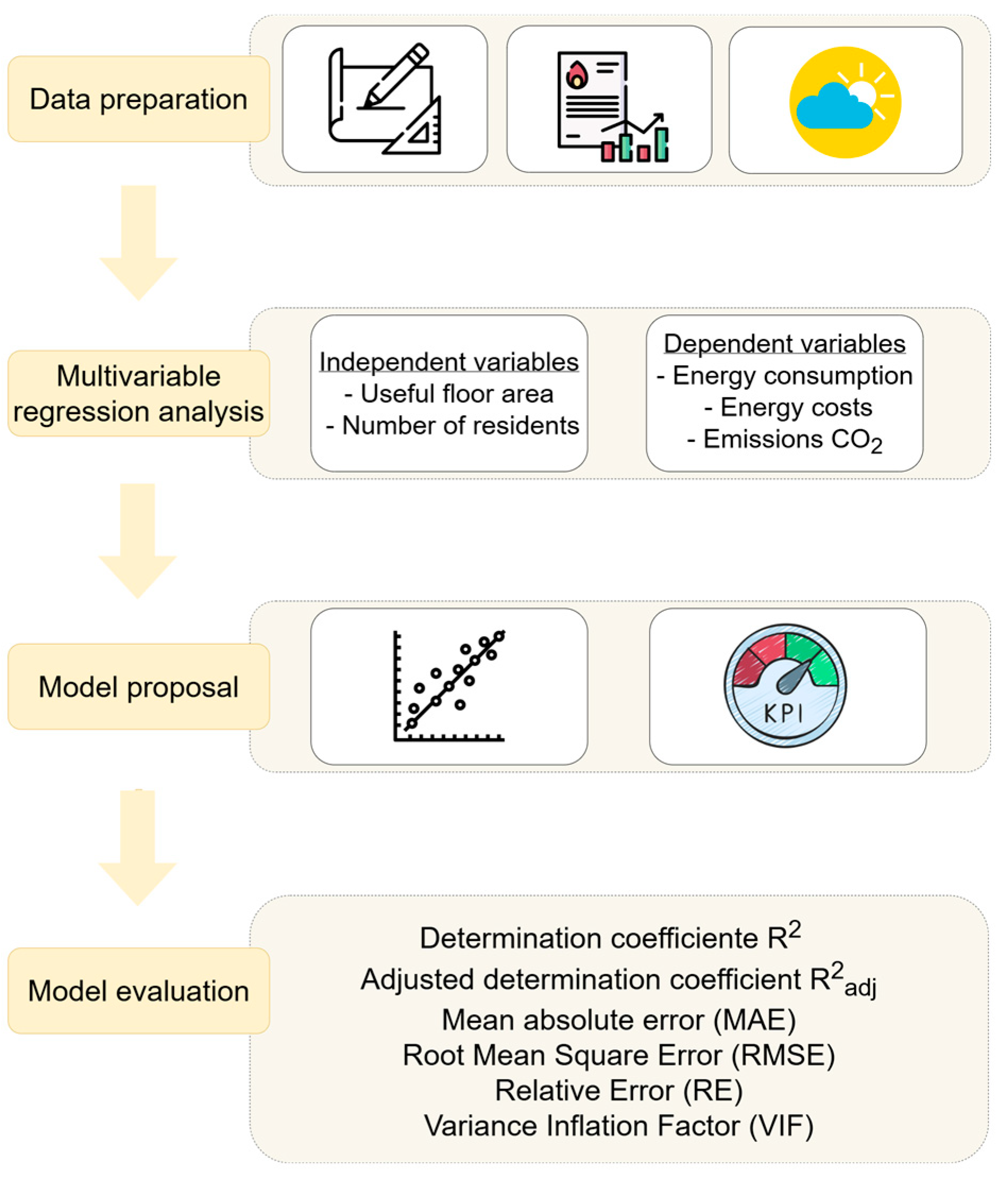
A quantitative analysis was conducted on 20 Spanish public nursing homes built or renovated between 1995 and 2009 in the region of Extremadura (Spain), spanning the period from 2019 to 2023. Concretely, the analysis was carried out on the nursing homes in Table 1, selected for having complete historical energy consumption records and representing the predominant operational and constructional profiles of public nursing homes in the region. Their useful floor area and number of residents ranged from 1332 to 10,880 m2 and 24 to 254 residents, respectively, capturing the typical variability in building size, occupancy, and climatic conditions across Extremadura. Figure 1 shows a general scheme of the method and workflow followed.
Firstly, information about the nursing homes was collected, including useful floor area, number of residents, and year of construction, as well as any reforms that could influence the building’s energy consumption, such as changes to facilities or the thermal envelope. This information was obtained from the construction projects of each building. The directors of the nursing homes were asked to confirm that the number of residents remained unchanged, for example, due to organizational issues. This study adopts the term “Useful floor area” to denote the surface area available to residents after excluding the area occupied by internal partitions and building services.
The records of electricity and other fuel consumption were carefully analyzed to compare energy consumption across nursing homes. The energy consumption was calculated by converting the associated thermal energy into standardized units. Thermal demand was expressed as equivalent electrical energy using a normalized efficiency factor based on the performance coefficient (COP) of a standard air-cooled heat pump [20], defined as the ratio of useful thermal output to electrical energy input, enabling cross-system comparability. Based on this coefficient, the total energy consumption was calculated as
EC = ECe + ECt/β,
where EC, ECe and ECt stand for the total annual electrical and thermal energy consumptions (expressed in kWh), while β is a non-dimensional factor related with the provincial climate characteristics of the areas where the nursing homes are situated: 2.60, 2.65 and 2.70, for the Atlantic Northern, Mediterranean and Continental climatic regions [32].
The conversion of energy consumed to carbon dioxide emissions was performed using Equation (2). It is based on the direct use of final energy consumption by energy carriers, preserving the specific emission factors associated with each energy source and ensuring consistent estimation across different energy systems. The calculation is defined as follows:
E = ECe × CFe + ECng × CFng + ECg × CFg + ECp × CFp,
where E represents the annual carbon dioxide emissions (expressed in kgCO2), ECe, ECng, ECg and ECp represent the annual consumption for electricity, natural gas, diesel and propane, respectively (expressed in kWh), and CFe, CFng, CFg and CFp are dimensionless conversion factors used, respectively, for electricity, natural gas, diesel and propane. The value of these conversion factors is 0.331, 0.252, 0.311 and 0.254 kgCO2/kWh, respectively [33,34].
Subsequently, information on the regional weather was obtained, as weather plays a critical role in energy management and the accurate forecasting of energy behavior [35,36]. To do this, the network of meteorological stations from the Agroclimatic Information System for Irrigation was accessed [37]. This network has 47 weather stations in Extremadura. The average daily temperature between 2019 and 2023 was obtained for the different locations; in total, 30,681 data were available, from which the heating degree days, cooling degree days and total degree days using Equations (3), (4) and (5), respectively, were calculated:
HDD 21   =   i   =   1 n ( θ h   θ i ) ,
CDD 23 = i = 1 n ( θ i θ c ) ,
DD = HDD 21 + CDD 23 ,
where HDD21 represents the heating degrees with base temperature 21 °C, CDD23 represents the cooling degrees with base temperature 23 °C, θh and θc denote the base temperatures for heating (21 °C) and cooling (23 °C), respectively, θi is the average temperature on day i, and n is the number of days during the heating or cooling period [38]. These base temperatures define the thresholds at which buildings require heating or cooling and are consistent with the thermal setpoint ranges established by the Royal Decree 178/2021 of Spanish regulations [39].
The climate in Extremadura is Mediterranean, with some Atlantic influence, featuring warm summers and mild winters. The lowest average maximum daily temperatures (between 22 °C and 23 °C) correspond to a strip north of the province of Cáceres, which coincides with the most mountainous area of the Region. The rest of the territory of Extremadura has an average maximum temperature between 23 °C and 25 °C [40]. The difference between the average highest maximum temperature and the average lowest maximum temperature was 8.8 °C; between the highest average minimum temperature and the lowest average minimum temperature, the difference was 6.47 °C. This shows the variability of the existing maximum temperatures in Extremadura.
The application of linear regression has yielded favorable outcomes among statistical models, owing to its acceptable predictive performance and comparatively straightforward implementation relative to alternative approaches [41]. The correlations among the analyzed variables were examined using simple regression. This method conducts a linear regression analysis using the “least squares” method to fit a line through a set of observations. Previously, atypical values had been ruled out through Chauvenet’s Criterion technique.
Additionally, a multivariable regression analysis was conducted using all sample values. A significance level of 5% (corresponding to a 95% confidence interval) was adopted in this study, and Student’s t-test was applied. Residual analysis was conducted to evaluate the adequacy of the linear regression model.
Simple and multivariable regressions have expressions such as the type shown in Equations (6) and (7) respectively:
Y   =   a 0 +   a 1 X 1 ,
Y = a 0 + a 1 X 1 + a 2 X 2 + a p X p ,
where Y represents the response variable, X1, X2, … Xp are the predictor variables, with p indicating the overall quantity of predictors, and a0, a1, a2 and ap correspond to the regression coefficients.
The validity of the correlations was assessed through several statistical indicators, including the coefficient of determination (R2), adjusted coefficient of determination (adjusted R2), root mean square error (RMSE), mean absolute error (MAE) and relative error (RE). The expressions used for these calculations are provided below.
R 2 = 1 i = 1 n ( y i y ^ i ) 2 i = 1 n y i y ¯ 2   ,
R adj 2 = 1 ( 1 R 2 ) ( n 1 ) / ( n p 1 ) ,
RMSE = 1 / n i = 1 n ( y i y ^ i ) 2 ,
MAE = 1 / n i = 1 n y i y ^ i ,
RE = 1 / n i = 1 n y i y ^ i y i ,
VIF = 1 / 1 R 2 ,
where yi is the observed value of the dependent variable for the i-th observation, y ^ i is the value predicted by the i-th observation model, y ¯ i is the mean of the observed values of the dependent variable, p is the number of independent variables and n is the number of observations in the sample.
The assumptions underlying the regression analysis were thoroughly evaluated, including linearity between the dependent and independent variables, independence of observations, normality and homoscedasticity of residuals, absence of influential points (outliers), and lack of multicollinearity, which occurs when strong linear correlations exist among the independent variables. Additionally, the presence of influential observations was examined using leverage and influence statistics, while multicollinearity among predictor variables was assessed using the Variance Inflation Factor (VIF), whose mathematical formulation is given in Equation (13) [42]. The findings were subsequently discussed and validated in collaboration with the engineers responsible for nursing homes.

3. Results

This section assesses the relationships between the variables and presents several linear regression models developed for this purpose. The outcomes are described in detail below.

3.1. Simple Linear Regression Models

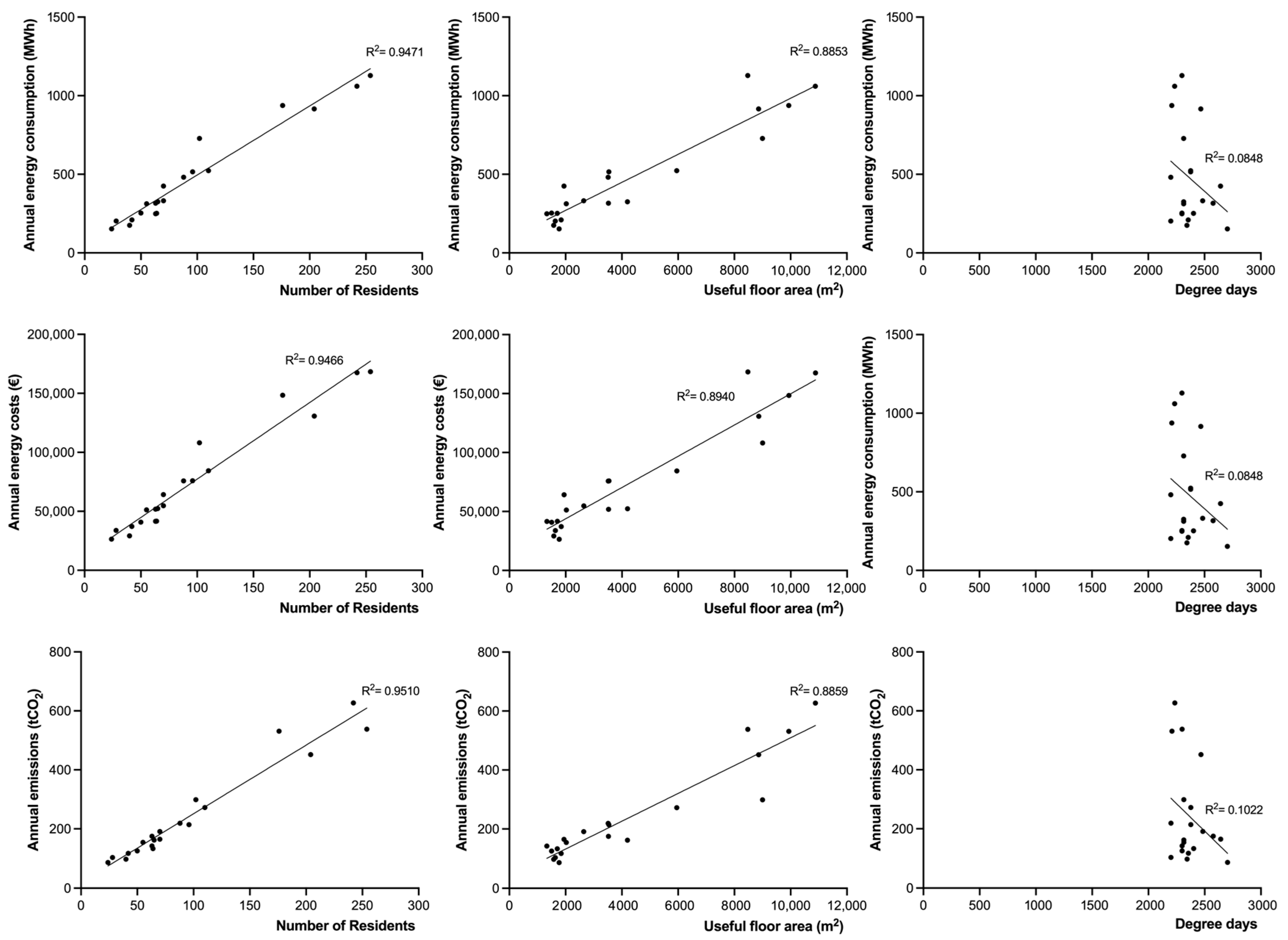
The 9 relationships to be studied result from the combination of the 3 independent variables: useful floor area, number of residents, and degree days, and the 3 dependent variables: Energy Consumption, Energy Costs, and CO2 Emissions. The selection criterion for the regression models was achieving a coefficient of determination (R2) greater than 0.80, as lower values were deemed to indicate a weak correlation between the variables. The simple regression plots corresponding to the paired analyses of variables for each predictive model are provided in Figure 2 and in Figures S1, S3, and S5 of the Supplementary Materials, respectively.
Useful floor area was found to correlate with Energy Consumption (R2 = 0.8853), Energy Costs (R2 = 0.8940) and CO2 Emissions (R2 = 0.8859). The more useful floor area that a nursing home has, the more energy it consumes and therefore, the greater the costs and emissions.
A correlation is observed relating resident count to Energy Consumption (R2 = 0.9471), Energy Costs (R2 = 0.9466), and CO2 Emissions (R2 = 0.9510). Energy consumption, associated Energy Costs, and CO2 Emissions increase depending on the number of residents.
It was found that there is no correlation between the degree days and Energy Consumption (R2 = 0.0848), Energy Costs (R2 = 0.0987) and CO2 Emissions (R2 = 0.1022).

3.2. Multivariable Linear Regression Models

Given the strong correlation identified between the dependent and independent variables, several multivariable linear regression models were evaluated. The dependent variables considered were energy consumption (EC), energy costs (C), and CO2 emissions (E), each analyzed in combination with the independent variables: useful floor area (S) and number of residents (N). The regression statistics for the proposed models are presented in Table 2 and Table 3.
Furthermore, the multicollinearity analysis showed that the VIF values for the independent variables under study were 4.81, which is below 5, indicating a moderate and acceptable level of multicollinearity [43]. Finally, the residual analysis revealed no significant deviations from normality or homoscedasticity, and no outliers with a disproportionate effect on the regression coefficients were identified. The underlying statistical process, along with the corresponding diagnostic analyses, is presented in the Supplementary Materials.
Equations (14)–(16) serve to determine the Energy Consumption, Energy Cost and CO2 Emissions in a public nursing home, whose useful floor area (S) and number of residents (N) were in the range of 1332–10,880 m2 and 24–254 residents. All the equations can be used in operational nursing homes, especially those built or renovated between 1995 and 2009. The equations are not applicable to new-design nursing homes because regulations aimed at enhancing the energy performance of buildings have evolved in recent years.
EC = 48 + 2.95N +0.03S,
C = 10,950 + 422.01N + 5.37S,
E = 13.87 + 1.58N + 0.02S,
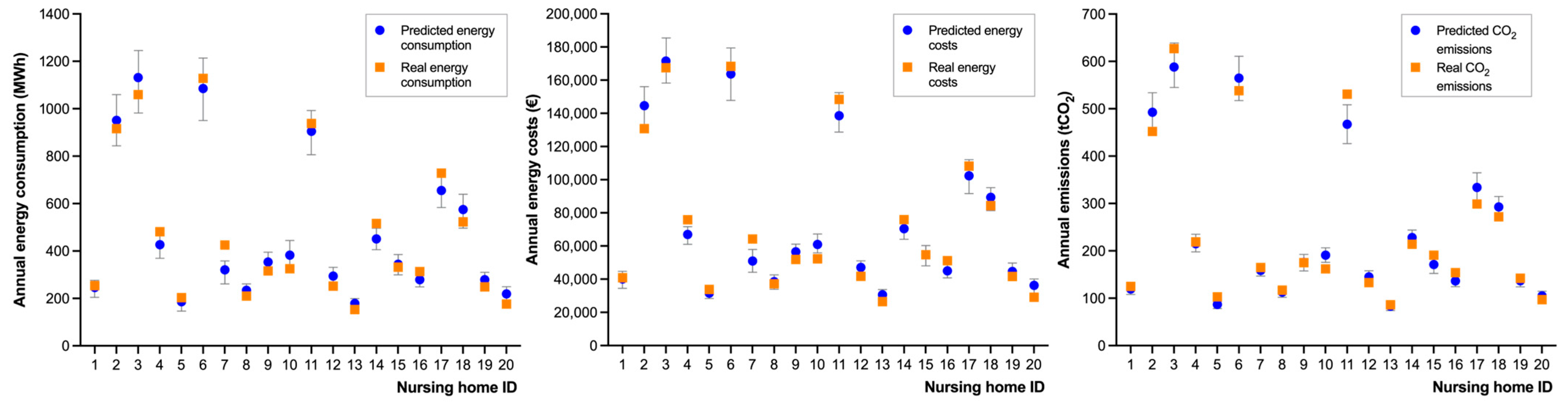
Figure 3 shows annual Energy Consumption, Energy Costs, and CO2 Emissions using both predicted and real models. The chosen vertical error bar corresponds to the overall relative error for each model.
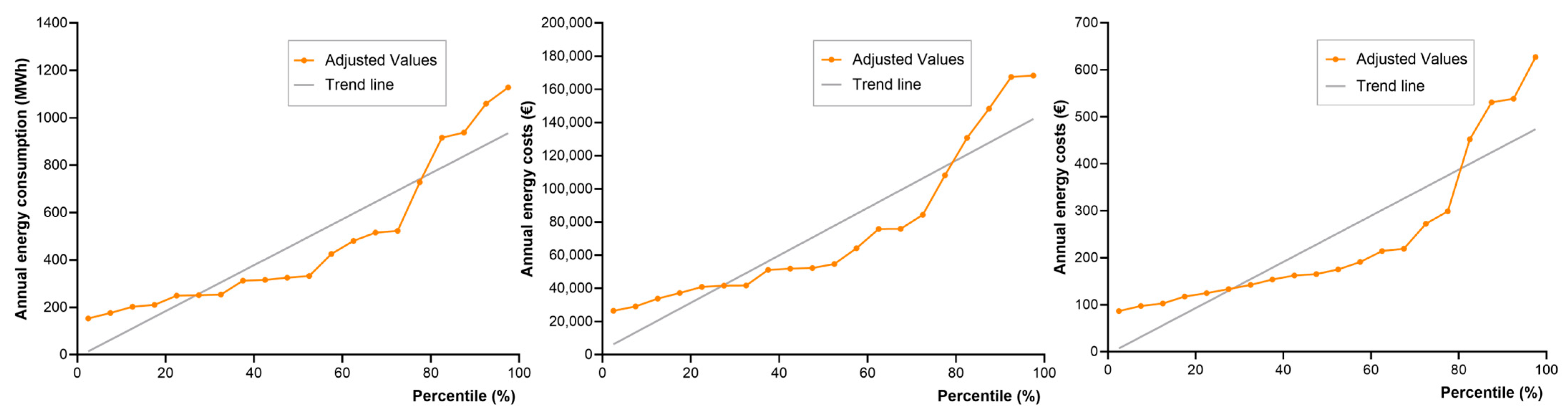
Figure 4 shows the distributions of annual Energy Consumption, annual Energy Costs, and annual CO2 Emissions by percentile. It reveals a clear upward trend, with more gradual growth in the lower and middle percentiles and a more pronounced increase in the upper percentiles. This pattern indicates greater variability among facilities with higher Energy Consumption, which is consistently reflected in the associated Energy Costs and CO2 Emissions, and is linked to differences in operating conditions, building characteristics, or energy systems.

3.3. Reference Indicators

The percentage distribution of Energy Consumption was calculated to be 34% for electricity, 21% for natural gas, 36% for diesel, and 9% for propane. The percentage distribution of Energy Costs was calculated to be 57% for electricity, 13% for natural gas, 25% for diesel, and 5% for propane. The percentage distribution of CO2 emissions was calculated as 37% for electricity, 18% for natural gas, 37% for diesel, and 8% for propane. Table 3 presents reference indicators related to energy consumption for the nursing homes that are the object of this study. The total Energy Consumption was broken down into electrical energy and thermal energy. The expenses related to energy and CO2 Emissions have been included. Energy use was calculated by converting the corresponding thermal energy to its electrical equivalent. However, for calculating energy costs and carbon dioxide emissions, no such conversion was applied, as these values were derived directly from the thermal energy data. These indicators are useful for benchmarking against other nursing homes or buildings with other uses, such as educational or commercial buildings.

3.4. Cost Analysis

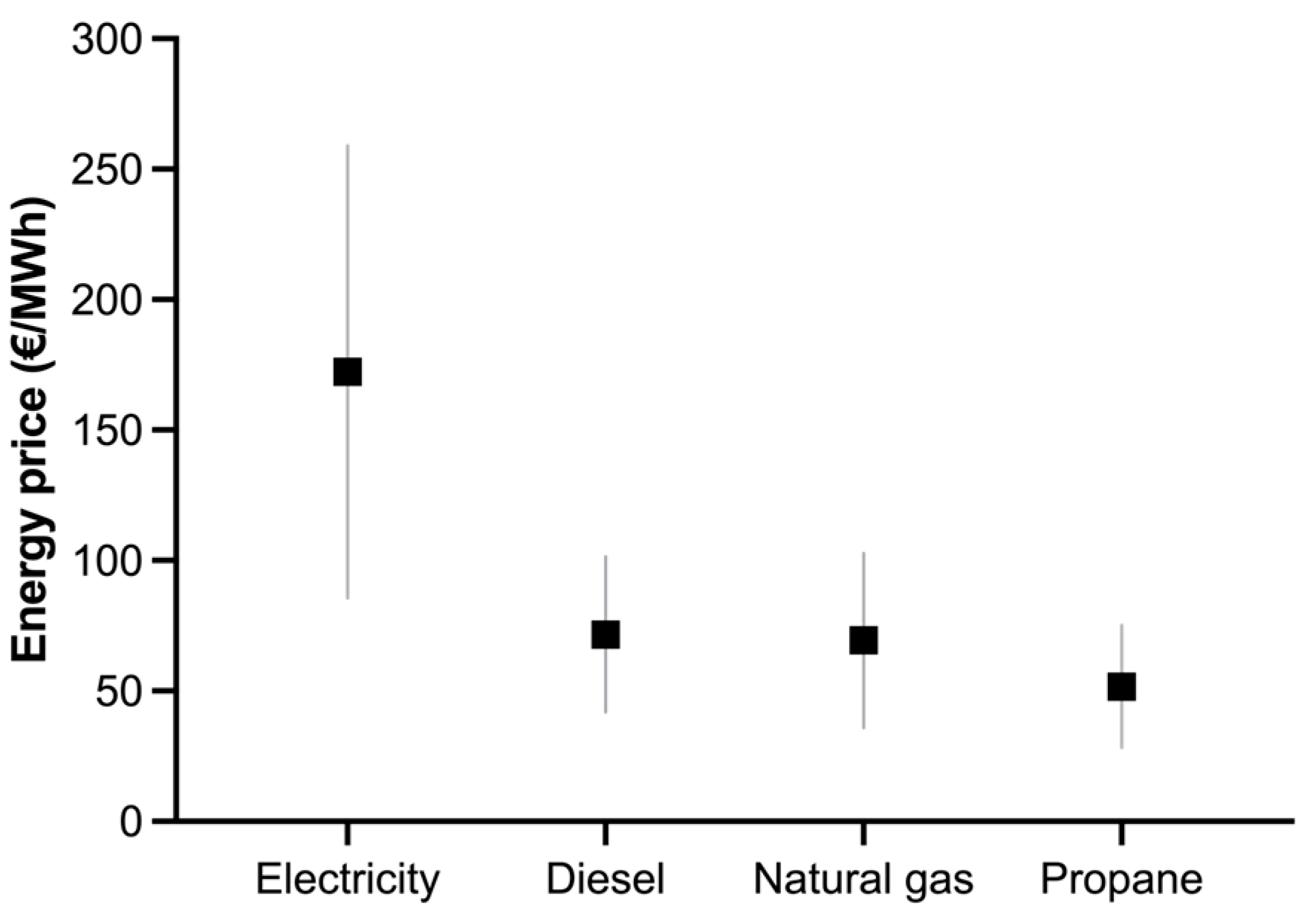
Figure 5 depicts the average, peak, and lowest costs of electricity and other fuels involved in the present study. Between 2019 and 2023, the price of electricity fluctuated between 90 €/MWh and 263 €/MWh, averaging 164 €/MWh. Natural gas fluctuated between 43 and 107 €/MWh, averaging 58 €/MWh. The maximum price of diesel was 104 €/MWh, the minimum was 45 €/MWh, and the average was 66 €/MWh. Propane fluctuated between 26 and 70 €/MWh, averaging 49 €/MWh during the study period.

4. Discussion

The equations proposed in this study are useful for several reasons. On the one hand, they allow the detection of inefficiencies in air-conditioning systems; on the other hand, they enable the comparison of different technologies or energy-efficiency strategies [44,45]. Having a reference to the energy cost for a nursing home improves financial planning and facilitates negotiating the most favorable energy purchase terms [46]. If a nursing home emits more CO2 than the value obtained using the proposed formula in this study, this may indicate that its energy sources are highly polluting; therefore, it would make sense to consider renewing the facilities, for example, by installing renewable energy sources [47]. In addition, the proposed models can inform public policy by providing reliable estimates of projected energy consumption and costs, thereby enabling the identification of deviations and guiding the prioritization of energy-efficiency measures [48].
Reyna & Chester (2017) found that the demand for electricity and natural gas for residential buildings in Los Angeles could increase from 41% to 87% between 2020 and 2060 due to climate change [49]. This increase could be contained with appropriate policies aimed at improving the energy efficiency of buildings. In Spain, nursing homes are obliged to display an energy-efficiency label for the building when the total useful surface area exceeds 250 m2 if publicly owned, and 500 m2 if not, due to the exemplary role of public buildings [50,51]. Recently, the European Union has established new requirements for existing buildings to be renovated so as to turn them into almost null energy consumption buildings (nZEB) [52]. These standards establish that energy rehabilitation must be profitable from an economic point of view [53], and that the influence on the resilience of the building when facing extreme meteorological phenomena must be evaluated according to Sun et al. (2020) [54].
With improvements in building energy efficiency in recent years, the energy used to produce sanitary hot water has become more significant in the overall energy balance of buildings [55]. Heat losses from the pipes account for 38% of the total energy consumed by the hot water installation, according to results reported by Inamoto et al. (2018) in a nursing home in Japan [56]. However, Taxt Walnum et al. (2019) concluded that losses in the sanitary hot-water production systems of three nursing homes and three hotels in Norway were lower than expected [57]. The same authors concluded that more than 50% of the circulation systems do not work as planned [58]. The influence of building energy consumption management had already been shown by Garcia-Sanz-Calcedo et al. (2017) [59]. However, Martínez de Salazar et al. (2019) found that adequate energy management in a building was more effective than increasing users’ environmental awareness [60].
Roeger et al. (2022) found that, due to restrictions on gas imports from Russia following the Ukraine War, gas prices in the European Union had increased significantly since the summer of 2022 [61]. Zakeri et al. (2023) found that the European electricity market was highly exposed to gas price volatility [62]. The results obtained in this study highlight the practical applicability of the proposed models for energy management. In this context, the models allow estimating expected energy costs, supporting decision-making regarding energy supply strategies. The heat pump was identified as the most favorable option from an economic standpoint, followed by propane, natural gas, and diesel.
It was found that, similar to carbon dioxide emissions, buildings that used electricity as a thermal energy source, together with a heat pump, emitted the least CO2 to the atmosphere, due to the high energy performance of this technology [63]. Natural gas was the next cleanest thermal energy source, followed by propane and diesel [64]. The construction of buildings, their operation, and the use of less clean energy sources have led to significant CO2 emissions into the atmosphere in recent years [65]. Specifically, for every 10 buildings, approximately 900 kg of carbon dioxide is emitted into the atmosphere, which is around 39% of global CO2 emissions every year [66].
Vergés et al. (2023) [20] reported coefficients of determination ranging from 0.46 to 0.80 in their linear regression models. Using the same dataset, Vergés et al. (2024) [19] developed an ANN-based model with strong predictive performance: a coefficient of determination of 0.95 and a relative error of 0.051. The two previous studies focused on forecasting the HVAC system’s energy demand throughout the cooling period. Therefore, they did not study HVAC energy consumption for the rest of the year and did not consider the energy consumption of other facilities: lighting, laundry, kitchen, medical devices, or sanitary hot water. The authors also did not propose reference indicators. Yiyu Ding et al. (2022) also concluded that artificial neural network models performed better in predicting heat consumption across 20 nursing homes [67]. However, compared to ANN-based models, the approach proposed in this study offers greater simplicity and direct applicability, providing interpretable reference values for comparative evaluation and practical decision-making [68]. This simplicity, both in its approach and in its computational requirements, facilitates integration into IoT devices, enabling implementation in operational environments without requiring advanced infrastructure [69]. Furthermore, by relying on readily available structural variables, such as Useful floor area and the Number of residents, the model exhibits reduced dependence on real-time data, thereby enhancing its robustness against potential failures in sensor systems [70].
Tartarini et al. (2017 and 2018) identified a lack of guidelines for thermal comfort and indoor environmental quality in the elderly care sector [71,72]. Subsequently, Forcada et al. (2020 and 2021) and Kainaga et al. (2022) developed studies that allowed us to know the preferred conditions both by the residents and the workers from a nursing home [73,74,75], which is especially important considering that the elderly spend 95% of their time indoors [76]. Forcada et al. (2020) found that, during winter, elderly residents tended to tolerate lower temperatures by adjusting their clothing, a behavior not observed among non-residents. Conversely, in summer, residents exhibited greater tolerance to high temperatures compared to non-residents [73].
The main limitation of this study is that its findings cannot be extrapolated to buildings constructed or extensively renovated after 2009, as energy efficiency regulations, such as the Energy Performance of Buildings Directive (EPBD), have since influenced building design practices and related parameters [77]. Furthermore, the sample size (20 nursing homes), while sufficient to identify consistent trends, may limit the generalizability of the results. On the other hand, although the MAE, RE, and RMSE were used to evaluate model performance, the validation approach is primarily internal. However, the diagnostic analysis performed, including residual assessment, outlier detection, and multicollinearity analysis, supports the internal consistency and stability of the resulting models. Finally, it should be noted that the models are based on aggregated data, which may not fully reflect differences in specific energy use across facilities.
Future studies should aim to provide a detailed analysis of nursing home energy consumption to inform the implementation of energy-saving measures.

5. Conclusions

The method used has proven effective for generating benchmark indicators and predictive equations from simple, readily available variables, facilitating their direct application in real-world operational contexts. In this regard, the developed models provide a practical benchmarking tool, enabling the identification of deviations from expected performance and supporting energy management and planning decisions in nursing homes.
The results show that the proposed models achieve high predictive power, with Radj2 values of 0.9710, 0.9744, and 0.9742 for Energy consumption, Energy Costs, and CO2 Emissions, respectively. Average annual indicators of 111 kWh/m2 and 4983 kWh/resident were identified for Energy Consumption, 17 €/m2 and 779 €/resident for Energy Costs, and 56 kg CO2/m2 and 2521 kg CO2/resident for CO2 Emissions, thus confirming strong relationships with variables such as Useful floor area and the Number of Residents.
The applicability of the proposed approach depends on the characteristics of the buildings analyzed, particularly with regard to their construction period and operating conditions. Within these parameters, the models offer a simple and transparent solution to support energy efficiency and sustainability strategies in the elderly care sector.

Supplementary Materials

The following supporting information can be downloaded at: https://www.mdpi.com/article/10.3390/smartcities9050079/s1.

Author Contributions

J.G.-S.-C.: Conceptualization, Formal Analysis, Funding acquisition, Supervision, Validation, Writing—review & editing. M.B.-A.: Formal Analysis, Investigation, Methodology, Project Administration, Validation, Writing—review & editing. M.G.-C.: Data Curation, Investigation, Methodology, Project Administration, Resources, Software, Visualization, Roles/Writing—original draft. A.P.-F.: Data Curation, Formal Analysis, Investigation, Project Administration, Resources, Supervision. All authors have read and agreed to the published version of the manuscript.

Funding

This research was funded by the European Regional Development Fund, provided through Research Projects GR24148, which is linked to the VII Regional Plan for Research, Technical Development, and Innovation from the Regional Government of Extremadura (Spain).

Data Availability Statement

The data presented in this study are available on request from the corresponding author due to privacy restrictions.

Acknowledgments

During the preparation of this manuscript, the authors used ChatGPT 5.3 and Grammarly 1.2 for English-language polishing. The authors have rigorously reviewed and edited the output and take full responsibility for the originality, validity, and integrity of the content of this publication. The authors acknowledge the 85% co-financing by the European Union, the European Regional Development Fund, and the Regional Government of Extremadura. Managing Authority: Ministry of Finance and GR24148.

Conflicts of Interest

The authors declare no conflicts of interest.

Abbreviations

The following abbreviations are used in this manuscript:
ANNArtificial Neural Networks
ATECYRAsociación Técnica de Climatización y Refrigeración
CDDCooling Degree Days
CDD23Cooling Degree Days (base temperature 23 °C)
CFConversion Factor
CFeConversion factor for electricity
CFgConversion factor for diesel
CFngConversion factor for natural gas
CFpConversion factor for propane
COPCoefficient of Performance
CO2Carbon Dioxide
DDDegree Days
DHWDomestic Hot Water
EAnnual Carbon Dioxide Emissions
ECEnergy Consumption
ECeElectrical Energy Consumption
ECgEnergy consumption from diesel
ECngEnergy consumption from natural gas
ECpEnergy consumption from propane
ECtThermal Energy Consumption
EPBDEnergy Performance of Buildings Directive
EUEuropean Union
HDDHeating Degree Days
HDD21Heating Degree Days (base temperature 21 °C)
HVACHeating, Ventilation and Air Conditioning
IEQIndoor Environmental Quality
MAEMean Absolute Error
MWhMegawatt-hour
PVPhotovoltaic
RERelative Error
RMSERoot Mean Square Error
R2Coefficient of Determination
R2adjAdjusted Coefficient of Determination
VIFVariance Inflation Factor
WHOWorld Health Organization
kWhKilowatt-hour
kgCO2Kilograms of Carbon Dioxide
nZEBNearly Zero Energy Building

References

  1. European Commision. Regulation (EU) 2021/1119 of the European Parliament and of the Council of 30 June 2021 Establishing the Framework for Achieving Climate Neutrality. Off. J. Eur. Union 2021, L 243/1–L 243/17. [Google Scholar]
  2. Awogbemi, O.; Kallon, D.V. Von Assessment of the Role of Renewable Energy in Achieving Sustainable Development Goals. Sustain. Energy Technol. Assess. 2025, 81, 104455. [Google Scholar] [CrossRef]
  3. European Commision. Directive (EU) 2024/1275 of the European Parliament and of the Council of 24 April 2024 on the Energy Performance of Buildings. Off. J. Eur. Union 2024, 1–68. [Google Scholar]
  4. Xiao, X.; Yuan, J.; Jiao, Z.; Lin, Z.; Emura, K.; Farnham, C.; Chai, J.; Kong, X.; Ding, Y.; Yang, X.; et al. Optimization of Energy-Efficient Residential Building Design in Japan: A Climate-Responsive Approach under Current and Future Scenarios. Energy Nexus 2025, 20, 100605. [Google Scholar] [CrossRef]
  5. United Nations. Global Status Report for Buildings and Construction|UNEP—UN Environment Programme. 2022. Available online: https://wedocs.unep.org/bitstream/handle/20.500.11822/45095/global_status_report_buildings_construction_2023.pdf?sequence=3&isAllowed=y (accessed on 28 April 2026).
  6. Khdair, A.I.; Aburumman, G.A.; Gholipour, S.; Afrand, M. Up-to-Date Literature Review on Zero-Carbon Buildings and Cities: Energy Innovations, Challenges, and Prospects. Sustain. Energy Technol. Assess. 2025, 82, 104505. [Google Scholar] [CrossRef]
  7. Kang, Y.; Yun, B.Y.; Kim, S. Energy and Carbon Reduction through Green Remodeling of Daycare Centers in Seoul. Sustain. Energy Technol. Assess. 2025, 74, 104163. [Google Scholar] [CrossRef]
  8. Rudnicka, E.; Napierała, P.; Podfigurna, A.; Męczekalski, B.; Smolarczyk, R.; Grymowicz, M. The World Health Organization (WHO) Approach to Healthy Ageing. Maturitas 2020, 139, 6–11. [Google Scholar] [CrossRef]
  9. Eurostat. An Ageing Population, European Commission. Available online: https://www.ine.es/prodyser/demografia_UE/bloc-1c.html?lang=en (accessed on 2 February 2026).
  10. Instituto Nacional de Estadística. Proyecciones de Población, Años 2024–2074. Available online: https://www.ine.es/dyngs/Prensa/PROP20242074.htm (accessed on 5 February 2026).
  11. Wieslander, L.; Haggström, M.; Bäckström, I. Health Professionals’ Experiences with Participating in Quality Improvement in Elderly Care. Int. J. Health Care Qual. Assur. 2025, 38, 158–170. [Google Scholar] [CrossRef]
  12. Sanford, A.M.; Orrell, M.; Tolson, D.; Abbatecola, A.M.; Arai, H.; Bauer, J.M.; Cruz-Jentoft, A.J.; Dong, B.; Ga, H.; Goel, A.; et al. An International Definition for “Nursing Home”. J. Am. Med. Dir. Assoc. 2015, 16, 181–184. [Google Scholar] [CrossRef]
  13. Sociedad Española de Geriatría y Gerontología. Presentación del Primer Censo de Residencias en España. Available online: https://www.segg.es/actualidad-segg/2024/04/25/presentacion-del-primer-censo-de-residencias-en-españa (accessed on 6 January 2026).
  14. Sánchez-Barroso, G.; Botejara-Antúnez, M.; García-Sanz-Calcedo, J.; Zamora-Polo, F. A Life Cycle Analysis of Ionizing Radiation Shielding Construction Systems in Healthcare Buildings. J. Build. Eng. 2021, 41, 102387. [Google Scholar] [CrossRef]
  15. Botejara-Antúnez, M.; González-Domínguez, J.; Rebollo-Castillo, F.J.; García-Sanz-Calcedo, J. Comparative Life Cycle Analysis of Legionella Treatment and Prevention Systems in Healthcare Buildings DHW Facilities. J. Water Process Eng. 2025, 70, 106946. [Google Scholar] [CrossRef]
  16. Botejara-Antúnez, M.; González Domínguez, J.; García-Sanz-Calcedo, J. Life Cycle Analysis Methodology for Heating, Ventilation and Air Conditioning Ductwork in Healthcare Buildings. Indoor Built Environ. 2023, 32, 1213–1230. [Google Scholar] [CrossRef]
  17. Kong, J.; Dong, Y.; Zhang, Z.; Yap, P.-S.; Zhou, Y. Advances in Smart Cities with System Integration and Energy Digitalization Technologies: A State-of-the-Art Review. Sustain. Energy Technol. Assess. 2024, 72, 104012. [Google Scholar] [CrossRef]
  18. Hesaraki, A.; Huda, N. A Comparative Review on the Application of Radiant Low-Temperature Heating and High-Temperature Cooling for Energy, Thermal Comfort, Indoor Air Quality, Design and Control. Sustain. Energy Technol. Assess. 2022, 49, 101661. [Google Scholar] [CrossRef]
  19. Vergés, R.; Gaspar, K.; Forcada, N. Predictive Modelling of Cooling Consumption in Nursing Homes Using Artificial Neural Networks: Implications for Energy Efficiency and Thermal Comfort. Energy Rep. 2024, 12, 2356–2372. [Google Scholar] [CrossRef]
  20. Vergés, R.; Gaspar, K.; Forcada, N. Assessment of the Energy Implications Adopting Adaptive Thermal Comfort Models during the Cooling Season: A Case Study for Mediterranean Nursing Homes. Energy Build. 2023, 299, 113598. [Google Scholar] [CrossRef]
  21. Li, W.; Sui, W.; Cheng, L.; Ji, Y.; Guo, Y.; Zhu, J. Quantifying Seasonal Demand-Side Flexibility in Residential Air Conditioning under Diverse Control Strategies. Energy Build. 2026, 352, 116764. [Google Scholar] [CrossRef]
  22. Jing, Q.; Guo, Y.; Liu, Y.; Wang, Y.; Du, C.; Liu, X. Optimization Study of Energy Saving Control Strategy of Carbon Dioxide Heat Pump Water Heater System under the Perspective of Energy Storage. Appl. Therm. Eng. 2026, 283, 129030. [Google Scholar] [CrossRef]
  23. Forcada, N.; Gangolells, M.; Casals, M.; Tejedor, B.; Macarulla, M.; Gaspar, K. Field Study on Thermal Comfort in Nursing Homes in Heated Environments. Energy Build. 2021, 244, 111032. [Google Scholar] [CrossRef]
  24. Bienvenido-Huertas, D.; Sánchez-García, D.; Rubio-Bellido, C. Adaptive Setpoint Temperatures to Reduce the Risk of Energy Poverty? A Local Case Study in Seville. Energy Build. 2021, 231, 110571. [Google Scholar] [CrossRef]
  25. Sun, N.; Ding, X.; Bi, J.; Cui, Y. Field Study on Winter Thermal Comfort of Occupants of Nursing Homes in Shandong Province, China. Buildings 2024, 14, 2881. [Google Scholar] [CrossRef]
  26. Fong, B.; Fong, A.; Hong, G.; Tsang, K.F. Optimization of Power Usage in a Smart Nursing Home Environment. IEEE Trans. Ind. Appl. 2023, 59, 38–46. [Google Scholar] [CrossRef]
  27. Zhou, P.; Song, D.; Zhang, C. Visualization Analysis and Optimization Strategy of Thermal Landscape in Retrofitted Elderly Care Buildings: A Case Study in Shanghai. Indoor Built Environ. 2024, 34, 477–496. [Google Scholar] [CrossRef]
  28. Dursun, B.; Aykut, E. An Investigation on Wind/PV/Fuel Cell/Battery Hybrid Renewable Energy System for Nursing Home in Istanbul. Proc. Inst. Mech. Eng. Part A J. Power Energy 2019, 233, 616–625. [Google Scholar] [CrossRef]
  29. Lindberg, K.B.; Bakker, S.J.; Sartori, I. Modelling Electric and Heat Load Profiles of Non-Residential Buildings for Use in Long-Term Aggregate Load Forecasts. Util. Policy 2019, 58, 63–88. [Google Scholar] [CrossRef]
  30. Kuzgunkaya, E.H. Energy Performance Assessment in Terms of Primary Energy and Exergy Analyses of the Nursing Home and Rehabilitation Center. Energy Environ. 2019, 30, 1506–1520. [Google Scholar] [CrossRef]
  31. Wang, F.; Olej, R.; Nioi, A. A Survey on Indoor Comfort and Energy Consumption in a Care Home. In Proceedings of the 33rd PLEA International Conference: Design to Thrive, Edinburgh, UK, 2–5 July 2017; Volume 1, pp. 1336–1343, ISBN 9780992895754. [Google Scholar]
  32. García-Sanz-Calcedo, J.; Gómez-Chaparro, M.; Sanchez-Barroso, G. Electrical and Thermal Energy in Private Hospitals: Consumption Indicators Focused on Healthcare Activity. Sustain. Cities Soc. 2019, 47, 101482. [Google Scholar] [CrossRef]
  33. Instituto Para la Diversificación y Ahorro Energético (IDAE). Guía Para Cumplimentar Las Memorias Técnicas de Las Actuaciones En El Ámbito Del Plan de Transición Energética En La Administración General Del Estado. 2024. Available online: https://sede.idae.gob.es/sites/default/files/2024-02/02-03-Guia_para_cumplimentar_las_memorias_tecnicas_Tipologias_1%2C2y3_04-10-2022.pdf (accessed on 28 April 2026).
  34. Gobierno de España. Factores de Emisión de CO2 y Coeficientes de Paso a Energía Primaria de Diferentes Fuentes de Energía Final Consumidas En El Sector de Edificios En España. 2016. Available online: https://www.miteco.gob.es/content/dam/miteco/es/energia/files-1/Eficiencia/RITE/documentosreconocidosrite/Otros%20documentos/Factores_emision_CO2.pdf (accessed on 28 April 2026).
  35. Amin, A.; Mourshed, M. Weather and Climate Data for Energy Applications. Renew. Sustain. Energy Rev. 2024, 192, 114247. [Google Scholar] [CrossRef]
  36. Guo, Q.; He, Z.; Wang, Z. Monthly Climate Prediction Using Deep Convolutional Neural Network and Long Short-Term Memory. Sci. Rep. 2024, 14, 17748. [Google Scholar] [CrossRef]
  37. Gobierno de España. Sistema de Información Agroclimática Para El Regadío. Available online: https://servicio.mapa.gob.es/siarweb/ (accessed on 28 April 2026).
  38. Yuan, J.; Jiao, Z.; Xiao, X.; Emura, K.; Farnham, C. Impact of Future Climate Change on Energy Consumption in Residential Buildings: A Case Study for Representative Cities in Japan. Energy Rep. 2024, 11, 1675–1692. [Google Scholar] [CrossRef]
  39. Gobierno de España. Real Decreto 178/2021, de 23 de Marzo, Por El Que Se Regula El Reglamento de Instalaciones Térmicas En Los Edificios. Boletín Of. Estado 2021, 33748–33793. [Google Scholar]
  40. Junta de Extremadura. Mapa de Impactos Del Cambio Climático En Extremadura. 2011. Available online: http://extremambiente.juntaex.es/files/biblioteca_digital/Mapa%20de%20Impactos%20del%20Cambio%20Climatico%20en%20Extremadura%20web.pdf (accessed on 28 April 2026).
  41. Fumo, N.; Rafe Biswas, M.A. Regression Analysis for Prediction of Residential Energy Consumption. Renew. Sustain. Energy Rev. 2015, 47, 332–343. [Google Scholar] [CrossRef]
  42. Miles, J. Tolerance and Variance Inflation Factor. In Wiley StatsRef: Statistics Reference Online; Wiley: Hoboken, NJ, USA, 2014. [Google Scholar]
  43. Chan, J.Y.-L.; Leow, S.M.H.; Bea, K.T.; Cheng, W.K.; Phoong, S.W.; Hong, Z.-W.; Chen, Y.-L. Mitigating the Multicollinearity Problem and Its Machine Learning Approach: A Review. Mathematics 2022, 10, 1283. [Google Scholar] [CrossRef]
  44. Elhami, M.; Goodarzi, S.S.; Maleki, S.; Sajadi, B. Three-Objective Optimization of the HVAC System Control Strategy in an Educational Building to Reduce Energy Consumption and Enhance Indoor Environmental Quality (IEQ) Using Machine Learning Techniques. J. Build. Eng. 2025, 105, 112444. [Google Scholar] [CrossRef]
  45. Yazdan, F.; Rehman, U.U.; Khan, F.A.; Ahmad, N.; Khan, A.; Ullah, Z. Improved Hourly Cooling and Heating Load Analysis Using Residential Load Factor Method. J. Eng. 2025, 2025, 9980277. [Google Scholar] [CrossRef]
  46. Daqrouq, K.; Alghamedi, S.; Alwaseli, S.; Alkhateeb, A.F.; Alghamdi, S.; Ajour, M.N.; Balamash, A.S.; Milyani, A.; Alharbi, K.; Rushdi, A.M. Impact of the Utilization of Artificial Intelligence in the Development of Electrical Engineering. J. Eng. 2025, 2025, 1390935. [Google Scholar] [CrossRef]
  47. Mohammad, A.A.S.; Oraini, B.A.; Mohammad, S.I.; Alenazi, S.A.; Al-Fawwaz, T.M.; Vasudevan, A. Mathematical and Statistical Modelling of Electricity Demand Forecasting Using Artificial Neural Networks and SARIMA: Implications for Energy Supply Chain Planning. Alex. Eng. J. 2026, 139, 98–108. [Google Scholar] [CrossRef]
  48. Al Kez, D.; Foley, A.; Lowans, C.; Del Rio, D.F. Energy Poverty Assessment: Indicators and Implications for Developing and Developed Countries. Energy Convers. Manag. 2024, 307, 118324. [Google Scholar] [CrossRef]
  49. Reyna, J.L.; Chester, M.V. Energy Efficiency to Reduce Residential Electricity and Natural Gas Use under Climate Change. Nat. Commun. 2017, 8, 14916. [Google Scholar] [CrossRef]
  50. Gobierno de España. Real Decreto 390/2021, de 1 de Junio, Por El Que Se Aprueba El Procedimiento Básico Para La Certificación de La Eficiencia Energética de Los Edificios. Boletín Of. Estado 2021, 169–170. [Google Scholar]
  51. European Commision. Directive (EU) 2023/1791 of the European Parliament and of the Council of 13 September 2023 on Energy Efficiency. Off. J. Eur. Union 2023. [Google Scholar]
  52. Ke, Z.; Zhang, H.; Jia, X.; Yan, J.; Lv, X.; Yu, H.; Gao, N.; Zeng, W.; Liu, Y.; Wong, N.H. Research on Energy Efficiency and Decarbonization Pathway of Nearly Zero Energy Buildings Based on System Dynamic Simulation. Dev. Built Environ. 2024, 17, 100310. [Google Scholar] [CrossRef]
  53. Teni, M.; Čulo, K.; Krstić, H. Renovation of Public Buildings towards NZEB: A Case Study of a Nursing Home. Buildings 2019, 9, 153. [Google Scholar] [CrossRef]
  54. Sun, K.; Specian, M.; Hong, T. Nexus of Thermal Resilience and Energy Efficiency in Buildings: A Case Study of a Nursing Home. Build. Environ. 2020, 177, 106842. [Google Scholar] [CrossRef]
  55. Ivanko, D.; Walnum, H.T.; Nord, N. Development and Analysis of Hourly DHW Heat Use Profiles in Nursing Homes in Norway. Energy Build. 2020, 222, 110070. [Google Scholar] [CrossRef]
  56. Inamoto, K.; Iba, C.; Hokoi, S.; Ogura, D.; Takada, S. Evaluating the Energy Consumption and Heat Loss in the Hot Water Supply and Heating Systems of a Nursing Home. In Proceedings of the Healthy, Intelligent and Resilient Buildings and Urban Environments, Syracuse, NY, USA, 23–26 September 2018; International Association of Building Physics (IABP): Syracuse, NY, USA, 2018; pp. 409–414. [Google Scholar]
  57. Taxt Walnum, H.; Sørensen, Å.L.; Ludvigsen, B.; Ivanko, D. Energy Consumption for Domestic Hot Water Use in Norwegian Hotels and Nursing Homes. IOP Conf. Ser. Mater. Sci. Eng. 2019, 609, 052020. [Google Scholar] [CrossRef]
  58. Aunión-Villa, J.; Gómez-Chaparro, M.; García-Sanz-Calcedo, J. Study of the Energy Intensity by Built Areas in a Medium-Sized Spanish Hospital. Energy Effic. 2021, 14, 26. [Google Scholar] [CrossRef]
  59. García-Sanz-Calcedo, J.; Gómez-Chaparro, M. Quantitative Analysis of the Impact of Maintenance Management on the Energy Consumption of a Hospital in Extremadura (Spain). Sustain. Cities Soc. 2017, 30, 217–222. [Google Scholar] [CrossRef]
  60. Martinez de Salazar, E.; García Sanz-Calcedo, J. Study on the Influence of Maintenance Operations on Energy Consumption and Emissions in Healthcare Centres by Fuzzy Cognitive Maps. J. Build. Perform. Simul. 2019, 12, 420–432. [Google Scholar] [CrossRef]
  61. Roeger, W.; Welfens, P.J.J. Gas Price Caps and Electricity Production Effects in the Context of the Russo-Ukrainian War: Modeling and New Policy Reforms. Int. Econ. Econ. Policy 2022, 19, 645–673. [Google Scholar] [CrossRef]
  62. Zakeri, B.; Staffell, I.; Dodds, P.E.; Grubb, M.; Ekins, P.; Jääskeläinen, J.; Cross, S.; Helin, K.; Castagneto Gissey, G. The Role of Natural Gas in Setting Electricity Prices in Europe. Energy Rep. 2023, 10, 2778–2792. [Google Scholar] [CrossRef]
  63. Asociación Técnica de Climatización y Refrigeración (ATECYR). DTIE 8.02 Bombas de Calor Para Calefacción; ATECYR: Madrid, Spain, 2020; ISBN 978-84-95010-72-8. [Google Scholar]
  64. Heide, M.; Dudka, K.M.; Hauschild, M.Z. Absolute Sustainable CO2-Limits for Buildings Should Reflect Their Function. A Case Study of Four Building Typologies. Dev. Built Environ. 2023, 15, 100175. [Google Scholar] [CrossRef]
  65. He, Z.; Guo, Q.; Yin, Z.; Luo, X.; Sun, M. Evolution and Driving Mechanisms of Eco-Environmental Quality across Different Urbanization Stages. Sci. Rep. 2025, 15, 22101. [Google Scholar] [CrossRef] [PubMed]
  66. Min, J.; Yan, G.; Abed, A.M.; Elattar, S.; Amine Khadimallah, M.; Jan, A.; Elhosiny Ali, H. The Effect of Carbon Dioxide Emissions on the Building Energy Efficiency. Fuel 2022, 326, 124842. [Google Scholar] [CrossRef]
  67. Ding, Y.; Timoudas, T.O.; Wang, Q.; Chen, S.; Brattebø, H.; Nord, N. A Study on Data-Driven Hybrid Heating Load Prediction Methods in Low-Temperature District Heating: An Example for Nursing Homes in Nordic Countries. Energy Convers. Manag. 2022, 269, 116163. [Google Scholar] [CrossRef]
  68. Ali, A.; Jayaraman, R.; Azar, E.; Maalouf, M. A Comparative Analysis of Machine Learning and Statistical Methods for Evaluating Building Performance: A Systematic Review and Future Benchmarking Framework. Build. Environ. 2024, 252, 111268. [Google Scholar] [CrossRef]
  69. Gamazo-Real, J.-C.; Torres Fernández, R.; Murillo Armas, A. Comparison of Edge Computing Methods in Internet of Things Architectures for Efficient Estimation of Indoor Environmental Parameters with Machine Learning. Eng. Appl. Artif. Intell. 2023, 126, 107149. [Google Scholar] [CrossRef]
  70. Sabit, H.; Tun, T. IoT Integration of Failsafe Smart Building Management System. IoT 2024, 5, 801–815. [Google Scholar] [CrossRef]
  71. Tartarini, F.; Cooper, P.; Fleming, R. Thermal Environment and Thermal Sensations of Occupants of Nursing Homes: A Field Study. Procedia Eng. 2017, 180, 373–382. [Google Scholar] [CrossRef]
  72. Tartarini, F.; Cooper, P.; Fleming, R. Thermal Perceptions, Preferences and Adaptive Behaviours of Occupants of Nursing Homes. Build. Environ. 2018, 132, 57–69. [Google Scholar] [CrossRef]
  73. Forcada, N.; Gangolells, M.; Casals, M.; Tejedor, B.; Macarulla, M.; Gaspar, K. Summer Thermal Comfort in Nursing Homes in the Mediterranean Climate. Energy Build. 2020, 229, 110442. [Google Scholar] [CrossRef]
  74. Forcada, N.; Gangolells, M.; Casals, M.; Tejedor, B.; Macarulla, M.; Gaspar, K. Field Study on Adaptive Thermal Comfort Models for Nursing Homes in the Mediterranean Climate. Energy Build. 2021, 252, 111475. [Google Scholar] [CrossRef]
  75. Kainaga, T.; Sagisaka, K.; Yamada, R.; Nakaya, T. A Case Study of a Nursing Home in Nagano, Japan: Field Survey on Thermal Comfort and Building Energy Simulation for Future Climate Change. Energies 2022, 15, 936. [Google Scholar] [CrossRef]
  76. Liu, M.; Zhai, Y.; Qiu, X.; Xie, X.; Liu, Z.; Zhu, L.; Lei, Y.; Li, Z. Air-Conditioning Usage Behaviour of the Elderly in Caring Home during the Extremely Hot Summer Period: An Evidence in Chongqing. Build. Environ. 2023, 244, 110828. [Google Scholar] [CrossRef]
  77. Jenkins, D.; McCallum, P.; Patidar, S.; Semple, S. Accommodating New Calculation Approaches in Next-Generation Energy Performance Assessments. J. Build. Perform. Simul. 2024, 17, 406–421. [Google Scholar] [CrossRef]
Figure 1. Overall method and workflow.
Smartcities 09 00079 g001
Figure 2. Single regression plots per predictive model.
Smartcities 09 00079 g002
Figure 3. Predicted consumption, costs and emissions models versus real.
Smartcities 09 00079 g003
Figure 4. Normal probability graphs.
Smartcities 09 00079 g004
Figure 5. Price for electricity and other types of fuels involved in the present study.
Smartcities 09 00079 g005
Table 1. List of nursing homes analyzed.
CodeUseful Floor Area (m2)Number of ResidentsHeating Degree DaysCooling Degree Days
11500501961339
210,8802422214253
33515881835399
41634281897304
584792541897304
61945701961339
71844422386256
84200652126229
999361762311266
101706641945370
112026551975234
1290001021937465
131332632498206
1488652042104273
153525632076408
161772241945370
173539961945370
182643702104273
1959501101961339
201576402066278
Table 2. Statistics of multivariable regression models for energy consumption.
R2adjRMSEMAERE (%)MaxMinAverageEquation
Energy Consumption0.971049 MWh43 MWh11%1128 MWh153 MWh475 MWh(14)
Energy Costs0.97446766 €5712 €9%168,331 €26,450 €74,229 €(15)
CO2 Emissions0.974224 kgCO218 kgCO28%627 kgCO287 kgCO2240 kgCO2(16)
Table 3. Reference indicators.
IndexUnitsValue
Annual energy consumption per m2kWh/m2111
Annual electrical energy consumption per m2kWh/m263
Annual thermal energy consumption per m2kWh/m247
Annual energy consumption per residentkWh/resident4983
Annual electrical energy consumption per residentkWh/resident2847
Annual thermal energy consumption per residentkWh/resident2136
Annual energy costs per m2€/m217
Annual electrical energy costs per m2€/m210
Annual thermal energy costs per m2€/m27
Annual energy costs per resident€/resident779
Annual electrical energy costs per resident€/resident448
Annual thermal energy costs per resident€/resident331
Annual emission of carbon dioxide per m2kgCO2/m256
Annual emission of carbon dioxide per m2 due to electrical energy consumptionkgCO2/m221
Annual emission of carbon dioxide per m2 due to thermal energy consumptionkgCO2/m235
Annual emission of carbon dioxide per residentkgCO2/resident2521
Annual emission of carbon dioxide per resident due to electrical energy consumptionkgCO2/resident942
Annual emission of carbon dioxide per resident due to thermal energy consumptionkgCO2/resident1578
Disclaimer/Publisher’s Note: The statements, opinions and data contained in all publications are solely those of the individual author(s) and contributor(s) and not of MDPI and/or the editor(s). MDPI and/or the editor(s) disclaim responsibility for any injury to people or property resulting from any ideas, methods, instructions or products referred to in the content.