
Article

Towards a Temporal City: Time of Day as a Structural Dimension of Urban Accessibility

1
School of Science, Engineering and Digital Technologies, University of Southern Queensland, Springfield Central, QLD 4300, Australia
2
Faculty of Society & Design, Bond University, Gold Coast, QLD 4229, Australia
*
Authors to whom correspondence should be addressed.
Smart Cities 2026, 9(4), 67; https://doi.org/10.3390/smartcities9040067

Submission received: 9 February 2026 / Revised: 3 April 2026 / Accepted: 8 April 2026 / Published: 10 April 2026

Highlights

What are the main findings?
  • Temporal impedance varies systematically across the day, even when distance and urban form remain constant.
  • Temporal impedance predicts transport mode choice more effectively than absolute travel time, with substantially greater explanatory power.
What is the implication of the main finding?
  • Planning and evaluation should account for systematic temporal variation across the day, rather than relying on average travel time measures.
  • Accessibility assessment should incorporate time-normalised measures (time per unit distance) to reflect temporal network conditions.

Abstract

Urban accessibility is commonly evaluated using static spatial indicators, which assume stable travel conditions throughout the day. Road congestion, network saturation, and service variability change the function and experience of the built environment (BE). This study tests the Temporal City Framework (TCF) by examining how time of day (TOD) reshapes urban accessibility and travel behaviour with varying levels of congestion. Using 30,288 trip records from the 2022 US National Household Travel Survey (NHTS), duration is operationalised as a sixth dimension of the BE. A time-normalised impedance metric, measured in minutes per mile (MPM), is used that captures realised congestion independently of distance. Temporal impedance (TI) varies strongly with TOD, with substantially higher MPM during peak and midday periods than at night. Compared with nighttime conditions, midday travel requires approximately 19% more time per mile. This indicates a measurable contraction in functional accessibility under identical BE conditions. The TI model outperforms duration-only models, with impedance remaining dominant when both measures are included. These results support interpreting duration as a structural dimension of urban accessibility. TI significantly increases the relative likelihood of active and public transport compared to private cars, even after accounting for absolute trip duration. Hired transport modes (taxi and ride-hailing services) are most prevalent at night, reflecting a greater reliance on on-demand services outside regular daytime schedules. This study tests duration as a structural dimension of the BE by operationalising time-normalised TI. Associations are interpreted as trip-level behavioural constraints rather than causal effects. Planning frameworks based on static travel times systematically misrepresent exposure, equity, and travel mode feasibility. Time-stratified accessibility metrics should therefore be integrated into transport and land-use evaluation and associated policies.

1. Introduction

Cities are complex spatial systems whose structure, interactions, and resilience are shaped by planning practices, adaptive dynamic systems, and the spatial organisation of buildings [1,2,3]. Within these systems, the built environment (BE) plays a central role in shaping physical activity, travel behaviour, and population health by structuring daily mobility patterns and access to urban facilities [4,5]. At the street and transit scales, land-use mix, urban density, and road network design determine how people move and access urban facilities [6,7]. These relationships are formalised through multidimensional BE frameworks that capture the heterogeneous effects of urban form on travel demand and activity patterns [8,9]. However, these frameworks largely conceptualise accessibility as a static spatial property, with limited consideration of how time-dependent travel conditions reshape the lived experience of urban form.
Road congestion is widely analysed in transport research as a behavioural, economic, and network efficiency problem rather than as a structural feature of the BE [10,11]. Pertinent studies focus on interventions and operational impacts rather than on how traffic congestion is experienced within BE [12,13]. Taken together, existing BE and health models represent accessibility and behavioural opportunity at an aggregate daily level, with limited attention to within-day temporal variation in travel conditions or exposure [14,15,16,17]. In this context, Arif et al. [18] placed duration as the 6th dimension of the BE framework. Road trips of the same distance often take different amounts of time depending on the time of day (TOD). The same street, neighbourhood, or transit corridor can function very differently at 8 am than at 2 pm or 6 pm, even though nothing has changed physically [18,19]. This reveals a fundamental disconnect between how travel durations in cities are measured and how they are experienced, a misalignment that is increasingly recognised in urban accessibility and transportation research.
Time-dependent accessibility measures have been widely developed in the extant literature. These include dynamic routing, schedule-based accessibility, and time-geographic approaches [20,21,22,23]. In the pertinent frameworks, time is incorporated as an input to network calculations or as a constraint on individual activity schedules. As a result, travel time (or duration) is treated as an output of network models rather than as an observed system-level property of how accessibility is realised [24]. The current study reconceptualises TOD as a structural condition through which the BE is experienced, rather than as a parameter within accessibility models. Instead of estimating potential accessibility using network-based measures, the analysis focuses on realised trip-level performance, operationalised as temporal impedance (TI) measured in minutes per mile (MPM). TI captures how spatial distance is translated into time under prevailing network conditions. This forms the basis of the Temporal City Framework (TCF) discussed in the current study. This study offers the following conceptual and empirical contributions:
  • It positions duration as a time-varying structural dimension of the BE.
  • It operationalises this concept using observed travel behaviour rather than modelled accessibility.
  • It demonstrates its behavioural relevance through travel mode choice modelling.
The above distinctions differentiate the TCF discussed in the current study from existing time-dependent accessibility approaches, which primarily embed time within modelling procedures and treat it as a system-level property of realised urban accessibility.
Overall, this study reconceptualises duration as a time-varying structural dimension of the BE that structures urban accessibility and behavioural opportunity, rather than a fixed impedance. The concept is operationalised using trip-level TI derived from the National Household Travel Survey 2022 (NHTS v2.1) [25]. Finally, it demonstrates that TOD systematically reshapes the feasibility of transport modes and behavioural accessibility.
This study empirically tests the TCF by examining how TOD reshapes urban accessibility, road congestion, and travel behaviour in BE contexts. To achieve this aim, the study addresses the following research questions:
RQ1. 
Does accessibility, as measured by travel time (duration) and TI, vary across time of day within the same BE context?
RQ2. 
Does time-dependent travel duration significantly influence transport mode choice beyond absolute trip duration and TOD effects?
To address these questions, the study pursues the following objectives:
  • To operationalise TI across TOD within consistent BE conditions.
  • To estimate time-dependent utility effects in transport mode choice after accounting for TOD and trip-level characteristics.
Two hypotheses are proposed accordingly:
H1. 
TI differs systematically across the daily cycle.
H2. 
TI significantly predicts travel mode choice beyond TOD and urban density.
This study provides planners, transport analysts, and public-health researchers with a time-normalised analytical basis for identifying when accessibility deteriorates within an otherwise supportive urban form. It enables time-stratified, context-specific identification of where such deterioration occurs in the BE.
The paper is organised as follows. Section 2 introduces the TCF and discusses duration as the sixth dimension of the BE. Section 3 details the data, variable construction, and modelling strategy. Section 4 reports descriptive and econometric results on TI and transport mode choice. Section 5 discusses theoretical implications, distinguishes duration from existing temporal constructs, and outlines its relevance to planning and policy. Section 6 presents the conclusions and limitations.

2. The Temporal City Framework

The TCF conceptualises the BE as a system with both spatial and temporal structure. While urban density, land-use mix, and road network design define the spatial potential for movement [26,27], realised accessibility is governed by TOD through congestion, network saturation, and speed variability [28,29,30]. Congestion has been shown to recur at specific times of day, increasing travel time and reducing network efficiency accordingly [31]. Consequently, highly walkable and transit-rich urban environments can become behaviourally constrained during peak traffic periods [32,33,34]. Similarly, accessibility conditions vary across the day as travel times, delays, and service levels change [35]. Thus, identical BEs can produce very different behavioural conditions depending on when and how they are experienced, reflecting variations in user interaction, constraints, and environmental conditions [36,37,38]. Arif et al. [18] established duration as the sixth, time-sensitive dimension of the BE framework. Duration captures the temporal burden of travel, including time spent moving, waiting, and delays due to congestion or peak-period traffic. This framing distinguishes duration from distance-based accessibility by treating time as a structural component of the BE. This perspective positions duration as a temporal dimension that governs how the BE is experienced in practice. Nevertheless, duration is not conceptualised as an independent spatial axis equivalent to density or design. It operates as a structural–temporal constraint that conditions how spatial configuration translates into realised travel time under varying road network conditions.
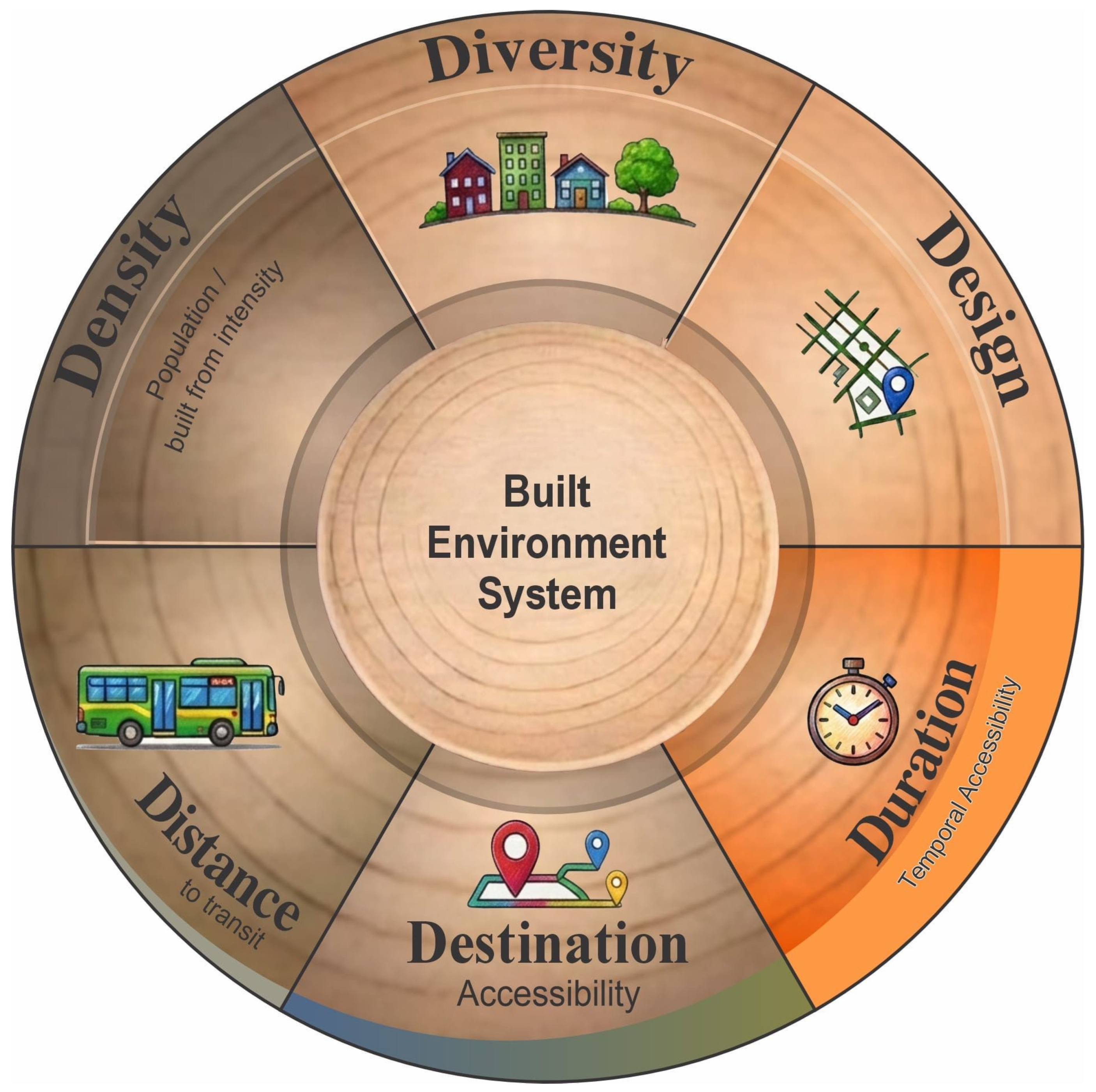
The BE remains fixed over the daily cycle. However, transport system performance varies with traffic flow, congestion, and service conditions. Temporal variation in accessibility, therefore, arises from changes in network performance rather than from any change in the BE itself. In this context, duration is conceptualised as a system-level interface that translates spatial structure into time-dependent accessibility, capturing how a fixed BE is differentially realised under varying network conditions. This interpretation distinguishes between potential accessibility, defined by spatial structure, and realised accessibility, determined by temporal network conditions. The six-dimensional structure of the BE, conceptualised by Arif et al. [18], is presented in Figure 1 and defined in Table 1. The five dimensions (density, diversity, design, distance, and destination) characterise the spatial configuration of the BE. The sixth dimension, duration, captures temporal accessibility, reflecting how this spatial structure is translated into time-dependent accessibility under varying transport network conditions.
In BE models, accessibility is defined by distance, connectivity, or proximity to destinations within a fixed spatial configuration [39]. However, there is a divergence between nominal and experienced travel time [40] which arises from TI [18]. Unlike distance, TI varies across urban corridors, transport modes, and time periods [41], creating fragmented accessibility. When congestion increases travel duration, it compresses the remaining time available for other activities, raising the effective cost of movement even if monetary costs remain constant [42]. Longer, more uncertain travel times, therefore, discourage discretionary trips [43], reduce the viability of active travel modes [44], and motivate travellers to use faster or more predictable options [45,46].
Dynamic and spatiotemporal accessibility studies using scheduled and high-resolution mobility data show that accessibility varies strongly across TOD and service conditions. This has implications for travel equity and ridership [47,48,49]. Transport geography and accessibility science have incorporated time-dependent impedance, time budget constraints, and travel equity into accessibility and participation models [50,51]. Accessibility studies also show that travel time uncertainty and service unreliability substantially affect accessibility estimates [47]. Spatiotemporal accessibility frameworks integrating smart card data, travel time thresholds, and multimodal connectivity reveal strong time-dependent variations in transit service coverage and accessibility across urban areas [52]. Data-driven and artificial intelligence approaches based on high-resolution smart card and global positioning system data have been used to model spatiotemporal dependencies in mobility. These have enabled the prediction of trip destinations and the reconstruction of within-day travel patterns [53]. Despite these methodological advances, most spatiotemporal models focus primarily on routing and optimisation [54,55,56,57]. By embedding TOD within BE theory through duration as the 6th dimension, the TCF provides a conceptual bridge between spatiotemporal accessibility analytics and the lived, health-relevant experience of urban mobility.

3. Methods

3.1. Data Source and Sampling

This study uses trip-level microdata from NHTS 2022 [25], a nationally representative travel diary survey in which all trips undertaken by individuals during a 24 h reporting period are recorded in the US. Each trip includes detailed information on trip start time (STRTTIME), duration (TRVLCMIN), distance (TRPMILES), and travel mode (TRPTRANS). The original dataset contains 31,074 trip records. Observations with coded-missing values (−9) or non-positive values for travel duration (TRVLCMIN ≤ 0) or distance (TRPMILES ≤ 0) were excluded in the analysis conducted in the current study. The final analytical sample comprises 30,288 trips with positive travel duration and distance, enabling the computation of TI (MPM) for all observations. All data management and statistical analyses were conducted using IBM SPSS Statistics version 31 [58]. Survey weights were not applied in the primary analysis. However, weighted models were estimated as a robustness check, and results were consistent across both specifications. Mode_Final, constructed from TRPTRANS, is the study’s dependent variable. It classifies trips into four mutually exclusive transport categories: private car, public transit, active (walking or cycling), and hired (taxi or ride-hailing services).
In the NHTS, each observation represents an individual trip with associated time, distance, and mode attributes, rather than spatial units such as grid cells, census tracts, or network nodes. Spatial context is incorporated through a binary urban classification (Urban_Core), rather than through spatial aggregation units.
The analysis is conducted at the trip level. The same individual may report multiple trips; these observations may be related rather than independent. Therefore, the results are interpreted as descriptive behavioural associations rather than causal effects. The sample construction process and exclusion criteria are summarised in Table 2.
A sensitivity analysis was conducted by estimating both unweighted and survey-weighted models using trip weights (WTTRDFIN). The results were directionally consistent across both specifications. TI and TOD effects remained statistically significant, and the relative ordering of effects was preserved. Differences in the magnitudes of likelihood ratio statistics reflect the impact of survey weighting on model estimation but do not alter the study’s substantive conclusions. The sensitivity analysis comparing unweighted and survey-weighted specifications is summarised in Table 3. The analysis relies on the observed trip-level travel diary data and does not incorporate schedule-based accessibility measures, points of interest, or network modelling inputs.

3.2. Variable Construction

The key trip variables used in the analysis (TRVLCMIN, TRPMILES, STRTTIME, TRPTRANS, URBAN) were converted to numeric format and screened for missing or invalid values prior to analysis. Derived variables (Impedance_Ratio, Day_Cycle, Urban_Core, and Mode_Final) were constructed from the source fields as described below. Trip duration was measured in minutes using TRVLCMIN, which captures realised travel time under prevailing congestion and network conditions. Trip distance was measured in miles using TRPMILES, which represents the spatial separation between origins and destinations independent of congestion. Variables stored as strings were converted to numeric format prior to screening and modelling. NHTS codes (−9) were specified as user-missing. These were treated as missing across all procedures. To operationalise the temporal dimension of accessibility, a time-normalised impedance metric was constructed as shown in Equation (1). This study does not estimate accessibility using cumulative opportunity, gravity-based, or network travel time measures, but instead analyses realised travel cost at the trip level.
I m p e d a n c e i = T R V L C M I N i T R P M I L E S i
In Equation (1), I m p e d a n c e i represents the number of minutes required to travel one mile for each trip. It captures realised temporal friction arising from congestion, network saturation, and delay. Impedance_Ratio was computed for all trips in the final analytical sample, which includes only observations with positive travel duration (TRVLCMIN > 0) and distance (TRPMILES > 0) following the exclusion criteria described in Section 3.1. The resulting analytical sample was used consistently across all descriptive and modelling analyses. TOD was derived from STRTTIME (trip start time) and classified into four daily congestion periods using Day_Cycle: morning peak (06:00–09:59), midday (10:00–14:59), evening peak (15:00–19:59), and night (20:00–05:59). This classification captures systematic within-day variation in network performance and travel conditions. Urban form was represented by Urban_Core, a binary indicator derived from the NHTS urban classification (URBAN), distinguishing the urban core (1) from other areas (0). Accordingly, trips were classified into two spatial categories: urban core and other areas (lower-density areas).
Other areas comprise suburban, small-urban, and rural census block groups with population densities below the urban core threshold. These categories reflect differences in density and network saturation. Mode_Final classifies each trip into private car, public transit, active, or hired. Private cars are used as the reference category because they represent the dominant baseline mode in the sample, accounting for approximately 88 percent of all trips. These variables define a behavioural mapping between space (Urban_Core), time (Day_Cycle), and duration (TRVLCMIN and Impedance_Ratio) that structures urban accessibility within the temporal city. Temporal variation is represented using four discrete congestion TOD periods rather than continuous-time modelling, enabling consistent comparisons across the daily cycle. Table 4 presents the analytical variables, their measurement levels, and coding used in the current study. All variable construction, filtering criteria, and model specifications are fully reproducible using standard SPSS procedures and the publicly available NHTS dataset [25].

3.3. Model Specification and Analysis

To distinguish conventional travel time effects from the BE’s temporal dimension, two multinomial logit models were estimated. Model A includes absolute trip duration (TRVLCMIN), TOD, and density context. Model B replaces TRVLCMIN with the time-normalised TI metric (Impedance_Ratio), providing a direct test of duration as the sixth dimension. Travel behaviour is modelled using a time-dependent discrete-choice framework based on a multinomial logit specification of urban accessibility. Travellers are assumed to select the mode of transport that maximises their latent travel utility.
Let m ∈ {active, public transit, hired, private car} denote the available modes for each trip i. The observed outcome (Mode_Final) is treated as the realisation of a random-utility process in which the utility of mode m for trip i is specified as Equation (2) (shown for Model B).
U im = β m I m p e d a n c e _ R a t i o i + γ m 1 D a y _ C y c l e i + γ m 2 U r b a n _ C o r e i + ε im
where ε im represents an independently and identically distributed extreme-value error. Under this structure, the probability that trip i is made using mode m is computed using Equation (3).
P im = e x p ( U im ) / k e x p ( U ik )
Mode_Final is the dependent variable, with private car used as the reference category because it represents the dominant baseline mode and provides a stable behavioural benchmark for estimating relative mode shifts. Model A replaces Impedance_Ratio in Equation (2) with absolute trip duration (TRVLCMIN), while all other components remain unchanged.
The core independent variables include the following:
  • Absolute duration (TRVLCMIN),
  • Clock-time congestion periods (Day_Cycle),
  • Urban density context (Urban_Core),
  • TI (Impedance_Ratio).
The multinomial logit model used in this study follows established practice in transport research. The contribution lies in the specification and interpretation of duration within the model. In standard mode choice models, travel time (TRVLCMIN) is included as a trip-level cost that is proportional to journey length. In this study, a time-normalised TI measure (MPM) is introduced. It represents the rate at which spatial distance is translated into travel time under prevailing network conditions. This specification separates trip length effects from time-dependent network conditions, allowing TI to be evaluated as a distinct temporal dimension of urban accessibility.
The model examines the structural role of TI within the BE rather than maximising predictive performance by including individual-level covariates. Sociodemographic characteristics such as age, income, vehicle ownership, and trip purpose are therefore not included in the primary specification. This is because these variables primarily capture individual heterogeneity rather than system-level temporal constraints. To assess the robustness of this specification, additional models incorporating sociodemographic controls were estimated. The inclusion of these variables did not materially alter the estimated effects of TI, which remained positive and statistically significant for active modes (OR = 1.128, p < 0.001) and public transport (OR = 1.041, p < 0.001), and positive but statistically weaker for other/hired modes (OR = 1.015, p = 0.128).
Descriptive statistics are used to characterise baseline travel duration, distance, and TI across all trips. Mean MPM values are examined across TOD categories and urban density contexts to assess whether realised accessibility varies systematically within BE conditions. This stage directly addresses whether accessibility is temporally structured rather than static. Time-stratified comparisons by day cycle and urban density are conducted to identify systematic variation in TI across TOD periods and spatial contexts. These comparisons provide empirical evidence on whether dense urban environments experience systematically different temporal constraints across the daily cycle.
Likelihood ratio tests are used to assess the joint significance of temporal and spatial variables in mode choice models. Predicted probabilities are then computed to translate the estimated utilities into interpretable measures of behavioural accessibility.
Overall, the analytical framework assesses whether temporal variation is a structural feature of the BE or merely reflects residual variability in travel conditions. Existing time-dependent and dynamic accessibility approaches incorporate temporal variation within network-based or schedule-based modelling structures. In such approaches, time functions as an input to accessibility calculations or routing procedures. Observed trip-level performance is used to examine whether TOD variation systematically alters the relationship between spatial distance and realised travel time. The comparison between absolute duration and time-normalised TI therefore isolates the effect of time-dependent network conditions from trip length.

4. Data Analysis and Results

H1 is evaluated by examining whether TI varies systematically across TOD conditions. This is assessed using distributional comparisons across Day_Cycle categories and the Kruskal–Wallis test (applied due to observed skewness). H2 is evaluated using multinomial logit models that test whether TI predicts transport mode choice after controlling for TOD classification and urban density. Observed mode shares are reported for descriptive context but do not constitute the primary test of H2. Together, these structures distinguish between the temporal organisation of the transport system (H1) and its behavioural consequences (H2).

4.1. Descriptive Temporal Structure of the City

In the analytical sample of 30,288 trips, the mean travel duration was 24.48 min, and the mean trip distance was 14.16 miles, yielding an average TI of 7.43 MPM. This indicates that, under prevailing traffic and network conditions, travellers require more than seven minutes to traverse one mile of urban space, even before accounting for systematic TOD variation, as summarised in Table 5.
Urban travel in the US reveals substantial heterogeneity in both spatial and temporal dimensions. Although the average trip spans approximately 14 miles, realised travel times vary widely. This results in a highly right-skewed distribution of TI, with a maximum value exceeding 4000 MPM (Table 5). This pattern indicates that a small number of trips experience exceptionally high time-per-distance burdens, reflecting severe congestion and network inefficiencies. The mean value (7.43 MPM) is sensitive to upper-tail observations and therefore serves as an aggregate indicator rather than a representative measure of overall travel conditions. It provides a system-level reference point for the overall level of temporal friction within the network. To assess the influence of extreme values, a winsorised specification of TI (capped at the 95th percentile) was estimated. The main behavioural relationships remain consistent under this specification, indicating that extreme observations do not drive the core findings.

4.2. Time of Day Variation in Temporal Impedance

TI varies systematically across the daily cycle, indicating that urban accessibility is strongly time-dependent within the otherwise fixed spatial BE. The mean value of the 6th dimension (MPM) across the four time periods defined by Day_Cycle is reported in Table 6.
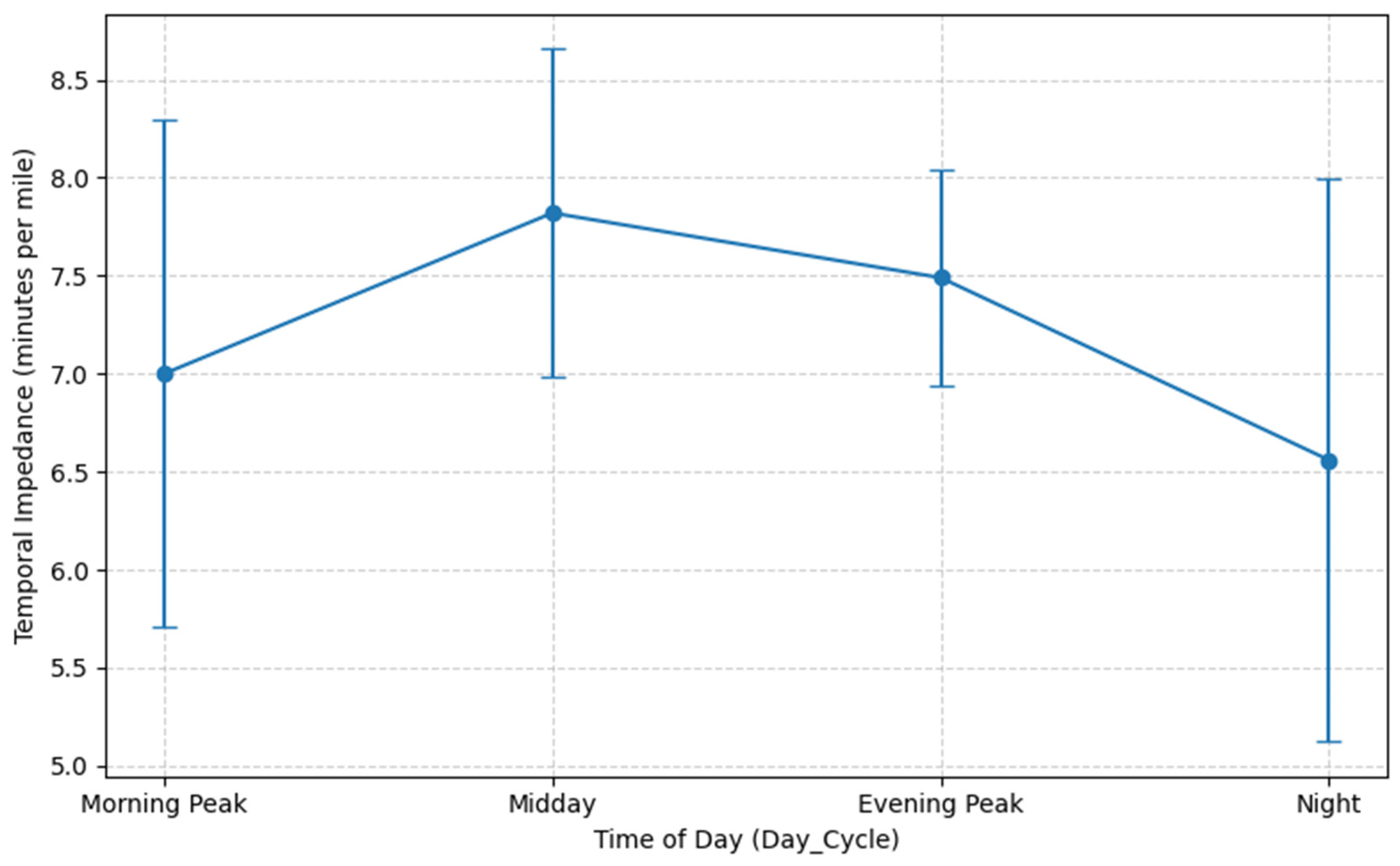
TI is lowest during the night period, when traffic volumes and network saturation are minimal, and highest during the midday and evening peak periods. For example, the average trip requires approximately 19% more time per mile at midday than during the night, despite identical spatial distances and BE conditions. These patterns indicate that the functional size of the city fluctuates over the daily cycle: congestion during peak and midday periods compresses accessibility, while off-peak conditions partially restore spatial reach. Figure 2 visualises these patterns, showing variation in mean TI across the daily cycle.
The error bars in Figure 2 represent 95% confidence intervals around the mean. While TI peaks during midday and evening periods and is lowest at night, substantial within-period variability is observed across all TOD conditions (see Table 6). The distribution of TI is highly right-skewed with substantial variance (Table 5), indicating the presence of extreme upper-tail observations. Under such conditions, mean-based parametric inference is sensitive to dispersion and may not adequately capture differences across groups. Accordingly, variation in TI across TOD periods (Table 6) was evaluated using the nonparametric Kruskal–Wallis test [59], which compares distributions based on ranks rather than means and is more robust under skewed and heteroscedastic conditions [59,60]. The results indicate statistically significant variation across the daily cycle (H = 285.25, p < 0.001), confirming that TI varies systematically with TOD. A one-way ANOVA did not detect statistically significant differences (F = 0.93, p = 0.427), reflecting the sensitivity of mean-based inference to extreme values and distributional asymmetry observed in Table 5. Given the heavy-tailed nature of the data, the Kruskal–Wallis test is therefore considered more appropriate for inference in this context. Complementary visualisation using 95% confidence intervals in Figure 2 indicates variability around mean estimates. However, the primary inference is based on distributional differences captured through rank-based methods.

4.3. Transport Mode Choice Models

To distinguish conventional travel time effects from the temporal dimension of the BE, two multinomial logit models were estimated as reported in Table 7. Model A includes absolute trip duration, whereas Model B replaces duration with the time-normalised TI metric.
The TI specification for Model B demonstrates a markedly stronger explanatory power than the duration-based model (Model A). This is reflected in a higher likelihood ratio statistic (χ2 = 4995.236 vs. 149.767) and improved model fit (McFadden R2 = 0.219 vs. 0.009; Nagelkerke R2 = 0.289 vs. 0.013). Likelihood ratio tests further indicate that TI contributes more to model fit than TOD effects. In Model A, both trip duration and TOD effects remain comparatively weak. These results show that time-normalised TI captures a larger share of variation in transport mode choice than absolute trip duration alone. The improvement in model fit from Model A to Model B provides empirical support for conceptualising duration as a time-dependent dimension of the BE rather than a simple measure of trip length. These results support H2 by demonstrating that TI predicts mode choice independently of TOD classification.

4.4. Behavioural Consequences of the Temporal City

Table 6 characterises temporal variation in realised travel conditions through TI. It provides a system-level measure of accessibility across the daily cycle. Table 8 reports observed mode shares by TOD and is presented for descriptive context only. While both tables reflect temporal variation, they represent different levels of analysis. Table 6 captures changes in the transport system’s performance, whereas Table 8 reflects the distribution of observed travel behaviour. Behavioural inference is derived from the multinomial logit models presented in subsequent sections, which test whether TI predicts mode choice beyond TOD classification. The descriptive patterns in Table 8 should be interpreted in relation to, but not as a substitute for, the model-based results.
Table 8. Observed mode shares by TOD (percent of trips).
Day CycleActive (Walking & Cycling)Private CarPublic TransitHired (Taxi/Rent)Total
Morning Peak7.6%89.9%1.6%1.0%100.0%
Midday7.7%90.7%0.8%0.7%100.0%
Evening Peak7.9%90.2%1.2%0.8%100.0%
Night6.2%90.7%1.1%2.0%100.0%
Total7.6%90.4%1.1%0.9%100.0%
Note: Percentages are calculated within each TOD category based on the analytical sample (N = 30,288). Observed mode shares are presented for descriptive context, while behavioural interpretation is based on model-derived predicted probabilities reported in Table 9.
Table 9. Key parameter estimates (Model A vs. Model B)—reference category: private car.
ModeModel A (Duration)Model B (Impedance)
ActiveOR = 1.000, p = 0.603OR = 1.128, p < 0.001
Public TransportOR = 1.005, p < 0.001OR = 1.041, p < 0.001
Other/HiredOR = 1.006, p < 0.001OR = 1.015, p = 0.128
Note: OR = odds ratio. Values greater than 1 indicate an increased likelihood of selecting the given mode relative to the reference category (car = 1.00). Model A uses trip duration (minutes) as the explanatory variable, while Model B uses TI (MPM). p-values indicate statistical significance of the estimated coefficients.

4.5. Parameter Estimates

A multinomial logit model was estimated in the sample. Two model specifications were estimated to distinguish the effects of absolute travel time from time-normalised travel cost. Model A includes absolute trip duration, while Model B includes TI (MPM). Both models control for TOD and urban density. All effects are interpreted relative to private car travel, urban core locations, and nighttime conditions. Key parameter estimates are summarised in Table 9, while full model results are reported in Table A1 and Table A2.
The results show a clear divergence between absolute travel duration and time-normalised TI. In Model A, trip duration does not significantly influence the likelihood of active transport relative to private car use (OR = 1.000, p = 0.603), indicating that absolute travel time does not meaningfully predict walking or cycling behaviour. Duration shows only weak effects for public transport (OR = 1.005, p < 0.001) and hired modes (OR = 1.006, p < 0.001), suggesting a limited association with mode choice overall. Model B shows that TI is a strong and statistically significant predictor of behaviour. A higher MPM substantially increases the likelihood of active transport (OR = 1.128, p < 0.001) and public transport use (OR = 1.041, p < 0.001). At the same time, its effect on hired modes is not statistically significant (OR = 1.015, p = 0.128).
This contrast indicates that time-normalised travel cost captures behavioural responses that are not revealed by absolute travel duration alone. While duration primarily reflects trip length, TI reflects network performance and congestion conditions, which play a more decisive role in shaping transport behaviour. The opposing patterns observed across the two models reinforce this interpretation. Duration has no meaningful effect on active transport, whereas TI strongly increases the likelihood of active transport. This divergence suggests that TI captures a distinct, system-level travel burden associated with network conditions rather than intrinsic modal characteristics.

4.6. Predicted Behavioural Accessibility

To translate the estimated utilities into interpretable measures of behavioural accessibility, predicted probabilities were computed for each travel mode, as shown in Table 10. These probabilities represent the expected likelihood that a trip will be made by active transport, public transport, hired services, or a private car, conditional on TOD and urban density. As such, they provide a time-normalised representation of how the temporal city restructures behavioural opportunity within the same BE across the daily cycle.
Predicted probabilities for public transport are highest during the morning peak (0.0155) and decline during midday and evening periods, reflecting the interaction between congestion, service availability, and commuting schedules. Active transport exhibits modest but systematic variation across the daily cycle, with slightly higher probabilities during the evening peak (0.0788) and lower probabilities at night (0.0616). Hired modes exhibit a distinct temporal pattern, with the highest predicted probability at night (0.0201), consistent with a greater reliance on on-demand services during off-peak hours.
The differences in predicted probabilities are modest in absolute terms. However, the relative changes across TOD conditions are substantial. For example, the probability of active transport increases from 0.0616 at night to 0.0788 during the evening peak, representing a 27.9% relative increase. Similarly, the probability of hired modes increases from 0.0072 at midday to 0.0201 at night, corresponding to an approximately 179% relative increase. These patterns are consistent with the odds ratio estimates, which indicate that TI is associated with increases of approximately 12–18% in the likelihood of active transport, 7–12% for public transport, and up to 11% for hired modes relative to a private car across TODs.
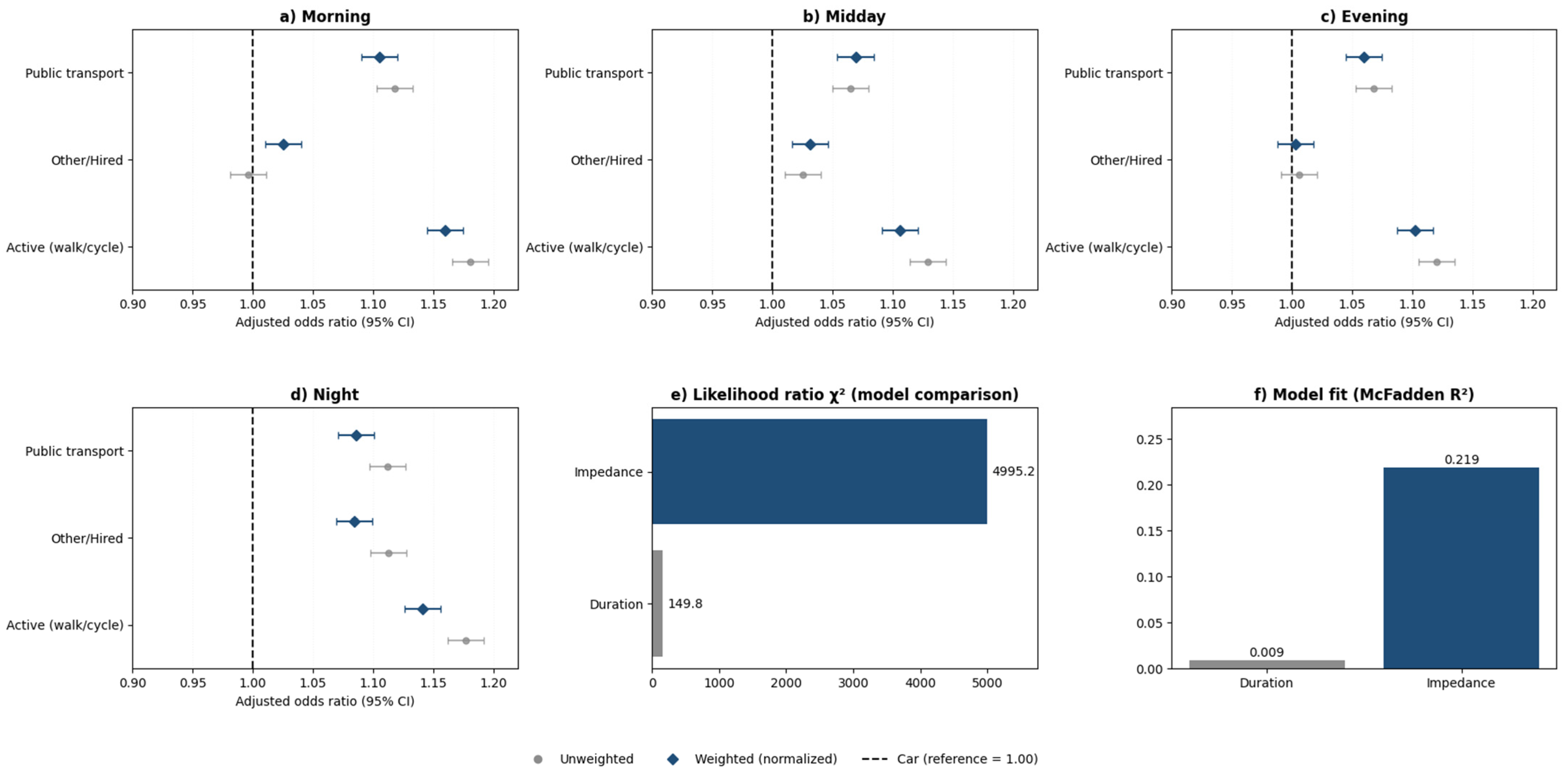
The multinomial logit model is non-linear, meaning that substantial changes in relative likelihood may translate into smaller absolute differences in predicted probabilities, particularly when one mode (private car) strongly dominates the choice set. These effects are consistent across both weighted and unweighted specifications, indicating robustness to the survey design (see Table A3). The results demonstrate that the temporal city operates through systematic shifts in relative modal likelihood, which remain meaningful even when absolute probability differences are modest. Figure 3 illustrates the effect of TI on mode choice. It shows that increases in TI are associated with relative shifts in mode choice away from private cars, with mode-specific responses across TOD conditions. The consistency of this pattern across weighted and unweighted specifications confirms the robustness of this behavioural response.

5. Discussion

TOD systematically alters how the same BE functions as accessible or otherwise. The results show that the functional accessibility associated with urban density varies across the daily cycle. Identical BEs yield markedly different TIs and accessibilities depending on TOD. This is consistent with longitudinal and morphometric studies of densification, which show that urban density emerges through time-dependent pathways, incremental change, and flow-regulating building structures rather than as a static spatial quantity [61,62,63]. Dense environments support mobility at certain times of day but constrain it at others. This means that urban form cannot be evaluated independently of temporal context. These patterns are consistent with evidence that dense, transit-rich cities do not automatically deliver high or equitable access. This is because lived accessibility is shaped by time-dependent constraints that are obscured by city-level feature averages [64,65,66]. Accessibility is therefore conditioned by transport system performance and network structure, not urban form alone [67]. It operates as a dynamic system outcome shaped by changing conditions and system capacity, rather than a static spatial attribute [68].
The econometric results demonstrate that these temporal structures translate directly into behavioural change. TI is strongly associated with mode choice, indicating that congestion patterns are embedded in behavioural outcomes across the daily cycle. TOD does not merely describe accessibility; it also governs the feasibility of different mobility options by reshaping the effective choice set available to travellers. This structuring of behaviour arises from variation in time costs, which constrains feasible actions and reshapes the set of available mobility options. Mode choice responds systematically to variations in travel conditions, particularly travel time and cost [69].
TI provides substantially greater explanatory power than absolute trip duration in explaining mode choice. This indicates that behavioural responses are more strongly associated with time-dependent network conditions than with trip length itself. The divergence between duration and TI effects suggests that the time per unit distance captures a system-level constraint on mobility that is not reflected in absolute travel time. In this sense, TI represents network-induced friction rather than intrinsic modal characteristics.
Duration is conceptually different from conventional travel time [70], reliability metrics [71], and time-geographic constraints [72]. It captures how the BE is experienced through realised trip performance across the daily cycle [18]. In classical time geography, accessibility is constrained by individual time budgets, space–time prisms, and activity schedules [73,74,75,76]. In conventional accessibility and time-geographic models, congestion influences accessibility only indirectly via longer travel times that contract individuals’ space–time prisms, rather than being modelled explicitly as a time-varying mobility constraint [39,77]. In contrast, duration captures how the BE generates time-varying friction that structures lived accessibility and reshapes the behavioural field of mobility by conditioning how individual schedules are realised under real-world travel conditions [18].
Reliability and variability research focuses on uncertainty around expected travel times, particularly delays and schedule failures [78,79,80]. The duration of the same urban space varies throughout the day. It reveals when the city is functionally compressed or expanded. Two trips may have an identical reliability yet occur within very different temporal cities if minutes-per-mile differ. Dynamic and spatiotemporal accessibility models embed time-dependent travel costs, service availability, and congestion into network calculations. This allows accessibility to vary across departure times and operating conditions [48,81,82,83]. Duration shifts the theoretical lens by treating TOD impedance as a temporal dimension through which urban form is realised, rather than merely as an input to routing algorithms. Because the chosen transport mode partly determines travel time and impedance, these associations should be interpreted as behavioural constraints rather than causal effects. The results describe how the temporal structure of the transport system shapes the behavioural opportunities available to travellers at different TODs in urban areas. In this sense, TI represents a time-varying mobility constraint that shapes which modes are realistically available, rather than a unidirectional determinant of choice.
Time scarcity acts as a structural constraint on physical activity, reducing participation even after accounting for income, socioeconomic status, and reverse causation [84,85]. TI links urban form and health outcomes by showing how time-based constraints reduce feasible activity windows and diminish the practical usability of urban space [86,87,88,89]. This helps explain why compact cities do not automatically produce healthier populations.
These findings have implications for how urban accessibility is interpreted in planning and analytical frameworks. Accessibility, density, and walkability are commonly evaluated using daily average travel times or static indicators, which assume temporal stability. For example, the 15 min pedestrian life-cycle frameworks evaluate accessibility based on walkable proximity and the spatial distribution of facilities within fixed thresholds [90]. However, the ability to realise this proximity varies across the daily cycle. The results of the current study show that such representations mask systematic TOD inequalities in realised accessibility and behavioural feasibility within the same BE. Time-stratified TI provides a basis for identifying when accessibility deteriorates within otherwise supportive urban environments. This has direct implications for peak-period transport management, dynamic service scheduling, and time-sensitive planning interventions targeting periods of reduced accessibility.

6. Conclusions and Limitations

TOD operates as a structural dimension of urban accessibility, shaping how the same BE is experienced across the daily cycle. TI varies systematically across TOD conditions, with higher time-per-distance burdens during peak and midday periods. This pattern indicates that realised travel conditions are not constant within fixed spatial settings. TI explains transport mode choice more effectively than absolute trip duration alone. Similarly, time-normalised measures capture behavioural responses to network conditions more directly than travel time. Duration functions as a structural temporal dimension of the BE, with TI providing its clearest empirical representation.
Furthermore, accessibility is not a fixed property of urban form, but a time-dependent condition shaped by the performance of the urban transport system. Planning approaches based on static or average travel time measures risk misrepresenting mobility opportunities and constraints. Time-stratified measures of accessibility provide a more accurate basis for transport evaluation and support interventions targeted to periods of reduced accessibility.
The current study has some limitations. The analysis relies on cross-sectional travel diary data from the US NHTS, which uses a single 24 h reporting period and captures within-day variation but does not observe longer-term behavioural adaptation. Longitudinal data would allow for an examination of how repeated exposure to TI accumulates into mobility stress, habit formation, and longer-term health outcomes. Because the chosen transport mode partly determines travel time and TI, the estimated relationships are interpreted as descriptive behavioural associations rather than causal effects. These endogeneity concerns could be addressed using panel data, instrumental-variable approaches, or structural modelling frameworks. The study also does not explicitly model trip purpose. The observed TOD patterns may partly reflect differences between commuting and discretionary travel. The analysis is based on nationally pooled urban trips rather than city-specific transport systems, which limits direct inference for individual metropolitan contexts. In the future, applying the TCF to specific cities using detailed spatial and network data would strengthen city-specific planning and enhance policy relevance in real-world urban transport systems. Furthermore, temporal aggregation into four TOD categories may mask finer intra-period variation that could be examined with higher-resolution temporal data in future research.

Author Contributions

Conceptualisation, I.A. and F.U.; methodology, I.A. and F.U.; software, I.A.; validation, I.A.; formal analysis, I.A.; investigation, I.A.; resources, I.A. and F.U.; data curation, I.A.; writing—original draft preparation, I.A.; review and editing, I.A., F.U., S.Q. and M.J.; visualisation, I.A.; supervision, F.U. and S.Q.; project administration, I.A. and F.U.; funding acquisition, M.J., F.U. and I.A. All authors have read and agreed to the published version of the manuscript.

Funding

This research received no external funding.

Data Availability Statement

The original data presented in the study are openly available in the National Household Travel Survey version 2.1, published by the U.S. Department of Transportation, Federal Highway Administration, at https://nhts.ornl.gov/ (accessed on 11 January 2026).

Acknowledgments

The AI-based tool ChatGPT Instant version 5.2 was used to review grammar, clarity, and sentence structure. It was used solely for language editing purposes.

Conflicts of Interest

The authors declare no conflicts of interest.

Appendix A

Table A1. Multinomial logit results (Model A: duration)—reference category: private car.
Active vs. Private Car
VariableOR (95% CI)p-value
Trip duration (minutes)1.000 (0.998, 1.001)0.603
Respondent age0.987 (0.985, 0.989)<0.001
Income (INC_N)1.061 (1.043, 1.079)<0.001
Vehicles in the household0.421 (0.398, 0.446)<0.001
Trip purpose1.007 (1.005, 1.008)<0.001
Morning peak (vs. night)1.225 (1.008, 1.488)0.041
Midday (vs. night)1.239 (1.029, 1.492)0.024
Evening peak (vs. night)1.246 (1.036, 1.498)0.020
Public transport vs. private car
VariableOR (95% CI)p-value
Trip duration (minutes)1.005 (1.003, 1.006)<0.001
Respondent age0.984 (0.978, 0.990)<0.001
Income (INC_N)1.092 (1.049, 1.138)<0.001
Vehicles in the household0.111 (0.094, 0.131)<0.001
Trip purpose0.999 (0.995, 1.003)0.728
Morning peak (vs. night)1.701 (1.087, 2.662)0.020
Midday (vs. night)0.897 (0.571, 1.408)0.636
Evening peak (vs. night)1.226 (0.794, 1.895)0.358
Other/hired vs. private car
VariableOR (95% CI)p-value
Trip duration (minutes)1.006 (1.005, 1.007)<0.001
Respondent age0.989 (0.983, 0.995)<0.001
Income (INC_N)1.086 (1.034, 1.140)<0.001
Vehicles in the household0.490 (0.421, 0.570)<0.001
Trip purpose1.014 (1.010, 1.019)<0.001
Morning peak (vs. night)0.419 (0.283, 0.620)<0.001
Midday (vs. night)0.328 (0.225, 0.478)<0.001
Evening peak (vs. night)0.372 (0.257, 0.540)<0.001
Table A2. Multinomial logit results (Model B: temporal impedance). Reference category: private car.
Active vs. private car
VariableOR (95% CI)p-value
Temporal impedance (min/mile)1.128 (1.123, 1.134)<0.001
Respondent age0.982 (0.980, 0.985)<0.001
Income (INC_N)1.099 (1.076, 1.121)<0.001
Vehicles in the household0.492 (0.461, 0.525)<0.001
Trip purpose1.003 (1.001, 1.005)<0.001
Morning peak (vs. night)1.329 (1.055, 1.675)0.016
Midday (vs. night)1.071 (0.858, 1.339)0.543
Evening peak (vs. night)1.119 (0.897, 1.395)0.320
Public transport vs. private car
VariableOR (95% CI)p-value
Temporal impedance (min/mile)1.041 (1.027, 1.055)<0.001
Respondent age0.984 (0.978, 0.990)<0.001
Income (INC_N)1.094 (1.050, 1.139)<0.001
Vehicles in the household0.114 (0.096, 0.135)<0.001
Trip purpose0.999 (0.994, 1.003)0.498
Morning peak (vs. night)1.795 (1.146, 2.814)0.011
Midday (vs. night)0.910 (0.578, 1.433)0.685
Evening peak (vs. night)1.216 (0.785, 1.884)0.381
Other/hired vs. private car
VariableOR (95% CI)p-value
Temporal impedance (min/mile)1.015 (0.996, 1.036)0.128
Respondent age0.990 (0.984, 0.995)<0.001
Income (INC_N)1.072 (1.022, 1.125)0.004
Vehicles in the household0.518 (0.445, 0.604)<0.001
Trip purpose1.013 (1.009, 1.017)<0.001
Morning peak (vs. night)0.441 (0.301, 0.646)<0.001
Midday (vs. night)0.311 (0.215, 0.450)<0.001
Evening peak (vs. night)0.331 (0.230, 0.476)<0.001
Table A3. Weighted and unweighted ORs.
TODModeUnweighted OR (95% CI)Weighted OR (95% CI)
MorningPublic transport1.11 (1.09–1.12)1.12 (1.10–1.14)
Ride-hailing/taxi1.03 (0.99–1.07)1.00 (0.94–1.05)
Active (walk/cycle)1.06 (1.15–1.17)1.18 (1.17–1.19)
MiddayPublic transport1.07 (1.06–1.08)1.07 (1.05–1.08)
Ride-hailing/taxi1.03 (1.01–1.05)1.03 (1.00–1.05)
Active (walk/cycle)1.11 (1.10–1.11)1.13 (1.12–1.14)
EveningPublic transport1.06 (1.05–1.07)1.07 (1.05–1.08)
Ride-hailing/taxi1.00 (0.98–1.03)1.01 (0.98–1.04)
Active (walk/cycle)1.10 (1.09–1.11)1.12 (1.11–1.13)
NightPublic transport1.09 (1.06–1.11)1.11 (1.08–1.15)
Ride-hailing/taxi1.08 (1.05–1.12)1.11 (1.08–1.15)
Active (walk/cycle)1.14 (1.13–1.16)1.18 (1.16–1.20)
Values are rounded to two decimal places; full-precision estimates are available in the model output.

References

  1. Fan, Q.; Mei, X.; Zhang, C.; Yang, X. Research on Gridding of Urban Spatial Form Based on Fractal Theory. ISPRS Int. J. Geo-Inf. 2022, 11, 622. [Google Scholar] [CrossRef]
  2. Shi, Y.; Zhai, G.; Xu, L.; Zhou, S.; Lu, Y.; Liu, H.; Huang, W. Assessment methods of urban system resilience: From the perspective of complex adaptive system theory. Cities 2021, 112, 103141. [Google Scholar] [CrossRef]
  3. Wu, C.; Smith, D.; Wang, M. Simulating the urban spatial structure with spatial interaction: A case study of urban polycentricity under different scenarios. Comput. Environ. Urban Syst. 2021, 89, 101677. [Google Scholar] [CrossRef]
  4. Zhong, J.; Liu, W.; Niu, B.; Lin, X.; Deng, Y. Role of Built Environments on Physical Activity and Health Promotion: A Review and Policy Insights. Front. Public Health 2022, 10, 950348. [Google Scholar] [CrossRef]
  5. Mouratidis, K. Urban planning and quality of life: A review of pathways linking the built environment to subjective well-being. Cities 2021, 115, 103229. [Google Scholar] [CrossRef]
  6. Li, Z.; Tang, J.; Ji, Y.; Liang, X.; Hu, L.; Hu, C. Relationship between the built environment and metro usage patterns: A motif-based perspective. Tunn. Undergr. Space Technol. 2025, 159, 106488. [Google Scholar] [CrossRef]
  7. Jiang, Y.; Han, Y.; Liu, M.; Ye, Y. Street vitality and built environment features: A data-informed approach from fourteen Chinese cities. Sustain. Cities Soc. 2022, 79, 103724. [Google Scholar] [CrossRef]
  8. Lyu, G.; Angkawisittpan, N.; Fu, X.; Sonasang, S. Investigating the relationship between built environment and urban vitality using big data. Sci. Rep. 2025, 15, 579. [Google Scholar] [CrossRef]
  9. Duan, Y.; Yuan, C.; Mao, X.; Zhao, J.; Ma, N. Influence of the built environment on taxi travel demand based on the optimal spatial analysis unit. PLoS ONE 2023, 18, e0292363. [Google Scholar] [CrossRef]
  10. Figliozzi, M.A. The impacts of congestion on commercial vehicle tour characteristics and costs. Transp. Res. Part E Logist. Transp. Rev. 2010, 46, 496–506. [Google Scholar] [CrossRef]
  11. Cheng, Y.; Watkins, S.J.; Anciaes, P. Chapter Six—What Interventions Are Effective in Reducing Congestion? Academic Press: Cambridge, MA, USA, 2024; Volume 13, pp. 197–225. [Google Scholar]
  12. Huan, W.; Li, S.; Liu, X.; Wu, H.; Diao, M.; Li, H.; Yair Grinberger, A.; Liu, H.; Liu, C.; Huang, W. Correlation and causality between traffic congestion and the built environment: A case study in New York city. Int. J. Digit. Earth 2025, 18, 2548377. [Google Scholar] [CrossRef]
  13. Conceição, M.A.; Monteiro, M.M.; Kasraian, D.; van den Berg, P.; Haustein, S.; Alves, I.; Azevedo, C.L.; Miranda, B. The effect of transport infrastructure, congestion and reliability on mental wellbeing: A systematic review of empirical studies. Transp. Rev. 2023, 43, 264–302. [Google Scholar] [CrossRef]
  14. Laddu, D.; Paluch, A.E.; LaMonte, M.J. The role of the built environment in promoting movement and physical activity across the lifespan: Implications for public health. Prog. Cardiovasc. Dis. 2021, 64, 33–40. [Google Scholar] [CrossRef]
  15. Su, R.; Goulias, K. Untangling the relationships among residential environment, destination choice, and daily walk accessibility. J. Transp. Geogr. 2023, 109, 103595. [Google Scholar] [CrossRef]
  16. Song, Y.; Wang, Y.; Zhou, M.; Suo, Z.; Wang, X.; Li, C.; Feng, X.; Cheng, J.; Yu, H. Association between the perceived built environment and health behaviors in older adults: A cross-sectional study from Beijing, China. BMC Geriatr. 2024, 24, 692. [Google Scholar] [CrossRef]
  17. Baobeid, A.; Koç, M.; Al-Ghamdi, S.G. Walkability and Its Relationships With Health, Sustainability, and Livability: Elements of Physical Environment and Evaluation Frameworks. Front. Built Environ. 2021, 7, 721218. [Google Scholar] [CrossRef]
  18. Arif, I.; Ullah, F.; Qayyum, S. Duration as the Sixth Dimension of the Built Environment Travel Behaviour Framework. Urban Sci. 2026, 10, 26. [Google Scholar] [CrossRef]
  19. Arif, I.; Ullah, F. Impact of Traffic Stress, Built Environment, and Socioecological Factors on Active Transport Among Young Adults. Sustainability 2025, 17, 9159. [Google Scholar] [CrossRef]
  20. Fransen, K.; Neutens, T.; Farber, S.; De Maeyer, P.; Deruyter, G.; Witlox, F. Identifying public transport gaps using time-dependent accessibility levels. J. Transp. Geogr. 2015, 48, 176–187. [Google Scholar] [CrossRef]
  21. Raza, A.; Zhong, M.; Akuh, R.; Safdar, M. Public transport equity with the concept of time-dependent accessibility using Geostatistics methods, Lorenz curves, and Gini coefficients. Case Stud. Transp. Policy 2023, 11, 100956. [Google Scholar] [CrossRef]
  22. Graff, L.K.; Flanigan, K.A.; Qian, S. Constructing a routable multimodal, multi-cost, time-dependent network model with all emerging mobility options: Methodology and case studies. Transp. Res. Part E Logist. Transp. Rev. 2024, 192, 103757. [Google Scholar] [CrossRef]
  23. Raza, A.; Zhong, M.; Safdar, M. Evaluating Locational Preference of Urban Activities with the Time-Dependent Accessibility Using Integrated Spatial Economic Models. Int. J. Environ. Res. Public Health 2022, 19, 8317. [Google Scholar] [CrossRef]
  24. Lachapelle, U.; Boisjoly, G. Breaking down public transit travel time for more accurate transport equity policies: A trip component approach. Transp. Res. Part A Policy Pract. 2023, 175, 103756. [Google Scholar] [CrossRef]
  25. U.S. Department of Transportation, Federal Highway Administration. National Household Travel Survey. Available online: https://nhts.ornl.gov/ (accessed on 11 January 2026).
  26. Cervero, R.; Kockelman, K. Travel demand and the 3Ds: Density, diversity, and design. Transp. Res. Part D Transp. Environ. 1997, 2, 199–219. [Google Scholar] [CrossRef]
  27. Ewing, R.; Cervero, R. Travel and the Built Environment. J. Am. Plan. Assoc. 2010, 76, 265–294. [Google Scholar] [CrossRef]
  28. Bimpou, K.; Ferguson, N.S. Dynamic accessibility: Incorporating day-to-day travel time reliability into accessibility measurement. J. Transp. Geogr. 2020, 89, 102892. [Google Scholar] [CrossRef]
  29. Moya-Gómez, B.; García-Palomares, J.C. The impacts of congestion on automobile accessibility. What happens in large European cities? J. Transp. Geogr. 2017, 62, 148–159. [Google Scholar] [CrossRef]
  30. Ashraf, M.T.; Dey, K.; Carrola, A.; Shi, X. Impacts of real-time transit information on transit accessibility—A case study. J. Public Transp. 2023, 25, 100043. [Google Scholar] [CrossRef]
  31. Bilotta, S.; Fereidooni, Z.; Ipsaro Palesi, L.A.; Nesi, P. Macroscopic GA-based Multi-Objective Traffic Light Optimization prioritizing tramways. Appl. Soft Comput. 2025, 178, 113269. [Google Scholar] [CrossRef]
  32. Sun, S.; Sun, C.; Liu, Y.; Yang, Y.; Qu, D. Walking Behavior Modeling in Urban Pedestrian-Only Spaces for Analysing Multiple Factors Influencing Pedestrian Density Distribution. Buildings 2025, 15, 3930. [Google Scholar] [CrossRef]
  33. Feng, L.; Betts, J.M.; Kamruzzaman, L.; Vu, H.L. Impact of autonomous vehicles on discretionary activities: An agent-based model with space–time accessibility constraints. Transportation 2026, 53, 433–457. [Google Scholar] [CrossRef]
  34. He, X.; He, S.Y. How does the effect of walkability on walking behavior vary with the time of day? A study of Shenzhen, China. J. Transp. Geogr. 2025, 126, 104210. [Google Scholar] [CrossRef]
  35. Ermagun, A.; Koury, E. Disproportionate impact of weekday-to-weekend transit service cuts on access for disadvantaged populations. Transp. Res. Part D Transp. Environ. 2024, 130, 104169. [Google Scholar] [CrossRef]
  36. Li, Z.; Lee, J.H.; Yao, L.; Ostwald, M.J. Impact of built environments on human perception: A systematic review of physiological measures and machine learning. J. Build. Eng. 2025, 104, 112319. [Google Scholar] [CrossRef]
  37. Ochodo, C.; Ndetei, D.M.; Moturi, W.N.; Otieno, J.O. External built residential environment characteristics that affect mental health of adults. J. Urban Health 2014, 91, 908–927. [Google Scholar] [CrossRef]
  38. Kirsh, D. Reimagining space: How activity space explains human behaviour in buildings. Archit. Sci. Rev. 2025, 1–11. [Google Scholar] [CrossRef]
  39. Pot, F.J.; van Wee, B.; Tillema, T. Perceived accessibility: What it is and why it differs from calculated accessibility measures based on spatial data. J. Transp. Geogr. 2021, 94, 103090. [Google Scholar] [CrossRef]
  40. Meng, M.; Rau, A.; Mahardhika, H. Public transport travel time perception: Effects of socioeconomic characteristics, trip characteristics and facility usage. Transp. Res. Part A Policy Pract. 2018, 114, 24–37. [Google Scholar] [CrossRef]
  41. Liu, X.; Chen, X.; Potoglou, D.; Tian, M.; Fu, Y. Travel impedance, the built environment, and customized-bus ridership: A stop-to-stop level analysis. Transp. Res. Part D Transp. Environ. 2023, 122, 103889. [Google Scholar] [CrossRef]
  42. Zhang, X.; Yang, H.; Huang, H.-J.; Zhang, H.M. Integrated scheduling of daily work activities and morning–evening commutes with bottleneck congestion. Transp. Res. Part A Policy Pract. 2005, 39, 41–60. [Google Scholar] [CrossRef]
  43. Dharmowijoyo, D.B.E.; Susilo, Y.O.; Karlström, A. Relationships among discretionary activity duration, its travel time spent and activity space indices in the Jakarta Metropolitan Area, Indonesia. J. Transp. Geogr. 2016, 54, 148–160. [Google Scholar] [CrossRef]
  44. de Sá, T.H.; Parra, D.C.; Monteiro, C.A. Impact of travel mode shift and trip distance on active and non-active transportation in the São Paulo Metropolitan Area in Brazil. Prev. Med. Rep. 2015, 2, 183–188. [Google Scholar] [CrossRef]
  45. Bhat, C.R.; Sardesai, R. The impact of stop-making and travel time reliability on commute mode choice. Transp. Res. Part B Methodol. 2006, 40, 709–730. [Google Scholar] [CrossRef]
  46. Ha, J.; Lee, S.; Ko, J. Unraveling the impact of travel time, cost, and transit burdens on commute mode choice for different income and age groups. Transp. Res. Part A Policy Pract. 2020, 141, 147–166. [Google Scholar] [CrossRef]
  47. Javanmard, R.; Liu, L.; Long, J.A.; Lee, J. Using Realtime GTFS to generate easy-to-use transit accessibility measures under travel time uncertainty. Travel Behav. Soc. 2025, 41, 101054. [Google Scholar] [CrossRef]
  48. Rathod, R.; Joshi, G.; Shriniwas, A. Evaluation of Spatiotemporal Transit Accessibility: Weighted Indexing Using the CRITIC-MCDM Approach and Performance Gap Analysis. J. Adv. Transp. 2024, 2024, 6343594. [Google Scholar] [CrossRef]
  49. Liang, Y.; Wang, D.; Zhou, X.; Hao, J.; Guo, Y. Assessing the impact of network and station accessibility on station-level rail transit ridership during peak and off-peak hours. Transp. Res. Part A Policy Pract. 2025, 199, 104574. [Google Scholar] [CrossRef]
  50. Braga, C.K.V.; Loureiro, C.F.G.; Pereira, R.H.M. Evaluating the impact of public transport travel time inaccuracy and variability on socio-spatial inequalities in accessibility. J. Transp. Geogr. 2023, 109, 103590. [Google Scholar] [CrossRef]
  51. Liu, L.; Porr, A.; Miller, H.J. Realizable accessibility: Evaluating the reliability of public transit accessibility using high-resolution real-time data. J. Geogr. Syst. 2022, 25, 429–451. [Google Scholar] [CrossRef]
  52. Liu, D.; Wei, J.; Kan, Z. Integrated transit service status assessment using smart transit card big data under the x-minute city framework. J. Transp. Geogr. 2025, 125, 104189. [Google Scholar] [CrossRef]
  53. Zhang, Q.; Ma, Z.; Zhang, P.; Jenelius, E. Mobility knowledge graph: Review and its application in public transport. Transportation 2025, 52, 1119–1145. [Google Scholar] [CrossRef]
  54. Muhammad, A.S.; Chen, L.; Wang, C. Advancing safe mobility: A global analysis of research trends in safe route planning. Heliyon 2023, 9, e22755. [Google Scholar] [CrossRef]
  55. Hassan, M.; Mahin, H.D.; Ahmed, F.; Hassan, M.M.; Rahaman, A.; Abdullah, M. Assessing Public Transit Network Efficiency and Accessibility in Johor Bahru and Penang, Malaysia: A Data-Driven Approach. Results Eng. 2025, 27, 106126. [Google Scholar] [CrossRef]
  56. Lee, S.; Cho, K.; Jeon, Y. Travel efficiency in urban space: The role of built environment in shaping excess travel distance across transport modes. Sci. Rep. 2025, 15, 33372. [Google Scholar] [CrossRef]
  57. Harun, I.; Yigitcanlar, T. Urban Land Use and Value in the Digital Economy: A Scoping Review of Disrupted Activities, Behaviours, and Mobility. Land 2025, 14, 1647. [Google Scholar] [CrossRef]
  58. Masuadi, E.; Mohamud, M.; Almutairi, M.; Alsunaidi, A.; Alswayed, A.K.; Aldhafeeri, O.F. Trends in the Usage of Statistical Software and Their Associated Study Designs in Health Sciences Research: A Bibliometric Analysis. Cureus 2021, 13, e12639. [Google Scholar] [CrossRef]
  59. Conover, W.J. Practical Nonparametric Statistics; John Wiley & Sons: Hoboken, NJ, USA, 1999. [Google Scholar]
  60. Hollander, M.; Wolfe, D.A.; Chicken, E. Nonparametric Statistical Methods; John Wiley & Sons: Hoboken, NJ, USA, 2013. [Google Scholar]
  61. Tümtürk, O. Multiple pathways to urban density: A comparative diachronic analysis of building type transitions across three city centers. Cities 2025, 167, 106308. [Google Scholar] [CrossRef]
  62. Foster, S.; Giles-Corti, B.; Bolleter, J.; Turrell, G. Denser habitats: A longitudinal study of the impacts of residential density on objective and perceived neighbourhood amenity in Brisbane, Australia. Cities 2023, 143, 104565. [Google Scholar] [CrossRef]
  63. Son, C.H.; Lee, C.H.; Ban, Y.U. Analysis of the impact and moderating effect of high-density development on urban flooding. Heliyon 2023, 9, e22695. [Google Scholar] [CrossRef] [PubMed]
  64. Griffin, G.P.; Sener, I.N. Public Transit Equity Analysis at Metropolitan and Local Scales: A Focus on Nine Large Cities in the US. J. Public Trans. 2016, 19, 126–143. [Google Scholar] [CrossRef]
  65. Yen, B.T.H.; Mulley, C.; Chen, M.Y.J.; Chiou, Y.-C. How transit-oriented development concepts and strategies influenced green transport systems: A meta-analysis approach. Asian Transp. Stud. 2024, 10, 100136. [Google Scholar] [CrossRef]
  66. Suel, E.; Lynch, C.; Wood, M.; Murat, T.; Casey, G.; Dennett, A. Measuring transport-associated urban inequalities: Where are we and where do we go from here? Transp. Rev. 2024, 44, 1235–1257. [Google Scholar] [CrossRef]
  67. Zhao, Y.; Li, L.; Zhang, Z.; Sun, D. Performance Evaluation for the Expansion of Multi-Level Rail Transit Network in Xi’an Metropolitan Area: Empirical Analysis on Accessibility and Resilience. Land 2024, 13, 1682. [Google Scholar] [CrossRef]
  68. Chen, M.; Zeng, L.; Deng, Y.; Chen, S.; Gu, X. The Impact of Land Marketization on Urban Resilience: Empirical Evidence from Chinese Cities. Land 2024, 13, 1385. [Google Scholar] [CrossRef]
  69. Cheng, Z.; Sun, D.; Zhao, Y.; Peng, H. Investigating the factors influencing intercity travel mode choice in urban agglomerations: Insights from a three-phase framework. Transp. Res. Part A Policy Pract. 2025, 199, 104577. [Google Scholar] [CrossRef]
  70. Van Acker, V.; Cornet, Y.; Milakis, D.; Malichová, E.; Ojeda-Cabral, M. Understanding worthwhile travel time: An empirical study of travel experiences across transport modes. Transp. Res. Part A Policy Pract. 2025, 192, 104336. [Google Scholar] [CrossRef]
  71. Kang, R.; Zhang, Q.; Zeng, Z.; Zio, E.; Li, X. Measuring reliability under epistemic uncertainty: Review on non-probabilistic reliability metrics. Chin. J. Aeronaut. 2016, 29, 571–579. [Google Scholar] [CrossRef]
  72. Dodge, S.; Nelson, T.A. A framework for modern time geography: Emphasizing diverse constraints on accessibility. J. Geogr. Syst. 2023, 25, 357–375. [Google Scholar] [CrossRef]
  73. Mahmoudi, M.; Song, Y.; Miller, H.J.; Zhou, X. Accessibility with time and resource constraints: Computing hyper-prisms for sustainable transportation planning. Comput. Environ. Urban Syst. 2019, 73, 171–183. [Google Scholar] [CrossRef]
  74. Qin, J.; Liao, F. Space–time prism and accessibility incorporating monetary budget and mobility-as-a-service. Int. J. Geogr. Inf. Sci. 2024, 38, 274–296. [Google Scholar] [CrossRef]
  75. Qin, J.; Liao, F. Space–time prism and accessibility in multi-state supernetwork: A lens for locating mobility hubs. J. Transp. Geogr. 2025, 129, 104439. [Google Scholar] [CrossRef]
  76. Ellegård, K.; Svedin, U. Torsten Hägerstrand’s time-geography as the cradle of the activity approach in transport geography. J. Transp. Geogr. 2012, 23, 17–25. [Google Scholar] [CrossRef]
  77. Chukwurah, G.O.; Okeke, F.O.; Isimah, M.O.; Nnaemeka-Okeke, R.; Okonta, E.D.; Awe, F.C.; Idoko, A.E.; Guo, S.; Okeke, C.A. Analysis of Route-Way Dynamics in Urban Traffic Congestion of Enugu, Nigeria. Future Transp. 2025, 5, 71. [Google Scholar] [CrossRef]
  78. Zang, Z.; Batley, R.; Xu, X.; Wang, D.Z.W. On the value of distribution tail in the valuation of travel time variability. Transp. Res. Part E Logist. Transp. Rev. 2024, 190, 103695. [Google Scholar] [CrossRef]
  79. Carrion, C.; Levinson, D. Value of travel time reliability: A review of current evidence. Transp. Res. Part A Policy Pract. 2012, 46, 720–741. [Google Scholar] [CrossRef]
  80. Noland, R.B.; Polak, J.W. Travel time variability: A review of theoretical and empirical issues. Transp. Rev. 2002, 22, 39–54. [Google Scholar] [CrossRef]
  81. Cheng, S.; Xie, B.; Bie, Y.; Zhang, Y.; Zhang, S. Measure dynamic individual spatial-temporal accessibility by public transit: Integrating time-table and passenger departure time. J. Transp. Geogr. 2018, 66, 235–247. [Google Scholar] [CrossRef]
  82. Ryan, J.; Pereira, R.H.M.; Andersson, M. Accessibility and space-time differences in when and how different groups (choose to) travel. J. Transp. Geogr. 2023, 111, 103665. [Google Scholar] [CrossRef]
  83. Zhao, W.; Zhang, S.; Wang, B.; Zhou, B. Spatio-temporal causal graph attention network for traffic flow prediction in intelligent transportation systems. PeerJ Comput. Sci. 2023, 9, e1484. [Google Scholar] [CrossRef]
  84. Healy, S.; Patterson, F.; Biddle, S.; Dumuid, D.; Glorieux, I.; Olds, T.; Woods, C.; Bauman, A.E.; Gába, A.; Herring, M.P.; et al. It’s about time to exercise: Development of the Exercise Participation Explained in Relation to Time (EXPERT) model. Br. J. Sports Med. 2024, 58, 1131–1144. [Google Scholar] [CrossRef]
  85. Venn, D.; Strazdins, L. Your money or your time? How both types of scarcity matter to physical activity and healthy eating. Soc. Sci. Med. 2017, 172, 98–106. [Google Scholar] [CrossRef]
  86. Mironowicz, I.; Netsch, S.; Geppert, A. Space and spatial practices in times of confinement. Evidence from three European countries: Austria, France and Poland. Urban Des. Int. 2021, 26, 348–369. [Google Scholar] [CrossRef]
  87. Simoes Aelbrecht, P. Human congestion in new designed public spaces: Researching its social interactional potential. J. Urban. Int. Res. Placemak. Urban Sustain. 2025, 18, 564–594. [Google Scholar] [CrossRef]
  88. Anupriya; Bansal, P.; Graham, D.J. Congestion in cities: Can road capacity expansions provide a solution? Transp. Res. Part A Policy Pract. 2023, 174, 103726. [Google Scholar] [CrossRef]
  89. Salvo, G.; Lashewicz, B.M.; Doyle-Baker, P.K.; McCormack, G.R. Neighbourhood Built Environment Influences on Physical Activity among Adults: A Systematized Review of Qualitative Evidence. Int. J. Environ. Res. Public Health 2018, 15, 897. [Google Scholar] [CrossRef]
  90. Ma, W.; Wang, N.; Li, Y.; Sun, D. 15-min pedestrian distance life circle and sustainable community governance in Chinese metropolitan cities: A diagnosis. Humanit. Soc. Sci. Commun. 2023, 10, 364. [Google Scholar] [CrossRef]
Figure 1. The six-dimensional (6D) framework of the BE (conceptualised by [18]).
Smartcities 09 00067 g001
Figure 2. Mean temporal impedance across the daily cycle with 95% confidence intervals.
Smartcities 09 00067 g002
Figure 3. Effect of temporal impedance on mode choice (odds ratios). Note: Odds ratios represent the change in likelihood of selecting each mode relative to private car for a one-unit increase in TI (MPM). Values are shown for both unweighted and survey-weighted specifications.
Smartcities 09 00067 g003
Table 1. The 6D of BE and their explanation.
DimensionExplanation
DensityMeasured as population, dwelling units, employment, or floor area per unit of gross or net land area [26].
DiversityThe number of different land uses in an area, measured using entropy or jobs-to-housing ratios [26].
DesignStreet network and physical features such as block size, intersection density, connectivity, sidewalks, and pedestrian-oriented elements [26].
Distance
(to transit)
Ease of reaching trip attractions, measured as distance to the CBD, number of opportunities within a travel time, or distance to the closest store [27].
Destination (accessibility)Average shortest street distance to the nearest bus stop or rail station, or transit route density and stop spacing [27].
Duration (temporal accessibility)A structural temporal property of the BE that governs how spatial form is converted into time-dependent accessibility across the daily cycle. It is not a trip-level mobility outcome or an exposure metric [18].
Table 2. Sample construction and exclusions (NHTS 2022).
StepSample Selection and ExclusionsN
1Raw trip records from the 2022 NHTS31,074
2Excluded trips with coded-missing (−9) values or non-positive values for TRVLCMIN or TRPMILES; TI (MPM) was computed only for trips with TRVLCMIN > 0 and TRPMILES > 0786
3Final analytical sample used in modelling30,288
Table 3. Comparison of unweighted and weighted model statistics.
VariableUnweighted χ2Weighted χ2
Impedance4995.2149.8
Time of day73.751.0
Note: Differences in χ2 magnitudes arise from the application of survey weights, which affect model scaling and variance estimation. These differences do not alter statistical significance or the relative contribution of predictors.
Table 4. Analytical variables and measurement properties.
VariableSPSS LabelMeasurement Level
TRVLCMINTrip duration in minutesScale
TRPMILESCalculated trip distance converted into milesScale
Impedance_RatioMinutes per mile (TI)Scale
Day_CycleTime of day cycle (HHMM start time)Nominal
Urban_CoreUrban indicator (URBAN = 1)Nominal
Mode_FinalMode choice (grouped from TRIPMODE)Nominal
Note: TRVLCMIN and TRPMILES are taken directly from the NHTS 2022 trip diary; values ≤ 0 are coded as missing and excluded from analysis. Impedance_Ratio is computed as TRVLCMIN divided by TRPMILES and represents MPM as a TI measure. Mode choice categories are derived from TRIPMODE.
Table 5. Descriptive statistics for travel duration, distance, and TI.
VariableNMinimumMaximumMeanStd. Deviation
Trip Duration in Minutes (TRVLCMIN)30,2881.001425.0024.4846.74
Trip Distance in Miles (TRPMILES)30,288<0.014859.4814.1686.46
TI (MPM)30,2880.094022.507.4341.20
Table 6. Temporal impedance by time of day.
Day_CycleMeanStandard DeviationN
Morning Peak7.0052.746381
Midday7.8244.5010,875
Evening Peak7.4929.0610,596
Night6.5636.152436
Average/Total7.4341.2030,288
Note: TI is measured as MPM. Statistics are computed for the analytical sample after applying data exclusion criteria described in the Methods section.
Table 7. Multinomial logit models of transport mode choice (Model A vs. Model B).
MetricModel A: Duration (TRVLCMIN)Model B: TI (MPM)
Key variable LR χ2149.7674995.236
Day_Cycle LR χ250.96773.746
McFadden R20.0090.219
Nagelkerke R20.0130.289
Note: Likelihood ratio (LR) χ2 statistics are based on nested model comparisons in which each variable group is removed from the full specification. Higher values indicate a greater contribution to model fit. Model A includes absolute trip duration (TRVLCMIN), while Model B replaces duration with TI (MPM). All other covariates are held constant across models.
Table 10. Predicted probabilities of transport mode choice by TOD.
TOD CycleActivePrivate CarPublic TransitOther/Hired
Morning Peak0.07590.89880.01550.0099
Midday0.07720.90720.00840.0072
Evening Peak0.07880.90200.01160.0076
Night0.06160.90720.01110.0201
Note: Values represent mean predicted probabilities derived from the multinomial logit model, averaged across all observations within each TOD category.
Disclaimer/Publisher’s Note: The statements, opinions and data contained in all publications are solely those of the individual author(s) and contributor(s) and not of MDPI and/or the editor(s). MDPI and/or the editor(s) disclaim responsibility for any injury to people or property resulting from any ideas, methods, instructions or products referred to in the content.