




Next Issue
Volume 8, March
Previous Issue
Volume 7, September


Clocks & Sleep, Volume 7, Issue 4 (December 2025) – 19 articles
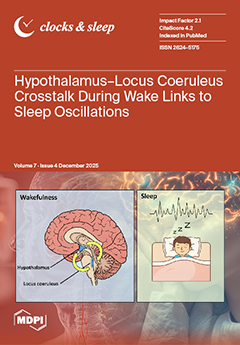
Cover Story (view full-size image): Sleep depends on coordinated activity within subcortical networks, yet how interactions among these regions shape human sleep remains unclear. This study investigates the crosstalk (or effective connectivity) between the locus coeruleus and hypothalamic subregions in wakefulness and relates these dynamics to sleep EEG features. Using 7T fMRI and laboratory sleep recordings, the authors first find strong bidirectional influences between these areas, consistent with animal research. They also identify age-related reductions in hypothalamus-to-locus coeruleus connectivity and show that, in late middle-aged adults (aged 50 to 70 years), stronger connectivity predicts lower REM theta and other low-frequency powers. These results highlight that subcortical communication contributes to sleep regulation and its changes with age. View this paper
  • Issues are regarded as officially published after their release is announced to the table of contents alert mailing list.
  • You may sign up for e-mail alerts to receive table of contents of newly released issues.
  • PDF is the official format for papers published in both, html and pdf forms. To view the papers in pdf format, click on the "PDF Full-text" link, and use the free Adobe Reader to open them.
Order results
Result details
Section
Select all
Export citation of selected articles as:
11 pages, 679 KB  
Review
Designing Infant Mattresses Tailored to Developmental Sleep Characteristics: A Comprehensive Review
by Yasunori Oka, Akiko Tange and Yuki Maeda
Clocks & Sleep 2025, 7(4), 70; https://doi.org/10.3390/clockssleep7040070 - 8 Dec 2025
Viewed by 279
Abstract
This paper reviews existing research on infant mattress design to promote safe and comfortable sleep and proposes evidence-based design recommendations. Focusing on safety related to Sudden Unexpected Infant Death (SUID) and comfort associated with infant development and thermoregulation, we examine mattress firmness, pressure [...] Read more.
This paper reviews existing research on infant mattress design to promote safe and comfortable sleep and proposes evidence-based design recommendations. Focusing on safety related to Sudden Unexpected Infant Death (SUID) and comfort associated with infant development and thermoregulation, we examine mattress firmness, pressure distribution, breathability, and thermal properties. Since infants have difficulty turning over and possess immature thermoregulatory functions, mattress characteristics directly influence sleep quality and safety. Based on international studies, we clarify the requirements for infant mattresses and provide insights into future product development and evaluation standards. Full article
(This article belongs to the Special Issue The Circadian Rhythm Research in Infants and Young Children)
Show Figures

Figure 1

12 pages, 1324 KB  
Review
Effects of Digital Cognitive Behavioral Therapy for Insomnia on Self-Reported Sleep Parameters: Systematic Review and Meta-Analysis
by Ingrid Porto Araújo Leite, Viviane Akemi Kakazu, Lucca Andrade Teixeira de Carvalho, Sergio Tufik and Gabriel Natan Pires
Clocks & Sleep 2025, 7(4), 69; https://doi.org/10.3390/clockssleep7040069 - 8 Dec 2025
Viewed by 791
Abstract
Digital Cognitive Behavioral Therapy for Insomnia (dCBT-I) is an effective alternative to therapist-delivered CBT-I. However, there is a lack of meta-analyses assessing its effects on other sleep-related outcomes. We aimed to conduct a meta-analysis of randomized controlled trials (RCTs) evaluating dCBT-I in adults [...] Read more.
Digital Cognitive Behavioral Therapy for Insomnia (dCBT-I) is an effective alternative to therapist-delivered CBT-I. However, there is a lack of meta-analyses assessing its effects on other sleep-related outcomes. We aimed to conduct a meta-analysis of randomized controlled trials (RCTs) evaluating dCBT-I in adults with insomnia through polysomnography (PSG) and sleep diary. Systematic searches were performed in PubMed and Web of Science. The outcomes considered were total sleep time (TST), sleep onset latency (SOL), sleep efficiency (SE), wake after sleep onset (WASO), and number of awakenings (NWAK). Meta-analyses were performed using random-effects models to compare dCBT-I with active (in-person or telehealth CBT-I) or inactive (waiting list, no treatment, or minimal intervention) control groups. Of the fourteen RCTs included, only three employed an active control. As no trials used PSG, the analyses relied solely on sleep diary data. DCBT-I showed no statistically significant differences from active controls, indicating comparable effects with therapist-delivered CBT-I. In contrast, it demonstrated statistically significant effects against inactive controls; TST increased by 0.20 h, SOL decreased by 15.53 min, SE improved by 7.91%, WASO reduced by 15.61 min, and NWAK decreased by 0.53. Future research should prioritize comparisons with therapist-delivered CBT-I and incorporate PSG for measuring these parameters. Full article
(This article belongs to the Section Disorders)
Show Figures

Figure 1

17 pages, 3433 KB  
Article
Anticipation of Stress and Relaxation Dynamically Impacts Sleep
by Sandrine Baselgia, Jonas Beck and Björn Rasch
Clocks & Sleep 2025, 7(4), 68; https://doi.org/10.3390/clockssleep7040068 - 3 Dec 2025
Viewed by 364
Abstract
Anticipation of stressful events can impair sleep quality. In a recent study, we reported that anticipating a stressful task before a nap led to negative changes in sleep parameters, particularly at the end of the nap. In our previous study, we compared stress [...] Read more.
Anticipation of stressful events can impair sleep quality. In a recent study, we reported that anticipating a stressful task before a nap led to negative changes in sleep parameters, particularly at the end of the nap. In our previous study, we compared stress anticipation with the anticipation of relaxation; thus, the observed effects may have been amplified by sleep quality improvements in the relaxation condition. In the current study, we aimed to replicate these findings using an alternative neutral control condition. The data from a newly collected sample (n = 31) were compared with the data from our previous study (n = 33) using identical analyses. The results reveal an opposite pattern from our previous study: participants in the neutral control condition showed poorer sleep (longer sleep onset latency, reduced slow-wave sleep, and lower SWA/beta ratio) compared to those anticipating stress. In a direct comparison of both studies, sleep parameters in the stress conditions were highly similar across the two studies, suggesting that the divergent outcomes are driven by differences in the control conditions. The temporal dynamic changes observed in our previous study could not be replicated. These findings highlight the importance of carefully considering control conditions in experimental sleep research and suggest that even “neutral” instructions can evoke anticipatory effects. Moreover, the observed benefits of anticipating post-sleep relaxation highlight opportunities for relaxation-based interventions to improve sleep quality. Full article
(This article belongs to the Section Human Basic Research & Neuroimaging)
Show Figures

Figure 1

22 pages, 1501 KB  
Article
Estimation of the Circadian Phase Difference in Weekend Sleep and Further Evidence for Our Failure to Sleep More on Weekends to Catch Up on Lost Sleep
by Arcady A. Putilov, Evgeniy G. Verevkin, Dmitry S. Sveshnikov, Zarina V. Bakaeva, Elena B. Yakunina, Olga V. Mankaeva, Vladimir I. Torshin, Elena A. Trutneva, Michael M. Lapkin, Zhanna N. Lopatskaya, Roman O. Budkevich, Elena V. Budkevich, Marina P. Dyakovich, Olga G. Donskaya, Dmitry E. Shumov, Natalya V. Ligun, Alexandra N. Puchkova and Vladimir B. Dorokhov
Clocks & Sleep 2025, 7(4), 67; https://doi.org/10.3390/clockssleep7040067 - 27 Nov 2025
Viewed by 304
Abstract
The circadian phase difference between morning and evening types is a fundamental aspect of chronotype. However, results of categorizations into chronotypes based on reported sleep times show low concordance with those based on measurements of the hormonal or physiological or molecular rhythm–markers of [...] Read more.
The circadian phase difference between morning and evening types is a fundamental aspect of chronotype. However, results of categorizations into chronotypes based on reported sleep times show low concordance with those based on measurements of the hormonal or physiological or molecular rhythm–markers of the circadian phase. This might be partially explained by the profound individual differences in the phase angle between the sleep–wake cycle and these rhythms that depends on chronotype, age, sex, and other factors. Here, we examined the possibility of using self-reported sleep times in the condition of 5-days-on/2-days-off school/work schedule to estimate circadian phase differences between various chronotypes. In an in silico study, we determined that, for such an estimation, similarities of the compared chronotypes in weekend sleep duration and weekend–weekday gap and in risetime are required. In the following empirical and simulation studies of sleep times reported by 4940 survey participants, we provided examples of the estimation of circadian differences between chronotypes, and the model-based simulations of sleep times in morning and evening types exemplified a way to confirm such estimations. The results of in silico, empirical, and simulation studies underscore the possibility of using bedtimes and risetimes for direct estimation of the circadian phase differences between individuals in real-life situations, such as a 5-days-on/2-days-off school/work schedule. Additionally, the results of these studies on different chronotypes provided further mathematical modeling and empirical evidence for our failure to sleep more on weekends to recover/compensate/pay back/ catch up on lost sleep. Full article
(This article belongs to the Section Human Basic Research & Neuroimaging)
Show Figures

Figure 1

18 pages, 979 KB  
Review
Sleep as a Developmental Process: A Systematic Review of Cognitive, Emotional, and Behavioral Outcomes in Children Aged 6–12 Years
by Adriana Félix and Adelinda Candeias
Clocks & Sleep 2025, 7(4), 66; https://doi.org/10.3390/clockssleep7040066 - 14 Nov 2025
Viewed by 1758
Abstract
Sleep is essential for child development, influencing cognition, emotional regulation, behavior, and physical health. Recent studies increasingly frame sleep as both a key developmental process and a modifiable factor shaped by, and shaping environmental risks—including digital screen exposure and psychosocial stress. This systematic [...] Read more.
Sleep is essential for child development, influencing cognition, emotional regulation, behavior, and physical health. Recent studies increasingly frame sleep as both a key developmental process and a modifiable factor shaped by, and shaping environmental risks—including digital screen exposure and psychosocial stress. This systematic review synthesized empirical findings from cross-sectional and cohort studies published between 2019 and 2024 on the associations between sleep duration, quality, and patterns and developmental outcomes in typically developing children aged 6–12 years. Searches were conducted in EBSCO, Scopus, and Web of Science databases, yielding 99 records, of which 20 met inclusion criteria. Methodological quality was evaluated using Joanna Briggs Institute tools. Findings show consistent associations between better sleep and enhanced cognitive performance, emotional well-being, and reduced behavioral problems. Some studies identified sleep as a mediator between screen use and behavioral difficulties, whit additional moderating effects related to gender and socioeconomic status. However, most studies used cross-sectional designs and self-reported measures, limiting causal interpretation. Overall, sleep emerge as a potentially modifiable factor influencing developmental outcomes, based on correlational evidence. Future research should prioritize longitudinal and ecologically valid designs, objective measures, and computational approaches to identify sleep-related risk profiles and guide early interventions. Full article
(This article belongs to the Special Issue The Circadian Rhythm Research in Infants and Young Children)
Show Figures

Figure 1

11 pages, 1446 KB  
Article
Sex-Related Differences in the Association Between Sleep Apnea and Subsequent Urinary Incontinence Diagnosis
by Lara Ilona Becker, Céline Vetter, Karel Kostev and Matthias Kalder
Clocks & Sleep 2025, 7(4), 65; https://doi.org/10.3390/clockssleep7040065 - 7 Nov 2025
Viewed by 624
Abstract
Objective: An association between sleep apnea and various urological symptoms has been reported in the literature. Therefore, the aim of this study is to analyze sex-related differences in the association between sleep apnea und subsequent urinary incontinence diagnosis. Methods: This study examined the [...] Read more.
Objective: An association between sleep apnea and various urological symptoms has been reported in the literature. Therefore, the aim of this study is to analyze sex-related differences in the association between sleep apnea und subsequent urinary incontinence diagnosis. Methods: This study examined the incidence of urinary incontinence in a matched pair cohort with and without sleep apnea treated in 1293 general practices in Germany between January 2005 and December 2022 (74,453 vs. 372,256 individuals). The five-year cumulative incidence of urinary incontinence in the cohorts with and without sleep apnea was studied using Kaplan–Meier curves and log-rank tests. Finally, a univariable Cox regression analysis was conducted to assess the association between sleep apnea and urinary incontinence. Stratified analyses were conducted by sex (male/female) and age group (18–50 years, 51–60 years, 61–70 years, >70 years). Results: Sleep apnea was significantly associated with urinary incontinence as compared to individuals without sleep disorder diagnosis (5.1% vs. 4.3%; p < 0.001), and this association remained robust in females (HR: 1.38; 95% CI: 1.29–1.46), but not in males (HR: 1.02; 95% CI: 0.96–1.08) In females, the association was strongest in the age group 51–60 years (HR: 1.98; 95% CI: 1.71–2.30). Conclusions: In conclusion, this study reports a significant association between sleep apnea and subsequent urinary incontinence diagnosis. Sex- and age-related differences should be taken into account, as associations were stronger for middle-aged females followed by younger females and no significant association was found regarding males. Full article
(This article belongs to the Section Disorders)
Show Figures

Figure 1

15 pages, 270 KB  
Article
Sleep and Psychosocial Risk Factors Associated with Social Jet Lag and Sleep Duration Among Colombian University Students
by Andrés Camargo, Leandro P. Casiraghi, Diego A. Golombek, Edith Villalobos, Viviana González, Carlos Orozco, Elena Jiménez, Danny Sanjuanelo, Oscar Pianeta and Rafael Vargas
Clocks & Sleep 2025, 7(4), 64; https://doi.org/10.3390/clockssleep7040064 - 7 Nov 2025
Viewed by 1210
Abstract
Undergraduate students and healthcare professionals often experience irregular sleep patterns, social jet lag (SJL), and rotating shifts that affect their performance. This study examined the association between SJL, sleep duration, and psychosocial factors among 1409 Colombian undergraduate students (mean age 24.4 ± 6.7 [...] Read more.
Undergraduate students and healthcare professionals often experience irregular sleep patterns, social jet lag (SJL), and rotating shifts that affect their performance. This study examined the association between SJL, sleep duration, and psychosocial factors among 1409 Colombian undergraduate students (mean age 24.4 ± 6.7 years) using data from the Ultra-Short Version of the Munich ChronoType Questionnaire collected between June and September 2023. Multivariable linear regression analysis identified factors associated with SJL. The prevalence of SJL exceeding two hours was high (84.6%), with an average magnitude of 4.4 h. Chronotype (MSFsc) was negatively correlated with SJL, indicating that students with later chronotypes tended to experience greater misalignment between biological and social time. Younger age and a higher number of working days were significantly associated with increased SJL, whereas substance use and mental health history showed no significant effects. These findings highlight that work-related demands, particularly frequent working days, play a key role in exacerbating social jet lag. The results underscore the need for institutional strategies to promote sleep health among Colombian university students and health professionals. Full article
(This article belongs to the Special Issue The Circadian Rhythm Research in Infants and Young Children)
18 pages, 896 KB  
Review
The Biological Clock Influenced by Burnout, Hormonal Dysregulation and Circadian Misalignment: A Systematic Review
by Alexandru Ungurianu and Virginia Marina
Clocks & Sleep 2025, 7(4), 63; https://doi.org/10.3390/clockssleep7040063 - 3 Nov 2025
Viewed by 1063
Abstract
Burnout is increasingly recognized as both a psychosocial and a chronobiological disorder characterized by endocrine dysregulation and circadian disruption. It arises from chronic occupational stress and manifests through psychological, physical, and physiological symptoms. Although psychosocial determinants are well established, the biological and chronobiological [...] Read more.
Burnout is increasingly recognized as both a psychosocial and a chronobiological disorder characterized by endocrine dysregulation and circadian disruption. It arises from chronic occupational stress and manifests through psychological, physical, and physiological symptoms. Although psychosocial determinants are well established, the biological and chronobiological mechanisms, particularly those involving cortisol and melatonin, remain less explored. This systematic review synthesizes current evidence on hormonal and circadian dysregulation in burnout and complements it with exploratory observational data from healthcare professionals. Peer-reviewed studies evaluating endocrine or circadian biomarkers in individuals with burnout were systematically reviewed. In addition, an exploratory observational analysis was carried out among 195 Romanian clinicians using an adapted Maslach Burnout Inventory. Morning salivary cortisol was measured once at 9 a.m. in a small subsample (n = 26) to provide preliminary physiological data. Because only a single time point was obtained, these values were interpreted as indicative of stress-related activation rather than circadian rhythm. Thirty-seven studies met the inclusion criteria. Across the literature, burnout was associated with altered HPA-axis activity, blunted diurnal cortisol variation, and irregular melatonin secretion related to shift work and disrupted sleep–wake cycles. Complementary exploratory data from our Romanian cohort indicated strong correlations between burnout severity, physical symptoms, and higher morning cortisol values among shift-working clinicians. These findings are preliminary and not representative of full circadian profiles. Burnout should be considered both a psychosocial and a systemic disorder influenced by endocrine and circadian dysregulation. Recognizing alterations in cortisol and melatonin as objective indicators may facilitate earlier detection and inform chronobiological interventions such as optimized scheduling, light exposure management, or melatonin therapy. The observational data presented here is preliminary and intended to generate hypotheses; future research should employ repeated cortisol sampling under controlled Zeitgeber conditions to confirm circadian associations. Full article
(This article belongs to the Section Human Basic Research & Neuroimaging)
Show Figures

Figure 1

13 pages, 686 KB  
Review
Modafinil for Promoting Wakefulness in Critically Ill Patients: Current Evidence and Perspectives
by Sotirios Kakavas and Dimitrios Karayiannis
Clocks & Sleep 2025, 7(4), 62; https://doi.org/10.3390/clockssleep7040062 - 27 Oct 2025
Viewed by 2354
Abstract
Critically ill patients are predisposed to developing cognitive dysfunction, excessive daytime sleepiness (EDS), and fatigue during their stay in the intensive care unit (ICU). Modafinil, a wakefulness-promoting agent, has demonstrated potential benefits in enhancing alertness, cognitive performance, and activity levels in various clinical [...] Read more.
Critically ill patients are predisposed to developing cognitive dysfunction, excessive daytime sleepiness (EDS), and fatigue during their stay in the intensive care unit (ICU). Modafinil, a wakefulness-promoting agent, has demonstrated potential benefits in enhancing alertness, cognitive performance, and activity levels in various clinical populations. The present narrative review aims to systematically evaluate the existing literature regarding the administration of modafinil for the treatment of EDS and fatigue in the ICU context. A comprehensive literature search was performed using the Embase, MEDLINE, Web of Science, and Google Scholar databases, covering publications up to 20 June 2025. Studies investigating the use of modafinil to improve wakefulness in ICU patients were identified. A total of nine relevant studies were included, comprising two randomized controlled trials (RCTs), two case series, and five retrospective cohort studies (n = 950 patients). Four of these studies focused on patients with traumatic brain injury or post-stroke conditions, whereas the remaining studies addressed heterogeneous ICU populations. Preliminary evidence indicates that modafinil may enhance wakefulness in selected critically ill patients and potentially facilitate their participation in rehabilitative interventions, such as physical therapy. Nonetheless, robust conclusions regarding efficacy and safety remain limited by the small sample sizes and methodological constraints of the available studies. Consequently, further large-scale RCTs are warranted to elucidate the therapeutic role of modafinil in the management of EDS and hypoactivity among ICU patients. Full article
(This article belongs to the Section Disorders)
Show Figures

Figure 1

13 pages, 233 KB  
Article
Psychometric Validation and Arabic Translation of the 11-Item Circadian Type Inventory (CTI-11A) Among Shift Workers
by Sara Ahmed Mansoor AlBuhmaid, Muneera Jasim Al-Rumaihi, Mohammed Adel M Albalawi, Ahmed Abdullatif Ahmed Almufarrij, Waqar Husain and Haitham Jahrami
Clocks & Sleep 2025, 7(4), 61; https://doi.org/10.3390/clockssleep7040061 - 25 Oct 2025
Viewed by 612
Abstract
Circadian rhythm disruptions from shiftwork impact sleep quality and work performance, yet validated tools to assess circadian preferences in Arabic-speaking populations are scarce. This study aimed to translate and validate the 11-item Circadian Type Inventory (CTI-11) into Arabic (CTI-11A), evaluate its psychometric properties, [...] Read more.
Circadian rhythm disruptions from shiftwork impact sleep quality and work performance, yet validated tools to assess circadian preferences in Arabic-speaking populations are scarce. This study aimed to translate and validate the 11-item Circadian Type Inventory (CTI-11) into Arabic (CTI-11A), evaluate its psychometric properties, and explore latent circadian profiles in relation to sleep quality. A cross-sectional survey in Bahrain involved 468 Arabic-speaking adults recruited via social media. The CTI-11A, assessing Languid/Vigorous (LV) and Flexible/Rigid (FR) subscales, and the Jenkins Sleep Scale (JSS) were administered. Confirmatory factor analysis (CFA), reliability tests, and latent class analysis (LCA) were conducted. Participants (mean age: 36.18 ± 10.35) showed CTI-11A total scores of 35.40 ± 6.61 and JSS scores of 5.76 ± 3.48. CFA confirmed the two-factor structure (RMSEA = 0.06, SRMR = 0.05, CFI = 0.93, TLI = 0.91), with Cronbach’s α of 0.72 (total CTI-11A). Test–retest reliability was high (ICC = 0.91). CTI-11A correlated moderately with JSS (r = 0.40, p < 0.001), with stronger FR-JSS (r = 0.36) than LV-JSS (r = 0.25) associations. LCA identified two classes (Class 1: 52%, vigorous/flexible; Class 2: 48%, languid/rigid), with Class 2 showing poorer sleep quality. The CTI-11A is a reliable and valid tool for assessing circadian preferences in Arabic-speaking populations, with distinct circadian profiles linked to sleep quality. While flexible/vigorous profiles associated with better sleep, languid/rigid profiles indicate higher sleep disturbance risk, informing targeted shiftwork interventions. Further refinement of the factor structure and broader regional validation are needed. Full article
(This article belongs to the Special Issue New Advances in Shift Work)
15 pages, 1120 KB  
Article
Influence of Maternal Working Hours on Children’s Sleep: A Preliminary Study on Disparities Between Day and Night Shifts
by Patrícia Andrade Nehme, Jefferson Santos, Ana Amélia Benedito-Silva, José Cipolla-Neto and Claudia R. C. Moreno
Clocks & Sleep 2025, 7(4), 60; https://doi.org/10.3390/clockssleep7040060 - 23 Oct 2025
Viewed by 779
Abstract
Background: Shift work necessitates alterations in daily routines, which can be detrimental to workers’ health and may also influence the activity and rest patterns of their children. Aim: The aim of this study was to evaluate the concordance between activity and rest parameters [...] Read more.
Background: Shift work necessitates alterations in daily routines, which can be detrimental to workers’ health and may also influence the activity and rest patterns of their children. Aim: The aim of this study was to evaluate the concordance between activity and rest parameters of mothers and their children, according to the mothers’ work shift (day vs. night). Methods: Twelve mother–child dyads participated in this study, including six mothers working night shifts and six working day shifts. All mothers followed a 12/36 h rotating schedule (07:00–19:00 for day shifts; 19:00–07:00 for night shifts). Participants wore actigraphy devices for 10 consecutive days. Sleep and motor activity parameters were analyzed using the Bland–Altman method. Results: Analysis of the five least active hours (L5) revealed increased nocturnal activity among the night shift group. The period of the 10 most active hours (M10) suggested greater activity in the day shift group, with a smaller difference between mother and child in the day shift group. The relative amplitude (RA) in the night shift group was lower among mothers compared to the day group. Interdaily stability (IS) was lower, and intradaily variability (IV) was higher in the night shift group, suggesting more irregular activity patterns. Bedtime data showed greater variability in the night shift group, with night shift mothers typically going to bed later than their children—a pattern that was also observed for wake times. In the day shift group, total sleep time did not differ between mothers and children; however, in the night shift group, discrepancies increased proportionally with total sleep duration. Sleep efficiency was lower among mothers in both groups, but the difference between mother and child was more pronounced in the night shift group. Conclusions: Night shift work among mothers appears to negatively affect both their own and their children’s activity and sleep parameters when compared to those in the day shift group. Full article
(This article belongs to the Section Society)
Show Figures

Figure 1

10 pages, 482 KB  
Communication
Sleep Health Inequities: Sociodemographic, Psychosocial, and Structural Determinants of Short Sleep in U.S. Adults
by Lourdes M. DelRosso and Mamatha Vodapally
Clocks & Sleep 2025, 7(4), 59; https://doi.org/10.3390/clockssleep7040059 - 16 Oct 2025
Viewed by 1129
Abstract
Short sleep duration (≤6 h) is a public health concern linked to cardiometabolic disease and premature mortality. However, persistent disparities across sociodemographic, psychosocial, and structural domains remain underexplored in recent nationally representative samples. We analyzed 2022 Behavioral Risk Factor Surveillance System (BRFSS) data, [...] Read more.
Short sleep duration (≤6 h) is a public health concern linked to cardiometabolic disease and premature mortality. However, persistent disparities across sociodemographic, psychosocial, and structural domains remain underexplored in recent nationally representative samples. We analyzed 2022 Behavioral Risk Factor Surveillance System (BRFSS) data, including 228,463 adults (weighted N ≈ 122 million). Sleep duration was dichotomized as short (≤6 h) versus adequate (≥7 h). Complex samples logistic regression estimated associations between sociodemographic, psychosocial, behavioral, and structural determinants and short sleep, accounting for survey design. The weighted prevalence of short sleep was 33.2%. Non-Hispanic Black (AOR = 1.56, 95% CI: 1.46–1.65) and American Indian/Alaska Native adults (AOR = 1.46, 95% CI: 1.29–1.65) were disproportionately affected compared with non-Hispanic White adults. Psychosocial factors contributed strongly: life dissatisfaction, limited emotional support, and low social connectedness increased odds, whereas high connectedness was protective. Food insecurity and smoking were significant structural and behavioral risks, while binge drinking and urbanicity were not. One-third of U.S. adults report short sleep, with marked disparities across demographic, socioeconomic status, psychosocial stressors, and structural barriers. Findings highlight the multifactorial nature of sleep health inequities and the need for multilevel interventions addressing both individual behaviors and upstream determinants. Full article
(This article belongs to the Section Society)
Show Figures

Figure 1

15 pages, 1122 KB  
Article
Cross-Sectional Analysis of Sleep Quality and Vascular Health in Shift- and Day-Working Nurses
by Gleb Saharov, Barbara Salti, Maram Bareya, Anat Keren-Politansky, Yona Nadir and Tamar Shochat
Clocks & Sleep 2025, 7(4), 58; https://doi.org/10.3390/clockssleep7040058 - 11 Oct 2025
Viewed by 865
Abstract
Sleep disturbances and shift work are associated with increased cardiovascular risk, possibly through disruptions in endothelial and hemostatic function. While prior studies link acute sleep deprivation to vascular dysfunction, the impact of chronic sleep quality and circadian misalignment on endothelial health in healthy [...] Read more.
Sleep disturbances and shift work are associated with increased cardiovascular risk, possibly through disruptions in endothelial and hemostatic function. While prior studies link acute sleep deprivation to vascular dysfunction, the impact of chronic sleep quality and circadian misalignment on endothelial health in healthy individuals, particularly shift workers, remains underexplored. The aim of this study was to examine the association between objectively measured sleep quality and endothelial/hemostatic function in healthy female hospital nurses, comparing shift and day workers, and considering time-of-day variation. In this repeated-measures study, 100 female nurses (51 shift, 49 day workers) aged 25–50 wore actigraphy devices for 7–14 days to assess total sleep time (TST), sleep efficiency (SEF), and wake after sleep onset (WASO). Endothelial function was measured using EndoPAT (Reactive Hyperemia Index—RHI). Hemostatic markers included plasminogen activator inhibitor-1 (PAI-1), von Willebrand factor (VWF), heparanase and heparanase procoagulant activity assessed by ELISA, and chromogenic assays in morning and evening. TST was not associated with any vascular outcomes. Poor sleep quality (low SEF, high WASO) was significantly associated with reduced RHI and elevated PAI-1 level, heparanase level, and heparanase procoagulant activity levels. Regression models revealed significant main effects of SEF and WASO on endothelial and coagulation markers, with some interactions depending on shift type and time of measurement. No significant associations were found for VWF. Impaired sleep quality, but not sleep duration, is associated with endothelial dysfunction and procoagulant activation, particularly among shift-working nurses. These findings suggest that sleep quality may play a critical role in vascular health and support the use of sleep-based interventions to reduce cardiovascular risk in shift-working populations. Full article
(This article belongs to the Section Human Basic Research & Neuroimaging)
Show Figures

Figure 1

17 pages, 594 KB  
Article
Does Daytime Sleepiness Moderate the Relationship Between Working Memory and Academic Performance in Schoolchildren? A Pilot Study
by Sergey Malykh and Valeriia Demareva
Clocks & Sleep 2025, 7(4), 57; https://doi.org/10.3390/clockssleep7040057 - 8 Oct 2025
Viewed by 1320
Abstract
Academic performance in adolescence is influenced by both cognitive capacity and physiological factors such as sleepiness. However, the interaction between these dimensions remains understudied. This pilot study examined whether daytime sleepiness moderates the relationship between working memory and academic achievement in a sample [...] Read more.
Academic performance in adolescence is influenced by both cognitive capacity and physiological factors such as sleepiness. However, the interaction between these dimensions remains understudied. This pilot study examined whether daytime sleepiness moderates the relationship between working memory and academic achievement in a sample of 601 schoolchildren aged 11 to 17 years. Participants completed a digital visuospatial working memory task and self-reported their daytime sleepiness using the Pediatric Daytime Sleepiness Scale (PDSS). Academic performance was assessed through official grades in Mathematics, Language, and Literature. Regression analyses showed that working memory (total score and average reaction time) and daytime sleepiness were independent predictors of academic performance. These findings support our hypotheses that cognitive and physiological factors each contribute to school success. However, no significant moderation effects were found in the full sample. Subgroup analyses revealed that working memory predicted academic outcomes only among students with normal sleepiness levels, whereas in high-sleepiness students, cognitive predictors lost significance and PDSS scores emerged as the dominant predictor. These results suggest that elevated daytime sleepiness can undermine the positive impact of working memory on academic performance. The findings highlight the importance of assessing both cognitive skills and physiological readiness when evaluating students. They also suggest that sleep-focused interventions may improve learning outcomes, especially during adolescence. Full article
(This article belongs to the Section Human Basic Research & Neuroimaging)
Show Figures

Figure 1

13 pages, 524 KB  
Article
Self-Reported Insomnia and Poor Sleep Quality Are Associated with Self-Reported Cognitive Changes in Older Adults
by Julia Glueck, Celina Pluim McDowell, Yakeel T. Quiroz, Alice Cronin-Golomb and Jeanne F. Duffy
Clocks & Sleep 2025, 7(4), 56; https://doi.org/10.3390/clockssleep7040056 - 2 Oct 2025
Viewed by 1587
Abstract
Older adults are vulnerable to changes in sleep with age. Poor sleep quality is associated with self-reported cognitive changes, which can occur before the onset of objective cognitive decline associated with Mild Cognitive Impairment and Alzheimer’s disease. The objective of this study was [...] Read more.
Older adults are vulnerable to changes in sleep with age. Poor sleep quality is associated with self-reported cognitive changes, which can occur before the onset of objective cognitive decline associated with Mild Cognitive Impairment and Alzheimer’s disease. The objective of this study was to examine associations between self-reported sleep complaints, objective sleep quality, and self-reported cognitive changes and their relations to symptoms of depression and anxiety in a group of community-dwelling older adults. Adults aged ≥ 50 without dementia (n = 45) were recruited and completed 1–2 weeks of rest-activity monitoring using a wrist-worn device, underwent a test of global cognitive functioning (Mini-Mental State Examination; MMSE), and completed questionnaires assessing insomnia (Insomnia Severity Index; ISI), subjective sleep quality (Pittsburgh Sleep Quality Index; PSQI), self-reported cognitive changes (Cognitive Function Instrument; CFI), and symptoms of depression and anxiety (Beck Depression Inventory-II; BDI-II and Generalized Anxiety Disorder 7-item assessment; GAD-7). Pearson partial correlations assessed relations among subjective and objective sleep quality, insomnia ratings, CFI ratings, and global cognition, while controlling for BDI-II and GAD-7 ratings. Exploratory analyses examined the correlation between PSQI component scores and CFI ratings and global cognition. Greater ISI (r = 0.50, p ≤ 0.001) ratings significantly correlated with higher CFI scores. PSQI total ratings and actigraphy-based measures (n = 41) did not significantly correlate with CFI scores. Exploratory PSQI subscale analyses revealed that worse subjective sleep quality (r = 0.31, p = 0.048), shorter sleep duration (r = 0.32, p = 0.04), and greater use of sleep medications (r = 0.31, p = 0.048) correlated with higher CFI scores. Poorer sleep quality due to less time spent asleep, fragmented or disturbed sleep, and requiring medications to sleep, may be associated with greater memory concerns. Alternatively, worries about cognition may deleteriously affect sleep. Subjective measures of sleep quality may be useful to identify older adults at increased risk of cognitive decline. Full article
(This article belongs to the Section Human Basic Research & Neuroimaging)
Show Figures

Figure 1

20 pages, 1355 KB  
Article
Under the Covers: The Effect of a Temperature-Controlled Mattress Cover on Sleep and Perceptual Measures in Healthy Adults
by Shauna Stevenson, Haresh Suppiah, Toby Mündel and Matthew Driller
Clocks & Sleep 2025, 7(4), 55; https://doi.org/10.3390/clockssleep7040055 - 1 Oct 2025
Viewed by 3523
Abstract
Ambient temperature and thermoregulation influence sleep quality. This study investigated the effects of a temperature-controlled mattress cover on sleep and perceptual outcomes in healthy adults. In a randomised, counterbalanced, crossover design, 34 healthy adults (20 F, 14 M; age, 30 ± 5 y) [...] Read more.
Ambient temperature and thermoregulation influence sleep quality. This study investigated the effects of a temperature-controlled mattress cover on sleep and perceptual outcomes in healthy adults. In a randomised, counterbalanced, crossover design, 34 healthy adults (20 F, 14 M; age, 30 ± 5 y) used a temperature-controlled mattress cover for 14 nights, following ≥3 nights of familiarisation. The temperature feature was on for 7 nights (POD) and off for 7 nights (CON). Sleep was assessed via wrist actigraphy, while heart rate (HR), heart rate variability (HRV), and respiratory rate (RR) were recorded by embedded sensors in the mattress cover. Participants completed daily and weekly questionnaires evaluating sleep quality, thermal comfort, and thermal sensation. Linear mixed models showed significant main effects of condition favouring POD over CON for all daily perceived outcomes (all p < 0.05). A large, significant improvement in perceived sleep quality was observed (p = 0.001, d = 0.92). No significant differences were found in objective sleep metrics or biometric measures (all p ≥ 0.05). A temperature-controlled mattress cover was associated with improved subjective sleep quality and thermal-related perceptions despite minimal changes in objective or biometric outcomes, which may in part reflect expectancy, or placebo effects. Further research is needed to explore whether these perceptual benefits lead to physiological improvements over time. Full article
(This article belongs to the Section Human Basic Research & Neuroimaging)
Show Figures

Figure 1

15 pages, 779 KB  
Article
Reporter-Mediated Evaluation of the Circadian Oscillations of SNAIL Across In Vitro Models
by Kaitlyn Chhe, Bhavna Kalyanaraman, Sophie A. Spielberger, Hui-Hsien Lin, Stephanie R. Taylor and Michelle E. Farkas
Clocks & Sleep 2025, 7(4), 54; https://doi.org/10.3390/clockssleep7040054 - 28 Sep 2025
Viewed by 1067
Abstract
The protein SNAIL has been widely studied for its roles in promoting cancer invasion and resistance to apoptosis. There are multiple contributors to its expression, including self- and circadian regulation, and it has been posited that SNAIL oscillates in a circadian manner. Given [...] Read more.
The protein SNAIL has been widely studied for its roles in promoting cancer invasion and resistance to apoptosis. There are multiple contributors to its expression, including self- and circadian regulation, and it has been posited that SNAIL oscillates in a circadian manner. Given the multiple factors involved, we sought to determine whether this is indeed the case. We developed a luciferase reporter that was used to demonstrate SNAIL’s rhythmic nature (SNAIL:luc) in the circadian model cell line, U2OS. Considering SNAIL’s relevance in breast cancer, we also assessed its oscillations in cellular models representing different levels of aggression. We incorporated the SNAIL:luc reporter in MCF10A breast epithelial cells, and MCF7 and MDA-MB-231 breast cancer cell lines, which are less and more aggressive, respectively. We found that SNAIL oscillations were present but weak in MCF7 and arrhythmic in MDA-MB-231 cells, correlating with those of core clock genes (BMAL1 and PER2) in these models. Surprisingly, MCF10A cells, whose core clock genes possess robust circadian expression patterns, did not have rhythmic oscillations of SNAIL. Our findings suggest that SNAIL is under circadian control, but this is cell line/tissue dependent, setting the stage for additional studies to better understand the impacts of various factors contributing to its expression. Full article
(This article belongs to the Section Human Basic Research & Neuroimaging)
Show Figures

Figure 1

22 pages, 2209 KB  
Article
The Crosstalk Between the Anterior Hypothalamus and the Locus Coeruleus During Wakefulness Is Associated with Low-Frequency Oscillations Power During Sleep
by Nasrin Mortazavi, Puneet Talwar, Ekaterina Koshmanova, Roya Sharifpour, Elise Beckers, Ilenia Paparella, Fermin Balda, Christine Bastin, Fabienne Collette, Laurent Lamalle, Christophe Phillips, Mikhail Zubkov and Gilles Vandewalle
Clocks & Sleep 2025, 7(4), 53; https://doi.org/10.3390/clockssleep7040053 - 26 Sep 2025
Viewed by 1035
Abstract
Animal studies show that sleep regulation depends on subcortical networks, but whether the connectivity between subcortical areas contributes to human sleep variability remains unclear. We investigated whether the effective connectivity between the LC and hypothalamic subparts during wakefulness relates to sleep electrophysiology. Thirty-three [...] Read more.
Animal studies show that sleep regulation depends on subcortical networks, but whether the connectivity between subcortical areas contributes to human sleep variability remains unclear. We investigated whether the effective connectivity between the LC and hypothalamic subparts during wakefulness relates to sleep electrophysiology. Thirty-three younger (~22 y, 27 women) and 18 late middle-aged (~61 y, 14 women) healthy individuals underwent 7-Tesla functional MRI during wakefulness to assess LC–hypothalamus effective connectivity. Additionally, sleep EEG was recorded at night in the lab to examine the relationships between effective connectivity measures and REM sleep theta energy as well as sigma power prior to REM. Connectivity analyses revealed strong mutual positive influences between the LC and both the anterior–superior and posterior hypothalamus, consistent with animal studies. Aging was negatively associated with the connectivity from the anterior–superior hypothalamus (including the preoptic area) to the LC. In late middle-aged adults, but not younger adults, stronger effective connectivity from the anterior–superior hypothalamus to the LC was associated with lower REM theta energy. This association extended to other low-frequency bands during REM and NREM sleep. These findings highlight the age-dependent modulation of LC–hypothalamus interactions and their potential roles in sleep regulation, providing new insights into neural mechanisms underlying age-related sleep changes. Full article
(This article belongs to the Section Human Basic Research & Neuroimaging)
Show Figures

Figure 1

13 pages, 868 KB  
Article
Exploring the Cross-Sectional Association Between Hypothyroidism and Circadian Syndrome: Insights from NHANES 2007–2012
by Ahmed Arabi, Humam Emad Rajha, Osama Alkeilani, Ahmad Hamdan, Dima Nasrallah and Giridhara R. Babu
Clocks & Sleep 2025, 7(4), 52; https://doi.org/10.3390/clockssleep7040052 - 24 Sep 2025
Viewed by 1035
Abstract
Background: Circadian Syndrome (CircS) encompasses a range of cardiometabolic risk factors that contribute to an increased susceptibility to cardiovascular diseases and type 2 diabetes. Understanding the factors that underpin CircS is essential. This study primarily aims to examine the association between hypothyroidism and [...] Read more.
Background: Circadian Syndrome (CircS) encompasses a range of cardiometabolic risk factors that contribute to an increased susceptibility to cardiovascular diseases and type 2 diabetes. Understanding the factors that underpin CircS is essential. This study primarily aims to examine the association between hypothyroidism and CircS in adults. A secondary analysis compares this association with that between hypothyroidism and Metabolic Syndrome (MetS). Additionally, the dose–response relationship between serum free thyroxine (FT4) levels and CircS probability is explored. Methods: This cross-sectional study includes 4050 National Health and Nutrition Examination Survey (NHANES) participants (2007–2012). Hypothyroidism was classified into (1) drug-managed, (2) non-drug-managed (NDM) primary, and (3) NDM central hypothyroidism, based on self-reported medication use and serum TSH/FT4 levels. CircS was defined as having ≥5 of its eight components, including MetS criteria, depression, short sleep, and non-alcoholic fatty liver disease. Results: Our results showed that hypothyroidism was significantly associated with CircS (OR: 1.58, 95% CI 1.26–1.98) and MetS (OR: 1.19, 95% CI 1.01–1.42). An inverse, non-linear relationship between serum FT4 levels and the probability of CircS was observed. Conclusions: The results underscore a significant association between hypothyroidism and CircS and MetS, with FT4 levels inversely related to CircS probability. These findings highlight hypothyroidism’s potential role in CircS pathogenesis and prevention. Full article
(This article belongs to the Section Disorders)
Show Figures

Figure 1

Previous Issue
Next Issue
Back to TopTop
