1. Introduction
The colorimetric behaviour of a fixed ceramic restoration poses several challenges for dentists, especially when selecting the type of ceramic material to use and the characteristics of the bonding/adhesion agents in cases involving colour-altered (darkened) teeth [
1]. In this scenario, the dentist faces the challenge of obtaining colorimetric properties similar to those of adjacent natural teeth, which is particularly significant when the prepared teeth are darkened, with varying intensity on a case-by-case basis [
1,
2].
Dental ceramics, recognized for their excellent colour stability, translucency, and ability to mimic tooth structure, stand out as restorative materials with colorimetric characteristics that resemble natural teeth [
1,
2,
3]. This quest for faithful reproduction of colorimetric properties is essential to achieve optimal esthetic results and harmoniously integrate ceramic restorations with the natural esthetics of teeth [
1].
Treatment success depends, among other factors, on the ability to achieve a perfect colour match between the restoration and the tooth. Complex variables are involved, including the colour of the tooth structure, the thickness of the ceramic, the colour and type of ceramic and resin cement, and the translucency of the restorative material resulting from the refracted and transmitted light [
1,
4]. Refraction and reflection occur infinitely on the surfaces of particles that are longer than the wavelength of light, resulting in light diffusion. The porosity of ceramic materials influences this phenomenon. The greater the difference in refractive index between the particle size and the ceramic matrix, the greater the refraction and reflection of light, which generally leads to an opaque effect in ceramic materials [
5].
Highly translucent ceramic restorations allow light to pass through and scatter, especially at thinner thicknesses. Vitreous ceramic crowns have higher translucency than those with an alumina or zirconia base [
4]. The influence of the dental substrate on the colour of restoration is evident, especially in translucent restorative materials, where the amount of light transmission through the ceramic plays a crucial role. Studies have shown that to mitigate the adjacent tooth’s darkened effect on the overall colour, vitreous ceramics should be at least 2.0 mm thick, which implies more extensive and less conservative preparations [
6]. The underlying cement can, in turn, influence the visible reflected colour of ceramics such as feldspathic and lithium disilicate due to their translucency. Therefore, the colour matching of ceramic crowns is sensitive to the thickness of the ceramic, the tooth region, tooth/substrate basis colour and the shade of the bonding agent [
7]. Mimicking different substrate colours is always a challenge in in vitro studies. In this regard, the use of prefabricated resins with different colours representing the natural and possible colours of the tooth substrates enhances the reliability and reproducibility of the protocols, as the colours are predefined in the material in a protocolized manner. Resin ND shades are an example of this material (IPS Natural Die Material, Ivoclar Vivadent, Schaan, Liechtenstein) and have been utilized in studies over time.
Notably, despite their excellent properties in biocompatibility, colour stability and mechanical strength, zirconia ceramics exhibit lower translucency than other ceramics [
7]. Thus, the effect of cement on the colour of zirconia ceramics may differ depending on the level of translucency of the ceramics used [
2,
7,
8,
9]. This underscores the complexity and importance of meticulously considering these factors to obtain optimal esthetic and functional results in fixed ceramic restorations. In rehabilitation, colour communication between physicians and laboratory technicians is commonly performed visually and analogously, using pre-made or individualized colour scales to compare and convey the closest match to a natural tooth. However, this method is subjective, and its accuracy can be influenced by many factors, including the observer’s experience and training, the light source and tooth colour. In this matter, it is important to note that the teeth have unique colours and characteristics that combine colours and effects in different samples/references of the same scale (e.g., A3.5 body with B1 border and orange cervical region) [
10,
11]. Instrumental and digital methods have been developed and optimized to reliably enhance colour selection and communication. These methods are considered more accurate than the visual method alone. When possible, a combination of visual and instrumental methods is recommended. Among the instrumental methods used are colorimetric and spectrophotometric methods, applied and supported by digital readers, scanners, cross-polarization filters, digital cameras and smartphones. Choosing the most appropriate method depends on considerations such as reliability, accuracy, durability, cost, and the interpretability of clinicians and technicians in the laboratory [
10,
11,
12]. This in vitro study focus on the following research question: what is the influence of ceramic thickness, cement characteristics, and substrate colour on the final colour perception of a ceramic restoration? The objective was to compare how different thicknesses of zirconia ceramics and cements with different colorimetric characteristics influence the final restoration colour on substrates with different levels of darkening. The null hypothesis is that there is no difference in colour perception, as measured by the
L*,
a*,
b* system, between darkened substrates, ceramics and cement opacities.
2. Materials and Methods
2.1. Preparation of Ceramic Samples
Three specimens of Prettau® 2 Zirconia ceramics (Prettau® Zirconia, Zirkonzahn GmbH, Gais, Italy), LOT ZC3024D, were milled in the Zirkonzahn M2 Dual equipment (Zirkonzahn, Zirkonzahn GmbH, Gais, Italy), with dimensions 15 × 15 mm (length × width) and thicknesses of 0.5 mm, 1.0 mm and 1.5 mm. This zirconia ceramic is a high-translucency yttria-stabilized material (3Y-TZP), composed predominantly of ZrO2 stabilized with Y2O3 and small amounts of Al2O3, with trace levels of other oxides, and contains no polymeric phase.
One side of the specimens was glazed, and the other was sandblasted in the lab, mimicking the routine for restorations.
2.2. Preparation of Resin Samples
The simulation of the darkened substrates was made using a resin composite (IPS Natural Die Material; Ivoclar Vivadent AG, Schaan, Principality of Liechtenstein) of four different shades (ND6–ND9). The die subtrates are light-curing composite resins consisting of a polyester urethane dimethacrylate matrix, silicon dioxide filler, copolymers, initiators, stabilizers and pigments. The samples were prepared using a silicone mould with dimensions of 12 × 9 × 4 mm (length × width × thickness) to make the resin build up. For this, ND6-, ND7-, ND8- and ND9-coloured resin composites (IPS Natural Die Material, Ivoclar, Vivadent, Schaan, Liechtenstein) were applied with 1 mm increments spread into uniform layers, followed by 15 s polymerization (Bluephase
® G2, Ivoclar Vivadent, Schaan, Liechtenstein) in SOFT START mode. For the last layer, the resins were covered with a 1 mm thickness glass slide so that the material was compressed under pressure to produce a smooth surface with reduced porosity. Final polymerization was promoted with the same light-curing unit set to the HIGH POWER mode for 40 s. The resin substrate samples were then polished using a resin composite finishing disc sequence (Sof-Lex™, 3M ESPE, Irvine, CA, USA) to ensure a smooth and polished surface.
Figure 1 presents the visual aspect of the resin substrates after polishing.
2.3. Image Collection with the Resin Cement Shades
The zirconia samples were stabilized over the different colour substrates with three shades of dual cure resin cement (Bifix QM, VOCO GmbH, Cuxhaven, Germany) of transparent (T), white opaque (WO) and universal (U) shades. Bifix QM; VOCO is a dual-cure, resin-based adhesive cement containing a dimethacrylate resin matrix (e.g., Bis-GMA), benzoyl-peroxide/amine initiators and radiopaque barium–aluminum–borosilicate glass fillers. Thus, 4 study groups (respective to substrates), 3 groups (related to zirconia of different thickness) and 3 groups (related to cements of different opacities) were organized.
The simulated restorations were photographed using the different cements placed on each of the resin substrates. The cements were applied with the syringe provided by the manufacturer directly on the substrate, and then the zirconia ceramic was applied over the cement and digitally pressed, mimicking the pressure exerted on the clinical procedures to place an intraoral ceramic restoration. Photographs were taken and recorded for all substrate/ceramic/resin cements.
As the cement was not polymerized on each sample and to validate the colour change imposed by the polymerization, a sample of each cement was applied between two laminas of transparent glass and photographed before and after polymerization using the BluePhase G2 light-curing unit (Ivoclar Vivadent AG, Schaan, Principality of Liechtenstein) in the HIGH mode for 10 s for photopolymerization.
2.4. Photographic Protocol
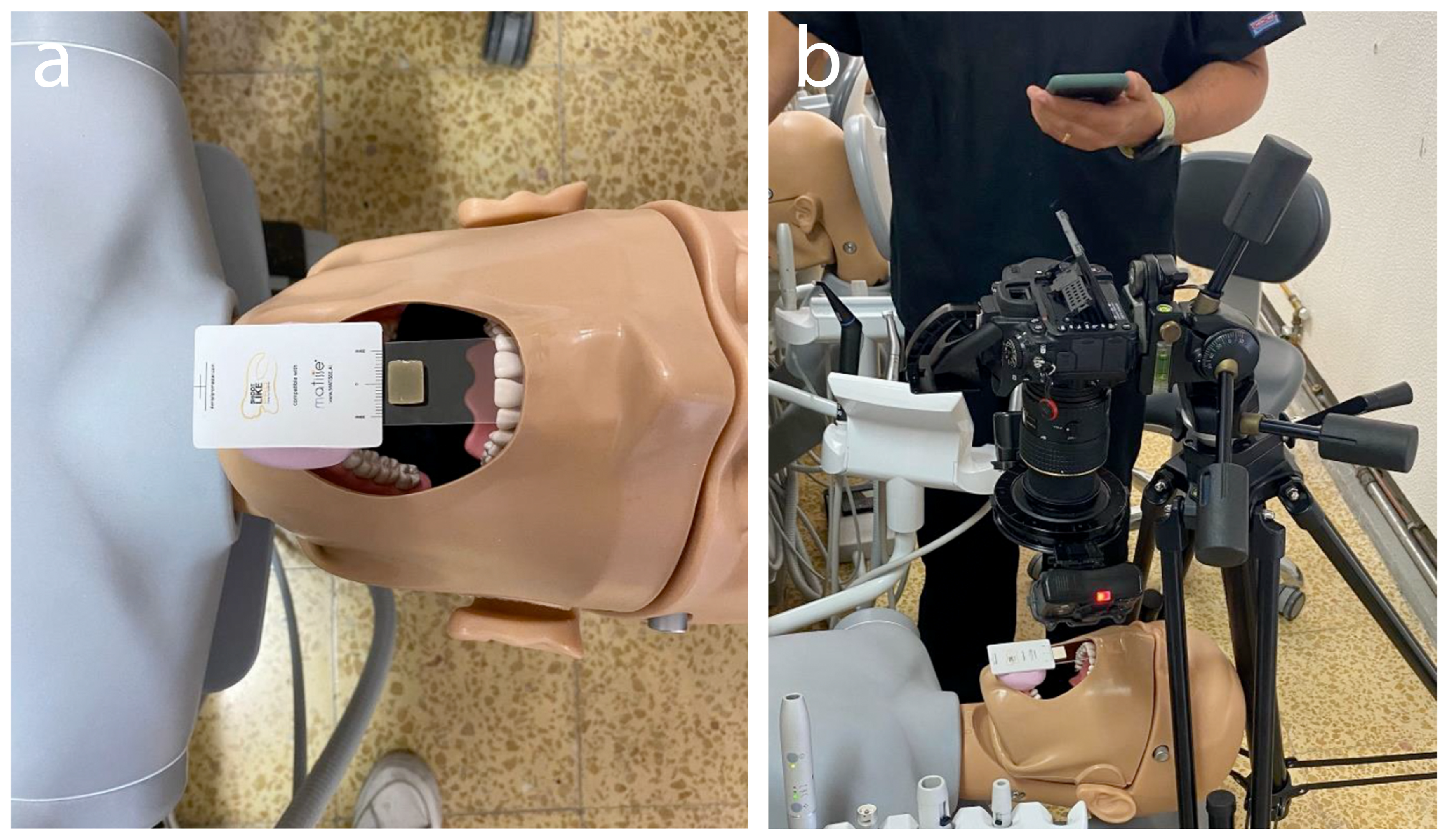
In order to mimic as much as possible the intra-oral conditions, a head phantom was used for the colour-taking photographs, simulating the dark background of the oral cavity, as well as the existence of empty space between the sample/tooth and the oral tissues, which creates a particular optical effect on the teeth and, consequently, on the colour presented. A glass lamina was adapted to serve as support and a grey colour calibration card, Matisse
® Photo Calibration Card (Labmatisse BV, Wijchen, The Netherlands), was also stabilized to standardize the tone of the photographs. The photographs were taken with a Tokina Macro 100 mm F2.8 D AT-X Pro objective lens (Tokina, Tokyo, Japan) mounted on a Nikon d750 camera (Nikon, Tokyo, Japan), and using a Nikon R1C1 flash (Nikon, Tokyo, Japan) with a polarizing filter (Polaris Filter) to reduce surface reflections. The set up was mounted on a tripod that ensured that the camera was kept at a constant distance from the objects, stable and without positional changes. The shots were taken using a remote control to avoid external interference with the camera or changes in positioning.
Figure 2 presents the photographic set up.
2.5. Measurement of the Colorimetric Parameters
In 1973, Sproull defined the three-dimensional nature of colour, proposing the CIELab system that characterizes
L* (luminosity),
a* (red-green value) and
b* (yellow-blue value), which was developed to produce a uniform colour space [
13,
14].
The colour measurements were performed in Adobe Photoshop, version 25.9.1. The images were transferred in JPEG format (Joint Photographic Experts Group) with no compression, and an area of 300 × 300 px was selected in the centre of the image. The colour values
L*,
a*,
b* of the substrates, ceramics and cements were recorded, as well as the values of the ceramics applied with the cements over the substrates. The Commission Internationale de l’Eclairage (CIE) system allows the evaluation of the degree of perceptible colour change (Δ
E*), based on the following three coordinates:
L*,
a* and
b*. If Δ
L* is positive, the sample is clearer than the reference; if it is negative, the sample is darker. Colour variations were determined of the target colour for the final restoration, that is the A1 Prettau
® 2 ceramics (Zirkonzahn, Zirkonzahn GmbH, Gais, Italy) for which
L*,
a* and
b* values were obtained from photographing shade tab under the same conditions [
1].
Colour differences relative to the A1 Prettau
® 2 zirconia shade tab were computed for each specimen as Δ
L*, Δ
a*, Δ
b* and as the overall colour-difference metric Δ
E*:
A Δ
E* value greater than 1.2 was taken as indicating a clinically perceptible colour difference, whereas a Δ
E* greater than 2.7 was taken as a non-acceptable colour difference, based on previously published thresholds for ceramic materials [
15,
16].
2.6. Statistical Analysis
All analyses were performed using R (RStudio 2025.09.1 + 401 “Cucumberleaf Sunflower” Release (20de356561bd58a6d88927cce948bd076d06e4ca, 23 September 2025) for windows). Colour measurements were expressed as CIELAB coordinates (L*, a*, and b*) and summarized as mean ± standard deviation (SD) and, when appropriate, 95% confidence intervals (95% CIs).
To obtain a single summary outcome reflecting global colour mismatch, an additive linear model was fitted with ΔE* as the dependent variable and substrate resin, cement and zirconia thickness as categorical predictors. Overall model significance was assessed with the F-test for the full model, and regression coefficients with 95% CI were estimated for each level of the three factors. The proportion of variance in ΔE* explained by each predictor (substrate resin, cement, and zirconia thickness) was quantified using the Lindeman–Merenda–Gold (LMG) relative importance metric, which decomposes the model R2 into non-negative contributions that sum to the total explained variance. To simultaneously evaluate the impact of substrate resin (ND6–ND9), cement (universal, transparent, and white opaque) and zirconia thickness (0.5, 1.0, and 1.5 mm) on the joint behaviour of the colour components, a main-effect multivariate analysis of variance (MANOVA) was fitted with ΔL*, Δa* and Δb* as dependent variables and the three experimental factors as fixed effects. Wilks’ Lambda was used as the multivariate test statistic, and, when significant, was followed by inspection of the corresponding univariate ANOVAs for each colour component. Interaction terms could not be estimated independently of the residual error and were therefore not included in the multivariate model. All statistical tests were two-sided, and a p-value < 0.05 was considered statistically significant.
3. Results
The descriptive statistics of the
L*,
a*, and
b* values of each of the three factors are presented in
Table 1,
Table 2 and
Table 3. As darkening of the substrate increases (from resin ND6 to ND9) there is a significant decrease in the lightness (
L*) of the samples, as well as a change in the chromaticity (
a* and
b*). A significant difference in lightness is also noticed with the use of different cements (
Table 2), with the lightest samples associated with the white opaque cement. However, this factor showed no impact on the chromaticity of the samples. When considering the different restoration thicknesses (
Table 3), there are no significant differences in lightness and chromaticity of the samples, suggesting that this factor may play a least important role in the final colour of the restoration.
The mean ΔE* was 6.67 ± 2.66 and all samples except two presented a clinically perceptible and unacceptable colour variation (ΔE* > 2.7) from the reference scale (L*, a*, and b* values of the A1 Prettau® 2 zirconia clinical shade guide). The sample that combined the resin ND8, the white opaque cement and the 0.5 mm thickness zirconia presented the lowest colour variation, with ΔE* = 1.73. In more than 80% of the samples, the final colour was darker than the reference (negative variation in L*), whereas in only 11.1% of the samples the final colour was lighter than the reference and in the remaining cases no change was observed in lightness.
The additive linear model that was applied to the colour-difference Δ
E* to examine the impact of the three main factors was adequate to describe the data and highly significant, F(7, 28) = 10.67,
p < 0.001.
Table 4 presents the coefficients obtained for the model. Relative to the reference substrate (resin ND6), all three tested substrates produced significantly lower Δ
E*. Using the white opaque cement significantly decreased Δ
E* relative to the reference (universal cement), whereas the transparent cement registered a colour variation similar to that of the universal cement (b = −0.16,
p < 0.001). Compared to the reference thickness (1.5 mm), decreasing the zirconia to 1.0 mm yielded non-significant increase in
ΔE* (b = 0.63,
p = 0.328), while the 0.5 mm zirconia produced a larger increase (b = 1.65,
p = 0.014), yet below the 2.7 acceptability threshold.
The full linear model accounted for 72.7% of the total response variance (total variance = 7.09, R2 = 0.6591). The Lindeman–Merenda–Gold metric (LMG) indicated that the proportions of explained variance attributable to each of the three predictors were 38.4%, 27.6% and 6.7% for resin, cement and zirconia thickness, respectively. Thus, the underlying substrate colour (resin) emerged as the most influential group of predictors in determining ΔE*, followed by the type of cement, whereas zirconia thickness had a comparatively minor effect.
A main-effect MANOVA with Wilks Lambda was also run to determine the impact of the three factors (resin substrate, cement and zirconia thickness) on the conjoint effect of
L*,
a* and
b* change. The analysis revealed a significant multivariate effect of the resin substrate on the combined colour axis variables (Wilks’ Λ = 0.03, F(9, 63.4) = 22.21,
p < 0.001), as well as a significant multivariate effect of the cement used (Wilks’ Λ = 0.28, F(6, 52) = 7.84,
p < 0.001). On the contrary, the impact of zirconia thickness on the multivariate outcome on the combined effect of
L*,
a* and
b* change was not significant (Wilks’ Λ = 0.72, F(6, 52) = 1.54,
p = 0.19).
Table 5 and
Table 6 present the variation in the three colour components,
L*,
a* and
b*, as well as the total colour variation, stratified by each of the significant factors in the multivariate analysis.
When referenced to the A1 Prettau shade tab, all resin substrates produced appreciable colour mismatches. ND6 generated the largest deviation, yielding restorations that were not statistically darker but markedly floated towards the red and yellow portions of the spectrum. ND7 and ND8 also shifted the colour away from the A2 shade tab, mainly through statistically significant darkening and increased yellowness, and virtually no shift in the red–green axis. ND9 led to a pronounced darkening combined with a subtle shift towards a greener hue.
Relative to the A1 Prettau reference tab, both the universal and transparent cements consistently produced significantly darker and warmer restorations, increasing yellowness. In contrast, the white opaque cement resulted in minimal non-significant darkening and a smaller, yet significant, yellow shift, keeping the final shade closer to the intended A1 shade tab.
4. Discussion
Colour can be described using the Munsell colour space, which considers hue, value, and chroma. In 1976, the Commission Internationale de l’Eclairage (CIE) defined the CIE Lab colour space. This space is based on the perception of colours in three segments: red, green, and blue. CIE Lab is widely recognized for being one of the most uniform colour spaces, where equal distances correspond to colour differences perceived as equal [
15,
17]. In the CIE Lab three-dimensional space, the axes are
L*,
a*, and
b*. The
L* value measures the luminosity of an object, with a value of zero representing a perfect black and 100 representing a perfect diffuse reflector. The value
a* indicates the amount of red (positive) or green (negative), while the value
b* indicates the amount of yellow (positive) or blue (negative). The
a* and
b* coordinates tend to approach zero for neutral colours (such as white and grey) and increase in magnitude for more saturated or intense colours [
17]. The main advantage of the CIE Lab system is that colour differences can be expressed in units that are directly related to visual perception and clinical meaning. This facilitates communication and colour analysis in a variety of industrial and scientific applications [
18]. The degree of colour perceptibility was estimated using the colour difference formula Δ
E*, which provides a quantitative representation of the perceived colour difference between a pair of coloured samples under a given set of experimental conditions. The formula for calculating Δ
E* is Δ
E* = [(Δ
L*)
2 + (Δ
a*)
2 + (Δ
b*)
2]
1/
2, where the differences in luminosity and chromaticity coordinates (Δ
L*, Δ
a*, and Δ
b*) are determined first (1,12). The Δ
E* values represent the numerical distances between the
L*,
a*, and
b* coordinates, and the magnitude of this value describes the clinically perceptible colour thresholds. A Δ
E* value of 0 indicates a perfect colour match whereas values between 0.5 and 1.5 units are considered very good; between 1 and 2.7 are perceptible but acceptable; between 2.7 and 3.5 are clinically noticeable; and values higher than 3.5 are unacceptable [
1,
8,
19].
This in vitro study evaluated how substrate shade (ND6–ND9), resin cement, and zirconia thickness influence the final colour of monolithic zirconia restorations referenced to the A1 Prettau
® 2 shade tab. Overall, the restorative complex showed limited masking ability since the mean colour difference was
ΔE* = 6.67 ± 2.66, and nearly all specimens exceeded the chosen threshold of Δ
E* > 2.7 relative to the reference shade, indicating that most combinations were not only perceptible but also outside conventional acceptability ranges for a substantial proportion of clinicians and patients [
15]. In addition, more than 80% of the specimens presented the final colour darker than A1 (negative Δ
L*), confirming that darkening of the restorative complex is a frequent outcome when attempting to mask a darkened substrate. The null hypothesis of our study was rejected based on the results obtained. The increase in substrate darkening from ND6 to ND9 resulted in a progressive and significant reduction in lightness (
L*) and changes in chromaticity (
a* and
b*). ND6 substrates yielded restorations that were only slightly darker than A1 but shifted clearly toward red and yellow, while ND7 and ND8 mainly produced darkening and increased yellowness with minimal change along the red–green axis. ND9 led to the greatest darkening, combined with a small shift towards a greener hue. Thus, the underlying resin shade did not merely scale brightness, but also altered hue and chroma in a substrate-dependent way.
Resin cement also emerged as a significant determinant of
ΔE*, as previously recorded [
20]. While the absolute
L*,
a*, and
b* means suggested only a modest effect on chromaticity, the analysis of Δ
L*, Δ
a*, and Δ
b* versus the A1 tab showed that universal and transparent cements consistently produced darker and warmer restorations, with a clear increase in yellowness. In contrast, the white opaque cement significantly reduced Δ
E* relative to the universal cement and yielded only minimal, non-significant darkening and a smaller yellow shift. In practical terms, the white opaque cement kept the final shade closest to the desired A1 shade, although the average Δ
E* still exceeded the usual acceptability thresholds for many observers. Recent in vitro work specifically investigating opaque cement shades over discoloured substrates confirms improved masking and reduced Δ
E* compared with translucent cements, although complete masking is rarely achieved [
5,
20,
21,
22,
23,
24,
25]. Our finding that the white opaque cement significantly lowered Δ
E* and produced minimal darkening compared with universal/transparent cements is consistent with these observations and supports the clinical use of high-opacity cements when masking a discoloured abutment is a priority. At the same time, the residual Δ
E* values indicate that cement alone cannot fully compensate for unfavourable substrate conditions.
Within the tested range (0.5, 1.0 and 1.5 mm), zirconia thickness had the least influence on the final colour. Neither
L*,
a*,
b* nor Δ
L*, Δ
a*, Δ
b* showed clinically meaningful differences across thicknesses, which was corroborated by the main-effect MANOVA that identified strong multivariate effects of resin and cement on the combined colour axes, whereas zirconia thickness did not contribute significantly to the multivariate outcome. Notwithstanding that, the linear model indicated that reducing zirconia thickness from 1.5 mm to 1.0 and 0.5 mm promoted an increase in Δ
E* of 0.63 and 1.65 units, which was statistically significant for the 0.5 mm group. Despite being a variation below the adopted perceptibility threshold of 2.7 units, this variation reflects a trend for higher colour differences in lower zirconia thicknesses, emphasizing, as other authors also mention, the need for sufficient ceramic thickness for masking the darkened backgrounds, optimizing the colorimetric properties of the restoration and achieving the desired colour matches [
7]. In fact, the relative importance analysis using the Lindeman–Merenda–Gold metric showed that substrate colour accounted for 38.4% of explained variance in Δ
E*, followed by cement (27.6%) and zirconia thickness (6.7%), with the model explaining 65.9% of total variance, which reinforces the clinical message that, within the specific Prettau
® 2 zirconia system tested, the underlying substrate and the choice of resin cement are the primary levers to optimize shade matching, while small changes in zirconia thickness play a comparatively minor role. Nonetheless, it is not possible to exclude a more important role of the restoration thickness in the masking ability [
7,
25,
26,
27] nor to exclude possible interactions between the three factors, as reported in the literature [
22,
28].
While these results generically align with the literature [
29], they only align partially with those of a very similar study recently published by Xia et al. [
28] that tested the impact of the substrate, cement, zirconia thickness and translucency on the colour variation from the target shade. The authors also used IPS Natural Die Refill resins to produce the substrate, two brands of zirconia to produce veneers with 0.5, 1.0 and 1.5 mm thickness and similar resin cements. All tested factors had a significant influence on
ΔE* but, contrary to our study, zirconia thickness had a major role in the determination of colour variation and the luting cement had the least importance. However, the reported differences could be due to both the different background and colour measurement methods used in the two studies, as well as the zirconia itself.
The central role of the background substrate in determining the final shade of zirconia-based restorations has been thoroughly documented [
22,
28,
30,
31], and together with zirconia material and thickness, is one of the key determinants of the final colour in zirconia-based restorations. Translucent zirconia is often unable to fully mask dark or high-chroma substrates, with Δ
E* values above acceptability thresholds even with samples presenting clinically relevant thickness. Our results are consistent with this evidence as none of the darker substrates yielded an acceptable match to the A1 reference. Interestingly, intermediate substrate shades (ND7 and ND8) reduced
ΔE* compared to the lightest substrate (ND6), suggesting a non-linear relationship between substrate shade and colour mismatch that requires further exploration.
It is important to mention the limitations associated with the present findings. First, this was an in vitro study using resin discs to simulate darkened substrates and a standardized A1 Prettau® 2 shade tab as the reference. While this design allows strict control of variables, it does not fully reproduce the complexity of clinical situations, such as variations in tooth morphology, multilayered dentin–enamel structures, or soft-tissue influences. Consequently, the absolute ΔE* values should be interpreted with caution when extrapolating to natural teeth or implant abutments. Second, the experimental conditions were restricted to one zirconia system (Prettau® 2), one target shade (A1), and a limited set of substrate and cement shades from a single manufacturer. The relative contributions of substrate, cement and thickness may differ for other zirconia formulations (e.g., different yttria content, translucency levels or multilayered structures), other ceramic systems, or different resin cements. Similarly, due to the sample size per combination, only a linear additive model with main effects was considered; thus, potential interactions between substrate, cement and thickness were not explored and might be relevant, particularly in extreme combinations (very dark substrates with minimal thickness).
Notwithstanding these limitations, the present study reinforces the notion that effective masking of darkened substrates with translucent zirconia remains challenging. Clinically, careful control of the substrate shade and judicious use of high-opacity resin cements appear more impactful for shade matching than small adjustments in zirconia thickness within the usual restorative range.