
Article

Cyclic Voltammetry-Assisted Electrodeposition of TiO2/PANI Thin Films on Boron-Doped Diamond and Fluorine-Doped Tin Oxide: Effect of Composition on Interfacial and Electrochemical Properties

by
Robert Josep Villanueva-Silva
1,
Ulises Páramo-García
1,*,
Ricardo García-Alamilla
1,
Luis Alejandro Macclesh del Pino-Pérez
1 and
Joel Moreno-Palmerin
2
1
Tecnológico Nacional de México, I. T. Cd. Madero, Centro de Investigación en Petroquímica, Prol. Bahía de Aldhair y Av. De las Bahías, Parque de la Pequeña y Mediana Industria, Altamira 89600, Mexico
2
Departamento de Minas, Metalurgia y Geología, Universidad de Guanajuato, Ex Hacienda de San Matías S/N, Guanajuato 36020, Mexico
*
Author to whom correspondence should be addressed.
Surfaces 2026, 9(1), 29; https://doi.org/10.3390/surfaces9010029
Submission received: 17 February 2026 / Revised: 11 March 2026 / Accepted: 13 March 2026 / Published: 17 March 2026

Abstract

This study presents the successful electrodeposition of polyaniline (PANI) and TiO2/PANI composites on boron-doped diamond (BDD) and fluorine-doped tin oxide (FTO) substrates via cyclic voltammetry. Using 20 scan cycles in 0.5 M H2SO4, we synthesized thin films with tailored electrochemical properties. The formation of PANI was confirmed by characteristic redox peaks in the voltammograms, while FTIR spectroscopy identified key functional groups and bonding interactions between TiO2 and PANI. Morphological analysis via optical and scanning electron microscopy revealed uniform but cracked surfaces influenced by TiO2 loading. Composite electrodes with molar ratios of 2:1, 4:1, and 6:1 (TiO2:PANI) were compared, showing increased titanium content with higher ratios, as confirmed by EDS. This work offers a reproducible route for designing modified electrodes with enhanced interfacial properties.

Graphical Abstract

1. Introduction

Conductive polymers have garnered significant attention in materials science due to their unique electronic properties and versatility in applications ranging from sensors to energy conversion devices [1]. Among them, polyaniline (PANI) stands out for its excellent environmental stability, straightforward synthesis, tunable conductivity, and cost-effectiveness [2]. PANI exists in three distinct oxidation states: leucoemeraldine (fully reduced), emeraldine (conducting), and pernigraniline (fully oxidized) [3]. Its conductivity can be further enhanced through doping with various organic and inorganic compounds [4,5].
Meanwhile, titanium dioxide (TiO2) has been widely employed as a photocatalyst owing to its chemical stability, low toxicity, and favorable bandgap properties [6]. However, its wide bandgap (3.2 eV for anatase) limits its activation to ultraviolet light, hindering its efficiency under visible light [7]. To overcome this limitation, researchers have coupled TiO2 with conductive polymers such as PANI, which exhibits π-conjugated electron systems that can sensitize TiO2 and extend its photoresponse into the visible region [8,9]. This synergy enhances charge separation and improves photocatalytic performance [10].
Recent studies have explored PANI/TiO2 composites for advanced oxidation processes (AOPs), electrocatalysis, and electrochemical sensors [11,12]. The choice of substrate plays a critical role in the performance of these composite electrodes. Boron-doped diamond (BDD) electrodes offer exceptional chemical stability, a wide potential window, and low background noise, making them ideal for electrochemical applications under extreme conditions [13,14]. On the other hand, fluorine-doped tin oxide (FTO) glass provides high transparency, electrical conductivity, and a textured surface suitable for homogeneous film deposition [15,16].
While previous reports have individually addressed the electrodeposition of PANI or TiO2 on various substrates, the direct electrochemical co-deposition of TiO2/PANI composites on BDD and FTO remains underexplored. Most studies focus on pre-synthesized nanoparticles or sequential deposition methods, which often lead to poor interfacial contact and limited control over morphology [17,18].
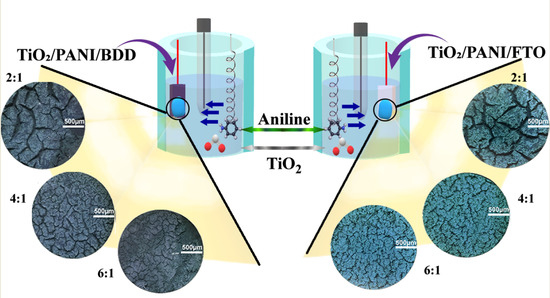
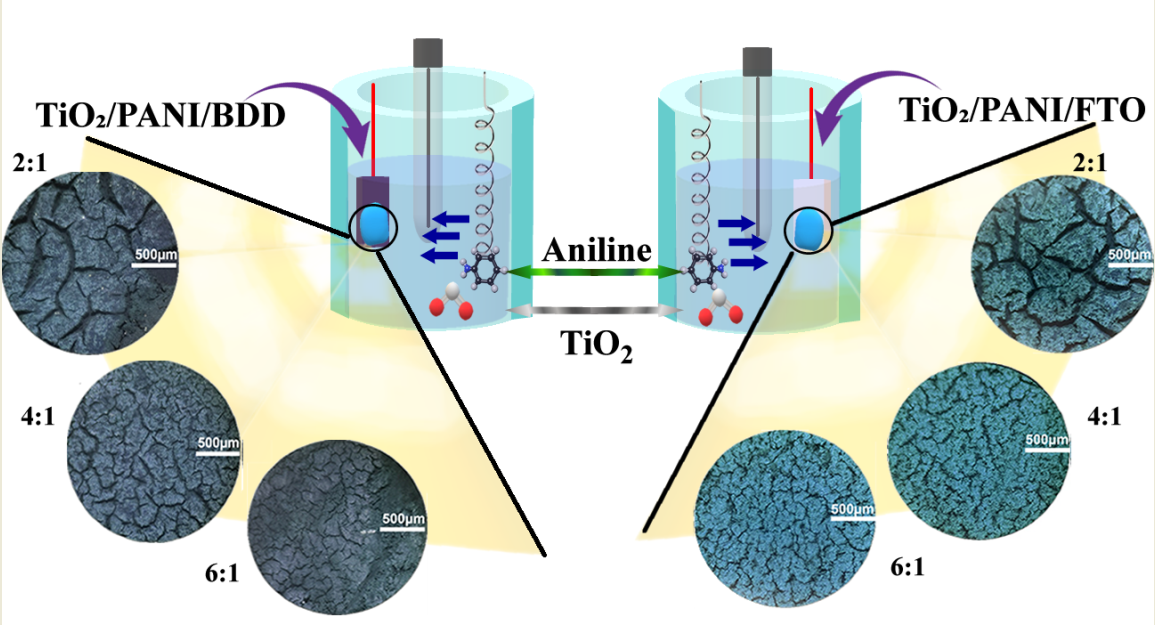
In this work, we report a one-step electrochemical synthesis of TiO2/PANI composites on both BDD and FTO substrates via cyclic voltammetry. We systematically investigated the effect of TiO2:PANI molar ratio (2:1, 4:1, and 6:1) on the electrochemical, morphological, and structural properties of the films. The composites were characterized using cyclic voltammetry, FTIR spectroscopy, optical microscopy, and scanning electron microscopy with EDS analysis. This approach offers a scalable and efficient route for producing modified electrodes for advanced applications.

2. Materials and Methods

2.1. Reagents

Aniline [A.C.S., Fermont, Monterrey, Nuevo León, Mexico], titanium dioxide (TiO2) [Degussa, P-25, Evonik, Essen, Germany], sulfuric acid (H2SO4) [Sigma Aldrich 99.9%, Saint Louis, MO, USA], deionized water [Quimicrón, Querétaro, Mexico], fluorine-doped tin oxide [FTO plate, Sigma-Aldrich], and boron-doped diamond (BDD) [SynLectro™, Sigma-Aldrich] were used for the preparation of PANI/BDD, PANI/FTO, TiO2/PANI/BDD, and TiO2/PANI/FTO electrodes.

2.2. Electrochemical Synthesis

2.2.1. PANI/FTO and PANI/BDD

This section describes the synthesis of the polyaniline (PANI) control electrodes, which were used as a baseline for comparison with the TiO2-containing composites. The polymerization of aniline was carried out in two electrochemical cells with a conventional three-electrode setup. Each cell contained aniline (0.1 M) in 20 mL of H2SO4 (0.5 M). A fluorine-doped tin oxide (FTO) plate [Aldrich, 1 cm2 geometric area] and a boron-doped diamond (BDD) electrode were used as the working electrodes (WEs). A silver/silver chloride (Ag/AgCl, 3 M KCl; BASi model MF-2056) was used as the reference electrode (RE), and stainless steel (AI-316) served as the counter electrode (CE). The experiments were performed at 27 ± 3 °C and 1014 mbar without stirring. The polymerization was conducted using a METROHM Autolab 302 N potentiostat/galvanostat controlled by Nova 2.0 software, with a working potential range from −0.2 V to 1.3 V and a scan rate of 50 mV/s. Finally, the obtained materials were rinsed with deionized water [Quimicrón] and dried at 60 °C in a conventional electric oven for 24 h.

2.2.2. TiO2/PANI/FTO and TiO2/PANI/BDD

The composite electrodes were synthesized following a similar procedure to that used for the controls (Section 2.2.1), but with the key addition of TiO2 nanoparticles to the polymerization solution. The composites were synthesized by adding aniline at a concentration of 0.1 M in a volume of 20 mL, along with the appropriate amount of TiO2 to achieve molar ratios of 2:1, 4:1, and 6:1 relative to aniline. After adding the reagents, the mixture was sonicated for 30 min and then placed in an electrochemical cell with a conventional three-electrode setup. The same electrodes and equipment were used as described in Section 2.2.1. The polymerization and electrodeposition were carried out under identical conditions (27 ± 3 °C, 1014 mbar, potential range of −0.2 V to 1.3 V, scan rate of 50 mV/s). The resulting materials were rinsed with deionized water and dried at 60 °C for 24 h.

2.3. Material Characterization

The electrochemical reactions in the solutions were analyzed using an Autolab 302 N potentiostat/galvanostat controlled by Nova 2.0 software, with a working potential from −0.2 V to 1.3 V and a scan rate of 50 mV/s. The functional groups of the materials were determined by Fourier transform infrared spectroscopy (FTIR) with an attenuated total reflectance (ATR) attachment, using a Perkin Elmer Spectrum 100 spectrophotometer (Waltham, MA, USA) in the range of 450–4000 cm−1.
Optical microscopy images were captured using a MAXLAPTER WR851 optical microscope (Shenzhen, China).
For the study of morphological structure, scanning electron microscopy (SEM) was performed at 20 keV using a JEOL JSM6010PLUS/LA instrument (Japan Electron Optics Laboratory, Tokyo, Japan) equipped with a tungsten filament and an OXFORD X-MAX EDS detector (Oxford Instruments, High Wycombe, UK).

3. Results and Discussion

3.1. Cyclic Voltammetry

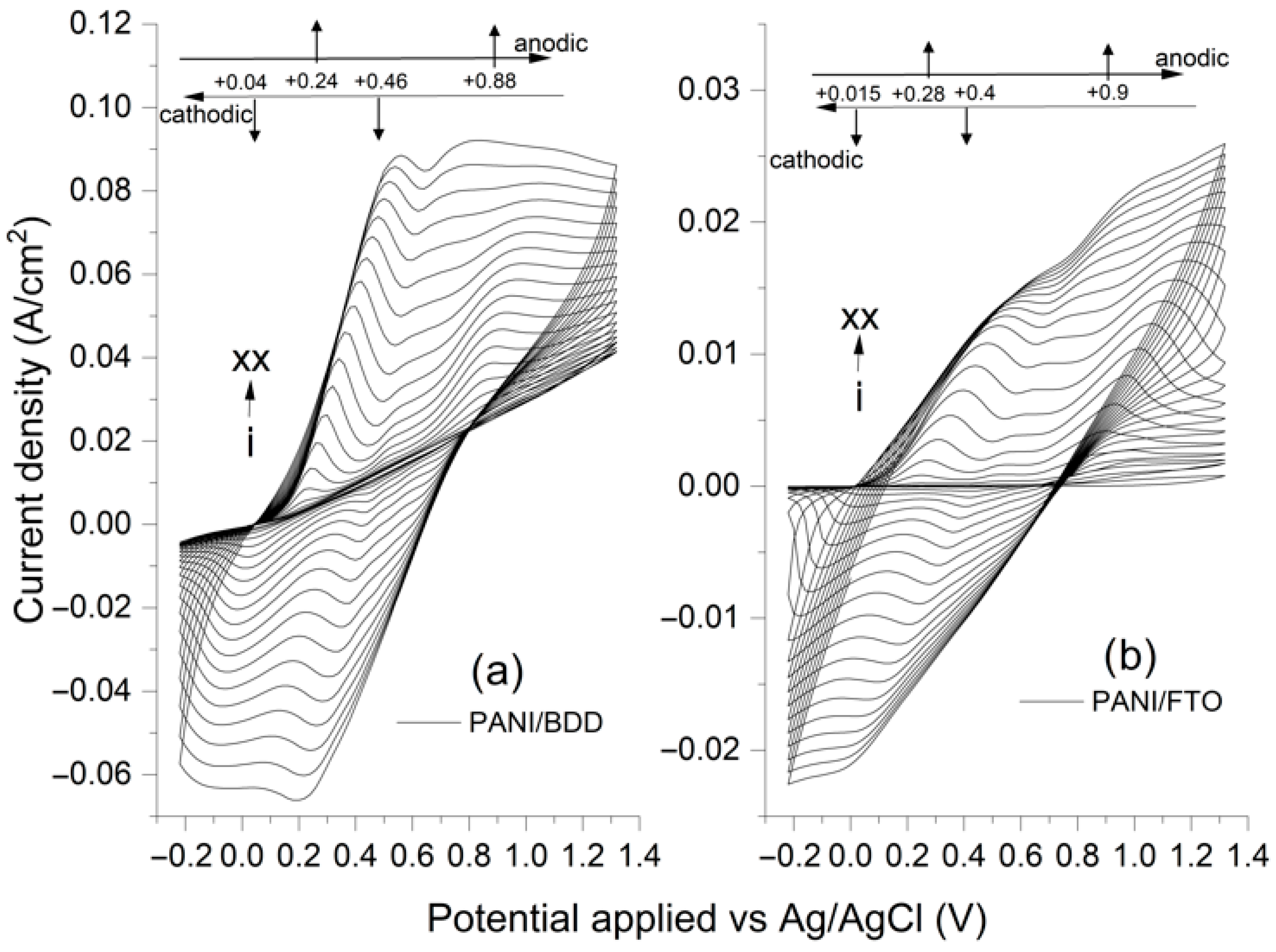
Figure 1 shows the cyclic voltammograms recorded during the electrophysmerization of aniline over 20 cycles on BDD (Figure 1a) and FTO (Figure 1b) substrates, within a potential window of −0.2 to 1.3 V. The well-defined redox pairs observed are unequivocally associated with the growth of the polyaniline (PANI) film on the electrode surface. For both PANI/BDD and PANI/FTO, the anodic scan revealed two characteristic oxidation peaks. The first anodic peak, located at 0.24 V for BDD (Figure 1a) and 0.28 V for FTO (Figure 1b), is attributed to the transition of leucoemeraldine (the fully reduced form of PANI) to emeraldine (the semi-oxidized, conducting state). The second anodic peak, at 0.88 V for BDD (Figure 1a) and 0.9 V for FTO (Figure 1b), corresponds to the further oxidation of emeraldine to pernigraniline (the fully oxidized state). The increasing current with cycles indicates successful film deposition, while peak broadening suggests increased resistance towards the end of the process.
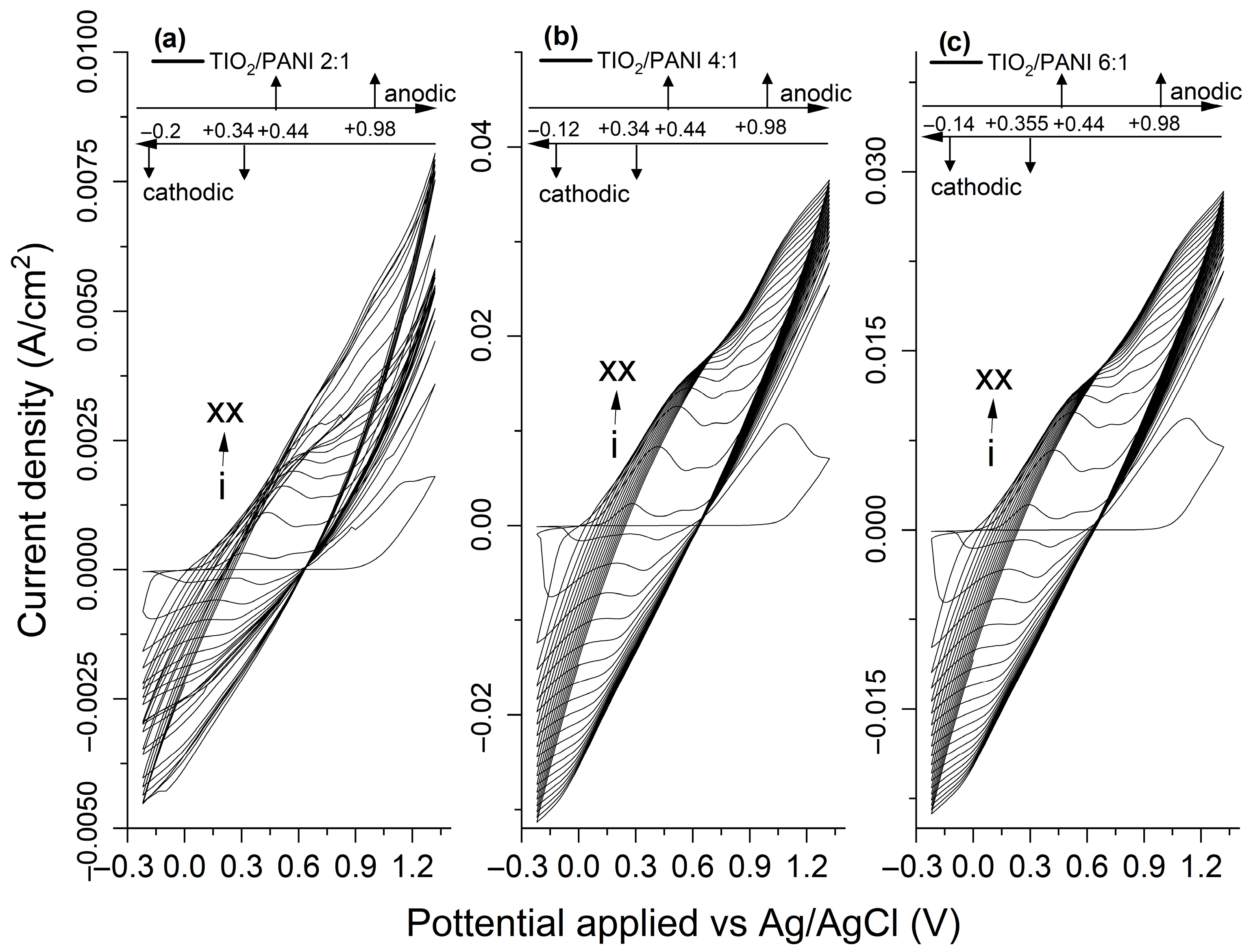
Conversely, the cathodic scan showed corresponding reduction peaks. The signals at 0.46 V BDD (Figure 1a) and 0.4 V FTO (Figure 1b) are assigned to the reduction of pernigraniline back to emeraldine. Subsequently, the peaks at 0.04 V BDD (Figure 1a) and 0.015 V FTO (Figure 1b) are consistent with the reduction of emeraldine to leucoemeraldine [19,20]. This sequence of redox events is a hallmark of PANI formation and growth on electrode surfaces in acidic media [21]. A key observation is the systematic increase in current intensity with successive cycles, indicating the progressive deposition of electroactive material and an increase in the thickness of the PANI layer. However, a gradual attenuation of the peak sharpness and intensity towards the final cycles suggests a decrease in the polymerization rate, likely due to the increased electrical resistance of the growing polymer film, signaling the approach of a deposition endpoint.
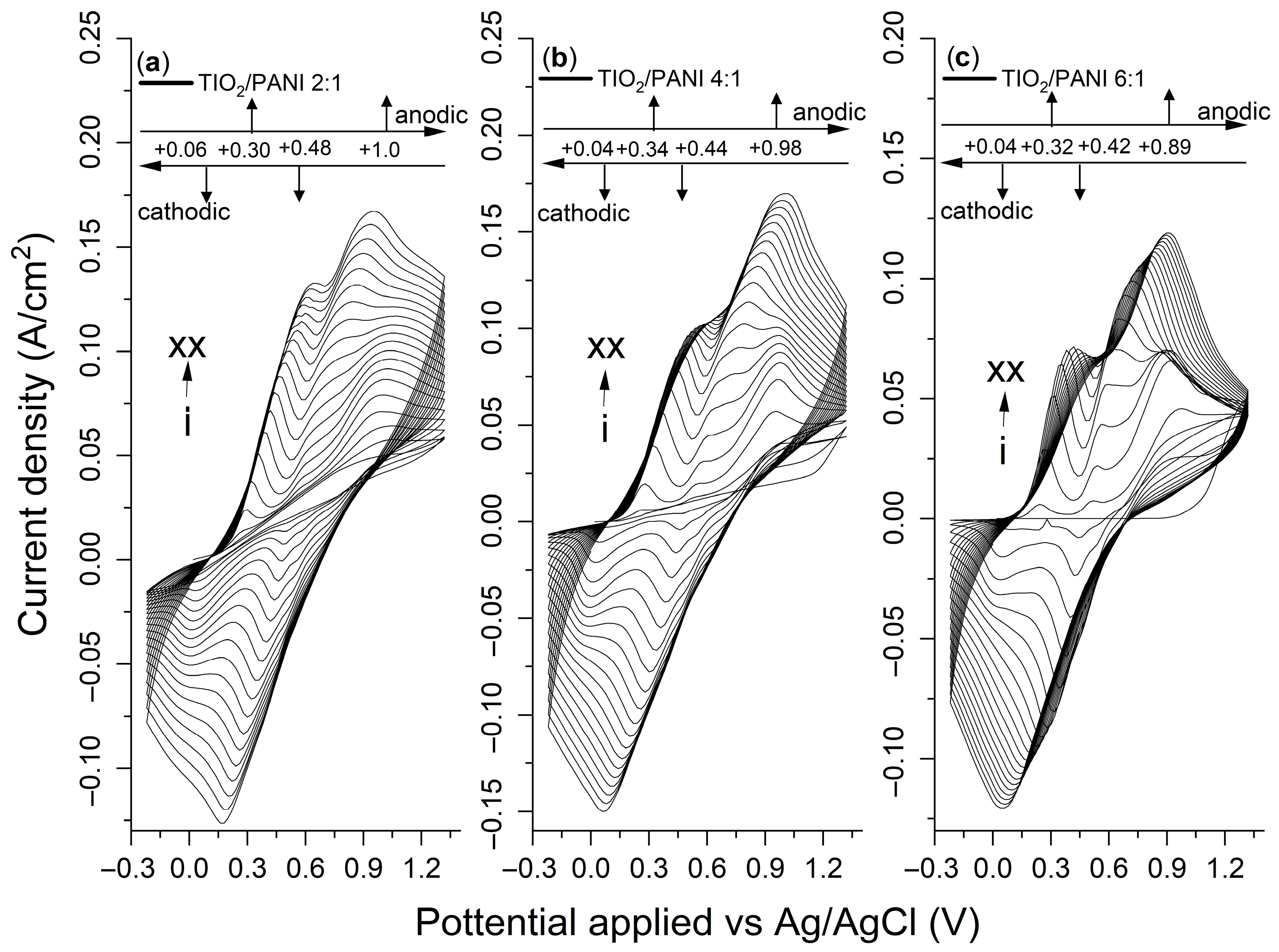
The successful incorporation of TiO2 into the PANI matrix on both BDD and FTO substrates was further confirmed by the cyclic voltammetry profiles shown in Figure 2 and Figure 3. The electrochemical behavior of the composite materials (TiO2/PANI/BDD and TiO2/PANI/FTO) synthesized at different molar ratios (2:1, 4:1, and 6:1) displayed noticeable shifts in the characteristic redox potentials of pure PANI, indicating a significant interaction between the polymer and the semiconductor oxide (TiO2).
For the composite with a 2:1 molar ratio, the anodic peaks were observed at +0.44 V and +0.98 V for FTO (Figure 3a) and at +0.3 V and +1.0 V for BDD (Figure 2a). The corresponding cathodic peaks were registered at +0.34 V and −0.02 V for FTO and +0.48 V and +0.06 V for BDD. When the TiO2 content was increased to a 4:1 molar ratio, the anodic peaks shifted to +0.44 V and +0.98 V for FTO (Figure 3b) and +0.34 V and +0.98 V for BDD (Figure 2b). The cathodic peaks were located at +0.34 V and −0.12 V for FTO and +0.44 V and +0.04 V for BDD. Finally, for the 6:1 molar ratio, the anodic peaks were found at +0.44 V and +0.98 V for FTO (Figure 3c) and +0.32 V and +0.89 V for BDD (Figure 2c). The cathodic peaks appeared at +0.355 V and −0.014 V for FTO and +0.42 V and +0.04 V for BDD.
A summary of all anodic and cathodic peak potentials for the synthesized TiO2/PANI composites is provided in Table 1. The consistent shifts in peak potentials across all compositions, compared to the pure PANI voltammograms, confirm the effective formation of the TiO2/PANI composite on both electrode substrates.
An interesting substrate-dependent behavior emerges from the data summarized in Table 1. For the FTO-based composites, the anodic peak potentials remain remarkably constant at approximately +0.44 V and +0.98 V across all TiO2:PANI molar ratios, whereas the cathodic peaks exhibit progressive shifts with increasing TiO2 content. This suggests that on FTO, the oxidation processes are predominantly governed by the PANI component and are less sensitive to the presence of TiO2. In contrast, the reduction processes appear to be more influenced by the semiconductor oxide, possibly due to changes in local proton concentration, polymer chain reorganization, or electrical connectivity during the cathodic scan [22,23]
For the BDD-based composites, both anodic and cathodic peaks shift systematically as the TiO2 content increases. This indicates that the porous and rough surface morphology of BDD promotes a more intimate interaction between PANI and TiO2 throughout the entire redox cycle, affecting both oxidation and reduction steps. The higher electrical conductivity and chemical stability of BDD may also facilitate charge transfer processes that are more sensitive to compositional variations [13,14]
These observations highlight that the substrate not only influences the morphology of the deposited films (as will be discussed in Section 3.3) but also modulates the electrochemical response of the composite, demonstrating the importance of substrate selection in the design of TiO2/PANI electrodes.
Before comparing the final voltammetric cycles, it is essential to establish a baseline by examining the electrochemical response of the pristine PANI electrodes. As shown in Figure 1, the cyclic voltammograms of pure PANI on both BDD and FTO exhibit the characteristic redox pairs corresponding to the leucoemeraldine/emeraldine and emeraldine/pernigraniline transitions, with well-defined peaks and increasing current intensity over the 20 cycles, indicating successful polymer growth.
In contrast, the incorporation of TiO2 into the PANI matrix introduces notable modifications to the electrochemical behavior. The shifts in peak potentials summarized in Table 1 already suggest a strong interaction between the polymer and the semiconductor oxide. However, a more detailed inspection of the current response reveals a clear trend: as the TiO2 content increases, the current density of the redox peaks progressively decreases. This attenuation indicates that while TiO2 is successfully incorporated, its increasing proportion may partially hinder the electron transfer processes inherent to the PANI’s redox chemistry. The most intense signals, corresponding to the highest electrochemical activity, were consistently observed for the 2:1 molar ratio on both substrates, followed by the 4:1 and finally the 6:1 ratios.
This composition-dependent behavior demonstrates that the incorporation of TiO2 not only preserves the electroactivity of PANI but also modulates its electrochemical response in a tunable manner, highlighting the potential advantages of the composite electrodes for specific applications where controlled conductivity is desired. The consistent trend observed on both BDD and FTO substrates further underscores the robustness of the electrosynthesis method and suggests that the interaction between PANI and TiO2 is governed primarily by the composite’s composition rather than by the underlying electrode material.
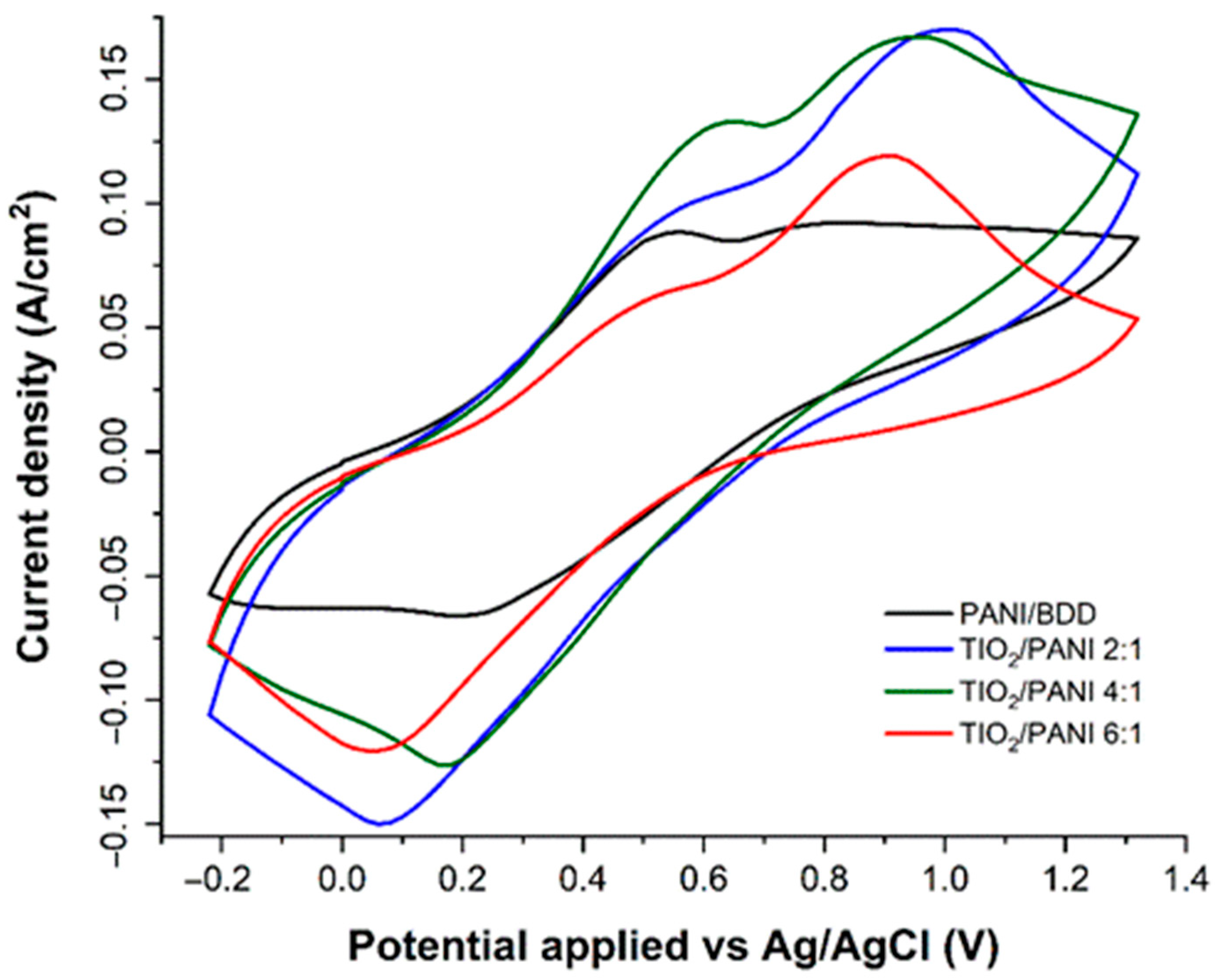
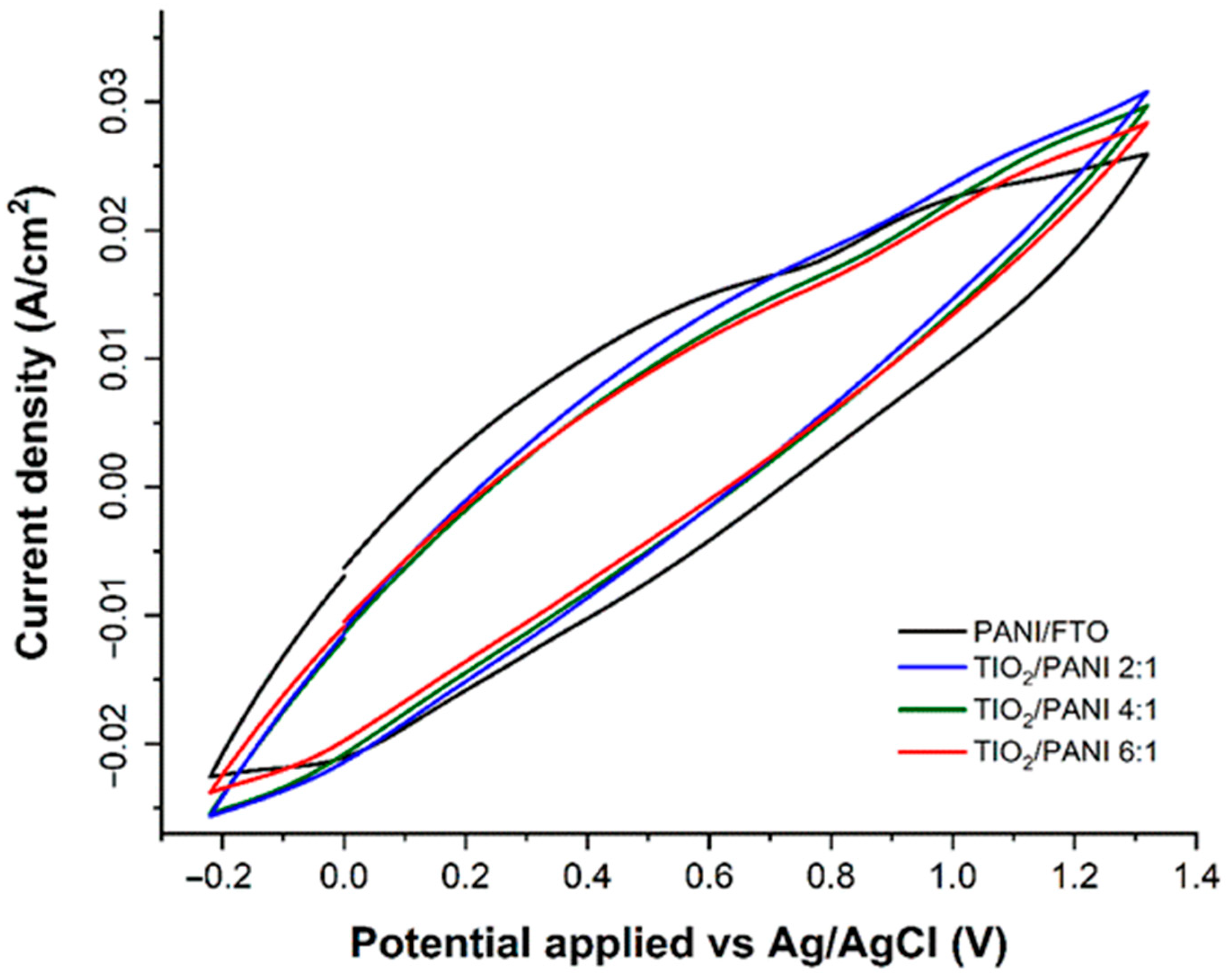
To further elucidate the electrochemical behavior and the effect of TiO2 loading on the polymerization process, the 20th cycle of the voltammograms for all synthesized composites is compared in Figure 4 and Figure 5 (BDD and FTO). A crucial observation is the notable decrease in the current density of the redox peaks as the TiO2 content increases in the composite. The most intense signals, corresponding to the highest electrochemical activity, were consistently observed for the 2:1 molar ratio on both substrates. This was followed by the 4:1 and finally the 6:1 ratios, indicating a clear trend: 2:1 > 4:1 > 6:1.
This attenuation in current density suggests that while TiO2 is successfully incorporated, its increasing proportion may partially hinder the electron transfer processes inherent to the PANI’s redox chemistry. Furthermore, the significantly diminished intensity of the peaks by the 20th cycle, compared to the initial cycles, provides strong evidence of the polymerization reaction reaching its completion, as the deposited layer becomes less electroactive. The consistent behavior observed on both BDD and FTO substrates underscores the robustness of the electrosynthesis method and the fundamental interaction between PANI and TiO2, which is influenced more by the composite’s composition than by the underlying electrode material.
The composition-dependent electrochemical behavior observed across the different TiO2:PANI ratios provides valuable insight into the tunability of the composite electrodes. The 2:1 molar ratio consistently exhibited the highest current density and most defined redox peaks, indicating superior electrochemical activity and more efficient charge transfer. This makes it a strong candidate for applications where fast electron kinetics are essential, such as electrochemical sensors or energy storage devices.
In contrast, the 4:1 and 6:1 composites, while showing progressively lower current responses, offer higher titanium oxide content, which may be advantageous in applications that leverage the semiconductor properties of TiO2, such as photocatalysis or photoelectrocatalysis. In these cases, the increased TiO2 loading could enhance light absorption, surface-active sites, or charge carrier generation, potentially offsetting the reduction in polymer-mediated conductivity.
Our results demonstrate that the electrochemical properties of TiO2/PANI composites can be deliberately modulated by adjusting the TiO2 content. This tunability is a key strength of the proposed electrosynthesis method, as it enables the design of electrode materials tailored to specific technological requirements.

3.2. FTIR Spectroscopy

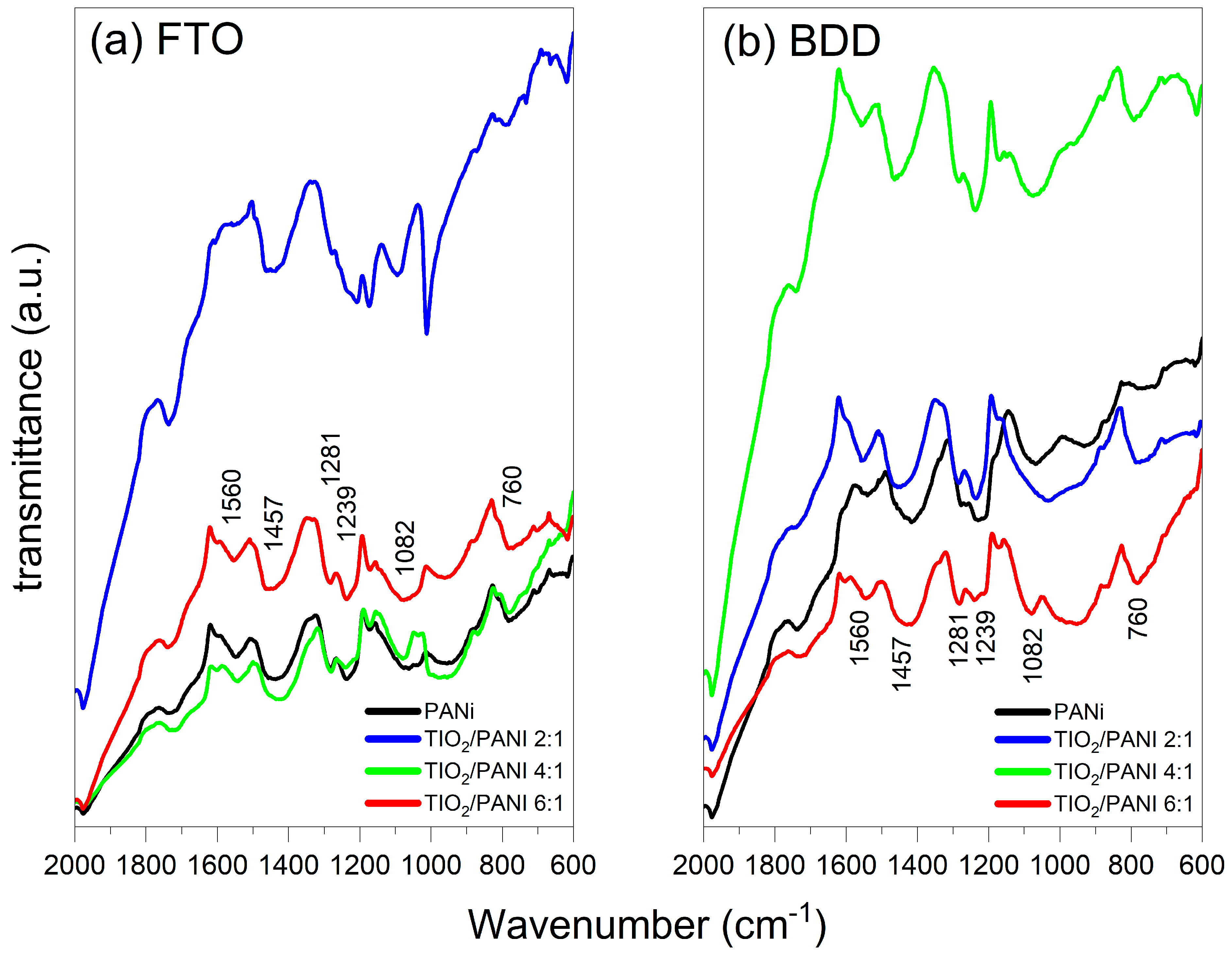
The chemical structure and functional groups of the synthesized PANI and TiO2/PANI composites were confirmed by Fourier-transform infrared spectroscopy (FTIR). The spectra for the materials deposited on FTO and BDD substrates are shown in Figure 6a,b, respectively. A weak but broad signal observed at 776 or 789 cm−1 is assigned to the antisymmetric Ti-O-Ti stretching mode of TiO2, confirming the successful incorporation of titanium dioxide into the composite [22,23,24,25,26].
The characteristic bands of polyaniline are also clearly identified. The signal around 1082–1095 cm−1 is attributed to in-plane bending vibrations of C-H bonds. The bands located at 1239 and 1281 cm−1 correspond to stretching vibrations of C-N bonds in aromatic secondary amines, associated with benzenoid and quinoid ring structures, respectively. Furthermore, the bands around 1457 and 1560 cm−1 are consistent with stretching vibrations of N-B-N (where B represents the benzenoid ring) and N=Q=N (where Q represents the quinoid ring) groups, respectively [22,27,28,29]. The presence of all these signals in the composite spectra provides conclusive evidence for the coexistence of both polyaniline and titanium dioxide on the BDD and FTO electrodes, confirming the successful formation of the TiO2/PANI composite.

3.3. Optic Microscopy

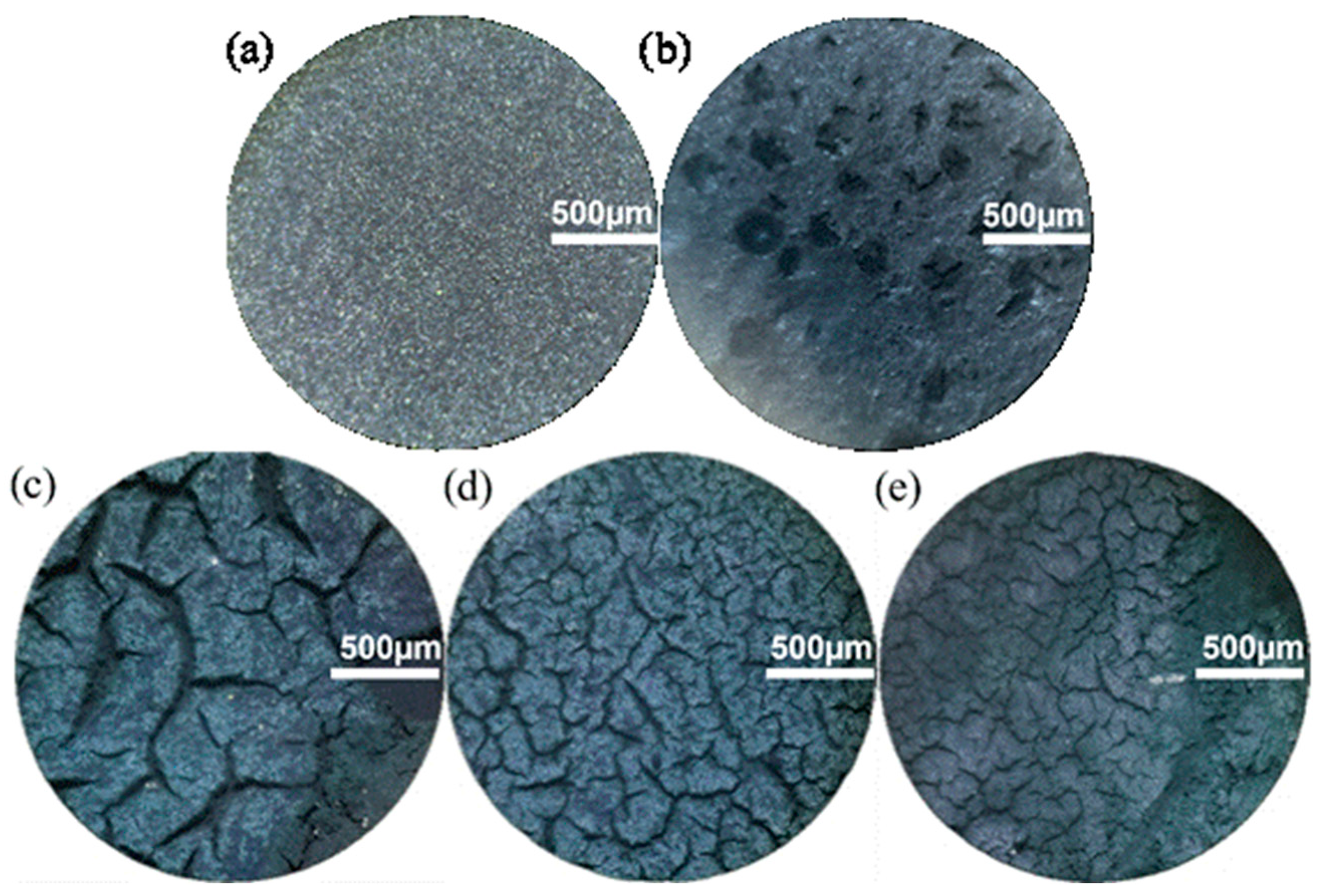
The surface morphology and deposition characteristics of the synthesized materials were initially examined using optical microscopy. Figure 7 shows the images for the BDD-based series, while Figure 8 corresponds to the FTO-based series. Figure 7a displays the clean BDD substrate prior to any deposition, revealing a uniformly porous and rough surface with a greyish appearance. The initial stages of PANI polymerization on BDD (Figure 7b) show isolated, semicircular polymer clusters growing on the surface. This island-like growth pattern suggests that the initial deposition preferentially occurs at the porous sites of the BDD surface, leading to an irregular film formation.
Figure 7c–e, correspond to the TiO2/PANI/BDD composites with molar ratios of 2:1, 4:1, and 6:1, respectively. A clear trend is observed: as the TiO2 content increases, the film grows in a more disordered manner and develops significant surface cracking. This cracking is likely a result of the increased film thickness due to TiO2 incorporation, which reduces the adhesive and cohesive forces within the composite layer, ultimately leading to mechanical stress and fracture—a common phenomenon in electrodeposited materials [30].
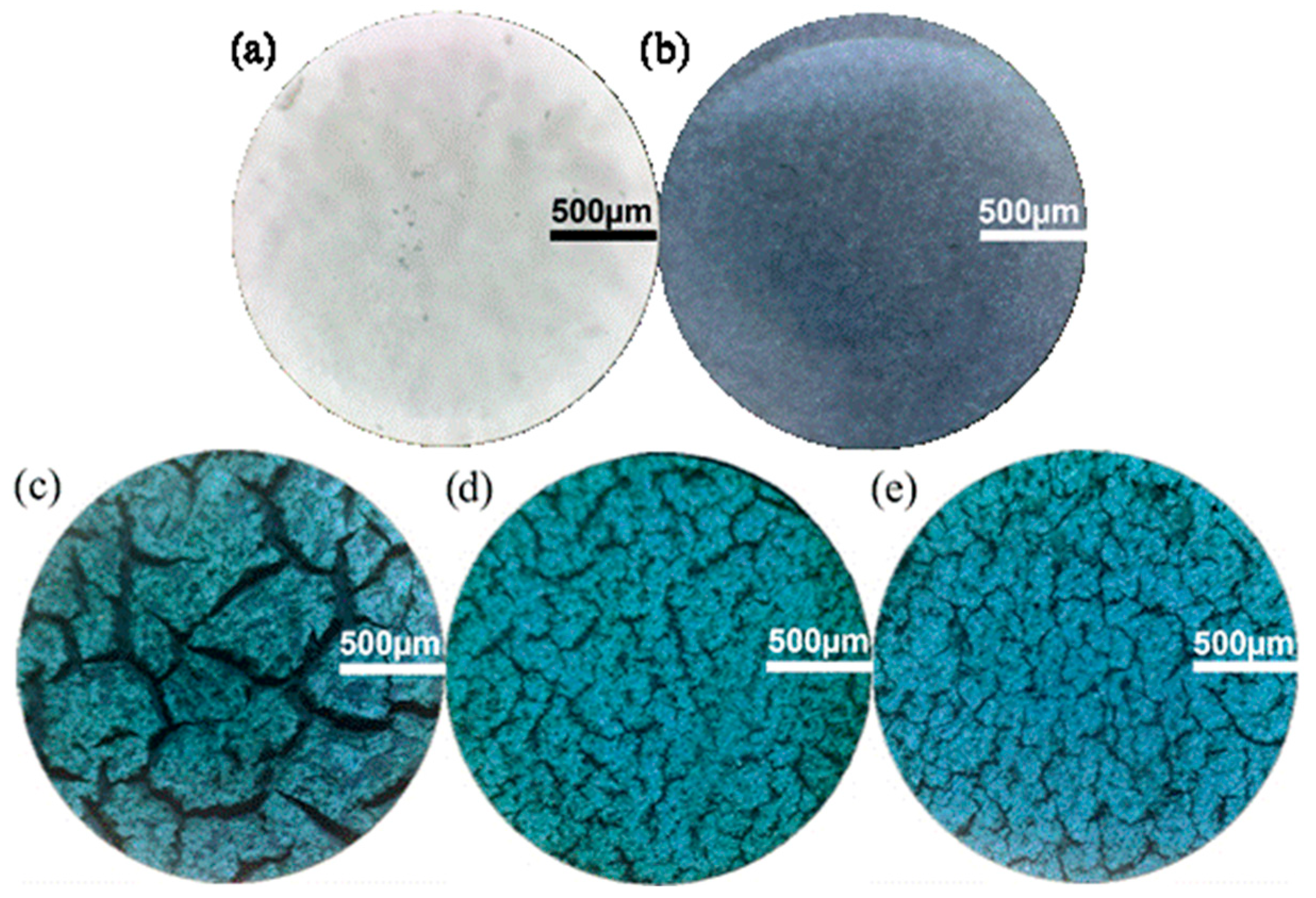
In contrast, the clean FTO substrate (Figure 8a) exhibits a slightly less rough, whitish appearance compared to BDD. The initial growth of PANI on FTO (Figure 8b) shows a more uniform and homogeneous film coverage without the isolated agglomerates seen on BDD. This difference is likely due to the absence of significant porosity on the FTO surface, allowing the polymer to grow evenly.
The TiO2/PANI/FTO composites (Figure 8c–e) exhibit the same trend observed on BDD. As the TiO2 ratio increases (2:1, 4:1, 6:1), the surface uniformity decreases, and cracking becomes more pronounced. This further supports the conclusion that the addition of TiO2 particles increases the film thickness and introduces mechanical instability, leading to cracking, regardless of the substrate used [30].

3.4. Scanning Electron Microscopy

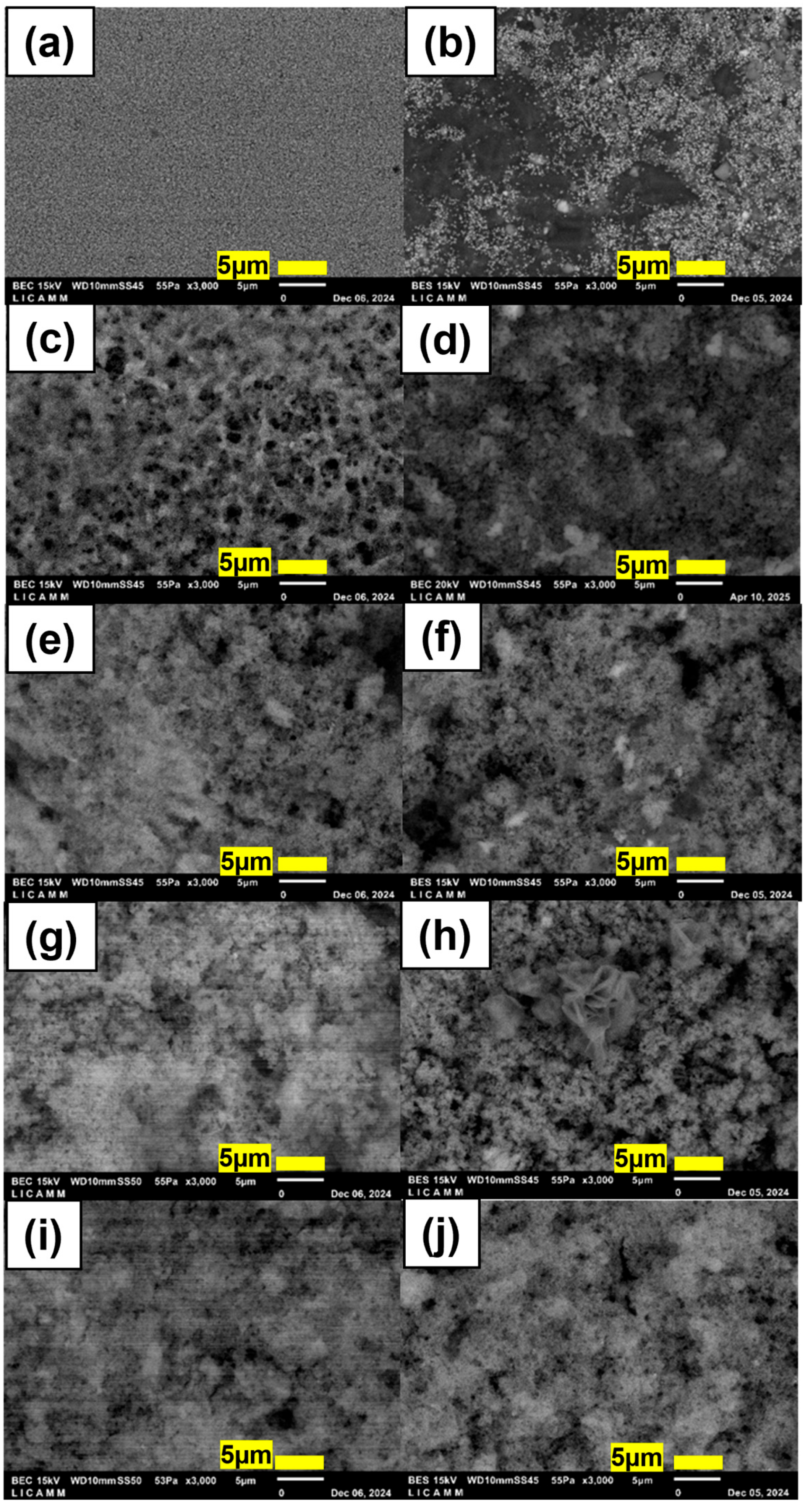
The surface morphology of the electrodes was further analyzed by scanning electron microscopy (SEM) at 3000× magnification, as shown in the panel of micrographs (Figure 9). Figure 9a,b show the clean, unmodified surfaces of the FTO and BDD substrates, respectively. The electropolymerized PANI on FTO (Figure 9c) exhibits a characteristic spongy, network-like structure, consistent with previous reports [23]. In contrast, the PANI deposited on BDD (Figure 9d) forms small, randomly distributed agglomerates, confirming the non-uniform growth observed by optical microscopy (Figure 7b).
The composite materials (Figure 9e–j) show a distinct morphological evolution. A whitish, granular layer is evident, which blends with and eventually covers the underlying PANI network. This layer increases in coverage with higher TiO2 ratios in the composite. In some regions, this coating exhibits circular or micro-granulated structures, indicative of the random aggregation of TiO2 particles, as reported in similar works [31,32,33]. The presence of surface cracks in some composites (Figure 9g,h) exposes the underlying substrate, which could potentially affect electrode performance by allowing direct contact with the contaminant solution [31].
The presence and increasing content of titanium in the composites were quantitatively confirmed by energy-dispersive X-ray spectroscopy (EDS). The weight percentages of titanium are summarized in Table 2. For the FTO-based composites, the Ti content increased from 3.29% (2:1), to 15% (4:1), and finally to 30.98% (6:1). A similar trend was observed for the BDD-based composites, where the Ti weight percentage rose from 8.01% (2:1), to 13.82% (4:1), and to 33.23% (6:1). This progressive increase confirms the successful and controllable incorporation of TiO2 into the PANI matrix during the electrosynthesis process. However, an interesting observation from the EDS data in Table 2 is that while the titanium content increases consistently with the TiO2:PANI molar ratio—from 3.29% to 30.98% on FTO and from 8.01% to 33.23% on BDD the oxygen content shows only a modest increase. This behavior can be explained by considering the multiple sources of oxygen contributing to the EDS signal.
First, oxygen is inherently present in the TiO2 nanoparticles, with a stoichiometric Ti:O ratio of approximately 1:2. However, the oxygen signal is not exclusively derived from the composite film. For FTO-based electrodes, the fluorine-doped tin oxide (SnO2:F) substrate itself contains a significant and relatively constant amount of oxygen, which contributes to the background signal regardless of the film composition. In thinner or cracked regions of the film, this substrate contribution becomes more appreciable [31].
Second, although polyaniline in its emeraldine base form does not contain oxygen, the polymer films in this study were synthesized in 0.5 M H2SO4 and may retain oxygen-containing species such as sulfate counter-ions (from doping), adsorbed water, or surface oxides formed during electropolymerization [22,23]. These species provide a baseline oxygen signal that is independent of TiO2 content.
Third, exposure to air prior to analysis may introduce additional oxygen-containing species on the film surface, further contributing to the background.
Therefore, while the titanium content serves as a direct and reliable indicator of TiO2 loading in the composites, the oxygen signal represents a convolution of contributions from TiO2, the substrate, the PANI matrix, and potential surface contamination. This explains why the oxygen content does not increase as steeply as titanium with higher TiO2:PANI ratios and highlights the importance of using titanium rather than oxygen as the primary elemental marker for TiO2 incorporation in EDS analysis of these composite films.
To contextualize the findings of this work within the broader literature on PANI-TiO2 composites, it is instructive to compare our results with previous studies that have employed different synthesis approaches and substrates. Filho et al. [34] reported the pulsed electrodeposition of PANI-TiO2 on ITO at varying pH, demonstrating through DFT calculations that a metallic interface forms between PANI and TiO2, enhancing conductivity. However, their work did not explore the effect of TiO2 loading or compare substrate performance.
Similarly, Rajakani et al. [23] synthesized PANI-TiO2 nanocomposites via chemical oxidation and found that lower TiO2 contents (0.25 g) yielded the best electrochemical response, with conductivity decreasing at higher ceramic loadings due to disruption of the polymer matrix. Xu et al. [35] also observed a maximum conductivity at 5 wt.% TiO2 in chemically synthesized composites, attributing the enhancement to H-bonding between PANI and TiO2, followed by a decline at higher TiO2 concentrations.
In agreement with these reports, our study confirms that lower TiO2 loadings (2:1 molar ratio) promote superior electrochemical activity. However, our work extends beyond previous contributions by demonstrating, for the first time, the successful one-step electrodeposition of TiO2/PANI composites on both BDD and FTO substrates via cyclic voltammetry, with precise control over the TiO2:PANI molar ratio. Furthermore, we provide a systematic comparison of the substrate-dependent electrochemical behavior and morphological evolution, revealing that the choice of substrate significantly influences the interaction between PANI and TiO2. This tunability and substrate versatility represent a key advancement in the design of modified electrodes for applications ranging from sensing to photocatalysis.

4. Conclusions

This study successfully demonstrates a straightforward and effective cyclic voltammetry route for the electrosynthesis of both pristine PANI and TiO2/PANI composite films on boron-doped diamond (BDD) and fluorine-doped tin oxide (FTO) electrodes. The electrochemical formation of polyaniline was unequivocally confirmed by the characteristic redox peaks in the cyclic voltammograms, which correspond to the transitions between its leucoemeraldine, emeraldine, and pernigraniline states. The successful incorporation of TiO2 into the PANI matrix was evidenced by consistent shifts in these redox potentials across all studied molar ratios (2:1, 4:1, 6:1). FTIR spectroscopy provided definitive chemical evidence of the composite’s formation, revealing the characteristic signatures of both materials: the Ti-O-Ti stretching mode of TiO2 (~789 cm−1) and the functional groups of PANI, including C-N stretches, C-H bends, and the distinctive N-B-N and N=Q=N vibrations.
Morphological analysis revealed that the underlying substrate dictates the initial growth pattern of PANI, with a porous BDD surface leading to irregular agglomerates and a smoother FTO surface promoting a more uniform film. However, a common phenomenon was observed regardless of the substrate: the increasing TiO2 content led to the formation of a granular layer, increased film thickness, and ultimately, surface cracking due to mechanical stress. Finally, EDS analysis quantitatively corroborated the increasing weight percentage of titanium within the composites, confirming the tunability of the electrosynthesis process.
We have developed a reproducible method for fabricating TiO2/PANI-modified electrodes with controllable composition. The demonstrated synergy between the conductive polymer and the semiconductor oxide, along with the detailed electrochemical and morphological characterization provided herein, establishes these composites as highly promising materials for electrocatalytic applications.

Author Contributions

Conceptualization, R.J.V.-S., U.P.-G. and R.G.-A.; methodology, R.J.V.-S.; formal analysis, U.P.-G. and R.G.-A.; investigation, R.J.V.-S.; resources, U.P.-G.; data curation, R.J.V.-S. and L.A.M.d.P.-P.; writing—original draft preparation, R.J.V.-S.; writing—review and editing, R.J.V.-S., U.P.-G., R.G.-A., L.A.M.d.P.-P. and J.M.-P.; visualization, R.G.-A. and J.M.-P.; supervisión, U.P.-G. and R.G.-A.; funding acquisition, U.P.-G. All authors have read and agreed to the published version of the manuscript.

Funding

This research received no external funding.

Institutional Review Board Statement

Not applicable.

Informed Consent Statement

Not applicable.

Data Availability Statement

The original contributions presented in this study are included in the article. Further inquiries can be directed to the corresponding author.

Acknowledgments

R. J. Villanueva-Silva acknowledges the scholarship No. 812890 provided by SECIHTI-MEXICO and project TecNM number 8118.20-P.

Conflicts of Interest

The authors declare no conflicts of interest.

Abbreviations

The following abbreviations are used in this manuscript:
PANIPolyaniline
BDDBoron-Doped Diamond
FTOFluorine-doped Tin Oxide
FTIRFourier Transform Infrared Spectroscopy
EDSEnergy Dispersive X-ray Spectroscopy
AOPsAdvanced Oxidation Processes
SEMScanning Electron Microscopy
TiO2Titanium Dioxide

References

  1. Boeva, Z.A.; Sergeyv, V.G. Polyaniline: Synthesis, properties, and application. Polym. Sci. Ser. C 2014, 56, 144–153. [Google Scholar] [CrossRef]
  2. Namsheer, K.; Rout, C.S. Conducting polymers: A comprehensive review on recent advances in synthesis, properties and applications. RSC Adv. 2021, 11, 5659–5697. [Google Scholar] [CrossRef] [PubMed]
  3. Bhandari, S. Chapter 2—Polyaniline: Structure and Properties Relationship. In Polyaniline Blends, Composites, and Nanocomposites; Elsevier: Amsterdam, The Netherlands, 2017; pp. 23–60. [Google Scholar] [CrossRef]
  4. Maldonado-Larios, L.; Mayen-Mondragón, R.; Martínez-Orozco, R.D.; Páramos-García, U.; Gallardo-Rivas, N.V.; García-Alamilla, R. Electrochemically-assisted fabrication of titanium-dioxide/polyaniline nanocomposite films for the electroremediation of congo red in aqueous effluents. Synth. Met. 2020, 268, 116464. [Google Scholar] [CrossRef]
  5. Lee, Y.J.; Lee, H.S.; Lee, C.G.; Park, S.J.; Lee, J.; Jung, S.; Shin, G.A. Applications of PANI/TiO2 Composite for Photocatalytic Degradation of Contaminants from Aqueous Solution. Appl. Sci. 2020, 10, 6710. [Google Scholar] [CrossRef]
  6. Nakata, K.; Fujishima, A. TiO2 photocatalysis: Desing and applications. J. Photochem. Photobiol. C Photochem. Rev. 2012, 13, 169–189. [Google Scholar] [CrossRef]
  7. Roy, H.S.; Islam, M.; Mollah, M.Y.A.; Susan, A.B.H. Polyaniline-NiO Nanocomposites as Tunable Conducting Materials. Mater. Today Proc. 2019, 15, 380–387. [Google Scholar] [CrossRef]
  8. Waqas, M.; Campbell, L.P.T. Polyaniline-Coated Surface-Modified Ag/PANI Nanostructures for Antibacterial and Colorimetric Melamine Sensing in Milk Samples. ACS Omega 2023, 8, 24010–24015. [Google Scholar] [CrossRef]
  9. Wang, X.; Tang, S.; Zhou, C.; Liu, J.; Feng, W. Uniform TiO2-PANI composite capsules and hollow spheres. Synth. Met. 2009, 159, 1865–1869. [Google Scholar] [CrossRef]
  10. Putri, N.P.; Riska, A.M.; Kusumawati, D.H.; Suaebah, E. Enhanced Photocatalytic Degradation of Congo Red Dye Using Green-Synthesized TiO2 and PANI/TiO2 with Papaya Leaf as Bio-Reduction. Trends Sci. 2024, 22, 9119. [Google Scholar] [CrossRef]
  11. Wang, F.; Min, S.X. TiO2/Polyaniline composites: An efficient photocatalyst for the degradation of methylene blue under natural light. Chin. Chem. Lett. 2007, 18, 1273–1277. [Google Scholar] [CrossRef]
  12. Basit, A.; Syauqi, M.I.; Sanjaya, A.R.; Rahmawati, I.; Gunlazuardi, J.; Ivandini, T.A. Electrochemiluminiscence of titanium dioxide nanomaterials for sensing applications. Anal. Sci. 2025, 41, 1427–1449. [Google Scholar] [CrossRef] [PubMed]
  13. Irkham; Fiorani, A.; Valenti, G.; Kamoshida, N.; Paolucci, F.; Einaga, Y. Electrogenerated Chemiluminescence by in Situ Production of Coreactant Hydrogen Peroxide in Carbonate Aqueous Solution at a Boron-Doped Diamond Electrode. J. Am. Chem. Soc. 2020, 142, 1518–1525. [Google Scholar] [CrossRef] [PubMed]
  14. Einaga, Y. Development of Electrochemical Applications of Boron-Doped Diamond Electrodes. Bull. Chem. Soc. Jpn. 2018, 91, 1752–1762. [Google Scholar] [CrossRef]
  15. Shah, S.S.; Aziz, A.; Al-Beta, A.-R.; Mahfoz, W. Electrodeposition of Polyaniline on high electroactive indium tin oxide nanoparticles-modified fluorine doped tin oxide electrode for fabrication of high-performance hybrid supercapacitor. Arab. J. Chem. 2022, 15, 104058. [Google Scholar] [CrossRef]
  16. Aziz, A.; Sohail, M.; Oyama, M.; Mahfoz, W. Electrochemical investigation of metal oxide conducting electrodes for direct detection of sulfide. Electroanalysis 2015, 27, 1268–1275. [Google Scholar] [CrossRef]
  17. Sobaszek, M.; Siuzdak, K.; Sawczak, M.; Ryl, J.; Bogdanowicz, R. Fabrication and characterization of composite TiO2 nanotubes/boron-doped diamond electrodes towards enhanced supercapacitors. Thin Solid Films 2016, 601, 35–40. [Google Scholar] [CrossRef]
  18. Pereira, L.A.; Couto, A.B.; Almeida, D.A.D.L.; Ferreira, N.G. The influence of TiO2 amount on the photoactivity response for the novel TiO2/BDD/Carbon fiber ternary composite. Diam. Relat. Mater. 2017, 75, 18–24. [Google Scholar] [CrossRef]
  19. Fitriyana, F.; Kurniawan, F. Polyaniline-Invertase-Gold Nanoparticles Modified Gold Electrode for Sucrose Detection. Indones. J. Chem. 2015, 15, 226–236. [Google Scholar] [CrossRef]
  20. Andriianova, A.N.; Biglova, Y.N.; Mustafin, A.G. Effect of structural factors on the physicochemical properties of functionalized polyanilines. RSC Adv. 2020, 10, 7468–7491. [Google Scholar] [CrossRef]
  21. Mahalakshmi, S.; Sridevi, V. In Situ Electrodeposited Gold Nanoparticles on Polyaniline-Modified Electrode Surface for the Detection of Dopamine in Presence of Ascorbic Acid and Uric Acid. Electrocatalysis 2021, 12, 415–435. [Google Scholar] [CrossRef]
  22. Molapo, K.M.; Ndangili, P.M.; Ajayi, R.F.; Mbambisa, G.; Mailu, S.M.; Njomo, N.; Masikini, M.; Baker, P.; Iwuoha, E.I. Electronics of Conjugated Polymers (I): Polyaniline. Int. J. Electrochem. Sci. 2012, 7, 11859–11875. [Google Scholar] [CrossRef]
  23. Rajakani, P.; Vedhi, C. Electrocatalytic properties of polyaniline-TiO2 nanocomposites. Int. J. Ind. Chem. 2015, 6, 247–259. [Google Scholar] [CrossRef]
  24. Pawar, S.G.; Patil, S.L.; Chougule, M.A.; Mane, A.T.; Jundale, D.M.; Patil, V.B. Synthesis and Characterization of Polyaniline: TiO2 Nanocomposites. Int. J. Polym. Mater. Polym. Biomater. 2010, 59, 777–785. [Google Scholar] [CrossRef]
  25. Jumat, N.A.; Wai, P.S.; Ching, J.J.; Basirun, W.J. Synthesis of Polyaniline-TiO2 Nanocomposites and Their Application in Photocatalytic Degradation. Polym. Polym. Compos. 2017, 25, 507–514. [Google Scholar] [CrossRef]
  26. Sayah, A.; Habelhames, F.; Bahloul, A.; Boudjadi, A. The effect of electrodeposition applied potential on the electrochemical performance of polyaniline films. J. Mater. Sci. Mater. Electron. 2021, 32, 10692–10701. [Google Scholar] [CrossRef]
  27. Sridevi, V.; Malathi, S. Synthesis and Characterization of Polyaniline/Gold Nanocomposites. Chem. Sci. J. 2011, 2011, CSJ-26. [Google Scholar] [CrossRef]
  28. Katoch, A.; Burkhart, M.; Hwang, T.; Kim, S.S. Synthesis of polyaniline/TiO2 hybrid nanoplates via a sol-gel chemical method. Chem. Eng. J. 2012, 192, 262–268. [Google Scholar] [CrossRef]
  29. He, Q.; Chen, X.; Jia, F.; Ding, W.; Zhou, Y.; Wang, J.; Song, X.; Jiang, J.; Liao, Q.; Li, J.; et al. The Role of Polyaniline Molecular Structure in Producing High-Performance Fe-N-C Catalysts for Oxygen Reduction Reaction. ChemistrySelect 2019, 4, 8135–8141. [Google Scholar] [CrossRef]
  30. Bott-Neto, J.L.; Martins, T.S.; Oliveira, O.N.; Marken, F. Controlled electrodeposition of brookite TiO2 for photoelectroanalysis at printed carbon electrodes. App. Surf. Sci. 2023, 640, 158316. [Google Scholar] [CrossRef]
  31. Rai, D.; Sinha, S. Characterization and electrochemical properties of TiO2-rNTs/SnO2-Sb/PbO2 electrodes for the mineralization of persistent organic pollutants using anodic oxidation coupled Electro-Fenton treatment: Effect of precursor selection. Chemosphere 2024, 352, 141307. [Google Scholar] [CrossRef]
  32. Ali, M.M.; Haque, J.; Kabir, M.H.; Kaiyum, M.A.; Rahman, M.S. Nano synthesis of ZnO-TiO2 composites by sol-gel method and evaluation of their antibacterial, optical and photocatalytic activities. Results Mater. 2021, 11, 100199. [Google Scholar] [CrossRef]
  33. Wang, S.; Bai, L.; Ao, X. Preparation and photocatalytic application of a S, Nd double doped nano-TiO2 photocatalyst. RSC Adv. 2018, 8, 36745–36753. [Google Scholar] [CrossRef]
  34. Filho, V.F.L.; Machado, G.; Batista, R.J.C.; Soares, J.S.; de Oliveira, A.B.; de Vasconcelos, C.; Lino, A.A.; Manhabosco, T.M. Effect of TiO Nanoparticles on Polyaniline Films Electropolymerized at Different pH. J. Phys. Chem. C 2016, 120, 14977–14983. [Google Scholar] [CrossRef]
  35. Xu, J.-C.; Liu, W.-M.; Li, H.-L. Titanium dioxide doped polyaniline. Mater. Sci. Eng. C 2005, 25, 44–447. [Google Scholar] [CrossRef]
Figure 1. Cyclic voltammograms illustrating the progressive electropolymerization of aniline over 20 cycles on (a) BDD and (b) FTO substrates in 0.5 M H2SO4.
Surfaces 09 00029 g001
Figure 2. Cyclic voltammograms recorded during the synthesis of TiO2/PANI composites on a BDD electrode at different molar ratios: (a) 2:1, (b) 4:1, and (c) 6:1.
Surfaces 09 00029 g002
Figure 3. Cyclic voltammograms recorded during the synthesis of TiO2/PANI composites on an FTO electrode at different molar ratios: (a) 2:1, (b) 4:1, and (c) 6:1.
Surfaces 09 00029 g003
Figure 4. Overlay of the 20th cycle during the electrosynthesis of pristine PANI and TiO2/PANI composites at different molar ratios (2:1, 4:1, 6:1) on a BDD electrode.
Surfaces 09 00029 g004
Figure 5. Overlay of the 20th cycle during the electrosynthesis of pristine PANI and TiO2/PANI composites at different molar ratios (2:1, 4:1, 6:1) on an FTO electrode.
Surfaces 09 00029 g005
Figure 6. FTIR spectra of (a) PANI/FTO and TiO2/PANI/FTO composites, and (b) PANI/BDD and TiO2/PANI/BDD composites at different molar ratios. The spectra confirm the coexistence of both materials, showcasing the characteristic Ti-O-Ti stretching mode of TiO2 (~789 cm−1) and the signature functional groups of PANI (C-N, C-H, N-B-N, and N=Q=N).
Surfaces 09 00029 g006
Figure 7. Optical micrographs (4× zoom) of the BDD series: (a) pristine BDD, (b) PANI/BDD, (c) TiO2/PANI/BDD (2:1), (d) TiO2/PANI/BDD (4:1), and (e) TiO2/PANI/BDD (6:1). The sequence reveals the transition from isolated polymer agglomerates to a cracked, composite morphology as the TiO2 content increases, highlighting the role of mechanical stress induced by particle incorporation.
Surfaces 09 00029 g007
Figure 8. Optical micrographs (4× zoom) of the FTO series: (a) pristine FTO, (b) PANI/FTO, (c) TiO2/PANI/FTO (2:1), (d) TiO2/PANI/FTO (4:1), and (e) TiO2/PANI/FTO (6:1).
Surfaces 09 00029 g008
Figure 9. Scanning electron micrographs (3000× magnification) of: (a) FTO, (b) BDD, (c) PANI/FTO, (d) PANI/BDD, (e) TiO2/PANI/FTO 2:1, (f) TiO2/PANI/BDD 2:1, (g) TiO2/PANI/FTO 4:1, (h) TiO2/PANI/BDD 4:1, (i) TiO2/PANI/FTO 6:1, and (j) TiO2/PANI/BDD 6:1.
Surfaces 09 00029 g009
Table 1. Anodic and cathodic peak potentials (V vs. Ag/AgCl) for the synthesized TiO2/PANI composites at different molar ratios on FTO and BDD substrates.
SampleFTOBDD
AnodicCathodicAnodicCathodic
2:1+0.44/+0.98+0.34/−0.2+0.3/+1.0+0.46/+0.06
4:1+0.44/+0.98+0.34/−0.12+0.34/+0.98+0.44/+0.04
6:1+0.44/+0.98+0.355/−0.14+0.32/+0.89+0.42/+0.04
Table 2. Weight percentage of Ti and O obtained by EDS analysis for the synthesized TiO2/PANI composites on FTO and BDD substrates. The increasing Ti content with higher TiO2:PANI ratios provides quantitative evidence of the successful and controllable incorporation of titanium dioxide into the composite films.
SampleFTOBDD
TiOTiO
2:13.2933.48.0127.86
4:11531.9113.8230.78
6:130.9835.0233.2334.34
Disclaimer/Publisher’s Note: The statements, opinions and data contained in all publications are solely those of the individual author(s) and contributor(s) and not of MDPI and/or the editor(s). MDPI and/or the editor(s) disclaim responsibility for any injury to people or property resulting from any ideas, methods, instructions or products referred to in the content.