Article

Two-Step Combined Ball Milling Strategy for FeCoCrNiCu High-Entropy Alloy Powders with Enhanced Compositional Homogeneity


1
Center for Alloy Innovation and Design, State Key Laboratory for Mechanical Behavior of Materials, Xi’an Jiaotong University, Xi’an 710049, China
2
State Key Laboratory for Strength and Vibration of Mechanical Structures, School of Aerospace Engineering, Xi’an Jiaotong University, Xi’an 710049, China
3
Laboratory for Novel Disorder Materials, Xi’an Jiaotong University, Xi’an 710049, China
*
Authors to whom correspondence should be addressed.
Surfaces 2026, 9(1), 28; https://doi.org/10.3390/surfaces9010028
Submission received: 24 January 2026 / Revised: 2 March 2026 / Accepted: 12 March 2026 / Published: 15 March 2026
(This article belongs to the Collection Featured Articles for Surfaces)

Abstract

This work aims to develop a controlled ball milling strategy for preparing FeCoCrNiCu high-entropy alloy (HEA) powders with improved compositional homogeneity while maintaining limited oxygen uptake. Specifically, a novel two-step combined ball milling strategy integrating gradient ball-size configurations with a sequential milling procedure is proposed and systematically evaluated. Compared with conventional single-step milling, the mixed-ball and two-step configurations enhance mechanical alloying (MA) efficiency and promote the formation of more stable FCC and BCC dual-phase structures, as confirmed by X-ray diffraction (XRD) analysis. Compositional standard deviation derived from energy-dispersive X-ray spectroscopy (EDS) measurements indicates improved macroscopic uniformity, while oxygen/nitrogen/hydrogen (ONH) analysis verifies that oxygen incorporation remains limited within the tested processing window. Systematic comparison of jar filling degrees and sampling interruptions further reveals the coupled influence of collision energy distribution and exposure frequency on oxidation behavior. The results demonstrate that controlled energy distribution and minimized atmospheric disturbance are critical for balancing alloying efficiency and oxygen control in FeCoCrNiCu powders.

1. Introduction

High-entropy alloys (HEAs) represent a paradigm shift in alloy design and have garnered extensive research interest within the last dozen years. These materials are characterized by the near-equiatomic mixing of multiple principal elements, which maximizes configurational entropy and stabilizes simple solid-solution phases [1]. First proposed by Yeh and Cantor, HEAs exhibit four core effects, including high-entropy stabilization, lattice distortion, sluggish diffusion, and the cocktail effect that synergistically leads to exceptional mechanical and functional properties [2,3,4]. Among various HEA systems, FeCoCrNi-based alloys have attracted particular interest due to their excellent cryogenic toughness and superior thermal stability [5,6,7]. Incorporating Cu into the base alloy results in a dual-phase FeCoCrNiCu system with distinct structural features, which offers a balance between strength and ductility. However, the immiscibility of Cu also introduces a tendency for elemental segregation [8,9,10]. As the exploration of HEA systems continues to advance, growing emphasis is now being placed on the development of versatile and scalable synthesis techniques that enable controlled phase formation, tailored microstructures, and minimized elemental segregation. These requirements have motivated intensive efforts to identify processing routes for HEA fabrication, particularly in the context of non-equilibrium or solid-state methods.
Casting is a widely employed method for fabricating HEAs. Nevertheless, the as-cast microstructures typically exhibit inherent defects such as phase segregation, grain coarsening, and compositional inhomogeneity, which collectively deteriorate mechanical performance [11,12]. Powder metallurgy (PM) has been recognized as an effective approach to mitigate defects associated with casting [13,14,15]. Within the PM route, mechanical alloying (MA) serves as a distinctive solid-state powder processing technique [16]. During the MA process, pure elemental powders or pre-alloyed powders undergo severe plastic deformation and crushing due to repetitive and violent collisions with the milling media. This process drives the diffusion of component elements to achieve complete alloying [17], while concurrently refining the grains to form nanocrystals and expanding the solid solution limit of the component elements [18]. Various advanced powder preparation techniques have been developed to enhance the performance of HEAs, including gas atomization, spray drying, and plasma spheroidization, which offer advantages in terms of powder morphology and purity [19]. However, MA remains a vital technique due to its ability to induce severe plastic deformation and high-density lattice defects. This solid-state processing route is particularly effective for overcoming sluggish diffusion barriers and promoting the formation of homogeneous solid solutions at temperatures below the melting point. Unlike granulation methods that focus on particle shape, ball milling facilitates significant crystallite refinement and competitive phase stabilization through continuous fracture and re-welding events.
In recent years, the investigations on the MA of HEA powders have progressively clarified that the balance among solid solution formation, grain refinement, and contamination is governed by the synergistic control of energy input and exposure pathway. Liu et al. [20] systematically explored the effects of milling parameters on the MA kinetics and microstructural evolution of CoCrFeNiAl0.9Nb0.1 powders. It is indicated that increasing the rotation speed or energy input can accelerate alloying and refine the grains but simultaneously intensify lattice strain and defect accumulation, necessitating a balance between alloying rate and strain development. Similarly, Shkodich et al. [21] reported that high-energy milling can rapidly yield nanocrystalline single-phase CoCrFeNiCu within 120 min, although the resulting solid solution remains metastable and decomposes upon subsequent heating. Regarding the selection and dosage of process control agents (PCA), Yazdani et al. [22] used AlCrCuFeNi as the model system and demonstrated that a moderate PCA addition (~2 wt.%) effectively suppresses cold welding and promotes finer particle sizes. Kalantari et al. [23] further showed that PCA-assisted long-term milling enables the formation of a nanocrystalline dual-phase AlCrFeNiTiZn HEA with homogeneous elemental distribution and stable body-centered cubic (BCC) + face-centered cubic (FCC) solid-solution structure. From the perspective of contamination sources and mechanisms, Moravčík et al. [24] conducted a systematic study on the MA + SPS (spark plasma sintering) route of CoCrFeNi powders, revealing that contamination, which is cumulative with milling time and operational steps, may arise from residual gases, PCA decomposition, and mechanical wear of milling media or vial walls. Their findings imply that nominal inert atmospheres alone are insufficient to fully prevent O/C ingress into the system.
In summary, existing studies demonstrate that process selection and oxygen control at the powder synthesis stage exert a sustained influence on the phase stability and microstructural integrity of HEAs. However, despite these advances, previous studies have generally focused on identifying individual process parameters without systematically evaluating their coupled effects on phase evolution, compositional homogeneity, and oxidation behavior, which has hindered a comprehensive understanding of how MA energy input and exposure pathways collectively influence microstructural evolution. Moreover, investigations on Cu-containing FeCoCrNi-based powders, which are prone to segregation and oxidation, remain particularly limited. Consequently, the primary objective of this study is to develop a controlled ball milling strategy for preparing FeCoCrNiCu high-entropy alloy powders. By integrating gradient ball size configurations with a sequential two step milling route, we evaluate the feasibility of balancing alloying efficiency and oxygen control to achieve superior compositional homogeneity. This approach aims to provide a robust methodology for optimizing the microstructural evolution and phase stability of powders intended for subsequent consolidation.

2. Materials and Methods

2.1. Synthesis of Alloy Powders

FeCoCrNiCu HEA powders were fabricated by MA using elemental Fe, Co, Cr, Ni, and Cu powders with purities of 99.8% and an average particle size of 45 μm. Tungsten carbide (WC) balls were used as the milling media, and stearic acid (2 wt.% of total powder mass) was added as a process control agent (PCA) to prevent excessive cold welding and to maintain good powder flowability. The ball-to-powder ratio (BPR) was fixed at 15:1, and the rotational speed was maintained at 350 rpm. To avoid overheating, the rotation direction was alternated every 30 min, followed by a 5 min rest interval. All ball milling operations were performed under a high-purity argon atmosphere to minimize oxidation.
The jar filling degree, defined as the ratio of the packed volume of balls including interstitial voids to the total volume of the 125 mL milling jar, was investigated using a ball combination of 10 mm, 7 mm, and 4 mm diameters with a mass ratio of 1:1:1 under the one-step milling configuration. To ensure consistent experimental control and minimize manual variation, the volume contribution of the powder charge was neglected in the filling degree calculation, thus enabling a clear focus on the collision dynamics under different filling conditions.
To investigate the influence of collision energy distribution on alloying behavior, a gradient-ball combination experiment was designed using five distinct ball-size configurations: (i) Max, using only 10 mm balls; (ii) Mid, using only 7 mm balls; (iii) Min, using only 4 mm balls; (iv) BS, a binary mixture of 10 mm and 4 mm balls with a mass ratio of 1:1; and (v) BMS, a ternary combination of 10 mm, 7 mm, and 4 mm balls with a mass ratio of 1:1:1. For the stepwise ball-milling experiment, the elemental powder mixture was first pre-milled with only 4 mm balls at 200 rpm for 5 h to promote uniform mixing under low-energy collisions. Subsequently, 7 mm and 10 mm balls were added to the same vial, and milling was continued at 350 rpm for 50 h to ensure complete alloying and microstructural refinement. Two separate continuous ball-milling runs lasting 50 h and 55 h were conducted respectively under identical conditions as control experiments for comparison analysis. To evaluate the effect of sampling interruptions, a set of controlled experiments was designed to simulate multiple powder-handling events during multi-step milling. The total milling duration was divided into equal time intervals corresponding to predetermined sampling frequencies. At each sampling interval, the vial was taken out and opened inside the glovebox, where it was deliberately left exposed to the inert atmosphere for 15 min. Afterward, it was resealed and placed back into the mill to resume the milling process. This sequence was repeated until the total designated milling time was reached, enabling a qualitative assessment of oxygen uptake behavior resulting from repeated exposure events.

2.2. Characterization and Analysis

The morphology and composition characteristics of the FeCoCrNiCu HEA powders were systematically analyzed using multiple complementary techniques to evaluate the effects of different milling parameters on microstructural evolution and oxidation behavior.
The surface morphology and particle size distribution of the alloy powders obtained under various milling conditions were characterized by scanning electron microscopy (SEM, ZEISS Sigma 300, Carl Zeiss AG, Oberkochen, Germany) operated at an accelerating voltage of 15 kV and a working distance of approximately 10 mm. Representative micrographs were obtained at magnifications of 200× and 3000× for quantitative comparison. Both the macro-scale (200×) and micro-scale (3000×) morphology, such as particle agglomeration, deformation features, and size evolution, as influenced by the experimental variables, including ball-size distribution, stepwise milling, and jar filling degree, was characterized. Particle size distributions were determined from SEM micrographs using ImageJ 1.53a (National Institutes of Health, Bethesda, MD, USA). For each condition, at least 200 particles were sampled from multiple fields of view across at least three independent images to ensure statistical reliability. The maximum Feret diameter was adopted as the representative size for irregular particles, while those intersecting image boundaries were excluded to avoid truncation bias. Data are presented as mean ± standard deviation. It should be emphasized that MA is an inherently multifactorial process. While particle size evolution is sensitive to various processing parameters, these factors were strictly controlled as constants throughout the study to minimize experimental interference. Consequently, the observed variations in particle size can be primarily attributed to the systematic modification of the milling configuration within this controlled experimental framework.
To quantitatively evaluate compositional homogeneity, energy-dispersive X-ray spectroscopy (EDS) data were analyzed at both macro and micro scales. At 200× magnification, the oxygen content was excluded, and the remaining metallic elements were normalized to ensure their total atomic fraction equaled unity, as shown in Equation (1):
C i = C i j = 1 n C j   for   i   =   1 ,   2 ,   ,   n ;   n   =   5
The standard deviation of the normalized composition values was then calculated to assess the degree of macro-scale compositional uniformity, as described in Equation (2):
σ = 1 n     1 i = 1 n ( C i C ¯ ) 2   for   i   =   1 ,   2 ,   ,   n ;   n   =   5
In Equations (1) and (2), C i denotes the normalized atomic fraction of element i (Fe, Co, Cr, Ni, Cu), C i is the measured atomic fraction of element i before normalization, and Σ j = 1 n C j represents the total atomic fraction of metallic elements after excluding oxygen. σ represents the compositional heterogeneity index, and C ¯ is the mean value of normalized atomic fractions. At 3000× magnification, three distinct powder particles were randomly selected, and one EDS point-scan was performed per particle. The elemental results from the three scans were averaged, followed by normalization and standard deviation analysis using the same procedures outlined in Equations (1) and (2), which served to quantify the micro-scale compositional standard deviation.
Phase identification and quantitative structural analysis were performed using X-ray diffraction (XRD, D8 Advance, Bruker AXS GmbH, Karlsruhe, Germany) over a 2θ range of 20–90° with a step size of 0.02°. The phase fractions (PF) of the FCC and BCC structures and lattice parameters (LP) were analyzed using the reference intensity ratio (RIR) method implemented in MDI Jade 6.0 software. The integrated peak intensities of each phase were normalized by their respective RIR values from the ICDD PDF database to obtain relative phase contents. Due to significant peak broadening and strong overlap between FCC and BCC reflections caused by nanocrystallization and lattice strain during MA, quantitative phase fraction analysis via full Rietveld refinement was not performed. Therefore, the present analysis is restricted to phase identification and comparative evaluation based on clearly resolvable reflections. Following the standard quantitative phase analysis procedure reported by Li and He [25], the average crystallite size ( CS ¯ ) can be well calculated by the Scherrer formula [26], as shown in Equation (3):
D = K λ β ( 2 θ ) cos θ
The lattice strain (LS) can be calculated by Williamson-Hall’s method [26]. The LS is described by Equation (4):
β ( 2 θ ) cos θ = K λ D + 4 ε sin θ
In Equations (3) and (4), D represents the average crystallite size, θ represents the Bragg angle, β(2θ) represents the full width at half maximum (FWHM) of diffraction peak, λ is the wavelength of the radiation source (Cu Kα1, λ = 0.15406 nm), K is a factor (usually K = 0.89), and ε represents the lattice strain.
To quantitatively determine the bulk oxygen content of the mechanically alloyed powders, an oxygen/nitrogen/hydrogen analyzer (ONH, LECO ON836, LECO Corporation, St. Joseph, MI, USA) was employed. The analysis was conducted using a small amount of sample powder per measurement under high-purity helium as the carrier gas. Only the oxygen concentration was considered in this work to verify and complement the surface EDS results, providing a quantitative reference for the total oxygen uptake during MA. The ONH data, together with EDS oxygen trends, enabled comprehensive evaluation of oxidation behavior induced by milling variables.
In this work, small portions of powder were withdrawn for XRD analysis to monitor phase evolution at cumulative milling times of 10, 20, 30, 40, and 50 h. After the full ball-milling schedule, representative samples were collected for EDS and ONH analyses. All sample loading, handling, and post-milling collection were conducted inside an argon-filled glovebox, and the milling jars were sealed with plastic film and petroleum jelly to minimize exposure to ambient air during processing.

3. Results and Discussions

3.1. Effect of Jar Filling Degree on Alloying Behavior

After systematically comparing multiple milling parameters, it was found that the filling degree exerts a significant influence on the morphological characteristics and resultant microstructural evolution of HEA powders, but it remains rarely discussed in prior studies. To isolate this factor, this work designed a controlled experiment in which only the volume fraction of milling balls relative to the jar was varied, neglecting the volume change contributed by powders.
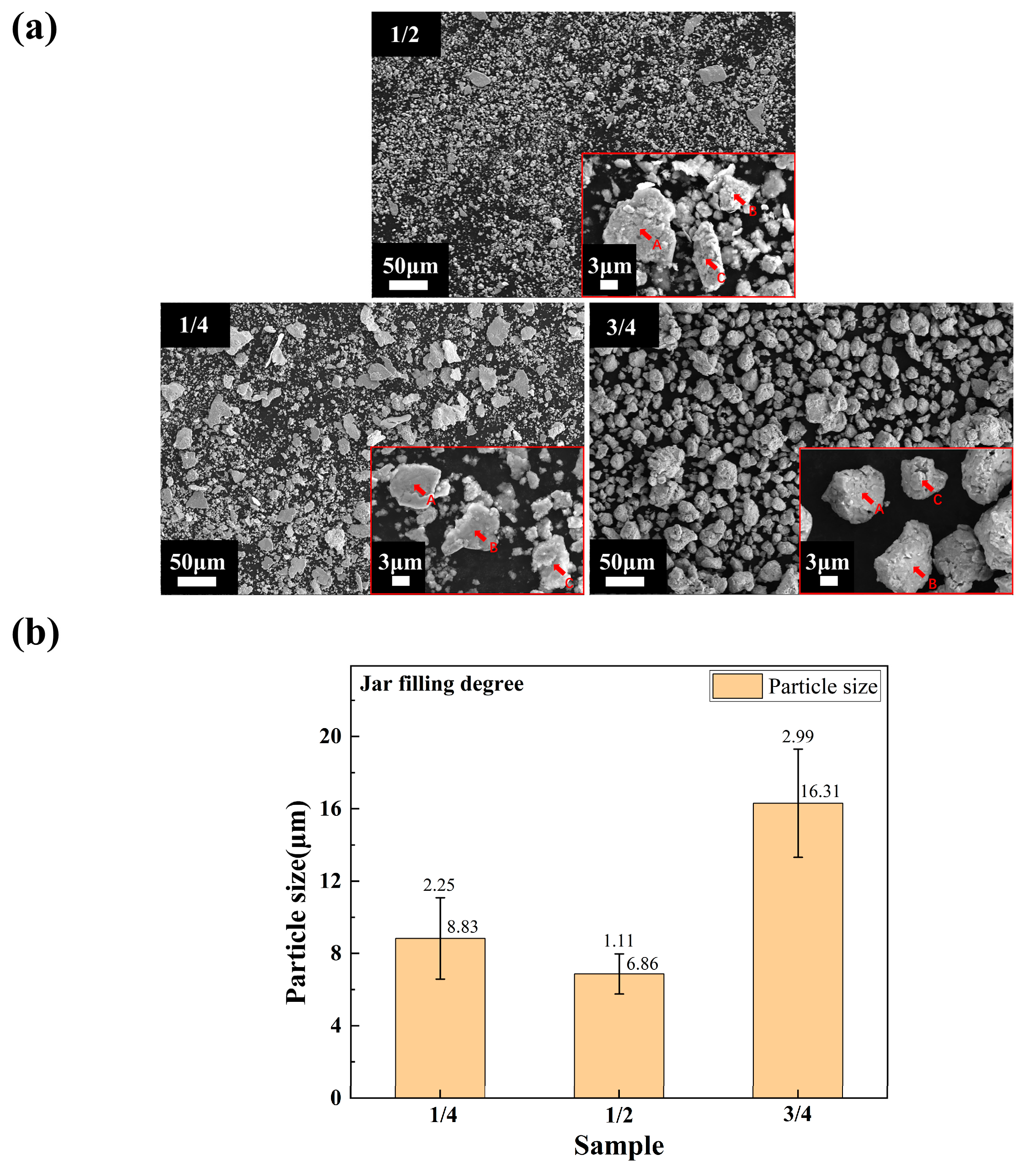
As shown in Figure 1a, a low filling degree is associated with a wider particle-size distribution and more irregular powder morphologies. This behavior may be attributed to a reduced collision frequency and relatively lower deformation energy under such loading conditions. At an intermediate filling degree, the powders became more uniform and finer, indicating a favorable balance between collision energy and powder flowability. However, when the filling degree was increased to 3/4 jar, excessive crowding of milling balls constrained their free trajectories and promoted localized heat accumulation and powder agglomeration. Figure 1b confirms a nonlinear relationship for the average particle size. Initially, the size decreases and becomes more uniform, but it increases sharply under overfilled conditions. This trend reflects that increased powder compaction at high filling ratios promotes a transition from a fracture-dominated to a cold-welding-dominated regime, which leads to the formation of coarse agglomerates that resist subsequent fragmentation. Because only three discrete filling degrees were examined, the results identify the minimum average particle size within the tested levels, and the true minimum may lie between 1/4 and 1/2.
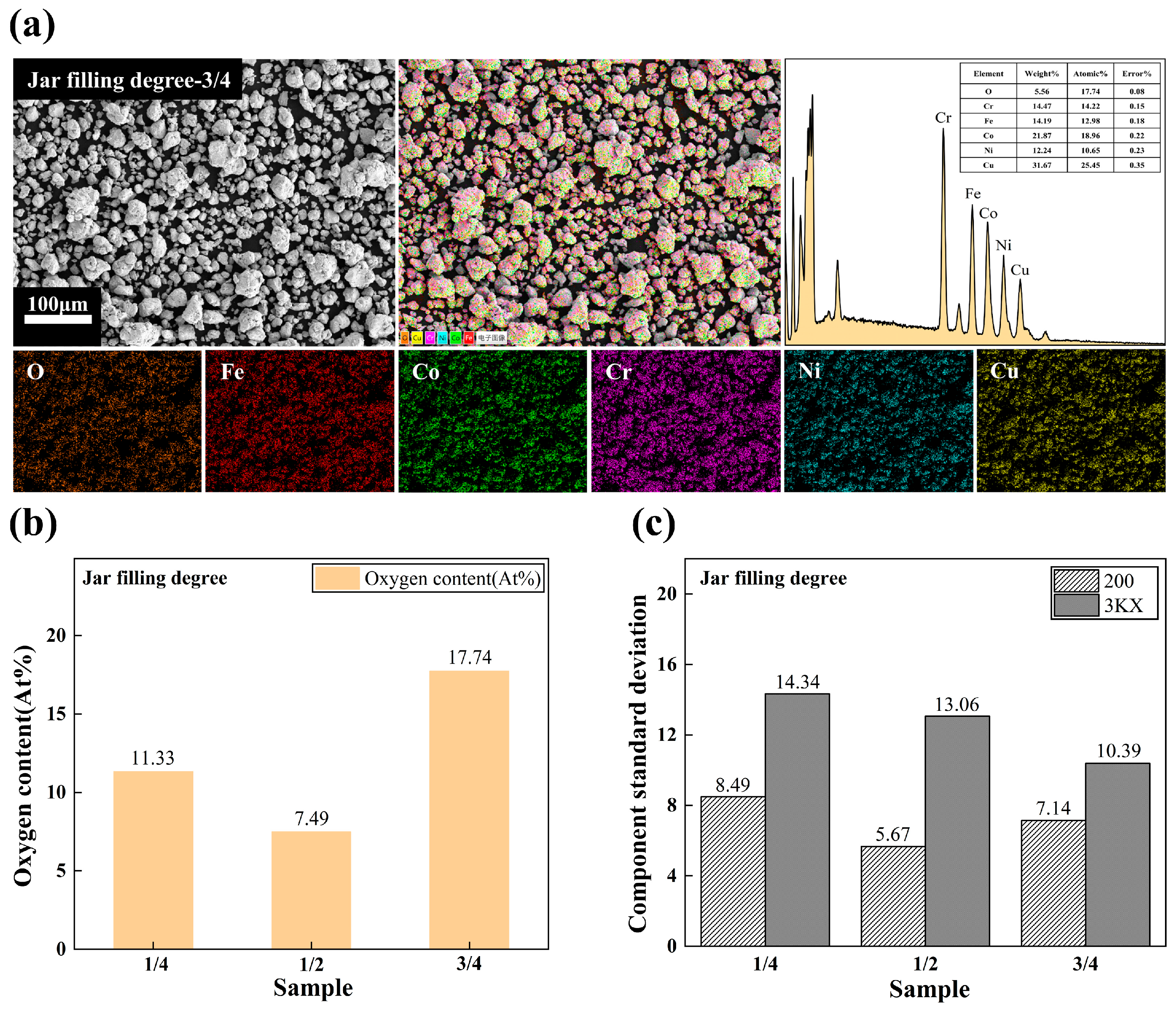
As shown in Figure 2a, an increased filling degree substantially modifies particle morphology, yet the overall elemental distribution remains uniform within the limits of SEM-EDS resolution. The absence of detectable macroscopic inhomogeneity suggests that enhanced collision density predominantly influences physical refinement rather than altering the micrometer-scale compositional balance. Figure 2b reveals a non-monotonic dependence of oxygen content on jar filling degree, with the minimum value obtained at 1/2 among the tested levels, this trend is likely associated with enhanced impact interactions between the powder–ball system and the vial walls at consistent rotational speeds, which may facilitate contamination from the milling media and trace atmospheric oxygen. Moreover, the reduced free motion space at high filling ratios restricts the effective cascading motion of balls, limiting their kinetic trajectories and thereby lowering the number of effective collisions per unit time. The constrained movement tends to produce stronger but fewer impacts, promoting the formation of microcracks and exposing fresh surfaces, which are highly susceptible to oxidation or impurity adsorption.
The compositional standard deviation plotted in Figure 2c demonstrates that the overall chemical uniformity remains stable, with only minor differences among the samples. In fact, the 3/4 jar powder exhibits slightly improved uniformity at 3000× magnification, which can be attributed to the higher degree of plastic deformation and localized diffusion within the compacted powder mass, thereby promoting short-range atomic redistribution. Meanwhile, the transient temperature spikes during impacts can activate short-range diffusion, accelerating elemental redistribution within the plastically deformed regions. Consequently, although surface oxidation becomes more pronounced, the internal mixing dynamics remain strong enough to preserve overall compositional homogeneity, suggesting that fine-scale atomic interdiffusion compensates for surface oxidation effects.
It is well recognized that EDS exhibits inherent limitations when characterizing light elements such as oxygen because of their low fluorescence yield and strong absorption of low-energy X-rays within the matrix [27,28]. As a result, EDS data primarily represent the surface oxygen distribution of the powder rather than the bulk content [29]. Previous studies have similarly emphasized that EDS provides only a semi-quantitative estimation of oxygen, being highly sensitive to surface contamination and beam–sample interaction volume [30]. However, the MA process inherently involves repeated cold welding, fracturing, and rewelding cycles, during which powder surfaces are continuously renewed and internal regions are exposed to the milling atmosphere, thereby promoting a uniform redistribution of oxygen atoms throughout the powder particles, thus resulting in a negligible gradient between surface and core compositions.
Given these considerations, the EDS oxygen data in this study were interpreted qualitatively to identify relative oxidation trends among samples, while the absolute bulk oxygen concentration was determined by ONH analysis, as shown in Table 1. The results are consistent with the EDS-derived trends, confirming that both excessively low and high jar filling degrees lead to increased oxygen incorporation, which validates that the oxygen introduced during MA was homogeneously distributed across the powder particles and that the EDS-derived surface data reliably reflected the overall oxidation behavior. At low filling, the reduced collision frequency and incomplete powder coverage by the milling media extend the exposure time of fine particles to the residual gas atmosphere, thereby facilitating surface oxidation. In contrast, at high filling, the intensified compaction and impact force between the balls and the vial wall increase the likelihood of introducing minor contaminants from the milling media and chamber surfaces. The localized temperature rises and repetitive fracture-welding events further promote the diffusion of oxygen into the powder interior. A minimum filling degree thus minimizes both oxygen uptake and compositional inhomogeneity, emphasizing the importance of precisely controlling the vial loading ratio in MA of high-entropy alloy powders.
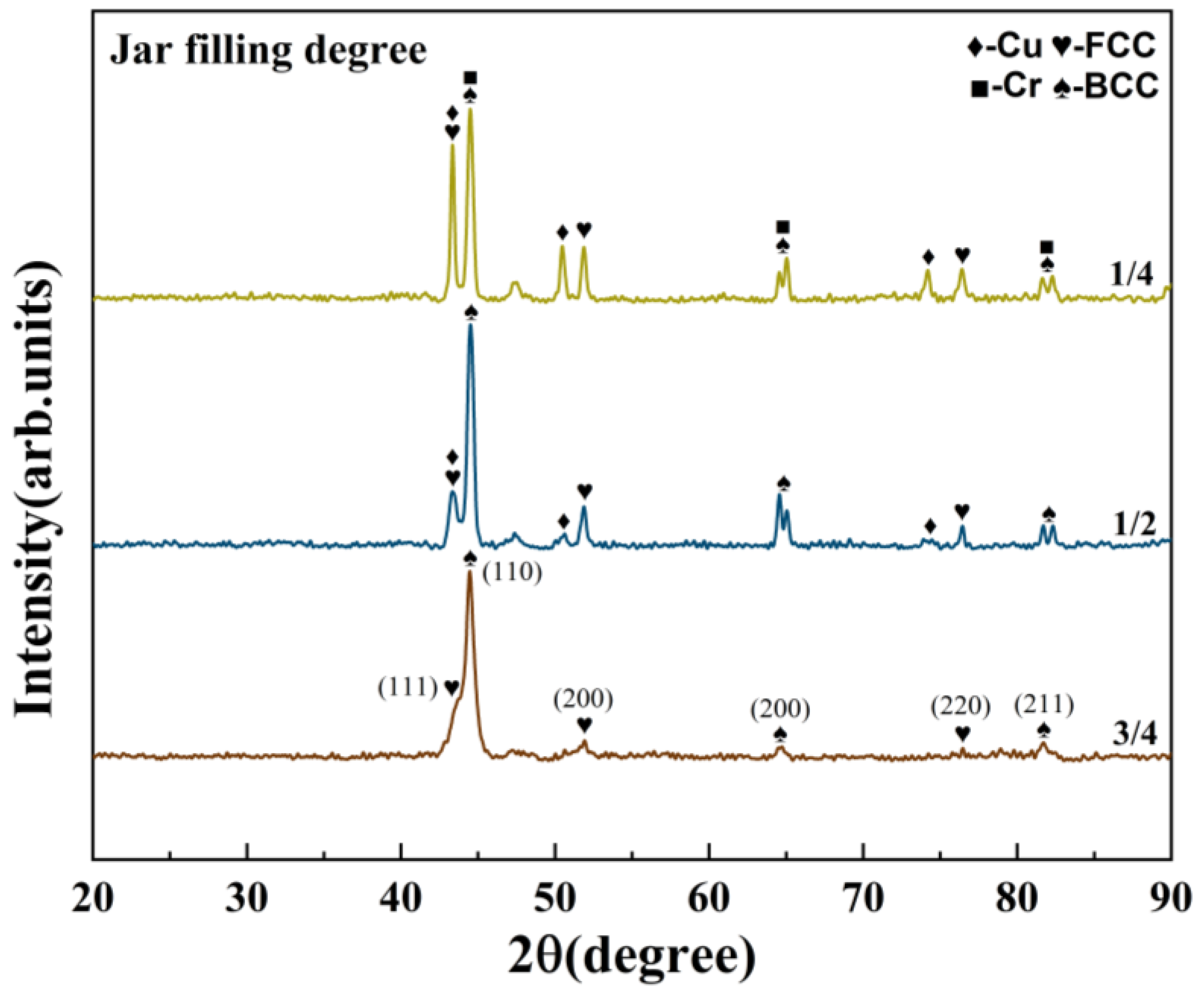
After processing the XRD data of the experimental samples shown in Figure 3, the calculated structural parameters are summarized in Table 2.
Increasing the jar filling degree is observed to coincide with a pronounced refinement of crystallite size and an increase in lattice strain, suggesting that oxygen introduced during milling may promote defect accumulation and suppress grain coarsening by potentially hindering dislocation recovery and grain boundary migration [31]. This phenomenon is consistent with previous reports in which oxygen atoms preferentially segregate at grain boundaries and dislocation cores, thereby increasing local strain energy and stabilizing nanocrystalline structures [32,33]. Nevertheless, such grain refinement simultaneously raises the specific surface area of the powders, generating additional high-energy adsorption sites that facilitate further oxygen uptake [34,35]. Consequently, a self-reinforcing interaction develops: oxygen incorporation induces grain refinement, and the refined microstructure accelerates oxidation, collectively governing the microstructural evolution of alloy powders under high-energy milling conditions.

3.2. Stepwise and Gradient-Ball Milling for the Oxygen–Homogeneity Trade-Off

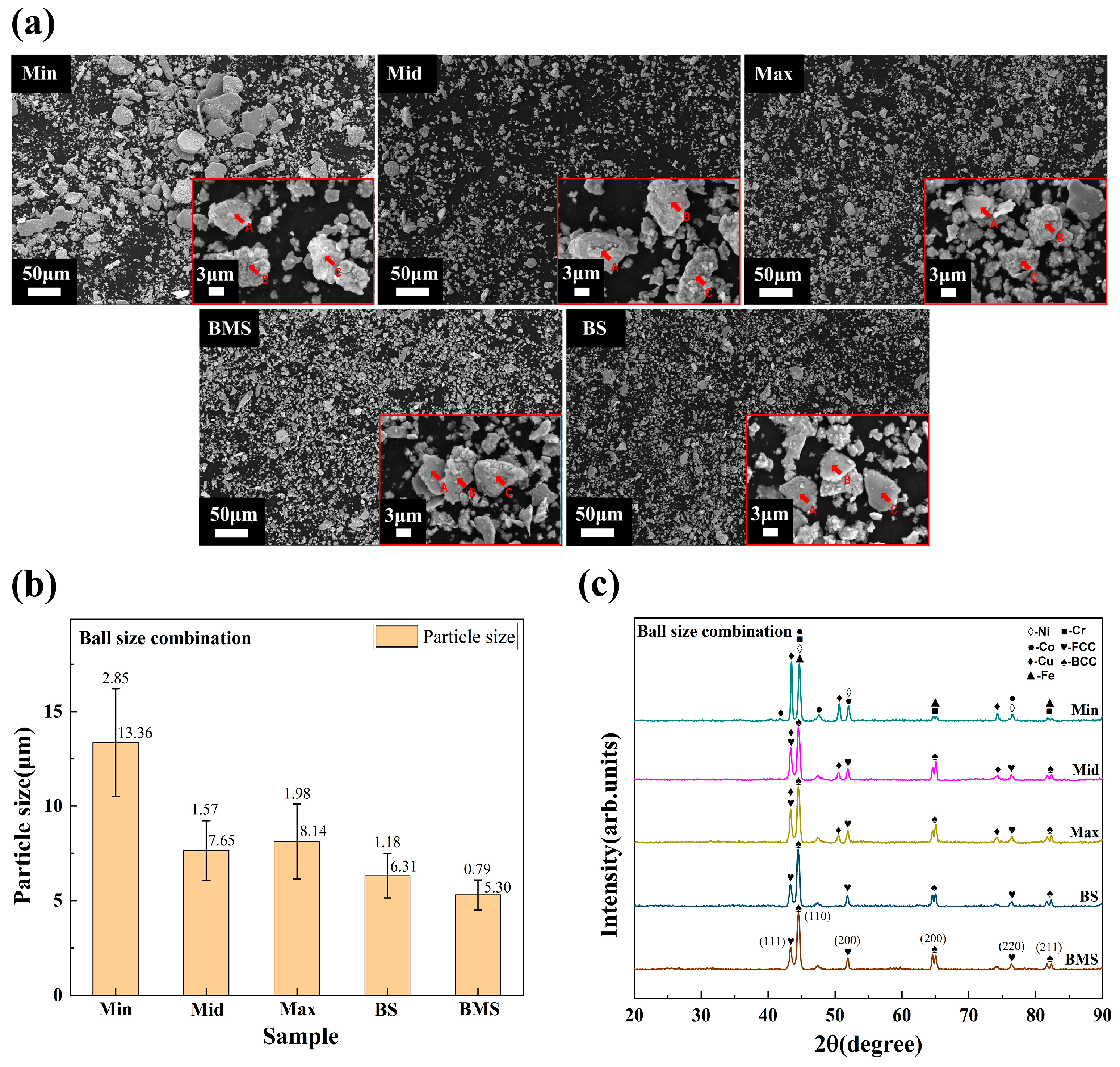
Figure 4 compares the powder morphology and particle size statistics of five ball-size schemes. In Figure 4a, SEM at 200×/3000× shows that Min produces the coarsest and most angular agglomerates, Mid/Max yield finer but still polydisperse particles, whereas BS further refines the powders, and BMS gives the most fragmented and uniformly sized particles. In Figure 4b, the average particle size decreases sequentially from Min to Mid/Max, BS, and finally BMS. The shortest error bars for BMS indicate the narrowest particle size distribution. Particle-size analysis based on SEM is a standard method for tracking MA-induced refinement and distribution changes in HEA powders, and its application here is consistent with established practice.
The observed trends are consistent with the energy imparted by ball-powder-vial collisions. Santhanam and Dreizin formalized this relationship via the milling dose Dm concept, emphasizing that small gains in energy transfer efficiency markedly shift the final size distribution [36]. Mechanistically, single-size small balls appear to favor surface shearing and cold welding over high-energy fracture, which is likely associated with the formation of coarse agglomerates and broad particle size distributions as observed in cases of insufficient collision energy. Single-size large balls supply higher impact energy but can suffer inefficient collisions and less effective mixing, which limits further narrowing of the size distribution. In contrast, multi-size ball configurations create a hierarchy of impact modes in which large balls drive bulk fracture and cold-welding cycles, while small balls raise collision frequency and local shear. Therefore, the BMS combination outperforms the other settings because it maximizes useful energy transfer while enhancing mixing, yielding both a lower mean size and smaller standard deviation. This trend aligns with findings from other studies on MA processing parameters, indicating that adjusting milling parameters tunes the balance between fracture and cold-welding to approach a steady refined state [37,38,39].
The distinct differences in phase constitution and alloying behavior with changes in ball size combination are revealed by XRD patterns in Figure 4c. Under the Min condition, multiple sharp peaks corresponding to the pure metallic elements, including Fe, Co, Cr, Ni, and Cu, are observed, indicating incomplete alloying. The limited solid-solution formation arises from the relatively low collision energy and insufficient plastic deformation associated with small balls, which hinder diffusion and mixing during MA of multi-principal-element systems.
As the ball size increases, the distinct elemental peaks progressively merge, and two broad reflections corresponding to the FCC and BCC solid-solution phases emerge, which appears to indicate an enhanced MA efficiency likely associated with increased impact energy that promotes repeated welding fracture cycles and atomic diffusion. Such dual-phase coexistence is frequently observed in HEAs produced by high-energy ball milling, resulting from competitive stabilization between FCC and BCC lattices governed by atomic size mismatch (δ) and mixing enthalpy (ΔHmix) [40,41,42]. This structural transition suggests that larger ball impacts may effectively drive the system toward a more homogeneous solid solution state by providing sufficient energy to overcome the kinetic barriers associated with multi-principal-element diffusion [43].
Compared with single-size milling configurations, the BS and BMS mixed-ball systems exhibit a noticeable reduction in the FCC diffraction peak intensity. This phenomenon can be primarily associated with the refined crystallite size and the high lattice macrostrain induced by the complex collision environment of mixed-ball milling. The simultaneous presence of high-energy impacts from large balls and frequent lower-energy contacts from smaller ones accelerates defect generation and fragmentation, leading to peak broadening and an apparent decrease in FCC peak height rather than an actual reduction in FCC phase content. Furthermore, the enhanced mechanical energy in mixed-ball systems promotes the redistribution of alloying elements and the competitive stabilization of phases. Meanwhile, a slight variation in the relative intensity of the BCC reflections is also noted in the mixed-ball systems. This change is associated with microstructural evolution under more intense collision conditions during milling, including crystallite refinement and increased peak broadening, which can modify the apparent FCC/BCC intensity ratio in XRD. Similar variations in FCC/BCC intensity ratios have been reported in mechanically alloyed FeCoCrNiCu systems under high-energy milling conditions [44]. In addition, the high defect density and lattice disorder introduced by repeated cold welding and fracture cycles diminish long-range order, lowering the coherent scattering power of FCC planes [45]. Overall, the reduced FCC peak intensity observed in the BS/BMS powders is primarily associated with microstructural refinement and strain-induced peak broadening under intensified milling conditions. The increased defect density and reduced coherent domain size modify the diffraction response, thereby affecting the apparent FCC peak height rather than indicating a confirmed reduction in the overall FCC phase fraction.
Based on the detailed analysis of the XRD patterns shown in Figure 4c, the quantitative structural parameters are summarized in Table 3. All samples exhibit dual-phase FCC + BCC structures, but the relative phase fractions vary significantly with ball-size configuration. For single-size systems, the BCC phase constitutes the majority, indicating its preferential stabilization under high-energy deformation. This tendency is likely associated with the higher atomic-size mismatch and negative mixing enthalpy among Fe, Cr, and Co, which promotes the formation of a disordered BCC solid solution under severe plastic deformation. The limited grain coarsening of mixed-ball systems may be explained by more homogeneous energy transfer and the reduction in localized deformation, which suppresses abnormal grain growth while sustaining plastic refinement and preserving dual-phase stability. Furthermore, the modest increase in LS reflects an equilibrium between defect accumulation and dynamic recovery during repeated collision [46,47].
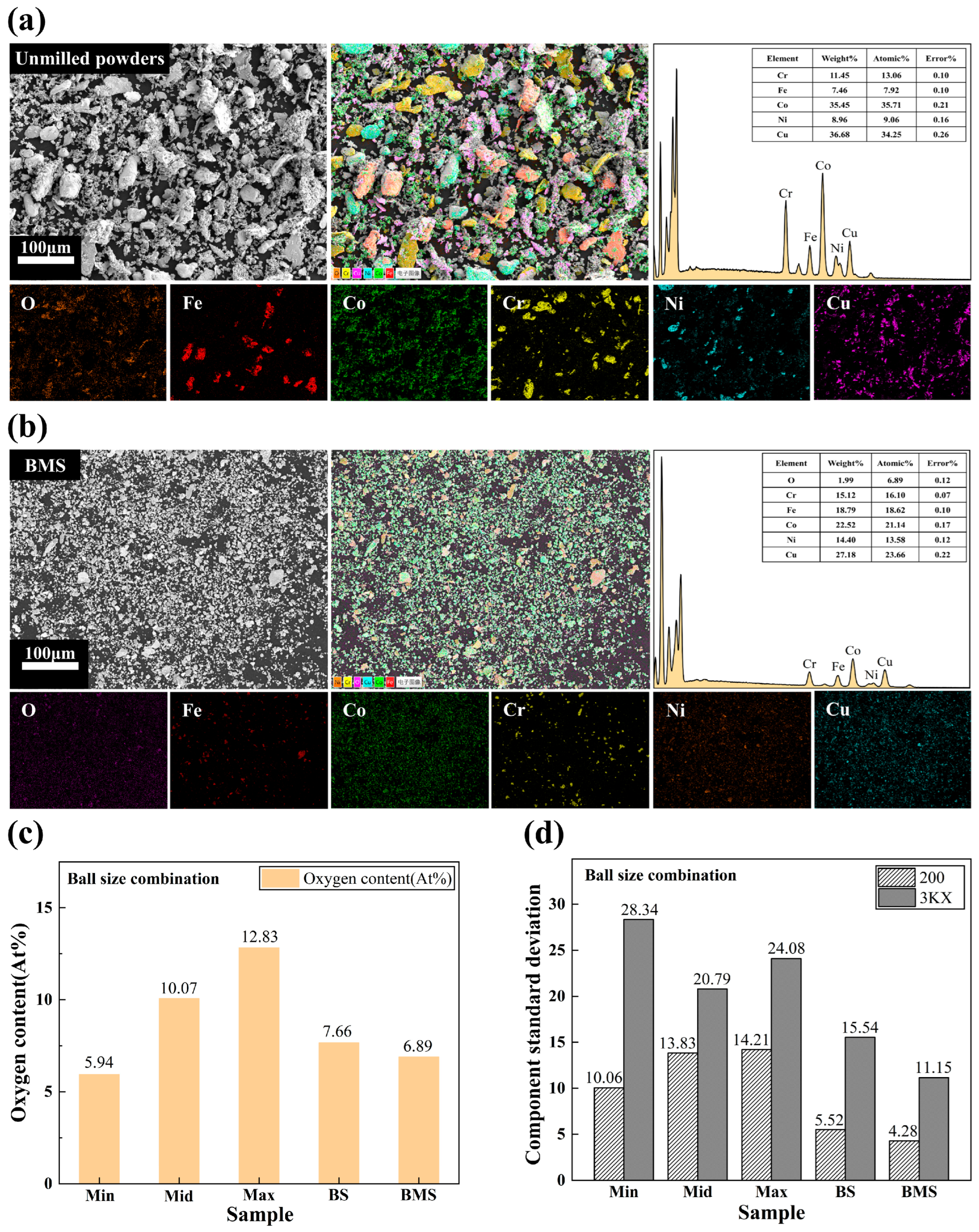
As illustrated in Figure 5a,b, the overall particle morphology shows moderate refinement after milling, while more significant changes are observed in the elemental distribution. The unmilled elemental mixture naturally presents discrete single-element regions without alloying. After milling under the BMS condition, the EDS maps reveal a more uniform spatial distribution of Fe, Co, Cr, Ni, and Cu, confirming that MA effectively promotes diffusion and solid-solution formation among the constituent elements. Similar homogenization phenomena have been observed in related HEA systems subjected to high-energy ball milling. Despite this improvement, Figure 5b indicates that the Cu content remains the highest, followed by Co and Fe, which is consistent with the positive enthalpy of mixing between Cu and other 3d transition metals, thereby thermodynamically limiting complete solid solution formation during early or intermediate alloying stages. Directional-solidification studies of FeCoCrNiCu systems similarly report Cu-rich regions or secondary FCC2 phases, arising from sluggish diffusion and phase immiscibility. During MA, Cu exhibits a relatively low solubility and mobility within the FeCoCrNi matrix, leading to temporary elemental enrichment, as confirmed by Wu et al. [48]. Thus, the higher Cu signal in Figure 5b reflects both intrinsic thermodynamic constraints and kinetic limitations, rather than measurement artifacts.
The oxygen content evolution, as derived from 200× area scans in Figure 5c, exhibits a clear trend. The Min condition results in the lowest oxygen level, which rises progressively with increasing ball size and peaks under the Max condition. Subsequently, the BS and BMS mixed-ball configurations show a moderate reduction in oxygen content, which may be attributed to the interplay between impact energy, collision frequency, and exposure-induced oxidation. Small balls provide frequent, low-energy collisions that promote plastic deformation without excessive surface activation, thereby minimizing oxidation. In contrast, large balls generate localized high-temperature impacts that enhance oxide formation through repeated surface fracture and re-welding. The partial recovery of low oxygen content in mixed-size systems arises from the synergistic balance between fine-particle dispersion and moderated impact severity.
Figure 5d presents the component standard deviation, a quantitative measure of compositional uniformity, which was obtained after removing the oxygen contribution and normalizing elemental proportions. Both 200× area-scan and 3000× point-scan results exhibit the same general tendency. The Min scheme achieves the lowest macroscopic compositional standard deviation, while increasing ball size leads to degraded uniformity. The BMS condition markedly reduces standard deviation compared to Mid and Max systems but remains slightly inferior to the Min condition. The tendency is consistent with the MA principle, whereby a high collision frequency and distributed shear deformation promote effective fragmentation of lamellae and uniform redistribution of elements. However, excessive impact energy from larger balls can induce agglomeration and heterogeneous lamella formation, thereby diminishing local mixing efficiency. Mixed-ball schemes balance these effects, enabling both high-impact fragmentation and fine-scale mixing. Consequently, the BMS milling scheme effectively reduces excessive lattice distortion and balances phase transformation kinetics, promoting dual-phase stabilization while maintaining overall compositional homogeneity.
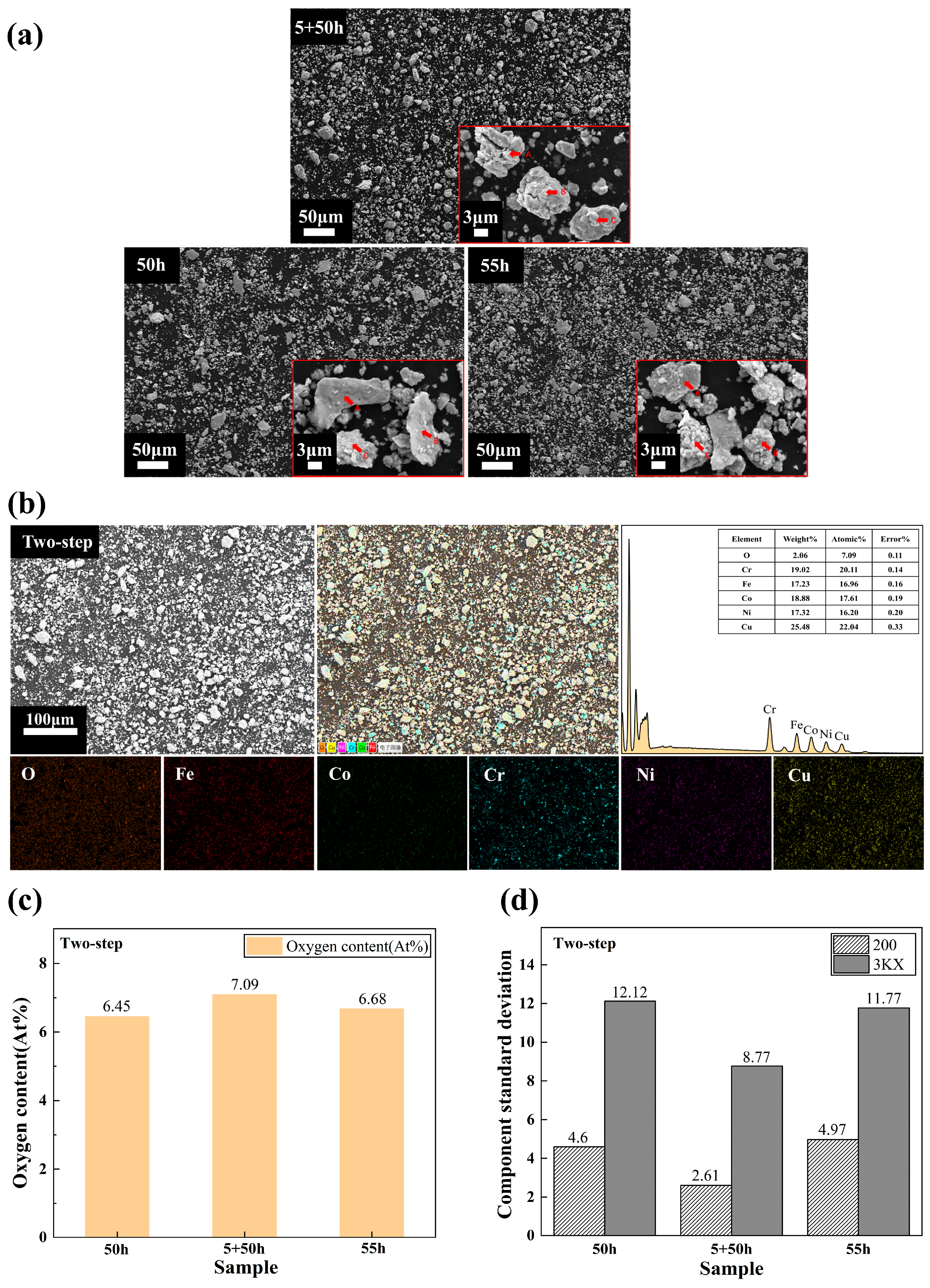
The two-step route involved low-speed pre-milling with small balls for 5 h, followed by continued high-energy milling using medium and large balls for 50 h. This approach yielded powders with markedly improved elemental uniformity compared with the single-step 50 h and 55 h conditions, as confirmed by EDS analysis shown in Figure 6b. The enhanced homogenization arises from the early-stage fine blending and surface activation induced by small-ball milling, which promote intimate particle contact and facilitate subsequent atomic diffusion under higher-energy impacts from larger balls. Furthermore, the short pre-milling duration of 5 h plays a crucial role in limiting powder over-activation and oxidation, as prolonged exposure to high surface energy states promotes oxygen uptake during MA. As indicated by Figure 6c, the oxygen content of the two-step sample increases slightly relative to the 50 h sample but remains below that of 55 h, demonstrating a controlled oxidation-homogenization balance. In the present system, the mild oxidation likely originates from dislocation-assisted adsorption of oxygen at defect-rich regions generated during pre-milling [24].
As shown in Figure 6d, compositional standard deviation analysis reveals that the two-step route effectively reduces chemical inhomogeneity at both 200× and 3000× magnifications, which is likely associated with the balanced energy distribution achieved by combining low- and high-impact events, promoting diffusion without excessive cold welding or agglomeration. Similar diffusion-activation dynamics have been reported by Suprianto and Chen [32], who observed that pre-milling treatments reduce oxide segregation and enhance uniform solid-solution formation in Cr-containing HEAs. Additionally, the presence of Cu, which exhibits a positive mixing enthalpy with Fe and Co, may influence the relative stability of the FCC structure during MA. In the two-step milling route, the modified impact sequence and energy distribution can affect the overall compositional homogenization process at the macroscopic scale, which may in turn contribute to the observed phase evolution.
To further quantify the oxygen evolution under different milling strategies, ONH analysis was performed to measure the bulk oxygen content of the FeCoCrNiCu powders. As shown in Table 4, the results confirmed that the measured oxygen contents followed the same trend as inferred from EDS, a minor increase for the two-step milling relative to 50 h, and a further rise for 55 h continuous milling.

3.3. Mechanisms of Oxidation and Powder Contamination

To further clarify the origin of the slight oxygen increase observed during the two-step MA process, a dedicated experiment was designed in which sampling interruption frequency was used as the sole variable to validate the hypothesis. The experimental results are summarized in Table 5. Although all milling operations were performed under argon protection within a glovebox, the powders still showed a non-negligible increase in oxygen content. Interestingly, the rate of oxidation accelerates with increasing sampling frequency, indicating a cumulative effect driven by repeated exposure. Each interruption, necessitating the opening and resealing of the milling vial, briefly disturbs the inert atmosphere, allowing trace amounts of oxygen and moisture to infiltrate the system. These seemingly negligible perturbations, when repeated, significantly compromise the oxygen integrity of the environment. The powders, characterized by freshly fractured surfaces rich in lattice defects, dislocation cores, and high-energy grain boundaries, exhibit heightened chemical reactivity. Upon re-exposure, the active sites readily chemisorb incoming oxygen molecules. Continued milling not only reactivates partially oxidized surfaces through cold welding and fracture cycles and defect-assisted pathways may contribute to enhanced oxygen transport. Consequently, oxygen incorporation occurs both at the surface and within particle interiors, leading to progressively accelerated oxidation despite the low external oxygen partial pressure.
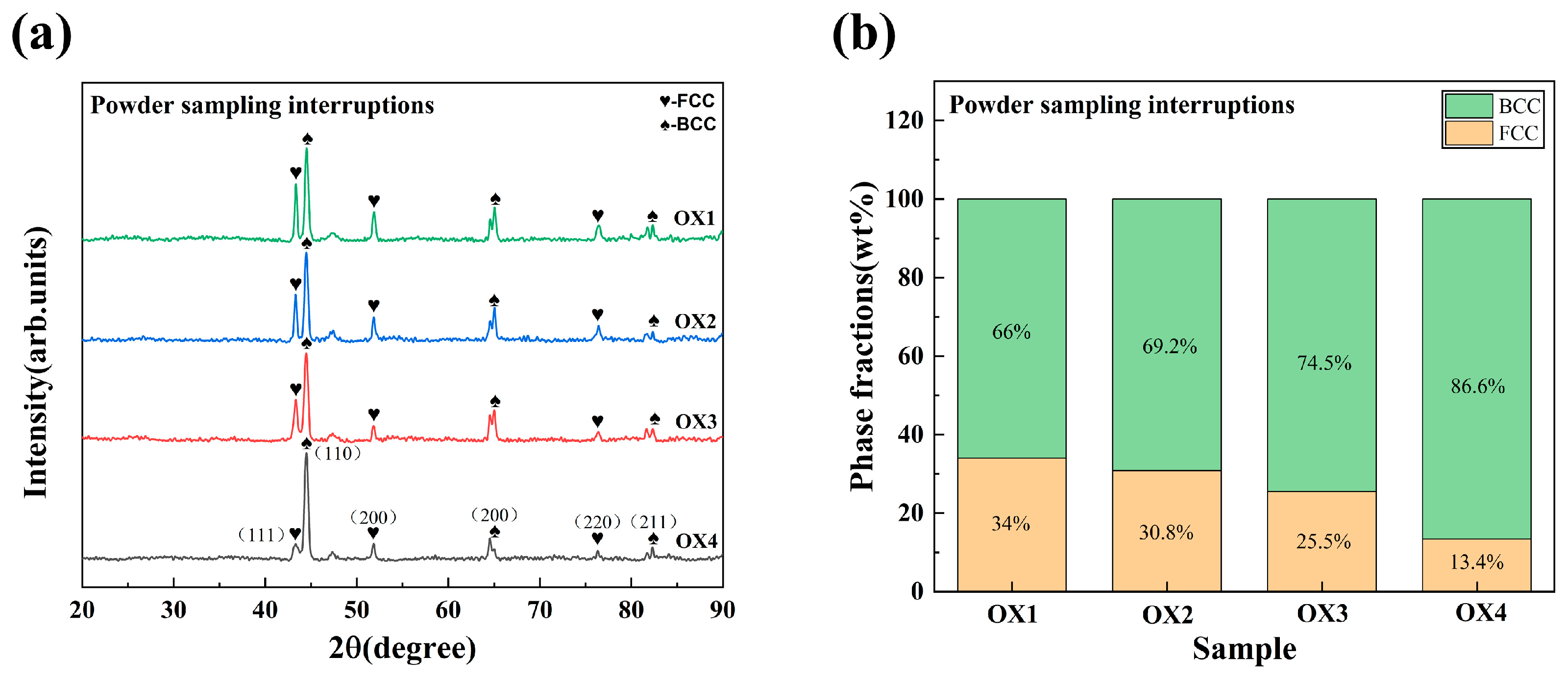
The XRD analysis of powders subjected to different sampling interruptions is presented in Figure 7a, and the corresponding phase fractions derived from RIR-based quantitative evaluation are summarized in Figure 7b. The data demonstrate a clear trend: the FCC phase fraction decreases progressively with increasing sampling frequency, while the BCC phase fraction correspondingly becomes dominant, which is consistent with the interpretation discussed in Section 3.1, where increased oxygen uptake associated with repeated handling was suggested to affect lattice stability and phase balance.
More specifically, the increased frequency of sampling interruptions exposes the powders intermittently to the ambient atmosphere, leading to incremental surface oxidation and oxygen incorporation that facilitates additional lattice strain and defect accumulation during subsequent milling, thereby potentially enhancing lattice distortion. As reported in previous studies, the presence of interstitial oxygen and heterogeneous strain fields destabilizes the FCC lattice by amplifying atomic size mismatch and altering the enthalpy of mixing, ultimately favoring the nucleation and growth of the BCC phase [49,50,51]. These structural changes are closely associated with the enhanced chemical reactivity and defect density introduced during MA. The observed evolution in phase composition in the present work is consistent with this interpretation, suggesting that oxygen uptake and microstructural heterogeneity may influence the FCC-to-BCC phase balance in HEA systems. This observation supports the interpretation drawn from the BMS analysis, indicating that controlled energy distribution and limited atmospheric disturbance are likely important factors in stabilizing the dual-phase structure in FeCoCrNiCu powders processed via MA.

4. Conclusions

In summary, the objective of developing a controlled ball milling strategy for FeCoCrNiCu high-entropy alloy powders has been successfully achieved through the implementation of a two-step combined milling route. This work demonstrates that the proposed strategy provides an effective and scalable approach for synthesizing powders with enhanced compositional uniformity while maintaining limited oxygen uptake. By introducing a low-energy pre-mixing stage prior to high-energy MA, the diffusion kinetics and mixing efficiency of the constituent elements were significantly improved, yielding powders maintaining structural integrity. Although a slight increase in oxygen content was observed due to the intermediate sampling interruption, combined EDS and ONH analyses confirmed that the oxygen uptake was both limited and homogeneously distributed. The findings indicate that the two-step approach provides a more favorable balance between oxygen incorporation and microstructural uniformity, yielding HEA powders with stable dual-phase (FCC + BCC) structures and reduced compositional standard deviation. Furthermore, the comparative evaluation and controlled selection of auxiliary milling parameters, including ball size combinations and jar filling degrees, was associated with improved alloying efficiency and refined crystallite structure under controlled oxygen uptake. The novelty of this study lies in integrating a two-step sequential milling route with gradient ball-size configurations and systematically evaluating the influence of jar filling degree on the oxygen–homogeneity trade-off under controlled processing conditions. Overall, the proposed two-step milling route provides a practical solution for producing compositionally homogeneous HEA powders with controlled oxidation behavior, thereby advancing the scalable fabrication of high-performance multi-component alloys [52,53].

Author Contributions

Y.Z. was involved in formal analysis, validation, writing—original draft, and visualization; W.L. contributed to formal analysis, and writing—review & editing; Z.S., K.L. and J.D. contributed to conceptualization, supervision, investigation, and writing—review & editing. All authors have read and agreed to the published version of the manuscript.

Funding

The authors would like to acknowledge financial support from the National Natural Science Foundation of China (No. 12372116).

Data Availability Statement

The datasets generated during and/or analyzed during the current study are available from the corresponding author on reasonable request.

Acknowledgments

The author acknowledgments Taixing Chengxing State Assets Management & Investment Co., Ltd. and Xi’an Jiaotong University for jointly establishing the Laboratory for Novel Disorder Materials.

Conflicts of Interest

The author Zhendong Sha has a project collaboration with Taixing Chengxing State Assets Management & Investment Co., Ltd. The remaining authors declare that the research was conducted in the absence of any commercial or financial relationships that could be construed as a potential conflict of interest.

References

  1. Chen, R.C.; Shi, X.L.; Kang, H.J.; Guo, E.Y.; Chen, Z.N.; Lu, Y.P.; Wang, T.M.; Chen, Z.G. A critical review on medium- and high-entropy thermoelectric alloys. Mater. Today 2025, 90, 815–837. [Google Scholar] [CrossRef]
  2. Cantor, B.; Chang, I.T.H.; Knight, P.; Vincent, A.J.B. Microstructural development in equiatomic multicomponent alloys. Mat. Sci. Eng. Struct. A 2004, 375, 213–218. [Google Scholar] [CrossRef]
  3. Yeh, J.W.; Chen, S.K.; Lin, S.J.; Gan, J.Y.; Chin, T.S.; Shun, T.T.; Tsau, C.H.; Chang, S.Y. Nanostructured high-entropy alloys with multiple principal elements: Novel alloy design concepts and outcomes. Adv. Eng. Mater. 2004, 6, 299–303. [Google Scholar] [CrossRef]
  4. Ding, J. Order or disorder, that’s the question in high-entropy alloys. Nat. Rev. Mater. 2026, 11, 82–83. [Google Scholar] [CrossRef]
  5. Otto, F.; Dlouhy, A.; Somsen, C.; Bei, H.; Eggeler, G.; George, E.P. The influences of temperature and microstructure on the tensile properties of a CoCrFeMnNi high-entropy alloy. Acta Mater. 2013, 61, 5743–5755. [Google Scholar] [CrossRef]
  6. Mane, P.J.; Shantharaja, M.; Manne, B.; Raju, B.S. Effect of FeCoNiMnCr High-Entropy Alloy Reinforcement on Mechanical, Wear, and Thermal Expansion Behavior of Copper Matrix Composites. JOM 2023, 75, 4421–4434. [Google Scholar] [CrossRef]
  7. Zhang, J.; Ma, Z.Y.; Xun, K.H.; Sha, Z.D.; Ding, J. Local chemical order in CrFeCoNiPd high entropy alloys. J. Appl. Phys. 2025, 138, 4. [Google Scholar] [CrossRef]
  8. Hu, Q.; Wang, H.L.; Qian, L.H.; Zeng, L.C.; Wang, Q.; Liu, X.W. Effects of Cu additions on microstructure and mechanical properties of as-cast CrFeCoNiCux high-entropy alloy. Trans. Nonferrous Met. Soc. China 2023, 33, 1803–1813. [Google Scholar] [CrossRef]
  9. Mukanov, S.; Loginov, P.; Fedotov, A.; Bychkova, M.; Antonyuk, M.; Levashov, E. The Effect of Copper on the Microstructure, Wear and Corrosion Resistance of CoCrCuFeNi High-Entropy Alloys Manufactured by Powder Metallurgy. Materials 2023, 16, 1178. [Google Scholar] [CrossRef]
  10. Lee, H.; Sharma, A.; Kim, M.; Ahn, B. Correlation between the nanomechanical characteristic and the phase transformation of BCC-based high entropy alloys produced via powder metallurgy. Powder Metall. 2023, 66, 669–678. [Google Scholar] [CrossRef]
  11. Wu, G.X.; Chen, H.; Qu, P.C.; Qiao, Y.Z.; Hua, Y.; Wang, Y.J.; Huang, Y.D.; Yang, W.J. Revealing the Mechanism of Oxidative Evolution of FeNiCuCoCr High-Entropy Alloys at 900 °C. JOM 2025, 1–11. [Google Scholar] [CrossRef]
  12. Mehmood, K.; Imran, M.; Ali, L.; Umer, M.A.; Abbas, M.; Saleem, M. Development of Cost-Effective Microstructure and Isothermal Oxidation-Resistant Bond Coats on Inconel 718 by Atmospheric Plasma-Sprayed NiCoCrAlFe High-Entropy Alloy. JOM 2023, 75, 239–247. [Google Scholar] [CrossRef]
  13. Lee, H.; Kim, M.; Sharma, A.; Ahn, B. Oxidative and abrasive wear of multiphase AlSiTiMnFeCu (=0, 0.25, 0.5) high entropy alloy under non-lubricating reciprocating motion. Powder Metall. 2023, 66, 623–634. [Google Scholar] [CrossRef]
  14. Dallari, E.; Bononi, M.; Pola, A.; Tocci, M.; Veronesi, P.; Giovanardi, R. Pulsed Current Effect on the Hard Anodizing of an AlSi10Mg Aluminum Alloy Obtained via Additive Manufacturing. Surfaces 2023, 6, 97–113. [Google Scholar] [CrossRef]
  15. Zhang, H.F.; Gao, B.; Wang, L.; Shen, W.H.; Lin, P.S.; Lan, X.; Liu, H. Effect of High-Current Pulsed Electron Beam on Microstructure and Surface Properties of Ag-10La0.7Sr0.3CoO3 Composites. Surfaces 2024, 7, 739–751. [Google Scholar] [CrossRef]
  16. Zhang, K.B.; Fu, Z.Y.; Zhang, J.Y.; Shi, J.; Wang, W.M.; Wang, H.; Wang, Y.C.; Zhang, Q.J. Nanocrystalline CoCrFeNiCuAl high-entropy solid solution synthesized by mechanical alloying. J. Alloy Compd. 2009, 485, L31–L34. [Google Scholar] [CrossRef]
  17. Smeltzer, J.A.; Burton, M.T.; Hornbuckle, B.C.; Giri, A.K.; Darling, K.A.; Harmer, M.P.; Marvel, C.J. Optimization of cryogenic mechanical alloying parameters to synthesize ultrahard refractory high entropy materials. Mater. Des. 2021, 210, 110070. [Google Scholar] [CrossRef]
  18. Varalakshmi, S.; Kamaraj, M.; Murty, B.S. Synthesis and characterization of nanocrystalline AlFeTiCrZnCu high entropy solid solution by mechanical alloying. J. Alloy Compd. 2008, 460, 253–257. [Google Scholar] [CrossRef]
  19. Chen, Y.; Yang, R.; Zhang, C.; Song, J.; Che, Y.; He, J. Novel process for preparing tungsten powder by hydrogen reduction of tungsten trioxide. Int. J. Refract. Met. Hard Mater. 2022, 106, 105869. [Google Scholar] [CrossRef]
  20. Liu, X.; Yun, H.; Hou, R.G.; Lv, Z. Effects of milling process parameters on the mechanical alloying behavior of CoCrFeNiAlNb high-entropy alloy powder. Mater. Today Commun. 2025, 48, 113458. [Google Scholar] [CrossRef]
  21. Shkodich, N.F.; Kovalev, I.D.; Kuskov, K.; Kovalev, D.Y.; Vergunova, Y.S.; Scheck, Y.B.; Vadchenko, S.G.; Politano, O.; Baras, F.; Rogachev, A.S. Fast mechanical synthesis, structure evolution, and thermal stability of nanostructured CoCrFeNiCu high entropy alloy. J. Alloy Compd. 2022, 893, 161839. [Google Scholar] [CrossRef]
  22. Yazdani, N.; Toroghinejad, M.R.; Shabani, A.; Cavaliere, P. Effects of Process Control Agent Amount, Milling Time, and Annealing Heat Treatment on the Microstructure of AlCrCuFeNi High-Entropy Alloy Synthesized through Mechanical Alloying. Metals 2021, 11, 1493. [Google Scholar] [CrossRef]
  23. Kalantari, H.; Khayati, G.R.; Adeli, M. A high entropy alloy of AlCrFeNiTiZn synthesized through mechanical alloying and sintering. Intermetallics 2023, 161, 107981. [Google Scholar] [CrossRef]
  24. Moravcik, I.; Kubicek, A.; Moravcikova-Gouvea, L.; Adam, O.; Kana, V.; Pouchly, V.; Zadera, A.; Dlouhy, I. The Origins of High-Entropy Alloy Contamination Induced by Mechanical Alloying and Sintering. Metals 2020, 10, 1186. [Google Scholar] [CrossRef]
  25. Li, H.; He, M. Calculating the reference intensity ratio of crystalline phases with unknown atomic arrangements using the lattice parameters and chemical information. J. Appl. Crystallogr. 2023, 56, 1707–1713. [Google Scholar] [CrossRef]
  26. Klug, H.P.; Alexander, L.E. X-Ray Diffraction Procedures for Polycrystalline and Amorphous Materials, 2nd ed.; John Wiley & Sons: New York, NY, USA, 1974; p. xxv. 966p. [Google Scholar]
  27. Newbury, D.E.; Ritchie, N.W.M. Performing elemental microanalysis with high accuracy and high precision by scanning electron microscopy/silicon drift detector energy-dispersive X-ray spectrometry (SEM/SDD-EDS). J. Mater. Sci. 2015, 50, 493–518. [Google Scholar] [CrossRef]
  28. Newbury, D.E.; Ritchie, N.W.M. Faults and Foibles of Quantitative Scanning Electron Microscopy/Energy Dispersive X-ray Spectrometry (SEM/EDS). Proc. Spie 2012, 8378. [Google Scholar] [CrossRef]
  29. Newbury, D.E.; Ritchie, N.W.M. Is Scanning Electron Microscopy/Energy Dispersive X-ray Spectrometry (SEM/EDS) Quantitative? Scanning 2013, 35, 141–168. [Google Scholar] [CrossRef]
  30. Shirley, B.; Jarochowska, E. Chemical characterisation is rough: The impact of topography and measurement parameters on energy-dispersive X-ray spectroscopy in biominerals. Facies 2022, 68, 7. [Google Scholar] [CrossRef]
  31. Wilde, G.; Divinski, S. Grain Boundaries and Diffusion Phenomena in Severely Deformed Materials. Mater. Trans. 2019, 60, 1302–1315. [Google Scholar] [CrossRef]
  32. Suprianto; Chen, C.L. Study of (Ni,Cr) pre-milling for synthesis of CoFe(NiCr)Mn high entropy alloy by mechanical alloying. Mat. Sci. Eng. Struct. A 2021, 807, 140810. [Google Scholar] [CrossRef]
  33. Zhang, Z.; Wang, Q.Q.; Mu, D.K.; Shen, G.Y.; Liu, M.H.; Zhang, M.; Chan, S.L.I.; Liang, J.M.; Wang, J. Microstructure evolution and mechanical properties of CoCrFeNiAl high entropy alloy produced by ball milling in combination with thermomechanical consolidation. Mater. Charact. 2022, 187, 111833. [Google Scholar] [CrossRef]
  34. Li, B.Y.; Fu, T.R.; Shi, C.L. Correlations between High-Temperature Oxidation Kinetics and Thermal Radiation Characteristics of Micro-Structured Nickel Surfaces Oxidized at 1173 K. Metals 2019, 9, 17. [Google Scholar] [CrossRef]
  35. Karanth, Y.; Sharma, S.; Darling, K.; El Kadiri, H.; Solanki, K. Oxidation Behavior of Nanocrystalline Alloys. Materials 2024, 17, 5842. [Google Scholar] [CrossRef]
  36. Santhanam, P.R.; Dreizin, E.L. Predicting conditions for scaled-up manufacturing of materials prepared by ball milling. Powder Technol. 2012, 221, 403–411. [Google Scholar] [CrossRef]
  37. Simba, K.P.; Moys, M.H. Effects of mixtures of grinding media of different shapes on milling kinetics. Miner. Eng. 2014, 61, 40–46. [Google Scholar] [CrossRef]
  38. Katubilwa, F.M.; Moys, M.H. Effect of ball size distribution on milling rate. Miner. Eng. 2009, 22, 1283–1288. [Google Scholar] [CrossRef]
  39. Miyazawa, O.; Kamo, R.; Takaya, Y.; Gunji, S.; Momota, K.; Shiina, S.; Okuyama, K.; Kamiya, H.; Tokoro, C. DEM study for investigating the mixing effect of two differently sized grinding media in an agitated media mill. Adv. Powder Technol. 2025, 36, 104810. [Google Scholar] [CrossRef]
  40. Jo, Y.H.; Choi, W.M.; Kim, D.G.; Zargaran, A.; Sohn, S.S.; Kim, H.S.; Lee, B.J.; Kim, N.J.; Lee, S. FCC to BCC transformation-induced plasticity based on thermodynamic phase stability in novel VCrFeCoNi medium-entropy alloys. Sci. Rep. 2019, 9, 2948. [Google Scholar] [CrossRef] [PubMed]
  41. Chen, L.J.; Zou, S.H.; Sui, S.; Weng, F.; Huangfu, S.X.; Cao, L.C.; Zhang, H.; Gaponenko, S.V.; Yang, T.; Ju, J.; et al. In situ tuning of FCC-BCC dual phase and mechanical properties in multi-principal element alloys via laser-aided additive manufacturing. Rare Met. 2025, 44, 7829–7845. [Google Scholar] [CrossRef]
  42. Luo, G.J.; Li, L.; Fang, Q.H.; Li, J.; Tian, Y.Y.; Liu, Y.; Liu, B.; Peng, J.; Liaw, P.K. Microstructural evolution and mechanical properties of FeCoCrNiCu high entropy alloys: A microstructure-based constitutive model and a molecular dynamics simulation study. Appl. Math. Mech. 2021, 42, 1109–1122. [Google Scholar] [CrossRef]
  43. Das, I.M.; Kumar, H.; Behera, K.K.; Makineni, S.; Bakshi, S.R.; Mandal, A.; Gollapudi, S. Microstructure and indentation of a (MoNbTaVW)C system processed by high energy ball milling followed by spark plasma sintering at 1800 °C. Mater. Charact. 2025, 225, 115124. [Google Scholar] [CrossRef]
  44. Huang, M.J.; Jiang, J.F.; Wang, Y.; Liu, Y.Z.; Zhang, Y. Effects of milling process parameters and PCAs on the synthesis of AlCoCrCuFeNi high entropy alloy powder by mechanical alloying. Mater. Des. 2022, 217, 110637. [Google Scholar] [CrossRef]
  45. Basooli, F.; Raanaei, H. Influence of milling time on solid solution formation, magnetic characteristics, and thermal behavior of (Co-Fe)70Ti8 Nb4 B18 soft ferromagnetic alloy via mechanical alloying synthesis. Mater. Chem. Phys. 2025, 332, 130250. [Google Scholar] [CrossRef]
  46. Yadav, Y.K.; Abu Shaz, M.; Mukhopadhyay, N.K.; Yadav, T.P. High entropy alloys synthesized by mechanical alloying: A review. J. Alloy Metall. Syst. 2025, 9, 100170. [Google Scholar] [CrossRef]
  47. Nagarjuna, C.; Dewangan, S.K.; Lee, K.; Ahn, B. Mechanical and thermal expansion behaviour of TiC-reinforced CoCrFeMnNi high entropy alloy prepared by mechanical alloying and spark plasma sintering. Powder Metall. 2023, 66, 613–622. [Google Scholar] [CrossRef]
  48. Wu, Y.T.; Du, C.C.; Yu, Z.L.; Wang, R.T.; Ren, X.D. Effect of Cu content on the microstructure and mechanical properties of Fe20Co30Ni10Cr20Mn20 FCC-typed HEAs. Mat. Sci. Eng. Struct. A 2024, 897, 146336. [Google Scholar] [CrossRef]
  49. Liu, Y.; Zheng, G.P.; Li, M. The effects of short-range chemical and structural ordering related to oxygen interstitials on mechanical properties of CrCoFeNi high-entropy alloys: A first-principles study. J. Alloy Compd. 2020, 843, 156060. [Google Scholar] [CrossRef]
  50. Guo, S.; Ng, C.; Lu, J.; Liu, C.T. Effect of valence electron concentration on stability of fcc or bcc phase in high entropy alloys. J. Appl. Phys. 2011, 109, 103505. [Google Scholar] [CrossRef]
  51. Zhu, L.Y.; Ida, S.; Hasemann, G.; Krüger, M.; Yoshimi, K. Microstructural characterization of arc-melted and directionally solidified near-eutectic molybdenum?silicon?boron alloys. Intermetallics 2021, 132, 107131. [Google Scholar] [CrossRef]
  52. An, Y.; Li, L.Z.; Li, W.X.; Zhang, C.; Ding, J.; Ma, E.; Ritchie, R.O. Thermally stable heterogeneous-grained refractory high-entropy alloy offering superior strength from 77 K to 973 K. Nano Lett. 2025, 25, 15785–15792. [Google Scholar] [CrossRef] [PubMed]
  53. An, Y.; Liu, Y.; Liu, S.; Zhang, B.Z.; Yang, G.; Zhang, C.; Tan, X.P.; Ding, J.; Ma, E. Additive manufacturing of a strong and ductile oxygen-doped NbTiZr medium-entropy alloy. Mater. Futures 2025, 4, 015001. [Google Scholar] [CrossRef]
Figure 1. (a) SEM images of FeCoCrNiCu HEA powders with different jar filling degrees under 200× and 3000× magnifications; (b) Corresponding average particle sizes with error bars.
Surfaces 09 00028 g001
Figure 2. (a) EDS elemental maps and spectrum of HEA powders with 3/4 filling degree; (b) Oxygen contents of HEA powders with different filling degrees; (c) Component standard deviation of different filling degrees, evaluated from EDS area analyses at 200× and 3000×.
Surfaces 09 00028 g002
Figure 3. XRD patterns of FeCoCrNiCu HEA powders prepared with different filling degrees.
Surfaces 09 00028 g003
Figure 4. (a) SEM images of FeCoCrNiCu HEA powders with different ball size combinations (Min, Mid, Max, BS, and BMS) under 200× and 3000× magnifications; (b) Corresponding average particle sizes with error bars; (c) XRD patterns of FeCoCrNiCu HEA powders prepared with different ball size combinations.
Surfaces 09 00028 g004
Figure 5. (a) EDS elemental maps and spectrum of unmilled FeCoCrNiCu HEA powders; (b) EDS elemental maps and spectrum of BMS-milled powders; (c) Oxygen contents of powders prepared with different ball-size combinations; (d) Component standard deviation of the five ball-size schemes, evaluated from EDS area analyses at 200× and 3000×.
Surfaces 09 00028 g005
Figure 6. (a) SEM images of FeCoCrNiCu HEA powders with two-step milling under 200× and 3000× magnifications; (b) EDS elemental maps and spectrum of two-step milling; (c) Oxygen contents of powders with different milling strategies; (d) Component standard deviation of different milling Strategies, evaluated from EDS area analyses at 200× and 3000×.
Surfaces 09 00028 g006
Figure 7. (a) XRD patterns of FeCoCrNiCu HEA powders with different sampling interruptions; (b) Phase fractions of FeCoCrNiCu HEA powders with different sampling interruptions.
Surfaces 09 00028 g007
Table 1. Oxygen content of HEA powders with different filling degrees measured by ONH analysis.
SampleTesting MassO (wt.%)
1/40.0458/0.04521.374/1.335
1/20.0521/0.05160.792/0.820
3/40.10531.993
Table 2. Present phases, phase fractions (PF), crystallite sizes (CS), lattice strain (LS), lattice parameters (LP) and average crystallite sizes ( CS ¯ ) of HEA powders with different filling degrees.
Filling DegreePresent PhasePF (%)CS (nm)LS (%)LP (Å) C S ¯ (nm)
1/4FCC53.43870.2183.6138318.964
BCC46.62410.3312.8762
1/2FCC25.41470.3773.6229201.458
BCC74.62200.3642.8757
3/4FCC22.92440.3733.5735177.694
BCC77.11580.4562.8802
Table 3. Present phases, phase fractions (PF), crystallite sizes (CS), lattice strain (LS), lattice parameters (LP) and average crystallite sizes ( CS ¯ ) of HEA powders different ball size combinations.
SamplePresent PhasePF (wt.%)CS (nm)LS
(%)
LP (Å) C S ¯ (nm)
MinFCC27.11290.6123.6161193.88
BCC72.92180.3862.8703
MidFCC47.14140.2023.5998336.24
BCC52.92670.3052.8665
MaxFCC24.51480.5843.6121212.93
BCC75.52340.3512.8729
BSFCC45.22780.3133.6112257.18
BCC54.82400.2982.8736
BMSFCC43.52400.3383.6130228.14
BCC56.52190.3362.8741
Table 4. Oxygen content of HEA powders with different milling strategies measured by ONH analysis.
SampleTesting MassO (wt.%)
50 h0.0394/0.03830.656/0.619
5 + 50 h0.0374/0.03760.870/0.894
55 h0.0339/0.03480.613/0.642
Table 5. Oxygen content of HEA powders with different sampling interruptions measured by EDS analysis.
SampleOX1OX2OX3OX4
Frequency2468
Oxygen content (%)10.6113.6219.9434.3
Disclaimer/Publisher’s Note: The statements, opinions and data contained in all publications are solely those of the individual author(s) and contributor(s) and not of MDPI and/or the editor(s). MDPI and/or the editor(s) disclaim responsibility for any injury to people or property resulting from any ideas, methods, instructions or products referred to in the content.