Article

Metadata Analysis of Hydroclimate Dynamics over the Last Two Thousand Years in Sardinia and in the Italian Peninsula-Sicily: Insights into Solar-Induced, NAO-Mediated Contrasting Regional Variabilities


by
Roberto Graziano
*,
Sebastiano Perriello Zampelli
and
Silvia Fabbrocino
*
Department of Earth, Environment and Resources Science (DiSTAR), University of Naples Federico II, 80126 Naples, Italy
*
Authors to whom correspondence should be addressed.
Heritage 2026, 9(7), 258; https://doi.org/10.3390/heritage9070258
Submission received: 21 May 2026 / Revised: 28 June 2026 / Accepted: 29 June 2026 / Published: 3 July 2026

Abstract

This study presents a meta-analysis of relatively high-resolution paleohydrological proxies derived from geological archives in Sardinia and in the Italian Peninsula–Sicily over the last 2000 years, with particular emphasis on the Medieval Warm Period (MWP) and the Little Ice Age (LIA). The investigated climate proxies, ranging from annual-decadal to centennial resolution, include terrestrial and marine sediment cores, glaciers, pollen spectra, speleothems, lake-level fluctuations, as well as sedimentary and geomorphological inventories. Such datasets were analyzed through holistic and stratigraphic approaches along West–East and North–South transects across the central Mediterranean. Limited temporal resolution and incomplete stratigraphic continuity of several paleoclimatic records from the investigated regions thwart full reconstructions of paleohydrological trends. Nevertheless, the presented meta-analysis has enabled: (1) the recognition of reliable paleoclimatic correlations between the two regions, which exhibit long-lasting anti-phase hydroclimatic trends (wetter conditions in Sardinia and drier conditions in central Italy during the MWP, with the opposite pattern during the LIA); and (2) the identification of the North Atlantic Oscillation (NAO) as the primary driver of these paleohydrological variations. The significance of this anti-phase pattern is discussed in the context of the North–South and West–East climatic dipoles identified in the Mediterranean region during the middle to late Holocene. Furthermore, we assessed the potential of the investigated paleohydrological network to: (1) compare reconstructed hydrological patterns with mean temperature and precipitation records derived from empirical and model-based climate reconstructions in southern Europe and the Mediterranean; and (2) identify gaps in data coverage that currently limit our understanding of high-resolution spatiotemporal hydrological variability and dynamics.The hydroclimatic pattern in Sardinia and in the Italian Peninsula–Sicily has exhibited marked spatio-temporal divergences, with major hydroclimatic transitions coincident with well-known solar minima over the last millennium, thus suggesting a possible cause-and-effect relationship. The interpretations presented in this study provide a framework for understanding how changes in the paleoclimatic variability of water resources may have influenced different regions of Italy since the Middle Ages, potentially affecting societal transitions as well as historical and socioeconomic dynamics. Comparison of the multidecadal-to-centennial reconstructions of paleohydrological patterns is presented for both areas, pending the development of new, higher-resolution, and more precisely dated proxies from the Italian records. Their importance is emphasized in order to improve reconstructions of past climate variability and to enhance assessments of future climate trajectories.

1. Introduction

Water availability conditions ecosystem functioning and socioeconomic development, and therefore impacts the resilience potential of human societies to climate change. The spatio-temporal hydroclimate variability of regional wetness/dryness patterns across Europe and the Mediterranean Sea [1,2,3,4,5,6,7,8] results from a complex interplay of climate dynamics linked to global atmospheric circulation and general temperature trends, e.g., [9,10,11,12,13,14], which are largely induced by solar irradiation variability ([15,16,17,18] and references therein). Hydrological fluctuations are plainly modulated by local factors such as orography, site altitude, and coupled effects of land–sea interactions in a variety of positive or negative evolving feedbacks which are hardly simple, as in the case of Central Italy [19,20,21]. Assessing such problematic cause-and-effect relationships is essential for understanding past, recent, and future climatic trends [22,23], especially when addressing how major hydroclimatic variabilities have impacted societal complexities, transformations, and resilience towards environmental drivers as well as cultural heritage adaptation with respect to climate stressors, e.g., [24,25,26,27,28,29,30,31].
History, archeology, and paleosciences are increasingly acting as ancillary disciplines, which can provide valuable, holistic insights into societal adaptation and response to shifting climate conditions, as well as human-environment interactions [32,33,34,35,36,37,38,39,40,41]. The latter are particularly significant in a complex and kaleidoscopic mid-latitude setting, such as the Mediterranean Sea and its oceanographically and hydroclimatically non-uniform bounding lands [42,43,44,45,46,47]. Mediterranean climate is typically seasonal due to the dual influence exerted by the subtropical high-pressure belt of Northern Africa during summer, and the mid-latitude westerlies from the North Atlantic, which combine with polar air incursions, during winter. The ensuing remarkable spatio-temporal hydroclimatic variability and shifting moisture sources (e.g., [13,21,48,49,50] and references therein) challenge any high-resolution reconstruction of past climate change patterns along with a reliable predictability of forthcoming climate trajectories in the Mediterranean, e.g., [51].
This is particularly detrimental to water management and to the understanding of the effects of water availability fluctuations on human societies as these dynamic processes coexist with, and exert deep impact on, the evolving socio-geographic contexts and the environment [35,52]. The inextricably interwined intersection of water, weather and climate trajectories throughout the history of societal conditions, coupled with the enormous value human societies place on water [29,52,53], is crucial to our understanding of how shifting hydroclimates have impacted the mutual coexistence and relationships of human societies with the environmental and historical spheres within specific temporal and spatial settings in the past [37], and how they are expected to impact the European and Mediterranean regions in the future, e.g., [25,36,54]. Although deep-time climates cannot represent exact analogs for the current and future climate trajectories [55], they provide context for future climate scenarios [56] and may become relevant to policy- and decision-making, in terms of natural and human-impacted ecosystem comprehension, cultural heritage development, and water management amelioration [57].
Improving current knowledge of historical and modern hydroclimatic fluctuations in the Mediterranean region requires the collection and evaluation of long-term, high-resolution data from the recent past. Such data permit an evaluation of the nature, magnitude, and dynamics of climate trends over decadal and multidecadal time frames during the last several thousand years, at least from the Holocene [45,58,59,60,61,62] and, specifically, during the late Holocene, e.g., [10,44,63,64,65,66,67,68,69]. In fact, reliance on short instrumental time series of monthly/yearly temperature and precipitation, averagely spanning the last two centuries or even less [8,70], can provide only a limited, potentially biased perception of climate dynamics due to a possible dominance of modern, ultra-rapid processes over longer (i.e., climatically relevant) trends, with the final results of likely misconceived reconstructions (cf. [71,72]). In addition, outcomes from distinct hydrological proxies, especially from tree rings, can display a clear contrast with others (e.g., isotope geochemistry, mineralogy, magnetic susceptibility, and biosedimentology) [10,68] with the result of additional pitfalls which can lead to deceptive reconstructions.
Quaternary geological record yields crucial insights into the understanding of hydroclimatic dynamics over relatively long-term intervals. Furthermore, it provides background context to the Modern climate system, which embodies the response of hydroclimates to a wide range of long-lasting forcings and related feedbacks, e.g., [36,73,74]. A surge of fruitful information from a highly diversified suite of analytical data and statistical models ameliorated our comprehension of evolving hydroclimates across the Mediterranean region in a range of time intervals, e.g., [2,3,6,10,49,67,75,76,77,78,79,80,81]. However, historical and recent hydrological changes and their driving mechanisms as related to, for instance, the fluctuations of the Arctic and North Atlantic Oscillations (AO, NAO), the Atlantic Meridional Overturning Current (AMOC), the Atlantic Multidecadal Oscillation (AMO), the Mediterranean Oscillation (MO), as well as the Western Mediterranean Oscillation (WeMO), along with their dynamic teleconnections, e.g., [13,44,51,54,69,82,83] remain largely unclear, fragmentary and somewhat controversial over the last millennia. This is especially true for Europe and the entire peri-Mediterranean region, e.g., [13,21,49,51,84] where a relative dearth of truly continuous and reliable sedimentary records and proxies, endowed with adequate and high-resolution chronological controls, characterize a region which is dominated by highly contrasting spatio-temporal climatic and hydrologic patterns [10,69,85,86], and might be governed by stochastic rather than deterministic internal variabilities [87]. The risks of consequent misconceived assumptions due to the potential alignment of untuned paleohydrologic datasets from different proxy archives, each endowed with specific robustness, pitfalls, and time resolution in delineating climatic variability [74,88,89], can thus be detrimental to the precise reconstructions of historical climate dynamics. This is the case for the analysis of Italian hydroclimatic shifts during the last millennium, due to various potential sources of inconsistencies arising from extremely different regional climatic features, orographic traits, atmospheric circulations, weather types, as well as land–sea interactions (cf. [19,20,21]).
Aiming to improve the current knowledge on the historical hydroclimatic variability across the Mediterranean region, we present herein a critical reappraisal of published experimental data on the paleohydrological evolution of the island of Sardinia and the Italian Peninsula-Sicily during the last millennium, in the search for specific evolutive patterns and climate driving stressors. The study area occupies a strategic position in the transition between the mid-latitude European humid belt and the sub-tropical North African dry belt as well as between the Western and Eastern Mediterranean, and the associated N-S and W-E hydroclimatic dipoles [44,49,64,67,68,90,91,92,93]. This makes the investigated region an interesting case study for detecting the Mediterranean hydroclimatic see-saw dynamics over historical times. To the authors’ knowledge, this is an innovative type of comparative investigation in this sector of Italy, regardless of analogous syntheses that have compared Italian paleohydrological patterns in a North–South oriented transect across the Apennine mountains belt and Sicily during the Holocene, e.g., [27,64,65,69,91,93]. Probably, the very scarce paleohydrological information from the geological record of Sardinia over the last two thousand years thwarted such an attempt in a West–East oriented perspective, thus undermining both the analysis of the potential climate-induced impacts on the societal dynamics of the island and weakening regional hydroclimate reconstructions in the Central Mediterranean. Original interpretations on this issue are provided hereinafter, obtained by comparing available information from updated regional sources and addressing several types of empirical paleohydrological proxies and data. Finally, pointers for future research are suggested aimed at improving the current knowledge of the historical paleoclimatic dynamics in the investigated regions, and at implementing their fundamental role in advancing reliable projections of near-future climate dynamics in the Central Mediterranean.

2. Materials and Methods

2.1. Literature Review

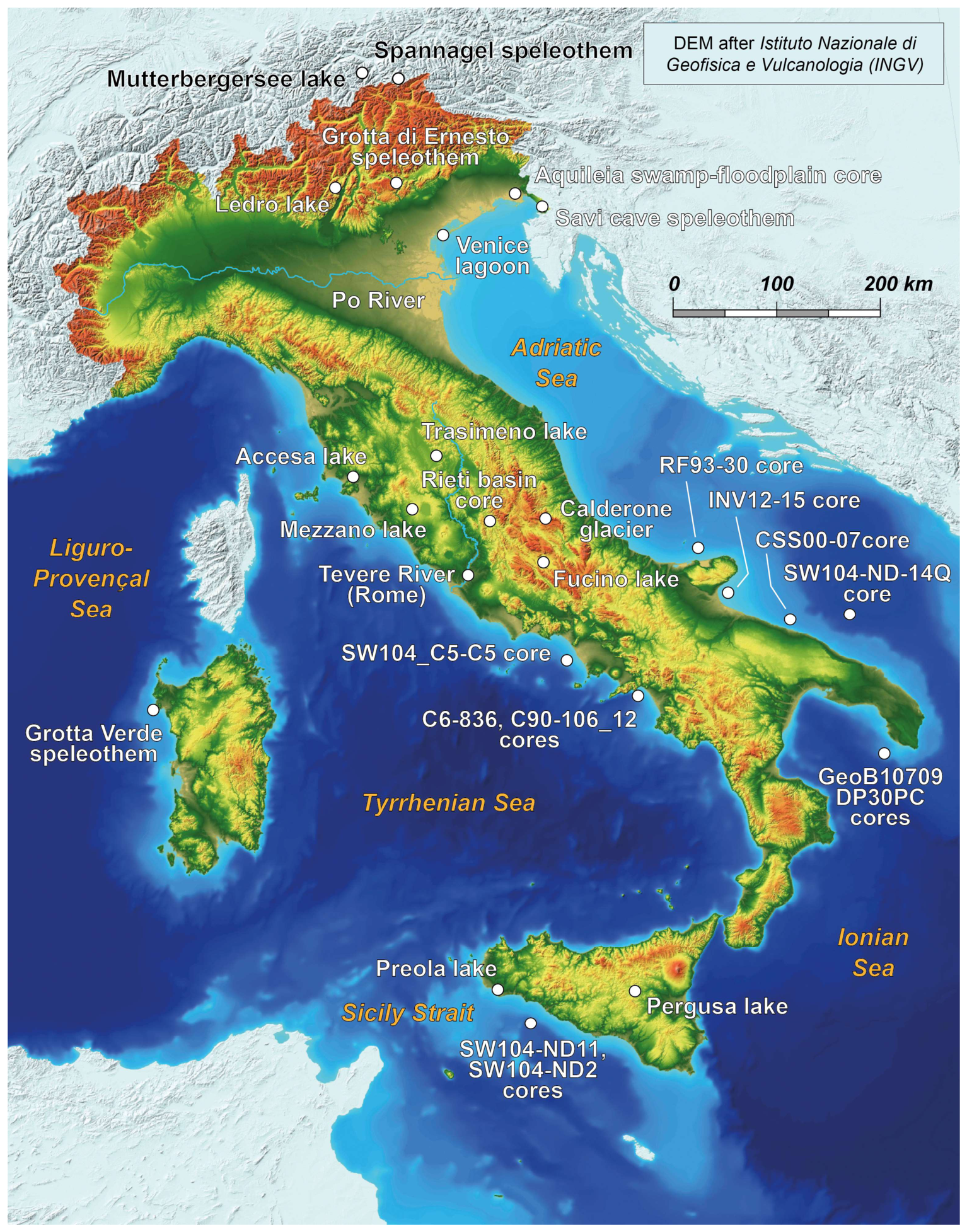
Routinely applied procedures aimed at understanding the spatio-temporal variability of hydrological changes over the last two thousand years across Europe and the Mediterranean usually profit from retrospective models based on modern datasets, which are subjected to complex statistical analyses and neural network procedures, e.g., [21,51]. The methodological approach herein is the opposite, as we have addressed ancient hydrological changes by scrutinizing a variety of multiproxy empirical data produced until now in the Western and Central Mediterranean, as well as their bounding lands, in order to decipher how Nature has already “run the experiment”, e.g., [69]. As only sparse studies have dealt with Italian paleohydrological proxies following a Modern Analogue Technique (MAT)-driven approach (notable exceptions are by [65,94,95,96,97]), we address our investigation to both quantitative and qualitative proxies for ancient rainfalls and dryness/wetness indexes. The resulting meta-analysis is based on an evaluation of more than two hundred high-graded publications dealing with specific paleohydrological proxies, reconstructions, and record types which cover a wide range of geological archives, time intervals, and resolutions, as well as dating techniques. A synthesis of the main selected sources and data types is provided in Table 1. A total of 25 crucial sites for our metadata analysis have been identified across Italy, including several reference key-localities close to the northern Italian border (Figure 1), with which to correlate the Italian hydroclimatic record for fulfilling time-calibrated and proxy-integrated reconstructions according to a multidisciplinary, holistic approach.

2.2. Investigation Tools and Data Types

Specific literature addressing study areas in Sardinia and Central Italy provides limited case studies, which, moreover, address different methodologies and data types (Table 1), thus making direct comparison of hydrologic interpretations problematic. Notwithstanding such limitation, the relatively ample availability of case studies and complementary methodologies from adjoining regions provide variably tuned- and time-resolved information of paleotemperature and paleoprecipitation/wetness and aridity proxies from a variety of investigation tools, largely dealing with: (1) speleothems; (2) lake water levels; (3) tree rings; (4) glacier activity; (5) peat/paleosols types; (6) geomorphological indicators of slope instability/coastline dynamics; (7) coastal and offshore marine sediment cores; (8) paralic and lacustrine sediment cores, and (9) pollen association archives from both coastal marine and terrestrial cores (Table 1; Figure 1). Additional insights into the evolving hydroclimate of the studied regions derive from the magnetostratigraphy, sedimentology, tephrostratigraphy, and mineralogy of selected records, mostly from the Italian Peninsula.
Modern time-series data from instrumental measurements are mostly available starting in the early to middle 19th century—mostly with monthly or yearly data (see Section 3.2)—and have been considered herein in order to perform a qualitative calibration and preliminary validation of the few existing proxy records over the corresponding time span.
Concerning the two study areas, highly qualitative hydrologic reconstructions of wet vs. arid end members of paleohydrologic conditions are available (variably referred to in the literature as Mean Anomaly, Filtered Anomaly, or Rainfall Anomaly Index). Very few Modern Analogue Technique (MAT)-aided case studies for deriving quantitative rainfalls and rainfall patterns have been attempted to date across Italy over the investigated time interval (see Table 1). This is mostly due to the substantial lack of modern, high-grade quality and high-resolution hydrologic proxies to be calibrated quantitatively through the employment of recent-to modern empirical measurements of temperatures and rainfalls (cf. [48,98]).
Table 1. List of the paleohydrological proxies and case studies used for the present study from Sardinia, Central Italy, and surrounding regions, together with a proxy selection from Northern-Southern continental Italy and Sicily. Bold asterisk indicates Modern Analogue Technique (MAT)-aided paleoclimatic reconstructions. Pale green, orange, and blue boxes refer to case studies from Sardinia, continental Italy-Sicily, and surrounding countries, including NAO-related type localities in Morocco and Scotland.
LocalityArchiveProxy/MethodsTime
Resolution
Time Period
(Years, AD)
Climate
Variable
Captured
Reference
Grotta Verde
(NW Sardinia)
Speleothemδ18O
Chemostratigraphy
Multidecadal-centennial1030–1998 ADTemperature,
dryness/
wetness
[99]
Grotta di Ernesto (cave)Speleothemδ18OMultidecadal-centennial [100,101]
Grotta Savi
(North-eastern
Italy, Friuli V. G.)
Speleothemδ18O
Chemostratigraphy
Multidecadal-centennial1000 BC–PresentTemperature,
dryness/
wetness
[102]
Ledro lake
(Northern Italy, Trentino)
Lake sedimentsLake level, pollen spectra, flood
frequency
Chemostratigraphy,
Palynology,
Sedimentology, δ14C
Decadal-
centennial
4100 BC–PresentDryness/
wetness,
rainfall
[65] *, [95] *, [103,104]
Aquileia (North-eastern Italy,
Friuli V.G.)
Floodplain
sediments
Pollen spectra
Chemostratigraphy,
Palynology,
Sedimentology, δ14C
Decadal500–ca. 1900 ADTemperature,
rainfall,
dryness/
wetness
[105]
Venice
(North-eastern
Italy, Veneto)
LagoonFreezing frequency
Chronicle
Annual-decadal1000–1990 ADTemperature[106,107,108]
Tevere valley (Roma)RiverFlood frequency
Chronicle
Yearly-decadal200 BC–1980 ADRainfall,
dryness/
wetness
[107,109]
Gran Sasso Mt.
(Central-eastern Italy, Abruzzo)
Soil, wood, peat, scree, glacial
debris
Alluvial phases
Geomorphology,
Sedimentology, δ14C
CentennialHoloceneTemperature,
dryness/
wetness
[110,111]
Northern and,
Central Italy
Peat bogs, lake sediments,
organic matter
Alluvial phases
Geomorphology,
Sedimentology, δ14C
Multidecadal-centennialHoloceneDryness/
wetness
[112,113]
Trasimeno lake
(Central Italy,
Umbria)
Lake sediments and terracesLake level
Chronicle,
Geomorphology
Centennial1000–1900 ADDryness/
wetness
[114], in [111]
Fucino lake
(Central Italy, Abruzzo)
Lake sediments and terracesLake level
Chronicle, δ14C,
Geomorphology,
Sedimentology
Multidecadal-centennial300 BC–1900 ADDryness/
wetness
[115]
Accesa lake
(Central Italy,
Toscana)
Lake sediments
and terraces
Lake level, pollen spectra
δ14C, Sedimentology, Palynology,
Tephrostratigraphy
Multidecadal-centennialHoloceneDryness/
wetness
[63], [65] *, [116]
Mezzano lake
(Central Italy,
Lazio)
Lake sediments and terracesLake level
Chronicle, δ14C,
Geomorphology,
Sedimentology
Centennial4000 BC–2000 ADDryness/
wetness
[117,118]
Gran Sasso Mts
(Central-eastern
Italy, Abruzzo)
Glacial deposits
(Calderone
glacier)
Glacier expansion/
contraction
δ14C, Geomorphology, Sedimentology
Centennial4000 BC–1900 ADTemperature, dryness/
wetness
[110,111,119,120]
Central-eastern Italy (Marche)Hillslopes,
fluvial dynamics
Alluvial phases, shoreline variation Geomorphology,
Chronicle
Multidecadal-centennial1000 BC–2000 ADDryness/
wetness
[121]
Rieti Basin
(Central Italy, North-eastern
Lazio)
Lake sediments, soilPollen spectra, alluvial phases,
δ14C,
Chemostratigraphy, Trace metals,
Palynology, Chronicle
Decadal-
multidecadal
700 BC–2000 ADDryness/
wetness,
temperature
[122,123,124]
Pergusa lake,
(Southern Italy, Central Sicily)
Lake sedimentsδ18O, pollen spectra, lake level
Chemostratigraphy,
Palynology, Chronicle
Multidecadal-centennial100 BC–1900 ADDryness/
wetness
[27], [94] *, [125]
Preola–Gorgo
lakes,
(Southern Italy, Western Sicily)
Lake sediments and terracesLake level, pollen spectraMultidecadal-centennial9000 BC–PresentDryness/
wetness,
paleosalinity
[126], [127] *
Gaeta Gulf
(E Tyrrhenian Sea)
Marine
sediments
(core SW104_C5-C5)
δ18O (planktonic foram.), pollen spectra
Chemostratigraphy, Magnetostratigraphy, Tephrostratigraphy,
Palynology, Chronicle
Multidecadal-centennial2400 BC–2000 ADSea surface
temperature,
dryness/
wetness
[128,129,130,131,132]
Salerno Gulf
(E Tyrrhenian Sea)
Marine
sediments
(cores C90-836)
δ18O (planktonic
foraminifera)
Chemostratigraphy,
Tephrostratigraphy,
Sedimentology
Multidecadal79–2006 ADSea surface
temperature,
dryness/
wetness
[133,134,135]
Taranto Gulf
(South-eastern
Italy, Puglia)
Marine
sediments
(cores GeoB10709, DP30PC)
Mg/Ca, δ18O, δ13C (planktonic-benthonic foram.)
δ14C, 210Pb
Chemostratigraphy
3 years-
multidecadal
3450 BP–PresentSea surface
temperature, river discharge, rainfall,
dryness/
wetness
[97] *, [136,137]
S. Adriatic Sea
(South-eastern
Italy, Puglia)
Marine
sediments
(cores RF93-30, INV12-15, CSS00-07, SW104-ND-14Q)
δ18O, δ13C (planktonic-benthonic foram.)
pollen spectra,
organic matter
δ14C, 210Pb,
Chemostratigraphy, Magnetostratigraphy, Tephrostratigraphy,
Palynology
Subdecadal-
multidecadal
5000 BC–2000 ADSea surface
temperature,
river discharge
[138,139]
S. Adriatic Sea
(South-eastern
Italy, Puglia)
Marine
sediments
Organic matter
δ14C, 210Pb,
Chemostratigraphy, Magnetostratigraphy, Tephrostratigraphy
5–24 years,
multidecadal
1000 BC–2007 ADSea surface
temperature, dryness/
wetness, river discharge
[140]
Sicily Strait
(Southern Italy)
Marine
sediments
(cores SW104-ND2, SW104-ND11)
Mg/Ca, δ18O
(planktonic foram.)
δ14C, 210Pb,
Chemostratigraphy, Chronicle
Centennial3350 BC–PresentSea surface
temperature
[129,141]
Adriatic Sea
(Eastern Italy), NE Spain
Coastal, paralic sedimentsChronicleMultidecadal-centennial870–1820 ADStorminess[142]
Southern Italy
(Campania, Apulia)
Coastal-paralic sediments, soilsGeoarcheology,
Paleoethnology
CentennialHoloceneDryness/
wetness
[143]
Spannagel cave
(W Austria)
Speleothemδ18O, δ13C
Th/U,
Chemostratigraphy
Yearly1–1950 ADAir
temperature, dryness/
wetness,
solar activity
[48] *
Scotland, MoroccoSpeleothem, tree ringsδ18O,
Chemostratigraphy,
Dendrochronology
Yearly900–1993 AD
1049–2002 AD
NAO index
Rainfall, dryness/
wetness
[144]
NW ScotlandSpeleothemδ18O,
Chemostratigraphy
Yearly1000 BC–1996 ADNAO index,
rainfall,
dryness/
wetness
[145]
Mutterbergersee lake (W Austria)Lake sedimentsChironomids4–10 years1300–2010 ADAir temperature[146] *
Central-Eastern AlpsTree ringsδ18O (wood)Yearly7000 BC–2014 ADSummer
dryness/
wetness
Figure 1. Location map of the proxy sites and main localities discussed in the text (see Table 1 for details). DEM is after INGV. Access date 30 June 2026; https://tinitaly.pi.ingv.it/.
Heritage 09 00258 g001
Available data types include: (A) biological proxies (pollen assemblage/spectra and tree rings); (B) historical sources and paleoethnological/geoarcheological evidence (e.g., river flood and lagoon freezing frequency); (C) isotope geochemistry proxies and chemostratigraphy (δ13C, δ18O) on a variety of geological records including stalagmites, tree rings, lake sediments and planktonic/benthonic foraminifers; (D) several type of geochronological dating and solar activity proxies (δ14C, 210Pb, Th/U, 10Be); (E) inorganic geochemistry proxies (Mg/Ca). Time resolution of the selected proxies varies from decadal-multidecadal to centennial, which provides the best available chronological framing of evolving hydroclimates so far, according to available literature. Time calibration and chronostratigraphic alignment of the multi-proxy empirical datasets, which have been used in the reconstructions herein, rely on the relative and/or absolute dating provided by individual literature sources. Only minor adjustments have been performed, mostly due to the ongoing chronologic reappraisal of crucial paleoclimatic and paleohydrologic events and/or key-markers.
Aiming to clarify paleohydrologic reconstructions and to elucidate the genuine significance of resulting cross-correlations, all relevant paleohydrologic data have been collected, ensuring careful consideration of their time calibration as well as reasonable reappraisal of their chronostratigraphic resolution and paleoclimatic context, in light of recent outcomes from the same localities and/or nearby regions.
Issues identified in the metadata analysis herein are discussed in Section 4.5.

3. Results

3.1. Hydroclimatic Setting of the Investigated Regions

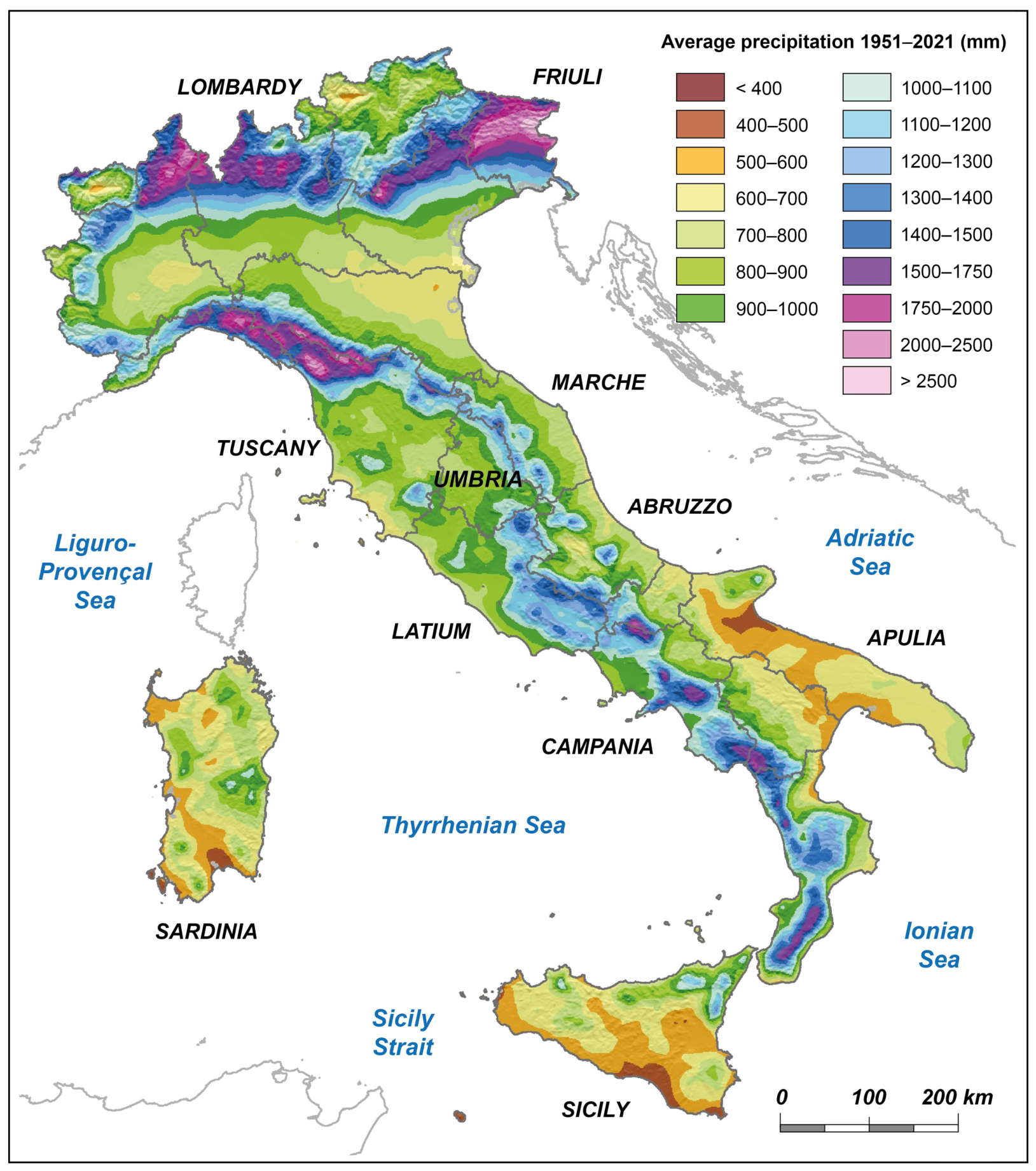
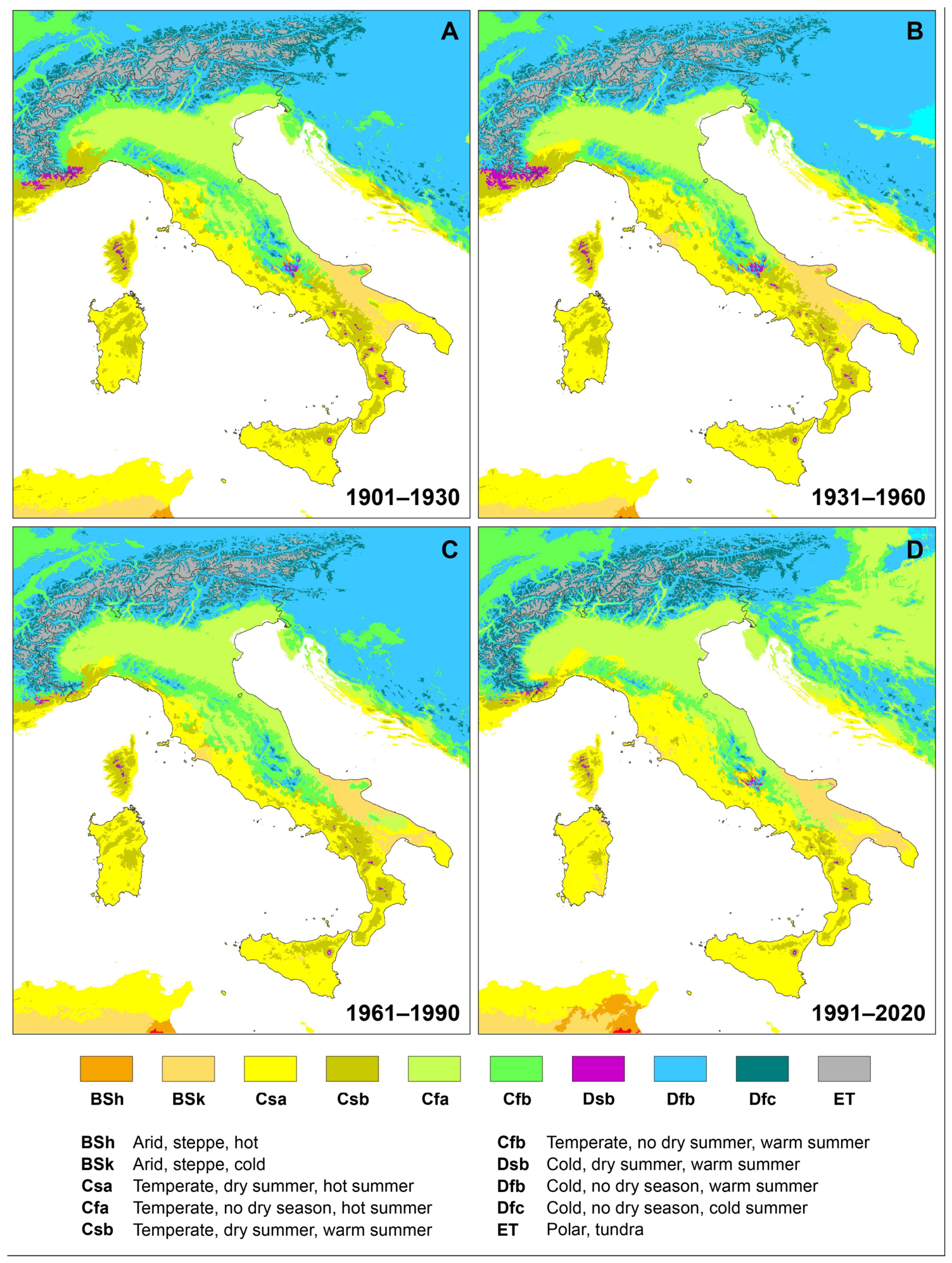
The two study areas of Sardinia and Central Italy are located in quite different environmental settings (coastal, low-energy Mediterranean hills vs. inner Apennine alluvial basin and mountain range, respectively), which are characterized by fully contrasting bioclimatic features. In fact, although Sardinia and Central Italy share a similar latitude belt in the central Mediterranean Sea (39–43° N), they fall mostly: (1) in the low vs. middle rainfall recharge regimes of Italy [147] (Figure 2); and (2) in the Csa (Temperate, dry and hot summer) vs. Cfb-Cfa (Temperate, maritime) climatic zones of the Köppen–Geiger classification, respectively [47,85,86] (Figure 3). This is irrespective of the ongoing rainfall fluctuations across the Italian subregions starting in the early 20th century, as documented by standardized reconstructions based on hydrological time series that permit tracking of their historical climatic trajectories over the 1901–2020 interval by means of high-resolution maps in 30-year time windows [86] (Figure 3). Furthermore, Sardinia and Central Italy pertain to the “Thermo-Mediterranean” and “Sub-Mediterranean” vegetation type zones [148] as well as to the “Mediterranean forest, woodland and scrub” vs. “Temperate broadleaf and mixed forest” biomes (see [149]), respectively, thus indicating largely different precipitation and evapotranspiration features. Despite this, Sardinia and Central Italy are commonly characterized by a remarkable decrease in rainfall during summer as well as the occurrence of dense Mediterranean waters along their coasts due to cooling and increasing salinities in the Adriatic and Liguro-Provençal basins during winter, under the effect of seasonal northerlies [150]. In addition, the prevailing moisture sources for the two study areas seem to be remarkably distinct as they would derive largely from the Western Mediterranean (Sardinia) and the Ionian Sea-Eastern Mediterranean (Central-Southern Italy) [21].
Figure 2. Averaged rainfalls from gauges across Italy over the 1951–2021 interval [147]. Present-day Sardinia and Central Italy regions fall in rather different hydrological settings, thus conveying the prospect of an analogous context over the last one thousand years (i.e., MWP and LIA).
Heritage 09 00258 g002
Figure 3. Köppen–Geiger maps of Italy and adjoining regions for the 1901–2020 gauge-based climatologies (after [86]). Thirty-year-long bins are reported in chronological order (panels (AD)). Consistent with Figure 1, which accounts for rainfall variabilities, Sardinia and Central Italy pertain to different climatic classes that have coherently tracked the global-scale temperature changes over the last 120 years, following the end of the LIA (around 1850 AD). Notably, areas falling in the Csa class (Temperate, dry-hot summer) are being increasingly widened over Sardinia and Central-Southern Italy, parallel to the contraction of the areas falling in the Csb (Temperate, dry-warm summer), Cfa (Temperate, no dry season, hot summer), and Cfb (Temperate, no-dry and warm summer) classes. The kaleidoscopic hydroclimatic patterns across Italy are at odds with a remarkable uniformity in regions nearby. On the whole, comparing panels (AD) elucidates that summer moisture across large sectors of Central-Southern Italy has increased perceptibly over the colder 1961–1990 bin, whereas it has decreased significantly over the warmer 1991–2020 bin.
Heritage 09 00258 g003

3.2. Overview of the Hydroclimate Proxy Records in the Study Areas and Adjoining Regions

Apart from a few exceptions, reliable direct measurements from meteorological gauges are not available before the middle 19th century, although the oldest meteorological measurements date back to the late 17th century. However, the latter are of very limited use as they are sparse, suffer from poor instrument calibration, and lack procedure uniformity [151,152]. As a consequence, rainfall and temperature dynamics need to be deduced by inference from proxy data, e.g., [69], with only minor constraints deriving from geoarchaeological and pedological investigations, e.g., [33,37,143]. This paper attempts to bridge the pitfall of ambiguous reconstructions by comparing available paleohydrologic proxies and datasets for the investigated areas over the last millennium, mostly focusing on the Medieval Warming Period (MWP) and Little Ice Age (LIA).
To date, very few speleothem- or pollen-based paleoclimate reconstructions, with yearly or decadal time resolution, exist for the peri-Mediterranean region, as most studies have focused on centennial- to millennial-scale changes. In addition, empirical studies on Mediterranean speleothems and pollen associations have normally resulted only in largely qualitative patterns of temperature and precipitation fluctuations, with the result of limited, low-resolution evidence of paleohydrologic trends and substantial lack of information on their spatio-temporal patterns.
In both the study areas, historical records and local paleoclimatic proxies have the potential of providing data on decadal to multidecadal time scales for up to several thousand years. However, this goal is far from being fully accomplished, and their paleoclimatic significance can be partly realized only for the last one thousand years, especially in Central Italy. It is also worth noting that all the above proxy data do not normally provide a continuous record, as remarkable lack of information has to be taken into account. In these cases, correlation of time-calibrated data from surrounding or relatively close regions can partially fill the gap in our comprehension in a supra-regional perspective. This is particularly true for the quasi-continuous coastal marine and lacustrine sedimentary records, which are commonly used as a chronological benchmark for long-term climatic fluctuations recorded on land.
Concerning rainfall and temperature fluctuations during the last three centuries, the oldest instrumental measurements in Italy come, to our knowledge, from the meteorological gauge stations established at Milano-Brera, Napoli-Capodimonte and Locorotondo (Bari, Puglia) in 1763, 1821, and 1829, respectively [101,153,154] as well as at Padova, Roma and Palermo (precipitation data from 1752, 1782, 1797, respectively) [70,155,156,157], although with several types of error sources [158]. These gauge stations fall outside the study areas but can represent useful benchmarks for calibrating recent paleohydrological proxies, e.g., [159], in combination with waterflow data from selected springs and/or rivers. The resulting composite time series of temperature and rainfall would provide solid ground for MAT-based paleohydrologic reconstructions by considering the degree of similarity, assessed through transfer functions, with overlapping and highly resolved, time-calibrated proxy data (e.g., Carbon and Oxygen stable isotopes from speleothems or lake carbonates, and pollen spectra from paleosols), from the same site or comparable nearby localities, e.g., [98]. Unfortunately, MAT- or analogous method-based climate reconstructions (see [65] for a broad synthesis) are rather scarce in the paleohydrological investigation and case studies from the Central Mediterranean and Alpine areas. Notable exceptions for the last two thousand years have addressed temperatures in the Austrian western Alps from the Spannagel δ18O speleothem chemostratigraphy [48] and the Mutterbergersee lake Chironomids [146], as well as extreme floods events in southern Germany [160] or rainfalls fluctuations from tree rings analysis in Central and Eastern Alps, where the most severe Holocene summer droughts occurred during the LIA, namely in the 18th and 19th centuries, with a clear control exerted by insolation changes [50]. To our knowledge, high-resolution MAT-based studies for the Italian hydrological archives over the last two thousand years are limited to the sedimentary records of the Pergusa and Preola lakes in central and western Sicily [94,127], the Ledro lake in the southern Alps, the Accesa lake in northern Tuscany [65,95], the Sicily Channel [96], and the Ionian offshore of Apulia [97]. Consequently, no reliable semi-quantitative paleohydrological data exist for the last two thousand years in Sardinia, as well as most of Central Italy. Paradoxically, relatively abundant, though—again—mostly qualitative, paleohydrological reconstructions from the Italian geological record are by far more complete and time-resolved over the Holocene, generally up to the Roman Warm Period (RWP), e.g., [61,64,65,91,97,102,125,130,139,141,161,162,163,164,165,166], rather than over the last two thousand years, with the notable exceptions of the sources reported in Table 1 (and references therein) (see Figure 1 for location of the studied records). Updated reviews of paleoclimatic proxies in the peri-Mediterranean region, in the search for spatio-temporal patterns, are provided by [67,69], focusing on the MWP and the last 6000 years, respectively.
Unfortunately, the Grotta Verde speleothem [99] (Figure 1) represents the only available proxy for the historical Sardinia hydrology and, as such, is described in detail in Section 3.2.1. By contrast, proxies from the continental and offshore Italian Peninsula and Sicily (Section 3.2.2) require only a limited examination, due to their rather robust and homogenous significance, combined with a relatively higher-resolution temporal dataset, with only minor departures from the average patterns. Such local discrepancies, which assume a remarkable importance when the Sardinia record is considered, are explored in some detail in Section 4.

3.2.1. The Sardinia Proxy Record

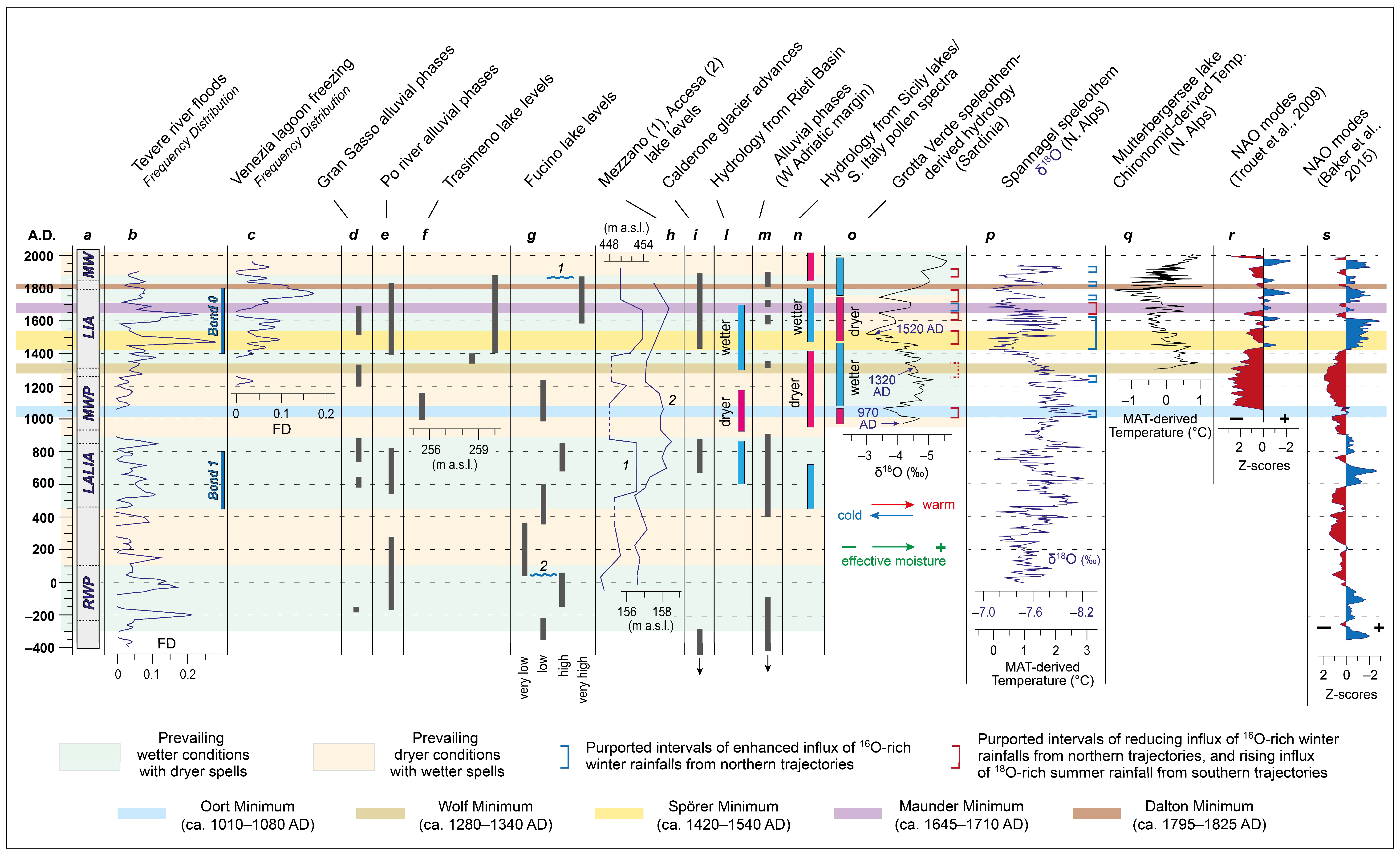
As yet, the δ18O-based chemostratigraphic study by (cf. [10,69,99]) on a speleothem from the Grotta Verde (Capo Caccia, Alghero) (Figure 1 and Figure 4o) provides the only useful proxy information for deriving potential hydroclimatic shifts in Sardinia during the last one thousand years. Although lacking a MAT-like analysis, and affected by a limited time resolution starting from 1520 AD, the Grotta Verde speleothem permits fulfilling of a relatively high-resolution cross correlation with the temperature-hydrologic trends established from the reference δ18O chemostratigraphy of the Spannagel cave speleothem, from Western Austria [48], combined with further proxies from continental and offshore Italy, including the Grotta di Ernesto and Savi cave speleothems, as well as the Aquileia floodplain core in its NE region (see Section 4). The Spannagel record yields two thousand years of a highly resolved temperature and paleohydrologic record following the conversion of the local δ18O isotope curve into temperatures through a MAT-transfer function built on several gauge measurements. Additional comparative insights have been retrieved from the tree ring-based alpine paleohydrology reconstructions by [50]. The 4–10 year-resolved temperature reconstruction for a 710 year-long record (1300–2010 AD) from the subfossil Chironomids of the Mutterbergersee lake (W Austria) provides context, calibrated through a further MAT-transfer function [146], to the adjoining Spannagel cave temperature and hydroclimate reconstructions, thus involving, in turn, the Grotta Verde speleothem as well (Figure 4). The coupled Spannagel-Mutterbergersee record permits advancing of innovative insights into the paleohydrology of the Italian Peninsula and revealing of distinct out-of-phase, and even anti-phase, local patterns, especially during the MWP and the LIA (see Section 4).
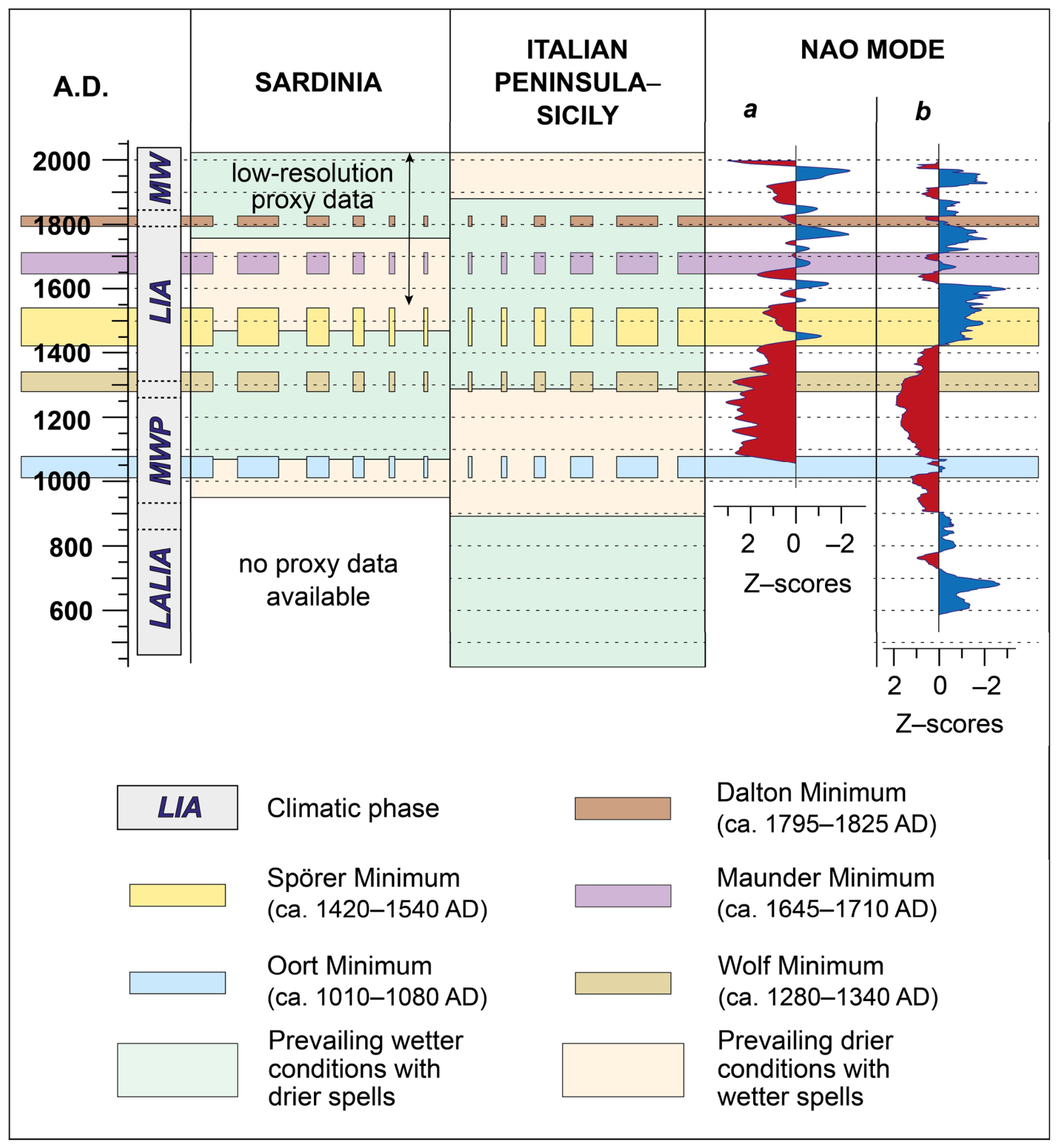
Figure 4. Overview of the major hydrologic proxies from, and potential climatic drivers in, Sardinia and the Italian Peninsula-Sicily during the last two thousand years, with a special focus on the 10th–13th centuries (MWP) and 15th–19th centuries (LIA) (data compiled after many sources). Location map of selected records is shown in Figure 1. Speleothem δ18O, pollen spectra, lake levels, sedimentological, paleontological, mineralogical and geomorphological proxies for wet-arid phases, and historical evidence were compared according to their best age estimation to allow direct comparisons on a common timescale with 50-year time increments. (a) chronostratigraphy of Roman Warm Period (RWP), Late Antique Little Ice Age (LALIA), Medieval Warming Period (MWP), Little Ice Age (LIA), and Modern Warming (MW). Dashed lines account for the commonly acknowledged boundaries among the climatic intervals (see [167] for discussion about the numerical ages of MWP and LIA time boundaries); (b) 2.400 years chronology of the Tevere river flood Frequency Distribution (FD) in Rome, after [107,109]. Bond 0–1 events, after [58] are also reported; (c) 1.000 years chronology of the Venice lagoon freezing FD, after [107]; (d) alluvial phases on the Gran Sasso Mt. (Abruzzo). Boxes pinpoint the maximum overlap of two sigma bars from δ14C datations on woods and soils, after [111]; (e) alluvial phases of the Po river with its tributaries from historical archives and geoarcheological data (after [109]; see also [113]); (f) Trasimeno lake level oscillation from historical archives ([114] in [111]); (g) Fucino lake level oscillation from δ14C peat datations and historical archives [115]. 1: 19th century drainage; 2: 1st–2nd century drainage; (h) Mezzano (1) and Accesa (2) lake level oscillations from δ14C peat-wood datations, and tephrostratigraphy, after [63,95]; (i) Calderone glacier expansions (Gran Sasso Mt.) from δ14C datations on soils and geomorphological evidence [110,111,120]; (l) hydrology reconstructions from the lacustrine Rieti Basin (Eastern Lazio region) through δ14C, 210Pb, 137Cs datations on plants, paleomagnetism, trace metals, tephrostratigraphy, palynology, and historical archives [122,123,124]; (m) geomorphologic studies from the Central Adriatic region involving fluvial/hillslope sedimentology, river floods, and marine shoreline dynamics [121]; (n) synthesis of the wetter/drier intervals in Sicily and southern Italy from δ18O on lacustrine carbonates (Pergusa lake) and palynology [27,125]; (o) δ18O curve from the Grotta Verde spelothem (NW Sardinia) (cf. [10,69,99]) and hydrology reconstructions herein (see text); (p) δ18O from the Spannagel spelothem (W Austria Alps) [48]; (q) Chironomid-based, calibrated temperatures from the Mutterbergersee lake (W Austria) [146]; (r) NAO index oscillation, after [144]; (s) NAO index oscillation, after [145]. Notations “−” and “+” in panels (r,s) refer to the rainfall regime anomalies with respect to the NAO in a negative mode (i.e., high average precipitation in S Europe and Mediterranean vs. low average precipitation in N Europe). Hydroclimate shift across the RWP is after [165] and reconstruction herein, see also [168]. A clear spatio-temporal partitioning of hydroclimatic patterns results from the comparison of reported proxies. Notably, wetness and dryness intervals (light green and orange shaded bands, respectively) are out of phase all over the MWP and LIA, thus elucidating an opposite moisture budget between Sardinia and the Italian Peninsula-Sicily (see text for discussion).
Heritage 09 00258 g004
Available syntheses of gauge-derived time series of rainfall and temperature in Sardinia start from the first half of the 20th century ([169,170] broad synthesis in [171]). Our ongoing efforts towards fortifying the historical hydrologic time series of Sardinia consider gauge data starting 1853 AD and could potentially provide MAT-type constraints on the Grotta Verde speleothem isotope record, in spite of its coarse and somewhat fragmentary chemostratigraphic resolution, and of the lack of detailed chronological definition of annual laminae. Unfortunately, the recent paleohydrological data from the Sarpis Cave chemostratigraphy (coastal eastern Sardinia) by [166] focus on ancient historical times (from the Bronze Age to the RWP) and provide only qualitative patterns for the middle-late Holocene. The same is valid for the paleohydrological reconstructions from historical vegetation dynamics provided by eastern [172] and western [173,174] Sardinia paralic and coastal sedimentary archives. As a consequence, it resulted here that precise reconstructions of the Sardinia hydrology over the last two thousand years can be only barely assessed, unless original and highly resolved isotopic studies on the Grotta Verde (or other speleothems from the region) and/or palynological-archeobotanical records from coastal lagoons are carried out, following precise MAT-transfer functions calibrated through modern gauge datasets. As yet, the quantitative historical and modern time hydrological dynamics for Sardinia can only be estimated by considering tie points from rather scarce waterflow measurements, while the ongoing reconstruction of historical gauge measurements is pending.
Evaluation and cross-correlations of δ18O speleothem records in a supra-regional perspective require a conservative approach and deserve cautious interpretations. This is mostly due to a wide range of uncertainties and potential pitfalls caused by local orography effects, environmental processes, and a variety of site-dependent geochemical features, combined with the moisture “Source effect”, which can potentially overprint the local hydrological signal, thus impeding reliable reconstructions (see [175,176] for in-depth reviews). Beyond these caveats, the δ18O speleothem data from Grotta Verde suggest the occurrence of a wet and warm phase during the 1050–1400 interval, which coincides with the MWP and is marked by relatively low δ18O values shifting from −3.5 to −5‰. A dry and cold phase during the 1500–1750 interval coincides with most of the LIA and is marked by a positive excursion of δ18O values from −4.5‰ to −3‰ [99] (Figure 4o). The onset of this colder and wetter interval is quite rapid and starts in the late 15th century, coincident with the earliest Spörer Minimum. It is interrupted by a relatively warm and wetter phase, about 50 years long and centered around 1700 AD, which is marked by a negative spike with δ18O values returning to values of about −4.5‰. Surprisingly, this phase coincides with the Maunder Minimum (Figure 4o), i.e., the coldest interval of the LIA during a solar irradiance minimum, e.g., [10] thus suggesting the need for an in-depth scrutiny on the actual significance of the related isotopic record (see Section 4). The following, rapid negative δ18O excursion (reaching −5.5‰ during the middle 20th century, i.e., the imputed warmest and wet interval of the entire Grotta Verde speleothem record), possibly represents only an artifact, due to the very low-resolution sampling, as the isotope curve consists of only about ten measurements over the 18th–20th centuries.

3.2.2. The Central Italy and Surrounding Regions Proxy Records

Opposite to Sardinia, continental and offshore Italy can profit from a number of proxy records derived from a variety of geological archives which provide compelling—though, again, only qualitative—paleohydrological reconstructions during the past two millennia. For instance, valuable, time-calibrated paleotemperature and paleoprecipitation evidence derive from the Calderone Glacier expansions and retreats (Gran Sasso Mts), which profit from radiocarbon dating of paleosols underlying ice-related deposits and alluvial deposits, combined with the Fucino lake level fluctuations from the nearby southern Abruzzi region [110,111]. On the whole, useful multiproxy from the study area are summarized as follows: (1) historical paleoflood reports for the Tevere River in Rome and for the Po river [107,109,177]; (2) freezing frequency of the Venice lagoon [106,107,108]; (3) pollen data from the Rieti Valley [122,123,124]; (4) Accesa, Mezzano, Fucino and Trasimeno lake level fluctuations [63,90,110,111], and alluvial phases and glacier dynamics on the Gran Sasso Mts (Abruzzo) [111] and Central Italy [121]; (5) Northern Italy alluvial phases [112,113]; (6) δ18O chemostratigraphy and pollen spectra from lacustrine carbonates of Sicily (Pergusa lake) [27,125]; (7) sea surface temperatures from the Sicily Channel [141]; (8) coupled δ18O chemostratigraphy and pollen spectra from Eastern Tyrrhenian Sea cores, off the Latium and Campania regions [128,129,131,133,134], and Adriatic-Ionian Sea cores off Apulia [97,136,137,138,140]; (9) pollen spectra from a NE Italy floodplain (Aquileia, Friuli region) [105]; (10) coupled Ledro lake level evolution, pollen spectra and flood frequency (Southern Alps of Northern Italy) [95,104]; (11) Grotta Savi δ18O speleothem chemostratigraphy (Friuli region, NE Italy) [102] (Table 1; Figure 1 and Figure 4).
Additional paleoclimatic/paleohydrologic constraints for the reconstructions presented herein derive from several adjoining Italian regions and include proxies from: (1) W Austria, close to the Italian border, which provide MAT-calibrated temperatures from δ18O speleothem chemostratigraphy (Spannagel cave) [48], and subfossil Chironomids (Mutterbergersee lake) [146], starting from O AD and 1300 AD, respectively, and profiting from 1 to 10 year time resolutions; (2) Alpine paleohydrology from tree-rings cellulose δ18O chemostratigraphy, with a 5-year time resolution starting in the early Holocene [50]; (3) the Alboran Sea, NE of Balearic islands, with marine sediment cores yielding a trace metal-derived proxy for Saharan dust input over the last two thousand years, at decadal-multidecadal resolution, coupled with paleoclimatic multiproxies from the Iberian peninsula [178]; (4) SE France storminess derived from the geochemistry and magnetic susceptibility of paralic sediments over the last three millennia [179].
General descriptions of the notable, interesting datasets derived from the above multiproxy reconstructions are synthesized in Table 1, while Figure 4 reports the time-calibrated correlations of several pivotal paleohydrologic proxies discussed herein (see Section 2 for methodological details).
Concerning modern instrumental measurements, monthly hydrological time series for selected areas of Central Italy (e.g., the Abruzzi region) are available only for the last 70 years (e.g., [19,180] and references therein), thus impeding adequate gauge constraints for MAT-like investigations.
On the whole, critical reassessment herein of available archives and multiproxy datasets permits highlighting of remarkable hydroclimate shifts across Italy during Medieval and Modern times, following the RWP (2nd century BC–1st century AD) and the subsequent Late Antique Little Ice Age (LALIA: 5th century–9th century AD) (cf. [97,105,125,165,181]). The geographical pattern of such a paleoclimatic framework is remarkably consistent in the entire western and central Mediterranean area, in general, and across the Italian Peninsula and Sicily, in particular, although regional departures from supra-regional trends occur (Figure 4) (cf. [69]). Ref. [95] has observed a decreasing and increasing water levels at Lake Ledro (Southern Alps) during the MWP and the LIA, respectively, coherent with glacier fronts and lake level oscillations in the Helvetic Alps [182]. This pattern is in agreement with the phases of: (1) the Calderone Glacier expansion, high Lake Trasimeno-Fucino levels, and the maximum flood frequency of the Tevere River in Rome during the LIA; (2) the Calderone glacial retreat, the low Lake Trasimeno-Fucino levels, and the minimum flood frequency of the Tevere River in Rome during the Modern Warming (MW) [107,177]. Unfortunately, high-resolution isotope records from the Italian speleothems are quite sparse and incomplete over the last few hundred years and, with the exceptions of the Savi cave [102] and the Grotta di Ernesto cave [100,102], and remain largely elusive over most of the RWP-MWP interval.
The vast range of proxies from the Italian Peninsula accounts for a persistently warm and relatively dry hydroclimate during the MWP, which was replaced, starting 1250–1300 AD, by increasingly colder and wetter conditions (Figure 4). The latter became remarkably and persistently cold and wet over the middle-late LIA (ca. 1600–1800 AD) and shifted rapidly towards warmer and drier hydroclimates since 1850–1860, i.e., at the very beginning of the Modern Warming (MW). Historical glacier front fluctuations in Switzerland provide a coherent hydrological pattern, which likely developed under solar driving control [167,182,183]. However, significant multidecadal dry spells have been recorded during the LIA in NE Italy [105], whereas persistent drier conditions have been suggested for the western side of Central-Southern Italy (Latium and Campania regions) throughout the LIA [132]. This evidence is discussed below, in some detail, in the context of the hydrological spatio-temporal patterns reconstructed in the whole study area, in the broader setting of the Western and Central Mediterranean.

4. Discussion

4.1. The Mediterranean Long-Term Hydroclimatic See-Saws over the Holocene

Identifying regional climate variability patterns in the Mediterranean area during historical times still represents a challenging task despite a vast range of multidisciplinary advancements acquired through a wide range of investigation tools, e.g., [11,12,68,97,140], especially in the last two decades (broad syntheses in [10,44,67,69]). In fact, the chronological uncertainties, the fragmentary nature, and the low resolution of many sedimentary records, the intrinsic limitations of routinely applied paleoclimatic proxies, and the uneven geographical distribution of detailed case studies still prevent conclusive assessments. Obviously, such a paleoclimatic conundrum affects the Italian lands and seas as well, and makes the incomparable wealth of their archeological, historical, and geological heritages largely undercapitalized in terms of paleoclimatic scrutiny over the last two thousand years (see [37] for a broad discussion), apart from remarkable exceptions (e.g., [27,61,63,97,101,102,124,125,128,129,132,137,140,165] among others). Moreover, MAT-aided case studies are still too scarce, e.g., [65,95,96,97] (Table 1), making retrospective hydroclimatic reconstructions from modern gauge data irrelevant or even inapplicable. More broadly, the response of regional water cycle and hydroclimatic conditions to global changes, and how they react to temperature fluctuations, e.g., [15,16,21,81], remain outstanding, although elusive issues also in a Mediterranean perspective. This is invariably valid for temperature shifts linked both to long-term processes, such as precessional and obliquity cycles [78], and decadal-centennial cycles of solar irradiance fluctuations, e.g., [16,17,50,184,185,186]. In fact, several regional syntheses have outlined that strong North–South and West–East hydroclimatic dipoles occurred across the Mediterranean during the Holocene, with a major temporal divide at the onset of the modern Neoglacial phase [64,91,93], specifically in the Italian Peninsula [63,65]. Winter and summer precipitation estimates, inferred mostly from pollen archives and lake levels, have documented that dry vs. wet conditions prevailed north and south, respectively, of a latitude boundary running roughly 43° N over the globally warmer early Holocene, with a rapid inversion toward the as much globally colder late Holocene ([64,93] and references therein). Similarly, a see-saw oscillation of drier vs. wetter conditions prevailed across the Western and Eastern Mediterranean according to similar timings and paces with respect to the Northern and Southern counterparts [44,61,66,68,92].
Many authors have investigated intriguing in-phase connections between modern hydroclimatic changes in Europe-Middle East and NAO shifts, e.g., [187,188,189,190,191,192,193,194] that, in turn, are likely regulated by cyclical fluctuations of solar irradiance across a range of periodicities, including the 11-year Schwabe frequency band [11,12,15,16,17,46,184,195,196]. If so, the predictability of the cyclical NAO fluctuations rooted in empirical historical trends would thus imply the opportunity to predict near-future regional precipitations, spring-river flow rates, and runoff maxima (see [197,198] for an opposite view). More particularly, a number of investigations advocate a negative NAO mode during periods of low solar irradiance, as in the case of the LIA [199] or recent decades [200]. However, several studies have countered this type of hypothesis, suggesting, for instance, that a persistent positive NAO mode did not originate the MWP in Europe [201], whereas high internal variabilities, rather than cyclical temporal trends, have dominated the precipitation patterns in the Mediterranean during the last 150 years [14]. Whatever their driving processes (i.e., solar, orbital, intrinsic pattern of the Earth’s hydrosphere-atmosphere system, or their combination), the NAO modes likely exert a deep control on the worldwide climate conditions, even by exciting subtropical teleconnections with the Pacific Ocean, ultimately controlling the pace and intensity of El Niño-Southern Oscillation (ENSO) [202]. Recently, several studies have suggested that additional climatic drivers, such as AMO and WeMO, significantly control precipitation patterns across Europe and the Mediterranean through a variety of dynamic mechanisms, including the modulation of the NAO-mediated influence [13,21,51,84,203].

4.2. Sardinia and Central Italy Proxies: Emergence of NAO Fluctuations as Driving Hydroclimatic Drivers over Historical Times

The Sardinia and the Central Italy study areas represent a possible crossroad of the N-S and W-E hydroclimatic see-saws across the Mediterranean and may thus contribute significantly to elucidating their dynamics during the last two thousand years. How the precipitation regime varies temporally in different locations is crucial to water management and ecosystem services. Hereinafter, the last one thousand years is mainly discussed, with a specific focus on the MWP and LIA hydroclimatic dynamics, by comparing paleoprecipitation proxies elaborated so far in the study areas (Table 1; Figure 1 and Figure 4).
Following this approach, metadata analysis herein permits highlighting of multicentennial, anti-phase hydroclimate shifts from the MWP to MW, specifically through the LIA. A pattern of rapidly shifting hydroclimates has been reported from the RWP (2nd century BC–1st century AD) and the subsequent Late Antique Little Ice Age (LALIA: 5th century–9th century AD) in Central Italy [97,165]. Unfortunately, no chance of cross-correlations with Sardinia is possible for these intervals due to the lack of available information for the corresponding island record.
Extensive and higher-resolution (i.e., daily) measurements of temperature and rainfall dynamics across Italy are increasingly available starting in the mid-19th century, namely at the beginning of the Industrial era, impeding further refinements in the search for specific climatic drivers for older intervals. These studies elucidate unequivocally the prominent role that the NAO exerts on rainfall and temperature fluctuations over the entire Mediterranean region, e.g., [16,69,130,144], although with complex—but likely predictable—regional-type variation patterns [13,51]. Critical assessment of available data herein permits highlighting that remarkable, possibly contrasting climate shifts occurred in the study areas over the Medieval to Modern times. Their absolute age and pace make them a possible clue for solar-driven latitudinal fluctuations of NAO, which induced alternate cold/warm and wet/arid climatic intervals in the Central Mediterranean during the last two millennia, following the RWP. The solar origin of NAO fluctuations, hence of the recognized hydroclimate cycles across the Atlantic Ocean, including the Mediterranean region, has been established by many recent studies based on a variety of investigation tools, e.g., [11,12,15,16,17,195]. According to our metadata analysis, we infer that the paleohydrological and paleothermal dynamics in the study areas over the last one thousand years closely resemble the time-dependent NAO fluctuations which have been reconstructed by several authors (Figure 4r,s). This assumption is particularly robust for the last 150 years. More particularly, Refs. [19,184,188] have demonstrated that temperature and rainfall variabilities from the modern Italian hydrological time series, i.e., supported by high-resolution instrumental measurements, follow cyclical changes which are modulated by NAO fluctuations in the scale of ca. 20 to 60 years periodicities of imputed solar origin, seemingly connected to the Hale and Yoshimura cycles. Improvements addressing this issue need further scrutiny for historical and modern contexts and a detailed hydrological time-series analysis. The latter represents the next step of our investigation.

4.3. Interpreting the Hydroclimate Proxies in the Study Areas over the Last One Thousand Years: Evidence for Anti-Phase Dynamics

The Mediterranean hydroclimatic conditions display a remarkably precise spatio-temporal evolution on the millennial-to-centennial scale over the Holocene, e.g., [68,90,93,125], whereas decadal- to multidecal-scale fluctuations remain still elusive over the last two thousand years. Analogously, spatio-temporal patterns of warm and cold intervals show no strict areal coherence as well. For instance, the MWP and the LIA, likely the warmest and coldest intervals, respectively, impacted human societies according to a diachronous dynamics and spatially different intensities [199,204,205]. The description and tentative genetic interpretations of such diachronous patterns are outlined in the sections below.

4.3.1. Interpreting the Grotta Verde Speleothem Proxy

Concerning the Sardinia study area, the prominent δ18O positive excursion recorded by the Grotta Verde speleothem over the LIA reasonably reflects the established cooling interval derived, especially in the Northern Hemisphere, from a wide range of proxies and chronicles ([89,206] among many others). This is confirmed confidently by a number of multiproxy evidence from several regions across Italy as well (Figure 4). Nevertheless, the remarkable Sardinia cooling would appear to be limited to the 15th century as it is replaced by a long-lasting δ18O negative excursion, which would mimic a slow and persistent warming trend over the early 16th century to the mid-19th century, with minor multidecadal positive δ18O snaps (Figure 4o). This is rather surprising as it is at odds with the coldest LIA peaks over the Maunder (ca. 1645–1710 AD) and Dalton (ca. 1795–1825 AD) Minima, e.g., [207]. Rather, the observed long-lasting δ18O negative excursion at Grotta Verde likely represents the geochemical evidence of the influx over Sardinia of moisture from northern westerlies, i.e., characterized by more negative δ18O values, in the context of a decidedly cold phase during the LIA. This would imply a case of “Source control” and/or changing pattern of the relative amount of winter vs. summer precipitation, similar to the reconstructions by [48] at Spannagel and by [160] in the Central-southern Germany, over the corresponding time interval. Interestingly, δ18O fluctuations recorded by tree-ring cellulose across the Alps pinpoint severe summer droughts coupled with shifting moisture sources during the middle and late LIA [50]. Likely, the shifting moisture sources over the last one thousand years discussed herein match the pattern elucidated across the Mediterranean region and Italy during modern times (cf. [21,49]).
The NAO is the acknowledged driver of the decadal- to multicentennial-scale rainfall fluctuations over Europe and the whole peri-Mediterranean region, e.g., [16,82,208,209,210,211], possibly in concert with further atmospheric dynamic controls such as AMO, e.g., [51,84]. Positive and negative NAO decadal oscillations are typically associated, respectively, with a marked rainfall decrease and increase in Southern Europe, the Mediterranean and the Middle East, being the opposite in Northern Europe, e.g., [13,62,82,187]. For instance, highly resolved, direct correlations of gauge-derived rainfall patterns and NAO fluctuations have demonstrated that the decadal hydrological deficit can be as high as 40–60% of the centennial averages [187,188].
Worth noting, recent NAO reconstructions point to short-term, i.e., decadal, positive fluctuations over both the Maunder and Dalton Minima in the course of the markedly negative, long-term (i.e., centennial) trend accompanying most of the LIA [145] (Figure 4s). Nevertheless, the NAO dynamics over the early LIA is not univocally assessed as a contrasting, largely positive long-term trend, punctuated by short-term negative oscillations, has been proposed [144], especially during the Spörer Minimum (ca. 1420–1540 AD) (Figure 4r).
Such decadal NAO fluctuations co-occur with regionally contrasting speleothem δ18O shifts, as during the Maunder Minimum, being isotopically positive at Grotta di Ernesto [100] and Spannagel [48] (Central Alps), and markedly negative at Grotta Verde cave (NW Sardinia) [99] (Figure 4o,p). Notably, thin and dark layers at Grotta di Ernesto cave are reported coincident with the Maunder and Dalton Minima, suggestive of reduced rainfalls on the Central Alps during intervals of low solar activity [101]. This highlights the development of variable regional vs. local isotopic patterns of effective rainfalls (i.e., the “Source effect”), overall temperature shifts, cave processes (for a thorough discussion, see [48,175,212,213]), and/or foundering time calibration of available speleothem records.
Starting about the early 20th century, NAO decadal positive oscillations co-occur with uneven hydrological patterns over the Central Mediterranean. In fact, gauge measurements point to arid vs. wet intervals affecting Sardinia and Central Italy, respectively [1,7,82].
Metadata analysis of hydrological proxies from the Central Mediterranean likely substantiates the pivotal role that NAO fluctuations exerted on recent-to-historical speleothem δ18O anomalies at Grotta Verde. The same is for the contrasting, although consistent, reliable hydrological evidence (e.g., lake levels, pollen spectra, river flood patterns, geomorphological indicators of slope and fluvial dynamics, shoreline variations, glacier front advances) derived from Central Italy and, more broadly, from the entire Italian Peninsula over the last thousand years. More particularly, it is proposed that:
(1)
The centennial positive isotopic trend at Grotta Verde over the LIA, with a maximum coincident with the Spörer Minimum (Figure 4o), was linked with a dry-cold interval, see also [99]. Likely, this was induced by a decreasing influx of 16O-rich moisture from northern westerlies on Sardinia rather than a hypothetical rainfall increase, as that supposedly originated from a coeval, long-term NAO negative mode (cf. [145]) (Figure 4s) The NAO positive fluctuations suggested by [144] during the Spörer-Maunder Minima interval (Figure 4r), and the consequent moisture decrease observed over the western Mediterranean [68], would be consistent with such an assumption. This evolving scenario appears compatible with a southward shift of the Intertropical Convergence Zone (ITCZ) over the LIA, connate with a long-lasting cold climatic phase (cf. [214]), as corroborated—even at a multidecadal scale—during the recent global cooling episode which occurred in the 1945–1980 interval [185];
(2)
The solid reconstruction of NAO positive modes at the onset of the Maunder and Dalton Minima (Figure 4r,s), resulting in a generalized moisture decrease across the Mediterranean, would have enhanced the secular drought affecting Sardinia during the mid-late LIA;
(3)
Starting early 20th century, i.e., at the onset of the present-day running NAO positive trend (Figure 4r,s) and the ensuing rainfall decrease across the Mediterranean, Sardinia and the inner areas of Central Italy fall persistently in the Csa (Temperate, dry-hot summer) and Cfb (Temperate, no dry and warm summer) regions, respectively, of the Köppen–Geiger hydroclimate classification (cf. [86]) (Figure 3). Coherently, empirical reconstructions of the historical rainfall regime developing in these areas [1,5,7,68] corroborate the occurrence of a persistent moisture deficit across Sardinia with respect to Central Italy, which is increasingly being strengthened over the last decades (cf. Figure 3).

4.3.2. Evidence of Contrasting Regional Paleohydrologies Across the Tyrrhenian Sea Starting the End of the Oort Minimum

Based on the above, the hydroclimatic pattern herein matches the overall positive δ18O excursion over the early-middle LIA recorded by the Grotta Verde speleothem, especially during the multidecadal Wolf and Spörer thermal Minima. By contrast, the Maunder and Dalton thermal Minima, with their distinctive negative δ18O excursions at Grotta Verde, likely represent decadal-multidecadal wetter snaps following a 16O-enriched, winter moisture influx from northern westerlies being shifted southward during the late, coldest LIA (Figure 4o) and the supposed episodes of shrinking ITCZ. Unfortunately, the low chemostratigraphic resolution of the Grotta Verde speleothem starting from around 1450 AD hinders definitive assessments in this regard. Coherently, 18O-enriched rainfalls from warm southern westerlies might have impacted Sardinia during the early MWP, especially during summer, with the result of a markedly reduced influx of 16O-enriched, winter rainfalls from northern westerlies, and a pronounced long-lasting positive δ18O excursion centered around 1000 A.D., i.e., at the onset of the Oort Minimum (Figure 4o). A similar, though less marked behavior could have taken place during the following Wolf Minimum. This assumption is consistent with the mineralogical composition of the deep marine sediments from the Alboran Basin, west of Sardinia, which indicates a conspicuous flux of Saharan dust over the 950–1250 A.D. interval, coupled with strengthening southern westerlies [178]. The following interval of the middle-late MWP recorded a prominent warming, which is associated with enhanced rainfalls in Sardinia from northern, i.e., 16O-enriched, westerlies. This process would have driven a long-term negative isotopic trend, as well as the development of overall, contrasting drier condition conditions all over the Italian Peninsula and Sicily, as clearly suggested by the coherent evolution of an integrated number of proxies (Figure 4b–i,l–n).
In between the very end of the MWP and the early LIA, i.e., starting the Wolf Minimum and until the Spörer Minimum, the commonly positive δ18O isotopic excursion at Grotta Verde (from −4.8‰ to −3‰) and Spannagel (from −8.2‰ to −7.1‰) would suggest the remarkable decrease of winter moisture from northern westerlies, i.e., from the Northern Atlantic negative δ18O pool. It was likely replaced by summer moisture coming preferentially from southern westerlies, i.e., from the North-western Africa positive δ18O pool. In fact, at least in recent times, the latter is characterized consistently by the most positive δ18O values in the world, up to +2‰, especially during summer [215]. Coherent with the context above, Ref. [78] has suggested that the fall and winter moisture sources over the Mediterranean Sea originate from the Mediterranean itself and the Northern Atlantic, respectively (cf. [49]). However, Ref. [21] suggests a partially different pattern, which includes an important role for the Ionian and Eastern Mediterranean moisture sources for Southern Italy. Furthermore, based on transfer function and principal components analysis, Ref. [127] has derived paleosalinity reconstructions from the Gorgo Basso lake (adjoining Preola lake; SW Sicily) over the last two thousand years, establishing the remarkable prevalence of spring, summer, and fall precipitations, i.e., with a scarce moisture source from northern (Atlantic) westerlies and the associated negative δ18O pool. However, it is worth noting that proxies from specific lake and/or speleothem systems do not necessarily fulfill reliable regional-level correlations or paleohydrologically constrained general conclusions due to a variety of intrinsic issues with paleoclimatic proxies, e.g., [48,125]. For instance, the Savi Cave speleothem from NE Italy displays an opposite, i.e., negative, δ18O excursion during the Wolf-Spörer Minima coupled with a similar, i.e., positive, behavior over the MWP [102] with respect to the Grotta Verde-Spannagel records. Nevertheless, the bulk of consistent paleohydrological information from the Italian Peninsula and Sicily would highlight a previously unreported, opposite rainfall pattern and moisture budget with respect to Sardinia all over the MWP and LIA (Figure 4). As a consequence, it is supposed herein that possible longitudinal displacements of the North-Western African and East-Central European high-pressure cells over time (cf. [130]) would have assumed a pivotal role in this context by regulating the contrasting hydroclimates in Sardinia and Central Italy starting the Oort Minimum, especially during the MWP and the LIA (Figure 4 and Figure 5). More particularly, the predominant position of the North-Western African high-pressure cell over the Western rather than the Central Mediterranean Sea would have induced anti-phase or in-phase paleohydrological modes in Sardinia and Central Italy, respectively. Worth noting, this tentative reconstruction would be strongly influenced by the NAO negative or positive modes in the broader context of the Northern Hemisphere climatic variabilities [13,130] (Figure 5).
Figure 5. Synopsis of the compared hydroclimatic patterns in the study areas over the last one thousand years following the critical appraisal of available empirical proxies (see Section 3.2 and Section 4). Starting the early MWP, opposite prevailing drier vs. wetter conditions have developed, especially over the middle-late MWP and the LIA. Turning points correspond with acknowledged solar minima and their impacts on NAO mode fluctuations (a, after [144]; b, after [145]). Worth noting, the apparently contrasting hydroclimates over much of the MW depend largely on the dearth of reliable and high-resolution proxy-derived information from Sardinia starting the latest Spörer Minimum (see also Section 4.3.1). In fact, modern gauge measurements document an increasing moisture deficit on Sardinia with respect to Central Italy starting in the early 20th century (see Section 4.3.1).
Heritage 09 00258 g005
If the points above hold true, Sardinia would have been affected by a relatively long-term wetness over the middle-late MWP, which was replaced gradually by a remarkable drought, particularly evident during most of the LIA, starting at the onset of the Wolf Minumum, i.e. around 1280 AD. This would be opposite to the hydroclimatic pattern across the Italian Peninsula, particularly on its Adriatic side, and Sicily (Figure 5). The Sardinia drought presumably reached its maximum toward the end of the Spörer Minimum, around 1520 AD, and seemingly weakened over the middle-late LIA (Figure 4o).
Paleohydrological information from the Italian Peninsula (especially along its Adriatic margin) and Sicily proxies, regardless of their different time resolution and sensitivity, are almost devoid of information from speleothems, thus precluding possible issues from the “Source effect” or specific cave-soil related processes. Nevertheless, these proxies provide a consistent rationale for a contrasting wetness over the interval in concern with respect to Sardinia, which mirrors the modern gauge data (Figure 2). Confirmation of this pattern, which delineates the occurrence of a broad arid anomaly centered around the Sardinia-central Tyrrhenian area over the LIA, is provided by the high-resolution δ18O-calibrated pollen spectra evolution recorded by the Gaeta Gulf coastal sediments (SW104_C5-C5 core), off the southern Latium region (Figure 1). In fact, starting in 1400 AD, a clear decline of the evergreen forest belt nearby, which is particularly evident from 1550 AD, suggests the onset of overall dry conditions lasting up to 1850 AD, i.e., all over the Bond Event 0 [130]. Consistent with this interpretation, a few and scattered stream floods seem to characterize the coastal sediment infilling in the northern Salerno Gulf during the LIA [135], thus confirming a moisture budget deficit on the Tyrrhenian side of Central-southern Italy.
Such an innovative hydrology over the LIA strengthens the well-known paleoclimatic evidence of partitioned, even cyclical hydrological patterns at a regional scale across the Mediterranean over the Holocene, e.g., [10,65,68,75,130]. Furthermore, it emphasizes how ancient and historical hydroclimatic reconstructions can be demanding and speculative in the absence of both precise chronological calibration of paleoclimatic proxies and the opportunity of high-resolution MAT-constrained procedures (cf. [62,74], among many others).

4.4. The Western and Central Mediterranean Perspective

The overall reconstruction herein on the compared historical paleohydrology of Sardinia and continental Italy-Sicily over the MWP-LIA, seemingly matches the paleohydrological correlation of isotope speleothem records from W Austria (Spannagel), NW Sardinia (Grotta Verde), and Turkey over the last two thousand years (cf. [10]). In fact, the positive δ18O excursion at Grotta Verde over the LIA would represent a significant reduction in the secular effective moisture, paralleled by a strong “Source control” on the moisture feeding the Spannagel speleothem with trade winds trajectories from the South ([48], discussion in [10], see also [50]).
On the whole, the high-resolution calibration of historical hydroclimatic pattern of Sardinia by means of novel proxies from across the island, are urged by: (a) the usually tricky interpretation of speleothem C- and O-isotope chemostratigraphy (which can be affected by several potential sources of environmentally driven inconsistencies); (b) the extremely variable (i.e., in- or anti-phase) correlation of NAO modes with the speleothem δ18O record all over the Holocene (largely depending on the NAO scenario adopted), and (c) the somewhat blurred Grotta Verde chemostratigraphy.
In Southern to Northern Italy, the onset of the cooling peaks linked with the Spörer and Maunder Minima (elucidated by the maximum frequency distribution of the freezing events in the Venice lagoon and the coeval Calderone Glacier expansions) couple with a remarkable long-term cooling in the Northern Alps (indicated by the negative trend in the MAT-calibrated temperature proxy from Chironomids at Mutterbergersee lake) and an overall rainfall increase, punctuated by multidecadal dry snaps, over the entire Bond Event 0 (Figure 4b–i,l–n). This pattern combines with contrasting positive or negative NAO modes, depending on the adopted reconstruction (Figure 4r,s), and the start of an overall negative δ18O trend recorded by Grotta Verde and Spannagel speleothems, again with contrasting negative-positive snaps as those occurring over the Spörer and Maunder Minima (Figure 4o,p).
An analogously complex dynamics occurred over the early LIA, at the onset of the contrasting hydroclimate pattern which characterized Sardinia and Central Italy across the Wolf Minimum, likely starting with the Oort Minimum, i.e., during the early MWP (Figure 4). Unfortunately, the relatively low and uneven chemo- and chrono-stratigraphic resolutions of the Grotta Verde speleothem, coupled with the lack of transfer functions calibrated by gauge measurements, hinder further insights into the compared hydroclimatic evolution in the two study areas. Nevertheless, the observed opposite trend between the two study areas (Figure 5) mirrors that reconstructed from terrestrial and marine pollen spectra across the Mediterranean, especially in the time windows of 8000–6000 BP and 4000–2000 BP, as well as today ([93] and references therein), as substantiated by recent, gauge-derived hydroclimatic reconstructions, e.g., [1,5,7].
Consistency of the reconstruction herein is corroborated by the coherent chronostratigraphic distribution of the paleohydrologic proxies involved, in the broader context of the evolving paleoclimatic conditions across the entire Europe and Mediterranean regions over the last two thousand years, e.g., [10,69]. Worth noting, both the onsets and terminations of several centennial-scale hydroclimatic phases, as well as multidecal snaps, correspond with the major thermal minima during the last one thousand years (cf. [105]) (Figure 4 and Figure 5). For instance, the significant correlation of the δ18O curve from the Spannagel speleothem—hence, the thermal and overall rainfall dynamics across Central Alps—with the δ14C curve, which is assumed to reflect the intensity of solar irradiation, indicates that isotopic positive maxima coincide with the δ14C maxima (i.e., solar minima) during the Wolf, Spörer, Maunder and Dalton Minima [48]. Interestingly, evident δ18O oscillations in the G. ruber-derived chemostratigraphic curve from a super-expanded coastal marine record of the Salerno Gulf have been correlated with the same thermal minima [134], which would suggest an overall LIA-related rainfall increase across Southern Italy in connection with clustered river flood events and consequent fan-delta progradation [143,181]. Nevertheless, possibly alternative reconstructions have been proposed for this area offshore Campania, where fluvial- and coastal-derived sediments suffered reworking and winnowing by seastorm-induced, downflow currents [135] (see Section 4.3.1 and Section 4.3.2). Consistently, along the western Adriatic coast and NE Spain, sea storms cluster over the LIA with a climax during the Spörer Minimum [142]. A similar chronological pattern has been revealed along the coast of SW France, where periods of high storminess cluster according to a 270-year, solar-driven pattern of storm and river flood cyclicity [179]. More broadly, it is widely acknowledged that the intensity of solar irradiation fluctuates through time according to a remarkable cyclical pattern which is regulated by the superposition of different solar drivers, each with distinct periodicities, including the Schwabe (11 years), Hale (20 years), Yoshimura (61 years), Gleissberg (ca 90 years) de Vries-Suess (ca 200 yeas), Eddy (980 years) and Bond (1470 years) cycles, among others (for an in depth analysis, see [18,216]). Consistently, the remarkable influx of such cyclicities on hydroclimate fluctuations in many regions worldwide is being increasingly demonstrated in modern paleoclimatology (e.g., [15,17,18,54,58,184,186,217,218,219] and references therein). On the whole, it is suggested here that the most various hydroclimatic fluctuations across the Mediterranean region over the course of the Holocene—including historical and modern times—result from, or are profoundly controlled by, the cyclical variations in solar irradiation, involving from the Schwabe to the Bond cycle drivers, e.g., [18,50,101,104,130,212] among many others. This would be coherent with a number of outcomes demonstrating: (1) the remarkable influx that NAO oscillation exerts on paleohydrology, e.g., [9,16,84,190,220], as also observed in the historical to modern Italian record, e.g., [184,188,191,193,194]; (2) the compelling solar forcing of NAO dynamics itself, e.g., [11,12,46,195,221,222] (again, see [197,198], for a contrasting view). It is worth noting, however, that stochastic rather than deterministic patterns of climate dynamics have been proposed across Europe and the Mediterranean, with a major meridional temperature gradient (i.e., the contrast between Northern and Southern Europe) which would be controlled by the random position of the summer storm track [87].
Results of the metadata analysis herein strongly suggest that the spatio-temporal evolution of wetness-dryness phases over the last two thousand years across Italy reflects the cyclical, decadal-centennial oscillations of solar irradiance and the ensuing shifts in NAO modes, which, in turn, control atmospheric circulation patterns across the Mediterranean region. This is in analogy with overall outcomes from cyclical, millennial-scale (including Milankovitch-type periodicities) hydroclimatic shifts in the area ([77,78,93,130] among others).
Such a conclusion favors a combination of climate modes on the determination of regional paleohydrologic shifts (cf. [21,51,68,84,203]) and highlights the utmost intricacy of paleohydrological reconstructions, as well as their potential fallacy, if they are considered under simplistic models. Contrasting dryness/wetness intervals in Sardinia and the Italian Peninsula-Sicily over the last millennium, with opposite conditions during the MWP and the LIA (Figure 4 and Figure 5), strengthen the findings of spatial disparities in historical regional hydrological variabilities worldwide, e.g., [205] and in the modern Mediterranean as well [1,5,7,223]. Following this line of research, [224] have carried out an integrated historical and paleoclimatic analysis aimed at understanding the potential consequences that shifting paleohydrological availability of water resources has exerted on watermill structure and functioning in the study areas (Mts. Ferru, Sardinia; Aterno River, Abruzzo) since the Middle Ages. Full understanding of water resource fluctuations in historical and socio-economic studies—i.e., how hydroclimatic variabilities have impacted human societies and their complexities over climate change intervals—is pivotal in the ongoing paleoclimatic debate and is increasingly being scrutinized in current studies worldwide (see Section 1), including Italy [25,27,224,225]. Concerning the Mediterranean region, updated research on high-resolution and time-calibrated studies is urged, so as to decipher the mosaic of past and recent hydroclimatic fluctuations with which to mitigate the societal impact of ongoing and near-future water availability changes. Recent outcomes on modern hydroclimatic variabilities across Italy (e.g., [19,21,171,188] and references therein) represent a valuable source of information for improving our understanding of this crucial issue from a Mediterranean perspective.
Significantly, it is suggested here that any hydroclimatic reconstruction addressing the past, including historical times, requires a holistic approach involving empirically derived proxies from a variety of geological archives, rather than models from a restricted source of information and/or controversial statistical procedures. Most of the Italian Peninsula and Sicily are provided with supportive, though improvable, datasets for the last two thousand years (Table 1; Figure 1 and Figure 4), regardless of the extreme paucity of a time-calibrated context via transfer functions built on modern gauge measurements. By contrast, the Sardinia region displays a manifest dataset deficit which is deserving of targeted, novel research so as to contribute effectively to the hydroclimatic reconstructions for the Mediterranean, especially due to its strategic geographic position at the crossroad of the acknowledged, North–South and West–East oriented climatic dipoles ([49,65,68,92,93] among others).

4.5. Limitations and Uncertainties: Pointers for Future Research

Paleoclimatic/paleohydrologic changes and their impacts on the Mediterranean societies remain unclear and controversial over the last two thousand years. This is largely due to the scarcity of adequately continuous, reliable sedimentary records provided with high-resolution chronological controls in a region that is characterized by highly contrasting spatio-temporal paleoclimatic/paleohydrologic patterns (see Section 4).
The relatively abundant paleoclimatic proxies over the time interval in concern for the Italian Peninsula-Sicily overwhelm the unique Grotta Verde proxy for Sardinia. Nonetheless, the robustness and reliability of the proposed paleohydrological correlations across Italy (Figure 4 and Figure 5; see Section 4) seem to be adequately supported by published data discussed herein. However, the uneven geographical partition of the studied proxies, coupled with undesiderably ample range of their time resolutions, challenges precise and definite conclusions at a decadal-multidecadal observation scale all over the studied time interval. The working hypothesis proposed herein (i.e., the bimodal paleohydrology during the last one thousand years between the Italian Peninsula-Sicily and Sardinia, particularly during MWP and LIA) would profit from further studies addressing the high-resolution geochronology of δ18O–δ13C geochemistry from lake-lagoon sediments yielding high-quality pollen spectra and, hopefully, speleothems as well as tree rings, especially for Sardinia. However, the efficacy of such proxies in providing definite paleohydrological reconstructions is still limited by many intrinsic shortcomings. For instance, tolerance ranges and phenotypic plasticity of many plants [226], and different spatio-temporal human impacts on vegetation (cf. [124,131,132,138,140]) can potentially hamper effective hydroclimatic interpretations from pollen spectra. Furthermore, drip water chemistry, CaCO3 precipitation kinetics and saturation state, cave ambient temperature and pCO2, local hydroclimate factors, moisture “Source effect” and seasonal precipitation shifts can misrepresent paleohydrologic interpretations based on speleothem δ18O-δ13C chemostratigraphy [101,175,176,213,227]. In addition, the reliability of speleothem-based paleohydrology has been recently limited to cold climatic intervals [213] so as to possibly undermine several previous reconstructions addressing temperate to warm time intervals.
As a consequence, we infer that harmonizing multi-proxy investigations, by holistically employing a range of complementary tools on highly resolved and time-calibrated geological records from specific areas, would provide adequately reliable information for building a solid reference network of paleohydrological datasets. Solid empirical reconstructions of spatio-temporal wetness/dryness patterns would thus implement or replace model-based reconstructions, e.g., [2,3,6,21,75,203,228], which can potentially suffer from severe statistical biases.
As a pointer for future research directions, we believe that yearlyto decadal time-calibrated δ18O data from speleothems are particularly necessary to clarify effectively the Sardinia and the Italian Peninsula paleohydrologies over the last two thousand years, in concert with inferences from pollen spectra retrieved from contiguous soil and paralic to coastal deposits. At present, while the historic to modern hydrology of Sardinia is almost devoid of adequate information, apart from the low-resolution study on the Grotta Verde speleothem [99], the coeval record from Central Italy is decidedly richer and yields valuable insights into regional paleohydrologic dynamics (Table 1; Figure 4), especially merging past NAO shifting modes into modern NAO fluctuations (cf. [19]). However, time resolution is still relatively low, regardless of specific areas in Italy, and, again, would require further improvements from new case studies in Central-Southern Italy, particularly from the Abruzzo region. This latter would provide an incomparably complete and favorable geological heritage for detailed interdisciplinary investigations on a variety of targets, including: (a) the Gran-Sasso-Calderone glacial and periglacial deposits; (b) sedimentary valley infills devoid of limiting human control on the vegetation dynamics, with the potential of high-quality and unaltered pollen spectra; (c) speleothems from various types of mountain caves and orographic contexts. Obviously, the adequate implementation of hydrologic time series from public and private archives would permit accomplishing MAT-like procedures with definite, potentially high-quality transfer functions for ultra-detailed paleoclimatic reconstructions. It is believed here that the high-resolution paleohydrology of Sardinia and Central-Southern Italy, due to their crucial geographical position, would provide a prospect of valuable insights into the critical topic of the interacting N-S and W-E climatic see-saws in the Mediterranean region. These dipoles are increasingly being recognized as the most important cyclical drivers of its dryness/wetness spatio-temporal patterns, both in historical and modern times [13,44,65,68,91,93,130]. Hopefully, improving comprehension of their dynamics will provide crucial insights into the hydroclimate fluctuations that are expected to impact human societies in the near future Mediterranean hotspot.

5. Conclusions

A metadata analysis of hydrological shifts occurring in Italy over the last two thousand years has been carried out, with a special emphasis on the Medieval Warm Period (MWP) and the Little Ice Age (LIA). The proposed critical assessment of available datasets permits, for the first time, the highlighting of remarkable anti-phase hydroclimate shifts in Sardinia vs. Italian Peninsula-Sicily over the last one thousand years, following a West–East oriented regional pattern across the Tyrrhenian Sea. This dipole is ancillary to the acknowledged North–South zonal gradient documented for the Italian Holocene. Such a contrasting, formerly disregarded, paleohydrological pattern possibly represents the hinge, which we locate in the Tyrrhenian Sea, of the centennial-scale see-saws across the western and eastern sides of the Mediterranean, where bipolar wet vs. arid conditions alternate under the control of cyclic solar variabilities.
Absolute age and pace make the observed hydrological shifts a possible clue for solar-driven fluctuations forcing the North Atlantic Oscillation (NAO) modes, which induced alternate cold-wet and warm-arid climatic intervals in the Central Mediterranean during the last two millennia, following the RWP. More particularly, starting late Oort Minimum of solar irradiance (around 1060 AD), remarkably wetter and drier conditions dominated Sardinia and the Italian Peninsula-Sicily, respectively, during the MWP and up to the onset of the Spörer minimum (around 1420 AD). The Oort Minimum is coincident with a sharp negative inversion of the NAO index at the beginning of the long-lasting positive NAO mode, which characterized the entire MWP. A further rapid, opposite hydroclimatic inversion, with drier and wetter conditions in Sardinia and the Italian Peninsula-Sicily, respectively, occurred starting the early LIA, across the Spörer Minimum and the lower Bond Event 0 (around 1430 AD), and persisted towards the end of the LIA itself, across the Dalton Minimum (ending around 1825 AD). All these events coincide precisely with secular shifts in the NAO index from positive to negative modes, and vice versa, implying that solar irradiance fluctuations exerted a remarkable control over climate by triggering hydrological shift patterns across the Tyrrhenian Sea, and likely elsewhere, according to a definite interplay of the acknowledged N-S and W-E climatic seesaws in the Mediterranean Sea.
Driving mechanisms of these changes seem to be primarily due to cyclic multidecadal-centennial NAO mode fluctuations and related atmospheric configurations, which regulate both the latitude and intensity of westerly storm track, as well as the geographic partitioning of the persistent High- and Low-pressure cells over Europe and the Mediterranean Sea. Nevertheless, the scarcity of high-resolution and precisely dated precipitation reconstructions, after well-defined proxies, limits their definitive assessment, as well as the predictability of near-future hydrologic conditions.

Author Contributions

S.F. and R.G. contributed to conceptualization, data validation, reviewing, and editing the manuscript. S.F. and R.G. performed data curation and formal analysis. S.F., R.G., and S.P.Z. carried out investigations. R.G. contributed to designing the methodology and wrote the first draft of the manuscript. S.F. was responsible for funding acquisition and project administration. All authors have read and agreed to the published version of the manuscript.

Funding

This research was financially supported in the framework of the NATIONAL RECOVERY AND RESILIENCE PLAN (NRRP)—MISSION 4 COMPONENT 2 INVESTMENT 1.1—“Fund for the National Research Program and for Projects of National Interest (NRP)” funded by the EUROPEAN UNION—NEXTGENERATIONEU: Project PRIN 2022 PNRR—M.A.C.IN.A.—Multilevel Application for Cultural Information Archives. A focus on the Inner Areas of Abruzzo and Sardinia regions. Project code: P2022JJ292; CUP: E53D23018740001.

Data Availability Statement

The original contributions presented in this study are included in the article. Further inquiries can be directed to the corresponding authors.

Acknowledgments

Two anonymous reviewers are gratefully acknowledged for their useful suggestions and constructive comments, which helped improve the clarity of the manuscript.

Conflicts of Interest

The authors declare no conflicts of interest.

Abbreviations

The following abbreviations are used in this manuscript:
RWPRoman Warm Period
LALIALate Antique Little Ice Age
MWPMedieval Warming Period
LIALittle Ice Age
MWModern Warming
NAONorth Atlantic Oscillation
AOArtic Oscillation
AMOCAtlantic Meridional Overturning Current
AMOAtlantic Multidecadal Oscillation
MOMediterranean Oscillation
WeMOWestern Mediterranean Oscillation
MATModern Analogue Technique
ITCZIntertropical Convergence Zone
ENSOEl Niño Southern Oscillation

References

  1. Xoplaki, E.; González-Rouco, J.F.; Luterbacher, J.; Wanner, H. Wet season Mediterranean precipitation variability: Influence of large-scale dynamics and trends. Clim. Dyn. 2004, 23, 63–78. [Google Scholar] [CrossRef]
  2. Pauling, A.; Luterbacher, J.; Casty, C.; Wanner, H. Five hundred years of gridded high-resolution precipitation reconstructions over Europe and the connection to large-scale circulation. Clim. Dyn. 2006, 26, 387–405. [Google Scholar]
  3. Nicault, A.; Alleaume, S.; Brewer, S.; Carrer, M.; Nola, P.; Guiot, J. Mediterranean drought fluctuation during the last 500 years based on tree-ring data. Clim. Dyn. 2008, 31, 227–245. [Google Scholar] [CrossRef]
  4. Briffa, K.R.; vand der Schrier, G.; Jones, P.D. Wet and dry summers in Europe since 1750: Evidence of increasing drought. Int. J. Climatol. 2009, 29, 1894–1905. [Google Scholar] [CrossRef]
  5. Philandras, C.M.; Nastos, P.T.; Kapsomenakis, J.; Douvis, K.C.; Tselioudis, G.; Zerefos, C.S. Long term precipitation trends and variability within the Mediterranean region. Nat. Hazards Earth Syst. Sci. 2011, 11, 3235–3250. [Google Scholar] [CrossRef]
  6. Ljungqvist, F.C.; Krusic, P.J.; Sundqvist, H.S.; Zorita, E.; Brattsrrom, G.; Frank, D. Northern Hemisphere hydroclimate variability over the past twelve centuries. Nature 2016, 532, 94–101. [Google Scholar] [CrossRef] [PubMed]
  7. Hoffmann, P.; Spekat, A. Identification of possible dynamical drivers for long-term changes in temperature and rainfall patterns over Europe. Theor. Appl. Climatol. 2021, 143, 177–191. [Google Scholar] [CrossRef]
  8. Lundstad, E.; Brugnara, Y.; Pappert, D.; Kopp, J.; Samakinwa, E.; Hürzeler, A.; Andersson, A.; Chimani, B.; Cornes, R.; Demarée, G.; et al. The global historical climate database HCLIM. Sci. Data 2023, 10, 44. [Google Scholar] [CrossRef] [PubMed]
  9. Hurrell, J.W. Decadal trends in the North Atlantic Oscillation: Regional temperature and precipitation. Science 1995, 269, 676–679. [Google Scholar] [CrossRef] [PubMed]
  10. Luterbacher, J.; García-Herrera, R.; Akcer-On, A.; Allan, R.; Alvarez-Castro, M.C.; Benito, G.; Booth, J.; Büntgen, U.; Cagatay, N.; Colombaroli, D.; et al. A review of 2000 years of paleoclimatic evidence in the Mediterranean. In The Climate of the Mediterranean Region: From the Past to the Future; Lionello, P., Ed.; Elsevier: Philadelphia, PA, USA, 2012; pp. 87–185. [Google Scholar]
  11. Hernández, A.; Sánchez-López, G.; Pla-Rabes, S.; Comas-Bru, L.; Parnell, A.; Cahill, N.; Geyer, A.; Trigo, R.M.; Giralt, S. A 2,000-year Bayesian NAO reconstruction from the Iberian Peninsula. Sci. Rep. 2020, 10, 14961. [Google Scholar] [CrossRef] [PubMed]
  12. Hernández, A.; Martin-Puertas, C.; Moffa-Sánchez, P.; Moreno-Chamarro, E.; Ortega, P.; Blockey, S.; Cobb, K.M.; Comas-Bru, L.; Giralt, S.; Goosse, H.; et al. Modes of climate variability: Synthesis and review of proxy-based reconstructions through the Holocene. Earth Sci. Rev. 2020, 209, 103286. [Google Scholar] [CrossRef]
  13. Müller-Plath, G.; Lüdecke, H.J.; Lüning, S. Long-distance air pressure differences correlate with European rain. Sci. Rep. 2022, 12, 10191. [Google Scholar] [CrossRef] [PubMed]
  14. Vicente-Serrano, S.M.; Tramblay, Y.; Reig, F.; González-Hidalgo, J.C.; Beguería, S.; Brunetti, M.; Kalin, K.C.; Patalen, L.; Kržič, A.; Lionello, P.; et al. High temporal variability not trend dominates Mediterranean precipitation. Nature 2025, 639, 658–670. [Google Scholar] [CrossRef] [PubMed]
  15. Barriopedro, D.; García-Herrera, R.; Huth, R. Solar modulation of Northern Hemisphere winter blocking. J. Geophys. Res. 2008, 113, D14118. [Google Scholar] [CrossRef]
  16. Gray, L.J.; Woollings, T.J.; Andrews, M.; Knight, J. Eleven-year solar cycle signal in the NAO and Atlantic/European blocking. Q. J. R. Meteorol. Soc. 2016, 142, 1890–1903. [Google Scholar]
  17. Laurenz, L.; Lüdecke, H.J.; Lüning, S. Influence of solar activity changes on European rainfall. J. Atmos. Sol.-Terr. Phys. 2019, 185, 29–42. [Google Scholar] [CrossRef]
  18. Scafetta, N.; Bianchini, A. Planetary modulation of solar and climate oscillations. Habitable Planet 2026, 2, 46–62. [Google Scholar]
  19. Vergni, L.; Di Lena, B.; Chiaudani, A. Statistical characterisation of winter precipitation in the Abruzzo region (Italy) in relation to the North Atlantic Oscillation (NAO). Atmos. Res. 2016, 178–179, 279–290. [Google Scholar] [CrossRef]
  20. Silvestri, L.; Saraceni, M.; Bongioannini Cerlini, P. Links between precipitation, circulation weather types and orography in central Italy. Int. J. Climatol. 2022, 42, 5807–5825. [Google Scholar] [CrossRef]
  21. Luppichini, M.; Natali, S.; Columbu, A.; Zanchetta, G.; Bini, M. Mediterranean precipitation variability is driven by complex atmospheric mechanisms beyond the North Atlantic Oscillation. Commun. Earth Environ. 2026, 7, 81. [Google Scholar] [CrossRef]
  22. Trenberth, K.E.; Dai, A.; van der Schrier, G.; Jones, P.D.; Barichivich, J.; Briffa, K.R.; Sheffield, J. Global warming and changes in drought. Nat. Clim. Change 2014, 4, 7–22. [Google Scholar]
  23. Trancoso, R.; Skytus, J.; Allan, R.P.; Croke, J.; Hoegh-Guldberg, O.; Chadwick, R. Significantly wetter or drier future conditions for one to two thirds of the world’s population. Nat. Commun. 2024, 15, 483. [Google Scholar] [CrossRef] [PubMed]
  24. deMenocal, P.B. Cultural responses to climate change during the late Holocene. Science 2001, 292, 667–673. [Google Scholar] [CrossRef] [PubMed]
  25. Mercuri, A.M.; Sadori, L. Mediterranean culture and climatic change: Past patterns and future Trends. In The Mediterranean Sea: Its History and Present Challenges; Goffredo, S., Dubinsky, Z., Eds.; Springer: Dordrecht, The Netherlands, 2014. [Google Scholar]
  26. Schmid, B.V.; Büntgen, U.; Easterday, W.R.; Ginzler, C.; Walløe, L.; Bramanti, B.; Stenseth, N.C. Climate-driven introduction of the Black Death and successive plague reintroductions into Europe. Proc. Natl. Acad. Sci. USA 2015, 112, 3020–3025. [Google Scholar] [CrossRef] [PubMed]
  27. Sadori, L.; Giraudi, C.; Masi, A.; Magny, M.; Ortu, E.; Zanchetta, G.; Izdebski, A. Climate, environment and society in Southern Italy during the last 2000 years. A review of the environmental, historical and archaeological evidence. Quat. Sci. Rev. 2016, 136, 173–188. [Google Scholar] [CrossRef]
  28. Degroot, D. Climate change and society in the 15th to 18th centuries. Wiley Interdiscip. Rev. Clim. Change 2018, 9, e518. [Google Scholar] [CrossRef]
  29. Erdkamp, P.; Manning, J.G.; Verboven, K. Climate Change and Ancient Societies in Europe and the Near East: Diversity in Collapse and Resilience; Palgrave-MacMillan: London, UK; Springer: Berlin/Heidelberg, Germany, 2021; 623p. [Google Scholar]
  30. Ljungqvist, F.C.; Seim, A.; Collet, D. Famines in medieval and early modern Europe: Connecting climate and society. Wiley Interdiscip. Rev. Clim. Change 2023, 15, e859. [Google Scholar] [CrossRef]
  31. Ljungqvist, F.C.; Seim, A. Reassessing grain price variability in early modern Europe (c. 1500–1800). Eur. Econ. Rev. 2024, 170, 104852. [Google Scholar] [CrossRef]
  32. Izdebski, A.; Holmgren, K.; Weiberg, E.; Stocker, S.; Büntgen, U.; Florenzano, A.; Gogou, A.; Leroy, S.A.; Luterbacher, J.; Martrat, B.; et al. Realising consilience: How better communication between archaeologists, historians and natural scientists can transform the study of past climate change in the Mediterranean. Quat. Sci. Rev. 2016, 136, 5–22. [Google Scholar] [CrossRef]
  33. Ghilardi, M.; Lespez, L. Geoarchaeology of the Mediterranean islands: From “Lost Worlds” to vibrant places. Geoarchaeology of the Mediterranean Islands. J. Archaeol. Sci. Rep. 2017, 12, 735–740. [Google Scholar]
  34. Haldon, J.; Mordechai, L.; Newfield, T.P.; Chase, A.F.; Izdebski, A.; Guzowski, P.; Labuhn, I.; Roberts, N. History meets palaeoscience: Consilience and collaboration in studying past societal responses to environmental change. Proc. Natl. Acad. Sci. USA 2018, 115, 3210–3218. [Google Scholar] [CrossRef] [PubMed]
  35. Kaptijn, E. Learning from ancient water management: Archeology’s role in modern-day climate change adaptations. Wiley Interdiscip. Rev. Water 2018, 5, e1256. [Google Scholar]
  36. Chiotis, E. (Ed.) Climate Changes in the Holocene: Impacts and Human Adaptation; CRC Press: Boca Raton, FL, USA; Taylor and Francis: Abingdon, UK, 2019; 406p. [Google Scholar]
  37. Ghilardi, M. Geoarchaeology: Where geosciences meet the humanities to reconstruct past human-environment interactions. An application to the coastal areas of the largest Mediterranean islands. Appl. Sci. 2021, 11, 4480. [Google Scholar] [CrossRef]
  38. Malanima, P. Famines, Demographic crises and climate in Italy 1650–1913. In Climate Change and Ancient Societies in Europe and the Near East: Palgrave Studies in Ancient Economies; Erdkamp, P., Ed.; Springer: Berlin/Heidelberg, Germany, 2021; pp. 103–125. [Google Scholar]
  39. Degroot, D.; Anchukaitas, K.; Bauch, M.; Burnham, J.; Carnegy, F.; Cui, J.; de Luna, K.; Guzowski, P.; Hambrecht, G.; Huhtamaa, H.; et al. Towards a rigorous understanding of societal responses to climate change. Nature 2021, 591, 539–550. [Google Scholar] [CrossRef] [PubMed]
  40. Allen, K.J.; Reide, F.; Gouramanis, C.; Keenan, B.; Stoffel, M.; Hu, A.; Ionita, M. Coupled insights from the palaeoenvironmental, historical and archaeological archives to support social-ecological resilience and the sustainable development goals. Environ. Res. Lett. 2022, 17, 055011. [Google Scholar] [CrossRef]
  41. Tubi, A.; Mordechai, L.; Feitelson, E.; Kay, P.; Tamir, D. Can we learn from the past? Towards better analogies and historical inference in society-environmental change research. Glob. Environ. Change 2022, 76, 102570. [Google Scholar] [CrossRef]
  42. Lionello, P.; Malanotte-Rizzoli, P.; Boscolo, R.; Alpert, P.; Artale, V.; Li, L.; Luterbacher, J.; May, W.; Trigo, R.; Timplis, M.; et al. The Mediterranean climate: An overview of the main characteristics and issues. Dev. Earth Environ. Sci. 2006, 4, 1–26. [Google Scholar] [CrossRef]
  43. Malanotte-Rizzoli, P.; Artale, V.; Borzelli-Eusebi, G.L.; Brenner, S.; Crise, A.; Gacic, M.; Kress, N.; Marullo, S.; Ribera d’Alcalà, M.; Sofianos, S.; et al. Physical forcing and physical/biochemical variability of the Mediterranean Sea: A review of unresolved issues and directions for future research. Ocean Sci. 2014, 10, 281–322. [Google Scholar] [CrossRef]
  44. Benito, G.; Macklin, M.G.; Zielhofer, C.; Jones, A.F.; Machado, M.J. Holocene flooding and climate change in the Mediterranean. Catena 2015, 130, 13–33. [Google Scholar] [CrossRef]
  45. Rohling, E.J.; Marino, G.; Grant, K.M. Mediterranean climate and oceanography, and the periodic development of anoxic events (sapropels). Earth-Sci. Rev. 2015, 143, 62–97. [Google Scholar] [CrossRef]
  46. Ait Brahim, Y.; Wassenburg, J.; Cruz, F.W.; Sifeddine, A.; Scholz, D.; Bouchaou, L.; Dassié, E.P.; Jochum, K.P.; Edwards, R.L.; Cheng, H. Multi-decadal to centennial hydroclimate variability and linkage to solar forcing in the Western Mediterranean during the last 1000 years. Sci. Rep. 2018, 8, 17446. [Google Scholar] [PubMed]
  47. Poulos, S.E. The Mediterranean and Black Sea marine system: An overview of its physico-geographic and oceanographic characteristics. Earth-Sci. Rev. 2020, 200, 103004. [Google Scholar] [CrossRef]
  48. Mangini, A.; Spötl, C.; Verdes, P. Reconstruction of temperature in the Central Alps during the past 2000 yr from a δ18O stalagmite record. Earth Planet. Sci. Lett. 2005, 235, 741–751. [Google Scholar]
  49. Batibeniz, F.; Ashfaq, M.; Önol, B.; Turuncoglu, U.U.; Mehmood, S.; Evans, K.J. Identification of major moisture sources across the Mediterranean Basin. Clim. Dyn. 2020, 54, 4109–4127. [Google Scholar] [CrossRef]
  50. Arosio, T.; Leuenberger, M.; Nicolussi, K.; Esper, J.; Krusic, P.J.; Bebchuk, T.; Tegel, W.; Hafner, A.; Kirdyanov, A.; Schluchter, C.; et al. Tree-ring stable isotopes from the European Alps reveal long-term summer drying over the Holocene. Sci. Adv. 2025, 11, eadr4161. [Google Scholar] [PubMed]
  51. Omrani, N.E.; Keenlyside, N.; Matthes, K.; Boljka, L.; Zanchettin, D.; Junclaus, J.H.; Lubis, S.W. Coupled stratosphere-troposphere-Atlantic multidecadal oscillation and its importance for near-future climate projection. NPJ Clim. Atmos. Sci. 2022, 5, 59. [Google Scholar]
  52. Morgan, R.A. Climate, weather, and water in history. Wiley Interdiscip. Rev. Clim. Change 2019, 10, e561. [Google Scholar]
  53. Tempelhoff, J.; Hoag, H.; Ertsen, M.; Arnold, E.; Bender, M.; Berry, K.; Fort, C.; Pietz, D.; Musemwa, M.; Nakawo, M.; et al. Where has the water come from? Water Hist. 2009, 1, 1–8. [Google Scholar] [CrossRef]
  54. Moffa-Sánchez, P.; Hall, I.R. North Atlantic variability and its links to European climate over the last 3000 years. Nat. Comun. 2017, 8, 1726. [Google Scholar] [CrossRef] [PubMed]
  55. Montañez, I.; Norris, R.D.; Algeo, T.; Chandler, M.A.; Johnson, K.R.; Kennedy, M.J.; Kent, D.V.; Kiehl, J.T.; Kump, L.R.; Ravelo, A.C.; et al. Understanding Earth’s Deep Past: Lessons for Our Climate Future; Committee on the Importance of Deep-Time Geologic Records for Understanding Climate Change Impacts; National Academy of Sciences: Washington, DC, USA, 2011; 208p. [Google Scholar]
  56. Tierney, J.E.; Poulsen, C.J.; Montanez, I.P.; Bhattacharya, T.; Feng, R.; Ford, H.L.; Hönisch, B.; Inglis, G.N.; Petersen, S.V.; Sagoo, N.; et al. Past climates inform our future. Science 2020, 370, 680. [Google Scholar] [CrossRef] [PubMed]
  57. Allen, K.J.; Gouramanis, C.; Sauchyn, D. Paleo-data is policy relevant: How do we better incorporate it in policy and decision making? Glob. Planet. Change 2025, 246, 104707. [Google Scholar] [CrossRef]
  58. Bond, G.; Kromer, B.; Beer, J.; Muscheler, R.; Evans, M.N.; Showers, W.; Hoffmann, S.; Lotti-Bond, R.; Hajdas, I.; Bonani, G. Persistent solar influence on North Atlantic climate during the Holocene. Science 2001, 294, 2130–2136. [Google Scholar] [CrossRef] [PubMed]
  59. Bell, M.; Walker, M.J.C. Late Quaternary Environmental Change: Physical and Human Perspectives; Pearson-Prentice Hall: Harlow, UK, 2005; 356p. [Google Scholar]
  60. Wang, Y.; Cheng, H.; Edwards, R.L.; Kong, X.; Shao, X.; Chen, S.; Wu, J.; Jiang, X.; Wang, X.; An, Z. Millennial- and orbital-scale changes in the East Asian monsoon over the past 224,000 years. Nature 2008, 451, 854–857. [Google Scholar] [CrossRef] [PubMed]
  61. Zanchetta, G.; Bar-Matthews, M.; Drysdale, R.N.; Lionello, P.; Ayalon, A.; Hellstrom, J.C.; Isola, I.; Regattieri, E. Coeval dry events in the central and eastern Mediterranean basin at 5.2 and 5.6 ka recorded in Corchia (Italy) and Soreq caves (Israel) speleothems. Glob. Planet. Change 2014, 122, 130–139. [Google Scholar]
  62. Mélières, M.A.; Maréchal, C. Climate Change. Past, Present and Future; Wiley-Blackwell: Chichester, UK, 2015; 391p. [Google Scholar]
  63. Magny, M.; de Beaulieu, J.L.; Drescher-Schneider, R.; Vanniere, B.; Walter-Simonnet, A.V.; Miras, Y.; Millet, L.; Bossuet, G.; Peyron, O.; Brugiapaglia, E.; et al. Holocene climate changes in the central Mediterranean as recorded by lake-level fluctuations at Lake Accesa (Tuscany, Italy). Quat. Sci. Rev. 2007, 26, 1736–1758. [Google Scholar] [CrossRef]
  64. Magny, M.; Combourieu Nebout, N.; de Beaulieu, J.L.; Bout-Roumazeilles, V.; Colombaroli, D.; Desprat, S.; Francke, A.; Joannin, S.; Peyron, O.; Revel, M.; et al. North-south palaeohydrological contrasts in the central Mediterranean during the Holocene: Tentative synthesis and working hypotheses. Clim. Past 2013, 9, 2043–2071. [Google Scholar]
  65. Peyron, O.; Magny, M.; Goring, S.; Joannin, S.; de Beaulieu, J.L.; Brugiapaglia, E.; Sadori, L.; Garfi, G.; Kouli, K.; Ioakim, C.; et al. Contrasting patterns of climatic changes during the Holocene across the Italian Peninsula reconstructed from pollen data. Clim. Past 2013, 9, 1233–1252. [Google Scholar] [CrossRef]
  66. Finné, M.; Holmgren, K.; Sundqvist, H.S.; Weiberg, E.; Lindblom, M. Climate in the eastern Mediterranean, and adjacent regions, during the past 6000 years—A review. J. Archaeol. Sci. 2011, 38, 3153–3173. [Google Scholar] [CrossRef]
  67. Finné, M.; Woodbridge, J.; Labuhn, I.; Roberts, N. Holocene hydro-climatic variability in the Mediterranean: A synthetic multi-proxy reconstruction. Holocene 2019, 29, 847–863. [Google Scholar]
  68. Roberts, N.; Moreno, A.; Valero-Garces, B.L.; Corella, J.P.; Jones, M.; Allcock, S.; Woodbridge, J.; Morellon, M.; Luterbacher, J.; Xoplaki, E.; et al. Palaeolimnological evidence for an east-west climate see-saw in the Mediterranean since AD 900. Glob. Planet. Change 2012, 84–85, 23–34. [Google Scholar] [CrossRef]
  69. Lüning, S.; Schulte, L.; Garcés-Pastor, S.; Danladi, I.B.; Galka, L. The Medieval climate anomaly in the Mediterranean region. Paleoceanogr. Paleoclimatol. 2019, 34, 1625–1649. [Google Scholar] [CrossRef]
  70. Camuffo, D.; Jones, P. (Eds.) Improved Understanding of Past Climatic Variability from Early Daily European Instrumental Sources; Kluwer Academic Publisher: Dordrecht, The Netherlands, 2002; 383p. [Google Scholar]
  71. Greve, P.; Orlowsky, B.; Mueller, B.; Sheffield, J.; Reichstein, M.; Seneviratne, S.I. Global assessment of trends in wetting and drying over land. Nat. Geosci. 2014, 7, 716–721. [Google Scholar] [CrossRef]
  72. Alimonti, G.; Mariani, L. Is the number of global natural disasters increasing? Environ. Hazards 2023, 23, 1–17. [Google Scholar] [CrossRef]
  73. Anderson, D.E.; Goudie, A.S.; Parker, A.G. Global Environments Through the Quaternary: Exploring Environmental Change; Oxford University Press: Oxford, UK, 2012; 406p. [Google Scholar]
  74. Bradley, R.S. Paleoclimatology: Reconstructing Climates of the Quaternary; Elsevier: Amsterdam, The Netherlands, 2015; 675p. [Google Scholar]
  75. Büntgen, U.; Tegel, W.; Nicoclussi, K.; McCormick, M.; Frank, D.; Trouet, V.; Kaplan, J.O.; Herzig, F.; Heussner, K.U.; Wanner, H.; et al. 2500 Years of european climate variability and human susceptibility. Science 2011, 331, 578–582. [Google Scholar] [CrossRef] [PubMed]
  76. Cook, E.R.; Seager, R.; Kushnir, Y.; Briffa, K.R.; Büntgen, U.; Frank, D. Old World megadroughts and pluvials during the Common Era. Sci. Adv. 2015, 1, e1500561. [Google Scholar] [CrossRef] [PubMed]
  77. Bosmans, J.H.C.; Drijfhout, S.S.; Tuenter, E.; Hilgen, F.J.; Lourens, L.J.; Rohling, E.J. Precession and obliquity forcing of the freshwater budget over the Mediterranean. Quat. Sci. Rev. 2015, 123, 16–30. [Google Scholar] [CrossRef]
  78. Bosmans, J.H.C.; van der Ent, R.J.; Haarsma, R.J.; Drijfhout, S.S.; Hilgen, F.J. Precession- and obliquity-induced changes in moisture sources for enhanced precipitation over the Mediterranean Sea. Paleoceanogr. Paleoclimatol. 2020, 36, e2019PA003655. [Google Scholar]
  79. Hanel, M.; Rakovec, O.; Markonis, Y.; Maca, P.; Samaniego, L.; Kysely, J.; Kumar, R. Revisiting the recent European droughts from a long-term perspective. Sci. Rep. 2018, 8, 9499. [Google Scholar] [CrossRef] [PubMed]
  80. Ionita, M.; Nagavciuc, V. Changes in drought features at the European level over the last 120 years. Nat. Hazards Earth Syst. Sci. 2021, 21, 1685–1701. [Google Scholar] [CrossRef]
  81. Konecky, B.L.; McKay, N.P.; Falster, G.M.; Stevenson, S.L.; Fischer, M.J.; Atwood, A.R.; Thompson, D.M.; Jones, M.D.; Tyler, J.J.; DeLong, K.L.; et al. Iso2k Project Members Globally coherent water cycle response to temperature change during the past two millennia. Nat. Geosci. 2023, 16, 997–1004. [Google Scholar]
  82. López-Moreno, J.I.; Vicente-Serrano, S.M. Positive and negative phases of the wintertime North Atlantic Oscillation and drought occurrence over Europe: A Multitemporal-Scale Approach. J. Clim. 2008, 21, 1220–1243. [Google Scholar] [CrossRef]
  83. Mikhailova, N.V.; Yurowsky, A.V. The East Atlantic Oscillation: Mechanism and Impact on the European Climate in Winter. Phys. Oceanogr. 2016, 4, 25–33. [Google Scholar] [CrossRef]
  84. Börgel, F.; Frauen, C.; Neumann, T.; Meier, H.E.M. The Atlantic Multidecadal Oscillation controls the impact of the North Atlantic Oscillation on North European climate. Environ. Res. Lett. 2020, 15, 104025. [Google Scholar] [CrossRef]
  85. Allam, A.; Moussa, R.; Najem, W.; Bocquillon, C. Specific climate classification for Mediterranean hydrology and future evolution under Med-CORDEX regional climate model scenarios. Hydrol. Earth Syst. Sci. 2020, 24, 4503–4521. [Google Scholar] [CrossRef]
  86. Beck, H.E.; Zimmermann, N.E.; McVicar, T.R.; Vergopolan, N.; Berg, A.; Wood, E.F. High-resolution (1 km) Köppen-Geiger maps for 1901–2099 based on constrained CMIP6 projections. Sci. Data 2023, 10, 724. [Google Scholar] [PubMed]
  87. Gagen, M.H.; Zorita, E.; McCarroll, D.; Zahn, M.; Young, G.H.F.; Robertson, I. North Atlantic summer storm tracks over Europe dominated by internal variability over the past millennium. Nat. Geosci. 2017, 9, 630–637. [Google Scholar]
  88. Blaauw, M. Out of tune: The dangers of aligning proxy archives. Quat. Sci. Rev. 2012, 36, 38–49. [Google Scholar] [CrossRef]
  89. Christiansen, B.; Ljungqvist, F.C. Challenges and perspectives for large-scale temperature reconstructions of the past two millennia. Rev. Geophys. 2017, 55, 40–96. [Google Scholar]
  90. Magny, M.; Bégeot, C.; Guiot, J.; Peyron, O. Contrasting patterns of hydrological changes in Europe in response to Holocene climate cooling phases. Quat. Sci. Rev. 2003, 22, 1589–1596. [Google Scholar] [CrossRef]
  91. Magny, M.; Peyron, O.; Sadori, L.; Ortu, E.; Zanchetta, G.; Vanniere, B.; Tinner, W. Contrasting patterns of precipitation seasonality during the Holocene in the south- and north-central Mediterranean. J. Quat. Sci. 2012, 27, 290–296. [Google Scholar]
  92. Dermody, B.J.; de Boer, H.J.; Bierkens, M.F.P.; Weber, S.L.; Wassen, M.J.; Dekker, S.C. A see-saw in Mediterranean precipitation during the Roman Period linked to millennial-scale changes in the North Atlantic. Clim. Past 2012, 8, 637–651. [Google Scholar]
  93. Peyron, O.; Combourieu-Nebout, N.; Brayshaw, D.; Goring, S.; Andrieu-Ponel, V.; Desprat, S.; Fletcher, W.; Gambin, B.; Ioakim, C.; Joannin, S.; et al. Precipitation changes in the Mediterranean basin during the Holocene from terrestrial and marine pollen records: A model-data comparison. Clim. Past 2017, 13, 249–265. [Google Scholar]
  94. Sadori, L.; Ortu, E.; Peyron, O.; Zanchetta, G.; Vannière, B.; Desmet, M.; Magny, M. The last 7 millennia of vegetation and climate changes at Lago di Pergusa (central Sicily, Italy). Clim. Past 2013, 9, 1969–1984. [Google Scholar] [CrossRef]
  95. Joannin, S.; Magny, M.; Peyron, O.; Vannière, B.; Galop, D. Climate and land-use change during the late Holocene at Lake Ledro (southern Alps, Italy). Holocene 2014, 24, 591–602. [Google Scholar] [CrossRef]
  96. Incarbona, A.; Jonkers, L.; Ferraro, S.; Sprovieri, R.; Tranchidia, G. Sea surface temperatures and paleoenvironmental variability in the Central Mediterranean during historical times reconstructed using planktonic foraminifera. Paleoceanogr. Paleoclimatol. 2019, 34, 394–408. [Google Scholar] [CrossRef]
  97. Zonneveld, K.A.F.; Harper, K.; Klugel, A.; Chen, L.; De Lange, G.; Versteegh, G.J.M. Climate change, society, and pandemic disease in Roman Italy between 200 BCE and 600 CE. Sci. Adv. 2024, 10, eadk1033. [Google Scholar] [CrossRef] [PubMed]
  98. Medina-Elizalde, M.; Burns, S.J.; Lea, D.W.; Asmerom, Y.; von Gunten, L.; Polyak, V.; Vuille, M.; Karmalkar, A. High resolution stalagmite climate record from the Yucatán Peninsula spanning the Maya terminal classic period. Earth Planet. Sci. Lett. 2010, 298, 255–262. [Google Scholar] [CrossRef]
  99. Antonioli, F.; Silenzi, S.; Gabellini, M.; Mucedda, M. High resolution climate trend over the last 1000 years from a stalagmite in Sardinia (Italy). Quat. Nova 2004, 7, 83–97. [Google Scholar]
  100. McDermott, F.; Frisia, S.; Huang, Y.; Longinelli, A.; Spiro, B.; Heaton, T.H.E.; Hawkesworth, C.J.; Borsato, A.; Keppens, E.; Fairchild, I.J.; et al. Holocene climate variability in Europe: Evidence from δ18O, textural and extension-rate variations in three speleothems. Quat. Sci. Rev. 1999, 18, 1021–1038. [Google Scholar]
  101. Frisia, S.; Borsato, A.; Preto, N.; McDermott, F. Late Holocene annual growth in three Alpine stalagmites records the influence of solar activity and the North Atlantic Oscillation on winter climate. Earth Planet. Sci. Lett. 2003, 216, 411–424. [Google Scholar] [CrossRef]
  102. Frisia, S.; Borsato, A.; Spötl, C.; Villa, I.M.; Cucchi, F. Climate variability in the SE Alps of Italy over the past 17000 years reconstructed from a stalagmite record. Boreas 2005, 34, 445–455. [Google Scholar]
  103. Magny, M.; Galop, D.; Bellintani, P.; Desmet, M.; Didier, J.; Haas, J.N.; Martinelli, N.; Pedrotti, A.; Scandolari, R.; Stock, A.; et al. Late-Holocene climatic variability south of the Alps as recorded by lake-level fluctuations at Lake Ledro, Trentino, Italy. Holocene 2009, 19, 575–589. [Google Scholar] [CrossRef]
  104. Vannière, B.; Magny, M.; Joannin, S.; Simonneau, A.; Wirth, S.B.; Hamann, Y.; Chapron, E.; Gilli, A.; Desmet, M.; Anselmetti, F.S. Orbital changes, variation in solar activity and increased anthropogenic activities: Controls on the Holocene flood frequency in the Lake Ledro area, Northern Italy. Clim. Past 2013, 9, 1193–1209. [Google Scholar] [CrossRef]
  105. Kaniewski, D.; Marriner, N.; Sarti, G.; Bertoni, D.; Marchesini, M.; Rossi, V.; Lena, A.; Bivolaru, A.; Pourkerman, M.; Vacchi, M.; et al. Northern Adriatic environmental changes since 500 A.D. reconstructed at Aquileia (Italy). Quat. Sci. Rev. 2022, 287, 107565. [Google Scholar] [CrossRef]
  106. Camuffo, D. Freezing of the Venetian lagoon since the 9th century A.D. in comparison to the climate of western Europe and England. Clim. Change 1987, 10, 43–66. [Google Scholar] [CrossRef]
  107. Camuffo, D.; Enzi, S. Cambiamenti climatici negli ultimi 2000 anni. Alp. Mediterr. Quat. 1994, 7, 257–266. [Google Scholar]
  108. Camuffo, D.; Bertolin, C.; Craievich, A.; Granziero, R.; Enzi, S. When the Lagoon was Frozen over in Venice from A.D. 604 to 2012: Evidence from Written Documentary Sources, Visual Arts and Instrumental Readings. Méditerranée [Online], Varia, Online since 07 February 2017. Available online: http://mediterranee.revues.org/7983 (accessed on 9 February 2017).
  109. Camuffo, D.; Enzi, S. The analysis of two bi-millennial series: Tiber and Po rivers floods. In Climatic Variations and Forcing Mechanisms of the Last 2000 Years; Jones, P.D., Bradley, R.S., Jouzel, J., Eds.; NATO ASI Series; Springer: Berlin/Heidelberg, Germany, 1996; Volume 41, pp. 433–450. [Google Scholar]
  110. Giraudi, C. Middle to Late Holocene glacial variations, periglacial processes and alluvial sedimentation on the higher Apennine massifs (Italy). Quat. Res. 2005, 64, 176–184. [Google Scholar] [CrossRef]
  111. Giraudi, C. Late-Holocene alluvial events in the Central Apennines, Italy. Holocene 2005, 15, 768–773. [Google Scholar] [CrossRef]
  112. Giraudi, C.; Magny, M.; Zanchetta, G.; Drysdale, R.N. The Holocene climatic evolution of Mediterranean Italy: A review of the continental geological data. Holocene 2011, 21, 105–115. [Google Scholar] [CrossRef]
  113. Giraudi, C. Coarse sediments in Northern Apennine peat bogs and lakes: New data for the record of Holocene alluvial phases in peninsular Italy. Holocene 2014, 24, 932–943. [Google Scholar] [CrossRef]
  114. Gambini, E. Le oscillazioni di livello del Lago Trasimeno; Quaderni del Museo della Pesca del Lago Trasimeno; Grafiche Piemme: Perugia, Italy, 1995; Volume 2, pp. 1–139. [Google Scholar]
  115. Giraudi, C. Late Pleistocene and Holocene lake-level variations in Fucino Lake (Abruzzo—Central Italy) inferred from geological, archaeological and historical data. ESF Workshop “Palaeohydrology as reflected in lake-level changes as climatic evidence for Holocene times”. Palaoklimaforschung Palaeoclim. Res. 1998, 25, 1–17. [Google Scholar]
  116. Peyron, O.; Goring, S.; Dormoy, I.; Kotthoff, U.; Pross, J.; de Beaulieu, J.L.; Drescher-Schneider, R.; Vannière, B.; Magny, M. Holocene seasonality changes in the central Mediterranean region reconstructed from the pollen sequences of Lake Accesa (Italy) and Tenaghi Philippon (Greece). Holocene 2011, 21, 131–146. [Google Scholar] [CrossRef]
  117. Ramrath, A.; Sadori, L.; Negendank, J.F.W. Sediments from Lago di Mezzano, central Italy: A record of late Glacial/Holocene climatic variations and anthropogenic impact. Holocene 2000, 10, 87–95. [Google Scholar] [CrossRef]
  118. Giraudi, C. Le oscillazioni di livello del lago di Mezzano (Valentano, VT): Variazioni climatiche e interventi antropici. Il Quat. 2004, 17, 221–230. [Google Scholar]
  119. Giraudi, C. Le oscillazioni del Ghiacciaio del Calderone (Gran Sasso d’Italia, Abruzzo - Italia Centrale) e le variazioni climatiche degli ultimi 3000 anni. Il Quat. 2002, 15, 145–150. [Google Scholar]
  120. Giraudi, C. Middle Pleistocene to Holocene Apennine glaciations (Italy). Il Quat. (Ital. J. Quat. Sci.) 2005, 16, 37–48. [Google Scholar]
  121. Materazzi, M.; Gentili, B.; Aringoli, D.; Farabollini, P.; Pambianchi, G. Elements of slope and fluvial dynamics as evidence of late Holocene climatic fluctuations in the Central Adriatic sector, Italy. Geogr. Fis. Dinam. Quat. 2010, 33, 193–204. [Google Scholar]
  122. Mensing, S.A.; Tunno, I.; Sagnotti, L.; Florindo, F.; Noble, P.; Archer, C.; Zimmermann, S.; Pavon-Carrasco, F.J.; Cifani, G.; Passigli, S.; et al. 2700 years of Mediterranean environmental change in central Italy: A synthesis of sedimentary and cultural records to interpret past impacts of climate on society. Quat. Sci. Rev. 2015, 116, 72–94. [Google Scholar] [CrossRef]
  123. Mensing, S.A.; Tunno, I.; Cifani, G.; Passigli, S.; Noble, P.; Archer, C.; Piovesan, G. Human and climatically induced environmental change in the Mediterranean during the Medieval Climate Anomaly and Little Ice Age: A case from central Italy. Anthropocene 2016, 15, 49–59. [Google Scholar] [CrossRef]
  124. Mensing, S.A.; Schoolman, E.M.; Tunno, I.; Noble, P.J.; Sagnotti, L.; Florindo, F.; Piovesan, G. Historical ecology reveals landscape transformation coincident with cultural development in central Italy since the Roman Period. Sci. Rep. 2018, 8, 2138. [Google Scholar] [CrossRef] [PubMed]
  125. Zanchetta, G.; Baneschi, I.; Magny, M.; Sadori, L.; Termine, R.; Bini, M.; Vanniere, B.; Desmet, M.; Natali, D.; Luppichini, M.; et al. Insight into summer drought in southern Italy: Palaeohydrological evolution of Lake Pergusa (Sicily) in the last 6700 years. J. Quat. Sci. 2022, 37, 1280–1293. [Google Scholar] [CrossRef]
  126. Magny, M.; Vannière, B.; Calo, C.; Millet, L.; Leroux, A.; Peyron, O.; Zanchetta, G.; La Mantia, T.; Tinner, W. Holocene hydrological changes in south-western Mediterranean as recorded by lake-level fluctuations at Lago Preola, a coastal lake in southern Sicily, Italy. Quat. Sci. Rev. 2011, 30, 2459–2475. [Google Scholar]
  127. Curry, B.; Henne, P.D.; Mesquita-Jones, F.; Marrone, F.; Pieri, V.; La Mantia, T.; Calò, C.; Tinner, W. Holocene paleoclimate inferred from salinity histories of adjacent lakes in southwestern Sicily (Italy). Quat. Sci. Rev. 2016, 150, 67–83. [Google Scholar] [CrossRef]
  128. Margaritelli, G.; Vallefuoco, M.; Di Rita, F.; Capotondi, L.; Bellucci, L.G.; Insinga, D.D.; Petrosino, P.; Bonomo, S.; Cacho, I.; Cascella, A.; et al. Marine response to climate changes during the last five millennia in the central Mediterranean Sea. Glob. Planet. Change 2016, 142, 53–72. [Google Scholar] [CrossRef]
  129. Margaritelli, G.; Lirer, F.; Schroeder, K.; Alberico, I.; Dentici, M.P.; Caruso, A. Globorotalia truncatulinoides in Central-Western Mediterranean Sea during the Little Ice Age. Mar. Micropaleontol. 2020, 161, 101921. [Google Scholar]
  130. Di Rita, F.; Fletcher, W.J.; Aranbarri, J.; Margaritelli, G.; Lirer, F.; Magri, D. Holocene forest dynamics in central and western Mediterranean: Periodicity, spatio-temporal patterns and climate influence. Sci. Rep. 2018, 8, 8929. [Google Scholar] [CrossRef] [PubMed]
  131. Di Rita, F.; Lirer, F.; Bonomo, S.; Cascella, A.; Ferraro, L.; Florindo, F.; Insinga, D.D.; Lurcock, P.C.; Margaritelli, G.; Petrosino, P.; et al. Late Holocene forest dynamics in the Gulf of Gaeta (central Mediterranean) in relation to NAO variability and human impact. Quat. Sci. Rev. 2018, 179, 137–152. [Google Scholar] [CrossRef]
  132. Di Rita, F.; Lirer, F.; Margaritelli, G.; Michelangeli, F.; Magri, D. Climate and human influence on the vegetation of Tyrrhenian Italy during the last 2000 years: New insights from microcharcoal and non-pollen palynomorphs. Geogr. Fis. Dinam. Quat. 2019, 42, 203–214. [Google Scholar] [CrossRef]
  133. Lirer, F.; Sprovieri, M.; Ferraro, L.; Vallefuoco, M.; Capotondi, L.; Cascella, A.; Petrosino, P.; Insinga, D.D.; Pelosi, N.; Tamburrino, S.; et al. Integrated stratigraphy for the late Quaternary in the eastern Tyrrhenian Sea. Quat. Int. 2013, 292, 71–85. [Google Scholar] [CrossRef]
  134. Lirer, F.; Sprovieri, M.; Vallefuoco, M.; Ferraro, L.; Pelosi, N.; Giordano, L.; Capotondi, L. Planktonic foraminifera as bio-indicators for monitoring the climatic changes that have occurred over the past 2000 years in the southeastern Tyrrhenian Sea. Integr. Zool. 2014, 9, 542–554. [Google Scholar] [CrossRef] [PubMed]
  135. Budillon, F.; Esposito, E.; Iorio, M.; Pelosi, N.; Porfido, S.; Violante, C. The geological record of storm events over the last 1000 years in the Salerno Bay (Southern Tyrrhenian Sea): New proxy evidences. Adv. Geosci. 2005, 2, 123–130. [Google Scholar] [CrossRef]
  136. Grauel, A.L.; Goudeau, M.L.S.; de Lange, G.J.; Bernasconi, S.M. Climate of the past 2500 years in the Gulf of Taranto, central Mediterranean Sea: A high-resolution climate reconstruction based on δ18O and δ13C of Globigerinoides ruber (white). Holocene 2013, 23, 1440–1446. [Google Scholar] [CrossRef]
  137. Goudeau, M.L.S.; Reichart, G.J.; Wit, J.C.; de Nooijer, L.J.; Grauel, A.L.; Bernasconi, S.M.; de Lange, G.J. Seasonality variations in the Central Mediterranean during climate change events in the Late Holocene. Palaeogeogr. Palaeoclimatol. Palaeoecol. 2015, 418, 304–318. [Google Scholar] [CrossRef]
  138. Oldfield, F.; Asioli, A.; Accorsi, C.A.; Mercuri, A.M.; Juggins, S.; Langone, L.; Rolph, T.; Trincardi, F.; Wolff, G.; Gibbs, Z.; et al. A high resolution late Holocene palaeo environmental record from the central Adriatic Sea. Quat. Sci. Rev. 2003, 22, 319–342. [Google Scholar] [CrossRef]
  139. Siani, G.; Magny, M.; Paterne, M.; Debret, M.; Fontugne, M. Paleohydrology reconstruction and Holocene climate variability in the South Adriatic Sea. Clim. Past 2013, 9, 499–515. [Google Scholar] [CrossRef]
  140. Jalali, B.; Sicre, M.A.; Klein, V.; Schmidt, S.; Maselli, V.; Lirer, F.; Bassetti, M.A.; Toucanne, S.; Jorry, S.J.; Insinga, D.D.; et al. Deltaic and coastal sediments as recorders of Mediterranean regional climate and human impact over the past three millennia. Paleoceanogr. Paleoclimatol. 2018, 33, 579–593. [Google Scholar] [CrossRef]
  141. Margaritelli, G.; Cacho, I.; Català, A.; Barra, M.; Bellucci, L.G.; Lubritto, C.; Rettori, R.; Lirer, F. Persistent warm Mediterranean surface waters during the Roman period. Sci. Rep. 2020, 10, 10431. [Google Scholar] [CrossRef] [PubMed]
  142. Camuffo, D.; Secco, C.; Brimblecombe, P.; Martin-Vide, J. Sea storms in the Adriatic Sea and the western Mediterranean during the last millennium. Clim. Change 2000, 46, 209–223. [Google Scholar] [CrossRef]
  143. Allocca, F.; Amato, V.; Coppola, D.; Giaccio, B.; Ortolani, F.; Pagliuca, S. Cyclical climatic-environmental variations during the Holocene in Campania and Apulia: Geoarcheological and paleoethnological evidence. Mem. Della Soc. Geol. Ital. 2000, 55, 345–352. [Google Scholar]
  144. Trouet, V.; Esper, J.; Graham, N.E.; Baker, A.; Scourse, J.D.; Frank, D.C. Persistent positive North Atlantic Oscillation mode dominated the Medieval Climate Anomaly. Science 2009, 324, 78–80. [Google Scholar] [CrossRef] [PubMed]
  145. Baker, A.; Hellstrom, J.C.; Kelly, B.F.J.; Mariethoz, G.; Trouet, V. A composite annual-resolution stalagmite record of North Atlantic climate over the last three millennia. Sci. Rep. 2015, 5, 10307. [Google Scholar] [CrossRef] [PubMed]
  146. Ilyashuk, E.A.; Heiri, O.; Ilyashuk, B.P.; Koinig, K.A.; Psenner, R. The Little Ice Age signature in a 700-year high-resolution chironomid record of summer temperatures in the Central Eastern Alps. Clim. Dyn. 2019, 52, 6953–6967. [Google Scholar] [PubMed]
  147. ISPRA. Il Modello BigBang per il Bilancio Idrologico a Scala Nazionale. 2025. Available online: https://www.isprambiente.gov.it/pre_meteo/idro/BIGBANG_ISPRA.html (accessed on 23 October 2025).
  148. Roberts, N.; Brayshaw, D.; Kuzucuoglu, C.; Perez, R.; Sadori, L. The mid-Holocene climatic transition in the Mediterranean: Causes and consequences. Holocene 2011, 21, 3–13. [Google Scholar] [CrossRef]
  149. Ouellet-Bernier, M.M.; de Vernal, A. Proxy indicators of climate in the past. In Climate changes in the Holocene: Impacts and Human Adaptation; Chiotis, E., Ed.; CRC Press: Boca Raton, FL, USA; Taylor and Francis: Abingdon, UK, 2019; pp. 41–76. [Google Scholar]
  150. Millot, C. Levantine Intermediate Water characteristics: An astounding general misunderstanding! Sci. Mar. 2013, 77, 16. [Google Scholar] [CrossRef]
  151. Camuffo, D.; Bertolin, C.; Diodato, N.; Cocheo, C.; Barriendos, M.; Dominguez-Castro, F.; Garnier, E.; Alcoforado, M.J.; Nunes, M.F. Western Mediterranean precipitation over the last 300 years from instrumental observations. Clim. Change 2013, 117, 85–101. [Google Scholar]
  152. Camuffo, D. Evidence from the archives of societies: Early instrumental observations. In The Palgrave Handbook of Climate History; White, S., Ed.; Palgrave Macmillan: London, UK, 2018; pp. 83–92. [Google Scholar]
  153. Casarano, D.; Polemio, M. Piovosità e recenti siccità in Italia meridionale. In La siccità in Italia (Roma, 21 Marzo 2003); Atti dei Convegni Lincei; Accademia Nazionale dei Lincei: Roma, Italy, 2004; Volume 204, pp. 275–283. [Google Scholar]
  154. Ducci, D.; Tranfaglia, G. Effects of climate change on groundwater resources in Campania (southern Italy). In Climate Change and Groundwate.r; Special Publications; Dragoni, W., Sukhija, B.S., Eds.; Geological Society: London, UK, 2008; Volume 288, pp. 25–38. [Google Scholar]
  155. Buffoni, L.; Maugeri, M.; Nanni, T. Precipitation in Italy from 1833 to 1996. Theor. Appl. Climatol. 1999, 63, 33–40. [Google Scholar] [CrossRef]
  156. Brunetti, M.; Maugeri, M.; Nanni, T. Variations of temperature and precipitation in Italy from 1866 to 1995. Theor. Appl. Climatol. 2002, 65, 165–174. [Google Scholar]
  157. Brunetti, M.; Buffoni, L.; Mangianti, F.; Maugeri, M.; Nanni, T. Temperature, precipitation and extreme events during the last century in Italy. Glob. Planet. Change 2004, 40, 141–149. [Google Scholar] [CrossRef]
  158. Camuffo, D. Calibration and instrumental errors in early measurements of air temperature. Clim. Change 2002, 53, 297–329. [Google Scholar] [CrossRef]
  159. Borsato, A.; Fairchild, I.J.; Frisia, S.; Wynn, P.M.; Fohlmeiser, J. The Ernesto Cave, northern Italy, as a candidate auxiliary reference section for the definition of the Anthropocene series. Anthr. Rev. 2023, 10, 269–287. [Google Scholar] [CrossRef]
  160. Kluge, T.; Holz, P.; Neumann, T.; Eiche, E.; Schuh, M.; Frank, N.; Friedrich, R.; Land, A.; Trieloff, M.; Schmitt, A.K. Assessment of climate extremes at the regional scale during the last millennium using an annually resolved stalagmite record. Earth Planet. Sci. Lett. 2023, 624, 118458. [Google Scholar] [CrossRef]
  161. Frisia, S.; Borsato, A.; Mangini, A.; Spötl, C.; Madonia, G.; Sauro, U. Holocene climate variability in Sicily from a discontinuous stalagmite record and the Mesolithic to Neolithic transition. Quat. Res. 2006, 66, 388–400. [Google Scholar] [CrossRef]
  162. Di Rita, F.; Magri, D. Holocene drought, deforestation and evergreen vegetation development in the central Mediterranean: A 5500 year record from Lago Alimini Piccolo, Apulia, southeast Italy. Holocene 2009, 19, 295–306. [Google Scholar] [CrossRef]
  163. Desprat, S.; Combourieu-Nebout, N.; Essallami, L.; Sicre, M.A.; Dormoy, I.; Peyron, O.; Siani, G.; Bout Roumazeilles, V.; Turon, J.L. Deglacial and Holocene vegetation and climatic changes in the southern Central Mediterranean from a direct land-sea correlation. Clim. Past 2013, 9, 767–787. [Google Scholar]
  164. Regattieri, E.; Zanchetta, R.; Drysdale, N.; Isola, I.; Hellstro, J.C.; Dalla, L. Late glacial to Holocene trace element record (Ba, Mg, Sr) from Corchia Cave (Apuan Alps, central Italy): Paleoenvironmental implications. J. Quat. Sci. 2014, 29, 381–392. [Google Scholar] [CrossRef]
  165. Bini, M.; Zanchetta, G.; Regattieri, E.; Isola, I.; Drysdale, R.N.; Fabiani, F.; Genovesi, S.; Hellstrom, J.C. Hydrological changes during the Roman Climatic Optimum in northern Tuscany (Central Italy) as evidenced by speleothem records and archaeological data. J. Quat. Sci. 2020, 35, 791–802. [Google Scholar] [CrossRef]
  166. Columbu, A.; Pérez-Mejías, C.; Regattieri, E.; Lugli, F.; Dong, X.; Depalmas, A.; Melis, R.; Cipriani, A.; Cheng, H.; Zanchetta, G.; et al. Speleothems uncover Late Holocene environmental changes across the Nuragic period in Sardinia (Italy): A possible human influence on land use during bronze to post-Iron Age cultural shifts. Quat. Sci. Rev. 2024, 328, 108534. [Google Scholar] [CrossRef]
  167. Nicolussi, K.; Le Roy, M.; Schlüchter, C.; Stoffel, M.; Wacker, L. The glacier advance at the onset of the Little Ice Age in the Alps: New evidence from Mont Miné and Morteratsch glaciers. Holocene 2022, 32, 624–638. [Google Scholar] [CrossRef]
  168. Hu, H.M.; Michel, V.; Valensi, P.; Mii, H.S.; Starnini, E.; Zunino, M.; Shen, C.C. Stalagmite-Inferred Climate in the Western Mediterranean during the Roman Warm Period. Climate 2022, 10, 93. [Google Scholar] [CrossRef]
  169. Montaldo, N.; Sarigu, A. Potential links between the North Atlantic Oscillation and decreasing precipitation and runoff on a Mediterranean area. J. Hydrol. 2017, 553, 419–437. [Google Scholar] [CrossRef]
  170. Caloiero, T.; Coscarelli, R.; Gaudio, R.; Leonardo, G.P. Precipitation trend and concentration in the Sardinia region. Theor. Appl. Climatol. 2019, 137, 297–307. [Google Scholar]
  171. Caporali, E.; Lompi, M.; Pacetti, T.; Chiarello, V.; Fatichi, S. A review of studies on observed precipitation trends in Italy. Int. J. Climatol. 2021, 41, 1–25. [Google Scholar]
  172. Beffa, G.; Pedrotta, T.; Colombaroli, D.; Henne, P.D.; van Leeuwen, J.F.N.; Süsstrunk, P.; Kaltenrieder, P.; Adolf, C.; Vogel, H.; Pasta, S.; et al. Vegetation and fire history of coastal north-eastern Sardinia (Italy) under changing Holocene climates and land use. Veg. Hist. Archaeoboany 2016, 25, 271–289. [Google Scholar]
  173. Di Rita, F.; Melis, R.T. The cultural landscape near the ancient city of Tharros (central West Sardinia): Vegetation changes and human impact. J. Archaeol. Sci. 2013, 40, 4271–4282. [Google Scholar] [CrossRef]
  174. Melis, R.T.; Depalmas, A.; Di Rita, F.; Montis, F.; Vacchi, M. Mid to late Holocene environmental changes along the coast of western Sardinia (Mediterranean Sea). Glob. Planet. Change 2017, 155, 29–41. [Google Scholar] [CrossRef]
  175. McDermott, F. Palaeo-climate reconstruction from stable isotope variations in speleothems: A review. Quat. Sci. Rev. 2004, 23, 901–918. [Google Scholar] [CrossRef]
  176. McDermott, F.; Schwarcz, H.; Rowe, P.J. Isotopes in speleothems. In Isotopes in Palaeoenvironmental Research; Leng, M.J., Ed.; Springer: Dordrecht, The Netherlands, 2005; pp. 185–225. [Google Scholar]
  177. Bersani, P.; Bencivenga, M. Le piene del Tevere a Roma dal V secolo a.C. all’anno 2000. Presidenza del Consiglio dei Ministri. Servizio Idrografico e Mareografico Nazionale, Roma, 2001, 100p. Available online: https://www.researchgate.net/publication/319991003_Le_piene_del_Tevere_a_Roma_dal_V_secolo_aC_all’anno_2000 (accessed on 20 January 2025).
  178. Moreno, A.; Pérez, A.; Frigola, J.; Nieto-Moreno, V.; Rodrigo-Gámiz, M.; Martrat, B.; González-Sampériz, P.; Morellón, M.; Mártin-Pueertas, C.; Corella, J.P.; et al. The Medieval Climate Anomaly in the Iberian Peninsula reconstructed from marine and lake records. Quat. Sci. Rev. 2012, 43, 16–32. [Google Scholar] [CrossRef]
  179. Degeai, J.P.; Devillers, B.; Dezileau, L.; Oueslati, H.; Bony, G. Major storm periods and climate forcing in the Western Mediterranean during the Late Holocene. Quat. Sci. Rev. 2015, 129, 37–56. [Google Scholar] [CrossRef]
  180. Scorzini, A.R.; Leopardi, M. Precipitation and temperature trends over central Italy (Abruzzo Region): 1951–2012. Theor. Appl. Climatol. 2018, 135, 959–977. [Google Scholar] [CrossRef]
  181. Sacchi, M.; Molisso, F.; Violante, C.; Esposito, E.; Insinga, D.; Lubritto, C.; Porfido, S.; Toth, T. Insights into flood-dominated fan-deltas: Very high-resolution seismic examples off the Amalfi cliffed coasts, eastern Tyrrhenian Sea. In Geohazard in Rocky Coastal Areas; Violante, C., Ed.; Special Publications: London, UK; The Geological Society: London, UK, 2009; Volume 322, pp. 33–71. [Google Scholar]
  182. Holzhauser, H.; Magny, M.; Zumbuühl, H.J. Glacier and lake-level variations in west-central Europe over the last 3500 years. Holocene 2005, 15, 789–801. [Google Scholar]
  183. Nussbaumer, S.U.; Steinhilber, F.; Trachsel, M.; Breitenmoser, P.; Beer, J.; Blass, A.; Grosjean, M.; Hafner, A.; Holzhauser, H.; Wanner, H.; et al. Alpine climate during the Holocene: A comparison between records of glaciers, lake sediments and solar activity. J. Quat. Sci. 2011, 26, 703–713. [Google Scholar] [CrossRef]
  184. Mazzarella, A.; Scafetta, N. Evidences for a quasi 60-year North Atlantic Oscillation since 1700 and its meaning for global climate change. Theor. Appl. Climatol. 2012, 107, 599–609. [Google Scholar]
  185. Brönnimann, S.; Fischer, A.M.; Rozanov, E.; Poli, P.; Compo, G.P.; Sardeshmukh, P.D. Southward shift of the northern tropical belt from 1945 to 1980. Nat. Geosci. 2015, 8, 969–976. [Google Scholar] [CrossRef]
  186. Krivova, N. Solar irradiance variability and Earth’s climate. In Climate Changes in the Holocene: Impacts and Human Adaptation; Chiotis, E., Ed.; CRC Press: Boca Raton, FL, USA; Taylor and Francis: Abingdon, UK, 2019; pp. 107–119. [Google Scholar]
  187. Cullen, H.M.; deMenocal, P.B. North Atlantic influence on Tigris-Euphrates streamflow. Int. J. Climatol. 2000, 20, 853–863. [Google Scholar] [CrossRef]
  188. De Vita, P.; Fabbrocino, S. Influenza dell’Oscillazione del Nord Atlantico (NAO) sulla variabilità climatica e sulle risorse idriche sotterranee degli acquiferi carbonatici dell’Italia meridionale. Ital. J. Eng. Geol. Environ. 2007, 1, 33–48. [Google Scholar]
  189. Trigo, R.M. The impacts of the NAO on hydrological resources of the Western Mediterranean. In Hydrological, Socioeconomic and Ecological Impacts of the North Atlantic Oscillation in the Mediterranean Region; Vicente-Serrano, S.M., Trigo, R.M., Eds.; Advances in Global Change Research; Springer: Dordrecht, The Netherlands, 2011; Volume 46, pp. 41–56. [Google Scholar]
  190. Vicente-Serrano, S.M.; López-Moreno, J.I.; Lorenzo-Lacruz, J.; El Kenawy, A.; Azorin-Molina, C.; Moran-Tejada, E.; Pasho, E.; Zabalza, J.; Begueria, S.; Angulo-Martinez, M. The NAO impact on droughts in the Mediterranean Region. In Hydrological, Socioeconomic and Ecological Impacts of the North Atlantic Oscillation in the Mediterranean Region; Vicente-Serrano, S.M., Trigo, R.M., Eds.; Advances in Global Change Research; Springer: Berlin/Heidelberg, Germany, 2011; Volume 46, pp. 23–40. [Google Scholar]
  191. Brandimarte, L.; Di Baldassarre, G.; Bruni, G.; D’Odorico, P.; Montanari, A. Relation between the North-Atlantic Oscillation and hydroclimatic conditions in Mediterranean areas. Water Resour. Manag. 2011, 25, 1269–1279. [Google Scholar] [CrossRef]
  192. De Vita, P.; Allocca, V.; Manna, F.; Fabbrocino, S. Coupled decadal variability of the North Atlantic Oscillation, regional rainfall and karst spring discharges in the Campania region (southern Italy). Hydrol. Earth Syst. Sci. 2012, 16, 1389–1399. [Google Scholar] [CrossRef]
  193. Ferrari, E.; Caloiero, T.; Coscarelli, R. Influence of the North Atlantic Oscillation on winter rainfall in Calabria (southern Italy). Theor. Appl. Climatol. 2013, 114, 479–494. [Google Scholar] [CrossRef]
  194. Corona, R.; Montaldo, N.; Albertson, J.D. On the role of NAO-driven interannual variability in rainfall seasonality on water resources and hydrologic design in a typical Mediterranean basin. J. Hydrometeorol. 2018, 19, 485–498. [Google Scholar] [CrossRef]
  195. Thiéblemont, R.; Matthes, K.; Omrani, N.E.; Kodera, K.; Hansen, F. Solar forcing synchronizes decadal North Atlantic climate variability. Nat. Commun. 2015, 6, 8268. [Google Scholar] [CrossRef] [PubMed]
  196. Moffa-Sánchez, P.; Born, A.; Hall, I.R.; Thornalley, D.J.R.; Barker, S. Solar forcing of North Atlantic surface temperature and salinity over the past millennium. Nat. Geosci. 2014, 7, 275–278. [Google Scholar] [CrossRef]
  197. Turner, T.E.; Swindles, G.T.; Charman, D.J.; Langdon, P.G.; Morris, P.J.; Booth, R.K.; Parry, L.E.; Nichols, J.E. Solar cycles or random processes? Evaluating solar variability in Holocene climate records. Sci. Rep. 2016, 6, 23961. [Google Scholar] [CrossRef] [PubMed]
  198. Chiodo, G.; Oerhlein, J.; Polvani, L.M.; Fyfe, J.C.; Smith, A.K. Insignificant influence of the 11-year solar cycle on the North Atlantic Oscillation. Nat. Geosci. 2019, 12, 94–99. [Google Scholar] [CrossRef]
  199. Shindell, D.T.; Schmidt, G.A.; Mann, M.E.; Rind, D.; Waple, A. Solar forcing of regional climate change during the Maunder Minimum. Science 2001, 294, 2149–2152. [Google Scholar] [CrossRef] [PubMed]
  200. Ineson, S.; Scaife, A.A.; Knight, J.R.; Manners, J.C.; Dunstone, N.J.; Gray, L.J.; Haigh, J.D. Solar forcing of winter climate variability in the Northern Hemisphere. Nat. Geosci. 2011, 4, 753–757. [Google Scholar] [CrossRef]
  201. Ortega, P.; Lehner, F.; Swingedouw, D.; Masson-Delmotte, V.; Raible, C.C.; Casado, M.; Yiou, P. A model-tested North Atlantic Oscillation reconstruction for the past millennium. Nature 2015, 523, 71–74. [Google Scholar] [CrossRef] [PubMed]
  202. Ding, R.; Nnamchi, H.C.; Yu, J.Y.; Li, T.; Sun, C.; Li, J.; Tseng, Y.H.; Li, X.; Xie, F.; Feng, J.; et al. North Atlantic oscillation controls multidecadal changes in the North Tropical Atlantic-Pacific connection. Nat. Commun. 2023, 14, 862. [Google Scholar] [PubMed]
  203. Redolat, D.; Monjo, R.; Lopez-Bustins, J.A.; Martin-Vide, J. Upper-Level Mediterranean Oscillation index and seasonal variability of rainfall and temperature. Theor. Appl. Climatol. 2019, 135, 1059–1077. [Google Scholar] [CrossRef]
  204. Neukom, R.; Steiger, N.; Gómez-Navarro, J.J.; Wang, J.; Werner, J.P. No evidence for globally coherent warm and cold periods over the preindustrial Common Era. Nature 2019, 571, 550–554. [Google Scholar] [CrossRef] [PubMed]
  205. Chen, A.; Zhou, X.; Jiang, S.; Luo, Y.; Liu, X.; Liu, J.; Li, X.; Wu, Z.; Ding, M.; Zhang, X.; et al. Asynchronous hydroclimate variability in Northeast Asia during the last millennium. Palaeogeogr. Palaeoclimatol. Palaeoecol. 2024, 650, 112352. [Google Scholar] [CrossRef]
  206. Luterbacher, J.; Werner, J.P.; Smerdon, J.E.; Fernández-Donado, L.; González-Rouco, F.J.; Barriopedro, D.; Ljungqvist, F.C.; Büntgen, U.; Zorita, E.; Wagner, S.; et al. European summer temperatures since Roman times. Environ. Res. Lett. 2016, 11, 024001. [Google Scholar] [CrossRef]
  207. Connolly, R.; Soon, W.; Connolly, M.; Baliunas, S.; Berglund, J.; Butler, C.J.; Cionco, R.G.; Legates, D.R.; Lüning, S.; Scafetta, N.; et al. How much has the Sun influenced Northern Hemisphere temperature trends? An ongoing debate. Res. Astron. Astrophys. 2021, 21, 68. [Google Scholar] [CrossRef]
  208. Visbeck, M.H.; Hurrell, J.W.; Polvani, L.; Cullen, H.M. The North Atlantic Oscillation: Past, present and future. Proc. Natl. Acad. Sci. USA 2001, 98, 12876–12877. [Google Scholar] [CrossRef] [PubMed]
  209. Trigo, R.M.; Osborn, T.J.; Corte-Real, J.M. The North Atlantic Oscillation influence on Europe: Climate impacts and associated physical mechanisms. Clim. Res. 2002, 20, 9–17. [Google Scholar] [CrossRef]
  210. Lopez-Moreno, J.I.; Vicente-Serrano, S.M.; Moran-Tejeda, E.; Lorenzo-Lacruz, J.; Zabalza, J.; El Kenawy, A.; Beniston, M. Influence of winter North Atlantic Oscillation Index (NAO) on climate and snow accumulation in the Mediterranean mountains. In Hydrological, Socioeconomic and Ecological Impacts of the North Atlantic Oscillation in the Mediterranean Region; Vicente-Serrano, S.M., Trigo, R.M., Eds.; Advances in Global Change Research; Springer: Dordrecht, The Netherlands, 2011; Volume 46, pp. 73–89. [Google Scholar]
  211. Faust, J.C.; Fabian, K.; Milzer, G.; Giraudeau, J.; Knies, J. Norwegian fjord sediments reveal NAO related winter temperature and precipitation changes of the past 2800 years. Earth Planet. Sci. Lett. 2016, 435, 84–93. [Google Scholar] [CrossRef]
  212. Scholz, D.; Frisia, S.; Borsato, A.; Spötl, C.; Fohlmeister, J.; Mudelsee, M.; Miorandi, R.; Mangini, A. Holocene climate variability in north-eastern Italy: Potential influence of the NAO and solar activity recorded by speleothem data. Clim. Past 2012, 8, 1367–1383. [Google Scholar] [CrossRef]
  213. Baker, A.; Hartmann, A.; Duan, W.; Hankin, S.; Comas-Bru, L.; Cuthbert, M.O.; Treble, P.C.; Banner, J.; Gently, D.; Baldini, L.M.; et al. Global analysis reveals climatic controls on the oxygen isotope composition of cave drip water. Nat. Commun. 2019, 10, 2984. [Google Scholar] [CrossRef] [PubMed]
  214. Arbuszewski, J.A.; deMenocal, P.B.; Cléroux, C.; Bradtmiller, L.; Mix, A. Meridional shifts of the Atlantic intertropical convergence zone since the Last Glacial Maximum. Nat. Geosci. 2013, 6, 959–962. [Google Scholar] [CrossRef]
  215. Bird, M.I.; Haig, J.; Hadeen, X.; Rivera-Araja, M.; Wurtser, C.M.; Zwart, C. Stable isotope proxy records in tropical terrestrial environments. Palaeogeogr. Palaeoclimatol. Palaeoecol. 2020, 538, 109445. [Google Scholar] [CrossRef]
  216. Scafetta, N.; Bianchini, A. The planetary theory of solar activity variability: A review. Front. Astron. Space Sci. 2022, 9, 937930. [Google Scholar] [CrossRef]
  217. Neff, U.; Burns, S.J.; Mangini, A.; Mudelsee, M.; Fleitmann, D.; Matter, A. Strong coherence between solar variability and the monsoon in Oman between 9 and 6 kyr ago. Nature 2001, 411, 290–293. [Google Scholar] [CrossRef] [PubMed]
  218. Zharkova, V.; Shepherd, S.J.; Popova, E.; Zharkov, S.I. Heartbeat of the Sun from Principal Component Analysis and prediction of solar activity on a millenium timescale. Sci. Rep. 2015, 5, 15689. [Google Scholar] [CrossRef] [PubMed]
  219. Zharkova, V. Millennial Oscillations of Solar Irradiance and Magnetic Field in 600–2600. In Solar System Planets and Exoplanets; IntechOpen: London, UK, 2021. [Google Scholar] [CrossRef]
  220. Hurrell, J.W.; Kushnir, Y.; Ottersen, G.; Visbeck, M. The North Atlantic Oscillation Climatic Significance and Environmental Impact; American Geophysical Union: Washington, DC, USA, 2003; p. 279. [Google Scholar]
  221. Gruzdev, A.N.; Bezverkhnii, V.A. Analysis of solar cycle-like signal in the North Atlantic Oscillation index. J. Atmos. Sol.-Terr. Phys. 2019, 187, 53–62. [Google Scholar] [CrossRef]
  222. Kuroda, Y.; Kodera, K.; Yoshida, K.; Yukimoto, S.; Gray, L. Influence of the solar cycle on the North Atlantic Oscillation. J. Geophys. Res. Atmos. 2020, 127, e2021JD035519. [Google Scholar] [CrossRef]
  223. Caloiero, T.; Caloiero, P.; Frustaci, F. Long-term precipitation trend analysis in Europe and in the Mediterranean basin. Water Environ. J. 2018, 32, 433–445. [Google Scholar]
  224. Fabbrocino, S.; Graziano, R.; Perriello Zampelli, S.; Paolillo, A.; Trizio, I. L’acqua e i mulini dal Medioevo: Evoluzione paleoclimatica e patrimonio culturale (Abruzzo-Sardegna). In Proceedings of the CNR ITC Construction Days 2025, Milano, Italy, 7–9 May 2025. [Google Scholar]
  225. SIGEA. Atti del convegno I mulini ad acqua: Risorsa di ieri e di domani Pereto (AQ) luglio 2010. Geol. Dell’ambiente 2011, Supplemento al n. 3/2011, p. 64, Roma, ISSN 1591-5352. Available online: https://sigea-aps.it/pubblicazione/atti-convegno-del-24-luglio-2010-i-mulini-ad-acqua-risorsa-di-ieri-e-di-domani-supplemento-gda-n-3-2011/ (accessed on 10 October 2024).
  226. Heinrich, F.; Hansen, A.M. A hard row to hoe: Ancient climate change from the crop perspective. In Climate Change and Ancient Societies in Europe and the Near East; Erdkamp, P., Manning, J.G., Verboven, K., Eds.; Palgrave Studies in Ancient Economies; Palgrave Macmillan: Cham, Switzerland, 2021; pp. 25–80. [Google Scholar] [CrossRef]
  227. Patterson, E.W.; Skiba, V.; Wolf, A.; Griffiths, M.L.; McGee, D.; Bùi, T.N.; Trần, M.X.; Đinh, T.H.; Đỗ-Trọng, Q.; Goldsmith, G.R.; et al. Local hydroclimate alters interpretation of speleothem δ18O records. Nat. Commun. 2024, 15, 9064. [Google Scholar] [CrossRef] [PubMed]
  228. Diodato, N.; Ljungqvist, F.C.; Bellocchi, G. Fingerprint of climate change in precipitation aggressiveness across the central Mediterranean (Italian) area. Sci. Rep. 2020, 10, 22062. [Google Scholar] [CrossRef] [PubMed]
Disclaimer/Publisher’s Note: The statements, opinions and data contained in all publications are solely those of the individual author(s) and contributor(s) and not of MDPI and/or the editor(s). MDPI and/or the editor(s) disclaim responsibility for any injury to people or property resulting from any ideas, methods, instructions or products referred to in the content.