
Review

What Is Architectural Heritage Gamification?

School of Architecture, Georgia Institute of Technology, Atlanta, GA 30332, USA
*
Author to whom correspondence should be addressed.
Heritage 2026, 9(7), 259; https://doi.org/10.3390/heritage9070259 (registering DOI)
Submission received: 5 May 2026 / Revised: 14 June 2026 / Accepted: 2 July 2026 / Published: 4 July 2026
(This article belongs to the Section Architectural Heritage)

Abstract

The use of gamification is growing within the field of architectural heritage, with applications in conservation, exhibitions, educational programming, and other dissemination mechanisms for interpretation. However, existing applications remain terminologically scattered and formally heterogeneous, lacking clear conceptual definitions or consistent evaluative criteria, making relevant practices difficult to identify, delimit, and compare, while risking misclassification or inconsistent conceptual judgment. Architectural Heritage Gamification (AHG) is proposed here as a distinct research object. Through conceptual alignment, historical contextual analysis, and review-based examination of the literature, this paper clarifies the need for AHG and develops a working definition accompanied by inclusion and exclusion criteria. AHG cannot be identified solely by media form, product form, or interaction intensity, but should instead be judged in relation to architectural centrality, the presence of identifiable gamification mechanisms, the extent to which architectural logic shapes mechanism formation, and normative conditions such as heritage interpretation and public responsibility. AHG is defined here as a design practice in which gamification elements are selected, organized, and judged within architectural heritage contexts on the basis of architectural logic and under the constraints of heritage interpretation, in order to support protection-oriented public understanding, participation, and meaning-making.

1. Introduction

When “gamification” is used in cultural heritage contexts, what exactly is being referred to—an identifiable set of design strategies, or an interactive slogan used in a generalized way? Although Deterding et al. proposed a widely adopted working definition—defining gamification as “the use of game design elements in non-game contexts” [1]—Wang et al. point out that there is still no consensus in academia on the definition of gamification [2]. Different studies often offer distinct definitions based on their disciplinary or theoretical positions and application contexts, introducing some ambiguity to the concept’s boundaries. Meanwhile, normative frameworks for heritage interpretation and presentation also note that contemporary interpretive practice has expanded rapidly and become increasingly complex under the influence of technology, media, and economic/communication strategies, thereby raising higher requirements for defensibility regarding “how it is presented” and “how it is understood” [3].
The systematic review shows that heritage-gamification research is largely oriented toward tourists and visitors, with goals primarily focused on enhancing motivation and engagement, and with mobile platforms, Augmented Reality (AR), and Virtual Reality (VR) commonly adopted as technological pathways [4]. The review suggests that gamification in heritage contexts has developed across diverse forms of practice without yet converging on a stable conceptual boundary. Rather than pointing to a settled framework, this pattern indicates that related practices are being articulated through heterogeneous applications, adjacent concepts, and different objects of reference. It is therefore necessary to clarify what this term should designate, what kinds of practices may legitimately fall within or outside its scope, and by what criteria such inclusion or exclusion should be judged, rather than assuming that any digital or game-like heritage presentation qualifies as AHG.
Architectural heritage sites and settings are not homogeneous: public areas, buildings, interiors, and related spatial configurations involve systematic differences in media form, value constraints, and structures of experience. Without calibration at this spatial level, the boundaries of gamification in heritage contexts are difficult to identify and compare consistently. This risks conflating media form, interaction intensity, and conceptual membership, making related cases harder to identify, delimit, and compare consistently, and potentially distorting conceptual judgment or boundary-making. The boundary work therefore focuses on a more specific domain—architectural heritage.
Architectural Heritage Gamification (AHG) is proposed as a distinct research area. Unlike many other forms of cultural heritage, meaning-making in architectural heritage depends heavily on spatial sequence, path organization, and embodied experience. For this reason, the question in architectural heritage is not merely whether gamified forms are present, but how participation, interpretation, and spatial experience are configured in relation to the architectural object.
To construct the conceptual boundary, a structured account of “gameness” from game studies is used as a point of reference for boundary judgment. Juul describes a game as a combination of a rule system and the player–world relation, and proposes a definitional framework consisting of rules, variable and quantifiable outcomes, value assigned to outcomes, player effort, player attachment to outcomes, and negotiable consequences, which allows borderline cases to be explained as borderline [5]. Used here not as a direct model for AHG, but as a discriminating reference, this framework helps clarify AHG’s conceptual boundary before the paper turns to conceptual alignment, historical contextualization, and the development of a working definition.

2. Conceptual Alignment

This section establishes the conceptual alignment for defining AHG. It does so by clarifying the definitional logics of adjacent concepts—gamification, serious games, and heritage interpretation—and bringing them into a reusable frame of reference to support the working definition and inclusion and exclusion criteria in Section 5.

2.1. Defining Gamification and Related Concepts: From “Gamefulness” to Heritage Contexts

For the basic definition of “gamification,” a classic definition is adopted: gamification is the use of game design elements in non-game contexts to evoke gamefulness, rather than turning something “into a game” [1,6]. This definition emphasizes both the “transfer of elements” and the “non-game context,” such that gamification can take place across domains including education, health, public participation, and heritage communication, without necessarily being equivalent to a complete game or a game product. For example, in the context of architecture and urban regeneration, Battista et al. propose a desktop, gamified, collaborative platform based on heritage building information modeling to foster interaction and co-creation among citizens, technicians, and administrators, thereby supporting participatory governance and decision-making processes related to renewal [7].
Building on this, a service-marketing perspective further suggests that gamification can be understood as a design approach that organizes experiences through a service system, thereby supporting value formation and value co-creation, rather than merely stacking surface elements such as points and badges [8]. When gamification is situated in architectural-heritage contexts, the question is no longer the single objective of “how to increase engagement,” but rather “what value engagement is organized to serve.” Gamification in general contexts often takes participation, motivation, and experiential intensity as its explicit aims; whereas architectural-heritage-oriented gamification needs to shift its aims toward the interpretation of heritage value and public responsibility, while accepting the constraints that heritage contexts impose on evidence, process, and object boundaries (this will be elaborated in Section 2.3).
To avoid misreading “gamification” as “digitalization” or simply “going online,” this paper draws on a structural view of games to emphasize that discussions of “gameness” should return to the structural components of games—such as players, rules, and the world or fictional framing—rather than to media itself [5]. Conceptually, AHG may span a continuum across digital and non-digital, as well as online and offline forms. However, whether AHG applies does not depend on media form itself, but on whether a practice satisfies a combined condition of architectural centrality, heritage-ethical constraints, and a gamification form. The specific decision criteria will be provided in Section 5. Gamification is treated as an elements-based construct and is not bound to any particular medium [5,6,8].

2.2. Role of Serious Games in Architectural Heritage Contexts: Boundary Comparison

Serious games are considered an adjacent category of intent-based game practices for clarifying the conceptual boundary of AHG. First, it should be acknowledged that the two do overlap: when an architectural-heritage-oriented practice is implemented through a relatively complete game system (rules–goals–feedback–progression), and when its design and evaluation are organized around external aims such as learning, communication, or participation, it may lie at the intersection of serious games and AHG. For example, location-based and site-based game practices in cultural-heritage contexts have already been systematically reviewed and synthesized, indicating that the intersection of “heritage × serious games” is not merely anecdotal [9].
However, overlap does not imply that one subsumes the other. As a category, serious games often organize their objects and evaluation concerns through a combination of “game form + external intent/function (e.g., education, training, communication, governance participation, etc.)”. Their objects do not necessarily point to cultural heritage, nor do they necessarily require compliance with the constraints—regarding evidence, responsibility, and object boundaries—expected in heritage-interpretation contexts. Correspondingly, serious games in domains such as environmental governance, natural resource management, and citizen science are often discussed as tool-oriented pathways for promoting participation, learning, and collaboration [10,11,12]. These studies are crucial for understanding the value of purpose-oriented games, yet their normative frameworks and evaluative focuses are not automatically equivalent to the conditions required in heritage-interpretation contexts, such as authenticity, an evidence base, and public responsibility.
Therefore, serious games are used solely for a conceptual comparison. When an architectural-heritage practice merely satisfies the condition of a “purpose-oriented, full-fledged game” yet lacks the necessary requirements of heritage-interpretation contexts (e.g., architectural centrality and heritage-ethical constraints), it can be a serious game, but it is not necessarily AHG. Conversely, AHG may take the form of lightweight mechanics and exist across media forms, without necessarily appearing as a “full game product.”
This section does not attempt a typological distinction between product-form games and element-level interventions; instead, the focus of this section is to propose operational conceptual boundaries and decision logics, while implementation-level subdivisions fall outside its scope. Serious games may intersect with AHG, but they cannot serve as a sufficient condition for determining AHG membership [9,11,12].

2.3. Heritage Interpretation and Ethical Principles: Necessary Constraints for AHG

In heritage contexts, gamification should not be understood as a value-neutral communicative wrapper; rather, it must be embedded within a framework of interpretation and public responsibility. Classic interpretation theory emphasizes that interpretation is not simply the transmission of information, but an organized way of supporting public understanding and meaning-making, and it requires defensibility and consistency across the object, the evidence, and audience experience [13]. An evidence base, interpretive consistency, and public responsibility constitute the normative preconditions for AHG: interpretation and presentation should be grounded in evidence sources supported by accepted scholarly and professional methods, and the information and interpretive pathways should be recordable, archivable, and traceable.
Moreover, interpretive practice must respect authenticity and should not, for the sake of presentation effects, cause adverse impacts on the heritage fabric and cultural values or introduce irreversible change [3]. Furthermore, the effectiveness of interpretation projects should not be assessed solely through single metrics such as visitor numbers or revenue; instead, they should serve broader conservation, educational, and cultural objectives, and be continuously reviewed as part of the conservation process [3]. At the governance level, heritage interpretation and presentation should be shaped through meaningful collaboration with communities and other stakeholders, and iteratively updated through ongoing research, training, and evaluation [3]. Therefore, heritage interpretation and ethical principles are not “moral decorations added for fun,” but a necessary layer of constraint: as defined through accepted professional principles, participatory stakeholder processes, and conservation management, they determine which mechanisms and forms of narrative structuring are acceptable, defensible, and sustainable in heritage contexts [3].

2.4. Evidence Pathways for Definition-Oriented Conceptual Research

Defining AHG requires an evidence-based and normatively informed form of conceptual clarification. First, this clarification draws on a systematic review to map how terms and research objects are distributed—and where they diverge—within cultural-heritage gamification research, thereby providing a checkable corpus that supports the need for clearer boundaries and a working definition [4]. The review corpus is used in this paper as an application-oriented evidence base rather than as an exhaustive map of the field’s full theoretical or discursive landscape. Review articles and theoretical essays are used where relevant as conceptual references, especially for definitional alignment and methodological positioning; however, they are not counted within the corpus-level synthesis because that synthesis requires extractable case-level, design-level, or implementation-level information.
Second, as cultural-heritage gamification practices continue to expand and diversify, application forms are developing faster than terminological boundaries are stabilizing, creating additional practical pressure: without clear decision criteria, research objects become harder to identify and compare in a consistent way [2].
This orientation is consistent with discussions in design research on research typologies. Frayling notes that research in art and design is not limited to engaging with existing knowledge; it also includes research types that construct methods, languages, and criteria for practice-oriented purposes [14]. In this sense, the definition and boundary clarification of AHG can be understood as a form of conceptual work oriented toward design and governance practice, grounded both in the corpus established through the systematic review and in the normative constraints of cultural heritage interpretation.
On this basis, adjacent concept comparison provides a reference system for the definitional work, bringing together elements-based gamification, intent-based serious games, and heritage interpretation as a norm-based layer of constraints. Although the core contribution of this paper lies in the definition and boundary clarification of AHG rather than in the elaboration of technical pathways, its broader framing is informed at a secondary level by discussions on emerging heritage applications and future-facing methodological perspectives [15,16].
Collectively, these adjacent conceptual reference points—elements-based gamification, intent-based serious games, and heritage interpretation as a norm-based layer of constraints—form the alignment framework that supports the working definition of AHG and the inclusion/exclusion criteria proposed in Section 5.

3. Historical and Practical Context

After the clarification and alignment of the relevant concepts in the previous section, it is necessary to further examine the historical and practical contexts in which these modes of participation have emerged within heritage practice. In fact, long before digital technologies entered the heritage field, many practices characterized by contextual reenactment, role-playing, and experiential participation had already appeared across different types of heritage sites. By tracing a number of historical and practical precedents, this section outlines the development of participation in architectural heritage from analog practices, to digitally mediated forms, and further to the differentiation of digital frameworks. It is not intended to provide a comprehensive history of digital heritage or participatory heritage practice. It selectively identifies historical and practical conditions that help explain why AHG requires a more specific conceptual boundary in Section 5.
It should be noted that these precedents are not understood as part of an established history of AHG, nor do they imply a linear developmental path leading to it. The concern of this section is to show how, prior to the formal articulation of AHG, a series of mechanisms related to participation, situated experience, media, and interaction had gradually emerged, accumulated, and been reorganized within architectural heritage practice.

3.1. Analog Precedents Before Digitalization: Living History and Reenactment

Before digital media became widely embedded in heritage settings, the heritage field had already developed a form of participatory practice characterized by contextual reenactment, role-playing, and the simulation of everyday life. Anderson writes that living history “can be defined as an attempt by people to simulate life in another time” and identifies its three most common purposes as more effective interpretation of material culture, the testing of archaeological or historical-ethnographic hypotheses, and participation in an activity that is both entertaining and educational [17]. He further notes that living history is related to forms of expression such as theatre, ritual, pageantry, and play. Its typical organization involves costumes, props, historical settings, and role-playing, through which participants temporarily enter a marked historical environment.
Colonial Williamsburg provides a representative example of how such practices have been organized within architectural heritage settings. As a Rockefeller-supported, restoration-based living-history environment that began with restoration efforts in 1926, Colonial Williamsburg interprets pre-Revolutionary colonial Virginia through spatial reconstruction, reenactment, and visitor participation [18]. Through restored environments, historical characters, craft demonstrations, and reenactment, visitors encounter the relationship between architecture, place, and historical life in spatial terms. In this respect, the significance of this case does not lie in its directly constituting gamified practice, but in showing that, even before the widespread intervention of digital media, participation in architectural heritage could already be systematically organized through space, roles, actions, and contextual reenactment.
Living history should therefore not be directly equated with gamification or later AHG. Rather, its relevance lies in showing that immersion, enactment, situated participation, and action-based engagement with the past were already present in architectural heritage before digital technologies. As Anderson suggests, the interpretive ambition of living museums extends beyond displaying historical objects themselves, toward placing such objects within a more complete social and cultural context [17]. Wilks and Kelly likewise note that living museums aim to represent social history and traditional ways of life [19]. Living history is therefore better understood here as an analog precedent for participation in architectural heritage, while recognizing that its forms may range from passive viewing to active role-based participation, rather than as a direct equivalent of AHG.

3.2. From Interpretive Traditions to Mediated Engagement

As heritage interpretation increasingly pursued broader dissemination, greater accessibility, and more experiential modes of understanding, its forms of realization gradually ceased to be confined to on-site interpreters, physical displays, and verbal explanation alone. Instead, they came to rely more extensively on media such as images, sound, screens, and narrative records to organize visitors’ understanding of objects, sites, and historical contexts. Liu (2020) notes that interpretation and presentation technologies in cultural heritage sites have a history of application spanning several decades, and that since the 1990s digital technologies have been increasingly incorporated into heritage interpretation and presentation, making previously more monolithic and static modes of display progressively more diverse, experiential, and interactive [20]. This does not mean that traditional on-site interpretive forms were simply replaced by digital media. On the contrary, Liu also emphasizes that the introduction of new formats does not imply the complete abandonment of conventional modes of presentation; rather, digital and traditional forms of display should be understood as interconnected and complementary [20].
This expansion through digital mediation can be seen in the heritage video practices developed through the collaboration between UNESCO and NHK. In these projects, digital image processing, sound technologies, 3D moving images, and reconstruction imagery were used to organize heritage objects and their historical environments into narrative content that could be disseminated widely and accessed remotely. In this process, digital media functioned not merely as a supplement to existing interpretive forms, but as a means of extending the scope and enhancing the communicative reach of heritage interpretation.
As Nowacki (2012) summarizes, the core of heritage interpretation is not simply the transmission of factual information, but the revelation of meanings and relationships through original objects, first-hand experience, and illustrative media, so as to help visitors understand the meaning of sites, develop a sensitivity to their surroundings, and realize the importance of history and the environment [21]. Seen in this light, the importance of participation in heritage does not lie only in making display more vivid, but in enabling objects, places, and narratives to be perceived as meaningful. When digital media gradually entered heritage settings, the key transformation was not merely a change in media form itself, but the ways in which this existing interpretive logic was reorganized and extended under new technological conditions.
CyArk offers a particularly useful example in this regard. Its practices are no longer limited to image-based presentation, but instead employ 3D documentation, virtual tours, interactive storytelling, place-based stories, and collaborative documentation initiatives to make cultural heritage presentable and explorable across websites, mobile platforms, and other digital media. What CyArk represents is not simply a continuation of the earlier UNESCO–NHK video practices, but a later form of digital heritage mediation that is more spatialized, interface-based, navigable and participatory. In such practices, visitors are no longer confined to viewing a pre-edited heritage narrative; they begin instead to engage heritage through viewpoint movement, interface navigation, and transitions between interpretive nodes.
This shift is particularly significant for architectural heritage, where understanding often depends on the relation between visitor movement, site structure, and historical narrative rather than on object explanation alone. For this reason, even before more strongly interactive and game-oriented forms of participation emerged, a transitional phase supported by digital media had already taken shape in architectural heritage settings. Through documentary-style narration, interface-based browsing, visual reconstruction of historical scenes, and other forms of digital presentation, this phase strengthened mediated relations between visitors, architecture, place, and historical narrative, while also expanding the interpretive scope of heritage presentation and creating conditions for later forms of more active engagement.

3.3. From Digital Heritage Frameworks to Emerging Participatory Models

As digital media further penetrated practices of heritage recording, presentation, and management, digital frameworks in the cultural heritage field gradually moved beyond mere visualization and information display, extending instead toward more systematic forms of data organization, semantic linkage, and interpretive contexts. In this process, digital practices in architectural heritage did not develop along a single trajectory. Rather, under different objectives such as documentation, modelling, monitoring, interpretation, and participation, they gradually gave rise to multiple technical paths and application directions that were related to one another, yet not identical.
Importantly, the significance of these changes lies not only in the increasing refinement of digital models themselves, but also in the fact that discussions of digital heritage have become increasingly concerned with whether digital environments can move beyond the reproduction of objects alone and begin to address how heritage meaning is constructed through narrative, emotion, social practice, and public participation. Recent research has pointed out that when digitization remains confined to the replication of physical form, heritage is easily reduced to static representation, while the roles of community participation, memory practices, and affective experience in heritage understanding are overlooked [22]. This does not imply that digital practice in architectural heritage has already converged into a unified participatory model. Rather, it suggests that digital heritage environments are no longer organized solely around the logic of object display, and have begun to create conditions for more open forms of browsing, exploration, and interpretation.
At the practical level, Virtual Angkor illustrates this exploratory tendency. By organizing the heritage site as an interactive and navigable virtual map with teaching modules, it allows users to construct spatial and historical understanding through viewpoint movement, path selection, and scene transitions. Such practices move beyond mediated interpretation toward a more open exploratory model, in which users begin to participate in spatial understanding and the organization of meaning.
Furthermore, with the expansion of interactive media and popular cultural platforms, commercial games have also begun to intervene more broadly in public encounters with architectural heritage and in the construction of cultural memory. Whether in the academic discussions surrounding Assassin’s Creed Unity (2014) and Notre-Dame, or in the circulation effects generated between Black Myth: Wukong (2024) and Chinese historic structures such as the Yingxian Wooden Pagoda, it is increasingly evident that historic buildings and heritage settings are entering public view as spatial objects that can be experienced, remembered, and re-encountered. At this point, the significance of digital heritage environments lies no longer only in displaying heritage, but in how they reorganize the relationship between the public and architecture, history, and cultural memory through exploration, immersion, and interaction. These examples are introduced here to illustrate the widening public circulation of architectural heritage through commercial game media, rather than to classify them as AHG cases prior to the criteria developed in Section 5.
Seen in this light, what is indicated by “From Digital Heritage Frameworks to Emerging Participatory Models” is not the formation of a unified technological paradigm, but rather a broader historical and practical transformation. Digital environments in architectural heritage no longer serve only documentation and explanation, but increasingly provide conditions for browsing, exploration, interpretive navigation, and broader forms of public engagement. These changes should be understood not as the emergence of AHG itself, but as part of the practical background within which later gamification-related explorations became possible.
Overall, the trajectory summarized in Figure 1 suggests that the evolution of participatory mechanisms and interpretive conditions in architectural heritage does not lead to any single unified mode of participation, nor should it be understood as the direct outcome of one particular framework. Rather, the historical developments outlined above indicate that, prior to the formal articulation of AHG, the conditions for participation in architectural heritage had already been progressively expanded through reenactment, mediation, digital documentation, exploratory interfaces, and broader forms of public engagement. These transformations are better understood as a reorganization of historical and practical conditions, rather than as the formation of AHG itself. Their importance lies in providing the broader background against which later discussions of gamification in architectural heritage become both possible and necessary.

4. Semantic Dispersion and Formal Heterogeneity in the Review Corpus

Following the conceptual alignment developed in Section 2 and the historical and practical contextualization provided in Section 3, it is necessary to return to the literature corpus itself and examine how research phenomena associated with architectural heritage gamification are named, organized, and articulated across existing studies. Based on the corpus constructed through PRISMA, this section addresses two closely related issues: the dispersal of relevant terminology in both patterns of use and semantic reference, and the heterogeneity of different applications in their media forms, interaction pathways, and practical aims. By bringing these two dimensions into view, this section seeks to demonstrate the complexity of current scholarship at both conceptual and applied levels, while also providing a corpus-based foundation for the subsequent definition of AHG.

4.1. Review Corpus Construction and Screening

To analyze the use of terminology, semantic referents, and applied forms in current research on architectural heritage gamification, this paper first constructed a literature corpus through the PRISMA process. Given the clearly interdisciplinary character of the topic, a combined strategy of multi-database retrieval and supplementary searching was adopted to collect relevant research materials in both English and Chinese. The databases consulted included Web of Science, Scopus, CumInCAD, China National Knowledge Infrastructure (CNKI), and Wanfang Data, with the search period spanning January 2010 to December 2025. The corpus is constructed primarily through English- and Chinese-language search environments and publication sources; accordingly, the geographical and cultural distribution of the included studies should be understood as a factor shaping the evidence base rather than as a direct map of global AHG practice.
During the search process, keyword combinations were developed around three dimensions: architectural heritage as the object domain, gamification-related concepts, and digital technological pathways. The search strings were adjusted according to the indexing characteristics of different databases. To minimize the possibility of omission, backward reference searching was also conducted on the bibliographies of included studies, and relevant conference materials were consulted where appropriate. With regard to the inclusion and exclusion criteria, screening was primarily guided by the research object, research focus, digital technological support, data completeness, publication language, and publication type. Studies were included if they treated architectural heritage as their core object, addressed the concepts, historical development, technical applications, or practical cases of architectural heritage gamification, and provided extractable core research information. Studies were excluded if they did not correspond to the research object or focus of the study, lacked digital technological support, contained incomplete data, or had been published in duplicate.
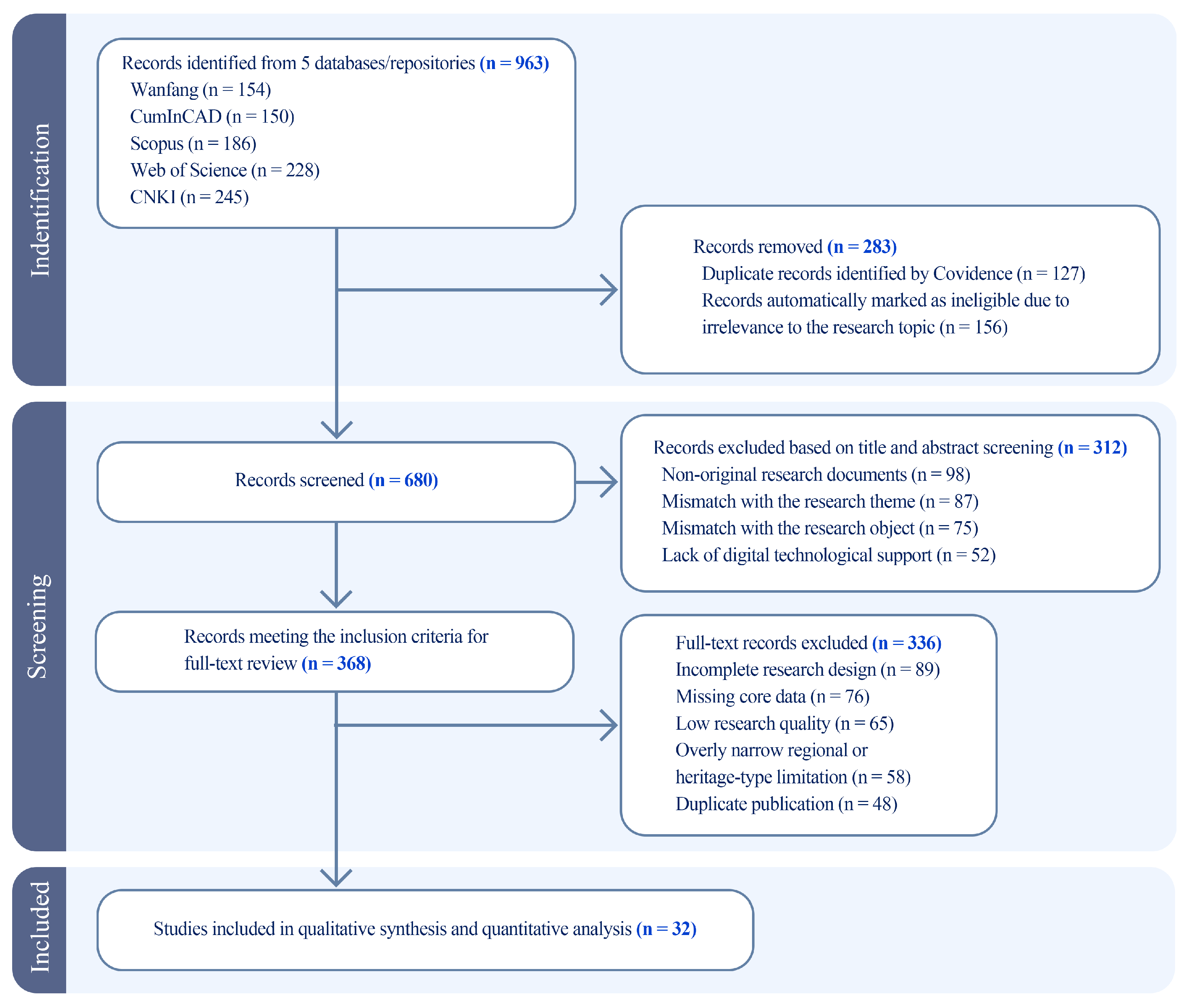
Following this strategy, the initial search yielded 963 records. After automatic deduplication in Covidence and manual verification, 127 duplicate entries were removed. The remaining records were then screened for relevance, with 680 studies retained for title and abstract screening. Screening was conducted by the primary reviewer with support from an additional independent reviewer, and disagreements were resolved through discussion. In the end, 32 studies were included as the corpus foundation for the subsequent analysis in this section. The numerical changes at each stage and the reasons for exclusion are summarized in the PRISMA flow diagram provided as Figure A1 in Appendix A.
The reduction from 963 initially identified records to 32 included studies should be understood in relation to the purpose of the corpus. The corpus is not intended to provide a comprehensive inventory of all theoretical, review-based, or commentary-based discussions surrounding gamification and heritage. Rather, it is a deliberately delimited set of original, application-oriented studies from which case-level, design-level, or implementation-level information could be extracted for analyzing terminology, formal heterogeneity, and applied pathways. This delimitation was necessary because the review aims to compare how gamification mechanisms are operationalized in concrete heritage applications, rather than to map all discussions of gamification and heritage.
Review articles, theoretical essays, reports, and expert commentaries were excluded from the corpus-level synthesis to avoid double-counting secondary interpretations and to maintain comparability across the included studies. However, such sources were not disregarded in the broader argument of the paper; where relevant, they were used as conceptual references for definitional alignment, methodological positioning, and discussion.

4.2. Semantic Dispersion and Analytical Layering of Terms

As noted earlier, a substantial number of participatory practices and design cases with gamification-like characteristics have already emerged in current practices of architectural heritage conservation, dissemination, and interpretation. These practices are distributed across multiple media, technical pathways, and public-oriented heritage experience formats, indicating that such interventions are no longer isolated phenomena. Yet this expansion of practice has not been accompanied by the stabilization of a unified terminological framework. Before moving to any specific classification, it is first necessary to examine how relevant terms are used in the existing literature and what kinds of semantic referents they are made to designate.
A systematic review of gamification, gamified practices in non-game contexts, and architectural heritage literature suggests that many practices involving similar participatory mechanisms or interaction logics have not been discussed within a unified terminological framework, but have instead been distributed across different fields and labeled in different ways. Depending on their research questions, disciplinary traditions, and application contexts, different studies adopt different expressions for related phenomena. Some situate such practices within discussions of digital display, media representation, immersive media, Human-Computer Interaction (HCI), or digital applications, and describe them as immersive experience [23], interactive heritage interface [24], digital heritage application [25], virtual museum [26], or walkthrough [25]. Others approach comparable practices from the perspectives of education, dissemination, or game studies, using labels such as serious game [27,28,29], edutainment [30,31], heritage game [27,32], or gamified learning [32,33].
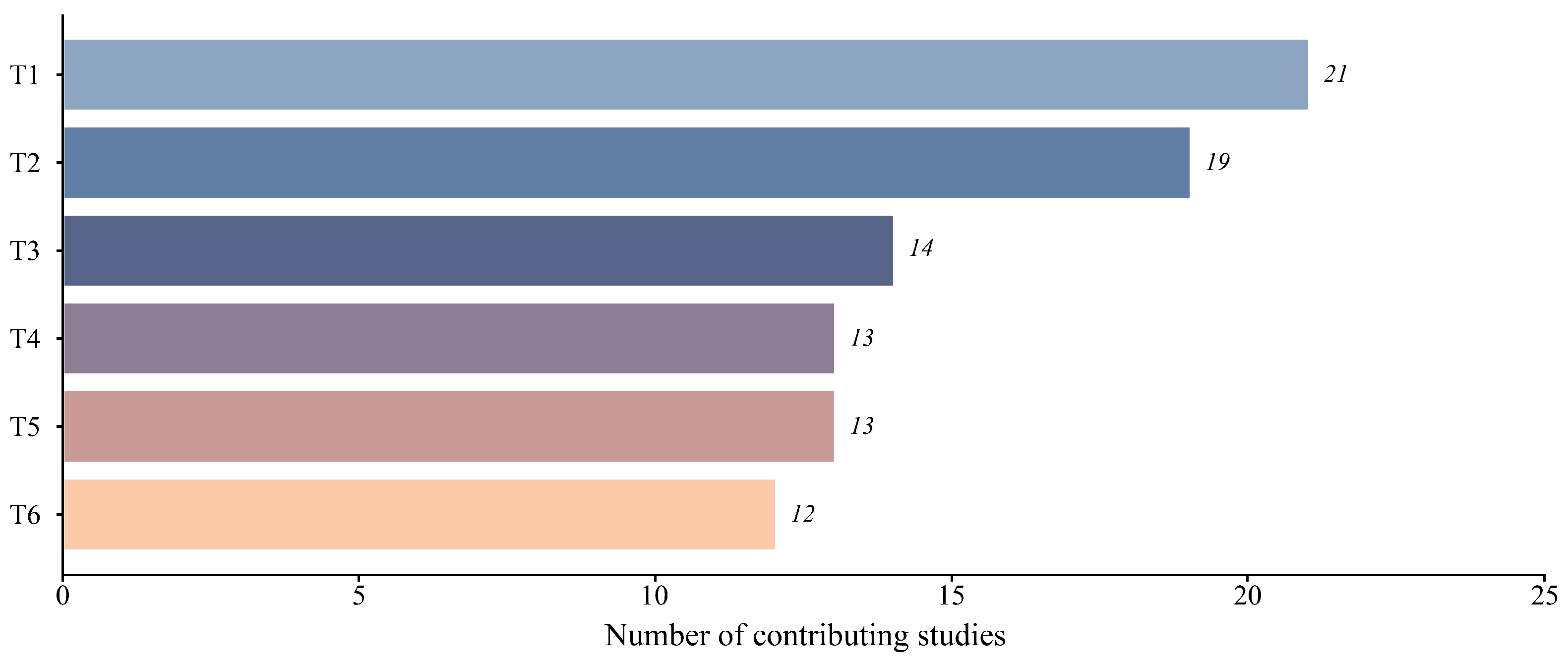
The issue is not simply one of terminological variety, but that these terms are often produced through different classificatory logics and do not always refer to phenomena operating at the same analytical level. To clarify the relationship among terminological usage, typical referents, and levels of analysis, the relevant expressions are further organized and their recurrent ambiguities compared in Table 1, while Figure 2 maps the frequency distribution of representative naming clusters across the review corpus.
Considered together, Table 1 and Figure 2 reveal not a set of simple synonymic substitutions among several terms, but a broader pattern of juxtaposition and overlap across naming logics, objects of reference, and levels of analysis in current scholarship. Although the existing literature has accumulated a considerable number of practical cases, these cases have yet to be situated within a unified and stable terminological framework.

4.3. Heterogeneous Forms and Application Paths

Beyond the terminological dispersion outlined above, the studies included in the review corpus also exhibit marked differentiation in their applied forms. Existing practices do not center on any single technology, medium, or product type; rather, they diverge in implementation pathways, modes of interactional organization, and practical objectives. Some remain closer to the contexts of digital heritage and visualization, emphasizing digital interpretation, interactive reconstruction, and virtual display. Others are more closely aligned with HCI-oriented approaches, foregrounding embodied interaction, situated experience, and user participation. Still others draw on organizational logics from game studies and design, highlighting spatial gameplay, rule structures, and forms of non-entertainment-oriented participation. Some continue to be shaped by the constraints of heritage interpretation, authenticity, and ethical boundaries. The review corpus suggests that the differences among these practices are manifested not only in media form, but also in interactional mechanisms and the interpretive aims they are intended to serve.
Within this formal heterogeneity, the review corpus also reveals several relatively stable clustering tendencies across research objects, practical aims, and technical pathways. The systematic review indicates that heritage-gamification studies are largely oriented toward tourists/visitors, with goals commonly focused on enhancing motivation and engagement, and that mobile platforms, AR, and VR are the most frequently adopted technical routes [4]. Meanwhile, studies on tourism experiences of built heritage similarly emphasize how digital technologies broaden user experience and facilitate engagement through playful and participatory approaches [55]. In the context of immersive virtual exhibitions, research often combines AR/VR with 3D reconstruction, multimodal data integration, and interactive narrative/task mechanics to produce more immersive heritage experiences, while emphasizing requirements such as cultural sensitivity and representational accuracy [2]. In architectural-heritage education settings, Voinea frames the work around virtual interactive learning, highlights boosting learning engagement through “play-and-flow,” and—through pathways involving digitalization, the import of game engines, and AR/VR integration—further discusses issues such as the tension between “authenticity–gamification” and perceptual accuracy [56].
In architectural heritage contexts, such formal variation should not be understood as a mere substitution of media. Rather, it results from the combined operation of architectural spatial characteristics, heritage-interpretive objectives, and methodological resources drawn from adjacent fields. Within gamification-related practices concerning architectural heritage, architecture does not function as a passive background for content, but as a structural condition that continuously participates in the unfolding of spatial sequences, the organization of pathways, and the production of meaning.
As reflected in the review corpus, these different orientations do not usually appear as isolated tendencies in specific cases, but are often layered within the same practice and reorganized in response to shifting research objectives and situational conditions. For this reason, current gamification-related practices in architectural heritage cannot be consistently identified through any single medium, interaction form, or product type. This formal heterogeneity constitutes an important corpus-level characteristic of the field and further indicates that existing research does not yet support a stable identification of such practices solely by reference to media form, product category, or interaction type.

5. Defining AHG: Scope and Criteria

The preceding discussion has shown why AHG cannot be identified through terminology, media form, or product type alone. This section therefore proposes a working definition of AHG and sets out the criteria by which it may be judged.

5.1. Working Definition of AHG

AHG should not be understood as a general combination of “heritage” and “gamification,” nor should it be extended to include any architectural-heritage experience that features interaction, immersion, or digital media. Rather, it designates a specific kind of design practice in which identifiable gamification mechanisms are introduced into an architectural heritage context and organized according to both architectural logic and the normative framework of heritage interpretation.
On this basis, AHG is defined here as a design practice in which gamification elements are selected, organized, and judged within architectural heritage contexts on the basis of architectural logic and under the constraints of heritage interpretation, in order to support protection-oriented public understanding, participation, and meaning-making.
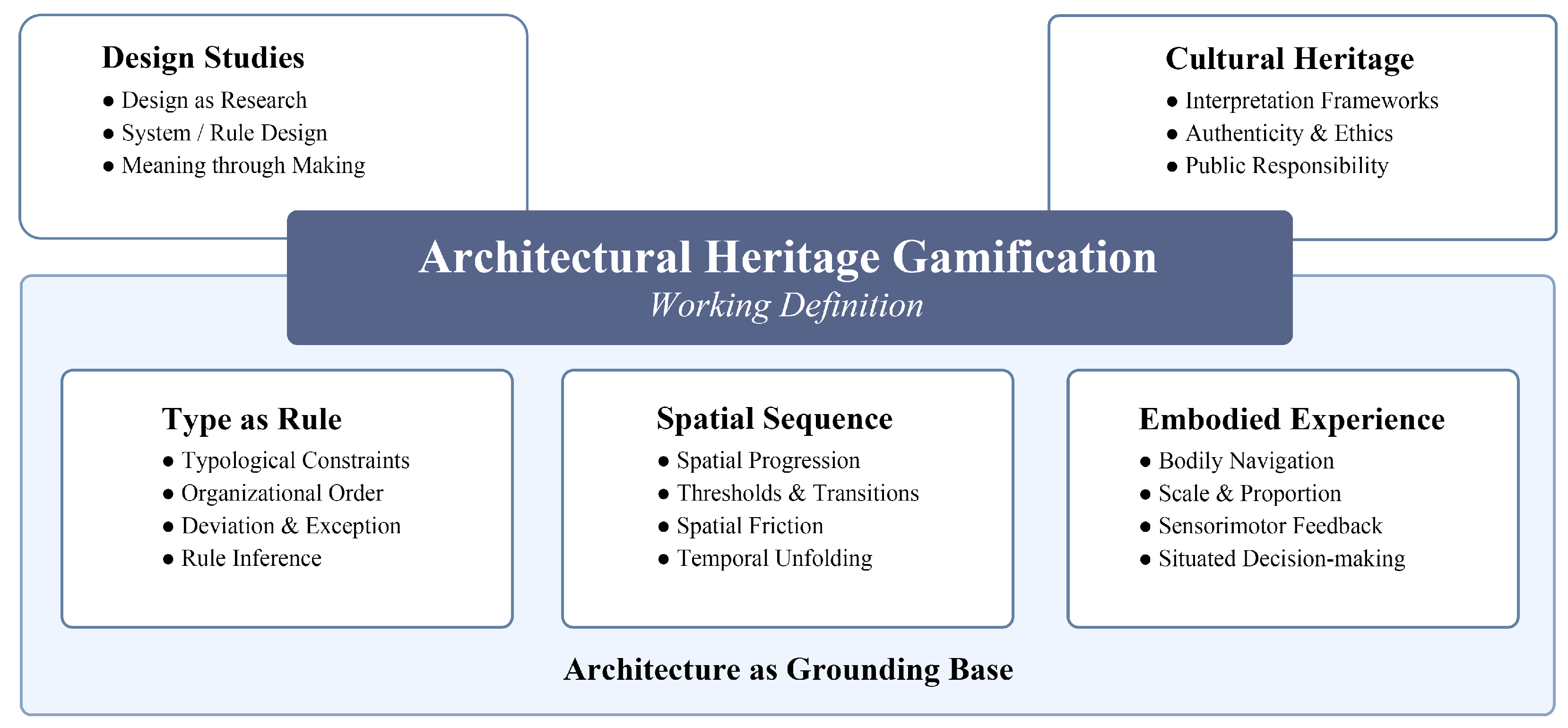
AHG depends on three jointly delimiting sets of conditions. First, design studies provide the basis for organizing mechanisms, such that AHG is built around identifiable structures such as tasks, rules, feedback, and progression, while also reflecting an orientation toward generating meaning through design and making. Second, the cultural heritage field provides its normative boundaries, meaning that such organization cannot be detached from interpretive frameworks, requirements of authenticity, ethical constraints, and public responsibility. Third, architecture constitutes the grounding base of AHG: it not only provides the object basis on which the practice depends, but also enters into the constitution of gamification mechanisms through three architectural paths—type as rule, spatial sequence and path organization, and embodied experience. The constitutive logic of AHG is summarized schematically in Figure 3.

5.2. Criteria of Inclusion and Exclusion

The working definition proposed above requires a corresponding set of inclusion and exclusion criteria in order to clarify which practices fall within AHG, which should be excluded, and which, although adjacent to it, remain insufficient to constitute AHG.
Before listing these criteria, it is necessary to clarify how the term “architectural logic” is used for the purpose of judgment in this paper. The term is not used here as a fixed disciplinary category or as a general synonym for architectural style, visual appearance, or recognizability. Rather, it functions in this paper as an analytical shorthand for the site- and setting-specific architectural relations through which architectural heritage organizes use, spatial sequence, access, visibility, scale, movement, and situated encounter. These relations matter to AHG not simply because they describe the object, but because they structure how visitors or players encounter, navigate, interpret, and make judgments about the architectural heritage.
For the purposes of AHG judgment, architectural logic is treated as operative only when such relations materially shape gamification mechanisms, such as tasks, rules, feedback, progression, challenge, or participant judgment. This also means that the mere presence of tasks, feedback, or challenge is insufficient if those mechanisms remain detached from the spatial, typological, embodied, or interpretive conditions of the heritage site or setting; in such cases, the problem is one of mechanism misalignment rather than a simple absence of gamification.
In terms of inclusion, a practice should satisfy at least the following conditions simultaneously:
  • A heritage context is established: The practice must be situated within the context of protection, interpretation, education, dissemination, or public participation in architectural heritage, rather than in the generalized sense of historical entertainment or a heritage-themed experience.
  • Gamification mechanisms are established: The practice should involve identifiable relations of tasks, goals, feedback, progression, challenge, or rules, rather than remaining merely at the level of interaction, immersion, or information display.
  • Architectural centrality is established: Architectural heritage must remain the central referent of the practice, rather than serving merely as a content container, narrative backdrop, or spatial shell.
  • Architectural logic enters into the constitution of mechanisms: Architectural heritage must shape the structure of participation at the level of tasks, rules, feedback, progression, or judgment, rather than remaining external to mechanism formation.
  • Normative constraints are established: The design cannot be detached from basic boundaries such as the priority of protection, authenticity requirements, interpretive responsibility, and public responsibility.
Only when these conditions are jointly satisfied can a practice be included within AHG, rather than being treated as a general digital heritage experience, an interactive framing, or a heritage-themed product. Correspondingly, where a practice clearly lacks the conditions above, it should be excluded from AHG:
  • Purely technical-display practices: If a project consists only of 3D modelling, digital reconstruction, AR/VR presentation, interactive guidance, or information overlay, without a clear gamification mechanism, it cannot constitute AHG.
  • Purely entertainment-oriented appropriations: If a project merely borrows heritage appearance, historical atmosphere, or cultural symbols, while assuming no interpretive responsibility toward architectural heritage and serving neither protection nor public understanding, it does not belong to AHG.
  • Purely spatial-container practices: If an activity takes place within a heritage space but the architecture neither shapes the organization of rules nor the structure of tasks, feedback, or participatory judgment, and remains only in the background, it cannot be included in AHG.
  • Media- or product-self-sufficient practices and adjacent concepts: AR/VR, heritage apps, immersive walkthroughs, and interactive reconstruction cannot be directly included within AHG solely by virtue of media or product form. Serious games, likewise, cannot be treated as AHG solely by virtue of intentional orientation. These practices may overlap with AHG only when they simultaneously satisfy the inclusion criteria above.
  • More fundamentally, mechanism-misaligned practices: If a gamified organization is formally visible yet remains misaligned with the architectural and interpretive conditions of the heritage site or setting in question, such a practice should not be regarded as a valid instance of AHG. In such cases, the issue is not the formal presence of gamification, but whether the mechanism is appropriate to the object in question.
However, commercial games such as the examples mentioned in Section 3.3 should be treated as boundary cases rather than as automatic inclusions or exclusions. Their special status comes from the fact that they are full game products rather than gamified heritage projects: AHG-relevant mechanisms may genuinely appear within particular segments of play, spatial exploration, architectural reconstruction, or heritage-oriented encounter, while the overall product logic may still remain oriented toward commercial entertainment. At the same time, the game as a whole should not be treated as AHG solely because it contains recognizable architectural heritage, nor should it be dismissed as irrelevant merely because it is a commercial game.
Its status depends on the level of analysis: particular mechanisms or episodes may approach AHG when architectural heritage becomes central to player action, spatial judgment, and interpretive meaning, while the whole product should not be included within AHG where heritage functions mainly as visual atmosphere, narrative setting, or cultural branding. Nevertheless, such AHG-relevant segments may still merit independent analysis where they organize architectural heritage as a meaningful object of player action, spatial exploration, and interpretive encounter.
The criteria above are intended as conceptual decision logics rather than as a scoring scale. To clarify how they may be exercised in case judgment, Table 2 identifies the kinds of evidence that may be examined when applying the criteria. The table does not introduce additional criteria; rather, it indicates how evidence may support or weaken a practice’s satisfaction of the criteria already listed above.
As a brief illustrative application, a mobile AR exploration game developed for the Relics of Arhat Monastery and Twin Pagoda in Suzhou can be read as a strong illustrative candidate for AHG under the criteria proposed here [44]. The project is developed for an architectural heritage site and is designed to support site visits and heritage learning through mobile AR. Its mechanisms include treasure hunt, role-playing, clues, collection, storytelling, puzzles, photo-taking, storyboard, and social sharing, while its learning tasks are organized around site-specific elements such as inscriptions, the carved brick gate, the twin pagodas, pillar shapes and patterns, and the planning of the Main Hall. In this case, architectural centrality is strengthened because the tasks and progression depend on the specific heritage object and would require substantial redesign if transferred elsewhere. Architectural logic enters mechanism formation insofar as spatial spots, inscriptions, structural elements, the site plan, visibility, and situated onsite exploration shape tasks, feedback, progression, and participant judgment. This reading is illustrative rather than a validation of the framework, but it shows how the criteria can be applied to a published case.
In sum, the criteria of inclusion and exclusion proposed in Section 5.2 are not supplementary additions to the working definition in Section 5.1, but a further elaboration of it at the level of judgment. They are proposed as decision logics for conceptual judgment, not as a ready-made evaluative scale. Together, they ensure that AHG is not generalized into any broad combination of “architectural heritage + interaction/game mechanisms,” but can instead be identified and discussed as a workable analytical category.

5.3. Architectural Grounding in AHG Mechanism Formation

What distinguishes AHG from general digital heritage experiences, exhibition-based interaction, or media-based interventions is not simply the introduction of gamification mechanisms, but the particular way in which architecture enters their formation. Section 5.2 has already proposed this as a criterion of judgment. The present section clarifies why that criterion is necessary and how architectural logic may become constitutive of mechanisms through several concrete paths. In AHG, architecture is not merely content to be interpreted or a cultural background to be carried, but the grounding base through which participants’ understanding, action, and judgment are organized.
  • Type as rule: from architectural typology to mechanism constraint
“Type as rule” does not treat architectural type as a static classificatory label or stylistic tag. Rather, it emphasizes that typological logic itself can serve as a constraint on mechanism organization, a basis for judgment, and a boundary of participation. Some architectural heritage objects do indeed provide a relatively direct basis for task arrangement, rule-setting, and feedback organization through strong typological constraints, organizational order, exceptional relations, or inferable structures.
For instance, in a pagoda, gate tower, or temple complex, typological order may require participants to follow a sequence of ascent, entry, or ritual approach, so that checkpoints, access rules, and feedback are organized around floors, gates, courtyards, or thresholds rather than arbitrary game levels. A comparable logic can be seen in the HeritageSite AR case, where tasks are organized across inscriptions, the carved brick gate, the twin pagodas, pillar remains, and the former main-hall layout, rather than around a generic sequence of challenges [44].
More importantly, however, type as rule is not limited to such objects with a strong formal logic. In cases where architectural heritage bears heavy historical experience, memory burden, or ethical sensitivity, the role of type may not manifest itself through clearly generalizable repetitive structures, but rather through restraint in modes of participation, caution in modes of interpretation, or the inappropriateness of certain levels of mechanism intensity, competitive logic, or forms of feedback.
Within AHG, type may operate both as an organizational constraint and as a participatory boundary. Precisely for this reason, type as rule is not only one of the pathways through which architecture enters AHG, but also a crucial point at which one judges whether a mechanism is compatible with the object in question. Whether a set of mechanisms is valid does not depend solely on the presence of tasks, feedback, or challenge, but more fundamentally on whether it corresponds to the typological characteristics, spatial conditions, historical context, and interpretive requirements of the object. If the typological logic of architecture cannot enter mechanism organization, an apparently gamified practice still cannot constitute AHG in the full sense.
  • Spatial sequence: from movement through space to task progression
Distinct from typological logic as a rule basis, another important path through which architecture enters AHG lies in the fact that spatial sequence and path organization can themselves become the structural basis for task progression and the unfolding of meaning. Architectural space is not a neutral container, but often organizes human action and perception through entry, pause, turning, threshold, concealment, and revelation.
For example, a route that moves from an entrance court through successive thresholds toward a main hall may allow tasks, clues, and feedback to unfold according to the order in which architectural information is progressively disclosed. Comparable spatial-narrative logic is visible in the Yedikule Fortress mixed-reality case, where focal nodes, designed links, route-based tasks, puzzles, collectible objects, and clues organize the visitor’s progression through the site [35].
When AHG translates architectural logic into mechanism organization, spatial progression itself may become the rhythm of tasks, the timing of feedback, and a condition for participatory judgment. The point here is not simply to turn route design into an interactive experience, but to ask how progression, threshold, and temporal unfolding within architectural space directly participate in the constitution of mechanisms, thereby shaping participants’ ways of understanding architectural heritage. Put differently, in AHG, space does not merely carry tasks, but co-produces structure with them; likewise, architectural meaning does not simply attach itself to an independent game objective, but gradually takes shape through movement, delay, turning, and arrival in space. This does not mean, however, that every route-based heritage experience constitutes spatial-sequence-based AHG; it applies only where movement, threshold, delay, or disclosure materially shapes task progression, feedback timing, or the points at which participants must interpret, judge, and respond.
  • Embodied experience: from bodily engagement to meaning-making
Beyond typological logic and spatial sequence, the third key path through which architecture enters AHG lies in embodied experience. Architectural heritage is not a purely visual object; its understanding is often closely bound up with bodily movement, pause, turning, the perception of scale, changes in rhythm, and judgments in action. Compared with more general screen-oriented and placeless gamified systems, what is distinctive about AHG is precisely that participants do not confront an abstract task system, but enter processes of judgment and action through the body within a concrete architectural environment. Embodied experience is not merely an increase in “immersion” or an enhancement of “experientiality”; rather, it is a mechanism condition that can directly affect how tasks are carried out, how feedback is perceived, how risk is assessed, and how meaning is generated.
For example, the difficulty of a task may derive not only from the rules themselves, but also from bodily conditions such as climbing, turning, looking upward, passing through a narrow threshold, or adjusting to scale, orientation, field of view, modes of access, and spatial pressure. A related concern is evident in Nofal et al.’s situated tangible gamification study, where different spatial configurations of game setups shaped visitors’ cultural learning, engagement, and collaboration with a 1:1 tomb-chapel replica and the original heritage artifact [24]. In such cases, feedback does not function simply as a system prompt; it becomes meaningful because the participant’s bodily position, path of movement, and sensory experience on site make differences, limits, and consequences perceptible.
At this level, architecture is not merely the setting in which tasks occur; through embodied participation, it gives the process of judgment an architectural character. Participation here is not an abstract interaction detached from object and place, but one conditioned by bodily situatedness within an architectural environment. Bodily immersion alone, however, is not enough. Embodied experience becomes constitutive only when bodily situatedness materially shapes action, perception, feedback, or judgment in relation to the heritage object.
Taken together, architectural grounding constitutes a substantive condition for the formation of AHG mechanisms. Type as rule enables architecture to enter mechanism organization in the form of constraint, boundary, and grounds of judgment; spatial sequence enables it to enter task rhythm in the form of progression, turning, and unfolding; and embodied experience enables it to enter participation in the form of conditions of action and perceptual difference. Together, these three paths show that architecture in AHG is not a passive background or optional cultural shell, but the grounding condition through which gamification mechanisms acquire an architectural character and through which heritage meaning is organized through participation. AHG should be judged not by media intervention, product form, or interaction intensity alone, but by whether architecture enters into the constitution of mechanisms.

5.4. AHG and Its Adjacent Fields

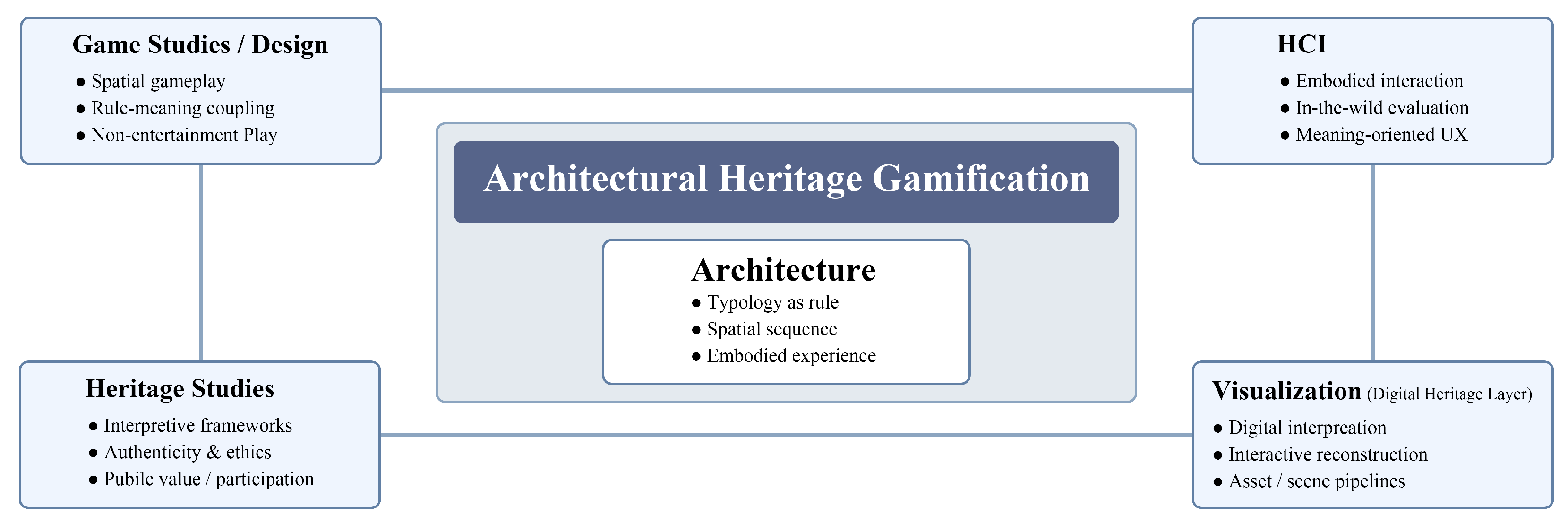
AHG does not emerge in isolation. Rather, it takes shape through ongoing exchanges with adjacent fields including architectural heritage conservation, design studies, game studies, HCI, and digital visualization. These fields provide interpretive, design, interactive, and implementation-related resources through which AHG can be understood and developed, but none of them alone is sufficient to define it.
Figure 4 presents AHG as positioned in relation to several adjacent fields rather than as a subcategory of any one of them. Heritage studies provide interpretive and normative resources; game studies and design contribute mechanism-oriented and organizational resources; HCI offers perspectives on participation, interaction, and embodied engagement; and visualization provides important implementation pathways for representation and communication. Yet AHG cannot be reduced to any of these fields individually, because architecture remains its grounding base rather than an external interface or optional thematic layer.
For this reason, the relative autonomy of AHG does not depend on disciplinary isolation, but on the specific way gamification mechanisms are constrained and organized within architectural heritage contexts. AHG should remain open to insights from adjacent fields while maintaining its own architectural and heritage-interpretive position.

6. Discussion, Limitations, and Future Directions

AHG is defined here as a distinct research object specifically oriented toward architectural heritage in response to the terminological dispersion, semantic overlap, and formal heterogeneity evident in current scholarship. Its contribution lies not in placing AHG under an already stabilized superordinate concept, but in clarifying a working definition together with corresponding inclusion and exclusion criteria. More importantly, within AHG, architecture is not a passive background, a cultural shell, or a mere carrier of content, but the grounding base through which gamification mechanisms acquire architectural character.
At the level of practice, AHG should not be identified directly through media form, technical intensity, or product classification. For practices related to architectural heritage, the more critical question is whether gamification mechanisms are organized, without diminishing the specificity of architectural heritage or weakening interpretive responsibility, into a form of participation oriented toward protection-oriented public understanding. In this sense, the proposed definitional framework is better understood as a basis for judgment rather than a design template. Beyond merely naming AHG, it helps clarify its conceptual boundaries, reduce misidentification in adjacent research, and provide a more consistent basis for case judgment, comparison, and future evaluation. It also offers a clearer point of reference for architectural heritage conservation, exhibition, education, and dissemination practices, while helping researchers, practitioners, and learners avoid mistaking technological intensification for interpretive deepening.
Several limitations should be acknowledged. Most fundamentally, the framework proposed here should be understood as a conceptual-operational basis for judgment rather than a validated classificatory instrument. Its purpose is to clarify how AHG may be identified and delimited, not yet to provide a fully standardized tool that can be applied across cases without further testing. In addition, although the systematic review offers a verifiable corpus foundation, the analysis remains shaped by database coverage, language distribution, and publication bias. The corpus should be understood as an application-oriented and case-extractable evidence base, rather than as a comprehensive representation of the field’s full theoretical or discursive landscape.
Because the corpus is based primarily on sources retrieved through these English- and Chinese-language search environments, its distribution may reflect the visibility of particular academic traditions and publication infrastructures rather than the full global range of AHG-related practice. The framework is therefore not assumed to be generalizable across cultural and regional contexts on this basis alone; its transferability should be examined through future comparative studies in heritage contexts shaped by different conservation traditions, interpretive norms, visitor cultures, and digital-infrastructure conditions. Finally, while three architectural paths are identified through which architectural centrality may enter AHG, their operational indicators and evaluative applications still require further refinement through future case comparison and testing.
Future validation could proceed through a staged comparative methodology. First, the criteria proposed in Section 5.2 could be applied to a larger and more culturally diverse set of architectural-heritage gamification cases across different heritage types, media forms, and regional contexts. Second, multiple reviewers could independently apply the criteria in order to examine whether the operational indicators support consistent case judgment and where disagreement occurs. Third, the results of such comparison could be used to refine the indicators, clarify ambiguous boundary cases, and develop a more robust evaluative protocol. In this way, future work could move the framework from a conceptual-operational basis toward a more validated classificatory and evaluative instrument.

Author Contributions

Conceptualization, Z.L. and D.S.W.; methodology, Z.L.; investigation, Z.L.; formal analysis, Z.L.; data curation, Z.L.; writing—original draft preparation, Z.L.; writing—review and editing, Z.L. and D.S.W.; supervision, D.S.W.; project administration, D.S.W. All authors have read and agreed to the published version of the manuscript.

Funding

This research received no external funding. The article processing charge (APC) was covered by the second author, Danielle S. Willkens.

Institutional Review Board Statement

Not applicable.

Informed Consent Statement

Not applicable.

Data Availability Statement

No new empirical data were created in this study. The data supporting the findings of this study consist of the review corpus and literature records described in the manuscript and Appendix A.

Acknowledgments

The authors would like to thank Xiaoran Meng from the University of Manchester for assistance with the literature screening process during the PRISMA-based corpus construction. During the preparation of parts of Figure 1, the authors used OpenAI ChatGPT (GPT-5.5 Thinking) to generate illustrative images. The generated outputs were subsequently reviewed, edited, and composed by the authors.

Conflicts of Interest

The authors declare no conflicts of interest.

Abbreviations

The following abbreviations are used in this manuscript:
AHGArchitectural Heritage Gamification
ARAugmented Reality
VRVirtual Reality
HCIHuman–Computer Interaction
PRISMAPreferred Reporting Items for Systematic Reviews and Meta-Analyses
HBIMHeritage Building Information Modeling
NHKNippon Hoso Kyokai
CNKIChina National Knowledge Infrastructure
UNESCOUnited Nations Educational, Scientific and Cultural Organization

Appendix A. Search Strategy and PRISMA-Based Screening

Appendix A.1. Screening Criteria

  • Inclusion criteria
    1.
    Research object: studies had to take architectural heritage as the core research carrier, including tangible built heritage such as historic buildings, monuments and sites, and historic urban areas, with baseline information on heritage type, regional characteristics, and related contextual features clearly identifiable and traceable;
    2.
    Research theme: the core content had to focus on architectural heritage gamification, covering at least one of the following dimensions: conceptual definition, historical development, technological application, or practical case analysis, and had to explicitly incorporate digital technologies;
    3.
    Data completeness: studies had to provide complete core research data and results, including aspects such as gamification design logic, technological implementation pathways, and application outcomes, such that valid information on findings, technical characteristics, and case details could be extracted;
    4.
    Publication language: only studies published in Chinese or English were included to ensure the accuracy and completeness of data extraction and to avoid information bias caused by language barriers;
    5.
    Publication type: only formally published research outputs were included, including journal articles, theses, and conference proceedings papers with complete data.
  • Exclusion criteria
    1.
    Research type: studies were excluded if they consisted only of theoretical speculation without empirical analysis, or if they discussed only the entertainment function of games without purposes related to architectural heritage protection, dissemination, or education; the present study focuses on the practical application and theoretical development of architectural heritage gamification under digitally enabled conditions;
    2.
    Document type: review articles, reports, expert commentaries, conference abstracts without full data, and other non-original research documents were excluded from the corpus-level synthesis, because the analysis in Section 4 required extractable case-level, design-level, or implementation-level information. These sources were not treated as irrelevant to the conceptual argument; where appropriate, review and theoretical sources were used as conceptual references for definitional alignment, methodological positioning, and broader discussion. Only original studies with complete research design, data records, or sufficiently detailed case-level, design-level, or implementation-level information were retained in the review corpus;
    3.
    Data quality: studies with duplicate publication of data were excluded, with preference given to the most recent or more complete version; studies lacking core research information and not reasonably supplementable were also excluded;
    4.
    Research content: studies focusing only on intangible cultural heritage or natural heritage, without architectural heritage as the central research object, were excluded; studies addressing non-digital traditional games in relation to architectural heritage were also excluded;
    5.
    Technical characteristics: studies that did not clearly integrate digital technologies and discussed only offline games, physical board games, or similar forms without digital support were excluded.

Appendix A.2. Database Selection

This study adopted a comprehensive literature collection strategy combining multi-database searches with manual searching in order to ensure the comprehensiveness, systematicity, and timeliness of the included studies and to provide high-quality primary data for the subsequent review. The search scope covered major international multidisciplinary databases, including Scopus and Web of Science, as well as core Chinese databases, including CNKI and Wanfang Data. Search strings were constructed in response to the indexing characteristics of each database through coordinated combinations of controlled terms and free-text terms. The core search dimensions included the research object (e.g., architectural heritage, built heritage), core approach (e.g., gamification, serious games), technological background (e.g., digitalization, virtual reality, game engines), and research focus (e.g., conceptualization, historical development, case-based practice).
For Web of Science and Scopus, combinations of topic terms and title/abstract free-text terms were used to fit international conventions of terminology. For the Chinese databases, search expressions combined standardized Chinese terminology for architectural heritage gamification with relevant English abbreviations in order to fit the expression patterns of Chinese academic literature. The time span for all database searches was set from January 2010 to December 2025, so as to comprehensively capture the most recent published work since the emergence of architectural heritage gamification research.
In addition, to reduce publication bias and improve the completeness of the corpus, supplementary search strategies were also implemented. These included backward reference searching of the bibliographies of included studies and targeted searches of important conference abstracts in the fields of architectural heritage and digital humanities published between 2019 and 2025. The databases consulted, search strings, and rationales for selection are summarized in Table A1.
Table A1. Databases, Search Strings, and Rationales for Selection.
DatabaseSearch StringRationale for Selection
Web of Science(“architectural heritage” OR “built heritage” OR “historic building” OR “heritage site”) AND (“gamification” OR “serious game” OR “game-based design”) AND (“digitalization” OR “virtual reality” OR “augmented reality” OR “game engine”) AND (concept OR evolution OR history OR case study OR practice)A combined topic-term and title/abstract free-text strategy was used to accurately match standardized terminology in international cultural heritage and architectural research and to cover interdisciplinary studies.
Scopus(“architectural heritage” OR “built heritage”) AND (“gamification” OR “serious game”) AND (“digital*” OR “VR” OR “AR” OR “HBIM”) AND (“conceptualization” OR “historical evolution” OR “practical application”)A relatively concise free-text combination was used to broaden retrieval coverage and to suit the multidisciplinary coverage characteristics of Scopus.
CumInCAD(“architectural heritage” OR “historic urban area”) AND (“gamification” OR “playful design”) AND (“digital reconstruction” OR “game engine” OR “BIM”)Focused on professional terminology in architectural computation and digital architecture to capture specialized research at the intersection of heritage digitization and gamification.
CNKI(“jianzhu yichan” OR “jiancheng yichan” OR “lishi jianzhu” OR “guji yizhi”) AND (“youxihua” OR “yansu youxi” OR “youxihua sheji”) AND (“shuzihua” OR “xuni xianshi” OR “zengqiang xianshi” OR “youxi yinqing”) AND (“gainian” OR “lishi” OR “yanjin” OR “anli” OR “shijian”)Combined standardized Chinese terminology for architectural heritage gamification with English abbreviations where relevant, in order to fit Chinese academic writing conventions and cover journals, theses, and conference papers.
Wanfang Data(“jianzhu yichan” OR “lishi chengqu”) AND “youxihua” AND (“shuzihua jishu” OR “xuni chongjian” OR “jianzhu xinxi moxing”) AND “yingyong yanjiu”Used Chinese keyword combinations while moderately expanding heritage-type terminology and including “yingyong yanjiu” (applied research) to match the practical analytical orientation of this study.
Note: Chinese search strings are presented in pinyin romanization for compatibility with the manuscript template.

Appendix A.3. Search Strategy and Screening Process

To systematically collect high-quality studies related to architectural heritage gamification in digital contexts, this study developed and refined a multidimensional search strategy. By integrating internationally used terminology with Chinese academic terminology and constructing targeted search expressions through Boolean operators, database-specific search strategies were implemented across different platforms. Mutual supplementation among databases was used to minimize the impact of publication bias. Based on this search strategy, the initial search yielded 963 records, distributed across databases as follows: CNKI (n = 245), Web of Science (n = 228), Scopus (n = 186), Wanfang Data (n = 154), and CumInCAD (n = 150).
The screening stage strictly followed the preset procedure. First, automatic deduplication was conducted in Covidence, followed by manual verification, which resulted in the removal of 127 duplicate records. An initial topical relevance screening excluded 156 studies that were unrelated to the research theme, leaving 680 records for the second-stage title and abstract screening. Screening was conducted by the primary reviewer with support from an additional independent reviewer, using the predefined inclusion and exclusion criteria; disagreements were resolved through discussion. After title and abstract screening, 312 studies were excluded for failing to meet the inclusion requirements. The specific reasons and counts were as follows: non-original research documents (n = 98, including reviews, expert commentaries, and conference abstracts without full data); mismatch with the research theme (n = 87, addressing only game design or only architectural heritage digitization without integrating the two); mismatch with the research object (n = 75, focusing on intangible cultural heritage or natural heritage); and lack of digital technological support (n = 52, discussing only traditional offline games in relation to architectural heritage).
The remaining 368 studies entered full-text retrieval and review under the same screening arrangement. At this stage, further screening was conducted in strict accordance with the inclusion criteria, limiting the corpus to original studies with complete research design, empirical analysis, and results discussion, in order to ensure the scientific rigor of the included research designs and the usability of the data. Ultimately, 336 studies were excluded for not meeting the requirements. The reasons for exclusion included incomplete research design (n = 89, such as studies lacking clear methods or presenting only a research proposal without empirical analysis); missing core data (n = 76, such as the absence of specific technological pathways or practical case details); low research quality (n = 65, including non-peer-reviewed works or publications in non-formal outlets); excessively narrow regional or heritage-type limitations without broader representativeness (n = 58); and duplicate publication (n = 48, where a more recent or more complete output by the same research team had already been included).
After the full screening process, 32 studies were found to meet all inclusion criteria and were included in the qualitative synthesis and quantitative analysis of this review. The key stages of the literature identification and screening process, the number of records at each stage, and the reasons for exclusion are fully documented in the PRISMA 2020 [57] flow diagram shown in Figure A1, which provides a transparent overview of the full screening process and supports the methodological reliability of the review.
Figure A1. PRISMA 2020 [57] Flow Diagram of Literature Screening.
Heritage 09 00259 g0a1

References

  1. Deterding, S.; Dixon, D.; Khaled, R.; Nacke, L. From Game Design Elements to Gamefulness: Defining “Gamification”. In Proceedings of the 15th International Academic MindTrek Conference: Envisioning Future Media Environments, Tampere, Finland, 28–30 September 2011; ACM: New York, NY, USA, 2011; pp. 9–15. [Google Scholar] [CrossRef]
  2. Wang, H.; Gao, Z.; Zhang, X.; Du, J.; Xu, Y.; Wang, Z. Gamifying Cultural Heritage: Exploring the Potential of Immersive Virtual Exhibitions. Telemat. Inform. Rep. 2024, 15, 100150. [Google Scholar] [CrossRef]
  3. ICOMOS. The ICOMOS Charter for the Interpretation and Presentation of Cultural Heritage Sites; ICOMOS Charter; International Council on Monuments and Sites (ICOMOS): Québec, QC, Canada, 2008; Available online: https://www.icomos.org/images/DOCUMENTS/Charters/interpretation_e.pdf (accessed on 18 June 2026).
  4. Marques, C.G.; Pedro, J.P.; Araújo, I. A Systematic Literature Review of Gamification in/for Cultural Heritage: Leveling up, Going Beyond. Heritage 2023, 6, 5935–5951. [Google Scholar] [CrossRef]
  5. Juul, J. The Game, the Player, the World: Looking for a Heart of Gameness. In Proceedings of DiGRA 2003 Conference: Level Up; Digital Games Research Association: Utrecht, The Netherlands, 2003. [Google Scholar] [CrossRef]
  6. Deterding, S.; Sicart, M.; Nacke, L.; O’Hara, K.; Dixon, D. Gamification. Using Game-Design Elements in Non-Gaming Contexts. In CHI ’11 Extended Abstracts on Human Factors in Computing Systems, Vancouver, BC, Canada, 7–12 May 2011; ACM: New York, NY, USA, 2011; pp. 2425–2428. [Google Scholar] [CrossRef]
  7. Battista, D.; Cecere, L.; Colace, F.; Guida, C.; Lorusso, A.; Santaniello, D. Gamification in Architecture: The Future Interface in Design as an Incentive to Participatory Democracy. In Proceedings of the 17th International Conference on Computer Supported Education, Porto, Portugal, 1–3 April 2025; SCITEPRESS–Science and Technology Publications: Setúbal, Portugal, 2025; pp. 801–811. [Google Scholar] [CrossRef]
  8. Huotari, K.; Hamari, J. Defining Gamification: A Service Marketing Perspective. In Proceeding of the 16th International Academic MindTrek Conference, Tampere, Finland, 3–5 October 2012; ACM: New York, NY, USA, 2012; pp. 17–22. [Google Scholar] [CrossRef]
  9. DaCosta, B.; Kinsell, C. Serious Games in Cultural Heritage: A Review of Practices and Considerations in the Design of Location-Based Games. Educ. Sci. 2022, 13, 47. [Google Scholar] [CrossRef]
  10. Madani, K.; Pierce, T.W.; Mirchi, A. Serious Games on Environmental Management. Sustain. Cities Soc. 2017, 29, 1–11. [Google Scholar] [CrossRef]
  11. Rodela, R.; Speelman, E.N. Serious Games in Natural Resource Management: Steps toward Assessment of Their Contextualized Impacts. Curr. Opin. Environ. Sustain. 2023, 65, 101375. [Google Scholar] [CrossRef]
  12. Speelman, E.N.; Rodela, R.; Doddema, M.; Ligtenberg, A. Serious Gaming as a Tool to Facilitate Inclusive Business; a Review of Untapped Potential. Curr. Opin. Environ. Sustain. 2019, 41, 31–37. [Google Scholar] [CrossRef]
  13. Tilden, F. Interpreting Our Heritage, 3rd ed.; University of North Carolina Press: Chapel Hill, NC, USA, 1994. [Google Scholar]
  14. Frayling, C. Research in Art and Design; Royal College of Art Research Papers; Royal College of Art: London, UK, 1993; Available online: https://researchonline.rca.ac.uk/384 (accessed on 18 June 2026).
  15. Martusciello, F.; Muccini, H.; Bucchiarone, A. A Reference Architecture for Gamified Cultural Heritage Applications Leveraging Generative AI and Augmented Reality. arXiv 2025. [Google Scholar] [CrossRef]
  16. Spennemann, D.H.R. Conceptualizing a Methodology for Cultural Heritage Futures: Using Futurist Hindsight to Make “Known Unknowns” Knowable. Heritage 2023, 6, 548–566. [Google Scholar] [CrossRef]
  17. Anderson, J. Living History: Simulating Everyday Life in Living Museums. Am. Q. 1982, 34, 290. [Google Scholar] [CrossRef]
  18. Colonial Williamsburg Foundation. History of Colonial Williamsburg. Available online: https://www.colonialwilliamsburg.org/about/history-of-colonial-williamsburg/ (accessed on 5 June 2026).
  19. Wilks, C.; Kelly, C. Fact, Fiction and Nostalgia: An Assessment of Heritage Interpretation at Living Museums. Int. J. Intang. Herit. 2008, 3, 128–140. [Google Scholar]
  20. Liu, Y. Evaluating Visitor Experience of Digital Interpretation and Presentation Technologies at Cultural Heritage Sites: A Case Study of the Old Town, Zuoying. Built Herit. 2020, 4, 14. [Google Scholar] [CrossRef]
  21. Nowacki, M. Heritage Interpretation; Podręczniki; Akademia Wychowania Fizycznego im. Eugeniusza Piaseckiego: Poznań, Poland, 2012. [Google Scholar]
  22. Cassar, A.; Baker, D.; Ioannides, M. From Digital Twin to Memory Twin: A Holistic Framework for Cultural Heritage Documentation, Interpretation, and Adaptive Reuse. Int. Arch. Photogramm. Remote Sens. Spat. Inf. Sci. 2025, XLVIII-M-9–2025, 203–209. [Google Scholar] [CrossRef]
  23. Camara, J. Serious Games and Heritage Mediation: Strategies for Identifying, Valuing and Transmitting the Intangible Cultural Heritage. Rev. Mem. 2018, 3, 1–5. [Google Scholar]
  24. Nofal, E.; Panagiotidou, G.; Reffat, R.M.; Hameeuw, H.; Boschloos, V.; Vande Moere, A. Situated Tangible Gamification of Heritage for Supporting Collaborative Learning of Young Museum Visitors. J. Comput. Cult. Herit. 2020, 13, 1–24. [Google Scholar] [CrossRef]
  25. Tan, K.L.; Lim, C.K. Digital Heritage Gamification: An Augmented-Virtual Walkthrough to Learn and Explore Historical Places. AIP Conf. Proc. 2017, 1891, 020139. [Google Scholar] [CrossRef]
  26. Sangamuang, S.; Wongwan, N.; Intawong, K.; Khanchai, S.; Puritat, K. Gamification in Virtual Reality Museums: Effects on Hedonic and Eudaimonic Experiences in Cultural Heritage Learning. Informatics 2025, 12, 27. [Google Scholar] [CrossRef]
  27. Mao, P.; Cho, D.M. Research on an Evaluation Rubric for Promoting User’s Continuous Usage Intention: A Case Study of Serious Games for Chinese Cultural Heritage. Front. Psychol. 2024, 15, 1300686. [Google Scholar] [CrossRef] [PubMed]
  28. Zhang, Z. Serious Games for Cultural Heritage Learning: A Discussion Based on Engagement. Art Des. 2022, 94–97. (In Chinese) [Google Scholar] [CrossRef]
  29. Zheng, C.; Xu, S.; Zhang, Y. Psychological Mechanisms of Empathetic Engagement in Cultural Heritage Education through Digital Games: A Case Study of “Cloud Tour of the Great Wall”. J. Cent. China Norm. Univ. (Nat. Sci.) 2025, 59, 426–436. (In Chinese) [Google Scholar]
  30. He, C.; Liu, Z. Intermedia Storytelling in Games and Cultural Communication: How Black Myth: Wukong Empowers the Global Transmission of Chinese Culture. J. Shanghai Jiaotong Univ. (Philos. Soc. Sci.) 2025, 33, 33–43+106. (In Chinese) [Google Scholar]
  31. Zheng, H.; Shi, H.; Xiao, Q.; Liu, J. From Historical Representation to Digital Resonance: Dissemination Mechanisms of Cultural Heritage Elements in Games. Glob. J. Media Stud. 2025, 12, 54–71. (In Chinese) [Google Scholar] [CrossRef]
  32. Zhang, Y.; Li, W.; Luo, Y.; Nie, X. Cultural Heritage Education Game Based on Experiential Learning Model—Taking the Game of “Dream Back to the Banquet in Southern Tang Dynasty” for Example. Mod. Educ. Technol. 2022, 32, 48–56. (In Chinese) [Google Scholar]
  33. Souropetsis, M.; Kyza, E.A. CompARe: Design and Development of a Gamified Augmented Reality Learning Environment for Cultural Heritage Sites. J. Comput. Cult. Herit. 2025, 18, 1–16. [Google Scholar] [CrossRef]
  34. Bieszk-Stolorz, B.; Dmytrów, K.; Eglinskiene, J.; Marx, S.; Miluniec, A.; Muszyńska, K.; Niedoszytko, G.; Podlesińska, W.; Rostoványi, A.V.; Swacha, J.; et al. Impact of the Availability of Gamified E-Guides on Museum Visit Intention. Procedia Comput. Sci. 2021, 192, 4358–4366. [Google Scholar] [CrossRef]
  35. Gül, L.F.; Güleç Özer, D.; Yağmur-Kilimci, E.S.; Coşkun, E. Spatial Narratives in Mixed Reality: Immersive Gamified Heritage Experience at Yedikule Fortress. In Confluence: Proceedings of the 43rd eCAADe Conference; eCAADe Conference Proceedings; eCAADe: Ankara, Turkey, 2025; Volume 2, pp. 19–28. [Google Scholar]
  36. Güner, S.; Gül, L.F. Evaluating Virtual Game Design for Cultural Heritage Interpretation: An Exploratory Study on arkeOyun. Heritage 2025, 8, 208. [Google Scholar] [CrossRef]
  37. Ibrahim, M.A.S.T.; Murphy, O. Gamified and Accessible Cultural Heritage: An AR Framework for Inclusive Experiences. EJDAM 2025, 3, 14–30. [Google Scholar] [CrossRef]
  38. Julrode, P.; Poollapalin, D.; Sangamuang, S.; Intawong, K.; Puritat, K. Can Location-Based Augmented Reality Support Cultural-Heritage Experience in Real-World Settings? Age-Related Engagement Patterns and a Field-Based Evaluation. Informatics 2026, 13, 12. [Google Scholar] [CrossRef]
  39. Li, Y.; Yan, X. Discussion on Serious Game Design for Studying Traditional Residential Cultural Heritage in Southwest Hubei. Design 2024, 37, 26–29. (In Chinese) [Google Scholar]
  40. Liu, B.; Gu, B.; Zheng, L.; Wan, H. Cultural Heritage Serious Games Design and Cultural Dissemination. Packag. Eng. 2021, 42, 47–53. (In Chinese) [Google Scholar]
  41. Mei, Q.; Zhang, J. Digital Experience Design for Historical and Cultural District Based on Gamification Theory. Packag. Eng. 2023, 44, 461–470. (In Chinese) [Google Scholar]
  42. Wang, J.; Li, K.; Wei, Z.; Niu, M. Gamification Design Strategy Based on Traditional Intangible Nuo Culture in Enshi. Packag. Eng. 2025, 46, 262–273. (In Chinese) [Google Scholar]
  43. Xu, H.; Gong, Y.; Zhang, A. Research on the Design of Serious Games for Cultural Heritage Education. Art Des. Res. 2024, 4, 87–94. (In Chinese) [Google Scholar]
  44. Xu, N.; Li, Y.; Liang, J.; Shuai, K.; Li, Y.; Yan, J.; Zhang, C.; Dong, Y. HeritageSite AR: Design and Evaluation of a Mobile Augmented Reality Exploration Game for a Chinese Heritage Site. J. Comput. Cult. Herit. 2024, 17, 1–29. [Google Scholar] [CrossRef]
  45. Zhang, S.; Jiang, R. Culture Translation and Dynamic Participation: A Serious Game Design Practice for Revitalizing Traditional Chinese Medicine Cultural Heritage. Digit. Publ. Res. 2024, 3, 40–48. (In Chinese) [Google Scholar]
  46. Zhu, J.; Li, Y.; Sun, X. Research on Embodied Experiential Educational Games Faced for Handicraft Intangible Cultural Heritage—Take the Educational Game Named “Finding the Trace of the Cloth Tiger” for Example. Mod. Educ. Technol. 2024, 34, 89–96. (In Chinese) [Google Scholar]
  47. Kontogianni, G.; Koutsaftis, C.; Skamantzari, M.; Georgopoulos, A.; Chrysanthopoulou, C. Developing and Exploiting 3D Textured Models for a Serious Game Application. In 2016 8th International Conference on Games and Virtual Worlds for Serious Applications (VS-GAMES), Barcelona, Spain, 7–9 September 2016; IEEE: Piscataway, NJ, USA, 2016; pp. 1–4. [Google Scholar] [CrossRef]
  48. Peter, K.; Auala, S.; Winschiers-Theophilus, H. An AR Game for Primary Learners to Safeguard Intangible Cultural Heritage of the Ovahimba Tribe. In Proceedings of the 2023 ACM International Conference on Interactive Media Experiences, Nantes, France, 12–15 June 2023; ACM: New York, NY, USA, 2023; pp. 359–361. [Google Scholar] [CrossRef]
  49. Thise, A.; Laboury, D.; Hallot, P. Video Games as a Tool for Heritage Mediation, Application on the Monument of Sennefer in the Theban Necropolis, Egypt. ISPRS Ann. Photogramm. Remote Sens. Spat. Inf. Sci. 2025, X-M-2–2025, 317–325. [Google Scholar] [CrossRef]
  50. Zhou, X.; Gao, B. Digital Game Design Research for the Tanshishan Site Museum: A Flow Theory Approach. Master’s Thesis, Fujian Agriculture and Forestry University, Fuzhou, China, 2025. (In Chinese) Available online: https://link.cnki.net/doi/10.27018/d.cnki.gfjnu.2025.000877 (accessed on 18 June 2026).
  51. Zúñiga-Solórzano, M.E.; Fabregat, R.; Jové, T. Characterization of Games Technologies for Learning in the Context of Intangible Cultural Heritage. Digit. Herit. 2025. [Google Scholar] [CrossRef]
  52. Galindo-Durán, A. Enhancing Artistic Heritage Education through Gamification: A Comparative Study of Engagement and Learning Outcomes in Local Museums. Nusant. J. Behav. Soc. Sci. 2025, 4, 51–58. [Google Scholar] [CrossRef]
  53. Forsyth, H. Building a Virtual Roman City: Teaching History through Video Game Design. J. Class. Teach. 2023, 24, 16–25. [Google Scholar] [CrossRef]
  54. Lv, Y.; Zhang, L. Innovative Applications of Multimedia Technologies in Digital Display for Intangible Cultural Heritage. Packag. Eng. 2016, 37, 26–30+10. (In Chinese) [Google Scholar]
  55. Garcia, A.P.; Frade, D.; Dias, D.R.C.; Almeida, M.A. Gamification and Tourism: The Experience of Built Cultural Heritage Mediated by Digital Technology. In Symposium on Virtual and Augmented Reality, Manaus, Brazil, 30 September–3 October 2024; ACM: New York, NY, USA, 2024; pp. 279–283. [Google Scholar] [CrossRef]
  56. Voinea, A.E. Gamification in Architecture Heritage Education. Virtual Interaction with Architectural Heritage from Cluj County, Romania. Int. Arch. Photogramm. Remote Sens. Spat. Inf. Sci. 2025, XLVIII-M-9–2025, 1579–1586. [Google Scholar] [CrossRef]
  57. Page, M.J.; McKenzie, J.E.; Bossuyt, P.M.; Boutron, I.; Hoffmann, T.C.; Mulrow, C.D.; Shamseer, L.; Tetzlaff, J.M.; Akl, E.A.; Brennan, S.E.; et al. The PRISMA 2020 statement: An updated guideline for reporting systematic reviews. BMJ 2021, 372, n71. [Google Scholar] [CrossRef] [PubMed]
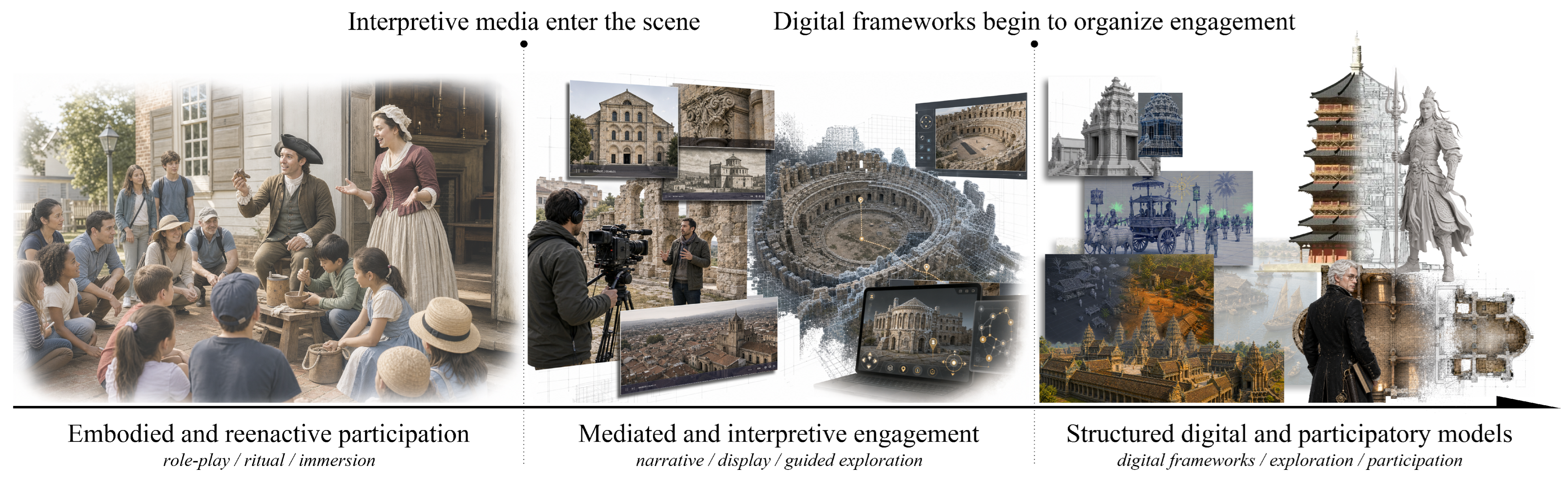
Figure 1. Historical Trajectories of Participatory Practices in Architectural Heritage. A historical-conceptual timeline illustrating the shift in architectural heritage from embodied and reenactive participation to mediated interpretive engagement, and further to structured digital and participatory models. Source note: All illustrative images in Figure 1 were generated using OpenAI ChatGPT (GPT-5.5 Thinking) and subsequently reviewed, edited, and composed by the authors.
Heritage 09 00259 g001
Figure 2. Frequency of representative terminological clusters in the review corpus. Note: The chart summarizes the frequency of representative terminological clusters in the review corpus. A single study may contribute to more than one cluster. The labels in the chart are abbreviated as follows: T1, Gamification; T2, Serious game/Heritage educational game; T3, Gamified heritage experience/visit/learning; T4, AR/VR heritage application/virtual museum/walkthrough; T5, Interpretation design/spatial narrative/gamified design framework; T6, Immersive/interactive/embodied heritage experience. Contributing studies by cluster are as follows. T1: [24,25,26,27,28,29,32,33,34,35,36,37,38,39,40,41,42,43,44,45,46]. T2: [23,27,28,29,31,32,36,37,39,40,43,44,45,46,47,48,49,50,51]. T3: [24,28,29,33,34,35,38,40,41,44,45,46,50,52]. T4: [24,25,26,34,35,36,37,38,44,47,48,53,54]. T5: [30,35,36,37,38,41,43,44,45,48,49,50,51]. T6: [23,24,26,29,40,45,46,47,48,52,53,54].
Heritage 09 00259 g002
Figure 3. A working definition framework for architectural heritage gamification. The figure presents AHG as a working definition jointly delimited by design studies, cultural heritage, and architecture as a grounding base. Within this framework, type as rule, spatial sequence, and embodied experience are identified as three architectural paths through which architecture enters the constitution of AHG.
Heritage 09 00259 g003
Figure 4. Positional map of AHG in relation to adjacent fields, showing architecture as its grounding base rather than an external interface.
Heritage 09 00259 g004
Table 1. Representative Terms in the Review Corpus, Their Typical Referents, Analytical Levels, and Common Ambiguities.
Term/Label in LiteratureTypical ReferentAnalytical LevelTypical Ambiguity in Use
GamificationThe introduction of game design elements, feedback mechanisms, and challenge structures into non-game heritage settingsElement/mechanism levelOften overextended to refer to complete products or entire experiences
Serious game/Heritage educational gameComplete game products oriented toward heritage education, dissemination, or public participationProduct levelOften conflated with gamification
Gamified heritage experience/visit/learningTask-based and feedback-oriented experiences organized around visiting, learning, or guided participationActivity/visit-design/
learning-process level
Occupies an intermediate position between mechanism and application
AR/VR heritage application/virtual museum/walkthroughVisual heritage experience carriers presented through AR/VR, virtual museums, or walkthrough systemsMedium/platform/
application level
The media form is often mistaken for a conceptual category
Immersive/interactive/
embodied heritage experience
Experiential features emphasizing immersion, interaction, bodily participation, or user agencyExperience/interaction levelExperiential effects are often equated with gamification
Interpretation design/spatial narrative/gamified design frameworkInterpretive or design frameworks that organize cultural content, spatial sequences, task structures, and feedback mechanismsDesign-organization/
interpretation-framework level
Easily blurred with products, narratives, or applied forms
Table 2. Operational evidence for applying AHG inclusion and exclusion criteria.
AHG CriterionOperational Evidence to Examine in Case Judgment
Heritage contextOrientation toward protection, interpretation, education, dissemination, public participation, or protection-oriented public understanding, rather than only heritage-themed entertainment, spectacle, or branding.
Gamification mechanismsPresence of tasks, goals, rules, feedback, challenge, progression, rewards, role-based participation, or structured participant judgment beyond mere interaction, immersion, browsing, visualization, walkthrough, or information display.
Architectural centralityDependence of the gamification mechanism on the specific architectural heritage object, such that transfer to another object would require substantial redesign rather than leaving the core rules, tasks, or feedback unchanged.
Architectural logic in mechanism formationShaping of tasks, rules, feedback, progression, challenge, or judgment by typological order, access hierarchy, threshold, spatial sequence, visibility, scale, movement, or situated encounter, rather than by generic game elements attached to heritage content.
Normative constraintsAttention to authenticity, evidential grounding, protection priority, interpretive responsibility, public responsibility, or accountability to heritage value, rather than engagement pursued through fictionalization or decontextualized entertainment alone.
Disclaimer/Publisher’s Note: The statements, opinions and data contained in all publications are solely those of the individual author(s) and contributor(s) and not of MDPI and/or the editor(s). MDPI and/or the editor(s) disclaim responsibility for any injury to people or property resulting from any ideas, methods, instructions or products referred to in the content.