
Article

Saimaluu-Tash I Rock Art (Kyrgyzstan): An Integrated Petrographic, Petrophysical, and Iconographic Study

by
David M. Freire-Lista
1,*,
Ramón Jiménez-Martínez
1,
Javier Luengo
1,
Asunción de los Ríos
2,
Sergio Pérez-Ortega
3,
Julia García-Oteyza
4 and
Aidai Sulaimanova
5
1
Instituto Geológico y Minero de España (CN IGME-CSIC), Ríos Rosas, 23, 28003 Madrid, Spain
2
Department of Biogeochemistry and Microbial Ecology, National Museum of Natural Sciences (MNCN-CSIC), 28006 Madrid, Spain
3
Department of Mycology, Real Jardín Botánico (CSIC), 28014 Madrid, Spain
4
Department of Geodynamics, Stratigraphy and Paleontology, Complutense University of Madrid, 28040 Madrid, Spain
5
Institute of History and Cultural Heritage, National Academy of Sciences of the Kyrgyz Republic, Bishkek 720071, Kyrgyzstan
*
Author to whom correspondence should be addressed.
Heritage 2026, 9(6), 241; https://doi.org/10.3390/heritage9060241
Submission received: 1 April 2026 / Revised: 18 May 2026 / Accepted: 15 June 2026 / Published: 19 June 2026

Abstract

Saimaluu-Tash I, located in a high-altitude glacial valley in Kyrgyzstan, preserves one of Central Asia’s largest and most culturally significant concentrations of rock engravings. Despite extensive archaeological research, the physical, mechanical, and chromatic properties of the sandstone substrates relevant for conservation assessment remain poorly characterized. This study integrates petrographic microscopy, scanning electron microscopy, colorimetry, and Vickers hardness testing with the digital documentation of twelve engraved blocks to evaluate weathering processes, engraving practices, and long-term preservation. The engravings are carved into arkosic sandstone with carbonate cement, characterized by a weathered surface enriched in clay minerals and covered by a dark surface coating (patina). Weathered surfaces exhibit significantly lower hardness (0.6 ± 0.2 GPa) than unweathered stone (2.8 ± 0.6 GPa), which facilitated the engraving of the petroglyphs by allowing tools to penetrate more deeply into the stone. Colorimetric analyses reveal a strong chromatic contrast between the surface patina and the lighter sandstone exposed by engraving (ΔE ≈ 22.7). This contrast would have enhanced the original visibility of the petroglyphs and highlights potential conservation issues associated with the progressive reformation of this surface layer. Iconographic analysis identifies recurrent themes related to hunting, herding, mobility, animal management, and symbolic spatial practices within a nomadic high-mountain landscape. Overall, the results demonstrate how an integrated material and interpretative approach contributes to understanding rock art production processes. They support preventive and sustainable conservation strategies for vulnerable engraving landscapes shaped by long-term interactions between geological processes and human activity.

1. Introduction

Rock art in Central Asia consists predominantly of engraved images, commonly referred to as petroglyphs, although painted examples are also documented [1]. These manifestations are widely distributed across mountainous regions—including the Tien Shan, Pamir-Alai, Chu-Ili, and Altai ranges—as well as arid environments such as the Kyzylkum and Karakum deserts. Prominent sites include Tamgaly, Eshkiolmes, Bayan-Zhurek, Kuljabasy, and Arpauzen in Kazakhstan; Cholpon-Ata, Ornok, Saimaluu-Tash, and Jaltyrak-Tash in Kyrgyzstan; Langar and the Shakhty Cave in Tajikistan; and Sarmishsay, Zaraut-Kamar, and Siypantosh in Uzbekistan.
Research on Central Asian rock art has developed over more than two centuries [2]. Early studies were initiated in the nineteenth century by Russian explorers and scholars, including Grigory Ivanovich Spassky. During the Soviet period, research became increasingly institutionalized through regional inventories and archaeological monographs, with major contributions [3,4,5,6,7,8,9], whose semiotic and structural approaches strongly influenced later interpretations. Since the independence of the Central Asian republics in 1991, research has expanded through local academic institutions and international collaborations [10].
Several rock art complexes in the region have received international recognition for their outstanding universal value. Tamgaly in Kazakhstan and Sulaiman-Too in Kyrgyzstan were inscribed on the UNESCO World Heritage List in 2004 and 2009, respectively. Other major sites—including Sarmishsay in Uzbekistan, Bezegli-depe in Turkmenistan, and Saimaluu-Tash in Kyrgyzstan—are currently under consideration for potential nomination.
The present study focuses on the Saimaluu-Tash rock art complex, whose name—meaning “patterned stone” in Kyrgyz—reflects the density and diversity of engraved imagery preserved at the site. Saimaluu-Tash is widely regarded as one of the most extensive rock art complexes worldwide. The rock engravings are distributed across two adjacent valleys, Saimaluu-Tash I and Saimaluu-Tash II, separated by the eastern branch of the Saimaluu-Tash Mountain range. This study concentrates specifically on Saimaluu-Tash I, where engraved sandstone blocks are densely clustered along a high-altitude glacial valley floor.
Saimaluu-Tash is located within the Fergana Mountain range, in the Toguz-Toro District of the Jalal-Abad Region, Kyrgyzstan (41°10′42.02″ N, 73°48′51.94″ E). The site was nominated by the Kyrgyz Republic for inclusion on the UNESCO World Heritage List in January 2001. Saimaluu-Tash I occupies a glacial valley exceeding 3000 m above sea level, characterized by cirques in its upper reaches and a block stream composed mainly of sandstone. Over millennia, geological, climatic, and ecological conditions favored the development of summer pastures that attracted ungulates and supported hunting activities. In this mountainous environment, pastoral economies developed alongside hunting practices, forming the subsistence base of local communities. From the Bronze and Iron Ages onward, innovations such as horseback riding and composite bows transformed hunting strategies, while nomadic herding of sheep, horses, and yaks remained central to regional lifeways.
For thousands of years, hunters and herders engraved images onto the sandstone blocks scattered across the Saimaluu-Tash I Valley [11]. These blocks are typically covered by a dark surface patina [12,13,14] that, when removed by engraving, exposes lighter underlying stone and produces strong visual contrast. Most engravings are concentrated along the valley’s longitudinal block stream (Figure 1), although additional engravings occur throughout the surrounding landscape. Common motifs include ungulates—particularly Siberian ibex and deer—alongside predators, human figures, and scenes depicting hunting, herding, and agriculture. Domestic animals such as yaks, dogs, horses, cattle, and camels are also frequently represented. Zigzag motifs, often interpreted as pathways or game trails [15], further emphasize the communicative and territorial dimensions of the site, providing valuable evidence for the study of hunting-related imagery and landscape use in Central Asia during the Middle Holocene. As in many large rock art complexes, the engravings at Saimaluu-Tash likely accumulated over extended chronological periods, and some panels may represent diachronic additions rather than single coherent compositions.
The first recorded exploration of Saimaluu-Tash was conducted by Nikolay Gavrilovich Khludov in 1902 [16,17], followed by an expedition led by Ivan Grigorievich Poslavsky in 1904. Systematic archaeological investigations began in 1946 under Boris Mikhailovich Zima [18] and were significantly expanded by Alexander Nikolaevich Bernshtam [11]. Subsequent studies by Yuri Alexandrovich Sher [7,8,9], Nikolai Lvovich Podolsky [19], A. I. Martynov, A. N. Mariashev, A. E. Rogozhinsky, Galina Aleksandrovna Pomaskina [20,21,22], Yuri Nikolaevich Gokendukhin [23], Lutfullo Jumaevich Dzhusupakmatov [24], and Henri-Paul Francfort further advanced research at Saimaluu-Tash. Since 1991, investigations have been led primarily by the Institute of History of the National Academy of Sciences of Kyrgyzstan, notably through the work of Kadicha L. Tashbaeva [25,26,27,28,29,30] and Aidai T. Sulaimanova [31,32,33].
Despite extensive archaeological and iconographic research, the petrophysical, mechanical, and chromatic properties of the Saimaluu-Tash I stone substrates remain poorly characterized, particularly in relation to conservation processes. Petrographic and petrophysical analyses are essential for understanding stone behavior, weathering, and long-term preservation of heritage materials [34,35,36]. Techniques such as optical microscopy [37,38,39,40,41], SEM [42,43], colorimetry [44,45], and hardness testing [45] provide complementary information on stone composition, surface alteration, and mechanical resistance. Beyond conservation studies, the characterization of engraved stone surfaces also contributes to the technological understanding of rock art production processes. Experimental, traceological, and technological studies have demonstrated that lithology, hardness, surface weathering, and mineral cohesion strongly influence engraving techniques, tool efficiency, gesture control, and the morphology of engraved traces [46,47,48,49,50,51,52]. In this context, archaeometric analyses provide valuable information for evaluating the mechanical and visual conditions under which petroglyphs were produced.
The aim of this study is to characterize the sandstone substrate on which the Saimaluu-Tash I petroglyphs are engraved (Figure 2) and to document and reinterpret twelve engraved blocks using an integrated analytical and digital approach. By combining petrographic, petrophysical, chromatic, microscopic, and iconographic analyses, this work aims to refine interpretations of engraving practices. It also provides a scientific basis for future conservation and management strategies at this exceptional high-mountain rock art site. Particular attention is given to the relationship between weathering processes, surface patina development, chromatic contrast, and mechanical weakening, as these variables are directly relevant for monitoring deterioration processes and defining future conservation priorities at the site.

2. Materials and Methods

A detailed geological survey was carried out both on the surrounding valley slopes, which constitute the source area of the block stream, and across the block stream itself in order to assess lithological variability and select representative samples.
The valley slopes expose the sandstone folded strata in situ. They generally lack well-developed surface patinas due to their comparatively limited exposure to atmospheric weathering. In this high-mountain periglacial environment, active frost weathering, seasonal snowmelt, and gravitational processes promote rapid erosion and frequent rock detachment from the slopes. The detached sandstone blocks progressively accumulate downslope and feed the extensive block stream occupying the valley floor.
A block stream is a geomorphological landform composed of accumulations of angular rock blocks generated by the mechanical weathering and fragmentation of bedrock under cold-climate conditions. These blocks are gradually transported downslope by gravity-driven processes, frost action, snowmelt, and seasonal periglacial dynamics, forming elongated streams of coarse debris along valley floors and mountain slopes. In Saimaluu-Tash I, the block stream represents a dynamic sedimentary system in which sandstone blocks detached from the surrounding slopes have progressively accumulated and slowly migrated downslope over long timescales, producing extensive surfaces exposed to weathering and surface patina formation. At present, parts of the block stream are partially covered by finer sediments and sparse vegetation (Figure 1).
Field observations were complemented by the use of a geological hand lens and high-resolution macroscopic photography to examine textural and compositional features at a finer scale. These analyses confirmed the overall lithological homogeneity of the engraved supports, all derived from the same sandstone level cropping out along the valley slopes. Lithological uniformity was verified throughout both the block stream and the adjacent slopes through detailed macroscopic inspection and hand-lens examination.
A total of four samples were selected for petrographic analysis, seven for scanning electron microscopy (SEM), eleven in situ engraved blocks for colorimetric characterization, and four samples for hardness testing. All analyzed samples corresponded to the same lithological unit and display consistent petrographic characteristics throughout the study area. Unengraved blocks were preferentially sampled in order to avoid direct intervention on engraved surfaces while ensuring that the analyzed material corresponded to the same lithological and weathering conditions observed in the petroglyph-bearing blocks.

2.1. Technical Analyses

2.1.1. Petrography

In order to analyze the stone substrate of the rock engravings in the Saimaluu-Tash I Valley, two fragments from a broken, unengraved stone with surface patina from the block stream were chosen. Samples and engraved panels were selected in order to represent the main macroscopic weathering states, patina development, and geomorphological distribution observed across the Saimaluu-Tash I block stream. The analyzed blocks were distributed along different sectors of the valley floor and correspond to the dominant sandstone facies identified throughout the site.
The preparation involved cutting the samples with a low-speed saw, followed by polishing with sandpaper and diamond spray of decreasing grain size (from 6.3 to 1 μm) to achieve thin sections of the samples. From each fragment, two thin sections were prepared: one parallel and the other perpendicular to the surface. In total, four thin sections were analyzed using a Leica DM2700P polarization microscope (Leica Microsystems GmbH, Wetzlar, Germany) equipped with a DFC550 digital camera and operated with Leica Application Suite software (LAS 4).

2.1.2. Scanning Electron Microscopy (SEM)

Scanning electron microscopy (SEM) was used to characterize the main morphological features of seven samples and to obtain semi-quantitative analyses to confirm their composition. Two scanning electron microscopes were employed:
(a) a JEOL JSM-6400 scanning electron microscope (JEOL Ltd., Tokyo, Japan) was usedat the National Centre for Electron Microscopy, Complutense University of Madrid (Spain). Operating conditions included an accelerating voltage of 20 kV and a working distance of 15 mm. A polished sample, cut perpendicular to the surface patina and containing both weathered and unweathered zones, with an approximately cubic shape (~1.5 cm per side), was embedded in a cylindrical mount (~2 cm in diameter) and polished. The sample was carbon-coated; therefore, all elements except carbon were analyzed.
(b) a JEOL 6010 PLUS/LA scanning electron microscope (JEOL Ltd., Tokyo, Japan) was used to analyze carbon at the CN IGME-CSIC laboratories in Tres Cantos, Madrid (Spain),. An accelerating voltage of 15 kV and a working distance of 10 mm were applied. Six millimetre-scale fragments were analyzed: two from the patina (cut parallel to the surface patina), three from sections cut perpendicular to the surface patina containing both the patina and the weathered—unweathered interface, and one sample from the weathered zone. These samples were not coated, as low-vacuum conditions (10–100 Pa) were used.
In both instruments, analyses were carried out using secondary and backscattered electrons. Both systems are equipped with energy-dispersive spectroscopy (EDS) microanalysis detectors. SEM-EDS analyses were used primarily for semi-quantitative elemental characterization and microtextural observation. The technique does not permit definitive identification of organic compounds or precise determination of patina genesis; therefore, interpretations regarding carbon-rich surface materials remain provisional and require confirmation through dedicated mineralogical or organic geochemical analyses.
Once the SEM images were obtained, they were processed using ImageJ v1.54 software (National Institutes of Health, Bethesda, MD, USA) to estimate the apparent two-dimensional porosity of both the unweathered and weathered zones. Void spaces were identified as dark low-signal areas in the SEM images due to the absence or very limited electron emission. The average pore size was additionally estimated by measuring the diameter of 20 representative pores in each zone and calculating the mean value.

2.1.3. CIE L*a*b* Chromatic Parameters

To assess the chromatic characteristics of the surface patina, eleven engraved blocks on the block stream were selected for analysis. Each block underwent ten measurements that were evenly distributed over the engraved area. From these 110 measurements, the average and standard deviation were calculated as follows: To evaluate the chromatic properties of the stone beneath the engravings, two samples were selected: one from an unweathered, gray surface inside the stone and another from a weathered, brown outer surface. These samples were sectioned into pieces of similar size and polished to achieve a uniform surface devoid of irregularities that could affect the color readings. After polishing, the samples were oven-dried until they reached a stable weight, ensuring the removal of moisture that could affect the chromatic results. For each sample, ten separate measurements were conducted on various parts of the polished surface to obtain representative values and minimize the effect of potential local material inconsistencies. Color measurements were performed using a HINOTEK DS-200 Series portable colorimeter (Hinotek Instrument Co., Ltd., Hangzhou, China), which was calibrated according to the manufacturer’s guidelines. The chromatic parameters were documented in the CIELAB color space (L*, a*, b*), where L* represents lightness (0 = black, 100 = white), a* denotes the position on the red-green axis (positive values indicate red, negative values indicate green), and b* denotes the position on the yellow-blue axis (positive values indicate yellow, negative values indicate blue). The mean values and standard deviations for each set of measurements on the unweathered and weathered surfaces were calculated to quantitatively compare the chromatic differences caused by weathering. Additionally, the color difference (ΔE) between the surface patina and the underlying weathered zone was calculated using the formula ΔE = √(ΔL*)2 + (Δa*)2 + (Δb*)2.
The chromatic comparison between the surface patina and the weathered zone was selected because the engraving process removes the thin surface patina and exposes the underlying weathered zone rather than the deeper unweathered interior of the sandstone. Field and microscopic observations indicate that the weathered zone forms a several-millimetre-thick altered layer directly beneath the surface patina, whereas the unweathered zone occurs at greater depth and is not reached by the depth of the rock engravings. Consequently, the visual appearance of freshly produced engravings would have depended primarily on the contrast between the surface patina and the lighter weathered zone exposed by pecking. For this reason, the patina–weathered zone contrast represents the most archaeologically relevant chromatic comparison for evaluating the original visibility of the petroglyphs.

2.1.4. Hardness Calculation

A Hoytom Model 1003A hardness tester (Hoytom S.L., Lezo, Spain) was used to assess the Vickers hardness (HV) of the unweathered and weathered surfaces of the engraved rock support. Two samples of weathered stone and two samples of unweathered stone were analyzed. The samples were prismatic, with a square base (~5 cm × ~5 cm), providing sufficient surface area for multiple indentations while preserving petrographic representativeness, and a height of 3 cm to ensure stability during testing. The loading surface was carefully prepared to obtain a sufficiently flat and stable area for indentation measurements, thereby minimizing potential sources of error during the Vickers hardness tests. The samples were then dried in an oven until they achieved a constant weight, eliminating any moisture that could potentially affect the experimental results. Additionally, a line was drawn along which a minimum of 10 indentations were made by applying a load of 150 kgf using a pyramid-shaped diamond tip, characteristic of the Vickers method. Prior to the measurements, pilot tests were conducted to verify that the selected load produced indentation marks that were clearly visible and well defined, allowing reliable optical measurement of the indentation diagonals. After the load was removed, indentation marks were observed, and their diameters were measured using an optical system integrated into the hardness tester. Based on the recorded dimensions of each indentation, the Vickers hardness (HV) was calculated using the following equation established in the standard:
HV = 1.854 × P/d2
where P is the weight applied in kgf and d is the average diagonal of the indentation in millimeters (mm).
Each sample was evaluated under the same experimental conditions, and individual hardness values were obtained by calculating the average of ten measurements for each sample. These values were compared to establish the differences in the mechanical behavior between the unweathered and weathered sandstone surfaces.
To calculate the average chipped perimeter surface for each sample (weathered and unweathered), the chipped area surrounding ten Vickers indentations was digitally outlined in Adobe Photoshop using images obtained from the optical system integrated into the hardness tester. The outlined regions were subsequently analyzed in ImageJ software, where the area of each chipped perimeter was measured and the mean value for each sample was calculated. This approach allowed a quantitative comparison of peripheral chipping in both lithological states and helped to evaluate how differences in mechanical cohesion between weathered and unweathered sandstone may influence engraving edge definition and surface response during percussion.

2.2. Interpretative Analysis

Digital Trace and Morphometric Analysis of the Rock Engravings

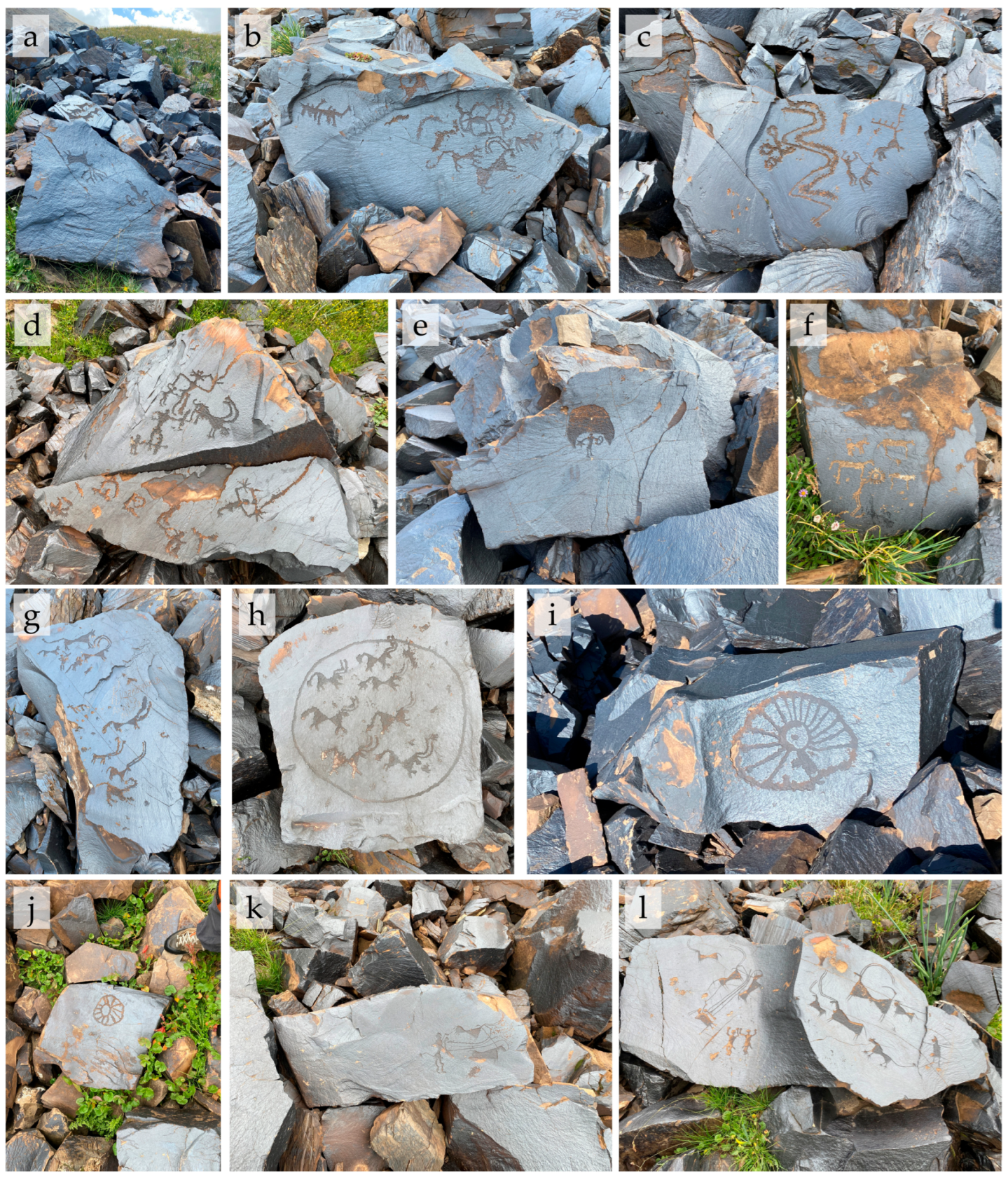
A digital tracing methodology was employed to document the rock engravings using orthogonal photographs of twelve panels (Figure 3) and subsequent graphic processing in Adobe Photoshop. Initially, photographs of the stone panels were taken under controlled conditions to ensure that the images were captured perpendicularly to the engraved surface. This involved positioning the camera at a right angle to the support plane and maintaining a consistent distance and angle to minimize geometric distortion. Each photograph included visible metric scales that helped adjust the actual proportions in the digital environment. Once the images were captured, contrast, brightness, and tonal levels were adjusted in Adobe Photoshop to improve the visual definition of the engravings and facilitate a more accurate identification and tracing of the incised lines. A digital tracing layer was then created, in which the identified lines and shapes were manually outlined using vector-drawing tools. The resulting tracings were subsequently reviewed and compared with the original photographs to verify consistency in the identification of engraved motifs. Interpretative additions not directly supported by visible engraved lines were intentionally avoided in order to minimize subjective reconstruction.
The percentage of the panel area covered by superficial patina versus the area where the weathered zone is exposed was also calculated using ImageJ software. This approach allows the relative vulnerability of each of the 12 studied panels to deterioration processes to be assessed. Panels with larger exposed weathered areas are potentially more vulnerable to ongoing erosion, granular disaggregation, progressive loss of engraved definition, and biological colonization.
The resulting digital tracing remained independent of the base image, allowing it to be exported in different formats (raster or vector) for analysis, comparison, and storage. This approach ensures fidelity to the original record while facilitating non-invasive documentation, comparative analysis, long-term digital preservation, and future reassessment of the engravings.
Although the analytical sampling strategy represents only a subset of the extensive Saimaluu-Tash I block stream, the observed lithological homogeneity and consistent weathering patterns across the valley support the broader applicability of the archaeometric observations presented here.

3. Results

3.1. Technical Analyses

3.1.1. Petrography

The stone is a sandstone, displaying a clastic texture and a fine- to medium-grained fabric. The relative abundances of quartz, feldspar, and lithic fragments support the classification of the sandstone as a feldspathic arenite (arkosic sandstone) according to Pettijohn et al. (1987) [53].
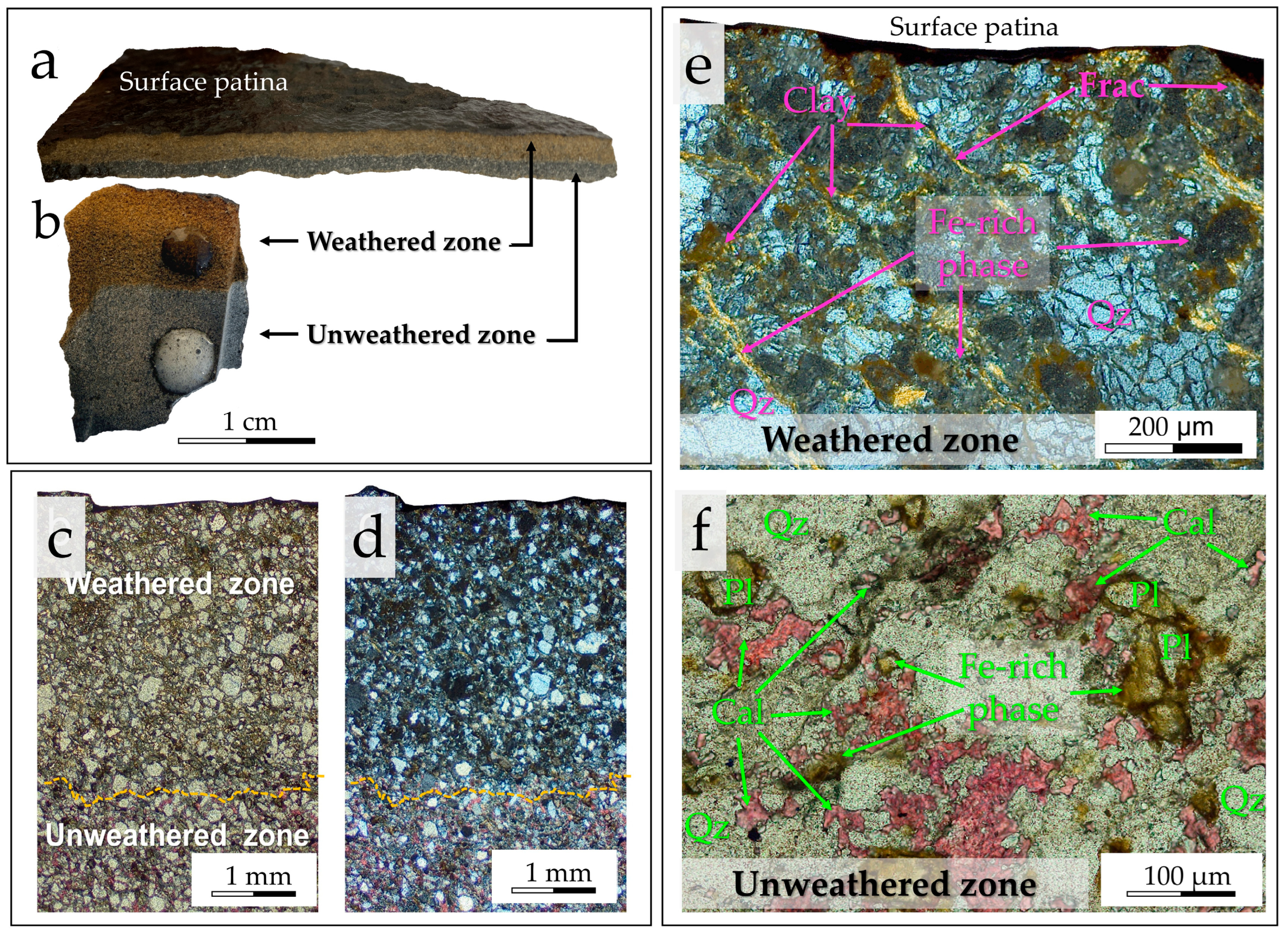
In unweathered areas, the rock is well compacted and composed predominantly of subrounded to subangular quartz grains and feldspars, which are relatively homogeneous in size and distribution. The unweathered zone highlights the irregular surface of the clasts in contact with the matrix, the presence of altered feldspars surrounded by iron oxides, and carbonate cement occupying irregular pore spaces (stained red) (Figure 4). Mineral phases such as quartz, plagioclase, and clay minerals were identified through the correlation of textural and morphological features observed in petrographic microscopy with their chemical signatures obtained by SEM-EDS elemental characterization. This combined approach allows a reliable discrimination of mineral phases based on both microtextural criteria and semi-quantitative elemental composition. Grain contacts are mainly point-to-linear, suggesting a moderate degree of mechanical compaction prior to cementation (Figure 4). The matrix is fine-grained and predominantly clay-rich, occupying intergranular positions and locally filling feldspar voids. Although a portion of the matrix is depositional, a significant proportion is secondary, derived from the decomposition of feldspars and lithic fragments and forming extensive pseudomatrix domains.
The cement is predominantly carbonate, most likely calcitic, and shows clear evidence of partial dissolution, particularly towards the outermost surfaces. This process has led to the development of a weathered surface zone of variable thickness, characterized by an intense dissolution of the carbonate cement, a marked increase in intergranular secondary porosity, and the presence of secondary mineral phases.
In the weathered zone, a fractured area near the surface is observed, where fractures are occluded by clay minerals and internal fragmentation of the clasts is recognized (Figure 4).
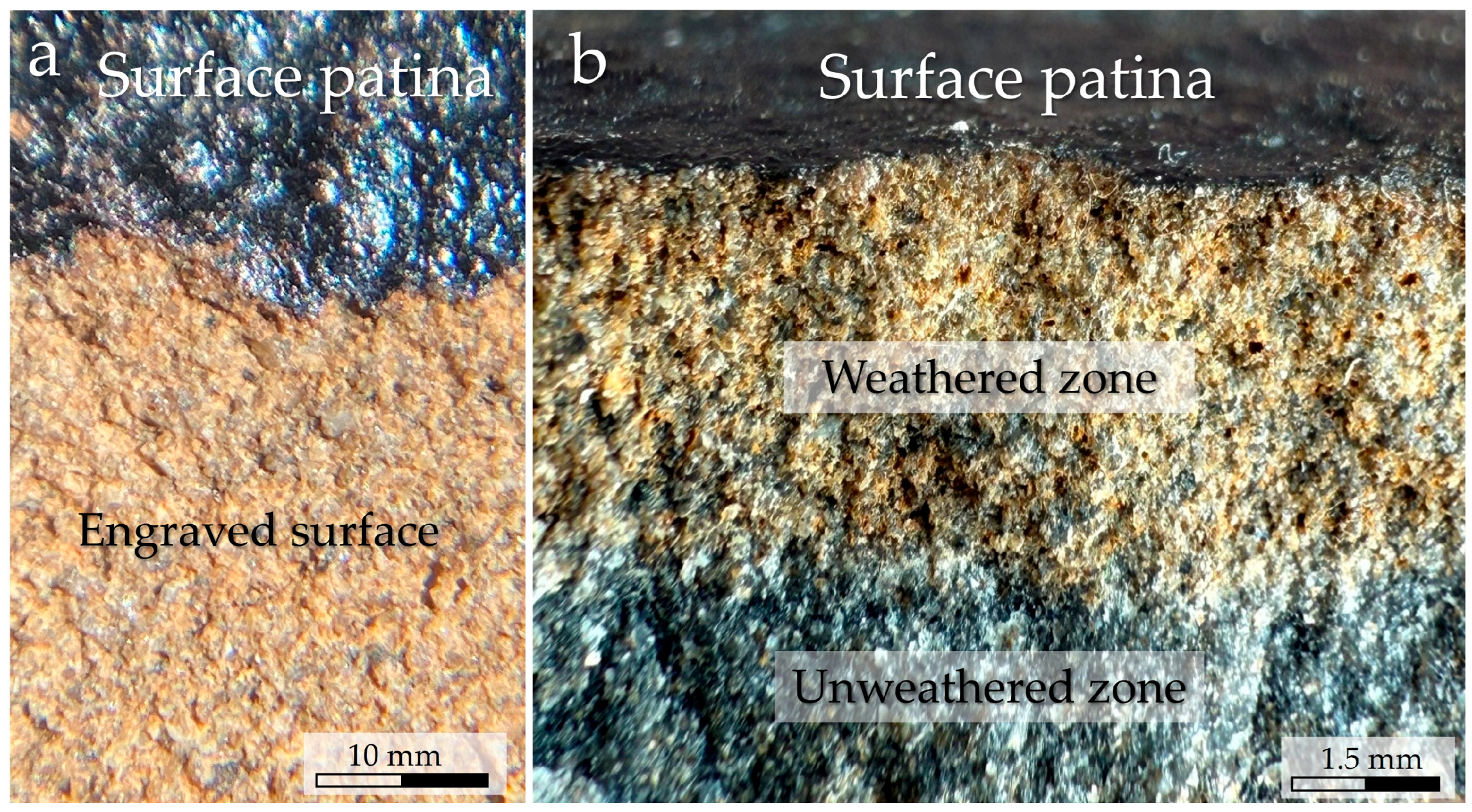
Figure 4a,b illustrates the macroscopic appearance of the upper ~6 mm of the sandstone surface. A surface patina is present, followed by an approximately 4 mm thick weathered zone (yellowish brown) and the underlying unweathered zone (gray). Figure 4b shows the complete dissolution of the calcium carbonate cement, as no reaction is observed in the HCl drop placed on the weathered zone (upper yellowish-brown part), whereas effervescence occurs in the unweathered zone.
Figure 4c and Figure 4d show optical photomicrographs of the same sample under plane-polarized light (PPL) and cross-polarized light (XPL), respectively, highlighting the weathered zone (upper part) and the unweathered zone (lower part). Notably, in the unweathered zone, the carbonated cement exhibits a pink coloration (Figure 4c,d,f), whereas carbonate is absent in the weathered zone. The boundary between these zones is indicated by a yellow dashed line for clarity.

3.1.2. Scanning Electron Microscopy (SEM)

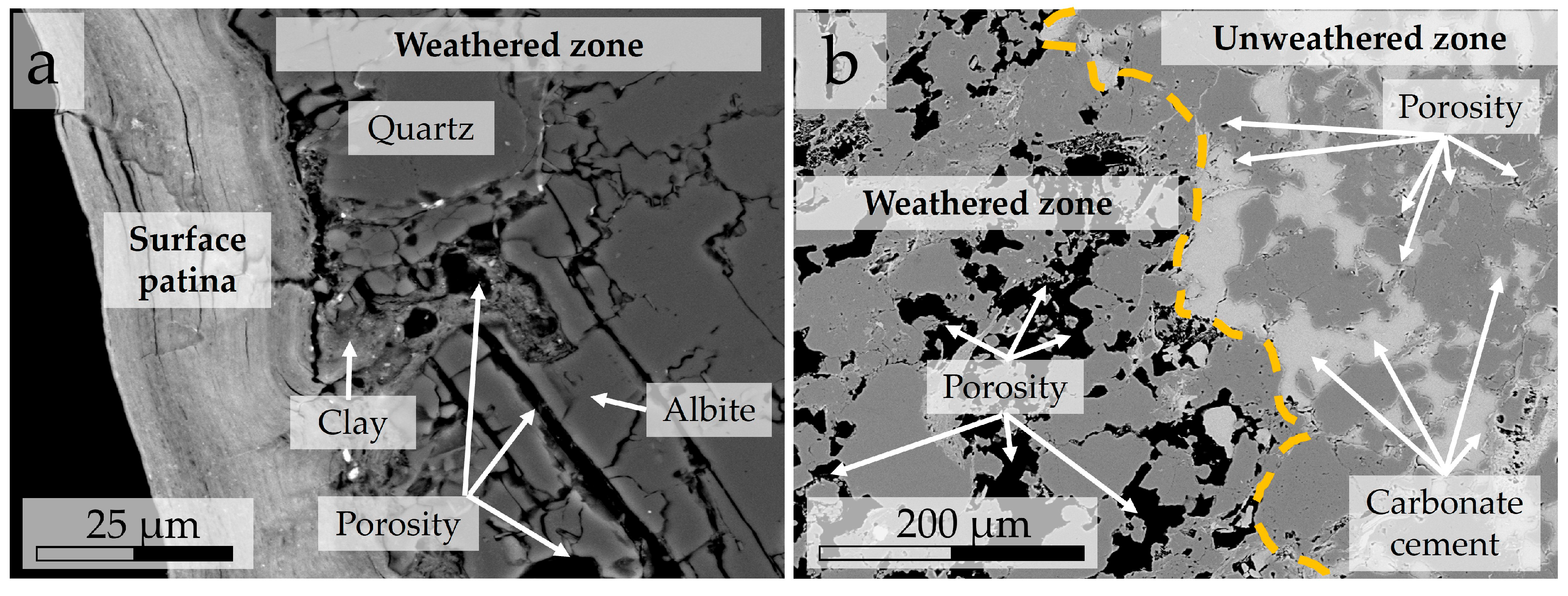
Scanning electron microscopy (SEM) was employed to determine the main morphological characteristics of the grains and to obtain the semi-quantitative analyses required to confirm their nature (SEM-EDS). The stone exhibits three clearly differentiated zones (Figure 5). The first corresponds to a surface patina, the second to a superficially weathered zone several millimetres thick, characterized by significant porosity. Within the clastic fraction, quartz predominates over plagioclase of albitic composition. Crystals of muscovite/illite, chlorite, and smectite have also been recognized, the latter forming part of a clay-rich matrix, together with occasional zircon crystals inherited from the parent rock. The third corresponds to the unweathered zone, where both the clasts and the matrix are very similar to those of the weathered zone; however, the presence of a carbonate cement is particularly noteworthy.
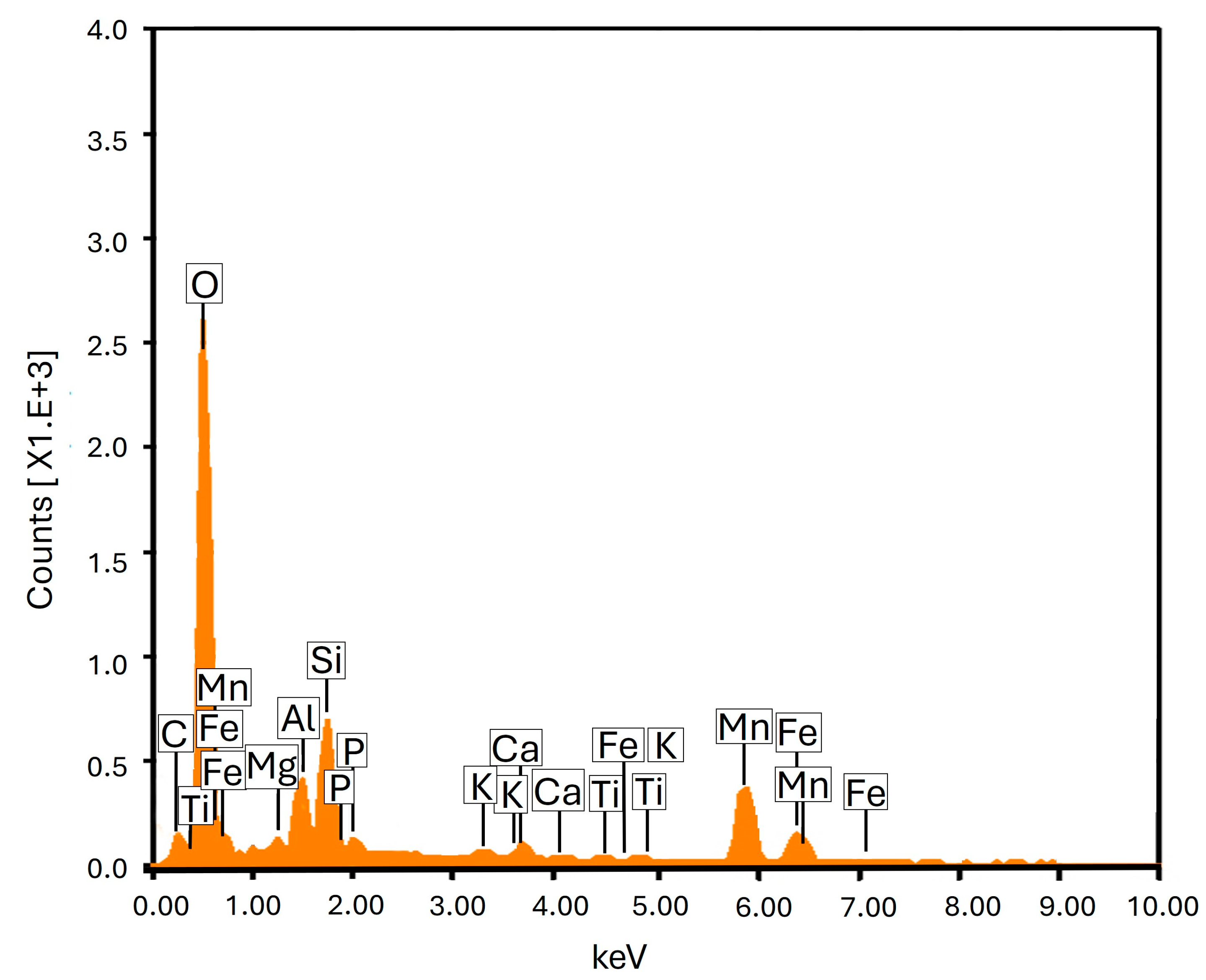
The surface patina, into which the petroglyphs were engraved, has a thickness that generally does not exceed 50 µm, as previously determined in the petrographic study of the analyzed samples. The surface patina exhibits a clay-rich composition containing Mn and Fe oxides, Mn oxides consistently occurring in higher concentrations, as well as carbon (Figure 6). The EDS results obtained from the surface patina showed elevated C values, indicating the presence of carbon-rich material. In addition, Fe and Mn occurred in notable proportions at multiple points, indicating the presence of iron and manganese oxide phases. These oxides are commonly involved in the development of dark coatings on exposed stone surfaces and may be linked to natural geochemical processes or environmental exposures [14].
The porosity estimates for the unweathered zone indicate that the micropores are very small and display a relatively homogeneous size distribution, yielding an average porosity of 1.5% and a mean pore diameter of 0.1 µm. In contrast, the weathered zone showed an average porosity value of 40% (Figure 5). The pore-size distribution was considerably more heterogeneous, with pores locally reaching up to 210 µm in diameter. This strong increase in porosity explains the marked mechanical weakening observed in the hardness tests.

3.1.3. CIEL*a*b* Chromatic Parameters

The average CIEL*a*b* parameters obtained for the different zones show clear chromatic differentiation linked to weathering processes. The unweathered zone presents relatively low lightness values (L* = 38.89 ± 2.34) and near-neutral chromatic coordinates (a* = −0.21 ± 0.33; b* = −1.42 ± 1.20), indicating a grayish substrate consistent with the presence of carbonate cement observed in petrographic and SEM analyses.
In contrast, the weathered zone shows significantly higher lightness (L* = 47.73 ± 0.76) and a marked shift towards negative a* values and positive b* values (a* = −6.42 ± 0.85; b* = 17.73 ± 1.01), indicating a yellowish-brown hue. This chromatic variation is consistent with the mineralogical and microstructural changes identified in the weathered layer, including the dissolution of carbonate cement and the formation of clay minerals and secondary phases, as observed in petrographic and SEM analyses.
The surface patina exhibits lower lightness values (L* = 37.16 ± 1.60) and near-neutral chromatic coordinates (a* = −0.22 ± 0.56; b* = −1.35 ± 1.10), consistent with its dark appearance and the presence of Fe- and Mn-rich phases detected by SEM-EDS. These compositional features explain the strong visual contrast between the surface patina and the underlying weathered zone.
The calculated color difference between the surface patina and the weathered zone (ΔE ≈ 22.7) indicates a pronounced chromatic contrast between both zones. This difference quantitatively reflects the distinct optical properties of the surface patina and the lighter underlying weathered zone.

3.1.4. Vickers Hardness

The Vickers hardness values showed a marked difference between the unweathered zone of the sandstone (2.8 ± 0.6) GPa; (HV~280) and weathered zone (0.6 ± 0.2) GPa; (HV~60).
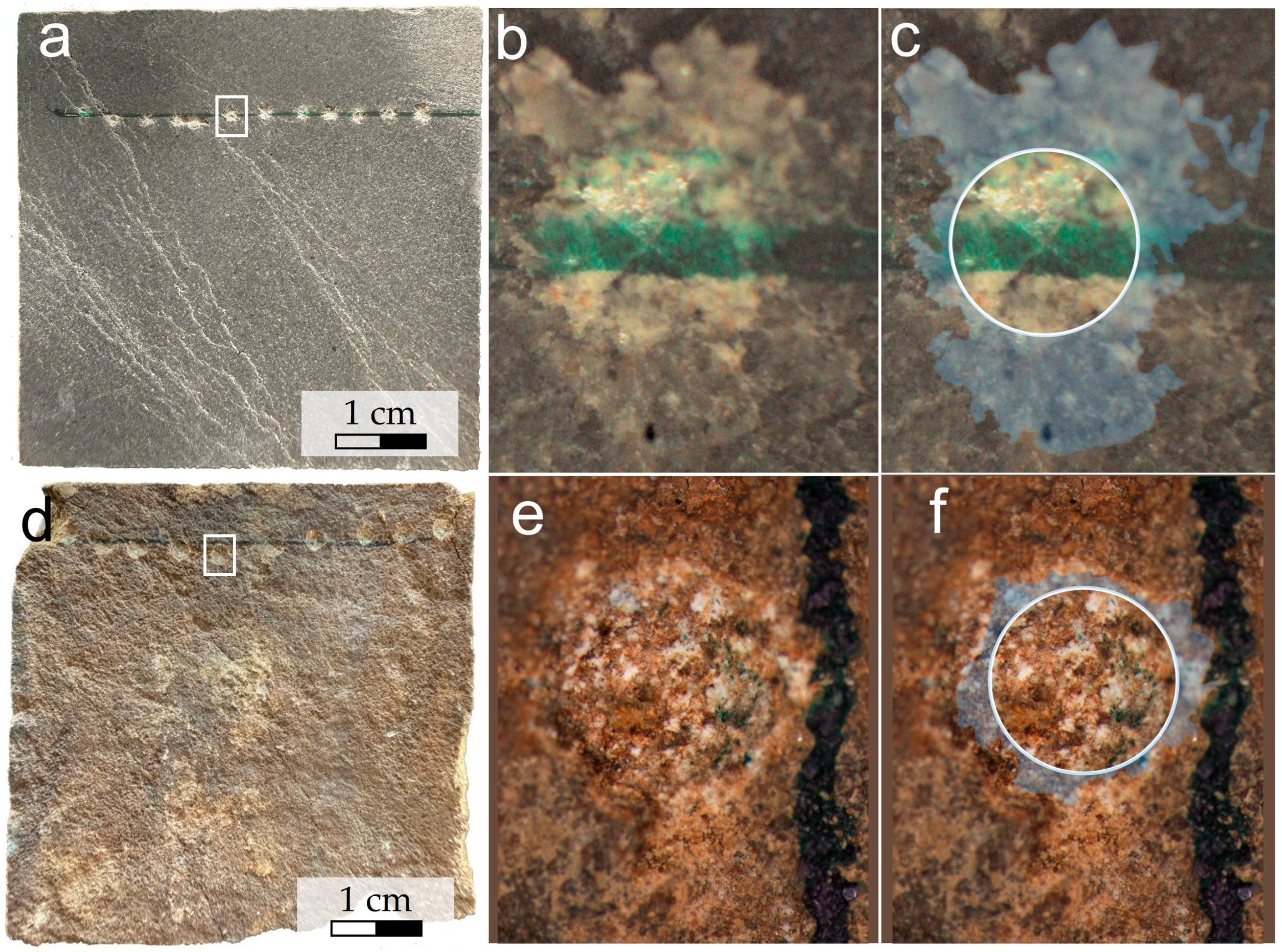
Hardness measurements reflect the mechanical resistance of the sandstone to engraving. The weathered zone exhibited significantly lower hardness values than the unweathered zone, indicating reduced resistance to percussion and incision. In addition, the unweathered zone displays edge chipping around the Vickers indentations (blue area surrounding the circle in Figure 7) that is approximately 120% larger than that observed in the weathered zone. Together, these results suggest that weathered sandstone surfaces may have provided mechanical conditions more favorable for engraving. The lower hardness values and reduced edge chipping indicate that weathered surfaces likely facilitated groove production and may have allowed greater control during percussion.

3.2. Interpretative Analysis

The Saimaluu-Tash I block stream originates from a sandstone stratigraphic level exposed along the valley slopes. These outcrops occur on steep mountain flanks affected by folding and intense fracturing. Periglacial dynamics, including frost shattering, rockfall activity, and seasonal erosion, strongly influence slope instability. Consequently, exposed rock surfaces on the slope outcrops remain exposed for relatively short periods, limiting the development of thick surface patinas. In contrast, sandstone blocks accumulated within the block stream remain exposed on the valley floor over long timescales, favoring the formation of weathered surfaces and well-developed patinas. The block stream also remains slowly active, and the sandstone blocks continue to migrate and rotate downslope. As a result, many engraved surfaces are unlikely to preserve their original orientation or emplacement over archaeological timescales. Some blocks may additionally undergo natural mechanical fracturing or disaggregation due to the high stresses generated within the active block stream.
Differences between blocks are mainly associated with geometry, fracture density, and preservation state of surface patina. Most engraved blocks exhibit angular morphologies, fracture networks related to tectonic mechanisms in addition to frost weathering, gravitational displacement, and long-term periglacial activity. The rock art panels are commonly developed on subplanar fracture surfaces, where plumose structures, en-echelon joints, and sigmoidal shear fractures are frequently observed [54,55,56,57].
The marked hardness contrast between weathered and unweathered sandstone surfaces would have strongly influenced engraving practices. Weathered surfaces, weakened by clay mineral formation and carbonate cement dissolution, would likely have required lower impact force during engraving and facilitated groove production, as the mineral grains lacked carbonate cement and were therefore less cohesive. In contrast, fresher sandstone would likely have required greater impact force and more resistant tools.
This section presents a description of 12 rock art panels (Figure 3) followed by their interpretation. For each panel, the discussion is structured into four analytical levels: (1) description of the engraved support, including calculation of the percentage of surface area covered by the surface patina versus the percentage of area where the weathered zone is exposed, (2) formal description of the motifs, (3) comparison with archaeological or ethnographic parallels, and (4) broader interpretative hypotheses. Given the schematic nature of many engravings, several interpretations should be regarded as tentative rather than definitive.

3.2.1. Rock Art Panel 1

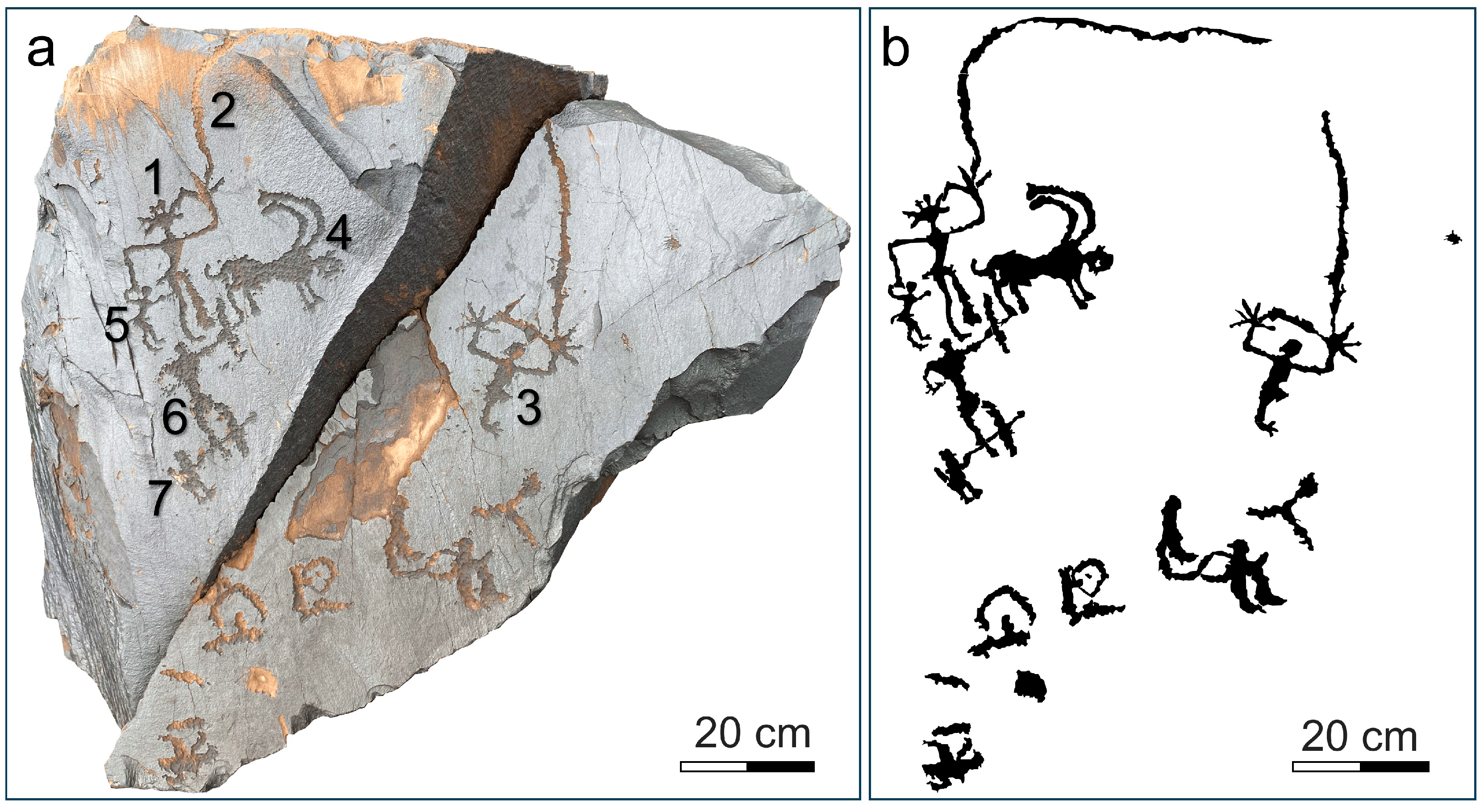
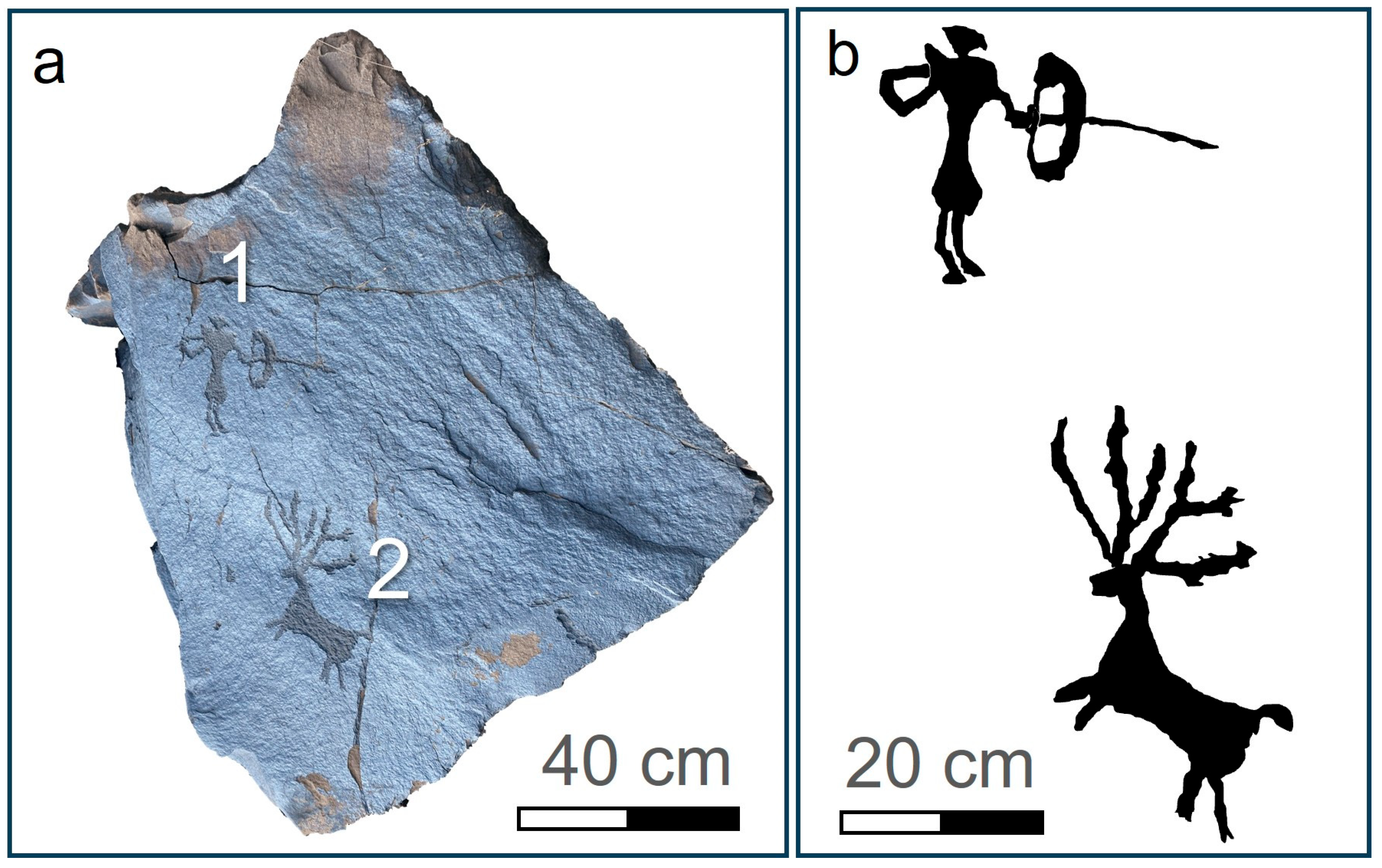
Panel with an irregular subtriangular morphology and a slightly undulating surface. It displays a semi-orthogonal fracture network, with minor exfoliation of the surface patina developed mainly along fracture margins. Peripheral sectors of the panel exhibit impact fractures and localized surface scaling, exposing the underlying weathered zone. Approximately 93–95% of the panel surface remains covered by the surface patina, whereas only ~5–7% corresponds to exposed weathered areas. These exposed sectors are concentrated mainly along peripheral fractures, small exfoliated zones, and impact-fracture edges. The engraving is currently upside down, probably as a consequence of the gradual displacement and rotation of blocks within the active block stream (Figure 3a).
Two figures are depicted on this stone (Figure 8). In the upper left corner is a figure of a hunter in a semi-frontal view. The feet are visible, while the slightly bent legs are represented by two pairs of parallel lines, indicating a static position. The torso was illustrated using two triangles with a biconical shape. The arms were bent at the elbow. The hunter holds a bow and arrow at chest level in his left hand, while his right hand seems to reach for an arrow from the quiver on his back. The head is represented by an inverted triangle. Below the hunter, slightly to the right, is the figure of a deer in profile. The deer’s legs were depicted as straight lines forming an angle of approximately 35°, with the front legs positioned higher than the hind legs. The antlers of the deer are long and asymmetrical. From the main beam of the antler, the brow tine, which is the first branching point, is engraved, with the right brow tine being larger than that of the left brow tine. Similarly, the right bay tine (second branching point) was longer than the left. At the end of this bay tine, there is a fork where the antler splits into two tines.
The 35° angle at which the deer’s front and back legs were positioned might suggest movement. The front legs were elevated compared with the back legs, possibly suggesting uphill movement. The posture of the figure may suggest movement, with its tail raised and in a state of alertness. Such postures are commonly associated in zoological observations with alert or communicative behaviour among herd animals [58], although this interpretation remains inferential in the context of schematic rock art. Based on the relative development and branching of the antlers, the figure could tentatively represent a mature rather than a juvenile deer [59]. However, the schematic nature of the engraving limits precise zoological or age-related identification. The Tian Shan red deer (Cervus elaphus songaricus) typically ascends to alpine meadows above the tree line (2500–3500 m) during summer, where trees are absent, but grass and low shrubs are abundant. In winter, it moves down to the valleys with fir or juniper forests to find shelter from the cold.

3.2.2. Rock Art Panel 2

The block is partially buried by smaller surrounding blocks (Figure 3b). The panel corresponds to a fracture surface displaying plumose markings and rib marks indicative of crack propagation. It is elongated and asymmetrical, with the engraved surface compartmentalized into two levels. Localized exfoliation exposing the underlying weathered zone is observed, particularly in the upper sector, together with small detachments along fracture edges. Longitudinal fractures with slight edge scaling are also present. Approximately 85–88% of the panel surface remains covered by the surface patina, whereas ~12–15% corresponds to exposed weathered areas. These exposed sectors are concentrated mainly in exfoliated zones, fracture planes, and peripheral areas affected by mechanical detachment.
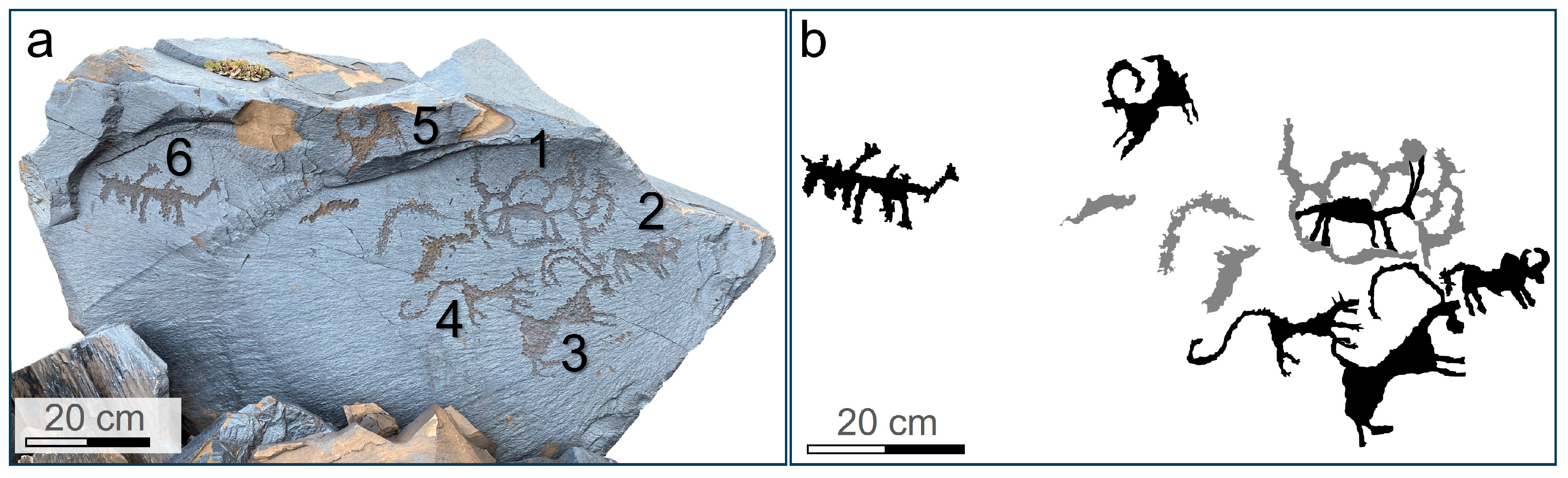
Six finished figures are distributed across the stone and organized into two groups according to the engraved surfaces (Figure 9). The main scene occupies the larger basal surface. It includes a Siberian ibex or gazelle, depicted with slender backward-curving horns and pseudo-parallel legs, seemingly trapped in what may represent a net (Figure 9. Rock engraving 1), a possible male yak characterized by large curved horns and a long, hairy tail (Figure 9. Rock engraving 2), and a Siberian ibex apparently shown in motion, with one hind leg bent and the tail held upright (Figure 9. Rock engraving 3). A felid, tentatively identified as a snow leopard is represented in a dynamic hunting posture, with an open mouth, extended limbs, and a long, curved tail (Figure 9. rock engraving 4). On an upper fracture plane, a second Siberian ibex faces in the opposite direction, may indicate a separate compositional or chronological element (Figure 9. Rock engraving 5). To the left, two overlapping figures that may represent camels depicted in full profile, with elongated necks, arched backs, and prominent humps, complete the panel (Figure 9. Rock engraving 6).
The following interpretation is based on formal comparison and ethnographic analogy and should therefore be considered hypothetical. The image of a gazelle apparently associated with a net-like motif (Figure 9. Rock engraving 1) evokes a scene of active pursuit [60,61]. The yak (Figure 9. Rock engraving 2) and Siberian ibex (Figure 9. Rock engraving 3) are species typically found in cold, mountainous regions, and their presence, along with that of the snow leopard (Figure 9. Rock engraving 4), situates this group in a high-altitude setting, such as Saimaluu-Tash I Valley. The depiction of the snow leopard in a hunting stance, with its mouth agape and ears alert, injects energy and narrative tension into the scene [62]. Its proximity to the Siberian ibexes may evoke a predation scene. The Siberian ibex on the upper level (Figure 9. Rock engraving 5), facing away from the others, might indicate a division between narrative layers or could be a later addition that reinterprets or completes the original scene. The Bactrian camel, native to the cold, arid regions of Central Asia, may symbolize domestication and cross-regional movement, linking the scene to a protohistoric or early historic period when camels became vital for transportation and trade routes. Symbolically, camels in rock art often represent endurance, travel, survival, and inter-territorial communication [63]. The repetition of this motif underscores the camel’s social and economic significance as a means of transport.

3.2.3. Rock Art Panel 3

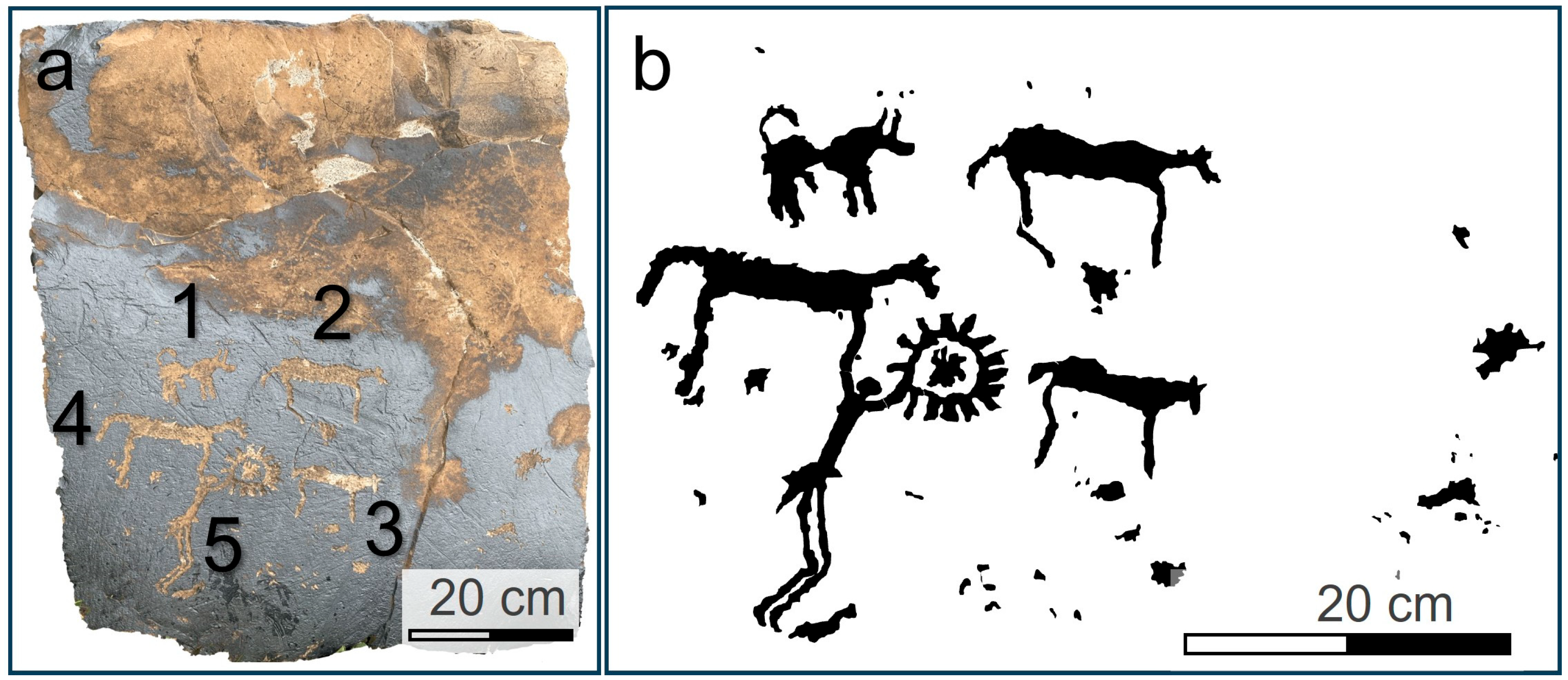
The main engraved surface of this subrectangular panel corresponds to a fracture plane displaying plumose markings and rib marks indicative of crack propagation. The surface exhibits several oblique fractures that delimit the engraved sector, which corresponds to the largest and most homogeneous area of the panel (right side). The panel is currently subjected to pressure exerted by upslope blocks within the active block stream (Figure 3c), which may contribute to fracture propagation and mechanical instability. Localized areas of surface exfoliation and small detachments associated with fractures are also observed. Approximately 88–91% of the panel remains covered by the surface patina, whereas ~9–12% corresponds to exposed weathered zones. These exposed sectors are concentrated mainly along fracture planes, exfoliated edges, and mechanically detached areas. Fossilized impact marks sealed beneath the surface patina are also visible above and below Figure 10, rock engravings 5 and 3, respectively, as well as in the lower left corner of the panel.
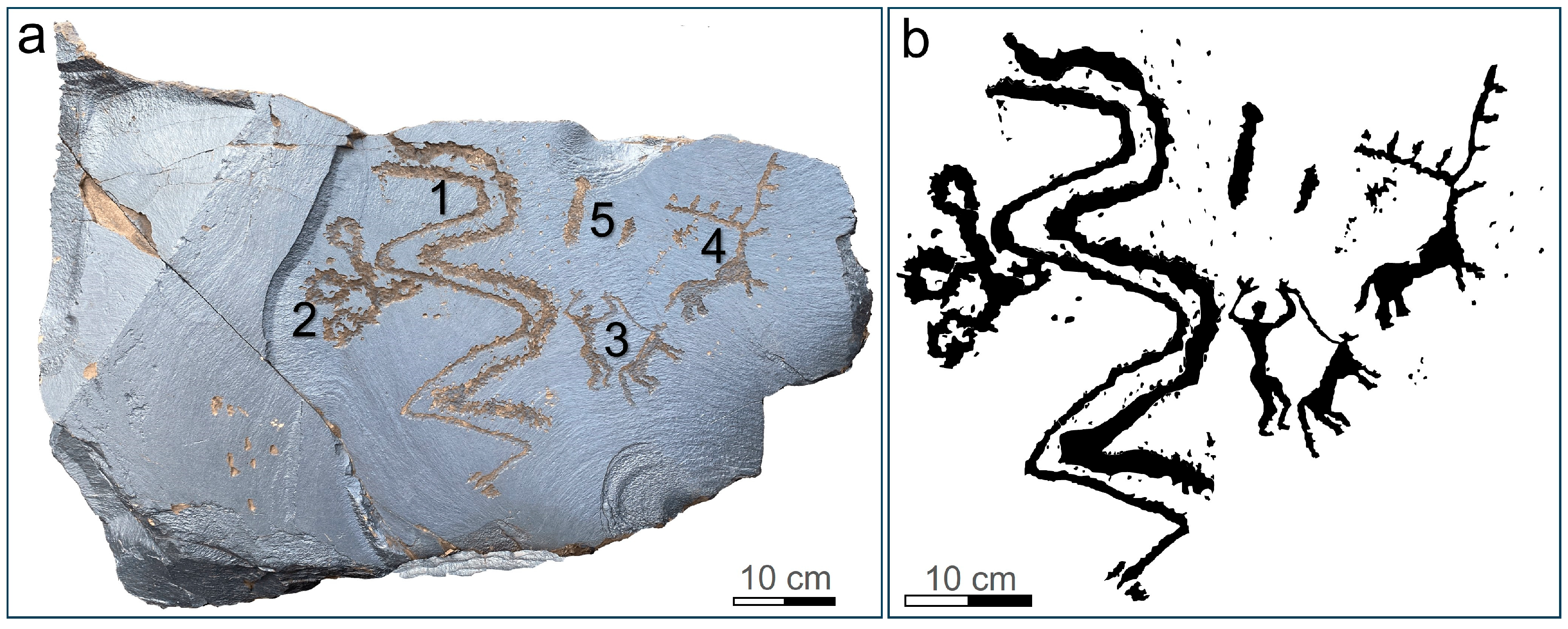
At the center of the stone, a double zigzag motif (Figure 10. Rock engraving 1), along which four interconnected circles are placed (Figure 10. Rock engraving 2). A male figure is shown in a semi-frontal stance with raised arms, holding a leash attached to a dog (Figure 10. Rock engraving 3). The dog, depicted with an elongated body and tail, appears calm and oriented forward. Ahead of the pair, a deer in profile is shown in motion, with angled forelegs and a relaxed tail (Figure 10. Rock engraving 4). The composition is completed by a sword with parallel edges and a circular hilt, consistent with a carp-tongue type (Figure 10. Rock engraving 5).
This piece is structured around various engraved motifs that blend geometric forms, human figures, animals, and a metallic object, a sword. The collection appears to convey a narrative or descriptive purpose, potentially linked to daily activities such as hunting and traversing mountainous areas. The double zigzag pattern is a schematic depiction of mountain paths or trails. Such lines are common in Saimaluu-Tash I and are often associated with the local landscape and routes used by people and animals [27]. Their central placement may suggest their function as key elements in the composition. Figure 10. Rock engraving 2, composed of four circles connected by straight lines, may tentatively represent organized or delimited spaces. By ethnographic or archaeological analogy, these motifs could be interpreted as fields, corrals, enclosed areas, or possibly trapping structures associated with animal movement along paths. However, given the schematic nature of the engraving, these interpretations should be considered hypothetical rather than definitive. Its geometric design may suggest a schematic or organizational function rather than a purely figurative representation, although its precise meaning remains uncertain. The depiction of a line connecting the human figure and the dog may suggest some form of control or guidance associated with hunting practices [64]. The spatial arrangement of the human figure, dog, and deer may evoke a scene of pursuit, hunting, and animal management. The human posture, with arms extended, emphasizes the notion of action or driving, possibly related to the preparation or execution of a hunt. The sword (Figure 10. Rock engraving 5), with a parallel blade featuring a sharp point and a circular hilt, aligns with the type known as ‘carp tongue’, found in archaeological contexts from the Bronze and Iron Ages. Its presence in the panel can be seen as a reference to everyday items or symbols of personal prestige associated with hunting activities. The isolated position of the motif could indicate that it was engraved to document or emphasize a specific weapon familiar to the creator or group of creators.

3.2.4. Rock Art Panel 4

Irregular pseudo-triangular panel divided into two main sectors by an open and displaced fracture. A network of parallel and oblique fractures is present, oriented approximately 45° relative to the main open fracture. The surface exhibits an upper sector with friction striations exposing the underlying weathered zone. The detached lower sector is partially covered by the surface patina, whereas the lower areas display more yellowish-brown tones, indicating more recent weathering and surface deterioration. Approximately 78–82% of the panel surface remains covered by the surface patina, while ~18–22% corresponds to exposed weathered zones. These altered sectors are concentrated mainly along fracture planes, displaced blocks, friction-striated surfaces, and recently exfoliated areas.
This fractured stone preserves engravings on both surfaces and depicts several anthropomorphic and zoomorphic figures. On one side, two anthropomorphic figures apparently face each other and are connected by a long curved line (Figure 11. Rock engravings 1–3). One figure displays elongated limbs and neck proportions, while the other raises both arms; stylistic irregularities, including asymmetry and polydactyly, are visible. Between them, an ungulate is represented (Figure 11. Rock engraving 4). A smaller anthropomorphic figure appears adjacent to one of the larger figures and may hold an object at the waist (Figure 11. Rock engraving 5).
Two additional anthropomorphic figures are represented. One holds a bow in a static stance, apparently preparing or retrieving an arrow (Figure 11. Rock engraving 6), while the other schematically holds a long linear object, possibly a spear (Figure 11. Rock engraving 7).
The composition may tentatively represent a coordinated hunting scene involving several human figures and an ungulate: two individuals (Figure 11. Rock engravings 1 and 3) hold a rope (Figure 11. Rock engraving 2) at each end to obstruct the path of an animal (Figure 11. Rock engraving 4), while the hunter in Figure 11. Rock engraving 5 supports the individual in Figure 11. Rock engraving 1. The smaller scale of Figure 11. Rock engraving 5 may reflect hierarchical distinction, narrative scaling, or simply stylistic variation. Two additional hunters are positioned behind the prey, one armed with a bow (Figure 11. Rock engraving 6) and the other with a spear (Figure 11. Rock engraving 7). The animal figure (Figure 11. Rock engraving 4) may not originally have represented a Siberian ibex, since the horns emerge from the withers rather than the head and the tail proportions differ from typical ibex representations. This could suggest later modification, underscoring the enduring significance of these animals throughout the rock art sequence [65]. Stylistic irregularities are evident in the left legs of the hunters in Figure 11. Rock engraving 3 lacks a left leg, the left leg of Figure 11. Rock engraving 1 is more crudely executed than the right, and in Figure 11. In rock engraving 2, the left leg appears larger than the right, possibly replaced by the bow shown in Figure 11. Rock engraving 7.
Traps, snares, and ropes—often made from plant or animal materials such as tendons [66]—require considerable labor and resources but significantly increase the efficiency of communal hunting. As illustrated here, their effectiveness depends on coordinated group action [67,68]. Unfinished or lightly incised lines on the underside of the stone may indicate incomplete figures.

3.2.5. Rock Art Panel 5

The engraved surface of this panel with a relatively homogeneous surface corresponds to a fracture plane displaying plumose markings and rib marks indicative of crack propagation. Several pseudo-perpendicular and oblique fractures relative to the engraved fracture plane are present, particularly concentrated in the right sector of the panel. Localized exfoliation and small marginal detachments associated with fractures and physical weathering are also observed. Approximately 92–95% of the panel surface remains covered by the surface patina, whereas ~3–5% corresponds to weathered zones. These decay are concentrated mainly along fracture margins, and small mechanically detached areas associated with physical weathering processes.
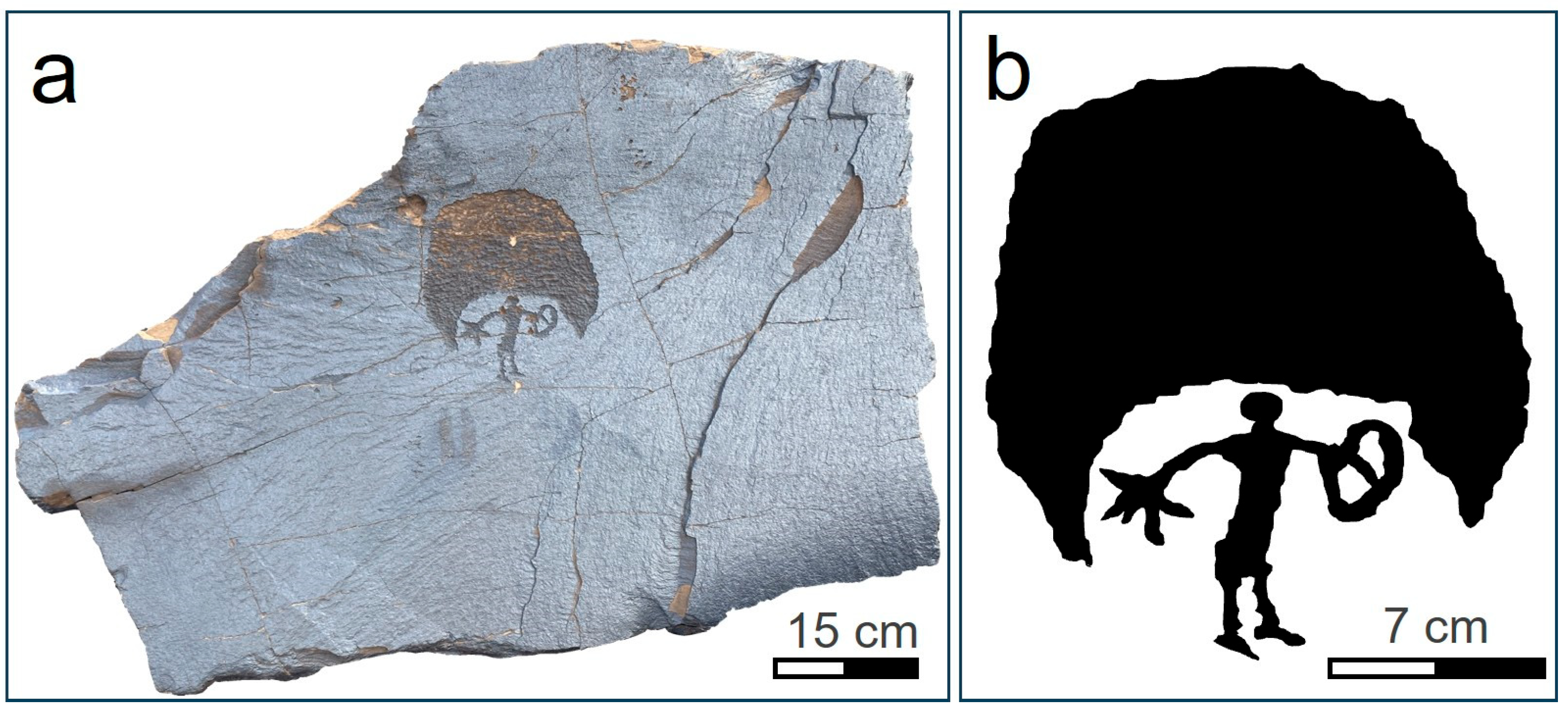
An anthropomorphic figure was preserved in the upper-central part of the stone (Figure 12). The feet are represented by two almost parallel lines, the legs by two pseudo-parallel straight lines, the torso is slightly inclined forward, and the arms are represented as extended with two nearly straight lines. The anthropomorphic figure has an exaggeratedly large right hand with four fingers, and in its left hand, it holds what may be a small bow. Above this anthropomorphic image is a curvilinear figure bounded by two circular arcs, forming a crescent-like shape that points downwards.
It is difficult to recognize traps and snares archaeologically, as they are usually made of materials that do not preserve well [60,69]. The curvilinear figure bounded by two circular arcs could represent a hunting net. However, given the schematic nature of the motif, multiple interpretations remain possible. Alternative readings proposed in previous studies include a mushroom-shaped figure, a human standing in front of a dwelling, or an anthropomorphic figure represented beneath the sky [28,70].
Gaston Phoebus, in the Livre de chasse (ca. 1387–1389) [71] illustrates hunting nets that could have some similarity to this one. The possible representation of traps or nets at Saimaluu-Tash I may reflect strategies aimed at increasing hunting efficiency; the absence of traps does not necessarily mean that people were unable to use this technique. The design of the rope figures and their geographical distribution reveal processes of cultural transmission, innovation, and evolution [72]. This provides significant evidence of the adaptability of a human group highly specialized in hunting ungulates in climatically complex environments.

3.2.6. Rock Art Panel 6

This panel is subrectangular with oblique and subvertical fractures. Several friction marks produced by contact and movement against adjacent blocks are preserved beneath the surface patina. Approximately 52–58% of the panel surface remains covered by the surface patina, whereas 42–48% corresponds to exposed weathered zones. These altered sectors are concentrated mainly in the upper part of the panel, along fractures and margins, particularly on the right side. Biological colonization is present within the weathered zone. The engravings are concentrated in sectors where the surface patina is preserved.
This panel possibly depicts a grazing or herding scene composed of five main figures oriented in the same direction. A stylized canid-like figure is shown in profile with an elongated body, raised tail, and erect ears, suggesting alertness and movement (Figure 13. Rock engraving 1). Three equids of different sizes, probably horses, are represented schematically with elongated bodies, simplified limbs, and descending tails, features that may suggest a calm stance or controlled movement rather than pursuit (Figure 13. Rock engravings 2–4). To the left, a human figure in a semi-frontal stance appears to guide the group (Figure 13. Rock engraving 5). The figure is depicted in motion, with slightly bent legs and raised arms, holding a circular figure with radial lines.
The arrangement of the figures and the consistency in their orientation could indicate a scene associated with movement or herding, although alternative interpretations cannot be excluded. The canines may have accompanied or guided the equid group. The representation of dogs associated with domestic animals or human groups is a common motif in scenes of herding or guarding livestock in Central Asian rock art [73]. The three equids of different sizes are aligned and face the same direction, reinforcing the idea of joint or controlled movement.
Figure 13. Rock engravings 2 and 4, which are larger and have well-defined dorsal lines, may represent adult horses characterized by their robust morphology. Figure 13. Rock engraving 4, with its longer neck, could represent a visually dominant animal within the composition. Figure 13. Rock engraving 3, smaller and with a similar outline, could represent a foal or young animal, an element that supports the interpretation of a herd or family group. Legs in a pseudo-parallel position are a typical feature of scenes depicting grazing or animal movement in nomadic rock art.
The human figure, located on the left and in a semi-frontal position, appears to be associated with the nearby group of animals. The circular object with 14 spokes held in the right hand may tentatively represent a symbolic or functional element. By ethnographic analogy, it could hypothetically relate to herding, trapping, or other activities involving animal management. However, due to the schematic nature of the engraving, the precise function and meaning of this object remain uncertain. Its association with equids and dogs may suggest a connection with animal movement or management scenes. Dogs are domesticated animals [74] commonly depicted in Asian rock art [75].

3.2.7. Rock Art Panel 7

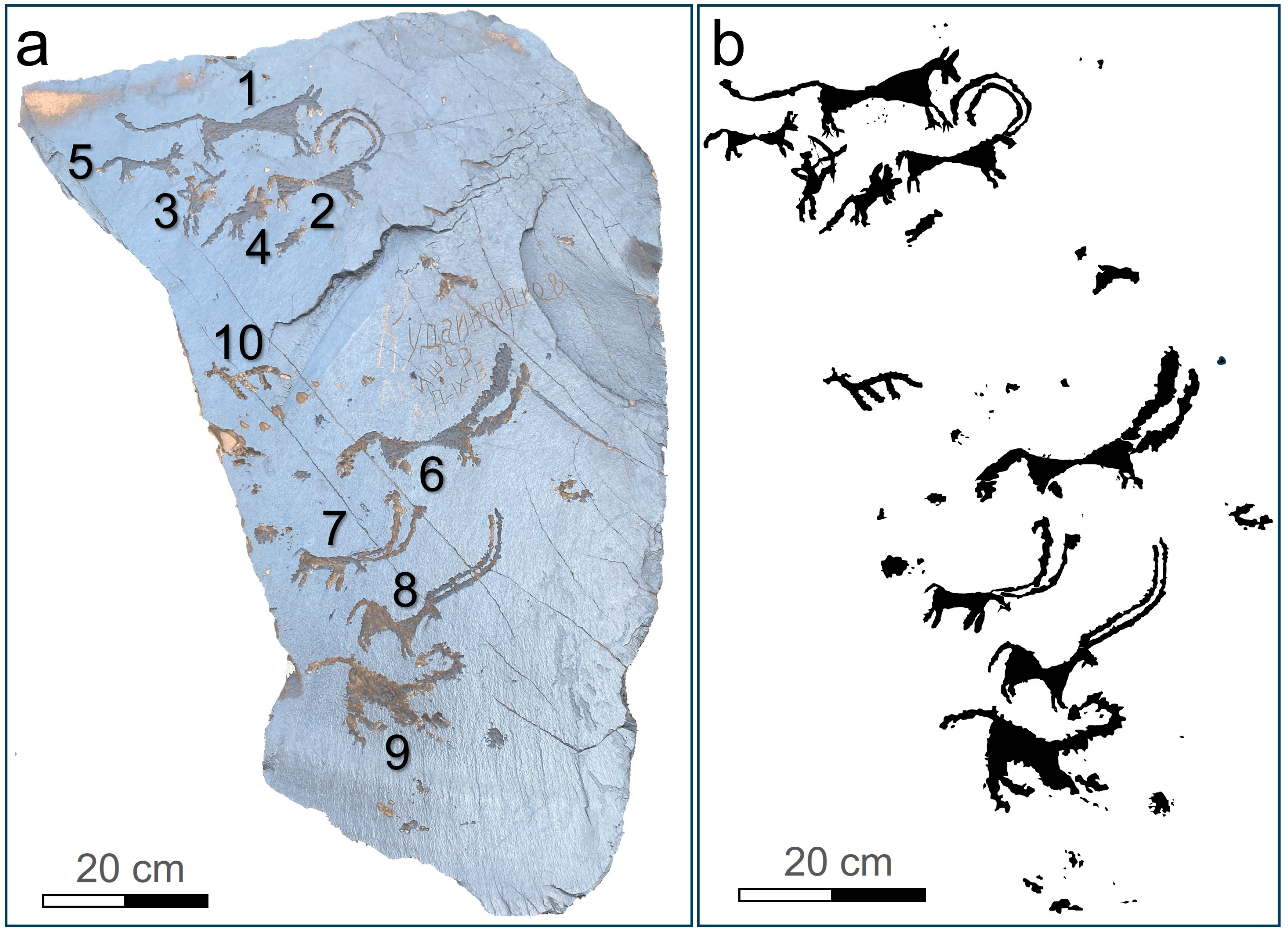
The engraved surface of this irregular and elongated panel corresponds to a fracture plane displaying plumose markings and rib marks indicative of crack propagation, which divides the panel into two main engraved sectors. Several oblique subparallel fractures with limited aperture are present across the panel surface. Small marginal exfoliations and localized surface detachments associated with physical weathering are also observed. Approximately 96–98% of the panel surface remains covered by the surface patina, whereas only ~2–4% corresponds to exposed weathered zones. These altered sectors are concentrated mainly along fractures, while in the upper part of the panel the weathered zone is exposed as a result of friction against an adjacent block. The panel also exhibits anthropogenic deterioration caused by modern graffiti engraved onto the rock surface.
Ten figures are arranged in two groups separated by a natural irregularity in the stone (Figure 14). The upper group possibly depicts an interaction between predators, prey, and humans. A snow leopard is shown in an alert hunting posture, with an open mouth and extended limbs, accompanied by a Siberian ibex (Figure 14. Rock engravings 1 and 2). Behind them, a hunter holds a bow and faces the animals, suggesting coordinated hunting (Figure 14. Rock engraving 3). Two canids, possibly dogs are represented nearby, one schematically rendered and the other more detailed, both oriented toward the same direction, possibly suggesting an association with the hunting scene (Figure 14. Rock engraving 4 and 5). The lower group consists of several ungulates depicted in profile and moving in the same direction, indicating collective movement or herding (Figure 14. Rock engravings 6–9). These include stylized mountain bovids, one likely representing a yak based on tail morphology. A single canid, tentatively identified as a dog, faces in the opposite direction. (Figure 14. Rock engraving 10).
The composition includes predators, prey, domestic animals, and a hunter, suggesting a scene of interaction between humans and local wildlife, possibly linked to hunting activities (top) and animal surveillance (bottom). The snow leopard’s hunting posture, with its mouth open and ears pricked, indicates attention to external stimuli, probably towards prey located on the same panel. The representation of claws and joints focuses on functional anatomical details, showing that the animal is in motion or alert. The Siberian ibex, along with the snow leopard, contributes to the dynamics of animal interactions on the panel. The hunter’s posture, behind the prey and predators, indicates a conscious use of space in the composition to show direction and actions. The dogs are focused in the same direction as the animals or the hunter, indicating their role as hunting assistants to the hunter. The difference in proportions between the three dogs show stylistic variations, probably derived from different origins. The lower section possibly depicts mountain ungulates, all facing the same direction, indicating collective movement, whereas differences in size and detail could reflect different artists.

3.2.8. Rock Art Panel 8

This panel is subrectangular, it has a relatively flat and homogeneous surface. Fracturing is limited and consists mainly of fine fractures oriented subperpendicular to the engraved surface. An oblique horizontal fracture crosses the lower sector of the panel and delimits the engraved area. Impact fractures are present along the margins, including a relatively large impact scar in the upper sector that is sealed beneath the surface patina. Approximately 96–98% of the panel surface remains covered by the surface patina, whereas only ~2–4% corresponds to exposed weathered zones. These altered sectors are concentrated mainly in the upper and lower-left parts of the panel. In the upper sector, friction striations produced by contact with adjacent blocks are visible within the weathered zone. One of the engravings (number 5) has also partially lost its surface patina.
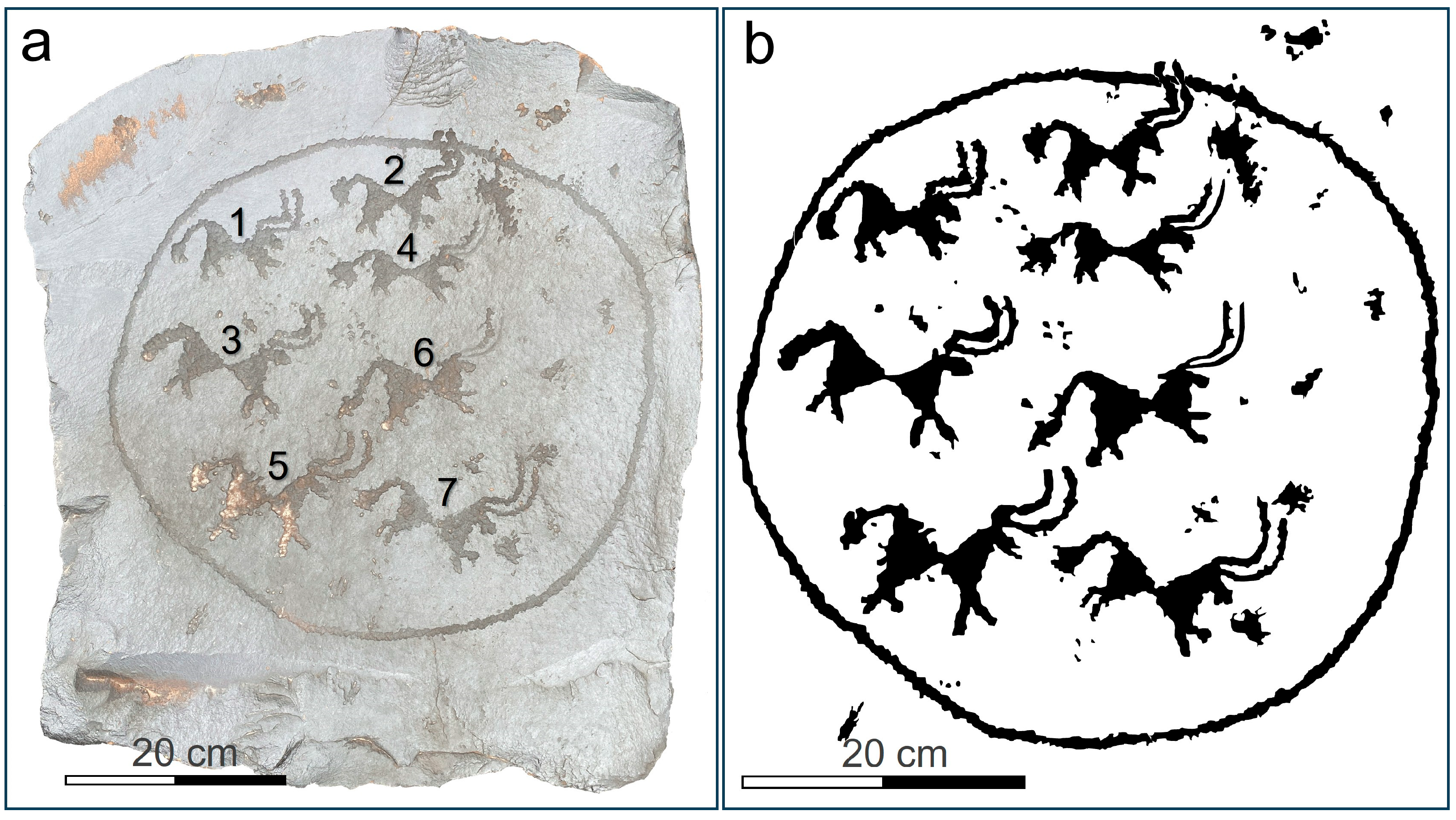
The stone has seven yaks enclosed in a circle (Figure 15). The yaks are depicted in profile, all of which are similar in size and are looking in the same direction. The trunks of the yaks are represented by a biconical pattern. The front and rear legs were represented by lines at an angle of approximately 45° (possibly indicating calm movement), with their heads lowered or neutral (not raised, alert), and with large horns. The tail is represented in an apparent slow movement and is loose. The engraving of the horns of yaks in Figure 15. Rock engraving 4 and 6 are unfinished. These images show the engraving technique, as the artist first scratched a line, on which he then pecked. Yak of Figure 15. Rock engraving 4 has one pecked horn (upper) and another represented only by a line scratched into the surface patina of the stone. Yak of Figure 15. Rock engraving 6 has half a pecked horn (upper) and the other half represented by a line scratched into the patina. The other horn (lower) is entirely represented by a line scratched into the patina.
Before the widespread domestication of horses in Central Asia, yaks were used to transport goods, materials, and tents across mountain passes. Yaks were valued as a means of sustenance and for their cultural importance in nomadic societies [76,77,78]. Ref. [79] explains how rock art in northern Altai shows the evolution of transhumance based on domesticated yaks, which emerged towards the end of the third millennium BC. This change was probably due to a drier and colder climate at the end of the Holocene, which reduced forests and prompted inhabitants to rely on domestic animals. During the Bronze Age, wild yaks were first hunted and then domesticated, giving rise to early transhumance centered on these animals. Horses and Bactrian camels arrived much later; domesticated horses were not introduced until the end of the second millennium BC, and camels were not introduced until the first millennium BC, when they partially replaced the yak as a pack animal [79].
Like most bovids, yaks (Bos grunniens) use a combination of body movements, postures, and sounds to communicate with other herd members. Shaking the head or moving the horns forward is usually a threatening gesture or warning. A tail held upright or waved vigorously expresses excitement, alarm, or aggression. A relaxed tail could indicates a state of calm. These features may suggest the representation of a calm or controlled group of domesticated yaks. The fact that all the yaks are the same size may indicate that they are adults in this herd.

3.2.9. Rock Art Panel 9

This subrectangular panel has a relatively homogeneous surface and slight undulation. The engraved surface corresponds to a fracture plane affected by minor marginal exfoliation and localized physical weathering. Approximately 93–96% of the panel conserves the surface patina, whereas only ~4–7% corresponds to the weathered zone. These sectors are concentrated mainly along the panel margins. Exfoliated sectors exposing the weathered zone are especially concentrated in the central-left area and the upper-right part of the panel. The left sector of the engraving also exhibits localized exfoliation and partial loss of the surface patina. The panel is partially buried within the block stream and is subjected to pressure exerted by upslope blocks within the active block stream (Figure 3i), which may contribute to mechanical instability and fracture propagation.
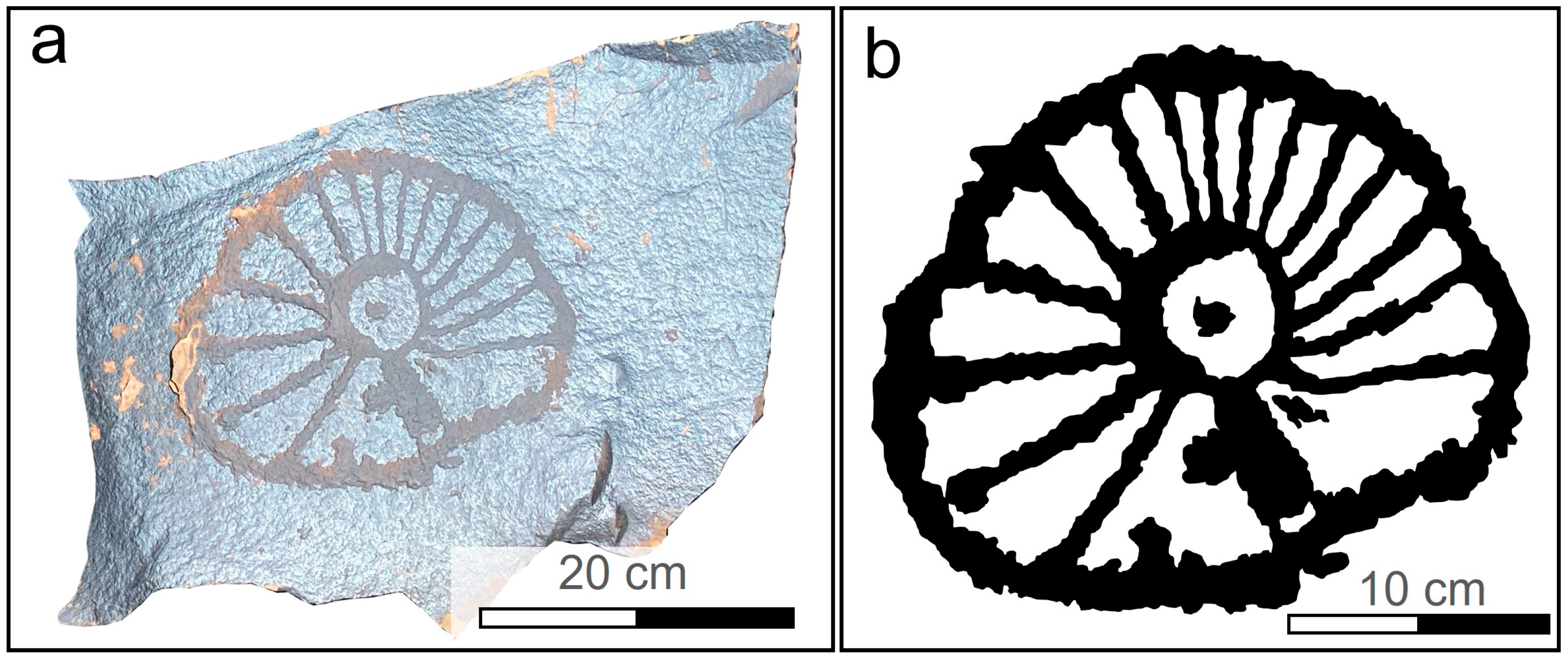
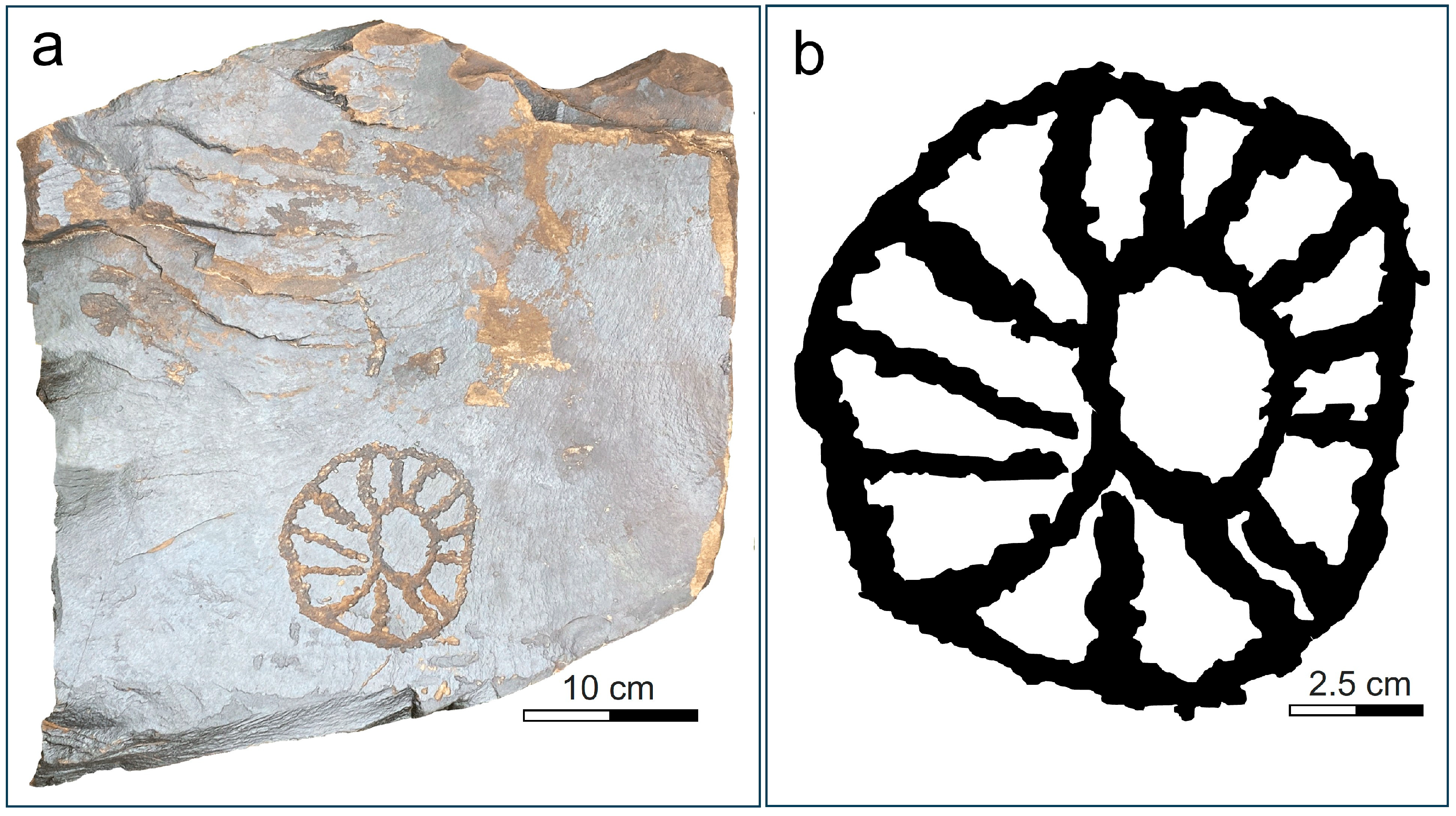
This stone has two pseudo-concentric circles joined by 16 spokes, creating 16 compartments and a central circular one (Figure 16). One spoke was thicker than the others were. The two compartments on either side of this thicker spoke were larger than the other compartments. The inside of the two circles is marked with a circular engraving.

3.2.10. Rock Art Panel 10

This subrectangular panel has a relatively homogeneous surface. It exhibits scarce visible step-like fractures together with a straight oblique fracture cutting across them. These discontinuities are mainly restricted to fine marginal fissures, localized weathered areas in the upper part of the panel, and small superficial detachments, particularly on the right side and in the upper central sector. Approximately 89–93% of the panel surface remains covered by the surface patina, whereas ~7–11% corresponds to exposed weathered zones. The engraving remains well preserved, although some sectors show partial detachment of the surface patina.
The engraving consists of two pseudo-concentric circles connected by 13 spokes, forming 13 compartments and a central circular area (Figure 17). Two of the spokes are parallel, and the central area is smaller than the surrounding compartments. The two compartments located on either side of the parallel spokes are slightly wider than the remaining compartments.
There are several interpretations of the Saimaluu-Tash I circular rock engravings relating them to solar rituals [28]. However, this study presents an alternative interpretation related to nomadic and pastoral cultures. The following interpretation should be regarded as a possible ethnographic analogy rather than a direct identification of the engraved structures. Livestock farmers have driven their cattle into enclosed areas or corrals for various reasons [80]. Collective rituals are used for seasonal livestock management in Central Asia. In summer, families and their herds go up to the high mountain pastures (jailoo—in Kyrgyz, jailau—in Kazakh, yaylak—in Turkish, suuder or gazar in Mongolian). In autumn, before the first snows, they descend to the valleys with their animals to spend the winter months. This annual descent, often communal, is the functional equivalent of the Icelandic ‘réttir.’ A ‘réttir’ is a circular stone or wooden corral with a central area and several smaller radial pens or compartments [81]. All livestock that have been grazing freely in the mountains during the summer are gathered in the center of a circular corral. Farmers identify their livestock and separate them into side pens belonging to each farm or district separately.
Some peoples, particularly Mongolian groups, celebrate the seasonal descent of herds through fairs, equestrian competitions, traditional games, banquets, and music. It should be noted, however, that this tradition is not currently documented among Kyrgyz communities, and therefore any parallel drawn in this context must be treated with caution. Such events, where they occur, function as rituals of social cohesion, reaffirming community ties among nomadic families, marking the end of the annual pastoral cycle, and providing occasions for epic songs, oral narratives, and social agreements between groups.
In nomadic contexts, there is no fixed corral like the Icelandic réttir, although there are temporary enclosures or stone or wooden fences (called koroo in Kyrgyz) where animals are gathered and separated at the end of the season. This engraving could hypothetically evoke a compartmentalized enclosure conceptually comparable to a réttir-type corral, although such an interpretation cannot be demonstrated archaeologically. In other places, there is ‘A rapa das bestas’, a Galician (Spain) tradition in which, every year, the neighbors gather the wild horses that live in the mountains in a circular corral to cut their manes, deworm them, and brand the new foals [82].

3.2.11. Rock Art Panel 11

This subrectangular and elongated panel has a relatively homogeneous surface developed on a fracture plane displaying plumose markings and rib marks indicative of crack propagation. The block is currently subjected to pressure exerted by adjacent and upslope blocks within the active block stream (Figure 3k), which may contribute to fracture propagation and mechanical instability. The panel exhibits several fine oblique and subparallel fractures, together with localized marginal exfoliations and small surface detachments associated with physical weathering. Approximately 91–94% of the panel surface remains covered by the surface patina, whereas ~6–9% corresponds to exposed weathered zones. These altered sectors are concentrated mainly along the upper and right margins, fracture planes, and small exfoliated areas.
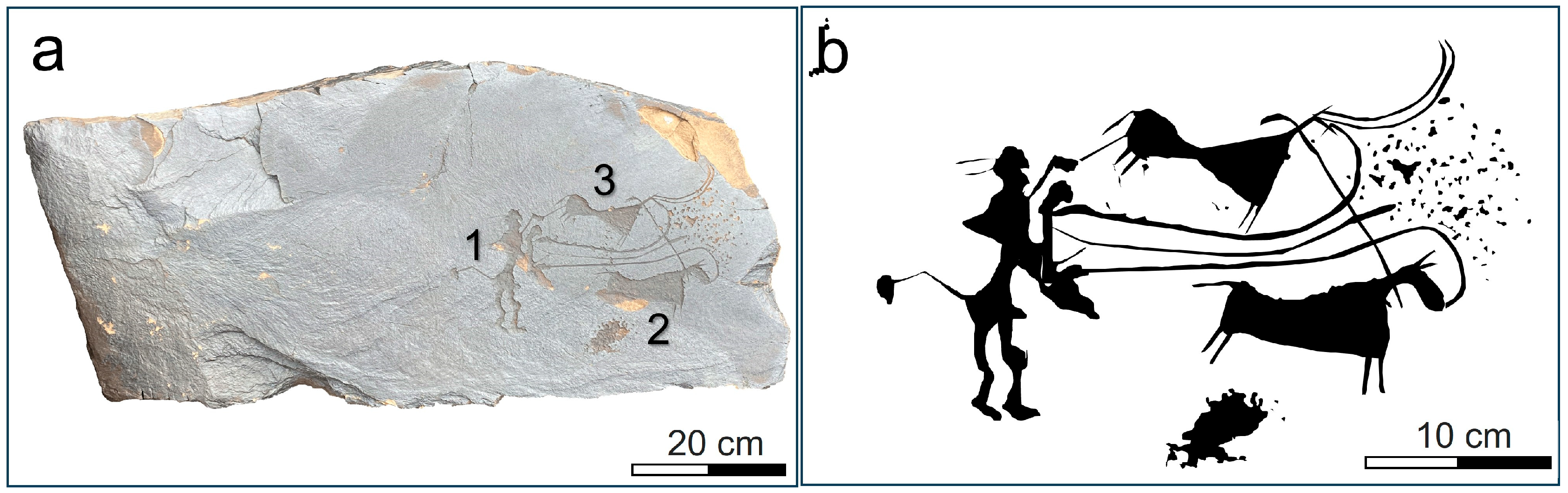
The engraved sector is located on the right half of the panel and includes three figures: a central anthropomorphic figure holding elongated linear elements, interpreted as ropes, spears, or symbolic lines (Figure 18, rock engraving 1), associated with two quadrupeds represented in profile (Figure 18, rock engravings 2 and 3). The upper animal displays elongated backward-curving horns and may tentatively represent a Siberian ibex, whereas the lower figure could correspond to a bovine or yak-like animal. A concentration of pecking marks and surface impacts is visible in the upper-right sector of the panel, close to the horned animal figure.
The plow with oxen is an exceptional theme in rock art, alluding to animal domestication and forms of organized agriculture in the region. The slanted feet suggest movement, whereas the slightly flexed legs indicate a posture of effort or balance during plowing. The hands hold the plowshare, a wooden element functioning as a handle or tiller to guide and control plow depth. Farmers may have carried a digging stick attached to the waist [83]. The presence of hair represented by tufts or braids on the head reinforces the anthropomorphic and detailed nature of this figure. Jacobson-Tepfer [84] interpreted similar lines on the head as feathers or plumes, symbols of power or ritual significance. The upright head position and its orientation toward the animals suggest concentration on the task. Overall, the composition indicates familiarity with agricultural and animal-management practices.
The team consists of two different animals, adding ethnographic interest to the composition. Both the equid and the yak are represented with features evoking slow and deliberate movement, reinforcing the interpretation of a controlled plowing scene within a pastoral-agricultural context.

3.2.12. Rock Art Panel 12

This elongated panel is composed of three fracture surfaces displaying plumose markings and rib marks indicative of crack propagation. Two of these surfaces are subparallel and located at different levels, whereas a third oblique fracture plane connects them. The panel exhibits numerous secondary oblique fractures, together with exfoliations and small detachments associated with the active dynamics of the block stream. Approximately 90–94% of the panel surface remains covered by the surface patina, whereas ~6–10% corresponds to exposed weathered zones. These altered sectors are concentrated mainly along fracture planes, mechanically detached areas. The right sector of the panel displays a large exfoliated area exposing the weathered zone, while several engravings also show localized detachment and partial loss of the surface patina.
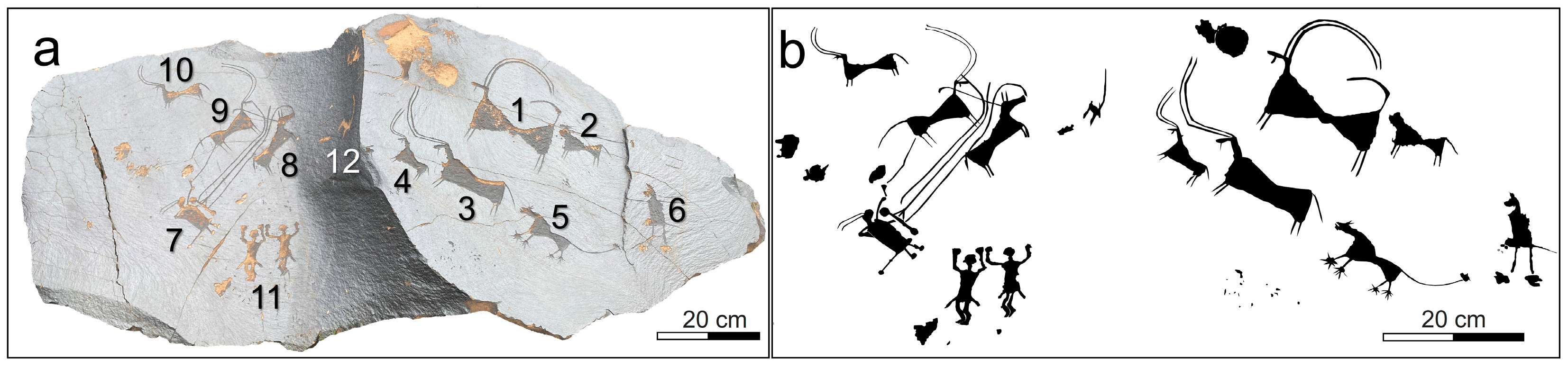
This densely engraved stone presents three distinct but interconnected scenes (Figure 19). On the right, a dynamic composition possibly depicts wild animals in motion, including several yaks of different sizes, a snow leopard in a hunting posture, and an unfinished anthropomorphic figure. All figures are oriented in the same direction, suggesting coordinated movement or predation. A Siberian ibex occupies a central position, acting as a visual and symbolic link between scenes.
On the left, an agricultural scene shows a farmer plowing with a yoked team composed of an equid and a yak, highlighting mixed traction practices. Two additional anthropomorphic figures with raised arms accompany the scene, possibly indicating ritual or symbolic actions related to agricultural activity.
Overall, the panel integrates themes of wild fauna, domesticated animals, and human labor within a single visual narrative. The consistent stylization, oblique orientation of figures, and spatial organization suggest a deliberate composition reflecting the interconnected spheres of hunting, herding, agriculture, and ritual within the Saimaluu-Tash I landscape.
The stone has three clearly differentiated compositions that seem to articulate a visual narrative linked to daily life. The scene on the right focuses on wild animals (yaks, Siberian ibex, and a snow leopard) depicted in motion and facing the same direction, suggesting a dynamic movement or hunting. The presence of the snow leopard stalking ungulates could represent a naturalistic scene of predation, but it could also express the tension between the wild and the domesticated, or between natural and human forces. The unfinished anthropomorphic figure behind it could symbolize an observer, hunter, or perhaps a mythical being related to the animals depicted.
At a broader interpretative level, the composition may hypothetically evoke relationships between wild fauna, pastoral practices, and ritual behavior. The scene on the left introduces a marked contrast, showing a clearly agricultural activity: a man guiding a plow pulled by a horse and a yak. This reflects human control over domesticated animals and alludes to complex agro-pastoral practices in the region. The presence of two human figures with raised arms could be interpreted as a ritual or celebratory expression or one related to agricultural propitiatory practices. They could depict a gesture of invocation, worship, or ritual dance. In the center, a Siberian ibex, an animal frequently associated with symbolic significance in several Central Asian traditions. Its liminal position between panels and lighter color may indicate that it was added later. The repetition of biconical bodies, linear limbs, and schematic heads demonstrates a coherent graphic language in which stylization reinforces iconicity and narrative intent over realism. The oblique orientation of the animals suggests movement and life, reinforcing the animation in the scene. Overall, the panel could tentatively be interpreted as expressing relationships between wild life, domestic life, and ritual or symbolic practices, although such readings remain hypothetical.

4. Discussion

Rock art forms part of a territorial system where geology, landscape, archaeology, and cultural practices interact [85]. The mineral composition, weathering, mechanical resistance, and surface patina of the Saimaluu-Tash I sandstone influenced both the production and preservation of the petroglyphs. In this context, the integrated geological, archaeometric, and iconographic analyses applied in this study provide essential information for interpreting the engravings and understanding the relationship between natural processes and human activity (Table 1).
The petrographic observations show that the sandstone is a feldspathic arenite in which quartz grains form the main framework, locally supported by carbonate cement and clay-rich pseudomatrix derived from feldspar alteration. Weathering processes affecting exposed surfaces involve the partial dissolution of carbonate cement together with the hydrolysis of feldspar grains. These processes promote clay mineral formation and increase porosity, weakening grain contacts within the rock. As a result, the weathered zone shows much lower Vickers hardness (0.6 ± 0.2 GPa) than the unweathered sandstone (2.8 ± 0.6 GPa).
The mechanical contrast observed between unweathering and weathered sandstone zones has important implications for understanding the engraving process. The weathered surface layer shows significantly lower hardness values than the unweathered interior, indicating that surface alteration substantially reduces the mechanical resistance of the rock. This is because, in the weathered zone, the grains have lost their carbonate cement, reducing their cohesion. At Saimaluu-Tash I, petroglyphs are frequently associated with naturally weathered and patinated surfaces, whose mechanical and chromatic properties made them especially suitable for engraving activities.
SEM image analysis indicates that the weathered zone reaches an average apparent two-dimensional porosity of approximately 40%, compared with only 1.5% in the unweathered zone, representing an increase of more than 2600%. This marked porosity increase is directly related to the dissolution of the carbonate cement and the formation of clay-rich alteration products, which weaken grain cohesion and favor granular disaggregation.
Colorimetric measurements further clarify the visual properties of the engravings. The yellowish-brown coloration of the weathered zone is likely related to the oxidation and hydration of iron-bearing mineral phases during weathering processes, leading to the formation of Fe oxyhydroxides, together with clay mineral development following carbonate cement dissolution. The weathered sandstone surface shows higher lightness values than the unweathered interior, while the surface patina displays markedly darker tones. The color difference between the surface patina and the weathered zone (ΔE ≈ 22.7) is therefore extremely high. Given that perceptibility thresholds for the human eye are commonly placed between ΔE ≈ 5 and 6, the removal of the surface patina during engraving would have produced a very strong visual contrast. This chromatic opposition likely enhanced the immediate visibility of the petroglyphs when they were produced. Over time, however, the progressive reformation of surface patina may reduce this contrast, thereby affecting the visibility of the engravings. A detailed study of the darkening processes of surface patina on rock engravings could provide valuable insights for establishing a relative chronology at Saimaluu-Tash I, particularly when variations in surface patina shades are observed on the same panel.
The marked mechanical contrast between the weathered and unweathered sandstone surfaces at Saimaluu-Tash I likely played a fundamental role in engraving practices. Experimental traceological studies have demonstrated that substrate hardness, mineral cohesion, and surface weathering strongly influence groove production, tool efficiency, and the microscopic wear traces generated during engraving activities [46]. In the Saimaluu-Tash I sandstone, the weathered zone exhibits significantly lower hardness values (0.6 ± 0.2 GPa; HV~60) than the unweathered sandstone (2.8 ± 0.6 GPa; HV~280), together with a substantial increase in porosity related to carbonate cement dissolution and clay mineral formation. These alteration processes reduced grain cohesion and likely facilitated percussion and incision by allowing tools to penetrate the rock surface more easily and with greater control. In contrast, the fresher calcite-cemented sandstone would have required greater impact force and more resistant tools. Such mechanical differences may also have influenced the morphology of engraved traces and the development of microwear patterns on the tools themselves. Previous experimental studies have shown that tools used to produce petroglyphs generate diagnostic microscopic traces that allow the identification of engraving techniques and even the reconstruction of technical gestures employed by prehistoric engravers [46]. These results support the hypothesis that prehistoric engravers intentionally selected weathered and patinated sandstone surfaces because they combined favorable mechanical properties for carving with strong chromatic contrast after engraving.
The calculated percentages of preserved surface patina versus exposed weathered areas in 12 panels reveal notable differences in the state of conservation among the studied rock art panels. Several panels still retain more than 90% of their original surface patina, whereas others show significantly larger proportions of exposed weathered sandstone due to exfoliation, fracture propagation, and progressive surface loss. These exposed altered zones are particularly vulnerable to ongoing deterioration processes because they exhibit substantially higher porosity and lower mechanical cohesion than the unweathered sandstone. The combination of higher porosity, lower hardness, loss of carbonate cement, and increased clay mineral content likely enhances water retention and promotes biological colonization on exposed weathered surfaces, thereby accelerating surface degradation and the progressive loss of engraved definition.
Recent studies have demonstrated the importance of combining experimental ar-chaeology, traceology, and technological analysis to better understand rock engraving production processes [46,47,48,49,50,51,52]. In this context, rock engraving should be understood not only as image production but also as a technological and social process. The type of rock, tool morphology, impact intensity, and working sequence formed part of the cultural knowledge transmitted within prehistoric communities [47,49].
Many of the iconographic interpretations proposed in this study rely on ethnographic analogy and comparative archaeological frameworks. While these approaches provide valuable contextual insights, the schematic nature of the engravings means that several readings remain interpretative hypotheses rather than demonstrable conclusions.
Rock art is created for specific places, with images fixed in the landscape whose location is integral to their meaning [86,87,88]. It plays a key role in human cognitive evolution [89], contributing to the creation and experience of places and to territorial appropriation. In contexts where hunting and livestock farming played a predominant role, rock art participated in assigning meaning to the landscape, marking paths, and signaling areas frequented by people and animals [28,90,91,92,93,94]. Following proposals that landscapes should be understood as networks of places connected by paths and routes, whose perceptions are constructed through direct experience [95,96,97], the Saimaluu-Tash I engravings can be read as part of a high-mountain relational geography where movement, resources, and symbolism converge.
Several authors have pointed out that such manifestations are closely linked to food-producing economies, especially livestock-based ones [98], and that their locations correspond to socioeconomic activities such as herding and hunting [94,99,100]. The depiction of hunting, particularly of caprine animals such as Siberian ibexes, is a recurring motif in rock art [101,102,103,104], especially in Saimaluu-Tash I. Therefore, rock art expresses not only territoriality but also the creation and experience of places linked to herding and hunting [87,88,89,105,106,107,108]. A notable peculiarity of Saimaluu-Tash I is the minimal overlap of engravings, a phenomenon common in other areas of Kyrgyzstan and worldwide [28]. This scarcity of palimpsests could indicate, as previously stated, that many engravings served communicative and practical functions (e.g., marking routes, signaling resource areas, or conveying territorial information) and were therefore left undisturbed to remain legible over time.
It has been suggested that they allow researchers to reconstruct aspects of the nomadic cultures of herders and hunters [12,109]. In changing environments, such as glacial regions, nomadic groups must mark their territory to guide their movements, find suitable pastures for their herds, and warn of the presence of predators [110]. The motifs depict social and economic activities, hunting, livestock herding, and domestic and wild animals, reflecting ways of life and cultural values that should be passed down from generation to generation [111,112].
The dating of the rock engravings at Saimaluu-Tash I remains a subject of debate. Most current researchers date the petroglyphs from the second half of the third millennium BCE or the beginning of the second millennium BCE to the Middle Ages [28]. The oldest, according to all accounts, are geometric-style drawings dating from the Chalcolithic and Bronze Ages. The Early Iron Age is characterized by realistic drawing techniques, with notable examples of Scythian and Saki zoomorphic styles. In the Middle Ages, straight lines and schematic styles predominated [70,113,114].
In general, morphological and technical analyses allow for the identification of temporal changes and variations among engravers [115,116]. Style, understood as a qualitative visual system [117,118], facilitates the organization of phases and symbolic interpretation when a clear relationship exists between form and meaning [119,120,121]. Although stone was possibly the primary material for making engraving tools until the Scythian period, the type of tool should not be considered a reliable chronological indicator [122].
Ultimately, the integration of geological characterization and iconographic interpretation provides a more comprehensive understanding of the Saimaluu-Tash I rock-art landscape. The archaeometric analyses demonstrate how natural weathering processes created mechanically weakened and visually contrasting surfaces suitable for engraving, while the iconographic evidence reveals how these surfaces were used to express social, economic, and symbolic relationships within a high-mountain pastoral environment. Such interdisciplinary approaches are essential for advancing both the interpretation and conservation of rock-art heritage, particularly in fragile alpine landscapes subject to ongoing natural weathering and increasing anthropogenic pressures.
Despite the results obtained, this study should be considered an initial archaeometric and interpretative approach to the Saimaluu-Tash I rock art valley. The analytical dataset is based on a relatively limited number of samples and panels, although the observed lithological homogeneity and consistent weathering patterns across the valley support the broader applicability of the results. In addition, the genesis and microstratigraphy of the surface patina have not yet been directly characterized through dedicated mineralogical, biomolecular, or geochemical analyses, and some iconographic interpretations remain hypothetical rather than demonstrative. Future research integrating absolute dating methods—such as cosmogenic isotope analysis, optically stimulated luminescence, and accelerator mass spectrometry—together with high-resolution digital documentation, will refine the chronological framework of the site and advance understanding of rock art production and landscape use in the Central Asian highlands. Preliminary EDS data indicate that the surface patina is a composite layer formed by carbon-rich material together with Fe–Mn oxides and carbonate phases; however, further high-resolution surface analyses are required to clarify the stratigraphy and relative contributions of organic and inorganic components to patina formation. Additional studies using mercury intrusion porosimetry (MIP) would also improve understanding of pore-size distribution and connectivity within the weathered zone, while contact-angle measurements could quantify the degree of hydrophobicity provided by the surface patina compared with the exposed weathered.
Today, Central Asian rock art is a symbol of identity and a highly significant cultural resource. Its increasing visibility presents challenges in terms of conservation, tourism, and sustainable management, particularly given the risks of vandalism and unregulated development.

5. Conclusions

This study provides the first integrated petrographic, chromatic, and mechanical characterization of the quartz-rich feldspathic arenite (arkosic sandstone) with calcitic cement hosting the rock art of the Saimaluu-Tash I Valley, combined with a detailed interpretative analysis of twelve engraved panels. The engraved sandstone blocks preserve a thin surface patina, generally less than 50 µm thick, composed predominantly of Fe–Mn oxide phases and carbon-rich material, whereas the outermost millimetres of the sandstone are affected by weathering processes involving carbonate cement dissolution and mineral alteration.
The dissolution of calcific cement and the formation of clay minerals within the weathered zone produced progressive loss of cohesion between mineral grains, significantly reducing the mechanical resistance of the rock and generating a characteristic light yellowish coloration. These altered surface created particularly favorable conditions for engraving activities. Their reduced hardness required lower impact energy during engraving, while the strong chromatic contrast with the darker surface patina (ΔE ≈ 22.7) substantially enhanced the visual definition and legibility of the engravings at the time of their production.
Vickers hardness measurements reveal a pronounced decrease from unweathered sandstone surfaces (2.8 ± 0.6 GPa) to weathered zones (0.6 ± 0.2 GPa), confirming that natural weathering processes significantly facilitated engraving activities. These petrophysical conditions likely influenced not only the technical feasibility of engraving, but also gesture control, impact precision, and groove formation during the production of the petroglyphs over several millennia.
The twelve analyzed panels show that most engraved surfaces remain largely covered by the surface patina, whereas the exposed weathered zones generally occupy a smaller proportion of the panel area. However, panels with larger exposed weathered areas appear more vulnerable to ongoing deterioration processes, including granular disaggregation, erosion, biological colonization, and progressive loss of engraving definition. These results highlight the critical importance of surface patina preservation for the long-term conservation and readability of the Saimaluu-Tash I petroglyphs.
The iconographic and compositional analyses highlight recurrent themes related to hunting, herding, mobility, and agricultural activities, reflecting the economic, social, and symbolic dimensions of pastoral and hunting communities inhabiting the high-mountain environments of Central Asia. Predatory scenes, communal hunting strategies, domestic herds, and geometric or symbolic structures form a coherent visual language closely linked to seasonal mobility, landscape use, and territorial practices. Although direct superimpositions are relatively uncommon at Saimaluu-Tash I, some engraved panels may nevertheless represent diachronic accumulations produced during different chronological phases. Within this framework, the present study proposes, for the first time, the hypothesis that certain engravings composed of concentric circles with radial divisions may represent seasonal corrals or gathering structures comparable to rettir-type pastoral enclosures. Nevertheless, this interpretation remains provisional and requires further archaeological, ethnographic, and spatial comparison.
Overall, Saimaluu-Tash I emerges as a cultural, ecological, and technological archive documenting long-term interactions between human communities and a dynamic glacial landscape. The preservation of this exceptional high-mountain rock art heritage, currently threatened by ongoing natural weathering processes and increasing anthropogenic pressures, requires coordinated scientific research, preventive conservation strategies, systematic monitoring of surface deterioration, public engagement, and sustainable site management.

Author Contributions

Conceptualization, D.M.F.-L. and A.S.; methodology, D.M.F.-L. and A.S.; software, D.M.F.-L.; validation, D.M.F.-L., R.J.-M., J.L., A.d.l.R., S.P.-O., J.G.-O., and A.S.; formal analysis, D.M.F.-L.; visualization, D.M.F.-L. and J.G.-O.; supervision, D.M.F.-L. and A.S.; project administration, D.M.F.-L. and A.S.; funding acquisition, D.M.F.-L. and A.S. All authors have read and agreed to the published version of the manuscript.

Funding

This research was funded by the State Program of the Kyrgyz Republic “Kɵɵnɵ tarykh syrlary/Secrets of Ancient History” and the Spanish grant RYC2023-042760-I, funded by MCIU/AEI/10.13039/501100011033 and by the ESF+.

Data Availability Statement

The original contributions presented in this study are included in the article. Further inquiries can be directed to the corresponding author.

Acknowledgments

The authors would especially like to thank the members of the expedition carried out in August 2025: Samat Kurmanbekov, Eldiiar Akdilabek uulu, Temuchin Baizakov, Aigul Ergeshalieva, Aichurok Akjoltoeva, Baktygul Mambetalieva, Myrza Akylbekov, Manas Kashkariev, and Artyk Jumaliliev. Without their support, this work would not have been possible. The authors also thank Ana J. López and Alberto Ramil from the Laboratorio de Aplicacións Industriais do Láser, Campus Industrial de Ferrol, Universidade da Coruña (15471 Ferrol, Spain), where the Vickers hardness analyses were carried out. We also thank Berta Ordóñez Casado, from the CN IGME-CSIC laboratories in Tres Cantos (Madrid), and Ana María Vicente Montaña, from the CNME at UCM, for their assistance with electron microscopy. The JEOL 6010 PLUS/LA instrument was partially funded by the European Regional Development Fund (ERDF) (Ref. IGME13-4E-1518).

Conflicts of Interest

The authors declare no conflicts of interest.

References

  1. Rogozhinsky, A.E. Petroglyph sites of Kazakhstan and Western Central Asia as part of the archaeological landscape: New challenges. Archaeol. Ethnol. Anthropol. Eurasia 2008, 36, 83–94. [Google Scholar] [CrossRef]
  2. Rozwadowski, A.; Lymer, K. Rock art in Central Asia: History, recent developments and new directions. In Rock Art Studies: News of the World IV; Bahn, P., Franklin, N., Strecker, M., Eds.; Oxbow Books: Oxford, UK, 2012; pp. 149–163. [Google Scholar] [CrossRef]
  3. Chernikov, S.S. Naskalnye izobrazheniya verkhovii Irtisha. Sov. Arkheologiya 1947, 9, 251–282. [Google Scholar]
  4. Maksimova, A.G. Naskalnye izobrazhenya ushelya Tamgaly. In Vestnik Akademii; Nauka Kazakhskoi SSR: Alma-Ata, Kazakhstan, 1958; Volume 9, pp. 108–110. [Google Scholar]
  5. Kabirov, Z. Rock Art on Boulders in Sarmish-Soy; FAN Publishing: Tashkent, Uzbekistan, 1976. [Google Scholar]
  6. Kadyrbaev, M.K.; Mariashev, A.N. Naskalnye Izobrazheniya Khreta Karatau; Nauka Kazakhskoi SSR: Alma-Ata, Kazakhstan, 1977. [Google Scholar]
  7. Sher, Y.A. K interpretatsiyi syuzhetov nekotorykh petroglifov Saimaly-Tasha. In Kultura Vostoka: Drevnost i Rannie Srednevekov’e; Avrora: Leningrad, USSR, 1978; pp. 163–171. [Google Scholar]
  8. Sher, Y.A. Petroglyphs of Middle and Central Asia; Nauka: Moscow, Russia, 1980. [Google Scholar]
  9. Sher, Y.A. Petroglify Srednei i Tsentralnoi Aziyi; Nauka: Moscow, Russia, 1980. [Google Scholar]
  10. Francfort, H.P.; Hamayon, R. Les Images Rupestres d’Asie Centrale et le Chamanisme; Éditions Errance: Paris, France, 2001. [Google Scholar]
  11. Bernshtam, A.N. Naskalnye izobrazheniya Saimaly-Tash. Sov. Etnogr. 1952, 2, 45–62. [Google Scholar]
  12. Andreeva, P.V.; Atwood, C.P. Camp and audience scenes in late Iron Age rock drawings from Khawtsgait, Mongolia. Archaeol. Res. Asia 2018, 15, 101–109. [Google Scholar] [CrossRef]
  13. Nir, I.; Barak, H.; Kramarsky-Winter, E.; Kushmaro, A.; de los Ríos, A. Microscopic and biomolecular complementary approaches to characterize bioweathering processes at petroglyph sites from the Negev Desert, Israel. Environ. Microbiol. 2022, 24, 967–980. [Google Scholar] [CrossRef] [PubMed]
  14. Dorn, R.I. Rock varnish revisited. Prog. Phys. Geogr. Earth Environ. 2024, 48, 389–419. [Google Scholar] [CrossRef]
  15. Savinov, D.G. On the interpretation of Central Asian and South Siberian rock art. Archaeol. Ethnol. Anthropol. Eurasia 2009, 37, 92–103. [Google Scholar] [CrossRef]
  16. Khludov, N.G. Pereval Saimaly-Tash, na kotorom naideny kamni s nadpisyami. In Protokoly Turkestanskogo Krujka Lyubitelei Arheologii (PTKLA); Turkestanskij Kruzhok Lyubitelej Arheologii: Tashkent, Uzbekistan, 1902; Volume 7. [Google Scholar]
  17. Poslavsky, I.T. Iz poyezdki na Saimaly-Tash. In Protokoly Turkestanskogo Krujka Lyubitelei Arheologii (PTKLA); Turkestanskij Kruzhok Lyubitelej Arheologii: Tashkent, Uzbekistan, 1903; Volume 8. [Google Scholar]
  18. Zima, B.M. Iz istoriyi izucheniya naskalnykh izobrazhenii Kirgizii. In Trudy Instituta Istorii AN Kirgizskoi SSR; Institut Istorii Akademii Nauk Kirgizskoi SSR: Frunze, Kyrgyzstan, 1958; Volume 4. [Google Scholar]
  19. Podolsky, N.L. O klassifikatsiyi naskalnykh izobrazhenii Saimaly-Tash Ferganskogo khrebta. In Doklady Vostochnoi Komissiyi VGO; Nauka: Leningrad, Russia, 1966; Volume 3. [Google Scholar]
  20. Pomaskina, G.A. Issledovaniye urochishcha Saimaly-Tash. In AO 1968 Goda; Nauka: Moscow, Russia, 1969; pp. 450–452. [Google Scholar]
  21. Pomaskina, G.A. Petroglify urochishcha Saimaly-Tash. In AO 1969 Goda; Nauka: Moscow, Russia, 1970; pp. 434–435. [Google Scholar]
  22. Pomaskina, G.A. Naskalnaya galereya Saimaly-Tash (k istoriyi issledovaniya). In Stranitsy Istoriyi i Materialnoi Kultury Kirgizstana; Institut Istorii Akademii Nauk Kirgizskoi SSR: Frunze, Kyrgyzstan, 1975. [Google Scholar]
  23. Golendukhin, Y.N. Voprosy klassifikatsiyi i dukhovnyi mir drevnego zemledeltsa po petroglifam Saimaly-Tash. In Pervobytnoye Iskusstvo; Nauka Publishers, Siberian Branch: Novosibirsk, Russia, 1971. [Google Scholar]
  24. Dzhusupakmatov, L.J. Semantics of Pictography of the Saimaluu-Tash Petroglyphs; Ilim Publishers: Bishkek, Kyrgyzstan, 2006. [Google Scholar]
  25. Tashbaeva, K.L. Saimaly-Tash: Histoire de la recherche et méthodes d’investigation. In Petroglyphes d’Asie Centrale: Méthodologie d’Étude d’un Art Rupestre; UNESCO: Paris, France, 1995. [Google Scholar]
  26. Tashbaeva, K.L. Rock pictures of Saimaly-Tash. In Prehistoric and Tribal Art: Shamanism and Myth; Nauka: Moscow, Russia, 1998. [Google Scholar]
  27. Tashbaeva, K.L. Noviye issledovaniya Saimaly-Tash. In Novoye o Drevnem i Srednevekovom Kyrgyzstane; Muras: Bishkek, Kyrgyzstan, 1999; pp. 72–75. [Google Scholar]
  28. Tashbaeva, K.L. The religious beliefs of the peoples of antiquity as evidenced by the Saimaly-Tash petroglyphs. In Collection of Materials of the UNESCO International Forum “Culture and Religion in Central Asia”, Kyrgyzstan, September 1999; National Commission of the Kyrgyz Republic for UNESCO: Bishkek, Kyrgyzstan, 2001; pp. 179–187. [Google Scholar]
  29. Tashbaeva, K.L. Petroglyphs of Kyrgyzstan. In Petroglyphs of Central Asia; Tashbaeva, K., Khujanazarov, M., Ranov, V., Samashev, Z., Eds.; International Institute for Central Asian Studies: Samarkand, Uzbekistan, 2001; pp. 9–79. [Google Scholar]
  30. Tashbaeva, K.L. Monuments of Kyrgyzstan. In Monuments of Rock Art of Central Asia: Public Participation, Management, Conservation, Documentation; UNESCO and the Research and Design Institute of Monuments of Material Culture: Almaty, Kazakhstan, 2004; p. 95. [Google Scholar]
  31. Sulaimanova, A.T.; Zholdoshov, C.T.; Duishanalieva, A.T. Archaeological Landscape Saimaluu-Tash; Uluu Toolor: Bishkek, Kyrgyzstan, 2016. [Google Scholar]
  32. Sulaimanova, A.T. New research on the Saimaluu-Tash monument (Kyrgyzstan, Fergana Ridge). Archaeol. Eurasian Steppes 2021, 6, 171–185. [Google Scholar] [CrossRef]
  33. Sulaimanova, A.T. Documentation of the high-mountain landscape with petroglyphs of Saimaly-Tash: New materials and data. In Bulletin for the 20th Anniversary of the Nomination of the “Petroglyphs of the Archaeological Landscape of Tamgaly” for the UNESCO World Heritage List; State Historical, Cultural and Natural Museum-Reserve “Tamgaly”: Almaty, Kazakhstan, 2025; pp. 36–39. [Google Scholar]
  34. Germinario, L.; Oguchi, C.T. Gypsum, mirabilite, and thenardite efflorescences of tuff stone in the underground environment. Environ. Earth Sci. 2022, 81, 242. [Google Scholar] [CrossRef]
  35. Salvini, S.; Coletti, C.; Maritan, L.; Spiess, R.; Mazzoli, C.; Pieropan, A.; Massironi, M. Petrographic characterization and durability of carbonate stones used in UNESCO World Heritage Sites in northeastern Italy. Environ. Earth Sci. 2023, 82, 49. [Google Scholar] [CrossRef]
  36. Blanco-Rotea, R.; Sanjurjo-Sánchez, J.; Freire-Lista, D.M.; Benavides García, R. Absolute dating of construction materials and petrological characterisation of mortars from the Santalla de Bóveda Monument (Lugo, Spain). Archaeol. Anthropol. Sci. 2024, 16, 7. [Google Scholar] [CrossRef] [PubMed]
  37. Hernanz, A.; Edwards, H.G.M.; Gavira-Vallejo, J.M.; Ruiz-López, J.F. A comprehensive micro-Raman spectroscopic study of prehistoric rock paintings from the Sierra de las Cuerdas, Cuenca, Spain. J. Raman Spectrosc. 2008, 39, 972–984. [Google Scholar] [CrossRef]
  38. Vasiliev, A.L.; Yatsishina, E.B.; Kovalchuk, M.V. Electron microscopy methods in studies of cultural heritage sites. Crystallogr. Rep. 2016, 61, 873–885. [Google Scholar] [CrossRef]
  39. Freire-Lista, D.M.; Sousa, L.; Carter, R.; Al-Na‘īmī, F. Petrographic and petrophysical characterisation and structural function of the heritage stones in Fuwairit Archaeological Site (NE Qatar): Implications for heritage conservation. Episodes 2021, 44, 43–58. [Google Scholar] [CrossRef]
  40. Freire-Lista, D.M. The forerunners on heritage stones investigation: Historical synthesis and evolution. Heritage 2021, 4, 1228–1268. [Google Scholar] [CrossRef]
  41. Freire-Lista, D.M.; Vidal Gonçalves, G.; Vazquez, P. Weathering detection of granite from three asynchronous historical quarries of Sabrosa municipally (North Portugal). J. Cult. Herit. 2022, 58, 199–208. [Google Scholar] [CrossRef]
  42. Cnudde, V.; Jacobs, P.J.S. Monitoring of weathering and conservation of building materials through non-destructive X-ray computed microtomography. Environ. Geol. 2004, 46, 477–485. [Google Scholar] [CrossRef]
  43. Mammoliti, E.; Cupido, M.; Teloni, R.; Tittarelli, F.; Giuli, G.; Paris, E.; Farabollini, P.; Santini, S. Implementation of a non-destructive method to assess weathering deterioration of sandstones in cultural heritage. Bull. Eng. Geol. Environ. 2024, 83, 110. [Google Scholar] [CrossRef]
  44. Akin, M.; Özsan, A. Evaluation of the long-term durability of yellow travertine using accelerated weathering tests. Bull. Eng. Geol. Environ. 2011, 70, 101–114. [Google Scholar] [CrossRef]
  45. Wilhelm, K.; Viles, H.; Mayaud, J.; Burke, O. Surface hardness as a proxy for weathering behaviour of limestone heritage: A case study on dated headstones on the Isle of Portland, UK. Environ. Earth Sci. 2016, 75, 1–165. [Google Scholar] [CrossRef]
  46. Alvarez, M.; Fiore, D.; Favret, E.; Castillo Guerra, R. The use of lithic artefacts for making rock art engravings: Observation and analysis of use-wear traces in experimental tools through optical microscopy and SEM. J. Archaeol. Sci. 2001, 28, 457–464. [Google Scholar] [CrossRef]
  47. Méndez, C. Cadenas operativas en la manufactura de arte rupestre: Un estudio de caso en El Mauro, valle cordillerano del Norte Semiárido de Chile. Intersecc. Antropol. 2008, 9, 145–155. [Google Scholar] [CrossRef]
  48. Santos da Rosa, N.; Cura, S.; Garcês, S.; Cura, P. Between tools and engravings: Technology and experimental archaeology to the study of Cachão do Algarve rock art. In Technology and Experimentation in Archaeology; Cura, S., Cerezer, J., Gurova, M., Santander, B., Oosterbeek, L., Cristóvão, J., Eds.; Archaeopress: Oxford, UK, 2014; pp. 87–96. [Google Scholar]
  49. Vergara, F.; Troncoso, A. Rock art, technique and technology: An exploratory study of hunter-gatherer and agrarian communities in Pre-Hispanic Chile (500 to 1450 CE). Rock. Art. Res. 2015, 32, 31–45. [Google Scholar] [CrossRef] [PubMed][Green Version]
  50. Araque Gonzalez, R.; Polo, M.-E.; Paniego Díaz, P.; Rammelkammer, V.; Asmus, B.; Kaiser, M.J.; Richter, A.; Vintrici, G.; Ferreiro Mählmann, R. Traceological Analyses of Tool Marks on Western Iberian Stelae and Their Replications: Stones and Steel at the End of the Bronze Age. J. Archaeol. Sci. 2025, 181, 106340. [Google Scholar] [CrossRef]
  51. Zotkina, L.V.; Kovalev, V.S. Lithic or metal tools: Techno-traceological and 3D analysis of rock art. Digit. Appl. Archaeol. Cult. Herit. 2019, 13, e00099. [Google Scholar] [CrossRef]
  52. Zotkina, L.V.; Davydov, R.V. Tools used in Tagar rock art: Findings of an experimental traceological study. Archaeol. Ethnol. Anthropol. Eurasia 2022, 50, 60–71. [Google Scholar] [CrossRef]
  53. Pettijohn, F.J.; Potter, P.E.; Siever, R. Petrography of common sands and sandstones. In Sand and Sandstone; Springer: New York, NY, USA, 1987; pp. 139–213. [Google Scholar]
  54. Bahat, D.; Grossenbacher, K.; Karasaki, K. Mechanism of Exfoliation Joint Formation in Granitic Rocks, Yosemite National Park. J. Struct. Geol. 1999, 21, 85–96. [Google Scholar] [CrossRef]
  55. Simón, J.L.; Arlegui, L.E.; Pocoví, A. Fringe cracks and plumose structures in layered rocks: Stepping senses and their implications for palaeostress interpretation. J. Struct. Geol. 2006, 28, 1103–1113. [Google Scholar] [CrossRef]
  56. Ziegler, M.; Loew, S.; Bahat, D. Growth of exfoliation joints and near-surface stress orientations inferred from fractographic markings observed in the upper Aar valley (Swiss Alps). Tectonophysics 2014, 626, 1–20. [Google Scholar] [CrossRef]
  57. Feng, Y.; Zhang, R.; Tao, Z.; Feng, Q. Experimental study on the failure mechanism of sandstone containing en-echelon joints and anchoring control effect of NPR bolt. Theor. Appl. Fract. Mech. 2025, 140, 105207. [Google Scholar] [CrossRef]
  58. LaGory, K.E. The possible communicative role of tail-flicking in white-tailed deer. Anim. Behav. 1981, 29, 966. [Google Scholar] [CrossRef]
  59. Jin, J.J.H.; Shipman, P. Documenting natural wear on antlers: A first step in identifying use-wear on purported antler tools. Quat. Int. 2010, 211, 91–102. [Google Scholar] [CrossRef]
  60. Oosterwijk, B. Caught in a net: An analysis of net-figures in the rock art of Bohuslän and southern Sweden. Adoranten 2020, 51, 96–114. [Google Scholar]
  61. Merlini, M. Capturing red deer alive in post-Paleolithic rock art—Hunting, taming, symbolism. Int. J. Archaeol. 2025, 13, 78–131. [Google Scholar] [CrossRef]
  62. Spassov, N.; Stojcev, T. In the Shadow of the Cave Lion and Other Cats: Leopards and Snow Leopards in the Prehistoric Rock Art of Europe, Caucasus and Central Asia. Annu. Dep. Archaeol. New Bulg. Univ. 2005, 6, 5–15. [Google Scholar]
  63. Guagnin, M.; Shipton, C.; Stileman, F.; Jibreen, F.; AlSulaimi, M.; Breeze, P.S.; Stewart, M.; Hatton, A.; Drake, N.; Kumar Jha, D.; et al. Before the Holocene humid period: Life-sized camel engravings and early occupations on the southern edge of the Nefud Desert. Archaeol. Res. Asia 2023, 36, 100483. [Google Scholar] [CrossRef]
  64. Guagnin, M.; Perri, A.R.; Petraglia, M.D. Pre-Neolithic evidence for dog-assisted hunting strategies in Arabia. J. Anthropol. Archaeol. 2018, 49, 225–236. [Google Scholar] [CrossRef]
  65. Avner, U.; Horwitz, L.K.; Horowitz, W. Symbolism of the ibex motif in Negev rock art. J. Arid. Environ. 2017, 143, 35–43. [Google Scholar] [CrossRef]
  66. Bertin, I.; Martín-Seijo, M.; Martínez-Sevilla, F.; McGrath, K.; Santana, J.; Herrero-Otal, M.; Sánchez, R.M.M.; Palomo, A.; Regert, M.; Théry, I.; et al. First evidence of early Neolithic archery from Cueva de los Murciélagos (Albuñol, Granada) revealed through combined chemical and morphological analysis. Sci. Rep. 2024, 14, 29247. [Google Scholar] [CrossRef] [PubMed]
  67. Rey Castiñeira, J.; Fernández, M.; García, J. The rock carvings of Cova da Bruxa (Galicia, north-west Iberia): A place of reiterated hunting scenes. In Recorded Places, Experienced Places: The Holocene Rock Art of the Iberian Atlantic North-West; Bettencourt, A.M.S., Santos Estevez, M., Sampaio, H.A., Cardoso, D., Eds.; BAR Publishing: Oxford, UK, 2017. [Google Scholar]
  68. Hill, M.E. Hunting traps, jumps, and kill sites. In Encyclopedia of Archaeology, 2nd ed.; Nikita, E., Rehren, T., Eds.; Academic Press: Cambridge, MA, USA, 2024; pp. 71–80. [Google Scholar] [CrossRef]
  69. Wadley, L. Were snares and traps used in the Middle Stone Age and does it matter? A review and a case study from Sibudu, South Africa. J. Hum. Evol. 2010, 58, 179–192. [Google Scholar] [CrossRef] [PubMed]
  70. Bernshtam, A.N. Selected Works on Archaeology and History of the Kyrgyz People and Kyrgyzstan, Vol. 1; Kyrgyzstan-Soros Foundation: Bishkek, Kyrgyzstan, 1997. [Google Scholar]
  71. Phoebus, G. Livre de Chasse, ca. 1387–1389; Manuscript fr. 616; Bibliothèque Nationale de France: Paris, France, 1980. [Google Scholar]
  72. Kaaronen, R.O.; Walsh, M.J.; Henrich, A.K.; Wisher, I.; Miu, E.; Manninen, M.A.; Eronen, J.T.; Riede, F. A global cross-cultural analysis of string figures reveals evidence of deep transmission and innovation. J. R. Soc. Interface 2024, 21, 20240673. [Google Scholar] [CrossRef] [PubMed]
  73. Khujanazarov, M. Petroglyphs of Uzbekistan. In Petroglyphs of Central Asia; Tashbaeva, K., Khujanazarov, M., Ranov, V., Samashev, Z., Eds.; International Institute for Central Asian Studies: Samarkand, Uzbekistan, 2001; pp. 80–121. [Google Scholar]
  74. Jung, C.; Pörtl, D. Scavenging hypothesis: Lack of evidence for dog domestication on the waste dump. Dog Behav. 2018, 4, 41–56. [Google Scholar] [CrossRef]
  75. Kudinova, M. Images of dogs in Chinese rock art. Vestn. NSU Ser. Hist. Philol. 2020, 19, 23–34. [Google Scholar] [CrossRef]
  76. Fijn, N. Living with Herds: Human–Animal Coexistence in Mongolia; Cambridge University Press: New York, NY, USA, 2011. [Google Scholar] [CrossRef]
  77. Johnson, T. Inter-species interaction rituals in yak herding practices in Nepal. In Relating with More-than-Humans; Chamel, J., Dansac, Y., Eds.; Palgrave Studies in Anthropology of Sustainability; Palgrave Macmillan: Cham, Switzerland, 2022. [Google Scholar] [CrossRef]
  78. Miller, D.J. Tough time for Tibetan nomads in Western China: Snowstorms, settling down, fences and the demise of traditional nomadic pastoralism. Nomadic Peoples 2000, 4, 83–109. [Google Scholar] [CrossRef]
  79. Jacobson-Tepfer, E. Wild yaks, domesticated yaks, and the emergence of transhumant pastoralism in the Mongolian Altai. Archaeol. Res. Asia 2025, 43, 100642. [Google Scholar] [CrossRef]
  80. Oyaneder, A. A tethered hunting and mobility landscape in the Andean highlands of the Western Valleys, northern Chile. Antiquity 2025, 99, 1640–1657. [Google Scholar] [CrossRef]
  81. Eggertsson, T. Analyzing institutional successes and failures: A millennium of common mountain pastures in Iceland. Int. Rev. Law Econ. 1992, 12, 423–437. [Google Scholar] [CrossRef][Green Version]
  82. Nuñez, C.; Scorolli, A.; Lagos, L.; Berman, D. Management of free-roaming horses. In Wild Equids: Ecology, Management, and Conservation; The University of Memphis: Memphis, TN, USA, 2016; pp. 133–148. Available online: https://digitalcommons.memphis.edu/facpubs/698 (accessed on 23 January 2026).
  83. Jorda, F. Bastones de cavar, layas y arado en el arte rupestre levantino. Munibe 1971, 23, 241–248. [Google Scholar]
  84. Jacobson-Tepfer, E. The Hunter, the Stag, and the Mother of Animals: Image, Monument, and Landscape in Ancient North Asia; Oxford University Press: Oxford, UK, 2015. [Google Scholar]
  85. Jacobson-Tepfer, E. The Rock Art of Mongolia. Silk Road 2006, 4, 5–13. [Google Scholar]
  86. Nash, G.; Chippindale, C. Images of enculturing landscapes: A European perspective. In European Landscapes of Rock-Art; Routledge: London, UK, 2001; pp. 1–19. [Google Scholar]
  87. Chippindale, C.; Nash, G. (Eds.) The Figured Landscapes of Rock Art: Looking at Pictures in Place; Cambridge University Press: Cambridge, UK, 2003. [Google Scholar]
  88. Chippindale, C.; Nash, G. (Eds.) Pictures in place: Approaches to the figured landscapes of rock-art. In The Figured Landscapes of Rock Art: Looking at Pictures in Place; Cambridge University Press: Cambridge, UK, 2004; pp. 1–36. [Google Scholar]
  89. Davidson, I. Humans making history through continuities and discontinuities in art. Camb. Archaeol. J. 2023, 33, 637–654. [Google Scholar] [CrossRef]
  90. Arsenault, D. Rock-art, landscape, sacred places: Attitudes in contemporary archaeological theory. In The Figured Landscapes of Rock Art: Looking at Pictures in Place; Chippindale, C., Nash, G., Eds.; Cambridge University Press: Cambridge, UK, 2004; pp. 69–84. [Google Scholar]
  91. Clottes, J. European Palaeolithic rock art and spatial structures. In The Oxford Handbook of the Archaeology and Anthropology of Rock Art; David, B., McNiven, I.J., Eds.; Oxford University Press: Oxford, UK, 2018. [Google Scholar]
  92. O’Sullivan, R. Movement across a “mountain barrier”: Mapping accessibility with rock-art and GIS in the Altai Mountains, Eastern Eurasia. J. Archaeol. Sci. Rep. 2019, 27, 101979. [Google Scholar] [CrossRef]
  93. Thiry, M.; Milnes, A. Engineered “landmarks” associated with Late Paleolithic engraved shelters. J. Archaeol. Sci. Rep. 2024, 55, 104490. [Google Scholar] [CrossRef]
  94. Karimi, E. Landscape affordances, GIS, and the hunting landscape of rock art in the Central Iranian Plateau. J. Archaeol. Sci. Rep. 2025, 65, 105246. [Google Scholar] [CrossRef]
  95. Tilley, C. A Phenomenology of Landscape: Places, Paths, and Monuments; Berg Publishers: Oxford, UK, 1994. [Google Scholar]
  96. Tilley, C. The Materiality of Stone: Explorations in Landscape Phenomenology; Routledge: London, UK, 2004. [Google Scholar]
  97. Tilley, C. Interpreting Landscapes: Geologies, Topographies, Identities; Explorations in Landscape Phenomenology 3; Routledge: London, UK, 2010. [Google Scholar]
  98. Cruz Berrocal, M.; Gárate, D. Historical dimensions of rock art: Perspectives from “peripheries”. Camb. Archaeol. J. 2025, 35, 56–69. [Google Scholar] [CrossRef]
  99. Guagnin, M.; Jennings, R.P.; Clark-Balzan, L.; Groucutt, H.S.; Parton, A.; Petraglia, M.D. Hunters and herders: Exploring the Neolithic transition in the rock art of Shuwaymis, Saudi Arabia. Archaeol. Res. Asia 2015, 4, 3–16. [Google Scholar] [CrossRef]
  100. Vanwezer, N.; Taylor, W.T.T.; Bayarsaikhan, J.; Breitenbach, S.F.M.; Amano, N.; Louys, J.; del Val, M.; Boivin, N.; Petraglia, M. Hunting, herding, and people in the rock art of Mongolia: New discoveries in the Gobi-Altai Mountains. Archaeol. Res. Asia 2021, 26, 100267. [Google Scholar] [CrossRef]
  101. Karimi, E. The visual landscape of rock art in Qeydu Valley in Teymare in the Central Iranian Plateau. Digit. Appl. Archaeol. Cult. Herit. 2024, 34, e00358. [Google Scholar] [CrossRef]
  102. Karimi, E.; Heydarian, M.; Alirezazadeh, M.R.; Ghorbani, H.R.; Sarikhani, M. Ibex in context: A new insight into the meaning of the ibex depiction in the rock art of Iran based on new findings from Mount Eüji-iti in Central Western Iran. Archaeol. Res. Asia 2020, 23, 100211. [Google Scholar] [CrossRef]
  103. Torkamandi, S.; Otte, M.; Motarjem, A. Analyzing the symbolic meaning of Bovidae in prehistoric cultures, particularly emphasizing ibex motifs in ancient Iranian arts. L’Anthropologie 2025, 129, 103384. [Google Scholar] [CrossRef]
  104. López-Montalvo, E. Hunting scenes in Spanish Levantine rock art: An unequivocal chrono-cultural marker of Epipalaeolithic and Mesolithic Iberian societies? Quat. Int. 2018, 472, 205–220. [Google Scholar] [CrossRef]
  105. Acevedo, A.; Fiore, D.; Ferrari, A.A. Rock art landscapes: A systematic study of images, topographies and visibility in south-central Patagonia (Argentina). J. Anthropol. Archaeol. 2019, 56, 101101. [Google Scholar] [CrossRef]
  106. Cruz Berrocal, M. Paisaje y Arte Rupestre: Patrones de Localización de la Pintura Levantina; Archaeopress: Oxford, UK, 2005. [Google Scholar]
  107. Rosenfeld, A. Archaeological signatures of the social context of rock art production. In Beyond Art: Pleistocene Image and Symbol; Conkey, M., Soffer, O., Stratman, D., Jablonski, N., Eds.; California Academy of Sciences: San Francisco, CA, USA, 1997; pp. 289–300. [Google Scholar]
  108. Santos Estévez, M.; Criado Boado, F. Espacios rupestres: Del panel al paisaje (Rock art spaces: From panel to landscape). Arqueol. Espac. 1998, 19–20, 579–595. [Google Scholar]
  109. Jacobson-Tepfer, E. The Deer Goddess of Ancient Siberia: A Study in the Ecology of Belief; Brill: Leiden, The Netherlands, 1993. [Google Scholar]
  110. Ponomareva, I.A. Unraveling manifold identities in the early nomadic rock art of East Siberia. Archaeol. Res. Asia 2020, 23, 100208. [Google Scholar] [CrossRef]
  111. Takaki, R.; Toriwaki, J.; Mizuno, S.; Izuhara, R.; Khudjanazarov, M.; Reutova, M. Shape analysis of petroglyphs in Central Asia. Forma 2006, 21, 243–258. [Google Scholar] [CrossRef][Green Version]
  112. Novozhenov, V.A. Rock art and petroglyphs. In Encyclopedia of Archaeology, 2nd ed.; Nikita, E., Rehren, T., Eds.; Academic Press: Cambridge, MA, USA, 2024; pp. 44–57. [Google Scholar] [CrossRef]
  113. Rozwadowski, A. From semiotics to phenomenology: Central Asian petroglyphs and the Indo-Iranian mythology. In Theoretical Perspectives in Rock Art Research; Helskog, K., Ed.; Novus Press: Oslo, Norway, 2001; pp. 155–174. [Google Scholar]
  114. Shirazi, R.; Soltani, M. The evidence of rock art in Iranian Makran: APS-E goalm and Kouhbodan-E jor petroglyphs, Qasr-e Qand. Archaeol. Ethnol. Anthropol. Eurasia 2015, 43, 23–33. [Google Scholar] [CrossRef]
  115. Roe, P.G. Style, society, myth, and structure. In Style, Society, and Person: Interdisciplinary Contributions to Archaeology; Carr, C., Neitzel, J.E., Eds.; Springer: Boston, MA, USA, 1995. [Google Scholar] [CrossRef]
  116. Angás, J.; Bea, M.; Abboud Jasim, S.; Uribe, P.; Farjas, M. New insights into human occupation through rock art at Khatm al Melaha archaeological site (Sharjah, United Arab Emirates). J. Archaeol. Sci. Rep. 2021, 39, 103147. [Google Scholar] [CrossRef]
  117. Schaafsma, P. Form, content, and function: Theory and method in North American rock art studies. In Advances in Archaeological Method and Theory; Schiffer, M.B., Ed.; Academic Press: New York, NY, USA, 1985; pp. 237–277. [Google Scholar] [CrossRef]
  118. Wintcher, A. Post-Palaeolithic Rock Art of Northeast Murcia, Spain: An Analysis of Landscape and Motif Distribution. Doctoral Dissertation, Durham University, Durham, UK, 2011. [Google Scholar]
  119. Lorblanchet, M.; Bahn, P.G. Rock Art Studies: The Post-Stylistic Era—Or Where Do We Go from Here? Papers Presented in Symposium A of the 2nd AURA Congress, Cairns 1992; Oxbow Books: Oxford, UK, 1993. [Google Scholar]
  120. Ziolkowski, M.C. Rock on art: Petroglyph sites in the United Arab Emirates. Arab. Archaeol. Epigr. 2007, 18, 208–238. [Google Scholar] [CrossRef]
  121. Le Quellec, J.-L. Arts rupestres sahariens: État des lieux depuis 2010 et perspectives. Abgadiyat 2017, 12, 47–109. [Google Scholar] [CrossRef]
  122. Zotkina, L.V.; Kolobova, K.A.; Sutugin, S.V.; Olsen, J.W. What defines the “Minusinsk Style” in the earliest rock art of the Minusinsk Basin, southern Siberia? J. Archaeol. Sci. Rep. 2023, 49, 104009. [Google Scholar] [CrossRef]
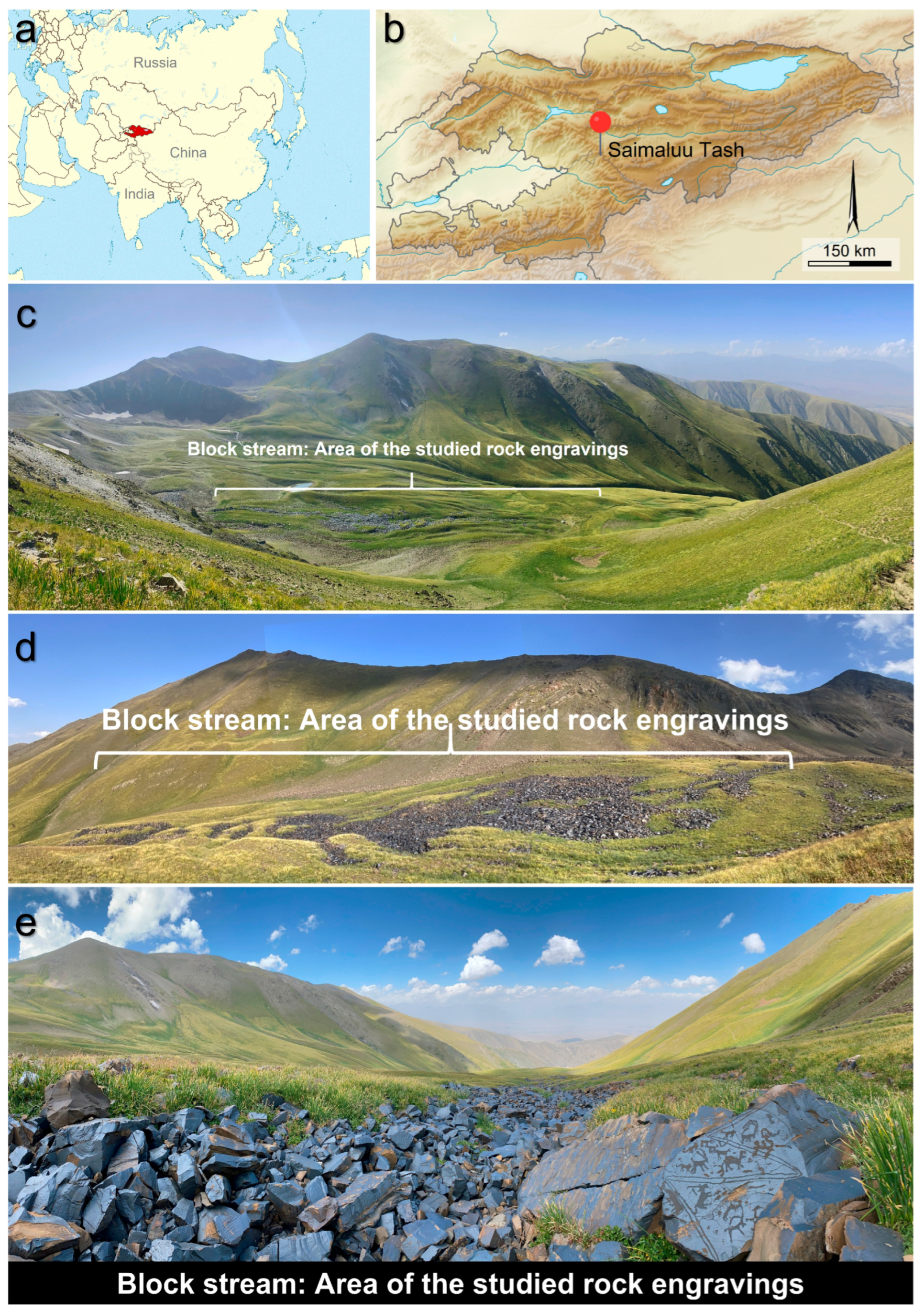
Figure 1. Location of the Saimaluu-Tash I rock art valley in Kyrgyzstan. (a): Map of Asia, with Kyrgyzstan colored red; (b): Map of Kyrgyzstan showing the location of the Saimaluu-Tash I rock-art valley; (c): General view from the east; (d): General view from the west; (e): View of the block stream with rock engravings.
Heritage 09 00241 g001
Figure 2. Parallel (a) and perpendicular (b) surfaces of the rock engravings in the Saimaluu-Tash I Valley. (a): Rock engraving (brown) and surface patina on sandstone; (b): Cross-section of the sandstone with the surface patina, weathered, and unweathered zones.
Heritage 09 00241 g002
Figure 3. Twelve rock art panels from the Saimaluu-Tash I block stream for which digital tracing and digital image processing were carried out. (a): Panel 1; (b): Panel 2; (c): Panel 3; (d): Panel 4; (e): Panel 5; (f): Panel 6; (g): Panel 7; (h): Panel 8; (i): Panel 9; (j): Panel 10; (k): Panel 11; (l): Panel 12.
Heritage 09 00241 g003
Figure 4. (a): Hand specimen of quartzitic sandstone showing a surface patina developed on the weathered zone (yellowish brown) above the unweathered zone (gray); (b): hand specimen with the polished weathered—unweathered interface, with a drop of HCl applied to each zone; (c,d): Optical photomicrograph of the same sample, showing the weathered zone at the top and the unweathered zone at the bottom under plane-polarized light (PPL), and under cross-polarized light (XPL) respectively; (e): Optical photomicrograph of a thin section under cross-polarized light (XPL), showing the weathered zone; (f): Optical photomicrograph of a thin section under plane-polarized light (PPL) showing the unweathered zone. Cal: calcite; Frac: fracture; Qz: quartz; Pl: plagioclase.
Heritage 09 00241 g004
Figure 5. Polished sample analyzed using a JEOL 6400 instrument. Backscattered electron (BSE) SEM micrographs showing. (a): detailed view of the surface patina and weathered zone; (b): general view of the weathered and unweathered zones.
Heritage 09 00241 g005
Figure 6. EDS spectra of the surface patina obtained using a JEOL 6010 PLUS/LA instrument.
Heritage 09 00241 g006
Figure 7. Images of the Vickers hardness test on a unweathered sandstone sample (top) and a weathered sandstone sample (bottom); (a): polished surface of the unweathered sandstone showing the 12 incisions with a Vickers point; (b): Vickers indentation made on the unweathered surface; (c): interpretation of the indentation on the unweathered sandstone and chipped perimeter surface; (d): surface of the weathered sandstone showing the 10 incisions with a Vickers point; (e): Vickers indentation made on the weathered surface; (f): interpretation of the indentation on the weathered sandstone and chipped perimeter surface. The circle in images c and d represents the perimeter of the Vickers indentation.
Heritage 09 00241 g007
Figure 8. Rock art panel 1. (a): Photograph of the panel with rock engravings. (b): Digital tracing of rock engravings.
Heritage 09 00241 g008
Figure 9. Rock art panel 2. (a): Photograph of the panel with rock engravings. (b): Digital tracing of rock engravings.
Heritage 09 00241 g009
Figure 10. Rock art panel 3. (a): Photograph of the panel with rock engravings. (b): Digital tracing of rock engravings.
Heritage 09 00241 g010
Figure 11. Rock art panel 4. (a): Photograph of the panel with rock engravings. (b): Digital tracing of rock engravings.
Heritage 09 00241 g011
Figure 12. Rock art panel 5. (a): Photograph of the panel with rock engravings. (b): Digital tracing of rock engravings.
Heritage 09 00241 g012
Figure 13. Rock art panel 6. (a): Photograph of the panel with rock engravings. (b): Digital tracing of rock engravings.
Heritage 09 00241 g013
Figure 14. Rock art panel 7. (a): Photograph of the panel with rock engravings. (b): Digital tracing of rock engravings.
Heritage 09 00241 g014
Figure 15. Rock art panel 8. (a): Photograph of the panel with rock engravings. (b): Digital tracing of rock engravings.
Heritage 09 00241 g015
Figure 16. Rock art panel 9. (a): Photograph of the panel with rock engravings. (b): Digital tracing of rock engravings.
Heritage 09 00241 g016
Figure 17. Rock art panel 10. (a): Photograph of the panel with rock engravings. (b): Digital tracing of rock engravings.
Heritage 09 00241 g017
Figure 18. Rock art panel 11. (a): Photograph of the panel with rock engravings. (b): Digital tracing of rock engravings.
Heritage 09 00241 g018
Figure 19. Rock art panel 12. (a): Photograph of the panel with rock engravings. (b): Digital tracing of rock engravings.
Heritage 09 00241 g019
Table 1. Synthesis of the analytical methods applied in this study, the main information obtained from each technique, and their respective contributions to the interpretation, conservation assessment, and understanding of the engraving processes at the Saimaluu-Tash I rock art complex.
Analytical MethodMain Information ObtainedConservation/Interpretative Relevance
Petrographic microscopy (PPL/XPL)Identification of sandstone composition, carbonate cement dissolution, weathered profile, and secondary clay mineral formationDefines the weathering structure of the rock support and explains the mechanical weakening of engraved surfaces
SEM–EDSCharacterization of surface patina, porosity increase, microtextures, and elemental composition (Fe–Mn oxides, carbon-rich material)Explains deterioration processes, patina formation, and the microstructural causes of sandstone weakening
ImageJ porosity analysisQuantification of porosity differences between weathered and unweathered zonesDemonstrates the strong increase in porosity associated with weathering and its effect on stone decay
CIEL*a*b* colorimetryQuantification of chromatic differences between patina and weathered zone (ΔE ≈ 22.7)Explains the original visual contrast and readability of the petroglyphs
Vickers hardness testingMeasurement of mechanical resistance in weathered and unweathered sandstoneDemonstrates the greater engravability of weathered surfaces and their role in facilitating engraving practices
Chipped perimeter analysisQuantification of edge chipping around Vickers indentationsEvaluates surface cohesion and the capacity of the rock to preserve engraving definition
Digital tracing and image processingDocumentation and enhancement of engraved motifs and panel morphologyImproves motif recognition, non-invasive documentation, and long-term digital preservation
Patina vs. weathered zone surface quantificationCalculation of exposed weathered areas in the 12 panelsAssesses panel vulnerability to erosion, granular disaggregation, and loss of engraved definition
Iconographic and spatial analysisIdentification of hunting, herding, mobility, and symbolic motifsSupports interpretation of landscape use, pastoral practices, and territorial organization in the high-mountain environment
Comparative interpretative analysisComparison with archaeological and ethnographic parallelsProvides hypotheses regarding seasonal mobility, communal hunting, and possible rettir-type pastoral enclosures represented by concentric-circle motifs
Disclaimer/Publisher’s Note: The statements, opinions and data contained in all publications are solely those of the individual author(s) and contributor(s) and not of MDPI and/or the editor(s). MDPI and/or the editor(s) disclaim responsibility for any injury to people or property resulting from any ideas, methods, instructions or products referred to in the content.