

Article

Geoethics as a Values Lens; Geoeducation as a Pedagogical Vehicle: A Convergence Framework for Environmental Education


by
Alexandros Aristotelis Koupatsiaris
* and
Hara Drinia
Department of Geology and Geoenvironment, National and Kapodistrian University of Athens, Panepistimiopolis, GR-15784 Athens, Greece
*
Author to whom correspondence should be addressed.
Heritage 2026, 9(6), 229; https://doi.org/10.3390/heritage9060229
Submission received: 29 March 2026 / Revised: 31 May 2026 / Accepted: 4 June 2026 / Published: 7 June 2026
(This article belongs to the Section Geoheritage and Geo-Conservation)

Abstract

Anthropocene pressures underscore that human well-being and societal resilience depend on both biodiversity and geodiversity, the latter providing the abiotic foundation of Earth’s life-support systems. Despite increasing emphasis on systems thinking, participation, and action, Environmental Education and Education for Sustainable Development often underrepresent this abiotic dimension and leave ethical commitments insufficiently articulated. Addressing these gaps, this concept paper develops a convergence framework that integrates geoethics, geoeducation, and geoenvironmental education within the broader domains of EE and ESD. Drawing on interdisciplinary scholarship, geoethics is positioned as a normative lens that clarifies principles for responsible human–Earth relations, including responsibility, justice, respect for Earth processes, transparency in science communication, prudent resource use, and risk-aware decision-making. Geoeducation is conceptualized as the pedagogical vehicle through which these values are translated into competencies such as geoliteracy, systems thinking, critical reflection, ethical deliberation, and evidence-informed action, while geoenvironmental education provides the integrative content domain linking biotic, abiotic, and cultural dimensions. Place-based learning functions as the primary implementation pathway, with protected landscapes and UNESCO Global Geoparks serving as exemplary “living laboratories” where geoconservation, education, and sustainable development are co-produced with local communities. The paper advances three interrelated contributions: (a) a conceptual convergence framework, (b) an operational definition of geoethical awareness, and (c) a programmatic model linking geoethical values to competencies, pedagogies, indicators, and place-based implementation strategies. Operationalized through a Theory of Change and a translation matrix connecting principles to educational outcomes, the framework provides a foundation for future empirical research, curriculum development, teacher education, and the cultivation of geo-citizenship, stewardship, and more resilient human–Earth relationships.

1. Introduction

1.1. Anthropocene Challenges and the “Missing Abiotic” Dimension

Earth operates as a dynamic, coupled system in which biotic and abiotic components jointly sustain biodiversity and geodiversity [1,2]. In the Anthropocene, however, the stability and life-support functions of this system are increasingly strained. The Planetary Health Check 2025 report warns that seven of nine planetary processes that regulate Earth’s stability, resilience, and life-support capacity have already been breached, with pressures intensifying in ways that signal further deterioration in the near future [3].
These converging stresses are not limited to biological systems. Geological heritage and geodiversity—including landforms, soils, rocks, minerals, fossils, and active geological processes—face escalating threats from pollution, intensive land use, urbanization and infrastructure expansion, mineral extraction, land-use change, and coastline modification [1,4,5,6]. Climate-related hazards further amplify these risks through warming, droughts, floods, habitat loss, and broader environmental degradation [7], while biodiversity loss continues at historically unprecedented rates [8,9].
Demographic and spatial transformations compound these dynamics. Global population growth and accelerating urbanization intensify pressures on land, ecosystems, and resource demand. The United Nations projects a global population of 8.5 billion by 2030, 9.7 billion by 2050, and approximately 10.4 billion by 2100 [10]. Urbanization is similarly rapid: roughly 55% of people currently live in urban areas, and this proportion is projected to reach 68% by 2050 [11]. Urban expansion has major implications for land-use change and socio-ecological stability, and estimates that 50–60% of the urban land expected to exist by 2030 was undeveloped as of 2010 highlight both risks and leverage points for sustainability-oriented planning [12]. These transformations unfold within a globalized political–economic context frequently characterized by short-termism and extractive development logics [13], often reinforced by educational systems that privilege narrowly academic or technocratic knowledge over situated, ethical, and action-oriented learning [14,15].
A persistent challenge within conservation and sustainability discourse is that geodiversity remains comparatively underrepresented relative to biodiversity [1,16]. Historically, conservation agendas have prioritized biological diversity while neglecting geological diversity, despite the foundational role of geodiversity in sustaining ecosystems, supporting human well-being, and underpinning the services upon which societies depend [1,17,18,19]. Designing durable environmental policy and effective management requires an Earth-systems understanding that integrates abiotic and biotic processes and the ways these processes interact with the built environment and human activity [20,21]. Geodiversity is therefore not merely “background” for biodiversity; it is a constitutive dimension of nature that connects people, places, and cultures across time and scale [20]. This shift is reflected in expanding scholarship on geodiversity, geoheritage, geosystem services, geotourism, geoeducation, UGGps, and geoethics [17,19,22,23,24,25,26,27,28,29].

1.2. Why Environmental Education Needs a Normative and Geoscience-Integrative Lens?

Responding to Anthropocene pressures requires more than technical solutions; it calls for educational transformation that cultivates ethical judgment, systems understanding, and civic capacity. Long-standing critiques of conventional education argue that schooling can alienate learners from real-world contexts, fragment knowledge, and separate emotion from cognition, limiting the ability to make responsible decisions in complex socio-ecological systems [30]. In contrast, Earth-centered education emphasizes interdependence, place, and lived experience as foundations for sustainability-oriented learning and action [31]. Contemporary EE has similarly grappled with an “identity” tension: it must address escalating environmental crises while also empowering learners to make informed and ethically grounded choices [7].
EE is frequently conceptualized as a broad field that supports decision-making, participation, and action through multiple lenses of “environment”—as a resource, a responsibility, a problem set, a decision system, a lived place, and a social issue requiring community involvement [32,33]. These perspectives converge on the need for citizens capable of moving beyond awareness toward environmental foresight—understanding the cyclical and interconnected dynamics of the geosphere, hydrosphere, biosphere, and atmosphere and aligning human actions accordingly [34,35]. This orientation resonates with contemporary work on environmental citizenship, which emphasizes responsible pro-environmental behavior and collective action across scales, including attention to rights and duties, structural drivers of environmental degradation, and competencies for critical civic participation [36,37,38,39].
At the same time, the Anthropocene intensifies ethical demands on geoscientific work and on public understanding of Earth systems. Geoscientists increasingly foreground questions of responsibility, transparency, and the social role of geoscience communication, especially in contexts of risk, resource governance, and sustainability transitions [40,41]. Advancing geoethics entails both clarifying the responsibilities of geoscience professionals and cultivating more appropriate human behaviors in relation to Earth systems [6,42]. This effort intersects with concerns about alienation from nature and “nature-deficit” experiences [43,44] and reinforces the importance of critical and systems thinking as core competencies for sustainable development and environmental literacy [7].
From this standpoint, EE and ESD benefit from a geoscience-integrative dimension and an explicit normative orientation across formal, non-formal, and informal educational contexts, including school, university, community-based, and protected-area learning environments. A geoscience-integrative lens makes the abiotic foundations of life visible through geodiversity, geohazards, georesources, and Earth-system processes. A normative lens, in turn, makes explicit the ethical principles and value judgments embedded in choices about extraction, land transformation, hazard governance, and conservation priorities [6]. Integrating these lenses strengthens the conceptual and practical capacity of EE to address the intertwined scientific, ethical, and civic dimensions of Anthropocene pressures.

1.3. Aim, Scope, and Contribution of This Paper

Building on this need, the paper develops a framework that connects geoethics, geoeducation, and geoenvironmental education within the broader field of EE and ESD. EE is understood as an overarching domain that fosters citizens’ capacities for informed decision-making, democratic engagement, and sustainability-oriented action. Within this context, geoenvironmental education is framed as a specialized strand that foregrounds the often-overlooked abiotic dimension by integrating biotic, abiotic, and cultural components through inquiry-based, participatory, and field-oriented approaches.
Within this structure, geoethics is introduced as a normative lens for human–Earth relations, defining principles such as responsibility, justice, respect for Earth processes, prudent resource use, transparency in scientific communication, and risk-aware decision-making [6,42]. Geoeducation, in turn, is conceptualized as the pedagogical means through which these principles are translated into learning processes that cultivate geoliteracy, systems thinking, critical reflection, environmental foresight, and evidence-informed action [34,35].
A key premise of the framework is that place operates not merely as a setting, but as a driver of learning and civic participation. Place-based approaches, particularly within protected landscapes, can strengthen a sense of place and foster stewardship by linking Earth system knowledge to community identity, values, and decision-making contexts [45,46,47]. UGGps exemplify this potential by connecting geoheritage with local culture and educational practice [46,48,49]. At the same time, they support geoethical awareness and more integrated governance by encouraging collaboration among scientists, institutions, policymakers, and communities toward sustainable, geocentric development [50,51,52,53,54,55]. In this respect, UGGps can be understood as “living laboratories” where geoconservation, education, and sustainable development intersect [5,22,56].
Despite substantial progress across EE and ESD, place-based education, geoeducation, and geoethics, current approaches rarely integrate four key dimensions simultaneously: (a) explicit recognition of the abiotic foundations of sustainability; (b) a clearly articulated normative framework for assessing human–Earth relations; (c) a pedagogical structure that links values to competencies and practice; and (d) institutional, place-based contexts that enable collective enactment. EE and ESD provide strong foundations for environmental literacy, participation, and action, yet often treat geodiversity as background and leave ethical commitments implicit. Geoeducation enhances understanding of Earth systems and supports geoliteracy, but does not always specify the value frameworks guiding decisions on georesources, geoheritage, and georisk. Geoethics, while offering such criteria, has been more extensively developed in relation to professional conduct and public communication than as an operational pedagogical framework within EE and ESD.
The novelty of this paper lies in bringing these strands into a coherent synthesis. Rather than simply incorporating geoscience content into EE and ESD or appending ethical considerations to geoscience education, the proposed framework demonstrates how geoethics can function as a values-oriented foundation, geoeducation as a pedagogical pathway, and geoenvironmental education as the integrative domain through which biotic, abiotic, and cultural dimensions are addressed together. This convergence reframes sustainability education as simultaneously Earth-system informed, ethically grounded, and place-responsive, linking knowledge, deliberation, and stewardship within shared community contexts such as UGGps.
Accordingly, the paper advances three interrelated contributions: (a) a conceptual contribution, through the development of the convergence framework; (b) a definitional contribution, through the articulation and operationalization of geoethical awareness; and (c) a programmatic contribution, by translating values into competencies, pedagogical approaches, indicators, and pathways for place-based implementation. As a conceptual and theory-building study grounded in interdisciplinary synthesis, the paper does not aim to provide a systematic review, scoping review, or empirical study. Instead, it brings together previously disconnected strands of scholarship to propose a novel framework that can inform future research, curriculum design, and place-based educational practice.

1.4. Paper Organization and Roadmap

The remainder of the paper is organized to build a coherent argument from problem framing to an operationalizable conceptual framework. Section 2 situates the proposed approach within the historical evolution of EE and ESD, emphasizing the shift from awareness-oriented agendas toward agency, participation, and action, while explaining why geodiversity and geoheritage remain underrepresented and how geosciences enter EE through hazards, resources, Earth-systems thinking, and geoconservation. Section 3 elaborates geoethics as a values lens for sustainability, clarifying its scope and core normative commitments and specifying what geoethics contributes to EE and ESD that is often left implicit. Section 4 positions geoeducation as the pedagogical vehicle that translates geoethical commitments into learning outcomes and practices, with particular attention to geoliteracy and the about–in/within–for learning design logic. Section 5 presents place-based learning and community engagement as the primary implementation axis, showing how a sense of place and social embedding can strengthen stewardship and environmental citizenship, with UGGps discussed as exemplary (though not exclusive) “living laboratory” contexts.
Building on these foundations, Section 6 presents the convergence framework in full: a nested integration architecture, a ToC narrative and hypothesized mechanisms, an operational translation matrix linking geoethical values to competencies, pedagogies, and indicators, and a set of testable propositions to guide empirical uptake. Section 7 synthesizes the model’s implications by articulating the key theoretical contribution, practical implications for curricula, teacher education, and geopark programming, and explicit limitations alongside priority directions for future research. Section 8 concludes by integrating the manuscript’s central claim: sustainability and resilience require the deliberate coupling of Earth-system literacy with a normative direction, enacted through place-based educational practice and community-facing stewardship.

2. From Environmental Education to Geosciences

2.1. Environmental Education as an Umbrella Domain: From Awareness to Agency and Action

For more than six decades, EE has evolved as a global field concerned not only with improving understanding of environmental systems and problems, but also with cultivating citizens who are willing and able to participate in solutions [57]. UNESCO’s engagement with environmental awareness and education dates to the organization’s early history and broader international conservation efforts, including the establishment of the International Union for the Conservation of Nature in 1948 [58]. A pivotal phase followed the United Nations Conference on the Human Environment (Stockholm, 1972) and the creation of the United Nations Environment Programme (UNEP), after which UNESCO and UNEP jointly advanced the International Environmental Education Programme (IEEP) (1975–1995). This institutional trajectory helped consolidate EE as a learning process that increases knowledge and awareness, develops skills and expertise, and fosters attitudes and commitments for informed decision-making and responsible action [59]. Importantly, this framing positioned EE as both an individual and collective endeavor by linking awareness and knowledge to skills and participation within educational practice [60,61,62].
EE’s conceptual evolution has also tracked shifting global priorities. Foundational statements such as the Belgrade Charter and the Tbilisi Declaration established enduring commitments to environmental literacy, participation, and action [59,60]. Subsequent developments reframed the field in relation to sustainability and systemic change, including EfS [63,64] and ESD, which gained prominence during the United Nations Decade of ESD [65,66]. More recently, UNESCO’s ESD for 2030 Framework, adopted in Berlin (2021), has emphasized priorities that move education beyond awareness toward transformation—advancing policy, reshaping learning environments, strengthening educator capacity, empowering youth, and accelerating local action [67]. These priorities align directly with the Agenda 2030 architecture and the 17 SDG [68], which have become a dominant reference point for education and sustainability policy.
At the level of educational theory, this institutional evolution corresponds to shifts in how learning and change are conceptualized. EE has been traced from behaviorist orientations toward paradigms that emphasize socio-ecological complexity, learner agency, and the political dimensions of sustainability [69,70]. Earlier predictive models of pro-environmental behavior emphasized knowledge, attitudes, and intention as central drivers [71,72,73]. Later approaches foregrounded action competence, participation, and transformative learning, positioning learners not as recipients of prescribed behaviors but as reflective agents capable of democratic engagement [74,75,76]. This trajectory aligns with contemporary emphases on place-based learning and lived experience as mechanisms for linking knowledge to practice [48]. In urban contexts in particular, EE has often been organized around complementary emphases such as the “city as classroom” [77], problem solving, stewardship, youth and community development, and the city as an ecological system [78].
Despite these developments, significant implementation gaps remain. UNESCO’s curriculum analysis reported uneven incorporation of climate change and limited coverage of biodiversity, alongside insufficient attention to socio-emotional and action-oriented competencies that are central to climate and environmental literacy [79]. In response, UNESCO has pushed for stronger curricular integration and broader initiatives to mainstream sustainability education [79,80]. In parallel, professional frameworks increasingly stress human well-being, local contexts, interdisciplinarity, equity and inclusion, lifelong learning, and systems thinking [62,81]. Evidence syntheses also indicate that effective EE can build knowledge and skills, strengthen predictors of pro-environmental behavior, catalyze action, develop community conservation capacity, and contribute to measurable environmental improvements [82]. Collectively, these developments position EE and ESD as an umbrella domain oriented toward participatory competence, democratic practice, and sustainability-oriented action, rather than awareness alone [7,61,83,84].

2.2. Why Geodiversity and Geoheritage Remain Underrepresented in Mainstream Environmental Education?

Although contemporary EE and ESD increasingly embrace systems thinking and interdisciplinarity, the field has historically privileged biotic dimensions of nature. Conservation discourse and educational practice have often centered on biodiversity, ecosystem services, and ecological integrity, while geodiversity—the diversity of rocks, minerals, fossils, soils, landforms, and active geological processes—has remained comparatively marginalized [2,18]. This imbalance matters because sustaining societies depends on the full spectrum of natural diversity, biotic and abiotic alike [19,85]. Geodiversity is foundational for ecosystem functioning, landscape stability, hazard dynamics, and the material conditions that shape human livelihoods and infrastructure [1,16,20,21].
Several factors contribute to this underrepresentation. First, the abiotic environment is frequently perceived as a “static background” rather than an active system with intrinsic value and direct links to well-being. Second, disciplinary and curricular traditions often separate Earth sciences from ΕΕ, placing geology in specialized tracks rather than integrating it across sustainability education. Third, environmental learning has sometimes been reduced to technocratic problem-solving or narrowly academic coverage, which can obscure the ethical and civic dimensions of georesources, hazards, and land-use change. As a result, learners may become literate in environmental “issues” without developing a robust understanding of Earth-system dynamics, deep time, or the geo-structural conditions that underpin ecological and social resilience [34,35].
Correcting this imbalance requires not merely adding geoscience topics to the curriculum, but reframing ΕΕ to make the abiotic dimension visible and educationally meaningful. This includes recognizing geoheritage as both a scientific record and cultural landscape [86,87], and treating geodiversity as a critical component of natural capital whose degradation has long-term consequences for ecosystems, hazards, and community resilience [5,88,89,90,91].

2.3. Where Geosciences “Enter” Environmental Education: Hazards, Resources, Earth Systems, and Geoconservation

Geosciences occupy a central position in contemporary discussions of human, social, and natural capital because they provide essential knowledge for understanding Earth systems, managing resources, and anticipating environmental risks [92]. Within the broader framework of environmental literacy, geoscience learning includes understanding interactions among Earth subsystems and living systems, assessing human impacts, forecasting hazardous phenomena, and managing critical resources such as water, soils, energy, and minerals [34,93,94]. These capacities are consequential for sustainability transitions and public safety: geoscientific knowledge underpins mitigation and adaptation strategies for earthquakes, landslides, subsidence, sinkholes, floods, and droughts, as well as planning for climate-related risks [94]. Accordingly, geoscience institutions increasingly emphasize the policy relevance of the discipline for protecting the environment and securing vital resources [95].
The importance of geoscience for sustainability is also reflected in bibliometric analyses. Recent work suggests that a substantial share of geoscience publications contributes to SDG-related knowledge across much of the SDG agenda, with strong representation in SDG 11 (Sustainable Cities and Communities), SDG 13 (Climate Action), SDG 14 (Life Below Water), and SDG 6 (Clean Water and Sanitation) [96]. This pattern underscores that geoscience is not peripheral to sustainability [41]; it is structurally necessary for addressing hazards, water security, climate dynamics, and land-use governance.
Within this context, geoconservation has emerged as a distinct field dedicated to safeguarding Earth features for their heritage, scientific, and educational significance [97,98]. Contemporary geoconservation recognizes that protecting geodiversity requires an ecosystem perspective that includes connections to biodiversity and ecosystem services [89,99,100]. Its purpose is not only preservation but also the “wise use” of geodiversity based on intrinsic, ecological, and heritage values [97]. This orientation aligns with calls to integrate Earth-science knowledge into planning and decision-making in support of sustainable management for present and future generations [94].
Closely related, geoheritage highlights the scientific and educational value of geodiversity elements as records of Earth history and the evolution of life [101]. It includes geosites and landscapes with scientific, educational, cultural, and aesthetic significance [102]. A widely used definition distinguishes (a) in situ geodiversity elements with high scientific value (geosites) and (b) ex situ elements (e.g., fossils, rocks, minerals in collections) that retain high scientific value despite displacement [85]. Geoheritage also includes multiple subtypes—geomorphological, petrological, mineralogical, paleontological, stratigraphic, structural, hydrogeological, and pedological—thereby offering diverse entry points for curriculum, interpretation, and community learning [85,102].
Importantly, contemporary geoheritage approaches move beyond a narrow focus on the geological record alone by emphasizing the intertwined physical and cultural dimensions of landscapes and the multi-scalar value of geosites—from individual locations to culturally significant regions [56,88,90]. This integrative perspective parallels shifts in protected-area management. Earlier models often emphasized strict protection and human exclusion [103,104], whereas contemporary approaches more often treat ecosystems and landscapes as socio-ecological systems and foreground collaboration with local communities for sustainability-oriented conservation [99,105,106,107]. Conceptual tools such as the “ABC” framework—integrating abiotic (e.g., geology, climate), biotic (fauna and flora), and cultural/human dimensions—provide a practical synthesis for connecting place identity with sustainable development [108]. Relatedly, geotourism operationalizes this synthesis by interpreting how abiotic and biotic processes shape cultural landscapes and human–environment relations over time [109].
Taken together, EE and ESD provide the broad educational mandate for sustainability-oriented agency and citizenship, while geosciences contribute the system knowledge, risk literacy, and stewardship-relevant content required to address Anthropocene challenges [110,111]. The bridge from EE and ESD to geosciences is therefore not merely additive; it is integrative—making the abiotic dimension explicit, linking Earth-system understanding to ethical and civic action, and situating learning in the management and meaning of real places.

3. Geoethics as a Values Lens for Sustainability

3.1. Working Definition and Scope

Geoethics has developed rapidly as a field within applied environmental ethics [112], focusing on the relationships between human activities and the Earth system, particularly in relation to geoscientific knowledge, professional practice, education, and communication [92,113]. The International Association for Promoting Geoethics (IAPG) defines geoethics as “research and reflection on the values which underpin appropriate behaviours and practices, wherever human activities interact with the Earth system” [114,115]. This definition is especially pertinent to sustainability-oriented education, as it frames geoethics not simply as a professional code for geoscientists, but as a broader normative perspective addressing how societies understand, utilize, and govern the Earth in contexts shaped by human intervention in geological processes, resources, hazards, and landscapes [56,113,116,117].
By its nature, geoethics is interdisciplinary, integrating insights from philosophy, political theory, sociology, and economics with geoscience. This integration enables the interpretation of complex, multi-scalar challenges—such as climate change, geohazards, resource governance, and spatial planning—and supports more inclusive and sustainability-oriented decision-making [116]. Contemporary approaches describe geoethics as both universal and pluralistic: it advances a shared ethical orientation grounded in responsibility toward the Earth system, while acknowledging diverse cultural perspectives and context-dependent forms of action [118]. In this respect, it aligns with the notion of ecological humanism, which affirms human agency and responsibility without endorsing domination over nature [113,116]. Within the widely accepted definition of sustainability as meeting present needs without compromising those of future generations [119], geoethics provides a domain-specific articulation focused on Earth-system governance, including decisions related to georesources, georisks, and geoheritage [120].
At the individual and societal level, geoethical awareness involves recognizing the technical, environmental, economic, cultural, and political constraints that shape socio-ecological systems. It fosters understanding, responsibility, and critical reflection regarding the ethical implications of decisions affecting the environment, human communities, and future generations. This orientation is associated with values such as integrity, respect for Earth systems, sustainability, and appreciation of both biotic and abiotic components [51]. Core geoethical principles encompass geoconservation, responsible resource use, adaptability, risk prevention, and the promotion of geoenvironmental education [6]. In practice, such awareness supports decision-making processes that prioritize environmental integrity, land stewardship, and the health of societies [6,113].
From an operational perspective, geoethical awareness can be understood through four interrelated dimensions: (a) ethical salience recognition, the ability to identify situations in which georesources, geohazards, geoheritage, or land-use decisions raise ethical concerns; (b) value-based judgment, the evaluation of alternatives in light of geoethical principles; (c) context-sensitive reasoning, which incorporates evidence, uncertainty, scale, and uneven impacts across communities and generations; (d) reflexive orientation, referring to the capacity to justify positions responsibly and engage in informed deliberation [29].
Although closely related to environmental ethics awareness, geoethical awareness is not identical to it. Environmental ethics typically addresses moral relationships between humans and the natural world in broad terms, often with a stronger emphasis on living systems and general sustainability principles [112]. In contrast, geoethics is specifically grounded in human–Earth interactions where the abiotic dimension is central, including considerations of geoscientific uncertainty, geohazards, resource extraction, deep time, and geoheritage stewardship. It is therefore best understood as a domain-specific ethical orientation within the wider field of environmental ethics.

3.2. Core Geoethical Values: Responsibility, Justice, Respect, Transparency, and Risk-Aware Choices

At its core, geoethics promotes the humane and responsible application of geoscientific knowledge for societal benefit while safeguarding shared heritage for present and future generations [42,121]. Peppoloni and Di Capua [114,115] characterize geoethics through four defining features: it is (a) human-agent-centric; (b) structured as a form of virtue ethics; (c) grounded in geoscientific knowledge; and (d) implemented through space-, time-, and context-dependent approaches. These features frame humans as moral agents whose decisions must be evaluated not only in terms of efficiency or utility, but also in terms of justice, responsibility, and respect for geo-biodiversity and socio-ecological systems [115].
Across the literature, several values recur as a coherent “values lens” for sustainability. Responsibility is foundational: geoethical decision-making depends on responsible autonomy—reasoned, reflective judgment rather than coercion, habit, or purely instrumental rationality [122,123,124]. Justice is central, including intra- and intergenerational justice, because resource use, hazard exposure, and conservation benefits and burdens are unevenly distributed across populations, regions, and time [6,115]. Respect is directed toward natural processes, geo-biodiversity, and the dignity of agents within the Earth system [113,116]. Transparency and integrity in scientific communication are emphasized because geoscientific knowledge frequently informs high-stakes public decisions about hazards, extraction, land-use change, and emergency response [92,125]. Finally, geoethics highlights risk-aware choices—the capacity to make prudent decisions under uncertainty and to manage emergencies effectively by linking scientific understanding with societal preparedness and care [6,92].
These values are reflected in the field’s thematic scope. Peppoloni and Di Capua [92] outline geoethical themes such as rational georesource use; transparent, accurate scientific communication; emergency management; improved relations among scientists, media, and the public; respect for legal and institutional frameworks; public engagement; interdisciplinary cooperation; and the development of educational tools that cultivate awareness, values, and responsible conduct. Similarly, the Cape Town Statement on Geoethics [40] consolidates reference values including honesty, integrity, transparency, competence, cooperation, respect for natural processes, protection of geodiversity and geoheritage, sustainability of economic activities, and the promotion of geoeducation for all [126]. Collectively, these commitments connect individual virtues to social responsibilities and to practical requirements for safety-oriented and sustainability-oriented governance [127].
A key conceptual move in this scholarship is the translation of high-level ethical principles into action-guiding ideals. Peppoloni and Di Capua [114] argue that responsibility, freedom, and dignity can be transformed through geoethics into justice, awareness, and respect—aspirational ideals operationalized through “values-in-practice.” Within this framing, geoethical awareness functions as the applied dimension of geoethics [29,54]: it translates abstract commitments into orientations that prioritize sustainability, equity, and ecological integrity, including alignment with planetary limits and the protection of geological and cultural heritage [124,128,129,130].

3.3. What Geoethics Adds to Environmental Education That Is Often Left Implicit

EE and ESD frequently emphasize knowledge, skills, participation, and action; however, the ethical foundations of environmental decisions can remain implicit or under-theorized, particularly when trade-offs are unavoidable. Geoethics strengthens EE and ESD [52] by clarifying and sharpening the normative dimension of sustainability learning in at least three ways.
First, geoethics makes normativity explicit. Decisions about georesource extraction, land transformation, hazard mitigation, and site protection are not only technical; they are moral and political choices that require criteria for what is socially acceptable and ecologically defensible [6]. By foregrounding responsibility, justice, respect, and transparency, geoethics clarifies the value judgments embedded in “sustainability” and provides a structured ethical vocabulary for deliberation, justification, and public reasoning.
Second, geoethics brings the abiotic dimension into ethical focus. In many educational and conservation framings, “nature” is tacitly treated as primarily biological [131]; geoethics challenges this tendency by directing ethical attention to geodiversity, geoheritage, and Earth processes. From a geoethical perspective, geoheritage is not merely an object of appreciation or regulated use, but a moral reference point within human–Earth relations [56,132]. Preservation of geosites, prudent use of georesources, and accurate communication about hazards become ethical acts because they shape environmental trajectories, community vulnerability, and intra- and intergenerational and interregional opportunities.
Third, geoethics strengthens the bridge between education and practice by emphasizing responsible autonomy and moral agency [133]. Because geoscience is inherently practice-oriented, geoethical values must be continually contextualized and validated through tangible outcomes in conservation, governance, and communication [122,134]. Within geoeducation specifically, geoethics supports learning designs that integrate cognitive and affective dimensions to cultivate awareness, responsibility, and action readiness, thereby enabling transformative change rather than compliance-based behavior modification [42,125,135]. Recent work also positions geoethics as a public-facing framework that supports inclusive, participatory, and transdisciplinary educational practices capable of shaping cultural understandings of geoscience and responsible conduct [136,137,138].
Finally, geoethics occupies a distinctive position within broader environmental ethics debates [139]. While it is epistemically anthropocentric—grounded in human knowledge and responsibility—it need not be morally anthropocentric, and ongoing debate examines its compatibility with ecocentric and relational perspectives [140,141,142,143]. This openness supports geoethics as a potentially integrative framework that can accommodate plural normative commitments while still offering actionable guidance for governance, education, and stewardship under Anthropocene conditions [56].
In summary, geoethics functions as a values lens that renders the ethical dimensions of human–Earth relations explicit, expands EE and ESD to include the moral significance of geodiversity and geoheritage, and strengthens the formation of responsible agency needed for sustainability and resilience.

4. Geoeducation as a Pedagogical Vehicle for Stewardship

4.1. Geoeducation and Geoliteracy as Core Competencies for Earth-System Cultivation

In this paper, geoenvironmental education is understood as the substantive domain of integration within EE and ESD, bringing into focus the interrelations among geodiversity, biodiversity, environmental change, geoheritage, geohazards, georesources, and cultural landscapes. Geoeducation, in contrast, refers to the pedagogical approaches through which this integrated knowledge is conveyed and constructed across formal, non-formal, and informal contexts. These approaches emphasize inquiry-based learning, field experience, interpretation, and the about–in/within–for design logic. Geoethics provides the normative orientation underpinning both, offering the principles through which human–Earth relationships are interpreted and evaluated. In this sense, geoenvironmental education defines the integrative content, geoeducation specifies the pedagogical process, and geoethics establishes the guiding values and criteria.
If geoethics supplies the ethical foundation—reframing geoheritage from an object of scientific or cultural interest into a matter of responsibility—then geoeducation, together with the broader practice of geoconservation, can be seen as the means through which such responsibility is cultivated and enacted [56,92,125]. Geoeducation thus operates as a key pathway for fostering geoethical awareness across generations, regions, and diverse learning environments. This role is particularly significant because decisions shaping landscapes—such as those concerning protection, land-use trade-offs, risk communication, and the prioritization of future outcomes—are inherently value-laden and produce uneven effects across spatial and temporal scales [6,97,144].
Geoeducation has been defined as “the teaching process that contains learning and knowledge, either in a formal or informal environment, that includes natural and cultural elements combined with local geology” [145]. This broad definition highlights its applicability beyond formal schooling, extending to public interpretation and community-oriented learning in settings such as museums, protected areas, and UGGps [146]. Crucially, geoeducation is not confined to the transmission of information; it aims to develop learners’ ability to interpret Earth-system processes, relate them to human decisions, and engage in evidence-informed deliberation within contexts characterized by uncertainty, risk, and competing interests.
Within this broader educational purpose, geoliteracy constitutes a central competency framework. It encompasses understanding how Earth systems function, recognizing interactions and feedbacks across spatial and temporal scales, and applying geoscientific knowledge to informed judgment and decision-making [147]. In this way, geoliteracy complements the goals of environmental literacy and environmental citizenship, while contributing a distinct emphasis on Earth-system dynamics and deep time—dimensions that are particularly critical for addressing governance challenges in the Anthropocene [34,148]. In practice, it enables learners to relate local issues—such as water scarcity, coastal erosion, land degradation, hazard exposure, and resource extraction—to broader Earth processes, institutional frameworks, and intergenerational as well as interregional implications.

4.2. The “About–In/Within–For” Logic as a Design Grammar for Geoeducation

A major strength of geoeducation is that it lends itself to a clear learning design grammar that connects conceptual understanding, situated experience, and civic action [149]. Building on foundational typologies in EE [150], Henriques et al. [98] articulate a tripartite structure for geoeducation in relation to geoconservation: education about, in/within, and for geoconservation. This structure is not merely classificatory; it provides a practical template for sequencing learning so that knowledge becomes meaningful, ethically salient, and action-relevant.
Education about geoconservation emphasizes conceptual understanding: learners develop explanatory knowledge of geodiversity, geoheritage, geohazards, Earth-system processes, and the relationships between abiotic and biotic systems. This dimension clarifies why geological features matter and how human actions alter geoenvironmental trajectories [5,97].
Education in/within geoconservation emphasizes experiential [151] and place-based education [152] through direct engagement with geosites, landscapes, and environmentally significant areas. This mode makes Earth processes tangible, strengthens inquiry skills (observation, interpretation, evidence use), and can cultivate affective connections to place that support stewardship dispositions [153]. Because many elements of geodiversity are sensitive to disturbance, learning in/within place also offers a concrete entry point into discussions of fragility, thresholds, and precaution [97].
Education for geoconservation foregrounds agency and ethical practice. Learners develop competencies for participation, deliberation, and stewardship-oriented action, including the ability to evaluate trade-offs, justify decisions, and collaborate on community-relevant responses to geoenvironmental problems. This dimension aligns with the view that geoconservation is not simply technical management but an ethical practice shaped by responsibility and by intergenerational considerations [6,154]. In effect, the “for” dimension is where geoethical commitments become civic capacities [56,155].

4.3. Translating Values into Outcomes and Practice: From Geoethics to Geoeducation to Stewardship

Geoeducation is most distinctive when it is approached explicitly as a geoethical practice—an educational process of ethical formation rather than a neutral instructional activity. From this perspective, geoeducation translates geoethical values (e.g., responsibility, justice, respect for natural processes, transparent communication, and risk-aware judgment) into teachable learning outcomes and pedagogical practices [6]. This translation can be understood through three mutually reinforcing mechanisms.
First, geoeducation links values to knowledge with consequences. Geoconservation emphasizes that the abiotic environment is not merely a backdrop for biodiversity, but a foundational dimension of nature with intrinsic, ecological, and geological heritage significance [156]. Effective stewardship, therefore, requires integrating bioconservation and geoconservation within a unified environmental understanding [88,97]. Bringing this relationship into learning can reshape how “nature” is conceptualized and strengthen learners’ capacity for holistic sustainability reasoning [107].
Second, geoeducation embeds values in competency development, particularly systems thinking, critical reasoning, and decision-making under uncertainty. These competencies are essential for navigating hazards, resource governance, and land-use dilemmas—domains in which competing interests and unequal distributions of risks and benefits make ethical justification unavoidable [6]. In this sense, competency development is not only cognitive; it is also normative, because it prepares learners to reason publicly and responsibly about contested socio-ecological choices [155].
Third, geoeducation supports values-in-action through participatory and field-oriented pedagogies that cultivate civic efficacy and stewardship dispositions [157]. When learners engage in inquiry, interpretation, deliberation, and collaboration with community actors, geoeducation can strengthen their sense of agency and their capacity to contribute to meaningful environmental decision-making and care practices [158]. This mechanism underscores that the educational aim is not awareness alone, but the development of durable capacities for participation and stewardship.
In place-based institutional contexts, such as UGGps, these mechanisms can be stabilized and scaled through ongoing partnerships, interpretative infrastructures, and community engagement pathways that link conservation priorities with local learning and development trajectories [146,159,160,161]. This view reinforces the central claim advanced here: geoeducation and geoconservation are most coherent and effective when they are pursued as sustainable and ethical practices in which geoethical responsibility is enacted over time [26,56,162].
In summary, geoeducation operationalizes geoethics by translating values into competencies and practices—geoliteracy, systems and critical thinking, participatory inquiry, and stewardship action—thereby strengthening sustainability-oriented decision-making and long-term care for the geoenvironment [2,51,92].

5. Place-Based Implementation and Community Engagement

5.1. Place and Sense of Place as a Learning Mechanism

Place is not merely a physical setting in which instruction happens; it operates as an active educational medium through which people interpret environmental change, construct identities, and develop commitments to care and stewardship. For an EE agenda that aims to integrate geoscientific understanding with explicit ethical orientation, place is especially consequential because it grounds abstract Earth-system processes in lived experience and locates sustainability dilemmas within concrete social relations, institutional arrangements, and culturally meaningful landscapes [7,45,47,163]. In this way, place-based implementation functions as a practical bridge between geoethics (as a values lens) and geoeducation (as a pedagogical vehicle), linking learning to community-facing outcomes such as stewardship, civic efficacy, and democratic participation.
This emphasis has deep roots in progressive education. Dewey [164] framed schools as “embryonic communities,” arguing that learning gains meaning when it is connected to experience and participation in social life. Sobel [152] likewise proposed a developmental logic in which education begins with “the closest things” and expands outward, aligning learning with the local ecologies and everyday realities that shape learners’ lives. Contemporary scholarship extends these insights by conceptualizing place as multidimensional rather than purely geographic: it includes natural and built features as well as social, cultural, economic, and political qualities that evolve over time [45,165,166]. Place is therefore dynamic and often contested, shaped by ecological processes as well as by governance structures and ideological meanings [167].
Within this broader framing, a sense of place becomes a core mechanism through which learning becomes environmentally consequential. Sense of place has been examined across disciplines as a multidimensional construct capturing how people experience, interpret, and bond with particular settings [168,169,170]. These bonds are both cognitive and affective, formed through personal histories and collective narratives and mediated by sociocultural values [171,172]. Importantly, a sense of place is not always positive: places may evoke fear, discomfort, alienation, or exclusion as well as attachment and belonging [173]. This matters pedagogically because effective place-based learning must engage not only appreciation and care, but also lived tensions such as unequal access, perceived risk, contested land uses, and experiences of marginalization.
A widely used conceptualization distinguishes two interrelated dimensions of sense of place: place attachment, referring to the strength of emotional bonds, and place meaning, referring to the symbolic and interpretive content that gives those bonds significance [174]. Related constructs such as place identity and place dependence are often understood as facets or expressions of these dimensions [175,176]. This distinction is particularly useful for geoeducation because it clarifies how Earth-system understanding becomes personally and socially salient: place-based learning does not simply convey information about landscapes; it supports learners in interpreting what landscapes mean and why they matter for identity, community continuity, and ethical responsibility.
Empirical and theoretical work suggests that stronger place attachment and more ecological place meanings are often associated with greater willingness to protect valued environments and participate in stewardship [169,177,178]. Sense of place has also been linked to pro-environmental behavior and conservation attitudes, indicating that affective and interpretive ties can complement knowledge-based approaches by strengthening motivation and commitment [179,180,181]. For geoeducation, this implies that geoliteracy alone is unlikely to be sufficient; learning designs should also cultivate relationships to place that make responsibility and care intelligible, meaningful, and durable [182,183]. Through this mechanism, learners can connect deep-time Earth narratives and present-day socio-environmental dilemmas to their own agency and ethical commitments, reinforcing geoethical awareness and stewardship dispositions [53,184].

5.2. Community Engagement and Stewardship: Why Social Embedding Matters?

Place-based approaches are not only experiential; they are inherently social and institutional in character. Over the past two decades, place-based education has gained international recognition as a pedagogical orientation that emphasizes contextual, community-centered, and experiential learning, strengthening learners’ connections with local environments, cultures, and civic life [185]. Sobel’s [152] well-known formulation—using the local community and environment as a starting point across the curriculum—captures a key insight: the community is not merely a setting for learning, but also a resource, an audience, and a field of inquiry. This perspective aligns with broader developments in ΕΕ, which have progressively shifted from awareness-raising toward participation, action competence, and civic engagement [7].
The importance of community engagement can be understood from both educational and governance perspectives. From an educational standpoint, inquiry-based learning depends on authentic problems, meaningful audiences, and opportunities for collaborative investigation [186,187]. Place-based education operationalizes these conditions by linking field-based inquiry with local knowledge and civic practice: learners explore their immediate environments, examine community challenges, and engage with stakeholders and knowledge holders [77,188]. Such processes enhance relevance and motivation while extending learning outcomes toward competencies essential for sustainability transitions, including systems thinking, deliberation, collaboration, and collective problem-solving [47].
From a sustainability perspective, social embedding is critical because stewardship cannot be reduced to individual attitudes or awareness alone. Enduring practices of care are shaped by social norms, institutional arrangements, trust, and networks that enable collective action [7]. Place-based learning contributes to the development of social capital by expanding learners’ relationships with peers, educators, scientists, community organizations, and decision-makers, thereby strengthening civic efficacy and sustaining engagement over time [47]. Through repeated participation in community-oriented initiatives, learners can move from passive observers to active contributors, reinforcing both agency and democratic involvement [185]. This is particularly important in the context of geoenvironmental challenges—such as land-use change, hazard mitigation, and resource governance—where contested trade-offs require not only technical understanding but also ethical reasoning and deliberative capacity [6,7].
At the same time, implementing place-based education often generates institutional tensions. Educators are positioned as curriculum designers navigating between learners’ needs and the opportunities offered by local contexts, yet this role can conflict with standardized curricula, assessment systems, and more technocratic views of knowledge [14,189,190]. Rather than indicating a limitation, such tensions reflect the transformative nature of place-based education. As Gruenewald and Smith [167] suggest, it represents not merely a pedagogical strategy but a reorientation of educational purpose, aligning learning with the investigation of socio-ecological realities that shape communities and future trajectories.
A justice-oriented extension further strengthens this framework by foregrounding distributive, procedural, and recognition dimensions of environmental decision-making. Geoethical considerations extend beyond questions of what should be protected to include who is exposed to geohazards, who benefits from resource use or geotourism, whose place-based meanings are acknowledged, and whose knowledge counts in governance processes. Incorporating this critical perspective helps avoid idealized notions of “community” as homogeneous and enhances alignment with principles of environmental justice, inclusive participation, and democratic accountability.

5.3. UNESCO Global Geoparks as Exemplary “Living Laboratories”

Protected or designated areas offer powerful contexts for place-based implementation because they concentrate ecological, geological, and cultural values while also making management dilemmas visible and learnable [191]. Within this broader category, UGGps provide a particularly robust example of “living laboratories” in which geoconservation, geoeducation, and sustainable development are intentionally connected [29,192]. UNESCO describes “UGGps as unified territories with internationally significant geological heritage that are managed through an integrated approach combining protection, education, and sustainable development, explicitly linking geological heritage to the area’s wider natural and cultural heritage in order to enhance awareness of key societal issues” [193]. This framing positions UGGps as integrative learning territories where Earth-science knowledge, community identity, and sustainability practice are designed to reinforce one another [27,89,194,195].
The UGGps model is widely characterized as participatory and community-centered, privileging bottom-up governance and stakeholder involvement rather than exclusionary conservation paradigms [196,197]. Educationally, this participatory logic expands geoeducation beyond visitor interpretation by treating local residents as co-stewards and co-interpreters of geoheritage and by encouraging collaboration among schools, scientists, local authorities, civil society organizations, and businesses. Gray [1] emphasizes that a core aim is to enable communities to take ownership of their geological and associated heritage by protecting and promoting it in ways that generate sustainable benefits. In this sense, UGGps provide not only a venue for learning, but also an institutional arena where geoethical commitments can be practiced and evaluated through ongoing partnerships and shared responsibility [6,27,56].
UGGps also clarify why the geoethical dimension cannot remain implicit [198]. Like other protected areas, designated regions, UGGps face pressures—limited public awareness, environmental degradation, and overtourism—that can threaten geosites, ecosystems, and community well-being [5,99]. These pressures foreground the ethical stakes of management: what forms of use are acceptable, how benefits and burdens are distributed, and how long-term protection is balanced with livelihood needs. Consequently, UGGps can support not only learning about and in/within geoconservation, but also learning for stewardship and sustainability-oriented governance, by providing recurring opportunities for deliberation, participation, and practice in real decision contexts [16,199,200].
In summary, place-based implementation is pivotal to the proposed framework because it provides the experiential and social infrastructure through which geoethical values can become durable learning outcomes and community practices. By strengthening sense of place (attachment and meaning), embedding learning in community partnerships, and leveraging living laboratories such as UGGps, geoeducation can support stewardship and environmental citizenship that are grounded in local realities while remaining oriented toward planetary responsibility.

6. Proposed Conceptual Framework for Convergence

6.1. Framework Overview

This paper proposes a convergence framework that positions geoethics and geoeducation as complementary, mutually reinforcing integrative layers within EE and ESD, particularly in contexts where the abiotic foundations of sustainability—geodiversity, geoheritage, and geosystem services—remain weakly articulated in mainstream EE. Rather than treating geoscience content and ethical reflection as peripheral “topics” appended to an otherwise biotically oriented curriculum, the framework conceptualizes them as structuring elements that strengthen EE and ESD’s capacity to address Anthropocene challenges [13,201,202] that are simultaneously scientific (Earth systems, hazards, resources), civic (participation and governance), and normative (trade-offs, fairness, and responsibility). Figure 1 presents a nested integration architecture that situates these elements in relation to one another.
At the outer level, EE and ESD function as the umbrella educational domain oriented toward building environmental literacy, civic participation, and sustainability-oriented action through learning that supports informed decision-making and democratic engagement [59,62,67]. Within this umbrella, geoenvironmental education is conceptualized as a specialization that makes the abiotic foundations of sustainability explicit by integrating biotic–abiotic–cultural dimensions through inquiry, fieldwork, and participatory learning, thereby addressing a persistent imbalance in which “nature” is implicitly treated as primarily biological [1,2].
Within this nested structure, the framework assigns two additional functions that enable convergence. First, geoethics operates as a normative layer—a values lens—clarifying what counts as “appropriate” human–Earth relations under conditions of uncertainty, competing interests, and unequal impacts. In practical terms, it foregrounds responsibility, justice, respect for natural processes, transparency in scientific communication, prudent resource use, and risk-aware choices as guiding criteria for environmental decision-making [6,42,92,113,115,116]. Second, geoeducation functions as the pedagogical vehicle that translates these geoethical commitments into teachable and assessable learning outcomes and practices by developing geoliteracy, systems thinking, critical reasoning, and evidence-informed action through coherent learning designs [98,147].
Although the model is presented as a nested architecture, it is explicitly intended to be implemented through place-based contexts, where protected or designated landscapes—including UGGps—can serve as high-leverage learning infrastructures that connect geoconservation, education, and sustainability in lived community settings.

6.2. Learning Mechanisms and Theory of Change

Grounded in ToC logic [203,204,205,206], the proposed framework clarifies the pathway through which geoethical values are translated into educational competencies and, over time, into stewardship and globalcitizenship [148]. The model begins with enabling conditions that make implementation feasible and meaningful. Learners must have access to place-based contexts—local environments, geosites, protected landscapes, designated areas, and, where available, UGGps—that can function as authentic settings for inquiry and interpretation [100]. The framework also presupposes partnerships that connect learners with expertise and governance, such as collaborations among schools, scientists, site managers, and community actors. Finally, it requires curricular and institutional space for inquiry, dialogue, and deliberation so that learners engage not only with environmental content but also with contested sustainability questions in ways that cultivate agency and participation.
Within these conditions, geoeducation operationalizes geoethics through core educational processes. Learning designs build Earth-systems understanding and explicitly foreground biotic–abiotic interdependence, supporting learners’ recognition that geodiversity underpins ecological function and social well-being [19,34,147]. They engage learners in field-based inquiry and interpretation using observation, evidence gathering, and place-based explanation to make Earth processes tangible and meaningful [98,153]. Crucially, the model incorporates ethical deliberation as an explicit pedagogical component, inviting learners to examine responsibilities and trade-offs in contexts such as georesource use, risk management, conservation priorities, and science communication [6,40,56,92]. Finally, learning is embedded in community-relevant problems through place-based education [207], strengthening place attachment and place meaning as motivational and interpretive mechanisms that connect understanding with care and responsibility [7,208,209].
On this basis, the framework anticipates short-term learning outcomes across three domains. Cognitively, learners develop geoliteracy and systems thinking, including the ability to reason across scales and anticipate consequences in complex Earth systems [147]. Ethically, learners strengthen geoethical awareness, operationalized through heightened attention to responsibility, justice, respect for natural processes, transparency, and risk-aware judgment [48,115]. Affective–interpretively, learners develop a stronger sense of place, expressed as increased attachment and richer place meanings, which has been consistently linked to stewardship orientations and pro-environmental dispositions [7,53,177,180,184].
As these outcomes consolidate, the model expects medium- to long-term changes in civic and stewardship practice. Learners should demonstrate stronger civic efficacy and participation and engage more consistently in stewardship behaviors such as monitoring, restoration, public communication, and deliberative involvement in environmental decision-making. These shifts align with environmental citizenship understood as multi-scalar individual and collective action to address and prevent environmental problems and advance sustainability [36,38,148,210,211]. In UGGp and protected-area contexts, the framework further anticipates feedback effects: increased participation and stewardship can inform planning, strengthen risk governance, and shape conservation priorities, thereby contributing to socio-ecological resilience over time [212].

6.3. Operationalization

Table 1 serves as a translation matrix that renders the central claim of this paper actionable: geoethics should not remain at the level of abstract principles but be systematically translated into teachable competencies, pedagogical designs, and observable outcomes.
Each row begins with a geoethical value or principle (e.g., responsibility, justice, transparency, risk-aware judgment) or orientation and connects it to a corresponding geoeducation competency that learners can realistically develop, such as systems thinking, ethical deliberation, risk literacy, and science communication. The third column outlines illustrative pedagogical approaches—including field inquiry, structured controversy, interpretive production, community audits, hazard communication tasks, service-learning, and narrative mapping—that function as practical means for enacting these values in educational settings. The final column identifies expected outcomes and indicators (e.g., performance improvements, rubric-based reasoning quality, communication accuracy, preparedness self-efficacy, and participation in stewardship activities), thereby enabling evaluation and aligning the framework with empirical research requirements.
The matrix is designed to align with the widely used “about–in/within–for” learning progression found in both ΕΕ and geoeducation. Learning can be structured from conceptual understanding about geoheritage and Earth-system processes, to experiential engagement in/within place through fieldwork and interpretation, and ultimately toward action through deliberation, planning, and stewardship practices. This progression highlights that values are most effectively developed through iterative cycles of understanding, experience, and action, rather than through normative instruction alone.
In practical terms, Table 1 can support multiple applications. It offers a tool for curriculum design by linking desired values to specific competencies and instructional strategies; it facilitates program evaluation through the selection of aligned indicators; and it enables comparative research by examining how different combinations of values, pedagogies, and contexts—such as protected areas or UGGps—affect the development of stewardship and environmental citizenship. At the same time, it remains compatible with geoscience didactics as a framework for instructional design and implementation [213].
Although conceptual in nature, the framework is intended to be empirically testable across formal and non-formal learning environments. In school contexts, it can be implemented through locally grounded, case-based units addressing geosites, geohazards, water systems, soils, or land-use change. Evaluation may include pre- and post-assessments of geoliteracy, ethical reasoning, sense of place, and civic efficacy, complemented by analysis of student outputs and reflective work. In UGGps and other protected areas, assessment can combine learning indicators—such as interpretive accuracy, risk literacy, and justice-oriented reasoning—with participation metrics, including stewardship engagement, continuity of involvement, and the quality of co-produced outputs. Additional site- or partner-level indicators, such as community feedback or reductions in environmentally harmful practices, can further strengthen evaluation.
In community-based learning contexts, mixed-method approaches can be employed to explore how activities such as citizen science, hazard preparedness initiatives, or geoheritage storytelling influence collaboration, readiness for action, and locally grounded participation. In this way, the framework can be assessed not only for its conceptual coherence but also for its pedagogical feasibility and broader social impact.

6.4. Propositions and Research Questions

To facilitate empirical uptake and guide subsequent evaluation, the proposed framework advances a set of testable propositions that translate its ToC into researchable claims.
First, the framework posits a mediation mechanism grounded in a sense of place: geoeducation interventions are expected to strengthen geoethical awareness and stewardship intentions partly through increases in place attachment and place meaning. Affective bonds to place and the interpretive meanings learners assign to landscapes are thus hypothesized to function as proximal pathways through which experiential, place-based learning becomes ethically salient and behaviorally consequential.
Second, the framework advances an added-value proposition: programs that incorporate explicit geoethical deliberation—including justice-based reasoning, responsibility, transparency, and risk trade-offs—should produce larger gains in civic efficacy and action readiness than programs focused on geoscience content or environmental information alone.
Third, the framework proposes a predictive proposition beyond knowledge: geoethical awareness should explain variance in pro-environmental behavior and civic participation above and beyond environmental knowledge and general attitudes, indicating that ethical orientation constitutes an additional—and potentially stronger—driver of action.
Fourth, the model includes a context proposition: place-based implementations in protected areas and UGGps should yield stronger and more durable outcomes across the knowledge–values–participation pathway than classroom-only implementations, due to authentic experience, social embedding, and sustained opportunities for stewardship practice.
Fifth, the framework posits a participation proposition: higher levels of community partnership (co-design, co-teaching, co-stewardship) should be associated with greater continuity of stewardship behavior and stronger community conservation capacity, reflecting the social and institutional conditions required for durable action.
Sixth, the framework advances an equity proposition: differences in access to place-based geoeducation—such as proximity to UGGps, resource availability, or institutional support—are expected to help explain variability in geoethical awareness and engagement, implying that scaling the approach depends on addressing opportunity structures and inclusion.
These propositions can be expressed as evaluative research questions that align directly with the framework’s mechanisms: To what extent do place attachment and place meaning mediate changes in geoethical awareness following an intervention? Do programs that incorporate explicit geoethical deliberation produce measurably greater civic efficacy than content-only programs? Does geoethical awareness predict observed stewardship behaviors when knowledge and attitudes are controlled? Under what institutional and access conditions are outcomes most durable across protected-area and classroom contexts? Framed in this way, the propositions provide a bridge from conceptual synthesis to comparative and intervention-based empirical testing.

7. Insights of the Proposed Integrative Model

7.1. Key Theoretical Contribution

Building on the nested architecture and ToC presented in Section 6, this concept paper argues that the coupled social–ecological pressures of the Anthropocene [87,144,202,214,215] make it increasingly untenable to treat EE and ESD as primarily “biotic” agendas. Biodiversity protection, climate adaptation, hazard governance, and resource stewardship are all grounded in—yet frequently separated from—geodiversity, geomorphological change, soils, water, minerals, and the broader dynamics of the Earth system [1,2,16,17,19,34,35]. The paper’s central theoretical contribution is a convergence framework that makes two dimensions explicit within EE and ESD: the abiotic dimension (through geoenvironmental education and Earth-system literacy) and the normative dimension (through geoethics as a values lens).
Within this synthesis, geoethics specifies criteria for appropriate human–Earth relations under conditions of uncertainty, unequal impacts, and long-term consequences, foregrounding responsibility, justice (including intra- and intergenerational justice), respect for natural processes, transparency in science communication, and risk-aware decision-making as action-guiding orientations rather than optional additions [6,40,92,114,115,118,124]. Geoeducation then operationalizes these orientations by translating them into teachable and assessable outcomes—via geoliteracy, systems thinking, critical reflection, and evidence-informed action—organized through coherent learning designs rather than abstract transmission [98,146,147,216,217].
A further contribution is the framework’s explicit treatment of place as an implementation axis that links ethical commitments to lived contexts. Place-based learning positions communities and landscapes not merely as settings for instruction but as arenas where meanings, identities, and responsibilities are negotiated and enacted [7,45,152,207]. UGGps are highlighted as exemplary (though not exclusive) “living laboratories” where geoconservation, education, and sustainable development are institutionally coupled and can be enacted through community partnerships [26,56,89,218,219]. The model’s integrative contribution is therefore not only conceptual but also programmatic: it offers a structured pathway through which Earth-system understanding and explicit normativity can be assembled into an educational logic oriented toward stewardship, environmental citizenship, and geo-citizenship merging geoethics, UGGps, and sustainability [118,120,148,220,221].

7.2. Practical Implications

The convergence model suggests that curricula can become more complete—and more action-relevant—by treating geodiversity, geosystem services, and Earth-system dynamics as foundational rather than peripheral [222]. In practice, this implies integrating geoscience-mediated sustainability questions (e.g., hazard governance, land-use change, resource trade-offs, and deep-time narratives) alongside climate topics [223] and biodiversity [224]. Geoethics provides a structure for addressing controversial issues without reducing them to technical optimization: learners can examine competing claims using criteria such as transparency, precaution, justice, and respect for natural processes. This approach aligns with contemporary EE emphases on systems thinking, local contexts, justice and inclusion, and participatory competence [7,61,62,171], and it can be mapped onto SDG-oriented learning priorities [68,80].
Teacher education is a primary lever for implementation. The framework implies that educators should be prepared to (a) teach Earth-system concepts in ways that connect biotic and abiotic change; (b) facilitate geoethical deliberation around risk, uncertainty, and contested trade-offs; and (c) design inquiry- and place-based learning sequences that move from “about” to “in/within” to “for” conservation-oriented action [98]. This requires capacity building not only in geoscience content knowledge but also in facilitation skills for ethical discussion, risk communication, and community-linked project design. Field pedagogy modules and structured partnerships with protected areas, museums, UGGps, and local agencies can support repeated engagement, co-teaching, and authentic assessment.
For UGGps and protected landscapes, the framework implies that education should be designed not only as interpretation for visitors but as a sustained, community-embedded pathway to stewardship that connects geoconservation priorities with civic participation and local livelihoods [220]. Because geoconservation decisions are inherently normative [88,97], UGGp programming can foreground geoethical dilemmas explicitly: what should be protected, why, and for whom; how benefits and burdens should be distributed, and how risk and uncertainty should be communicated. Geoeducation initiatives—guided walks, citizen science, youth geo-clubs, teacher networks, and service-learning—can be aligned with both educational outcomes (geoliteracy, systems thinking, civic efficacy, sense of place, geoethical awareness) and management indicators (stewardship participation, reduced site impacts, improved compliance with conservation guidance). Framing UGGps as participatory learning infrastructures aligns with UNESCO’s emphasis on transforming UNESCO sites into learning hubs and living laboratories for sustainability, as well as for advancing scientific and environmental education that supports sustainable and resilient communities within local contexts and across generations [193,225].

7.3. Limitations and Implementation Challenges

Several limitations should be acknowledged. First, this paper presents a conceptual synthesis rather than a systematic review; it prioritizes theoretical coherence and explanatory clarity over exhaustive coverage of the literature. Second, while the framework seeks integration, such breadth entails a risk of conceptual stretching: terms such as geoeducation, geoenvironmental education, and EE are interpreted differently across scholarly traditions and national contexts, which may affect their alignment and application. Third, although contemporary geoethics adopts an explicitly pluralist stance, ongoing debates remain regarding its anthropocentric orientation and the extent to which it can incorporate more-than-human ethical perspectives. This tension is best understood not as a weakness, but as an open line of inquiry requiring further theoretical and empirical exploration.
Beyond these conceptual considerations, practical implementation is likely to vary considerably across contexts. Educational systems differ in terms of curricular flexibility, assessment structures, access to field sites, logistical support, safety regulations, teacher preparation, and the availability of institutional partnerships. Such factors shape the feasibility and scope of place-based geoeducation, particularly in settings where educators face time constraints, limited resources, or insufficient professional development opportunities.
Cultural and political conditions further influence implementation. Interpretations of heritage, risk, responsibility, and legitimate knowledge are context-dependent, and local tensions related to land use, resource extraction, tourism, or conservation may complicate participatory approaches. These dynamics require sensitivity to local values and power relations, especially when engaging communities in deliberative or action-oriented processes.
For these reasons, the proposed framework should be treated as an adaptable heuristic rather than a prescriptive model. Its applicability and effectiveness ultimately depend on empirical validation across diverse educational, institutional, and cultural settings.

7.4. Future Research Directions

A research agenda commensurate with the ambition of the convergence framework should prioritize testable propositions, transparent designs, and measurable outcomes that capture change across cognitive, affective, ethical, and behavioral domains.
One near-term priority is theory testing and mechanism-focused research that evaluates whether explicit geoethical framing—engaging learners with responsibility, justice, transparency, and risk trade-offs—produces added value beyond conventional EE messaging. Experimental and quasi-experimental designs can assess whether such framing strengthens systems thinking, risk reasoning, deliberative competence, and stewardship intentions, while clarifying causal pathways among constructs.
A second priority concerns longitudinal durability. Because the framework is oriented toward sustained citizenship and stewardship rather than short-term awareness, evaluation designs should move beyond immediate post-tests to trace whether gains in geoliteracy, sense of place, and geoethical reasoning persist and translate into durable civic participation and verified pro-environmental behavior.
A third direction is cross-context comparison. Comparative studies across multiple protected areas—including, but not limited to, UGGps—are needed to distinguish what is place-specific from what is generalizable about geoethical learning pathways, especially in relation to institutional maturity, governance arrangements, cultural narratives, and access to field-based learning opportunities.
A fourth direction involves operationalization and measurement. Advancing the framework requires developing and validating instruments that connect geoethical values to competencies and indicators, including decision quality in trade-off scenarios, argumentation and justification, civic efficacy, participation intensity, stewardship continuity, geo-citizenship, and geoethical awareness. Where the framework is applied across languages and cultural settings, measurement work should include cross-cultural adaptation and tests of multilingual invariance to ensure comparability and valid inference.
Collectively, these steps would move the model from a plausible conceptual synthesis to an empirically grounded framework that can inform curriculum design, teacher preparation, and place-based sustainability education. In an era of accelerating planetary change, moving beyond “geological value” alone toward “moral responsibility” [56]—and designing educational pathways that enable learners and communities to enact that responsibility—offers a coherent avenue for strengthening EE and ESD in ways that are simultaneously Earth-system literate, ethically explicit, and socially embedded.

8. Conclusions

In the broader arc of this concept paper, the Anthropocene is framed not only as an environmental condition but also as a civic and educational challenge: societies must learn to live within Earth-system limits while navigating contested values, uneven vulnerabilities, and long-term responsibilities. The framework proposed here responds to this challenge by positioning EE as the umbrella field of democratic capacity-building, while arguing that a sustainability-ready EE and ESD must explicitly include the often “missing” abiotic dimension—geodiversity, geoheritage, and Earth processes.
Within this framework, geoethics serves as a normative compass that makes explicit what is frequently left implicit in sustainability education: responsibility, justice (including intra- and intergenerational justice), transparency, respect for natural processes, and risk-aware decision-making. Geoeducation is then framed as the pedagogical vehicle that operationalizes these commitments through geoliteracy, systems and critical thinking, and evidence-informed action, structured through “about–in/within–for” learning sequences that connect conceptual understanding to lived experience and stewardship practice.
Place anchors the framework as the setting where knowledge becomes meaning, meaning becomes attachment, and attachment becomes civic and environmental agency. In this sense, protected and designated landscapes—and especially UGGps—function as exemplary (though not exclusive) learning environments where geoconservation, education, and sustainable development can be co-produced with communities rather than delivered to them.
Ultimately, the paper argues that sustainability and resilience are not secured by scientific literacy alone, nor by ethics in abstraction, but through their deliberate integration in place-based practice. By linking values, learning, and action, the proposed model offers a foundation for future empirical research aimed at fostering stewardship, environmental citizenship, geo-citizenship, and more inclusive, legitimate, and durable governance of the Earth system.

Author Contributions

Conceptualization, A.A.K.; resources, A.A.K.; writing—original draft preparation, A.A.K.; writing—review and editing, A.A.K. and H.D.; supervision, H.D. All authors have read and agreed to the published version of the manuscript.

Funding

This research received no external funding.

Institutional Review Board Statement

Not applicable.

Informed Consent Statement

Not applicable.

Data Availability Statement

No new data were created or analyzed in this study.

Acknowledgments

The authors sincerely thank the journal’s Editor-in-Chief as well as the editorial board and the three anonymous reviewers for their valuable feedback on the manuscript.

Conflicts of Interest

The authors declare no conflicts of interest.

Abbreviations

The following abbreviations are used in this manuscript:
AGIAmerican Geosciences Institute
EEEnvironmental Education
EfSEducation for Sustainability
ENECEuropean Network for Environmental Citizenship
ESDEducation for Sustainable Development
GSAGeological Society of America
IAPGInternational Association for Promoting Geoethics
IEEPInternational Environmental Education Programme
IUCNInternational Union for Conservation of Nature
NAAEENorth American Association for Environmental Education
SDG(s)Sustainable Development Goal(s)
ToCTheory of Change
UGGp(s)UNESCO Global Geopark(s)
UNUnited Nations
UNDAFUnited Nations Development Assistance Framework
UNEPUnited Nations Environmental Programme
UNESCOUnited Nations Educational, Scientific and Cultural Organization
WCEDWorld Commission on Environment and Development

References

  1. Gray, M. Geodiversity: Valuing and Conserving Abiotic Nature; John Wiley & Sons: Chichester, UK, 2004. [Google Scholar]
  2. Gray, M. The confused position of the geosciences within the “natural capital” and “ecosystem services” approaches. Ecosyst. Serv. 2018, 34, 106–112. [Google Scholar] [CrossRef]
  3. Planetary Boundaries Science. Planetary Health Check 2025; Potsdam Institute for Climate Impact Research (PIK): Potsdam, Germany, 2025. [Google Scholar] [CrossRef]
  4. Scoullos, M.; Alambei, B.; Kouroutos, B.; Malotidi, M.; Mantzara, M.; Psallidas, B. Environmental Education and Education for Sustainable Development in Protected Areas: Educational Material; MIO-ECSDE: Athens, Greece, 2008; Available online: http://mio-ecsde.org/epeaek09/book/perivallontikiekpaidefsi.pdf (accessed on 3 June 2026).
  5. Gordon, J.E. Geoconservation principles and protected area management. Int. J. Geoherit. Park. 2019, 7, 199–210. [Google Scholar] [CrossRef]
  6. Peppoloni, S.; Di Capua, G. Geoethics: Manifesto for an Ethics of Responsibility Towards the Earth; Springer: Cham, Switzerland, 2022. [Google Scholar] [CrossRef]
  7. Krasny, M.E. Advancing Environmental Education Practice; Cornell University Press: Ithaca, NY, USA, 2020. [Google Scholar]
  8. Mace, G.; Masundire, H.; Baillie, J. Biodiversity. In Ecosystems and Human Well-Being: Current State and Trends; Hassan, R., Scholes, R., Ash, N., Eds.; Island Press: Washington, DC, USA, 2005; Volume 1, pp. 77–122. Available online: http://www.millenniumassessment.org/documents/document.273.aspx.pdf (accessed on 3 June 2026).
  9. Whittaker, R.J.; Araújo, M.B.; Jepson, P.; Ladle, R.J.; Watson, J.E.M.; Willis, K.J. Conservation biogeography: Assessment and prospect. Divers. Distrib. 2005, 11, 3–23. [Google Scholar] [CrossRef]
  10. United Nations; Department of Economic and Social Affairs; Population Division. World Population Prospects 2022: Summary of Results; United Nations: New York, NY, USA, 2022; Available online: https://www.un.org/development/desa/pd/sites/www.un.org.development.desa.pd/files/wpp2022_summary_of_results.pdf (accessed on 3 June 2026).
  11. United Nations; Department of Economic and Social Affairs; Population Division. World Population Prospects 2019: Volume II: Demographic Profiles; United Nations: New York, NY, USA, 2019; Available online: https://population.un.org/wpp/Publications/Files/WPP2019_Volume-II-Demographic-Profiles.pdf (accessed on 25 March 2026).
  12. Fragkias, M.; Güneralp, B.; Seto, K.C.; Goodness, J. A synthesis of global urbanization projections. In Urbanization, Biodiversity and Ecosystem Services: Challenges and Opportunities; Elmqvist, T., Fragkias, M., Goodness, J., Güneralp, B., Marcotullio, P.J., McDonald, R.I., Parnell, S., Schewenius, M., Sendstad, M., Seto, K.C., et al., Eds.; Springer: Dordrecht, The Netherlands, 2013; pp. 409–435. [Google Scholar] [CrossRef]
  13. Latour, B.; Stengers, I.; Tsing, A.; Bubandt, N. Anthropologists are talking—About capitalism, ecology, and apocalypse. Ethnos 2018, 83, 587–606. [Google Scholar] [CrossRef]
  14. Posch, P. Curriculum change and school development. Environ. Educ. Res. 1996, 2, 347–362. [Google Scholar] [CrossRef]
  15. Huckle, J. Sustainable schools: Responding to new challenges and opportunities. Geography 2009, 94, 13–21. [Google Scholar] [CrossRef]
  16. UNESCO. Seven Reasons Why “Geodiversity Is for Everyone”. Available online: https://www.unesco.org/en/articles/seven-reasons-why-geodiversity-everyone (accessed on 25 March 2026).
  17. Gray, M. Other nature: Geodiversity and geosystem services. Environ. Conserv. 2011, 38, 271–274. [Google Scholar] [CrossRef]
  18. Almeida, A.; Vasconcelos, C. Geoethics: Master’s students’ knowledge and perception of its importance. Res. Sci. Educ. 2015, 45, 889–906. [Google Scholar] [CrossRef]
  19. Brilha, J.; Gray, M.; Pereira, D.I.; Pereira, P. Geodiversity: An integrative review as a contribution to the sustainable management of the whole of nature. Environ. Sci. Policy 2018, 86, 19–28. [Google Scholar] [CrossRef]
  20. Stanley, M. Geodiversity—Linking people, landscapes and their culture. In Natural and Cultural Landscapes: The Geological Foundation; ResearchGate GmbH: Berlin, Germany, 2004; pp. 45–52. Available online: https://www.researchgate.net/publication/285890010_Geodiversity_-_linking_people_landscapes_and_their_culture (accessed on 25 March 2026).
  21. Gordon, J.E.; Barron, H.F.; Hansom, J.D.; Thomas, M.F. Engaging with geodiversity—Why it matters. Proc. Geol. Assoc. 2012, 123, 1–6. [Google Scholar] [CrossRef]
  22. Crofts, R.; Gordon, J.E.; Brilha, J.; Gray, M.; Gunn, J.; Larwood, J.; Santucci, V.L.; Tormey, D.; Worboys, G.L. Guidelines for Geoconservation in Protected and Conserved Areas; IUCN: Gland, Switzerland, 2020. [Google Scholar] [CrossRef]
  23. Kubalíková, L.; Drápela, E.; Kirchner, K.; Bajer, A.; Balková, M.; Kuda, F. Urban geotourism development and geoconservation: Is it possible to find a balance? Environ. Sci. Policy 2021, 121, 1–10. [Google Scholar] [CrossRef]
  24. Drinia, H.; Voudouris, P.; Antonarakou, A. Editorial of special issue—“Geoheritage and geotourism resources: Education, recreation, sustainability”. Geosciences 2022, 12, 251. [Google Scholar] [CrossRef]
  25. Drinia, H.; Voudouris, P.; Antonarakou, A. Geoheritage and geotourism resources: Education, recreation, sustainability II. Geosciences 2023, 13, 350. [Google Scholar] [CrossRef]
  26. Ferreira, D.R.; Valdati, J. Geoparks and sustainable development: A systematic review. Geoheritage 2023, 15, 6. [Google Scholar] [CrossRef]
  27. Koupatsiaris, A.A.; Drinia, H. Exploring Greek UNESCO Global Geoparks: A systematic review of grey literature on Greek universities and future research avenues for sustainable development. Geosciences 2023, 13, 296. [Google Scholar] [CrossRef]
  28. Gray, M.; Fox, N.; Gordon, J.E.; Brilha, J.; Chakraborty, A.; Garcia, M.G.; Hjort, J.; Kubalíková, L.; Seijmonsbergen, A.C.; Urban, J. Boundary of ecosystem services: A response to Chen et al. (2023). J. Environ. Manag. 2024, 351, 119666. [Google Scholar] [CrossRef] [PubMed]
  29. Koupatsiaris, A.A. Socio-Educational Insights into Geoethics within UNESCO Global Geoparks: Development and Implementation of the Geoethical Awareness Scale. Ph.D. Thesis, National and Kapodistrian University of Athens, Athens, Greece, 2026. Available online: https://pergamos.lib.uoa.gr/uoa/dl/object/5362849 (accessed on 24 March 2026).
  30. Orr, D.W. Ecological Literacy: Education and the Transition to a Postmodern World; State University of New York Press: Albany, NY, USA, 1992. [Google Scholar]
  31. Orr, D.W. Earth in Mind: On Education, Environment, and the Human Prospect; Island Press: Washington, DC, USA, 1994. [Google Scholar]
  32. Sauvé, L. Environmental education and sustainable development: A further appraisal. Can. J. Environ. Educ. 1996, 1, 7–34. Available online: https://files.eric.ed.gov/fulltext/EJ540073.pdf (accessed on 3 June 2026).
  33. UNESCO. Environmental education: Possibilities and constraints. Connect UNESCO Int. Sci. Technol. Environ. Educ. Newsl. 2002, 27, 1–4. Available online: https://unesdoc.unesco.org/ark:/48223/pf0000146295 (accessed on 3 June 2026).
  34. Orion, N. The relevance of earth science for informed citizenship: Its potential and fulfillment. In Contextualizing Teaching to Improving Learning: The Case of Science and Geography; Leite, L., Dourado, L., Afonso, A.S., Morgado, S., Eds.; Nova Science Publishers: New York, NY, USA, 2017; Volume 3, pp. 41–56. Available online: https://www.researchgate.net/publication/326110889_The_relevance_of_earth_science_for_informed_citizenship_Its_potential_and_fulfillment (accessed on 20 March 2026).
  35. Orion, N. The Future Challenge of Earth Science Education Research. Discip. Interdiscip. Sci. Educ. Res. 2019, 1, 3. [Google Scholar] [CrossRef]
  36. European Network for Environmental Citizenship. Defining Environmental Citizenship. Available online: https://enec-cost.eu/our-approach/enec-environmental-citizenship/ (accessed on 20 March 2026).
  37. Hadjichambis, A.C.; Reis, P. Introduction to the conceptualisation of environmental citizenship for twenty-first-century education. In Conceptualizing Environmental Citizenship for 21st Century Education; Hadjichambis, A.C., Reis, P., Paraskeva-Hadjichambi, D., Činčera, J., Boeve-de Pauw, J., Gericke, N., Knippels, M.-C., Eds.; Springer: Cham, Switzerland, 2020; pp. 1–14. [Google Scholar] [CrossRef]
  38. Jørgensen, F.A.; Jørgensen, D. Citizen science for environmental citizenship. Conserv. Biol. 2021, 35, 1344–1347. [Google Scholar] [CrossRef]
  39. Vijaikis, A.; Poškus, M.S. Does being an environmental citizen lead to greater well-being? The self-determination theory approach. SAGE Open 2024, 14, 21582440241267156. [Google Scholar] [CrossRef]
  40. Di Capua, G.; Peppoloni, S.; Bobrowsky, P.T. The Cape Town Statement on Geoethics. Ann. Geophys. 2017, 60, S0704. [Google Scholar] [CrossRef]
  41. Gill, J.C. Reshaping geoscience to help deliver the Sustainable Development Goals. In Geosciences and the Sustainable Development Goals; Gill, J.C., Smith, M., Eds.; Springer: Cham, Switzerland, 2021; pp. 453–468. [Google Scholar] [CrossRef]
  42. Bohle, M.; Marone, E. Geoethics, a branding for sustainable practices. Sustainability 2021, 13, 895. [Google Scholar] [CrossRef]
  43. Bookchin, M. Toward an Ecological Society; Black Rose Books: Montreal, QC, Canada, 1982. [Google Scholar]
  44. Louv, R. Last Child in the Woods: Saving Our Children from Nature-Deficit Disorder; Atlantic Books: London, UK, 2005. [Google Scholar]
  45. Gruenewald, D.A. The best of both worlds: A critical pedagogy of place. Environ. Educ. Res. 2008, 14, 308–324. [Google Scholar] [CrossRef]
  46. Morgan, A. Place-based education in the global age: Local diversity. Environ. Educ. Res. 2009, 15, 521–523. [Google Scholar] [CrossRef]
  47. Vander Ark, T.; Liebtag, E.; McClennen, N. The Power of Place: Authentic Learning through Place-Based Education; ASCD: Alexandria, VA, USA, 2020. [Google Scholar]
  48. Larson, L.R.; Cooper, C.B.; Stedman, R.C.; Decker, D.J.; Gagnon, R.J. Place-based pathways to proenvironmental behavior: Empirical evidence for a conservation-recreation model. Soc. Nat. Resour. 2018, 31, 871–891. [Google Scholar] [CrossRef]
  49. Valencia-Arias, A.; Cifuentes-Correa, L.M.; Quiroz-Fabra, J.; Londoño-Celis, W.; García-Arango, D.; García-Pineda, V. Geoparks as sites for conservation, education, and development: A bibliometric review. In Intelligent Sustainable Systems; Nagar, A.K., Singh Jat, D., Mishra, D.K., Joshi, A., Eds.; Springer: Singapore, 2023; Volume 579, pp. 267–275. [Google Scholar] [CrossRef]
  50. Poch, J. Geoethics: Basic concepts and its potential for UNESCO Geoparks. In Geoethics in Latin America; Acevedo, R., Frías, J., Eds.; Springer: Cham, Switzerland, 2018; pp. 7–20. [Google Scholar] [CrossRef]
  51. Peppoloni, S.; Bilham, N.; Di Capua, G. Contemporary geoethics within the geosciences. In Exploring Geoethics: Ethical Implications, Societal Contexts, and Professional Obligations of the Geosciences; Bohle, M., Ed.; Palgrave Pivot: Cham, Switzerland, 2019; pp. 25–70. [Google Scholar] [CrossRef]
  52. Koupatsiaris, A.A.; Drinia, H. Expanding geoethics: Interrelations with geoenvironmental education and sense of place. Sustainability 2024, 16, 1819. [Google Scholar] [CrossRef]
  53. Koupatsiaris, A.A.; Drinia, H. Investigating sense of place and geoethical awareness among educators at the 4th Summer School of Sitia UNESCO Global Geopark: A quasi-experimental study. Geosciences 2024, 14, 269. [Google Scholar] [CrossRef]
  54. Koupatsiaris, A.A.; Drinia, H. Assessment and validation of a Geoethical Awareness Scale (GAS) for UNESCO Global Geoparks: A case study in Greece. Geosciences 2025, 15, 213. [Google Scholar] [CrossRef]
  55. Koupatsiaris, A.A.; Drinia, H. Mapping geoethical awareness and unveiling environmental engagement profiles of residents in Hellenic UNESCO Global Geoparks: A quantitative survey. Heritage 2025, 8, 275. [Google Scholar] [CrossRef]
  56. Koupatsiaris, A.A.; Drinia, H. Geoethics as a normative foundation for geoheritage, geoconservation, and geoeducation: From geological value toward moral responsibility. J. Geothics Soc. Geosci. 2026, 1, 1–34. [Google Scholar] [CrossRef]
  57. Stapp, W.B. The concept of environmental education. J. Environ. Educ. 1969, 1, 30–31. [Google Scholar] [CrossRef]
  58. International Union for Conservation of Nature. Our Union. Available online: https://iucn.org/our-union (accessed on 3 June 2026).
  59. UNESCO–UNEP. Intergovernmental Conference on Environmental Education: Tbilisi (USSR), 14–26 October 1977: Final Report; UNESCO: Paris, France, 1978; Available online: https://unesdoc.unesco.org/ark:/48223/pf0000032763 (accessed on 3 June 2026).
  60. UNESCO–UNEP. The Belgrade Charter: A Framework for Environmental Education; UNESCO: Paris, France, 1977; Available online: https://unesdoc.unesco.org/ark:/48223/pf0000017772 (accessed on 3 June 2026).
  61. Monroe, M.C.; Krasny, M.E. Across the Spectrum: Resources for Environmental Educators, 3rd ed.; North American Association for Environmental Education: Washington, DC, USA, 2016; Available online: https://eepro.naaee.org/resource/across-spectrum-resources-environmental-educators-third-edition-2016 (accessed on 3 June 2026).
  62. North American Association for Environmental Education. Guidelines for Excellence: Environmental Education Programs; North American Association for Environmental Education: Washington, DC, USA, 2022; Available online: https://eepro.naaee.org/sites/default/files/eepro-post-files/guide_4.ee_programs.5.20.22.no_crops_compressed.pdf (accessed on 3 June 2026).
  63. Tilbury, D. Environmental education for sustainability: Defining the new focus of environmental education in the 1990s. Environ. Educ. Res. 1995, 1, 195–212. [Google Scholar] [CrossRef]
  64. Huckle, J. Education for sustainability: Assessing pathways to the future. Aust. J. Environ. Educ. 2014, 30, 31–50. [Google Scholar] [CrossRef]
  65. United Nations. Decade for Education for Sustainable Development; UNESCO: Paris, France, 2005; Available online: https://en.unesco.org/themes/education-sustainable-development/what-is-esd/un-decade-of-esd (accessed on 3 June 2026).
  66. UNESCO. Education for Sustainable Development Goals: Learning Objectives; UNESCO: Paris, France, 2017; Available online: https://unesdoc.unesco.org/ark:/48223/pf0000247444 (accessed on 3 June 2026).
  67. UNESCO. Berlin Declaration on Education for Sustainable Development: Learn for Our Planet—Act for Sustainability; UNESCO: Paris, France, 2022; Available online: https://unesdoc.unesco.org/ark:/48223/pf0000381228 (accessed on 3 June 2026).
  68. United Nations. Transforming Our World: The 2030 Agenda for Sustainable Development; United Nations: New York, NY, USA, 2015; Available online: https://sustainabledevelopment.un.org/content/documents/21252030%20Agenda%20for%20Sustainable%20Development%20web.pdf (accessed on 3 June 2026).
  69. Gough, A. The emergence of environmental education: A “history” of the field. In International Handbook of Research on Environmental Education; Stevenson, R.B., Brody, M., Dillon, J., Wals, A.E.J., Eds.; Routledge: London, UK, 2013; pp. 13–22. [Google Scholar] [CrossRef]
  70. Breiting, S. School development and engagement—Is mental ownership the holy grail of education for sustainable development? In Environmental and School Initiatives: Lessons from the ENSI Network—Past, Present and Future; Affolter, C., Varga, A., Eds.; Eszterházy University: Eger, Hungary, 2018; Available online: https://www.academia.edu/39271313/ENVIRONMENT_AND_SCHOOL_INITIATIVES_Lessons_from_the_ENSI_Network_Past_Present_and_Future (accessed on 3 June 2026).
  71. Hines, J.M.; Hungerford, H.R.; Tomera, A.N. Analysis and synthesis of research on responsible environmental behavior: A meta-analysis. J. Environ. Educ. 1987, 18, 1–8. [Google Scholar] [CrossRef]
  72. Hungerford, H.R.; Volk, T.L. Changing learner behavior through environmental education. J. Environ. Educ. 1990, 21, 8–21. [Google Scholar] [CrossRef]
  73. Kollmuss, A.; Agyeman, J. Mind the gap: Why do people act environmentally and what are the barriers to pro-environmental behavior? Environ. Educ. Res. 2002, 8, 239–260. [Google Scholar] [CrossRef]
  74. Jensen, B.B.; Schnack, K. The action competence approach in environmental education. Environ. Educ. Res. 1997, 3, 163–178. [Google Scholar] [CrossRef]
  75. Jensen, B.B. Knowledge, action and pro-environmental behaviour. Environ. Educ. Res. 2002, 8, 325–334. [Google Scholar] [CrossRef]
  76. Mogensen, F.; Schnack, K. The action competence and the “new” discourses of education for sustainable development, competence, and quality criteria. Environ. Educ. Res. 2010, 16, 59–74. [Google Scholar] [CrossRef]
  77. Leou, M.; Kalaitsidaki, M. Cities as classrooms. In Urban Environmental Education Review; Russ, A., Krasny, M.E., Eds.; Cornell University Press: Ithaca, NY, USA, 2017; pp. 215–222. [Google Scholar] [CrossRef]
  78. Russ, A. Urban Environmental Education; Cornell University Civic Ecology Lab; North American Association for Environmental Education; EECapacity Project: Ithaca, NY, USA, 2015. [Google Scholar]
  79. UNESCO. Learn for Our Planet: A Global Review of How Environmental Issues Are Integrated in Education; UNESCO: Paris, France, 2021; Available online: https://unesdoc.unesco.org/ark:/48223/pf0000377362 (accessed on 3 June 2026).
  80. UNESCO. Education for Sustainable Development: A Roadmap; UNESCO: Paris, France, 2020; Available online: https://unesdoc.unesco.org/ark:/48223/pf0000374802 (accessed on 3 June 2026).
  81. Russell, R.; Guerry, A.; Balvanera, P.; Gould, R.; Basurto, X.; Chan, K.; Klain, S.; Levine, J.; Tam, J. Humans and nature: How knowing and experiencing nature affect well-being. Annu. Rev. Environ. Resour. 2013, 38, 473–502. [Google Scholar] [CrossRef]
  82. Ardoin, N.M.; Bowers, A.W.; Gaillard, E. Environmental education outcomes for conservation: A systematic review. Biol. Conserv. 2020, 241, 108224. [Google Scholar] [CrossRef]
  83. Carter, R.L.; Simmons, B. The history and philosophy of environmental education. In The Inclusion of Environmental Education in Science Teacher Education; Bodzin, A., Shiner Klein, B., Weaver, S., Eds.; Springer: Dordrecht, The Netherlands, 2010; pp. 3–16. [Google Scholar] [CrossRef]
  84. Hollweg, K.S.; Taylor, J.R.; Bybee, R.W.; Marcinkowski, T.J.; McBeth, W.C.; Zoido, P. Developing a Framework for Assessing Environmental Literacy; North American Association for Environmental Education: Washington, DC, USA, 2011; Available online: https://naaee.org/sites/default/files/inline-files/devframewkassessenvlitonlineed.pdf (accessed on 3 June 2026).
  85. Brilha, J. Inventory and quantitative assessment of geosites and geodiversity sites: A review. Geoheritage 2016, 8, 119–134. [Google Scholar] [CrossRef]
  86. Brilha, J. Geoconservation and protected areas. Environ. Conserv. 2002, 29, 273–276. [Google Scholar] [CrossRef]
  87. Ruban, D.A. Geological heritage of the Anthropocene Epoch: A conceptual viewpoint. Heritage 2020, 3, 19–28. [Google Scholar] [CrossRef]
  88. Brocx, M.; Semeniuk, V. Geoheritage and geoconservation: History, definition, scope and scale. J. R. Soc. West. Aust. 2007, 90, 53–87. Available online: https://www.researchgate.net/publication/285012358_Geoheritage_and_geoconservation_-_History_definition_scope_and_scale (accessed on 3 June 2026).
  89. Gray, M. Geodiversity, geoheritage and geoconservation for society. Int. J. Geoherit. Park. 2019, 7, 226–236. [Google Scholar] [CrossRef]
  90. Pijet-Migoń, E.; Migoń, P. Geoheritage and cultural heritage—A review of recurrent and interlinked themes. Geosciences 2022, 12, 98. [Google Scholar] [CrossRef]
  91. Pescatore, E.; Bentivenga, M.; Giano, S.I. Geoheritage and geoconservation: Some remarks and considerations. Sustainability 2023, 15, 5823. [Google Scholar] [CrossRef]
  92. Peppoloni, S.; Di Capua, G. Geoethics and geological culture: Awareness, responsibility and challenges. Reflections from the Geoitalia Conference 2011. Ann. Geophys. 2012, 55, 335–341. [Google Scholar] [CrossRef]
  93. American Geosciences Institute. Critical Needs for the Twenty-First Century: The Role of the Geosciences; American Geosciences Institute: Alexandria, VA, USA, 2012; Available online: https://www.americangeosciences.org/static/files/profession/critical-needs/CriticalNeeds2012.pdf (accessed on 3 June 2026).
  94. Geological Society of America. Integrating Geoscience with Sustainable Land-Use Management. Available online: https://www.geosociety.org/GSA/gsa/positions/position13.aspx (accessed on 24 March 2026).
  95. Geological Society of London. Geosciences for the Future. Available online: https://www.geolsoc.org.uk/Posters (accessed on 24 March 2026).
  96. GeoScienceWorld. How Geoscience Can Support Sustainability Goals. Available online: https://community.geoscienceworld.org/2023/04/18/how-geoscience-can-support-sustainability-goals/ (accessed on 24 March 2026).
  97. Sharples, C. Concepts and Principles of Geoconservation; Department of Natural Resources and Environment: Tasmania, Australia, 2002. Available online: https://nre.tas.gov.au/Documents/geoconservation.pdf (accessed on 24 March 2026).
  98. Henriques, M.H.; dos Reis, R.P.; Brilha, J.; Mota, T. Geoconservation as an emerging geoscience. Geoheritage 2011, 3, 117–128. [Google Scholar] [CrossRef]
  99. Larwood, J.G.; Badman, T.; McKeever, P.J. The progress and future of geoconservation at a global level. Proc. Geol. Assoc. 2013, 124, 720–730. [Google Scholar] [CrossRef]
  100. Crofts, R. Promoting geodiversity: Learning lessons from biodiversity. Proc. Geol. Assoc. 2014, 125, 263–266. [Google Scholar] [CrossRef]
  101. Gordon, J.E.; Crofts, R.; Díaz-Martínez, E.; Woo, K.S. Enhancing the role of geoconservation in protected area management and nature conservation. Geoheritage 2018, 10, 191–203. [Google Scholar] [CrossRef]
  102. Geological Society of America. GSA Position Statement Draft: Geoheritage. Available online: https://rock.geosociety.org/net/gsatoday/archive/21/4/pdf/i1052-5173-21-4-56.pdf (accessed on 24 March 2026).
  103. Pinchot, G. The Fight for Conservation; Doubleday, Page & Company: New York, NY, USA, 1910. [Google Scholar]
  104. Tilden, F. Interpreting Our Heritage, 3rd ed.; University of North Carolina Press: Chapel Hill, NC, USA, 1977. [Google Scholar]
  105. Dudley, N. (Ed.) Guidelines for Applying Protected Area Management Categories; IUCN: Gland, Switzerland, 2008; Available online: https://portals.iucn.org/library/sites/library/files/documents/pag-021.pdf (accessed on 3 June 2026).
  106. Gill, J.C. Geology and the sustainable development goals. Episodes 2017, 40, 70–76. [Google Scholar] [CrossRef]
  107. Vasconcelos, C.; Orion, N. Earth science education as a key component of education for sustainability. Sustainability 2021, 13, 1316. [Google Scholar] [CrossRef]
  108. Dowling, R.K. Global geotourism—An emerging form of sustainable tourism. Czech. J. Tour. 2013, 2, 59–79. [Google Scholar] [CrossRef]
  109. Newsome, D.; Dowling, R.K. (Eds.) Geotourism: The Tourism of Geology and Landscape; Goodfellow Publishers: Oxford, UK, 2010. [Google Scholar]
  110. Castree, N. The Anthropocene: A primer for geographers. Geography 2015, 100, 66–75. [Google Scholar] [CrossRef]
  111. Steffen, W. Introducing the Anthropocene: The human epoch. Ambio 2021, 50, 1784–1787. [Google Scholar] [CrossRef]
  112. McShane, K. Environmental ethics: An overview. Philos. Compass 2009, 4, 407–420. [Google Scholar] [CrossRef]
  113. Di Capua, G.; Peppoloni, S. Defining Geoethics. International Association for Promoting Geoethics (IAPG), 2019. Available online: https://www.geoethics.org/definition (accessed on 25 March 2026).
  114. Peppoloni, S.; Di Capua, G. Geoethics to start up a pedagogical and political path towards future sustainable societies. Sustainability 2021, 13, 10024. [Google Scholar] [CrossRef]
  115. Peppoloni, S.; Di Capua, G. Current definition and vision of geoethics. In Geo-Societal Narratives: Contextualising Geosciences; Bohle, M., Marone, E., Eds.; Palgrave Macmillan: Cham, Switzerland, 2021; pp. 17–28. [Google Scholar] [CrossRef]
  116. Di Capua, G.; Peppoloni, S. An expanded definition of geoethics. In Proceedings of the European Geosciences Union General Assembly 2023, Vienna, Austria, 24–28 April 2023. [Google Scholar] [CrossRef]
  117. Koupatsiaris, A.A.; Drinia, H. Integrating geoethics, geoeducation, and sense of place: Nourishing sustainable human–Earth practices in the Anthropocene. In Proceedings of the European Geosciences Union General Assembly 2025, Vienna, Austria, 27 April–2 May 2025. [Google Scholar] [CrossRef]
  118. Di Capua, G.; Peppoloni, S. Developing a geo-citizenship through the global ethics of geoethics. In Global Ethics in a Time of Crises; Collste, G., Lodén, T., Eds.; Bloomsbury Publishing: London, UK, 2025; pp. 149–172. [Google Scholar] [CrossRef]
  119. World Commission on Environment and Development. Our Common Future; United Nations: New York, NY, USA, 1987; Available online: https://sustainabledevelopment.un.org/content/documents/5987our-common-future.pdf (accessed on 3 June 2026).
  120. Mendonça, S.; Piovesana, G.F.; Pissolito, V. Geoethics and sustainability: Addressing challenges in environmental education for achieving the SDGs. Sustainability 2025, 17, 574. [Google Scholar] [CrossRef]
  121. Bohle, M. A geo-ethical logic for citizens and geoscientists. Sustain. Water Resour. Manag. 2021, 7, 85. [Google Scholar] [CrossRef]
  122. Peppoloni, S.; Di Capua, G. Theoretical aspects of geoethics. In Teaching Geoethics: Resources for Higher Education; Vasconcelos, C., Schneider-Voß, S., Peppoloni, S., Eds.; U. Porto Edições: Porto, Portugal, 2020; pp. 41–56. [Google Scholar] [CrossRef]
  123. Peppoloni, S.; Di Capua, G. Geoethics for redefining human–Earth system nexus. In Bridges to Global Ethics: Geoethics at the Confluence of Humanities and Sciences; Di Capua, G., Oosterbeek, L., Eds.; Springer: Cham, Switzerland, 2023; pp. 5–23. [Google Scholar] [CrossRef]
  124. Peppoloni, S.; Di Capua, G. Introduction: Geoethics for the future. In Geoethics for the Future: Facing Global Challenges; Peppoloni, S., Di Capua, G., Eds.; Elsevier: Amsterdam, The Netherlands, 2024; pp. xxi–xxxi. [Google Scholar] [CrossRef]
  125. Peppoloni, S.; Di Capua, G. The meaning of geoethics. In Ethical Challenges and Case Studies in Earth Sciences; Wyss, M., Peppoloni, S., Eds.; Elsevier: Amsterdam, The Netherlands, 2015; pp. 3–14. [Google Scholar] [CrossRef]
  126. Antić, A.; Peppoloni, S.; Di Capua, G. Applying the values of geoethics for sustainable speleotourism development. Geoheritage 2020, 12, 73. [Google Scholar] [CrossRef]
  127. Bohle, M.; Marone, E. Phronesis at the human–Earth nexus: Managed retreat. Front. Political Sci. 2022, 4, 819930. [Google Scholar] [CrossRef]
  128. Peppoloni, S.; Di Capua, G. Geoethics: Ethical, social, and cultural values in geosciences research, practice, and education. In Geoscience for the Public Good and Global Development: Toward a Sustainable Future; Wessel, G.R., Greenberg, J.K., Eds.; Geological Society of America: Boulder, CO, USA, 2016; pp. 17–21. [Google Scholar] [CrossRef]
  129. Bohle, M.; Marone, E. Why geo-societal narratives? In Geo-Societal Narratives; Bohle, M., Marone, E., Eds.; Palgrave Macmillan: Cham, Switzerland, 2021; pp. 1–16. [Google Scholar] [CrossRef]
  130. Chan, M.A.; Mogk, D.W. Establishing an ethic of sampling for future generations of geoscientists. GSA Today 2023, 33, 16–18. [Google Scholar] [CrossRef]
  131. Maliniemi, T.; Tukiainen, H.; Hjort, J.; Toivanen, M.; Vernham, G.; Bailey, J.J.; Baines, O.; Benniston, L.; Brilha, J.; Field, R.; et al. Too much diversity: Multiple definitions of geodiversity hinder its potential in biodiversity research. Divers. Distrib. 2024, 30, e13843. [Google Scholar] [CrossRef]
  132. Quesada-Valverde, M.E.; Quesada-Román, A. Worldwide trends in methods and resources promoting geoconservation, geotourism, and geoheritage. Geosciences 2023, 13, 39. [Google Scholar] [CrossRef]
  133. Metzger, E.; Gosselin, D.; Orr, C.H. Quality education. In Geosciences and the Sustainable Development Goals; Gill, J.C., Smith, M., Eds.; Springer: Cham, Switzerland, 2021; pp. 81–104. [Google Scholar] [CrossRef]
  134. Di Capua, G.; Bobrowsky, P.T.; Kieffer, S.W.; Palinkas, C. Introduction: Geoethics goes beyond the geoscience profession. Geol. Soc. Lond. Spec. Publ. 2021, 508, 1–11. [Google Scholar] [CrossRef]
  135. Promduangsri, P.; Crookall, D. Geoethics education: From theory to practice—A case study. In Proceedings of the EGU General Assembly 2020, Online, 4–8 May 2020. [Google Scholar] [CrossRef]
  136. Hirsch Hadorn, G.; Hoffmann-Riem, H.; Biber-Klemm, S.; Grossenbacher-Mansuy, W.; Joye, D.; Pohl, C.; Wiesmann, U.; Zemp, E. (Eds.) Handbook of Transdisciplinary Research; Springer: Dordrecht, The Netherlands, 2008. [Google Scholar]
  137. Lotz-Sisitka, H.; Wals, A.E.J.; Kronlid, D.; McGarry, D. Transformative, transgressive social learning: Rethinking higher education pedagogy in times of systemic global dysfunction. Curr. Opin. Environ. Sustain. 2015, 16, 73–80. [Google Scholar] [CrossRef]
  138. Gerbaudo, A.; Tonon, M.D. Words as stones for a geoethical glossary. J. Geothics Soc. Geosci. 2023, 1, 1–23. [Google Scholar] [CrossRef]
  139. Bobrowsky, P.; Cronin, V.; Di Capua, G.; Kieffer, S.; Peppoloni, S. The emerging field of geoethics. In Scientific Integrity and Ethics in the Geosciences; Gundersen, L.C., Ed.; American Geophysical Union; Wiley: Washington, DC, USA, 2017; pp. 175–212. [Google Scholar] [CrossRef]
  140. Kopnina, H.; Washington, H.; Taylor, B.; Piccolo, J.J. Anthropocentrism: More than just a misunderstood problem. J. Agric. Environ. Ethics 2018, 31, 109–127. [Google Scholar] [CrossRef]
  141. Kopnina, H. Ecocentric education: Introduction to a special collection of essays. Educ. Sci. 2020, 10, 217. [Google Scholar] [CrossRef]
  142. Frigo, G.; Ifanger, L.A. A critique of (weak) anthropocentric geoethics. In Geo-Societal Narratives: Contextualising Geosciences; Bohle, M., Marone, E., Eds.; Palgrave Macmillan: Cham, Switzerland, 2021; pp. 67–80. [Google Scholar] [CrossRef]
  143. Frigo, G.; Ifanger, L.A.; Greco, R.; Kopnina, H.; Hillerbrand, R. Shallow vs. deep geoethics: Moving beyond anthropocentric views. J. Agric. Environ. Ethics 2024, 37, 2. [Google Scholar] [CrossRef]
  144. Ribeiro, T.; Vasconcelos, C. Earth system science and education: From foundational thoughts to geoethical engagement in the Anthropocene. Geosciences 2025, 15, 224. [Google Scholar] [CrossRef]
  145. Fernández Álvarez, R. Geoparks and education: UNESCO Global Geopark Villuercas-Ibores-Jara as a case study in Spain. Geosciences 2020, 10, 27. [Google Scholar] [CrossRef]
  146. Ferdowsi, S.; Tavana, M.; Heydari, R.; Štrba, Ľ. Geoeducation: The key to geoheritage conservation in tourism destinations. Int. Geol. Rev. 2025, 67, 1674–1696. [Google Scholar] [CrossRef]
  147. Edelson, D.C. Geo-Literacy. National Geographic Society. 2014. Available online: https://education.nationalgeographic.org/resource/geo-literacy-preparation-far-reaching-decisions/ (accessed on 3 June 2026).
  148. Huckle, J. Putting global citizenship at the heart of global learning: A critical approach. Geography 2015, 100, 76–83. [Google Scholar] [CrossRef]
  149. Rokka, A.X. Geology in primary education: Potential and perspectives. Bull. Geol. Soc. Greece 2018, 34, 819–823. [Google Scholar] [CrossRef][Green Version]
  150. Lucas, A. Environment and Environmental Education: Conceptual Issues and Curriculum Implications. Ph.D. Thesis, The Ohio State University, Columbus, OH, USA, 1972. Available online: https://files.eric.ed.gov/fulltext/ED068371.pdf (accessed on 3 June 2026).
  151. Kolb, D.A. Experiential Learning: Experience as the Source of Learning and Development; Prentice-Hall: Englewood Cliffs, NJ, USA, 1984. [Google Scholar]
  152. Sobel, D. Place-Based Education: Connecting Classrooms and Communities, 2nd ed.; The Orion Society: Great Barrington, MA, USA, 2004. [Google Scholar]
  153. Tormey, D. New approaches to communication and education through geoheritage. Int. J. Geoherit. Park. 2019, 7, 192–198. [Google Scholar] [CrossRef]
  154. Prosser, C.D. Our rich and varied geoconservation portfolio: The foundation for the future. Proc. Geol. Assoc. 2013, 124, 568–580. [Google Scholar] [CrossRef]
  155. Orion, N. Geoscience education: Changing paradigms. In Geoethics for the Future: Facing Global Challenges; Peppoloni, S., Di Capua, G., Eds.; Elsevier: Amsterdam, The Netherlands, 2024; pp. 333–338. [Google Scholar] [CrossRef]
  156. Németh, K.; Gravis, I. Geoheritage and geodiversity elements of the SW Pacific: A conceptual framework. Int. J. Geoherit. Park. 2022, 10, 523–545. [Google Scholar] [CrossRef]
  157. Brocx, M.; Semeniuk, V. The “8Gs”—A blueprint for geoheritage, geoconservation, geo-education, and geotourism. Aust. J. Earth Sci. 2019, 66, 803–821. [Google Scholar] [CrossRef]
  158. Spyropoulou-Katsani, D.; Koskolou, A.; Mitsis, P.; Pavlikakis, G.; Fermeli, G. Application Guide of the Curriculum: “Environment and Education for Sustainable Development”; Ministry of Education and Religious Affairs; Institute for Education Policy: Athens, Greece, 2014. Available online: http://hdl.handle.net/10795/1855 (accessed on 20 March 2026).
  159. Rosado-González, E.M.; Sá, A.A.; Palacio-Prieto, J.L. UNESCO Global Geoparks in Latin America and the Caribbean, and their contribution to Agenda 2030 Sustainable Development Goals. Geoheritage 2020, 12, 36. [Google Scholar] [CrossRef]
  160. Rodrigues, J.; Costa e Silva, E.; Pereira, D.Í. Science communication practices in UNESCO Global Geoparks: A benchmark analysis. Geosciences 2025, 15, 78. [Google Scholar] [CrossRef]
  161. Nyulas, J.; Dezsi, Ș.; Niță, A.-F.; Magyari-Sáska, Z.; Frey, M.-L.; Horváth, A. Twenty-five years of scientific production on geoparks from the perspective of bibliometric analysis using PRISMA. Sustainability 2025, 17, 2218. [Google Scholar] [CrossRef]
  162. Catana, M.M.; Brilha, J.B. The role of UNESCO Global Geoparks in promoting geosciences education for sustainability. Geoheritage 2020, 12, 1. [Google Scholar] [CrossRef]
  163. Ontong, K.; Le Grange, L. The role of place-based education in developing sustainability as a frame of mind. S. Afr. J. Environ. Educ. 2015, 30, 27–38. Available online: https://www.researchgate.net/publication/295430885_The_Role_of_Place-based_Education_in_Developing_Sustainability_as_a_Frame_of_Mind (accessed on 3 June 2026).
  164. Dewey, J. The School and Society; The Child and the Curriculum; University of Chicago Press: Chicago, IL, USA, 2017; Available online: https://www.gutenberg.org/files/53910/53910-h/53910-h.htm (accessed on 24 March 2026).
  165. Gieryn, T.F. A space for place in sociology. Annu. Rev. Sociol. 2000, 26, 463–496. [Google Scholar] [CrossRef]
  166. Somerville, M. A place pedagogy for “global contemporaneity”. Educ. Philos. Theory 2010, 42, 326–344. [Google Scholar] [CrossRef]
  167. Gruenewald, D.A.; Smith, G.A. (Eds.) Place-Based Education in the Global Age: Local Diversity; Routledge: New York, NY, USA, 2008. [Google Scholar]
  168. Cross, J.E. What is sense of place? In Proceedings of the 12th Headwaters Conference, Gunnison, CO, USA, 2 November 2001; Available online: http://hdl.handle.net/10217/180311 (accessed on 20 March 2026).
  169. Ardoin, N.M. Toward an interdisciplinary understanding of place: Lessons for environmental education. Can. J. Environ. Educ. 2006, 11, 112–126. Available online: https://cjee.lakeheadu.ca/article/view/508 (accessed on 20 March 2026).
  170. Rajala, K.; Sorice, M.G.; Thomas, V.A. The meaning(s) of place: Identifying the structure of sense of place across a social-ecological landscape. People Nat. 2020, 2, 718–733. [Google Scholar] [CrossRef]
  171. Russ, A.; Krasny, M.E. (Eds.) Urban Environmental Education Review; Cornell University Press: Ithaca, NY, USA, 2017. [Google Scholar]
  172. Nelson, J.; Ahn, J.J.; Corley, E.A. Sense of place: Trends from the literature. J. Urban. Int. Res. Placemaking Urban Sustain. 2020, 13, 236–261. [Google Scholar] [CrossRef]
  173. Tuan, Y.-F. Landscapes of Fear; Basil Blackwell: Oxford, UK, 1980. [Google Scholar]
  174. Kudryavtsev, A.; Stedman, R.C.; Krasny, M.E. Sense of place in environmental education. Environ. Educ. Res. 2012, 18, 229–250. [Google Scholar] [CrossRef]
  175. Jorgensen, B.S.; Stedman, R.C. Sense of place as an attitude: Lakeshore owners’ attitudes toward their properties. J. Environ. Psychol. 2001, 21, 233–248. [Google Scholar] [CrossRef]
  176. Stedman, R.C. Toward a social psychology of place: Predicting behavior from place-based cognitions, attitude, and identity. Environ. Behav. 2002, 34, 561–581. [Google Scholar] [CrossRef]
  177. Kudryavtsev, A.; Krasny, M.E.; Stedman, R.C. The impact of environmental education on sense of place among urban youth. Ecosphere 2012, 3, 29. [Google Scholar] [CrossRef]
  178. Adams, J.D.; Greenwood, D.A.; Thomashow, M.; Russ, A. Sense of place. In Urban Environmental Education Review; Russ, A., Krasny, M.E., Eds.; Cornell University Press: Ithaca, NY, USA, 2017; pp. 68–75. [Google Scholar] [CrossRef]
  179. Halpenny, E.A. Pro-environmental behaviours and park visitors: The effect of place attachment. J. Environ. Psychol. 2010, 30, 409–421. [Google Scholar] [CrossRef]
  180. Scannell, L.; Gifford, R. The relations between natural and civic place attachment and pro-environmental behavior. J. Environ. Psychol. 2010, 30, 289–297. [Google Scholar] [CrossRef]
  181. Brehm, J.M.; Eisenhauer, B.W.; Stedman, R.C. Environmental concern: Examining the role of place meaning and place attachment. Soc. Nat. Resour. 2013, 26, 522–538. [Google Scholar] [CrossRef]
  182. Semken, S.; Freeman, C.B. Sense of place in the practice and assessment of place-based science teaching. Sci. Educ. 2008, 92, 1042–1057. [Google Scholar] [CrossRef]
  183. Semken, S.; Freeman, C.B.; Watts, N.B.; Neakrase, J.J.; Dial, R.E.; Baker, D.R. Factors that influence sense of place as a learning outcome and assessment measure of place-based geoscience teaching. Electron. J. Res. Sci. Math. Educ. 2009, 13, 136–159. Available online: https://ejrsme.icrsme.com/article/view/7803 (accessed on 3 June 2026).
  184. Koupatsiaris, A.A.; Drinia, H. Assessing educators’ sense of place and geoethical awareness at the 4th Summer School of Sitia UNESCO Global Geopark. In Proceedings of the 17th International Congress of the Geological Society of Greece; Geological Society of Greece: Athens, Greece, 2025; pp. 810–816. Available online: https://ege2025lesvos.gr/wp-content/uploads/2025/09/07_ABSTRACTS_151-200_NEW_18_08_2025_1.pdf (accessed on 3 June 2026).
  185. Yemini, M.; Engel, L.; Ben Simon, A. Place-based education: A systematic review of literature. Educ. Rev. 2023, 77, 640–660. [Google Scholar] [CrossRef]
  186. Bell, T.; Urhahne, D.; Schanze, S.; Ploetzner, R. Collaborative inquiry learning: Models, tools, and challenges. Int. J. Sci. Educ. 2010, 32, 349–377. [Google Scholar] [CrossRef]
  187. Pedaste, M.; Mäeots, M.; Siiman, L.A.; de Jong, T.; van Riesen, S.A.N.; Kamp, E.T.; Manoli, C.C.; Zacharia, Z.C.; Tsourlidaki, E. Phases of inquiry-based learning: Definitions and the inquiry cycle. Educ. Res. Rev. 2015, 14, 47–61. [Google Scholar] [CrossRef]
  188. Smith, G.A. Place-based education: Learning to be where we are. Phi Delta Kappan 2002, 83, 584–594. [Google Scholar] [CrossRef]
  189. Papadimitriou, V. Environmental Education and School: A Timeless View, 5th ed.; Tipothito G. Dardanos: Athens, Greece, 1998. [Google Scholar]
  190. Powers, A.L. An evaluation of four place-based education programs. J. Environ. Educ. 2004, 35, 17–32. [Google Scholar] [CrossRef]
  191. Escorihuela, J. Ineffectiveness in natural resource management in modern society: Geoparks proposed as possible tools for increasing awareness in the short to medium term. Episodes 2017, 40, 57–62. [Google Scholar] [CrossRef]
  192. Martini, G.; Zouros, N.; Zhang, J.; Jin, X.; Komoo, I.; Border, M.; Watanabe, M.; Frey, M.L.; Rangnes, K.; Tran, T.V.; et al. UNESCO Global Geoparks in the “world after”: A multiple goals roadmap proposal for future discussion. Episodes 2022, 45, 29–35. [Google Scholar] [CrossRef]
  193. UNESCO. What is a UNESCO Global Geopark? International Geoscience and Geoparks Programme. Available online: https://www.unesco.org/en/iggp/geoparks/about (accessed on 20 March 2026).
  194. Tourtellot, J. The surprising value of geoparks. Destin. Stewardsh. Rep. 2023, 4. Available online: https://www.gstc.org/the-surprising-value-of-geoparks/ (accessed on 23 March 2026).
  195. Koupatsiaris, A.A.; Drinia, H. A systematic review of grey literature in Greek university repositories to uncover Greek UNESCO Global Geoparks. In Proceedings of the 17th International Congress of the Geological Society of Greece; Geological Society of Greece: Athens, Greece, 2025; pp. 805–809. Available online: https://ege2025lesvos.gr/wp-content/uploads/2025/09/07_ABSTRACTS_151-200_NEW_18_08_2025_1.pdf (accessed on 3 June 2026).
  196. Frey, M.L.; Martini, G.; Zouros, N. A European Geopark charter. Eur. Geoparks Mag. 2001, 1, 2–4. Available online: http://www.europeangeoparks.org/EGNMagazineIssue1 (accessed on 25 March 2026).
  197. Zouros, N. Global Geoparks Network and the new UNESCO Global Geoparks Programme. Bull. Geol. Soc. Greece 2016, 50, 284–292. [Google Scholar] [CrossRef]
  198. Sá, A.A.; Silva, E.; Vasconcelos, C. Geoparks and geoethics: A fruitful alliance to guarantee the wholesome development of geoparks in the world. In Book of Abstracts of the 13th European Geoparks Conference; European Geoparks Network: Digne-les-Bains, France, 2015; p. 84. Available online: https://www.europeangeoparks.org/wp-content/uploads/2012/02/Book-of-Abstracts-EGN-conference-2015.pdf (accessed on 20 March 2026).
  199. Martínez-Martín, J.E.; Rosado-González, E.M.; Martínez-Martín, B.; Sá, A.A. UNESCO Global Geoparks vs. generative AI: Challenges for best practices in sustainability and education. Geosciences 2024, 14, 275. [Google Scholar] [CrossRef]
  200. Migoń, P.; Pijet-Migoń, E. Non-uniform distribution of geoheritage resources in geoparks—Problems, challenges, and opportunities. Resources 2024, 13, 23. [Google Scholar] [CrossRef]
  201. Arias-Maldonado, M. The anthropocenic turn: Theorizing sustainability in a postnatural age. Sustainability 2016, 8, 10. [Google Scholar] [CrossRef]
  202. Bohle, M.; Bilham, N. The “Anthropocene proposal”: A possible quandary and a work-around. Quaternary 2019, 2, 19. [Google Scholar] [CrossRef]
  203. Taplin, D.H.; Clark, H. Theory of Change Basics: A Primer on the Theory of Change; ActKnowledge: New York, NY, USA, 2012; Available online: https://www.theoryofchange.org/wp-content/uploads/toco_library/pdf/ToCBasics.pdf (accessed on 20 March 2026).
  204. Taplin, D.H.; Clark, H.; Collins, E.; Colby, D.C. Technical Papers: A Series of Papers to Support Development of Theories of Change Based on Practice in the Field; ActKnowledge; The Rockefeller Foundation: New York, NY, USA, 2013; Available online: https://www.actknowledge.org/resources/documents/ToC-Tech-Papers.pdf (accessed on 20 March 2026).
  205. United Nations Sustainable Development Group. Theory of Change UNDAF Companion Guidance; United Nations: New York, NY, USA, 2017; Available online: https://unsdg.un.org/resources/theory-change-undaf-companion-guidance (accessed on 20 March 2026).
  206. Mayne, J. Theory of change analysis: Building robust theories of change. Can. J. Program Eval. 2017, 32, 155–173. [Google Scholar] [CrossRef]
  207. Smith, G.A.; Sobel, D. Place- and Community-Based Education in Schools; Routledge: New York, NY, USA, 2010. [Google Scholar]
  208. Tuan, Y.-F. Topophilia: A Study of Environmental Perception, Attitudes, and Values; Prentice-Hall: Englewood Cliffs, NJ, USA, 1974. [Google Scholar]
  209. Relph, E. Place and Placelessness; Pion: London, UK, 1976. [Google Scholar]
  210. Huttunen, S.; Salo, M.; Aro, R.; Turunen, A. Environmental citizenship in geography and beyond. Fennia 2020, 198, 196–209. [Google Scholar] [CrossRef]
  211. Hernández Guzmán, D.; Hernández García de Velazco, J. Global citizenship: Towards a concept for participatory environmental protection. Glob. Soc. 2023, 38, 269–296. [Google Scholar] [CrossRef]
  212. Steg, L.; Vlek, C. Encouraging pro-environmental behaviour: An integrative review and research agenda. J. Environ. Psychol. 2009, 29, 309–317. [Google Scholar] [CrossRef]
  213. Antonarakou, A.; Koumoutsakou, O.; Lyras, G.; Smyrnaiou, Z. Geoscience Teaching and Learning; Kallipos, Open Academic Publications: Athens, Greece, 2024. [Google Scholar] [CrossRef]
  214. Rosol, C.; Nelson, S.; Renn, J. Introduction: In the machine room of the Anthropocene. Anthr. Rev. 2017, 4, 2–8. [Google Scholar] [CrossRef]
  215. Schill, C.; Anderies, J.M.; Lindahl, T.; Folke, C.; Polasky, S.; Cárdenas, J.C.; Schlüter, M. A more dynamic understanding of human behaviour for the Anthropocene. Nat. Sustain. 2019, 2, 1075–1082. [Google Scholar] [CrossRef]
  216. Vasconcelos, C.; Torres, J.; Vasconcelos, L.; Moutinho, S. Sustainable development and its connection to teaching geoethics. Episodes 2016, 39, 509–517. [Google Scholar] [CrossRef]
  217. Georgousis, E.; Savelidi, M.; Savelides, S.; Holokolos, M.-V.; Drinia, H. Teaching geoheritage values: Implementation and thematic analysis evaluation of a synchronous online educational approach. Heritage 2021, 4, 3523–3542. [Google Scholar] [CrossRef]
  218. Fassoulas, C.; Zouros, N. Evaluating the influence of Greek geoparks to the local communities. Bull. Geol. Soc. Greece 2010, 43, 896–906. [Google Scholar] [CrossRef]
  219. Zouros, N.; Valiakos, I. Geoparks management and assessment. Bull. Geol. Soc. Greece 2010, 43, 965–977. [Google Scholar] [CrossRef]
  220. Henriques, M.H.; Brilha, J. UNESCO Global Geoparks: A strategy towards global understanding and sustainability. Episodes 2017, 40, 349–355. [Google Scholar] [CrossRef]
  221. Martínez-Martín, J.E. Geosites as educational key-elements for sustainability: The UNESCO Global Geoparks model. Proceedings 2023, 87, 22. [Google Scholar] [CrossRef]
  222. Tsipra, T.; Drinia, H. Promoting local geodiversity through experiential outdoor education: The Syros Island initiative. Heritage 2025, 8, 244. [Google Scholar] [CrossRef]
  223. Moshou, H.; Drinia, H. Strategic insights for environmental education in Greece: SWOT and PEST analyses in the context of the climate change crisis. Sustainability 2025, 17, 2633. [Google Scholar] [CrossRef]
  224. Van Weelie, D.; Wals, A. Making biodiversity meaningful through environmental education. Int. J. Sci. Educ. 2002, 24, 1143–1156. [Google Scholar] [CrossRef]
  225. UNESCO. UNESCO Sites as Partners for Education for Sustainable Development: An Implementation Guide; UNESCO: Paris, France, 2025. [Google Scholar] [CrossRef]
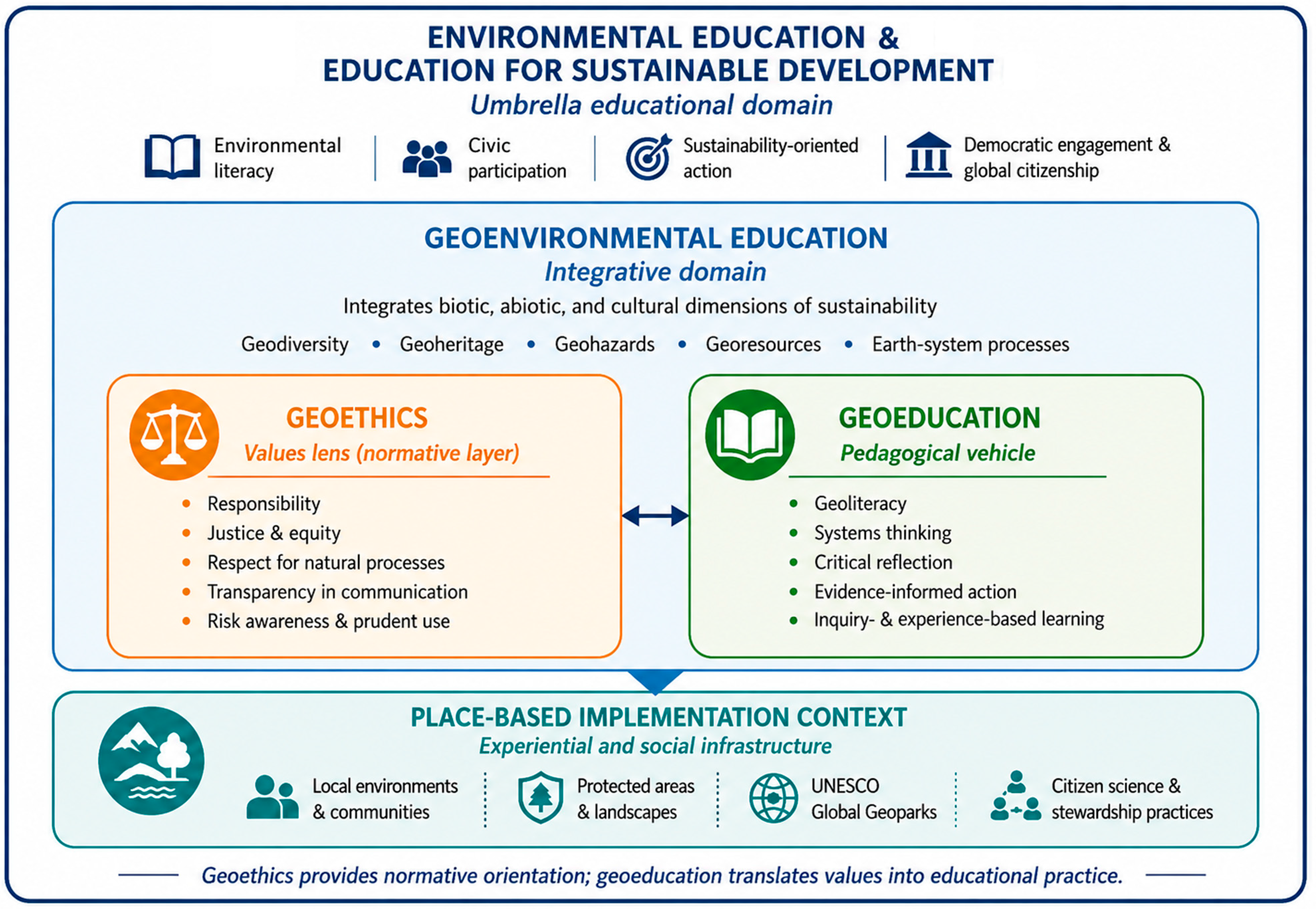
Figure 1. Nested convergence framework positioning geoethics as a values lens and geoeducation as a pedagogical vehicle within geoenvironmental education, under the Environmental Education and Education for Sustainable Development umbrella. Authors’ own elaboration.
Heritage 09 00229 g001
Table 1. Operational “geo” matrix linking values to competencies, pedagogies, and outcomes.
Geoethical Value/
Principle
Geoeducation
Competency
Example Pedagogy/
Learning Design
Expected Outcomes/
Indicators
Responsibility
(toward Earth systems and communities)
systems thinking;
causal reasoning;
accountability
field inquiry on human impacts
on a geosite;
reflective journaling;
“responsibility map”
of actors and choices
improved systems-thinking
performance;
higher responsibility/
agency scores;
stronger reflective justification
Justice and equity
(including intra- and
intergenerational justice)
ethical reasoning;
deliberation;
perspective-taking
structured controversy;
role-play on a land-use or
extraction dilemma affecting
geoheritage
increased use of justice-based
arguments; improved
deliberative competence;
higher-quality policy briefs
Respect
for natural processes and geo-biodiversity
Earth-systems literacy;
observation and
interpretation
guided interpretation;
student-designed outputs
explaining place-based processes
(trail panels, story maps)
gains in geoliteracy;
accuracy of interpretations;
strengthened in sense of place
Prudent and equitable
georesource use
resource literacy;
trade-off analysis;
decision-making
community-based audits
(water, soil, minerals);
scenario planning
improved decision quality;
stronger behavioral intentions; feasible action plans
Transparency and
integrity in science communication
science communication;
uncertainty reasoning;
media literacy
“explain the hazard” task:
translating technical
geohazard information into
public-facing formats
communication clarity and
accuracy; appropriate treatment of uncertainty; enhanced critical evaluation skills
Risk-aware choices
and preparedness
risk literacy;
preparedness planning;
adaptive thinking
hazard mapping;
preparedness micro-project (school/community)
better risk
perception calibration;
increased preparedness self-efficacy;
completed preparedness outputs
Care
(geoconservation
practice)
civic efficacy;
collaboration;
participation
service-learning:
geosite monitoring or restoration;
citizen science with local partners
participation rates;
stewardship hours;
sustained engagement;
positive partner feedback
Cultural
meaning-making and heritage responsibility
place-based interpretation;
narrative competence;
identity/place reflection
storytelling;
mapping geo-cultural
narratives
(oral histories, geostories,
local knowledge)
deeper engagement profiles;
increased motivation
for heritage protection;
publicly shared, locally
relevant outputs
Note. The “about–in/within–for” progression can be applied across all rows: conceptual understanding (about), experiential engagement (in/within), and action competence (for geoconservation and stewardship).
Disclaimer/Publisher’s Note: The statements, opinions and data contained in all publications are solely those of the individual author(s) and contributor(s) and not of MDPI and/or the editor(s). MDPI and/or the editor(s) disclaim responsibility for any injury to people or property resulting from any ideas, methods, instructions or products referred to in the content.


