

A Systematic Review of Extended Reality (XR) Applications in Cultural Heritage

Abstract
1. Introduction
- RQ1: How were XR technologies applied in CH between 2021 and 2025?
- RQ2: What interaction paradigms are used, and how do they shape engagement and meaning making?
- RQ3: What user experience outcomes are reported in XR CH applications?
- RQ4: What evaluation methods are employed and what methodological gaps remain?
- RQ5: What challenges persist across XR heritage implementations?
2. Methodology
2.1. Review Process
2.1.1. Eligibility Criteria
2.1.2. Information Sources
2.1.3. Search Strategy
- Scopus/Web of Science: [TITLE-ABS-KEY ((“Virtual Reality” OR “Augmented Reality” OR “Mixed Reality” OR “Extended Reality” OR “Spatial Augmented Reality”) AND (“Cultural Heritage” OR “Intangible Cultural Heritage”))].
- IEEE Xplore: [(“Virtual Reality” OR “Augmented Reality” OR “Mixed Reality” OR “Extended Reality” OR “Spatial Augmented Reality”) AND (“Cultural Heritage” OR “Intangible Cultural Heritage”)].
- ACM Digital Library: [Title: (“Virtual Reality” OR “Augmented Reality” OR “Mixed Reality” OR “Extended Reality”) AND Abstract: (“Cultural Heritage” OR “Intangible Cultural Heritage”)].
2.1.4. Selection Process
2.1.5. Data Collection Process
2.1.6. Data Items
2.1.7. Risk of Bias Assessment
2.1.8. Effect Measures
2.2. Thematic Categorization
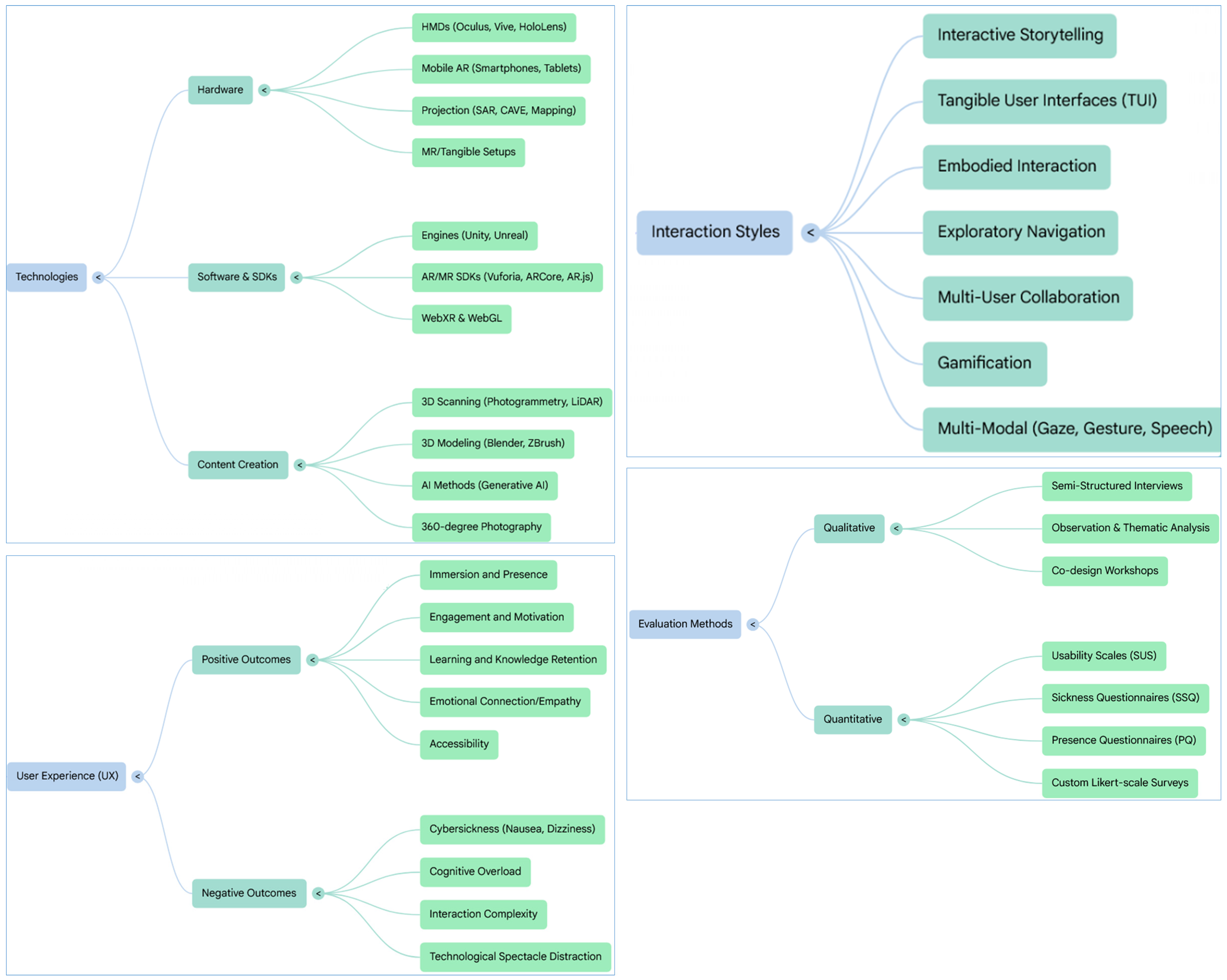
- Technology (hardware, software, content creation): represents the technological foundation that supports design choices, performance, accessibility, and scalability.
- Interaction style (input modalities and narrative structures): concerns the interaction design that affects how users engage with the software, moving from passive consumption to active exploration.
- User experience (immersion, learning, accessibility, emotion): captures outcomes and challenges from the user’s perspective.
- Evaluation (methods and instruments used to assess usability and educational impact): provides evidence of usability, effectiveness, and cultural/educational value.
3. Results: A Thematic Analysis of XR in CH
3.1. Overview of the Thematic Analysis
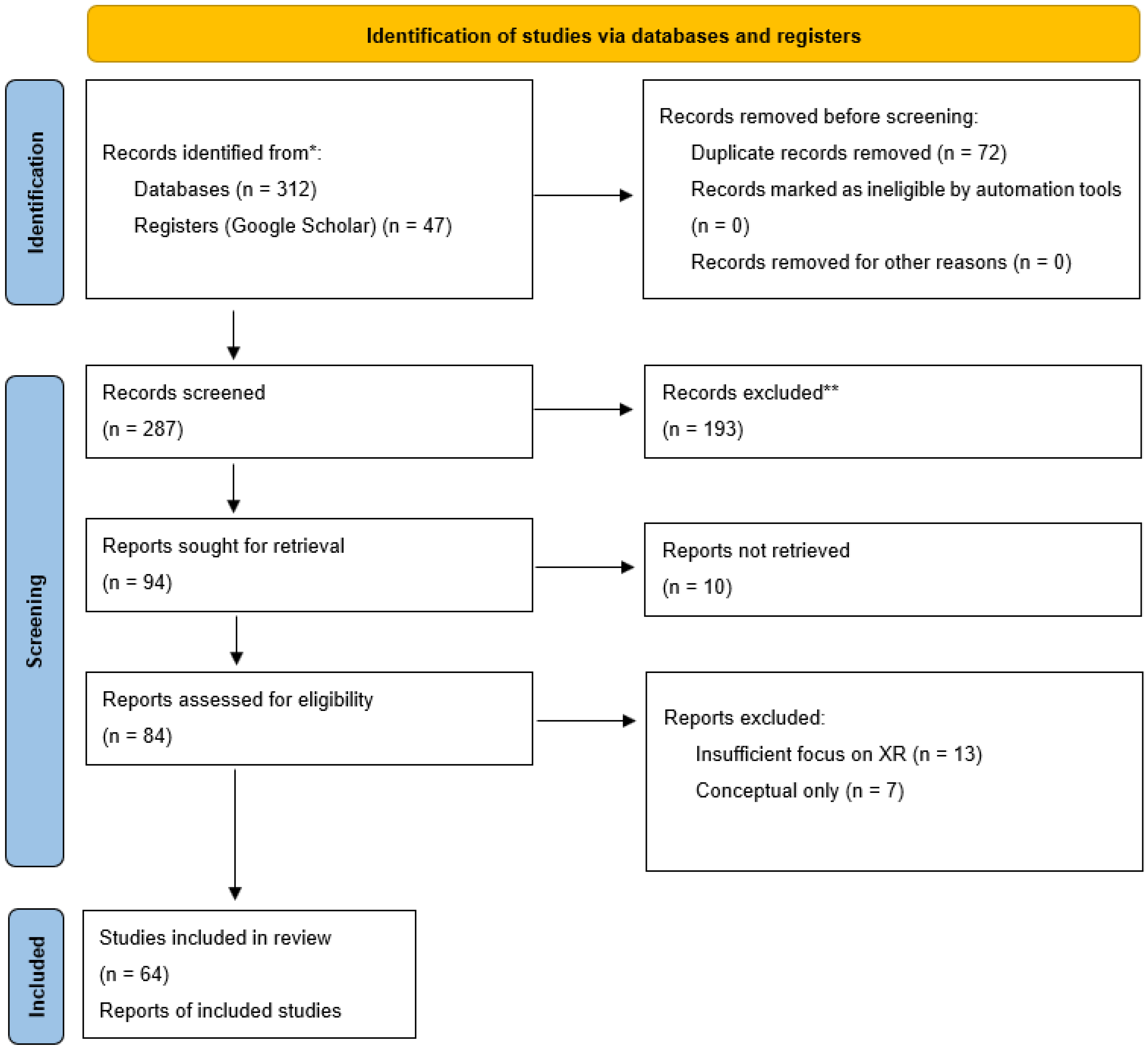
3.1.1. Characteristics of Included Studies
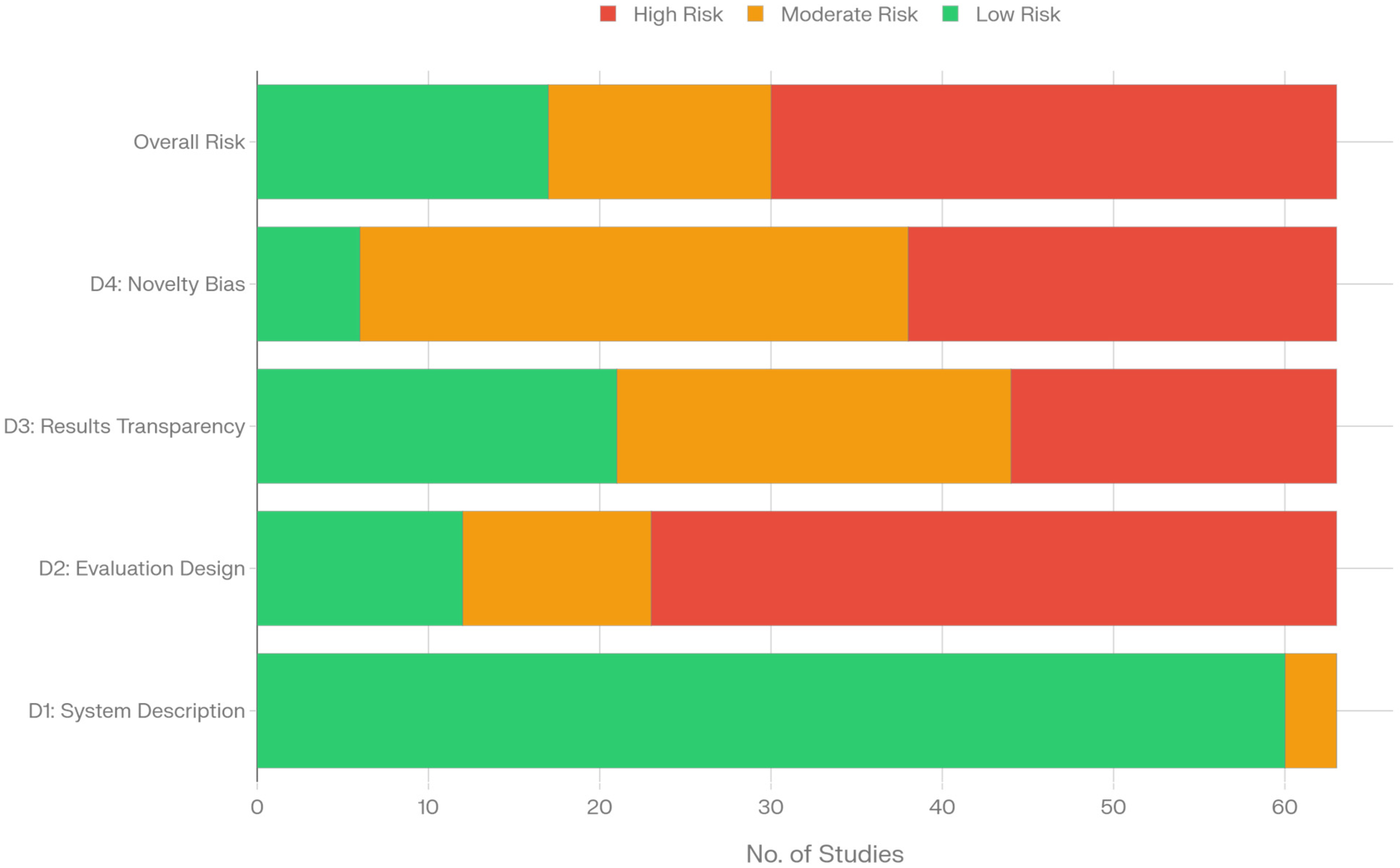
3.1.2. Risk of Bias in Included Studies
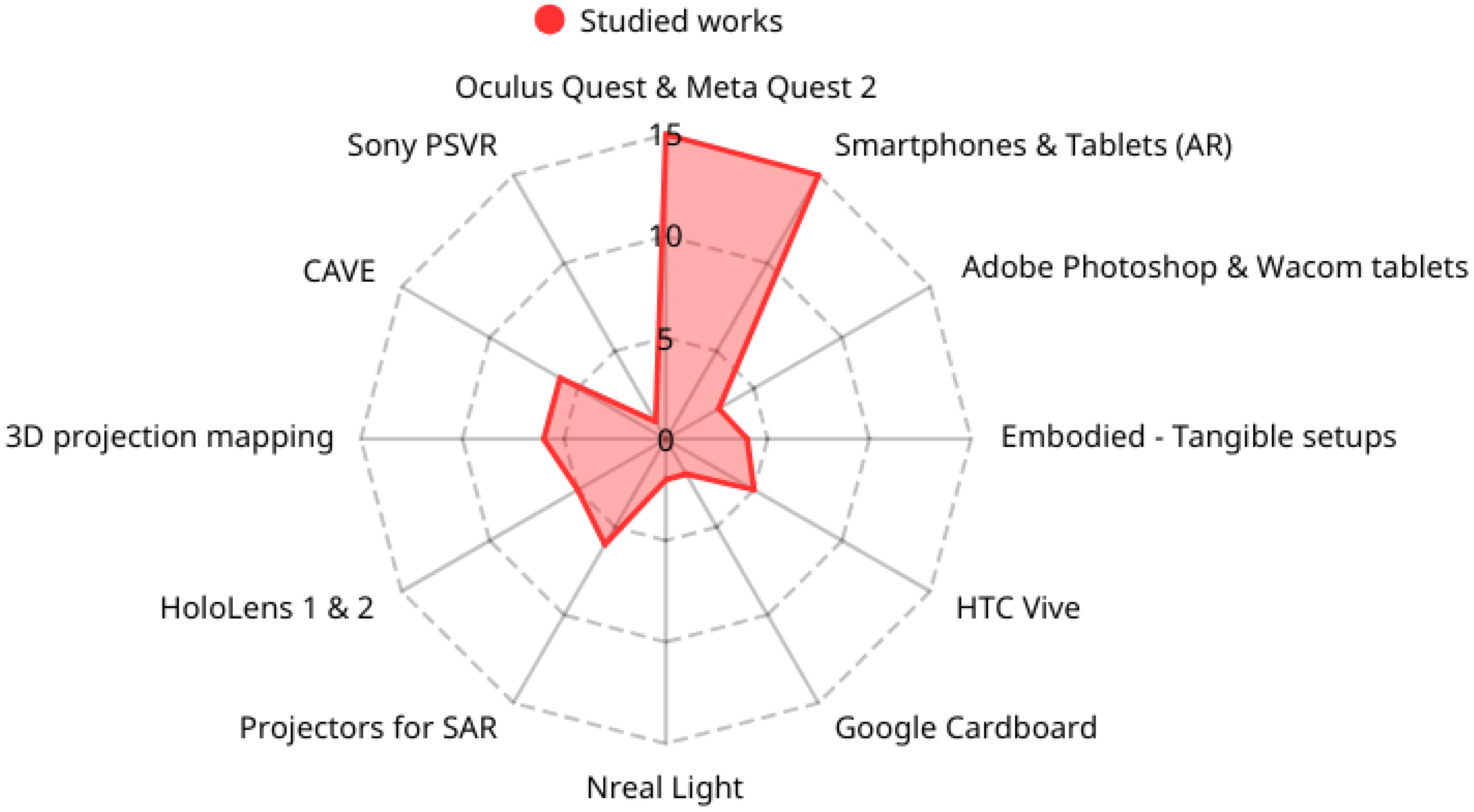
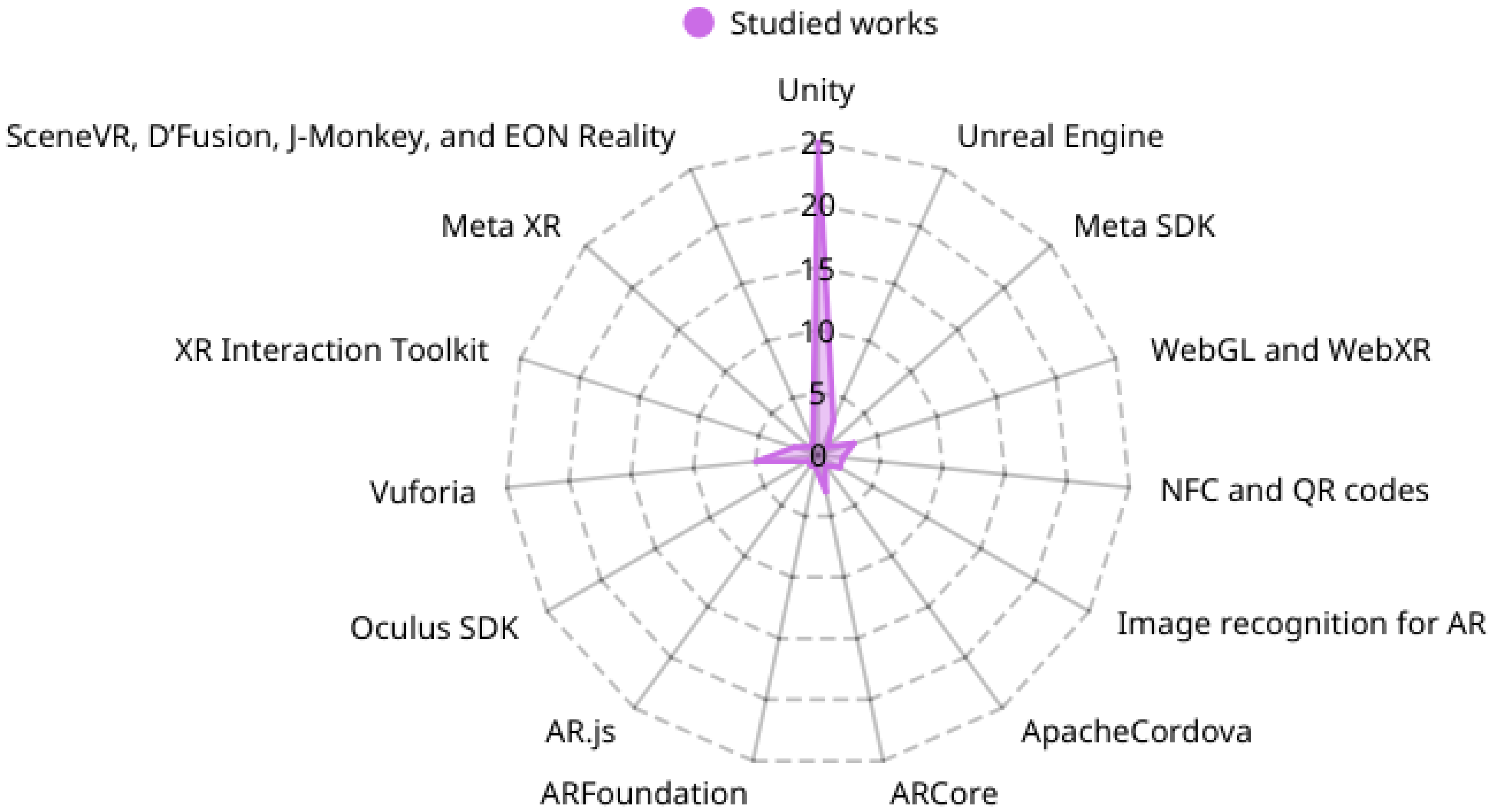
3.2. Technology
3.3. Interaction Styles and Paradigms
3.4. User Experience (UX) Dimensions
3.5. Evaluation Methodologies
4. Analytical Synthesis
4.1. Technology
4.1.1. Hybrid and Collaborative XR
- VR, SAR, and bidirectional interaction: This grouping enables collaborative exhibitions where VR users interact with content that is simultaneously projected into a public space via SAR, allowing other participants to influence the VR environment and vice versa [46].
- Hybrid VR, AR, tangible user interface (TUI), and multiuser interaction: This is a system combining VR headsets (HTC Vive) and mobile AR apps, allowing co-located users with asymmetrical access to communicate and interact around shared digital heritage objects, mediated by a physical, recognizable object (an AR cube) [7].
- MR, TUI, Substitutional Reality (SR), and hand tracking: This blend, exemplified by the School House Virtual Museum, integrates physical proxy objects (like a desk or buttons) placed in the real world with virtual objects in a VR environment (Oculus Quest 2), enhancing immersion and providing passive haptic feedback via natural hand tracking [23].
- MR, TUI with 6 DoF tracking, and spatial audio: Installations such as LanternXR couple a physical replica of an artifact with handheld, tracked props (a camera and a candlestick) using highly accurate sensors (anti-latency), displaying the interactive scene on large, high-resolution monitors accompanied by spatial audio [50].
- Hybrid MR, tangible controller, and motion capture: This hybrid installation approach promotes intangible CH by coupling a physical, simplified mechanical controller (like a crane model containing an ESP32 microcontroller, rotary encoder, and switch) with a virtually reconstructed environment featuring characters animated using motion capture data [48].
- MR, hand tracking, and spatial mapping/scene understanding: The Falconry Heritage prototype leverages the Microsoft HoloLens 2’s advanced sensor array for environmental tracking and real-time scene understanding, integrating the virtual falcon’s hunting logic with the user’s natural hand gestures [35].
4.1.2. XR Integrated with AI, Cloud, and Computational Services
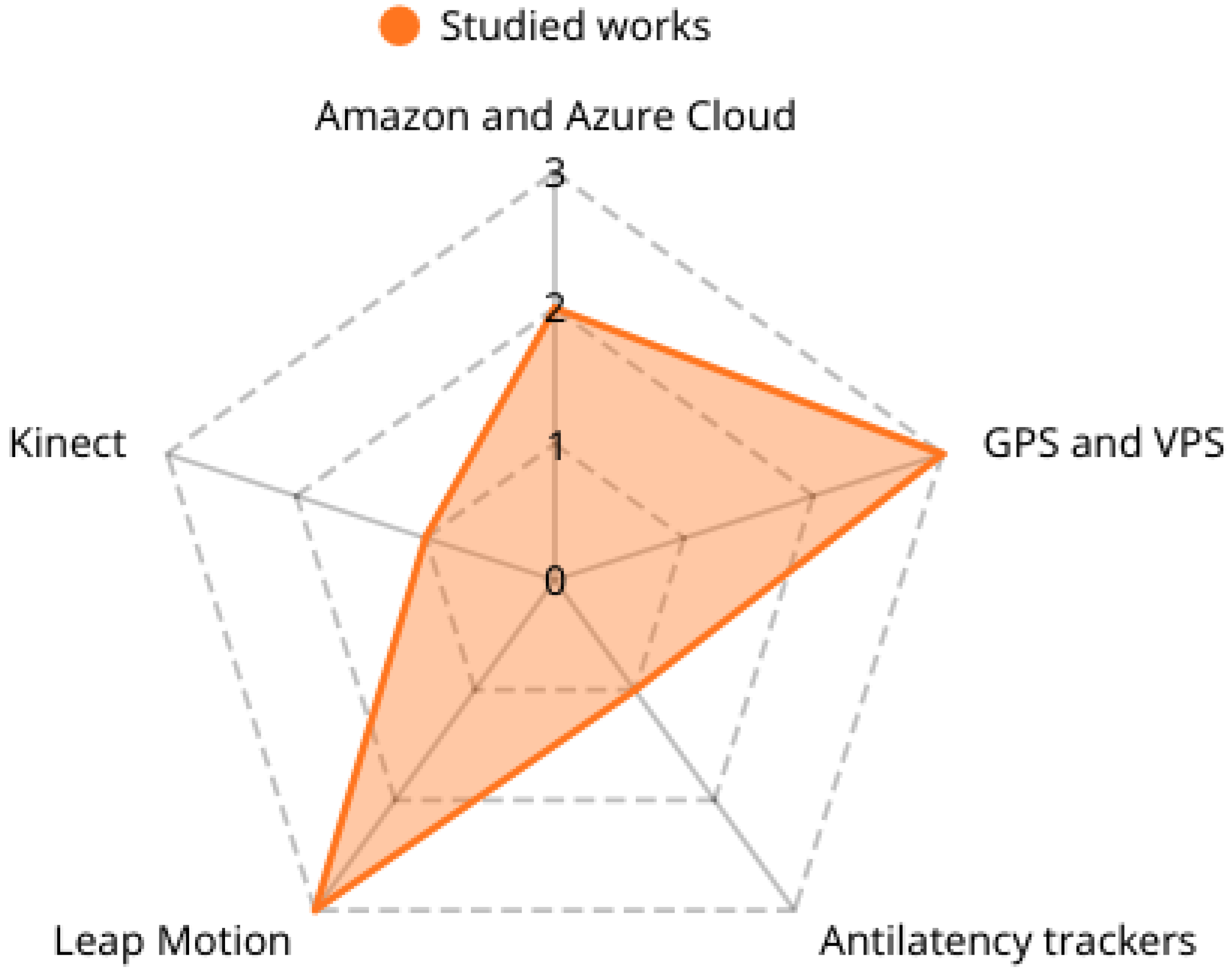
- MR, cloud computing, and multimodal interactions: Such applications integrate MR display devices (Microsoft HoloLens) with cloud services (e.g., Azure Spatial Anchors, Amazon Polly, Amazon S3, Azure Cosmos DB) for managing distributed content, ensuring persistence of shared experiences, and processing multimodal input (gaze, gesture, speech) [33,34].
- VR, AI-driven natural language understanding (NLU), knowledge graph (KG), and emotional avatar: A VR system (Oculus Quest 2) utilizes AI to analyze users’ verbal input for emotional and moral values (NLU/KG), dynamically generating a personalized conversational avatar to promote perspective-taking in relation to cultural interpretation [24].
- Generative AI, AR, data science, and 3D assets: A proposed preservation system uses generative AI (like GANs or diffusion models) to digitally restore damaged artifacts, relying on data science techniques to verify historical accuracy, and then leverages AR to visualize these reconstructed 3D models in a real-world context [5].
4.1.3. Digitization and Visualization Platforms
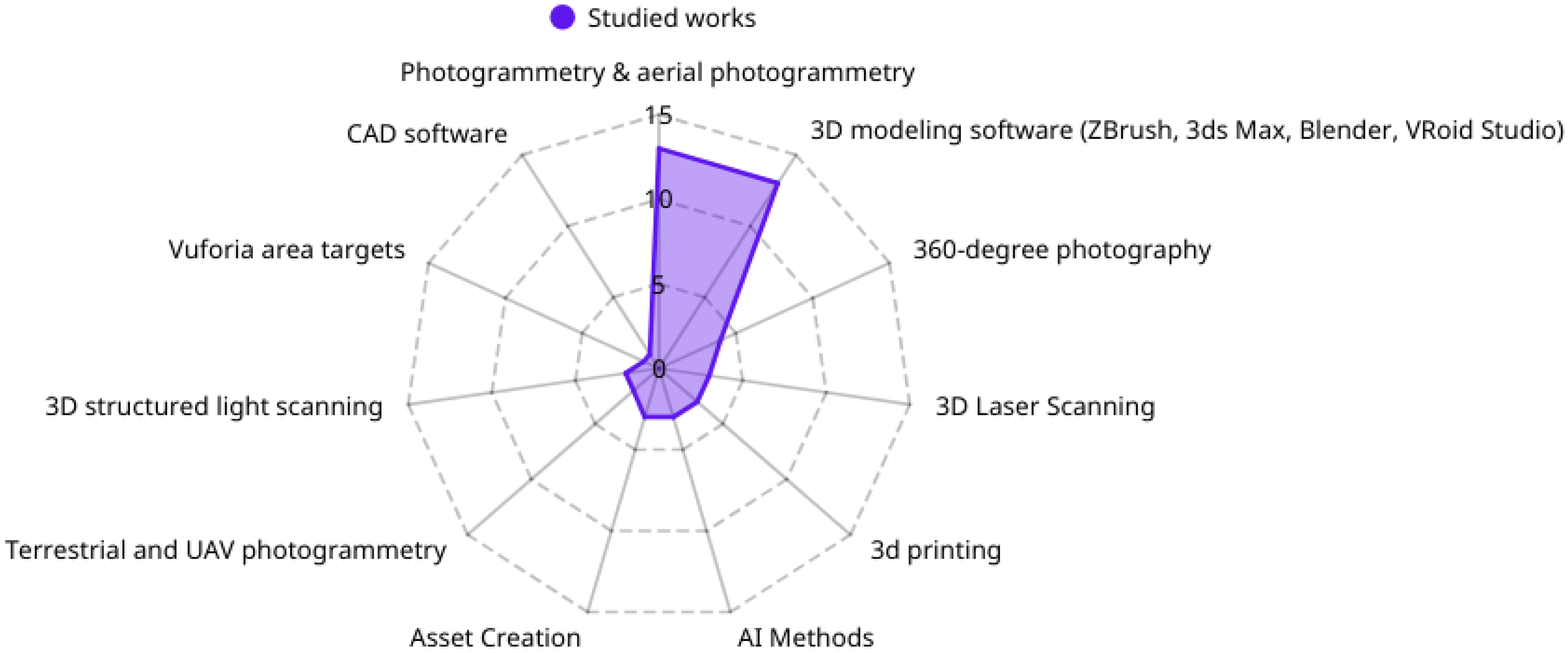
- 3D digitization and game engines: The standard approach for generating immersive CH assets involves acquiring precise spatial data through methods like laser scanning, drone photogrammetry, or Structure-from-Motion (SfM), followed by processing and rendering within real-time platforms such as Unity or Unreal Engine [6,56].
- Web3D/WebXR, pixel shaders, and progressive refinement: This web-based technique uses GLSL shaders to enable localized, interactive transitions between different time periods within a 3D scene, employing efficient data handling methods like spatial indexing (BVH trees) and progressive streaming [22].
- VR animation, 3D modeling software, and image editing: This combination is used specifically for ICH projects, combining multiple 3D modeling tools to build virtual environments and traditional objects and integrating 2D graphical work (e.g., texture mapping in Adobe Photoshop) for digital restoration and realistic appearance [63].
4.1.4. Mobile and Location-Aware AR/XR
- XR, Visual Positioning Service, GPS, Transparent OLED, and Head-Mounted Display (HMD): This system uses a fusion of global GPS data (for approximate location) and high-accuracy VPS (for precise AR content anchoring) in combination with both HMDs (Nreal Light) and Transparent OLED screens (TOLED) for visual output in a moving vehicle context [36].
- Mobile marker-based AR, tangible artifact, and location-based information: This hybrid mobile intervention uses the smartphone’s internal sensors (GPS, gyroscope, accelerometer) for location-based AR and relies on a physical installation structure that doubles as a recognizable marker (marker-based AR) when precision is needed [38].
- Mobile AR, image recognition, GPS, and game engine: This widely adopted approach uses image recognition technology (via Vuforia) to trigger virtual content (like AR figures or augmented information) anchored to physical objects, with potential augmentation from GPS data for broader localization [45].
4.2. Interaction Styles and Paradigms
4.3. User Experience Outcomes
4.4. Evaluation Methods
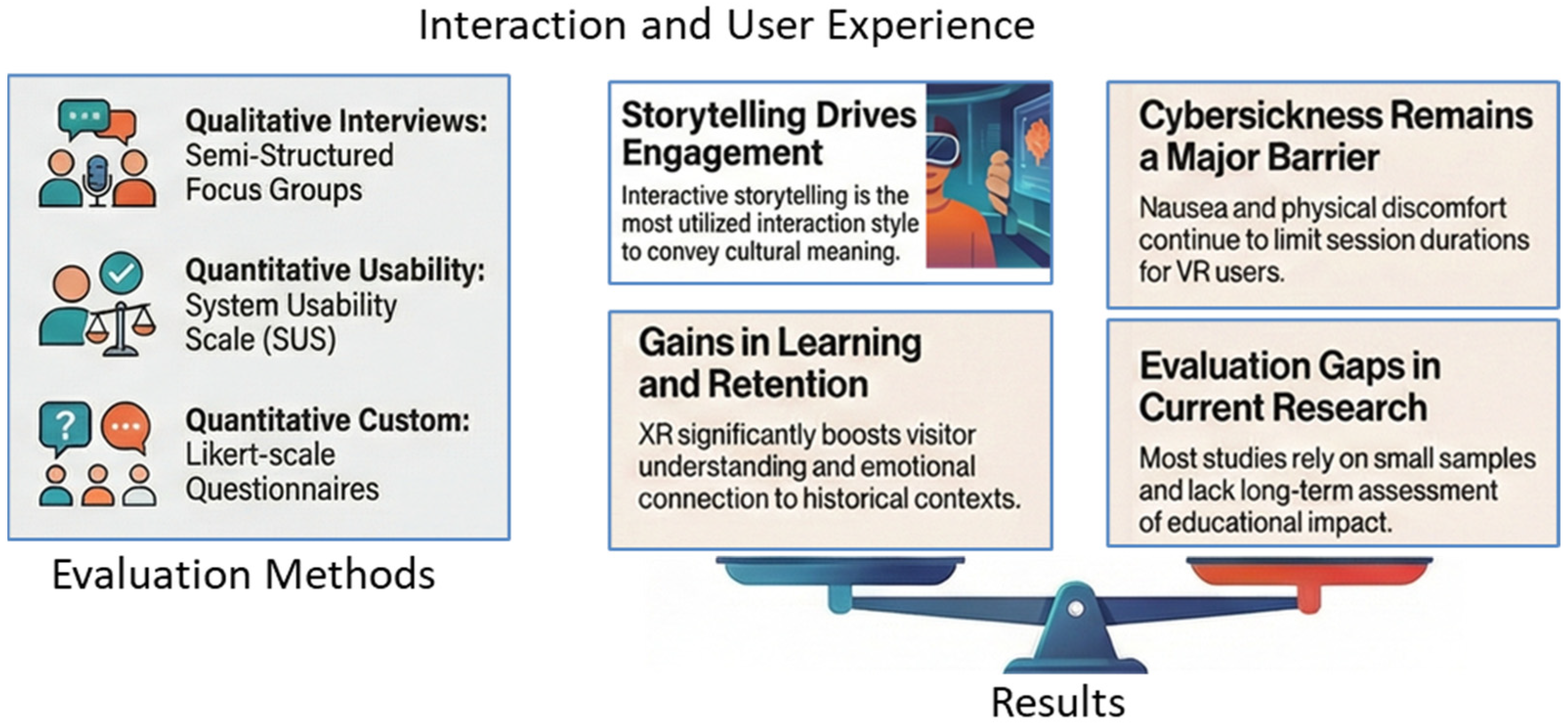
- The fundamental evaluation of the collaboratively designed MR application involved a total of 11 experts (curators, archaeologists, and researchers) across two sessions [33].
- A key part of the social AR intervention focusing on the umarell phenomenon involved a focus group of 15 young adults to shape the design process [38].
- The second expert evaluation of the Media Bus XR prototype involved semi-structured interviews with six specialists in tourism, XR, HCI, and digital heritage [36].
- The qualitative analysis on embodied interaction for intangible CH selected 20 students as learners, each experiencing the system for 10 to 15 min [64].
- In the research on AR integration heuristics, initial data collection involved 20 participants, followed by intensive qualitative work with 12 participants for interviews, culminating in a participatory workshop with 9 participants [69].
- The social AR study involving co-viewing heritage objects included a total sample of 30 participants (organized into 10 groups with 3 participants each) [37].
- The large-scale tactile and XR accessibility project leveraged a final test campaign involving 30 users (20 male, 10 female) ranging in age from 11 to 72 years [11].
- The usability assessment for the VR system enhancing social cohesion utilized a sample of 30 museum visitors [24].
- The hybrid VR and AR acceptance model analysis involved 52 users (organized into 26 pairs) [7].
- The VR collaborative exhibition system based on Spatial AR included a comparative study with 16 participants (8 pairs) [46].
- The comparative analysis of Interactive Virtual Museum formats utilized a total sample of 30 school participants and 12 museum visitors, yielding a valid school group sample of 25 participants [54].
- The original user study for the campus heritage AR prototype included 10 current students [45].
- A large-scale study exploring the impact of VR on museum experiences involved a total of 80 participants (architectural students and faculty members), divided equally between mobile VR and wearable VR groups [30].
- The framework evaluation involving tangible AR interfaces utilized data collected from an in situ study featuring 80 visitors (40 female and 40 male) who completed a paper questionnaire during a two-week installation [66]. Additionally, records showed that 572 visitors interacted with the display based on digital survey entries [66].
- Testing of the developed individual VR/AR platform documented a total of 72 observations collected from surveyed users over three days [59].
- The comparative analysis of three XR applications related to the Dacian Bronze Matrix utilized 37 filled questionnaires for each solution, totaling 111 questionnaires [12].
- An intervention designed to promote the umarell cultural phenomenon publicly demonstrated the system to approximately 125 teenagers and young adults and collected data via a survey involving 73 participants [38].
4.5. Cross-Cutting Result
4.6. A Typology of Design Failure Modes
5. Discussion
5.1. Persistent Limitations
5.1.1. Technological Barriers
5.1.2. Usability and User Experience Challenges
- Cybersickness, non-intuitive interaction techniques, and steep learning curves remain major barriers to adoption, particularly for first-time or casual users. Cybersickness continues to limit session duration and suitability for general audiences, especially in locomotion-heavy VR experiences.
- Interface intuitiveness is not guaranteed by so-called “natural” interaction techniques; several studies indicate that familiar inputs such as touchscreens or controllers may outperform gesture-based interfaces for novice users in museum settings.
- Interaction complexity often necessitates explicit onboarding, increasing cognitive load and potentially detracting from interpretive goals. Discoverable controls, clear feedback, and progressive disclosure are therefore critical design strategies.
- Closely related is the issue of cognitive and perceptual load. Excessive density of digital overlays, particularly in AR, has been shown to increase task-completion times, error rates, and perceived effort.
5.1.3. Perceptual and Immersion Gaps
5.1.4. Authenticity and Representation
5.1.5. Accessibility and Inclusivity Gaps
5.1.6. Evaluation Rigor
5.1.7. Limitations of the Review Process
5.2. Implications for Future Research and Practice
6. Conclusions
Author Contributions
Funding
Data Availability Statement
Acknowledgments
Conflicts of Interest
Abbreviations
| XR | Extended Reality |
| VR | Virtual Reality |
| AR | Augmented Reality |
| DCF-XR | Design Coherence Framework for XR Heritage |
| MR | Mixed Reality |
| SAR | Spatial Augmented Reality |
| CH | cultural heritage |
| ICH | intangible cultural heritage |
| SLR | Systematic Literature Review |
| UX | user experience |
| HMD | Head-Mounted Display |
| PRISMA | Preferred Reporting Items for Systematic Reviews and Meta-Analyses |
| RQ | research question |
| TUI | tangible user interface |
| SUS | System Usability Scale |
| SSQ | Simulator Sickness Questionnaire |
| PQ | Presence Questionnaire |
| GEQ | Game Experience Questionnaire |
| IEQ | Immersion Experience Questionnaire |
| NLU | Natural Language Understanding |
| KG | knowledge graph |
| BIM | Building Information Modeling |
| SfM | Structure-from-Motion |
| VPS | Visual Positioning Service |
| GPS | Global Positioning System |
| NFC | Near-Field Communication |
| QR | Quick Response (codes) |
| TOLED | Transparent OLED |
| OLED | Organic Light-Emitting Diode |
| UAV | Unmanned Aerial Vehicle |
| LiDAR | Light Detection and Ranging |
| DoF | Degrees of Freedom |
| CAD | Computer-Aided Design |
| GLSL | OpenGL Shading Language |
| BVH | Bounding Volume Hierarchy |
| GAN | Generative Adversarial Network |
| SR | Substitutional Reality |
| HCI | Human–Computer Interaction |
References
- Xu, Z.; Dahlan, N.D.; Abdullahe, S.I.S.S.; Sahrir, S.; Cao, K. Augmented Reality for Cultural Preservation: A Case Study of Shaanxi Weinan Shadow Puppetry. In Proceedings of the 2025 2nd International Conference on Informatics Education and Computer Technology Applications, Kuala Lumpur, Malaysia, 17–19 January 2025; pp. 253–260. [Google Scholar]
- Su, Z. Inheriting cultural heritage: The application of virtual reality technology in the display of Peking Opera costumes. IEEE Access 2025, 13, 107832–107843. [Google Scholar] [CrossRef]
- Khalloufi, H.; Zaifri, M.; Kadri, M.; Benlahbib, A.; Kaghat, F.Z.; Azough, A. El-FnaVR: An immersive virtual reality representation of Jemaa El-Fna in Marrakech for intangible cultural heritage experiences. IEEE Access 2023, 12, 9331–9349. [Google Scholar] [CrossRef]
- Li, Y. Enhancing Conservation and Presentation of Intangible Cultural Heritage through Augmented Reality. In Proceedings of the 2025 4th International Conference on Distributed Computing and Electrical Circuits and Electronics (ICDCECE), Ballari, India, 25–26 April 2025; pp. 1–7. [Google Scholar]
- Mogre, S.C.; Nikam, J.S.; Damani, P.; Banik, A. Generative AI for Cultural Heritage Preservation Using AR and Data Science. In Proceedings of the 2025 International Conference on Machine Learning and Autonomous Systems (ICMLAS), Prawet, Thailand, 10–12 March 2025; pp. 1068–1073. [Google Scholar]
- Huang, X.; Li, Y.; Tian, F. Enhancing User Experience in Interactive Virtual Museums for Cultural Heritage Learning through Extended Reality: The Case of Sanxingdui Bronzes. IEEE Access 2025, 13, 59405–59421. [Google Scholar] [CrossRef]
- Li, Y.; Ch’ng, E.; Cai, S.; See, S. Multiuser interaction with hybrid VR and AR for cultural heritage objects. In Proceedings of the 2018 3rd Digital Heritage International Congress (DigitalHERITAGE) Held Jointly with 2018 24th International Conference on Virtual Systems & Multimedia (VSMM 2018), San Francisco, CA, USA, 26–30 October 2018; pp. 1–8. [Google Scholar]
- Petrelli, D.; Roberts, A.J. Exploring digital means to engage visitors with Roman culture: Virtual reality vs. tangible interaction. ACM J. Comput. Cult. Herit. 2023, 16, 1–18. [Google Scholar] [CrossRef]
- Li, X.; Deng, X.; Xu, H. Interactive cultural communication effect in VR space of intelligent mobile communication network. Wirel. Commun. Mob. Comput. 2022, 2022, 9689272. [Google Scholar] [CrossRef]
- Olaz, X.; Garcia, R.; Ortiz, A.; Marichal, S.; Villadangos, J.; Ardaiz, O.; Marzo, A. An interdisciplinary design of an interactive cultural heritage visit for in-situ, mixed reality and affective experiences. Multimodal Technol. Interact. 2022, 6, 59. [Google Scholar] [CrossRef]
- Gatto, C.; Barba, M.C.; Chiarello, S.; Corchia, L.; Faggiano, F.; Nuzzo, B.L.; Panaro, I.R.; Sumerano, G.; De Luca, V.; De Giorgi, M.; et al. Improving accessibility to cultural heritage: Integration of extended reality, tactile prints and user experience analysis for the church of Madonna dell’Itri. ACM J. Comput. Cult. Herit. 2025, 18, 1–31. [Google Scholar] [CrossRef]
- Neamțu, C.; Comes, R.; Popovici, D.M.; Băutu, E.; Liliana, M.S.; Syrotnik, A.; Popovici, M.I. Evaluating user experience in the context of cultural heritage dissemination using extended reality: A case study of the dacian bronze matrix with hollow design. ACM J. Comput. Cult. Herit. 2024, 17, 1–21. [Google Scholar] [CrossRef]
- Xu, J.; Wen, C.; Liu, D.; Zhao, W. VR Baixi: Improving Cultural Heritage Learning of Qin Dynasty via Virtual Reality. In Proceedings of the 2024 International Conference on Virtual Reality Technology, Ningbo, China, 22–24 November 2024; pp. 51–59. [Google Scholar]
- Sun, D.; Wang, C. Application of AR Technology in Intangible Cultural Heritage and Cultural Tourism. In Proceedings of the 3rd International Conference on Electronic Information Technology and Smart Agriculture, Sanya, China, 8–10 December 2023; pp. 247–252. [Google Scholar]
- Russo, M.; De Fino, M.; Cui, C.D.; Tavolare, R.; Fatiguso, F.; Currà, E. A Tailored Workflow for the Valorization Projects of Industrial Heritage Through a BIM-Based VR Experience. SCIRES-IT 2024, 14, 1–12. [Google Scholar]
- Grellert, M. Rapid Prototyping in the Context of Cultural Heritage and Museum Displays: Buildings, Cities, Landscapes, Illuminated Models. In 3D Research Challenges in Cultural Heritage II: How to Manage Data and Knowledge Related to Interpretative Digital 3D Reconstructions of Cultural Heritage; Springer International Publishing: Cham, Switzerland, 2016; pp. 77–118. [Google Scholar]
- Boboc, R.G.; Băutu, E.; Gîrbacia, F.; Popovici, N.; Popovici, D.M. Augmented reality in cultural heritage: An overview of the last decade of applications. Appl. Sci. 2022, 12, 9859. [Google Scholar] [CrossRef]
- Rodriguez-Garcia, B.; Guillen-Sanz, H.; Checa, D.; Bustillo, A. A systematic review of virtual 3D reconstructions of Cultural Heritage in immersive Virtual Reality. Multimed. Tools Appl. 2024, 83, 89743–89793. [Google Scholar] [CrossRef]
- Innocente, C.; Ulrich, L.; Moos, S.; Vezzetti, E. A framework study on the use of immersive XR technologies in the cultural heritage domain. J. Cult. Herit. 2023, 62, 268–283. [Google Scholar] [CrossRef]
- Wang, H.; Du, J.; Li, Y.; Zhang, L.; Li, X. Grand challenges in immersive technologies for cultural heritage. Int. J. Hum.–Comput. Interact. 2025, 41, 13682–13703. [Google Scholar] [CrossRef]
- Page, M.J.; McKenzie, J.E.; Bossuyt, P.M.; Boutron, I.; Hoffmann, T.C.; Mulrow, C.D.; Moher, D. The PRISMA 2020 statement: An updated guideline for reporting systematic reviews. BMJ 2021, 372, n71. [Google Scholar] [CrossRef]
- Fanini, B.; Ferdani, D.; Demetrescu, E. Temporal lensing: An interactive and scalable technique for Web3D/WebXR applications in cultural heritage. Heritage 2021, 4, 710–724. [Google Scholar] [CrossRef]
- Hulusic, V.; Gusia, L.; Luci, N.; Smith, M. Tangible user interfaces for enhancing user experience of virtual reality cultural heritage applications for utilization in educational environment. ACM J. Comput. Cult. Herit. 2023, 16, 1–24. [Google Scholar] [CrossRef]
- Lucifora, C.; Schembri, M.; Asprino, L.; Follo, A.; Gangemi, A. Virtual Empathy: Usability and Immersivity of a VR System for Enhancing Social Cohesion through Cultural Heritage. ACM J. Comput. Cult. Herit. 2024, 17, 1–11. [Google Scholar] [CrossRef]
- Rahaman, H.; Champion, E.; McMeekin, D. Outside inn: Exploring the heritage of a historic hotel through 360-panoramas. Heritage 2023, 6, 4380–4410. [Google Scholar] [CrossRef]
- Wang, Z.; Li, F. Design of panoramic virtual museum interactive interface based on entropy weight TOPSIS and PSO-SVR. npj Herit. Sci. 2025, 13, 201. [Google Scholar] [CrossRef]
- Yan, Y.; Du, Q. From digital imagination to real-world exploration: A study on the influence factors of VR-based reconstruction of historical districts on tourists’ travel intention in the field. Virtual Real. 2025, 29, 85. [Google Scholar] [CrossRef]
- Wang, Y.; Liu, Q.; Wei, X.; Fan, M. Facilitating daily practice in intangible cultural heritage through virtual reality: A case study of traditional chinese flower arrangement. In Proceedings of the 2025 CHI Conference on Human Factors in Computing Systems, Yokohama, Japan, 26 April–1 May 2025; pp. 1–17. [Google Scholar]
- Xhako, A.; Katzourakis, A.; Evdaimon, T.; Zidianakis, E.; Partarakis, N.; Zabulis, X. Reviving Antiquity in the Digital Era: Digitization, Semantic Curation, and VR Exhibition of Contemporary Dresses. Computers 2024, 13, 57. [Google Scholar] [CrossRef]
- Jangra, S.; Singh, G.; Mantri, A.; Ahmed, Z.; Liew, T.W.; Ahmad, F. Exploring the impact of virtual reality on museum experiences: Visitor immersion and experience consequences. Virtual Real. 2025, 29, 84. [Google Scholar] [CrossRef]
- Kong, C. Digital Diabolo: A Virtual Reality Game for the Presentation of Intangible Cultural Heritage Through Participatory Design. In Proceedings of the Participatory Design Conference 2024: Situated Actions, Doctoral Colloquium, PDC Places, Communities, Sibu, Malaysia, 11–16 August 2024; Volume 3, pp. 19–23. [Google Scholar]
- Liang, J. [DC] Playful and Participatory Cultural Heritage Experience Using Extended Reality Technologies. In Proceedings of the 2024 IEEE Conference on Virtual Reality and 3D User Interfaces Abstracts and Workshops (VRW), Orlando, FL, USA, 16–21 March 2024; pp. 1154–1155. [Google Scholar]
- Bekele, M.K. Clouds-based collaborative and multi-modal mixed reality for virtual heritage. Heritage 2021, 4, 1447–1459. [Google Scholar] [CrossRef]
- Bekele, M.K.; Champion, E.; McMeekin, D.A.; Rahaman, H. The influence of collaborative and multi-modal mixed reality: Cultural learning in virtual heritage. Multimodal Technol. Interact. 2021, 5, 79. [Google Scholar] [CrossRef]
- Boray, Y.; Alkai, R.; Fetais, N. Falconry Heritage in Mixed Reality: An Interactive Experience for Digital-Native Tourists. In Proceedings of the 2025 ACM International Conference on Interactive Media Experiences, Niterói, Brazil, 3–6 June 2025; pp. 333–337. [Google Scholar]
- Du, J.; Lee, H.; Lee, J.; Kim, G. Media Bus: XR-Based Immersive Cultural Heritage Tourism. In Proceedings of the SIGGRAPH Asia 2024 Posters, Tokyo, Japan, 3–6 December 2024; pp. 1–3. [Google Scholar]
- Ch’ng, E.; Cai, S.; Feng, P.; Cheng, D. Social augmented reality: Communicating via cultural heritage. ACM J. Comput. Cult. Herit. 2023, 16, 1–26. [Google Scholar] [CrossRef]
- Prandi, C.; Ceccarini, C.; Tumedei, G.; Salomoni, P. Augmenting the intangible: An intervention through an AR mobile app and an installation to foster a local cultural phenomenon. Front. Comput. Sci. 2025, 7, 1629965. [Google Scholar] [CrossRef]
- Souropetsis, M.; Kyza, E.A. CompARe: Design and development of a gamified augmented reality learning environment for cultural heritage sites. ACM J. Comput. Cult. Herit. 2025, 18, 1–16. [Google Scholar] [CrossRef]
- Vilar, J.; Rodrigues, A.; Correia, N. An Extended Reality Platform for Cultural Gaming: Enabling Interactive Narratives in Spatial Contexts. ACM J. Comput. Cult. Herit. 2025, 17, 1–18. [Google Scholar] [CrossRef]
- Wu, X. Application of Virtual Reality Technology in the Digital Inheritance of Intangible Cultural Heritage. In Proceedings of the 2023 International Conference on Distributed Computing and Electrical Circuits and Electronics (ICDCECE), Ballar, India, 29–30 April 2023; pp. 1–6. [Google Scholar]
- Zhang, J. Design of Digital Display Platform for Intangible Cultural Heritage Based on VR Intelligent Technology. In Proceedings of the 2023 2nd International Conference on Data Analytics, Computing and Artificial Intelligence (ICDACAI), Zakopane, Poland, 17–19 October 2023; pp. 451–456. [Google Scholar]
- Serres, B.; Létienne, D.; Roussey, O.; Venturini, G. Visit: A content management and exploration system for mobile augmented reality in the context of digital humanities and cultural heritage. ACM J. Comput. Cult. Herit. 2023, 16, 1–19. [Google Scholar] [CrossRef]
- Guimarães, F.; Figueiredo, M.; Rodrigues, J. Augmented Reality and Storytelling in heritage application in public gardens: Caloust Gulbenkian Foundation Garden. In Proceedings of the 2015 Digital Heritage, Granada, Spain, 28 September–2 October 2015; Volume 1, pp. 317–320. [Google Scholar]
- Gao, G.; Zhang, Y.; Cheng, C.; Bu, Y.; Shih, P.C. Designing to enhance student participation in campus heritage using augmented reality. In Proceedings of the 2018 3rd Digital Heritage International Congress (DigitalHERITAGE) Held Jointly with 2018 24th International Conference on Virtual Systems & Multimedia (VSMM 2018), San Francisco, CA, USA, 26–30 October 2018; pp. 1–4. [Google Scholar]
- Chen, K.; Yang, Q.; Yuan, Q.; Pan, Z. Exploring the Impact of Bidirectional Interactions Between VR and SAR on Cultural Exhibition. In Proceedings of the 19th ACM SIGGRAPH International Conference on Virtual-Reality Continuum and Its Applications in Industry, Nanjing, China, 1–2 December 2024; pp. 1–8. [Google Scholar]
- Nikolakopoulou, V.; Koutsabasis, P. A Framework for Co-designing Mixed Reality Experiences to Enrich Intangible Cultural Heritage in Museums. In Proceedings of the 3rd International Conference of the ACM Greek SIGCHI Chapter, Syros, Greece, 24–26 September 2025; pp. 117–125. [Google Scholar]
- Nikolakopoulou, V.; Vosinakis, S.; Nikopoulos, G.; Stavrakis, M.; Politopoulos, N.; Fragkedis, L.; Koutsabasis, P. Design and user experience of a hybrid mixed reality installation that promotes tinian marble crafts heritage. ACM J. Comput. Cult. Herit. 2022, 15, 1–21. [Google Scholar] [CrossRef]
- Zhang, X.; Sun, L.; Yan, S. NVSHU: Virtual Reality Design and Narrative Popularization for Intangible Cultural Heritage Characters. In Proceedings of the SIGGRAPH Asia 2023 XR, Sydney, Australia, 12–15 December 2023; pp. 1–2. [Google Scholar]
- Muñoz, A.; Climent-Ferrer, J.J.; Martí-Testón, A.; Solanes, J.E.; Gracia, L. Enhancing Cultural Heritage Engagement with Novel Interactive Extended-Reality Multisensory System. Electronics 2025, 14, 2039. [Google Scholar] [CrossRef]
- Schauer, S.; Sieck, J. Tracking, visualisation and interaction for virtual reconstruction of cultural heritage in mixed reality. In Proceedings of the 20th International Conference on Culture and Computer Science: Code and Materiality, Lisbon, Portugal, 28–29 September 2023; pp. 1–5. [Google Scholar]
- Xiong, H.; Nie, K.; Zeng, J.; Shen, S.; Guo, M. SugART: Mixed Reality Sugar Painting for Intangible Cultural Heritage Learning at Home. In Proceedings of the Special Interest Group on Computer Graphics and Interactive Techniques Conference Posters, Vancouver, BC, Canada, 10–14 August 2025; pp. 1–3. [Google Scholar]
- Di Feola, G.; Rostami, A. Child Remains: Engaging Grief, Memory, and Cultural Heritage through XR and the Tactility of Absence. In Proceedings of the 2025 ACM International Conference on Interactive Media Experiences, Niterói, Brazil, 3–6 June 2025; pp. 412–417. [Google Scholar]
- Huang, Y.; Huang, Y. Research on the Application of Virtual Reality Technology in Digital Protection of Cultural Heritage Landscape. In Proceedings of the 2025 IEEE International Conference on Electronics, Energy Systems and Power Engineering (EESPE), Shenyang, China, 17–19 March 2025; pp. 336–341. [Google Scholar]
- Costa, S.S.P.; Miranda, B.M.A.; Orichuela, S.D.A.; Ramos, E.A.; Bessa, O.F.M.; Souza, A.M.D.C. Xilovr: Preserving cultural heritage through a virtual reality-based woodcutting simulation. In Proceedings of the 26th Symposium on Virtual and Augmented Reality, Manaus, Brazil, 30 September–3 October 2024; pp. 234–241. [Google Scholar]
- Kebir, A.; Kacher, S.; Larabi, M.C.; Meneveaux, D. Engaging Youth in Moorish Architectural Heritage through Virtual 3D Experience of the Bardo Palace of Algiers. ACM J. Comput. Cult. Herit. 2025, 18, 1–19. [Google Scholar] [CrossRef]
- See, Z.S.; Santano, D.; Sansom, M.; Fong, C.H.; Thwaites, H. Tomb of a sultan: A vr digital heritage approach. In Proceedings of the 2018 3rd Digital Heritage International Congress (DigitalHERITAGE) Held Jointly with 2018 24th International Conference on Virtual Systems & Multimedia (VSMM 2018), San Francisco, CA, USA, 26–30 October 2018; pp. 1–4. [Google Scholar]
- Tong, L.; Lindeman, R.W.; Lukosch, H.; Clifford, R.; Regenbrecht, H. Applying cinematic virtual reality with adaptability to indigenous storytelling. ACM J. Comput. Cult. Herit. 2024, 17, 1–25. [Google Scholar] [CrossRef]
- Hu, J. Individually integrated virtual/augmented reality environment for interactive perception of cultural heritage. ACM J. Comput. Cult. Herit. 2024, 17, 1–14. [Google Scholar] [CrossRef]
- Tsita, C.; Satratzemi, M.; Pedefoudas, A.; Georgiadis, C.; Zampeti, M.; Papavergou, E.; Tsiara, S.; Sismanidou, E.; Kyriakidis, P.; Kehagias, D.; et al. A virtual reality museum to reinforce the interpretation of contemporary art and increase the educational value of user experience. Heritage 2023, 6, 4134–4172. [Google Scholar] [CrossRef]
- Yu, J.; Wang, Z.; Cao, Y.; Cui, H.; Zeng, W. Centennial Drama Reimagined: An Immersive Experience of Intangible Cultural Heritage through Contextual Storytelling in Virtual Reality. ACM J. Comput. Cult. Herit. 2025, 18, 1–22. [Google Scholar] [CrossRef]
- Xie, R. Intangible Cultural Heritage High-Definition Digital Mobile Display Technology Based on VR Virtual Visualization. Mob. Inf. Syst. 2021, 2021, 4034729. [Google Scholar] [CrossRef]
- Cai, Y.; Yang, C. The Application and Research of VR Animation Technology in Intangible Cultural Heritage: –Take Danzhai Miao Batik as an example. In Proceedings of the 2023 8th International Conference on Information and Education Innovations, Manchester, UK, 13–15 April 2023; pp. 157–163. [Google Scholar]
- Ji, Y.; Zhong, S.; Zhang, B.; Sean, C. Constructing embodied interaction of intangible cultural heritage course through immersive virtual reality. In Proceedings of the Ninth International Symposium of Chinese CHI, Online, 16–17 October 2021; pp. 133–138. [Google Scholar]
- Zhang, M.; Jin, N.; Xiang, N.; Ji, C. Immersive Virtual Reality for Digital Cultural Tourism. In Proceedings of the 2024 International Conference on Virtual Reality Technology, Ningbo, China, 22–24 November 2024; pp. 44–50. [Google Scholar]
- Kobeisse, S. Hands on the Past: Towards a Conceptual Framework for Developing and Evaluating Tangible AR Interfaces for Historical Artefacts. In Proceedings of the 35th Australian Computer-Human Interaction Conference, Wellington, New Zealand, 2–6 December 2023; pp. 340–349. [Google Scholar]
- Elrawi, O.M. The use of mixed-realities techniques for the representation of Islamic cultural heritage. In Proceedings of the 2017 International Conference on Machine Vision and Information Technology (CMVIT), Singapore, 17–19 February 2017; pp. 58–63. [Google Scholar]
- Andrade, P. Viral Cultural Heritage: A Case Study Applying Hybrid Discourse Analysis. In Proceedings of the 11th International Conference on Digital and Interactive Arts, Faro, Portugal, 28–30 November 2023; pp. 1–9. [Google Scholar]
- Monteiro, C.; Rajasekar, I.; Bhargava, P.; Srivastava, A. Safar: Heuristics for augmented reality integration in cultural heritage. In Proceedings of the 2023 Conference on Interactive Surfaces and Spaces, Pittsburgh, PA, USA, 5–8 November 2023; pp. 40–44. [Google Scholar]
- McCarthy, J.; Wright, P. Technology as experience. Interactions 2004, 11, 42–43. [Google Scholar] [CrossRef]
- Smith, L. Uses of Heritage; Routledge: London, UK, 2006. [Google Scholar]







| Criterion | Inclusion | Exclusion |
|---|---|---|
| Publication type | Peer-reviewed journal articles and conference papers | Editorials, opinion pieces, posters without empirical data |
| Language | English only | Non-English publications |
| Publication date | January 2020–March 2025 | Published before January 2020 |
| Topic | XR (VR, AR, MR, SAR) applied in CH contexts | XR in non-CH domains; CH studies without XR |
| Study type | Implemented XR systems with empirical or evaluative data | Purely conceptual or theoretical proposals without implementation |
| Outcome | Reports on technology, interaction design, UX, and/or evaluation data | Studies reporting no usable empirical outcomes |
| Thematic Domain | Primary Outcomes Sought |
|---|---|
| Technology | Hardware platform, software engine, content creation method, supporting infrastructure |
| Interaction Style | Input modality, interaction paradigm, narrative structure |
| User Experience | Immersion, presence, engagement, learning, emotional connection, accessibility, cybersickness, cognitive load |
| Evaluation | Evaluation instruments, study design, sample size, qualitative/quantitative methods |
| Ref # | Author(s) | Year | XR Type | CH Context | Hardware Platform | Interaction Paradigm | Evaluation Method(s) | Sample | Venue Type |
|---|---|---|---|---|---|---|---|---|---|
| [1] | Xu et al. | 2025 | AR | Shadow puppetry (ICH) | Mobile AR | Storytelling | Custom questionnaire | NR | Conference |
| [2] | Su | 2025 | VR | Peking Opera costumes (ICH) | HMD (VR) | Exploratory navigation | Interviews, observation, photogrammetry | NR | Journal |
| [3] | Khalloufi et al. | 2023 | VR | Jemaa El-Fna, Marrakech (ICH) | HMD (Oculus Quest) | Exploratory navigation | SUS, SSQ, custom Likert | NR | Journal |
| [4] | Li | 2025 | AR | Intangible CH (general) | Mobile AR | Exploratory navigation | Custom questionnaire | NR | Conference |
| [5] | Mogre et al. | 2025 | AR | Artifact preservation (general) | Mobile AR | Exploratory navigation | System proposal (no user study) | N/A | Conference |
| [6] | Huang et al. | 2025 | XR (VR and AR) | Sanxingdui Bronzes (ICH) | HMD (Oculus Quest) and mobile | Gamification, exploratory navigation | SUS, GEQ, custom Likert | NR | Journal |
| [7] | Li et al. | 2018 | VR and AR (Hybrid) | CH objects (tangible) | HMD (HTC Vive) and mobile AR | Multiuser collaboration | Custom questionnaire | 52 (26 pairs) | Conference |
| [8] | Petrelli and Roberts | 2023 | VR and TUI | Roman culture (tangible) | HMD (Google Cardboard/PSVR) and tangible | Embodied, interactive storytelling | Observation, interviews | NR | Journal |
| [9] | Li et al. | 2022 | VR and SAR | Cultural spaces (general) | Projection and Nreal Light | Exploratory navigation | System description (no formal user study) | N/A | Journal |
| [10] | Olaz et al. | 2022 | MR and SAR | In situ CH visit (tangible/intangible) | Projection (SAR) | Interactive storytelling, co-design | Participatory workshop | NR | Journal |
| [11] | Gatto et al. | 2025 | XR | Church of Madonna dell’Itri (tangible) | Mobile, HMD and tactile | Multimodal, accessibility | Custom Likert, accessibility evaluation | 30 | Journal |
| [12] | Neamțu et al. | 2024 | XR (VR, AR and MR) | Dacian Bronze Matrix (tangible) | HMD, mobile, and desktop | Gamification, exploratory navigation | Custom Likert, comparative | 111 (37 per condition) | Journal |
| [13] | Xu et al. | 2024 | VR | Qin Dynasty Baixi (ICH) | HMD (VR) | Exploratory navigation | Interviews, observation, custom questionnaire | NR | Conference |
| [14] | Sun and Wang | 2023 | AR | ICH and cultural tourism | Mobile AR | Interactive storytelling | Custom Likert | NR | Conference |
| [15] | Russo et al. | 2024 | VR | Industrial heritage (BIM-VR) | HMD (VR) | Exploratory navigation | Custom questionnaire | NR | Journal |
| [21] | Fanini et al. | 2021 | WebXR | Archaeological site (tangible) | Web browser (WebGL/WebXR) | Exploratory navigation | System evaluation (technical) | N/A | Journal |
| [22] | Hulusic et al. | 2023 | VR, and TUI | Schoolhouse CH (tangible) | HMD (Oculus Quest) and TUI | Tangible UI, interactive storytelling | GEQ, IEQ, custom questionnaire | 62 and 25 | Journal |
| [23] | Lucifora et al. | 2024 | VR | Social cohesion/CH (intangible) | HMD (Oculus Quest) | Multimodal, embodied | SUS, PQ, SSQ, custom Likert | 30 | Journal |
| [24] | Rahaman et al. | 2023 | VR (360°) | Historic hotel heritage (tangible) | HMD and 360° panorama | Exploratory navigation, embodied | Interviews, observation, SSQ | NR | Journal |
| [25] | Wang and Li | 2025 | VR (360°) | Panoramic virtual museum (general) | HMD (360°) | Exploratory navigation | SUS, custom questionnaire | NR | Journal |
| [26] | Yan and Du | 2025 | VR | Historical districts (tangible) | HMD (Pico 4) | Exploratory navigation | Custom Likert, structural equation model | NR | Journal |
| [27] | Wang et al. | 2025 | VR | Chinese flower arrangement (ICH) | HMD (Oculus Quest) | Multiuser, exploratory navigation | Interviews, custom questionnaire | NR | Conference (CHI) |
| [28] | Xhako et al. | 2024 | VR and MR | Antiquity dresses/museum (tangible) | HMD (HoloLens) and VR | TUI, multiuser | Expert evaluation (11 experts), custom Likert | 11 | Journal |
| [29] | Jangra et al. | 2025 | VR | Museum experience (general) | HMD (Oculus Quest) and mobile | Exploratory navigation | Custom questionnaire, comparative | 80 | Journal |
| [30] | Kong | 2024 | VR | Diabolo (ICH) | HMD (VR) | Gamification, participatory design | Co-design workshop | NR | Conference |
| [31] | Liang | 2024 | XR | CH experience (general) | HMD (VR, AR, and MR) | Exploratory navigation | Doctoral colloquium (design research) | N/A | Conference |
| [32] | Bekele | 2021 | MR (Cloud) | Virtual heritage (tangible) | HMD (HoloLens) and cloud | Multiuser, multimodal | Expert evaluation | 11 | Journal |
| [33] | Bekele et al. | 2021 | MR (Cloud) | Cultural learning (virtual heritage) | HMD (HoloLens) and cloud | Multiuser, multimodal | Custom questionnaire, interviews | NR | Journal |
| [34] | Boray et al. | 2025 | MR | Falconry heritage (ICH) | HMD (HoloLens 2) | Embodied, interactive storytelling | System description (no formal user study) | N/A | Conference |
| [35] | Du et al. | 2024 | XR (AR, MR) | CH tourism (tangible) | HMD (Nreal) and TOLED | Exploratory navigation | Expert interview (6 specialists) | 6 | Conference (SIGGRAPH) |
| [36] | Ch’ng et al. | 2023 | AR (Social) | CH objects (tangible) | Mobile AR | Multiuser, social | Observation, interviews | 30 (10 groups) | Journal |
| [37] | Prandi et al. | 2025 | AR | Cultural phenomenon (ICH) | Mobile AR, physical installation | Interactive storytelling, gamification | Survey, focus group | 73 and 125 | Journal |
| [38] | Souropetsis and Kyza | 2025 | AR | CH sites (tangible) | Mobile AR | Gamification, interactive storytelling | Custom questionnaire | NR | Journal |
| [39] | Vilar et al. | 2025 | XR | Cultural gaming/interactive narratives | Mixed (web-based) | Gamification, interactive storytelling | SUS, custom questionnaire | NR | Journal |
| [40] | Wu | 2023 | VR | ICH digital inheritance (general) | Desktop/Web VR | Interactive storytelling, virtual guide | Custom questionnaire | NR | Conference |
| [41] | Zhang | 2023 | VR | ICH digital display (general) | Desktop VR | Gamification, adaptive narrative | Custom Likert | NR | Conference |
| [42] | Serres et al. | 2023 | AR | Digital humanities/CH (general) | Mobile AR (WebAR) | Exploratory navigation | Custom questionnaire | NR | Journal |
| [43] | Guimarães et al. | 2015 | AR | Public garden heritage (tangible) | Mobile AR | Gamification, interactive storytelling | Custom questionnaire | NR | Conference |
| [44] | Gao et al. | 2018 | AR | Campus heritage (tangible) | Mobile AR | Exploratory navigation, TUI | Custom questionnaire | 10 and pilot | Conference |
| [45] | Chen et al. | 2024 | VR, and SAR | Cultural exhibition (tangible) | HMD (VR), projection (SAR) | Multiuser, interactive storytelling | Custom questionnaire, comparative | 16 (8 pairs) | Conference |
| [46] | Nikolakopoulou and Koutsabasis | 2025 | MR | ICH in museums (intangible) | MR setup | Embodied, co-design | Participatory workshop | NR | Conference |
| [47] | Nikolakopoulou et al. | 2022 | MR and TUI | Tinian marble crafts (ICH) | MR and physical controller | TUI, gamification | Custom questionnaire, interviews | NR | Journal |
| [48] | Zhang et al. | 2023 | VR | NVSHU (ICH characters) | HMD (VR) | Adaptive narrative, interactive storytelling | System description | N/A | Conference (SIGGRAPH) |
| [49] | Muñoz et al. | 2025 | XR (MR and TUI) | CH engagement (general) | MR and tangible (antilatency) | TUI, multisensory | SUS, Focus group (6 experts), Formative (9 staff) | 6 and 9 | Journal |
| [50] | Schauer and Sieck | 2023 | MR | Virtual reconstruction CH (tangible) | MR (Vuforia LiDAR) | TUI, exploratory Navigation | System description (technical) | N/A | Conference |
| [51] | Xiong et al. | 2025 | MR | Sugar painting (ICH) | MR (Meta SDK) | TUI, interactive storytelling | System description | N/A | Conference (SIGGRAPH) |
| [52] | Di Feola and Rostami | 2025 | XR | Grief/memory/CH (intangible) | XR and tactile | Embodied, multisensory | Qualitative design research | NR | Conference |
| [53] | Huang and Huang | 2025 | VR | Heritage landscape (tangible) | HMD and desktop VR | Exploratory navigation | Custom questionnaire, comparative | 25 and 12 | Conference |
| [54] | Costa et al. | 2024 | VR | Woodcutting (ICH) | HMD (Unity VR) | Embodied, interactive storytelling | System description | N/A | Conference |
| [55] | Kebir et al. | 2025 | VR | Bardo Palace architecture (tangible) | HMD (VR) | Exploratory navigation | SUS, interviews | NR | Journal |
| [56] | See et al. | 2018 | VR | Tomb of a Sultan (tangible) | HMD (VR) and Kinect | Embodied, interactive storytelling | Interviews, observation | NR | Conference |
| [57] | Tong et al. | 2024 | VR (360°) | Indigenous storytelling (ICH) | HMD (VR 360°) | Interactive storytelling, adaptive narrative | PQ, interviews, observation | NR | Journal |
| [58] | Hu | 2024 | VR and AR | CH (general) | HMD, mobile, and desktop | Exploratory navigation | Custom questionnaire | 72 | Journal |
| [59] | Tsita et al. | 2023 | VR | Contemporary art museum (tangible) | HMD (Oculus Quest) | Exploratory navigation, virtual guide | SUS, SSQ, interviews | NR | Journal |
| [60] | Yu et al. | 2025 | VR | Centennial Drama (ICH) | HMD (VR) | Contextual storytelling, adaptive narrative | PQ, interviews, observation | NR | Journal |
| [61] | Xie | 2021 | VR | ICH mobile display (general) | Mobile VR | Exploratory navigation | System description (technical) | N/A | Journal |
| [62] | Cai and Yang | 2023 | VR | Danzhai Miao Batik (ICH) | HMD (VR) | Embodied, interactive Storytelling | System description | N/A | Conference |
| [63] | Ji et al. | 2021 | VR | ICH course (embodied learning) | HMD (VR) | Embodied interaction | Observation, custom questionnaire | 20 | Conference |
| [64] | Zhang et al. | 2024 | VR | Digital cultural tourism (general) | HMD (VR) | Virtual guide, AI communication, exploratory navigation | Custom Likert, interviews | NR | Conference |
| [65] | Kobeisse | 2023 | AR and TUI | Historical artefacts (tangible) | Mobile AR, and tangible | TUI, gamification | Custom questionnaire (in situ) | 80 and 572 | Conference |
| [66] | Elrawi | 2017 | MR | Islamic CH (tangible) | MR setup | Interactive storytelling | System description | N/A | Conference |
| [67] | Andrade | 2023 | MR (hybrid) | CH discourse (general) | Mixed (hybrid) | Interactive storytelling | Discourse analysis (qualitative) | N/A | Conference |
| [68] | Monteiro et al. | 2023 | AR | CH sites (general) | Mobile AR | Co-design, heuristic evaluation | Participatory workshop, expert heuristics | 20, 12, and 9 | Conference |
| Ref # | Author(s) | Year | D1: System Description | D2: Evaluation Design | D3: Results Transparency | D4: Novelty Bias | Overall Risk | Notes |
|---|---|---|---|---|---|---|---|---|
| [1] | Xu et al. | 2025 | Low | High | Moderate | High | High | Sample NR; single session; limited stats |
| [2] | Su | 2025 | Low | High | Moderate | High | High | Sample NR; qualitative only; novelty likely |
| [3] | Khalloufi et al. | 2023 | Low | High | Low | High | High | Sample NR; SUS/SSQ used but N not disclosed |
| [4] | Li | 2025 | Low | High | High | High | High | Sample NR; minimal methodological detail |
| [5] | Mogre et al. | 2025 | Low | High | High | Moderate | High | No user study; system proposal only |
| [6] | Huang et al. | 2025 | Low | Moderate | Low | Moderate | Low | Validated instruments (SUS, GEQ); multi-condition |
| [7] | Li et al. | 2018 | Low | Low | Low | Moderate | Low | N = 52 (26 pairs); custom instrument; controlled |
| [8] | Petrelli and Roberts | 2023 | Low | Moderate | Moderate | High | Moderate | Qualitative only; NR sample; rich observation |
| [9] | Li et al. | 2022 | Low | High | High | Moderate | High | No user study; technical system description |
| [10] | Olaz et al. | 2022 | Low | Moderate | Moderate | Moderate | Moderate | Participatory workshop; NR sample |
| [11] | Gatto et al. | 2025 | Low | Low | Low | Moderate | Low | N = 30; accessibility evaluation; multimodal |
| [12] | Neamțu et al. | 2024 | Low | Low | Low | Low | Low | N = 111 (37/condition); comparative; multi-XR type |
| [13] | Xu et al. | 2024 | Low | High | Moderate | High | High | Sample NR; qualitative only; single session |
| [14] | Sun and Wang | 2023 | Low | High | High | High | High | Sample NR; minimal evaluation detail |
| [15] | Russo et al. | 2024 | Low | High | Moderate | High | High | Sample NR; BIM-VR; no validated instrument |
| [21] | Fanini et al. | 2021 | Low | High | High | Low | Moderate | Technical evaluation only; no user study |
| [22] | Hulusic et al. | 2023 | Low | Low | Low | Moderate | Low | N = 62 and 25; GEQ and IEQ used; multi-session aspects |
| [23] | Lucifora et al. | 2024 | Low | Low | Low | Moderate | Low | N = 30; SUS, PQ, and SSQ; validated instruments |
| [24] | Rahaman et al. | 2023 | Low | High | Moderate | High | High | Sample NR; qualitative; 360° novelty effect |
| [25] | Wang and Li | 2025 | Low | High | Moderate | High | High | Sample NR; SUS used but N not disclosed |
| [26] | Yan and Du | 2025 | Low | High | Low | Moderate | Moderate | SEM analysis; NR sample but quantitative model |
| [27] | Wang et al. | 2025 | Low | High | Moderate | High | High | Sample NR; qualitative; CHI workshop paper |
| [28] | Xhako et al. | 2024 | Low | Moderate | Low | Moderate | Low | N = 11 experts; expert eval; limited generalizability |
| [29] | Jangra et al. | 2025 | Low | Low | Low | Moderate | Low | N = 80; comparative; multiple conditions |
| [30] | Kong | 2024 | Low | High | High | Moderate | High | Co-design only; no formal evaluation; NR sample |
| [31] | Liang | 2024 | Moderate | High | High | Moderate | High | Doctoral colloquium; design research; no user study |
| [32] | Bekele | 2021 | Low | Moderate | Moderate | Moderate | Moderate | N = 11 experts; expert eval; technical focus |
| [33] | Bekele et al. | 2021 | Low | High | Moderate | High | High | Sample NR; custom questionnaire; cloud system |
| [34] | Boray et al. | 2025 | Low | High | High | Moderate | High | No user study; system description only |
| [35] | Du et al. | 2024 | Low | Moderate | Moderate | Moderate | Moderate | N = 6 specialists; expert interview; SIGGRAPH |
| [36] | Ch’ng et al. | 2023 | Low | Low | Low | Moderate | Low | N = 30 (10 groups); observation and interviews; social AR |
| [37] | Prandi et al. | 2025 | Low | Low | Low | Low | Low | N = 73 and 125; survey, and focus group; large public deployment |
| [38] | Souropetsis and Kyza | 2025 | Low | High | Moderate | High | High | Sample NR; custom questionnaire; single session |
| [39] | Vilar et al. | 2025 | Low | High | Moderate | Moderate | Moderate | SUS used; NR sample; web-based XR |
| [40] | Wu | 2023 | Low | High | High | High | High | Sample NR; minimal evaluation; conference paper |
| [41] | Zhang | 2023 | Low | High | High | High | High | Sample NR; custom Likert only; minimal detail |
| [42] | Serres et al. | 2023 | Low | High | Moderate | High | High | Sample NR; WebAR; custom questionnaire |
| [43] | Guimarães et al. | 2015 | Low | High | High | High | High | Sample NR; 2015 paper; limited eval detail |
| [44] | Gao et al. | 2018 | Low | Moderate | Moderate | High | Moderate | N = 10 pilot; small sample; early AR study |
| [45] | Chen et al. | 2024 | Low | Moderate | Low | Moderate | Low | N = 16 (8 pairs); comparative VR and SAR; controlled |
| [46] | Nikolakopoulou and Koutsabasis | 2025 | Low | High | Moderate | Moderate | Moderate | Participatory workshop; NR sample; co-design |
| [47] | Nikolakopoulou et al. | 2022 | Low | High | Moderate | High | High | Sample NR; custom questionnaire; MR and TUI |
| [48] | Zhang et al. | 2023 | Low | High | High | Moderate | High | No user study; SIGGRAPH system paper |
| [49] | Muñoz et al. | 2025 | Low | Moderate | Low | Moderate | Low | N = 6 and 9; SUS and formative; iterative design |
| [50] | Schauer and Sieck | 2023 | Low | High | High | Low | Moderate | Technical system description; no user study |
| [51] | Xiong et al. | 2025 | Low | High | High | Moderate | High | No user study; SIGGRAPH system paper |
| [52] | Di Feola and Rostami | 2025 | Low | High | Moderate | Moderate | Moderate | Qualitative design research; NR sample |
| [53] | Huang and Huang | 2025 | Low | Moderate | Low | Moderate | Low | N = 25 and 12; comparative; custom questionnaire |
| [54] | Costa et al. | 2024 | Low | High | High | Moderate | High | No user study; VR system description |
| [55] | Kebir et al. | 2025 | Low | High | Moderate | High | High | Sample NR; SUS and interviews; NR sample size |
| [56] | See et al. | 2018 | Low | High | Moderate | High | High | Sample NR; qualitative only; early VR study |
| [57] | Tong et al. | 2024 | Low | Moderate | Low | High | Moderate | PQ and interviews; NR sample; 360° novelty |
| [58] | Hu | 2024 | Low | Low | Low | Moderate | Low | N = 72; multi-platform comparative; good reporting |
| [59] | Tsita et al. | 2023 | Low | High | Low | High | High | Sample NR; SUS and SSQ used; single session |
| [60] | Yu et al. | 2025 | Low | High | Low | High | High | Sample NR; PQ and interview performed in a single session |
| [61] | Xie | 2021 | Low | High | High | Low | Moderate | Technical description; mobile VR; no user study |
| [62] | Cai and Yang | 2023 | Low | High | High | Moderate | High | No user study; system description only |
| [63] | Ji et al. | 2021 | Low | Low | Moderate | Moderate | Low | N = 20; observation and questionnaire; embodied learning |
| [64] | Zhang et al. | 2024 | Low | High | Moderate | High | High | Sample NR; custom Likert; AI guide novelty |
| [65] | Kobeisse | 2023 | Low | Low | Low | Low | Low | N = 80 and 572; large in situ; multi-method |
| [66] | Elrawi | 2017 | Moderate | High | High | Moderate | High | No user study; 2017 system paper; limited detail |
| [67] | Andrade | 2023 | Moderate | High | High | Moderate | High | Discourse analysis only; no empirical user study |
| [68] | Monteiro et al. | 2023 | Low | Low | Low | Moderate | Low | N = 20, 12, and 9; participatory and expert heuristics; multi-stage |
| Category | Analysis | |
|---|---|---|
| Hardware platforms | HMDs | Oculus Quest/Meta Quest 2 [3,6,11,14,22,23,24,25,26,27,28,29,30,31,32] HTC Vive [7,12,13,28,32] HoloLens 1 and 2 [29,32,33,34,35] Nreal Light [9,36]. Google Cardboard [8,30] Sony PSVR [8] Transparent OLEDs (TOLEDs) [36] Pico 4 [27] |
| Mobile devices | Smartphones and tablets for AR [1,6,11,12,30,36,37,38,39,40,41,42,43,44,45] | |
| Projection systems | Projectors for SAR, CAVE, 3D projection mapping systems [9,10,46,47,48,49] | |
| MR setups | Embodied/tangible setups [50,51,52,53] | |
| Software frameworks | Game engines | Unity [3,6,7,8,9,11,12,14,24,25,28,29,33,37,40,42,45,46,50,54,55,56,57,58,59] Unreal Engine [25,27,54] Meta SDK [52] |
| Web | WebGL and WebXR for browser-based experiences [22,41,43] NFC and QR codes [11,15,39] Image recognition for AR [40,43] ApacheCordova [38] | |
| AR/MR SDKs | ARCore [37,41,43] ARFoundation [6] AR.js [38] Oculus SDK [30] Vuforia [7,12,42,45,51] XR Interaction Toolkit [11,55] Meta XR [28] SceneVR, D’Fusion, J-Monkey, and EON Reality [59] | |
| Content-generation techniques | 3D modeling and scanning | Photogrammetry and aerial photogrammetry [1,2,7,11,15,22,25,28,37,53,54,56,60] 3D Laser Scanning [1,2,29] Terrestrial and UAV photogrammetry [15,61] 3D structured light scanning [2,62] Vuforia area targets (LiDAR) [51] 3D modeling software (ZBrush, 3ds Max, Blender, VRoid Studio) [2,3,11,12,13,25,31,48,59,61,63,64,65] 360-degree photography [25,26,57,58] CAD software [12] 3D printing [11,12,50] |
| AI methods | Generative AI for artifact restoration and natural communication [5,24,58] | |
| Asset creation | Adobe Photoshop for textures and Wacom tablets for manual digital restoration [11,57,63] | |
| Supporting infrastructure | Cloud services | Amazon S3, Azure Spatial Anchors, Azure Cosmos DB for multiuser synchronization and content management [28,33] |
| Sensors and trackers | GPS and Visual Positioning Service (VPS) for location-based AR [36,38,41] Anti-latency trackers for precision [50] Leap Motion for hand tracking [12,25,27] Kinect for body tracking [57] |
| Interaction Paradigm | Description and Purpose | Analysis |
|---|---|---|
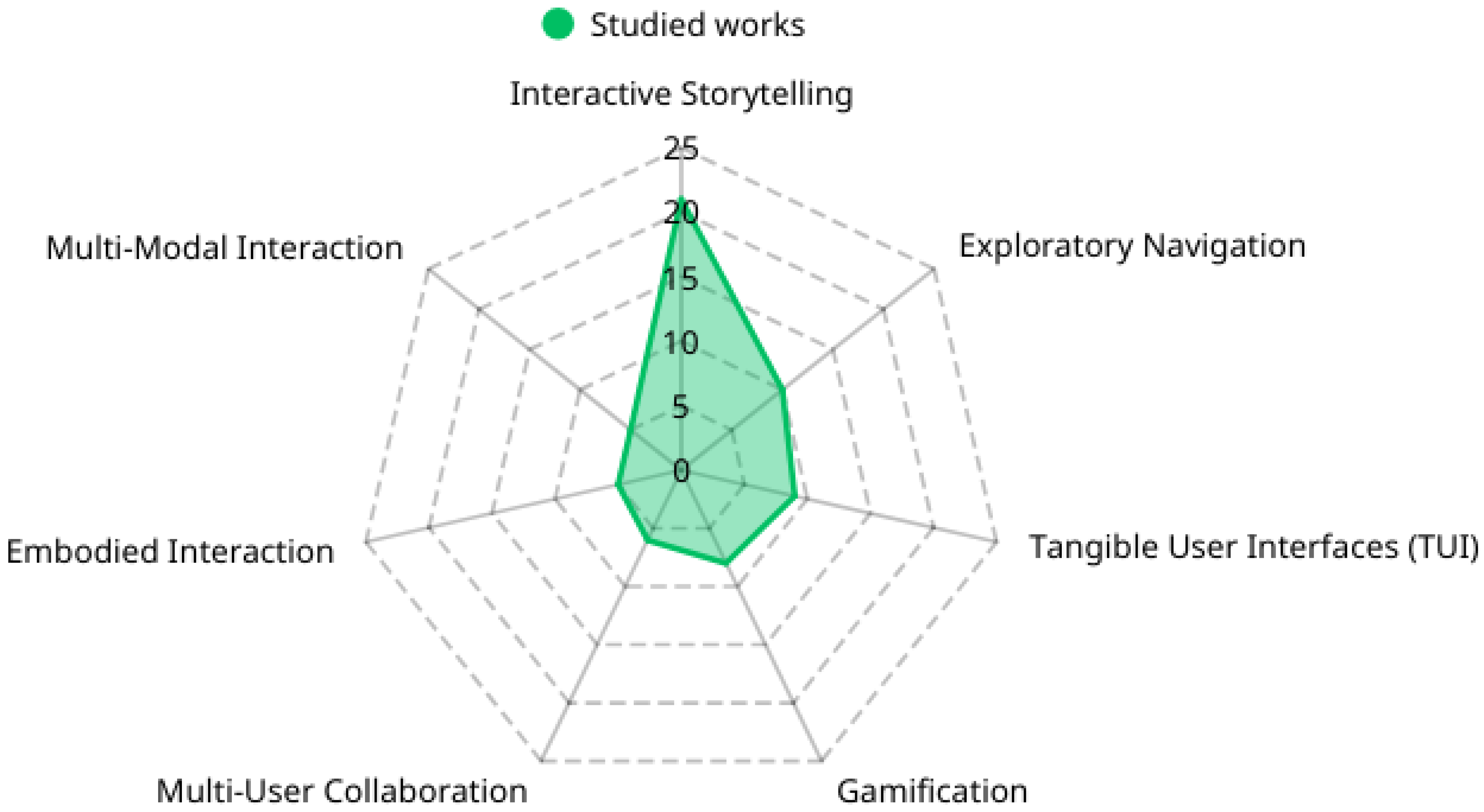
| Exploratory navigation | Single-user navigation in VR/AR. | [2,13,15,25,27,28,39,57,60,65] |
| Embodied interaction | Using the user’s own body movements, gestures, and physical actions as the primary input. | [8,25,27,47,63] |
| Tangible user interfaces (TUI) | Employing physical objects, props, or replicas as interfaces to manipulate digital content. | [23,25,29,42,48,50,51,52,66] |
| Multiuser collaboration | Systems are designed for multiple users to interact simultaneously within a shared virtual or mixed-reality space. | [1,7,25,28,34,37] |
| Gamification | Integration of game mechanics (e.g., challenges, rewards, scoring) and serious games to enhance motivation, engagement, and learning outcomes in a playful context. | [6,12,39,40,41,42,44,48] |
| Multimodal interaction | Combining multiple input modalities such as gaze, gesture, speech, and touch to create a more natural and flexible user interaction experience. | [24,25,27,34,57] |
| Interactive storytelling | Structuring the experience around a narrative that can be linear (guided) or nonlinear, allowing users to influence the story’s progression through their actions and choices. | [1,8,10,14,26,42,45,67,68] |
| Virtual guide (3D character) to deliver curated information in a personified and engaging manner. | [41,60,65] | |
| AI-powered communication to support natural language conversation with virtual characters. | [65] | |
| Adaptive narrative (personas): personalize storytelling content based on user background and interests. | [42,49,58,61] | |
| Contextual storytelling: immerse users in a narrative by animating historical scenes. | [14,49,58,61] |
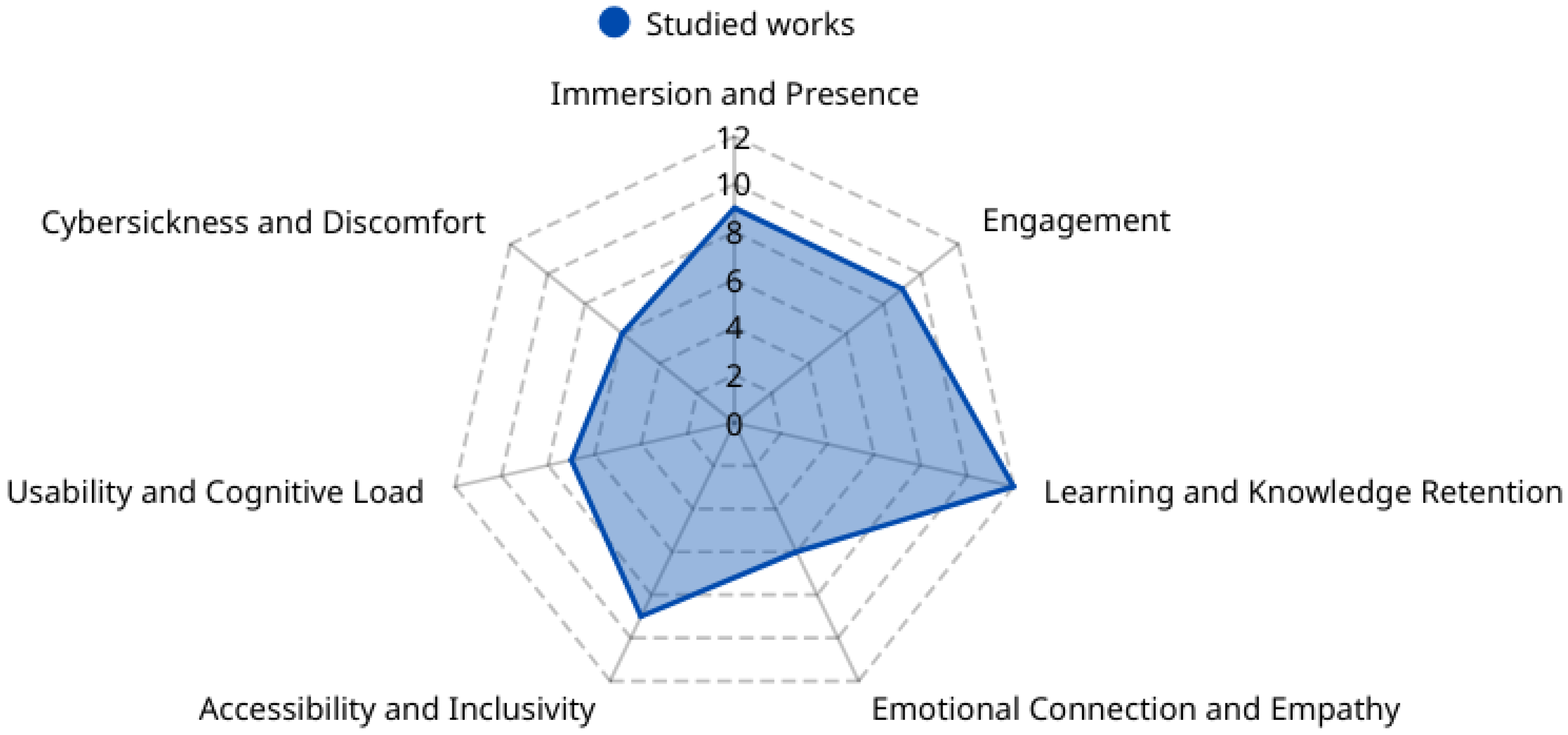
| UX Dimension | Key Findings (Positive and Negative) | Analysis |
|---|---|---|
| Immersion and presence | Positive: HMD-based VR and MR systems are consistently reported inducing high levels of immersion and presence, making users feel physically and psychologically “in” the virtual environment. Wearable VR outperforms mobile VR in immersion. | [2,8,13,25,30,58,60,61,65] |
| Engagement | Positive: interactive and gamified elements significantly increase user engagement, motivation, and time spent with the content. Multiuser systems enhance social engagement. | [4,6,14,39,40,45,49,61,66] |
| Learning and knowledge retention | Positive: XR applications, particularly those with interactive and game-based elements, are shown to improve learning outcomes, knowledge retention, and understanding of cultural context. | [1,6,13,15,23,28,34,39,41,42,48,56] |
| Emotional connection and empathy | Positive: immersive storytelling and virtual embodiment can foster empathy and a strong emotional connection to historical events and heritage, enhancing social cohesion. | [24,38,49,53,58,61] |
| Accessibility and inclusivity | Positive: XR can make inaccessible sites visitable and provide multisensory experiences (e.g., tactile and audio) for users with visual impairments. | [1,11,14,30,36,39,42,43,62] |
| Usability and cognitive load | Negative: users can experience cognitive load when interfaces are complex or when technology overshadows the cultural content. Challenges with navigation, gestures, and controllers are common. | [3,4,12,15,26,29,34] |
| Cybersickness and discomfort | Negative: motion sickness (nausea, dizziness, eyestrain) remains a significant barrier, especially in VR systems. Physical discomfort from headsets is also reported. | [3,24,25,30,57,60] |
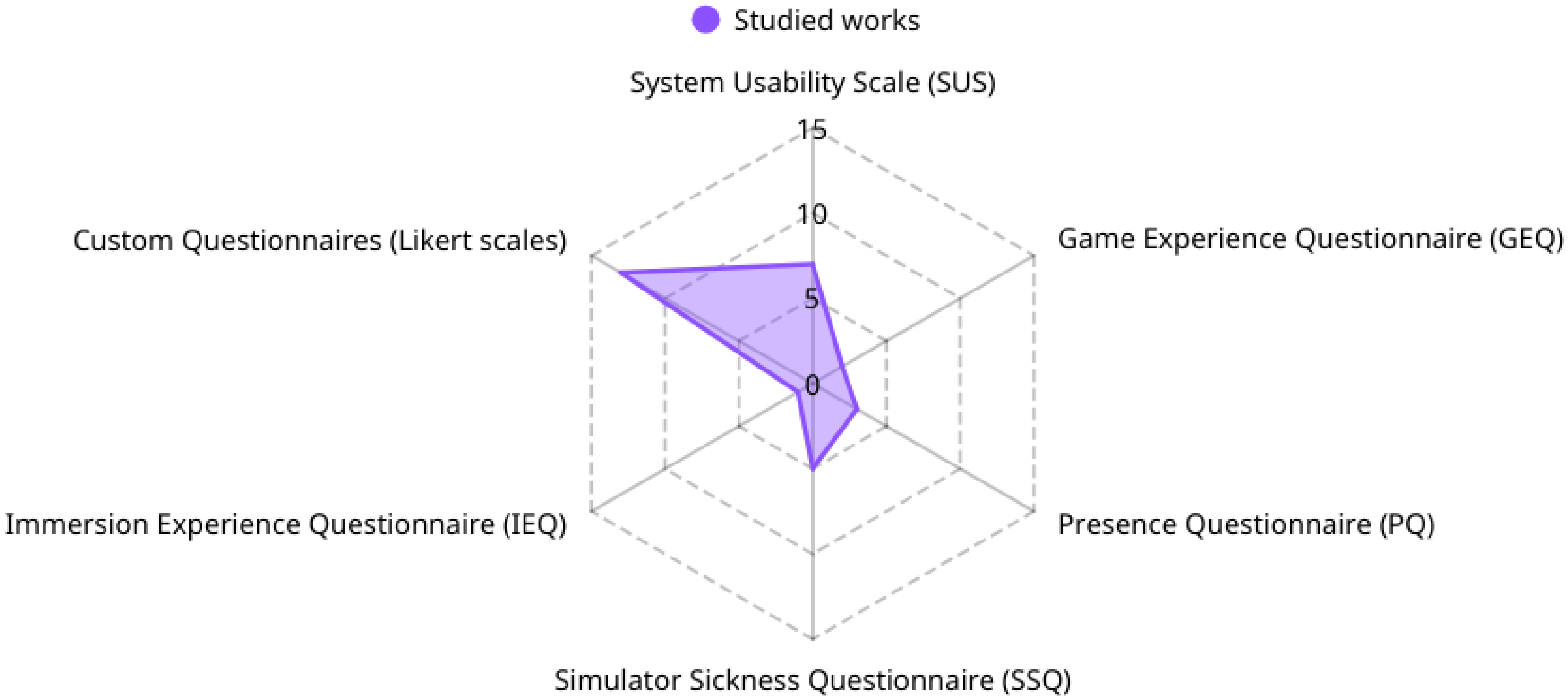
| Method/Instrument | Analysis |
|---|---|
| Qualitative methods | |
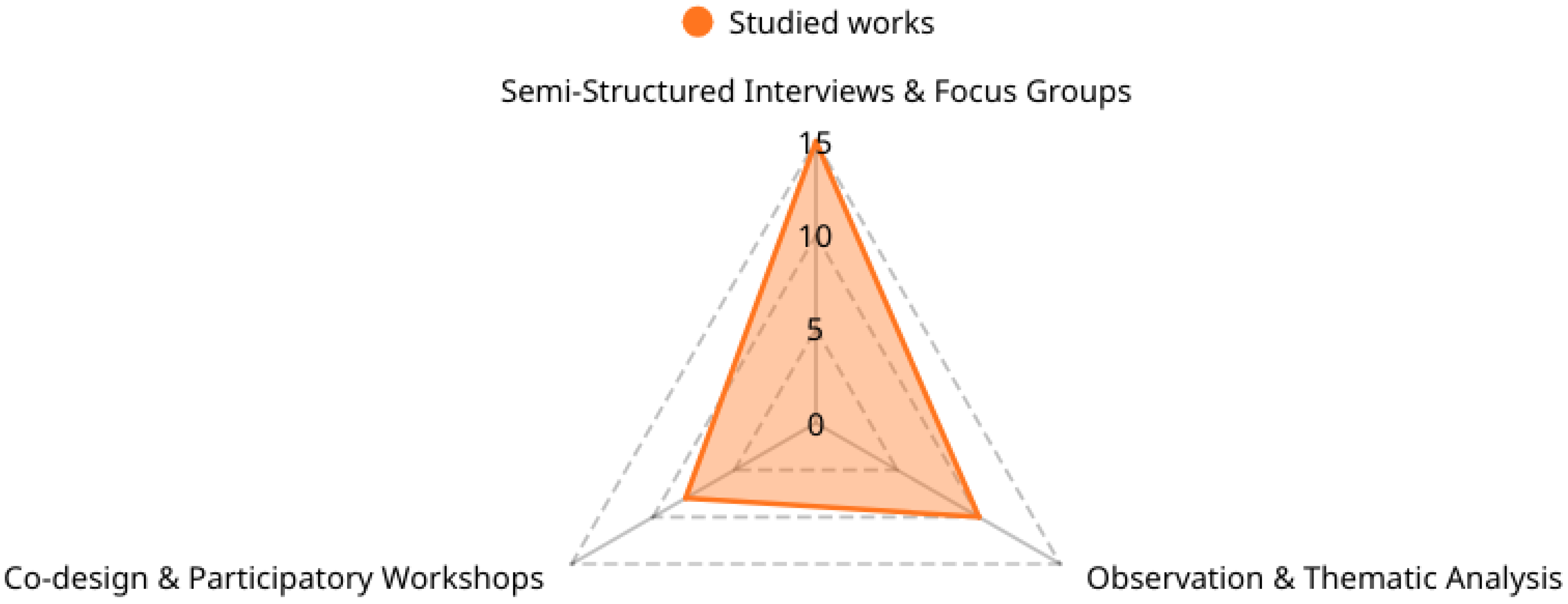
| Semi-structured interviews and focus groups | [2,6,13,25,28,34,41,49,50,56,57,58,60,61,65] |
| Observation and thematic analysis | [2,8,13,25,28,50,58,60,61,66] |
| Co-design and participatory workshops | [10,29,31,33,39,40,47,69] |
| Quantitative methods and instruments | |
| System Usability Scale (SUS) | [6,24,26,40,50,56,60] |
| Game Experience Questionnaire (GEQ) | [6,23] |
| Presence Questionnaire (PQ) | [24,58,61] |
| Simulator Sickness Questionnaire (SSQ) | [24,25,30,57,60] |
| Immersion Experience Questionnaire (IEQ) | [23] |
| Custom questionnaires (Likert scales) | [6,12,14,26,27,29,34,39,42,43,49,65,66] |
| Failure Mode | Technology | Interaction Design | User Experience | Evaluation |
|---|---|---|---|---|
| 1. Technologically rich, interactionally poor | Strong | Weak | Shallow | Novelty-only |
| 2. Narratively strong, evaluatively absent | Strong | Strong | Intended | Absent |
| 3. Evaluatively rigorous, culturally thin | Present | Present | Unmeasured | Technically present, culturally misaligned |
| 4. Participatory in design, solitary in use | Present | Co-designed | Individualized | Partial |
Disclaimer/Publisher’s Note: The statements, opinions and data contained in all publications are solely those of the individual author(s) and contributor(s) and not of MDPI and/or the editor(s). MDPI and/or the editor(s) disclaim responsibility for any injury to people or property resulting from any ideas, methods, instructions or products referred to in the content. |
© 2026 by the authors. Licensee MDPI, Basel, Switzerland. This article is an open access article distributed under the terms and conditions of the Creative Commons Attribution (CC BY) license.
Share and Cite
Partarakis, N.; Katsantonis, M.N.; Zidianakis, E. A Systematic Review of Extended Reality (XR) Applications in Cultural Heritage. Heritage 2026, 9, 215. https://doi.org/10.3390/heritage9060215
Partarakis N, Katsantonis MN, Zidianakis E. A Systematic Review of Extended Reality (XR) Applications in Cultural Heritage. Heritage. 2026; 9(6):215. https://doi.org/10.3390/heritage9060215
Chicago/Turabian StylePartarakis, Nikolaos, Menelaos N. Katsantonis, and Emmanouil Zidianakis. 2026. "A Systematic Review of Extended Reality (XR) Applications in Cultural Heritage" Heritage 9, no. 6: 215. https://doi.org/10.3390/heritage9060215
APA StylePartarakis, N., Katsantonis, M. N., & Zidianakis, E. (2026). A Systematic Review of Extended Reality (XR) Applications in Cultural Heritage. Heritage, 9(6), 215. https://doi.org/10.3390/heritage9060215