Article

14C Dating of Lead White in Painted Decorations: The Case of the Queen’s Library at the Palace of Versailles


1
Laboratoire de Mesure du Carbone 14 (LMC14), LSCE, CEA, CNRS, IRD, ASNR, Ministère de la Culture, Université Paris-Saclay, 91191 Gif-sur-Yvette, France
2
ENS Paris-Saclay, CNRS, PPSM, Université Paris-Saclay, 91190 Gif-sur-Yvette, France
3
LAMS, CNRS UMR 8220, Sorbonne Université, UPMC Univ Paris 06, Place Jussieu 4, 75005 Paris, France
4
European Synchrotron Radiation Facility, Avenue des Martyrs 71, 38043 Grenoble, France
5
CEA, CNRS, NIMBE-LAPA, Université Paris-Saclay, 91191 Gif-sur-Yvette, France
6
CEA, Service de Recherche en Corrosion et Comportement des Matériaux, SRMP, Université Paris-Saclay, 91191 Gif-sur-Yvette, France
7
Independent Researcher, 91120 Palaiseau, France
*
Author to whom correspondence should be addressed.
Heritage 2026, 9(4), 128; https://doi.org/10.3390/heritage9040128
Submission received: 2 February 2026 / Revised: 6 March 2026 / Accepted: 7 March 2026 / Published: 26 March 2026

Abstract

Radiocarbon dating of lead white has progressed considerably in the last decade. Today, the protocol enables the analysis of various types of samples: pure lead white in cosmetics, ancient and modern paint layers containing lead white and oil, and mixtures of lead white and calcite. However, it has also been shown that the presence of a large amount of calcite in lead white paint can alter the radiocarbon result through contamination with dead carbon. To overcome this problem, careful characterization of samples must be carried out prior to dating. Lead white paint layers from the Queen’s apartment at the Palace of Versailles were observed by electronic microscopy and analyzed by Synchrotron X-ray-based diffraction to discriminate the different layers of paint in order to minimize contamination. Chemical analysis and 14C dating were used to document the implementation of the decorations in Queen Marie-Antoinette’s library.

1. Introduction

The Palace of Versailles is one of the greatest achievements of French 17th century architecture. Louis XIII’s old hunting pavilion was transformed and extended by his son, Louis XIV, when he installed the Court and government there in 1682. A succession of kings continued to embellish the Palace up until the French Revolution, with frequent transformations of the King’s and Queen’s state and private apartments. Among them, the bibliothèque de la Reine et son Supplément (Queen’s library and its extension) are a suite of rooms located in the petit appartement de la Reine. They are situated on the first floor of the central section of the Palace, behind the grand appartement de la Reine (State apartment) and open onto an interior courtyard. This petit appartement was the private domain of the queens of France: Maria Theresa of Spain (1638–1683), the wife of King Louis XIV, Marie Leszczyńska (1703–1768), the wife of King Louis XV, and Marie-Antoinette, (1755–1793) the wife of King Louis XVI.
The part corresponding nowadays to the Queen’s library was constructed at the end of the 17th century and underwent several modifications in the 18th century by the successive queens or dauphines. The layout of the petit appartement de la Reine for Marie-Antoinette began in 1779 [1]. The bibliothèque was built between 1779 and 1781 by the architect Richard Mique (1728–1794). The rooms were lined with glass-fronted bookcases, whose shelves could be easily adjusted. The décor consisted of finely sculpted book cabinets, woodwork, and gilded and painted cornices. The last major modification of the petit appartement occurred in 1783, when Marie-Antoinette ordered a complete redecoration of the grand cabinet intérieur. At the same time, an extension of the library was built in the adjoining room. The library has remained almost as it was delivered to Marie-Antoinette in 1781, without any major restoration, whereas the extension was restored in the 1980s. A restoration campaign of the bibliothèque de la Reine and the supplément de la bibliothèque took place from 2017 to 2018 (Figure 1). This restoration provided a unique opportunity to access the original decorative paintings. The scientific analyses aim to document this untouched 18th century royal décor, focusing on paint composition and dating. The survey before the restoration provided samples in various locations of the library. Paint samples were observed by optical and scanning electron microscopy (SEM) and chemically characterized by SEM-EDX and laboratory and synchrotron-based micro X-ray diffraction (XRD). As the lead white pigment was produced using the same process over more than 20 centuries, its characterization cannot be used to date the décor. Despite the lack of resolution of the radiocarbon dating method for this period (1750 to 1950), an attempt was nevertheless carried out to date the wooden panels as well as the paint layers, based on recent advances in 14C dating of lead white for paintings and sculptures [2,3,4,5,6,7,8,9].

2. Materials and Methods

2.1. Sampling of the Painted Décor and the Wooden Structure

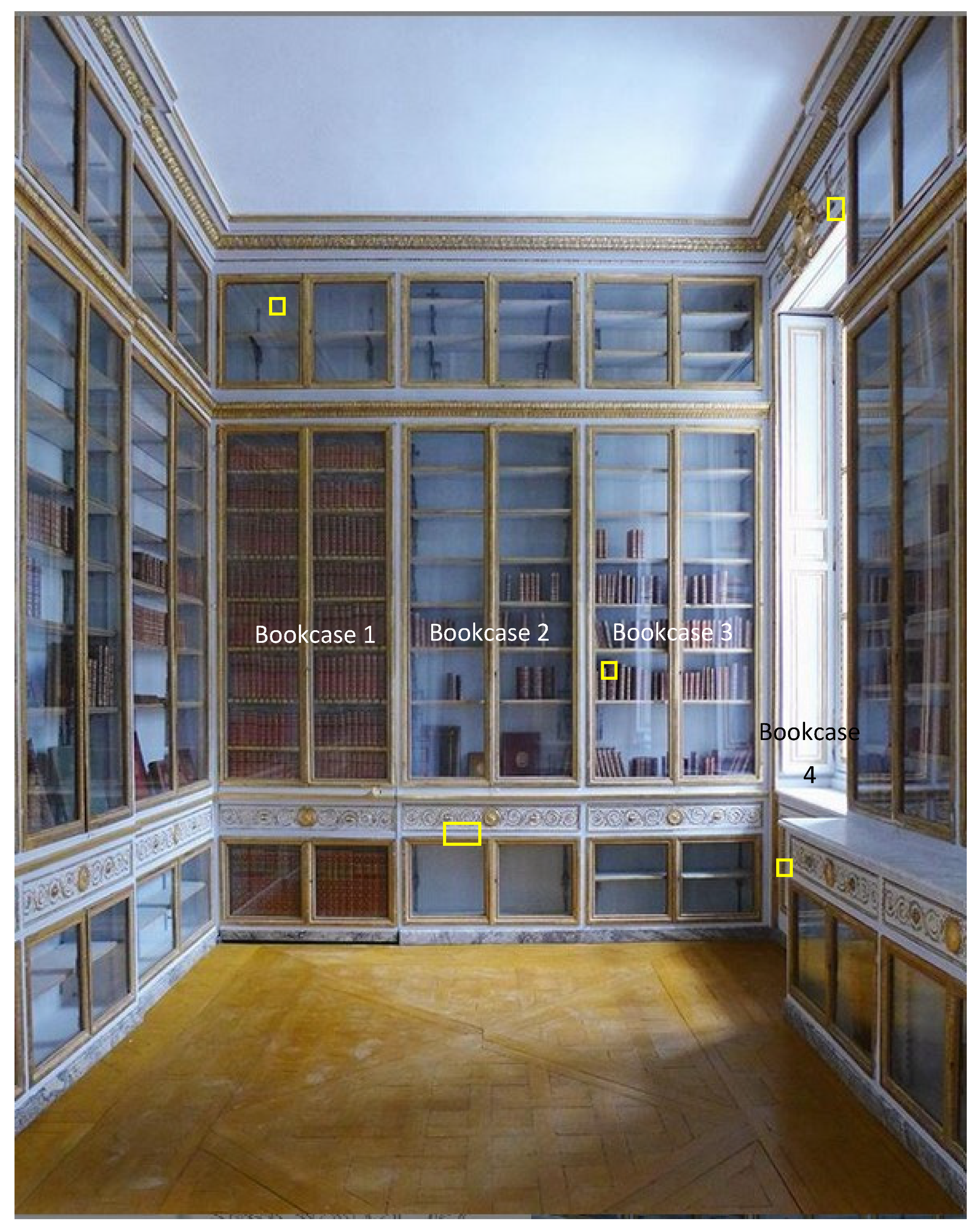
Sampling was carried out at the beginning of the restoration campaign. The layout of the Queen’s library consists of ten vertical units of shelving divided into three bookcases (lower case, main case and upper case). The bookcases are separated by horizontal cornices. Samples of white paint (VERS-02, -04, -07, -11–13, -17, -21, -24), paper (VERS-20), and wood (VERS-05) were taken from bookcases 1, 2, 3, and 4. A detailed description of the samples is reported in Table 1 and their locations are shown in Figure 1. One paint sample was also taken in the extension (VERS-30). A wood sample (VERS-26) was taken from one of the beams of the wooden structure of the wall separating the library from its extension.
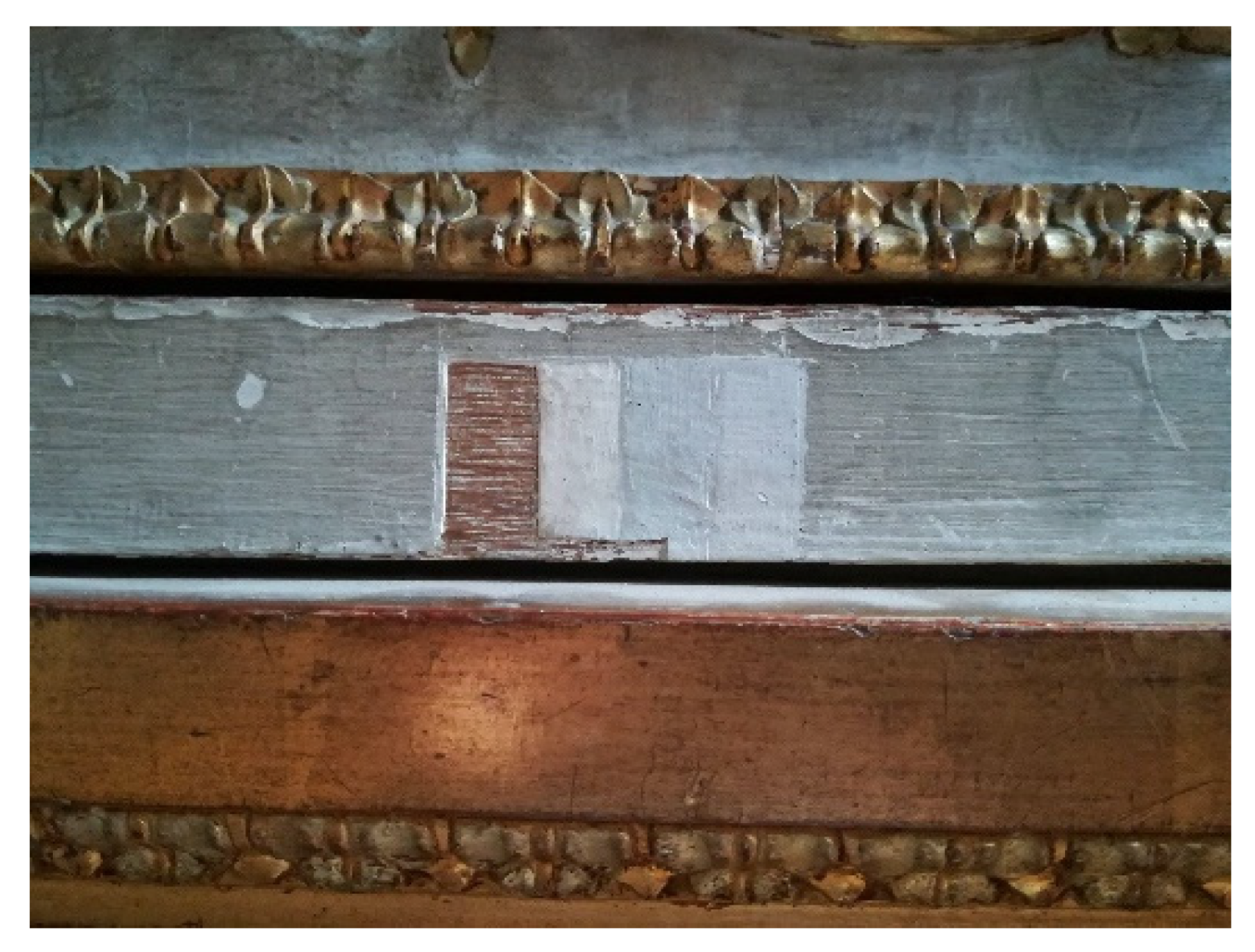
In the library, VERS-02, -04, -21, and -24 are powder samples, obtained from an area located at the cornice of bookcase 2. The surface was scratched layer by layer during the restoration survey prior to our investigation (Figure 2). Four layers were revealed by the restorer and one or two samples of each layer were taken. Samples VERS-07, -11, and -12 were also scratched from the panel surface of bookcases 3 and 4. Samples VERS-13 and VERS-17 are flakes comprising all the paint layers together. Each sample was removed using a clean scalpel and stored in glass vials or aluminum paper.
A known-age sample of lead white (LW-MP-mh), prepared in 2015 according to the historical process, was selected as the control sample for 14C dating [10].

2.2. Methods

Depending on the sample size and shape, different analytical methods were used. XRD was carried out in transmission on powder samples VERS-21 and VERS-30 using a RU-200B (Rigaku Corporation, Tokyo, Japan) rotating anode X-ray generator equipped with a Mo anode. The beam was monochromatized around the Mo-Kα lines and focused on the sample with a size of 100 µm and a photon flux of about 2 × 10⁷ ph/s. XRD images were recorded behind the sample using a RebirX 70S single-photon counting detector from Cegitek.
The microstructure of three paint cross-sections containing the full stratigraphy (samples VERS-13, -17, -30) was investigated using a field emission scanning electron microscope (FEG-SEM) Zeiss LEO 1520 at CEA Saclay, a JSM-7001F LV FEG-SEM equipped with a Bruker EDX detector.
Synchrotron radiation micro X-ray diffraction (SR-µXRD) maps were obtained for two of the cross-sections (samples VERS-13 and VERS-17) on the micro-branch end-station of the ID13 beamline at the ESRF through the “Historical Materials BAG” access [11]. Thin (10 µm) sections were obtained from resin cross-sections using a microtome, mounted on Kapton tape and placed perpendicular to the X-ray beam. The samples were then raster-scanned in order to collect 2D XRPD patterns in transmission, with a Dectris EIGER 4 M single-photon counting detector, that acquires frames with a total pixel array of 2070 × 2167 pixels (75 × 75 μm pixel size). The energy was fixed at 12.99 keV, and the beam was focused to ~2 × 2 μm using a compound refractive lens set-up (CRL) mounted in a transfocator. Azimuthal integration was performed on-line using a dedicated ESRF EWOKS workflow. The crystalline maps were processed using XRDUA software (v. 7.7.1.1) [12].
14C dating was carried out using the ARTEMIS Accelerator Mass Spectrometer (AMS) from NEC (Middleton, WI, USA) [13]. Lead white paint layers were prepared according to the procedure developed in previous works [14,15]. This procedure is based on the thermal properties of lead white, which decomposes into CO2 and PbO at 350 °C, whereas calcite decomposes at a higher temperature (800 °C). Heating samples at 350 °C avoids contamination by carbon calcium carbonates when CaCO3 content is lower than 50 w% [15,16]. The resulting CO2 was trapped using liquid nitrogen (–196 °C). The wood and paper materials were prepared using the standard acid–base–acid method (0.5 M HCl at 80 °C, 1 h/0.1 M NaOH at 80 °C, 1 h/0.5 M HCl at 80 °C, 1 h) and then dried under vacuum overnight (60 °C—0.1 mbar). CO2 was obtained by combustion (5 h, 850 °C) in a sealed tube with an excess of CuO (400–500 mg) and a 1 cm Ag wire. CO2 was converted to graphite and analyzed by AMS [17]. Two samples were used to validate the protocol: sample VERS-24 made with calcite and sample LW-MP-hm, a modern reproduction (2015) of lead white containing cerussite and hydrocerussite (SacA 49229, 103.27 ± 0.22 pMC). Radiocarbon dates were calibrated using OxCal 4.4 software [18] and the IntCal20 atmospheric calibration curve [19] for all samples except for the modern sample LW-MP-hm, for which the calibrated date was provided using the Bomb21NH1 calibration curve [20]. When two radiocarbon measurements were carried out for one sample, the results were combined using the R Combine function of OxCal 4.4 [18].

3. Results

3.1. Paint Layer Characterization

The cross-sections of three samples were examined by SEM and analyzed by SEM-EDX, XRD, or SR-µXRD. Two of them, VERS-13 and VERS-17, are located in the library and one, VERS-30, is from the extension. The samples were collected in such a way as to contain all the layers of paint.
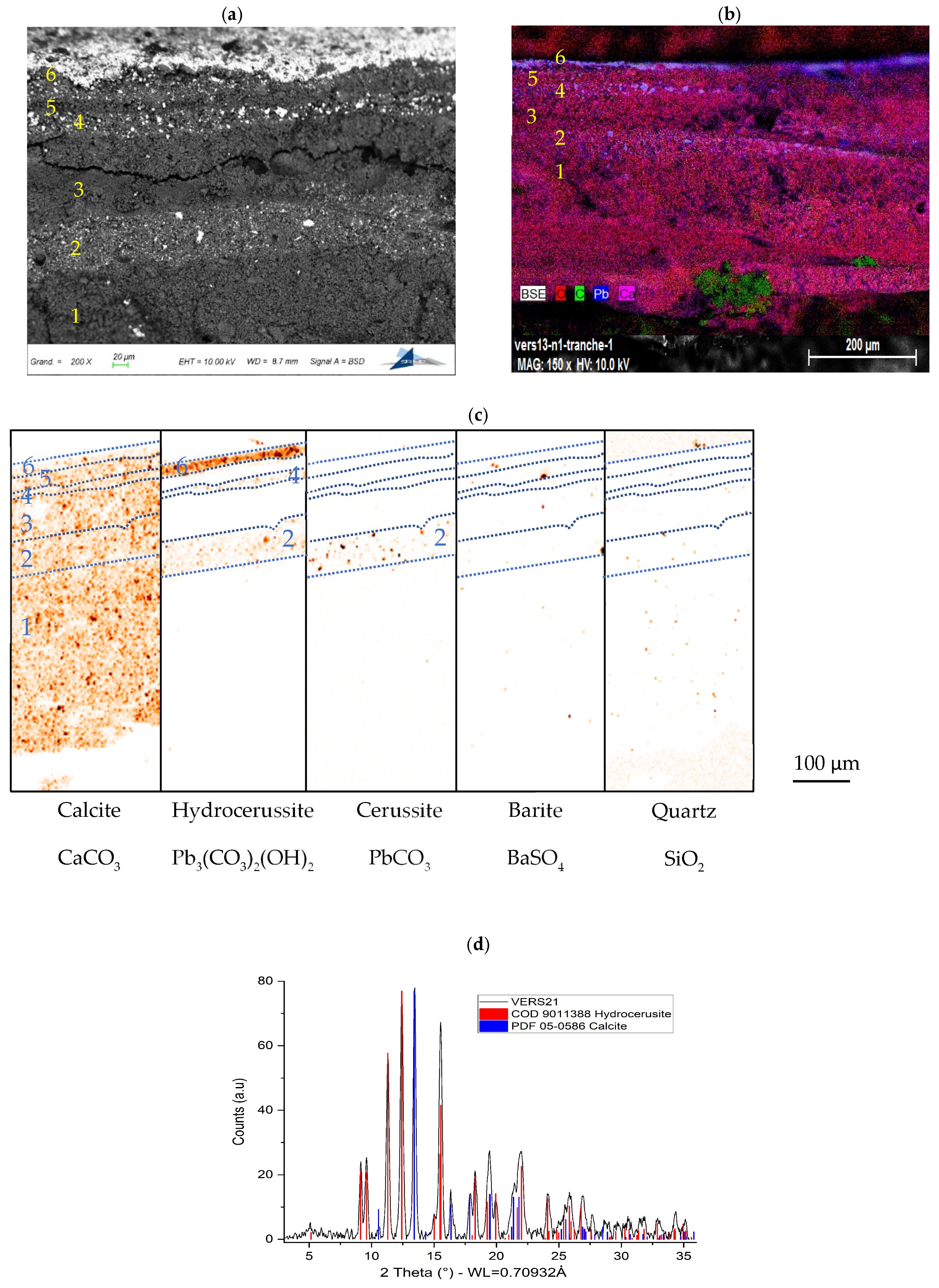
SEM analysis showed that sample VERS-13 consists of six alternating thick (from 35 µm to more than 100 µm thick) and thin (from 10 to 50 µm) layers of different compositions (Figure 3a). The thick layers (layers 1, 3, 5) contain calcium (Ca), and the thinner ones (layers 2, 4, 6) contain Ca and lead (Pb) (Figure 3b). SR-µXRD mapping indicated that the thick layers are composed of calcite (CaCO3) and that the thin layers are mixtures of calcite and lead carbonates in various proportions (Figure 3c). The innermost thin layer (layer 2) is composed of calcite, hydrocerussite (3Pb(CO3)2.(OH)2), and cerussite (PbCO3), the intermediate layer (layer 4) contains calcite and hydrocerussite, and the external layer (layer 6) contains only hydrocerussite. XRD was performed on VERS-21, a powder sampled from the surface, so mainly in layer 6, but which may contain sub-layers as well, confirmed the presence of the two major compounds, hydrocerussite and calcite (Figure 3d). According to the elemental and structural maps, the ratio of hydrocerussite to calcite appears to be higher in the external layer than in the other layers. Traces of barite and quartz were observed throughout the cross-section. This variation in the composition of the lead white pigment is not surprising, as the ratio of the pigment’s constitutive phases cerussite and hydrocerussite has been shown to be dependent on the synthesis parameters as well as the post-synthesis processes applied by paint manufacturers or painters [21]. It can also be influenced by in situ chemical transformation, which is active within the paint layers during the paint aging [22]. The stability of lead carbonates is pH-dependent, with cerussite being stable at pH < 6 and hydrocerussite at 6 < pH < 8. A pre-industrial lead white obtained via the traditional corrosion process typically contains both hydrocerussite and cerussite in variable proportions. A pigment composed exclusively of hydrocerussite, such as the one observed in the top layer of sample VERS-13, is probably not a raw product used immediately after synthesis but a material that has been processed (for example, after heating in water), resulting in an equilibrium shift and the transformation of cerussite into hydrocerussite. After the industrial revolution and the modernization of chemistry, many new syntheses were introduced for lead white, resulting in different mineral composition for the pigment [23]. In the case of sample VERS-13, as the layers are believed to be original, the composition of the pigment used in the top layers could thus be indicative of a specific post-synthesis process [24].
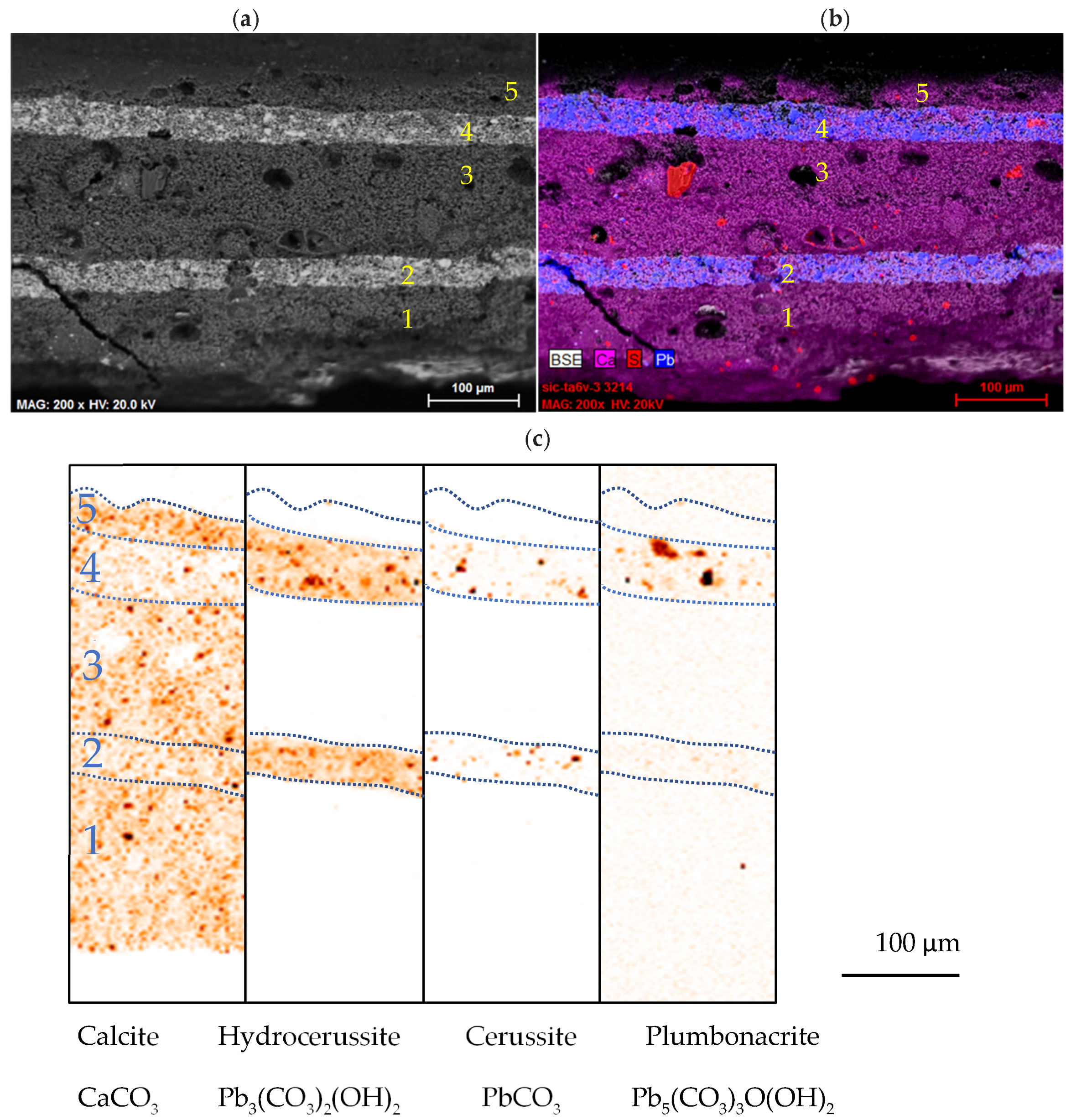
Fragment VERS-17 was sampled above one of the windows of the library. As shown by SR-µXRD, it contains five alternating layers of pure calcite and a mixture of calcite, hydrocerussite, and traces of cerussite (Figure 4). However, for this sample, the external layer is made of calcite (layer 5), contrary to sample VERS-13, which is coated with lead carbonates. It is not clear if this last external lead carbonate layer was never applied or was removed at the beginning of the restoration. One of the layers (layer 4) also contains plumbonacrite (Pb5(CO3)3O(OH)2). This metastable compound (stable at pH > 10) may originate from (i) an in situ reaction such as, for example, the carbonation of an alkaline lead oxide, as observed in mock-up drying oils [22], or (ii) the use of modern lead white [25].
In both samples, VERS-13 and VERS-17, the micro-chemical analysis showed that the composition of the white paint used in the library varies slightly. Most paint layers are based on a pigment containing hydrocerussite and calcite, while other layers include other lead carbonates, cerussite, and plumbonacrite in a very low amounts (Table 2).
The layers composed of lead carbonates and calcite correspond to a lead white pigment diluted with chalk. This type of adulteration is frequently reported in historical sources and usually corresponds to a lower-grade material, as chalk was considerably cheaper than lead white [26,27]. The décor thus combines a succession of double layers: a thick ground layer made of chalk followed by a thin layer of lead white mixed with chalk. This pattern is repeated twice identically in VERS-17 or three times in VERS-13 with decreasing thicknesses and slightly changing compositions. The composition of the paints and the superimposition of lead white on top of a layer of chalk are characteristic of the 17th and 18th centuries [26,27,28,29] and do not reveal any recent restorations.
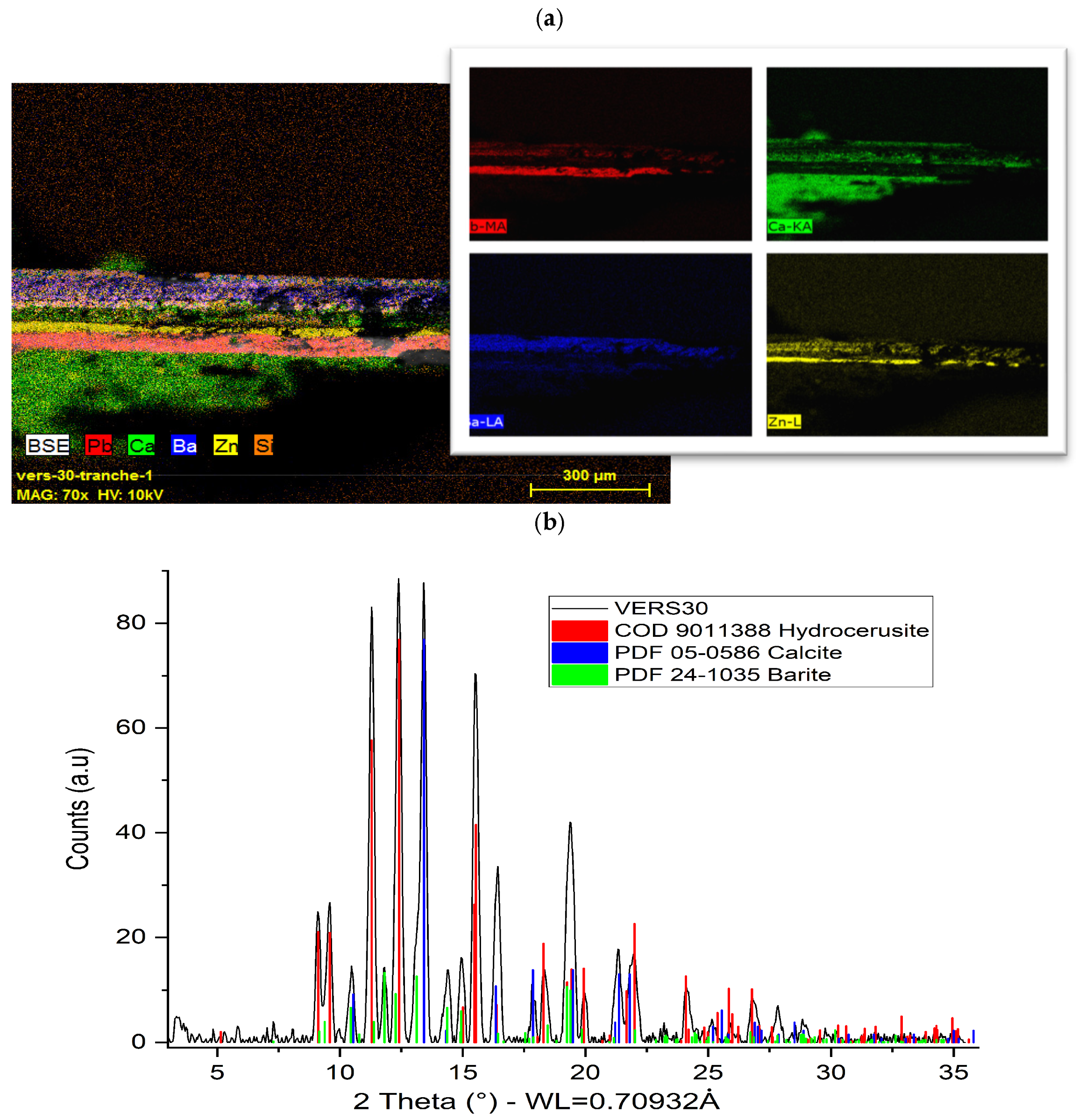
SEM analysis of sample VERS-30 from the extension showed a different feature. The two internal layers containing Ca and Pb are covered with layers containing Zn or Ba (Figure 5a). XRD showed the presence of calcite, hydrocerussite, and barite (BaSO4) (Figure 5b). Although no zinc crystallized compounds were detected by XRD, the presence of Zn may correspond to the presence ZnO (zinc white) in layer 3 and lithopone (a mixture of barite and zinc sulfide (ZnS)) in layer 6. Zinc white started to be used at the beginning of the 19th century, and lithopone was invented in the middle of the 19th century. Barium sulphate became the most frequently used lead white extender from the second quarter of the 19th century in preference to chalk because its high density [26]. The composition of these paint layers is in line with the known restorations of the extension in the 20th century. Lead and calcium observed beneath the modern layers probably correspond to the first application of paint at the construction of the extension. These paint layers are composed of calcite and hydrocerussite, as in the library.
The characterization of the paint layers is essential for selecting a suitable individual layer for 14C dating. As far as possible, 14C dating was carried out according to the stratigraphy determined above. As it was difficult to physically isolate the deep layer of original lead white from the modern restorations for the sample from the extension, only the samples taken from the library were subjected to absolute dating. For the latter, the attested absence of restoration [30] confirmed by the chemical analysis ensured the absence of modern synthetic binders that could bias the 14C results.

3.2. Radiocarbon Dating

3.2.1. Control Samples

VERS-24 containing only calcite was processed as for lead white samples containing a mixture of hydrocerussite and calcite. CO2 was not released when heating VERS-24 at 350 °C, which confirms that the preparation process efficiently minimizes the risk of contamination of lead white CO2 by calcite CO2. For sample LW-MP-mh, the obtained value of percent of modern carbon (pMC) was 103.03 ± 0.33, corresponding to the years 1956 or 2012–2015 (Table 3). This last interval is in agreement with the production date of the pigment in 2015.

3.2.2. Library

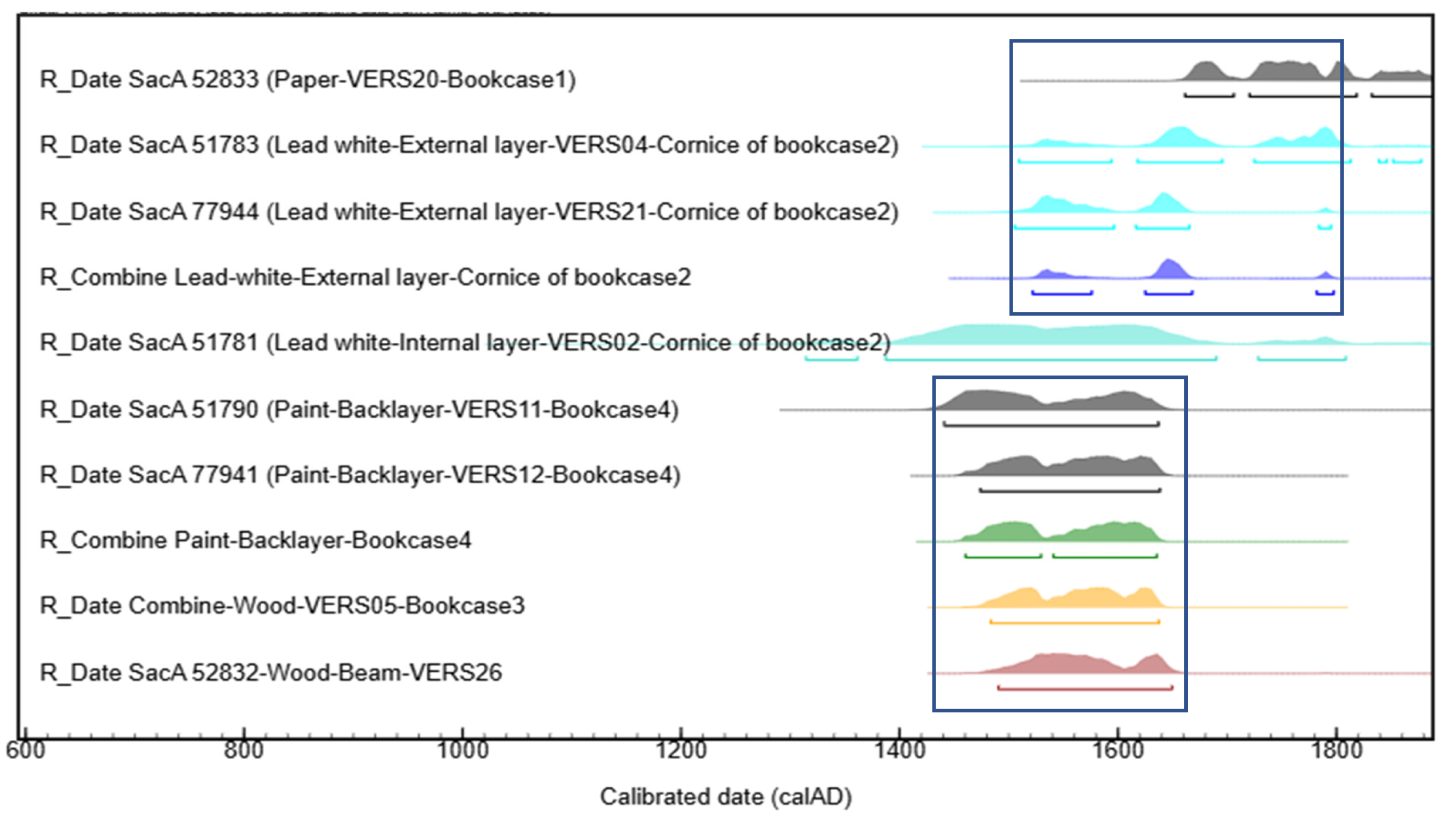
Two lead white samples coming from the cornice of bookcase 2 (VERS-04 and VERS-21) were measured. The external layer was dated 215 ± 45 BP (SacA 51783) and 280 ± 30 BP (SacA 77944). The combination of these two results is 260 ± 25, which, after calibration, gives three intervals of calibrated dates: 1522–1575 (22.1%), 1625–1670 (61.5%), and 1780–1799 (11.8%) (Table 2). This last interval is in agreement with the implementation date of the décor of the Queen Marie-Antoinette library in 1779–1781 [1] and confirms that the painted décor of the library did not undergo any major renovation after 1799. The internal lead white layer (VERS-02) was dated 380 ± 110 BP (SacA 51781). The large uncertainty is due to the very low mass of carbon (30 µg), and, consequently, this result should be considered with caution. The same observation can be made for the result obtained on the paint layer on the back panel of the adjacent bookcase (VERS-07 in bookcase 3, carbon mass 60 µg) with a date of 240 ± 110 BP (SacA 51786), providing calibrated intervals of 1475–1895 (86.1%) and 1902–1950 (9.4%). Due to the small size of these two samples, the resulting date intervals cover six centuries, which limits their interpretation as they are statistically coherent with most 14C results.
Two white paint samples (VERS-11 and VERS-12) from the back panel of bookcase 4, a deep closet situated below the left window, were dated 380 ± 50 (SacA 51790) and 340 ± 30 BP (SacA 77941). The weighted mean calculated from the two measurements was 351 ± 26 BP, which gives after calibration two intervals of calibrated dates: 1460–1539 (40.6%) and 1541–1635 (54.8%). Two dates obtained for the wood panel (VERS-05) supporting the paint layers gave a similar result, 335 ± 30 BP (SacA 51775 and 51831), with a weighted mean of 335 ± 22 BP, providing the calibrated date interval 1483–1637 (95.4%). The paint and the wooden panel radiocarbon measurements are statistically consistent at the 5% significance level (χ2 test, T = 0.2 (5%) = 3.8, ν = 1 [31]) and could, therefore, be of the same age. This result suggests that this paint layer may have been applied during the early occupation of the room by the queens of France. The radiocarbon measurement obtained on a piece of wood coming from the wall (VERS-26) supports this assumption with an age of 310 ± 30 BP (SacA 52832), corresponding to the calibrated date interval 1490–1649 (95.4%). The earliest dates obtained for this layer of paint and for the wooden panels located at the back of a low and relatively inaccessible piece of furniture suggest that during the refurbishment of the library for Marie-Antoinette, the hidden parts were not retouched; the wooden panels at the back were probably neither replaced nor repainted. These dating results are consistent with a rapid installation of the new decorated panels, which were placed on the front of a pre-existing structure [30].
The 14C results reflect the existence of at least two phases of decoration (Figure 6). The first phase in the 17th c. corresponds to the construction of the room and the layout for the early occupation. The second dated decoration can be related to the renovation that took place at the end of the 18th c. when the room was converted into a library for Queen Marie-Antoinette. The fact that an early layer of paint was preserved in a hidden place of the room could reflect the need to install the new decoration very rapidly when Marie-Antoinette became Queen of France, as also shown by the discovery of the ingenious locking system during the 2018 restoration [30]. However, due to plateaus in the atmospheric radiocarbon calibration curve for the 18th century, it is not possible to further refine the calibrated date ranges. We cannot, therefore, exclude the possibility of intermediate stages of decoration between the two phases mentioned above.

4. Discussion

The decoration of the Bibliothèque de la Reine was undertaken between 1779 and 1781 for Queen Marie-Antoinette. Observations made during the recent restoration suggest that the installation was completed very quickly, during the queen’s absences, in order to avoid any inconvenience. The décor consists of painted wooden panels with gilded and painted wooden cornices. The paint is unicolored, and we showed that it is composed of lead white and chalk. Depending on the location, five to six layers of paint were found, alternating calcium and lead-based pigments. Two or three layers of lead white are present, always mixed with chalk. The internal layers contain a higher amount of chalk, indicating a lower quality for the ground. Although lead white was not the most expensive pigment and it was used here in a prestigious residence, its cost was reduced by adding a lower-value adulterant. This practice is attested as early as the 17th century for large surfaces, such as building decoration or for preparatory layers. In these cases, lead white is typically diluted with chalk in a 1:1 proportion [28].
Lead white components were found to be variable from one layer to another. The main compound was hydrocerussite, used almost pure in the external layer, or containing a low amount of cerussite for the internal layers. Lead white composition can be influenced by the production conditions (lead corrosion process) as well as post-processes, such as washing, grinding, and decanting of the pigment, leading to variable hydrocerussite:cerussite ratios [23,26,28]. The different compositions observed here reflect different varieties of lead white, although produced over a short period, but probably by several manufacturers (or by the painters themselves). To a lesser extent, this diversity might also result from in situ chemical transformations in the paint layers, such as the formation of plumbonacrite that can be linked to the use of a siccative oil binder [22].
It is important to state that this variability in the composition of lead white does not constitute a reliable marker that can be used to date its production. Indeed, before the industrial era, from the first productions in the 3rd century BC to the beginning of the 19th century, lead white was produced according to the same corrosion method, with no significant changes in the process observed over more than 20 centuries. While production practices, post-treatment, and aging could modify the composition of the pigment, previous works have shown that there is no direct correlation between a specific composition and a date of synthesis; various hydrocerussite:cerussite ratios have been observed in multiple artistic contexts, from ancient cosmetics to Renaissance and Modern paintings [6,7,8,10,33,34,35,36,37]. It is thus difficult to rely on lead white composition to date a work of art, except when new whites with other elemental compositions, such as zinc oxide or titanium oxide, appeared on the market, providing termini ante or post quem, as shown in [38]. Radiocarbon dating of lead white is thus the only tool to determine the production date of the pigment.
Radiocarbon dates were obtained for the paint layers in the Queen’s Library at the Palace of Versailles. However, due to the low carbon content and the presence of large amounts of calcite, the implementation of this technique was challenging. Even if it is now possible to process small-sized samples, the resulting dates are subject to large uncertainties when carbon masses are lower than 0.1 mg. An uncertainty of more than 50 BP is particularly significant for the 18th century, which is already impacted by the shape of the 14C calibration curve. Nevertheless, we were able to identify two stages in the layout of the bibliothèque de la Reine. The first one may correspond to the construction of the room and the layout for its first occupations in the second part of the 17th century. The dates obtained on wood and paint are in agreement but are slightly older than expected. It is not inconsistent to observe this offset between the 14C dates and the historical records because the radiocarbon results are related to the date of tree felling and pigment manufacture rather than to the construction itself. The second phase is characterized by large intervals of dates, due to the shape of the calibration curve. Despite the lack of precision for this period, some intervals correspond to the known dates of the refurbishment of the library for Marie-Antoinette between 1779 and 1781. This dating result, together with the paint composition, confirms that the library was close to its original condition before its renovation in 2018. Furthermore, the dating results allow us to exclude the hypothesis that the plumbonacrite detected in the studied paint layers was recent lead white, pointing to an in situ crystallization of the compound, which could be linked to the use of a siccative oil binder. This result highlights how radiocarbon dating can provide complementary clues on the paint materials and techniques probed via X-ray-based techniques. Finally, differences in the dating results between hidden elements and the façade of the décor corroborate a rapid assembly of the new décor of the library on a pre-existing structure, as was also observed during the recent renovation.

Author Contributions

Conceptualization, L.B., C.M. (Cyrielle Messager) and C.M. (Christian Maury); methodology, L.B., C.M. (Cyrielle Messager), M.C. and V.G.; chemical and 14C analyses, data treatment, L. B., C.M. (Cyrielle Messager), I.C., P.B., E.F., M.C. and V.G.; writing L.B., M.C. and V.G. All authors have read and agreed to the published version of the manuscript.

Funding

This research received no external funding.

Data Availability Statement

SR-µXRD data are accessible on the ESRF data portal: https://doi.org/10.15151/ESRF-DC-2313079459. Radiocarbon dating data are available from the corresponding author upon request.

Acknowledgments

The authors would like to thank Jerôme Léon (2BDM ARCHITECTURE & PATRIMOINE) for providing access to the library during restoration and for agreeing to the publication of the research results. We acknowledge the European Synchrotron Radiation Facility for provision of beamtime at ID13 through the historical materials BAG access (proposal HG-254) and the LMC14 staff for sample preparation and radiocarbon measurements.

Conflicts of Interest

The authors declare no conflicts of interest.

References

  1. Verlet, P. Le Château de Versailles; Librairie Arthème Fayard: Paris, France, 1985. [Google Scholar]
  2. Hendriks, L.; Hajdas, I.; Ferreira, E.S.B.; Scherrer, N.C.; Zumbühl, S.; Kuffner, M.; Carlyle, L.; Synal, H.A.; Gunther, D. Selective Dating of Paint Components: Radiocarbon Dating of Lead White Pigment. Radiocarbon 2019, 61, 473–493. [Google Scholar] [CrossRef]
  3. Beck, L.; Messager, C.; Caffy, I.; Delqué-Količ, E.; Perron, M.; Dumoulin, J.-P.; Moreau, C.; Degrigny, C.; Serneels, V. Unexpected presence of 14C in inorganic pigment for an absolute dating of paintings. Sci. Rep. 2020, 10, 9582. [Google Scholar] [CrossRef]
  4. Quarta, G.; D’eLia, M.; Paparella, S.; Serra, A.; Calcagnile, L. Characterisation of lead carbonate white pigments submitted to AMS radiocarbon dating. J. Cult. Herit. 2020, 46, 102–107. [Google Scholar] [CrossRef]
  5. Hendriks, L.; Hajdas, I.; Scherrer, N.C.; Zumbühl, S.; Stenger, J.; Welte, C.; Synal, H.-A.; Günther, D. Advances and limitations of 14C dating in the field of heritage sciences. Technè 2021, 52, 111–117. [Google Scholar] [CrossRef]
  6. Duchêne, S.; Beck, L.; Caffy, I.; Bellot-Gurlet, L.; Berné, D.; Plagnieux, P. Medieval polychromy from Parisian Gothic sculptures (1145–1250): Tracing stone preparation techniques by chemical analyses and radiocarbon dating of lead white. J. Cult. Herit. 2025, 75, 147–157. [Google Scholar] [CrossRef]
  7. Ferreira, E.S.B.; Hoffmann, C.; Hendriks, L.; Hajdas, I.; Kradolfer, S.; Günther, D.; Hünerfauth, K.; Reinhardt, J.; Portsteffen, H.; Müller-Bechtel, S. Integrating Material Analysis, Radiocarbon Dating, and Technical Examination in the Dating and Provenance Study of a Copy of Raphael’s “The Great Holy Family of Francis I”. Heritage 2025, 8, 424. [Google Scholar] [CrossRef]
  8. Sá, S.; Hendriks, L.; Cardoso, I.P.; Hajdas, I. Radiocarbon dating of lead white: Novel application in the study of polychrome sculpture. Sci. Rep. 2021, 11, 13210. [Google Scholar] [CrossRef]
  9. Messager, C.; Beck, L.; Blamart, D.; Richard, P.; Germain, T.; Batur, K.; Gonzalez, V.; Foy, E. 25 Centuries of lead white manufacturing processes identified by 13C and 14C carbon isotopes. J. Archaeol. Sci. Rep. 2022, 46, 103685. [Google Scholar] [CrossRef]
  10. Hendriks, L.; Kradolfer, S.; Lombardo, T.; Hubert, V.; Küffner, M.; Khandekar, N.; Hajdas, I.; Synal, H.-A.; Hattendorf, B.; Günther, D. Dual Isotope System Analysis of Lead White in Artworks. Analyst 2020, 145, 1310–1318. [Google Scholar] [CrossRef]
  11. Cotte, M.; Gonzalez, V.; Vanmeert, F.; Monico, L.; Dejoie, C.; Burghammer, M.; Huder, L.; de Nolf, W.; Fisher, S.; Fazlic, I.; et al. The “Historical Materials BAG”: A New Facilitated Access to Synchrotron X-ray Diffraction Analyses for Cultural Heritage Materials at the European Synchrotron Radiation Facility. Molecules 2022, 27, 1997. [Google Scholar] [CrossRef]
  12. De Nolf, W.; Vanmeert, F.; Janssens, K. XRDUA: Crystalline phase distribution maps by two-dimensional scanning and tomographic (micro) X-ray powder diffraction. J. Appl. Crystallogr. 2014, 47, 1107–1117. [Google Scholar] [CrossRef]
  13. Beck, L.; Caffy, I.; Delqué-Količ, E.; Dumoulin, J.-P.; Goulas, C.; Hain, S.; Moreau, C.; Perron, M.; Setti, V.; Sieudat, M.; et al. 20 years of AMS 14C dating using the ARTEMIS facility at the LMC14 National Laboratory: Review of service and research activities. Radiocarbon 2024, 66, 1041–1053. [Google Scholar] [CrossRef]
  14. Beck, L.; Messager, C.; Coelho, S.; Caffy, I.; Delqué-Količ, E.; Perron, M.; Mussard, S.; Dumoulin, J.-P.; Moreau, C.; Gonzalez, V.; et al. Thermal decomposition of lead white for radiocarbon dating of paintings. Radiocarbon 2019, 61, 1345–1356. [Google Scholar] [CrossRef]
  15. Messager, C.; Beck, L.; de Viguerie, L.; Jaber, M. Thermal analysis of carbonate pigments and linseed oil to optimize CO2 extraction for radiocarbon dating of lead white paintings. Microchem. J. 2020, 154, 104637. [Google Scholar] [CrossRef]
  16. Hendriks, L.; Caseri, W.; Ferreira, E.S.B.; Scherrer, N.C.; Zumbühl, S.; Küffner, M.; Hajdas, I.; Wacker, L.; Synal, H.-O.; Günther, D. The Ins and Outs of 14C Dating Lead White Paint for Artworks Application. Anal. Chem. 2020, 92, 7674–7682. [Google Scholar] [CrossRef]
  17. Dumoulin, J.-P.; Moreau, C.; Delqué-Količ, E.; Caffy, I.; Farcage, D.; Goulas, C.; Hain, S.; Perron, M.; Semerok, A.; Sieudat, M.; et al. 14C preparation protocols for archaeological samples at the LMC14. Saclay. France. Radiocarbon 2024, 66, 1566–1579. [Google Scholar] [CrossRef]
  18. Bronk Ramsey, C. Bayesian Analysis of Radiocarbon Dates. Radiocarbon 2009, 51, 337–360. [Google Scholar] [CrossRef]
  19. Reimer, P.J.; Austin, W.E.N.; Bard, E.; Bayliss, A.; Blackwell, P.G.; Ramsey, C.B.; Butzin, M.; Cheng, H.; Edwards, R.L.; Friedrich, M.; et al. The INTCAL20 northern hemisphere radiocarbon age calibration curve (0–55 cal kBP). Radiocarbon 2020, 62, 725–757. [Google Scholar] [CrossRef]
  20. Hua, Q.; Turnbull, J.C.; Santos, G.M.; Rakowski, A.Z.; Ancapichún, S.; De Pol-Holz, R.; Hammer, S.; Lehman, S.J.; Levin, I.; Miller, J.B.; et al. Atmospheric Radiocarbon For The Period 1950–2019. Radiocarbon 2022, 64, 723–745. [Google Scholar] [CrossRef]
  21. Gonzalez, V.; Wallez, G.; Calligaro, T.; Cotte, M.; De Nolf, W.; Eveno, M.; Ravaud, E.; Menu, M. Synchrotron-Based High Angle Resolution and High Lateral Resolution X-ray Diffraction: Revealing Lead White Pigment Qualities in Old Masters Painting. Anal. Chem. 2017, 89, 13203–13211. [Google Scholar] [CrossRef]
  22. Fazlic, I.; Gonzalez, V.; Vanmeert, F.; Alvarez-Martin, A.; Hermans, J.; Flapper, J.; de Bruin, B.; Keune, K.; Cotte, M. Early formation and detection of lead-based products from PbO-oil paint systems. NPJ Herit. Sci. 2025, 13, 430. [Google Scholar] [CrossRef]
  23. Bijker, I.; Deleu, N.; Darcis, Y.; Janssens, K.; Van der Snickt, G. In search for a new lead white: Understanding the historical production processes for industrial-age lead white pigments (1740–1940). Dye Pigment. 2025, 235, 112566. [Google Scholar] [CrossRef]
  24. Gonzalez, V.; Wallez, G.; Calligaro, T.; Gourier, D.; Menu, M. Synthesizing lead white pigments by lead corrosion: New insights into the ancient manufacturing processes. Corros. Sci. 2019, 146, 10–17. [Google Scholar] [CrossRef]
  25. Corbeil, M.C.; Sirois, P.J. A Note on a Modern Lead White, also Known as “Synthetic Plumbonacrite”. Stud. Conserv. 2007, 52, 281–288. [Google Scholar] [CrossRef]
  26. Stols-Witlox, M.J.N. ‘The heaviest and the whitest’: Lead white quality in north western European documentary sources, 1400–1900. In Studying Old Masters’ Paintings: Technology and Practice; Spring, M., Ed.; Archetype Publications: London, UK, 2011; pp. 284–294. [Google Scholar]
  27. de Viguerie, L.; Glanville, H.; Ducouret, G.; Jacquemot, P.; Dang, P.A.; Walter, P. Re-interpretation of the Old Masters’ practices through optical and rheological investigation: The presence of calcite. Comptes Rendus Phys. 2018, 19, 543–552. [Google Scholar] [CrossRef]
  28. Stols-Witlox, M.J.N. Historical Recipes for Preparatory Layers for Oil Paintings in Manuals, Manuscripts and Handbooks in North West Europe, 1550–1900: Analysis and Reconstructions. Doctoral Dissertation, University of Amsterdam, Amsterdam, The Netherlands, 2014. [Google Scholar]
  29. Stols-Witlox, M.J.N.; Megens, L.; Carlyle, L. ‘To prepare white excellent…’: Reconstructions investigating the influence of washing, grinding and decanting of stack-process lead white on pigment composition and particle size. In The Artist’s Process: Technology and Interpretation; Green, S.E., Townsend, J.H., Clarke, M., Nadolny, J., Kroustallis, S., Eds.; Archetype: London, UK, 2012; pp. 112–129. [Google Scholar]
  30. Didier, F.; Léon, J. Montage éclair pour une bibliothèque de reine. Carnets Versailles 2019, 16, 44–47. [Google Scholar]
  31. Ward, G.K.; Wilson, S.R. Procedures for comparing and combining radiocarbon age determinations: A critique. Archaeometry 1978, 20, 19–31. [Google Scholar] [CrossRef]
  32. Ramsey Bronk, C. OxCal v.4.4.4 [Software]. 2021. Available online: https://c14.arch.ox.ac.uk/oxcal.html (accessed on 5 March 2026).
  33. Beck, L.; Messager, C.; Germain, T.; Hain, S. How the incorporation of 14C in lead white makes its absolute dating possible. Radiocarbon 2024, 66, 1507–1517. [Google Scholar] [CrossRef]
  34. Walter, P.; Martinetto, P.; Tsoucaris, G.; Bréniaux, R.; Lefebvre, M.A.; Richard, G.; Talabot, J.; Dooryhee, E. Making make-up in Ancient Egypt. Nature 1999, 397, 483–484. [Google Scholar] [CrossRef]
  35. Welcomme, E.; Walter, P.; Van Elslande, E.; Tsoucaris, G. Investigation of white pigments used as make-up during the Greco-Roman period. Appl. Phys. A 2006, 83, 551–556. [Google Scholar] [CrossRef]
  36. Berrie, B.; Matthew, L. Lead white from Venice: A whiter shade of pale? In Studying Old Masters Paintings: Technology and Practice; Spring, M., Ed.; Archetype Publications: London, UK, 2011; pp. 295–301. [Google Scholar]
  37. Photos-Jones, E.; Bots, P.; Oikonomou, E.; Hamilton, A.; Knapp, C.W. On metal and ‘spoiled’ wine: Analysing psimythion (synthetic cerussite) pellets (5th-3rd centuries BCE) and hypothesizing gas-metal reactions over a fermenting liquid within a Greek pot. Archaeol. Anthropol. Sci. 2020, 12, 243. [Google Scholar] [CrossRef]
  38. Hageraats, S.; Thoury, M.; Cotte, M.; Bertrand, L.; Janssens, K.; Keune, K. Microchemical Imaging of Oil Paint Composition and Degradation: State-of-the-Art and Future Prospects. In Analytical Chemistry for the Study of Paintings and the Detection of Forgeries. Cultural Heritage Science; Colombini, M.P., Degano, I., Nevin, A., Eds.; Springer: Cham, Switzerland, 2022. [Google Scholar] [CrossRef]
Figure 1. Library after its restoration in 2020 © Jérôme Léon. Sample locations are indicated by yellow squares on the bookcases 1 (upper case), 2 (cornice), 3 (main case, on the back wall), and 4 (not visible, under the window and upper cornice, above the window).
Heritage 09 00128 g001
Figure 2. Preliminary diagnostic survey of the painted décorof the cornice of bookcase 2 (see Figure 1 for the location) before restoration, showing the different layers.
Heritage 09 00128 g002
Figure 3. Paint sample VERS-13 from the library. (a) SEM image in BSE mode, (b) SEM-EDX elemental maps on the cross-section, (c) SR-µXRD maps, (d) XRD on sample VERS-21, which corresponds to the external layer of VERS-13. The red and blue lines indicate the diffraction peak positions for hydrocerussite and calcite, respectively.
Heritage 09 00128 g003
Figure 4. Paint sample VERS-17 from the library: (a) SEM image in BSE mode, (b) SEM-EDX elemental maps on the cross-section showing four layers of paint, (c) SR-µXRD maps.
Heritage 09 00128 g004
Figure 5. Paint sample VERS-30 from the extension: (a) SEM-EDX elemental maps on the cross-section showing 6–7 layers of paint, (b) X-ray diffractogram. The red, blue, and green lines indicate the diffraction peak positions for hydrocerussite, calcite, and barite, respectively.
Heritage 09 00128 g005
Figure 6. Calibrated radiocarbon dates obtained on lead white paint and wood and paper samples taken from the décor of the Queen’s Library at the Palace of Versailles. The boxes indicate the two proposed construction phases. OxCal v. 4.4.4. [32] and atmospheric data from [19].
Heritage 09 00128 g006
Table 1. Sample description and analytical methods (OM: optical microscopy, SEM: scanning electron microscopy, SR-µXRD: synchrotron radiation micro X-ray diffraction, XRD: X-ray diffraction, AMS 14C: accelerator mass spectrometry radiocarbon dating).
Room and LocationSample NumberDetailed LocationMaterialDescriptionMethod
Library
Bookcase 2VERS-24medium corniceWhite paintGround layer (layer 1)AMS 14C (control)
VERS-02Internal layer (layer 2)AMS 14C
VERS-04 and VERS-21External layer (layer 6)XRD, AMS 14C
VERS-13Fragment (all layers)OM, SEM, SR-µXRD
Bookcase 3VERS-05main case—back panelWood Fragment AMS 14C
VERS-07White paintExternal layerAMS 14C
Bookcase 4VERS-11 VERS-12lower case, below the window—back panelWhite paintExternal layerAMS 14C
VERS-17upper cornice, above the windowFragment (all layers)OM, SEM, SR-µXRD
Bookcase 1VERS-20upper case—back panelPaperPaper glued on the wooden panelAMS 14C
Partition wall between the library and its extensionVERS-26beam of the wooden structureWoodFragmentAMS 14C
Extension
Main shelfVERS-30 White paintFragment (all layers)SEM (cross-section), XRD
Test sample
-LW-MP-mh Lead white pigmentPowderAMS 14C (control)
Table 2. Results for lead white layers and wood and paper samples: composition, carbon mass (mg), radiocarbon ages (before present), and calibrated dates.
Room and LocationSample NumberMaterialComposition (SEM-EDX or XRD or SR-µXRD)SacA-Lab NrC Mass (mg)Radiocarbon Age (BP)Calibrated Date Intervals
Bookcase 2, cornice, external layer (layer 4)VERS-04 White paint Hydrocerussite/Calcite517830.21215 ± 451509–1594 (14.2%)
1618–1695 (35.2%)
1725–1813 (36.2%)
1839–1846 (0.4%)
1852–1877 (1.2%)
1916–… (8.1%)
VERS-21779440.54280 ± 301505–1596 (55.0%)
1616–1665 (37.8%)
1784–1795 (2.6%)
Combine (Χ2-test: d.f = 1, T = 0.7, 5% = 3.8)51783 and 77944 260 ± 251522–1575 (22.1%)
1625–1670 (61.5%)
1780–1799 (11.8%)
Bookcase 2, cornice, internal layer (layer 2)VERS-02White paint Hydrocerussite/Calcite517810.03380 ± 1101314–1361 (2.8%)
1387–1690 (85.4%)
1728–1808 (5.8%)
1922–… (1.4%)
Bookcase 2, cornice, preparation layer (layer 1)VERS-24White paint Calcite77946No CO2
Bookcase 3, main case, back panelVERS-07White paint- 517860.06240 ± 1001475–1895 (86.1%) 1902–… (9.4%)
VERS-05Wood 518310.98335 ± 301475–1640 (95.4%)
517750.62335 ± 301475–1640 (95.4%)
Combine 51831 and 51775 335 ± 22 1483–1637 (95.4%)
Bookcase 4, lower case, back panelVERS-11White paint 517900.14380 ± 501441–1637 (95.4%)
VERS-12 779410.3340 ± 301474–1638 (95.4%)
Combine 77941 and 51790 351 ± 261460–1539 (40.6%)
1541–1635 (54.8%)
Wall VERS-26Wood 528321.34310 ± 301490–1649 (95.4%)
Bookcase 1VERS-20Paper 528331.06165 ± 301661–1706 (17.2%)
1720–1818 (44.0%)
1832–1892 (14.9%)
1907–… (19.5%)
Table 3. Results for the lead white modern sample: composition, carbon mass (mg), radiocarbon measurements (percent of Modern Carbon), and calibrated dates.
Room and LocationSample NumberMaterialComposition (XRD)SacA-Lab NrC Mass (mg)14C Measurement (pMC)Calibrated Date Intervals
LW-MP-hmCommercial pigmentLead white Cerussite/Hydrocerussite779480.36103.03 ± 0.331956
2012–2015
Disclaimer/Publisher’s Note: The statements, opinions and data contained in all publications are solely those of the individual author(s) and contributor(s) and not of MDPI and/or the editor(s). MDPI and/or the editor(s) disclaim responsibility for any injury to people or property resulting from any ideas, methods, instructions or products referred to in the content.