


Abstract
The short career of the Philadelphia-built transatlantic steamship S.S. Lewis (1851–1853) offers an instructive look at speculation, financing, and operating a steamer in the mid-19th century United States. S.S. Lewis was built as an American entry into the highly competitive arena of the transatlantic steam packet service. An early propeller steamer, it was heralded as an exemplar of American technology and shipbuilding prowess. It was also cleverly marketed, and named for Samuel Shaw (S.S.) Lewis, the Boston-based agent for Cunard. Following the failure of the transatlantic partnership that operated S.S. Lewis, the vessel entered the isthmian service from Nicaragua to San Francisco during the California Gold Rush. It wrecked, without loss of life, in April 1853 north of the Golden Gate. The wreck site, known to pioneering wreck divers for decades, is now archaeologically described and assessed for the first time. The post-wreck saga of the site is an important part of the story of the evolution of maritime archaeology in California.
Keywords:
Boston; Liverpool; transatlantic steam routes; Canada; California Gold Rush; shipwreck; wreck divers 1. Introduction
The story of S.S. Lewis offers an instructive tale with regard to maritime heritage. At one level, this is a story about a now largely forgotten mid-19th century steamship that played a brief role in the saga of transatlantic travel by sea between the United States and the United Kingdom, and subsequently as a “pioneer” steamship involved in Pacific trade between Central America and San Francisco in the latter years of the California Gold Rush. Its total loss to shipwreck in 1853 left a brief mention in history books, but also created a maritime archaeological site that in time was discovered by wreck divers in the 1970s. That site, now in a U.S. National Marine Sanctuary, is a “protected resource” under federal and state law and regulation. Prior to the passage of legislation that established these protections, wreck divers made a series of dives on the wreck, which exists in extremely hazardous conditions, filmed and mapped it and recovered a number of artifacts. These actions were subsequently determined legal by government authorities at a time when artifacts were being donated to a government institution. This shipwreck’s post-wrecking story is a common one on a global scale. The questions that arise are what is maritime heritage and how do people experience it, and what is unprofessional recovery vs. artifacts from a wreck that would have never been archaeologically studied?
2. S.S. Lewis: The Ship
S.S. Lewis was an early screw (propeller)-driven steamship intended for transatlantic service, in competition with the Cunard Line, financed and launched by Philadelphia backers and builders. It was named for Samuel Shaw Lewis of Boston, a prominent merchant, waterfront developer and Samuel Cunard’s agent in North America. The “S.S.” in the ship’s name stands for “Samuel Shaw,” not “steam ship,” the usual praenomen for a steamer. The naming of S.S. Lewis was both audacious and a tip of the hat to one of Boston’s influential brahmins, and reflected its intended role as the first of a new Boston and Liverpool Line established by express agents Harnden & Company and their backers. Perhaps they hoped to lure Lewis into being the agent for their new, all-American line.
Harnden & Co’s Boston and Liverpool Line represented Boston’s second attempt to create an American-owned steam packet service to and from the city. Founded by William Frederick Harnden, an independent express agent for rail shipments, the Company was expanding from managing shipments to owning the ships themselves. While Harnden died in 1845, his business continued when it was merged with rivals Burke & Adams, but retained its name [1] (p. 59). Dexter Brigham, Jr., Harnden’s major partner, continued the business after Harnden’s death. Brigham went abroad and established “branches in Liverpool, London and Paris” [1] (pp. 59–60). An advertisement in the Boston Pilot in December 1840 for “Harnden & Co’s Boston, Liverpool and London, and Boston, Providence, New York & Philadelphia Packet Express, Foreign Letter, General Forwarding and Commission Office” noted that W.F. Harnden “has associated himself with DEXTER BRIGHAM, JR., under the firm of HARNDEN & CO. They have established a Branch of their house in Liverpool and London, and Mr. Brigham will reside permanently there to conduct the business” [2] (p. 4).
Harnden & Co. was one of four companies that became the Adams Express Company in 1854, although the Harnden name persisted in use until 1871, likely because Harnden, the founder of express business in the United States, was highly esteemed by his peers and the business community. Harnden & Co.’s office was in the Bank of North America building on State Street in Boston. “The business, however, was at first small, and threatened, to prove unsuccessful, until the starting of the Cunard line of steamers, which commenced running in 1840, and so increased the number of small packages as to give him a living patronage” [3] (p. 257).
The move was profitable. By
becoming agencies for the convenience of immigrants who desired to send passage money to their friends at home. Harnden & Co. also contracted with Boston packet-ship owners for the cheap conveyance of immigrants, and with the New York and Erie canal for the exclusive use of all their passenger-boats for the same purpose, affording protection to the newcomers from the extortion of land-sharks. Before 1844 Harnden had been the means of bringing to this country over 100,000 laborers, and placing them on western railways and canals [3] (pp. 257–258).
Harnden already worked with a Liverpool & Boston Line of sailing packets, and at the same time he first advertised S.S. Lewis, he also listed twenty-two other vessels, “among the number of vessels despatched from Liverpool to Boston” [4] (p. 8). He did not own any of these vessels, but had contracted with their owners to be their agent.
S.S. Lewis was heralded as the “first boat of what is known as Harnden & Co.’s Liverpool line of Steamships… Her commander, Captain William C. Barstow, is well known as having been one of the most successful packet captains sailing out of New York, and her owners may feel confident that he will make her do all that can be expected of any sailor from a ship combining so many favorable qualities” [5] (p. 1). The Harnden Line, as advertised, would consist of “four first class powerful steamships” with Lewis as the first of the line slated to leave “Boston in the month of July next under the command of WILLIAM C. BARSTOW… followed by the under named vessels: R.G. SHAW, FRANKLIN HAVEN, DAVID HENSHAW” [4] (p. 8).
The other three ship names—R.G. Shaw, Franklin Haven, and David Henshaw—were also a strategic move. R.G. Shaw was named for Robert Gould Shaw (1775–1853), an auctions and commission merchant salesman of dry goods and shipowner who had joined Samuel Shaw Lewis in the development of Commercial Wharf, Noddles’ Island, and in other investments in Boston. “He knew more about vessels than most men who have not made them a specialty. He used to go under their bottoms when on the ways for repairs, and into their holds when loading” [6] (p. 52). In addition, “He was always ready to listen with favor to projects for the development of the trade of Boston, and never withheld his aid when such projects seemed to him feasible, subscribing largely to the stock of railroad and manufacturing companies, from which no immediate direct return could be expected” [7] (pp. 53–54).
Franklin Haven (1804–1893) was a banker and a close friend of lawyer, politician and statesman Daniel Webster. He advanced in his career from cashier to President of Boston’s Globe Bank, a position he held for forty-six years. He also held appointed U.S. Government offices as pension agent for Massachusetts and United States sub-treasurer. He was a stockholder in the Boston & Maine Railroad, a director of the Illinois Central Railroad, and in his later years, was a key figure in the redevelopment and enhancement of Boston, as well as being prominent in support of the government during the Civil War [7] (p. 158). David Henshaw (1792–1852), the son of a sea captain, was a Boston advocate for internal improvements, rail especially, and also shipbuilding.
Henshaw entered business as a pharmacist but expanded his business interests into banking and transportation. Elected to the Massachusetts State Senate in 1826, he subsequently failed to win a Congressional seat. Like Lewis, he also suffered from a bank failure when he was a partner in the Commonwealth Bank. He eventually recovered financially. Serving as Collector of the Port of Boston (1827–1830), he was also briefly the Secretary of the Navy; after serving for seven months, however, he failed to be confirmed by Congress.
The other name associated with the venture was Richard Fanning Loper (1800–1880), a native of Stonington, Connecticut. Loper’s career began as a fourteen-year-old teenager working on sailing coasters. When he was sixteen, Loper assumed command of the coastal schooner Mary Palmer; the next year, he shipped as mate on Captain Nathaniel Palmer’s schooner Hero, and spent the next two years hunting seals. At age 21 he founded a small packet company running coasters while he was still working as master of coastal schooners. He married in 1826. Loper retired from sailing in 1831, moving to Philadelphia where he turned to shipbuilding. By 1844, Loper, already an advocate for steam propulsion, had begun to experiment with composite construction and screw propellers. The push for propellers was not only for speed, but a means of “reducing the weight, space, and cost of machinery” required by paddle steamers; the “screw was one way available means of achieving this. It was in this direction that those who wanted to build lighter and cheaper lines tried to go” [8] (p. 187).
While Loper’s contemporary, Swedish American inventor John Ericsson, is better known, Loper “like Ericsson, obtained a number of patents covering the design of propellers and engines to turn them;” Loper was “a much more practical, if considerably less flamboyant, engineer” [8] (p. 189). Loper not only built ships and designed and patented steam machinery and propellers, but served as President of the Philadelphia Steam Propeller Company in 1848, and in 1849, started the Philadelphia and Hartford Line of steamships. It was in this capacity that he, with Samuel Reynolds and E. Lincoln, ordered the construction of the steamer that would be christened S.S. Lewis. Not much is known of his partners; Samuel Reynolds had earlier been a financial backer on the Board of the Delaware and Hudson Canal Company, chartered in 1825 to build a canal from the Hudson River to Honesdale, Pennsylvania, and E. Lincoln was a shipowner in New York. Both men also invested in other Loper steamers, and were the agents for the Philadelphia & Boston Steam Packet Line.
The hull of S.S. Lewis was built at Kensington (now part of Philadelphia), Pennsylvania, by Theodore Birely and Son, the city’s leading shipbuilder in 1851 [9] (p. 19). Loper designed the steamer’s engines and propeller, which were manufactured at the J.T. Sutton and Company’s Franklin Iron Works, and supervised the design of the hull to “ensure that it was structurally and hydrodynamically suitable for the mode of propulsion;” he also personally took part in the manufacture of the machinery and the construction of the hull of S.S. Lewis [10] (p. 2); [8] (p. 189). A description of the steamer in April 1851 described it as “of the most exquisite model, and warrants superior speed,” and was “rendered the most substantial, by the use of heavy, wrought iron diagonal braces… She will be, when complete, the largest propeller steamship that ever floated in the Delaware” [11] (p. 2).
The shipyard launched the steamship, which had been laid down as Chief, but which slid down the ways as S.S. Lewis, on 12 June 1851. Hawsers set to arrest the slide “failed to bring her up until the whole extent of the rope was paid out,” snapping a bollard and hitting a nearby boat, injuring two of the men in it and throwing out three of the men “by the violence of the blow” [12] (p. 2). After launch, a tug brought the steamer to the Franklin Iron Works’ pier: “The heaviest portion of her machinery is already on board, and her boilers are nearly ready to be shipped” [12] (p. 2).
As the steamer neared completion at the Franklin Iron Works, a detailed description appeared in the Philadelphia Public Ledger of 26 August 1851:
A gilded spread-eagle ornaments her stern, while the bow has gilded billet heads… She is in every respect the most beautiful vessel, both allow and aloft, that has ever been turned out by our Philadelphia mechanics. She has a deck house 190 feet in length, the top of which forms a spacious promenade for her passengers… This house contains the mess-room and state-rooms for the officers and engineers of the ship, captain’s cabin, hatchways leading to the cabins and engine-room, the ice-house, and a large galley, with one of Wood’s patent caboose stoves. The main saloon contains thirty state rooms, and is panelled, set off with pilasters and cornices, edged with beautiful carving and fringed with gold and silver. The arrangements for securing ventilation are perfect… Her motive power consist of two engines, with 60 inch cylinders and 40 inches stroke, applied to a Loper propeller, 14 feet in diameter… The engines are of the angular pattern… Competent judges have pronounced her motive power, and its application to the propeller the most perfect that has been produced [10] (p. 2).
Loper, Lincoln and Reynolds had intended Chief to operate in the California trade, carrying immigrants and high-valued freight to the Pacific Coast following the discovery of gold in California. However, before the steamer was launched, they sold it to the Harnden Express Company, and with the new Boston connection, quickly renamed it for the launch [13] (p. 4). Loper and his partners “originally designed her for the Pacific, but steam vessels having latterly proved unprofitable speculations in those waters, they were induced to accept the offer of the Messrs. Harnden… and she was disposed to form the first of their new Liverpool Line” [10] (p. 2).
The new name may have been a tactical move to secure the favor of Samuel Shaw Lewis, or to suggest or signal an association with Cunard. Because S.S. Lewis “bore the name of the Cunard agent at Boston and a picture suggests that her funnel was painted the Cunard colours,” historian Vernon Gibbs believed that “some association may have existed between the owners” and Cunard [14] (pp. 86–87). After undergoing steam trials in Philadelphia on September 4, 1851, S.S. Lewis steamed to Boston on September 13. The steamer participated in a grand jubilee on Boston harbor to celebrate the completion of the first Boston-to-Canada railroad on September 16, and carried President Millard Fillmore and other dignitaries, including Daniel Webster, on a tour of the harbor. A contemporary account of the day noted that
… the President and those who accompanied him, were conveyed on board the S. S. Lewis, which, bearing the English flag at her fore, and the Union Jack at her mast-head, and with the Stars and Stripes floating from her mizzen, was impatiently riding at anchor in the stream. The party was soon transferred to her decks, the anchor was hove up, and the noble ship moved majestically down the harbor, preceded by the cutters “Hamilton” and “Morris” as her escort, and followed by… other boats in succession. As the cutters… passed by the President’s ship to take their places in the van, they fired a national salute of twenty-one guns. And now the whole pageant was moving gracefully and gaily down the animated harbor, whose waters, hardly ruffled by the soft air, were glittering in the sun, and on either shore the thousands of delighted spectators were giving vent to their enthusiasm in oft repeated cheers which, mingled with the gladsome roar of artillery, added the last and perhaps not the least effective element to the sympathetic enthusiasm of the hour [15] (p. 84).
The captain of S.S. Lewis, George A. Cole, was a veteran of the packet ship trade to and from Liverpool, formerly in command of the sailing packet Orpheus, and most recently, served as captain of the Pacific Mail Steamship Company’s steamer Tennessee running between Panamá and San Francisco. Cole had commanded Tennessee for the New York and Savannah Steam Navigation Company, running between those two ports starting in mid-1849, taking the steamer to California when it was sold to its new owners that December. After eight months on the Pacific, he relinquished command to a new captain in Panamá in February 1851 [16] (p. 333); [17] (pp. 33–44); [18] (pp. 29, 92).
Harnden & Co. had provided their new vessel free of charge, and the local and national press showered the new steamer with accolades. It was a grand entrance, not only as a new steamer: “During the excursion, the President, accompanied by Capt. Cole, inspected every part of the Lewis, and expressed his admiration of the numerous improvements which have been introduced into this model of a vessel. Every one on board was struck with the facility and steadiness with which she moved through the water” [15] (p. 86). The newspaper and magazine coverage of the event was published in a souvenir book, which included a detailed, eight page essay on the new steamer and its owners’ company.
Harnden & Co. also opened the ship to the public for tours, and “our citizens seem to have taken a lively interest in this new Boston steamer… On Saturday, Capt. Cole and his officers had the pleasure of waiting on six or seven hundred ladies on board. Yesterday a party of Canadians were also entertained” [19] (p. 2).
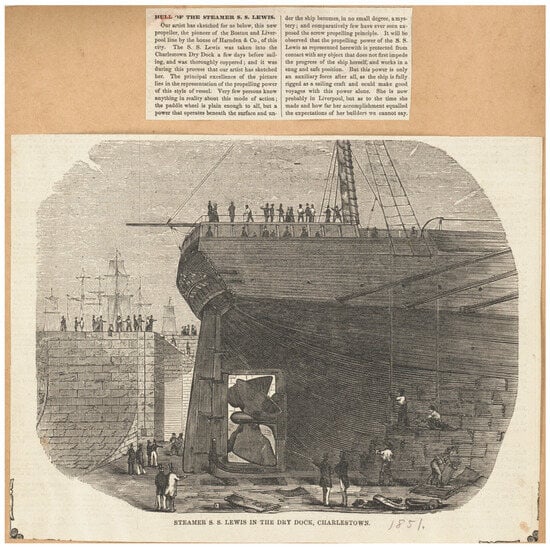
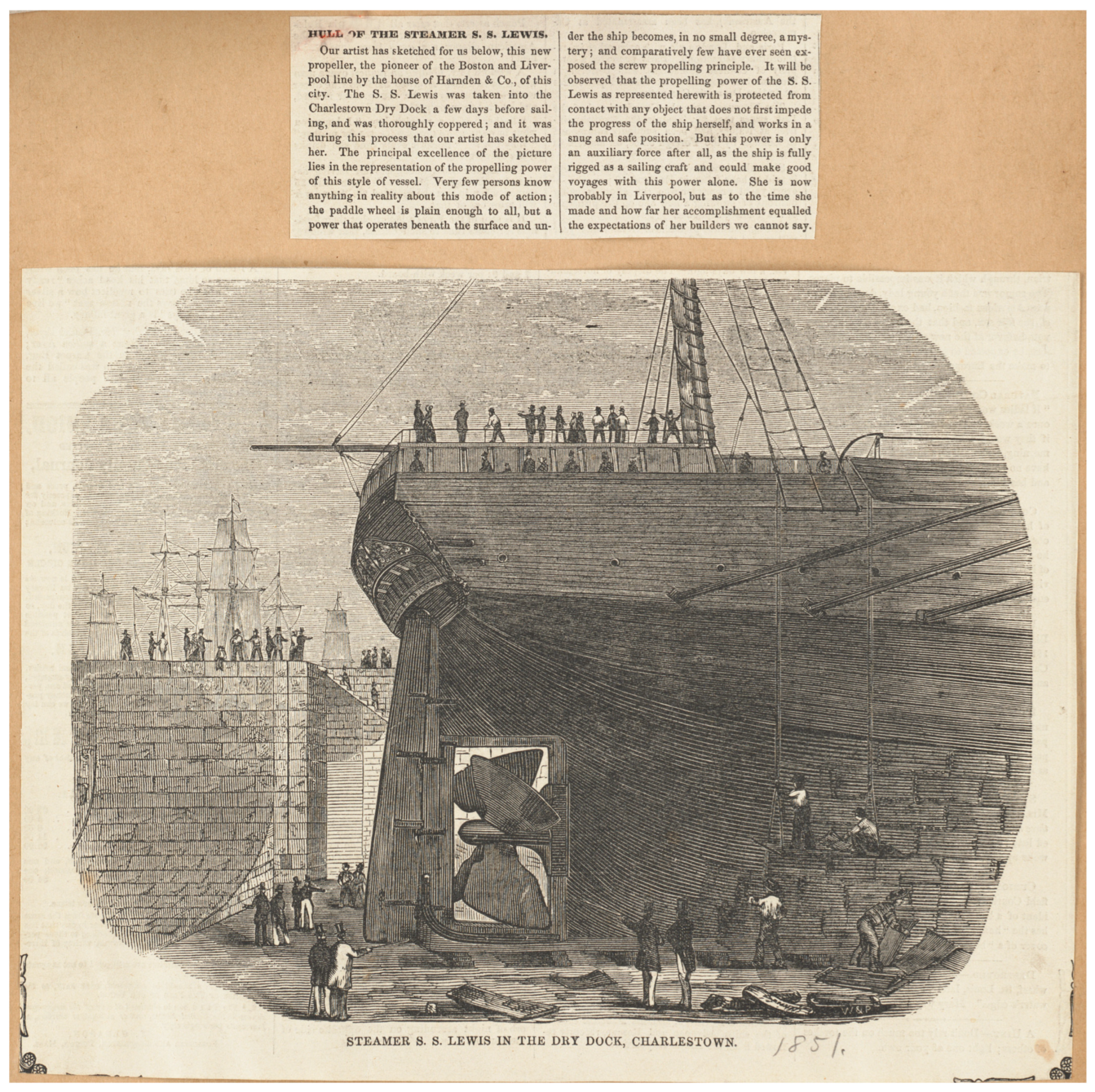
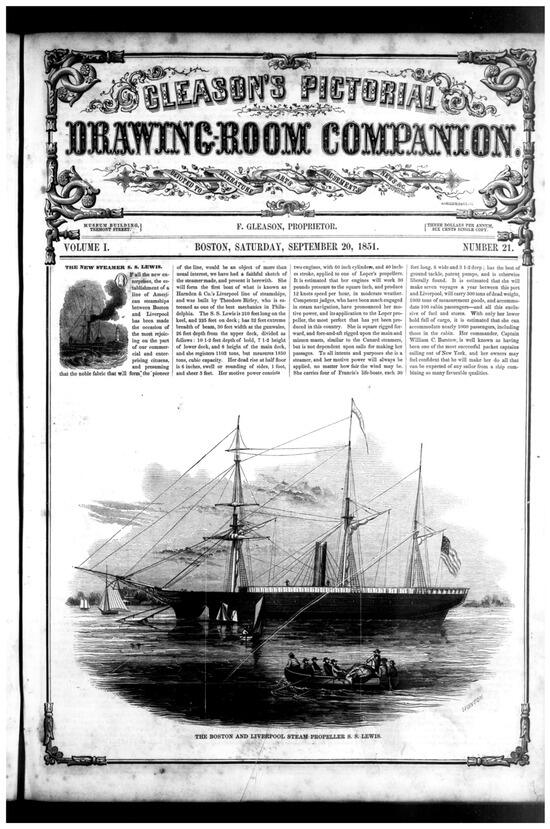
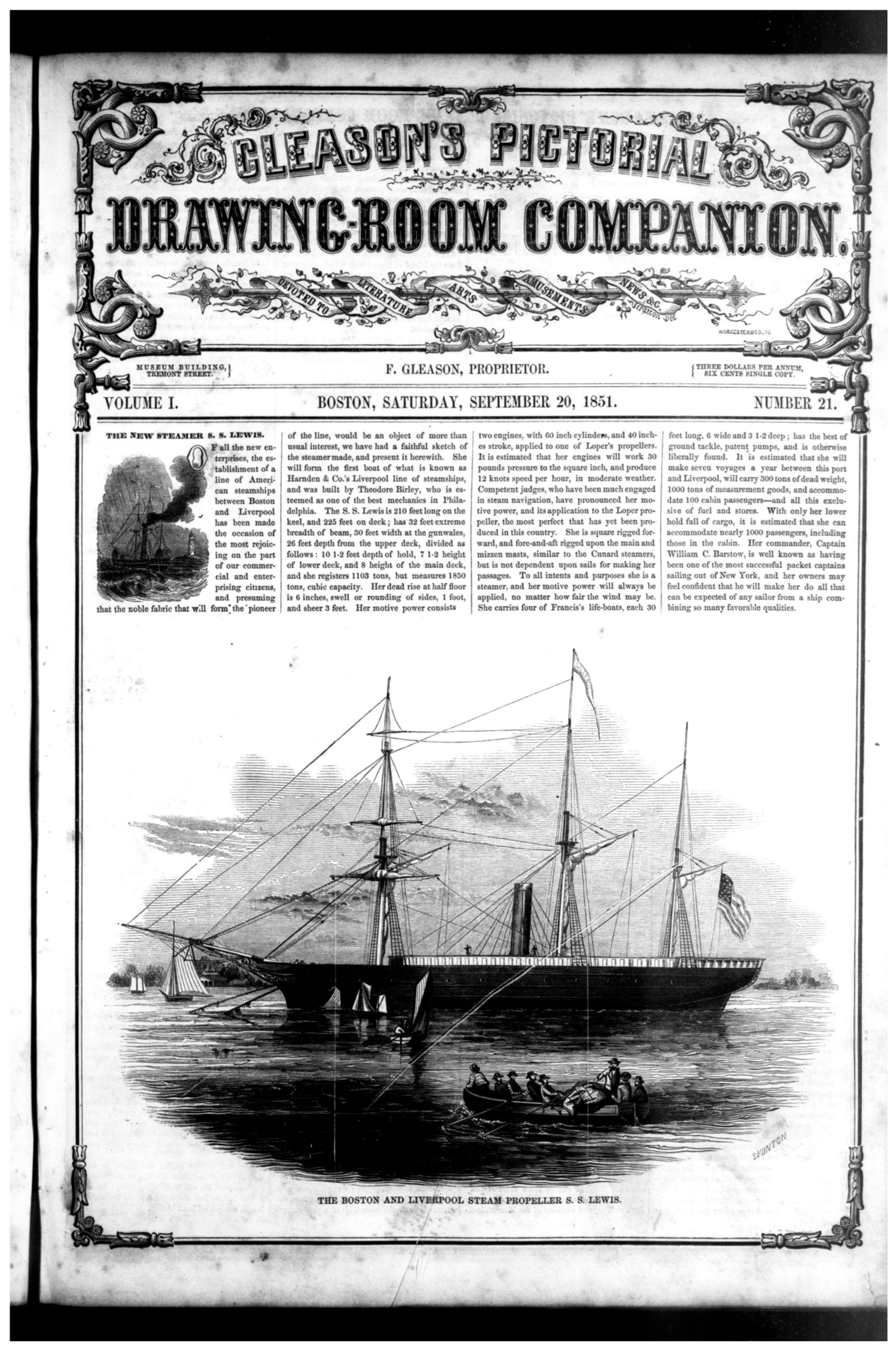
Boston’s newly founded illustrated periodical, Gleason’s Pictorial Drawing-Room Companion, had already published an illustration of the launch, a portrait of the steamer, and an image of it parading through the harbor during the Railroad Jubilee. When the steamer was hauled at the Charlestown Navy Yard for the hull to be coppered a few days prior to its transatlantic voyage, the periodical sent an artist to sketch it, and published the view of the stern and the steamer’s massive propeller (Figure 1) because “the principal excellence of the picture lies in the representation of the propelling power of this style of vessel. Very few persons know anything in reality about this mode of action… a power that operates beneath the surface and under the ship becomes, to no small degree a mystery, and comparatively few have ever seen exposed the screw propelling principle” [20] (p. 416). S.S. Lewis was a “celebrity” steamship (Figure 2).
Figure 1.
The stern and propeller of S.S. Lewis, as depicted in Gleason’s Pictorial Drawing Room Companion in the 25 October 1851 edition (Boston Public Library).
Figure 2.
S.S. Lewis on the front page of Gleason’s Pictorial Drawing-Room Companion (Library of Congress).
On 27 September, Harnden & Co. advertised that S.S. Lewis would leave for Liverpool on 2 October, noting its “substantial” construction, elegance and comfort, and the reputation of Captain Cole [20] (p. 416). Cabin passage was advertised at $80, steerage at $20, or in modern terms, about $3339 US in 2025 for cabin and $835 US for steerage. The steamer did not depart on the 2nd due to a delay that was “unavoidable” but with “Thirty passengers… already booked for her first voyage… she will be full of freight.” Lewis steamed from Boston for Liverpool on October 4, 1851, with forty-five cabin and sixty steerage passengers, “in fine style, firing a salute as she passed Long Wharf. She is a noble craft. Success to her!” [21] (p. 2).
The steamer was the subject of much attention and high hopes, but it steamed into a mid-Atlantic gale, and with a day and half out from Liverpool, lost the blades to the propeller, “whether by coming in contact of a spar or piece of an old wreck, is not known. The accident rendered it necessary to stop the engines; and then she made the passage with her sails” arriving in Liverpool on 21 October [22] (p. 3); [23] (p. 8). It was a disappointment, although the Boston papers churned out a steady stream of editorials lauding the speed made by Lewis prior to the accident, and that from that “extraordinary speed… it has been seen what voyages may be made with a propeller of her superior model and power” [24] (p. 2).
The Liverpool press reported that “the accident to the vessel will not take a long time to repair. She brought a fair number of passengers, and a cargo consisting of wool, tallow and lard,” and praised the ship’s form; “the model is good… the cabins are elegantly fitted up” [25] (p. 6). In Liverpool, Lewis was hauled out and fitted with a new British propeller and advertised for the return voyage. S.S. Lewis departed Liverpool under the command of Captain William C. Barstow on 4 December, but ran out of coal just four days out. (William C. Barstow represents another example of the close relationships of the people involved in this ship, and Boston of that time. In addition to the packet ship an Harnden relationship, Barstow was also the treasurer and superintendent of the East Boston Company. [26] (p. 8). Barstow was also, like Samuel Shaw Lewis, a member of the Roxbury community.) Once again turning to the sails, the steamer reached Halifax twenty days later [27] (p. 2); [28] (p. 2).
S.S. Lewis did not reach Boston until 3 January 1852, arriving with eighteen cabin and forty-two steerage passengers [29] (p. 3).
Even as they advertised for a return trip to Liverpool, Lewis’ misfortunes were a fatal blow to Harnden & Co.’s new steamship line; the Liverpool office suspended payments on their bills, and Lewis’ advertised departure for Liverpool never happened. Seized by U.S. Marshals, S.S. Lewis was sold at auction on 12 February 1852; “this noble steamer, with her entire inventory,” was purchased by Cornelius Vanderbilt “for the sum of $150,000, cash… Her destination will probably be to California” [30] (p. 2).
After steaming to New York, S.S. Lewis’ new owner had the steamer readied for a new career. Vanderbilt had established his own steamship line to carry gold-seekers to California by way of Nicaragua. Lewis was to work the Pacific side of the route with the steamer Independence [31] (pp. 38, 46, 47). Steaming from New York on 5 March 1852, Lewis sailed for Rio de Janeiro, and from there navigated the Straits of Magellan into the Pacific. After stopping at Valparaiso and Panama, Lewis arrived at San Juan del Sur, the Pacific terminus of the Nicaragua route, where several hundred passengers had waited for three weeks for its arrival. From San Juan del Sur, S.S. Lewis steamed to Acapulco, Mexico, arriving at San Francisco on 7 July 1852, with 653 passengers, 112 days from New York [6] (p. 4). The steamer was no longer a celebrity; the San Francisco Daily Alta California greeted S.S. Lewis lukewarmly, “she is a large fine looking vessel, possessing apparently all the requisites for a good safe sea-going steamer” [6] (p. 4).
Vanderbilt’s steamers were not noted for good service, and the death by disease of nineteen passengers on the voyage to San Francisco was not the best introduction for S.S. Lewis [6] (p. 1); [8] (p. 191). S.S. Lewis operated between San Juan del Sur, Nicaragua and San Francisco for more than a year. The steamer’s Pacific career was marked by problems; the line was fined in the fall of 1852 for overloading [32] (p. 1). In January 1853 S.S. Lewis was described “by the most reliable authority to have arrived here in the most filthy condition; so much indeed as to create nausea to those who visited her. She is in a very leaky condition, and has several feet of water” [33] (p. 2). The San Francisco Daily Alta California’s editors expressed their outrage: “the lives and property of the public should not be trifled with...the present condition of the ship...is calculated to induce sickness and death, especially where human beings are packed together in dense masses” [33] (p. 2).
The arrival on 4 January was also marked by the breakdown of the steamer, necessitating a tow into port by the steam tug Goliah. A week later, the Daily Alta California reported that “we understand” that Lewis was to be “taken out and thoroughly overhauled and repaired. New engines are going to be put in her, and new propeller paddles to replace the old ones. The copper will be stripped off, seams recaulked, new copper put on, and in fine the ship made as good as new. We are really glad that such is to be the case” [34] (p. 2). The ship was repaired under contract by the Pacific Mail Steamship Company at their Benicia depot, north of San Francisco on Carquinez Strait; it was the only industrial facility in California that could undertake the work, and a paying job, even from a competitor, was a paying job [18] (pp. 132–149); [35]. The old engines were repaired, not replaced, despite the Daily Alta California editor’s hopes. In late March 1853, S.S. Lewis departed San Francisco for San Juan del Sur.
In the early morning of 9 April 1853, returning from Nicaragua, S.S. Lewis ran aground on Duxbury Reef. The thick fog obscured the land, and like the steamer Tennessee, lost just a month before, Lewis was wrecked because the captain and his officers did not know where they were on a coast that was still being charted, and had no aids to navigation such as a lighthouse or a fog signal [18] (p. 161). William Tecumseh Sherman, the famous U.S. Civil War General, at that time on leave from the U.S. Army and on his way to San Francisco to try his hand at banking, was a cabin passenger on board. He later remarked that “she was… very slow, moving not over eight miles an hour” during the voyage [36] (p. 95). Anticipating the steamer’s arrival of the next day, Sherman went to sleep in his cabin, fully dressed, only to be awakened “by a bump or grating of the vessel” and then “the ship struck heavily; the engines stopped, and the running to and fro on the deck showed that something was wrong” [36] (p. 95).
The scene on deck, when he reached it, found the steamer stuck on the rocks, shrouded in fog, but with the sea calm; “the ship would rise with the swell, and come down with a bump and quiver that was decidedly unpleasant” [36] (p. 95). The passengers and crew waited for dawn as the hull flooded, but the decks remained dry. “Then the fires were all out, the ship full of water, and gradually breaking up, wriggling with every swell like a willow basket—the sea all around is full of the floating fragments of her sheeting, twisted and torn into a spongy condition” [36] (pp. 96–97).
After landing the passengers on a nearby beach when the sun came up, Sherman was able to take news of the wreck to San Francisco by way of a small schooner that arrived to load lumber from a nearby sawmill, only to wreck again when the schooner, caught in a riptide, capsized at the Golden Gate and Sherman had to swim for it. “I was not in the least alarmed, but thought two shipwrecks in one day not a good beginning for a new, peaceful career” [36] (p. 99). He counted himself fortunate; “I lost my carpet-bag, but saved my trunk. The Lewis went to pieces the night after we got off” [36] (p. 100). S.S. Lewis’ 385 passengers, safely landed ashore on the coast along with the ship’s specie, mail, and some of the baggage, were rescued the next day by the U.S. surveying steamer Active, which arrived at the wreck on April 10 along with the Revenue Cutter Frolic, and with Goliah brought them to San Francisco, steaming through floating debris from the wreck [37] (p. 2).
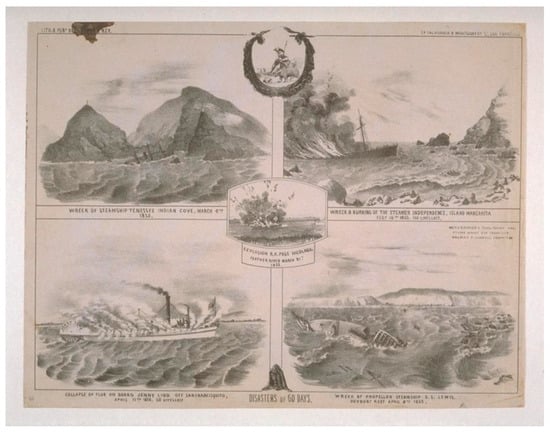
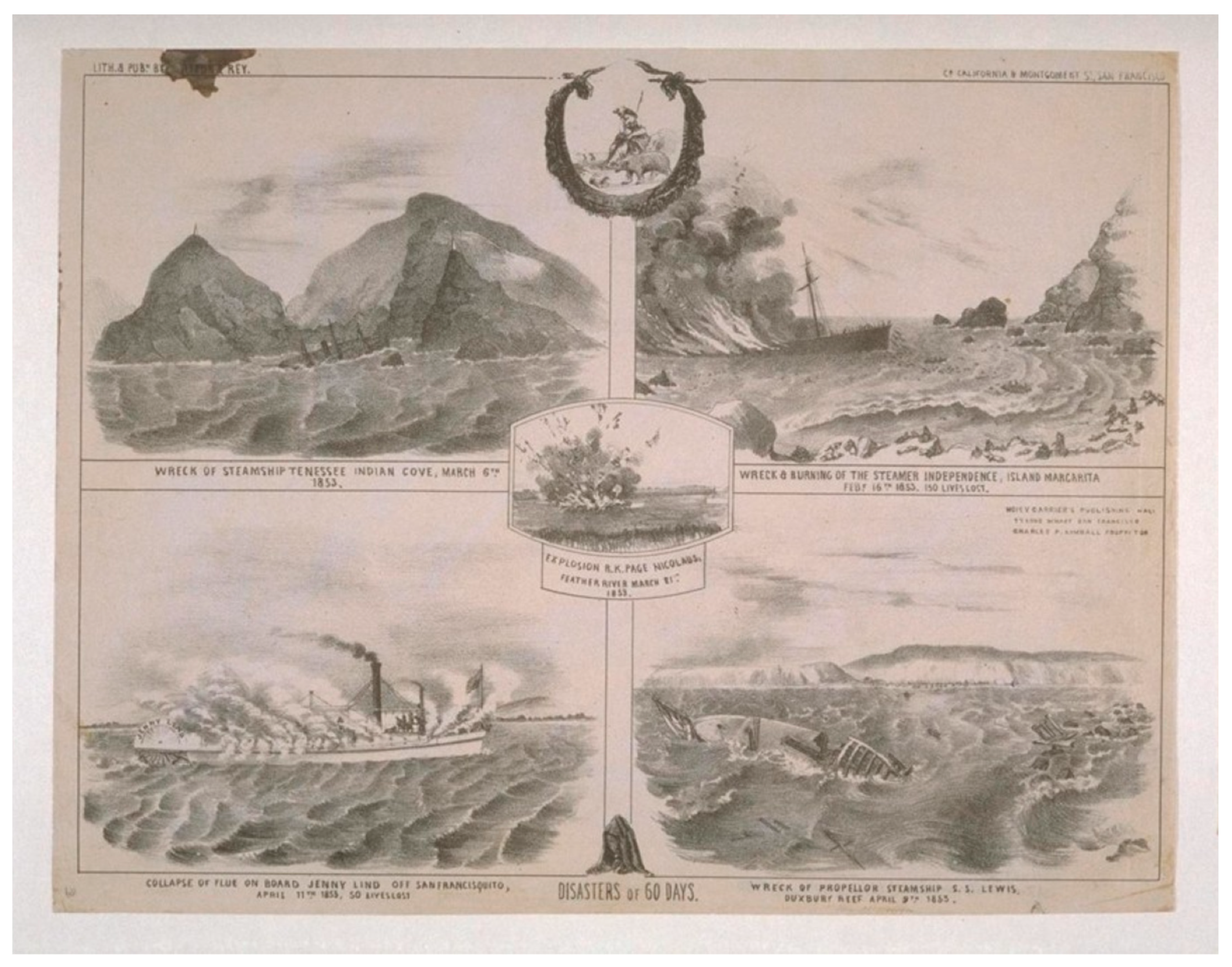
The Daily Alta California, still not favorably impressed with S.S. Lewis and its owners, opined that “as there were no lives lost and no distress occasioned by this disaster, other than the temporary inconvenience to the passengers and the anxiety of their friends, this loss may be considered as rather beneficial to the traveling public than otherwise, as the S.S. Lewis could not be considered wholly seaworthy” [38] (p. 2). Even in death, the steamer remained a celebrity—of sorts. A common feature of the California Gold Rush was the production of illustrated lettersheets (writing paper) with scenes from the mines, of the cities, towns and mining camps, and in this case, a series of shipwrecks that spanned the first half of 1853, including S.S. Lewis, and published with drawings of each as “Disasters of Sixty Days.” (Figure 3).
Figure 3.
Disasters of Sixty Days (Library of Congress).
3. S.S. Lewis: The Wreck Site: Location and Background
S.S. Lewis was the first total loss of eleven vessels along this section of the California coast. The reef gained its name from the stranding of the ship Duxbury in August 1849 [39] p. 111). “Various vessels have struck at various times. It is a very dangerous point for mariners. As there is a strong current running all year round, which takes a vessel right on it. It is especially dreaded during the period of fogs and calms, when it is impossible to keep vessels out of the set, except by anchoring” [40].
A U.S. Coast Survey crew plotted the location of the wreck in 1853 as they were working on the survey and charting of the coast at that time and had previously plotted the still exposed wreck of S.S. Tennessee a few miles down the coast. The U.S. Coast Pilot for the Pacific Coast noted that Lewis “went ashore” at a location “Quite close to Duxbury Point” [41] (p. 75). After running aground “in a thick fog and calm, while running at ordinary speed,” the captain backed off, but “ran ashore again within a few hundred yards to the northward, and was totally lost in the breakers” [41] (pp. 75–76).
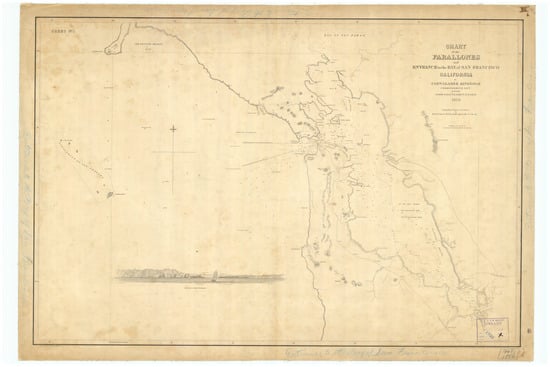
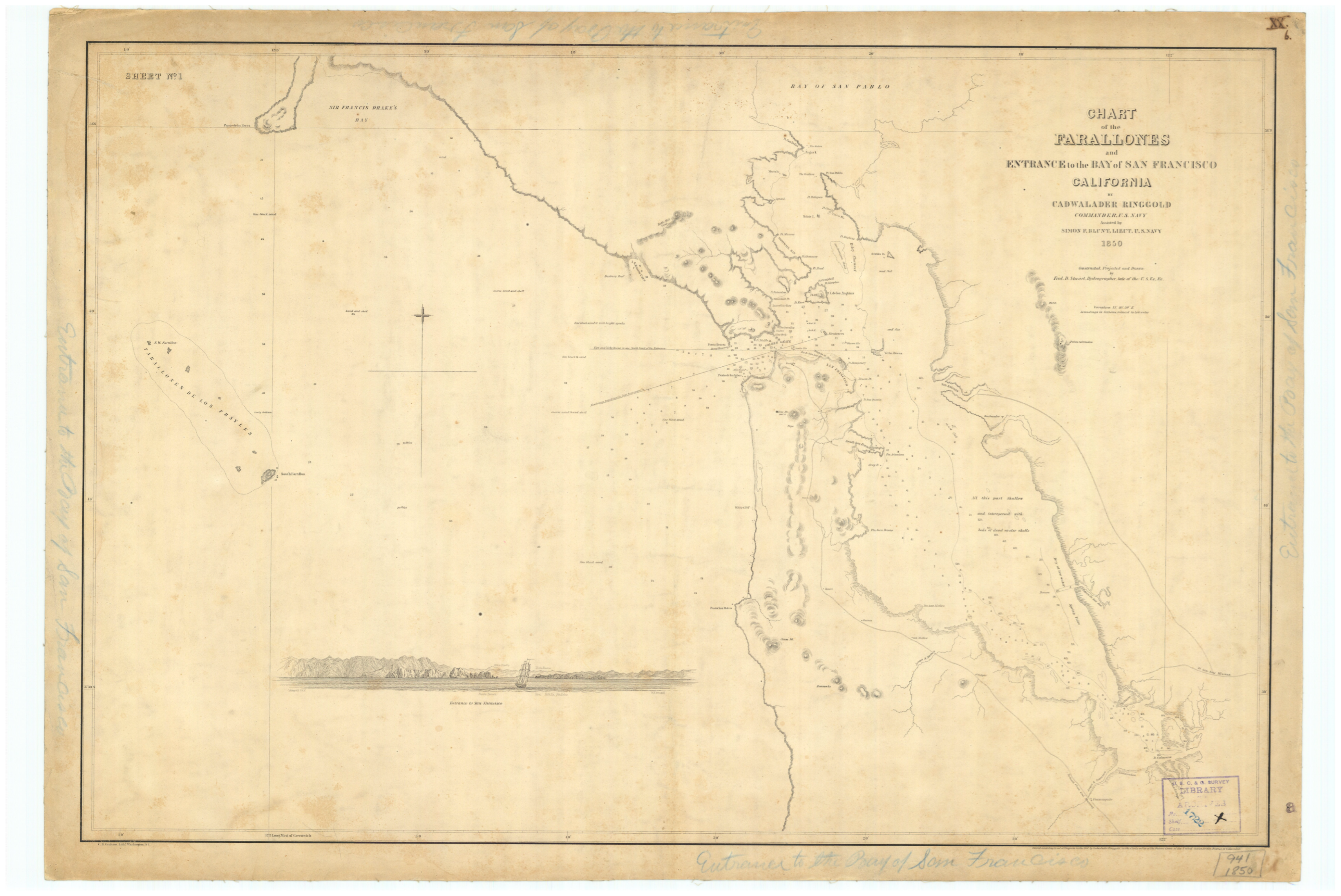
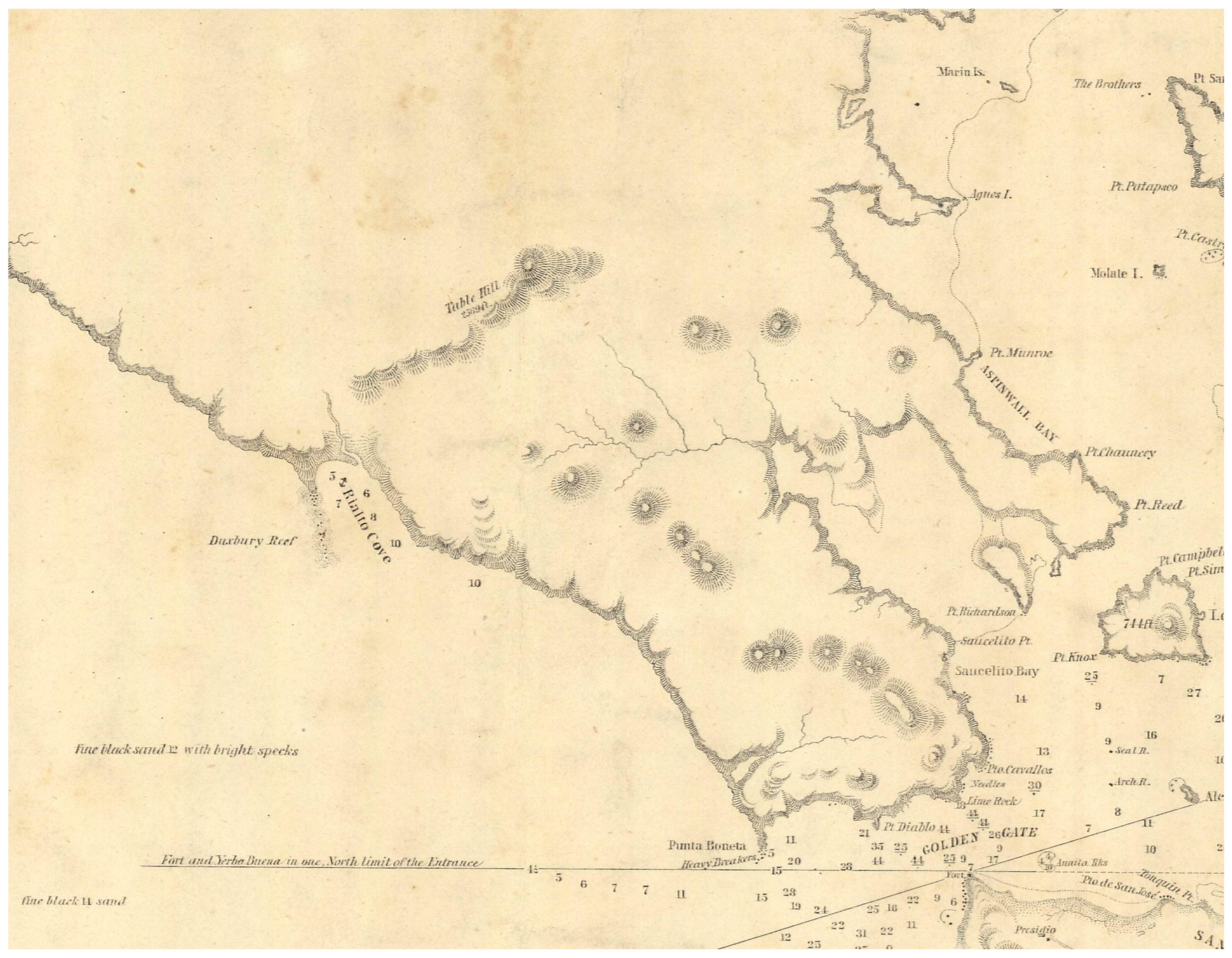
The wreck lies at an average depth of five meters of water against the ocean side of Duxbury Reef, a large shale reef that extends 300 m beyond the southernmost end of the Point Reyes Peninsula, point near the modern community of Bolinas, California. The reef forms the western edge of Bolinas Bay. Duxbury Reef and the waters surrounding it are a marine protected area at both a state and national level, lying in the Agate Beach Duxbury Reef State Marine Conservation Area and Great Farallones National Marine Sanctuary. The wreck, lying on the seaside face of the reef, is exposed to the full force of the open Pacific, and the refraction of wave energy around the reef and into Bolinas Bay (Figure 4 and Figure 5).
Figure 4.
The preliminary U.S. Coast Survey chart for the Gulf of the Farallones extended from South of the Golden Gate to Point Reyes, and included Duxbury Reef (U.S. National Oceanic & Atmospheric Administration).
Figure 5.
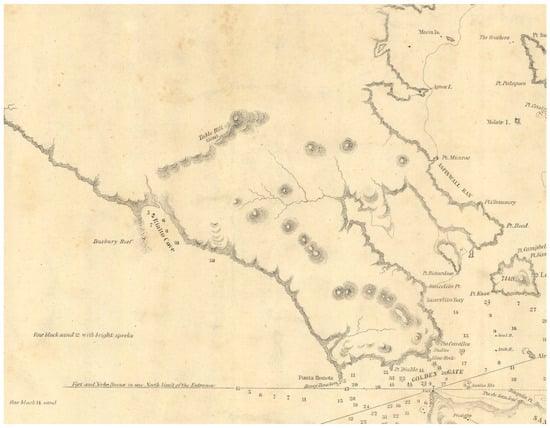
Detail of the 1850 U.S. Coast Survey preliminary chart showing the location of Duxbury Reef (U.S. National Oceanic and Atmospheric Administration).
A nineteenth century local historical account of the region noted that “All the freight and baggage was lost, as was also the safe containing twenty thousand dollars. More or less of the former was washed ashore, but nothing was ever seen of the latter, nor have divers been successful in finding it” [42] (p. 271). The wreck was rediscovered by Bob and Bruce Lanham, two highly experienced and pioneering wreck divers, in the 1970s.
A number of the artifacts recovered were acquired by another wreck diver, David Buller, who made his first wreck dive with them on S.S. Lewis, and who described his encounter in rough, “black” water with the steamer’s engine machinery: “I was amazed at the size of the engine… Within an iron, grid-like structure I could see the large flat flywheel and the lignum vitae (ironwood) gears coming off to engage the drive shaft… That was my introduction to shipwreck diving, and I was as much enthralled by the history as I was by the wrecked remains” [43] (p. 192).
To cover the costs of their diving gear and boat, Buller stated that the Lanham brothers often sold “copper and brass.” Buller noted that this approach quickly changed as a sense of the vessel’s history emerged from the wreckage [43] (p. 193). Buller himself acquired many of the copper and brass artifacts recovered from S.S. Lewis by the Lanhams. The author saw the collection in the early 1980s; it was a range of ship fasteners, brass portholes, some with glass intact, and steam and water piping and valves [43] (p. 277). Dave Buller kept the collection at his home. Unfortunately, his home was subsequently destroyed by fire and the artifacts were lost. (Had the fire not occurred, the author is of the strong opinion that the Lewis collection could have joined that of the Lanham brothers at San Francisco Maritime National Historical Park. The Lanham brothers, David Buller and other divers donated their collections from the 1850 wreck of Frolic, noting that earlier efforts to donate artifacts from that wreck were refused by the museum [43] (p. 10).
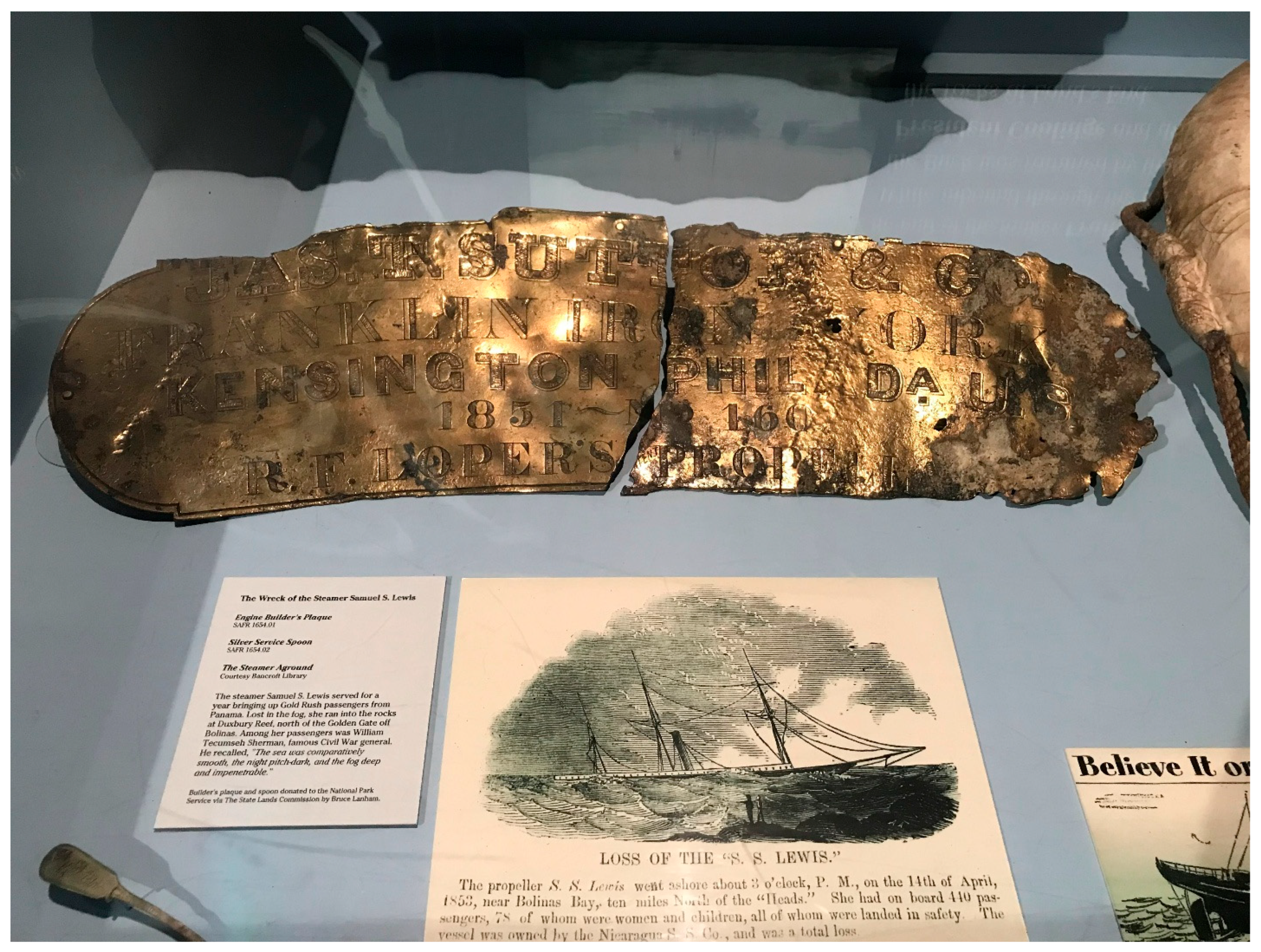
In 1980, Bob and Bruce Lanham recovered two artifacts which clearly identified the wreck; however, they had done historical research, knew the area, and as accomplished, highly proficient (and professional) salvage divers had specifically sought and determined the wreck was that of S.S. Lewis as it was exactly where the 1869 Pacific Coast Pilot placed it. The artifacts were a small silver condiment spoon with the steamer’s name engraved on it, and the builder’s plate for the engine were “smoking gun” additional points of confirmation. The builder’s plate (Figure 6), semicircular and made of brass, is engraved:
| JAS. T. SUTTON & CO. |
| FRANKLIN IRON WORKS |
| KENSIGNTON PHILADA. |
| 1851—No. 160 |
| R.F. LOPER’s PROPELL |
Figure 6.
The engine builder’s plate recovered from the wreck and displayed at San Francisco Maritime National Historical Park (James P. Delgado).
These artifacts, as all of the others previously noted, were recovered legally in 1980 “decades before the laws protecting shipwrecks were enacted”, as noted in a memorandum to the California State Lands Commission by then CSLC General Counsel Pamela Briggs on 30 January 2002. This was also a year before the federal government took steps to designate the waters as then known as Gulf of the Farallones National Marine Sanctuary, now Greater Farallones National Marine Sanctuary. As the Lanham brothers had donated the artifacts to San Francisco Maritime National Historical Park, a unit of the U.S. National Park System, for museum retention and display, the commissioners were asked, as California had subsequently claimed title to the wrecks following the passage of the U.S. Abandoned Shipwreck Act of 1988, to grant title to the artifacts to the Park:
Staff recommends that title to the spoon and plaque, which is vested in the State and in the custody of the Commission, pursuant to P.R.C. 6313(a), be transferred under authority of that section to the San Francisco Maritime National Historical Park. It is recommended that title, rather than custody, be transferred consistent with best museum practice. The Park has the specialized expertise, facilities, and security to properly care for these objects [44].
The Commissioners agreed, and the artifacts were transferred; more than two decades later, they remain on display the park’s visitor center. The acceptance of the artifacts from S.S. Lewis marked a significant shift in the former San Francisco Maritime Museum’s practice and policy. Founded in 1951, the museum collected artifacts and relics from abandoned or derelict vessels, including machinery and deck fittings, but did usually did not accept shipwreck artifacts. This was not a matter of museum or archaeological ethics but more a focus on larger industrial maritime artifacts for interpretive displays. While some artifacts recovered from shipwrecks entered the museum’s collections, these acquisitions were an anomaly, as the museum’s founder, Karl Kortum, had little use for divers and their finds [43] (p. 33).
More recently, Bruce Lanham, following his strong belief in returning artifacts from those dives of decades ago to descendants of ship owners, or passengers involved in the wreck, sent additional artifacts to last known direct descendant of Samuel Shaw Lewis. At her request, these artifacts are undergoing the same process as was done with the builder’s plate and spoon for donation to San Francisco Maritime National Historical Park. These have been studied and cataloged and will be discussed later in this article. It should be noted that, while the wreck site lies on the state tide lands of California, and hence are under the jurisdiction of the California State Lands Commission, it also, as already noted, rests within the area managed by NOAA’s Office of National Marine Sanctuaries as part of Greater Farallones National Marine Sanctuary (GFNMS). The area is a breeding and feeding ground for Carcharodon carcharias, known popularly as the great white shark. The population of these apex predators has grown exponentially since the 1980s, and a reassessment of the local population estimated no less than 2148 white sharks [45] (p. 7). The presence of these animals curtailed and then stopped scientific diving, including archaeological investigation, other than by remotely operated vehicles, for NOAA; neither federal nor state officials dive in these waters, nor have they for many years. A three-year mission to Greater Farallones NMS to assess historic shipwrecks involved the wreck divers, who shared locations and observations. That project was conducted solely with remote sensing, autonomous and remotely operated vehicles [46].
The field notes, site map, underwater imagery and artifacts collected by the Lanham brothers from S.S. Lewis in the years before that mission are the source of the observations the author now makes as a maritime archaeologist. This approach is in line with the observations made in the recent Society for Historical Archaeology publication Wreck Divers and Archaeologists [43] in which the issue was discussed from the perspective of California sites and projects, but with wider implications for the discipline and field. In addition to further examining this aspect of the past of maritime archaeology and shipwreck diving, this article is also the first step in following through with the management recommendation made in 1989 to nominate the wreck site to the National Register of Historic Places [39] (p. 183). These goals are not mutually exclusive.
4. S.S. Lewis: The Wreck Site—Description
The wreck site is defined by the lower hull and scattered wreckage that includes the engine, propeller shaft and propeller, fragments of sheathing, iron diagonal strapping, iron and composition-metal fasteners, portholes, and coal. The remains are consistent with the description of a violent wrecking process that tore the steamer apart after it struck the rocks “and rolled heavily from side to side, sustaining considerable injury from the first shock of the rock and wave” [37] (p. 2). The account of Coast Survey ship Active’s voyage to the wreck site noted that Active
passed through a field of “drift” consisting of mattresses, benches, spars and loose timber, which had floated down from the wreck… of the wreck itself, barely the hull remained” as Lewis “had completely gone to pieces… At the point on which she struck was to be seen a fragment of her hull—the lower portion—and even this remnant was being fast washed apart. Her timbers are strewn along the beach. A portion of her upper works had become disengaged from the main wreck, and drifting a few hundred yards to the southward had sought an easy death among a formidable line of breakers. Only these two vestiges of the Steamer remain up the rocks… Looking upon her wreck one would almost imagine it to be the remains of a vessel lost in the latter part of the last century [37] (p. 2).
The hull was extensively documented in contemporary publications and “is the only early screw steamer for which detailed scantlings are available” [8] (p. 189). That is fortunate, because the wrecking process and subsequent exposure in an active, shallow coastal environment has not been conducive to the survival of wooden structure at the site.
The contemporary, published details of the hull’s construction include the measurements and spacing of “a special set of diagonal iron straps” in the area of the engine, along with “the usual diagonal straps,” and the dimensions of the various wooden components from keel, keelson, frames and planking, as well as the details and spacing of fasteners, which “not counting the strapping” amounted to 125,000 pounds of iron fastenings, 10,000 of copper, and 5000 of composition metal (i.e., brass) [8] (p. 190). The area surrounding the engine, as noted, has large numbers of these fasteners, no longer associated with wood, concentrated in and around the rocks of the seabed. The position of the wreckage indicates that S.S. Lewis swung broadside to starboard, and rests against the reef, which is formed of ridges of steeply dipping strata of Monterey Shale.
The remains of the two boilers, with some of the tubes exposed by the loss of shell plating, and a field of “iron wreckage” and a corroded conglomerate of iron that includes a small anchor, and what may be remains of the steamer’s ten iron tanks that held 12,000 gallons of water, lie to one side of the engine. The engine is upright, still mounted to the cast-iron fourteen-by-sixteen-foot (4.27 by 4.88 m) bedplate. This is 224 square foot (20.81 square meter) bedplate and the machinery atop it are the most prominent features of the wreck site.
The twin sixty-inch diameter (1.52 m) pistons remain set in place at 45 degrees to the vertical, as is the seventeen-inch (43.18 cm) diameter, fourteen-foot (4.27 m)-long overhead crankshaft. The shaft is still connected to the eleven-inch diameter (28 cm) propeller shaft, which was manufactured in three sections. The propeller shaft extends aft for its full sixty-seven feet (20.42 m). Supported by its braces, the engine retains its gears and pinions, the main gear being eight feet (2.44 m) in diameter and connecting to the smaller propeller shaft below it. The gear teeth are lignum vitae.
The English replacement propeller is mounted at the end of the shaft. The dimensions and shape of that propeller were not documented in the archival record; photographs and measurements provided by the Lanham brothers to naval architect and historian Cedric Ridgely-Nevitt enabled him to compare the original and replacement propellers in his landmark study of early American steamships on the Atlantic [8] (p. 191). The wreck divers recovered a large number of fasteners and small artifacts that had been wedged in rocks and scattered on the seabed. They reflect a high-energy near-shore wreck site exposed to the open swell of the Pacific Ocean. There is no exposed wood, only scattered bronze, brass and copper fittings, fasteners and objects. The fasteners are square-headed composite metal spikes, drifts and sheathing nails. They are consistent in style with numerous examples of similar fasteners from California Gold Rush contexts, including Frolic [47] (p. 132) for an overview of this type and style]. Also recovered were the remains of one intact and fragments of composition metal (an older term for brass) portholes, valves as well as steam and water piping, the engine builders’ plate, hinges, handles and latches from cabin doors, and brass keys on rectangular tags.
The key is 3-1/4 inches (82.44 mm) long, with a 1- and 3/4-inch (44.45 mm) loop handle with a brass tag attached by a round ring. The 1-1/2-inch (38.1 mm) by 2-1/2-inch (63.5 mm) tag has the number 25 on one side. The key is from one of the main saloon cabins; the “main saloon contains thirty state rooms” [10] (p. 2). It is a cast brass simple oval loop bow/grip “bit” key (the tooth at the end is the “bit”) [48] (p. 246). This type of key fit a cased lock; “it was not until the early nineteenth century that the rim lock was completely contained within a box having four sides and both a front and a back” [48] (p. 246). Fragments of these case locks were also recovered from the site. These artifacts indicate the disintegration of the upper works of the ship, namely, the saloon.
Another diagnostic artifact that supports this context is an ornately shaped solid brass riser cover once mounted to a fascia board of a stairway. This is a joinery element likely from the passenger areas of the ship, possibly from the main saloon. The plate is a 0.16-inch (two mm) gauge intact piece that is 27 inches (68.58 cm) maximum length with a flat bottom and curlicued upper edge forming the decorative pattern to a maximum height of just under 5 inches (122 mm). It is the same length and height of differently styled brass riser plates found on the aft cabin staircase of the 1878, Scottish-built ship Falls of Clyde, for example. Generally, sailing and steam ships of the period were equipped with ladders for access between decks. “Very little is written about ladders” including inclined ladders that in some ships were effectively staircases and, in some cases, “in spite of basic economy, some inclined ladders became staircases in the truest sense of the word” [49] (pp. 316–317). While details are lacking, mention of staircases as part of the elaborate joinery of cabin passengers on packet ships and steamers of the period appear in the descriptions of these more elegant areas of those vessels [49] (pp. 328–331).
Other finds included a fragment of Muntz metal hull sheathing; one example is a small fragment torn from a sheet of sheathing. It has an irregular edge of 2-3/4 inches (6.9 cm) and a maximum length of 6-1/2 inches (16.5 cm), for a thickness of 26 ounces per square foot. This 60/40 percent metal, a copper–zinc alloy, was first patented in 1832. The fragment from the Lewis wreck has the double oval stamped seal MUNTZ, with a number 3 on its rim, which remains a mystery, but which may be a manufacturer’s code [50] (p. 8). The Lewis fragment has one large 12 mm nail hole, two smaller 6 mm ones at the surviving complete edge—similar to one from Petrel, an Australian barque wreck built in 1847 and lost in 1853: “the vessel’s short life suggests this could be its original sheathing” [50] (p. 8), and which falls within the 1853 date for the loss of SS Lewis. The sheathing is of British manufacture; was it imported to Philadelphia, or is it from a repair made in Liverpool? “In the 1850s, while some yellow metal was being manufactured in the United States, most of it appears to have been imported from mills in Birmingham, and Liverpool” [49] (p. 273).
However, the most iconic and diagnostic artifact recovered was found as a crumpled mass of metal that was carefully treated and flattened to reveal that it was the engine’s builders plate. This is a curved, engraved brass artifact of 28 by 8-1/4 inches (71.12 by 20.96 cm), with incised lettering that identifies the builder. It was a significant find for the divers, as it was a “smoking gun” that revealed the name of the wreck, along with the small silver condiment spoon with “S.S. Lewis” lightly engraved on its handle. These proved to be a significant artifact in more ways than one, as noted, as the donation, once accepted, opened the door for the artifact assemblage to become part of a publicly owned curatorial facility and museum repository, available for study and preserved.
Viewed pragmatically, the author acknowledges that no archaeological project could nor would have been mounted to survey for, identify, document, excavate and conserve those artifacts given the lack of budgetary resources and the hazardous conditions of diving in what divers have referred to as “diving in a washing machine” at a high spin cycle. The author knows these conditions, as well as encountering large marine mammals and sharks, in the murky waters of this section of the California coast. The available resources were expended in surveys and dives at nearby Point Reyes to survey its wrecks, notably the Spanish Manila galleon San Agustin, wrecked in 1595, and the focus of a treasure hunting application. Other projects were emergency responses to the exposure of wooden wrecks in intertidal areas of park beaches in the aftermath of extreme storms between 1982 and 1986, and the remains of S.S. Tennessee that were also exposed by intertidal erosion after storm at the same time [51,52]. None of these involved diving, and minimal resources were available.
5. Discussion and Conclusions
The issue of non-archaeologically recovered assemblages coming into museum collections has been a contentious issue for decades [53,54,55,56,57,58,59]. For professionally accredited museums, accepting and/or displaying artifacts from shipwreck sites is specifically addressed in the standards and bylaws of the International Congress of Maritime Museums (ICMM) and the Council of American Maritime Museums (CAMM). The author is conversant with both as a fifteen-year veteran maritime museum director, as the past President of CAMM, and as a long-standing member of ICMM’s archaeological committee.
A review of the pertinent bylaws for both museum organizations is relevant:
The ICMM bylaws state that
We will not knowingly encourage the illegal, unprofessional or unethical recovery of cultural material by: A. Purchasing or accepting as gifts objects recovered in such a manner; B. Exhibiting objects recovered in such a manner; C. Collaborating with external partners engaged in the illegal, unprofessional or unethical recovery of cultural heritage [60].
The ICMM bylaws also note that
We will only act to preserve material, including associated archival documentation, after recovery has occurred in an illegal, unprofessional or unethical manner, if the material is culturally significant and at serious risk of destruction, damage or irretrievable dispersal, or where we are required to do so by national or local law. Where this is required, we will act in consultation with and at the behest of duly constituted cultural authorities and insofar as it is possible, in accordance with the ICOM Code of Ethics for Museums and the UNESCO Convention on the Protection of the Underwater Cultural Heritage (2001, including its Annex) [60].
The CAMM bylaws state that
CAMM member institutions shall adhere to archaeological standards consistent with those of AAM/ICOM, and shall not knowingly acquire or exhibit artifacts which have been stolen, illegally exported from their country of origin, illegally salvaged or removed from commercially exploited archaeological or historic sites in recent times [61].
There are a few pertinent points reflected in the language which have bearing on the S.S. Lewis artifacts and others collected in the past by divers. How does one specifically define “unprofessional recovery?”
We as archaeologists may have the perspective of being a member of the profession, but highly competent and trained wreck divers may have another, especially in regard to diving skills in extreme environments; this point has been debated in a variety of forums, and ultimately, NOAA came to recognize not only the skills but also the invaluable contributions wreck divers (and military divers) had and could contribute to historically and archaeologically significant shipwrecks in the case of the USS Monitor and the USCS Robert J. Walker [62] (pp. 100–102, 117–138, 140–182); [13].
If a wreck diver was not and is not a practicing archaeologist, were dives where artifacts were recovered decades ago “unethical”? This raises a point that needs to be discussed. Should artifacts only be accepted when collected prior to legislation or regulations? Should authorities offer an “amnesty” to accept collections at risk of final loss if the divers associated with these recoveries seek to relinquish them, or are deceased and the artifacts are at risk of discard? Should there be a statute of limitations to accept some collections while discouraging ongoing, current-day collecting and removal? If dives occurred at a time prior to the imposition of laws and regulations, were they “illegal”? These issues are more than hypothetical, as a number of museums have accepted and curate artifacts from historic shipwrecks that were collected decades ago from wreck divers. While Frolic’s artifacts in the Mendocino Museum are an obvious example, the San Francisco Maritime Museum accepted some artifacts from divers in the 1960s and into the 1970s; these are now federally owned and managed as part of the collections of San Francisco Maritime National Historical Park.
The New Jersey Maritime Museum was founded with wreck diver collections, and NOAA acknowledged their ability to display artifacts removed from the wreck of Robert J. Walker, a U.S. Government-owned vessel, as a U.S. Coast Survey steamer (a predecessor agency of NOAA) lost in the line of duty [63] (pp. 176–177), but also noted in an open public statement that the agency recognized that artifacts recovered in past years by divers before the identity of the vessel was known had not broken any laws, was not seeking action against divers, and hoped that divers would donate their artifacts to NOAA “for conservation and public display at one or all of the public museums in New Jersey. In addition to sharing the story of the Walker, this exhibit would recognize the role of wreck divers in locating and identifying the wreck as well as helping tell its story” [63] (p. 166).
The same approach was taken by NOAA in the U.S. Great Lakes for artifacts recovered from wrecks prior to the establishment of Thunder Bay National Marine Sanctuary (headquartered in Alpena, Michigan), and a similar approach was taken by the Wisconsin Maritime Museum in Manitowoc in 2022. The museum accepted nearly 10,000 artifacts from the collection of the Allen “Butch” Klopp (1944–2021) of Port Washington, Wisconsin. The “Klopp Shipwreck Artifact Collection” was collected from wrecks in the 1960s and 1980s, and displayed in the “Sunken Treasures Maritime Museum” in Port Washington. The Wisconsin Maritime Museum accepted the donation, noting they had done so because the family had donated the artifacts to ensure the collection stayed together and could be displayed for public education.
There are other examples of other museums, and with other collections, on an international scale. The author suspects that many of these were pragmatic decisions that sought to save and keep collections intact, and to not see the artifacts sold off, often in junk shops, or simply discarded. Scuba diving is declining; wreck diving as a subset is also declining. And, as noted in Wreck Divers and Archaeologists [43], these activities were for decades not illegal, but an aspect of the impact of post-World War II scuba, and the thin line that existed between wreck divers and pioneering maritime archaeologists as it emerged as a not initially accepted subdiscipline of archaeology.
A recent review of Wreck Divers and Archaeologists [64] notes that the volume, with interviews and personal narratives of both wreck divers and archaeologists, “allows readers to gain valuable insights into the ethical divide between archaeologists and divers who collect items from shipwrecks,” with a recognition of the divers’ perspective, acknowledging “the powerful connection to the past people may feel by owning or obtaining artefacts, and that an artefact can be a powerful mnemonic reminding us of history or the story of how it was obtained” [64] (p. 1298). The review understood key points the author and colleagues were seeking to make in that Society for Historical Archaeology-published book. The professionalism of wreck divers (some ex-military, others commercial divers) that undertook to research, locate and document sites, reaching out to partner with institutions or agencies, often to be rebuffed in past decades, was one point; another was
the substantial time and resource commitments of the divers and their incredible knowledge and skill sets. These personal perspectives were valuable and interesting, giving readers insights into the sophistication and extent of the divers’ research skills and experience, knowledge and documentation of shipwrecks in California. The narratives also highlight the difficult position some of the divers found themselves in when interacting with archaeologists in the past [64] (p. 1299).
This review, and another by archaeologist and museum director Cathy Green, also stressed how the book was published, in their own words, through oral histories,
to gain an understanding of the perspectives and objectives of both groups, made more powerful by their links to Frolic. These narratives demonstrate that both the archaeologists and divers value shipwrecks and their history and express these connections differently. The book shows what is possible when divers and heritage professionals work in partnership. It also highlights the challenges and effort required for these relationships to be successful and beneficial to archaeologists, divers and society more broadly [65] (p. 79).
As the first part of this article noted, S.S. Lewis, like the business entrepreneur it was named for, is largely forgotten; both man and steamer often a brief mention or a footnote. When popularly referenced, the focus is on American Civil War General William Tecumseh Sherman’s prewar presence on board as a passenger when it wrecked.
The story of S.S. Lewis is both typical for its time and contexts, and yet an aspect that is largely lost to modern audiences. The wreck’s location, in one of the most inaccessible and inhospitable sections of the California coast, effectively meant that no opportunities were available to seek, dive and document, or archaeologically excavate it. That wreck divers did so, and kept their collections, not selling them, and that ultimately Bruce Lanham would seek to donate to a reputable, national museum of the National Park Service, offers the opportunity to reconnect with the physicality of the ship and the people on board, and does so in a way that takes a heritage lost to one of a heritage saved.
Funding
There was no funding provided for this research.
Data Availability Statement
There is no data that is publicly accessible.
Conflicts of Interest
The author declares no conflict of interest.
References
- Fisher, C.E. The Birth of the Express Business. Bull. Bus. Hist. Soc. 1939, 13, 59–63. [Google Scholar] [CrossRef] [Scilit]
- Boston Pilot. Boston Pilot, Boston, MA, USA, 19 December 1840.
- Bancroft, H.H. Chronicles of the Builders of the Commonwealth, Volume V; The History Company: San Francisco, CA, USA, 1891. [Google Scholar]
- Boston Pilot. Boston Pilot, Boston, MA, USA, 16 August 1851.
- Gleason’s Pictorial Drawing-Room Companion. Gleason’s Pictorial Drawing-Room Companion, Boston, MA, USA, 20 September 1851.
- San Francisco Daily Alta California. San Francisco Daily Alta California, San Francisco, CA, USA, 8 July 1852.
- New England Historic Genealogical Society. Memorial Biographies of the New England Historic Genealogical Society; The New England Historic Genealogical Society: Boston, MA, USA, 1881; Volume 2, pp. 1853–1855. [Google Scholar]
- Ridgley-Nevitt, C. American Steamships on the Atlantic; University of Delaware Press: East Brunswick, NJ, USA, 1981. [Google Scholar]
- Heinrich, T.R. Ships for the Seven Seas: Philadelphia Shipbuilding in the Age of Industrial Capitalism; Johns Hopkins University Press: Baltimore, MD, USA, 1997. [Google Scholar]
- Philadelphia Public Ledger. Philadelphia Public Ledger, Philadelphia, PA, USA, 26 August 1851.
- Philadelphia Public Ledger. Philadelphia Public Ledger, Philadelphia, PA, USA, 25 April 1851.
- Philadelphia Public Ledger. Philadelphia Public Ledger, Philadelphia, PA, USA, 13 June 1851.
- Philadelphia Public Ledger. Philadelphia Public Ledger, Philadelphia, PA, USA, 12 June 1851.
- Gibbs, V.C.R. Passenger Liners of the Western Ocean; Staples Press Ltd.: London, UK, 1952. [Google Scholar]
- The Railroad Jubilee—An Account of the Celebration Commemorative of the Opening of Railroad Communication Between Boston and Canada, September 17, 18th and 19th, 1851; J.H. Eastburn, City Printer: Boston, MA, USA, 1852.
- Albion, R.G. Square Riggers on Schedule: The New York Sailing Packets to England, France, and the Cotton Ports; Princeton University Press: Princeton, NJ, USA, 1938. [Google Scholar]
- Delgado, J.P. Steamers to Savannah: The Origins of the New York and Savannah Steam Navigation Company. Am. Neptune 1987, 47, 33–44. [Google Scholar]
- Delgado, J.P. To California by Sea: A Maritime History of the Gold Rush; University of South Carolina Press: Columbia, SC, USA, 1990. [Google Scholar]
- Boston Daily Evening Transcript. Boston Daily Evening Transcript, Boston, MA, USA, 22 September 1851.
- Gleason’s Pictorial Drawing-Room Companion. Gleason’s Pictorial Drawing-Room Companion, Boston, MA, USA, 25 October 1851.
- Boston Daily Evening Transcript. Boston Daily Evening Transcript, Boston, MA, USA, 4 October 1851.
- Boston Daily Evening Transcript. Boston Daily Evening Transcript, Boston, MA, USA, 11 November 1851.
- The Liverpool Mercury. The Liverpool Mercury, Liverpool, UK, 21 October 1851.
- Boston Daily Evening Transcript. Boston Daily Evening Transcript, Boston, MA, USA, 21 November 1851.
- The Liverpool Mercury. The Liverpool Mercury, Liverpool, UK, 24 October 1851.
- Adams, G. The East Boston Directory: Containing the Names, Business and Residences of the Citizens, with A Variety of Other Information; George Adams, Publisher: East Boston, MA, USA, 1852. [Google Scholar]
- Kingston Daily News. Kingston Daily News, Kingston, ON, Canada, 6 January 1852.
- Boston Daily Evening Transcript. Boston Daily Evening Transcript, Boston, MA, USA, 2 January 1852.
- Boston Daily Evening Transcript. Boston Daily Evening Transcript, Boston, MA, USA, 5 January 1852.
- Boston Daily Evening Transcript. Boston Daily Evening Transcript, Boston, MA, USA, 12 February 1852.
- Folkman, D.I. The Nicaragua Route; University of Utah Press: Salt Lake City, UT, USA, 1972. [Google Scholar]
- New York Daily Herald. New York Daily Herald, New York, NY, USA, 12 October 1852.
- San Francisco Daily Alta California. San Francisco Daily Alta California, San Francisco, CA, USA, 5 January 1853.
- San Francisco Daily Alta California. San Francisco Daily Alta California, San Francisco, CA, USA, 13 January 1853.
- Delgado, J.P. Sidewheel Steamships on the Strait: The Pacific Mail Steamship Company’s Depot at Benicia, 1850–1869. In Up the River: Steam Navigation Above Carquinez Strait; David, H., Ed.; Book Club of California: San Francisco, CA, USA, 2003; pp. 7–9. [Google Scholar]
- Sherman, W.T. Memoirs of General William T. Sherman, by Himself; D. Appleton & Co: New York, NY, USA, 1876; Volume 1. [Google Scholar]
- San Francisco Daily Alta California. San Francisco Daily Alta California, San Francisco, CA, USA, 11 April 1853.
- San Francisco Daily Alta California. San Francisco Daily Alta California, San Francisco, CA, USA, 10 April 1853.
- Delgado, J.P.; Haller, S.H. Submerged Cultural Resource Assessment, Golden Gate National Recreation Area, Gulf of the Farallones National Marine Sanctuary and Point Reyes National Seashore; National Park Service: Washington, DC, USA, 1989.
- San Francisco Daily Alta California. San Francisco Daily Alta California, San Francisco, CA, USA, 11 July 1878.
- Davidson, G. Pacific Coast. Coast Pilot of California, Oregon, and Washington Territory; Government Printing Office: Washington, DC, USA, 1869.
- Alley, Bowen & Co., Compilers. History of Marin County, California; Alley, Bowen & Co., Publishers: San Francisco, CA, USA, 1880. [Google Scholar]
- Layton, T.N.; Delgado, J.P. Wreck Divers and Archaeologists: A History of Maritime Archaeology in California; Society for Historical Archaeology: Germantown, MD, USA, 2024. [Google Scholar]
- State Lands Commission. Minute Item C33: Consider Artifact Transfer—SS Samuel S. Lewis Artifacts (Meeting Calendar Item 013002C33). 30 January 2002. Available online: https://slcprdwordpressstorage.blob.core.windows.net/wordpressdata/Meeting_Summaries/2002_Documents/01-30-02/Items/013002C33.pdf (accessed on 25 February 2026).
- Burgess, G.H.; Bruce, B.D.; Cailliet, G.M.; Goldman, K.J.; Grubbs, R.D.; Lowe, C.G.; MacNeil, M.A.; Mollet, H.F.; Weng, K.C.; O’Sullivan, J.B. A Re-Evaluation of the Size of the White Shark (Carcharodon carcharias) Population off California, USA. PLoS ONE 2014, 9, e98078. [Google Scholar] [CrossRef] [Scilit] [PubMed]
- Delgado, J.P.; Schwemmer, R.V.; Brennan, M.L. Shipwrecks and the Maritime Cultural Landscape of the Gulf of the Farallones. J. Marit. Archaeol. 2020, 15, 131–163. [Google Scholar] [CrossRef] [Scilit]
- McCarthy, M. Ships’ Fastenings: From Sewn Boat to Steamship; Texas A&M University Press: College Station, TX, USA, 2023. [Google Scholar]
- Hume, I.N. A Guide to Artifacts of Colonial America; University of Pennsylvania Press: Philadelphia, PA, USA, 2001. [Google Scholar]
- Crothers, W.L. American-Built Packets and Freighters of the 1850s: An Illustrated Study of their Characteristics and Construction; McFarland & Company: Jefferson, NC, USA; London, UK, 2013. [Google Scholar]
- Bingeman, J.M. Copper and Muntz Metal Sheathing: A global update. Int. J. Naut. Archaeol. 2018, 47, 460–471. [Google Scholar] [CrossRef] [Scilit]
- Delgado, J.P. SS Tennessee: A Near-Shore Shipwreck from the California Gold Rush. J. Marit. Archaeol. J. Marit. Archaeol. 2021, 16, 445–476. [Google Scholar] [CrossRef] [Scilit]
- Delgado, J.P. Skeletons in the Sand: National Park Service Work on Intertidal Shipwrecks, 1980–1990. In The Intertidal Shipwreck: Management of a Historic Resource in an Unmanageable Environment; Jennifer, J., Daniel, Z., Calvin, S.M., Eds.; University of Florida Press: Gainesville, FL, USA, 2025; pp. 16–35. [Google Scholar]
- Deuchar, S. Sense and sensitivity: Appraising the Titanic. Int. J. Herit. Stud. 1996, 2, 212–221. [Google Scholar] [CrossRef] [Scilit]
- Hosty, K. A Matter of Ethics: Shipwrecks, Salvage, Archaeology and Museums. Bull. Aust. Inst. Marit. Archaeol. 1995, 19, 33–36. [Google Scholar]
- Hosty, K. Maritime Museums and Maritime Archaeological Exhibitions. In Maritime Archaeology. The Springer Series in Underwater Archaeology; Mark, S., Michael, N., Eds.; Springer: Boston, MA, USA, 2006. [Google Scholar] [CrossRef] [Scilit]
- Johnston, P.F. Is it treasure or a worthless piece of ship? Hist. Archaeol. 1992, 26, 118–123. [Google Scholar] [CrossRef] [Scilit]
- Miller, G.L. The second destruction of the Geldermalsen. Hist. Archaeol. 1992, 26, 124–131. [Google Scholar] [CrossRef] [Scilit]
- Pearson, N. Belitung: The Afterlives of a Shipwreck; University of Hawaii Press: Honolulu, HI, USA, 2023. [Google Scholar]
- Johnston, P.F. Treasure salvage, archaeological ethics and maritime museums. Int. J. Naut. Archaeol. 1993, 22, 53–60. [Google Scholar] [CrossRef] [Scilit]
- International Congress of Maritime Museums (ICMM). New ‘Åland Accord’—A Statement of Code of Ethics for Maritime Museums. 22 May 2020. Available online: https://icmm-maritime.org/2020/05/22/icmm-announces-new-aland-accord-a-statement-of-code-of-ethics-for-maritime-museums/ (accessed on 25 February 2026).
- Council of American Maritime Museums (CAMM). Membership. Council of American Maritime Museums. Available online: https://councilofamericanmaritimemuseums.org/membership/ (accessed on 25 February 2026).
- Broadwater, J.D. USS Monitor: A Historic Ship Completes Its Final Voyage; Texas A&M University Press: College Station, TX, USA, 2012. [Google Scholar]
- Delgado, J.P.; Nagiewicz, S.D. Robert J. Walker: The History and Archeology of a U.S. Coast Survey Steamship; University Press of Florida: Gainesville, FL, USA, 2020. [Google Scholar]
- Edney, J. Book Review, Wrecks Divers and Archaeologists: A History of Maritime Archaeology in California. J. Marit. Archaeol. 2025, 20, 1297–1300. [Google Scholar] [CrossRef] [Scilit]
- Green, C. Book Review, Wreck Divers and Archaeologists: A History of Maritime Archaeology in California. Sea History, 2025; No. 190. pp. 77–79.
Disclaimer/Publisher’s Note: The statements, opinions and data contained in all publications are solely those of the individual author(s) and contributor(s) and not of MDPI and/or the editor(s). MDPI and/or the editor(s) disclaim responsibility for any injury to people or property resulting from any ideas, methods, instructions or products referred to in the content. |
© 2026 by the author. Licensee MDPI, Basel, Switzerland. This article is an open access article distributed under the terms and conditions of the Creative Commons Attribution (CC BY) license.