
Environmental Trade-Offs Between Essential Oil and Quaternary Ammonium Biocides in Cultural Heritage Conservation

 ,
, 
 and
and 
Abstract
1. Introduction
2. Materials and Methods
2.1. Application Scenarios
- FU1—Formulation-based: This comprises 1 kg of ready-to-use biocidal formulation, enabling comparison of intrinsic material burdens independent of application efficiency.
- FU2—Surface-based: This entails 1 m2 of heritage surface treated to achieve ≥99% reduction in viable microbial load, accounting for differences in formulation concentration, application rate, and number of treatment cycles required reported in case studies.
- FU3—Intervention-based: This is a complete conservation intervention including formulation preparation, application, auxiliary materials (cotton pads, brushes, nitrile gloves, protective equipment), and waste management, representing realistic operational practice.
- (1)
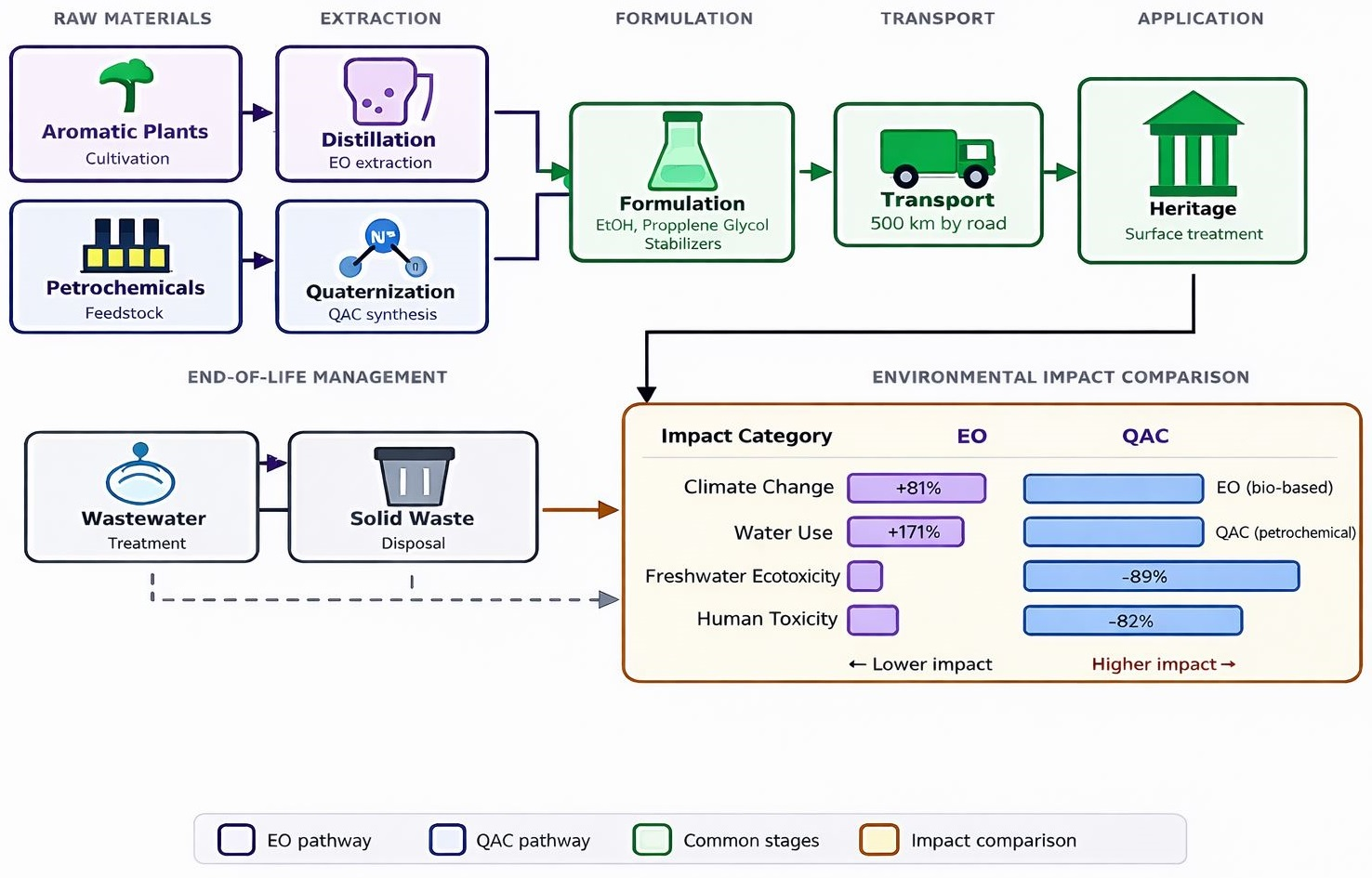
- Raw material production, including agricultural cultivation of aromatic plants for EO and petrochemical feedstocks for QAC synthesis;
- (2)
- Active ingredient production via steam distillation for EO or quaternization reactions for QAC;
- (3)
- Formulation with co-solvents (ethanol, propylene glycol) and stabilizers;
- (4)
- Transport to conservation site (European average, 500 km by road);
- (5)
- Application to heritage surfaces;
- (6)
- End-of-life management, including wastewater treatment for rinse water and municipal solid waste disposal for auxiliary materials.
2.2. Life Cycle Inventory
2.3. Life Cycle Impact Assessment
- (1)
- EO extraction energy demand ± 30%, reflecting variability between industrial facilities and extraction methods;
- (2)
- Number of application cycles ± 1, acknowledging substrate-specific and microbial-specific requirements;
- (3)
- Formulation concentration ± 20%;
- (4)
- Electricity grid composition scenarios including European average (2020), renewable-dominated (80% renewable), and fossil-dominated (80% fossil) mixes.
2.4. Sensitivity and Uncertainty Analysis
- (i)
- Renewable energy integration (80% renewable electricity grid);
- (ii)
- Optimized industrial extraction processes;
- (iii)
- Reduced application cycles based on efficacy thresholds;
- (iv)
- Worst-case laboratory-scale production conditions.
3. Results
3.1. Life Cycle Impact Assessment
3.2. Sensitivity Analysis
3.2.1. Monte Carlo Uncertainty Analysis
3.2.2. Scenario Analysis
4. Discussion
5. Conclusions
Author Contributions
Funding
Data Availability Statement
Acknowledgments
Conflicts of Interest
Abbreviations
| BAC | Benzalkonium Chloride |
| CPC | Cetylpyridinium Chloride |
| CTUe | Comparative Toxic Units for ecosystems |
| CTUh | Comparative Toxic Units for humans |
| CV | Coefficient of Variation |
| DADMAC | Diallyl Dimethyl Ammonium Chloride |
| DDAC | Didecyldimethylammonium Chloride |
| EC10 | 10% Effect Concentration |
| EF | Environmental Footprint |
| EFSA | European Food Safety Authority |
| EO | Essential Oils |
| FU | Functional Unit |
| GWP | Global Warming Potential |
| ILCD | International Reference Life Cycle Data System |
| IPCC | Intergovernmental Panel on Climate Change |
| ISO | International Organization for Standardization |
| JRC | Joint Research Centre |
| LC50 | 50% Lethal Concentration |
| LCA | Life Cycle Assessment |
| LCIA | Life Cycle Impact Assessment |
| MIC | Minimum Inhibitory Concentration |
| NOEC | No Observed Effect Concentration |
| OAT | One-at-a-time |
| PAF | Potentially Affected Fraction |
| PNEC | Predicted No-Effect Concentration |
| PPDB | Pesticide Properties Database |
| PVA | Polyvinyl Alcohol |
| QAC | Quaternary Ammonium Compounds |
| REACH | Registration, Evaluation, Authorization and Restriction of Chemicals |
| SSD | Species Sensitivity Distribution |
References
- Cirone, M.; Figoli, A.; Galiano, F.; La Russa, M.F.; Macchia, A.; Mancuso, R.; Ruffolo, S.A. Innovative methodologies for the conservation of cultural heritage against biodeterioration: A review. Coatings 2023, 13, 1986. [Google Scholar] [CrossRef]
- Liu, X.; Koestler, R.J.; Warscheid, T.; Katayama, Y.; Gu, J.D. Microbial deterioration and sustainable conservation of stone monuments and buildings. Nat. Sustain. 2020, 3, 991–1004. [Google Scholar] [CrossRef]
- Pinna, D. Essential Oils and Cultural Heritage Conservation: Are They Safe, Environmentally Friendly, Sustainable, and Negligibly Toxic? Gels 2025, 11, 978. [Google Scholar] [CrossRef]
- Macchia, A.; Strangis, R.; De Angelis, S.; Cersosimo, M.; Docci, A.; Ricca, M.; Gabriele, B.; Mancuso, R.; La Russa, M.F. Deep eutectic solvents (DESs): Preliminary results for their use such as biocides in the building cultural heritage. Materials 2022, 15, 4005. [Google Scholar] [CrossRef]
- Sterflinger, K. Fungi: Their role in deterioration of cultural heritage. In Fungal Biology Reviews; Elsevier: Amsterdam, The Netherlands, 2010; Volume 24, pp. 47–55. ISSN 1749-4613. [Google Scholar] [CrossRef]
- Gadd, G.M.; Fomina, M.; Pinzari, F. Fungal biodeterioration and preservation of cultural heritage, artwork, and historical artifacts: Extremophily and adaptation. Microbiol. Mol. Biol. Rev. 2024, 88, e00200-22. [Google Scholar] [CrossRef]
- Cappitelli, F.; Cattò, C.; Villa, F. The control of cultural heritage microbial deterioration. Microorganisms 2020, 8, 1542. [Google Scholar] [CrossRef]
- Chiacchiaretta, P.; Prestileo, F.; Stella, E.M.; Aruffo, E.; Simeone, P.; Lanuti, P.; Di Lodovico, S.; Di Giulio, M.; Guarnieri, S.; Del Boccio, P.; et al. Impact of climate change on cyanobacteria growth: A case study of Lama Dei Peligni rock paintings conservation (Majella Massif—Abruzzo Region, Italy). Sustainability 2025, 17, 10861. [Google Scholar] [CrossRef]
- Zaratti, C.; Brunetti, S.; Fondi, V.; Alisi, C.; Prestileo, F.; de Caro, T.; Montorsi, S.; Macchia, A. Luca Vitone: Monitoring of four living canvases. Heritage 2024, 7, 1438–1452. [Google Scholar] [CrossRef]
- Zhang, J.; Cheng, L.; Li, H.; Chen, X.; Zhang, L.; Shan, T.; Wang, J.; Chen, D.; Shen, J.; Zhou, X.; et al. Challenges of quaternary ammonium antimicrobial agents. Sci. Total Environ. 2025, 958, 178020. [Google Scholar] [CrossRef] [PubMed]
- Mohapatra, S.; Yutao, L.; Goh, S.G.; Ng, C.; Luhua, Y.; Tran, N.H.; Gin, K.Y. Quaternary ammonium compounds of emerging concern. J. Hazard. Mater. 2023, 445, 130393. [Google Scholar] [CrossRef]
- Anjali Kumar, S.; Vijayasri, K.; Verma, N.; Tiwari, A. Quaternary ammonium salts-based materials and their biological applications. MRS Commun. 2025, 15, 1393–1403. [Google Scholar] [CrossRef]
- Kwaśniewska, D.; Chen, Y.L.; Wieczorek, D. Biological activity of quaternary ammonium salts and their derivatives. Pathogens 2020, 9, 459. [Google Scholar] [CrossRef]
- Gerba, C.P. Quaternary ammonium biocides: Efficacy in application. Appl. Environ. Microbiol. 2015, 81, 464–469. [Google Scholar] [CrossRef]
- Luci, M.; De Leo, F.; De Pascale, D.; Galasso, C.; La Russa, M.F.; Lo Schiavo, S.; Ricca, M.; Ruffolo, S.A.; Ruocco, N.; Urzì, C. Surface-active ionic-liquid-based coatings as anti-biofilms for stone: An evaluation of their physical properties. Coatings 2023, 13, 1669. [Google Scholar] [CrossRef]
- Vannini, A.; Contardo, T.; Paoli, L.; Scattoni, M.; Favero-Longo, S.E.; Loppi, S. Application of commercial biocides to lichens: Does a physiological recovery occur over time? Int. Biodeterior. Biodegrad. 2018, 129, 189–194. [Google Scholar] [CrossRef]
- Aventaggiato, M.; Valentini, F.; Caissutti, D.; Relucenti, M.; Tafani, M.; Misasi, R.; Zicari, A.; Di Martino, S.; Virtuoso, S.; Neri, A.; et al. Biological effects of small sized graphene oxide nanosheets on human leukocytes. Biomedicines 2024, 12, 256. [Google Scholar] [CrossRef]
- Arnold, W.A.; Blum, A.; Branyan, J.; Bruton, T.A.; Carignan, C.C.; Cortopassi, G.; Datta, S.; DeWitt, J.; Doherty, A.C.; Halden, R.U.; et al. Quaternary ammonium compounds: A chemical class of emerging concern. Environ. Sci. Technol. 2023, 57, 7645–7665. [Google Scholar] [CrossRef]
- Ng, M.K.; Mont, M.A.; Bonutti, P.M. Clinical and environmental harms of quaternary ammonium disinfectants and the promise of ultraviolet-C (UV-C) alternatives: A narrative review. Cureus 2025, 17, e84022. [Google Scholar] [CrossRef] [PubMed]
- Frantz, A.L. Chronic quaternary ammonium compound exposure during the COVID-19 pandemic and the impact on human health. Toxicol. Environ. Health Sci. 2023, 15, 199–206. [Google Scholar] [CrossRef]
- Juksu, K.; Zhao, J.L.; Liu, Y.S.; Yao, L.; Sarin, C.; Sreesai, S.; Klomjek, P.; Jiang, Y.X.; Ying, G.G. Occurrence, fate and risk assessment of biocides in wastewater treatment plants and aquatic environments in Thailand. Sci. Total Environ. 2019, 690, 1110–1119. [Google Scholar] [CrossRef]
- Han, Y.; Zhou, Z.C.; Zhu, L.; Wei, Y.Y.; Feng, W.Q.; Xu, L.; Liu, Y.; Lin, Z.J.; Shuai, X.Y.; Zhang, Z.J.; et al. The Impact and mechanism of quaternary ammonium compounds on the transmission of antibiotic resistance gene. Environ. Sci. Pollut. Res. 2019, 26, 28352–28360. [Google Scholar] [CrossRef]
- Gadea, R.; Glibota, N.; Pérez Pulido, R.; Gálvez, A.; Ortega, E. Adaptation to biocides cetrimide and chlorhexidine in bacteria from organic foods. J. Agric. Food Chem. 2017, 65, 1758–1770. [Google Scholar] [CrossRef]
- Kim, M.; Weigand, M.R.; Oh, S.; Hatt, J.K.; Krishnan, R.; Tezel, U.; Pavlostathis, S.G.; Konstantinidis, K.T. Widely used benzalkonium chloride disinfectants promote antibiotic resistance. Appl. Environ. Microbiol. 2018, 84, e01201-18. [Google Scholar] [CrossRef] [PubMed]
- Hrubec, T.C.; Seguin, R.P.; Xu, L.; Cortopassi, G.A.; Datta, S.; Hanlon, A.L.; Lozano, A.J.; McDonald, V.A.; Healy, C.A.; Anderson, T.C.; et al. Altered toxicological endpoints in humans from common quaternary ammonium compound disinfectant exposure. Toxicol. Rep. 2021, 8, 646–656. [Google Scholar] [CrossRef] [PubMed]
- Miranowicz-Dzierżawska, K.; Zapór, L.; Skowroń, J.; Chojnacka-Puchta, L.; Sawicka, D. Comparative in vitro cytotoxicity of active disinfectant substances and a commercially available surface disinfectant on human respiratory epithelial cells. Interdiscip. Toxicol. 2025, 15, 9–18. [Google Scholar] [CrossRef]
- Wang, G.; Yang, L.; Jiang, L.; Chen, J.; Jing, Q.; Mai, Y.; Deng, L.; Lin, Y.; Chen, L.; Chen, Z.; et al. A new class of quaternary ammonium compounds as potent and environmental friendly disinfectants. J. Clean. Prod. 2022, 379, 134632. [Google Scholar] [CrossRef]
- Palla, F.; Bruno, M.; Mercurio, F.; Tantillo, A.; Rotolo, V. Essential oils as natural biocides in conservation of cultural heritage. Molecules 2020, 25, 730. [Google Scholar] [CrossRef]
- Pop, D.M.; Timar, M.C.; Varodi, A.M.; Beldean, E.C. An evaluation of clove (Eugenia caryophyllata) essential oil as a potential alternative antifungal wood protection system for cultural heritage conservation. Maderas. Cienc. Y Tecnol. 2021, 24, 1–16. [Google Scholar] [CrossRef]
- Paolino, B.; Sorrentino, M.C.; Pacifico, S. Greener solutions for biodeterioration of organic-media cultural heritage: Where are we? Herit. Sci. 2024, 12, 334. [Google Scholar] [CrossRef]
- Paolino, B.; Sorrentino, M.C.; Troisi, J.; Delli Carri, M.; Kiselev, P.; Raimondo, R.; Lahoz, E.; Pacifico, S. Lavandula angustifolia Mill. for a suitable non-invasive treatment against fungal colonization on organic-media cultural heritage. Herit. Sci. 2024, 12, 53. [Google Scholar] [CrossRef]
- Paolino, B.; Sorrentino, M.C.; Macchia, A.; Troisi, J.; Zaratti, C.; Hansen, A.; Ilardi, S.; Russo, G.; Lahoz, E.; Pacifico, S. Lavender essential oil for a contactless application for contemporary art conservation: A case study. Npj Herit. Sci. 2025, 13, 8. [Google Scholar] [CrossRef]
- Argyri, A.A.; Doulgeraki, A.I.; Varla, E.G.; Bikouli, V.C.; Natskoulis, P.I.; Haroutounian, S.A.; Moulas, G.A.; Tassou, C.C.; Chorianopoulos, N.G. Evaluation of plant origin essential oils as herbal biocides for the protection of caves belonging to natural and cultural heritage sites. Microorganisms 2021, 9, 1836. [Google Scholar] [CrossRef] [PubMed]
- Sobhy, M.; Abdelkarim, E.A.; Hussein, M.A.; Aziz, T.; Al-Asmari, F.; Alabbosh, K.F.; Cui, H.; Lin, L. Essential oils as antibacterials against multidrug-resistant foodborne pathogens: Mechanisms, recent advances, and legal considerations. Food Biosci. 2025, 64, 105937. [Google Scholar] [CrossRef]
- Posgay, M.; Greff, B.; Kapcsándi, V.; Lakatos, E. Effect of Thymus vulgaris L. essential oil and thymol on the microbiological properties of meat and meat products: A review. Heliyon 2022, 8, e10812. [Google Scholar] [CrossRef]
- Wińska, K.; Mączka, W.; Łyczko, J.; Grabarczyk, M.; Czubaszek, A.; Szumny, A. Essential oils as antimicrobial agents—Myth or real alternative? Molecules 2019, 24, 2130. [Google Scholar] [CrossRef] [PubMed]
- Ribeiro, M.; Simões, M. Antimicrobial activity of essential oils. In Health Consequences of Microbial Interactions with Hydrocarbons, Oils, and Lipids; Goldfine, H., Ed.; Handbook of hydrocarbon and lipid microbiology; Springer: Cham, Switzerland, 2020. [Google Scholar] [CrossRef]
- Khwaza, V.; Aderibigbe, B.A. Antibacterial activity of selected essential oil components and their derivatives: A review. Antibiotics 2025, 14, 68. [Google Scholar] [CrossRef]
- Aliasghari Veshareh, A.; Mohammadi, P.; Ahmadi, S. Hydrogels containing Thymus vulgaris essential oil as a novel approach for cleaning monument glazed tiles. Npj Herit. Sci. 2025, 13, 130. [Google Scholar] [CrossRef]
- Macchia, A.; Aureli, H.; Prestileo, F.; Ortenzi, F.; Sellathurai, S.; Docci, A.; Cerafogli, E.; Colasanti, I.A.; Ricca, M.; La Russa, M.F. In-situ comparative study of eucalyptus, basil, cloves, thyme, pine tree, and tea tree essential oil biocide efficacy. Methods Protoc. 2022, 5, 37. [Google Scholar] [CrossRef]
- Antonelli, F.; Iovine, S.; Sacco Perasso, C.; Macro, N.; Gioventù, E.; Capasso, F.E.; Bartolini, M. Essential oils and essential-oil-based products compared to chemical biocides against microbial patinas on stone cultural heritage. Coatings 2024, 14, 1546. [Google Scholar] [CrossRef]
- Ranaldi, R.; Rugnini, L.; Gabriele, F.; Spreti, N.; Casieri, C.; Di Marco, G.; Gismondi, A.; Bruno, L. Plant essential oils suspended into hydrogel: Development of an easy-to-use protocol for the restoration of stone cultural heritage. Int. Biodeterior. Biodegrad. 2022, 172, 105436. [Google Scholar] [CrossRef]
- Lopes, A.I.; Melo, A.; Afonso, T.B.; Silva, S.; Barros, L.; Tavaria, F.K.; Pintado, M. Alginate edible films containing essential oils: Characterization and bioactive potential. Polymers 2025, 17, 1188. [Google Scholar] [CrossRef]
- Sterflinger, K.; Piñar, G. Microbial deterioration of cultural heritage and works of art—Tilting at windmills? Appl. Microbiol. Biotechnol. 2013, 97, 9637–9646. [Google Scholar] [CrossRef]
- Ferraz, C.A.; Pastorinho, M.R.; Palmeira-de-Oliveira, A.; Sousa, A.C.A. Ecotoxicity of plant extracts and essential oils: A review. Environ. Pollut. 2022, 292, 118319. [Google Scholar] [CrossRef]
- Sharma, K.; Shah, G.; Singhal, K.; Soni, V. Comprehensive insights into the impact of oil pollution on the environment. Reg. Stud. Mar. Sci. 2024, 74, 103516. [Google Scholar] [CrossRef]
- Gaikwad, R.K.; Mondal, I.H.; Dash, K.K.; Shaikh, A.M.; Béla, K. Effectiveness of sustainable oil extraction techniques: A comprehensive review. J. Agric. Food Res. 2025, 19, 101546. [Google Scholar] [CrossRef]
- Aqeel, U.; Aftab, T.; Khan, M.M.A.; Naeem, M. Regulation of essential oil in aromatic plants under changing environment. J. Appl. Res. Med. Aromat. Plants 2023, 32, 100441. [Google Scholar] [CrossRef]
- Moura, B.; Monteiro, H.; Mata, T.M.; Martins, A.A. Life-cycle energy and carbon emissions of essential oil extraction from rosemary. Energy Rep. 2022, 8, 291–297. [Google Scholar] [CrossRef]
- Jacquemin, L.; Pontalier, P.Y.; Sablayrolles, C. Life cycle assessment (LCA) applied to the process industry: A review. Int. J. Life Cycle Assess. 2012, 17, 1028–1041. [Google Scholar] [CrossRef]
- Klüppel, H.J. The revision of ISO standards 14040-3-ISO 14040: Environmental management—Life cycle assessment—Principles and framework-ISO 14044: Environmental management—Life cycle assessment—Requirements and guidelines. Int. J. Life Cycle Assess. 2005, 10, 165. [Google Scholar] [CrossRef]
- de Souza, N.R.D.; Matt, L.; Sedrik, R.; Vares, L.; Cherubini, F. Integrating ex-ante and prospective life-cycle assessment for advancing the environmental impact analysis of emerging bio-based technologies. Sustain. Prod. Consum. 2023, 43, 319–332. [Google Scholar] [CrossRef]
- Liu, M.; Zhu, G.; Tian, Y. The historical evolution and research trends of life cycle assessment. Green Carbon 2024, 2, 425–437. [Google Scholar] [CrossRef]
- Shlosman, K.; Rein, D.M.; Shemesh, R.; Cohen, Y.; Galant, O.; Spatari, S. Life cycle assessment of cellulose encapsulated essential oils as pesticide and preservative alternatives. J. Polym. Environ. 2025, 33, 1389–1402. [Google Scholar] [CrossRef]
- Husgafvel, R.; Vanhatalo, K.; Rodriguez-Chiang, L.; Linkosalmi, L.; Dahl, O. Comparative global warming potential assessment of eight microcrystalline cellulose manufacturing systems. J. Clean. Prod. 2016, 126, 620–629. [Google Scholar] [CrossRef]
- Ahlgren, S.; Björklund, A.; Ekman, A.; Karlsson Potter, H.; Berlin, J.; Börjesson, P.; Ekvall, T.; Finnveden, G.; Janssen, M.; Strid, I. Review of methodological choices in LCA of biorefinery systems—key issues and recommendations. Biofuels Bioprod. Biorefining 2015, 9, 606–619. [Google Scholar] [CrossRef]
- González-Aguirre, J.A.; Solarte-Toro, J.C.; Cardona Alzate, C.A. Supply chain and environmental assessment of the essential oil production using Calendula (Calendula officinalis) as raw material. Heliyon 2020, 6, e05606. [Google Scholar] [CrossRef] [PubMed]
- Kumar, S.; Sharma, A.K.; Rawat, S.S.; Jain, D.; Ghosh, S. Use of pesticides in agriculture and livestock animals and its impact on environment of India. Asian J. Environ. Sci. 2013, 8, 51–57. [Google Scholar]
- Causil, S.; Villa, A.L. Circular economy and life cycle assessment in extraction process and transformation of essential oils for reaching sustainable development goals. In The Contribution of Life Cycle Analyses and Circular Economy to the Sustainable Development Goals; Brandli, L., Rosa, F.D., Petrorius, R., Veiga Avila, L., Filho, W.L., Eds.; World sustainability series; Springer: Cham, Switzerland, 2025. [Google Scholar] [CrossRef]
- Limam, Z.; Azzaro-Pantel, C.; Hajjaji, N.; Romdhane, M.; Bouajila, J. From process simulation to life cycle assessment: Generating life cycle inventory for the eco-design of essential oil extraction—A case study on Eucalyptus intertexta. Comput. Chem. Eng. 2025, 200, 109140. [Google Scholar] [CrossRef]
- Falcone, G.; Fazari, A.; Vono, G.; Gulisano, G.; Strano, A. Application of the LCA approach to the citrus production chain—A systematic review. Clean. Environ. Syst. 2024, 12, 100156. [Google Scholar] [CrossRef]
- Margni, M.; Rossier, D.; Crettaz, P.; Jolliet, O. Life cycle impact assessment of pesticides on human health and ecosystems. Agric. Ecosyst. Environ. 2002, 93, 379–392. [Google Scholar] [CrossRef]
- van den Berg, H.; Gu, B.; Grenier, B.; Kohlschmid, E.; Al-Eryani, S.; Bezerra, H.S.S.; Nagpal, B.N.; Chanda, E.; Gasimov, E.; Velayudhan, R.; et al. Pesticide lifecycle management in agriculture and public health: Where are the gaps? Sci. Total Environ. 2020, 742, 140598. [Google Scholar] [CrossRef]
- Baima, L.; Nari, L.; Nari, D.; Bossolasco, A.; Blanc, S.; Brun, F. Sustainability analysis of apple orchards: Integrating environmental and economic perspectives. Heliyon 2024, 10, e38397. [Google Scholar] [CrossRef]
- Andreasi Bassi, S.; Biganzoli, F.; Ferrara, N.; Amadei, A.; Valente, A.; Sala, S.; Ardente, F. Updated Characterisation and Normalisation Factors for the Environmental Footprint 3.1 Method; JRC130796; Publications Office of the European Union: Luxembourg, 2023. [Google Scholar] [CrossRef]
- Paolino, B.; Prestileo, F.; Carnazza, P.; Sacco, F.; Strozzi, A.; Congeduti, A.; Macchia, A. Life cycle impact assessment (LCIA) of materials in painting conservation: A pilot protocol for evaluating environmental impact in cultural heritage. Heritage 2025, 8, 212. [Google Scholar] [CrossRef]
- Macchia, A.; Paolino, B.; Zaratti, C.; Prestileo, F.; Sacco, F.; La Russa, M.F.; Ruffolo, S.A. A comprehensive protocol for the life cycle assessment of green systems for painting cleaning. Heritage 2025, 8, 544. [Google Scholar] [CrossRef]
- Gabriele, F.; Ranaldi, R.; Bruno, L.; Casieri, C.; Rugnini, L.; Spreti, N. Biodeterioration of stone monuments: Studies on the influence of bioreceptivity on cyanobacterial biofilm growth and on the biocidal efficacy of essential oils in natural hydrogel. Sci. Total Environ. 2023, 870, 161901. [Google Scholar] [CrossRef] [PubMed]
- Menicucci, F.; Palagano, E.; Michelozzi, M.; Ienco, A. Essential oils for the conservation of paper items. Molecules 2023, 28, 5003. [Google Scholar] [CrossRef] [PubMed]
- Tomić, A.; Šovljanski, O.; Nikolić, V.; Pezo, L.; Aćimović, M.; Cvetković, M.; Stanojev, J.; Kuzmanović, N.; Markov, S. Screening of antifungal activity of essential oils in controlling biocontamination of historical papers in archives. Antibiotics 2023, 12, 103. [Google Scholar] [CrossRef]
- D’Agostino, G.; Giambra, B.; Palla, F.; Bruno, M.; Badalamenti, N. Application of the essential oils of Thymus vulgaris L. and Crithmum maritimum L. as biocides on two Tholu Bommalu Indian leather puppets. Plants 2021, 10, 1508. [Google Scholar] [CrossRef] [PubMed]
- Matusiak, K.; Machnowski, W.; Wrzosek, H.; Polak, J.; Rajkowska, K.; Śmigielski, K.; Kunicka-Styczyńska, A.; Gutarowska, B. Application of Cinnamomum zeylanicum essential oil vapour for heritage textiles. Int. Biodeterior. Biodegrad. 2018, 131, 88–96. [Google Scholar] [CrossRef]
- UNI 11897:2023; Conservazione del Patrimonio Culturale: Linee Guida per L’applicazione Dei Criteri Generali di Qualità Negli Interventi di Conservazione e Restauro Dei Beni Culturali. Ente Italiano di Normazione (UNI): Milano, Italy, 2023.
- Weidema, B.P.; Wesnæs, M.S. Data quality management for life cycle inventories—An example of using data quality indicators. J. Clean. Prod. 1996, 4, 167–174. [Google Scholar] [CrossRef]


| Heritage Substrate/Environment | Application Context | Biocidal System Tested | Main Microbial Targets | Reference |
|---|---|---|---|---|
| Marble stone (outdoor monument) | Archaeological site (Ostia Antica, Italy) | EO vs. QAC (brush application) | Algae, cyanobacteria, bacteria | Macchia 2022 [40] |
| Calcareous stone | Outdoor stone monuments | EO in alginate hydrogel | Cyanobacterial biofilms | Gabriele 2023 [68] |
| Mosaic (glass/stone tesserae) | Monumental mosaic (Rome, Italy) | EO-based hydrogels vs. oxidant biocides | Mixed microbial patina | Antonelli 2024 [41] |
| Historical wood | Indoor heritage objects | Clove EO vs. conventional biocides | Fungi (Aspergillus, Penicillium) | Pop 2021 [29] |
| Wooden artifacts | Museum/storage environments | EO vapor phase | Filamentous fungi | Sterflinger 2013 [44] |
| Paper and archival documents | Archive collections | EO solutions | Bacteria and fungi | Menicucci 2023 Tomić 2023 [69] |
| Hypogean environments (caves) | Natural and cultural caves | Multiple plant EO | Bacteria and fungi | Argyri 2021 [33] |
| Glazed ceramic tiles | Architectural heritage | EO-loaded hydrogels | Fungal colonization | Aliasghari Veshareh 2025 [39] |
| Leather artifacts | Indian leather puppets (Tholu Bommalu) | Thymus and Crithmum EO | Bacteria and fungi | Tomić 2023 [70] D’Agostino 2021 [71] |
| Heritage textiles | Textile collections | Cinnamon EO vapor phase | Bacteria and fungi | Matusiak 2018 [72] |
| Data Source | Reliability | Complete. | Temporal | Geograph. | Technol. |
|---|---|---|---|---|---|
| Ecoinvent v3.8 datasets | 1 | 1 | 2 | 2 | 1 |
| EO extraction [49] | 2 | 2 | 2 | 3 | 2 |
| Application protocols | 2 | 3 | 2 | 2 | 2 |
| QAC proxies (structural) | 3 | 2 | 2 | 2 | 3 |
| USEtox® 2.1 CFs (JRC 2020) | 2 | 2 | 1 | 2 | 2 |
| Case Study | Biocide Conc. | Application Rate | Cycles | Surface | Reference |
|---|---|---|---|---|---|
| Marble (Ostia Antica) | EO 5% QAC 5% | 100 mL/m2 | 2 | 10 m2 | [41] |
| Calcareous stone | EO 0.5% hydrogel | 150 g/m2 | 1 | 5 m2 | [66] |
| Mosaic (Rome) | EO 2% hydrogel | 200 g/m2 | 1 | 2 m2 | [40] |
| Historical wood | EO 5–10% QAC 5% | 300 mL/elem | 3 | 0.5 m2 | [29] |
| Wooden artifacts | EO vapor | 0.5 mL/L air | 1 | 1 m3 | [44] |
| Paper archives | EO 5% | spray | 2 | 100 sheets | [29] |
| Cave environments | EO 0.1–5% | 200 μL/disk | 1 | lab scale | [33] |
| Glazed tiles | EO 5–10% hydrogel | brush overnight | 3 | 6.25 cm2 | [39] |
| Leather puppets | EO undiluted | contact | 1 | object | [71] |
| Heritage textiles | EO vapor | 0.5 mL | 1 | chamber | [72] |
| Scenario | EO (g) | QAC (g) | Water (L) | Energy (MJ) | Aux. Mat. (g) | Reference |
|---|---|---|---|---|---|---|
| Stone 1 m2 (EO) | 5.0 | — | 0.10 | 0.83 | 50 | [41] |
| Stone 1 m2 (QAC) | — | 2.5 | 0.10 | 0.04 | 50 | [41] |
| Hydrogel 1 m2 (EO) | 7.5 | — | 0.15 | 1.25 | 150 | [66] |
| Wood element (EO) | 15.0 | — | 0.30 | 2.49 | 30 | [29] |
| Wood element (QAC) | — | 15.0 | 0.30 | 0.23 | 30 | [29] |
| Tiles 1 m2 (EO) | 80.0 | — | 0.50 | 13.28 | 200 | [39] |
| Process | Energy (MJ/kg) | CO2-eq (kg/kg) | Water (L/kg) | Reference |
|---|---|---|---|---|
| EO steam distillation (industrial) | 166–363 | 8–20 | 1600–3600 | [49] |
| EO hydrodistillation (lab scale) | 10,992 | 541 | 3400 | [49] |
| QAC synthesis (BAC) | 8–15 | 0.5–1.2 | 50–100 | Ecoinvent 3.8 |
| Alginate production | 25–40 | 1.5–2.5 | 200–400 | Ecoinvent 3.8 |
| Ethanol (co-solvent) | 30–35 | 1.8–2.2 | 80–120 | Ecoinvent 3.8 |
| Impact Category | EO-Based | QAC-Based | Δ (%) | Unit |
|---|---|---|---|---|
| Climate Change | 3.8 | 2.1 | +81% | kg CO2-eq |
| Freshwater Ecotoxicity | 0.42 | 2.95 | −86% | CTUe |
| Human Toxicity (non-cancer) | 1.6 × 10⁻⁷ | 8.9 × 10⁻⁷ | −82% | CTUh |
| Human Toxicity (cancer) | 4.1 × 10⁻⁸ | 2.3 × 10⁻⁷ | −82% | CTUh |
| Water Use | 0.19 | 0.07 | +171% | m3 world eq. |
| Impact Category | EO-Based | QAC-Based | Δ (%) | Unit |
|---|---|---|---|---|
| Climate Change | 1.25 | 0.95 | +32% | kg CO2-eq |
| Freshwater Ecotoxicity | 0.14 | 1.31 | −89% | CTUe |
| Human Toxicity (non-cancer) | 5.2 × 10⁻⁸ | 4.1 × 10⁻⁷ | −87% | CTUh |
| Human Toxicity (cancer) | 1.3 × 10⁻⁸ | 9.8 × 10⁻⁸ | −87% | CTUh |
| Impact Category | EO-Based | QAC-Based | Δ (%) | Dominant Hotspot (%) |
|---|---|---|---|---|
| Climate Change (kg CO2-eq) | 2.4 | 2.2 | +9% | EO extraction energy (65%) |
| Freshwater Ecotox. (CTUe) | 0.21 | 2.74 | −92% | QAC active substance (92%) |
| Human Toxicity (CTUh) | 6.8 × 10⁻⁸ | 6.1 × 10⁻⁷ | −89% | QAC active substance (89%) |
| Parameter | Baseline | Low | High | Distribution | Source/Justification |
|---|---|---|---|---|---|
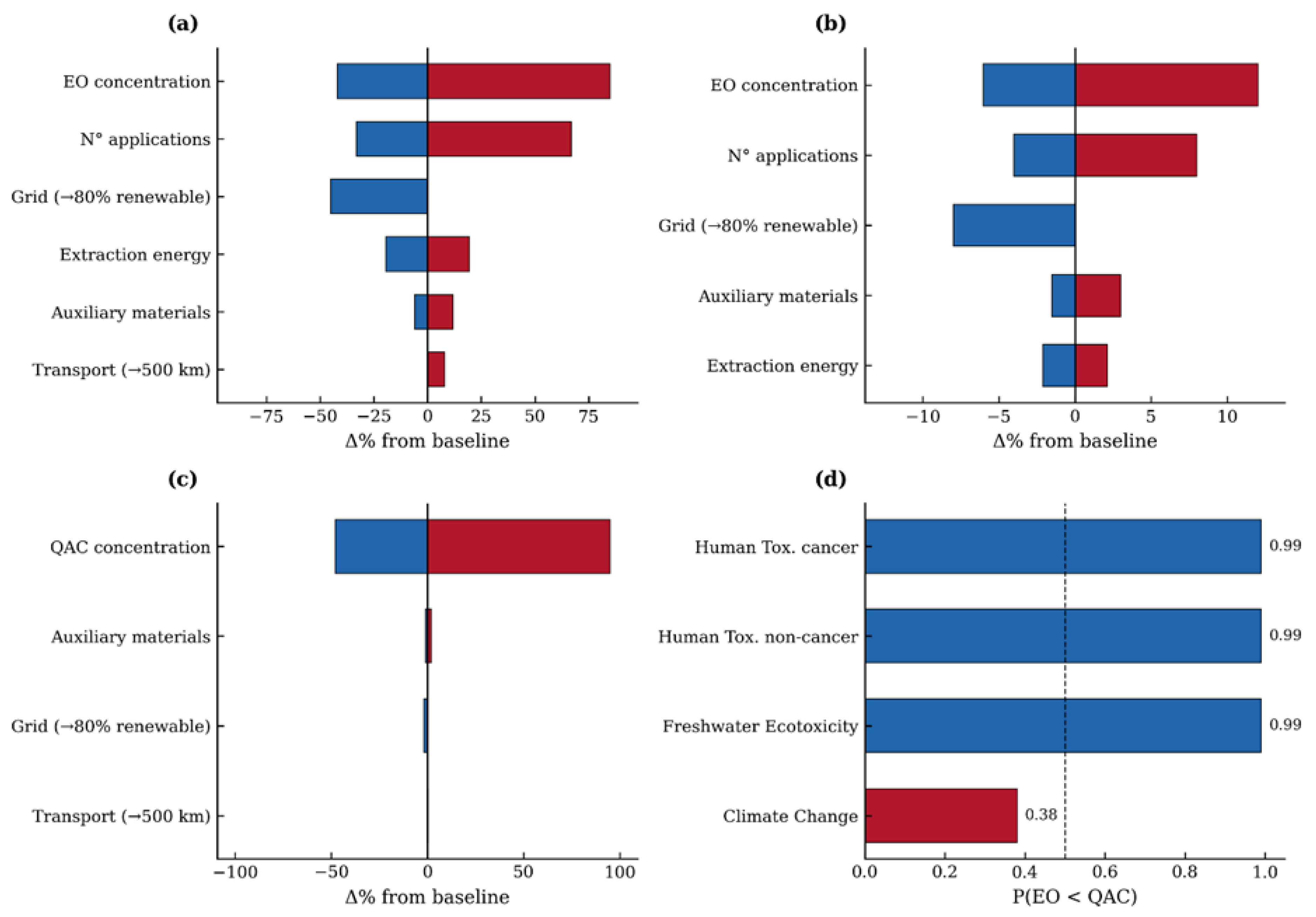
| EO extraction energy (MJ/kg) | 265 | 166 | 363 | Triangular | [49] |
| EO concentration (% v/v) | 5.0 | 2.0 | 10.0 | Triangular | Case study range |
| Number of EO applications | 3 | 2 | 4 | Discrete | Efficacy requirements |
| QAC concentration (% w/v) | 2.5 | 1.0 | 5.0 | Triangular | Manufacturer species |
| Electricity grid (% renewable) | 35 | 15 | 80 | Triangular | EU grid scenarios |
| EO yield (g/kg biomass) | 15 | 8 | 25 | Lognormal | Literature range |
| Auxiliary materials (g/m2) | 100 | 50 | 150 | Triangular | Application method |
| Transport distance (km) | 100 | 50 | 500 | Triangular | Supply chain |
| Parameter Variation | ΔClimate (EO) | ΔEcotox (EO) | ΔClimate (QAC) | ΔEcotox (QAC) |
|---|---|---|---|---|
| EO energy + 30% | +19.5% | +2.1% | — | — |
| EO energy − 30% | −19.5% | −2.1% | — | — |
| EO concentration × 2 | +85% | +12% | — | — |
| EO applications 2→4 | +67% | +8% | — | — |
| QAC concentration × 2 | — | — | +15% | +95% |
| Grid 35%→80% renewable | −45% | −8% | −12% | −2% |
| Transport 100→500 km | +8% | +1% | +5% | +0.5% |
| Auxiliary materials + 50% | +12% | +3% | +10% | +2% |
| Impact Category (FU2) | Mean EO | 95% CI EO | Mean QAC | 95% CI QAC | P(EO < QAC) |
|---|---|---|---|---|---|
| Climate Change (kg CO2-eq) | 1.25 | 0.78–1.89 | 0.95 | 0.72–1.28 | 38% |
| Freshwater Ecotoxicity (CTUe) | 0.14 | 0.08–0.24 | 1.31 | 0.89–1.92 | >99% |
| Human Tox. non-cancer (CTUh) | 5.2 × 10⁻⁸ | 2.9–8.1 × 10⁻⁸ | 4.1 × 10⁻⁷ | 2.8–5.9 × 10⁻⁷ | >99% |
| Human Tox. cancer (CTUh) | 1.3 × 10⁻⁸ | 0.7–2.1 × 10⁻⁸ | 9.8 × 10⁻⁸ | 6.5–14.2 × 10⁻⁸ | >99% |
| Scenario | Climate EO | Climate QAC | Ecotox EO | Ecotox QAC |
|---|---|---|---|---|
| Baseline (EU avg grid) | 1.25 | 0.95 | 0.14 | 1.31 |
| Renewable grid (80%) | 0.69 | 0.84 | 0.13 | 1.29 |
| Industrial EO (optimized) | 0.85 | 0.95 | 0.11 | 1.31 |
| Reduced applications (2 cycles) | 0.83 | 0.95 | 0.09 | 1.31 |
| Best case EO (combined) | 0.52 | 0.95 | 0.08 | 1.31 |
| Worst case EO (lab scale) | 3.85 | 0.95 | 0.18 | 1.31 |
Disclaimer/Publisher’s Note: The statements, opinions and data contained in all publications are solely those of the individual author(s) and contributor(s) and not of MDPI and/or the editor(s). MDPI and/or the editor(s) disclaim responsibility for any injury to people or property resulting from any ideas, methods, instructions or products referred to in the content. |
© 2026 by the authors. Licensee MDPI, Basel, Switzerland. This article is an open access article distributed under the terms and conditions of the Creative Commons Attribution (CC BY) license.
Share and Cite
Macchia, A.; Zaratti, C.; Paolino, B.; Canini, A.; Ruffolo, S.A.; La Russa, M.F.; Valentini, F.; Prestileo, F. Environmental Trade-Offs Between Essential Oil and Quaternary Ammonium Biocides in Cultural Heritage Conservation. Heritage 2026, 9, 82. https://doi.org/10.3390/heritage9020082
Macchia A, Zaratti C, Paolino B, Canini A, Ruffolo SA, La Russa MF, Valentini F, Prestileo F. Environmental Trade-Offs Between Essential Oil and Quaternary Ammonium Biocides in Cultural Heritage Conservation. Heritage. 2026; 9(2):82. https://doi.org/10.3390/heritage9020082
Chicago/Turabian StyleMacchia, Andrea, Camilla Zaratti, Benedetta Paolino, Antonella Canini, Silvestro Antonio Ruffolo, Mauro Francesco La Russa, Federica Valentini, and Fernanda Prestileo. 2026. "Environmental Trade-Offs Between Essential Oil and Quaternary Ammonium Biocides in Cultural Heritage Conservation" Heritage 9, no. 2: 82. https://doi.org/10.3390/heritage9020082
APA StyleMacchia, A., Zaratti, C., Paolino, B., Canini, A., Ruffolo, S. A., La Russa, M. F., Valentini, F., & Prestileo, F. (2026). Environmental Trade-Offs Between Essential Oil and Quaternary Ammonium Biocides in Cultural Heritage Conservation. Heritage, 9(2), 82. https://doi.org/10.3390/heritage9020082