1. Introduction
A Holocene sea level rise and increased river sediment transport and sedimentation after the Last Glacial Maximum (LGM) were the primary factors shaping coastal environments (e.g., [
1,
2,
3,
4]). Studies on the Mediterranean’s alluvial–coastal plains, marine embayments, river mouths and rocky coasts reveal that the Early Holocene sea level rise triggered a general marine transgression that extended to several kilometers inland [
4,
5,
6,
7,
8,
9]. The transgression was followed by pronounced coastal progradation, which began around 6.0 ka and was driven by the combined effects of a decreasing rate in the sea level rise and increasing river sediment supply [
10]. The latter intensified particularly during the last ~3 ka, as a result of strong anthropogenic pressure on coastal environments and watersheds [
11,
12]. The coastal progradation occurred in more steps that progressively moved forward articulated sandy barrier–lagoonal systems composed of sandy beach–dune landforms and lagoonal and pond environments [
13]. In many cases, these environments were often selected for maritime activities, including harbours, embayments, fish farms and salt production [
14,
15]. Starting from 6.0 ka, lagoonal or back barrier depressions were progressively silted up by fluvial depositions, and consequently, they became marshes and swamps [
16,
17]. The resulting shoreline progradation and silting of embayments forced the change in position of harbours and maritime activities during the Greek–Roman period.
Thus, the Late Quaternary coastal landforms and sedimentary sequences are crucial systems for understanding the relationship between natural and anthropogenic coastal evolution, especially within areas that have been urbanized since early historical times [
17].
Several suitable stratigraphical proxies can be found in the sedimentary successions of these environments, which enable detailed paleogeographical reconstructions and consequently hypothesize the harbour locations [
18,
19,
20]. Today, most ancient harbours are either submerged and partly eroded or landlocked and buried, or they are often distant from the present coastline due to the extensive coastal changes that have taken place since they were in use [
15,
21,
22]. The most common natural factors that result in the ancient harbour basins losing their functions and their subsequent abandonment are gradual relative sea level changes and strong siltation, along with extreme events such as floods and storms. In the most extreme cases, when river sediment supply was exceptionally high, the shoreline progradation led to kilometric coastline advancements that completely landlocked many ancient maritime settlements and structures, such as ports, harbours and quays [
20].
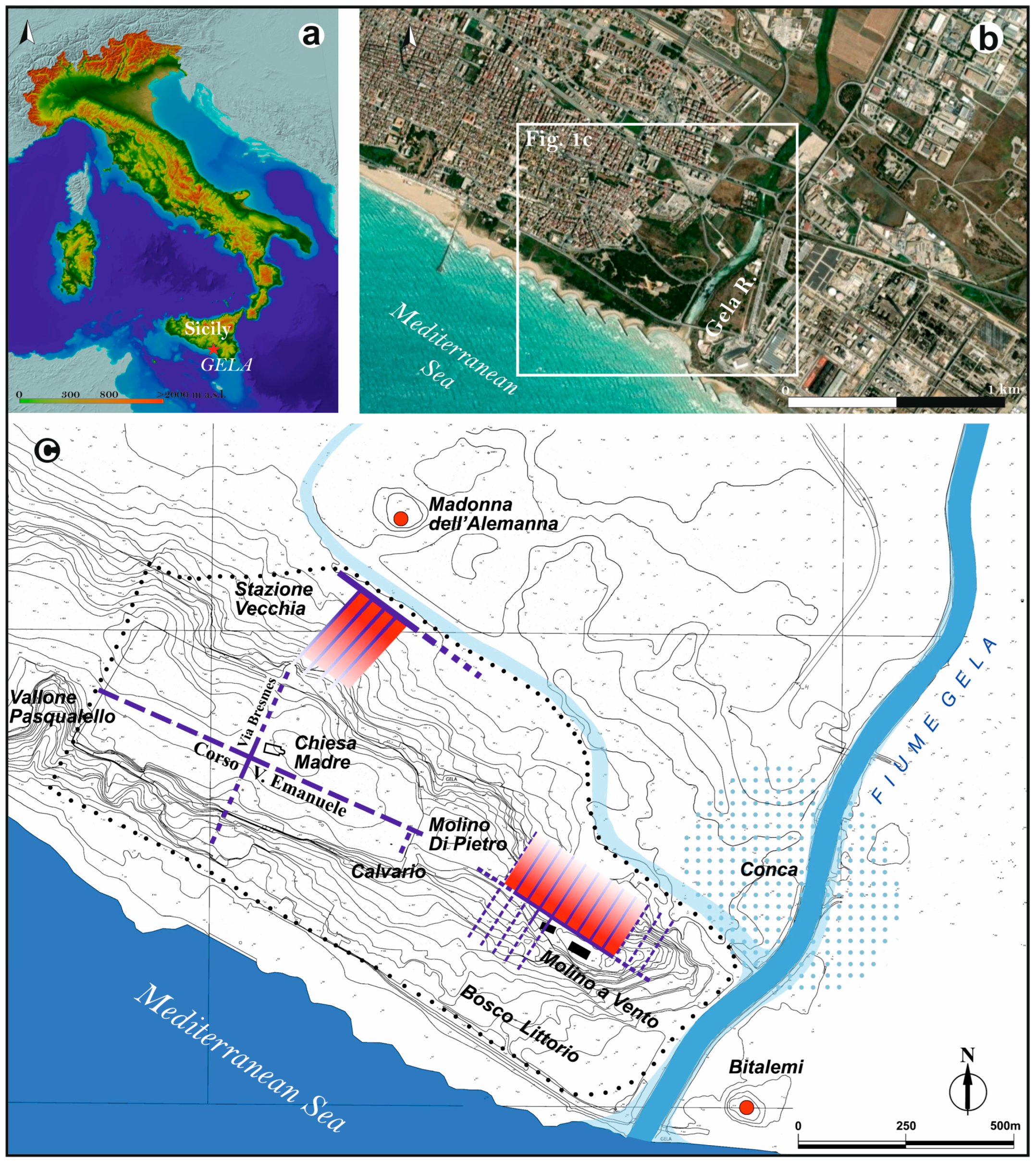
This study focuses on the Mediterranean coastal area near the ancient city of Gela, located in the southern sector of Sicily Province (Southern Italy,
Figure 1), very close to the fluvial mouth of the Gela River (
Figure 1a,b). This area was chosen as a human settlement since the Early Holocene (Copper and Bronze Ages, see
Section 3, Archaeological setting), and then in historical times, it became a site of a town and harbour-related facilities. The historical center of Gela and its coastal sector have been significantly modified over the last 2.7 ka, particularly after the Greek colonization [
23]. The Greek city was established on a Plio-Pleistocene marine terrace (ca. 45 m above sea level) with an elongated shape (4 km long), parallel to the sea, rather flat at the top and with not very steep sides (
Figure 1c). Behind this hill stretches a large plain, crossed to the east by the river from which the city took its name.
The features of coastal landforms in historical times and the location of the ancient harbour structures remain largely unknown and never investigated. Equally, current knowledge of the Holocene paleogeographical evolution of the Gela coast is limited, as unlike other coastal sectors of the southern Sicily coasts, meaningful landforms and outcrops are lacking. Currently, however, the river estuary does not appear to function as a natural harbour (
Figure 1b), as it has been subject to continuous silting up. The entire coast of Gela seems to lack suitable inlets for maritime activities.
For this reason, the area has been the focus of a multidisciplinary research project called M.I.R.A.GE. (Multidisciplinary Investigations for the Reconstruction of the Ancient Landscape of Gela), conducted by a team of researchers from various universities and partially funded by EniMed S.p.A. of Gela.
To fill the gap in knowledge on Late Holocene (last 5.0 ka) coastal configuration, a multi-method study was conducted, which included historical, archaeological, geomorphological, stratigraphical, paleontological and geochronological approaches. Data integration also enabled the formulation of hypotheses about the location of the ancient harbour of Gela, beginning with the Greek colonization, and consequently of the causes of its disappearance. The study began with an analysis of written sources, historical cartography and aerial photographs [
25], as well as from a schematic paleogeographical and paleolandscape reconstruction of Gela territories [
26]. An extensive field archeological survey was conducted in the sector of the Conca basin, followed also by the excavation of a small archaeological trench. Finally, we planned a detailed geomorphological study that guided the selection of the new stratigraphical data from boreholes and geophysical surveys, as well as new archaeological investigations. Targeted samples from borehole layers were subjected to stratigraphical, paleontological and paleoecological analysis, as well as geochronological and archeological dating. More details were given to investigating and reconstructing the coastal landforms and environments of a little sector of the Gela territory that, thanks to several archaeological and geomorphological indicators, was considered more promising than other areas for the location of the Greek harbour.
2. Geological and Geomorphological Setting
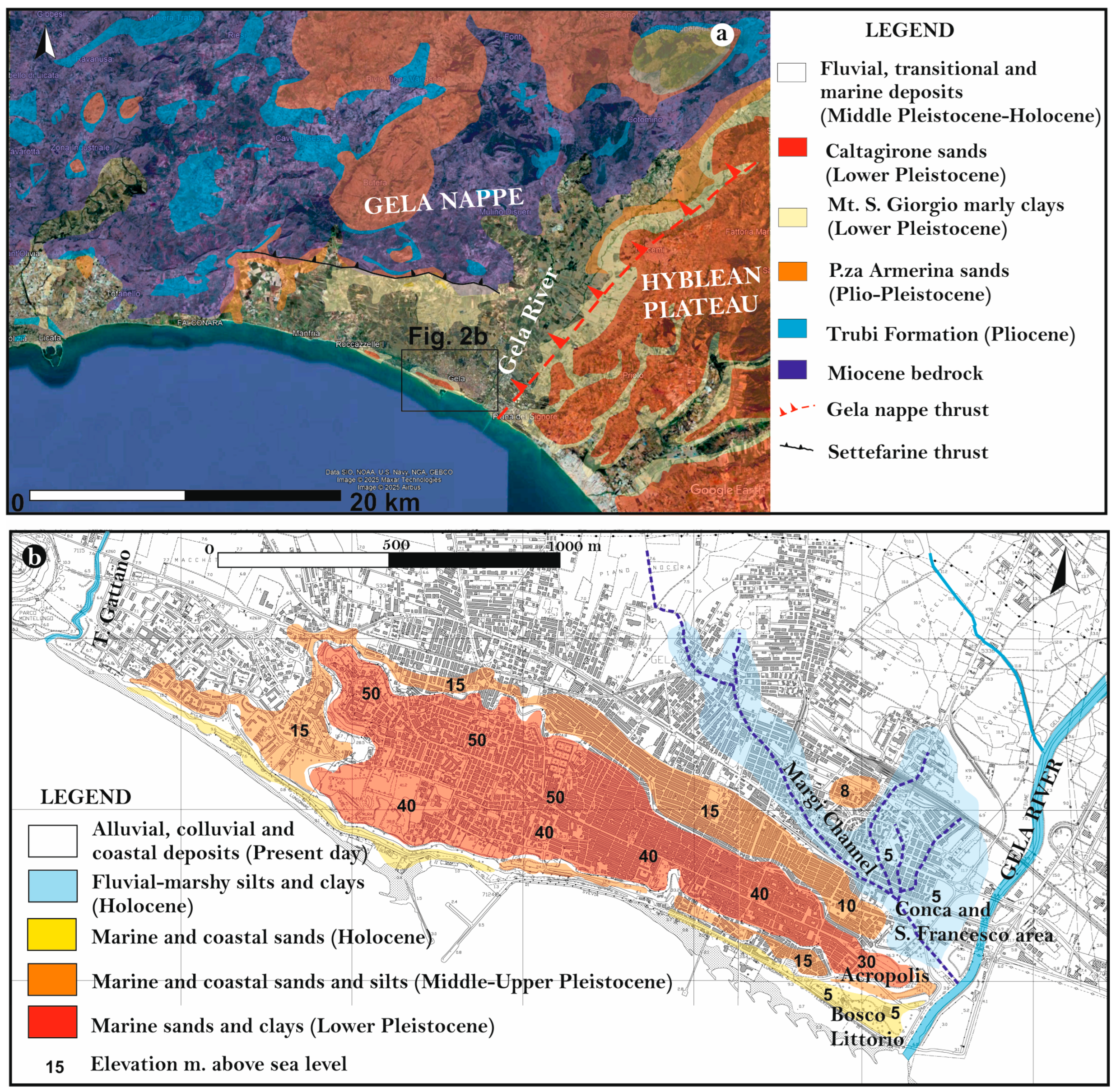
The study area lies within the transitional zone between the Gela Nappe and the Hyblean Foreland (
Figure 2a), part of a complex thrust-and-fold belt in the central Mediterranean area, known as the Sicilian orogenic system [
27]. The Sicilian orogenic system developed in response to the collision of the leading margin of the African Plate with more internal units of the European province, a process that began in the Neogene and continued into the Pleistocene [
27,
28,
29,
30,
31].
The Gela alluvial–coastal plain was formed by tectono-eustatic processes of the Sicilian orogenic system, which, particularly during Plio-Quaternary, underwent several tectonic phases that led to sea level changes and marine transgressions [
32,
33,
34,
35]. These transgressive phases resulted in the deposition of thick marine succession, organized in more tectonic units, known as Gela Nappe [
36,
37,
38,
39], and mainly made of clay, marl, sand and evaporitic deposits [
40,
41,
42,
43], all deposited in an active tectonic context [
44]. Also, chaotic rocky deposits (olistostrome) of Miocene–Pliocene age are present [
45,
46], generally covered by Plio-Pleistocene deposits that form a complete regressive cycle [
47,
48].
The geology of the Gela territory is briefly synthesized in
Figure 2 where Miocene–Quaternary stratigraphical units are grouped from youngest to oldest, as reported in [
27].
- -
Clays, silts, sands and gravels of fluvial, marine, coastal, marshy and slope environments show heterotopic relationships and similar chronologies (Middle to Late Pleistocene–Holocene). They outcrop mainly on the Gela River’s alluvial coastal plain, on the narrow and elongated coastal strip and in the piedmont area of the inner hills.
- -
Clayey deposits (M. S. Giorgio Unit of [
27]) passing upward to clayey sands and sands (Caltagirone Unit of [
27]). They are of Lower Pleistocene age and mainly outcrop on the left side of the hills bordering the Gela River alluvial plain, forming the bedrock of the Gela town terrace.
- -
Marly clays and silts of the regressive cycle of P.za Armerina Sand Unit of [
27] dating to the Upper Pliocene (
Globorotalia aemiliana zone). They are gradually covered by sandy clays and silts with local intercalation of sandstones of Upper Pliocene–Lower Pleistocene age (
Globorotalia inflata zone). These deposits gradually transition upward to yellowish sands and gravelly sands and marls also including local bioclastic layers. The age is Lower Pleistocene (
Globorotalia inflata zone). They outcrop mainly in the inner part of the Gela River alluvial coastal plain, forming little hills that reach up to 300 m above sea level (m. a.s.l.).
- -
Well-stratified marls and calcareous marls and clays known as Trubi Formation. They are of Lower–Middle Pliocene age (Globorotalia margaritae and Globorotalia puncticulata zones), and they form little hilly reliefs in the inner part of the plain, which have been reduced to small outcrops due to erosion.
- -
The Plio-Quaternary succession is deposited in unconformity on Miocene units, which are mainly made of several cycles of marine deposition both of deep environments and evaporitic sedimentation. Chalks, clayey marls, evaporitic limestones, diatom marls and diatoms of Messinian age are in unconformity on pelagic successions, mainly made of siliciclastic deposits, passing upward to sandy clays and calcareous marls of Tortonian age. They constitute the hilly landforms of the inner territory of the so-called Gela nappe.
From a geomorphological point of view, Gela lies mainly on the top of a flat surface cut on the Lower Pleistocene deposits of the Caltagirone sands and M. S. Giorgio clays, forming a broad erosional terrace, WNW-ESE elongated and dipping from WNW to ESE, with elevations ranging from 50 to 30 m a.s.l. (
Figure 2b). The terrace, which has been significantly modified by human activities and urbanization over the past few centuries, is wider on the WNW side, where it extends for several hundred meters, while on the ESE side, it narrows to approximately 100 m. Toward the coast, remnants of marine terraces are present at elevations between 15 and 8 m a.s.l. Similar features also occur in the inner part of the Lower Pleistocene terrace, where they are better preserved. Although no chronological data are available in the literature, we hypothesize that these terraces may be linked to glacio-eustatic sea level highstands during past interglacial periods, most likely the MIS 5.5 stage and earlier MIS events. Toward the coast, both Lower Pleistocene deposits and Upper Pleistocene deposits present a steep slope that could be interpreted as a paleocliff related to the post-glacial transgressive phase of the sea level rise. The paleocliff was also affected by several erosional landforms such as landslides and mass movements. Many of these phenomena were active during historical times because they partially impacted the borders of the ancient city. Downstream from the paleocliff, a narrow and WNW-ESE elongated sandy strip is present. It is made of an overlap of more generations of beaches and dunal systems that are fully weathered due to recent urbanization.
Only in the sector closest to the mouth of the Gela River is the sandy coastal strip still preserved (
Figure 2b). In this area, known as Bosco Littorio, the remains of an urban district of the Greek city have been uncovered (
Figure 1c and
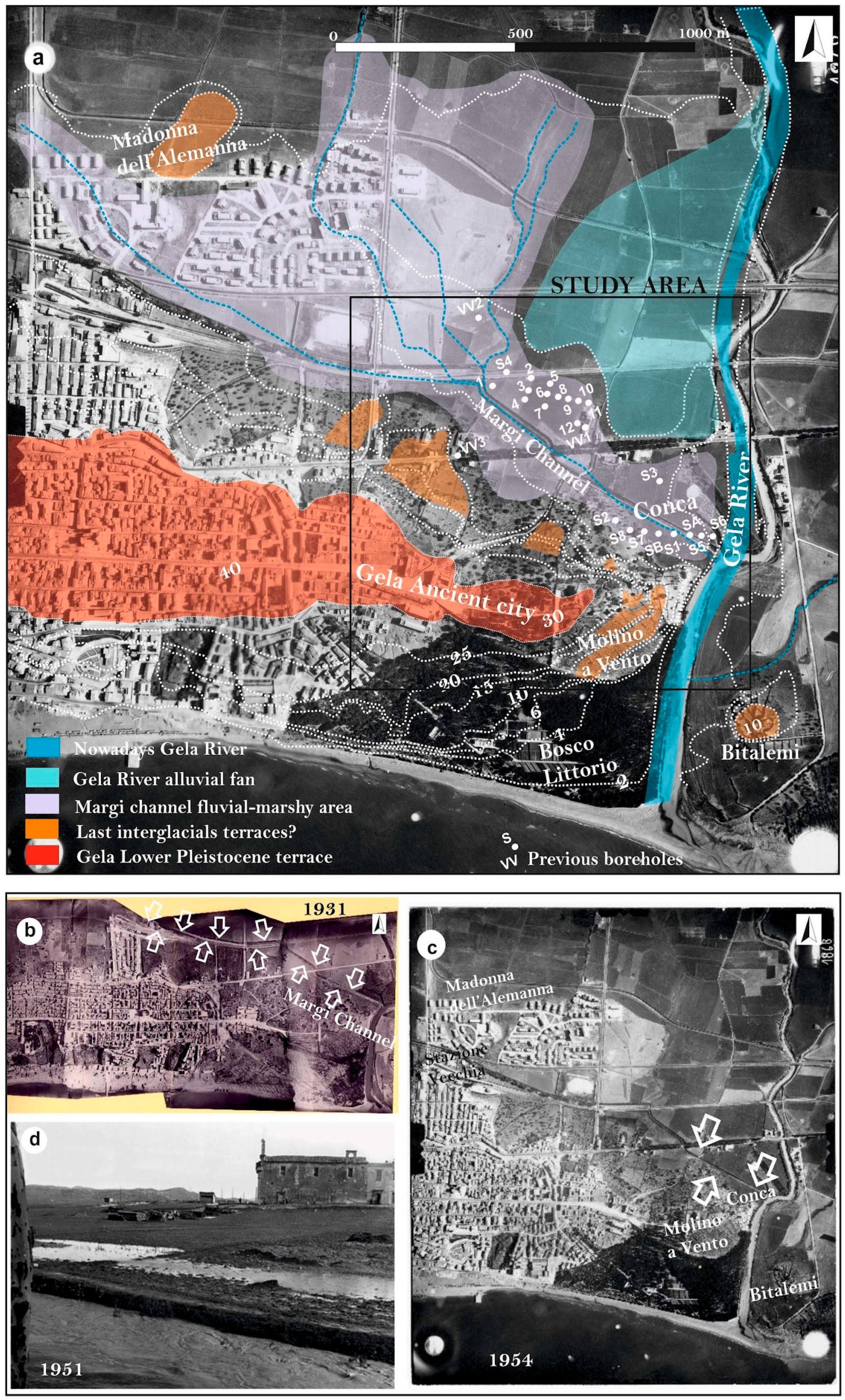
Figure 2b). The inner part of the plain presents typical landforms of the alluvial–coastal plain, including a wide flat surface with traces of ancient hydrographic networks, reclamation channels and relics of marshy areas, as well as of fluvial landforms resulting from Late Holocene Gela River floods. One of these fluvial–marshy traces is present near the NE flank of the Gela terrace. It was preserved until the last century, as shown by historical aerial photos and evidenced as the Margi channel in
Figure 2b and which will be discussed further in
Section 5.1. This channel seems to flow into the Gela River near a depression known by the toponym
Conca (Basin in English). The Conca could be interpreted as the relic of an ancient lagoonal or marshy depression or as an ancient oxbow of the Gela River. The Gela River in its final stretch follows a straight course due to artificial embankments built to prevent disastrous flooding. Also, the coastal sector has been artificially preserved by means of coastal defense works to prevent erosion. The SE sector of the alluvial coastal plain was totally modified in the 1960s by the construction of a large ENI petrochemical plant (now converted into a biorefinery), which significantly contributed to the environmental and ecological pollution of Gela territory [
49].
3. Archeological Setting
Gela was one of the most important Greek colonies in the Mediterranean Sea [
23,
50,
51,
52,
53,
54,
55]. It was founded by Rhodians and Cretans in 689–688 BCE, in an area that had been partly inhabited during the Copper and Bronze Ages [
50,
51,
52,
53,
55]. In the first two centuries of its history, the Greek city became very prosperous thanks to the fertility of the alluvial plain, making it one of the main wheat-producing centers in the Mediterranean. At the beginning of the 5th century BCE, the tyrant
Hippocrates and, later, the tyrants
Gelon and
Hieron, belonging to the
Dinomenid dynasty, with their expansionist policies, gave the city a leading role among the powers of the Mediterranean Sea [
50,
51,
52,
53,
54,
55].
According to recent studies [
23,
54], the urban area in the 6th—5th century BCE extended for approximately 100 hectares, occupying both the summit plateau and the sides of the hill, in the sector between the area called Molino a Vento and the Vallone Pasqualello, which marked the city’s western border, beyond which the necropolis extended (
Figure 1c). The urban layout was characterized by a main road on the ridge of the hill and secondary roads that followed the slopes. The sacred acropolis, with the temples of the Polyadic deities, was located on the southern side of the Molino a Vento area [
53,
56], while another important urban sanctuary was near the modern city’s main Christian church [
56,
57]. Residential areas extended mainly along the hill’s slopes (
Figure 1c), including the northern slope, where the urban blocks of the Molino a Vento area [
58] and of the Stazione Vecchia were uncovered [
23,
59], and the southern slope, stretching toward the coast, where the Bosco Littorio district was discovered [
23,
60,
61]. Outside the supposed perimeter of the city, two extra-urban sanctuaries were located (
Figure 1c). One was situated to the north, on the small hill of the Church of
Madonna dell’Alemanna [
62,
63], and the other to the east, across the Gela River, on the small hill of
Bitalemi [
56,
64,
65].
After the fall of the tyranny, Gela went through a rather difficult period and was finally destroyed by the Carthaginians in 405 BCE. The city remained almost uninhabited for about 60 years, until it was refounded by the Corinthian
Timoleon in a different area of the hill from that of the older city, precisely to the west of the Vallone Pasqualello, where the necropolis previously extended [
53,
55]. However, the settlement never again reached its former glory, and it finally ceased to exist in 282 BCE. During the Roman era, the site was no longer urbanized, though the surrounding territory continued to be used for agricultural purposes, as evidenced by the remains of a farm in the Bitalemi area [
65]. In 1233 CE, Frederick II, King of Sicily and Emperor of the Holy Roman Empire, founded the city of
Heraclea, later called
Terranova, in the central sector of the hilltop [
66], on the ruins of a portion of the Greek settlement. From this small, fortified center, the modern town developed and in 1927 CE regained its ancient name of Gela.
Most likely the Greek city had a harbour basin to support the needs of an important
polis, particularly during its maximum flowering period between the 6th and 5th century BCE. Indeed, ancient sources attest that the vast plain produced a great abundance of cereals, which were also destined for wide-ranging exportation
1,2,3,4; and, on the other hand, archaeological excavations have brought to light numerous imported artefacts (valuable objects, transport amphorae containing the finest wines in the Greek world) attesting the intense trade with Mediterranean peoples [
67]. In addition, the Greek historian
Thucydides says that at the beginning of the 5th century BCE, only the
Corcyraeans and tyrants of Sicily had substantial military fleets (
Thucydides. I, 14), suggesting that Gela, under the
Dinomenids tyranny, must have had numerous warships and a secure harbour for their shelter. However, ancient sources do not provide any indication of the location of the harbor and, since the 1960s, researchers have simplistically assumed that it was located at the mouth of the Gela River [
52,
68].
Historical and archival sources highlight that the surrounding territory of the city was once much richer in water than it is today, with small lakes and marshes [
25].
Pliny the Elder (1st century CE) mentions a salt lake near the city of Gela
5; and the
Paradoxographus Florentinus (late 1st–2nd century CE) refers to a marsh called
Silla in the area
6. The existence of marshes is well documented in Gela even in the Middle Age and later. Large wetlands, such as the Margi to the north, and the Catarrosone/Piana del Signore to the east, extended around the city [
25]. Furthermore, in the 18th century, Vito Amico described a small river [
69], most likely a tributary of the Gela River, flowing west to east along the northern side of the hill, where a drainage canal, known as the Canale Margi, was constructed at the beginning of the last century [
25].
Finally, aerial photographs from the 1931 Italian Air Force flight and the 1954 EIRA company flight reveal a depressed area prone to flooding during rainy periods, located behind the eastern end of the hill (the Molino a Vento area and the Greek city’s acropolis), between the hill and the final stretch of the Gela River [
25]. This zone includes parts of the district of S. Francesco, and, above all, the locality named Conca in the old cartography (i.e., Basin), where the Canale Margi once flowed into the Gela River (
Figure 2b). Surface surveys in this area have yielded no archaeological evidence or significant quantities of ancient ceramic fragments. Therefore, before planning extensive archeological excavations, it was decided to conduct several multidisciplinary investigations.
4. Materials and Methods
4.1. Geomorphology
A detailed geomorphological study of the Gela coastal area was conducted using a combination of cartographic sources (1:5000 scale maps), historical aerial photos (1931 and 1954), current satellite images (Google Earth) and interpretation of historical maps and photographs. An archival investigation was carried out to collect historical maps and pictures of the Gela coastal area. These images were employed as an additional data source to outline the physiographical features of Gela territory and the changes that have occurred since the 18th century CE. A geomorphological field survey of the Conca depression was carried out using a topographic map with 1 m contour line intervals. The contour lines were derived from interpolation and digitalization techniques in a Geographic Information System (GIS) (by means of the 3D Analyst tool of the software ArcGIS 9.3) of the altimetric points (above sea level) indicated in the available topographic maps (Carta Tecnica Regionale 1:10,000 of the Sicily Region, 1991), integrated by new topographical measurements using GPS instruments (Trimble Geo 7X Series of Trimble Germany company). This integrated approach enabled us to draw a new map with 1 m contour lines. The contour line map thus obtained was then analyzed to distinguish the main features of the landforms and landscape. Simultaneously, aerial photo interpretation (1:18,000, 1931 and 1:39,000, 1954) was carried out, mainly to identify traces of water and moisture, which were crucial for mapping the more depressed areas and the course of ancient river channels.
4.2. Borehole and Archaeological Trench Stratigraphy
In the morphological depression of the Conca area, 5 new 10 cm diameter sediment cores (S1: 37°3′47.99″ N, 14°15′43.73 E; S2: 37°3′45.82″ N, 14°15′44.15 E; S3: 37°3′48.31″ N, 14°15′41.79 E; S4: 37°3′46.54″ N, 14°15′42.10″ E and S5: 37°3′47.06″ N, 14°15′41.42″ E, at an altitude of ca. 5 m a.s.l.) were drilled using dry-continuous mechanical coring. The cores reached a depth of 10 m without reaching Plio-Quaternary bedrock. The cores were preserved in coring boxes and are currently stored in the warehouses of the Gela Archaeological Park. They were then analyzed to define the main lithostratigraphic features and sedimentary–pedogenic facies following the methods illustrated in [
70]. Subsamples were taken for paleontological analyses, as well as
14C dating. The Unconformity Boundary Stratigraphic Unit protocol (UBSU, after [
71]) was applied to subdivide the core successions into multiple stratigraphical units based on lithofacies, unconformities and the occurrence of paleosols.
Paleoenvironmental interpretations were based on sedimentary features and fossil content (e.g., ostracods and benthic foraminifers). Paleoecological data were obtained from more significant samples picked in the S1, S2 and S4 boreholes. Some pottery fragments were retrieved from the new boreholes and subjected to stylistic and technological analysis to identify diagnostic features corresponding to their archaeological period. In addition, datasets from 25 previous boreholes were reviewed and correlated with the units identified in the 5 new cores. The previous boreholes (13 drilled between the 1980s and 1990s for the construction of a sewer collector and 12 drilled in 1996–1997 for the construction of the new courthouse) helped to better define the locations for the new boreholes and provided a preliminary assessment of the spatial extent of the different environments over time. Some preliminary stratigraphic data were also obtained from an archaeological trench, carried out in 2019 in the area known as S. Francesco, located just west of the Conca area (
Figure 2b). The trench, measuring 6 × 7.80 m and oriented northwest–southeast, reached a depth of ca. 1.5 m below ground level, intercepting the shallower layers and consequently providing data on the more recent stratigraphy. Although the excavation could be continued to greater depths, the data were still valuable for planning the placement and depth of the new boreholes.
4.3. Paleoecological Analyses
Paleoecological analyses were performed on 28 samples, 11 collected from borehole S1 (9.80, 9.00, 8.50, 7.80, 7.30, 6.80, 6.20, 5.30, 4.70, 3.80 and 3.50), 12 from borehole S2 (8.30, 7.60, 7.50, 7.40, 7.30, 6.80, 5.80, 5.30, 4.80, 4.30, 3.50 and 1.50) and 5 from borehole S4 (8.40, 7.60, 6.80, 6.70, 5.30, 4.70 and 4.40). The samples were oven-dried (100 g dried weight), disaggregated in boiling water with sodium carbonate and washed through 230- and 120-mesh sieves (63 and 125 μm, respectively). The resulting residues were examined under a binocular microscope using reflected light.
Semiquantitative data were recorded for bivalves, bryozoans and gastropods, charophyte oogonia, echinoderm spines, planktonic foraminifers, sponge spicules, serpulids and carbonaceous material (frustules) (see
tables in the Supplementary Materials). Benthic foraminiferal tests and ostracod shells were picked from the coarsest fraction (>125 μm). Autochthonous and allochthonous specimens were distinguished and the former were used for quantitative analyses. The number of foraminiferal specimens, the ostracod Minimum Number of Individuals (MNI) and the ostracod Total Number of Valves (TNV) were used for quantitative analysis. MNI consists of the greater number between right and left adult valves plus the number of adult carapaces. When only juvenile shells were recorded, the MNI equals one. TNV includes all the juvenile and adult valves. Benthic foraminiferal and ostracod taxa were identified according to the classic and modern literature both for benthic foraminifers and for ostracods (i.a. [
72,
73,
74,
75]).
All the studied specimens are housed in the Aiello Barra Micropaleontological Collection (A.B.M.C.) at the Dipartimento di Scienze della Terra, dell’Ambiente e delle Risorse, Università degli Studi di Napoli Federico II. A complete list of species, both foraminifera and ostracoda, is in
Table S5 of the Supplementary Materials of this work.
4.4. 14C Datings
Five
14C dates were obtained from unidentified wood and charcoal specimens found in the cores. The samples were analyzed at Vilnius Radiocarbon Laboratory. The equipment used for the analysis was the following: Single Stage Accelerator Mass Spectrometer of National Electrostatic Corporation (Middleton, WI, USA), Low-Energy Accelerator Ionplus AG (Zürich, Switzerland), Automated Graphitization Equipment AGE-3 Ionplus AG (Zürich, Switzerland). The analysis method consisted of pretreatment of samples with an acid–base–acid-bleaching protocol. IAEA C3, IAEA C9 and NIST-OXII were used as reference materials. The results are reported as years before 1950 (radiocarbon age BP), with uncertainty given as ±one standard deviation. All radiocarbon ages were corrected for isotopic fractionation using the measured
13/12C-ratio. The radiocarbon ages were then calibrated to calendar years using OxCal v.4.4.4 Bronk Ramsey (2021): r:5; with atmospheric data from [
76].
5. Results
5.1. Gela Geomorphology
The study area is located in the inner part of Gela terrace, where a large flat depression (ranging from 8 m to 5 m above sea level) is present (
Figure 3a). The depression, named Margi fluvial marshy area, extends from WNW to ESE, between the
Madonna dell’Alemanna Church and the Gela River, and from N to S, between the inner part of the alluvial plain and the northern slope of the Gela Plio-Quaternary terrace. A larger section of the fluvial marshy area is found between the
Madonna dell’Alemanna Church and the Gela Plio-Quaternary terrace, while it is narrower near the Gela River, likely due to siltation from river floods that formed a polyphasic alluvial fan during historical times. The flat area is marked by several traces of ancient paleocourses or channels, likely resulting from historical reclamation activities superimposed on the natural fluvial networks. One of these, the Margi channel, is well documented in historical maps (
Figure 3b,c) and photographs (
Figure 3d).
The confluence zone between the Margi channel and the Gela River represents the lowest area of the entire fluvial marshy environment (ca. 4–5 m a.s.l.). Historical maps and aerial photographs (Conca area), as well as historical sources, highlight that this area persisted until recent centuries. This depressed area may be interpreted as the remnant of an ancient backridge depression or alternatively as an abandoned oxbow of the Gela River. If these interpretations are accurate, the depression could have been affected by marine, lagoonal and marshy environments during Late Holocene times, as evidenced by similar geomorphological contexts in the Mediterranean Sea [
16,
17]. For this reason and in order to better understand its evolution during recent and historical times, new stratigraphical data were acquired using boreholes (see following sections).
The geomorphological study also suggests that the paleocourse and paleomouth of the Gela River are likely located between the marine terrace of the last interglacial period, situated approximately 10 m a.s.l. (between Bitalemi Sanctuary and Molino a Vento terrace remnants, as shown in
Figure 3). This interpretation is further supported by the presence of the sandy dunal ridge of the Bosco Littorio area, which dates to a more recent period, as evidenced by the significant archeological remains of the Greek settlement. The geomorphological study also identifies further landforms, some of which predate the earliest archaeological evidence of the territory, such as the Gela Plio-Quaternary terrace and the marine terraces from the last interglacial periods. These ancient landforms have been modified by erosion processes during Late Quaternary and historical times, primarily along the borders of the terraces and mainly on the slopes subjected to marine erosion resulting from the post-glacial sea level rise. In fact, the entire southern slope of the Gela terrace is characterized by cliff recession landforms, as well as landslides and mass movements. Similar features are also observed on the northern slope of the terrace and along both its flanks. These erosional processes have affected the archaeological structures of the Greek city, providing evidence of a reduction in the width of the terrace, even during historical times. Below is a detailed stratigraphical description of the subsoils in the fluvial–marshy depression, based on previous and new borehole data.
5.2. Previous Boreholes
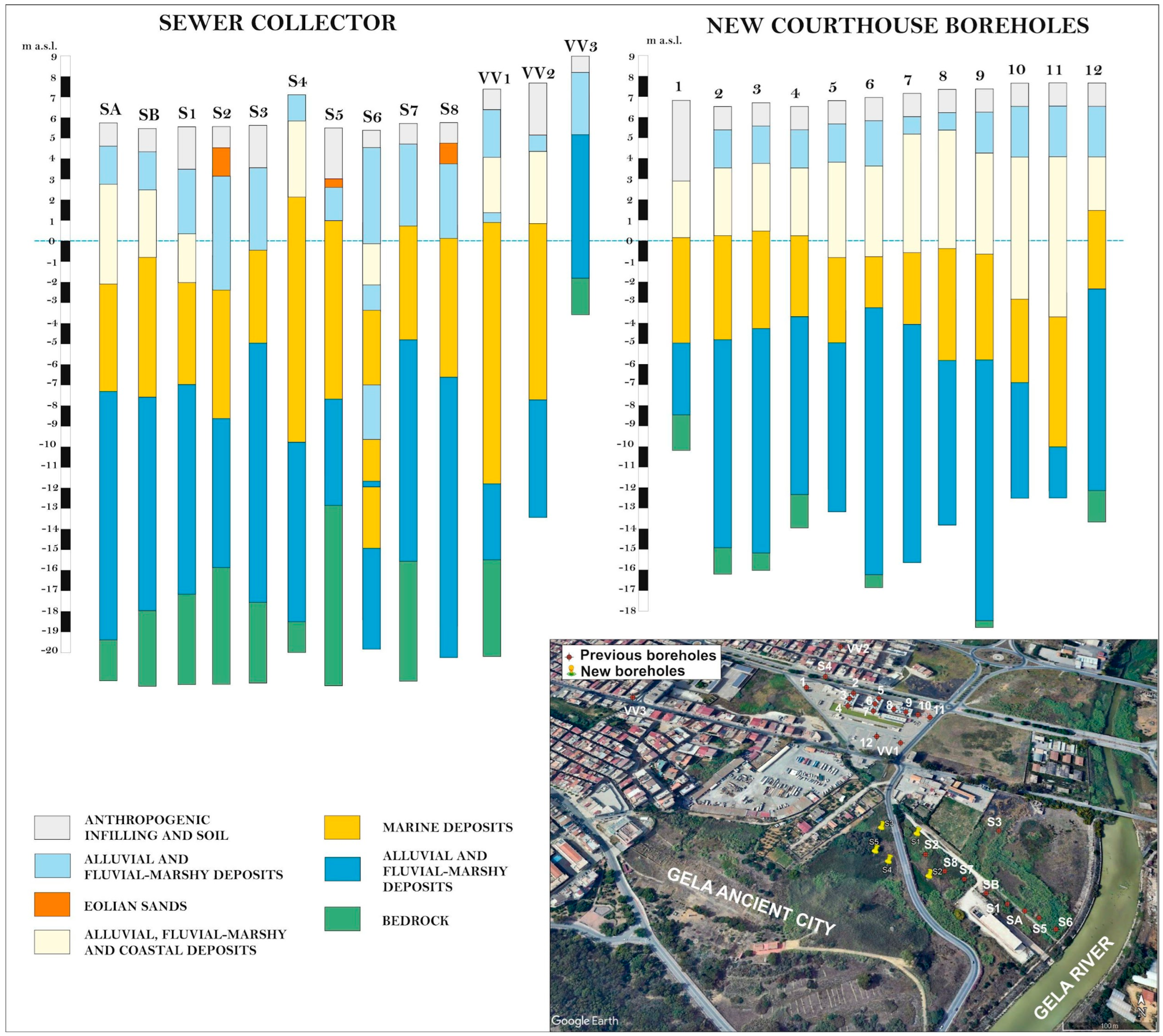
A dataset of deep boreholes was acquired and thoroughly reviewed. The dataset consists of 25 borehole stratigraphy reports, conducted for geotechnical purposes during the construction of the new sewer collector and courthouse in Gela, and obtained from public administration offices (
Figure 4).
Twelve boreholes from the new courthouse are located in the inner part of the large fluvial marshy depression while thirteen boreholes from the new sewer collector are situated along the channel traces of the Margi paleocourse, extending from the NW sector toward the Gela River. These boreholes, ranging in depth from 15 to 30 m and drilled at elevations between 6 and 9 m a.s.l., highlight stratigraphical features that do not fully clarify the lithofacies and associated paleoenvironments, primarily due to the absence of paleoecological analyses and chronological data. Despite that, a critical review of the report enabled the identification of seven stratigraphic units, characterized by distinctive features and marked by clear unconformity (UBSU).
From top to bottom, the identified units are as follows:
- -
Unit 1: Anthropogenic infilling and soils. Brown yellowish sandy silts with gravels, waste materials, construction debris, woods and roots;
- -
Unit 2: Aeolian sands. Yellowish loose fine sands;
- -
Unit 3: Alluvial and fluvial marshy deposits. Alternating layers of medium and coarse rounded openwork gravels, sandy silt matrix-supported rounded gravels, dark gray silty clays and peaty clays;
- -
Unit 4: Alluvial, fluvial marshy and coastal deposits. Alternating layers of brownish sandy silt matrix-supported rounded gravels, dark gray silty and peaty clays, yellowish-orange coarse and medium sands and grayish sandy silts;
- -
Unit 5: Marine deposits. Grayish laminated and oxidized medium and coarse sands with abundant shell fragments.
- -
Unit 6: Alluvial and fluvial marshy deposits. Alternating layers of brownish sandy silt matrix-supported rounded gravels, dark gray silty and peaty clays;
- -
Unit 7: Plio-Quaternary bedrock. Dark gray consolidated clays and silts.
The thickness of these units ranges from a few meters to several meters, as shown in
Figure 4. The plausible interpretation of these units is as follows: Unit 7 represents the local bedrock, Unit 6 consists of continental and transitional deposits from the last glacial period when the sea level was significantly lower, Unit 5 corresponds to marine and lagoonal deposits formed during the post-glacial sea level rise, Units 4 and 2 are fluvial and marshy deposits from historical times, and Unit 3 represents aeolianites deposited in more recent centuries.
5.3. New Boreholes and Archeological Trench
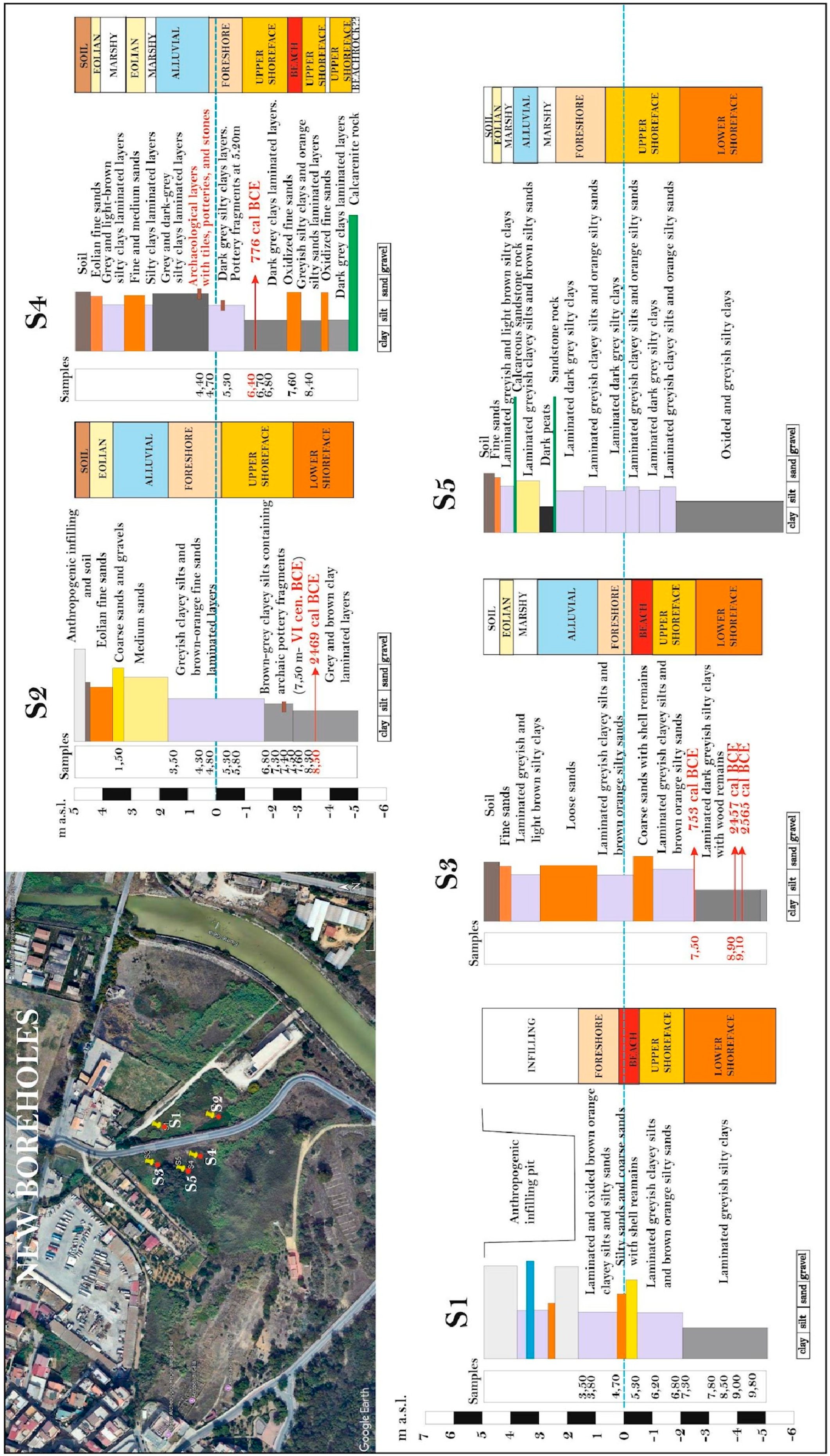
Five new boreholes were drilled in the most depressed sector of the Conca area (see inset in
Figure 5). These boreholes reached a depth of 10 m from ground level (5 m a.s.l.) without reaching the Plio-Quaternary or Miocene bedrock. The logs of the drilled successions are shown in
Figure 5, while the main litho-stratigraphical features, paleoenvironments and chronologies are presented in
Table 1. Seven stratigraphic units (US), marked by clear unconformities, were identified in the drilled successions. They are briefly synthesized as follows:
- -
US1: Anthropogenic infilling deposits;
- -
US2: Soil;
- -
US3: Aeolian deposits;
- -
US4: Fluvial–marshy deposits;
- -
US5: Foreshore and beach deposits;
- -
US6: Upper shoreface deposits;
- -
US7: Lower shoreface deposits.
Table 1.
Lithofacies features of the boreholes and chronologies.
Table 1.
Lithofacies features of the boreholes and chronologies.
| US | Facies Description | Environment | Age |
|---|
| 1 | Heterogeneous and heterometric sediments are made mainly of gravel, waste material and refuse, waste constructions. In S1 borehole, they fill a pit until 3.40 m from ground level while in S2, the thickness reaches ca. 1 m. In S3, S4 and S5 are lacking. | Anthropogenic infilling | |
| 2 | Dark brown silty sands with sporadic fine and medium gravel containing roots and woods, charcoal, pottery and waste constructions. In S1 borehole, it is lacking because it is cut by a pit while in S2, it is very thin (<0.40 m). In S3, S4 and S5, the thickness reaches ca. 0.70 m. | Soil | |
| 3 | Yellowish loose fine sands containing several pulmonata shells. They are present in all boreholes with variable thickness from 0.30 to 0.90 m, except in S1 borehole because they are cut by a pit. | Aeolianite | |
| 4 | Alternating with dark gray laminated silty clays, dark brown peaty clays and massive brownish sandy gravels and silty sand layers. They are present in all boreholes with variable thickness from 1.5 to 3.5 m. In S4, at 4.70 m, undefined pottery is present. | Fluvial–marshy | Historical times: Middle Age and post-Middle Age? |
| 5 | Alternating with yellow orange laminated medium coarse sands and grayish laminated silty clays and light brown silty sand layers. In S1 and S3 boreholes, a thin layer (0.1–0.2 m) made of coarse sands and rounded gravels is present in the lower part of the units. Thickness is variable between 1.00 and 2.00 m. | Foreshore and beach | |
| 6 | Alternating between light brown and yellow brown massive medium and coarse sands and laminated dark gray silty clays containing several shell fragments. They are present in all boreholes with variable thickness from 1.00 to 3.00 m. In S4 borehole, two layers (thick ca. 0.50 m) of orange oxidized fine sands are present. In S2, at 7.50 m, archaic pottery (ca. 6th century BCE) is present. | Upper shoreface | S3—7.50 753 cal BCE
S4—6.40 776 cal BCE
S2—7.50 archaic pottery (ca.6th century BCE) |
| 7 | Massive and/or laminated grayish silty clays. Thickness is variable from 2.00 to 4.00 m, except in S4 borehole, where the layer is lacking. | Lower shoreface | S2—8.50 2469 cal BCE
S3—8.90 2457 cal BCE
S3—9.10 2565 cal BCE |
Figure 5.
Logs, samplings and paleoenvironments of the new boreholes. In black, layers sampled for paleoecological analyses and in red for 14C dating.
Figure 5.
Logs, samplings and paleoenvironments of the new boreholes. In black, layers sampled for paleoecological analyses and in red for 14C dating.
These paleoenvironmental interpretations were supported by both the textural features of the drilled layers and the paleoecological analyses from several samples taken from the S1, S2 and S4 drilled successions. Chronologies were determined based on archaeological contents in several layers and 14C radiocarbon dating of unidentified woods and charcoal samples collected from selected intervals within the drilled boreholes. The results of the paleoecological and geochronological data are presented in the following sections of this work.
In summary, the drilled successions highlight a typical stratigraphic sequence representing environments transitioning from marine to transitional and continental conditions. Specifically, the sequence transitions from deeper to shallower marine environments (moving from lower to upper shoreface), then to beach and foreshore environments, followed by marshy and fluvial–marshy deposits, and finally becoming silted up and/or reclaimed through flooding and anthropogenic infillings. This stratigraphic assemblage is typical of many similar geomorphological contexts around the Mediterranean Sea, both in natural and artificial embayments. In this study, the marine embayment and its subsequent silting were identified in all the drilled successions, with the extent of the embayment hypothesized based on stratigraphic data from previous boreholes.
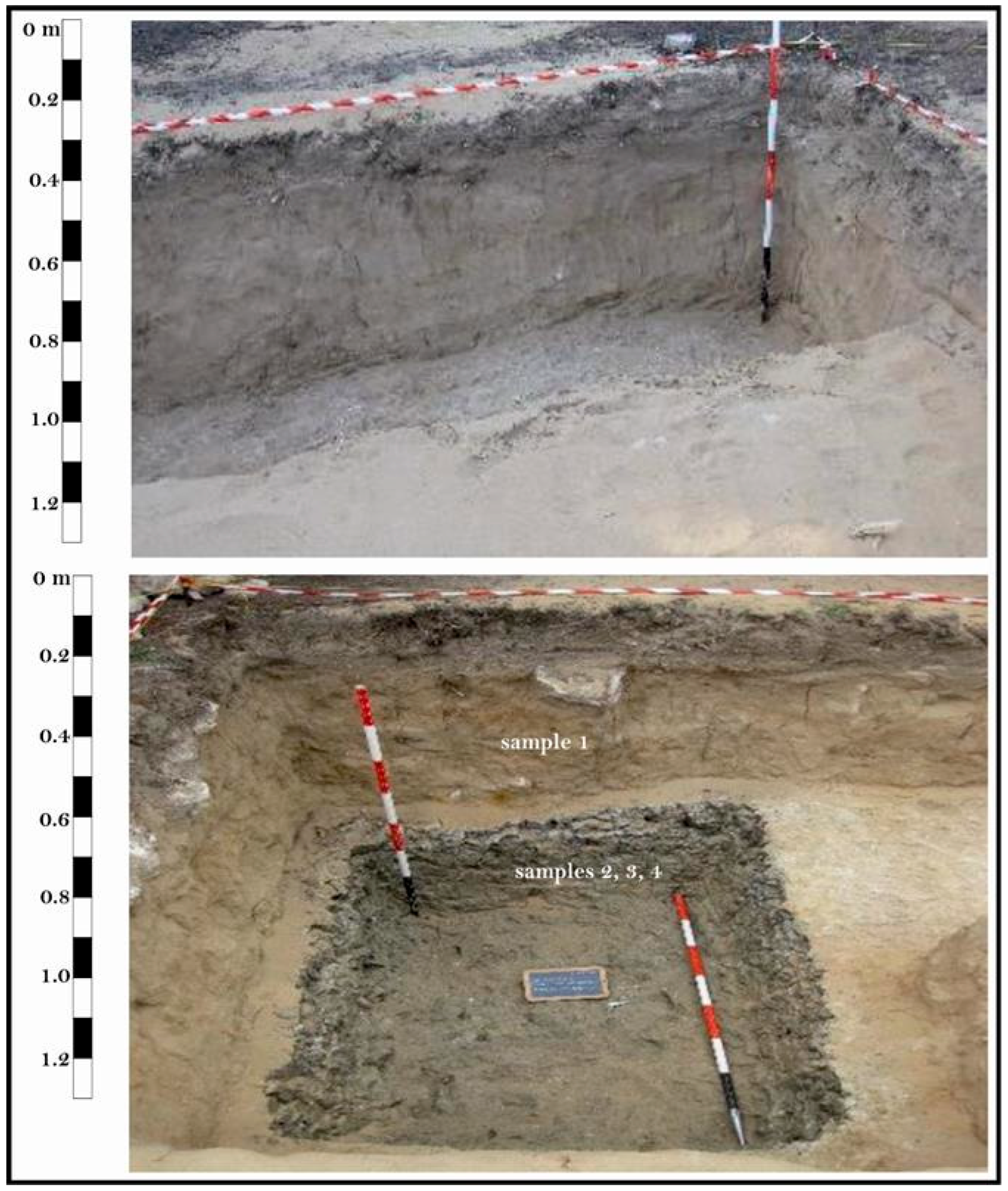
An archeological trench was excavated in 2019, reaching a depth of approximately 1.5 m below ground level. The exposed succession (
Figure 6) consisted of four main layers, which were compared with those identified in the borehole stratigraphy:
Beneath the first layer (US1), which is 0.25–0.40 m thick and made of sand and heterometric gravel mixed with waste material, refuse and construction debris, indicative of modern anthropogenic infilling, a layer of brown-yellowish loose and cross-stratified fine sands (US2) was encountered. This layer averages 0.70 m in thickness and is fully devoid of archeological contents (
Figure 6). The upper part of this layer contains a significant abundance of pulmonate shells. Sample 1 was picked at 0.70 m below ground level and subjected to paleoecological analyses. This sandy layer overlies massive and compacted grayish silty clays, which are very rich in millimetric-sized organic matter remains (US4). These clays were very difficult to excavate due to their hardness (
Figure 6). Three samples (2, 3, 4) were collected at depths of 1.20, 1.40 and 1.60 m below ground level, respectively, and were subjected to paleoecological analyses.
Paleoecological analyses confirmed the preliminary paleoenvironmental interpretation based on sedimentary features. Sample 1 was poorly diversified in terms of ostracoda and foraminifera species (see
Table S1 in the Supplementary Materials). The latter are mainly allochthonous, likely derived from older Plio-Quaternary units. Sample 1 was barren and can be attributed to aeolian sands. Samples 2, 3 and 4 were deposited in marshy environments with repeated fluvial inputs and no marine interaction (see
Table S1 in the Supplementary Materials).
5.4. Chronology from 14C Dating and Archaeological Contents
Five samples were collected from the S2, S3 and S4 boreholes. These samples consist of centimeter-sized unidentified wood fragments, with the S4_6,40 sample consisting of unidentified charcoal fragments. S3_7,50 and S4_6,40 were taken from US6, while the S2_8,50, S3_8.90 and S3_9,10 samples were collected from US7. The results are summarized in
Table 2, and the diagrams of radiocarbon dates with the calibrated probability density function are provided in
Figure S1 of the Supplementary Materials.
The chronological data allow us to constrain Unit 6 to approximately the 8th-7th century BCE (ca. 2700 years ago) and Unit 7 to around 4500 years ago.
5.5. Paleoecology
Benthic foraminifers were present in all the samples, while ostracod shells were found in 25 samples. All foraminiferal assemblages were mixed (sensu [
77]), including both allochthonous and autochthonous specimens (
Tables S1–S4 in the Supplementary Materials). Sixteen samples yielded mixed ostracod assemblages, six assemblages were allochthonous, two autochthonous and three samples were devoid of ostracod remains. The data presented below, for both benthic foraminifers and ostracods, refer exclusively to autochthonous assemblages.
Benthic foraminifers were abundant across the samples with a total of 2502 specimens belonging to 115 species in 71 genera; five taxa were left in open nomenclature due to poor preservation. Paleoecological reconstructions were based on 40 autochthonous species with the remaining 75 species being reworked from older sediments.
Ammonia aberdoveyensis was the only species present in all the samples with a Relative Species Abundance (RSA) ranging from 5.26% (sample S2 4.30) to 66.70% (S2 4.80). Common species included Elphidium crispum (present in 22 samples; maximum RSA = 33.33%, sample S2 1.50), Bulimina elongata (21 samples; max RSA = 50%, sample S1 3.50), Cibicides lobatulus (22 samples; max RSA = 21.57%, sample S1 7.30), Neoconorbina terquemi (21 samples; max RSA = 17.65%, sample S1 7.30) and Fursenkoina subacuta (18 samples; max RSA = 11.80%, sample S2 7.60).
Ostracods were relatively rare, with a total of 322 ostracod valves (one carapace counted as 2 valves) collected from 19 samples. The ostracod assemblages included 64 species from 36 genera, 51 of which were definitively or tentatively classified, 12 left in open nomenclature and 1 with an affinitive status. Of these, 35 species were autochthonous, with 29 either reworked from older sediments (21 species) or transported from continental waters (8 species). Cyprideis torosa was the common species, occurring in nine samples.
Borehole S1. Benthic foraminiferal assemblages were present in all eleven samples examined, with 979 specimens pertaining to 34 species in 20 genera (
Table S2 of Supplementary Materials). The samples S1 6.80 (246 individuals in 29 species) and S1 3.80 (188 individuals in 22 species) yielded the most abundant and diversified foraminiferal assemblages. Foraminiferal assemblages occurring in the samples S1 4.70 and S1 3.50 were very poor, with two individuals in two species. Reworked specimens were present in all eleven samples, showing 56 allochthonous species. Allochthonous ostracod shells are present in all the borehole S1 samples; autochthonous ostracods are relatively rare, being present in eight samples. Forty-six valves (Total Number of Valves—TNV = 46; Minimum Number of Individuals—MNI = 35) pertaining to 20 species in 12 genera were recorded. Samples S1 8.50, S1 7.30 and S1 4.70 yielded only a few allochthonous specimens. Ostracod assemblages found in the samples S1 3.80 and S1 6.20 are the most abundant and diverse, showing, respectively, 13 valves in ten species (TNV = 13; MNI = 10) and 12 valves in eight species (TNV = 12; MNI = 9).
Borehole S2. Benthic foraminifers were present in all twelve sediment samples, with 836 tests pertaining to 27 species in 14 genera (the remaining 43 species were allochthonous) (
Table S3 of the Supplementary Materials). The sample S2 7.60 showed the maximum abundance (272 specimens), whereas the maximum simple diversity was recorded in the sample S2 5.30 (16 species). Samples S2 4.80 and S2 3.50 displayed low diversity and abundance (respectively, three specimens in two species and three specimens in three species. Autochthonous ostracod specimens (TNV = 261; MNI = 75) occurred in eight samples, with 17 species in 12 genera. They were not present in the samples S2 4.80 and S2 1.50 (devoid of ostracod remains) and in the samples S2 5.80 and S2 3.50 (which yielded only allochthonous valves). The maximum abundance value (TNV = 144; MNI = 33) was recorded in the sample S2 7.50 pertaining to two species; the maximum simple diversity was recorded in the sample S2 6.80 (five species). Allochthonous ostracod specimens were recorded in ten samples (with a total of 15 species).
Borehole S4. The five samples of the borehole S4 yielded 687 autochthonous foraminiferal specimens in 36 species assigned to 19 genera (
Table S4 of the Supplementary Materials). The maximum abundance and simple diversity values (respectively, 218 specimens, 22 species) were recorded in the sample S4 5.30. The assemblage of the sample S4 8.40 showed the minimum abundance (72 specimens) and number of species (eight). Allochthonous benthic foraminiferal specimens (38 species) were present in all the samples.
Ostracod assemblages are poor and poorly diversified, including 15 valves (TNV = 15; MNI = 10). Autochthonous species were recorded in three samples (nine species in seven genera). The samples S4 8.40 and S4 7.60 were devoid of ostracod remains. In sample S4 4.40, the maximum abundance (TNV = 8; MNI = 6) and diversity (six species) was recorded. Allochthonous ostracods were present in the samples S4 8.40 and S4 4.40 (two species).
6. Discussion
6.1. Correlation Between Previous and New Boreholes, Paleoenvironments and Their Chronology
Considering the lithostratigraphic features of the drilled successions, it is possible to correlate the stratigraphic units of the previous boreholes with those of the new boreholes as follows:
Unit 1 of the previous boreholes corresponds to US1 and US2 in the new boreholes. Both represent anthropogenic infillings and soils;
Unit 2 corresponds to US3. Both units are aeolianites;
Unit 3 is found only in the previous boreholes and indicates flooding events of the Gela River during historical times;
Unit 4 corresponds to US4 and US5. Both units are fluvial marshy and transitional (lagoonal, salt marsh, foreshore and beach) deposits, representing the silting up of the depressed area;
Unit 5 correlates with US6 and US7. These are marine deposits that developed between 4.5 ka and 2.7 ka, in response to the decreasing rate of the Late Holocene sea level rise;
Units 6 and 7 are only present in the previous boreholes. They represent, respectively, the fluvial–marshy sedimentation during the lowstand of the Last Glacial Maximum and the Plio-Pleistocene bedrock.
6.2. Fossil Assemblage
The autochthonous assemblages of benthic foraminifera and ostracods indicate deposition in shallow marine waters, within the infralittoral zone (~0–40 m below sea level), under the influence of freshwater input. The allochthonous foraminiferal species are likely of Pliocene–Pleistocene age, originating from mainland sediments eroded by rivers. Allochthonous ostracods include both reworked Plio-Pleistocene species and taxa characteristic of continental waters, which were similarly transported.
The poorly diversified assemblages found in samples S1 3.50, S2 7.60 and S2 4.30, with very rare ostracod shells and foraminifera tests that exhibit high strength and toughness (
sensu [
78]), were likely deposited in very shallow high-energy marine waters (upper infralittoral, 0–5 m below sea level). The samples S1 8.50, S1 7.30, S1 4.70, S2 5.80, S2 4.80, S2 3.50, S2 1.50, S4 8.40 and S4 7.60 did not contain ostracod remains (which are rarely preserved in high-energy environments). The very low diversity of the benthic foraminiferal assemblages suggests paleoenvironments ranging from the uppermost part of the infralittoral zone to the midlittoral zone, although deposition in the supralittoral zone cannot be excluded.
An episode of lowered salinity was recorded in sample S1 9.00, where species characteristic of brackish waters (e.g., ostracods Cyprideis torosa and Loxoconcha elliptica and foraminifers Ammonia aberdoveyensis and Haynesina germanica) were dominant. In sample S2 7.50, the high abundance of the euryhaline ostracod species C. torosa and the presence of stenohaline taxa (e.g., Elphidium spp.) suggest rapid fluctuations between marine and brackish water conditions.
6.3. Chrono-Stratigraphical Reconstruction and Spatial Distribution of Lithofacies
Litho-stratigraphic features, fossil assemblages and chronological data enable the reconstruction of the chrono-stratigraphy and associated paleoenvironments of the drilled boreholes, as well as the hypothesized spatial distribution of these units.
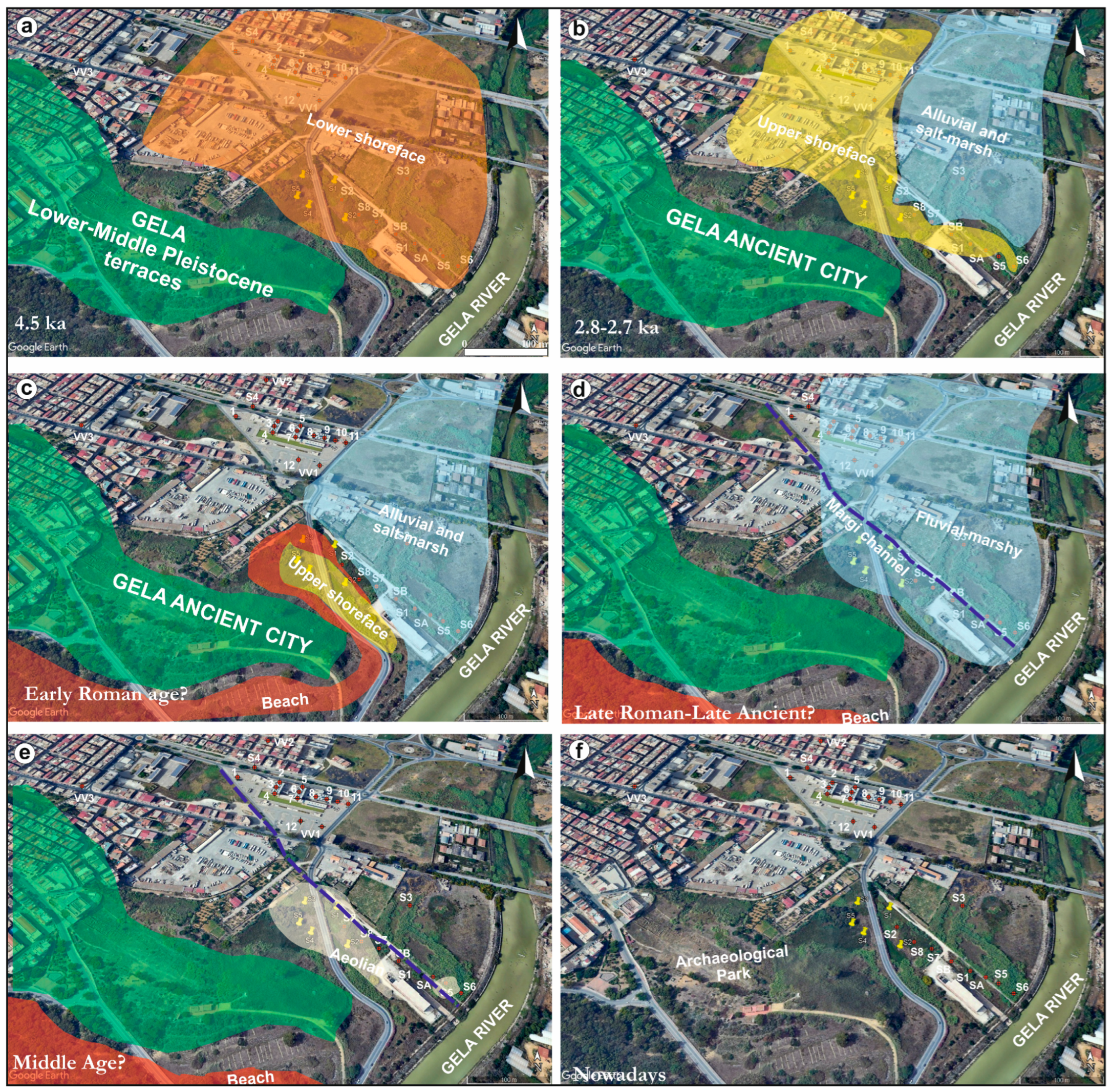
The basal part of all boreholes (US7 and Unit 5) corresponds to marine environments, such as lower shoreface zones (
Figure 7a).
In the S1, S2, S3 and S5 boreholes, the lithofacies indicate the sedimentation of millimetric and centimetric thick layered silty clays, typical of environments alternating between marine and brackish waters. The fossil assemblages of S1 9.00 and S2 7.50 support this interpretation. Additionally, episodes representing a range of environments, from the uppermost part of the infralittoral zone to the midlittoral (upper shoreface and beach environments), are recorded in oxidized fine sand layers interbedded with silty clay, as reflected in the fossil assemblages. These episodes are predominantly found in the basal part of the S4 borehole, likely due to its location in the marginal part of the depressed area. Furthermore, in the lowest part of this borehole, the drilling penetrated a calcarenite stone (only 20 cm of which was drilled), which could be interpreted as beachrock or, alternatively, as an archeological stone. Three
14C dates are available for this unit, both from the S2 and S3 boreholes. These dates range from 2.565 and 2.469 cal BCE, linking the marine environments to the progradational trend of the coastline, driven by the decreasing rate of the Holocene sea level rise that occurred after ca. 6.5 ka, as observed in similar Mediterranean Sea case studies [
4]. This phase of marine environments in the Gela River alluvial coastal plain was also observed in all the previous boreholes (Unit 5), suggesting the existence of a large gulf or embayments (
Figure 7a) in the Gela River alluvial coastal plain. It is reasonable to assume that the Gela Plio-Quaternary terrace was an island during this period. The upper chronological limit of the lower shoreface unit is approximately 750 cal BCE, as testified by
14C dating on the S3 7.50 sample.
The transition to the upper units (US6 and Unit 5) is marked by an abrupt lithological change from grayish silty clays to brown and orange layered silty sands and clayey silts, which are very rich in organic matter, woods, charcoal, shell fragments and archeological pottery. These textural features suggest sedimentation in shallow marine environments that were subject to repeated sea level fluctuations, as is typical in upper shoreface and foreshore environments (
Figure 7b). Fossil assemblages from several samples collected in the S1, S2 and S4 boreholes indicate very shallow (upper infralittoral, 0–5 m below sea level) and high-energy marine waters. Fragments of Archaic Age pottery (ca. 6th century BCE), found in the S2 borehole at 7.50 m, along with two
14C datings from samples S3 7.50 and S4 6.40, allow us to constrain this unit to the Late Holocene, more precisely to 776–750 cal BCE. These chronological data are very close in time to the beginning of the 7th century BCE, supporting the hypothesis that these environments persisted until the foundation of the Greek city of Gela in 689–688 BCE.
This hypothesis opens new perspectives for research and scientific debate regarding the possibility that the Greek harbour was located in this area. The extension of the embayment toward the northern part of the Gela River plain is limited by previous stratigraphic data from boreholes (specifically S2, S3 and S7), which indicate an abrupt transition to fluvial deposits, likely due to historical floods of the Gela River. Also, geomorphological features suggest the presence of an alluvial fan, which probably filled up the ancient embayment. These floods progressively reduced the width of the embayment, which persisted as a larger depression only between the Conca basin and the new courthouse areas.
The transition to the upper unit (US4) is poorly marked by lithological changes and it appears in continuity with the lower unit (US5). It consists of alternating layers of grayish silty sands and orange oxidized fine sands, reflecting prolonged periods of sea emergence, typical in foreshore and beach environments (
Figure 7c). In the S4 borehole, at 5.20 m, fragments of non-diagnostic pottery were found. A speculative interpretation suggests they date to the Archaic to Classical period (6th-4th century BCE). Fossil assemblages suggest paleoenvironments ranging from the uppermost infralittoral zone to the midlittoral, with deposition in the supralittoral zone also possible. It was not possible to hypothesize the extension of these environments toward the inner part of the plain because stratigraphical data from previous boreholes are not as accurate as those from the new borehole samples. Therefore, as a preliminary approach, the extent of the foreshore and beach environments is limited to the Conca area, considering that the new courthouse stratigraphical data are likely overlaid by fluvial and marshy sediments.
The age of this unit is hypothesized based on historical sources and post-quem constraints, suggesting that it was deposited between the Hellenistic period (3rd century BCE) and the Early Roman age (1st century BCE). These data allow us to propose that the marine embayment disappeared and was gradually silted up by Gela River floods, starting from the Late Hellenistic age. It is plausible that upper shoreface and beach environments persisted during this interval, although it is difficult to imagine a harbour basin in this context.
An abrupt lithological change occurs at the top of US4: from clayey silts and silty sands to coarse sands and rounded gravel layers indicative of fluvial environments (
Figure 7d). Intercalations of clayey silt matrix-supported gravels and grayish laminated silty clays further confirm the transition from marine to fluvial–marshy conditions across all studied areas. In the S4 borehole, between 4.40 and 4.70 m, archaeological contents, such as pottery, tiles and stones, allow us to constrain these floods to historical times, likely between the Late Roman to Late Ancient Age and the Middle Age (approximately 4th–9th century CE). In the archaeological trench, this layer appears to have been deposited in marshy environments, supporting the hypothesis that the Conca depression persisted into more recent centuries.
Another abrupt lithological change marks the top of the fluvial marshy unit, where yellowish very fine sands were deposited (US3 and Unit 2). In S4, these sands are interfingered with fluvial marshy deposits, while in S1, they are absent due to truncation by an anthropogenic pit. The textural features of these sands suggest aeolian deposition, likely resulting from extreme sandy storm events (
Figure 7e), which have been well documented at other coastal archaeological sites in southern Sicily during and after the Middle Age (11th–14th century CE) [
79,
80]. Sandy layers are also recorded in previous boreholes, such as S2, S5 and S8 from the new sewer collector, as well as in the archaeological trench, where millimetric cross-stratification sedimentary structures further support the hypothesis of aeolian deposition. The stratigraphy of both the previous and new boreholes concludes at the top of the core samples with soils and anthropogenic fills (
Figure 7f).
6.4. Implication for Greek Harbour Location
Taking into account the stratigraphic and paleoenvironmental data, the hypothesis of shallow marine environments within the Conca depression until the foundation of the Greek city of Gela (7th century BCE) appears reasonable. The central question is whether this marine embayment could have hosted the ancient harbour of the city. Given that Gela was a major city in the Mediterranean Sea, strategically located at the crossroads of key maritime trade routes and possessing a military fleet, the harbour would have been situated close to the ancient city. Excluding the coastal sector directly in front of the Gela terrace, due to its exposure to sea wave action, and the mouth of the Gela River, which was prone to flooding risks, the Conca depression is the only area that could have hosted the ancient harbour. It was characterized by shallow marine environments that were well protected by sea waves and fluvial floods, as well as being hidden from potential enemies and easily accessible by sea (
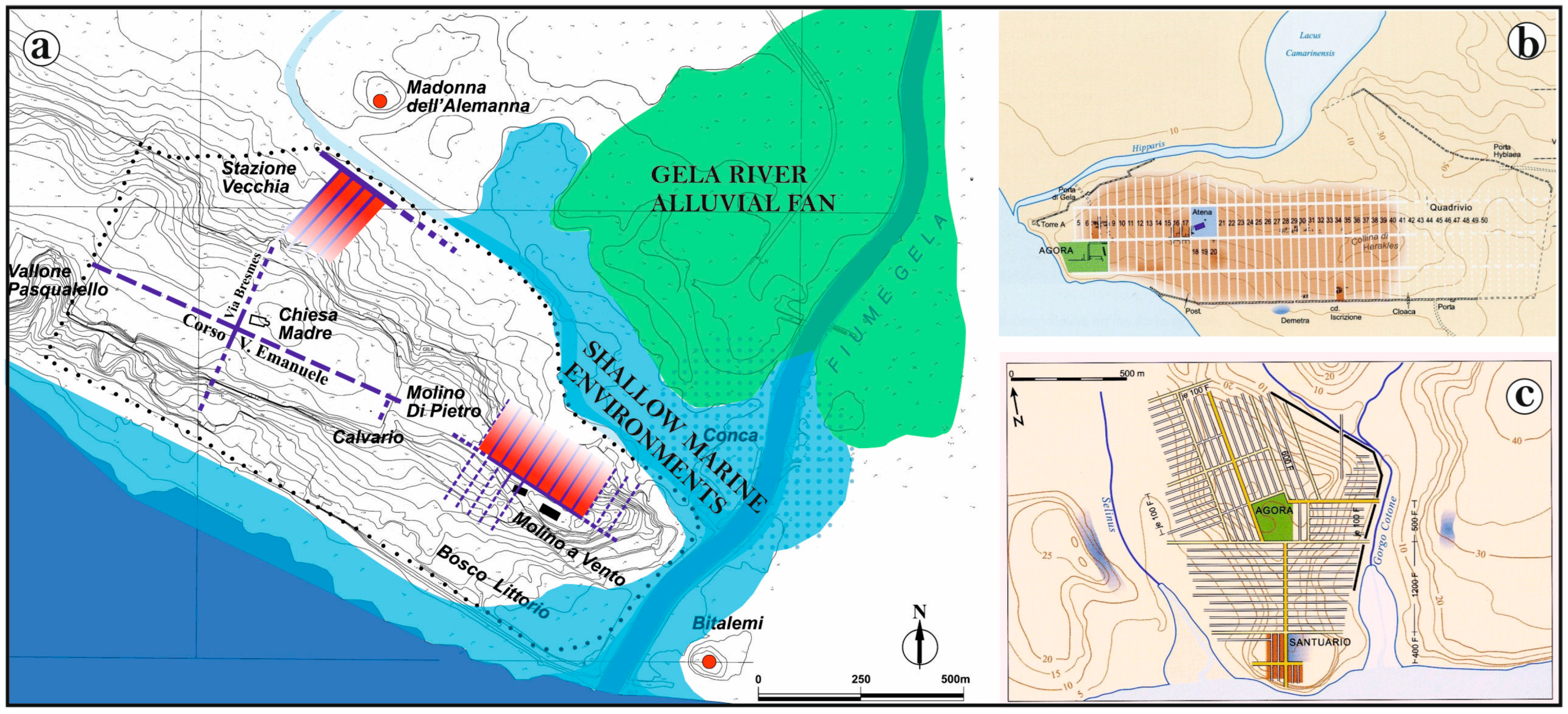
Figure 8a).
The hypothesis of a harbour located inland within the alluvial plain, behind a morphological high and near a fluvial mouth, is also well documented in other important Greek cities on the southern coast of Sicily, such as
Camarina and
Selinunte [
81] (
Figure 8b,c). In the case of
Camarina, it was hypothesized to be within the
Hypparis river coastal plain, where ancient sources describe a marsh located very close to the city, extending over a Quaternary terrace, much like Gela. Similarly, at
Selinunte, the harbour was hypothesized to be located within the
Selinus and
Gorgo rivers, whose courses were near the ancient city, which was situated on the top of the marine terrace as well.
Data from the Conca depression show that the embayment was rapidly silted up and filled by fluvial deposits between the Hellenistic and Roman periods, confirming its disappearance before the Roman period. Several floods from the Gela River gradually reduced the width of the embayment and filled the depression. Today, the layers indicating shallow marine deposits from the Greek age occur at approximately 6–7 m below the surface, corresponding to an elevation of −2 to −1 m a.s.l.
Further investigations using deeper geophysical methods and additional boreholes are planned to identify potential archeological targets (structures, quays, etc.) buried beneath the Conca depression and to better define the inland extension of the embayment.
7. Concluding Remarks
A multidisciplinary approach, including geomorphological, stratigraphical, geochronological, paleoecological and archeological methods, enables us to identify the presence of shallow marine environments (lower and upper shoreface) in a coastal sector, named Conca, located close to the ancient city of Gela. These environments were constrained between 4.5 and 2.7 ka, based on five 14C datings. They occur at depths ranging from 4.5 m to 7 m in one of the most depressed sectors of the alluvial–coastal plain, situated between the Gela River and the hill (marine terrace) that hosts the ancient ruins of Gela, just behind the present-day dunal–beach system and the Gela mouth. Considering that the Greek city was founded in 689 BCE and mainly developed until the 5th century BCE, shallow marine environments were present in the Conca basin during this time. These marine environments shaped the coastal landforms of a large sector of the Gela alluvial–coastal plain, which could be used as a harbour basin. These data provide new insights into the debated location of the harbour of ancient Greek Gela, which several scholars had previously hypothesized to be situated either within the paleomouth of the Gela River or in other areas of the city’s territory. The location of the harbour basin within sheltered marine bays and lagoons is well documented in other ancient coastal cities of the Mediterranean Sea and along the southern coast of Sicily, too. During Roman times, the extent of shallow marine environments in the Conca basin was progressively reduced by repeated alluvial events of the Gela River, which rapidly silted up the area, also influenced by fluvial sediment contributions from the Margi Channel, whose traces are well documented in historical aerial photos and maps. The rapid silting up of the Conca depression led to the closure of the ancient marine basin, transitioning to fluvial–marshy environments. A significant phase of aeolian sedimentation contributed to the silting of the Conca basin during the last millennia, driven by short-term arid climatic fluctuations. Similar processes have been documented at other archaeological sites in southern Sicily, such as Camarina and Selinunte. Further investigations will aim to identify archaeological features within the subsurface of the Conca depression using geophysical methods. Furthermore, the spatial extent of shallow marine environments in the inner Gela alluvial plain during the Greek period will be more precisely constrained using borehole stratigraphic data and the methodological framework developed in this study.



 ,
,