1. Introduction
For the first time, cultural heritage is more prominently mentioned in international documents like the UN’s Sustainable Development Goals Agenda 2030 [
1]. A long waiting list of cities and sites which want to be inscribed as UNESCO World heritage sites, and an ever-growing number of prizes and events for cultural heritage such as, for instance, the European Prize for cultural heritage [
2] or the UNESCO Asia Pacific Awards for Heritage Conservation [
3], can be seen around the globe. The year 2018 was the European year of cultural heritage aiming “to encourage more people to discover and engage with Europe’s cultural heritage, and to reinforce a sense of belonging to a common European space” [
4,
5].
The principal positive connotation of cultural heritage is attractive for policy- and decision-makers as well as for a large part of the public. However, at the same time, the still prevalent notion of cultural heritage is to understand and define it in an objective and material way. Large parts of the European heritage sector are still focused on buildings, albeit intangible heritage and other categories have been given more attention in recent years [
6,
7]. The often quoted “pressure” on cultural heritage by climate adaptation and mitigation measures is constantly increasing and often leading to a wide variety of conflicts between different interests of the society [
8]. The sectoral approach to cultural heritage has traditionally been focused on its tangible aspects such as physical objects and buildings [
9], which has implied that heritage principles have strongly been rooted in a safeguarding and protection narrative that regards cultural heritage to be under threat with the speed and intensity of changes.
The objective of this paper is to develop a new understanding of how the transformation process of cultural heritage is interpreted as a process that is changing heritage systems, that is beneficial and more realistic, and, thereby, has the ability to open new doors to new answers and solutions to challenges of the 21st century.
The research question for this paper is as follows: Does an operationalized metamodel for heritage-based urban development enable more effective heritage management practices in Western European urban contexts when addressing systemic challenges such as climate change, disaster risks, and rapid urban transformation?
2. Methodology
This paper takes a conceptual approach toward understanding how cultural heritage is understood as systems change over time, especially under pressure from challenges like climate change, rapid urban growth, and natural disasters. Our method combines insights from a broad literature review with a metamodel for heritage-based urban development [
10] to contextualize and understand these transformations in a structured way, to enhance a theoretical understanding and, at the same time, advancing “heritage management” approaches.
A metamodel is a higher-level abstraction of a model, essentially a “model of models.” While a model provides a framework for understanding or solving specific problems in a defined context, a metamodel operates at a more conceptual level and is used to analyze, select, or design appropriate models for varying situations. In fields like ecology, information science, and urban planning, metamodels offer systemic, transferable structures that are not bound to one particular case or environment.
The first step—the development of the metamodel for heritage-based urban development—was carried out in the framework of Matthias Ripps’ dissertation [
10]. It was carried out using a mixed-methods research design combining a grounded-theory based analysis [
11,
12] of case-models from a European context to develop the elements of the metamodel. In a second step using design research methodology (DRM) [
13,
14], these elements have been used to construct a metamodel based on John P. Van Gigchs’ [
15] metamodeling theory. The metamodel was described and tested, and different scenarios for its application have been developed. For this paper, we use this metamodel as one tool, together with literature review, using a wide range of academic studies, policy papers, and real-world examples focused on heritage resilience, disaster risk, adaptive reuse, and new technologies in heritage management. Particular attention was given to data and papers that are following a holistic/new heritage approach and understands heritage in a systemic way.
The goal was to gather different perspectives on how heritage systems operate and evolve. The outcome of this literature review was then combined with the metamodel that treats cultural heritage as a dynamic system shaped by social, environmental, and economic factors to develop the following hypothesis: Embracing the complexity of cultural heritage and understanding it as a system and process that is defined not only by object-qualities but also functions, uses, values, people, etc. enables heritage managers to better connect, adapt, use, and safeguard heritage in the face of current rapid and radical challenges.
To test this hypothesis in practice, we tested it against cases that use cross-resilient strategies from the field of disaster risk management (DRM), sustainability, and circular economy. We chose these pilot cases because it requires systems thinking and coordination across multiple sectors, from emergency response to heritage conservation. We used examples from international frameworks (like UNESCO and ICOMOS) and from real post-disaster recovery projects to explore how the different parts of our model play out in practice. This helped us identify where the model works well, and where it might need refinement.
Case selection criteria were systematically operationalized through the metamodel’s five domains to ensure methodological rigor across heterogeneous scenario applications. As the metamodel posits that heritage transformation encompasses coordinated changes across People, Resources, Concepts, Processes, and Principles domains, candidate cases were evaluated against this integrated framework rather than against domain-isolated criteria. This approach operationalizes a key theoretical premise: “transformation is not reducible to single-domain interventions but emerges from systemic coordination across interdependent components” [
16]. Consequently, cases required explicit heritage focus coupled with demonstrable systemic understanding across all five domains—specifically excluding cases that exhibited preservation activity without evidence of transformative integration across multiple domains. Second, we prioritized cases exhibiting substantive multi-stakeholder collaboration positioned within the People domain, combined with documented resource integration across both tangible heritage assets and intangible knowledge systems in the Resources domain. This dual criterion ensured cases represented meaningful stakeholder engagement rather than top-down heritage management. Third, governance processes required documented adaptive or iterative cycles calibrated to each scenario’s operational logic: cyclical phases (before/during/after) for disaster risk management cases, participatory planning loops for sustainable development applications, and functional reuse iterations for circular economy implementations. These domain-specific process requirements reflected the theoretical assertion that “transformation processes must be scenario-specific while maintaining systemic coherence” across conceptual and operational levels. Finally, all cases underwent evaluation against metamodel principles—specifically evidence of cross-sectoral integration, value transformation demonstrating heritage transitioning from cost to investment, and operational learning systems enabling adaptive management. Only cases demonstrating coherent performance across all five metamodel domains were retained, thereby ensuring that selected cases instantiated the theoretical framework rather than merely aligning superficially with isolated criteria.
The examples have been selected based on the following criteria:
The explicit focus on cultural heritage;
The implementation of an integrated approach, bringing together different uses, stakeholders, etc.;
A sign of a systemic understanding of the heritage at hand;
Not being limited to a traditional preservation-centered narrative, where the safeguarding of cultural heritage is the only and final objective;
The case is already finished, and the existence of some sort of final evaluation (even if only by subjective means) is available;
Existence of extensive description/documentation;
Enough data and text on them are published in the English language.
These seven selection criteria were systematically mapped to the five metamodel domains across three scenario applications (disaster risk management, climate adaptation, and sustainable development), as presented in
Table 1.
During the revision of this manuscript, the conversational AI assistant Perplexity AI was employed to support literature discovery and to refine the clarity of the text. All outputs were critically evaluated, corrected where necessary, and integrated into the manuscript by the authors, who retain full responsibility for the accuracy and originality of the content.
By combining theoretical research with a focused application to risk management, this approach offers both a deeper understanding of heritage as a system and related practical tools that can inform policy and planning in the real world.
The complete methodological framework, integrating grounded theory analysis, design research methodology, literature review, hypothesis development, and case study testing, is synthesized in
Table 2.
2.1. Methodological Considerations: Migration, Diversity, and Population Composition
The methodological framework underpinning this study requires critical examination regarding a foundational assumption: the treatment of Western European urban populations as relatively homogeneous entities. As recent demographic research has demonstrated, Western Europe’s population composition reflects substantial migration-driven diversity, with immigrant populations constituting between 10 and 25 percent of urban populations across major metropolitan areas. This demographic reality necessitates explicit methodological reconsideration of how case selection criteria address stakeholder diversity and, consequently, how the resulting heritage valuations may be skewed toward authorized frameworks that exclude migrant communities and their heritage practices.
Contrary to implicit assumptions of cultural and social homogeneity, contemporary Western Europe is fundamentally shaped by migration dynamics. As Steven Vertovec [
17] articulated in his seminal conceptualization of “super-diversity,” the transformation extends “not just in terms of bringing more ethnicities and countries of origin, but also with respect to a multiplication of significant variables” affecting settlement patterns, legal statuses, labor market positioning, and social integration. Between 2012 and 2022, net migration accounted for the primary source of population growth across European Union member states, with Western European regions experiencing steady increases in migration stocks from all source regions since 1990 [
18]. Brussels exemplifies this transformation: today, 184 nationalities coexist within the city, with non-Belgian populations representing a substantial and growing proportion of urban residents.
Case Selection Limitations and Stakeholder Representation
The case selection criteria employed in heritage research—focusing on “explicit focus on cultural heritage,” “integrated approaches,” and “systemic understanding”—inadvertently privilege heritage that has been formally recognized, institutionalized, and articulated within professional and policy frameworks. These criteria operate within what Smith [
9] termed “authorized heritage discourse” (AHD): top-down, expert-mediated conceptualizations of heritage predominantly framed as material objects and monuments requiring professional translation for public consumption. By design, such criteria systematically exclude heritage practices, narratives, and valuations emerging from migrant and minority communities, whose relationship to place, belonging, and cultural transmission often operates outside formalized heritage institutions and may be articulated through practices—foodways, linguistic expression, religious observance, and memorial practices—that challenge conventional definitions of heritage itself.
The present study’s case selection did not explicitly interrogate whether participating stakeholder groups reflected the full demographic composition of case study cities. This omission is methodologically significant: if heritage valuations were assessed primarily through established institutions, official documentation, and recognized authority figures—heritage professionals, municipal planners, property owners, and tourism boards—the resulting analysis likely privileges heritage meanings already embedded within authorized frameworks while remaining “blind” to alternative heritage claims articulated by recent migrants, refugee communities, or economically marginalized populations.
The failure to address stakeholder diversity risks reproducing a form of methodological “heritage nationalism.” When heritage systems are analyzed as though composed of culturally coherent populations with shared historical narratives, the analytic frame inadvertently obscures conflicting heritage claims, silences minority heritage narratives, and naturalizes particular heritage regimes as universal or inevitable. As Ashbury et al. [
19] demonstrate in their examination of multicultural societies, heritage in diverse urban contexts frequently becomes a site of contestation, wherein heritage designation can function to exclude marginalized groups—particularly through gentrification processes that render “heritage districts” economically inaccessible to longtime migrant residents. This dynamic is not incidental to heritage systems but rather constitutive of how heritage operates as a mechanism of power, inclusion, and exclusion.
Recent scholarship in migration heritage [
20,
21] has identified migration and mobility as constitutive rather than exceptional dimensions of heritage. This perspective reframes “migration heritage” not as heritage about migrants, but as recognition that all heritage has always been shaped by human mobility, cultural hybridity, and intercultural encounter. Critically, migration heritage scholarship reveals that migrant communities actively produce heritage—through museums, oral histories, memorials, and place-making practices—and, yet, these practices frequently remain invisible within heritage management systems and academic analysis alike.
The European Heritage Label designation awarded to MigratieMuseumMigration (MMM) in Brussels offers instructive contrast to the broader case study findings. Located in Molenbeek, a historically significant “arrival area” within the Brussels canal zone, MMM was “largely developed and also run by these [migrant] communities,” as noted in
Section 8.2 of the manuscript. The museum’s permanent collections center on “the stories of the first generation of guest workers, of the earliest inhabitants of the Petit-Château, of the expats, the war refugees, the Europeans who move freely within the EU and many others.” Crucially, MMM was conceptualized not as a fixed monument but as a dynamic, continuously evolving project: “The MIGRATIEMUSEUMMIGRATION will never be finished. In this way, the museum is also a symbol of the constant dynamism of Brussels.” This approach embodies a fundamentally different heritage epistemology—one centered on multiplicity, community curation, and the recognition that contemporary European heritage is irreducibly shaped by migration.
The analysis of MMM in
Section 9 constitutes an important exception to the broader case study findings; yet, this exception itself reveals the extent to which migration-centered heritage governance remains marginal within heritage management practice. While MMM demonstrates how heritage systems can be structured to foreground migrant experiences and narratives, the limited prominence of such initiatives in international heritage discourse and practice suggests that methodological frameworks continue to prioritize established, institutionalized heritage over emergent, community-generated, migration-informed heritage practices.
2.2. Methodological Considerations: Community Participation, Institutional Contexts, and Global Diversity
Community participation in heritage governance and conservation takes fundamentally distinct forms across geographical and historical contexts, and the conceptual universality of participatory approaches requires critical interrogation. In Western European heritage frameworks, participation typically operates within established democratic institutions and consensus-seeking mechanisms. As articulated by the European Framework for Action on Cultural Heritage, the mandate emphasizes “more participative approach in the safeguarding and management of cultural heritage” framed through “open, participatory and inclusive processes” that engage “local communities, as well as a wide range of stakeholders through open, participatory and inclusive processes.” Similarly, the Council of Europe Framework Convention on the Value of Cultural Heritage for Society privileges “participation, transparency, accountability, rule of law, effectiveness, and equity” as hallmarks of good governance. However, as Waterton and Smith [
22] have demonstrated in their examination of “authorized heritage discourse,” participation within these frameworks frequently operates to reproduce professional expertise and institutional legitimacy rather than genuinely democratize heritage decision-making. They argue that the “recognition and misrecognition of community heritage” reflects persistent hierarchies in which expert-mediated top-down frameworks constrain what counts as heritage and whose heritage narratives are institutionally recognized.
In marked contrast, community heritage engagement in Global South contexts—particularly in post-colonial and indigenous-majority societies—remains fundamentally bound to broader struggles for social justice, territorial sovereignty, and decolonization. As Savoy and colleagues emphasize in their examination of restitution and anti-colonial heritage movements, “restitution in the cultural and artistic arena is an unstoppable movement. Activists, leaders, cultural workers, and institutions both on the African continent and in the diaspora continue to make strides in shifting the discourse and programs on reparations.” Critically, these movements position heritage not as a domain of consensus-seeking management but as a contested arena of political struggle. The United Nations Declaration on the Rights of Indigenous Peoples (UNDRIP) recognizes that indigenous heritage claims are inextricably linked to territorial sovereignty: Article 26 establishes that indigenous peoples “have the right to the lands, territories and resources which they have traditionally owned or occupied,” while Article 31 grants indigenous communities the right to “maintain, control, protect and develop” their cultural heritage and intellectual property. As scholars of decolonial heritage practice articulate, heritage engagement in these contexts serves as “a mechanism for addressing colonial legacies, territorial claims, and cultural revitalization tied to social movements rather than professional heritage bureaucracies.”
Moreover, as Harrison [
23] contends in his analysis of heritage protests in contemporary Latin America, heritage has the “potential to transform society” precisely because heritage claims are deployed by marginalized communities as instruments of political resistance and social change. The distinction matters methodologically: Western European heritage frameworks operate through procedural consensus and institutional legitimacy, potentially obscuring power asymmetries and reproducing what Smith [
9] terms the “authorized heritage discourse”—a Eurocentric approach in which heritage is treated as “innately valuable ‘things’ of ‘the past’ which need to be ‘translated’ by experts for the public in a top-down manner.” Global South heritage movements, by contrast, foreground heritage as a site of political contestation, epistemological decolonization, and restitution tied to land claims, resource rights, and the redress of historical dispossession. These divergent modalities suggest that heritage participation frameworks—even those designed to be “inclusive”—may reproduce Western institutional biases when applied transnationally without critical examination of how participation itself is structured by different political regimes, power geometries, and historical trajectories of colonialism, marginalization, and resistance.
3. Theoretical Background—Contemporary and Systemic Understanding of Urban Heritage
3.1. Systemic Perspectives on Heritage Transformation
The theoretical background of this research is grounded in a systemic worldview: instead of concentrating on singular entities, it considers the interdependencies of these, changes, and connections, and implements a far more complex but simultaneously realistic view of the phenomena. Heritage is no longer understood as a bounded set of objects requiring protection from change but rather as dynamic, interconnected systems of meaning, practice, knowledge, and place. This systemic understanding represents a fundamental epistemological shift in how heritage is theorized, managed, and governed across contemporary Europe.
Systems theory, as von Bertalanffy articulated, provides “a general science of ‘wholeness’” capable of addressing the “problems of organization” and “dynamic interactions manifest in difference of behavior of parts when isolated or in a higher configuration.” [
24] Applied to cultural heritage, systems thinking recognizes heritage’s irreducible complexity: the interdependencies among physical fabric, social practices, economic forces, institutional frameworks, and cultural meanings cannot be reduced to isolated technical interventions. Contemporary urban heritage scholarship increasingly emphasizes this systemic worldview, which “considers the interdependencies of entities, changes, and connections, and implements a far more complex but at the same time realistic view of phenomena” than traditional object-focused conservation. Van Gigch [
25] emphasized that “a system can be made up of concepts, objects, and subjects, as in a man–machine system comprising all three kinds of elements,” a formulation particularly relevant to heritage systems that integrate tangible and intangible dimensions. Systems theory is not a single unified theory but rather “a heterogenous and wide scientific field” for which “there is no generally agreed definition” but rather “a set of axioms...used to define how a system must operate.” Von Bertalanffy stressed that systems theory “has the potential to integrate physical and social sciences,” a potential critical for heritage management where social, cultural, and environmental dimensions are inseparable.
While viewing heritage systemically is not novel—systems thinking has influenced heritage practice since the emergence of integrated conservation in the 1970s—this paper advances a more explicit and operationalized application of systems theory to heritage transformation. The theoretical apparatus of systems thinking—including metamodeling, boundary critique, and complexity theory—has remained underutilized in heritage scholarship until recent decades, despite the field’s acknowledged complexity. Understanding heritage as systemic is essential for grasping the contemporary reality: heritage is “community-oriented, not static but rather dynamic, systemic not linear.” Changes in urban cultural heritage areas are not limited to physical and tangible aspects but must be understood as “reflection of changes in socio-political practices, economic consequences and cultural effects.”
3.2. Historical Development: From Monument Protection to Systemic Heritage Governance
3.2.1. Early Heritage Concepts and the “Authorized Heritage Discourse”
Understanding contemporary systemic approaches requires acknowledging earlier definitional frameworks and their limitations. Since Laurajane Smith [
9] exposed the restrictions of the heritage sector’s “authorized heritage discourse,” with its narrow focus on material aspects and expert authority, the scope of cultural heritage has fundamentally broadened. Early preservation scholars, represented by Alois Riegl (1858–1905) and Georg Dehio (1850–1932), concentrated on monuments—castles and churches—understood primarily through aesthetic and historical criteria. Riegl, in his groundbreaking The Modern Cult of Monuments [
26], established what became the foundational preservation theory by proposing that “every artifact without regard to its original significance and purpose” could constitute a monument “as long as it reveals the passage of a considerable period of time.” Critically, Riegl moved beyond earlier restoration practices, establishing that “the historical monument is treated as a social and philosophical object. Only through the research of the meaning or meaning that society attributes to the historical monument can a practice be founded.”
Yet, despite Riegl’s sophisticated theoretical contributions, Dehio [
27], argued for preservation through minimal intervention, asserting that “the first commandment of preservation was ‘conserve, do not restore.’” Dehio contended that “To protect monuments is not to pursue pleasure, but to practice piety,” emphasizing ethical and collective responsibility. These early theorists, though differing in approach, shared fundamental limitations: they focused on discrete monuments rather than territorial systems, on material fabric rather than social meaning, and on expert-determined heritage value rather than community participation. This object-centric paradigm persisted through much of the 20th century, treating heritage as discrete entities requiring protection from degradation rather than as systems requiring adaptive stewardship.
3.2.2. The 1975 Watershed: European Architectural Heritage Year and Integrated Conservation
The 1975 European Year of Architectural Heritage marked a watershed moment in European conservation thinking. Both the European Charter of the Architectural Heritage [
28] and the Amsterdam Declaration [
29] emphasized the principle of “integrated conservation,” representing “an early, though often implicit, application of systems thinking to heritage.” These documents fundamentally reframed conservation by recognizing that “focusing solely on physical expressions while ignoring the social dimensions of cultural life posed significant risks to heritage.”
The Amsterdam Declaration explicitly stated that “architectural conservation must be considered, not as a marginal issue, but as a major objective of town and country planning” and called for conservation to become “an integral part of urban and regional planning” rather than a secondary consideration. The Declaration further emphasized that “integrated conservation involves the responsibility of local authorities and calls for citizens’ participation,” establishing both democratic principles and local accountability as foundational. Critically, the Declaration recognized that “the conservation of the architectural heritage, however, can only be really ensured if the people who inhabit these areas regard themselves as jointly responsible for the protection of their architectural heritage” and mandated that “a permanent dialogue between conservationists and those responsible for planning is thus indispensable.”
This integration acknowledged “the interdependencies between physical fabric, social practices, economic forces, and institutional frameworks;” yet, this holistic understanding remained largely implicit rather than theoretically articulated. The 1975 frameworks represented what contemporary scholars characterize as expansion “from a focus on monumental conservation to a systemic, socially constructed concept,” though the systemic vocabulary had not yet been formally adopted in heritage scholarship. The European Charter of the Architectural Heritage further specified that “integrated conservation should make full use of all existing laws and regulations that can contribute to the protection and preservation of the architectural heritage,” establishing multidisciplinary and cross-sectoral integration as methodological requirement.
3.2.3. Mid-20th Century Expansion: From Monuments to Ensembles and Urban Settings
By the mid-20th century, heritage understanding had expanded beyond individual monuments to encompass ensembles and urban settings. This territorial expansion prefigured systems thinking but operated primarily through spatial rather than conceptual logic. Heritage protection mechanisms evolved to address historic urban cores and cultural landscapes as wholes; yet, professional practice remained dominated by object-focused expertise and preservation paradigms emphasizing material authenticity.
3.2.4. The 1990s: ICCROM’s Integrated Territorial and Urban Conservation Program
Building on the 1975 foundations, ICCROM’s Integrated Territorial and Urban Conservation (ITUC) program of the 1990s advanced substantially more proactive engagement with rapid transformations in historic environments. Jokilehto [
30,
31] argued that heritage management must “integrate environmental regulations, public–private partnerships, and planning tools to address the accelerating pace of urban change.” Feilden and Jokilehto’s foundational Management Guidelines for World Cultural Heritage Sites [
32] established that “management should focus on risk assessment” and that “conservation is an essential part of the management process, the theory guiding conservation actions must be understood and used by the multidisciplinary management team.”
Stovel [
33] articulated four ITUC pillars that operationalized this integrated approach: integration (linking conservation with broader planning and development), territorial context (understanding heritage within its wider geographic setting), urban dynamism (acknowledging the inherent changeability of cities), and conservation as transmission of values (ensuring continuity for future generations). This framework represented an explicit recognition that heritage systems operate at territorial scales and must adapt to ongoing urban transformation. Critically, Stovel emphasized that the ITUC approach “treats conservation not as a marginal concern but as an integral component of urban development policy.”
3.3. Legal and Normative Foundations: International Conventions
3.3.1. The European Landscape Convention
The European Landscape Convention, adopted by the Council of Europe on 19 July 2000 and opened for signature in Florence, represents the first international treaty “exclusively devoted to all aspects of European landscape.” [
34]. The Convention extended heritage protection beyond monumental objects to encompass entire territorial systems. Critically, it defines landscape not by aesthetic or cultural significance but by lived experience: landscape encompasses “any part of the land, as perceived by people, whose character is the result of the action and interaction of natural and/or human factors.” This phenomenological approach—centering perception and human relationship to place rather than expert assessment—prefigures participatory turns in contemporary heritage management.
By requiring member states to “lay down procedures for participation by the general public, local and regional authorities and other interested parties in the formulation and implementation of these policies,” the Convention established procedural commitments to democratic engagement with heritage systems understood as territorial wholes rather than isolated sites. The Convention further recognizes landscapes as constituting part of “the ideals which are their common heritage” and require “maintenance and management by means of effective international cooperation.”
3.3.2. The Framework Convention on the Value of Cultural Heritage for Society—The Faro Convention
The Faro Convention, adopted on 13 October 2005 and entering into force on 1 June 2011, reconceptualizes heritage through explicitly rights-based and participatory lenses [
35]. Central to Faro’s innovation is the concept of the “heritage community” “a group of persons engaged in reviving out they decided to be heritage”—and the establishment that “everyone, alone or collectively, has the right to benefit from the cultural heritage and to contribute towards its enrichment.” The Convention establishes foundational human rights principles: “the enjoyment of cultural heritage and the sharing of values that it conveys is a right. Responsibility for cultural heritage and its sustainable management is shared by all members of society.”
The Convention emphasizes that “objects and places are not, in themselves, what is important about cultural heritage. They are important because of the meanings and uses that people attach to them and the values they represent.” By positioning heritage within human rights frameworks and linking stewardship to democratic participation, Faro establishes that heritage governance cannot operate through technical expertise alone but must be co-produced through dialogue among diverse stakeholders. The Convention emphasizes heritage’s role “in the construction of a peaceful and democratic society” and stipulates that “the exercise of the right to cultural heritage may be subject only to those restrictions which are necessary in a democratic society for the protection of the public interest and the rights and freedoms of others.” This positions heritage protection as foundational to democratic legitimacy and social cohesion.
3.3.3. UNESCO Convention for the Safeguarding of Intangible Cultural Heritage
Adopted on 17 October 2003, the Convention for the Safeguarding of Intangible Cultural Heritage responded to the recognition that embodied knowledge and practices had been systematically excluded from heritage frameworks [
36]. The Convention defines intangible cultural heritage as “practices, representations, expressions, knowledge and skills—as well as the instruments, objects, artefacts and cultural spaces associated therewith—that communities, groups and, in some cases, individuals recognize as part of their cultural heritage.” Significantly, the Convention recognizes that “the intangible cultural heritage as a mainspring of cultural diversity and a guarantee of sustainable development” had been systematically neglected.
By mandating that member states foster “institutions for training in the management of the intangible cultural heritage and the transmission of such heritage through forums and spaces intended for the performance or expression thereof,” UNESCO extends heritage systems thinking beyond tangible fabric to encompass embodied knowledge, social relationships, and intergenerational transmission—dimensions entirely absent from earlier frameworks. Critically, the Convention mandates that “the safeguarding of the intangible cultural heritage means ensuring respect for the intangible cultural heritage of the communities, groups and individuals concerned,” grounding protection in community agency rather than expert determination. This approach aligns with the contemporary critique of the “authorized heritage discourse,” which had narrowly focused on material aspects while marginalizing community meanings and lived practice.
3.3.4. UNESCO Recommendation on the Historic Urban Landscape
Adopted on 10 November 2011, the Recommendation on the Historic Urban Landscape synthesizes and operationalizes the preceding frameworks while providing explicit systems-thinking language [
34]. It defines historic urban landscape as “the urban area as the result of a historic layering of cultural and natural values and attributes” and understands urban heritage explicitly “as a system and a resource for sustainable urban development.” The Recommendation reframes heritage conservation as integral to urban development rather than oppositional, positioning heritage as a strategic asset for addressing contemporary challenges: sustainable development, social cohesion, economic resilience, and climate adaptation.
Drawing from urban morphology scholarship [
37,
38], the HUL framework articulates “a holistic and systemic understanding of heritage that emphasizes interconnections among urban functions, values, and stakeholders.” This represents “a milestone in reframing heritage not as static fabric but as a dynamic system composed of physical, social, and cultural entities.” Urban change itself must be understood systemically—not limited to physical and tangible aspects but reflecting “changes in socio-political practices, economic consequences and cultural effects.”
However, contemporary urban heritage scholarship has identified critical challenges embedded in these transformation processes. Urban change “often leads to long-term, marginalized residents, including indigenous peoples and women, being forced to move when areas are gentrified.” This process “can erase the cultural presence and history of these groups, which is a major problem for post-colonial and indigenous groups.” Urban heritage feminist research has identified key concerns “including home and housing, work, economic development and poverty, as well as urban spaces, planning and politics,” dimensions frequently absent from mainstream heritage governance frameworks. These dynamics underscore that systemic heritage understanding must explicitly address power relations, social equity, and the political dimensions of heritage transformation.
3.3.5. Council of Europe European Cultural Heritage Strategy for the 21st Century
Launched on 6 April 2017, the Council of Europe’s “Strategy 21” operationalizes these normative frameworks through concrete strategic guidance [
39]. The Strategy identifies 24 challenges organized around three components—social, economic/territorial development, and knowledge/education—and formulates 32 recommendations on handling these challenges. Significantly, Strategy 21 explicitly “redefines the place and role of cultural heritage in Europe” by grounding heritage governance in “participation, social cohesion, sustainable development, and capacity building” as core strategic imperatives rather than peripheral concerns.
This represents the explicit recognition that heritage systems cannot function through sectoral approaches alone. Instead, they require “transversal or multidimensional” frameworks “aligning different policy areas and resources...taking into account the role of each part in the whole structure.” Systems theory provides the theoretical foundation for this multidimensional approach. According to Whitney et al., systems theory “is also multidisciplinary in application, as it is removed from traditional unidisciplinary problem solving approaches. As such it provides an ideal groundwork for the consideration of governance in complex systems.”
3.4. National Heritage Legal Frameworks
3.4.1. Germany: Denkmalschutzgesetz (Heritage Protection Law)
German heritage protection, established through the Denkmalschutzgesetz (Heritage Protection Act), operates on the principle that “nobody may alter, damage, destroy wholly or partially, or transfer a monument without permission.” [
40]. Significantly, German law grounds protection obligations not solely on aesthetic or historical values but on the principle of kulturelle Kontinuität (cultural continuity). The law establishes that heritage authorities bear primary responsibility for monument protection (Denkmalschutz) and for maintaining “den Zustand der Kulturdenkmale zu überwachen sowie auf die Abwendung von Gefährdungen and die Bergung von Kulturdenkmalen hinzuwirken”—to monitor the condition of cultural monuments and to avert threats and secure monuments. By establishing preventive monitoring obligations, German law operationalizes systemic approaches that treat heritage protection as a continuous management of risk and vulnerability rather than a one-time intervention.
3.4.2. France: Code du Patrimoine (Heritage Code)
The French heritage system, codified in the Code du patrimoine, establishes a comprehensive definition encompassing both tangible and intangible heritage [
41]. The Code defines patrimoine as “the whole of goods, whether immovable or movable, of public or private ownership, which present a historic, artistic, archaeological, aesthetic, scientific or technical interest,” explicitly including “elements of intangible cultural heritage, in the sense of Article 2 of the international convention for the safeguarding of intangible cultural heritage, adopted in Paris on 17 October 2003.”
By positioning cultural heritage as “a responsibility of the state” (Le patrimoine s’entend... de l’ensemble des biens), French law establishes public stewardship as a foundational principle. The Code establishes hierarchical protection mechanisms (classement/inscription) while distinguishing legal protection from participatory valorization processes, reflecting the distinctly French administrative tradition of centralized authority and professional expertise.
3.5. Contemporary Heritage Management: Paradigm Shifts and Systemic Approaches
3.5.1. Reconceptualizing Conservation: From Preservation to Adaptive Stewardship
The contemporary understanding of conservation represents a fundamental reconceptualization of heritage management objectives. Sir Bernard Fielden described conservation as “the dynamic management of change in order to reduce the rate of decay,” a formulation emphasizing adaptation and active intervention rather than static preservation. More contemporary definitions frame conservation as “the long-term, sustainable transmission of resources from the past into the future.” Conservation today “brings together values, regulations, policies, and actors,” operationalizing the systemic integrations mandated by international frameworks.
Critically, conservation has shifted from being perceived as an obstacle to development toward recognition as “contributing to territorial cohesion, quality of life, and sustainability transitions.” Adaptive reuse, particularly, “offers opportunities for innovation within the circular economy,” shifting “the focus from mere safeguarding of values to the creation of new ones.” This represents a profound reconceptualization: heritage is no longer defensive safeguarding but rather a strategic resource for urban transformation and sustainable development.
3.5.2. Economic Value and Social Returns
“Cultural heritage—material and immaterial—has become a driver of urban regeneration.” Conservation “enhances economic value” and “is increasingly seen as an investment rather than a cost.” Yet, the returns “extend beyond monetary gains to creativity, innovation, public health, and social cohesion.” Over the past fifty years, “heritage management has shifted from narrowly focused conservation toward addressing broader global and urban challenges,” expanding the rationale for heritage protection beyond cultural preservation to encompass economic development, environmental sustainability, and social welfare. The research demonstrates that heritage contributes to multiple Sustainable Development Goals while simultaneously providing economic resilience and community well-being benefits.
3.5.3. Governance, Participation, and Professional Roles
Successful heritage management requires substantial shifts in governance and professional practice. Ashworth [
42] identified three coexisting paradigms: preservation (focused on material authenticity and expert authority), conservation (allowing for adaptive reuse and broader decision-making), and heritage (centered on meaning, use, and citizen participation). Sully [
43] similarly traces “the evolution from object-based conservation to participatory heritage management prioritizing social welfare,” emphasizing that “professional conservators have been amending the focus of their work, from attending to the material preservation of heritage spaces, places, and objects, toward the values that people have for their cultural heritage.”
This shift positions conservators “not only as technical experts but also as mediators among diverse actors.” Sully further emphasizes that “conservation practice requires principles, policies, and guidelines that help conservators to engage people in decision-making about their heritage,” validating “conservation responses that seek to incorporate the multiple ways that people care for and use their own cultural heritage.”
Successful management requires “collaboration across policymakers, businesses, owners, investors, planners, and residents.” In practice, this “often involves cross-sectoral and multi-problem collaborations,” where “negotiation and dialogue are increasingly necessary, embedding heritage within broader sustainable development agendas.”
Preservation practices must now “reflect and respond to the complexities of cultural heritage and its various stakeholders through community-based participatory research,” and require “new types of inter-disciplinary and cross-sectoral management systems.” Such systems must replace “the usual sector or one-dimensional approaches with new transversal or multidimensional ones, aligning different policy areas and resources...taking into account the role of each part in the whole structure.”
3.6. Toward Integrated Systemic Heritage Governance
These layered frameworks—from the 1975 Amsterdam Declaration’s call for “integrated conservation” through ICCROM’s ITUC program to contemporary systemic approaches—constitute an emergent normative architecture positioning heritage as irreducibly systemic, participatory, and integral to sustainable development. Together, these frameworks “trace a conceptual evolution from integrated conservation to territorial thinking to full systems-based approaches in urban heritage management.” “In this systemic view, heritage is inherently linked to functions, resources, and people, making it both more complex and more relevant to contemporary urban transformation.”
This normative shift has profound implications for heritage management practice, professional training, governance structures, and research methodologies. Heritage cannot be managed through isolated technical interventions, sectoral expertise, or top-down authority structures. Instead, contemporary heritage systems require the explicit integration of participatory governance, adaptive management approaches, interdisciplinary collaboration, and attention to social equity dimensions—particularly the lived experiences and knowledge of marginalized communities.
The systemic understanding of heritage that emerges from these layered conventions and practices positions heritage as fundamentally interconnected with territorial development, social cohesion, economic resilience, and democratic participation. Yet, the implementation remains contested, with persistent tensions between expert-driven conservation paradigms and participatory governance frameworks; between the preservation of material authenticity and adaptive reuse for contemporary needs; and between centralized legal protections and decentralized community agency. The metamodel framework developed in this paper operationalizes these systemic principles, providing both conceptual clarity and practical guidance for heritage transformation management in the contexts of accelerating urban change, climate uncertainty, and democratic demands for inclusive governance. By explicitly integrating systems theory, participatory frameworks, territorial perspectives, and social equity considerations, this research contributes to more rigorous, inclusive, and adaptive approaches to heritage management in contemporary European urban contexts.
3.7. Geographic and Epistemological Boundaries: Towards a Decolonial Critique of Systems Thinking in Heritage
The metamodel and systems-oriented framework presented in this paper—while offering valuable analytical tools for understanding heritage as a dynamic, interconnected whole—must be subjected to critical epistemological scrutiny. This section explicitly acknowledges the Western European grounding of our study and confronts a fundamental limitation: the potential inappropriateness of equilibrium-seeking systems models when applied to heritage contexts characterized by ongoing contestation, colonial legacies, and political struggle. By engaging with decolonial heritage theory, we aim to interrogate the universalizing tendencies embedded within systems thinking and to recognize heritage practices that actively resist systematization.
3.7.1. The Western Epistemological Foundations of Systems Thinking
The systems thinking paradigm upon which this paper builds—rooted in the work of Von Bertalanffy, Van Gigch, and contemporary complexity theory—emerges from distinctly Western scientific traditions that privilege rationality, objectivity, and the pursuit of equilibrium as organizing principles. As Quijano [
44] argues, the “coloniality of power” extends beyond formal political colonialism to encompass epistemological domination, whereby European knowledge systems have been positioned as universal, objective, and superior, while non-European ways of knowing have been systematically devalued, suppressed, or erased. This “coloniality of knowledge” [
44] operates through what Mignolo [
45] terms the “colonial matrix of power”—a structure that continues to organize knowledge production, heritage interpretation, and cultural value hierarchies long after formal decolonization.
In heritage studies, this epistemological imperialism manifests through what Smith [
9] identifies as the “Authorized Heritage Discourse” (AHD)—a Eurocentric framework that privileges monumentality, expert knowledge, material authenticity, and aesthetic values derived from Western art-historical traditions. The AHD functions as a regulatory mechanism that determines which pasts matter, whose heritage is legitimate, and what conservation practices are deemed appropriate. Critically, the AHD operates transnationally through institutions like UNESCO, ICOMOS, and national heritage agencies, effectively globalizing Western heritage epistemologies while marginalizing Indigenous, subaltern, and non-Western knowledge systems.
Our metamodel, despite its aim toward inclusivity and participatory approaches, operates within these inherited epistemological structures. The very language of “systems,” “components,” “equilibrium,” and “optimization” reflects Western scientific rationality that may be fundamentally incommensurable with Indigenous ontologies and decolonial worldviews. As Henderson (quoted in [
46]) observes, “the discord between Aboriginal and Eurocentric worldviews is dramatic. It is a conflict between natural and artificial contexts.” This discord demands that we interrogate whether systems thinking—as currently formulated—can accommodate pluriversal epistemologies or whether it inevitably reinscribes colonial power relations.
3.7.2. Heritage as Site of Resistance, Not Balance
Decolonial theory fundamentally challenges the notion that heritage systems naturally seek or should seek equilibrium, stability, or harmonious integration. In contexts marked by ongoing colonialism, Indigenous dispossession, and racialized oppression, heritage is not a neutral field of meaning-making but an active battleground where power, sovereignty, and historical justice are contested. As Mignolo and Walsh [
47] argue, decoloniality is not merely a critique but a praxis of resistance, re-existence, and the creation of alternative worlds that refuse integration into dominant systems.
For Indigenous peoples asserting sovereignty over ancestral lands and cultural practices, heritage functions as a site of resistance against settler colonial states that continue to claim authority over Indigenous territories, knowledge, and futures. Indigenous sovereignty movements—from Haudenosaunee governance structures to Ojibwe assertions of treaty rights—do not seek equilibrium with settler institutions but rather demand recognition of inherent, pre-existing political authority that predates and supersedes colonial state formation. As Bush’s failed attempt to define tribal sovereignty demonstrated, settler states fundamentally misunderstand Indigenous sovereignty as something “given” by external powers rather than intrinsic to Indigenous nationhood.
Heritage in these contexts becomes what we might term “resistance heritage”—cultural practices, landscapes, and knowledge systems that actively refuse incorporation into state-sanctioned heritage frameworks and reject the very premises of colonial authority. Examples include the National Day of Mourning at Plymouth Rock, which directly contests colonial Thanksgiving narratives, or Indigenous food sovereignty initiatives that reassert traditional ecological relationships against state-imposed resource management regimes. These are not heritage “systems” seeking stability but rather ongoing acts of decolonial refusal that maintain what Simpson [
48] calls the “inconceivability” of Indigenous worlds to settler logics.
Similarly, contested heritage sites in post-colonial contexts—from Jerusalem’s religious landmarks to Istanbul’s Byzantine-Ottoman monuments—are characterized by irreconcilable competing claims rooted in historical trauma, political struggle, and fundamentally incompatible visions of collective identity. In such contexts, the pursuit of “equilibrium” or “sustainable management” may serve to obscure ongoing injustices, normalize colonial dispossession, or prematurely foreclose necessary political contestation. As Huttunen [
49] demonstrates in analyzing the Sino-Japanese dispute over Nanjing Massacre documentation, heritage becomes instrumentalized in international political struggles where recognition, historical justice, and national reputation are at stake—not system optimization.
3.7.3. The Violence of Equilibrium: When Systems Thinking Becomes Oppressive
The pursuit of equilibrium within heritage systems can itself constitute a form of epistemological violence when it demands that communities experiencing ongoing colonial harm accept “balance” with their oppressors or integrate their resistance into manageable “stakeholder” categories. Decolonial scholars argue that calls for “dialogue,” “reconciliation,” or “integrated management” often function to domesticate radical demands for justice, land return, and structural transformation.
As Fanon [
50] argued, resistance to colonial domination is not merely political strategy but a process of reclaiming humanity and historical agency—one that cannot be reduced to a variable within a system model. Smith [
51] emphasizes that, for Indigenous peoples, resistance through cultural affirmation, language reclamation, and ceremonial practice are “not one-size-fits-all or neatly structured; they are grounded in the specific histories, worldviews and hopes of each community.” These modes of being and knowing actively resist the rationalizing, categorizing impulses of systems frameworks.
The application of equilibrium-seeking models to heritage in conflict zones or post-colonial contexts risks several dangerous outcomes. First, it may pathologize legitimate resistance as “dysfunction” or “instability” requiring correction. Second, it can obscure the structural violence and power asymmetries that produce heritage contestation in the first place. Third, it may privilege expert-driven, technocratic solutions over community-led movements for self-determination and justice. Finally, equilibrium models may inadvertently legitimize what Coulthard [
52] calls the “politics of recognition”—whereby colonial states grant limited cultural rights while maintaining ultimate sovereignty over Indigenous lands and peoples.
3.7.4. Toward Pluriversal Heritage Epistemologies
Engaging seriously with decolonial critique requires more than acknowledging our Western European positionality; it demands fundamental epistemological humility and openness to what Mignolo [
53] terms “border thinking”—the capacity to think from multiple, often incommensurable epistemological locations simultaneously. Rather than seeking a unified, universal heritage theory, decolonial approaches advocate for what Escobar [
54] calls “pluriversality”—a world where many worlds fit, each with its own ontological premises, epistemological frameworks, and modes of engaging with the past, present, and future.
Indigenous scholars have articulated alternative heritage epistemologies that fundamentally challenge Western assumptions. Million’s [
55] concept of “Indigenism” emphasizes lateral connections across diverse Indigenous nations based not on shared characteristics but on parallel commitments to land, sovereignty, and decolonial futurity. These epistemologies refuse the subject–object dualism central to Western heritage conservation, instead positioning humans, ancestors, land, and non-human beings in relationships of mutual obligation and reciprocity. As one Indigenous research principle states, “the focus is on the nature and characteristic of the connection between and amongst living things and their environments”—not on optimizing individual components within a system.
Decolonial heritage practice, thus, requires what Tuck and Yang [
56] call the “refusal” of settler colonial frameworks, including, potentially, the refusal of systems thinking itself when it functions to domesticate Indigenous ways of knowing into Western analytical categories. This refusal is not anti-intellectual but rather insists on the integrity of Indigenous knowledge systems on their own terms, without translation into Western epistemological languages. As Nanibush argues, “decolonisation means letting Indigenous people lead”—not integrating Indigenous perspectives into pre-existing Western models.
3.7.5. Implications for This Study’s Framework
This decolonial critique poses challenging questions for the metamodel and systems approach we have developed. We acknowledge several critical limitations:
Geographic Specificity: While metamodeling has led to a universally applicable metamodel (this is the nature of metamodels; when the metamodel is applied/translated into specific contexts, it needs to be considered that it has been constructed using primarily Data and Examples from European urban heritage contexts [
10]. For the application in contexts shaped by ongoing colonialism, particularly settler colonial states where Indigenous sovereignty remains contested, more entity groups that have not been found in Europe are surely relevant.
Epistemological Parochialism: The analytical categories we employ (actors, resources, tools, and processes) reflect Western organizational logics that may violate Indigenous relational ontologies or other non-Western knowledge systems.
The Equilibrium Trap: Our emphasis on heritage systems’ adaptive capacity and resilience may inadvertently privilege stability over the necessary disruption, conflict, and transformation demanded by justice movements.
Expert-Centrism: Despite rhetorical commitment to participation, systems frameworks often reinscribe expert authority (through complexity management) at the expense of community self-determination.
We do not claim to resolve these tensions but rather acknowledge them as constitutive limitations of our approach. For heritage contexts characterized by ongoing colonial violence, Indigenous land struggles, or fundamental political contestation, our systems framework may be not only inadequate but potentially harmful if deployed to rationalize, manage, or equilibrate what should remain sites of productive conflict and decolonial resistance.
Future research must explore whether systems thinking can be fundamentally reconfigured through decolonial epistemologies or whether pluriversal heritage scholarship requires developing entirely new conceptual frameworks rooted in Indigenous, Afro-diasporic, and other non-Western knowledge traditions. As Quijano reminds us, “the liberation of the colonized can only be achieved through the liberation of knowledge itself”—a task that extends far beyond the scope of this paper but toward which we hope to contribute through this explicit acknowledgment of our geographic, epistemological, and political positionality.
3.8. Critical Systems Thinking—Limitations and Boundaries
While the preceding sections have established systems thinking as a powerful analytical framework for understanding heritage transformation, critical engagement with this paradigm’s limitations is essential for responsible scholarship. This section examines when and why systems thinking—particularly its emphasis on equilibrium, homeostasis, and optimization—may obscure power relations, inadvertently privilege stability over necessary disruption, and impose analytical boundaries that reflect researcher positionality rather than objective reality.
3.8.1. The Homeostasis Trap: When Balance Becomes Ideology
Systems thinking, inherited from biology and cybernetics, fundamentally emphasizes homeostasis—the tendency of systems to maintain internal stability through negative feedback loops that counteract disturbances and restore equilibrium. In biological contexts, homeostatic regulation (temperature control and blood sugar balance) is indeed essential for survival. However, when this metaphor migrates to social, cultural, and heritage systems, it carries normative assumptions that may be inappropriate or even oppressive.
As Midgley and Rajagopalan observe, early “hard” systems thinking approaches promoted “systems as homeostatic, ‘closed’, and with an equilibrium to be sought,” which “is to maintain or even accentuate existing power relations implicit in the system.” The biological notion of homeostasis implies systems naturally tend toward steady states, with feedback mechanisms serving to regulate deviations and restore equilibrium. This framing implicitly pathologizes disruption, conflict, and transformation as “dysfunction” requiring correction rather than potentially generative forces for justice and change.
In heritage contexts, equilibrium-seeking frameworks risk several dangerous outcomes. First, they may naturalize existing heritage governance arrangements, presenting the current distributions of authority, resources, and recognition as a functional “balance” rather than contested outcomes of historical power struggles. Second, they can render invisible the structural violence and asymmetries that produce heritage contestation in the first place, treating symptoms (conflict and resource scarcity) rather than root causes (colonialism, dispossession, and inequality). Third, equilibrium models privilege technocratic, expert-driven solutions aimed at “stabilizing” heritage systems over community-led movements that may demand the fundamental restructuring of heritage authority and practice.
As a recent critique argues, “the risk is that systems thinking, in trying to describe ‘the whole,’ ends up naturalizing the current order, offering solutions that stabilize rather than challenge the relations of production.” In heritage, this manifests when systems frameworks emphasize “sustainable management,” “stakeholder balance,” and “adaptive capacity” without interrogating whose sustainability is being served, which stakeholders are systematically excluded from the “balance,” and whether adaptation to unjust conditions is itself a form of complicity.
3.8.2. Heritage as Necessary Disruption
Critical systems thinking (CST) emerged in the 1980s precisely to address these limitations, arguing that systems thinking and its methods can be “exploited by those in dominant positions—either deliberately or through lack of awareness—to maintain the status quo.” CST proponents emphasize that, “without a commitment to human emancipation and critical reflection on power, systems thinking and its methods” risk reinforcing existing hierarchies rather than challenging them.
For heritage, this critique demands we recognize contexts where heritage functions not as an equilibrium but as a necessary disruption—sites where transformation, conflict, and refusal are productive forces for justice rather than problems to be managed. Examples include the following:
Monument removals and recontextualizations: The removal of Confederate statues, colonial monuments, and other contested heritage represents the intentional disruption of symbolic landscapes that had normalized white supremacy and imperial power. Systems frameworks emphasizing “balance” between pro-removal and anti-removal factions’ risk false equivalence that obscures the fundamental injustice being challenged.
Indigenous cultural resurgence: Indigenous language reclamation, ceremonial revival, and assertions of sovereignty over sacred sites actively disrupt settler colonial heritage frameworks that had positioned Indigenous cultures as historical artifacts rather than living, sovereign nations.
Counter-memorialization: Projects like Germany’s Stolpersteine (stumbling stones), the National Memorial for Peace and Justice in Montgomery, or counter-monuments worldwide intentionally disrupt comfortable historical narratives, refusing reconciliation or closure around historical atrocities.
In such contexts, pursuing systemic “equilibrium” may constitute what Fanon termed epistemological violence—demanding that communities experiencing ongoing harm accept “balance” with their oppressors or integrate their resistance into manageable categories. Heritage transformation may require what is not equilibration but rather what Simpson calls “refusal”—the insistence that certain historical wrongs, ongoing dispossessions, and structural injustices cannot and should not be normalized through systems optimization.
3.8.3. Systems Boundaries as Analytical Constructs Reflecting Positionality
A fundamental insight of CST is that system boundaries are not objective features of reality but rather analytical constructs that reflect the values, interests, and positionality of those who define them. Churchman’s [
57] pivotal contribution was recognizing that boundaries “can usefully be seen as conceptual: in an applied system/OR project, they demarcate what is relevant to an analysis from what is superfluous, and they define stakeholder inclusion and exclusion.” Critically, “judgements on boundaries are always values-based, and hence decision making on the remit of a project is an inherently ethical matter.”
Ulrich’s [
58] critical system’s heuristics operationalized this insight through the systematic questioning of boundary judgements: Who is included as the decision-maker, and who is excluded? What resources, expertise, and values are deemed relevant, and what is dismissed? Whose worldview defines the “problem” to be addressed? These questions expose how seemingly technical choices about the system scope actually encode normative assumptions about whose perspectives matter, whose knowledge counts, and whose interests will be served.
For the heritage metamodel presented in this paper, boundary critique demands reflexive acknowledgment of several constructed boundaries:
Temporal boundaries: Our focus on “transformation” privileges change over continuity, potentially marginalizing heritage communities who emphasize persistence, intergenerational continuity, or cyclical rather than linear time.
Scalar boundaries: Emphasis on “urban heritage systems” centers city-scale dynamics, potentially obscuring regional, national, or transnational heritage networks, or, conversely, hyperlocal neighborhood and household-scale heritage practices.
Actor boundaries: Defining “actors” within heritage systems unavoidably includes some entities (professionals, institutions, and organized communities) while marginalizing others (non-human agents, ancestors, future generations, and informal practitioners).
Epistemological boundaries: Systems thinking itself, rooted in Western scientific rationality, establishes epistemological boundaries that may exclude Indigenous relational ontologies, spiritual ways of knowing, or affective and embodied heritage knowledges (see
Section 3.1).
These boundaries are not neutral; they reflect our positionality as Western-trained heritage scholars working primarily in European contexts, influenced by disciplinary norms that privilege rationality, documentation, and expert analysis. As Midgley emphasizes, “being critical about boundaries... essentially means making ‘transparent to oneself and others the value assumptions underlying practical judgements, rather than concealing them behind a veil of objectivity’.”
3.8.4. Critical Systems Thinking Literature: Towards Reflexive Practice
The development of CST provides methodological tools for heritage scholars to engage more reflexively with systems frameworks. Barton et al. [
59] trace the “maturing of systems thinking” through the recognition that contemporary systems practice must be “the ethical, scientific pursuit of knowledge using the socio-ecological (open) systems frame.” This maturation involves several key shifts:
From Ontology to Epistemology: Moving from treating systems as real-world entities (first wave) to recognizing them as epistemological constructs for organizing knowledge and action (second and third waves). For heritage, this means acknowledging our metamodel is not discovering pre-existing heritage “systems” but rather constructing a particular way of seeing heritage that foregrounds certain dynamics while backgrounding others.
From Neutrality to Emancipation: Rejecting the “value-free” image of the systems analyst in favor of an explicit commitment to human emancipation and social justice. CST demands we ask not merely “does this model accurately represent heritage dynamics?”, but “whose interests does this model serve? What forms of domination might it perpetuate or challenge?”
From Monism to Methodological Pluralism: Recognizing that different problem contexts require different methodological approaches—quantitative modeling for agreed-upon questions, participatory dialogue for pluralist disagreement, boundary critique, and potentially confrontational methods for coercive contexts. Heritage situations characterized by power asymmetries, historical trauma, or contested sovereignty require different analytical and interventional approaches than those marked by collaborative governance.
From Stability to Dynamics: Challenging the homeostatic bias by recognizing that systems far from equilibrium may exhibit emergence, self-organization, and phase transitions—phenomena that equilibrium models cannot capture. Heritage systems experiencing rapid gentrification, disaster impacts, or decolonial activism may be better understood through non-equilibrium dynamics than through adaptive capacity frameworks.
Midgley’s [
60] Systemic Intervention: Philosophy, Methodology, and Practice synthesize these insights, arguing that responsible systems practice requires integrating a boundary critique with methodological pluralism—continuously reflecting on who and what is marginalized by our analytical choices, and adapting the methods accordingly. For heritage scholarship, this demands ongoing reflexivity about the political and ethical implications of our theoretical frameworks, recognition of contexts where systems thinking may be inappropriate, and openness to epistemologies that resist systematization.
3.8.5. Implications for Heritage Transformation Research
This critical engagement with systems thinking limitations shapes how we position the metamodel presented in this paper. We acknowledge the following:
Equilibrium is not universal: Our framework’s emphasis on adaptive capacity, resilience, and systemic balance may be inappropriate for heritage contexts requiring fundamental restructuring, where disruption and conflict are productive rather than pathological.
Boundaries are constructed and contestable: The boundaries we have drawn around “heritage systems” reflect our analytical purposes and epistemological commitments, not objective features of heritage itself. Alternative boundary judgements would generate different insights and serve different interests.
Power requires explicit analysis: Systems models that do not explicitly theorize power risk naturalizing existing hierarchies. Future applications of our metamodel must integrate tools for analyzing how power operates within and through heritage systems.
Positionality shapes knowledge: Our Western European grounding influences which heritage dynamics appear salient, which conceptual vocabularies seem appropriate, and which transformation pathways seem feasible. Researchers positioned differently would construct alternative models.
Some heritage resists systematization: Indigenous, decolonial, and other non-Western heritage epistemologies may fundamentally refuse the rationalizing, categorizing impulses of systems frameworks, insisting on forms of knowing and practice that cannot be captured in metamodels.
By foregrounding these limitations, we aim to practice what Reynolds [
61] calls “critical systems thinking literacy”—the capacity to “understand just what the critical systems idea is and its relevance to contemporary systems thinking in practice.” Our metamodel offers valuable analytical leverage for understanding heritage transformation in many contexts, but it is neither universal nor neutral. Responsible application requires ongoing critical reflection on when systems thinking illuminates and when it obscures, when it empowers and when it constrains, and whose worlds it makes visible and whose it renders marginal.
4. Bridging Conservation Thinking to Systems Approach: The Metamodeling Approach
While the historical evolution of conservation practices—from monument-centric approaches to people-centered and integrated strategies like ITUC and HUL—has broadened the scope of heritage management [
62], it has not yet fully addressed the interconnected complexity inherent in urban heritage systems [
10]. Urban environments are dynamic, composed of diverse actors, values, resources, and layers of meaning. Responding to such complexity requires a shift from linear, sectoral thinking to systems thinking, which allows us to understand the interdependencies, feedback loops, and emergent behaviors within urban heritage contexts. Systems thinking provides the conceptual scaffolding for this shift. Rather than viewing heritage as a static asset, systems thinking emphasizes relationships, flows, and transformations across the cultural, social, economic, and ecological dimensions. It moves beyond diagnosis and singular interventions to envision adaptive, resilient systems that can sustain heritage values while navigating change. In this light, the need arises for tools that not only analyze complexity but also organize and guide action across multiple contexts. The metamodel [
10,
63] emerges from this paradigm. It is not a prescriptive blueprint, but a higher-order conceptual framework that captures the essential variables and relationships found in successful heritage-based urban recovery (HBUR) models. By identifying recurring patterns—such as stakeholder engagement, heritage as a resource, enabling tools, and transformation processes—the metamodel offers a transferable, systems-based structure. This structure supports the design of context-specific models, while maintaining a systemic coherence rooted in tested practice.
A first step in this direction is that the metamodel for heritage-based urban development was based in three case-models with a significant number of participating cities—based on a grounded theory analysis, entities that are relevant in such a cultural heritage system have been identified [
10].
Metamodeling is often used in ecology, information science, and the field of military decisions. Following the ideas of Van Gigch [
15], a metamodel is a model that is logically one level above a “normal” model. To describe this relation, Van Gigch also uses the term “Inquiring Systems.” In his understanding, these are systems “…devoted to the creation, acquisition, production and dissemination of knowledge” [
64].
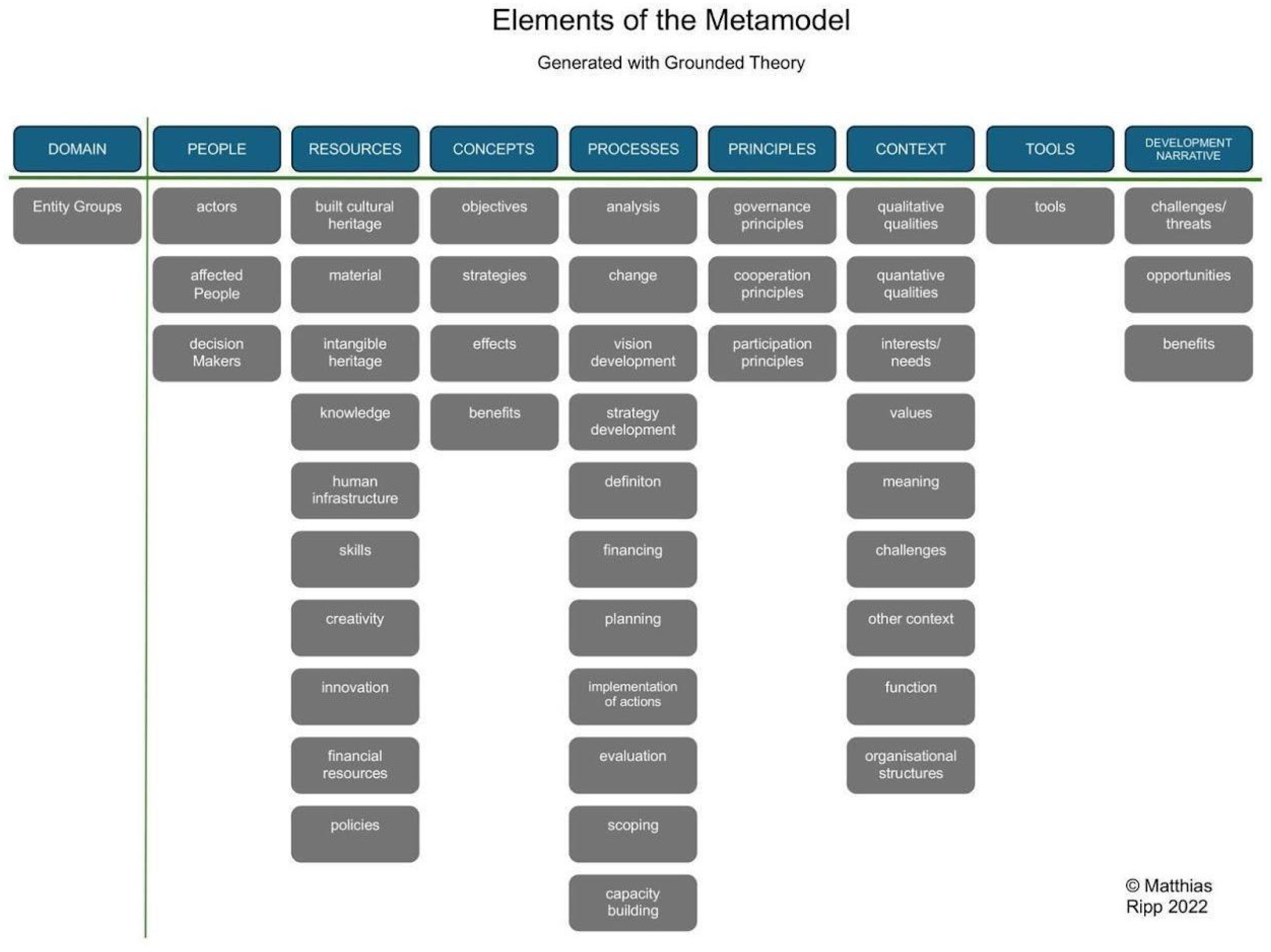
A metamodel represents cultural heritage as a system describing, on an abstract metamodel level, the entities (parts) of the system. This contemporary understanding of cultural heritage has a number of consequences: Already explicitly addressed in the Faro Convention [
35], it becomes very clear that, without people, there is no heritage. This implies that a people-oriented approach should have first priority in cultural heritage beside objects. This includes a re-evaluation of the roles of (local) communities in a number of heritage practices, governance, and decision-making. This systemic understanding of cultural heritage is also reflected in the corresponding system of values [
65]. ICCROM, in its publication People-Centred Approaches to the Conservation of Cultural Heritage: Living Heritage [
66], shows that cultural heritage is more than mere remnants of the past that have reached us in the form of objects, monuments, or traditions; it is something ‘living’ that manifests in our daily lives. Communities possess capacities and resources that endure beyond political or professional structures, complementing specialized knowledge and skills. A people-centered approach leverages these capacities to provide long-term joint conservation and management, benefiting both the heritage and the community. The metamodel’s structural components and their interrelationships are illustrated in
Figure 1, which depicts the key entities and domains that constitute heritage systems.
In heritage sites that are integral to their communities, community involvement often benefits both the heritage and the people. Communities bring enduring resources and skills that go beyond political or professional frameworks, complementing expert knowledge. By adopting a people-centered approach, these strengths can be utilized to ensure the long-term preservation and shared management of heritage, benefiting both the cultural site and the community it serves [
66]. Consequently, only a holistic understanding of the heritage at stake is able to take the full complexity of heritage, including context, users, etc., into account. Heritage projects need cross-sectoral and interdisciplinary teams with diverse scientific and work-related backgrounds to understand the heritage system and design, govern, and implement related interventions and actions. Actors and affected people in the cultural heritage sector need a flexible mind-set with a tolerance for uncertainty [
67], rather than a rigorous linear step-by step approach.
Since the beginning of the conservation movement following the Second World War, the primary focus has been on keeping the material remains of tangible heritage for posterity. This was understandable as countless heritage assets were lost in the war. However, as the definition of heritage keeps expanding, with people increasingly at the center and with growing recognition that change is, in fact, the only constant in life, there is a tectonic shift in embracing continuity and change as an essential element of a heritage place. In this new paradigm, heritage is considered within the changing context in which change is an inherent part of society, the economy, the environment, and governance. Even the needs and attitudes of people change. It is, therefore, important to position heritage within such a context, and, no matter how much we want to keep the values for posterity, values will become lost, change, and transform, and new values will be created over time. Caitlin De Silvey [
68] discusses this very dilemma in relation to Mullion Harbour, Cornwall, UK. In the light of the eventual loss of this site due to climate change, the eventual decision was made to abandon heritage interventions and allow for managed ruination to take place.
When understanding heritage as a system it also becomes clear that this system, with all its entities which constitute it, is constantly changing. The idea that heritage is stable and based on something already existing is an illusion that was never true; some authors like Brett [
69] early on identified heritage itself as a construct. In the beginning of the preservation movement, only parts of heritage systems have been differentiated and valued, analyzed, and protected in an isolated way, which is also closely related with the new formations of scientific disciplines, e.g., art history [
70]. With a broadened focus of heritage, even the concept of ensembles [
71] has already acknowledged the role of change processes like urban transformations.
The holistic understanding of heritage is focusing on the interlinkages between tangible and intangible, and movable and immovable cultural elements, and people and nature in a dynamic interrelationship. The Venice Carnival exemplifies this integration, where intangible cultural practices are inseparably connected to the tangible built heritage environment (
Figure 2). Such a heritage place-based approach considers heritage with a larger territorial context that goes beyond designated administrative boundaries.
8. Cross-Sectoral Resilience Strategies for Reducing Risks
Resilience involves enhancing the capacity of urban heritage systems to adapt and recover from disturbances, such as disasters or rapid urban change [
79]. Resilience is a systemic concept, which has been used more often in relation to heritage and urban planning in the last years [
80]. It can be described as a meta-strategy or concept to enable heritage systems to be prepared for and respond to crisis and transformation: “A heritage-centered resilience vision should aim to be community-based, culture-driven, socially just, and economically viable while integrating local and traditional knowledge as well as local ecosystems and resources. Such a vision should reuse and adapt approaches from already more developed fields whenever possible, only developing new heritage-specific approaches when the singularity of urban heritage makes this mandatory.” [
80].
Resilience as an overarching approach addresses the challenges outlined in the previous section through cross-sectoral risk reduction strategies, namely, disaster risk management, sustainable development, and circular economy. The three are inherently connected through a systems-thinking approach to heritage management. Systems thinking enables us to understand heritage as a dynamic system of interdependent social, cultural, environmental, and economic dimensions [
63]. Disaster risk management (DRM) seeks to mitigate and prepare for disasters, while also responding and recovering from these in a post-crisis context. DRM is conceived as a cycle with three distinct interconnected phases that correspond to before-, during-, and after-disaster situations. Climate adaptation is the process of adjustment to actual or expected climate and its effects, in order to moderate harm or exploit beneficial opportunities (IPCC-2018). Sustainable development ensures that heritage strategies meet present needs while safeguarding resources and values for future generations [
81]. The circular economy supports this by advocating for adaptive reuse, resource efficiency, and long-term value regeneration [
82]. In this framework, heritage is no longer a cost but a strategic investment with positive socio-economic and environmental spillovers [
83,
84]. These concepts converge in a metamodel that structures cross-sectoral strategies and stakeholder collaboration to enable heritage-led regeneration. As demonstrated in Horizon 2020 projects like CLIC and Be. CULTOUR, cultural heritage can foster closed-loop systems that connect conservation, innovation, and resilience. This holistic approach turns heritage into a catalyst for sustainable urban transformation. The increasing complexity and interdependency of urban challenges—ranging from climate change and disaster risks to socio-economic transitions and cultural sustainability—demand integrated, adaptive responses [
85,
86]. This section introduces the application of the metamodel as a systems-based tool that enables such responses. Building on the systems thinking paradigm established earlier, the metamodel is employed here not merely as a conceptual framework, but as an operational lens to identify and structure resilience strategies that cut across conventional disciplinary and sectoral boundaries [
63,
87]. By organizing the interplay between actors, resources, tools, and transformation processes, the metamodel reveals how urban heritage can serve as a foundational platform for designing cross-over strategies—strategies that connect heritage-based urban recovery with fields such as DRM and circular economy [
81,
88]. These strategies are not isolated innovations, but rather emerge from an understanding of heritage systems as complex, adaptive, and resource-rich environments [
84]. The application of the metamodel in this context makes it possible to visualize, coordinate, and scale multi-sectoral interventions, tailored to specific urban conditions, yet informed by transferable principles [
79]. In the following subsections, we elaborate on how this approach can be operationalized within DRM and circular economy frameworks, supported by relevant case studies that illustrate its practical implications.
In this paper, we will use relevant cases to demonstrate the application of an already introduced metamodel (and, more specifically, the Domains) for disaster risk management and climate adaptation, sustainable development, and a circular economy to structure and present the cases, based on a systemic understanding of cultural heritage.
8.1. The Examples of Disaster Risk Management and Climate Adaptation:
Change is an inherent part of heritage, as it has always evolved in response to disasters to which it becomes exposed by learning and relearning while adapting to the changing context. When considered this way, there is no real DRM cycle, as, after any disaster, one can never come back to the same pre-disaster context. It is rather a cyclic loop, where the post-disaster context brings heritage to a new vantage point where vulnerabilities are reduced supposedly based on the lessons learnt from the disaster. Alternatively, one may reinforce or even increase vulnerability if these lessons are not understood well. As such, heritage keeps evolving as a result of a series of trials and errors following successive disasters. A classic example to illustrate this is Hagia Sophia in Istanbul—how a monumental built heritage has evolved in direct response to earthquakes. Located in the seismically active Marmara region, the structure has endured repeated earthquakes that have necessitated significant architectural adaptation and reinforcement. The collapse of the original dome in 558 CE, following earlier seismic damage in 553 and 557, led to its reconstruction by Isidore the Younger with a higher and steeper profile designed to reduce lateral thrusts [
89,
90]. A major earthquake in 989 destroyed parts of the dome and northwest semi-dome, prompting reconstruction with the renewal of some ribs and stabilization of the vault system [
91]. During the 14th century, further seismic episodes necessitated the addition of buttresses under Emperor Andronikos II, reflecting a shift toward external reinforcement [
92]. Following the Ottoman conquest in 1453, Sinan and other imperial architects introduced massive buttresses and minarets that also functioned structurally, consolidating the monument against future tremors [
93]. In the mid-19th century, the Fossati brothers implemented comprehensive restorations, adding iron tie-rods and restraining chains to mitigate the seismic risk [
94]. Modern structural analyses demonstrate the building’s remarkable resilience, though recent conservation campaigns (2025) continue to address earthquake safety through dome reinforcement and steel upgrades. Hagia Sophia thus represents a dynamic case study in seismic adaptation, illustrating how architectural, political, and technological responses to earthquakes have shaped its survival over time.
The historic properties on Nantucket Island, off the eastern coast of the United States (
Figure 5), illustrate the growing vulnerability of coastal heritage to climate-change-driven erosion and sea-level rise. Nantucket’s historic fabric, renowned for its 18th- and 19th-century buildings, is increasingly at risk as shorelines retreat and storms intensify [
95]. In response, residents have adopted strategies such as elevating historic houses above projected flood levels or relocating entire structures when erosion renders sites untenable (Federal Emergency Management Agency [FEMA], 2020). [
96]. While such interventions preserve the building fabric, they also raise critical debates about authenticity, integrity, and the cultural landscape.
Technocentric interventions, such as the installation of large-scale sand-filled “Geo Tubes” at Siasconset, were initially proposed as protective measures against shoreline retreat. However, long-term assessments reveal limited effectiveness, with continued erosion and ecological disruption undermining the project [
97]. These examples highlight that heritage cannot be treated as a static entity; rather, it must adapt within shifting environmental contexts. A systems-thinking approach is required—one that balances engineered protection, adaptive reuse, community priorities, and ecological processes—ensuring that cultural heritage resilience becomes integral to broader climate adaptation strategies.
Disaster risk management makes sure that vulnerabilities and risks are reduced in the post-disaster context following the principle of building back better while enabling the continuity of values that define the heritage significance to the best possible extent. In this process, of course, values also become transformed and new values might be created. When considering this perspective, heritage is understood as a result of living with risks rather than fighting with them. In this process of a continued relationship with risks, heritage emerges as a dynamic response to the local context, and, in this process, traditional knowledge for coping with disasters keeps becoming updated over time. This explains why, on the east coast of Japan, frequent tsunamis resulted in the temples being built on higher ground that, in fact, saved many lives of people who could take refuge in them. Another example is the vernacular architecture on stilts in the Southeast Asian region that is a logical response to frequent floods.
DRM and climate adaptation also help us approach heritage management from the risk lens that entails considering short- and long-term scenarios that rely not only on deductions from past events/data but also on taking into account predictions based on projected models. How do we see the future of the present if the past, present, and future are in a continuum? What is an acceptable change that ensures the continuity of heritage through evolution? However, this also means embracing uncertainty and creating various options for interventions rather than fixed, close-ended prescribed solutions. This would necessitate a focus on the process of designing pathways of change and creative ways of regeneration rather than merely the product (outcome) and identifying transition points for reflecting and making decisions. Once more, a systemic understanding of heritage will help in understanding these pathways of change that are based on the continuous building of resilience and adaptation in response to recurring disasters. In fact, lessons learnt from each disaster helps in reviewing and updating the disaster management plan. The systems thinking also helps in identifying the root causes of vulnerability through understanding causes and effects rather than a mere reactive treatment of symptoms. The metamodel’s five domains—people, resources, concepts, processes, and principles—provide an operational framework for analyzing heritage systems within disaster risk management and climate adaptation contexts, as detailed in
Table 4.
8.2. Sustainable Development
Sustainable Development and cultural heritage’s ability to build bridges between perspectives, people, time, and space is seen in this context as a necessary resource for jointly shaping the future way of living and working. Cultural heritage activities contribute, to a large extent, to the creation of new values. It is not only about cultural heritage contributing to strengthening the attractiveness of a place or region and thus contributing to increased tourism, nor is it only about economic returns or the creation of new jobs. It can be about refurbishment, restoration, and conservation leading to a higher market value and sale price of properties, but also about new values through social cohesion, circular economy, and sustainable development.
The UN’s Sustainable Development Goals, Agenda 2030 [
1], have perhaps had a greater impact globally than previous international agreements in this area. Agenda 2030 is based on the three dimensions of environmental, social, and economic sustainable development with the aim of creating a transition to a sustainable society for people, the planet, and prosperity.
Goal 11, Sustainable cities and communities, is of particular concern and it is here that we find target 11.4, Protect world’s cultural and natural heritage, where, for the first time in this type of international policy document, we find the concept of cultural heritage explicitly. This means, among other things, that UN member states agree that urban cultural heritage is a fundamental resource and a necessary prerequisite for sustainable development. Cultural heritage is considered in this context as a testimony to human endeavor and the aspirations of humanity over time and how the society we live in is shaped. Target 11.4 states that we will protect and preserve natural and cultural heritage. The only indicator initially provided was to look at the total costs incurred by member countries to evaluate the actions. Now, UNESCO has developed 22 new indicators to monitor culture within the 2030 Agenda. Of interest is that they do not focus solely on economic impacts, but, instead, focus on the importance of culture for the environment and resilience, prosperity and livelihoods, knowledge and skills, and inclusion and participation.
In other words, there is a clear shift towards the contribution of culture and heritage to sustainable development. It also means that we can see the impact of culture and cultural heritage not only in Goal 11, but also in Goals 2 (Zero hunger), 4 (Quality education), 6 (Clean water and sanitation for all), 8 (Decent work and economic growth), 9 (Sustainable industry, innovation and infrastructure), 10 (Reduced inequalities), 12 (Sustainable consumption and production), 13 (Combat climate change), 14 (Oceans and marine resources), 15 (Ecosystems and biodiversity), and 16 (Peaceful and inclusive societies). The question is whether culture also has an impact on Goals 1 (No poverty), 3 (Good health and well-being), 5 (Gender equality), 7 (Sustainable energy for all), and 17 (Implementation and global partnership)?
A crucial element in combating climate change is the more sustainable development of cities and the stimulation of urban resilience [
8,
10]. The United Nations’ member states have recognized that overcoming poverty depends on fostering economic growth while simultaneously addressing essential social needs, such as a strong health and education system and access to quality employment opportunities. These vital steps toward achieving social equality must be aligned with efforts to protect our planet and cultural heritage. The United Nations established the Sustainable Development Goals, tried to set specific targets, and set up a monitoring system (SDGs) in 2015 [
1]. However large parts of the change that we see happen in urban environments is not planned but rather organic and is now more often called urban transformation [
63]. This is also part of the urban reality and needs to be taken into account when analyzing urban heritage.
The Green Deal aims to transform the EU into a modern, resource-efficient, and competitive economy. As part of the work to realize the European strategic agenda, the EU has launched a New European Bauhaus with the aim of contributing to societal development based on inclusion, diversity, accessibility, sustainability, creativity, and innovation.
Sustainable development should incorporate culture and cultural heritage from the outset, recognizing them as essential drivers and foundational elements. While heritage managers have always been tasked with taking preventive measures to protect cultural heritage, the complexity of this responsibility has increased in recent decades.
The application of the metamodel domains to sustainable development demonstrates how cultural heritage contributes to multiple UN Sustainable Development Goals across social, economic, and environmental dimensions, as shown in
Table 5.
8.3. Circular Economy
Recently, international organizations such as the UN and the European Union as well as more and more cities and regions have initiated work on shifting to a circular paradigm of production–consumption. The circular economy is often understood as a powerful tool in the transition to a resource-efficient society and can help us achieve our environmental and climate goals. The transition to a circular economy has great potential to reduce resource use and limit climate and environmental impacts.
In a circular economy, things are used for as long as possible. According to Luigi Fusco Girard and Antonia Gravagnuolo [
82] the circular economy has three main characteristics: it is oriented to enlarge the lifetime of goods, assigning them new functions (in a long-time perspective); it is based on synergies/symbioses between actors in fostering closed loops of value creation—economic wealth is created through the multiplying of relationships; and, finally, it enhances productivity, decoupling wealth production from negative environmental impacts.
A circular economy has been regarded as a tool to increase prosperity, while reducing the dependence on primary materials and energy [
98]. At the policy level, the UN has, with the New Urban Agenda [
99], considered the circular economy model in a critical strategy to manage ecological resources such as land, water, energy, materials, and food. The UN highlights that the transition to a circular economy facilitates ecosystem conservation, regeneration, restoration, and resilience in the face of new and emerging challenges [
100]. For the construction industry, this includes a qualitative shift toward waste reduction, energy and raw material savings, building renovation, repurposing, and reuse [
82]. The circular economy, enhancing resource efficiency and creating new marketplaces for used resources, can create new jobs from low- to high-skill workers.
The circular economy paradigm’s business models are centered on reuse, rather than the consumption of ecological resources, and regenerative practices that have, on top of economic advantages, beneficial impacts for society as a whole [
101]. For cultural heritage management, it has implied a stronger focus on the adaptive reuse of historic buildings and environments (
Figure 6).
The closed loop is the key principle of the circular economy model [
82]. In the EU Horizon research projects CLIC and Be.CULTOUR, circular models were studied from a cultural heritage perspective to financing, business, and governance models, creating synergies between multiple actors, reducing the use of resources and reusing/regenerating values, capitals, and knowledge.
Cultural heritage can be considered an economic good [
83,
102]. The CLIC and Be.CULTOUR studied the adaptive reuse of abandoned industrial heritage sites, and, here, it was obvious that the circular economic processes were linked to a reduction in costs in different ways. The non-used cultural heritage can thereby be regarded as a cost. With its (what Fusco Girard and Gravagnuolo [
82] call) creative functional reuse, it can, instead, reduce this cost, transforming it into an investment. Hereby, the conservation of cultural heritage becomes effective if it is incorporated in a circular economy perspective/strategy. The metamodel framework operationalizes this circular economy approach by structuring the interrelationships between stakeholders, resources, concepts, processes, and principles, as presented in
Table 6.
9. General Insights/Common Learnings: Heritage Systems Are Morphing into Different Shapes, but Core Principles, Values, etc. Stay
From a conceptual view, if we understand heritage as a system which is determined by connections, values, and people, beyond the physical objects, the definition of conservation must be challenged. A conserving system is a different approach than conserving a physical object like a building. When we limit cultural heritage, for example, to the physical dimension of a listed building, we can work with approaches like keeping the exact same fabric and the exact same appearance, etc. Conserving a heritage system might look more at how the heritage is used by whom, when, etc. and how this is changing as in the case of the management of historic landscapes [
103], especially in an urban context through the historic urban landscape approach [
81,
104].
Berlin is still Berlin even if many entities have changed during the last 50 years. Understanding and feeling that we are still in the same city is more connected to iconic/landmark elements, atmosphere, experiences, people, culture, language, food, climate and setting, and a multitude of other entities which, altogether, form the context and system of the city at the same time. Transferring this to cultural heritage, all the elements of a heritage system are relevant and should be taken into account. Even on the macro level, for example, the transformation of the Museum Island in Berlin, with the addition of the James Simon Gallery (opened in 2019), illustrates that the heritage system that we call museum island, which is made by buildings, functions, its setting, values, etc., is still intact, even though significant parts have been changed—of course, after careful consideration and a planning process where the heritage values played a major role [
105].
From the beginning of the conservation movement, the concept of conservation was developed as an “antidote to change.” In the beginning, united together with environmental movements, the “Heimatschutz” Movement was based on “keeping” rather than changing or adapting [
106]. The core principle has somehow remained stable and is still, today, at the heart of either community-based bottom-up conservation movements or state-based administered conservation policies and their implementation. Recent examples can be seen in Central European cities, where the bankruptcy of an Austrian development company has left large department stores unused and with an insecure future, often right in the heart of historic cities. Together with other developments, like structural changes, changes in the way shopping is carried out, etc., this contributes to an increased insecurity if these large shopping complexes can survive in the long run. The more the discussion and potential change, together with anticipated insecurities, emerged, like a reflex, these have been examined as to whether they can obtain official heritage status. As this could be scientifically based and well-deserved, the timing for this evaluation can too easily be interpreted as a reaction to probable change. From a meta viewpoint, this “coincidence” could also be interpreted as a sort of misuse of heritage listing to counteract development or, in this case, urban transformation (
https://www.mittelbayerische.de/archiv/1/regensburg-kaufhof-unter-denkmalschutz-11766587, accessed on 21 August 2024).
To manage cultural heritage as a system, it is important to recognize, reinforce, and maintain the interrelationships between attributes rather than focusing on them in isolation. In this process, some values are retained, while others are transformed and even new values are created over time. The heritage management system should be able to accommodate and adjust this dynamic change in values within the larger system.
An interesting example where community-based heritage includes not only “traditional” communities but also more recent migrant communities is the Migratie Museum Brussels, which received the European Heritage Label by the European Union. Largely developed and also run by these communities, it shows that alternative narratives and history also contribute to current European values. “Located in Brussels, Belgium, MigratieMuseumMigration (MMM) stands as a testament to the diverse migratory experiences that have shaped the continent’s history. Recognized as a European Heritage Label site, MMM documents the stories of migrants who have made Europe their home. The museum’s collections provide a unique perspective on the social, economic, and cultural impacts of migration, fostering understanding and appreciation for the contributions made by migrants to European society.”(
https://www.europeanheritagedays.com/EHD-Programme/Press-Corner/News/Three-European-Heritage-Label-Sites-supported-under-the-European-Heritage-Days, accessed on 24 August 2024).
Furthermore, the interconnectedness of different geographical scales from micro to macro and vice versa needs consideration. Therefore, instead of looking at individual heritage components such as a monastery or sacred mountain, industrial heritage, or a marine ecosystem, in isolation, the place-based approach for management considers heritage within the larger territorial context that goes beyond designated administrative boundaries that define heritage sites. It seeks to identify and manage multiple interlinkages of the site with its larger territory, both in terms of identifying the larger set of values that are crucial for supporting the more recognized values, while also considering the factors outside the site boundaries that directly or indirectly pose risks to the heritage site under consideration. This approach also advocates for a regional planning approach that seeks the integrated conservation and development of urban, fringe, and rural areas through mainstreaming heritage management in larger conservation and development processes.
Cultural heritage understood as a system contributes to the creation of new values and uses [
107]. These valorizations can be understood as a return of investments in line with the UNESCO Culture 2030 Indicators (2019), which, among all, highlights their environmental, cultural, and socioeconomic components [
108]. The economics of cultural heritage has been studied from multidimensional perspectives in recent decades, including with a view to developing tools and approaches for the conservation, use, and development of cultural heritage within the framework of sustainable development [
109]. Studies have also shown that a building’s higher cultural and historical value imply a higher selling price, which can be interpreted as people appreciating heritage values; however, it can also be understood as conservation operating as a driver for gentrification [
110].
The actors on the cultural heritage market are, to a large extent, public entities, such as public cultural institutions [
111], but also startups, SMEs, and larger, more mature commercial companies [
112]. The economic importance of cultural heritage for tourism was recognized early on, and it accounts for up to 40% of all tourism economies in Europe [
113]. In Europe, overall, the cultural heritage sector generates a gross value added of €32 billion, corresponding to 3.4% of the total services economy [
111]. In England, the cultural heritage sector alone contributed approximately £44.9 billion in value added in 2022, which represents about 0.80% of England’s total value added [
114]. The European Commission, as well as member states, e.g., Sweden, regard cultural and creative industries as a new type of primary industry [
115].
Recently, there has been an increased interest in relations between the cultural and creative sector, including cultural heritage and creativity and innovation, health and quality of life, and social impact and behavior change, and this, hereby, has the capacity to address societal challenges. The CHCfE Consortium [
116] highlights the importance of cultural heritage in strengthening a city’s or region’s attractiveness (visitors, talents, and investments); supporting citizens’ identity and local/regional narratives, job creation (the construction industry, property market, tourism, and the cultural and creative industries as catalysts for heritage-led regeneration); mitigating climate change (adaptive reuse, and embedded energy), improving quality of life, underpinning education and life-long learning, supporting social cohesion, and increasing creativity and innovation. In cultural heritage, innovation plays a key role in adding a socio-economic value to the cultural one [
107,
109,
116,
117]. Innovation is the “multi-stage process whereby organizations transform ideas into new/improved products, services or processes, to advance, compete and differentiate themselves successfully in their marketplace” [
118].
The indicative funding amount for Horizon Europe for the period 2021–2027 is EUR 93.5 billion [
119]. Record-breaking total of 1331 proposals submitted to the 2025 calls for various cultural heritage research and innovation projects [
120]. More than 90 regions in Europe have mentioned culture and heritage in their Smart Specialization Strategy [
121]. However, less than 10% of the strategies give important political priority to cultural heritage [
122].
Culture and cultural heritage are inseparably connected. This can be seen, for example, in the European Capitals of Culture Initiative. Heritage systems (in this case, usually cities) are not only the stage, but also the resource, seeding ground, incubator, etc. for this year-long cultural festival. Often, these mega-events [
123] stimulate investments in the cultural infrastructure and also cultural heritage through enhanced accessibility, urban regeneration projects, increased heritage interpretation, etc.
The metamodel [
10,
63] can be used to understand and map heritage, broadening the focus and understanding in a holistic and systemic way. This deeper understanding can then contribute to design change, transformation, and urban development processes [
124]. Understanding heritage in this way, also related to its context, processes, etc., can help to acknowledge that, in this view, it is rather normal that some entities of heritage systems are constantly changing.
10. Implications for the Heritage Sector
DRM for cultural heritage has resulted in the development of the concept of resilience that is seen as the way of moving forward rather than bouncing backwards in the aftermath of a disaster. In order to move forward, rather than merely considering persistence, transformation and adaptation are accepted as strategies for heritage management. Even dealing with the eventual loss of heritage is acknowledged as part of heritage management practice through extreme measures such as relocation. This new understanding for heritage management becomes even more crucial in the light of climate change, where various climate models suggest that many heritage sites such as those along the coast are certainly going to become lost in the foreseeable future due to sea level rise coastal flooding and erosion, no matter how many resources are spent and technology created for mitigating the potential impact. This forces us to think of new ways of managing heritage, not just in terms of preserving the physical fabric, but also preserving the memory through creative means. Fortunately, digital technology empowers us to do so in so many ways at present than was possible in the past.
DRM and climate adaptation also help us approach heritage management from the risk lens. This entails considering short- and long-term scenarios based on probabilities and developing our actions on predictions rather than merely deducing from the historical data. However, this also means embracing uncertainty and creating various options for interventions rather than fixed close-ended prescribed solutions. Risk perspective also involves considering multiple hazards and their complex interactions rather than thinking of hazards such as earthquakes and floods, and even human-induced ones such as arson and looting in an isolated manner. It is a well-known fact that disasters are becoming increasingly complex due to a combination of various factors that resonate the impact several times. The recent wildfires in Los Angeles provide us with a good illustration of this issue. Another important point that comes forward is the importance of a territorial approach in addressing disaster risks as risks are often created outside the designated boundaries of a heritage site and reducing them would require coordination across various jurisdictions and stakeholders from multiple sectors and at various levels. For example, the risk of flooding or erosion that may affect a heritage site might be connected with the dam being built several miles away.
Another important implication for the heritage sector is the recognition of the importance of creativity and innovation, an important dimension of heritage management rather than static preservation. This is not just concerned with what we inherit from the past but also what we create for the future. Heritage is constantly produced through a creative act, even though it gains recognition as heritage over time. While we keep what we inherit for the future generations, we also need to create a heritage of the future as a continuous creative act for which innovation and adaptability are much needed in the heritage conservation discourse. Since heritage is not just a reference of the past but also to the future, the post-crisis recovery of heritage provides an opportunity to build a sustainable and resilient future.
Therefore, rather than merely recognizing and rediscovering traditional knowledge and romanticizing it, it is also important to constantly review, update, and adapt it to the current constraints, needs, and opportunities. In this context, one needs to move beyond the dichotomy of traditional and scientific knowledge and develop an interface between these two systems. While the scientific aspects of traditional wisdom will help to innovate, the scientific knowledge may need traditional modes of communication for wider outreach and effectiveness. In terms of governance, this would require developing an institutional interface between the four key areas of heritage conservation and management, sustainable development, disaster risk reduction, and climate action, which are often siloed in different sectors with little or no coordination.
11. Conclusions
Conservation theory and practice have developed significantly over the last 50–60 years. The first years were largely devoted to the identification of historic values, followed by the protection of selected historic buildings, often single monuments, through strengthened legislation. The first challenge for the heritage sector was to develop methods of and an appraisal of historic values and, accordingly, make a selection for conservation. The value assessment established the cultural heritage sector with a focus on protection through incorporating cultural heritage values into urban and spatial planning. The Venice Charter for the Conservation and Restoration of Monuments and Sites from 1964 is a set of guidelines for the conservation and restoration of historic buildings. In the following years, this charter was followed by several doctrines aimed at preserving different elements of the tangible cultural heritage. However, the preservation of cultural heritage was considered a cost to society, an economic burden tolerated mainly as a moral duty. Within this discourse, historic buildings were seen by those outside the sector as an obstacle to economic growth and development in general.
Nowadays, the cultural heritage, as well as its interpretation and re-interpretation, is still too often regarded to be constant. This has implied that conservation principles and praxes have also been modified corresponding to new challenges and opportunities. Nothing is heritage in itself, unless it becomes perceived and used as such. In the UNESCO Recommendation on Historic Urban Landscape, cultural heritage is linked to creativity and development.
11.1. Scope and Limitations
While this study advances the operationalization of a metamodel for heritage-based urban development and demonstrates its applicability across multiple cross-sectoral domains, several methodological, contextual, and epistemological limitations must be acknowledged. As Midgley [
50] emphasizes, “being critical about boundaries... essentially means making ‘transparent to oneself and others the value assumptions underlying practical judgements, rather than concealing them behind a veil of objectivity’.” In this spirit, we reflexively identify the constructed boundaries that shape both the scope and findings of this research.
First, the study is geographically bounded to Western European urban heritage contexts. The empirical focus draws primarily from case studies situated in European cities (e.g., Berlin Museum Island, Venice, and Nantucket), reflecting institutional, policy, and governance frameworks particular to this region. As a result, the generalizability of findings to non-European contexts—particularly the Global South, rapidly urbanizing cities in Asia, Africa, and Latin America, or rural and Indigenous heritage contexts—is inherently limited [
23,
125]. The cultural, institutional, and epistemological frameworks that underpin Western heritage discourse may not translate directly to settings where relational ontologies, oral traditions, or spiritual heritage knowledge systems prevail [
22]. This reflects what identified as the values-based nature of boundary judgements: “judgements on boundaries are always values-based, and hence decision making on the remit of a project is an inherently ethical matter” [
50].
Second, the operationalization and evaluation of the metamodel are constrained by methodological boundaries. While the metamodel was developed using grounded theory and design research methodology [
10], its testing relies on qualitative case analysis, scenario-based application, and available documentation. A quantitative, longitudinal assessment of the metamodel’s impact on heritage management effectiveness—such as measurable improvements in stakeholder coordination, disaster resilience, or circular economy outcomes—remains limited [
50,
109]. Furthermore, the case selection criteria prioritized sites with extensive English-language documentation, integrated systemic approaches, and completed interventions with available evaluations. This introduces selection bias, potentially overrepresenting well-resourced, internationally visible projects while marginalizing less documented or unsuccessful cases [
126]. As Ulrich [
58] observe, such methodological choices encode normative assumptions about whose perspectives matter and whose knowledge counts.
Third, temporal and scalar boundaries shape the study’s analytical focus. By emphasizing “transformation” and “urban heritage systems,” the research privileges change over continuity and city-scale dynamics over hyperlocal or transnational heritage networks [
9,
42]. This temporal framing may marginalize heritage communities who emphasize persistence, intergenerational continuity, or cyclical understandings of time, while the scalar focus may obscure regional heritage planning or neighborhood-level practices [
23]. These boundaries are not neutral; they reflect disciplinary norms within Western-trained heritage scholarship that prioritize rationality, documentation, and expert analysis [
127].
Fourth, epistemological boundaries inherent in systems thinking itself must be acknowledged. Systems thinking, rooted in Western scientific rationality, establishes epistemological boundaries that may exclude Indigenous relational ontologies, spiritual ways of knowing, or affective and embodied heritage knowledges [
22,
125]. While the metamodel integrates participatory and people-centered approaches [
66], its conceptual architecture—actors, resources, tools, and processes—remains grounded in rationalist frameworks that may not accommodate alternative epistemologies. As Jackson [
128] notes, responsible systems practice requires rendering such boundaries visible, contestable, and revisable in cross-cultural applications.
Finally, the dynamic nature of heritage policy, governance structures, and systemic challenges means that the study’s conclusions reflect the context current at the time of research (2024–2025). Climate risks, urban policies, technological advances, and socio-economic factors are continuously evolving, and the metamodel’s applicability may require adjustment as these conditions change [
85]. Future research should integrate more robust, standardized metrics for longitudinal assessment, expand case studies to diverse geographic and cultural contexts, and explore participatory, field-based, and co-creative methodologies to test the metamodel’s adaptability [
129].
In summary, the scope of this study is intentionally bounded to urban heritage systems in Western Europe, applying an operationalized metamodel to address systemic, multi-scalar challenges such as climate change, disaster risks, and circular economy transitions. These boundaries should be kept in mind when interpreting results and considering future transfer or adaptation of the metamodel. By acknowledging these limitations transparently, we invite critical engagement with the metamodel as a provisional, context-dependent tool—one that must be continually refined through dialogue, empirical testing, and cross-cultural collaboration.
11.2. Management of Heritage Systems in Practice
For urban heritage conservation and management, this paper presents advanced understanding and opens a door for a deeper understanding of historic urban landscapes and their urban fabric by acknowledging the full systemic nature of conservation. Since an understanding of heritage as a system is still only developed as a theoretical concept, this initially implies a need for deeper understanding of this system and its various parts. Such an understanding includes exercises of mapping, inventories, etc. which focus on the system as a whole. A good example demonstrating this direction is the first volume of the Bamberg inventory coordinated by Thomas Gunzelmann [
130] or various recently published studies in the world heritage context like the urban analysis related to the bid of Olympiapark in Munich [
131]. After broadening the concept and understanding of heritage, this opens the door to broader “entry points” and advanced activities of heritage interpretation [
132]. A systemic understanding of heritage makes it much more connected to different target groups because it includes more opportunities to relate to their real-world issues. For heritage professionals and site managers, this has most probably the most serious implications: They need to be prepared and have the appropriate mindset to be willing to constantly learn about new entities of the system by leaving their comfort zone. Complex heritage systems of course are more demanding in terms of management, participation process, number of stakeholders, etc., but, in a way, this already reflects today’s reality of many world heritage site managers who are responsible for urban heritage. Looking at examples of the impacts of climate change and urban transformation on heritage, it becomes clear that many aspects beyond single monuments are affected. Skills that are related to management and participation like, e.g., facilitation, are, therefore, becoming more relevant and are often not sufficiently present, for example, in corresponding university curricula. The identification of connections and relations between different components of heritage systems is, however, a great source for innovation. Therefore, the main objective is expanded from a focus on the conservation of heritage elements like listed buildings to, more and more often, the professional capacity to administer the processes of change that are taking place, either induced by planned urban development processes or informal urban transformations.
11.3. Implications for Capacity Building and Training
This new paradigm has profound implications on training and capacity building for heritage conservation and management. Firstly, the target audience should include not only heritage professionals but also those from planning, development, disaster risk management, and environment sectors. This would enable understanding and appreciating the vocabularies and tools from different fields to foster cross-disciplinary collaboration. In terms of course content, capacity building activities should combine technical skills with soft skills such as negotiations, dialogue, and team building to enable collaborations at multiple levels. Perhaps the most important implication of the systems thinking in heritage conservation is to promote longitudinal field-based and scenario-based learning aimed at developing a package of options based on innovation and experimentation that can be creatively combined and tested for their application on ground for managing continuity as well as change. This would help in going beyond standard recipe-based solutions that do not work well in an evolving context.
11.4. Heritage as Part of Management of Change
Many policy makers, researchers, and stakeholders now see cultural heritage not as an obstacle to economic growth or as a luxury, but as a crucial resource for citizens and the key to competitive advantage. Historic environments often have strong attractiveness to appeal to talent, tourists, and investment. This has opened up new opportunities for cultural heritage management.
Conservation of cultural heritage should thereby not be regarded as a cost to the society: instead, it has to be recognized as investments. The return on these investments can be identified as spillover or crossover effects such as the reinforcement of social cohesion and quality of life, increased attractiveness for visitors, talents and investments, strengthening the inhabitants’ identity and narratives, creation of jobs (the construction industry, property market, tourism, the cultural, and creative industries, however, in the whole economy as well), urban historic environments as arenas for creativity and innovation, the mitigation of climate change through adaptive reuse, and the utilization of embedded energy, and, in general, as a catalyst for heritage-led regeneration and sustainable development.
This means that the spillover or crossover effects from investments in cultural heritage can be understood as contributing to sustainable development and can thus be used as starting points for planning the priorities of heritage management. The focus of the heritage sector is no longer only on the preservation and protection of monuments: finding new activities to take place in historic buildings has become more important.
Today, heritage increasingly has the potential to be recognized as a dynamic force driving social, cultural, and economic change, thereby strengthening communities by drawing on a rich cultural heritage of knowledge and ideas, stories, and opportunities for social exchange transmitted across generations.
However, the transformation to a green economy and society implies that cultural heritage requires to have the capacity to address societal challenges. This implies that we need to emphasize the notion of cultural crossovers. Cultural heritage can interact with health and well-being, social cohesion, innovation, and education, and, in particular, with attitudinal and behavior change, not just as just a spillover effect.
Further research should focus on the combination of digital technologies including artificial intelligence as well as conventional means for understanding multi-layered and complex heritage systems. Further, the dynamics of change should be analyzed based on the past data as well as future projections for developing evidence-based multiple scenarios. Research is also needed on analyzing the long-term impacts of investing in heritage for improving the quality of life of people in various socio-cultural, geographic, and economic contexts. Last but not the least, we need innovative research on applying the traditional knowledge collectively developed by communities over time to address contemporary challenges of climate change, protecting natural resources, and stimulating sustainable development. This will ensure that heritage is sustained not as static but as a dynamic evolving system adjusting to ever changing context.
In this context, the historic city is a living entity that evolves over time and space. To continue to thrive, remain attractive, and inspire the broader city of which it is the heart, it must adapt like any other urban district. A city is meant to be lived in—whether for residence, work, socialization, personal growth, community building, or welcoming others. How these living spaces are organized and function directly impacts the quality of life of its inhabitants and the extent to which they engage with the environment. In a historic city, not everything is a “monument,” and modernity has its place. Heritage, however, remains the driving force of urban development—an invaluable resource that should be used wisely and creatively to enhance the well-being and quality of life of residents, while also informing urban policies [
133].
The new LEIPZIG Charta by the European Commission tries to respond to these challenges:
“Cities and urban systems need flexibility as well as the ability to respond to external disruptive events and chronic stress. The robustness of cities to cope with changing framework conditions should be supported by an ability to learn from past events and from each other, flexible urban governance for the common good as well as balanced implementation of just, green and productive cities. Predictive and preventive policies, plans and projects should include diverse scenarios to anticipate environmental and climatic challenges and economic risks as well as social transformation and health concerns”.
11.5. Implications for Future Research
To strengthen the methodological validity, especially considering Eurocentric notions on heritage, and, at the same time, system thinking, future iterations of heritage systems analysis should carry out the following: (1) explicitly map stakeholder compositions against demographic profiles of case study cities, identifying whose heritage narratives are included and whose are absent; (2) investigate heritage practices emerging outside formal institutions, including those articulated by migrant communities; (3) examine how heritage designations and conservation priorities may reproduce or challenge existing patterns of urban inequality and social exclusion; and (4) engage critically with questions of whose heritage is recognized, funded, and institutionalized within professional heritage systems. Such methodological refinements would honor the demographic reality that Western European heritage is fundamentally shaped by migration while addressing the risk that heritage analysis reproduces authorized discourses that privilege certain communities while rendering others invisible.