1. Introduction
Digitization has become a defining technological trend of the 21st century, transforming economies, societies, and industries. By converting analog information into digital formats, digitization enhances the physical deterioration, environmental threats, and unforeseen disasters of cultural assets while expanding their accessibility and supporting knowledge dissemination across scholars, educators, and the public [
1,
2]. Large-scale investments in cultural heritage digitization (CHD) have reinforced its role in cultural accessibility, knowledge production, and economic development [
1,
3]. As digital technologies continue to reshape the sector, CHD has become part of the broader digital economy, contributing to the creation of economic value and fostering new forms of cultural participation. In analytical terms, these developments are outcomes of digitization and must be distinguished from the socioeconomic drivers and institutional conditions that enable or constrain CHD across different contexts.
However, despite these advancements, CHD remains constrained by institutional and financial barriers. In response, the European Union (EU) has positioned digitization as a policy priority within its broader digital transformation strategies, consistently framing CHD as a strategic instrument to improve access to cultural heritage and support innovation in the cultural and creative sectors [
4]. Aligned with the EU’s digital competitiveness agenda and cultural policy objectives [
2], these frameworks primarily articulate normative goals, while offering limited empirical insight into the structural conditions under which CHD advances across different national and regional contexts.
The economic significance of CHD extends beyond cultural preservation, positioning it as a socioeconomic asset with implications for both economic activity and sustainable cultural management. In the European tourism sector, historic sites, museums, and cultural institutions rely increasingly on digital accessibility to reach domestic and international audiences, contributing to revenue generation and employment [
5]. Through virtual exhibitions, interactive platforms, and augmented reality applications, cultural heritage institutions (CHIs) enhance accessibility and audience engagement while responding to evolving visitor expectations [
3]. At the same time, CHD supports long-term preservation and open access to fragile artifacts, fosters participatory knowledge-sharing, and promotes social inclusion in cultural heritage interactions [
6,
7,
8]. By integrating cultural heritage into broader sustainability objectives related to economic stability, education, and environmental conservation [
9], CHD reinforces its role within the cultural and creative economy and reflects wider patterns of digital technology adoption in the cultural sector [
2].
Despite the recognized benefits of CHD and ongoing EU investments, research on its socioeconomic drivers remains limited, as empirical studies have not kept pace with policy developments [
10]. Existing research largely relies on conceptual discussions, expert-based assessments, and qualitative approaches, with relatively few large-scale, data-driven analyses of the external factors shaping CHD. Prior studies have addressed specific dimensions of digitization, including regional challenges in CHD adoption [
11], the economic value of digital heritage content [
1], and platform-specific forms of digital engagement, such as those associated with Europeana and Google Arts & Culture [
12]. In parallel, the broader digital transformation literature has expanded. Yet, it primarily examines national-level digitalization processes or sustainability outcomes without explicit attention to the cultural heritage sector, focusing instead on Information and Communication Technology (ICT) adoption [
13], supply chain efficiency in relation to the Sustainable Development Goals [
14], crowdsourcing-based sustainability models [
15], or institutional capacity and innovation in digitization using ENUMERATE data [
16]. However, these approaches do not systematically account for the broader socioeconomic conditions that shape CHD across contexts.
While these studies offer valuable insights, they lack a systematic and data-driven framework for assessing the broader socioeconomic factors that shape CHD. Given the scale of EU investments, it is crucial to determine whether digitization outcomes are primarily driven by targeted funding or by the broader macroeconomic and socioeconomic environment in which CHIs operate. At the aggregate level, institutional capacity, resource allocation, and technological readiness are not only shaped by internal strategies but also fundamentally dependent on broader socioeconomic conditions, which cannot be fully captured by case-based or qualitative approaches alone. The absence of empirical evidence on such structural drivers limits policymakers’ and institutions’ ability to design effective and context-sensitive strategies to expand CHD.
Therefore, this study aims to examine the socioeconomic drivers of CHD across Europe systematically. By focusing on macro-level indicators and cross-country variation, it adopts an econometric perspective that captures structural relationships beyond individual institutional contexts. Using data from ENUMERATE and Eurostat, it provides an empirical assessment of the external factors shaping CHD across Europe. A structured analysis of existing research identified key socioeconomic drivers, forming the theoretical foundation for the analysis. Given the complexity of CHD drivers, this study employs Ordinary Least Squares (OLS) and Generalized Additive Models (GAMs) to capture both linear and non-linear relationships. By integrating these modeling approaches, the study bridges qualitative insights and empirical validation, offering a more precise understanding of the factors driving CHD.
This study is structured as follows.
Section 2 presents a literature review, examining existing research on CHD drivers and establishing the theoretical foundation for empirical analysis.
Section 3 outlines data sources, variable selection, and econometric models.
Section 4 provides an empirical assessment of the socioeconomic drivers of CHD, while
Section 5 contextualizes the findings in relation to previous studies. Finally,
Section 6 synthesizes key insights, highlights their implications for policy and institutional strategies, and identifies future research directions for advancing CHD in Europe.
2. Literature Review
The factors driving cultural heritage digitization are multifaceted, operating across economic, technological, institutional, and social dimensions. Although CHD is both a cultural and technological process, it is also a component of the broader digital economy, affecting economic productivity, labor markets, and industry structures. In line with Schumpeter’s Theory of Economic Development [
17], CHD represents an innovation-driven transformation in which technological advancements disrupt traditional cultural preservation and engagement models, fostering new economic opportunities and institutional adaptations. Digitization transforms how cultural content is disseminated and consumed, creating new market dynamics, altering value chains, and reshaping competitive landscapes. However, while innovation theory helps explain the dynamics of technological change, the diffusion and outcomes of CHD are also shaped by complementary factors related to human capital formation, demand-side conditions, and institutional structures. Understanding the socioeconomic drivers of CHD is essential for assessing the efficiency of digitization investments, their spillover effects on cultural and creative industries, and their potential to influence broader economic trends.
Despite its economic significance and growing policy priority, particularly in Europe, systematic, data-driven research to identify and classify its socioeconomic drivers remains limited. To address this gap, this study develops a structured classification of CHD drivers based on an extensive literature analysis, providing a foundation for empirical testing. We identify six key categories of CHD drivers: (1) economic and technological, (2) human capital, (3) culture, (4) tourism, (5) education, and (6) internal institutional. The summarized classification of socioeconomic drivers of CHD is presented in
Table 1. This classification not only provides a novel framework for understanding digitization trends but also bridges the gap between qualitative insights and empirical validation, enabling a comparative, data-driven analysis of the macroeconomic drivers of CHD. Furthermore, this classification serves as the foundation for the econometric modeling in this study, in which we empirically test the extent to which these drivers influence CHD. The contribution of this classification lies not in the identification of individual drivers—many of which have been examined in isolation—but in their systematic consolidation into a coherent, analytically structured framework suitable for macro-level empirical testing. By integrating economic, technological, social, and institutional dimensions within a single classification, this approach enables the joint examination of drivers that are typically treated separately in the literature. As such, the six-category framework provides a structured basis for comparative analysis and supports the transition from fragmented qualitative insights toward systematic empirical assessment of the socioeconomic conditions shaping CHD.
The following sections provide a detailed discussion of each category, along with its theoretical and empirical foundations.
2.1. Economic and Technological
External and internal economic drivers play a vital role in CHD. While in developed countries, CHIs often face challenges related to the sheer volume of collections, in developing countries, they struggle with resource constraints and conflicting ideas about the digitization process [
22]. Several authors [
5,
24] highlight the significant economic impact of the COVID-19 pandemic, as CHIs suddenly had to invest in digital tools such as virtual platforms, online archives, and digital exhibitions. CHD requires sustainable financial investments, which can be challenging, especially for smaller CHIs [
26]. On the contrary, ref. [
25] noted that revenue opportunities generate income beyond their physical locations and serve as a strong economic driver of CHD.
Advances in technology, particularly in artificial intelligence, 3D modeling, and virtual reality, have opened new avenues for creating entirely new immersive user experiences in the context of personalized engagement and interaction within cultural spaces [
18], creating opportunities to provide individualized service [
20] and to attract new customer traffic. Growing public interest in digital tools such as mobile applications and virtual tours encourages institutions to innovate and adopt user-centric approaches. Ref. [
19] established that using augmented reality (AR) in museums fosters greater visitor satisfaction, prolonged engagement, and increased tourism activity while contributing to AR-enhanced tourism. From the perspective of innovation economics and Schumpeter’s Theory of Economic Development, these economic and technological drivers reflect innovation-led dynamics in which technological change and investment incentives shape institutional adaptation and value creation in CHD.
2.2. Education
Education plays a crucial role in fostering awareness and support for the CHD, particularly through formal education systems, academic research, and professional training. According to [
40], the population with higher education levels is more likely to recognize the importance of CHD. In addition, higher levels of education among the regional population correlate with greater efficiency, especially in museums [
29]. Moreover, academic research acts as the most important driver of CHD in CHIs, followed by educational reasons [
23]. Finally, the education of CHI employees, such as investing in regular training and upskilling [
26], plays a vital role in CHD ability to face systemic and technological challenges and manage digital collections effectively [
39]. From a human capital theory perspective, these findings indicate how formal education, research capacity, and professional training contribute to the development of the skills and knowledge necessary to advance CHD.
2.3. Human Capital
When society acknowledges the significance of CH and possesses the societal capacity and skills to engage with it in a digital context, it strives to cultivate a sustainable relationship with it [
27]. According to [
29], societies that invest in their CH as part of their human capital are more likely to support CHD. Moreover, community engagement, reflecting the broader societal ability to participate in and support digitization initiatives, is a vital aspect of successful digitization [
28]. However, in developing countries, negative perceptions, such as concerns about the permanent loss of heritage or disinterest from key stakeholders, can hinder progress [
22]. From a human capital theory perspective, these factors highlight how collective skills, social engagement, and population-wide capacities condition the adoption and effectiveness of CHD initiatives across contexts.
2.4. Tourism
Tourism is a primary source of sustainable economic development for CH [
37]. Digital tools enable museums and libraries to cater to “digital heritage tourists,” i.e., individuals who primarily engage with cultural content online, rather than digital tourists who use digital technology to enhance the physical tourists’ experience [
34]. Ref. [
36] findings suggest that digital cultural tourism services can partially complement in-suit cultural tourism experiences. On the contrary, digitization can boost cultural tourism by making heritage sites and artifacts more accessible and appealing [
27,
48]. Major cities across the EU are increasingly prioritizing investments in digital tourism, creating opportunities to access CH sites and promoting more environmentally conscious tourism [
35]. By integrating digital tools, smaller cities could increase their socioeconomic potential by sharing their unique heritage globally without compromising their slow-paced, community-centered way of life [
38]. The study by [
29] established the heterogeneous effects of international and domestic tourist flows on museums and libraries. From an economic demand-side perspective, these dynamics highlight how tourism-related patterns of access, consumption, and mobility shape incentives for CHIs to adopt and expand CHD initiatives.
2.5. Cultural
Rising cultural consumption and demand by cultural enthusiasts, reflecting patterns of cultural participation and consumption, drive the CHD across Europe and encourage initiatives that not only preserve cultural assets but also maximize their reuse and societal impact [
32]. Such demand creates pressure for CHIs to adopt digital technologies, ensuring more expansive access, enhanced engagement, and sustained relevance in the digital age [
31]. Therefore, CHIs must be equipped with sufficient specialized staff, targeted training, and capacity-building initiatives to respond to evolving cultural expectations [
33]. From an economic demand-side perspective, these factors underscore how cultural consumption patterns and public expectations influence the incentives and pace of CHD adoption.
2.6. Internal Institutional
The internal environments of CHIs also shape CHD outcomes. Multiple dimensions of the internal institutional environment come into play. For instance, ref. [
49] reported a positive impact of long-term strategic planning on the share of digital collections. Moreover, most CHIs are driven by missions centered on education and access to knowledge provision [
41]. Ref. [
43] highlighted the importance of business model innovation. Ref. [
44] argues that cost savings, skill sharing, and access to technological tools are key benefits of digitization collaboration. Moreover, the relationships with stakeholders, such as community relations [
47] and participatory governance approaches [
45,
46] positively shape CHD. Ref. [
42] highlights that corporate museums provide more digital services than traditional public museums, which is explained by greater knowledge spillover from more profit-oriented CHIs. From an institutional economics perspective, these internal factors illustrate how organizational structures, governance arrangements, and strategic orientations condition the capacity of CHIs to implement and sustain CHD.
3. Materials and Methods
3.1. Data
This study draws on large-scale datasets from ENUMERATE and Eurostat to examine the socioeconomic drivers of CHD using a systematic, data-driven approach. Data on CHIs were obtained from the ENUMERATE survey, while national-level socioeconomic indicators were sourced from the Eurostat database. The ENUMERATE Core Survey 4 conducted in 2017 was part of a broader series on digitization in Europe, following Core Surveys 1 and 2, conducted by the ENUMERATE Thematic Network in 2011 and 2013. Core Survey 3 and the most recent ENUMERATE survey were carried out under the Europeana initiative in 2015 and 2022, respectively.
However, because the 2022 survey did not include information on the share of digitized cultural heritage collections, this study relies on data from the 2011, 2013, 2015, and 2017 surveys. The pooled cross-sectional dataset initially contained 5320 observations. Standard data-cleaning procedures addressed inconsistencies and missing values, resulting in a final sample of 2166 CHIs observations. The analysis focuses on the European cultural heritage sector rather than a country-level framework, with CHIs grouped accordingly. The dataset includes 526 archives, 622 libraries, 869 museums, and 149 institutions classified as “other.”
3.2. Variables
The dependent variable, DIG SHARE, measures the share of digitized cultural heritage collections as a percentage of total collections at a CHI. This variable is the primary indicator of digitization outcomes, reflecting the extent of digitization efforts within CHIs across the EU. Data for DIG SHARE were obtained from the answers to the ENUMERATE survey question: “Estimate the percentage of your analog heritage collections that have already been digitally reproduced. A digital reproduction is a digital surrogate of an original analog object. Please note that an object only cataloged in a database with metadata records is not considered “digitally reproduced.”
The independent variables were assigned to categories of socioeconomic drivers affecting CHD based on findings from the academic literature (see
Table 1). Variables capturing economic and technological change—GDP per capita (GDP CAP), general government expenditures (GOV EXP) and access to high-speed internet (INT 100)—were grouped with indicators reflecting digitization capacity within CHI, namely the share of expenditure devoted to digitalization (DIG EXP SH), and volume of human resources (FTE DIG) dedicated to digitization at CHI, reflecting overall economic stability and institutional capability. The national levels of cultural consumption (CULT CON) and employment in the cultural heritage sector (EMPL LAM) were used to proxy the impacts of cultural sector strength. For tourism drivers, domestic tourism (TOU DOM), which can encourage CHI to attract local tourists, and total tourism (TOU TOT), which may drive digitization to enhance global accessibility and visibility, were selected. For education, the share of individuals with tertiary education was used as the indicator (EDU). Two indicators were used to proxy human capital: DIG SKI, measuring the share of individuals with basic or above-basic overall digital skills, and INT USE, capturing internet usage patterns. A higher level of digital skills within the population is expected to enhance engagement with and utilization of digital content, potentially incentivizing CHIs to expand their digitization efforts. As internal institutional drivers, the binary (dummy) variables indicating whether CHI had a digitization strategy (ORG STR) and whether CHI measured the use of their digitized collections (USE), coded as 1 for ‘yes’ and 0 for ‘no,’ were included in the model.
To align with the ENUMERATE survey waves (2011, 2013, 2015, and 2017), corresponding observations for the independent variables were extracted from Eurostat for the same years. Where values were not available for a given year, missing observations were reconstructed using linear interpolation (for gaps within the observed time range) or linear extrapolation (for years outside the observed range).
Table 2 reports variable definitions, units of measurement, abbreviations, data sources, the years available, and the imputation approach applied to obtain complete observations for the analysis period. Independent variables are organized into CHD driver categories based on the literature review and conceptual framework. The table also identifies intermediate input variables that are not entered directly into the regressions but are used to compute constructed independent variables.
For the analysis of survey-based revenue data (REVENUE), data on CHI’s self-reported financial positions were collected as predefined revenue ranges rather than exact amounts. To enable quantitative analysis, these categorical responses were converted into single representative values. Specifically, each closed interval was assigned its midpoint (i.e., the mean of the lower and upper bounds), providing a standardized continuous approximation. For the open-ended upper category (e.g., “>€10 million”), a representative value was assigned using a defensible assumption for the upper tail, consistent with standard practice for handling top-coded interval data.
3.3. Econometric Modeling
Including multiple socio-economic drivers required a method to assess their simultaneous and individual impacts. Econometric modeling was selected for this research to integrate theoretical assumptions with real-world data. As Ramsey’s regression specification error test [
50] detected a nonlinear relationship in the Ordinary Least Squares (OLS) model, empirical validation was conducted by estimating the OLS model and a fully flexible machine-learning Generalized Additive Model (GAM). Introduced by [
51], GAM enables consistent estimation of linear and non-linear effects by applying the Frisch–Waugh–Lovell theorem [
52].
To establish a simple model consistent with the conceptual framework, we began with the baseline model, including all theoretically motivated predictors. Because the number of predictors is high relative to the available survey rounds observations, we used backward stepwise elimination as a model refinement tool, removing variables sequentially based on a combination of statistical criteria (AIC/BIC), incremental explanatory contribution (adjusted R squared) and conventional significance thresholds. The stepwise procedure was applied after the complete set of variables had been identified from the literature review. GOV EXP, DIG EXP SH, EMPL LAM, TOU DOM, INT USE, and USE predictors did not significantly improve the model fit or explanatory power (and were therefore excluded from the preferred specification. The final set of predictors was selected based on their statistical significance, contribution to explanatory power, and optimal model performance:
where:
DIG SHARE—dependent variable;
β0—intercept;
βk—corresponds to the coefficients of variables;
ε—the error term, capturing unobserved factors;
DIG SKI × INT 100—interaction term;
ORG STR and TYPE—categorical variables included as dummies;
As a robustness check, we compared the preferred model with the full-theory specification and with alternative models that retained substantively important covariates despite marginal insignificance. We found that the main inferences remained qualitatively stable. Then, the partial linear model (PLM) double residual methodology was estimated. The estimation proceeded in multiple steps:
In the first step, general PLM was defined as:
where:
s(Xj)—an unknown smooth function of Xnonlinear.
Z—linear variables Xlinear.
Non-linear variables (Xnonlinear): FTE SH, CULT CON, GDP CAP.
Linear variables (Xlinear): TOU TOT, EDU, DIG SKI, INT 100, DIG SKI×INT 100.
In the second step, the dependent variable DIG SHARE was modeled as a combination of smooth functions of non-linear variables to isolate non-linear effects:
where:
s(X) are smooth splines estimated using GAM.
Then residuals were extracted to remove the non-linear effects from DIG SHARE, leaving only the linear components and categorical variables:
Each linear predictor was regressed on the non-linear terms:
The residuals of all linear variables are extracted:
where:
(Xk∣Xnonlinear): the predicted values obtained from the GAM.
After residualizing both DIG SHARE and X
linear predictors, an OLS regression was performed using heteroskedasticity-consistent standard errors:
In the last step, the complete GAM integrating non-linear, linear, and categorical variables is constructed:
The estimation approach separated non-linear (smooth) effects from linear effects, applied heteroskedasticity-consistent standard errors to the linear regression, and refitted a final GAM. The final model integrated smooth terms, adjusted linear effects, and categorical variables to comprehensively analyze the relationship between the dependent variable and the predictors.
4. Results
Descriptive statistics indicate that most CHIs have limited financial and human resources dedicated to digitization. A few well-funded institutions significantly raise the average, masking the prevalence of resource constraints among most CHIs. Investment in digitization is highly uneven, with some institutions allocating substantial funds while others invest minimally or not at all (see
Table 3).
Annual revenue varies considerably across CHIs, with a few large institutions significantly elevating the average. A similar pattern is observed in staffing levels: most institutions have a relatively small workforce, while some employ substantially larger teams. Only 38% of CHIs report having a formal digitization strategy. The share of digitized collections has a median of 10%, though extreme outliers inflate the mean to 20%. The allocation of financial resources to digitization exhibits substantial skewness. The mean annual expenditure on digitization is €170,432, whereas the median is €5000, indicating that while a few institutions allocate substantial budgets, most dedicate only limited funding. Institutions employ, on average, 4.8 staff members for digitization, but the median is only 2, reflecting that many CHIs have minimal dedicated personnel. Volunteers play a less prominent role overall, though some institutions rely heavily on them, with the maximum reported count reaching 1100.
To examine the relationship between the share of digitized cultural heritage collections (DIG SHARE) and various socioeconomic, technological, and institutional factors, Ordinary Least Squares (OLS) regressions (see
Table 4) and Generalized Additive Model (GAM) (see
Table 5) were estimated. The OLS model provides a baseline linear estimation, while GAM accounts for potential nonlinear relationships by incorporating smooth terms for selected variables. The adjusted R-squared values indicate that OLS explains 13% of the variance, whereas GAM improves model fit slightly, explaining 17%. Both models yield similar estimates for the linear predictors, with GAM additionally capturing non-linear effects.
While these values may appear modest, they are well within the acceptable range for cross-sectional analyses in the social sciences, where a large degree of unobserved heterogeneity across institutions and countries is expected. In such studies, the primary goal is often not to achieve high predictive accuracy but to identify statistically significant relationships, and an R-squared value of 0.10 is considered an acceptable minimum when key predictors are substantial, as is the case in our models [
53].
OLS and GAM estimate a positive and statistically significant effect of household broadband access (INT 100) on DIG SHARE. In OLS, the coefficient is 0.0710 (p = 0.45), while in GAM, it is 0.0652 (p = 0.0316), indicating a consistent but slightly lower estimated impact in the non-linear framework.
Both models show a positive and significant relationship between TOU TOT and DIG SHARE, suggesting that CHIs in regions with higher tourism activity tend to have more outstanding digitization shares. The OLS estimate is 0.035 (p = 0.002), and the GAM estimate is 0.00776 (p < 0.001), indicating a slightly lower effect size in the latter.
DIG SKI has a negative, highly significant coefficient in both models, suggesting that a higher share of individuals with basic or above-basic digital skills is associated with lower digitization levels. OLS estimates the effect at −0.604 (p < 0.001), while GAM provides a slightly lower estimate of −0.580 (p = 0.001). However, the interaction term DIG SKI × INT 100 is positive and statistically significant in both models, indicating a moderating effect where digital skills enhance digitization outcomes only when internet access is sufficiently high. OLS estimates the effect at 0.0078 (p = 0.006), while GAM provides a lower estimate of 0.0061 (p = 0.03). The share of the population with tertiary education (EDU) is positively associated with digitization levels in both models. The OLS estimate is 0.67 (p < 0.001), while the GAM estimate is 0.631 (p = 0.001), confirming a robust effect across both approaches. A formal digitization strategy (ORG STR) is among the strongest predictors of DIG SHARE across both models. OLS estimates a 6.0 (p < 0.001) effect, while GAM reports 4.40 (p = 0.003), slightly reducing the magnitude but maintaining strong significance.
OLS estimates a positive and weakly significant effect of CULT CON on DIG SHARE (0.0073, p = 0.049). However, this variable is not included in the GAM parametric terms, suggesting potential non-linearity in its relationship with digitization. GDP CAP is positively associated with DIG SHARE in OLS (0.0002, p = 0.018) but is modeled as a smooth term in GAM. OLS estimates FTE SH at 0.0068 (p = 0.061), indicating a weakly significant effect. However, in GAM, this variable is treated as a smooth term to capture potential non-linearity.
Compared to the baseline category, CHIs classified as museums and other institutions exhibit significantly higher digitization shares in both models. Museums: OLS estimates 14.7 (p < 0.001), while GAM reports 13.9 (p < 0.001). Other CHIs: OLS estimates 19.1 (p < 0.001), with GAM estimating 18.10 (p < 0.001). Libraries: OLS finds 0.75 (p = 0.70), while GAM estimates 1.74 (p = 0.379), confirming that the effect remains small and statistically insignificant in both models.
In addition to the linear predictors, the GAM captures non-linear relationships through smooth functions. Three variables—cultural consumption (CULT CON), GDP per capita (GDP CAP), and the share of full-time employees in digitization (FTE SH)—were modeled using smooth terms to account for potential non-linear effects.
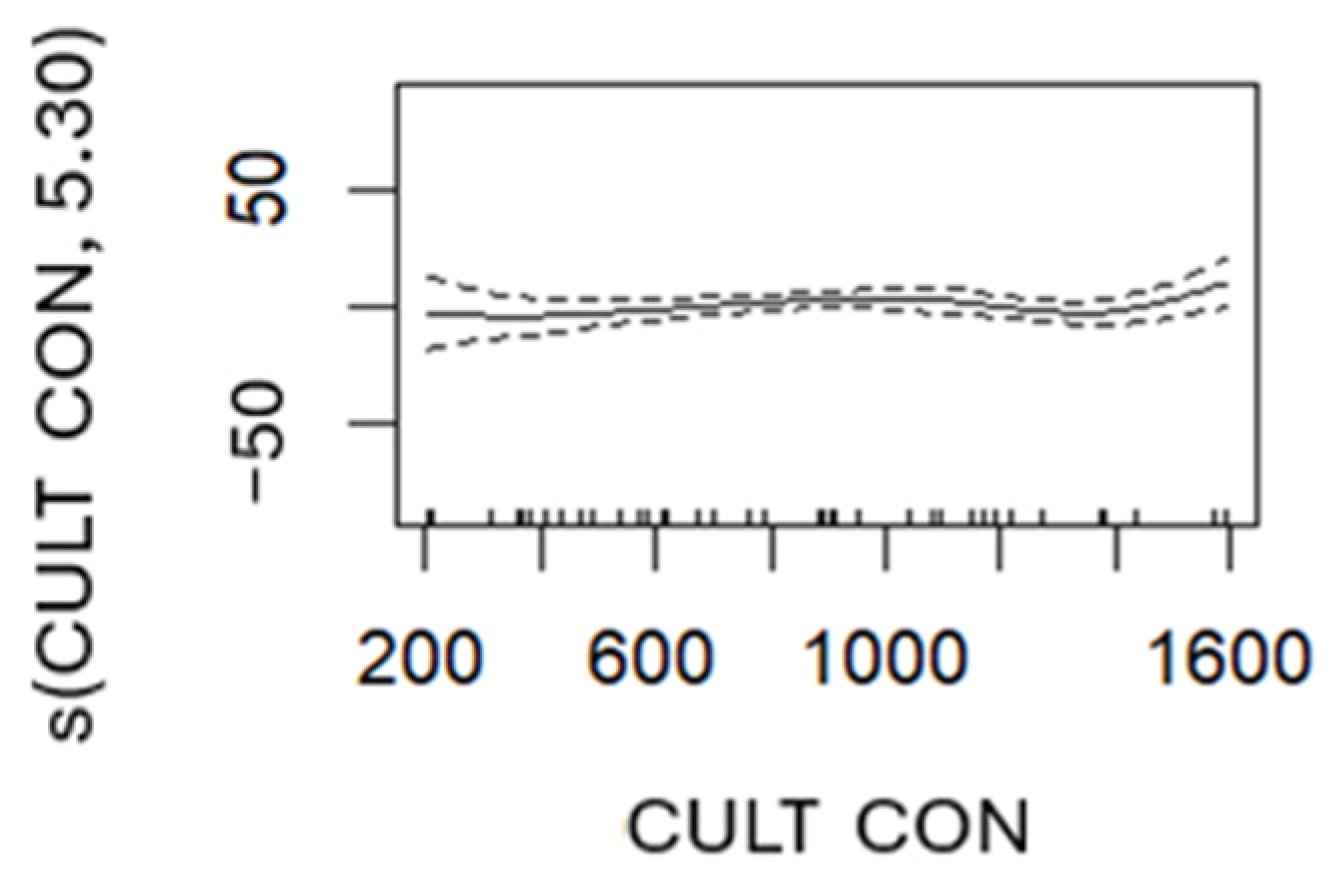
The smooth term for CULT CON (see
Figure 1) did not reach statistical significance in GAM (edf = 5.30, F = 1.65,
p = 0.112), suggesting that household expenditure on cultural goods and services does not exhibit a strong or consistent relationship with DIG SHARE when non-linearity is accounted for. The plot shows a relatively flat relationship with wide confidence intervals that encompass zero across most of the range of cultural consumption values. The smooth function hovers around zero with no clear directional trend, and the wide confidence bands indicate substantial uncertainty around the estimated effect. This pattern suggests that there is no meaningful non-linear relationship between cultural consumption and digitization share. The effect is essentially indistinguishable from zero, which explains why the smooth term is not statistically significant (
p = 0.112). This differs from OLS, where CULT CON had a weakly significant positive effect (
p = 0.049), indicating that its impact may be more complex and not adequately captured by a simple linear specification.
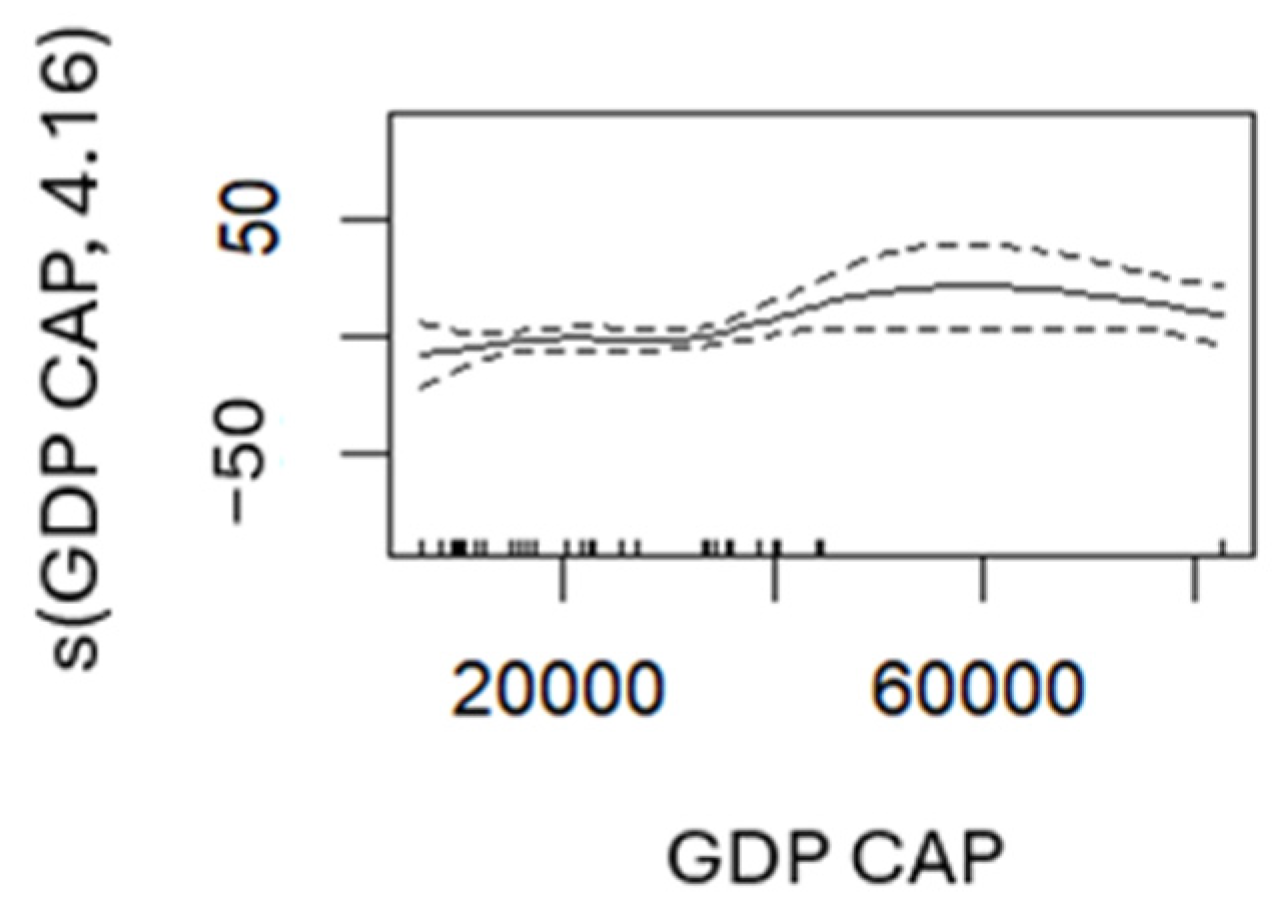
The smooth term for GDP CAP (see
Figure 2) approaches statistical significance (edf = 4.16, F = 1.92,
p = 0.099), indicating that the relationship between economic wealth and DIG SHARE may not follow a strictly linear trend. The plot suggests a generally positive, but decelerating, relationship. The upward trend is most pronounced at lower levels of GDP per capita and then flattens out, suggesting diminishing returns to economic wealth in predicting the share of digitized collections. This non-linear pattern is more nuanced than the simple linear effect captured by the OLS model. In contrast, OLS estimated a small but significant positive coefficient (
p = 0.018), which suggests that a linear approximation may overstate the robustness of this effect.
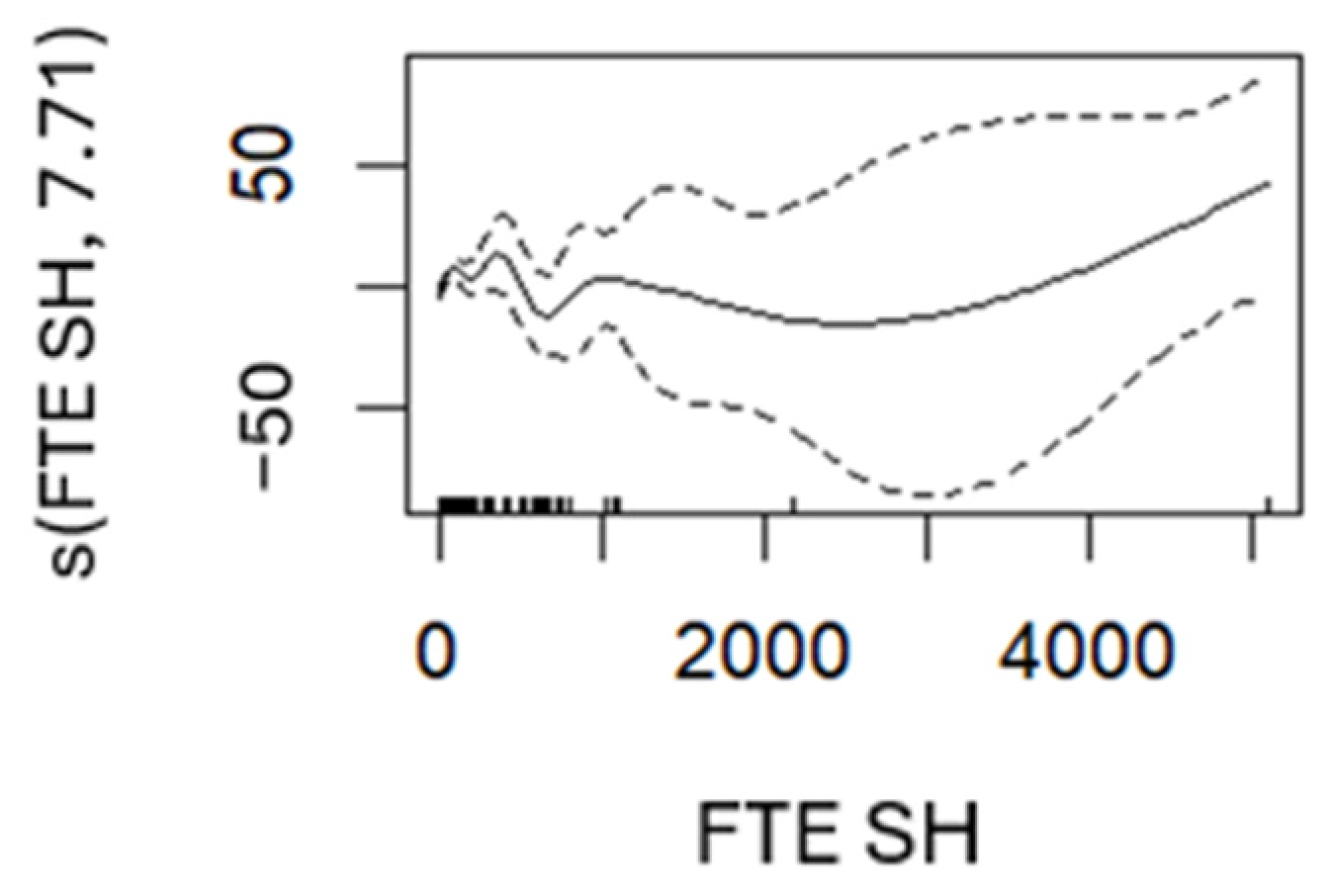
FTE SH (see
Figure 3) exhibits a highly significant non-linear relationship with DIG SHARE in GAM (edf = 7.71, F = 3.66,
p < 0.001), indicating that the effect of human resource allocation on digitization is not constant across institutions. In OLS, FTE SH had a weakly significant linear effect (
p = 0.061). However, the GAM plot reveals a clear threshold effect. The effect of additional staff is negligible at very low levels, then increases sharply, and finally plateaus. This suggests that a minimum level of staffing is required to initiate meaningful digitization efforts, after which additional staff have a significant positive impact up to a certain point, beyond which the returns diminish. This non-linear pattern, which the OLS model cannot capture, provides a much richer understanding of how workforce allocation relates to digitization outcomes.
The results highlight distinct socioeconomic, technological, and institutional drivers of CHD, revealing both linear and non-linear effects. The following section contextualizes these results within existing research and discusses their implications for policy and practice.
5. Discussion
This study presents a comprehensive, data-driven analysis of the socioeconomic drivers shaping European cultural heritage digitization. While digitization has long been recognized as a policy priority, empirical research quantifying its structural drivers remains limited. This study systematically assesses the underlying forces influencing CHD using large-scale datasets from ENUMERATE and Eurostat. The application of econometric modeling that integrates both linear and non-linear estimation techniques provides empirical validation of the external drivers of digitization efforts. This approach bridges the gap between conceptual discourse and empirical evidence, providing a robust foundation for understanding how economic, technological, and institutional factors collectively shape CHD trends.
Economic and technological conditions jointly shape the environment in which CHD develops, highlighting the role of national wealth and digital infrastructure as foundational enablers of digitization. Higher levels of economic prosperity support investment in CHD. However, the benefits of increased resources appear to diminish once basic financial constraints are overcome, suggesting that funding alone is insufficient to sustain continued progress in digitization. This pattern is consistent with earlier research identifying financial limitations as a persistent barrier for resource-constrained institutions [
26]. From an innovation-oriented perspective, these findings suggest that economic resources facilitate the initial adoption of digitization but do not, by themselves, guarantee sustained transformation.
Digital infrastructure plays a similarly enabling role. Greater broadband availability is consistently associated with higher levels of CHD, underscoring connectivity as a prerequisite for digitization activities [
39]. However, technological capabilities do not operate independently. Population-level digital skills alone do not automatically translate into higher digitization outcomes, indicating that general competencies are insufficient in the absence of supportive institutional and infrastructural conditions. The positive interaction between digital skills and broadband access reinforces this interdependence, suggesting that technological capabilities contribute to CHD only when embedded within adequately resourced and connected environments. Taken together, these findings indicate that economic and technological factors function as necessary but not sufficient conditions for CHD, with their impact mediated by broader infrastructural and institutional contexts that shape how innovation is translated into sustained digitization outcomes.
Demand-side dynamics play an important role in shaping CHD, as both cultural consumption and tourism generate pressures for greater digital access to cultural heritage. Higher levels of cultural engagement are generally associated with increased investment in digitization, indicating that demand for cultural content encourages CHIs to expand digital offerings. However, this relationship is not uniform across contexts. Evidence suggests that beyond a certain point, higher levels of cultural consumption do not necessarily translate into additional digitization efforts, particularly where institutions already operate with relatively advanced digital infrastructures. This pattern indicates that cultural demand alone is insufficient to drive CHD and that broader institutional and structural conditions mediate its influence. Institutional type appears especially relevant, as museums and other cultural heritage institutions consistently exhibit higher digitization levels than libraries, regardless of regional consumption patterns. These findings align with prior research showing that regional cultural performance depends not only on consumption levels but also on demographic, educational, and organizational factors [
29].
Tourism reinforces these demand-side pressures by shaping how CHIs respond to visitor expectations [
37]. Increased tourism activity is associated with greater digitization efforts, reflecting institutional strategies to enhance access, engagement, and visibility. At the same time, this relationship should be interpreted cautiously, as digitization may also contribute to tourism growth, suggesting a mutually reinforcing rather than strictly causal dynamic. While aggregate tourism demand appears more influential than distinctions between domestic and international visitors, previous studies indicate that international tourists are generally more inclined to engage with digital heritage content [
34]. The growing relevance of the “digital heritage tourist” further highlights rising demand for remote cultural engagement [
34], while evidence suggests that digital cultural tourism complements rather than replaces physical visits [
36]. Nonetheless, adoption remains uneven, with demographic factors and technical or accessibility barriers constraining uptake in some contexts. Taken together, these findings suggest that CHD reflects not only institutional or policy priorities but also evolving demand-side pressures linked to cultural consumption and tourism. However, the extent to which these pressures translate into sustained digitization outcomes depends on institutional capacity and structural context, rather than demand intensity alone.
Human capital emerges as a central theme shaping CHD, operating through both formal education and population-level digital skills, but with distinct mechanisms and implications for digitization outcomes. Higher levels of tertiary education strengthen the institutional conditions under which CHD initiatives are planned and implemented, contributing to managerial efficiency, structured planning, and governance capacity within CHIs. Regions with more educated populations tend to exhibit more advanced digitization efforts, a pattern consistent with previous research showing that education often exerts a more substantial influence on cultural institution performance than economic factors alone [
29]. More broadly, higher levels of education may also legitimize and support greater investment in digital heritage initiatives, reinforcing demand for digitized collections and fostering knowledge-based engagement with cultural heritage. In this sense, tertiary education functions primarily as an institutional enabler of CHD, shaping long-term strategic orientation rather than acting as a direct technological driver.
By contrast, population-level digital skills exhibit a more conditional relationship with CHD. Higher levels of digital literacy alone do not automatically translate into increased digitization efforts within CHIs, indicating that individual skills in isolation are insufficient to drive CHD outcomes. Digital skills become effective only when supported by adequate technological infrastructure and enabling institutional conditions, underscoring the interdependence between human capabilities and broader structural contexts. Without sufficient connectivity or institutional support, the potential benefits of a digitally skilled population remain underutilized. This interpretation aligns with prior research suggesting that, while societies increasingly recognize the economic and tourism-related benefits of digitization, they do not necessarily associate digital engagement with the long-term preservation of cultural heritage [
27]. Consequently, the translation of digital skills into CHD outcomes depends not only on individual competencies but also on complementary infrastructure and policy environments, distinguishing their role from that of tertiary education, which primarily strengthens institutional capacity and long-term strategic orientation.
While economic resources and digital infrastructure enable CHD, their impact ultimately depends on institutional capacity, which shapes how external conditions are translated into sustained digitization outcomes. Governance arrangements, strategic orientation, and workforce organization influence whether available resources are effectively mobilized, coordinated, and maintained over time. Even well-resourced CHIs may struggle to scale digitization initiatives without coherent institutional frameworks and long-term planning. Internal institutional factors, therefore, play a decisive role in conditioning the effects of economic and technological drivers. Institutions with clearly defined digitization strategies tend to achieve higher and more consistent digitization outcomes, reflecting the importance of strategic planning to align resources, secure funding, and foster collaboration. In contrast, the absence of strategic direction often results in fragmented efforts and inefficient resource use [
16]. Institutional type further shapes these dynamics, as museums and other CHIs generally exhibit higher levels of digitization than libraries, likely reflecting differences in funding models, collection priorities, and engagement strategies. Workforce allocation also mediates how institutional intentions translate into practice. Evidence suggests that a minimum level of staffing is required before digitization efforts can gain momentum. Below this threshold, limited expertise and competing institutional demands constrain progress, while beyond it, additional personnel contribute less proportionally to digitization gains. This highlights the importance of effective workforce planning rather than simply expanding staff. Beyond internal resources, governance constraints and challenges in stakeholder engagement further influence CHD trajectories. As previous research indicates, stakeholder resistance, ownership concerns, and reliance on short-term funding can undermine sustainability and limit the transformative potential of digitization initiatives [
1,
22]. Without stable investment and structured institutional frameworks, CHD risks remaining a passive archival activity rather than functioning as an active driver of cultural and economic engagement.
While this study focuses on the EU context, the observed relationships may differ in regions with weaker institutional frameworks, lower levels of public investment, or uneven digital infrastructure. In such settings, economic and technological drivers may exert more fragmented effects, and institutional capacity may play an even more decisive role in shaping the scope and sustainability of CHD initiatives.
6. Conclusions
Through large-scale econometric modeling, this study provides a systematic, data-driven assessment of the socioeconomic drivers shaping cultural heritage digitization across Europe, addressing a critical gap in empirical research. Overall, the findings of this study confirm that targeted funding initiatives do not solely drive CHD but are shaped by complex interactions among economic capacity, digital infrastructure, institutional strategy, and societal demand. The findings reveal that economic and technological conditions, including GDP per capita and broadband internet access, serve as primary drivers of CHD, but their impact depends on institutional capacity. Tourism and education levels also emerge as significant drivers, reinforcing the role of external demand and knowledge-based engagement in digitization efforts. Conversely, digital skills alone negatively correlate with CHD, but when combined with broadband access, their effect becomes positive, highlighting the role of infrastructure in enabling digital engagement. Institutions with structured digitization strategies exhibit significantly higher digitization rates, emphasizing the importance of long-term planning. Finally, workforce allocation follows a non-linear threshold effect, indicating that a minimum level of dedicated personnel is required before digitization gains become substantial.
6.1. Theoretical Implications
This study advances the economic and institutional analysis of CHD by empirically validating the role of macroeconomic conditions in driving digitization efforts. Its primary theoretical contribution lies in the systematic consolidation of previously fragmented insights into a six-category framework of socioeconomic drivers, enabling their joint empirical assessment at the macro level. While existing literature often treats CHD as a supply-driven policy initiative, these findings highlight its demand-driven dimensions, particularly the influence of tourism and education. The results also contribute to digital economy research, showing that technological readiness alone is insufficient without complementary institutional and workforce investments. The non-linear effects detected in GAM further underscore the threshold-dependent nature of CHD drivers, emphasizing the need for context-specific policy interventions rather than uniform strategies.
6.2. Practical Implications
For policymakers and cultural heritage institutions, these findings underscore the need for targeted, multi-dimensional strategies to enhance CHD. Financial and technological investments must be paired with institutional capacity-building measures, including the development of structured digitization strategies and long-term workforce planning. In practical terms, this implies that broadband infrastructure investments should be coordinated with institutional digitization strategies, ensuring that connectivity upgrades are accompanied by organizational readiness to deploy digital tools effectively. The strong link between tourism and CHD suggests that integrating digitization efforts into tourism strategies could enhance accessibility and economic sustainability. Policy coordination between cultural, digital, and tourism authorities may therefore help align demand-side pressures with institutional digitization capacity. Additionally, education policies should emphasize not just digital literacy but also the role of higher education in fostering CHD adoption. Finally, as digital skills alone do not translate into more excellent digitization outcomes, workforce development policies should prioritize specialized training and stable staffing structures alongside infrastructure investment, ensuring that digital competencies can be effectively mobilized within CHIs.
6.3. Limitations
Despite its contributions, this study has several limitations. First, data constraints in the ENUMERATE surveys present challenges for long-term trend analysis. While the dataset spans multiple years (2011, 2013, 2015, and 2017), the 2022 survey lacked sufficient quality and coverage, particularly regarding the dependent variable (share of digitized collections), limiting the ability to capture recent digitization trends, including accelerated digitization during the COVID-19 period and the rapid diffusion of AI. The analysis pools observations across survey waves (2011, 2013, 2015, and 2017) to increase statistical power and to estimate average associations over the study period. Because the specification does not include explicit wave (year) effects, pooling may mask temporal heterogeneity if relationships differ across waves, and coefficients should therefore be interpreted as period-average associations rather than time-invariant effects.
Second, the study relies on self-reported data, introducing measurement inconsistencies and potential biases in how CHIs assess their digitization progress. While no systematic errors were detected, heterogeneous reporting practices across institutions and countries may influence results. Additionally, the number of CHIs participating varied across survey waves, and there is no guarantee that the same institutions responded in each round, potentially affecting comparability over time.
Third, the analysis does not account for variations in collection size, as all CHIs are treated equally in the models. A weighted approach could provide more precise insights, particularly if CHIs with extensive collections have systematically different digitization dynamics.
Fourth, a limitation of this analysis is potential endogeneity (e.g., reverse causality between tourism intensity and digitization, and omitted factors correlated with both), so the estimates should be interpreted as associations rather than causal effects; establishing directionality is outside the scope of the present study.
6.4. Future Research Agenda
Future research should expand on this study by incorporating more recent data, potentially through targeted surveys or administrative records. The integration of alternative datasets, such as national cultural statistics or institutional financial reports, would enable the construction of longitudinal datasets suitable for panel-data analysis, thereby allowing a more explicit treatment of time-variant effects. These data sources could also be complemented with Artificial Intelligence (AI)-enabled methods to perform periodic, standardized reviews of online cultural heritage resources, capturing changes in collection scale, metadata richness, and user access features across institutions and countries. Second, future studies should explore heterogeneous effects across CHI types and regions. While this study identifies key structural drivers, further research could investigate institutional size, governance models, and funding mechanisms using institution-level comparative designs to assess how organizational characteristics moderate digitization outcomes. In this context, comparative analyses across governance regimes or funding models could provide deeper insight into institutional variation beyond aggregate patterns. Finally, expanding the econometric framework to include panel-data techniques, dynamic models, or causal inference approaches would enable a more rigorous assessment of CHD drivers over time. Such methods could help address issues of endogeneity and directionality, providing clearer evidence on how policy interventions and economic conditions shape the digital transformation of cultural heritage.