
Tracing the Onset of Agriculture Through Phytolith Analysis at the Abora I Neolithic Settlement, Eastern Latvia

Abstract
1. Introduction
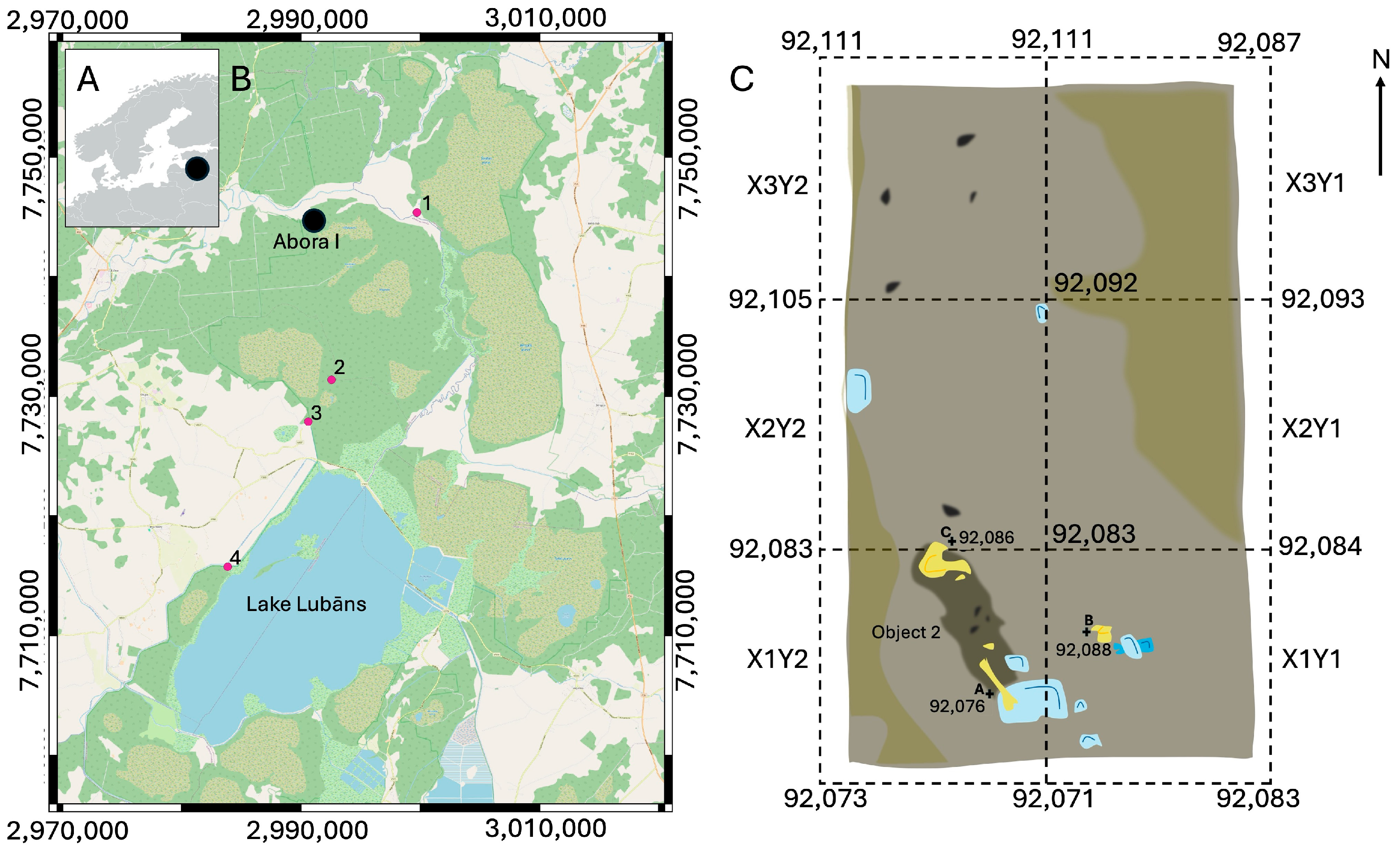
2. Study Area and Archaeological Background
3. Materials and Methods
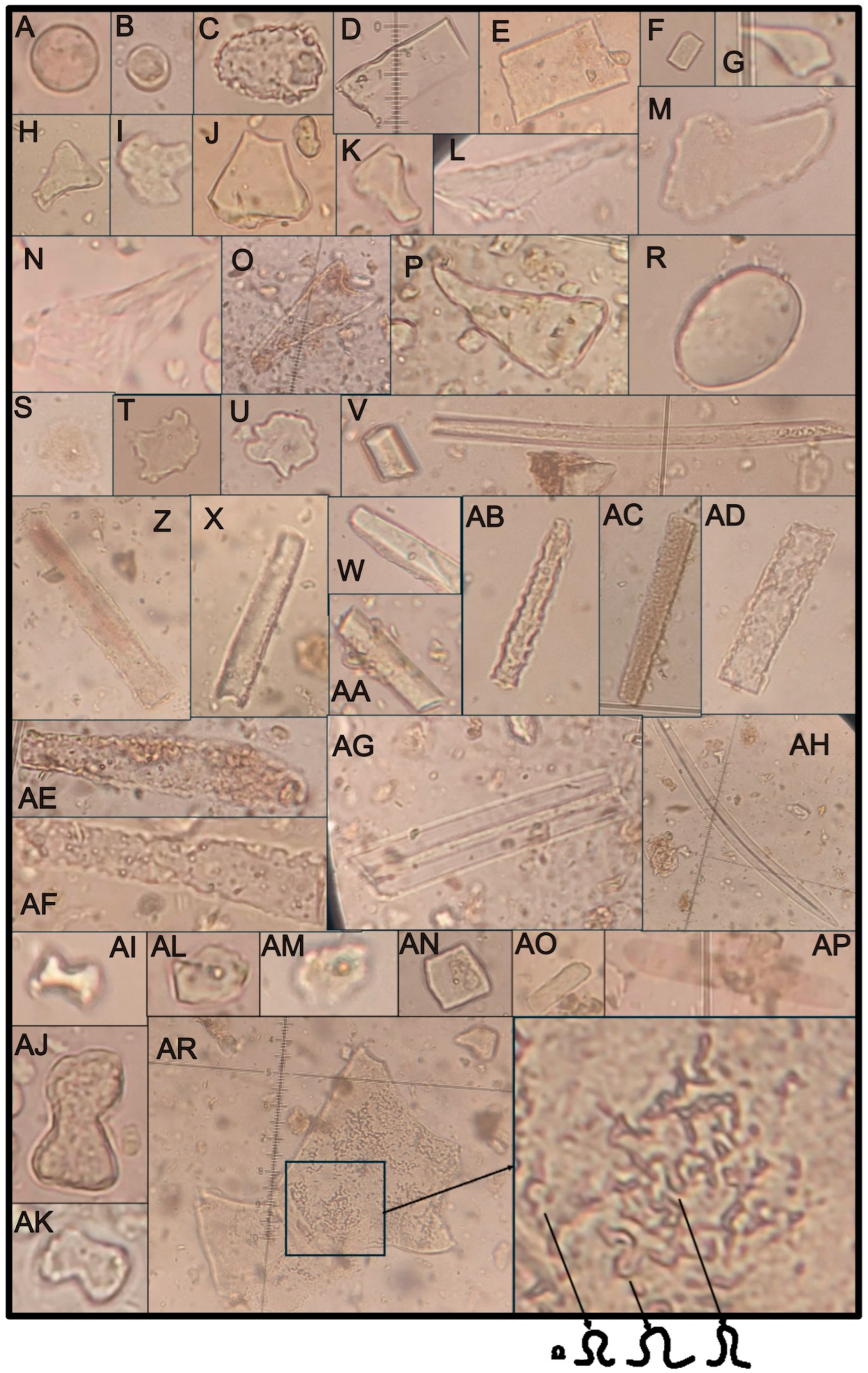
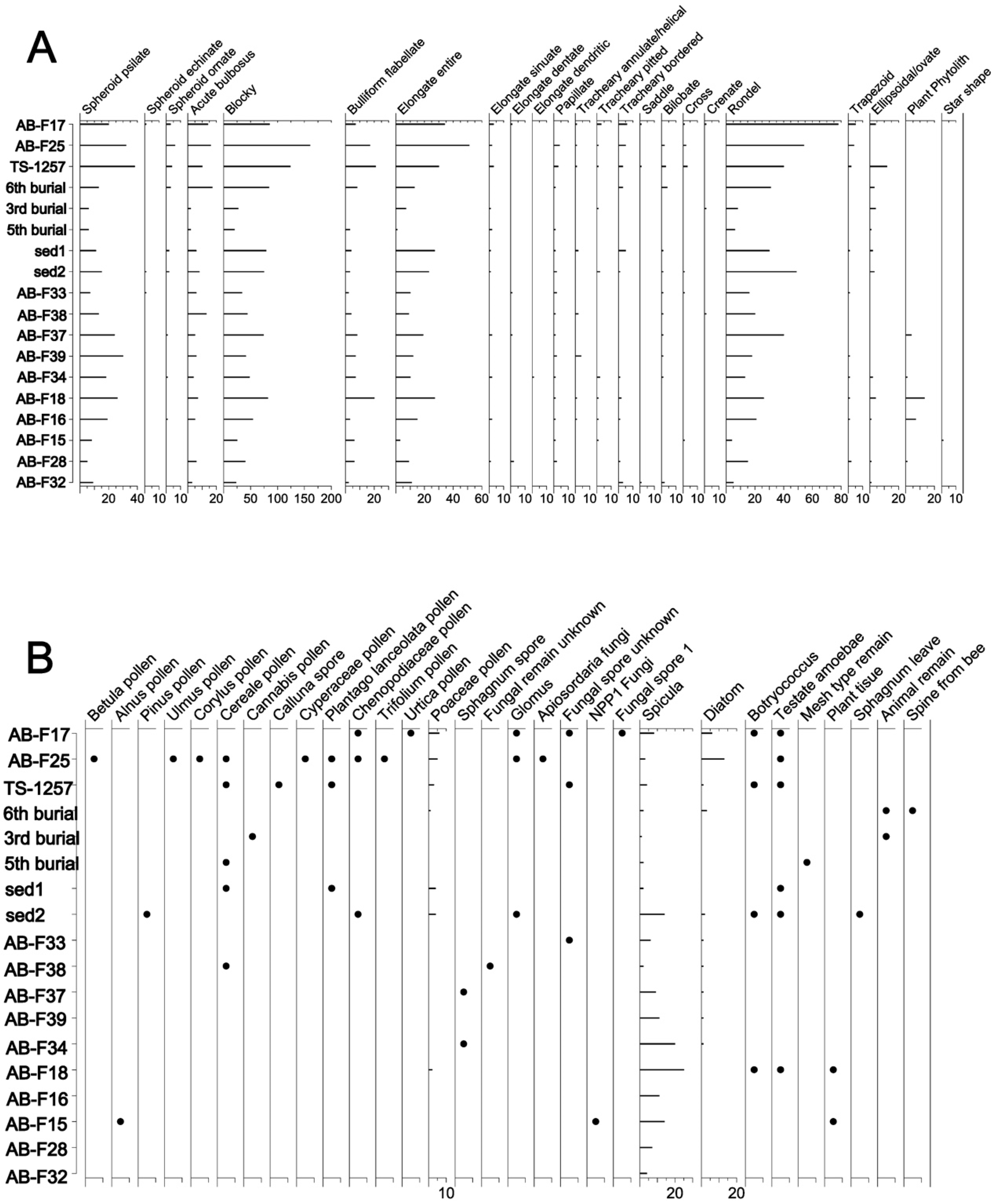
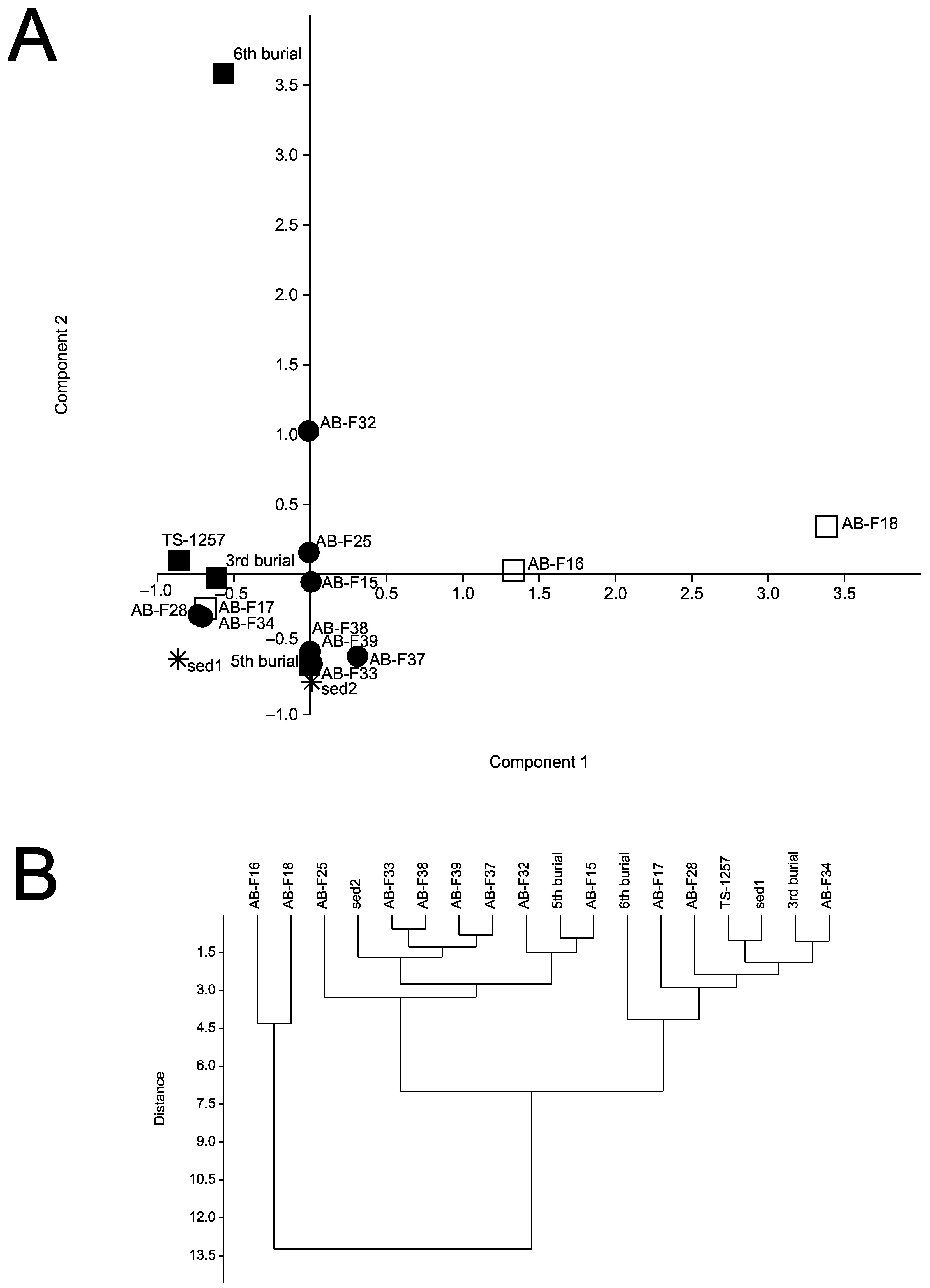
4. Results
5. Discussion
6. Conclusions
Author Contributions
Funding
Data Availability Statement
Acknowledgments
Conflicts of Interest
Abbreviations
| AMS | Accelerator Mass Spectrometry |
| BP | Before Present (1950) |
| Cal BC | Calibrated years Before Christ |
| ICPN | International Code for Phytolith Nomenclature |
References
- Loze, I. The Late Neolithic and the Early Bronze Age of the Lubans Wetland. [Pozdnij Neolit i Ranjaja Bronza Lubanskoij Ravnini]; Zinatne: Riga, Latvia, 1979; p. 204. (In Russian) [Google Scholar]
- Rasiņš, A.; Tauriņa, M. Pārskats par Latvijas PSR arheoloģiskajos izrakumos konstatētajām kultūraugu un nezāļu sēklām. [Overview of cultivated and weed seeds identified in archaeological excavations in the Latvian USSR]. Arheol. Etnogrāfija 1983, 14, 152–176. (In Latvian) [Google Scholar]
- Graudonis, J. Agro Metālu Periods (1500.–1. g. pr.Kr.) [The Early Metal Period (1500–1 BC)]. In Latvijas Senākā Vesture (9. g.t. pr.Kr.–1200. g.); Mugurēvičs, E., Vasks, A., Eds.; Latvijas Vēstures Institūta Apgāds: Riga, Latvia, 2001; pp. 116–185. (In Latvian) [Google Scholar]
- Vasks, A. No Medniekiem un Zvejniekiem Līdz Lopkopjiem un Zemkopjiem: Latvijas Aizvēstures Senākais Posms (10500.–1. g. pr.Kr.). [From Hunters and Fishers to Herders and Farmers: The Earliest Period of Latvian Prehistory (10,500–1 BC)]; Zinatne: Riga, Latvia, 2015; p. 184. ISBN 978-9984-879-98-7. (In Latvian) [Google Scholar]
- Robson, H.K.; Skipitytė, R.; Piličiauskienė, G.; Lucquin, A.; Heron, C.; Craig, O.E.; Piličiauskas, G. Diet, cuisine and consumption practices of the first farmers in the southeastern Baltic. Archaeol. Anthropol. Sci. 2019, 11, 4011–4024. [Google Scholar] [CrossRef]
- Oras, E.; Tõrv, M.; Johanson, K.; Rannamäe, E.; Poska, A.; Lõugas, L.; Lucquin, A.; Lundy, J.; Brown, S.; Chen, S.; et al. Parallel worlds and mixed economies: Multi-proxy analysis reveals complex subsistence systems at the dawn of early farming in the northeast Baltic. R. Soc. Open Sci. 2023, 10, 230880. [Google Scholar] [CrossRef]
- Podėnas, V.; Garbaras, A.; Micelicaite, V.; Minkevicius, K.; Sapolaite, J.; Ezerinskis, Z.; Civilyte, A. Diet of the fortified settlement. J. Archaeol. Sci. Rep. 2023, 51, 104184. [Google Scholar] [CrossRef]
- Zariņa, G.; Visocka, V.; Legzdiņa, D.; Ceriņa, A.; Plankājs, E.; Meža, J. Dietary practices during the Late Neolithic and the Bronze Age in the territory of Latvia: A case study of Lake Lubāns Wetland and the Lower Daugava. Latv. Vēstures Institūta žurnāls 2023, 118, 5–28. [Google Scholar] [CrossRef]
- Loze, I. Lubāna Mitrāja Apdzīvotība Akmens Laikmetā: Rēzeknes Novada Mezolīta un Neolīta Apmetnes. [Settlement of the Lubans Wetland in the Stone Age: Mesolithic and Neolithic Sites in Rezekne Municipality]; Rēzeknes Augstskola: Rezekne, Latvia, 2015; p. 312. (In Latvian) [Google Scholar]
- Edwards, K.J.; Whittington, G. Multiple charcoal profiles in a Scottish lake: Taphonomy, fire ecology, human impact and inference. Palaeogeogr. Palaeoclimatol. Palaeoecol. 2000, 164, 67–86. [Google Scholar] [CrossRef]
- Twiddle, C.L.; Jones, R.T.; Caseldine, C.J.; Sugita, S. Pollen productivity estimates for a pine woodland in eastern Scotland: The influence of sampling design and vegetation patterning. Rev. Palaeobtoany Palynol. 2012, 174, 67–78. [Google Scholar] [CrossRef]
- Regnell, M. Plant subsitence and environment at the Mesolithic site Tagerup, southern Sweden: New insights on the “Nut Age”. Veg. Hist. Archaeobotany 2012, 21, 1–16. [Google Scholar] [CrossRef]
- Out, W.A.; Enevold, R.; Mikkelsen, P.H.; Jensen, P.M.; Portillo, M.; Schwartz, M. Wood, seeds and fruits, phytoliths, pollen and non-pollen palynomorphs of the horse burial of Fregerslev II. In Horse and Rider in the Late Viking Age; Bagge, M.S., Pedersen, A., Eds.; Aarhus Universitetsforlag: Aarhus, Denmark, 2021; pp. 61–81. [Google Scholar]
- Falcon-Lang, H. Piperno, D. R. 2006. Phytoliths. A Comprehensive Guide for Archaeologists and Paleoecologists. ix + 238 pp. Lanham, New York, Toronto, Oxford: AltaMira Press (Rowman & Littlefield). Geol. Mag. 2007, 144, 893. [Google Scholar] [CrossRef]
- Rosen, A.M. Phytolith analysis. Encycl. Archaeol. 2008, 3, 1818–1822. [Google Scholar]
- Madella, M.; Lancelotti, C. Taphonomy and phytoliths: A user manual. Quat. Int. 2012, 275, 76–83. [Google Scholar] [CrossRef]
- Neumann, K.; Chevalier, A.; Vrydaghs, L. Phytoliths in archaeology: Recent advances. Veg. Hist. Archaeobotany 2017, 26, 1–3. [Google Scholar] [CrossRef]
- Ball, T.B.; Ehlers, R.; Standing, M.D. Review of typologic and morphometric analysis of phytoliths produced by wheat and barley. Breed. Sci. 2009, 59, 505–512. [Google Scholar] [CrossRef]
- Wang, X.; Shang, X. The influence of heat on phytolith morphology and implications for quantifying archaeological foxtail and common millets. Herit. Sci. 2023, 11, 143. [Google Scholar] [CrossRef]
- Juhola, T.; Henry, A.G.; Kirkinen, T.; Laakkonen, J.; Väliranta, M. Phytoliths, parasites, fibers, and feathers from dental calculus and sediment from Iron Age Luistari cemetery, Finland. Quat. Sci. Rev. 2019, 222, 105888. [Google Scholar] [CrossRef]
- Capasso, G.; Neves, D.; Sperduti, A.; Cristiani, E.; Manzo, A. Direct evidence of plant consumption in Neolithic Eastern Sudan from dental calculus analysis. Sci. Rep. 2024, 14, 4278. [Google Scholar] [CrossRef] [PubMed]
- Santiago-Marrero, C.G.; Lymperaki, M.; Urem-Kotsu, D.; Kotsos, S.; García-Granero, J.J. What do phytoliths from pottery cooking vessels represent? Insights from Neolithic Stavroupoli (northern Greece). J. Archaeol. Sci. Rep. 2024, 57, 104679. [Google Scholar] [CrossRef]
- ICPN (International Committee for Phytolith Taxonomy). International Code for Phytolith Nomenclature (ICPN) 2.0. Ann. Bot. 2019, 124, 189–199. [Google Scholar] [CrossRef]
- Haferberga, V.; Čakare, A.; Zariņa, G.; Batraga, A.; Kalniņš, M.; Plankājs, E. Arheoloģiskās Izpētes Darbi Aboras I Apmetnē 2023. Gadā. [Archaeological Investigations at the Abora I Settlement in 2023]. In Arheologu pētījumi Latvijā 2022. un 2023.Gadā; NT Klasika: Riga, Latvia, 2024; pp. 17–22. (In Latvian) [Google Scholar]
- Legzdiņa, D.; Zariņa, G. Living on the climate edge suitable for early farming: The complex subsistence strategies of the Late Neolithic people at the Abora site in Latvia. Proc. Latv. Acad. Sci. Sect. B 2023, 77, 1–14. [Google Scholar] [CrossRef]
- Zelčs, V.; Markots, A. Deglaciation history of Latvia. In Quaternary Glaciationse Extent and Chronology of Glaciations; Ehlers, J., Gibbard, P.L., Eds.; Elsevier: Amsterdam, The Netherlands, 2004; pp. 225–243. [Google Scholar]
- Veski, S.; Amon, L.; Heinsalu, A.; Reitalu, T.; Saarse, L.; Stivrins, N.; Vassiljev, J. Lateglacial vegetation dynamics in the eastern Baltic region between 14,500 and 11,400 cal yr BP: A complete record since the Bolling (GI-1e) to the Holocene. Quat. Sci. Rev. 2012, 40, 39–53. [Google Scholar] [CrossRef]
- Loze, I. Arheoloģiskie izrakumi Aboras vēlā neolīta apmetnē. [Archaeological excavations at the Late Neolithic settlement of Abora]. In Arheologu Pētījumi Latvijā 2008. un 2009 Gadā. [Archaeological Research in Latvia in 2008 and 2009]; Nordik: Riga, Latvia, 2010; pp. 23–26. (In Latvian) [Google Scholar]
- Legzdiņa, D.; Plankājs, E.; Visocka, V.; Zariņa, G. Arheoloģiskie izrakumi Aboras I apmetnē 2021. gadā. [Archaeological excavations at the Abora I settlement in 2021]. In Arheologu pētījumi Latvijā 2020. un 2021 Gadā; Nordik: Riga, Latvia, 2022; pp. 11–15. (In Latvian) [Google Scholar]
- Kalniņa, L.; Kalniņš, M.; Ceriņa, A.; Zariņa, G.; Goslar, T.; Kalvišķis, K. Multidisciplinary studies for the identification of the environment and early farming of Neolithic settlement in Lubans wetlands. Proc. Latv. Acad. Sci. Sect. B Nat. Exact Appl. Sci. 2025, 79, 20–30. [Google Scholar]
- Lang, V.; Kriiska, A.; Haak, A. A new Early Bronze Age socketed axe. Est. J. Archaeol. 2006, 10, 81–88. [Google Scholar] [CrossRef]
- Box, G.E.P.; Cox, D.R. An analysis of transformations. J. R. Stat. Soc. Servies B Methodol. 1964, 26, 211–252. [Google Scholar] [CrossRef]
- Hammer, O.; Harper, D.A.T.; Ryan, P.D. PAST: Paleontological statistics software package for education and data analysis. Palaeontol. Electron. 2001, 4, 9. [Google Scholar]
- Reimer, P.; Austin, W.; Bard, E.; Bayliss, A.; Blackwell, P.; Bronk Ramsey, C.; Talamo, S. The IntCal20 northern hemisphere radiocarbon age calibration curve (0–55 cal kBP). Radiocarbon 2020, 62, 725–757. [Google Scholar] [CrossRef]
- Blaauw, M. Methods and code for ‘classical’ age-modelling of radiocarbon sequences. Quat. Geochronol. 2010, 5, 512–518. [Google Scholar] [CrossRef]
- Posit Team. RStudio: Integrated Development Environment for R. Posit Sofware, PBC: Boston, MA, USA, 2025. Available online: http://www.posit.co (accessed on 1 November 2025).
- An, J.; Chevalier, A.; Brozio, J.P.; Muller, J.; Kirleis, W. Functional exploration of grinding and polishing stones from the Neolithic settlement site of Oldenburg LA77, Northern Germany—Evidence from plant microfossil analysis. J. Archaeol. Sci. Rep. 2025, 61, 104913. [Google Scholar] [CrossRef]
- Out, W.A.; Garcia-Granero, J.; Andreasen, M.H.; Patus, C.N.; Kirleis, W.; Barfod, G.H.; Andersen, N.H. Plant use at Funnel Beaker sites: Combined macro- and microremains analysis at the Early Neolithic site of Frydenlund, Denmark (ca. 3600 BCE). Veg. Hist. Archaeobotany 2025, 34, 177–203. [Google Scholar] [CrossRef]
- Dal Corso, M.; Out, W.A.; Ohlrau, R.; Hofmann, R.; Dreibrodt, S.; Videiko, M.; Muller, J.; Kirleis, W. Where are the cereals? Contribution of phytolith analysis to the study of subsistence economy at the Trypillia site Maidanetske (ca. 3900-3650 BCE), central Ukraine. J. Arid. Environ. 2018, 157, 137–148. [Google Scholar] [CrossRef]
- Tsartsidou, G.; Kotsakis, K. Grinding in a hollow? Phytolith evidence for pounding cereals in bedrock mortars at Paliambela Kolindros, and Early Neolithic site in Macedonia, North Greece. Archaeol. Anthropol. Sci. 2020, 12, 173. [Google Scholar] [CrossRef]
- Lentfer, C.J.; Boyd, W.E.; Gojak, D. Hope farm windmill: Phytolith analysis of cereals in Early Colonial Australia. J. Archaeol. Sci. 1997, 24, 841–856. [Google Scholar] [CrossRef]
- Grikpedis, M.; Motuzaite Matuzeviciute, G. A review of the earliest evidence of agriculture in Lithuania and the earliest direct AMS date on cereal. Eur. J. Archaeol. 2018, 21, 264–279. [Google Scholar] [CrossRef]
- Kubiak-Martens, L. The plant food component of the diet at the late Mesolithic (Ertebolle) settlement at Tybrind Vig, Denmark. Veg. Hist. Archaeobotany 1999, 8, 117–127. [Google Scholar] [CrossRef]
- Łuczaj, Ł.J.; Dumanowski, J.; Köhler, P.; Mueller-Bieniek, A. The Use and Economic Value of Manna grass (Glyceria) in Poland from the Middle Ages to the Twentieth Century. Hum. Ecol. 2012, 40, 721–733. [Google Scholar] [CrossRef]
- Lucquin, A.; Robson, H.K.; Oras, E.; Lundy, J.; Moretti, G.; Gonzalez, L.; Dekker, C.J.; Demirci, O.; Dolbunova, E.; McLaughlin, T.R.; et al. The impact of farming on prehistoric culinary practices throughout Northern Europe. Proc. Natl. Acad. Sci. USA 2023, 120, e2310138120. [Google Scholar] [CrossRef]
- Saul, H.; Madella, M.; Fischer, A.; Glykou, A.; Hartz, S.; Craig, O.E. Phytoliths in pottery reveal the use of spice in European prehistoric cuisine. PLoS ONE 2013, 8, e70583. [Google Scholar] [CrossRef]
- Hart, T.C. Evaluating the usefulness of phytoliths and starch grains found on survey artifacts. J. Archaeol. Sci. 2011, 38, 3244–3253. [Google Scholar] [CrossRef]
- Fishkis, O.; Ingwersen, J.; Lamers, M.; Denysenko, D.; Streck, T. Phytolith transport in soil: A laboratory study on intact soil cores. Eur. J. Soil Sci. 2010, 61, 445–455. [Google Scholar] [CrossRef]
- Danu, M.; Messager, E.; Carozza, J.-M.; Carozza, L.; Bouby, L.; Philibert, S.; Anderson, P.; Burens, A.; Micu, C. Phytolith evidence of cereal processing in the Danube Delta during the Chalcolithic period. Quat. Int. 2019, 504, 128–138. [Google Scholar] [CrossRef]
- Kitaba, I.; Nakagawa, T. Black ceramic spheres as marker grains for microfossil analyses, with improved chemical, physical, and optical properties. Quat. Int. 2017, 455, 166–169. [Google Scholar] [CrossRef]
- Stockmarr, J. Tablets with spores used in absolute pollen analysis. Pollen Spores 1971, 13, 615–621. [Google Scholar]
- Johanson, K.; Unt, A.; Hiie, S. Archaeobotany in Estonia—History, state of the art and future perspectives. Est. J. Archaeol. 2025, 29, 34–71. [Google Scholar] [CrossRef]
- Hamon, C.; Cagnato, C.; Emery-Barbier, A.; Salavert, A. Food practices of the first farmers of Europe: Combined use-wear and microbotanical studies of Early Neolithic grinding tools from the Paris basin. J. Archaeol. Sci. Rep. 2021, 36, 102764. [Google Scholar] [CrossRef]



| Sample | Material | Stratigraphy (Layer/Stratum) | Depth (cm)/Elevation (m.a.s.l.) | Excavation Year |
|---|---|---|---|---|
| AB-F17 | Grinding stone | 3/5 | 42/92.073 | 2024 (this study) |
| AB-F18 | Grinding stone | 3/3–5 | 39/92.103 | 2024 (this study) |
| AB-F16 | Grinding stone | 3/5 | 37.3/92.120 | 2024 (this study) |
| AB-F25 | Pottery (Lubāns type) | 5/7 | 53.9/91.954 | 2024 (this study) |
| AB-F37 | Pottery (Lubāns type) | 3/4–5 | 28/92.213 | 2024 (this study) |
| AB-F38 | Pottery (Corded ware) | 4/5–6 | 45/92.043 | 2024 (this study) |
| AB-F39 | Pottery (Abora ware) | 3/6–7 | 46.3/92.058 | 2024 (this study) |
| AB-F34 | Pottery (Abora ware) | 3/4 | 23.8/92.283 | 2024 (this study) |
| AB-F15 | Pottery (Ilmandu (?) type) | -/5 | 26/- | 2024 (this study) |
| AB-F28 | Pottery (Abora ware) | 2/1–2 | 10.2/92.391 | 2024 (this study) |
| AB-F32 | Pottery (Lubāns type) | 2/1 | 12/92.401 | 2024 (this study) |
| TS-1257(6), singular find | Human jaw | 3/3 | Ca. 40/92.046 | 2023 [24] |
| 6th burial (AB) | Human jaw | - | 53/- | 1964 [1] |
| 3rd burial (AB) | Human jaw | - | 50/- | 1964 [1] |
| 58th burial (AB) | Human jaw | - | 50/- | 1971 [1] |
| Sed1 | Sediment | 3/- | Ca. 30–40/- | 2024 (this study) |
| Sed2 | Sediment | 3/- | Ca. 30–40/- | 2024 (this study) |
| AB-F33 | Sediment | 4/5 | 40.4/92.089 | 2024 (this study) |
| Sample | Context | m.a.s.l. | Sample Type | Lab. ID | 14C Age (BP) | Calibrated BC (95%) |
|---|---|---|---|---|---|---|
| Abora TS 1140 | Trench “I”, layer 3, sq. X1Y2 | 92.05 | Charcoal | Poz-192460 | 4445 ± 35 | 3335–2930 |
| Abora TS 1160 | Trench “I”, layer 3, sq. X1Y2 | 92.09 | Charcoal | Poz-193176 | 4155 ± 30 | 2875–2630 |
| Abora TS 1179 | Trench “I”, layer 3, sq. X1Y2 | 92.06 | Charcoal | Poz-193175 | 4230 ± 35 | 2910–2680 |
| Abora TS 1213 | Trench “I”, layer 4, sq. X1Y1 | 92.04 | Charcoal | Poz-192458 | 4125 ± 35 | 2870–2580 |
| Abora TS 1215 | Trench “I”, layer 4, sq. X1Y1 | 92,03 | Charcoal | Poz-192457 | 4140 ± 35 | 2875–2585 |
| Abora TS 1217 | Trench “I”, layer 4, sq. X1Y2 | 92.01 | Charcoal | Poz-192456 | 4105 ± 35 | 2870–2500 |
| Abora TS 1266 | Trench “I”, layer 5, sq. X1Y1 | 91.96 | Charcoal | Poz-193131 | 4055 ± 35 | 2845–2470 |
| Abora TS 1270 | Trench “I”, layer 5, sq. X1Y1 | 91.94 | Charcoal | Poz-193130 | 3850 ± 80 | 2560–2045 |
| Abora TS 1274 | Trench “I”, layer 5, sq. X1Y2 | 91.98 | Charcoal | Poz-192463 | 4100 ± 35 | 2865–2500 |
| Abora TS 1285 | Trench “I”, layer 5, sq. X1Y2 | 91.89 | Charcoal | Poz-193129 | 4155 ± 35 | 2880–2625 |
| Abora X1Y2 | Trench “I”, layer 5/bedrock, sq. X1Y2 | - | Charcoal | Poz-192462 | 4150 ± 35 | 2880–2585 |
Disclaimer/Publisher’s Note: The statements, opinions and data contained in all publications are solely those of the individual author(s) and contributor(s) and not of MDPI and/or the editor(s). MDPI and/or the editor(s) disclaim responsibility for any injury to people or property resulting from any ideas, methods, instructions or products referred to in the content. |
© 2025 by the authors. Licensee MDPI, Basel, Switzerland. This article is an open access article distributed under the terms and conditions of the Creative Commons Attribution (CC BY) license (https://creativecommons.org/licenses/by/4.0/).
Share and Cite
Stivrins, N.; Zariņa, G.; Haferberga, V.; Reire, E. Tracing the Onset of Agriculture Through Phytolith Analysis at the Abora I Neolithic Settlement, Eastern Latvia. Heritage 2025, 8, 524. https://doi.org/10.3390/heritage8120524
Stivrins N, Zariņa G, Haferberga V, Reire E. Tracing the Onset of Agriculture Through Phytolith Analysis at the Abora I Neolithic Settlement, Eastern Latvia. Heritage. 2025; 8(12):524. https://doi.org/10.3390/heritage8120524
Chicago/Turabian StyleStivrins, Normunds, Gunita Zariņa, Vanda Haferberga, and Elina Reire. 2025. "Tracing the Onset of Agriculture Through Phytolith Analysis at the Abora I Neolithic Settlement, Eastern Latvia" Heritage 8, no. 12: 524. https://doi.org/10.3390/heritage8120524
APA StyleStivrins, N., Zariņa, G., Haferberga, V., & Reire, E. (2025). Tracing the Onset of Agriculture Through Phytolith Analysis at the Abora I Neolithic Settlement, Eastern Latvia. Heritage, 8(12), 524. https://doi.org/10.3390/heritage8120524