Article

Integrated Comprehensive Characterization of Black Crusts from Milan’s Monumental Cemetery: A Synergistic Approach Combining Conventional and Unconventional Analytical Techniques


1
Department of Chemistry, University of Milan, Via Golgi 19, 20133 Milan, Italy
2
Instituto de Quimica Fisica Blas Cabrera, IQF-CSIC, C/Serrano 119, 28006 Madrid, Spain
3
Facultad de Ciencias Químicas, Universidad Complutense de Madrid, Pl. de las Ciencias, 2, 28040 Madrid, Spain
4
Instituto de Ciencias de la Construcción Eduardo Torroja, IETcc-CSIC, C/Serrano Galvache 4, 28033 Madrid, Spain
5
Instituto de Estructura de la Materia, IEM-CSIC, C/Serrano 121, 28006 Madrid, Spain
6
Department of Chemistry, University of Bologna, Via Francesco Selmi, 2, 40126 Bologna, Italy
*
Author to whom correspondence should be addressed.
Heritage 2025, 8(12), 506; https://doi.org/10.3390/heritage8120506
Submission received: 3 October 2025 / Revised: 21 November 2025 / Accepted: 27 November 2025 / Published: 1 December 2025
(This article belongs to the Special Issue History, Conservation and Restoration of Cultural Heritage)

Abstract

Black crusts are degradation features found on stone buildings, offering valuable insights into local pollution sources. Their composition and structure reflect environmental conditions, making them important indicators for environmental and conservation studies. In this study, black crusts collected from funerary monuments in the Monumental Cemetery of Milan were comprehensively characterized using SEM-EDX, Raman spectroscopy, LIBS, and oxidative potential (OP) assays. SEM-EDX and Raman spectroscopy revealed extensive degradation of the substrate and the incorporation of pollutant-derived particles, with heavy metals such as Fe, Zn, and Pb detected in more than 90% of the samples. Correlation analysis proved effective in distinguishing major pollution sources, primarily vehicular and railway traffic, indicated by strong associations such as Zn–Mn (r = 0.896), Fe–Zn (r = 0.734), and Fe–Mn (r = 0.655), from minor sources linked to industrial emissions, reflected in correlations including Ti–Pb (r = 0.589), Pb–Cl (r = 0.702), and S–Pb (r = 0.661). Instead, LIBS analysis confirmed stratigraphic penetration of these elements beyond the surface layers, suggesting long-term accumulation. OP assays, applied here for the first time to black crusts, showed values between 0.5 and 3.0 pmol min−1 µg−1, indicating moderate oxidative reactivity linked to metal content. Overall, the findings contribute to a deeper understanding of pollution-driven stone decay and support the development of more effective diagnostic and conservation strategies.

1. Introduction

Black crusts are the visible manifestation of degradation phenomena that form on stone buildings exposed to outdoor air pollution but sheltered from rain, leading to both aesthetic and structural damage to monuments [1,2,3,4,5,6]. Their formation has been extensively studied and is attributed to the interaction between airborne pollutants, namely SO2 and particulate matter (PM), and carbonate surfaces [5,7,8]. PM plays a key role in this process: it consists of carbonaceous particles enriched with heavy metals that catalyze the formation of black crusts [9,10]. These particles become embedded within the newly formed gypsum matrix, imparting the characteristic dark color, which is due to the presence of elemental carbon, a major component of PM [11,12,13].
Once embedded within the structure, these particles not only contribute to the degradation process already underway but also enable the black crust to function as a record of the surrounding atmospheric pollutant sources [14,15]. This is because the chemical composition of the particles is strictly related to the sources that generated them [16]. This property has been widely exploited in the literature, where chemical characterization of the crust’s elemental composition has allowed researchers to identify the predominant sources of air pollution [9,14]. Indeed, the combined analysis of both the crust and the underlying substrate allowed researchers to distinguish elements introduced exclusively through interaction with polluted ambient air from those already present in the substrate. In the latter case, the observed enrichment of certain elements within the crust compared to the substrate provided clear evidence of their additional contribution from external atmospheric sources.
To perform these analyses, researchers have employed a range of techniques, with Laser Ablation Inductively Coupled Plasma Mass Spectrometry (LA-ICP-MS) being among the most prevalent [14]. Other commonly used methods include X-Ray Fluorescence (XRF) [17,18] and Energy Dispersive X-ray spectroscopy (EDX), often integrated with Scanning Electron Microscopy (SEM-EDX) [6,19,20]. In a recent study [21], a wide range of hazardous elements (As, Cd, Co, Cr, Hg, Ni, Pb, Sb, Se, U, Mo, V, Cu, and Zn) was detected by XRF, and their presence was attributed to major pollutant sources in the area, such as vehicular traffic and domestic solid fuel combustion. In another study [22], elemental analysis using ICP-MS at a very different site revealed that the dominant pollutant sources were construction activities and emissions from cement factories. These two distinct cases demonstrate that black crusts can serve as equally effective indicators for identifying pollutant sources through traditional elemental analysis techniques. Unfortunately, these approaches typically require sample preparation, such as producing a thin or thick section, to enable detailed visualization and elemental analysis of the crust.
In response to the need for more efficient methodologies, recent research has explored alternatives that minimize sample handling and preparation time. One promising technique is Laser Induced Breakdown Spectroscopy (LIBS), which has demonstrated potential for black crust analysis and is being tested as a potentially viable alternative to the other methods described previously [23,24,25,26]. LIBS has primarily been applied to the analysis of black crusts for surface cleaning [25,27,28], as the penetration depth of the laser pulses is well-suited to the typical thickness of these deposits. This approach allows for the careful removal of the crust with high precision, minimizing the risk of damaging the underlying unaltered substrate. More recently, the analytical potential of LIBS has also been explored [23,24], and in one study, surface cleaning was successfully combined with elemental analysis of black crusts [26].
Overall, previous studies on black crusts have largely focused on morphological and compositional characterization using traditional techniques such as SEM-EDX and Raman spectroscopy, but they have not fully explored the integration of advanced methods capable of providing complementary insights into elemental distribution and pollutant interactions. This study was performed to address these gaps by characterizing a set of black crusts from the Monumental Cemetery of Milan using both conventional and unconventional techniques. SEM-EDX and Raman spectroscopy were combined with LIBS to evaluate the ability of this novel technique in performing elemental analysis and assessing the distribution of metals within the crust.
Moreover, oxidative potential (OP) assays were applied for the first time to black crusts to better understand the role of reactive metals in crust formation and their link to local pollution sources. These tests are commonly used to assess the oxidative properties of PM [29,30] and are particularly sensitive to the presence of metals [31,32,33]. Since exogenous trace elements in black crust almost exclusively come from PM, these tests may represent a rapid and effective tool to assess pollutant accumulation within black crust and the overall health hazard of the surrounding ambient air.
The comparative use of these techniques not only enhanced the characterization of crust morphology and composition but also provided new evidence of how pollutant-derived metals contribute to substrate degradation. The significance of this work lies in demonstrating that unconventional techniques, when used alongside established analytical methods, can open new pathways for diagnosing the impact of environmental pollutants on cultural heritage materials. The achievable outcomes include improved diagnostic protocols for conservation scientists, more accurate identification of pollutant sources affecting monuments, and the development of restoration strategies that specifically target pollutant-induced degradation. Ultimately, this integrated approach strengthens both the analytical framework for studying black crusts and the practical toolkit available for preserving monuments against environmental damage.

2. Materials and Methods

The Monumental Cemetery of Milan is one of the most renowned sites in Italy, recognized for its exceptional artistic and cultural heritage and often described as an open-air museum. The structure, richly decorated with marble monuments, is considered a pivotal example marking the end of the Neoclassical era in Italian cemetery architecture. Located within the urban core of Milan, among the most industrialized and densely populated regions in Northern Italy, the cemetery’s funerary monuments have undergone progressive degradation over time due to prolonged exposure to polluted ambient air. Atmospheric aerosol concentrations frequently exceed legal thresholds [34], and Milan’s position at the center of the Po Valley further exacerbates the issue. The region experiences limited rainfall and weak wind circulation, largely due to the surrounding Alpine barrier, which hinders air dispersion and promotes the accumulation of pollutants, favoring the formation of black crusts. These conditions make the cemetery an ideal site for studying such degradation phenomena, especially given that no restoration interventions have ever been carried out on the funerary monuments considered in this study.
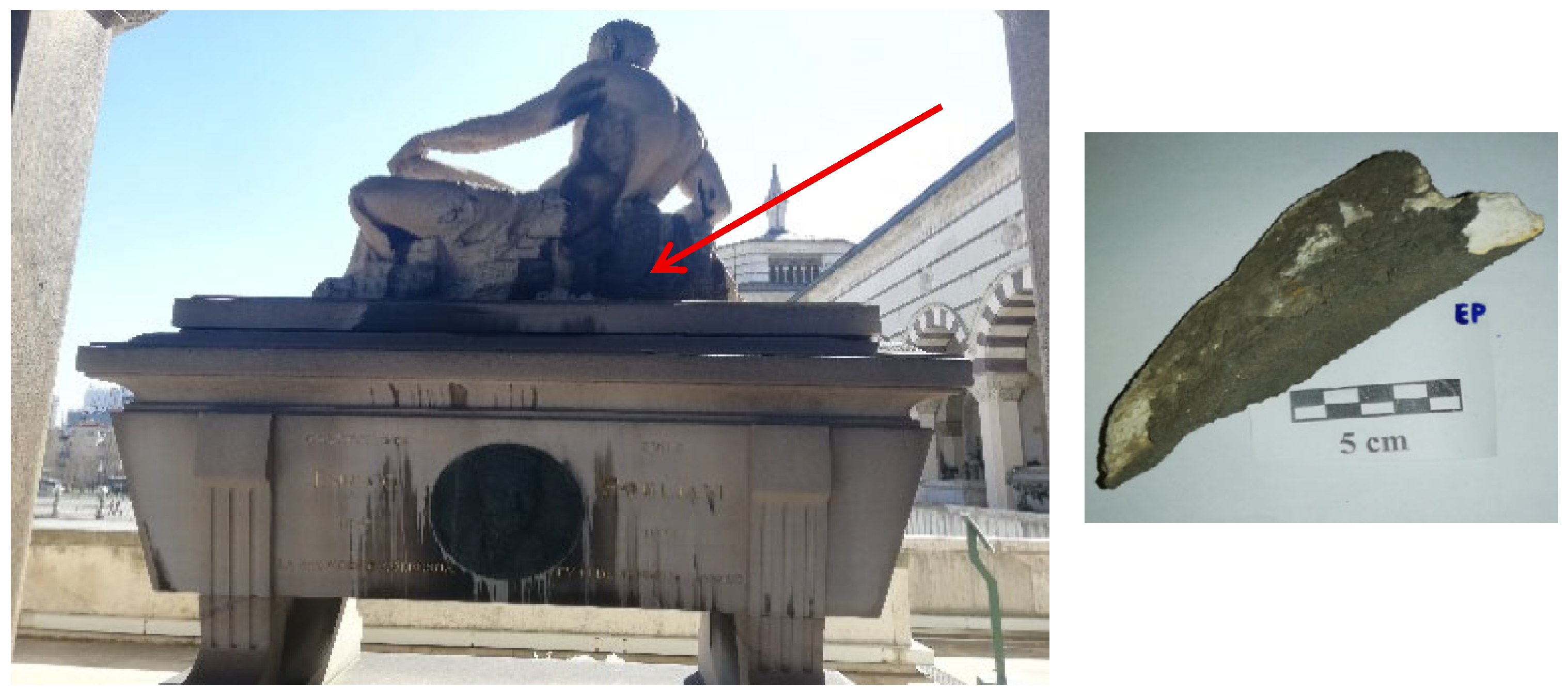
Sampling was conducted in April 2023 by collecting freely available black crust fragments that had spontaneously detached from the surface of funerary monuments ensuring that no mechanical removal or damage was inflicted on the structures. Figure 1 shows one of the funerary monuments as an example, with the corresponding black crust sample that was collected.
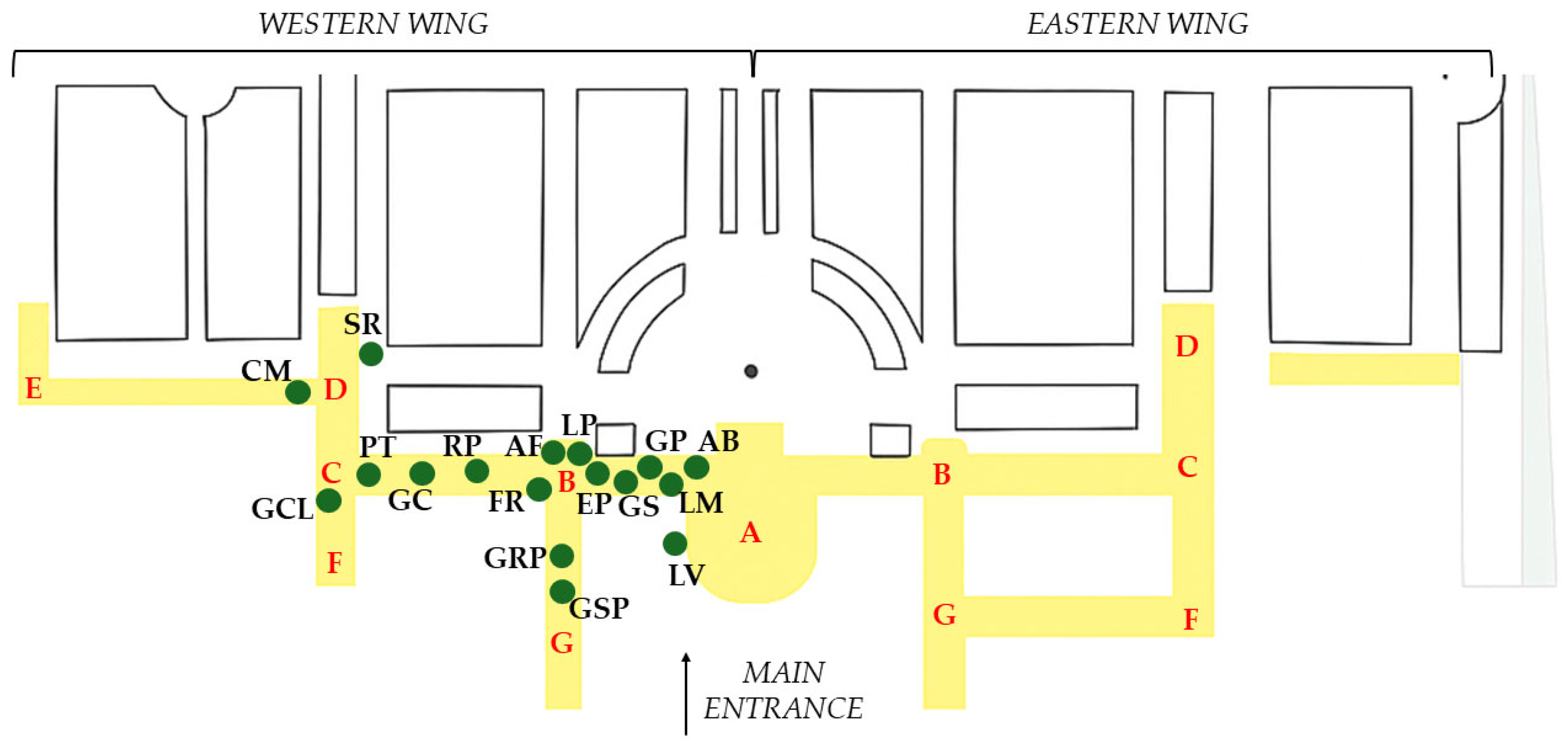
All the fragments derived from funerary statues were collected using sampling tweezers and placed into plastic containers. They measured approximately 10 cm in width, with a variable height ranging between 3 and 5 cm. The monuments chosen were primarily concentrated in the Upper and Lower Western Galleries of the cemetery (Table 1, Figure 2).
Access was restricted to the Western wing of the cemetery, where sampling was conducted with the aim of capturing different environmental conditions. Specifically, monuments were selected to represent varying degrees of exposure to outdoor air pollutants. Within this sector, monuments located in the BC and D sections were more exposed to outdoor conditions, while those in the remaining areas were comparatively sheltered. The black crusts were analyzed using a range of conventional and advanced techniques to investigate their morphology and chemical composition. The aim was to elucidate the nature of crusts formed over centuries in a heavily polluted urban environment and to assess the influence of both historical and contemporary pollutant sources. Particular attention was given to the spatial distribution of diagnostic elements within the crust, which reflect prolonged interactions with polluted ambient air.

2.1. Scanning Electron Microscopy Coupled to Energy Dispersive X-Ray Spectroscopy

Polished thick cross sections embedded in resin and cut using a circular saw were prepared for the black crusts and analyzed with a scanning electron microscope (TM4000 Plus, Hitachi, Tokyo, Japan), equipped with energy dispersive X-ray microanalysis (Az-tecOne, Oxford Instruments, Oxford, UK). Analysis was carried out with an acceleration voltage of 10–15 kV under medium-vacuum conditions. SEM imaging was performed in a mixed backscattered electron (BSE) and secondary electron (SE) mode to capture both compositional and topographical contrast. A wide range of magnifications was used (50–500×) depending on the specific features of the samples.
Elemental mapping was carried out to visualize the spatial distribution of major elements across selected areas of the crust. Moreover, line scan profiles were acquired to assess the in-depth elemental gradients, particularly across stratified layers or interfaces. Finally, point analyses were performed to determine the composition of individual, highly reflective metallic particles embedded within the crust matrix.

2.2. Laser-Induced Breakdown Spectroscopy

LIBS analysis was conducted on the black crust samples following the same specifications outlined in Bergomi et al. (2022) and Bergomi et al. (2023) [23,24]. The former studies provided a preliminary assessment of LIBS feasibility for elemental analysis of black crusts, while the latter offered an initial comparison of LIBS performance against conventional analytical techniques, albeit on a limited sample set. Building on these foundations, the dataset has since been significantly expanded to enable a comprehensive evaluation of black crusts within the specific context of the Monumental Cemetery of Milan.

2.3. Raman Spectroscopy

Raman measurements were carried out on thick cross-sections of the black crusts. Raman mapping was performed to identify the main phases and their distribution within selected regions of the crust. In addition, point analyses were performed to characterize specific particles embedded in the gypsum matrix. Samples were analyzed in ambient conditions without coating. Prior to analysis, thick cross-sections were gently polished and mounted on glass slides.
Mapping of sample cross-sections was performed using a Virsa Raman analyzer (Agilent Technologies, Santa Clara, CA, USA) equipped with a 785 nm diode laser operated at 5 mW. Spectra were collected over a range of 600–1700 cm−1 with a spatial resolution of 5 μm. The scanned areas were 20 × 180 µm in order to evaluate the distribution of the main components from the outer to the inner layers of the crust.
Point spectra on individual particles were acquired using an InVia Reflex Raman spectrophotometer (Renishaw plc, Wotton-under-Edge, Gloucestershire, UK) with a 785 nm diode laser operated at either 15 or 30 mW, depending on sample sensitivity. Measurements were performed using a 50× objective lens, with an integration time of 10 s and 2 accumulations per spectrum.

2.4. Oxidative Potential Measurements

Among the various OP assays available in the literature, the ascorbic acid (AA) test was selected to evaluate the response of the black crust samples. This method was chosen due to its high sensitivity to heavy metals [33], which are prevalent in black crusts primarily as a result of particulates embedded within the gypsum matrix.
Black crust samples were prepared by carefully removing the top layer using a scalpel, followed by grinding into a fine powder with an agate mortar. The same procedure was applied to the underlying altered substrate, where possible. The distinction between the two layers was made based on their visual appearance: the crust exhibited a distinctly black coloration, while the substrate appeared significantly lighter.
To serve as blanks representing unaltered substrates, standard stone materials were also analyzed. Since it was not possible to sample directly from the unaltered substrate of the funerary monuments at the cemetery, representative samples of Carrara marble, calcarenite, and Candoglia marble were selected. These materials closely resemble the original substrates of the analyzed monuments. Their surfaces were first abraded with sandpaper to remove superficial contaminants, then rinsed with Milli-Q water and left to air dry. Using a scalpel, the surface of each sample was scraped to produce a powder, which was subsequently ground with an agate mortar, following the same procedure used for the black crusts and altered substrates.
OP assays were performed using approximately 2 mg of powder per sample. Each was extracted in 10 mL of phosphate buffer at pH 7.4, using an ultrasonic bath (Branson 2510, Branson Ultrasonics Corporation, Danbury, CT, USA) for 30 min. The extracts were then filtered through 0.45 μm PVDF filters (GVS Filter Technology, Bologna, Italy) and transferred to clean plastic tubes. Prepared samples were stored at approximately 4 °C until analysis. Analyses using the AA assay were conducted in accordance with the protocol described by Visentin et al. (2016) [33].

3. Results & Discussion

3.1. Morphological and Elemental Characterization with SEM-EDX

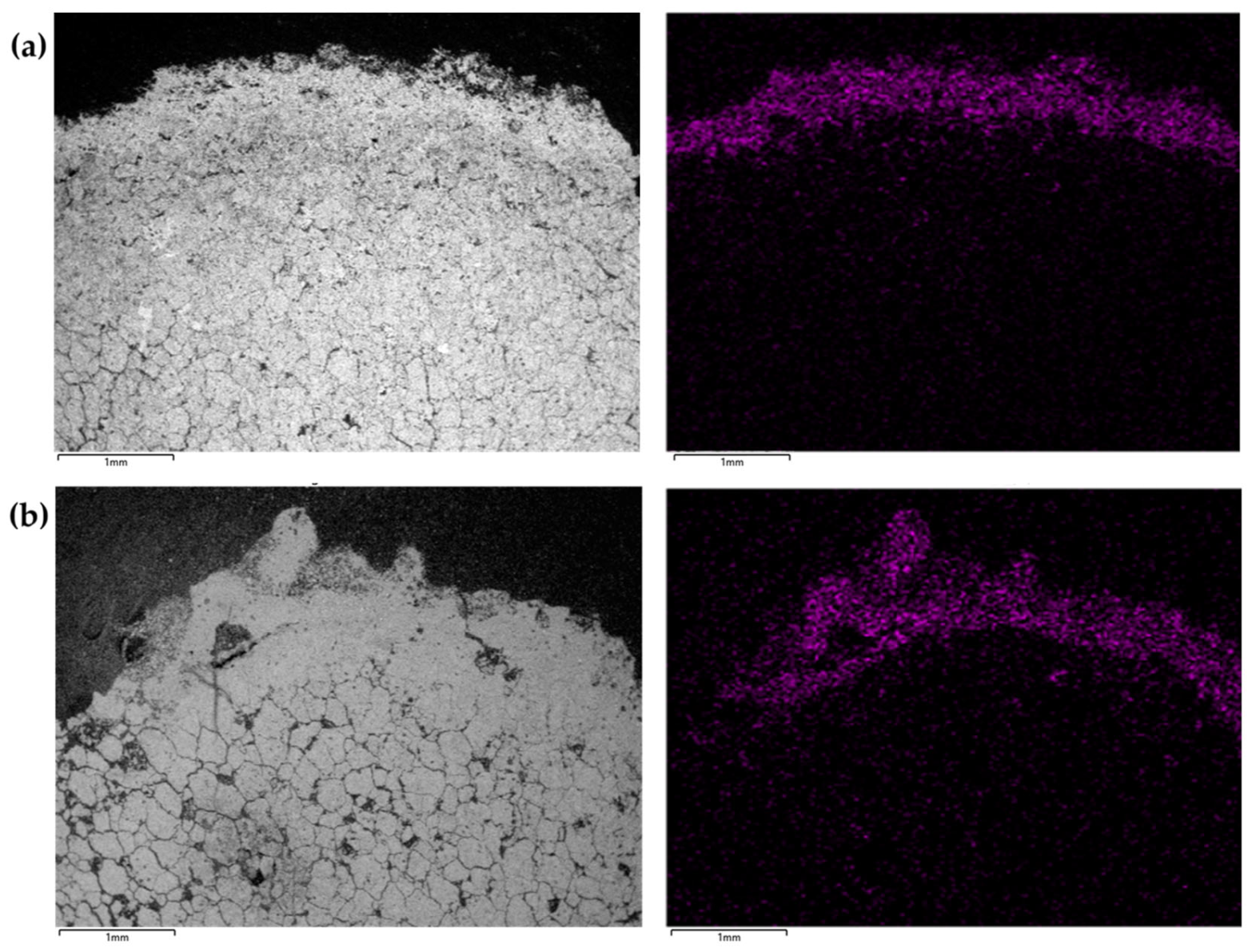
Thick cross sections of the black crusts collected in this study were initially examined morphologically using SEM to gain detailed insights into their structure and interaction with the underlying stone substrate. The crusts exhibit variable thicknesses, ranging from a few micrometers to several millimeters. In the SEM micrographs (Figure 3), they display a heterogeneous morphology characterized by irregular and poorly defined outer edges.
Observations at the crust–substrate interface suggest that crust formation occurs at the expense of the stone material. All samples show a pervasive network of microfractures extending well into the substrate. These microfractures are often partially or completely filled with gypsum crystals, which infiltrate the cracks and therefore indicate extensive degradation of the substrate.
The EDX sulfur maps (Figure 3) closely reflect the SEM findings: the sulfur signal is predominantly confined to the crust, with only a faint diffuse presence in the carbonate substrate. Additionally, localized areas of elevated sulfur intensity are observed within the microfractures, particularly near and just beneath the interface, indicating the presence, and likely in-situ formation, of gypsum penetrating into the substrate.
EDX analysis was also conducted to assess the chemical composition of the black crusts. Elemental mapping and area analyses revealed the presence of common elements (Ca, C, O, Si, S, Mg, and Al) also found in the underlying substrate, indicating no substantial compositional differences between the two. However, in contrast to the substrate, the crust exhibited an extensive presence of embedded particles within its structure. The quantity and spatial distribution of these particles varied both across different samples and within distinct regions of the same crust, indicating a non-uniform, random dispersion throughout the matrix. This heterogeneity supports the hypothesis of an exogenous origin for the particles, which were subsequently examined in detail through point analysis.
The results highlight the presence of numerous additional elements not detected in the substrate. Depending on the characteristics of each sample, a variable number of analyses were performed on selected particles, ranging from 31 to 131. Due to the large number of particles examined and the inherent uncertainty associated with quantitative EDX analysis, elemental distribution within each sample was assessed by recording the frequency with which each element was detected in individual particles (Table 2 and Table 3).
Ubiquitous elements detected throughout the crust include all those previously identified in the substrate, along with additional components such as Cl, K, Ti, Na, Fe, and P. Their presence may suggest interactions between exogenous particles and the original substrate; however, these elements are also commonly associated with the chemical composition of airborne PM [35], making it difficult to clearly determine their origin. It is highly likely that they result from a combination of both sources. Additional elements detected in many of the samples include Zn, Pb, F, Mn, Sn, Cu, and Ba. As previously noted in preliminary studies on black crusts from the Monumental Cemetery, the presence of these elements aligns with the primary pollution sources in the area, namely vehicular traffic and railway emissions [36,37].
All other elements were detected only sporadically, suggesting they likely originate from less impactful pollutant sources. Among these is bismuth, a rare element in studies on black crusts and PM, with limited research available on its atmospheric origins. Potential sources include coal combustion, non-ferrous metal smelting, and aluminum production [38]. Overall, pollution studies involving bismuth are scarce; however, one of the few, conducted by Legrand et al. (2023), reports a rise in atmospheric bismuth concentrations in Europe since pre-industrial times, with a notable peak between 1935 and 1945, primarily attributed to coal burning and other end-use processes [38]. The same study also notes that bismuth’s main application during the 1960s was as a steel additive, potentially linking its presence to railway-related emissions considering the nature of the site under investigation. It is therefore plausible that bismuth found in the black crusts of the Monumental Cemetery is not recent, underscoring the crust’s capacity to trap and preserve airborne pollutants over extended periods.
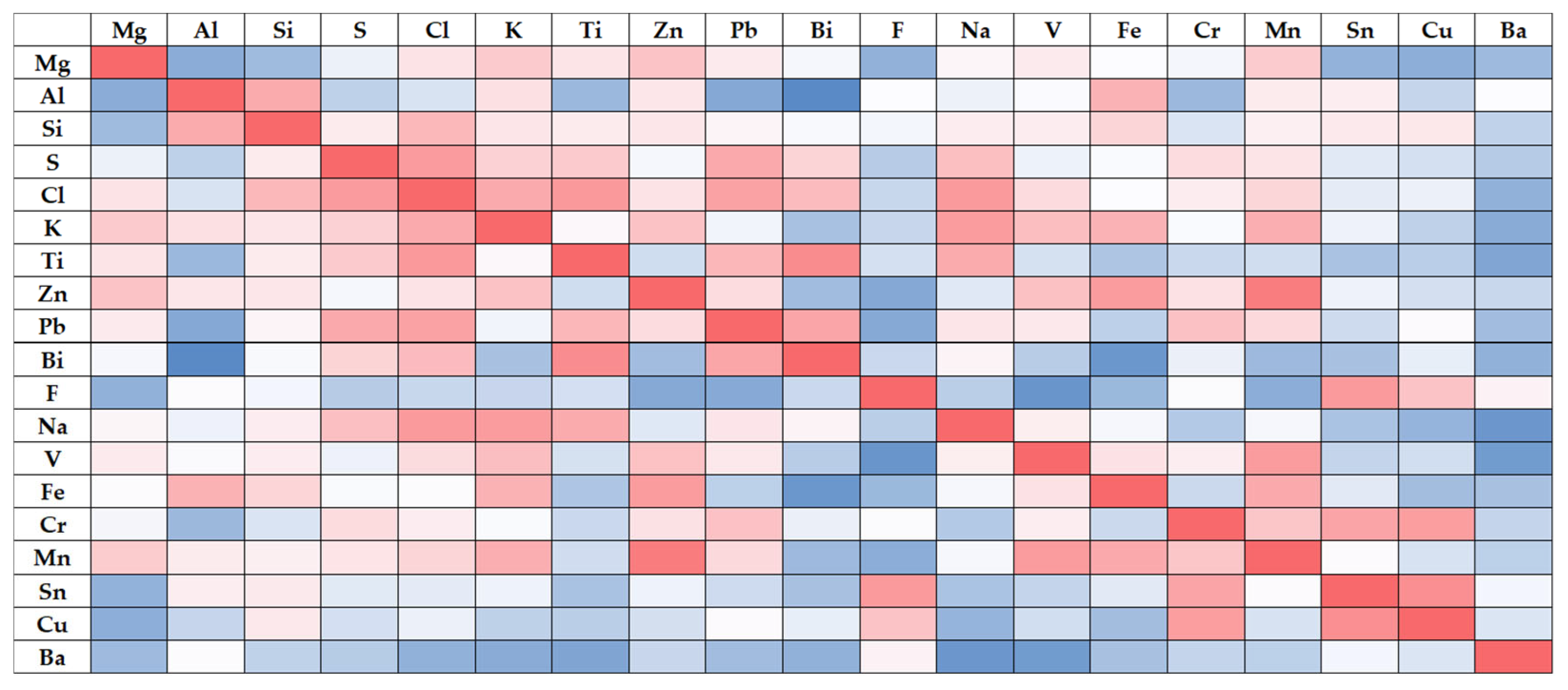
To better understand the origin of each metal tracer detected via SEM-EDX, correlation analysis was performed. Figure 4 presents a heatmap illustrating the relationships among characteristic metals identified in the crust, specifically those detected in at least three samples.
Positive correlations such as Al–Si (r = 0.654), Al–Fe (r = 0.612), and Si–Fe (r ≈ 0.430) may be attributed to the crustal or mineral dust component of the particles. Al, Si, and Fe are well-established tracers of terrigenous PM, typically associated with clays, feldspars, and mineral-based road or rail dust [37]. Instead, the correlations between Na–Cl (r = 0.745) and K–Cl (r = 0.656) are consistent with the accumulation of chloride salts within the crust [39]. In the specific case of Milan, source apportionment analyses have identified a “sea/road salt” factor, where sea salt is grouped with contributions from wintertime road de-icing salts. As highlighted by Comite et al. (2018) in their study on Santa Maria delle Grazie along the Naviglio Grande, the use of unrefined road salt for winter de-icing has contributed to the presence of salts in the crusts and may have been a contributing factor also in this case [40].
With regard to bismuth, the positive Pb-Bi (r = 0.683) correlation indicates, as was suggested previously, that the latter element originates from coal combustion and non-ferrous metallurgical processes [38,41]. Moreover, correlations such as Ti–Pb (r = 0.589), Pb–Cl (r = 0.702), and S–Pb (r = 0.661) are also indicative of industrial and combustion-related inputs.
Finally, Zn–Mn (r = 0.896), Fe–Zn (r = 0.734), Fe–Mn (r = 0.655), Sn–Cu (r = 0.800), Cr–Cu (r = 0.723), and Sn–Cr (r = 0.688) correlations are characteristic of non-exhaust traffic emissions, such as brake, disc, and tire wear, as well as railway abrasion. Elements such as Cu, Ba, Sb, Sn, Fe, Zn, and Mn are recognized tracers of brake and tire wear [36,42,43], while Fe, Mn, Cu, and Cr are associated with rail track wear [44,45,46,47].
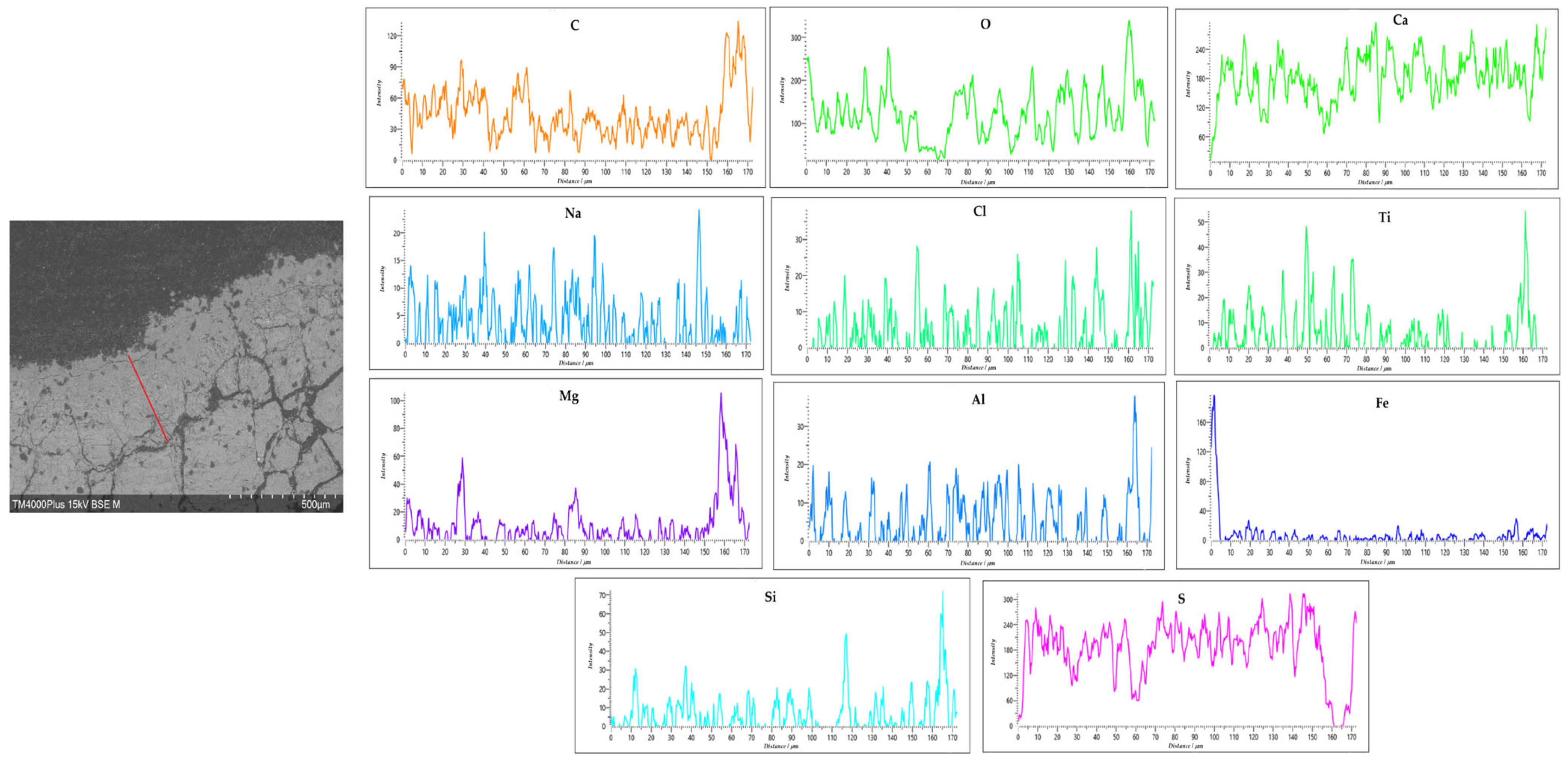
An initial attempt to define the distribution profile of tracer elements, potential indicators of the long-term evolution of the crust [23,24], was conducted using EDX linescan analysis. Figure 5 presents a representative experiment performed on sample AF. The linescan successfully identified the principal elements of the crust, namely those consistently detected through point analysis, as well as elements shared with the underlying substrate. Across the investigated region, most of these elements exhibited relatively stable concentrations, with the exception of iron. In this case, the profile revealed predominantly low-intensity signals (largely noise) and a single pronounced peak located in the layer closest to the surface. Based on morphological observations, this peak likely corresponds to an iron-rich particle embedded near the surface.
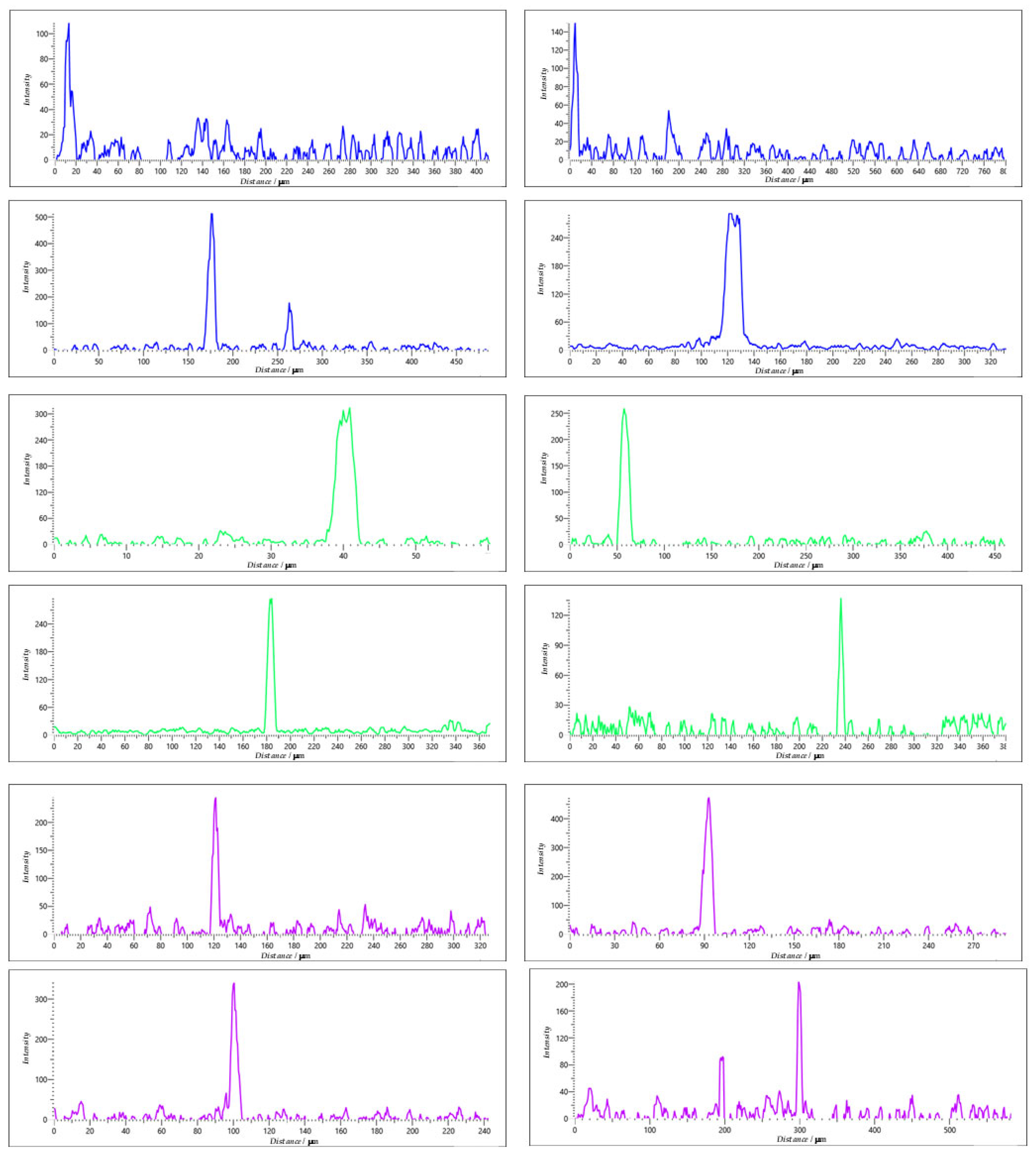
Comparable patterns were observed in all other black crust samples, supporting the hypothesis of an exogenous origin for iron. The linescans consistently displayed low signal intensity with sporadic peaks, typically near the surface and occasionally at greater depths (Figure 6), indicative of iron-rich particles introduced through interaction with polluted ambient air. In contrast to sample AF, other black crusts also exhibited similar behavior for titanium, suggesting a predominantly exogenous origin for this element as well (Figure 6).
Additional elements such as Ba and F were detected sporadically in select samples. These elements, clearly of exogenous origin, mirrored the distribution patterns observed for iron, further reinforcing the interpretation. The random occurrence of Fe, Ba, Ti, and F peaks, at different distances along the linescans, underscores the heterogeneous distribution of particles within the matrix. No consistent gradient from surface to interior could be established.
Finally, due to the low concentrations involved, no other characteristic elements were detected via linescan analysis, consistent with the semi-quantitative results obtained from SEM-EDX point analysis (Table 2 and Table 3).

3.2. In-Depth Surface and Stratigraphic Elemental Characterization with LIBS

The elemental composition of the black crusts was also investigated through surface analysis using LIBS. To distinguish crust-specific elements from those inherent to the original material, additional measurements were performed on the unaltered marble substrate. Table 4 summarizes the chemical species detected in the substrate alongside those characteristic of the black crusts.
First, the results show that the number of elements detected with LIBS is less compared to those identified by SEM-EDX for all the samples. Although LIBS generally offers lower detection limits for some elements, its broader ablation area and deeper sampling volume can dilute trace signals, particularly when elements are not uniformly distributed as in the case of black crusts. In contrast, SEM-EDX point analysis targets highly localized regions, allowing for the detection of elements concentrated within specific particles. This is consistent with SEM observations, which revealed that such particles are randomly dispersed throughout the samples.
Indeed, the elements detected with LIBS correspond to those identified via SEM-EDX in all or most of the samples. On one hand, this confirms the technique’s ability to detect major trace elements. On the other hand, it highlights a limitation: LIBS is less effective at identifying elements present only sporadically in black crust samples due to their low concentrations and the heterogeneous nature of the crust’s composition. As a result, surface LIBS analysis primarily reflects elements originating from pollution sources that exerted the greatest influence on the area’s environmental profile.
Iron was the only element detected in all black crust samples, consistent with it being one of the most abundant heavy metals in PM and its association with dominant local sources such as vehicular traffic, railway emissions, and crustal contributions. This interpretation is further supported by the concurrent detection of Mn and F, which point to railway emissions; Ti, indicative of crustal inputs; and Ba, Cu, Cr, and Zn, which are characteristic of vehicular traffic. Conversely, the absence of elements typically linked to industrial or combustion-related sources, such as Pb, Bi, As, and C, suggests that these sources played a relatively minor role in shaping the area’s emission profile.
Stratigraphic analysis was also performed using LIBS to investigate the in-depth elemental profile, as previously attempted with SEM-EDX linescan analysis. Compared to the latter, LIBS proved more effective in resolving the vertical distribution of elements within the crust. Notably, all elements identified through surface LIBS analysis were also detected in the stratigraphic profiles, allowing for a comprehensive evaluation of their distribution throughout the crust layers. The enhanced efficiency of LIBS in this context is likely due to its broader ablation area, which samples a greater volume of material than the localized region probed by the SEM electron beam.
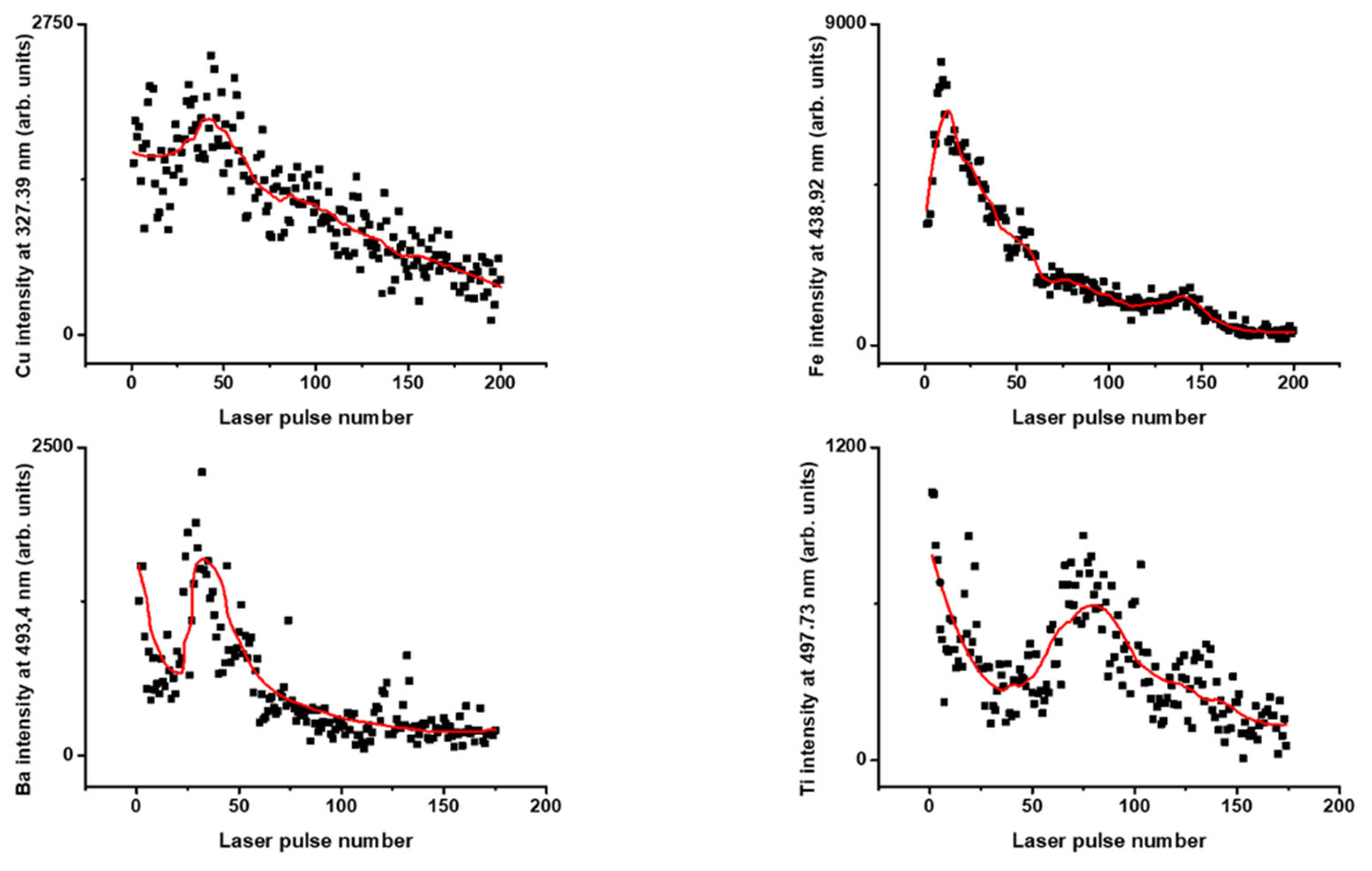
Preliminary results reported by Bergomi et al. (2023) indicated a consistent decreasing trend in elemental concentrations from the upper to the inner layers of the crust across all investigated samples [24]. This is in line with observations conducted in similar studies, which highlighted a decrease in the signal intensity of elements deriving from atmospheric pollution and deposition with depth [25,26]. While this pattern remains valid for some cases, the expanded dataset reveals that it cannot be generalized to all black crusts from the Monumental Cemetery. In fact, several samples exhibit distinct peaks in the LIBS spectra occurring after multiple laser pulses, indicating the presence of certain elements deep within the altered substrate (Figure 7).
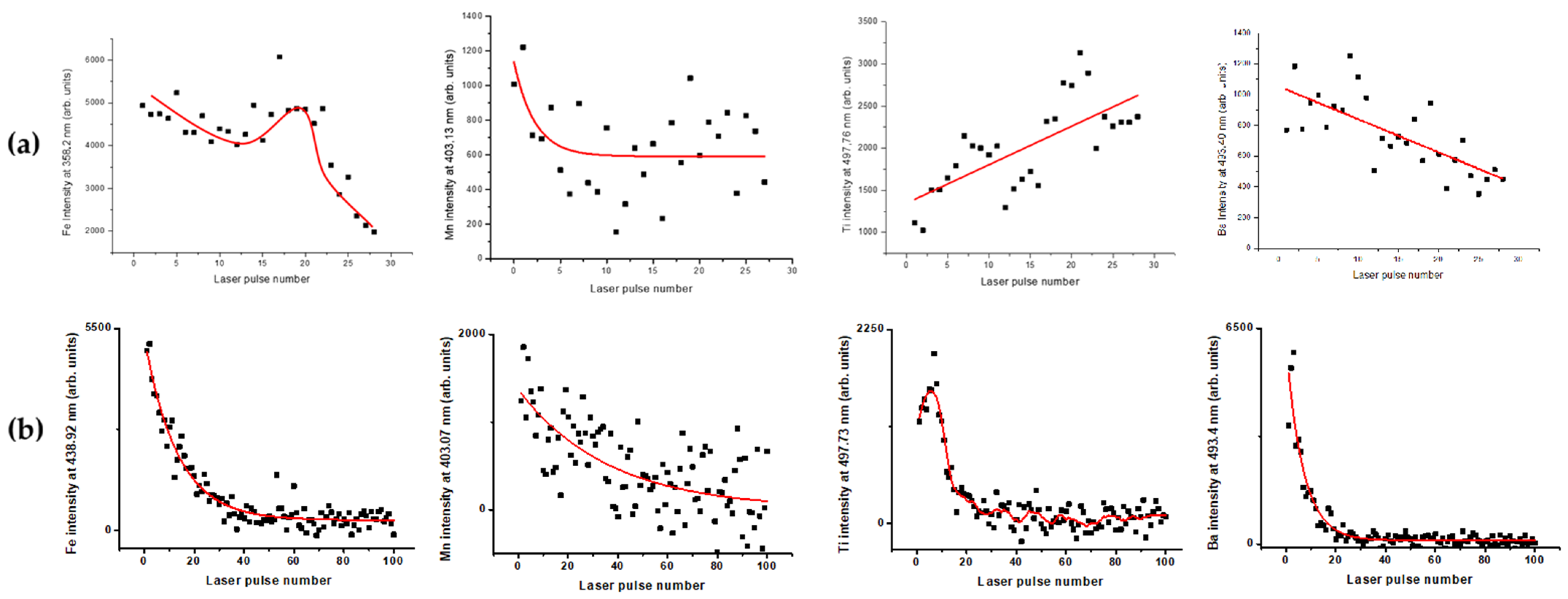
This behavior partially mirrors the findings from SEM-EDX linescan analysis, where peaks in signal intensity appear to occur randomly across the examined area. Such variability is once again attributable to the irregular distribution of particles within the crust, which hinders the identification of a consistent stratigraphic pattern across samples from this site. The heterogeneous nature of the crust is further supported by the observation that repeated analyses on the same sample often yield differing results, both in terms of elemental distribution from the outer to the inner layers and in signal intensity. This is exemplified in Figure 8, which compares two stratigraphic analyses performed on separate sections of sample GP.
These findings are particularly significant, as this is the first time that such trends have been documented in black crust samples. Previous studies investigating the stratigraphy of elements within black crusts reported a progressive decrease in signal intensity from the upper to the lower layers for all pollutants of atmospheric origin [25,26]. This pattern was generally attributed to surface deposition processes, which led to the accumulation of these elements on the outermost layers. In contrast, the results of the present study indicate at least partial penetration of pollutant-derived elements into deeper sections of the crust. This phenomenon may be explained by a combination of factors, including the considerable age of the crusts and the persistently high levels of atmospheric pollution to which they have been exposed over many years.

3.3. Mineral Phases and Their Distribution Within the Black Crusts

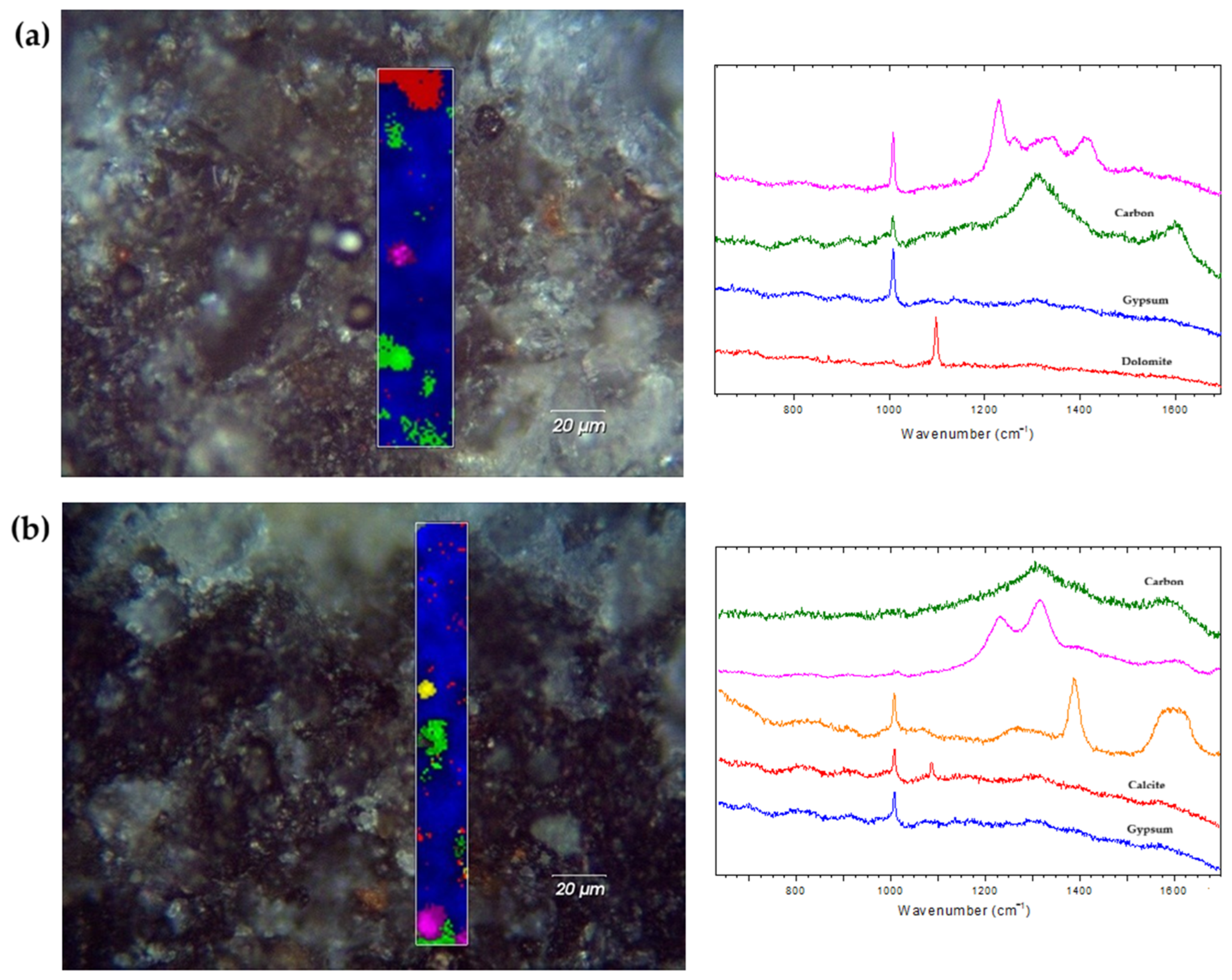
Samples EP and GS were selected for Raman mapping to assess the spatial distribution of the principal phases within the black crusts (Figure 9).
Gypsum was identified by the signal at 1008 cm−1, which corresponds to the symmetric stretching mode of SO4. Gypsum is the predominant phase in both samples, indicating a significant degree of degradation of the original marble substrate. Nonetheless, Raman signals attributable to the original substrate were detected by the ν1 vibrational mode of CO3: a peak at 1097 cm−1 corresponding to dolomite in sample EP, and a peak at 1085 cm−1 corresponding to calcite in sample GS. Despite this, the Raman maps reveal that substrate-related phases are less abundant than gypsum and are irregularly distributed across the analyzed areas. This suggests extensive deterioration, with only a minor fraction of the original substrate preserved within the newly formed gypsum matrix.
In addition, both samples display Raman signals associated with carbon, most likely originating from carbonaceous particles embedded within the black crust. This interpretation is supported by the presence of broad and intense bands at approximately 1350 and 1580 cm−1, which are typical of pollution-derived materials such as black carbon, soot, and combustion residues [48]. The irregular spatial distribution of these signals, as shown in the Raman maps, further suggests that these particles are heterogeneously incorporated into the gypsum matrix rather than forming a continuous phase.
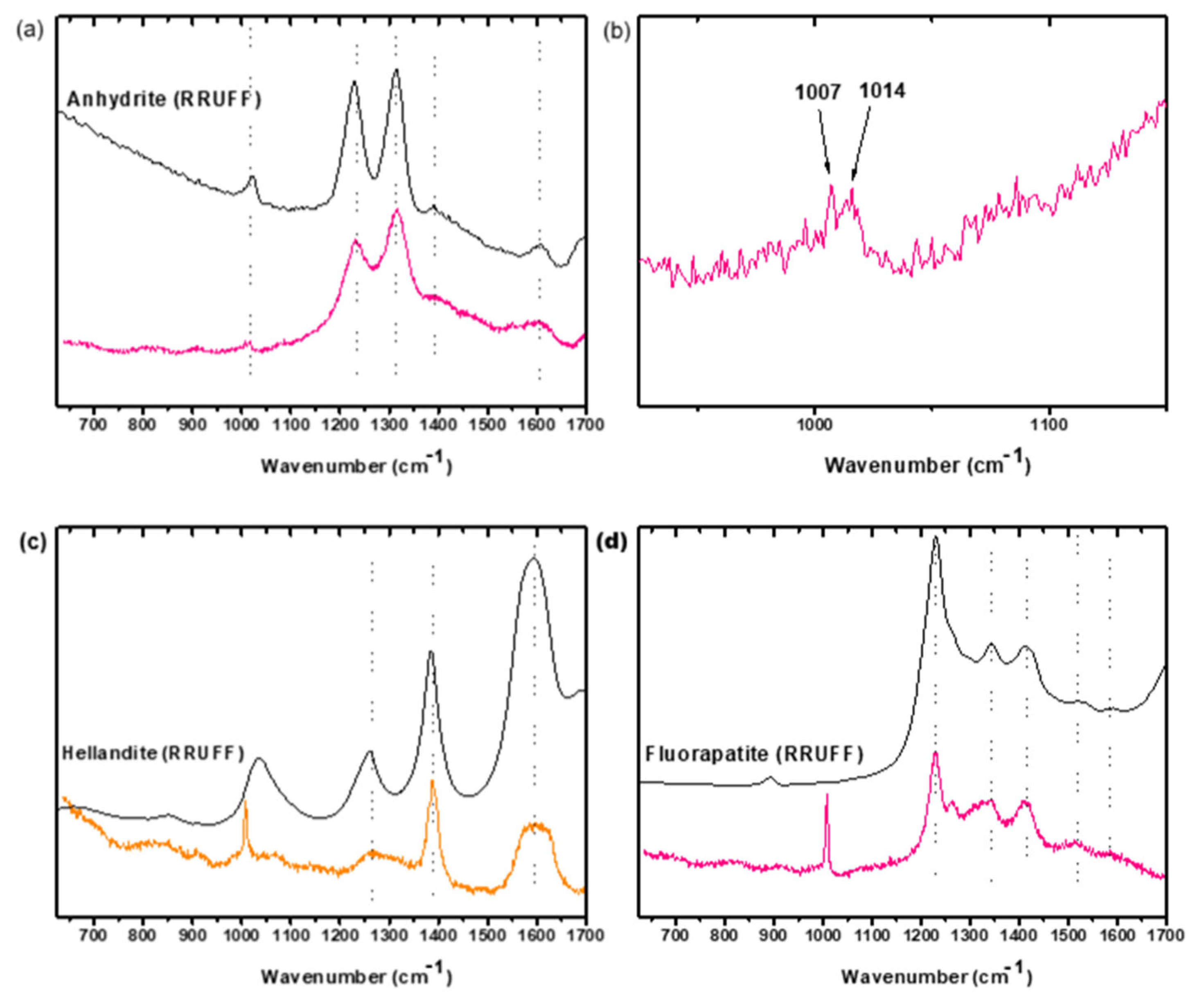
Additional signals were identified in both samples that could not be unambiguously assigned from the mapping results alone. To identify these phases, their spectra were compared against entries in the RRUFF database, enabling the most probable assignments to be proposed (Figure 10).
The pink spectrum in sample GS (Figure 10a) closely matches the reference spectrum of anhydrite (CaSO4) from the RRUFF database. When examining the spectral region between 900 and 1125 cm−1 in greater detail (Figure 10b), two distinct signals emerge, confirming the presence of anhydrite (CaSO4; ν1 at 1015 cm−1) and gypsum (CaSO4·2H2O; ν1 at 1007 cm−1). However, bands at 1232 and 1316 cm−1 are not anhydrite vibrational modes and could not be assigned. Minor deviations from the standard profile may be attributed to structural modifications within the black crust, likely caused by the coexistence of both species.
The attribution of the unknown phase detected in sample GS (orange spectrum) is more complex (Figure 10c). The spectrum most closely resembles that of Hellandite-Ce [(Ca,REE)4Ce2Al(Be,Li)2−xB4Si4O22(OH)2], although cerium (Ce) was not identified by LIBS analysis, and the compound itself is rare and unlikely to occur in this context. A bibliographic review ruled out oxalates and common compounds containing Ca, Al, Si, and O as plausible candidates. Additionally, the signal observed at 1388 cm−1 is slightly high for typical carbonaceous vibrations. Based on these considerations, the detected signals are most likely attributable to organic compounds embedded within the matrix, possibly polycyclic aromatic hydrocarbons (PAHs), which were previously identified in similar black crusts by Ricciardi et al. (2024) [49].
The unassigned phase in sample EP was also examined through spectral comparison with the RRUFF database (Figure 10d). The spectrum showing the highest degree of similarity corresponds to fluorapatite with minor manganese substitution [(Ca0.99Mn0.01)5(PO4)3F]. This assignment wasn’t fully verified as the main band at 1228 cm−1 does not correspond to the PO3 vibration modes; however, no other compounds showed a higher degree of similarity. Although this compound has not previously been reported in black crusts, its presence cannot be ruled out, as all constituent elements (Ca, Mn, P, and F) have been identified in the black crusts of the Monumental Cemetery through LIBS and SEM-EDX analyses. The formation of this phase is likely linked to the deposition of calcium phosphate particles, commonly associated with vehicular emissions [50], whose structure may have been altered by the incorporation of manganese and fluorine, elements also detected in the area and known to originate from other pollutant sources.
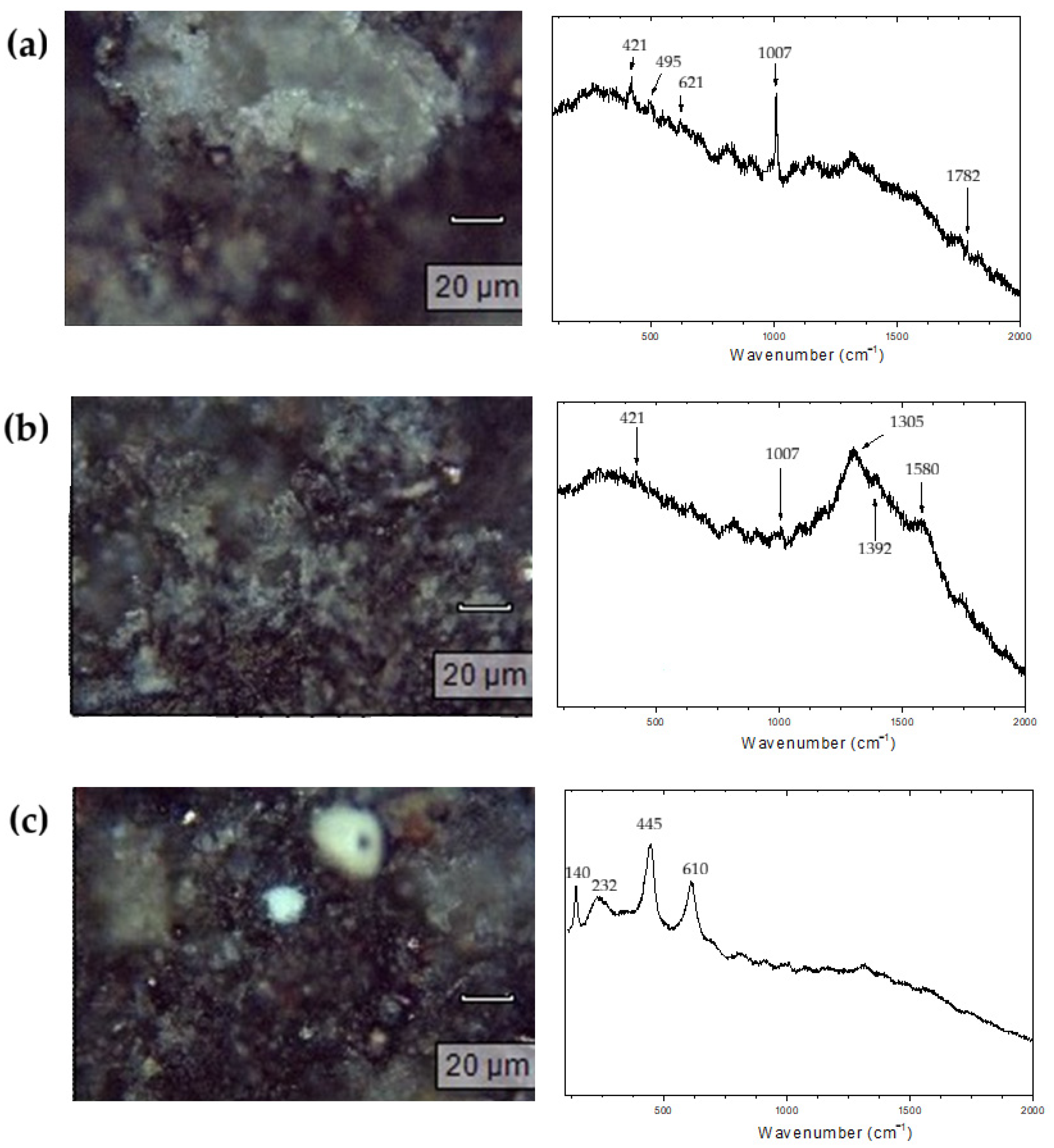
Targeted Raman point analyses were also performed on selected particles. In addition to the phases previously identified through spectral mapping, these localized measurements revealed the presence of additional ones, including corundum (Al2O3), rutile (TiO2), muscovite (KAl2(AlSi3O10)(OH)2), and hematite (Fe2O3). Figure 11 presents the spectra of representative particles, highlighting these newly detected components.

3.4. Oxidative Potential

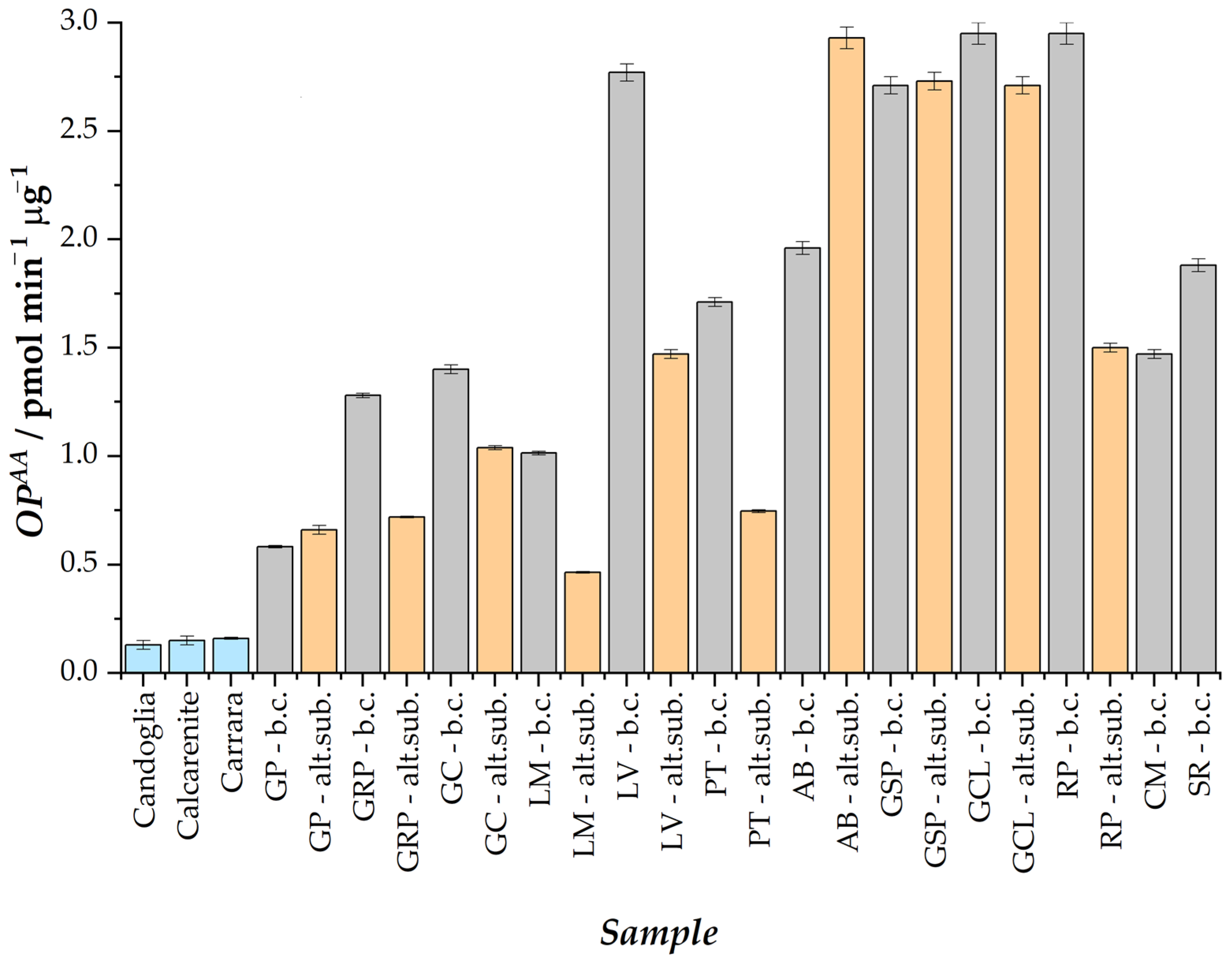
AA assays were performed on black crust samples distinguishing, where possible, between the upper black layer and the underlying altered substrate (Figure 12).
The results indicate that the samples exhibit higher oxidative potential values compared to the three marble substrates selected to represent the unaltered material. This increase is attributed to the interaction between the funerary monuments and polluted ambient air, which has led to surface degradation and the concurrent accumulation of pollutants within the newly formed black crust. Literature studies show that heavy metals and certain organic compounds are the primary agents responsible for the oxidation of ascorbic acid [51,52,53]. As they are also key constituents of PM, these are the substances responsible for the oxidative properties of the black crusts, confirming the accumulation of these elements within their structure.
Moreover, the top layer of the crust exhibits greater OPAA values compared to the underlying altered substrate across most of the samples analyzed. This indicates a higher concentration of oxidative species in the upper layers of the crust, which is in line with the observation made by Bergomi et al. (2023), suggesting that particulates embedded in the structure tend to stay preferentially in the upper layers, despite many years of exposure of the monuments [23]. Nevertheless, the observed differences in oxidative potential between altered and unaltered substrates indicate that some degree of particulate penetration occurs, reaching deeper layers of the crust. In certain cases, such as samples GP and GSP, this results in comparable OP values between layers, pointing to substantial infiltration from the surface. An exception to this pattern is sample AB, which displays markedly higher OPAA values in the altered substrate than in the upper black crust, suggesting a unique distribution of oxidative species in this instance.

4. Conclusions

This study characterized a representative set of black crusts collected from funerary monuments at the Monumental Cemetery of Milan through an integrated approach combining both traditional and advanced analytical techniques. SEM-EDX and Raman spectroscopy provided valuable insights into the morphology of the crusts and the distribution of their main mineral phases, while LIBS offered complementary insights into elemental distribution. Quantitatively, LIBS proved more effective than SEM-EDX line-scan analysis in profiling elemental stratification within the crusts, but less effective than SEM-EDX point analysis in detecting the full range of elements, as fewer species were identified through LIBS surface analysis.
In addition, OP assays were successfully applied to black crusts for the first time. Results demonstrated that both the crust and the altered substrate exhibited a measurable oxidative response, clearly distinguishable from the blank, confirming the presence of reactive metals and their contribution to degradation processes. These findings highlight OP assays as a promising complementary tool for evaluating pollutant-induced deterioration in heritage materials.
Beyond advancing analytical methodology, these findings carry significant implications for conservation practice. LIBS, with its ability to be applied in-situ, represents a powerful diagnostic tool for assessing black crusts directly on monuments and guiding restoration decisions in real time. OP assays, on the other hand, show strong potential as a rapid, low-cost, and effective screening technique to quickly evaluate the metal content of black crusts, enabling conservation scientists to prioritize interventions and monitor pollutant-driven deterioration more efficiently. Together, these approaches expand the toolkit available for diagnosing, protecting, and restoring cultural heritage surfaces affected by environmental stressors.
Future developments of this research could involve more detailed quantitative investigations of the characteristic elements within the black crusts. While techniques such as SEM-EDX and LIBS provide valuable semi-quantitative information, the absolute concentrations of trace elements remain subject to uncertainty. Quantitative analyses would enable a more accurate assessment of the stratigraphy of individual elements across the crust layers and allow direct comparison with ambient air quality measurements in the city of Milan. This approach would strengthen the evaluation of the relationship between atmospheric pollution and the chemical composition of black crusts at different depths. Furthermore, quantitative data would enhance the interpretation of OP assays, which are highly influenced by both the type and concentration of elements present. Since OP assays were applied here for the first time to black crusts, their interpretation remains exploratory and not yet standardized; quantitative investigations could therefore provide a more robust framework for their future application.

Author Contributions

Conceptualization, M.C. and P.F.; Data curation, A.B., V.C. and M.B.; Formal analysis, A.B., C.A.L., E.F., M.O., L.M.-G., P.M.C.-Q., A.C. and M.P.; Funding acquisition, M.C. and P.F.; Investigation, A.B., V.C., M.B. and C.A.L.; Methodology, A.B., V.C., C.A.L. and P.F.; Project administration, V.C., M.C. and P.F.; Resources, M.C. and P.F.; Software, M.O.; Supervision, M.C. and P.F.; Validation, V.C. and P.F.; Writing—original draft, A.B. and V.C.; Writing—review & editing, V.C., M.O. and P.F. All authors have read and agreed to the published version of the manuscript.

Funding

This work was partly funded by the H2020 European project IPERION HS (Integrated Platform for the European Research Infrastructure ON Heritage Science, GA 871034) through a Fixlab Transnational Access. Funding from the Spanish State Research Agency (AEI) through project PID2022-137017OB-I00/AEI/1013039/501100011033, Regional Government of Madrid through the project TEC Heritage-CM (TEC-2024/TEC-39) and the support by CSIC Platform “Open Heritage: Research and Society” (PTI-PAIS) is also acknowledged. The project was also funded by the European Union—NextGenerationEU under the National Recovery and Resilience Plan (PNRR)—Mission 4 Education and research—Component 2 From research to business—Investment 1.3, Notice D.D. 341 of 15 March 2022, entitled: Cultural Heritage Active Innovation for Sustainable Society proposal code PE0000020-CUPG53C22000430006, duration until 28 February 2026.

Data Availability Statement

The original data presented in the study are openly available at https://doi.org/10.5281/zenodo.17257430 (accessed on 2 October 2025).

Conflicts of Interest

The authors declare no conflicts of interest.

References

  1. Maravelaki-Kalaitzaki, P. Black Crusts and Patinas on Pentelic Marble from the Parthenon and Erechtheum (Acropolis, Athens): Characterization and Origin. Anal. Chim. Acta 2005, 532, 187–198. [Google Scholar] [CrossRef]
  2. Islam, N.; Roy, K.; Barman, P.; Rabha, S.; Bora, H.K.; Khare, P.; Konwar, R.; Saikia, B.K. Chemical and Toxicological Studies on Black Crust Formed over Historical Monuments as a Probable Health Hazard. J. Hazard. Mater. 2024, 464, 132939. [Google Scholar] [CrossRef]
  3. Ausset, P.; Del Monte, M.; Lefè, R.A. Embryonic Sulphated Black Crusts on Carbonate Rocks in Atmospheric Simulation Chamber and in the Field: Role of Carbonaceous Fly-Ash. Atmos. Environ. 1999, 33, 1525–1534. [Google Scholar] [CrossRef]
  4. Török, Á.; Licha, T.; Simon, K.; Siegesmund, S. Urban and Rural Limestone Weathering; the Contribution of Dust to Black Crust Formation. Environ. Earth Sci. 2011, 63, 675–693. [Google Scholar] [CrossRef]
  5. Sabbioni, C. Contribution of Atmospheric Deposition to the Formation of Damage Layers. Sci. Total Environ. 1995, 167, 49–55. [Google Scholar] [CrossRef]
  6. Maravelaki-Kalaitzaki, P.; Biscontin, G. Origin, Characteristics and Morphology of Weathering Crusts on Istria Stone in Venice. Atmos. Environ. 1999, 33, 1699–1709. [Google Scholar] [CrossRef]
  7. Bugini, R.; Tabasso, M.L.; Realini, M. Rate of Formation of Black Crusts on Marble. A Case Study. J. Cult. Herit. 2000, 1, 111–116. [Google Scholar] [CrossRef]
  8. Del Monte, M.; Sabbioni, C.; Vittori, O. Airborne carbon particles and marble deterioration. Atmos. Environ. (1967) 1981, 15, 645–652. [Google Scholar] [CrossRef]
  9. García-Florentino, C.; Maguregui, M.; Ciantelli, C.; Sardella, A.; Bonazza, A.; Queralt, I.; Carrero, J.A.; Natali, C.; Morillas, H.; Madariaga, J.M.; et al. Deciphering Past and Present Atmospheric Metal Pollution of Urban Environments: The Role of Black Crusts Formed on Historical Constructions. J. Clean. Prod. 2020, 243, 118594. [Google Scholar] [CrossRef]
  10. Wang, F.; Fu, Y.; Li, D.; Huang, Y.; Wei, S. Study on the Mechanism of the Black Crust Formation on the Ancient Marble Sculptures and the Effect of Pollution in Beijing Area. Heliyon 2022, 8, e10442. [Google Scholar] [CrossRef]
  11. Bonazza, A.; Sabbioni, C.; Ghedini, N. Quantitative Data on Carbon Fractions in Interpretation of Black Crusts and Soiling on European Built Heritage. Atmos. Environ. 2005, 39, 2607–2618. [Google Scholar] [CrossRef]
  12. Bonazza, A.; Brimblecombe, P.; Grossi, C.M.; Sabbioni, C. Carbon in Black Crusts from the Tower of London. Environ. Sci. Technol. 2007, 41, 4199–4204. [Google Scholar] [CrossRef]
  13. Graue, B.; Siegesmund, S.; Oyhantcabal, P.; Naumann, R.; Licha, T.; Simon, K. The Effect of Air Pollution on Stone Decay: The Decay of the Drachenfels Trachyte in Industrial, Urban, and Rural Environments-a Case Study of the Cologne, Altenberg and Xanten Cathedrals. Environ. Earth Sci. 2013, 69, 1095–1124. [Google Scholar] [CrossRef]
  14. Barca, D.; Belfiore, C.M.; Crisci, G.M.; La Russa, M.F.; Pezzino, A.; Ruffolo, S.A. A New Methodological Ap-proach for the Chemical Characterization of Black Crusts on Building Stones: A Case Study from the Catania City Centre (Sicily, Italy). J. Anal. At. Spectrom. 2011, 26, 1000–1011. [Google Scholar] [CrossRef]
  15. Wilhelm, K.; Longman, J.; Orr, S.A.; Viles, H. Stone-Built Heritage as a Proxy Archive for Long-Term Historical Air Quality: A Study of Weathering Crusts on Three Generations of Stone Sculptures on Broad Street, Oxford. Sci. Total Environ. 2021, 759, 143916. [Google Scholar] [CrossRef] [PubMed]
  16. Rodriguez-Navarro, C.; Sebastian, E. Role of Particulate Matter from Vehicle Exhaust on Porous Building Stones (Limestone) Sulfation. Sci. Total Environ. 1996, 187, 79–91. [Google Scholar] [CrossRef]
  17. Morillas, H.; Maguregui, M.; García-Florentino, C.; Carrero, J.A.; Salcedo, I.; Madariaga, J.M. The Cauliflow-er-like Black Crusts on Sandstones: A Natural Passive Sampler to Evaluate the Surrounding Environmental Pollution. Environ. Res. 2016, 147, 218–232. [Google Scholar] [CrossRef]
  18. Macholdt, D.S.; Herrmann, S.; Jochum, K.P.; Kilcoyne, A.L.D.; Laubscher, T.; Pfisterer, J.H.K.; Pöhlker, C.; Schwager, B.; Weber, B.; Weigand, M.; et al. Black Manganese-Rich Crusts on a Gothic Cathedral. Atmos. Environ. 2017, 171, 205–220. [Google Scholar] [CrossRef]
  19. Calparsoro, E.; Maguregui, M.; Giakoumaki, A.; Morillas, H.; Madariaga, J.M. Evaluation of Black Crust Formation and Soiling Process on Historical Buildings from the Bilbao Metropolitan Area (North of Spain) Using SEM-EDS and Raman Microscopy. Environ. Sci. Pollut. Res. 2017, 24, 9468–9480. [Google Scholar] [CrossRef]
  20. Galletti, G.C.; Bocchini, P.; Cam, D.; Chiavari, G.; Mazzeo, R. Chemical Characterization of the Black Crust Present on the Stone Central Portal of St. Denis Abbey. J. Anal. Chem. 1997, 357, 1211–1214. [Google Scholar] [CrossRef]
  21. Hatir, M.E.; Ince, I.; Hatir, A.E. The Effect of Particulate Matter (PM2.5 and PM10) on Human Health and Cultural Heritage in the Historical City Centre of Konya. Sadhana 2025, 50, 219. [Google Scholar] [CrossRef]
  22. Kumar, G.; Rusin, L.; Nagar, P.K.; Manjul, S.K.; Back, M.; Benedetti, A.; Gurjar, B.R.; Ojha, C.S.P.; Sharma, M.; Balliana, E. Characterization of Red Sandstone and Black Crust to Analyze Air Pollution Impacts on a Cultural Heritage Building: Red Fort, Delhi, India. Heritage 2025, 8, 236. [Google Scholar] [CrossRef]
  23. Bergomi, A.; Comite, V.; Contardi, C.; Carmona-Quiroga, P.M.; Maestro-Guijarro, L.; Oujja, M.; Crespo, A.; Sanchez-Cortes, S.; Lombardi, C.A.; Borelli, M.; et al. Assessing the Use of Laser Induced Breakdown Spectroscopy for the Stratigraphic Analysis of Black Crusts. In Proceedings of the 2024 IEEE International Conference on Metrology for Archaeology and Cultural Heritage, La Valletta, Malta, 7–9 October 2024. [Google Scholar]
  24. Bergomi, A.; Comite, V.; Della Pina, C.; Carmona-Quiroga, P.M.; Maestro-Guijarro, L.; Oujja, M.; Crespo, A.; Lombardi, C.A.; Borelli, M.; Castillejo, M.; et al. Surface and Stratigraphic Analysis of Black Crusts Using Laser Induced Breakdown Spectroscopy. In Proceedings of the 2023 IMEKO TC-4 International Conference on Metrology for Archaeology and Cultural Heritage, Rome, Italy, 19–21 October 2023. [Google Scholar]
  25. Senesi, G.S.; Carrara, I.; Nicolodelli, G.; Milori, D.M.B.P.; De Pascale, O. Laser Cleaning and Laser-Induced Breakdown Spectroscopy Applied in Removing and Characterizing Black Crusts from Limestones of Castello Svevo, Bari, Italy: A Case Study. Microchem. J. 2016, 124, 296–305. [Google Scholar] [CrossRef]
  26. Maravelaki-Kalaitzaki, P.; Anglos, D.; Kilikoglou, V.; Zafiropulos, V. Compositional Characterization of Encrustation on Marble with Laser Induced Breakdown Spectroscopy. Spectrochim. Acta Part B At. Spectrosc. 2001, 56, 887–903. [Google Scholar] [CrossRef]
  27. Oujja, M.; Rebollar, E.; Castillejo, M.; Domingo, C.; Cirujano, C.; Guerra-Librero, F. Laser Cleaning of Terracotta Decorations of the Portal of Palos of the Cathedral of Seville. J. Cult. Herit. 2005, 6, 321–327. [Google Scholar] [CrossRef]
  28. Potgieter-Vermaak, S.S.; Godoi, R.H.M.; Van Grieken, R.; Potgieter, J.H.; Oujja, M.; Castillejo, M. Micro-Structural Characterization of Black Crust and Laser Cleaning of Building Stones by Micro-Raman and SEM Techniques. Spectrochim. Acta Part A Mol. Biomol. Spectrosc. 2005, 61, 2460–2467. [Google Scholar] [CrossRef]
  29. Bergomi, A.; Carrara, E.; Festa, E.; Colombi, C.; Cuccia, E.; Biffi, B.; Comite, V.; Fermo, P. Optimization and Application of Analytical Assays for the Determination of Oxidative Potential of Outdoor and Indoor Particulate Matter. Atmosphere 2024, 15, 772. [Google Scholar] [CrossRef]
  30. Molina, C.; Manzano, C.A.; Toro, A.R.; Leiva, G.M.A. The Oxidative Potential of Airborne Particulate Matter in Two Urban Areas of Chile: More than Meets the Eye. Environ. Int. 2023, 173, 107866. [Google Scholar] [CrossRef]
  31. Pietrogrande, M.C.; Russo, M.; Zagatti, E. Review of PM Oxidative Potential Measured with Acellular Assays in Urban and Rural Sites across Italy. Atmosphere 2019, 10, 626. [Google Scholar] [CrossRef]
  32. Pietrogrande, M.C.; Bertoli, I.; Manarini, F.; Russo, M. Ascorbate Assay as a Measure of Oxidative Potential for Ambient Particles: Evidence for the Importance of Cell-Free Surrogate Lung Fluid Composition. Atmos. Environ. 2019, 211, 103–112. [Google Scholar] [CrossRef]
  33. Visentin, M.; Pagnoni, A.; Sarti, E.; Pietrogrande, M.C. Urban PM2.5 Oxidative Potential: Importance of Chemical Species and Comparison of Two Spectrophotometric Cell-Free Assays. Environ. Pollut. 2016, 219, 72–79. [Google Scholar] [CrossRef]
  34. European Parliament; Council of the European Union. Directive (EU) 2024/2881 of 13 September 2024 on ambient air quality and cleaner air for Europe. Off. J. Eur. Union 2024, L 202, 1–45. Available online: https://eur-lex.europa.eu/legal-content/EN/TXT/?uri=CELEX:32024L2881 (accessed on 24 September 2025).
  35. Terzi, E.; Argyropoulos, G.; Bougatioti, A.; Mihalopoulos, N.; Nikolaou, K.; Samara, C. Chemical Composition and Mass Closure of Ambient PM10 at Urban Sites. Atmos. Environ. 2010, 44, 2231–2239. [Google Scholar] [CrossRef]
  36. Fussell, J.C.; Franklin, M.; Green, D.C.; Gustafsson, M.; Harrison, R.M.; Hicks, W.; Kelly, F.J.; Kishta, F.; Miller, M.R.; Mudway, I.S.; et al. A Review of Road Traffic-Derived Non-Exhaust Particles: Emissions, Physico-chemical Characteristics, Health Risks, and Mitigation Measures. Environ. Sci. Technol. 2022, 56, 6813–6835. [Google Scholar] [CrossRef] [PubMed]
  37. Reizer, M.; Calzolai, G.; MacIejewska, K.; Orza, J.A.G.; Carraresi, L.; Lucarelli, F.; Juda-Rezler, K. Measurement Report: Receptor Modeling for Source Identification of Urban Fine and Coarse Particulate Matter Using Hourly Elemental Composition. Atmos. Chem. Phys. 2021, 21, 14471–14492. [Google Scholar] [CrossRef]
  38. Legrand, M.; McConnell, J.R.; Bergametti, G.; Preunkert, S.; Chellman, N.; Desboeufs, K.; Lestel, L.; Plach, A.; Stohl, A. Alpine-Ice Record of Bismuth Pollution Implies a Major Role of Military Use during World War II. Sci. Rep. 2023, 13, 1166. [Google Scholar] [CrossRef]
  39. Fermo, P.; Goidanich, S.; Comite, V.; Toniolo, L.; Gulotta, D. Study and Characterization of Environmental Deposition on Marble and Surrogate Substrates at a Monumental Heritage Site. Geosciences 2018, 8, 349. [Google Scholar] [CrossRef]
  40. Comite, V.; Fermo, P. The Effects of Air Pollution on Cultural Heritage: The Case Study of Santa Maria Delle Grazie al Naviglio Grande (Milan)⋆. Eur. Phys. J. Plus 2018, 133, 556. [Google Scholar] [CrossRef]
  41. Loveluck, C.P.; McCormick, M.; Spaulding, N.E.; Clifford, H.; Handley, M.J.; Hartman, L.; Hoffmann, H.; Korotkikh, E.V.; Kurbatov, A.V.; More, A.F.; et al. Alpine Ice-Core Evidence for the Transformation of the European Monetary System, AD 640–670. Antiquity 2018, 92, 1571–1585. [Google Scholar] [CrossRef]
  42. Grigoratos, T.; Martini, G. Brake Wear Particle Emissions: A Review. Environ. Sci. Pollut. Res. 2015, 22, 2491–2504. [Google Scholar] [CrossRef]
  43. Slezakova, K.; Castro, D.; Begonha, A.; Delerue-Matos, C.; da Conceição Alvim-Ferraz, M.; Morais, S.; do Carmo Pereira, M. Air Pollution from Traffic Emissions in Oporto, Portugal: Health and Environmental Implications. Microchem. J. 2011, 99, 51–59. [Google Scholar] [CrossRef]
  44. Bukowiecki, N.; Gehrig, R.; Hill, M.; Lienemann, P.; Zwicky, C.N.; Buchmann, B.; Weingartner, E.; Balten-sperger, U. Iron, Manganese and Copper Emitted by Cargo and Passenger Trains in Zürich (Switzerland): Size-Segregated Mass Concentrations in Ambient Air. Atmos. Environ. 2007, 41, 878–889. [Google Scholar] [CrossRef]
  45. Fridell, E.; Ferm, M.; Ekberg, A. Emissions of Particulate Matters from Railways—Emission Factors and Condition Monitoring. Transp. Res. Part D Transp. Environ. 2010, 15, 240–245. [Google Scholar] [CrossRef]
  46. Fruhwirt, D.; Sturm, P.; Nöst, T.; Leonhardt, P.; Bode, G.; Michael, S.; Rodler, J. PM Emissions from Railways—Results of Tests on a Wheel-Rail Test Bench. Transp. Res. Part D Transp. Environ. 2023, 122, 103858. [Google Scholar] [CrossRef]
  47. Hildemann, L.M.; Klinedinst, D.B.; Klouda, G.A.; Currie, L.A.; Cass, G.R. Sources of Urban Contemporary Carbon Aerosol. Environ. Sci. Technol. 1994, 28, 1565–1576. [Google Scholar] [CrossRef] [PubMed]
  48. Sadezky, A.; Muckenhuber, H.; Grothe, H.; Niessner, R.; Pöschl, U. Raman Microspectroscopy of Soot and Related Carbonaceous Materials: Spectral Analysis and Structural Information. Carbon 2005, 43, 1731–1742. [Google Scholar] [CrossRef]
  49. Ricciardi, M.; Faggiano, A.; Pironti, C.; Motta, O.; Carotenuto, M.; Comite, V.; Fermo, P.; Proto, A. Analysis of PAHs (Polycyclic Aromatic Hydrocarbons) and Other Main Components in Black Crusts Collected from the Monumental Cemetery of Milan (Italy). In Proceedings of the 2021 International Conference on Metrology for Archaeology and Cultural Heritage (MetroArchaeo 2021), Milan, Italy, 20–22 October 2021; Institute of Physics: London, UK, 2022; Volume 2204. [Google Scholar]
  50. Santiago Pozo-Antonio, J.; Cardell, C.; Comite, V.; Fermo, P. Characterization of Black Crusts Developed on Historic Stones with Diverse Mineralogy under Different Air Quality Environments. Environ. Sci. Pollut. Res. 2022, 29, 29438–29454. [Google Scholar] [CrossRef]
  51. Rao, L.; Zhang, L.; Wang, X.; Xie, T.; Zhou, S.; Lu, S.; Liu, X.; Lu, H.; Xiao, K.; Wang, W.; et al. Oxidative Potential Induced by Ambient Particulate Matters with Acellular Assays: A Review. Processes 2020, 8, 1410. [Google Scholar] [CrossRef]
  52. Janssen, N.A.H.; Yang, A.; Strak, M.; Steenhof, M.; Hellack, B.; Gerlofs-Nijland, M.E.; Kuhlbusch, T.; Kelly, F.; Harrison, R.; Brunekreef, B.; et al. Oxidative Potential of Particulate Matter Collected at Sites with Different Source Characteristics. Sci. Total Environ. 2014, 472, 572–581. [Google Scholar] [CrossRef]
  53. Jiang, H.; Sabbir Ahmed, C.M.; Canchola, A.; Chen, J.Y.; Lin, Y.H. Use of Dithiothreitol Assay to Evaluate the Oxidative Potential of Atmospheric Aerosols. Atmosphere 2019, 10, 571. [Google Scholar] [CrossRef]
Figure 1. EP funerary monument (left) and associated black crust sample (right). The red arrow marks the hypothesized location where the black crust detached from the monument.
Heritage 08 00506 g001
Figure 2. Map of funerary monuments in the Monumental Cemetery where black crust samples were collected.
Heritage 08 00506 g002
Figure 3. SEM micrographs (left) and sulfur EDX maps (right) of crust thick cross sections of sample EP (a) and GS (b).
Heritage 08 00506 g003
Figure 4. Heatmap showing correlations between characteristic elements detected in at least three black crust samples. Red shading represents positive correlations, while blue shading represents negative correlations.
Heritage 08 00506 g004
Figure 5. Linescan EDX analysis of sample AF. The red line in the SEM micrograph marks the path of the scan, performed from top to bottom.
Heritage 08 00506 g005
Figure 6. Linescan EDX analysis results for Fe (blue lines), Ti (green lines), and Ba (purple lines).
Heritage 08 00506 g006
Figure 7. Elemental stratigraphy of Cu, Fe, Ba, and Ti in sample AB.
Heritage 08 00506 g007
Figure 8. Elemental stratigraphy of Fe, Mn, Ti, and Ba in sample GP: first section (a) and second section (b).
Heritage 08 00506 g008
Figure 9. Raman maps and corresponding spectra from selected regions of samples EP (a) and GS (b), illustrating the spatial distribution and chemical composition of key phases within the black crusts.
Heritage 08 00506 g009
Figure 10. Analysis of unassigned Raman spectra: panels (a,c,d) show comparisons with the RRUFF database, while panel (b) presents a magnified view of the ~1000 cm−1 region of the pink spectrum.
Heritage 08 00506 g010
Figure 11. Point Raman analysis on selected particles: (a) corundum/gypsum; (b) corundum/carbon; (c) rutile.
Heritage 08 00506 g011
Figure 12. OPAA values of black crusts collected from the Monumental Cemetery: b.c. refers to the upper black layer of the crust; alt.sub. refers to the underlying layer of altered substrate.
Heritage 08 00506 g012
Table 1. Sample name, location, and construction dates of black crusts from the Monumental Cemetery.
SampleGallerySectionDate
GSWestern, UpperAB1873
EPWestern, UpperAB1924
LPWestern, UpperB1884
AFWestern, UpperB1878
GRPWestern, UpperBG1903
LMWestern, UpperAB1911
GPWestern, UpperAB1893
RPWestern, UpperBC1887
GCWestern, UpperBC1909
FRWestern, UpperB1865
CMWestern, UpperBalcony1869
LVWestern, LowerAB1870
SRWestern, GardenD1869
ABWestern, UpperAB1940
GCLWestern, UpperC1913
GSPWestern, UpperBG1874
PTWestern, UpperBC1876
Table 2. Frequency of element detection in particles from each black crust sample, expressed as a decimal. Part 1. n.d. = not detected.
SampleCOMgAlSiSClKCaTiZnPbBiFNaVFePCrCo
AF1.001.000.900.711.001.000.920.391.000.770.020.260.530.080.750.010.390.020.010.01
EP1.001.001.001.001.001.000.790.841.000.210.290.21n.d.n.d.0.470.131.000.400.080.03
GRP1.001.000.540.631.001.000.730.191.000.170.080.310.33n.d.0.080.040.420.100.08n.d.
GS1.001.000.771.001.001.000.770.721.000.240.270.23n.d.0.050.620.010.970.410.050.04
LP1.001.000.810.881.001.000.880.711.000.350.080.060.130.210.48n.d.0.790.130.040.08
CM1.001.000.910.450.820.730.090.241.000.03n.d.0.03n.d.n.d.0.12n.d.0.360.060.03n.d.
FR1.001.001.001.001.000.700.360.421.000.030.210.03n.d.n.d.0.030.030.970.24n.d.n.d.
GP1.001.000.421.001.000.740.290.321.000.03n.d.n.d.n.d.0.320.10n.d.0.450.100.06n.d.
GC1.001.000.531.001.000.590.500.441.000.180.090.03n.d.0.060.410.060.650.29n.d.n.d.
LM1.001.000.271.001.000.890.260.181.000.080.050.02n.d.0.020.12n.d.0.950.30n.d.n.d.
LV1.001.000.430.990.960.810.280.101.000.060.010.06n.d.0.070.12n.d.0.340.21n.d.n.d.
RP1.001.000.630.970.950.910.450.451.000.030.060.06n.d.0.120.32n.d.0.770.180.03n.d.
SR1.001.000.571.001.001.000.710.801.000.14n.d.0.06n.d.n.d.0.840.060.730.31n.d.n.d.
Table 3. Frequency of element detection in particles from each black crust sample, expressed as a decimal. Part 2. n.d. = not detected.
SampleMnSnCuBaScAgCdSrSbInNiAsPdPtAuBrHg
AFn.d.n.d.n.d.n.d.n.d.n.d.n.d.n.d.n.d.n.d.n.d.n.d.n.d.n.d.n.d.n.d.n.d.
EP0.400.050.050.060.020.02n.d.n.d.0.02n.d.n.d.n.d.n.d.n.d.n.d.n.d.n.d.
GRP0.080.040.170.150.020.040.020.02n.d.n.d.0.04n.d.n.d.n.d.n.d.n.d.n.d.
GS0.210.050.080.21n.d.n.d.n.d.0.080.040.01n.d.0.01n.d.n.d.n.d.n.d.n.d.
LP0.100.060.080.25n.d.n.d.n.d.n.d.n.d.0.020.02n.d.0.020.020.020.02n.d.
CMn.d.n.d.n.d.0.09n.d.n.d.n.d.0.03n.d.n.d.n.d.n.d.n.d.n.d.n.d.n.d.n.d.
FR0.12n.d.n.d.0.21n.d.n.d.n.d.0.03n.d.n.d.n.d.n.d.n.d.n.d.n.d.n.d.n.d.
GPn.d.0.100.190.19n.d.n.d.n.d.0.03n.d.n.d.n.d.n.d.n.d.n.d.n.d.n.d.n.d.
GC0.060.030.060.03n.d.n.d.n.d.n.d.n.d.n.d.0.06n.d.n.d.n.d.n.d.n.d.n.d.
LM0.040.020.020.09n.d.n.d.n.d.n.d.n.d.n.d.n.d.n.d.n.d.n.d.n.d.n.d.n.d.
LV0.030.01n.d.0.49n.d.n.d.n.d.n.d.0.01n.d.n.d.n.d.n.d.n.d.n.d.n.d.n.d.
RP0.060.05n.d.0.14n.d.0.02n.d.n.d.n.d.n.d.n.d.n.d.n.d.n.d.n.d.0.020.02
SR0.04n.d.n.d.0.04n.d.n.d.n.d.n.d.n.d.n.d.n.d.n.d.n.d.n.d.n.d.n.d.n.d.
Table 4. Chemical species detected by LIBS surface analysis in black crust samples and in the unaltered marble substrate.
SampleLIBS Signal Assignments 1
SubstrateC, Si, Mg, Al, Ca, CN, K, Sr, C2, CaO, Na
GSFe, Mn, Ba, Ti, Cr, Cu, Zn
AFFe
GRPFe, Cu
LMFe, Mn, Ba, Ti, Cr, Cu, Zn
GPFe, Mn, Ba, Ti, Cr, Cu, CaF
RPFe, Mn, Ba, Ti, CaF
GCFe, Mn, Ba, Ti, Cu, CaF
FRFe, Mn, Ba, Ti, Cr
CMFe, Mn, Ba, Ti, Cr
LVFe, Mn, Ba, Ti, Cr, Cu, CaF
SRFe, Mn, Ba, Ti, Cr, Cu
ABFe, Mn, Ba, Ti, Cr, Cu
GCLFe, Mn, Ba, Ti, Cr, Cu
GSPFe, Mn, Ba, Ti, Cu
PTFe, Mn, Ba, Cu, CaF
1 All chemical species identified in the substrate were also present in the black crusts. Hence, the species listed in the table for each black crust sample are those considered characteristic of the crusts; that is, they were not detected in the unaltered substrate.
Disclaimer/Publisher’s Note: The statements, opinions and data contained in all publications are solely those of the individual author(s) and contributor(s) and not of MDPI and/or the editor(s). MDPI and/or the editor(s) disclaim responsibility for any injury to people or property resulting from any ideas, methods, instructions or products referred to in the content.