
Article

Photoreforming of Polylactic Acid over g-C3N4-Based Catalysts Derived from Sustainable Precursors

by
Daniela Casamayor-Roberto
,
Alejandro Ariza-Pérez
,
David Ortega-Domínguez
,
Vicente Montes
,
Rafael Estevez
,
Francisco J. Urbano
,
Alberto Marinas
and
Francisco J. López-Tenllado
*
Departamento de Química Orgánica, Instituto Químico para la Energía y el Medioambiente (IQUEMA), Universidad de Córdoba, E-14071 Córdoba, Spain
*
Author to whom correspondence should be addressed.
Clean Technol. 2026, 8(4), 104; https://doi.org/10.3390/cleantechnol8040104
Submission received: 19 April 2026 / Revised: 10 June 2026 / Accepted: 1 July 2026 / Published: 9 July 2026
(This article belongs to the Topic Green and Sustainable Chemical Processes)

Abstract

The global proliferation of plastic waste has made the search for sustainable chemical recycling strategies imperative to transition toward a circular bioeconomy. This study presents a dual-valorization approach for polylactic acid (PLA) waste, utilizing it both as a sustainable precursor for g-C3N4 catalyst synthesis and as a sacrificial agent for green hydrogen production via photoreforming. Platinum-modified graphitic carbon nitride catalysts were synthesized and evaluated using pure lactic acid and commercial PLA waste under solar-simulated irradiation. Results identified C3N4-NaOH-Pt as the most active material, while the simultaneous one-pot depolymerization/photoreforming of macroscopic PLA fragments exhibited a peak H2 production rate of 1.5 mmol·h−1·g−1, remarkably surpassing both the pure monomer model and pre-depolymerized solutions. This enhanced performance is tentatively attributed to a “controlled release” mechanism that prevents catalyst surface saturation and minimizes light scattering effects inherent to fine powders. The study concludes that maintaining the macroscopic integrity of PLA waste provides a strategic advantage for chemical reforming by eliminating energy-intensive grinding and pretreatment. Future research into diverse operational and chemical parameters, including temperature and base-addition strategies, will be essential for scaling solar-driven upcycling technologies.

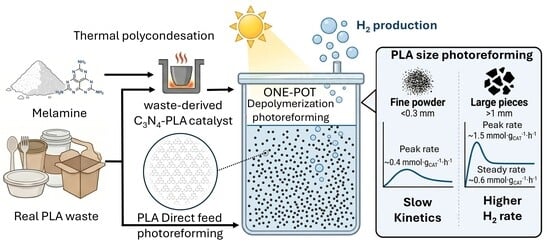
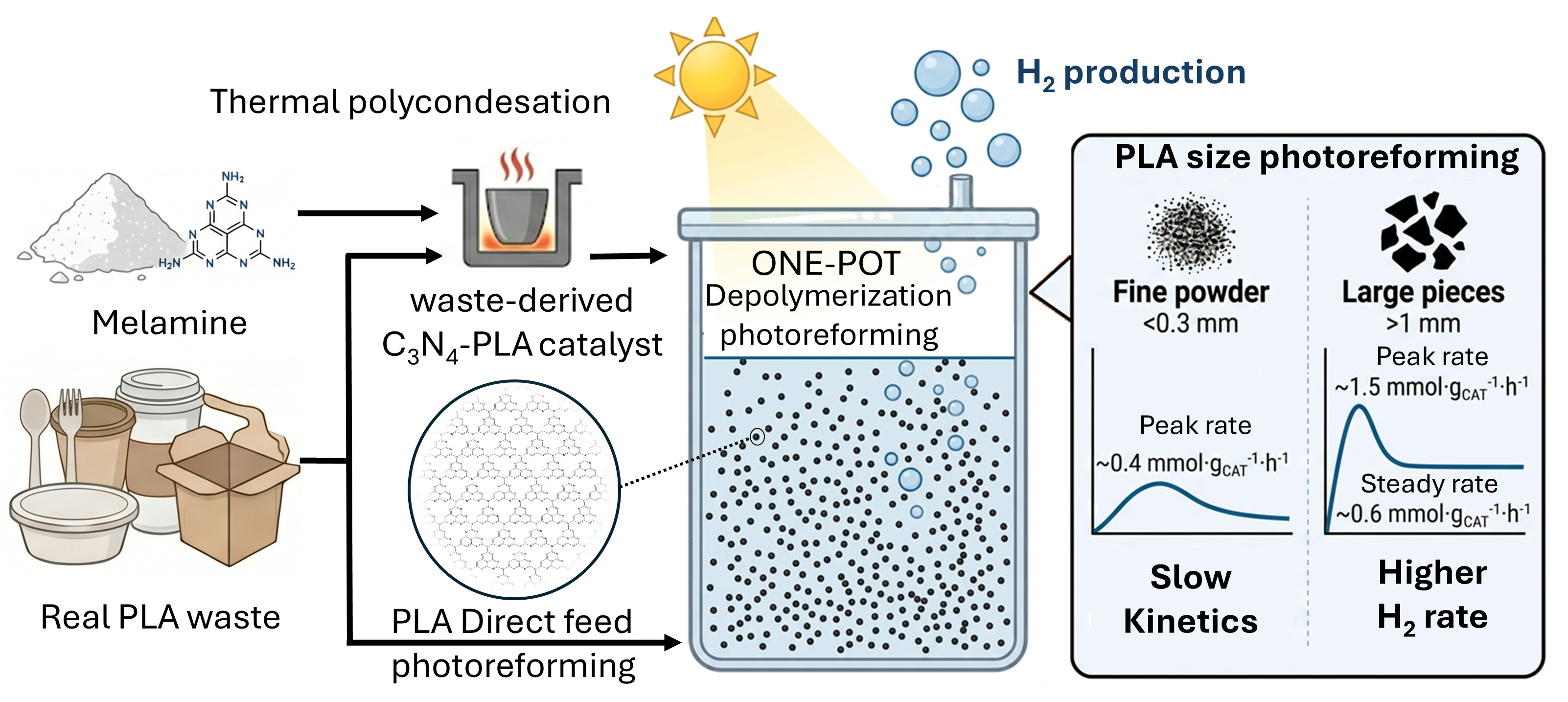
Graphical Abstract

1. Introduction

The widespread utilization of synthetic plastics has provided undeniable socio-economic benefits over the past century; however, the environmental externalities associated with their production, consumption, and disposal have reached critical levels. According to current market projections, global annual plastic production is expected to rise from 435 million tons to approximately 736 million tons by 2040 [1]. Cumulative mass-balance estimates reveal that of the approximately 6300 Mt of plastic waste generated globally since the mid-20th century, only 9% has been recycled, while 79% has accumulated in landfills or natural ecosystems [2]. This historical stagnation underscores a systemic inability of conventional waste management models to close material loops at a large scale. Consequently, the continuous accumulation of these non-biodegradable polymers drives severe ecological fragmentation, transforming macro-wastes into persistent micro- and nanoplastics that threaten marine habitats and soil chemistry and enter the trophic chain carrying toxic contaminants [3].
To address these management limitations, substituting conventional polymers with bio-based plastics is seen as a key strategy to support the transition toward a circular economy [4]. Global production capacities of bioplastics are projected to increase to 4.7 million tons by 2030, with biodegradable alternatives accounting for more than half of this capacity [5]. Within this market, polylactic acid (PLA) has emerged as the most representative biodegradable polymer, holding an expected 44% share among biodegradable options. However, simple environmental biodegradation is proving to be an insufficient end-of-life scenario. Recent technical assessments indicate that the half-life of PLA in marine environments is alarmingly similar to that of petroleum-based polyethylene [6]. This underscores that PLA biodegradability is highly restricted and strictly dependent on specific thermodynamic conditions (e.g., high temperature and humidity) that are exclusively met in industrial composting facilities rather than in real, unmanaged natural settings [7].
These limitations suggest that simple environmental biodegradation is not a sustainable end-of-life framework, prompting the development of controlled valorization methods capable of converting bioplastic waste into high-value products [8]. In this context, solar-driven photoreforming emerges as a promising strategy to upcycle polyester-based wastes, such as PLA, into clean hydrogen (H2) and green chemicals under ambient conditions [9]. Currently, over 95% of global H2 is generated through steam reforming of fossil fuels, an energy-intensive pathway that drives substantial greenhouse gas emissions [10]. While photocatalytic water splitting represents a clean alternative, its industrial deployment is severely hindered by high thermodynamic barriers and sluggish oxygen evolution kinetics [11]. To overcome these limitations, photoreforming processes utilize organic sacrificial agents to promote the reaction, effectively preventing charge recombination and improving H2 production rates [12,13]. These organic substrates make the process thermodynamically favorable; for instance, the photoreforming of a typical organic monomer requires a standard energy input of only +9.3 kJ/mol, which is significantly lower than that of pure water splitting [14].
Recent research has thoroughly explored the utilization of pure organic substrates such as lactic acid, demonstrating that photoreforming not only yields high H2 production rates, sometimes exceeding 10 mmol·g−1·h−1, but also generates valuable chemical byproducts such as pyruvic acid [15]. This dual production approach improves the overall economic and environmental viability of this technology, offering a sustainable path for waste valorization. To further enhance sustainability, recent efforts have shifted toward abundant, low-cost sacrificial agents derived from complex organic wastes [16,17]. In this framework, using post-consumer plastic waste as an electron donor under ambient conditions represents a highly promising upcycling strategy [18,19,20,21]. This solar-driven process transforms organic substrates into H2, CO2, and valuable chemical platform molecules [22], offering a controlled alternative to natural degradation while reducing the environmental footprint of plastic wastes. Nevertheless, the photoreforming of real-world plastic waste faces severe technical constraints; synthetic polymers often exhibit low reactivity compared to simpler biomass [16]. Furthermore, while the use of monomers or oligomers can improve efficiency, the presence of commercial additives and dyes remains a major inhibitor [23].
Specifically for PLA, high efficiency has been achieved by leveraging the synergistic effects of hydrolysis, photolysis, and photocatalysis [24]. Recent studies have reported nearly complete PLA degradation (~99%) and a high selectivity (~96%) toward pyruvic acid (PA) under simulated sunlight. Additionally, implementing hydrothermal pretreatment to depolymerize PLA into monomers and oligomers significantly enhances its adsorption onto the photocatalyst surface [25]. Using bifunctional catalysts such as hollow CdS@NiS-PdS, researchers have achieved hydrogen evolution rates as high as 34.65 mmol·g−1·h·−1 and pyruvic acid generation with 96.8% selectivity [25]. These advancements demonstrate that plastic photoreforming can effectively convert low-value waste into high-purity chemicals and clean energy. The utilization of PLA as a sacrificial agent has demonstrated significant potential, with H2 production rates reaching 577 µmol·g−1·h−1 [26]. This efficiency stems from the polyester nature of PLA, which readily depolymerizes into lactic acid monomers through alkaline hydrolysis. Among the semiconductors employed for plastic photoreforming, graphitic carbon nitride, g-C3N4, is often preferred over TiO2 or CdS due to its low cost, visible light harvesting, and lower toxicity. Despite these advantages, g-C3N4 synthesized via conventional thermal polymerization typically suffers from low surface area and high charge recombination. To overcome these limitations, recent studies have explored copolymerization with recycled polymers such as PET to enhance light harvesting and electron migration [27]. Similarly, the use of molecular mediators like lactic acid during synthesis has been shown to increase surface area and double H2 production efficiency by enriching surface hydroxyl groups [28].
Building on this concept of circularity, the present study proposes a novel approach: using PLA waste not only as a sacrificial substrate for H2 production but also as a sustainable precursor for the synthesis of g-C3N4. By integrating hydrothermal pretreatment to facilitate depolymerization, this dual-use strategy aims to optimize the catalyst morphological properties while offering a comprehensive route for the upcycling of bio-based plastics into clean energy and high-value chemicals.

2. Materials and Methods

2.1. Materials

All chemical reagents were used as received without further purification. Melamine (99%, Sigma-Aldrich, St. Louis, MO, USA) was employed as the nitrogen-rich precursor for the synthesis of g-C3N4, while commercial polylactic acid (PLA) packaging consisting of 60 mL cups, Ø 7 × 2.6 cm, model 304001-P purchased from Pickdpack (Barcelona, Spain) was used as the source of bio-based polymer for the modified series. Additionally, analytical-grade lactic acid (85%, Sigma-Aldrich) was utilized for comparative activity tests and benchmarking.
The metallic modification of the supports was carried out using a chloroplatinic acid solution (H2PtCl6, 8 wt.% in H2O, Sigma-Aldrich) as the platinum precursor. For the depolymerization of PLA and subsequent catalyst treatment, sodium hydroxide (NaOH, 98.0–100.5% purity, PanReac AppliChem, Barcelona, Spain) and hydrochloric acid (HCl, 37%, PanReac AppliChem, Barcelona, Spain) were used. Finally, absolute ethanol and pure methanol, both supplied by PanReac AppliChem, were employed as cleaning solvents and sacrificial agents during the photodeposition and photoreforming reactions.

2.2. Catalyst Synthesis

The graphitic carbon nitride (g-C3N4) catalysts were synthesized via thermal polycondensation of melamine. Three types of materials were prepared: bulk g-C3N4 (named C3N4) as a dry-calcined reference; a NaOH-modified control (named C3N4-NaOH) prepared by wet-mixing melamine and NaOH; and the PLA-modified series (named C3N4-PLA(x)).
The C3N4-PLA(x) series was prepared by incorporating varying weight percentages of the polymer (1, 2, 5, 10, and 25 wt.%) while maintaining a constant total precursor mass (melamine + PLA) of 4.0 g. For instance, the synthesis of the C3N4-PLA(5) sample involved the mixture of 0.20 g of PLA and 3.80 g of melamine. The PLA was first depolymerized in a 0.626 M NaOH solution following a procedure adapted from Siddiqui et al. [29]. To ensure a fair comparison, the final volume and NaOH concentration were kept uniform (8 mL of 0.626 M NaOH) across the C3N4-NaOH reference and all PLA-containing samples. In a typical procedure, the required amount of melamine was added to the corresponding solution and stirred at 60 °C until complete evaporation. The resulting mixtures were calcined in semi-closed crucibles at 520 °C for 1 h (10 °C min−1). Post-synthesis, the sodium-containing catalysts were washed with 1 M HCl and distilled water to remove residual species, ground, and stored.
Platinum (0.4 wt.%) was loaded onto the synthesized supports via a photodeposition method adapted from Herrera-Beurnio et al. [30]. In a typical procedure, the support was dispersed in a 10% v/v aqueous methanol solution containing H2PtCl6 as the platinum precursor. The suspension was maintained under a constant inert Ar atmosphere. The mixture was stirred and irradiated for 5 h using a Sol1A™ Class ABB solar simulator (Newport, Irvine, CA, USA) at 1 sun of irradiance (1000 W·m−2). The reaction temperature was kept constant at 10 °C using a thermostatic bath. Finally, the catalysts were filtered, washed with distilled water, and dried overnight at 110 °C. The resulting platinum-loaded samples were identified by adding the suffix -Pt to the respective support name (e.g., C3N4-PLA(1)-Pt).

2.3. Characterization Techniques

X-ray diffraction (XRD) analyses were performed at the Chemical Institute for Energy and Environment (IQUEMA) of the University of Córdoba using aD8 Discover diffractometer (Bruker, Karlsruhe, Germany) equipped with a monochromatic Cu Kα radiation source (λ = 1.54 Å). Patterns were recorded over an angular range of 10 to 80° (2θ) with a scanning speed of 1.45°·min−1. This technique was employed to evaluate the crystalline phase and structural integrity of the g-C3N4 framework as a function of the PLA content incorporated during the synthesis.
Fourier-transform infrared (FTIR) spectra were recorded at the Central Research Support Service (SCAI) of the University of Cordoba on a Tensor 27-Hyperion 2000 FT-IR spectrophotometer (Bruker, Ettlingen, Germany) to examine the molecular structure and functional groups of the catalysts. For the analysis, the powder samples were mixed with KBr and pressed into translucent pellets using a manual hydraulic press.
Nitrogen adsorption–desorption isotherms were recorded at 77 K using a ASAP 2420 (Micromeritics, Norcross, GA, USA) instrument at the University of Seville (CITIUS). Prior to analysis, all samples were degassed at 200 °C for 12 h. The specific surface area was determined using the Brunauer–EmmettTeller (BET) method, while the pore volume and size distribution were calculated following the Barrett–Joyner–Halenda (BJH) model.
Ultraviolet–visible diffuse reflectance spectra (UV-Vis DRS) were recorded on a Lambda 650 S spectrophotometer (PerkinElmer, Walthan, MA, USA) equipped with a 60 mm integrating sphere. Measurements were performed in the 300–800 nm range. Prior to the analysis, the instrument’s baseline (100% reflectance) was calibrated using a certified Labsphere reflectance standard (99% reflectance, model USRS-99-010). The bandgap (Eg) of the catalysts was determined via Tauc plots by plotting the square root of the Kubelka–Munk function, ([F(R∞)·hʋ]1/2), against photon energy (eV).
X-ray photoelectron spectroscopy (XPS) analyses were conducted at the University of Málaga using a VersaProbe II spectrometer (Physical Electronics, Chanhassen, MN, USA) equipped with a monochromatic Al Kα X-ray source (hυ = 1486.6 eV). The system was operated at 46.7 W with a beam diameter of 200 μm. The binding energy scales were calibrated using the C1s peak at 284.8 eV as an internal reference. High-resolution spectra were acquired for the C1s, N1s, O1s, and Pt4f core levels to investigate the surface chemical environment and the oxidation state of the catalysts.
The platinum and sodium contents of the catalysts were determined via Inductively Coupled Plasma Mass Spectrometry (ICP-MS) using a PerkinElmer NexION X spectrometer (PerkinElmer, Walthan, MA, USA) at the Central Research Support Service (SCAI) of the University of Cordoba. The instrument was equipped with an argon plasma ionization source and a quadrupole ion detector.
The surface morphological features of the catalysts were examined at the Central Research Support Service (SCAI) of the University of Cordoba using a JSM-7800F field-emission scanning electron microscope (FESEM) (JEOL, Tokyo, Japan) at an accelerating voltage of 5–15 kV.
High-resolution transmission electron microscopy (HRTEM) and scanning transmission electron microscopy (STEM) were performed at the Central Research Support Service (SCAI) of the University of Cordoba using a Talos F200i microscope (Thermo scientific, Waltham, MA, USA) operating at 200 kV. STEM images were acquired using a high-angle annular dark-field (HAADF) detector to enhance the contrast of the platinum nanoparticles. The average particle size distribution was determined by processing the resulting micrographs with ImageJ software (version 1.53, National Institutes of Health, Bethesda, MD, USA).

2.4. Photocatalytic Activity Tests

Photocatalytic tests were conducted in a 50 mL jacketed glass reactor equipped with a quartz window. In a typical screening experiment, 0.025 g of catalyst was dispersed in 50 mL of a 10% w/w lactic acid (LA) solution (0.5 g·L−1 catalyst concentration). The reactor was hermetically sealed and purged with a constant Ar flow (20 mL·min−1) to ensure an inert atmosphere. The suspension was maintained under continuous stirring at 25 °C using a thermostatic bath. Irradiation was provided by the Sol1ATM Class ABB solar simulator (Newport, Irvine, CA, USA) at 1 sun for 5 h. The evolved gases were monitored in real-time using an HPR-20 EPIC mass spectrometer (Hiden Analytical, Warrington, UK) by tracking the m/z signals for H2 (2) and CO2 (44). Quantitative analysis was performed after calibrating the system with a standard gas mixture (0.2% H2 and 0.1% CO2 in Ar).
For the valorization of real plastic waste, commercial PLA was evaluated under two different regimes: pre-depolymerized solutions and simultaneous “one-pot” depolymerization/photoreforming. To ensure a rigorous comparison with the LA photoreforming, the PLA concentration in all experiments was standardized to 1 M relative to the lactic acid repeating unit (C3H4O2, MW = 72.06 g/mol). Accordingly, 3.6 g of solid PLA was added to 50 mL of reaction solution. For both the pre-depolymerized and the one-pot processes, alkaline hydrolysis was promoted using a NaOH:PLA repeating unit molar ratio of 1.5:1. While the pre-depolymerized samples underwent this treatment for 18 h at 80 °C prior to irradiation, the one-pot samples were hydrolyzed in-situ during the photocatalytic run. The influence of critical parameters was systematically investigated, including PLA particle size, obtained via mechanical grinding using a conventional laboratory blender and subsequently sieved to obtain specific size fractions (big pieces to 150 µm), pH (adjusted with HCl or NaOH to 2, 7, and 12), and temperature (10 to 50 °C), as summarized in Table 1 along with their respective control methods.

3. Results and Discussion

3.1. Characterization of the Photocatalysts

3.1.1. Structural and Crystalline Phase Analysis (XRD)

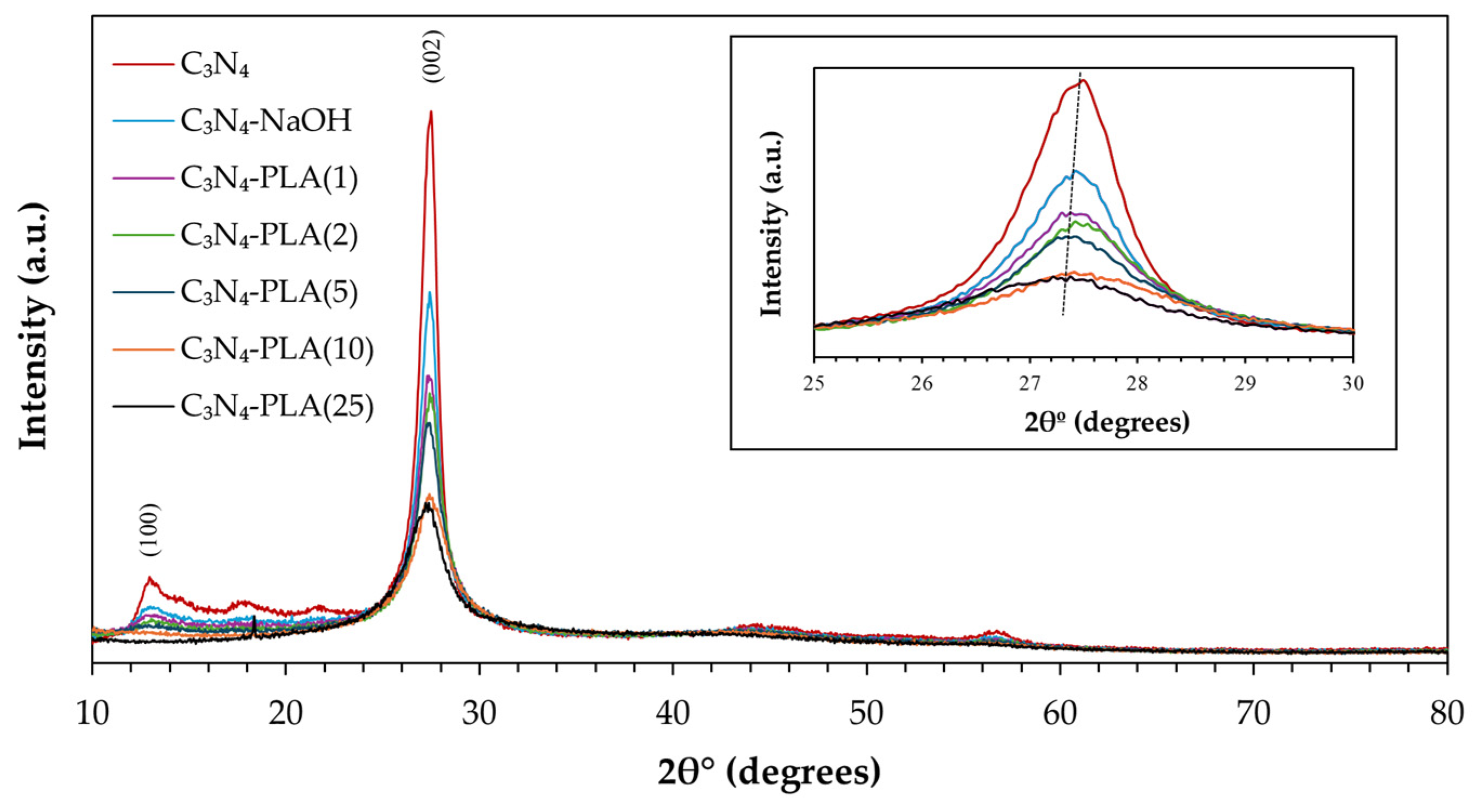
The crystalline structure and phase purity of the synthesized catalysts were evaluated via X-ray diffraction (XRD). The diffraction patterns of the platinum-free samples (Figure 1) exhibit the two characteristic peaks of g-C3N4. The main peak, located at 2θ ≈ 27.5° (d = 0.32 nm), corresponds to the (002) plane, associated with the interlayer stacking of the conjugated aromatic systems. A second, lower-intensity peak at 2θ ≈ 13° (d = 0.68 nm) is assigned to the (100) plane, representing the in-plane structural periodicity of the tri-s-triazine units. These results confirm the successful formation of the g-C3N4 framework, in good agreement with the literature [31,32].
As shown in the magnified inset of Figure 1, the (002) peak undergoes a systematic decrease in intensity and a clear shift toward lower 2θ values as the PLA content during the synthesis increases. According to Bragg’s Law, this shift indicates a slight expansion of the interlayer distance, suggesting that the thermal decomposition of the PLA packaging residue introduces structural defects and “imperfections” that expand the g-C3N4 lattice. This effect is consistent with the introduction of functional groups that cause a partial exfoliation or separation of the layers, as previously reported [26]. Furthermore, the significant peak broadening and loss of intensity observed in the C3N4-NaOH and the high-PLA samples point toward a reduction in crystallinity and the presence of microstrains or vacancies.

3.1.2. Surface Functional Groups and Chemical Environment (FTIR)

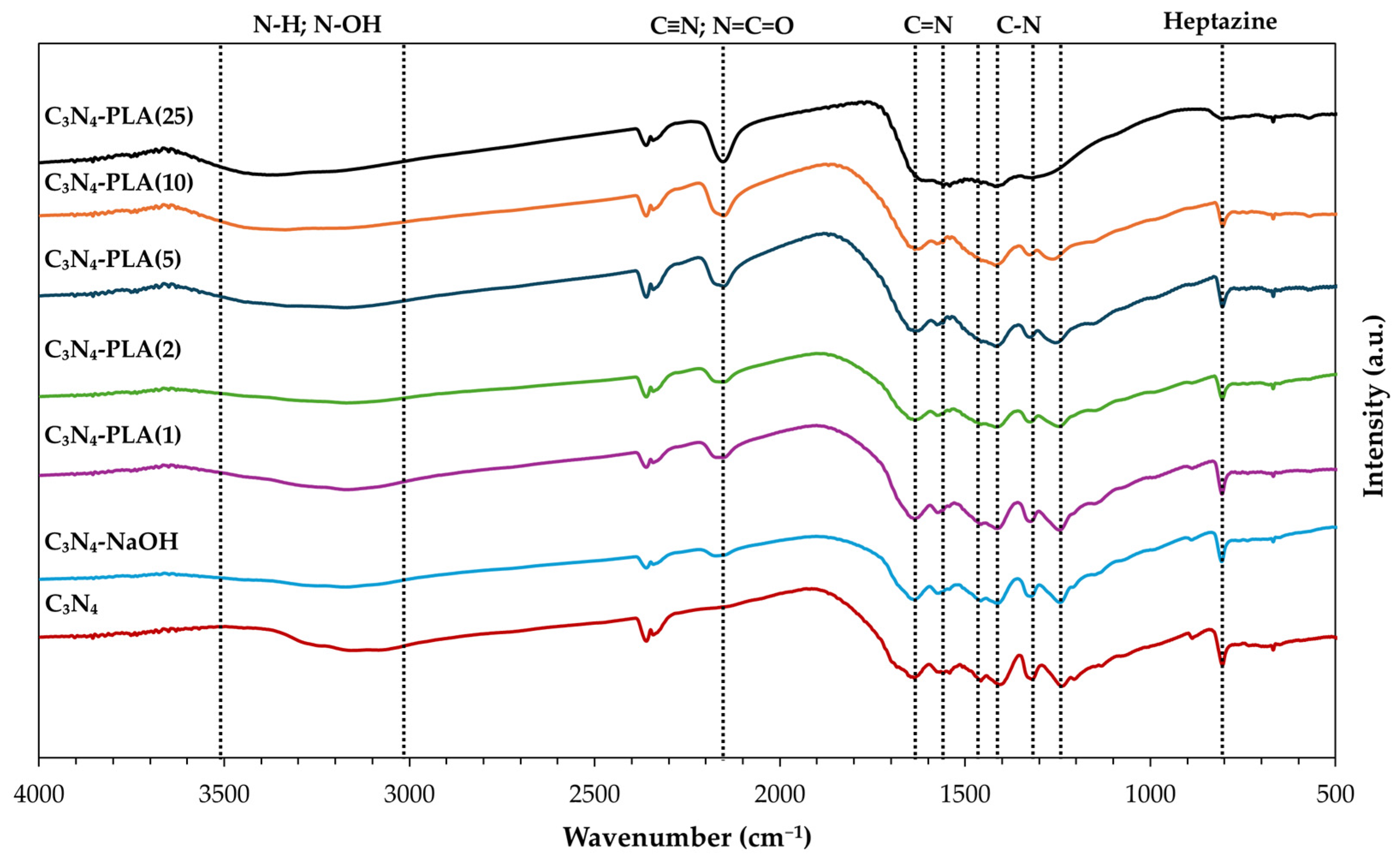
The Fourier-transform infrared (FTIR) spectra of the synthesized catalysts are shown in Figure 2. All samples exhibit the characteristic vibrational fingerprint of the g-C3N4 framework, confirming that the primary structure is preserved after the modification with NaOH and PLA. Specifically, the sharp peak at 808 cm−1 is attributed to the out-of-plane breathing mode of the tri-s-triazine (heptazine) structures [33]. The intensity of this band systematically decreases with increasing PLA content, particularly for the C3N4-PLA(25) sample, suggesting a partial disruption of the long-range aromatic order.
The broad absorption region between 1240 and 1650 cm−1 corresponds to the typical stretching vibrations of CN heterocycles. The peaks at 1240, 1320, 1415, and 1469 cm−1 are assigned to the stretching of aromatic C–N units, while the peaks at 1560 and 1645 cm−1 are related to C=N stretching [34]. Higher PLA concentrations lead to a noticeable broadening of these bands, indicating a less homogeneous chemical environment and increased structural disorder, consistent with the XRD findings.
Notably, a new band emerges at 2142–2160 cm−1, gaining intensity as the PLA and NaOH contents increase. This signal is associated with the stretching vibrations of cyano (–C≡N) or isocyanate (–N=C=O) terminal groups [33]. The presence of these groups suggests that the thermal decomposition of the PLA packaging residue promotes the formation of structural defects and oxygenated functional groups at the edges of the heptazine sheets.
Finally, the broad band in the 2950–3390 cm−1 range is related to the stretching vibrations of N–H groups from terminal amines (–NH2 and =NH) and adsorbed O–H from water molecules. The progressive attenuation of this band in the modified samples suggests a higher degree of polycondensation at the edges of the g-C3N4 sheets, reducing the number of free amino groups. Overall, the FTIR results corroborate that while the core heptazine structure remains intact, the incorporation of PLA significantly alters the surface chemistry and structural regularity of the photocatalysts.

3.1.3. Morphological and Textural Properties (Surface Area, SEM, and STEM)

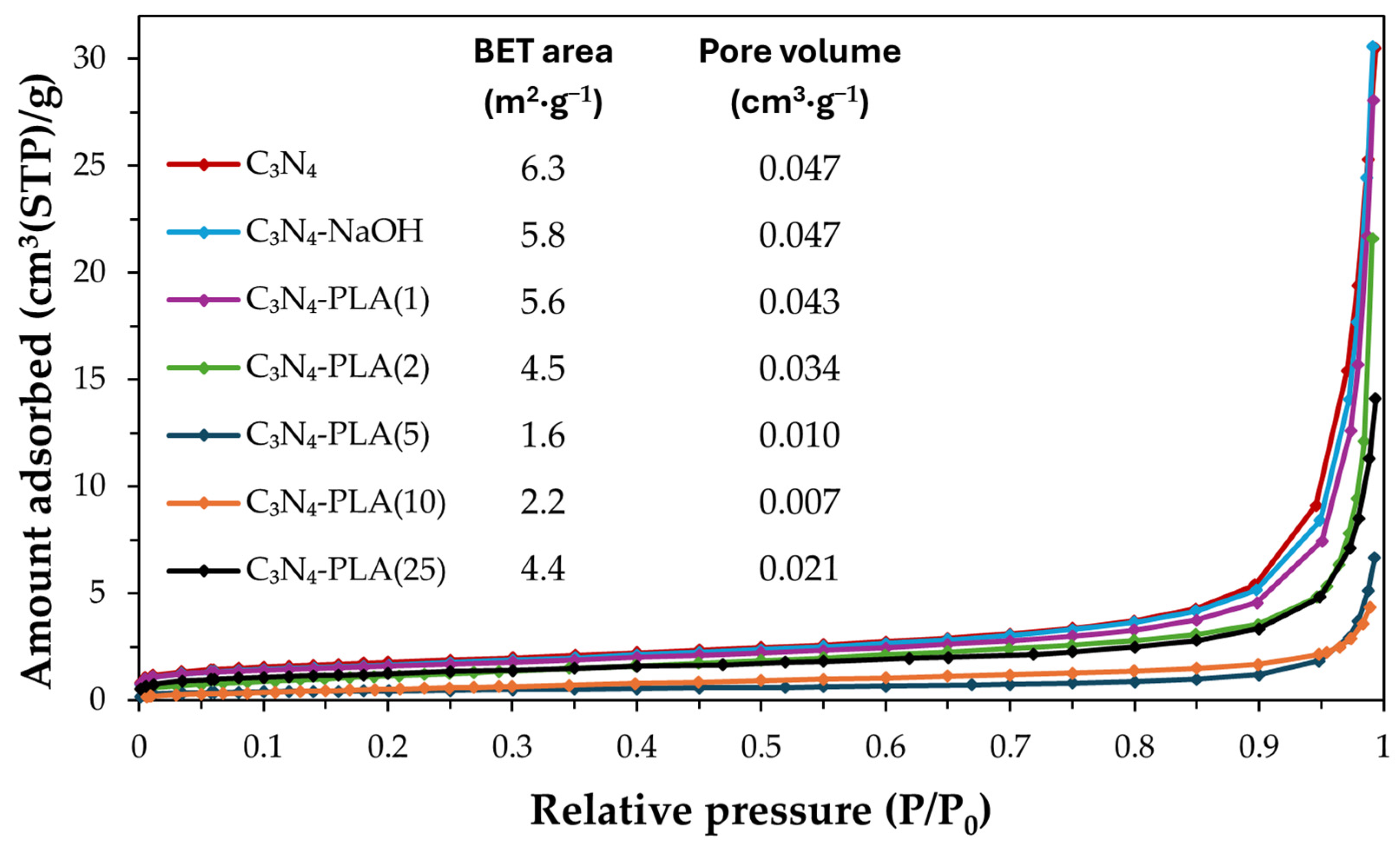
The textural properties of the synthesized catalysts were evaluated via N2 adsorption–desorption measurements. As shown in Figure 3, all samples exhibit isotherms that can be classified as Type II according to the IUPAC, displaying a characteristic sigmoid shape. This profile is typical of non-porous or macroporous adsorbents where unrestricted monolayer–multilayer adsorption occurs. The relatively low nitrogen uptake at low relative pressures (P/P0 < 0.1) and the absence of a hysteresis loop suggest a poorly defined pore distribution, primarily dominated by the external surface of the g-C3N4 particles.
The pristine C3N4 presents the highest specific surface area (6.3 m2·g−1) and pore volume (0.047 cm2·g−1). Upon modification, all polymer-treated samples exhibit a small decrease in surface area, maintaining an ultra-low specific surface area profile with values strictly clustered between 1.6 and 5.6 m2·g−1. Nevertheless, all of these samples possess a small surface area and maintain a lower porosity than the pristine C3N4, confirming that the modification primarily influences the surface chemical environment rather than creating a high-porosity framework. Therefore, the inclusion of PLA during the synthesis did not favor the improvement of the surface area.
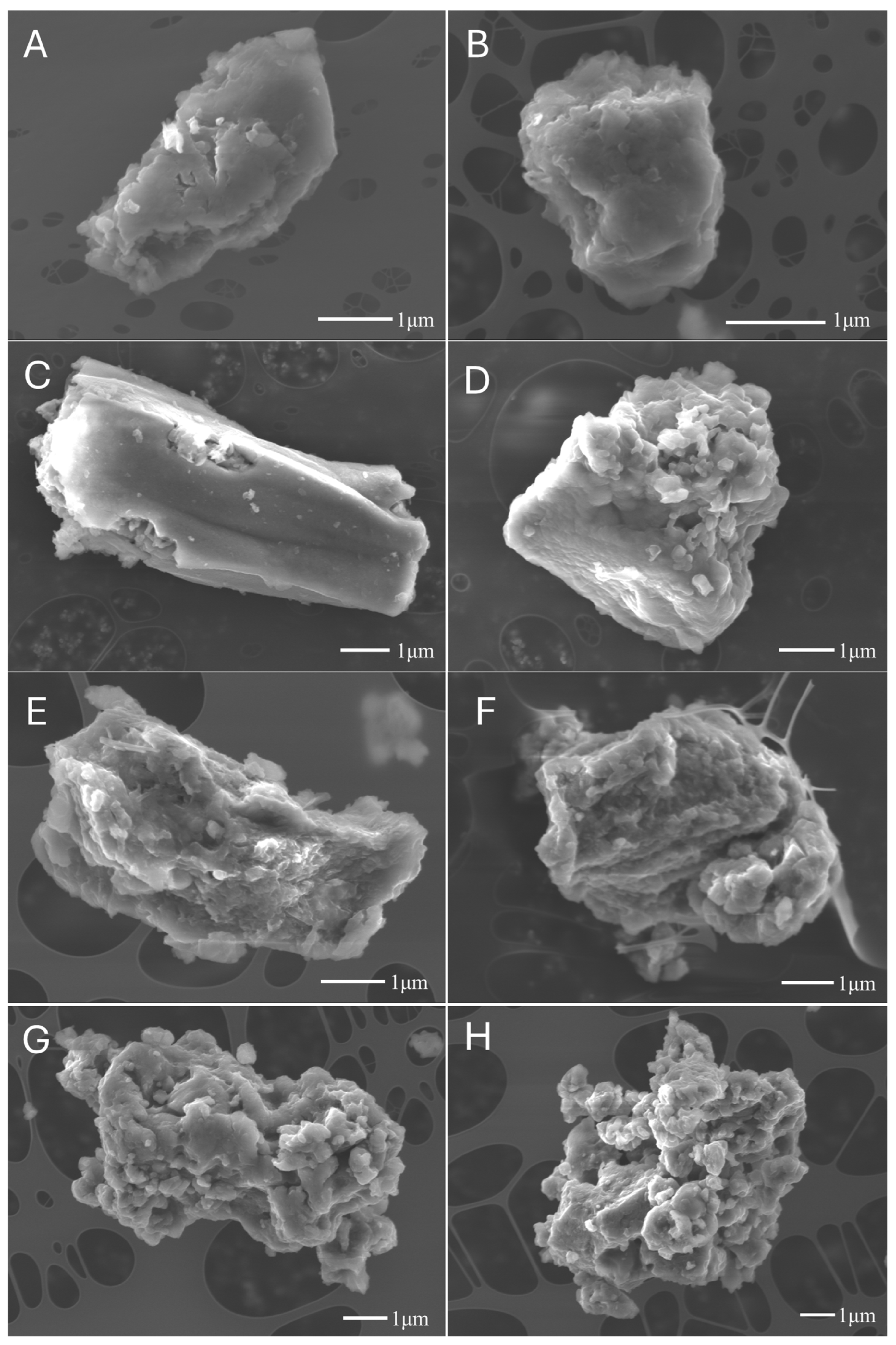
The morphology of the synthesized materials was evaluated via scanning electron microscopy (SEM), as shown in Figure 4. The images reveal a significant structural evolution of the g-C3N4 framework as a function of the PLA content added during the synthesis. The pristine samples (Figure 4A,B) exhibit a characteristic bulk-like architecture consisting of stacked laminar layers. This layered morphology is typical of g-C3N4 synthesized from melamine, reflecting the hierarchical stacking of conjugated tri-s-triazine units. Upon the addition of 1 wt.% PLA (Figure 4C), the material largely retains its structure. However, an emergence of surface defects and irregular grain boundaries becomes visible, marking the onset of structural modification induced by the PLA used during the synthesis.
As the PLA concentration increases from 2% to 25% (Figure 4D–G), the smooth surface of the original nitride sheets suffers a progressive disruption. A high density of voids, macropores, and structural imperfections appears, leading to a more disordered and fragmented morphology. In the highest PLA-content samples (Figure 4F,G), the characteristic layered arrangement is significantly altered, resulting in an irregular, porous-like agglomeration of particles. These morphological observations are in agreement with the XRD results, where the systematic decrease in the (002) peak intensity and broadening pointed toward a loss of long-range crystalline order. Furthermore, the transition from well-defined plates to a more fragmented and defective structure correlates with the textural modifications observed in the N2 physisorption analysis, where the introduction of PLA-derived defects influenced the effective surface area and pore volume of the catalysts.
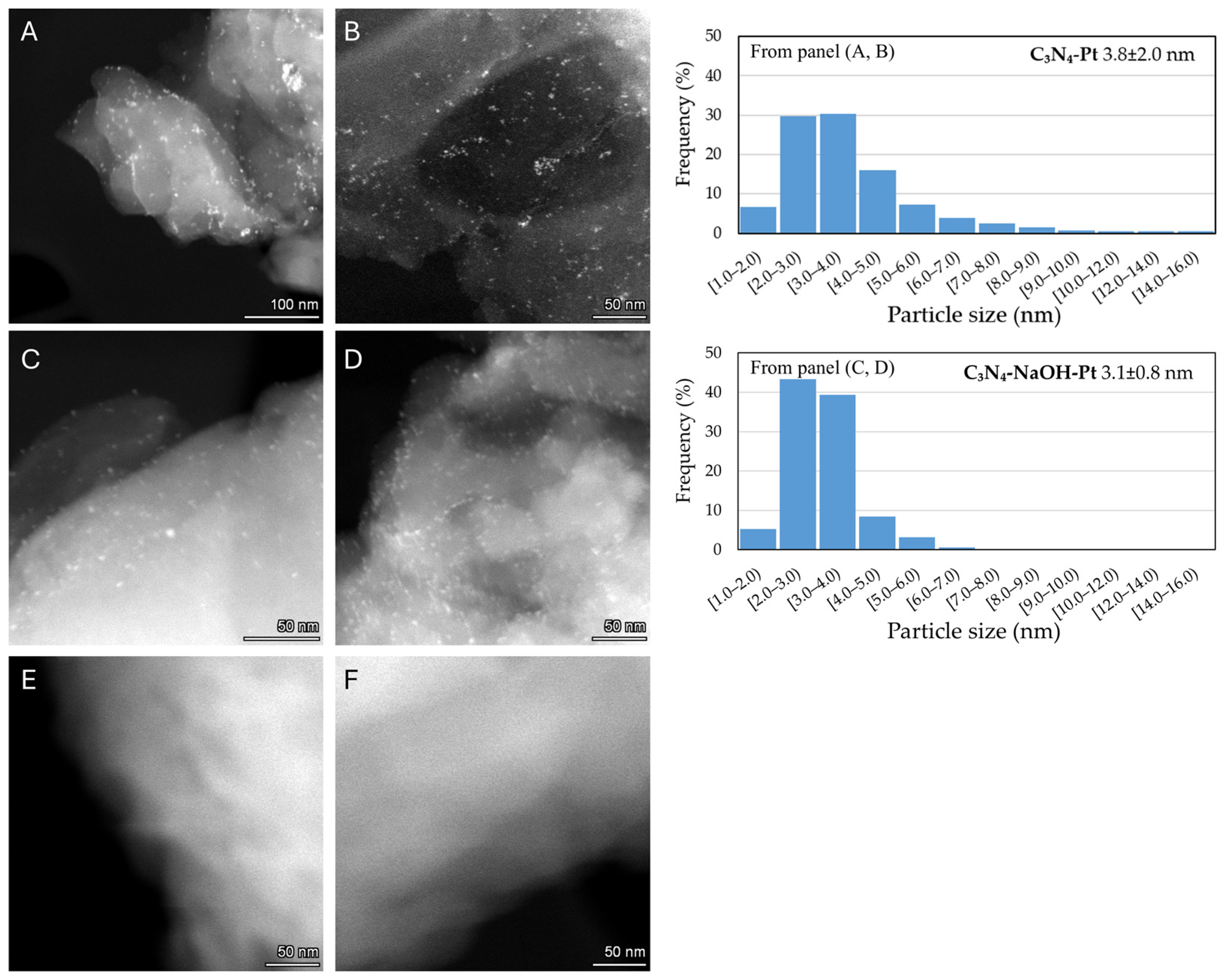
The dispersion and particle size of the photodeposited platinum were further investigated via HAADF-STEM (Figure 5). For the reference catalysts (C3N4-Pt and C3N4-NaOH-Pt), a successful distribution of metallic nanoparticles, bright spots, was achieved, with average sizes of 3.8 ± 2.0 nm and 3.1 ± 0.8 nm, respectively. These results demonstrate that the pristine and NaOH-modified C3N4 are suitable for the stabilization of ultrafine platinum clusters. Notably, the C3N4-NaOH-Pt sample exhibits a more homogeneous dispersion compared to the pristine C3N4-Pt. This improved uniformity is likely related to the presence of sodium, qualitatively detected via EDX analysis, which may favor a more regular stabilization of the metallic phase. In contrast, the pristine C3N4-Pt catalyst shows a broader size distribution with the presence of occasional larger agglomerates, which increases the average particle size and standard deviation.
However, a different behavior was observed for the C3N4-PLA(1)-Pt sample, highlighting a systematic limitation of the PLA-melamine co-pyrolysis strategy regarding noble metal cocatalysis deposition. Despite being subjected to the same photodeposition procedure, representative STEM images (Figure 5E,F) show an absence of platinum nanoparticles, showing exclusively the bare bulk polymeric matrix of the g-C3N4. This visual observation is directly corroborated by the elemental analysis (Table 2, ICP-MS), which reveals a negligible platinum content (0.02 wt.%) for this sample, significantly below the target loading of 0.4 wt.%. This inhibition of conventional Pt nucleation represents a notable negative side-effect driven by the addition of PLA during the thermal condensation. This finding suggests that the structural defects and functional groups introduced by the PLA residue (such as the cyano and isocyanate groups identified via FTIR) or the presence of unreacted carbonaceous products from the polymer thermal decomposition may inhibit the conventional nucleation of Pt by either altering the surface energy or the electronic density of the heptazine sheets.

3.1.4. Optical Properties and Bandgap Analysis (UV-Vis DRS)

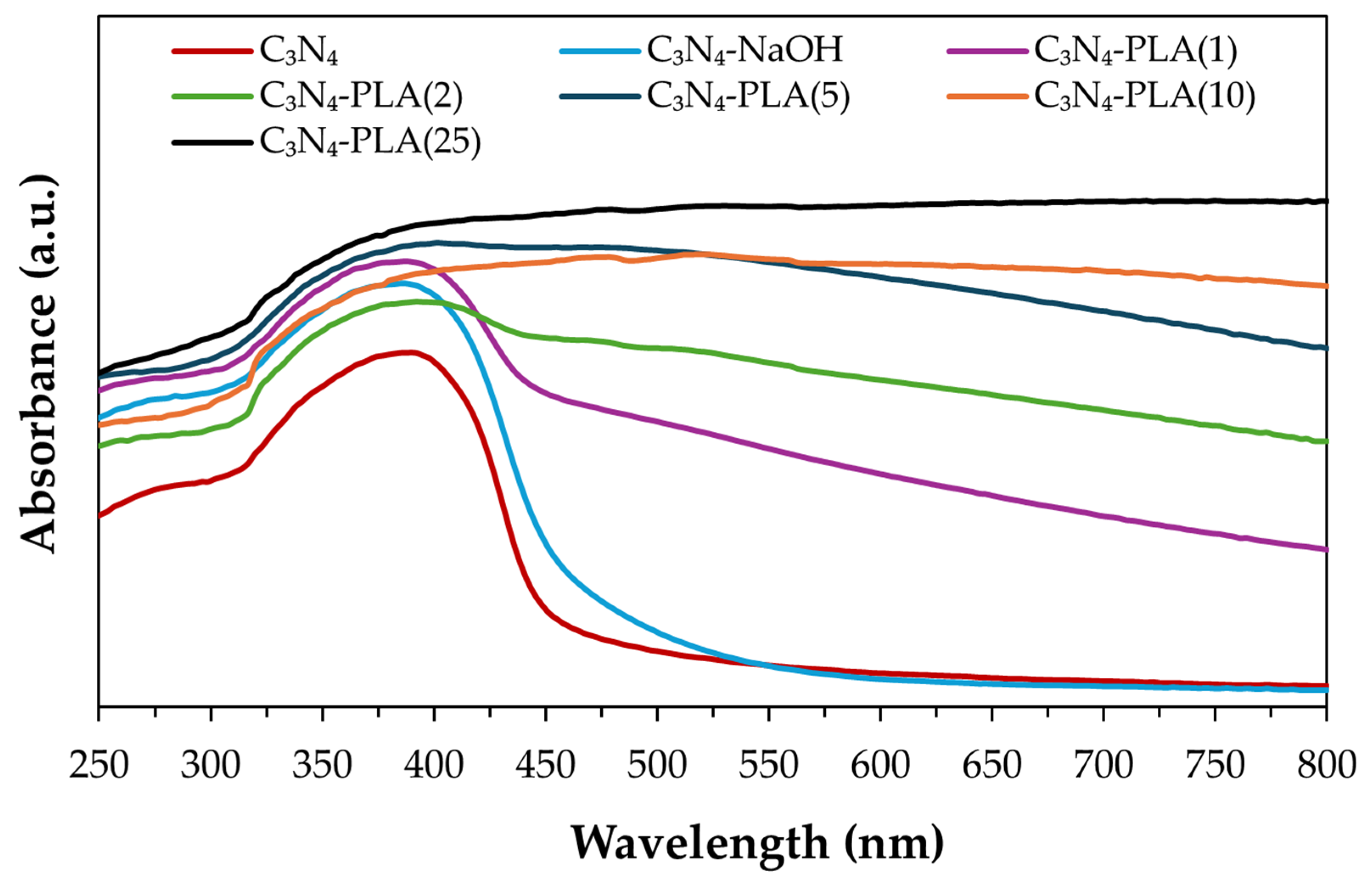
The optical absorption properties of the synthesized catalysts were evaluated via UV-Vis diffuse reflectance spectroscopy (Figure 6). All samples exhibit the characteristic absorption edge of g-C3N4 in the 400 to 450 nm range, which corresponds to the electronic transitions from the valence band to the conduction band.
A clear evolution in optical behavior is observed upon the incorporation of PLA. As shown in Figure 6, the baseline of the spectra in the visible region rises significantly as the PLA content increases. This background absorption is responsible for the dark coloration of the high-PLA samples and is attributed to the presence of carbonaceous species or structural defects (such as the cyano groups detected via FTIR) that act as light-trapping centers. While the addition of platinum contributes to a general increase in absorbance across the visible spectrum due to its metallic nature, it does not significantly alter the intrinsic absorption edge of the g-C3N4.
The optical bandgap (Eg) values, determined using the Tauc plot method, are summarized in Table 2. The pristine C3N4 has an Eg of 2.75 eV, consistent with the literature [35]. Interestingly, the addition of PLA induces a slight “blue shift” (increase in Eg), reaching 2.88 eV for the C3N4-PLA(5) sample. This widening of the bandgap, despite the darker appearance of the powder, suggests that the PLA-derived defects may induce a redistribution of the electronic states or a quantum confinement effect within the heptazine framework. Conversely, the C3N4-NaOH sample shows a slight “red shift” to 2.67 eV, indicating that the sodium treatment marginally narrows the energy gap, potentially favoring the absorption of lower-energy photons. For the samples with 10% and 25% PLA, the Eg could not be accurately determined due to the saturation of the signal caused by the high density of structural imperfections.

3.1.5. Surface Chemical Composition and Electronic State (XPS)

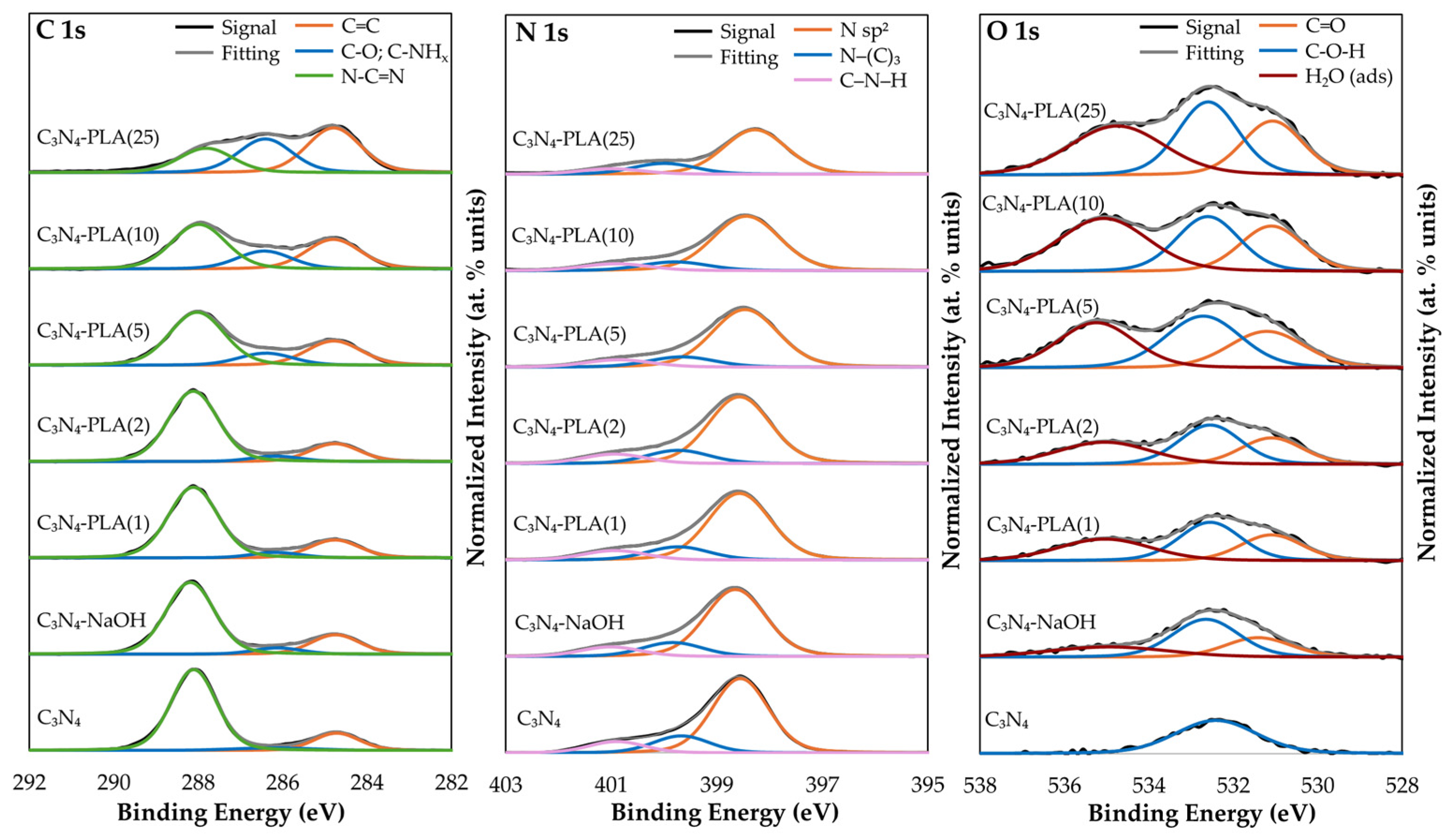
As shown in Table 2, the incorporation of PLA during synthesis leads to a systematic increase in the surface content of carbon (from 48.6 at.% to 58.2 at.%) and oxygen (from 2.1 at.% to 9.5 at.%). This elemental evolution is reflected in the C/N atomic ratio, which rises from 0.99 for pristine C3N4 to 1.80 for the C3N4-PLA(25) sample. These results provide quantitative evidence that the thermal degradation of the PLA residue generates a carbon-rich phase that progressively coats or integrates into the nitride surface.
The C1s high-resolution spectra (Figure 7, left) show three electronic environments at 288.2 eV, 286.4 eV, and 284.8 eV, assigned to the N–C=N framework of the heptazine rings, C–O/C–NHX defect linkages, and C=C/C–C graphitic/adventitious carbon, respectively [36]. In the pristine C3N4, the N–C=N signal, the structural fingerprint of the nitride lattice, accounts for 80% of the total carbon area. However, this contribution drops to 60% for the C3N4-PLA(5) sample and dramatically collapses to only 24% for the C3N4-PLA(25) catalyst. This evolution confirms that the PLA-derived carbonaceous species (predominantly C=C and C–O environments) eventually dominate the surface, masking the original tri-s-triazine framework.
The N1s spectra (Figure 7, center) were deconvoluted into three peaks at 398.7 eV (N sp2), 400.1 eV (N–(C)3), and 401.2 eV (C–N–H). The N sp2 signal, corresponding to the triazine ring nitrogen, remains the majority component across the entire series. This suggests that the local molecular environment of the heptazine units is chemically preserved, even at high polymer loadings. However, this observation must be reconciled with the XRD data, which indicated a significant loss of crystallinity. While the XPS confirms that the nitrogen atoms still participate in the characteristic heptazine bonding, the interpenetration of the amorphous carbon phase disrupts the long-range crystalline order and the periodic stacking of the laminar sheets.
Finally, the O1s region (Figure 7, right) has three contributions at 531.0 eV (C=O), 532.4 eV (C–O–H), and 534.2 eV (H2O ads). The scaling of the C=O and C–O–H contributions with the PLA content corroborates the successful anchoring of oxygenated functional groups (such as carboxyls and esters) identified by means of FTIR. The persistent H2O ads signal, despite the 520 °C calcination temperature, is attributed to the high hygroscopicity of the defective nitride surface, which tends to readsorb atmospheric moisture during sample handling and storage.
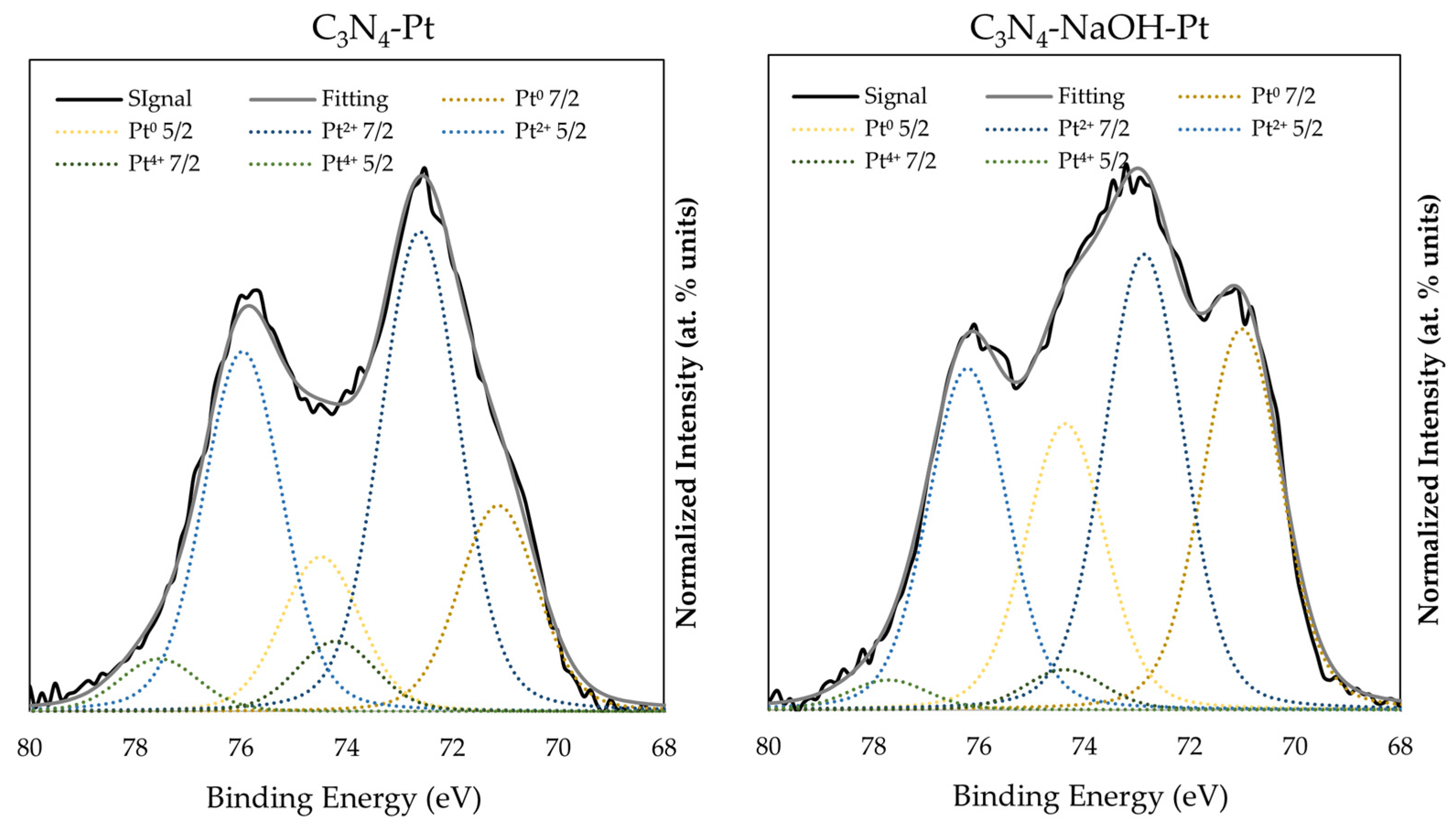
The Pt4f high-resolution spectra for the detectable samples are shown in Figure 8. The signal was deconvoluted into three distinct doublets. The primary component at ~71.2 eV is assigned to metallic platinum (Pt0), while the signals at ~72.5 eV and ~74.1 eV correspond to oxidized species, namely, Pt2+ and a minor contribution of Pt4+, respectively. Interestingly, the NaOH treatment significantly influences the platinum oxidation state, increasing the relative amount of metallic Pt0 from 27.3% in the C3N4-Pt sample to 43.3% in the C3N4-NaOH-Pt catalyst. This higher proportion of reduced platinum species is highly consistent with the alkali-assisted synthesis. As reported for similar alkalinized C3N4 frameworks, the introduction of NaOH creates surface functional defects and alters the local electron density of the heptazine cavities, which act as preferential coordination and electron-trapping sites that promote a more efficient reduction and homogeneous dispersion of the metallic phase [37]. This higher proportion of highly dispersed metallic Pt0 species is directly responsible for enhanced catalytic performance. Mechanistically, the interface between these metallic nanoclusters, observed by means of STEM, and the C3N4 establishes a Schottky barrier. Driven by the work function alignment between both phases, photogenerated electrons rapidly migrate across this interface into the Pt0 sites. By acting as highly efficient electron sinks, these metallic centers successfully suppress charge recombination and lower the overpotential for proton reduction, directly driving the solar-to-hydrogen conversion during the subsequent one-pot photoreforming process.

3.2. Photocatalytic Performance

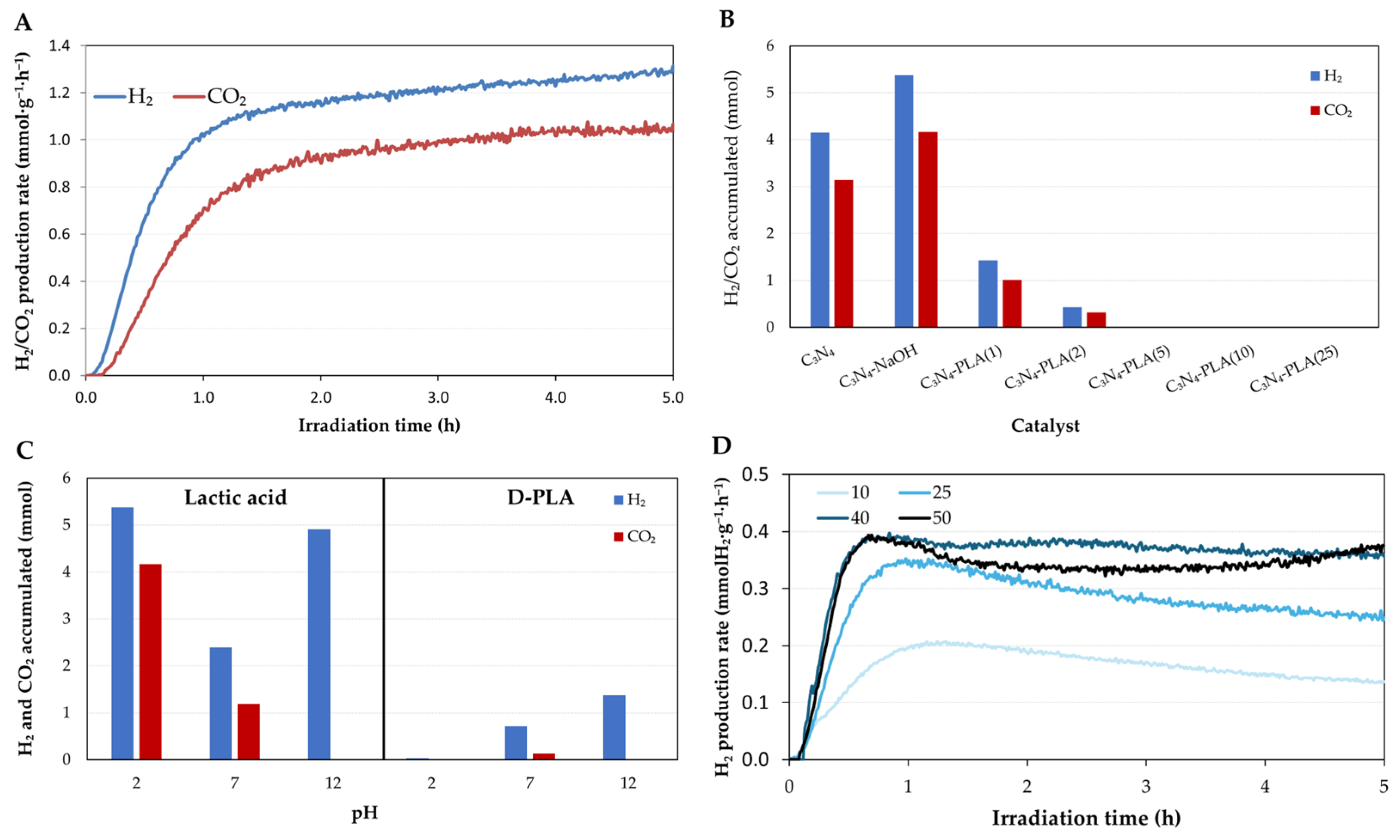
Figure 9A illustrates the gas production rates over time for the C3N4-NaOH-Pt catalyst, which exhibited the highest photocatalytic activity among the synthesized materials during the photoreforming of 1 M LA. After an initial induction period of approximately one hour, the system reached a steady-state production rate of 1.3 mmol·h−1·g−1 for H2 and 1.0 mmol·h−1·g−1 for CO2. This performance demonstrates the high stability of the material and the absence of catalyst deactivation or poisoning by reaction intermediates throughout the 5 h test. Regarding the stoichiometry of the gaseous products, the production rates yield an experimental H2/CO2 molar ratio of approximately 1.3. Crucially, this stoichiometric deviation is maintained in both pristine and alkali-modified C3N4 samples, indicating that the coexistence of these competitive pathways is intrinsic to the g-C3N4 framework itself. Mathematically, this 1.3 value demonstrates that while oxidative decarboxylation (H2/CO2 = 1) involving C–C bond cleavage remains the predominant majority pathway, accounting for approximately 75% of the total substrate conversion, it inherently coexists with a carbon-preserving parallel route (~25%) that selectively dehydrogenates the α-hydroxyl group of LA to produce pyruvic acid (H2/CO2 = ∞). Unlike pristine metal sulfides that require specific configurations to shield the carboxylate group and suppress decarboxylation [24,38], the heptazine-based cavity structure of g-C3N4 naturally balances both functionalities. Consequently, the role of the NaOH chemical modification is not to alter this reaction mechanism but to act as a powerful structural promoter. As supported by Dong et al. [37], the alkali-assisted synthesis introduces structural surface defects and alters the local electronic properties without disrupting the baseline selectivity, successfully driving enhancement in the photocatalytic reaction rates and charge separation efficiencies. This enables the intrinsic dual-pathway mechanism, further supported by the radical stability models of Liang et al. [27] and Roostaei et al. [15].
Figure 9B shows the cumulative H2 and CO2 production after five hours of irradiation, providing a comparison of the efficiency across the different catalytic systems. The results confirm that C3N4-NaOH-Pt is the most active material in the series, exhibiting H2 production approximately 30% higher than that of the C3N4-Pt catalyst. This enhanced performance is supported by the characterization data. STEM imaging confirms that the platinum co-catalyst is deposited as smaller and more homogeneously distributed particles, while XPS reveals a higher proportion of metallic Pt0 species. This combination optimizes the electron transfer to the Pt0 sites, which act as efficient sinks for proton reduction, while the photogenerated holes oxidize the commercial lactic acid molecules. This effective charge separation minimizes carrier recombination and justifies the superior reaction kinetics observed for the alkalinized catalyst. Additionally, the observed reduction in the band gap led to a better utilization of the visible spectrum, increasing the efficiency of charge carrier generation under solar-like irradiation.
In contrast, the catalysts prepared via the PLA route showed significantly lower production. This drop in performance is largely due to the deficient platinum incorporation. According to ICP-MS analysis, the presence of carbonaceous residues from the polymer on the nitride surface acts as a barrier that hinders the effective anchoring of the co-catalyst during the photodeposition process. Nevertheless, the behavior of the C3N4-PLA(1)-Pt sample is particularly noteworthy. Despite having a platinum content of only 0.05 wt.%, an order of magnitude lower than the nominal 0.4 wt.% value, it exhibits remarkably higher activity than the 5% and 10% PLA samples. This suggests that the chemical modifications induced by the LA in the carbon nitride structure partially compensate for the low metal loading by facilitating more efficient charge transfer to the limited available active sites.
To assess the feasibility of using plastic waste as a sacrificial agent, the photocatalytic activity of the best-performing catalyst C3N4-NaOH-Pt was evaluated using both pure LA 1 M and depolymerized PLA (D-PLA). The D-PLA substrate was obtained via alkaline hydrolysis in a NaOH solution, resulting in an initial pH of 12. To provide a comprehensive comparison with the 1 M LA model (natural pH 2), a pH screening (2, 7, and 12) was performed for both substrates, as shown in Figure 9C. The pH of the LA solution was adjusted using NaOH, while the D-PLA solution was acidified using HCl. Although LA showed its maximum activity at its natural acidic state (pH 2), the comparison at pH 12 is considered the most rigorous and fair, as both reaction media contain NaOH at this point, ensuring a similar chemical environment regarding ionic species. This drastic difference between the two substrates suggests that while the pure LA monomer is highly active at low pH, the complex mixture of oligomers and intermediates in the D-PLA solution tends to aggregate or become less photo-reactive under acidic conditions.
Given the complex nature of the D-PLA solution, which, unlike the pure monomer, contains a mixture of oligomers and residual additives, the kinetics of the process may be significantly influenced by the reaction temperature. Figure 9D illustrates the H2 production rate over time for the D-PLA system at temperatures ranging from 10 to 50 °C. At lower temperatures (10 and 25 °C), the system shows lower production rates (stabilizing at ~0.15 and ~0.25 mmol·h−1·g−1, respectively). The lower thermal energy likely limits the diffusion of the bulkier oligomers toward the catalyst surface and slows the surface reaction kinetics. At 40 and 50 °C, a stable maximum H2 production rate of approximately 0.38 mmol·h−1·g−1 was reached. The stability of the signal over the 5 h test confirms that at 40 °C, the rate of surface regeneration and the reforming of the complex substrate are well-balanced.
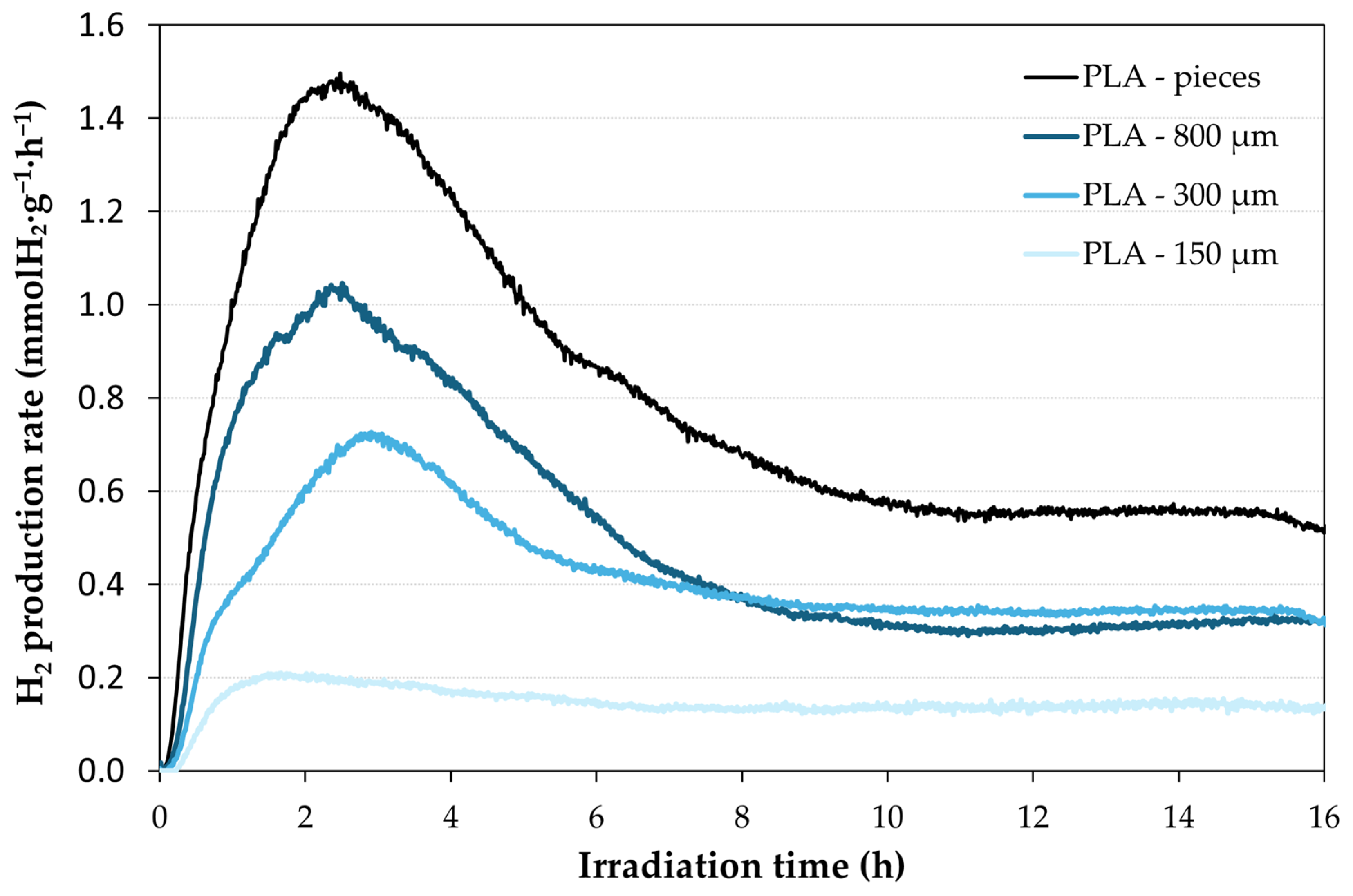
The 16 h evaluation of the simultaneous one-pot depolymerization/photoreforming process (Figure 10) confirms its technical simplicity and kinetic superiority over the two-step process. Remarkably, photoreforming of pieces of PLA achieved a peak H2 production rate of ~1.5 mmol·h−1·g−1, surpassing the rates observed for LA 1 M photoreforming. Furthermore, the steady-state production of the larger fragments (~0.6 mmol·h−1·g−1) remained significantly higher than that achieved with pre-depolymerized PLA solutions (D-PLA). This synergistic effect suggests that in situ monomer generation provides a more reactive environment than pre-saturated systems.
Interestingly, the evaluation of the polymer size configuration revealed that macroscopic PLA pieces outperformed the finely ground and sieved powder fractions (150 to 800 μm). This trend could be qualitatively interpreted as a ‘controlled release’ effect that regulates the accumulation of dissolved monomeric units in the reaction medium. This hypothesis potentially aligns with the heterogeneous interface principles proposed by Praus et al. [39] for microplastic suspensions, where direct solid–solid contact between the polymer particles and the photocatalyst surface is generally expected to be limited. Consequently, the reaction is widely suggested to proceed via a two-step pathway: an initial localized dissolution or hydrolysis that releases soluble degradation intermediates into the liquid phase, followed by their subsequent diffusion and photoreforming at the semiconductor active sites.
While conventional milling is typically intended to accelerate this dissolution by maximizing the initial surface area [40], the kinetic models proposed by Tang et al. suggest that an immediate excess of suspended fine particles can induce parasitic light scattering and solution turbidity, potentially hindering effective photon absorption [9]. Furthermore, as highlighted by some researchers, prolonged exposure of high concentrations of dissolved monomers to alkaline media can stimulate complex secondary reactions that hinder the photoreforming process [38,40]. This gradual release provided by macroscopic pieces effectively manages the concentration of chemical feedstocks in the broth, potentially protecting the freshly released lactate units from these alkaline-induced secondary degradations. Additionally, this mechanism avoids the sudden accumulation of additives contained within the commercial polymer matrix, which might otherwise induce intense surface fouling, chemical poisoning, or competitive chemisorption over the active sites, which could block the reaction centers and deactivate photoreforming [41].
In conclusion, the one-pot process using large PLA fragments emerges as a promising strategy for plastic upcycling, eliminating energy-intensive grinding and lengthy pre-treatments. These findings establish that maintaining the macroscopic integrity of waste is, paradoxically, the most effective route for chemical reforming. While this work provides a fundamental proof-of-concept, future research should focus on optimizing the NaOH:PLA stoichiometric ratio, temperature and evaluating performance with multi-component plastic streams. Such developments will be crucial for scaling up solar-driven hydrogen production and integrating plastic waste management into a true circular bio-economy. From a techno-economic and scalability perspective, it must be noted that widespread industrial application of photoreforming is currently constrained by low volumetric productivities when compared to conventional H2 production. Furthermore, as highlighted by Abad-Lopez, aggressive chemical pretreatments act as a severe economic bottleneck, accounting for over 85% of total operational costs in conventional layouts [42]. To overcome these limitations and facilitate future integration into industrial biorefineries, current research must pivot toward process simplification. In this scenario, strategies that avoid energy-intensive grinding and minimize chemical consumption, such as the one-pot approach using large macroscopic fragments explored herein, represent a necessary step forward in lowering capital and operational barriers. Ultimately, for these systems to become industrially viable, the economic driving force must shift from pure solar fuel pricing to multi-product upcycling and environmental cost savings derived from the decentralized remediation of real plastic waste. In this context, future investigations should encompass the precise quantification and chemical characterization of the post-reaction residues to achieve a rigorous mass balance and better understand the degradation mechanisms of the macroscopic polymer fragments.

4. Conclusions

This study demonstrates a comprehensive dual-valorization strategy for polylactic acid (PLA) waste, utilizing it both as a sustainable precursor for catalyst synthesis and as a sacrificial agent for green hydrogen production. The incorporation of PLA waste during the thermal polycondensation of melamine proved to be an effective route for the structural and electronic tuning of graphitic carbon nitride (g-C3N4). XRD and FTIR analyses confirmed that PLA-derived species induce a structural expansion of the nitride lattice and the formation of functional defects, such as cyano and isocyanate terminal groups. Optically, the PLA-modified series exhibited a systematic widening of the band gap and increased visible-light background absorption. Although the carbonaceous surface residues hindered effective platinum photodeposition, this approach establishes a novel method for utilizing bioplastic waste to engineer the chemical environment and electronic states of metal-free semiconductors.
Additionally, the one-pot depolymerization/photoreforming process emerged as the most efficient route for hydrogen evolution, significantly outperforming the conventional two-step strategy. The optimized C3N4-NaOH-Pt catalyst achieved steady-state production rates of 1.3 mmol·h−1·g−1 using lactic acid. Remarkably, using macroscopic PLA pieces directly in the reactor yielded a peak rate of 1.5 mmol·h−1·g−1, surpassing even the pure monomer model. This superiority is tentatively attributed to a “controlled release” mechanism, where large fragments may act as a reservoir providing a sustained monomer flux that could prevent catalyst surface “choking” while maintaining a clearer solution that avoids the light-scattering effects inherent to fine powders.
These findings suggest that maintaining the macroscopic integrity of plastic waste could be an effective path for chemical reforming, potentially eliminating the need for energy-intensive grinding and pretreatment. Future research could explore a wide range of operational and chemical parameters, such as the influence of temperature, the optimization of the NaOH:PLA ratio, or the impact of progressive base addition strategies. Furthermore, the investigation of alternative depolymerization routes, including the use of different bases, alkaline waste streams, or non-basic conditions, will be essential for scaling solar-driven upcycling technologies and integrating plastic waste management into a robust circular bioeconomy, provided that future configurations pivot toward real waste valorization to overcome the inherent techno-economic limitations of large-scale photoreforming.

Author Contributions

D.C.-R.: Formal analysis, Investigation, and Writing—Original Draft. A.A.-P.: Investigation. D.O.-D.: Investigation. V.M.: Conceptualization and Writing—Review and Editing. R.E.: Formal analysis, Writing—Original Draft. F.J.U.: Funding acquisition, Project administration, and Supervision. A.M.: Conceptualization, Funding acquisition, Methodology, Project administration, and Supervision. F.J.L.-T.: Conceptualization, Supervision, Formal analysis, Writing—Review and Editing, Funding acquisition, and Project administration. All authors have read and agreed to the published version of the manuscript.

Funding

This research was funded by Universidad de Córdoba, Junta de Andalucía and FEDER funds 2021–2027 (Project: PP2F_L1_21). MCIU/AEI/10.13039/501100011033 and FEDER, UE (project: PID2022-142275OB-I00).

Data Availability Statement

The raw data supporting the conclusions of this article will be made available by the authors upon request.

Acknowledgments

The authors gratefully acknowledge the Institute of Chemical and Environmental Research (IQUEMA) and the Central Research Support Services (SCAI) at the University of Córdoba for their essential technical support and the use of their analytical facilities. F.J.L.T. acknowledges funding from Universidad de Córdoba under the Plan Propio de Investigación 2025 (Subprogramme 2.3, UCO Postdoctoral Contracts). During the preparation of this manuscript, the authors used Gemini 3.5 Flash (Google) for the purposes of enhancing the clarity, grammar, and overall readability of the manuscript. The authors have reviewed and edited the output and take full responsibility for the content of this publication.

Conflicts of Interest

The authors declare no conflicts of interest.

Abbreviations

The following abbreviations are used in this manuscript:
D-PLADepolymerized polylactic acid
FESEMField-emission scanning electron microscopy
FTIRFourier-transform infrared spectroscopy
ICP-MSInductively coupled plasma mass spectrometry
LALactic acid
PETPolyethylene terephthalate
PLAPolylactic acid
XPSX-ray photoelectron spectroscopy
XRDX-ray diffraction

References

  1. OECD. Policy Scenarios for Eliminating Plastic Pollution by 2040; OECD Publishing: Paris, France, 2024. [Google Scholar] [CrossRef]
  2. Geyer, R.; Jambeck, J.R.; Law, K.L. Production, Use, and Fate of All Plastics Ever Made. Sci. Adv. 2017, 3, e1700782. [Google Scholar] [CrossRef] [PubMed]
  3. Bläsing, M.; Amelung, W. Plastics in Soil: Analytical Methods and Possible Sources. Sci. Total Environ. 2018, 612, 422–435. [Google Scholar] [CrossRef] [PubMed]
  4. Ali, S.S.; Abdelkarim, E.A.; Elsamahy, T.; Al-Tohamy, R.; Li, F.; Kornaros, M.; Zuorro, A.; Zhu, D.; Sun, J. Bioplastic Production in Terms of Life Cycle Assessment: A State-of-the-Art Review. Environ. Sci. Ecotechnol. 2023, 15, 100254. [Google Scholar] [CrossRef] [PubMed]
  5. European Bioplastics. Bioplastics Market Development Update 2025; European Bioplastics: Berlin, Germany, 2025; Available online: https://docs.european-bioplastics.org/publications/market_data/2025/EUBP_Market_Data_Report_2025.pdf (accessed on 9 June 2026).
  6. Dilshad, E.; Waheed, H.; Ali, U.; Amin, A.; Ahmed, I. General Structure and Classification of Bioplastics and Biodegradable Plastics. In Bioplastics for Sustainable Development; Kuddus, M.R., Ed.; Springer: Singapore, 2021; pp. 61–82. ISBN 978-981-16-1823-9. [Google Scholar]
  7. Yu, Y.; Qafoku, O.; Kovarik, L.; Astner, A.F.; Hayes, D.G.; Flury, M. Mobility of Soil-Biodegradable Nanoplastics in Unsaturated Porous Media Affected by Protein-Corona. Environ. Sci. Nano 2024, 11, 3522–3532. [Google Scholar] [CrossRef]
  8. Zhou, H.; Wang, Y.; Ren, Y.; Li, Z.; Kong, X.; Shao, M.; Duan, H. Plastic Waste Valorization by Leveraging Multidisciplinary Catalytic Technologies. ACS Catal. 2022, 12, 9307–9324. [Google Scholar] [CrossRef]
  9. Tang, X.; Han, X.; Sulaiman, N.H.M.; He, L.; Zhou, X. Recent Advances in the Photoreforming of Plastic Waste: Principles, Challenges, and Perspectives. Ind. Eng. Chem. Res. 2023, 62, 9032–9045. [Google Scholar] [CrossRef]
  10. Naseem, K.; Qin, F.; Khalid, F.; Suo, G.; Zahra, T.; Chen, Z.; Javed, Z. Essential Parts of Hydrogen Economy: Hydrogen Production, Storage, Transportation and Application. Renew. Sustain. Energy Rev. 2025, 210, 115196. [Google Scholar] [CrossRef]
  11. Lin, S.; Huang, H.; Ma, T.; Zhang, Y. Photocatalytic Oxygen Evolution from Water Splitting. Adv. Sci. 2021, 8, 2002458. [Google Scholar] [CrossRef] [PubMed]
  12. Banerjee, D.; Kushwaha, N.; Shetti, N.P.; Aminabhavi, T.M.; Ahmad, E. Green Hydrogen Production via Photo-Reforming of Bio-Renewable Resources. Renew. Sustain. Energy Rev. 2022, 167, 112827. [Google Scholar] [CrossRef]
  13. Herrera-Beurnio, M.C.; Ariza-Pérez, A.; Martín-Gómez, J.; López-Tenllado, F.J.; Hidalgo-Carrillo, J.; Marinas, A.; Urbano, F.J. Chapter 5 Advances in Hydrogen Production by Photocatalysis: Efficiency Improvements and Research for Effective Photocatalysts. In Thermochemical, Electrochemical, Sonochemical, Biological and Photocatalytic Processes; Merouani, S., Hamdaoui, O., Eds.; De Gruyter: Berlin, Germany, 2025; pp. 271–318. ISBN 9783111623863. [Google Scholar]
  14. Chang, L.; Yong, S.-T.; Chai, S.-P.; Putri, L.K.; Tan, L.-L.; Mohamed, A.R. A Review of Methanol Photoreforming: Elucidating the Mechanisms, Photocatalysts and Recent Advancement Strategies. Mater. Today Chem. 2023, 27, 101334. [Google Scholar] [CrossRef]
  15. Roostaei, T.; Zhao, H.; Eisapour, M.; Zhao, J.; Omidkar, A.; Chen, Z.; Hu, J. Hollow NiP–ZnIn2S4 Heterojunction for Simultaneous Hydrogen and Pyruvic Acid Production from Lactic Acid Photoreforming. Energy Fuels 2023, 37, 16915–16923. [Google Scholar] [CrossRef]
  16. Nagakawa, H.; Nagata, M. Photoreforming of Organic Waste into Hydrogen Using a Thermally Radiative CdOx/CdS/SiC Photocatalyst. ACS Appl. Mater. Interfaces 2021, 13, 47511–47519. [Google Scholar] [CrossRef] [PubMed]
  17. Edirisooriya, E.M.N.T.; Senanayake, P.S.; Ahasan, T.; Xu, P.; Wang, H. Comprehensive Insights into Photoreforming of Waste Plastics for Hydrogen Production. Catalysts 2025, 15, 453. [Google Scholar] [CrossRef]
  18. Ashraf, M.; Ullah, N.; Khan, I.; Tremel, W.; Ahmad, S.; Tahir, M.N. Photoreforming of Waste Polymers for Sustainable Hydrogen Fuel and Chemicals Feedstock: Waste to Energy. Chem. Rev. 2023, 123, 4443–4509. [Google Scholar] [CrossRef] [PubMed]
  19. Uekert, T.; Pichler, C.M.; Schubert, T.; Reisner, E. Solar-Driven Reforming of Solid Waste for a Sustainable Future. Nat. Sustain. 2021, 4, 383–391. [Google Scholar] [CrossRef]
  20. Edirisooriya, E.M.N.T.; Senanayake, P.S.; Xu, P.; Wang, H. Enhanced H2 Production Efficiency in Photo-Reforming of PET Waste Plastic Using Dark-Deposited Atom/Nanocomposite Pt/TiO2 Photocatalysts. Catalysts 2025, 15, 334. [Google Scholar] [CrossRef]
  21. Li, Z.; Wang, Y.; Choy, K.L. Eco-Friendly Solar-Powered H2 Generation from Plastic Waste Using Earth-Abundant Cu-Doped ZnS Catalysts. Nanomaterials 2025, 15, 1311. [Google Scholar] [CrossRef] [PubMed]
  22. Uekert, T.; Kasap, H.; Reisner, E. Photoreforming of Nonrecyclable Plastic Waste over a Carbon Nitride/Nickel Phosphide Catalyst. J. Am. Chem. Soc. 2019, 141, 15201–15210. [Google Scholar] [CrossRef] [PubMed]
  23. Zheng, Y.; Fan, P.; Guo, R.; Liu, X.; Zhou, X.; Xue, C.; Ji, H. Visible Light Driven Reform of Wasted Plastics to Generate Green Hydrogen over Mesoporous ZnIn2S4. RSC Adv. 2023, 13, 12663–12669. [Google Scholar] [CrossRef] [PubMed]
  24. Aida, H.; Morita, M.; Fukumoto, H.; Kobayashi, Y.; Nagakawa, H. Enhanced Degradation and Selective Photoreforming of Polylactic Acid via Solar-Driven Photocatalytic Reactions. ChemCatChem 2025, 17, e01045. [Google Scholar] [CrossRef]
  25. Guo, C.; Tian, X.; Zhuang, Z.; Huang, S.; Huang, Z.; Liu, H.; Long, X.; Hu, Y.; Yang, J.; Wang, D.; et al. Photocatalytic Upgrading of Polylactic Acid to Pyruvic Acid and Hydrogen over a Bifunctional Hollow CdS@NiS-PdS Catalyst. Chem. Eng. J. 2025, 521, 166469. [Google Scholar] [CrossRef]
  26. Sun, D.-W.; Chen, K.-L.; Huang, J.-H. Benzenesulfonyl Chloride-Incorporated g-C3N4 for Photocatalytic Hydrogen Generation by Using the Hydrolysate of Poly(Lactic Acid) as Sacrificial Reagent. Appl. Catal. A Gen. 2021, 628, 118397. [Google Scholar] [CrossRef]
  27. Liu, N.; Hu, Z.; Hao, L.; Bai, H.; He, P.; Niu, R.; Gong, J. Trash into Treasure: Converting Waste Polyester into C3N4-Based Intramolecular Donor-Acceptor Conjugated Copolymer for Efficient Visible-Light Photocatalysis. J. Environ. Chem. Eng. 2022, 10, 106959. [Google Scholar] [CrossRef]
  28. Wu, X.; Gao, D.; Yu, H.; Yu, J. High-Yield Lactic Acid-Mediated Route for a g-C3N4 Nanosheet Photocatalyst with Enhanced H2-Evolution Performance. Nanoscale 2019, 11, 9608–9616. [Google Scholar] [CrossRef] [PubMed]
  29. Siddiqui, M.N.; Kolokotsiou, L.; Vouvoudi, E.; Redhwi, H.H.; Al-Arfaj, A.A.; Achilias, D.S. Depolymerization of PLA by Phase Transfer Catalysed Alkaline Hydrolysis in a Microwave Reactor. J. Polym. Environ. 2020, 28, 1664–1672. [Google Scholar] [CrossRef]
  30. Herrera-Beurnio, M.C.; López-Tenllado, F.J.; Hidalgo-Carrillo, J.; Martín-Gómez, J.; Estévez, R.; Castillo-Rodríguez, M.; de Miguel, G.; Urbano, F.J.; Marinas, A. Controlled Photodeposition of Pt onto TiO2-g-C3N4 Systems for Photocatalytic Hydrogen Production. Catal. Today 2023, 413–415, 113967. [Google Scholar] [CrossRef]
  31. Wang, X.; Maeda, K.; Thomas, A.; Takanabe, K.; Xin, G.; Carlsson, J.M.; Domen, K.; Antonietti, M. A Metal-Free Polymeric Photocatalyst for Hydrogen Production from Water under Visible Light. Nat. Mater. 2009, 8, 76–80. [Google Scholar] [CrossRef] [PubMed]
  32. Su, Z.; Zhang, J.; Tan, Z.; Hu, J.; Zhang, F.; Duan, R.; Yao, L.; Han, B.; Zhao, Y.; Yang, Y. Facilitated Photocatalytic H2 Production on Cu-Coordinated Mesoporous g-C3N4 Nanotubes. Green Chem. 2023, 25, 2577–2582. [Google Scholar] [CrossRef]
  33. Ben-Refael, A.; Benisti, I.; Paz, Y. Transient Photoinduced Phenomena in Graphitic Carbon Nitride as Measured at Nanoseconds Resolution by Step-Scan FTIR. Catal. Today 2020, 340, 97–105. [Google Scholar] [CrossRef]
  34. Narkbuakaew, T.; Sujaridworakun, P. Synthesis of Tri-S-Triazine Based g-C3N4 Photocatalyst for Cationic Rhodamine B Degradation under Visible Light. Top. Catal. 2020, 63, 1086–1096. [Google Scholar] [CrossRef]
  35. Yan, Y.; Meng, Q.; Tian, L.; Cai, Y.; Zhang, Y.; Chen, Y. Engineering of g-C3N4 for Photocatalytic Hydrogen Production: A Review. Int. J. Mol. Sci. 2024, 25, 8842. [Google Scholar] [CrossRef] [PubMed]
  36. Estrada-Movilla, E.; Castillo-Saenz, J.; Valdez-Salas, B.; Ortiz-Pérez, Á.; Beltrán-Partida, E.; Salvador-Carlos, J.; Puello-Polo, E. Challenges and Opportunities for g-C3N4-Based Heterostructures in the Photodegradation of Environmental Pollutants. Catalysts 2025, 15, 653. [Google Scholar] [CrossRef]
  37. Dong, Q.; Chen, Y.; Wang, L.; Ai, S.; Ding, H. Cu-Modified Alkalinized g-C3N4 as Photocatalytically Assisted Heterogeneous Fenton-like Catalyst. Appl. Surf. Sci. 2017, 426, 1133–1140. [Google Scholar] [CrossRef]
  38. Miao, Y.; Zhao, Y.; Gao, J.; Wang, J.; Zhang, T. Direct Photoreforming of Real-World Polylactic Acid Plastics into Highly Selective Value-Added Pyruvic Acid under Visible Light. J. Am. Chem. Soc. 2024, 146, 4842–4850. [Google Scholar] [CrossRef] [PubMed]
  39. Praus, P.; Řeháčková, L.; Filip-Edelmanová, M.; Gavlová, A.; Koštejn, M.; Škuta, R.; Bednárek, J.; Bednář, P.; Kočí, K. Photoreforming of PET and PLA Microplastics for Sustainable Hydrogen Production Using TiO2 and g-C3N4 Photocatalysts. J. Environ. Chem. Eng. 2025, 13, 116998. [Google Scholar] [CrossRef]
  40. Zhang, X.; Zu, W.; Lee, L.Y.S. Crucial Role of Pre-Treatment in Plastic Photoreforming for Precision Upcycling. npj Mater. Sustain. 2025, 3, 3. [Google Scholar] [CrossRef]
  41. Edirisooriya, E.M.N.T.; Senanayake, P.S.; Xu, P.; Wang, H. Recyclability and Regeneration of Au/TiO2 Nanocomposite and Pt/TiO2 Atom-Nano Composite Catalysts in Photo-Reforming Plastics for Hydrogen Production. J. Environ. Chem. Eng. 2025, 13, 116467. [Google Scholar] [CrossRef]
  42. Abad-López, A.P.; Grande-Tovar, C.D. Photoreforming of Plastic Waste: Connecting the Dots for Green and Efficient Upcycling Systems within a Circular Economy. ACS Appl. Polym. Mater. 2026, 8, 7008–7026. [Google Scholar] [CrossRef]
Figure 1. XRD patterns of the synthesized catalysts, including the pristine C3N4, C3N4-NaOH, and the C3N4-PLA(x) series (where x represents the initial PLA wt.%). The inset provides a magnified view of the (002) peak, with a dashed grey line highlighting the systematic decrease in intensity and the structural shift toward lower 2θ values.
Cleantechnol 08 00104 g001
Figure 2. FTIR spectra of the pristine C3N4, C3N4-NaOH, and the C3N4-PLA(x) series. Vertical dashed lines indicate the characteristic vibrational regions of the graphitic carbon nitride framework.
Cleantechnol 08 00104 g002
Figure 3. N2 adsorption–desorption isotherms of the synthesized catalysts. The inset table summarizes the specific surface area (BET area) and total pore volume for each sample.
Cleantechnol 08 00104 g003
Figure 4. SEM micrographs of the synthesized catalysts: pristine C3N4 (A), C3N4-NaOH (B), C3N4-PLA(1) (C), C3N4-PLA(2) (D), C3N4-PLA(5) (E), C3N4-PLA(10) (F), and C3N4-PLA(25) (G,H). The scale bar represents 1 μm for all images.
Cleantechnol 08 00104 g004
Figure 5. HAADF-STEM images and platinum particle size distribution histograms: (A,B) C3N4-Pt catalyst, (C,D) C3N4-NaOH-Pt catalyst, and (E,F) C3N4-PLA(1) catalyst. The bright spots observed in panels (AD) correspond to the highly dispersed photodeposited Pt. Conversely, panels (E,F), without bright spots, show the absence of visible Pt nanoparticles due to the hindered photodeposition process caused by PLA decomposition residues.
Cleantechnol 08 00104 g005
Figure 6. UV-Vis absorption spectra of the synthesized catalysts. The incorporation of PLA induces structural defects that lead to a significant baseline shift in the visible region.
Cleantechnol 08 00104 g006
Figure 7. High-resolution N1s, C1s, and O1s XPS spectra for the C3N4, C3N4-NaOH, and C3N4-PLA(x) catalysts. The deconvoluted components correspond to: (left) C1s region with C=C, C–O/C–NHx, and N-C=N heptazine framework signals; (middle) N1s region with N sp2, N–(C)3, and C–N–H species; and (right) O 1s region showing C=O, C–O–H, and adsorbed water (H2O ads).
Cleantechnol 08 00104 g007
Figure 8. Pt 4f XPS spectra showing the oxidation states of the photodeposited co-catalyst. The plots illustrate the distribution of Pt0, Pt2+, and Pt4+ species.
Cleantechnol 08 00104 g008
Figure 9. Photocatalytic performance and process optimization studies. (A) Real-time gas production rates (H2 and CO2) for the C3N4-NaOH-Pt catalyst using LA 1 M as a sacrificial agent. (B) Cumulative gas evolution after 5 h of irradiation for the platinum-loaded C3N4 series. (C) Influence of the initial pH (2, 7, and 12) on H2 production comparing 1 M LA and D-PLA with the C3N4-NaOH-Pt catalyst (the vertical line separates the Lactic acid and D-PLA datasets). (D) Effect of reaction temperature (10 to 50 °C) on H2 production kinetics using D PLA as a sacrificial agent over the C3N4-NaOH-Pt catalyst.
Cleantechnol 08 00104 g009
Figure 10. Simultaneous one-pot depolymerization/photoreforming of PLA waste. H2 production rates over 16 h comparing different PLA particle sizes (pieces, 800 µm, 300 µm, and 150 µm) as sacrificial agents. Reaction conditions: C3N4-NaOH-Pt catalyst (0.5 g·L−1), 25 °C, (1.5:1 NaOH:PLA molar ratio), and 1 sun irradiation (AM 1.5 G).
Cleantechnol 08 00104 g010
Table 1. Summary of the operational parameters investigated during the photocatalytic reforming experiments.
ParameterEvaluated ConditionsControl Method/Equipment
PLA Particle SizePieces (macroscopic), 800, 300, and 150 µm Mechanical grinding (laboratory blender) and subsequent sieving
Initial Medium pH2, 7, and 12Adjustment via controlled addition of HCl or NaOH solutions
Reaction Temperature10, 25, 40, and 50 °CExternal cooling/heating jacket connected to a thermostatic bath
Substrate Dosage3.6 g of solid PLA in 50 mL (1 M relative to monomer unit) Standardized benchmark against the pure lactic acid model
Table 2. Physicochemical properties of the synthesized catalysts, including bandgap (Eg), surface area (SBET), and elemental composition determined via XPS and ICP-MS.
CatalystBand Gap
(eV)
SBET
(m2/g)
C At.% 1N At.% 1O At.% 1C/N
Ratio 1
Pt wt.% 2Na wt.% 2
C3N4 2.756.348.6 49.3 2.1 0.990.4100.01
C3N4-NaOH2.675.848.9 46.7 3.9 1.050.3901.72
C3N4-PLA(1)2.825.648.0 47.4 4.6 1.010.0202.64
C3N4-PLA(2)2.824.547.8 47.5 4.7 1.010.0052.19
C3N4-PLA(5)2.881.650.3 41.8 7.9 1.200.0052.57
C3N4-PLA(10)n.d.2.250.1 40.2 8.7 1.250.0021.01
C3N4-PLA(25)n.d.4.458.2 32.3 9.5 1.800.0071.78
1 Determined via XPS; 2 Determined via ICP-MS. n.d.: not determined due to signal saturation.
Disclaimer/Publisher’s Note: The statements, opinions and data contained in all publications are solely those of the individual author(s) and contributor(s) and not of MDPI and/or the editor(s). MDPI and/or the editor(s) disclaim responsibility for any injury to people or property resulting from any ideas, methods, instructions or products referred to in the content.