
Article

From Insulator to Conductor: Tailoring Sustainable PLA/PCL Nanocomposites with Hybrid Nanostructures Based on Carbon Nanotubes and Graphene Nanoplatelets

by
Carlos Bruno Barreto Luna
1,*,
Emanuel de Morais Araújo
1,
Pedro Henrique Medeiros Nicácio
1,
Elieber Barros Bezerra
1,
Débora Pereira Schmitz
2,
Bluma Guenther Soares
3,
Renate Maria Ramos Wellen
4 and
Edcleide Maria Araújo
1
1
Academic Unit of Materials Engineering, Federal University of Campina Grande, Av. Aprígio Veloso, 882—Bodocongó, Campina Grande 58429-900, Paraíba, Brazil
2
Institute of Integrated Engineering, Federal University of Itajubá—UNIFEI, Av. BPS, 1303, Itajubá 37500-903, Minas Gerais, Brazil
3
Department of Metallurgical and Materials Engineering—COPPE, PEMM-COPPE, Federal University of Rio de Janeiro, Rio de Janeiro 21941-594, Rio de Janeiro, Brazil
4
Department of Materials Engineering, Federal University of Paraíba, Cidade Universitária, João Pessoa 58051-900, Paraíba, Brazil
*
Author to whom correspondence should be addressed.
Clean Technol. 2026, 8(3), 86; https://doi.org/10.3390/cleantechnol8030086

Submission received: 2 April 2026 / Revised: 12 May 2026 / Accepted: 28 May 2026 / Published: 4 June 2026

Highlights

What are the main findings?
  1. The production of conductive PLA/PCL-based nanocomposites contributed to the development of new eco-friendly materials with multifunctional behavior, generating potential applications for products in the electrical sector.
  2. Hybrid nanofillers in PLA/PCL promoted a balanced combination of toughness, electrical conductivity, and crystallization behavior without causing significant losses in thermomechanical performance.
What are the implications of the main findings?
  1. The hybridization strategy based on carbon nanostructures provides an effective route to tailor biodegradable polymer systems such as PLA/PCL for engineering applications.
  2. The use of conventional extrusion and injection molding demonstrates the feasibility of transferring these sustainable conductive nanocomposites to industrial-scale manufacturing.

Abstract

This study aims to develop sustainable conductive nanocomposites based on poly(lactic acid) (PLA)/poly(ε-caprolactone) (PCL) blends reinforced with multi-walled carbon nanotubes (MWCNT) and graphene nanoplatelets (G), focusing on their multifunctional performance. The novelty lies in the production of hybrid nanocomposites based on PLA/PCL blends with MWCNT/G using conventional industrial processing techniques, enabling the development of eco-friendly nanocomposites with tailored electrical, mechanical, and electromagnetic properties. The nanocomposites were prepared by twin-screw extrusion followed by injection molding. Rheological, scanning electron microscopy (SEM), mechanical, thermal, thermomechanical, electrical conductivity, and electromagnetic shielding properties were systematically evaluated. From a rheological perspective, the PLA/PCL/MWCNT and PLA/PCL/MWCNT/G nanocomposites exhibited a plateau at low frequencies, associated with the formation of a percolated network. This was confirmed by the significant increase in electrical conductivity and electromagnetic shielding response. The morphology observed by SEM showed a refinement of the PCL phase in the PLA matrix with the incorporation of MWCNT. The PLA/PCL/MWCNT/G (4/2 parts per hundred resin, phr) nanocomposite showed a 309% increase in impact strength compared to neat PLA, while maintaining the heat deflection temperature (HDT). The elastic modulus exceeded 2300 MPa and accelerated the crystallization process by more than 15 °C compared to PLA, which makes it important to reduce injection molding time. Additionally, it exhibited the highest electrical conductivity level, around 6.79 × 10⁻⁵ S/cm, which resulted in improved electromagnetic shielding performance in the 8.2–18 GHz range, highlighting the synergistic effect between 1D and 2D fillers. The developed PLA/PCL/MWCNT and PLA/PCL/MWCNT/G nanocomposites demonstrate potential for antistatic applications, combining sustainability with multifunctional performance and industrial scalability.

1. Introduction

The development of new polymeric materials with a lower environmental footprint has become a strategic priority within the scientific community, driven by growing concerns over climate change and the accumulation of plastic waste in the environment resulting from the disposal of conventional plastics [1,2]. In this context, scientific research has focused on developing more sustainable polymer systems capable of combining adequate technological performance with strategies to reduce environmental impact throughout their life cycle [3,4]. Therefore, efforts have been directed toward the design of renewable-based polymers, biodegradable materials, recyclable systems, and sustainable composites and nanocomposites capable of replacing conventional commodity polymers without compromising the functional performance required for industrial applications [5,6,7].
Polymeric nanocomposites can be described as multiphase materials in which a continuous polymer matrix is filled with nanoparticles having dimensions in the nanometric scale in at least one of their dimensions [8,9]. They represent a class of materials designed to optimize the functional performance of polymers, enabling the development of systems with tunable properties for applications in sectors such as packaging, electronics, transportation, biomaterials, and structural engineering [10,11]. Among the current approaches under investigation, eco-friendly nanocomposites based on polymer blends stand out, using polymers derived from renewable sources or with biodegradability potential, indicating a promising pathway for material development aligned with current sustainability demands [12,13]. The blending of different polymers allows the mitigation of individual limitations, such as brittleness, low thermal resistance, or poor processability. This approach enables the tailoring of final properties, expanding the application potential of materials with reduced environmental impact, particularly in the development of eco-friendly nanocomposites [14,15,16]. In this context, the blend of PLA/PCL stands out due to its potential to combine the stiffness and mechanical strength of PLA with the high flexibility and toughness of PCL [17,18]. This combination helps overcome the individual limitations of these polymers, enabling the production of materials with more balanced mechanical properties. In addition, the incorporation of carbon-based conductive nanofillers, such as carbon nanotubes, can further expand the application range of PLA/PCL blends [19]. Due to their high aspect ratio, excellent electrical conductivity, and outstanding structural stability, carbon nanotubes can promote the formation of conductive networks within PLA/PCL systems, leading to nanocomposites with tailored electrical and mechanical properties, which are essential for functional applications [20].
Nanocomposites based on PLA/PCL blends reinforced with carbon nanotubes exhibit significant technological potential due to the combination of biodegradability, flexibility, and multifunctional performance [21]. These attributes enable applications in green engineering, including antistatic systems, electromagnetic interference shielding, and sustainable structural devices, reinforcing their relevance in emerging technologies, as reported in the literature [22,23,24]. In line with new directions in sustainable nanocomposites, there is a growing trend toward the development of eco-friendly and hybrid nanocomposites, aiming at tailored properties and multifunctional performance [25]. This approach allows the adaptation of nanocomposites for specific applications, such as sensors, smart packaging, and sustainable electronic devices, significantly expanding their range of applications [26].
In this context, Botlhoko et al. [27] developed hybrid PLA/PCL (80/20 wt.%) nanocomposites, incorporating boehmite–alumina and reduced graphene. The authors observed an increase in dielectric constant, elastic modulus, and tensile strength, demonstrating the suitability of these materials for applications in flexible electronic components. Liu et al. [28] produced PLA/PCL nanocomposites through a hybridization approach using MWCNT and silicon dioxide. The authors selectively distributed silicon dioxide (SiO2) in the PLA phase and carbon nanotubes in the PCL phase, resulting in an increase in electrical conductivity from 1.19 × 10⁻¹⁴ S/m to 4.57 × 10⁻⁴ S/m, particularly at the MWCNT/SiO2 ratio of 1/6 wt.%. Bouakaz et al. [29] developed hybrid PLA/PCL (70/30 wt.%) nanocomposites with montmorillonite clay and graphene, using 3 wt.% of each nanofiller. The results demonstrated that the combined use of clay/graphene in PLA/PCL improved both storage and loss modulus compared to systems where the nanofillers were added separately. PLA/PCL blends with nanofillers also exhibited superior barrier properties compared to the neat blend. Furthermore, the clay/graphene hybridization promoted enhanced permeation behavior, suggesting effective intercalation and a synergistic effect between these nanofillers.
The specific literature on hybrid PLA/PCL nanocomposites has been explored using carbon-based and inorganic fillers, as previously discussed. Despite recent advances, studies focusing on the development of hybrid PLA/PCL nanocomposites simultaneously reinforced with MWCNT and G remain scarce. In this context, it becomes essential to establish a technical protocol for obtaining PLA/PCL/MWCNT/G systems using processing routes widely employed in the plastics manufacturing industry. Such an approach not only contributes to advancing scientific knowledge regarding the synergy between these nanofillers but also enables the large-scale production of new materials with enhanced conductive properties, thereby expanding their technological application potential. Thus, these hybrid systems represent a promising strategy for applications in sustainable, high-value-added materials.
The present study aimed to develop hybrid PLA/PCL nanocomposites by incorporating different contents of G into a system containing a fixed MWCNT content (4 phr). The MWCNT concentration was selected based on preliminary studies conducted in the laboratory, considering its ability to establish a conductive network in the PLA/PCL base system. The study evaluates the formation of conductive networks and their impact on electrical conductivity, with emphasis on the potential application in electrostatic discharge and electromagnetic shielding.

2. Materials and Methods

2.1. Materials

PLA was used in pellet form under the commercial designation Ingeo 3D850, produced by NatureWorks (Minnetonka, MN, USA) and supplied by 3DLab. The material exhibits a melt flow index (MFI) ranging from 7 to 9 g/10 min, determined according to ASTM D1238 [30] at 210 °C under a load of 2.16 kg. Its density is 1.24 g/cm3, measured according to ASTM D792 [31], and its relative viscosity is 4, in accordance with ASTM D5225 [32]. PCL was employed as a flexible impact-modifying phase in pellet form, under the code Capa® 6500, produced by Scania (Perstorp, Sweden). This material presents a melt flow index of 2.36 g/10 min (80 °C/2.16 kg), an elastic modulus of 430 MPa, and an approximate hardness of 51 Shore D. As nanofillers, multi-walled carbon nanotubes (MWCNTs), code CNT-3080, supplied by Shandong Gelon (Linyi, China), were used, with purity higher than 99%, an outer diameter between 30 and 80 nm, length below 20 µm, and a specific surface area ranging from 80 to 120 m2/g. Additionally, graphene nanoplatelets (G) were employed in the form of a black powder, code QN090-23, with 95% purity, a surface area between 100 and 140 m2/g, and an average lateral size in the range of 1 to 2 µm, according to the manufacturer (2DM, Singapore).

2.2. Methods

2.2.1. Preparation of Concentrates

PLA, MWCNT, and G were previously dried in a vacuum oven at 60 °C for 24 h. PCL was dried at 40 °C due to its low crystalline melting temperature (50–60 °C) in order to prevent the onset of melting during drying. The samples were maintained under a pressure between 500 and 600 mmHg. This pre-treatment step is essential for removing residual moisture from the materials, preventing possible degradation by hydrolysis during subsequent thermomechanical processing stages. For each composition, the amount of material processed in the extruder was 600 g. PLA/MWCNT (4 phr) (240 g/24 g) masterbatches were prepared for each composition by the melt intercalation method using a Haake PolyLab QC internal mixer (Thermo Scientific, Waltham, MA, USA) equipped with roller-type rotors. Processing was carried out at 170 °C, at a rotation speed of 60 rpm, for 4 min. PCL/G (0.5 phr: 50 g/3 g; 1 phr: 50 g/6 g; 1.5 phr: 50 g/9 g; 2 phr: 50 g/12 g) masterbatches were produced by the melt intercalation method using a high-speed mixer (thermokinetic homogenizer), model MH-50H (MH Equipment, Guarulhos, Brazil). Subsequently, the PLA/MWCNT and PCL/G masterbatches were ground in a knife mill, yielding flake-shaped particles for the subsequent dilution step in an extruder.

2.2.2. Preparation by Extrusion

Prior to extrusion processing, PLA and the PLA/MWCNT masterbatch were dried in a vacuum oven at 60 °C. The PCL/G masterbatch was dried at 40 °C due to the lower melting temperature of PCL. The drying procedure was carried out under a pressure between 500 and 600 mmHg. Neat PLA, PLA/PCL blends, and the nanocomposites were melt-processed using a co-rotating twin-screw extruder, model ZSK (Zweischnecken, Schnecken, Kneter), with a screw diameter (D) of 18 mm and a length-to-diameter ratio (L/D) of 40, manufactured by Coperion Werner & Pfleiderer (Stuttgart, Germany). Processing was conducted at a feed rate of 3 kg/h, screw speed of 250 rpm, and a temperature profile along the heating zones of 160 °C—170 °C—180 °C—180 °C—190 °C—190 °C—200 °C. The obtained filaments were cooled in a water bath, dried using compressed air, and subsequently pelletized for the next injection molding step. The extruder screw features an optimized configuration for operation under high shear rates, incorporating distributive and dispersive mixing elements, including kneading blocks and turbine-type elements, as reported in the literature [33].
The developed formulations are described in Table 1, with the proportions of PLA and PCL expressed in weight percentage (% wt.). The nanofillers, consisting of MWCNT and G, were expressed in phr. The fixed concentration of 4 phr for MWCNT was based on preliminary studies conducted in the laboratory, indicating that, for the PLA/PCL system under the evaluated experimental conditions, a significant improvement in electrical conductivity was achieved. During processing, the materials were simultaneously fed into the extruder using a gravimetric feeder coupled to the equipment. The compositions processed in the extruder were: PLA (600 g); PLA/PCL (420/180 g); PLA/PCL/MWCNT (PLA: 180 g, PCL: 180 g, PLA/MWCNT (240 g/24 g) masterbatch); PLA/PCL/MWCNT/G (0.5 phr) (PLA: 180 g, PCL: 130 g, PLA/MWCNT (240 g/24 g) masterbatch, PCL/G (50 g/3 g) masterbatch); PLA/PCL/MWCNT/G (1 phr) (PLA: 180 g, PCL: 130 g, PLA/MWCNT (240 g/24 g) masterbatch, PCL/G (50 g/6 g) masterbatch; PLA/PCL/MWCNT/G (1.5 phr) (PLA: 180 g, PCL: 130 g, PLA/MWCNT (240 g/24 g) masterbatch, PCL/G (50 g/9 g) masterbatch); PLA/PCL/MWCNT/G (2 phr) (PLA: 180 g, PCL: 130 g, PLA/MWCNT (240 g/24 g) masterbatch, PCL/G (50 g/12 g) masterbatch).

2.2.3. Injection Molding

Prior to the injection molding stage, the pellets obtained from extrusion were conditioned by drying in an oven under reduced pressure (500–600 mmHg) at 60 °C for 24 h. The injection molding of the specimens was carried out using an Allrounder 207C Golden Edition injection molding machine, manufactured by Arburg (Loßburg, Germany). The temperature profile set along the barrel zones was 170 °C, 180 °C, 180 °C, 190 °C, and 200 °C. The injection pressure was 1200 bar, the holding pressure was 800 bar, the mold temperature was maintained at 20 °C, and the cooling time was fixed at 25 s. The injection-molded specimens for tensile testing followed the ASTM D638 [34] standard, specifically Type I samples, with dimensions of 165 mm in length, 13 mm in width, and 3.2 mm in thickness. For impact strength testing, ASTM D256 [35] was used, with standardized specimens of 63.5 mm in length, 12.7 mm in width, and 3.2 mm in thickness. The HDT test was conducted on samples with dimensions of 127 mm in length, 12.8 mm in width, and 3.2 mm in thickness, as recommended by ASTM D648 [36].
The pellets obtained from extrusion were used to manufacture plates for electrical conductivity and electromagnetic interference shielding tests through the injection molding process. The molded plates had an approximate thickness of 1.5 mm, a width of 80 mm, and a length of 130 mm. The operational parameters adopted for the injection molding of these plates were the same as those previously described.

2.2.4. Characterization of Materials

Structural characterization was performed by Fourier Transform Infrared Spectroscopy with Attenuated Total Reflectance (FTIR-ATR). The analyses were carried out using an Alpha II spectrometer, manufactured by Bruker (Leipzig, Germany), operating in the spectral range of 4000 to 400 cm−1, with a resolution of 4 cm−1 and 32 scans per sample.
The rheological tests in the oscillatory regime were carried out using an Anton Paar MCR 702 rheometer (Anton Paar GmbH, Graz, Austria). The instrument was configured with a parallel-plate geometry of 25 mm in diameter, operating at 200 °C, with a gap of 1.0 mm between the plates and an angular frequency ranging from 0.1 to 600 rad/s. The applied strain was 1%, maintained within the linear viscoelastic region. The tests were conducted on rectangular samples obtained from injection-molded impact specimens.
The extensional rheology at low shear rates was evaluated using a rotational-mode rheometer (MCR 702, Anton Paar, Graz, Austria) on injection-molded samples. The tests were carried out at 200 °C, with a shear rate sweep ranging from 0.1 to 10 s−1.
Morphological analysis was performed by scanning electron microscopy (SEM/FEG), using the fracture surface region of specimens after the impact test. The analyses were carried out using a VEGAN 4 scanning electron microscope, manufactured by TESCAN (Kohoutovice, Czech Republic), operating at an accelerating voltage of 5 kV under high vacuum conditions. Prior to analysis, the sample surfaces were sputter-coated with a thin layer of gold.
The Izod impact strength was determined using a Resil 5.5 impact testing machine manufactured by CEAST (Pianezza, Italy). The tests were conducted in accordance with ASTM D256 [35], employing the notched Izod impact method. The specimens were notched using a CEAST notching device, featuring a “V”-shaped geometry with a 45° angle and a notch depth of 2.54 ± 0.1 mm, as specified by the standard. The tests were carried out using a 2.75 J pendulum at room temperature, with an impact velocity of 3.46 m/s. For each composition, ten specimens were tested, and the average value of the obtained results was reported.
The tensile mechanical properties, including elastic modulus and tensile strength, were determined in accordance with ASTM D638 [34]. The tests were performed using a universal testing machine (BME, Oswaldo Filizola, São Paulo, Brazil), with a test speed of 5 mm/min, a 20 kN load cell, and at room temperature. The reported results correspond to the arithmetic mean obtained from ten specimens for each composition.
The HDT was characterized in accordance with ASTM D648 [36]. The tests were carried out using a Ceast HDT 6 VICAT/N apparatus (CEAST S.p.A., Pianezza, Italy) under a load of 1.82 MPa and a heating rate of 120 °C/h, following Method A. The HDT was recorded when a deflection of 0.25 mm was reached, using a silicone oil bath. The reported results correspond to the arithmetic mean obtained from three specimens.
Differential scanning calorimetry (DSC) analysis was performed using a DSC-60 Plus instrument (Shimadzu, Kyoto, Japan), with nitrogen as the purge gas at a flow rate of 50 mL/min. The thermal cycle consisted of heating–cooling–heating (30–200 °C, 200–30 °C, and 30–200 °C), at a heating rate of 10 °C/min, with a 2 min isothermal step, using approximately 3 mg of sample. The degree of crystallinity (Xc) of PLA was determined using Equation (1) [37].
X c = H m H c c w × H 100 % × 100 %
where ΔHm represents the melting enthalpy from the second heating cycle obtained by DSC, ΔHcc indicates the cold crystallization enthalpy, w represents the mass fraction of PLA, and ΔH100% corresponds to the enthalpy of 100% crystalline PLA (93.7 J/g [38]). For the formulations containing MWCNT and G, the effective PLA mass fraction (w) in the system became slightly lower due to the incorporation of nanofillers expressed in phr. Therefore, the degree of crystallinity was calculated considering the total composition of each system, including the contents of MWCNT and G in the determination of w, as presented in Equation (2):
w = F P L A F P L A   +   F P C L   +   F M W C N T   +   F G  
where FPLA = PLA fraction of 70% (0.7); FPCL = PCL fraction of 30% (0.3); FMWCNT = MWCNT fraction of 4 phr (0.04); FG = G fraction (0.005; 0.01; 0.015; 0.02).
The electrical conductivity (σ) was determined using injection-molded samples with an approximate thickness of 1.5 mm. Measurements were performed using an electrometer (model 8009, Keithley, Cleveland, OH, USA), employing the volumetric method to evaluate conductivity. During the tests, a current of 20 mA was applied under a voltage of 1 V for a period of 2 min in order to ensure signal stabilization and the reliability of the obtained results.
The electromagnetic properties of the developed materials were evaluated through the determination of electromagnetic interference shielding effectiveness (EMI SE) and reflection loss (RL) in the microwave frequency ranges corresponding to the X-band (8.2–12 GHz) and Ku-band (12–18 GHz). The measurements were carried out using a vector network analyzer (VNA), model E5080B, manufactured by Keysight Technologies (Santa Clara, CA, USA), employing a rectangular waveguide appropriate for the respective frequency ranges.

3. Results and Discussion

3.1. Fourier Transform Infrared Spectroscopy (FTIR)

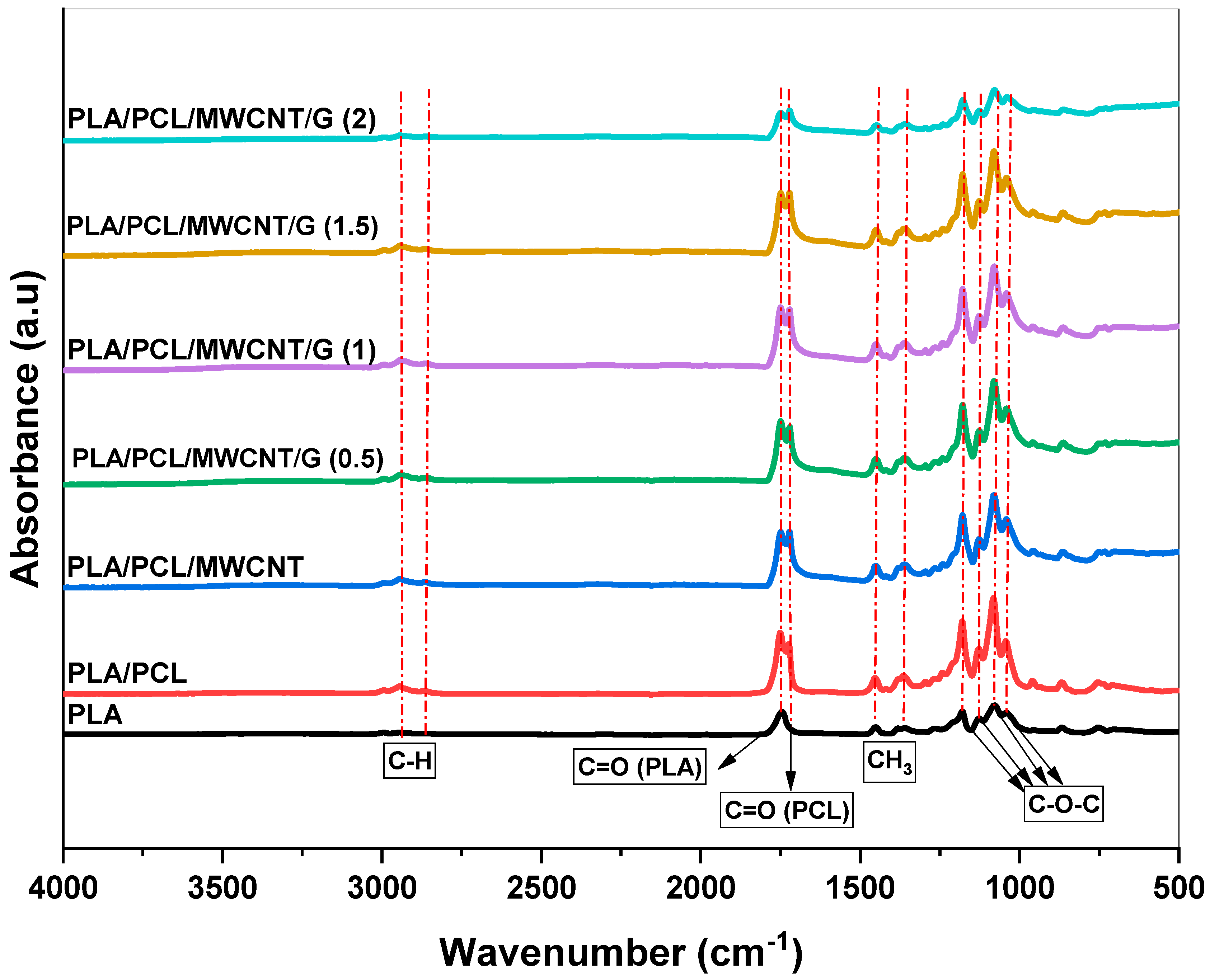
Figure 1 shows the FTIR absorption spectra of neat PLA, the PLA/PCL blend, and the nanocomposites containing MWCNT and different contents of G.
In the PLA spectrum, bands are observed in the range of 3000–2850 cm−1, attributed to the asymmetric (2995 cm−1) and symmetric (2947 cm−1) stretching of C–H bonds, while the band at 1452 cm−1 is related to the bending vibration of CH3 groups [39]. The intense absorption band at 1745 cm−1 corresponds to the stretching of the carbonyl group (C=O). In the regions of 1176 cm−1, 1073 cm−1, and 1034 cm−1, bands assigned to the stretching of C–O–C bonds, typically associated with ester groups, are observed [40]. For the PLA/PCL blend, the FTIR spectrum essentially shows a superposition of the characteristic bands of both polymers. However, compared to PLA, the main difference in the PLA/PCL spectrum is the appearance of the PCL carbonyl band, with lower absorption intensity and at a lower wavenumber (1724 cm−1). The simultaneous presence of these two bands at 1745 cm−1 and 1724 cm−1 confirms the coexistence of both phases in the blend, contributing to the toughening effect of PCL in the PLA matrix, as further evidenced by impact strength results. Moreover, the FTIR spectrum of the PLA/PCL blend did not show the emergence of new significant bands, indicating the absence of chemical reactions between the phases, with physical interactions being predominant. The PLA/PCL/MWCNT and PLA/PCL/MWCNT/G nanocomposites, regardless of the graphene nanoplatelet content, maintained the same FTIR spectral profile as the PLA/PCL blend, suggesting that no changes in chemical structure occurred.

3.2. Rheological Properties

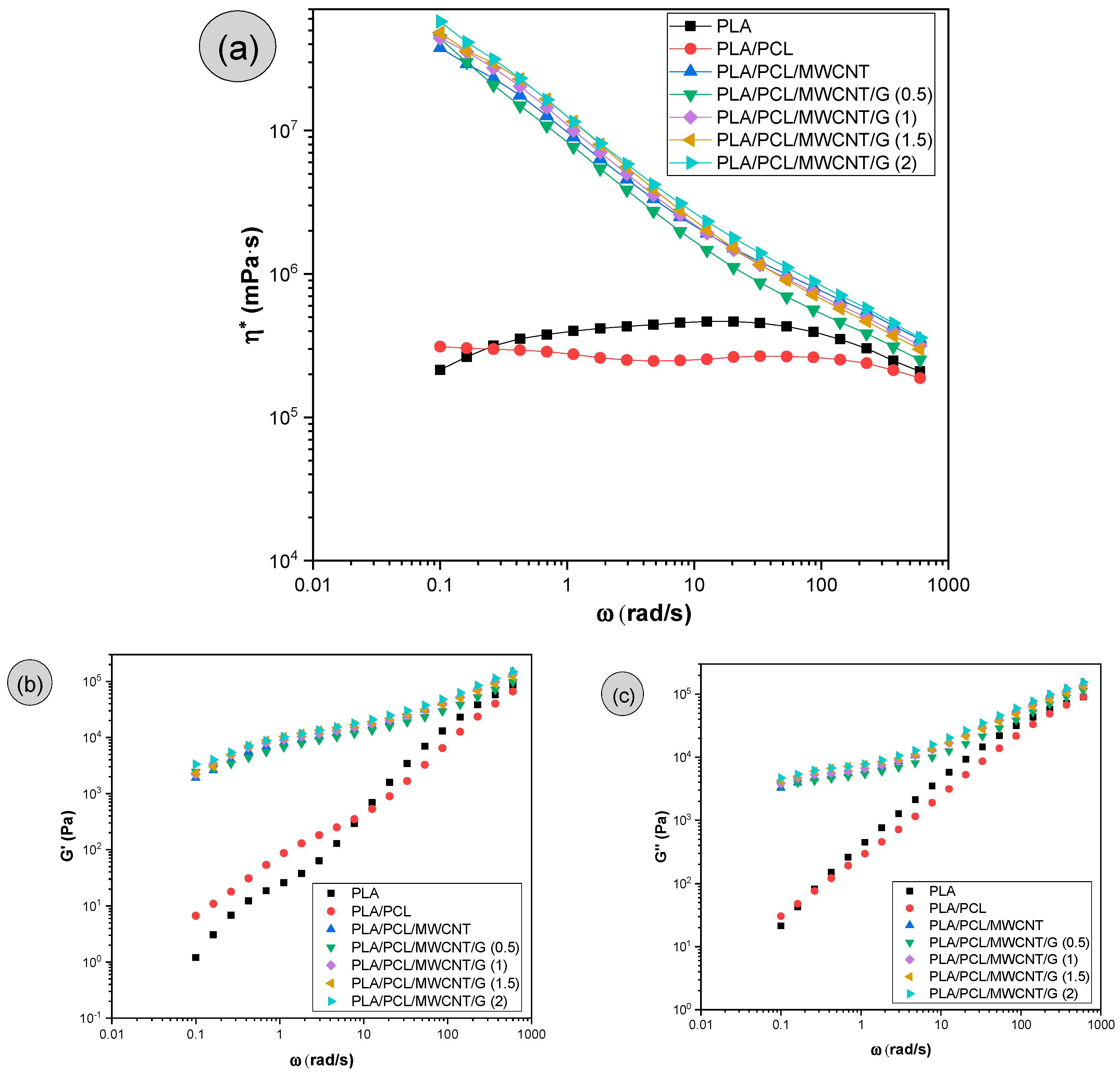
Figure 2a–c presents the results of complex viscosity (η*), storage modulus (G′), and loss modulus (G″) as a function of angular frequency for neat PLA, the PLA/PCL blend, and the nanocomposites as a function of graphene nanoplatelet concentration.
In Figure 2a, neat PLA exhibited a typical Newtonian behavior over the entire analyzed frequency range, characterized by a plateau in complex viscosity. A similar behavior was also reported for PLA in the study by Lima et al. [41]. Likewise, the PLA/PCL blend showed a predominantly Newtonian behavior, with viscosity being nearly independent of shear rate. The addition of 30% PCL to PLA led to a change in rheological behavior in the range of 0.1–1 rad/s, with a decrease in viscosity for the PLA/PCL blend compared to neat PLA. This behavior suggests a plasticizing effect of PCL in the PLA matrix, reducing flow resistance. On the other hand, the PLA/PCL/MWCNT and PLA/PCL/MWCNT/G nanocomposites exhibited a pseudoplastic behavior, evidenced by a pronounced decrease in viscosity with increasing frequency. Additionally, at low frequencies (0.1–1 rad/s), a more significant increase in complex viscosity was observed for the PLA/PCL/MWCNT and PLA/PCL/MWCNT/G nanocomposites. This effect is associated with the formation of a percolated network of MWCNT and G in the PLA/PCL system, which restricts polymer chain mobility at low frequencies, reducing system flowability and increasing viscosity. This result is consistent with that reported by Masarra et al. [42] for PLA/PCL nanocomposites containing graphene nanoplatelets. In Figure 2a, as the frequency applied to the PLA/PCL/MWCNT and PLA/PCL/MWCNT/G nanocomposites increases, the percolated network is progressively disrupted and aligned along the flow direction, reducing viscous resistance [43]. Regarding the amount of G incorporated into PLA/PCL/MWCNT, the effect was relatively subtle, with no significant change in complex viscosity. The curves for PLA/PCL/MWCNT and PLA/PCL/MWCNT/G nanocomposites are nearly superimposed, showing only minor fluctuations.
In Figure 2a, the increase in graphene nanoplatelet content in PLA/PCL/MWCNT/G did not show a monotonic trend in complex viscosity. At low G content (0.5 phr), a more pronounced reduction in viscosity was observed compared to the PLA/PCL/MWCNT base system, possibly associated with a lubrication effect, as also reported in the literature [44]. In this case, well-dispersed G acts as a solid lubricant, reducing interparticle friction and facilitating polymer chain mobility. At intermediate contents (1–1.5 phr), the PLA/PCL/MWCNT/G nanocomposites exhibit a transition behavior with an increase in complex viscosity, in which more significant particle–particle interactions begin to occur, leading to the formation of a more established percolated network, resulting in intermediate viscosity values. At higher G content (2 phr), the more pronounced increase in complex viscosity is related to the formation of a more interconnected hybrid network between MWCNT and G, which intensifies the interactions between the nanofillers and restricts polymer chain mobility.
Figure 2b,c present the results of the storage modulus (G′) and loss modulus (G″), respectively. For neat PLA, at low frequencies, the loss modulus (G″) is higher than the storage modulus (G′), indicating a predominantly viscous behavior. This suggests that PLA chains are able to dissipate energy efficiently. As the frequency increases, both moduli rise, with a tendency for G′ and G″ to approach each other. The PLA/PCL blend exhibited behavior similar to that of neat PLA, with G″ predominating over G′, especially at low frequencies, also indicating a dominant viscous character. However, some important differences can be observed. The incorporation of PCL into PLA, due to its higher flexibility, tends to reduce both moduli (G′ and G″) at frequencies above 10 rad/s. The higher storage modulus (G′) observed for the PLA/PCL blend at low frequencies (<10 rad/s), compared to neat PLA, is associated with the immiscible biphasic nature of the system (see more later in SEM). In this regime, the viscoelastic response is governed by long-timescale relaxation processes, which are highly sensitive to morphology and interfacial interactions. The presence of dispersed PCL domains in the PLA matrix promotes interfacial relaxation, contributing to additional elastic energy storage. Moreover, these domains act as deformable inclusions that resist deformation at low frequencies, temporarily increasing G′. In general, both neat PLA and the PLA/PCL blend exhibit typical viscoelastic fluid behavior dominated by dissipation (G″ > G′), with the addition of PCL promoting increased molecular mobility, reducing stiffness, and enhancing system flow. For the PLA/PCL/MWCNT and PLA/PCL/MWCNT/G nanocomposites, the storage modulus (G′) presented a slope tending to zero at low frequencies, with values oscillating between 0.61 and 0.72, in contrast to neat PLA (1.89) and the PLA/PCL (1.68) blend, indicating a behavior characteristic of a system with a percolated network [45]. This result suggests the formation of a continuous network of conductive nanofillers in the PLA/PCL system, corroborating the electrical response discussed later. Regarding the loss modulus (G″), a similar trend is observed, with the slope also tending toward zero at low frequencies, along with higher values compared to neat PLA and the PLA/PCL blend, particularly in the range of 0.1 to 1 rad/s. This behavior indicates increased energy dissipation in the nanocomposites, attributed to enhanced interfacial friction between the nanofillers and the PLA/PCL blend, as well as deformation of the formed conductive network, resulting in improved rheological performance associated with G″.
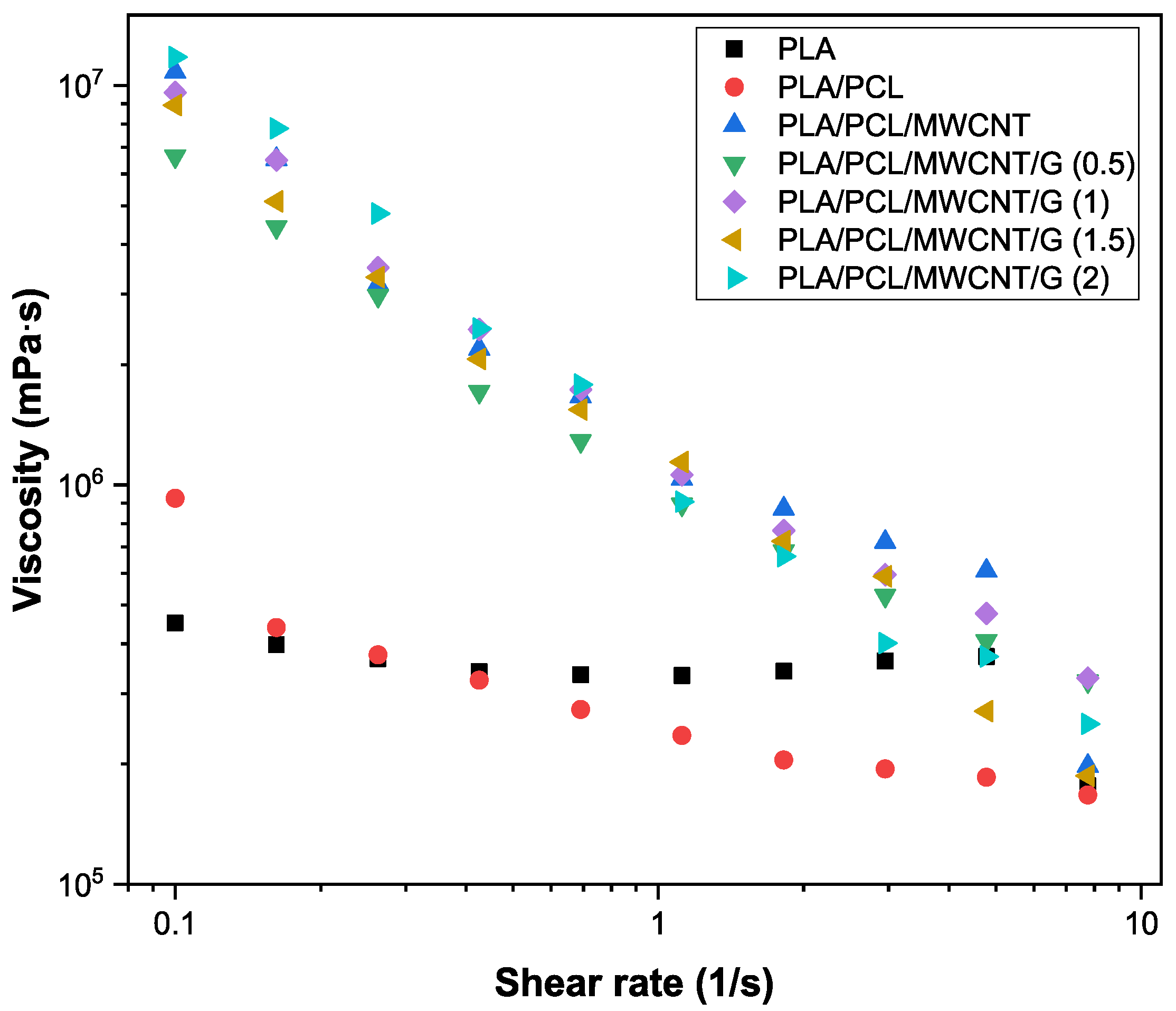
Figure 3 presents the evolution of viscosity obtained under rotational regime for neat PLA, the PLA/PCL blend, and the PLA/PCL/MWCNT nanocomposites, as a function of graphene nanoplatelet content. Under rotational conditions, the viscosity profile of the materials as a function of shear rate consistently reproduces the trends observed in oscillatory tests, indicating coherence in the rheological response of the systems.
Neat PLA exhibited relatively stable viscosity over the applied shear rate range. Upon incorporating PCL, the PLA/PCL blend showed a reduction in viscosity within the range of 0.1–1 s−1 compared to neat PLA, which can be interpreted as a plasticizing effect. With the addition of MWCNT to PLA/PCL, a significant increase in viscosity was observed, indicating physical interactions between nanoparticle–nanoparticle and nanoparticle–PLA/PCL, increasing friction and resistance to flow. However, as the shear rate increases, a clearly pseudoplastic behavior is observed, associated with the orientation and progressive breakdown of the percolated network under flow, leading to a reduction in system viscosity. The PLA/PCL/MWCNT/G (0.5 phr) nanocomposite promoted a slight decrease in viscosity compared to the PLA/PCL/MWCNT system, suggesting a possible lubrication effect. Graphene nanoplatelet contents of 1 phr and 1.5 phr practically maintained the viscosity behavior of the base PLA/PCL/MWCNT nanocomposite. A more pronounced increase in viscosity was observed for the 2 phr graphene nanoplatelet content, particularly in the low shear rate range of 0.1 to 0.5 s−1. This indicates a greater contribution to the formation of a more interconnected particle network, which is consistent with the electrical and electromagnetic results discussed later.

3.3. Scanning Electron Microscopy (SEM)

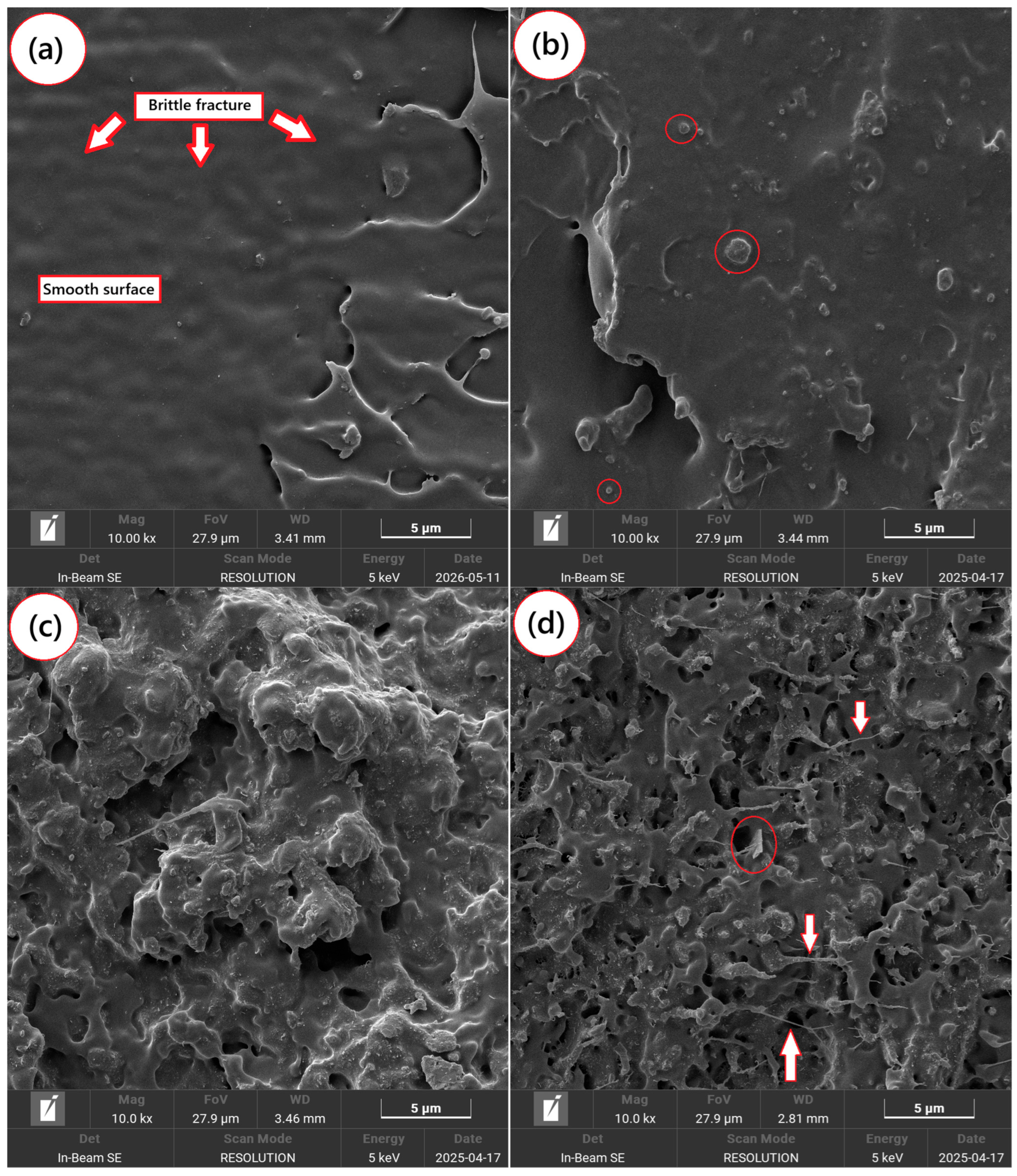
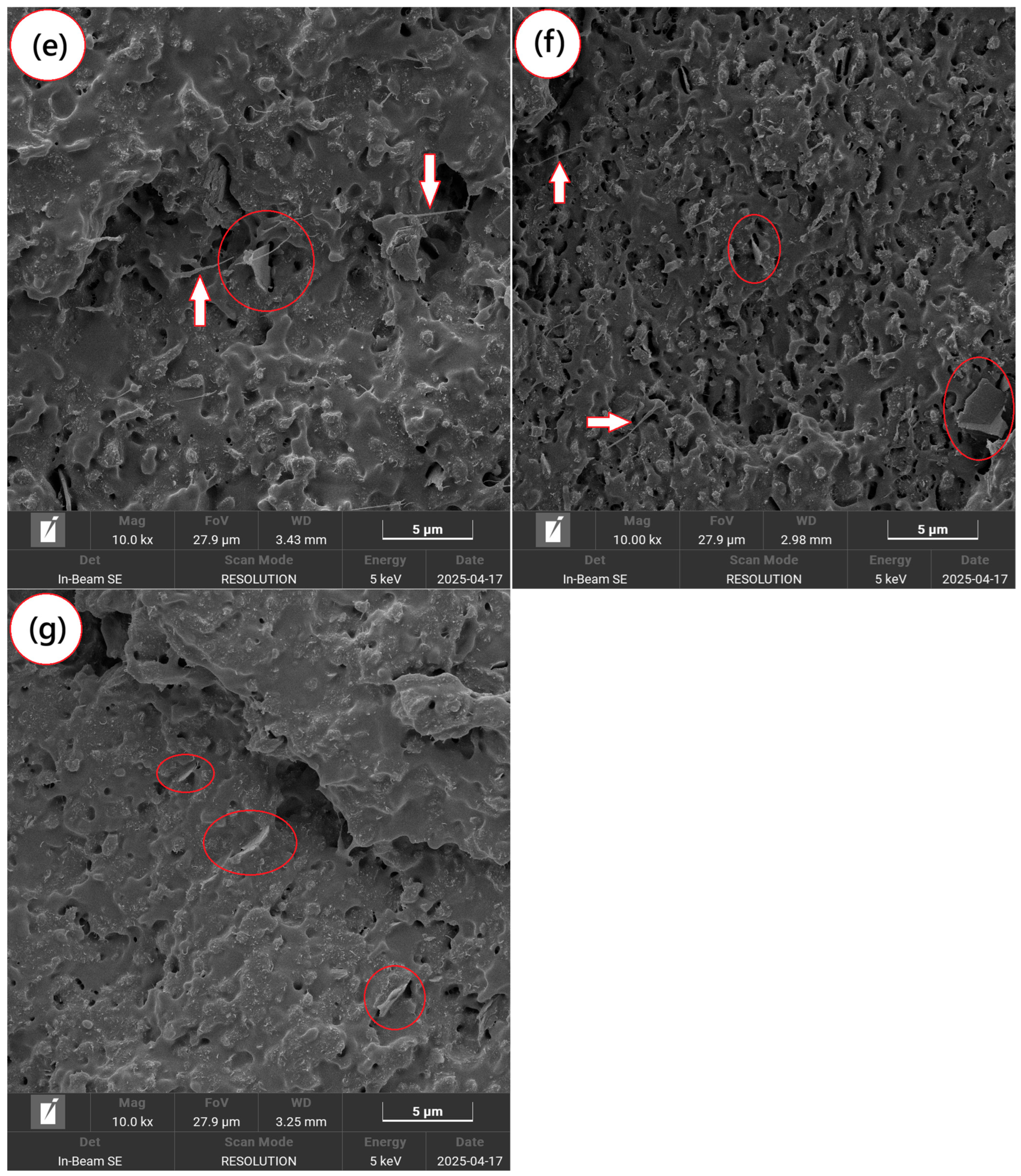
Figure 4a–g presents scanning electron microscopy (SEM) micrographs of the fracture surfaces, obtained at a magnification of 10,000× after the impact test, for neat PLA, the PLA/PCL polymer blend, and the nanocomposites, both in the presence and absence of G. The images obtained at a magnification of 100,000× are available in the Supplementary Materials Figure S1.
In Figure 4a, the morphological aspect of PLA is directly associated with its intrinsically brittle mechanical behavior. In general, a predominantly smooth and homogeneous surface was observed, with relatively flat regions indicating low capacity for plastic deformation prior to fracture. This pattern suggests that crack propagation occurs rapidly, with limited energy dissipation. The absence of significant plastic deformation reinforces the glassy nature of PLA under ambient conditions, confirming its brittleness and low impact strength, as discussed later. In Figure 4b, the morphology of the PLA/PCL blend is characterized by the presence of discrete PCL domains dispersed in the PLA matrix, predominantly exhibiting a droplet-like morphology (see red circle). The phase separation indicates the formation of an immiscible blend, in agreement with the FTIR results. The PCL domains appear well adhered to the continuous PLA phase, with no evidence of voids associated with interfacial debonding. This suggests good interfacial interaction between PLA and PCL. Consequently, this promotes stress transfer between the phases, contributing to the activation of toughening mechanisms and energy dissipation under impact, as demonstrated later.
The SEM micrograph of the fracture surface of the PLA/PCL/MWCNT nanocomposite reveals a significant change in morphological pattern compared to neat PLA and the PLA/PCL blend, reflecting the role of MWCNT in modifying the fracture mechanism. In Figure 4c, a markedly rougher and more heterogeneous surface was observed, which is directly associated with increased plastic deformation. The presence of MWCNT in PLA/PCL promoted the formation of a morphology in which the PCL domains remain well dispersed and adhered to the PLA matrix, while the MWCNT are distributed throughout the system. Additionally, the size of the PCL phase was refined in the PLA matrix, suggesting that the MWCNT contributed to morphological stabilization. This finding is consistent with reports in the literature [46], where enhanced interfacial stability was observed in PLA/EVA/MWCNT nanocomposites. According to the authors, MWCNTs act as physical barriers (steric hindrance effect), hindering coalescence and contributing to the refinement of the dispersed phase, which favors improved toughening. Given this, probably the steric hindrance stabilization mechanism can be acted on in the PLA/PCL/MWCNT nanocomposite, minimizing coalescence. At higher magnification (100,000×, see Figure S1b), the fracture surface of the PLA/PCL/MWCNT nanocomposite shows well-dispersed MWCNT and a highly refined PCL phase, indicating morphological stability. Consequently, there was a probable synergistic effect in the toughening mechanism, leading to crack deflection and an increase in toughness. However, it should also be noted that there is a tendency for MWCNTs to preferentially segregate into the PCL phase, which may limit their reinforcing effect under tensile loading.
In Figure 4d–g, the fracture surfaces of the hybrid PLA/PCL/MWCNT/G nanocomposites exhibit a typically ductile morphological behavior, characterized by roughness, the presence of plastic deformation, and fibrillated regions (see arrows). This morphology suggests that the PLA/PCL/MWCNT/G nanocomposites, regardless of graphene nanoplatelet content, possess a capacity for energy dissipation. However, compared to the PLA/PCL/MWCNT system, the hybrid composites show a less structurally stable morphology. The PLA/PCL/MWCNT/G nanocomposites present some voids in the PLA matrix, as well as G with poorly adhered interfacial regions (see red circles and Figure S1c–f), which can act as stress concentrators and reduce the efficiency of energy dissipation mechanisms. This partially compromises mechanisms such as crack deflection induced by the presence of nanofillers, leading to earlier fracture compared to the PLA/PCL/MWCNT system. However, the presence of G in PLA/PCL/MWCNT possibly contributed to assisting the distribution and dispersion of MWCNT, promoting the formation of an efficient electrical percolation pathway and resulting in an improved electromagnetic response (as discussed later). Yue et al. [47] investigated the effect of graphene nanoplatelets on the dispersion of MWCNT in epoxy resin, reporting a synergistic effect. A CNT:GNP (carbon nanotubes/graphene nanoplatelets) ratio of 8:2 in epoxy resulted in improved mechanical performance and a reduced electrical percolation threshold, attributed to enhanced dispersion of MWCNT in the presence of G. According to the authors, the interaction between 1D (MWCNT) and 2D (G) structures favors the formation of an efficient three-dimensional network, increasing electrical conductivity and highlighting the potential of hybrid systems.

3.4. Impact Strength

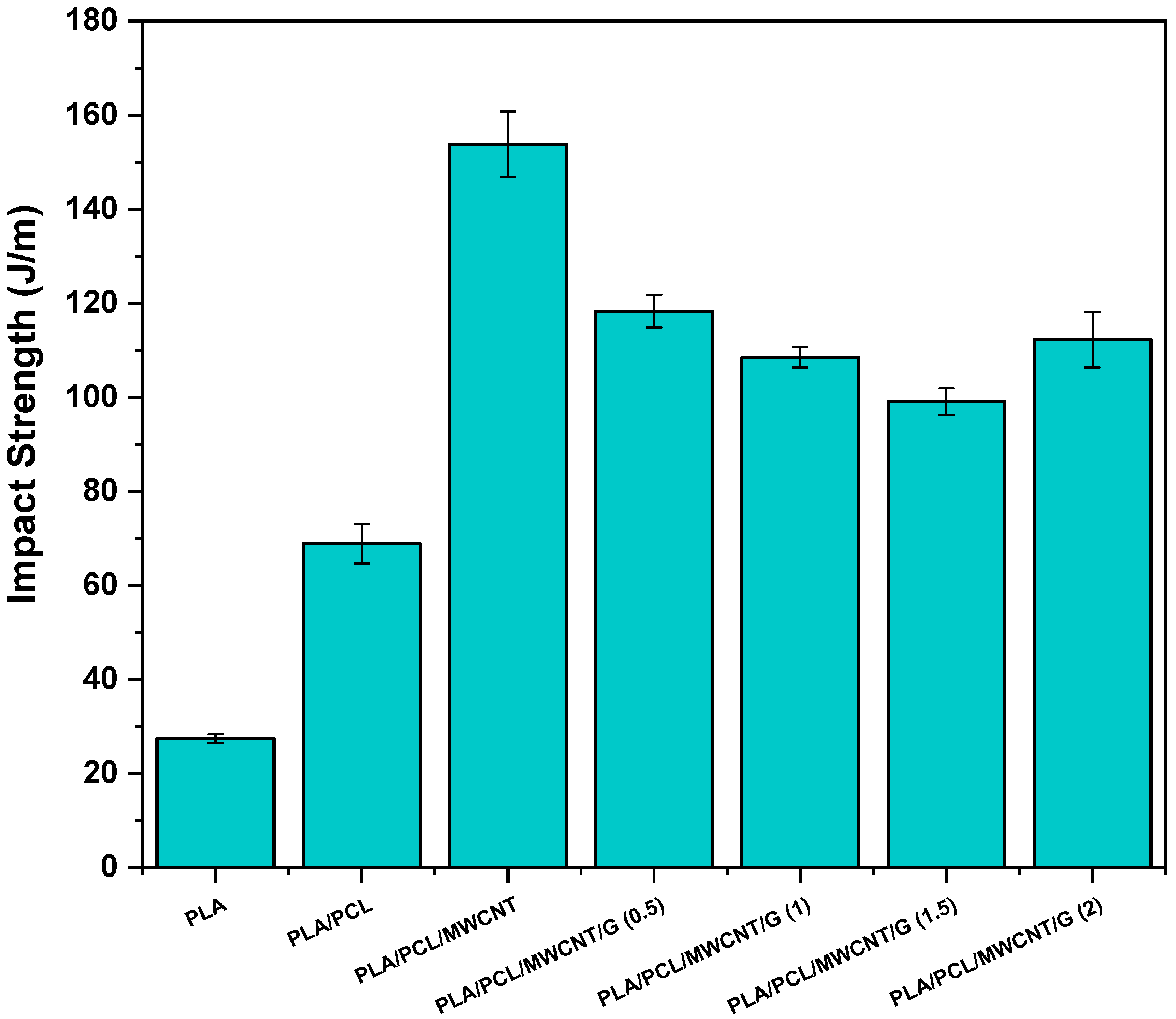
Figure 5 presents the impact strength response at room temperature for neat PLA, the PLA/PCL blend, and the PLA/PCL/MWCNT nanocomposites, with and without G. Neat PLA exhibited low impact strength, with a value of 27.4 J/m. This indicates a limited capacity for energy dissipation under impact and reinforces its glassy nature at room temperature, as also reported in the literature [48,49]. With the incorporation of 30% PCL into PLA, an increase in impact strength to 69 J/m was observed, corresponding to a 152% improvement compared to neat PLA. This result highlights the role of PCL as an impact modifier for PLA, promoting increased toughness of the system. The toughening effect of PCL in the PLA matrix was also reported by Ostafinska et al. [50].
The impact strength of the PLA/PCL/MWCNT and PLA/PCL/MWCNT/G nanocomposites clearly indicates a transition to more ductile behavior at room temperature compared to neat PLA and the PLA/PCL blend. The addition of MWCNT to PLA/PCL significantly enhanced impact strength, reaching a value of 153.8 J/m. This behavior indicates the formation of a tough and ductile nanocomposite at room temperature, which is consistent with the SEM-observed morphology. The refined PCL droplets in the PLA matrix promoted efficient energy dissipation under impact. This suggests that the toughening effect of PCL in the PLA matrix was amplified by the presence of MWCNTs. Other studies [46,51,52] have also reported improvements in the mechanical properties of polymer blends with the incorporation of MWCNT, highlighting their role as compatibilizing agents and their steric hindrance effect. Furthermore, the MWCNT dispersed in the PLA/PCL system likely contributed to crack deflection and retardation of crack propagation, leading to an enhanced ductility mechanism.
The addition of G to the PLA/PCL/MWCNT nanocomposite led to a gradual reduction in impact strength, particularly in the 0.5 to 1.5 phr range. This trend indicates a decrease in energy dissipation capacity under impact, likely due to a stress concentration effect. As observed in the SEM analysis, the presence of voids in the PLA/PCL/MWCNT/G nanocomposites, as well as G with poorly adhered interfacial regions, contributed to the reduction in impact resistance compared to the PLA/PCL/MWCNT base system. With a graphene nanoplatelet content of 2 phr in PLA/PCL/MWCNT, a slight recovery in impact strength was observed, reaching 112.2 J/m, a value comparable to that of the PLA/PCL/MWCNT/G (0.5 phr) nanocomposite. However, considering the experimental error margin, no significant difference in impact strength was observed among the PLA/PCL/MWCNT/G nanocomposites, only similar values. Although the PLA/PCL/MWCNT/G systems exhibited lower impact strength than PLA/PCL/MWCNT, their values remain significantly higher than those of neat PLA and the PLA/PCL blend. Overall, the impact strength of the PLA/PCL/MWCNT/G nanocomposites falls in the range of 99–120 J/m, indicating that the materials still maintain a tough behavior at room temperature.
In addition to the morphological aspects observed by SEM, the impact strength behavior can also be interpreted considering the DSC results presented later. The PLA/PCL/MWCNT nanocomposite showed an increase in crystallinity, indicating a nucleating effect of MWCNT. This more organized structure, combined with the refinement of PCL droplets observed by SEM, favors energy dissipation mechanisms, such as crack deflection and localized plastic deformation, resulting in higher impact strength. On the other hand, the addition of G reduced the crystallinity compared to the PLA/PCL/MWCNT system, in addition to interfacial defects observed by SEM. These factors contribute to lower efficiency in stress transfer and greater ease of crack initiation, justifying the reduction in impact strength. Thus, the impact performance was the result of the probable combined effect of morphology and crystallization behavior, both being determinant in the mechanical response of the nanocomposites.
The results obtained for the PLA/PCL/MWCNT and PLA/PCL/MWCNT/G nanocomposites are technologically relevant, as they surpass the performance of widely used commercial polymers, such as homopolymer polypropylene (27.2 J/m, 2.75 J pendulum) [53], and are comparable to high-impact polystyrene (HIPS) (101 J/m, 2.75 J pendulum) [54].

3.5. Tensile Properties

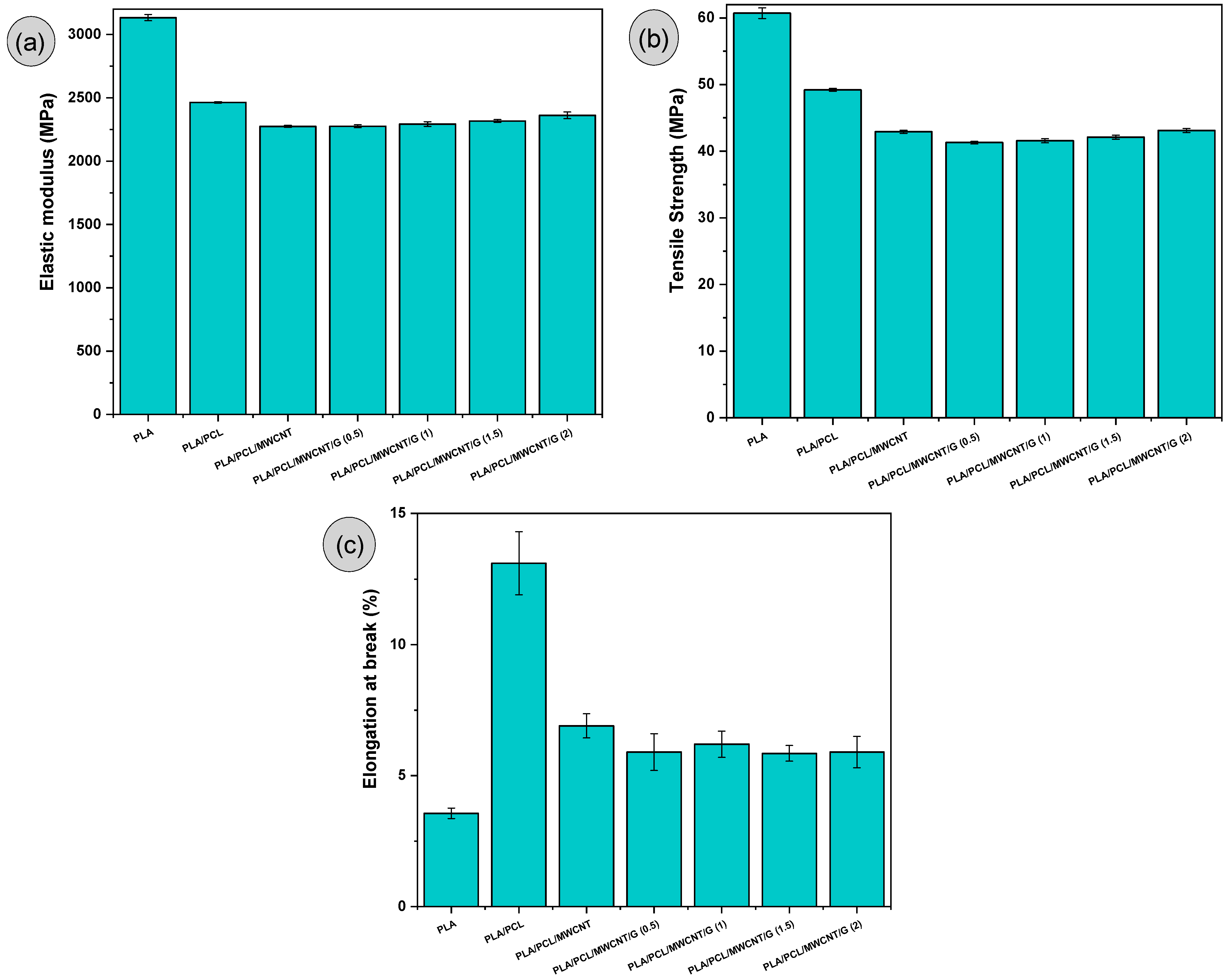
Figure 6a–c shows the results of elastic modulus, tensile strength, and elongation at break for neat PLA, the PLA/PCL blend, and PLA/PCL/MWCNT nanocomposites as a function of graphene nanoplatelet concentration.
PLA, with a tensile modulus of 3132 MPa, exhibited the highest stiffness among all materials, in agreement with values reported in the literature [55,56]. In contrast, the incorporation of 30% PCL, a more flexible polymer with a lower elastic modulus, produced a plasticization effect in the PLA matrix, reducing the modulus to 2463 MPa. This lower-rigidity dispersed phase contributed to the decrease in resistance to elastic deformation of PLA. The incorporation of MWCNT into the PLA/PCL blend did not lead to the expected increase in tensile modulus; on the contrary, a reduction was observed compared to the PLA/PCL base system. At first glance, this result may appear counterintuitive, since MWCNTs are typically considered rigid reinforcing agents. However, literature reports [57,58,59] have also shown no improvement in elastic modulus in PLA/PBAT nanocomposites, often attributed to the selective migration of MWCNT into the dispersed phase. For PLA/PCL-based nanocomposites containing MWCNT, studies by Tao et al. [60] and Xu et al. [61] demonstrated that the preferential migration and localization of MWCNT is thermodynamically more favorable toward the PCL phase. In this context, as shown in Figure 6a, the behavior of the PLA/PCL/MWCNT nanocomposite has, as a probable explanation, a preferential localization of MWCNT in the PCL phase, generating a decline in the elastic modulus. As a consequence, the PLA continuous phase, primarily responsible for the stiffness of the nanocomposite, remains relatively poor in reinforcing nanofillers, resulting in limited effectiveness in enhancing the elastic modulus. With the addition of G to PLA/PCL/MWCNT, the elastic modulus values ranged from 2275 to 2365 MPa, indicating similarity to the base PLA/PCL/MWCNT nanocomposite. In other words, the results fall within the experimental error margin, with no significant gains in stiffness, only comparable values.
Regarding tensile strength, as illustrated in Figure 6b, neat PLA required a higher load for deformation due to its glassy nature. The PLA/PCL blend exhibited a reduction in tensile strength, attributed to the increased flexibility of the system and the lower intrinsic strength of the PCL phase. The PLA/PCL/MWCNT and PLA/PCL/MWCNT/G nanocomposites showed tensile strength values ranging from 41 to 43.5 MPa, lower than those of the PLA/PCL blend. Since tensile strength is measured in the plastic deformation regime, it is dependent on nanofiller distribution and interfacial adhesion. In this context, two possible explanations can be proposed for the observed behavior. First, the results may be directly related to the probable preferential localization of MWCNT in the dispersed PCL phase. As this phase has a lower load-bearing capacity, the confinement of nanotubes within it limits their effectiveness as reinforcing agents in the PLA continuous phase, which is primarily responsible for the mechanical strength of the system. Alternatively, the reduction in tensile strength may be associated with stress concentration effects induced by the presence of nanofillers, promoting early crack initiation under loading and consequently leading to reduced tensile performance.
In Figure 6c, neat PLA exhibited low elongation at break (3.56%), confirming its characteristic brittle behavior, associated with limited segmental mobility, in agreement with the impact strength results. The incorporation of PCL into PLA increased the elongation at break to 13.1%, evidencing a plasticizing effect and indicating greater capacity for plastic deformation prior to fracture. The PLA/PCL/MWCNT nanocomposite showed a reduction in elongation at break compared to the PLA/PCL blend; however, it still exceeded the value of neat PLA by 93.8%. With the addition of G (0.5–2 phr) to the PLA/PCL/MWCNT system, a slight additional decrease in elongation at break was observed, with values ranging from approximately 5.85% to 6.2%. This behavior can be attributed to the presence of nanofillers, which act as anchoring points and restrict polymer chain mobility, and may also promote stress concentration, leading to premature fracture compared to the PLA/PCL base system. Although the incorporation of G led to a slight reduction in elongation at break relative to the PLA/PCL/MWCNT system, the differences among the compositions were not statistically significant, considering the experimental error. This result indicates that, within the investigated concentration range, G did not exert a significant influence on the ductility of the PLA/PCL/MWCNT system.

3.6. Heat Deflection Temperature (HDT)

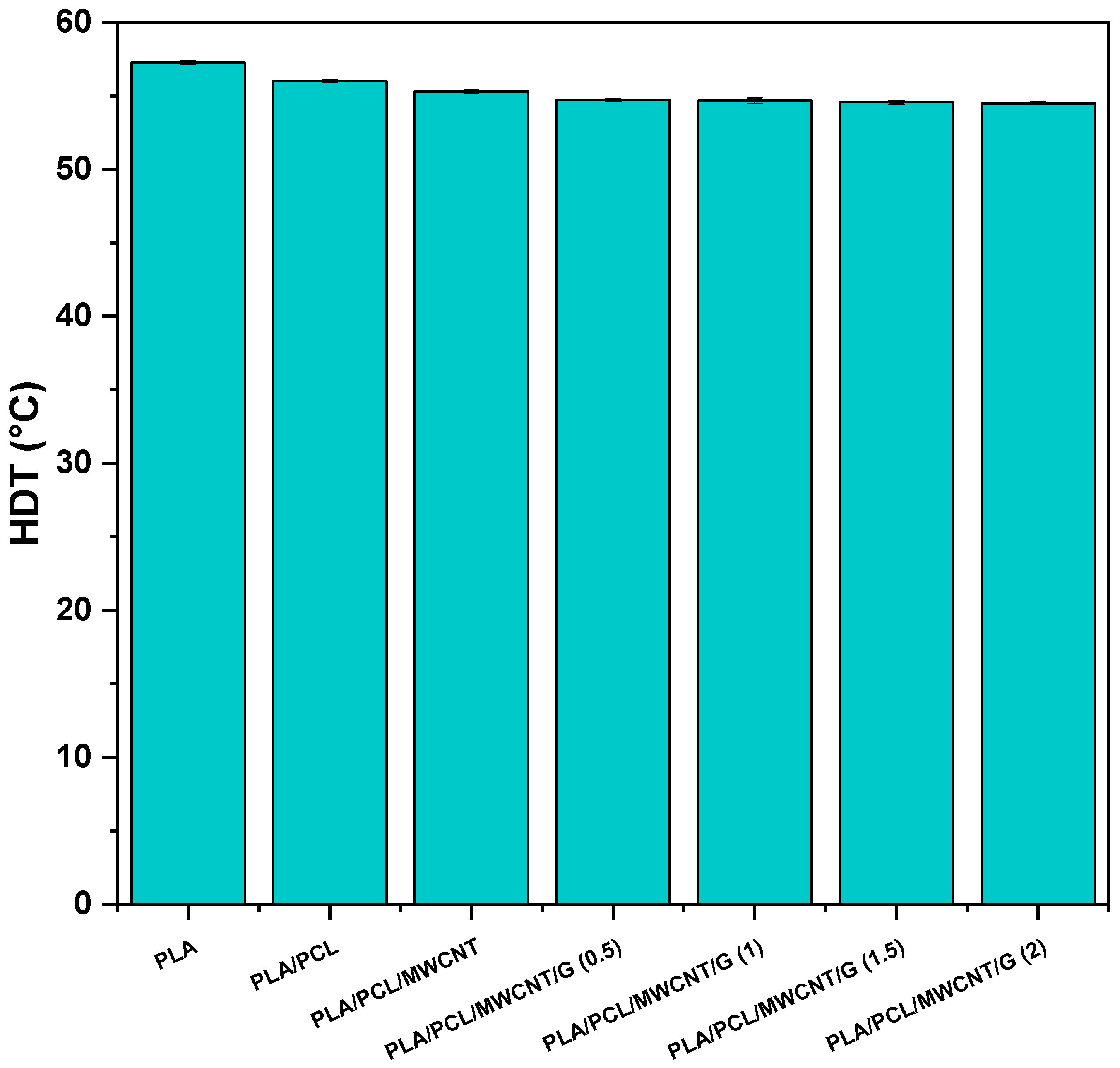
Figure 7 shows the thermomechanical stability, evaluated by HDT, for neat PLA, the PLA/PCL blend, and the PLA/PCL/MWCNT nanocomposites as a function of graphene nanoplatelet content. The HDT of neat PLA was determined to be 57 °C, a value consistent with those reported in the literature [62]. With the incorporation of 30% PCL into PLA, a slight reduction in HDT to 56 °C was observed, indicating that the presence of the flexible phase did not significantly affect the thermomechanical resistance performance. Thus, the proximity of the HDT values suggests that, although the PLA/PCL blend induces mechanical modifications, its effect on thermomechanical stability is minimal, being mainly governed by the continuous PLA phase. The PLA/PCL/MWCNT and PLA/PCL/MWCNT/G nanocomposites exhibited very similar values, ranging from 54 to 55.5 °C. Overall, the HDT results were substantially comparable for all evaluated materials, indicating the preservation of structural stability under simultaneous mechanical loading and temperature increase within the conditions of the test performed.

3.7. Differential Scanning Calorimetry (DSC)

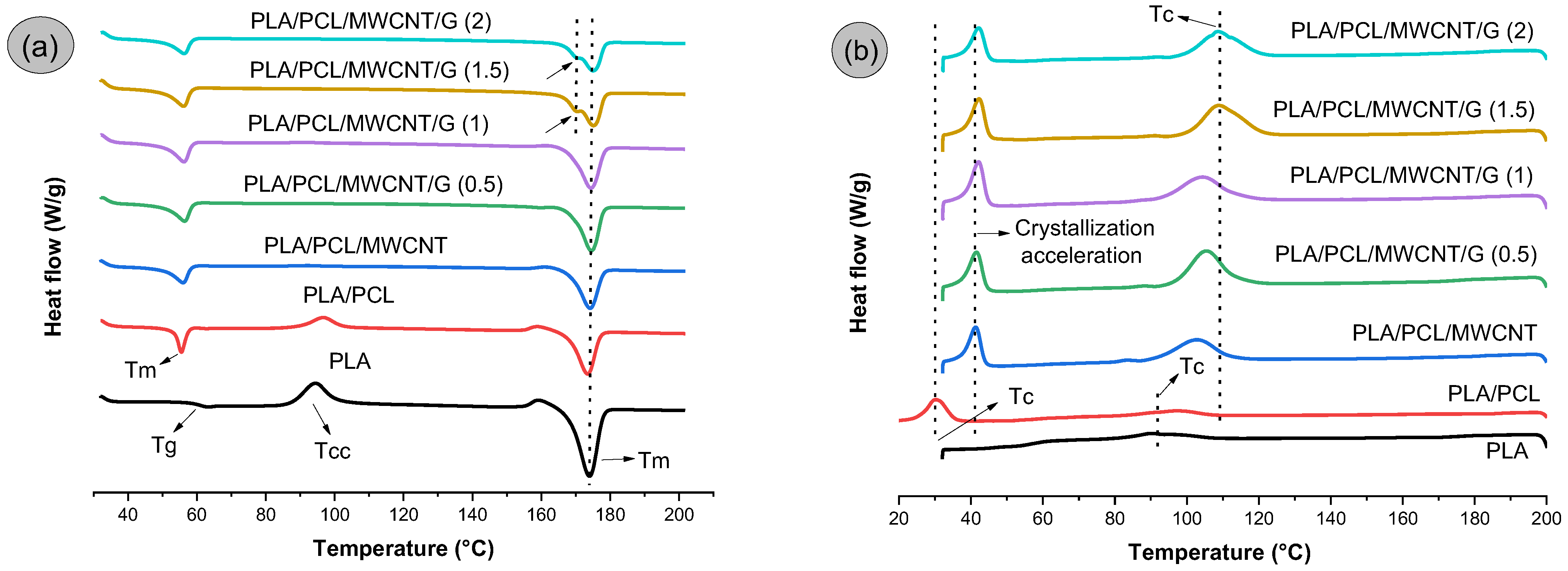
Figure 8a,b shows the DSC curves obtained during the second heating cycle and cooling for neat PLA, the PLA/PCL blend, and the PLA/PCL/MWCNT nanocomposites with different graphene nanoplatelet contents. The results for crystallization temperature (Tc), crystalline melting temperature (Tm), and degree of crystallinity (Xc) are presented in Table 2. The reported thermal parameters refer to PLA. As shown in Figure 8a, the first thermal event corresponds to the crystalline melting temperature of PCL, around 55 °C, for the PLA/PCL blend and the nanocomposites, with practically constant values and no significant changes. In this case, no alteration in crystal perfection or crystalline structure was observed, indicating only maintenance of the existing morphology. A similar Tm behavior for PCL has also been reported in the literature [63]. For neat PLA, the first thermal event observed corresponds to the glass transition temperature (Tg), around 59.6 °C, a value consistent with that reported by Ivanov et al. [64]. The Tg of PLA above room temperature explains its poor impact performance, as shown in Figure 5. The Tg signals for the PLA/PCL blend and the nanocomposites were not clearly detected, as they overlapped with the PCL thermal event occurring in the 43–60 °C range.
The cold crystallization temperature (Tcc) of PLA was observed as an exothermic peak during heating at 96.4 °C. This behavior is associated with the structural reorganization of amorphous PLA chains into crystalline regions, as also reported by [65]. The PLA/PCL blend maintained the Tcc value around 96.7 °C, with no significant change compared to the PLA matrix. The PLA/PCL/MWCNT and PLA/PCL/MWCNT/G nanocomposites did not exhibit the Tcc event, suggesting its inhibition in the presence of nanofillers. This indicates alterations in the structural organization process of the amorphous PLA fraction, possibly due to the accommodation of nanofillers within the amorphous regions. Consequently, this led to a physical restriction of chain mobility imposed by the nanofillers in PLA/PCL, limiting the ability to undergo reorganization. Thus, the disappearance of the cold crystallization event (Tcc) indicates a change in the crystallization mechanism of the nanocomposites, in agreement with the Tc behavior (see Figure 8b).
Pure PLA exhibited a single main peak corresponding to the crystalline melting temperature (Tm2) at 173.9 °C, a value close to that reported in the literature [66]. The higher-temperature peak observed for PLA is associated with the α phase [67]. As shown in Table 2, the Tm2 of the PLA/PCL blend remained practically unchanged at 173.4 °C. This minor variation indicates that the crystalline structure of PLA was not significantly affected by the presence of 30% PCL. In other words, the lamellar organization of PLA was preserved, with no evidence of relevant interference in crystal thickness. Additionally, the presence of characteristic thermal events of both PLA and PCL in the DSC curves reinforces the existence of two distinct phases, supporting the formation of an immiscible system, consistent with the bands at 1745 cm−1 and 1724 cm−1 observed in FTIR analysis. Regarding the nanocomposites, the PLA/PCL/MWCNT and PLA/PCL/MWCNT/G (0.5 phr and 1 phr) systems maintained stable Tm2 values without significant changes. However, upon increasing the graphene nanoplatelet content in PLA/PCL/MWCNT to 1.5 phr and 2 phr, a change in the crystalline melting profile was observed, with the emergence of two melting events, Tm1 and Tm2. This behavior indicates the formation of crystalline populations with different levels of structural organization. The lower-temperature peak (Tm1) can be associated with less perfect crystals, characterized by lower thermal stability and melting first. In contrast, the higher-temperature peak (Tm2) is related to more stable and well-organized crystalline regions. Literature [68] indicates that these crystalline phases correspond to α’ (Tm1) and α (Tm2). For graphene nanoplatelet contents of 0.5 phr and 1 phr in PLA/PCL/MWCNT, a more efficient structural rearrangement during heating was achieved, which prevented the formation of Tm1. On the other hand, higher contents such as 1.5 phr and 2 phr induced greater heterogeneity, leading to changes in PLA chain mobility and affecting crystallization growth kinetics. This effect likely contributes to the coexistence of crystals with different degrees of perfection, reflected in the two melting events.
In Figure 8b, the crystallization temperature (Tc) of the PLA/PCL blend was 30.2 °C, whereas the PLA/PCL/MWCNT and PLA/PCL/MWCNT/G nanocomposites shifted to the range of 41–43 °C. This shift toward higher temperatures suggests that the crystallization process occurs earlier during cooling, indicating a nucleating effect of the nanofillers. This behavior can be interpreted as a result of the ability of the nanofillers to reduce the energetic barrier required for crystal nucleation. In other words, the presence of nanofillers dispersed in the PLA/PCL blend generates interfacial regions that favor the initial chain organization, thereby advancing the onset of crystallization. Regarding the PLA matrix, Tc was around 93.4 °C, while the PLA/PCL blend induced a slight shift to 95.8 °C. The results were more pronounced for the PLA/PCL/MWCNT and PLA/PCL/MWCNT/G nanocomposites, which exhibited a Tc shift of more than 10 °C compared to neat PLA. This indicates an earlier crystallization at higher temperatures, which is important for reducing the injection molding cycle time.
In Table 2, it was observed that PLA exhibits a semicrystalline characteristic, with a crystallinity degree of 35.8%. The addition of 30% PCL to PLA reduced the crystallinity degree to 32.9%, indicating a lower amount of crystal formation. The PLA/PCL/MWCNT nanocomposites showed the highest crystallinity level, reaching 53.7%, suggesting that the MWCNT, due to their high specific surface area, acted as nucleating agents, promoting crystal formation and accelerating crystallization. The PLA/PCL/MWCNT/G nanocomposites exhibited a reduced crystallinity degree in the range of 43–48% compared to PLA/PCL/MWCNT. This indicates that G hindered nucleation, crystal growth, and crystal stability in the PLA/PCL/MWCNT nanocomposites, possibly due to their lower effective surface area, leading to a reduction in the nucleating effect of the MWCNT.
The integration of DSC, HDT, and mechanical properties results indicates that the incorporation of MWCNT and G promotes a nucleating effect, increasing the Tc and the degree of crystallinity of PLA, which would, in principle, favor higher stiffness and thermomechanical stability. However, this effect was not reflected in improvements in the elastic modulus, considering the similar values observed among the nanocomposites. The nearly constant HDT values indicate that thermomechanical resistance was mainly governed by the continuous PLA phase and its Tg (59.6 °C). Furthermore, the suppression of Tcc and the reduction in elongation at break of the nanocomposites compared to PLA/PCL suggest restricted chain mobility due to the presence of nanofillers. On the other hand, the increase in impact resistance is more closely associated with the developed morphology of the PLA/PCL/MWCNT and PLA/PCL/MWCNT/G nanocomposites and the increase in the degree of crystallinity (greater organization), since the dispersed phases act to delay crack propagation, while the nanofillers contribute to crack deflection.

3.8. Electrical Conductivity

Table 3 compiles the electrical conductivity (σ) values obtained for neat PLA, the PLA/PCL blend, and the nanocomposites formulated with different contents of G.
The electrical conductivity values obtained for neat PLA (3.35 × 10⁻¹⁰ S/cm) and for the PLA/PCL blend (3.49 × 10⁻¹⁰ S/cm) indicate that both systems exhibit a typically insulating behavior [69], with only minor differences between them. The incorporation of MWCNT into the PLA/PCL blend led to a pronounced change in the electrical behavior of the system, increasing the conductivity to 2.95 × 10⁻⁶ S/cm. This rise of approximately four orders of magnitude compared to the unfilled materials highlights the effective role of MWCNT as the phase responsible for establishing an electrical conduction network. Consequently, the PLA/PCL/MWCNT system no longer exhibits insulating characteristics and instead shows semiconductive behavior, indicating its potential for applications requiring electrostatic discharge or controlled electrical functionality. Materials with electrical conductivity in the range of 10−8 to 10−3 S/cm are generally classified as suitable for antistatic applications, as they enable the controlled dissipation of accumulated electrostatic charges [70]. The simultaneous incorporation of MWCNT and G (0.5 phr) into the PLA/PCL blend resulted in a further increase in electrical conductivity, reaching 6.10 × 10⁻⁶ S/cm. However, the same order of magnitude was maintained. This suggests that hybridization favored improved interconnection between conductive pathways in PLA/PCL/MWCNT/G, reducing interparticle distances and facilitating charge transport mechanisms.
The increase in graphene nanoplatelet content in the hybrid PLA/PCL/MWCNT/G systems led to a progressive enhancement in electrical conductivity, with values on the order of 10−5 S/cm. This behavior evidences the continuous improvement of the conductive network as the fraction of two-dimensional fillers increases, suggesting an intensified synergistic effect between the nanofillers. In the range from 1 to 2 phr of G, the nanocomposites exhibit the formation of a more consolidated conductive network. As confirmed by SEM analysis, the MWCNTs are well dispersed, while the G are intercalated in the PLA/PCL blend, favoring electrical conduction. In this context, while the MWCNT likely act as connecting elements throughout the PLA/PCL blend, the nanoplatelets contribute to increasing contact areas and reducing separation distances, thereby promoting the formation of denser and more efficient electrical pathways, consistent with the trends observed in oscillatory rheology. With increasing graphene nanoplatelet content, the probability of interconnection between these conductive phases increases, which likely enhances the overall electrical transport performance. The conductivity values obtained for the PLA/PCL/MWCNT/G nanocomposites, in the range of 1 to 2 phr, place these materials in a higher conductivity regime, making them more suitable for demanding functional applications while still maintaining potential for effective electrostatic charge dissipation.

3.9. Electromagnetic Shielding

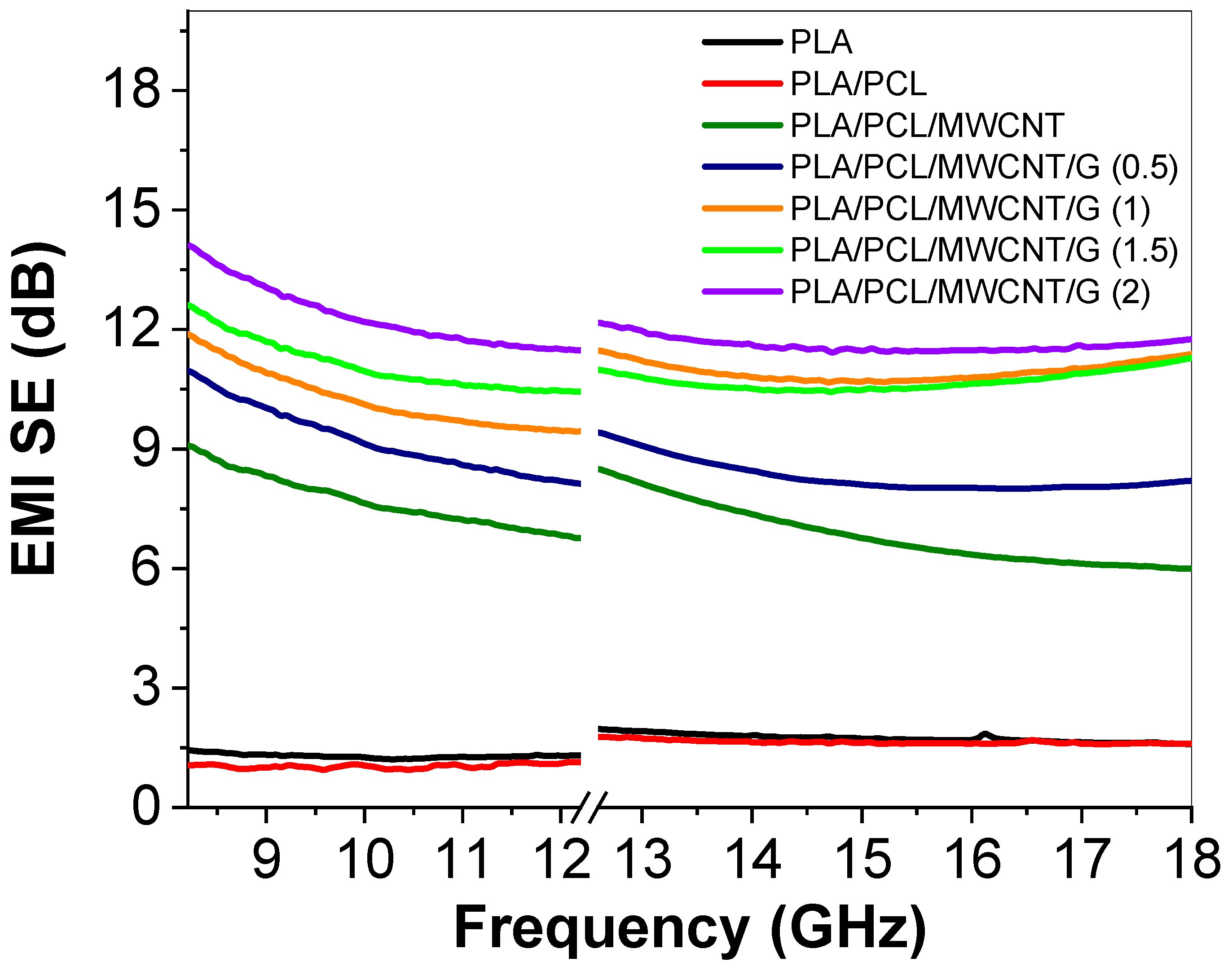
Figure 9 presents the electromagnetic interference shielding effectiveness (EMI SE) results for neat PLA, the PLA/PCL blend, and the PLA/PCL/MWCNT nanocomposites, with and without the presence of G.
Neat PLA and the PLA/PCL blend exhibited limited electromagnetic shielding performance, which is consistent with their low electrical conductivity values, characteristic of essentially insulating materials with a reduced ability to interact with electromagnetic waves. With the incorporation of MWCNT into the PLA/PCL blend, an increase in shielding effectiveness was observed, reaching values between 6–9 dB (8.2–18 GHz) compared to neat PLA and the PLA/PCL blend. This improvement can be attributed to the presence of MWCNT dispersed in the PLA/PCL system, leading to an increase in the number of dipoles and charge carriers interacting with electromagnetic radiation, thereby contributing to enhanced shielding efficiency [71]. The electromagnetic shielding results of the PLA/PCL/MWCNT/G nanocomposites in the 8.2–18 GHz range show a strong dependence on the electrical conductivity of the evaluated systems. The increase in graphene nanoplatelet content in the PLA/PCL/MWCNT system led to a progressive enhancement in shielding effectiveness, closely following the rise in electrical conductivity reported in Table 3. This behavior indicates the formation of a more efficient conductive network in the PLA/PCL/MWCNT/G nanocomposites, which favors attenuation mechanisms, particularly by increasing the density of charge carriers. As observed in the rheological analysis, the hybrid PLA/PCL/MWCNT/G systems exhibited a more pronounced formation of a dense and interconnected conductive structure. This, in turn, resulted in stronger interactions with incident electromagnetic radiation, thereby enhancing electromagnetic attenuation throughout the material. Among the evaluated compositions, the PLA/PCL/MWCNT/G nanocomposite containing 2 phr of G showed the highest electromagnetic shielding performance, with shielding effectiveness values ranging from 12 to 14 dB in both the X-band (8–12 GHz) and Ku-band (12–18 GHz), as illustrated in Figure 9. This performance is consistent with the highest electrical conductivity previously observed. The results indicate that this nanocomposite achieves an estimated attenuation efficiency of 90 to 96.9% of the incident electromagnetic radiation [72].
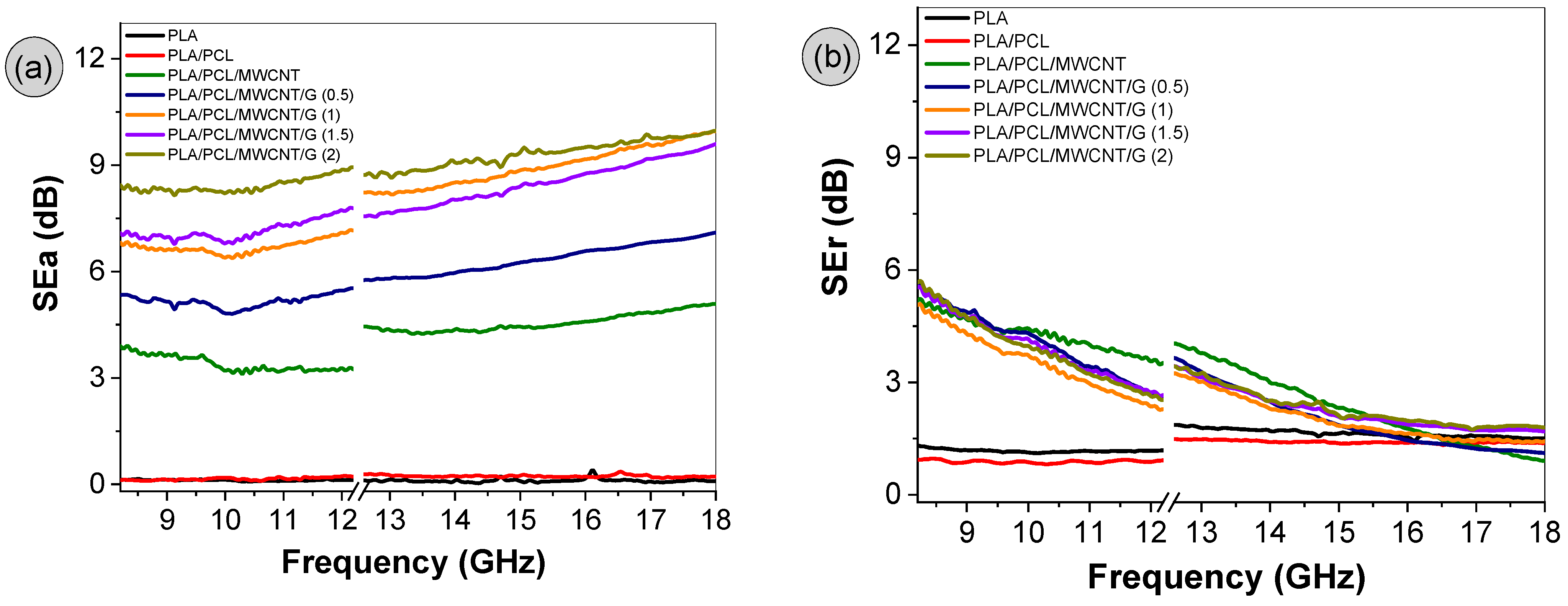
Figure 10 illustrates the contribution of absorption and reflection mechanisms to the electromagnetic shielding effectiveness of PLA, the PLA/PCL blend, and the nanocomposites with different graphene nanoplatelet contents. Neat PLA and the PLA/PCL blend exhibited typical insulating behavior, with no significant contribution from either absorption or reflection mechanisms. Regarding the PLA/PCL/MWCNT and PLA/PCL/MWCNT/G nanocomposites, both the absorption (SEa) and reflection (SEr) components increased with higher graphene nanoplatelet concentrations. Additionally, in all nanocomposite formulations, the absorption contribution was higher than that observed for reflection.
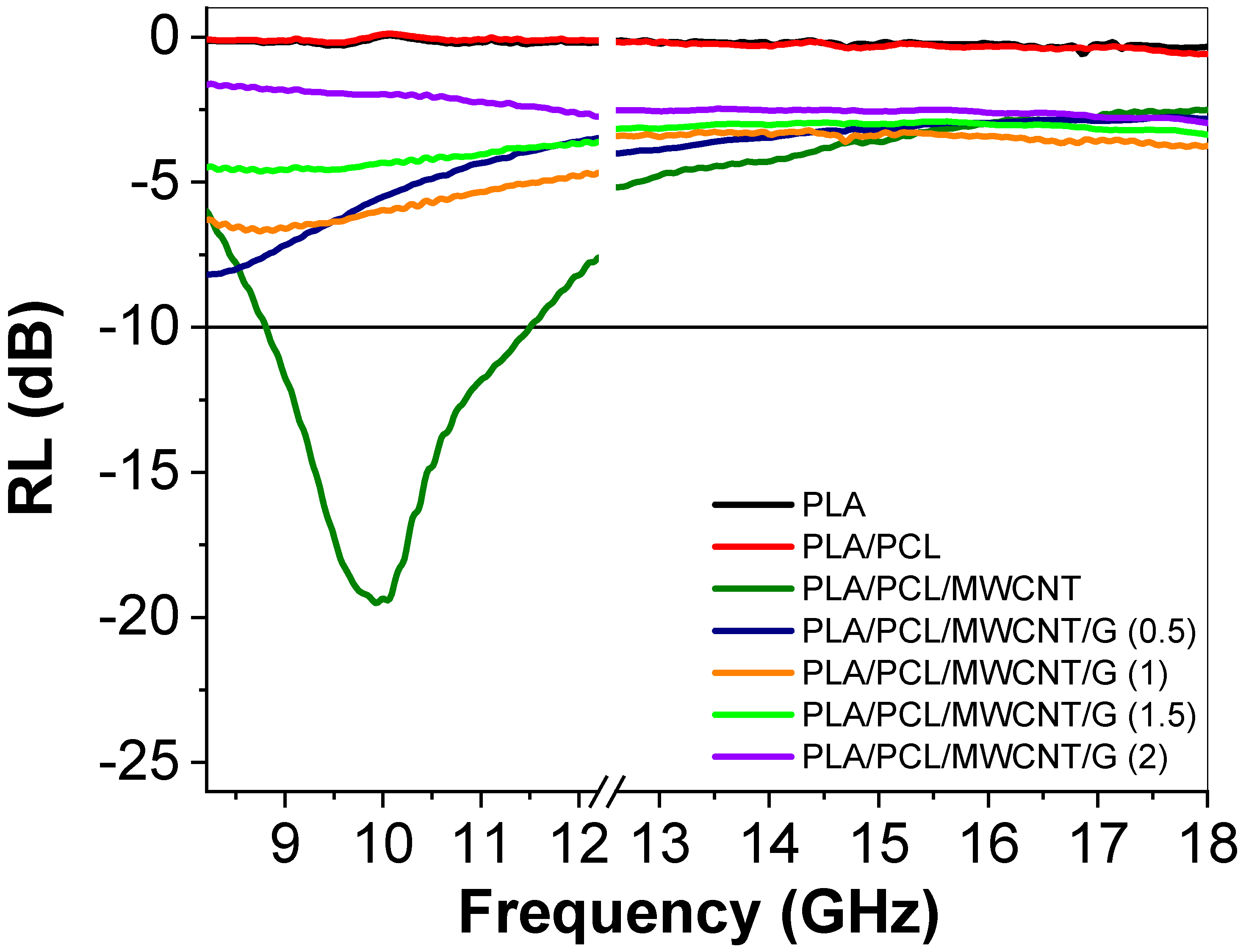
Figure 11 shows the reflection loss (RL) behavior of PLA, the polymer blend, and the PLA/PCL/MWCNT nanocomposites as a function of G concentration. For a material to be classified as an efficient absorber, it must exhibit reflection loss values below −10 dB, which corresponds to approximately 90% energy absorption [73,74]. The PLA/PCL/MWCNT nanocomposite was the only material that showed a strong reflection loss response, with a minimum RL value of −19.4 dB at 9.93 GHz, corresponding to an energy attenuation of approximately 98–99% [72]. Although the PLA/PCL/MWCNT nanocomposite exhibits lower electrical conductivity, its reflection loss performance was higher when compared to the PLA/PCL/MWCNT/G systems. This result indicates that microwave absorption efficiency does not depend solely on electrical conductivity but is also related to impedance matching and the dielectric loss mechanisms involved. The observed behavior can be explained by the influence of the material’s microstructural characteristics. The presence of multiple interfaces in the system promotes interfacial polarization and successive internal reflections, which intensify electromagnetic wave scattering and enhance energy dissipation in the nanocomposite. Thus, these factors significantly contribute to the increased absorption capacity, even in systems with lower electrical conductivity.
The increase in electrical conductivity observed in the PLA/PCL/MWCNT/G nanocomposites is associated with the formation of a more interconnected conductive network, which favors charge transport and contributes significantly to electromagnetic shielding, especially through reflection mechanisms. In this context, higher conductivity tends to increase shielding efficiency due to the greater density of free charge carriers that interact with incident electromagnetic waves. However, higher electrical conductivity did not necessarily imply better performance in the absorption of electromagnetic radiation. The reflection loss results indicate that the PLA/PCL/MWCNT nanocomposite, despite exhibiting lower conductivity compared to the hybrid nanocomposites, showed higher absorption efficiency. This behavior can be explained by impedance-matching issues. Highly conductive materials tend to exhibit a large impedance mismatch with free space, promoting greater reflection of incident waves at the surface rather than allowing their penetration into the material. On the other hand, materials with intermediate conductivity, such as PLA/PCL/MWCNT, may exhibit better impedance matching, allowing greater absorption of electromagnetic waves. Once inside the material, attenuation mechanisms such as interfacial polarization, dipolar relaxation, and multiple internal reflections become more effective, resulting in higher absorption efficiency. Thus, although the incorporation of G favors the formation of conductive networks and increases shielding effectiveness, it may also shift the dominant mechanism toward reflection at the expense of absorption. These results demonstrate that the optimization of absorption does not depend solely on increasing electrical conductivity but on the balance between conductivity, impedance matching, and dielectric loss mechanisms.

4. Conclusions

Hybrid nanocomposites based on PLA/PCL reinforced with MWCNT and G were produced via twin-screw extrusion and injection molding. The incorporation of MWCNT significantly improved impact strength, indicating enhanced energy dissipation and resulting in tougher materials at room temperature. Although G did not further increase impact resistance compared to the PLA/PCL/MWCNT system, all nanocomposites outperformed neat PLA and the PLA/PCL blend. The preferential localization of nanofillers in the PCL phase limited reinforcement of the PLA matrix, causing reductions in elastic modulus and tensile strength. Thermomechanical performance, assessed by HDT, remained stable across all formulations, with no significant variations. Rheological analysis at low deformation rates revealed the formation of a dense, interconnected nanofiller network within the PLA/PCL matrix, supporting improved electrical properties. The combined use of MWCNT and G proved effective in converting an insulating system into a multifunctional material with electrical conductivity, electromagnetic response, and enhanced toughness. MWCNT played a key role in forming percolated conductive networks, while G contributed synergistically by improving interconnectivity and charge transport efficiency. Additionally, nanofillers accelerated crystallization in the composites, reducing injection molding cycle time and supporting the feasibility of large-scale industrial processing.
The results of the hybrid PLA/PCL/MWCNT/G nanocomposites advance the understanding and development of multifunctional sustainable materials, especially for applications requiring electrostatic charge dissipation, combining technological performance with reduced environmental impact. Future work should focus on improving the dispersion and interfacial adhesion of G to minimize stress concentration effects and enhance mechanical performance. In addition, surface functionalization strategies, such as plasma treatments, and long-term durability assessments are recommended to further advance performance protocols for multifunctional polymer nanocomposites.

Supplementary Materials

The following supporting information can be downloaded at: https://www.mdpi.com/article/10.3390/cleantechnol8030086/s1, Figure S1: SEM morphology of fracture surfaces after impact testing at 100,000× magnification, for: (a) PLA/PCL; (b) PLA/PCL/MWCNT; (c) PLA/PCL/MWCNT/G (0.5); (d) PLA/PCL/MWCNT/G (1.0); (e) PLA/PCL/MWCNT/G (1.5); (f) PLA/PCL/MWCNT/G (2.0).

Author Contributions

Conceptualization, C.B.B.L., E.d.M.A. and D.P.S.; Methodology, C.B.B.L., E.d.M.A., E.B.B., P.H.M.N. and D.P.S.; Validation, C.B.B.L., D.P.S., R.M.R.W. and B.G.S.; Formal analysis, C.B.B.L., E.d.M.A., E.B.B., P.H.M.N., B.G.S. and D.P.S.; Investigation, C.B.B.L., E.d.M.A., E.B.B., P.H.M.N., B.G.S. and D.P.S.; Resources, E.M.A.; Data curation, C.B.B.L., R.M.R.W. and E.M.A.; Writing—original draft, C.B.B.L., E.d.M.A. and D.P.S.; Writing—review and editing, C.B.B.L., E.d.M.A., E.B.B., P.H.M.N., B.G.S., D.P.S., R.M.R.W. and E.M.A.; Visualization, C.B.B.L., R.M.R.W. and E.M.A.; Supervision, E.M.A.; Project administration, E.M.A.; Funding acquisition, E.M.A. All authors have read and agreed to the published version of the manuscript.

Funding

The authors acknowledge the National Council for Scientific and Technological Development (CNPq) for the research fellowships granted to Carlos Bruno (Process No. 350025/2023-1) and PDJ (Process No. 152382/2025-9), as well as to Renate Wellen (Process No. 303426/2021-7) and Edcleide Araújo (Process Nos. 312014/2020 and 408779/2022-5).

Data Availability Statement

The original contributions presented in this study are included in the article/Supplementary Material. Further inquiries can be directed to the corresponding author.

Acknowledgments

The authors acknowledge the Federal University of Campina Grande (UFCG) for providing infrastructure support and laboratory conditions that enabled the development of this work. The financial support granted by the National Council for Scientific and Technological Development (CNPq) to the Nanotechnology and New Materials program is also gratefully acknowledged. The Foundation for Research Support of the State of Paraíba (FAPESQ) is thanked for funding the acquisition of mechanical tensile testing and Fourier Transform Infrared Spectroscopy (FTIR) equipment. The authors also express their appreciation to the Federal University of Rio de Janeiro (UFRJ), especially Bluma Soares, for the electromagnetic shielding analyses, whose contribution was essential for obtaining and interpreting the results.

Conflicts of Interest

The authors declare no conflicts of interest.

References

  1. Rosli, N.A.; Chen, R.S.; Dufresne, A.; Ahmad, I.; Ahmad, S.; Shahdan, D.; Shamene, B. Biobased rubber toughened poly(lactic acid) blend for sustainable packaging films: The role of optical purity of poly(lactic acid). J. Appl. Polym. Sci. 2024, 141, e56113. [Google Scholar] [CrossRef]
  2. Akhir, M.A.M.; Ramakrishnan, S.; Mariatti, M. Anti-Hydrolysis, UV Absorber, and Photostabilizer Additives Effect on Degradation of Poly(Butylene Adipate-co-Terephthalate) Biocomposite Film for Mulching Application. Polym. Adv. Technol. 2025, 36, e70266. [Google Scholar] [CrossRef]
  3. Yang, Q.; Ding, Y.; Liu, H.; Li, S.; Wang, X. Preparation of PBAT/PLA Blend Microporous Foam with Excellent Resilience and Cushioning Properties by scCO2 Technology Through Improving Compatibility. J. Appl. Polym. Sci. 2024, 142, e56542. [Google Scholar] [CrossRef]
  4. Li, L.; Li, T.; Zhao, D.; Xie, Y.; Feng, D.; Wu, F.; Xie, D.; Wang, C.; Liu, Y.; Mei, Y. Toughness enhancement of polylactide with low amounts of poly (butylene adipate-co-terephthalate) through in situ reactive compatibilization. J. Appl. Polym. Sci. 2024, 141, e55310. [Google Scholar] [CrossRef]
  5. Andrade, L.S.A.; da Silva, E.O. Effect of Nanoparticles as Reinforcements and Compatibilizers of Poly(Lactide)/Poly(Butylene Adipate-Co-Terephthalate) Blends for Application in Food Packaging. Polym. Adv. Technol. 2025, 36, e70298. [Google Scholar] [CrossRef]
  6. Aydemir, D.; Gumus, H.; Altuntas, E.; Yalçın, Ö.Ü.; Özan, Z.E. Biopolymer nanocomposite blends of poly(lactic acid) and polyhydroxybutyrate biopolymers reinforced with cellulose nanofibrils at low loading ratio. Polym. Adv. Technol. 2024, 35, e6520. [Google Scholar] [CrossRef]
  7. Dehghani, S.; Salehiyan, R.; Pholharn, D.; Worajittiphon, P.; Srithep, Y. Enhancing Polylactic Acid Properties by Blending with Recycled Polycarbonate: The Effect of a Bio-Based Compatibilizer on Properties. J. Appl. Polym. Sci. 2025, 142, e57197. [Google Scholar] [CrossRef]
  8. Ismail, I.; Azis, R.S. A review of magnetic nanocomposites for EMI shielding: Synthesis, properties, and mechanisms. J. Mater. Sci. 2024, 59, 5293–5329. [Google Scholar] [CrossRef]
  9. Qureshi, N.; Dhand, V.; Subhani, S.; Kumar, R.S.; Raghavan, N.; Kim, S.; Doh, J. Exploring Conductive Filler-Embedded Polymer Nanocomposite for Electrical Percolation via Electromagnetic Shielding-Based Additive Manufacturing. Adv. Mater. Technol. 2024, 9, 2400250. [Google Scholar] [CrossRef]
  10. Silva, R.B.; Ferreira, E.d.S.B.; Filho, E.A.d.S.; Bezerra, E.B.; Siqueira, D.D.; Wellen, R.M.R.; Araújo, E.M.; Luna, C.B.B. Flexible and Sustainable PLA/PBAT-g-GMA Nanocomposites Based on Carbon Nanotubes with Potential for Electrostatic Control. Polym. Adv. Technol. 2025, 36, e70369. [Google Scholar] [CrossRef]
  11. Maity, A. Advances in polymer-based nanocomposites in electromagnetic shielding: Principles, theoretical foundation and mechanism. Results Chem. 2025, 18, 102877. [Google Scholar] [CrossRef]
  12. Huang, W.; Zhang, G.; Zhou, Y.; Joziasse, C.A.P.; Wang, R.; du Sart, G.G.; Chen, P. Superior heat-resistant polylactide/poly(butylene succinate) blend fibers via in-situ reactive compatibilization. Polym. Adv. Technol. 2024, 35, e6345. [Google Scholar] [CrossRef]
  13. Zheng, G.; Han, L.; Zheng, B.; Bian, J.; Zhang, H. Biodegradable poly(lactic acid)/poly(propylene carbonate) blend with enhanced mechanical properties and heat resistance by uniaxial pre-stretching. Polym. Adv. Technol. 2024, 35, e6395. [Google Scholar] [CrossRef]
  14. Haghgoo, G.; Dadashi, P.; Babaei, A. Effects of Cellulose Nanocrystals Localization on Compatibility Between Polylactic Acid and Polycaprolactone: Correlating the Microstructure and Mechanical Performance. Polym. Adv. Technol. 2025, 36, e70113. [Google Scholar] [CrossRef]
  15. Liu, B.; Gu, X.; Chen, X.; Yang, Y.; Zou, J.; Yin, H.; Cai, Y. Preparation, shape memory properties and application research of PLA/PCL-based shape memory polymers doped with Al2O3 and lignin. J. Appl. Polym. Sci. 2024, 141, e55252. [Google Scholar] [CrossRef]
  16. Murtaza, A.; Rehman, T.-U.; Aslfattahi, N.; Kim, G.M.; Park, C.W. Toward Nanostructured Conducting Polymers: Synthesis, Synergies, Applications, and Sustainability. Int. J. Polym. Sci. 2026, 2026, 3231099. [Google Scholar] [CrossRef]
  17. Li, H.; Li, R.; Zhang, X.; Xing, Q. Sustainable polylactide/polycaprolactone based polyurethane blends fabricated via reactive compatibilization. Polym. Adv. Technol. 2024, 35, e6282. [Google Scholar] [CrossRef]
  18. Eryildiz, M.; Karakus, A.; Demirci, M.; Kadirhan, O.A.; Altan, M.E. Optimization of Thermal, Mechanical, Biodegradation, and Shape Memory Properties in 4D-Printed PLA/PCL Blends for Spinal Cages. Polym. Adv. Technol. 2025, 36, e70133. [Google Scholar] [CrossRef]
  19. Al-Saleh, M.H.; Al-Shboul, T.S. Carbon nanotubes-filled polylactic acid/polycaprolactone biodegradable blends: Effect of the polycaprolactone viscosity and carbon nanotubes addition on the microstructure, electrical and mechanical properties. J. Thermoplast. Compos. Mater. 2022, 36, 3485–3498. [Google Scholar] [CrossRef]
  20. Xu, P.; Huang, B.; Tang, R.; Wang, Z.; Tu, J.; Ding, Y. Improved mechanical and EMI shielding properties of PLA/PCL composites by controlling distribution of PIL-modified CNTs. Adv. Compos. Hybrid Mater. 2022, 5, 991–1002. [Google Scholar] [CrossRef]
  21. Huang, B.; Wang, Z.; Tu, J.; Liu, C.; Xu, P.; Ding, Y. Interfacial distribution and compatibilization of imidazolium functionalized CNTs in poly(lactic acid)/polycaprolactone composites with excellent EMI shielding and mechanical properties. Int. J. Biol. Macromol. 2022, 227, 1182–1190. [Google Scholar] [CrossRef]
  22. El-Taweel, S.H.; Fathy, R. Synergistic Effects of Multi-Wall Carbon Nanotubes and Polycaprolactone on the Thermal and Mechanical Properties of Polylactic Acid. J. Macromol. Sci. Part B 2022, 61, 719–740. [Google Scholar] [CrossRef]
  23. Urquijo, J.; Dagréou, S.; Guerrica-Echevarría, G.; Eguiazábal, J.I. Morphology and properties of electrically and rheologically percolated PLA/PCL/CNT nanocomposites. J. Appl. Polym. Sci. 2017, 134, 45265. [Google Scholar] [CrossRef]
  24. Liu, T.; Feng, H.; Zeng, W.; Jin, C.; Kuang, T. Facile Fabrication of Absorption-Dominated Biodegradable Poly(lactic acid)/Polycaprolactone/Multi-Walled Carbon Nanotube Foams towards Electromagnetic Interference Shielding. J. Compos. Sci. 2023, 7, 395. [Google Scholar] [CrossRef]
  25. Tajdari, A.; Babaei, A.; Goudarzi, A.; Partovi, R.; Rostami, A. Hybridization as an efficient strategy for enhancing the performance of polymer nanocomposites. Polym. Compos. 2021, 42, 6801–6815. [Google Scholar] [CrossRef]
  26. Kumar, A.; Sharma, K.; Dixit, A.R. A review of the mechanical and thermal properties of graphene and its hybrid polymer nanocomposites for structural applications. J. Mater. Sci. 2018, 54, 5992–6026. [Google Scholar] [CrossRef]
  27. Botlhoko, O.J.; Makwakwa, D.; Muniyasamy, S. Design of 3D printable boehmite alumina/thermally exfoliated reduced graphene oxide-based polymeric nanocomposites with high dielectric constant, mechanical and thermomechanical performance. Nano-Struct. Nano-Objects 2024, 39, 101228. [Google Scholar] [CrossRef]
  28. Liu, Y.; He, H.; Tian, G.; Wang, Y.; Gao, J.; Wang, C.; Xu, L.; Zhang, H. Morphology evolution to form double percolation polylactide/polycaprolactone/MWCNTs nanocomposites with ultralow percolation threshold and excellent EMI shielding. Compos. Sci. Technol. 2021, 214, 108956. [Google Scholar] [CrossRef]
  29. Bouakaz, B.S.; Habi, A.; Grohens, Y.; Pillin, I. Organomontmorillonite/graphene-PLA/PCL nanofilled blends: New strategy to enhance the functional properties of PLA/PCL blend. Appl. Clay Sci. 2017, 139, 81–91. [Google Scholar] [CrossRef]
  30. ASTM D1238-23; Standard Test Method for Melt Flow Rates of Thermoplastics by Extrusion Plastometer. ASTM International: West Conshohocken, PA, USA, 2023.
  31. ASTM D792-20; Standard Test Methods for Density and Specific Gravity (Relative Density) of Plastics by Displacement. ASTM International: West Conshohocken, PA, USA, 2020.
  32. ASTM D5225-22; Standard Test Method for Measuring Solution Viscosity of Polymers with a Differential Viscometer. ASTM International: West Conshohocken, PA, USA, 2022.
  33. da Silva, F.U.; Luna, C.B.B.; da Silva, F.S.; Barreto, J.V.M.; Schmitz, D.P.; Soares, B.G.; Wellen, R.M.R.; Araújo, E.M. Exploring the Effect of Annealing on PLA/Carbon Nanotube Nanocomposites: In Search of Efficient PLA/MWCNT Nanocomposites for Electromagnetic Shielding. Polymers 2025, 17, 246. [Google Scholar] [CrossRef]
  34. ASTM D638-22; Standard Test Method for Tensile Properties of Plastics. ASTM International: West Conshohocken, PA, USA, 2022.
  35. ASTM D256-24; Standard Test Methods for Determining the Izod Pendulum Impact Resistance of Plastics. ASTM International: West Conshohocken, PA, USA, 2024.
  36. ASTM D648-18; Standard Test Method for Deflection Temperature of Plastics Under Flexural Load in the Edgewise Position. ASTM International: West Conshohocken, PA, USA, 2018.
  37. Zhao, H.; Cui, Z.; Sun, X.; Turng, L.-S.; Peng, X. Morphology and Properties of Injection Molded Solid and Microcellular Polylactic Acid/Polyhydroxybutyrate-Valerate (PLA/PHBV) Blends. Ind. Eng. Chem. Res. 2013, 52, 2569–2581. [Google Scholar] [CrossRef]
  38. Mondragón-Herrera, L.I.; Vargas-Coronado, R.F.; Carrillo-Escalante, H.; Cauich-Rodríguez, J.V.; Hernández-Sánchez, F.; Velasco-Santos, C.; Avilés, F. Mechanical, Thermal, and Physicochemical Properties of Filaments of Poly (Lactic Acid), Polyhydroxyalkanoates and Their Blend for Additive Manufacturing. Polymers 2024, 16, 1062. [Google Scholar] [CrossRef]
  39. Senila, L.; Cadar, O.; Kovacs, E.; Gal, E.; Dan, M.; Stupar, Z.; Simedru, D.; Senila, M.; Roman, C. L-Poly(lactic acid) Production by Microwave Irradiation of Lactic Acid Obtained from Lignocellulosic Wastes. Int. J. Mol. Sci. 2023, 24, 9817. [Google Scholar] [CrossRef]
  40. Terzopoulou, Z.; Xanthopoulou, E.; Pardalis, N.; Pappa, C.P.; Torofias, S.; Triantafyllidis, K.S.; Bikiaris, D.N. Synthesis and Characterization of Poly(lactic acid) Composites with Organosolv Lignin. Molecules 2022, 27, 8143. [Google Scholar] [CrossRef]
  41. Lima, J.C.C.; Araújo, J.P.; Agrawal, P.; Mélo, T.J.A. Efeito do teor do copolímero SEBS no comportamento reológico da blenda PLA/SEBS. Rev. Eletrônica Mater. E Process. 2016, 11, 10–17. [Google Scholar]
  42. Masarra, N.-A.; Quantin, J.-C.; Batistella, M.; El Hage, R.; Pucci, M.F.; Lopez-Cuesta, J.-M. Influence of Polymer Processing on the Double Electrical Percolation Threshold in PLA/PCL/GNP Nanocomposites. Sensors 2022, 22, 9231. [Google Scholar] [CrossRef]
  43. Kotsilkova, R.; Tabakova, S. Exploring Effects of Graphene and Carbon Nanotubes on Rheology and Flow Instability for Designing Printable Polymer Nanocomposites. Nanomaterials 2023, 13, 835. [Google Scholar] [CrossRef] [PubMed]
  44. Kotsilkova, R.; Tabakova, S.; Ivanova, R. Effect of graphene nanoplatelets and multiwalled carbon nanotubes on the viscous and viscoelastic properties and printability of polylactide nanocomposites. Mech. Time-Dependent Mater. 2021, 26, 611–632. [Google Scholar] [CrossRef]
  45. Hadaeghnia, M.; Ahmadi, S.; Ghasemi, I.; Wood-Adams, P.M. Manipulating the morphology of PA6/POE blends using graphene to achieve balanced electrical and mechanical properties. Compos. Sci. Technol. 2020, 200, 108412. [Google Scholar] [CrossRef]
  46. Wang, X.-F.; Zhang, Z.-X.; Li, J.-L.; Yang, J.-H.; Wang, Y.; Zhang, J.-H. Largely improved fracture toughness of an immiscible poly(l-lactide)/ethylene-co-vinyl acetate blend achieved by adding carbon nanotubes. RSC Adv. 2015, 5, 69522–69533. [Google Scholar] [CrossRef]
  47. Yue, L.; Pircheraghi, G.; Monemian, S.A.; Manas-Zloczower, I. Epoxy composites with carbon nanotubes and graphene nanoplatelets—Dispersion and synergy effects. Carbon 2014, 78, 268–278. [Google Scholar] [CrossRef]
  48. Nofar, M.; Salehiyan, R.; Barletta, M. Tuning the Structure–Property Relationships in Binary and Ternary Blends of PLA/PBAT/PHBH. Polymers 2024, 16, 1699. [Google Scholar] [CrossRef] [PubMed]
  49. Ding, Z.; Tang, Z.; An, X.; Guo, B. Mechanical and rheological properties of poly(lactic acid) toughened by bio-based thermoplastic polyamide elastomer. Polym. Eng. Sci. 2025, 65, 3662–3672. [Google Scholar] [CrossRef]
  50. Ostafinska, A.; Fortelny, I.; Nevoralova, M.; Hodan, J.; Kredatusova, J.; Slouf, M. Synergistic effects in mechanical properties of PLA/PCL blends with optimized composition, processing, and morphology. RSC Adv. 2015, 5, 98971–98982. [Google Scholar] [CrossRef]
  51. Wu, D.; Zhang, Y.; Zhang, M.; Yu, W. Selective Localization of Multiwalled Carbon Nanotubes in Poly(ε-caprolactone)/Polylactide Blend. Biomacromolecules 2009, 10, 417–424. [Google Scholar] [CrossRef] [PubMed]
  52. Tao, F.; Auhl, D.; Baudouin, A.; Stadler, F.J.; Bailly, C. Influence of Multiwall Carbon Nanotubes Trapped at the Interface of an Immiscible Polymer Blend on Interfacial Tension. Macromol. Chem. Phys. 2013, 214, 350–360. [Google Scholar] [CrossRef]
  53. Alves, A.M.; Cavalcanti, S.N.; Arimatéia, R.R.; Agrawal, P.; Freitas, N.L.; Mélo, T.J.A. Influência do Proces-samento e da Alumina Sintetizada em Laboratório nas Propriedades do Polipropileno. Rev. Eletrônica Mater. Process. 2016, 11, 155–163. [Google Scholar]
  54. Silva, D.F.; Luna, C.B.B.; Silva, G.; Araújo, E.M.; Mélo, T.J.A. Avaliação das propriedades mecânicas de blendas de poliestireno/composto de borracha reciclada (SBRr). Rev. Eletrônica Mater. Process. 2014, 9, 92–97. [Google Scholar]
  55. George, J.; Jung, D.; Bhattacharyya, D. Improvement of Electrical and Mechanical Properties of PLA/PBAT Composites Using Coconut Shell Biochar for Antistatic Applications. Appl. Sci. 2023, 13, 902. [Google Scholar] [CrossRef]
  56. Matumba, K.I.; Motloung, M.P.; Ojijo, V.; Ray, S.S.; Sadiku, E.R. Investigation of the Effects of Chain Extender on Material Properties of PLA/PCL and PLA/PEG Blends: Comparative Study between Polycaprolactone and Polyethylene Glycol. Polymers 2023, 15, 2230. [Google Scholar] [CrossRef]
  57. Xiao, Z.; Li, G.; Liu, C.; Li, H.; Lin, J. The carbon nanotubes effects on the morphology and properties of poly(lactic) acid/poly(butylene adipate-co-terephthalate) blends. Polym. Compos. 2022, 43, 8725–8736. [Google Scholar] [CrossRef]
  58. Urquijo, J.; Aranburu, N.; Dagréou, S.; Guerrica-Echevarría, G.; Eguiazábal, J. CNT-induced morphology and its effect on properties in PLA/PBAT-based nanocomposites. Eur. Polym. J. 2017, 93, 545–555. [Google Scholar] [CrossRef]
  59. Behera, K.; Tsai, C.-H.; Liao, X.-B.; Chiu, F.-C. Fabrication and Characterization of PLA/PBAT Blends, Blend-Based Nanocomposites, and Their Supercritical Carbon Dioxide-Induced Foams. Polymers 2024, 16, 1971. [Google Scholar] [CrossRef] [PubMed]
  60. Tao, J.-R.; Yang, D.; Yang, Y.; He, Q.-M.; Fei, B.; Wang, M. Migration mechanism of carbon nanotubes and matching viscosity-dependent morphology in Co-continuous Poly(lactic acid)/Poly(ε-caprolactone) blend: Towards electromagnetic shielding enhancement. Polymer 2022, 252, 124963. [Google Scholar] [CrossRef]
  61. Xu, Z.; Zhang, Y.; Wang, Z.; Sun, N.; Li, H. Enhancement of Electrical Conductivity by Changing phase Morphology for Composites Consisting of Polylactide and Poly(ε-caprolactone) Filled with Acid-Oxidized Multiwalled Carbon Nanotubes. ACS Appl. Mater. Interfaces 2011, 3, 4858–4864. [Google Scholar] [CrossRef] [PubMed]
  62. Wertz, J.T.; Mauldin, T.C.; Boday, D.J. Polylactic Acid with Improved Heat Deflection Temperatures and Self-Healing Properties for Durable Goods Applications. ACS Appl. Mater. Interfaces 2014, 6, 18511–18516. [Google Scholar] [CrossRef]
  63. Erceg, T.; Rackov, S.; Terek, P.; Pilić, B. Preparation and Characterization of PHBV/PCL-Diol Blend Films. Polymers 2023, 15, 4694. [Google Scholar] [CrossRef]
  64. Ivanov, E.; Kotsilkova, R.; Georgiev, V.; Batakliev, T.; Angelov, V. Advanced Rheological, Dynamic Mechanical and Thermal Characterization of Phase-Separation Behavior of PLA/PCL Blends. J. Manuf. Mater. Process. 2025, 9, 35. [Google Scholar] [CrossRef]
  65. Yang, H.; Du, J. Crystallinity, Rheology, and Mechanical Properties of Low-/High-Molecular-Weight PLA Blended Systems. Molecules 2023, 29, 169. [Google Scholar] [CrossRef]
  66. Pregi, E.; Romsics, I.; Várdai, R.; Pukánszky, B. Interactions, Structure and Properties of PLA/lignin/PBAT Hybrid Blends. Polymers 2023, 15, 3237. [Google Scholar] [CrossRef]
  67. Benkraled, L.; Zennaki, A.; Zair, L.; Arabeche, K.; Berrayah, A.; Barrera, A.; Bouberka, Z.; Maschke, U. Effect of Plasticization/Annealing on Thermal, Dynamic Mechanical, and Rheological Properties of Poly(Lactic Acid). Polymers 2024, 16, 974. [Google Scholar] [CrossRef]
  68. Kang, H.; Kim, D.S. A study on the crystallization and melting of PLA nanocomposites with cellulose nanocrystals by DSC. Polym. Compos. 2023, 44, 7727–7736. [Google Scholar] [CrossRef]
  69. Ferreira, S.T.; Menezes, F.; Montagnal, L.S.; Lemes, A.P.; Passador, F.R. Synergistic effect of adding lignin and carbon black in poly (lactic acid). Polímeros Ciência Tecnol. 2020, 30, e2020002. [Google Scholar] [CrossRef]
  70. Pascual, A.M.D.; Naffakh, M.; Marco, C.; Ellis, G. Mechanical and electrical properties of carbon nano-tube/poly(phenylene sulphide) composites incorporating polyetherimide and inorganic fullerene-like nanoparticles. Compos. Part A Appl. Sci. Manuf. 2012, 43, 603–612. [Google Scholar] [CrossRef]
  71. Soares, B.G.; Cordeiro, E.; Maia, J.; Pereira, E.C.L.; Silva, A.A. The effect of the noncovalent functionalization of CNT by ionic liquid on electrical conductivity and electromagnetic interference shielding effectiveness of semi-biodegradable polypropylene/poly(lactic acid) composites. Polym. Compos. 2019, 41, 82–93. [Google Scholar] [CrossRef]
  72. Faez, R.; Rezende, M.C.; Martin, I.M.; De Paoli, M.-A. Polímeros condutores intrínsecos e seu potencial em blindagem de radiações eletromagnéticas. Polim. E Tecnol. 2000, 10, 130–137. [Google Scholar] [CrossRef][Green Version]
  73. Henriques, R.R.; Schettini, A.; Soares, B.G. Enhanced Dielectric and Microwave-Absorbing Properties of Poly(Lactic Acid) Composites via Ionic Liquid-Assisted Dispersion of GNP/CNT Hybrid Fillers. J. Compos. Sci. 2026, 10, 50. [Google Scholar] [CrossRef]
  74. Carelo, J.C.; Soares, B.G.; Schmitz, D.P.; Henriques, R.R.; Silva, A.A.; Barra, G.M.O.; Barthem, V.M.T.S.; Livi, S. Magnetic Ionic Liquid: A Multifunctional Platform for the Design of Hybrid Graphene/Carbon Nanotube Networks as Electromagnetic Wave-Absorbing Materials. Molecules 2025, 30, 985. [Google Scholar] [CrossRef]
Figure 1. FTIR spectra of neat PLA, the PLA/PCL blend, and the nanocomposites with the incorporation of MWCNT and G.
Cleantechnol 08 00086 g001
Figure 2. Evolution of oscillatory rheological behavior for neat PLA, the PLA/PCL blend, and the nanocomposites: (a) Complex viscosity; (b) Storage modulus; (c) Loss modulus (G″). The slope of the curves was determined using Origin (2018 version) software.
Cleantechnol 08 00086 g002
Figure 3. Viscosity behavior under rotational regime at low shear rates for PLA, the PLA/PCL blend, and the nanocomposites with different graphene nanoplatelet contents.
Cleantechnol 08 00086 g003
Figure 4. SEM morphology of fracture surfaces after impact testing for: (a) PLA; (b) PLA/PCL; (c) PLA/PCL/MWCNT; (d) PLA/PCL/MWCNT/G (0.5); (e) PLA/PCL/MWCNT/G (1.0); (f) PLA/PCL/MWCNT/G (1.5); (g) PLA/PCL/MWCNT/G (2.0).
Cleantechnol 08 00086 g004aCleantechnol 08 00086 g004b
Figure 5. Impact strength behavior of neat PLA, the PLA/PCL blend, and the PLA/PCL/MWCNT nanocomposites, with and without G.
Cleantechnol 08 00086 g005
Figure 6. Tensile mechanical behavior of neat PLA, the PLA/PCL blend, and the nanocomposites: (a) elastic modulus; (b) tensile strength; (c) elongation at break.
Cleantechnol 08 00086 g006
Figure 7. Thermomechanical stability (HDT) of neat PLA, the PLA/PCL blend, and the nanocomposites, with different graphene nanoplatelet contents.
Cleantechnol 08 00086 g007
Figure 8. DSC curves for the second heating and cooling cycles of neat PLA, the PLA/PCL blend, and the nanocomposites: (a) crystalline melting temperature; (b) crystallization temperature.
Cleantechnol 08 00086 g008
Figure 9. Evolution of electromagnetic shielding performance for neat PLA, the PLA/PCL blend, and the nanocomposites, with different graphene nanoplatelet concentrations.
Cleantechnol 08 00086 g009
Figure 10. Electromagnetic attenuation mechanisms for neat PLA, the PLA/PCL blend, and the nanocomposites: (a) Absorption; (b) Reflection.
Cleantechnol 08 00086 g010
Figure 11. Reflection loss behavior of PLA, the PLA/PCL blend, and the nanocomposites with varying graphene nanoplatelet contents.
Cleantechnol 08 00086 g011
Table 1. Prepared compositions of the samples.
SamplesPLA (% wt.)PCL (% wt.)MWCNT (phr)G (phr)
PLA100---
PLA/PCL7030--
PLA/PCL/MWCNT70304-
PLA/PCL/MWCNT/G703040.5
PLA/PCL/MWCNT/G703041.0
PLA/PCL/MWCNT/G703041.5
PLA/PCL/MWCNT/G703042.0
Table 2. Thermal properties obtained by DSC for PLA, the PLA/PCL blend, and the nanocomposites. The reported results refer to the PLA matrix.
SamplesTc (°C)Tm1 (°C)Tm2 (°C)Xc (%)
PLA 193.4-173.935.8
PLA/PCL 295.8-173.432.9
PLA/PCL/MWCNT 3102.8-173.853.7
PLA/PCL/MWCNT/G (0.5) 4105.4-174.146.8
PLA/PCL/MWCNT/G (1) 5104.3-174.147.1
PLA/PCL/MWCNT/G (1.5) 6108.9170.2175.144.1
PLA/PCL/MWCNT/G (2) 7108.7170.1174.943.5
The mass fraction (w) used in Equation (1) to determine the degree of crystallinity was: (1) w = 1; (2) w = 0.7; (3) w = 0.673; (4) w = 0.670; (5) w = 0.667; (6) w = 0.664; (7) w = 0.660.
Table 3. Response in electrical conductivity of PLA, PLA/PCL blend, and nanocomposites.
Samplesσ (S/cm)
PLA3.35 × 10−10
PLA/PCL3.49 × 10−10
PLA/PCL/MWCNT2.95 × 10−6
PLA/PCL/MWCNT/G (0.5)6.10 × 10⁻⁶
PLA/PCL/MWCNT/G (1)4.35 × 10⁻⁵
PLA/PCL/MWCNT/G (1.5)5.66 × 10⁻⁵
PLA/PCL/MWCNT/G (2)6.79 × 10⁻⁵
Disclaimer/Publisher’s Note: The statements, opinions and data contained in all publications are solely those of the individual author(s) and contributor(s) and not of MDPI and/or the editor(s). MDPI and/or the editor(s) disclaim responsibility for any injury to people or property resulting from any ideas, methods, instructions or products referred to in the content.